98
15
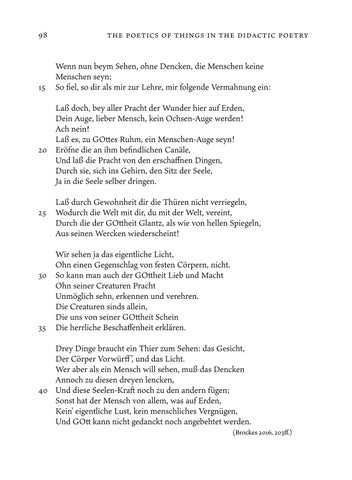
the poetics of things in the didactic poetry Wenn nun beym Sehen, ohne Dencken, die Menschen keine Menschen seyn; So fiel, so dir als mir zur Lehre, mir folgende Vermahnung ein:
Laß doch, bey aller Pracht der Wunder hier auf Erden, Dein Auge, lieber Mensch, kein Ochsen-Auge werden! Ach nein! Laß es, zu GOttes Ruhm, ein Menschen-Auge seyn! 20 Eröfne die an ihm befindlichen Canäle, Und laß die Pracht von den erschaffnen Dingen, Durch sie, sich ins Gehirn, den Sitz der Seele, Ja in die Seele selber dringen. 25
30
35
Laß durch Gewohnheit dir die Thüren nicht verriegeln, Wodurch die Welt mit dir, du mit der Welt, vereint, Durch die der GOttheit Glantz, als wie von hellen Spiegeln, Aus seinen Wercken wiederscheint! Wir sehen ja das eigentliche Licht, Ohn einen Gegenschlag von festen Cörpern, nicht. So kann man auch der GOttheit Lieb und Macht Ohn seiner Creaturen Pracht Unmöglich sehn, erkennen und verehren. Die Creaturen sinds allein, Die uns von seiner GOttheit Schein Die herrliche Beschaffenheit erklären.
Drey Dinge braucht ein Thier zum Sehen: das Gesicht, Der Cörper Vorwürff ’, und das Licht. Wer aber als ein Mensch will sehen, muß das Dencken Annoch zu diesen dreyen lencken, 40 Und diese Seelen-Kraft noch zu den andern fügen; Sonst hat der Mensch von allem, was auf Erden, Kein’ eigentliche Lust, kein menschliches Vergnügen, Und GOtt kann nicht gedanckt noch angebehtet werden. (Brockes 2016, 203ff.)
Ukázka elektronické knihy, UID: KOS516253
the poetics of things in the didactic poetry
99
Glass Orb On an orb made of glass and artfully gilded overall, I saw ascribed the surroundings, admirably rendered small, With gaze transfixed on it, incredulous, how clear, how pure How nice and dainty all the small-scale-formed bodies were! 5
10
15
As I observed it, quite awestruck, I had good reason to not deny That this smooth and round orb bore likeness to the eye. The only difference being that, while of corporeal things The images on the orb are only shapes, and as such do backward spring; Whereas, when in the eye, indeed quite through it they proceed And touch the back wall, via a nerve they onward speed; Whereby in the human brain, then to contemplations lead, As long as the nerve’s not blocked. Because, just like ox eyes, no more, People can see and reflect on nothing beyond what they saw. When seeing, yet unthinkingly, people aren’t humankind; So feeling, for you and me to learn, the following came to mind:
With all the splendour of miracles here on earth, May your eye, dear mankind, not be just an oxen eye! Oh no! Let human eyes bear witness to God’s glory, so! 20 Let channels made for access be wide opened whole, Allow the splendour of all things created Through them, into the brain, the seat of the soul, Yes, right into the soul go permeating. 25
30
Do not let old habits shut the doors you have awaiting, Through which the world and you, you and the world, are one, By Divine radiance, as if from dazzling mirrors, From His Works being shone! Yet the light itself we cannot detect Unless off tangible bodies it should reflect. God’s love and power too, being perceived the less Without Creation in its wondrousness
Ukázka elektronické knihy, UID: KOS516253
100
35
the poetics of things in the didactic poetry Impossible is to see, to recognize, stand in awe. Through his creatures alone we see it thus His Godliness, thus apparent made to us Making grand orderliness more than clear.
An animal needs three things, for to see: its face, Physical bodies, and light upon their place. But to see like a human being – thought In addition to these three aspects must be brought, 40 And this soul-power to the rest must make connection; Else for mankind, all the Earth has to give Brings no true joy, no human satisfaction, And God cannot be thanked, nor praise receive. These two odes – among the shorter of Brockes’ works – represent the two different types of representation of an object with physicotheological purpose. The formal, Horatian ode, favoured at the time, allows the free arrangement of both the actual representation (mimesis) and the reflection upon this representation. It makes possible varying lengths of stanzas and lines, as well as variations in types of rhyme (as opposed to baroque poetics). The varied length of the lines evokes a colloquial tone, close to prose.9 In the first part (lines 1–14), the poem “Amarantus cristatus” highlights the peculiar nature of this plant, which is beautiful, albeit seemingly almost without form. Most of the shapes that can be identified on this wonderfully purple flower resemble the comb of a rooster (the German name of the flower is “Hahnkamm” or “rooster comb”). In the second part (lines 15–23), the observing eye is replaced by the organ of thought, inspired by free association. The rooster comb brings in a soft crowing, which rouses our observer out of their apathy, turns their attention to the manifestations of God’s presence in earthly phenomena, and exhorts them to glorify these wonders. In the first, mimetic 9
Here, it is worth reminding ourselves that (German) poetics right up to the end of the eighteenth century did not necessarily separate poetry from prose on the basis of the arrangement of the language in verse, but mainly by its aptness (aptum), that is, by the appropriate relationships between the subject of the text, the author’s intent, the audience, and the way of representation – aptum (Angemessenheit) in this sense, as Johann Christoph Adelung put it, being “the truthfulness of the style” (Adelung 1974, 1:166).
Ukázka elektronické knihy