98
VIII. Teacher
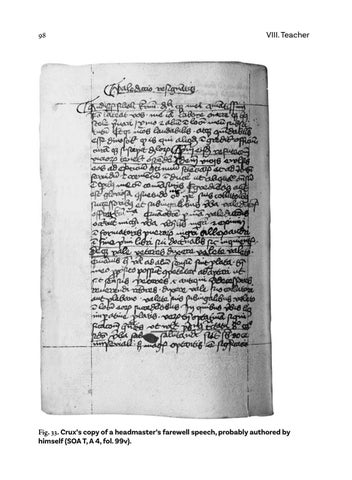
Fig. 33. Crux’s copy of a headmaster’s farewell speech, probably authored by himself (SOA T, A 4, fol. 99v).
Ukázka elektronické knihy, UID: KOS297503
VIII. Teacher
99
Fig. 34. Crux’s copy of a brief moral encouragement by a headmaster, probably authored by himself (SOA T, A 4, fol. 98r, beginning in the middle of the page).
Ukázka elektronické knihy, UID: KOS297503
VIII. Teacher
100
books.224 There was no fixed system, nor rules or norms; individual schools differed substantially and their quality was often dependent on the education and personality of the teacher: the curriculum started with grammar and went as far as the teacher’s knowledge allowed.225 It is sometimes assumed that town schools were gradually more laicised, under the influence of Humanism, and that there was a growing tension between parish and city schools.226 There are case studies for the Latin schools in Plzeň227 and Český Krumlov.228 The only known headmaster’s speech from the Czech lands before 1500 comes from Plzeň from 1480. It has been published under the title Oratio ad studiosos and was given by Jiří of Litoměřice upon assuming the headmaster’s office.229 Unlike Crux, however, Jiří does not address students but rather town councillors, and he criticises the schools of the nobility. Another difference is that Jiří builds the speech very carefully and meticulously.
224
225 226 227 228 229
Regensburg 1250–1500 (Leiden: Brill, 2008). Cf. also Paul F. Grendler, “Schooling in Western Europe,” Renaissance Quarterly 43, no. 4 (1990): 775–787. For the Czech environment, see Zikmund Winter, Život a učení na partikulárních školách v Čechách v 15. a 16. století [The life and instruction at towns schools in Bohemia in the 15th and the 16th centuries] (Prague: Nákl. České akademie císaře Františka Josefa pro vědy, slovesnost a umění, 1901); Josef Macek, “Děti, škola, univerzita” [Children, school, university], in Jagellonský věk v českých zemích (1471–1526) (Prague: Academia, 1998), 3:223–245, esp. pp. 228–239; Bořek Neškudla, Knihovny a čtenářská recepce v období raného humanismu v Čechách [Libraries and the readers’ reception in early Humanism in Bohemia], an unpublished dissertation of the Department of Czech history, Faculty of Arts, Charles University, Prague 2014; František Šmahel, “Gramotnost lidových vrstev” [Literacy among common people], in Mezi středověkem a renesancí [Between the Middle Ages and the Renaissance] (Prague: Argo, 2002), 54–71. Macek, “Děti,” 235–236. Cf. Macek, “Děti,” 231. Sheffler argues against this simplified view, pointing out to the collaboration of these schools and the omnipresent inclusion of parish priests in education (Sheffler, Schools, 215). Josef Hejnic, Latinská škola v Plzni a její postavení v Čechách (13.–18. století) [The Latin school in Plzeň and its status in Bohemia (13th–18th centuries)], Rozpravy ČSAV 89/2 (Prague: Academia, 1979). Josef Hejnic, Českokrumlovská latinská škola v době rožmberské [The school in Český Krumlov at the time of the Rosembergs], Rozpravy ČSAV 82/2 (Prague: Academia, 1972). It has been preserved in Kap, M XXXVII, fols. 282r–283r, which was part of the library of Alexius of Třeboň from 1488; cf. Anděla Fialová and Josef Hejnic, “Jiří z Litoměřic a jeho Oratio ad studiosos” [ Jiří of Litoměřice and his Oratio ad studiosos], Listy filologické 102 (1979): 133–144.
Ukázka elektronické knihy