98
Expansion 1966−75
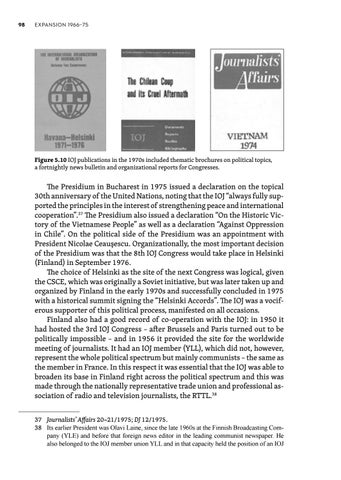
Figure 5.10 IOJ publications in the 1970s included thematic brochures on political topics, a fortnightly news bulletin and organizational reports for Congresses.
The Presidium in Bucharest in 1975 issued a declaration on the topical 30th anniversary of the United Nations, noting that the IOJ “always fully supported the principles in the interest of strengthening peace and international cooperation”.37 The Presidium also issued a declaration “On the Historic Victory of the Vietnamese People” as well as a declaration “Against Oppression in Chile”. On the political side of the Presidium was an appointment with President Nicolae Ceauşescu. Organizationally, the most important decision of the Presidium was that the 8th IOJ Congress would take place in Helsinki (Finland) in September 1976. The choice of Helsinki as the site of the next Congress was logical, given the CSCE, which was originally a Soviet initiative, but was later taken up and organized by Finland in the early 1970s and successfully concluded in 1975 with a historical summit signing the “Helsinki Accords”. The IOJ was a vociferous supporter of this political process, manifested on all occasions. Finland also had a good record of co-operation with the IOJ: in 1950 it had hosted the 3rd IOJ Congress – after Brussels and Paris turned out to be politically impossible – and in 1956 it provided the site for the worldwide meeting of journalists. It had an IOJ member (YLL), which did not, however, represent the whole political spectrum but mainly communists – the same as the member in France. In this respect it was essential that the IOJ was able to broaden its base in Finland right across the political spectrum and this was made through the nationally representative trade union and professional association of radio and television journalists, the RTTL.38 37 Journalists’ Affairs 20–21/1975; DJ 12/1975. 38 Its earlier President was Olavi Laine, since the late 1960s at the Finnish Broadcasting Company (YLE) and before that foreign news editor in the leading communist newspaper. He also belonged to the IOJ member union YLL and in that capacity held the position of an IOJ
Ukázka elektronické knihy, UID: KOS286610
Expansion 1966−75
99
After signing an agreement on co-operation with the IOJ in May 1974, the RTTL representative attended the Presidium in Ulan Bator and the whole RTTL leadership visited the IOJ Secretariat in Prague in December 1974, meeting there both Secretary General Kubka, new Treasurer Kìrály and President Hermann. In this way the RTTL became an active observer at the IOJ, leading in May 1975 its delegation back to Finland – Zagladin and Bureš attending a colloquium “Journalists and Détente” at the University of Tampere39 and meeting Finland’s Prime Minister and Minister of Foreign Affairs. These discussions (Figure 5.11) paved the way for Finland to become the site of the 8th Congress. Once the Final Act of Helsinki was signed at the CSCE Summit on 1 August 1975, the YLL, the RTTL in co-operation with the main trade union of press journalists in Finland (SSL, a member of the IFJ) formed a broadly representative local organizing committee for the Congress. The preparations were officially launched in Helsinki in November 1975 with an IOJ delegation: Jiří Kubka, Oleg Zagladin and Oldřich Bureš from the Prague Secretariat as well as Alexander Losev, the Vice-President of the Union of Journalists of the USSR from Moscow. The delegation met not only the local organizing committee but also the Prime Minister, the Mayor of Helsinki, the
Figure 5.11 Bridgebuilding in Finland: The RTTL hosted the colleagues from the IOJ Secretariat in Prague several times after 1974. Here at a table outdoors on the right: RTTL leaders Reino Paasilinna, Esko Seppänen and Arne Wessberg talking to Oldřich Bureš. On the left: Eero Toukkari talking to Oleg Zagladin. In the middle: Sirkka Närhinen and Unto Miettinen. (Photo: RTTL)
Vice-President from 1962 to 1971 (see Figure 4.8 in Chapter 4). The RTTL leadership in the 1970s represented first and foremost professional and trade union interests, with political affiliations of mainly Social Democrats and Communists. The Secretary General of the RTTL at the time was Esko Seppänen, who later became a leftist member of both the Finnish Parliament and the European Parliament. 39 See Journalists and Détente (1975).
Ukázka elektronické knihy, UID: KOS286610
100
Expansion 1966−75
Director-General of the Finnish Broadcasting Company (YLE) and the secretaries of the Central Organization of the Finnish Trade Unions (SAK). The overall development of the IOJ from the mid-1960s to the mid1970s was growth and consolidation. The positive development was a consequence of three main trends. Firstly, the Soviet-inspired attempts to dispel the Cold War tension in Europe, with the Finnish-led CSCE diplomacy for détente, encouraged journalists’ associations to co-operate across the East-West divide and pushed the IFJ to gradually abandon its hard line of separatism and anti-communism. Secondly, the developing countries found the socialist community – despite the rift with China – as a natural ally in geopolitical platforms, while at the same time the Third World was gathering its own forces around the Non-Aligned Movement (NAM). Thirdly, the IOJ was proactive in capitalizing on these trends, with the political and material assistance of its European member unions in the socialist countries.
Ukázka elektronické knihy