98
5.0 4.0
B1
B2
Semitones
3.0 2.0 1.0 0.0 -1.0 -2.0 -3.0 -4.0
T1
T2
T3
T4
T5
T1
T2
T3
T4
T5
Normalized time
Figure 5.13: Vietnamese tones B1 and B2 in high (dotted black), zero (solid black) and low (solid grey) preceding context (for normalized time see Section 4 – Method).
Figure 5.13. displays coarticulatory effects concerning the tones sắc (B1) and nặng (B2) in our material. The situation seems to be quite plausible: the low context pulls the contour down, the high context in the opposite direction either at the beginning of the contour (B1) or throughout its course (B2). It should be remembered that B2 is shorter than B1 so, perhaps, there is less time for any convergence. The zero-context contour is either in the middle posi6.0 5.0
B1-SG
B1-HN
4.0 3.0 2.0 1.0 0.0 -1.0
Semitones
-2.0 -3.0 -4.0 6.0 5.0
4.0
B2-HN
3.0 2.0
4.0
1.0
3.0
0.0
2.0
-1.0
1.0
-2.0
0.0
-3.0
-1.0
-4.0
-2.0
-5.0
-3.0 -4.0
! B2-SG
-6.0
T1
T2
T3
T4
T5
T1
T2
T3
T4
T5
Normalized time
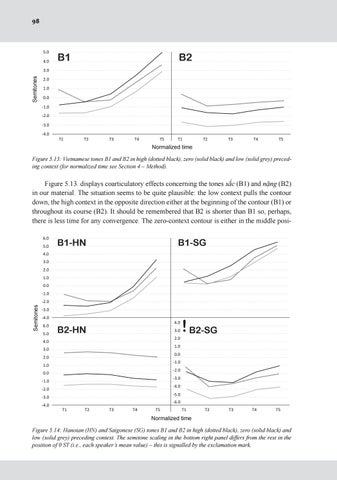
Figure 5.14: Hanoian (HN) and Saigonese (SG) tones B1 and B2 in high (dotted black), zero (solid black) and low (solid grey) preceding context. The semitone scaling in the bottom right panel differs from the rest in the position of 0 ST (i.e., each speaker’s mean value) – this is signalled by the exclamation mark.
Ukázka elektronické knihy, UID: KOS274382
99
5. data analysis
tion (B2), or it starts there (B1 – left panel in Fig. 5.13). The fact that it rises higher in times T3, T4 and T5 might be the reflection of the fact, that our sample for the current analyses is not entirely balanced in terms of the speaking style. The contextless syllables come very often from the reading of isolated lists, while the high and low contexts come from the reading of continuous texts. However, a matter of greater concern is the fact that, unlike in tones A1 and A2, there are substantial differences between the B-tone renderings in the two dialects (cf. Fig. 5.8). Therefore, we find it necessary to analyse the B-tones separately by the dialect. The result can be observed in Figure 5.14. The high preceding context always results in a higher onset of the tone. In the case of Hanoian nặng (B2) the affected contour actually stays high throughout the syllable. In both dialects and both tones the low context also pulls the onset of the investigated tone down, but this affect is negligible in Saigonese sắc (B1). It is worth noting that the distance between B2HN in high vs. low context is almost 4 ST along the whole contour. This distance is greater than, for instance, the one between mean B1 and B2 in Hanoi in Figure 5.8. The tones C1 (hỏi) and C2 (ngã) also behave differently in the two dialects. Figure 5.15 breaks down the coarticulatory data in a manner similar to the preceding picture. The 4.0 3.0
C1-HN
C1-SG
C2-HN
C2-SG
2.0 1.0 0.0 -1.0 -2.0
Semitones
-3.0 -4.0 -5.0 5.0 4.0 3.0 2.0 1.0 0.0 -1.0 -2.0 -3.0 -4.0
T1
T2
T3
T4
T5
T1
T2
T3
T4
T5
Normalized time
Figure 5.15: Hanoian (HN) and Saigonese (SG) tones C1 and C2 in high (dotted black), zero (solid black) and low (solid grey) preceding context. Broken lines in C2-HN indicate glottalization (cf. Fig. 5.5). The individual patterns are not directly comparable – the bottom panels differ from the top ones in the position of 0 ST (i.e., each speaker’s mean value).
Ukázka elektronické knihy, UID: KOS274382
100
first fact to mention is the similarity of the Saigonese C1 and C2 already observed above, in Figure 5.9. More to the point, which are the coarticulatory effects, is the mutual position of the tones with high and low context (dotted black and solid grey lines in Fig. 5.15). In all four panels the high-context tone is above the low-context tone. However, this effect is very small in the case of Saigonese versions, whereas the Hanoian tonal coarticulation is quite substantial. The onsets of C1-HN are slightly over 3 ST apart. The contours then converge to about 0.5 ST. The behaviour of the zero-context contours is less orderly, but the reason for this has already been mentioned – to preserve the quantity balance in the sample, we had to supplement the continuous reading with isolated syllables. Those, however, seem to represent slightly different speaking style, i.e., the one in which tones (and probably even segmental make-up content of the syllables) are pronounced with greater effort. Hence, the offsets of the zero-context contours surpass the offset values of tones in the other two conditions. The coarticulation in allotones sắc2 (D1) and nặng2 D2 is captured in Figure 5.16. Since they do not differ markedly across the two dialects (cf. Fig. 5.10), we display them together like the A-tones above. 6.0
Semitones
5.0
D2
D1
4.0 3.0 2.0 1.0 0.0 -1.0 -2.0 -3.0 -4.0
T1
T2
T3
T4
T5
T1
T2
T3
T4
T5
Normalized time
Figure 5.16: Vietnamese tones D1 and D2 in high (dotted black), zero (solid black) and low (solid grey) preceding context.
Similarly to all the other cases above, the low-context contour either is or at least starts below the high-context contour. However, the difference in the case of D2 is negligible and even the zero-context contour occupies the same tonal space as the contours in the other two conditions. On the other hand, the difference between the high-context and low-context D1 is almost 2 ST at the onset and still about 1 ST at the offset. In summary, the null hypothesis H20 can be rejected – there are observable coarticulatory effects in the tonal F0 contours triggered by the preceding context. The onsets and sometimes even the whole contours are attracted towards the earlier tone. This progressive or perseverative influence is quite clear in the case of co-occurrence of tones with the opposite [± high] phonological value. Interestingly, the magnitude of coarticulatory effects differs across individual tones but also between the two dialects. It seems that Saigonese speakers coarticulate a little less than speakers from the North. It has to be admitted, though, that our study was not
Ukázka elektronické knihy