98
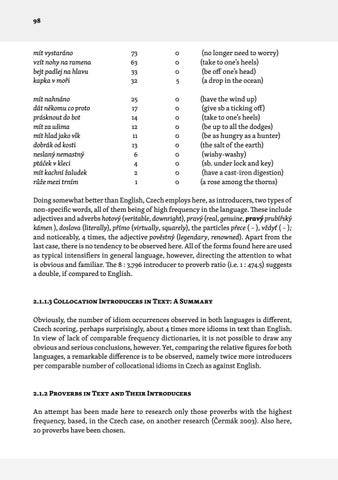
mít vystaráno vzít nohy na ramena bejt padlej na hlavu kapka v moři
73 63 33 32
0 0 0 5
(no longer need to worry) (take to one’s heels) (be off one’s head) (a drop in the ocean)
mít nahnáno dát někomu co proto prásknout do bot mít za ušima mít hlad jako vlk dobrák od kosti neslaný nemastný ptáček v kleci mít kachní žaludek růže mezi trním
25 17 14 12 11 13 6 4 2 1
0 0 0 0 0 0 0 0 0 0
(have the wind up) (give sb a ticking off) (take to one’s heels) (be up to all the dodges) (be as hungry as a hunter) (the salt of the earth) (wishy-washy) (sb. under lock and key) (have a cast-iron digestion) (a rose among the thorns)
Doing somewhat better than English, Czech employs here, as introducers, two types of non-specific words, all of them being of high frequency in the language. These include adjectives and adverbs hotový (veritable, downright), pravý (real, genuine, pravý prubířský kámen ), doslova (literally), přímo (virtually, squarely), the particles přece ( – ), vždyť ( – ); and noticeably, 4 times, the adjective pověstný (legendary, renowned). Apart from the last case, there is no tendency to be observed here. All of the forms found here are used as typical intensifiers in general language, however, directing the attention to what is obvious and familiar. The 8 : 3,796 introducer to proverb ratio (i.e. 1 : 474.5) suggests a double, if compared to English. 2.1.1.3 Collocation Introducers in Text: A Summary Obviously, the number of idiom occurrences observed in both languages is different, Czech scoring, perhaps surprisingly, about 4 times more idioms in text than English. In view of lack of comparable frequency dictionaries, it is not possible to draw any obvious and serious conclusions, however. Yet, comparing the relative figures for both languages, a remarkable difference is to be observed, namely twice more introducers per comparable number of collocational idioms in Czech as against English. 2.1.2 Proverbs in Text and Their Introducers An attempt has been made here to research only those proverbs with the highest frequency, based, in the Czech case, on another research (Čermák 2003). Also here, 20 proverbs have been chosen.
Ukázka elektronické knihy, UID: KOS268796
99
B / Proverb Use and Pragmatics
2.1.2.1 English Proverb Introducers BNC Frequency Introducers 1 You can’t have your cake and eat it 42 2 There is no such thing as free lunch 36 3 Prevention is better than cure 36 4 Chickens come home to roost 31 5 Every cloud has a silver lining 22 6 Better late than never 18 7 Discretion is best part of valour 15 8 All’s well that ends well 14 9 Forewarned is forearmed 13 10 A bird in the hand is worth two in the bush 13 11 Let bygones be bygones 12 Practice makes perfect 13 Don’t look a gift horse in the mouth 14 Like father like son 15 An eye for an eye 16 An apple a day keeps the doctor away 17 Once bitten twice shy 18 Two heads are better than one 19 Charity begins at home 20 Too many cooks spoil the broth
12 12 12 11 11 11 9 8 8 8
2 5 15 6 10 4 9 1 3 2 1 5 1 1 3 4 2 2 2 2
Without any a priori discrimination, there are, basically, four broad classes of introducers to be found here: (a) nouns, such as axiom, proverb, maxim, adage, saying, rule, principle, fact, message, conviction, phrase, argument, cliché (often followed by that, e.g., message that) (b) v erbs, such as remember, conclude, comment, decide, assert, point out, counter (c) phrases, such as as they say, mind you, so it is said, they say that, on the basis/premise that, to quote X, or (d) other, mostly adverbs or conjunctions, such as always, really, but, though, if – then, definitely, well, so Obviously, in some cases, the introducers are to be found in various forms or with an additional word, such as commenting, he decided, coining the phrase, the grim fact that.., but the idea was that… Some of more interesting full examples: Contrasting proverbs with ponderous prose offers a way in: ‘too many cooks spoil the broth’ is a far more expressive way of saying: Over-maximization of the work force is counter-productive because it inhibits the realization of a satisfactory outcome. The saying ‘An apple a day keeps the doctor away’ contains some truth., the golden rule of banking is…, If,
Ukázka elektronické knihy, UID: KOS268796
100
however, you get elected and you then have to carry out your policies, then of course you face the real world and then you can’t have your cake and eat it problem., The old adage that holds prevention is better than cure…, Deciding that discretion is best part of valour Davidson began… Sometimes, reference to the proverb is rather a subtle one, if only a hint at the proverb is present, such as in ‘Once bitten and things of that nature,’ smiled Tuppe. The proverb might be signalled, however, by referring to the author who has become an authority, such as in All’s well that ends well, to quote Shakespeare. Or it may be veiled as a simile, such as inThis seems like looking a gift horse in the mouth but these things do occur. If unknown, however, it is almost impossible to recognize a proverb, if used as a quotation, in direct speech, such as: Then, through a loudspeaker, the mother told cheering neighbours in Palermo, Sicily: ‘An eye for an eye, a tooth for a tooth and nudity for nudity’. Despite their small frequency and number of items, some introducers exhibit a tendency for repetition, suggesting that they might be fixed in language. The top 5 introducers here include saying (7×), always (7×), they say that (5×), decide (5×), principle (4×). A limiting influence on the choice and appearance of introducers may be attributed to occasional proverb transformations into something else, such as silver lining, being a nominalization. This, rather exceptionally, was found to be the case in 17 out of 22 occurrences of this particular proverb. For reasons to be yet explored, it seems that the semantics of proverbs may influence the choice of introducers in some cases. Thus, the co-occurrence of the verb decide (in various forms) with the proverb Discretion is the better part of valour in almost 50 percent does not seem to be due to chance only. It is worth observing that the obvious candidate, being a direct name English has here, namely proverb, has only a marginal frequency (1×), being superceded by saying (7×), or, to a lesser extent, by maxim (2×), adage (2×), axiom (2×), and the like. This seems to confirm that normal users cannot always identify the type and function with its proper label, or, simply want to avoid it for some other reason, which is not clear here, however. The low frequency of the proverb here is somewhat improved by a double occurrence of the adjective proverbial, however. In trying to pin down types of proverbs used with introducers, no firm conclusion can be made. Due to the fact that the free lunch proverb uses an introducer five times, it seems that there is no evident link between the introducer and the metaphorical quality of the proverb. The 20 English proverbs that have been recorded in BNC occurred 351 times, having 69 introducers altogether (19.65%). All English proverbs examined do have at least one introducer to accompany it. 2.1.2.2 Czech Proverb Introducers CNC Frequency Introducers 1 Účel světí prostředky 2 Nic není zadarmo
89 88
44 28
(The end justifies the means) (Nothing is for free)
Ukázka elektronické knihy