98
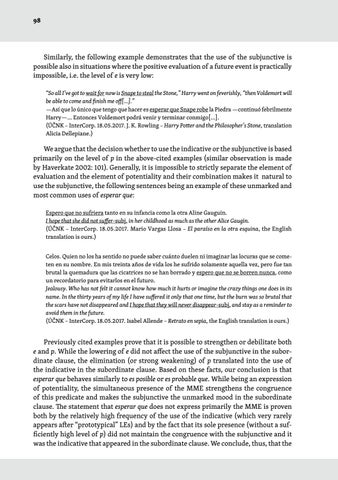
Similarly, the following example demonstrates that the use of the subjunctive is possible also in situations where the positive evaluation of a future event is practically impossible, i.e. the level of e is very low: “So all I’ve got to wait for now is Snape to steal the Stone,” Harry went on feverishly, “then Voldemort will be able to come and finish me off[…].” —Así que lo único que tengo que hacer es esperar que Snape robe la Piedra —continuó febrilmente Harry—… Entonces Voldemort podrá venir y terminar conmigo[…]. (ÚČNK – InterCorp. 18.05.2017. J. K. Rowling – Harry Potter and the Philosopher’s Stone, translation Alicia Dellepiane.)
We argue that the decision whether to use the indicative or the subjunctive is based primarily on the level of p in the above-cited examples (similar observation is made by Haverkate 2002: 101). Generally, it is impossible to strictly separate the element of evaluation and the element of potentiality and their combination makes it natural to use the subjunctive, the following sentences being an example of these unmarked and most common uses of esperar que: Espero que no sufriera tanto en su infancia como la otra Aline Gauguin. I hope that she did not suffer-subj. in her childhood as much as the other Alice Gaugin. (ÚČNK – InterCorp. 18.05.2017. Mario Vargas Llosa – El paraíso en la otra esquina, the English translation is ours.) Celos. Quien no los ha sentido no puede saber cuánto duelen ni imaginar las locuras que se cometen en su nombre. En mis treinta años de vida los he sufrido solamente aquella vez, pero fue tan brutal la quemadura que las cicatrices no se han borrado y espero que no se borren nunca, como un recordatorio para evitarlos en el futuro. Jealousy. Who has not felt it cannot know how much it hurts or imagine the crazy things one does in its name. In the thirty years of my life I have suffered it only that one time, but the burn was so brutal that the scars have not disappeared and I hope that they will never disappear-subj. and stay as a reminder to avoid them in the future. (ÚČNK – InterCorp. 18.05.2017. Isabel Allende – Retrato en sepia, the English translation is ours.)
Previously cited examples prove that it is possible to strengthen or debilitate both e and p. While the lowering of e did not affect the use of the subjunctive in the subordinate clause, the elimination (or strong weakening) of p translated into the use of the indicative in the subordinate clause. Based on these facts, our conclusion is that esperar que behaves similarly to es posible or es probable que. While being an expression of potentiality, the simultaneous presence of the MME strengthens the congruence of this predicate and makes the subjunctive the unmarked mood in the subordinate clause. The statement that esperar que does not express primarily the MME is proven both by the relatively high frequency of the use of the indicative (which very rarely appears after “prototypical” LEs) and by the fact that its sole presence (without a sufficiently high level of p) did not maintain the congruence with the subjunctive and it was the indicative that appeared in the subordinate clause. We conclude, thus, that the
Ukázka elektronické knihy, UID: KOS257383
3. modal meaning potential → modal meaning evaluative
99
evaluation has here a role similar to the negation with expressions of potentiality: it strengthens the congruence, but, by itself, it does not create it.
3.2 temer(se) The verb temer(se) can be considered an opposite of esperar. Both predicates present the event of the subordinate clause as uncertain and they also imply personal evaluation. While with esperar the uncertain event is evaluated positively, temer(se) expresses a negative feeling or displeasure. Once again, linguists do not unanimously agree whether temer(se) is an expression of potentiality (uncertainty) or personal evaluation. For RAE (2009: 1896), it is the emotionality that stands at the first place: “Fear represents, by all means, a type of emotion. The use of the subjunctive in the sentence complement of the verb temer is, thus, entirely expectable.”46 However, as observed by Haverkate (2002: 102–103), the expressions of evaluation or emotion that are followed by the subjunctive generally comment upon an event that is considered real: [T]he subject of temer(se) is attributed both an emotional and a dubitative attitude towards the content of the embedded proposition. […] Obviously, the state of affairs described by the que clause is not real, but a hypothetical one. Although the speaker of the sentence adopts a negative propositional attitude, the subjunctive in the subordinate clause is not triggered by his/her expressing an emotional evaluation, as that would require reference not to a hypothetical state of affairs, but to a state of affairs presupposed to be real. In other words, it is the potentialis interpretation of the embedded proposition which explains the use of the subjunctive.
We do not agree entirely with either of the above-cited interpretations. We consider completely relevant the claim that the uncertain realization of the embedded event makes it impossible to see these constructions in the same way as other utterances with the MME, nevertheless, the assertion that the subjunctive congrues solely with potentiality is problematic for the very same reasons as with esperar: its frequency is much higher than with other LPs that are not negated. The situation with the verb temer(se) is even more complicated than with esperar, for it can appear both as pronominal temerse and non-pronominal temer whilst the choice between these two alternatives influences the choice of mood in the dictum, being the subjunctive more frequent with the non-pronominal variant.
46
Original quoatation (the translation is ours): “El temor constituye, sin duda, un tipo de emoción. El empleo del subjuntivo en el complemento oracional del verbo temer es, por tanto, enteramente esperable.”
Ukázka elektronické knihy, UID: KOS257383
100
3.2.1 corpus analysis The analysis took place in May 2017, we analysed the choice of mood after the verb temer(se) in first person singular, present tense. We analysed both the non-pronominal temo que (I am afraid) and the pronominal me temo que (I am afraid). Queries had the following forms: [!word="[Mm]e"][word="[Tt]emo"][word="que"],47 [word="[Mm]e"][word="temo"][word="que"].
Table 33: Choice of mood after (me) temo que
(ME) TEMO QUE
Temo que Indicative
Me temo que
Subjunctive
Indicative
Subjunctive
SPAIN Cela
—
—
—
2
Cercas
—
—
2
—
Cunqueiro
—
1
1
—
Etxebarría
2
—
4
—
Marías
1
—
6
1
Marsé
—
1
1
—
Mendoza
—
2
1
—
Moro
—
1
4
1
1
2
2
—
Ortega y Gasset
—
1
—
—
Pérez-Reverte
—
1
16
1
Sanmartín Fenollera
—
—
19
—
Sierra
—
—
1
—
Torres
—
1
2
—
Navarro
Unamuno
1
—
—
2
Vila Matas
—
—
1
—
Total for the area
5
10
60
7
47
Using this query, the results contained appearances of −Me temo que… in direct speech. These cases were filtered manually and they were added to the second concordance.
Ukázka elektronické knihy, UID: KOS257383