98
gen.pl
M
MF
dat.pl acc.pl
F
F
FN
N
F
F
FN
MFN MFN
voc.pl loc.pl inst.pl
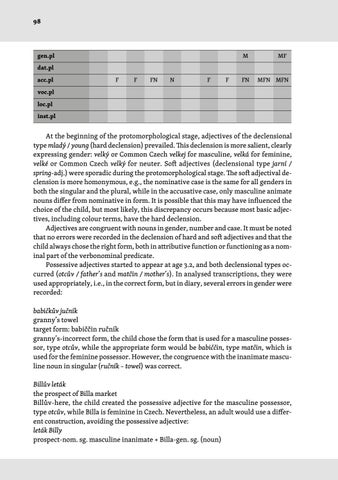
At the beginning of the protomorphological stage, adjectives of the declensional type mladý / young (hard declension) prevailed. This declension is more salient, clearly expressing gender: velký or Common Czech velkej for masculine, velká for feminine, velké or Common Czech velký for neuter. Soft adjectives (declensional type jarní / spring-adj.) were sporadic during the protomorphological stage. The soft adjectival declension is more homonymous, e.g., the nominative case is the same for all genders in both the singular and the plural, while in the accusative case, only masculine animate nouns differ from nominative in form. It is possible that this may have influenced the choice of the child, but most likely, this discrepancy occurs because most basic adjectives, including colour terms, have the hard declension. Adjectives are congruent with nouns in gender, number and case. It must be noted that no errors were recorded in the declension of hard and soft adjectives and that the child always chose the right form, both in attributive function or functioning as a nominal part of the verbonominal predicate. Possessive adjectives started to appear at age 3.2, and both declensional types occurred (otcův / father’s and matčin / mother’s). In analysed transcriptions, they were used appropriately, i.e., in the correct form, but in diary, several errors in gender were recorded: babičkův jučník granny’s towel target form: babiččin ručník granny’s-incorrect form, the child chose the form that is used for a masculine possessor, type otcův, while the appropriate form would be babiččin, type matčin, which is used for the feminine possessor. However, the congruence with the inanimate masculine noun in singular (ručník – towel) was correct. Billův leták the prospect of Billa market Billův-here, the child created the possessive adjective for the masculine possessor, type otcův, while Billa is feminine in Czech. Nevertheless, an adult would use a different construction, avoiding the possessive adjective: leták Billy prospect-nom. sg. masculine inanimate + Billa-gen. sg. (noun)
Ukázka elektronické knihy, UID: KOS228085
99
9. acquisition of morphology – adjectives
To sum up, no errors in congruence appeared, and the adjective was always congruent with the noun it modified in gender, number and case. However, occasionally, the child did not choose the correct declensional type: he mixed up the declensions for masculine and feminine possessors, preferring the masculine form even for feminine possessors. At the end of the protomorphological stage, such errors no longer occurred. There was one type of error that needs to be mentioned. The child used feminine adjective endings when referring to himself during the protomorphological stage: jsem šikovná I am skilful be-1sg. present + skilful-nom. sg. feminine Although it is not a correct form, it cannot be viewed as a grammatical error. Rather, it should be viewed as an example of overgeneralization. The child processed the input, and in the input, the feminine endings prevailed in 1st person singular as his daily caregivers were women. Thus, the feminine form was understood as unmarked by the child. This error frequently occurs in young Czech boys. Nevertheless, when the child spoke about himself in 3rd person singular, he used the correct masculine animate form: kluk je šikovnej the boy is skilful boy-nom. sg. masculine + be-3sg. present + skilful-nom. sg. masculine animate (Common Czech) In table 32, the number of all adjective lemmas and the number of soft and possessive adjective lemmas that occurred in transcriptions of the audio recordings are presented. Tab. 32: Number of adjective lemmas age (year, month)
2.8
2.9
2.10
2.11
3.0
3.1
3.2
3.3
3.4
3.5
3.6
all lemmas
12
11
13
19
19
15
24
23
31
33
28
soft decl. lemmas
1
0
1
4
1
1
1
3
2
2
3
possessive decl. lemmas
0
0
0
0
0
0
1
1
0
1
0
Ukázka elektronické knihy, UID: KOS228085
100
9.5 acquisition of adjectives – summary The analysis of adjective declension brought interesting results. As the child grew older, the vocabulary naturally increased, more adjective lemmas were used, and repetition decreased. Regarding acquisition of grammatical categories, the sequence of acquisition of declensional cases was similar to the acquisition of case in nouns, but individual cases were acquired several months later in adjectives than in nouns. Some cases, however, were not used with adjectives at all (dative and vocative singular and dative, vocative, locative and instrumental plural). In the beginning, adjectives were used as the nominal part of verbo-nominal predicates and, later, as congruent attributes. Adjective declension of all three genders was acquired simultaneously, which also supports the claim that the child acquired the category of grammatical gender before the category of case. No errors in congruence with nouns in case, gender and number occurred apart from overgeneralization of the feminine ending when referring to himself due to the prevalence of feminine endings in the input. At the beginning of the protomorphological stage, only the hard adjectives occurred in the child’s speech. Even in the later period, the child preferred hard endings, and around age 4.4, in the stage of modularised morphology, several examples of overgeneralization appeared: kousacá věc a biting thing, a toy made for biting biting-nom. sg. feminine (hard ending, while the correct use would be the soft ending – kousací) + thing-nom. sg. feminine Comparative and superlative forms did not occur except for lexeme velký / big: at age 3.0, three tokens of comparative (větší / bigger) were recorded, and at age 3.3, one token of superlative (největší / the biggest) was recorded. All forms were correctly used in appropriate contexts. Nevertheless, these were most likely rote learned, as they are irregular in form. The regular morphological derivation to form comparatives and superlatives did not occur during the protomorphological stage.
Ukázka elektronické knihy, UID: KOS228085