98
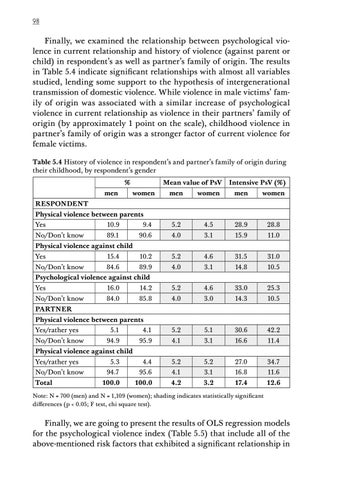
Finally, we examined the relationship between psychological violence in current relationship and history of violence (against parent or child) in respondent’s as well as partner’s family of origin. The results in Table 5.4 indicate significant relationships with almost all variables studied, lending some support to the hypothesis of intergenerational transmission of domestic violence. While violence in male victims’ family of origin was associated with a similar increase of psychological violence in current relationship as violence in their partners’ family of origin (by approximately 1 point on the scale), childhood violence in partner’s family of origin was a stronger factor of current violence for female victims. Table 5.4 History of violence in respondent’s and partner’s family of origin during their childhood, by respondent’s gender % men
Mean value of PsV women
Intensive PsV (%)
men
women
men
women
RESPONDENT Physical violence between parents Yes
10.9
9.4
5.2
4.5
28.9
28.8
No/Don’t know
89.1
90.6
4.0
3.1
15.9
11.0
Physical violence against child Yes
15.4
10.2
5.2
4.6
31.5
31.0
No/Don’t know
84.6
89.9
4.0
3.1
14.8
10.5
Psychological violence against child Yes
16.0
14.2
5.2
4.6
33.0
25.3
No/Don’t know
84.0
85.8
4.0
3.0
14.3
10.5
PARTNER Physical violence between parents Yes/rather yes No/Don’t know
5.1
4.1
5.2
5.1
30.6
42.2
94.9
95.9
4.1
3.1
16.6
11.4 34.7
Physical violence against child Yes/rather yes No/Don’t know Total
5.3
4.4
5.2
5.2
27.0
94.7
95.6
4.1
3.1
16.8
11.6
100.0
100.0
4.2
3.2
17.4
12.6
Note: N = 700 (men) and N = 1,109 (women); shading indicates statistically significant differences (p < 0.05; F test, chi square test).
Finally, we are going to present the results of OLS regression models for the psychological violence index (Table 5.5) that include all of the above-mentioned risk factors that exhibited a significant relationship in
Ukázka elektronické knihy, UID: KOS216065
99
bivariate analysis.27 Partner’s low self-control had the strongest effects in the models for both genders (β = 0.32 for men and 0.38 for women); the effects of violence in partner’s family of origin were also significant but somewhat weaker. Similarly to Chapter 6, these models indicated that frequent binge drinking was a risk factor especially for men, both as victims and as offenders. In contrast, frequent binge drinking in women was weakly associated with their risk of victimization. Furthermore, both models indicated direct effects of subjective household income. The model for women was more successful in explaining variance, with a satisfactory level of R2 = 0.30 (compared to 0.20 for men). Table 5.5 Risk factors of psychological violence, regression models for men and women Men
Women
beta
beta
Education (P)
0.01
−0.02
Unemployment (P)
0.05
0.04
Low subjective household income
0.08*
0.08**
Alcohol abuse
0.12**
0.07*
Alcohol abuse (P)
−0.03
0.11**
Low self-control
0.02
0.03
Low self-control (P)
0.32**
0.38**
Violence in family of origin
0.15**
0.14**
Violence in family of origin (P)
0.08*
F test (model) adj. R2 N
18.7** 0.20 636
0.10** 49.3** 0.30 1,014
Note: Psychological violence index is the dependent variable; (P) indicates partner-related independent variables; * p < 0.05; ** p < 0.01.
27 Some variables were transformed for the purposes of the regression analysis. Partner’s economic activity was dichotomized to indicate unemployment (1 = yes, 0 = no); frequency of excessive alcohol consumption was dichotomized to measure binge drinking at least once a week (1 = yes, 0 = no); low self-control was calculated as mean score of the four items that were asked about respondent as well as partner; and violence in family of origin was dichotomized to indicate the existence of at least one of the practices studied (1 = yes, 0 = no; see Table 5.4).
Ukázka elektronické knihy, UID: KOS216065
100
Tolerance of psychological violence Before concluding the analysis, we are going to briefly examine the subject of tolerance of psychological violence between intimate partners, and in particular, its association with relationship satisfaction and thoughts about separation. Our respondents rated the tolerability of practices included in Set A, and the results are presented for those who had an intimate partner at time of data collection (Table 5.6). It is apparent that psychological violence was found relatively tolerable, especially more common practices (see Table 5.1) such as neglecting partner’s opinions or feelings or psychological coercion (silence, weeping, threatening breakup etc.) Analogously, the least common practices (aggression against pets or being put down or humiliated) were rated as the least tolerable. There were also apparent differences between women’s and men’s tolerance of psychological violence, with men rating all practices as more tolerable than women. The gender gap was especially pronounced for economic abuse, verbal abuse and neglect of opinions/ feelings. We also constructed an index of tolerance of psychological violence by calculating the mean score of all items in Table 5.6.28 The average index was 2.03 for men and 1.77 for women, a significant difference indicating women’s lower tolerance of psychological violence. Subsequent analysis of social determinants did not confirm any strong associations. Tolerance of psychological violence did not vary with age and the relationships with education and unemployment (observed only for women) were weak. Tolerance of psychological violence somewhat grew with declining subjective household income, with growing frequency of binge drinking, and with decreasing self-control. All these relationships were somewhat stronger for women than for men. Tolerance of psychological violence increased with the intensity of actual psychological violence in current relationship, again more strongly for women (Table 5.7).29 However, we are unable to determine the direction of causality due to the cross-sectional character of our study. One possible interpretation is that tolerance for psychological violence increases as victims get more and more used to it; alternatively, individuals who do not tolerate violence tend to end their intimate relationships 28 The reliability of the index was excellent, with Cronbach’s alpha values of 0.86 for men and 0.87 for women. 29 To avoid bias, respondents with physically violent partners were excluded from the analysis reported in Table 5.7.
Ukázka elektronické knihy, UID: KOS216065