98
3. dative (dativus) 4. accusative (accusativus), abbrev. Acc. 5. vocative (vocativus) 6. ablative (ablativus), abbrev. Abl. However, in medical terminology we apply only nominative, genitive, accusative and ablative as remaining two (dative and vocative) are not used. From these four cases we have had so far an opportunity to employ only the first two (Nom., Gen.). ●● Nominative is the most basic grammatical case. ●● Genitive is used to express the English prepositional phrase “... of ...” or (less frequently) instead of English possessive case, preserved as the inflexions ‘s and s’.50 Remaining two grammatical cases (Acc., Abl.) are subject of the Lesson 13 of this textbook.
grammatical number Grammatical cases of nouns can be used in two numbers (i.e. Singular and Plural).51 This means that so far every Latin noun has for purpose of this course four different forms (two in singular and two in plural) to express its various roles.
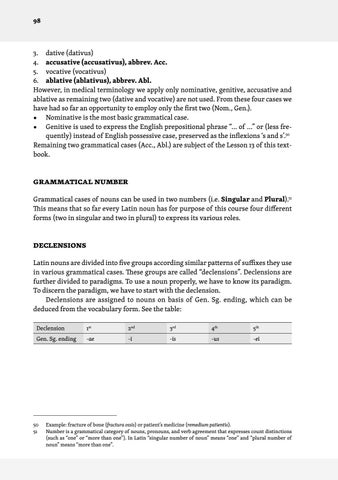
declensions Latin nouns are divided into five groups according similar patterns of suffixes they use in various grammatical cases. These groups are called “declensions”. Declensions are further divided to paradigms. To use a noun properly, we have to know its paradigm. To discern the paradigm, we have to start with the declension. Declensions are assigned to nouns on basis of Gen. Sg. ending, which can be deduced from the vocabulary form. See the table: Declension
1st
2nd
3rd
4th
5th
Gen. Sg. ending
-ae
-i
-is
-us
-ei
50 51
Example: fracture of bone (fractura ossis) or patient’s medicine (remedium patientis). Number is a grammatical category of nouns, pronouns, and verb agreement that expresses count distinctions (such as “one” or “more than one”). In Latin “singular number of noun” means “one” and “plural number of noun” means “more than one”.
Ukázka elektronické knihy, UID: KOS209566
99
part 2 / lesson 12 (review)
list of paradigms of nouns from the first part of the course Declension
1st
Gender
f.
2nd m.
3rd n.
4th
m./f.
5th
n.
m.
n.
f.
???
???
-us
-u
-es
-is
-is
-us
-us
-ei
Singular Nom.
-a
-us/-er
-um/-on
Gen.
-ae
-i
-i
Plural Nom.
-ae
-i
-a
-es
-a/-ia
-us
-ua
-es
Gen.
-arum
-orum
-orum
-um/-ium
-um/-ium
-uum
-uum
-erum
Comments: ●● “Gender” as signified in the table is not a rule; there are occasional exceptions, like word manus which belongs technically to “masculine” column of the 4th declension, although it is a feminine. More exceptions will be discussed during this term. ●● Alternatives in Nom. Sg. of the 2nd declension express difference between paradigms musculus x cancer, and intestinum x colon. ●● Alternatives in the 3rd declension columns express difference between imparisyllabic and parisyllabic paradigms.
adjectives There are two major groups of adjectives that borrow endings either from the 1st and 2nd declension of nouns or the 3rd declension. The full paradigm looks like this: 1st and 2nd decl. adjective
3rd decl. adjective three-termination
m.
f.
n.
m.
f.
n.
two-termination
one-term.
m./f.
n.
m./f./n.
-is
-e
Singular Nom.
-us/-er
-a
-um
-r
Gen.
-i
-ae
-i
see →
Nom.
-i
-ae
-a
Gen.
-orum
-arum
-orum
-is
-e
-is
??? ← see
Plural see →
-es -ium
-ia
← see
Comments: ●● Alternatives in Nom. Sg. for masculine gender in the 1st and 2nd declension adjectives reflects difference between sub-categories longus, a, um x dexter, tra, trum.
Ukázka elektronické knihy, UID: KOS209566
100
●●
Among the 3rd declension adjectives the three- and one-termination groups copy the two-termination one in all the grammatical cases and numbers with exception of Nom. Sg.
clinical terminology Clinical terms are created using Greek prefixes, stems, and endings. Presence of a prefix is facultative; however, there will be always at least one stem and one ending in every clinical term. Overall we have two rules which govern Greek medical terminology: 1. Two stems or stem and ending may be connected using an additional “o”, which helps to achieve alternating order of vowels and consonants. 2. If there is both Greek and Latin alternative (e.g. phleb(o)- and vena), you must create the clinical terms using the Greek one. For full list of prefixes, stems, and endings see Lessons 10 and 11.
Ukázka elektronické knihy, UID: KOS209566