98
3. Catalogue of Lamps
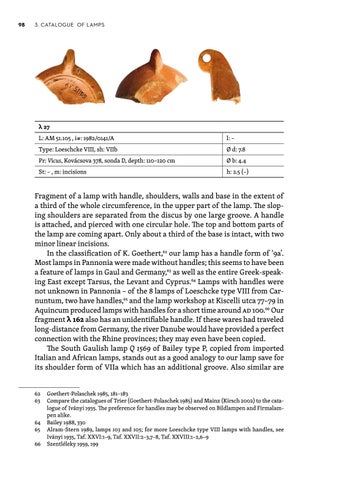
λ 27 L: AM 51.105 , i#: 1982/0141/A
l: –
Type: Loeschcke VIII, sh: VIIb
Ø d: 7.8
Pr: Vicus, Kovácsova 378, sonda D, depth: 110–120 cm
Ø b: 4.4
St: – , m: incisions
h: 2.5 (–)
Fragment of a lamp with handle, shoulders, walls and base in the extent of a third of the whole circumference, in the upper part of the lamp. The sloping shoulders are separated from the discus by one large groove. A handle is attached, and pierced with one circular hole. The top and bottom parts of the lamp are coming apart. Only about a third of the base is intact, with two minor linear incisions. In the classification of K. Goethert,62 our lamp has a handle form of ‘9a’. Most lamps in Pannonia were made without handles; this seems to have been a feature of lamps in Gaul and Germany,63 as well as the entire Greek-speaking East except Tarsus, the Levant and Cyprus.64 Lamps with handles were not unknown in Pannonia – of the 8 lamps of Loeschcke type VIII from Carnuntum, two have handles,65 and the lamp workshop at Kiscelli utca 77–79 in Aquincum produced lamps with handles for a short time around ad 100.66 Our fragment λ 162 also has an unidentifiable handle. If these wares had traveled long-distance from Germany, the river Danube would have provided a perfect connection with the Rhine provinces; they may even have been copied. The South Gaulish lamp Q 1569 of Bailey type P, copied from imported Italian and African lamps, stands out as a good analogy to our lamp save for its shoulder form of VIIa which has an additional groove. Also similar are 62 Goethert-Polaschek 1985, 181–183 63 Compare the catalogues of Trier (Goethert-Polaschek 1985) and Mainz (Kirsch 2002) to the catalogue of Iványi 1935. The preference for handles may be observed on Bildlampen and Firmalampen alike. 64 Bailey 1988, 330 65 Alram-Stern 1989, lamps 103 and 105; for more Loeschcke type VIII lamps with handles, see Iványi 1935, Taf. XXVI:1–9, Taf. XXVII:2–3,7–8, Taf. XXVIII:1–2,6–9 66 Szentléleky 1959, 199
Ukázka elektronické knihy, UID: KOS208380
3. Catalogue of Lamps
99
lamps Q 3045–3046 from Ephesus with a VIIb shoulder form, plain discus and handle. An analogous lamp from Leiden has the same shoulder form VIIb and handle, but is decorated with the relief of a standing Harpocrates; as it was published 101 years ago, not much more can be said. For what it is worth, the shoulder form VIIb is quite common on Cnidian lamps. Though the condition of our fragment does not allow to identify analogies, four Loeschcke type VIII lamps from Trier are close in execution save for the shoulder form, but they are out of place in Trier, with most type VIII lamps having pronounced fat shoulders and a small, deep discus, similar to the shape of λ 162. The handle form ‘9a’ is a feature on 31 lamps there. C: light brown, L: red, traces of thin layer Cf. No exact analogies. Similar execution on Lo VIII: (with sh VIIIb): Brants 1913, 523, Pl. V; Bailey III (South Gaulish) Q 1569, (from Ephesus) Q 3045–3046; Goethert 644a, 707 and 719, Taf. 75, all three from graves dated to the first half of the 2nd century ad; For different lamps with the same handle form, see Goethert 1985, 182, type ‘9a’
λ 28 L: AM 21.223 , i#: 1972/604/A
l: –
Type: Loeschcke VIII (?), sh: VIIIb
Ø d: 5.0
Pr: II, grave 95, subolescens
Ø b: –
St: –
h: – (–)
Fragment of the shoulders and part of the discus of a lamp with four curved relief lines, representing the ends of a rosette – the completed rosette had 20 to 24 petals (see 6.xxvii). The shoulders are rounded and separated from the discus by one elevated groove. The clay is gray, porous and damaged with no traces at all of slip. Grave 95 is dated through a north Italian terra sigillata bowl of type Drag. 36 belonging to the Flavian-Trajanic period (ad 69–117).67 This fragment may possibly belong to three types of lamps: 67 Gabler and Pichlerová 1996, 53
Ukázka elektronické knihy, UID: KOS208380
100
3. Catalogue of Lamps
(i) Loeschcke IV: This type had double-sided volutes extending from the shoulder to an elongated nozzle without the sharp angular ends of Loeschcke type I. The most common shoulder forms are II and III, but even forms V–VII are found. Production of this type was underway from the reign of Tiberius (ad 14–37) to the end of the 1st century ad,68 but the workshop of romanesis on the Greek island of Cnidus continued to produce this type even in the reign of Hadrian (ad 117–138).69 Suitable parallels to our fragment would be Menzel 182, with a 19-leaf rosette, or Heres 183, with a romanesis producer’s mark. The lamp Iványi 523 has a similar rosette on its discus, but it belongs to a special form of Loeschcke type IV with opposite double nozzles and a circular handle in the middle of the discus. The rosette on Balestrazzi 815 or 817 would fit very nicely with ours, but the shoulder form is entirely different. (ii) Loeschcke V Lamps of this rare type have their volutes absorbed into the shoulder, extending only to the beginning of the nozzle. The shape was likely conceived after ad 50, continuing on into the beginning of the 2nd century in Pannonia.70 One such lamp from Siscia, a variation with two nozzles and a discus rosette of 14 petals and a shoulder form of VIIb,71 may be an analogy to our fragment. (iii) Loeschcke VIII: The lamps of this type are closely associated with shoulder forms VII and VIII, and they are frequently decorated with rosettes. The lamp Q 1202 from the British Museum could be a good analogy to our lamp – with a short, rounded nozzle, 17-leaf rosette, and one groove – but for the form VIIb shoulder. It is one of the earliest Loeschcke type VIII lamps, manufactured in Italy and exported to the northern and north-western provinces.72 The lamp in question dates to the third quarter of the 1st century ad. The lamp C460 from Sidi Khrebish (Berenice) in Libya is very similar,73 as is the lamp Balestrazzi 1010, which has a shoulder form of IVb. The lamp Iványi 728 with a 19-leaf rosette is also comparable, but its rosette has petals in full relief, as compared to the outline on our fragment. 68 69 70 71 72 73
Loeschcke 1919, 226; Bailey 1980, 159 Heres 1968 Bailey 1980, 184–185; Iványi 1935, 12 Vikić-Belančić 1971, 149, lamp 146 Part of Bailey type O, group (i): Bailey 1980, 294–295 Bailey 1985, 69, Pl. 13
Ukázka elektronické knihy, UID: KOS208380