90
For example, consider poor cat whose life and death depends on a quantum process such that it happens to be in a superposition state |ψcat i = α|ψdead i + β|ψalive i . On which level the process R takes place? Or: who kills the cat? I Quantum logic J 1936: introduced by Birkhoff & von Neumann Which-path & interference setups of the two-slit experiment indicate that (A ∨ B) ∧ S 6= (A ∧ S) ∨ (B ∧ S) (see Introduction) I Quantum Zeno paradox
J 1977: discovered by Sudarshan & Misra
Repeated measurements slow down or even stop (in the limiting case of infinite frequency ) the decay process. Survival probability of a decaying system for evolution without measurement: 2 P0 (t) = |hψ(0)|ψ(t)i|2 ≈ 1 − τt (see Sec. 1.5) ˆ ≡ |ψ(0)ihψ(0)| with interval ∆t = t → 0: Periodic measurement of A n h in n→∞ t n t 2 t n t n 0 P0 (t) = P0 n ≈ 1 − nτ = 1 − nτ 1+ −−−−−−→ 1 | {z } | {znτ } Note: for exponential decay no
→e−t/τ effect: P00 (t)
I “Bomb-testing” paradox
→e+t/τ −λ nt n
= [e
] = e−λt = P0 (t)
J 1993: discovered by Elitzur & Vaidman
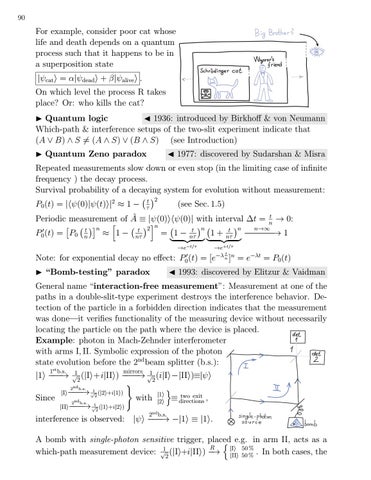
General name “interaction-free measurement”: Measurement at one of the paths in a double-slit-type experiment destroys the interference behavior. Detection of the particle in a forbidden direction indicates that the measurement was done—it verifies functionality of the measuring device without necessarily locating the particle on the path where the device is placed. Example: photon in Mach-Zehnder interferometer with arms I, II. Symbolic expression of the photon state evolution before the 2nd beam splitter (b.s.): 1st b.s.
|1i −−−→
mirrors 1 √1 (|Ii+i|IIi) − −−−→ √2 (i|Ii−|IIi)≡|ψi 2 2nd b.s.
Since
|Ii−−−→ √12 (|2i+i|1i) 2nd b.s.
|IIi−−−→ √12 (|1i+i|2i)
) with
|1i |2i
o two exit , ≡ directions
2nd b.s.
interference is observed: |ψi −−−→ −|1i ≡ |1i. A bomb with single-photon sensitive trigger, placed n e.g. in arm II, acts as a R 50 % 1 which-path measurement device: √2 (|Ii+i|IIi) −→ |Ii |IIi 50 % . In both cases, the Ukázka elektronické knihy, UID: KOS207024
91
n
2nd b.s.
R
photon can exit in states |1i → |Ii −−−→ |2i (with proba|2i . Sequence |1i → .. − bility 25 %) indicates functionality of the bomb without causing its explosion! More sophisticated setups have been described which enable one to increase the efficiency of the “bomb detectionâ€? arbitrarily close to 100 % Applications of quantum measurement Present-day people are no more impressed by mere paradoxes. They seek for practical applications! So here are some. I Quantum cryptography The measurement-induced collapse of wavefuction can, in principle, disclose any hidden measurement performed on the system. This can be used to detect eavesdropping in secret communications: Alice sends o a binary sequence o |xi |yi by individual photons in linear polarization states |x0 i ≥ 0 and |y0 i ≥ 1, selecting between 2 rotated polarization frames S & S0 . Bob measures photon polarizations using independent selection of the same frames S or S0 . The photons for which Alice’s & Bob’s frames coincide must yield the same initial & final polarizations. Any violation of this rule (detected on a released sample of photons) indicates that the photon state was distorted during transmission (Eve’s measurement). If no eavesdropping detected, the states of the remaining photons (for which Alice’s & Bob’s frames equal) may be used as a private key. I Quantum teleportation Teleportation means transfer of a physical state of a given object to another carrier. The simplest quantum realization is for a 2-state object, e.g., spin 12 . ( ) |Ďˆi
|Ďˆi
−−−−−−→ Alice
Setup:
spin 1
EPR source
�−−−− spin 2
Bob −−−−−−→
−−−−→
spin 3
spin 3
Unknown state |Ďˆi = Îą| ↑i+β| ↓i of spin 1 is reconstructed on spin 3, which is a part of the entangled pair in state |ĎˆEPR i23 , using results of Alice’s measurement on spins 1+2 communicated to Bob by a classical channel . A |φ i12 = √12 (|↑i1 |↓i2 −|↓i1 |↑i2 ), |φB i12 = √12 (|↑i1 |↓i2 +|↓i1 |↑i2 ), Alice measures in entang. basis: |φC i = √1 (|↑i |↑i −|↓i |↓i ), |φD i = √1 (|↑i |↑i +|↓i |↓i ). 12
1
2
2
1
2
12
2
1
2
1
2
(Îą| ↑i1 + β| ↓i1 ) √12 (| ↑i2 | ↓i3 − | ↓i2 | ↑i3 ) = | {z }| {z } |Ďˆi1
|Ďˆ A i3
|ĎˆEPR i23
|Ďˆ B i3
|Ďˆ C i3
|Ďˆ D i3
√1 |φA i12 (âˆ’Îą|↑i3 âˆ’Î˛|↓i3 ) +|φB i12 (âˆ’Îą|↑i3 +β|↓i3 ) +|φC i12 (Îą|↓i3 +β|↑i3 ) +|φD i12 (Îą|↓i3 âˆ’Î˛|↑i3 ) 4 Correlated with |φA i12 , |φB i12 , |φC i12 , |φD i12 (results of Alice’s measurement), Bob receives states |Ďˆ A i3 , |Ďˆ B i3 , |Ďˆ C i3 , |Ďˆ D i3 , each of them allowing specific unitary transformation Uˆ • |Ďˆ • i3 = |Ďˆi3 (•=A,B,C, or D) to the desired state |Ďˆi.
z
}|
{
z
}|
{
z
}|
{
z
}|
{
UkĂĄzka elektronickĂŠ knihy, UID: KOS207024
92
I Quantum computation Quantum generalization of classical bit b = { 01 }: qubit
|ψi = α|0i + β|1i
Replacing classical bits by qubits can essentially speed up some computations! Instantaneous state of an n-bit classical computer ≡ (b0 , b1 , . . . , bn−1 ) encodes n−1 P a single number x = bi 2i . A state of n-qubit quantum computer correi=0
sponds to a general superposition of numbers: |Ψi =
n 2X −1
αx ∈ C αx |xi P |αx |2 = 1
x=0
x
2n −1 |xi x=0 ≡ |b0 b1 . . . bn−1 i bi =0,1 ≡ separable basis in H=H0 ⊗H1 ⊗...⊗Hn−1 Quantum computation: controlled sequence of elementary unitary operations on a system of qubits (only 1- and 2-qubit operations allowed) concluded by a specific quantum measurement. The same sequence repeated N times to yield a sufficiently large statistical sample of outputs. n qubits ≡ x Possible computation task: probing function f (x) ⇒ m qubits ≡ f (x) Examples: period determination, distinction of constant/nonconst. functions... General computation scheme: ˆ ⊗Iˆ ˆ2 ˆ3 ⊗Iˆ P P P U U U √1 √1 |0in |0im −−1−→ √12n |xin |0im −→ |xi |f (x)i − − − → αxy |yin |f (x)im n m 2n 2n x
x
x,y
Measurement of y ⇒ output probabilities p(y) contain information on f (x) superpositions ⇒ parallelism In general, quantum computation uses both entanglement ⇒ link x ↔ f (x) J Historical remark 1982: R. Feynman comments on potential use of quantum systems for computation 1984: C.H. Bennet & G. Brassard propose a scheme for quantum cryptography 1993: C.H. Bennett et al. discover quantum teleportation 1994: P. Shor formulates an efficient quantum algorithm for factorization problem till now: multiple experimental attempts in all these areas Bell inequalities Let us return to the EPR situation. Above, we presented the perfect correlation (anticorrelation) of Alice’s & Bob’s spin measurements as a paradox. But is it really a paradox? Given that both spins have a common origin and both observers use the same (pre-agreed!) orientations of measuring devices, who can be surprised by the correlation of results?k But what would happen if Alice & Bob select orientations of their respective spin measurements independently? k
The correlation is surprising if one insists on the reality of wavefunction. If the wavefunction represents an element of the world “out there” (and not just our information on it), Alice’s measurement indeed acts out of its light cone!
Ukázka elektronické knihy, UID: KOS207024