Cvičení / Exercises: 5.III.1 1. 2. 3. 4. 5. 6. 5.III.2 1. 2. 3. 4. 5. 6. 7. 8. 9. 10. 11. 12. 5.III.3
1. 2. 3. 4. 5. 6. 7. 5.III.4 1. 2. 3. 4. 5. 6.
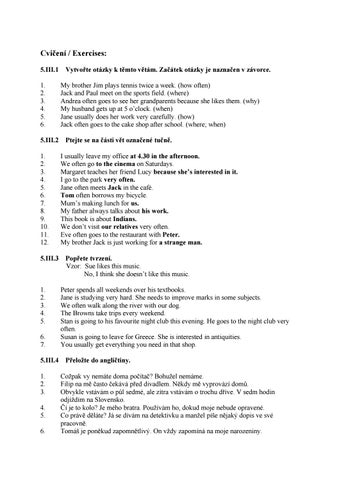
Vytvořte otázky k těmto větám. Začátek otázky je naznačen v závorce. My brother Jim plays tennis twice a week. (how often) Jack and Paul meet on the sports field. (where) Andrea often goes to see her grandparents because she likes them. (why) My husband gets up at 5 o’clock. (when) Jane usually does her work very carefully. (how) Jack often goes to the cake shop after school. (where; when) Ptejte se na části vět označené tučně. I usually leave my office at 4.30 in the afternoon. We often go to the cinema on Saturdays. Margaret teaches her friend Lucy because she’s interested in it. I go to the park very often. Jane often meets Jack in the café. Tom often borrows my bicycle. Mum’s making lunch for us. My father always talks about his work. This book is about Indians. We don’t visit our relatives very often. Eve often goes to the restaurant with Peter. My brother Jack is just working for a strange man. Popřete tvrzení. Vzor: Sue likes this music. No, I think she doesn’t like this music. Peter spends all weekends over his textbooks. Jane is studying very hard. She needs to improve marks in some subjects. We often walk along the river with our dog. The Browns take trips every weekend. Stan is going to his favourite night club this evening. He goes to the night club very often. Susan is going to leave for Greece. She is interested in antiquities. You usually get everything you need in that shop. Přeložte do angličtiny. Cožpak vy nemáte doma počítač? Bohužel nemáme. Filip na mě často čekává před divadlem. Někdy mě vyprovází domů. Obvykle vstávám o půl sedmé, ale zítra vstávám o trochu dříve. V sedm hodin odjíždím na Slovensko. Čí je to kolo? Je mého bratra. Používám ho, dokud moje nebude opravené. Co právě děláte? Já se dívám na detektivku a manžel píše nějaký dopis ve své pracovně. Tomáš je poněkud zapomnětlivý. On vždy zapomíná na moje narozeniny.
Ukázka elektronické knihy, UID: KOS203812
7. 8. 9. 10. 11. 12. 13. 14. 15. 5.III.5 1. 2. 3. 4. 5. 6. 7. 8. 9. 10. 11. 12. 13. 14. 15. 16. 17. 18. 19. 20. 5.III.6 1. 2. 3.
4. 5. 6.
Pro koho chystáš tu snídani? Kdo ti pomáhá s domácími pracemi? Z čeho je vyroben tento koberec? Který z nich je tvůj kamarád Jirka? Je to ten vysoký kluk s tmavými kudrnatými vlasy. Na co ještě čekáš? Ty nenavštěvuješ často jeho přednášky, že ne? Ty máš rád Markétu, že? Ano, mám. Ale ona nemá ráda mě. A: Znáš nějaké pohádky? B: Bohužel neznám žádné. C: Já také ne. S kým chodí Petr do divadla a na koncerty? S jednou svou kolegyní. Doplňte výrazy v závorkách ve správném tvaru v angličtině. (Zůstávám) at home this evening. Some friends (přijdou) to see me. When (hodláš opravit) the fence? I think (udělám) it next Saturday. (Půjdeme) to see our teacher? (Bude ležet) in hospital from Monday to Friday next week. (Ponesete) the heavy bags, please? (Ponesete) my luggage too? My husband (se vrací) from Scotland on 15th August. Your train (odjíždí) at 10.30. You needn’t hurry. (Právě se chystám) to call you. (Jsem zrovna na odchodu). (Zavolám) you later. Mr. Lake (má hovořit) to our director tomorrow. (Máme se sejít) in the café at the corner of Long Street. This time tomorrow (pojedu autem) to Bratislava. Our aunt (přijde) at two p.m. as usual. (Připravíš večeři) in half an hour? In December they (budou cestovat) for half a year. I’ll lend you the magazine when I (přečtu si) it. (Naučím se) to drive a car by next summer. How long have you been working in our firm? In February (budu pracovat) here for ten years. I won’t leave until I (nesetkám se s) him. When I get home tomorrow, the flat (bude vymalovaný). Vyberte ze závorky správnou formu budoucího času. George is back from holiday. Is he? (I’ll call/I’m going to call) him. When will you hand in the report? I think (I’ll write/I’ll have written) it by the end of this week. A: Peter, what’re you planning for tomorrow afternoon? B: Nothing special. (I’ll stay/I’m staying) at home. (I’m watching/I’ll be watching) an important football match on TV from three to five. A: Can I call on you after six? There’s something I’d like to talk to you about. B: Of course, Jack. (I’ll expect/I’ll be expecting) you at six o’clock then. (Will you make/Will you be making) us two cups of coffee, please? (Will you wash/Will you be washing) the cups? If not, I’ll do it myself. As soon as (I’ll have passed/I have passed) the final examination, I’ll leave for abroad.
Ukázka elektronické knihy, UID: KOS203812
7. 8. 9. 10. 11. 12. 5.III.7 1. 2. 3. 4. 5. 6. 7. 8. 9. 10. 11. 12. 13.
14. 15. 16. 17. 5.III.8 1. 2. 3. 4. 5. 6. 7. 8. 9. 10. 11. 12. 13.
You can try the soup after (I’ll finish/I have finished) it. (I’ll be speaking/I’m due to speak) at the conference tomorrow. A: Have you seen Philip this week yet? B: No, I haven’t. But (we will be meeting/ we are to meet) in our club the day after tomorrow. A: Mr. Smith, can I talk to you now? B: I’m afraid (I will leave/I’m about to leave.) When (are you writing/are you going to write) the letter? After finishing the course (I’ll have been working/I’m going to work) as a translator. Přeložte do angličtiny. Co děláš dnes večer? Jdu na koncert. Myslím, že se zítra nebudu moci zúčastnit porady. Omluvíte mou nepřítomnost, prosím? Příští týden budu muset pečovat o nemocného syna. Budeš smět jít se mnou na procházku? Mám na tebe počkat před kinem? Kdy hodláš uklidit ten hrozný nepořádek? Neboj se. Uklidím ten pokoj, než přijdou rodiče z divadla. Budeme mít čas dát si šálek kávy? Proč ne? Náš vlak odjíždí o půl třetí. Lituji, nemám teď čas o tom mluvit. Jsem právě na odchodu. Můžeš ke mně zajít v sobotu. Budu celé odpoledne pracovat na své zahradě. Budu na tebe čekat v naší hospodě mezi druhou a třetí odpoledne. Nedělej si starosti. Až přijdeš večer domů, byt bude vymalovaný a uklizený. Upečeš ten koláč, než přijdou hosté? A: Jak dlouho už pracujete na té knize? B: V listopadu ji budu psát už 15 měsíců. A: Půjčíte mi ji, prosím, až ji dokončíte? B: Samozřejmě. Slibuji, že budete první, kdo si ji bude moci přečíst. Pospěšte si. Naše letadlo odlétá za půl hodiny. Kdo má zajistit občerstvení pro naše zahraniční hosty? Zítra ráno se mám setkat s panem Jonesem na konferenci. Mám mu něco vyřídit? Nemohu vám říci svůj názor, dokud si celý článek nepřečtu. Doplňte sloveso ze závorky v minulém čase. Jim (do) .......it without us. She (give) ...........us some money. We (have) ...........a good idea. Stan (go) ............to that pub. We (sit) ............and (wait) ............. He (say) .............goodbye and (leave) ............. The children (eat) .............everything. I (write) .............him a long letter. She (tell) ...........me about her problems. Jack (drink) ............three glasses of wine. I (see) ..............you at the theatre yesterday. Everyone (come) ...............to the meeting. I (read) .............the article without my glasses.
Ukázka elektronické knihy, UID: KOS203812