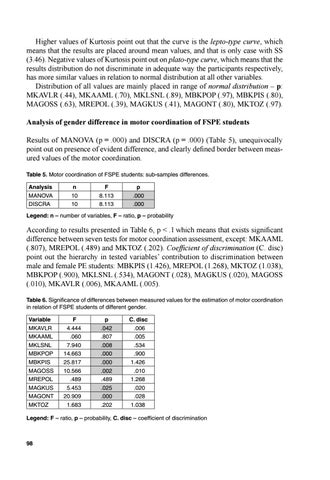
Higher values of Kurtosis point out that the curve is the lepto-type curve, which means that the results are placed around mean values, and that is only case with SS (3.46). Negative values of Kurtosis point out on plato-type curve, which means that the results distribution do not discriminate in adequate way the participants respectively, has more similar values in relation to normal distribution at all other variables. Distribution of all values are mainly placed in range of normal distribution – p: MKAVLR (.44), MKAAML (.70), MKLSNL (.89), MBKPOP (.97), MBKPIS (.80), MAGOSS (.63), MREPOL (.39), MAGKUS (.41), MAGONT (.80), MKTOZ (.97). Analysis of gender difference in motor coordination of FSPE students Results of MANOVA (p = .000) and DISCRA (p = .000) (Table 5), unequivocally point out on presence of evident difference, and clearly defined border between measured values of the motor coordination. Table 5. Motor coordination of FSPE students: sub-samples differences. Analysis MANOVA DISCRA
n 10 10
F 8.113 8.113
p .000 .000
Legend: n – number of variables, F – ratio, p – probability
According to results presented in Table 6, p < .1 which means that exists significant difference between seven tests for motor coordination assessment, except: MKAAML (.807), MREPOL (.489) and MKTOZ (.202). Coefficient of discrimination (C. disc) point out the hierarchy in tested variables’ contribution to discrimination between male and female PE students: MBKPIS (1.426), MREPOL (1.268), MKTOZ (1.038), MBKPOP (.900), MKLSNL (.534), MAGONT (.028), MAGKUS (.020), MAGOSS (.010), MKAVLR (.006), MKAAML (.005). Table 6. Significance of differences between measured values for the estimation of motor coordination in relation of FSPE students of different gender. Variable MKAVLR MKAAML MKLSNL MBKPOP MBKPIS MAGOSS MREPOL MAGKUS MAGONT MKTOZ
F 4.444 .060 7.940 14.663 25.817 10.566 .489 5.453 20.909 1.683
p .042 .807 .008 .000 .000 .002 .489 .025 .000 .202
C. disc .006 .005 .534 .900 1.426 .010 1.268 .020 .028 1.038
Legend: F – ratio, p – probability, C. disc – coefficient of discrimination
98
Ukázka elektronické knihy, UID: KOS196817
Characteristics and homogeneity of coordination variables in relation to different sub-samples of FSPE students, after gender: Group-1 (Male), Group-2 (Female) Based on actual consideration and analysis of total sample (N = 39), in harmony with applied methodology, logical research continuum is determination of characteristics and homogeneity of every group of examinees (male/female). Table 7. Characteristics and homogeneity of Groups in motor coordination tests Variable MKAVLR MKAAML MKLSNL MBKPOP MBKPIS MAGOSS MREPOL MAGKUS MAGONT MKTOZ n/m Hmg %
Group-1 smaller smaller smaller smaller smaller smaller smaller smaller smaller smaller 26/26 100.00
Group-2 larger* 1 larger larger larger* 1 larger* 1 larger* 1 larger* 1 larger* 1 larger* 1 larger 12/13 92.31
ctrb % 27.240 24.222 19.828 17.192 10.201 .535 .382 .191 .115 .096
Legend: Hmg % – homogeneity; ctrb % – contribution of the variables to the Groups characteristics
The fact that p = .000 (DISCRA), means that exists clearly defined border between set of variables for estimation of motor coordination, and that it’s possible to determine characteristics of every group in relation to different sub-samples of participants (male/female). Based on this report it is possible to say that the characteristics of Group-1s homogeneity is 100.0% (Table 7), which means that all participants possess only group specific characteristics; as well characteristics of Group-2s homogeneity is 92.3%, while only one participant has other characteristics. That means that in examinees with characteristics as similar as those characteristics of Group-1, one can expect, with 100% of confidence, belonging to Group-1, i.e. it is possible to predict it with certain confidence. Discussion In accordance with pre-determined study design the thematic unit was analyzed: motor coordination in relation to gender specific FSPE students. The first section presents the central and dispersion parameters and variation indicators, skewness and kurtosis measures in relation to the monitored parameters. In the second part were analyzed 99
Ukázka elektronické knihy, UID: KOS196817
the between groups differences, in order to assess the results and the appropriateness of further consideration. Then, under existing conditions, the characteristics and homogeneity of each group were defined. In Group-1 (male students) values of CV% (see Table 3) and Hmg% (see Table 7) point out on homogeneity of almost all tested variables (except MKLSNL). That cannot be said for Group-2: in female students that homogeneity is seen in instruments for assessment of upper body coordination (MKAAML), lower body coordination (MAGKUS), or whole body coordination – simple tasks (MKAVLR, MBKPOP, MAGOSS). On the multivariate level, MANOVA and DISCRA (see Table 5) showed statistically significant differences between these two sub-samples. If one takes into account the fact that coordination is the most complex motor ability that is being saturated through its relations with all others, these results are expected. This means that, for example, the abilities of speed, strength, flexibility and endurance have to develop to a certain degree to be gradually integrated into the ability of performing the most complex movements, i.e. coordination. Only three out of 10 variables do not discriminate Group-1 from Group-2 [MKAAML (.807), MREPOL (.489), and MKTOZ (.202)]. The rest of seven variables gave their contribution to discrimination between male and female PE students, and there’s hierarchy in their contribution: MBKPIS (1.426), MREPOL (1.268), MKTOZ (1.038), MBKPOP (.900), MKLSNL (.534), MAGONT (.028), MAGKUS (.020), MAGOSS (.010), MKAVLR (.006), MKAAML (.005). It can be said that this is expected if we take into account everything said above. In test MKAVLR (see Table 8), male students obtained result of 8.92 ± .87 sec, which is almost the same result to those gained by male students of the Faculty of Physical Culture (FPC), University of Zagreb, in 1989. The differences are noticable in female group. In 2013, female students with the result of 9.87 ± 1.97 sec are much above (considered as inverse values) than female students from previous generation of 2012 (11.02 sec) (Popović et al., 2012). When talking about test MKAAML, male and female FSPE students achieved almost equal points, and that equality can be noticed also when compared with the results of male students of the FPC, University of Zagreb (Metikoš et al., 1989). Obtained values for MKLSNL in female students (32.83 ± 7.62 sec) are significantly weaker than in the group of male students (26.89 ± 5.39 sec) in the current study. In 2013 female students with their result are much above (considered as inverse values) than female students from previous generation of 2012 (37.02 ± 6.84 sec) (Popović et al., 2012). The best result (23.58 ± 3.48 sec), considered as inverse values, have achieved male students of the FPC, University of Zagreb (Metikoš et al., 1989). In male group, obtained value for MBKPOP is 14.74 ± 2.04 sec, which is almost the same with the result obtained by male students (14.87 ± 2.89 sec) from Zagreb (Metikoš et al., 1989). In this case, female students showed lower level of whole body coordination (18.02 ± 3.31 sec) in comparison to male students. For test MBKPIS female students scored 19.10 ± 6.05 sec, which is the most weaker result, compared to the male students in this study (12.22 ± 2.44 sec), as well 100
Ukázka elektronické knihy, UID: KOS196817