98
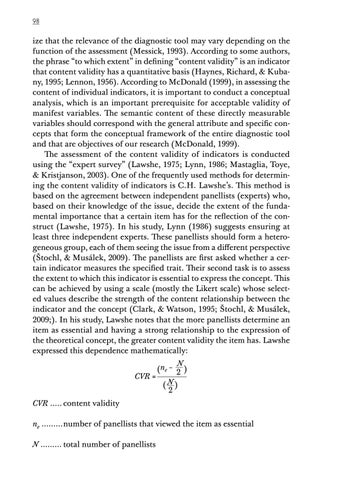
ize that the relevance of the diagnostic tool may vary depending on the function of the assessment (Messick, 1993). According to some authors, the phrase “to which extent” in defining “content validity” is an indicator that content validity has a quantitative basis (Haynes, Richard, & Kubany, 1995; Lennon, 1956). According to McDonald (1999), in assessing the content of individual indicators, it is important to conduct a conceptual analysis, which is an important prerequisite for acceptable validity of manifest variables. The semantic content of these directly measurable variables should correspond with the general attribute and specific concepts that form the conceptual framework of the entire diagnostic tool and that are objectives of our research (McDonald, 1999). The assessment of the content validity of indicators is conducted using the “expert survey” (Lawshe, 1975; Lynn, 1986; Mastaglia, Toye, & Kristjanson, 2003). One of the frequently used methods for determining the content validity of indicators is C.H. Lawshe’s. This method is based on the agreement between independent panellists (experts) who, based on their knowledge of the issue, decide the extent of the fundamental importance that a certain item has for the reflection of the construct (Lawshe, 1975). In his study, Lynn (1986) suggests ensuring at least three independent experts. These panellists should form a heterogeneous group, each of them seeing the issue from a different perspective (Štochl, & Musálek, 2009). The panellists are first asked whether a certain indicator measures the specified trait. Their second task is to assess the extent to which this indicator is essential to express the concept. This can be achieved by using a scale (mostly the Likert scale) whose selected values describe the strength of the content relationship between the indicator and the concept (Clark, & Watson, 1995; Štochl, & Musálek, 2009;). In his study, Lawshe notes that the more panellists determine an item as essential and having a strong relationship to the expression of the theoretical concept, the greater content validity the item has. Lawshe expressed this dependence mathematically: N (ne − 2 ) CVR = ( N ) 2 CVR ..... content validity ne ......... number of panellists that viewed the item as essential N ......... total number of panellists
Ukázka elektronické knihy, UID: KOS194961
99
Based on this mathematical expression for determining the content validity of indicators, the following table with recommended values of panellists’ (experts) conformity was proposed: Table 3 Recommended values of panelist conformity Number of Panelists
Minimum Value
5
.99
6
.99
7
.99
8
.85
9
.78
10
.62
11
.59
12
.56
13
.54
14
.51
15
.49
20
.42
25
.37
30
.33
35
.31
40
.29
(Lawshe, 1975)
When creating a scale assessing the content validity of indicators, two types of scales were considered: a scale with an even number of options and scale with an odd number of options. According to Davis (1992), it is generally advisable to have an ordinal scale with 4 categories. The researcher thus prevents a situation where the expert notes that the item displays a neutral character of relevance towards the construct (from the character 1 – not acceptable, to the character 4 – highly relevant). Based on the results, the indicators are selected from categories 3 and 4 (Davis, 1992). In our case, in order to assess the content validity of indicators, we finally decided to create the five-point Likert scale which did not contain a neutral option and, simultaneously, displayed a fine distinction between individual degrees of the indicators’ content validity with regard to the defined theoretical concept:
Ukázka elektronické knihy, UID: KOS194961
100
1. the indicator does not measure the theoretical concept at all 2. the indicator measures the theoretical concept weakly 3. the indicator measures the theoretical concept 4. the indicator measures the theoretical concept strongly 5. the indicator measures the theoretical concept very strongly In order to assess content validity, the lists of relevant indicators for both the adult and child populations were sent to six experts from different disciplines related to the motor manifestations of laterality. The following disciplines were used: special education, neurology, psychiatry, anthropomotorics, kinesiology, and neurophysiology. All experts were informed of the aim of this thesis, and in addition to the assessment of the indicators’ content validity, the experts were asked to specify whether the indicator is appropriate in the form of the question in the questionnaire, motor task, or motor test. This specification was conducted by the experts by assigning shortcuts to the indicators: Q question in the questionnaire PT preference task PET performance test When assessing the content validity, the fact whether the indicator represents a spontaneous activity or activity that is currently subject to social pressure was also taken into account. The lists of items were sent to the experts repeatedly, three times in total. The listswere always repeated sent to the experts 14 days after returning the previous assessment. In order to determine the most appropriate content items, we used the method of conformity developed by Lawshe (1975). The calculation of conformity was carried out according to the formula N (ne − 2 ) (Lawshe, 1975). CVR = ( N ) 2 Subsequently, we selected the indicators where all experts repeatedly agreed on the value of 5. Then we incorporated the indicators where more than half of experts agreed on the value of 5, but other panellist(s) assigned the value of 4 to this item. The last part of the indicators included in the creation of the test batteries was represented by items to which all the panellists assigned the value 4.
Ukázka elektronické knihy, UID: KOS194961