Schooled in Ethics: A Lawyer’s Duty to Have Uncomfortable Conversations with a Judge . . . Page 19 How to Thrive: Five Mental Performance Lessons from the World Cup . . . Page 27
A Publication of the Knoxville Bar Association | September/October 2026
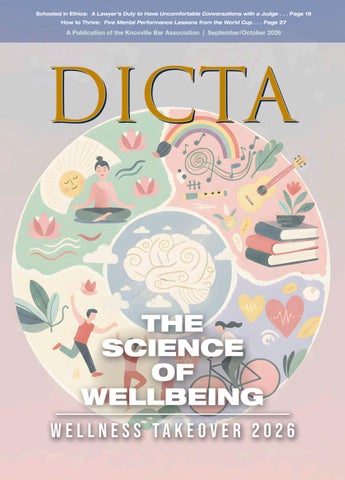
THE SCIENCE OF WELLBEING WELLNE SS TAKEOVER 2026
When Immigration Comes Up, Send Them Our Way
Torres Law Firm PLLC
Whether immigration is central to the case or just one piece of the puzzle, we help your clients move forward with clarity and confidence.
FREE CONSULT DAY October 16, 2026 | 9:00AM - 3:00PM
Consultations in English & Spanish • Professional Interpretation Services Available
Refer with confidence. We’ll take it from here. I m m i g r a t i o n | P e r s o n a l I n j u r y | Wo r ke r ’s C o m p . | Me d i c a l M a l p r a c t i c e
(865) 558 - 6161 Office@TorresLawFirmTN.com 7220 Wellington Drive Knoxville, TN 37919 2
DICTA
September/October 2026
In This Issue
Officers of the Knoxville Bar Association
September/October 2026
COVER STORY 16
The Science of Wellbeing
CRITICAL FOCUS 5 President Rachel Park Hurt
President-Elect Ursula Bailey
Treasurer Catherine E. Shuck
Secretary M. Samantha Parris
Immediate Past President Jonathan D. Cooper
KBA Board of Governors Courteney M. Barnes-Anderson R. Kim Burnette Melissa B. Carrasco Meagan Collver
Joshua D. Hedrick Allison Jackson Matthew R. Lyon James R. Stovall
C. Scott Taylor Alicia J. Teubert Shannon van Tol Isaac W. Westling
8 11 19
21
The Knoxville Bar Association Staff
President’s Message
Fat Weight
Appealing
The Right Stuff
Legal Update
Weaponized Discretion
Schooled in Ethics
A Lawyer’s Duty to Have Uncomfortable Conversations with a Judge
Management Counsel
Navigating the New Frontier: Accommodating Mental Health Conditions in the Workplace
WISDOM 6 10 Tasha C. Blakney Executive Director
Tammy Sharpe Director of CLE & Section Programming
Bridgette Fly Membership Coordinator
Alyx White Programs & Communications Coordinator
Knoxville Bar Association 505 Main Street Suite 50 Knoxville, TN 37902 865-522-6522 www.knoxbar.org Tracy Chain LRIS Director
Jason Galvas LRIS Assistant
Dicta
All articles submitted for publication in DICTA must be submitted in writing and in electronic format (via e-mail attachment). Exceptions to this policy must be cleared by KBA Executive Director Tasha Blakney (522-6522).
September/October 2026
13 14 18 20
22
Volume 54, Issue 7
DICTA is a bi-monthly publication by the Knoxville Bar Association. It is designed to offer information of value to members of the local bar association. The news and features should illustrate the issues affecting the bar and its members. The opinions expressed do not necessarily represent those of the Knoxville Bar Association.
12
Dicta is the official publication of the Knoxville Bar Association
Publications Committee Executive Editor Executive Editor Executive Editor Executive Editor Sherri Alley Parker Bohne Elizabeth B. Ford Joseph G. Jarret F. Regina Koho Matthew R. Lyon Robin McMillan
Managing Editor
Sarah M. Booher Wade H. Boswell, II Melissa B. Carrasco Summer McMillan Angelia Morie Nystrom Katheryn Murray Ogle Bridget Pyman Cathy Shuck Jimmy Snodgrass Eddy Smith Grant Williamson
Tasha C. Blakney KBA Executive Director
DICTA
24 26 27 29 30
31
Around the Bar
An Update from the KBA Wellness Committee
Judicial Profile
Upholding Equity and Devotion to the Truth: A Profile of Chancellor John F. Weaver
Of Local Lore and Lawyers
Don’t Get Burned by Burnout!
Three Stars
Professional Wellness
Hello My Name Is
Ellie Sousa
Legally Weird
Louisiana – The Legally Weird Gift That Keeps on Giving
KBA Volunteerism
The Volunteer Spirit: Highlighting Attorney Dedication to Philanthropy: Cathy Shuck
Building the Record
Knoxville’s Nastiest Divorce
21st Century Lawyer
Where Do You See Yourself in Three Years?
Privileged to Be in the Law
Leaving the Office to Go Run
How to Thrive
Five Mental Performance Lessons from the World Cup
Barrister Bites
Empty Nest . . . Lots of Fresh
Well Read
Silencing the Gavel in the Mind: A Review of Hunter Fowler’s Mind Intruder
Outside My Office Window
Building a Mystery: The Love of LEGO
COMMON GROUND 23 28
Pro Bono Spotlight Address Changes/New Members
3
aim is your winning ROOTED IN TRUST. GROWING WITH PURPOSE.
defense.
For decades, AIM has helped attorneys build stronger practices through dependable protection, practical resources, and a commitment to what’s next.
Just like football, AIM is a tradition for Southern lawyers. Formed by attorneys, for attorneys, our playbook will always provide high-quality legal malpractice insurance for Tennessee lawyers, unparalleled customer service, unmatched claims defense, and free CLE. Come join the AIM team and experience firsthand the peace of mind AIM provides.
4
DICTA
Get a Quote Today: 205.980.0009 info@attorneysinsurancemutual.com www.attorneysinsurancemutual.com
September/October 2026
PRESIDENT’S MESSAGE By: Rachel Park Hurt Arnett Baker Draper & Hagood, LLP
FAT WEIGHT This edition of DICTA is all about the health of the KBA. For the whole month of October, the KBA focuses on mental and physical health and the overall wellness of the legal profession. There will be opportunitites to exercise – like hiking and the annual Barristers Golf Tournament. And the big event, hosted by the Wellness Committee, is an excellent wellness fair at the City County Building. Excellent health care providers will be present to stretch you, massage you, test you (your vital signs), poke you (with your flu vaccination), and generally give you an overall picture of your health. And, good or bad, you need to know how you are doing. The Wellness Fair is an incredible member service that should not be missed. The KBA focuses on mental and physical health for obvious reasons. The legal profession has long been associated with, well, unhealthy life habits. Long hours of sedentary work contribute to back pain, neck strain, obesity, cardiovascular disease, and other chronic health conditions. Irregular schedules often lead to skipped meals, excessive caffeine consumption, and inadequate sleep, all of which diminish energy, concentration, and long-term health. I am the living example of the legal profession as I sit at my desk for what seems to be the 16th hour of the day, writing this article at 3:15 a.m., eating beef jerky and mixed nuts (not kidding), having only had one meal and four cups of coffee today. I am not feeling healthy, physically or mentally. In fact, I think, like most attorneys, I am on the verge of burnout nearly every day. I want to work out. I want to drink more water. I want to eat better. I want to feel better. I want to look better. I want to stress less. And yet I wake up every day and the flood of to-do lists and deadlines and unexpected fires and known but procrastinated dumpster fires come at me with a speed that cannot be maintained or sustained. Every…single…day. And, while I really do hope that I am alone in these feelings, I strongly believe that I am not. Over the course of the last 10 months, I have talked to so many attorneys and the repeated refrain is that we are all busy, stressed, tired, overwhelmed, exhausted, behind…or some combination of these. And, what surprises me the most is that these conversations are not whining, complaining, or pleas for help. Instead, lawyers just talk about these feelings as if they are just life, believing that nothing can be done. And I think this is the problem…the mindset that this is just how it has to be. This leads me to…fat weight. Now, I am not talking about my current weight…it is not really about being overweight at all. Instead, fat weight is a term that I recently learned in a falconry demonstration. Fat weight is the maximum weight that a bird of prey reaches before it becomes unmotivated, lazy, and unresponsive to its handler because it lacks the natural hunger drive needed to hunt. Once a bird reaches a certain weight (approximately 5% over hunt weight), the bird will just stop eating until it loses the weight. What caught my attention first is that birds of prey will simply stop eating when they reach fat weight. I wish I had the magical fat weight sensation. After I overcame this bitterness, I really thought about the relationship between health and the hunt: being at your best vs. being unmotivated, tired, and disinterested. It is so obvious that everyone, in any profession, performs best when they are physically (and mentally) healthy. And, so, in thinking about fat weight, I did what all attorneys like me do – research ways to improve my health. These are some basic tips that I found. You might find them useful too. Physical wellness begins with small, intentional habits. Taking brief walking breaks throughout the day, using ergonomic workstations, September/October 2026
stretching between meetings, lifting a weight while on a conference call, and prioritizing nutritious meals can significantly reduce the physical strain of legal practice. Even modest exercise—such as a 30-minute walk before work or after court—improves cardiovascular health while also reducing stress and anxiety. Sleep deserves equal attention. Lawyers frequently sacrifice rest to meet filing deadlines or prepare for trial, yet chronic sleep deprivation impairs memory, judgment, and decision-making. Ironically, the very work meant to demonstrate excellence may suffer when adequate rest is ignored. Hydration, preventive healthcare, and routine medical appointments are similarly essential. Attorneys often postpone their own medical needs while addressing those of clients, but preventive care remains one of the most effective strategies for maintaining long-term health. Wellness extends beyond avoiding illness; it encompasses creating habits that allow individuals to thrive personally and professionally. For lawyers, wellness should be viewed as an ongoing investment rather than an occasional reward. A comprehensive wellness plan may include: • Regular physical activity that is enjoyable and sustainable; • Balanced nutrition and consistent hydration; • Seven to nine hours of quality sleep whenever possible; • Mindfulness practices such as meditation, prayer, or deep breathing; • Meaningful relationships with family, friends, and colleagues; • Hobbies unrelated to legal practice that encourage creativity and relaxation; • Professional counseling or coaching when needed; • Stretching, yoga, or Pilates to maintain and strengthen core muscles and posture; or • Turning off emails and cell phones to avoid having to be “always on.” Setting boundaries is important. Not every email requires an immediate response, and uninterrupted personal time strengthens resilience. Scheduling vacations, protecting evenings with family, and occasionally disconnecting from technology allow attorneys to return to work with renewed focus. These tips are common sense, but I thought worth repeating. What I didn’t expect in my research was the emphasis on the “village” to really assist in helping individuals make lifestyle changes. Repeatedly, I read that individual effort alone cannot solve systemic wellness challenges. Employers play a critical role in fostering healthy workplace cultures. Professional organizations, like the great Knoxville Bar Association, contribute through continuing legal education focused on wellness, confidential assistance programs, and initiatives addressing substance use and mental health awareness. Mentorship also contributes significantly to attorney wellness. Experienced lawyers who openly discuss challenges normalize helpseeking behaviors and demonstrate that successful careers include periods of growth, vulnerability, and adaptation. (Younger lawyers, read paragraphs 2 and 3 above) We all have a role in helping ourselves, our colleagues, our friends, and our Bar. We are all in this together. And we need to be hungry, ready for the hunt. I need you to help me get healthier, and I will do my best to help you.
DICTA
5
AROUND THE BAR By: Hannah Lowe
Tennessee Valley Authority Office of General Counsel
Saiid Lewis
JD Candidate (Class of 2028), University of Tennessee Winston College of Law
WELLNESS COMMITTEE UPDATE FOR 2026 The KBA Wellness Committee strives for a holistic approach to attorney wellbeing, encompassing the six dimensions of wellbeing identified in the 2018 ABA Task Force Report on Lawyer Wellbeing: (1) occupational; (2) emotional; (3) physical; (4) intellectual; (5) spiritual; and (6) social.1 The KBA provides opportunities for education, networking, and mentorship, helping members achieve career satisfaction and growth. The Wellness Committee offers financial wellness webinars to help members take control of their finances at various career stages. Further, it seeks to provide opportunities for members to learn and develop tools to build resilience and manage stress, including engaging in creative pursuits and mindfulness/meditation. We encourage you to maintain good physical health by eating a healthy diet, exercising regularly, completing regular health checks and screenings (as indicated by age and family history), and getting any recommended vaccines. Look for ways to strengthen your intellectual health by cultivating a desire to learn and continue developing throughout each stage of your life and career. Seek out opportunities to foster your spiritual health by finding meaning and purpose through activities that are meaningful to you, for example, participating in a church or a religious group, volunteering, pro bono work, and teaching/coaching. Find time to support your social health by cultivating connections, community, and a sense of belonging. KBA Wellness Committee Activities The Wellness Committee continues to offer opportunities for KBA members to get outside, get together, and care for their wellbeing. Last year’s Healthy Bar Challenge was a great success and will return this October. We hope you will participate! Highlights from last year’s Healthy Bar Challenge include a walking tour of the Knoxville Farmers Market and litter collection at Victor Ashe Park.
In April 2026, we explored trails at beautiful Aspire Park in Clinton.
Enjoying the trails at Aspire Park in April 2026. We continue our weekly walks. This year, we moved our Tuesday evening walks (5 PM) to downtown Knoxville (Market Square). We continue to meet on Friday mornings (7 AM) at Lakeshore Park. We hope you will join us! Contact Hannah Lowe (865-385-4724) with questions. Strong social connections provide health benefits, and intergenerational relationships are especially valuable, as they build empathic connections and foster group learning among all members.2 This year, several KBA Law Student members have joined the weekly walks, allowing members to organically cultivate meaningful social connections and intergenerational relationships in an informal setting.
Finding treats at the Knoxville Farmers Market, October 2025. Picking up litter at Victor Ashe Park, October 2025.
6
KBA lawyers and law students enjoying the trails at Lakeshore Park. Healthy Bar Challenge The Healthy Bar Challenge sponsored by First Horizon is back in 2026, and we are excited for year four. Registration opens in September, and the Challenge begins October 1. Track your progress and earn points
DICTA
September/October 2026
October 1 – 31. Earn points for time spent doing physical, mental, or financial wellness activities. Earn bonus points and a chance to win prizes for participating in the Weekly Incentive Activities. Earn more bonus points by participating in the activities and events sponsored by the KBA Wellness Committee. Compete as an individual or make it more fun by joining a team (comprised of 3 or 4 KBA members, including law student KBA members, from the same firm/organization, different firms/ organizations, or a combination thereof ). We will have a recognition breakfast to celebrate everyone’s hard work (and announce the winners) on Friday, November 13, 2026. 2026 Healthy Bar Challenge Weekly Incentive Themes: Have a Ball Fun with Kids & Pets Get Outside Tee-ing Off Wellness Mental Health 2026 Wellness Committee Sponsored Activities: Tuesday Evening Walks (5 PM) Friday Morning Walks (7 AM) Pickleball/Tennis Tournament - October 2, 2026, at 2:30 PM 3 Financial Wellness Webinars (see below) Barrister’s Charity Golf Tournament - October 19, 2026 KBA Wellness Conference (see below) Fall Hike with Professionalism Committee - October 31, 2026 Financial Wellness Webinar Programming Winding Down a Solo Law Practice - October 5, 2026 Account Solutions for Firms of All Sizes - October 21, 2026 Trust Account Horror Stories - October 28, 2026
Join the Wellness Committee We encourage you to get involved with the KBA Wellness Committee. If you have ideas for activities or programs focused on lawyer wellbeing, we would love to hear from you! Lawyers regularly help others, but we must be comfortable asking for help when needed, whether from friends or family, or a mental health professional. The 988 Suicide and Crisis Line is available 24 hours a day for those who need help in crisis. TLAP (615-741-3238) also offers confidential assistance for a wide range of issues, including referrals for health assessments, counseling, mental health treatment, and substance abuse treatment. 1
Wellness Conference and Health Fair Join us October 29, 2026, in the City County Building for the Wellness Conference and Health Fair. Mac’s Pharmacy will offer flu shots, along
September/October 2026
with other health vendors. We will have 2 hours of CLE programming: • Beyond the Brief: Recognizing Mental Health and Addiction in the Legal Profession: A representative from Cornerstone of Recovery will discuss current data on mental health and substance use, how to identify early warning signs of impairment, practical strategies to support colleagues and clients, confidential resources and treatment options, and ethical considerations related to attorney wellbeing. • Build a Strong Foundation, Stand Tall, and Lead from the Heart: Yoga and Mindfulness Tools for Lawyers: Wellness Committee Co-Chair and certified Yoga Instructor Hannah Lowe will explore the principles behind certain yoga poses and mindfulness tools to help build resilience and manage stress. This will be an (optional) interactive session no yoga experience required!
2
DICTA
Information about the Report from the National Task Force on Lawyer Wellbeing is available at https://www.americanbar.org/groups/lawyer_assistance/task_force_ report.html/ and the Institute for Well-Being in Law at www.lawyerwellbeing.net. IRT, 8 Benefits of Intergenerational Relationships (Jun 10, 2025), https://www.irt.org.au/ the-good-life/the-benefits-of-intergenerational-relationships/
7
APPEALING By: Robin McMillan
Career Clerk to the Honorable Cynthia R. Wyrick, United States Magistrate Judge
THE RIGHT STUFF Does your brief have the right stuff ? I am not asking if you have the gutsy-est, most winning-est arguments designed to change the American legal landscape forever. Rather, have you fulfilled the minimum requirements to allow issues to be considered by the Court of Appeals and the Tennessee Supreme Court? Briefs must comply with several rules, discussion of which would fill several articles. Here, let’s focus on parts of Rule 27 of the Tennessee Rules of Appellate Procedure. Rule 27 sets out what an appellate brief must contain and some of what it may contain. The rule provides for eight possible sections. I say possible sections, not mandatory sections, because not all sections are required in every brief. But more on that in a moment. Rule 27 dictates that the sections shall have “appropriate headings” and shall appear within the brief “in the order here indicated.”1 When drafting, simply open the rule, utilize the section headings given, and follow the order presented. Whether a section is compulsory hinges on whether the brief is being filed by the appellant or the appellee. Some sections are mandatory for both, others only for appellants, and one is required only in a specific instance. Let’s table that for now The first two Rule 27(a) sections, a table of contents and a table of authorities, are mandatory for both appellant and appellee.2 Both sections require references to the pages of the brief where the appropriate information appears.3 When preparing these references, provide specific page numbers. Avoid resorting to “passim” when something appears multiple times. “Passim” can frustrate a busy judge searching for something specific within the brief. Even if numerous, provide page numbers or, if appropriate, a range such as 4––7.4 Your reader will be able to locate information more easily using actual page numbers.
17
Tenn. R. App. P. 27(a). Id. at (1) & (2). Id. If the item appears on pages 4, 5, and 7, but not on page 6, do not use 4––7. Use the actual page numbers even if your list winds up looking like this: “4, 5, 7, 12, 14, 15, 16, 17, 19, 20, 22, 25, 27.” You Don’t Need Me, by The Melodians, released as a single (1967). Tenn. R. App. P. 27(a)(3). Issues, by Julia Michaels, album Nervous System (2017). Tenn. R. App. P. 27 (b). An appellee not raising separate issues may choose to include its own statement of the issues. E.g., Smith v. Hughes, 639 S.W.3d 627, 650 n.11 (Tenn. Ct. App. 2021). Hodge v. Craig, 382 S.W.3d 325, 334 (Tenn. 2012). Id. at 335 (“an issue may be deemed waived when it is argued in the brief but is not designated as an issue in accordance with Tenn. R. App. P. 27(a)(4).”). Charles v. McQueen, 693 S.W.3d 262, 283 (Tenn. 2024) (discussing Killingsworth v. Ted Russell Ford, Inc., 205 S.W.3d 406 (Tenn. 2006) wherein the Court addressed requirements for an appellant to present a request for attorney’s fees on appeal). Id. at 284 (“When a request for appellate attorney’s fees does not seek relief from the judgment below, an appellee is not required to include the request in the statement of issues. . .. But an appellee is required to present the request to the appellate court by raising it in the body of the brief, adequately developing the argument, and specifying that relief in the brief’s conclusion.”). Id. Id. Hodge v. Craig, 382 S.W.3d 325, 334 (Tenn. 2012) (citing several resources regarding framing appellate issues). Id.
DICTA
September/October 2026
You don’t need me5 Section three, i.e., a jurisdictional statement, is required in only one specific instance. It need be included only if you represent the appellant in a case being directly appealed to the Supreme Court from the trial court.6 In a case appealed to the Court of Appeals a jurisdictional statement is unnecessary. ’Cause I got issues, but you got ’em too7 The fourth section, i.e., a statement of the issues, is mandatory for appellants and optional for appellees. This is so because the appellee may choose to raise separate issues. An appellee not raising separate issues may skip this section.8 The statement of the issues presents two extremely serious potential pitfalls. First, for the appellate court to address an issue, it must be
8
contained in the statement of the issues. And the appellant must take care to include all issues in the opening brief. An issue an appellant includes in a reply brief that was not included in the opening brief has been waived.9 “Appellate review is generally limited to the issues that have been presented for review.”10 Failing to include an issue in the statement of the issues can result in waiver of that issue.11 There is an exception to this rule regarding waiver specific to requests for attorney’s fees on appeal. Whether the request must be included in the statement of the issues depends, largely, upon the status of the party making the request. An appellant must include a request for attorney’s fees on appeal in the statement of the issues.12 An appellee, however, may make the request without including it in the statement of the issues if the request does not seek relief from the trial court’s judgment and appellee does two things.13 First, the appellee must appropriately raise the request within the body of the brief accompanied by an argument in support.14 And second, the request must be included in the brief ’s conclusion.15 The second potential pitfall concerns the wording of issues. The manner in which an issue is framed will dictate how the court will view and address that issue. The Tennessee Supreme Court has noted: “The outcome of a case is influenced, at least in part, by how the court approaches the issues presented.”16 Asking the right question is critical to receiving the right answer.17 The importance of the phrasing of issues cannot be overstated. Spend serious time crafting the questions posed in the issues. 1 2 3 4 5 6 7 8 9 10 11 12 13
14 15 16
Personal guidance. Powerful resources. Behind every strong community lies the strength of trusted advocacy. We’re proud to support members of the Knoxville Bar Association and their commitment to providing expertise that protects, empowers and uplifts. firsthorizon.com
©2026 First Horizon Bank. Member FDIC.
September/October 2026
DICTA
9
JUDICIAL PROFILE By: Katie Ogle Burks & Ogle
UPHOLDING EQUITY AND DEVOTION TO THE TRUTH: A PROFILE OF CHANCELLOR JOHN F. WEAVER Chancellor John F. Weaver does not describe his nearly three decades on the Chancery Court for Knox County in terms of rulings or reputation. He describes them in terms of a discipline: showing up, doing the work, and defending a system of justice—equity—that he believes is too often mistaken for something it is not. A colleague once remarked that Weaver “continues to outwork those around him,” even through serious injury. It is a fitting description of a judge who has approached the bench less as a platform for personal distinction than as a duty demanding steady, meticulous application. Background and Path to the Bench After graduating from Emory University School of Law in 1977, Chancellor Weaver joined a small business litigation firm as an associate. Appearing early in his career before Chancellors Broughton and McDonald, he decided that he wanted to become a chancellor himself. His practice later exposed him to the court from several vantage points: he served as a bankruptcy trustee, a special master, a receiver, and a special Chancellor within Knox County Chancery Court. In 1993, Chancellors McDonald, Cate, and Bell selected him as their Clerk and Master. Later in this term, when Chancellors McDonald and Cate chose not to seek reelection, Chancellor Weaver decided to run for the seat himself. He credits his judicial temperament in part to the example of these three chancellors—McDonald’s composure, Cate’s command of the law, and Bell’s decisiveness—along with the influence of Bankruptcy Judge Stair and two mentors from his undergraduate years at the University of Tennessee, Professor Otis H. Stephens, Jr., and Assistant Dean Richard P. Baxter. The Work of Chancery Court Chancery Court’s docket is entirely civil and subject to no monetary limit, encompassing adoptions, termination of parental rights proceedings, contract and probate disputes, real estate matters, and governmental cases. Domestic cases, Weaver notes, tend to require the most attention, and although litigants may demand a jury, nearly all matters are tried before the court alone. He regards the formation and denial of injunctive relief as among the most demanding aspects of equity jurisdiction, which is a natural consequence of equity’s historical role in providing remedies beyond the money judgments available at law. Of the matters that come before him, he considers termination of parental rights cases the most taxing. Life on the Bench Chancellor Weaver describes a meaningful shift in how he measures
10
his own work since moving from advocacy to the bench. As a lawyer, he gauged his progress by courtroom performance—winning objections and prevailing in argument. However, what he came to understand only after taking the bench was that, in his words, “the Chancellor is concerned, first and foremost, with the truth.” That recognition, he says, marks the essential divide between the advocate’s role in pursuing an outcome for one side and the jurist’s obligation to reach a fair and correct result for both. Off the bench, he believes lawyers and judges can work alongside one another for the benefit of the legal community, but he is careful to note that no such association carries into the courtroom, where each case is decided on its own terms. Perspective on the Profession When asked what he wishes lawyers understood better, Weaver returns to two themes: preparation and demeanor. Thorough preparation guards against surprise, and a composed, persuasive presentation is essential to effective advocacy in any court. “The Chancery practitioner should keep in mind, when preparing and presenting his or her case, that litigation consists of three areas of the law, not just substantive and procedural, but also persuasive. Civility toward the bench, opposing counsel, and witnesses, is an essential part of that persuasion.” He also credits the current generation of younger lawyers with a genuine commitment to their cases, a development that gives him confidence in the profession’s future in East Tennessee. “Looking at the bar as a whole, the eagerness of our younger lawyers gives me the most optimism about the future of the legal profession in East Tennessee,” notes the Chancellor. “Some of the younger members actually glow with enthusiasm in presenting their cases. When I see that glow, I rest assured of our future.” Knox County and Community Chancellor Weaver acknowledges that balancing bench duties with legal-community and civic involvement can be difficult. Preparing for the next day’s docket, he says, must take precedence over evening obligations under the Code of Judicial Conduct—a limitation he accepts as inherent to the office. He speaks with particular seriousness about Chancery Court’s equity jurisdiction, which he believes remains distinct from, and should not be absorbed into, the jurisdiction of the circuit courts. Personal Reflection Weaver declines to identify a proudest moment on the bench, comparing such reflection to an umpire dwelling on his own best game. Asked what he hopes lawyers and litigants will say about him—not as a judge, but as a person—he offers a simple answer: that he was “sincere, genuine and fair and who did his best.” For a court built on the pursuit of fairness rather than victory, it is difficult to imagine a more fitting standard for the man who has presided over it.
DICTA
September/October 2026
LEGAL UPDATE By: Natalie Miramontes-Tankersley
Kramer Rayson LLP
WEAPONIZED DISCRETION:
HOW USCIS PLANS TO MAKE ADJUSTMENT OF STATUS HARDER FOR CERTAIN IMMIGRANTS The U.S. immigration process has changed substantially within the last two years, greatly increasing the amount of work per client for immigration attorneys.1 From removing a number of experienced immigration court judges, appointing new judges, pausing all asylum cases,2 and ending Temporary Protected Status (TPS) for many, every week brings changes to an already complex system. On May 21, 2026, the U.S. Citizenship and Immigration Services (USCIS) released a policy memorandum3 that put many immigration attorneys and their clients into a panic because it affected the way many people become lawful permanent residents of the United States. As a quick primer, a lawful permanent resident (LPR) is a nonU.S. citizen who has “been lawfully accorded the privilege of residing permanently in the United States as an immigrant in accordance with the immigration laws.”4 In other words, a person who has LPR status can live anywhere they want to live, work without restrictions, serve in the U.S. military, attend college, own property, start a business, and travel in and out of the U.S., and they can extend this status indefinitely or, after a period of time, become eligible for naturalization.5 Currently, there are two ways that an immigrant can apply for LPR status: (1) by applying at a U.S. consulate office abroad – consular processing, or (2) by applying at a USCIS office in the U.S. – adjustment of status (AOS). Consular processing means that, after a person has been found eligible to be an LPR, they must finish the process via a U.S. consulate abroad – usually the one in their country of birth. If they or their family have been living in the U.S., they have to leave the U.S. to finish this process, which for some, may take months or years, depending on how long the waiting list may be to get an appointment at the consulate.6 Additionally, consular processing also strips an applicant’s right to an attorney and right to appeal a denial, reducing the applicant’s chance of success. But, since 1952, the Immigration and Nationality Act (INA) has allowed AOS in place of consular processing for qualifying nonimmigrants already in the U.S. who are applying for LPR status, including family-based, employment-based, and humanitarian applications.7 For over 70 years, AOS has been a common method for nonimmigrants already in the U.S. to apply for LPR status, such as a student who becomes eligible for LPR status when sponsored by their employer or an undocumented immigrant who becomes eligible through marriage to a U.S. citizen. This is a very simplified explanation of a complex process, and there are numerous criteria that must be satisfied to establish that a person is eligible for AOS. Additionally, this method is limited by discretionary authority of the officer.8 Although USCIS recognizes discretion as a difficult term to describe, it has long been held as a flexible balancing test between adverse and positive factors in a petition on a case-by-case basis.9 As such, AOS has been used by millions of nonimmigrants within the U.S. to adjust to LPR status without returning to their home countries and enduring longer application wait times. From 2015-2024, around 10.5 million immigrants have been granted LPR status, with 54% using September/October 2026
AOS.10 That is why the May 21 policy memo caused such an uproar. The policy memo reminded USCIS officers that adjustment of status is “a matter of discretion and administrative grace not to supersede the regular consular processing of immigrant visas.”11 In other words, it seemed to establish that consular processing was the preferred route to permanent residency and limited adjustment of status to apply only in extraordinary circumstances, a major change to the previous LPR process. Following public outcry, a USCIS spokesperson clarified the policy memo’s goals, stating that it was meant to remind USCIS officers of their discretionary authority for each case.12 Although officers evaluating an applicant’s LPR petition have always had discretionary authority to deny a case, this policy memo was seen as USCIS and the current administration putting a proverbial “thumb on the scale” of officer discretion, increasing chances of denial for immigrants of less favorable countries and backgrounds. In doing so, the policy memo ignores strong legal precedent – both codified and case law. Instead, it calls AOS “an ‘extraordinary’ form of relief dispensing with ordinary immigration procedures,” despite a 70 year history of granted AOS applications.13 The policy memoranda references Matter of Blas, a case that does emphasize granting LPR to an applicant is at “the exercise of administrative discretion” and that “[e]very adjudication must be on a case-by-case basis.”14 However, this decision was framed specifically for the case’s unique circumstances, where an immigrant came to the U.S. by omitting facts about their reason for entering the U.S., abandoned his wife and four children in his home country, and married a U.S. citizen, an act contrary to the U.S. immigration goals of keeping families united.15 The case uses discretionary authority to deny an applicant who failed to provide pertinent information about his plans in the U.S. and whose actions proved contrary to public policy. By cherry-picking this case, the policy memo ignores several other cases favoring AOS, such as Matter of Cavasos,16 which states “an application for adjustment of status should as a general rule be granted in the exercise of discretion.”17 While providing little guidance on how this policy exactly will be applied, the policy spells out who will be impacted: applicants who seek adjustment under discretionary INA § 245(a)–– i.e. all applicants who have been inspected and admitted or paroled into the U.S.–– are eligible for an immigrant visa and have an immigrant visa immediately available. In summary, many applicants will be affected by this change, and their attorneys will need to prepare further evidence to prove why AOS should be considered over consular processing. Justifying the policy, a USCIS spokesperson claimed the memo will return the immigration process to its original intent.18 However, this claim is not backed by law or practice. After enacting the INA, Congress expanded AOS with codified law in many ways, such as eliminating the need for the applicant to maintain status to qualify for AOS19 and establishing TPS as a lawful status when applying for AOS, after an initial lawful entry.20 By reducing AOS to an “extraordinary” form of relief, the May continued on page 25
DICTA
11
OF LOCAL LORE AND LAWYERS By: Joe Jarret, J.D., Ph.D. University of Tennessee
DON’T GET BURNED BY BURNOUT! Introduction: Recently, I was having lunch with a fellow lawyer and old friend of mine. As we were catching up he said, “Well, our pastor resigned, so it looks like we’ll be forming a search committee to find a new one.” Before I could respond he added, “He told us he was ‘simply burned out.’ I mean, I don’t get it. The guy preaches three times a week, occasionally visits folks in the hospital, and teaches Sunday school, and he’s burned out? He should try practicing law!” When I told my dad I was leaving my Army career to go to law school, he responded, “Smart move. You’ll be going from a high stress, no-break-in-the-action job to 40 hours a week in an office with weekends off.” What do my friend and my dad have in common? They both had incorrect and naïve assumptions about the stress faced by clergy and members of the legal profession. And as with both, as well as with other high-stress careers, burnout is an occupational hazard often ignored by people both inside and outside their chosen profession. Understanding Burnout: Burnout is most commonly defined to mean a state of severe emotional, mental, and physical exhaustion caused by prolonged or unmanaged stress. Recognized by the World Health Organization as a syndrome that drains your energy, it can leave you feeling hopeless, cynical, and disconnected. According to the Centers for Disease Control and Prevention, burnout is an “occupational phenomenon,” rather than a medical condition or actual disease. “Although burnout is not an official medical condition, it is an important and increasingly common phenomenon that needs to be intentionally addressed.”1 Addressing Burnout: As members of a high-stress, demanding profession, we often find that we and our colleagues succumb to the rigorous demands of the law by showing signs of fatigue, detachment, and exhaustion, as well as a reduced sense of professional and ethical efficacy, especially when we can’t, because of existing facts beyond our control, achieve the results our clients want or we feel they deserve. Here are a few questions, developed by the Mayo Clinic, that may help you identify if you might have job burnout:
• • • • • • • • •
12
Do you question the value of your work? Do you drag yourself to work and have trouble getting started? Do you feel removed from your work and the people you work with? Have you lost patience with co-workers, customers or clients? Do you lack the energy to do your job well? Is it hard to focus on your job? Do you feel little satisfaction from what you get done? Do you feel let down by your job? Do you doubt your skills and abilities?
• • •
Are you using food, drugs or alcohol to feel better or to numb how you feel? Have your sleep habits changed? Do you have headaches, stomach or bowel problems, or other physical complaints with no known cause?2
What’s a Lawyer to Do?: According to the American Psychiatric Association, preventing burnout is about creating a sustainable balance in your life. They suggest the following actionable strategies to help manage and prevent burnout: 1. Set Boundaries Boundaries are essential to preventing burnout. They protect your time and energy for the things that matter most. To set clear boundaries: prioritize your most important tasks and say no to less critical ones or delegate them if possible. 2. Mindfulness and Stress Management Mindfulness helps manage stress and keeps you grounded when feeling overwhelmed. Consider practicing daily mindfulness, such as meditation, yoga, or simply sitting quietly for 5–10 minutes (and no scrolling on your phone!). 3. Engage in Self-Care Self-care goes beyond bubble baths — it’s about taking intentional steps to nurture your physical, emotional, and mental health such as getting enough sleep, eating balanced meals, exercising, and reaching out to friends and loved ones. 4. Take Breaks and Disconnect With constant exposure to work demands and social media, it’s easy to feel like you’re always on. To truly disconnect, you must schedule regular breaks throughout your day, such as eating lunch away from your desk or taking a walk. 5. Ask for Help No one should feel like they have to handle everything on their own. If you’re feeling overwhelmed, don’t hesitate to ask for help, whether it’s through therapy, talking to a colleague, or leaning on friends and family.3 Summary: Preventing burnout isn’t about working harder — it’s about working smarter and more intentionally. By setting thoughtful boundaries, practicing self-care, and recognizing when to ask for help, you can safeguard your well-being and sustain your energy. Remember, burnout is a gradual process, but with the right strategies, you can catch it early and prevent it from taking its toll. 1 2 3
DICTA
Centers for Disease Control and Prevention, Understanding and Preventing Burnout among Public Health Workers: Guidance for Public Health Leaders, www.CDC.org. Mayo Clinic, Job burnout: How to spot it and take action (Nov. 30, 2023), www. Mayoclinic.org. Sue Varma, M.D. Preventing Burnout: A Guide to Protecting Your Well-Being (Feb. 3, 2025), www.Psychiatry.org.
September/October 2026
THREE STARS By: Melissa B. Carrasco Carrasco Trump, PLLC
PROFESSIONAL WELLNESS Wellness: “the active pursuit of activities, choices, and lifestyles that lead to a state of holistic health.”1 It is hard to be an attorney. It is equally hard to pinpoint why. Indeed.com says it is because “lawyers are required to invest in their cases morally, ethically, professionally, and financially.”2 Gemini, the free AI friend that now pops up on my Google search bar, says it is “because the job is a high-stakes, adversarial grind that demands constant conflict and perfection.”3 Reddit has a whole forum on the topic, “Is being a lawyer really that bad or are people just b****in?”4 The TBA tells us we undergo a change in law school where we “move from personally meaningful goals and values for [our] legal careers to more status-seeking, externally oriented goals and values.”5 Maybe they are right (and if so, oh dear), but maybe it comes down to choices . . . and remembering that wellness extends to professional choices as much as it does to choices about what we eat, or how we exercise, or what we do to help our brains wind down for a bit. On July 20, 2026, we all received a lesson in choices. According to her Avvo biography, Ms. Connie Lynn Reguli “is a mother, a grandmother, an attorney, a business owner, and an advocate for change.”6 According to Lexis Nexis, there are over 100 opinions by Tennessee federal and state courts in which Ms. Reguli was the attorney for one of the parties. According to the Board of Professional Responsibility, she graduated from the Nashville School of Law and obtained her license to practice law in 1994.7 According to the Tennessee Supreme Court, she engaged in conduct that was “a grave dishonor as a lawyer and demands the most severe sanction.”8 The reoccurring themes of Reguli v. Bd. of Pro. Resp. are “disregarding the truth, ignoring court orders, intimidating court system officials, and actions intended to inspire fear in court system officials and undermine the justice system.”9 The Opinion is 98 pages and 39,553 words long. The first 15 pages detail instance after instance where a choice was made: • the choice to file a motion for civil contempt and sanctions against a CASA volunteer because CASA redacted some of the volunteer’s notes before producing them in response to a subpoena (it was dismissed); • the choice to file a motion for criminal contempt against the same CASA volunteer for forwarding two emails from CASA to a child’s teacher (also dismissed);10 • the choice to “fudge” on the Rules of Professional Conduct by undertaking representation of multiple adverse parties in child custody disputes, and communicating with represented parties without notice to or consent from their attorneys; • the choice to advise clients not to comply with court orders; • the choice to distribute a flyer accusing DCS of selling children; • the choice to publicly disparage a juvenile court judge on social media, before the Tennessee General Assembly, and in other public forums; • the choice to post the same judge’s cell phone number and email address on social media and to urge her followers to contact the “stalker judge” (resulting in a flood of threatening and harassing texts, emails, and calls to the judge); • the choice to assist in the creation of a website accusing the judge of unethical conduct (which evoked even more threatening and harassing communications to the judge); and • the choice to assist a client in defying a court custody order
and evading law enforcement, leading to her client’s indictment and conviction for custodial interference (Ms. Reguli was also charged and convicted for facilitation, but the conviction was vacated on appeal).11 Multiple disciplinary complaints were filed, and before the BPR hearing panel and the trial court’s review, Ms. Reguli’s defense was simple. She was doing her best to act in her clients’ best interests every time and was simply acting to inform the public about the juvenile justice system. What the people did with that information was not her issue. After all, the First Amendment protects freedom of speech.12 Before the Supreme Court, Ms. Reguli renewed her First Amendment defense, and the Court provided a stern reminder to the Bar that “[t]he First Amendment, however, does not offer unbounded protection to attorney speech” because “‘membership in the bar is a privilege burdened with conditions.’”13 For lawyers, “speech exists on a spectrum.”14 In the courtroom and in court pleadings and filings, “a lawyer’s right to free speech is ‘often subordinated to other interests inherent in the judicial setting.’”15 Outside of a court setting, attorneys have more freedom in their speech unless the speech is part of the lawyer’s representation of a client in a pending matter.16 Certainly, “legitimate criticism of judicial officer is tolerable.” But the Rules of Professional Conduct still apply.17 Why must lawyers be tempered in their speech about matters involving the judicial process? “[L]awyers are essential to the primary governmental function of administering justice and have historically been ‘officers of the court.’”18 And maybe that is why being an attorney is so hard. It is a “privilege burdened with conditions.” But maybe professional wellness as an attorney just means making the choice to remember that we are essential to the administration of justice. That means we must make daily choices that align with that role. If you start to forget, just read the first paragraph of the Preamble to the Rules of Professional Conduct: “A lawyer is an expert in law pursuing a learned art in service to clients and in the spirit of public service and engaging in these pursuits as part of a common calling to promote justice and public good. Essential characteristics of the lawyer are knowledge of the law, skill in applying the applicable law to the factual context, thoroughness of preparation, practical and prudential wisdom, ethical conduct and integrity, and dedication to justice and the public good.”19 1 2 3
4 5 6 7
The Global Wellness Institute, What is Wellness?, https://globalwellnessinstitute.org/ what-is-wellness/, last visited Aug. 7, 2026. Indeed.com, Why being a Lawyer is Hard (with 12 Examples and Solutions) (June 16, 2026), https://ca.indeed.com/career-advice/career-development/why-beinglawyer-is-hard, last visited Aug. 7, 2026. It seems the Bluebook hasn’t quite come up with a way to properly cite the things that the AI overlords tell us, and I have no idea what results you will get if you ask the AI’s “why is it hard to be an attorney?” So, you’ll just have to take my word on this one. Reddit, Is Being a Lawyer really that Bad or are People just B****in?, https://www. reddit.com/r/LawSchool/comments/6slf03/is_being_a_lawyer_really_that_bad_or_ are_people, last visited Aug. 7, 2026. David Shearon, Why Thriving is Hard for Lawyers, Vol. 49, No. 5, Tenn. Bar Assoc (May 2013), available at https://www.tba.org/index. cfm?pg=LawBlog&blAction=showEntry&blogEntry=14077. Avvo.com, Connie Reguli, https://www.avvo.com/attorneys/37027-tn-conniereguli-1702469.html#misconduct, last visited Aug. 8, 2026. Bd. of Pro. Resp. of the Sup. Ct. of Tenn., Attorney Details for Reguli, Connie Lynn, https://www.tbpr.org/attorneys/016867, last visited Aug. 9, 2026.
continued on page 25 September/October 2026
DICTA
13
HELLO MY NAME IS By: Bridget J. Pyman
Arnett Baker Draper & Hagood, LLP
ELLIE SOUSA This month’s Hello My Name Is column features Ellie Sousa, an Associate Attorney at Carrasco Trump, PLLC, where she practices corporate law, business transactions, mergers and acquisitions, and contract law. Ellie is a Dallas native. She earned her undergraduate degree from UCLA then worked at a Los Angeles law firm before moving to Knoxville, ultimately graduating with honors from the University of Tennessee College of Law in 2025. She is a member of the Knoxville Bar Association. Ellie advises individuals and businesses at every stage of corporate and entrepreneurial development, partnering with local innovators to facilitate their transition from earlystage start-ups to well established community assets. From her responses, it is apparent that corporate law and personal health are complementary disciplines for Ellie, each marked by a commitment to community, open communication, and cultivating a resilient, balanced life. What do you enjoy most about your job? The variety. In any given week I might be helping a client start a new business, guiding another through raising capital, or working through the sale of a company. Getting to move between those different stages of a business’s life keeps the work interesting, and it means I’m constantly learning something new. No two clients or deals are exactly alike, so I’m always having to think through a new set of facts rather than applying the same playbook over and over. I especially enjoy working with startups and entrepreneurs, since there’s a real energy that comes from working with people who are ambitious and eager to share what they’re building. What energizes and motivates you at work? Watching the businesses we help get off the ground actually grow and evolve. There’s something really rewarding about being part of that process from an early stage and then seeing it pay off down the road. It also means a lot to know that, in a small way, the work we do is helping Knoxville grow too, whether that’s a new business opening its doors or an existing one expanding into something bigger. Being part of that trajectory, from the first conversation to a milestone years later, is what keeps the work feeling meaningful rather than routine. How do you achieve work-life balance? For me it comes down to compartmentalizing. When I’m home, I try to actually be home, with exceptions here and there of course, but for the most part I’m able to keep work and home life separate. Part of that is setting boundaries, which for me can be as simple as communicating with my firm when I have a lot going on outside of work and may not be as available, and then being fully present and available during the times I am available. I’m also fortunate to have an incredible team around me that
14
understands the importance of family and supports that balance. How do you practice self-care? Having things outside of work that are just mine has been important for growing as a person. For me, that’s time at the gym, cooking, and time with my life group at church, which I’ve been a part of for about three years now. It’s given me a great group of friends and people I can lean on when things get difficult, which has been just as valuable as the break from work itself. Even on the days I don’t feel like going to the gym, knowing how good it is for my overall health keeps me motivated, and it doesn’t hurt that it’s also how my husband and I met. So we usually get to go together. Tell me about your family. I got married in January 2026 to my husband, Travis Sousa, in San Diego. Both our families live in California, and Travis was stationed at Camp Pendleton for five years prior to moving to Knoxville. He now works at Fifth Third Bank and is currently working toward his financial services licenses. We actually met at the gym here in Knoxville and had our first date over three years ago. We just purchased our first home in West Knoxville and are settling in, which has been an exciting milestone for us. We also have a dog, Coco, and two cats, Denver and Rocky, who round out the household. What is your favorite type of food to cook? I love cooking almost anything, but Italian food, especially pasta, is my favorite, and vodka sauce pasta is my go-to dish. I actually got into cooking in college because I wanted to learn how to make whole, healthier foods for myself, which eventually led me into the gym and, for a while, into competing in bodybuilding. These days, cooking is still one of the best ways I unwind, and turning on some music and cooking dinner is a genuinely relaxing way to end a long day.
DICTA
September/October 2026
WE BELIEVE YOUR FINANCIAL LIFE SHOULDN'T BE BUILT ON COMPROMISE Family-founded. Independence-driven. Focused on helping you build a future that supports the life you want to live— now and in retirement.
865.288.7685
STIVERSWEALTH.COM 135 FOX ROAD, SUITE H, KNOXVILLE, TN 37922
Stivers Wealth Management LLC is a registered investment adviser in the State of Tennessee. Registration as an investment adviser does not imply a certain level of skill or training. The information contained herein is for informational purposes only and does not constitute investment advice. Advisory services are only offered to clients or prospective clients where Stivers Wealth Management LLC and its representatives are properly licensed or exempt from licensure.
September/October 2026
DICTA
15
THE SCIENCE OF WELLBEING There are scientific reasons why we feel better when we get a good night’s sleep, walk outside in nature, practice mindfulness/meditation, engage in creative pursuits, spend time with others, and develop friendships and mentorships with colleagues in the Bar. In this article we explore the science behind why these activities enhance wellbeing and ways to integrate them into our lives. Movement/Physical Activity Physical activity has long been known to reduce risks of cardiovascular disease, but exercise is also linked to lower physiological stress and improved psychological well-being. Modern studies of stress focus on allostatic load, the cumulative strain on the body’s systems when external pressures exceed its coping abilities, leading to dysregulation.1 Increased allostatic load is linked to adverse health outcomes, including cardiovascular disease, neurological disorders, and certain cancers.2 Exercise reduces our allostatic load by improving the body’s stress-response efficiency.3 Furthermore, enjoyment of physical activity can promote endorphin release, boosting mood while reducing depressive symptoms. Just thirty minutes a day of moderate activity such as brisk walking or biking, or fifteen minutes a day of vigorous activity, such as running or swimming, can improve mental and physical wellness.4 Start or end your workday with a regular activity. Walk your neighborhood, enjoy some of Knoxville’s 125 miles of trails,5 or join the KBA Weekly Walks. Mindfulness and Meditation Mindfulness is the practice of focusing on being present in the moment, without judgment.6 Research shows mindfulness can reduce stress and anxiety, improve mood and focus, reduce pain, improve immune function, decrease blood pressure, decrease rumination/ racing thoughts, and even change the pathways of the brain involved in memory, thinking, and emotional regulation.7 Practiced regularly, it can build resilience by aiding in tolerating uncertainty and regulating and controlling thoughts and emotions.8 Mindfulness helps us to avoid being triggered into an emotional reaction, which is helpful in life and law practice. Practice mindfulness through meditation, grounding yourself in the present moment and focusing on the senses. Cultivate awareness with curiosity and openness. You can find guided meditations online or try setting a timer for 2 minutes and closing your eyes to scan your body, noticing the sensations you feel without judgment. Gentle restorative yoga or stretching can also
16
help bring you into the present moment, regulating your thoughts and emotions. Next time you eat lunch at your desk, practice “mindful eating,” turning off your phone and focusing on being fully present to enjoy your meal. Time Spent in Nature The Japanese practice of Shinrinyoku, or forest bathing, originated in the 1980s but has gained popularity around the world in recent years as numerous studies have shown its health benefits.9 Forest bathing is a mindfulness practice focused on immersing oneself in the present moment and taking in the forest’s atmosphere through all five senses.10 When practiced intentionally, it can calm and regulate the nervous system, reduce cortisol levels, lower blood pressure, lower blood sugar, reduce stress and anxiety, and improve mental and emotional health.11 Studies have also shown forest bathing can increase immune cell activity and aid in the expression of anti-cancer proteins, as inhaling antimicrobial compounds released from trees and plants (phytoncides) reduces cortisol levels.12 It is based on three concepts: yugen (awareness of the world’s beauty); komorebi (“sunlight leaking through the leaves”) and wabi sabi (celebrating the beauty of imperfection and impermanence).13 It also has positive impacts on oxygen levels in the brain.14 Forest bathing can be done anywhere, with health benefits felt even in a city park or urban green space. Even fifteen minutes can improve your mood and mental health. Start by sitting or planting your feet firmly on the ground, then cycle through the five senses, noticing what you see, hear, touch, taste, and smell. Leave your phone at home or in your car and immerse yourself in the present moment. Take some deep breaths and see if your mood is lifted. Sleep Sleep is often the first thing sacrificed in our busy lives, but it is one of the most important. Until recently, very little scientific research existed regarding why we sleep, the health benefits, or the negative health consequences from lack of sleep. In his book Why We Sleep, neuroscientist and sleep expert Dr. Matthew Walker explores cutting-edge research showing the benefits of sleep for a diversity of brain functions, including our ability to learn, memorize, and make logical decisions.15 Sleep regulates our emotions and our nervous system, restocks our immune system, calibrates our metabolism, and regulates our appetite.16 Dreaming inspires creativity.17 Sleep affects every aspect of our physical, mental, and
DICTA
September/October 2026
COVER STORY By: Hannah Lowe
Tennessee Valley Authority Office of General Counsel
Saiid Lewis
JD Candidate (Class of 2028), University of Tennessee Winston College of Law
emotional wellbeing.18 Dr. Walker recommends the “four macros of good sleep” as metrics for whether sleep is truly restorative: quantity (the CDC recommends 7-9 hours for adults); quality (percentage of time actually spent asleep and amount of deep sleep and REM); regularity (regular sleepers experience more health benefits); and timing (sleep aligned with your chronotype/when you go to bed and get up).19 Practice good sleep hygiene: make your bedroom comfortable, cool, and calm (keep phones/ devices elsewhere at night); maintain a consistent sleep schedule and follow a restful bedroom routine (putting away electronic devices, reading for pleasure, doing some light stretching or yin yoga).20 Studies also show morning sunlight exposure helps align circadian rhythms and improve sleep health.21 Creative Pursuits Art creation offers another way to de-stress, due to the dopamine release it triggers and its links to cortisol reduction.22 Further research shows the creative process distracts the mind from harmful rumination and allows the nervous system to slow down, while sharpening attention and improving memory.23 The creative process itself can take different forms. Drawing, painting, singing, dancing, and writing can all lower stress levels. Dancing can be especially effective because it is incorporated into routine activities, e.g. cleaning or cooking, and provides the health benefits of physical activity/exercise. It can also be enjoyed in group settings, providing the wellness benefits of social engagement. Embrace the urge to doodle or sing after a frustrating meeting. Exploring a new activity provides an increased dopamine boost, so try something new.24 Social Time Human aversion to loneliness is an evolutionary response that increased the likelihood of survival. Early hominids that enjoyed isolation likely had a hard time surviving harsh environments. With no one else present to warn of predators, a lone individual was easy prey.25 Today, in the information age, the rise of remote work and excessive mobile device use pose new threats from prolonged isolation: higher risks of stroke, heart attack, and premature death.26 A warning was issued when thenSurgeon General Vivek Murthy, MD, declared a “loneliness epidemic” and compared its effects to smoking a pack of cigarettes a day.27 Alternatively, strong social connections are associated with slower cognitive decline because positive social interactions provide cognitive stimulation and allow us to exercise cognitive functions like memory and language.28 Studies also show that strong social support reduces stress-induced immunosuppression and can lower rates of respiratory infection.29 Laughter, a common occurrence in social settings, stimulates air intake, releases endorphins, and aids muscle relaxation.30 Human social needs vary widely, and the quality of interaction is as important as the quantity.31 If you experience stress or loneliness, make time to seek social connection. Make a date with friends. Go to a sporting event. Join a club. Attend a CLE in person. Visit the KBA calendar32 and participate in a fun event. Explore local volunteer opportunities to engage socially while helping our community.33 Conclusion Find ways to incorporate and prioritize movement, mindfulness/ meditation, time in nature, creative pursuits, social time, and sleep in your schedule and notice the health benefits. We encourage you to get involved with the Wellness Committee. Come join us on a walk soon! September/October 2026
1 2 3 4 5 6 7 8
9 10 11 12 13 14 15 16 17 18 19 20 21
22 23 24 25 26 27 28 29 30 31 32 33
DICTA
Jenny Guidi et al., Allostatic Load and Its Impact on Health: A Systematic Review, 90 Psychotherapy and Psychosomatics 11, 11 (2020), https://karger.com/pps/ article/90/1/11/294736/Allostatic-Load-and-Its-Impact-on-Health-A. Id. at 11-17. Nat’l Inst. of Health, Physical Activity, Metabolic Risk & the Primary Allostatic Load Mediators: An Explorative Study, Nat’l Library of Med. (Mar. 9, 2026) available at https://pubmed.ncbi.nlm.nih.gov/41893598/. Mayo Clinic, Exercise and Stress: Get moving to manage the stress (2025), https://www. mayoclinic.org/healthy-lifestyle/stress-management/in-depth/exercise-and-stress/ art-20044469. City of Knoxville, Greenways and Trails, https://www.knoxvilletn.gov/government/ city_departments_offices/parks_and_recreation/greenways_trails, last visited Aug. 22, 2026. See Why Mindfulness Is a Superpower, https://www.youtube.com/ watch?v=w6T02g5hnT4&t=8s. Mindfulness Meditation, Johns Hopkins Medicine, https://www.hopkinsmedicine. org/health/wellness-and-prevention/mindfulness-meditation. Jason N. Linder, PsyD, 4 Ways Mindfulness Traits and Practices Build Resilience, Psychology Today (March 11, 2021) https://www.psychologytoday.com/us/blog/ mindfulness-insights/202103/4-ways-mindfulness-traits-and-practices-buildresilience. Bridget Shirvell, Dip Your Toes into Forest Bathing, Johns Hopkins University HUB, https://hub.jhu.edu/2024/06/04/forest-bathing-nature-kids/. Vedika Patani and Carly Smith, The Unexpected Health Benefits of Forest Bathing, Stanford Lifestyle Medicine, https://lifestylemedicine.stanford.edu/the-differencebetween-hiking-and-forest-bathing/. Id. Id. Forest Bathing: What it is and its Potential Benefits, Cleveland Clinic (December 6, 2023) https://health.clevelandclinic.org/why-forest-therapy-can-be-good-for-yourbody-and-mind. Id. Matthew Walker, PhD, Why We Sleep, Simon & Shuster (2017). See also https:// www.sleepdiplomat.com/. Id. Id. Id. https://www.sleepdiplomat.com/. See, e.g. National Sleep Foundation, Sleep Tips, https://www.thensf.org/sleep-tips/ Luiz Antonio Alves de Menezes-Junior, Thais da Silva Sabiao, Julia Cristina Cardoso Carraro, George Luiz Lins Machado-Coelho, Adriana Lucia Meireles, The role of sunlight in sleep regulation: analysis of morning, evening and late exposure, BMC Public Health (October 6, 2025) available at https://pmc.ncbi.nlm.nih.gov/articles/PMC12502225/. Frank Otto, At Any Skill Level, Making Art Reduces Stress Hormones, DrexelNews (June 14, 2016) https://drexel.edu/news/archive/2016/june/art_hormone_levels_lower. Id. Sage Neuroscience Center, How Art Therapy Can Relieve Stress, https://sageclinic.org/ blog/art-relieve-stress. Neil Schoenherr, Man the Hunted and the Evolution of Sociality, Washington University in St. Louis: Newsroom (Feb. 16, 2006) https://source.washu.edu/2006/02/man-thehunted-and-the-evolution-of-sociality. Zara Abrams, The science of why friendships keep us healthy, 54 Monitor on Psychology (June 1, 2023) https://www.apa.org/monitor/2023/06/cover-storyscience-friendship. Eric Horvath, Measuring the impact of loneliness and social isolation on our brains, PennMedicine (July 11, 2025) https://www.pennmedicine.org/news/what-isloneliness-doing-to-us. Suraj et al., Associations between social connections and cognition: a global collaborative individual participant data meta-analysis, Lancet Healthy Longev. (Oct. 20, 2022) https://pmc.ncbi.nlm.nih.gov/articles/PMC9750173/. See Bruce S. McEwen Ph. D, Allostasis and Allostatic Load: Implications for Neuropsychopharmacology, 22 Neuropsychopharmacology 108, 117, https://www. nature.com/articles/1395453#Sec5. Mayo Clinc, Stress Relief from laughter (2026) https://www.mayoclinic.org/healthylifestyle/stress-management/in-depth/stress-relief/art-20044456. Holly Tiret, Social connections: How much is enough? Michigan State University Extensions: Food and Health (April 11, 2023) https://www.canr.msu.edu/news/socialconnections-how-much-is-enough. https://www.knoxbar.org/?pg=events. Local volunteer opportunities: https://volunteeretn.galaxydigital.com/need/
17
LEGALLY WEIRD By: Wade H. Boswell II
Tennessee Department of Human Services
LOUISIANA – THE LEGALLY WEIRD GIFT THAT KEEPS ON GIVING Louisiana, thank you. This is my tenth article, and you have now provided 20% of my subject matter. In recognition of your contributory status, “Louisiana – The Legally Weird Gift that Keeps on Giving” will henceforth be the branded byline for articles arising from your courts and state bar. 1 As a state, you make other states feel better about themselves by comparison. Coming in overall number 50 tends to do that.2 What’s unfortunate is that Louisiana’s supreme court chief justice is leading the court on a steep descent to mirror the state’s overall ranking. Though, to be fair, the court does not have that far to fall.3 In a recent eye-opening move, the associate justices ordered the recusal of the chief justice from a case under consideration.4 The lead attorney for the plaintiffs is a former associate justice, Scott Crichton, who retired from the bench at the beginning of 2025.5 Chief Justice John Weimer does not like Mr. Crichton, not even a little. Crichton lives rent free in CJ Weimer’s head. Crichton’s recusal motion is based on CJ Weimer’s two recent ex parte letters to Crichton. Per Crichton’s motion, the chief justice’s ire stems from a coup by the six associate justices, who, having lost confidence in the chief justice, formed an executive committee that assumed most of the court’s administrative responsibilities and internal governance, leaving the chief justice with only his ceremonial duties. Crichton was the first chairman of the newly formed executive committee.6 The Louisiana Constitution directs that the chief justice is the most-senior justice, so the executive committee was an end run around the constitution.7 The court revealed a skeleton from its own closet in disclosing the associate justices’ coup. The first letter, written on official court letterhead “and signed with the titular honorific, ‘Chief Justice,’” was sent to Crichton and other former justices. In the letter, CJ Weimer repeated disagreements with various decisions made by his fellow justices, and he claimed that Crichton’s actions were self-serving, self-centered, and entitled, leaving “the reputation of the Supreme Court in shambles.”8 In addition to the letters, and long after Crichton’s retirement from the court, CJ Weimer attacked Crichton more than a dozen times in materials transmitted to the Legislative Auditor, the Judicial Compensation Commission, and Supplemental Compensation Board, and he name-checked Crichton and other former justices “in writings he forced unnaturally into unrelated court opinions.”9 I encourage you to read the full ruling. It’s a quick nine-page read that I could address even more, but this is not today’s only episode of The Real Justices of Louisiana. The next most senior justice is Jefferson Hughes, and should he ascend to the chief justice role, he is well on his way to lowering the chief justice bar even further. In 2019, a former local politician and campaign worker, Johnny Blount, accused Justice Hughes of offering him $5,000 to switch sides in an election for a different supreme court seat. Hughes denies offering money but acknowledges telling Blount that he could make more money working for the opposing candidate. For this, Hughes was publicly censured, and he acknowledged that he “brought the judiciary into disrepute.”10 Hughes’ public censure was the catalyst an investigative reporter needed. The investigation revealed that in the late 1990s, while Hughes was a district judge, he presided over a child custody case. The child’s
18
mother’s attorney was Hughes’ girlfriend. Not only was his girlfriend representing the child’s mother, but she was also defending the child’s stepfather in a criminal child abuse case for burning the same 4-yearold child in scalding water. The child’s father confronted Hughes in chambers and told him that they knew he was dating the mother’s attorney and thus he should recuse himself. Hughes refused, and his girlfriend withdrew instead. Four days later, Hughes awarded the child’s mother split custody. A few months later, he made the mother the domiciliary parent, allowing the child to have contact with his abusive stepfather under the mother’s supervision. The stepfather then pleaded no contest to the abuse. This led to a secret investigation by the FBI and the Louisiana Judiciary Commission, resulting in an apology letter from Hughes to the father where Hughes admitted that “justice suffered” due to his actions. The Times Picayune/New Orleans Advocate exposed the investigations and that Hughes had written three separate apology letters. Multiple editorials were written, and in 2020, Hughes sued for defamation. At the time of this writing, the case was set for trial on August 17, 2026. During the case’s pendency, counsel for the newspaper filed another Judiciary Commission complaint against Hughes. But due to confidentiality rules, it’s unknown whether an investigation was opened. The circumstantial evidence shows it might have, as the court, with Hughes recused, delayed action in a Judiciary Commission matter until August 31, 2026, two weeks after the defamation trial. The defendants believe Hughes is the confidential party and that he is using the secrecy of judicial discipline to his advantage. In a ruling I cannot locate, on August 13, 2026, the supreme court upheld the denial of the defendant’s motion to continue the trial, with one justice dissenting that the defendants are being subjected to a trial by ambush. So now, it will be up to the jury to decide whether Justice Hughes has been defamed because the original editorial did not make it clear that his girlfriend was no longer representing the child’s mother when he awarded her custody. Let’s hope the jury summarily rejects his claim. 1 2 3 4
5 6 7 8 9 10
DICTA
With apologies to my old Knox bar friends Saja Hoffpauir and Anna Friedberg—who have since returned to their home state—should they happen to see this. U.S. News & World Report, Louisiana #50 in Overall Rankings, https://www.usnews. com/news/best-states/louisiana#state-rankings, last visited Aug. 14, 2026. Mitu Gulati, Stephen J. Choi, & Eric Posner, John M. Olin Law & Economics Working Paper (2d Series) No. 405, 2008, available at https://scholarship.law.duke.edu/ faculty_scholarship/2191, last visited Aug. 14, 2026. St. Charles Surgical Hosp., L.L.C., et al. v. La. Health Serv. & Indem. d/b/a Blue Cross Blue Shield of Louisiana, Inc., et al., No. 2026-C-00227, No. 2026-C-00241, Order (La. July 28, 2026) (per curiam), https://www.lasc.org/opinions/2026/ NR036_26-0227.C.PC.pdf, last visited Aug. 14, 2026 Wikipedia, Scott Crichton, https://en.wikipedia.org/wiki/Scott_Crichton_(judge), last visited Aug. 17, 2026. St. Charles Surgical Hospital, L.L.C., et al.,v. La. Health Serv. & Indemnity d/b/a Blue Cross Blue Shield of La., Inc., et al. No. 2026-C-00241, 2026 La. LEXIS 1069 at * 1-2 (La. July 28, 2026) La Const. of 1974, art. 5, § 6. St. Charles Surgical Hospital, L.L.C., et al., 2026 La. LEXIS 1069 at * 2-3. Id. at * 4. David Hammer, A Louisiana Supreme Court justice sued a newspaper. A secrecy dispute now hangs over the trial (WWL TV Aug. 14, 2026). https://www.wwltv.com/ article/news/investigations/a-louisiana-supreme-court-justice-sued-a-newspapera-secrecy-dispute-now-hangs-over-the-trial/289-85881826-202b-400f-8c6a3085759c7baf, last visited Aug. 16, 2026. All remaining facts regarding Justice Hughes are from this article, unless specifically noted.
September/October 2026
SCHOOLED IN ETHICS By: Alex B. Long
Williford Gragg Distinguished Professor of Law University of Tennessee Winston College of Law
A LAWYER’S DUTY TO HAVE UNCOMFORTABLE CONVERSATIONS WITH A JUDGE Lawyers sometimes have ethical obligations to tell people things they don’t know or that they might not want to hear. Sometimes this means having an uncomfortable conversation with a client. For example, a lawyer’s duty to keep a client reasonably informed may require the lawyer to disclose information that the lawyer knows the client will be unhappy to hear. This could even include disclosing the fact that the lawyer has made a mistake that rises to the level of legal malpractice. A lawyer’s duty to render candid advice may require the lawyer to tell the client an uncomfortable truth. As an officer of the court, a lawyer’s ethical obligations may also sometimes require the lawyer to have an uncomfortable conversation with a judge. For example, a lawyer’s duty of candor towards the tribunal may require the lawyer to inform the court of some fact that the lawyer knows will displease the court or harm the lawyer’s case, such as the fact that a witness has lied under oath.1 Two recent opinions—one an ethics opinion from the ABA and the other a judicial decision from New York—highlight the extent to which this general duty to have an uncomfortable conversation with a judge extends. ABA Formal Opinion 522 recently explored a lawyer’s duty when the lawyer represents a client in a matter before the tribunal and a judge fails to raise the possibility of recusal, but the lawyer knows information establishing that the judge must consider recusal because the judge’s impartiality might reasonably be questioned. The opinion provides the following example: A lawyer learns that co-counsel for another party in a consolidated civil action has engaged the judge’s spouse’s law firm for related consulting work on discovery strategy. The lawyer knows of this fact because an associate from the spouse’s firm copied the lawyer on an email exchange related to scheduling depositions. Rule 2.11 of the Code of Judicial Conduct requires judicial recusal in any situation “in which the judge’s impartiality might reasonably be questioned.” This could include where the judge’s spouse is acting as a lawyer in the proceeding or has more than a de minimis interest that could be substantially affected by the proceeding.2 Depending upon the details, it is possible that judicial recusal is required in the hypothetical. But it is also possible that the judge may not be aware of the potential conflict. Rule 8.4(d) requires a lawyer to avoid engaging in conduct prejudicial to the administration of justice. According to the ABA opinion, this rule requires a lawyer who knows information that is reasonably likely to give rise to a judicial recusal obligation to disclose that information to the tribunal. Depending upon the details in the hypothetical, the lawyer may possess actual knowledge of facts that may reasonably require the judge to consider recusal, so disclosure of these facts may be required. This duty is limited, however, by the lawyer’s duty of confidentiality under Rule 1.6. If the information the lawyer knows is “information relating to the representation of the client,” the duty of confidentiality September/October 2026
under Rule 1.6(a) applies. However, the opinion notes that “Model Rule 1.6(b)(6) permits a lawyer to “reveal information relating to the representation of a client to the extent the lawyer reasonably believes necessary . . . to comply with other law.” The opinion concludes that this exception would permit disclosure to the judge “[i]nsofar as the judicial decisions of the relevant jurisdiction extend this disclosure obligation to information regarding judicial recusal.”3 Notably, TRPC Rule 1.6(c)(3) requires disclosure of information relating to the representation of a client where necessary to comply with other law. Another situation in which a lawyer may be ethically required to have an uncomfortable conversation with a judge arose recently in Landberg v. City of New York.4 In Landberg, the lawyer for the appellant submitted a brief that contained several fictitious cases generated by Artificial Intelligence. If interested, you can watch a cringeworthy video of oral arguments in which the appellate court lays into counsel for this error.5 But the court did not stop there. The judges then laid into counsel for the appellee for failing to catch his opponent’s mistake and notify the court. The judges noted that they rely on counsel for a correct summation of the law and chided the appellee’s lawyer for falling short in this regard. The court ultimately ordered the lawyer for the appellant to pay a sanction of $8,000 to the Lawyers’ Fund for Client Protection of the State of New York, and ordered his law firm to pay a sanction of $2,500 to the Fund. Although the court admonished counsel for the appellee for not catching and reporting the errors in opposing counsel’s brief, the court did not impose sanctions on those lawyers. A recent decision from a California court took a similar view of an attorney’s obligations, imposing a $10,000 sanction on the lawyer who submitted a brief with hallucinated cases but awarding no attorney’s fees to the other lawyer who failed to call his opponent’s mistake to the court’s attention.6 So, the lesson that emerges from these cases is that a lawyer may have an obligation to notify a court of the unpleasant reality that opposing counsel has submitted a brief containing hallucinated decisions. The preamble to the Tennessee Rules of Professional Conduct notes that a lawyer is an officer of the legal system. The special obligations that flow from this position are reflected in several rules of professional conduct. As these recent decisions illustrate, a lawyer’s role as an officer of the legal system may require a lawyer to engage in some uncomfortable conversations with judges concerning some unusual topics. 1 2 3 4 5
6
DICTA
Tenn. Sup. Ct. R. 8 RPC 3.3(h). Tenn. Sup. Ct. R. 8, Code of Jud. Conduct R. 2.11(A)(2). ABA Formal Opinion 522. Landberg v. New York, 2026, N.Y. App. Div. LEXIS 4087, 2026 NY Slip Op 03433 (June 23, 2026). https://www.reddit.com/r/law/comments/1trds5d/when_a_judge_starts_reciting_ model_rule_33a_to/?solution=337a8101efe45dbd337a8101efe45dbd&js_ challenge=1&token=7afd7253fec22262ff1c52b1703fe9ec1e39860f2740e287d 2865122c514853d&jsc_orig_r= Amanda Robert, More Courts Are Coming Down on ‘Non-Offending Counsel’ for AI Missteps, ABA Journal, June 10, 2026.
19
KBA VOLUNTEERISM By: Emma Grace Estabrooks Miranda E. Goodwin Malia & Goodwin
THE VOLUNTEER SPIRIT: HIGHLIGHTING ATTORNEY DEDICATION TO PHILANTHROPY One of the greatest advantages of practicing law in Knoxville is the abundant options lawyers have at their disposal to make a meaningful impact beyond the courtroom. Knoxville offers lawyers the chance to strengthen both their profession and the community they call home through countless opportunities for volunteer service, charitable giving, and civic engagement. This article is dedicated to highlighting attorneys who have woven in community involvement to their practice of law. These attorneys have dedicated much time and effort to volunteering and have expanded the ways the KBA can engage with the community beyond legal services. There are many local attorneys whose philanthropy goes unnoticed, and this article hopes to shine a light on some of these attorneys to express gratitude for their commitment to volunteerism. The attorney that the Volunteer Breakfast committee would like to highlight for this article is Catherine Shuck. Cathy Shuck is the Vice President of Legal Services and General Counsel at the newly-named Dolly Parton Children’s Hospital. Cathy and her husband, Tim, have called Knoxville home for more than 20 years. Throughout those years, Cathy has become a dedicated community leader, lending her time and expertise to Knoxville by chairing numerous nonprofit boards and committees, helping launch the children’s hospital partnership with Legal Aid, and, most recently, earning an appointment from Mayor Indya Kincannon to serve on the City of Knoxville Planning Commission. Cathy Shuck’s story is one that highlights how volunteerism and professionalism can be combined to both innovate philanthropic spaces and provide invaluable legal skills to communities who need it. Cathy’s roots here in Knoxville began when her husband, a microbiologist, received a job opportunity at the University of Tennessee. They moved here from San Francisco after her year of clerking for the Ninth Circuit, and her first job in Knoxville was to clerk for the Tennessee Supreme Court. After her clerkship and a handful of years in general practice, Cathy began to work in the employment law field right as legislation like the Affordable Care Act (ACA) began to quickly change the landscape of the overlap between healthcare and employment law issues. Cathy’s practice soon began to involve ACA employer compliance, and, at the same time, she became increasingly involved with what is now Dolly Parton Children’s Hospital in roles such as sitting as a council member on the Family Advisory Council and participating as
20
a community member on the hospital’s Institutional Review Board. Through her community engagement with the hospital, Cathy met her longstanding mentor and began working with him as general counsel to the hospital. Cathy has now been leading her team at the hospital for nearly a decade. When reflecting on the story of her career, Cathy commented, “I got the job that I have today because I started out as a volunteer at the hospital. I didn’t plan it that way, but if I hadn’t volunteered, I would not have been in the right place at the right time.” Cathy’s commitment to the hospital is only one of several volunteer positions she has committed to in the last two decades. Other examples of Cathy’s community engagement include being a member on boards for organizations like the Children’s Center of Knoxville, KBA Board of Governors, Real Good Kitchen Foundation, Ronald McDonald House of Knoxville, and Lisa Ross Birth and Women’s Center. Cathy credits both her career development and professional relationships in Knoxville to her enthusiasm for serving on boards that she is interested in. She encourages other lawyers to consider how their expertise can aid community projects or nonprofits they are excited about: “The nonprofit community needs lawyers’ skills because nonprofits have to have volunteer boards that provide oversight to them, and lawyers can truly appreciate what the fiduciary duty of a board is.” When asked about what a lawyer’s role looks like when volunteering in an administrative capacity, Cathy expressed how analytical and critical thinking skills help bring ideas to fruition: “The ability to look at a lot of information and synthesize it into action items or use the analytical thinking that we’re trained to do as lawyers, is helpful in any problemsolving setting. You also brainstorm in a different way. There are needed people on these teams who are so creative and imaginative—but then to have a lawyer who has the skill to hear their vision and give it reality by breaking it down into action items, or problems to think about, is very important.” As Knoxville continues to grow, so does its legal landscape. Cathy encourages new attorneys to explore their interests both in and out of the legal field by connecting with boards that interest them, explaining that it is a good way to meet people from different backgrounds, get curious about different causes within the community, and use legal skills outside of work to make a difference in Knoxville. Cathy Shuck is one of many local attorneys who are an example of an approach to volunteerism that the Volunteer Breakfast Committee is grateful for. An attorney’s dedication to philanthropy can take many forms, whether it be related to legal expertise or not. The Volunteer Breakfast Committee looks forward to continuing to highlight ways KBA members can volunteer that are not purely legal in nature and encourages its members to consider ways they could volunteer that are most meaningful to them. If you know someone you think should be interviewed and highlighted in this article for future editions, please contact Emma Grace Estabrooks at emmagestabrooks@gmail.com.
DICTA
September/October 2026
MANAGEMENT COUNSEL: LAW PRACTICE 101 By: Jimmy Snodgrass Bass, Berry & Sims
NAVIGATING THE NEW FRONTIER: ACCOMMODATING MENTAL HEALTH CONDITIONS IN THE WORKPLACE The rise of mental health conditions in the workplace today has created a significant compliance challenge for employers. Well-meaning managers find themselves walking a tightrope—balancing genuine concern for employee wellbeing against the prohibition on assuming an employee has a disability, all while ensuring compliance with the Americans with Disabilities Act and somehow trying to find time to run a business. For employment law practitioners, advising clients through this complex terrain requires both legal and practical advice. This has created a new employer landscape for handling accommodation requests. For years, employers developed institutional competence around traditional accommodation requests. Examples include allowing time off for physical therapy, providing larger computer monitors for employees with vision impairment, or permitting the use of a stool for workers who cannot stand for extended periods. Handling these accommodations became relatively routine for HR professionals. Mental health conditions, however, present fundamentally different challenges. The EEOC has estimated that accusations of mental health discrimination accounted for approximately 30 percent of ADA charges in 2021, representing a ten-percent increase from a decade earlier.1 This upward trend shows no signs of stopping, and practitioners should expect a continued increase in handling accommodation requests related to anxiety, PTSD, depression, bipolar disorder, and other mental health conditions. While most employers understand their obligation to provide “reasonable accommodations” for qualified applicants and employees with disabilities, many remain uncertain about how this duty applies to mental health conditions. A critical point to emphasize with clients: employees are not automatically entitled to the specific accommodation of their choice. Courts have consistently held that when multiple effective, reasonable accommodations exist, the employer may choose among them. The key inquiry remains whether the accommodation enables the employee to perform the essential functions of the position without imposing an undue hardship on the employer. Essentially, the new issue for employers is how to determine whether accommodation is reasonable when handling a significant increase in mental health conditions. The Department of Labor’s Office of Disability Employment Policy has identified several “effective and frequently used workplace accommodations” for mental health conditions that practitioners should have in their advisory toolkit.2 These include flexible workplace arrangements, such as remote work options; flexible scheduling, including modified hours and the ability to make up missed time; dedicated sick leave for mental health treatment or therapy appointments; individualized break schedules based on the employee’s specific needs rather than rigid company-wide policies; and modifications to workplace equipment or
environment, such as providing recording devices for reviewing meetings or adjusting supervisory approaches. There should be pushback when a manager claims that an accommodation is not reasonable because it is not something that the company has ever done before. An easy potential accommodation to institute would be providing additional forms of communication, including communicating instructions in the employee’s preferred learning style (such as providing checklists or written assignments). Perhaps no aspect of ADA compliance is more critical, or more frequently mishandled, than the interactive process. When accommodating mental health conditions, this dialogue between employer and employee becomes even more essential. Unlike a request for a standing desk or modified work schedule for a physical condition, mental health accommodation often requires ongoing communication and adjustment. What works initially may need modification as the employee’s condition evolves or as job responsibilities change. Additionally, while there are no magic words required to initiate an accommodation request, employers should be more sensitive as to whether an employee is telling them that a medical condition is affecting their ability to work. The most common request for accommodation that employers are facing is for remote work. Management should evaluate whether the essential functions of an employee’s position require in-person attendance. If so, remote work is not a reasonable accommodation. “[T]he mere fact that [an employee] possessed the same technology at home and in the office does not negate [the employer’s] judgment that in-person collaboration is required for [the employee’s] position.”3 Further consideration is still required as a part of the interactive process. “Within the interactive process, an employee seeking a remote work accommodation ‘must explain what limitations from the disability make it difficult to do the job in the workplace, and how the job could still be performed from the employee’s home.’”4 When faced with a request for remote work as an accommodation, employers can request additional medical documentation if it is not clear why an employee’s disability requires them to work from home. 1 2 3 4
See J. Edward Moreno, Anxiety, PTSD Drive Rise in Mental Health Employment Bias Claims, Bloomberg Law (Apr. 11, 2022), https://news.bloomberglaw.com/dailylabor-report/anxiety-ptsd-drive-rise-in-mental-health-employment-bias-claims. U.S. Dept. of Labor, Accommodations for Employees with Mental Health Conditions, https://www.dol.gov/agencies/odep/program-areas/mental-health/maximizingproductivity-accommodations-for-employees-with-psychiatric-disabilities. Monday v. UT-Battelle, LLC, 823 F. Supp. 3d 795, 804 (E.D. Tenn. 2026). Green v. Rocket Mortg. LLC, 769 F. Supp. 3d 668, 678 (E.D. Mich. 2025) (quoting U.S. EEOC, Work at Home/Telework as a Reasonable Accommodation (2003)).
About this column: “The cobbler’s children have no shoes.” This old expression refers to the fact that a busy cobbler will be so busy making shoes for his customers that he has no time to make some for his own children. This syndrome can also apply to lawyers who are so busy providing good service to their clients that they neglect management issues in their own offices. The goal of this column is to provide timely information on management issues. If you have an idea for a future column, please contact Jimmy Snodgrass at jimmy.snodgrass@bassberry.com. September/October 2026
DICTA
21
BUILDING THE RECORD By: Bob Pryor Pryor, Priest & Harber
KNOXVILLE’S NASTIEST DIVORCE In the year of his death, my friend and A-list divorce attorney, John Lockridge, told me a tale about Country Music Hall of Fame artist Don Gibson. I could not resist looking into the matter only to find out that the case might well be Knoxville’s nastiest divorce case in memory. Around Nashville’s Music Row, Don Gibson was known as the “Sad Poet” and revered as a pioneer of the sound that gave modern country music its mainstream appeal. Rarely seen and known to few, Gibson was that paragon talent most pickers admired and sought to emulate. No one questioned the originality of his sad lyrics until 1962 when his divorce proceedings in the Knox County Chancery Court called it all into question. In 1950, Gibson arrived in Knoxville to perform country music on WNOX Radio and to escape the poverty his family endured in his hometown, Shelby, North Carolina. His family were sharecroppers, and when his father died when Don was in second grade, he dropped out of school to help support his mother and six siblings. As a teenager, he learned to play the guitar and formed a band. By 1954, he had been discovered as a talented songwriter and singer. But stage performances were a real challenge. Gibson was a shy and private person who was always uncomfortable in crowds, so he naturally avoided situations where he would be the center of attention. He stuttered in his early years, which fed his insecurities. In Knoxville, Gibson met and married his second wife, Polly Bratcher. But, despite his talents, the newlyweds still struggled. They lived in a trailer at the Shiland Trailer Park on Clinton Highway, and Polly often was left at home alone while Don was on tour with other WNOX musicians. As Gibson’s music and recording career was taking off, Polly gave birth to a beautiful but physically and mentally-challenged daughter. It was not a glamorous life for Polly even though, by then, they had moved into a new home in West Hills. Both Gibson and Polly were known to drink heavily. Between 1956 and 1962, Don Gibson recorded the songs that made him a household name. In rare interviews years later, he would tell of writing “I Can’t Stop Loving You” and “Oh, Lonesome Me” in a single afternoon in 1956 at the Knoxville trailer. When the songs were released in 1958, the record became a double-sided hit and what many consider the beginning of the “Nashville Sound”—moving from fiddles and steel guitars to more of a pop sound with violins and background singers. By this time, reports of Gibson’s attachment to illicit drugs were circulating. On July 27, 1962, Knoxville attorney G. Wilson Horde filed a divorce action on behalf of Don Gibson. Mr. Horde was a 1951 Vanderbilt law graduate and associate at Stone & Bozeman.1 The original bill sought divorce on the grounds that Polly had been unfaithful with several men while Gibson was on the road. The bill was explicit– naming men, places, dates and times, and even the activities in which Polly allegedly had engaged. Gibson’s legal team pulled no punches. Polly was represented by Knoxville attorneys, R. C. Smith, Jr. and Martin Southern. A popular young attorney, Smith was elected as a Knoxville city councilman in 1946 at age 26. Southern practiced in Knoxville with his father. Both Southern and his father were wellknown attorneys and politicians in Knoxville, and both had studied law under John R. Neal, a noted legal scholar and eccentric progressive who ran a part-time law school from 1923 to 1943 largely in retaliation to being fired as a professor at U. T. College of Law. 2 Initially, Polly’s legal team countered with allegations of excessive drinking and use of nonprescription drugs, but they held a trump card. Polly’s amended and supplemental answer and cross-bill alleged
22
that she actually wrote the lyrics to many of Gibson’s most beloved songs. Polly claimed she wrote the lyrics to “I Can’t Stop Loving You” (1956). She made this claim right about the time that Ray Charles had recorded it, and it happened to be the No. 1 song in the United States — selling more than 1,500,000 copies. Eventually, the song became the No. 2 selling song of 1962, and Ray Charles won a Grammy for Best Rhythm and Blues Record of 1962. Polly also alleged that she wrote “Too Soon to Know” (1957), “Give Myself a Party” (1958), “Who Cares” (1958), “Lonesome Number One” (1961), and six other hit recordings. She claimed rights to 50% of all royalties. Polly’s legal team pulled no punches either. Gibson denied that Polly wrote his songs, and apparently, his limited formal education and writing skills were not made an issue. Nevertheless, the Gibson divorce was highly publicized, and the much-anticipated resolution came on July 10, 1963. Chancellor Charles E. Dawson found Gibson engaged in “cruel and inhuman treatment or conduct toward Polly as to render it unsafe and improper for her to further cohabit with him or be under his dominion or control.” The court awarded $500 a month as alimony and child support, and Gibson was to pay all bills for the medical care and education of their daughter. Gibson prevailed on the creative issue, and the court gave him “custody” of his songs. Polly’s claim for right, title, and interest in any musical compositions was found to be without merit and was denied. Polly’s cross-bill (today, a third-party complaint) against Acuff-Rose, the Nashville publisher of the songs, was deemed without merit and was dismissed. Polly’s lawyers were awarded $3,000—around $33,000 today. In 1973, Polly petitioned the court for an increase in alimony and child support.3 Polly died 10 years later, and Gibson was appointed guardian of their daughter. In 2000, he petitioned to be relieved as guardian after DNA proof revealed he was not the child’s biological father. That petition was granted, but by agreement, Gibson voluntarily created a special needs trust for the purpose of meeting her financial needs. Gibson died on November 7, 2003. John Lockridge closely followed the Gibson divorce while he was in law school. He recalled how, many years later, he enjoyed drinks with Gibson and his lawyer, Bill Badgett. John recalled that Gibson began to brag about making a lot of money with only a second-grade education to which John sarcastically replied, “Oh, sure. ‘If They Gave Gold Statuettes for Tears and Regrets, I’d Be a Legend in My Time’ (Don Gibson? 1960) – now does that sound like a song that could be written with a secondgrade education?” Many, including John, thought Polly probably was the real “Sad Poet.” 1
2
3
DICTA
Horde later become Assistant U. S. Attorney and then served as general counsel for Union Carbide and Lockheed Martin Energy Systems at Oak Ridge. Late in his career, he joined Kramer Rayson where he retired at age 90. The founders of Stone & Bozeman were similarly accomplished. Harold Stone was an accountant/attorney with a significant business practice, and C. Howard Bozeman served two terms as county judge between 1948 and 1982. Smith later served as City Law Director and then established a private practice focusing on matters of codes and zoning. Southern lived in his childhood home in the Fort Sanders area and was a brilliant lawyer, recognized chess expert, and bridge master. In 1967, Southern joined the litigation team representing Gary Scott, who was fired for teaching evolution at Jacksboro High School. Scott’s litigation team threatened another “Scopes Monkey Trial,” and Campbell County immediately reinstated Scott with back pay. Within 48 hours, the legislature repealed the Butler Act. By 1973, Gibson was represented by colorful Knoxville lawyer, Bill Badgett, who subsequently was shot and murdered the following year in his driveway by his son over a money dispute.
September/October 2026
PRO BONO SPOTLIGHT By: Rebecca Spicer-Keller LAET Pro Bono Coordinating Attorney
Jennifer Schilling Clark and Washington
SUSTAINING PRO BONO SERVICE: ATTORNEY WELLNESS AND THE COMMITMENT TO ACCESS TO JUSTICE Pro bono legal service is one of the legal profession’s most important commitments. Attorneys who volunteer their time and expertise help ensure that individuals and families who cannot afford civil legal representation are not left to navigate the legal system alone. The value of that work is undeniable, but attorneys must also protect their own physical, emotional, and professional well-being. A sustainable commitment to pro bono service requires balance. Lawyers already manage heavy caseloads, strict deadlines, client expectations, and emotionally difficult matters. Adding pro bono work can deepen those pressures if it is not approached with realistic expectations and support. Wellness Is Part of Competent, Compassionate Service Volunteer lawyers bring skill, judgment, and credibility to people who might otherwise face legal problems alone. Through LAET’s Pro Bono Project, private attorneys expand services in areas such as housing, family law, consumer matters, public benefits, elder law, health, life planning, and veterans’ issues. Some volunteers provide brief advice, while others draft pleadings, mentor attorneys, prepare educational materials, or accept extended representation. Each act of service matters. Pro bono work asks a great deal of the lawyer. Clients often come to LAET after experiencing poverty, trauma, family violence, housing instability, or disaster. Their stories are personal and urgent. At the same time, the need for civil legal services far exceeds LAET’s capacity to handle every matter in-house, which makes volunteer attorneys essential. These realities can create pressure on volunteers to accept more than they can reasonably handle. The Risk of Burnout Is Real Attorney wellness is not a side issue; it is connected to competence, communication, and sustainability. When lawyers are exhausted or emotionally depleted, it becomes harder to be patient, attentive, creative, and clear. Burnout, compassion fatigue, and secondary traumatic stress can affect even experienced practitioners, especially when the work involves repeated exposure to urgent human need. Recognizing these risks does not make pro bono service less meaningful. It makes service more sustainable. Many attorneys volunteer because they strongly believe in access to justice for all individuals. But meaningful work alone is not a wellness plan. Lawyers need boundaries, support, and recovery practices that let them continue serving without sacrificing their health. Creating Sustainable Pro Bono Practices First, define the scope of representation clearly. Many LAET pro bono opportunities are flexible; volunteers are not required to accept a particular number of referrals or type of service. Whether the matter is limited-scope advice, a clinic consultation, or full representation, the attorney and client should understand what the attorney can do, what the client must do, and when the representation will end. Second, ask for support early. Legal aid staff, pro bono coordinators, mentors, and clinic partners want volunteers to succeed. LAET provides training, mentoring, and malpractice coverage for volunteers. Reaching out with a procedural question, a client-communication concern, or a September/October 2026
request for sample materials is not a burden. It is good lawyering. Third, pay attention to what the work is doing to you. Warning signs may include irritability, dread before client contact, difficulty sleeping, detachment, trouble concentrating, or feeling personally responsible for solving every part of a client’s life. A lawyer’s role is powerful, but it is not limitless. Healthy boundaries protect both attorney and client. Fourth, build in recovery time. After a difficult clinic, hearing, or client meeting, take a few minutes to debrief, breathe, walk, or transition before moving to the next demand. Talk with a trusted colleague or mentor. Small practices can make a meaningful difference when they become routine. LAET Has a Wellness Role, Too LAET has responsibilities to volunteer attorneys. If we ask lawyers to meet clients in crisis, we must provide strong training, realistic expectations, sample documents, trauma-informed guidance, and accessible support. We should normalize conversations about stress and remind volunteers that caring for themselves is not a lack of commitment. East Tennessee needs volunteer attorneys who can return to clinics, accept cases, mentor peers, and remain engaged over time. A lawyer who is supported is more likely to say yes again. A legal community that values wellness strengthens the clients, courts, and communities it serves. To every attorney who has volunteered with Legal Aid of East Tennessee, or who is considering doing so: your service matters. You may help someone remain housed, stabilize income, escape violence, protect property, or simply feel heard in a system that can be intimidating. Let that work be meaningful, but not all-consuming. Advice From a Volunteer Attorney ( Jennifer Schilling) When asked about how she balances her volunteer work with her job at Clark and Washington, attorney Jennifer Schilling shared the following: In my pro bono bankruptcy work, I find Chapter 7 cases manageable because they generally follow the same process as paying cases and do not require extra tasks simply because the client is pro bono. I try to approach clients with compassion without taking on their stress as my own. The facts of the case are what they are, and while strategic timing can sometimes reduce adverse consequences, the process is relatively straightforward and usually does not carry the same urgency I see in some other areas of law. My immigration-related volunteer work feels very different. Circumstances can change quickly, and clients may be moved out of state with less than 24 hours’ notice. It can be stressful to rely on strategies that are less familiar to me, such as habeas pleadings, especially when the stakes are so high. The hardest part is seeing peaceful families and longtime community members face destabilizing and harmful enforcement actions. What sustains me most is turning to others who share the same commitment to protecting constitutional rights and responding to injustice. I need the support of people who are willing to share resources, knowledge, and experience, and who refuse to give up hope. That kind of community support is essential to continuing difficult pro bono work.
DICTA
23
21ST CENTURY LAWYER By: Jordan H. Meddings Bradley Arant Boult Cummings LLP
WHERE DO YOU SEE YOURSELF IN THREE YEARS? REFLECTIONS FROM A THIRD-YEAR ATTORNEY “Where do you see yourself in __ years?” Without a doubt, everyone has been asked this question at some point in their lives. Whether it be in a professional or personal setting, this question has been the bane of many of our existences in ice-breaker exercises or worse – in our own thoughts. It’s difficult to forecast exactly where life will take us, and the uncertainty can be uncomfortable to confront. Sure, we all have goals. We all have plans. But plans change, goals move, and we change along the way. Answering the question is tough, but I would venture to say many of us give a response and move on without revisiting the issue. At least that has been my experience. October of this year will mark three years that I have been practicing law. Around the time I started, I recall thinking about where I would be in my career, what I would be doing, and how I would feel about being a lawyer. In this article, I set out to take stock of the reality I find myself in now and revisit the question “Where do you see yourself in three years?” In doing so, I hope to share valuable lessons I learned along the way and to provide some insight to young attorneys and recent Bar takers who may be asked/asking the same question now. And in the spirit of this Wellness edition of DICTA, I hope all reading this will venture to perform this exercise of reflection as well. Where will I be and what will I do? My first job out of law school was at a small, local firm here in Knoxville. I was able to work in a variety of practice areas, but primarily civil litigation. Alongside some great attorneys and mentors, I had the opportunity to consult with clients, draft pleadings and motions, take depositions, appear in court, and even try a case. I always intended to be a litigator since I decided to become a lawyer, and I always preferred the idea of a smaller firm with plenty of mentorship. This job checked all those boxes, and at that time, I anticipated being there for many years. But, as the lead-in suggests, life is full of unexpected opportunities. Around a year and a half into my practice, one of my best friends reached out about an opening at his local firm doing real estate transactions and title work. Though I was skeptical of my ability and desire to practice transactional law, I heard him out and decided to submit a resume. Ultimately, I got an offer and made the difficult but exciting decision to move firms and practice areas. At my second job, I got the chance to experience a whole new world of the law. I enjoyed the work far more than I would have expected in law school. Candidly, Property was my least favorite law school class. I also had a great, small team to work alongside. Again, I thought I would stay for a while. Yet again, however, opportunities arise when least expected.
24
A few months ago, I was privileged to accept a job at Bradley, diving even deeper into the transactional world, but now at a firm with nearly 800 attorneys and 13 offices. Though I no longer litigate (at least right now), and though I am no longer at a small firm, I find the work interesting and that mentorship is abundant. The boxes I set out to check at the beginning look a little different, but in substance, remain checked. Needless to say, what I do and where I do it are far different than I would have expected three years ago. The lesson I’ve learned is to embrace new possibilities, even if scary, because growth lies outside of my comfort zone. And do not close yourself off to an opportunity just because it doesn’t fit within your plan. How would I feel about being a lawyer? Starting out, I certainly went through the growing pains of being a young attorney. As soon as legal reasoning and advocacy left the lecture hall and entered the office and courtroom, I started doubting myself at every turn. I recall that, shortly after taking the oath, I felt this great weight of pressure and responsibility, which at times was almost paralyzing. I often felt that every person I interacted with knew something I didn’t and could see right through me. Two words: Impostor Syndrome. I now know that this is a normal, albeit terrible, part of growing as an attorney. To young and prospective attorneys: chances are, you will experience Impostor Syndrome at some point, if not already. As you continue to learn, gain experience, develop some battle scars, get a few wins (big and small) under your belt, it gets easier to manage. But here’s the real secret – as best as I can tell as a third-year lawyer – not even the most experienced attorney has all the answers in every situation. With experience comes the ability to push through self-doubt and uncertainty. I still feel the effects of Impostor Syndrome with some regularity, but with every new challenge tackled, I find it easier to tackle the next. It takes time. Thinking back to how I felt three years ago, what once would stop me in my tracks is now fleeting. Perhaps being busier and having less time to dwell on what I don’t know plays a role. But I also believe building confidence through experience is like exercising a muscle – the more you do it, the stronger you become. Ultimately, I now get to feel the privilege of being a lawyer and helping my clients rather than dwelling on feelings of insecurity and inadequacy. In sum, for those pondering “Where will I be in __ years?”, I hope you enjoy the time spent getting there. And when you do, I hope you think back fondly on the journey even if it is different than you originally planned.
DICTA
September/October 2026
L E G A L U P D A T E , continued from page 11 21 policy memo also upends historical use of AOS. Although USCIS seemingly backtracked this memo after public outcry,21 the message to USCIS officers was clear: they should use their discretionary authority more strongly, evaluating why an applicant did not apply via consular processing rather than their eligibility for permanent residency. Without a clear understanding of how this policy is applied, immigration attorneys will need to communicate with each other and share their clients’ experiences to better prepare LPR petitions. It presents another reason to send your local immigration attorney some flowers and chocolates. 1 2 3 4 5 6 7 8 9 10 11 12
Bridgit Bowden, Wisconsin immigration attorneys struggle to keep up with Trump policy changes, Wisconsin Public Radio (Dec 8, 2025), https://www.wpr.org/news/ wisconsin-immigration-attorneys-trump-policy-changes. The pause was lifted in June 2026 after a federal court enjoined it. See Dorcas Int’l Inst. of R.I., et al v. U.S. Citizenship and Immigration Servs., No. 26-cv-132, 2026 U.S. Dist. LEXIS 124714 (D. R.I. June 5, 2026). USCIS, PM-602-0199, Adjustment of Status is a Matter of Discretion and Administrative Grace, and an Extraordinary Relief that Permits Applicants to Dispense with the Ordinary Consular Visa Process (2026). 8 U.S.C. § 1101(20). Office of Homeland Security Statistics, Lawful Permanent Residents, https://ohss. dhs.gov/topics/immigration/lawful-permanent-residents. See USCIS, Consular Processing, https://www.uscis.gov/green-card/green-cardprocesses-and-procedures/consular-processing (last visited Aug. 11, 2026). INA § 245 (a). Id. at § 245(f). Matter of Marin, 16 I&N Dec. 581, 584 (BIA 1978). Office of Homeland Security Statistics, U.S. Lawful Permanent Residents: 2024, https://ohss.dhs.gov/topics/immigration/lawful-permanent-residents/annual-flowreport/fy-24-lpr-flow-report. May 21, 2026, Policy Memo, supra n. 3. Hamed Aleaziz, Madeleine Ngo, and Lydia DePillis, Actually, Most Immigrants Won’t Need to Leave U.S. to Get Green Cards, D.H.S. Says, The New York Times (May
September/October 2026
13 14 15 16 17 18
19 20 21
29, 2026), https://www.nytimes.com/2026/05/29/us/politics/green-cards-dhs. html?unlocked_article_code=1.mFA.FSdi.MwfcJ2HB8pmK&smid=nytcore-iosshare. USCIS, supra note 2. 15 I&N Dec. 626, 628 (BIA 1974; A.G. 1976). Id. at 629 (“It would be unreasonable to ascribe to Congress an intention to promote the breakup of aliens’ marriages abroad.”) 17 I&N Dec. 215 (BIA 1980). Id. at 215. U.S. Citizenship and Immigration Services Will Grant ‘Adjustment of Status’ Only in Extraordinary Circumstances, U.S. Citizenship and Immigration (May 22, 2026), https://www.uscis.gov/newsroom/news-releases/us-citizenship-and-immigrationservices-will-grant-adjustment-of-status-only-in-extraordinary. See P.L. 85-700 (1958) and P.L. 103-317(1994). See P.L. 101-649 (1990); but see Sanchez v. Mayorkas, 593 U.S. 409 (2021) (holding that a person who initially entered the United States without lawful status but was later granted TPS was not eligible for adjustment of status). Hamed Aleaziz, supra note 13.
T H R E E S T A R S , continued from page 13 8 9 10 11 12 13 14 15 16 17 18 19
DICTA
Reguli v. Bd. of Pro. Resp. of the Sup. Ct. of Tenn., No. M2024-00153-SC-R3-BP, 2026 Tenn. LEXIS 231, at *2 (Jul. 20, 2026) Id. at * 7, 11, 12, 14, 32. The trial court noted a “‘pattern or practice’ of charging parties and witnesses with contempt ‘as a coercive litigation tool.’” Id. at *6. Id. at * 3-42. Id. at *96-97. Id. at *97 (quoting Gentile v. State Bar of Nev., 501 U.S. 1030, 1066 (1991)). Id. at *98. Id. at *99 (quoting Bd. of Pro. Resp. of Sup. Ct. of Tenn. v. Slavin, 145 S.W.3d 538, 549 (Tenn. 2004)). Id. at 100, n. 78 (quoting In re Comfort, 159 P.3d 1011, 1027 (Kan. 2007) (“A lawyer’s right to free speech is tempered by his or her obligation to both the courts and the bar, an obligation ordinary citizens do not undertake.”)) Id. at *101. Id. (quoting In re Prius, 436 U.S. 412 (1978)). Tenn. S. Ct. R. 8, RPC Preamble (1).
25
PRIVILEGED TO BE IN THE LAW By: K.O. Herston Herston Law Group, PLC
LEAVING THE OFFICE TO GO RUN On many afternoons, I change clothes, leave my office above Mast General Store, and head out for a run. By the time I step outside, I’m usually wearing a hat, sunglasses, running shorts, and running shoes. The first thing I notice is the brightness and the heat. That will be my environment for the next hour. My usual route takes me from downtown to the greenway along the river and Neyland Drive, through UT’s campus, through World’s Fair Park, and into the Old City. When it’s warm, I usually end up back at the office covered in sweat. Fortunately, I have an office shower, which makes it possible to clean up if I need to be somewhere later in the day or after work. I am 54 years old and in my 29th year of practice. My weekly routine is pretty steady: six days a week, I alternate between lifting weights in my home gym one day and running the next. Sunday is my rest day. The larger point is that exercise is not something I squeeze in if I happen to have extra time. It is part of how I live and work. The reason I exercise is simple: it helps. Exercise reduces my anxiety, clears mental clutter, improves my mood, helps me sleep, and gives me an emotional reset after difficult events. Some days it feels more like pleasure. Some days it feels more like discipline. Usually, it is both. Either way, I am always glad I did it. Over time, I have come to believe that one of the most important lessons for lawyers is this: longevity in this profession requires more than endurance; it requires maintenance. That may sound obvious, but I do not think the legal profession always acts like it believes it. Too often, our profession rewards unhealthy norms. We admire overwork, performative busyness, and the false prestige of exhaustion. A lawyer with a packed calendar and no margin can look, from the outside, like a lawyer who is thriving. But those are not the same thing. That is especially true in family law, which is my area of specialization. Family law is meaningful work, but it is also emotionally heavy, full of intense human conflict. Clients come to us during deeply painful and uncertain times in their lives. If you do that kind of work long enough and do not take care of yourself, it will take something out of you. In family law, if you do not take care of yourself, you cannot take care of your clients. That is one of the reasons I feel privileged to be in the law. I do not mean that the work is easy, because it is not. I do not mean that the profession is free from stress or frustration, because it certainly is not. I mean that the law has given me the opportunity to do work that matters while also building a life that is sustainable. I still get a great deal of satisfaction from helping clients through hard transitions. I enjoy the intellectual challenge of trying cases. I also enjoy writing, teaching, and speaking to other lawyers and law students about family law. But one of the genuine benefits of having a smaller practice like mine is the autonomy and flexibility to structure my life in a way that supports my well-being instead of undermining it. That does not happen automatically. It takes discipline. For me, that has meant being selective and taking fewer cases than I otherwise might. It has meant tighter control over my calendar and firmer boundaries with clients. It has also meant treating exercise as part of my work life, not something I do only if I happen to have time left over. I know that not every lawyer has the same kind of schedule or the same level of flexibility. I am fortunate in that respect, and I know it. In
26
fact, when I leave my office in the middle of the afternoon to go for a run, what I mostly feel is gratitude. I feel privileged to be able to do it. At the same time, I do not think the lesson here is just about flexibility. It is also about choice. Over the years, I have tried to build a practice that lets me live like a human being. That has required some tradeoffs, but it has also made me a better lawyer. I say that plainly because I believe it is true: I am a better lawyer when I leave the office and go run. Running and weightlifting have helped me avoid becoming consumed by the profession. They remind me that my work matters, but that it is not the whole of my identity. They give me perspective. They restore energy. They make me steadier, more clearheaded, and better able to return to my clients’ problems. There is no one-size-fits-all model for lawyer wellness. Not every lawyer is going to run in the hottest part of the day or lift weights in a home gym while watching Netflix between sets. But I do think it is both possible and necessary to make time for self-care. After nearly three decades in practice, I have come to believe that one of the real privileges of being in the law is the opportunity to build a sustainable life within it. Taking care of the lawyer improves care for the client. And that, in the end, is part of what it means to be privileged to be in the law.
DICTA
September/October 2026
HOW TO THRIVE By: Emily Heird
Vantage View Coaching
FIVE MENTAL PERFORMANCE LESSONS FROM THE WORLD CUP This summer I watched more soccer than I have in my entire life. The 2026 World Cup, hosted across the U.S., Mexico, and Canada, delivered one of its best stories in Norway. The team hadn’t qualified for a World Cup in 28 years. Led by Manchester City striker Erling Haaland, they made a run to the quarterfinals, their first ever, before England ended it in extra time. I found myself watching like a fan and like a mental performance coach. The tournament was a live case study in the same principles I teach lawyers and executives: how to perform under pressure, how to lead, how to lose, and how to stay whole while doing all three. Here are five lessons worth carrying from the pitch into the practice of law. 1. Perform loose, not tight Haaland scored seven goals in five matches and became the breakout story of the tournament, all while looking like he was having the time of his life. He mugged for cameras, celebrated with his teammates like a kid, and never let the weight of the moment show up in his shoulders. This is not an accident, and it is not a lack of seriousness. Elite performers understand that tightness kills performance. Gripping the pen too hard in a deposition, over-rehearsing a cross-examination until it sounds robotic, walking into a hearing braced for disaster: all of it narrows your access to skill and judgment right when you need both most. The lawyers I coach who perform best under real stakes are not the ones who feel nothing. They are the ones who have trained themselves to stay loose while the stakes are real. Fun and seriousness are not opposites. Fun is often what makes seriousness sustainable. 2. Let the underdog identity work for you Norway had no recent history of World Cup failure to carry into the tournament. No prior heartbreak, no ghosts of past collapses in the locker room. That absence of baggage let them play freely instead of defensively protecting a legacy. Lawyers carry identity narratives into every case, often without examining them. “We always lose these” or “this judge never rules our way” becomes a self-fulfilling script. Norway’s run is a reminder that you get to choose which story you’re telling yourself walking into a courtroom or a negotiation. A newer attorney or a firm untested in a particular arena has a real advantage available to them: no history of failure to defend against. That is worth naming out loud before a big case and not just noticing in hindsight. 3. Build a Plan B before you need one England’s path to victory was simple on paper and hard in execution: neutralize Haaland. When they did, in a tense quarterfinal in Miami, Norway’s attack had no clear second option. The team that had ridden one player’s brilliance through four matches suddenly had no answer when that brilliance was taken off the table. September/October 2026
This is the lesson I return to most often with solo practitioners and firms built around a single rainmaker or a single strategy. What happens when the judge doesn’t respond to your best argument the way you expected? What happens when your star trial attorney is out sick the week before a hearing? Mental performance training is not only about sharpening your A-game. It is about building the discipline and the bench so the operation doesn’t collapse the moment your best weapon gets solved for. Resilience lives in the depth chart, not just the headline. 4. How you talk to yourself in the loss matters more than how you talk in the win After Norway’s elimination, Haaland grabbed a post-match microphone rather than retreating. He didn’t spin the loss or pretend it didn’t hurt. He named the pride he felt, the growth he’d experienced, and the joy of an experience he used to watch from the sidelines. No bitterness, no excuse-making, no collapse into self-criticism. Every lawyer loses. A motion gets denied, a verdict goes the other way, a deal falls apart at the table. The self-talk in that immediate aftermath sets the trajectory for what comes next far more than the self-talk during a win does. Athletes who sustain long careers are the ones who can hold a loss honestly, feel it, and still speak to themselves with respect rather than contempt. That skill is trainable. It is also one of the clearest predictors of whether a hard year in practice becomes a turning point or a spiral. 5. Individual brilliance still needs a team container Haaland was the story, but he was careful, in interview after interview, to talk about unity: the feeling in Norway, the feeling in the locker room, the sense that this was something the whole country was living through together. Even the most singular talent on the tournament located his performance inside a team. High performance in law gets sold as an individual sport. Billable hours, individual rainmaking credit, solo reputations. But the attorneys and firms I see sustain excellence over decades are rarely operating alone. They have staff who catch what they miss, partners who challenge their thinking, and a culture that makes showing up at their best repeatable rather than a matter of individual willpower. Sustainable performance is supported performance. Haaland’s talent got him on the field. His team is what got him to the quarterfinal. The throughline None of these five lessons are really about soccer. They are about what it takes to perform under real pressure without breaking, and what it takes to lose without losing yourself. Norway didn’t win the World Cup. But they gave the rest of us a good look at what strong mental performance actually looks like in real time, under lights, with the whole world watching. The stakes in a courtroom are different from the stakes in a stadium. The mental skills required to meet them well are not.
DICTA
27
WELCOME NEW MEMBERS
THE KNOXVILLE BAR ASSOCIATION IS PLEASED TO WELCOME THE FOLLOWING NEW MEMBERS:
NEW ATTORNEY MEMBERS Jodie A. Birdwell Tennessee Valley Authority Jennifer J. Cross Knox County Public Defender’s Community Law Office Samuel V. Elizondo Attorney at Law Jared C. Jackson Young, Williams & Theiss, PC
Gabriel I. Koebel Gordon Rees Scully Mansukhani, LLP Joshua W. Leach Knox Legal Solutions Katelyn L. Malcolm Breeding Carter, PC A. Scott McCulley Attorney at Law
Erinn O’Leary Knox County Public Defender’s Community Law Office Nicole D. Pfarr Tennessee Tax Law PLLC Jessica S. Sisk Attorney at Law Hayden Sutherland Quintairos, Prieto, Wood & Boyer, P.A.
NEW LEGAL ASSOCIATE MEMBERS Trista Dodd Burks & Ogle, PLLC Bianca Johnson Burks & Ogle, PLLC Jill-Anne Owen U.T. Winston College of Law Legal Clinic
Dana Moore Knox County Probation Rebecca J. Rowe Law Office of Arnold G. Cohen Megan Sooter Breeding Carter, PC
NEW LAW STUDENT MEMBERS MaryAlice C. Baldwin Parker N. Brand Grayson C. Breedlove Jacob Doane
Address Changes
Please note the following changes in your KBA Attorneys’ Directory and other office records: Charles F. Aiken BPR #: 019272 Hagood Moody Hodge PLC 900 S. Gay Street, Suite 2100 Knoxville, TN 37902-1862 Ph: (865) 525-7313 caiken@hagoodmoodyhodge.com
Katherine Sierra-Kelly BPR #: 042780 Mandy Hancock Law 625 Market St., 5th Floor Knoxville, TN 37902-2212 Ph: (865) 832-7071 katherine@mandyhancocklaw.com
Leah W. McClanahan BPR#: 037900 Associate General Counsel, Contractor to the Department of Energy P.O. Box 2009 Oak Ridge, TN 37831 Ph: 865.574.3036 leah.mcclanahan@y12nsc.doe.gov
Daniel T. Swanson BPR #: 023051 Lewis Thomason, P.C. P.O. Box 2425 Knoxville, TN 37901-2425 900 S. Gay St., Suite 300 Knoxville, TN 37902-1802 Ph: (865) 564-7660 dswanson@lewisthomason.com
Glenna W. Overton-Clark BPR #: 042780 Glenna W. Overton-Clark Law Firm 9041 Executive Park Drive, Suite 125 Knoxville, TN 37923-4637 Ph:(865) 690-0617 goverton@tnlawhelp.com
Logan A. Wade BPR #: 042530 Hughes and Coleman, PLLC Ph: (615) 514-2683 lawade@hughesandcoleman.com
Jackson R. Gallaher T. Dalton Glenn Callie Mastin J. Cody Stiner
Firm Relocation: Knox Defense 625 S. Gay St., Suite 230 Knoxville, TN 37902-1650 Ph: (865) 524-8106
Rusty Harmon NMLS #673950 Senior Vice President, Private Banker M: 865.719.9677 rusty.harmon@smartbank.com
Our dedicated private banking team offers exclusive services to attorneys and their practices, providing a deep understanding of your financial ambitions and a collaborative partnership. We invite you to experience banking
redefined.
Bearden
Cedar Bluff
Farragut
www.smartbank.com
28
DICTA
NMLS #604758
September/October 2026
BARRISTER BITES By: Angelia Nystrom East Tennessee Foundation
EMPTY NEST, BUT LOTS OF FRESH There are certain milestones in life no one adequately prepares you for: your child’s first day of school, the day he gets his driver’s license and pulls out of the driveway on his own for the first time, high school graduation from the school where he had been since kindergarten, college move-in, and then the day he tells you he is going to work in Florida for the entire summer and won’t be home. This summer, Hugh and I officially entered the empty-nester phase of life (even if temporarily). Our son, Trace, traded the rivers and lakes of East Tennessee for the wilds of the Ocala, Florida area, where he worked for the Florida Department of Wildlife as a fishing and canoeing instructor at a camp for kids ages 8-15. While I liked to picture him spending his days outdoors, surrounded by sunshine and water and children smiling because they caught fish from the lakes, I chose not to think too much about the particular creatures for which Florida is famous. I pretended not to hear when he told me he was on “gator watch.” As a mother, there are some things that are best left ignored. Meanwhile, back in Knoxville, Hugh and I had to adjust to life as a household of two. There were definite advantages. The laundry situation improved dramatically. The dishwasher took considerably longer to fill. No one wanders into the kitchen at 9:30 at night asking what there is to eat approximately forty-five minutes after eating dinner. And when I bought something specifically because I wanted to eat it later, there was a remarkably good chance it would still be there when I returned. But cooking for two on a regular basis took some adjustment. For years (and even when Trace was living in the dorm or frat house), dinner was part meal and part logistics exercise. Would Trace be home? Did we have enough food? Would there be leftovers? Should I make extra because Trace might bring a friend (or eight) home? Somewhere along the way, I became accustomed to cooking as though a small but hungry delegation might appear at any moment. Then suddenly, there were two of us. At first, that can make dinner feel a little anticlimactic. Why make a big production when there are only two plates on the table? Why dirty every pot in the kitchen? Why spend an hour making something that will be eaten in fifteen minutes? But I have discovered something unexpected about empty-nest cooking: dinner doesn’t have to become less interesting just because the table has gotten smaller. In fact, it can become simpler—and maybe even better. Summer is particularly well suited to this new philosophy. Summer in East Tennessee is not the time for complicated recipes or long stretches standing over a hot stove. It is the time of year when the best ingredients need almost no help at all. Watermelon is cold and sweet. Corn is at its peak. Peaches taste like peaches are supposed to taste. Dinner can come from the farmers market, the produce stand, or the grocery store and require little more than a knife, a grill, and enough restraint not to overcomplicate things. So this month, I’m embracing a couple of fresh dishes that have become a part of our rotation. One of our favorites is a cold watermelon salad that manages to be sweet, salty, and refreshing all at once. To make it, you need 8 cups of seedless watermelon chunks (1- to 2-inch pieces), 2 ½ cups arugula, 2 ½ cups of spinach, 1 8-ounce block of feta cheese (cut in small cubes), ¼ cup slivered red onion, 3 TBS olive oil, 3 TBS finely chopped fresh mint, 2 TBS orange juice, 2 TBS champagne vinegar, ½ tsp kosher salt, and ¼ tsp freshly ground pepper. Combine watermelon, arugula, spinach, feta, and onion in a large September/October 2026
salad bowl. Toss gently. Whisk together olive oil, chopped mint leaves, orange juice, champagne vinegar, salt, and pepper in a small bowl. Drizzle over salad. Garnish with additional mint leaves. This recipe takes about 15 minutes to prepare and makes about 12 servings (or so the recipe says). Hugh and I must be big eaters because this will last us approximately 3 meals. Another favorite has been fresh corn on the cob, which proves that one of summer’s most ordinary foods can also be one of the best. My mom provided a cooking tip that has made it quick and easy. Simply cut the ends off an ear of corn, leaving shucks and silks on, wrap in a white paper towel, wet the towel, and then microwave for 4 minutes on high. It comes out perfectly every time, and the silks just fall off. If you want a little extra flavor, melt ½ stick of butter, add some basil paste (comes in a tube in the produce section of the grocery), and add some lime juice. Brush mixture onto corn and place on the grill until it looks a little charred. Neither of these recipes requires much time. Neither requires culinary heroics. And neither produces enough leftovers to feed a college swim team. They are simply good summer food for two people sitting down together at the end of the day. As it turns out, an emptier nest doesn’t necessarily mean an emptier table. Sometimes, it just means there’s more room for freshness from the garden.
DICTA
The KBA’s Lawyer Referral Service Helps Clients Find You Receive MONTHS of targeted leads for less than ONE Google ad.
You define your areas of practice. We screen calls for the leads.
SIGN UP TODAY New year began July 1. Join now for referrals through June 30, 2027.
29
WELL READ By: Loretta G. Cravens Eldridge & Cravens, P.C.
SILENCING THE GAVEL IN THE MIND: A REVIEW OF HUNTER FOWLER’S MIND INTRUDER Lawyers face complex issues on a regular basis, and our minds are our most important tool to address them. We spend years training to think like a lawyer, then continue to hone our minds through practice to be sharp, analytical, and unfailingly precise. But, what happens when the very tool we rely upon for our livelihood is not operating at full capacity? For many in the practice of law, relentless pressure to perform can transform healthy issuespotting into a debilitating loop of anxiety. This is a challenge that many if not most of the lawyers I know face, at least on occasion, but it remains in the shadows. Enter Mind Intruder: A Story of Surviving Obsessive-Compulsive Disorder, a profoundly moving book by Hunter Fowler.1 Mind Intruder does not take place in a law firm or a courtroom, but in the human mind. Farrah Hubert is a shy girl battling low selfesteem whose anxious experiences trace back to her earliest memories at age five. We follow Farrah from a young girl to her teen years, on her journey to law school and beyond, as she journeys to overcome Obsessive-Compulsive Disorder, the ever-present intruder in her mind. Many of the experiences and emotions Farrah navigates feel familiar; they likely will to any legal professional who has ever felt hostage to their own overthinking, anxiety, or intrusive thoughts. If you have ever felt paralyzed by imposter syndrome or the fear of making a catastrophic error, you will recognize yourself in Farrah’s story. Fowler strips Obsessive-Compulsive Disorder of tired cultural clichés. Rather, the “Mind Intruder” is depicted as exactly that: a psychological trespasser that hijacks one’s peace, planting seeds of doubt and irrational fear in the fertile soil of the mind. Fowler captures the sensation of fighting an invisible adversary, rendering the intangible weight of a mental condition into something the reader can see, feel, and understand. Farrah is relatable throughout her journey, though I’m certain, in different ways for different readers. While I would also recommend this for young adult readers, for the attorney reading this, Farrah’s story is a mirror. In law school, we are taught to foresee every possible disaster, to play out all the worstcase scenarios, and to mitigate risk at all costs. When that professional conditioning bleeds into our personal neurology, it can simulate the very intrusive thoughts that Farrah battles daily. Mind Intruder captures this mental exhaustion, but more importantly, illuminates the path out of the dark. The narrative doesn’t just linger in the struggle; it is deeply rooted in the journey of recovery. As Farrah navigates emotional situations
30
and learns vital coping techniques, the reader cheers her on. Facing one’s fears, cognitive reframing, and the sheer courage to confront one’s own darkness are essential tools for any lawyer seeking to maintain equilibrium in a highly adversarial profession. In the legal field, vulnerability is too often misconstrued as a liability. By witnessing Farrah’s earliest childhood struggles and her courageous confrontation with her own mind, we are reminded that mental health challenges are not moral failings or signs of professional inadequacy. They are deeply human experiences. This book serves as a much-needed reminder for attorneys to lower their armor, acknowledge their own internal intruders, and begin the vital work of healing without an ounce of shame. Achieving professional longevity requires viewing self-care not as an occasional luxury but as an indispensable maintenance routine for sustainable practice. In a profession where billable hours and relentless advocacy often glorify overworking, we must remain aware that an attorney’s most valuable asset is an unclouded mind. Managing the unique stress of legal practice demands proactive strategy rather than passive endurance. Just as we would never advise a client to navigate complex litigation alone without expert counsel, we must destigmatize seeking outside resources for our own well-being. Whether through professional therapy, specialized coaching, support groups, or lawyer assistance programs tailored for the bar, utilizing external tools is a sign of professional wisdom, not personal failure. Mind Intruder illustrates that reaching outward to untangle internal turmoil is a fundamental act of courage. Ultimately, a successful legal career cannot be measured by trial victories, awards and recognitions, or firm partnership if it comes at the cost of personal well-being. By integrating deliberate stress management, honoring life outside the courtroom, and embracing external support when the burden becomes heavy, attorneys can cultivate both professional excellence and personal fulfillment. If you have ever felt overwhelmed by the relentless gavel of your own thoughts, let Farrah’s journey be your precedent.
1
DICTA
Hunter Fowler is a rising 2L at Lincoln Memorial University’s Duncan School of Law. This is her first novel. Mind Intruder is available in paperback and eBook on Amazon.com.
September/October 2026
OUTSIDE MY OFFICE WINDOW By: Sarah M. Booher
Tennessee Department of Human Services
BUILDING A MYSTERY: THE LOVE OF LEGO To steal a phrase from social media, I was “marked safe” from them for decades. I didn’t play with them, and my memory bank doesn’t conjure up any visuals of them in the bedrooms and playrooms of my childhood friends. On the other hand, reading has been one of my primary hobbies for four decades, and in 2023 I read a book1 about the founding of the company and the global success of this brand that encourages taking time to nurture your inner child. The book was incredibly boring. Still marked safe. Last year, though, I got a little curious and bought J Set #31214 for Valentine’s Day, Robert Indiana’s LOVE sculpture. We enjoyed assembling the 791 pieces and the chocolate box gift with purchase that accompanied it, but I still wasn’t in any sort of danger. Then I saw it: Set #10297. Released January 1, 2022, and retired December 31, 2025, the Boutique Hotel’s 3,066 pieces are a tribute to turn of the century European architecture and a celebration of travel. It might have been inspired by the Central Post Office in the capital of Slovenia, but everything about it reminded me of the 2023 TBA trip to Cuba – the opulent beauty of the structure and its vintage decor, yes, but especially the art gallery adjacent to the hotel, (aptly?) called El Cubo Fine Art. It’s safe to say I was a goner, officially enamored, and what I now know is called an AFOL – adult fan of LEGO.2 As though I didn’t already love J enough, it was my prize 2025 Christmas present, and this time, the build was magic. A modular architectural build is like a thousand tiny builds in one. Couch? Check! A variety of minifigures? Check! 1950s TV? Check! The cutest rendering you’ve ever seen of a commercial dumpster? CHECK! He did the odd numbered steps, I did the even numbered steps, we switched off assembling the minifigures, and a new hobby and tradition was born. As a person who generally gravitates toward solitary hobbies (primarily reading and puzzling3) and loosey goosey activities, LEGO has melted my brain. To embrace the popular myth for a moment, J is more left-brain, and I am more right-brain in the approach to life. He likes numbers, builds a mean spreadsheet, and can generally distill a problem that’s been overwhelming my brain for weeks with remarkable ease and precision. So it’s fascinating for me to watch him open a bag and gleefully sort the pieces before we start building. It thrills me that he also loves the process more than the end product. I’m amazed by the fact that he can look at the photo instructions upside down and get the step right. Not me. I need to position my plastic construction site exactly as it is in the picture when I take my turn, and I still might get it wrong. I love taking a complex structure and knowing before we start that we have the exact guidance for how to get there. Unlike the law or life, September/October 2026
it doesn’t depend. It’s cut and dry. I love taking a few random pieces and, in as many seconds, we have a charming Murphy bed in an efficiency apartment or the headlight set on a donut truck. I most especially love taking a quiet Friday night, when the hustle of the week is over and the dog is curled up at our feet, to sit across from one of my favorite humans and watch him in his element, maybe talking, but assuredly resetting our brains. This is evidently a real thing. According to Rewired Brain’s “The Neuroscience of LEGO for Adult Mental Health,” hands-on, creative activities relieve the amygdala and move us into the prefrontal cortex, supporting a sense of calm and control. They also assist in neuroplasticity, using repetitive, focused activities to strengthen our brain’s pathways for problem-solving, creativity, and mindfulness. Finally, it can create a “flow state” where we boost our dopamine levels and allow our bodies to move away from worry toward cognitive flexibility and emotional regulation. And much like travel, you build relationships and learn about each other when you Lego together. Why are we using cliché questions when we interview potential employees or stumble through small talk on first dates? Let’s get to the important stuff ! Hand them a random set and ask them to assemble it. What do you do when you realize this is not an extra piece, but you were supposed to use it 15 steps ago? What’s the first reaction when you lose a piece? How do you develop a plan together when you buy a retired set off eBay that’s a half-assembled, Frankensteined mess in the box?4 Do either of you have the eyesight necessary to decipher the color of the brick in Step 272 of the printed instruction manual? Our latest purchase was released on August 1. It is Set #31221, a 4,000-piece version of Gustav Klimt’s The Kiss. It is in anticipation of December 27th, 2026, when we stand together in awe in front of the real deal in the Belvedere Palace in Vienna, before the apfelstrudel cooking class and after the National Library. Elated and in awe. So while I’m not saying you must make LEGO your next hobby, I am reminding you that DeBeers is wrong. LEGO are a girl’s best friend. Microplastics are forever. Take some time to melt your brain in glee, and calm, and love. Make cognitive and personal connections. Have fun. 1 2 3 4
DICTA
Jens Andersen, The Lego Story: How a Little Toy Sparked the World’s Imagination (2022). Yes, the plural form of LEGO is LEGO. No, I will never ever correct you for saying LEGOS. Yes, puzzling is a verb and, yes, J will confirm that it is most certainly a solo activity for me that cannot be breached! Also, puzzling is surprisingly incongruent with deeply analytical/logic-forward brains. Asking for a friend. I don’t have any personal experience with this.
31
Prsrt Std US POSTAGE
PAID
KNOXVILLE, TN PERMIT NO. 3 9 6
P.O. Box 2027 Knoxville, TN 37901
Let’s Work Together.
Call Us (865)457-6440
www.foxlawtn.com
Shared clients. Shared purpose. Shared trust. Your referral is your reputation. Colleagues across Tennessee trust Fox, Farley, Willis & Burnette with serious injury and wrongful death cases for candid assessments, steady communication, and trial-tested Scan the code above to learn advocacy. more about our referral program.