Drawing First Amendment Lines 19 Schooled in Ethics
Be Careful What You Say: Maintaining the Duty of Confidentiality When Moving to Withdraw 21 Management Counsel
Amending Protective Orders to Address AI Usage
Mythbreakers
Dicta
DICTA is published monthly (except July) by the Knoxville Bar Association. It is designed to offer information of value to members of the local bar association. The news and features should illustrate the issues affecting the bar and its members. The opinions expressed do not necessarily represent those of the Knoxville Bar Association.
All articles submitted for publication in DICTA must be submitted in writing and in electronic format (via e-mail attachment). Exceptions to this policy must be cleared by KBA Executive Director Tasha Blakney (522-6522).
Publications Committee
Executive Editor Sarah M. Booher
Executive Editor Wade H. Boswell, II
Executive Editor Melissa B. Carrasco
Executive Editor Summer McMillan
Sherri Alley
Parker Bohne
Elizabeth B. Ford
Joseph G. Jarret
F. Regina Koho
Matthew R. Lyon
Robin McMillan
Angelia Morie Nystrom
Katheryn Murray Ogle
Bridget Pyman
Cathy Shuck
Jimmy Snodgrass
Eddy Smith
Grant Williamson
Managing Editor Tasha C. Blakney
KBA Executive Director
Tasha C. Blakney Executive Director
Tammy Sharpe Director of CLE & Section Programming Bridgette Fly Membership Coordinator
Alyx White Programs & Communications Coordinator
Tracy Chain LRIS Director
Jason Galvas LRIS Assistant
LEGACY
As you might have heard, I got to meet with Governor Lee a few months back. During our conversation, he asked me what I thought my professional legacy would be at the end of my career. The question was specifically focused on my professional legacy (not my personal legacy to my family and friends). It was not a question that I had ever spent too much time asking myself. In my experience, the practice of law is like drinking from a fire hose while running an ultra-marathon. There never seems to be time to stop. Think. Appreciate. Reflect. But, in that moment, I was on the spot, and I had to answer. And so, I did. My answer was not profound or poetic. It was not ever going to be block quoted in the future. But it was honest. My answer was simple. I want people to say I tried hard every day, and if I am lucky, I made lives better along the way.
After our conversation, I had three hours in the car by myself to question all of my answers to all the questions from that day. While I second guessed myself (the same way that I leave every deposition and question why I did not ask this or that), the legacy question is the one I just kept coming back to. I started to really think, not just about my legacy, but the legacy of others…my firm, lawyers…specific lawyers but also just in general, the KBA, and on and on. I thought about specific lawyers/ judges: Hon. Connie Clark, Hon. Penny White, Hon. Pam Reeves, Heidi Barcus, Rick Powers, Michael Fitzpatrick, Jimmie Miller, and others and how these folks played a role in my life. Where I ultimately got to on my long drive home was that so many in my life have helped shaped me, and I hope that they have had the opportunity to know that. To stop. Think. Reflect. Appreciate.
Obviously, my life has been a bit bumpy these past few months. But this path that I am on--with no regrets--is a path that could only exist because of the actions of others. I am just getting to walk on it. This path was created by all the attorneys, coaches, teachers, bosses, colleagues, my parents, and friends that taught me, guided me, helped me, criticized me, encouraged me, laughed with me, cried with me, and believed in me along the way.
With the release from the Governor’s office of my nomination, the calls and texts and emails flooded in. And, I mean, they flooded! Literally hundreds of people reached out from my present and past. And, what caught my attention the most is that so many from my distant past started the message with “You might not remember me, but…” And all I could think in my head while reading these messages was, “OF COURSE I REMEMBER YOU! I AM HERE BECAUSE OF YOU!”
My boss from my 1L summer internship? Yep, certainly remember you. You made me feel like I belonged in the practice of law--that I was smart enough and good enough. The law clerk who worked beside
PRESIDENT’S MESSAGE
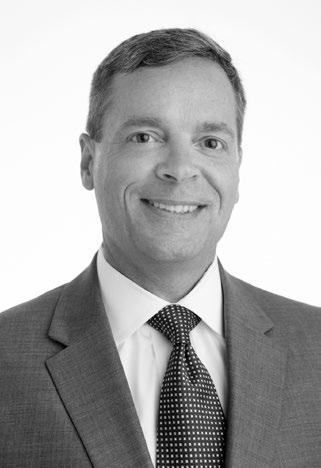
By: Rachel Park Hurt Arnett Baker Draper & Hagood, LLP
me during my time clerking for Justice Clark? Of course I remember you. You were the one who didn’t make me feel like an idiot when I had no idea how to draft my first assignment. My middle school coach? I 100% remember you! You made me run until I got sick. You gave me the knowledge and belief that I could push through anything and that hard work pays off. Professors from law school? Definitely remember you. You taught me to look at the law as an unfinished book—the story has not ended—and we get to help write the next chapters. Judges that I have appeared in front of over the years? Certainly remember all of you. The fear of failure before each of you made me try harder. These are just some of the people who reached out. These are but a few examples of the people who have a legacy to me.
The other two most common comments from those who reached out were “your mother would be so proud”1 or “Justice Clark would be proud.” And, while I certainly hope these statements are true, these statements are also just written confirmation of their legacies. Because when you become a part of someone’s story, when you help and lift up people, you are creating your lasting legacy.
I did some googling and found this quote, “what you leave as a legacy is not what is etched in stone monuments, but what is woven into the lives of others.” And, although Google tells me “anonymous” made this statement, in reality, someone who truly understood the meaning of legacy made this statement. Legacy is what you do for others along the way.
If you reached out to me recently to congratulate or console me, I hope I have responded. I hope I have expressed how truly blessed I am by all the colleagues, friends, and mentors I have had over my life. I hope that I have expressed how appreciative I am of you. Because I am. I have written dozens of thank you notes to express my gratitude and appreciation for so much that I have been given and for the legacies that people have created.
These past few months have really just had me thinking about my legacy. I hope you are thinking about yours. What will your professional legacy be? There is no right or wrong answer. But I hope you will be able to say now or someday that you helped others along the way, helped strengthen the public’s perception of lawyers, helped promote the Rule of Law, helped the community, helped younger lawyers become better lawyers, or helped a lawyer in need. And, I hope you can say these things because if you can, your legacy is cemented forever.
1 Certainly, my mom’s legacy lives on in me; that one is obvious, and I don’t want to diminish it because she was the most amazing mother. But the focus here is professional legacy.
AROUND THE BAR
By: Hannah Clyde Malin McKinnish Law Group, PLLC
LAW & LIBERTY AWARD RECIPIENT CAITLIN TORNEY
The Law and Liberty Award is an honor that is presented to a person, but not necessarily a lawyer, who has fostered and maintained good relationships between the legal profession and the community, promoted and advanced a better understanding of the law, set an example of good citizenship, stimulated a sense of civic responsibility, or otherwise contributed to the improvement of the legal profession in our community.
The Law and Liberty Award recognizes and celebrates those who maintain high standards of professional integrity and ethical conduct and demonstrate respect for personal, political, civil, and religious liberties.
This year’s recipient, Caitlin Torney, truly reflects the principles this award is designed to honor.
Ms. Torney earned both her undergraduate and law degrees from Wake Forest University in Winston-Salem, North Carolina. After graduating from law school in 2011, she began her legal career in private practice before transitioning into academia, where she taught paralegal and criminal justice courses at Davidson County Community College. Following her move to Knoxville in 2016, she worked with the YWCA and became licensed to practice law in Tennessee.
She recently completed a five-year tenure as Director of Pro Bono
for Legal Aid of East Tennessee, where she strengthened and expanded the Pro Bono Project, enabling the local legal community to serve a broader range of needs.
Throughout her career, Ms. Torney has demonstrated a deep commitment to expanding access to justice. She has supported veterans through Veterans Legal Clinics, partnered with faith-based organizations to serve the community, and assisted Black business owners through small business legal clinics.
In response to the devastating storm damage in East Tennessee from Hurricane Helene in 2024, she quickly mobilized efforts to meet urgent legal needs, showing remarkable leadership and dedication during a critical time.
Her work has also enhanced the visibility of legal service initiatives, helping Legal Aid of East Tennessee and its network of volunteer attorneys reach more individuals across the region.
Since 2023, Ms. Torney has served as co-chair of the Knoxville Bar Association’s Access to Justice Committee, continuing to build meaningful connections between the legal profession and the community.
Caitlin Torney is highly deserving of this recognition. In her current role as Director of Career Services and Alumni Relations at Lincoln Memorial University Duncan School of Law, she continues to guide and inspire future members of the legal profession. Each day, she exemplifies the spirit of the Law and Liberty Award.
Congratulations, Caitlin Torney!
APPEALING
By: Robin McMillan Career Clerk to the Honorable Cynthia R. Wyrick, United States Magistrate Judge
“TELL ME, TELL ME, TELL ME SOMETHING I DON’T KNOW”
Are you aware that the Tennessee Court of Appeals has its own set of rules and published Internal Operating Procedures? Although brief, these rules and procedures contain important information that practitioners ought to know. In fact, I would say that the rules and procedures of the Court of Appeals are small but mighty and well worth the few minutes of your time it will take to read them.
I hope that you are aware of Rule 10 of the Rules of the Court of Appeals. I have mentioned this rule in previous columns. If all judges participating in a case concur, the panel may issue a memorandum opinion pursuant to Rule 10.1 That opinion will have no precedential value.2 It will be designated as a “MEMORANDUM OPINION” and may not be cited or relied upon in any unrelated case.3 If you encounter a Rule 10 Memorandum Opinion while conducting research, I suggest that you immediately trash it because it will be of absolutely no assistance to you whatsoever. Don’t even read it. Doing so will only make the facts stick in your brain and later tease you into believing that some helpful precedent exists somewhere when it does not.
If you ever handle an appeal in a domestic relations matter, you must comply with Rule 7 of the Rules of the Court of Appeals. If either party raises an issue with regard to the classification or distribution of marital property or debt, that party must include a table in their brief that lists: “all property and debts considered by the trial court, including: (1) all separate property, (2) all marital property, and (3) all separate and marital debts.”4 Each entry in the table must include citations to the record where the evidence regarding classification or valuation and the trial court’s decisions about these matters can be located.5 If the opposing party disagrees with the table provided, the opposing party must provide their own properly supported table.6
Ever wonder why some Court of Appeals’ opinions are published and others are not? Look to Rule 11 of the Rules of the Court of Appeals for some answers. Rule 11 provides that if an application for permission to appeal to the Tennessee Supreme Court has not been filed, a Court of Appeals’ opinion may only be published if it meets one of half-a-dozen enumerated criteria and successfully passes a Court review.7 At least seven members of the Court must approve the publication.8
Rule 5 of the Rules of the Court of Appeals governs the preservation of records both during and after an appeal. Once a record has been filed with the Appellate Court Clerk, it may be removed from the Clerk’s Office only by counsel of record with the Clerk’s permission.9 After a record has been archived, it “may not be removed from the court archives by anyone for any purpose except on order of a judge of this Court for good cause shown.”10 Rule 5 also provides that if any panel of the Court determines that the record in any case assigned to that panel “has possible historical value, the panel may enter an order directing the clerk of the Court to transfer the record and other papers to the State Library and Archives for preservation or other disposition as the State Library and Archives deems appropriate.”11
Rule 5 also addresses disposition of records. Records are to be kept for at least six months after issuance of the Court’s mandate.12 After that time, the Court will give notice of proposed disposition to the clerk of the trial court and to all counsel of record or pro se parties.13 Those who receive notice have thirty days to object to the disposition in writing in compliance with Rule 5.14 If such an objection is timely filed, the record may only be disposed of upon order of the Court.15
The Internal Operating Procedures of the Court of Appeals spans only a page or two but contains some interesting information. It provides information about who controls the docketing and assignment of cases, sets out how the Court selects a presiding judge, and discusses when and how cases may be heard by the Court en banc 16 Potentially more helpful, the procedures contain information about the general timeline for the circulation of opinions.17 This information can assist in educating a client unfamiliar with appeals about the typical length of the appellate process. Absent an approved waiver or extension as provided for in the procedures, a judge “shall prepare a proposed opinion and circulate it to the other judges on the panel” within six months of the case assignment.18 The panel judges than have fourteen days to review “and respond to the authoring judge with comments, suggestions, questions, or intent to concur or dissent.”19 A separate concurring or dissenting opinion “shall be circulated within twenty-eight (28) days of the date of circulation of the original opinion.”20 Being able to point to the timelines contained in the Court’s Internal Operating Procedures coupled with the specific rules in the Tennessee Rules of Appellate Procedure that govern time lines for record preparation, briefing, and docketing can assist in setting realistic client expectations.
It will take you longer to read this issue of DICTA than it will to read the Rules of the Court of Appeals and the Court’s Internal Operating Procedures. So, take a few minutes, go read those rules and procedures right now, and learn more interesting things about the Court.
1 Tenn. R. Ct. App. 10.
2 Id.
3 Id.
4 Tenn. R. Ct. App. 7(a).
5 Tenn. R. Ct. App. 7(b).
6 Tenn. R. Ct. App. 7(c).
7 Tenn. R. Ct. App. 11.
8 Tenn. R. Ct. App. 11(c)(2).
9 Tenn. R. Ct. App. 5(a)(1).
10 Id.
11 Id.
12 Tenn. R. Ct. App. 5(b)(1)(a).
13 Tenn. R. Ct. App. 5(b)(1)(b).
14 Tenn. R. Ct. App. 5(b)(2).
15 Tenn. R. Ct. App. 5(b)(3).
16 Internal Operating Procedures of the Court of Appeals.
17 Id.
18 Id.
19 Id.
20 Id.
LEGAL MYTHBREAKERS
By: Brad Fraser
Leitner, Williams, Dooley & Napolitan
Stefanie Bowen
Leitner, Williams, Dooley & Napolitan
DOE, OH DEAR
“Let’s start at the very beginning. That’s a very good place to start.”1
In The Sound of Music Maria von Trapp transforms uncertainty into understanding by teaching “Do-Re-Mi,” the foundational basis of musical melody. But unlike “Do-Re-Mi,” which eventually brings us back to “doe, a deer, a female deer,” a John Doe defendant in a lawsuit is only the beginning.
Some attorneys use John Doe defendants, like Maria von Trapp, as a practical starting point. In some instances, only through investigation and discovery can each unnamed party be identified, assigning his or her proper place in the story that is a claim at a later time.
But in the instance where discovery is propounded slower than expected, and the statute of limitations lapses, after the identities of the John Doe defendants is discovered, can a plaintiff freely move for leave to amend under Federal Rule of Civil Procedure 15? The answer, if the statute of limitations has lapsed, may be that the plaintiff has fa—a long, long way to run.
Rule 15 of the Federal Rules of Civil Procedure addresses amended and supplemental pleadings. Section (a) is fairly straightforward. A party gets one free amendment as a matter of course, no later than 21 days after serving it, or, if the pleading is one to which a response is required, 21 days after service of the responsive pleading or service of the 12(b), (e), or (f) motion, whichever is earlier. All other amendments to a pleading would require the opposing party’s written consent or the court’s leave. And leave should be “freely given, when justice so requires.”
But part (c) governs when an amendment “relates back” to the date of the original pleading. And (c) says that you may amend a pleading with relation back only when:
(A) the law that provides the applicable statute of limitations allows relation back;
(B) the amendment asserts a claim or defense that arose out of the conduct, transaction, or occurrence set out—or attempted to be set out—in the original pleading; or
(C) the amendment changes the party or the naming of the party against whom a claim is asserted, if Rule 15(c)(1)(B) is satisfied and if, within the period provided by Rule 4(m) for serving the summons and complaint, the party to be brought in by amendment:
(i) received such notice of the action that it will not be prejudiced in defending on the merits; and
(ii) knew or should have known that the action would have been brought against it, but for a mistake concerning the proper party’s identity.
So, Rule 15(c)(1)(C)(ii) looks helpful to the “John Doe” scenario we have described, right? The Sixth Circuit consistently disagrees. Substituting a named Defendant for a John Doe defendant is treated as the addition of a new party, which does not satisfy the requirements for relation back under Rule 15(c) when the statute of limitations has expired.2 Why?
Rule 15(c)(1)(C)(ii) requires a “mistake” concerning the proper party’s identity.3 And the Sixth Circuit has held that the term “mistake” refers to an actual error as to the defendant’s identity, not a lack of knowledge of the defendant’s identity.
In Smith v. City of Akron, the Sixth Circuit considered whether the district court appropriately dismissed two police officers added as defendants after a two-year statute of limitations had expired.4 Smith originally styled the case to include John and Jane Doe defendants. Two years later he amended to re-name the John and Jane Doe as Officers Ross and Miles.5 Smith argued that the two officers “knew or should have known” that the claim would have been brought against them as the complaint described the John and Jane Doe defendants as the “arresting officers.”6 But the Court pointed out that Rule 15(c)(1)(C)(ii) also requires a “mistake” concern the proper parties identity.7 And Smith was not wrong about Officers Ross and Miles identity; he did not know who they were and apparently did not find out within the two-year limitations period. The “relation-back” protections were not designed to protect that kind of problem.8
The Sixth Circuit took the opportunity in Smith to address a 2010 Supreme Court case that involved a true mistake in order to distinguish Smith’s problem. In Krupski v. Costa Crociere S. p. A., the plaintiff knew of two potential parties when she filed the lawsuit, but she sued the wrong party and corrected the mistake only after the statute of limitations had expired.9 The Supreme Court held that Krupski made a “mistake” under Rule 15(c), even though she knew the identity of the proper party when she filed her complaint.10 Smith, on the other hand, made no mistake, the Court held. He simply did not know who to sue or “opted not to find out within the limitations period.”11 The Rule allows relation back for the mistaken identification of defendants, not for defendants to be named later through “John Doe,” “Unknown Defendants” or other missing appellations.
In the end, starting with “Doe” may be a very good place to start, but it is not the end of your complaint. John Doe defendants can provide a useful opening, but there is no substitute for timely identification. Rule 15 offers the flexibility to use discovery to identify the Does, but there is a distinction between “mistake” and “lack of knowledge” that can determine whether the claim goes on or fall silent. Without diligence, the melody never resolves, potentially leaving a plaintiff with a tune that is incomplete.
So as Max said, “What’s gonna happen’s gonna happen. Just make sure it doesn’t happen to you.”
1 Do-Re-Mi, Rogers and Hammerstein’s The Sound of Music, 1959.
8 Id. (citing In re Kent Holland Die Casting & Plating, Inc., 928 F.2d 1448, 1449-50 (6th Cir. 1991)); Cox,75 F.3d at 240; Moore v. Tennessee, 267 F. App’x 450, 455 (6th Cir. 2008) (emphasis in original).
9 560 U.S. 538 (2010).
10 Id. at 554-5.
11 Smith, 476 F. App’x at 69.
LEGAL UPDATE
By: Regina Koho Tennessee Valley Authority Office of the General Counsel
DRAWING FIRST AMENDMENT LINES
CHILES V. SALAZAR CLARIFIES WHEN HEALTHCARE REGULATIONS IMPLICATING SPEECH ARE CONSTITUTIONALLY SUSPECT, BUT AT WHAT COST?
‘Conversion therapy’ began “as an attempt to ‘cure’ gay and transgender people of their ‘nonconforming’ orientations or identities.”1 Historically, it consisted of “aversive therapeutic modalities,” such as inducing nausea or subjecting patients to electric shocks “in response to nonconforming thoughts.”2 Such harsh treatments eventually fell out of favor and “talk therapy” became “the predominant form of conversion therapy.”3 However, the goal of talk therapy remains to change patients’ sexual orientation or identity.4
Over time, “the premise of conversion therapy (in whatever form)” became “widely discredited within the medical and scientific community,” which “no longer regards nonheterosexual orientations or noncisgender identities as ‘nonconforming.’”5 The experience with conversion therapy demonstrated that there is “no empirical evidence that providing any type of therapy in childhood can alter adult same-sex sexual orientation.”6 The evidence also showed that conversion therapy has caused “lasting psychological harm” in patients, including feelings of “shame and selfhatred.”7
Thus, in 2019, Colorado joined 25 other states in banning conversion therapy for children with the enactment of the Minor Conversion Therapy Law (MCTL).8 The MCTL forbids a counselor from providing “therapy designed to ‘change [a minor’s] sexual orientation or gender identity,’”9 but “allows a counselor to offer therapy expressing ‘[a]cceptance, support,’ and other affirmation of the minor’s ‘identity exploration.’”10
Chiles v. Salazar involved a constitutional challenge to the MCTL. The key inquiry for the Supreme Court was the extent to which the First Amendment protects speech that is made in the context of providing medical care. As described below, the majority’s ruling will likely result in more healthcare regulations involving speech receiving the highest First Amendment protections, which potentially places them in constitutionally questionable territory.
Relevant First Amendment principles
“Content-based” restrictions on speech, which “regulat[e] speech based on its subject matter or ‘communicative content’ are ‘presumptively unconstitutional’” and therefore are generally subject to strict scrutiny review by courts.11 This means that the government must prove that a content-based restriction is narrowly tailored to serve a compelling state interest.12 Similarly, courts view “regulations that discriminate based on the speaker’s point of view” as even more suspect,13 describing such regulations as “a particularly egregious form of content-based regulation, implicating First Amendment concerns to the highest possible degree.”14
Of course, with any rule, there are exceptions, and where certain categories of speech restrictions are concerned, strict scrutiny may not be triggered.15 As is relevant to Chiles, where the government regulates “professional conduct” and the regulation “incidentally involves
speech,” the Court has previously suggested that strict scrutiny is not automatically applicable.16 This is often the case when “the regulated speech [is] made during the provision of medical care.”17 For example, the Court has held that a law requiring doctors to provide women seeking abortions certain information about the procedure did not violate the First Amendment because the challenged speech occurred “only as part of the practice of medicine, subject to reasonable licensing and regulation by the State.”18 Under those circumstances, a state’s regulation would be evaluated by a court under rational basis review, a much easier constitutional burden to satisfy.
The challenge to the MCTL and the Court’s decision
Kaley Chiles, a licensed mental health counselor in Colorado, challenged the MCTL and sought to preliminarily enjoin its application to her.19 Her only offering as a counselor was “talk therapy.”20 She claimed that “she did not attempt to convert her clients,” but “merely tried to help them with their stated desires and objectives in counseling, which sometimes include[d] clients seeking to reduce or eliminate unwanted sexual attractions, change sexual behaviors, or grow in the experience of harmony with [their] physical body.”21 Effectively, Ms. Chiles asserted that Colorado’s law allowed her to speak in one way (the way approved by the state) but not another, which “strip[ped] her of her First Amendment right to speak freely with her clients in ways she believes might help them meet their own goals.”22
Both the district court and the Tenth Circuit sided with Colorado, concluding that although speech was regulated by the MCTL, its “main thrust” was “to delineate which treatments and therapeutic modalities are permissible.”23 Because the MCTL’s focus was on the medical profession, not speech, the lower courts concluded that only rational basis review applied and that, because Colorado was likely to satisfy that standard, Ms. Chiles was not entitled to enjoin the MCTL’s application as to her.24
In an 8-1 decision authored by Justice Gorsuch, a majority of the Court reversed and remanded, concluding that the lower courts “failed to apply sufficiently rigorous First Amendment scrutiny” to the MCTL.25 Justice Gorsuch rejected Colorado’s (and the lower courts’) conclusion that the MCTL only regulated conduct or treatment because, as to Ms. Chiles, it only regulated what she could say.26 Moreover, he found that the law went beyond just regulating the content of Ms. Chiles’s speech to dictating what she “may and may not express”—although she could provide supportive, identity-affirming counseling, she could not speak in ways that helped a client reduce unwanted same sex attraction or align gender identity with sex.27 The fact that the statute “target[ed] only licensed healthcare professionals” was of no moment to the majority because it viewed “the dangers associated with censorship” to be “no less acute in the fields of medicine and public health than they are anywhere else.”28
continued on page 24
OF LOCAL LORE AND LAWYERS
By: Joe Jarret, J.D., Ph.D. University of Tennessee
FAME AND FORTUNE!
Introduction:
Recently, Amanda and I were exploring antique stores in Dandridge, Tennessee. While thumbing through a stack of antique postcards, one card in particular immediately caught my attention. It read, “You Can Study Law at Home!” The card, issued by the William C. Sprague Correspondence School of Law, was, unfortunately, unused and lacked a postmark. However, it did read, “Place 1 Cent Stamp Here.” The U.S. Postal Service went from a 1-cent stamp to a 2-cent stamp in 1952, but it was obvious the card was much older. Needless to say, I was intrigued. Specifically, was this card a novelty, or a genuine advertisement? It turns out it was the latter.
Fame and Fortune:
On the reverse side of the card, were the words, in bold and block letters, “THE EVIDENCE OF FAME AND FORTUNE.” Then the following:
That the law offers many flattering opportunities to the young man is best evidenced by a look into the big office buildings, courtrooms, and capitols. Here will be found the heads of great businesses and financial institutions, prominent lawyers, legal advisers and statesmen, almost all of whom owe their triumphs to a knowledge of the law.
That any ambitious young man can learn law at home by mail, is best evidenced by the thousands of successful graduates of the Sprague Correspondence School of Law – the first to offer this system of instruction. Endorsed by bar [sic] and educators. If you want to know how our students have passed the state board examinations for admittance to the bar in every state; how others have been placed in commanding positions in business and public life; how we make it possible for you to do as much, send for our free book of letters from hundreds of these students.
The card ends with, “Liberal Terms! Special Offer Now!”
A Law School is Born:
According to legal historian and blogger Bernard Hibbitts, the William C. Sprague Correspondence School of Law was the first forprofit correspondence law school in the U.S., offering legal education by mail. It aimed to make legal training accessible to those unable to attend traditional university programs. Although Sprague was a university-educated lawyer from Ohio, he recognized the limitations of contemporary law office training for lawyers, so he established the program in 1890 in Detroit, Michigan. Having already helped a student
in another state pass his bar exam, he thought his method could be generalized. In 1889, he hit upon the notion of organizing a stand-alone correspondence-based law school that would teach law by mail. It would be, as he saw it, the first commercial correspondence school in the world.1 Clearly, Sprague was ahead of his time. Not merely because he hit upon a unique marketing concept, but because, despite advertisements that targeted young men, he actively recruited and encouraged women to study law. In fact, the first woman to be called to the bar in Indiana was a Sprague graduate. He likewise welcomed AfricanAmerican students, many of whom came to him after he advertised in Southern newspapers. Advertising in fact was key to Sprague’s success. At a time when only a few law schools advertised and lawyers were largely discouraged from doing so by new ethics rules, Sprague poured thousands of dollars into his marketing efforts, placing increasingly large and sophisticated advertisements in newspapers and popular magazines across the country. And the students enrolled. They enrolled from the midwest, the north, the south, the west and the east. They enrolled from the US, from Canada, and from American possessions and embassies abroad. In 1893 the school listed more than 1400 registered students.
A Novel Concept Comes to a Close:
Despite Sprague’s claim that his school was “Endorsed by the Bar,” the ABA’s Section on Legal Education launched a campaign against law instruction by correspondence in general, and against Sprague in particular, at its annual meeting in Sprague’s own home town in 1909. Prior to the meeting, the ABA’s Section on Legal Education formally condemned law degree-granting by correspondence law schools. The result of the meeting was a recommendation to limit bar admission standards to some combination of law school and office training, effectively eliminating correspondence legal education as a springboard to the bar. Exhausted by overwork and doubtlessly disillusioned by the ABA’s efforts, Sprague turned administration of his school over to his staff and retired. He died of influenza seven years later in 1922. He was only 62. When he passed, correspondence legal education passed away with him.
Conclusion:
In the not-so-distant past, the thought that people could study law outside of a formal classroom setting seemed improbable, if not absurd. Clearly, times have changed. Recently, the ABA approved several wholly online J.D. programs, affording students the opportunity to study law from home. I think Sprague would have been pleased.
1 Hibbitts, Bernard, 2014, Blog: Missionary Man: William Sprague and the Correspondence Law School
THREE STARS
By: Melissa B. Carrasco Carrasco Trump, PLLC
DETAILS IN A DOCTOR’S NOTE
Hammonds v. Kemer is the first reported Tennessee case in which a party requested a continuance of their trial.1 The facts of the case are very sad. Mr. and Mrs. Kemer (back then it was “Kemer and Wife”2) sued Mr. Hammonds for return of an enslaved woman who Mr. Hammonds apparently “borrowed” and never sent back.3 The reason appears to be that Mr. Hammonds “lent” the enslaved woman to someone named “Jinkins” who then died intestate.4 Jinkins’ estate was tied up in probate in Wythe County, Virginia,5 which was Mr. Hammonds’ defense as to why he could not return the enslaved woman, who is never even given the dignity of being named.6
But, the case was set for trial, so Mr. Hammonds filed a motion for continuance accompanied by his own affidavit.7 The affidavit set forth the foregoing facts (about the Jinkins estate), said that Mr. Hammonds was waiting on letters of administration from Virginia, and asked for a continuance of the trial date.8 Then, “having been told by his counsel that the affidavit would certainly procure a continuance,” Mr. Hammonds did not show up for trial.9 The trial judge disagreed, denied the motion for continuance, went forward with the trial, and rendered a verdict in favor of Mr. and Mrs. Kemer.10
Mr. Hammonds filed a motion for a new trial accompanied by another affidavit stating the reason why he did not appear for trial (his attorney told him he would get a continuance) and stating that he believed he had a good defense.11 The trial court denied the motion. Mr. Hammonds appealed.
The Supreme Court affirmed the judgment of the trial court.12 Mr. Hammonds had two problems. First, Mr. and Mr. Kemer admitted to the existence of the probate estate and letters of administration. So, there was no need to introduce the letters as evidence at trial and therefore no need to continue the trial date while everyone was waiting on the letters to make it through the Blue Ridge Mountains and the wilds of upper East Tennessee down to Knoxville.13
Second, Mr. Hammonds’ affidavit was not specific enough. Reading between the lines, the Supreme Court sounds a little put out. It states a belief of the deponent in general terms, that he has a good defense and can make it at another time. His absence was not occasioned in any degree by the wrongful conduct of his adversary; shall he then make it injurious to his adversary? No, surely. And will this court grant a new trial upon the belief of Hammonds, without knowing the particulars of the defense he is to set up, so as to judge of its effect, and of the probability there is that he will be able to produce the evidence needful to support it? Surely not. That would be to make the right of a suitor depend very much upon the credulity of his antagonist, and even upon his rashness. He ought to have stated the particulars, and then to
have shown by indifferent testimony a concurrence of circumstances, that the facts upon which it rested could be established.14
Apparently saying you “can make it another time” is as well-received by the Tennessee Supreme Court as it would be by your mother. Fast forward 110 years, and the Court of Appeals faced the same issue. Sometime in 2017 or early 2018, Ms. Mary Germaine Wilson went to the dentist.15 According to Ms. Wilson, it did not go well, and she and her husband, Dennis filed a health care liability lawsuit against the dentist.16 The case was set for trial in 2023, continued by agreement a few more times, and then finally set by agreed order for December 9, 2024, with a back-up trial date on April 22, 2025 (the December date was a 5th setting).17
By November 2024, the case had moved up the docket to a first setting, and the dentist was ready to try it in December. Ms. Wilson was not. One day before pre-trial filings were due, she and Mr. Wilson filed a motion for continuance until the April 2025 date. Ms. Wilson had developed a health condition that put her in the hospital, made her “very weak” and “caused her to be ‘unable to dedicate any significant time to the preparation of her case for trial.’”18 The trial court heard the motion three days later and denied it.
The court notes that this case has been pending for over six and one-half years, and has been continued multiple times. The Court has no reason to expect Plaintiff[s’] ability to participate in a trial will improve by the next term of court.19
It got worse. In their renewed motion for continuance, the Wilsons’ attorney stated that he had been unable to communicate with Ms. Wilson, that she was “physically and/or mentally incapacitated, and as a result, is not capable of providing testimony either before or during” a December jury trial.20 Counsel also asked to withdraw from representation due to the inability to communicate with Ms. Wilson. At some point, the Wilsons’ counsel informed the Court that they were not going to appear for trial on December 9th. The Defense filed a motion to dismiss for failure to prosecute.21
One week before the December trial date, the trial court denied the Wilsons’ renewed motion for continuance and the motion to withdraw, granted the motion to dismiss, and dismissed the case with prejudice.22 After the trial court denied the Wilsons’ Rule 59 Motion submitting a letter from Ms. Wilson’s physician as to her condition, the Wilsons appealed.23
The Court of Appeals affirmed the trial court in all respects. In the opinion drafted by Judge Davis, we are reminded of two very important things pertaining to a motion for continuance.
First, the decision to grant a continuance is discretionary. That means the decision is reviewed under an “abuse of discretion” standard, which starts with the presumption that the decision was the correct
continued on page 24
HELLO MY NAME IS
By: Bridget J. Pyman Arnett Baker Draper & Hagood, LLP
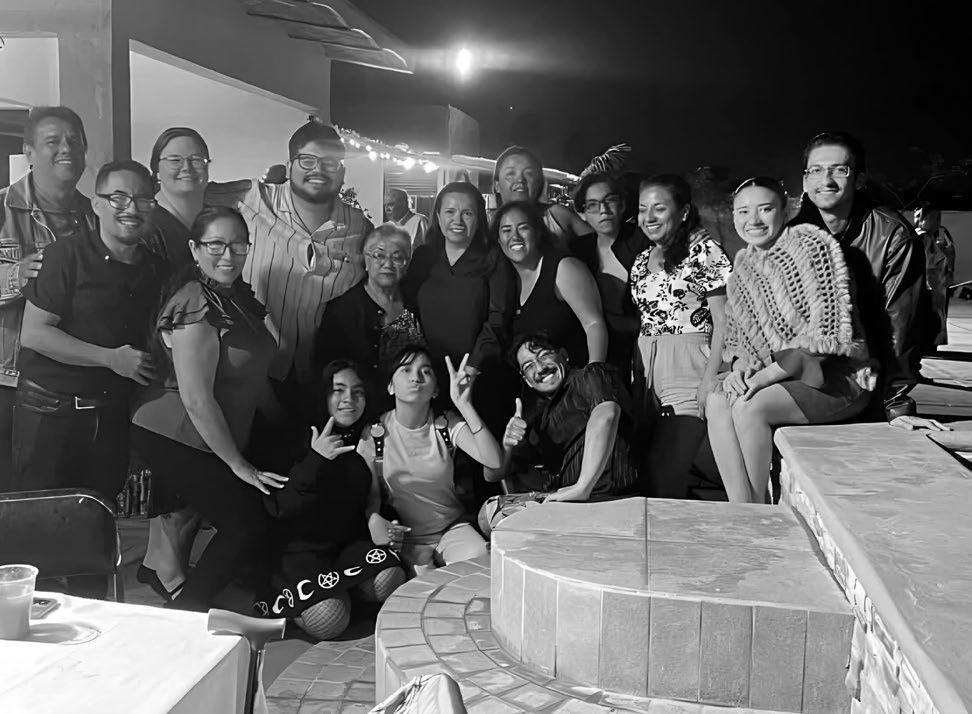
NATALIE MIRAMONTES-TANKERSLEY
This month’s Hello My Name Is column features Natalie Miramontes-Tankersley, an Associate at Kramer Rayson, LLP, where she practices Immigration and Naturalization Law. A 2023 graduate of the Lincoln Memorial University Duncan School of Law, Natalie brings a nuanced perspective shaped by her deep ties to the international community to her work with her clients. She is a member of the Knoxville Bar Association and the Tennessee Bar Association, and she currently serves as co-chair of the Barristers’ Access to Justice Group.
Natalie’s interest in the law was driven by a desire to bridge the gap between academic research and community service. She views the practice of immigration law as a vital resource for those navigating one of the most complex sectors of our legal system. Her work often involves assisting academic professionals, where she applies a sharp analytical focus to help clients manage their status while maintaining their research and global family connections.
Why did you decide to go to law school?
I went to law school because I really wanted to help people while also using my best asset: my brain. I have always been book smart and wanted a career in academia. However, I also wanted to use my knowledge to help people. With my cross-cultural connections and experience, I realized helping immigrants navigate our complex legal system was a great way for me to achieve both these goals. I consider lawyering to be a form of ministry to the people, offering critical services to folks who need to use the legal system but cannot without guidance. This is especially true with immigrants who may know nothing about our legal system, not to mention immigration, a very complex area of law.
What do you enjoy most about your job?
I love hearing my clients’ immigration stories and how their journey impacts their family. With clients from all over the world, I get to learn a little bit about their home country and why they’ve come to the U.S. I work mostly with academics, so I also get to learn about their research and why it’s so impactful to their field. As they are usually much smarter than me, I love learning about a new topic! Many of them also support their global families, which I do as well. As someone with this shared experience, it allows me to connect with them and see how their immigration process affects more than just their lives but their family as a whole.
Describe the person who had the most significant impact on your career.
My partner Alan has always been very supportive of me. Somehow, he worked and supported our whole family while I was in law school and never complained about it. It was a hard time for us, especially during COVID, but he never gave up on me or my dream. Now, he always supports me when I work late or contribute to community events for
immigrants. He has even tagged along to events, acting as a Spanish translator. As an educator, he also serves immigrants in his job. We both agree our jobs are more a lifestyle choice than just a career, so supporting each other is vital to continuing the good work!
Tell me about your family.
I have a large and global family that I love very much. In Knoxville, there is my partner Alan, his mother Irma, my mother Amy, and my father Wes. My brother Jacob lives in Memphis with my sisterin-law Anna and my newborn niece Eleanor (who is only 2 months old). We have a ton of family in Mexico, including my aunt Chayo, uncle Toño, and cousins Flor and Krizz; aunt Maguy, cousin David and Sarah and their children, Diego, Emiliano, and Fernanda; and cousin Lidia and cousin Marianna. And that’s only our intermediate family. My partner’s grandmother Mama Lidia had nine siblings, so the list goes on! We regularly host family reunions in Mexico, and the invite list can include over 200 people, all of whom are family members.
We also love animals in our family. I am a self-defined crazy cat lady with only one kitty, Odin. He is a very timid and sweet kitty and a huge mama’s boy! He loves to stare at me while I work and has two teeth that hang out, making him look like a vampire.
Have you traveled or lived internationally?
Yes! My partner is from Guadalajara, Mexico, and we regularly spend time down there visiting our family. We love to travel and have done extensive road trips in Mexico, visiting 6 states: Queretaro, Guanajuato, Aguascalientes, Jalisco, Nayarit, and the State of Mexico. My favorite places were Guanajuato and the State of Mexico, where Mexico City resides. Guanajuato is a mining town, and the streets are old mines underneath the city. It’s extremely hilly and reminds me of Appalachia. The city is known for its mummies. When the mines were active, people placed their
continued from page 14
dead in older mines and sealed them up. The air in the mines quickly mummified the bodies. Now, there’s a museum with the mummies, and the city sells caramel candy shaped like a mummy. Mexico City is also an amazing place with lots of wonderful food and artsy culture. Because the city is so high up, the temperature is amazing. I highly recommend visiting Chapultepec Park and learning about the Niños Heroes, boy soldiers who defended the city from the U.S. invasion in 1847. I personally did not know the U.S. ever invaded Mexico, not to mention conquered territory all the way to Mexico City!
Beside Mexico, we have recently traveled to Iceland using the direct flight from Nashville’s airport. The food was absolutely amazing, and everyone was extremely friendly. The capital of Iceland, Reykjavik, is considered a cat capital with many kitties roaming the city. It is also known for its books per capita, notably due to its winter tradition called Jólabókaflóð, or Christmas Book Flood, where everyone exchanges books on Christmas Eve and reads through the night to Christmas day, usually with hot chocolate.
DRAWING THE LINE: CONSTITUTIONAL CHALLENGES TO TENNESSEE’S NEW BUFFER-ZONE LAW
Before becoming a criminal defense attorney, I worked as a breaking news reporter for the Knoxville News Sentinel 1 For five years, I covered shootings, fires, protests, court cases, and the occasional absurd animal story—often from the edge of chaotic scenes where police officers and onlookers shared the same space. Those experiences now shape my view of Tennessee’s new “bufferzone” law, which regulates how close a person may come to law enforcement in those moments. The law raises practical concerns for journalists and difficult constitutional questions for courts—issues now headed to the Sixth Circuit.
The parent company of the News Sentinel—Gannett—and a slew of other media companies are suing Tennessee officials over the state’s passage last year of Tennessee Code Annotated § 39-16-612.2 The law makes it a Class B misdemeanor for a person to “intentionally approach[] within twentyfive feet (25’), a law enforcement officer after the officer has ordered the person to stop approaching or to retreat and the officer is lawfully engaged in the execution of official duties involving: (1) A lawful traffic stop; (2) An active investigation of the scene of an alleged crime; or (3) An ongoing and immediate threat to public safety.”3
The plaintiffs in Gannett v. Long fear the law affords too much discretion to individual officers, who could use it to arrest journalists who are just trying to do their jobs—jobs that often involve gathering news near law enforcement. The companies argue the law is unconstitutionally vague under the Fourteenth Amendment and that it violates the First Amendment both on its face and as applied to the companies’ journalists. They are seeking an injunction barring enforcement of the law against them, and, ultimately, a judgment declaring the statute unconstitutional.
No one has been prosecuted for a violation of the new law yet.4
The plaintiffs’ motion for a preliminary injunction is accompanied by six declarations from reporters and photojournalists who express concern as to how the law might be employed against them while they are covering rapidly evolving scenes such as protests outside the State Capitol. The State responded in part by raising several issues—like standing—in asking the court to dismiss the case before it reaches the merits. Without
downplaying those arguments, I want to focus more on the constitutional questions. But before we get there, we need to understand what the law actually does.
Stop approaching or get back?
Tennessee is not the first state to pass a buffer zone law. Indiana, Louisiana, Oklahoma, and Florida all have enacted similar statutes in recent years.5 The Gannett plaintiffs are following a playbook established in Indiana and Louisiana, where media companies filed pre-enforcement constitutional challenges to their state’s laws based on journalists’ declarations and won preliminary injunctions barring enforcement of the laws because they are likely void for vagueness.6
In one Indiana case, the parties argued as though that statute allowed “an officer to move anyone who happens to be within a 25-foot radius of the officer back to a point outside that radius.”7 Indiana’s statute is similar to Tennessee’s, with two differences: (1) Indiana’s does not contain the Tennessee statute’s list of three official duties, one of which the officer must be performing for the law to apply; and (2) the words “or to retreat” from Tennessee’s statute are absent in Indiana’s, meaning Indiana’s law is triggered only when an officer orders a person to stop approaching. The Seventh Circuit found the Indiana law is “not a force field”; it does not allow officers to force people to move back, just to stop approaching.8
The inclusion of the phrase “or to retreat” in Tennessee’s statute creates a disconnect: The sole act forbidden by the statute is approaching, yet approaching becomes a crime once the person is ordered either “to stop approaching” or “to retreat.” It is difficult to imagine an officer ordering a person to get back but not arresting them if they stay where they are. Yet, under the plain text of the statute, only continuing to approach is a crime.
There are practical questions as to how the law will be enforced and violations prosecuted. As the local TV journalist Don Dare wrote in his Gannett declaration, “[W]ho determines how far 25 feet is? Are law enforcement officers going to mark that boundary off? Will a tape measure be used?”9 The issue of whether a person was, in fact, within
25 feet—and whether they “intentionally” approached within 25 feet— would surely be litigated extensively in prosecutions.
A right to record the police?
The First Amendment prohibits laws “abridging the freedom of speech, or of the press.”10 “Speech” is more than just saying words aloud or writing them down. It’s painting a picture, taking a photograph, or recording a video. It’s the pictures, photographs, and videos themselves.11 “Freedom of the press,” in turn, is not the freedom of the news media.12 It’s the freedom of every person to “lay what sentiments he pleases before the public; to forbid this, is to destroy the freedom of the press.”13
It’s no surprise, then, that the First Amendment protects the right to receive, gather, and share news and information.14 It reflects our “profound national commitment to the principle that debate on public issues should be uninhibited, robust, and wide-open.”15 Nowhere are the First Amendment’s protections stronger than in traditional public fora such as streets, sidewalks, and parks.16
Laws affecting where people can be in relation to police in public spaces—and whether they can document officers’ actions—therefore implicate the First Amendment. Indeed, eight federal circuit courts of appeals have recognized a First Amendment right to record officers performing their official duties in public.17 But buffer-zone laws do not explicitly prohibit observing or recording the police. If they did, they would be more likely to be unconstitutional. Laws that limit speech based on its content must satisfy strict scrutiny, meaning they must be “necessary to serve a compelling state interest” and “narrowly drawn to achieve that end.”18 A 2022 Arizona law that explicitly made it a crime for a person to knowingly record video of police activity within eight feet after receiving a warning easily failed this test.19
Because Tennessee’s statute purports to regulate conduct (approaching), not speech (newsgathering), it is less vulnerable to facial First Amendment challenges and is likely to be analyzed as a time, place, and manner restriction.20 Such restrictions are valid if they are “justified without reference to the content of the regulated speech, [if] they are narrowly tailored to serve a significant governmental interest, and [if] they leave open ample alternative channels for communication of the information.”21
This is an easier test to pass. Ensuring police and bystander safety is a significant governmental interest,22 so the primary question is whether the law is narrowly tailored to serve that interest. Arguing that it is not involves pointing to other statutes that serve similar purposes—like Tennessee’s resisting arrest and disorderly conduct statutes23—and noting ways the law could be less restrictive.
The Seventh Circuit found Indiana’s law was, on its face, a reasonable time, place, and manner restriction.24 It stated that an attack on the law based on an improper application—like police ordering people to disperse because they are recording—would be better suited to an asapplied challenge, which typically requires an arrest and depends on the facts surrounding it.25
For these reasons, a pre-enforcement challenge to Tennessee’s law seems more likely to succeed under the Fourteenth Amendment.
Void for vagueness?
The Fourteenth Amendment’s Due Process Clause requires a statute to define a criminal offense “with sufficient definiteness that ordinary people can understand what conduct is prohibited” and “in a manner that does not encourage arbitrary and discriminatory enforcement.”26 If a law fails to do either, it is void for vagueness.
By: Travis E. Dorman Law Office of Jeffrey C. Coller
As mentioned above, federal courts granted preliminary injunctions in Indiana and Louisiana because the plaintiffs were likely to succeed in showing those laws were unconstitutionally vague. Buffer-zone laws that “lack[] any standard by which an officer may issue an order to stand back or retreat,” or that fail to notify members of the public of “what activity, if any, they must be engaged in when they may be subject to such an order,” are vulnerable here.27 If an officer can issue an order and make an arrest for any reason or no reason at all, then the law may encourage arbitrary and discriminatory enforcement. In Indiana, counsel for the State conceded during oral argument that an officer could invoke the buffer-zone law “just because he had a bad breakfast,”28 which surely did not help the State’s case.
Tennessee’s law is somewhat narrower because it specifies that an officer must be engaged in official duties relating to a traffic stop, a crime scene investigation, or a threat to public safety. An officer merely walking the streets could not issue a buffer-zone order, nor could an officer standing watch at a peaceful protest. But if a protester were to push a counter-protester, does the entire protest then turn into a crime scene?
Some buffer-zone laws alleviate vagueness concerns by including additional elements. Florida and Oklahoma’s laws make approaching or remaining within 25 feet a crime only if the person has the intent to impede with the first responder’s duties, threaten them with physical harm, or harass them.29 While litigation over Indiana’s first buffer-zone law was pending, its legislature passed a second version adding the requirement that the officer reasonably believe the person’s presence within 25 feet will interfere with the officer’s duties.30
As for Tennessee’s law, U.S. District Judge William L. Campbell Jr. denied the Gannett plaintiffs’ motion for a preliminary injunction after oral argument on February 17, finding the media companies failed to show they would suffer irreparable harm if the injunction were not issued.31 The plaintiffs are appealing the denial to the Sixth Circuit, and the case in the district court has been stayed. The media companies have yet to file their brief, but it is clear the case could have significant implications for constitutional jurisprudence in the circuit.
1 I now work with attorney Jeff Coller in Knox, Campbell, and surrounding counties. You may have seen his “Call Coller” billboards. I’ve been trying to get him to add “Dial Dorman”—no luck just yet.
2 Gannett Co., Inc. v. Long, No. 3:25-cv-00830 (M.D. Tenn. July 22, 2025) (PACER). The plaintiffs are Gannett (owns USA TODAY, the Tennessean in Nashville, The Commercial Appeal in Memphis, the Knoxville News Sentinel, etc.); Gray Local Media (WSMV in Nashville, WVLT in Knoxville, Action News in Memphis), Nashville Public Media (the Nashville Banner), Nexstar Media Group (WATE in Knoxville, WKRN in Nashville, WREG in Memphis), Scripps Media (WTVF in Nashville), States Newsroom (Nashville-based nonprofit Tennessee Lookout), and Tegna (WBIR in Knoxville, WATN and WLMT in Memphis). The defendants are Jeff Long, commissioner of the Tennessee Department of Safety and Homeland Security; Glenn Funk, district attorney general for Nashville and Davidson County; and John Drake, chief of Metropolitan Nashville Police Department. Each defendant is sued in his official capacity.
3 A Class B misdemeanor is punishable by a maximum of six months in jail or probation, more serious than a speeding or public intoxication charge, less serious than DUI or domestic assault, and on par with offenses like reckless driving and resisting arrest. The law provides for only one affirmative defense: “that the lawful order was not received or understood by the person and was not capable of being received or understood under the conditions and circumstances that existed at the time of the issuance of the order.” Tenn. Code Ann § 39-16-612(b).
4 Commissioner Long and General Funk’s Response in Opposition to the Motion for Preliminary Relief at 7, Gannett v. Long, No. 3:25-cv-00830 (M.D. Tenn. Sept. 12, 2025) (stating that the plaintiffs “seek judicial veto of a newly enacted law that has yet to be interpreted or enforced by any Tennessee police officer, prosecutor, or court”). Chief Drake’s response to the motion states that he does not know why he
continued on page 25
LEGALLY WEIRD
By: Wade H. Boswell II Tennessee Department of Human Services
OPERATION SIDESWIPE: AN ATTORNEY-LED CONSPIRACY
Most criminal schemes are fueled by a combination of stupidity and hubris. Stupidity in thinking the crime is a sound plan and hubris in thinking that one’s smart enough to get away with it. A person may initially be able to get away with a criminal act, but the odds of continually escaping accountability decrease with each occurrence. Those ever-diminishing odds were not a consideration for the attorneys involved in the Operation Sideswipe conspiracy.
Operation Sideswipe was a staged crash scheme that began in Louisiana in 2011.1 In the scheme, the attorneys paid “runners” to recruit participants, coordinate accidents, and direct clients to specific doctors. “Slammers” were paid to drive the cars and cause the wrecks.2 Of the 63 people to have been charged, three are attorneys, and one is a disbarred attorney.3 The attorney who got the scheme rolling is Jason Giles and his firm, the King Law Firm.4 Another attorney from the King Law Firm, Danny Keating, joined the conspiracy in 2017, actively participating until 2020.5 In 2016, Vanessa Motta and her firm, Motta Law LLC, joined the conspiracy. She was joined by her fiancé and disbarred attorney, Sean Alfortish.6
Motta appears driven to be seen. She danced ballet professionally for Ballet Memphis. She then ventured to Hollywood to break into the film industry, where she was a stuntperson and actress. She performed stunts in 84 movies and TV shows and appeared as an actress in 20 movies and TV shows.7 She was nominated for Best Fire at the 2010 Taurus World Stunt Awards for being set ablaze in Friday the 13th but lost to Sherlock Holmes 8 Possibly due to concussions from stunts, Motta decided to go to law school, becoming an attorney on May 12, 2016, only months before joining the conspiracy.9 Some of her fraudulent recoveries were invested in Motta Law to gain legitimate clients. Over the course of 2017, Motta spent $15,000 on advertising. By 2018, she spent $68,000 on one ad buy alone.10 Motta’s commercials played up her past as a stuntperson, showing her involved in numerous stunts, with a voiceover stating, “Stuntwoman turned bad a-- attorney. When you need legal action, send ‘er in.”11
Alfortish was licensed to practice law on October 8, 1993.12 He served as a magistrate judge, and in March 2005, he was elected president of a non-profit that represents horse owners and trainers. In this position, he also oversaw a medical trust and diverted money from it for his own use. To keep the theft from being discovered and to keep using the medical trust as his personal account, he rigged his 2008 reelection campaign. In August 2011, he pleaded guilty to one felony count of conspiracy to commit mail, wire, healthcare, and identification document fraud, receiving a sentence of 46 months incarceration. For this, Alfortish was permanently disbarred.13
The scheme began to unravel in 2019 after attorneys representing trucking companies noticed a pattern of the same individuals repeatedly appearing in serious crashes and being represented by the same law firms.14 Operation Sideswipe was launched, and the early focus was on a slammer, Cornelius Garrison. Alfortish and Motta learned that Garrison was cooperating with the investigation and offered him $500,000 to move to the Bahamas to prevent his cooperation.15 On September 18, 2020, Garrison was indicted and was set to formalize his cooperation
with the authorities.16 Four days later, he was gunned down.17 The gunman, also a slammer, pleaded guilty to the killing, received a 35 year sentence, and implicated Alfortish and another man in the plot to kill Garrison.18
On March 20, 2026, the first trial in Operation Sideswipe concluded with Motta and Giles each being found guilty of all charges.19 Motta was found guilty of conspiracy to commit mail and wire fraud, two counts of mail fraud, obstruction of justice, and witness tampering. Giles was convicted of similar charges.20 Alfortish and the other man charged in the killing of Garrison will go to trial this summer.
The number of fraudulent cases was in the hundreds. Keating collected over $1 million on 77 fraudulent cases, and a slammer testified to staging more than 80 crashes, primarily for Motta and Alfortish.21 I have no estimate of fraudulent cases attributable to Giles, but it cannot be insignificant as he was the primary attorney involved for the first few years of the scheme. There were also three unnamed attorneys in the indictment, Attorneys D, E, and F, who are presumably the attorneys who received transactional immunity for their cooperation.22
Lest you think that the conspiracy was a high volume, lower payout scheme, it wasn’t. Not only did some plaintiffs just fake their injuries, some went to the next level and had major back and neck surgeries to better their chances of a large settlement.23 One 2015 crash was settled for $4.7 million, for which C.R. England filed a RICO suit against Giles, the King Law Firm, and others.24 A separate RICO suit was filed against Keating.25
In response to this insurance fraud scheme and the increase in insurance rates across the state, the Louisiana legislature has instituted tort reform. Two measures seem to be byproducts of the Sideswipe scheme. The pure comparative fault system has been replaced by a modified comparative fault system like Tennessee’s.26 And, the legislature overruled the Housley presumption, which presumed that if a person is in good health before an accident, and the injury or other malady arises afterward, and the medical evidence shows a reasonable possibility of causal connection, the injury is presumed to result from the accident.27 Large changes, indeed.
Hubris is endemic in the attorney population, and it was these attorneys’ downfall. May their cautionary tale serve as a reminder to keep your overconfidence reined in so that you are not blind to the realities you face.
1 John Kingston, UPDATE: Two attorneys convicted, jailed in Louisiana staged accident scam, FREIGHTWAVES, Mar. 20, 2026, https://www.freightwaves.com/ news/two-attorneys-convicted-in-louisiana-staged-accident-scam, Last visited Apr. 10, 2026.
2 Erin Lowrey, New Orleans attorneys Vanessa Motta and Jason Giles found guilty of all charges, Mar. 20, 2026, https://www.wdsu.com/article/new-orleans-stagedwrecks-trial-attorneys-guilty/70803673, Last visited Apr. 12, 2026.
3 Id.
4 Id.
5 Id.
6 Id.
7 https://www.imdb.com/name/nm1906778/, Last visited Apr. 13, 2026.
8 https://en.wikipedia.org/wiki/Taurus_World_Stunt_Awards, Last visited Apr. 10, 2026. continued on page 27
SCHOOLED IN ETHICS
By: Judy M. Cornett University of Tennessee Winston College of Law
BE CAREFUL WHAT YOU SAY: MAINTAINING THE DUTY OF CONFIDENTIALITY WHEN MOVING TO WITHDRAW
When filing a motion to withdraw from representation, what can you file in support of the motion? When arguing the motion, or moving to withdraw in open court, what can you say in response to the court’s question about your grounds for withdrawal?
Withdrawal is governed by Tenn. Sup. Ct. R. 8, RPC 1.16, which provides both mandatory and permissive grounds for withdrawal. Rule 1.6 protects from disclosure all “information relating to the representation,” subject to both mandatory and permissive exceptions. An attorney’s motion to withdraw must be supported by one of the grounds in Rule 1.16 but must not violate the duty of confidentiality in Rule 1.6. The conundrum created by the operation of Rule 1.6 in the context of a motion to withdraw was recently addressed in a Tennessee Supreme Court case as well as in an ABA Formal Ethics Opinion.
In Johnson v. Board of Professional Responsibility, 1 the Tennessee Supreme Court upheld a 3-month suspension2 for an attorney who violated rule 1.6 by “publicly fil[ing] confidential communications between him and his client as an exhibit to a motion to withdraw.”3 Johnson represented a client in a divorce proceeding. After a contentious 3-month relationship marked by numerous angry email exchanges with his client, Johnson filed a motion to withdraw, alleging that his client had “refused to follow the advice of counsel.”4 Attached to the motion were copies of his email exchanges with the client, which contained his “professional opinions and advice related to the representation” as well as threats and insults.5 He also moved for an award of attorney fees, attaching his fee agreement with the client.6 The trial court, failing to discern the violation of Rule 1.6, granted the motion to withdraw, denied the motion for attorney’s fees, but granted the attorney a lien on the client’s real property. The attorney then filed a motion, apparently seeking to enforce the lien, labeled “For the Court’s Eyes Only,” again attaching confidential client information.
In his appeal, the attorney did not dispute the Rule 1.6 violation but argued that the 3-month suspension was too harsh because the violation was negligent rather than “knowing.” He argued that he “incorrectly believed that Rule 1.16 required him to show the communications as justification for his withdrawal.”7 The court rejected this argument, noting that “Rule 1.16 merely explains the grounds for when an attorney must or may withdraw from representation; it does not state that an attorney can disclose such justifications publicly in violation of other Rules of Professional Conduct.” The court quoted Rule 1.16(c), which provides that “[a] lawyer must comply with applicable law requiring notice to or permission of a tribunal when terminating a representation” and explicitly held, “The ‘applicable law’ includes Rule 1.6.”8 The court also addressed the assertion that the attorney would not have violated Rule 1.6 if he had filed his original motion and attachments only with the court, labelled “For the Court’s Eyes Only.” On the contrary, said the court, “disclosure of confidential information to a judge is still disclosure of confidential information.”9
If Johnson clarifies what an attorney should not do, a recent ABA Formal Ethics Opinion10 explains what an attorney should do, noting that the duty of confidentiality is “paramount.”11 First, the opinion notes that the dilemma can be avoided if the client gives informed consent to disclosure or if an exception in Rule 1.6 applies. The opinion cautions that the exception for disclosure “impliedly authorized in order to carry
out the representation” does not apply.12 However, if the disclosure is required by the rules of the tribunal or other law, the attorney may reveal confidential client information in order to comply, but only to the extent reasonably necessary.13 Unlike the Model Rule, which is permissive, Tennessee’s rule is mandatory, but the attorney can disclose “only if ordered to do so by the tribunal after the lawyer has asserted on behalf of the client all non-frivolous claims that the information sought by the tribunal is protected against disclosure by the attorney-client privilege or other applicable law.”14 Thus, a Tennessee attorney would avoid the nightmare scenario envisioned by the ABA ethics opinion in which an attorney is forced to continue representation even when withdrawal is required under Rule 1.16(a) because the attorney chooses not to reveal confidential client information sought by the court.15
Reading the ABA Ethics Opinion and Rule 1.6(c) together, the following steps should be taken when seeking to withdraw: (1) base the initial motion on “professional considerations” or “irreconcilable differences”16; (2) if the court asks for more information that would require disclosure of confidential client information, try to “persuade the court to rule on the motion without requiring the disclosure of confidential client information”17; (3) if the court insists on the disclosure, make sure the court puts its request in the form of an order, thereby invoking the exception in Rule 1.6(c)(2)18; (4) argue “all non-frivolous claims that the information sought by the tribunal is protected against disclosure by the attorney-client privilege or other applicable law”19; (5) if disclosure is still ordered, make the disclosure only to the extent “reasonably necessary,” and “preferably by whatever restricted means of submission are available, such as in camera review [or] under seal.”20
Bottom line: watch what you say when seeking to withdraw, making sure to protect confidential client information by complying with Rule 1.6.
2 Thirty days were to be served on active suspension, and the attorney was also ordered to complete 6 hours of CLE.
3 Id. at *1. The client did not give informed consent to the disclosure. Id.
4 Id. at *2.
5 Id.
6 Id.
7 Id. at *5. The attorney also argued that his disclosure was protected by Rule 1.6(b) (5) because he was seeking to “establish a claim” against his client for attorney fees, but the Supreme Court rejected this reason, noting that his original motion cited only the negative relationship with the client. Id. at *6.
8 Id. at *6. The Court held that the attorney’s “incorrect belief” that he was required to disclose the confidential information “[was] no defense.” Id.
9 Id. at *7 (citing In re Vogel, 482 S.W.3d 520, 531-32 (Tenn. 2016) (holding that attorney violated RPC 1.6 by copying trial judge on a letter to client explaining his reasons for withdrawing and containing confidential client information)).
10 ABA Formal Ethics Op. 519 (Dec. 3, 2025).
11 Id. at 6.
12 Id. at 11. See Tenn. Sup. Ct. R. 8, RPC 1.6(a)(2).
13 Model Rule 1.6(b)(6) permits disclosure “to comply with other law or a court order.”
14 Tenn. Sup. Ct. R. 8, RPC 1.6(c)(2).
15 See ABA Formal Ethics Op. 519, at 8-9.
16 Id. at 10.
17 Id.
18 Id.
19 Tenn. Sup. Ct. R. 8, RPC 1.6(c)(2).
20 ABA Formal Ethics Op. 519, at 10.
TENNESSEE CHAPTER
Knoxville Area Members recognized for Excellence in the field of Mediation or Arbitration
Adrienne ANDERSON (865) 249-8011
James LONDON (865) 637-0203
Scott TAYLOR (865) 546-8030
Bob ARRINGTON (423) 723-0402
Richard MARCUS (423) 756-0414
Mark TRAVIS (931) 252-9123
Gail ASHWORTH (615) 254-1877
David NOBLIT (423) 265-0214
William VINES (865) 637-3531
Paul HOGAN Jr. (865) 546-2200
Robert NOELL (865) 215-1023
Howard VOGEL (865) 546-7190
Dana HOLLOWAY (865) 643-8720
Sarah SHEPPEARD (865) 546-4646
Jeffrey WARD (423) 639-6811
Check preferred available dates or schedule appointments online directly with the state’s top neutrals
Check preferred available dates or schedule appointments online directly with the state’s top neutrals
TennesseeMediators.org is free, funded by members
TennesseeMediators.org is free, funded by members
MANAGEMENT COUNSEL: LAW PRACTICE 101
By: Jimmy Snodgrass Bass, Berry & Sims
AMENDING PROTECTIVE ORDERS TO ADDRESS AI USAGE
As I sit down to write another article about AI in the legal profession, I must admit that it has become increasingly hard to avoid this topic recently. There have been several articles authored in DICTA about the use of AI tools, sanctions for hallucinated cases generated by AI, and whether such inputs in AI platforms are protected by the attorney client privilege and work product protections. As much as we may hate to say it, AI is here to stay, and it is important to continue to analyze how to protect our clients and brainstorm how to address the use of AI in litigation.
Clients have always been extremely sensitive about the disclosure of confidential information in the discovery process in litigation. This hesitance has arguably only been exacerbated by many clients’ awareness that their confidential information may be uploaded into ChatGPT immediately after being produced to the opposing party. This reluctance is further increased when an employer is required to disclose confidential information to a pro se party. A recent report estimated a 49% jump in pro se employment lawsuit filings in 2025, likely due to the use of AI tools, as well as drastically increased motion practice by the pro se plaintiffs (both in the number of motions filed, as well as the length and complexity of the motions employers are now forced to address).1
A recent decision from the U.S. District Court for the District of Colorado has provided another strategy for protecting confidential client information—specific language in a protective order prohibiting the uploading of confidential information into an AI tool. In Morgan v. V2X, Inc., an employment discrimination case, the Court addressed whether work product protection applied to the pro se litigant’s use of AI, as well as “to what extent should a protective order expressly restrict the use of AI.”2
The employer had moved to amend the protective order to address AI-related concerns, including requiring the plaintiff to disclose what AI tools he was utilizing. The employer claimed that this disclosure would allow it to assess appropriate safeguards. The Magistrate Judge provided a helpful “Summary for Pro Se Plaintiff”—finding that while the pro se plaintiff was required to disclose the name of any AI tool used in connection with “Confidential Information,” such use of an AI tool did not waive work product protection.3
The Magistrate Judge’s analysis of the conflicting proposed protective order language details another approach that counsel can utilize to prevent the disclosure of confidential information. The previous protective order in place was fairly standard, allowing the parties to designate information as “Confidential,” as well as providing that all Confidential Information “shall not, without the consent of the designating party or further Order of the Court, be disclosed,” except under limited, specifically enumerated, circumstances. Although the parties both submitted proposed language for the protective order regarding the use of AI, the defendant was concerned that the plaintiff’s
proposal did not include “sufficient guardrails.” The Court also found that the defendant’s language was not narrowly-tailored and would instead cover only the defendant’s specific use of AI providers, while providing helpful background on the various versions of AI tools and providers. Ultimately, the Court drafted the following language to be included in the parties’ protective order:
• No party or authorized recipient may input, upload, or submit CONFIDENTIAL Information into any modern artificial intelligence platform, including any generative, analytical, or large language model-based tool (“AI”), unless the AI provider is contractually prohibited from:
o (1) storing or using inputs to train or improve its model; and
o (2) disclosing inputs to any third party except where such disclosure is essential to facilitating delivery of the service. Where disclosure to a third party is essential to service delivery, any such third party shall be bound by obligations no less protective than those required by this Order.
• In addition, the AI provider must contractually afford the party or authorized recipient the ability to remove or delete all CONFIDENTIAL information upon request. A party intending to use AI that it contends meets these requirements must retain written documentation of these contractual protections.
As noted in the Court’s summary to the pro se plaintiff, the inclusion of similar language in protective orders will assuage client concerns about the disclosure of confidential information and, in essence, prevent a party from disclosing confidential information in “any mainstream AI tool like standard ChatGPT, Claude, Gemini, or similar platforms.”
2 No. 25–CV–01991–SKC–MDB, 2026 WL 864223, at *1 (D. Colo. Mar. 30, 2026).
3 The Court noted its conflicting approach to a recent decision addressing work product protection in United States v. Heppner, 2026 WL 436479 (S.D.N.Y. Feb. 17, 2026), and that its decision was in line with a recent decision from the Eastern District of Michigan that a pro se plaintiff did not waive work product protection by using an AI large language model, Warner v. Gilbarco, Inc., 2026 WL 373043 (E.D. Mich. Feb. 10, 2026).
About this column: “The cobbler’s children have no shoes.” This old expression refers to the fact that a busy cobbler will be so busy making shoes for his customers that he has no time to make some for his own children. This syndrome can also apply to lawyers who are so busy providing good service to their clients that they neglect management issues in their own offices. The goal of this column is to provide timely information on management issues. If you have an idea for a future column, please contact Jimmy Snodgrass at jimmy.snodgrass@bassberry.com.
21ST CENTURY LAWYER
By: Grant T. Williamson
Bradley Arant Boult Cummings LLP
SETTING THE TONE
You would not know it by looking at me today, and it has been a long time since this has been true, but once upon a time I was an athlete. Not ever the best athlete on any of the teams I played on growing up (and I played on a LOT of teams), I prided myself on being the hardest working person on each team. The oft-misattributed quote that “[h]ard work beats talent when talent doesn’t work hard” was something I firmly believed in and tried to live up to. I was determined to bridge the gap between my talent and my teammates’ and opponents’ talent by simply wanting to win more than anyone else did. If I could ask my old coaches what the most important thing I brought to any team that I was on was, I hope that they would all say that I set the tone for the team, that I was the first one there, the last to leave, and the one who was always willing to lay my body on the line to help my teammates. I hope I set the tone for what the best version of each team could be, even if we did not always live up to it.
Team analogies are rife in corporate settings, so I hope you will bear with me as I employ the tired trope once again. In this instance, I think it is a useful one because of how often the word “culture” is thrown around in both the legal profession and the sporting world without actually holding any real meaning at most firms or teams. Despite this disconnect, culture is an extremely important thing in the legal industry (and sports world). If it were not, firms would not throw the word around so often in recruiting. Young attorneys want to join a firm with culture, where they are part of a team with a common mission and way of doing things. But what exactly should the culture be at a law firm? And how does it become established? Why is it so easy to draft a culture statement but so difficult to actually have a recognizable culture in practice?
There is no single “culture” that is right for all law firms. Too many factors are at play for there to be an answer, even if all of the Type A lawyers would like there to be one. But in order to establish a culture at all in any firm, you have to have tone setters: people who are willing, regardless of talent, title, or any other factors, to live out the type of culture they want to have at a firm despite any of their personal limitations and in furtherance of the goals of the firm, not their personal goals. The tone setter must practice what they preach (or make their practice their preaching), so that the approach they take to their work becomes infectious. Culture is not something that a firm can manufacture—it is a result of how the people at the firm approach each day and encourage everyone around them each day to do the same. If each day is not approached in a manner consistent with the culture statement that the firm has put down on recruiting materials, the culture can be ascertained by looking at how young associates in the firm are treated and how they feel about their roles. If your firm culture does not ring true for the lowest people on the totem pole, that is not your firm’s culture. If the highest people on the totem pole are insulated from your firm culture, that is not your firm culture.
Sometimes tone setters are people like me; people who are not the most talented but who want to succeed, and, more importantly, want their team to succeed above anything else and are willing to do what it takes to make that happen. If a firm is lucky, the tone setters are the most
talented people at a firm, the breadwinners, and the people who have an outsized influence on those around them. Elizabeth Sauer is a partner in Bradley’s Nashville office who I have had the great fortune of working for and learning from as a young associate. She is someone who has a book of business that is so impressive, it seems unfathomable, and yet, she is quick to let younger associates who are working for her know that if they are working on a weekend to get something finished, she is right there with them working even harder. She is quick to provide advice and mentorship, even though she has enough work on her plate to keep a team of partners busy, and quick to praise people when they find success. Bradley has a real culture because of partners like her and Kacie McRee in our Knoxville office, who set the tone each and every day for everyone else in the firm.
Culture is created by finding tone setters and adding them to your team, not by making lofty statements of what your firm’s culture is and hoping that people will conform to them.
PRO BONO SPOTLIGHT
By: Sierra Sidoti LMU Duncan School of Law
J.D. Candidate, 2026
REFLECTING ON MY TIME AS THE PRO BONO PROJECT LAW CLERK
Working in a pro bono capacity, often alongside dedicated attorneys and judges, has provided me with a unique lens through which to view the law. It has felt less like a set of rules that are abstract or purely academic and more like a tool that can be used in the way you decide to wield it. People in the pro bono realm repeatedly choose to use the law to promote justice and equity, and our communities are better for it. As I reflect on my time as a law clerk for Legal Aid of East Tennessee’s Pro Bono Project, I am struck by the profound impact that this experience has had on both my professional development and my understanding of the legal system’s role in serving underserved communities.
My journey into public interest work began before law school. I worked in the women’s dorms at Knox Area Rescue Ministries’ shelter in downtown Knoxville when I was first introduced to public interest law. My interest grew during my undergraduate education and that interest followed me to law school. During my 1L year, I spoke with a mentor, and she recognized that my interests aligned the best with an internship at Legal Aid. After spending my 1L summer working at Legal Aid in various roles, I was offered the opportunity to clerk for their Pro Bono Project. While all of Legal Aid serves the underserved in our community, our Pro Bono Project specifically acted as a bridge connecting this part of the community with attorneys in private practice.
My role as the clerk for the Pro Bono Project is far more than just a job that I show up for or a place where I simply clock in and out. It is a meaningful commitment with purpose for our clients. Every member of the Pro Bono Project team shares a deep dedication and genuine passion for providing reliable, quality legal services to those who need them most. Whether it means going the extra mile to research complex issues, networking for volunteer attorneys at every event we attend, or spending our Saturday mornings at legal clinics, we approach our work with care and are honored to be doing the work. For this team, pro bono service is not something we feel obligated to do, it is something we recognize as a need in our communities, and we work to fulfill the needs we can.
One of the most significant challenges I’ve faced is navigating the emotional weight of the cases. Clients at Legal Aid almost always arrive with stories of hardship and every staff member at Legal Aid has heard a client’s story at some point that still sticks with them. For me, that was a case where a recently widowed mother was seeking a conservatorship over her disabled daughter that had just turned 18 years old. Any research or drafting I did on a client’s case felt more significant the more I got to hear about their lives. There is a middle ground between compassion fatigue and indifference to the struggles of others. Finding that middle ground is difficult when every client has not only financial hardship but likely another pressing legal issue to resolve. However, connecting
the procedural work to the personal lives of your clients continues to be valuable in remaining motivated towards pro bono work.
Time management was another hurdle. Balancing pro bono duties with other commitments required prioritizing tasks and collaborating with my team members. There were moments of frustration when resources were limited or external factors slowed progress. However, these obstacles fostered growth. And through these experiences, I gained practical skills that classroom learning couldn’t replicate.
Despite the challenges, the rewards of being the Pro Bono clerk have been immense. Seeing a client’s relief when a case resolved favorably was incredibly fulfilling, specifically with adoptions, conservatorships, and name changes. These victories highlighted the transformative power that pro bono legal work has. On a personal level, the experience boosted my confidence as an aspiring lawyer. It allowed me to apply classroom-level knowledge in real life scenarios to better understand what an attorney’s job truly looks like on a daily basis.
More importantly, pro bono work connected me to a community of like-minded professionals. Networking with attorneys dedicated to public service inspired me and opened doors to mentorship opportunities. Pro bono service not only benefits clients but also enhances lawyers’ skills and job satisfaction. It fosters a sense of purpose, combating burnout and reinforcing why many of us entered the legal field in the first place. Having a community of attorneys around me who constantly remind each other of the community’s needs helps us all stay grounded and continue working.
My time as the Pro Bono Project’s law clerk has solidified my belief in the necessity of pro bono programs. In a justice system where access to counsel is often a privilege rather than a right, pro bono efforts bridge vital gaps. They align with the goals of bar associations, which promote public service to maintain the profession’s integrity and public trust. In particular, the Knoxville Bar Association has been instrumental in pro bono efforts in our community as a whole. I want to personally thank the KBA for funding the Pro Bono Law Clerk position at Legal Aid.
For aspiring lawyers and seasoned practitioners, I encourage embracing pro bono opportunities. Whether through clerkships, volunteer clinics, or firm initiatives, these experiences can only serve to enrich your career and contribute to a more equitable society.
My pro bono clerkship was a formative chapter, blending professional growth with meaningful impact. It reminded me that the law, at its best, serves the general good of the public. As I move forward in my legal journey, I carry the lessons from this period with gratitude, committed to continuing pro bono work whenever possible.
Upcoming Clinic Opportunities
Legal Advice Clinic for Veterans: In person at the Public Defender’s Community Law Office at 1101 Liberty Street in Knoxville. Phone advice options available. Signup via the KBA website.
• Wednesdays, June 10, August 12, October 14 and December 9 Noon – 2:00 PM
Debt Relief Clinic: In person at the Public Defender’s Community Law Office at 1101 Liberty Street in Knoxville. Signup via the KBA website.
• Saturdays, June 27, September 12, and November 14 9AM – Noon.
Justice Jackson was the sole dissenter. In her view, “context matters when evaluating First Amendment challenges to state regulation,”29 and she argued that the majority failed to consider “the crucial context” of Ms. Chiles’s claims, which rose “not . . . in the ether,” but in the context of “providing therapy to minors as a licensed healthcare professional.”30 She contended that the majority erred by focusing only on the fact that Ms. Chiles was speaking when she provided talk therapy and not on “what the State is doing,” which was regulating the medical profession and precluding the provision of a discredited medical treatment.31 Further, she noted that “professional medical speech does not intersect with the marketplace of ideas: In the context of medical practice, we insist upon competence, not debate.”32 Because the MCTL only restricted “professional medical speech,”33 and “there [wa]s zero evidence that Colorado ha[d] engaged in the corrosive and illicit suppression of ideas that the First Amendment valiantly repels,”34 Justice Jackson did not view the statute as presumptively suspect for First Amendment purposes.
Conclusion
Although the majority’s commitment to protecting “the free marketplace of ideas” is laudable, it seems odd to provide the same level of First Amendment protection to a counselor’s use of a discredited type of treatment as is provided to speech that we traditionally think of as implicating this constitutional provision (e.g., political debate).35 Thus, Justice Jackson’s more nuanced dissent has practical appeal, as it would provide more deference to governments when they regulate the medical profession in ways that reflect modern scientific views.36 Although the ultimate outcome remains to be seen, it seems likely that courts will see more suits from counselors, alternative health practitioners, and providers of controversial therapies (among others) challenging laws that regulate what they may say in the context of providing treatment or therapy. And, given the majority’s analysis in Chiles, “it is not at all clear how, or to what extent, state regulation of medical care involving practitioner speech can survive.”37
1 Chiles v. Salazar, No. 24-539, 2026 WL 872307, at *16 (U.S. Mar. 31, 2026) (Jackson, J., dissenting).
2 Id.
3 Id.
4 Id.
5 Id.
6 Id. (internal quotation marks omitted).
one—even if there were other alternatives.24 Second, if you are going to ask for a continuance, you have to give the trial court detailed evidence to support the request—particularly if the basis is a medical issue.25 Although the Wilsons’ original motion and the renewed motion described Ms. Wilson’s health issues, neither of them were supported by medical documentation that states (1) the nature of the condition, (2) when the physician last examined Ms. Wilson, and (3) when the physician expected the condition to resolve such that she could resume prosecuting her claim.26 The exact details may vary based on the reason a continuance is sought, but the details – and having a basis for those details – matter, as they have mattered since 1816.
2 Married women did not have the legal right to file a lawsuit in their own name until 1913 when the General Assembly passed the Married Women’s Emancipation Act, now codified at Tennessee Code Annotated § 36-3-504 and § 36-3-505.
11 Id. at *7 (majority opinion) (quoting Reed v. Town of Gilbert, 576 U.S. 155, 163 (2015)).
12 Id.
13 Id.
14 Id. at *13 (Kagan, J., concurring) (internal quotation marks omitted).
15 Id. at *7 (majority opinion).
16 See, e.g., Sorrell v. IMS Health Inc., 564 U.S. 552, 567 (2011).
17 Chiles, 2026 WL 872307, at *19 (Jackson, J., dissenting).
18 Planned Parenthood v. Casey, 505 U.S. 833, 844 (1992) (joint opinion of O’Connor, Kennedy, and Souter, JJ.).
19 Chiles, 2026 WL 872307, at *3 (majority opinion).
20 Id. at *4.
21 Amy Howe, Supreme Court sides with therapist in challenge to Colorado’s ban on “conversion therapy”, SCoTUSblog (Mar. 31, 2026, 12:05 PM), https://www. scotusblog.com/2026/03/supreme-court-sides-with-therapist-in-challenge-tocolorados-ban-on-conversion-therapy/ (internal quotation marks omitted).
22 Chiles, 2026 WL 872307, at *4 (majority opinion) (internal quotation marks omitted).
23 Id. at *6 (citation modified).
24 Id.
25 Although Justice Kagan joined in the majority opinion, she authored a brief concurrence (joined by Justice Sotomayor) to opine “that if Colorado had instead enacted a content-based but viewpoint-neutral law, it would raise a different and more difficult question.” Id. at *13 (Kagan, J., concurring).
26 Id. at *9 (majority opinion).
27 Id.
28 Id. (internal quotation marks omitted).
29 Id. at *22 (Jackson, J., dissenting).
30 Id. at *15.
31 Id. at *20; see also id. at *24 (“Colorado’s clear aim is enforcement of a standard of care that is indisputably applicable to the State’s licensed healthcare professionals.”).
32 Id. at *23 (citation modified).
33 Id. at *22 (internal quotation marks omitted).
34 Id. at *26.
35 Id. at *23.
36 See G.S. Hans, How the Supreme Court Made the First Amendment a Tool for Getting the Results the Justices Want, bAllS And STrikeS (Apr. 7, 2026), https:// ballsandstrikes.org/scotus/chiles-v-salazar-supreme-court-opinion-recap-firstamendment/ (observing that the majority opinion puts not just Colorado’s law at risk, “but rather an entire regulatory system”).
37 Chiles, 2026 WL 872307, at *30 (Jackson, J., dissenting).
7 Id.
8 Id.
9 Id.
10 Id.
11 Id.
12 Id. at 146. In case you were wondering why this case went straight to the Tennessee Supreme Court, the answer is that the Tennessee Court of Appeals did not exist until 1925. See Tennessee Courts, The Court of Appeals at 100 (Apr. 15, 2025), available at https://www.tncourts.gov/news/2025/04/15/court-appeals-100.
13 Id.
14 Id.
15 Mary Germaine Wilson, et al. v. Dr. Alicia Jamelle Mickles, No. E2025-00349-COAR3-CV, 2026 Tenn. App. LEXIS 142, * 2 (Tenn. Ct. App. Mar. 31, 2026).
16 Id.
17 Id.
18 Id. at *3.
19 Id. at *5.
20 Id.
21 Id. at *5-6.
22 Id. at*6.
23 Id. at *7.
24 Id. at *8.
25 Id. at *12.
26 Id. at *12-13.
THREE STARS, continued from page 13
STORY, continued from page 17
was sued and that he is taking no position on the constitutionality of the statute.
5 ind. Code Ann § 35-44.1-2-14 (West 2023); lA. STAT. Ann § 14:109 (2024); FlA STAT. Ann § 843.31 (West 2025); oklA STAT. Ann tit. 21 § 540.D (West 2025). Of note: Louisiana’s Democratic governor initially vetoed his state’s bill, writing in part that it would “chill exercise of First Amendment rights and prevent bystanders from observing and recording police action.” Letter from Louisiana Gov. John Bel Edwards to Louisiana Speaker of the House Clay J. Schexnayder Regarding the Veto of House Bill 85 of the 2023 Regular Session (June 27, 2023). An earlier version of Florida’s bill specifically provided that “[t]he peaceful audio or video recording or eyewitness observing of a first responder is a legitimate purpose that does not constitute” a violation. H.B. 1539, 2023 Reg. Sess. (Fla. 2023). This provision did not make it into the version of the bill that ultimately was passed.
6 Reporters Committee for Freedom of the Press v. Rokita, 147 F.4th 720 (7th Cir. 2025) (Indiana injunction affirmed on appeal); Deep South Today v. Murrill, 779 F.Supp.3d 782 (M.D. La. 2025). The legal organization that secured victories in these cases is the same one that is representing the Gannett plaintiffs: The Reporters Committee for Freedom of the Press provides pro bono legal representation “to protect First Amendment freedoms and the newsgathering rights of journalists across the country.” What We Do, reporTerS CommiTTee For Freedom oF The preSS, https://www.rcfp.org/what-we-do/ (last visited Mar. 25, 2026).
7 Nicodemus v. City of South Bend, Indiana, 137 F.4th 654, 661 (7th Cir. 2025).
8 Id. at 662.
9 Decl. of Don Dare at 3, Ex. B to Plaintiffs’ Motion for a Preliminary Injunction, Gannett v. Long, No. 3:25-cv-00830 (M.D. Tenn. Aug. 22, 2025).
10 U.S. ConST amend. I.
11 E.g., Fields v. City of Philadelphia, 862 F.3d 353, 358 (3d Cir. 2017) (“The First Amendment protects actual photos, videos, and recordings … and for this protection to have meaning the Amendment must also protect the act of creating that material.”); ACLU v. Alvarez, 679 F.3d 583, 595 (7th Cir. 2012) (“The act of making an audio or audiovisual recording is necessarily included within the First Amendment’s guarantee of speech and press rights as a corollary of the right to disseminate the resulting recording. The right to publish or broadcast an audio or audiovisual recording would be insecure, or largely ineffective, if the antecedent act of making the recording is wholly unprotected….”); Anderson v. City of Hermosa Beach, 621 F.3d 1051, 1062 (9th Cir. 2010) (“The process of expression through a medium has never been thought so distinct from the expression itself that we could disaggregate Picasso from his brushes and canvas, or that we could value Beethoven without the benefit of strings and woodwinds. In other words, we have never seriously questioned that the processes of writing words down on paper, painting a picture, and playing an instrument are purely expressive activities entitled to full First Amendment protection.”)
12 E.g., Branzburg v. Hayes, 408 U.S. 665, 704 (1972) (“Freedom of the press is a fundamental personal right which is not confined to newspapers and periodicals…. The press in its historic connotation comprehends every sort of publication which affords a vehicle of information and opinion.”) (internal citations and quotation marks omitted).
13 Eugene Volokh, Freedom for the Press as an Industry, or for the Press as a Technology? From the Framing to Today, 160 U. pA l rev 459, 465 (2012) (quoting 4 WilliAm blACkSTone, CommenTArieS 151).
14 Stanley v. Georgia, 394 U.S. 557, 564 (1969) (“It is now well established that the Constitution protects the right to receive information and ideas.”); Hayes, 408 U.S. at 681 (“We do not question the significance of free speech, press, or assembly to the country’s welfare. Nor is it suggested that news gathering does not qualify for First Amendment protection; without some protection for seeking out the news, freedom of the press could be eviscerated.”); Houchins v. KQED, Inc., 438 U.S. 1, 11 (1978) (“There is an undoubted right to gather news ‘from any source by means within the law’….”); Sorrell v. IMS Health, Inc., 564 U.S. 552, 570 (2011) (“[T]he creation and dissemination of information are speech within the meaning of the First Amendment.”).
15 New York Times Co. v. Sullivan, 376 U.S. 254, 270 (1964).
16 These are places that “have immemorially been held in trust for the use of the public, and … have been used for purposes of assembly, communicating thoughts between citizens, and discussing public questions.” Nicodemus v. City of South Bend, Indiana, 137 F.4th 654, 663 (7th Cir. 2025) (quoting Perry Educ. Ass’n v. Perry Loc. Educators’ Ass’n, 460 U.S. 37, 45 (1983)).
17 Glik v. Cunniffe, 655 F.3d 78 (1st Cir. 2011) (holding that the right to record the police in public was clearly established such that officers were not entitled to qualified immunity after they arrested the plaintiff, who recorded video of them, for violating Massachusetts’ wiretap statute); Fields v. City of Philadelphia, 862 F.3d 353, 356 (3d Cir. 2017) (“Simply put, the First Amendment protects the act of photographing, filming, or otherwise recording police officers conducting their official duties in public.”); Sharpe v. Winterville Police Dep’t, 59 F.4th 674, 681 (4th Cir. 2023) (agreeing with other courts that have “routinely recognized these principles extend the First Amendment to cover recording—particularly when the information involves matters of public interest like police encounters”); Turner v. Driver, 848 F.3d 678, 688 (5th Cir. 2017) (“We conclude that First Amendment principles, controlling authority, and persuasive precedent demonstrate that a First Amendment right to record the police does exist, subject only to reasonable time, place, and manner restrictions.”); ACLU v. Alvarez, 679 F.3d 583, 595 (7th Cir. 2012) (“[T]he First Amendment limits the extent to which Illinois may restrict audio and audiovisual recording of utterances that occur in public.”); Fordyce v. City of
Seattle, 55 F.3d 436, 439 (9th Cir. 1995) (recognizing that an individual recording police officers at a protest was “exercising his First Amendment right to film matters of public interest”); Irizarry v. Yehia, 38 F.4th 1282, 1288 (10th Cir. 2022) (“We recognize that the [First Amendment] right [to film the police performing their duties in public] exists and was clearly established when the incident occurred.”); Smith v. City of Cumming, 212 F.3d 1332, 1333 (11th Cir. 2000) (“[W]e agree with the Smiths that they had a First Amendment right, subject to reasonable time, manner and place restrictions, to photograph or videotape police conduct.”).
18 Perry Educ. Ass’n, 460 U.S. at 45.
19 Ariz. Broadcasters Ass’n v. Brnovich, 626 F. Supp. 3d 1102, 1106 (D. Ariz. 2022).
20 See Nicodemus, 137 F.4th at 667–70.
21 Ward v. Rock Against Racism, 491 U.S. 781, 791 (1989).
22 See, e.g., Mahoney v. Sessions, 871 F.3d 873, 882 (9th Cir. 2017) (holding that such an interest is sufficient to satisfy intermediate scrutiny); Hoyland v. McMenomy, 185 F. Supp. 3d 1111, 1125–26 (D. Minn. 2016) (holding that “a police officer’s ability to secure a scene—protecting the safety of the public and the officer—is a significant government interest”) (citing Colten v. Kentucky, 407 U.S. 104, 109–10 (1972)).
23 Tenn. Code Ann § 39-16-602 (making it a crime for a person to use force to intentionally prevent or obstruct an officer from effecting a stop, frisk, halt, arrest, or search of any person); Tenn. Code Ann § 39-17-305 (making it a crime to, “with intent to cause public annoyance or alarm,” refuse to obey an official order to disperse issued to maintain public safety in dangerous proximity to a fire, hazard, or other emergency). Additionally, § 55-8-104 makes it a crime for a person to “willfully fail or refuse to comply with any lawful order or direction of any police officer invested by law with authority to direct, control, or regulate traffic.”
24 Nicodemus, 137 F.4th at 670.
25 Id. at 669; but see Deep South Today v. Murrill, 779 F.Supp.3d 782, 800 (M.D. La. 2025). In Deep South Today, the court denied a motion to dismiss the media company plaintiffs’ pre-enforcement, as-applied First Amendment challenge, stating that, although an as-applied challenge typically requires enforcement, the plaintiffs’ injury is “certainly impending.”
26 Reporters Committee for Freedom of the Press v. Rokita, 147 F.4th 720, 730 (7th Cir. 2025) (quoting Skilling v. United States, 561 U.S. 358, 402–03 (2010)).
27 Deep South Today, 779 F.Supp.3d at 824.
28 Reporters Committee for Freedom of the Press, 174 F.4th at 731.
29 FlA. STAT. Ann § 843.31 (West 2025); oklA STAT Ann. tit. 21 § 540.D (West 2025).
30 ind. Code Ann § 35-44.1-2-15(a)(2) (West 2025).
31 Unfortunately, the court’s order does not contain its reasoning, and a full transcript of the hearing is not yet available on PACER.
PRIVILEGED TO BE IN THE LAW
By: Victoria Tillman McKinney & Tillman, P.C.
HELPING CLIENTS TO PASS IT ON WELL
Until my junior year in high school, I was undecided what I wanted to do for a career. I was leaning toward physical therapy when my school decided to participate in a mock trial competition. From that first competition, my mind was made up—I wanted to be an attorney. My next challenge was what my undergraduate major would be, and after taking Introduction to Business my first semester at Memphis State University, I knew I would major in accounting with a degree in Business Administration.
Unbeknownst to me, my decision to major in accounting would shape my path in law school, open the door to my first law clerk and associate position with a law firm in Memphis, and prepare the way for me to be the managing partner of McKinney & Tillman, P.C., a boutique law firm that focuses on estate planning, estate and trust administrations, and estate tax issues. By the time I reached my third year of law school, I knew that I preferred transactional law over litigation, so when the partners of the firm where I was clerking encouraged me to find a focus area for my practice in their firm, I narrowed it down to estate planning and estate administrations.
Armed with estate planning forms from my law school class, and after multiple visits to the probate court to study probate files, I was ready to meet clients and assist them with their estate planning. My first trip before the probate judge led to a visit to the judge’s chambers to answer questions about the will I was probating, a will that I had prepared. He asked where I got the form for the will, and I explained it was from my law professor, Steve McDaniel. He laughed out loud and said, “[Heck], no, these are my forms that I gave to him.” After wiping the sweat from my forehead, I told him how much I appreciated them and proceeded to establish my career in estate administration.
Shortly after beginning my law career in Memphis, my husband and I decided that we wanted to raise our new family in the beautiful hills of East Tennessee and moved to Powell. Because I was pregnant with my second child, I took a time out from practicing law to be a mommy, but I kept my license active. To fulfill my CLE requirements, I attended a presentation by Anne M. McKinney, and after hearing her speak and sing, I told my husband that if I were to go back to my law career, I would love to practice with her.
Fast forward a few years, and I became Anne’s associate attorney, and what I learned about estate planning and estate and inheritance taxes from her and Eugene “Buzzy” Jones, Anne’s senior paralegal, was invaluable. I was so blessed to practice with Anne and Mr. Jones. The knowledge and experience I gained through their mentorship was
well beyond anything I could have received elsewhere. With Anne’s retirement in 2024, and the seamless succession of her firm to me, I now manage an amazing law practice with my new partner, Patrick McKenrick.
I absolutely love my law career, and I love my clients. I have the privilege of meeting with clients and learning about their families and their passions and making sure that their planning accomplishes their goals now and in the future. I also have the honor to provide comfort and counsel to clients during some of the most difficult times of their lives—the loss of a loved one. My client base now spans multiple generations of families, giving me the privilege of seeing the legacy of one generation pass to the next generation and even to the third generation. In addition to educating and serving my clients with their estate planning, I have had the privilege now for over five years to teach the next generation of attorneys in the area of estate planning through my role first as an adjunct professor with the Homer A. Jones Wills Clinic, a service provided to low-income clients through The University of Tennessee, Winston College of Law, and now as the adjunct professor of the Estate Planning Seminar at the law school. In my class, my students start at the very beginning by “meeting” an estate planning client and taking them through the whole planning process, culminating in their preparation of the clients’ estate planning documents and follow-up work. To me, this experiential learning is invaluable to the students who will soon be stepping into their own practices, even if they are not solely estate planners. Like I tell them, inevitably someone is going to ask you to prepare their will or powers of attorney or to help with a probate, and you will be ready to assist them in a professional and competent manner.
I can honestly say that the career path my law degree has led me on has been both rewarding and fulfilling. The clients, and their other professionals, that I have met and worked with fill my day with challenges and words of gratitude, and sometimes hugs. When the plan is complete or the administration closed, my clients can move forward with a sense of accomplishment and satisfaction that matters have been properly and completely taken care of. As I tell my clients and the students that I teach, “We do not sell documents, we provide peace of mind.”
FOODIE FINDS: THE BEST OF KNOXVILLE FOOD TRUCKS
By: Parker Bohne LMU Duncan School of Law J.D. Candidate, 2026
DADO’S KITCHEN
Some food trucks are built on culinary résumés or long-standing restaurant ambitions. Others come together more organically—grounded in family, timing, and the idea that doing something meaningful together might be worth the risk. Dado’s Kitchen falls squarely into that second category.
Pierce and Jenn Copeland, the husband-and-wife duo behind Dado’s Kitchen, didn’t come up through the traditional food industry pipeline. Pierce works in tech as a project manager, and Jenn spent years as a nurse. A couple of years ago, the two began brainstorming investment ideas that would allow them to work and build a business together. A food truck was at the top of that list. What started as a conversation turned into a business plan, and not long after, into a fully operational food truck. In the spring of 2025, Dado’s Kitchen came to life. It wasn’t necessarily a lifelong dream—but sometimes those are the ventures that feel the most honest.
And if you ask them what makes it all worth it, the answer isn’t complicated: it’s the chance to do it side-by-side. The payoff? Working events together, bringing their daughter, a sophomore in high school, into the mix, and watching something they created grow in real time. The hard part? Everything else, like the permits, food prep and packing, logistics, and the constant behind-the-scenes work that makes the service window look effortless.
What sets Dado’s Kitchen apart isn’t just the food—it’s the personality behind it. The name “Dado” comes from Pierce’s grandfather, a man whose nickname originated from a childhood mispronunciation that stuck for life. That kind of story tells you everything you need to know about the brand: it’s personal, it’s a little nostalgic, and it doesn’t take itself too seriously. Each pretzel box comes with a dad joke tucked inside, and the menu leans fully into the theme, with items named after iconic sitcom fathers. It’s the kind of detail that could feel gimmicky elsewhere but comes across here as genuine.
Then there’s the food, which is where Dado’s Kitchen really finds its lane.
Instead of trying to do everything, the Copelands focused on doing one thing well: soft pretzels. Not the mall-food-court kind, either. These
LEGALLY
WEIRD, continued from page 18
9 Louisiana Attorney Disciplinary Board, www.ladb.org, Last visited Apr.12, 2026.
10 James Finn and John Simerman, ‘He don’t play’: Slammer in staged-crash case feared disbarred lawyer before murder, attorney says, NOLA.com, Mar. 10, 2026. https://www.nola.com/news/courts/murdered-slammer-cornelius-garrison-feareddisbarred-attorney-witness-testifies-new-orleans-federal-trial/article_593c610262c7-479d-bd1c-341a4a29420d.html, Last visited Apr. 8, 2026.
11 David Propper, New Orleans stuntwoman-turned-lawyer busted in staged car crash, fraudulent lawsuit scheme: feds, NEW YORK POST, Jan. 7, 2025, https://www.aol. com/orleans-stuntwoman-turned-lawyer-busted-044021452.html, Last visited Apr. 10, 2026.
12 See supra note 9.
13 In re: Sean Daniel Alfortish, No. 13-B-2424 (La. May 7, 2015).
14 Ashley DeMouy, Two Louisiana Attorneys Convicted in Sweeping Staged-Accident Fraud Scheme, Mar. 20, 2026, MBLB, https://mblb.com/trucking-transportation/ two-louisiana-attorneys-convicted-in-sweeping-staged-accident-fraud-scheme/, Last visited Apr. 13, 2026.
15 Ray Paulick, Former Louisiana HBPA President Sean Alfortish Charged in Murder of Federal Witness, PAULICK REPORT, Apr. 28, 2025, https://paulickreport.com/news/ the-biz/former-louisiana-hbpa-president-sean-alfortish-charged-in-murder-offederal-witness, Last visited Apr. 10, 2026.
16 See supra note 10.
are oversized, made-from-scratch pretzels—about two and a half times the size of what you’d expect—served hot and fresh in a pizza box. The menu balances classics like salted and cinnamon sugar with more creative options and rotating monthly specials.
And the pretzels aren’t working alone. The lemonade lineup deserves just as much attention. Made from freshsqueezed lemons, the menu includes both traditional and more adventurous flavors—strawberry, coconut blends, blueberry—plus seasonal specials that keep things fresh.
It’s a match made in heaven: something warm, soft, and savory matched with something bright and refreshing.
Part of what makes this concept work so well is how clearly it fills a gap. Knoxville has no shortage of strong food trucks, but pretzels haven’t really been the main event—until now. The Copelands recognized that early and leaned into it, building a menu that feels both familiar and new at the same time.
Like many newer trucks, Dado’s Kitchen is still building its rhythm—popping up at events, growing its following, and refining its operation as it goes. For now, the best way to keep up is through social media (@dadosfoodtruck on Facebook and @dados_food_truck on Instagram), where they post schedules, specials, and a steady stream of dad jokes.
17 Id.
18 Id.
19 See supra note 2.
20 U.S. v. Alfortish, et al., Case No. 2:24-cr-00105-WBV-JVM, ECF No. 517 (E.D. La. Jan. 9, 2026)
21 See supra note 2.
22 Id.
23 Michael Perlstein, Two New Orleans law firms charged with staging accidents for settlements, The Guardian, Dec. 9, 2024, https://www.theguardian.com/usnews/2024/dec/09/new-orleans-law-firms-staging-accidents-settlements, Last visited Apr. 10, 2026.
24 Greg Grisolano, ‘Operation Sideswipe’: C.R. England files RICO suit to recoup $4.7M payout in staged crash scheme, Feb. 12, 2021, https://landline.media/operationsideswipe-c-r-england-files-rico-suit-to-recoup-4-7m-payout-in-staged-crashscheme/, Last visited Apr. 12, 2026. See, C.R. England, Inc. v. Giles, et al., No. 2:21cv-00264 (E.D. La. Feb. 9, 2021).
25 Southeastern Motor Freight, Inc. v. Keating et al, No. 2:20-cv-02398 (E.D. La. Sept. 1, 2020)
26 2025 La. Acts 15
27 Housley v. Cerise, 579 So.2d 973, 980 (La. 1991).
Nathaniel H. Evans
Evans Law Firm
Mark C. Hazlewood
The Bosch Law Firm, P.C.
Megan L. Hutchens
Attorney at Law
Luke P. Ihnen
Federal Defender Services
Bridget Bailey Lipscomb
United States Department of Justice
Michael J. McCormick
McCalla Raymer Leibert Pierce, LLP
Andrea Aquirre
THE KNOXVILLE BAR ASSOCIATION IS PLEASED TO WELCOME THE FOLLOWING NEW MEMBERS:
Madyson A. McNamara
Mandy Hancock Law, PLLC
Mollye O’Rourke Strachn Law
Samantha V. Pedregon
Breeding and Carter PC
Allison Ruiz
The Lanzon Firm
David Sexton II
The Sexton Law Firm
Austin R. Watson
Attorney at Law
NEW LAW STUDENT MEMBERS
Dominick Canelles
Address Changes
Please note the following changes in your KBA Attorneys’ Directory and other office records:
Gavin C. Duvall
Dalila Minter
Emily Harfouche
Logan P. Miller
Abigail C. Walker
Washington BPR #: 58700
Nelson Mullins Riley & Scarborough LLP 1222 Demonbreun St. Nashville, TN 37203-3340
Deena Chase
City of Knoxville Law Department
Brenda Conn
City of Knoxville Law Department
Kathleen Costello City of Knoxville Law Department
Ph: (865) 215-2515 dakotavermillion@gmail.com NEW ATTORNEY MEMBERS
Ph: (865) 776-6624
klavrinovich@besco.com
Ph: (865) 776-6624 klavrinovich@besco.com
Knoxville, TN 37929-9801
Ph: (865) 522-8381 dvalone@valone-law.com
P.O. Box 1468 Knoxville, TN 37901-1468
BARRISTER BITES
By: Angelia Nystrom East Tennessee Foundation
AUGUSTA DREAMS AND KITCHEN COUNTER REALITY: MASTERS PIMENTO CHEESE
I fell in love with golf as I fell in love with Hugh. In the early days when we were first dating in Nashville, Sunday afternoons usually belonged to the two of us and a tee time at the par 3 at Percy Warner Park. We played almost every week. It didn’t matter if it was humid, drizzling, or one of those blazing hot Tennessee afternoons. We showed up anyway—coffee or a cold drink in hand, competitive spirits just barely disguised as flirtation. Sunday afternoons on the golf course became our rhythm. It was how we spent time, how we talked, and how we learned about each other.
By the summer of 2005, we were married and golf had woven itself so tightly into our story that it only made sense to build a trip around it. We went to the U.S. Open as a “last trip,” just the two of us, before Trace arrived and changed everything in the best possible way. I remember walking the course, slower than usual, thinking that life felt very full and very good.
Then, life did what life does.
We became parents. Within a couple of years, Trace started swimming, which quickly became less of a hobby and more of a lifestyle. Hugh broke his shoulder for the first time while playing hockey. Our leisurely Sundays on the golf course quietly slipped away, replaced by early swim meets, packed schedules, and the general chaos that comes with raising a child who is very good at something. Golf didn’t disappear entirely—it just moved indoors. We still watched the majors on television, still debated putts from the couch, still claimed we’d “get back out there soon.” Except we didn’t.
going to do this, we needed a Masters pimento cheese sandwich. Not just any pimento cheese—the pimento cheese. The one that has achieved near-mythical status among golf fans who have stood in line at Augusta and come away with something simple, inexpensive, and apparently perfect.
I, confident in my abilities and perhaps overly trusting of the internet, decided I would recreate it. It’s pimento cheese and white bread. How hard could it be?
A quick search later, I had what appeared to be a legitimate recipe. The recipe called for 4 oz cream cheese softened to room temperature, 2 cups shredded sharp cheddar cheese, 1 cup shredded Monterey Jack cheese, 1/2 cup Duke’s mayonnaise, 1 teaspoon very finely minced onion, 1/4 teaspoon garlic powder, 1/4 teaspoon cayenne pepper, 1/4 teaspoon salt, 1/4 teaspoon black pepper, 4 oz jar pimientos small diced in jar (drained), and 16 slices white bread.
To make the pimento cheese, take the cream cheese out of the fridge and place it on your kitchen counter to bring it to room temperature. The cream cheese needs to be soft at room temperature, so your spread will be creamy without lumps. Place all the ingredients except the diced pimentos into a medium size bowl. Mix with a large wooden spoon until it is well acquainted.
Next, drain the pimentos in a fine mesh strainer. Discard the juice. Using a large spoon gently fold in the drained pimentos into the cheese mixture until it is creamy and smooth.
But one tournament never lost its hold on us: The Masters.
For Hugh and me, when it comes to The Masters, it has never been just about the golf. We love the tradition of it all. The Green Jacket. The impossibly polished beauty of Augusta National Golf Club. The fashion—equal parts Southern proper and quietly competitive. And those azaleas in Amen Corner, blooming like they’ve been personally instructed to behave. (We have, on more than one occasion, tried to recreate that look in our own yard. We have also, on more than one occasion, failed.)
This year, we decided it might finally be time to see The Masters in person. We talked about it over dinner one night—how we’d never been, how we weren’t getting any younger, how this might be the year we stopped saying “someday” and actually did it.
And then I saw the prices on Ticketmaster. It became a hard “no.”
We decided that if we couldn’t go to Augusta, Augusta would come to us. We would watch the tournament from home—but we would do it properly. Respectfully. With snacks. Hugh announced that if we were
Lay two slices of bread on your cutting board. Scoop 1/3 cup of the room temperature pimento cheese onto the slice of white bread. Spread the pimento cheese evenly over the bread slices up to the edges of the crust. Cut the sandwich in half to form two triangles. Place the sandwich in a green wrapper so that it looks authentic.
I would like to tell you that the pimento cheese was the best that I have ever had. It wasn’t. Hugh complimented it and said it was “just great,” but I knew that was a lie. He later confessed that Palmetto cheese, especially the kind with jalapenos, is much better than the pimento cheese I had made.
As a general rule, we prefer homemade food to pre-packaged, processed food. This time, we did not. That being said, it was close enough: close enough to remember who we were when we played every Sunday, and close enough to remind us that maybe—just maybe—we’ll find our way back to the course again.
WELL READ
By: Cheryl G. Rice Egerton McAfee
GREENLIGHTS: AN UNCONVENTIONAL AND THOUGHT-PROVOKING MEMOIR
It seems that when I mention the actor Matthew McConaughey to people, they either love him or, to put it nicely, they don’t like him at all. I like McConaughey the actor, but I didn’t know much about McConaughey the person until I came across his 2020 memoir, Greenlights. If you appreciate a story told in the storyteller’s own voice, with insights into the author that also provide food for thought, and you are looking for a quick read, this book is for you.
Greenlights is written by McConaughey, without the help of a ghost writer. In 304 pages, he shares events from his childhood, provides insight into the role his family and upbringing played in the man he has become, and describes his search for more meaning in life, all through the metaphor of “greenlights.” Told in an informal and very personal voice—which is clearly that of McConaughey himself, his story is entertaining and told with a level of vulnerability that draws the reader in.
Raised in a family of relatively modest means but with lots of originality, McConaughey’s parents were determined that he should strive for more and see himself as “the best” in any area he chose to pursue. His memoir shares any number of his stumbles and successes along his life’s path, and how he learned from each. As you might expect, McConaughey’s telling of his story is full of humor, but somewhat surprisingly (at least to me), his style is authentic, introspective, and largely self-deprecating. A storyteller at heart, certain of McConaughey’s stories hint at shades of Texas tall tale, but they are told in such an engaging manner that the potential for exaggeration doesn’t detract. And some of his adventures that seem farfetched are often “proved up” by photo support. Throughout, the book’s themes of introspection, mind-body connection, and the importance of being “present” resonate.
your current situation. His way of thinking is that a “no” is not a dead end but is, instead, a “yes” to something different, to a thing that is meant for you, is a mindset that reflects an attitude of resilience and optimism we may all want to consider adopting.
Through Greenlights, McConaughey shares various lessons he’s learned over time. He describes his college decision to pivot from becoming a lawyer to acting. He takes us through his thought process behind his equally risky career move from stereotypical rom-com leading man (think How to Lose a Guy in 10 Days and The Wedding Planner) to taking the lead role in more dramatic stories (like Dallas Buyers Club), and his determination in pursuing that change inspires us to take risks in pursuit of our own true passions. The idea that real happiness and self-satisfaction come not from accolades but from self-discovery through lessons learned the hard way is reflected consistently throughout this memoir and encourages the reader to embrace both failure and success as part of the journey that is life. McConaughey’s mantra “Less Impressed, More Involved” sums up his strong sentiment that life is something to be lived, not observed.
The memoir’s contents are drawn in significant part from diaries McConaughey kept for years starting in his teens. The format of the book is rather unconventional: it is divided into 8 different sections, each organized in chronological order with McConaughey’s life, but also defined by themes and with mantra-like sayings interspersed. Anecdotes are augmented by selections from his curated collection of bumper stickers that hold either personal meaning to McConaughey and/or general wisdom, and the sections are also broken up by the occasional hand-written note or original poem of the author.
The title, Greenlights, reveals a key to McConaughey’s approach to living that we should all consider. In McConaughey’s vernacular, “greenlights” are those moments in life that push you forward, sometimes teach you resilience, and always lead you to the place where you are meant to be. In his experience, “red lights”—dead ends or “no’s,” and “yellow lights”—”maybes” or signs to proceed with caution, often ultimately lead to “greenlights.” In other words, he views what most of us consider obstacles as opportunities, assuming you can “get relative to”
“Greenlights” are, quite literally, highlighted for the reader in green ink. If you like audio books, I highly recommend you experience this title in that format, because McConaughey narrates the audio version himself. Hearing a tale in this author’s own voice adds a special dimension to his personal, conversational style of writing.
In Greenlights, McConaughey’s journey is a road trip, where learning to embrace the twists and turns along the way as part of the drive to your destination is the secret to enjoying the adventure we call life. Greenlight!
JOYFUL GIRL
I do it for the joy it brings
Because I’m a joyful girl
Because the world owes me nothing
And we owe each other the world
I do it because it’s the least I can do I do it because I learned it from you
And I do it just because I want to1
–Ani Difranco
Zayden has been a real joy to us this week.
I mean, it’s true that I have been actively avoiding timely writing this column for Tasha, but there’s also the simple truth that we’ve been incredibly busy. When the heck was I going to find the time to write the thing?!
We’re busy because it’s Church of the Good Shepherd’s week for Family Promise, a commitment we honor approximately 4 times per year, one week at a time. For those of you who aren’t familiar, Family Promise is a fantastic nonprofit organization serving over 200 communities in 43 states with a mission to support families with children in housing crisis, help them through transitional housing, and support them as they establish permanent, secure housing. Family Promise Knoxville is fearlessly led by the KBA’s own Kathryn Ellis, and Good Shepherd really loves this organization. We better love them; we’re a long-standing host site.
Being a host site means that, when it comes our turn every 11 weeks or so, we welcome 4 families/up to 14 individuals into our church structure and community of people. We feed them breakfast and dinner, house them for the week, visit with them, provide entertainment, and generally do what we can to help families not only stay together during an incredibly stressful and uncertain time, but to also be able to breathe a deep sigh of relief while they’re doing it.
Zayden is one of the children staying with us this week. I don’t know how he, his mother, and his sister came to need Family Promise, but I’m glad they found it because he is the epitome of sweet. When the family arrived on Sunday, FP volunteer Fletcher Morrison offered to play ping pong with Zayden. When Fletcher introduced himself, the child said, “I’m Zayden. Nice to meet you,” and stuck out his hand for Fletcher to shake. On Monday, he told another volunteer he wanted to watch some YouTube on the communal TV, which we thought was hysterical because our AV system can best be described as the Digital Mesozoic Era. Yesterday, he was tired of playing ping-pong and offered to serve as the game’s “ball boy,” a job he elevated by offering any and all passersby individual Peeps from his Easter basket. Like I said, he’s darling. He’s probably one of the reasons that joy has been on my mind a lot lately. There’s no 100% happiness guarantee when you’re doing social justice work. If I’m speaking truthfully, there have been a few days lately when the stress of adult life has personally been a lot, and I’ve yearned for a bit more joy. But also there’s the medical student character Joy on Season 2 of HBO’s The Pitt (if you haven’t watched it yet, it’s
OUTSIDE MY OFFICE WINDOW
By: Sarah M. Booher Tennessee Department of Human Services
fantastic television!). And there’s the twenty-eleventh Ani Difranco show in Asheville that I’m going to next month, the day after I make my umpteenth trip to the Biltmore, which I fondly refer to as “my happy place.” Ani sings one of my all-time favorite songs called “Joyful Girl.” But I’ve also been seeing a lot of press lately for Joyful, Anyway, a new book by author and Duke University Professor Kate Bowler. While I haven’t read the book yet (but it’s on my ever-growing TBR list!), it looks like it draws from, or at least sits in the same camp as, a lot of the vulnerability and joy research from Brene Brown.
According to Brown,2 and I’m not paraphrasing here, vulnerability is the birthplace for joy. It is not a constant. It comes to us in ordinary moments. Collected over time, it fuels resilience. But often we miss great bursts of joy because we are too busy looking for the extraordinary. Bowler suggests joy can be found in loosening control, introducing novelty, choosing charity, and staying open to the moments that pull us back into life.3
From my little corner over here in Knoxville, I couldn’t agree more. Family Promise provides some pretty amazing, ordinary moments. As most of us do, I generally have a lot going on. I could have used the extra down time or a little more sleep this week not volunteering multiple days and for multiple roles during our Family Promise host week. At the very least, I could have spent more time getting caught up on The Pitt. But I would have missed out on Zayden. I would have missed the look in a father’s eyes when I told him, “Yes, actually, there is one more piece of cheesecake in the back that I can go get for you.” I would have missed being able to answer affirmatively when a mom quietly asks, “Can you help me for just a moment?” I would have missed out on Michael’s amazing baked chicken, and a little girl’s enthusiastic meanderings across the piano keys, and the resilience that fortifies our faith community every time we host this mission. I would have missed, quite simply, the joy.
1 Ani Difranco, JoyFUl girl, on Dilate (Righteous Babe Records 1996).
2 See her books Daring Greatly and The Gifts of Imperfection
3 https://katebowler.com/books/joyfulanyway/
Shared clients. Shared purpose. Shared trust. Your referral is your reputation. Colleagues across Tennessee trust Fox, Farley, Willis & Burnette with serious injury and wrongful death cases for candid assessments, steady communication, and trial-tested advocacy.