









Courteney M. Barnes-Anderson
R. Kim Burnette
Melissa B. Carrasco
Meagan Collver


Joshua D. Hedrick
Allison Jackson
Matthew R. Lyon
James R. Stovall



C. Scott Taylor
Alicia J. Teubert
Shannon van Tol
Isaac W. Westling

Courteney M. Barnes-Anderson
R. Kim Burnette
Melissa B. Carrasco
Meagan Collver
Joshua D. Hedrick
Allison Jackson
Matthew R. Lyon
James R. Stovall
C. Scott Taylor
Alicia J. Teubert
Shannon van Tol
Isaac W. Westling
DICTA is published monthly (except July) by the Knoxville Bar Association. It is designed to offer information of value to members of the local bar association. The news and features should illustrate the issues affecting the bar and its members. The opinions expressed do not necessarily represent those of the Knoxville Bar Association.
All articles submitted for publication in DICTA must be submitted in writing and in electronic format (via e-mail attachment). Exceptions to this policy must be cleared by KBA Executive Director Tasha Blakney (522-6522).
Publications Committee
Executive Editor Sarah M. Booher
Executive Editor Wade H. Boswell, II
Executive Editor Melissa B. Carrasco
Executive Editor Summer McMillan
Sherri Alley
Parker Bohne
Elizabeth B. Ford
Joseph G. Jarret
F. Regina Koho
Matthew R. Lyon
Robin McMillan
Angelia Morie Nystrom
Katheryn Murray Ogle
Bridget Pyman
Cathy Shuck
Jimmy Snodgrass
Eddy Smith
Grant Williamson
Managing Editor Tasha C. Blakney
KBA Executive Director
Something
But in the End Is Right” 8 Legal Update No Affidavit? No Problem. Supreme Court Rejects State Med Mal Merit Mandates in Federal Diversity Actions.
Schooled in Ethics
Beyond Turning Over the File: A Lawyer’s Obligation to Provide Unmemorialized Information to a
By: Rachel Park Hurt Arnett Baker Draper & Hagood, LLP
Article 1, section 4 of the Tennessee Constitution states, “That no political or religious test, other than an oath to support the Constitution of the United States and of this State, shall ever be required as a qualification to any office or public trust under this State.”
I am a textualist. But, even if you are not, I think we as lawyers all know what these words should mean. I certainly want them to mean something. I want them to mean what they meant at the time that they were written. The “original public meaning” doctrine has now been cited by each of our current Tennessee Supreme Court Justices. I like the doctrine. I think if I were to ever have been given an opportunity, I would have known how to interpret Article I, section 4 of the Tennessee Constitution.
I swore to uphold the Constitution… twice. First, when I became a lawyer, and second, when I became KBA president. Frankly, I was expecting to do it again, but God had different plans. Plans, by the way, that I fully accept. While I may not understand God’s plan just yet, I will never doubt His plan for me. And, for that reason, this message is not meant to rant or express anger. It just isn’t. This message isn’t about politics either, despite some in the General Assembly thinking I have “concerning partisan politics.”1 I know I am not the first judicial nomination who has not been confirmed because of politics. And I certainly do not believe this is a Republican only issue; this is a politics issue. Instead, this message is really just to memorialize a cold reality. I am not a member of the Tennessee Court of Appeals because of politics. And, while you might think that I would have been a terrible judge and are super happy that I am not on the bench…that isn’t the point either. My qualifications, which are permitted to be considered under the Constitution, were never put to the test by the Legislature.
In the meetings leading up to my Senate and House Judiciary Committee hearings, it was made known to me that certain members of the Senate had concerns about my politics. The totality of my perceived sins: a couple hundred dollars in donations to Democrats, including, $4002 to Hillary Clinton in 2016, a Facebook post supporting a fellow KBA member and friend who ran for the Tennessee Senate in 2018, and the fact that I was on the KBA Board of Governors when the KBA issued a DEI award to Legal Aid of East Tennessee. The fact that I had given money to Republicans, had given more recently to Republicans, had given to Republicans who are friends, and had only ever voted in Republican primaries did not matter at all.3
During these meetings with members of the Senate Judiciary Committee, I was asked about my political contributions, a Facebook post, the KBA award, and my faith. These were the only questions that I was asked. I was not asked about my legal career, my judicial philosophy, my temperament, my writing experience, my ideas for the future of the Court…nothing. I was made to feel small and unworthy because of a couple hundred dollars and a Facebook post.
Foolishly, I thought this was just a few taking a pound of flesh to show disagreement with my perceived past indiscretions. I thought that

the Committee would surely realize that my judicial philosophy aligns with the Tennessee Supreme Court. I thought it would be understood that my judicial philosophy aligns with the Judges and Justices that have been approved by the Legislature over the last 8 years of Governor Lee’s tenure. I thought that my career accomplishments would be valued. For someone who was deemed “too political,” I really didn’t understand politics at all.
I am so appreciative of the Judicial Council for the work that they do. I told them this even before they selected me. The Council is made up of lawyers who take their roles seriously, knowing the stakes of their picks. I am so appreciative for Governor Lee, the time that we shared in his office, and of course my nomination. I am appreciative of his legal team. They engaged me in rigorous discourse on my judicial philosophy, approach to appellate opinion writing, and my world view of life. The questions were not easy…but they were asked with respect and genuine interest for the betterment of the judiciary. All lawyers should feel good about their efforts (even if you disagree with their picks).
The third phase of the process, however, has left me disheartened. And, it is not because I was not confirmed. I have a great job, great family, great friends…I will be fine. But, my faith in the system has taken a real hit. I have defended the law, lawyers, the Constitution, and the Rule of Law for 20 years. And, now, a cold new reality has set in.
My new reality really set in when I had to tell my 11-year-old daughter that I would not be a Judge. I explained to her that the Legislature just didn’t think I was good enough, and so I withdrew my nomination when I was told that I would not be confirmed. And with that, my daughter said, “I thought you were a fighter? You are a lawyer. And lawyer’s fight. Why would you just agree to not be a Judge without a fight?” And let me tell you, while the Senators made me feel small for the wrong reasons, my daughter just made me feel so small.
I am a lawyer. And lawyers do fight. But, as I walked my daughter through my mindset and my reasoning, my closing point was simply, “As a lawyer, I fight because the law applies equally and that means my clients have a fair fight. But, this fight just wasn’t fair. I wasn’t going to win. And so, I just tried to do the right thing when others were not willing.” Someday, my daughter may understand, maybe not. Heck, I am not even sure I understand how a couple hundred dollars and a Facebook post could so easily abrogate the plain language of Article 1, section 4 of the Tennessee Constitution.
1 See Andy Sher, Senator says Lee Pick for State Appellate Court Bench Backing out of Nomination (Tenn. J. Feb. 10, 2026).
2 For some perspective, I have given more to “Go Fund” me donations of people I have never met. I have given 100 times more, in toto, just in the last few years to faith-based organizations, police and firefighter organizations, health care charities and organizations, military and veterans organizations, Olympic athletes, and various other community organizations.
3 And, I fully admit that these facts shouldn’t matter. But if my few donations to Democrats mattered why not my Republican donations? Isn’t impartiality on the Court a good thing?


By: Brad Fraser Leitner, Williams, Dooley & Napolitan
Stefanie Bowen Leitner, Williams, Dooley & Napolitan
The 1980 film 9 to 5 was, in some ways, ahead of its time. Dolly Parton’s Doralee Rhodes character, a corporate administrative assistant to her egotistical, sexist, and hypocritical boss, Franklin Hart Jr., delivers the witty one liner that sums up the entire movie. “Mr. Hart, I sign your name better than you do!” This serves as a reminder of how easily authority can be imitated in the corporate setting.1 Doralee, (with the help of her workplace gal pals played by Lilly Tomlin and Jane Fonda) eventually proves herself wildly capable when the group bands together to imitate the corporate vice president. They do it so well that even the CEO is shocked at the improved company morale. But when it comes to service of process on a corporation, that sort of imitation can carry real legal risk.
While employees of a corporation may be “workin’ 9 to 5,” not everyone in the office is empowered to accept a summons or complaint. Rules governing service of process demand more than diligence and good intentions—they require compliance with specific procedural standards that ensure a corporation receives proper notice. Failure to serve the proper person can result in wasted effort, delay, and in some cases, the dismissal of a lawsuit. Knowing who can imitate Mr. Hart (without kidnapping him!) when process is served is critical to keeping a case on track.
Tennessee Rule of Civil Procedure 4.04(4) states that service upon a domestic or foreign corporation doing business in the state of Tennessee may be effectuated by delivering a copy of the summons and complaint to: an officer, a managing agent, the chief agent in the county where the action is brought, or by delivering the copies to any other agent authorized by appointment or law to receive service. Tennessee Code Annotated sections 48-15-101 and 104(a) also require that a corporation maintain a registered agent for, amongst other things, service of process. Because there is no statutory prohibition against an agent authorizing a subagent for service of process, the Tennessee Court of Appeals has previously held that in some scenarios, registered agents may do so. This means that if service upon a corporation is effectuated upon someone other than an officer, managing agent, or the registered agent, the analysis must be whether the subagent—like a secretary or administrative assistant—was authorized to accept service.
The Tennessee Court of Appeals applied the law of agency in Rubio v. Precision Aerodynamics to determine whether service upon a registered agent’s administrative assistant was sufficient to comply with Rule 4.04(4).2 In Rubio, a corporation’s registered agent was a Tennessee attorney.3 Plaintiff’s process server visited the agent’s law office and was met by Ms. Daniels, the attorney’s administrative assistant.4 Ms. Daniels represented to the process server that she was authorized by the attorney to accept process, that she had done so in other cases, and that she would deliver the summons and complaint to the attorney.5 The corporation never answered the complaint, instead collaterally attacking personal jurisdiction for lack of compliance with service of process.6 The Court of Appeals, applying agency laws, determined that Ms. Daniel’s express authority was that authority given by the attorney either orally or written.7 Implied authority, as distinguished from expressed authority,
embraces all powers which are necessary to carry into effect the granted power. The court found that the registered agent was authorized to designate Ms. Daniel to act on his behalf in the performance of his duties at registered agent.8 Thus, the personal delivery of the summons and complaint on Ms. Daniels constituted sufficient service of process on the registered agent of the corporation and therefore constituted service of process on the corporation.
Compare this outcome with Hall v. Haynes. In Hall, the Tennessee Supreme Court examined whether various employees of a medical corporation were agents properly authorized to receive service of process on behalf of the corporation.9 In this matter, the summons and amended complaint were served by certified mail, return receipt requested, addressed to the corporation and its registered agent.10 The letter carrier delivered the certified mail to the corporation, where an accounts payable clerk received and signed for the corporation.11
Examining the same agency principles as those in Rubio, the Tennessee Supreme Court found that the corporation did not expressly authorize the clerk to accept service of process of lawsuits on its behalf.12 The clerk testified she did not know what she was signing for and further stated that she did not normally sign for mail.13 And “acting as a corporation’s agent for some other purpose does not automatically make a person the corporation’s agent for accepting service of process.”14 The record was without any evidence of the authorized subagency as that in Rubio—the clerk had no management or supervisory responsibilities and was not an officer or managing agent.15 The particular responsibilities of the clerk made it clear that she did not “st[an]d in such a position as to render it fair, reasonable and just to imply the authority on h[er] part to receive service of process” on the corporation’s behalf.16 Therefore, the court found that the plaintiff’s attempt to serve process on the corporation was a failed one. The clerk was unauthorized to receive service for the corporation and she was not a subagent of the registered agent.
The takeaway is that Plaintiffs cannot just assume that service on a corporate defendant is sufficient without some due diligence. It’s enough to drive you crazy if you let it.
1 9 to 5 (20th Century Fox, 1980).
2 Rubio v. Precision Aerodynamics, Inc., 232 S.W.3d 738 (Tenn. Ct. App. 2006).
3 Id. at 740.
4 Id.
5 Id.
6 Id. at 741.
7 Id. at 742.
8 Id.
9 Hall v. Haynes, 319 S.W.3d 564 (Tenn. 2010).
10 Id. at 568-9.
11 Id. at 569.
12 Id. at 574.
13 Id. at 575.
14 Id. at 576.
15 Id.
16 Id. (citing Garland v. Seaboard Coastline R.R. Co., 658 S.W.3d 528, 531 (Tenn. 1983)).
By: Robin McMillan Attorney at Law
1Tennessee is fortunate to have dedicated, hard-working trial courts. Sometimes trial courts err; however, a trial court can also make numerous errors and still arrive at the correct ultimate conclusion. Enter the tipsy coachman doctrine. The tipsy coachman does not refer to drunk driving. Rather, it is doctrine—known by several different names—which has been used in American courts for over a century. What is this doctrine? It is a principle by which an appellate court affirms a judgment on grounds other than the one upon which the trial court decision rested. I will provide examples, but first, let’s look at the origination of the name ‘tipsy coachman.’
The colorful name comes from an 1879 Georgia Supreme Court opinion wherein the Court explained the doctrine stating:
[M]any steps in the reasoning of the court below might be defective, and still its ultimate conclusion be correct. It not infrequently happens that a judgment is affirmed upon a theory of the case which did not occur to the court that rendered it, or which did occur and was expressly repudiated. The human mind is so constituted that in many instances it finds the truth when wholly unable to find the way that leads to it.2
The Court then quoted a poem by Oliver Goldsmith, thus inaugurating the name:
The pupil of impulse, it forc’d him along, His conduct still right, with his argument wrong; Still aiming at honor, yet fearing to roam, The coachman was tipsy, the chariot drove home.3
Other appellate courts have also referred to the tipsy coachman doctrine. Since January 2000, courts in Alabama, Virginia, Pennsylvania, Oregon, Florida, and the Northern Mariana Islands have recognized the tipsy coachman doctrine. The 4th and 11th Circuit Courts of Appeals and the United States Army Court of Criminal Appeals also mentioned the tipsy coachman doctrine during this time period. Florida courts refer to the tipsy coachman doctrine often. I located over 500 references to the tipsy coachman doctrine in Florida opinions since January 2000. And the tipsy coachman doctrine has been discussed in a variety of different types of cases including ones involving driving under the influence!
The Florida Supreme Court explained that “the key to applying the tipsy coachman doctrine is that the record before the trial court must support the alternative theory or principle of law.”4 The Supreme Court of the Commonwealth of the Northern Mariana Islands states that the doctrine is available only “when the reviewing court is certain the lower judgment was correct” and remand would be unnecessary.5 The Oregon Court of Appeals refuses to apply the tipsy coachman doctrine “if the losing party might have created a different record below had the prevailing party raised [the alternative issue]. . .,” even if the record on appeal contained evidence supporting the alternative.6 In a special concurrence, an Alabama Supreme Court Justice wrote:

Although a coachman might not be competent to help a “chariot” reach its correct destination, the alternative of relying upon the horse alone to reach that destination may be available, but only if the horse has the wherewithal to do so. In a like manner, if a ground relied upon by a trial court . . . is invalid . . ., an alternative ground may still be used . . ., but only if that alternative ground has the legal wherewithal to do so.7
Two Tennessee Court of Appeals opinions refer to the tipsy coachman doctrine. In 2017, the Court mentioned the tipsy coachman doctrine when a trial court erred in its analysis but ultimately reached the correct result.8 In 2022, the Court used the doctrine when a trial court erroneously applied federal case law rather than Tennessee law.9 The Court explained: “It is the duty of this Court to apply the controlling law, for which there is a basis in the record, whether or not cited or relied upon by the parties.”10 Because applying Tennessee law resulted in the same outcome, the Court affirmed under the tipsy coachman doctrine.11 Although references to the tipsy coachman doctrine are rare in Tennessee case law, use of the doctrine itself is not. Other Tennessee cases have referred to the doctrine as ‘right result, wrong reason.’ In a late-2025 opinion, the Court of Appeals reminded, “The Tennessee Supreme Court has explained that ‘when a case has been fully and completely tried . . . and the right result has been reached, it will not be reversed and remanded because the trial judge gave the wrong reason in reaching the right result.’”12
So, if you represent an appellee facing potential error, consider whether you might want to argue, in the alternative, that a horse also has the wherewithal to get the chariot home.
1 Good Riddance (Time of Your Life), by Green Day, album Nimrod (1997).
2 Lee v. Porter, 63 Ga. 345, 346 (Ga. 1879) (emphasis in original).
3 Id.; see also, Ferguson v. Commonwealth, 340 A.3d 278, 295 n.57 (Pa. 2025) (providing information about poem).
4 State Farm Fire & Cas. Co. v. Levine, 837 So. 2d 363, 365 (Fla. 2002) (emphasis in original).
5 Appleby v. Villagomez, No. 2020-SCC-0011-CIV, 2020 N. Mar. I. LEXIS 23, at *12 (N. Mar. I. Dec. 17, 2020).
6 State v. McHenry, 205 Ore. App. 310, 315 (Or. Ct. App. 2006) (emphasis in original).
7 Pavilion Dev., L.L.C. v. JBJ P’ship, 979 So. 2d 24, 41 (Ala. 2007), Murdock, J. (concurring specially) (responding to dissent and referring also to doctrine as Alabama’s “affirm-on-any-valid-legal-ground” rule).
8 Biles v. Roby, No. W2016-02139-COA-R3-CV, 2017 Tenn. App. LEXIS 546, *19 n.3 (Tenn. Ct. App. August 11, 2017) (referring to doctrine also as ‘right result, wrong reason’).
9 Southern Steel & Concrete, Inc. v. Southern Steel & Constr., LLC, No. W202000475-COA-R3-CV, 2022 Tenn. App. LEXIS 149, *24 (quoting Kocher v. Bearden, 546 S.W.3d 78, 85 n.8 (Tenn. Ct. App. 2017)).
10 Id.
11 Id.
12 Nelson v. Justice, No. E2021-01398-COA-R3-JV, 2023 Tenn. App. LEXIS 310, at *31 (Tenn. Ct. App. July 27, 2023) (quoting State ex rel. Moretz v. City of Johnson City, 581 S.W.2d 628, 631 (Tenn. 1979)).

By: Rachel Schworer Tennessee Valley Authority Office of the General Counsel
On January 20, 2026, the Supreme Court unanimously decided Berk v. Choy, 1 addressing whether Delaware’s medical malpractice affidavit of merit requirement applies in federal court when a plaintiff brings a statelaw claim under diversity jurisdiction. The Court held it does not
Background
After Harold Berk suffered a severely deformed ankle due to the alleged negligence of his physician and hospital, Berk sued for medical malpractice under Delaware law in federal court based on diversity of citizenship.2
For a medical malpractice claim, Delaware Code, Title 18, § 6853(a)(1), (c) (2025) requires an affidavit of merit signed by a medical professional to accompany the complaint, establishing “reasonable grounds to believe that there has been health-care medical negligence committed by each defendant.”3 The failure to comply results in the clerk’s refusal to file the complaint.4
Berk failed to comply with § 6853 but argued that the state statute was displaced by the Federal Rules of Civil Procedure (Rule(s)).5 Both the District Court and Third Circuit disagreed.6 The Supreme Court granted certiorari.7
Berk presented the classic conflict-of-law issue of “whether to apply state or federal law.”8 If there is no federal rule on point, an Erie analysis is conducted to determine whether the state rule is substantive (state law applies) or procedural (federal law applies). The Rules of Decision Act instructs federal courts to apply state substantive law.9 However, an Erie analysis is unnecessary when a rule is on point because, according to the Rules of Decision Act, state substantive law must yield if the Constitution, a treaty, or a statute “otherwise require[s] or provide[s].”10 Moreover, the Rules Enabling Act, which authorizes the Court to adopt uniform procedural rules, allows for the application of federal law.11 Accordingly, a valid (meaning procedural) rule displaces contrary state law if the rule “answers the question in dispute.”12 To determine if a rule is procedural rather than substantive under the Rules Enabling Act, the court asks whether the rule “really regulates procedure.”13
Justice Barrett, writing for the majority, considered “whether Berk’s lawsuit may be dismissed because his complaint was not accompanied by an expert affidavit.”14 The Court held that Rule 8 answers this question and thereby displaces § 6853.15 To arrive at its decision, the Court first discussed how Rule 8, which requires only “a short and plain statement of the claim showing that [a plaintiff] is entitled to relief,” implicitly establishes “that evidence of a claim is not required.”16 Then, the Court found that Rule 12 “reinforces” this understanding because it only allows dismissal of a lawsuit for “failure to state a claim upon which relief can be granted”17 and forbids a court to consider “matters outside the pleadings.”18
Contrary to these Rules’ focus on strictly factual allegations, Delaware law requires evidence in the form of an affidavit of merit.19 Thus, the Court concluded that the two laws conflicted.20
Next, the Court dismissed respondent’s arguments, including that Rule 11(a)—which states that “[u]nless a rule or statute specifically states otherwise, a pleading need not be verified or accompanied by an affidavit”—allowed the application of Delaware’s affidavit of merit requirement even if it was in conflict with other Rules.21 The Court explained that Rule 11 is a verification requirement for those who practice before courts and “has nothing to do with affidavits from third parties.”22
Finally, the Court found Rule 8 was procedural because “[i]t determines what plaintiffs must present to the court about their claims at the outset of litigation,” making the Rule valid under the Rules Enabling Act.23 Therefore, Rule 8 governs, and Delaware’s affidavit of merit law is inapplicable in federal court.24
Justice Jackson agreed that Delaware’s affidavit of merit law is displaced by federal law, although she disagreed with the majority’s conclusion as to which rule displaced § 6853 and the ultimate question posed. Jackson argued that Rule 3—“[a] civil action is commenced by filing a complaint with the court”—(and § 6853) answer the question of “what is required to start a medical malpractice case” and, because Rule 3 is “valid,” it displaces § 6853.25 Jackson also agreed that Rule 12(d) conflicts with § 6853 because the latter requires consideration of a matter outside of the pleadings, but she disagreed to the extent it was used to “reinforce” the majority’s Rule 8 argument.26 Jackson argued that § 6853 does not conflict with Rule 8 because it focuses on the “pleading” and Delaware’s law requires something “in addition” to the pleading.27
Berk resolved a long-standing split among federal circuits over the applicability of state affidavit or certificate of merit—or, in Tennessee’s case, a certificate of good faith—requirements in federal court diversity lawsuits.28 The Court’s resolution of the split in favor of the majority of circuits is consistent with the Court’s rejection in other contexts of lower courts’ attempts to require litigants to plead more than Rule 8 requires.29
However, Berk is not without potential limitations for litigants in states like Tennessee that impose additional pleading stage requirements for health care liability claims.30 The goal of state affidavit or certificate of merit requirements are to screen out meritless claims before defendants begin incurring litigation costs.31 Consequently, the requirements impose a time and expense barrier for plaintiffs to demonstrate expert support at the time of filing.32 Berk removed this barrier by enforcing the relatively easy burden Rule 8 imposes when a litigant files a medical malpractice claim in federal court under diversity jurisdiction.33
As a result, federal court is desirable for plaintiffs hoping to build their case during discovery and avoid the need to obtain expert support
continued on page 24
By: Lucas Fishman Fishman Consulting

Introducing the Barristers’ New CLE Series
You walked across the stage, accepted your law degree, studied hard, passed the bar—and now you’re a licensed attorney ready to take on the world. Right?
Well, maybe.
When do I ask for an extension? How do I take a deposition? Who prepares the first draft of the agreement and how long should that actually take? Wait, where is the courtroom anyway? And just like that, the imposter syndrome sets in, and you start questioning the investment you made to get here.
Admittedly, being a new attorney is intimidating. What many lawyers eventually learn, however, is that everyone has been there. Historically, the practice of law was rooted in apprenticeships, something we are reminded of as the Tennessee Supreme Court considers potential regulatory reforms.1 But as the profession has evolved, so has the way lawyers learn to practice.
Technology now gives us access to an abundance of resources at the click of a button, but it has also brought increased expectations of immediacy from clients, opposing counsel, senior partners, and judges. We are expected to do more in less time— despite the fact that there are still only 24 hours in a day. At the same time, post-COVID practice has become increasingly virtual, reducing the in-person interactions and organic mentorship opportunities that once helped new lawyers learn the profession and build relationships within the Bar.
The result? New attorneys are often expected to “just know” things that were never formally taught or had the experience to learn.
The Barristers are excited to introduce our 2026 continuing legal education series: The Unwritten Rules of the Practice of Law (the Unwritten Rules Series). Throughout the year, the Barristers will host a series of CLEs aimed at helping bridge the gap between law school and the realities of practicing law.
These programs will focus on exactly what the name suggests—the practical norms, courtroom expectations, and professional instincts that are rarely taught in law school and are usually learned only through years of experience. While the series is designed with newer attorneys in mind, it will also benefit any lawyer looking to sharpen practical skills and gain some new insights from different perspectives.
Through this series, we aim to highlight a diverse range of practice areas, featuring experienced practitioners and members of the judiciary
who will share candid insights rarely found in casebooks or statutes. The goal is simple: to provide practical guidance that helps attorneys practice more confidently, effectively, and professionally.
Calling all seasoned attorneys! Please share your feedback and ideas for practice areas or topics that would be valuable additions to this series. If there is an area where you routinely see new lawyers struggle, we want to hear about it. We also encourage you to recommend these CLEs to your new associates.
And to our newer attorneys, please tell us what you want to learn. Let us know which practice areas, forums, or professional skills you would like to see addressed throughout the series.
Kicking Off the Series: The Unwritten Rules of General Sessions Court
We will kick off the Unwritten Rules Series by focusing on a forum filled with customary norms and unspoken expectations—General Sessions Court—which many attorneys encounter early in their careers. General Sessions Court can be intimidating for new lawyers, with crowded dockets, informal procedures, and little room for error. At the same time, it is often where attorneys first develop their courtroom presence, clientmanagement skills, and professional reputation.
On Tuesday, March 3, from 12-1:30 pm, the Barristers will host the first CLE in the series in the Fourth Circuit Courtroom: The Unwritten Rules of General Sessions Court
This program is designed to demystify General Sessions practice. Experienced practitioners and judges will discuss unwritten norms, courtroom expectations, and real-world strategies that are not taught in law school—from interacting with judges and clerks to managing clients and dockets efficiently. Attendees will gain practical insights that go beyond black-letter law and help them avoid common missteps, allowing them to practice more confidently and effectively in General Sessions Court.
The Barristers are excited to launch the Unwritten Rules Series and look forward to continuing the conversation through future programs. We encourage KBA members, especially newer attorneys, to attend, ask questions, and take advantage of the collective experience our legal community has to offer.
Stay tuned for details on upcoming programs, and we hope you will join us for The Unwritten Rules of General Sessions Court as we kick off this new CLE series.
1 DICTA, Dec. 2025, at 16-17 (Knoxville Bar Ass’n)

By: Grant T. Williamson Bradley Arant Boult Cummings LLP
In 2025, I billed more hours than I billed in any other year that I have been practicing law. It was exhausting at times, but, ultimately, I am grateful to be at a place in my career where I can easily find interesting work to do at my firm (even if sometimes it is too much interesting work to do). I would always rather be too busy than not busy enough. Jokingly, I often tell partners that I am as busy as I am at times because I cannot say “no” when someone asks me to help them with something. The positive of that approach is that I have realized over time that I genuinely enjoy the work I get to do day in and day out and crave new and interesting projects. The negative of that approach is that I can overload myself in a way that is not always healthy (at one point during an especially busy season, I was dreaming about negotiating loan documents). Work-life balance, or work-life integration, is something that I am not always great at. My wife, my five-year-old, and my two-year-old are graciously patient with me when they catch me checking emails when we are playing at home. All in all, 2025 was an extremely successful year for me professionally, if measured only by sheer billable volume.

a healthy attorney, as opposed to one who is burnt out and narrowly focused on work, is the best attorney. Those attorneys are curious and interested in growing both as people and as practitioners, which will inevitably come through in the way they serve their clients and the way they treat their colleagues and other members of the profession.
As I navigate 2026, I am trying my best to be more intentional about where my time goes, whether that is billable time, non-billable time, or time that is not categorized. There is absolutely a pull to continue to measure myself based on hours billed; it is much easier to judge yourself when you can be objective. I hope, though, that I can focus on subjective ways to judge myself. Am I a good father and husband? Am I committed to my clients’ best interests? Am I still learning something new each day? Am I becoming a better overall person and attorney?
There is, however, something bittersweet about starting a new year after a year like 2025: once January 1 hits, the billable hour tracker resets to zero and it is back to the races to hit firm billable hour goals and personal billable hour goals. In the past, the billable reset has come with a lot of anxiety for me. All of the work I had done in the past year was seemingly washed away, and I would be tasked again with finding new partners to work with and new clients to work for. As a transactional attorney, December is always the busiest time of the year, so all of the work I had become accustomed to taking on during the previous December would also be in the past. Inevitably, I would overwork myself during January to feel like I was off to a good start to the year after the billable reset. Then, February 1 would hit, and I would already be exhausted and staring down the barrel of another eleven months of work ahead. What this also meant was that I was sacrificing opportunities early in the year to participate in pro bono work, to take continuing legal education courses that were interesting to me, to read for fun (rather than reading the terms of a loan agreement), to spend time with my wife and kids, to take care of myself mentally, physically, and emotionally, to touch base with clients on a personal level, and to do things that had nothing at all to do with billable hours.
I am a firm believer that being a great attorney is the product of multiple different factors. The attorneys who put their heads down and bill the most hours are often not the best attorneys; they are the busiest attorneys. The attorneys who bill the fewest hours are also not the worst attorneys; they are the attorneys who are pursuing a more wholistic practice and life outside of work or are simply more efficient at their work. The best attorneys are the ones who find a way to manage the work they are doing in a way that is healthy for them because ultimately

Knoxville Area Members recognized for Excellence in the field of Mediation or Arbitration

Adrienne ANDERSON (865) 249-8011
James LONDON (865) 637-0203
Scott TAYLOR (865) 546-8030

Bob ARRINGTON (423) 723-0402
Richard MARCUS (423) 756-0414
Mark TRAVIS (931) 252-9123

Gail ASHWORTH (615) 254-1877

David NOBLIT (423) 265-0214
William VINES (865) 637-3531
Paul HOGAN Jr. (865) 546-2200

Robert NOELL (865) 215-1023
Howard VOGEL (865) 546-7190

Dana HOLLOWAY (865) 643-8720

Sarah SHEPPEARD (865) 546-4646

Jeffrey WARD (423) 639-6811
Check preferred available dates or schedule appointments online directly with the state’s top neutrals
Check preferred available dates or schedule appointments online directly with the state’s top neutrals
TennesseeMediators.org is free, funded by members
TennesseeMediators.org is free, funded by members
By: Joe Jarret, J.D., Ph.D. University of Tennessee
Introduction:
At the end of celebrated director John Ford’s film The Man Who Shot Liberty Valance, 1 the newspaper reporter says, “When the legend conflicts with the facts— print the legend.” That could serve as an epigraph for all too many articles written about that quintessential amber brew, beer! In fact, more than one aspiring Ph.D. candidate has submitted a dissertation that explores beer, its origins, and place in past and present society. One successful scholar defended his choice of beer as a research topic thusly: Beer products are seen as marginalized not only in economic policies, but also as a subject of research. While wine and wine consumption is frequently a topic of scientific research carried out through years or even decades, beer as a product is rarely the subject of independent study. 2 Although beer products may be marginalized in economic policies, we can all agree that both the Tennessee Legislature and our court system maintain a keen interest in beer and the sale and consumption thereof.
Beer in Tennessee:
It was the 1979 case of the Classic Cat II, a notorious Nashville bar, and two soldiers stationed at Ft. Cambell who imbibed there that came to the attention of the Metropolitan Government of Nashville and Davidson County Beer Board. 5 Court records reveal that one of the soldier’s intended actions was “to get bombed,” and he was indeed successful in this endeavor. The Court found that “While he lolled, loafed, and loitered about the Classic Cat satisfying his lickerish craving for liquor by lapping up lavish libations, he fell from his chair, clutching his drink in his hand, into the waiting hands of a vice squad officer who helped him up and took him to jail.” 6 This fact prompted Tennessee Supreme Court Justice Joe W. Henry to poetically, assert, “Not drunk is he who from the floor can rise alone and still drink more; But drunk is he, who prostrate lies, Without the power to drink or rise.” 7

Immediately prior to having the privilege of serving Knox County initially as its chief deputy law director and later as its law director, I was the law director for Polk County, Florida, population 787,300. In that position, I faced the usual legal and political challenges that come with serving bodies politic, but one of them wasn’t beer. In Florida, the State preempts the sale and licensure of beer. As such, unlike in Tennessee, local government entities are not in the beer licensing business. The only power and authority local governments in Florida have in relation to beer is that they may alter the hours when beer may be sold or consumed. Specifically, Florida Law provides in pertinent part that, “Except as otherwise provided by county or municipal ordinance, no alcoholic beverages may be sold, consumed, served, or permitted to be served or consumed in any place holding a license under the division between the hours of midnight and 7 a.m. of the following day.” 3 Imagine my surprise when I learned one of duties and responsibilities representing Knox County was advising the Beer Board.
In Tennessee, county or city beer boards have jurisdiction over licensing, regulating, and controlling the transportation, storage, sale, distribution, possession, receipt and/or manufacture of beer of an alcoholic content of not more than eight percent by weight or any other beverage of like alcoholic content, and shall constitute the sole administrative agency for the administration of all laws and ordinances relating to beer and like alcoholic beverages. Further, Tennessee Law reads in pertinent part that, “It is unlawful to operate any business engaged in the sale, distribution, manufacture, or storage of beer without a permit issued by the county or city where such business is located under the authority herein delegated to counties and cities.” 4
The Metropolitan Government of Nashville and Davidson County Beer Board was far more interested in the Classic Cat’s propensity to permit intoxicated patrons to loiter on or about premises in contravention of Metropolitan Code Section 5-2-23.3, which makes such actions unlawful, than it was about an errant, beer-imbibing soldier. However, the Court noted that the soldier “was drunk—openly, visibly, notoriously, gloriously and uproariously drunk.”
And further, “the Classic Cat II violated one of the great commandments by which ‘beer joints’ must live.” In summary and in short, in paraphrase and in idiom, the law “don’t allow no [drunken] hanging around” beer establishments. 8
Conclusion:
As I suggested at the beginning of this piece, beer has made its way into folklore, poetry, literature, etc. Further, more than one sage has had something to say about the amber brew. Perhaps it’s fitting to end with a quote from that great President and lawyer Abraham Lincoln, who once quipped, “I am a firm believer in the people. If given the truth, they can be depended upon to meet any national crisis. The great point is to bring them the real facts, and beer.” 9
1 The Man Who Shot Liberty Valance, Paramount Pictures, 1962.
2 MAJOR, A. (2017). THESIS OF (PhD) DISSERTATION (Doctoral dissertation, KAPOSVÁR UNIVERSITY).
3 Fla. Stat. Ann. § 562.14.
4 Tenn. Code Ann. § 57-5-103.
5 Metropolitan Government of Nashville and Davidson County v. Martin, 584 S.W.2d 643 (Tenn. 1979).
6 Id. at 647
7 Id. at 643, citing Thomas L. Peacock, The Misfortunes of Elphin (1827) Translated from the Welsh.
8 Id.
9 There is a debate amongst Lincoln historians whether this is an accurate or an apocryphal quote.
By: Melissa B. Carrasco Carrasco Trump, PLLC
There isn’t a clear, historical record as to the identity of the first, “modern” road in what would come to be known as the State of Tennessee. Some say it was the “Wilderness Road” carved by Daniel Boone and his cohorts through the Cumberland Gap in 1775.1 Others would point to the Old Natchez Trace connecting middle Tennessee to the Alabama and Mississippi territories.2 Still others would say it was the Walton Road, now U.S. Hwy 70N, which meanders across the Cumberland Plateau.3
What we do know is that, in 1794, the very first session of the General Assembly passed an Act “to authorize the raising [of] a fund for the purpose of discharging the cost of cutting and clearing a wagon road from southwest point to the settlement on Cumberland river, in Mero district,4 by lottery.”5 You read that correctly. The first state lottery was instituted to fund the first state road.
Within a few years, that wagon road turned into more wagon roads—many of them toll roads6—as people started planting settlements and cities across the infant State of Tennessee and commerce began to flow from Jonesborough to the newly acquired territory in West Tennessee.7 “First class roads” were 12 feet wide and had mile markers notched into the trees. “Third class roads” were of “sufficient width for the passage of a single horse and rider, and for the purpose of milling on single horse.”8 There were too many of them for things like mile markers.
But, all of that went out the window when the first cars appeared on our roads. With the opening of Marathon Motor Works, first in Jackson and then in Nashville, Tennessee’s wagon roads and turnpikes had to adjust to motor vehicles, and so did the law. In 1905, the General Assembly enacted Tennessee’s first vehicle registration law requiring registration of any automobile with the Tennessee Secretary of State and payment of certain fees — $2.00 to the Secretary of State and $1.00 to the county clerk where the owner lived.9 The law also prohibited operating an automobile faster than 20 mph on any “street, highway, or other thoroughfare.”10
In 1937, Tennessee enacted the “Uniform Motor Vehicle Operator’s and Chauffer’s License Act,11 and in 1938—the same year the Fair Labor Standards Act was enacted—the newly formed Division of Highway Patrol was “required to examine every applicant and to issue a license only upon satisfactory evidence that he meets the driving requirements.”12 And, just like that, the State of Tennessee invented the driver’s license and required a test of some sort.
In 1988, the law was given a bit of an overhaul and renamed to the “Uniform Classified and Commercial Driver License Act of 1988,”13 and for the next 37 years, very few modifications were made. Then, in 2025, the 114th Tennessee General Assembly enacted Public Chapter No. 1.
Public Chapter No. 1 made a number of changes. It amended Title 2, Titles 4-8, and Title 55 of the Tennessee Code Annotated. It created a “Centralized Immigration Enforcement Division” within the Tennessee Department of Safety and the position of Chief Immigration Enforcement Officer.14 It provided civil and criminal penalties for local state entities and officials who “adopt or enact a sanctuary policy,” including removal from office after conviction.15 And, it also created a
new driver’s license.

As of January 1, 2026, the DMV is prohibited from issuing a driver’s license to any person who is not a U.S. citizen.16 Instead, for noncitizens, the DMV may only issue a “temporary driver license, temporary intermediate driver license, temporary photo identification license, or temporary learner permit.”17 This law applies to lawful permanent residents, non-citizens who have valid visas, and other non-citizens who have been authorized to be present in the U.S. “for a specific purpose and for a specific period of authorized stay.”18
According to the new statute, this driver’s license for non-citizens “must include a visually distinctive marker for the class designation on the face of the license to distinguish the temporary license from the license issued to United States citizens . . . .”19 In other words, as of January 1, 2026, U.S. citizens who are Tennessee residents will have a distinctive driver’s license. But if an individual who is not a U.S. citizen needs a new license or to renew their driver’s license, they can only have a temporary driver’s license that looks distinctively different than the driver’s license for U.S. citizens. This requirement applies to lawful permanent residents who have lawfully lived and worked in the State of Tennessee for decades. It applies to UT’s international students. It applies to research scientists working in Oak Ridge on a work visa. And it applies to their spouses and children, unless they are U.S. citizens.
The stated reason for requiring non-citizens to have a visibly different type of drivers’ license is to further ensure that only U.S. citizens can vote.20 However, there are a number of other, more-common reasons why a person would need to show their drivers’ license—during a traffic stop, to open a bank account, to pick up medication, or simply to order a cocktail at a restaurant. Individuals who are not U.S citizens will have a constant reminder that they are different—that they are treated differently than U.S. citizens—and that this difference is something they cannot overcome through education, merit, hard work, or even service to the community. Separate but equal in wallet size.
¹ History.com, The Wilderness Road (Apr. 12, 2010), last visited Feb. 1, 2026.
2 National Park Service, Natchez Trace, last visited Feb. 1, 2026.
3 Walton Road, Tennessee, a Pioneer Passage, https://waltonroad.com/, last visited Feb. 1, 2026.
4 The “Mero District” refers to a judicial district established by the State of North Carolina in 1788 to serve the settlers of the Cumberland frontier. John McNairy was appointed as the first judge of the Mero District Superior Court, and the first district attorney was none other than Andrew Jackson. Charles A. Sherrill, Mero District, Tennessee Encyclopedia (Mar. 1, 2018), available at https:// tennesseeencyclopedia.net/entries/mero-district/.
5 Ch. XX, 1st Sess. 1794 (Sept. 27, 1794), in History of the Tennessee Highway Dept., 5-7 (1959), available at https://www.tn.gov/content/dam/tn/tdot/ documents/100years/History_of_the_TN_Highway_Department.pdf.
6 Toll roads were known as “turnpikes” named after the gates constructed of spears or “pikes” that blocked the road. When the toll was paid, the gate was opened; in other words, the “pikes” were turned. History of the Tenn. Hwy Dept., 9-10, supra n. 4.
7 History of the Tenn. Hwy. Dept., 11, supra n. 4.
8 Id.
9 Id. at 17.
10 Id.
11 Tenn. State Gov’t., 70 Years of Driving Tennessee (Sept. 17, 2007), https://www.
continued on page 25
By: Bridget J. Pyman Arnett Baker Draper & Hagood, LLP
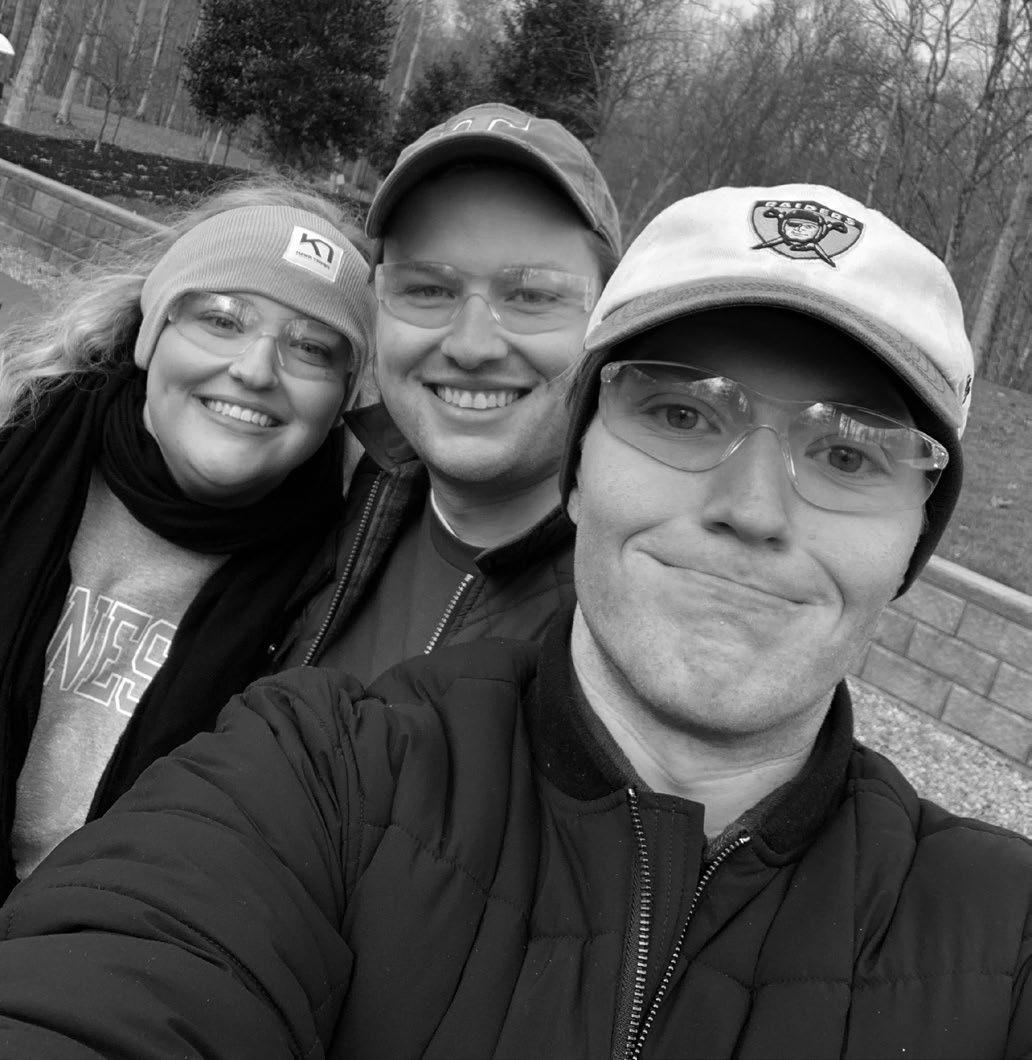
This month’s Hello My Name Is column features Davis Capps, an Associate at Egerton, McAfee, Armistead & Davis, P.C., where he practices commercial litigation. A 2024 graduate of the University of Tennessee College of Law, Davis also holds an accounting degree from the UT Haslam College of Business. Davis is an active member of the Knoxville Bar Association, the Tennessee Bar Association, and the Tennessee Defense Lawyers Association.

Davis transitioned into the legal field after deciding to pivot from his initial path in accounting during his senior year of college. He now finds fulfillment in the analytical nature of legal research and the collaborative environment of his firm. Outside of his practice, Davis stays active through weightlifting at the Cansler YMCA and enjoys keeping up with college football trivia with his family.
Why did you decide to go to law school?
Candidly, my journey to law school did not start with a lifelong dream or any particular purpose. It started in my senior year of college when I came to the hard realization that I did not want to be an accountant.
Impulsively, I took the LSAT and began applying to law schools. I did not know any lawyers, and I had zero exposure to the practice of law. Honestly, I leaped into law school blindly hoping that I would enjoy the practice of law more than accounting. After my first semester of law school, I fell in love with the law. Attending law school felt like a very bizarre decision at the time, but I have never once regretted it.
If you could give a new law student one piece of advice, what would it be?
There are several reasons why the legal profession is very complicated for law students. One of the most overlooked reasons is the countless career opportunities offered to law students. There are countless practice areas, billable hour requirements, big cities, in-house positions, governmental positions, and widely different firm cultures. In light of this, I have two pieces of advice for law students. First, take every opportunity to explore your interests as early as possible. Second, try to understand yourself and learn what a satisfying career looks like for you. There is no right or wrong answer, but you are the only person who knows what a successful career looks like for you.
What do you enjoy most about your job?
I truly enjoy the people I work with. I am beyond lucky to have coworkers who are considerate, intelligent, and funny. For my job duties, I enjoy the challenging legal research the most. I’ve always been a bit introverted, and legal research provides me with an opportunity to focus on a complex problem for hours. Additionally, finding the right answer to a legal question is a fantastic way for young lawyers to actively contribute to a case, a transaction, or the firm in general.
What is your favorite way to stay active?
My favorite way to stay active is with a friend. Spring semester of my 3L year I worked as a part-time clerk for Egerton, McAfee. Graciously, one of the young associates at the firm, Dalton Howard, asked if I wanted to go weightlift at the Cansler YMCA with him.
My favorite part about working out with Dalton isn’t weightlifting. It’s the conversations we have between sets. Over the last two years, our workouts consisted of Dalton mentoring me through my clerkship, the bar exam, and my first year of practice. He’d help me work on my lifting form while I recited bar exam essay prompts for his input. Frankly, the reason I enjoy working out is for friendship, even if Dalton makes me look like a crudely drawn stick man when we workout together.
What is your favorite thing to do with your family?
I’ve got an older brother and sister, and I only see my brother a handful of times every year because he is attending law school at the University of Michigan. All five of us are usually only together for the holidays. Since the holidays are so busy, and my brother also needs to visit with our extended family, it is rare for the five of us to spend much time relaxing when we’re together. When we do relax, it’s often during a football game.
Over the years, my parents and older siblings have incorporated college football trivia questions into our viewing experience. I know it sounds mundane, but just sitting with my siblings and parents while watching football and talking sports trivia fills my heart.




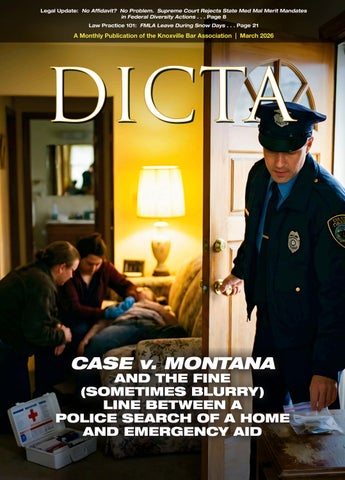
If there is any question in criminal constitutional law that keeps people’s interest, it is, “When can police enter and search your residence without a warrant?” In Case v. Montana, the United States Supreme Court explains when officers can enter a home based on an emergency.
The Court granted certiorari because courts have differed on whether police officers entering a home to provide emergency aid need probable cause to believe that an occupant is in peril.1
The United States Supreme Court selects around 80 cases of the 8000 writs of certiorari filed each year.2 The Court has the luxury of picking perfect facts for any issue. The facts in Case dramatically support the Court’s holding. As we’ll see below, the problems arise when lower courts address facts that aren’t so compelling.
In Case, police in a small Montana town received a call from William Case’s former girlfriend. William had called her and threatened to kill himself. He was specific about his plan. He said he was going to write a note. The former girlfriend reported she even heard a clicking sound like he was cocking a gun. When she suggested she was going to call the police, Case claimed he would kill them all, too.
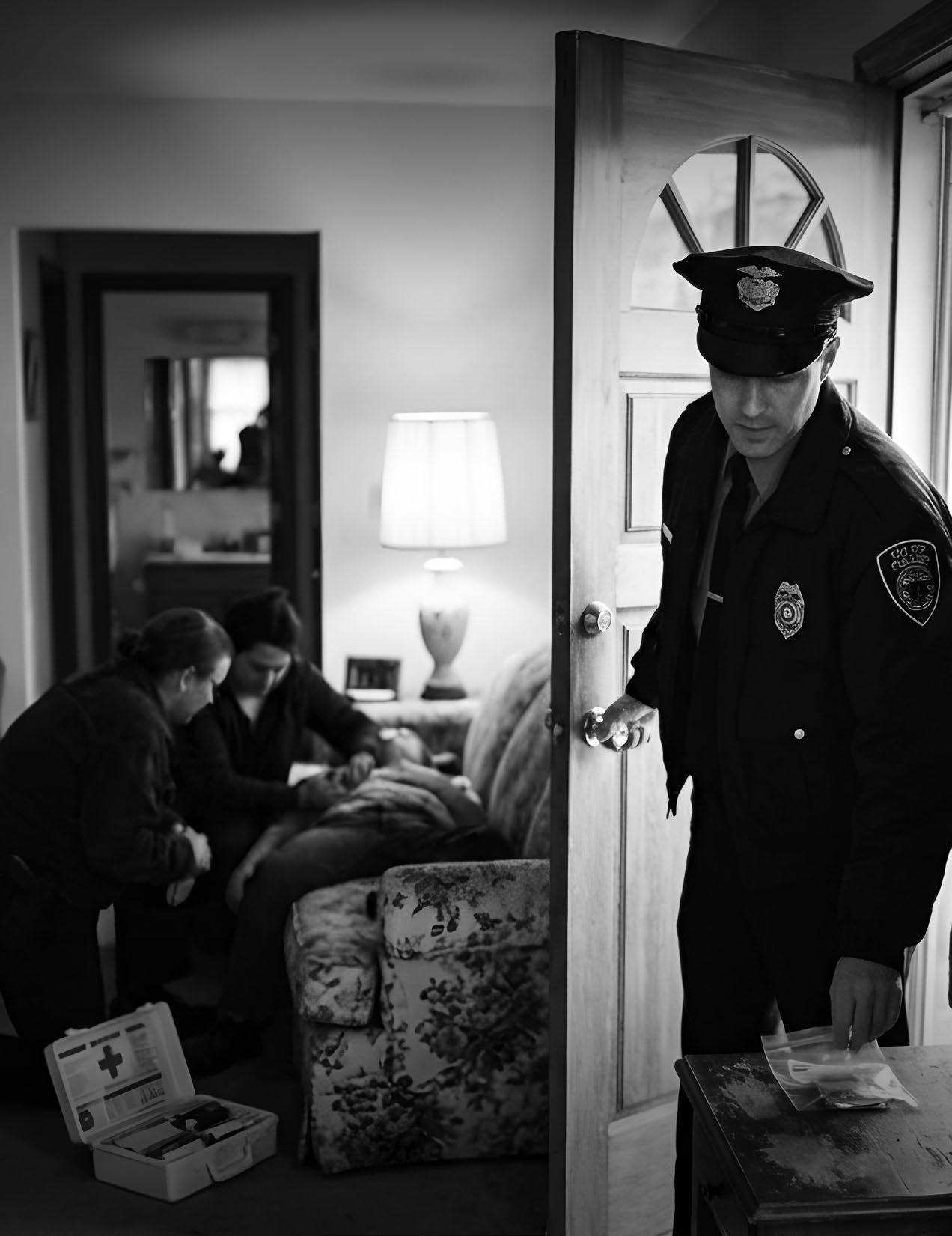
The caller then heard a pop and thought William shot himself. If that wasn’t enough, the officers who responded already knew Case. He had a history of alcohol and drug abuse, had been suicidal, and had attempted “suicide by cop.” When the officers arrived, they saw a gun holster and what appeared to be a note through the window.
Officers entered the home with rifles drawn and a ballistic shield. Case jumped out of a closet holding a “black object,” and an officer shot him. A gun was found nearby. Case survived and was charged and convicted of assaulting an officer.3
No one was arguing that officers can never enter a home without a warrant when there is an emergency. Although searches and seizures
inside a home without a warrant are presumptively unreasonable, there are several exceptions to the warrant requirement. Almost twenty years ago, the Court addressed an emergency situation in Brigham City v. Stuart and held that police can enter a home without a warrant if they have an “objectively reasonable basis” for believing that someone inside needs emergency assistance.4 Here the Court clarified how courts interpret the level of proof required that there is truly an emergency.
What is the difference between a criminal investigation requiring a warrant based on probable cause and an emergency response? The petitioner in Case argued for a probable cause requirement for both. He cited the long line of cases emphasizing that the home deserves the highest level of protection under the Fourth Amendment. His position was that probable cause is the level of proof required to justify a search and seizure of evidence or contraband. Therefore, he argued that police should have probable cause to believe an occupant is seriously injured or imminently threatened with serious injury before relying on the emergency aid exception.5
The Court rejected Case’s proposed probable cause requirement. Probable cause is a standard that applies to criminal investigations, not an emergency response.
The rule is that police may enter a home without a warrant if they have an objectively reasonable basis for believing that someone inside needs emergency assistance. The objective reasonableness is evaluated looking at the “totality of the circumstances.”6 The Court also noted the occupant must be “seriously injured or imminently threatened with such injury.”7 The theory does not apply unless serious physical injury is likely.
The Case v. Montana opinion is important because policing is changing. For example, in Knoxville, we have a successful program called the Co-Responder Program that pairs a crisis intervention-trained Knoxville Police Department officer with a mental health clinician from the McNabb Center to respond to calls that may involve a behavioral health crisis.8 The point is to de-escalate situations and potentially divert
them from the criminal justice process. Under Case, if the responding officer realizes an occupant is in danger, the officer is permitted to enter to render aid. In a concurring opinion, Justice Sotomayor discussed programs just like this. Justice Sotomayor suggested it might not always be reasonable for law enforcement to enter the home. Justice Sotomayor specifically cited the types of approaches that the Knoxville Police Department and McNabb are using, including “officers trained in crisis intervention; or … work with mental-health professionals to approach the occupant.”9 It is interesting to see a Supreme Court case that deals with practical issues that occur in Knoxville daily.
Limitations and potential for abuse.
Notably, the opinion does not authorize warrantless entry into a home for a “community caretaking” purpose. It is limited to a true emergency. Just a few years ago in Caniglia v. Strom, the Supreme Court expressly rejected the argument that there is an exception to the warrant requirement for community caretaking functions. “Community caretaking” is sometimes a legitimate basis for officers to approach a vehicle, but it does not apply to the home.10
Caniglia also involved a report of a potentially suicidal man with guns in the house. Officers went to the scene, convinced him to go to the hospital, and then went into the house and seized his weapons. Anyone faced with an emergency aid case should look closely to see whether the situation is closer to Case or Caniglia
One of the most important lines in the Case opinion acknowledges the overriding privacy interest in the home. “And in that vein, we note that an emergency-aid entry provides no basis to search the premises beyond what is reasonably needed to deal with the emergency while maintaining the officers’ safety.”11 Similarly, Justice Scalia in Arizona v. Hicks, held that any activity during a warrantless search had to be strictly related to the initial justification. In that case, where officers also picked up stereo equipment to look at the serial number, it was a separate search that required a warrant.12
Allowing emergency aid makes sense, but there is real potential for abuse. If all it takes is a phone call, an unscrupulous person could create an emergency basis by making such a call. Because officers could then seize evidence or contraband in plain view, this emergency exception could undermine the warrant requirement. In its amicus brief, the National Association of Criminal Defense Lawyers argued officers could use a thin emergency aid rationale to enter the home and pursue otherwise inappropriate investigatory aims once inside, or as a post hoc justification for an entry that lacked probable cause.13 The amicus brief collects cases in which officers entered a house under the pretext of rendering aid and went on to conduct other law enforcement investigation. We’ll have to see how this plays out, but it certainly is not
By: Wade V. Davies
The Davies Law Firm, PLLC

what the Court intends given the restrictions expressed regarding further investigation.
The Tennessee Supreme Court has addressed similar issues.
The Tennessee Supreme Court has affirmed the seizure of evidence in plain view when officers responded to an emergency where someone had been killed.14 Thus, Case seems to confirm Tennessee law. The Tennessee Supreme Court also discussed the emergency doctrine in State v. Meeks, stating that the emergency aid exception is a subset of the exigent circumstances doctrine.15 The Court has also affirmed the application of the community caretaking function, but only in the context of vehicles.16
Officers didn’t do anything wrong by going into William Case’s house to try to prevent physical harm. But the exception to the warrant requirement is very limited. It requires objective facts indicating such harm is likely, and the authority is limited to addressing the emergency.
1 Case v. Montana, 223 L.Ed.2d 382, 387-88, 2026 U.S. LEXIS 432 (2026)
2 Website of the Supreme Court of the United States, FAQ, https://www. supremecourt.gov/about/faq_general.aspx#:~:text=How%20many%20cases%20 are%20appealed,the%20Supreme%20Court%20first%20meet?
3 Case, 223 L.Ed.2d at 387.
4 Brigham City v. Stuart, 547 U.S. 398, 126 S. Ct. 1943 (2006).
5 Case, 223 L.Ed.2d at 390 (2026).
6 Id. at 391.
7 Id. at 392 (citing Brigham City, 547 U.S. at 400).
8 Knoxville Police Department, https://knoxvilletnpolice.gov/co-responder-program/; WBIR, “KPD says after more than 1,700 crisis calls, mental health co-responder team has never used force,” https://www.wbir.com/article/news/community/ co-responder-knoxville-police-team-program-no-use-of-force/51-ec75d44d-1e4749b2-8e10-622697a20afb; Full Disclosure: I served as Chair of the McNabb Center Board and am proud of this innovation.
9 Id. at 394 (Sotomayor, J., concurring).
10 Caniglia v. Strom, 593 U.S. 194 (2021)
11 Case, 223 L.Ed.2d at 390 (2026).
12 Arizona v. Hicks, 480 U.S. 321 (1987).
13 Case, Brief of National Association of Criminal Defense Lawyers, et al as Amici Curiae in Support of Petitioner, https://www.nacdl.org/getattachment/08f534b15177-4b68-9f26-4a89c86061c2/case-v-montana-brief.pdf
14 State v. Hutchison, 482 S.W.3d 893, 917 (Tenn. 2016) (abrogated in part on an unrelated issue by State v. Livingston, W2024-01087-CCA-R3-CD, 2025 Tenn. Crim. App. LEXIS 352 (Tenn. Crim. App. Jul 29, 2025)). See also State v. Guy, 679 S.W.3d 632 (Tenn. Crim. App. 2023).
15 State v. Meeks, 262 S.W.3d 710, 723 (Tenn. 2008)
16 See State v. Washington, No. W2022-01201-SC-R11-CD, 2025 Tenn. LEXIS 400, at *11 (Oct. 8, 2025) (stating that the Constitution does not bar law enforcement officers from approaching vehicles … when an officer possesses “specific and articulable facts which, viewed objectively and in the totality of the circumstances, reasonably warranted a conclusion that a community caretaking action was needed, such as the possibility of a person in need of assistance or the existence of a potential threat to public safety.”).
By: Wade H. Boswell II Tennessee Department of Human Services
One of the many things I enjoyed about college were the random conversations I had with my suitemates. I recently recalled a conversation we had that started with the things we had done during childhood that we survived without injury and those that we didn’t. While laughing about our exploits, the conversation turned to the future when my roommate said, “You know, we’re going to be sitting at work and will get a call that Junior just did something insane and shattered his leg” (or more colorful words to that effect). Thankfully, my daughter, save one minor matter where I got all lawyerly with the principal—to no avail—never did anything that rose to the level we envisioned back in college. I now need to follow-up with my roommate to see if his statement was fate foreshadowing what was to come from his three boys. Undoubtedly, he’ll have some good tales.
Someone who did get such a call were the parents of Elijah Dominic Robinson and Xavier Fellin.1 Back on August 9, 2022, when Robinson was 9 and Fellin was 11, they attended the same summer day care program. That day, they were playing with a toy dinosaur, which was about the size of a 16.9-ounce soft drink bottle. As they were young boys playing with the same toy, the inevitable dispute happened. During the ensuing “swatting match,” Fellin weaponized the dinosaur, which is understandable as he couldn’t relinquish the dinosaur and be left fighting one handed. Fellin struck Robinson’s right ring finger causing injury, and Robinson sued Fellin and his parents.2

Robinson’s lawsuit was brought in the Alberta Court of Justice, the equivalent of our General Sessions Court, though with a $100,000 jurisdictional limit and written opinions that appear on the internet.3 Based upon the case’s docket number and Alberta, Canada’s 2-year statute of limitations, the case was filed in 2024 and came on for hearing on December 1, 2025.4
Robinson’s mother was his Litigation Representative, the equivalent of our next friend, and Fellin’s were his parents. They proceeded pro se, which begs the question of what constitutes the unauthorized practice of law in Alberta, as none of the parents are attorneys. Well, whatever the standard, it wasn’t breached. The case proceeded with a paucity of evidence. The injury to Robinson’s finger? Per the court, “The finger was essentially severed at the bone but still attached. The injury required surgery or the finger would apparently have been lost. Unfortunately, no actual hospital or doctor’s records were produced.”5 The Plaintiff’s testimony wasn’t detailed, as he was trying to recall a skirmish from more than 3 years prior.6 To put that in perspective, this incident has covered a quarter of Robinson’s life. Who here hasn’t had a case that felt like it took a quarter of their life to resolve?
The day care was not sued, as it had closed. The day care was, unsurprisingly, not helpful and didn’t share any information with the parties due to privacy concerns and liability reasons. There was video of the incident that neither party was able to obtain from the day care.7
Ms. Robinson did not come close to her burden of proof against Fellin’s parents. She provided no evidence that Fellin’s parents did anything wrong in relation to the incident itself. They didn’t provide their son with a dangerous weapon or object. There was neither lack of supervision nor encouragement, and “[t]here was no evidence of poor child-rearing.” So, what was Ms. Robinson’s beef with Fellin’s parents? She was fixated on their lack of attention and contact. The court instead blamed the day care for creating an “awkward situation” by being uncooperative. It then advised Ms. Robinson that, “[w]hile contact from the Defendant’s parents might have been polite and courteous, they were under no legal obligation to make contact. Failure to make that contact or to offer to ‘help out’ does not found legal liability . . ..”8
The court dismissed the action against Fellin’s parents at the trial’s conclusion.9 In its ruling, the court notes the rarity of civil actions between minors and that these cases raise issues of the minor’s capacity to be negligent. The court also declared that consent and voluntary assumption of risk are relevant to this case. Instead of addressing these issues to reach a ruling on whether Fellin’s conduct was the actual cause of Robinson’s injury, the court opts to rely upon the well-established proximate cause of “fluke.” The court ruled that the injury couldn’t have been anticipated and that it was not part “of any concerted or intentional assault. It was a highly accidental fluke from children engaging in typical enough child activities. Reasonable people expect the possibility of children having minor disagreements and minor altercations. Children in these situations are within the expected scope of risk of injury, especially a difficult to foresee risk.” And with that, Robinson’s claim against Fellin was dismissed.10
Oddly, the court doesn’t stop here. Instead, it felt the need to share what the damages would be if Robinson had proven Fellin’s liability: $10,000.00 in general damages plus out-of-pocket expenses. This is the lead-in to the court relaying that Robinson’s finger is well-healed and that there are little to no ongoing difficulties.11 Makes one wonder if liability would have been found if the finger weren’t well-healed and caused Robinson ongoing problems. Regardless, may you be blessed to never receive a call that your child T-Rexed another child.
1 Robinson v. Fellin, 2026 ABCJ 2 (CanLII). h/t Kevin Underhill, Judge Finds for 11-Year-Old in Toy-Dinosaur-Assault Case, Lowering the Bar, Jan. 28, 2026. https:// www.loweringthebar.net/category/civil, last visited Feb. 11, 2026.
2 Ibid. at paras 1-3. (Canadian legal writing uses ibid. instead of id.)
3 https://albertacourts.ca/cj/areas-of-law/overview, last visited Feb. 11, 2026.
4 RSA 2000, c L-12.
5 Robinson, supra note 1 at para 3.
6 Ibid. at para 4.
7 Ibid. at para 2.
8 Ibid. at para 5.
9 Ibid.
10 Ibid. at paras 6-8.
11 Ibid. at para 9.
By: Paula Schaefer Art Stolnitz Distinguished Professor of Law University of Tennessee Winston College of Law

When a lawyer’s representation ends during an ongoing matter, a transfer of information is typically accomplished by turning over the former client’s file. However, there are circumstances when a lawyer may be required to respond to additional requests for information from successor counsel or the former client. In January 2026, the ABA’s Standing Committee on Ethics and Professional Responsibility released its Formal Opinion 520, which guides lawyers in understanding when they have an obligation to provide such information.1
Formal Opinion 520 reminds lawyers that Model Rule 1.16(d) requires lawyers to “take reasonable steps to the extent reasonably practicable to protect a [former] client’s interests” at the conclusion of a representation.2 In addition to providing reasonable notice and returning any unearned fee, the Model Rule lists the obligation to surrender “papers and property to which the client is entitled.” Similarly, Tennessee’s RPC 1.16(d) lists papers and property that must be surrendered to the client, although Tennessee provides substantially more detail about what that duty entails.3
Unlike the Model Rule, Tennessee’s RPC 1.16(d) explicitly addresses an attorney’s duty to “cooperat[e] with successor counsel engaged by the client.”4 The Formal Opinion’s discussion—regarding a lawyer’s duty to provide unrecorded information upon request by successor counsel—helpfully explicates a Tennessee lawyer’s cooperation with successor-counsel obligation under Tennessee RPC 1.16(d).
As a threshold matter, the Opinion notes that these duties apply even when the lawyer has been unfairly discharged and that the obligation to protect the client’s interests relates only to the matter in which the lawyer represented the former client.5
The Opinion determines that “[w]hen a request [from successor counsel or former client] makes it evident that unrecorded information is necessary to protect the former client’s interests in the matter, the former counsel must convey such information if it is reasonably practicable to do so.”6
The Opinion explains that there is no obligation to provide information accessible elsewhere7 and stresses that the information must be based on work that the lawyer has already performed for the former client.8 Some examples of information that a former lawyer would be obligated to provide include:
• Factual information that could have been memorialized in the file, such as a witness interview, an off-the-record discussion in court, or the content of settlement negotiations;
• Strategic or tactical reasons for taking certain actions;
• Impressions of a witness’s credibility; and
• Unmemorialized communications with the client.9
Another helpful point made in the Opinion is that the former
lawyer’s duty to provide information is limited to what is “reasonably practicable.” Thus, the lawyer is not required to generate new memos or affidavits, retrieve information not in the lawyer’s possession, review information to refresh the lawyer’s recollection, or educate successor counsel on the law.10
The Opinion provides several illustrations that demonstrate circumstances when a lawyer is obligated to respond to a request for information.11 For a lawyer confronted with whether to fulfill a request for additional information, these illustrations will be helpful in navigating the situation.
In conclusion, Formal Opinion 520 addresses an important issue that has not previously been explored in detail by the ABA. When a representation ends before the matter is concluded, most attorneys appreciate their obligation to turn over a client’s file, but they likely have given little thought to when they must respond to successor counsel’s request to provide more information. The Opinion provides a practical guide for both former lawyers and successor lawyers facing that issue.
1 ABA Formal Opinion 520 A Lawyer’s Obligation to Convey Information to a Former Client or Successor Counsel (January 21, 2026), available at https://www. americanbar.org/content/dam/aba/administrative/professional_responsibility/ ethics-opinions/aba-formal-opinion-520.pdf
2 Id. at 1.
3 Tennessee’s rule contains six categories of actions to protect a former client’s interests. The provisions related to turning over property include: “(4) promptly surrendering papers and property to which the client is entitled and any work product prepared by the lawyer for the client and for which the lawyer has been compensated; (5) promptly surrendering any other work product prepared by the lawyer for the client, provided, however, that the lawyer may retain such work product to the extent permitted by other law but only if the retention of the work product will not have a materially adverse effect on the client with respect to the subject matter of the representation.” Tenn. RPC 1.16(d)(4), (5).
4 Tenn. RPC 1.16(d)(3).
5 Formal Opinion 520, supra note 1, at 1.
6 Id. at 4.
7 Id. at 5.
8 Id 9 Id.
10 Id. at 5-6.
11 Id. at 6-7. One illustration provides: [S]uppose that a lawyer represented a client in the sale of a business. After negotiations began, the client became dissatisfied with the lawyer’s services and obtained successor counsel, who then requested the file from the lawyer. When reviewing the file, successor counsel could not determine why a specific term had been omitted from the most recent draft of the proposed terms of sale, and the client cannot recall. . .. The lawyer must answer successor counsel’s questions about the omission of the term, to the extent that the lawyer is able to do so, because the information requested is important to a full understanding of the status of the ongoing transactional matter and it is reasonably practicable for the lawyer to provide the information.


By: Geran E. Minor Landry & Azevedo
Jordan H. Meddings Young, Williams & Theiss
Every year, the Knoxville Bar Association Barristers are proud to host the High School Mock Trial Competition. This year’s annual competition took place on February 6-8, 2026. Over 150 competitors comprised 15 teams from 10 high schools across Tennessee Districts 2, 3, and 4. The competing teams included Annoor, Farragut (Blue), Farragut (Silver), Jefferson County, Knoxville Catholic (Gold), Knoxville Catholic (Green), L&N STEM Academy (L Team), L&N STEM Academy (N Team), Maryville, Paideia, Sevier County (Purple), Sevier County (White), Walker Valley, Webb School of Knoxville (Atticus), and Webb School of Knoxville (Finch).
Teams participated in four preliminary rounds, trying a premeditated murder case with many interesting issues. The Knoxville City-County Building hosted the competitors, their coaches, friends, and families on February 6th and 7th. The students competed in the courtrooms that members of the Knox County judiciary generously made available for the event. We extend our gratitude to Judges Deborah Stevens, Greg McMillan, Hector Sanchez, Emily Abbott, Scott Green, Chuck Cerny, Judd Davis, Patricia Hall Long, Andrew Jackson, VI, Tony Stansberry, and Chancellors John Weaver, Bud Armstrong, and Chris Heagerty for permitting us to use their courtrooms and providing the competitors with an enriched and realistic mock trial experience.
During the preliminary rounds, the following competitors were recognized for their exceptional mock trial skills:
• Kara Lenaghan (Farragut Blue) as the Best Advocate for the Prosecution;
• Sai Bobba (L&N STEM N Team) and Rafika Amlani (Farragut Silver) as the Best Advocates for the Defense;
• Helen Rose O’Reilley (Knoxville Catholic Green) and Olivia Grossman (Webb Atticus) as the Best Witnesses for the Prosecution; and
• Mackenzie Mangham (Walker Valley) as the Best Witness for the Defense.
After the preliminary rounds concluded, Farragut (Silver) and Jefferson County prevailed as the competition frontrunners and advanced to the district championship held on February 8th at the Lincoln Memorial University’s Duncan School of Law.
The championship round featured a highly qualified jury of attorneys. Attorneys Jonathan Cooper, Sean Roberts, and Erin White scored the championship, each of whom evaluated the competitors’ performances as advocates and witnesses during the mock criminal trial. The Honorable Suzanne Bauknight presided over the championship as Jefferson County advocated for the prosecution and Farragut (Silver) represented the defendant.
After a competitive final trial, Jefferson County emerged as District Champion. Both Jefferson County and Farragut (Silver) punched their tickets to compete in the State Mock Trial Tournament which will take place on March 20th and 21st in Nashville. We wish them good luck, and after having watched them perform, we are confident both teams will represent East Tennessee well.
Without our roster of dedicated volunteers, it would have been impossible to make this great event a reality. Thank you, again, to the judges, attorneys, law students, and undergraduate mock trial members
who served as presiding judges, scoring judges, and bailiffs, as well as those who were willing to lend a helping hand whenever the need arose.
We likewise thank Judicial Clerk Esther Roberts, Court Administrator Jessica Haun, and the staff of the Public Building Authority for their assistance in arranging and securing the Knoxville City-County Building facilities; Matthew Lyon, Andrew McRee, and Lincoln Memorial University’s School of Law for hosting the Championship round; and Tasha Blakney, Bridgette Fly, and the KBA Staff for all the support they provided us over the past several months as we all worked to ensure a smoothly-run competition. We are genuinely privileged to boast such an involved and supportive bar association.
The impact this event has every year on our student competitors cannot be overstated. In fact, several of our volunteers this year competed in this very competition as high school students. Countless students, parents, and teachers shared their immense gratitude that so many of our association members would sacrifice time from their weekends to help these students grow and learn. We thank you for another successful year, which would not have been possible without your generous support.
Attorney Volunteers
Anna Rickels Emma Estabrooks Maria Hinkley
Bailey Harned Erin White Martha McCampbell
Bethany Wilson Glenn Walter Matthew Hubbs
Breana Query Haden Blair Mike Stanuszek
Caleb Smothers
Hannah Lowe Miranda Goodwin
Celia Ball Christmas Holly Zitka Nate Ogle
Cheri Flynn Kimberly Riddett Nick Armes
Cindy White
Holly Nehls Rachel Hurt
Courteney Barnes-Anderson Jada Carson Ryan Shannon
David Eldridge Jon Fromke Sean Roberts
Dillon Zinser
Jonathan Cooper Shannon van Tol
Dominic Garduno Kaitlyn Sell Shanon Taylor
Donna Smith
Katherine Sierra-Kelly Hon. Suzanne Bauknight
DT Christmas Kayla Long Tasha Blakney
Emily Cala Kendal Walker Taylor Moning
Law Student Volunteers
Aaron Argall
Christy Urquieta Cortes Margaret Parent
Abigail Muller Grace Smyth Maria Salvador
Alexandria Marsicovetere Haleigh Barnett McKenzie Larrimore
Amanda Ellis Jacquelynne Miller Megan Smith
Ashley Singleton Kaden Tackett Saiid Lewis
Brittany Mauro Kadie Smolock Stefan Conlee
Cameron Kinser Kameron Andrews Taylor Schneider
Carsen Goodwin Lilah Afflerbaugh Tyler Ward
Valeria Loggiodice
Undergraduate Volunteers
Ava Heuston
Caroline Snyder
Christon King
Emily Kitch
Grace While Madelyn Harrell
Jayden Hastings Presley Richards
Kya Calbo Taylor Santucci
Livia Odoi
By: Jimmy Snodgrass Bass, Berry & Sims

Handling leaves of absence under the Family and Medical Leave Act is an extremely difficult task that can create liability for employers even when attempted to be handled correctly. As you are aware, under the FMLA, eligible employees may generally take up to twelve workweeks of leave during a twelve-month period. To be eligible for FMLA leave, an employee must have worked for an employer (with fifty or more employees) for a minimum of 1,250 hours in the twelve months prior to the request for leave.
Imagine if an employee was unfortunately forced to take several instances of leave under the FMLA due to multiple qualifying events. These could include the birth or placement of a child and helping with an immediate family member who has a serious health condition. Now, the employee has their own serious health condition that will require physical therapy twice a month. The employee has come to you, stating that they need to take intermittent FMLA leave every other Tuesday for two hours to attend physical therapy. After several months, the employee is worried about exhausting all of their unpaid FMLA leave and has several questions.

First, potential pitfalls include how to measure what twelve-month period the calculation is based on, as well as how to calculate the hourly equivalent of twelve workweeks of leave.1 Assuming the employer has calculated this amount, we have recently received guidance on one other minor example that the employer should consider— how do office closures and holidays affect the calculation of an employee’s FMLA leave.2
On January 5, 2026, the U.S. Department of Labor Wage and Hour Division issued an opinion letter, FMLA 2026-1, responding to a request for an opinion on how a school closure of less than a full week impacts the amount of leave a school employee uses under the FMLA for the closure period. The Opinion Letter utilized the example I set forth above, where an employee needed FMLA leave each Tuesday afternoon
for physical therapy, but the school was closed on Tuesday due to inclement weather. Under this example, if the employer was closed due to inclement weather, and the employee was not expected to work from home, then the closure time should not be deducted from the FMLA leave entitlement.
The opinion letter set forth the DOL Wage and Hour Division’s opinion that if an employee has been approved for FMLA leave for less than a full workweek, and then the employer is closed during this time and the employee would not be required to report to work, the closure time should not be deducted from the amount of FMLA leave.“ When an employee takes FMLA leave for less than one full workweek, the amount of FMLA leave used is determined as a proportion of the employee’s actual workweek.”3 This is similar treatment to when a holiday falls during a week when the employee is taking FMLA leave in increments of less than a full workweek. However, if the employee is taking FMLA leave for a full workweek, the closure has no impact on the usage and total of FMLA leave.4
This minor example shows the potential and unexpected pitfalls that an employer faces when assessing leave issues under the FMLA. In yet another example, in an opinion letter issued the same date, the DOL Wage and Hour Division clarified that employees may use leave under the FMLA for time spent traveling to or from medical appointments, including those for a qualifying family member (FMLA 2026-2).
These opinion letters, a program which the Trump administration has attempted to expand as of June 2025, are helpful tools to think through issues regarding the administration of FMLA leave or ensuring that any retained vendor is paying attention to nuanced details for specific employees.5
1 See U.S. Department of Labor Wage and Hour Division Fact Sheet #28I for calculating leave use under the FMLA, as well as DOL WHD Opinion Letter FMLA 2025-02-A, addressing when the need to calculate hourly equivalents for FMLA leave.
2 This is a timely issue for me, as I lost power for the last week of January in Nashville and had planned to come to Knoxville to be able to say I saw Nate Ament play in college in my season tickets, only to be prevented from taking the trip due to snow in Knoxville. One drawback of my recent move is far fewer people want to talk about Rick Barnes’s rotations and how much better of a shooter Bishop Boswell is than last year.
3 29 C.F.R. § 825.205(b).
4 29 C.F.R. § 825.200(h).
5 https://www.dol.gov/agencies/whd/opinion-letters/request/existing-guidance
About this column: “The cobbler’s children have no shoes.” This old expression refers to the fact that a busy cobbler will be so busy making shoes for his customers that he has no time to make some for his own children. This syndrome can also apply to lawyers who are so busy providing good service to their clients that they neglect management issues in their own offices. The goal of this column is to provide timely information on management issues. If you have an idea for a future column, please contact Jimmy Snodgrass at jimmy.snodgrass@bassberry.com.

By: Cathy Shuck East Tennessee Children’s Hospital
We are all familiar with the warning that “those who cannot remember the past are condemned to repeat it.”1 Although it sounds dire, the warning offers a way out: if we pay attention to the lessons of history, then we can avoid making the same bad decisions our ancestors made, and we can escape the tragedies that befell them.
The idea also implies that history is linear: time is ever moving forward with the implication of progress and a better life ahead.
I used to take the idea of linear human history as a given, but as I’ve gotten older, it seems to not always be true. Some things that have happened in my lifetime show linear progress. First we got answering machines. Then we got virtual voicemail, then flip phones, then iPhones. Automobiles have gotten exponentially safer. Women in leadership roles were few and far between when I was a kid, but now we are if not ubiquitous, certainly more well-represented.
But as a society, we also seem to be backsliding in some significant ways. Environmental protections are being rolled back. Infectious diseases that were close to eradication are making a comeback. Civil rights gains are in danger. Collective support for NATO and the United Nations seems vulnerable.
Instead of taking current events as a sign that history is moving backwards, I am finding solace in the school of thought that history is cyclical. The idea of history as a cycle is central to many cultures and schools of philosophy; a common feature is a division into four predictable cycles of birth, growth, decay, and death.
As applied to Anglo-American history, the cycle theory is explored in exhaustive detail and applied to current events in The Fourth Turning is Here by Neil Howe.2 Howe first articulated the theory that Anglo-American history moves in predictable cycles of 80 to 100 years in The Fourth Turning3 written with his longtime collaborator William Strauss. The book predicted that America was headed towards a crisis, but it was not clear in 1997 what that crisis would be. The Fourth Turning is Here identifies the financial crash of 2008 as the start of a current crisis era and explores various ways that the crisis might resolve.
It is not necessary to have read the original Fourth Turning to appreciate Howe’s recent book, as he spends a good deal of it recapping material from the original book. Howe is focused only on AngloAmerican history. The theory is that since the Renaissance, history has moved in cycles of approximately 100 years, which Howe and Strauss
termed a “saeculum.” Each saeculum contains four phases: the “High”; the “Awakening”; the “Unraveling”; and the “Crisis.” Each phase is a “Turning”; hence, “the Fourth Turning is here” means we are in a Crisis
The phases, or Turnings, are straightforward enough and echo many other descriptions of cyclical history. Strauss and Howe’s innovation was overlaying a theory of four archetypal social generations, which correlate to the same Turning over time. The generational archetypes are the Artist, the Prophet, the Nomad, and the Hero, depending on which Turning they were born in. Prophets are born in the First Turning; Nomads are born during the second; Heroes are born during the Third; and Artists are born during the Fourth. Which generations hold power and influence during different Turnings tells us something about how that Turning will progress and resolve, particularly the Crisis. I had to take notes to keep up with all the different terminology, but the components as a whole make a lot of sense.
According to Howe, the current “saeculum” began with the end of World War II, at the beginning of the Boomer generation. The Awakening began in 1964 as Boomers came of age and began pushing on the norms established during the beginning of the saeculum. The Unraveling began in 1984 as Generation X came of age and the Crisis, again, began in 2008. Howe compares these Turnings and events within them to earlier Turnings in history. Previous Crisis Turnings were the era of the Glorious Revolution, 1675-1706; the American Revolution, 1773-1794; the Civil War; and the Depression and World War II. Importantly, much was lost and many suffered during each previous Crisis. But each Crisis ultimately resolved. I can’t do justice to the Howe’s argument here, but I found the tapestry of history that he weaves in The Fourth Turning is Here extremely compelling. At one level, the message is a little bleak: we are doomed to repeated difficult times. At another level, though, it is reassuring. We’ve been here before and came out the other side. And although we may not be able to control the churn of history, we do have the ability to control how we respond to it and what we build during the next Turning.
1 Generally attributed to George Santayana, The Life of Reason (1905).
2 Neil Howe, The Fourth Turning is Here: What the Seasons of History Tell Us About How and When this Crisis Will End, Simon & Schuster (2023).
3 William Strauss & Neil Howe, The Fourth Turning: An American Prophecy – What the Cycles of History Tell Us About America’s Next Rendezvous with Destiny, Crown Publishers (1997). William Strauss died in 2007.
By: Mary Frances DeVoe Legal Aid of East Tennessee

As Director of Pro Bono at Legal Aid of East Tennessee, I’m proud to introduce Rebecca Spicer-Keller in her new role as Pro Bono Coordinating Attorney based in our Knoxville office! I will continue to oversee the overall direction of LAET’s Pro Bono Project across our service area, while Rebecca will lead day-to-day pro bono operations, volunteer support, and local initiatives in the Knoxville area. This structure allows us to provide strong, on-the-ground support for the Knoxville Bar while maintaining consistent leadership and vision for the program as a whole. I’m excited for our pro bono community to work with Rebecca, and I am confident she will be a tremendous resource!
Rebecca Spicer-Keller, Pro Bono Coordinating Attorney
I am honored to step into the role of Pro Bono Coordinating Attorney at LAET. Pro bono services are an integral part of the legal community, and I look forward to continuing the important work of serving individuals and families who otherwise would not have access to needed legal services. This role represents more than a professional transition for me. It reflects a core belief that has guided me throughout my legal career, which is that access to justice should not be limited to only individuals who can afford representation.
I am originally from Sevierville, Tennessee, and I graduated from the University of Tennessee in 2019, magna cum laude, earning a B.A. in Political Science: Honors Concentration. After completing my undergraduate degree, I attended the University of Tennessee (Winston) College of Law where I completed a JD-MA (Philosophy) dual degree in 2022. I currently live in Knoxville with my husband, daughter, and two dogs. East Tennessee is my home, and helping the most vulnerable individuals in our community is why I wanted to become an attorney. The true power of being an attorney is being able to provide stability, protection, and clarity during some of the most challenging moments in a person’s life.
Prior to accepting this position, I worked for LAET as a benefits attorney, helping individuals obtain access to Medicare, SNAP, and disability benefits. Through my benefits work, I have seen firsthand the profound impact that even limited legal guidance can make. It can be the difference between whether or not a person can provide food for their children, have access to life saving Medicaid benefits, or be able to pay rent despite being disabled and unable to work. I look forward to continuing my work with LAET and to bringing those skills to this new
position by creating new clinics and opportunities for attorneys to get involved.
Pro bono service helps bridge the gap between legal rights and access to justice. Unfortunately, the need for legal services far exceeds the resources we currently have available, which is why pro bono services are so important. Taking on this role is a professional responsibility for me as well as a personal commitment to the people we all aim to serve. I hope to be a consistent and reliable presence to everyone looking to get involved with our pro bono mission.
The Knoxville Bar has a history of strong dedication to pro bono work. Yet the attorneys who provide pro bono services face challenges. They must balance an already demanding workload, deal with the emotional complexities that come with pro bono cases, and make sure they have a life outside of work. Additionally, new areas of law can be intimidating for attorneys who provide pro bono services. That is where LAET’s Pro Bono Project comes in. Our goal is to make it as easy and rewarding as possible for attorneys who volunteer to take pro bono cases or participate in clinics while serving as many people in our community as we can. I am grateful for the work done by the individuals who were in this position before me. More specifically, I am grateful to Deb House, Mary Frances DeVoe, Jeanne Carmichael, and Sierra Dennis for the hard work and dedication that they continue to put in to the Pro Bono Project every day, as well as their continued support and guidance.
In addition to continuing to take on benefits cases for direct representation, I look forward to contributing to the growth of our Pro Bono Project by collaborating with colleagues and community organizations to identify unmet legal needs and expand opportunities for service, as well as continuing our current program and clinics.
Ultimately, pro bono service is about more than resolving a legal issue. It is about advancing our community as a whole. I am proud to take on this role and remain committed to ensuring that everyone has access to justice. If you have identified any unmet legal needs that we can help with, want to get involved, or have questions about our process please feel free to contact me at any time by phone at 865-224-3608, or by email at rkeller@laet.org
Legal Advice Clinic for Veterans: In person at the Public Defender’s Community Law Office at 1101 Liberty Street in Knoxville. Phone advice options available. Phone advice options available. Signup via the KBA website.
• Wednesdays, April 8, June 10, August 12, and October 14 Noon – 2:00 PM
Debt Relief Clinic: In person at the Public Defender’s Community Law Office at 1101 Liberty Street in Knoxville. Signup via the KBA website.
• Saturdays, March 28, June 27, September 12, and November 14 9AM – Noon.
continued from page 8
at the outset of litigation. Accordingly, defendants should be aware of the potential for plaintiffs to forum shop in cases where diversity jurisdiction exists and avoid an increase in early litigation costs.34 The best defense against unsupported medical malpractice diversity claims post-Berk is dispositive motion practice, such as Rule 12(b)(6) and Rule 56 motions.35 Yet, even post-Berk, state affidavit of merit requirements will still be enforced in state court.
1 607 U.S. ___ (2026).
2 Berk v. Choy, No. 24-440, 2026 WL 135974, at *2 (U.S. Jan. 20, 2026).
3 Id.
4 Id.
5 Id. at *3.
6 Id.
7 Id.
8 Id.
9 Id. (citing 28 U.S.C. § 1652).
10 Id. (quoting 28 U.S.C. § 1652).
11 Id. (citing 28 U.S.C.§ 2072(a); Fed. R. Civ. P. 1).
12 Id. at *3 (quoting Shady Grove Orthopedic Assocs., P.A. v. Allstate Ins. Co., 559 U.S. 393, 398 (2010)).
13 Id. at *6 (quoting Sibbach v. Wilson & Co., 312 U.S. 1, 14 (1941)).
14 Id. at *3.
15 Id. at *3, 6-7.
16 Id. at *3.
17 Id. at *4 (citing Fed. R. Civ. P. 12(b)(6)).
18 Id. (citing Fed. R. Civ. P. 12(d)).
19 Id
20 Id
21 Id. at *6.
22 Id.
23 Id. at *6-7.
24 Id. at *7.
25 Id. at *7-8 (Jackson, J., concurring).
26 Id. at *11-12 (Jackson, J., concurring).
27 Id. at *10-11 (Jackson, J., concurring).

28 Buckner Wellford, Jerrick D. Murrell & Alex Hall, Berk v. Choy: What the Supreme Court’s Ruling Means for Medical Malpractice Litigation, Baker Donelson (Jan. 22, 2026), https://www.bakerdonelson.com/berk-v-choy-what-the-supremecourts-ruling-means-for-medical-malpractice-litigation; see also U.S. Supreme Court Rules State Affidavit/Certificate of Merit Requirements Do Not Apply in Federal Court, Duane Morris (Jan. 22, 2026), https://www.duanemorris.com/alerts/ us_supreme_court_rules_state_affidavit_certificate_merit_requirements_do_ not_apply_0126.html#:~:text=On%20January%2020%2C%202026%2C%20 the,conflict%20with%20the%20Federal%20Rules (Pre-Berk, the Second, Fourth, Fifth, Sixth, Seventh, and Ninth Circuits held these requirements conflicted with the Rules and could not be enforced in federal court; the Third and Tenth Circuits held the opposite.).
29 Berk, 2026 WL 135974, at *4 (referencing Leatherman v. Tarrant Cnty. Narcotics Intel. & Coordination Unit, 507 U.S. 163, 113 (1993) (42 U.S.C. § 1983 actions against municipalities); Swierkiewicz v. Sorema N. A., 534 U.S. 506, 122 (2002) (employment discrimination suits); Jones v. Bock, 549 U.S. 199, 127 (2007) (prisoner suits)).
30 Wellford, Murrell & Hall, supra note 28 (discussing the possibility of Tennessee’s “pre-suit notice” affidavit requirement falling under Rule 11).
31 Ward & Smith, P.A. et al., Supreme Court Confirms That State Affidavit-of-Merit Laws Don’t Apply in Federal Court, JD supra (Jan. 30, 2026), https://www.jdsupra. com/legalnews/supreme-court-confirms-that-state-6991242/.
32 Id.
33 Berk, 2026 WL 135974, at *3-4.
34 Wellford, Murrell & Hall, supra note 28.
35 U.S. Supreme Court Rules State Affidavit/Certificate of Merit Requirements Do Not Apply in Federal Court, supra note 28; Ward & Smith, P.A. et al., supra note 32.
FRIDAY, MAY 15, 2026 | 3:00 P.M. Tennessee Supreme Court Courtroom 505 Main Street, 2nd Floor
We gather, not for the purpose of grieving, but rather to celebrate the careers of, and to honor, applaud, and express our gratitude to, those members of the Knoxville Bar who passed away in the time since we last gathered in remembrance.

STARS, continued from page 13 tn.gov/news/2007/9/17/celebrating-70-years-of-driving-tennessee.html, last visited Feb. 1, 2026; see also Tennessee Blue Book 1937-1938 at 124, available at https://tnsla.ent.sirsi.net/client/en_US/search/asset/127589/0.
12 Tennessee Blue Book 1937-1938 at 124; see also Jonathan Grossman, Fair Labor Standards Act of 1938: Maximum Struggle for a Minimum Wage, U.S. Dept. of Labor (June 1978), available at https://www.dol.gov/general/aboutdol/history/flsa1938.
13 See Pub. Acts. 1988, ch. 584, codified at Tenn. Code Ann. § 55-50-101 (1988).
14 Tenn. Code Ann. § 4-3-2014 (Jan. 1, 2026).
15 Tenn. Code Ann. §§ 4-42-103; 4-42-104 (Jan. 1, 2026).
16 Tenn. Code Ann. § 55-50-303(a)(9) (Jan. 1, 2026).
17 Tenn. Code Ann. § 55-50-301 (Jan. 1, 2026).
18 Tenn. Code Ann. § 55-50-331(g) (Jan. 1, 2026).
19 Tenn. Code Ann. § 55-50-331(g)(3) (Jan. 1, 2026).
20 See Fiscal Summary, SB 6002, available at https://wapp.capitol.tn.gov/apps/BillInfo/ Default?BillNumber=SB6002&GA=114, last visited Feb. 1, 2026.





By: Tammy Sharpe Director of CLE Knoxville Bar Association
If you had told me twenty years ago that I’d end up working for a bar association and running continuing legal education for lawyers, I would have laughed.
Not because it isn’t a wonderful job, but because, honestly, I didn’t even know the bar association existed.
My background wasn’t legal at all. I came from the service/tourism industry, where my focus was supervision and HR. I had a knack for keeping people around—good morale, good communication, and maybe my glowing personality (at least that’s what I tell myself). The legal arena was not on my radar.
In fact, my very first experience with anything remotely legal was giving a deposition after a car wreck I was involved in back in high school. I remember walking into one of those big downtown office buildings and being absolutely terrified. Not because I’d done anything wrong, but because everything felt so formal and serious and unfamiliar. I just kept thinking, “Don’t mess this up.”
My attorney and the state trooper gave me one piece of advice: “Just tell the truth.”
Anyone who knows me also knows that’s kind of my thing. I tell it like it is, so I did just fine. But, at the time, it was pretty intimidating, and if you’d asked me whether I’d someday work with lawyers every day, I would have said, “No, thank you.”
And yet, much to my amazement, here we are.
I interviewed for the position at the Knoxville Bar Association back in June 2006. When I was called and asked to come in, I remember thinking, “Wait. What exactly is the bar association?”
Turns out, I wasn’t alone. During my first year or two answering phones at the KBA, we regularly got calls from people asking if we’d found the driver’s license they’d left behind the night before at Bar Knoxville. Apparently, “the bar” meant something very different to them. I didn’t arrive with a legal background or some grand plan to serve the profession. I stumbled into it. But sometimes those are the best journeys.
I started my career at the KBA running the Legal Placement Service. I helped law firms find qualified support staff and attorneys. That position taught me something important early on: no lawyer succeeds alone. Most successful law offices have a strong support system behind them. You don’t need to practice law to make a meaningful contribution in the legal profession.
Eventually, probably because I showed up to work every day and behaved myself, I was promoted to managing the KBA’s continuing legal education.
At first, I just did what Marsha Watson and the CLE Committee told me to do: plan the programs, confirm the speakers, reserve the rooms, and make sure everyone got credit. Very straightforward. It didn’t take long for me to realize how important this service really was. While attorneys are required to complete annual continuing education hours to maintain their licenses, the deeper purpose is to ensure they remain knowledgeable and effective advocates for their clients. What we provide isn’t merely credit hours, it’s meaningful professional growth.
A large part of what I do is listening. I speak with section leaders, law firm administrators, judges, and practitioners across every area of
law. I ask what’s keeping them up at night. What’s changing in their practices? Where are they struggling? What would make their day-to-day work easier?
Sometimes it’s substantive law updates. Sometimes it’s ethics questions. Lately, it’s often technology, case management systems, cybersecurity, AI tools, remote work, or simply how to be more efficient without burning out.
After I understand those needs, my job is to turn them into practical, relevant programming. Not theory. Not fluff. Real tools lawyers can use on Monday morning.
And if you want to see all of that come together in one place, here is my slightly shameless plug: Come experience our annual Law Practice Today Expo scheduled for March 19.
The Expo is where everything I love about this job comes together. It’s focused less on theory and more on the practical side of running a law office, including technology, management, systems, and real-world solutions. We bring in law firm administrators, tech experts, exhibitors, and practitioners to share what’s actually working for them. Not sales pitches, but real, usable advice.
This is the kind of event where someone might learn a new way to manage deadlines, discover a tool that saves hours each week, or finally feel confident about tackling cybersecurity or AI. And, there’s just an energy to the day that you don’t always get from a standard CLE. People are discussing, sharing, brainstorming, and walking away with ideas they can implement immediately (plus who doesn’t like door prizes and swag).
So yes, this is my official appeal. Come to the Expo. You’ll earn your credits, but more importantly, you’ll walk away with something useful. And you’ll make my CLE Director heart very happy.
I’ve learned that I absolutely could not do this job alone. Planning a big event like the Expo takes a team. Our member volunteers are everything. Section leaders, committee members, speakers—they’re the ones sharing their knowledge and making these programs meaningful. And making my job easier.
Over the years, I’ve realized that even though I’m not practicing law, I still feel deeply connected to the legal community. If the CLE programs that the KBA produces help an attorney learn a better system, avoid an ethical misstep, or save time with technology, that ripple effect reaches their clients and our whole community.
That feels like a pretty meaningful contribution.
Serving as the KBA’s CLE Director has shown me that contributing to the practice of law doesn’t require a courtroom or a caseload. It requires a commitment to helping others grow. I am privileged to play a role in supporting the lawyers who serve our communities every day. By equipping them with education, resources, and opportunities to learn, I contribute, indirectly but meaningfully, to the quality and integrity of the legal profession itself.
Beyond the work itself, I’ve gained incredible connections and friendships through my time at the KBA, something I value deeply and wouldn’t trade for anything.
I would say here’s to another 20 years, but let’s not get too carried away!
By: Parker Bohne
LMU Duncan School of Law
J.D. Candidate, 2026
Some food trucks are born from culinary school dreams or restaurant-industry burnout. But Daddy D’s traces its roots somewhere much closer to home—Sunday dinners, church picnics, and a lifelong love of fried chicken.
Long before Darryl Fannon, the owner of Daddy D’s, ever fired up a fryer in his food truck, he was growing up on a farm in East Tennessee through the 1960s and 70s, where fried chicken was a staple of family gatherings. Growing up, it amazed him how home cooks, including his mother and aunt, turned simple ingredients into something unforgettable. That early exposure planted a seed, but it wasn’t until decades later that it fully took shape.

The turning point came in the early 1990s when his former roommate at the University of Tennessee introduced Darryl to Nashville’s hot chicken scene. Trips to East Nashville became informal research missions, hopping from one hot chicken joint to the next. Over time, he learned the subtle differences between spice blends, heat levels, and preparation styles.
By the early 2000s, those lessons found their way into his own kitchen. Darryl began hosting hot chicken parties for friends—many of them fellow teachers—testing new spice combinations and collecting feedback from people who had never really tried hot chicken before. Despite steady encouragement from his colleagues, the leap into business took time. After 31 years in education and with retirement on the horizon, a colleague gave him the nudge he needed. In 2017, that same colleague found what would become Daddy D’s food truck: a retired 1997 USPS vehicle listed on governmentdeals.com. Five thousand dollars later—plus some investment in kitchen installation—and Daddy D’s was officially underway.
While Darryl had long toyed with and dreamed of the idea of opening a bar or restaurant, practicality ultimately drove the decision to go mobile. As Knoxville’s food truck scene began to grow pre-pandemic, the numbers made sense. A brick-and-mortar location came with higher overhead and long-term risk. A food truck offered flexibility, ownership, and a manageable entry point into entrepreneurship. For someone starting a second act after retirement, it was the right fit.
Ask Darryl about the best part of owning a food truck, and the answer comes easily: people. Introducing customers to his food and seeing them return to say it was the best they’ve ever had, is what keeps
him going.

What helps Daddy D’s stand out is simplicity. A small menu means consistently fresh food at an approachable price point. While several trucks around town serve fried chicken, Daddy D’s focuses squarely on Nashville-style hot chicken. The menu centers on spicy and sweet chicken and fish sandwiches, with heat levels that respect tradition without overwhelming flavor. For those who prefer less fire, a Southernfried, honey-drizzled option delivers comfort without compromise.
And then there’s dessert. Teddy Lee’s Banana Pudding has developed a following of its own—so much so that it’s now sold (along with other versions) at Three Rivers Market, extending Daddy D’s reach beyond the truck.
You won’t find Daddy D’s parked in one permanent spot. Instead, the truck rotates through corporate parking lots, local breweries, and other local festivals or events. Catering for businesses, parties, and special occasions is also a growing part of the operation.
While Daddy D’s has been shut down for the winter season, you don’t want to miss their first service this spring on March 14 at the Knox Shamrock Fest at the World’s Fair Performance Lawn.
To keep up with locations or to book an event, follow Daddy D’s on Facebook at @DaddyDsknox or Instagram @thehotdaddyds, or reach out directly via email at thehotdaddyds@gmail.com
Benjamin T. Barnett The Barnett Firm
Theodore D. Bissmeyer Attorney-at-Law
Christian A. Flint Pryor, Priest & Harber
Kevin N. Graham
Wettermark Keith
David R. Houbre Garza Law Firm, PLLC
Lydia K. Adkins
Benjamin J. Bambrey
Haleigh Barnett
Reagan Battershell
Gabriel T. Carroll
Mia B. Cate
Elizabeth Coleman
Susanne Cooper
Amelia K. Fraser
WELCOME NEW MEMBERS
THE KNOXVILLE BAR ASSOCIATION IS PLEASED TO WELCOME THE FOLLOWING NEW MEMBERS:
Jenna Santero Attorney-at-Law
Daniel Schaffzin Attorney-at-Law
Rachel R. Schworer Tennessee Valley Authority Office of the General Counsel
Ethan Stephens Tennessee Valley Title Insurance Company
Cody S. Walsh BFP Law Firm
Berkley Kendrick
Claire A. Klim
Gabriella G. Lewis
Zach McDonough
Ella G. McLerran
Alyssa N. Miles
Erik Parry
Asita Patel
Paxton Pearce
Please note the following changes in your KBA Attorneys’ Directory and other office records:
Angelia Morie Nystrom
BPR #: 016222
East Tennessee Foundation 525 Portland Street Knoxville, TN 37919
Ph: (865) 524-1223 anystrom@etf.org
Dan Channing Stanley
BPR #: 021002
Knoxville Attorney, PLLC
422 S. Gay Street, Suite 301 Knoxville, TN 37902-1144 Ph: (865) 337-5737 dan@knoxvilleattorney.com
William L. Willis
BPR #: 041815
Bridgefront Law Group, PLLC
720 S. Gay St. Knoxville, TN 37902 atty.wm.willis@gmail.com
Jessica D. White Attorney-at-Law
Allison A. Johnson Apex Bank
Sabrina Prado
Morgan B. Shepard
John R. Terry
Brendan Yee
Joseph Zaylik

By: Angelia Nystrom East Tennessee Foundation
I hate to admit this, but during the week, I am notorious for dodging social plans. I usually eat dinner at 8:00 pm or later, which is too late for most people. I’ve got a morning routine that includes a half a pot of coffee with my dog before getting ready for work. That usually makes breakfast too compressed to enjoy and then get to the office on time. Lunch out usually requires a calendar invite, and, as of late, has usually consisted of a pack of peanut butter crackers, a bag (or two) of Skinny Pop, and a Diet Coke at my desk. Recently, my weekdays have been non-stop, and I end most of them too exhausted to do much of anything except veg for a few minutes in front of the television before falling asleep. Hugh and I joke that we are boring, and, recently, we’ve been more boring than usual.
With this type of schedule, I feel like I did as a kid in school… I live for the weekends. By the time the weekend rolls around, I’m not looking for novelty. I’m looking for relief. After a week measured in deadlines, decisions, and the lowgrade adrenaline that comes from being perpetually “on,” that sought-after relief often comes in the form of brunch. It offers something rare: a pause that still feels productive. It is a meal enjoyed in daylight, at a table, and with real conversation—civilized enough to restore order, indulgent enough to feel like a reward.

and sweet. To make the salad, arrange 5 oz. or so of baby arugula across a large serving platter. Sprinkle ½ cup of lightly toasted chopped pecans and ½ cup crumbled feta over the arugula. Thinly slice one large ripe Bartlett pear and 1 medium Honeycrisp apple. Arrange the slices of pear and apple across the salad. Sprinkle all over with fresh pomegranate arils from one pomegranate.
For the dressing, combine ¼ cup extra virgin olive oil, 1 Tbsp apple cider vinegar (to taste), 1 Tbsp Dijon mustard, 1Tbsp maple syrup, 1 tsp finely grated fresh ginger, ¼ tsp fine sea salt, and about 10 twists of freshly ground black pepper. Drizzle dressing over the salad and serve immediately.

While I generally do not choose a vegetarian option, the Crustless Vegetable Quiche looked too good to pass up. It was filling, healthy, and delicious. To prepare, sauté ½ finely chopped red pepper, 6 chopped broccoli florets, and 1 small zucchini in oil until tender. Beat 6 large eggs in a bowl and add salt and pepper to taste. Add cooled veggies and mix well. Spray glass pie plate with cooking spay and pour half of the egg mixture into the plate. Add 5 oz. provolone cheese. Top with remaining egg mixture and bake at 350° for 15-17 minutes, until slightly browned on top.
There is something particularly satisfying to me about brunch after a demanding week. It signals that I have “closed the file” on the week, at least temporarily. I show up, properly dressed, semi-rested, and ready to enjoy a meal that doesn’t need to be rushed or justified. Having been in a profession that prizes efficiency and endurance for over three decades, brunch is a small but meaningful act of self-respect—proof that rest, like good lawyering, is best done deliberately.
Weekend brunch usually finds Hugh and me at one of our favorite local brunch spots with a large pot of coffee and a couple of newspapers. It’s a good time to enjoy a meal, discuss the news of the week, and generally reconnect and unwind. A couple of weeks ago, though, a dear friend invited about 10 other friends and me to brunch in her home. Honestly, it was as good or better than any brunch I’ve had at a restaurant. The menu included salad, fruit, two types of quiche, and homemade cookies. While all of the food was good, the Pomegranate and Pear Salad with Ginger Dressing, Pecan-Crusted Chicken Quiche, and Vegetarian Crustless Quiche (yes, I tried both main dishes) were so good that I asked for the recipes. Thankfully, she obliged, and I would feel selfish if I did not share.
The Pomegranate and Pear Salad with Ginger Dressing was one of the best salads I have ever had. While it was beautiful on the plate, it tasted amazing. It was bursting with flavor and was the perfect mix of tart
The Chicken Pecan Quiche was the unexpected surprise. I had never tried a chicken quiche…and certainly not one with a pecan crust. It was unusual in a good way, and I contemplated going back for seconds. Were it not for fear of looking like a pig, I would have!
To prepare the crust, combine 1 cup all-purpose flour, 1 cup shredded cheddar cheese, ¾ cup chopped pecans, ½ tsp salt, and ¼ tsp paprika, and mix well. Add ⅓ cup vegetable oil and combine until wellacquainted. Press firmly into the bottom and up the sides of a 9” deep dish pie plate. Bake at 350° for 12 minutes. Cool completely.
Combine 1 cup sour cream, ½ cup chicken broth, ¼ cup mayonnaise, and 3 large eggs and whisk until smooth. Add 2 cups cooked chicken (finely chopped…rotisserie is fine), ½ cup shredded cheddar cheese, ½ tsp dried dill weed, and 3-5 drops of Tabasco sauce.
Pour chicken mixture into prepared crust. Arrange ¼ cup pecan halves over the top. Bake at 350° for 55 minutes until set. Let stand 10 minutes before serving.
I enjoyed brunch with friends who, like me, had spent the week juggling professional obligations and personal ones with varying degrees of grace. The food was excellent, but more important was the rhythm of the table: unhurried conversation, laughter that came easily, and the subtle recalibration that happens when you remember you are more than your inbox and the items on your “to-do” list.
By: Mariel Bough VeraSafe
The KBA’s members are constantly making a meaningful impact in our community through the cumulative efforts of seemingly small and simple volunteer efforts. This column highlights not only the ongoing contributions of our members through the KBA Barristers’ Volunteer Breakfast Committee, but also the expansion of our members’ engagement in 2025 through new partnerships with community programs, such as CareCuts and Grow Free Tennessee.
Once a month, the KBA continues to support individuals who are working hard to overcome homelessness and attain housing by preparing a hot meal with the help of the Volunteer Ministry Center. The KBA’s ability to consistently support this program is only possible through our community’s generosity with both their time and resources. Recently, Rachel Hurt, our KBA President, reflected on the cumulative impact of the KBA’s ongoing volunteer work. When asked what inspires her and her firm’s ongoing support of the Volunteer Breakfast, she wrote: “‘Small ripples lead to big waves.’ I believe that community involvement and community connection are fundamental to a purposeful life. Volunteer Breakfast is one small way that the KBA continues its focus on improving the community in which we work and live.”
maintains the divide between the lawyers and the clients. To me, feeding the homeless does more to serve on a person-to-person level by removing invisible barriers between lawyers and nonlawyers.”

The Barristers Volunteer Breakfast Committee would like to extend its heartfelt gratitude to all the incredible sponsors who made our committee missions possible in 2025. Your generosity in providing donations is crucial to the work of this committee, and your support enabled us to expand our sponsorship options and continue to help those in need. Looking ahead, we plan to continue partnering with CareCuts and Grow Free on a monthly basis in addition to our monthly partnership with Volunteer Ministry Center in 2026. Both new partnerships fulfill our mission of community engagement and service by providing things such as a hot meal to women’s shelters, personal grooming services to the unhoused, and backpacks filled with common drugstore items that many in our community struggle to afford. We look forward to continuing our work with these organizations in 2026 as we represent the value of service in our legal community to the greater Knoxville population.
Arnett, Baker, Draper & Hagood LLP LMU Duncan School of Law
We are deeply grateful to local Knoxville area law firms—like Arnett, Baker, Draper, and Hagood—that demonstrate a consistent commitment to service and who give back to our community year after year, making a positive impact one day at a time.
In addition to local firms, we are just as proud of individual KBA members who contribute to our volunteer causes as well. An example is Courteney Barnes-Anderson, Barristers President and judicial clerk for the Eastern District of Tennessee, and her family, who sponsored “because we recognize the need in our community. We have been blessed, so we wanted to be a blessing to others.” The generosity of the Barnes-Anderson family resulted in the KBA providing a meal to the Grow Free family table program, purchasing over two hundred hand warmers that were donated to Volunteer Ministry, and bought 18 backpacks that were donated to CareCuts.
Finally, one of our Volunteer Breakfast sponsors who chose to remain anonymous shared similar sentiments: “I love to support the Volunteer Breakfast for two reasons. First, I was active in feeding the homeless for 20 years as part of a church ministry, so this KBA outreach is near to my heart. Second, I love to see the KBA reaching out in non-lawyer service. Pro bono work is great and needed, but that effort
Bradley Arant Boult Cummings LLP Malia & Goodwin
Butler Vines & Babb Mike Hammond
Courteney Barnes-Anderson Rachel Park Hurt Eldridge & Cravens, P.C. Tarpy, Cox, Fleishman Kramer Rayson LLP & Leveille, PLLC
Volunteering is a powerful way to serve others, and our Knoxville community benefits when we come together for causes like these. Whether it’s through regular efforts like the Volunteer Ministry Center Breakfast or newer initiatives like CareCuts and Grow Free Tennessee’s Family Table Program, there are many opportunities to make a difference. We encourage you to consider how you can get involved and help make our community stronger in 2026. To get involved, learn more, or share an idea for a new initiative to support, please contact the co-chairs of the Volunteer Breakfast Committee, Emma Grace Estabrooks emmagestabrooks@gmail.com, and Miranda Goodwin at mirandagoodwin@gmail.com.
By: Sarah M. Booher Tennessee Department of Human Services
Shakespeare wasn’t lying about our winter of discontent. Winter is, as one of my law school professors used to describe things, less than awesome. It’s gross. In other words, it’s safe to say I hate winter.
In January, the Christmas decorations have come down. Gone are the LED lights, the traditional lights, the inflatables, the spotlights, the retro blow molds, and all the pops of color. The sun seems to follow suit and is scarcely available. The Seasonal Affective Disorder kicks in. February is just as bad, maybe worse. If it hasn’t already, it rains. It snows. It does a “wintry mixture.” I beg my dog to go outside to potty. I plead. It starts to feel like someone needs to come in for a hostage negotiation, although I’m not sure which of us would be the hostage and which the taker. The sun appears to be the only entity moving out of Tennessee, not into it. Like a bad country song, it packed the truck and took my happiness with it.
This winter has been no different. It’s rained; it’s snowed; it’s iced over all of my weekend activities. Cruising social media for some dopamine hits doesn’t improve the situation. We hate them. How dare you. They loathe the very essence of us. Not in my back yard. This is an outrage. We have to do something!!!!!! Oh, yes, let’s not forget the gratuitous exclamation marks. The things that used to be safe topics for conversation aren’t anymore. Even the Super Bowl halftime show was a scandal before it even happened – and there wasn’t a single “wardrobe malfunction” in sight. Doomscrolling, indeed.
When we had the big snow in January 2024, a friend came and picked me up because my car was snowed in, I’d been at home for nine days, and I was out of meal ingredients. We braved the icy sidewalks of downtown and ate Yassin’s. It was conversation. It was emotional and physical sustenance. It was heaven.
During the entirety of my private practice career, I ate at Yassin’s at least twice a week. For most of my work-life downtown, I was in the Walnut Building, a voluntary captive audience. My order has its own button on their computer: Sara, Phone, Extra Spicy. (As a side note, for an actually healthy mood booster, eat hummus. Chickpeas are rich in tyrosine, which is a vital ingredient in the synthesis of dopamine and serotonin.1) An employee once asked me to write a character reference to the court for them. I did so eagerly. It was deserved and necessary.
It’s not just the general lack of civility anymore that’s really bumming me out this winter. It also feels like Knoxville is losing so many of its priceless “third places.”
Ray Oldenburg, an American sociologist, created this term to describe the places outside of the home (the first place) and the workplace (the second place) where people go to converse with others and connect with their community. In this casual and social environment, no one is obligated to be there . . . . At a third place, you might go to hang out with your friends, you might run into acquaintances by chance, or you might meet people you have never encountered before. It is a meeting ground to build relationships with others outside of home or work.2
Many of our restaurants (and other businesses), most of whom survived COVID, are officially calling it quits: Last Days of Autumn, and
with it, St. Lucille; Penne for Your Thoughts; Status Dough, PostModern Spirits; Sweet P’s downtown location; Babalu; and Landing House (to name a few) couldn’t survive the increasing hassle and rising costs of doing business, and shuttered.
Last Days of Autumn’s closure hit me hard. It was a quintessential third place, and certainly never wanting for a faithful following. I would run into neighbors and lawyers alike there. After your first visit there, they knew your name and addressed you specifically. Once (pre-COVID? When we were trying to return to normal COVID?), I went to the Last Days’ Friday seafood boil and accidentally left my phone there. I had one of those credit card holders on the back of my phone, which also held my ID, so it’s not an exaggeration to say I was beside myself. A friend hailed me an Uber back there, and no sooner had I thrown the door open, my eyes frantically darting around, than Aaron called to me from behind the bar, my phone in his outstretched hand. He had spotted it as soon as I left and held it for me until I was able to retrace my steps. All my cards and funds were safely intact. I knew I would never get that lucky again and removed the wallet from my phone case that very evening.
J and I keep a running list of restaurants all over town (and several out of towners, too) that we want to try, in the hopes of staving off that dreaded “I don’t care, where do you want to go?” conversation. The last time I updated it, I deleted more restaurants because of closure than because we’d been lucky enough to have experienced a meal there already.
I am also fully aware that not every restaurant or business always provides a great experience. Portions are smaller, prices are higher, parking is ridiculous. I get it. The last few times I have visited a specific spot downtown, also popular with the lawyers, the service has been so terrible I’ve practically served myself. But long before I was an attorney, I had my own brief stints in the food service industry, and I must remember them. Even they, both as business and as individuals, require patience and sustenance.
Parker Bohne’s monthly Food Truck Review column3 might not be a substantive law article, but it is an essential community article. It is simultaneously sounding the dinner bell and the alarm. We are not just hurting online anymore. The winter of our discontent has arrived in person, downtown and at every corner of our Scruffy City. We must regain the muscle memory of community connections over the breaking of bread, the tearing of hummus, the ripping of tortilla. We can support one another, even at this moment when it seems the hardest thing in the world to do. We must eat. With the memory and hope of the sun shining warm on our faces again, with love in our hearts for our neighbors, with the prosperity of our community and its people on our minds –we must eat.
1 Four Reasons to Eat More Hummus, St. Vincent’s Medical Center, February 24, 2025, https://stvincents.org/about-us/news-press/newsdetail?articleId=61559&publicid=395#:~:text=%E2%80%9CHummus%20is%20 high%20in%20fiber,are%20great%20for%20your%20heart.
2 Aquizon Colquitt, Third Places: What Are They and Why Are They Important to American Culture?, The University of Chicago English Language Institute (Nov. 1, 2023), https://esl.uchicago.edu/2023/11/01/third-places-what-are-they-and-whyare-they-important-to-american-culture/.
3 And sometimes Angelia Nystrom’s Barrister’s Bites articles.

Shared clients. Shared purpose. Shared trust. Your referral is your reputation. Colleagues across Tennessee trust Fox, Farley, Willis & Burnette with serious injury and wrongful death cases for candid assessments, steady communication, and trial-tested advocacy.