Legal Update: The Path Forward for ABA Accreditation of Law Schools after an Eventful 2025 . . . Page 8 Schooled in Ethics: The Ethical Duty to Cite Adverse Legal Authority from Within a Controlling Jurisdiction . . . Page 19
A Monthly Publication of the Knoxville Bar Association | January 2026
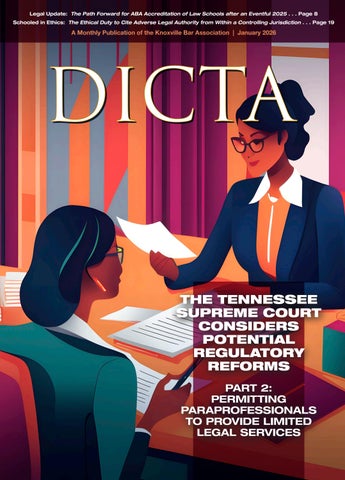
THE TENNESSEE SUPREME COURT CONSIDERS POTENTIAL REGULATORY REFORMS PART 2: PERMITTING PARAPROFESSIONALS TO PROVIDE LIMITED LEGAL SERVICES
2
DICTA
January 2026
In This Issue
Officers of the Knoxville Bar Association
January 2026
COVER STORY 16
President Rachel Park Hurt
President-Elect Ursula Bailey
Treasurer Catherine E. Shuck
Secretary M. Samantha Parris
Immediate Past President Jonathan D. Cooper
KBA Board of Governors Courteney M. Barnes-Anderson R. Kim Burnette Melissa B. Carrasco Meagan Collver
Joshua D. Hedrick Allison Jackson Matthew R. Lyon James R. Stovall
C. Scott Taylor Alicia J. Teubert Shannon van Tol Isaac W. Westling
The Knoxville Bar Association Staff
The Tennessee Supreme Court Considers Potential Regulatory Reforms to Increase Access to Quality Legal Representation – Part 2 in a DICTA Series
CRITICAL FOCUS 5 7 8
19
21
President’s Message
“Welcome Home”
Appealing
Don’t You Forget About Me
Legal Update
The Path Forward for ABA Accreditation of Law Schools after an Eventful 2025
Schooled in Ethics
The Ethical Duty to Cite Adverse Legal Authority from Within a Controlling Jurisdiction
Management Counsel
New Standard for Employer Liability for Harassment by Non-Employees
WISDOM 9 Tasha C. Blakney Executive Director
Tammy Sharpe Director of CLE & Section Programming
Bridgette Fly Membership Coordinator
Tracy Chain LRIS Director
Knoxville Bar Association 505 Main Street Suite 50 Knoxville, TN 37902 865-522-6522 www.knoxbar.org
10 12 13 14 18
Jason Galvas LRIS Assistant
20
Volume 54, Issue 1
Dicta DICTA is published monthly (except July) by the Knoxville Bar Association. It is designed to offer information of value to members of the local bar association. The news and features should illustrate the issues affecting the bar and its members. The opinions expressed do not necessarily represent those of the Knoxville Bar Association. All articles submitted for publication in DICTA must be submitted in writing and in electronic format (via e-mail attachment). Exceptions to this policy must be cleared by KBA Executive Director Tasha Blakney (522-6522).
January 2026
Dicta is the official publication of the Knoxville Bar Association
Publications Committee Executive Editor Executive Editor Executive Editor Executive Editor Sherri Alley Parker Bohne Elizabeth B. Ford Joseph G. Jarret F. Regina Koho Matthew R. Lyon Robin McMillan
Managing Editor
Sarah Booher Wade H. Boswell, II Melissa B. Carrasco Summer McMillan Angelia Morie Nystrom Katheryn Murray Ogle Bridget Pyman Cathy Shuck Jimmy Snodgrass Eddy Smith Grant Williamson
Tasha C. Blakney KBA Executive Director
DICTA
22 24 26 27 29 30 31
Around the Bar
Governor’s Award Recipient Reggie E. Keaton
How to Thrive
How to Use Visualization for Goal-Setting that Sticks
Of Local Lore and Lawyers
About a Book: James Joyce’s Ulysses and the Courts
Three Stars
Roses and Thorns
Hello My Name Is
Angela Gianino-Book
Legally Weird
Why Would You Do That?
Judicial Profile
A Passion for Justice: An Interview with Magistrate Brenda Lindsay-McDaniel
Well Read
Mark Twain, by Ron Chernow
21st Century Lawyer
Kind Words Go a Long Way
Privileged to Be in the Law
I’m Not Ally McBeal. That’s Okay.
Legal Libations
Next Level Brewing Company
Barrister Bites
Life Flies at you Fast: Eat the Cake
Top Ten List
New Year’s Resolutions for 2026
Outside My Office Window
The Strange Gift of Boswellia Serrata
COMMON GROUND 23 28
Pro Bono Spotlight Address Changes/New Members
3
The best of big and small. So you get it all. First Horizon is the only bank that offers big bank capabilities with small bank flexibility. It’s the powerful tools you need with the personal service you deserve.
firsthorizon.com/getitall
©2025 First Horizon Bank. Member FDIC.
Let’s Work Together. Trust. Communication. Shared Purpose.
When you refer a client, you are placing your reputation in another lawyer’s hands. At Fox, Farley, Willis & Burnette, we value the confidence our colleagues place in us to handle complex injury and wrongful death cases. Whether it is a referral, co-counsel opportunity, or case consultation, we welcome the opportunity to work with you. Call Us (865)457-6440
4
Visit Our Website www.foxlawtn.com
DICTA
CLICK THE REFERRAL TAB FOR MORE DETAILS
January 2026
PRESIDENT’S MESSAGE By: Rachel Park Hurt Arnett Baker Draper & Hagood
“WELCOME HOME” Greetings from December 14, 2024. Jonathan Cooper was sworn in as president about 16 hours ago. It is now 2 a.m., and I have insomnia. Never wanting to waste a productive hour, I have written my speech for my swearing-in as the next President of the Knoxville Bar Association. Unfortunately, checking that task off my to-do list has not cured my insomnia, and so, I am pressing on to my first President’s message. If you made it to the December 12, 2025, annual meeting, you have heard a little bit about my focus for 2026: fundamental, functional, and fun. I will extrapolate on those ideas here now and for the rest of this year. Knowing me as I do, I highly doubt that the words from my swearing-in or this president’s message will change over the next twelve months, because I have felt each of these beliefs since my first year in the KBA. Fellowship is Functional If you are not now, nor have ever been, an active member of this Association, enjoying its many great personal and professional offerings, you are missing out. In my humble opinion, your life is less fulfilled. While the KBA has excellent CLE offerings, purposeful and impactful community outreach and pro Bono opportunities, and a successful client referral program (LRIS), I want to discuss the benefit that has been most impactful to me— fellowship. In the first weeks at my firm— Arnett Baker— my now law partner, Rick Powers, told me that I had to go to Barristers’ meetings. And if you know Rick, it wasn’t a suggestion as much as it was a command. Not one to question the man who is paying me money to go have a drink and be social, I walked across the street the second Wednesday of the next month and never looked back. As a young associate, in an established firm, with a lot of “old” guys directing my daily assignments, I was, frankly, lost. But when I started attending Barristers meetings, I discovered my peers were lost too! What a relief. With each meeting, I looked forward to commiserating with my fellow Barristers about billable hours, deposition summaries, and, well, the practice of law. And in those monthly meetings, I met lifelong (or what I hope to be lifelong) friends. I met genuinely good, interesting, passionate people who were eager to practice law, scared that they had no idea what they were doing, and praying that they made the right career choice. January 2026
Having just returned to Knoxville after clerking for two years in Nashville post-law school, I found connection to Knoxville through Hunger & Poverty Relief outings. My husband and I made friends and (before kids took all of our free time) we did adult, social things with those friends. I also started my “rolodex” of peers who I knew I could call anytime I needed help with a legal issue, a personal issue, or just wanted to laugh. I want this level of connection to Knoxville and to the KBA for all of our members. To do that, I need you to come and break bread with the KBA at the Law Day luncheon and Supreme Court Bench and Bar reception. I need you to attend our CLE offerings or be a CLE presenter. I need you to encourage the young attorneys in your office to go to Barristers meetings. If you are a young attorney, I want to personally invite you to the next Barristers meeting. Come and get healthy during our October Wellness Challenge. Play golf or pickleball in our annual tournaments. Serve food to the homeless, participate in a Veteran’s pro bono clinic, or mentor a law student. The KBA does so much. Come experience how great we are. Speaking of things that are great, I love Disney World. I go often, with and without my kids. I have been going to Disney World for 45 years, and every time I go, as a Disney Vacation Club member, when I pull up to the gate of the Disney resort that will be my accommodation, I am always greeted with “Welcome Home!” No matter how long I have been gone, no matter what I have been doing since my last visit, no matter how stressed I am from the 10-hour drive with hateful Atlanta traffic, I know that these two words are coming and that they are going to give me instant connection and joy! Disney has captured brand loyalty better than any business in my lifetime (my credit card statements would be exhibit A). For me, there is a connection to Disney because of the idea of welcoming me home every time I return. I know that I am always welcome, Disney takes me (and my money) as I am, and they want me to feel like family. These same notions of acceptance and family are true in this organization as well. You are family. We are in this together. We are not (and should not be) divisive, difficult, or a distraction. And so, whether you are new to the KBA, have been absent from Bar activities for a while, have never been engaged, or are a Bar stalwart, let me say that I hope to see you at a KBA function this year (and consider this a personal invite). “Welcome Home!”
DICTA
5
ATTORNEY PROFILE By: Bill Vines Butler, Vines & Babb, PLLC
GOVERNOR’S AWARD RECIPIENT REGGIE E. KEATON Is there a greater honor for a practicing attorney than to be recognized as a role model by his peers in the Bar Association? On December 12, 2025, Reggie Keaton was so recognized at the annual Knoxville Bar Association meeting where he was given the KBA Governor’s Award. The Governor’s Award is the highest award of the Knoxville Bar Association and recognizes those attorneys felt to be truly role models for the legal profession. Reggie is a 1984 graduate of the University of Tennessee College of Law, graduating with high honors and Order of the Coif. He is a partner at the firm of Frantz, McConnell and Seymour, and the emphasis of his law practice has been construction law and business litigation. He was named to Best Lawyers® for his work in this area, and he was awarded Lawyer of the Year for construction litigation. Reggie has served as President of the Knoxville Bar Association, President of the Hamilton Burnett American Inns of Court, and president of Knoxville Barristers. He is a Fellow of the Knoxville Bar Foundation and a Fellow of the Tennessee Bar Foundation. He served on the leadership cabinet for fundraising for the legal clinic. Reggie is an example of a smalltown person who has done well. He is from Sneedville, a city generally not thought of as a “destination
6
location.” He attended Carson Newman College (magna cum laude) and as stated above, the University of Tennessee. In talking with lawyers who have worked with Reggie or been adverse to him, they are all complimentary of his demeanor. One of his partners, Beverly Nelms, described him as “one of the kindest persons I have ever known.” Another said “he smiles often and I don’t remember he has ever frowned!” While he is a strong advocate for his clients, he advocates with a strong sense of fairness. Reggie loves baseball. Reggie has made certain that his three sons Brad, Jonathan, Thomas, and his wife, Sally, feel the same way about the sport. To satisfy his love of the sport and to spark their interest in the sport, he has loaded them up in his car and driven them to many baseball games. They prefer not to fly and have driven coast to coast to see ballgames at many baseball stadiums. Distance has been no problem. While Reggie is known as an excellent attorney, particularly in his field, it is his demeanor and personality which is so outstanding. He’s a really good lawyer, but he’s a really nice person!
It's "Snow" Joke! LRIS is a great value for your ad dollars Join LRIS for 1/2 price ($75) & receive referrals through June 30.
DICTA
Over $2.36 million earned from LRIS-referred cases since January 2025
Tracy Chain, LRIS Administrator tchain@knoxbar.org www.knoxbar.org/joinLRIS January 2026
APPEALING By: Robin McMillan Attorney at Law
DON’T YOU FORGET ABOUT ME Here are four things you learned in middle school that should be forgotten for legal writing. 1. Forget the lesson to use lots of adjectives and adverbs to describe things. In other words, avoid purple prose. What is purple prose? Here is an example. It was a dark and stormy night; the rain fell in torrents, except at occasional intervals, when it was checked by a violent gust of wind which swept up the streets (for it is in London that our scene lies), rattling along the house-tops, and fiercely agitating the scanty flame of the lamps that struggled against the darkness. Through one of the obscurest quarters of London, and among haunts little loved by the gentlemen of the police, a man, evidently of the lowest orders, was wending his solitary way.1 You read correctly. Edward BulwerLytton used nearly 100 words to convey the idea that a man was walking alone through a dangerous section of preelectricity London on a stormy night. While perhaps appropriate for a novel, this type of prose is unsuitable for legal writing. Your middle school teacher may have urged you to write: “With his legs pumping up and down like the pistons of a V8-engine racing out of control, he swiftly but unerringly sprinted down the spongy artificial turf of the white-lined football field.” But most of the details in this sentence are meaningless and distracting. Instead, write: “He sprinted down the football field.” Excessive descriptors and needless metaphors make sentences difficult to read and obscure the point. The more difficult the sentence is to read, the more likely you will lose your reader. To avoid purple prose stick to the facts and avoid embellishments. Focus on the who, what, where, why, when, and how, absent extra adjectives and adverbs. And remember, you need not include all of these in a single sentence. Nor need they be reiterated in every paragraph. Shorter sentences are easier to read, and every fact does not bear repeating. If it is important that the night was cold and windy, then include those facts and repeat as necessary. If not, omit them or include them only once. It may be helpful to keep in mind Stephen King’s advice to “[k]ill your darlings, kill your darlings, even when it breaks your egocentric little scribbler’s heart, kill your darlings.”2 2. Forget the lesson to use bigger or more sophisticated words. I am reminded of the episode of Friends wherein Joey undertakes to write a letter to an adoption agency recommending Monica and Chandler as prospective adoptive parents. Joey discovers a thesaurus and uses it to assist him in finding what he believes are superior words. But he goes overboard replacing virtually all of his first-choice words. As a result, the sentence that initially read: “They are warm, nice people with big hearts,” becomes: “They are humid prepossessing Homo sapiens with full-sized aortic pumps.”3 January 2026
More complex words are more challenging to comprehend quickly and may not accurately convey the intended message. While acetylsalicylic acid is the same as aspirin, acute hepatic porphyria is not necessarily the same thing as a stomachache. Exercise discretion when using bigger, more complex, or technical words. If the case involves acute hepatic porphyria, then use those words. If, however, you are simply trying to convey that plaintiff took a couple of aspirin, do not say, “Plaintiff orally ingested two acetylsalicylic acid tablets.” When a topic requires the use of complex terminology, choose simpler words to surround those terms to give your reader a break. 3. Forget the lesson to vary your word choice. Changing the words you use can easily confuse your audience. For example, if in your first paragraph you refer to your client as plaintiff, in the second you switch to your client’s name, and in the third you begin to refer to your client as the injured party, you have inevitably confused your reader. Instead, decide how you will refer to each party, location, or important item and use the same words throughout the document. Your reader will have a much easier time following the important points of your argument. Use care when choosing those important words. Aim for precision. Words that are similar do not always express the same thought. Although the thesaurus groups them together, a ‘store’ is not necessarily the same thing as a ‘depot,’ a ‘warehouse,’ a ‘stockroom,’ a ‘department store,’ a ‘repository,’ or a ‘depository.’ If your case involves a warehouse, don’t use ‘warehouse’ in some places and ‘stockroom’ in others. Using these words interchangeably may lead the reader to believe that you are discussing multiple items. Thoughtfully choose one best word and use it throughout. 4. Forget the lesson to use more words. Just because Tenn. R. App. P. 30 allows you to use 15,000 words in your principal brief4 does not mean that your goal is to use 15,000 words. Writing a brief is not an exercise in write-at-least-this-many-words. Your middle school teacher likely assigned papers that required you to write a specific number of words, e.g., 500 words or 1,000 words. If your paper fell short of the required number, you would lose points. The court, however, will not lower your grade if you write fewer words. To the contrary, succinctness is appreciated. Yes, generally it is more challenging to convey ideas using fewer words. This is where editing comes in. First drafts are not meant to go out the door anyway. Edit ruthlessly. And remember, repetition for the sake of enlarging the word count is not an effective tactic for persuading readers. Aim to convey your ideas without beating a dead horse. After all, “brevity is the soul of wit”5—and reader engagement. 1
2
3
4 5
DICTA
Paul Clifford, Edward Bulwer-Lytton, published 1830, copy available at www.gutenberg.org. On Writing: A Memoir of the Craft, Stephen King, p. 271, published 2000, Simon and Schuster. Friends (1994-2004), Season 10, Episode 5: The One Where Rachel’s Sister Babysits. Tenn. R. App. P. 30(e). Hamlet, Shakespeare, Act II, Scene II.
7
LEGAL UPDATE By: Matthew R. Lyon LMU Duncan School of Law
THE PATH FORWARD FOR ABA ACCREDITATION OF LAW SCHOOLS AFTER AN EVENTFUL 2025 This article summarizes the first two issues on which the Tennessee Supreme Court has sought comment in its September 2025 Order on potential regulatory reforms to the legal profession here in Tennessee: (1) “[w] hether the Court should modify, reduce, or eliminate its reliance on ABA accreditation in setting minimum educational requirements for applicants to the Tennessee Bar; and (2) [w]hether there are any practicable alternatives to ABA accreditation that the Court should consider.”1 The law school accreditor in the United States is not actually the broader American Bar Association (“ABA”) but rather the Council of the Section of Legal Education and Admissions to the Bar of the ABA (the “Council”).2 The Council is made up of 21 law school administrators and professors, judges, attorneys, and members of the public, supported by employees at the ABA, who meet quarterly to consider changes to the accreditation standards and rules of procedure and make accreditation decisions as to individual law schools.3 The Council considers itself to be fully independent from the larger ABA; while its decisions to adopt, revise, amend or appeal the ABA Standards and Rules of Procedure are subject to concurrence by the ABA House of Delegates, the Council retains the ability to implement and enforce its decisions even if the House of Delegates disagrees with them.4 The Council’s accrediting power derives from two sources of authority: (1) the federal government, which recognizes the Council as the programmatic accreditor for institutions of higher education awarding the J.D. degree, and (2) state supreme courts, which control admission and licensure of attorneys and have historically made graduation from a law school approved by the Council a requirement for bar admission, with some exceptions. Continued support from these two sources of authority has maintained the Council’s status as the primary accreditor of law schools for decades. In the past year, however, that support has become much less certain. Federal Agencies are Displaying Hostility to the ABA Accreditation Model The federal government has recognized the Council as the national agency for the accreditation of programs leading to the J.D. degree since 1952.5 Currently, the National Advisory Committee on Institutional Quality and Integrity (“NACIQI”) of the U.S. Department of Education (“USDOE”) delegates accreditation authority for law schools to the Council.6 This USDOE recognition makes Title IV funding available to ABA-approved law schools, which allows their students to access federal student loans. Since January 2025, various agencies within the federal government have expressed concern about the ABA Standards for legal education and questioned whether the Council’s role as accreditor of law schools should continue. These statements include: • February: After the Council voted to suspend ABA Standard 206 relating to diversity and inclusion until August 2025,7 Attorney General Pam Bondi sent a letter on behalf of the Department of Justice to the Council, urging it to repeal Standard 206. The Attorney General wrote that “[t]he Council’s status as the sole accrediting body of American law schools is a privilege, and mandatory diversity objectives are an abuse of that privilege, which is subject to revocation.”8 • April: President Trump signed an Executive Order designed “to
8
overhaul the higher education accreditation system” and “direct[ing] the Secretary of Education to hold higher education ‘accreditors’ accountable.” The Executive Order explicitly refers to the ABA Standards as requiring “unlawful race-based preferences” for law schools, which constitute an abuse of the Council’s accrediting authority. 9 • December: The Directors of the Office of Policy Planning and Bureau of Competition at Federal Trade Commission (“FTC”), in a comment to the Texas Supreme Court (see more on that below), expressed the view that the Council’s role as the sole accreditor for law schools in the United States makes the ABA an unlawful monopoly.10 The Council was last recognized by the USDOE as the accreditor for law schools in 2021, and its next review comes later this year, at NACIQI’s summer 2026 meeting.11 It is possible that NACIQI could recommend to the Secretary of Education that the USDOE cease to recognize the Council as an accreditor for law schools. Such a decision, while historic, would not cause the Council and the ABA Standards for legal education to simply go away. The vast majority of law schools are associated with a University that is approved by a regional accreditor, such as the Southern Association of Colleges and Schools Commission on Colleges (SACSCOC) here in the Southeast.12 Federal student loan funds still will be available to students enrolled at these law schools, even if the Council is not recognized as an accreditor by the USDOE. And unless an alternative accrediting body arises, law schools still will have to comply with the ABA Standards to ensure that their students’ J.D. degrees are portable and that they can sit for the bar exam in all fifty states. State Supreme Courts Have Begun to Question Reliance on ABA Accreditation This brings us to the second, and more important, source of authority for the Council: state supreme courts, which have inherent authority over the practice of law in their states, including the power to establish qualifications for the licensing and admission of attorneys.13 For decades, most state supreme courts have made graduation from a law school approved by the Council a requirement to sit for the bar exam in their state. Several states make exceptions for state-approved law schools (like the Nashville School of Law here in Tennessee), and a few states do not require a J.D. degree. In all states, however, a degree from an ABA-approved law school assures that the applicant meets the basic educational requirements to take the bar exam.14 In July 2025, the Committee on Legal Education and Admissions Reform (“CLEAR”), a joint project of the Conference of Chief Justices and the Conference of State Court Administrators, released its Report and Recommendations to state supreme courts.15 Citing concerns about access to justice, unmet legal needs, and the skills gap among less-experienced attorneys, the CLEAR Report urges state supreme courts to reassert their authority and “take a leadership role in fostering innovation and reform to realign legal education, bar admissions, and new lawyers’ readiness to practice, meeting the legal needs of the public they serve.”16 Since the release of the CLEAR Report, four state supreme courts have publicly questioned whether they should continue to make graduation from a law school approved by the Council a requirement for admission to continued on page 25
DICTA
January 2026
AROUND THE BAR By: J. Scott Griswold
Clerk and Master of the Chancery Court for Knox County, Tennessee
TRIAL COURT FUNDING IN 2026 AND BEYOND How often have you thought about what goes on behind the clerk’s counter after you file a pleading? If I had to venture a guess, I would say not much. Candidly, I did not give it much thought either. That all changed when I became Clerk and Master of the Knox County Chancery Court. Now as Clerk of one of the largest civil trial courts in Tennessee, these thoughts consume more of my time than I would like to admit. How are our trial courts funded? Why does filing a personal injury lawsuit in Blount County Circuit Court cost $295.00, but the same filing fee in Knox County Circuit Court is $339.50? Well, this will come as no surprise to anyone who has traveled into a neighboring county—it depends. Before we can delve into these considerations, though, it helps to understand the role of the clerk of the court in funding. Clerks are ministerial officers, meaning that they perform specific legal duties when the appropriate conditions have been met, but they do not exercise discretion when performing those duties.1 The General Assembly has determined that trial courts should be funded through user fees and taxes. It is, in essence, a “pay to play” system. The clerk has no discretion to charge or not.2 The amount that a filer pays at the start of a lawsuit depends on three considerations: (1) the clerk’s fee, (2) the state litigation taxes, and (3) the local litigation taxes and other allowed assessments. First, the legislature determines what clerks shall charge and collect for the services they perform.3 Though the legislature has not defined “filing fees” and “court costs,” they are different.4 A filing fee is the amount that a filer must pay at the time he or she initiates a legal proceeding, whereas a court cost is an expense incurred during a legal proceeding and is connected to a specific act that the clerk performs. In 2006, the General Assembly enacted the current fee and cost statute. It divides fees into different categories that generally reflect how much time a court may devote to a matter. For example, a personal injury lawsuit has a higher filing fee ($225.00)5 than a name change ($100.00),6 because it generally takes more judicial resources to dispose of the former than the latter. However, this is only part of the amount that filers pay when they initiate a lawsuit. Next, the General Assembly imposes state privilege taxes that the clerk must collect.7 Lastly, it authorizes each county by resolution of its legislative body to levy privilege taxes and other assessments for various needs, such as records management, jail construction, or courthouse security.8 The answer then to why a filer pays different amounts depends on what decisions the local legislative bodies have made. Some counties have chosen to enact local privilege taxes and assessments to fund their local courts. Others have not. But honestly, what has changed since January 1, 2006, when the current fee statute went into effect? For one, Netflix had not started January 2026
streaming into our homes.9 For another, $1.00 in January 2006 had the same buying power as $1.64 in September 2025.10 Recognizing that the financial needs of the trial court system have grown substantially over the past 19 years, the General Assembly enacted a revised filing fee and cost statute that goes into effect on January 1, 2026. The revised fee and cost schedule, codified at Tennessee Code Annotated section 8-21-401, is available on Lexis,11 Westlaw, and other publicly available sources. Locally, the Circuit Court and Chancery Court for Knox County have posted their new fee schedules online.12 Practitioners should confirm with the local court clerks before attempting to file new matters after January 1, 2026. Here are a few highlights that practitioners should keep in mind. First, these changes primarily affect civil matters. The criminal court costs largely remain the same. Second, the filing fees are scheduled to increase by $100.00 over the next three years: $50.00 in 2026, $25.00 in 2027, and $25.00 in 2028. Third, most fees for domestic relations matters are not changing. For example, an adoption filing fee does not change. Fourth, court costs will increase as clerks must now charge for services provided. To illustrate, if the clerk is required to issue a deed following a judicial sale, there is a cost of $50.00. No one likes paying more for services. However, as every practitioner can attest, operating and labor costs have risen significantly over the past several years, and the General Assembly recognizes the need to better fund our local courts so they can meet the needs of their communities.
1
2 3 4
5 6 7 8 9
10
11 12
DICTA
Gordon v. Henderson, No. 3622, 1987 Tenn. App. LEXIS 2828, at *7 (Tenn. Ct. App. Jul. 27, 1987) (reversed on other grounds by Gordon v. Henderson, 766 S.W.2d 784 (Tenn. 1989)); see also In re Lineweaver, 343 S.W.3d 401 (Tenn. Ct. App. 2010). Tenn. Code Ann. § 8-22-104. See id. § 8-21-401. See Lawson v. Hawkins Cnty., 661 S.W.3d 54, 63 (Tenn. 2023) (“When interpreting a statute, we generally presume that when the legislature uses one term in one part of a statute, and a different term elsewhere in the same or related statute, those terms mean different things”). Tenn. Code Ann. § 8-21-401(b)(1)(A). Id. § 8-21-401(b)(1)(D)(vii). Id. § 67-4-602. Id. § 67-4-601. Skip Intro: Netflix Turns 25 Today, available at https://www.netflix.com/tudum/ articles/netflix-trivia-25th-anniversary (last accessed Dec. 7, 2025). [Interesting note: the first DVD Netflix shipped was Beetlejuice on March 10, 1998.] CPI Inflation Calculator, available at https://www.bls.gov/ (last accessed Dec. 7, 2025). There are some formatting issues that Lexis needs to correct on the tables. Knox County Circuit Court New Circuit Court & Civil Sessions Fee Schedules, available at https://www.knoxcounty.org/circuit/index.php (last accessed Dec. 7, 2025); Knox County Chancery Court New Fee Schedule Effective Jan. 1, 2026, available at https://www.knoxcounty.org/chancery/fee_schedules.php (last accessed Dec. 7, 2025).
9
HOW TO THRIVE By: Emily Heird, LPC/MHSP Vantage View Coaching
HOW TO USE VISUALIZATION FOR GOAL-SETTING THAT STICKS A new year reignites the fresh start effect, the same force that convinces millions to buy treadmills that become clothing racks by the end of January. Use that momentum for something that actually sticks. Most attorneys, and most humans, plan their year backwards. They set goals, build action lists, and hope discipline will hold. The people who operate at elite levels do something different. Virtually anyone who performs under pressure–Olympians, pro athletes, surgeons–trains their mind to see the outcome first, then organizes their life around it. They mentally rehearse both the victories and the obstacles before either materializes. They tap into the power of the mental skill called visualization. The neuroscience behind this skill is compelling. When Harvard researcher Alvaro Pascual-Leone studied piano players, he found that those who practiced only in their minds showed brain changes almost identical to those who practiced on the keys. Alan Richardson saw the same pattern with basketball players. After 20 days, the athletes who visualized free throws improved almost as much as the ones who physically practiced. The group that did nothing saw no change. The brain is a rehearsal system. What is repeated gets hard-wired. This matters for how you set up 2026. You can train your brain toward the outcomes you want if you visualize with precision. That word matters. Poorly designed visualization can stall motivation. UCLA research reveals that purely positive visualization (seeing only the positive outcome) reduces systolic blood pressure, thereby creating a false sense of achievement that diminishes drive. When you imagine yourself achieving a big goal without visualizing the process, your brain releases dopamine as if you’d already succeeded. You feel accomplished before doing any actual work, likely leading to inaction towards your goal. The solution lies in process visualization. See yourself doing the daily actions: having the difficult conversation with the managing partner, staying late to fine-tune the brief, making the fifth business development call when you’d rather go home, or going to the gym when you feel tired. Mental rehearsal of process creates what psychologists call implementation intentions. These are pre-decisions that automate behavior when the moment arrives. Try this exercise for your biggest 2026 goal. Pick three specific Tuesday afternoons in March when you’re tired, behind on billables, and facing the exact action required to advance that goal. See yourself choosing correctly. Include sensory details like the fluorescent light, the coffee getting cold, the moment you decide to act despite not feeling motivated. This specific visualization prepares your brain for the actual moment when willpower feels depleted. Researcher Gabriele Oettingen discovered that purely positive visualization often backfires. After studying motivation for over 20 years, she found that people who spent more time fantasizing about their dream job without acknowledging obstacles received fewer job offers and lower starting salaries. Her solution is mental contrasting where you alternate between visualizing success and visualizing obstacles. The framework she developed is “WOOP”: Wish (your specific 2026 goal), Outcome (the best result and how it feels), Obstacles (internal barriers you’ll face), and Plan (if-then responses to each
10
obstacle). For example, if you feel overwhelmed by partnership track requirements, then you will review your written plan and complete just the next single action. Studies show this approach significantly improves goal achievement compared to positive visualization alone. Athletes use cognitive rehearsal extensively, and attorneys can adapt these same techniques for high-stakes moments. Identify your three highest-leverage moments for 2026 like compensation negotiation, a crucial presentation, or the decision that could change your trajectory. Write exactly how you’ll open the conversation, what body language you’ll maintain, and how you’ll respond to pushback. Then visualize in progressively challenging conditions. Start calm, then add stressors. Picture negotiating after losing a motion, when sleep-deprived, or when the managing partner seems irritated. Include recovery visualization too. See yourself managing mistakes. Visualize losing composure momentarily, then watch yourself recover professionally. This builds what researchers call mistake resilience, the ability to keep performing after a wobble. LeBron James famously refers to himself in third person to enhance mistake resilience during pressure moments because this self-distanced perspective reduces anxiety and increases strategic thinking. Environmental visualization matters as much as action visualization. What will your office look like when you’re performing at peak? How will your calendar be structured? What will your morning routine include? If you visualize yourself working in an organized space with blocked focus time, you’re more likely to protect those conditions. Environmental visualization serves dual purposes: helping you recognize environmental triggers that derail performance and pre-committing you to create conditions for success. The most effective visualization happens on a consistent basis rather than randomly or as a one-off. Athletes incorporate mental imagery daily. For example: Sunday evening, spend 10 minutes visualizing the upcoming week’s key moments. Each morning, take 2 minutes for process visualization of that day’s priority. Before any high-stakes interaction, use 30 seconds of cognitive rehearsal. Attach visualization to existing habits like your commute, while coffee brews, or in the elevator to your office. There are many ways you can weave this skill into your day. Create a visualization audit to track whether your mental rehearsal matches reality. When the moments you visualized arrive, note what aligned and what didn’t. This feedback loop sharpens your visualization accuracy and reveals patterns where your planning breaks down. Elite performers constantly refine their mental models based on actual outcomes. Resolutions usually fail because they rely on a sudden surge of discipline. Visualization works because it builds familiarity. You rehearse the version of yourself you want to bring into the year, which makes the behavior feel easier when the real moment arrives. Attorneys who adopt this approach walk into 2026 with steadier execution. If you’ve promised yourself that next year will look different, and past years have not delivered on that promise, try a different entry point. Start with clarity and purpose you can feel and train your mind to live the moment before it arrives. That is the shift that holds when resolutions don’t.
DICTA
January 2026
TENNESSEE CHAPTER Knoxville Area Members recognized for Excellence in the field of Mediation or Arbitration
Adrienne ANDERSON (865) 249-8011
Bob ARRINGTON (423) 723-0402
Gail ASHWORTH (615) 254-1877
Paul HOGAN Jr. (865) 546-2200
Dana HOLLOWAY (865) 643-8720
James LONDON (865) 637-0203
Richard MARCUS (423) 756-0414
David NOBLIT (423) 265-0214
Robert NOELL (865) 215-1023
Sarah SHEPPEARD (865) 546-4646
Scott TAYLOR (865) 546-8030
Mark TRAVIS (931) 252-9123
William VINES (865) 637-3531
Howard VOGEL (865) 546-7190
Jeffrey WARD (423) 639-6811
Check preferred available dates or schedule appointments online directly with the state’s top neutrals TennesseeMediators.org is free, funded by members
January 2026
DICTA
11
OF LOCAL LORE AND LAWYERS By: Joe Jarret, J.D., Ph.D. University of Tennessee
ABOUT A BOOK: JAMES JOYCE’S ULYSSES AND THE COURTS Introduction: On a recent visit to the Museum of Literature Ireland (MoLI) in Dublin, Amanda and I were not surprised to find a significant part of the museum dedicated to Dublin’s favorite son, James Augusta Aloysius Joyce. What we did find surprising, however, is that displayed next to his most controversial book, Ulysses (published in Dublin on February 2, 1922), was a copy of a United States District Court (Southern District of New York), opinion. According to the MoLI historian with whom we spoke, Ulysses has been called one of the most challenging and rewarding novels ever written and is considered to be one of the most important works of Modernist literature. However, what we did not realize is that the book was also the subject of litigation that led to a major change in the way our courts analyzed obscenity cases and expanded the First Amendment rights of authors. This piece explores the case of United States v. One Book Called “Ulysses.1 About an Author: Considered to be one of the most influential writers of the early 20th century, Joyce was born February 2, 1882, in Dublin, and is noted for his experimental use of language and exploration of new literary methods. Upon graduating from Dublin’s version of high school, he entered University College Dublin (UCD), which was then staffed by Jesuit priests. There he studied languages and read widely, particularly books objected to by his teachers.2 Hence, Joyce appeared to be destined to confront censorship, head-on. About Censorship: One of the more challenging situations I found myself in during my years as a public sector lawyer involved the censorship or banning of books in public school libraries. In 2022, the Tennessee Legislature passed the “Age-Appropriate Materials Act of 2022.”3 This law regulates books, magazines, films and other educational media that are available in public school libraries. According to the American Library Association,4 pressure groups and government entities that include elected officials, school board members, and school administrators initiated 72% of demands to censor books in school and public libraries. It appears not much has changed since Joyce’s time. About a Book: Joyce’s Ulysses tells the story of Leopold Bloom and a tortured artist named Stephen. Each of the 18 chapters (or episodes) describes and relates a series of encounters and incidents that occur as Bloom travels through Dublin on June 16, 1904. Joyce intentionally paralleled the characters and events in the Odyssey, the epic poem written by Homer. In fact, the name Ulysses is the Latin form of the name of Odysseus, the star of the Odyssey. Ulysses was first published in its entirety on February 2, 1922, by Shakespeare and Company, a Paris-based bookstore run by Sylvia Beach. The date was chosen to coincide with author James Joyce’s 40th birthday. However, parts of the novel had previously been serialized (published in multiple installments over a period of time), in the American magazine The Little Review in 1920. When the sexually evocative chapter 13 appeared in The Little Review, the secretary of the
12
New York Society for the Suppression of Vice filed a complaint, and the United States Post Office halted mailing of The Little Review pending a court decision. In February 1921, the New York Court of Special Session ruled that Joyce’s work was obscene and fined the editors of The Little Review fifty dollars each. As a result of this decision, Joyce was unable to secure an American publisher for his book. About a Lawsuit:
In 1933, Random House Publishers, seeking to challenge the ban, imported Ulysses and arranged to have the book seized by United States customs officials. The United States government, acting as the libelant, which sought to seize and destroy the book it deemed obscene, filed a lawsuit. Random House, the book’s publisher, acted as the claimant, intervening in the case to deny that the book was obscene and to argue that it was protected by the First Amendment. In the case of United States v. One Book Called Ulysses, United States District Court Judge John M. Woolsey addressed the issue of free expression by looking at the novel’s “effect on a person with average sex instincts.” The main issue in the case was whether Joyce’s intent in writing Ulysses was obscene. At the time, the prevailing view of obscenity was based on an 1868 English case Regina v. Hicklin, in which the court defined obscenity as material that corrupted “those whose minds are open to … immoral influences” and that led “the young [to] … thoughts of a most impure and libidinous character.” In short, up until the second Ulysses trial, courts looked to how children would view the material to support antiobscenity laws, regardless of the age of the intended audience.5 Judge Woolsey ultimately concluded that Ulysses had no prurient effect on such a person, and to confirm this he consulted two friends and “literary assessors,” Henry Seidel Canby (editor of the Saturday Review of Literature) and Charles E. Merrill Jr. (cofounder of Merrill Lynch).6 As a result of the ruling, the court did not apply an obscenity standard that deprived adults of literature thought corrupting to children. Summary: Legend has it that Random House began typesetting Ulysses within ten minutes of hearing the judge’s ruling. A copy of Judge Woolsey’s opinion appeared in every copy of Ulysses sold. According to one scholar in residence at MoLI, academics have spent over a century arguing over Ulysses, with some scholars dedicating their entire careers to studying the book. This, it appears, was the intent of Joyce, who had this to say about his tome: “I’ve put in so many enigmas and puzzles that it will keep the professors busy for centuries arguing over what I meant, and that’s the only way of insuring one’s immortality.” 1 2 3 4
5
6
DICTA
United States v. One Book Called “Ulysses”, 5 F. Supp. 182 (S.D.N.Y. 1933). https://www.poetryfoundation.org/poets/james-joyce Tenn. Code Ann. § 49-6-3803. For more information about the American Library Association, see https://www.ala. org/aboutala Regina v. Hicklin, England and Wales High Court of Justice, Queen’s Bench Division, 11 Cox C.C. 19 (1868). For more information about the case of United States v. One Book Called “Ulysses” see Stern, S. (2022). Ulysses, The First Amendment Encyclopedia.
January 2026
THREE STARS By: Melissa B. Carrasco Carrasco Trump, PLLC
ROSES AND THORNS Divorces tend to be messy. This one most definitely was. It was the end of a twenty-year relationship, and this particular breakup had all the features of The War of the Roses starring Michael Douglas and Kathleen Turner:1 irreconcilable differences, one party who refused to let go, a lengthy arbitration, an even lengthier court battle, and at least one motion for contempt. The way the relationship began was unremarkable. Chevy Chase G.I. Investors, L.C. was a physician practice group, and AmSurg Holdings, Inc. was in the business of partnering with physician practice groups to operate ambulatory surgery centers.2 They decided to go into business together to open and operate an ambulatory surgery center in Chevy Chase, Maryland. So, they created an LLC, signed an operating agreement, and got busy doing everything ambulatory service centers do.3 But, after twenty years, the parties (we’ll call them Chevy and AmSurg) no longer saw eye-to-eye. We don’t have much information as to what their differences may have been, but we do know that Chevy wanted out. So, Chevy told AmSurg it was either going to get out or voluntarily dissolve itself. According to the LLC’s operating agreement, when one party dissolved, the LLC that Chevy and AmSurg created also had to dissolve and wind down.4 In other words, if Chevy dissolved, the LLC in which it was a member was supposed to dissolve itself, wrap up business, pay off its creditors, and distribute any remaining assets. That may have been what the LLC’s operating agreement said, but that isn’t what AmSurg wanted. AmSurg wasn’t ready to let go, and it certainly wasn’t ready to give up on the ambulatory surgery center it had been a part of for the past twenty years. It tried to buy out Chevy, but Chevy wasn’t having any of it. With no resolution on the horizon, Chevy began the arbitration process.5 In the arbitration, Chevy asked one question: “Whether its voluntary dissolution would require the mandatory dissolution of [the LLC] without subjecting [Chevy] to liability for damages under the [LLC’s ] Operating Agreement or the [Tennessee LLC Act].”6 The arbitration went on for over a year, and eventually, the arbitration panel concluded that, yes, if Chevy dissolved, the LLC also had to be dissolved AND that, no, Chevy was not liable for damages due to its dissolution.7 Chevy took that arbitration award straight to the Davidson County Chancery Court to have the arbitration award confirmed and a judgment entered.8 AmSurg did not oppose the petition and did not appeal entry of the judgment.9 Three (3) years later, Chevy filed articles of cancellation to terminate its own existence, and then it demanded that AmSurg dissolve the LLC and wind up the operations of the ambulatory surgery center. AmSurg’s response was a polite, “No thank you.” Its plan was to keep operating the ambulatory surgery center without Chevy.10 After all, under the Tennessee LLC Act, even if there is a dissolution event, the remaining member (or members) of an LLC can continue its business.11 Who is going to argue with a statutory right? Chevy—that’s who. Chevy filed suit to enforce the arbitration award and final judgment that the Court had entered three (3) years earlier and that AmSurg did not oppose or appeal.12 And just like Oliver Rose, AmSurg refused to let go. AmSurg filed a Motion to Dismiss founded on its statutory right to continue the LLC’s business. The Chancery Court denied the Motion and ordered AmSurg to January 2026
dissolve the LLC.13 It didn’t. A month later, Chevy filed a supplemental memorandum informing the Chancery Court that AmSurg had not dissolved the LLC. AmSurg’s response was that it had a “good faith belief ” that it had the right to continue operating the LLC and had to keep operating the LLC to preserve the business for the appeal it was planning.14 Chevy filed a Motion for Contempt. AmSurg posted a bond and filed an appeal.15 There were a lot more filings. But, at the end of the day, it all came down to what was in the arbitration award. This was the Court of Appeals’ tenth case in 2025 involving an issue of arbitration.16 If there is a common theme, it is (1) in general, agreements to arbitrate will be enforced exactly as written, and (2) it is really hard to overturn an arbitration award after it is issued. It all starts with a basic principle first articulated nearly thirty years ago. “In all cases warranting judicial review of arbitration awards, the trial court ‘must accord deference to the arbitrators’ awards.’”17 But, it actually goes further than mere deference: Moreover, we are ‘not permitted to consider the merits of an arbitration award even if the parties allege that the award rests on errors of fact or misrepresentation of the contract.’ Where, as here, the issues presented are questions of law, we must resolve the matter ‘with the utmost caution, and in a manner designed to minimize interference with an efficient and economical system of alternative dispute resolution.’18 In other words, it does not matter if the arbitrator or arbitration panel correctly decided an issue as a matter of fact or a matter of law. That is beyond the scope of judicial review.19 The question that matters is whether the arbitrator considered and decided the thing that a party is trying to appeal. If an arbitrator considered it and the arbitration award decided it, then the Court of Appeals is not going to overturn it.20 AmSurg still has time to file a Rule 11 Application for permission to appeal. So, this may change. But, for now, Chevy, AmSurg, and their LLC find themselves dangling from the chandelier of an enforceable arbitration award with the scope of judicial review stretching thinner and thinner. 1
2
3
4 5 6 7 8 9 10 11 12 13 14 15 16
DICTA
I have not seen the 2025 remake, but I will concede that anything with Benedict Cumberbatch at least has some promise. Chevy Chase G.I. Invs. v. Amsurg Holdings, Inc., No. M2024-01187-COA-R3-CV, 2025 Tenn. App. LEXIS 454, *1, n.2, (Tenn. Ct. App. Dec. 3, 2025). Id. at *1. In all fairness, I try to avoid visiting ambulatory surgery centers and, in particular, any ambulatory surgery center with the letters, “G.I.” in its name. So that is as far as this author’s research goes. Id. at *2-3. Id. at *3. Id. at *3-4. Id.at *8. Id. Id. Id. at *8-9. See Tenn. Code Ann. § 48-245-101(b). Chevy Chase G.I. Invs., 2025 Tenn. App. LEXIS 454, at *9. Id. at *9-10. Id. at *10. Id. at *10, 26. See In re Isaiah M., E2025-01509-COA-T10B-CV (Tenn. Ct. App. Nov. 26, 2025); Brittney Emmel et al. v. Mid-America Apt. Comm’ns, Inc., M2025-003430COA-R9-
continued on page 30
13
HELLO MY NAME IS By: Bridget J. Pyman Arnett | Baker
ANGELA GIANINO-BOOK Angela Gianino-Book is an Associate Attorney at Arnett Baker Draper & Hagood, practicing primarily health care defense litigation. She holds a J.D. from Lincoln Memorial University Duncan School of Law and an Accelerated BSN from Washington University Barnes Jewish College of Nursing. This dual educational background informs her focus on the legal defense of caregivers and health care providers. Angela is a member of the Knoxville Bar Association and the East Tennessee Lawyers’ Association for Women. Angela’s previous career as a registered nurse provided her with comprehensive experience in the highstakes environment of patient care. Angela found a passion for advocacy through her nursing role, which included working with hospital attorneys on the Quality Committee, making her eventual transition to law a natural progression. This clinical insight serves as the foundation for Angela’s professional focus on health care defense, allowing her to approach legal matters with a global view of both medical practice and professional liability. Angela’s family, including her husband and three children, relocated to the Knoxville area from Maine, driven by the appeal of the Smoky Mountains region and the opportunity to be closer to family. What brought you to Knoxville? I am a St. Louis native, and it was there I met my husband, who attended Logan University to become a chiropractor. We purchased a practice in beautiful Maine and lived there for eight years. Despite its beauty, we began to miss our family and wanted to move closer. We have always loved visiting the Smoky Mountains, so when a practice became available in Maryville, we knew it was meant for us. Why did you decide to go to law school? I have always been interested in law and medicine. I was concerned about the time I had to give to law school while raising a family and working so I chose to complete an accelerated program in nursing offered by Washington University. I was in the first graduating class and obtained my BSN in one year. I really enjoyed nursing and the advocacy path it led me down. I loved advocating for my patients and working with hospital attorneys on the Quality Committee, so it felt natural to transition to law. My daughter graduated college in May 2022, and I started law school in August 2022 so I could obtain my JD and finish law school before our second child starts college. One family member in college at a time is enough! Did you have any significant or formative experience during law school that relates to your career now? After my 2L externship at Arnett Baker Draper and Hagood, I was required to give a presentation about why I chose a health law externship and whether I decided that health law was the type of law I wanted to practice. My presentation focused on the importance of protecting caregivers in our community to attract the best providers to our area. While living in the St. Louis area, right across the river from Illinois, I had the eye-opening experience of seeing how providers can be driven out of a community. Providers left the area or quit medicine entirely because Illinois malpractice laws differed so much from neighboring states, making malpractice insurance three times the cost that it was
14
in those neighboring states. Some malpractice carriers refused to cover Illinois, resulting in a provider shortage that significantly impacted care in some communities. From my experience, most people do not consider the community at large when it comes to malpractice. Viewing my past work through a legal lens intensified my motivation to practice health care law defense. Have you had any significant or interesting work experience before you became a lawyer that impacted your career? My first nursing job was in hospice and oncology. When I was in nursing school, I thought I wanted to work with children, but when I met the manager of the hospice and oncology unit, I knew I wanted to work for her because of the opportunity I would have to learn and grow. It was emotionally challenging but rewarding. Because it was such a difficult unit to work on, we worked together and supported one another. Everyone from the unit secretary to the surgical oncologist worked hard to provide the best care and quality of life for our patients that we could. I had the privilege to work with some of the best oncologists, surgeons, hospitalists, and nurses imaginable. I know first-hand how difficult the job is, how much providers care, and that you always take the work home with you. You do not stop caring when you clock out. My nursing experience provided me with the passion to defend caregivers because I know exactly what they go through and that they strive to help every patient they care for. How do you practice self-care? I am fortunate enough to have experience in both western medicine and alternatives such as acupuncture and chiropractic care. I see the value in both and actively use both to maintain my health. I get regular adjustments and acupuncture as well as routine well visits and preventative care. This helps me stay active. I have been a runner for over three decades and without consistent care, my joints could not stand up to the repetitive motion. I also love Pilates and spin classes. I am working on my meditation practice, but it is hard to stay focused and not think about cases! Tell me about your family. My husband, now a chiropractor, played professional baseball for the St. Louis Cardinals in his younger years. We have three children: Calista is a first-grade teacher in Maine, and our two sons, Dalton, a high school senior, and Elias, a freshman, are both in high school and play baseball like their dad. Our household also includes a mini zoo: a 13.5-year-old chocolate lab who works with my husband at his office, a feisty Siamese blue point named Whiskey who runs the house, a Costa Rican Zebra tarantula, and a Russian tortoise.
DICTA
January 2026
It’s a new day for your practice Your favorite, most trusted business solutions. Now under a new name. Introducing 8am.
Purpose-built for your path forward
Supported by experts you can trust
Designed specifically for legal, accounting, and client-focused professionals
From onboarding to live support, our team is here to help you—every step of the way
Optimized for clarity and control
One platform, many possibilities
Smarter workflows that drive efficiency and deliver the insights you need to succeed
Powerful solutions built to support every part of your business and simplify your day
Learn more at 8am.com/kba
January 2026
DICTA
15
THE TENNESSEE SUPREME COURT CONSIDERS POTENTIAL REGULATORY REFORMS TO INCREASE ACCESS TO QUALITY LEGAL REPRESENTATION This is the second in a DICTA series on the Tennessee Supreme Court’s recent request for comment on potential regulatory reforms to the practice of law and legal education. Last month, we considered the topic of “alternative pathways for admission to the Tennessee Bar.” This feature addresses the topic of paraprofessionals and the provision of limited legal services by paraprofessionals. The Legal Update, found on page 8 of
this edition, considers the topic of ABA accreditation of law schools. The Knoxville Bar Association intends to provide a comment to the Court on behalf of our members. DICTA readers are encouraged to contact KBA Executive Director Tasha Blakney (tblakney@knoxbar.org) with feedback for consideration by the KBA Professionalism Committee and the Board of Governors in crafting the KBA’s comment.
Permitting Paraprofessionals to Provide Limited Legal Services
and supervised non-lawyers “provide general information, written materials, and one-on-one assistance to eligible unrepresented litigants.” This includes helping litigants access and complete court forms, assisting them with keeping paperwork in order, accessing interpreters and other services, and explaining what to expect and what the roles of each person are in the courtroom.2 Most navigator programs have been organized by state access to justice commissions, nonprofit organizations, and concerned judges and court staff rather than through formal court order or statute.3
The sixth issue upon which the Tennessee Supreme Court has solicited written comments is “[w]hether any legal services currently provided by lawyers could be competently provided by paraprofessionals and, if so, what qualifications, limitations, or subject matter restrictions the Court should consider imposing.” In 2014, the ABA Task Force on the Future of Legal Education called on states to license “persons other than holders of a JD to deliver limited legal services.” Since then, several jurisdictions have experimented with permitting non-lawyers to provide assistance in legal matters to individuals who might not otherwise be able to afford a lawyer. Some of the experiments have been fairly modest in nature. Others have been more expansive. Court Navigators According to one recent study, at least 21 states have some type of court navigator program in place to help individuals navigate their way through the court process.1 Court navigators are generally prohibited from providing legal information and advice to individuals, but they can provide some basic forms of information and assistance in navigating the legal system. As an example, New York’s Court Navigator Program was created in 2014 to assist unrepresented parties in landlord-tenant and consumer debt proceedings. According to the program’s website, specially trained
16
Permitting Non-Lawyers to Provide Limited Legal Advice In 2024, the South Carolina Supreme Court held that a program developed by the NAACP to train nonlawyer housing advocates to provide limited legal advice, vetted by lawyers, to people facing eviction was permissible under the state’s Unauthorized Practice of Law statute. After receiving training, advocates may 1) confirm that the tenant they are helping has an eviction action filed against them; (2) advise the tenant that they should request a hearing and, based on the text of the eviction notice and checking relevant court records, explain how and when to do so; and (3) provide the tenant with narrow additional advice about the hearing by flagging common defenses, primarily pertaining to notice, that the tenant might be able to raise.4 Permitting Licensed Legal Paraprofessionals to Provide Limited Legal Services In recent years, several jurisdictions have experimented with permitting non-lawyer legal paraprofessionals to engage in some limited
DICTA
January 2026
COVER STORY By: Alex B. Long
Williford Gragg Distinguished Professor of Law Winston College of Law, University of Tennessee
forms of the practice of law. Washington’s Limited License Legal Technician (LLLT) Program was the first program of its kind in the U.S. when created in 2015. Under the program, non-lawyer LLLTs could become licensed in the area of family law to “help clients prepare and review legal documents and forms; advise them on other documents they may need; explain legal procedures and proceedings, including procedures for service of process and filing of legal documents; and gather relevant facts and explain their significance.”5 To become licensed as an LLLT, an applicant was required to have at least an associate’s degree, complete 45 credit hours of specially-designed course work (including civil procedure, legal research and writing, professional responsibility, etc.), and complete 3,000 hours of substantive legal work under the supervision of an attorney. LLLTs were subject to a licensing and regulatory framework similar to that of lawyers. But in 2020, the Washington Supreme Court voted to sunset the program. Part of the justification for the decision was the lack of interest; at the time, there were only 39 licensed LLLTs in the state.6 Critics of the court’s decision to sunset the program charged that the program was poorly promoted and that the licensing requirements were unduly burdensome.7 In February 2021, the Arizona Supreme Court approved a Legal Paraprofessional (LP) program. To become an LP, one must first satisfy either an experience requirement (consisting of seven years of fulltime, substantive law-related experience, such as being a paralegal) or an educational component (which can be satisfied in a variety of ways, including completion of a bachelor’s degree in law, a specially-approved certification program, or a Master in Legal Studies program). As part of the educational requirement, a candidate must complete three credit hours in professional responsibility and experiential learning, supervised by a licensed attorney. A candidate must also pass an examination in one of five designated practice areas: family law; limited jurisdiction civil cases; limited jurisdiction criminal cases where no jail time is involved; state administrative law (where the administrative agency allows); and juvenile law. The services an LP can provide are more extensive than those that LLLTs in Washington had been authorized to perform. An Arizona LP can prepare and sign legal documents; provide specific advice, opinions, or recommendations about possible legal rights, remedies, defenses, options, or strategies; draft and file documents, including initiating and responding to actions, related motions, discovery, interim and final orders, and modification of orders, and arrange for service of legal documents; appear before a court or tribunal on behalf of a party, including mediation, arbitration, and settlement conferences where not prohibited by the rules and procedures of the forum; and negotiate legal rights or responsibilities for a specific person or entity.8 In 2024, Arizona conducted an assessment of the program. According to the assessment, the state had issued 79 LP licenses by the beginning of 2025.9 Approximately 48% of clients represented by LPs would have otherwise been self-represented.10 Eighty-one percent of clients indicated satisfaction with the resolution of their LP-handled matter (with the other 19% having their matters still pending), and 94% of clients were satisfied with the fees charged by their LP.11 Other states with similar programs include Utah, Oregon, Minnesota, and Colorado. January 2026
Policy Research Associates, Court Navigation and Support, Sept. 1, 2024, https:// www.sji.gov/court-navigation-and-support-policy-research-associates/. Court Navigator Program, New York City, https://ww2.nycourts.gov/courts/nyc/ housing/rap.shtml. Mary E. McClymont, Nonlawyer Navigators in State Courts: An Emerging Consensus 14 (2019). In Re: South Carolina NAACP Housing Advocate Program, South Carolina Supreme Court, Feb. 8, 2024, https://www.sccourts.org/media/courtOrders/PDFs/2024-0208-02.pdf. Robert Ambrogi, Washington State Moves Around UPL, Using Legal Technicians to Help Close the Justice Gap, ABA Journal (Jan. 1, 2015). Lyle Moran, How the Washington Supreme Court’s LLLT Program Met its Demise, ABA Journal (July 9, 2020). Lacy Ashworth, Nonlawyers in the Legal Profession: Lessons from the Sunsetting of Washington’s LLLT Program, 74 ARK. L. REV. 689, 726 (2022). Ariz. Code Jud. Admin. § 7–210(f). Ariz. Code Jud. Admin. § 7–210(f); ASSESSING ARIZONA’S LEGAL PARAPROFESSIONALS: 2024 PROGRAM SURVE: Narrative Summary, https:// www.azcourts.gov/Portals/0/26/Assessing%20Arizonas%20Legal%20 Paraprofessionals_2024%20Survey%20--%20Narrative%20Summary_1.pdf. Id. Id.
1
2
3
4
5
6
7
8 9
10 11
A SUPERIOR LEGAL RESEARCH TOOL
ONLY $350
ANNUALLY All 50 State Trial Court Cases w/ Case Citator Feature Federal Case Law Internal Revenue Services Rulings Internal Revenue Bulletins FCC Decisions Federal Energy Regulatory Commission Decisions
Bankruptcy Reform Act Case Citator DOE Office of Hearings and Appeals Decisions
Visit knoxbar.org/Decisis or scan the QR Code to Get Started!
DICTA
17
LEGALLY WEIRD By: Wade H. Boswell II
Tennessee Department of Human Services
WHY WOULD YOU DO THAT? Ok, I’ll admit it. Denial is becoming unconvincing, as the signs are everywhere. I’m aging. I passed the AARP eligibility age seven years ago, and the mirror’s secret that I’m losing my hair has long been shared. While I have—I hope—many years until I reach the curmudgeon stage and even more years before I reach the old-man-yells-at-cloud stage, I’m presently at a perplexed stage when it comes to some societal changes since I was admitted to practice. I really don’t get social media and the need to put one’s curated self out for all to see. That’s not to say that I’ve never taken part. I have a Facebook account, but I have not been on it for at least a decade. I have a LinkedIn account, but that was only for work to access LinkedIn Learning. I have an X (formerly known as Twitter) account, and I even sent a tweet…once (Hey, UT, I still think it would’ve been nice of you to show the men’s basketball game during the Neyland weather delay). In short, the only social media I use is Reddit and mainly because unlike all other sites it’s anonymous. It is the antithesis of curated personas from other sites. So, no, you’ll never see me on Snapchat, Instagram, or TikTok. One person who, in hindsight, might wish to have as little a social media footprint as me is Katie Panzer, an attorney in Salt Lake City.1 Having only been licensed since 2018, and based upon her LinkedIn photo, Ms. Panzer is a member of the younger generation of attorneys who grew up putting their lives online.2 On Friday, August 29, 2025, at 4:35 p.m., Ms. Panzer served Plaintiff ’s Second Set of Discovery Requests on opposing counsel via email, closing her email with, “Have a great weekend!”3 A few minutes later, Ms. Panzer posted this on Instagram: So if you know me in real life, you probably know that I am a petty-ass bitch. And one of my favorite things to do is drop a bunch of bullshit on opposing counsel’s desk at like 4:45 on a Friday afternoon, and then be like, thanks so much. Have a great weekend! Opposing counsel saw this post and asked Ms. Panzer to withdraw the discovery requests claiming they were propounded for an improper purpose in violation of Rule 26(g) of the Federal Rules of Civil Procedure.4 During a couple of meet and confer phone calls, Ms. Panzer refused to withdraw the discovery requests.5 England Logistic’s counsel objected to all the requests based on improper purpose, asserted additional objections, and substantively responded to some of the requests.6 There was an impasse on proceeding, as England’s counsel maintained that Ms. Panzer’s Instagram statements were an admission that the requests were served for an improper purpose.7 When England’s counsel said she might bring this before the court, Ms. Panzer, in a race to the courthouse, pulled the legal equivalent of a preemptive I’m rubber-you’re glue by filing a motion to compel, averring that England’s improper-purpose objection to all the discovery requests was, itself, improper under Rule 26(g) and sanctionable.8 In response, England filed its motion for sanctions.9 The court held a hearing on both parties’ motions on October 28, 2025. The court, in its role as in loco parentis to squabbling counsel, saw both sides. It overruled England’s improper-purpose objection holding, “[b]ecause neither the content nor timing of the requests is
18
improper—even when considered together with Ms. Panzer’s Instagram statements—the requests do not demonstrate an improper purpose.”10 As for Plaintiff ’s request for sanctions against England, the court held that “England was substantially justified in asserting the improper-purpose objection based on Ms. Panzer’s public statements.”11 Though the court focused on the merits of the parties’ positions, it notified Ms. Panzer at the hearing that it was considering imposing sanctions sua sponte and gave Ms. Panzer four days to show cause. Did Ms. Panzer grovel and throw herself upon the mercy of the court? No, not quite.12 Ms. Panzer apologized for her unprofessionalism, for putting lawyers in a bad light, and for causing disruption to the court.13 Ms. Panzer acknowledged that her “hyperbolic anecdote” was meant to be “commentary on finding small bits of humor in the doldrums of litigation” and not an admission of misconduct.14 Ms. Panzer also advised the court that she reviewed the Standards of Professionalism and Civility and the applicable Rules of Professional Conduct and will be taking additional professionalism and ethics CLEs, including, “Ethics of Lawyers on Social Media: Guidelines and Regulations that Govern Lawyers’ Online Behavior.”15 She then addressed the three standards of conduct cited by the court and how they are not applicable to her Instagram post.16 The closest Ms. Panzer got to groveling was when she addressed potential sanctions: “I respectfully submit that monetary sanctions are not appropriate. As a self-employed single mother, being required to pay the Defendant’s legal fees incurred in opposing the Motion to Compel would likely be financially devastating. Such a sanction is not proportional to the conduct at issue.”17 The court agreed: “Provided Ms. Panzer follows through on her CLE commitments described in the response, the court finds the Order to Show Cause satisfied and declines to impose sanctions.”18 To those of you actively participating in social media, let Ms. Panzer’s situation be a cautionary tale, as you never know who’s looking at your online postings. 1
2 3
4 5 6 7 8 9
10 11 12 13 14 15 16 17 18
DICTA
h/t Joe Patrice, First Rule Of Being A ‘Petty-Ass Bitch’ Lawyer Is You Do Not Go On Instagram And Talk About Being A ‘Petty-Ass Bitch’ Lawyer, Above the Law, Nov. 10, 2025. https://abovethelaw.com/2025/11/first-rule-of-being-a-petty-ass-bitchlawyer-is-you-do-not-go-on-instagram-and-talk-about-being-a-petty-ass-bitchlawyer/, Last visited Dec. 10, 2025. https://www.linkedin.com/in/katie-panzer-25b32116a, Last visited Dec. 10, 2025. Soqui v. England Logistics, Inc., Case No. 2:24-cv-00261, Memorandum Decision and Order Granting in Part and Denying in Part Plaintiff’s Motion to Compel (Doc. No. 34) and Denying Defendant’s Motion for Sanctions (Doc. No. 39), ECF No. 60, at 4 (D. Utah Oct. 31, 2025). Id. at 1. Id. Id. at 2. Id. at 4. Id. at 10. See Motion to Compel, ECF No. 34. Soqui, Short Form Motion for Sanctions Pursuant to Rule 26(g), ECF No. 39 (D. Utah Oct. 20, 2025). Soqui, ECF No. 60, at 3 (D. Utah Oct. 31, 2025). Id. Soqui, Response to Order to Show Cause, ECF No. 64 (D. Utah Nov. 4, 2025). Id. at 1. Id. at 2. Id. at 3. Id at 4-6. Id. at 6. Soqui, Docket Text Order, ECF No. 65 (D. Utah Nov. 5, 2025).
January 2026
SCHOOLED IN ETHICS By: Alex B. Long
Williford Gragg Distinguished Professor of Law University of Tennessee Winston College of Law
THE ETHICAL DUTY TO CITE ADVERSE LEGAL AUTHORITY FROM WITHIN A CONTROLLING JURISDICTION In light of the dozens of recent judicial decisions involving lawyers who have cited non-existent cases generated by Artificial Intelligence (AI), no lawyer can claim in good faith to be unaware of the dangers of failing to verify the results of AI-generated legal research. Indeed, some courts have questioned whether citing non-existent cases generated by AI amounts to a violation of a lawyer’s duty of candor to the tribunal under Rule 3.3.1 If AI is generating fake cites, it is also possible that it is failing to cite actual relevant authority. Thus, it is possible that a lawyer who has relied exclusively on AI for the lawyer’s legal research and has not bothered to verify the accuracy of the results may also have violated a different, but related, form of lack of candor: the failure to cite adverse legal authority from within a controlling jurisdiction.2 This duty, outlined in TRPC Rule 3.3(a)(2), requires a lawyer to disclose directly adverse legal authority from within the controlling jurisdiction. There have been a surprising number of decisions within just the past year involving violations of this rule.3 In some of these instances, the lawyers in question have been referred for professional discipline.4 Even when it is not clear from the decision whether the courts have referred the lawyers in question for discipline, the decisions have frequently been highly critical of the lawyers who have engaged in these violations.5 In one recent case, a federal judge ordered a U.S. Attorney from the Southern District of New York to share a copy of the court’s order criticizing the lawyer’s failure to cite adverse authority in the case to the Chief of the Civil Division of the U.S. Attorney’s Office.6 In another, a court considered, but ultimately decided against, dismissing the plaintiff ’s complaint over his lawyer’s failure to comply with the rule.7 Many lawyers express frustration with the obligations imposed by the rule, complaining that it requires them “to do the job” of an opponent when it comes to legal research. But as explained by one federal court, the duty to disclose adverse legal authority “is an important one, especially in the district courts, where its faithful observance by attorneys assures that judges are not the victims of lawyers hiding the legal ball.”8 A comment to the rule explains that the justification underlying the rule “is that legal argument is a discussion seeking to determine the legal premises properly applicable to the case.”9 The rule also serves to prevent a waste of time and judicial resources, including the possibility of a trial court reaching a decision based on an incomplete or inaccurate understanding of existing law.10 As an Illinois ethics opinions notes, a lawyer’s failure to disclose adverse authority might lead to reversible error in a jury trial in the form of a judge’s failure to properly instruct the jury on the law.11 Ultimately, the knowing failure to cite authority covered by the rule is a form of a dishonesty.12
Several conditions must be met before a duty under Rule 3.3(a)(2) arises. First, the lawyer must know that the authority exists. Despite the fact that a lawyer must have actual knowledge of a fact to satisfy this requirement, courts are willing to infer knowledge based upon the circumstances.13 For example, in Massey v. Prince George’s County, a federal court in Maryland acknowledged that it was possible that an assistant county attorney did not know of the existence of a particular decision, but if so, “the oversight was glaring and extremely troublesome,” due in part to the fact the other decision involved a similar set of facts and involved the same government entity.14 Thus, the court issued a show-cause order, requiring the lawyer to explain how the adverse decision ended up being omitted from the relevant court filing. Ultimately, the court withheld judgment on the question of whether the lawyer in question or other lawyers in the office knew about the adverse authority but suggested that the failure to know about it may have been a form of incompetence.15 Second, the adverse authority must be from within “the controlling jurisdiction.” As the Massey court explained, “In federal court, the ‘controlling jurisdiction’ is the circuit in which the district court sits.”16 Note that there is no requirement that the adverse decision be controlling authority. For example, in Matthews v. Kindred Healthcare Inc., a federal district court in Tennessee admonished a lawyer for failing to cite decisions from other courts within the district that had ruled against the defendant on the same legal issue.17 Thus, the obligation to cite adverse authority from within the controlling jurisdiction may extend not just to decisions from appellate courts but to decisions from coordinate trial courts. Third, the authority must be “directly adverse.” Lawyers charged with violating this rule often attempt to argue that they were under no duty to disclose a decision because the decision was not “precisely on point” or the facts of the case at hand were distinguishable.18 However, numerous authorities, including an ABA ethics opinion on the subject, have taken the position that a prior decision need not be decisive of the present matter in order for the duty to arise. Instead, these authorities have stated that duty applies to “potentially dispositive authorities” and those “which would reasonably be considered important by the judge sitting on the case.”19 A lawyer who decides not to cite authority on the grounds that it is distinguishable runs the risk that the judge in the case might find the same authority on the judge’s own and disagree with the lawyer’s conclusion. Thus, the Massey court suggested that if authority from the controlling jurisdiction “comes anywhere close to being relevant to a disputed issue, the better part of wisdom is to cite it and attempt to distinguish it.”20 Finally, the lawyer must disclose the authority to the tribunal. continued on page 24
January 2026
DICTA
19
JUDICIAL PROFILE By: Angela Gianino-Book
Arnett, Baker, Draper & Hagood LLP
A PASSION FOR JUSTICE: AN INTERVIEW WITH MAGISTRATE BRENDA LINDSAY-MCDANIEL Magistrate Brenda Lindsay-McDaniel conducts hearings regarding child support matters for Knox County Chancery Court and Knox County Circuit Court, Division IV (Fourth Circuit). With an animated presence and lovely accent, Magistrate LindsayMcDaniel presides over her courtroom where she knows family law matters can be messy, but justice is always the goal. A dedicated public servant with a remarkable life story, her journey from a curious child in Clinton to a respected judge is one of passion, perseverance, and a deep-seated commitment to making the legal system better for everyone. The Calling in Clinton Magistrate Lindsay-McDaniel’s path to the bench began in the seventh grade when she decided she wanted to be a lawyer. This conviction was solidified by a formative childhood experience in her hometown. While waiting for her bus, which didn’t arrive until 5:30 pm, she found herself drawn to a sensational murder trial about a man who brutally killed his wife. Day after day, she watched the proceedings, captivated by the process. One day, she missed her bus entirely to stay for the powerful closing arguments, delivered by a persuasive defense attorney from Ridenour & Ridenour. That experience, which resulted in a long walk home, left an indelible mark and confirmed her calling. Before that, she had wanted to be a veterinarian, a passion that still endures today, evidenced by her current homestead which she shares with three horses, one dog, twelve cats, chickens, and three roosters. From UT Law to the Bench Magistrate Lindsay-McDaniel obtained her undergraduate degree from University of Tennessee and went on to the University of Tennessee College of Law (now Winston College of Law), where a crucial early experience further shaped her career. To help support herself through law school, she wrote appellate briefs for a flat fee. The very first one she wrote helped save the life of a man on death row. While at UT Law, she also honed her skills in the criminal law clinic. Magistrate Lindsay-McDaniel was the first person in her family to attend college. Her mother was her biggest supporter. At Magistrate Lindsay-McDaniel’s swearing-in, with her typical blend of dynamic energy and sweetness, her mother took charge and got up on stage with the Tennessee Supreme Court so the family could have pictures with the Justices. She even included Magistrate Lindsay-McDaniel’s best friend from law school. Both new graduates were shocked but thankful for her spirited participation in this important rite of passage for new lawyers. After graduation, Magistrate Lindsay-McDaniel worked for a family and criminal law attorney, building a diverse legal foundation. Her public service career began to take shape as she covered for General Sessions judges, served as a special Master in Chancery, and heard
20
order of protection cases. In 1993, she became a part-time judicial commissioner, moving to full-time as the senior commissioner in 1994, a position she held for six years. A Judge Who Listens and Teaches Appointed to her current position on April 8, 2002, Magistrate Lindsay-McDaniel has made child support her specialty and passion. She hears an average of 100 cases per week, relying on an excellent memory and meticulous notes on everyone who comes through her court room. Her judicial philosophy centers on patience, ensuring people feel heard. “If she does her job well enough then the case does not have to go any further,” is a guiding principle. She uses her courtroom as a place of learning, teaching individuals about making wise decisions, better choices, and living with the consequences of their actions. She requires attorneys to be prepared and to not make excuses for their clients’ conduct. A self-described lifelong learner, she attributes her success to always being willing to observe and learn from other courtrooms. She recalls a moment in Federal Court when as a new attorney observing, Judge Taylor invited her to sit next to him so he could explain the proceedings as they happened, a testament to her proactive approach to learning. Innovating the System Magistrate Lindsay-McDaniel is also a driving force for systemic improvement. She was part of a child support review task force a few years ago and will take up review again in January, working on reforms and hoping to create incentives for individuals to “do the right thing.” She also hosts lunch-and-learns to teach other lawyers the intricacies of child support law. Technology has had a mixed impact on her courtroom. While orders are more efficient, the rise of Zoom hearings presents challenges, as people often say things remotely they never would in person. Cell phones, too, are a double-edged sword—she has seen social media evidence, such as a father posing with fanned cash while not paying support. This type of evidence can instantly bolster or destroy a person’s credibility. Security and Celebration The Magistrate’s commitment to safety is as strong as her commitment to justice. When she first started, there was no security for her courtroom. She started asking people to leave their weapons in a shoe box outside the door, which quickly filled up. After upgrading to a large tote that also filled up, she took pictures and successfully secured proper security for her court. Despite the often-serious nature of her work, she brings joy to the bench. When a parent finally pays off their child support debt, she celebrates the milestone by having the whole courtroom dance. Outside the courtroom, she is a talented artisan, creating beautiful stained-glass pieces. Above all, she and her husband are proud parents to three successful daughters and doting grandparents to two grandsons. Magistrate Lindsay-McDaniel is a judge who truly loves the law and the people it serves, bringing a unique blend of compassion, strictness, and innovation to her daily pursuit of justice.
DICTA
January 2026
MANAGEMENT COUNSEL: LAW PRACTICE 101 By: Jimmy Snodgrass Bass, Berry & Sims
NEW STANDARD FOR EMPLOYER LIABILITY FOR HARASSMENT BY NON-EMPLOYEES The Sixth Circuit recently established a new standard for employer liability for harassment by non-agents, while also weakening the impact of the EEOC’s interpretation of federal statutes. On August 8, 2025, in Bivens v. Zep, Inc., the Sixth Circuit found that employers are not liable for hostile work environment based upon the actions of a nonemployee unless the employer intended for the harassment to occur.1 Dorothy Bivens was an AfricanAmerican employee of Zep, Inc., who, as a sales representative, visited various businesses in the Detroit area to sell cleaning products. Ms. Bivens claimed that when she visited one of the company’s clients, a motel, the manager locked the door and asked her on a date. When Ms. Bivens described these events to her supervisor, the client was reassigned to another sales team, and Ms. Bivens did not have to interact with the client again. Around the same time, the Company eliminated twenty-three positions, including Ms. Bivens’ job. Ms. Bivens then brought hostile work environment, retaliation, and discrimination claims against her previous employer, asserting that the client’s actions subjected her to a hostile work environment and that she was fired because of her race and her complaint about the client’s advances. The Eastern District of Michigan granted the company’s motion for summary judgment on all of Ms. Bivens’ claims. However, on appeal, the Sixth Circuit issued a new standard for employer liability of hostile work environment claims based upon the actions of non-agents. Additionally, the Court rejected the “negligence” standard of the EEOC, which has been adopted by most courts, including the First, Second, Eighth, Ninth, Tenth, and Eleventh Circuits. Ultimately, after Bivens, for an employer to be held liable under Title VII for hostile work environment harassment by a third party, or any individual who is not an agent of the employer, the employee must show that the employer intended for the harassment to occur. The Sixth Circuit described “the key ‘factual question’” in such a claim as whether “the defendant intentionally discriminated against the plaintiff.” Therefore, employers are liable for the acts of third parties if the employer intended and “desired to cause” the harm or “was substantially certain” the discriminatory harm “would result” from its actions. The Court detailed “there is no legal mechanism for imputing unlawful intent of a customer to a business he frequents.” Conversely, the EEOC has previously stated that an employer may be liable for sexual harassment by a non-employee if the employer knew, or should have known, of the harassing conduct and fails to
take immediate and appropriate corrective action.2 In Bivens, however, the Sixth Circuit stated that the EEOC’s authority under Title VII was limited to issuing procedural regulations and that courts, rather than federal agencies, are responsible for interpreting federal statutes. A circuit split remains on this standard, as Ms. Bivens’ petition for a rehearing en banc was subsequently denied on November 5, 2025. While the standard for liability for nonemployee hostile work environment claims has been limited in the Sixth Circuit, it is important to realize that the potential still exists for such claims in a variety of industries. The standard example that comes to mind is obviously customers at a retail establishment, or clients at an outside sales role (as was the case with Ms. Bivens). However, one potential example would be on a large construction site where an employee of one contractor is harassed by another contractor on the job. Another example seen in various cases nationwide is where providers at a medical facility are assigned to patients who the company knew had a past of engaging in racial harassment or groping other employees.3 In an example in Tennessee, an employer was required to defend a hostile work environment claim where the property management company had knowledge of a sexual assault and crime on the property and still required the property manager to “walk” units to collect rent and survey the property.4 Law firms can also be subject to claims of hostile work environment based upon the actions of a non-employee. While under a different standard, the Southern District of New York denied the employer’s motion to dismiss, finding that a paralegal alleged a hostile work environment based on a client’s repeated inappropriate conduct and the firm’s multiple failures to alert her to and protect her from the client’s visits to the office.5 Even though the Sixth Circuit has created a higher standard for employer liability, best practice remains to ensure that managers and supervisors are trained on the need to prevent any harassment by third parties and on the necessity to act promptly to ensure that an employee is not subject to any situation where they may face harassment. 1 2 3
4 5
147 F.4th 635 (6th Cir. 2025). 29 C.F.R. § 1604.11(e). Davis v. Elwyn of Pennsylvania and Delaware, 2023 WL 3918680 (3d Cir. 2023); Gardner v. CLC of Pascagoula, L.L.C., 915 F.3d 320 (5th Cir. 2019). Surprisingly (or perhaps it shouldn’t be), there are also several cases addressing claims by dealers at casinos that customers at their tables created a hostile work environment. Doe v. New Aspen Mgmt. LLC, 2021 WL 5054107, at *4 (M.D. Tenn. Nov. 1, 2021). Pesce v. Mendes & Mount, LLP, 2020 WL 7028641 (S.D.N.Y. Nov. 30, 2020).
About this column: “The cobbler’s children have no shoes.” This old expression refers to the fact that a busy cobbler will be so busy making shoes for his customers that he has no time to make some for his own children. This syndrome can also apply to lawyers who are so busy providing good service to their clients that they neglect management issues in their own offices. The goal of this column is to provide timely information on management issues. If you have an idea for a future column, please contact Jimmy Snodgrass at jimmy.snodgrass@bassberry.com. January 2026
DICTA
21
WELL READ By: Kelly S. Street
Egerton, McAfee, Armistead & Davis, PC
MARK TWAIN, BY RON CHERNOW You can learn a lot by examining your order history on Amazon. Mine tells me that on October 27, 2025, I purchased Mark Twain by Ron Chernow, which arrived the same day. It also tells me that Mark Twain was published by Penguin Press in May of 2025, contains 1,174 pages of text, measures 6.5 x 2.14 x 9.52 inches, and weighs 3.53 pounds. I began reading it the day it arrived, and at the time this article goes to press, I will still be reading it. It’s long, even for a biography, and why shouldn’t it be? It tells the life of that most gregarious, curmudgeonly, and charismatic personality, that raconteur, who became famous at a young age and lived a long time that way. Even now, Twain’s books remain banned in some libraries, and his legacy is still debated by readers and scholars alike. Twain would approve. He wore his hair wild, with long mustaches over elegant three-piece suits, and he could be, at turns, crude and funny, unholy and poignant. Perpetually clutching a lit cheroot cigar, Twain toured a world powered by steam, and he stood before audiences on nearly every continent, delivering time-worn stories, talks, and readings from prepared texts. By all accounts, he surveyed these rooms in deadpan solemnity, spinning yarns and building tension until the laughter could be heard in the street. He wrote so much and was so often quoted that one can almost discern his thoughts on any given day; and under the scrutiny of Chernow’s capable pen, Twain’s personality flies from the page. Let’s also not forget Chernow himself (of Hamilton fame), who isn’t known for his economy, and who may, in fact, be paid by the word. My point is this: you’ve got Mark Twain as the subject, and you’ve got Ron Chernow as the author. Put them together, and you get a hardcover book about the size and weight of a wooden jewelry box filled with silver dollars. Open it. The silver of those dollars shines like the day it was mined, and it tells the story of a southern kid, of fairly modest means, raised in Hannibal, Missouri, a kid with an over-active imagination and a strong distaste for convention–a boy, and then a man, forever caught between his appetites and his morals, who rankled under tradition, concepts of race, and social status, and who, somehow, transcended them all during his time. Despite strong abolitionist sympathies, Twain became a southern river boat captain1 and then a militiaman in a Confederate unit during the Civil War. But just before General Grant turned his armies south, Twain rattled west in a wagon, to reinvent himself in the Nevada Territory. For a time, he mined silver (unsuccessfully) and pursued a career in government service (also unsuccessfully), but eventually he found success in the smoky saloons of Carson City and the jolly dancehalls of San Francisco. It was here that Twain discovered his ear for dialect and his talent as a storyteller. He took a job as a journalist to pay the rent, and soon, he made for the Sandwich Islands (now Hawaii),
22
where he earned national acclaim as a travel writer. He would again reinvent himself, by trading the west for the northeast. In Hartford, Connecticut, Twain married an heiress and did his best to fit in with a clique of educated friends while his new wife corrected his manners. They had three daughters who brought them great happiness. But soon, boyhood memories carried Twain south, and it was there, along the banks of the Mississippi, that he found the rich store of material that would become Tom Sawyer, Huckleberry Finn, and Jim. Those characters made Twain a household name, and they made him wealthy. How then, was he forever broke? How does a man of such rare intelligence and insight spend money so carelessly that, despite his royalties and his wife’s inheritance, he’d be forced to trade a comfortable Hartford home for a gypsy’s life in Europe?2 Financial misadventures and bad business decisions hounded him throughout middle age, and even as he lost his wife and eldest daughter to disease, he would be scandalized in newspapers with stories of bankruptcy, unpaid debts, and shady business deals. It gets heavy. But you can learn that for yourself, if only you invest a month (or more) in Mark Twain. Hold Mark Twain aloft with one hand as you read. Already your wrist is tired. Switch hands. Soon you will find both wrists aching. So maybe, you think, you will place Mark Twain across your legs, read it like that, but no. Your kneecaps have fallen asleep. Ok, fine. Pack Mark Twain in an overnight bag. Read him later, on the plane, as you depart for that weekend trip, but remember: Mark Twain increases the weight of your luggage by exactly 3.53 lbs. “Sorry, um, sir? You’re going to have to check that bag beneath the aircraft.” Here’s an idea. Supplement your reading of Mark Twain with the Spotify audiobook version. This allows you to exercise while you listen. Just don’t be surprised when the Spotify lady stops you in the middle of Chapter 27 and says, “Hello, Spotify Listener. Looks like you’re out of audiobook listening hours for the month. Want more hours? You can buy top-ups in the app!” Top-ups? Don’t mind if I do… And this is where we must imagine Twain, taking a puff of his cigar with a wry, half-smile. The word “top-ups” amuses him, and even better, some poor fellow has written a book review, about him–an entire book review!–without bothering to read the book all the way through. Twain would approve. 1
2
DICTA
As we all know, Twain’s given name was Samuel Clemens, but his nom de plume, Mark Twain, comes from his time on the Mississippi River, where one often heard shouts of “Mark... Twain!” to indicate a depth of two fathoms (12 ft), the minimum depth for a large vessel to pass safely. Twain’s adventures in Europe are legendary. I personally like to imagine the afternoon in 1891 when he socialized with Oscar Wilde (and Lord Alfred Douglas) at a German spa.
January 2026
PRO BONO SPOTLIGHT By: Mary Frances DeVoe
Director of Pro Bono Legal Aid of East Tennessee
Pro Bono Night 2025: Thursday, November at The Standard PRO BONO NIGHT 2025:13THURSDAY, NOVEMBER 13TH AT Thank you to everyone who came out to Pro Bono Night 2025! THE It was a joy toSTANDARD celebrate all the incredible work th
our area’s bar and community partners have done to support Legal Aid of East Tennessee and the Pro Bono
Thank you to everyone who came out to Pro Bono Night 2025! It was a joy to celebrate all the incredible work our area’s bar and community Project. We aretodelighted to share pictures from theand event, including some We of our wonderful Pro Bono partners have done support Legal Aid of East Tennessee the Pro Bono Project. are delighted to 2025 share pictures from the event, winners andPro presenters! including some ofAward our wonderful 2025 Bono Award winners and presenters!
Pro Bono Law Student of the Year Sierra Dennis pictured with Dean Matthew Lyon, Caitlin Torney, and Lucille McGee
Law Firm of the Year Kizer & Black attorneys Andrew Sneed and Melanie Davis pictured with LAET Executive Director Debra House
Hall of Fame Inductee Gregory Logue pictured with Chief Bankrupcy Judge Suzanne Bauknight
Joy Radice, Access to Justice Commission Chair; Chief Justice Jeffrey Bivins; Kendra Mansur, Access to Justice Commission Member; Judge Dwight Stokes, Sevier County General Sessions Court
Community Partner of the Year TVA Office of General Counsel pictured with Chief Justice Jeffrey Bivins January 2026
DICTA
Pro Bono Attorney of the Year Rhett Sexton pictured with KBA President Rachel Park Hurt
Mary Frances DeVoe, LAET Director of Pro Bono; Jeanne Carmichael, Pro Bono Paralegal; and Sierra Dennis, Pro Bono Law Clerk
23
21ST CENTURY LAWYER By: Grant Williamson Bradley Arant Boult Cummings LLP
KIND WORDS GO A LONG WAY I keep a handwritten thank you letter on my desk that I received from a client I worked with earlier this year. The client was not a client that I helped close a $100 million plus loan or a client that I helped acquire a property that would fit in nicely with their existing real estate portfolio. By many metrics that a large firm or an associate seeking to become a partner one day would consider important, this client was not “important” at all. But for me, this client has been one of the most important clients that I have ever had the privilege of representing— someone who, through the simple act of sending a short handwritten thank you letter, has given me a constant source of motivation to be a better attorney each day for my other clients, regardless of how big or small the client or their work may be. It only took them thirty-four words to make this impact: Thank you so much for representing my company regarding our lease! Your expertise and dedication make a significant difference, and we appreciate the time and effort you’ve invested in ensuring our interests are wellrepresented. The client was a small business. I was fortunate to get paired up with its founder during one of my firm’s monthly pro bono clinics. They happened to need some real estate advice. After the initial call with the client during the clinic, the firm supported me representing the business on a pro bono basis as they sought to negotiate a lease for the space that they were currently operating in without a written lease in place. We were working with a difficult and unresponsive landlord, and I felt certain that I was not actually helping my client much because it seemed like things
were dragging along with little to no resolution. (I am not someone who likes a lack of resolution. Is any attorney?) My client remained gracious and appreciative throughout the entire process as they considered potentially looking at a different location for their business and ultimately decided to remain in the current location. As far as clear “wins” that I have had working on various projects in my six years as a practicing attorney, I would not consider this one of them. And yet, the client still felt that they were well-represented. It is easy to get caught up in metrics and data as an attorney—especially in the year 2025 (and now 2026 somehow!) when it has never been easier in the legal profession, or any other profession, really, to make every aspect of your work into a piece of information to be scrutinized and used as a catalyst to become better. But we should not forget that the impact we have on our clients goes beyond just “wins” and “losses” and stretches to how we treat them and how they felt because of the way we chose to represent them. We also should remember the power that our words have, especially kind words. Far too often I find myself appreciative of the work a younger associate has done on a project for me or the mentorship that a partner provided me on a matter, but almost never do I actually take the time to tell them how appreciative I am and thank them for what they did. If they are anything like me, the impact of someone going out of their way to say “thank you” might make all the difference in the world and motivate them to continue working hard for their clients and colleagues in an industry that can easily chew you up and spit you out if you let it.
S C H O O L E D I N E T H I C S , continued from page 19 As a comment to the rule explains, a lawyer is, of course, not required “to make a disinterested exposition of the law.” But the lawyer still “must recognize the existence of pertinent legal authorities.”21 While it is understandable that a lawyer might wish to avoid bringing a court’s attention to a possibly damaging judicial decision, the failure to do so may prove counterproductive in the end. In a 2024 decision, a federal judge in Oklahoma admonished a lawyer for failing to cite an Oklahoma Supreme Court decision that, while not completely foreclosing the lawyer from advancing a specific legal argument, did call into question the validity of that argument. The judge stated that “perhaps” the lawyer was not required by Rule 3.3(a)(2) to discuss the Oklahoma Supreme Court decision. But the judge added a word of caution for future lawyers who find themselves in a similar position: [T]he undersigned is sure of one thing—this is not a good way to persuade a decisionmaker that your interpretation is correct and that you are confident in its correctness. By failing to acknowledge the contrary authority, GMB lost the opportunity to explain why its interpretation was the better one.22 1
2
3
4
24
United States v. McGee, CRIM. ACT. NO. 1:24-cr-112-TFM, CRIM. ACT. NO. 1:24-cr113-TFM, 2025 WL 2888065 (S.D. Ala. Oct. 10, 2025). See, e.g., United States v. Dahlquist, Criminal Action No. 24-443 (BAH) 2025 WL 208018 (D.D.C. Jan. 15, 2025). See Mercis B.V. v. Individuals, Corporations, Limited Liability Companies, Partnerships, and Unincorporated Associations, No. 25 C 378, 2025 WL 1434927, *4 n.2 (N.D. Ill. May 19, 2025); See, e.g., United States v. Dahlquist, Criminal Action No. 24-443 (BAH) 2025 WL
5
6
7
8
9 10
11 12
13 14 15 16 17
18
19
20 21 22
DICTA
208018 (D.D.C. Jan. 15, 2025). See, e.g., Carter v. City of Hartford, 3:22-CV-00298 (VDO), 2025 WL 926354 (D. Conn. March 26, 2025)); Mercis B.V. v. Individuals, Corporations, Limited Liability Companies, Partnerships, and Unincorporated Associations, No. 25 C 378, 2025 WL 1434927 (N.D. Ill. May 19, 2025). Cardenas v. Almodovar, 25-CV-9169 (JMF), 2025 WL 3215573 (S.D.N.Y. Nov. 18, 2025). Mercis B.V. v. Individuals, Corporations, Limited Liability Companies, Partnerships, and Unincorporated Associations, No. 25 C 378, 2025 WL 1434927 (N.D. Ill. May 19, 2025). Transamerica Leasing, Inc. v. Compania Anonima Venezolana de Navegacion, 93 F.3d 675, 676 (9th Cir. 1996). TRPC R. 3.3 cmt. 4. Delaware County Republican Executive Committee v. Board of Elections, 271 A.3d 537 (Table), 2021 WL 5882114, *9 (Commonwealth Ct. of Pa. Dec. 13, 2021). Ill. Ethics Op. 16-02 (2016). TRPC R. 3.3 cmt. 4 (“Legal argument based on a knowingly false representation of law constitutes dishonesty toward the tribunal.”). TRPC R. 1.0(f). Massey v. Prince George’s County, 907 F. Supp. 138, 142 (D. Md. 1995). Massey v. Prince George’s County, 918 F. Supp. 905, 908 (D. Md. 1996). Massey, 907 F. Supp. at 142. Matthews v. Kindred Healthcare Inc., 2005 U.S. Dist. LEXIS 38295 (W.D. Tenn.) (Dec. 7, 2005). See, e.g., Naughton v. Windsor Housing Authority, 2023 WL 2889301, *2 n.2 (Conn. Super. Ct. April 4, 2023). Tyler v. State, 47 P.3d 1095, 1104-06 (AK 2001) (summarizing decisions) (citations omitted). Massey, 918 F. Supp. at 908. TRPC R. 3.3 cmt. Hansen v. GMB Transport, Inc., Case No. 24-cv-00255-SH, 2024 WL 4981092, *3 (W.D. Okla. Dec. 4, 2024).
January 2026
L E G A L U P D A T E , continued from page 13 practice law in their states. As of the time of this writing, these state actions are at varying stages: • Texas: In September, the Texas Supreme Court issued an order tentatively ending the Court’s reliance on Council accreditation in the bar admissions process. Among other goals, the Court expressed a desire to have approved law schools “satisfy a set of simple, objective, and ideologically neutral criteria (such as bar exam passage rate) using metrics no more onerous than those currently required by the ABA.”17 The Court is accepting further comments on the matter, with a final decision expected by the end of 2025. • Florida: The Florida Supreme Court has established a Working Group on the role of ABA accreditation in bar admission requirements, which issued its final report in October. The report describes twelve alternatives to the current system that the Court might adopt, including recognizing accreditors other than the Council, establishing a state accreditation system, or advocating for a decoupling of the Council from the ABA. The Court is accepting comments on the Working Group’s report and considering next steps.18 • Ohio: In July 2025, the Ohio Supreme Court established a Law School Accreditation Advisory Committee, the purpose of which “is to evaluate and review current accreditation standards and procedures for Ohio’s law schools, with an emphasis on identifying potential opportunities for innovation, in light of the evolving needs of the legal profession.” The Advisory Committee met for the first time in early November.19 The Tennessee Supreme Court’s September Order differs in multiple ways from the efforts these other states are undertaking. It is the only Order that is cloaked in concerns regarding access to justice, particularly in rural areas, which are at the heart of the CLEAR Report. It is the only Order from a state that allows graduates from a non-ABA-accredited law school to sit for its bar exam. And it is the only Order to consider other initiatives state supreme courts have considered, and in some cases implemented, to fill the access-to-justice gap.20 Conclusion The Council and its standards and processes are not without their flaws and their critics.21 Acknowledging that, there still are significant benefits of having a central accreditor for law schools. These include ensuring a baseline of quality for legal education, providing a central and reliable source of information for law school applicants, and ensuring portability of degrees for law school graduates. A movement by states away from ABA accreditation without a reasonable alternative in place could threaten these benefits. In addition, a decision by Tennessee or any other state to “modify, reduce, or eliminate its reliance on ABA accreditation” would not reduce the cost of legal education, because so long as any state supreme court continues to rely on ABA accreditation standards, law schools will have to meet them to ensure their graduates can sit for the bar exam in that state.22 Perhaps these initiatives by the supreme courts in Tennessee and elsewhere are not intended to overhaul the system of law school accreditation but are instead intended to convince the Council that reasonable changes should be made to its standards and processes to make them more beneficial to the communities that law school graduates serve. Indeed, the Council’s actions in 2025 suggest it is responding to the pressures being placed on it by federal agencies, state supreme courts, and the CLEAR Report. In August, the Council adopted a set of Core Principles and Values of Law School Accreditation.23 The Council will be undertaking a review of the ABA Standards in 2026 to reevaluate and realign them with this document, in the interest of ensuring the standards “do not unnecessarily impose burdens or cost, but rather allow sufficient flexibility to allow law schools to appropriately innovate, while still ensuring a baseline of quality.”24 Remarkably, every single action described in this article took place in the last twelve months. This leaves law schools and our applicants, students, and recent graduates in a place of significant uncertainty. What is certain is that the pace of change around the ABA accreditation process is likely to accelerate in 2026. Law schools are grateful to have a voice in the conversations taking place all over the country, including here in Tennessee. January 2026
1
2 3
4
5 6 7 8
9
10 11 12
13 14
15 16 17 18 19 20 21 22
23
24
DICTA
In re Public Comments on Potential Regulatory Reforms to Increase Access to Quality Legal Representation, No. ADM2025-01403 (Tenn. Sept. 16, 2025), https://tncourts. gov/sites/default/files/ProposedRulesPdf/ORDER%20SOLICITING%20PUBLIC%20 COMMENTS%20ON%20POTENTIAL%20REGULATORY%20REFORMS%20TO%20 INCREASE%20ACCESS%20TO%20QUALITY%20LEGAL%20REPRESENTATION.pdf. Despite this distinction, for space and convenience reasons, I use the terms “Councilapproved” and “ABA-approved” interchangeably throughout this article. The 2025-2026 Council members are listed here: https://www.americanbar.org/ groups/legal_education/about/leadership/. The 2025-2026 version of the ABA Standards and Rules of Procedure can be found here: https://www.americanbar.org/ groups/legal_education/accreditation/standards/. Specifically, after the House of Delegates has twice referred a Council decision back to the Council rather than concurring in the decision, the Council may allow the decision to stand. See ABA Rule of Procedure for Approval of Law Schools 55, https:// www.americanbar.org/groups/legal_education/accreditation/standards/. ABA Section of Legal Education and Admissions to the Bar, Frequently Asked Questions, https://www.americanbar.org/groups/legal_education/accreditation/faqs/. U.S. Department of Education, Institutional Accrediting Agencies, https://www.ed.gov/ laws-and-policy/higher-education-laws-and-policy/college-accreditation/institutionalaccrediting-agencies#Recognition. The Council later extended the suspension of Standard 206 to August 31, 2026. ABA Standard 206, https://www.americanbar.org/groups/legal_education/accreditation/ standards/. U.S. Department of Justice, Letter from Attorney General Bondi to the American Bar Association’s Council of the Section of Legal Education and Admissions to the Bar (Feb. 28, 2025), https://www.justice.gov/ag/media/1392081/dl?inline. This followed a letter written by 21 state attorneys general (drafted on the letterhead of Tennessee Attorney General Jonathan Skrmetti) expressing similar concerns. South Carolina Attorney General’s Office, Second Letter to ABA re SFFA (Jan. 6, 2025), https://www. scag.gov/media/ru4dwwfm/multistate-comment-re-standard-206-filed.pdf. The White House, Fact Sheet: President Donald J. Trump Reforms Accreditation to Strengthen Higher Education (Apr. 23, 2025), https://www.whitehouse.gov/ fact-sheets/2025/04/fact-sheet-president-donald-j-trump-reforms-accreditation-tostrengthen-higher-education/ Federal Trade Commission, FTC Staff Comment to Texas Supreme Court Regarding Proposed Amendment to Rule 1 of the Rules Governing Admission to the Bar (Dec. 1, 2025), https://www.ftc.gov/system/files/ftc_gov/pdf/ftc-staff-comment-tex-s.-ct.pdf. Institutional Accrediting Agencies, supra note 6. Of the 197 law schools approved by the Council, only 14 are independent and not associated with a university. ABA Section of Legal Education and Admissions to the Bar, Council-Approved Independent Law Schools, https://www.americanbar.org/ groups/legal_education/accreditation/approved-law-schools/independent/. In re Public Comments, supra note 1; see also Barry Currier, Law School Regulation: Three Truths, Legal Education Matters (Oct. 9, 2025), https://barrycurrier.substack. com/p/law-school-regulation-three-truths. The Florida Bar, Workgroup on the Role of the American Bar Association in Bar Admission Requirements: Final Report (Oct. 27, 2025), at 10-12, https://www. floridabar.org/the-florida-bar-news/final-report-of-the-workgroup-on-the-role-of-theaba-in-bar-admission-requirements/. See National Center for State Courts, CLEAR, https://www.ncsc.org/our-centersprojects/clear. Committee on Legal Education and Admissions Reform (CLEAR) Report and Recommendations (July 27, 2025), at 14, https://www.ncsc.org/sites/default/files/ media/document/CLEAR_Report.pdf. Preliminary Approval of Amendments to Rule 1 of the Rules Governing Admission to the Bar of Texas, Misc. Docket No. 25-9070 (Tex. Sept. 26, 2025), https://www. txcourts.gov/media/1461357/259070.pdf. Florida Workgroup Final Report, supra note 14. This report is meticulously researched and includes input from a variety of stakeholders, including the Council itself. If you are interested in a deeper dive on this topic, it is a good place to start. The Supreme Court of Ohio & The Ohio Judicial System, Law School Accreditation and Advisory Committee, https://www.supremecourt.ohio.gov/courts/advisory/advisorycommittees/law-school-accreditation/ These other issues are discussed in an ongoing series of feature articles in DICTA written by my colleagues at the University of Tennessee Winston College of Law. These are too numerous to fully summarize here, but see Florida Working Group Report, supra note 14, at 18-27. See Derek T. Muller, What is the future of ABA accreditation of law schools? (In short, fairly secure), Excess of Democracy (Feb. 19, 2025), https://excessofdemocracy.com/ blog/2025/2/what-is-the-future-of-aba-accreditation-of-law-schools-in-short-fairlysecure. ABA Section of Legal Education and Admissions to the Bar, Core Principles and Values of Law School Accreditation, https://www.americanbar.org/content/dam/aba/ administrative/legal_education_and_admissions_to_the_bar/2025/core-principlesand-values-of-law-school-accreditation.pdf. Daniel R. Theis, From the Chair: The Council’s ‘Core Principles’ Review of the Standards, ABA Section of Legal Education and Admissions to the Bar, Syllabus Fall 2025, (Nov. 24, 2025), https://www.americanbar.org/groups/legal_education/ resources/syllabus/2025-fall/councils-core-principles-review-of-standards/.
25
PRIVILEGED TO BE IN THE LAW By: Kathryn S. Ellis Family Promise of Knoxville
I’M NOT ALLY MCBEAL. THAT’S OKAY. For as long as I remember, I have been drawn to television shows depicting lawyers, judges, and any aspect of criminal and civil justice systems. Someone recently commented to me that they think I watch a lot of television, especially for someone who has never lived in a house, apartment, or dorm room with more than one television for everyone to share. Maybe I do watch a lot, but I think it’s more that I retain a lot and can drop a reference for just about any scenario. Just ask me about Judging Amy, Franklin & Bash, Law & Order (the original, SVU, or Criminal Intent), Suits, L.A. Law, The Practice, Boston Legal, Matlock, All Rise, Accused, Extraordinary Attorney Woo, J.A.G., The Lincoln Lawyer, Night Court (the original and the reboot), Bull, Ally McBeal . . . you get the picture. As much as I enjoy these shows, none of them depict lawyers who followed a career path similar to mine. My path, which if drawn on paper would look like a Rube Goldberg machine, has given me a level of personal satisfaction I never expected. Even in my toughest career stops, I rarely have a day where I don’t feel like I made a real difference in someone’s life. Sometimes the difference made is small, almost immeasurable. Sometimes it is so significant that it has the potential to change the path of someone’s life. Most of the time, the difference is simply that the person felt heard and felt seen. Listening with empathy and compassion is important and means more than most of us realize. When a lawyer listens with empathy and compassion, it means that someone who has knowledge and connections to make a real difference is listening. We are privileged to be lawyers. We are lucky to be able to help people in our community who are struggling. In the 15 years since I was sworn in by Tennessee Supreme Court Justices in the City-County Building Main Assembly Room, I spent about two years at a small plaintiff ’s firm focusing on drafting appellate briefs, four years at Legal Aid of East Tennessee (LAET) primarily working with victims of domestic violence in six counties, four years at LAET as Pro Bono Director, three (and a half ) years as the Executive Director of the Knoxville Family Justice Center, and am now wrapping up my first year as the Executive Director of Family Promise of Knoxville. With each job change I have learned new things – new areas of law, new resource partners, new “how things actually work.” I know a LOT about domestic violence and Orders of Protection. I know about divorces, QDROs, parenting plans, and alimony. I know about Fair Housing, HUD requirements, URLTA and non-URLTA evictions, and reasonable accommodations. I also know a bit about wills, powers of attorney, conservatorships, driver’s license reinstatements, expungements, stalking, sexual assault, strangulation, yaw marks, property use designations, nonprofit management, board development, vendor contracts, conflicts of interest, worker’s comp, premises liability, HSAs, and QSEHRAs. The most important thing I know is that having a law degree and experience in and out of court make me qualified for a lot of career options. Having a network of other lawyers and legal professionals means that I have access to resources needed to solve just about any problem my clients face. Being a lawyer and a member of the Knoxville Bar
26
Association afford me a seemingly never-ending support network that I can tap for my clients. My clients are different now. I am not their lawyer. I am not their case manager. I am the person who runs the nonprofit that supports them when they and their families are experiencing homelessness or facing housing instability. I am the person who writes the check to provide one-time help with their rent or utility bills to prevent their impending eviction. I am the person who applies for grants and writes letters to raise money for the programs we offer–eviction prevention & shelter diversion, emergency shelter, transitional housing, and housing stabilization. I am the person who calls a Board member to help reinstall a door that has come off its hinges. I am the person who brings a leaf blower from home to clear the leaves away from the entrance when we have community members dropping off Christmas presents for 107 children in our programs. It is a privilege to be that person for the families who come to Family Promise of Knoxville and being that person brings me satisfaction and joy. Despite what television shows us, not all lawyers use their skills in the courtroom. That’s okay.
DICTA
January 2026
LEGAL LIBATIONS: KNOXVILLE BREW REVIEW By: Parker Bohne LMU Duncan School of Law J.D. Candidate, 2026
NEXT LEVEL BREWING COMPANY The Atmosphere Walking into Next Level Brewing Company feels like stepping into someone’s warm, welcoming living room—relaxed, cozy, and inviting. Long wooden tables, soft lighting, and a layout that invites casual conversation set the tone for a comfortable evening. Beyond the cozy interior, Next Level Brewing extends its warmth outward: there’s a covered patio and outdoor seating for a seamless flow during warmer days and nights, making it easy to move between the indoors and outdoors, sip a beer, and catch some fresh air. Inside, the vibe is flexible: people come to unwind with a drink, but there’s also space for socializing, watching games, or enjoying events. Even the regulars create a friendly and inclusive environment. The setup seems to suit a range of visitors: from families or friends gathering for a casual pint, to folks wanting to linger a little longer, share a flight, and enjoy good company. By combining craft-beer quality with a laid-back, down-to-earth environment, Next Level Brewing doesn’t go for flash. Instead, it strives for warmth, approachability, and community. It’s the kind of place you could imagine spending an evening with friends or family, maybe even bringing your dog along, and feeling at ease whether you’re perched at the bar or lounging on the patio. The Brews Next Level’s beer list shows just how much range a small Knoxville brewery can pack into a single tap wall. From crisp lagers to rich stouts and fruited sours, Next Level’s tap list is like a choose-your-own adventure for every type of drinker. Their lighter offerings like Scratchy the Lager and Auto Daddy anchor the menu with clean, easy-drinking options. But the brewery really leans into bolder flavor profiles as you move across the list. Big Boi Map and Space Jam Bond headline the IPA section, each brewed with fruit-forward hops like Citra, Motueka, Dorado, and Mosaic, giving hop fans plenty to explore. For stout lovers, Next Level doesn’t hold back: BA Mound and Collision offer rich, dessert-leaning experiences, while the Joose Newton stout series layers in playful additions like grapefruit. Fruit-focused drinkers and sour fans will find just as much to love. Raspberry Fluff and Blueberry Fluff bring marshmallow sweetness to tart berry bases, while the Pawpaw Seltzer adds a uniquely East Tennessee January 2026
flair. And for those seeking something beyond beer, Next Level also advertises THC seltzers, hard cider, non-alcoholic options, sodas, and Frog Juice kombucha. Altogether, the list reflects a brewery that embraces creativity without alienating the classics, making it easy for both seasoned craft drinkers and newcomers to find a favorite. The Food On-site food is handled by Snack City Heroes, the resident food truck parked right outside Next Level Brewing Company. And it’s a perfect match for the brewery’s laid-back, welcoming vibe. The menu leans playful, with items like the “Sweet Justice” burger, “Fries of Justice,” and the “Snack City Meteor” brownie, bringing some serious personality and comfort-food energy. On nights like “Pizza Friday,” a pizza from Snack City Heroes comes with a deal: get your first two flagship pints for just a dollar each, which is a nice bonus if you’re already settling in for a couple beers. It’s a setup that makes the taproom feel more like home with casual eats, good drinks, and easygoing hospitality.
Newly Elected Barristers Executive Committee
Vice-President: Isaac Westling Spicer Rudstrom, PLLC
Secretary/Treasurer: Elle Shipley Lewis Thomason, P.C.
Member-at-Large: Bethany Westcott Wilson Kramer Rayson LLP
Member-at-Large: Andrew York Buter, Vines & Babb, PLLC
DICTA
27
Rusty Harmon NMLS #673950 Senior Vice President, Private Banker M: 865.719.9677 rusty.harmon@smartbank.com
Our dedicated private banking team offers exclusive services to attorneys and their practices, providing a deep understanding of your financial ambitions and a collaborative partnership. We invite you to experience banking
redefined.
Bearden
Cedar Bluff
Farragut
www.smartbank.com
NMLS #604758
Address Changes
Please note the following changes in your KBA Attorneys’ Directory and other office records: Anderson & van Tol PLLC P.O. Box 2588 Knoxville, TN 37901-2588 800 S. Gay St., Suite 1505 Knoxville, TN 37902 Ph: (865) 249-8011 Fax: (888) 384-1231 Dominic A. Garduño BPR #: 018275 Dominic A. Garduño Attorney at Law, PLLC 625 Market St., Fifth Floor Knoxville, TN 37902-2212 Ph: (865) 401-0055 Fax: (865) 505-1701 dominic@mandyhancocklaw.com Katheryn Murray Ogle BPR #: 030872 Burks & Ogle 800 S. Gay St., Suite 1900 Knoxville, TN 37929-9709 Ph: (865) 522-4964 katie@knoxlegalteam.com
WELCOME NEW MEMBERS
THE KNOXVILLE BAR ASSOCIATION IS PLEASED TO WELCOME THE FOLLOWING NEW MEMBERS:
NEW ATTORNEYS Matthew M. Googe Malibu Boats
Mike Serafim Nassios Nassios Law
Megan D. Duthie BESCO
Hannah M. Kallstrom Office of the Chapter 13 Trustee
Brian Jackson O’Connor Attorney-at-law
Emma G. Estabrooks Malia & Goodwin
Emily M. Leininger All Things Family Law
Barry W. Eubanks Eubanks Law Firm, P.C.
Lindsey E. Lyle Federal Defender Services
David Forrest Attorney-at-law
Hailey E. Motter Law Office of David L. Valone
Camille L. Alley Lipsey, Morrison, Waller & Lipsey, P.C.
Patrick B. Slaughter Attorney-at-law Heidi H. Timmerman Office of the Chapter 13 Trustee
NEW LAW STUDENT MEMBERS Audrey T. Abreu Haleigh Barnett Joshua M. Brown, II Sydney Brummitt
28
DICTA
Briana P. Carlsen Daniel P. Damico Trent J. Lovelace Samantha Paradise
Sarah Sanders William C. Stitt
January 2026
BARRISTER BITES By: Angelia Nystrom East Tennessee Foundation
LIFE FLIES AT YOU FAST: EAT THE CAKE Apart from airplanes, I have never liked things that fly. It is the Christmas season, and I am puzzled every time I hear “Twelve Days of Christmas.” Why would a person’s true love ever give them a bird? A bird would be a nightmare gift, and, in my house, it would be the cause of divorce. My dislike of birds started early. I recall being chased around our backyard by a blue jay as a kid. As a teen, I was attacked by a seagull on the beach and ended up with bird poop in my perfectly coifed hair and on my very cute outfit. Years later, I was mercilessly bombed by a mockingbird every time I stepped out of my apartment and to my car. I’m not sure if it was my red car or if that bird just sensed fear. In any event, that bird was my nemesis. I also learned that it was a protected species in Tennessee and that my tennis racquet could not, in fact, be used as a weapon against it. Because God has a sense of humor, my fear on flying things is not limited to birds. My fear became a true nightmare a few years ago when I was attacked by a bat in our back yard. It was not Halloween, and I’m sure it was only chasing mosquitos, but I ended up in the ER and was subjected to a series of rabies shots. Given this pattern, you can imagine how I feel about flying objects in general. Birds? Hard pass. Bats? Absolutely not. And now, I must add one more to the list: a broken brake drum flying off an 18-wheeler at interstate speed. Before I go on, this story has a happy ending. On October 28, I received the call that no parent ever wants. Trace had been injured in an accident, and I needed to head to the ER at UT Medical Center as quickly as I could. A brake drum on the semi that was driving in front of Trace had broken and crashed through the windshield of the truck, striking him in the head. Trace suffered from a depressed skull fracture, necessitating emergency brain surgery. The medical team lifted his skull from his brain, removed the bone fragments, and then rebuilt his skull with a titanium mesh plate. The police officer told me that he should not have lived. The medical team told me that most people who survive this type of injury are left with significant impairment. Miraculously, Trace survived. Even more miraculously, his cognitive functioning remains intact. He is recovering. He is himself, and he’s back at UT, studying for final exams. We are eternally grateful. I’m not going to lie, though, it’s been a tough couple of months. Hugh was injured on September 28, and then Trace’s accident occurred one month later. We have amazing friends, and our friends did what friends do: they kept us well-fed. We received so many wonderful casseroles and amazing soups. And we received lots of fabulous desserts. I loved absolutely everything that was provided to us (as my waistline will attest), but the pièce de résistance was my friend Beth Pearson’s Apple Pound Cake. Beth and I grew up together in Jefferson County and have known each other for nearly 40 years. If Martha Stewart and Ina Garten had a daughter who was also from East Tennessee and believed in generous food gifting, it would be Beth. January 2026
Throughout the years, Beth has gifted me with homemade pickles, salsa, jams, jellies, and various other homemade goods; however, this cake was next level. Moist and dense in that perfect pound cake way and studded with apples, it was comfort and warmth and relief and hope wrapped up in a pan. Naturally, I asked Beth for the recipe. And naturally, she shared it because her generosity is unmatched—culinary and otherwise. She’s the type of friend who appears with food when your child is in the ICU, who knows what you need before you do, and who always brings something baked, canned, pickled, or otherwise delicious. In honor of Beth and in honor of Trace’s recovery—and as a small offering of gratitude in a world where good people outnumber flying brake drums—here is the apple pound cake recipe: For the cake you will need: 1 ½ cups Wesson oil 3 eggs 1 tsp salt 1 Tbsp vanilla 1 cup chopped pecans 2 cups sugar 3 cups sifted flour 1 tsp baking soda 3 large apples cut into small pieces Combine oil, sugar, and eggs; beat at medium speed for 3 minutes. Add combined flour, salt, baking soda, and vanilla. Mix well. Fold in apples and pecans. Bake in well-greased and floured tube pan at 325° for 1 hour and 20 minutes. Remove cake from pan and allow to cool. Once cool, cover with sauce. For the sauce, you need: 1 stick of butter ½ cup light brown sugar, packed 2 teaspoons of milk Combine and bring to a boil. Reduce heat and cool for 6 minutes. While hot, pour over cooled cake. In the weeks since Trace’s accident, we have learned many things. We have learned how strong Trace is. We have learned how extraordinary the medical team was. We have learned that miracles are real. We have learned that love often arrives in the form of casseroles, soups, and, yes, pound cakes. And I have personally learned one final, surprising lesson: maybe things that fly aren’t always bad. Sometimes, miraculously, the thing that lands is love.
DICTA
29
TOP TEN By: Jason Long Lewis Thomason
NEW YEAR’S RESOLUTIONS FOR 2026 I feel like a Top Ten List of New Year’s Resolutions is a no brainer for the column this month. Just as I write that, it dawns on me that I have probably, over the years, written several columns about new year’s resolutions. Theoretically, if I achieve my resolutions each year, this list should not be repetitive or redundant. Rather, it should be a written testament to the ways in which 2026 Jason is going to be a better version of 2025 Jason, which was a better version of 2024 Jason, and so on. If I were a disciplined person, the kind who maintained and kept his resolutions each year, my life would be one constant and dramatic rise, improving year after year. Of course, that’s not my reality. Because I am wholly incapable of carrying through on even the simplest of resolutions, this list is just recycled each year, dusted off and repackaged to look new. If I sound bitter, maybe I am a little bit. Please, God, let 2026 be the year I finally check off some items from this list that has haunted me my entire adult life. Without further ado, a list of Top Ten Resolutions for the New Year that have little-to-no chance of being accomplished. 10. Read more. Who am I kidding? After a full day of work, coming home and preparing dinner, and going through the nightly routine, am I going to be motivated to crack open the newest addition to the New York Times’ Best Seller List and actively exercise my brain? Well, if history is any indication, the answer is “nope.” I’m much more likely to scroll through the latest Netflix offerings and veg out until I fall asleep on the couch. 9. Improve my golf game. What am I even shooting for here? It’s not like I’m suddenly going to start a competitive golf career. I should just be happy to have the opportunity to get out and enjoy the fresh air, the severely low intensity exercise, and the camaraderie with friends. But I know me. The first round I play this year, my blood pressure will spike with my first triple bogey, crushing the dreams I apparently continue to harbor that I will suddenly give Tiger Woods a run for his money.
7. Get ahead of my cases. I’m pretty sure last year I made a resolution to stop asking for continuances for various client projects. Opposing counsel in one case pointed this out to me when I asked for an extension to answer discovery on January 8. Maybe this year I’ll make it through the first two weeks of the New Year. 6. Spend less/Save more. Perhaps its time that I stop living my life like there is a sieve in my pocket. I’m not going to be able to practice law forever, and one day it may be nice to have a nest egg I can retire on. At the rate I’m currently going, I’ll be able to retire when I’m 107. Wish me luck. 5. Participate in more public service/professional association activities. I do honestly feel that we, as lawyers, have an obligation to contribute whatever skills we claim to the betterment of the profession and the community. Fortunately, this belief lines up pretty well with my complete inability to say “no” to any request made of me. Maybe this is actually a resolution I will keep. 4. Spend more time in the kitchen. I eat entirely too much junk food. Easy and fast, it is a default after a long day. I’d like to resolve to do more cooking and take Big Ed’s off speed dial, but that is some pretty damn good pizza. 3. Less phone time. Don’t you hate that iPhone function that tells you your average daily screen time? It’s a visual representation of how much of your life you are wasting away watching cat videos or looking at Sean Bean memes (“One does not simply walk into Mordor.”). 2. Lose Weight/Get Healthy. Yeah, because at age 54 it is going to be soooo much easier to shed those unwanted pounds I have packed on over the past 30 years.
8. Spend more time with friends. As the kids have gotten older (one in college and the other driving and living her best life), I’d like to resolve to spend more of my newly found free time with the friends I’ve lost contact with over the years who have been such a meaningful part of my life. The reality is that, as I age, I become more and more introverted, less inclined to connect with society, and retreating further into what will inevitably be my grumpy old man phase (“Stay off my lawn.”).
1. Stop procrastinating. For some of us, this is the bane of life. The ability to put off until the last minute that which must be done. It informs all of my other actions in life. I sit here writing this article at the very last minute and only after substantial prompting from Tasha. I’ve been procrastinating for 45 years, I’m sure this is the year I will turn it all around (next year I’ll resolve to stop being sarcastic). Happy New Year, and I wish the best for everyone in 2026.
T H R E E S T A R S , continued from page 13 CV (Tenn. Ct. App. Nov. 24, 2025); Renee’ Niter-Martin v. Methodist HealthcareMemphis Hosp., W2024-01193-COA-R3-CV (Tenn. Ct. App. Nov. 4, 2025); Carbon Fiber Recycling, LLC v. Timothy Spahn, E2024-00741-COA-R3-CV (Tenn. Ct. App. Oct. 2, 2025); Applied Underwriters Captive Risk Assurance Co., et al v. Tenn. Dept. of Commerce & Insurance, M2024-01239-COA-CV (Tenn. Ct. App. Aug. 4, 2025); MidSouth Constr., LLC v. Daniel Burstiner, et al., M2023-01396-COA-R3-CV (Tenn. Ct. App. June 12, 2025); Janine M. Lamothe, et al. v. Deer Hill Village Homeowners’ Assoc., Inc., E2024-00465-COA-R3-CV (May 21, 2025); Janice L. Ruiz v. Butts Foods, L.P., et al., W2023-01053-COA-R3-CV (Apr. 14, 2025); Delisa Roose v. Bath Fitter Tenn., Inc., M2023-01767-COA-R3-CV (Apr. 10, 2025).
30
17
18 19 20
DICTA
Chevy Chase G.I. Invs., 2025 Tenn. App. LEXIS 454, at *12-13 (quoting D&E Const. Co. v. Robert J. Denley Co., 38 S.W.3d 513, 519 (Tenn. 2001) and Arnold v. Morgan Keegan & Co., 914 S.W.2d 445, 448 (Tenn. 1996)). Id. at *13 (quoting D&E Const. Co., 38 S.W.3d at 518). Id. at * 16. See id. at *19.
January 2026
OUTSIDE MY OFFICE WINDOW By: Sarah M. Booher
Tennessee Department of Human Services
THE STRANGE GIFT OF BOSWELLIA SERRATA “You know that Boswellia Serrata is really frankincense, right,” my friend Sherri rhetorically asked. “And if it’s good enough for 8 pound, five ounce baby Jesus,1 I guess it’s good enough for our own babies.” At least 3 years ago, my Humane Society of the Tennessee Valley rescue dog Deacon started taking Movoflex at my bossy older sister’s encouragement (who was instructed to give it to her dog by her own Texas veterinarian). It is a “palatable soft chew” designed for joint support for all our favorite little pups at home and, sure enough, my medical whiz friend Sherri was correct as always. Right there, underneath 66 mg of Biovaflex Egg Shell Membrane and 8 mg Hyaluronic Acid per 2 gram soft chew, is 5 mg of Boswsellia Serrata extract – more commonly known as Indian frankincense. Boswellia Serrata is a tree native to Africa, India, and the Arabian Peninsula, and it is primarily used for its antiinflammatory properties. Other potential benefits include improving asthma symptoms, supporting joint and cartilage health, and possibly having anti-cancer effects.2 Amazon kindly automatically delivers it to me every 60 days, guided to my house by the light of their GPS, sometimes in the dark of night. Deacon refuses to eat his dinner until I’ve given it to him, and up until a few months ago, it blessedly constituted the entirety of his arthritis treatment plan. Which led me to wonder about this story we have been told for time immemorial, as I suppose most women have also wondered throughout the generations: Why gold, frankincense, and myrrh? Why did these men (from Africa, Arabia, and Europe, I might add) bring the most seemingly impractical, non-helpful gifts??? I’ve never given birth, much less in exceedingly humble conditions, but I can guarantee you if anyone ever showed up unexpectedly anywhere from 12 days to 2 years after my baby was born, you best be believin’ I’d want something practical or stress relieving. Diapers. Restaurant gift cards. Live-in babysitters. House robots that rivaled the Jetsons’ Rosey. Surely they did not anticipate that one day I’d lie on my adjustable base mattress and order health supplements from a multinational e-commerce company for a tiny wolf ’s descendant whose hearing is going quickly and hasn’t paid me rent or rent in-kind in nearly 11 years. A quick internet search (for whatever that’s worth) provided me with some valuable insight. Gold, frankincense, and myrrh were both symbolic and practical! If I am to believe what I read, gold represents the holy child’s royalty and status as King, frankincense represents his divinity, and myrrh represents his humanity and eventual suffering. But wait! They were also exceedingly valuable and provided financial security for the eventual flight to Egypt and offered medicinal and healing benefits for the family.3 There you have it. Of course that’s the answer. I have always loved strange gifts in weird packaging. And why shouldn’t Deacon and his frankincense medicine embody that? He was given to me by a former romantic partner, and even when my breakup pain was the most acute, I knew I could never truly hate him because he gave me Deacon. Who isn’t named after a church elder, January 2026
by the way. All my pets get musical names, and at the time I got him, I was watching Nashville, a very soapy ABC drama about the country music scene that starred Connie Britton and Hayden Panattiere. Deacon Claybourne was Britton’s character’s longtime guitarist and love interest, and it wasn’t until after I named him that I found out actor Charles Esten attended The College of William & Mary for undergrad, also my alma mater. I had transferred there after a troubling and bizarre incident at another college–and loved it! And he’s a strange gift. Despite being a pack animal, he’s not keen on other dogs or many humans. He once backed a Doberman five times his size into a corner until I intervened. He will only walk clockwise through the circular layout of my parents’ home. He dislikes anxiety medicine because then he just freaks out about why he’s high. He’s allergic to omega fatty acids. I used to be his favorite human until J came along, and now I’m just the spare. Heck, I didn’t even really mean to wind up in Knoxville. I wasn’t big on mountains at the time–I’m prone to motion sickness and all the mountains represent to me is the incredible amount of upchucking I did in the car as a kid. But I came here twenty years ago with the intention of staying a year while I figured out what I wanted to do with my life. Much later, my career change into the law was precipitated by an unceremonious pink slip following a local government administration change. People kept calling me to express their sympathies and let me know they were thinking about me, and I told them to save it. I had already asked the universe for a sign. Where was I to go? What was the plan? I needed a map, and ten minutes later my phone rang. “My sister says if you’ve ever wanted to go to law school, now’s the time!” I was good. That was the last job-related phone call I received, and what a gift that was. Even today, I braved West Town Mall to pick up some gifts for my nonprofit kids. It was a miserable experience, but I got the gift of my annual laugh at myself. For a brief moment in 2011, I wanted kids because that’s what adults do, but the feeling soon passed. What’s more, I loathe shopping with every fiber of my being. And yet, for the past 12 years, I have spent countless hours buying Christmas presents for Tennessee children experiencing foster care. I still don’t entirely understand all the catalysts for that coming to be, but every year it gives me purpose, every year it is an agonizing and divine experience, and every year, after we’ve cleaned up from the party and my nerves are fried from 6 weeks of endless shopping and 2 hours of kids shouting their joy at dangerous decibels, I go home and pet my dog. We each pop an anti-inflammatory, and then we jump on Amazon to see what weird and wonderful Christmas gifts we can bestow upon my family in just a few days’ time . . . . 1 2 3
DICTA
Yet another Will Ferrell reference. www.webmd.com/viatmins/ai/indredientmono-63/boswellia-serrata#overview www.christianity.com
31
Prsrt Std US POSTAGE
PAID
P.O. Box 2027 Knoxville, TN 37901
KNOXVILLE, TN PERMIT NO. 3 9 6