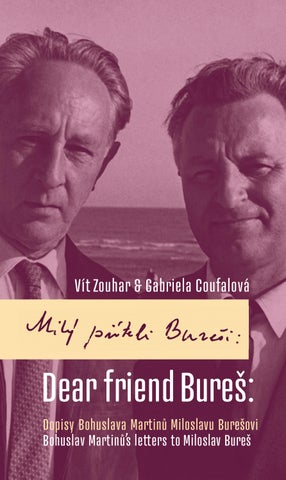
Dear friend Bureš:
Dopisy_M-B_POTAH_26mm 13.09.17 13:23 Stránka 1
206
Vít Zouhar & Gabriela Coufalová
Vít Zouhar & Gabriela Coufalová
16
123
26
Dear friend Bureš: Dopisy Bohuslava Martinů Miloslavu Burešovi Bohuslav Martinů’s letters to Miloslav Bureš
123
16
Dear friend Bureš:
Vít Zouhar & Gabriela Coufalová
Dear friend Bureš: Dopisy Bohuslava Martinů Miloslavu Burešovi Bohuslav Martinů’s letters to Miloslav Bureš
Univerzita Palackého v Olomouci Palacký University, Olomouc Olomouc 2S17
K tisku doporučili: Reviewed and recommended by: doc. MgA. Mgr. Monika Holá, Ph.D. Mgr. Jaromír Synek, Ph.D.
Vydáno za finanční podpory Grantové agentury České republiky GAČR v rámci projektu Souborné vydání Bohuslava Martinů – 2. fáze, 13-19162S. Published with the kind support of the Czech Science Foundation GAČR as a part of the project Bohuslav Martinů Complete Edition – Phase 2, No. 13-19162S.
1. vydání First Edition © Vít Zouhar, Gabriela Coufalová, 2017 © Univerzita Palackého v Olomouci, 2017 Translation © Hilda Hearne, John Hearne, 2017 Neoprávněné užití tohoto díla je porušením autorských práv a může zakládat občanskoprávní, správněprávní, popř. trestněprávní odpovědnost. Unauthorized use of the work is a breach of copyright and may be subject to civil, administrative or criminal liability. DOI: 10.5507/pdf.17.24451329 ISBN 978-80-244-5133-6 (online : PDF) ISBN 978-80-244-5132-9 (print)
PŘEDMLUVA FOREWORD
Dopisy hudebního skladatele Bohuslava Martinů básníku Miloslavu Burešovi z konce 50. let uplynulého století jsou klíčové pro poznání a pochopení spolupráce obou autorů. Dokumentují vznik volného cyklu čtyř kantát Otvírání studánek, Legenda z dýmu bramborové nati, Romance z pampelišek a Mikeš z hor a rozkrývají jejich další záměry, které však nikdy nebyly realizovány. Po takřka šedesáti letech jsou zveřejněny všechny dochované dopisy, v nichž Martinů nadšeně komentoval Burešovu „meditativní poesii“, žádal o nové texty, navrhoval jejich úpravy, ale také předával pokyny interpretům či protestoval proti problémům s vydavateli nebo proti filmovým úpravám kantáty Otvírání studánek. Edice obsahuje také jediné dva známé dopisy Miloslava Bureše zaslané Bohuslavu Martinů z přelomu let 1955 a 1956 a dopis a dvě pohlednice rodině do Poličky. Jsou unikátním svědectvím velkého ohlasu kantáty Otvírání studánek, prvních provedení, zvukové nahrávky, televizního přenosu i nerealizovaného filmového záměru Jiřího Trnky. Korespondence obou autorů dokresluje obtížnost komunikace přes železnou oponu v průběhu 50. let. Skryté významy a jinotaje, jimiž Martinů naznačoval své postoje, aby dopisy unikly cenzuře, objasňují detailní komentáře. Kniha zachycuje osobitý literární styl Martinů v autentické podobě bez korekcí a úprav, přináší faksimile dopisů 6
The letters Bohuslav Martinů wrote to Miloslav Bureš at the end of the 1950s are of major significance for gaining an insight into the collaboration between the composer and the poet. They serve to document the genesis of the loose cycle of four cantatas Opening of the Springs, The Legend of the Smoke from Potato Tops, A Dandelion Romance and Mikesh from the Mountains, and also bring to light other intentions that would never come to fruition. In all the surviving letters, now published in their entirety for the very first time since they were written, almost six decades ago, Martinů enthusiastically commented on Bureš’s “meditative poetry”, asked the author for more texts, suggested modifications, but also passed on his instructions to musicians, complained of the problems he faced with publishers, and voiced his disapproval at the film adaptations of the cantata Opening of the Springs. The present edition also contains the two known letters Miloslav Bureš wrote to Bohuslav Martinů at the turn of 1955 and 1956, as well as a letter and two postcards from the poet to the composer’s family in Polička. They contain his unique description of the keen response to the cantata Opening of the Springs, bear witness to its first performances, refer to the audio recording and television broadcast, as well as Jiří Trnka’s intention to make a film of it, which failed to materialise. The correspondence between Martinů and Bureš reveals just how difficult it was to communicate across the Iron Curtain during the course of the 1950s. The hidden meanings and allusions the composer employed to indicate his 7
a konfrontuje skladatelovu korespondenci s dopisy rodině, přátelům, a interpretům. Navazuje na edici skladatelovy korespondence Milý příteli: Dopisy Bohuslava Martinů Zdeňku Zouharovi / Dear Friend: Bohuslav Martinů’s Letters to Zde něk Zouhar (Olomouc, 2008).
8
opinions, so as to prevent the letters being censored, are explained in the detailed commentaries. The book captures Martinů’s prose style in its authentic form, without having been corrected and changed. Moreover, it contains facsimiles of the letters and juxtaposes Martinů’s correspondence with the letters he wrote to his family, friends and musicians. It links up to the edition of the composer’s correspondence Milý příteli: Dopisy Bohuslava Martinů Zdeňku Zouharovi / Dear Friend: Bohuslav Martinů’s Letters to Zdeněk Zouhar (Olomouc, 2008).
9
ÚVODEM INTRODUCTION
Korespondence Bohuslava Martinů (1890–1959) obsahuje více než dva tisíce dopisů, které z velké části nebyly dosud publikovány. Značná část je uložena v Centru Bohuslava Martinů v Poličce (nejrozsáhlejším souborem je zde korespondence rodině obsahující 638 položek), v Nadaci Bohuslava Martinů v Praze, v Českém muzeu hudby v Praze, v Moravském zemském muzeu v Brně, v archivech dalších institucí či soukromých sbírkách. Korespondence Bohuslava Martinů s Miloslavem Burešem je souborem dopisů zabývajících se především vzájemnou spoluprací na čtyřech kantátách: Otvírání studánek, H 354 (1955), Legenda z dýmu bramborové nati, H 360 (1956), Romance z pampe lišek, H 364 (1957), a Mikeš z hor, H 375 (1959). Korespondence přináší podrobnosti ke genezi těchto děl, jejich uvedení, vydání partitur a vzniku jejich nahrávek. Tento soubor dopisů dokumentuje také mnohé problematické otázky realizace skladeb Bohuslava Martinů v Československu, „na dálku“ prováděné korektury partitur, obtíže s filmovou adaptací Otvírání studánek i neautorizovanými úpravami pro filmové účely, pochybnosti o dedikaci kantáty Mikeš z hor Pavlu Eisnerovi, nefungující zasílání nahrávek Bohuslavu Martinů do zahraničí atp. Také je z korespondence zřejmé, jak Martinů využil kantátu Legenda z dýmu bramborové nati k protestu proti potlačení povstání v Maďarsku. 12
The correspondence of Bohuslav Martinů (1890–1959) amounts to more than 2,000 letters, most of which have yet to be published. The bulk of them are maintained at the Bohuslav Martinů Centre in Polička (the most extensive set is the letters written to his family in Polička, totalling some 638 items), at the Bohuslav Martinů Foundation in Prague, at the Czech Museum of Music in Prague, the Moravian Museum in Brno, as well as in the archives of other institutions and private collections. The correspondence between Bohuslav Martinů and Miloslav Bureš is an integrated set of letters in which their writers mainly devoted to their collaboration on four cantatas: Opening of the Springs, H 354 (1955), The Legend of the Smoke from Potato Tops, H 360 (1956), A Dandelion Romance, H 364 (1957), and Mikesh from the Mountains, H 375 (1959). The correspondence brings to light details of the works’ genesis, their performances, publications of their scores, and making of recordings. The set of letters also documents the problematic questions pertaining to performance of Martinů’s pieces in Czechoslovakia, corrections of the scores carried out “at a distance”, the difficulties with the film adaptation of Opening of the Springs and unauthorised cuts of the work for film purposes, the doubts relating to the dedication of the cantata Mikesh from the Mountains to Pavel Eisner, Martinů’s not receiving recordings abroad, etc. One of the letters reveals how Martinů made use of the cantata The Legend of the Smoke from Potato Tops to protest against the suppression of the 1956 uprising in Hungary. 13
Důležitou součástí této korespondence jsou úvahy a návrhy B. Martinů na další společná díla, která však nebyla nikdy realizována. Je zřejmé, že Martinů od počátku doufal, že Bureš se může stát libretistou. Již ve druhém dopise z 15. července 1955 (CBM, PBM, Kb 640), jen krátce po dokončení Otvírání studánek, se ptal Bureše: „Nevím zdali máte zájem na divadle […].“ Současně upřesnil, že společně s ním chce napsat novou „Prodanou“. Proto jej později žádal o adaptaci povídky Kleveta Antona Pavloviče Čechova, k níž skladatel poslal básníkovi synopsi (PBM Na 55), blíže neurčené hry Václava Klimenta Klicpery či se ptal na Burešovo libreto Veselohra (PNP 396). Miloši Šafránkovi napsal: „[…] on [Bureš] má báječný smysl pro scénu a i pro humor.“ (30. března 1958, CBM, PBM Kmš 869). Martinů Burešovi také radil, jak psát libreto, aniž by se snažil „pomáhat“ skladateli (říjen 1958, CBM, PBM Kb 656). Žádný z těchto operních záměrů však nebyl realizován. Jednu z příčin Martinů později objasnil Šafránkovi: „[…] skoda, ze on [Bureš] nemá smysl pro divadlo, to by byl dobrý libretista.“ (26. dubna 1959, CBM, PBM Kmš 892). Jak vyplývá z dopisů, Martinů se seznamoval také s dalšími Burešovými texty, básnickou sbírkou Nevěsta z roku 1930, Zpívající lípa z roku 1956, Zamilovaná ves (1957) a zajímal se také o Veselé pohádky a jiné příběhy z Vysočiny vypra vuje Miloslav Bureš, které byly vydány v roce 1958. Bureš zmínil také skladatelův záměr zhudebnit jeho sbírku Pochovávání světla (Bureš, 1960, s. 54), který nebyl realizován. Miloslav Bureš nebyl hudebník ani interpret, a tudíž informace o dalších skladbách jsou jen stručné. Týkají se jednotlivých provedení a nahrávek (Kytice, H 260, 5. symfonie, H 310, Les Fresques de Piero 14
Of major significance are Martinů’s deliberations on and suggestions to Bureš that they collaborate on other works, which, however, did not come to fruition. According to the correspondence, Martinů evidently hoped that Bureš could also become his librettist. In his second letter, dated 15 July 1955 (CBM, PBM Kb 640), written shortly after he had completed Opening of the Springs, the composer asked the poet: “I don’t know whether you are interested in theatre […].” Martinů also expressed his wish to write with Bureš a new “Bartered Bride”, hence, later on, he asked the poet to make adaptations of the short story A Slander by Anton Pavlovich Chekhov, whose synopsis Martinů sent to Bureš (PBM Na 55), an unspecified play by Václav Kliment Klicpera, and about the libretto titled Comedy (PNP 396). The composer wrote to Miloš Šafránek: “[…] it’s a pity he [Bureš] has a fabulous sense for the stage and humour too.” (30 March 1958, CBM, PBM Kmš 869). Martinů also advised Bureš how to write a libretto without trying to “help” the composer (October 1958, CBM, PBM Kb 656). Nevertheless, none of these plans to create an opera would come to fruition. In a letter to Šafránek, Martinů clarified one of the reasons later: “[…] pity that he [Bureš] does not have a sense for theatre, he would be a good librettist.” (26 April 1959, CBM, PBM Kmš 892). As the letters show, Martinů also familiarised himself with other texts penned by Bureš, including the collections of poems Nevěsta (The Bride), dating from 1930, and Zpívající lípa (The Singing Linden), dating from 1956, Zamilovaná ves (A Village in Love), dating from 1956, and he was interested in the Veselé pohádky a jiné příběhy z Vysočiny vypra vuje Miloslav Bureš, (Miloslav Bureš Tells Merry Fairy Tales and Other Stories from Vysočina), which was published in 1958. Bureš also mentioned Martinů’s intention to set to music his collection Pochovávání světla (Burying of Light; Bureš, 1960, p. 54), which, however, did not come to fruition. 15
della Francesca, H 352), paralel s kantátami (Řecké pašije, H 372, Hry o Marii, H 236) nebo informací ke vzniku dalších děl (Koncert pro klavír a orchestr č. 5, H 366, Nonet č. 2, H 374). Poznámka o dokončeném cyklu Zbojnické písně, H 361, dokumentuje skladatelovu snahu probudit v Československu „zbojnickou náladu“ (12. leden 1957, CBM, KBM Kb 650). Zmínka o kantátě Epos o Gilgamešovi, H 351, je dokladem Burešovy nabídky na přebásnění textu do češtiny, což však Martinů odmítl. Tento soubor dopisů částečně doplňuje mozaiku životopisných informací o Bohuslavu Martinů, dokládá jeho pobyty ve Francii, Spojených státech, Švýcarsku a Itálii, jeho politické názory, ale také zdravotní stav v posledních letech života. Martinů v nich zmiňuje řadu přátel a známých (Miloš Šafránek, Karel Šebánek, Frances Ježková, František Muzika, Jiří Berkovec, Pavel Eisner), interpretů (manželé Kühnovi, Paul Sacher, Václav Trojan, Rafael Kubelík, Zdeněk Zouhar ad.), souborů a institucí (pěvecký sbor OPUS, Kühnův dětský sbor, SNKLHU, ASCAP atp.). Adresátem korespondence je poličský rodák, básník a prozaik Miloslav Bureš (1909–1968), vlastním jménem Jan Bohuslav Bureš, který působil jako úředník na ministerstvu informací, poté na ministerstvu školství a ministerstvu kultury. Od roku 1961 pracoval v kulturní rubrice pražské redakce Svobodného slova. S Martinů se Bureš setkával již v mládí, ale skladatel si dle korespondence rodině na mladšího básníka nevzpomenul: „ Jak jsem Vám psal ten p. Bureš mi poslal báseň je to z našeho kra je, o králkách, čištění studánek na jaře. […] Kteří to jsou Burešovi, znáte je?“ (dopis ze dne 5. července 1955, CBM, PBM Kr 495). V dalších letech se osobně setkali dvakrát – v roce 1957 během po16
Miloslav Bureš was not a musician, nor a performer. Therefore, other compositions are only mentioned briefly in the letters. The information pertains to individual performances and recordings (Bouquet, H 260, Symphony Nr. 5, H 310, Les Fresques de Piero della Francesca, H 352, The Miracles of Mary, H 236), parallels with the four cantatas (The Greek Passion, H 372, The Miracles of Mary, H 236) and their origination (Concerto for Piano and Orchestra No. 5, H 366; Nonet No. 2, H 374). Martinů’s remark on his having finished the cycle Brigand Songs, H 361, bears witness to his endeavour to awaken a “brigand mood” in Czechoslovakia (12 January 1957, CBM, PBM Kb 650). A mention of the cantata The Epic of Gilgamesh, H 351, documents Bureš’s offer to versify the text in Czech, which Martinů turned down. The set of letters serves in part to complete the mosaic of biographic information about Bohuslav Martinů, documents his stays in France, the USA, Switzerland and Italy, and sheds light on his political opinions, as well as his health during the final years of his life. In his letters, Martinů refers to a number of his friends and acquaintances (Miloš Šafránek, Karel Šebánek, Frances Ježková, František Muzika, Jiří Berkovec, Pavel Eisner), musicians (Jan and Markéta Kühn, Paul Sacher, Václav Trojan, Rafael Kubelík, Zdeněk Zouhar, and others), ensembles and institutions (the OPUS choir, the Czech Philharmonic Children’s Choir, the State Publisher of Literature, Music and Art, the American Society of Composers, Authors and Publishers, etc.). The person to whom Martinů wrote the letters was the Polička native, poet and prose writer Miloslav Bureš (1909–1968), born Jan Bohuslav Bureš, who worked as a clerk at the Ministry of Information, and subsequently at the Ministry of Education and the Ministry of Culture. From 1961, he served in the culture department of the newspaper Svobodné slovo in Prague. Bureš met Martinů 17
bytu Martinů v Římě a o dva roky později se Bureš vydal za skladatelem do Švýcarska. Pozůstalost básníka, včetně strojopisů a rukopisných poznámek ke zmiňovaným textům, korespondence s různými osobnostmi, katalogy, programy, ohlasy, výstřižky a fotografie jsou od roku 1975 uloženy v Památníku národního písemnictví v Praze. Pozůstalost zahrnuje období 1894–1995 a je uložena v celkem devíti archivních kartonech. Korespondence Martinů–Bureš je až na dvě výjimky jednostranná. Jedná se tedy o dopisy B. Mar tinů adresované M. Burešovi v rozmezí let 1955 až 1959. Fond je uložen v Centru Bohuslava Martinů v Poličce (dále CBM) pod inventárními čísly PBM Kb 639–662. Soubor obsahuje celkem 24 dopisů, z nichž je pět strojopisů s doplněnou diakritikou (CBM, PBM Kb 643, 649–652), jedenáct strojopisů bez doplněné diakritiky (CBM, PBM Kb 648, 653–662), sedm rukopisných dopisů (CBM, PBM Kb 639–642, 644–646) a jeden strojopis s rukopisným přípisem skladatele (CBM, PBM Kb 647). Ze související korespondence je zřejmé, že dnes známý soubor korespondence není úplný. Miloslav Bureš se 28. srpna 1955 zmínil Zdeňku Zouharovi o dalším dopise Bohuslava Martinů: „[…] píše mi B. Martinů, že můžeme recitační vložky rozší řit, že se mu prý zdá, že někde zbytečně text z re citace ubral.“ Existenci zmiňovaného dopisu však nedokládá žádný jiný pramen a dnes není známý. Nedochoval se také dopis, v němž Martinů objasňoval Burešovi důvody, proč nemohl odeslat dokončenou partituru kantáty Legenda z dýmu bramborové nati do Prahy. Martinů na tento dopis upozornil Karla Nováka 24. prosince 1956. Soubor je doplněn jedinými dvěma dochovanými dopisy Miloslava Bureše Bohuslavu Martinů, které 18
during the time of his youth, yet the composer did not seem to remember the poet, his junior, as he put it in his correspondence to his family in Polička: “As I have written to you, the said Mr. Bureš has sent me a poem, it is about our region, the custom of cleaning the wells in the spring. […] Who are the Burešes, do you know them?” (letter dated 5 July 1955, CBM, PBM Kr 495). Over the following years, Martinů and Bureš met in person on two occasions – in 1957, when the poet visited the composer in Rome, and two years later, when Bureš paid a visit to Martinů in Switzerland. The poet’s personal effects, including typed and hand-written notes relating to the mentioned texts, his correspondence with various renowned figures, catalogues, programmes, clippings and photographs, have since 1975 been maintained at the Museum of Czech Literature in Prague. Encompassing the period between 1894 and 1995, the collection is stored in nine archival boxes. With a mere two exceptions, the correspondence between Martinů and Bureš concerns Martinů’s letters to Bureš, written from 1955 to 1959. The collection is deposited at the Bohuslav Martinů Centre in Polička (BMC) under the inventory numbers PBM Kb 639–662. The set amounts to a total of 24 letters, five of which are typed, with added Czech diacritics (CBM, PBM Kb 643, 649–652), 11 typed without added diacritics (CBM, PBM Kb 648, 653–662), seven manuscripts (CBM, PBM Kb 639–642, 644–646) and one typed letter with the composer’s hand-written inscription (CBM, PBM Kb 647). The related correspondence has made it clear that the set of letters available today is not complete. Bureš referred to Zdeněk Zouhar on 28 August 1955: “[…] B. Martinů wrote to me that we can extend the narrative inserts, that it seemed to him that the recitation has been unnecessarily reduced in the text.” The existence of the said letter has not been documented by any other source, and it is not available today. Evidently lost is yet another letter in which 19
jsou uloženy v CBM v Poličce. Jedná se o dopis ze dne 15. prosince 1955 (PBM Kd 20) a dopis pravděpodobně z 23. ledna 1956 (datum určeno z kontextu dopisu, PBM Kd 21). Oba dopisy se týkají úspěšného provedení Otvírání studánek – a to jak v pražské předpremiéře (Klub Svazu československých skladatelů, 7. prosince 1955, Kühnův dětský sbor a ženská část Českého pěveckého sboru, dirigent Jan Kühn), tak v poličské premiéře (Tylův dům, 7. ledna 1956, brněnský pěvecký sbor OPUS, dirigent Zdeněk Zouhar). Bureš zde s obrovským obdivem a respektem ke skladateli popisuje průběh obou uvedení, dojaté reakce na tuto kompozici, rozdílnosti obou interpretací i další plány na propagaci díla. Vzhledem k charakteru celé korespondence byl do této edice včleněn také dopis M. Bureše ze dne 11. prosince 1955 adresovaný rodině do Poličky (uloženo v CBM, PBM Kd 589), který taktéž nadšeně referuje o předpremiéře Otvírání studánek. A dále dvě pohlednice z návštěvy u Martinů v Římě v květnu 1957 (CBM, PBM Kd 549, 596). Obálky ke všem zmíněným dopisům nejsou dochovány. Martinů používá v této korespondenci bílý nelinkovaný papír, u deseti dopisů obsahuje tento papír vodoznaky celkem pěti různých typů, doplnění diakritiky je provedeno rukou modrým perem nebo tužkou. Z důvodu zachování autentičnosti korespondence byl při transkripci použit diplomatický přepis, a to ve všech parametrech. Přestože některé edice korespondence B. Martinů doplňují diakritiku a vycházejí přitom z rukopisných dopisů autora, 1 1
20
Zejména: Popelka, Iša: Bohuslav Martinů. Dopisy domů. Z ko respondence do Poličky. (Praha: Mladá fronta, 1996) či Zouhar, Zdeněk – Zouhar, Vít: Milý příteli: Dopisy Bohuslava Martinů
Martinů explained to Bureš the reasons why he could not send to Prague the finished score of the cantata The Legend of the Smoke of Potato Fires, which Martinů mentioned to Karel Novák on 24 December 1956. This edition also contains the only two surviving letters Bureš wrote to Martinů, which are located at the BMC in Polička. They include the letter dated 15 December 1955 (PBM Kd 20) and the letter most likely written on 23 January 1956 (the date has been determined on the basis of the letter’s context, PBM Kd 21). Both letters pertain to the successful performances of Opening of the Springs – the pre-premiere in Prague (at the Club of the Union of Czechoslovak Composers on 7 December 1955, by the Czech Philharmonic Children’s Choir and the female section of the Czech Choir, conducted by Jan Kühn), and the premiere in Polička (at the Tyl House on 7 January 1956, by the Brno-based OPUS choir, conducted by Zdeněk Zouhar). With the utmost admiration and respect for the composer, in the letters Bureš describes the two performances, the enthusiastic and emotional responses to the cantata, the differences between the two performances, as well as the further plans to promote the work. With regard to the nature of the entire correspondence, the present edition also contains the letter Bureš wrote on 11 December 1955 to Martinů’s family in Polička (maintained at the BMC, PBM Kd 589), in which he again enthusiastically depicts the pre-premiere of Opening of the Springs. Two postcards Bureš wrote to the Martinů family in Polička during his visit to the composer in Rome in May 1955 are included too (CBM, PBM Kd 549, 596). None of the letter envelopes have survived. In his correspondence, Martinů used standard nonlinear paper, in ten letters with five different types of watermarks, with the Czech diacritics having been additionally written in hand with a blue pen or pencil. With the aim to retain the authenticity of the correspond21
tato komentovaná edice zachovává text v původní nedoplněné formě. Obsahuje četné komentáře a také faksimile všech dopisů, které doplňují svazek čtyř kantát na texty Miloslava Bureše, vydaný v rámci Souborného vydání děl Bohuslava Martinů (Zouhar, 2016). Anglický překlad se nepokouší rekonstruovat specifickou angličtinu Bohuslava Martinů, nýbrž zpřístupnit dopisy široké veřejnosti. Autoři komentované edice děkují Jaromíru Synkovi, Gabriele Všetičkové, K arle Zouharové a Radce Topinkové Rozkovcové za připomínky a komentáře k textu. Dále děkují Monice Holé (CBM), Lucii Jirglové (Inst. BM), Janě Frankové (Inst. BM), Jitce Bílkové (Archiv bezpečnostních složek) a Michalu Přibáňovi (Akademie věd) za upřesňující informace. Poděkování patří též Jiřímu Hlaváčovi – předsedovi správní rady Nadace Bohuslava Martinů, Aleši Březinovi – řediteli Institutu Bohuslava Martinů, Davidu Junkovi a Pavle Juklové – ředitelům Měst ského muzea v Poličce za přístup k pramenům a poskytnutí souhlasu s jejich publikováním. Vít Zouhar a Gabriela Coufalová Olomouc, leden 2017
Zdeňku Zouharovi. (Olomouc: UP, 2008). Také Hudská, Barbora: Korespondence mezi Bohuslavem Martinů a Miloslavem Burešem s od kazem na jejich společnou tvorbu. (Diplomová práce). Hradec Králové: Univerzita Hradec Králové, 2016.
22
ence, diplomatic transcription was applied, in all parameters. Even though some of the editions of Martinů’s correspondence have added Czech diacritics, having done so on the basis of the composer’ manuscript letters,1 the present annotated edition of the correspondence between Martinů and Bureš has kept the Czech texts in their original, uncompleted form. The edition contains numerous comments, as well as facsimiles of all the letters, which supplement the volume of the four cantatas within The Bohuslav Martinů Complete Edition (Zouhar, 2016). The English translation does not strive to reconstruct Bohuslav Martinů’s specific English, but to make the letters available to the wider public. The authors of the annotated edition would like to extend their thanks to Jaromír Synek, Gabriela Všetičková, Karla Zouharová and Radka Topinková Rozkovcová for their observations and comments pertaining to the text. They would also like to thank Monika Holá (BMC), Lucie Jirglová (the Bohuslav Martinů Institute), Jana Franková (the Bohuslav Martinů Institute), Jitka Bílková (Security Service Archives) and Michal Přibáň (Czech Academy of Sciences) for providing invaluable information. Furthermore, we extend our thanks to Jiří Hlaváč, Chair man of the Board of the Bohuslav Martinů Foundation; Aleš Březina, Director of the Bohuslav Martinů Institute; David Junek and Pavla Juklová, Directors of the Municipal Museum in Polička, for making available the sources and for granting their consent to their publication. Vít Zouhar and Gabriela Coufalová Olomouc, January 2017 1
In particular: Popelka, Iša: Bohuslav Martinů. Dopisy domů. Z korespondence do Poličky. (Prague: Mladá fronta, 1996) and Zouhar, Zdeněk – Zouhar, Vít: Milý příteli: Dopisy Bohuslava Martinů Zdeňku Zouharovi / Dear Friend: Bohuslav Martinů’s Letters to Zdeněk Zouhar (Olomouc: UP, 2008). Also Hudská, Barbora: Korespondence mezi Bohuslavem Martinů a Miloslavem Burešem s odkazem na jejich společnou tvorbu. (MA Theses). Hradec Králové: Univerzita Hradec Králové, 2016.
23
Věnováno Zdeňku Zouharovi, Věře Zouharové, Karle a Honzovi.
To Zdeněk Zouhar, Věra Zouharová, Karla and Jan.
DOPISY THE LETTERS
1 [Kb 639]
[Nice] July [4]2 55. Milý pane Bureš: Děkuji Vám za Váš milý dopis. Vaše báseň o Stu dánce3 se mne hluboce dotkla nejen pro to že máte rád Vysočinu ale i proto že je krásná. Mnoho vzpomínek vyvolala a drahých.4 Ovšem že na ni napíšu hudbu5 tak krásný text se nenajde každý den.6 Měl 2 3
4
5
6
28
Špatně čitelné. Bohuslav Martinů zde myslí Píseň o studánce rubínce, textovou předlohu kantáty Otvírání studánek, H 354, kterou obdržel o dva dny dříve. Rodinu v Poličce o tom informoval: „Také jsem dostal dnes báseň od M. Bureše, taky Poličák, moc hezká báseň Píseň o Studánce Rubínce.“ (2. července 1955, CBM, PBM Kr 494). Text podtržen modrofialovou pastelkou pravděpodobně rukou Miloslava Bureše. Báseň situoval do okolí Třech Studní. Zdeňku Zouharovi k tomu napsal: „Tam se B. M. kdysi setkal s Vítězslavou Kaprálovou a já jsem tam prožíval chvíle mladé lásky se Zdeňkou Entnerovou / jmenuji ji, protože ten vztah mi tyto kouty důvěrně přiblížil /.“ (14. října 1955, ZZ, MB 6). Obřad čištění studánek Bureš záměrně přemístil z Litomyšlska na Českomoravskou vrchovinu. Jan Kapusta to objasnil ve stati „O původu námětu k ‚Otvírání studánek‘“, Opus musicum 14, č. 2 (1982), s. 4–5. Kantátu Otvírání studánek, H 354, Martinů začal koncipovat 4. čer vence a dokončil 12. července 1955 (dopis rodině 12. července 1955, CBM, PBM Kr 497, a Zouhar, 2016, s. XIII). O Burešově textu se Martinů zmiňuje následující den rodině do Poličky: „Jak jsem Vám psal ten p. Bureš mi poslal báseň je to z našeho kraje, o králkách, čistění studánek na jaře. Je tak krásná že na ní udělám hudbu a měl bych plán že by to Brněnští mohli udělat v Poličce jako světovou premieru, to by byla sensace. […] Báseň je moc krásná
1 [Kb 639]
[Nice] July [4.]2 55. Dear Mr. Bureš: Thank you for your kind letter. Your poem about the Spring3 has touched me deeply, not only because you like the Vysočina region but also because it is beautiful. It has evoked many memories dear to me.4 I will certainly write music5 to it, since a text as wonderful as yours does not appear every day.6 I would like to suggest a proposal. They 2 3
4
5
6
Barely legible. Bohuslav Martinů evidently refers to the Song of the Ruby Spring, the text on which he would base the cantata Opening of the Springs, H 354, and which he received two days previously. He wrote of it to his family in Polička: “Today I have also received a poem from M. Bureš, a Polička native too, a very nice poem, Song of the Ruby Spring.” (Letter dated 2 July 1955, CBM, PBM Kr 494). The text is underlined in blue-violet crayon, probably by Miloslav Bureš. He set the poem in the environs of Tři Studně. Bureš wrote to Zdeněk Zouhar: “That is where B. M. once met with Vítězslava Kaprálová and where I experienced moments of young love with Zdeňka Entnerová / I am mentioning her since this relationship brought me into intimate contact with those quarters /.” (14 October 1955, ZZ, MB 6). Bureš wittingly relocated the scene of cleaning the springs from the Litomyšl region to the CzechMoravian Uplands, as elucidated by Jan Kapusta in his essay “O původu námětu k ‚Otvírání studánek‘” [On the origin of the subject of ‘Opening of the Springs’], Opus musicum 14, No. 2 (1982), pp. 4–5. Martinů started to conceive the cantata Opening of the Springs, H 354, on 4 July and completed it on 12 July 1955 (his letter to his family, dated 12 July 1955, CBM, PBM Kr 497, and Zouhar, 2016, p. XIII). The next day, Martinů mentioned Bureš’s text in a letter to his family in Polička: “As I have written to you, Mr. Bureš sent me a poem set in our region,
29
bych návrh. Brněnští mne chtějí příští rok oslavit7 a mohli bychom udělati světovou premieru v Poličce, co o tom soudíte?8 Oni stejně hledají moje skladby a chtějí udělati zájezd do Poličky, mají dobrý ženský sbor9 a tak by to šlo snad realizovat. Mám rád tu myšlenku, aspoň bych se trochu vrátil domu.10 Budu se snažit užít celou báseň jak je.11 Foto Vám pošlu brzo. Děkuji Vám: za „Nevěstu“12 nevím zdali jsem vám poděkoval v těch pohnutých dobách. Těším se velmi na práci, už dlouho jsem nepracoval na čes-
a dojemná, jednoduchá, tak bychom byli dva rodáci z Poličky.“ (5. července 1955, CBM, PBM Kr 495). 7 Dirigent Zdeněk Zouhar informoval Martinů o záměru uspořádat cyklus čtyř koncertů ke skladatelovým 65. narozeninám v Univerzitní knihovně v Brně, které připravoval na sezonu 1955–1956, a také o koncertech sboru OPUS, na nichž uvedl v premiéře cyklus Petrklíč (ZZ, BM 12, Zouhar, 2008, s. 120). 8 Přestože Martinů si přál, aby se premiéra Otvírání studánek uskutečnila v Poličce, situace byla komplikovanější. Svaz československých skladatelů uspořádal 7. prosince 1955 v Praze koncert ke skladatelovu výročí, na němž byla kantáta poprvé provedena. Miloslav Bureš o tom později referoval jako o „předpremiéře“ (15. prosince 1955, CBM, PBM Kd 20, viz zde s. 172). 9 Myslí zde ženskou část smíšeného sboru OPUS, který pod vedením Zdeňka Zouhara premiéroval 25. dubna 1955 cyklus Petrklíč, H 348. 10 Téma návratu do vlasti se v korespondenci Martinů objevuje opakovaně. Bylo však neslučitelné s jeho postojem k vládnoucímu režimu v tehdejším Československu. Jedním z důvodů, který návrat také znemožnil, byla zřejmě skutečnost, že agenti 1. správy Ministerstva vnitra ČSR se pokusili Martinů přimět k návratu (Archiv bezpečnostních složek, reg. č. 20892, AS 3250, s. 129 a 131). 11 Zejména poslední část básně však výrazně zkrátil (Zouhar, 2016, s. XIII) a Burešovi napsal: „Sdělte mi zdali jste spokojen s tím jak jsem vám ostříhal vaši báseň, ale vysvětlil jsem Vám proč.“ (16. července 1955, CBM, PBM Kb 641). Martinů o krácení básně psal Burešovi také 15. července (CBM, PBM Kb 640). Viz zde s. 34, 36. 12 Jedná se o Burešovu básnickou sbírku Nevěsta z roku 1930, kterou autor dedikoval Bohuslavu Martinů (CBM, PBM B 9).
30
in Brno would like to celebrate me next year,7 so we could give the world premiere in Polička. What do you think about it?8 They seek my compositions anyway and want to make a trip to Polička, they have a good female choir,9 so it would perhaps be possible to carry it out. I like the idea, at least I would somewhat return home.10 I will try to make use of the whole poem as it is.11 I will send you a photo soon. Thank you: for the “Bride”,12 I do not know whether I thanked you in those agitated times. I really look forward to the work, it has been a long time since I worked on a Czech text, as this is the only one that has grown in about cleaning the wells in the spring. It is so beautiful that I have decided to set it to music, and I think that the Brno choir could give its world premiere, that would be fabulous. […] The poem is really wonderful and moving, simple, so we would be two natives of Polička.” (5 July 1955, CBM, PBM Kr 495). 7 The conductor Zdeněk Zouhar informed Martinů of his intention to hold a cycle of four concerts to celebrate the composer’s 65th birthday, at the University Library in Brno, which he was preparing for the 1955/56 season, as well as of concerts given by the OPUS choir, where the cycle Primrose was premiered (ZZ, BM 12, Zouhar, 2008, p. 121). 8 Martinů wanted Opening of the Springs to be premiered in Polička, yet the situation was rather complicated. On 7 December 1955, the Union of Czechoslovak Composers organised a concert marking the composer’s anniversary, at which the cantata received its first performance. Later on, Miloslav Bureš referred to it as a “pre-premiere” (15 December 1955, CBM, PBM Kd 20, p. 172). 9 He has in mind the female section of the mixed OPUS choir, who on 25 April 1955, under Zdeněk Zouhar, premiered the cycle Primrose, H 348. 10 The subject of returning to his homeland reappears in Martinů’s cor respondence, yet coming back was incompatible with his attitude towards the Communist regime in Czechoslovakia. One of the likely reasons for the composer’s not returning was the fact that the agents of the Ministry of Internal Affairs attempted to make him do so (Archive of Security Files, Reg. No. 20892, AS 3250, pp. 129 and 131). 11 Yet he shortened the poem, particularly its final section (Zouhar, 2016, p. XIII), and then wrote to Bureš: “Let me know whether you are satisfied with my cuts in your poem, but I have explained to you why I have done so.” (16 July 1955, CBM, PBM Kb 641) Martinů also wrote to Bureš about abridging the poem on 15 July (CBM, PBM Kb 640), pp. 34, 36. 12 Bureš’s collection of poems Nevěsta [The Bride], dating from 1930, dedicated to Bohuslav Martinů (CBM, PBM B 9).
31
kém textu ač je to jediný co mi přirostl k srdci.13 Pojedete-li do Poličky stavte se u našich.14 Mnoho a srdečně vás zdravím B. Martinů
Obdobně reagoval o rok dříve v dopise Zdeňku Zouharovi, který jej žádal o sbory na českou lidovou poezii: „Práce s našimi národními texty mi vždy dělá radost.“ (Dopis 29. července 1954, Zouhar, 2008, s. 48). 14 V dalších dopisech již s návštěvou počítá. Viz zde s. 42. 13
32
my heart.13 Should you go to Polička, pop in to see my family.14 Many and cordial regards, B. Martinů
13
He had responded in a similar way a year previously, in a letter to Zdeněk Zouhar, who had asked him for choruses to Czech folk poetry: “Working with our national texts always makes me happy.” (Letter dated 29 July 1954, Zouhar, 2008, p. 49). 14 In subsequent letters, he did count with the visit. See, p 43.
33
2 [Kb 640]
[Nice] July 15. 55. Milý příteli Bureši: Neděkujte mi, jste to vy kdo mi dal několik dní radostné práce na vaši básni a je na mně poděkovati vám.15 Pošlu Vám v těchto dnech foto a kopii partitury, kterou jsem právě dokončil.16 Nebudete snad proti tomu že jmenuji komposici: „Otvírání studánek“17 Je to zase můj vztah a vzpomínky, termín je ze Sušilovy sbírky18. Báseň jsem nemohl užít celou, protože by byla skladba příliš dlouhá ale užil jsem skoro vše co je hlavní.19 Je to pro 2 housle, violu a piano a ženský sbor se solovými party, tedy formace již nelze dlouho užíti a v komposici půl minuty „na víc“ může shroutit celou skladbu.20 Celá věc je jednoduText podtržen modrofialovou pastelkou pravděpodobně rukou Milo slava Bureše. 16 Do Poličky sdělil o tři dny dříve: „Tu studánku jsem dokončil a pošlu kopii do Brna.“ (12. července 1955, CBM, PBM Kr 497). 16. července 1955 napsal Zdeňku Zouharovi: „Posílám vám současně dvě kopie Otvírání studánek […].“ (ZZ, BM 12, Zouhar, 2008, s. 108). Téhož dne odeslal také kopii partitury patrně Janu [Novákovi?] (CBM, PBM Kr 498). 17 Martinů zde uvádí název, kterým nahradil Burešovo původní označení Píseň o studánce rubínce. Nový název kantáty použil Martinů poprvé v dopisu do Poličky: „Ta nová komposice se jmenuje: Otvírání studánek […].“ (8. července 1955, CBM, PBM Kr 496). 18 Jak objasnil Zdeněk Zouhar, nešlo o sbírku Františka Sušila Moravské národní písně s nápěvy do textu vřaděnými, ale o sbírku Karla Jaromíra Erbena Prostonárodní české písně a říkadla (Zouhar, 1957, s. 120). Martinů z ní čerpal texty k baletu Špalíček, H 214, v němž zhudebnil mj. verše: „U studánky, u rubínky ruce jsem si myla, zámečkem jsem zamykala, lístečkem jsem odmykala.“ (B. Martinů: Špalíček. Klavírní výtah. Praha: SNKLHU, 1951, s. 90 a 98). 19 Martinů provedl několik úprav a výrazně zkrátil zejména závěrečnou, šestou část (viz Zouhar, 2016, s. XIII). 20 Na titulní straně autografu uvedl: „Pro ženský sbor, Soprán, alt a Baryton Solo, (Recitátor) / a pro dvoje housle, violu a piano.“ (CBM, PBM Ab 105). 15
34
2 [Kb 640]
[Nice] July 15. 55. Dear friend Bureš: Do not thank me, it is you who have granted me several days of joy working on your poem, so it is I who should be thanking you.15 I will soon send you a photo and a copy of the score I have just finished.16 I hope you will not object to my naming the composition “Opening of the Springs”.17 It reflects my relationship and memories, the term is from Sušil’s collection.18 I could not make use of the whole poem, for the piece would be too long, but I used almost everything that is of major importance.19 It is for 2 violins, viola and piano and female chorus with solo parts, a formation that cannot be long, as an “additional” half a minute can make the entire composition collapse.20 The 15
The text is underlined in blue-violet crayon, probably by Miloslav Bureš. Three days previously, he wrote to Polička: “I have finished the Spring, and will send a copy to Brno.” (12 July 1955, PBM Kr 497) On 16 July 1955, he wrote to Zdeněk Zouhar: “I am sending you two copies of Opening of the Springs […].” (ZZ, BM 12, Zouhar, 2008, p. 109) On that very day, he evidently sent another copy of the score to Jan [Novák?] (CBM, PBM Kr 498). 17 Martinů mentions the title that he gave to the work in place of Bureš’s original Song of the Ruby Spring. He first used the cantata’s new name in a letter to Polička: “The new composition is titled: Opening of the Springs […].” (8 July 1955, CBM, PBM Kr 496). 18 As Zdeněk Zouhar explained, it did not concern František Sušil’s collection Moravian Folk Songs with the Tunes Fitted into the Texts, but Karel Jaromír Erben’s Czech National Songs and Proverbs (Zouhar, 1957, p. 120). Martinů used texts from the book for his ballet Chap-book, H 214, in which he also set to music the verse: “By the spring, the Ruby spring, I washed my hands, locked it with a little lock, unlocked with a leaf.” Bohuslav Martinů: Chap-book. Piano reduction (Prague: SNKLHU, 1951, pp. 90 and 98). 19 Martinů carried out several modifications and considerably abridged it, mainly the final, sixth, part (see Zouhar, 2016, p. XIII). 20 On the autograph’s title page, he wrote: “For female choir, Soprano, alto and Baritone Solo, (Reciter) / and for two violins, viola and piano.” (CBM, PBM Ab 105). 16
35