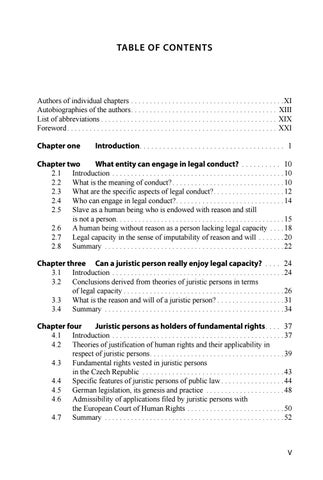
TABLE OF CONTENTS
Authors of individual chapters . . . . . . . . . . . . . . . . . . . . . . . . . . . . . . . . . . . . . . . . .XI Autobiographies of the authors . . . . . . . . . . . . . . . . . . . . . . . . . . . . . . . . . . . . . . . XIII List of abbreviations . . . . . . . . . . . . . . . . . . . . . . . . . . . . . . . . . . . . . . . . . . . . . . . XIX Foreword . . . . . . . . . . . . . . . . . . . . . . . . . . . . . . . . . . . . . . . . . . . . . . . . . . . . . . . . XXI
Chapter one
Introduction. . . . . . . . . . . . . . . . . . . . . . . . . . . . . . . . . . . . . 1
Chapter two What entity can engage in legal conduct? . . . . . . . . . . 10 2.1 Introduction . . . . . . . . . . . . . . . . . . . . . . . . . . . . . . . . . . . . . . . . . . . . . . 10 2.2 What is the meaning of conduct? . . . . . . . . . . . . . . . . . . . . . . . . . . . . . . 10 2.3 What are the specific aspects of legal conduct? . . . . . . . . . . . . . . . . . . . 12 2.4 Who can engage in legal conduct? . . . . . . . . . . . . . . . . . . . . . . . . . . . . . 14 2.5 Slave as a human being who is endowed with reason and still is not a person. . . . . . . . . . . . . . . . . . . . . . . . . . . . . . . . . . . . . . . . . . . . . 15 2.6 A human being without reason as a person lacking legal capacity . . . . 18 2.7 Legal capacity in the sense of imputability of reason and will . . . . . . . 20 2.8 Summary . . . . . . . . . . . . . . . . . . . . . . . . . . . . . . . . . . . . . . . . . . . . . . . . 22 Chapter three Can a juristic person really enjoy legal capacity? . . . . 24 3.1 Introduction . . . . . . . . . . . . . . . . . . . . . . . . . . . . . . . . . . . . . . . . . . . . . . 24 3.2 Conclusions derived from theories of juristic persons in terms of legal capacity . . . . . . . . . . . . . . . . . . . . . . . . . . . . . . . . . . . . . . . . . . . 26 3.3 What is the reason and will of a juristic person? . . . . . . . . . . . . . . . . . . 31 3.4 Summary . . . . . . . . . . . . . . . . . . . . . . . . . . . . . . . . . . . . . . . . . . . . . . . . 34 Chapter four Juristic persons as holders of fundamental rights . . . . 37 4.1 Introduction . . . . . . . . . . . . . . . . . . . . . . . . . . . . . . . . . . . . . . . . . . . . . . 37 4.2 Theories of justification of human rights and their applicability in respect of juristic persons . . . . . . . . . . . . . . . . . . . . . . . . . . . . . . . . . . . . 39 4.3 Fundamental rights vested in juristic persons in the Czech Republic . . . . . . . . . . . . . . . . . . . . . . . . . . . . . . . . . . . . . . 43 4.4 Specific features of juristic persons of public law . . . . . . . . . . . . . . . . . 44 4.5 German legislation, its genesis and practice . . . . . . . . . . . . . . . . . . . . . 48 4.6 Admissibility of applications filed by juristic persons with the European Court of Human Rights . . . . . . . . . . . . . . . . . . . . . . . . . . 50 4.7 Summary . . . . . . . . . . . . . . . . . . . . . . . . . . . . . . . . . . . . . . . . . . . . . . . . 52
V
TABLE OF CONTENTS
Chapter five 5.1
5.2
5.3 5.4
How can a juristic person act under substantive law? . . . . . . . . . . . . . . . . . . . . . . . . . . . . . . . . . . . . . . . . . . . 54 Status of the governing body when acting on behalf of a juristic person . . . . . . . . . . . . . . . . . . . . . . . . . . . . . . . . . . . . . . . . . . . 55 5.1.1 Basic concept—member of the governing body as a juristic person’s representative sui generis . . . . . . . . . . . . . . . 55 5.1.2 Member of the governing body (exceptionally) as a juristic person’s contractual representative . . . . . . . . . . . . . . . 58 5.1.3 Member of the governing body (exceptionally) as a juristic person’s statutory representative . . . . . . . . . . . . . . . . . 62 Applicability of the rules on representation to acts made on behalf of a juristic person by a member of the governing body . . . . . . . . . . . . 63 5.2.1 Can a member of the governing body grant a power of attorney for the given juristic person? (Applicability of Sections 438 and 439 of the Civil Code) . . . . . . . . . . . . . . . . 63 5.2.2 Presumption of representation—why is a representative deemed to act on his own behalf in case of doubt? (Applicability of Section 436 (1) of the Civil Code) . . . . . . . . . 64 5.2.3 When can representative’s good faith be attributed to the juristic person being represented? (Applicability of Section 436 (2) of the Civil Code) . . . . . . . . . . . . . . . . . . . . . 69 5.2.4 How should a conflict of interests between a member of a (business) corporation’s governing body and that corporation be resolved? (Applicability of Section 437 of the Civil Code) . . . . . . . . . . . . . . . . . . . . . . . . . . . . . . . . . . . . . .78 5.2.5 Is it possible to approve ex post any acts taken by members of the governing body who went beyond the limits of their authorisation to represent the juristic person? (Applicability of Section 440 of the Civil Code) . . . . . . . . . . . . . . . . . . . . . . . 81 Joint representation by a member of the governing body and a corporate agent . . . . . . . . . . . . . . . . . . . . . . . . . . . . . . . . . . . . . . . . . . 83 Summary . . . . . . . . . . . . . . . . . . . . . . . . . . . . . . . . . . . . . . . . . . . . . . . . 90
Chapter six 6.1 6.2 6.3
VI
Specific features of legal acts taken (not only by juristic persons) in procedural law . . . . . . 93 Introduction . . . . . . . . . . . . . . . . . . . . . . . . . . . . . . . . . . . . . . . . . . . . . . 93 The term “procedural act” . . . . . . . . . . . . . . . . . . . . . . . . . . . . . . . . . . . 94 Procedural acts of the parties . . . . . . . . . . . . . . . . . . . . . . . . . . . . . . . . . 95 6.3.1 General remarks . . . . . . . . . . . . . . . . . . . . . . . . . . . . . . . . . . . . . 95 6.3.2 Requisites of procedural acts of the parties . . . . . . . . . . . . . . . . 97 6.3.3 Interpretation of procedural acts of the parties . . . . . . . . . . . . . 99 6.3.4 Are conditional procedural acts permissible? . . . . . . . . . . . . . 100 6.3.5 Defects of procedural acts of the parties . . . . . . . . . . . . . . . . . 102
TABLE OF CONTENTS
6.4 6.5
6.3.6 Can procedural acts of the parties have substantive effects? . . 104 6.3.7 Certain remarks on procedural agreements . . . . . . . . . . . . . . . 107 Specific aspects of procedural acts of juristic persons . . . . . . . . . . . . . 109 Summary . . . . . . . . . . . . . . . . . . . . . . . . . . . . . . . . . . . . . . . . . . . . . . . 112
Chapter seven Juristic person as a subject of responsibility . . . . . . . 114 7.1 Fault-based liability of juristic persons . . . . . . . . . . . . . . . . . . . . . . . . 115 7.2 No-fault liability of juristic persons . . . . . . . . . . . . . . . . . . . . . . . . . . . 116 7.3 Capacity of jurisic persons to bear legal responsibility (liability) . . . . 119 7.4 Summary . . . . . . . . . . . . . . . . . . . . . . . . . . . . . . . . . . . . . . . . . . . . . . . 119 Chapter eight No-fault liability of juristic persons . . . . . . . . . . . . . . . 121 8.1 Introduction . . . . . . . . . . . . . . . . . . . . . . . . . . . . . . . . . . . . . . . . . . . . . 121 8.2 Introduction: characteristics of no-fault liability—its function and purpose in contemporary tort law . . . . . . . . . . . . . . . . . . . . . . . . . . . . 122 8.3 No-fault liability from comparative perspective—various approaches . . . . . . . . . . . . . . . . . . . . . . . . . . . . . . . . . . . . . . . . . . . . . . 123 8.4 Liability of legal entities—imputation of consequences . . . . . . . . . . . 127 8.5 Selected cases of no-fault liability of legal entities . . . . . . . . . . . . . . . 130 8.5.1 Liability for activities . . . . . . . . . . . . . . . . . . . . . . . . . . . . . . . . 130 8.5.1.1 Operational damage (Section 2924) . . . . . . . . . . . . . 130 8.5.1.2 Damage caused by a particularly hazardous operation (Section 2925) . . . . . . . . . . . . . . . . . . . . . 131 8.5.1.3 Damage caused by other operational activities . . . . 133 8.5.1.4 Damage caused by operation of means of transport . . . . . . . . . . . . . . . . . . . . . . . . . . . . . . . . 136 8.5.1.5 Damage caused in exercise of public authority . . . . 137 8.5.1.6 Damage to real property . . . . . . . . . . . . . . . . . . . . . . 140 8.5.2 Liability for damage caused by a thing . . . . . . . . . . . . . . . . . . 140 8.5.2.1 Damage caused by a thing . . . . . . . . . . . . . . . . . . . . 140 8.5.2.2 Damage caused by a product defect . . . . . . . . . . . . . 143 8.6 Summary . . . . . . . . . . . . . . . . . . . . . . . . . . . . . . . . . . . . . . . . . . . . . . . 145 Chapter nine Liability of juristic persons based on fault . . . . . . . . . 147 9.1 Introduction . . . . . . . . . . . . . . . . . . . . . . . . . . . . . . . . . . . . . . . . . . . . . 147 9.2 Identification of liability based on fault . . . . . . . . . . . . . . . . . . . . . . . . 148 9.3 Approach in foreign laws . . . . . . . . . . . . . . . . . . . . . . . . . . . . . . . . . . . 149 9.3.1 German law . . . . . . . . . . . . . . . . . . . . . . . . . . . . . . . . . . . . . . . 150 9.3.2 Austrian law . . . . . . . . . . . . . . . . . . . . . . . . . . . . . . . . . . . . . . . 151 9.4 Liability based on fault under valid regulation . . . . . . . . . . . . . . . . . . 152 9.4.1 Conditions for establishing liability based on fault . . . . . . . . . 152 9.4.2 Section 2909—Breach of good morals . . . . . . . . . . . . . . . . . . 153 9.4.3 Section 2910—General liability based on fault . . . . . . . . . . . . 154 VII
TABLE OF CONTENTS
9.5
9.6
9.7
Imputability of natural person’s conduct . . . . . . . . . . . . . . . . . . . . . . . 155 9.5.1 General rule (Section 167) . . . . . . . . . . . . . . . . . . . . . . . . . . . . 156 9.5.2 Assistant person (Section 2914) . . . . . . . . . . . . . . . . . . . . . . . . 157 9.5.2.1 Scope of application . . . . . . . . . . . . . . . . . . . . . . . . . 158 9.5.2.2 Notion of assistant . . . . . . . . . . . . . . . . . . . . . . . . . . 158 9.5.2.3 Scope of principal’s liability . . . . . . . . . . . . . . . . . . . 159 Culpability . . . . . . . . . . . . . . . . . . . . . . . . . . . . . . . . . . . . . . . . . . . . . . 162 9.6.1 Capacity to be liable for a wrong . . . . . . . . . . . . . . . . . . . . . . . 163 9.6.1.1 Capacity of a natural person to be liable for a wrong . . . . . . . . . . . . . . . . . . . . . . . . . . . . . . . . . . . 163 9.6.1.2 Capacity of a juristic person to be liable for a wrong (delictual capacity) . . . . . . . . . . . . . . . . . . . 164 9.6.1.3 Analogous concept of delictual capacity of a juristic person . . . . . . . . . . . . . . . . . . . . . . . . . . . . . 165 9.6.1.4 Gaps in the concept of imputation . . . . . . . . . . . . . . 166 9.6.2 Viewpoint for assessing culpability . . . . . . . . . . . . . . . . . . . . . 167 9.6.2.1 Assessing culpability of natural persons . . . . . . . . . 167 9.6.3 Viewpoint of culpability of juristic persons . . . . . . . . . . . . . . . 171 9.6.4 Standard of conduct . . . . . . . . . . . . . . . . . . . . . . . . . . . . . . . . . 172 9.6.4.1 Setting the standard of conduct for natural persons . . . . . . . . . . . . . . . . . . . . . . . . . . . . . . . . . . . 172 9.6.4.2 Setting the standard of conduct for juristic persons . . . . . . . . . . . . . . . . . . . . . . . . . . . . . . . . . . . 173 Summary . . . . . . . . . . . . . . . . . . . . . . . . . . . . . . . . . . . . . . . . . . . . . . . 174
Chapter ten Vicarious liability of juristic persons . . . . . . . . . . . . . . 177 10.1 Introduction . . . . . . . . . . . . . . . . . . . . . . . . . . . . . . . . . . . . . . . . . . . . . 177 10.2 Vicarious liability and similar concepts in the Czech Civil Code . . . . 179 10.3 Liability and responsibility in the Czech legal theory . . . . . . . . . . . . . 181 10.3.1 Liability in the ABGB . . . . . . . . . . . . . . . . . . . . . . . . . . . . . . . 184 10.3.2 Liability as an integral part of an obligation . . . . . . . . . . . . . . 189 10.3.2.1 Schuld und Haftung (1874) . . . . . . . . . . . . . . . . . . . 191 10.3.2.2 Reception of the “Schuld und Haftung” doctrine in the Czech environment . . . . . . . . . . . . . . 192 10.3.3 Liability in the sense of responsibility . . . . . . . . . . . . . . . . . . . 194 10.4 A circular relationship between responsibility (liability) and duty . . . 197 10.4.1 A solution to the circular relationship by abandoning the notion of liability . . . . . . . . . . . . . . . . . . . . . . . . . . . . . . . . 199 10.4.2 The first loss of the meaning of responsibility . . . . . . . . . . . . . 201 10.4.3 Interim conclusions . . . . . . . . . . . . . . . . . . . . . . . . . . . . . . . . . 202 10.5 The normativist account of vicarious liability . . . . . . . . . . . . . . . . . . . 204 10.6 Vicarious liability as the only form of secondary liability of juristic persons . . . . . . . . . . . . . . . . . . . . . . . . . . . . . . . . . . . . . . . . . 206 VIII
TABLE OF CONTENTS
Chapter eleven Administrative-law liability of juristic persons . . . . . 207 11.1 Introduction . . . . . . . . . . . . . . . . . . . . . . . . . . . . . . . . . . . . . . . . . . . . . 207 11.2 Czech legislation on administrative offences committed by juristic persons until 1 July 2017 . . . . . . . . . . . . . . . . . . . . . . . . . . . . . . . . . . . 208 11.3 New regulation of corporate liability for administrative offences existing since 2017 . . . . . . . . . . . . . . . . . . . . . . . . . . . . . . . . . . . . . . . . 211 11.4 Case-law of the European Court of Human Rights, the principle of ne bis in idem and its impact on the Czech national practice of administrative punishment . . . . . . . . . . . . . . . . . . . . . . . . . . . . . . . . 216 11.5 Summary . . . . . . . . . . . . . . . . . . . . . . . . . . . . . . . . . . . . . . . . . . . . . . . 224 Chapter twelve Conclusion . . . . . . . . . . . . . . . . . . . . . . . . . . . . . . . . . . . . 225 12.1 General remarks . . . . . . . . . . . . . . . . . . . . . . . . . . . . . . . . . . . . . . . . . . 225 12.2 What entity can engage in legal conduct? . . . . . . . . . . . . . . . . . . . . . . 225 12.3 Can a juristic person really enjoy legal capacity? . . . . . . . . . . . . . . . . 227 12.4 Juristic persons as holders of fundamental rights . . . . . . . . . . . . . . . . 229 12.5 How can a juristic person act under substantive law? . . . . . . . . . . . . . 230 12.6 Specific features of legal acts taken (not only by juristic persons) in procedural law . . . . . . . . . . . . . . . . . . . . . . . . . . . . . . . . . . . . . . . . . 233 12.7 Juristic person as a subject of responsibility . . . . . . . . . . . . . . . . . . . . 234 12.8 No-fault liability of juristic persons . . . . . . . . . . . . . . . . . . . . . . . . . . . 235 12.9 Liability of juristic persons based on fault . . . . . . . . . . . . . . . . . . . . . . 236 12.10 Vicarious liability of juristic persons . . . . . . . . . . . . . . . . . . . . . . . . . . 238 12.11 Administrative-law liability of juristic persons . . . . . . . . . . . . . . . . . . 239 Summary . . . . . . . . . . . . . . . . . . . . . . . . . . . . . . . . . . . . . . . . . . . . . . . . . . . . . . . . . 241 Bibliography . . . . . . . . . . . . . . . . . . . . . . . . . . . . . . . . . . . . . . . . . . . . . . . . . . . . . . 247 List of case law . . . . . . . . . . . . . . . . . . . . . . . . . . . . . . . . . . . . . . . . . . . . . . . . . . . . 258 Index . . . . . . . . . . . . . . . . . . . . . . . . . . . . . . . . . . . . . . . . . . . . . . . . . . . . . . . . . . . . 262
IX
CHAPTER ONE INTRODUCTION (WHAT ARE THE COMMON FEATURES AND EFFECTS OF LEGAL ACTS AND OF RESPONSIBILITY, OR LIABILITY, OF JURISTIC PERSONS?)
The terms “legal conduct” (or “legal transaction”)1, “legal responsibility” (or “liability”)2 and “juristic person”3 are construed and interpreted as mutually isolated 1
2
3
ZAMFIR, P. B., NEAGU, E. The Legal Conduct’s Place in the Present Configuration of the Legal State. Annals of Constantin Brancusi University. 2007, pp. 81–86; MONAHAN, J. H. Method of Law: An Essay on Stattement and Arrangement of Legal Standard of Conduct. London: Macmilan and co., 1878; KOCOUREK, A., WIGMORE, J. H. Evolution of law: select readings on the origin and development of legal institution. Volume III. Boston: Litle, Brown, and company, 1918, p. 533; FRÖDE, Ch. Willenserklärung, Rechtsgeschäft und Rechtsgeschäftfähigkeit. Tübingen: Mohr Siebeck, 2012; BORK, R. Allgemeiner teil des Bürgerliches Gesetzbuch. Tübingen: Mohr Siebeck, 2006, pp. 155–211; LARENTZ, K., WOLF, M. Allgemeiner Teil des Bürgerlichen Rechts. München: C. H. Beck, 2004, pp. 393–507; MEDICUS, D. Allgemeiner teil des BGB. Heidelberg: C. F. Müler, 2006, pp. 73–98; WEBER, A. D. Systematische entwicklung der Lehre von der natürlichen Verbindlichkeit. Schwerin: Bödner, 1800; SCHLOSSMAN, S. Willenerklärung und rechtsgeschaft. Kiel: Lipsius und Tischer, 1907; MUGDAN, B. Die gesammten materialen zum Bürgerlichen gesetsbuch für das Deutsche reich. Band I. Berlin: R. v. Decker, 1899, p. 421; FLUME, W. Allgemeiner Teil des Bürgerlichen Rechts. Band II: Das Rechtsgeschäft. Berlin, Heidelberg: Springer Verlag, 2012. HONORÉ, T. Responsibility and Fault. Oxford: Hart Publishing, 1999; JANSEN, N. The Idea of Legal Responsibility. Oxford Journal of Legal Studies. 2014, vol. 34, no. 2, pp. 221–252; KUTZ, C. Responsibility. In: COLEMAN, J., SHAPIRO, S. (eds.) The Oxford Handbook of Jurisprudence and Philosophy of Law. Oxford: Oxford University Press, 2002, pp. 548–587; LUCAS, J. R. Responsibility. Oxford: Clarendon Press, 1993; RADKO, T. N. Legal Liability: Basic Approaches to Its Concept in Modern Jurisprudence. In: CHERNIAVSKY, A. G. (ed.) Legal liability: The Main Approaches in Modern Science. Moscow: Rusciense, 2017, pp. 4–8. WOLGAST, E. Ethics of an Artificial Person: Lost Responsibility in Professions and Organizations. Stanford, Calif.: Stanford University Press, 1992; TEUBNER, G. Enterprise Corporatism: New Industrial Policy and the “Essence” of the Legal Person. The American Journal of Comparative Law. 1988, pp. 130–155; HALLIS, F. Corporate Personality: A Study in Jurisprudence. Aalen: Scientia Verlag, 1978 (reprint); OTT, C. Recht und Realität der Unternehmenskorporation. Tübingen: Mohr Siebeck, 1977; EISENBERG, M. The Structure of the Corporation: a Legal Analysis. Boston: Little, Brown & Co, 1976; JOHN, U. Die organisierte Rechtsperson: System und Probleme der
1
INTRODUCTION
concepts, seemingly having no common features. Indeed, which common features could they have if they each belong systemically to a different area? After all, legal conduct is classified as one of the types of legal facts establishing, modifying or terminating a (subjective) right, while legal responsibility is understood to be an obligation to compensate any damage arising out of legal facts (unlawful conduct and unlawful state of affairs) and, finally, the concept of juristic person is also interpreted entirely autonomously, in particular in terms of whether or not an entity is a person, whether it has legal personality (personhood) and whether it enjoys or is deemed to have legal capacity. On rare occasions, the concepts of legal conduct, legal responsibility and juristic person are considered in mutual conjunction, in searching for an answer to the following questions: “What is legal conduct of a juristic person?” and “What is legal responsibility of a juristic person?” Ergo, this monograph aims to show that, in order to determine the preconditions for the capacity of a juristic person to engage in legal conduct and to bear legal responsibility, the terms “legal conduct”, “legal responsibility” and “juristic person” need to be analysed in their mutual context. When looking for an answer to the aforementioned questions we must take into account that the legal basis for the creation of a person’s right or obligation consists either in a legal regulation alone, or in a legal regulation in conjunction with a certain legal fact. The capacity to engage in legal acts is often considered a prerequisite for the creation of rights and obligations. However, this is not entirely accurate. Indeed, a person can incur rights and obligations not only on the basis of a certain legal act (also referred to in this text as legal conduct), but also as a consequence of an unlawful act (wrong, or delict), unlawful state of affairs (quasi delict), or legal event (i.e. for example birth, death or running of time). Nonetheless, it is equally true that a person’s capacity to incur rights and obligations through legal acts (legal conduct) is intrinsically associated with his personality (personhood). A person vested with legal personality, as a mere capacity to have rights and obligations, but unable to engage in legal conduct, whether himself or through the acts of his representative, would be a “legally-crippled” individual, rather that a person.4 However, the Czech notion of “právní jednání” (legal act, or legal conduct) in fact covers two concepts, at least under the applicable Czech law. Legal act in the sense of a legal title means the result of legal conduct, rather than legal conduct as
4
2
Personifikation im Zivilrecht. Berlin: Duncker & Humblot, 1977; RITTNER, F. Die werdende juristische Person: Untersuchungen zum Gesellschafts- und Unternehmensrecht. Tübingen: Mohr Siebeck, 1973; NÉKÁM, A. The Personality Conception of the Legal Entity. Cambridge, Mass: Harvard University Press, 1938; WORMSER, A. Disregard of the Corporate Fiction and Allied Corporation Problems. New York: Baker, Voorhis & Co, 1927; CARTER, J. The Nature of the Corporation as a Legal Entity. Baltimore: M. Curlander, 1919. Nonetheless, the same conclusion cannot be reached in respect of other legal facts. To illustrate this, we can refer to Section 1481 of the Civil Code, which excludes certain persons from inheritance as a consequence of their previous unlawful conduct. Such persons are prevented from inheriting upon occurrence of a legal event—the testator’s death. However, this incapacity in no way affects the operation of the concept of person under the law.
INTRODUCTION
such, which is a mere precondition for the establishment of a legal title. This can be best illustrated on a typical example of a legal title, an agreement (contract). An agreement is a bilateral legal act arising from the consensus of the parties. It is thus a result of two unilateral legal acts that are, upon reaching a consensus, transformed into an agreement as a bilateral legal act—legal title. It follows from the above that the notion of legal act is used, first, to denote a prerequisite (legal conduct aimed e.g. to establish an agreement) and, second, as a notion referring to the result of such conduct (the agreement). This is also the reason why the Civil Code uses the concept of legal act in two different places. First, “legal act” is defined as a type of legal fact, giving rise to the creation, amendment or termination of a certain person’s rights and obligations; second, legal acts are mentioned in connection with legal capacity, i.e. the capacity of a person to incur rights and obligations through his own legal acts (or, in other words, conduct). Nonetheless, the said two meanings of the notion of legal act need to be distinguished from one another. In terms of legal acts performed by persons, this notion does not refer to the resulting act, but rather to legal conduct as a prerequisite for the establishment of a legal title. Such a legal construct, based on the concept of prerequisite and consequence, applies not only to legal acts, but rather to all legal facts. The difference is that legal facts, independent of human will (i.e. an unlawful state of affairs, a legal event), give rise to a person’s right or obligation irrespective of the person’s acts, whether legal or unlawful. This means that the imputability of rights and obligations arising as a consequence of an unlawful state of affairs or a legal event depends on the provisions which govern the legal fact in question. We can refer as an example to the concept of no-fault liability, where obligations are imputed to a specific person based on an unlawful state of affairs, as an unlawful result of the events beyond the person’s control. This fact is important, in particular, because the question of imputability of no-fault liability does not necessarily depend on the person’s general (legal) capacity, but can rather be subject to ad hoc provisions pertaining to a specific right or obligation. The above calls for an explanation of the mutual relation between legal acts (conduct) and liability of juristic persons. Indeed, where a legal act is understood in the sense of a legal title, i.e. the result, which can take form of an agreement (for example), this legal title serves merely as a means for the given person to acquire— not only potentially, but actually—certain rights and obligations. Nonetheless, the establishment of a legal title (an agreement) requires a previous legally relevant act (conduct) imputable to the person concerned, which represents a (mere) precondition for the creation of the title, as its consequence. The same must also apply to legal liability. Assuming that legal liability arises from an unlawful act or unlawful state of affairs, which—in the light of the above—can be understood as a consequence, we must ask a question: what preceded the creation of the legal title from the viewpoint of the person concerned? In this sense, we are confronted with the existence of an unlawful act or illegal result of events beyond the person’s control as a prerequisite for the establishment of a legal title, similar to a person’s legal conduct as a precondition for the creation of an agreement. 3
INTRODUCTION
Consequently, legal acts and legal liability of juristic persons alike must follow a similar concept as the creation of such person’s rights and obligations. Both an obligation established by a contract and an obligation ensuing from legal liability call for a question as to what preceded the inception of that obligation. It is nonetheless true in both these examples that the law must stipulate the manner in which the legal titles are imputable to a specific person as grounds for the establishment of that person’s rights and obligations. However, the manner of imputing the above differs for juristic persons and natural persons. Accordingly, the individual chapters of this monograph deal with the question of how rights and obligations are imputed to persons in connection with legal acts (conduct), unlawful acts and unlawful state of affairs, respectively. Chapter Two, titled “What entity could engage in legal conduct?” shows why every entity (for it to be considered a legal person) must be vested with “legal personality” and simultaneously the capacity to “engage in legal conduct” (i.e. perform legal acts). There are two essential prerequisites for a person to be able to engage in any legal conduct: reason and will. Nonetheless, law commonly operates with the concept of “persons lacking legal capacity”, i.e. entities that have no or insufficiently developed reason and will. This logically calls for a question how such persons could enter into legal relations and thus incur rights and obligations. To understand how a person lacking reason and will could engage in legal conduct, we first need to explain the meaning of the notion of “conduct” and how it differs from “legal conduct”. The first difference lies in the purpose of “conduct” and “legal conduct”, respectively. The second then lies in the question as to who can engage in “conduct”, on the one hand, and in “legal conduct”, on the other hand. Once those questions are answered, it then becomes clear how law permits even a person without reason and will, i.e. lacking legal competence, to engage in legal conduct. Chapter Three builds on the theoretical fundaments laid in Chapter Two and explains how a juristic person can “engage in legal conduct”, primarily providing an answer to the question of what is, or what can be considered, reason and will of a juristic person. A feature common to both natural and juristic persons is the requirement that they must be vested with legal personality. The way a legal personality is discerned nonetheless differs for natural and juristic persons. Indeed, in the case of natural persons, our senses allow us to determine who a natural person is and what legal conduct can be attributed to him (or her). Such an approach cannot be used in the case of juristic persons. Accordingly, for juristic persons, answers to both aforesaid questions need to be derived from the applicable law. However, even the applicable law cannot explain why an entity other than a human being is considered a person or why only specific conduct that is described by the applicable law can be considered legal conduct of a juristic person. Therefore, we must analyse the conclusions which follow from theories of legal persons as concerns their legal acts (conduct). It then has to be shown, in particular, how such theories explain the substance and creation of juristic persons’ reason and will, and how it is at all possible for a juristic person to possess its own reason and will and, accordingly, to be deemed to enjoy legal capacity in a sense similar to natural persons. 4
INTRODUCTION
Even though a juristic person, as a legal entity, can be the holder of rights, it is quite controversial to assume that a juristic person should also enjoy fundamental rights guaranteed by national constitutions or international treaties. This is probably so because a juristic person is a mere legal concept, whereas fundamental rights represent human rights stemming from the human nature and enshrined in the law. Unlike juristic persons, a human being enjoys freedom and human dignity, but is also vulnerable and often requires special protection provided by the state—this, in aggregate, forms the fundament of that person’s human rights. This brings us to the following question: Do juristic persons need protection on the constitutional level and, if so, why? Would it not rather be sufficient and efficient to protect fundamental human rights only where exercised by a human being individually or collectively? Chapter Four describes in more detail the current situation where case law, not only in the Czech Republic, attributes to juristic persons certain fundamental rights, specifically those that correspond to the substance of a juristic person. The chapter further deals with related questions of justification of fundamental rights of juristic persons, and also with differences among the approaches used in the Czech Republic, the Federal Republic of Germany and the Strasbourg system of protection based on the European Convention for the Protection of Human Rights and Fundamental Freedoms. Special focus is placed on the question of existence of fundamental rights of juristic persons of public law, which is one of the most controversial issues in this area and the subject of ongoing theoretical discussions and also disputes arising in specific cases before the Czech Constitutional Court. A juristic person can engage in legal conduct only in that certain acts of an individual, i.e. a natural person, are imputed to it. It is irrelevant in this respect whether the individual concerned is designated as “director”, i.e. a member of the juristic person’s governing body (or representative of a director where the office of director is discharged by another juristic person), or as a representative of the juristic person. In all the aforementioned cases, someone else’s reason and will are imputed to the juristic person. The difference lies in the fact that law can attribute different effects to acts of a natural person discharging the office of director and to acts of a natural person acting as another (“common”) representative, respectively. Indeed, the fact that the manners of representation vary is well illustrated by the traditional differentiation—not only in the Czech Civil Code—between contractual representation and statutory representation. The author therefore asks the question of whether the acts of a juristic person’s director are to be considered contractual or statutory representation, or even specific (“sui generis”) representation belonging to neither of the aforementioned categories. The solution to this issue is not a mere theoretical exercise, but rather a key to answering the question of whether and to what extent such acts are to be governed by rules governing contractual representation or by those applicable to statutory representation. Consequently, Chapter Five primarily clarifies the nature of directors’ acts made on behalf of a juristic person under substantive law. The solution is decisive in terms of application of the rules governing representation, for example with respect to the following questions: Under what 5
INTRODUCTION
circumstances is a director deemed to act on his own behalf and not on behalf of the juristic person? In which cases are acts performed by a director of a juristic persons (or by other persons) imputable to the juristic person? When does, and when does not, the ban on representation in case of a conflict of interests under Section 437 of the Civil code apply to acts taken by a member of the governing body? Similarly, we need to answer the question why a director of a juristic person may grant a power of attorney, on behalf of the juristic person, to further representatives, irrespective of Sections 438 and 439 of the Civil Code, and whether or not it is possible to ratify retroactively acts made by a director who, in doing so, failed to comply with the prescribed manner of representation as he acted on his own although he was obliged to act jointly with another director. Finally, given that the Czech Civil Code designates directors of juristic persons as mere “representatives”, it is once again necessary to resolve the question of joint representation by such a director and a corporate agent. Juristic persons engage in legal conduct not only in substantive, but also in procedural relations. Chapter Six deals with the requirements on such procedural acts within civil court proceedings. It shows that there are substantial differences between “procedural acts” and “legal acts (conduct)” in terms of the requirements for effectiveness, as well as from the viewpoint of their interpretation, consequences of defects and the possibility to subject them to certain conditions. In all the aforementioned respects, the theory of procedural law emphasises the principle of legal certainty— court proceedings should serve to protect an infringed or jeopardised right of a person, rather than give rise to disputes as to whether a certain procedural act is or is not effective. Such an approach adopted in procedural law enables the judge and the parties to concentrate on the merits of the legal case, and accordingly, to hear and resolve the case within a reasonable period of time. Legal acts performed in civil proceedings form another important legislative aspect discussed in this chapter. Under what conditions do substantive legal acts performed during civil proceedings give rise to consequences? Does a plea of set-off invoked by a defendant before the court result automatically in termination of the relevant debt? And what about acknowledgement of debt by the defendant? Does this have any consequences in pending proceedings? This part of the monograph further addresses the area of procedural agreements, which are only scarcely regulated by the Czech legislation. The reason behind this fact is revealed in this chapter. In conclusion, it provides an answer to the question of why procedural law follows a different concept of acts taken by of juristic persons than substantive law. Can the provisions of the Czech Code of Civil Procedure (see Sections 21 and 21b of the Code of Civil Procedure) which unequivocally stipulate that a juristic person has its own will and define who specifically may express its will be considered a mistake or do they rather indicate the legislator’s intent to adopt a different approach to acts of juristic persons than the one applied in substantive law? To a certain degree, “legal personality” is associated with the person’s “mental capacity” in terms of his capacity to bear legal responsibility (liability). Assuming that a juristic person is vested with legal personality and is, accordingly, competent to engage in legal conduct, one must inquire about its possible mental capacity, i.e. 6
INTRODUCTION
capacity to be a subject of responsibility (liability). Nonetheless, is the capacity to perform own unlawful acts even required for juristic persons to have the capacity to be liable under the law? To answer this question, we first need to explain what provisions of law are required for a legal person to be deemed the perpetrator of an offence, wrong or infraction, and how a specific obligation is imputable to a juristic person based on its legal liability. However, answers to this question will differ depending on whether such liability is based on private or public law; moreover, private-law liability can be broken down to liability based on fault and no-fault liability. Chapter Seven therefore explains the general prerequisites for a juristic person to be liable under the law. This then serves as the starting point for subsequent chapters, which deal specifically with liability of juristic persons under private law in the forms of fault-based, no-fault and vicarious liability; the following chapter then analyses public-law, or administrative liability of juristic persons. There can be no reasonable doubt that juristic persons have the capacity to be legally liable within the regime of no-fault liability. Indeed, such liability arises irrespective of whether the juristic person in question has the capacity to perform its own or someone else’s unlawful acts; the only relevant precondition for the inception of such liability is that its elements described by the law are present—they usually link possible liability with the existence a (loss) event defined by the law. The above could suggest that there are no substantial differences between juristic and natural persons in terms of no-fault liability. Is this conclusion really accurate? Is there not any difference in the manner of imputing the obligation to compensate damage to natural and juristic persons, respectively? How are harmful consequences caused by operation imputed to juristic persons? What are the limits of no-fault liability? Who shall or must benefit from the grounds for exoneration stipulated by law? How can juristic persons prove that they exercised all the care that can be reasonably required? Is there any difference between contractual and non-contractual liability of a juristic person, as both said types of legal liability are considered no-fault liability? Chapter Eight aims to provide answers to the questions asked above, although there is no general solution and the individual questions need to be assessed on a case-bycase basis, depending on the specific description of the conduct or event concerned. Indeed, the specific elements described by the law determine what can be imputed to juristic persons on the grounds of no-fault liability. Liability based on fault is arguably the most complex case of legal obligation arising from liability. The reason is that, unlike in the case of no-fault liability, the juristic person in question not only must have the capacity to incur legal obligations directly imputable to it as a consequence of the relevant conduct or events described by the law, but the same person must also have committed an unlawful act and this act must be considered culpable. However, the answer to this question asked in Chapter Nine, is opened, rather than closed by this statement. Indeed, the relevant considerations must follow from the premise that a juristic person can never act itself and is always dependent on acts of natural persons whose acts are imputed to—and therefore considered acts of—the relevant juristic person. This applies both to lawful 7
INTRODUCTION
and unlawful acts. However, it follows from the Czech Civil Code that conduct imputed to a juristic person as its legal act (Section 151 of the Civil Code) is not the same as that imputed to a juristic person as its unlawful act (Section 167 of the Civil Code, in conjunction with Section 2914, where applicable). Accordingly, the following fundamental question needs to be resolved: what does the law consider unlawful conduct giving rise to legal liability of juristic persons? Moreover, a mere existence of unlawful conduct does not suffice for liability based on fault to arise. Even in the case of juristic persons, it holds that the given unlawful conduct must be culpable. What is considered culpable conduct of a juristic person, and does a juristic person have the capacity to be liable for a wrong? Since culpability is presumed in private law—in the least severe form of negligence—, it is also necessary to clarify the notion of negligent conduct of a juristic person and the extent to which the capacity of a juristic person to be liable for a wrong can be inferred. Nonetheless, in order to come up with an answer to this question, we first need to analyse the notion of negligence in general, i.e. not only with respect to juristic persons, but also in relation to natural persons. Chapter Ten examines whether a juristic person can bear liability under private law in a form other than vicarious liability. The question is phrased in theoretical terms, in particular from the viewpoint of jurisprudence as it developed in Czechoslovakia at the beginning of the 20th century. The introductory part of this chapter summarises the genealogy of the term liability (in Czech: “ručení”) and the notion of vicarious liability in Czech legal doctrine. Attention is then turned to the concept of delegated binding effect in the context of juristic persons and their capacity to be liable for a wrong. The key question is whether juristic persons can be liable individually or directly, or whether they can only bear vicarious liability, i.e. be liable for someone else’s wrong. The aim of the chapter is, among others, to present and develop the viewpoint of the Normative theory (pure theory of law) of vicarious liability. Chapter Ten builds primarily on historical and theoretical analysis of the Czech law, the Czech and German legal terminology and the ground-breaking work by a Czech representative of the Normative Legal Theory, František Weyr, whose publications are mostly unknown in English-speaking countries. English literature generally associates the Normative Legal Theory with an equally innovative jurist, Hans Kelsen, who nonetheless did not devise any detailed theory of vicarious liability. The discourse comprised in Chapter Ten not only presents Weyr’s ideas and the genealogy of the concept of liability, but also places them into the context of contemporary Czech law and legal liability of juristic persons, and further develops them in terms of both theory and jurisprudence. Chapter Eleven first describes the development of administrative legal liability of juristic person in the Czech Republic, or Czechoslovakia, which can be traced back to the legislation of the First Czechoslovak Republic. This is necessary to understand why Act No. 250/2016 Coll., on liability for infractions and proceedings concerning infractions, effective from 1 July 2017, represented such a fundamental change and breakthrough for the Czech Republic. The reason is that said law offered a solution to 8
INTRODUCTION
the general issues of administrative punishment, where however juristic persons show some important specificities. The main difference compared to infractions committed by natural persons must necessarily be inferred from the answer to the question of what is considered an administrative offence committed by a juristic person. The law must necessarily lay down how unlawful conduct of natural persons (or consequences of such conduct) can be imputed to a juristic person. In this context, it is necessary to analyse when infractions are committed in the framework of activities of a juristic person and in which cases liability for an infraction is borne only by the natural person concerned or by the juristic person, or by both these persons simultaneously. The following questions need to be answered, in particular: Can a juristic person bear liability if it is a mere “shell company�, where no natural persons can be identified to whom an administrative infraction could be imputed? Under what conditions is a juristic person deemed to have exerted all reasonable efforts and thus exonerated from liability? Is it possible to take account of the financial standing of a juristic person in imposing sanctions? An absolutely crucial aspect from the viewpoint of administrative punishment of juristic persons is the prohibition of double punishment for the same act. Such a situation could indeed easily occur in the case of juristic persons since one act can correspond to the merits of several infractions laid down in various sectoral laws. In the light of the case law of the European Court of Human Rights, it is further necessary to analyse in what cases parallel and administrative liability of juristic persons is permissible and when it is not.
9