(
...,,, ~--...
..,.;,
'
.
--*'··
..
. ..
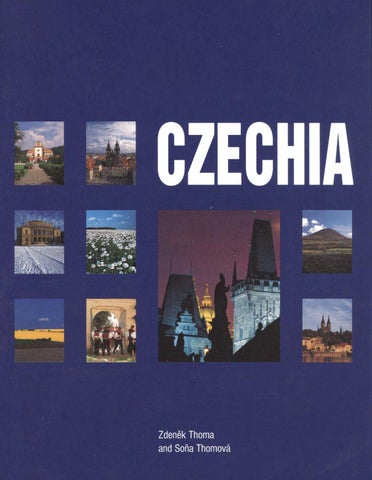
lntroduction ~ .. and this is lhal beautiful country, the Czech Lands, my home...~ as the Czech national anthem says. Ali nations love their homeland, whether it fies in the harsh north of aur planet, covered with snow for most of the year, ar on mountain slopes, in fertile lowlands ar inhospitable deserts. We love aur home, even though we a/so love to travel and gel to know other parts of the world. ff you want to travel, you do not have to head for the Egyptian pyramids, ar the soaring Himalayan heights. Take a look at the very heart of Europe, the Czech Republic. That name covers the historical territories of Bohemia, Moravia and part of Silesia, which have long historical and national lies. The book you have in front of you will show you unique historical and architectural monuments, fairytale towns, venerable customs and festivals, the poetry of the countryside and the changeable charm of mountains and footh1lls. lt is not intended solely for visitors from abroad, bul for everyone who enjoys visiting places and regions which are we/1-known and etose to hand, bul where there is still plenty to discover This list of beauty spots and interesting places in the Czech Republic is not and cannot be complete. We are sure hCNvever lhal your impressions from the distinctive photographs by we/1-known Czech photographer Zdeněk Thoma will piece together an 1mpressive mosaic.
Photography © Zdeněk Thoma Text© Soňa Thomová Translation © Adrian Dean © Slovart Publishing
A little history The history of the Czech Lands (or Čechy in the Czech language) began to unfold at the beginning of the 6th century. An old legend relates that a Slav tribe, led by their chief, Čech, had long roamed the world in search of a place where they could settle. They were by now very tired, and longed for a peaceful life. Just when they had begun to turn against their leader, they reached a hospitable region between the River Ohře and the River Eibe. The leader of the Slavs and some of his loyal followers climbed the rounded hill now known as Říp, gazed far and wide over the landscape, and said: "This is the land I promised you, a land subjugated by no man, tuli of birds and animals, flowing in milk and sweet honey... " His companions, greatly moved. cried aut "You brought is here, Čech, let the land be called after you - Čechy!" Our forefathers' promised land According to archaeological and historical sources, the Slav tribes set aut from their homeland east of the Carpathians on their journey to centra" and southern Europe at the beginning of the 6th century. They arrived in Bohemia sometime in the first third of the 6th century, with a second wave following around forty years later. ln line with the legend, they did indeed first settle in the fertile lowlands around Říp, but it is not known when or how the name Čechy came into existence. lt first appears in a Latin translation as Bohemia (from the name of a Celtic tribe, the Baii, which had settled in the region long before the Slavs arrived), while the Slav version, Čechy, was first recorded in the 1Oth century. By then, the Slavs had accumulated an eventful and colourful history. lt starts witn the powerful Samo Empíre (623 - 658), which successfully withstood raids by the nomadic Avars, and attacks by the Frankish King Dagobert I and continues with the Great Moravian Empíre (early 9th century - 907), which became a partner to tne Frankish Empíre of Emperor Charles the Great Svatopluk I, one of the most powerful Morav1an rulers, controlled not only Moravia, Bohemia, the Cracow region and what is now Slovakia. but. rt is believed, extensive territory to the north-west of the present Czech border. The Christian apostles St. Constantine (Cyril) and St. Methodios were act1ve under Svatopluk's reign. These educated and charismatic brothers from Thessaloniki brought 1,ith them the Slavonic script, a translation of part of the
0ld Testamer Thanks to thE language Th1 for the b1rth o while ,t has be has had a pen of southern a Czech Prince court lt is said t himse~. who d from hlS seat swineherds likf
The age of I ln the yeai Moravian Em attacks by the dukedom wa German conb princes wishe state That Will murdered his I in935 Wenca King Heinrich I and 500 silYer I
; (ar Čechy 1fold at the gend relates :h, had long : where they y tired, and yhad begun ahospitable l River Eibe. 1ya1 followers s Říp, gazed and said: I subjugated 1wing in milk eatly moved, let the land
d historical iir homeland iy to central J of the 6th et,me in the econd wave ine with the 1 the tertile wn when ar ence. lt first 1em1a (from 1had settled r ved), while Jrded in the 1ccumulated starts with 358), which nadic Avars, obert I, and mpire (early artner to the : the Great. ul Moravian ohemia, the <ia, but. it is 1-west of the rn apostles ;were active Jcated and brought with 1f part of the
Old Testament, and Greek ecclesiastical law texts. Thanks to them, masses were held in the Slavonic language. Their mission was of crucial importance for the birth of a distinctive Slavonic culture, which, whileit has been forgotten in Bohemia and Moravia, has had apermanent influence on asubstantial part of southern and eastern Europe Around 883 the Czech Prince Bořivoj was baptised at Svatopluk's court. lt is said lhal he was forcedtodo soby Svatopluk himself, who during a banquet told him to get down from his seat and go and eat on the floor with the swineherds like the heathen he was.
one wished to pul even more power into Přemyslid hands. The insignificant Swabian Count Rudolph of Habsburg was elected in his place. The tension between the two rulers led to the Battle of Marchfield in 1278, near the village of Durnkrut. Přemysl was killed and his army suffered a crushing defeat. That was a catastrophe for the Czech Lands and the Přemysl i ds, opening the way for the Habsburgs to become one of the most important royal families in Europe. Who knows how European history would have turned out if Přemysl had had better luck in battle?
the Czech nobility had placed in the new dynasty. This wise, devout and politically adept man, educated at the French cour!, earned the respect of all of Europe. He became not only King of Bohemia. but Roman Emperor too. He chase Prague as his home, and under his rule theLands of the Bohemian Crown flourished. Everywhere there were new buildings, and a famous university was founded in Prague. The Czech Lands can thank Charles IV for many remarkable Gothic monuments. To this day, he is spoken of in Bohemia and Moravia as the Father of the Country.
The age of Přemyslid rulers The King of Bohemia =,'-'----The Hussite Wars ln the years 905 - 907 the Great does not flee from battle After Charles IV's death, everything Moravian Empíre broke up under Přemysl's son Wenceshe had so carefully built up collapsed. attacks by the Magyars. The Bohemian las li did not have an easy Relations between his son Wenceslas dukedom was at that time under life. At the age of eleven he IV and the nobility were strained, and German control, and the Přemyslid became king of a country there were also attempts to reform the princes wished for an independent ravished by war, !amine J.:!iS::~~~~:.J church, which had become increasingly state. That was probably why Boleslav Menhir near Peruc and plague. He died aged From Great Morav,a remote from the principles of Christian murdered his brother, the pious Prince Wenceslas, just thirty-four, bul under him the Czech Lands had teaching. Tension mounted in the country, climaxing in 935; Wenceslas had pledged to send the Saxony prospered, aided by rich new silver deposits in Kutná after 1415, when the Czech reformist preacher Jan King Heinrich I an annual "peace tax" of 120 oxen Hora. Thanks to him the Prague groschen, the best- Hus was burnt at the stake in Constance, in the and 500 silver talents. Wenceslas was later canonised, known and most valuable Bohemian coin, was minted, Hussite uprising, which lasted al most two decades. becoming the patron saint and protector of the becoming lega! tender throughout Europe for quarter Although the Hussite movement did not have a single Czechs. ln 936, Boleslav I (known as "the Cruel") of a millennium. However, the end of the Přemyslid ideology, therewas agreement on four basic points, defeated Saxony forces and made peace with dynasty was nigh. ln 1306 seventeen-year-old the Articles of Prague. The first article demanded Heinrich's son Otto I, ending fourteen turbulent Wenceslas Ill, the last maledescendant of one of the communion in both kinds, i.e. both the body and years. Boleslav laid down the foundations for the oldest ruling dynasties in Europe, was stabbed todeath the blood of Our Lord - the host and the wine - for mighty Přemyslid state, which while coming under in Olomouc. Chaos was averted by the marrage of al! believers, not just priests; the second article the Holy Roman Empíre, enjoyed a ll'J!lll!ll!!l!ll!!I'.!!'""~-~""-' Wenceslas ll's daughter, demanded punishment for mortal sins distinctive status. ln the long era that eighteen-year-oldElizabeth - murder, bearing false witness, adultery, followed, the Přemyslids reinforced Přemysl, to fourteen-year-old drunkenness and gluttony - regardless with varying degrees of success - their John of Luxembourg, whose of status; and the third article demanded rule in Bohemia, Moravia and central father had been made King the free proclamation of the word of Europe as a whole. Al the end of the of Rome shortly before. God. The fourth and most controversial 12th century, one of the dynasty's most The Czech Lands were not article was against the secular power capable rulers, Přemysl Otakar I, came dear to Sir John, who spent wielded bychurch dignitaries, and included to power. ln 1212 the Roman Emperor his time in tournaments, . =:;.___..:;.; a call for the confiscation of church Frederick li issued the Sicilian Golden Constantine and Meihodios wars and battles. He was The Rotunda at Vysehrad property. These calls for religious reform Bull, confirming hereditary kingship for Bohemia. not only a great fighter, but also a skilful diplomat; were ahead of their time, and were rejected by the The grandson of Přemysl Otakar I, Přemysl Otakar li, "nothing can be done without the King of Bohemia", rest of Europe. nicknamed the iron and gold king, achieved a as they said in Europe. He died, blind, in the Battle The Hussites did not only fight the local number of remarkable successes. He was King of of Crécy, and his last words were apparently Catholics, but also successfully withstood armies of Bohemia, Margrave of Moravia, Duke of Austria, "God forbid that the King of Bohemia should flee crusaders from the German regions of Hungary, Styria and Carinthia, and controlled Chebsko, Krain, from battle!'' Silesia and Lusatia, who strove to eradicate the Ostmark and the city of Pordenone. Northem "Bohemian heresy". One of the battles took place ltalian cities, including Verona, came under The Father of the Country in 1420 on Vítkov Hill in Prague. Hussite warriors, his protection. lt is no wonder that he sought the Charles IV, the son of Elizabeth Přemysl and led by Jan Žižka of Trocnov, defeated a much larger title of Roman Emperor, but that was not to be, as no John of Luxembourg, fulfilled all the hopes which army of crusaders. Fourteen years later, however,
5
all had come to nothing. ldeological differences had splintered the movement, and the radical Huss1tes were defeated at Lipany by the united forces of Bohem1an Catholic nobles and moderate Hussites. Charles IV's second son, Sigismund of Luxembourg, King of Hungary and Roman Emperor, was a skilful poli!ician, but he was extremely Uf)popular in Bohemia, where he was nicknamed the red fax. Although he had fought hard against the Hussites, he now reappraised thesituation and, with the Bohemian throne in sight, granted them the rights formulated in the Articles of Prague. The King of "Two Peoples" After Sigismunďs death,the throne went to his son-if)-law Albrecht of Habsburg. ln 1439 Albrecht died, and following an interim period, his son Ladislav Pohrobek took the throne. -The charming, golden-haired king died in mysterious circumstances at the age of seventeen; we now believe the cause of death to have been leukaemia. There was speculat1on that he had been poisoned by the provincial administrator and leader of the Hussite s1de, George of Poděbrady. Those false accusations did not however prevent the latter from being elected as the new King of Bohemia at a stormy assembly For the Hussite majority in the nation, he embodied hopes that their ideas would be respected rather than suppressed. One of George of Poděbrady's noteworthy deeds as king was a project for a peace confederation, which he presented at the courts of western European rulers. The irntiative was however ahead of its time, and the proposal met with little understanding - perhaps because Europe regarded the King as a man "of mediocre descent", and ruler of a heretical nation George of Poděbrady tried to be a good ruler of "two peoples" - Utraquists and Catholics. He did not succeed. At the end of his life, he had to f1ght both Catholics and fore1gn enemies, leo by King Matthias Corvinus of Hungary. lt is estimated that at the time of his death, the population of the Kingdom of Bohemia had shrunk by as much as 30 percent in consequence of the Hussite wars.
From the Good King to three centuries of Habsburg rule The usual opinion of Vladislav li Jagiello does him a disservice when it refers to him as a weak ruler, who agreed to everything by uttering the
nobles, and had four culprits executed as a warning. He instated a governor in Bohemia, his younger son Archduke Ferdinand of the Tyrol. While the art-loving archduke was no tyrani, enjoying romantic interludes here with his secret wife, word"gooď .U nderhisrule ( 1471-1516)tensions a beautiful and gentle town girl called Filipína eased and the lands of the Bohem1an Crown were Welserová. and workmg on the enchanting Hvězda u11ce more united, as after the death of Matth1as summer palace in Prague, he was nevertheless Corvinus the Hungarian throne went to Vladislav. a reminder to the Czechs of their subordmate Throughout the country, and especially in Prague, status. At the end of the sixteenth century, the there was much new building work. Among the Habsburg Emperor Rudolph li moved his court to most beautiful monuments Prague. For a short time, the Czech from that time are the ~~--=~""~'""l,.,ll!'I_. Lands stood once more at the centre Vladislav Hall at Prague of Europe. The reserved and eccentric Castle and the Royal Emperor, more interested inart and the Oratory in St. Vitus·s occult than in ruling, was continuously Cathedral. Vladislav's son, threatened by his ambitious brother Ludwig Jagiello, died in Matthias. ln 1609, Czech Protestants 1526 at the Battle of forced Rudolph - under threat of dis--. _.:.:_........,. Mohács. He was leading obedience - to s1gn a Leiter of Majesty, Leo,,ý Hradec a Christian army which Sázava hymn book guaranteeing them religious freewas trying to stop forays by Turkish soldiers. dam, something unparalleled in Europe at the The battle lost, the twenty year old ruler drowned time. However, that state of affairs was not to last in a marsh while fleeing. The Bohemian Estates even ten years ... again had to elect a king. They were to pay a heavy price for their haste, and for 1gnoring the views Traitors out of the window of the countries neighbouring Bohemia - Moravia, the beginning of the Thirty Years' War Silesia and Lusatia. They elected the ambitious ln the years 1618 - 1620, the Bohemian twenty-three year old Ferdinand I of Habsburg, the Estates tried once more to free themselves from husband of Ludwig's sister Anna Jagiello, little Habsburg rule. The spark that led to open conflict suspecting that in doing so they were stripping their was the prohibition of assemblies of the Bohemian country of its sovereignty Estates. and a false report that two for over three hundred royal governors, the Bohemian years, leaving them with Catholic nobles Wilhelm Slavata of no way of influencing the Chlum and Jaroslav Boři la of Martinic, country's affairs. were planning to persecute their Protestant rivals. A secret meeting of The Bohemian furious Estates politicians in Smiřický Estates are lured Palace in Malá Strana resulted in a by promises march on Prague Castle, where the St Wenceslas Ferdinand I had promBuch/(!1 Castle angry nobles found the governors in ised a great deal - the payment of royal debts, their office. Alter brief verba! exchanges, Wilhelm religious freedom, the inviolability of the Estates' Slavata and Jaroslav Bořila were thrown aut of the riahts - and had also promised to reside in Prague. window into the moat as traitors. 0espite his lt soon became clear that he would not keep his desperate pleas for mercy, their secretary promises. He settled in Vienna, where he worked followed them there. Miraculously, all three survived to increase his power and support the Catholics. the seventeen-metre drop. The place in the Na That resulted in 1547 in open resistance, which valech garden where they landed is marked today was almost immediately severely suppressed. by three sandstone obelisks. The defenestrat1on Ferdinand circumscribed the powers of the royal was the beginning of the Thirty Years' War, wh1ch cities, confiscated the property of a number of raged through Europe.
fITT __ ~
6
swift Thos who d1d no captured, a were exec Square n extens1ve
conversion of them of those
das awarnJhemia, his 1f the Tyrol. yrant enjoysecret wife, 1lled Filipína 1ting Hvězda 1evertheless subordinate century, the his court to , the Czech it the centre nd eccentric nart and the ~ontinuously ous brother Protestants threat of dis:r of Majesty, 1gious freerope at the 1s not to last
·s'War
i Bohemian 1selves from )pen conflict 1e Bohemian ort that two Bohemian 1Slavata of 1of Martinic, ecute their t meeting of ; in Smiřický 3sulted in a 1, where the Jovernors in 1es, Wilhelm vn aut of the Despite his · secretary iree survived e in the Na 1arked today 1fenestration 'War, which
Although initially the Bohemian Estates tried to negotiate with Emperor Matthias of Habsburg, the situation resulted in a split. Following Matthias's death in 1619, the Czechs refused to recognise Ferdinand li as their ruler, electing the leader of the Protestant Union, Frederick Falcký, as their king. As his nickname, the Winter King, suggests, he did not sit on the Bohemian throne for long. The uprising against the Habsburgs was soon quashed by the defeat of the Bohemian Estates at White Mountain. The battle itself lasted just two hours, but had unforeseen consequences for the Czech Lands ...
and its expression in form." The style, born in sunny Italy, gradually took on a uniquely Czech appearance, changing the face of the Czech Lands. Wonderful Baroque palaces, chateaux, churches, sculptures, fountains, town houses and charming rustic buildings are to be found at every turn. Many of those monuments are among the fines! examples of Czech culture.
to which animal and vegetable matter consists of cells of protoplasm, and the "greatest Czech" of the 19th century, František Palacký, who published the first Czech-language "History of the Czech Nation in Bohemia and Moravia". The revolutionary year of 1848, with armed uprisings in European countries, brought Czech patriots to the barricades.
The troubled 20th century The Peasant Emperor Until 1918 the Czech Lands remained part and the Czech Revival of the Austro-Hungarian monarchy, The Habsburg dynasty finally gaining independence after ruled from Vienna. The World War One. The first president of Czech Lands, although the Czechoslovak Republic, Tomáš The Counter Reformation and they had previously been Garrigue Masaryk, had played a great the Baroque one of the most advanced role in bringing about the Republic's Retribution for disloyalty was regions of centra! Europe, existence. The unstable political swift. Those leaders of the uprising gradually fell behind. ln situation in Europe following Hitler's rise who did not manage to escape were the countryside, where to power climaxed in World War Two, captured, and twenty-seven of them serfdom made life very The intenor of the Church du ring which Czechoslovakia was were executed on the OId Town Jan ližka of Trocnov hard, there was often open of St Nicholas occupied by Germany, curtailing the Square in Prague. That was fol lowed by the resistance. One hundred years after extensive seizure of property. Confiscated thP end of the Thirty Years' War, Empress Maria positive political and economic developments in estates were given to Catholic nobles to reward Theresa acceded to the Austro-Hungarian throne. the country. Alter the war had ended, Czechotheir loyalty to the Emperor, and to foreign Under her rule, compulsory school attendance slovakia came under Soviet influence. ln 1948 nobles and officers of the imperial army. The was introduced, and serfdom was amel iorated. the Communist Party came to power, followed by Bohemian elite emigrated en masse, among them The reforms continued under her son Joseph li, mass arrests and fabricated political trials, the important Czech thinker and member who ruled from 1780 to 1790. An enlightened often ending in the death penalty. ln 1968 there of the Unitas Fratrum, Commenius, famous for his ruler, dubbed the Peasant Emperor, he curtailed was an unsuccessful attempt to reform communism, pedagogical and theological writings, and known the rights of the church in favour of the which was al most immediately put down by Warsaw to this day as the teacher of nations. Ordinary state, abolished serfdom, and issued an Edict of Pact troops. ln 1989 the country toppled the communist regime in the Velvet towndwellers and farmers also fled Toleration, allowing freeRevolution, which restored democraabroad, rather than face forcible dom of belief. Alter more cy after decades of totalitarian rule. conversion to Catholicism. The majority than 150 years of perOne more event was to influence the o! them were never to return. Most secution, non-Catholics history and the borders of the Czech of those who remained gave in to could finally proclaim their Lands, when Slovakia became inpressure and converted to Catholicism. faith openly and without dependent in 1993. The wounds wreaked by wars, emigratfear. ion and forcible conversion have never The long years of entirely healed. Habsburg domination had That is just a small part of the Even though history had not turned Tyc/Jo Brahe resulted in astrong German The Prague Secession colourful and eventful history of the out as desired by the leaders of the Bohemian influence in society. At the beginning of the 19th Czech Lands. Much has been left out, but there is Estates, things were not entirely bad. The Catholic century, new Enlightenment ideas resulted in enough to give you an idea of the events which Church, which had once again begun to play the an awakening of the national consciousness, formed the local people and culture, which while main role, brought the Baroque to the Czech which was particularly apparent in the arts and distinctive, remains firmly tied to the other countries Lands. This spectacular, at times grandiose style sciences. Czech was heard on theatre stages, of centra! and western Europe. extended to all areas of the arts, and became away and Czech-language boo ks and newspapers of life. The French historian V. L. Tapié says of it: began to appear. Theera is closely linked with the "The Baroque is a timeless example of what can- names of famous Czech thinkers, including the not be expressed by rules or regulations; it is the scientist and doctor Jan Evangelista Purkyně, bearer of the eternal constancy of the human soul who discovered cellular theory, according
Although we know a good deal about castles - who they belonged to, who built them, and in 1"11ich style - they still keep some secrets. Take for instance Rožmberk, the cradle of the south Bohemian Vítkovec dynasty. The castle was founded at the beginning of the 13th century, and the last Rožmberk, the temperamental Peter Vak, died in 1611. Sixteen comely women and girls apparently attended on him on his manyestates. As his chronicler says, 'they had the keys to everything, they served their lord at the table, and tended to him da,, and night". Or the moated Š~hov Castle, a unique structure whose appearance is unlike any other fortified residence 1n Bohem1a. The thick walls and protruding rounded towers allowed shooting along the ramparts, and if needed defenders could flood the surrounding area, making the castle impregnable. Not even the Swedes could conquer it during the Thirty Years' War. Benedikt Rejl, one of the builders of Prague Castle, worked on ŠVihov from 1480 to 1504. At that time the owner was Půta Švihovský, the Supreme Magistrate of the Kingdom of Bohemia. When he suddenly died in 1504, it was rumoured that the devil had taken Půta to hell, and a holeyawned in the castle's roof - if repaired, it would only be there again 1n the morning.
Rožmberk Castle in southern Bohem/a
The mighty towers of Zvíkov Castle
92
9
Landscape
31
Prague
Towns and cities
67
History
85 103
The Countryside
Zdeněk
Thoma and S o ňa Thomová CZECHIA
Copyright© Slovart Publlshing, Prague 2002, 2006, 2011, 2017 Photography © Zdeněk Thoma Text © Soňa Thomová Trans1at1on © Adrian Dean Fourth Czech ed1tion Graphic designer: Mgr. Art Braňo Gajdoš Editor: Jana Steinerová Copy editor: Richard Drury Typeset by: Typocon, s. r. o., Bratislava Printed by: TBB, Banská Bystrica Ali rights reserved. lt ,s forbidden to use this publicalion, or arr; part of -~for reprod~lion or storage in a research S'/Stem, or to disseminate it by any means whether electromcal y, mechan:ca11y, by COJ)'fing recoding or otherw se, 1·1.tnout the copyright holder's consenl
IWIW.slovart.cz
10 9 8 7 6 5
ISBN 978 - 80- 7529- 381- 7
"iJIDI