The KM Malta Airlines In-Flight Magazine
ISSUE 23
September 2026
PG 52
PG 33
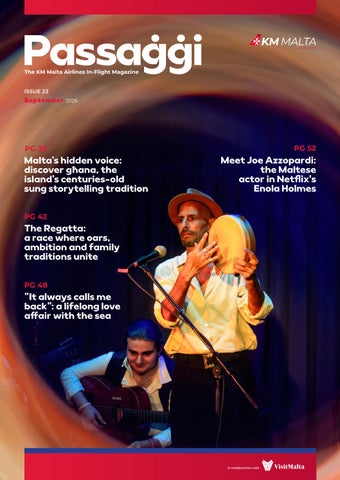
Malta’s hidden voice: discover għana, the island’s centuries-old sung storytelling tradition
Meet Joe Azzopardi: the Maltese actor in Netflix's Enola Holmes
PG 42
The Regatta: a race where oars, ambition and family traditions unite PG 48
“It always calls me back”: a lifelong love affair with the sea
in collaboration with
BEHIND ???????? PASSAĠĠI
The KM Malta Airlines In-Flight Magazine
ISSUE 23
September 2026
PG 52
PG 33
Malta’s hidden voice: discover għana, the island’s centuries-old sung storytelling tradition
Meet Joe Azzopardi: the Maltese actor in Netflix's Enola Holmes
PG 42
The Regatta: a race where oars, ambition and family traditions unite PG 48
“It always calls me back”: a lifelong love affair with the sea
in collaboration with
ON THE COVER Andrew Alamango’s Folk Underground. Photo: Elisa Von Brockdorff.
MEET THE TEAM DESIGN forty Creative Studio
PUBLISHER Associated News Group
EDITOR
PRINTER
Fiona Galea Debono
Gutenberg Press
SALES AND BUSINESS DEVELOPMENT
PHOTOGRAPHERS
Associated News Group
Alex Boulton Andre Gialanze Atelier del Restauro Carmel Saliba David Carabott Elisa Von Brockdorff Grace Fowler John Wilson Nicholas Falzon Raymond Gialanze Tony Gatt
CONTRIBUTORS Adriana Bishop David Carabott Edward Bonello Iggy Fenech Inkontru.app Lea Hogg Ruth Zammit DeBono Veronica Stivala
WOULD YOU LIKE TO BE FEATURED IN PASSAĠĠI? For advertising opportunities, get in touch with Associated News Group on passaggi@tbwa-ang.com or (+356) 2131 0608 Abigail: abigail@tbwa-ang.com or (+356) 9929 0518
HOW TO PRONOUNCE PASSAĠĠI
/pasˈsadʒi/ Here’s the breakdown: • /p/ as in pass • /a/ as in art • /sˈ/ as in sun (with stress on the following syllable) • /dʒ/ as the sound of the j in 'judge' (geminated or doubled sound) • /i/ as in eat The word passaġġi means 'passages' in English.
The publisher, authors and contributors reserve their rights with regards to copyright. No part of this magazine may be reproduced or copied by any means without the written consent of the publisher. Editorial features and opinions expressed in Passaġġi do not necessarily reflect the views of KM Malta Airlines, the publisher, or the editorial team. Both KM Malta Airlines and the publisher do not accept responsibility for commercial and advertising content. Although the authors and publisher have made every effort to ensure that the information in this magazine was correct before going to print, the author and publisher do not assume and hereby disclaim any liability to any party for any loss, damage, or disruption caused by errors or omissions, whether such errors or omissions result from negligence, accident, or any other cause. Special thanks to KM Malta Airlines and Visit Malta for the provision of photographic material. All magazine rights are reserved by KM Malta Airlines.
Associated News Group, 3rd Floor, Professional Building, Sliema Road, Gżira GZR 1633 Malta - (+356) 2131 0608
2
Your Luxury Real Estate Partner Residential & Commercial Sales & Letting Property Management Residency & Relocation
Scan to Contact Us
+356 2010 8077 • +356 9910 8070 info@maltasothebysrealty.com maltasothebysrealty.com
— Portomaso Marina, St. Julian’s — Pjazza Tigné, Tigne Point, Sliema
Welcome to The KM Malta Airlines In-Flight Magazine
David Curmi
Executive Chairman KM Malta Airlines As the busy summer travel season continues, I would like to thank all our passengers who have chosen to travel with KM Malta Airlines over the past few months. We are proud to connect thousands of travellers with family and friends, business opportunities and memorable holidays across our growing network. Providing an excellent customer experience remains at the heart of everything we do. We are therefore delighted to share that our Customer Satisfaction (CSAT) score reached 90.1%, while our Net Promoter Score (NPS) increased to 33.3 during July 2026. These results reflect the trust our passengers place in us and, importantly, the dedication of our employees, who work every day to deliver a safe, reliable and welcoming journey. While we are pleased with these results, we continue to look for ways to improve every aspect of the customer experience. Our KM Rewards loyalty programme continues to go from strength to strength, with more than 128,000 members now enjoying the benefits of being part of our growing loyalty community. We are delighted to see so many passengers choosing to join the programme, and we look forward to introducing further benefits and exclusive offers that will deliver even greater value to our loyal members in the months ahead. For those already planning their next trip, our flights for Christmas 2026 and Easter 2027 are already on sale, with bookings available as far ahead as July 2027. We encourage passengers to plan and book early to secure their preferred travel dates and benefit from the widest choice when arranging their holidays.
4
Holiday planning has also never been easier with KM Malta Holidays, bringing flights and hotels together in one convenient package. Packages include 20kg checked baggage as standard, ATOL protection for added peace of mind, and the flexibility to add airport transfers or car hire, allowing you to tailor your holiday to your individual needs. Whether you are planning a short city break or a longer escape, KM Malta Holidays offers excellent value and a seamless booking experience from start to finish. Finally, while air travel should be an enjoyable experience, we all have a responsibility to ensure that every journey remains safe and pleasant for everyone on board. Respect for fellow passengers and our crew, together with cooperation with crew instructions, is an essential part of maintaining a safe environment on board our aircraft. I encourage you to read our feature on unruly passenger behaviour on PG 84, which explains why courtesy, cooperation and responsible behaviour are so important to the safety and well-being of everyone travelling with us. As Malta's national airline, we remain firmly committed to providing safe, reliable and customer-focused air travel while strengthening Malta's connectivity with Europe and beyond. Thank you for choosing KM Malta Airlines and for placing your trust in us. We look forward to welcoming you on board again soon.
Fiona Galea Debono Editor
It’s another one of those issues where I would have liked to highlight so many stories on the cover. Each deserves attention, and each goes beyond the clichés so often associated with promoting this tiny tourist island. In truth, there is so much more to Malta, and we hope to be your guide to an island that is about far more than sun, sea and fun. Locals often travel to other Mediterranean islands in search of the authenticity that, more often than not, lies just around the corner at home. Thanks to Passaġġi’s crop of passionate writers – well-seasoned travellers in their own right, who know what to seek out on their journeys and whose love for the Maltese Islands is tangible – we bring you the people, places and stories that reveal what really makes Malta Malta. From stories told by the soil and the produce of earth scorched beneath the Maltese sun, to the local actor spreading his wings internationally while playing a distinctly Maltese character; from the women rowers who have earned their place in the Regatta, Malta’s oldest sporting competition, where family and tradition carry a weight far beyond the race finish line, to the family that has transformed its former quarry into an educational and cultural hub, offering insight into one of the island’s oldest trades and preserving the traditional craftsmanship behind its limestone heritage, Malta comes alive through the personalities who inhabit, experience and shape these islands.
surrounding waters; and through the musician giving għana, Malta’s living vocal tradition, an underground platform that is propelling it into the spotlight and inviting new audiences to discover the rich world of this distinctive folk tradition. The days may finally be cooling down, but the islands’ cultural calendar shows no sign of relenting. Alongside the return of centuries-old sung storytelling for locals and visitors alike, candlelit museums, open-air theatre, fun improv, eye-catching exhibitions and even robots at Valletta’s Triton Fountain are all set to fill your holiday itinerary. We’ve listed these, as well as the last of the village feasts that will bring the season to a spectacular close, to help guide you through Malta this month. The Grand Harbour features prominently in this issue: as the backdrop to the Regatta and important feasts, and even in the limestone buildings that give its sweeping views their distinctive golden glow as Malta’s warm, honey-coloured light catches the island’s characteristic stone at sunset. A country is not just its places, but also its people. And Malta is no exception. The islands can be tasted, heard, felt and experienced in all of the above. The idea is simply that you find what tickles your fancy – whether you’re a traveller looking for something beyond the usual sightseeing itinerary, or a local curious to rediscover a part of your own heritage.
Different perspectives of Malta and Gozo emerge through the eyes of a meticulous conservator, whose trail of restored and revived artworks allows us to appreciate them anew; through a deep love of the sea and the profound personal feelings inspired by Malta’s
5
????????
Contents ISLANDS 8
33
Malta in one sweeping view The Grand Harbour brings it all together
TRAVEL 16
Munich outdoors Bavaria’s capital is a great family getaway
HERITAGE 20
Malta's limestone story Globigerina stone has defined the island's architecture
CULTURE 24
This month’s must-see events September’s cultural calendar is heating up
BOOKS 30
From Malta to the world Hosting the launch of Inter The Opus World Tour
MUSIC 33
Underground, but alive and well
38 42
Discover għana, a tradition of sung storytelling
ART 38
Bringing Malta's treasures back to life Follow a conservation trail to rediscover the islands’ artworks
ACTION 42
Oars, ambition and family Meet a rowing team behind the Regatta 6
????????
NATURE 48
Drawn to the sea Feeling like home and offering freedom
MOVIES 52
“Free Malta!” Actor Joe Azzopardi on his Netflix revolutionary hero role
ENTERTAINMENT 56
Festa season closes with a bang
52
Your guide to the grand finale of feasts
56
PETS 62
Roy walks the runway The confidence that comes with a dog that travels
PEOPLE 64
The name is Bajada, Toni Bajada His daring swims across Grand Harbour impacted the Great Siege
GOZO 68
The island of the Three Hills Discover these peaks and how they shaped its character
FOOD 73
Pork to plate: the story of Malta’s zalzett A taste of history and home
76
Under the Maltese sun A tomato’s travels from soil to table
AIRLINE NEWS 83
Flight, company and destination information All you need to know about flying with KM Malta Airlines
76 7
???????? ISLANDS
Words by
Lea Hogg Lea is a Malta-based journalist and writer, known for her TV programme on current affairs, cultural news and in-depth interviews about politics and global issues.
Malta in one sweeping view The Grand Harbour combines experiences that usually require separate journeys: a remarkable natural harbour, one of Europe's great fortified landscapes, a living maritime centre and an extraordinary concentration of architectural history. If your stay in Malta allows time for one single view, choose this for the island's story in one place. 8
Malta's Grand Harbour and the Saluting Battery.
???????? ISLANDS
There are few arrivals in the Mediterranean that can prepare you for the first sight of Malta's Grand Harbour. However many times I have made the journey, the moment never loses its power. As the plane banks towards the island, I find myself drawn instinctively to the window, waiting for that familiar glimpse. Then, almost without warning, it appears. A month ago, returning to Malta after a brief absence, I experienced that involuntary suspension of breath all over again. The Grand Harbour emerged beneath the wing with such sudden theatricality that it felt almost unreal. Yet there was no digital enhancement, and this is no carefully composed film set. The spectacle is entirely natural: sunlight pouring across honey-coloured limestone,
bastioned walls rising from impossibly blue water, and fortifications, churches, terraces and limestone architecture somehow brought together by that Mediterranean light. There is, indeed, a unique quality to the light in Malta. It is the same quality that artists have captured for centuries: the way the Mediterranean sun falls on the limestone, transforming its warm golden surfaces into an almost luminous glow. The effect is particularly striking around the Grand Harbour, where the stone fortifications catch the light and seem to change character as the day moves on. The Grand Harbour is, of course, one of Europe's great historic anchorages.
9
Valletta's Upper Barrakka Gardens at sunrise.
???????? ISLANDS
For centuries, it has been a natural gateway into Malta, attracting merchants, sailors and naval powers because of its deep, sheltered waters and strategic position in the centre of the Mediterranean. Phoenicians, Romans, Arabs and later European powers all recognised its importance. The Knights of the Order of St John made it the centre of their power on the island, and after the Great Siege of 1565, they built Valletta above the harbour as a fortified city capable of defending it. This month, the Grand Harbour once again comes alive with the Malta Regatta, as crews take to the water in a vivid display of rowing, tradition and maritime pride. Watching
10
the boats race across the historic harbour is a timely reminder that Malta's relationship with the sea is not simply historical. The same water that once carried the fleets of empires still shapes the life and identity of the island today. (See story on PG 42.) That history remains remarkably visible. Valletta's enormous bastions rise directly from the water, while across the harbour lie Birgu, Senglea and Cospicua, collectively known as the Three Cities. The result is not a collection of monuments separated from ordinary life, but an entire historic landscape. Churches, palaces, walls, docks and houses occupy the shores and hillsides, making it possible
to read Malta's history simply by looking across the water. The best way to understand the scale of the harbour, however, is to leave the land behind. From a traditional dgħajsa, or one of the harbour cruises, the perspective changes completely. The walls that appear imposing from above become immense when viewed from the water. You pass beneath bastions, move into the narrow creeks and look back towards Valletta from an angle that reveals how carefully the cities were positioned for defence. From the Upper Barrakka Gardens, the view is almost the reverse. Standing high above the harbour, you can see across to the Three
????????
These places allow the visitor to understand how closely Malta's architecture and history have always been connected to the sea Cities and Fort St Angelo, with the water filling the spaces between the fortifications. Yet it would be a mistake to think of the Grand Harbour as a place preserved in the past. It remains intensely alive. Ferries cross between Valletta and the surrounding towns, boats move through the creeks, and the waterfront continues to function as it has for centuries. The harbour is part of everyday life for the people who live around it, rather than simply a backdrop for visitors. For them, the harbour also provides a remarkably concentrated introduction to Malta. Valletta offers the grandest expression of the Knights' legacy, with its baroque churches, palaces and defensive walls, while the Three Cities offer a more intimate experience, with narrow streets, old waterfronts and fortifications that predate Valletta. Fort St Angelo, standing at the tip of Birgu, provides another perspective on the harbour and its military history. Taken together, these places allow the visitor to understand how closely Malta's architecture and history have always been connected to the sea. But for me, it is still the view that remains strongest. Perhaps because I first see the harbour from the aircraft before I have had time to think about its history, or identify its monuments, I experience it simply as a landscape. The details come afterwards: the bastions, the churches, the boats, the old cities and the extraordinary depth of the harbour itself. Every return reminds me why this place has held the attention of sailors, artists and historians for centuries. The Grand Harbour manages to combine the things that usually require separate journeys: a remarkable natural harbour, one of Europe's great fortified landscapes, a living maritime centre and an extraordinary concentration of architectural history. If your stay in Malta allows time for only a single view, I would choose the Grand Harbour without hesitation. For here, in one sweeping glance, you have the island's history in one place: the past and the present, the story of the Knights of St John and their fortifications, of sailors and merchants who crossed the Mediterranean, of empires that fought for control of this strategic harbour, and of the limestone architecture that has defined Malta for centuries. From Valletta and the Three Cities to Fort St Angelo and the harbour itself, it is the place where Malta's history, architecture and relationship with the sea come together most completely.
suggests
Places in and around the Grand
Harbour
.....
St John’s Co-Cathedral Valletta Adults €15; seniors/students €12; children under 12 free when accompanied by an adult. Opening hours: Monday - Saturday, 9am - 4:45pm (last admission 4pm); closed Sundays and public holidays.
Upper Barrakka Gardens Valletta Entry is free. Open daily: 7am 10pm. Saluting Battery terrace: €3 for adults; €2 for children. Traditional cannon firing: daily at noon and 4pm.
The Three Cities Vittoriosa (Birgu), Senglea (Isla) and Cospicua (Bormla) Explore medieval lanes, waterfronts, fortifications and centuries of maritime history.
Harbour cruises Take a boat trip in a dgħajsa because the scale of the fortifications is best understood from the water.
Fort St Angelo One of the most important defensive sites in the harbour, with links to the Knights and Malta's military history.
11
Wied il-Mielaħ Window
Salt Pans
29
25 ‘Kappar’ Capers
Żebbuġ
26
Tal-Mixta Cave
Għasri
27
Għarb
23
San Lawrenz Xagħra Victoria
24
Qala
Nadur 28
‘Bużbież’ Wild Fennel
Għajnsielem Sannat
Mġarr 22
Sanap Cliffs
M
COMINO
ġa rr-
GOZO
KEMMUNA
21
Ċi ew rk w
G Ħ AW D E X
aM
Crystal Lagoon
Passenger Ferry
ġa rr 12
Vehicle & Passenger Ferry
Ċirkewwa
Red Tower
S T P A U L’ S ISLAND
06
Mellieħa
01 Popeye Village
16 St Paul’s Bay
‘Bajtar tax-Xewk’ Prickly Pears
09 ‘Frawli’ Strawberries 08 Mġarr 05
Mos ‘Merill’ National Bird
Rabat
Airport (MLA)
Grand Harbour 8.1km
01
02
Dingli
B
BEACHES 01 02 03 04 05 06 07 08 09 10 11 12 13 14 15
12
Anchor Bay Armier Bay Balluta Bay Delimara Point Fomm ir-Riħ Għadira Bay Għar Lapsi Ġnejna Bay Golden Bay Marsascala Bay Marsaxlokk Bay Paradise Bay Pretty Bay Salina Bay St George's Bay
Dingli Cliffs
16 17 18 19 20 21 22 23 24 25 26 27 28 29
St Paul's Bay St Peter's Pool St Thomas Bay Wied iż-Żurrieq Xrobb l-Għaġin Blue Lagoon Santa Marija Bay Daħlet Qorrot Dwejra Bay Marsalforn Bay Ramla Bay San Blas Bay Xlendi Bay Xwejni Bay ~ Salt Pans
07
‘Lampuki’ Dolphin Fish
‘Xemx’ Sun
The Siege Bell War Memorial in Valletta.
INSTAGRAMMABLE SPOTS AROUND THE GRAND HARBOUR
KM Malta Airlines Airbus A320neo
a-
Bu
ġ ib
ba
-M
Mġ
14
ġa
ar
rr
r-V a ll
et
ta
-M
ġa
rr
The St Elmo Breakwater Bridge.
em
M A LT A Pembroke 15
Għargħur St Julian’s
Naxxar
Sliema
sta
Gżira
03 02
Valletta Upper Barrakka Gardens
Birkirkara ‘Ħobża tal-Malti’ Maltese Bread
The view from the Lower Barrakka Gardens.
S li
Birgu Qormi
Żebbuġ
10
Buskett
18
Żejtun
01
Marsascala
Luqa 20
Marsaxlokk
Qrendi
‘Qarnita’ Octopus
11
Żurrieq
17
13 19
04 sponsored by
FILFLA ‘Luzzu’ Traditional Fishing Boat
13
Must-see sites
???????? ISLANDS
Words by
Heritage Malta The national agency for museums, conservation practice and cultural heritage, it is the guardian of over 8,000 years of history.
If this is your first visit to the Maltese Islands, you cannot leave without ticking these sites off your list. National Museum of Archaeology
Valletta
With artefacts dating back from Malta's Neolithic period (5900-2500 BC) up till the early Phoenician period (8th6th century BC), the National Museum of Archaeology is definitely your first step to understanding the richness of the land you tread on, its people and their ancestors. Its ground floor is dedicated to the Neolithic period, while the upper floor currently houses the Bronze Age and the Phoenician period sections. The museum regularly hosts temporary exhibitions.
Fort St Elmo and the National War Museum
Valletta
The splendid, unobstructed views of Grand Harbour, enjoyed today from Fort St Elmo, originally served the purpose for which the star-shaped fort was built – to face and hold back the wrath of the Ottoman armada. The National War Museum, located within the fort, is divided into seven sections and covers 7,000 years of Maltese military history from the Bronze Age until Malta’s accession to the EU. Notable artefacts include military armour of the Order of St John and the Ottoman Turks, while World War II is the most represented conflict in the museum. Highlights include the Gloster Sea Gladiator N5520, Faith, Roosevelt’s Jeep ‘Husky’, and Malta’s award for gallantry, the George Cross.
Ġgantija Archaeological Park Xagħra, Gozo The Ġgantija Archaeological Park complex is a unique prehistoric monument listed by UNESCO as a World Heritage Site. Situated in Xagħra, it consists of two structures built between c.3600 and c.3200 BC. Notwithstanding its age, the monument survives in a considerably good state of preservation. Entrance to the Ġgantija Archaeological Park is through an interpretation centre, which houses a selection of the most significant artefacts discovered at various prehistoric sites in Gozo.
14
???????? ISLANDS
Ta’ Kola Windmill Xagħra, Gozo Imagine... a bright new morning with just the right wind; a miller letting the locals know by blowing through a triton shell; the villagers bringing their cereals to be ground into flour. Ta' Kola Windmill is a unique relic of breadmaking in Gozo, transporting you back to such a morning. This 300-year-old building is a living testimony to our forefathers' way of life, marked with hardships and daily struggles, at a time when bread was the most indispensable food item. The exhibits inside the windmill belonged to the last miller residing there and were used to operate and maintain the building and milling mechanism.
Ħal Tarxien Prehistoric Complex Ħal Tarxien
Have the honour and the privilege of stepping inside a UNESCO World Heritage Site! Discovered in 1913 by farmer Lorenzo Despott, the Hal Tarxien Prehistoric Complex consists of four megalithic structures built in the late Neolithic and then re-adapted for use during the Early Bronze Age. The site was excavated between 1915 and 1919 by Sir Themistocles Zammit, Director of Museums at the time. This year marks the 110th anniversary since the first sketches of the site were made by Zammit himself during the initial excavations.
National Museum of Natural History Mdina The National Museum of Natural History in Mdina is housed within Palazzo Vilhena, a Parisian baroque palace commissioned in 1724 by Grand Master Antonio Manoel de Vilhena and designed by Charles François de Mondion. Before becoming a museum, the building served as a temporary hospital during the 1837 cholera outbreak, later a British military sanatorium, and eventually a tuberculosis clinic until 1956. Inaugurated in 1973, the museum is dedicated to the acquisition, curation and conservation of Malta’s biological and palaeontological heritage. Its collections include thousands of minerals, geological specimens, birds, mammals, molluscs, insects and fossils, displayed through thematic exhibitions and supported by active research and public outreach.
15
???????? TRAVEL
Words by
Veronica Stivala Veronica is an editor and writer based in Munich and mother to two wonderful boys. She runs her own company at ittra.eu, where she helps businesses find their stories.
Munich outdoors The English Garden in Munich. English Garden Park, Munich.
From the zoo to nature parks, rivers, streams and leafy gardens, Munich makes for a great holiday destination for families with children of all ages. Follow these insider tips to being outside in Bavaria’s capital.
16
????????
I’ll never forget the article I once read by a dad who lamented the woes and tribulations of travelling with the children, while praising the simple pleasures of staying home and simply exploring nearby attractions. Yet while this has a lot of truth in it, there is also a lot of truth to the expression that travel broadens the mind… and a change of scene does wonders for everyone. Munich is a top holiday destination for families as it has a wide variety of entertainment options within easy reach for grown-ups and children of all ages. It gives the kids room to run, water to splash in, animals to meet and ice cream to look forward to, while their parents can enjoy the city’s parks, riverside paths and beer gardens. Hellabrunn Zoo deserves pride of place on a family itinerary, and for good reason. Munich’s historic geo-zoo stretches across a generous landscape in the south of the city, where animals are arranged by habitat rather than by mere convenience, and where little legs are kept happily busy by playgrounds, a train ride and plenty of places to pause. The large play area near the restaurant is a welcome gift to parents, who can watch their children clamber and climb while they take a breath of their own. And if you time your visit well, feeding sessions – including the penguins – add an extra thrill. The zoo is open year-round, though opening hours vary by season. Just beyond the zoo (accessible via its carpark) is the beautiful Isar. On warm days, the river’s shallow stretches and shaded banks are ideal for paddling, picnicking and cooling off after a few hours among the animals. There are stretches where bathing is permitted, but always check local guidance before entering the water as not every part of the Isar is suitable for swimming. If you prefer to stay dry, the river paths alone are worth the walk: easy, breezy and full of that particular Munich light that flickers through the trees. For a bit of local drama, head to the Eisbach wave and watch surfers ride one of the city’s best-known currents. If the city zoo feels like the polished opening chapter, Wildpark Poing is the slightly wilder sequel. Here, animals roam in a more open setting and visitors can buy animal feed. Deer come close enough to make feeding them feel almost theatrical. The owl show draws crowds for good reason as they show off their skills, flying over onlookers. The park’s large playground, water features on warmer days and enough space to wander until everyone is happily tired are certainly other notable attractions. The park covers a broad area of woodland, meadow and ponds, which gives it a true open-air feel.
17
????????
suggests
Munich travel guide
.....
Flamingos in Hellabrunn.
Surf’s up At the Eisbach in the English Garden, watch surfers take on the waves.
My favourite park Ostpark is ideal for a gentle wander, a playground stop and a drink by the lake.
Then there is BergTierPark Blindham, set in the countryside and all the better for it. The setting alone – broad greenery, tall trees and a sense of escape from the city – would make the journey worthwhile, but the park goes further. Deer, goats and donkeys are only part of the appeal; the real draw is the play world, both indoors and out. Ziplines, a marble run, trampolines and a huge indoor playground mean that even a grey day need not spoil the mood. Bring a picnic if you go. The food is limited and pricey, and the beer benches scattered around the grounds are made for unpacking your own sandwiches and settling in. The park is open daily throughout the year, which makes it a reassuringly flexible option when plans depend on the weather. The snag here is accessibility so consider renting a car or factor in a number of public transport connections before a 10 - 20-minute walk to the park. For something gentler and slightly off the beaten track, head to Umweltgarten in Neubiberg, an easygoing park where children can wander past sheep, hens, rabbits and donkeys, then stop to watch ducks by the pond. It is not a grand attraction, and that is precisely its charm. The Umweltgarten is freely accessible and well suited to a slower pace.
Did you know? Many Munich beer gardens have a playground or sandpit for children.
Public transport Munich’s U-Bahn, S-Bahn, trams and buses make getting around easy.
If the day needs a sweet ending, Munich obliges in style. Der Verrückte Eismacher – the Crazy Ice Cream Maker – serves flavours that are as playful as the city itself, from the ridiculous to the delicious. Think fish, white sausage, beer, cheese noodles and onion to more approachable ones like champagne, walnut fig, vanilla lavender and strawberry basil. In the end, the best way to do Munich with children is to follow the city’s own rhythm: start with animals, drift towards water, stop for ice cream, and keep one eye on the weather.
KM Malta Airlines operates regular flights between
Malta International Airport (MLA) and Munich International Airport (MUC) kmmaltairlines.com Umweltgarten in Neubiberg.
18
????????
beach club
& restaurant in Comino
Island
Sunset Dinner
HERITAGE
Words by
Lea Hogg
Malta's
limestone Stonework workshop at Limestone Heritage.
story
20
For thousands of years, Malta's honey-coloured Globigerina limestone has defined the island's architecture, from prehistoric temples and fortified cities to baroque churches and traditional village homes. Behind every carved façade and weathered stone wall is a story of quarrymen, stonemasons and families whose skills helped shape the island.
HERITAGE
Anne-Marie and Manuel Baldacchino.
Malta's golden glow appears to belong to the Mediterranean sun. Look closer, and the source is the island's limestone; the warm, honey-coloured Globigerina stone that has influenced Malta's landscape and architecture for more than five millennia. Before Malta became known for luxury hotels and a thriving tourism industry, it was a place built by hand, block by block. The same stone beneath the feet of visitors formed prehistoric temples, village churches, fortifications and the homes of Maltese families. And behind this extraordinary architecture lies the hard work of quarrymen and stonemasons, who extracted, cut and carved the stone, using skills honed through years of experience. In Siġġiewi, the Baldacchino family is preserving some of that history. A former family quarry has been transformed into Limestone Heritage Park & Gardens, a place where the traditions, skills and memories of Malta's stone industry are kept alive. A HERITAGE CARVED BY HAND The Limestone Heritage Park & Gardens occupy the former quarry that has been transformed into an educational and cultural hub. Through working demonstrations, restored quarry features and traditional craftsmanship, it offers visitors an insight into one of the island's oldest trades. Founded by former quarryman Manuel Baldacchino and his wife Anne-Marie Formosa, both coming from families connected to quarrying, building and craftsmanship, together with their children, Eve and Julian, they transformed the exhausted quarry into a space dedicated to preserving the history of the island's quarrying tradition. Here, visitors can understand the extraordinary journey of a single block of stone, from the quarry to the monuments and architecture that define the islands. “We wanted people to understand where Malta came from,” says Anne-Marie about a philosophy that echoes throughout the park. For her, the gardens are a way of bringing a sense of home back to a place once defined by hard physical labour. THE STONE THAT BUILT MALTA For generations, across villages in the south of the island, particularly Mqabba, Qrendi and Siġġiewi, entire communities were connected to the quarrying trade. Men worked the stone, families depended on the industry, and craftsmanship became part of the identity of these communities. “Before modern machinery transformed the industry, extracting limestone was a demanding craft that relied on experience and precision,” Manuel explains. Long before modern machinery and safety standards, quarrying was physically demanding, labour-intensive and often carried out in harsh conditions. Quarrymen began work in the early hours to avoid the intensity of Malta's summer heat.
“They marked and cut limestone blocks directly from the rock face using chisels and hammers, relying on experience to judge the stone and extract it without damage,” Manuel says. Every cut demanded a deep understanding of the limestone, and a single mistake could crack a block and render hours of work worthless. Once removed from the quarry, the heavy limestone blocks were transported by carts drawn by horses or mules to construction sites and to skilled stonemasons, who transformed them into architectural details, decorative features and building structures. Their work required years of training, and an intimate understanding of how the material would respond to each strike of the chisel. For Manuel, that understanding began in childhood. His grandparents and father took him to the quarries from an early age, introducing him to the work and character of the material. Among the sounds, dust and freshly cut stone, he began to develop an instinctive understanding of its texture, strength and character. “A stonemason didn't simply carve stone,” Manuel says. “He had to understand its character. Every block was different, and experience told you how far you could push it without breaking it.” Globigerina limestone became central to the island's architectural identity because of its unique qualities. When freshly quarried, the stone is relatively soft and easy to carve, allowing craftsmen to create intricate balconies, church façades and decorative details. Once exposed to air, it gradually hardens, giving historic structures the strength to withstand centuries of changing weather and time. “The skills weren't learnt in a classroom,” Manuel adds. “They were developed through daily work alongside experienced craftsmen.” Much of this practical knowledge was learned through experience and preserved within working communities rather than formally recorded. And the result can be seen throughout the islands. From the prehistoric temples of Ħaġar Qim, dating back more than 5,000 years, to the baroque grandeur of
21
HERITAGE
St John's Co-Cathedral and the defensive walls of Fort St Elmo, the material has played a defining role in the island's spiritual, architectural and military history. Each landmark reflects a different chapter in the relationship between the Maltese people and the material, from ceremonial spaces and artistic craftsmanship to fortifications built for survival.
Among the quieter traditions of the family is Manuel's passion for making limoncello, using oranges and lemons grown on the land itself. Olive trees now occupy other areas of the site, producing the family's own olive oil and adding another connection between the land and the traditions that continue there.
MORE THAN ARCHITECTURE Limestone was central to far more than buildings. The island's geology influenced agriculture, water management and daily life. With freshwater always scarce, underground cisterns were carved directly into limestone to collect precious rainwater.
It is a remarkable transformation: a quarry that once provided the stone for Maltese homes and buildings now has a new purpose, cultivating nature, preserving memories and sharing the story of the people who once worked here.
After a quarry had reached the end of its working life, it was often transformed into fertile agricultural land or orchards, giving the landscape a second life. In many ways, nothing was wasted. The relationship between quarrying and farming became uniquely Maltese, a cycle of extraction followed by cultivation. That philosophy continues today within the Baldacchino family's gardens. WHERE STONE MEETS NATURE Walking through Limestone Heritage Park with AnneMarie is unexpectedly peaceful. The gardens were very much part of her vision, a reflection of her love for nature, her eye for detail and her instinct for creating a welcoming family environment. She helped transform the former quarry from an industrial landscape into a place where stone, plants and family traditions coexist. “We didn't want people to see only what the quarry had been,” Anne-Marie says. “We wanted them to experience what it could become; a place where families can slow down, enjoy nature and appreciate the work that shaped the island.” Waterfalls tumble into pools in what was once a working quarry, Mediterranean gardens soften the limestone walls, while citrus trees now flourish where stone was once extracted.
22
Spending time with Manuel and Anne-Marie at Limestone Heritage, the history of the site becomes personal. Their perspective comes from direct experience of the quarry and the changes they have witnessed over the years. MALTA'S IDENTITY, SET IN STONE Today, in an era of advanced machinery and modern construction methods, many of these traditional skills have become increasingly rare. But here, the craft continues not only through carving demonstrations, but also through the memories, stories and experiences of people who have worked closely with the quarrying tradition. While modern construction methods have changed the industry, these traditional skills remain an important part of understanding the island's architectural heritage. The transformation of the Baldacchino family's former quarry reflects the importance of preserving this heritage, not simply the material itself, but the stories, techniques and experiences associated with the people who worked with it. Today, Malta's limestone remains one of the island's most recognisable features, but its importance lies in more than the buildings it created. It represents the skills, labour and traditions of the people who extracted, shaped and worked the stone. Preserving this heritage means remembering not only the monuments left behind, but also the people whose hands built them.
A Taste of Spain on Malta’s Mediterranean Shores BOOK YOUR TABLE
ST. GEORGE’S BAY, ST. JULIAN’S
CULTURE
Words by
This month’s
must-see events The days may finally be cooling down, but Malta and Gozo's cultural calendar is only heating up. From candlelit museums and robots taking over Triton Fountain to open-air theatre, fun improv and eye-catching exhibitions, September is packed with reasons to get out and explore. Cagliostro and the Pirate Queen When: Every Tuesday Where: Valletta Waterfront This swashbuckling spectacle transforms Valletta Waterfront into a free open-air stage where theatre, folklore and fantasy come alive. Set against the stunning Grand Harbour, this 20-minute weekly performance reimagines Malta's maritime past through pirates, mystery and adventure.
Reluctant Modernism: the Art of Ġużeppi Briffa When: 1st - 8th September Where: Heart of Gozo Museum, Victoria Discover the artistic legacy of Ġużeppi Briffa in a major retrospective featuring over 110 works spanning religious art, painting and drawing. Curated by Dr Christian Attard, the exhibition explores Briffa's remarkable versatility and his unique ability to bridge tradition with bold artistic innovation.
Il-Ħadd Fuq il-Bejt When: 13th September Where: Catholic Institute, Floriana Experience a fresh stage adaptation of Francis Ebejer's acclaimed Malteselanguage play Il-Ħadd fuq il-Bejt in an intimate rooftop setting. Reimagined by Ron Briffa and directed by Annalisa Schembri, this powerful production breathes new life into one of Malta's most celebrated plays, exploring timeless themes of love, identity and social change.
Improvizza! When: 16th - 19th September Where: MUŻA, Valletta The latest edition of Improvizza! brings together an international ensemble of improv performers and guest teachers for a vibrant celebration of improvised theatre. Enjoy inspiring workshops, showcases and unique performances in a welcoming, community-driven atmosphere where creativity, connection and laughter take centre stage, whether you're a seasoned improviser or simply curious to join the fun.
24
CULTURE
Museums by Candlelight When: 19th September Where: Rabat & Mdina Heritage Malta presents the final Museums by Candlelight event of the year, taking place across Rabat and Mdina. Visitors can explore Domvs Romana, St Paul’s Catacombs and the National Museum of Natural History, each illuminated by candlelight and brought to life through live performances, music and a magical atmosphere celebrating history, art and culture throughout this special evening.
Seussical – The Musical When: 25th September Where: Sir Temi Zammit Hall, Msida Seussical brings the magical world of Dr Seuss to life in a colourful family musical filled with unforgettable characters, catchy songs and heartwarming adventures. Join Horton the Elephant, the Cat in the Hat and friends for a joyful celebration of imagination, friendship and the timeless message that every person matters, no matter how small.
Carmen When: 26th September Where: Teatru Salesjan, Sliema D’Opéra Malta: Paris Concert Edition presents Bizet’s iconic Carmen in an intimate theatrical setting, blending world-class opera, drama and immersive staging. Presented in partnership with the Embassy of France in Malta, this unique production offers a fresh, accessible take on one of opera’s greatest masterpieces while preserving its timeless passion and artistry.
Science in the City When: 25th - 26th September Where: Triton Fountain, Valletta Science in the City is back for its 15th edition. This special street festival transforms Triton Fountain into a free, open-air celebration of science and the arts, with over 100 interactive stands, experiments, robots, games and hands-on experiences covering everything from health and technology to sustainability and culture. Join all the fun and scientific shenanigans.
Discover and experience more with Inkontru.app, your web-based application that prioritises functionality and performance, meaning no need to download, seamless updates, no storage space taken and easy sharing. Enjoy!
25
CULTURE
TRADITIONAL FEASTS & CELEBRATIONS
The Feast of St Catherine in Żurrieq on 6th September Celebrated on the first Sunday of September, the Feast of St Catherine of Alexandria has been integral to village life in Żurrieq for two centuries. Inside the parish church, Italian baroque artist Mattia Preti (who is said to have lodged in Żurrieq for several years) left his mark on six canvases, including a masterful painting showing Catherine’s martyrdom. It is one of the finest collections of Preti's work in any Maltese parish church, tucked away in a village many visitors simply pass by on their way to the Blue Grotto.
26
Catch the eve-of-feast fireworks from the church piazza, then on feast Sunday, watch as passionate locals shoulder Mariano Gerada's 1818 titular statue, depicting a gilded, jewel-crowned Catherine, one hand pressed to her heart, through streets strung with lights and decorations, accompanied by the jubilant sounds of the Soċjetà Mużikali Santa Katarina brass band. (Read more about this feast and others in September on PG 58.) For a guide to upcoming religious celebrations and traditional feasts across the Maltese Islands, be sure to visit Inkontru.app
MALTA’S LEADING CONFERENCE & EVENT SUPPLIER iCAN Malta is a leading event management and audio-visual solutions company that specializes in delivering high-quality conferences, corporate events, and productions. Based in Malta, the company offers a comprehensive “one-stop-shop” service, handling everything from planning and logistics to technical execution, including sound, lighting, and video production. With a team of experienced professionals and advanced technology, iCAN is known for creating tailored, high-standard events and has been trusted with major local and international projects. www.ican.com.mt | info@ican.com.mt
Rabat & Mdina 19th September, 7PM - 12AM
In collaboration with:
National Museum of Natural History, Domvs Romana, St Paul’s Catacombs
27
CULTURE
Simone Ellul.
INKONTRU.APP MEETS... No script. No safety net. Just creativity in the moment. Theatre maker and festival director Simone Ellul tells us why improv is unlike any other form of theatre and what to expect at this year’s Improvizza! What first drew you to the world of improvisational theatre? My background is in scripted theatre, and I was first introduced to improvisation as a rehearsal tool. While completing my MFA in Staging Shakespeare, I explored improvisation techniques to support my final production. Later, when life made it difficult to commit to scripted plays, I came across an improvisation workshop and decided to give it a try.
immediately supportive. That’s how Improvizza! was born. I hope that the combination of everything it has to offer and the opportunity to experience Malta will encourage people to join us for four days of as much improvisation as possible!
At first, I saw improv as enjoyable but somehow less ‘serious’ than scripted theatre. The more I immersed myself in it, however, the more I realised it is one of theatre’s purest forms. It has made me a stronger performer by teaching me to listen, respond truthfully and embrace the unexpected. What I love most is that every performance is created collaboratively, in the moment, making each show completely unique for both performers and audiences.
How has local improv evolved over the years, and what can audiences look forward to at this year’s Improvizza!? There used to be an active improvisation scene in Malta, which unfortunately went dormant during the pandemic. When I organised the first edition of Improvizza! in 2022, it helped connect people who were looking for an opportunity to do improvised theatre and gave them a point of contact. Since then, a small community has started to grow, with people now meeting regularly to train, rehearse and perform together.
How do you go about creating such an international community of performers? I started visiting international improvisation festivals and discovered a thriving international community that many people don’t even realise exists. Over the years, I’ve built strong ties within that community, and I thought we should be able to do this in Malta. I approached Spazju Kreattiv with the idea, and they were
This year, we have four packed days of workshops and shows! Workshops range from two-day intensives to three-hour sessions, covering topics that improvisers and actors working in scripted theatre can benefit from. Each evening also features three improvised shows, showcasing just how rich this performance art really is.
INSTALL inkontru.app Step into Malta’s scene with Inkontru.app, your personal guide to all the latest art, culture and heritage events in Malta and Gozo. More than just a calendar, the app connects you with exciting events and artists through exclusive interviews and video features. Easily find event details, get directions and purchase tickets – all in one place. Need a ride? Book a cab effortlessly through the app and share your plans with friends and family with ease.
28
Your first step into the history of the Maltese Islands
15% Discount
On the purchase of an adult ticket Please quote “Passaggi” at the ticketing counter to claim your discount. (Not valid with any other offer)
Few places have a history as turbulent and inspiring as the Maltese islands. Its gripping story is that of a country buffeted by world events, in which the bravery and resilience of its people have been tested to the limit. Through beautiful authentic imagery and a gripping commentary, the show covers 7000 years of history in 45 minutes. From the early settlers of the temple period to the Knights of the Great Siege through to the destruction of World War 2, The Malta Experience chronicles the events that have shaped the island's history.
www.themaltaexperience.com
A NEW LIFE FORCE
CULTURE
Nathanaëlle Herbelin Kemi Onabulé Megan Rooney
Opening 10 October 2026
Malta’s National Contemporary Art Museum
FIND US
Ospizio Complex, Bieb ilPulverista, Triq Joseph J Mangion, Floriana FRN1830
St Elmo Bastion, Mediterranean Street, Valletta. tel 2552 4000
29
BOOKS
Words by
Ensign Ventures Ltd
From Malta to the world:
the story of Inter The Opus
Giuseppe Baresi. Photo: Nicholas Falzon.
Some journeys are measured not only by the destinations they reach, but also by the memories they elicit along the way. This is what happens when a world-class publication, a historic launch and a prestigious partnership take flight.
This summer, Malta proudly hosted the launch of Inter The Opus, marking a significant milestone in the worldwide journey of one of the most prestigious publications ever produced for a football club. Following an unforgettable evening, attended by Inter legend Giuseppe ‘Beppe’ Baresi, official representatives of FC Internazionale Milano, distinguished guests, sponsors and hundreds of passionate Nerazzurri supporters, the event firmly established Malta as the starting point of the Inter The Opus World Tour.
30
A key contributor to the success of the event was KM Malta Airlines, whose valued partnership ensured the safe transportation of the exclusive Opus editions and invited guests to Malta, including Baresi and The Opus team, led by CEO Karl Fowler. The collaboration reflected a shared commitment to excellence, professionalism and showcasing Malta as a destination capable of hosting top-level international events.
“Inter The Opus is much more than a book,” Baresi, who made over 550 appearances for the Italian Serie A champions, remarked. “It is a tribute to the history, passion and values of Inter, preserving the club’s greatest moments for generations to come.”
One of the evening’s highlights saw the first edition of Inter The Opus ceremonially carried into the hall by KM Malta Airlines cabin crew members Abigail Zahra and Julia Callus. The symbolic presentation marked the official launch of the publication while enhancing the prestige of the partnership between the project and Malta’s national airline.
WHY MALTA? The launch of Inter The Opus in Malta was inspired by the fact that the driving forces behind the project were Maltese father-andson duo Tony and Warren Meilak, both lifelong Inter supporters whose vision and dedication helped bring this prestigious publication to life.
Produced by internationally renowned publisher Opus, each edition is much more than a book. Every volume is individually crafted as a collector’s masterpiece, combining exceptional photography, exclusive editorial content and luxury craftsmanship to celebrate the remarkable 118-year story of FC Internazionale Milano.
BOOKS
Photo: Grace Fowler.
GOVERNMENT OF MALTA SOCIAL CAUSES FUND
Collectors and supporters can still acquire one of the three available editions: the Marquee Edition, the ultimate collector’s edition, is handcrafted to museum-quality standards and produced in strictly limited numbers. Each copy represents the pinnacle of luxury publishing and offers an extraordinary opportunity for personalisation. The Classic Edition is a beautifully crafted collector's edition that captures the complete Inter The Opus experience. Owners also have the opportunity to commission a bespoke version, incorporating personal photographs and memories, and creating a unique family heirloom.
Re o au rIbU
bEi
at
The Midi Edition is designed for supporters wishing to own a piece of Inter history, combining the same outstanding production quality and imagery in a more accessible format, making it the perfect addition to any Nerazzurri collection. One of the highlights of the Malta launch was the opportunity for purchasers to personalise their editions with professional photographs captured during the gala evening by the official Opus photographer, Grace Fowler, creating truly one-of-a-kind keepsakes. The success of the Malta launch, which was also supported by VisitMalta, represents only the beginning of an international programme that will culminate in the official grand finale in Milan during 2027, where Marquee Edition No. 1 will be presented during a prestigious charity auction. The Maltabased Save & Support Trust, a voluntary organisation dedicated to making a meaningful difference in the lives of vulnerable individuals and communities across Malta and Gozo, will be one of the beneficiaries of the initiative. As Inter The Opus continues its journey around the world, the memories created in Malta – and the valued partnership with KM Malta Airlines – will remain an important chapter in its remarkable story.
Mfcc, ta' qali
26Th Sep MbeR 2026
book your tickets on
s wS pP inG.cOm
For further information, visit thisisopus.com/inter
31
DRINK DIFFERENT
MUSIC
Words by
Iggy Fenech Iggy is a cultural journalist and lifestyle writer. His favourite thing about travelling is getting to discover new ingredients and flavours to blend into his cooking.
UNDERGROUND, BUT ALIVE AND WELL:
DISCOVER MALTA’S STORYTELLING TRADITION
Għana is Malta's living vocal tradition, but until recently, it was hard to find somewhere to listen to it, especially as a tourist. Now, Andrew Alamango’s Folk Underground is bringing centuries of sung storytelling to locals and visitors alike. Karol Aquilina, Andrew Alamango and Mariele Zammit. Photos: Elisa Von Brockdorff.
33
MUSIC
When one thinks of traditional Maltese music, it’s easy to draw a blank: unlike flamenco in Spain or the fado in Portugal, Malta’s ancestral sound has largely remained hidden from international audiences. Yet, as a relatively new weekly concert in Valletta has set out to prove, Malta’s musical tradition is alive and well. Every Wednesday until the end of October, Sala San Duminku in Valletta, a vaulted crypt-cum-theatre located beneath the 18th-century Basilica of St Dominic, is becoming the home to Underground Folk. This ambitious project, which is part recital and part storytelling, invites audiences to discover the rich world of għana, Malta's distinctive folk tradition. “Għana is a particular Maltese hybrid that’s been forged by the peoples of the Mediterranean who have left their marks on these islands, resulting in a Semitic voice accompanied by European guitar and musical chords. Even so, it is a distinctly Maltese form of storytelling formerly championed by the working classes that’s characterised by a restrained voice,” explains Andrew Alamango, Underground Folk organiser, together with project manager Marcon Borg Caruana. Għana, however, isn’t some homogenous type of singing. Today, there are primarily four types that are still performed, albeit largely in private settings.
Andrew Alamango with Mikiel Cumbo.
The first recounts stories and facts, just like ballads did in yesteryear, and is typically performed by a single għannej (an għana performer). The second is Spirtu Pront, which refers to improvised verses, making it more akin to traditional rap. In it, two għannejja battle it out in freestyle rhyme.
34
The third has an Italian name written in Maltese, makkjetta, which translates to stain. This, too, sees two għannejja trying to outperform each other, but in this case the banter is kept light and humorous. Finally, there is the Għana fil-Għoli (high-pitched singing). Also known as La Bormliża, this places melody at the centre, often at the expense of vocal clarity and even storytelling.
tourists or, indeed, locals would tend to visit. Għana is still sung in homes, garages, social events and other intimate spaces, but in almost all cases, these would be kept private, with the singers simply regaling their nearest and dearest with their rhymes... Even the public evenings dedicated to għana don’t tend to be mainstream affairs,” Andrew explains.
These singing traditions are intertwined with local history, and stretch back centuries to at least the 1700s, when the għannej wasn’t just a singer, but the keeper of collective memory. The tradition then continued, with the dawn of the 20th century seeing the first għannejja’s tunes making it onto flat disc records to be played on gramophones. But, following World War II, rapid urbanisation and a more European/ Western outlook, għana became much less mainstream.
He wanted to give better access to this tradition, particularly as it encapsulates so much of what being Maltese within the context of the islands’ wider region means. Indeed, since before studying musicology under the legendary local composer Charles Camilleri, Andrew had been in search of music that speaks to his Mediterranean roots, which għana certainly does. But the journey to Folk Underground has had quite a few twists and turns.
“Today, għana is still performed in certain pockets across the islands, but not in places where many
It was living abroad in Australia that strengthened his curiosity for traditional Maltese music,
Għana is still performed in certain pockets across the islands
MUSIC
prompting him to search for songs, stories and traditions that reflected where he came from. That led to the establishment of Etnika, the pioneering world music ensemble that reimagined Maltese folk music for contemporary audiences in Malta and Gozo, but also across Europe, Australia and Canada. Then came Magna Żmien, a growing archive dedicated to preserving Maltese cultural heritage, and Malta's Lost Voices Project, which digitised the earliest recordings of Maltese music. Together, these initiatives sought (and still seek) to preserve what Andrew calls "the people's narrative", the everyday voices that existed beyond official histories and broadcasts. And that’s how għana ended up in the spotlight in Andrew’s latest project. "A lot of my work has felt like archaeology," Andrew reflects. "We often have to dig before things start to emerge, and it is only when they do, that we can start to understand how, at least when it comes to Maltese music, we have often lacked references to what came before. “Għana has been the same for me and many others; we had forgotten its true purpose, which is that of bringing people together to say what needs to be said. Underground Folk aims to change that, as it repackages this most Maltese form of storytelling in a format that is accessible to both locals and foreigners on our shores.” Indeed, for audiences unfamiliar with
36
għana, Underground Folk offers an accessible introduction. Every 45- to 50-minute performance is sung in Maltese, preserving the authenticity of the songs, but the lyrics and traditional context are explained in English. The show also represents several generations of Malta's folk music community. Singer Mariele Zammit, who only recently became part of the għana community, brings warmth and clarity to the repertoire. Meanwhile, guitarist Karol Aquilina performs alongside his father, Ġorġ Aquilina, both known as Ta' Nofsillejl, continuing a family lineage of traditional guitar playing. They are joined by Mikiel Cumbo, also known
as l-Iżgej, an acclaimed exponent of the high-pitched La Bormliża style, and Andrew himself accompanying the ensemble. Folk Underground promises to be that rare opportunity to hear the voices, stories and melodies that have echoed across the Mediterranean Islands for centuries. Indeed, whether you’re a traveller seeking something beyond the usual sightseeing itinerary, or a local curious to rediscover a part of your own heritage, this is an unmissable opportunity to explore something most people don’t ever get to hear. For more information, visit folkunderground.com
zz
OPENING CONCERT 2026/27 SEASON
Victor Julien-Laferrière Cello De Valette Chamber Orchestra
1st October 2026 8pm | Teatru Manoel, Valletta www.devalettechamberorchestra.com
Presents
Haydn & Schubert
ART
Words by
David Carabott
Restoration work at Ta' Doni Church in Rabat. Photos: Atelier del Restauro.
David is a teacher, specialised in mentoring students of different abilities. An avid traveller, his target is to visit all the countries in the world. When he is not in Malta or travelling elsewhere, you can find him somewhere in Rome.
38
Bringing Malta's treasures
back to life Follow this conservation trail around the islands to see how hidden detail, forgotten artefacts and treasured monuments are saved, returning to tell their stories through the work of professionals, who preserve Malta’s cultural heritage layer by fine layer.
Conservator Valentina Lupo at work on the statue of St Paul in Safi.
???????? ART
Valentina Lupo working on the revered 1742 Redentur.
Over the years, I found myself following a fascinating trail shaped by the conservation work of restorers on objects of art and heritage. It led me to take a closer look, unveiling details that shed more light on the islands’ identity. My journey began in Safi, when a friend invited me to an event marking the return of the statue of St Paul and a talk by the restoration team at Atelier del Restauro, founded by conservator Valentina Lupo. The parish titular statue of one of Malta’s patron saints, created in 1843, had gradually lost many of its original features beneath layers of varnish applied over the years, significantly darkening the sculpture. I learnt that with careful restoration, details hidden for decades had reemerged. The project highlighted how conservation can transform our understanding of familiar works, revealing features that had effectively disappeared through the ages. It was only after the conservation of a 17th-century walnut pulpit in the Parish Church of St Catherine in Żurrieq that I truly noticed its extraordinary detail. Dating from 1669, the second oldest pulpit in Malta has stood before generations of worshippers, yet many of its finest details had been obscured by centuries of darkened varnish and accumulated grime. Following conservation work, delicate carvings, figures of saints and intricate decorative elements have emerged once again.
Birgu, also known as Vittoriosa, is one of the Three Cities and the main base of the Order of St John in Malta before the building of the new capital city of Valletta. While wandering around, I stopped at the Church of the Annunciation (Dominican Order) to see a monumental painting by Maltese modernist artist Emvin Cremona. As I stepped in, I found myself face to face with the imposing work that dominates the church interior. It is regarded as one of Cremona’s masterpieces and among the largest he ever created. I admired how the colours that had faded over time have regained their vibrancy and how damaged areas have been meticulously reintegrated. A different dimension of conservation emerged in Senglea, at the Basilica and Sanctuary of
the Nativity of Mary (Our Lady of Victories). Here I admired the restored Maria Bambina (Infant Mary), dating from 1618. It is the first titular statue in Malta, and according to tradition, it was found in the sea near Dalmatia. It was likely a statue from a chapel on a ship that sank. One such example is the statue of St John the Baptist, which was on the Order’s Gran Carracca and is now in Dingli church. In the early 1800s, Mariano Gerada made the globe beneath it and the pedestal. Upon entering the Oratory of the Holy Crucifix in Senglea, I immediately turned left and came across the revered Redentur (Christ the Redeemer, 1742) – one of Malta’s most venerated effigies. It draws thousands of pilgrims each year, not only when it is carried shoulder-high in
39
ART
procession during Lent and in June, but also throughout the year as they pray in front of its niche. I also encountered the magnificent 1736 wooden Crucifix, both restored to their former glory by Lupo and her team. Travelling to Malta’s northernmost village, Mellieħa, I visited the Parish Church of the Nativity of the Virgin Mary to see the beloved statue of Maria Bambina, a 19th-century work by sculptor Pietro Paolo Azzopardi, created in 1853. Studies carried out during its restoration revealed significant alterations made to the statue over the years. This conservation project highlighted an important principle: before any treatment begins, conservators must first understand an object’s history, identifying previous interventions and distinguishing between the original work and later additions. My journey then took me across the Gozo Channel to Gozo and on to the Ta' Pinu Sanctuary, one of the Maltese Islands’ most important pilgrimage sites. Here, work on its titular painting of 1619 by Amadeo Perugino combined scientific investigation with meticulous restoration. Layers of aged varnish were removed, revealing colours and details that had been hidden for generations. Back in Malta, at the M.U.S.E.U.M. centre in Ħamrun, I finally saw first-hand the crucifix associated with St George Preca, Malta’s first and only canonised saint. It was given to him by Bishop Pietro Pace in 1910 and
Lab work on the painting depicting the Judgement of Solomon at the Archbishop's Palace in Valletta.
Conservation of the Żurrieq Parish Church 1669 pulpit.
later entrusted to the centre. The museum superior explained that its recent conservation ensures that this historically significant object can continue to inspire future generations while preserving its authenticity and integrity. One of the most remarkable examples of conservation, uncovering hidden history, awaited me in Rabat. At Ta’ Doni Church, home to the Equestrian Order of the Holy Sepulchre in Malta, ongoing restoration works revealed an 18th-century wall painting of St Paul concealed beneath later layers of overpainting. Through painstaking mechanical cleaning, conservators gradually brought the original artwork back to light. My final stop was the historic Palazzo Falson in the old capital of Mdina, where I saw paintings and lithographs and was mesmerised on entering the studio of Olaf Gollcher. It offered a genuine insight into the world of its former owner. Together, these collections show how conservation extends far beyond churches and devotional art. Every conserved artefact, whether painting, sculpture, document, or decorative artwork, contributes to preserving the wider story of Malta’s heritage. As I completed this experience, I came to appreciate conservation in a new light. It is not simply a process carried out behind closed doors; nor merely about repairing ageing objects. It reveals forgotten stories, recovers lost details and preserves the cultural heritage that continues to shape the identity of the islands. It forms a bridge between past and present. Through the work of professionals such as Lupo and Atelier del Restauro, hidden details re-emerge, forgotten artworks return to public view and treasured monuments continue to tell their stories. For those looking beyond Malta’s coastline and wellknown landmarks, following this conservation trail offers a different perspective on the islands. It highlights not only remarkable works of art but also the dedicated efforts that ensure Malta’s rich cultural and artistic heritage remains visible, accessible and meaningful for generations to come.
40
MALTA’S OLDEST CAFETERIA IN THE HEART
OF VALLETTA
www.caffecordina.com
ACTION
Words by
Edward Bonello Edward is a content writer and PR consultant. He is interested in the wonderfully superfluous and exquisitely redundant. When he's not happily tapping away at his laptop, he enjoys collecting useless trivia and watching B-movies.
As the feast of Our Lady of Victories, celebrated on 8th September, approaches, the Birgu Regatta Club is deep in preparation for one of Malta's oldest sporting competitions. It is a race that demands the discipline of an athlete, the passion of a true enthusiast, and for many of its rowers, carries the weight of family and tradition far beyond the finish line.
Oars,
ambition and family 42
ACTION
The Maltese summer is in full swing. Towns and villages take it in turns to celebrate their patrons; countless food and drink festivals offer memorable, laidback evenings in great company. But in the Grand Harbour, an old tradition is brewing, as rowers from across the island get ready to challenge each other for one of Malta’s most prestigious sporting titles. It’s the Regatta, a multi-heat boat race tournament that takes place in the middle of the Grand Harbour. It is held twice yearly, once in March and again in September, and in Cottonera, it equals (if not surpasses) football for the passion and fervour it elicits. The September regatta goes back to the 1950s, with official records showing the titles being contested in the post-war period. However, the origins of such races in the Grand Harbour are much older, with professional barklori, or boatsmen, who would ferry people and goods across the harbour, cheekily challenging each other as they rowed
their distinctive slim vessels from Valletta to the Three Cities and back. This show of prowess quickly gathered popularity, and it wasn’t long before the regatta became an actual sport. WOMEN TAKING TO THE WATER Jade Cachia, 19, from Birgu, and Paula Cuschieri, 23, from Swieqi, will be sharing a boat in the all-female race on 8th September. It is the first time they will be competing together in what has quickly become one of the most anticipated heats of the competition. For Jade, the Regatta is a deeprooted family tradition as it represents a great deal of her identity. “I practically grew up on these boats. Before I was old enough to row, I served as coxswain – the child, often no older than five, who steers the boat for the rowers, since they would be rowing with their backs to the front of the boat,” she explains. Jade already knows what victory tastes like, having come second in
43
Paula Cuschieri and Jade Cachia.
ACTION
Before the female races were introduced, I would watch the men row with some envy the A competition and first in the B as coxswain. Now she is working to bring home a title as a rower alongside Paula in the women's event. “Before the female races were introduced, I would watch the men row with some envy, asking anyone who would listen why girls were not allowed to compete too. When the female races were introduced, it was a natural choice for me as it fulfilled a wish I had been making all my life!” Her late grandfather and uncle, both celebrated rowers in their time, are never far from her thoughts whenever she treads the boat’s boards. Jade visits the cemetery and places flowers on their graves on the morning of the races, asking them for strength. Their santi, or commemorative pictures, kept in their memory, accompany her on the boat too. Neither of them lived to see her row, so bringing their images with her has become her way of keeping them close and showing them that she is carrying their passion forward. For Paula, on the other hand, this September will mark her first ever rowing competition, a milestone she is approaching with equal parts excitement and nerves! She and Jade became friends through dance classes, and their collaboration has proved indispensable, especially as Paula had quite a steep learning curve to get on top of technique, as well as training for endurance. “Each position on the boat requires a different technique, which rowers need to master to the best of their abilities,” Paula says. The pruwa position, the front-most rower, twists the oar while pulling towards the chest with the left hand. On the other hand, the irmiġġ position, the
44
rower at the back, twists the oar with the right. This is how Paula will be racing. “The two opposing techniques exist because the oar must mimic the motion of a propeller as it enters the water, and every rower has to judge the precise angle at which this happens, the pull that follows and the twist that lifts it clear again with the least possible resistance.” Along with her clubmates, Paula records her sessions from the boat on her smartphone, or else asks a trusted relative to film her and her rowing mate from the shore, so that she can study her own technique afterwards and refine it. “Sometimes, the video shows you more things than you would be able to see yourself, allowing you to get better with each training session,” Paula reflects. Asked what she expects to do on the morning of the race day itself, she admits she doubts she will have much of an appetite, worried that nerves alone might be enough to make her feel unwell. What unites both young women is a shared hope that more girls will follow them onto the water. Competing, and doing well, in a sport that has for so long been dominated by men is, for both of them, a source of real pride. CHASING THE SHIELD Christian Bugeja, 33, has been rowing for quite a while. He joined Birgu in 2018, and though he is not from Birgu himself, he speaks with obvious pride about how well organised the club is.
EXPERIENCE EXPERIENCE WHERE IT ALL STARTED
WHERE
IT ALL
STARTED
VISIT CISK THE HOME OF
ACTION
“It’s an extremely demanding sport! The training it entails, both on land and on the water, is quite considerable. However, the satisfaction it brings, especially when the crew wins, makes every bit of it worthwhile,” he declares.
Christian Bugeja.
The club's rowers train all year round, splitting their preparation evenly between land and sea. Alongside conditioning work, such as gym sessions and even taking part in national Hyrox competitions, they take to the water as soon as the weather turns gentler, refining their technique against the waves through the height of summer. By the time June gives way to July, August and finally September, the crews are confronting the waves almost daily as the competition draws near, training with an intensity that Christian describes as effectively professional. “It is precisely this rising standard that keeps times falling and competition sharper year on year, just as it would in any other sport,” he explains. Just before the race, Christian tries to get a good night's sleep, though the excitement rarely allows for much rest. Next best thing is making sure he gets a proper breakfast before heading to the boat. Around his neck he wears a small dog tag bearing the name of his son Mateo, whom he and his wife lost at just five months in 2024. He carries it onto the boat for every race – a discrete way of bringing his son with him to the challenge as he dedicates his efforts and successes to him. Not yet on the winning team, Christian is determined to give his best shot. “That’s the ultimate goal after all: bringing home the shield, a crowning moment for a year’s dedication and hard work.” His advice to anyone thinking of taking up the sport is to find a club that will support their passion, and to take the commitment seriously, because the Regatta is as much a beautiful tradition worth preserving as it is a very rewarding sport. STEERING THE TEAM FROM THE SHORE And like in any other sport, behind every crew stands a team of people who, without setting foot on the boat, steer the teams from afar, providing the necessary support for all this to be possible. Clint Cope, 47, is the club's team manager. A proud Ġirbi (the traditional nickname for a native resident of Birgu), Clint had always followed the Regatta, but it was only two years ago that he decided to get properly involved. Since then, he spends a considerable share of his waking hours at the club alongside his fellow committee members. “It is a labour of passion, which we do voluntarily for the love of our hometown,” Clint explains. Clint speaks fondly of the healthy sense of rivalry that runs between the competing clubs. And nowhere is that more present than among the Three Cities of Vittoriosa (Birgu), Senglea (Isla) and Cospicua (Bormla). Their rivalry stretches back generations, and the clubs that perform best each year invariably find themselves at friendly loggerheads over the titles that follow.
46
“Without that rivalry, the sport itself would lose much of its edge and popularity, since it is precisely a strong and worthy opponent that pushes every crew to keep improving. The banter between supporters can be cheeky, but it is always delivered and received in good sporting spirit,” Clint adds. Volunteers remain the backbone of the club's operations, and while Birgu is fortunate to count on a solid number of them, Clint notes that the timing of the Regatta poses its own challenge, falling as it does right alongside the two feasts that are celebrated in Birgu in the middle of summer. This inevitably stretches the same pool of willing hands rather thin. Necessity, as they say, however, is the mother of invention, and boy what a mother it turned out to be! To help fund the club's running costs, the Birgu Regatta Club came up with a weekly bingo night, which has steadily grown into something of a national phenomenon in its own right, drawing hundreds of players from across the island and even attracting local celebrity callers, social media influencers and sizeable crowds, all playing for equally sizeable prizes. “It is a rare example of a community fundraiser that has become a genuine national talking point, and one that keeps the club, and its rowers, afloat for another season,” Clint concludes.
NATURE
Words by
David Carabott
sea A refreshing swim at Il-Ħofriet, a hidden gem on Malta's southeastern coast in Delimara. Photo: David Carabott.
Drawn to the
48
A lifelong love affair with the sea in all its moods… always there, waiting patiently, calling back; feeling like home; offering freedom, healing and wonder.
NATURE
The natural sea pool and rocky cove of Għar Lapsi, with Filfla in the distance. Photo: Tony Gatt.
I can almost smell it from a distance, as though it runs through me like a current in my blood
Malta is an island shaped by the sea, where crystal-clear waters, hidden coves and glowing sunsets create an atmosphere that soothes my rebellious soul, restless mind and wandering spirit. I have always stood before the open horizon and wondered what lies beyond. That sense of curiosity, of stepping into the unknown, is what repeatedly draws me into the water, alongside an appreciation of the many benefits it brings to my well-being. Drawn to the sea in all its moods, I find it restorative in the calm of early morning, alive with energy by midday and softly magical in the evening, lingering in my thoughts long after I have left the shore.
It is never merely scenery. It stays with me, quietly calling me back whenever I am away. I can almost smell it from a distance, as though it runs through me like a current in my blood. In the mountains, I feel confined; by the coast, I feel completely free. From the expansive sands of Golden Bay to the family-friendly shores of Għadira; from the rugged beauty of Riviera beach to the gentle shallows of Paradise Bay and the sheltered charm of Anchor Bay, every stretch of coastline around the Maltese Islands possesses its own character and sense of place. I feel a particular closeness to Għar Lapsi and the Blue Grotto, both only a short distance from where I live.
Yet, wherever I swim, the feeling is always the same. The sea welcomes me, challenges me and gently calls me back again. FROM FEAR TO FREEDOM My relationship with the sea, however, did not begin with comfort. It began with fear. As a child, I was terrified of what might be hidden beneath the surface. Whenever my mother took me to the beach, especially on those days when we accompanied my father on sea urchin hunts, my imagination would take over. Even during harpooning trips for fish and octopus, I would scan the water constantly, convinced that danger lurked below, just beyond sight. It was the unknown that frightened me most.
49
NATURE
For me, swimming remains one of the best ways to feel both physically active and mentally at ease. It clears the mind and restores a sense of balance that is difficult to find elsewhere. It is exercise, certainly, but also something closer to meditation; a rhythm of breath and movement that settles everything else.
Il-Ġebla taċ-Ċawl, limits of Qala, Gozo. Photo: Tony Gatt.
READING THE SEA One late afternoon in Marsascala, on Malta's eastern coast, I arrived at the shoreline with the feeling that something had changed. The air was warm yet still. The wind had shifted and almost disappeared altogether. The sea lay unusually calm, while the current moved gently outward, subtle but unmistakable. I began interpreting the signs around me and concluded that a southwesterly wind was likely forming. A quick search later confirmed what I had already suspected. I decided to swim. Halfway across the bay, I was suddenly confronted by an extraordinary sight. Beneath me, a vast shoal of fish, most likely grouper, moved in a frantic shimmering mass. There must have been hundreds of them. For a moment, I froze, wondering whether they were fleeing something larger, something unseen. I had never witnessed anything like it.
I grew up swimming at Pretty Bay, then one of the most popular sandy beaches in southern Malta. I would watch others cross the bay with ease and could not understand how they moved through the water with such confidence. To me, it seemed impossible. Slowly, things began to change. News of dolphins appearing close to the Maltese coastline softened my fear. I remember hearing about pods swimming just beyond the Birżebbuġa water polo pitch and, for the first time, the sea felt less threatening and more alive in a different way. I began returning to the beach more often. During long summer holidays, I pushed myself to go almost every day. It was during one of those summers that I swam without floats for the first time. I still remember
50
how rough the sea felt that morning and how quickly I turned back, climbing the ladder after only a few seconds. Yet something had shifted. Even that brief moment mattered. It showed me that fear can be overcome in small steps, and that small steps are often enough. From there began a gradual process of building confidence and learning not to fear what I could not see. SALT ON MY SKIN Whenever my mother proposed going to the beach, it felt like the best invitation ever. I still love the sensation of salt on my skin after a swim; that unmistakable reminder that I have spent time in the water. Even now, I enjoy standing in front the mirror afterwards, noticing the traces of the warmth of the sun on my skin left behind by a day at sea.
Then I steadied myself and continued forward, allowing the water to carry me. Nothing was going to stop me from reaching the other side. Over the years, the sea has taught me a quiet lesson: fear may appear without warning, but so can calm, and so can freedom. FOREVER DRAWN BACK No matter where life takes me, the sea will always feel like home. It has frightened me, challenged me and taught me how to move through uncertainty. It has offered freedom, healing and wonder in equal measure. Every swim is a reminder that the horizon is not something to fear but something to move towards, again and again. And no matter how far I travel, I know the sea will always be there, waiting patiently, calling me back.
A Beach Club designed for long summer days, laid-back aaernoons and nights by the sea. Located along the waterfront, Nine Lives brings together food, drinks, music and Mediterranean summer energy in one vibrant destination.
From leisurely breakfasts and sun-soaked lunches to refreshing cocktails and sunset drinks, its relaxed atmosphere and livelysetting make it the perfect place to eat, unwind and stay a little longer.
Happy Hour
All You Can Eat Sushi
4pm till 7pm
Every Monday
Sea Side Sunbeds
By day, a Beach Club. By night, a Destination Located in St. Paul’s Bay Perched directly along the waterfront
@ninelivesmalta
Open Daily Breakfast, Lunch, Dinner
Reservations Walk-ins welcome, Book your table
www.ninelivesmalta.com
Actor Joe Azzopardi in Enola Holmes. Photos: John Wilson.
MOVIES
Words by
Edward Bonello
"FREE MALTA!" Landing a role in a major Netflix production is a big enough feat for any young actor, but for a Maltese one, such opportunities are extremely rare. Joe Azzopardi talks about playing revolutionary hero Mikiel Mizzi, the nerves of sharing a set with Helena Bonham Carter and Millie Bobby Brown, and why he still can't quite believe strangers now shout “free Malta” at him in the street. “It's a very special feeling; one that's hard to put into words. Opportunities like this don't come around often for Maltese actors, and when they do, you need to rise to the occasion and give it your best shot,” Joe Azzopardi says of being cast in the third instalment of Netflix’s hit series Enola Holmes, starring Millie Bobby Brown, Henry Caville and Helena Bonham Carter. “Getting this was genuinely incredible, and I don't think it's fully sunk in even now!” Joe plays Mikiel Mizzi, a Maltese activist and member of the Partito Anti-Riformista at the height of Malta’s British occupation. The story takes place entirely in Malta, as Brown’s Enola finds herself suspending her upcoming Maltese nuptials to investigate her brother Sherlock’s disappearance. It’s not long before
52
Mikiel crosses paths with her, among others, and he proves to be an invaluable ally along the journey. The quirky character provided the local flavour to the film, which was almost entirely shot in Malta, and while Mikiel might have been entirely fictitious, Joe’s research into the role was rooted in some real-life Maltese 19th-century political characters. “I must admit that playing a Maltese character on the show gave me a healthy sense of patriotism,” Joe explains. “I knew this was something I really needed to get right. Finding his voice, literally and figuratively, meant researching the real-life Partito Anti-Riformista and the history of the time. I never wanted to play him for laughs, even though his character does
Joe Azzopardi on set with renowned actors Helena Bonham Carter and Millie Bobby Brown.
MOVIES
provide the much-needed tension-breaker in some scenes.” Some of Mikiel’s traits, though, came together on the day itself, through improvisation that was encouraged by director Philip Barantini. “I dropped in a fair amount of Maltese-isms, which gave Mikiel the authenticity that carried the character, I believe. I also took a few liberties of my own, giving him layers that weren't necessarily written in. That felt like the most rewarding part of the whole process.” Even the character's final line in the film, Joe reveals, was never scripted at all. “Honestly, I think a Mikiel Mizzi spin-off would be awesome!” Working alongside silver screen legends such as Bonham Carter reserved its fair share of apprehension for Joe at first, but things turned out splendidly in the end. “There's that old saying about never meeting your heroes, and I kept thinking: what if she turns out to be anything less than the amazing idea I'd built up of her in my head,” Joe recalls. Yet his trepidation turned out to be largely uncalled for. “She is just as amazing and talented, and a fantastic person to work with, as I had imagined her to be – actually superseding any
expectations I might have had,” Joe confirms. “She's an incredible woman, and even when she was improvising, she was genuinely, properly funny.” Brown left a similar impression, albeit for different reasons. “Millie is fantastic. We all watched her grow up and develop into a refined actress on screen. Yet on set, a completely different aspect of her professionalism comes into play as she works closely with the director and fellow actors, making sure all is set for the scene. She is completely switched on, and you can tell she's a filmmaker at heart. My call is that it won’t be long before we see her own movies on screen.” With Louis Partridge, who played Viscount Tewkesbury, even though Joe didn’t share much screen time with him, he found a solid connection off screen, which went beyond the set entirely. “We became real buddies and hung out quite a bit during the shoot weeks.” Among his most surreal early memories on the production was walking into Shepperton Studios in the UK, where most interiors were shot, to find perfect replicas of Maltese 18thand 19th-century palazzos, with Malta’s scenery reproduced faithfully outside the windows.
53
MOVIES
“It was quite the bizarre moment; almost like travelling back in time. Admittedly, I did find myself tapping on the wooden and fiberglass walls to check if they were really made of Maltese limestone! That’s what movie magic is about, I guess.” Joe’s first day on set gave him little time to ease into it as it was perhaps his most demanding scene. “Nerve-wracking, to put it mildly,” he laughs. “I had five pages of dialogue to deliver and, on top of that, a full stunt sequence, with Millie, all on the very same day. The one thought running through my head was, whatever happens, don't injure the lead actress! Thankfully, it all went well, and the sequence worked out. “I'm quite fit generally, but stunt work is a completely different discipline from just being in shape. Some prior stunt training did help though. Beyond the actual stunts themselves, the scene contributed to the physicality of the character from his first scene, introducing him in a memorable way,” Joe explains.
54
The film's premiere in New York brought a taste of a star’s lifestyle for Joe, but he’s not the type to get carried away. “The whole thing was amazing, and a bit crazy if I think back on it.” Back home, the recognition followed. “My social media following has definitely picked up, and casting directors do take that sort of thing into account nowadays,” he says. But the strangest part of it all is distinctly Maltese. “The funniest is when people from across the street shout: 'Free Malta!' It still catches me off guard every time.”
I must admit that playing a Maltese character on the show gave me a healthy sense of patriotism
Joe Azzopardi sporting the "power of a good smile". Photo: Alex Boulton.
MOVIES
Looking ahead, Joe has a small part lined up in an upcoming Guy Ritchie film, alongside involvement in a Jason Statham project, though he is careful not to get ahead of himself. “It's really about staying focussed and continuing to push. For Maltese actors, breaking through on this level is still almost impossible, so I'm not taking any of it for granted.” His advice to young Maltese actors hoping to follow a similar path is to believe in themselves. “If you have a real passion for it and genuinely want to do it, go for it. Acting is a release; it lets out a kind of pent-up energy that builds up whenever you’re not acting. It's also a muscle, and like any muscle, you need
to keep working it, practising as often as you possibly can to hone your craft.” Listening to others who can give you the right advice, he adds, matters just as much as instinct. “A career in acting is really about releasing your artistic side, so try it, and listen to what casting directors and acting coaches have to say because, sometimes, what you're feeling internally as an actor doesn't actually translate the same way on screen. “Finally, never underestimate the power of a good smile. So many actors get dismissed as broody just because they never show that side of themselves. Don't make that mistake,” Joe concludes.
VALLETTA WATERFRONT Triq il-Vittmi Furjaniżi tal-Gwerra, Floriana Discover this hidden gem within Malta's Grand Harbour, where history meets modern indulgence. Enjoy panoramic views, exciting activities and delectable dining experiences along this strolling promenade. Savour Chinese, American, Mediterranean, sushi or local cuisine in beautifully refurbished 1752-built stores, or dine al fresco by the water's edge. Just a short walk from central Valletta and Floriana, and across from the Three Cities, experience fun and relaxation away from the crowds. There is always something happening at Valletta Waterfront, with cultural celebrations, seasonal events, live music, special themed nights and family-friendly activities that bring the historic promenade to life. vallettawaterfront vallettawaterfront.com 55
The Żabbar feast. Photo: Andre Gialanze.
ENTERTAINMENT
56
ENTERTAINMENT ????????
Words by
Edward Bonello
Festa season closes
with a bang
As summer makes way for shorter days and the odd shower, Malta’s festa calendar starts wrapping up… But not before some of the most important and historically significant feasts are celebrated around the islands. As all good things, even summers must come to an end, but that doesn’t mean that Malta’s obsession with saints and fireworks just fades into the autumn without a few final memorable shindigs. In fact, Malta’s festa season comes to a beautiful and quite spectacular close in September, as the weather begins to shift and the last feasts unfold. From the historic Grand Harbour city of Senglea to the Gozitan hilltop village of Xagħra, this fifth instalment in our series about Malta’s festa season covers some incredible celebrations, several of them among the most significant on the entire calendar. 6TH SEPTEMBER ST CATHERINE OF ALEXANDRIA, ŻURRIEQ Żurrieq marks its second feast of the year with the celebration of its titular patron, St Catherine of Alexandria. It has long been popular for its striking fireworks displays lighting up the skies above the town. In fact, like in practically all other feasts in this particular neck of the woods, fireworks enthusiasts make sure to find the best spot on the bypass overlooking the fields from where the displays are set off, to take in the wonderful spectacle in all its glory and most minute detail. Notes are taken, and a full extensive report is inevitable. Back in the village square, the streets are decked to the nines, with elaborate baroque banners, flags, wooden pedestals and papier mâché statues, a very distinctive feature of festas in Malta.
What truly sets this feast apart, however, is the massive allegorical tableau of statues that stands in the middle of the square, depicting the saint's martyrdom in vivid detail. According to tradition, having refused to give up her faith, Catherine of Alexandria was condemned to be broken upon a spiked wheel – a spectacular torture device straight out of Game of Thrones. Miraculous intervention, however, made the whole thing shatter at Catherine’s touch, sparing her from that painful death. The Żurrieq statue captures this very moment, as innocent Catherine is gathered in deep prayer, while her evil enemies look in horror as, by divine intervention, the machine turns its spikes of death on them! 8TH SEPTEMBER THE NATIVITY OF OUR LADY, VARIOUS This is possibly one of the most important feasts of the year, and for many years it was regarded as Malta's national holiday above all others. At its heart, the feast celebrates the Nativity of Our Lady, a date marked by Catholics the world over. However, in Malta, the occasion carries a much deeper meaning, since the 8th September commemorates the end of the Great Siege, when the Knights of St John and the Maltese repelled the Ottoman forces after five months of fighting in 1565. It also marks the publication of Italy’s Armistice in 1943, effectively bringing to a close Malta’s harrowing chapter of World War II.
Both dates are considered extremely significant due to the losses endured, and both are tightly associated with the feast of Our Lady due to the serendipitous recurrence. It is for this reason that the day is also known as Our Lady of Victories. In the morning, High Mass is celebrated by the Archbishop in St John’s Co-Cathedral in Valletta, a solemn occasion attended by the nation’s high brass. The Armed Forces of Malta provide all the necessary pomp and ceremony as dignitaries lay wreaths at the foot of the Great Siege Monument in Republic Street. The national Regatta also takes place on the eventful day, with rowers from the cities surrounding the Grand Harbour taking it in turns to race each other for the prestigious shield. (Read more about this historical sport on PG 42.) On a more local level, the feast is celebrated in three localities across Malta: Senglea, Naxxar and Mellieħa, as well as in Xagħra over in Gozo. Each community adds its own local flavour to a feast that resonates far beyond the parish boundary. 13TH SEPTEMBER OUR LADY OF GRACES, ĦAŻ-ŻABBAR Among the most eagerly awaited feasts on the island, Żabbar's celebration of Our Lady of Graces is fuelled by a spirited and longstanding rivalry between its band clubs, whose enormous marches fill the town's main thoroughfares with
57
highlights
5th
Our Lady of Consolation Valletta
6th
St Francis of Assisi Qawra
6th
St Gregory the Great Sliema
6th
Our Lady of Mount Carmel Xlendi
6th
St Catherine Żurrieq
8th
The Nativity of Our Lady Mellieħa
8th
The Nativity of Our Lady Naxxar
8th
The Nativity of Our Lady Senglea
8th
The Nativity of Our Lady Xagħra
13th Our Lady of Graces Ħaż-Żabbar 20th St Leonard Ħal Kirkop 20th St Augustine Valletta 20th Our Lady of Graces Victoria 27th Stigmata of St Francis of Assisi Marsa 27th Our Lady of Mellieħa Mellieħa 58
The Żabbar feast. Photo: Raymond Gialanze.
Feasts in September .....
thousands of revellers. In fact, in the week leading to the feast, the streets of Żabbar erupt in blue and green as supporters of each club stake their claim to the festa spirit. The odd cheeky taunt addressed at the rival club is never amiss, as the band marches climax with the much anticipated revealing of some impressive work of craftsmanship and engineering such as a massive, decorated umbrella, or painted fan that literally takes over the entire pjazza! One distinctive feature of this feast, however, is the annual pilgrimage of bicycles and motorbikes that brings riders and cyclists from all over the island together for possibly their greatest gathering of the year. The pilgrimage sets off from Mellieħa, another town with great Marian ties, and winds its way down through towns and villages across Malta before finally arriving in Żabbar. Hundreds of pilgrims follow a large painting of Our Lady of Graces, mounted proudly on a lorry that leads the procession the entire way, turning the journey itself into an act of devotion. When in Żabbar, make sure to visit the exquisite baroque parish church, and pay special attention to the
titular statue by celebrated Maltese sculptor Mariano Gerada. The adjoining parish museum features both religious and secular artefacts, including a collection of ex-voto paintings, offered to Our Lady by devout sailors across the centuries as thanks for their safe return. 20TH SEPTEMBER ST AUGUSTINE, VALLETTA Finally, the capital city closes our festa calendar with the feast of St Augustine, the fourth and last titular feast in Valletta for the year. It is a modest affair, yet one that speaks clearly to the long association between the Augustinian Order and the capital. The Church of St Augustine on Old Bakery Street remains one of Valletta's most beautiful places of worship and well worth a visit in its own right. The statue carried in procession on the morning of the feast is notably, the newest of the four titular statues paraded through Valletta's streets each year. Carved in wood in 2017 by Alfred and Aaron Camilleri Cauchi and only completed with its polychromy and gilding in 2022, it is a reminder that even centuries-old traditions continue to be shaped by the craftsmanship of today.
????????
From world-famous macarons to exquiste pastries, breakfast and lunch, discover a little taste of Paris in the heart of Sliema.
Tigne Square, The Point Shopping Mall, Sliema www.laduree.com.mt Available on
HEALTH
Words by
The Commission on Gender-Based Violence & Domestic Violence Malta’s national body responsible for the prevention of and response to gender-based and domestic violence, committed to social responsibility and contributing to a safer, more informed community.
A guide to enjoying
Malta’s festa season As part of its summer campaign, aimed at promoting consent during Malta’s feast season, the Commission on Gender-Based Violence & Domestic Violence offers practical tips on consent within the context of village feasts, encouraging respectful, consent-based interactions and promoting positive experiences. The Maltese festa has a unique atmosphere, with every village and town in Malta coming alive in celebration. It brings together several communities and visitors to honour patron saints while celebrating Malta’s rich history, culture and traditions. Whether it’s your first festa or you are returning for another summer in Malta, your experience of this cherished tradition will certainly be memorable! Apart from the decorations, the music and the fireworks, the Maltese festa is a social event where people meet either for the first time or catch up after a while, share a beer together, dance and sing, creating memories with families, friends, neighbours and acquaintances. Social interactions are at the core of the festa scenario. The evening celebrations and the Sunday afternoon traditional band marches can be busy and crowded, but everyone should feel safe and comfortable. Behind every spectacular festa, in fact, is careful planning, teamwork and clear communication. And the same applies to our interactions with others at the festa or anywhere else. Just as clear communication is essential when volunteers prepare the rotating fireworks, it is equally important to communicate clearly our intentions with others, respect boundaries and seek consent. The beauty of the festa is that it offers space where people can get together and celebrate in crowded streets. The Maltese are generally very sociable and welcoming, and friendly conversations with strangers start without much effort. A smile or a warm greeting are a great way to kick off a conversation, and the best chats are those where both people are happy to continue the interaction. Whether it’s a flirty conversation with another person or joining in a dance, checking that others are comfortable helps keep the festive atmosphere going. Everyone
60
enjoys being in their comfort zone, so being mindful of personal space and boundaries keeps every interaction fun and cheerful. Enjoying a refreshing local beer during the festa is one of the many ways to experience Malta’s vibrant culture, and while you raise a glass, remember that mutual interest in continuing the conversation or engaging in an activity is the spirit. Every ‘yes’ should be enthusiastic, and every ‘no’ deserves respect. At the end of the day, the best memories are the ones where everyone enjoys the moment. From spectacular fireworks to friendly conversations in lively village squares, Malta’s festas are full of moments to remember. These events represent a celebration of community, local traditions, history and culture. Creating unforgettable memories is at the heart of Malta’s feast season. This summer, you are welcome to share your joy and cheer while respecting consent, so everyone can celebrate safely and make memories to treasure.
Fireworks, joy and cheer. Respect consent, make it clear. If you are experiencing abuse: 179, 116 006 If you would like to address abusive behaviour: 2295 9000
????????
Discover Malta
FROM THE SEA
EXCLUSIVE RHIB EXPERIENCES. UNFORGETTABLE MEMORIES.
+356 9905 3999 | ONDALUXURYCHARTERS .COM
YOUR NEXT FAVOURITE TABLE IN MALTA RESERVE YOUR TABLE
TANVIMALTA.COM
tanvimalta
Tanvi Malta
ST. GEORGE’S BAY, ST. JULIAN’S, MALTA 61
PETS
Words by
Ruth Zammit DeBono
Photo: Courtesy of Woouf Dog Fashion Show Gala.
Ruth is a passionate traveller, artist and devoted dog mum, who finds joy in storytelling and discovering the world always with her pet by her side.
Roy Walks the
Runway
The joys of raising a dog who travels – and the confidence that comes with it to meet new situations, from new terminals to new faces to new arms carrying him on an unfamiliar catwalk, without flinching. 62
Roy has mastered the art of looking unbothered in an airport terminal There's a particular kind of pride that comes from watching your dog do something you never trained him for. Roy has flown with me, sat through boarding queues like a seasoned commuter, and mastered the art of looking unbothered in an airport terminal – but nothing quite prepared me for watching him make his debut at the Woouf Dog Fashion Show Gala. We signed up almost on a whim. Roy, ever the professional, treated it exactly like he treats a flight with KM Malta Airlines: calm, curious, completely convinced the whole event was arranged specifically for him. Miniature poodles have a way of carrying themselves like this – as if every room, every gala, every airport gate is simply the next step they were always going to take. Backstage was chaos in the best way. Dogs in tiny bowties, owners fussing over collars, someone's terrier refusing to wear anything at all. Roy, meanwhile, stood there like he'd done this 100 times – the same composed little face he gives me at check-in, right before we board. When it was his turn, he didn't so much as walk the runway as get carried down it – cradled by one of the models, perfectly still, looking out at the lights. Somehow, it suited him. Some dogs strut. Roy is carried, and makes it look like an entrance. And that's really what struck me most. The confidence Roy showed wasn't new. It's the same confidence he's built one trip at a time, flying to places most dogs never get to see. A dog who travels learns to meet new situations without flinching – new terminals, new faces, new arms carrying him somewhere unfamiliar. A runway, it turns out, is just another kind of gate to walk through, even if someone else is doing the walking.
points
Travelling with your pet in the cabin – key rules
.....
PETC is available for small dogs or cats only. The pet, including the carrier, must not exceed 10kg in total weight. Only one pet container is permitted per adult passenger. The pet must remain inside the carrier for the entire flight. The carrier must be placed under the seat in front of the passenger during the flight.
He didn't win anything. He wasn't supposed to. But watching him held up under the lights, tail giving the smallest wag, I felt something close to what I feel watching him settle into his seat before takeoff. All those small moments of trust we've built, one flight and one new place at a time, quietly showed up when it mattered. Maybe that's the real gift of raising a dog who travels. It's not just the passport stamps, or the photos in front of famous skylines. It's watching him become the kind of dog who can be be lifted into someone new's arms, placed under bright lights, and simply decide he belongs there. Next stop: who knows. Roy's ready either way.
DM us anytime on Instagram @PupsPaintAndProsecco – Mama and I are always happy to help another dog-and-human duo plan their next adventure.
63
PEOPLE
Words by
Edward Bonello
The name is Bajada,
Toni Bajada
Lifting of the Siege of Malta by Charles-Philippe Larivière (1798 - 1876), Hall of the Crusades, Palace of Versailles. Photo: wikiart.org
His name barely survives in the history books, yet his daring swims across the Grand Harbour and missions behind Ottoman lines may have shaped the outcome of the Great Siege itself, and recent discoveries at Fort St Elmo have only lent more credibility to his remarkable story.
64
Picture this. It’s the height of summer in 1565, and the heat is unbearable. The Grand Harbour, not yet surrounded by the majestic bastions and cities that characterise it today, is the theatre of one of Malta’s most significant conflicts in its history.
Malta is in the middle of the Great Siege, a five-month battle that saw an Ottoman force of 40,000 men on a 200-ship armada laying siege to the islands, defended by some 8,000 troops.
The hill on which Valletta sits today is a baron tongue of land, scorched by the scars of battle. Fort St Elmo at the tip of the peninsula valiantly defends the Sciberras hill, as Fort St Angelo in Birgu pummels the Ottoman troupes that have set up their cannon across the water.
A hundred books have been written about this fateful episode, the Knights who led the defences, such as Grand Master de Valette and his collaborators. But one man’s incredible exploits stand out and have been consecrated to the stuff of legends.
Toni Bajada's character inspired numerous works of fiction, including this novel by Gużè Muscat Azzopardi, published by Klabb Kotba Maltin.
PEOPLE
Since 1969
iginal r O e s e t l Ma acks Baked Sn
His name is Bajada, Toni Bajada, a Maltese man whose incredible acts of courage, skill and determination contributed directly to the victory, even though the historical record about him remains frustratingly thin.
Mo re vours Fla
Born in Naxxar, Bajada is said to have spent time as a slave in Ottoman captivity before the siege began, and it was during this imprisonment that he picked up the language, giving him the ability to follow what his captors and officials were discussing around him. An early attempt to escape captivity ended with one of his ears getting chopped off in punishment. A second attempt was more successful, leaving the man, understandably, deeply resentful! When the Ottoman fleet descended on the Maltese Islands in May 1565, Bajada's command of Turkish, along with Arabic and Maltese, proved invaluable to the Knights of St John, and Grand Master de Valette entrusted him with one of the most dangerous missions of the entire siege, acting as a spy behind enemy lines. He was joined in this role by four other Maltese men, Andrew Zahra, James Pace, Anton Cascia and Francis Xerri, about whom history, sadly, records very little beyond their willingness to risk their lives in the same cause. Bajada's feats during the siege can be easily brushed off as implausible. He is said to have
65
Fort St Elmo.
PEOPLE
carried messages on foot between Mdina and the Sciberras peninsula; to have swum across the Grand Harbour between Fort St Elmo and Fort St Angelo and back under the cover of darkness several times; and even to have swum the Gozo Channel between Ċirkewwa and Mġarr. Disguising himself as a slave allowed him to infiltrate enemy camps with relative ease. Moving among the enemy encampment, he gathered intelligence about their plans for the following day and carried this information back to the Knights, giving them crucial intelligence in anticipation of the Ottoman attacks, and shaping their own defences. The siege itself, which raged from 18th May to 8th September, tested the Knights and the Maltese population to their absolute limits, and its brutality has lost none of its power to shock even centuries later. In the lead-up to the Ottoman arrival, Grand Master de Valette ordered the harvesting of all crops on the island, unripened grain included, to strip the enemy of any local food supply. The wells and springs in the fields were poisoned with bitter herbs and dead animals to deny them access to fresh water. Fort St Elmo was the first to fall. Expected by the Ottomans to fall in just three days, the tiny star-shaped fort resisted for 34 days, costing the Ottoman army its top commander and thousands
66
of elite troops, buying critical time for the rest of Malta to prepare. Mustafa Pasha ordered the decapitation of captured Knights, their bodies set afloat across the bay on mock crucifixes as a message to the defenders. De Valette answered in kind, beheading his own Turkish prisoners and firing their heads by cannon back across the harbour into the enemy camp – a grim exchange that speaks to how far both sides were willing to go. Though his historical existence is pretty much solid, much else about Bajada's own story remains shrouded in mystery. However, a remarkable discovery during recent restoration works at Fort St Elmo has lent new credibility to his legend. It had long puzzled historians how Bajada could have entered the fort at night after his exhausting swims, given that no known access existed from the rocky foreshore surrounding it. The restoration works, however, uncovered an actual passageway linking the heart of the fort to the rocks below, making his nightly returns entirely plausible after all. So, this 8th September, while relaxing on the beach or enjoying your favourite festa snack, spare a thought for Bajada and his fellow spies, whose courage played no small part in securing victory for the Maltese and the Knights all those centuries ago.
GOZO
Words by
David Carabott
The island of the
Three Hills Find the time to discover these peaks, take in their views, and see how they have shaped the island’s scenery and character.
In Gozo, wherever you look, there are hills, and whenever I am there, I try to guess which village sits on each one. For years, I had wanted to explore the island’s famed three hills, which appear on its coat of arms. Finally, I had a full day to discover them, take in the views from their peaks, and see how these hills have shaped the island’s scenery and character, the very essence that defines Gozo’s charm and is deeply rooted in the collective conscience. It may not be something to attempt right now, but as the weather starts to cool, it is a chance to breathe in the fresh sea air, admire sweeping vistas and lose yourself among green landscapes that stretch as far as the eye can see. MERŻUQ HILL: GOZO’S GUARDIAN PEAK One of the three hills that give Gozo its nickname, Merżuq Hill, immediately captures the imagination. Also known as Tas-Salvatur, its old name, Il-Munġbell, is the same as the ancient name of the Sicilian volcano Mount Etna, Mongibello (Monte Gibello). At one point, Merżuq Hill was even known locally as a volcano, Il-Vulkan, as smoke was said to rise from its peak. Geological studies have long disproved this, but
68
GOZO
The Saviour statue on top of Merżuq Hill.
Climbing Merżuq Hill. Photos: Carmel Saliba.
I had long dreamed of climbing it and standing beside the statue of Christ the Saviour. As I made my way to the summit, I was struck by its quiet presence amid the green terraces and Mediterranean landscape. A smaller version of the famous Christ the Redeemer in Brazil’s Rio de Janeiro, the statue stands majestically over the valley below. The current figure is the third on the hill, all erected in the 20th century. From the top, the surrounding countryside unfolds like a patchwork quilt, offering breathtaking views in every direction. The blend of history, myth and natural beauty made the climb feel like stepping into a fairy tale. IL-QOLLA S-SAFRA: THE GOLDEN HILL OF GOZO From Merżuq Hill, I wandered through fields stretching endlessly under the Maltese sun.
The air was fresh and carried the scent of wild herbs and earth. Every so often, I paused to listen to the distant calls of birds and the soft rustle of the wind through the grass. This calm and landscape eventually led me to IlQolla s-Safra, the Yellow Hillock, rising quietly behind Marsalforn’s Qbajjar promenade. I had first discovered this hill through a painting in an exhibition, and seeing it in person felt like stepping into that artwork. Smaller and gentler than Merżuq, it's rounded summit and warm ochre tones give it a quiet grace. As I walked slowly around its base, I found myself imagining the lives that had unfolded here over the centuries: early settlers shaping the land, fishermen returning from the sea, generations watching the same sunlit slopes. Standing there, I felt an unexpected sense of familiarity; as if the hill was part of my own story, a silent witness to Gozo’s enduring spirit.
The Yellow Hillock. Photo: David Carabott.
the legend remains a charming part of Gozitan folklore.
69
GOZO
suggests
Did you know?
.....
IL-QOLLA L-BAJDA: GOZO’S WHITE HILL Continuing from Il-Qolla s-Safra, I arrived at Il-Qolla l-Bajda, the White Hillock, which stands on the promontory between Qbajjar and Xwejni Bays. Its pale limestone slopes gleamed under the Maltese sun, and the view of the deep blue Mediterranean beyond was mesmerising. I could not resist capturing the contrast between the hill’s bright white surface and the endless blue of sea and sky. The climb was gentle, and when I reached the summit, I felt a childlike joy. Looking around and beneath me, I finally understood why these three hills hold such a special place on Gozo’s emblem. I am told by boat owners that, from the sea, their rounded tops, along with the other hills of Gozo, form a distinctive line that once guided seafarers to safe anchorage long before modern navigation existed.
Gozo has at least 31 hilltops While writing this article, I came across a book, Gozo: The Island of Hills, by Anthony Grech. His work opened my eyes to just how many hills the island has, at least 31, most with flat tops and valleys around them used for agriculture.
By the time I descended, the sun was high, and it felt like the perfect moment to head to Marsalforn for lunch. The seafood was exceptional – a true celebration of
Gozo's emblem It depicts three hills above the waves, topped with a mural crown. The White Hillock. Photo: David Carabott.
70
the Mediterranean. I savoured freshly grilled dorado, tender calamari and sweet, succulent red prawns, all seasoned with local herbs, drizzled with lemon and paired with a glass of local wine. After lunch, I took a leisurely walk along the coast. The path led me back to Qbajjar Bay, a small beach where a few locals and visitors were swimming and sunbathing. I slipped off my shoes and felt the warm sand between my toes before wading into the water. The swim was invigorating, leaving me refreshed and full of energy. Wandering across the island, I could see why Gozo’s three round-topped hills have long captured the local imagination. They rise distinctly above the landscape, symbols of the island in both history and culture. Standing at their summits, I felt their quiet presence and imagined the stories they hold, as if the hills themselves were whispering the island’s past. As artist and illustrator Edward Lear noted while visiting Gozo in 1866, the hills are so well-shaped that the island is full of picturesque views.
It’s giving... vacay worth the stop
FOOD
Words by
Adriana Bishop Adriana is a news journalist and former travel PR executive, now a freelance writer based in Switzerland, with her heart and eyes always set on her forever home, Malta.
Pork to plate:
the story of Malta’s zalzett Flavoured with coriander seeds and packed with prime local pork, the unique Maltese sausage not only sizzles on our summer BBQs but helps keep Malta’s pork industry alive. You’ve paired beers with bratwurst, breakfasted on bangers, laced your paella with chorizo and piled your cold cuts platter with salsiccia. But have you ever spread raw zalzett on a cracker? Let me introduce you to Malta’s very own sausage. The humble pork specialty is a beloved staple of our kitchen, eaten both raw and cooked. But it is more than just an ingredient. It is the tastiest symbol of Malta’s local pork industry.
The custom died out during World War II and never revived. Food writer Matty Cremona recounts that a pig would be generously donated by a family and allowed to roam the village streets for a year, living off leftovers and scraps fed by the villagers. On All Souls’ Day, the pig, by now nicely fattened, would be slaughtered and roasted at the local bakery or made into a soup prepared by the local community and then shared with the poor.
Pork has been popular in Maltese kitchens for centuries, with a brief interlude during the Arab domination for obvious reasons. Families used to keep a few pigs in small rooms of their razzett (farmhouse), feeding them table scraps and leftovers.
The Maltese diet used to be quite sombre and frugal, largely dictated by religion, with fish eaten on Wednesdays and Fridays and fasting observed on the eves of feasts. But come any celebration, the pig would take centre stage on any festive table.
It was traditionally associated with All Souls’ Day, which is commemorated on 2nd November, when the All Souls’ Pig would be slaughtered to make a pot of soup that was shared among the villagers.
Pig farming was practically wiped out in 1978 following an outbreak of African swine fever until a breeding farm was built on the islet of Comino to resupply pigs to commercial producers. Comino
73
FOOD
was considered an ideal location as it served as a segregated quarantined breeding zone to safely revive the national herd. That farm eventually closed down in 2009 when new facilities were constructed at Għammieri on mainland Malta, and Comino is now mostly populated by day visitors looking to dip their toes into its famous Blue Lagoon.
The versatile Maltese sausage remains a perennially popular and hearty addition to any dish from BBQs to pizza or pasta, or even crumbled into a soup or stew. Matty Cremona, in her book, The Way We Ate, suggests crumbling it into a focaccia mix before baking or adding it to a traditional kawlata vegetable soup.
Malta was nearly 100 per cent self-sufficient for pork and pork products, but European Union membership opened the doors to cheaper and, farmers argued, inferior meat. This led the local pig breeders to double down on their efforts to nurture the local pig industry. The University of Malta even came up with a scientific study to help identify Maltese pork from imported meat, concluding that the local variety is higher in protein.
I love frying it in small chunks and mixing it with broccoli, a little chilli and a generous sprinkling of grated cheese for a quick pasta dish that pleases all the family. And some creative butchers are also adding other ingredients to the pork mix, giving the traditional zalzett a modern twist.
Foreign competition may have dealt a heavy blow to the local breeding industry, but Maltese farmers are fighting back, highlighting the virtues of “Majjal ta’ Malta” (Maltese pork) as a veritable brand of quality. And the traditional zalzett Malti is one of the tastiest ways to enjoy local pork. What makes this sausage unique is the addition of ground, roasted coriander seed. Butcher Charles Pace of Ta’ Paris Butcher explains the sausage is made using 70 per cent pork shoulder and 30 per cent pork belly, freshly jointed and portioned. A “good amount” of fat is essential for the best results. The meat is finely chopped and mixed with salt, pepper, garlic, parsley and that defining ingredient – roasted, ground coriander seed. The mixture is passed again through a mincer before the casings are filled and plaited into thick sausages. The zalzett was often considered to be “very salty” as this was necessary to cure the meat since it was primarily eaten raw. However, after we discovered that the sausage is equally delicious when cooked, the amount of salt in the mixture has been reduced considerably without altering the distinctive taste.
But the original remains iconic, so much so that Maltese emigrants even take the recipe with them to their adopted homelands. In Australia, cousins Adam and Ben Zammit of Zammit Smallgoods in Sydney are still making Maltese sausages today, following the recipe handed down from their greatgreat-grandfathers, also butchers, who started producing them in their backyard over 70 years ago after emigrating from Malta to Australia in the aftermath of World War II. Another third-generation Maltese-Australian artisan butcher, Matthew Bonnici, is following in his father and grandfather’s footsteps in producing the traditional Maltese and the sweet blood mazzit sausage in his shop outside Melbourne. And the sausage has also made it across the Atlantic where Maltese migrants settled in Canada and the US. Whether sizzling over charcoal on a summer evening, folded into a rustic pasta dish, or enjoyed the traditional way on fresh bread, the humble zalzett is far more than just a sausage. It is a taste of Malta's history, its farming traditions and the resilience of a local industry that continues to thrive. For visitors, it is an authentic flavour worth seeking out. For Maltese, it is quite simply the taste of home.
DID YOU KNOW? Malta celebrates the iconic zalzett with a national day on 30th July. But do feel free to eat it any day, any time.
74
FOOD
Words by
David Carabott
Under the
Photos: David Carabott.
Maltese sun
Sometimes, the strongest connection to a place is found in the stories of its soil and the food it produces. For some, that bond lies in the tomato fields of Malta. Deeply woven into the islands’ life, agriculture and culinary traditions, the smell, taste and warmth of fresh tomatoes are filled with memories and are the flavour of home. When I was a little boy, I could not stand tomatoes and would always leave them untouched on my plate. Their sharp, earthy flavour seemed far too strange to me, and I never understood why anyone would enjoy them. As I grew older, however, I began to appreciate not only their health benefits but also their rich, vibrant taste. Tomatoes went from being the food I avoided most to something I could hardly imagine a meal without.
76
I grew up surrounded by tomato fields in the Maltese countryside. Summers were spent under the sun, moving between rows of plants, carrying crates, watering the soil and watching tomatoes slowly ripen in the heat. At the time, it all felt perfectly normal. Only later did I realise how deeply tomatoes are woven into life in Malta and how important they are to the islands’ agriculture and culinary traditions. What makes local tomatoes special is not only their flavour but also their freshness. Malta’s small size
FOOD
means produce does not need to travel far, allowing tomatoes to move quickly from field to kitchen while preserving their natural taste and quality. Originally native to South America and introduced to Europe in the 16th century, tomatoes gradually became one of the ingredients most closely associated with Malta and its culinary identity. Agriculture has always played an important role in Malta. With few natural resources, the islands historically relied heavily on the land and the sea for survival. Tomatoes began to be widely cultivated during the early 20th century, eventually becoming an important part of Malta’s agricultural economy and one of its key products. Tomatoes are also deeply connected to Mediterranean cooking, including Maltese cuisine. Traditional varieties such as tadam ċatt and tadam żenguli – flat and plum tomatoes – thrive in Malta’s warm climate, where strong sun, regular watering and fertile soil create ideal growing conditions. They are used in many forms, whether fresh, cooked into sauces, or preserved for the winter months. From fresh produce markets to factories producing tomato pulp, sauces and the traditional kunserva – a concentrated tomato paste – tomatoes have shaped both everyday cooking and food production. Rich and intensely flavoured, kunserva remains a staple in almost every Maltese kitchen. Over time, tomatoes became part of almost every traditional Maltese dish. They are used in kawlata (Maltese vegetable soup), aljotta (fish soup), ross il-forn (baked rice), timpana (baked macaroni pie), imqarrun (baked pasta) and ravjul (ravioli) served with tomato sauce. Slow-cooked rabbit stew, octopus stew and lampuki (dolphinfish) dishes all depend on tomatoes for their depth of flavour. Simpler foods such as ħobż biż-żejt – literally bread with oil, though it is far more than that – as well as ftira with tuna and kapunata (the Maltese version of the Italian classic caponata), also rely heavily on tomatoes. For Maltese families, tomatoes are not simply an ingredient. They are part of everyday life and have been for generations. Despite the challenges faced by agriculture today, they remain deeply connected to the islands and to the people who still work the land. Looking back, I realise those fields taught me more than farming. They taught me patience, respect for tradition and appreciation for simple things done properly. Sometimes, the strongest connection to a place can be found in the food grown from its soil, and for me, that connection lies in the tomato fields of Malta.
77
FOOD
Sundried tomatoes: my grandmother’s recipe The recipe we still use for our sundried tomatoes comes from my grandmother, who worked the Maltese fields. As a child, I watched her tend the plants and water them by hand under the summer sun. That was where I learnt that patience and care were part of the flavour. Every season, we still grow and pick the tomatoes by hand exactly as she taught us. Once harvested, they are laid outside in the open air with salt and left beneath the Mediterranean sun to dry slowly. Over time, the tomatoes release their juices while their natural sweetness becomes more concentrated. Depending on the season and the strength of the sun, the process can take between five and 10 days. Once ready, they are preserved in olive oil with garlic, wild oregano, basil and capers. I always leave a few fully dried to eat as a snack or take abroad to share with friends. In a world that feels increasingly commercial, it is something rare, simple and genuinely handmade in Malta. Even now, after all these years, the smell, taste and warmth of tomatoes drying under the summer sun take me straight back to those fields. They remind me of where I come from, how I was raised and why some of the simplest things are often the ones that stay with us forever.
TA’ MARIJA – YOUR GASTRO MALTESE KITCHEN Constitution Street, Mosta Established in 1964, Ta’ Marija is one of Malta’s most historically rich restaurants. Enjoy their cultural Folklore Dinner Shows every Wednesday, Friday and Sunday evening for Maltese liveliness (transport can be arranged). The gastro menu is bursting with creativity and local traditions, stamped with Ta’ Marija’s signature flavours. From appetizers and platters to traditional homemade ravioli, Ta' Marija brings Maltese favourites to the table in a unique way. Mains include a popular rabbit selection, fish and shellfish in season, local meats and the famous Whisper chargrilled steaks. (+356) 2143 4444 tamarija.com TamarijaRestaurantMostaMalta
78
FOOD
MUŻA RESTAURANT Merchants Street, Valletta If you're looking for an extraordinary dining experience in the capital city, book a table at MUŻA Restaurant. Situated in the picturesque courtyard of an old auberge, MUŻA provides a cosy, laidback ambiance, perfect for a romantic dinner, or a night out with friends. The menu is bursting with fresh, local ingredients, and the knowledgeable staff can help you select the perfect wine to complement your meal. (+356) 7979 0900 muzarestaurant.com.mt
MUZARestaurantValletta
muzarestaurant
TIDE BISTRO 66, Church Street, St Paul’s Bay Discover Tide Bistro, where the land meets the sea. Located within the historic Gillieru, a beloved landmark dating back to 1966, Tide Bistro brings together the best of both worlds: fresh fish from the sea and great meat from the land, with plenty of variety served in a relaxed seaside bistro setting, where everyone finds something they enjoy. With one of the best sea views in St Paul’s Bay, it’s the perfect spot for a long lunch or a sunset dinner by the water's edge after a day exploring the island. (+356) 7902 2371 tidebistro.mt Tide Bistro
tide_bistro
BOTTEGIN PALAZZO XARA Triq San Pawl, Rabat Tucked away in the heart of Rabat, just a short stroll from the historic Mdina, Bottegin Palazzo Xara offers an authentic Maltese dining experience. Situated within a local band club, the cosy bistro provides a welcoming atmosphere, while the peaceful Mediterranean courtyard offers a tranquil setting for al fresco dining. The extensive menu features everything from hearty breakfasts to pizzas, pastas, grills and traditional local dishes. With soft jazz music and a vibrant, social atmosphere, it's the perfect place to dine like a local! (+356) 7945 4538 bottegin.com.mt
botteginpalazzoxara
botteginpalazzoxara
THE MAMMA MIA EXPERIENCE 66, Church Street, St Paul’s Bay Looking for an unforgettable experience in Malta? Step into a night of music, dancing and seaside magic with the Mamma Mia Experience at Gillieru. Every Friday, this spectacular dinner show brings ABBA’s greatest hits to life with dazzling live performances, sing-along moments, DJ sets and an electric atmosphere that keeps the party going all night long. Enjoy a delicious threecourse dinner, sing along to ABBA’s greatest hits and keep the night going on the dance floor. More than just a meal, it’s a one-of-a-kind experience, where dinner turns into music, dancing and unforgettable memories! (+356) 7902 2371 tidebistro.mt/mamma-mia The Mamma Mia Experience mammamia_experience_mt
79
FOOD
ANDREW’S BAR St George’s Bay, St Julian’s Andrew's Bar is a freshly re-opened venue where fun is not optional, good food is compulsory, and building great memories is essential. Steeped in legacy, this is, in fact, Malta's oldest bar! The place is a go-to, and you're simply going to love indulging in the extensive menu, with a great local cuisine focus, serving traditional Maltese and modern dishes, such as pizza or pasta. Ideal for breakfast, lunch and dinner, it is also perfect for a quiet drink or two. (+356) 2138 8031 info@andrewsbar.com
TA' KOLINA 151, Tower Road, Sliema Ta’ Kolina is a quaint, family-run restaurant on Tower Road (one of Sliema’s most popular spots). Open since 1974, it is a typical Maltese restaurant with a traditional Maltese interior and décor. A set menu comprising of traditional Maltese food offers a choice of starter, main dish, dessert and coffee for €27 per person. There is also a vibrant à la carte menu and daily display of fresh local fish. Dining here is a true Maltese experience for a reasonable price. Ta' Kolina is open for both lunch and dinner from 12 to 10.30pm. (+356) 2133 5106 www.takolina.mt
80
Eat. Drink. Watch. Unwind. With large screens showing all the biggest sports , it’s your go-to restaurant for great atmosphere, seaside vibes, and a relaxed day or night out.
OpenWaters — St George’s Bay Good food. Cold drinks. Live sports. Sea views.
OpenWaters, St George’s Bay, St Julian’s OpenWaters
It’s giving... fresh worth the stop
Welcome! Merħba!
83
AIRLINE ???????? NEWS
Keeping the skies safe Why respect matters on every flight Flying is one of the safest and most efficient ways to travel, connecting people with places, opportunities and loved ones every day. While airlines invest heavily in safety and crew training, passengers also play an important role in helping maintain a calm, respectful and safe cabin environment.
84
Thankfully, most passengers are respectful and cooperative. However, a small number of disruptive incidents continue to occur across the aviation industry each year.
to respect the rules of conduct at an airport or on board an aircraft, or who does not follow the lawful instructions of crew members, thereby disturbing the good order or discipline on board.
While they may seem isolated, unruly passenger behaviour can have serious consequences, not only for those involved, but for fellow travellers, crew members, and even the operation of the flight itself.
Put simply, if a passenger's actions compromise safety, disrupt the cabin environment or prevent the crew from carrying out their duties, they may be considered unruly.
WHAT IS AN UNRULY PASSENGER? The International Air Transport Association (IATA) defines an unruly passenger as someone who fails
A GROWING CHALLENGE FOR AIRLINES Although serious incidents remain relatively uncommon, disruptive passenger behaviour
AIRLINE NEWS
continues to pose a challenge for airlines around the world. According to the latest data from IATA's Incident Data eXchange (IDX) Programme: • In 2025, airlines reported one unruly passenger incident for every 355 flights • The most common incidents involve passengers refusing to follow crew instructions • Verbal abuse and intoxication remain among the leading causes of disruptive behaviour, while physical aggression represents only a small proportion of reported cases but carries the greatest safety risk To help protect passengers and crew, aviation authorities and airlines worldwide continue to reinforce a zero-tolerance approach to unruly behaviour.
• Diversion of the flight to another airport • Arrest upon landing • Significant fines or criminal prosecution under national laws • Civil claims to recover the costs of flight diversions • Being banned from flying with an airline in the future Depending on the circumstances, passengers may also be required to compensate the airline for costs incurred as a result of their actions, including flight diversions. Flight diversions caused by unruly passengers can cost tens of thousands of euros and inconvenience hundreds of passengers through delays, missed connections and disrupted travel plans.
EXAMPLES OF UNRULY BEHAVIOUR Unruly behaviour can range from minor non-compliance to serious criminal offences. Examples include: • Refusing to follow cabin crew instructions • Smoking or vaping on board • Excessive alcohol consumption leading to disruptive behaviour • Harassing or verbally abusing passengers or crew • Physical aggression or threatening behaviour • Tampering with emergency equipment • Attempting to interfere with aircraft doors or other safety-critical equipment • Ignoring seatbelt signs or safety announcements Even behaviour that may appear minor (such as repeatedly refusing to fasten a seatbelt) can create unnecessary risks during turbulence or emergency situations. WHY FOLLOWING CREW INSTRUCTIONS MATTERS Cabin crew are first and foremost trained safety professionals. While they strive to make every journey comfortable, their primary responsibility is the safety and well-being of everyone on board. Every instruction given by the crew, whether it's fastening your seatbelt, switching electronic devices to flight mode when required, remaining seated during turbulence, or leaving luggage behind during an emergency evacuation, is based on internationally recognised safety procedures. THE CONSEQUENCES OF UNRULY BEHAVIOUR Disruptive behaviour doesn't just affect the individual responsible; it can impact everyone on board. Depending on the severity of the incident, consequences may include: • Being refused boarding or removed from the aircraft
SIMPLE WAYS TO HELP MAKE EVERY FLIGHT ENJOYABLE A little consideration goes a long way. Here are a few simple tips to help ensure a smooth journey for everyone: • Listen to the crew: Their instructions are there to keep everyone safe • Drink alcohol responsibly: Cabin pressure can increase the effects of alcohol • Be patient. Delays and queues can happen, but treating fellow passengers and staff with kindness makes a difference • Respect personal space: Remember that everyone shares the cabin environment • Prepare for your flight: Keep essential items within easy reach before take-off to minimise unnecessary movement during the flight • Stay calm during turbulence: It is a normal part of flying – simply remain seated with your seatbelt fastened • During an emergency, leave your belongings behind FLYING TOGETHER, SAFELY At KM Malta Airlines, the safety and well-being of our passengers and crew will always come first. By treating one another with courtesy, following the instructions of our cabin crew and travelling responsibly, we can all help create a safe, comfortable and enjoyable journey, for ourselves and for everyone on board.
85
????????
Step into a world of rewards!
Your Journey, Your Rewards
Join
KM Rewards Scan below to register
Discover a world of exclusive benefits with KM Rewards, the loyalty programme designed to make your travels with KM Malta Airlines even more rewarding. Every time you fly, you earn SkyBux, which can be redeemed for flights, extras and more! Join for free today and start turning your SkyBux into unforgettable journeys. Climb the tiers faster and unlock the exclusive perks of KM Elite – before you can say: ‘Ready for take-off!’
Or visit kmmaltairlines.com/en/km-rewards
Download the KM Rewards mobile app
86
WITH KM REWARDS, YOU’LL ENJOY: Exciting travel perks Seamless bookings Exclusive KM Rewards discount on flights
AIRLINE NEWS
NEW FOR 2026 – FLY FOR LESS! Better fares await KM Rewards members who book direct on our website or app! Log in and save with the KM Rewards Discount, guaranteeing the lowest available price on our website. Exclusively for members, applicable on KM operated flights.
EARN INSTANTLY! Just joined KM Rewards? You can still claim flights you took up to three months before your enrolment date. It’s our way of helping you get the most out of every trip, right from the start.
BOOK FASTER, FLY SOONER! Log in before you book and let us do the work for you! Your personal details are filled in automatically, saving you time and making your booking experience smoother than ever. Less typing, more travelling!
REDEEM ON THE FLY! Whether you fly often or just once in a while, your SkyBux can help you save on your next trip with KM Malta Airlines. Just log in and use our slider on the website or app to choose how much SkyBux and Cash to combine. No blackout dates – if the flight is for sale, your SkyBux are ready to go. Use them to lower the cost of your flight or enjoy extras like extra legroom or an additional bag.
87
FLIGHT INFORMATION
KM MALTA AIRLINES DIRECT FLIGHTS
Amsterdam
Berlin
London – Heathrow London – Gatwick
Düsseldorf
Brussels
Prague
Paris – Charles de Gaulle
Munich Vienna
Zurich
Lyon Milan – Linate
Rome – Fuminicio
Istanbul
Madrid
Palermo Catania
Málaga
Malta
SUMMER SCHEDULE 2026 Mon
Tue
Wed
Thur
Fri
Sat
Amsterdam (AMS) Berlin (BER) Brussels (BRU) Catania (CTA) Düsseldorf (DUS) Istanbul (IST) London (LHR) London (LGW) Lyon (LYS) Madrid (MAD) Málaga (AGP) Milan (LIN) Munich (MUC) Palermo (PMO) Paris (CDG) Prague (PRG) Rome (FCO) Vienna (VIE) Zurich (ZRH)
Information is subject to change.
Sun
FLIGHT???????? INFORMATION
FLIGHT AND COMPANY INFORMATION INFORMAZZJONI DWAR IT-TITJIRA U L-KUMPANIJA
Welcome on board KM Malta Airlines
Merħba abbord il-KM Malta Airlines
We’re excited to have you with us and want to ensure you have a comfortable and enjoyable flight. Here are a few important tips to keep everything smooth and safe for everyone.
Aħna ħerqanin li inti tkun magħna, u rridu nkunu żguri li jkollok titjira komda u pjaċevoli. Hawnhekk issib ftit pariri importanti biex jinżamm kollox pinna u sigur għal kulħadd.
OUR MAIN AIRPORT HUB IĊ-ĊENTRU EWLIENI TAL-AJRUPORT TAGĦNA Malta International Airport (MLA), the main hub for KM Malta Airlines, first opened in 1958 as Luqa Airport and has since grown into a modern, world-class facility. Playing a crucial role in connecting the island to hundreds of destinations, MLA supports KM Malta Airlines’ extensive network of flights. Guided by core values, the airport ensures a seamless travel experience for all passengers. By working sustainably and collaboratively with its partners, MLA continues to enhance Malta's connectivity and deliver exceptional service to travellers worldwide. L-Ajruport Internazzjonali ta’ Malta (MLA), iċ-ċentru ewlieni għall-KM Malta Airlines, fetaħ għall-ewwel darba fl-1958 u minn dakinhar kiber f’faċilità moderna u ta’ klassi dinjija. Bi rwol kruċjali biex jgħaqqad ’il gżiritna ma’ mijiet ta’ destinazzjonijiet, l-MLA jappoġġja x-xibka estensiva tat-titjiriet tal-KM Malta Airlines. Iggwidat minn valuri tal-qalba, l-ajruport jiżgura esperjenza ta’ vjaġġ trankwill għall-passiġġieri kollha. Permezz tal-ħidma sostenibbli u kollaborattiva mal-imsieħba tiegħu, l-MLA jissokta jsaħħaħ l-konnettività ta’ Malta u jagħti servizz eċċezzjonali lill-vjaġġaturi mad-dinja kollha.
OUR FLEET IL-FLOTTA TAGĦNA AIRBUS 320NEO
QUANTITY: 8 IN FLEET NUMBER OF SEATS: 180 ENGINES: CFM LEAP-1A MAXIMUM TAKE OFF WEIGHT: 73.5 / 77 METRIC TONS OVERALL LENGTH: 37.57M WINGSPAN: 35.8M CRUISING SPEED: MACH 0.78 (450KNOTS, 833KM/HR) RANGE: 6,500KM, 3,500 NMI, 4,025 SMI FUEL CONSUMPTION: 1.8 LITRES PER 100KM PER PASSENGER* * Based on a 1,000NM (1,860KM) journey with 180 pax and bags.
89
FLIGHT INFORMATION
A quick heads-up! Inħejjuk bil-quddiem!
SEATBELT SAFETY
Your seatbelt is here for your protection! Please fasten it whenever the seatbelt sign is on or while the aircraft is moving. For your safety, we recommend keeping it fastened throughout the flight. If you’re travelling with a child under two, they’ll need to be secured on your lap with an infant seatbelt, which our crew will be happy to provide.
ALCOHOL CONSUMPTION
Only alcohol served by our crew is allowed on board, and it’s only for passengers aged 17 and over. Remember, alcohol can have a stronger effect at high altitudes, so please enjoy responsibly. In line with international regulations, we may prevent intoxicated passengers from boarding or continuing their journey.
PHOTOGRAPHY ETIQUETTE
We want everyone to feel comfortable, so please respect your fellow passengers and crew. Please do not take photos or videos on board without their verbal permission.
NO SMOKING ZONE
For the safety and comfort of everyone, smoking – including e-cigarettes and vaping – is strictly prohibited at any time when on board the aircraft. If you see anyone smoking, let our crew know immediately.
SURVEY
Customer satisfaction is of the utmost importance at KM Malta Airlines and we are always looking for ways to improve. Scan the QR code to tell us about your experience and be in with a chance to win a pair of return flights with us!
IS-SIGURTÀ TAĊ-ĊINTURIN
Iċ-ċinturin tiegħek qiegħed għall-protezzjoni tiegħek! Jekk jogħġbok aqflu kull meta s-sinjal taċ-ċinturin ikun mixgħul jew sakemm ikun miexi l-ajruplan. Għas-sigurtà tiegħek, aħna nirrakkomandaw li żżommu maqful matul it-titjira kollha. Jekk qed tivvjaġġa bl-ulied taħt is-sentejn, dawn għandhom jinżammu fuq ħoġrok b’ċinturin għat-trabi li l-ekwipaġġ ikun kuntent li jagħtik.
IL-KONSUM TAL-ALKOĦOL
Abbord huwa permessibbli biss l-alkoħol servut mill-ekwipaġġ tagħna, u dan qiegħed biss għallpassiġġieri li għandhom 17-il sena jew iktar. Ftakar, f’altitudnijiet għolja l-alkoħol jista’ jkollu effetti aqwa, għalhekk, jekk jogħġbok, ħu gost b’mod responsabbli. Skont ir-regolamenti internazzjonali, nistgħu nipprevjenu lill-passiġġieri fis-sakra milli jitilgħu abbord jew milli jissuktaw bil-vjaġġ tagħhom.
L-ETIKETT TAL-FOTOGRAFIJA
Irridu li kulħadd iħossu komdu, għalhekk, jekk jogħġbok, irrispetta lill-passiġġieri ta’ miegħek u lillekwipaġġ. Jekk jogħġbok tiħux ritratti jew filmati abbord mingħajr il-permess verbali tagħhom.
POST LI FIH MA TPEJJIPX
Għas-sigurtà u l-kumdità ta’ kulħadd, it-tipjip – inklużi s-sigaretti elettroniċi u vaping – huwa pprojbit f’kull waqt abbord l-ajruplan. Jekk tara lil xi ħadd ipejjep, għarraf lill-ekwipaġġ tagħna minnufih.
STĦARRIĠ
Is-sodisfazzjon tal-klijent huwa tal-ogħla importanza għall- KM Malta Airlines u b’hekk aħna dejjem infittxu modi kif intejbu dan. Skennja l-kodiċi QR biex tgħidilna iktar dwar l-esperjenza tiegħek u idħol fiċ-ċans li tirbaħ magħna żewġ biljetti bir-ritorn!
SCAN & WIN • SKENNJA U IRBAĦ • SCAN & WIN • SKENNJA U IRBAĦ 90
ELECTRONIC ???????? DEVICES
USING PORTABLE ELECTRONIC DEVICES (PEDs) L-UŻU TAT-TAGĦMIR ELETTRONIKU PORTABBLI (PEDs) Most portable electronic devices (PEDs) are equipped with powerful lithium batteries. Under certain conditions, these can overheat and catch fire. By following these instructions, you will be enhancing safety on board our aircraft. Monitor your PEDs during the flight and protect them from damage and unintentional activation. E-cigarettes and power banks can be easily activated and raise their temperature quickly. Keep them on your person if you can, and do not place them next to flammable items such as perfume when in hand baggage. Power banks are not to be used or charged while on board the aircraft. No more than two power banks per person with a limit of 100Wh each are allowed.
PEDs IN FLIGHT MODE
Any devices that can send or receive data by wireless means, such as smartphones, tablets and e-readers must be switched to flight mode before departure and can be used throughout the flight. If data transmission capability cannot be switched off while the device is operating, the device itself must be switched off completely for the duration of the flight. Bluetooth connectivity can be used during all phases of flight.
LARGER DEVICES (LAPTOPS, LARGE TABLETS)
These should be turned off and stowed away during taxi, take-off and landing, but you’re free to use them during the cruise.
USE OF HEADPHONES
Headphones may be used during all phases of flight, however we ask you to remove them during the safety briefing. Customers sitting in an emergency exit row must refrain from using headphones during taxi, take-off and landing.
DAMAGED OR OVERHEATING DEVICES
If any device is damaged, starts to overheat or produces smoke, is lost or falls into the seat structure, please notify our crew immediately. Do not try to retrieve it yourself if it falls between seats; we’ll take care of it. Carriage of damaged, defective or recalled lithium batteries or devices is prohibited on board our flights. We kindly ask that all passengers follow these guidelines for the safety and comfort of everyone on board. Have a fantastic flight with KM Malta Airlines!
Ħafna mill-PEDs huma mgħammra b’batteriji b’saħħithom tallitju. Meta jkunu taħt ċerti kundizzjonijiet dawn jistgħu jisħnu żżejjed u jieħdu n-nar. Jekk issegwi dawn l-istruzzjonijiet, inti tkun qed issaħħaħ is-sigurtà abbord l-ajruplani tagħna. Osserva l-PEDs tiegħek matul it-titjira u pproteġihom millħsara u milli jixegħlu b’mod mhux intenzjonat. Is-sigaretti elettroniċi u l-power banks jistgħu jixegħlu faċilment u t-temperatura tagħhom tista’ tiżdidilhom malajr. Jekk tista’ żommhom fuqek, u tqegħedhomx ħdejn oġġetti li jieħdu n-nar bħal fwieħa meta dawn ikunu fil-bagalja tal-idejn. Il-power banks m’għandhomx jintużaw jew jiġu ċċarġjati fuq l-ajruplan. Kull persuna jista’ jkollha magħha sa żewġ power banks b’limitu ta’ 100Wh ta’ kapaċità kull waħda.
IL-PEDs FUQ IL-MODALITÀ TAT-TITJIRA
Kwalunkwe tagħmir elettroniku li jista’ jibgħat jew jirċievi d-data mingħajr il-ħtieġa ta’ wajer, bħall-ismartphones, it-tablets u l-e-readers għandhom jinqalbu għall-modalità tat-titjira qabel it-tluq, u hekk jistgħu jintużaw matul ittitjira kollha. Jekk il-funzjoni tat-trasmissjoni tad-data ma tistax tintefa waqt li t-tagħmir elettroniku jkun mixgħul, it-tagħmir innifsu għandu jintefa għalkollox tul it-titjira kollha. Il-konnettività tal-Bluetooth tista’ tintuża tul il-fażijiet kollha tat-titjira.
IT-TAGĦMIR ELETTRONIKU TA’ DAQS IKBAR (LAPTOPS, TABLETS KBAR)
Dawn għandhom jintfew u jintrefgħu matul is-sewqan, it-tlugħ u l-inżul, iżda tista’ tużahom b’mod liberu tul il-kruċiera.
L-UŻU TAL-HEADPHONES
Il-headphones jistgħu jintużaw tul il-fażijiet kollha tat-titjira, madankollu nitolbuk tneħħihom waqt l-ispjegazzjoni tas-sigurtà. Il-klijenti bilqiegħda f’xi filliera tal-ħruġ tal-emerġenza m’għandhomx jużaw ilheadphones matul is-sewqan, it-tlugħ u l-inżul.
IT-TAGĦMIR ELETTRONIKU BIL-ĦSARA JEW LI JKUN SAĦAN IŻŻEJJED Jekk xi tagħmir elettroniku jkollu l-ħsara, jibda jisħon jew idaħħan, jintilef jew jaqa’ fl-istruttura tal-pultruna, jekk jogħġbok għarraf lill-ekwipaġġ tagħna minnufih. Tippruvax issibu inti jekk jaqa’ bejn il-pultruni; nieħdu ħsiebu aħna. Il-ġarr ta’ batteriji tal-litju jew tagħmir elettroniku bil-ħsara, difettuż jew wieħed li ntalab jinġabar lura huwa pprojbit abbord it-titjiriet tagħna.
Ġentilment nitolbu li l-passiġġieri kollha jsegwu dawn il-linji gwida għas-sigurtà u l-kumdità ta’ kulħadd abbord. Nixtiqulek titjira fantastika mal-KM Malta Airlines!
91
Where Maltese Hospitality and Mediterranean flavours meet. Upgrade your journey to Business Class and make every moment in the air as special as your time at your destination. Visit kmmaltairlines.com to explore upgrade options.
OVER 150
BRANDS
under one roof
OPEN EVERY DAY
MONDAY TO SUNDAY 10.00AM – 7.30PM