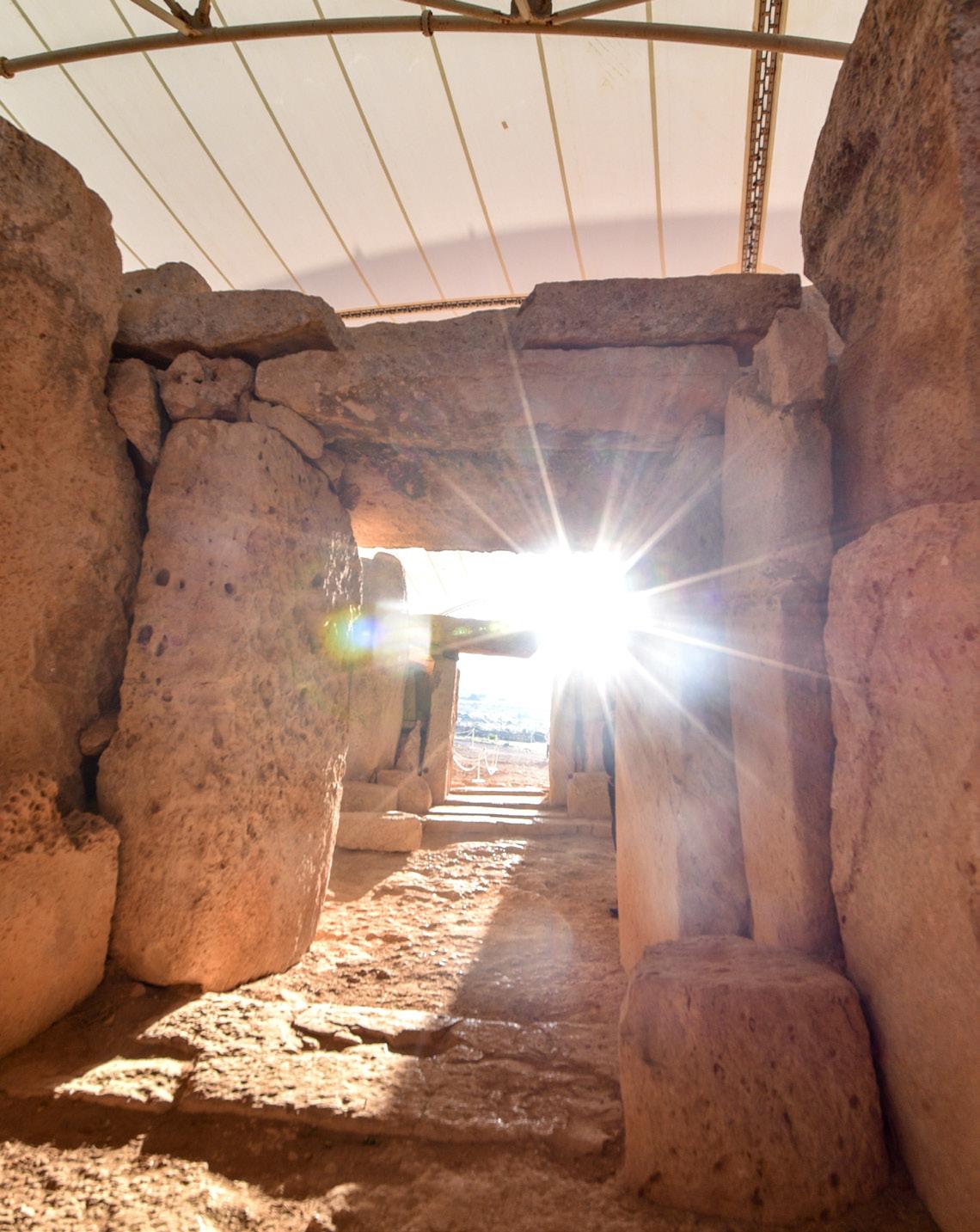
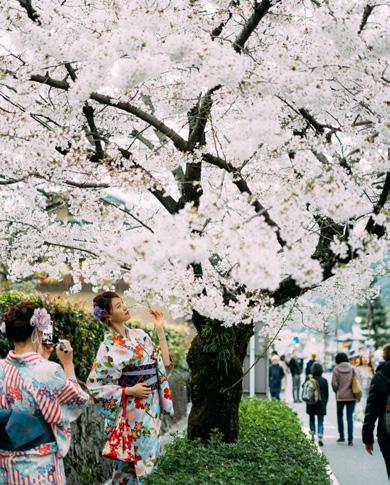
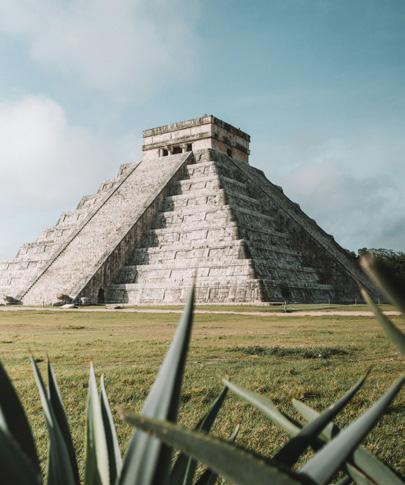
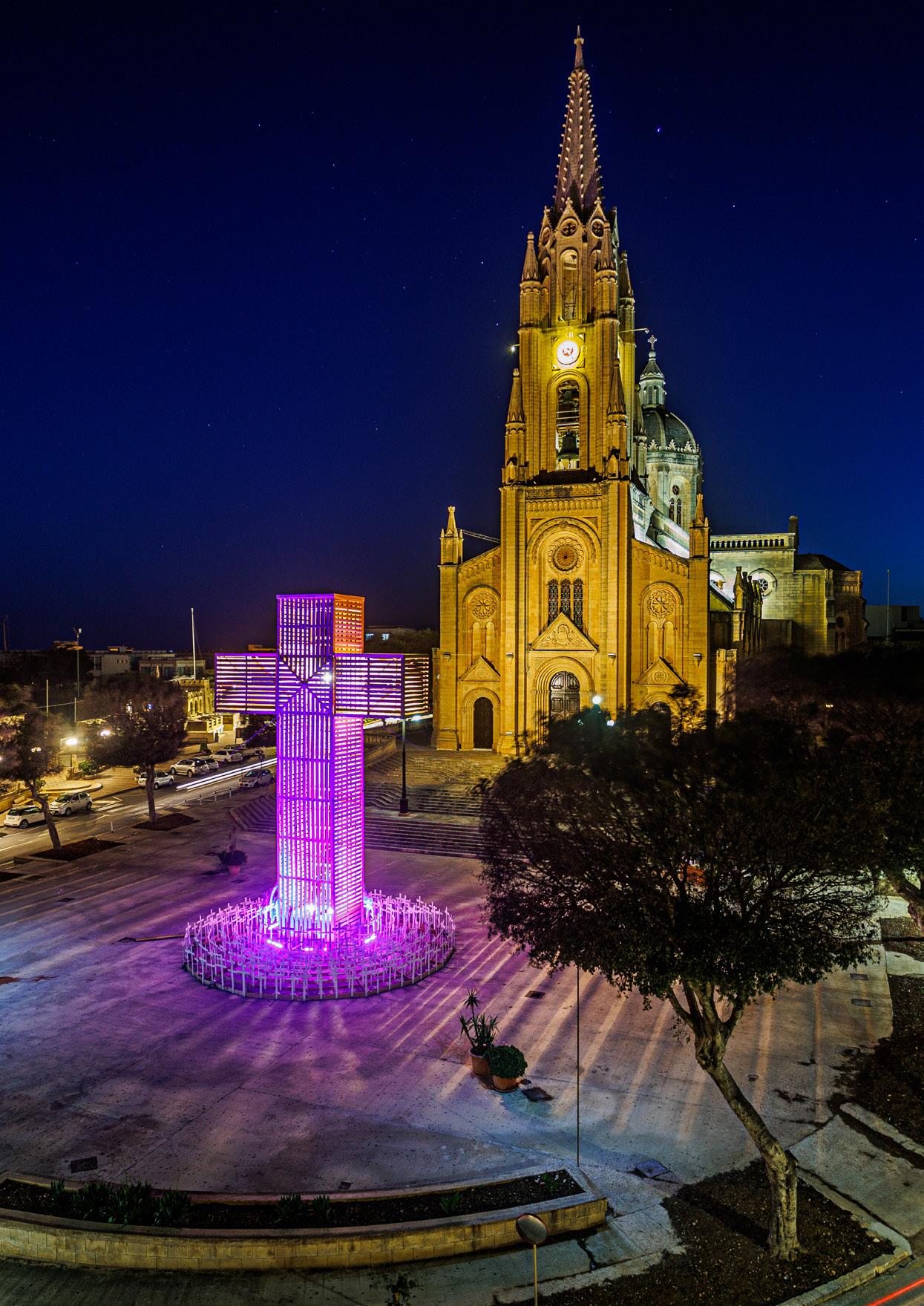
Preparing for Easter: from Passion plays to inspirational traditions & gripping experiences
PG 32
Spring is in the air: clean out baggage, discover nature & watch the Equinox
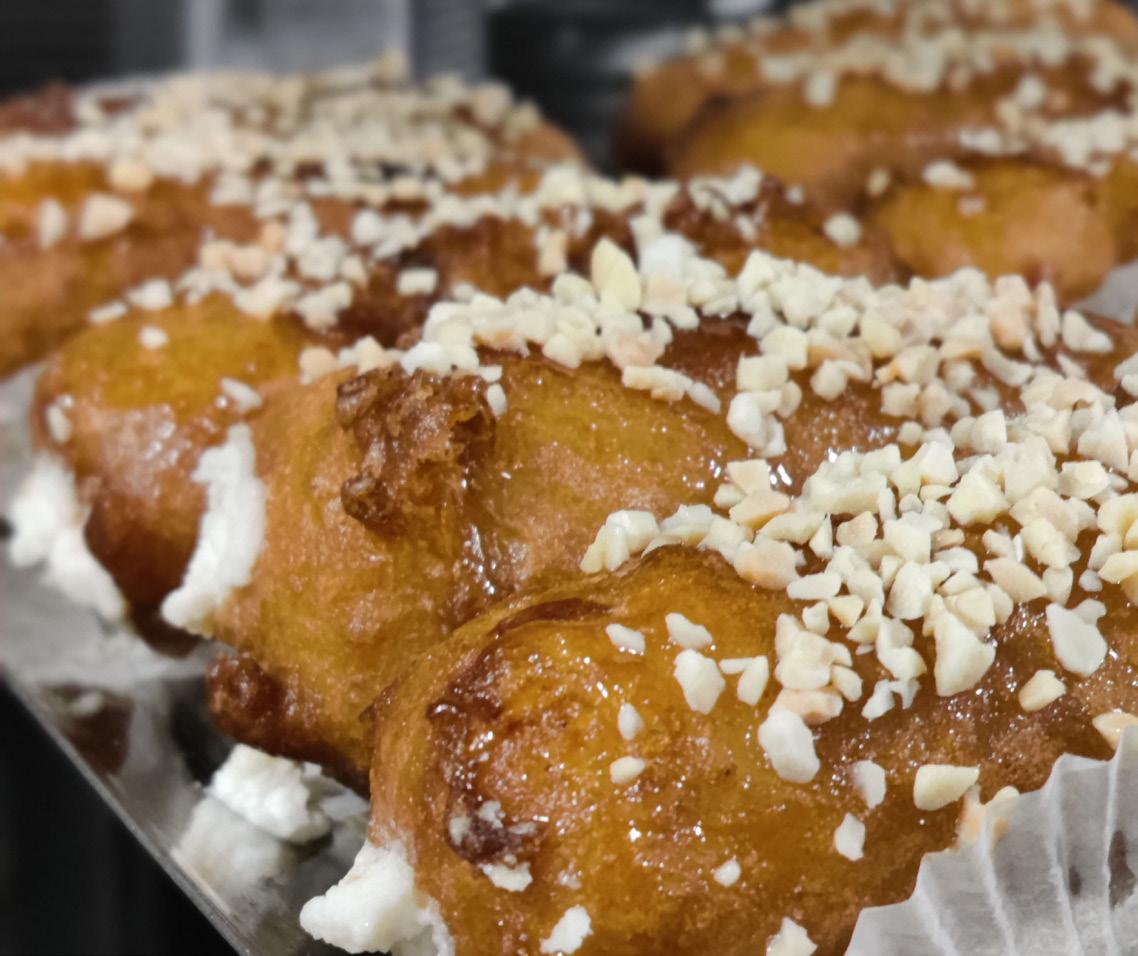
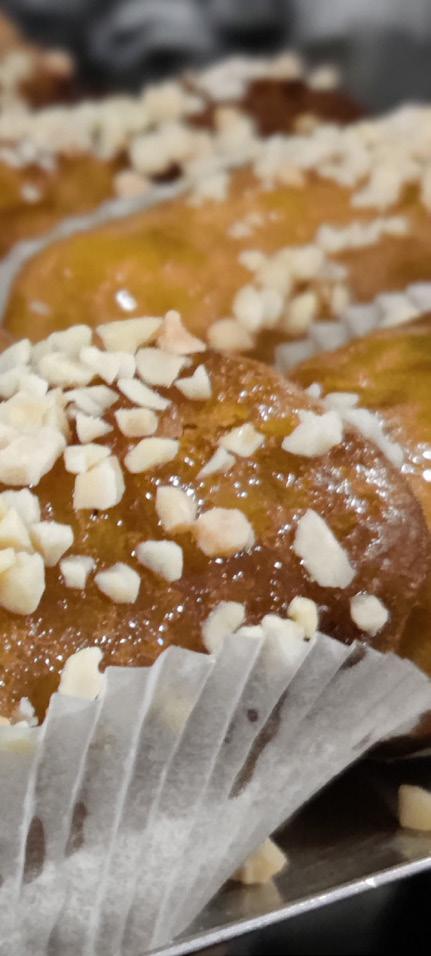
What’s a festa without its signature sweet? Żeppoli, an age-old treat made only in March PG 71
The KM Malta Airlines In-Flight Magazine
ON THE COVER
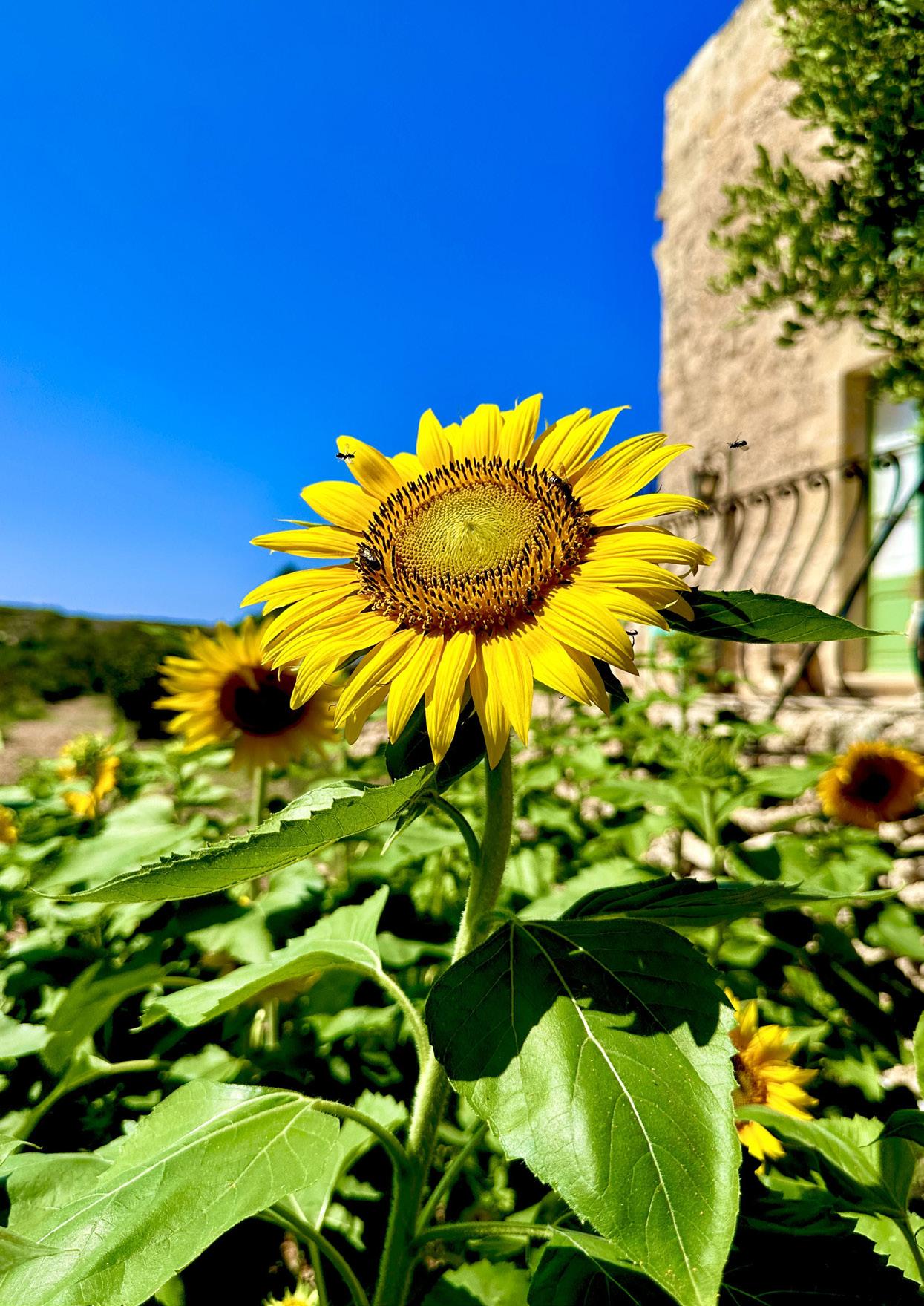
A sunflower in Wardija
MEET THE TEAM
DESIGN
TBWA\ANG
EDITOR
Fiona Galea Debono
SALES AND BUSINESS DEVELOPMENT
TBWA\ANG
CONTRIBUTORS
Adriana Bishop
Anna Marie Galea
Coryse Borg
Edward Bonello
David Carabott
Inkontru.app
Kristina Cetchuti
Lea Hogg
Ramona Depares
Ruth Zammit DeBono
Shirley Jobson
Thomas Camilleri
WOULD YOU LIKE TO BE FEATURED IN PASSAĠĠ I?
For advertising opportunities, get in touch with TBWA\ANG on passaggi@tbwa-ang.com or (+356) 2131 0608
Abigail: abigail@tbwa-ang.com or (+356) 9929 0518
COVER PHOTOGRAPHY
Tony Gatt
PHOTOGRAPHERS
Archconfraternity of St Joseph of Rabat-Mdina
Charelle Micallef
Charles Bonaci
Charlie Buttigieg
Christ the King Parish, Paola
Darren Agius
Edward Bonello
Fabian Tagliaferro
Heritage Malta
Lisa Attard
Martin Attard
Sean Mallia
Tony Gatt
Vince Piscopo
Wikimedia
Xagħra Parish Church
HOW TO PRONOUNCE PASSAĠĠ I
/pasˈsadʒi/
Here’s the breakdown: • /p/ as in pass • /a/ as in art • /sˈ/ as in sun (with stress on the following syllable) • /dʒ/ as the sound of the j in 'judge' (geminated or doubled sound) • /i/ as in eat
The word passaġġi means 'passages' in English.
The publisher, authors and contributors reserve their rights with regards to copyright. No part of this magazine may be reproduced or copied by any means without the written consent of the publisher. Editorial features and opinions expressed in Passaġġi do not necessarily reflect the views of KM Malta Airlines, the publisher, or the editorial team. Both KM Malta Airlines and the publisher do not accept responsibility for commercial and advertising content. Although the authors and publisher have made every effort to ensure that the information in this magazine was correct before going to print, the author and publisher do not assume and hereby disclaim any liability to any party for any loss, damage, or disruption caused by errors or omissions, whether such errors or omissions result from negligence, accident, or any other cause. Special thanks to KM Malta Airlines and VisitMalta for the provision of photographic material. Printed in Malta by Gutenberg Press. All magazine rights are reserved by KM Malta Airlines.
TBWA\ANG, 3rd Floor, Professional Building, Sliema Road, Gżira GZR 1633 Malta \ (+356) 2131 0608 \ tbwa-ang.com
Welcome to
David Curmi Executive Chairman KM Malta Airlines
As we move into March, thoughts naturally turn to the upcoming Easter period and the opportunity to enjoy a well-earned break or spend time with family and friends. With demand for travel traditionally strong at this time of year, we encourage passengers to plan ahead and secure their flights early to ensure the best choice of dates and fares.
We are pleased to share that our Summer 2026 schedule represents the largest programme to date, reinforcing Malta’s connectivity across Europe and the Mediterranean. The schedule includes 19 routes, nearly 8,000 flights, and over 1.3 million seats, reflecting our continued commitment to providing strong and reliable air links for leisure, business and essential travel.
As part of this expansion, Catania returns to our network for Summer 2026, with services operating in time for the Easter holidays. This popular route offers a convenient gateway to eastern Sicily and continues to strengthen our seasonal links within the central Mediterranean.
Looking beyond Europe, we are also introducing a new twice-weekly service to Tel Aviv, operating on Wednesdays and Sundays from 27th May 2026. This new route enhances connectivity beyond our traditional markets and supports Malta’s wider economic, tourism and cultural ties with the region.
For business travellers, we are introducing an additional weekly flight to Brussels, operating every Tuesday morning. This added frequency complements our existing Brussels services and provides greater flexibility for those travelling regularly between Malta and Belgium.
In addition, an extra Thursday afternoon service to London Gatwick will increase
our London operations to 23 weekly flights, further strengthening links with one of Malta’s most important markets.
As Malta’s national airline, KM Malta Airlines recognises the importance of maintaining stable, year-round connectivity to key economic centres. Our Summer 2026 programme has been carefully designed to balance growth with responsibility, ensuring Malta remains well connected while supporting tourism, trade and outbound mobility for our community.
Our KM Rewards loyalty programme continues to deliver added value to members, including exclusive member-only discounts when logged in to our website. These offers are designed to reward loyalty and make each journey even more rewarding, whether passengers travel frequently or occasionally.
For those looking to simplify their travel planning, KM Malta Holidays offers a convenient way to book flights and accommodation in one place, with the option to add extras such as transfers or car hire. Whether planning an Easter escape or looking ahead to the summer months, this all-in-one booking experience provides flexibility, value and peace of mind.
As we look ahead to a busy spring and summer season, our teams remain focused on delivering safe, reliable operations and a positive travel experience at every touchpoint. Thank you for choosing KM Malta Airlines. We look forward to welcoming you on board again soon.
The KM Malta Airlines In-Flight Magazine
Fiona Galea Debono Editor
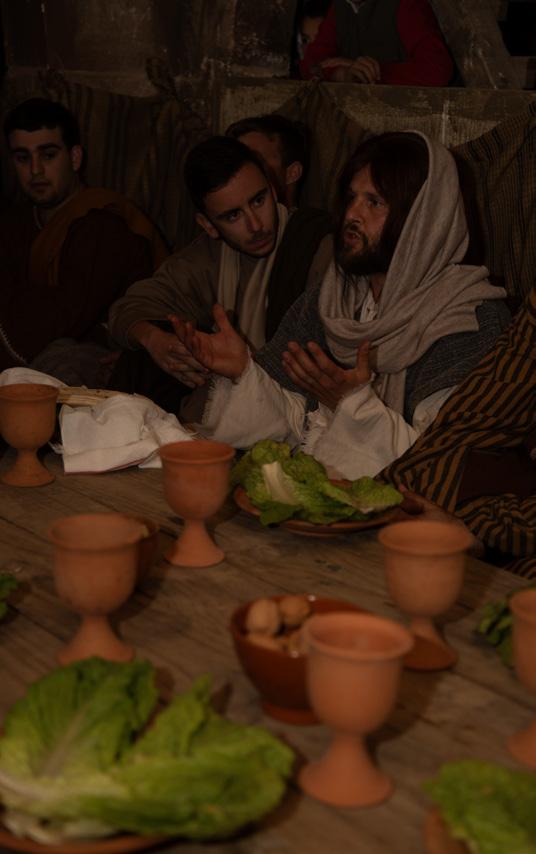
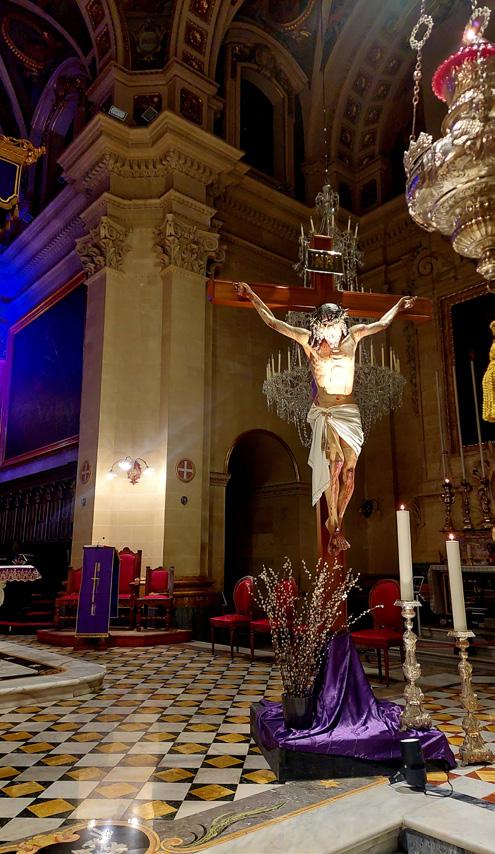
Easter may be early next month, but preparations for this major feast begin well in advance, and the March issue of Passaġġi sets the scene for the customs that make these islands so distinctive.
From Passion plays – rich in drama, meaning and community spirit – to centuries-old, mouth-watering treats like żeppoli, which happily defy Lenten restraint, and the feast of St Joseph, celebrated in the twilight of winter, the run-up to Easter is alive with tradition, pageantry and culinary culture.
As always, working on this magazine inspires me to sketch out my own itinerary for the weeks ahead, pencilling in long-forgotten – or perhaps overlooked – highlights on Malta’s calendar.
I know exactly where I should be on 19th March. I plan to join the festa in Rabat, a thriving town I’m discovering anew as a hub of history, culture and growing vibrancy. On this public holiday, the feast of St Joseph offers the perfect excuse to wander its decorated streets, follow the festive tunes of brass bands and savour the heady aroma of those traditional, freshly made, ricotta-filled golden fritters.
That’s Malta in March – a month that also heralds the start of spring. Fleeting though the season may be on these islands, it brings subtle yet meaningful changes in both landscape and lifestyle.
Spring speaks its own language in Malta’s fields, as one of Passaġġi’s contributors reveals, measured in careful timing, close observation, and the quiet expertise and patience of farmers who keep the countryside alive. Journey through Malta’s green
pastures through the eyes of a farmer, whose labour of love paints an idyllic picture of nature renewed.
Still inspired by the season, we invite you to experience the Spring Equinox at sunrise from a prehistoric temple, and to explore simple well-being tips designed to clear out the baggage and start afresh.
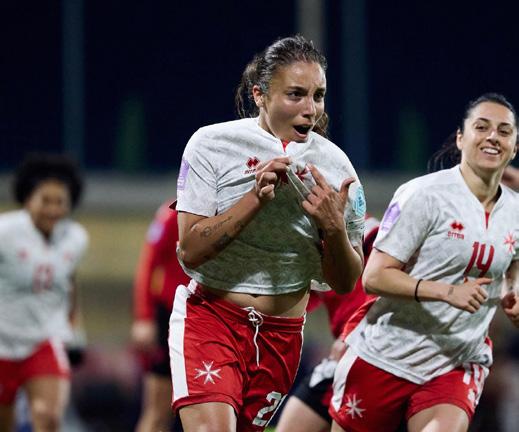
March also marks International Women’s Day, making it the perfect moment to meet Malta’s elite female footballer, Haley Bugeja – the country’s international soccer star, or should we say comet?
And staying with the theme of women on the move, our pet travel feature looks at female solo journeys… accompanied by a dog, and the empowering sense of freedom, awareness, connection and safety that can bring.
Enjoy your flight – alone, in company, or with a four-legged friend – whether you’re leaving the islands behind or embarking on your Malta adventure. With spring in the air, now is the time to pause and breathe, or as our health coach calls it, bask.
Her advice: “Look at the sky and simply make an effort to hear yourself breathing… in… and out. And repeat for a couple of minutes.”
Bon voyage!
Home to the Karkariżi
Walk through time and curious landmarks in Birkirkara
TRAVEL 16
Amsterdam unplugged: canals, cats and culture
A city with a playful side
THEATRE 20 A passion for community theatre
Traditional Lenten plays and their role in society
Where creativity meets professional practice
Mapping out a strategy for the cultural scene
CULTURE 28
This month’s must-see events
So many ways to feed your artistic curiosity
Spring is in the air
Plan your clean way forward
Female solo travel… with a dog
For a confidence-boosting experience
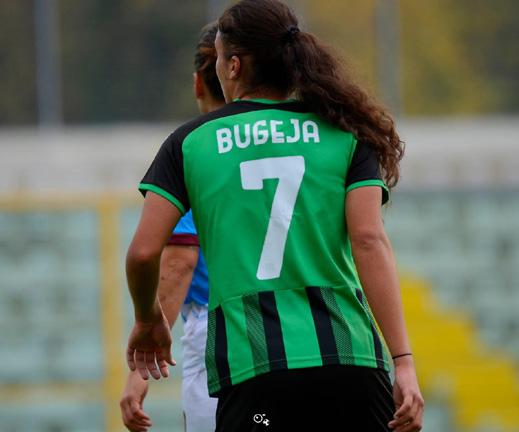
Our rising football star
Haley Bugeja is the country’s world-class talent
TRADITION
40
Celebrating St Joseph
A bright feast in the gentle twilight of winter
MADE IN MALTA
46
So many things to dream about… and make
The unique creations of an aesthete
NATURE
51 Spring through a farmer’s eyes
Learn the language of Malta’s fields
56 Understanding the Spring Equinox
Experience this astronomical milestone at a prehistoric temple
GOZO
60
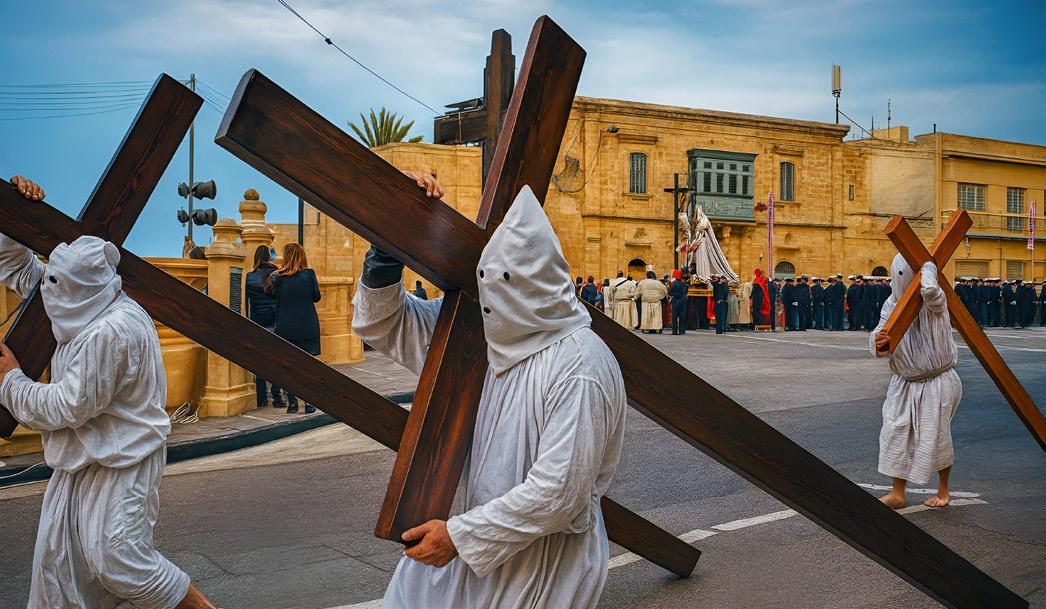
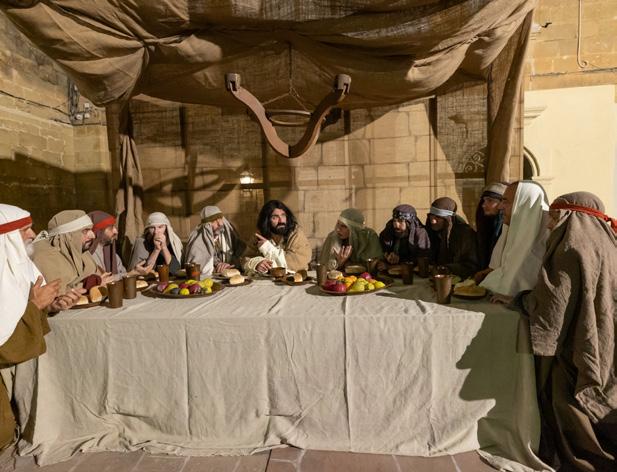
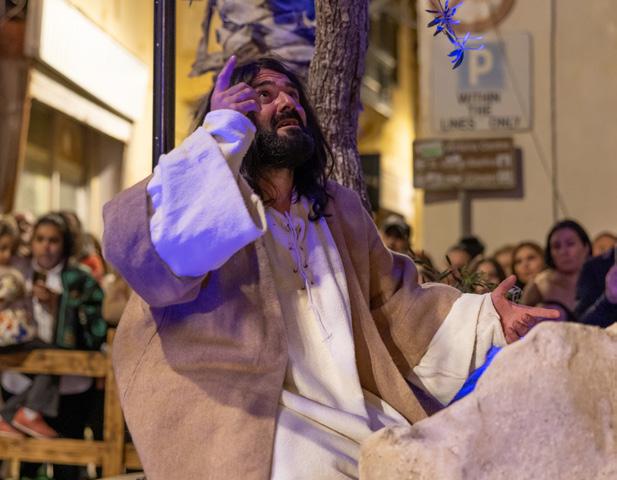
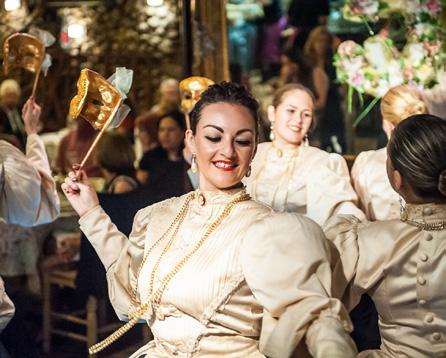
Get ready for Gozo’s Easter traditions
Prepare for deep, inspirational and gripping experiences
FOOD
66
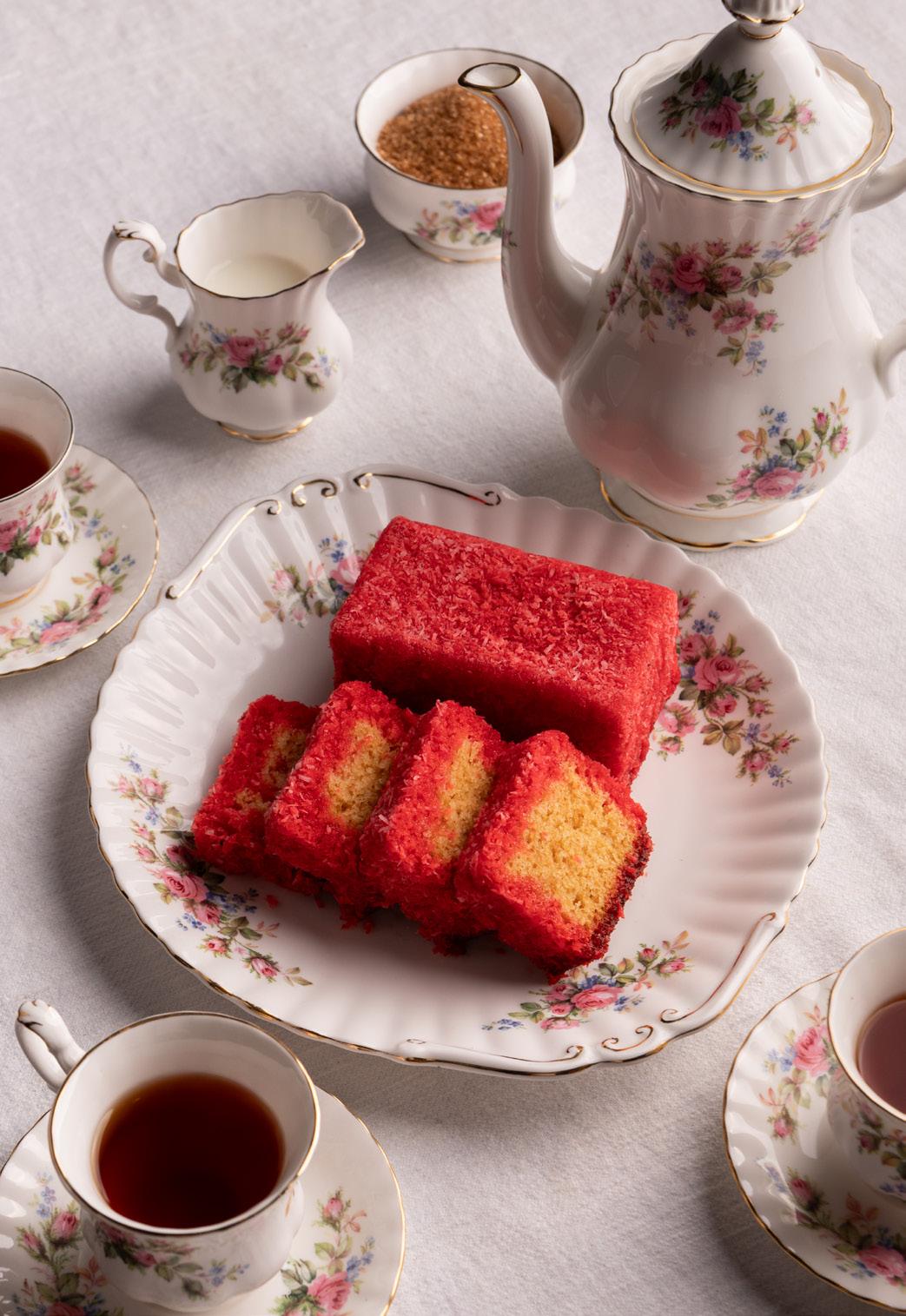
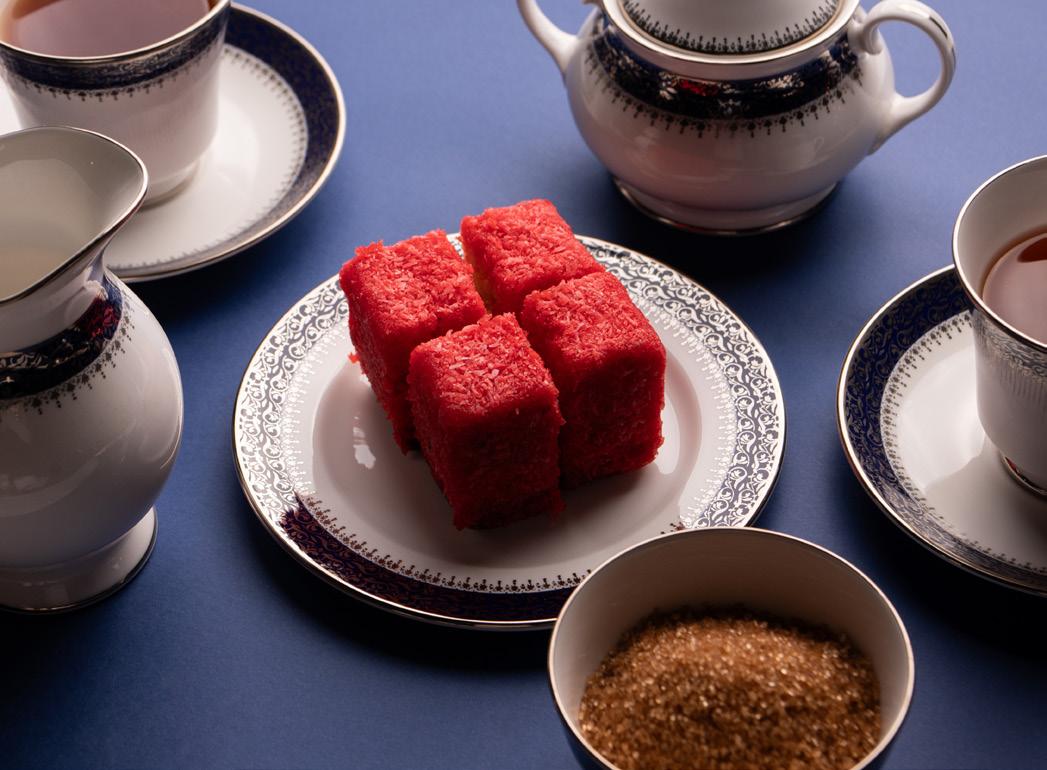
Fancy a bambaluna?
That nuclear pink sweet you just can’t miss
71
Żeppoli: a festive treat for St Joseph’s Day
Indulge in ricotta-filled golden fritters
ENTERTAINMENT
75 Inside Malta’s poker boom
From niche tables to a thriving hub
AIRLINE NEWS
79 Flight, company and destination information
All you need to know about flying with KM Malta Airlines
Words by Edward Bonello
Edward is a content writer and PR consultant. He is interested in the wonderfully superfluous and exquisitely redundant. When he’s not happily tapping away at his laptop, he enjoys collecting useless trivia and watching B-movies.
Home to the Karkariżi
Take a walk through time and curious landmarks in Birkirkara, one of the largest, oldest and most populated localities in Malta – a major central residential and commercial hub with a rich history.
Birkirkara, often shortened to the friendlier B’Kara, is one of Malta’s larger towns by population, and logically, you are never too far away from someone who hails from there (or has an uncle who does).
But the town is not only known for its size, and proud inhabitants; it also packs heaps of history, curious landmarks and a good dose of vernacular wisdom, which provide the perfect backdrop for our town of interest this month.
The people of Birkirkara are known as Karkariżi, but they also have a curious nickname, which could be loosely translated into ‘those of a flat bottom’! There are a few theories as to the origins of this, but perhaps the most plausible and creative relates to one of the town’s biggest prides: the large bell in St Helen’s belfry.
In fact, this bell is the largest to complete a set in any church in Malta, and legend has it that when the villagers were pulling at the ropes to hoist it in place, some 100 years ago, something must have gone wrong, because they all went tumbling, bum-first, down to the ground. Hence the nickname. Thankfully, the bell survived, and today, its beautiful, deep voice can be heard by churchgoers and townspeople alike.
The Basilica dedicated to St Helen sits at the centre of Birkirkara and is a beautiful example of Maltese baroque architecture. The majestic façade is the work of Maltese 17th-century architect Salvu Borg, together with master builder Domenico Cachia.
The feast dedicated to St Helen, Emperor Constantine’s mother, is celebrated in August each year and is a favourite
homecoming for Karkariżi of all ages. The unique morning procession is a moment of pride as it features one of the island’s finest religious works of art – the wooden statue of St Helen by the celebrated Maltese sculptor Salvatore Psaila. It is said that he fashioned the saint’s likeness after his own wife and it is considered one of the island’s most loved titular statues.
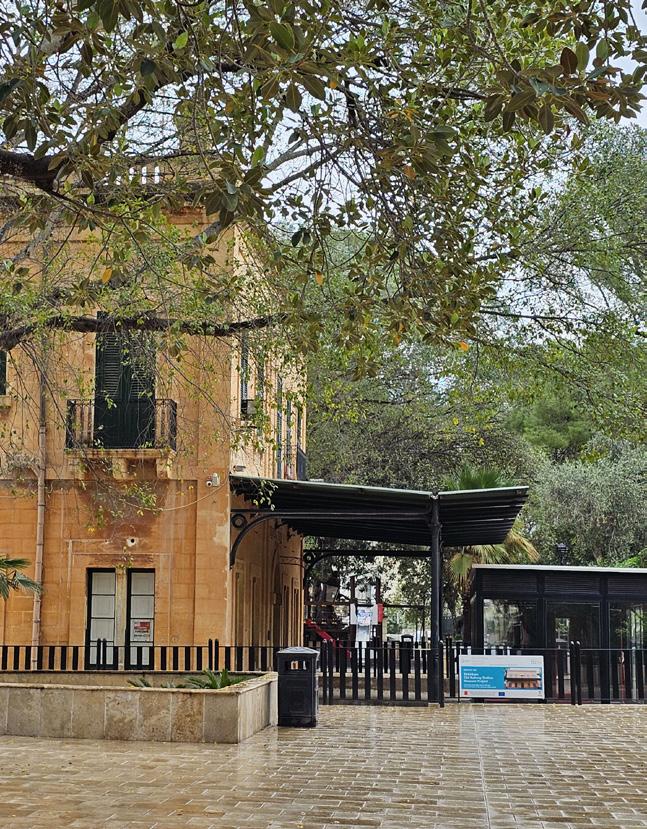
For those interested in the less trodden path, Birkirkara has a fascinating history to discover, which makes for a wonderful walking tour. For example, the town is home to the island’s best preserved train station, harking back to the time when Malta too had its own single-line railway connecting Rabat to Valletta.
Ġnien il-Ferrovija, or Railway Garden, is a tranquil pocket of peace and quiet in the middle of the highly urbanised town and is a mecca for railway enthusiasts who enjoy visiting the early 20thcentury train station and the one remaining wagon.
The garden is not too far from the old parish of Santa Marija, a Renaissance-style church that served as the main parish of the town until the basilica was consecrated in the 18th century. The church, which has since been reinstated as the parish due to the growing demography of the town, features fascinating graffiti of ships from the time of the Knights of St John, scratched into its side walls by devout sailors – a sign of its ancient history.
On the same side of town is the historic St Aloysius College, run by Jesuit priests, and one of the island’s foremost educational institutions. It is considered the de facto training ground for Malta’s political class, as an inordinate number of Maltese politicians sat on the school’s benches.
Down the road is Birkirkara’s famous valley, the commercial district of the town. Here, locals and residents from neighbouring localities congregate to purchase their daily needs, with numerous shops lining both sides of the thoroughfare. This is where you are most likely to meet an authentic Karkariż and perhaps hit it off on hot topics such as the beloved Birkirkara FC, which plays in the national Premier League, or the eternal band club rivalry between the greens and the reds. Whatever you do, don’t take sides!
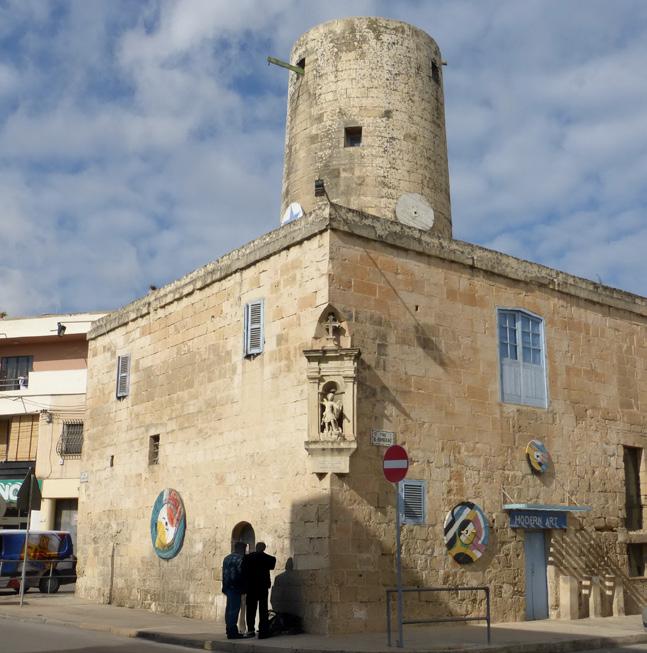
Ta' Ganu Windmill.
Photo: Edward Bonello. The feast of St Helen.
Up the road is another remarkable landmark – the modernist sanctuary dedicated to St Therese of Lisieux, better known as St Therese of the Child Jesus. Completed in 1982, the church is a fine example of brutalist architecture, designed by Italian professor Giorgio Pacini of Rome. It is one of a handful of post-Vatican Council II churches, giving a Maltese nod to the democratisation of faith and enhanced participation of the faithful.
Not too far off is the 18th-century Ta' Ganu Windmill, built in 1724 during the reign of Grand Master António Manoel de Vilhena. Through the centuries, the structure was used for multiple purposes, even serving as an unlikely air-raid shelter during World War II. In the 1990s, it was entrusted to renowned contemporary artist Gabriel Caruana who made it his own artistic laboratory and exhibition hub. Since Caruana’s passing, the building lives as a monument to his artistic and often provocative expression.
Villino Grech is an iconic, modernist building from the 1960s, impossible to miss on Naxxar Road. The private residence, built by entrepreneur Carmelo Grech, is a favourite among illustration artists and architecture students, given its distinct international-style design. Its iconic V-shaped colonnade, supporting the conservatory above, gives the protected building its uniquely quirky look.
One final place to visit would be the Sanctuary of Our Lady of Tal-Ħerba, very close to St Helen’s Basilica. The present church dates back to the early 17th century but it sits on the site of an earlier one that had existed since at least 1575. According to tradition, a crippled man was miraculously healed on the spot on hearing the church’s ringing bells. Needless to say, the miracle opened the floodgates to pilgrimages from near or far – as far as Sicily, Spain and even the UK! The church annex has a remarkable collection of ex-voto offerings, a heartfelt display of devotion and faith.
At this point, you must have worked up a serious appetite, so make sure to drop by Dolceria Barigozzi in the tiny street opposite St Helen’s Basilica for a quick snack or whatever seasonal goodie is on offer!
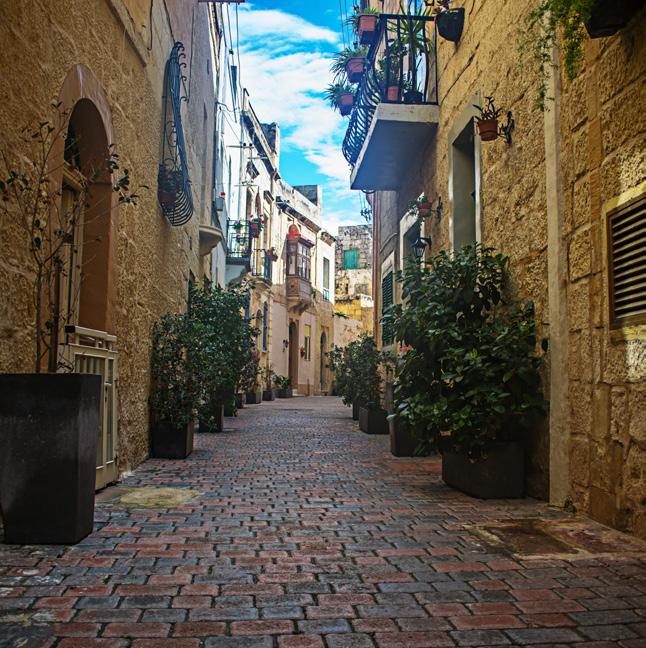
Old streets and houses.
The old railway station.
Must-see sites
Words by Heritage Malta
The national agency for museums, conservation practice and cultural heritage, it is the guardian of over 8,000 years of history.
If this is your first visit to the Maltese Islands, you cannot leave without ticking these sites off your list.
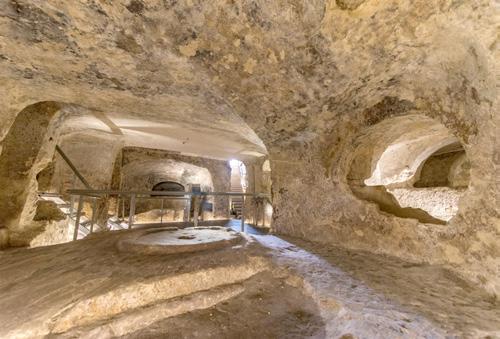
St Paul’s Catacombs
Rabat
Leave the sights and sounds of modern life behind you as you step down into another world – a burial ground from Punic, Roman and Byzantine times, representing the earliest and largest archaeological evidence of Christianity in Malta. The catacombs form a typical complex of interconnected underground Roman cemeteries that were in use up to the 7th and possibly the 8th century AD. Part of the catacombs was re-utilised during the re-Christianisation of the island, around the 13th century, when an open space was re-cut and used as a Christian shrine decorated with murals.
Grand Master’s Palace
Valletta
Newly restored and proudly dominating St George’s Square, the Grand Master’s Palace invites you to wander along its 450-year history as a centre of power and the symbol of a nation. Presently the seat of the Office of the President of Malta, the Palace grants visitor access to over 85 per cent of the building’s footprint, including the magnificent Armoury. The Palace’s restoration project was partly financed via the European Regional Development Fund (ERDF).
Fort St Angelo
Birgu
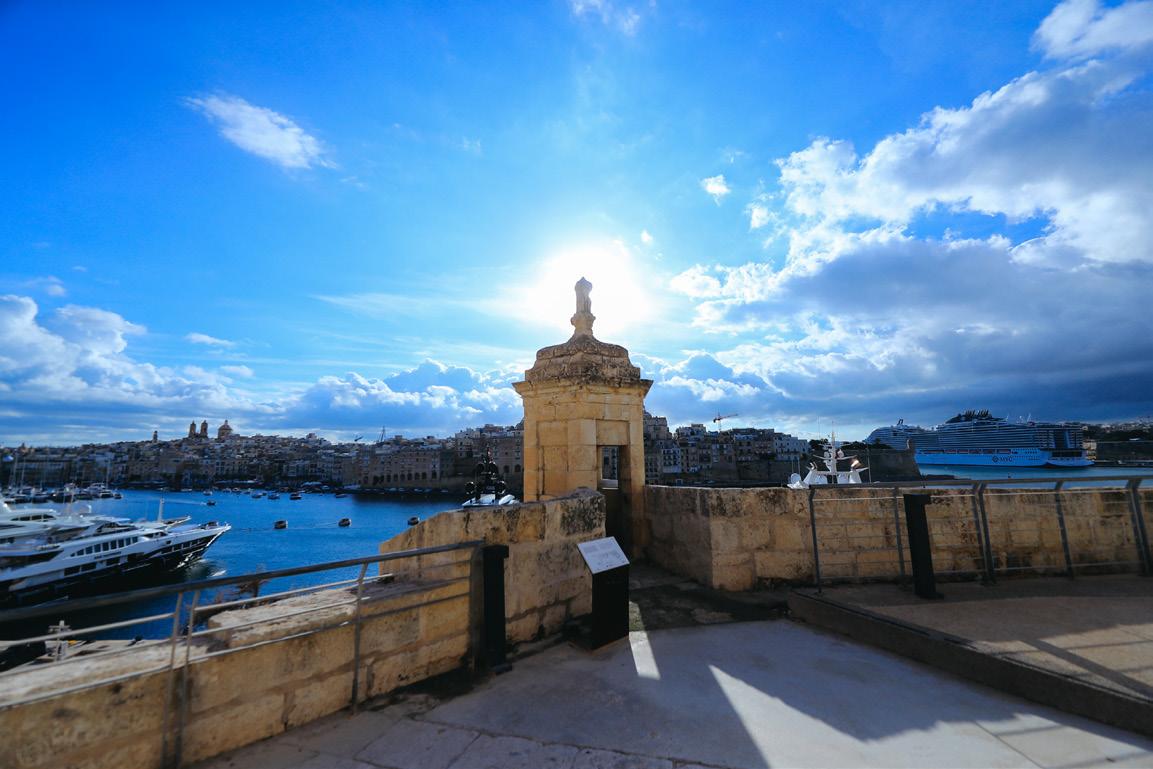
No other fortress has been engaged with the same intensity in the shaping of Malta’s destiny as Fort St Angelo! Known as Castrum Maris in medieval times, this stronghold was christened as Fort St Angelo by the Knights of the Order of St John, who turned it into their headquarters. The Knights remodelled the building extensively with the construction of a series of artillery platforms that marked the introduction of the bastioned system of defence on these islands. During the British period, the fort served as a shore establishment of the Royal Navy in Malta until the last detachment of foreign forces marched out of its walls in March 1979.
Underground Valletta Valletta
Valletta, a UNESCO World Heritage Site, cannot be fully appreciated without experiencing what lies beneath it. Descend into the capital’s fascinating depths to discover dark underground spaces, which, centuries ago, were crucial for the movement of troops, for grain and water storage, and for drainage. Then fast forward to the terrible years of World War II, when these underground tunnels and chambers provided shelter to thousands of people seeking refuge from the relentless enemy bombs, with primitive sanitary facilities and very scarce food stocks, but with a burning hope of survival that defied desperation. Pre-booking is required.
MUŻA – The National Community Art Museum Valletta
The acronym MUŻA refers to the mythological Muses of classical antiquity and to the Maltese term for artistic inspiration. Through a varied collection of paintings, sculptures, furniture, silver pieces, works on paper and objets d’art, MUŻA’s main focus is to show artistic developments in Malta impacted by its Mediterranean context as well as the cultural influences resulting from the governance of the Order of St John (15301798), the British Empire (1800 - 1964), the postIndependence period (since 1964) and the overall impact of the Church.
Inquisitor’s Palace
Birgu
The Inquisitor’s Palace is both a historic house museum and the National Museum of Ethnography.
Built in the 1530s, it was the powerhouse of the Holy Roman Inquisition that dominated Malta for over 224 years. After the French abolished the Inquisition in Malta upon their arrival in 1798, the building served French and British rules, as well as the Dominican Order for a period of time after World War II. The Inquisitor’s Palace also houses the National Textiles Collection.
‘Lampuki’
Crystal Lagoon
Popeye Village
Dingli Cliffs
Rabat
Dingli
Buskett
‘Luzzu’
sponsored by
The feast of St Helen.
St Helen's Square. Houses of Birkirkara.
Words by Coryse Borg
Amsterdam unplugged: canals, cats and culture
Coryse is a broadcaster, actress and voiceover artiste. She is passionate about writing, travelling and spending time with her loved ones; discovering new places and sampling new food in as many countries as possible.
From world-class museums to floating cat sanctuaries, Amsterdam is a city where iconic sights meet playful oddities… with a new story around every corner.
Amsterdam fits a lot into a compact footprint, which makes it perfect for a long weekend, or a few days of exploration. Having relatives who live in the city means I have been lucky enough to visit plenty of times over the past few years, and it is my go-to for a week-long holiday or short weekend break.
The city hides a playful sense of humour and a love of the quirky – an attitude that shines through in everything from a museum dedicated to felines to shops selling very special rubber ducks.
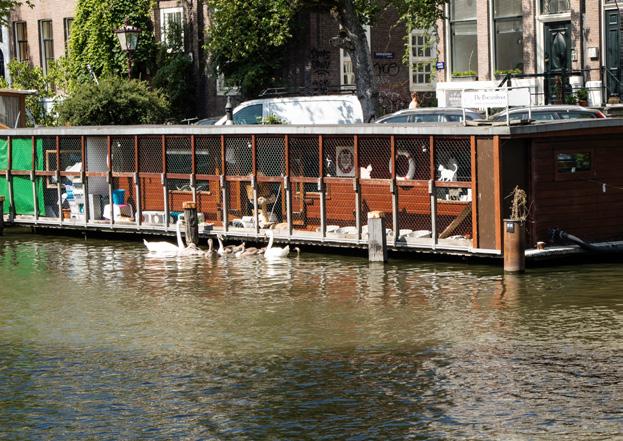
Take De Poezenboot, the floating cat sanctuary moored on the Singel canal. This attraction doubles as a rescue home for cats and a chance for visitors to adopt a new furry friend.
Speaking about felines, the KattenKabinet is another must-see for cat lovers. Located in a 17th-century canal house, this museum was founded in 1990 by Dutch collector Bob Meijer in memory of his red tomcat, John Pierpont Morgan (named after the American financier).
Being a cat lover myself, I made a beeline for the place the last time I visited Amsterdam. The museum is a charming blend of art and feline whimsy, with resident cats padding through rooms adorned with paintings and prints.
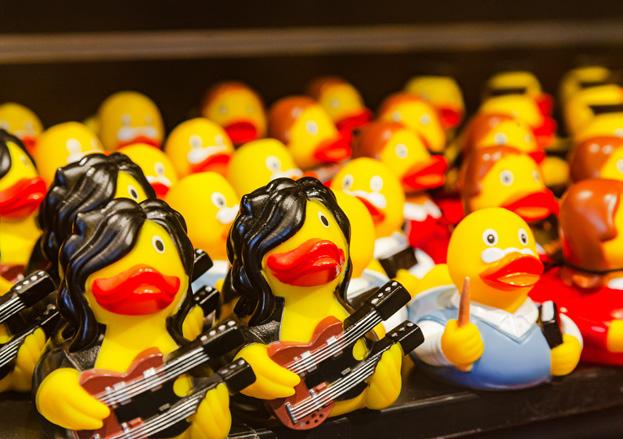
Another place on my list of must-sees is the Amsterdam Duck Store, which sells hundreds of themed rubber ducks – from pop-culture icons to movie characters. The founders say they “don’t sell ducks but little pieces of joy”, and visiting the shop feels exactly like that – a small, colourful reminder that the city embraces its playful side.
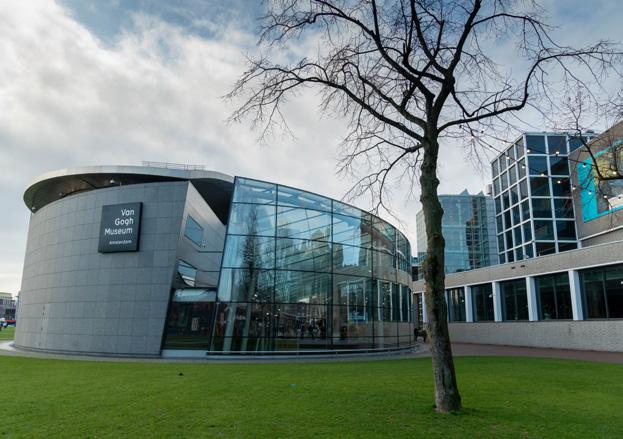
Of course, Amsterdam is also a treasure trove for museum-goers. The Van Gogh Museum holds the largest collection of the pioneering Dutch Post-Impressionist painter’s works worldwide, including Sunflowers, my own personal favourite.
Nearby, the Rijksmuseum offers a deep dive into Dutch art and history, with the super-impressive The Night Watch by Rembrandt anchoring a vast collection of Golden Age masterpieces.
For a more reflective experience, the Anne Frank House on Prinsengracht preserves the space where Anne Frank penned her diary, paired with a poignant exhibition on persecution and human rights.
As you wander along the canal belt, keep an eye out for the city’s narrowest canal house façade – so slim it’s barely wider than a doorway.
Amsterdam Duck Store.
The Van Gogh Museum.
KM Malta Airlines operates regular flights between Malta International Airport (MLA) and Amsterdam (AMS) kmmaltairlines.com
The canals themselves are made for wandering. For a different perspective, hop onto a canal cruise – you can choose a classic hour-long tour for the highlights, or opt for a smaller boat with drinks for a romantic or relaxed evening.
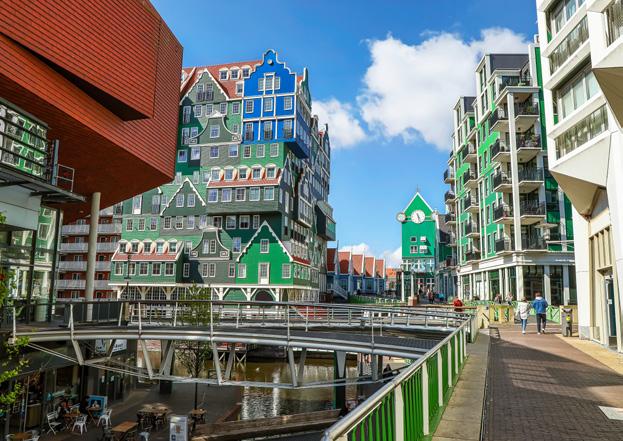
Amsterdam is wonderfully walkable, but don’t discount a short trip beyond the city. Spend half a day in gorgeously colourful Zaandam – about 10 to 15 minutes by train from Amsterdam Centraal, with the station dropping you right into the compact modern centre.
The Zaandam city centre mixes contemporary Lego-like green buildings with references to old Zaan architecture and has a small riverside promenade for short strolls.
Zaanse Schans, technically a neighbourhood of Zaandam, is an open-air gallery of working windmills, traditional wooden houses, barns and small museums along the Zaan river.
As for travelling, trams are one of the easiest and most useful ways for visitors to get around Amsterdam. The network has a dense web of stops, especially across the centre, west and south, connecting Centraal Station with major neighbourhoods.
And of course, you can also rent a bike (or e-bike) – the primary mode of transportation, utilised by locals and tourists alike. There are rental shops all over the city centre, where biking is considered one of the best ways to explore. Amsterdam is, after all, known as the Bicycle Capital of the World, with over 500km of designated bike paths and more bicycles than residents.
suggests
Top tips for visitors
• Don’t skip local markets, cafés and street food – friet (thick-cut, doublefried potatoes served hot in paper cones with a variety of toppings) and bitterballen (a popular deep-fried snack pictured above) are must-tries.
• Walk as much as possible; use the tram/metro for longer journeys.
• Pre-book the ‘big’ museums (including the Anne Frank House) to avoid queues and museum fatigue, especially in high season.
• Mix icons with quirky stops to make the trip memorable.
• See the canals from multiple angles – cruise one way, walk another.
• Respect cycle lanes.
Words by Edward Bonello
A passion for community theatre
Passion plays in Malta are a central Lenten tradition with an age-old message. Here’s a look at how they have remained relevant in today’s fast-paced life and continue to attract both volunteers and audiences alike.
As Lent, the 40 days of preparation for Easter, comes around, Maltese villages don a sombre quality as a long procession of traditions, some ancient, some not so much, unfold one after the other in preparation for Christianity’s foremost feast.
One such relatively recent tradition relates to theatre, and it brings communities together in a meaningful way.
The theatrical representation of the Passion of Christ can be traced to various cities around medieval Europe, and it is said to be a development of having more than one person narrating the Gospel during Holy Week functions. The tradition quickly spread, and developed into various passion representations, sometimes taking place in the streets as well as on a fixed stage.
Today, Passion plays have a special place in Malta’s Lenten landscape, and several local clubs and social groups compete to produce the most beautiful and moving displays.
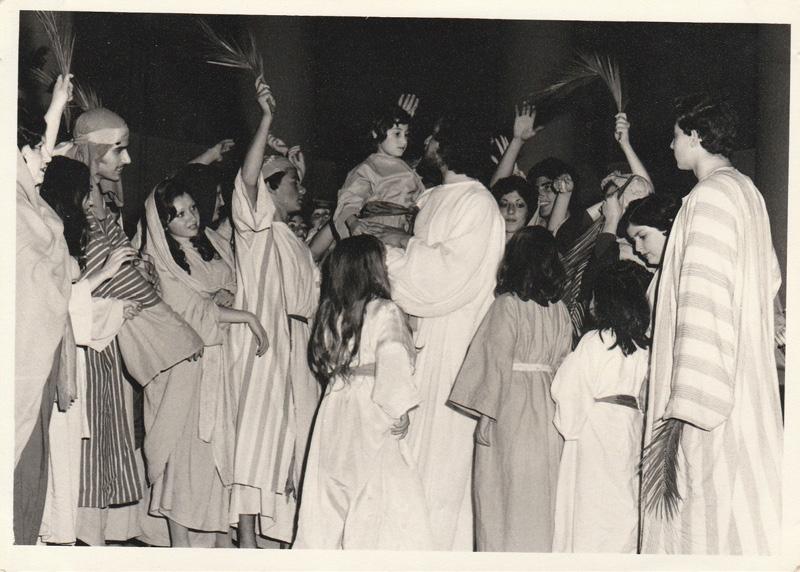
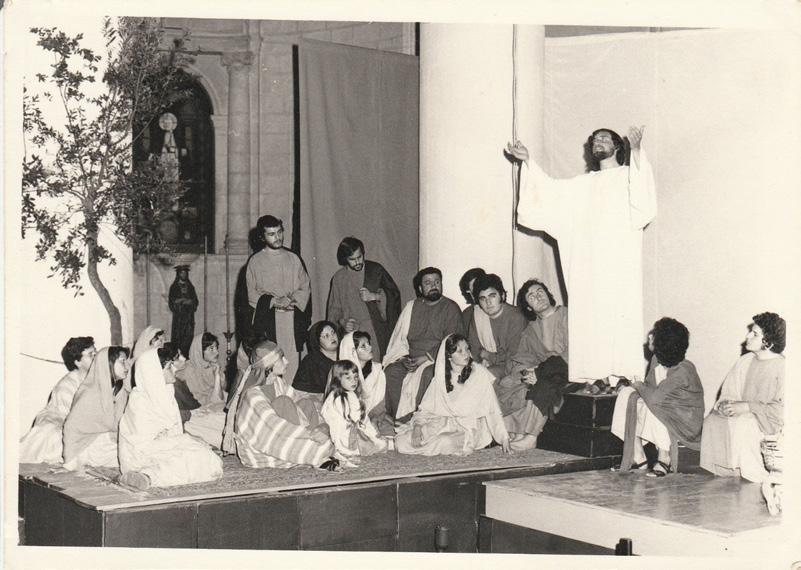
Locally, the phenomenon as we know it dates back to the post-war years and coincided with the first social groups and youth centres that started to emerge in Maltese towns and villages. While the Swinging Sixties roared through the mainland, new social dynamics also started to shyly sprout in conservative Malta, meaning that young men and women could congregate and socialise albeit under the watchful local ecclesiastical gaze.
Photos: Christ the King Parish, Paola. A pageant from the 1960s.
Some of these groups turned to theatre as their central calling, solidly inspired by a holy theme. What started as improvised Passion plays, quickly developed into fully fledged theatrical productions, featuring researched scripts, accurately fashioned costumes and purposely crafted scenery and props.
Localities that were lucky enough to have their own theatres welcomed crowds of young men and women as they practised their lines, sometimes picked directly from the Gospels for extra authenticity. In other localities, the church itself provided the majestic backdrop, with impromptu stages and theatrical set-ups taking over the presbytery for a week or two during Lent.
The result was an impressive exercise in community theatre, where youths of all ages came together to bring the greatest story ever told to life. Today this tradition is alive and well, and in several localities, Passion plays characterise what Lent means to many.
Rose Anne and Kenneth Camilleri have been writing scripts and directing Passion plays since their teens, and now they are proud to have passed on the bug to an equally motivated troop of theatre makers in their hometown.
“We started off very young. We used to attend the youth group in our home parish of Our Lady of Lourdes in Paola, and we’d always be helping the parish priest with Gospel animation during Mass. It was a clever way of involving kids and young adults to participate,” Rose Anne recalls, reminiscing about her own teens. “Before you knew it, come Lent, we were putting on full productions about the life and teachings of Jesus,” Kenneth continues.
When Rose Anne and Kenneth got married and moved to Żebbuġ, they didn’t leave their passion for community theatre behind, bringing it with them to their new home.
“Coincidentally, the Żebbuġ parish priest was an old friend, and it wasn’t long before we started brainstorming ways to bring the Passion play back in our new hometown,” Kenneth explains.
“That’s how we met a group of passionate teens, whose enthusiasm for the Passion play was as encouraging and contagious as ours! Fast forward 25 years, and those teens are today family men and women, who, together with a large group of enthusiastic volunteers, are the moving force behind the Żebbuġ Pageant Group,” Rose Anne adds.
The particularity of such theatrical productions is that they are built on volunteer effort and community engagement. Passion plays are a moment when the community comes together to interact in an otherwise hyper-busy life.
As the years rolled on, Rose Anne and Kenneth always sought ways to render the play as relevant and engaging to modern audiences.
“Alongside the known and familiar stories from the Gospels, we started to introduce episodes from contemporary life, juxtaposing the age-old Bible message to its relevant application today, tackling sensitive and
topical subjects such as substance abuse, mental health and solitude among others, and framing them within a positive message of hope.
“This proved to be extremely successful as the plays served as an effective opportunity for Lenten meditation,” Rose Anne says.
Apart from being a chance for community engagement, the play is also a place for whole families to grow together. “We have one small rule, and that is that children must be accompanied by a parent to take part. That way, we have managed to attract whole families to our fold, and they look forward to participating in the play from one year to the next, as a family activity,” Kenneth shares.
Securing the 120-strong cast each year is no joke, and Rose Anne and Kenneth, together with their collaborators, are constantly on the lookout for talented and motivated individuals, young and old.
“We all live busy lives, work multiple jobs and have 101 things to contend with,” Rose Anne concedes. “Yet, we are grateful that as soon as Lent approaches, we are flooded with interest from parishioners and friends to take part.”
Passion plays in Malta and Gozo typically run through and around Holy Week. They have established themselves alongside other ancient traditions, such as Good Friday processions, and other expressions of popular faith.
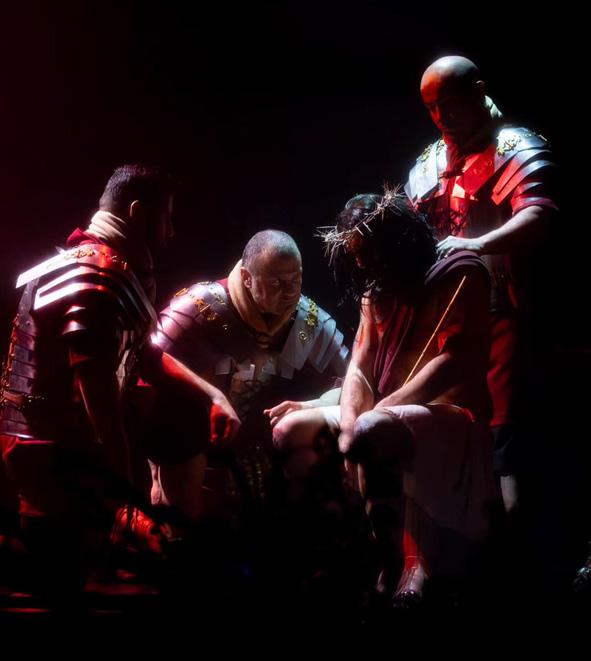
Today, Passion plays around Malta and Gozo, are impressive theatrical productions, complete with elaborate stage and light design, engaging special effects and realistic theatrical make-up for a complete immersive experience.
Photo: Charelle Micallef. A scene from the pageant in Żebbuġ.
Discover Fort Delimara 14-15 March
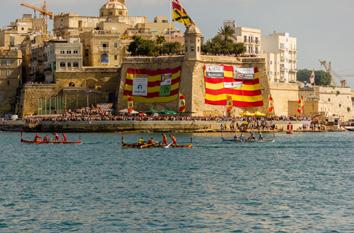
Freedom Day & Regatta 31st March
Built to defend. Open to explore.
Discover Heritage Malta Events on heritagemalta.mt/whats-on
A FEW RULES FOR PREDICTING THE FUTURE
A Few Rules for Predicting the Future takes inspiration and its title from Afrofuturist sci-fi writer Octavia E. Butler, who calls for a grounded futurity shaped by interdependence, transformation and imagination. The exhibition brings together international artists whose works move between critical engagements with the present and speculative propositions. Rather than attempting to predict what is to come, the artists trace the future’s contours from the ground up, with their work operating as constellations,
Discover this hidden gem within Malta's Grand Harbour, where history meets modern indulgence. Enjoy panoramic views, exciting activities and delectable dining experiences along this strolling promenade. Savour Chinese, American, Mediterranean, sushi, or local cuisine in beautifully refurbished 1752-built stores, or dine al fresco by the water's edge. Just a short walk from central Valletta and Floriana, and across from the Three Cities, experience fun and relaxation away from the crowds. There is always something happening at Valletta Waterfront, with cultural celebrations, seasonal events, live music, special themed nights,and family-friendly activities that bring the historic promenade to life.
LOVE LANDS DELICIOUSLY
Words by Ramona Depares
Ramona is an author and journalist with an interest in culture-related topics. She runs her own food and culture website at ramonadepares.com
Where creativity meets professional practice
Malta’s cultural scene has evolved, with more artists and practitioners following their dream of a full-time profession in the arts. Here’s how Arts Council Malta’s Strategy 2030 is mapping a road towards securing a sustainable future in the sector.
Anyone spending time in Malta’s cultural scene today will notice a change from a few years ago. Whereas creative work was once carried out in addition to other employment, it is now, for many artists and practitioners, their main profession.
“This professionalisation of creativity has brought opportunities and visibility to Maltese artists and practitioners. But with this comes the pressure of sustaining what is often a difficult career choice,” says Dr Luke Dalli, Arts Council Malta executive chair.
“For many practitioners, especially those at early stages, cultural work still means short contracts, irregular income and limited security. These realities are weighed within a wider European context, where the gig economy is also common within the sector.”
ACM’s Strategy 2030 is set out precisely within this context. While the document is, by nature, a strategic framework, it is rooted in very human concerns: how to balance passion with professional reality; how to build careers that do not burn out early; and how to ensure that cultural work is valued beyond applause and exposure.
“For artists who are now working full-time, this new strategy shifts the focus to what makes that life possible. Being paid properly, knowing where you stand contractually, working in environments that feel safe and respectful, and being recognised as a professional all have a direct impact on how sustainable that choice really is,” Dalli continues.
“These elements all contribute towards determining whether someone can keep on creating work year after year, take on ambitious projects, or simply say yes to opportunities without constantly worrying about the basics.”
Strategy 2030 empowers artists and practitioners to do exactly this, by creating a framework for these practical conditions, from transparent and consistent pay structures to support for professional development and stability. Of course, financial support forms a central part of this, with a range of funding opportunities planned for 2026.
Photo: Vince Piscopo.
Photo: Darren Agius.
Joanne Casabene
A total investment of €6.5 million will be distributed across a minimum of 32 calls, with an approach that prioritises long-term sustainability over oneoff outcomes. The focus is on supporting artists and practitioners as they build careers over time, giving them the stability to develop work, strengthen skills and remain active in the sector, rather than moving from project to project without continuity.
Strategy 2030 is built around three broad areas that frequently overlap in practice, starting with professional development. As actor and producer Antonella Galea Loffreda puts it, artists should not “shy away from training and accredited courses in the arts, as these open doors to more opportunities”.
Her words are echoed by freelance artist Sean Borg, who urges creatives to “invest in transferable skills”.
The strategy brings together this focus on professional development with two other equally important areas: cultural rights and international exchange.
“Working abroad was an eye-opener for me. I have performed twice at the Edinburgh Fringe, and seeing Maltese talent in that context, it very clearly matched foreign talent in this arena,” Sean adds.
Strategy 2030 approaches residencies, collaborations and co-productions as spaces for learning and dialogue, where artists carry ideas outwards and bring influences back with them. The emphasis is on maintaining a strong local grounding, while offering Maltese practitioners opportunities to engage more visibly with international contexts, such as through participation in La Biennale di Venezia and the Gwangju Biennale.
This international context is also shaping how film is being supported locally, Dalli explains. A newly established Domestic Film Development and Strategy Unit within ACM is focused specifically on strengthening the indigenous film scene, looking beyond funding alone.
“While screen support funds continue to grow, the unit gives equal importance to connection, visibility and longterm development. For filmmakers, this opens the door to international networks and co-production opportunities that would otherwise be difficult to reach independently. The unit has already secured Malta’s membership in Eurimages, which has created opportunities for local filmmakers to partner up with other countries on coproductions,” he states.
This, in turn, allows them to grow internationally while remaining rooted here. Alongside this, ACM is increasing its presence at key festivals and markets, giving producers space to meet, pitch and build relationships. Training and capacity-building initiatives are being announced in parallel, addressing the gaps within the local industry and creating spaces for filmmakers to stay connected, share knowledge and feed back into how the sector evolves.
“While Strategy 2030 does not promise easy solutions to artists and practitioners, it does offer a clearer acknowledgement of the conditions artists work in, while building an infrastructure that strengthens the industry,” he concludes.
15% Discount
On the purchase of an adult ticket Please quote “Passaggi” at the ticketing counter to claim your discount. (Not valid with any other offer)
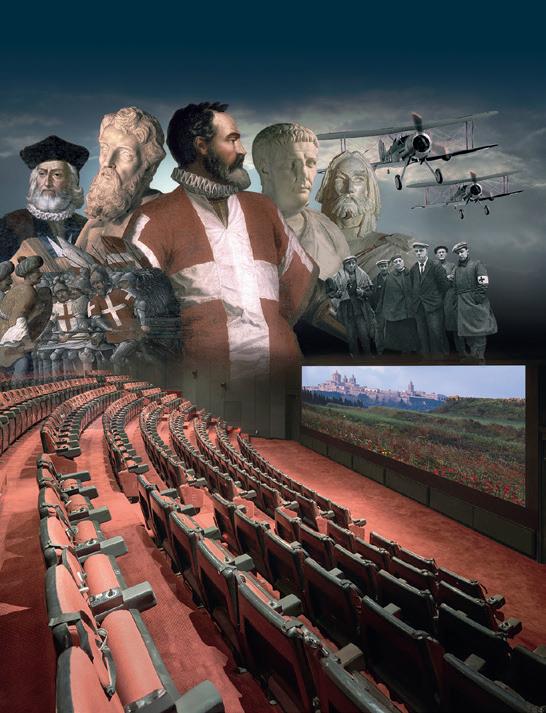
Few places have a history as turbulent and inspiring as the Maltese islands. Its gripping story is that of a country buffeted by world events, in which the bravery and resilience of its people have been tested to the limit.
Through beautiful authentic imagery and a gripping commentary, the show covers 7000 years of history in 45 minutes. From the early settlers of the temple period to the Knights of the Great Siege through to the destruction of World War 2, The Malta Experience chronicles the events that have shaped the island's history.
Words by
This month’s must-see events
With spring in the air, there’s no better time to reconnect with art and culture. This handpicked calendar of music, theatre, dance and visual arts offers plenty of ways to feed your curiosity this month.
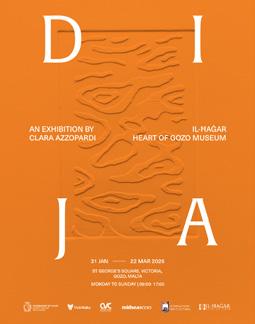
Dija
When: 1st - 22nd March
Where: Il-Ħaġar – Heart of Gozo Museum, Victoria, Gozo
This solo exhibition by Gozitan artist Clara Azzopardi explores light as a thread through grief, hope, memory and daily life. Moving between domestic interiors and the open sea, her works reflect light as refuge, pause and quiet anchor amid constant change.
Her Say III
When: 6th - 8th March
Where: Spazju Kreattiv, Valletta
Her Say returns with a new series of powerful, female-led stories reflecting contemporary life. Through intimate narratives, the production explores motherhood and change, the realities faced by migrant workers in Malta, and how today’s social landscape shapes the lives of young females with each story told through a woman’s perspective. (See interview on PG 31.)
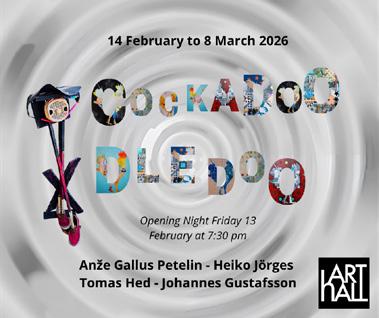
Cockadoodledoo
When: 1st - 8th March
Where: Arthall, Victoria, Gozo
Drawing on Thus Spoke Zarathustra, Cockadoodledoo brings together artworks by multiple artists exploring modern numbness and lost depth. Through varied visual languages, the exhibition questions comfort, cognitive anaesthesia and what it means to truly awaken to life’s complexity, tension and urgency today.
Holmasonika
When: 7th March
Where: Liquid Club, San Ġwann
Ħolmasonika returns for its fourth edition, blending live bands and electronic energy into one immersive night. Headliners include Maltese lyric-driven stalwarts Brikkuni, psychedelic indie-pop outfit The Velts, and Argentine cumbia collective Los Leales, alongside a strong supporting local line-up and DJs.
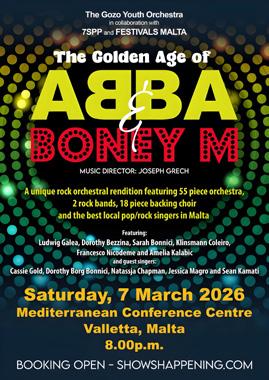
The Golden Age of ABBA & Boney M
When: 7th March
Where: MCC, Valletta
Some of Gozo’s finest young musicians revisit the glittering heyday of disco and pop with The Golden Age of ABBA & Boney M. Get ready to sing along to this high-energy live concert packed with era-defining hits, infectious grooves and feel-good nostalgia celebrating two of music’s most iconic acts.
7 Sins
When: 13th & 14th March
Where: Spazju Kreattiv, Valletta
This bold dance experience by Moveo Dance Company dives deep into the world of human temptation, desire and inner conflict. Each of the seven deadly sins is transformed into movement, with dancers embodying the raw emotions and energy that define them from pride's intensity to envy's tension, and from lust's fire to sloth's stillness.
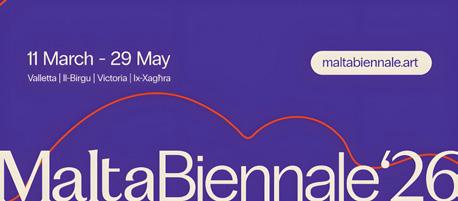
Malta Biennale 2026
When: 11th March - 29th May
Where: Various venues
Themed CLEAN | CLEAR | CUT, the Malta Biennale 2026 runs across historic sites and museums in Valletta, Vittoriosa and Gozo. An initiative of Heritage Malta, the second edition of the contemporary art platform will be held under the helm of artistic director and international curator, Rosa Martínez.
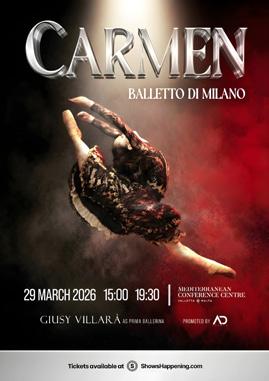
Carmen
When: 29th March
Where: MCC, Valletta
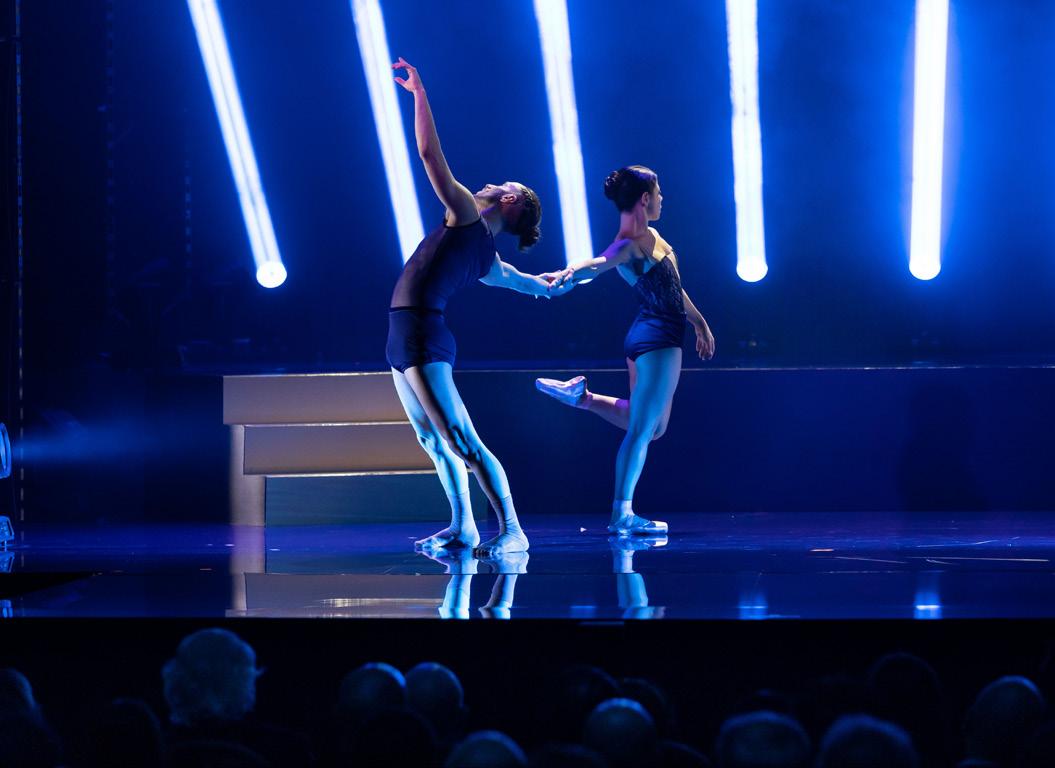
Carmen by the Balletto di Milano makes its Malta debut. This bold retelling follows the fiercely independent Carmen, whose defiance sparks desire, jealousy and tragedy. Performed by a world-class Italian ballet troupe, this performance blends Bizet’s iconic score with modern choreography and striking costume and set design.
Lent in Malta
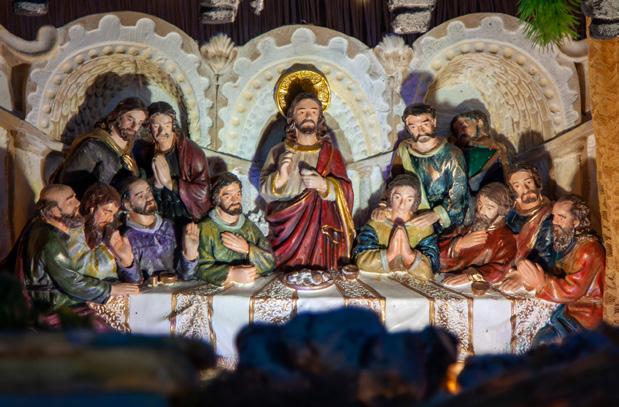
Lent in Malta is traditionally a quiet, reflective season that gradually builds towards the spectacle of Holy Week. In the weeks leading up to Good Friday, many towns and villages across the island open their doors to traditional Holy Week exhibitions, many organised by band clubs, parish groups and cultural societies. These displays offer a loving introduction to the Passion story.
Each exhibition showcases a variety of faithinspired works and devotional pieces, such as detailed Last Supper scenes, miniature Good Friday processions, and dramatic representations of Golgotha, created using clay figures, wood and everyday materials like coloured semolina, rice and pasta.
Life-size statues of Christ the Redeemer are a common focal point, alongside Roman soldiers’ costumes, sacred vessels and symbolic objects linked to the Passion.
Some exhibitions also recreate Altars of Repose, or entire church interiors in miniature, while others highlight local artistic talent through sculpture and hand-crafted tableaux.
These exhibitions set the spiritual tone that precedes the island’s solemn Good Friday processions and joyful celebrations of Easter Sunday. Head to towns like Mosta, Birkirkara and Rabat, where some of the island’s most popular Holy Week exhibitions bring these longstanding Lenten traditions to life.
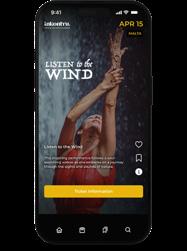
For a guide to upcoming religious celebrations and traditional feasts across the Maltese Islands, be sure to visit inkontru.app
TRADITIONAL SPOTLIGHT FREEDOM DAY REGATTA
Each year on the 31st March, Malta marks its Freedom Day celebrations with one of its most stirring spectacles on water. Set within the natural amphitheatre of the Grand Harbour, the races commemorate the 1979 departure of British forces from the island. Crews from harbour towns line up in brightly painted traditional boats like frejgatini, kajjikki and dgħajjes tal-pass, rowing fiercely for pride and the coveted Regatta Shield. Spectators crowd the waterfront around Fort St Angelo, Senglea and Valletta, as centuries-old rivalries play out on the water.
Discover and experience more with inkontru.app, your web-based application that prioritises functionality and performance, meaning no need to download, seamless updates, no storage space taken and easy sharing. Enjoy!
ENTRY DENIED | A SATELLITE EVENT OF THE MALTA BIENNALE 2026
Christine X Art Gallery, Sliema
Entry Denied confronts the reality of artists blocked from international platforms by visa restrictions, exposing how mobility becomes a gatekeeping mechanism in the global art world. A satellite of Malta Biennale 2026, the exhibition at Christine X Art Gallery gathers artists whose practices are shaped by cross-border exclusion. Through artworks, documentary material and testimonies, it transforms rejection into artivism, questioning who is granted access, visibility and belonging. The exhibition is on from 12th March to 9th April, open Monday to Saturday from 10am - 1pm and 4 - 7pm.
info@christinexart.com (+356) 9984 4653
INKONTRU.APP MEETS...
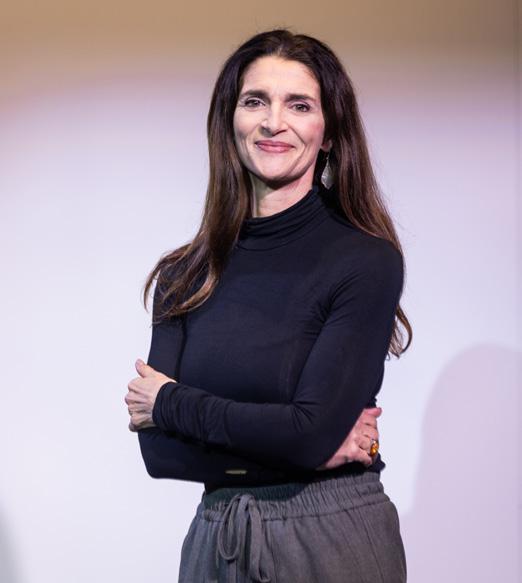
Now in its third edition, Her Say III has become a platform for women’s voices. Director Charlotte Grech reflects on the shared threads running through this year’s stories, how they mirror lived realities in Malta today, and what she hopes audiences carry with them beyond the final curtain .
What connects the stories chosen for this year’s edition?
We are presenting contemporary Maltese stories, which are all very relatable. They are somewhat linked by change happening to the protagonists through the circumstances they are in. How do I become braver? Do I stay or do I leave? How do I get through this phase? These are all gender-neutral questions that we can all recognise. Although we have three different stories, written by different writers, each exploring different themes, my objective as director applies to all: to portray the voices heard in these pieces as truthfully as possible.
How do the themes of each piece reflect the realities women are navigating in Malta today?
They are based on actual stories. We all know of someone who has gone through similar experiences. They are timely, use conversational tones and have very sharp contemporary writing. They make us pause and think, laugh and nod at the scenarios, and who knows, they might even make us question our own lives, or the lives of those around us.
What do you hope audiences take away from these stories, especially those who may not immediately recognise themselves in these women?
The audiences are in for a treat in the form of new and vibrant writing by some of the leading contemporary Maltese playwrights, played out in a real setting by exceptional performers. We hope these stories will linger till after the curtain falls, or even open new dialogues about issues that perhaps we usually shy away from.
INSTALL inkontru.app
Step into Malta’s scene with inkontru.app, your personal guide to all the latest art, culture and heritage events in Malta and Gozo. More than just a calendar, the app connects you with exciting events and artists through exclusive interviews and video features. Easily find event details, get directions and purchase tickets – all in one place. Need a ride? Book a cab effortlessly through the app and share your plans with friends and family with ease.
Charlotte Grech.
Words by Kristina Chetcuti
Kristina is a Registered Health Coach (UKIHCA), specialising in lifestyle medicine. She helps people change their lifestyle behaviours for better health.
Spring is in the air
Time to clear out the winter baggage…
Phew. We can finally see the tail end of this long, cold tunnel that was winter. So tough it was that we can all give a collective sigh of relief, a communal, incredulous cry of: “Spring Ahoy!”
Each March, we get this dawning of a sudden lightness of being. It’s innate in us, given that for most of human history, winter wasn’t just cold and inconvenient; it was a threat to our survival. Food supplies ran low, illnesses spread more easily, animals died and people themselves didn’t always make it through.
When spring arrived, there was nothing poetic about it; no one sat down with a harp in hand, whimsically chanting: “Roses are red, violets are blue…” No, it was more a matter of fist bumping whoever you, well, bumped into: “We actually made it through winter!” (One exclamation almost seems too little.)
After months of huddling in a cave / wood hut / Roman domus, the first signs of spring were reassuring. Finally, we can sow seeds! The livestock will give birth! We can see each other’s faces properly in the light (for better or for worse)!
To this very day, every March feels pretty akin to coming out of the cave of hibernation, blinkered by the sun, and feeling the corners of our mouth crack into a slow-motion smile. This is why, in fact, March is the proper time for healthrelated New Year’s resolutions.
And this very flight – this rare pocket of undisturbed attention – is where you are going to reflect and plan your healthy way forward. The best way to start is with a topto-toe ‘spring clean’.
START AT THE TOP
While you’re travelling, consciously or subconsciously, you’re a little (or a lot) frayed around the edges. It’s been pack-pack-pack, rush-rush-rush, check-in-check-incheck-in. Now, as you’re sitting down, reading this, it’s time to clear your headspace.
If you’re heading to Malta, that’s the perfect opportunity: the island’s spring light is generous, and you can revel in the clear blue mornings and soft orangey evenings. Ideally, you chuck your phone away, out of sight and out of sound, and simply bask in natural light.
How does one ‘bask’ you might ask? I’d sum it up as taking a moment to breathe. Look at the sky and simply make an effort to hear yourself breathing… in… and out. And repeat it for a couple of minutes. Of course, your brain will go berserk and start chattering away on overdrive. No matter, just gently bring yourself back to listening to your breathing.
That is what I call ‘basking’. Some might call it ‘meditation’; you can call it cloud-gazing or whatever
takes your fancy – but the point is there is a lot of scientific evidence to show that pausing and breathing is the best way to ‘spring clean’ our minds.
We go through life with our body in one place and the head somewhere else; so being conscious of our breathing for a few minutes every day, while looking at the vast expanse of Maltese sky, will make us whole again.
END AT THE TOES
We underestimate our poor feet. Most of the time, we’re shod, wearing tight, narrow and weirdly stacked shoes, constantly imprisoning our toes, and leaving a painful ripple effect on our knees and our backs (which oddly, we never trace back to the fact that we’re never in our natural state: barefoot).
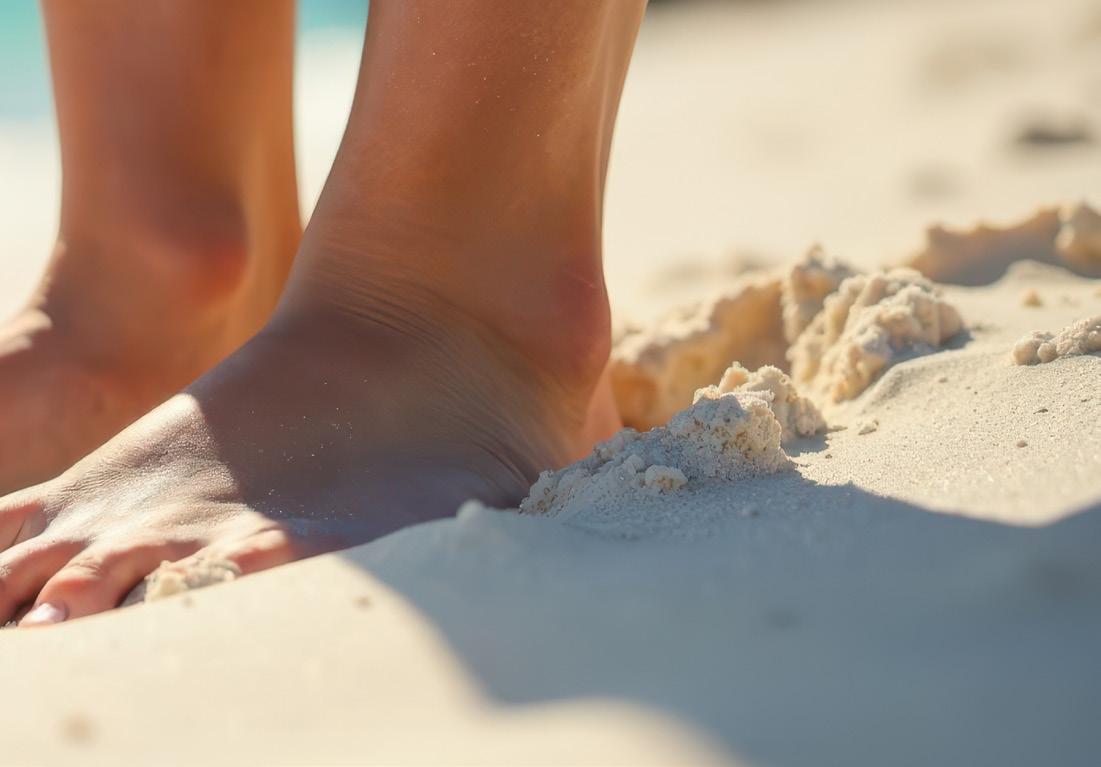
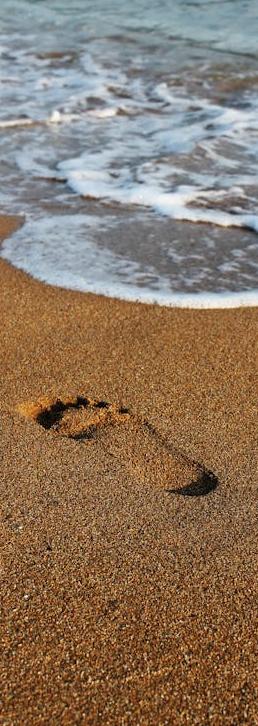
This spring, please set them free. Go to Għajn Tuffieħa or to Imġiebaħ Bay – so pristine and so pretty in March –take off your shoes, and feel the sand between your toes, the texture, the temperature. Let your feet connect you with the place and your pace.
This is called ‘grounding’, something that, until the recent past, we used to snub as woo-woo and New Agey. But ultimately, science has proved us wrong: walking barefoot in nature has amazing benefits for our health.
If you must keep your shoes on, no problem; the feet and the rest of the body can still benefit. March is for… marching. The muscles and joints, stiff from winter and compressed by travel, need to thaw, and exploring some of Malta’s off-the-beaten-track areas are the best way to do that. Here are some favourites: Wied Babu, a lush, narrow valley near Żurrieq, with views down toward the famous Blue Grotto; the Fomm ir-Riħ trail, surrounded by cliffs and blue water; and that rugged coastal trail through wildflower meadows, cliffs and hidden coves called Il-Majjistral Nature and History Park.
FUEL THE IN-BETWEEN
I have not mentioned any resolutions about food. We first need to clear our headspace and give ourselves a few minutes of inner calm to listen to our body, then we can make food-related decisions.
However, a good way to recalibrate your nutritional compass while you’re in Malta is to look for local produce. There’s no better place to do that than at the Farmers’ Market in Ta’ Qali. Go there on Tuesdays and Saturdays, chat with the local, knowledgeable farmers, test-nibble some of their seasonal products before buying and then go back to make a fresh, tasty carpaccio of everything.
www.orangeunjuiced.com
Words by Ruth Zammit DeBono
Ruth is a passionate traveller, artist and devoted dog mum, who finds joy in storytelling and discovering the world always with her pet by her side.
Female solo travel… with a dog
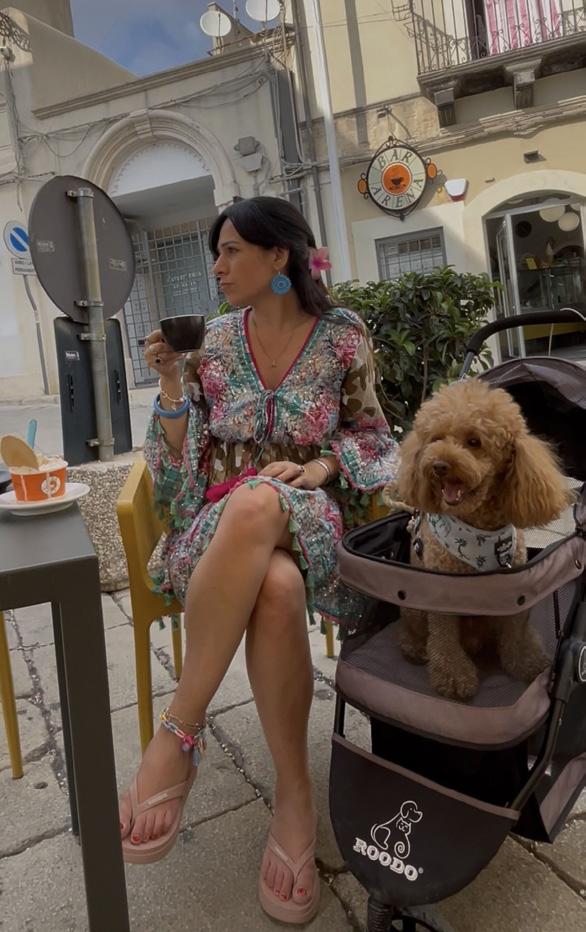
Travelling alone as a woman is often seen as brave, adventurous and possibly risky. Travelling alone with a dog, however, completely changes the experience and how we define going solo. It becomes more about confidence, awareness and connection.
Having a dog with you on your travels gives a completely different rhythm to your trip. You will travel slower, you will observe more closely, and you will be aware of your environment much more than before. That new pace is just one of the benefits.
Morning walks replace rushed itineraries. You will be developing familiar routines with your dog – feeding times, rest stops, gentle exploratory walks around your neighbourhood. This new rhythm will bring you calmness, and that will, in turn, increase your confidence.
Having a dog with you while travelling alone also creates another level of safety. Walking with a dog, even a small one, makes you far more visible and present within your environment. You’re less likely to feel anonymous or alone, like you normally would when travelling solo.
And you are more likely to engage naturally with locals – people smile and interact with you via small talk, sharing a mutual affection towards dogs. This also sharpens awareness of your surroundings, creates stronger instincts within you and provides more definitive boundaries between you and those around you.
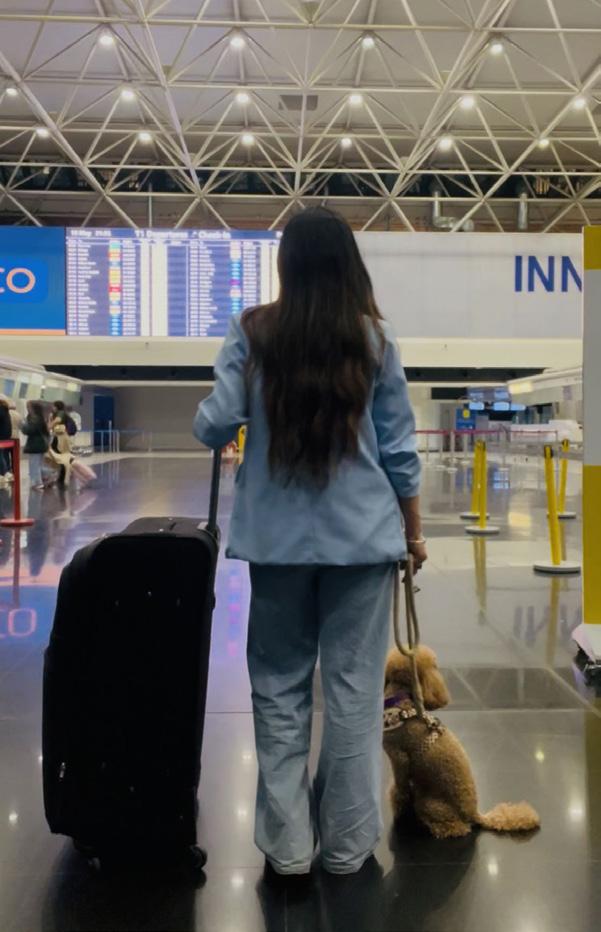
Travelling solo with a dog also fosters independence. From navigating airports to settling into a new city, you learn to trust yourself more than before. Finding dog-friendly transportation, planning your route prior to departure and being open to make changes in your itinerary based on the weather or your own energy levels will become automatic behaviours.
Air travel is made easier with carriers such as KM Malta Airlines, through their smooth connections for those who appreciate a comfortable and relaxed experience – both for themselves and their four-legged companions.
But perhaps the most surprising element is this: travelling with a dog never feels lonely. You will share many moments – scenic sunsets, train rides, quiet cafés. Sharing these experiences with your dog will anchor the two of you as a team. You’re never alone; you’re simply travelling together. And the feeling lingers long after the journey ends.
As we mark International Women’s Day in March, travelling solo with a dog feels like a quiet celebration of trust – in our instincts, our rhythms and our ability to find our way, wherever we are.
points
Flying with your dog on KM Malta Airlines: what to know .....
Only small dogs and cats are permitted to travel in the cabin, subject to availability.
Pets must travel in an airlineapproved soft carrier that fits under the seat in front of you.
The combined weight of the pet and carrier must not exceed the airline’s specified limit.
Pets must remain inside the carrier for the entire duration of the flight.
Advance booking is required, as the number of pets allowed per flight is limited.
DM us on Instagram @pupspaintandprosecco if you’d like to chat or need help planning your journey.
Words by David Carabott
David is a teacher, specialised in mentoring students of different abilities. An avid traveller, his target is to visit all the countries in the world. When he is not in Malta or travelling elsewhere, you can find him somewhere in Rome.
Malta’s rising football star
Haley Bugeja is not just a footballer. She is the pride and joy of the Maltese Islands and a true ambassador for her country on the stage of the sporting world. Take a journey into women’s football and hear her story of talent and perseverance.
My interest in women’s football began when I befriended Gozitan Melania Bajada at work. I soon started following and supporting the team she coached, Birkirkara. She won a staggering five titles in a row as a player coach.
We even travelled together to Lyon in France to watch the 2019 FIFA Women’s World Cup final, and on one occasion, Melania told me about a young girl she considered to be very promising and regards as a star.
Indeed, Haley Bugeja, 21, is not just a footballer. She is the pride and joy of the Maltese Islands and a true ambassador for her country on the stage of the sporting world, where she carries the Maltese flag with honour.
From a local talent to an international player, Haley’s journey has inspired countless young athletes in Malta and beyond, uniting fans across the country and showing what talent, dedication, humility and heart can achieve. She makes the nation proud every time she steps onto the field and fans eagerly follow her career, celebrating every goal she scores.
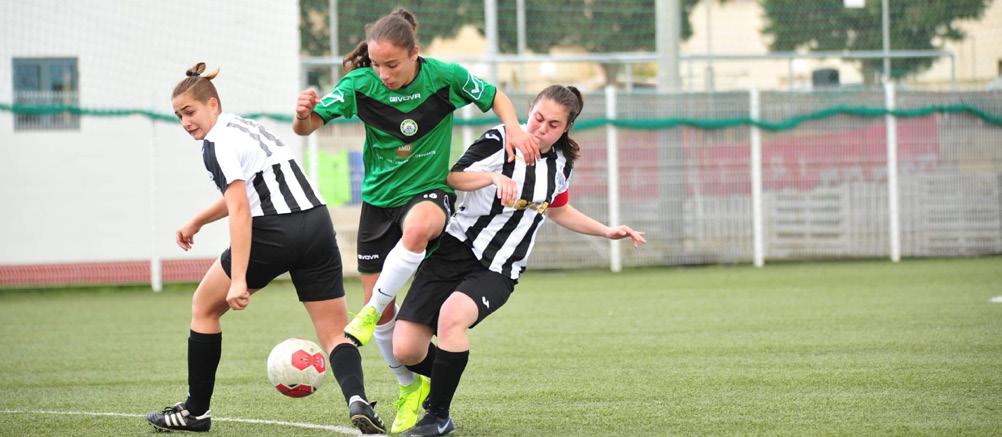
EARLY BEGINNINGS AT MĠARR UNITED Haley’s football journey began in her hometown Birkirkara, aged five, before joining the Mġarr United Football Club at 11. It was there, as a young girl with great potential, that she first showcased her natural skills, technique and instinctive understanding of the game.
Her rapid rise from Mġarr’s youth ranks to the senior squad signalled the emergence of a unique talent destined for far greater things.
Haley later captured the attention of the Maltese public when she broke boundaries, joining the Serie A club Sassuolo. During her time there, spectators became accustomed to her breathtaking coast-to-coast goals, which demonstrated her speed, power and footballing intelligence. Each match was a reminder that Malta had produced world-class talent worthy of competing with the best.
This talent then took her from Italy to the US where she joined Orlando Pride in the National Women’s Soccer League (NWSL), known for its intensity and high level of competition, especially as the US had just won the Women’s World Cup while she was playing there.
More recently, Haley joined and is shining at Inter Milan, further establishing herself as one of Malta’s brightest sport stars.
Her presence has elevated every team she has represented and her performances with Malta’s national team continue to raise the profile and competitiveness of Maltese women’s football internationally. Watching her play is a reminder that Malta has a global presence through her achievements.
But Haley, whose life revolves around football, is also am ambassador off the field. On holiday with a relative, her name came up in conversation, and I was told she was one of the daughters of my cousin’s closest friends – genuine, humble and approachable, despite competing with some of the best footballers.
When Haley received my message that I am a teacher and would like her to visit my school, which caters for students with different abilities, she immediately agreed.
Haley has now visited twice and they were unforgettable experiences. The staff organised a penalty shoot-out and she immersed herself fully in the activity, interacting warmly with every student and cheering them on.
Her presence lit up the school, and it was clear how much she cared about connecting with the next generation. On that day. she was not only a football star but also a mentor and a role model.
Words by David Carabott
Celebrating St Joseph
Before Malta erupts into its summer procession season, the feast of St Joseph arrives quietly, in the gentle twilight between winter and spring. Celebrated most evocatively in Rabat, it is a reminder that, on these islands, tradition is not only observed, but also lived, tasted and carried forward, one generation at a time.
Feasts in Malta are among the most traditional and colourful celebrations on the islands. They dominate village and town life in summer, with bright decorations, statues carried shoulder-high in processions, and dazzling fireworks transforming even the smallest localities into vibrant stages.
Yet the feast of St Joseph stands apart. Although some towns and villages do celebrate St Joseph in summer, in Rabat it is still celebrated in March on its proper liturgical day, allowing for deeper reflection and devotion. During this period, the celebration feels more intimate, rooted in memory and tradition.
Every year on 19th March, Malta celebrates the feast of St Joseph, a public holiday and one of the most important dates in the national calendar. Falling during Lent, the feast, in honour of the patron of workers, fathers and the universal Church, balances reflection with celebration, marking the end of winter and the approach of spring, well before the start of the summer village feasts.
In Rabat, the celebrations revolve around the Church of St Mary of Jesus, known locally as Ta’ Ġieżu. The feast is organised by the Archconfraternity of St Joseph of RabatMdina, in collaboration with the Franciscan friars from the same church, L’Isle Adam Band Club A.D. 1860 and the 19th March Fireworks Factory.
The church, dedicated to the Visitation of Mary to her relative Elizabeth, features a luminous altarpiece painted by Giuseppe Hyzler, locally celebrated for his distinctive Nazarene style.
On the day of the feast, the church is lovingly adorned in rich cherry-red damask, which is replaced by deep black once the celebration concludes, in preparation for Holy Week. A Solemn High Mass is officiated by the Mdina Metropolitan Chapter, accompanied by sacred music composed by the late esteemed Maestro Carlo Diacono.
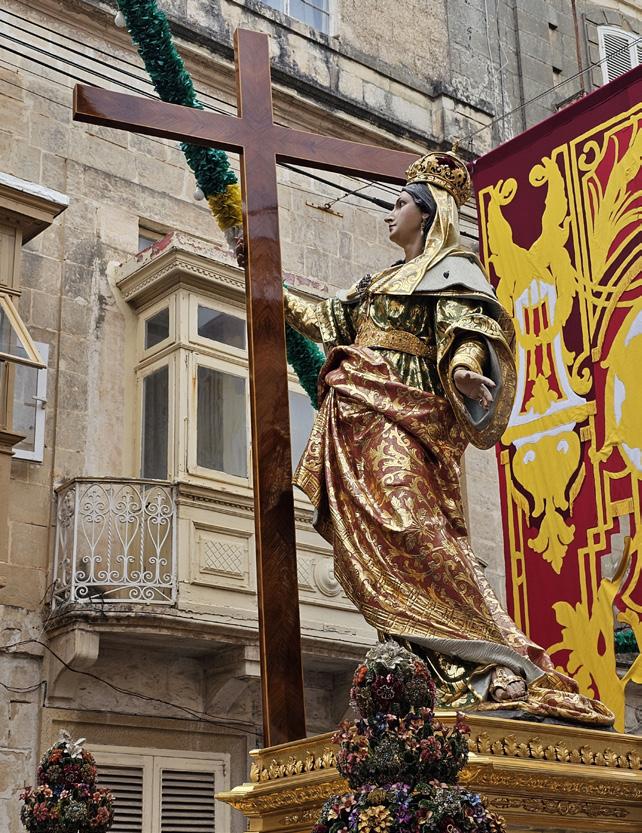
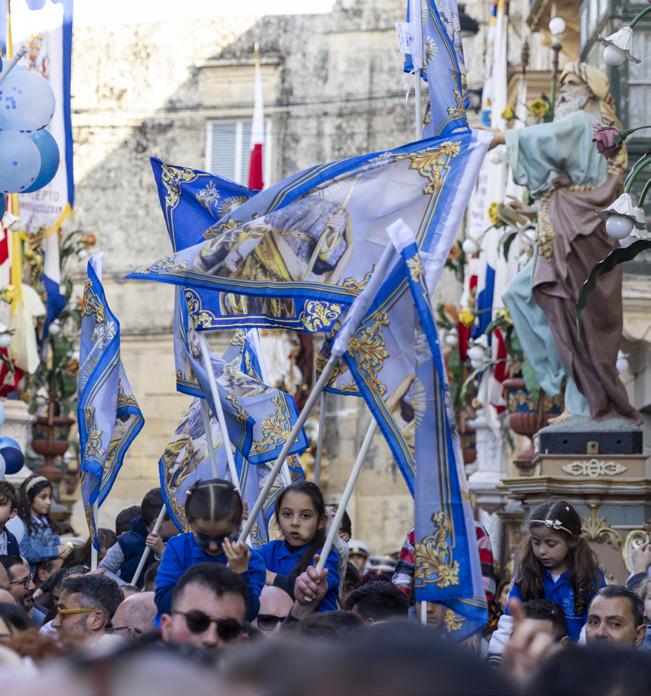
As evening falls, a finely wrought papier-mâché statue of St Joseph, brought from Marseilles and crafted to a design by Luigi Fontana, is carried high on shoulders in procession, accompanied by music, applause and the soft glow of lights strung across balconies and façades. The steady beat of brass bands leads people, myself included, through the winding streets, while glittering fireworks fill the night sky.
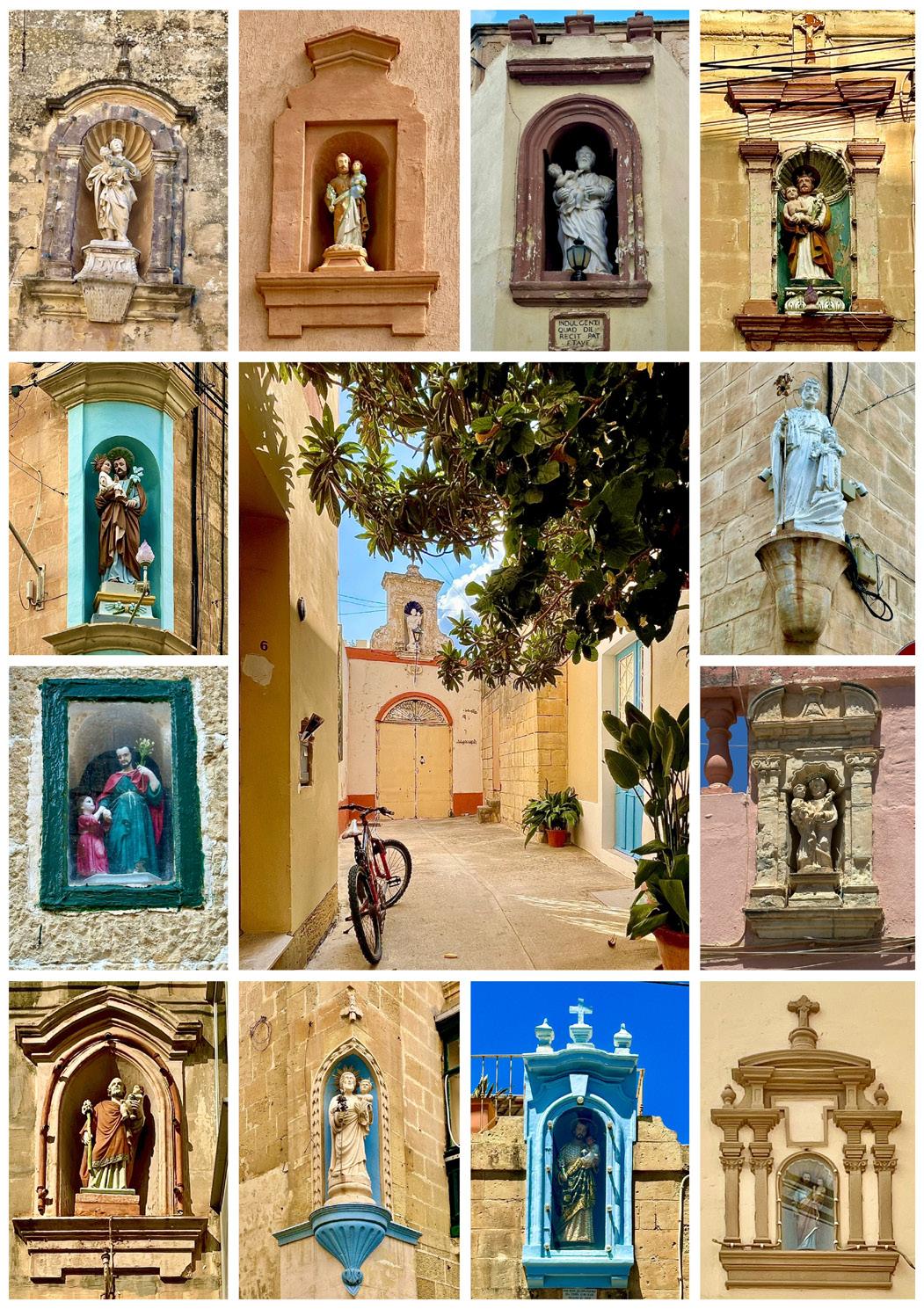
Photo: Tony Gatt. Roadside shrines to St Joseph.
Walking through Rabat during the day, I always sense how deeply the feast is woven into community life. Doors are left ajar, neighbours greet one another, and visitors are welcomed without hesitation. The atmosphere is festive but grounded, joyful yet reflective. It is a reminder that Maltese identity is shaped not only by grand events but also by shared rituals repeated year after year.
St Joseph, or San Ġużepp in Maltese, is deeply woven into the physical and emotional landscape of the islands. His presence is felt not only in churches, but also in street names, squares and the quiet corners of villages and towns.
Triq San Ġużepp in Marsaxlokk, the fishing village where I spent many childhood summers, is one such place. To me, that street is synonymous with memories of salt in the air, characteristic fishing boats rocking gently in the harbour, and the unhurried rhythm of authentic village life shaped by the sea and the seasons.
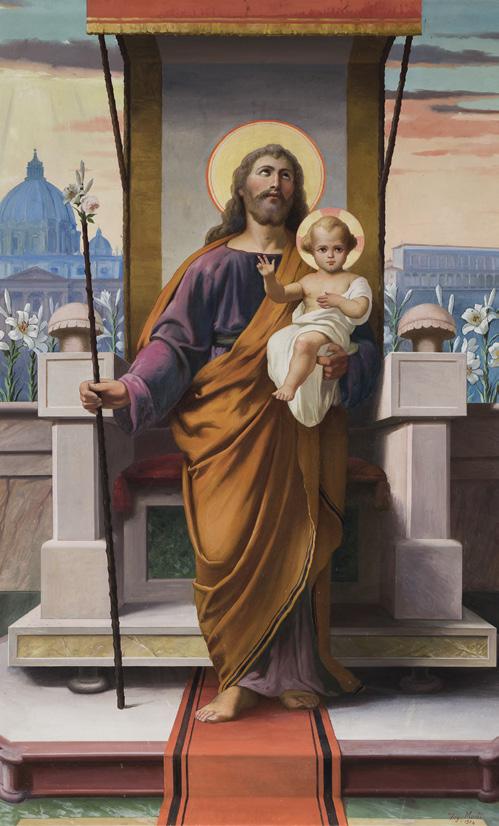
My favourite image of St Joseph in the Maltese archipelago is the striking painting by the Italian artist Virginio Monti in the Basilica of the Nativity of Our Lady in Xagħra, Gozo. The work honours the saint not only in devotion but also in artistic representation, depicting him as a figure of quiet strength and humility. These qualities resonate deeply within Maltese culture and reflect the enduring reverence for San Ġużepp across the islands.
TASTING TRADITION
No Maltese feast is complete without food, and the feast of St Joseph is no exception. Whenever I attend the Rabat feast on 19th March, the first thing I look out for is not the procession or the feast decorations but the unmistakable aroma of the żeppoli ta’ San Ġużepp. These are delicious confections made from a rice batter with candied fruit and raisins, deep-fried and drizzled with honey and icing sugar (see story on PG 71).
Another traditional treat is the sfinġa, a golden fried choux pastry made especially for the feast. It can be enjoyed sweet, filled generously with ricotta and drizzled with honey, or savoury, often filled with anchovies. The savoury version continues to be prepared throughout Lent until Good Friday.
Alongside the żeppoli and sfineġ, other traditional treats appear, from honey rings and carob sweets to qubbajt, a nougat made with almonds and honey; imqaret, date-filled pastries; kwareżimal, a spiced almond-based biscuit traditionally baked during the Lenten period; and figolli, elaborately decorated almond-filled pastries associated with Easter, offering a glimpse into Malta’s rich culinary heritage.
Photos: Archconfraternity of St Joseph of Rabat-Mdina. The feast of St Joseph.
As I bite into a sfinġa, warm and indulgent, I am reminded how taste has the power to unlock memory. Around me, bands play, children weave through the crowds, and the statue of St Joseph moves slowly forward, carried with devotion and care. During that moment, past and present seem to converge.
CONTINUITY AND BELONGING
The feast of San Ġużepp is an occasion where faith, language, memory and community come together. It speaks of traditions celebrated quietly. Long before the summer marathon of feasts begins, 19th March offers a pause, a moment when the islands collectively honour continuity and belonging.
As I leave Rabat, the sounds, smells and sight of fireworks fading behind me, the sweetness of honey still lingering on my palate, I am struck by how much this single day contains. It holds my own memories and national identity, private reflection and shared celebration.
In the gentle light at the very end of winter, St Joseph’s feast serves as a recollection that, in Malta, tradition is lived tasted, and carried forward, one generation at a time.
WHAT’S IN A NAME?
For many Maltese, the name Joseph or Ġużeppi embodies faith, tradition and the strength of family bonds. In my own family, that history links directly to my father, who was baptised Giuseppe, a name that remained common even after Italian ceased to be Malta’s official language.
English and Maltese became Malta’s official languages in 1934, and under British rule, Italian was gradually phased out of official use by 1936. Over time, Italian names such as Giuseppe increasingly turned into Joseph, reflecting changes in the way the islands were administered.
But these changes did not erase what came before. In Malta, language, beliefs and identity have always overlapped, adding layers of meaning rather than replacing them. My father’s identity card still bears the name Giuseppe.
Photo:
Xagħra Parish Church.
Painting by the Italian artist Virginio Monti in the Basilica of the Nativity of Our Lady in Xagħra, Gozo.
Words by Heritage Malta
GOZO, COMINO AND THE CORSAIRS
Catch a glimpse of the swashbuckling past of the commerce raiders through a new and gripping book on their maritime adventures.
Malta’s sister islands, Gozo and Comino, were much more than peaceful retreats in the Mediterranean. During the 17th and 18th centuries, they served as frequent havens for commerce raiders – famed Mediterranean privateers, who used these sheltered shores to replenish supplies, seek refuge from storms and prepare for the next stage of their daring exploits.
For those who wish to explore the hidden stories of the commerce raiders, Morte o Fortuna, the latest book by historian Liam Gauci, takes readers deep
into these maritime adventures, unveiling the rich history of corsair activity along these very shores.
Take, for instance, the year 1778. Captain Francesco German sailed his felucca to the island of Comino, where he spent a day replenishing his water supply. This wasn’t a solitary event. In fact, in 1787, Captain Gaetano Cavasso sought shelter in Comino’s quiet bays due to contrary winds, and in 1792, Captain Valentini’s ill-fated journey took him on a tumultuous path, forcing him to seek refuge in Comino several times before completing his voyage.
These islands were more than just stopovers; they were vital lifelines to commerce raiders navigating treacherous waters.
In Gozo, the plot thickens. During a journey in 1791, Captain Valentini’s felucca, brimming with captured slaves, made a stop at the island’s picturesque Il-Ġebla tal-Ġeneral bay. The captain procured provisions from the Governor of Gozo, ensuring his crew was well-stocked for the next leg of their journey.
Yet, it was Gozo’s role as a safe harbour that truly stood out – when the overloaded felucca faced disaster at sea, it was Gozo that became a sanctuary once more, offering safety and provisions until the journey could continue.
Gozo and Comino were more than just islands in the Mediterranean – they were part of a vast network that ensured commerce raiders could continue their daring raids across the seas. Their strategic locations, sheltered coves, and pristine landscapes offer a glimpse into a forgotten maritime world.
VISITING GOZO AND COMINO: TRACING THE CORSAIRS' FOOTSTEPS
Today, these historic sites are accessible to visitors eager to walk in the footsteps of the past. In Gozo, the Dwejra Bay area, with its dramatic limestone cliffs and the iconic Fungus Rock (Il-Ġebla talĠeneral), offers a tangible connection to the corsairs.
Dwejra Tower, built in 1652, stands as a sentinel overlooking the bay, once serving as a watchtower to guard against corsair landings. Visitors can explore it and enjoy panoramic views of the surrounding landscape.
On Comino, Saint Mary's Tower, constructed in 1618, was strategically positioned to defend against corsair attacks and to communicate with the mainland. The tower remains a prominent feature of the island's landscape and is open to the public, offering insights into its military history.
EXPERIENCE THE CORSAIR LEGACY
For those intrigued by the tales of Malta's commerce raiders and the beauty of these islands, Morte o Fortuna is a must-read. This book weaves together captivating historical stories with a deep appreciation for Malta’s maritime past, bringing to life the world of commerce raiders, their adventures and the islands they frequented.
Whether you're planning a visit, or simply want to immerse yourself in Malta’s rich history, Gozo and Comino offer the perfect backdrop for discovering the past while celebrating the beauty of the present.
To delve deeper into the world of corsairs and their impact on Malta, visit Heritage Malta's online store to purchase Morte o Fortuna: Corsairs in Malta 1747 - 1798.
Words by Thomas Camilleri
Creative director by day and actor by night, Thomas also founded Lazarus Tiles, a project through which he saves and documents Malta's cement tile heritage.
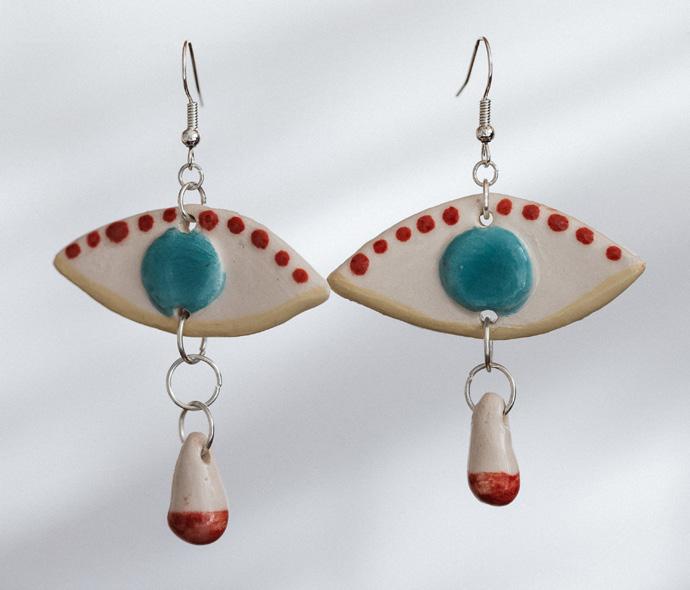
So many things to dream about… and make
Is she
a seamstress? Is she a writer?
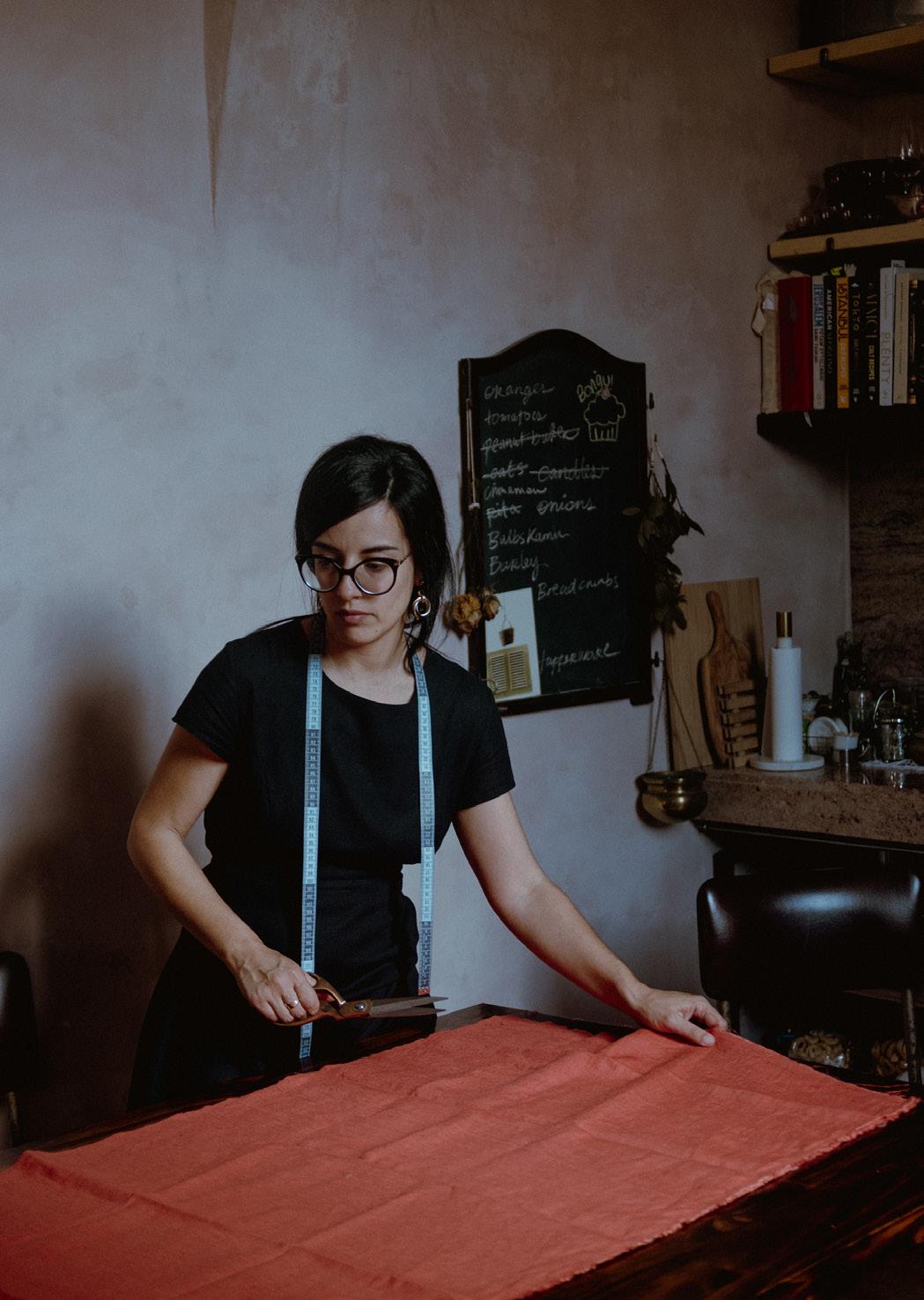
Is she a cook? No, she’s all of that and more. Unpicking as much as possible of Maria Muscat lays bare an enigmatic and talented aesthete and the creations behind Babettopolis.
I met Maria at an interesting juncture in her life. She’d just joined the marketing agency I worked at, needing a little income stability as it was time to feather her own nest. Though we’ve now both moved on from our old jobs, our friendship remained.
The house, too, still stands as a beautiful pink Siġġiewi village-core-townhouse-meets-hammam confection of her own making and already lives in several happy memories of mine.
I suppose that one of the reasons I was so drawn to Maria is that, like me, she’s never had a clear idea of what she wanted to be. Rather, she understands how short our time here is and that there are “so many things to dream about and make and narrate with so little time”.
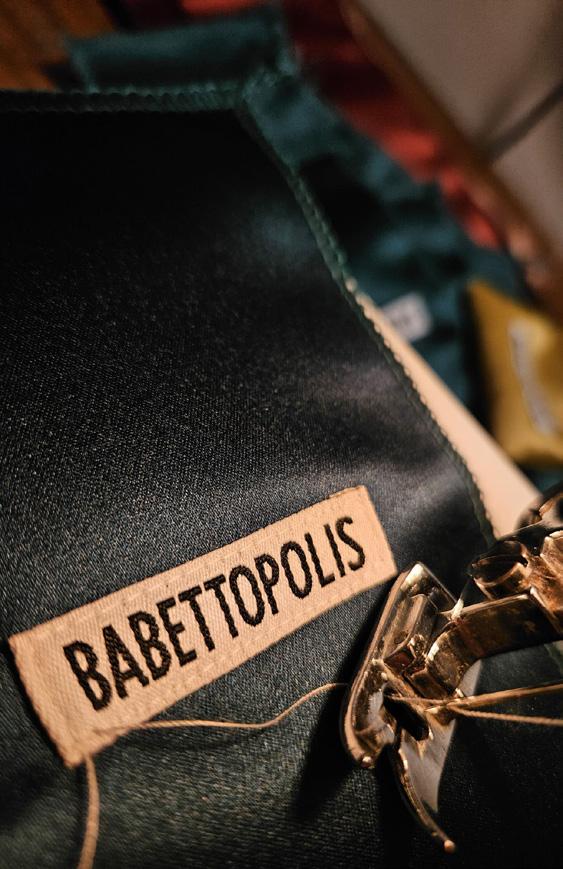
Through a new friend, I’d heard of her pseudonym before as she’d sewn her wedding dress – no mean feat! The origins of the Babettopolis name might be lost to the sands of time, but the purpose of creation and discovery that it came with are still what drive her.
Photos: Lisa Attard. Maria Muscat in her studio.
While I’m sure there’s a lot of nature in there, the artistic nurturing she received growing up definitely helped form who she is today. “My parents’ house was equipped with everything I needed to create,” she tells me. “That can-do attitude and a varied skill set across mediums have informed my approach throughout everything I tried my hand at.”
Visiting her home is always a pleasure. I love hosting too, but it invariably ends up being a stressful few hours before my guests arrive and me needing a nap by dessert. On the other hand, Maria has it down to a fine art. A reader of cookery books for pleasure, she will set aside an entire day or two to partake in the joy of slowly and meticulously preparing a feast, to then enjoy it at equal leisure with those lucky enough to be sat at her table.
On her method, she is clear: “Stopping to make time for the slow creative processes that I love in a very fast-paced world is what keeps me grounded and centred. I like to think that making unique things slowly and with a lot of love and patience –
things many people do not seem to have time for anymore – encapsulates a kind of magic.”
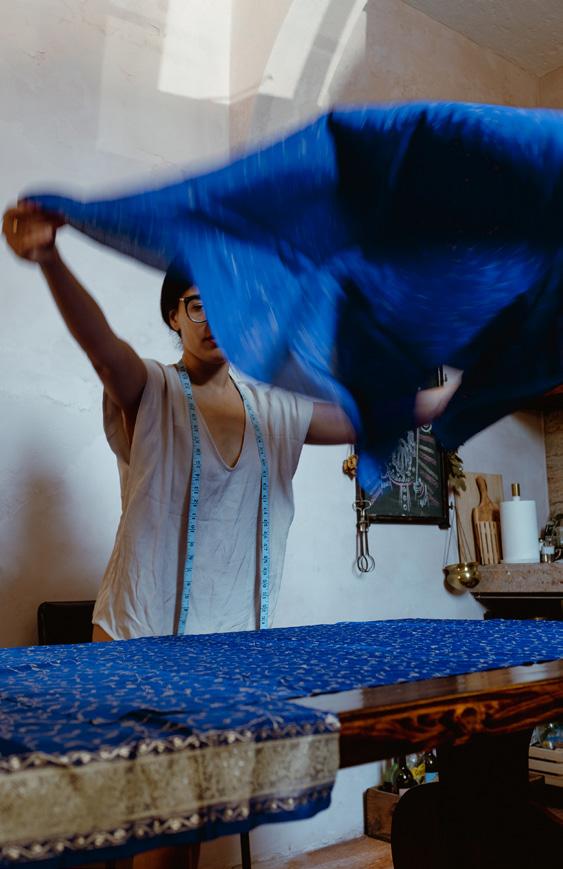
Maria’s keen awareness of our place in the world often informs her endeavours, and she is always seeking to reuse, recycle, or repurpose where possible. This is why I wanted to work with her on one of my latest projects. Having collected vintage fabrics for years simply because they were too beautiful to be thrown away, I floated the idea of creating bags to recycle the material and she jumped on it. It would be a limited collection, endlessly changing based on whatever items we were recycling, be they curtains or bedspreads.
“A 'create according to what comes in' approach means less waste and more uniqueness,” she says, displaying a variety of pie bags and clutches, laptop and bottle totes.
Delving into her process, Maria explains that when the material comes in, it is tested for strength and cleaned thoroughly. “Then, after sitting a while with the material, I decide on what it is best suited for.”
We both agree that it ticks many boxes for us and for those who engage with the project.
“It’s imbued with stories and a collaborative spirit, engaging the community as people come forward with material they'd like to donate and transform.
“It then reaches out to a clientele, among whom there may be new converts to the idea of taking home or gifting something repurposed; or simply people who would love to remember Malta by a unique item rather than a mass-produced trinket,” she says.
With her father George Muscat being a ceramicist, it’s perhaps inevitable, rebellious as she may be, that she also has a love of clay and its malleability.
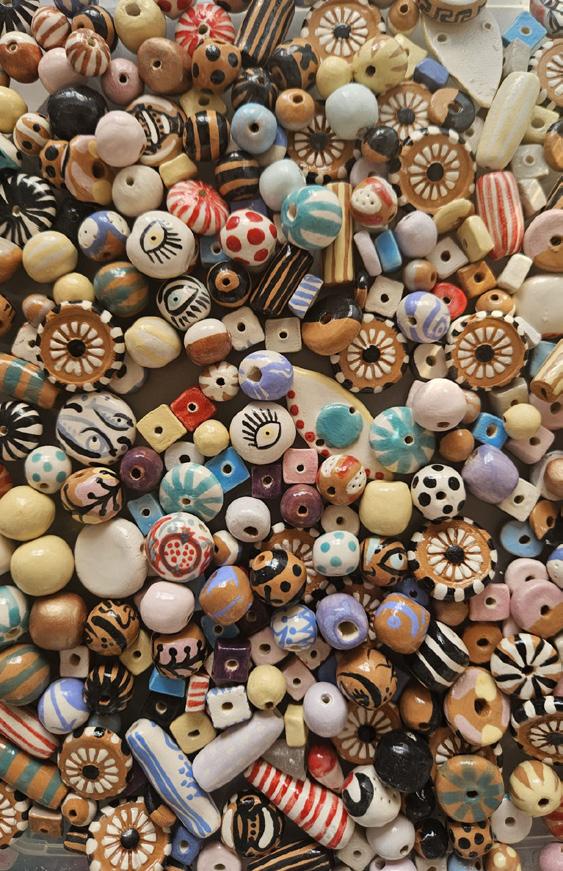
“My father has devoted his life to creating art with clay, while I, much to his teasing disdain, was always drawn to making items I could use or wear.” Maria explains this as she scatters all manner of painted beads and hardware across the table.
“Following some major changes in my life, including returning to freelance work, I started to reconnect with making things. I never stopped sewing or altering clothes, or making custom items for creative projects, but making things for me, for fun, patiently, was something I needed to retrain myself in.”
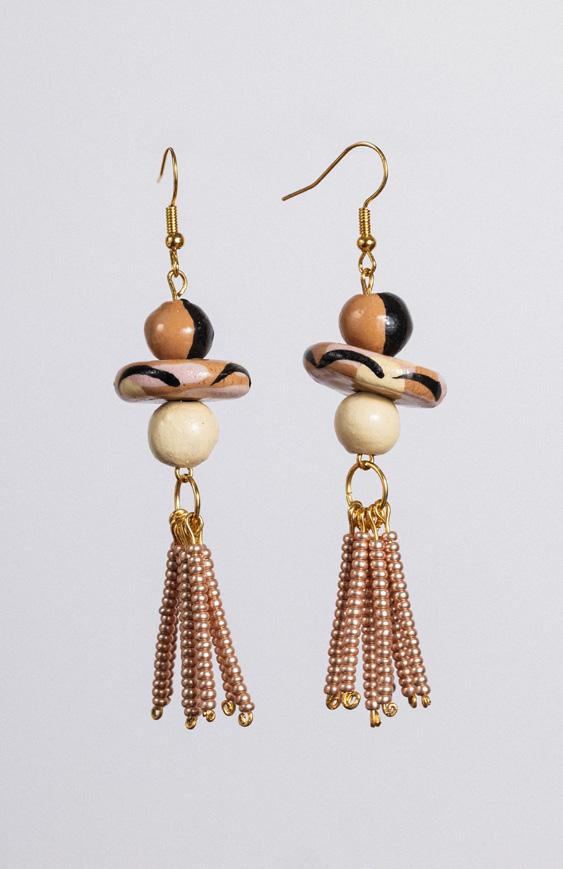
This has led to a collection of handmade white and terracotta clay bead jewellery, incorporating recycled items she has finally found a use for.
Every aspect bears Maria’s touch, down to the packaging that is entirely made by her too.
“I really love that I can make unique objects and share them with the world,” she reflects. “I guess that in a way, my ultimate aim was always to lead a creative life, whichever way, shape, or form that took.”
You can follow Maria’s musings and projects on Instagram @babettopolis and find her bags and jewellery at Hollywood, 92 Republic Street, Valletta.
Words by David Carabott
Spring through a farmer’s eyes
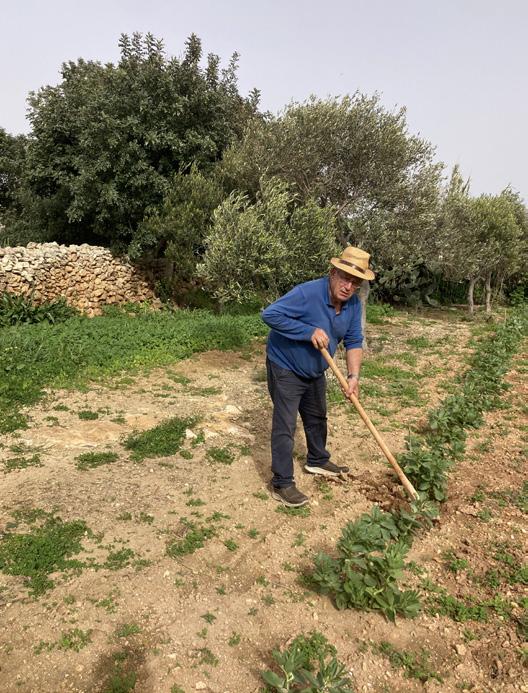
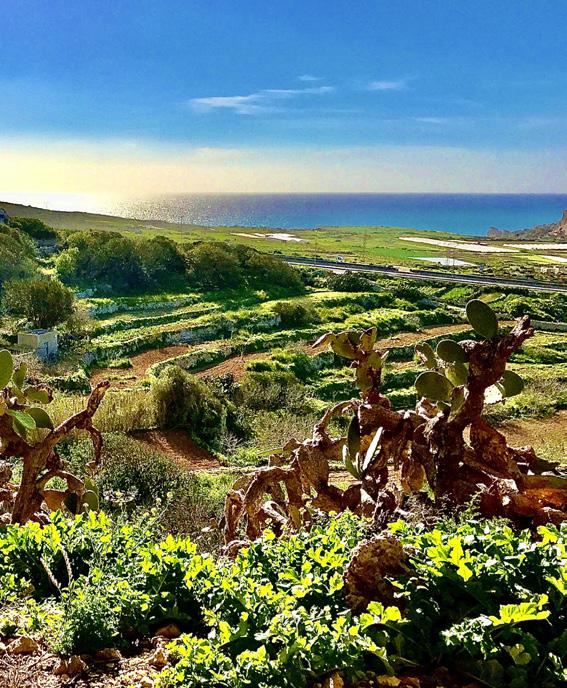
Learn the language of Malta’s fields in spring, as the countryside comes alive and every moment counts in this brief season of splendour. From the precise timing of planting and harvesting to the tender care of growing crops, a farmer’s life is ruled by a balance of nature, patience and hard-earned skill.
Spring is my favourite season and my preferred time to swim. The air is fresh and gentle, not too cold and not too warm, with mild temperatures ranging from 15°C to 25°C. The skies are blue, the waters are crystal clear, the beaches serene and empty, and the quiet invites you to dive in, alone and unhurried.
It is also the ideal time for wandering through the Maltese countryside, which varies between the north, with its enchanting and unique charm, and the south. Greenery stretches to the horizon as fields and surrounding nature come alive in full bloom.
Walking through the awakening landscape alongside Mike Bonello, a local farmer, I begin to see the season through his eyes. Fresh growth pushes through the earth, the air hums with life, and ordinary fields become extraordinary under his care.
For Mike, a farmer all his life, this season is the crown jewel of the year; a reminder of why he chose this path. Moving through the vibrant green, feeling the earth’s pulse and listening to nature’s quiet whispers, he is immersed in the patience and devotion that farming requires. The work may be demanding, yet there is a profound privilege in witnessing the land awaken, season after season.
READING THE LAND
A tour through his fields highlights differences in the land that might otherwise go unnoticed. Mike tends the lush, green patches with particular care, keeping them irrigated through the arid months. These are his saqwi – fields where vegetables and fruit thrive thanks to a reliable water source.
In the past, his family channelled water through small canals to reach these cultivated grounds, a method shaped by generations of care, observation and knowledge.
Then there are the more rugged areas that rely entirely on rainfall. These are his bagħli – rain-fed fields usually used for winter crops. Here, Mike can grow hardy vegetables, such as pumpkins or cabbages, without additional watering, though the land is far less forgiving. The bagħli fields complement his saqwi, allowing him to make the most of both water-rich and rain-dependent land.
Nearby, Mike points out a small round stone structure rising quietly from the field. It is a girna, a traditional Maltese hut, carefully built by his ancestors by stacking roughly hewn stones by hand, without any mortar, its roof closing into a dome. Mike uses it for shelter from sun and rain, and as a practical space to store the tools he needs for working the fields.
Seeing Mike in his element, nurturing his land and using the structures his family built, gives a vivid sense of the skill and rhythm of farm life, and of the deep connection between him and the land he continues to care for.
AWAKENING FIELDS
From March to June, the islands slowly come alive. Though rainfall is scarce during these months, the autumn and winter rains have already soaked the soil, and now hills, terraces, plateaus and valleys begin to shimmer with lush greenery. What was brown and dusty just weeks ago is now a patchwork of life, as nature awakens in a quiet, persistent surge of growth.
Wildflowers burst across the uncultivated landscape, from the deep red of poppies to the delicate purple of wild orchids and the cheerful yellow of crown daisies. Fragrant clover carpets fields and waysides in a natural celebration of spring. Among these wild blooms, Mike also nurtures lilies, freesias and gladioli, coaxing each flower to life for Holy Week displays or to brighten Maltese homes.
Walking beside him, I feel the sun’s warmth seep into the land as the salty Mediterranean air mingles with the crisp scent of new growth. It is a sharp contrast to the more parched landscapes of summer.
CREAM OF THE CROP
Mike plants some of his vegetables under protective covers in a greenhouse, and with irrigation (saqwi ), allowing him to bring produce to market earlier than usual. On the open land, he practices dry farming (bagħli ), cultivating garlic, onions, carrots and tomatoes, using only natural rainfall.
Spring is the time when the work of the previous autumn bears fruit. Cauliflowers, cabbages, broccoli, marrows, kale, fennel, lettuce, turnips and peas begin to emerge, each crop adhering to its own careful timetable.
From strawberries to peas, garlic to almonds, every crop in his fields tells a story of timing and attention to detail.
I am captivated watching the fresh garlic push through the soil, each sprout promising to enrich a traditional fried or stewed rabbit, both of which are cooked with generous amounts of this vegetable, while parsley and celery thrive nearby, destined for divine broths, soups and hearty seasonal dishes.
As soon as spring arrives, broad beans are ready for harvest, and Mike and I enjoy a simple snack of these freshly picked, sweet and succulent legumes straight from the field.
After, we savour a few ripe, red strawberries. Their sweetness, which dominates local markets
Mike Bonello.
Photos: Tony Gatt.
from mid-April through June, is a testament to the care and expertise of farmers like Mike. Broad beans and strawberries are truly the king and queen of the Maltese table.
ORCHESTRATING THE ELEMENTS
Spring is a season of constant attention and care, where each day brings a new challenge. From the delicate timing of planting and harvesting to the careful monitoring and protection, the life of a farmer in Malta is shaped by nature, patience and expertise.
The fruit trees also come alive in spring. Almond, lemon and peach trees burst into delicate blossoms, mulberry trees begin to fill with deep-coloured fruit, and loquat and fig trees show the first signs of the harvest to come.
In the last third of spring, temperatures rise considerably and irrigation becomes vital. Winter rainfall is no longer sufficient to sustain the crops, so Mike employs methods such as mulching, covering the soil with straw or plastic to retain moisture, and drip irrigation, which delivers water directly to the roots of his plants in the saqwi fields.
In May, Mike begins grafting, a meticulous practice that allows him to cultivate new fruit varieties, blending patience with centuries of agricultural wisdom, and a profound respect for the land he tends.
He monitors the weather closely, knowing that rain after mid-April can damage his tender crops, raising the risk of fungal infections in vegetables like marrows and tomatoes. Wheat and other cereals nearing harvest are particularly vulnerable to late rains, which can compromise both yield and quality.
As spring draws to a close, Mike spreads manure across his fields, and prepares the soil for summer crops, including melons, watermelons, cucumbers, aubergines, peppers and courgettes, all of which thrive under Malta’s scorching sun.
FRUITS OF LABOUR
Despite the daily challenges, spring is also the most rewarding time of the year for Mike. It is a season of growth and abundance, when his careful planning and hard work are met by the earth’s generosity.
The season is also a time of hope, a promise of summer and the unbroken cycle of growth that sustains the islands. The countryside around him is alive with colour, scent and movement, from the rustle of leaves in the breeze to the rhythmic drip of irrigation water onto the soil.
As the sun warms the fields, a patchwork of greens and golds stretches into the distance. Walking beside Mike, I soak in the scene, noticing how every square metre of cultivated land and every flowering tree whispers stories of care, hope and renewal.
Even from 9,000 metres high, it is easy to see why spring in the Maltese Islands is so special. It is more than a season; it is an awakening, and in Mike’s fields, life unfolds in all its vibrant glory.
Words by Coryse Borg
Understanding the Spring Equinox
Each
March, the Earth reaches a precise point in its orbit when day and night stand in near-perfect balance. Known as the Spring Equinox, this astronomical milestone has shaped calendars, cultures and rituals for thousands of years and continues to resonate today, from global celebrations of renewal to a remarkable sunrise phenomenon at Malta’s prehistoric temples.
Twice a year, the Earth arrives at a moment of equilibrium that has fascinated astronomers and historians alike. The Spring or March Equinox marks that instant when the sun crosses the celestial equator, moving from the southern to the northern hemisphere.
For a brief period, daylight and darkness are almost equal in length across the globe, signalling the start of astronomical spring in the Northern Hemisphere and autumn in the Southern.
The term equinox derives from the Latin words for ‘equal’ and ‘night’ – an apt description of this celestial balance. While it is often referred to as the Spring solstice, the equinox is a distinct astronomical event, separate from the solstices that mark the longest and shortest days of the year.
From this point onwards, daylight hours in the Northern Hemisphere steadily increase, ushering in longer evenings, rising temperatures and the visible reawakening of the natural world.
From a scientific perspective, the Spring Equinox occurs when the Sun is positioned directly above the Earth’s equator. Because of this alignment, both hemispheres receive almost the same amount of sunlight, resulting in day and night being of nearly equal duration worldwide. In practice, daylight usually exceeds night by a few minutes due to atmospheric refraction and the way sunrise and sunset are measured.
But beyond its astronomical significance, the Spring Equinox plays an important role in how humans organise time. A key reference point in astronomy and calendrical systems, it is used to determine the dates of movable feasts, most notably Easter.
Photo: Heritage Malta. Mnajrda.
For millennia, cultures around the world have recognised the equinox as a turning point in the year, developing traditions that emphasise renewal, harmony and new beginnings. According to Christian tradition, Easter falls on the first Sunday after the first full moon following the Spring Equinox, linking one of the most important dates in the Christian calendar directly to this moment of celestial balance.
In Iran and across regions influenced by Persian culture, the Spring Equinox marks Nowruz, the Persian New Year, which is both a cultural and spiritual reset, closely tied to the rhythms of nature. In South Asia, the festival of Holi is celebrated around the same time of year. Although its timing follows the lunar calendar, its association with the seasonal shift has long linked it to the broader themes of renewal embodied by the equinox.
In Europe and North America, many modern Pagan and Wiccan traditions observe Ostara, a festival dedicated to balance, renewal and rebirth. Rituals often include sunrise observances, planting and the use of eggs as symbols of new life. Japan marks the equinox with Shunbun no Hi (Vernal Equinox Day), a national public holiday, part of a seven-day period of reflection, family visits to ancestral graves and an appreciation of balance in nature and in life. The equinox here often coincides with the early blooming of cherry blossoms.
In parts of Central America, the equinox is celebrated at ancient archaeological sites that demonstrate a sophisticated understanding of astronomy. At Chichén Itzá in Mexico, the spectacular Serpent of Light phenomenon, can be experienced, while at Teotihuacán, thousands of visitors gather to climb the Pyramids of the Sun and Moon to welcome spring.
THE MNAJDRA PHENOMENON
Malta’s relationship with the Spring Equinox is a bit quieter but no less remarkable. Although there is no public holiday dedicated to the event, the islands are home to one of the most striking equinox alignments in the Mediterranean.
This phenomenon has been observed for over 5,000 years and offers compelling evidence of the astronomical knowledge possessed by Malta’s Neolithic communities.
At Mnajdra, part of the Ħaġar Qim and Mnajdra Archaeological Park in Qrendi, the South temple is precisely aligned so that during the Spring and Autumn Equinoxes, the rising sun’s first rays shine directly through the main doorway, illuminating the central passage and lighting up a niche within the structure.
The solar alignment of its South structure is one of Mnajdra’s most striking characteristics. During the summer and winter solstices, sunlight enters at an angle, illuminating different decorated slabs within the first chamber.
Given the precision of these alignments, it is reasonable to infer that they were intentional and reflect deliberate design. This accuracy demonstrates a sophisticated understanding of astronomy and the natural environment.
The alignment at Mnajdra highlights the importance of seasonal change in prehistoric life, where tracking the movement of the sun was essential for agriculture, ritual and survival, making it one of the most sophisticated examples of prehistoric astronomical architecture in the region.
For prehistoric agricultural communities, tracking seasonal changes was essential for planning sowing and harvesting. In the absence of formal calendars, these alignments may well have served as a practical way to mark the changing of the seasons.
Today, this ancient understanding is honoured through Heritage Malta’s annual Spring Equinox event at Mnajdra. Each year, it opens the temple complex at dawn for visitors eager to witness the sunrise during the equinoxes and solstices.
This year, the public has the opportunity to experience the phenomenon during the Spring Equinox on the 19th, 20th, 21st and 22nd March, with only a limited number of tickets available to ensure a meaningful experience.
Participants gather before dawn at the Ħaġar Qim and Mnajdra Archaeological Park and walk to the temple to witness the sunrise alignment. Guided explanations place the experience in a historical and cultural context, offering insight into how and why the temples were constructed with such precision.
Advanced booking via heritagemalta.mt is advised due to high demand
The Spring Equinox is marked around the world.
Words by Shirley Jobson
Shirley moved to Gozo a few years ago to enjoy its calmer pace with her English husband. After working as cabin crew for several years, she is now a freelance writer and proofreader who loves discovering Gozo’s little secrets.
Get ready for Gozo’s Easter traditions
No matter where you go in Gozo during Lent and Easter, you will experience reflective, inspirational and compelling moments that will remain imprinted in your memory long after the titular statues are returned to their niches. Here’s a schedule of events that promises unique encounters with the upcoming local rituals and divine
ceremonies of the season.
Whether you are an active participant or merely an observer on the sidelines, you are sure to remain mesmerised by the variety of family activities, religious installations, processions, art exhibitions, concerts, dramatic performances and holy functions that fill up the days from Ash Wednesday to Easter Sunday in Gozo.
The island’s capital, Victoria, and its neighbouring towns are renowned for adding to the spirit of this prayerful season.
While various artistic and sacred exhibitions are displayed inside chapels, convent halls and even in private homes, the O Quam Tristis concert at the Don Bosco Oratory in the capital on 13th March presents a musical meditation inspired by Lenten themes.
Youngsters are also given a role in these hallowed commemorations, with the opportunity to carry miniature statues depicting Jesus’s Passion on their young shoulders during the children’s procession, Ħallu t-Tfal Jiġu Għandi (Let the Children Come to Me) on 22nd March.
On the night before Palm Sunday on 29th March, the roads in Victoria become a living stage, showcasing the annual Passion play, L-Imsallab fi Triqatna. As the actors portray the dramatic circumstances surrounding Jesus’s life, agony and death,
the audience walks alongside the performers and experiences each scene in a deeply personal way.
In the suburb of Fontana, during I Fiori Della Passione, the church parvis is covered in beautiful floral designs from 13th March, symbolising Christ’s suffering and encouraging the contemplation of Easter’s significance. This is further enhanced by the Lux Lucernae event on Maundy Thursday on 2nd April, when burning candles in the shape of a cross are laid out to create a peaceful and spiritual atmosphere.
In Munxar, a similar display in the church square features an illuminated cross formed by fjakkoli, while Kerċem’s Hebdomada Sancta on 27th March and Lux Crucifixus on 2nd April include religious displays, biblical exhibitions and candlelit processions.
The village of Għajnsielem unveils another edition of Is-Salib, Ġesù, u Int (The Cross, Jesus, and You). Every year, a small but dedicated group of volunteers – the Għajnsielem Events Team, led by Franco Ciangura –works tirelessly to construct stunning installations from recycled materials, illuminating the skyline alongside the parish church.
Photo: Charlie Buttigieg. The Għajnsielem Cross in 2022.
WHERE IT ALL STARTED EXPERIENCE
EXPERIENCE WHERE IT ALL STARTED
The Brewhouse, Mdina Road, Birkirkara +356 2779 6700
The idea originated during the pandemic, when 800 wooden crosses were placed on the stairs leading up to the church as a memorial to COVID-19 victims. In each subsequent year, this concept evolved into a 15-metrehigh steel cross covered in wooden pallets; a 28-metre-high iron cross adorned with intricate wood patterns, along with a sevenmetre-high model of Jesus crafted from wire and transparent netting; and a 20-metrehigh cross in a steel structure overlaid with multicoloured piping.
This year, yet another illuminated cross, reaching a height of eight metres, was constructed in a metal frame wrapped in white mesh, with the figure of Jesus carved from wooden pallets and 12 large candles circling the cross. The wooden room at its base displays a contemporary Via Crucis reflecting on present-day issues.
Olive trees planted in the surrounding green areas recreate the Garden of Gethsemane, while a more traditional Way of the Cross is dotted around the church square.
Throughout Lent, the interior rustic décor with cosy carpets and cushions offers a tranquil prayer room for people to pause in their daily life, meditate on the season’s message of hope and hold prayer meetings for youths.
On the evening of Maundy Thursday and the morning of Good Friday, the room’s setting will be completely transformed for ongoing reenactments of the Last Supper, with live actors seated at the fully laid table on one side and visitors entering in groups to observe from the other, as the lamb and other food is cooked in the little kitchen at the back of the room and served to Jesus and the apostles.
Photo: Fabian Tagliaferro. The Good Friday street procession in
Photos: Martin Attard.
The yearly Passion play in Victoria, L-Imsallab fi Triqatna.
On Easter Sunday, the ringing church bells announce the joy of the Risen Christ, amid other activities for both adults and children. The most important feast day for Roman Catholics is evident in the centuries-old Easter Sunday processions, with devotees carrying the statue of l-Irxoxt while running enthusiastically through the streets of Gozitan towns, accompanied by happy cheers from the crowds.
Family fun and games can be enjoyed at the Hip Hop Hurray Easter celebration on 5th April at Villa Rundle, Victoria, while the annual Easter Egg Hunt at Ta’ Dbieġi Artisan Village in Għarb on 10th April will entertain kids during the holidays.
From 9th April, artisans and cultural enthusiasts can visit the Xewkija Windmill for an exhibition titled Woven in Faith: Devotion, Crafts, and Easter Heritage, merging handmade creations, artworks, beliefs and customs.
No matter where you go in Gozo during Lent and Easter, you will definitely experience reflective, inspirational and compelling moments that will remain imprinted in your memory long after the titular statues are returned to their niches.
Photo: Fabian Tagliaferro. The Crucifix at the Ċittadella Cathedral, Victoria.
Words by Anna Marie Galea
Anna Marie is a writer, shopaholic and gourmand. When she's not looking up the best restaurants to visit in other cities, she loves playing tourist in her own country.
Fancy a bambaluna?
Square, oblong, cubed, round, but always nuclear pink. The lamington, pasta roża, or as Gozitans call it, bambaluna, remains a staple on the Maltese culinary scene. Here’s one food-obsessed author’s recollections of her experiences with this coconutty treat, reminding everyone that indulgence doesn’t need to be limited to a specific season.
My first real memories of this exotic dessert date back to when we lived in a mostly mundane part of Msida. I must have been 10 or 11 when the mania took hold. I would get home from school and rush upstairs to put down my rucksack. I would then lie in wait near the balcony like a cat about to pounce on an unsuspecting mouse.
The second I would hear the horn of the bread van toot, I would peer through the balcony window to ensure it was actually my saviour and not some unsuspecting fishmonger. Then I’d bound down the stairs two or three at a time to get to the delivery boy before he decided to unceremoniously up and leave.
I still remember peering into the back of the van as I queued up behind old ladies bent over like question marks, offering up prayers to the heavens that they hadn’t sold out of my favourite after-school snack. If, and when, I managed to procure one, I would slink back upstairs with an enormous Cheshire Cat grin.
With bambaluna in one hand and a mug of tea in the other, every other niggling problem faded away, and all felt right in the world. Some 30 years later, the bread van no longer comes, and my creaking knees definitely won’t be allowing me to take anything riskier than one step at a time, but the feeling when my eyes catch a glimmer of that unnatural pink that exists nowhere else in nature remains exactly the same.
Like many things on our beautifully patchworked island, it is believed that the lamington arrived to our fair shores by sea, specifically, by Maltese migrants coming home from Australia in the 1960s and 1970s. No doubt the colour and the extremely sweet taste appealed to the Maltese palate, and so, once migrants returned to the land of their birth, the Maltese variation was born.
When I visited Australia some years ago, the lamington connoisseur in me demanded that I try several of the Australian versions, but I found them significantly drier than what I was used to, and I remained sadly unmoved. That said, though, it is also true that the bambaluna of my childhood, full of a fudgy radioactive pink cream-like substance that made it look like children’s putty, would now probably break several EU food regulations. There were probably enough E numbers in it to complete several alphabets, but that’s probably what made them so, so good.
Indeed, so great and renowned was my love for them that my paternal grandmother, who was a dab hand with the whisk, used to make them for me too when I visited her
Photos: Sean Mallia. The lamington.
on weekends. Her recipe was a standard one that she had probably written down once and committed to her incredible memory, but if I close my eyes, I can still taste them.
I remember sun-filled afternoons, her booming laughter, which both my father and I inherited, and the tremendous amount of patience she had with every single task she undertook. That woman made every single day feel like a celebration with her warmth and light; she was never not laughing or not cooking.
Nowadays, although dessert trends have changed, lamingtons can still be found in a number of confectioneries, and after asking around recently, it was wonderful to see that many people still have their favourite place to get their pink coconut fix.
For the Gozitans, the lamington place to be remains Portelli Confectionery in Sir Adrian Dingli Street in Victoria. I personally cannot recommend anything enough from
there; their prices have remained low, but the heart and the passion they put into their various traditional cakes remain bigger than ever.
However, if you don’t want to cross to the sister island (and I can’t imagine why you wouldn’t), Ta’ Barbetta in Żejtun has lovely ones, as does Big Bun Bakery and Grocery in Żabbar. If all these are too out of the way for you and your craving is too great to wait, the ubiquitous bakery chain Maypole also sells out of them daily.
Although the lamington wasn’t born on our shores, perhaps it melded so well with the Maltese because in many ways it truly represents us as a people: with our brightly coloured, loud exteriors made slightly exotic with coconut, and our surprisingly soft and jammy centres, if ever there was a cake that felt like us, this would definitely be it.
Happy lamington hunting!
TA’ MARIJA – YOUR GASTRO MALTESE KITCHEN
Constitution Street, Mosta Established in 1964, Ta’ Marija is one of Malta’s most historically rich restaurants. Enjoy their cultural Folklore Dinner Shows every Wednesday, Friday and Sunday evening for Maltese liveliness (transport can be arranged). The gastro menu is bursting with creativity and local traditions, stamped with Ta’ Marija’s signature flavours. From appetizers and platters to traditional homemade ravioli, Ta' Marija brings Maltese favourites to the table in a unique way. Mains include a popular rabbit selection, fish and shellfish in season, local meats and the famous Whisper chargrilled steaks.
If you're looking for an extraordinary dining experience in the capital city, book a table at MUŻA Restaurant. Situated in the picturesque courtyard of an old auberge, MUŻA provides a cosy, laidback ambiance, perfect for a romantic dinner, or a night out with friends. The menu is bursting with fresh, local ingredients, and the knowledgeable staff can help you select the perfect wine to complement your meal.
(+356) 7979 0900 muzarestaurant.com.mt
GILLIERU RESTAURANT
66, Church Street, St Paul’s Bay
MUZARestaurantValletta muzarestaurant
The Gillieru Restaurant, located on the picturesque coast of St Paul’s Bay, is renowned to be one of the best restaurants in the area for fresh fish and local flavours. Housed within the historic Gillieru Harbour Hotel, a beloved establishment since the 1960s, it offers stunning views of the bay and nearby islands. Gillieru Restaurant delivers an unforgettable culinary journey, blending tradition and innovation in a cosy, seaside atmosphere, perfect for a memorable meal.
(+356) 7902 2371 bastions.mt
BOTTEGIN PALAZZO XARA
Triq San Pawl, Rabat
Tucked away in the heart of Rabat, just a short stroll from the historic Mdina, Bottegin Palazzo Xara offers an authentic Maltese dining experience. Situated within a local band club, the cosy bistro provides a welcoming atmosphere, while the peaceful Mediterranean Courtyard offers a tranquil setting for al fresco dining. The extensive menu features everything from hearty breakfasts to pizzas, pastas, grills, and traditional local dishes. With soft jazz music and a vibrant, social atmosphere, it's the perfect place to dine like a local!
The Michelin-recommended Grotto Tavern restaurant offers a unique and unforgettable dining experience in the heart of Rabat. Nestled in a cave, the ambience is enchanting and romantic. Grotto Tavern’s chefs expertly craft tasting menus that showcase their passion for local and seasonal ingredients. Guests can sample innovative dishes by indulging in its fiveor seven-course experience. A visit to Grotto Tavern is a must for those seeking fine dining with a twist.
St George’s Bay, St Julian’s Andrew's Bar is a freshly re-opened venue where fun is not optional, good food is compulsory, and building great memories is essential. Steeped in legacy, this is, in fact, Malta's oldest bar! The place is a go-to, and you're simply going to love indulging in the extensive menu, with a great local cuisine focus, serving traditional Maltese and modern dishes, such as pizza or pasta. Ideal for breakfast, lunch and dinner, it is also perfect for a quiet drink or two.
(+356) 2138 8031 info@andrewsbar.com
TA' KOLINA
151, Tower Road, Sliema
Ta’ Kolina is a quaint, family-run restaurant on Tower Road (one of Sliema’s most popular spots). Open since 1974, it is a typical Maltese restaurant with a traditional Maltese interior and décor. A set menu comprising of traditional Maltese food offers a choice of starter, main dish, dessert and coffee for €27 per person. There is also a vibrant à la carte menu and daily display of fresh local fish. Dining here is a true Maltese experience for a reasonable price. Ta' Kolina is open for both lunch and dinner from 12 to 10.30pm.
(+356) 2133 5106 www.takolina.mt
Words by Adriana Bishop
Adriana is a former news journalist and travel PR executive, now a freelance writer based in Switzerland, with her heart and eyes always set on her forever home, Malta.
Żeppoli: a festive treat for St Joseph’s Day
Made only in March to honour St Joseph, these ricotta-filled golden fritters are a centuries-old indulgence that breaks restraint in the Lenten calendar.
What’s a party without food? And what’s a festa without its own signature treat? In Malta, this is something we take seriously. Every milestone in the calendar is marked by a distinctive celebratory dish, a sweet or savoury ritual that completes the occasion.
Christmas wouldn’t be Christmas in Malta without Qagħaq tal-Għasel, black honey pastry rings, which are so popular they are now ubiquitous throughout the year. Carnival, which often coincides with the first major festa and public holiday of the year – St Paul’s Shipwreck on 10th February – sees us tucking into the exuberant sugar bomb Prinjolata, while in Easter, we celebrate the end of 40 days of Lenten sacrifice with giant almond biscuits called Figolli.
That’s already three reasons to visit Malta at different times of the year. Here’s a fourth. The second public holiday of the year – the feast of St Joseph on 19th March – often lands in the middle of Lent when sugary treats are traditionally forbidden, according to strict Catholic beliefs. But this feast was too important to ignore, and an exception was always made for the ‘party’ in honour of Jesus’s earthly father.
Let me introduce you to żeppoli – the golden deep-fried nuggets of sweet choux pastry, filled with sweetened
ricotta and candied peel and decorated with lashings of Maltese honey and a generous sprinkling of roasted almonds. The pastries are a direct nod to Malta’s close historical and cultural ties with our Italian neighbours. They remain as popular there as on our island, especially in Sicily and Naples, where they are said to have been invented in the 19th century.
The delectable pastries are often linked to St Joseph’s role as a provider, marking the end of winter and the arrival of spring with all its promise of abundance. The name żeppoli is a derivative of the Italian version of Joseph, Giuseppe. In Malta, every Joseph used to invariably end up being nicknamed Żeppi in Maltese.
St Joseph is so venerated in Italy – especially in Sicily, where he is considered to be the island’s patron saint – that the feast unsurprisingly and quite rightly coincides with Father’s Day.
Medieval lore has it that the Sicilians prayed to St Joseph for an end to a devastating drought. When the heavens finally opened, leading to a restorative harvest, the Sicilians expressed
their gratitude by preparing a celebratory table with special food in honour of the saint and to share with their impoverished neighbours.
The tradition of St Joseph’s Table as a form of celebration and altar of reverence soon spread to other countries, including Poland and Spain, and is still held today in some Roman Catholic communities. The table is usually a three-tiered display, symbolising the Holy Trinity, with a statue of St Joseph on the top. The other tiers would be laden with symbolic breads, wine and fruit.
And of course, the żeppoli would take pride of place as the dessert du jour. The Italians like to top theirs with crème pâtissière and decorate them with a maraschino cherry. In Malta, our żeppoli are filled with ricotta.
According to tradition, no cheese is eaten on St Joseph’s Day, symbolising the hardships of that drought, and
pasta is sprinkled with breadcrumbs representing sawdust in honour of the saint’s day job as a carpenter.
There is also a savoury version called sfineġ tal-inċova (anchovy fritters), which are very popular during Lent and especially on Good Friday when meat is not eaten.
While the St Joseph’s Table is not widely observed in Malta, the sweet treats associated with this feast remain inseparably linked to this celebration. In an overcommercialised world where our heritage is at risk of disappearing into the pages of history books and nothing is seasonal and special anymore, it is heartening to see that the tradition of żeppoli remains as alive as ever.
It is also reassuring to know that in Rabat, where St Joseph is celebrated with particular fervour, the sweet treats are only available for a short number of weeks around festa time, and if you miss them, you just have to wait until next March. It’s what makes them so treasured.
Photo: Charles Bonaci. Żeppoli.
Make them at home
Żeppoli are not difficult to make, once you’ve mastered the skill of preparing a basic choux pastry. Follow this recipe by tisjir.com
INGREDIENTS
FOR THE PASTRY
200g plain 00 flour
100g unsalted butter
190ml water
4 - 5 eggs
1 tbsp sugar
Oil for frying
FOR THE FILLING
200g ricotta
50g sugar
Candied peel
Chocolate chips
FOR THE DECORATION
Roasted almonds, roughly chopped Honey for drizzling
METHOD
WHERE TO FIND ŻEPPOLI
As Rabat is the home of the feast of St Joseph, celebrated on 19th March, it is quite natural that confectionaries and cafés in the town would be your first stop for the most authentic and delicious żeppoli. Here are a few to look out for:
La Brioscia, Ta’ Doni, Dolceria Appetitosa, Café Santa Lucia and Bottegin Palazzo Xara.
Tal-Karmnu Farm Shop, Żebbuġ – handmade on site with their own fresh sheep’s milk ricotta.
Busy Bee cafés in Mrieħel, Sliema and Msida, where the parish church is also dedicated to St Joseph, but the feast is celebrated in summer.
Put the water in a saucepan and bring to the boil. Add the butter and stir until it melts. Lower the heat and pour in the flour and one tablespoon of caster sugar. Beat the mixture until the paste comes away from the sides of the pan. Remove from the heat and leave to cool.
In the meantime, prepare the filling by mixing together the ricotta, candied peel, chocolate chips and sugar.
When the choux mixture has cooled, beat in the eggs with an electric whisk until the mixture is smooth and shiny.
Pour the oil into a deep saucepan and heat it well. Carefully drop heaped teaspoonfuls of the choux pastry into the boiling oil. Lift them out as soon as they turn puffy and golden. Place them on thick kitchen paper to absorb the oil.
Once they are cool enough to handle, slit each żeppola open and fill it with the ricotta mixture. Decorate them with a drizzle of honey and a sprinkling of chopped roasted almonds.
Words by Lea Hogg
Lea is a Malta-based journalist and writer, known for her TV programme on current affairs, cultural news and in-depth interviews about politics and global issues.
Inside Malta’s poker boom
Malta’s poker scene has quietly evolved from niche tables to a thriving hub that attracts pros and dreamers from all corners of the world.
Poker has travelled continents and centuries, moving from drawing rooms to riverboats, and from smoky casinos to televised tournaments. Its story is far richer and more intricate than neon-lit Las Vegas might suggest.
The earliest recorded mention comes from 1834, yet the game’s roots stretch further back to Europe’s 17th- and 18th-century parlours. The English brag, the SpanishItalian primero, and the German-French poque are all card games that prized calm composure when fortune turned against you.
Malta’s accessible poker rooms make the island an ideal training ground for small-stakes cash-game hopefuls as well as seasoned grinders. Games typically spark to life at around 6pm, with buy-ins starting at a friendly €5. Many local players embrace a loose, anything-goes approach, splashing into nearly every pot with little regard for bet sizing or game-theory precision. For visitors, this creates a lively, unpredictable ecosystem, where patience and discipline can go a long way.
Beyond the tables themselves, Malta’s casino landscape adds a layer of theatre to the experience. It’s a mix of old-world elegance and contemporary thrill under the Malta Gaming Authority’s strict regulatory eye. At the storied Dragonara Casino, housed in a 19th-century seaside palace in St Julian's, players drift between ornate architecture and a buzzing modern floor of slots and live tables. Portomaso Casino, located in the St Julian’s
business tower, by contrast leans into polished sophistication and has cemented its place as the island’s premier poker arena.
Meanwhile, Casino Malta by Olympic Casino, also located in St Julian’s, brings a flash of Mediterranean Vegas with its sprawling layout, concerts and major poker festivals, while Oracle Casino in St Paul’s Bay offers a slower, resortstyle pace, ideal for relaxed, low-stakes play.
Together, these venues form a cohesive, trustworthy and vibrant circuit, a gaming culture that seamlessly fits into the island’s wider appeal.
Walk through Portomaso Casino today and the island’s enthusiasm for poker is immediately unmistakable. The venue regularly draws prominent local figures, including Antoine Degiorgio and Ivonne Montealegre, often referred to as Malta’s poker king and queen, who are frequently seen in action at the tables and maintain that “poker in Malta has become more cosmopolitan than Vegas”.
Degiorgio, the quietly charismatic founder of the Malta Poker Fish community, speaks with passion about Malta as a place where poker players of all levels can come together.
“Malta is the most welcoming for all players, and it really works,” he notes. New or less experienced players can enjoy the game without feeling left behind, while still finding opportunities to learn and grow.
Portomaso Casino has carved out its reputation as Malta’s premier destination for high-stakes poker, hosting a steady stream of cash games and major tournaments that attract both local talent and visiting professionals. The polished, competitive atmosphere creates ideal conditions for seasoned players to apply straightforward, valuedriven strategies, building strong pots and capitalising on less disciplined and less experienced opponents.
Degiorgio has helped turn Malta into a genuine poker mecca and he says it’s booming. “Malta’s regulations set the minimum age for live poker at 25 for Maltese citizens and 18 for foreign players, but the players are still coming in strong. We’re multicultural: Finnish, Portuguese, Costa Rican, British – all playing together, joining the Maltese poker community. It’s beautiful!”
Malta Poker Fish started as a modest Facebook group but has blossomed into a hub where live and online tournaments run year-round, drawing a cosmopolitan crowd and creating an inclusive space for newcomers and veterans alike.
Degiorgio credits the island’s compact geography, with three casinos within the space of just a kilometre, and its thriving iGaming industry for accelerating the community’s growth.
He has championed accessible buy-ins and charity events that lower the barrier for local players, while veteran grinders and visiting professionals mingle, teach mixed games and mentor newer talent. Every tournament is, for him, a chance to learn, not just to win.
Adding to this vibrant ecosystem is Montealegre, who heads the Malta Poker Tour and whose global poker experience brings dynamic energy to the island’s tables. Born and raised in Costa Rica, she recalls her early fascination with the psychology and strategy of poker, which quietly transformed into a lifelong pursuit.
Her journey carried her from country to country before finally leading her to Sweden and, ultimately, to Malta, where she settled with her young family and continues to help shape the poker landscape.
With 1,202 entries, the Grand Event at the 2025 Malta Poker Festival, of which she is founder, amassed an impressive €555,940 prize pool.
Over the years, Montealegre has built communities across continents, creating events where players from all corners of the globe feel the thrill of belonging, especially when following her global poker tours or her poker podcast.
Montealegre notes that these games provide both a challenge and a practical training ground, allowing players to refine their decision-making and adapt to a diverse mix of competitors drawn to Malta’s compact and walkable casino district.
Her pride shines in the rapid rise of her festivals in Malta, the privilege of standing beside giants of the game, and the joy of crafting spaces grounded in ethics, security and warmth. For her, the Malta Poker Tour is more than a competition. She describes it as a shared experience, alive with the stories of every player.
At the tables, Degiorgio leans over a hand with quiet intensity, eyes scanning players’ gestures, reading patterns and intentions. Montealegre moves with effortless authority, greeting players and coordinating the room, her presence adding a touch of elegance, giving the game in Malta a more refined feel.
Poker is a game of skill, on the same level as chess or backgammon. Every decision matters, and every move carries weight. For anyone who has ever dreamed of playing poker but never tried, Malta offers the ideal place to get started.
18+ Only | Gamble Responsibly. rgf.com.mt
Dragonara
The arts at the heart of Malta’s future.
OUR STORY MATTERS.
And what better way to tell it than through the buildings and artefacts that have borne witness to some of our islands’ most defining moments? From landmarks that have become iconic features of the Maltese landscape to lesser-known underground war rooms and underwater treasures, the Malta Airport Foundation has made it its mission to ensure that these once-silent witnesses continue to share our story-today, and with generations yet to come.
Welcome! Merħba!
KM Malta Airlines reveals SUMMER 2026 SCHEDULE
KMMaltaAirlinesunveilsitslargest Summer Schedule to date with 7,948 flightsand19routes,anaverage of262weeklyflights,1.34million seats and a new Tel Aviv service tostrengthenconnectivityacross Europeandbeyond.
SUMMER 2026 HIGHLIGHTS
(operating period from 29th March to 31st October 2026):
• Average of 262 weekly flights, 7,948 total flights
• 1,340,000+ total seats
• 19 routes across Europe and the Mediterranean
• New Tel Aviv service (from 27th May 2026, on Wednesdays and Sundays)
• Additional Tuesday morning service to Brussels
• Additional Thursday afternoon service to London Gatwick (resulting in 23 weekly London flights)
• Renewed Malta-Catania services in summer
• 8 aircraft with average aircraft utilisation of 12 hours daily
The expanded schedule will reinforce Malta’s connectivity with key European markets, including the UK, Germany, France, Italy, the Netherlands, Austria, Spain, Switzerland, the Czech Republic, Belgium and Türkiye, while strengthening links with Israel through the new Tel Aviv service.
The twice-weekly service to Tel Aviv will commence on 27th May 2026 (Wednesdays and Sundays), while the additional weekly Brussels service will operate on Tuesday mornings.
Renewed summer services to Catania will provide greater flexibility for travellers within the central Mediterranean, while the extra Thursday afternoon service to London Gatwick brings weekly London frequencies up to 23.
Throughout Summer 2026, KM Malta Airlines will maintain strong frequencies across the core markets, providing seamless access to major European hubs and onward global connectivity via partner airlines to North America, the Middle East, Africa and Asia. London, Munich, Paris and Rome will have two daily flights to and from Malta, supporting increased connections with codeshare partners.
As Malta’s national airline, KM Malta Airlines plays a strategic role beyond operating flights. For an island nation at the crossroads of Europe and the Mediterranean, air connectivity
is essential. A strong national carrier ensures stable, year-round links to key economic and political centres, supports inbound tourism and outbound mobility, strengthens trade and investment ties, and safeguards Malta’s long-term connectivity resilience.
The Summer 2026 schedule reflects this responsibility, balancing commercial growth with the wider national interest.
“Our Summer 2026 schedule represents a significant step forward in strengthening Malta’s air connectivity. With nearly 8,000 flights, 1.34 million seats, and 19 routes, we are not only expanding capacity but also strategically investing in markets that are most important to Malta’s tourism, business and diaspora communities,” said David Curmi, Executive Chairman, KM Malta Airlines.
“By combining direct point-to-point services with access to the major passenger hubs across Europe, we provide an important number of connecting seats.”
The airline’s Summer 2026 programme has been designed to meet strong demand across all markets while supporting Malta’s position as a leading Mediterranean destination.
Aircraft utilisation across the fleet will average 12 hours per day during the peak summer season, reflecting efficient, optimised operations, designed to maximise capacity while maintaining high service standards.
Flights are available for booking via kmmaltairlines.com and through authorised travel partners across all markets.
Let this be YOUR SIGN!
KM Malta Airlines’ celebration of staff success shines a spotlight on its Ancillary Manager
Ema-Sinead Zammit, who has been pushing above her weight.
KM Malta Airlines Ancillary Manager Ema-Sinead Zammit recently took first place at the Winter Nationals Powerlifting Competition in the -69kg open female category, lifting a total of 393kg between squat, bench press and a new national record deadlift. Her performance has earned her the qualification to compete internationally later this year, and she is the pride of KM Malta Airlines.
HOW DID YOU PREPARE FOR THE WINTER NATIONALS, BOTH PHYSICALLY AND MENTALLY?
I started my preparatory physical training specifically for this competition last October. Basically, it consisted of a training macrocycle with week-on-week targets to successfully lift leading up to competition day. It was probably the most difficult preparation I had ever done, both physically and mentally, as I was recovering from a serious deltoid injury I had sustained a few months before. This had left a mark on all aspects of my well-being. To alleviate some of the mental pressure, I tried to convince myself that I would walk into the competition without expectations and just do it for ‘fun’ and to get myself onto the competition platform once again. However, I tend to always give my best and ended up taking it quite seriously anyway. To compete in my preferred weight class, I also had to diet more strictly to lose a couple of kilos in bodyweight, which was more challenging than usual, particularly because my preparation took place in the festive season.
WHAT DID SETTING A NEW NATIONAL RECORD MEAN TO YOU?
The deadlift has been my best and favourite lift since I set foot in the gym about eight years ago, and it is always a pleasure to be
its record holder. I work hard to keep this title for as long as I can, especially because I face strong competition in this weight class.
HOW DO YOU BALANCE YOUR ROLE AS ANCILLARY MANAGER WITH ELITE-LEVEL TRAINING?
I always believe there is enough time in the day to reach your goals if you prioritise and plan wisely. My life tends to be a balancing act between my professional career, the sport and my other hobbies, but I have developed exceptional time management skills. Thankfully, my role as Ancillary Manager is office-based with fixed hours, which makes my three-hour-long training sessions after work possible and my routine almost static, week on week. The consistency allows me to recognise growth and helps me identify weak points in my training, while also giving me time to recover physically and enjoy my profession at KM Malta Airlines.
WHAT’S NEXT FOR YOU IN YOUR POWERLIFTING JOURNEY?
The competition in January was a qualifier for international competitions later this year, and I have successfully obtained the requirements for them. So, my next goal is to compete internationally and represent Malta for the second time in my life, possibly next September at the Western Championships held in Luxembourg. There is still ample time leading up to that competition, so my participation depends heavily on how my training will go. However, having already secured the requirements to compete, I have commenced my off-season training around it.
WHAT ADVICE WOULD YOU GIVE TO OTHERS PURSUING BIG GOALS OUTSIDE OF WORK?
Time management is key – prioritise tasks; filter out time-eating distractions and break down big long-term goals to measurable and achievable targets; be patient and trust the process. Over time, this will all add up and you will be thanking yourself. Finally, I guarantee that if you put your mind and heart to it and commit to working relentlessly towards reaching your goal, there is a big chance you will make it happen. Let this be your sign!
Discover a world of exclusive benefits with KM Rewards, the loyalty programme designed to make your travels with KM Malta Airlines even more rewarding. Every time you fly, you earn SKYBUX, which can be redeemed for flights, extras and more!
Join for free today and start turning your SKYBUX into unforgettable journeys. Climb the tiers faster and unlock the exclusive perks of KM Elite – before you can say: ‘Ready for take-off!’
NEW FOR 2026 – FLY FOR LESS!
Better fares await KM Rewards members who book direct on our website or app! Log in and save with the KM Rewards Discount, guaranteeing the lowest available price on our website. Exclusively for members, applicable on KM operated flights.
EARN INSTANTLY!
Just joined KM Rewards? You can still claim flights you took up to three months before your enrolment date. It’s our way of helping you get the most out of every trip, right from the start.
BOOK FASTER, FLY SOONER!
Log in before you book and let us do the work for you! Your personal details are filled in automatically, saving you time and making your booking experience smoother than ever. Less typing, more travelling!
REDEEM ON THE FLY!
Whether you fly often or just once in a while, your SkyBux can help you save on your next trip with KM Malta Airlines. Just log in and use our slider on the website or app to choose how much SkyBux and Cash to combine. No blackout dates – if the flight is for sale, your SkyBux are ready to go. Use them to lower the cost of your flight or enjoy extras like extra legroom or an additional bag.
KM MALTA AIRLINES DIRECT FLIGHTS
Amsterdam (AMS)
Berlin (BER)
Brussels (BRU)
Catania (CTA)
Düsseldorf (DUS)
Istanbul (IST)
London (LHR)
London (LGW)
Lyon (LYS)
Madrid (MAD)
Milan (LIN)
Munich (MUC)
Paris (CDG)
Paris (ORY)
Prague (PRG)
Rome (FCO)
Vienna (VIE)
Zurich (ZRH)
Tel Aviv (TLV)
Düsseldorf
Catania
Tel Aviv
Gaulle
Rome
FLIGHT AND COMPANY INFORMATION
INFORMAZZJONI DWAR
IT-TITJIRA U L-KUMPANIJA
Welcome on board
KM Malta Airlines
We’re excited to have you with us and want to ensure you have a comfortable and enjoyable flight. Here are a few important tips to keep everything smooth and safe for everyone.
OUR MAIN AIRPORT HUB
Merħba abbord
il-KM Malta Airlines
Aħna ħerqanin li inti tkun magħna, u rridu nkunu żguri li jkollok titjira komda u pjaċevoli. Hawnhekk issib ftit pariri importanti biex jinżamm kollox pinna u sigur għal kulħadd.
IĊ-ĊENTRU EWLIENI TAL-AJRUPORT TAGĦNA
Malta International Airport (MLA), the main hub for KM Malta Airlines, first opened in 1958 as Luqa Airport and has since grown into a modern, world-class facility. Playing a crucial role in connecting the island to hundreds of destinations, MLA supports KM Malta Airlines’ extensive network of flights. Guided by core values, the airport ensures a seamless travel experience for all passengers. By working sustainably and collaboratively with its partners, MLA continues to enhance Malta's connectivity and deliver exceptional service to travellers worldwide.
L-Ajruport Internazzjonali ta’ Malta (MLA), iċ-ċentru ewlieni għall-KM Malta Airlines, fetaħ għall-ewwel darba fl-1958 u minn dakinhar kiber f’faċilità moderna u ta’ klassi dinjija. Bi rwol kruċjali biex jgħaqqad ’il gżiritna ma’ mijiet ta’ destinazzjonijiet, l-MLA jappoġġja x-xibka estensiva tat-titjiriet tal-KM Malta Airlines. Iggwidat minn valuri tal-qalba, l-ajruport jiżgura esperjenza ta’ vjaġġ trankwill għall-passiġġieri kollha. Permezz tal-ħidma sostenibbli u kollaborattiva mal-imsieħba tiegħu, l-MLA jissokta jsaħħaħ l-konnettività ta’ Malta u jagħti servizz eċċezzjonali lill-vjaġġaturi mad-dinja kollha.
OUR FLEET
IL-FLOTTA TAGĦNA
AIRBUS 320NEO
QUANTITY: 8 IN FLEET
NUMBER OF SEATS: 180
ENGINES: CFM LEAP-1A
MAXIMUM TAKE OFF WEIGHT: 73.5 / 77 METRIC TONS
OVERALL LENGTH: 37.57M
WINGSPAN: 35.8M
CRUISING SPEED: MACH 0.78 (450KNOTS, 833KM/HR)
RANGE: 6,500KM, 3,500 NMI, 4,025 SMI
FUEL CONSUMPTION: 1.8 LITRES PER 100KM PER PASSENGER*
* Based on a 1,000NM (1,860KM) journey with 180 pax and bags.
A quick heads-up!
Inħejjuk bil-quddiem!
SEATBELT SAFETY
Your seatbelt is here for your protection! Please fasten it whenever the seatbelt sign is on or while the aircraft is moving. For your safety, we recommend keeping it fastened throughout the flight. If you’re travelling with a child under two, they’ll need to be secured on your lap with an infant seatbelt, which our crew will be happy to provide.
ALCOHOL CONSUMPTION
Only alcohol served by our crew is allowed on board, and it’s only for passengers aged 17 and over. Remember, alcohol can have a stronger effect at high altitudes, so please enjoy responsibly. In line with international regulations, we may prevent intoxicated passengers from boarding or continuing their journey.
PHOTOGRAPHY ETIQUETTE
We want everyone to feel comfortable, so please respect your fellow passengers and crew. Please do not take photos or videos on board without their verbal permission.
NO SMOKING ZONE
For the safety and comfort of everyone, smoking – including e-cigarettes and vaping – is strictly prohibited at any time when on board the aircraft. If you see anyone smoking, let our crew know immediately.
SURVEY
Customer satisfaction is of the utmost importance at KM Malta Airlines and we are always looking for ways to improve. Scan the QR code to tell us about your experience and be in with a chance to win a pair of return flights with us!
IS-SIGURTÀ TAĊ-ĊINTURIN
Iċ-ċinturin tiegħek qiegħed għall-protezzjoni tiegħek! Jekk jogħġbok aqflu kull meta s-sinjal taċ-ċinturin ikun mixgħul jew sakemm ikun miexi l-ajruplan. Għas-sigurtà tiegħek, aħna nirrakkomandaw li żżommu maqful matul it-titjira kollha. Jekk qed tivvjaġġa bl-ulied taħt is-sentejn, dawn għandhom jinżammu fuq ħoġrok b’ċinturin għat-trabi li l-ekwipaġġ ikun kuntent li jagħtik.
IL-KONSUM TAL-ALKOĦOL
Abbord huwa permessibbli biss l-alkoħol servut mill-ekwipaġġ tagħna, u dan qiegħed biss għallpassiġġieri li għandhom 17-il sena jew iktar. Ftakar, f’altitudnijiet għolja l-alkoħol jista’ jkollu effetti aqwa, għalhekk, jekk jogħġbok, ħu gost b’mod responsabbli. Skont ir-regolamenti internazzjonali, nistgħu nipprevjenu lill-passiġġieri fis-sakra milli jitilgħu abbord jew milli jissuktaw bil-vjaġġ tagħhom.
L-ETIKETT TAL-FOTOGRAFIJA
Irridu li kulħadd iħossu komdu, għalhekk, jekk jogħġbok, irrispetta lill-passiġġieri ta’ miegħek u lillekwipaġġ. Jekk jogħġbok tiħux ritratti jew filmati abbord mingħajr il-permess verbali tagħhom.
POST LI FIH MA TPEJJIPX
Għas-sigurtà u l-kumdità ta’ kulħadd, it-tipjip – inklużi s-sigaretti elettroniċi u vaping – huwa pprojbit f’kull waqt abbord l-ajruplan. Jekk tara lil xi ħadd ipejjep, għarraf lill-ekwipaġġ tagħna minnufih.
ST ĦARRIĠ
Is-sodisfazzjon tal-klijent huwa tal-ogħla importanza għall- KM Malta Airlines u b’hekk aħna dejjem infittxu modi kif intejbu dan. Skennja l-kodiċi QR biex tgħidilna iktar dwar l-esperjenza tiegħek u idħol fiċ-ċans li tirbaħ magħna żewġ biljetti bir-ritorn!
USING PORTABLE ELECTRONIC DEVICES (PEDs)
L-UŻU
TAT-TAGĦMIR
ELETTRONIKU PORTABBLI (PEDs)
Most portable electronic devices (PEDs) are equipped with powerful lithium batteries. Under certain conditions, these can overheat and catch fire. By following these instructions, you will be enhancing safety on board our aircraft. Monitor your PEDs during the flight and protect them from damage and unintentional activation. E-cigarettes and power banks can be easily activated and raise their temperature quickly. Keep them on your person if you can, and do not place them next to flammable items such as perfume when in hand baggage. Power banks are not to be used or charged during the flight.
PEDs IN FLIGHT MODE
Any devices that can send or receive data by wireless means, such as smartphones, tablets and e-readers must be switched to flight mode before departure and can be used throughout the flight. If data transmission capability cannot be switched off while the device is operating, the device itself must be switched off completely for the duration of the flight. Bluetooth connectivity can be used during all phases of flight.
LARGER DEVICES (LAPTOPS, LARGE TABLETS)
These should be turned off and stowed away during taxi, take-off and landing, but you’re free to use them during the cruise.
USE OF HEADPHONES
Headphones may be used during all phases of flight, however we ask you to remove them during the safety briefing. Customers sitting in an emergency exit row must refrain from using headphones during taxi, take-off and landing.
DAMAGED OR OVERHEATING DEVICES
If any device is damaged, starts to overheat or produces smoke, is lost or falls into the seat structure, please notify our crew immediately. Do not try to retrieve it yourself if it falls between seats; we’ll take care of it. Carriage of damaged, defective or recalled lithium batteries or devices is prohibited on board our flights.
We kindly ask that all passengers follow these guidelines for the safety and comfort of everyone on board. Have a fantastic flight with KM Malta Airlines!
Ħafna mill-PEDs huma mgħammra b’batteriji b’saħħithom tal-litju. Meta jkunu taħt ċerti kundizzjonijiet dawn jistgħu jisħnu żżejjed u jieħdu n-nar. Jekk issegwi dawn l-istruzzjonijiet, inti tkun qed issaħħaħ is-sigurtà abbord l-ajruplani tagħna. Osserva l-PEDs tiegħek matul ittitjira u pproteġihom mill-ħsara u milli jixegħlu b’mod mhux intenzjonat. Is-sigaretti elettroniċi u l-power banks jistgħu jixegħlu faċilment u t-temperatura tagħhom tista’ tiżdidilhom malajr. Jekk tista’ żommhom fuqek, u tqegħedhomx ħdejn oġġetti li jieħdu n-nar bħal fwieħa meta dawn ikunu fil-bagalja tal-idejn. Il-power banks m’għandhomx jintużaw jew jiġu ċċarġjati matul it-titjira.
IL-PEDs FUQ IL-MODALITÀ TAT-TITJIRA
Kwalunkwe tagħmir elettroniku li jista’ jibgħat jew jirċievi d-data mingħajr il-ħtieġa ta’ wajer, bħall-ismartphones, it-tablets u l-e-readers għandhom jinqalbu għall-modalità tat-titjira qabel it-tluq, u hekk jistgħu jintużaw matul ittitjira kollha. Jekk il-funzjoni tat-trasmissjoni tad-data ma tistax tintefa waqt li t-tagħmir elettroniku jkun mixgħul, it-tagħmir innifsu għandu jintefa għalkollox tul it-titjira kollha. Il-konnettività tal-Bluetooth tista’ tintuża tul il-fażijiet kollha tat-titjira.
IT-TAGĦMIR ELETTRONIKU TA’ DAQS IKBAR (LAPTOPS, TABLETS KBAR)
Dawn għandhom jintfew u jintrefgħu matul is-sewqan, it-tlugħ u l-inżul, iżda tista’ tużahom b’mod liberu tul il-kruċiera.
L-UŻU TAL-HEADPHONES
Il-headphones jistgħu jintużaw tul il-fażijiet kollha tat-titjira, madankollu nitolbuk tneħħihom waqt l-ispjegazzjoni tas-sigurtà. Il-klijenti bilqiegħda f’xi filliera tal-ħruġ tal-emerġenza m’għandhomx jużaw ilheadphones matul is-sewqan, it-tlugħ u l-inżul.
IT-TAGĦMIR ELETTRONIKU BIL-ĦSARA JEW LI JKUN SAĦAN IŻŻEJJED Jekk xi tagħmir elettroniku jkollu l-ħsara, jibda jisħon jew idaħħan, jintilef jew jaqa’ fl-istruttura tal-pultruna, jekk jogħġbok għarraf lill-ekwipaġġ tagħna minnufih. Tippruvax issibu inti jekk jaqa’ bejn il-pultruni; nieħdu ħsiebu aħna. Il-ġarr ta’ batteriji tal-litju jew tagħmir elettroniku bil-ħsara, difettuż jew wieħed li ntalab jinġabar lura huwa pprojbit abbord it-titjiriet tagħna.
Ġentilment nitolbu li l-passiġġieri kollha jsegwu dawn il-linji gwida għas-sigurtà u l-kumdità ta’ kulħadd abbord. Nixtiqulek titjira fantastika mal-KM Malta Airlines!