The KM Malta Airlines In-Flight Magazine
ISSUE 15
January 2026
PG 25
Neil Agius: the man redefining human limits one record-breaking swim at a time
PG 48
PG 41
Buckle up for 2026: give your health a first-class upgrade
Take a tour of the eclectic treasures in Malta’s ecclesiastical museums
in collaboration with
BEHIND ???????? PASSAĠĠI
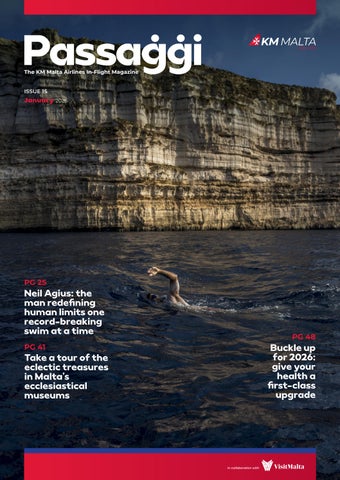
ON THE COVER Neil Agius swimming around Gozo
MEET THE TEAM DESIGN TBWA\ANG
COVER PHOTOGRAPHY Kurt Arrigo
EDITOR
PHOTOGRAPHERS
Fiona Galea Debono
Archdiocese of Malta David Carabott Jeff Fabri Julia Schembri Kurt Arrigo Mark Bonnici Michael Calleja Tony Gatt Żejtun Local Council
SALES AND BUSINESS DEVELOPMENT TBWA\ANG
CONTRIBUTORS Adriana Bishop Christian Peregin David Carabott Emmanuel Galea Inkontru.app Karen Mugliett Kristina Chetcuti Lea Hogg Ruth Zammit DeBono Thomas Camileri
WOULD YOU LIKE TO BE FEATURED IN PASSAĠĠI? For advertising opportunities, get in touch with TBWA\ANG on passaggi@tbwa-ang.com or (+356) 2131 0608 Abigail: abigail@tbwa-ang.com or (+356) 9929 0518
HOW TO PRONOUNCE PASSAĠĠI
/pasˈsadʒi/ Here’s the breakdown: • /p/ as in pass • /a/ as in art • /sˈ/ as in sun (with stress on the following syllable) • /dʒ/ as the sound of the j in 'judge' (geminated or doubled sound) • /i/ as in eat The word passaġġi means 'passages' in English.
The publisher, authors and contributors reserve their rights with regards to copyright. No part of this magazine may be reproduced or copied by any means without the written consent of the publisher. Editorial features and opinions expressed in Passaġġi do not necessarily reflect the views of KM Malta Airlines, the publisher, or the editorial team. Both KM Malta Airlines and the publisher do not accept responsibility for commercial and advertising content. Although the authors and publisher have made every effort to ensure that the information in this magazine was correct before going to print, the author and publisher do not assume and hereby disclaim any liability to any party for any loss, damage, or disruption caused by errors or omissions, whether such errors or omissions result f rom negligence, accident, or any other cause. Special thanks to KM Malta Airlines and VisitMalta for the provision of photographic material. Printed in Malta by Gutenberg Press. All magazine rights are reserved by KM Malta Airlines.
TBWA\ANG, 3rd Floor, Professional Building, Sliema Road, Gżira GZR 1633 Malta \ (+356) 2131 0608 \ tbwa-ang.com
2
Welcome to The KM Malta Airlines In-Flight Magazine
David Curmi
Executive Chairman KM Malta Airlines As we enter the New Year, it is a pleasure to welcome you on board KM Malta Airlines. January is a month that naturally inspires a sense of renewal – a moment to look ahead, make plans and begin shaping the year. Whether you are travelling for business, visiting loved ones, or enjoying a quiet winter escape, we are delighted to accompany you on your first journeys of 2026. For many travellers, this season is also the ideal time to start thinking about the warmer months. Our Summer 2026 schedule is now live and open for bookings, and we encourage you to secure your preferred dates early, especially on our most popular routes. Planning ahead not only offers greater choice but also provides peace of mind as you shape your next holiday. If you are considering a getaway sooner, our KM Malta Holidays platform provides a seamless way to book your flight and hotel together, with the option to add airport transfers or car hire. With competitive deals, a wide range of accommodation and the convenience of arranging everything in one place, it is an easy and reliable way to plan your next trip with confidence. We are also pleased to see our KM Rewards loyalty programme continue to grow. A heartfelt thank you goes to all our members – your enthusiasm and engagement are helping us build a strong community. We are working on a number of exciting enhancements for the year ahead, designed to bring even more value and flexibility to your travel experience. We look forward to sharing more in the coming months.
4
For travellers seeking added convenience, we have recently introduced a car-rental booking option through our website. This service offers several advantages, including free cancellation up to 48 hours before pick-up and the ability to add your flight number so the rental provider can monitor your arrival time. With access to more than 1,700 trusted suppliers and damage-andtheft coverage included, the process is simple, flexible and designed to ensure your journey begins smoothly from the moment you land. As we embark on 2026, our commitment remains unchanged: to offer you an excellent travel experience, supported by a dedicated team who take pride in delivering the highest standards of Maltese hospitality. On behalf of everyone at KM Malta Airlines, I wish you a wonderful year ahead; one filled with new adventures, memorable journeys and moments to look forward to. In turn, we look forward to welcoming you on board throughout 2026.
Fiona Galea Debono Editor
I’m writing this note weeks before Christmas has even arrived, yet I can already sense the familiar January urge to reset – to clear out the excess and step into the new year with lighter habits and a healthier mindset. This month’s Passaġġi quite literally lays the path for that shift, guiding us back to nature; back to our roots. The issue has naturally gravitated toward the idea of reconnecting with our origins – through family traditions and simpler ways of living that offer grounding, context and a renewed sense of calmness. Farm life, living off the land and plantbased eating are at the heart of our January edition, a month that happens to be “one of the most beautiful” for fresh, local produce in Malta. Health educator and professional home economist Dr Karen Mugliett picks up on this in our food section, presenting a local dish that celebrates the core principles of the Mediterranean diet: seasonal eating, reducing food waste, cooking creatively with vegetables and pulses, and letting honest ingredients shine. January travel, she notes, tends to be reflective. It’s not only about discovering new places, but also about feeling renewed. And food becomes part of that journey – a way to support our well-being while connecting with the culture of wherever we land. Learn about low-impact eating, respect for local produce, resourcefulness and plant-based nourishment powered by tradition, and you might just set yourself up for a very good start.
New Year’s resolutions. She offers simple, practical tips for life the moment you put down Passaġġi and step off this flight – beginning with ditching those resolutions altogether. Being in nature and moving your body is also recommended to reduce stress, and Malta offers some lovely solutions for that, blending movement with sightseeing. The January issue is brimming with inspiration, and record-breaking swimmer Neil Agius brings more than enough motivation on his own. He speaks about his seven consecutive swims around Gozo – an extraordinary show of endurance that pushed human limits – and what the experience gave back to him. Neil shares the tools that kept him going when the pressure mounted, from breathwork to presence, and invites us to see Gozo as he did: from the water, from the outside in; to notice its contours, its force, its cliff faces rising like guardians; to feel its calm and its powerful energy. Whether you’re seeing Gozo in a single day, or seeing it from the sea, we’ve got the landmarks mapped out and your itinerary set. Winter is, after all, the season when its true character emerges. Again, it’s about space and air, peace and calm. So, here’s to starting the new year grounded in what matters – and inspired to explore even more. May it offer fresh paths, deeper roots and journeys that enrich us in every sense. Breathe in, breathe out…
But don’t be too hard on yourself. Health coach Kristina Chetcuti reminds us that we can still become our healthiest selves in 2026 – even without the “useless” pressure of
5
????????
Contents ISLANDS 8
8
A Walk through Żejtun Malta’s olive city
TRAVEL 16
Zurich, a city for all seasons Genteel and sophisticated destination
HISTORY 21
Iconic Mosta Dome Experience the Rotunda up close
ACTION 25
Seven times around Gozo
25
Record-breaking swimmer Neil Agius explores human limits
CULTURE 31
This month’s must-see events A fresh line-up of arts and entertainment for the year
GOZO 36
An island in a day Get to know Gozo’s true character in winter
HERITAGE 41
The eclectic world of ecclesiastical museums Not just silver, saints and statues
BOOKS 46
55 6
Malta bound in a monumental book
Its landscapes and identity together in one ambitious volume
????????
46
HEALTH 48
Fasten your seatbelt: better health ahead in 2026 Forget January resolutions and chart a gentler course
PETS 51
Chamonix: a winter wonderland through my paws Visit the dog-friendly capital of alpine magic
MADE IN MALTA 55
Celebrating local identity through design Reproducing historical buildings in miniature
NATURE 58
Growing up on an andar Returning to simple life on a Maltese farm
FOOD 62
58
A warm start to the year Minestra: when food is comfort, nourishment and care
67
Living off the land Discover a farm shop in the limits of Rabat
AIRLINE NEWS 71
Flight, company and destination information All you need to know about flying with KM Malta Airlines
67 7
Photo: Tony Gatt. The Chapel of St Catherine, commonly known as St Gregory's Church.
???????? ISLANDS
8
???????? ISLANDS
Words by
David Carabott David is a teacher, specialised in mentoring students of different abilities. As a traveller, his target is to visit all the countries in the world. When he is not in Malta or travelling elsewhere, you can find him somewhere in Rome.
A walk through Żejtun In Malta’s olive city, the past does not linger like a shadow. It pulsates quietly, like the roots of the trees whose name it bears. Morning light spills softly over Żejtun as I step into its quiet streets. The town’s name comes from the Sicilian Arabic zaytun, meaning ‘olive’, a nod to its ancient groves. Granted the title Città Beland in 1797 by Grand Master Ferdinand von Hompesch, Żejtun still carries a calm pride. Perched on a hill overlooking Marsaxlokk, St Thomas Bay and Marsascala, it feels close to the sea in every direction, with the horizon keeping watch. ST CATHERINE’S AND THE PARISH MUSEUM I begin my walk near the parish church dedicated to St Catherine of Alexandria, a baroque masterpiece by Lorenzo Gafà, who also designed St Paul’s Cathedral in Mdina. Its warm limestone glows beneath the sun, the façade rising in ornate symmetry. Inside, the scent of candle wax lingers and light filters through the windows, illuminating marble and gilded altars. My next stop is to the Oratory of the Blessed Sacrament, recently restored to its former glory, which sits right next to the church. Its façade, framed by columns and angels
carved in stone, is pure baroque drama. Inside hang six paintings by Francesco Zahra, each alive with colour and movement and marked by Neapolitan influence. In the adjoining museum, I finally get to admire a painting of St Catherine’s beheading from the School of Caravaggio. IN THE HEART OF ŻEJTUN Every town and city, no matter how small, has its own areas. In Żejtun, Bisqallin (the Lower Village, known as IrRaħal t’Isfel), Ħal Bisbut (the Upper Area, known as Ir-Raħal ta’ Fuq), il-Ħerba, Ta’ Tablin, Ħabel ix-Xgħir, Ħal Tmikki, Ħal Bajda and Ħal Ġwann are all hamlets, clusters of buildings in the old centre. Just beyond the main square, the narrow lanes of Bisqallin twist like ribbons. This is the oldest part of Żejtun. The walls are thick, the corners sharp, and the doors painted in soft greens and blues. A man sweeping his doorstep nods as I pass. Further on, an elderly woman leans from her window to chat with a neighbour across the alley. Every few metres, a niche holds a small statue of a saint, the paint slightly faded but the glass still polished with care.
9
???????? ISLANDS
Ħerba Quarter.
St Gregory's secret passage.
Photos: Żejtun Local Council. Juventutis Domus.
Not far away, the restored Villa Cagliares glows behind high walls. Built in 1620 by Bishop Baldasare Cagliares as a country residence, it embodies Żejtun’s architectural dialogue between strength and grace. In one corner stands the Vendôme Tower, built in 1715 by Philippe de Vendôme, a Knight of the Order of St John. Today, it is a private residence. It stands near the church of Ta’ Sant Anġ, close to Testaferrata Palace. From its position, it appears to have been intended to guard the entrance to the Raħal Ta’ Fuq. The streets narrow once again as I enter Ħerba, a quarter whose name means ‘ruin’. The area takes its name from ħirba, an old house long abandoned and left to decay. The limestone here is weathered and soft, its centuries etched in every grain. Wandering through Żejtun, I pass the Jesus of Nazareth Institute, home to orphans after World War II. Every Christmas, its mechanical crib comes to life, papier-mâché figures moving gently through scenes of the Nativity, a tradition that still draws crowds from across the island. Not far stands the Church of the Holy Spirit, another of Gafà’s creations, where the Daughters of the Sacred Heart once ran Żejtun’s first school. As I continue, I come across Circolo Musicale Sancta Caterina, known locally as tal-Laċċi. It is the city’s second oldest band club, founded in 1892. I think of the generations who have practised and performed here, and how something as simple as a band club can hold a community together for more than a century. I discover that Grand Master Perellos also had his summer residence here. Casa Perellos was built in 1710 so that from its balcony he could enjoy the procession dedicated to St Gregory. A little further along St Gregory's Street, I notice a building that once belonged to Bishop Ferdinand Mattei, the first Maltese to serve as Bishop of Malta under British rule. Today, it houses Juventutis Domus, a youth club with its own theatre and a chapel dedicated to the Holy Family. Stepping inside feels like entering another world, one for which words can hardly do justice. Theatre Juventutis Domus, built in 1820 and recently renovated, is used on a regular basis. ST GREGORY’S CHURCH AND ADJOINING CEMETERIES At the end of Triq San Girgor, on the edge of Żejtun, stands a stone statue of Saint Gregory the Great. Sculpted by Salvatore Dimech, one of the notable Maltese artists associated with the Nazarene Movement, it was installed in the early 1830s. I have admired this statue since childhood, along with the old parish church, which resembles a fortress. Each time I pass by, I feel compelled to stop and admire the beauty. The old parish church, dedicated to Saint Catherine of Alexandria but popularly known as Saint Gregory’s, owes its familiar name to a traditional procession held annually on the first Wednesday after Easter Sunday. Pilgrims make their way along Saint Gregory Street, which is regally lined with noble houses,
10
???????? ISLANDS
and walk towards the church to honour Saint Gregory the Great. The tradition concludes with the first swim of the year, which follows the pilgrimage, and which is usually enjoyed at the coastal village of Marsaxlokk.
The San Girgor Garden next door provides respite for locals who sit for hours beneath its olive and carob trees. Men play cards, arguing good-naturedly over a hand, while children chase a football along the path. The garden is scattered with bronze busts and monuments honouring folk singers (għannejja), who honoured Żejtun. Nearby stands the Millennium Monument, its olive tree a symbol of peace and heritage. Beneath it lies an old cannon that once defended the city. ROMAN VILLA As I walk near a secondary school, I come across the remains of an agrarian Roman villa uncovered in 1961. The site appears to have been used for olive pressing, a reminder of how long Żejtun has been connected to olive cultivation. It is one of over 30 Roman villas in Malta that combine residential and industrial areas. Beneath its ruins, traces of Punic-era wine production have also been found.
Ġnien tal-Kmand.
GARDENS, MONUMENTS AND OLIVE TREES Leaving the church behind, I follow a quiet path past Luqa Briffa Garden, formerly known as Ġnien tal-Kmand. It was one of several public gardens commissioned between 1802 and 1805 by Sir Alexander Ball during British rule in Malta. It is a peaceful haven, shaded by old trees, with the scent of citrus hanging in the air. I am alone, lost in nature, and I feel as if I am wandering through a secret garden.
A Roman-era olive press replica.
The church stands beside Żejtun’s three cemeteries, dedicated to St Rocco, St Augustine and St Catherine, with St Rocco’s being the oldest. In the middle of Misraħ San Girgor stands proudly the statue of Pope St Gregory the Great. At the San Girgor Cemetery, overlooking the square, I paid homage to my late grandfather, a moment of reflection, appreciation and gratitude, thinking of life, time and reverence.
Gwiedi Quarter.
Built on the site of an earlier chapel, the church was once among Malta’s eight mother churches. Its dome, one of the oldest on the island, rises simply yet commandingly. I enjoy passing by, and each time I look at the impressive dome and fortress-like structure of the church complex, I feel as if I am stepping back in time, like in a scene from a movie.
TWILIGHT IN ŻEJTUN The afternoon light starts to fade. I continue to wander through the town, looking at façades in the amber glow. Doors close softly and the smell of dinner drifts through open windows. At the edge of the town, I turn back for one final look. The olive tree in the square is catching the last rays of the sun. Its leaves shimmer, whispering a story that began centuries ago. In Żejtun, the past does not linger like a shadow. It breathes quietly, like the roots of the trees whose name the city bears.
11
Must-see sites
???????? ISLANDS
Words by
Heritage Malta The national agency for museums, conservation practice and cultural heritage, it is the guardian of over 8,000 years of history.
If this is your first visit to the Maltese Islands, you cannot leave without ticking these sites off your list. St Paul’s Catacombs Rabat
Leave the sights and sounds of modern life behind you as you step down into another world – a burial ground from Punic, Roman and Byzantine times, representing the earliest and largest archaeological evidence of Christianity in Malta. The catacombs form a typical complex of interconnected underground Roman cemeteries that were in use up to the 7th and possibly the 8th century AD. Part of the catacombs was re-utilised during the re-Christianisation of the island, around the 13th century, when an open space was re-cut and used as a Christian shrine decorated with murals.
Grand Master’s Palace
Valletta
Newly restored and proudly dominating St George’s Square, the Grand Master’s Palace invites you to wander along its 450-year history as a centre of power and the symbol of a nation. Presently the seat of the Office of the President of Malta, the Palace grants visitor access to over 85 per cent of the building’s footprint, including the magnificent Armoury. The Palace’s restoration project was partly financed via the European Regional Development Fund (ERDF).
Fort St Angelo Birgu No other fortress has been engaged with the same intensity in the shaping of Malta’s destiny as Fort St Angelo! Known as Castrum Maris in medieval times, this stronghold was christened as Fort St Angelo by the Knights of the Order of St John, who turned it into their headquarters. The Knights remodelled the building extensively with the construction of a series of artillery platforms that marked the introduction of the bastioned system of defence on these islands. During the British period, the fort served as a shore establishment of the Royal Navy in Malta until the last detachment of foreign forces marched out of its walls in March 1979.
12
???????? ISLANDS
Underground Valletta
Valletta
Valletta, a UNESCO World Heritage Site, cannot be fully appreciated without experiencing what lies beneath it. Descend into the capital’s fascinating depths to discover dark underground spaces, which, centuries ago, were crucial for the movement of troops, for grain and water storage, and for drainage. Then fast forward to the terrible years of World War II, when these underground tunnels and chambers provided shelter to thousands of people seeking refuge from the relentless enemy bombs, with primitive sanitary facilities and very scarce food stocks, but with a burning hope of survival that defied desperation. Pre-booking is required.
MUŻA – The National Community Art Museum Valletta
The acronym MUŻA refers to the mythological Muses of classical antiquity and to the Maltese term for artistic inspiration. Through a varied collection of paintings, sculptures, furniture, silver pieces, works on paper and objets d’art, MUŻA’s main focus is to show artistic developments in Malta impacted by its Mediterranean context as well as the cultural influences resulting from the governance of the Order of St John (1530 - 1798), the British Empire (1800 - 1964), the post-Independence period (since 1964) and the overall impact of the Church.
Inquisitor’s Palace Birgu The Inquisitor’s Palace is both a historic house museum and the National Museum of Ethnography. Built in the 1530s, it was the powerhouse of the Holy Roman Inquisition that dominated Malta for over 224 years. After the French abolished the Inquisition in Malta upon their arrival in 1798, the building served French and British rules, as well as the Dominican Order for a period of time after World War II. The Inquisitor’s Palace also houses the National Textiles Collection.
13
Wied il-Mielaħ Window
Salt Pans
29
25 ‘Kappar’ Capers
Żebbuġ
26
Tal-Mixta Cave
Għasri
27
Għarb
23 Xagħra Victoria
24
Qala
Nadur 28
‘Bużbież’ Wild Fennel
Għajnsielem Sannat
Mġarr 22
Sanap Cliffs M
COMINO
ġa rr-
GOZO
KEMMUNA
21
Ci rk ew w
G Ħ AW D E X
aM
Crystal Lagoon
Passenger Ferry
ġa rr
12
Vehicle & Passenger Ferry
Ċirkewwa
Red Tower
S T P A U L’ S ISLANDS
06
Mellieħa
01 Popeye Village
16 St Paul’s Bay
‘Bajtar tax-Xewk’ Prickly Pears
09 ‘Frawli’ Strawberries 08 Mġarr 05
Mos ‘Merill’ National Bird
Rabat
Valletta
Żejtun 10.2km
01
02
Dingli
B
BEACHES 01 02 03 04 05 06 07 08 09 10 11 12 13 14 15
14
Anchor Bay Armier Bay Balluta Bay Delimara Point Fomm ir-Riħ Għadira Bay Għar Lapsi Ġnejna Bay Golden Bay Marsaskala Bay Marsaxlokk Bay Paradise Bay Pretty Bay Salina Bay St George's Bay
Dingli Cliffs
16 17 18 19 20 21 22 23 24 25 26 27 28 29
St Paul's Bay St Peter's Pool St Thomas Bay Wied iż-Żurrieq Xrobb l-Għaġin Blue Lagoon Santa Marija Bay Daħlet Qorrot Dwejra Bay Marsalforn Bay Ramla Bay San Blas Bay Xlendi Bay Xwejni Bay ~ Salt Pans
07
‘Lampuki’ Dolphin Fish
INSTAGRAMMABLE SPOTS IN AND AROUND ŻEJTUN
The Maltese stone façade of an old house.
‘Xemx’ Sun
Mġ
r-V a ll
et
ta
-M
ġa
rr
M A LT A Pembroke 15
Għargħur St Julian’s
Naxxar
Sliema
sta
03 Valletta
Gżira
Upper Barrakka Gardens 01
‘Ħobża tal-Malti’ Maltese Bread
St Catherine of Alexandria Parish Church.
14
ar
A remissa where farmers kept animals and tools.
KM Malta Airlines Airbus A320neo
Birgu Qormi
Żebbuġ
10
Buskett
02
18
Żejtun
Marsascala
Luqa 20
Marsaxlokk
Qrendi
‘Qarnita’ Octopus
11
Żurrieq
17
13 19
04
sponsored by
FILFLA ‘Luzzu’ Traditional Fishing Boat
15
Bahnhofstrasse.
???????? TRAVEL
Words by
Adriana Bishop Adriana is a former news journalist and travel PR executive, now a freelance writer based in Switzerland, with her heart and eyes always set on her forever home, Malta.
Zurich, a city for all seasons Genteel and sophisticated, the city is a delight at any time of year, whether it’s for cherry blossoms in spring, swimming in the lake in summer, golden autumn walks, or dazzling Christmas markets.
16
Quick quiz: Which is the capital city of Switzerland? Is it a) Geneva; b) Bern; c) Zurich; or d) none of the above? No, it’s not the one you’re thinking. Switzerland technically does not have an official capital city defined in its constitution. While Bern, delightful as it is with its porticoed walkways, functions as the de facto federal city, and Geneva is the diplomatic hub, with its iconic Jet d’Eau sprouting water sky high, like its cost of living, Zurich is the symbol of Swiss economic stability.
The Limmat River.
???????? TRAVEL
On Bahnhofstrasse, the main thoroughfare of luxury shops leading from the cavernous main train station down to the lake, quiet wealth strolls unhurriedly savouring the richness of life with every expensively clad footstep. Zurich is a sophisticated, genteel, well-respected lady, who never shouts, but expresses herself in measured educated tones of elegance and culture. Ostentation is shunned in the city, but then wealth is so ubiquitous it’s simply taken for granted. Even on the rare days when the streets are full enough to be described as ‘crowded’, the city still feels as serene as the mountains that surround it. But do not be fooled by those twee little lanes in the old town. The city is as cosmopolitan as London, as trendy as New York, and can even put on an edge when it wants to, just on a more boutique scale.
Burning Böögg at Sechseläuten.
The country’s largest city, and a global financial hub, it is consistently ranked among the world’s most liveable places, if not one of the most expensive. Or as my son puts it: “Everything happens in Zurich.”
Behind the polished, somewhat reserved façade beats a surprisingly creative and rebellious heart. Zurich is the birthplace of the disruptive Dada art movement, home to cutting-edge design studios, and an early champion of techno music, which is now celebrated in full force at the annual Street Parade.
I’ve lived in the neighbouring canton of Zug for 20 years, and every time I pop into the city, I feel I should swap my countrybumpkin garb for my Sunday best. You don’t want to look too shabby in Zurich. It may not have Italy’s design pedigree or Paris’s haute-couture flair, but you’ll still want to shine your shoes and run a comb through your hair before stepping onto Bahnhofstrasse, if you know what I mean. My first stop is always Globus, the Swiss answer to Harrods, where I pretend I can afford the high-end designer wares on the ground floor and plump for some delicious treats from the gourmet food hall in the basement.
Grossmünster.
Most visitors land at Zurich Airport, admire its polished floors, and head straight to the reliably punctual trains to whizz off on their grand tour of Insta-famous sites. But it would be a shame to miss out on a couple of days in the city itself.
•
The Limmat River that meanders across the city down to the lake, separates the newer part with its shiny office blocks from the Altstadt with its quaint medieval streets, guild houses and churches. Trams rattle across the city but many locals prefer commuting by bike. In summer, the expansive lakeside promenade and parks are a joyous bubble of locals enjoying long balmy evenings swimming and picnicking. Historic public baths dot the river, including the Frauenbad at Stadthausquai, which was built for and is still exclusively used by women.
17
????????
suggests
Day trips and more Zurich main station is the largest in Switzerland and one of the busiest in the world with almost 3,000 trains a day, which means you can easily visit neighbouring cities, cantons and countries. • Come say hello to me in Zug, just 25 minutes away, and find out why its pretty lake is not the main reason more expats are choosing to live in the smallest canton. Clue: it might have something to do with its low taxes. • Bern is less than an hour away on the fastest train so it’s easy to compare the economic hub with the seat of governmental institutions. • Bellinzona, the capital of the Italian-speaking canton of Ticino, is just under two hours away and many Zurichers escape grey, foggy days to enjoy winter sunshine in their holiday homes south of the Gotthard. • Seen enough of Switzerland? There are direct trains from Zurich Hauptbahnhof to Paris, Milan, Munich and beyond.
.....
Events • Art on Ice (26th February - 7th March) • Sechseläuten Spring Festival (20th April) • Zurich Pride (19th - 20th June) • Street Parade (8th August) • Zurich Openair music festival (28th and 29th August, 4th and 5th September) • Zurich Film Festival (24th September - 4th October) • Christmas markets (throughout December, various locations)
18
In winter, the lake does not freeze over enough for ice skating anymore, but the narrow streets of the old town hide cosy cafés for a warming cup of heisse Schoggi. My favourite is Café Schober (now known as Café & Conditorei 1842) housed in a cute 13th-century building with a plush, dark red velvet room upstairs that reminds me of a bordello – not that I would know, of course. While I usually go to Zurich for errands or shopping, I love taking some time to meander aimlessly, soaking up the romantic atmosphere of the old town, following the aroma of roasting chestnuts in winter and the trail of cherry blossoms in spring. It can take a while for Zurich to embrace you. It reveals itself slowly, like a shy blossom opening up, petal by petal. Expats often find the weather and culture difference a challenge, but we soon learn to love those differences. Singaporean artist Amy Ang, who has lived in Zurich with her Australian husband and two boys for 18 years, admits it was hard adjusting to Zurich’s dry, cold winters after her home country’s endless sunshine and humidity. “I have learned to embrace the seasons and look forward to the myriad traditions, activities, food and change in landscape that mark each one. Picture perfect Zurich changes its façade with every turn of the weather like a fickle wealthy socialite,” says Amy as she proceeds to describe the city’s metamorphosis throughout the year with her inimitable, poetic artistry. “Fresh flowers cover the surface of many fountains in the old town in Zurich in spring as the icy pipes start to thaw. In summer, the lake fills with people shedding off their stifling office wear to sunbathe or have a quick dip in the cool clear waters during lunchtime. In autumn, I love the breathtaking view of the Zürichberg covered in shades of yellow, red and gold. And finally, the smell of roasted chestnuts and fairy lights at the various Christmas markets in the city.” MELTING POT You are more likely to hear English spoken in the streets than Züritüütsch, the Zurich dialect of Swiss German, and occasionally even a gaggle of Maltese, especially around the middle of January when our community meets for the annual lunch. There will be around 80 of us under one roof, and I’m sure the whole of Zurich will know about it. Sorry, not sorry. Do not make the mistake of thinking Zurich is a mirror of everything Swiss. It is only one city in one of the 26 cantons of Switzerland, each with their own very distinct identity and unique dialect or language. Yes, there are different forms of Swiss German, as if ‘normal’ German alone weren’t already difficult enough. Change one umlaut and you’ll be marked out as hailing from another canton. The eclectic mélange of nationalities that call Zurich their home is reflected in the deliciously varied gourmet scene. Just a 10-minute tram ride away from the main station, quiet, residential Wiedikon (Kreis or district 3) and the edgy, nightclub hub of Aussersihl (Kreis 4) are the go-to spots for foodies and night owls.
????????
“My husband and I are foodies and we love to explore new restaurants and bars in Zurich,” continues Amy. “The last five to seven years have seen the areas of Werd and Letzigrund become more gentrified, and the numerous restaurants that offer cuisine from Central Europe to Asia and South America reflect the melting pot that Zurich has become. “It has also become a hotbed for young, forward-looking chefs to create their versions of modern European cuisine, with restaurants like Rosi, Silex and Gartenhof. The area is also littered with cool modern art galleries like Karma International and Soon, and off-spaces like Galerie 111 and Coin-Coin, as well as local Swiss designers and funky vintage and second-hand shops such as Caritas, Maroni Vintage and Love at the Bus Stop.” Some restaurants are revered institutions such as the historic Kronenhalle, where you can dine on their legendary Zürcher Geschnetzeltes of chopped veal in a creamy sauce served with rösti, while gazing at the owner’s original collection of fine art featuring works by Marc Chagall, Joan Miró, Pierre Bonnard and Georges Braque. So keen was he on his art, that in his will Gustav Zumsteg insisted that as long as Kronenhalle exists, no painting may be removed from its place. It is a great spot for a pre-theatre dinner before heading to the bijoux Opera House across the Bellevue. I somehow always end up grabbing a plate of colourful veggie creations from the buffet of Hiltl, the oldest vegetarian restaurant in the world, where even the fussiest eater will fall in love with broccoli and Brussels sprouts. But for dessert, nothing beats the exquisite chocolate truffles from Teuscher, especially the ones laced with champagne. Their OTT shop decorations are kitschy but cute and you can now enjoy possibly the most expensive coffee in town at their Café Felix. Zurich is a city that is constantly looking ahead while still embracing its past. Traditions are strongly held and devoutly followed, none more than the centuries-old Sechseläuten Spring Festival when guild members parade in historical costumes alongside musical ensembles. The spirit of winter is literally blasted away as the Böögg, a snowman perched on top of a pyre, is set on fire on the stroke of 6pm. The quicker the snowman’s head explodes, the better the summer will be. And while I wait for the burning of the Böögg in the hope that this time it will hail an early glorious summer, I will indulge in the city’s reflective winter. Zurich may not shout for your attention, but it will linger long enough and it will reward you with quiet beauty, deep-rooted traditions and a cultural heart that beats far louder than its polite façade suggests.
KM Malta Airlines operates regular flights between
Malta International Airport (MLA) and Zurich (ZRH) kmmaltairlines.com
Do not miss Grossmünster church, with its double towers, will grab your attention first but cross the bridge to the smaller Fraumünster to sit in front of Marc Chagall’s famous stained-glass windows for a reflective moment of tranquility For a potted history of Switzerland head to the Landesmuseum, the Swiss National Museum, housed in a mock-gothic castle-like building right behind the train station. You can also grab the most authentic local souvenirs in the region. Lovers of the beautiful game cannot skip a visit to the FIFA Museum. The Kunsthaus art museum is home to one of the greatest art collections in the country. Short on time but still want to get a small taste of the Swiss mountains? Head up the Uetliberg for a splendid panoramic view of the entire city and some easy hiking trails.
.....
Where to stay Splash the cash: Baur au Lac is a seventh-generation family-run hotel that has been welcoming the well-heeled and their deep pockets since 1844. The iconic property is a symbol of Zurich. It’s worth popping in even just for a cocktail, tea or dinner in one of their restaurants. Quirky and fun: B2 Hotel is housed in the former Hürlimann brewery and features two of my favourite things: a library with 33,000 books in the breakfast hall and a rooftop heated pool commanding one of the best views across town. I could live there. 19
The ceiling of Mosta church.
HISTORY
Words by
Iconic Mosta Dome
David Carabott
It is one of the largest unsupported domes in the world, a neoclassical masterpiece of monumental design that dominates the town. Explore the Rotunda up close to be left both awed and humbled. On the way to Mosta, a town in the centre of Malta, the Rotunda, or Mosta Dome, rises majestically above the skyline. The dome was inspired by the Pantheon in Rome, while the façade by the Temple of Diana at Ephesus. This neoclassical masterpiece had always captured my attention, and I could not wait to explore it up close. My wish was to climb to the top of its iconic dome, having noticed people walking along its roof. The current gigantic church in Mosta was designed by Maltese architect Giorgio Grognet de Vassé, who is buried inside it. It was completed in 1860 after 27 years of construction and stands on the site of two earlier churches. The first was dedicated to the Assumption of Our Lady into Heaven and became the parish church in 1608, shortly after Mosta was separated from the nearby village of Naxxar. A second church replaced it, a Renaissance building by Tommaso Dingli, completed around 1619, which was demolished only once the dome of the new church was finished.
21
Photos: David Carabott.
HISTORY
Standing in front of the Rotunda, I was struck by its sheer scale. With an internal diameter of nearly 40 metres and a height of 55, it is one of the largest unsupported domes in the world. The church façade is equally impressive: a portico with six Ionic-style columns, flanked by two bell towers, reflecting elegance and grandeur.
22
The stairs were narrow and winding. I was finally on my way up and there was no turning back. Eventually, I stepped onto the inner balcony. Walking along, I could see the spot where a wartime bomb had pierced the roof, a reminder of the Rotunda’s incredible history and resilience.
I was simultaneously awed and humbled. Just imagining the generations of people who contributed to its creation gives me a deep sense of admiration for their devotion and ambition.
I continued up to the roof, and the view took my breath away. Malta stretched in every direction. The old centre of Mosta was full of townhouses built with characteristic Maltese stone. But there was also new construction. I caught a glimpse of Mdina, the old capital perched on its hill and spent a few quiet moments simply taking it all in.
Inside, the Rotunda radiates light and symmetry. The ceiling, geometrically patterned and painted in calming shades of blue, white and gold, is adorned with gilded details and delicate stucco mouldings. At ground level, the intricate marble floor might appear ordinary at first glance, but from above, it perfectly mirrors the ceiling’s geometric design. The harmony between ceiling and floor gives the entire space the feeling of a cohesive, breathtaking vision.
HISTORY PRESERVED IN THE SACRISTIES Back inside, the sacristies felt like a small museum. I was fascinated by the objects of religious and historical significance, including a large-scale model of the Rotunda and a replica of the bomb that pierced the dome during that fateful evening mass in 1942. Around 300 people were inside, but incredibly, the bomb did not explode. A few other bombs fell nearby that day, but none detonated. No one was injured, and the Rotunda remained intact, a moment hailed as a miracle. Standing there,
HISTORY
The spiral staircase to the gallery inside the dome.
Your first step into the history of the Maltese Islands
I could not help but reflect on how close that day came to tragedy. A FULLY IMMERSIVE VISITOR EXPERIENCE I was lucky I visited on a Tuesday, as this is when visitors can also take part in other experiences offered by the Mosta Rotunda Foundation, which plays a vital role in preserving and promoting the Sanctuary Basilica of the Assumption of Our Lady. So besides the entrance ticket to the church, a Tuesday visit may also include a walking tour through the World War II underground shelter beneath the church parvis, as well as a stroll through Mosta’s historic streets. There is also the possibility of a visit to the traditional Marquis Mallia Tabone Farmhouse, a typical Maltese farmhouse from another era that now serves as an art and exhibition centre, and the picturesque Our Lady of Hope Church in the Speranza Valley. The tour was led by a well-read, patient and eloquent guide who seemed to know every detail of these places by heart. The morning concluded with a Maltese food buffet at Dar Mustija, a traditional house with its own garden just across the alley, run by the foundation. The homemade dishes, lovingly prepared and served by volunteers, reminded me of meals at my grandparents’ table – fresh, comforting and full of care. I felt completely immersed in Maltese culture and hospitality. A SYMBOL OF FAITH, RESILIENCE AND COMMUNITY The Mosta Dome is more than a building. It is a symbol of faith, resilience and the power of community. Many locals funded its construction and volunteered their labour, creating a monument that continues to inspire generations. Being there, seeing it and walking through its history made me feel connected to that legacy. As I left, I glanced back at the great dome rising into the sky and felt grateful to Mosta Parish Archpriest Fr Sebastian Caruana, and Giovanni Chetcuti, CEO of the Rotunda Foundation, for the opportunity to experience and explore it so closely and uncover its stories first-hand.
15% Discount
On the purchase of an adult ticket Please quote “Passaggi” at the ticketing counter to claim your discount. (Not valid with any other offer)
Few places have a history as turbulent and inspiring as the Maltese islands. Its gripping story is that of a country buffeted by world events, in which the bravery and resilience of its people have been tested to the limit. Through beautiful authentic imagery and a gripping commentary, the show covers 7000 years of history in 45 minutes. From the early settlers of the temple period to the Knights of the Great Siege through to the destruction of World War 2, The Malta Experience chronicles the events that have shaped the island's history.
www.themaltaexperience.com St Elmo Bastion, Mediterranean Street, Valletta. tel 2552 4000
23
ACTION
Words by
Christian Peregin
Christian is a writer and communications strategist from Malta. He has travelled the world but still finds it hard to beat the quiet magic of a Maltese sunset.
Seven times around Gozo Dive inside the mindset of Neil Agius, the two-time world-record holder for the longest unassisted swim, to explore human potential – and who we might become if we learn to meet pressure with presence instead of panic. Most people know Gozo as a holiday island. Neil Agius knows it as something else entirely; a quiet, ancient engine of energy that has carried him through some of the longest unassisted ocean swims in human history. “Ever since my first world record in 2021, I’ve felt a pull towards the island,” he says. “Gozo is calm in a way most places aren’t. We take it for granted, but its energy is powerful.” The first world record he mentions matter-of-factly came when he swam from Linosa, Italy, to Gozo in 2021. He swam 125 kilometres over 52 unassisted hours in open sea. His second world record arrived in 2024, when he completed a full loop around Malta, Gozo and Comino: 142 kilometres, more than 60 hours in the water, and not even a wearable device allowed on his body. This summer, he decided to attempt a different kind of experiment. He became the first person in history to swim around Gozo seven times in seven days, covering more than 270 kilometres and clocking over 100 combined hours in the water – roughly 15 hours per day.
25
Photos: Kurt Arrigo. Neil Agius in action.
ACTION
But for Neil, this was not about breaking any records. It was a swim designed to fail, an exploration of human limits: how the body breaks and rebuilds, how the mind collapses and reconfigures itself, and how people adapt when pushed to the farthest edges of physical and psychological pressure. Unlike traditional world-record attempts, he exited the water between island loops for physiological tests, wearable tracking, (which was a luxury this time around) and psychological monitoring. Scientists studied his stress levels, cognitive decline and recovery patterns in real time. He also had short windows to try to sleep between swims. Using red light therapy from Bon Charge, he attempted to maximise this recovery time. Gozo was both the most ideal and the most dangerous place to do this. Ideal because of the energy and calm it provides to so many Maltese, but technically, it was the most challenging swim he had ever attempted. Unlike open crossings, where currents are deep but predictable, Gozo’s circular course created constant turbulence. “There were stretches where I stared at the same rock for 45 minutes without moving. The lack of progression messes with your mind.” Neil describes the sea around Gozo as a complex system of currents. The cliffs create undercurrents, rebounds and unexpected headwinds. Efficiency becomes everything: How is my body responding? Do I tack left or right? How do I conserve metres, calories and minutes? Over time, his entire approach to swimming changed. “At the start of my career, I used distractions to pass the time. Now it is the opposite. I became fully present. You turn the knobs on your internal system to match the sea, physically, mentally and emotionally.”
26
ACTION
Most people experience Gozo from its cliffs looking outward. Agius wanted to reverse the perspective. “I wanted people to see the island from the outside in, to notice its shape, its force, the way the cliffs rise like guardians,” he explains. Those cliffs became something close to companions. Hour after hour, lap after lap, he studied the coastline – Xlendi, Dwejra, Wied il-Għasri, Marsalforn and Ramla – tracing every indent and cave. Each new day, his team deliberately changed the starting point to disorient him, adding difficulty but revealing more of the island’s character. “There were moments when the cliffs felt like stability. Storms come and go, tides shift, but they are just there, solid, ancient and consistent. I would check in with them and draw strength from them. When you are present for so many hours, you start noticing everything we usually miss.” Day Seven delivered the moment he will never forget. Exhausted and starting late due to medical concerns, he swam through the dark tunnel of the Inland Sea at Dwejra. “It was pitch black. Then suddenly this turquoise light. It felt like a force field hit me. That moment carried me.” Neil recalls a meltdown during a previous swim, rounding Għarb, when his team warned him of an incoming headwind. “I spiralled. I felt like a fraud, like I had let down my team, Lara (my partner), and the nation.” This time though, he had tools. “I have studied what happens in the mind when you hit the edge: breathwork, presence, downregulating the nervous system. In that moment, I focused on my breath, brought my heart rate down and went from crying to neutral to clear. Only then could I lead.”
27
Photos: Michael Calleja. Neil Agius preparing for a swim and using red light therapy for recovery.
ACTION
That earlier collapse became the blueprint for what he now calls The Ocean Mindset, a philosophy born from abandoning the Mallorca-to-Ibiza swim after jellyfish stings pushed him towards neurological shutdown. “That failure taught me more than any world record,” he says. “Not about swimming, but about how the mind loses focus under extreme stress, and how we can train it to stay present.” Breathwork has become central to Neil’s teaching. It is also shaping his next role: fatherhood. With Lara expecting their first child, he has even designed breathwork routines for different stages of labour. “It is about staying grounded, present, able to face pain without panic.” He smiles when he imagines sharing the sea with his child one day. “The sea teaches humility. That is something worth passing on.” For now, he is training, teaching and preparing for what he calls “the next chapter of the experiment”. Not necessarily another world record, but another exploration of human potential. “I am not interested in breaking records for the sake of it anymore. What excites me is what we learn in those last 20 hours, when your back is against the wall, and everything
28
inside you says stop. That is where the growth is. That is where the truth is.” That same obsession with the “last 20 hours” is now being channelled into everyday life. Agius has begun translating what he learned alone in the dark, surrounded by jellyfish and cliffs, into breathwork experiences for ordinary people: CEOs, parents, athletes, anyone quietly running their own ultramarathon. In his sessions, he shares insights from his swims, guides people through his unique breathing practice, introduces coldwater immersion and shows them how to find calm in the middle of chaos rather than in the absence of it. In a way, the Gozo 7 was never just about Gozo, or even about swimming. It was about a Maltese athlete using a tiny island and a vast sea to test what a human being can endure, and who we might become if we learn to meet pressure with presence instead of panic. The cliffs will still be there, solid, ancient and consistent. Neil’s bet is that, with the right tools, the rest of us can learn to be a little more like them. To learn more about Neil Agius, stay up to date with his next feats and attend one of his breathwork experiences, follow him on facebook.com/neilagius.official and instagram.com/neil.agius.
OUR STORY MATTERS. And what better way to tell it than through the buildings and artefacts that have borne witness to some of our islands’ most defining moments? From landmarks that have become iconic features of the Maltese landscape to lesser-known underground war rooms and underwater treasures, the Malta Airport Foundation has made it its mission to ensure that these once-silent witnesses continue to share our story-today, and with generations yet to come.
E M P OW E R I N G W E L L N E S S
u o y r a e n
2 9 B ROW N ’ S O UTL ETS READY TO HELP!
BrownsPharma
www.browns.pharmacy
CULTURE
Words by
This month’s
must-see events Ease into 2026 with a fresh line-up of arts and culture events across Malta and Gozo. From music and visual arts to heritage and family activities, inkontru.app brings you this month’s highlights to spark your imagination and set the tone for the year ahead. Valletta Baroque Festival When: 8th - 25th January Where: Various venues around Malta Now in its 14th edition, this year’s Valletta Baroque Festival returns with international artists and leading ensembles performing across Malta’s most iconic venues. Among the many highlights are Rubino’s Messa de Morti at St John’s Co-Cathedral, Vivaldi’s Quattro Stagioni, concerts by Tenebrae and the Valletta Baroque Ensemble, and the first Maltese staging of Abos’s rediscovered opera Pelopida.
Mystique Blues When: 9th January - 10th February Where: MUŻA, Valletta Contemporary visual artist Galina Troizky presents 26 urbandriven works exploring the tension between human experience and rapid urbanisation. Blending acrylic with layered contemporary imagery, the exhibition moves between past, present and imagined futures, continuing her long-standing inquiry into shifting social and spatial environments.
Stand Up Comedy in Broken English When: 10th - 13th January Where: Malta Society of Arts, Valletta Radu Isac and Victor Pătrășcan, two veterans of the European comedy circuit, bring sharp, bold and thought-provoking stand-up to Malta. Expect smart punchlines, cheeky audience moments and humour that tackles politics, culture and modern life with wit rather than shock.
Beethoven & Mahler When: 11th January Where: MCC, Valletta Austrian soprano Elisabeth Breuer joins the Malta Philharmonic Orchestra under the direction of Michael Laus, opening the programme with Beethoven’s Ah! Perfido. Mahler’s Symphony No. 4 takes the audience on a journey from innocence to transcendence, culminating in a soprano solo that evokes the divine.
31
CULTURE
JazzKlabb When: 14th January Where: Teatru Salesjan, Sliema JazzKlabb’s third session brings the Galea–Portelli– Debono Trio to an intimate cabaret setting, presenting new material alongside handpicked standards. This free event showcases close-knit interplay and refined musicianship, offering a warm start to the year for jazz lovers.
Fil-Friġġ wara t-Tadam When: 22nd January - 8th March Where: Spazju Kreattiv, Valletta This debut solo exhibition by Maltese artist Lorella Castillo, blends surreal staged photography and small sculptural installations, transforming familiar Maltese proverbs and idioms into absurdly vivid visual metaphors.
Toi Toi: Earth When: 31st January; 1st & 7th February Where: Teatru Manoel, Valletta A curious alien lands on Earth in this gentle, sensory performance for ages 0-3 written and directed by Nicole Sciberras. Through playful storytelling, music and hands-on exploration, little ones discover themes of nature, recycling and caring for the planet.
Hats Off! Hats at the Turn of the 20th Century When: Throughout January Where: Inquisitor’s Palace, Vittoriosa This quirky exhibition traces how hats shaped European fashion and social identity at the dawn of the modern age, featuring standout pieces from Malta’s national ethnographic collection, from late-19th-century top hats to early-20th-century cloches, boaters, fedoras and trilbies.
32
CULTURE
TRADITIONS AND HERITAGE
Photo: Mark Bonnici.
The Feast of St Anthony the Abbot in Xagħra
The Feast of St Anthony the Abbot remains one of Malta’s most distinctive winter traditions. Celebrated on 17th January, it honours the 4th-century desert hermit who became the patron saint of farmers, domestic animals and the poor. The day is marked by the traditional blessing of animals, and nowhere is it observed with more charm than in Xagħra, Gozo, where devotion to the saint stretches back centuries. The celebration centres around the parish church, which is in fact dedicated to St Anthony. It is one of Gozo’s oldest churches, having served as Xagħra’s first parish seat in the late 17th century, and later sheltering the community during the 1814 plague. Inside, you’ll even spot a painting by Dun Salv Bondi, completed in 1816, depicting St Anthony watching over the people of Xagħra as they lived under tents during the epidemic. In January, this liturgical feast is marked by a procession in which the statue of St Anthony is carried through village streets, accompanied by the Victory Band and clergy. Residents line the route before gathering on the church parvis, where animals of every kind, from horses and ponies to dogs, cats, birds and smaller pets, are brought forward. The parish priest leads a short prayer and sprinkles holy
water over the assembled animals, continuing a rite rooted in St Anthony’s role as their protector. Sometimes, small tokens or blessed items are distributed, and families linger afterwards in the square, chatting and catching up, keeping the spirit of this community gathering alive. For a guide to upcoming religious celebrations and traditional feasts across the Maltese Islands, be sure to visit inkontru.app
Discover and experience more with inkontru.app, your web-based application that prioritises functionality and performance, meaning no need to download, seamless updates, no storage space taken and easy sharing. Enjoy!
33
Artistic director Kenneth Zammit Tabona.
CULTURE
INKONTRU.APP MEETS... With Valletta once again set to be transformed into a stage for baroque music, artistic director Kenneth Zammit Tabona reflects on the festival’s evolution, its archival discoveries and why the city remains its perfect muse. How has the Valletta Baroque Festival evolved? Let me start by stating that I myself am on a learning curve; a voyage of discovery of works which I’d listened to for decades, of music that I knew existed but never had the chance to experience, and of music that is still being found in archives all over Europe, Malta included! This is what makes Early Music so utterly fascinating. All this creates a kaleidoscope of beautiful, ever-varying patterns and colours with which I try to infuse each successive festival. The revival of Girolamo Abos’s Pelopida is a major highlight. What drew you to staging this rarely performed Maltese work? This is a quintessentially high-baroque creation in the full Neapolitan style, florid and dramatic. I first learned about the opera in my 20s, when I formed part of the Cathedral Museum Resources Council, assisting the late Mgr Dun Ġwann Azzopardi. He had told me about Abos, whose mixed parentage, a French father and a Maltese mother, sister to the Uditore Carlo Farrugia, placed him in a position of considerable influence. I had promised Dun Ġwann that, when the opportunity arose, I would see these works were performed. Pelopida, dating from 1747, was commissioned by the magnificent Teatro Argentina in Rome and dedicated to Cardinal Prince Alessandro Albani. It has not been heard in its entirety in living memory, and its return will be a revelation to us all. 34
CULTURE ????????
Why is Valletta the ideal backdrop for a baroque music festival of this scale? The festival’s entire aesthetic rests on the extraordinary artistic and architectural legacy left to us by the Knights of St John and by our own forefathers. As a nation, we were incredibly fortunate to have had a reigning prince and his international court, who created beauty wherever they turned. Where would we be without Grand Masters La Cassiere and Cotoner, responsible for the construction and embellishment of St John’s Co-Cathedral? And what if Grand Master Vilhena had not commissioned the building of a theatre in 1731? The Knights were here from 1530 to 1798, and in that time they created Valletta from scratch, a baroque city that began as a monumental fortress and evolved into a grid of elegant churches, palaces and houses. Despite wars and the occasional unwise decision, much of this heritage remains for us to enjoy today. The Valletta Baroque Festival fits this setting perfectly. It is an art form meeting the very city that inspires it.
INSTALL inkontru.app Step into Malta’s scene with inkontru.app, your personal guide to all the latest art, culture and heritage events in Malta and Gozo. More than just a calendar, the app connects you with exciting events and artists through exclusive interviews and video features. Easily find event details, get directions and purchase tickets all in one place. Need a ride? Book a cab effortlessly through the app and share your plans with friends and family with ease.
SPAZJU KREATTIV - MALTA’S ONLY ARTHOUSE CINEMA Castille Place, Valletta Located in Valletta, Spazju Kreattiv is home to Malta’s only arthouse cinema. It presents newly released arthouse titles, local productions and acclaimed documentaries, alongside live broadcasts from leading international stages such as the National Theatre and the Met Opera. Through its diverse film programme, Spazju Kreattiv supports Maltese filmmakers, nurtures cinematic appreciation and fosters cultural exchange by connecting audiences with distinctive voices and stories from around the world. spazjukreattiv spazjukreattiv.org
VALLETTA WATERFRONT Triq il-Vittmi Furjaniżi tal-Gwerra, Floriana Discover this hidden gem within Malta's Grand Harbour, where history meets modern indulgence. Enjoy panoramic views, exciting activities and delectable dining experiences along this strolling promenade. Savour Chinese, American, Mediterranean, sushi, or local cuisine in beautifully refurbished 1752-built stores, or dine al fresco by the water's edge. Just a short walk from central Valletta and Floriana, and across from the Three Cities, experience fun and relaxation away from the crowds. There is always something happening at Valletta Waterfront, with cultural celebrations, seasonal events, live music, special themed nights,and family-friendly activities that bring the historic promenade to life. vallettawaterfront vallettawaterfront.com 35
GOZO
Words by
Emmanuel Galea Emmanuel is a Gozitan freelance writer, who draws on his global experience to promote Gozo as a destination that rewards those who take the time to explore it.
Gozo in a day Visit the sister island that feels like a world apart. In winter, it shows its true character. The season gives Gozo more space and air. Think green valleys, misty domes and stone paths that guide you both inward and onward. Winter in the Mediterranean has a soft touch. Malta still has energy – the streets of Valletta shine after rain, cafés offer warmth to cold hands, and the lights of churches shine through early evenings. But just across the water, Gozo offers a more peaceful experience. Gozo doesn’t need summer excitement as it thrives on calmness. In winter, the island shows its true character – green valleys, misty domes and stone paths that guide you both inward and onward. If Malta has your days, give Gozo only one. It might just shift your entire experience. The ferry pushes its way through the darkblue channel. Low clouds streak across the sky, and gulls, or maybe dolphins, make easy curves behind the ferry’s trail. Mġarr comes into view – calm and welcoming, with no fuss. Fishing boats gently sway against the dock. Our Lady of Lourdes Church sits on the hill
36
like a lighthouse overlooking the harbour. You decide at your own pace, and the island is pleased to go along with it. The road from Mġarr winds up, skirting the village of Għajnsielem and within reach of another village, Xewkija. Admire the majestic church dome amid the green fields. Further on, the citadel captures your view of Victoria – Rabat to the locals. Soon you reach the centre, Independence Square, which feels more relieved in winter. You can sit outside under a heater with a coffee and Gozitan pastry that is rich and flavourful. The clinking of cups, a laugh with a Maltese ring, and the soft sound of distant bells – together they create a peaceful rhythm. Two teenagers share a pastry and argue about a football game. Yes, Gozo offers a gentle and warm atmosphere. Walk up to the Citadel and follow paths worn smooth by the wind across the walls. The view gets wider with each step. Rain-washed stone shines like dull gold.
The Cittadella.
Victoria.
The Church of Our lady of Lourdes in Mġarr.
GOZO
Thin mist hangs in the valleys. Domes mark villages like pearls on green velvet. You touch the cold fortress walls and let the breeze clear your thoughts. Winter provides Gozo with more space and air. You can feel it, and you can take it all in. From Victoria, take the road towards the village of Xagħra, where the prehistoric Ġgantija megalithic temple complex stands in a light that emphasises every curve of its giant stones that have endured for 5,000 years. Stay longer if you have time. Trace a line in the limestone, and the place will respond with a deep, present silence. Nearby, you could visit Ta’ Kola Windmill and climb the narrow stairs for a glimpse into the working life that once powered bread and daily routines. Here, the stories come from tools and hands, not spectacle. Marsalforn calls to you next, even when the sea seems more serious in winter. The bay rolls in slow, blue-grey breaths. You step into a small, cosy restaurant, and order aljotta fish soup that warms you from the inside
out. A basket of warm bread, accompanied by local olive oil, arrives at table; you tear off a piece, dip it, and smile. Maybe you follow this up with rabbit stew, or Gozitan ravioli stuffed with local cheese. The restaurant attendant chats about the weather and the enticing local dishes. You nod, and the entire island feels like a neighbour. As the afternoon sun moves towards the west, Dwejra responds with drama. Waves crash hard against the cliffs as if still depressed, missing the collapsed Azure Window. Plumes of spray lift in the wind and move inland like salty ghosts. The Inland Sea darkens to a heavy green mirror. Fungus Rock remains solid and stubborn. Here, Gozo takes away anything showy and offers raw truth – stone, water, wind, time. On the way back, Ta’ Pinu Sanctuary stands alone in a wide valley. The Basilica shines as if it holds a small sun inside. You enter and sit
37
down with no fuss. A hymn starts somewhere in the back and moves through the space like a tide. Candles cast a gentle light up through the arches. You think of someone you miss. You think of someone you love. The place makes room for both. Head back to Mġarr, where harbour lights twinkle, awakening the scene. You board the ferry and proceed to the lounge. Despite the chill in the air, you choose to stand outside, watching Gozo receding over the channel, sharpening the memory of the island, leaving a sense of peace. You carry a local lace souvenir, a sensible reminder. Winter in Gozo is not just a simple list of attractions to tick off. Instead, it grants you something more profound – a sense of presence. Time slows down, inviting you to observe more intently, to savour each moment more deeply, and to depart with a heart that feels quieter and more at ease. Malta’s streets will be vibrant, and its nights lively. However, you’ll already be thinking about a return to the longer mornings, relaxed lunches and peaceful strolls by the winding rubble walls. You came for a day, perhaps expecting just a fleeting experience. Instead, you discovered a season; a feeling that would linger.
38
Ġgantija near Xagħra.
The Sanctuary of Ta' Pinu.
The Ta' Kola Windmill, Xagħra.
GOZO
Tickets and more info v b f . m t Tickets and more info v b f . m t In collaboration with:
Sponsored by:
Supported by:
In collaboration with:
Sponsored by:
Supported by:
Tickets and more info v b f . m t Tickets and more info v b f . m t
In collaboration with:
Supported by:
Sponsored by:
In collaboration with:
Supported by:
Sponsored by:
Gozo
Explore more
Discover Gozo, Malta's sister island. Just a short ferry ride from the mainland or from the capital city, Valletta. Gozo offers a calmer, greener escape with attractions for all ages. Experience a more authentic, rural way of life.
@VisitMalta
stories
HERITAGE
Words by
Adriana Bishop
The eclectic world of ecclesiastical museums It’s not just icons and incense, silver and statues; church museums house a vast and varied collection that reflects the local community at its most authentic. Behind church doors in Maltese villages lie not only treasures of faith, but intimate relics of ordinary lives – ex-votos of sailors saved from storms, a plague hearse, a priest’s diary from his days in a World War II concentration camp, even the twisted remains of a Vulcan bomber, sitting alongside gilded altar pieces, saints and silver.
particular to that specific community where it is located, serving as “anchors” of the community.
Eclectic, if not curated, Malta’s 25 ecclesiastical museums are where devotion meets community history, raw and unfiltered, and where the island’s collective memory is preserved in the most unexpected ways.
Let’s start with that hearse. The plague of 1813 was the last major outbreak to hit the Maltese Islands, claiming over 4,500 lives or five per cent of the population of the time. Those who survived showed their gratitude to God by commissioning ex-voto paintings to be displayed in their parish church. A statue was erected to St Sebastian in Qormi, one of the hardest hit localities, to celebrate deliverance from the disease and then eventually a church was built nearby.
Away from the mainstream attractions – such as the superb St John’s Co-Cathedral, which should always be on anyone’s must-see list – these smaller, independent village museums, often carved out of repurposed spaces and mostly run by volunteers, are the real McCoy. They are an authentic glimpse into what makes that particular community tick, a testament to its unique heritage. Even more fascinating is how different each one is, despite being just a few kilometres apart, each telling the distinctive story of its own village. Dr Matthias Ebejer, the senior collections officer of the Archdiocese of Malta, says that what makes these museums unique is the fact that they are a blend of “parish museum mixed with city museum” and each is
“If you go to Rabat to see the Dominican Priory museum and the Augustinian museum, each reflect the religious order specifically in the context of Rabat,” he says.
Anything that touched the plague was destroyed to quell any possible contamination. Almost everything. One macabre memento of that tragic episode slipped through the net, possibly out of carelessness, and in 1992, it was rediscovered in the crypt beneath the parish church of Żabbar. Today, it is on display in the Żabbar Sanctuary Museum as a living testament of the devastation that the plague wrought upon the country.
41
The intricate ferro battuto and stonework in the Naxxar Parish Church.
Photos courtesy of the Archdiocese of Malta. The plague hearse found in the Żabbar Sanctuary Museum.
An ex-voto painting in Mellieħa of a Maltese soldier who fought with Napoleon in Egypt.
HERITAGE
Every church in Malta – 68 parishes and around 300 churches and chapels, one for nearly every day of the year – reflects the character and craft of its locality. In Naxxar, intricate wrought-iron work surrounds the altar, a nod to the town’s blacksmithing heritage. At St Paul’s in Valletta, the confraternity of St Homobonus – the guild of drapers, tailors and seamstresses – left its mark through finely crafted drapery that still adorns the church. St John’s Co-Cathedral in the capital city, the church of the Knights of St John, is very different in nature to Valletta’s actual parish church just a couple of streets away, dedicated to St Paul, the patron saint of Malta. “While the Co-Cathedral was the ‘state’ church of the time, representing the Order of St John and their raison d'être, St Paul’s is the diocesan church representing the local community. One is packed with works from mostly foreign artists commissioned by the Knights, with nothing new added since, while the other features more recent works. St Paul’s is still a parish today and the beating heart of the community,” Matthias explains. Many of these museums, such as the ones in Żabbar, Naxxar, Birkirkara and Mellieħa, are tied to Marian devotions in appreciation of Our Lady’s
42
continued protection over the community. Another curious exhibit at the Żabbar parish museum is a large portion of the Avro Vulcan bomber that crashed on the town in 1975. The locals believe that it was a “Marian” miracle, an intervention attributed to our Lady of Graces to whom the church is dedicated, that only six people died in the tragedy – “grazzja f’disgrazzja”. The collections help to reinforce the community’s sense of belonging to its place of origin and nowhere is this more evident than in the ex-votos on display at Pilgrim’s Lodge, the parish museum of the National Sanctuary of Our Lady of Mellieħa, one of the oldest parishes in Malta. These rather naïve paintings would have been presented to the church as a sign of gratitude for surviving a challenging period in life, such as a battle or an illness. Many of the ones displayed in the seaside town of Mellieħa naturally have a maritime theme as local sailors would return home to give thanks to Our Lady following a long voyage. One very small but precious ex-voto features a Maltese soldier among the troops fighting with Napoleon in the battle of the pyramids in Egypt. He survived the battle, and upon his return to Malta, he commissioned this crude but historic painting of his experience abroad, giving us an important testimony about Maltese presence among Napoleon’s troops.
St Paul's Grotto.
suggests
Do not miss
These pockets of community treasures are often run with a lot of heart by dedicated and knowledgeable volunteers who welcome visitors for free or against a very small fee, which does not even begin to cover any of the exorbitant costs. “They are not financially sustainable; they survive only socially and culturally. They don’t break even with ticket sales,” Matthias points out. Many of the museums double as social clubs, where the local community convenes for tombola nights or evening lectures. They see their biggest crowds once a year during the parish festa. Preserving such a diverse collection is a challenge, with so many different materials used, often requiring skills that are dying out. And limited resources mean particular pieces that reinforce the sense of local identity might get first dibs on any restoration funds. In future, the Archdiocese of Malta is planning to create a digital archive of all the collections, giving a more accurate and continuous oversight of the thousands of artefacts. It is one small but important step to safeguard the preservation of the idiosyncratic charm of the parish museums for generations to come. In the end, it is not the statues or silverware that truly define these museums, but the voices that tell you where they came from. Parish volunteers – many now ageing – are living archives in their own right, holders of memories that risk fading if no heirs come forward. “Speak to the volunteers. They are the real treasure. Many of them are pensioners and the stories they know about the locality are not written down. Our fear is that in 10 years’ time or so, we will lose them along with the stories they recall,” Matthias says. If future generations answer that call, the story will continue. That, perhaps, is the most precious exhibit of all.
Wignacourt Collegiate Museum, Rabat: Formerly the baroque residence of the Chaplains of the Knights of St John, the 17th-century building houses an impressive picture gallery featuring masterpieces by Mattia Preti and Antoine Favray among others on the first floor; a garden on the ground floor from where bread used to be distributed to Rabat residents during World War II; and a labyrinth of Punic, Roman and Christian Hypogea underground, intertwined with a complex of WWII shelters. But it is most famous for St Paul’s Grotto, one of the most venerated sites on the Maltese Islands, where it is believed St Paul stayed when he arrived in Malta in 60 AD. Three popes have visited the grotto, and most recently, the newly appointed US Ambassador to Malta Somers Farkas made it a point to go there on her first day in office. It was believed that the rock in the cave had powerful therapeutic powers, particularly against poison, and small shards would be chipped away and handed out as Terra Sigillata Melitensis, stamped with the seal of the leader of the day.
.....
Capuchin Crypt, Floriana: This one is not for the faint-hearted but has long been a subject of great curiosity. The Capuchin order is known for preserving dead friars in a “pickled” state and the one in Floriana still has two of them on display. A creepy if rather peculiar collection that raises ethical and moral challenges.
.....
Il-Ħaġar, Victoria, Gozo: Attached to the parish of St George, this small but beautiful museum recounts the history of Gozo through its people, their beliefs, abilities and products. Opened in 1998, it was the result of a major crowdfunding effort by the people of Victoria, supplemented by EU funds. It houses the entire oeuvre of Gozitan composer and conductor Maestro Joseph Vella, spanning a 60-year career. And, what’s most peculiar is that this museum is run by expats, symbolising one of the most beautiful examples of integration between the local and foreign community. 43
EXPERIENCES
Words by
THE HERITAGE EXPERIENCE REDEFINED Heritage Malta’s CEO Noel Zammit talks about the national agency’s luxury packages, aimed at spreading the island’s culture even further by creating customised, private and exclusive experiences at its most iconic historical sites. WHAT ARE HERITAGE MALTA’S OFFERINGS THAT SPECIFICALLY TARGET THE HIGH-END BUSINESS MARKET? Heritage Malta’s luxury packages are designed to elevate Malta’s cultural heritage into an exclusive, experiential product for discerning audiences, in our effort to reach as many people as possible and disseminate the island’s culture even further. Through this product, we open the doors to Malta’s most iconic sites, such as the Grand Master’s Palace, Fort St Angelo and the Inquisitor’s Palace, among others, for private, tailor-made experiences. These packages include curator-led tours, exclusive afterhours access, fine dining in heritage settings and cultural performances designed specifically for the occasion. They are aimed at high-net-worth visitors, corporate groups and international delegates seeking meaningful and authentic engagement with Malta’s heritage. HOW DO THESE PREMIUM OFFERINGS SPECIFICALLY APPEAL TO THE NEEDS AND EXPECTATIONS OF HIGHEND BUSINESS CLIENTS, INCLUDING MULTINATIONAL COMPANIES, TOP-TIER MICE ORGANISERS AND LUXURY BRANDS, AS OPPOSED TO THE GENERAL PUBLIC? High-end business clients expect exclusivity, discretion and a sense of distinction. Heritage Malta offers a rare blend of cultural prestige and personalised service, positioning our sites as venues of experience rather than simply locations. From bespoke itineraries and curated access to closed areas to custom menus grounded in history, designed by local chefs, and high-level logistical coordination, we ensure each engagement reflects the brand stature and values of the client. In essence, we provide a cultural signature to corporate events, something that a conventional venue cannot replicate. BEYOND THE HISTORICAL VALUE, WHAT IS THE UNIQUE SELLING PROPOSITION OF A HERITAGE MALTA SITE AS A VENUE FOR A HIGH-PROFILE CORPORATE EVENT, PRODUCT LAUNCH, OR GALA DINNER COMPARED TO A FIVE-STAR HOTEL BALLROOM? Our USP lies in authenticity and storytelling. While other venues can offer luxury, Heritage Malta presents a 16thcentury setting overlooking the Grand Harbour, including the emotional and historical depth that comes with it.
44
Hosting a gala dinner within a restored palace or fortress creates an immersive, once-in-a-lifetime experience, where every wall and artefact contributes to the event’s narrative. These spaces connect guests to Malta’s cultural identity and history in a tangible, memorable way. WHEN SELECTING A CORPORATE PARTNER OR SPONSOR, WHAT SPECIFIC BRAND VALUES AND BUSINESS SECTORS DOES HERITAGE MALTA PRIORITISE, IF ANY, TO ENSURE THE ALIGNMENT IS MUTUALLY BENEFICIAL AND PROTECTS THE INTEGRITY OF THE NATIONAL HERITAGE? We seek partnerships that share our values of authenticity, sustainability, cultural preservation and excellence. Collaborations must reinforce the integrity of the national heritage and align with Malta’s broader positioning as a destination for quality and sustainable tourism. We welcome partnerships with organisations from sectors such as luxury travel, finance, arts, innovation and hospitality, provided they contribute positively to Malta’s cultural narrative and long-term heritage conservation goals. FOR THE CORPORATE PATRONAGE SCHEME, WHAT ARE THE MOST VALUABLE, NON-MONETARY STRATEGIC BENEFITS OFFERED TO BUSINESSES, SUCH AS NETWORKING OPPORTUNITIES, OR EXCLUSIVE BRAND ALIGNMENT? Beyond visibility and brand alignment, the Corporate Patronage Programme offers businesses access to exclusive networking events, curator-led previews of exhibitions, private receptions at heritage venues and recognition across Heritage Malta’s communication platforms. These opportunities allow patrons to associate their brand with national heritage and cultural excellence, strengthening their corporate identity while engaging employees and clients in a meaningful cause. COULD YOU PROVIDE EXAMPLES OF RECENT, HIGHLY CUSTOMISED, HIGH-END CORPORATE EVENTS HELD AT A MAJOR SITE, DETAILING THE LEVEL OF BESPOKE SERVICE OFFERED TO THE CLIENT? Recent bespoke events include exclusive dinners and brand activations at Fort St Angelo, executive receptions at the Grand Master’s Palace, and private, curator-led tours across
several heritage locations, including access to sites that are usually closed. Each event was meticulously tailored, from lighting design and entertainment to curator-led storytelling, historically inspired menus, paired with fine wines, creating immersive experiences that resonated with both corporate guests and cultural enthusiasts. HOW IS HERITAGE MALTA LEVERAGING DIGITAL TECHNOLOGIES TO CREATE A UNIQUE AND MORE EXCLUSIVE EXPERIENCE FOR HIGH-END CORPORATE GROUPS THAT GOES BEYOND STANDARD VISITOR ACCESS? Heritage Malta is actively investing in Augmented Reality (AR), Virtual Reality (VR), and interactive storytelling to enhance visitor engagement. Immersive VR experiences of the Grand Master’s Palace and Malta’s underwater wreck sites are already available for the public to enjoy. For corporate clients, this technology allows us to extend exclusivity beyond physical access, offering private guided tours with leading experts, immersive historical reconstructions, and digital extensions of their event content. This blend of innovation and tradition reinforces Malta’s positioning as a forward-thinking cultural destination. WHAT OPPORTUNITIES EXIST FOR BUSINESS CLIENTS TO RECEIVE BEHIND-THE-SCENES OR CURATOR-LED PRIVATE TOURS OF SITES OR COLLECTIONS NOT TYPICALLY OPEN TO THE PUBLIC, AND HOW ARE THESE EXPERIENCES INTEGRATED INTO YOUR PREMIUM PACKAGES? Our Luxury Packages offer special access to areas not usually open to the general public, often guided by curators, conservators, or historians. These experiences may include behind-the-scenes visits to conservation laboratories, private viewings of artefacts, or themed tours led by subject experts, who elevate the experience through their knowledge and storytelling. These exclusive encounters transform visits into deeply personal, educational and memorable moments, making them ideal for small corporate groups, executive incentives, or high-profile delegations. WHAT OPERATIONAL PROTOCOLS ARE IN PLACE, PARTICULARLY CONCERNING LOGISTICS, SECURITY AND PRESERVATION, TO HOST A COMPLEX, HIGHCAPACITY CORPORATE EVENT AT A SENSITIVE HISTORICAL SITE? Hosting events at heritage sites requires careful balance between access and preservation. We have clear Standard Operating Procedures covering logistics, security, conservation and visitor flow. Our team works hand in hand to ensure that setups respect the site’s integrity, equipment use is non-invasive, and security is managed seamlessly. Each event is assessed on a case-by-case basis, with detailed risk evaluations and on-site supervision.
Noel Zammit, Heritage Malta CEO.
HOW COULD INVESTING IN A SITE OR EVENT WITH HERITAGE MALTA CONTRIBUTE TO A BUSINESS’S CORPORATE SOCIAL RESPONSIBILITY GOALS? Partnering with Heritage Malta allows companies to contribute directly to the preservation of national heritage. Revenues generated from these collaborations are reinvested into site restoration, education programmes, and cultural accessibility initiatives. This makes every event or investment socially responsible and culturally enriching, offering partners measurable CSR impact that aligns with sustainability and community engagement objectives. LOOKING AHEAD AND BEYOND THE LOCAL, WHICH INTERNATIONAL BUSINESS HUBS OR MARKETS ARE YOU ACTIVELY TARGETING FOR HIGH-END EVENTS AND CORPORATE PARTNERSHIPS, AND WHAT IS YOUR STRATEGY FOR REACHING THEM AND ATTRACTING THEM TO ONE OF HERITAGE MALTA’S SITES? We are currently focusing on the UK, French, Polish, American and Asian markets, targeting luxury travel operators, event planners and corporate networks with an interest in cultural destinations. Our strategy includes collaboration with Malta’s tourism stakeholders, international PR and trade participation, and digital storytelling campaigns positioning Malta as a premier destination for luxury cultural experiences. ARE THERE FUTURE PLANS TO INTEGRATE EXCLUSIVE OR HIGH-END CORPORATE EVENT OPPORTUNITIES WITHIN THE WIDER ACCESSIBILITY STRATEGY OF SITES THAT ARE NEWLY ACQUIRED OR CURRENTLY UNDER RESTORATION? ARE ANY ADDITIONAL PREMIUM EXPERIENCES BEING DEVELOPED FOR BUSINESS AUDIENCES? Yes, these include the Grand Master’s Palace, having undergone a major restoration, and also the Malta Maritime Museum and Fort St Elmo, which now boasts a state-of-the-art kitchen that will truly transform visitor experience in the 16th-century fort. Villa Guardamangia and Villa Portelli are in the pipeline as major projects under the remit of Heritage Malta, each planned to offer unique thematic possibilities. These projects will further expand Heritage Malta’s portfolio of premium, culturally rich venues, ensuring continued innovation and sustainability in our offering. heritagemalta.mt/explore/ luxury@heritagemalta.mt
45
BOOKS
Words by
Lea Hogg Lea is a Malta-based journalist and writer, known for her TV programme on current affairs, cultural news and in-depth interviews about politics and global issues.
Malta bound in a monumental book The Malta Opus has the scale of a cinematic epic, bringing together Malta’s landscapes and identities in one ambitious volume. When Daniel Cuschieri first imagined The Malta Opus, he was not thinking of producing another handsome coffee-table volume destined for the living rooms of diplomats and boutique hotels. He was thinking about Malta itself. Not as a destination or a brand, but as an experience. As the concept director, he wanted it to be a lasting memory. Cuschieri proposed something unprecedented to the publishers of Opus, known for vast, luxurious publications about global icons. Why not turn that same artistry, scale and reverence towards a nation, and begin with Malta? The result is The Malta Opus, a book weighing over 38 kilograms, costing €9,150 for the crystal-studded version and €4,000 in red leather, and conceived as a portrait of the islands and their people. He laughs when I mention the weight. “It is both metaphor and reality,” he says. “The gravity of who we are.” MALTA AS AN EXPERIENCE The Maltese Islands are often compressed into tidy boxes: sun, sea, history, fortresses, festa culture, shipwrecks. But The Malta Opus resists this. Minister for National Heritage and the Arts Owen Bonnici described it as more than a book, calling it “a journey into the heart of the Maltese Islands”. That sentiment echoes throughout its pages and through the choices that shape it.
46
BOOKS
Cuschieri explains it simply. So much of what defines us is intangible. The book had to convey that. The light on limestone walls; the sounds of church bells mixed with harbour horns; the way the past sits right beside the present without ever losing its footing. “This was not a catalogue; it had to feel lived,” he adds. VISION BECOMES REALITY The idea began in a conversation with Opus founder Karl Fowler. Cuschieri told him that Malta was the perfect starting point for expanding the brand into national storytelling. Opus had immortalised luxury houses and global figures. Why not Malta? Fowler agreed and the work began. The Malta Tourism Authority, Heritage Malta, scholars, photographers, designers and archivists entered the circle. Prof. Victor Grech, as chief editor, helped define the structure. Along the way, the project drew in a constellation of Maltese personalities: artists, writers, sports figures, business leaders, cultural voices. Cuschieri describes the process as an intricate balancing act. We wanted coherence, not clutter. Many compelling pieces did not make the print edition, but the digital version will include them. One standout contribution, Cuschieri notes, is Adrian Grima’s essay on language – Quite the Character – which explores Maltese with clarity. “It is not only about linguistics. It is about who we are, shaped by centuries, influences, invasions and evolutions,” continues Cuschieri. IMAGES THAT SHAPE A NATION Photography carries much of the emotional power of The Malta Opus. Because the creative team is Maltese, Cuschieri says they instinctively understood which landscapes, streetscapes and faces reveal who we really are. The book moves through the luminous alleys of Mdina, the deep blues of Marsaxlokk, the shadows of the Three Cities and the imposing fortifications of Valletta.
That is the magic of archives. They remind us that ordinary lives form the spine of national identity. MALTA BETWEEN HERITAGE AND MODERN LIFE Malta today is a country in rapid transformation. Construction pierces skylines once defined by steeples. The island is filled with new languages. Tech hubs and helicopter pads emerge in old shipyards. Yet none of this erases the past. Instead, Malta carries it forward, layer by layer. Cuschieri says the book aims to present both forces without taking sides. Tradition and change belong to the same story. The Malta Opus offers more than nostalgia or critique. It offers an immersive Malta, seen from multiple angles. CULTURAL LEGACY IN THE MAKING The Malta Opus is being positioned as a cultural landmark. Three editions have been produced, from the ultra-luxury Marquee Edition to a classic leather-bound version. The first copy, numbered 001, will be auctioned to support Maltese NGOs. At its launch at the Malta Maritime Museum, the arrival of the Opus in a classic car escorted by the Armed Forces was ceremonial. But the book’s legacy extends further. Opus Malta is partnering with MCAST to train students in photography and design, ensuring that the next generations of Maltese creators will shape future national volumes. Several followup Opus editions are already planned, including editions on Maltese churches, Valletta, Gozo and the fortifications. WHAT READERS WILL FEEL Cuschieri says that, so far, readers have felt awe and wonderment. “Especially Maltese readers. We take so much for granted. Sometimes it takes seeing it on this scale to realise what we have.” The Malta Opus articulates that sentiment beautifully in its introduction. To define Malta is to embark on a journey that traverses not only the physical dimensions of its islands but also “the intangible essence that binds its past, present and future”, notes Cuschieri. It is a place where the ancient and the modern come together seamlessly.
Even the vanished Azure Window appears. It had to be included, Cuschieri says. “It is part of our collective memory. Loss is part of the story too.”
“I invite you to join us on this epic journey to discover beautiful Malta, not merely as a destination, but as a state of mind and a source of inspiration,” he adds.
Archival material adds another dimension. A favourite photograph among early viewers shows two men sitting outside Bonzo Bar in Valletta, captured in quiet companionship decades ago. Cuschieri describes how readers linger on these pages. “Who would have known that these two men, in a simple moment outside a small bar, would one day be seen around the world,” he says.
The Malta Opus aims to bring together Malta’s history, memory, identity and sense of belonging in a single volume. For Maltese readers it is a mirror. For international readers, it is an invitation to explore the island’s beauty, appreciate the craft behind its creation and understand the coexistence, complexity and resilience that shape its people.
47
HEALTH
Words by
Kristina Chetcuti Kristina is a registered health coach, specialising in lifestyle medicine. She helps people change their lifestyle behaviours for better health.
Fasten your seatbelt: better health ahead in 2026 Even without useless January resolutions, this year could see the healthiest version of you. How to go about it? First off, by being realistic. Once you step off this flight, chart a gentler, steadier course that gives your health a first-class seat every day. This is the time of year when we feel extreme pressure to make New Year’s resolutions. We go through December feeling guilty – overeating, over partying, overstaying on the sofa – and then, come January, we want to redeem ourselves, pronto! So, we start firing off New Year’s resolutions: “Strict diet as of January 2! Gym every day from January 3!” I hate to break it to you, but most of these resolutions don’t make it past the last day of January. By February, 90 per cent of all resolutions fail. And there is a logical reason to it: New Year’s grand plans are just too grand to be sustainable, plus they’re not driven by purpose, but by guilt. Therefore, this year, if you must make a resolution, make one not to make one. Despite the lack of January pledges, 2026 can still be the year that sees the healthiest version of you. How to go about it? First off, by being realistic. You’re reading this on a flight to or from Malta, which means you’re either returning home, or going on holiday. If you're on the way to Malta, you’ll be fed as if we’re going under siege tomorrow. Stressing about it won’t get you anywhere – just embrace it and enjoy the Mediterranean vegetables, fish, beans
48
and olive oil while soaking in the sunny winter mornings and the glorious vitamin D. If you’re reading this on your way back home from Malta and you’ve gained a few pounds, leave the guilt at the gate, treasure the amazing moments and plan your way forward. How? If you want to work on your food intake, focus on breakfast. By breakfast, I mean ‘breaking the fast’. You may be one of those people who needs to eat as soon as they lift their head off the pillow, or you may gag at the thought of lifting as much as a teaspoon to your mouth. Listen to your body and break the fast when you’re hungry (hungry, not famished), whether it’s 7am or 11am. Then, consider carefully what sort of breakfast you’re having. Cereal, toast, or fresh orange juice are absolutely not doing your body any favours. If you’re changing your food landscape this year, dive deep into what really constitutes a healthy breakfast (usually it doesn’t come out of a packet or a plastic bag) and then adopt that breakfast habit wherever you are in the world. Any other tips for a healthier you in 2026? Yes. Find a moment (as soon as you put down this magazine is as
HEALTH
good a moment as any) to reflect on what really stressed you in 2025. Is there any stress that has lingered? Can you shed it from your life? If not, what small habits can you adopt to manage it better? Here are a couple of tips: being in nature and moving your body help reduce chronic stress. Malta offers some lovely solutions for that. You could walk along the quiet coastal paths in the north of the island at sunrise or sunset, go on a hike in the lush valleys of Gozo, or get a luzzu to take you to Comino and simply sit and stare. This blends movement with sightseeing – and it counts even if you’re a local (sometimes we forget how beautiful the island is). Then, once you’ve settled back into your post Christmas routine, don’t rush to book a gym membership. Instead, schedule short ‘movement appointments’ with yourself – choose a day and time and plan a couple of active moments each week. It could be walking, or dancing in the kitchen, or bouncing on a trampoline. Once you’ve committed to these slots, you can gradually add to them.
There are a couple of other things to reflect on this January: your sleep and your screen time. The two, alas, go hand in hand. Screen time – doom scrolling, Netflix binges and so forth – eats into our sleep for a multitude of reasons. Yet science keeps warning us of its health dangers. We used to think we slept simply ‘to fix tiredness’. Now we know that we must sleep seven to nine hours a day because almost every system in our body and brain depends on it: brain function, memory consolidation, metabolism, emotional well-being, immunity and longevity. It’s not called ‘beauty sleep’ for nothing. In short, once you step off this flight and back into real life, forget dramatic January promises and instead chart a gentler, steadier course. Every day is the day when you should give your health a seat in first class, and the lifestyle you choose is the most powerful medicine you’ll ever prescribe for yourself. orangeunjuiced.com
49
M A LTA’ S # 1 B I G G A M E F I S H I N G EXPE R I E N C E
W W W. I S L A N D F I S H I N G M A LTA .CO M
What if Malta’s past simply wasn’t behind us …
but right ahead of our next breath? Subscribe to stay tuned heritagemalta.mt
PETS
Words by
Roy (with a little help from
Ruth Zammit DeBono – paws don’t type!) Ruth is a passionate traveller, artist and devoted dog mum, who finds joy in storytelling and discovering the world always with her pet by her side.
Visit the dog-friendly capital of alpine magic par excellence. Whether you love long hikes or prefer stroller-assisted sightseeing, Chamonix has something for every pace. Here’s how to do it style. If you had told me a year ago that I’d be padding through snowy alpine paths, posing beneath the highest mountain in Western Europe and sipping puppuccinos surrounded by cosy chalets, I would’ve tilted my head in disbelief. But here I am, Roy, reporting live from Chamonix, in France – the dog-friendly capital of winter magic.
Ruth Zammit DeBono and Roy, the toy poodle.
Chamonix: a winter wonderland through my paws
Getting here from Malta is much simpler than most humans think. We flew with KM Malta Airlines to Milan – a smooth, comfortable and wonderfully dog-friendly route (Zurich is another possible arrival option for travellers, but Milan is our personal favourite.) From Milan, you can either drive or take a train through some of the prettiest winter landscapes imaginable: pine forests, frozen lakes, tiny villages dusted in snow… I kept pressing my nose against the window so much that Mama had to keep wiping the glass. And then, suddenly, you’re in Chamonix – a place where winter feels soft, poetic, and almost cinematic.
51
SNOW, SNUGGLES & SNIFF-WORTHINESS Chamonix might be known for skiing and mountaineering but let me tell you a secret: it’s also a paradise for small dogs. Everywhere I turned, I saw four-legged friends wrapped in little coats, trotting beside their humans, and even enjoying the occasional snowball chase. I felt right at home.
points
The town itself is flat and easy to walk, with a beautiful pedestrian centre lined with chocolate shops, patisseries and cosy cafés. And the best part? Most places happily welcome dogs. I sat in cafés, watching snowflakes dance outside the window while Mama warmed her hands on hot chocolate. CABLE CARS & MOUNTAIN VIEWS Many mountain lifts and cable cars in the Chamonix area allow dogs – as long as we’re on a lead or in a stroller. That means small dogs like me get to ride all the way up to panoramic terraces, where the Alps stretch out like a painting. Imagine fresh mountain air tickling your whiskers, the crunch of snow beneath your paws, and a view so big it makes you blink twice. From higher viewpoints, you’ll see glaciers, snowy ridges and that iconic massif everyone comes here for. Mama took about 100 photos of me with that backdrop. I didn’t complain... I am, after all, a professional. WINTER WALKS FOR EVERY PAW LEVEL Whether your dog loves long hikes or prefers stroller-assisted sightseeing, Chamonix has something for every pace. You can stroll along the riverside path that winds through the village – wide, quiet and surrounded by postcard-perfect scenery. There are also gentle forest trails perfect for a winter wander. I trotted beside Mama, paws crunching through snow, occasionally stopping to make tiny pawprints that we both pretended were art. Important note: Because it’s a mountainous region, always check weather updates. A TOWN THAT TRULY WELCOMES DOGS Mama kept saying: “Chamonix gets it!” And she was right. Dogs are part of social life here. No one flinches when they see a dog in a café. People smile, wave and sometimes even ask if we’re warm enough. Shops often place water bowls by their doors. Locals even greet us in French: "Bonjour, petit chien!" (I wag every time I hear it.) Travelling with me never feels like an inconvenience in places like this. It feels like we’re part of the winter atmosphere - a duo exploring the world together, just like always.
52
KM Malta Airlines' paw-perfect rules for a smooth journey
.....
Whether you’re heading to Milan or Zurich with KM Malta Airlines before continuing on to Chamonix, keep these in mind:
Book early: Small dogs travel incabin, so secure your spot in advance. Check your carrier: Ensure it meets KMMA’s size and ventilation requirements. Have documents ready: EU passport, vaccines, microchip details. Keep calm & cosy: A familiar blanket or toy helps us relax. Arrive early: This avoids stress for both humans and furry passengers – trust me. Chamonix is more than a destination – it’s a feeling. A winter storybook where dogs aren’t only allowed; we’re embraced. And if you’re starting the New Year dreaming of somewhere snowy, magical and pet-friendly, then this little alpine village might just steal your heart the way it stole Mama’s… and mine. Dreaming of snowy peaks, cosy cafés and little pawprints in the Alps? Message us on Instagram – we are always happy to share tips, routes and our favourite Chamonix discoveries. @PupsPaintAndProsecco
Colour, Form & Composition: The Enduring Influence of
MILTON AVERY Harold Ancart March Avery Andrew Cranston Nicolas Party
Henni Alftan Gary Hume Jonas Wood
25 October 2025 – 4 April 2026 MICAS, Floriana
Malta Contemporary Art Museum Come Visit Opening Hours
FIND US
Tue Wed Thu Fri Sat Sun
12:00 – 18:00 10:00 – 18:00 10:00 – 18:00 10:00 – 20:00 10:00 – 20:00 10:00 – 18:00
Supported by:
The Milton and Sally Avery Arts Foundation Waqas Wajahat, New York
twistees.com
A FEAST FOR FOODIES
AT THE FOOD COURT
MADE IN MALTA
Words by
Thomas Camilleri Creative director by day and actor by night, Thomas also founded Lazarus Tiles, a project through which he saves and documents Malta's cement tile heritage.
Celebrating local identity through design Xafra is not just about printing objects; it’s about capturing and interpreting the essence of a building and specific architectural details, allowing people to hold and experience design in a way that drawings, photographs, or screens cannot fully convey. If you find yourself in the Three Cities (you should!), you’ll discover that they’re built on two peninsulas, with Fort St Angelo at the tip of one and the Senglea bastion garden at the other. At the end of this garden, there is a watchtower jutting out in the direction of Valletta, with different sculptures on each of its six faces, including eyes and ears, signifying the eternal lookout over the Grand Harbour. Several centuries after this iconic gardjola was built, a young Maltese architect, fascinated by our monumental cities, started off a small project on his computer that would bring so many of these small watchtowers into homes all over the world. His name is Luke Scicluna, though many know him by his brand name Xafra. As any architect will attest, university days are a hard slog of model-building, sometimes taking students straight through the night to have their projects ready for presentations in the morning. Until recently, this was very much a slow process of construction in miniature, using a variety of materials, though mostly mountboard and wood. But everything changed with the advent of 3D printing, especially when the technology became so easily accessible.
55
MADE IN MALTA
56
Luke Scicluna.
MADE IN MALTA
Gone were the days of fingers covered in liquid glue and backaches from bending over these models. Those with the edge were the ones keeping themselves ahead of the curve by adapting to the use of different software and printers to take ideas from two to three dimensions. Firmly ahead of this curve, Luke found himself developing his interest after a brief work experience with a local 3D printing company. He began experimenting with reproducing our vernacular buildings in miniature, and what started as a few prints for fun soon became a creative pursuit, turning familiar landmarks, façades and details into tactile design objects. “Xafra was born out of curiosity, a passion for craftsmanship, and a desire to give Malta’s architectural heritage a new, contemporary medium,” Luke says. When asked about how his studies influenced the project, he explains how he learned how to use complex 3D modelling software, allowing him to design and print the detailed pieces Xafra produces. The variety is wondrous. From topographical representations of the Valletta peninsula (with or without buildings) to the gates of various forts, the Gozo Ċittadella to the façade of the Mosta Rotunda – seemingly everything can be created once the skill to form them digitally is mastered. “It’s a way of preserving and celebrating local identity through design. Xafra is not just about printing objects; it’s about capturing and interpreting the essence of a building and specific architectural details, allowing people to hold and experience design in a way that drawings, photographs, or screens cannot fully convey,” Luke explains. Part of the excitement is the breakneck speed at which the technology is advancing, meaning investing in higher-quality printers and
experimenting with more advanced materials and software is all part of the process. “The slicing and modelling programmes I use evolve alongside the hardware, allowing me to achieve greater precision, smoother finishes and more ambitious designs with every project,” Luke notes. Curious about adaptation to use in real-life construction projects, he confirms that this is already happening internationally: “Largescale printers are now capable of printing entire structures using materials like clay, concrete and composites. While this technology has not reached Malta yet, it is only a matter of time before it becomes part of the local construction landscape. It is an exciting prospect; one that could make building faster, more sustainable and more precise.” For now, though, the smaller scale is where bigger things are happening for Luke. “I’m currently working on a series of Malta’s most iconic landmarks, including those designed by the renowned architect Richard England. Also, following the success of the Valletta and Ċittadella prints, the Three Cities and Mdina are up next! Each piece continues the story of Malta’s built heritage through a modern craft.” So, which one of Luke’s many designs is his favourite? We go full circle to the Senglea gardjola. “It’s one of my most popular pieces, deeply appreciated by the Maltese community for both its symbolism and design,” he is quick to say. “The gardjola represents Malta’s maritime heritage and serves as a reminder of vigilance and protection – values that are beautifully embedded in our island’s history and architecture.” @xafra.mt
57
NATURE
Words by
David Carabott
Growing up on an andar Travel back to a time when life was simple, quiet and closely tied to the land. Returning to Ix-Xerriek is more than just visiting an old farmstead filled with family memories; it is about experiencing centuries of Maltese farming heritage, the stories of those who once lived and worked the land and a place to call home. I grew up on a farm, spending my days far from the noise of modern life and immersed in the quiet beauty of simplicity. A traditional farm was a world unto itself, a harmony of stone and soil. Low buildings clustered around a sun warmed courtyard, a small yard held goats and sheep, and a cistern collected precious rainwater. Wheat and vegetables grew in neat patches, and every corner bore the mark of hands that worked with care and patience, shaping a life measured by rhythms of land and seasons. The farmhouse, Tal-Palma, at Tax-Xerriek in Trejqet il-Marnisi, a stone’s throw away from Palazzo Marnisi, was the heart of this world. Its sun-worn walls seemed to hold the memory of countless seasons, and the courtyard echoed with the gentle sounds of animals and daily chores. Life was simple, quiet, and closely tied to the land. Time was measured not by clocks but by the turning of the seasons, the rising and setting of the sun, and the steady rhythm of work and nature. MY GREAT-GRANDFATHER’S ANDAR Up until the beginning of World War II, every farmer needed a place to thresh wheat, but not all had enough land or means to do so. Threshing required a special space known as a threshing floor (qiegħa), and a farm with a permanent one was called an andar. What is an andar? I could not find a one-word translation for this in English, but it is a type of farm where the fields include the means and space necessary to prepare and operate a threshing floor for wheat or barley. Anġlu, my great-grandfather, who lived to be almost 101 years old, owned one of these traditional farms. His was
58
the heart of the area, with a threshing floor made of stone that was most likely shared by neighbouring farmers. This andar, one of quite a few that once dotted Malta and Gozo, still stands proudly today as a testament to the hard work of past generations and the central role it once played in the life of the local farming community. This sense of community explains the name Ix-Xerriek, which comes from xirka, meaning union or association. It was, indeed, a place where farmers came together. They would gather to take turns to use the threshing floor and probably also shared the rights to the cistern. THE ART OF THRESHING Threshing is a tradition worth recording. It was the process by which wheat was prepared for grinding. Farmers spread it across the circular threshing floor and then drove animals around it, allowing their hooves to crush the stalks and loosen the grain. The grain was then taken to a mill, often a windmill, to be ground into flour for bread. Over time, the word andar came to mean a farmstead. In the past, when a farmer was threshing wheat, people would say he was “on the andar”. Strictly speaking, however, only a farm with space for a permanent threshing floor truly deserved that name. THE DONKEY AND THE MILL My grandfather Carmelo used to tell me about the man with a donkey and cart who collected sacks of wheat from farms too far from the mill. He would take the wheat to be ground and return with flour, semolina and bran. By the time my grandfather shared these stories, that tradition had already died. After the war, bakeries
Photos: David Carabott. A stone structure to keep bees on the old farmstead.
???????? NATURE
59
The stone threshing floor.
NATURE
cropped up all over the island, people stopped kneading bread at home, mills closed and bread became a commodity that was bought. For my great-grandfather, farming was always more than just wheat. His produce included irkotta (a type of fresh Maltese cheese), ġbejniet (a small round traditional cheeselet), eggs, snails, figs, prickly pears, carob pods, capers, potatoes and other fruits and vegetables. Income from these modest sales provided for the family’s livelihood. There is a little building at Ix-Xerriek that I still vividly remember from my childhood. Small, square and slanting at the sides, it was often mistaken for a hunters’ hide. But it was actually a stone structure where my great-grandfather kept his bees. He never sold the honey; it was produced solely for the household, a touch of sweetness reserved for the family. The structure still stands proudly today. The farm’s cistern is enormous. I remember my grandparents storing food and drinks in buckets in the cold water to keep them fresh and cool during Malta’s hot summers. It is supported by roofed pillars topped with capitals and is also likely to have once formed part of a larger complex connected to a neighbouring farmhouse. THE COW AND THE MARE Whenever I entered the courtyard as a child, I was greeted by a cow. It usually stayed outside but could also step into a large room beneath the stairs leading up to the landing. The cow of my childhood was kept only for milk, but in earlier times my family had also used one for ploughing. I was told that once a cow had bolted and almost run my great-grandfather over. He also kept a mare in a room secured with a wooden bar. The mare, which ploughed the fields and pulled the cart, would often stand with its head poking out, gazing at the cow. For short distances, Anġlu travelled by mare and cart. However, when he went to Valletta to sell his produce, he drove his Ford Prefect, which was a rare sight at the time as many people still walked barefoot.
60
???????? NATURE
It is likely that the roof of the garage was built with leftover British materials from a Nissen hut. During the war, the farmhouse suffered some damage and was later repaired using War Damage funds. The cart shed, known in Maltese as remissa, stands in front of the main gate. It is not as old as the farmhouse and was built by my great-grandfather. I remember a cart in the cart shed, and beside it, a slightly raised area where my great-grandmother Ġanna used to cook, her large pot balanced on wood and stones. The wood provided the fire, and the stones gave support. Further inside was a small yard and a little pen that held a few sheep or goats, never more than two or three. TAL-PALMA The leaning palm tree, set against the bright blue sky, stands beside the cistern, which todate continues to hold fresh rainwater vital for the crops my father still grows on the farm and for other daily needs. The tree is beautiful from every angle and in every light, and it may well be the oldest and tallest in the Maltese Islands. It is iconic, a landmark I even recognise from an aeroplane, like a guiding star pointing me to my haven. Its height has caused it to bend, a silent reminder that even the tallest and strongest are not eternal. But in spite of its curve, the palm tree still stands tall above Ix-Xerriek and once it is gone, its memory will continue to live within me as a symbol of place and time. Whenever I return to Ix-Xerriek, I see more than an old farmstead. I see centuries of Maltese farming heritage etched in the stone threshing floor, the cistern and the bee house. For me, it is also a place filled with family memories. Ix-Xerriek is a reminder that the Maltese countryside echoes stories of those who once lived and worked the land. For me, it is where, in Malta, I feel at home and at one with nature. The author thanks Ġużi Gatt, a Maltese researcher, Secretary General of the Folklore Society, editor of L-Imnara and expert in local folklore, for his assistance.
61
FOOD
Words by
Karen Mugliett Karen is a Home Economics lecturer at the University of Malta and health educator who contributes actively to media discussions on food, education and well-being. She combines her professional expertise and deep interest in food culture and healthy living with a passion for exploring different cultures, cities and nature through travel.
A warm start to the year Discover Malta’s plant-based heritage through minestra, the island’s much-loved traditional vegetable soup. More than a dish, it is a memory. January has a way of slowing us down. After the sparkle and indulgence of the festive season, we often look for calmer rhythms, restorative habits and a sense of grounding. Whether seated on a flight headed towards the Maltese Islands, or just leafing through the pages of Passaġġi, many readers will be thinking about how to start the year with more balance, more nourishment and a touch of Mediterranean inspiration. In Malta, the answer has been simmering quietly for generations. Long before “plant-based” became a headline trend, the islands were practising their own version of vegetable-forward eating, which was rooted in seasonality, frugality, local produce and flavours simmered slowly over a stove. Nowhere is this heritage more visible, fragrant, or comforting than in a steaming bowl of minestra, Malta’s much-loved traditional vegetable soup. A PLANT-BASED CLASSIC To many Maltese over 50, minestra is the taste of home. It is the dish that fed families in more frugal times, and perfumed kitchens on chilly January afternoons. It is hearty but simple, nourishing yet humble, and always rooted in what the land offers in winter: cauliflower, pumpkin, carrots, marrows, favetta (small dried broad beans), or ful (the larger broad bean), barley, potatoes, and whatever else the farmer’s field or village grocer provided. For visitors discovering Malta in January – one of the most beautiful months for fresh produce – minestra is a charming window into how the islands ate long before wellness movements and plant-based cookbooks came along. It embodies many of the principles of the Mediterranean diet, now celebrated worldwide: eating seasonally, reducing food waste, using vegetables and pulses creatively and letting natural ingredients shine.
62
There is no single strict or correct recipe for minestra because it was always shaped by household traditions, what was affordable, and what was in season. Some include pasta or barley for an extra thick soup. But all versions share the same philosophy: food as comfort, nourishment and care. WHY THIS MATTERS TO TRAVELLERS IN JANUARY January travel tends to be reflective. People wander, hoping not only to see new places, but to feel renewed. Food becomes part of that journey – a way to tap into well-being while also discovering the culture of the place. Minestra, with its slow-cooked warmth and rustic goodness, offers exactly the kind of experience many travellers crave: • A taste of authenticity: Not every visitor seeks high-end dining. Many want the ‘everyday life’ of a place; the flavours that locals return to week after week. • Healthy inspiration: After holiday excess, travellers appreciate dishes that are wholesome, simple and naturally plant-based without being restrictive. • Winter comfort with Mediterranean brightness: Minestra is satisfying without being heavy, making it perfect for those who want comfort food but still feel well enough to explore. • A cultural story in a bowl: Through minestra, visitors learn about Maltese family life, rural traditions and the rhythm of the seasons. In a world where travel experiences can feel too touristy or commercial, minestra reminds us that some of the most memorable discoveries are those
Photo: Jeff Fabri. Minestra.
FOOD
simmered quietly in ordinary homes. Yet it is a pity that this wholesome, deeply authentic soup rarely appears on restaurant menus today. Even within Maltese households, younger families often resort to quicker meals, or readymade convenience foods, leaving traditional dishes behind. A SUSTAINABLE STORY FOR A NEW YEAR As global conversations increasingly turn towards sustainability, minestra also carries a modern message. Malta’s food culture evolved from the need to use ingredients wisely, avoid waste and cook with what the land supplied. Minestra exemplifies low-impact eating; respect for local produce; resourcefulness; and plantbased nourishment powered by tradition. This resonates deeply with travellers who want to start the year more mindfully – whether that means eating more vegetables, cooking more at home, or adopting climateconscious habits. WHERE TRAVELLERS CAN EXPERIENCE IT For visitors eager to enjoy minestra during their stay, one should look for small, family-run restaurants that may serve seasonal soups in winter, especially in village cores where culinary traditions remain strongest. Markets such as Marsaxlokk on a Sunday and the Ta’ Qali Farmers’ Market overflow with the very ingredients that make up the dish. Visitors can stroll through colourful stalls, learn the Maltese names of local vegetables, and perhaps even be inspired to recreate minestra once they’re home. Those staying in farmhouses or self-
catering apartments may even enjoy preparing it themselves – a rewarding immersion into everyday Maltese cooking. THE EMOTIONAL HEART OF A BOWL OF MINESTRA For many Maltese, minestra is more than a dish; it is a memory. It recalls grandmothers tending pots made of clay, families gathering around the table, and neighbours sharing vegetables from their gardens. It is a symbol of care, community and the pace of life that Malta once knew intimately. Travellers are often touched by this emotional dimension. After all, the most memorable meals are rarely the most elaborate; they are the ones that make us feel connected. AN INVITATION AND A RESPONSIBILITY As Malta welcomes travellers seeking genuine experiences, there is an opportunity and perhaps even a responsibility for our culinary landscape to reflect the true flavours of the islands. These simple, hearty foods are part of who we are, and bringing them back into our eateries, markets and homes celebrates a culinary identity that is uniquely Maltese. By reviving these dishes, we honour our past while giving both locals and visitors the chance to enjoy authentic nourishment, rooted in the seasons and the land.
63
FOOD
How to make
Malta’s Traditional Minestra SERVES 6 INGREDIENTS • 2 tbsp olive oil • 1 onion, chopped • 2-3 garlic cloves, crushed • 2 carrots, diced • 2 potatoes, diced • 1 marrow, diced • 1 slice of pumpkin, cubed • 1 small cauliflower, chopped • 1 tomato or 1 tbsp kunserva (tomato paste) • 1 cup dried small broad beans (favetta), or fresh broad beans (pulses like chickpeas can also be used) • Optional: ½ cup pearl barley (traditional) or a handful of short pasta • 1 cup cabbage or spinach, shredded • Salt, pepper, bay leaf • Olive oil & parsley to finish • Ġbejna (local cheeselet) can be served on top METHOD Sauté the onion and garlic in olive oil until soft. Add carrots, potatoes, pumpkin, cauliflower, marrow, broad beans and tomato. Stir well. Cover with water or vegetable stock; season with salt, pepper and bay leaf. Stir in barley early on (if using). Simmer partially covered for 45-60 minutes until thick and tender. If using pasta stir in the last 10 minutes. Finish with shredded cabbage/spinach for the final 10 minutes. Serve hot with parsley, a dash of pepper and a drizzle of olive oil or a ġbejna. Tip: Minestra tastes even better the next day as the flavours deepen.
TA’ MARIJA – YOUR GASTRO MALTESE KITCHEN Constitution Street, Mosta Established in 1964, Ta’ Marija is one of Malta’s most historically rich restaurants. Enjoy their cultural Folklore Dinner Shows every Friday evening for Maltese liveliness (transport can be arranged). The gastro menu is bursting with creativity and local traditions, stamped with Ta’ Marija’s signature flavours. From appetizers and platters to traditional homemade ravioli, Ta' Marija brings Maltese favourites to the table in a unique way. Mains include a popular rabbit selection, fish and shellfish in season, local meats and the famous Whisper chargrilled steaks. (+356) 2143 4444 tamarija.com TamarijaRestaurantMostaMalta
64
FOOD
MUŻA RESTAURANT Merchants Street, Valletta If you're looking for an extraordinary dining experience in the capital city, book a table at MUŻA Restaurant. Situated in the picturesque courtyard of an old auberge, MUŻA provides a cosy, laidback ambiance, perfect for a romantic dinner, or a night out with friends. The menu is bursting with fresh, local ingredients, and the knowledgeable staff can help you select the perfect wine to complement your meal. (+356) 7979 0900 muzarestaurant.com.mt
MUZARestaurantValletta
muzarestaurant
GILLIERU RESTAURANT 66, Church Street, St Paul’s Bay The Gillieru Restaurant, located on the picturesque coast of St Paul’s Bay, is renowned to be one of the best restaurants in the area for fresh fish and local flavours. Housed within the historic Gillieru Harbour Hotel, a beloved establishment since the 1960s, it offers stunning views of the bay and nearby islands. Gillieru Restaurant delivers an unforgettable culinary journey, blending tradition and innovation in a cosy, seaside atmosphere, perfect for a memorable meal. (+356) 7902 2371 bastions.mt
BOTTEGIN PALAZZO XARA Triq San Pawl, Rabat Tucked away in the heart of Rabat, just a short stroll from the historic Mdina, Bottegin Palazzo Xara offers an authentic Maltese dining experience. Situated within a local band club, the cosy bistro provides a welcoming atmosphere, while the peaceful Mediterranean Courtyard offers a tranquil setting for al fresco dining. The extensive menu features everything from hearty breakfasts to pizzas, pastas, grills, and traditional local dishes. With soft jazz music and a vibrant, social atmosphere, it's the perfect place to dine like a local! (+356) 7945 4538 bottegin.com.mt
botteginpalazzoxara
botteginpalazzoxara
GROTTO TAVERN Misraħ Ii-Paroċċa, Rabat The Michelin-recommended Grotto Tavern restaurant offers a unique and unforgettable dining experience in the heart of Rabat. Nestled in a cave, the ambience is enchanting and romantic. Grotto Tavern’s chefs expertly craft tasting menus that showcase their passion for local and seasonal ingredients. Guests can sample innovative dishes by indulging in its fiveor seven-course experience. A visit to Grotto Tavern is a must for those seeking fine dining with a twist. (+356) 7945 3258 grottotavern.net
grottotavernrestaurant
thegrottotavern
65
FOOD
ANDREW’S BAR St George’s Bay, St Julian’s Andrew's Bar is a freshly re-opened venue where fun is not optional, good food is compulsory, and building great memories is essential. Steeped in legacy, this is, in fact, Malta's oldest bar! The place is a go-to, and you're simply going to love indulging in the extensive menu, with a great local cuisine focus, serving traditional Maltese and modern dishes, such as pizza or pasta. Ideal for breakfast, lunch and dinner, it is also perfect for a quiet drink or two. (+356) 2138 8031 info@andrewsbar.com
TA' KOLINA 151, Tower Road, Sliema Ta’ Kolina is a quaint, family-run restaurant on Tower Road (one of Sliema’s most popular spots). Open since 1974, it is a typical Maltese restaurant with a traditional Maltese interior and décor. A set menu comprising of traditional Maltese food offers a choice of starter, main dish, dessert and coffee for €27 per person. There is also a vibrant à la carte menu and daily display of fresh local fish. Dining here is a true Maltese experience for a reasonable price. Ta' Kolina is open for both lunch and dinner from 12 to 10.30pm. (+356) 2133 5106 www.takolina.mt
66
FOOD
Words by
Lea Hogg
Living off the land A quiet road past Rabat leads to Kunċizzjoni, where a tiny farm shop sells home-grown produce, olive oil and herbs, keeping a little corner of Malta untouched. You need to drive past the northern edge of Rabat, over the quiet hills, and keep going until the island opens onto one of its most breathtaking scenes: a sweep of sea and the silence so complete that it feels like the road to heaven. This is the route to Kunċizzjoni, a strip of tarmac that seems to slip out of modern Malta altogether. Keep going and the chapel appears without ceremony, a small mark against Malta’s farmland. Terraced fields stretch in green and ochre, held in place by dry stone walls above the Mediterranean Sea, a strong and defining presence in the landscape. There are no hotels here, no buildings, only wind, soil and the whiff of sagħtar (thyme). At a lonely bus stop marked Wied il-Gerżuma, the 109A still pauses on its way to Rabat, though few ever step off. At the crest stands the tiny, whitewashed chapel of Kunċizzjoni, founded in 1736 by Grand Master António Manoel de Vilhena. Inside, a single altar is crowned by a painting of the Immaculate Conception, flanked by St Joseph, St Paul, St John the Baptist and St Anthony of Padua. And beside it is a humble farm shop that opens only at weekends, as if refusing the pace of the rest of the island. It feels like a relic of Malta, quietly slipping into the past. After the indulgence of Christmas, the New Year brings a craving for something clean, simple and untouched by factories or fertilisers; a reset. At Kunċizzjoni, that shift feels almost automatic. The food is as fresh as it comes, grown without additives or shortcuts, pulled straight from the soil by the people who tend it.
If starting the year on a healthier path is the goal, this is exactly the place to be. The person keeping this little ecosystem going for the last 30 years is Doris Inguanez Grech. At her home next door to the farm shop and chapel, Doris describes a life that was always full, with three children, a husband who split his days between a government job and the fields, and a kitchen that smelt of whatever was in season. She raised her children between fields and classrooms in the same steady, practical way she runs the shop: no fuss, no shortcuts, just doing what needed to be done. One became a teacher like she was, another an LSE, and the third, who was drawn to farming, she gently guided towards education, knowing the land offered love but not a living. “We were farmers, but farming doesn’t bring profit,” Doris says. “That’s why I wanted my children to continue their studies.” She recalls weekends when the children played outside while she cleaned camomile or sorted mint, and evenings when her husband came home tired from work but still went out to tend the olives. Their food, their wine, even the oil on their table came from their own hands. Life was simple, busy and honest, and remains so even now, with grown children, grandchildren, but a much quieter house. Doris talks about those years with a softness that never leaves her voice. They were a mix of duty, love and routine that shaped the family beside the little shop and chapel at Kunċizzjoni.
67
Photos: Julia Schembri. Louis and Doris Inguanez Grech and their local produce, from olives to ġbejniet and honey rings.
FOOD
68
The countryside at KunĊizzjoni.
FOOD
Outside, plants line the low stone wall in mismatched pots, their prices written on bits of paper that flutter in the breeze. Bougainvillea, geraniums, ferns – the ordinary beauty of a Mediterranean life – are well tended.
The seasonal rhythm still dictates everything. Soon the oranges and tangerines will arrive. Strawberries come later. Wine appears in quietly labelled bottles.
Inside, it smells of vinegar, olives and dried herbs, from camomile to sage, basil, mint and fennel. “The camomile is Maltese and it is popular. I used to clean it myself and now a friend does it for me. I still do the fennel, basil, sagħtar and mint by hand,” Doris says.
“We eat and drink our own products. It’s important to use local produce as you know what you are eating. Even potatoes that sprout – people throw them away, but that’s because no fertiliser has been used,” she points out.
On the shelves, olive oil gleams in recycled glass bottles. “It’s from our own trees. We take it to be processed, but it’s fully natural with no additives,” she points out.
“Sunday was the day of opening back then, and we sold eggs and chocolate and a few convenience items, but really it was just whatever we could manage in the beginning,” Doris recalls.
Nothing is curated or styled; everything is just alive in its simplicity. Pepper-flecked ġbejniet (traditional cheeselets) sit in baskets, exactly as they have for decades. “Until today, we use the same producer for them. Local products only, always!” The story begins 30 years ago, when this place was nothing more than the abandoned garage of the chapel. “We had no money. Nothing! The space was empty. It was just a garage. We asked the Father in charge if we could use it, and that’s how it started, little by little,” Doris recounts. Now, some of the earnings from Doris’s sales go directly to keeping that chapel running. Originally from Rabat, Doris came here when she married her husband, Louis. His sister and nephew still live nearby, while another brother is over in Baħrija. “Families here are like the fields: they spread, but they remain connected”, she adds. Their first offerings were bits and pieces such as vegetables from the family’s fields, ġbejniet from that trusted producer, camomile and other local herbs. The growth was slow, but everything was homemade or home-grown. They added plants, the kind that still remind me of my grandmother’s garden, and the shelves filled up little by little.
She opens the shop at 9.45am and stays until about 6pm to welcome customers after Mass. Some have been coming for 25 years, she says. “A few only, but they still come.” And visits are welcome even outside weekends; if anyone wants something outside opening hours, they can simply call. Someone will stroll over, unlock the door and serve them. “There is nowhere more beautiful than Kunċizzjoni,” Doris says, looking out at the empty road, the sun-washed fields, the chapel bell that marks time without hurrying it. She is right. After leaving the shop, I walked around to take in the views. Wandering further, I stumbled onto a stretch of the Victoria Lines. These British-era fortifications thread past terraced walls and old stone markers, hinting at centuries of history and leading west towards Baħrija and Għargħur. Kunċizzjoni is less a destination and more a taste of bygone Malta, made not of modern development, but of soil and patience, and the quiet pride of a woman who built a farm shop out of a garage with nothing but determination, fields and family.
69
Valletta
Explore more
legends
Nestled in the heart of Valletta, the Grand Master’s Palace, constructed by the Knights of the Order of St John, once stood as the Governor’s Palace and the site of the island's first parliamentary assembly.
@VisitMalta
Welcome! Merħba!
71
AIRLINE ???????? NEWS
TOUCH DOWN. PICK UP. GO. Planning a trip and want the freedom to explore at your own pace? KM Malta Airlines now offers a seamless car rental booking service, giving you total convenience from touchdown to check-in. Travellers can enjoy free cancellation up to 48 hours before pick-up, plus the option to add their flight number so the rental provider can track arrival times. With access to over 1,700 trusted suppliers worldwide, you’ll always find a vehicle that suits your travel style and budget. For peace of mind, damage and theft coverage is included, making your journey smooth from the moment you land. Book your rental with ease and start exploring on your terms. Visit our website to get behind the wheel of your next adventure.
PLAN YOUR PERFECT GETAWAY with KM Malta Holidays Dreaming of your next escape? KM Malta Airlines has made holiday planning easier than ever with KM Malta Holidays – our brand-new flight + hotel packages designed for seamless, great-value travel. Simply choose your destination, pick your ideal hotel and customise your trip with optional extras… all in one simple booking. Whether you’re after a spontaneous weekend break or a longer adventure, KM Malta Holidays offers: • Great flight deals across all our destinations • Generous baggage allowance, including a small bag, 10kg hand luggage and 20kg checked luggage • Hotels for every budget, from luxury, fivestar stays to affordable, cosy options • Stress-free add-ons, including airport transfers or car hire It’s everything you need for a perfect getaway wrapped up in one flexible, easy-to-use platform. Discover your next holiday at holidays.kmmaltairlines.com and let your journey begin!
72
AIRLINE NEWS
LET'S MEET... Adriana Gauci Zerafa KM Malta Airlines Safety Specialist Operations
WHAT’S THE MOST REWARDING ASPECT OF YOUR JOB? For me, the most rewarding part is knowing that the work we do on a day-to-day basis within the Safety and Compliance department directly contributes to the safety of our operations. Being able to see safety improvements implemented across the organisation gives me a deep sense of satisfaction. IF SOMEONE IS VISITING MALTA FOR THE FIRST TIME, WHAT’S THE ONE THING THEY MUST SEE OR DO? In summer, one should definitely explore Malta’s stunning beaches, especially Għajn Tuffieħa to enjoy its golden sands, or Għar Lapsi for a natural rocky beach experience. If you’re visiting in winter, a walk along Dingli Cliffs is a must; the open sea views and golden-hour glow are breathtaking. FAVOURITE MALTESE DISH? There’s nothing better than a simple Maltese icon: crusty Maltese bread with butter and cheese, or the classic ftira with tomato paste, tuna and filled with fresh local ingredients like tomatoes, olives, capers, onions and peppered cheeselets.
WHERE’S YOUR FAVOURITE PLACE TO RELAX IN MALTA AFTER A BUSY DAY? My favourite spot to relax after a long day is Wied iż-Żurrieq. The peaceful sea views and fresh breeze always help me unwind. WINDOW SEAT OR AISLE SEAT? It doesn’t really matter. Being on board always means I am either going on a holiday or a work trip, and I enjoy the experience either way. WHAT DESTINATION ON OUR NETWORK WOULD YOU RECOMMEND FOR A WEEKEND TRIP, AND WHY? A weekend trip to Rome or London is always a good escape: Rome for its timeless history, architecture and delicious Italian cuisine, while London offers the perfect mix of iconic landmarks, museums, theatres and pub life. IF YOU COULD SWAP ROLES FOR A DAY WITH SOMEONE IN THE AIRLINE, WHAT ROLE WOULD IT BE AND WHY? My first instinct would be the pilot, but on second thoughts, being an Aviation Ground Engineer would also be interesting. Seeing how aircraft are maintained and prepared behind the scenes provides a unique perspective on the technical side of aviation while experiencing all the work that keeps flights safe.
73
????????
Step into a world of rewards!
Your Journey, Your Rewards
Join
KM Rewards Scan below to register
Or visit kmmaltairlines.com/en/km-rewards
Download the KM Rewards mobile app
Discover a world of exclusive benefits with KM Rewards, the loyalty programme designed to make your travels with KM Malta Airlines even more rewarding. Every time you fly, you earn SkyBux, which can be redeemed for flights, extras and more! Join for free today and start turning your SkyBux into unforgettable journeys. Climb the tiers faster and unlock the exclusive perks of KM Elite – before you can say: "Ready for take-off!"
WITH KM REWARDS, YOU’LL ENJOY: Seamless bookings Exciting travel perks Exclusive offers … and much more!
74
AIRLINE NEWS
EARN INSTANTLY! Just joined KM Rewards or forgot to add your membership number? You can earn on flights flown up to 3 months before the date you join; existing members can claim for the past 6 months. To claim, visit your KM Rewards account and click Claim Missing SkyBux.
BOOK FASTER, FLY SOONER! Log in to your account before you book and let us do the work for you! Your personal details are filled in automatically, saving you time. Less typing, more travelling!
SKYBUX AT YOUR SERVICE – NOW ONLINE! Whether you fly often or just once in a while, your SkyBux can help you save on your next trip with KM Malta Airlines. Use them to save on your flight or to enjoy extras like extra legroom or more baggage. With our easy-to-use slider, you decide how much SkyBux and cash to combine. Your SkyBux are ready to go!
AND THERE’S MORE TO COME! New ways to redeem your SkyBux are on the way – not just for travel, but beyond. Stay tuned!
75
FLIGHT INFORMATION
KM MALTA AIRLINES DIRECT FLIGHTS
Amsterdam
Berlin
London – Heathrow London – Gatwick
Düsseldorf
Brussels
Prague
Paris – Charles de Gaulle
Munich
Paris – Orly
Vienna Zurich
Lyon Milan – Linate
Rome – Fuminicio
Istanbul
Madrid
Malta
WINTER SCHEDULE 2025/2026 Mon
Tue
Wed
Thur
Amsterdam (AMS) Berlin (BER) Brussels (BRU) Düsseldorf (DUS) Istanbul (IST) London (LHR) London (LGW) Lyon (LYS) Madrid (MAD) Milan (LIN) Munich (MUC) Paris (CDG) Paris (ORY) Prague (PRG) Rome (FCO) Vienna (VIE) Zurich (ZRH)
Information is subject to change.
Fri
Sat
Sun
FLIGHT???????? INFORMATION
FLIGHT AND COMPANY INFORMATION INFORMAZZJONI DWAR IT-TITJIRA U L-KUMPANIJA
Welcome on board KM Malta Airlines
Merħba abbord il-KM Malta Airlines
We’re excited to have you with us and want to ensure you have a comfortable and enjoyable flight. Here are a few important tips to keep everything smooth and safe for everyone.
Aħna ħerqanin li inti tkun magħna, u rridu nkunu żguri li jkollok titjira komda u pjaċevoli. Hawnhekk issib ftit pariri importanti biex jinżamm kollox pinna u sigur għal kulħadd.
OUR MAIN AIRPORT HUB IĊ-ĊENTRU EWLIENI TAL-AJRUPORT TAGĦNA Malta International Airport (MLA), the main hub for KM Malta Airlines, first opened in 1958 as Luqa Airport and has since grown into a modern, world-class facility. Playing a crucial role in connecting the island to hundreds of destinations, MLA supports KM Malta Airlines’ extensive network of flights. Guided by core values, the airport ensures a seamless travel experience for all passengers. By working sustainably and collaboratively with its partners, MLA continues to enhance Malta's connectivity and deliver exceptional service to travellers worldwide. L-Ajruport Internazzjonali ta’ Malta (MLA), iċ-ċentru ewlieni għall-KM Malta Airlines, fetaħ għall-ewwel darba fl-1958 u minn dakinhar kiber f’faċilità moderna u ta’ klassi dinjija. Bi rwol kruċjali biex jgħaqqad ’il gżiritna ma’ mijiet ta’ destinazzjonijiet, l-MLA jappoġġja x-xibka estensiva tat-titjiriet tal-KM Malta Airlines. Iggwidat minn valuri tal-qalba, l-ajruport jiżgura esperjenza ta’ vjaġġ trankwill għall-passiġġieri kollha. Permezz tal-ħidma sostenibbli u kollaborattiva mal-imsieħba tiegħu, l-MLA jissokta jsaħħaħ l-konnettività ta’ Malta u jagħti servizz eċċezzjonali lill-vjaġġaturi mad-dinja kollha.
OUR FLEET IL-FLOTTA TAGĦNA AIRBUS 320NEO
QUANTITY: 8 IN FLEET NUMBER OF SEATS: 180 ENGINES: CFM LEAP-1A MAXIMUM TAKE OFF WEIGHT: 73.5 / 77 METRIC TONS OVERALL LENGTH: 37.57M WINGSPAN: 35.8M CRUISING SPEED: MACH 0.78 (450KNOTS, 833KM/HR) RANGE: 6,500KM, 3,500 NMI, 4,025 SMI FUEL CONSUMPTION: 1.8 LITRES PER 100KM PER PASSENGER* * Based on a 1,000NM (1,860KM) journey with 180 pax and bags.
77
FLIGHT INFORMATION
A quick heads-up! Inħejjuk bil-quddiem!
SEATBELT SAFETY
Your seatbelt is here for your protection! Please fasten it whenever the seatbelt sign is on or while the aircraft is moving. For your safety, we recommend keeping it fastened throughout the flight. If you’re travelling with a child under two, they’ll need to be secured on your lap with an infant seatbelt, which our crew will be happy to provide.
ALCOHOL CONSUMPTION
Only alcohol served by our crew is allowed on board, and it’s only for passengers aged 17 and over. Remember, alcohol can have a stronger effect at high altitudes, so please enjoy responsibly. In line with international regulations, we may prevent intoxicated passengers from boarding or continuing their journey.
PHOTOGRAPHY ETIQUETTE
We want everyone to feel comfortable, so please respect your fellow passengers and crew. Please do not take photos or videos on board without their verbal permission.
NO SMOKING ZONE
For the safety and comfort of everyone, smoking – including e-cigarettes and vaping – is strictly prohibited at any time when on board the aircraft. If you see anyone smoking, let our crew know immediately.
SURVEY
Customer satisfaction is of the utmost importance at KM Malta Airlines and we are always looking for ways to improve. Scan the QR code to tell us about your experience and be in with a chance to win a pair of return flights with us!
IS-SIGURTÀ TAĊ-ĊINTURIN
Iċ-ċinturin tiegħek qiegħed għall-protezzjoni tiegħek! Jekk jogħġbok aqflu kull meta s-sinjal taċ-ċinturin ikun mixgħul jew sakemm ikun miexi l-ajruplan. Għas-sigurtà tiegħek, aħna nirrakkomandaw li żżommu maqful matul it-titjira kollha. Jekk qed tivvjaġġa bl-ulied taħt is-sentejn, dawn għandhom jinżammu fuq ħoġrok b’ċinturin għat-trabi li l-ekwipaġġ ikun kuntent li jagħtik.
IL-KONSUM TAL-ALKOĦOL
Abbord huwa permessibbli biss l-alkoħol servut mill-ekwipaġġ tagħna, u dan qiegħed biss għallpassiġġieri li għandhom 17-il sena jew iktar. Ftakar, f’altitudnijiet għolja l-alkoħol jista’ jkollu effetti aqwa, għalhekk, jekk jogħġbok, ħu gost b’mod responsabbli. Skont ir-regolamenti internazzjonali, nistgħu nipprevjenu lill-passiġġieri fis-sakra milli jitilgħu abbord jew milli jissuktaw bil-vjaġġ tagħhom.
L-ETIKETT TAL-FOTOGRAFIJA
Irridu li kulħadd iħossu komdu, għalhekk, jekk jogħġbok, irrispetta lill-passiġġieri ta’ miegħek u lillekwipaġġ. Jekk jogħġbok tiħux ritratti jew filmati abbord mingħajr il-permess verbali tagħhom.
POST LI FIH MA TPEJJIPX
Għas-sigurtà u l-kumdità ta’ kulħadd, it-tipjip – inklużi s-sigaretti elettroniċi u vaping – huwa pprojbit f’kull waqt abbord l-ajruplan. Jekk tara lil xi ħadd ipejjep, għarraf lill-ekwipaġġ tagħna minnufih.
STĦARRIĠ
Is-sodisfazzjon tal-klijent huwa tal-ogħla importanza għall- KM Malta Airlines u b’hekk aħna dejjem infittxu modi kif intejbu dan. Skennja l-kodiċi QR biex tgħidilna iktar dwar l-esperjenza tiegħek u idħol fiċ-ċans li tirbaħ magħna żewġ biljetti bir-ritorn!
SCAN & WIN • SKENNJA U IRBAĦ • SCAN & WIN • SKENNJA U IRBAĦ 78
ELECTRONIC ???????? DEVICES
USING PORTABLE ELECTRONIC DEVICES (PEDs) L-UŻU TAT-TAGĦMIR ELETTRONIKU PORTABBLI (PEDs) Most portable electronic devices (PEDs) are equipped with powerful lithium batteries. Under certain conditions, these can overheat and catch fire. By following these instructions, you will be enhancing safety on board our aircraft. Monitor your PEDs during the flight and protect them from damage and unintentional activation. E-cigarettes and power banks can be easily activated and raise their temperature quickly. Keep them on your person if you can, and do not place them next to flammable items such as perfume when in hand baggage. Power banks are not to be used or charged during the flight.
PEDs IN FLIGHT MODE
Any devices that can send or receive data by wireless means, such as smartphones, tablets and e-readers must be switched to flight mode before departure and can be used throughout the flight. If data transmission capability cannot be switched off while the device is operating, the device itself must be switched off completely for the duration of the flight. Bluetooth connectivity can be used during all phases of flight.
LARGER DEVICES (LAPTOPS, LARGE TABLETS)
These should be turned off and stowed away during taxi, take-off and landing, but you’re free to use them during the cruise.
USE OF HEADPHONES
Headphones may be used during all phases of flight, however we ask you to remove them during the safety briefing. Customers sitting in an emergency exit row must refrain from using headphones during taxi, take-off and landing.
DAMAGED OR OVERHEATING DEVICES
If any device is damaged, starts to overheat or produces smoke, is lost or falls into the seat structure, please notify our crew immediately. Do not try to retrieve it yourself if it falls between seats; we’ll take care of it. Carriage of damaged, defective or recalled lithium batteries or devices is prohibited on board our flights. We kindly ask that all passengers follow these guidelines for the safety and comfort of everyone on board. Have a fantastic flight with KM Malta Airlines!
Ħafna mill-PEDs huma mgħammra b’batteriji b’saħħithom tal-litju. Meta jkunu taħt ċerti kundizzjonijiet dawn jistgħu jisħnu żżejjed u jieħdu n-nar. Jekk issegwi dawn l-istruzzjonijiet, inti tkun qed issaħħaħ is-sigurtà abbord l-ajruplani tagħna. Osserva l-PEDs tiegħek matul ittitjira u pproteġihom mill-ħsara u milli jixegħlu b’mod mhux intenzjonat. Is-sigaretti elettroniċi u l-power banks jistgħu jixegħlu faċilment u t-temperatura tagħhom tista’ tiżdidilhom malajr. Jekk tista’ żommhom fuqek, u tqegħedhomx ħdejn oġġetti li jieħdu n-nar bħal fwieħa meta dawn ikunu fil-bagalja tal-idejn. Il-power banks m’għandhomx jintużaw jew jiġu ċċarġjati matul it-titjira.
IL-PEDs FUQ IL-MODALITÀ TAT-TITJIRA
Kwalunkwe tagħmir elettroniku li jista’ jibgħat jew jirċievi d-data mingħajr il-ħtieġa ta’ wajer, bħall-ismartphones, it-tablets u l-e-readers għandhom jinqalbu għall-modalità tat-titjira qabel it-tluq, u hekk jistgħu jintużaw matul ittitjira kollha. Jekk il-funzjoni tat-trasmissjoni tad-data ma tistax tintefa waqt li t-tagħmir elettroniku jkun mixgħul, it-tagħmir innifsu għandu jintefa għalkollox tul it-titjira kollha. Il-konnettività tal-Bluetooth tista’ tintuża tul il-fażijiet kollha tat-titjira.
IT-TAGĦMIR ELETTRONIKU TA’ DAQS IKBAR (LAPTOPS, TABLETS KBAR)
Dawn għandhom jintfew u jintrefgħu matul is-sewqan, it-tlugħ u l-inżul, iżda tista’ tużahom b’mod liberu tul il-kruċiera.
L-UŻU TAL-HEADPHONES
Il-headphones jistgħu jintużaw tul il-fażijiet kollha tat-titjira, madankollu nitolbuk tneħħihom waqt l-ispjegazzjoni tas-sigurtà. Il-klijenti bilqiegħda f’xi filliera tal-ħruġ tal-emerġenza m’għandhomx jużaw ilheadphones matul is-sewqan, it-tlugħ u l-inżul.
IT-TAGĦMIR ELETTRONIKU BIL-ĦSARA JEW LI JKUN SAĦAN IŻŻEJJED Jekk xi tagħmir elettroniku jkollu l-ħsara, jibda jisħon jew idaħħan, jintilef jew jaqa’ fl-istruttura tal-pultruna, jekk jogħġbok għarraf lill-ekwipaġġ tagħna minnufih. Tippruvax issibu inti jekk jaqa’ bejn il-pultruni; nieħdu ħsiebu aħna. Il-ġarr ta’ batteriji tal-litju jew tagħmir elettroniku bil-ħsara, difettuż jew wieħed li ntalab jinġabar lura huwa pprojbit abbord it-titjiriet tagħna.
Ġentilment nitolbu li l-passiġġieri kollha jsegwu dawn il-linji gwida għas-sigurtà u l-kumdità ta’ kulħadd abbord. Nixtiqulek titjira fantastika mal-KM Malta Airlines!
79
Where Maltese Hospitality and Mediterranean flavours meet. Upgrade your journey to Business Class and make every moment in the air as enjoyable as your time on the ground. Visit kmmaltairlines.com to explore upgrade options and elevate your next flight.
OVER 150
BRANDS
under one roof
OPEN EVERY DAY
MONDAY TO SUNDAY 10:00AM – 7.30PM.