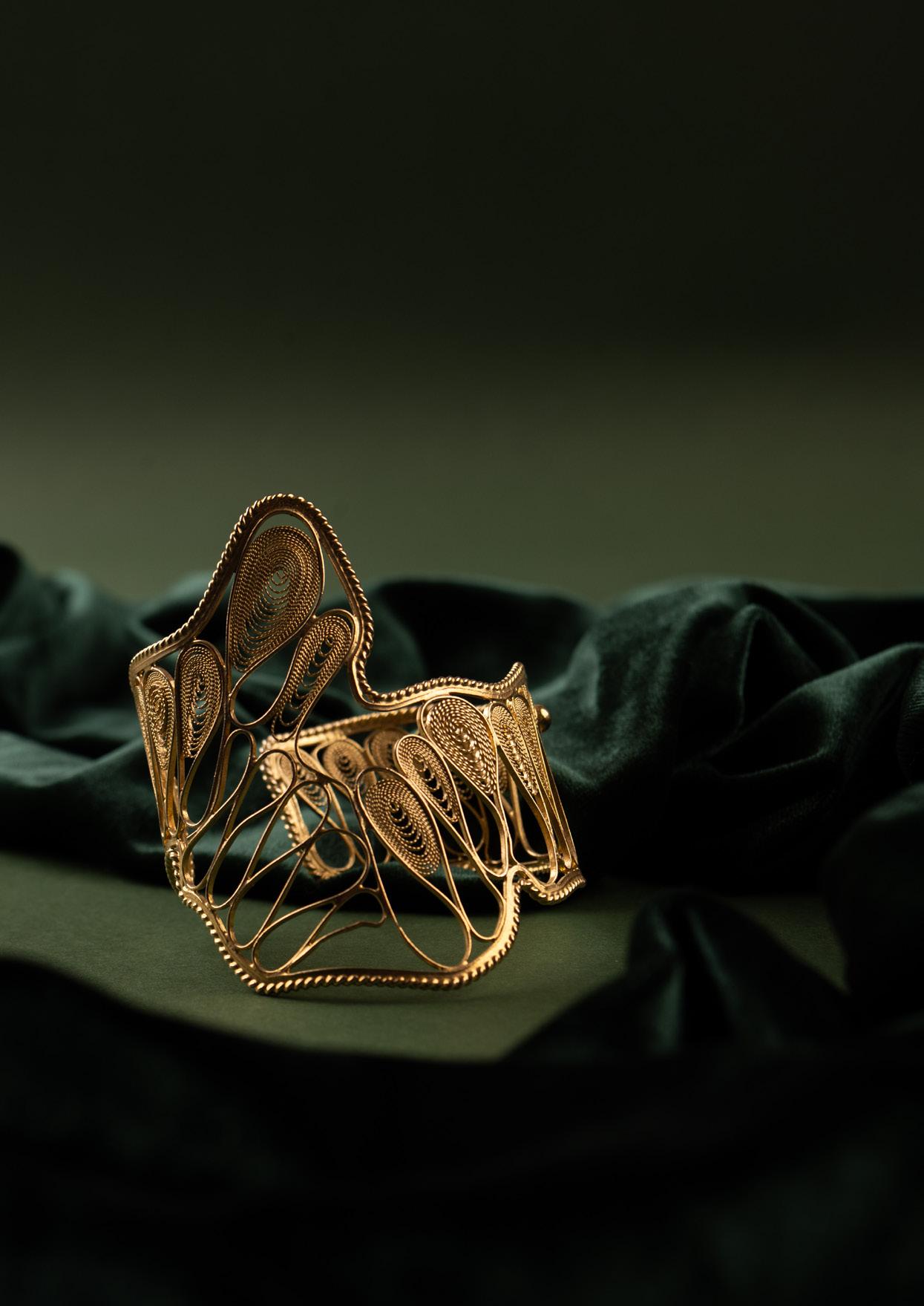
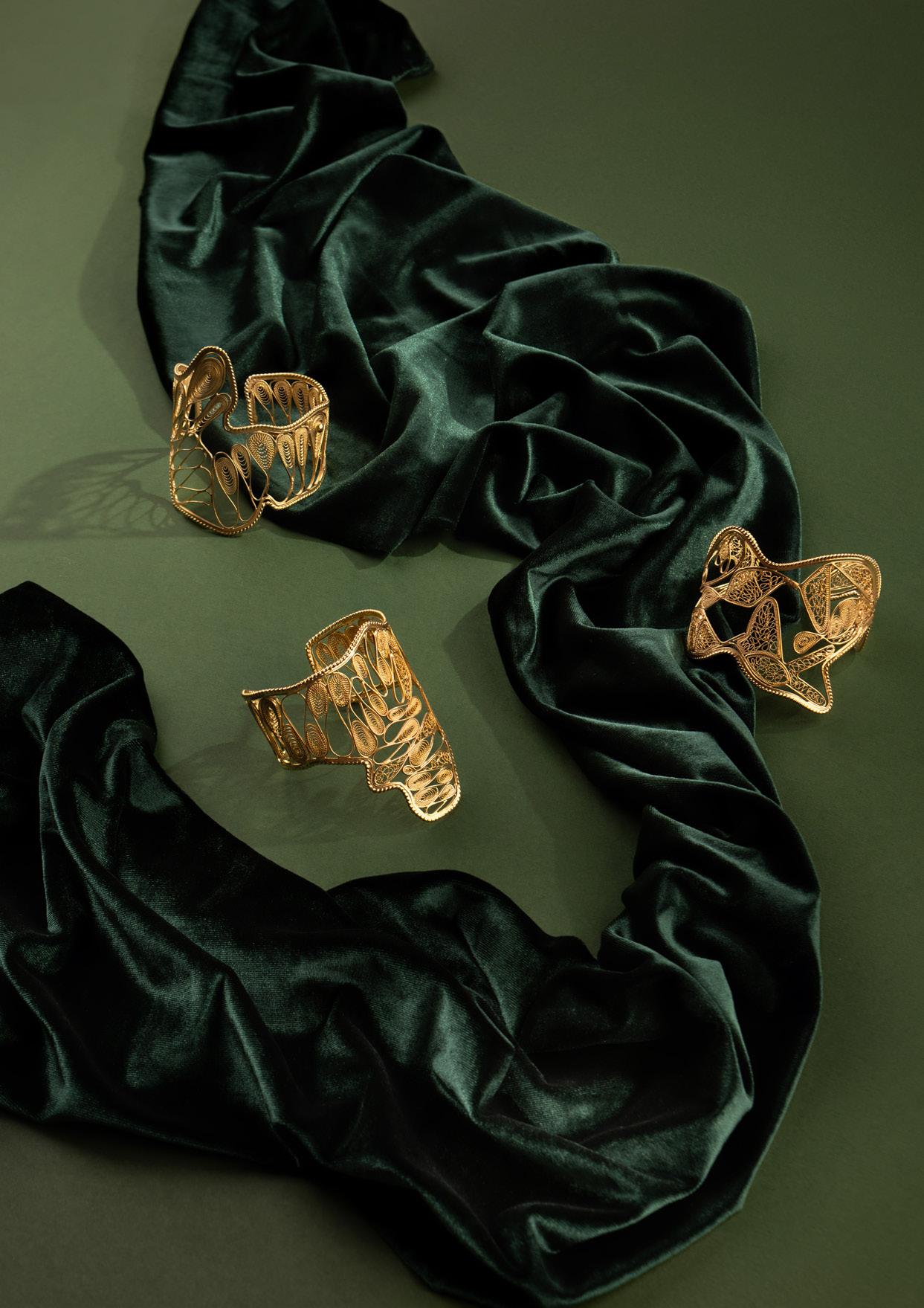
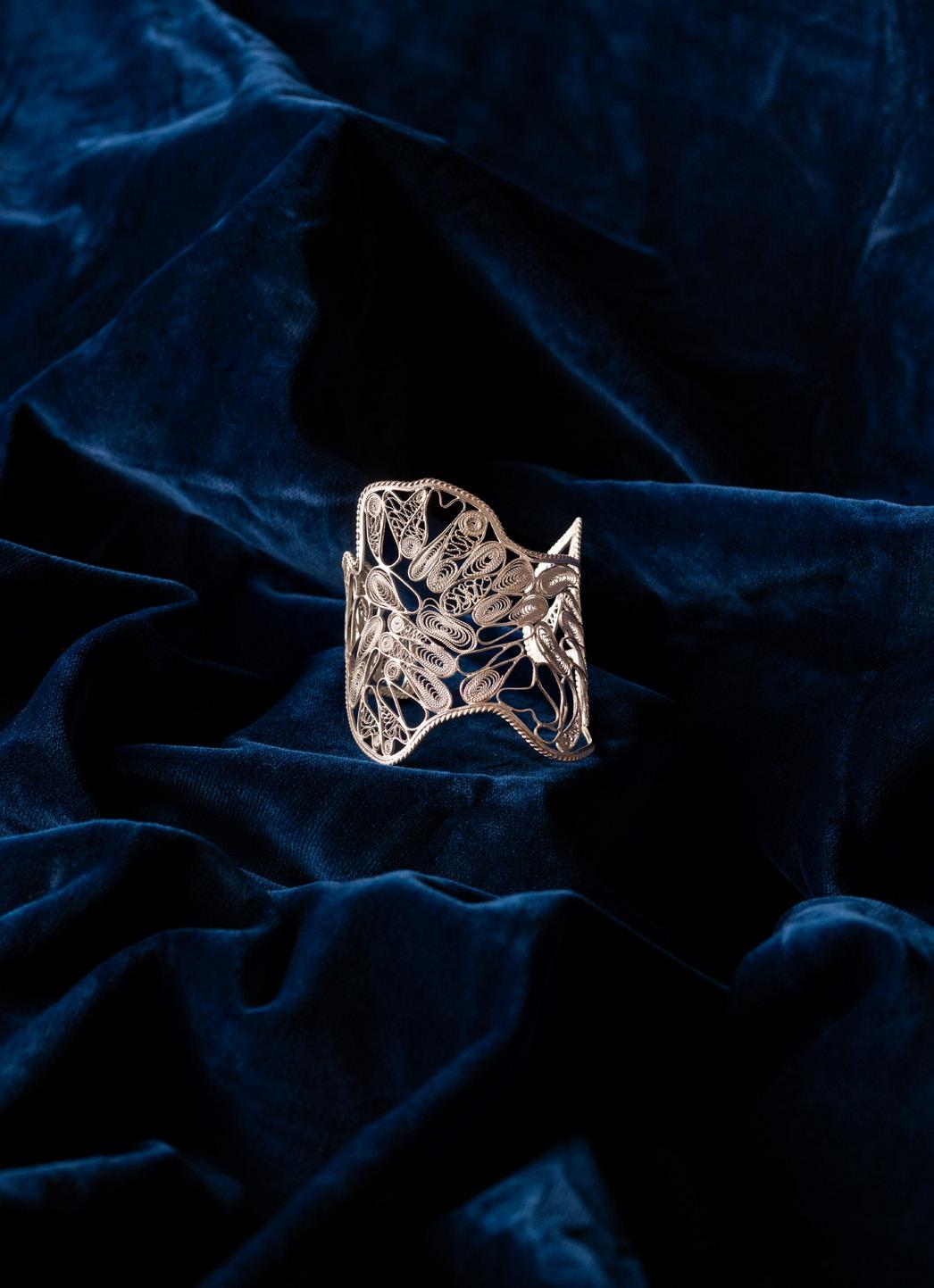
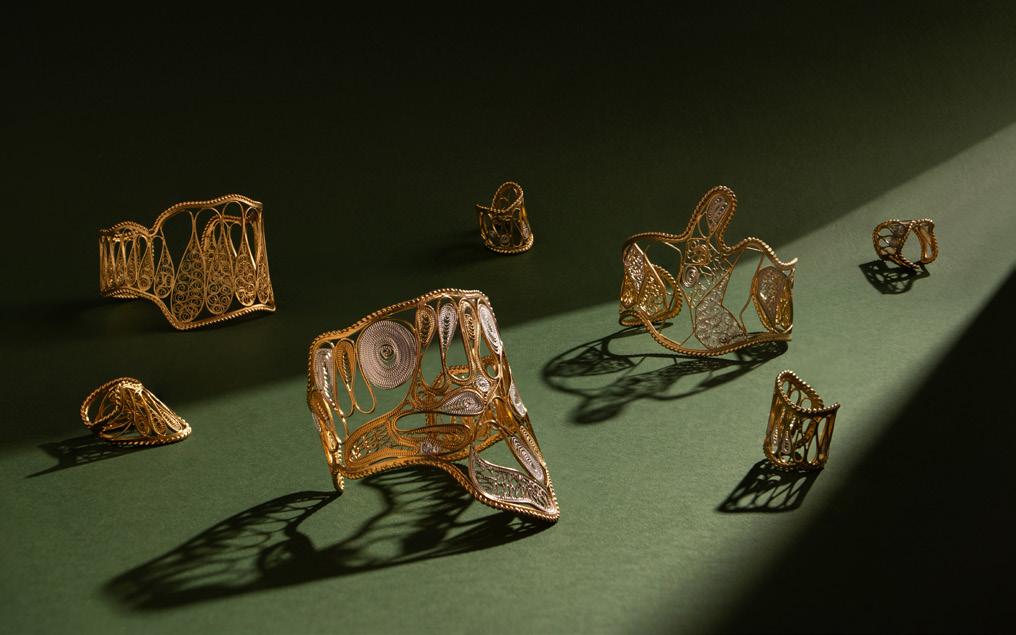
Filigree jewellery, courtesy of Kevin Attard from Auberge, Valletta
MEET THE TEAM
DESIGN
TBWA\ANG
EDITOR
Fiona Galea Debono
SALES AND BUSINESS DEVELOPMENT
TBWA\ANG
CONTRIBUTORS
Adriana Bishop
Edward Bonello
Emmanuel Galea
David Carabott
Inkontru.app
Lea Hogg
Ruth Zammit DeBono
Susan Morton
Thomas Camilleri
WOULD YOU LIKE TO BE FEATURED IN PASSAĠĠ I?
For advertising opportunities, get in touch with TBWA\ANG on passaggi@tbwa-ang.com or (+356) 2131 0608
Abigail: abigail@tbwa-ang.com or (+356) 9929 0518
COVER PHOTOGRAPHY
Sean Mallia
PHOTOGRAPHERS
Austin Camilleri Studio
Craig Jean Deguara
David Carabott
Gozo Album
Ed Muscat Azzopardi
Julia Schembri
Karen Ballard
Media Link
Nino Xerri
Screen Malta
Teatru Manoel
Tony Gatt
Żejtun local council
HOW TO PRONOUNCE PASSAĠĠ I
/pasˈsadʒi/
Here’s the breakdown: • /p/ as in pass • /a/ as in art • /sˈ/ as in sun (with stress on the following syllable) • /dʒ/ as the sound of the j in 'judge' (geminated or doubled sound) • /i/ as in eat
The word passaġġi means 'passages' in English.
The publisher, authors and contributors reserve their rights with regards to copyright. No part of this magazine may be reproduced or copied by any means without the written consent of the publisher. Editorial features and opinions expressed in Passaġġi do not necessarily reflect the views of KM Malta Airlines, the publisher, or the editorial team. Both KM Malta Airlines and the publisher do not accept responsibility for commercial and advertising content. Although the authors and publisher have made every effort to ensure that the information in this magazine was correct before going to print, the author and publisher do not assume and hereby disclaim any liability to any party for any loss, damage, or disruption caused by errors or omissions, whether such errors or omissions result from negligence, accident, or any other cause. Special thanks to KM Malta Airlines and VisitMalta for the provision of photographic material. Printed in Malta by Gutenberg Press. All magazine rights are reserved by KM Malta Airlines.
TBWA\ANG, 3rd Floor, Professional Building, Sliema Road, Gżira GZR 1633 Malta \ (+356) 2131 0608 \ tbwa-ang.com
Welcome to
The KM Malta Airlines In-Flight Magazine
David Curmi Executive Chairman KM Malta Airlines
As we move further into spring, longer days and warmer weather bring a renewed sense of energy across Europe and the Mediterranean. It is a wonderful time to travel – whether for a short city break, a business trip, or to begin planning those much-anticipated summer holidays.
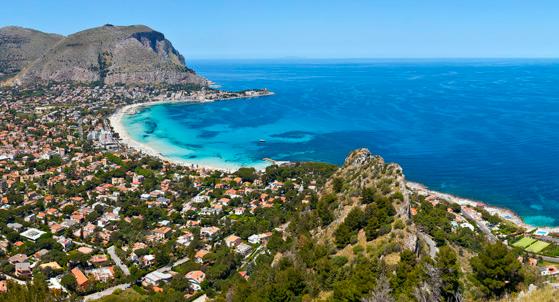
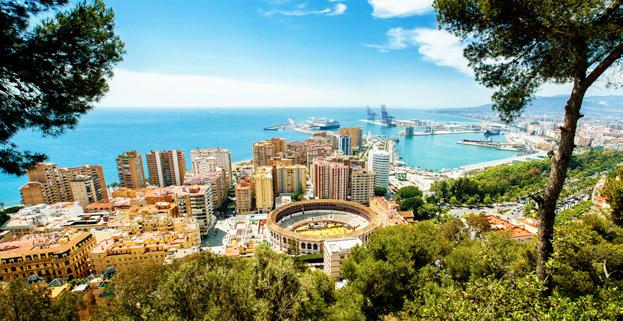
As part of our expanding Summer 2026 Schedule, we are delighted to introduce two new direct services: Malta–Palermo and Malta–Málaga. Our Palermo service will operate three times weekly from 30th May, offering a convenient gateway to western Sicily and its rich cultural and culinary heritage. Meanwhile, our Málaga route, launching on 28th May 2026 with twice-weekly flights on Wednesdays and Sundays, opens up new opportunities to explore southern Spain. You can read more about these exciting additions on PG 81 of this magazine.
At KM Malta Airlines, we continue to encourage passengers to make the most of the benefits offered through our KM Rewards loyalty programme. Members enjoy exclusive discounts and access to the lowest fares available on our website when logged into their accounts. If you are not yet a member, we invite you to join KM Rewards and start enjoying the added value and privileges available to our growing community of loyal travellers.
We are also pleased to be strengthening our collaboration with the Institute of Tourism Studies (ITS) through a new cabin crew training pathway. This initiative will provide students with the opportunity to pursue a specialised diploma and prepare for a career in aviation. It reflects our ongoing commitment to supporting the next generation of aviation professionals in Malta while building a strong and talented workforce for the future.
Our teams remain focused on delivering safe, reliable operations while continuing to enhance the overall travel experience. This is reflected in our February results, with a customer satisfaction rating of 93% and an on-time performance of 88%. As Malta’s national airline, we take pride in connecting our islands with key destinations across Europe and the Mediterranean, supporting tourism, business travel and the many personal journeys that bring people together.
Thank you for choosing KM Malta Airlines. We look forward to welcoming you on board again soon.
Fiona Galea Debono Editor
Spring is a wonderful time to arrive in Malta. If you land early enough this month, you may catch the island in the midst of its vibrant Easter celebrations on 5th April – one of the most meaningful moments in the Maltese cultural calendar.
And if the festivities have already passed, you may still find a lingering taste of the season in the form of figolli, the beloved large almond-filled Easter biscuits. Failing that, you’ll find the recipe in this issue of Passaġġi, so you can try recreating the culinary tradition yourself.
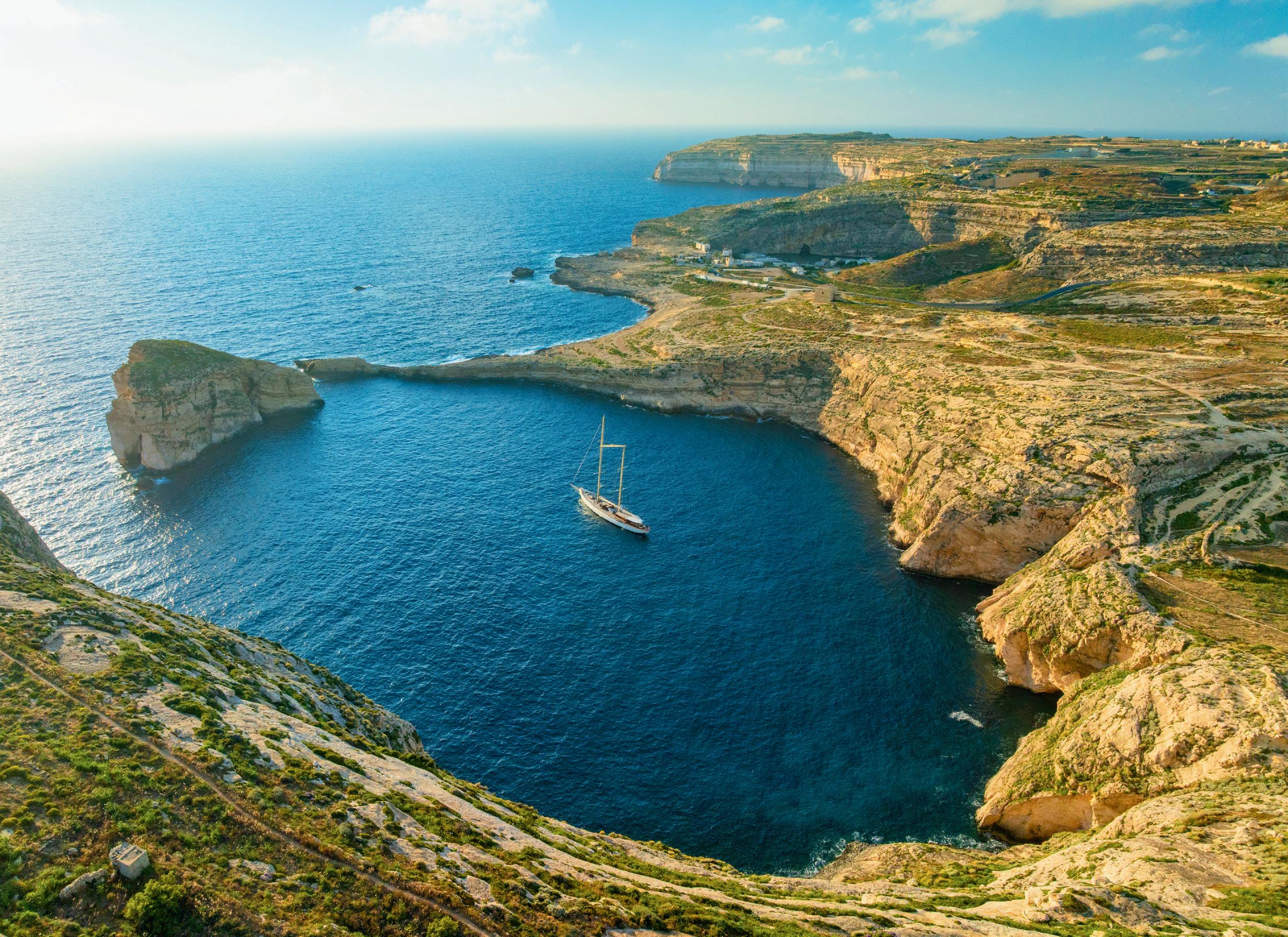
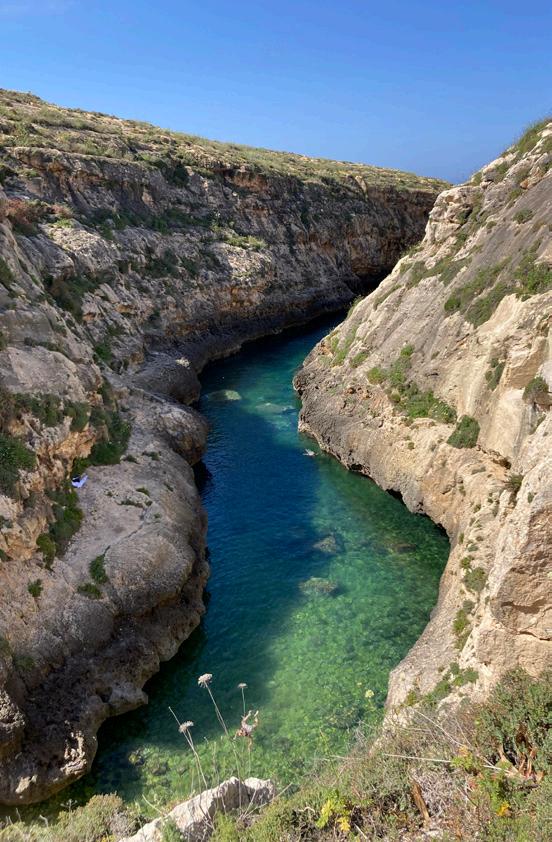
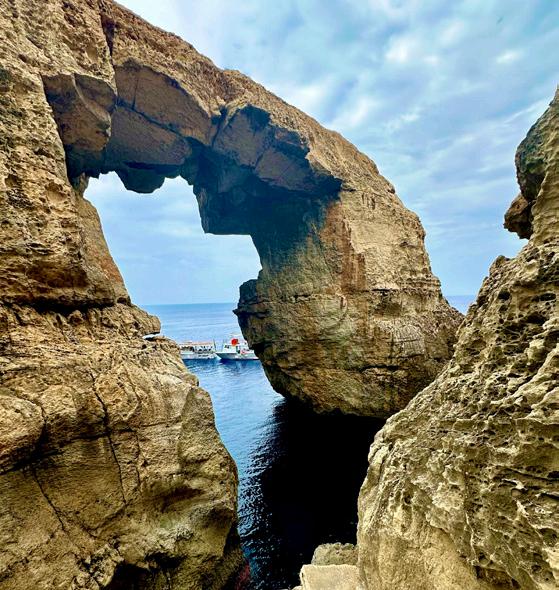
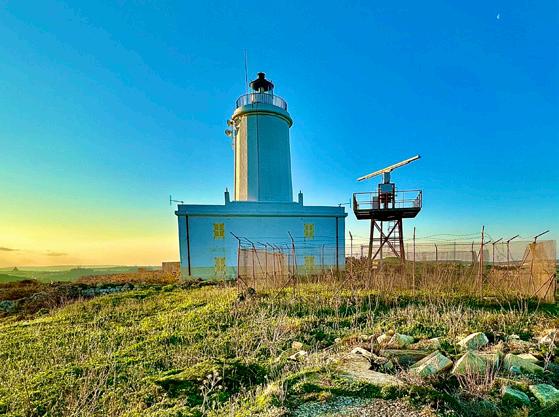
Easter is especially cherished on Gozo, Malta’s sister island, and many locals make the short crossing to spend the holiday there as spring warms the air and the countryside is at its best. Should you decide to follow their lead, we have mapped out a trail along Gozo’s northern coast: from a lighthouse viewpoint, through a dramatic gorge, and on to a wellearned seafood lunch, rounded off with a sunset stop as the day winds down.
Gozo’s myths and legends only deepen its allure. In this issue you can explore some of them before you arrive – just don’t be tempted to linger quite as long as Odysseus did in Homer’s Odyssey.
Back in Malta, another tradition marks the turning of the season. On the first Wednesday after Easter Sunday, the brave take part in the island’s first swim of the year. The ritual begins with a centuries-old procession from St Gregory’s Church in the southern village of Żejtun. Participants then make their way to the harbour village of Marsaxlokk, where hundreds plunge into the stillchilly Mediterranean Sea – an exuberant welcome to the summer months ahead.
It may not be for the faint-hearted, but it is another of those traditions that make Malta so distinct.
Closer to home, Naxxar takes centre stage in this issue. Since moving nearby, it has become my go-to town, a place I pass through daily and rely on for many of life’s small errands. Yet our feature on the locality – April’s chosen destination in Malta – reveals layers of history and culture that bring new meaning to a place that can feel so familiar.
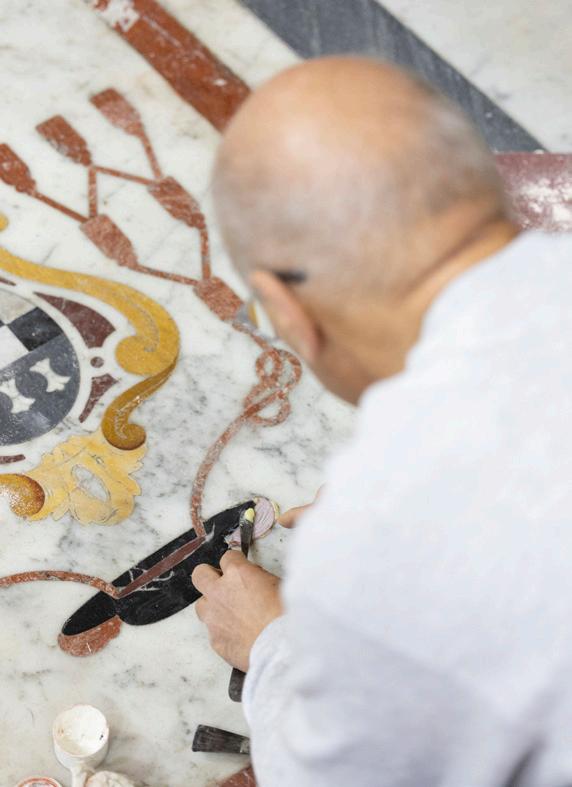
Naxxar also appears in the story of a master marble sculptor who grew up there, inspired by the town’s feast traditions and artistic heritage. With each careful strike of the chisel, he keeps a centuries-old craft alive, carving Malta’s history into stone.
Creativity runs as a thread throughout this issue of Passaġġi, where you will also discover the delicate art of Maltese filigree, a centuries-old craft that twists fine strands of silver into intricate jewellery. It is painstaking work that also continues to preserve and celebrate the island’s artistic heritage.
The stories in Passaġġi reveal the many ways Malta can be experienced – from its landscapes and legends to its traditions and crafts. We hope this issue opens a window onto a few more of the island’s many layers and perhaps inspires you to explore them for yourself.
Welcome to Naxxar
This bustling town has it all TRAVEL 16
Timeless Madrid
A city of history, architecture and tradition
ARTS 20
Carving a legacy in marble
Meet a master marmista
25
The people's theatre
The magic of the Manoel
TRADITION
28
The first swim of the year
Follow Żejtun’s centuries-old procession to the sea
CULTURE
32
This month’s must-see events
A season of inspiring creative moments
PETS 36
Spring city breaks with a small dog
The best season for a mini vacation
Quiet strategy on 64 squares
Chess moves in Malta
HERITAGE
42
Silent sentinels of faith
A living gallery of crosses
MADE IN MALTA
48
Discovering the fine details of filigree
The patience behind the delicate art form
52 'Too much photography'
Capturing the beauty of imperfection
GOZO
58 My favourite escape
Northern Gozo invites exploration
63 Between giants and nymphs
The myths that still shape the island ENTERTAINMENT
66
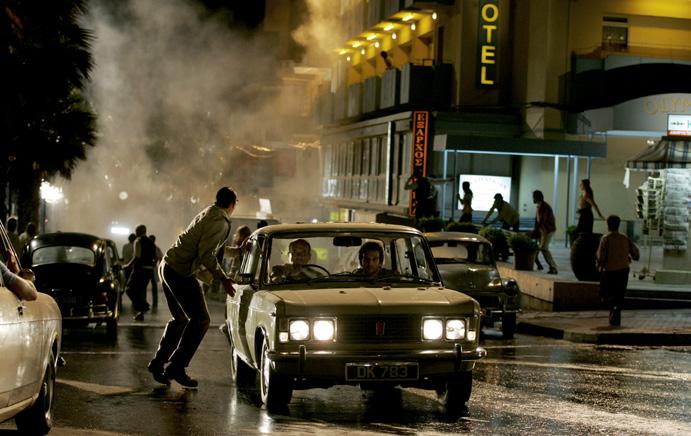
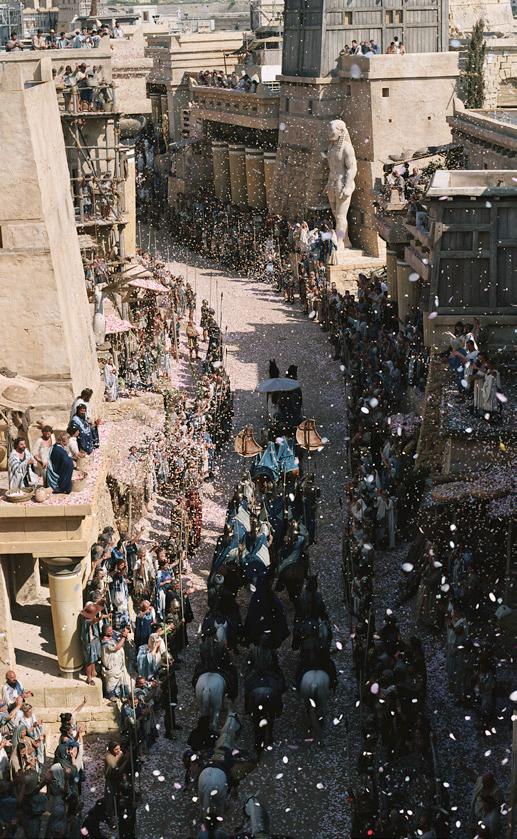
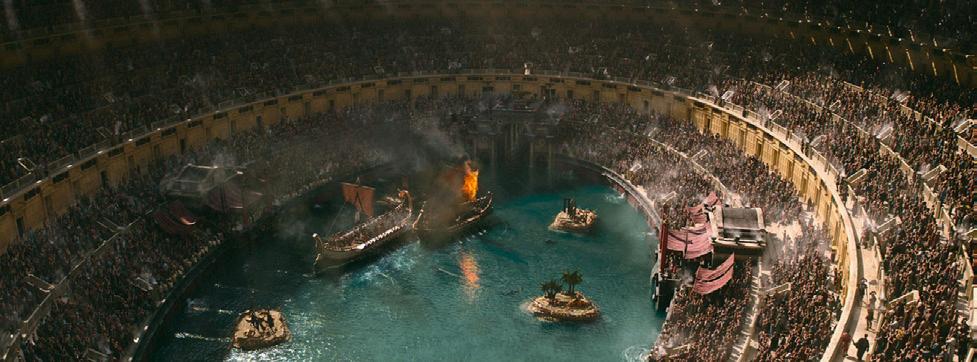
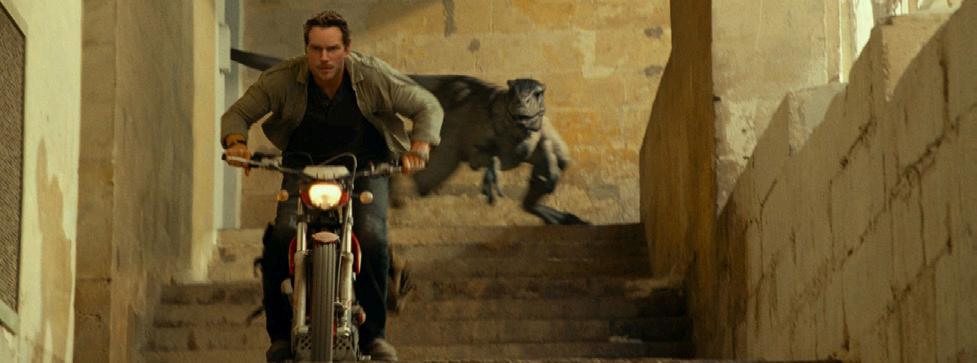
Malta as a movie set
Recognise these locations from a famous film?
FOOD
70
From Lent to figolli
A well-deserved sweet Easter treat
AIRLINE NEWS
79
Flight, company and destination information
All you need to know about flying with KM Malta Airlines
Words by Edward Bonello
Edward is a content writer and PR consultant. He is interested in the wonderfully superfluous and exquisitely redundant. When he’s not happily tapping away at his laptop, he enjoys collecting useless trivia and watching B-movies.
Welcome to Naxxar
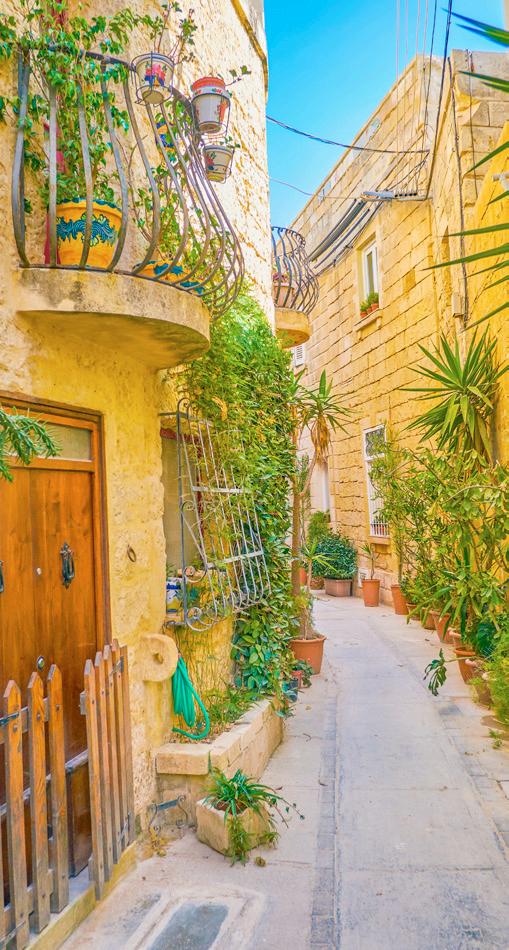
From chapels to café culture, prestigious palazzos, fine dining and festa fun, this bustling town has it all.
When St Paul was shipwrecked on Malta, in the year AD 60, it is said that the Maltese offered him and his exhausted colleagues a warm welcome on a cold, stormy, winter’s night. In fact, St Luke, who is believed to have been on site chronicling the ordeal, gave Malta perhaps its earliest and best tourist tagline, noting how “the islanders showed us unusual kindness”.
But there’s one town in Malta, in particular, that carries this reputation, even giving it place of honour in its motto, Prior Credidi, Latin for ‘first to believe’. That locality is Naxxar.
This popular belief has some very deep roots and is thought to be one of the possible etymological sources of the town name itself. In fact, some scholars have argued that Naxxar may be related to the words Nazaroei or Nsara, referring to the identity given to the first Christians, the Nazarenes.
And it may very well be plausible as Naxxar is situated on a large promontory overlooking Baħar iċ-Ċagħaq
and St Paul’s Bay, both central to the Pauline episode. So, it’s not unlikely that the beleaguered crew of that fateful shipwreck would have found welcome among our friendly Naxxarin as the seas calmed and the skies settled.
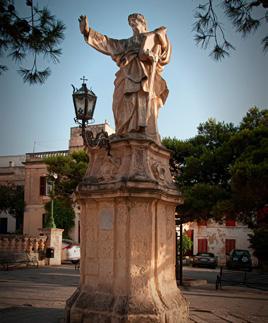
The chapel dedicated to St Paul’s shipwreck and the large statue of the apostle on the edge of the plateau are said to mark the spot where he would preach and, low and behold, even be heard from as far as Gozo!
Naturally, that last bit of information faded into the realm of legend, but it is very normal for history and myth to intertwine indistinguishably on ancient lands like Malta.
St Paul’s is not the only wayside chapel in Naxxar as the locality has no less than 11 dotted around its streets and alleyways. Each of these small places of worship has its own fascinating history, some going back several centuries, and a tour of these chapels would make for a wonderful trek in itself.
But beyond the chapels, Naxxar has other highlights, starting from the large Parish Church of the Nativity of Our Lady, associated with Our Lady of Victories. This parish is one of the oldest in Malta and dates back at least to 1436, when Bishop de Mello listed it as one of 10 in Malta. Neighbouring localities of Għargħur and Mosta were eventually hived off Naxxar.
The present church was built between 1616 and 1630 as the need for a larger church was felt, given the growing population of the town, which at the time numbered 1,200 inhabitants. Celebrated Maltese architect Tumas Dingli designed the façade. This was replaced by a larger one in the beginning of the 20th century, while the choir by Lorenzo Gafà, the same architect who designed the Cathedral of Mdina, still survives.
A beautiful church, certainly worth visiting, especially during the festivities dedicated to Our Lady of Victories in September, its main painting is attributed to the school of Mattia Preti, while two paintings by Stefano Erardi flank it.
Speaking of the feast, Naxxar is home to two large band clubs that hold a significant place within the social fabric of the town. Together, they are responsible for organising much of the external celebrations related to the village feast, as well as a busy calendar of social and musical events throughout the year, intended to keep the community engaged.
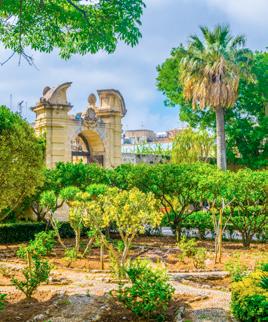
Naxxar is a locality of stunning houses, many of which survive to this day. Perhaps the most famous is Palazzo Parisio, a popular reception venue for classy events. The 18th-century setting, modelled on the Sicilian country palazzo style, with its golden halls and lush gardens, has also been a favourite setting for several cinematic productions.
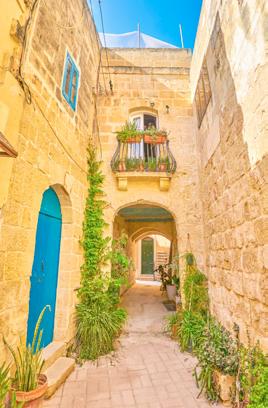
A narrow street in Naxxar.
The gardens of Palazzo Parisio.
Palazzo Nasciaro, which naturally takes its name from the town, is another 18th-century palace built during the time of the Knights of the Order of St John, serving several purposes through the centuries. It was the official residence of the Britishperiod Lieutenant, who administered the region, the first public school in the town and a maternity underground hospital during World War II. Today, it is a private residence.
Naxxar was a popular hunting ground at the time, and the Knights would gladly let off steam in the area. Hompesch Hunting Lodge was built by the last Grand Master of the Order of St John, Ferdinand von Hompesch, for his recreational purposes.
More modern buildings of note from the 20th century include the 1990s-era local council by architect Prof. Richard England, among others.
The town is also home to several businesses that have set up shop – a marked deviation from the traditional trades that would have been found in the locality some years back. In fact, Naxxar was once famous for its blacksmiths, the finest in Malta, some would argue, who attracted serious trade from far and wide. While some artisanal tradesmen still survive, the landscape has certainly shifted.
Today, Naxxar’s population is in the region of 15,000 inhabitants as the town has grown to be a lively centre of activity and business. The main thoroughfare leading to the parish square is a popular spot where residents and visiting shoppers see to their daily needs.
Café culture is also very strong in the area with a healthy number of cafeterias offering all sorts of goodies and beverages, from breakfast to dinner.
Photo: Nino Xerri. The Chapel of San Pawl tat-Tarġa.
Must-see sites
Words by Heritage Malta
The national agency for museums, conservation practice and cultural heritage, it is the guardian of over 8,000 years of history.
If this is your first visit to the Maltese Islands, you cannot leave without ticking these sites off your list.
St Paul’s Catacombs
Rabat
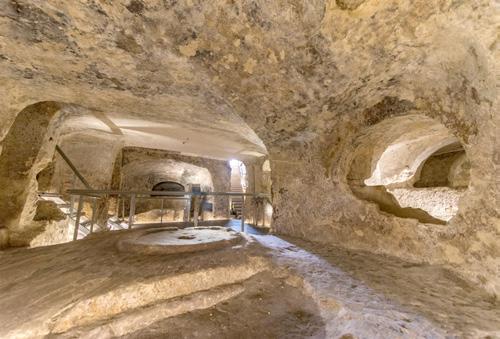
Leave the sights and sounds of modern life behind you as you step down into another world – a burial ground from Punic, Roman and Byzantine times, representing the earliest and largest archaeological evidence of Christianity in Malta. The catacombs form a typical complex of interconnected underground Roman cemeteries that were in use up to the 7th and possibly the 8th century AD. Part of the catacombs was re-utilised during the re-Christianisation of the island, around the 13th century, when an open space was re-cut and used as a Christian shrine decorated with murals.
Grand Master’s Palace
Valletta
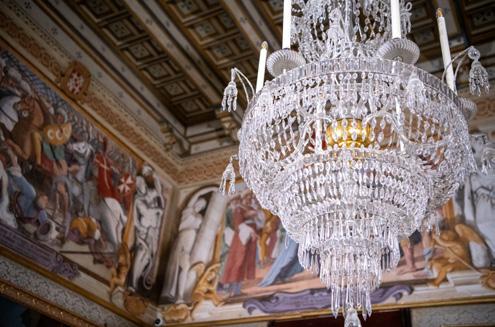
Newly restored and proudly dominating St George’s Square, the Grand Master’s Palace invites you to wander along its 450-year history as a centre of power and the symbol of a nation. Presently the seat of the Office of the President of Malta, the Palace grants visitor access to over 85 per cent of the building’s footprint, including the magnificent Armoury. The Palace’s restoration project was partly financed via the European Regional Development Fund (ERDF).
Fort St Angelo
Birgu
No other fortress has been engaged with the same intensity in the shaping of Malta’s destiny as Fort St Angelo! Known as Castrum Maris in medieval times, this stronghold was christened as Fort St Angelo by the Knights of the Order of St John, who turned it into their headquarters. The Knights remodelled the building extensively with the construction of a series of artillery platforms that marked the introduction of the bastioned system of defence on these islands. During the British period, the fort served as a shore establishment of the Royal Navy in Malta until the last detachment of foreign forces marched out of its walls in March 1979.
Underground Valletta Valletta
Valletta, a UNESCO World Heritage Site, cannot be fully appreciated without experiencing what lies beneath it. Descend into the capital’s fascinating depths to discover dark underground spaces, which, centuries ago, were crucial for the movement of troops, for grain and water storage, and for drainage. Then fast forward to the terrible years of World War II, when these underground tunnels and chambers provided shelter to thousands of people seeking refuge from the relentless enemy bombs, with primitive sanitary facilities and very scarce food stocks, but with a burning hope of survival that defied desperation. Pre-booking is required.
MUŻA – The National Community Art Museum Valletta
The acronym MUŻA refers to the mythological Muses of classical antiquity and to the Maltese term for artistic inspiration. Through a varied collection of paintings, sculptures, furniture, silver pieces, works on paper and objets d’art, MUŻA’s main focus is to show artistic developments in Malta impacted by its Mediterranean context as well as the cultural influences resulting from the governance of the Order of St John (15301798), the British Empire (1800 - 1964), the postIndependence period (since 1964) and the overall impact of the Church.
Inquisitor’s Palace
Birgu
The Inquisitor’s Palace is both a historic house museum and the National Museum of Ethnography.
Built in the 1530s, it was the powerhouse of the Holy Roman Inquisition that dominated Malta for over 224 years. After the French abolished the Inquisition in Malta upon their arrival in 1798, the building served French and British rules, as well as the Dominican Order for a period of time after World War II. The Inquisitor’s Palace also houses the National Textiles Collection.
‘Lampuki’
Crystal Lagoon
Popeye Village
Dingli Cliffs
Rabat
Dingli
Buskett
‘Luzzu’
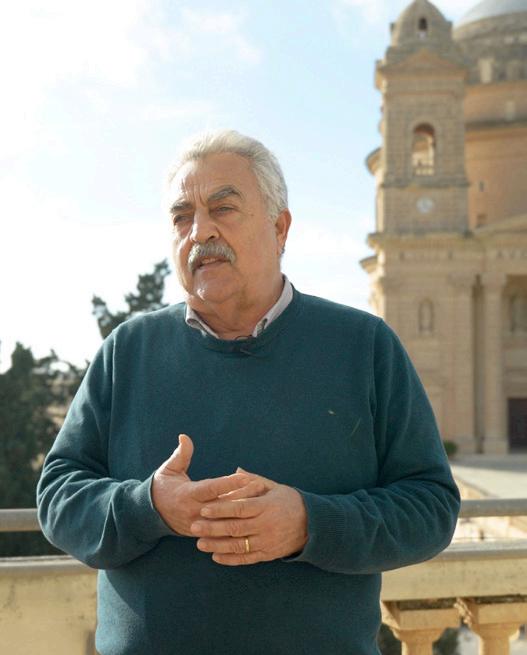
Old residence in Naxxar.
Statue of St Paul.
Palazzo Parisio gardens.
Words by Lea Hogg
Lea is a Malta-based journalist and writer, known for her TV programme on current affairs, cultural news and in-depth interviews about politics and global issues.
Timeless Madrid
From candlelit processions to art deco landmarks and late-night flamenco, Madrid rewards those who take time to explore. In the historic Barrio de las Letras, the city’s past and present meet in streets filled with history, architecture and tradition.
I’ve lost count of the amount of times I’ve visited Madrid. For years, it was part of a familiar ritual: a night or two in the city, followed by a drive south to our holiday home on the Andalusian coast. Sun and sand grow repetitive without a detour, so we began each journey in Madrid, lingering just long enough before driving through the sierras and stopping somewhere unexpected along the way.
During one of our trips, we stayed at the Gran Hotel Inglés, Madrid’s oldest hotel. Its art deco elegance was compelling, but even more alluring was its location in the storied Barrio de las Letras, where Spain’s literary giants once lived during the 16th and 17th centuries.
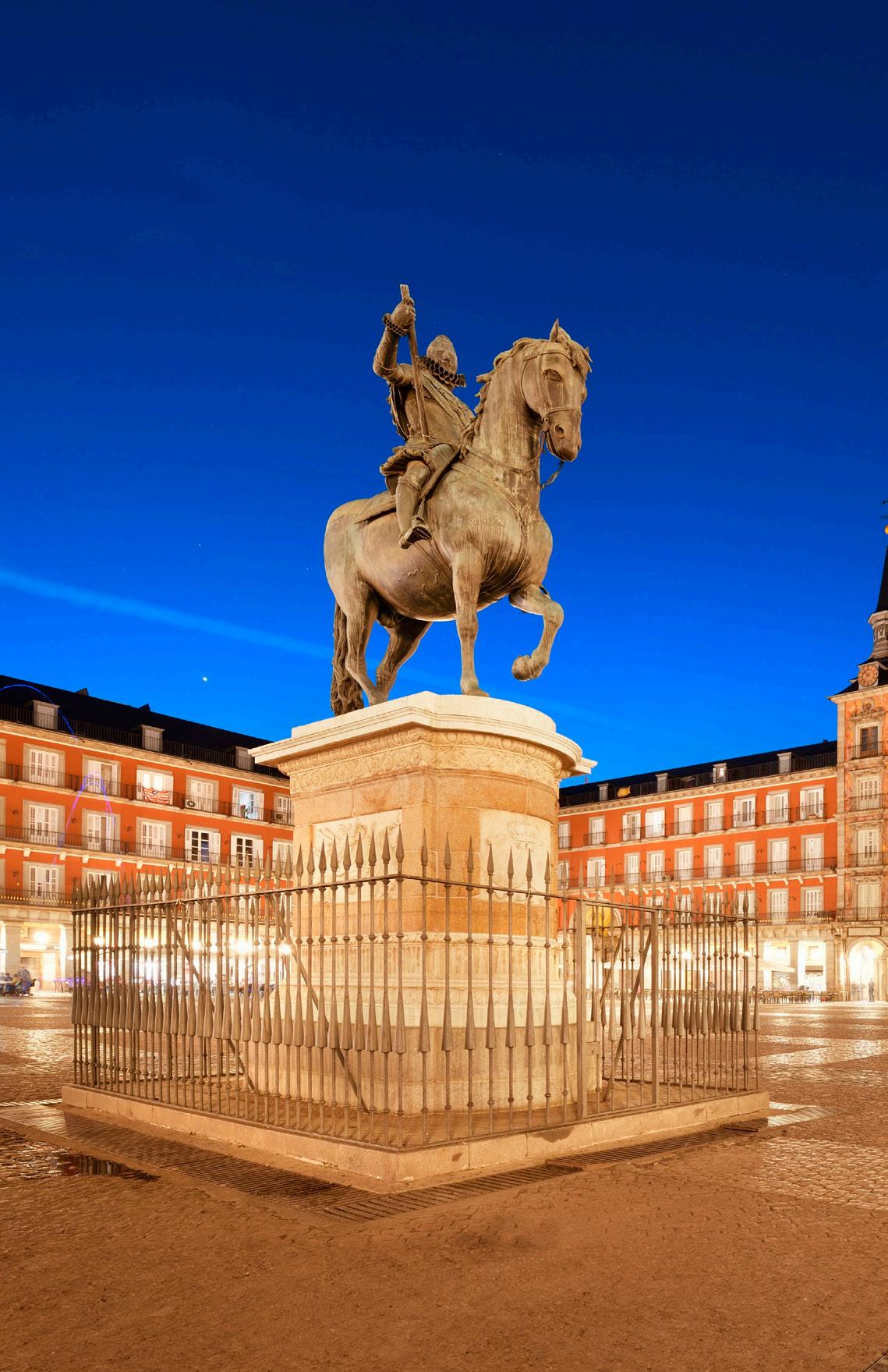
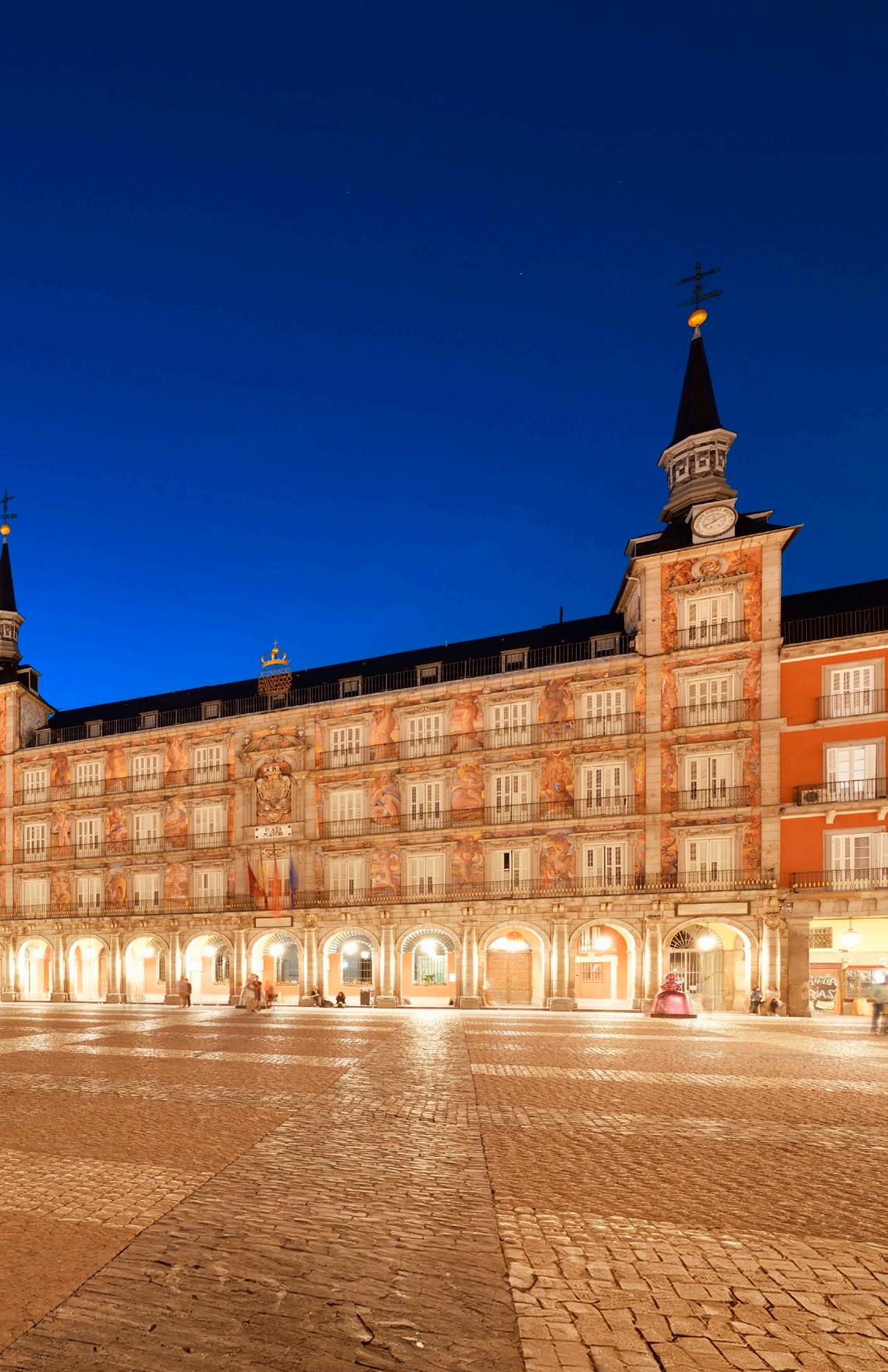
At Easter, Madrid balances solemn processions with lively streets. Brotherhoods carry pasos through Plaza Mayor and Puerta del Sol, candlelit processions winding through the historic centre and culminating on Domingo de Resurrección (Resurrection Sunday). At 1pm, the Tamborrada begins, with drummers in traditional Aragon tunics filling the square with rolling percussion, lifting the solemnity of Holy Week.
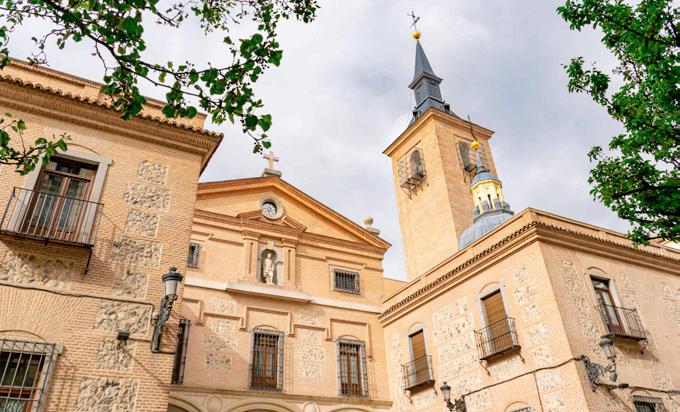
Mornings belonged to wandering the Barrio de las Letras. Start at San Ginés Church, one of Madrid’s oldest, built in 1645 and home to El Greco’s La purificación del templo. Then, indulge in torrijas, Madrid’s quintessential Easter treat since the 15th century.
At La Casa de las Torrijas, just off Calle Paz near Puerta del Sol, the tradition has been served unchanged since 1907. Faded tiles, timber counters, worn benches and antique enamel plaques hint at its history as a wine tavern. Locals sip Moscatel, Pedro Ximénez, or Malaga wine; my favourite was the floral sweetness of Moscatel, which complemented the warm, cinnamon-bready dessert perfectly.
Art deco enthusiasts will find Madrid exciting. The Gran Vía, the Edificio Carrión, Cine Callao and Edificio Telefónica showcase the bold lines of the 1920s and 1930s. Nearby, Casa Gallardo and Palacio de Longoria reveal the transition from modernist flourishes to sleek art deco.
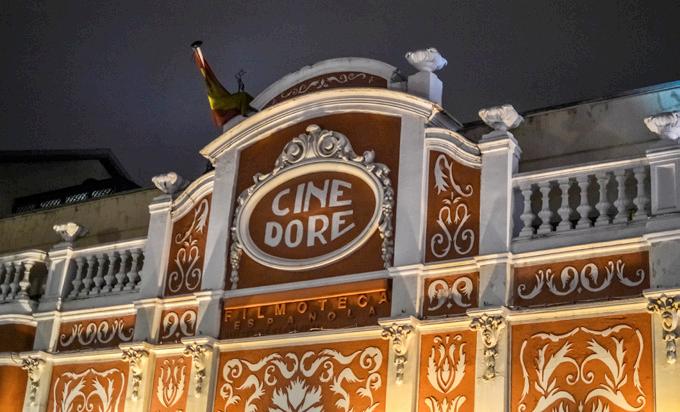
A walking route from Plaza del Callao to Plaza de España includes Galería Canalejas and Cine Doré, where decorative façades, stained glass and cinematic heritage offer a glimpse of Madrid’s stylish interwar era.
The Naval Museum (Museo Naval de Madrid) is another art deco treasure. Its monumental staircase, crafted from Carrara marble in 1928 by José Espelius and Francisco Javier de Luque, is considered one of Madrid’s most beautiful. Its grand scale, geometric elegance and luxurious materials perfectly capture the city’s late-1920s design sensibility.
For true antique art deco, ANTIK Almoneda at IFEMA Madrid is a must and takes place from 11th to 19th April. Wander among 1920s and 1930s furniture, lighting and decorative pieces, each a testament to the era’s craftsmanship.
Madrid’s charm continues after dark. We spent an evening at the rooftop terrace of Círculo de Bellas Artes. A short lift ride opens onto panoramic views: the Metropolis Building gleaming at Gran Vía, the Sierra de Guadarrama on clear nights, and the slow glitter of traffic threading through the streets below. It is the perfect place to linger over a cocktail as the skyline fades from amber to deep blue.
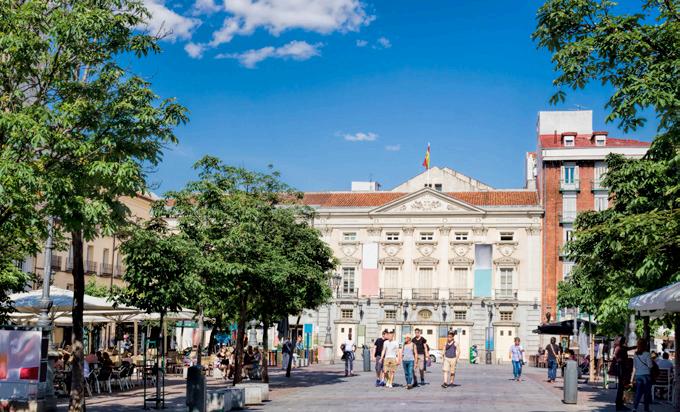
Nearby, Sala Equis, tucked into a former cinema near Plaza de Jacinto Benavente, offers a contrasting vibe. Velvet sofas and low tables face a screen alternating films, music sessions and conversations.
If the mood shifts after dinner, wander north toward Malasaña, the bohemian quarter and one of Madrid’s most energetic nightlife districts. Vintage shops, street art and neon-lit bars spill onto the pavements long after midnight.
The neighbourhood rose to fame during the Movida Madrileña counterculture movement and still attracts students, artists and musicians. We loved La Vía Láctea, which hosts indie music, DJ sets and spontaneous dancing, creating an open-air party that flows.
But for a distinctly Madrid experience, nothing rivals a night of flamenco. At Corral de la Morería, widely regarded as one of Spain’s most prestigious tablaos, the experience is intimate and intense. Guitar, song and dance unfold just feet from the audience, the rhythm building until the room seems to pulse with the beat of heels against wood. It is theatre in its most authentic form and one of the city’s most memorable cultural traditions.
If you prefer music that stretches into the night, Café Central, beside the arcades of Plaza de Santa Ana, remains a benchmark. Since the early 1980s, the club has hosted an extraordinary roster of international and Spanish musicians. The room is intimate, the acoustics warm, and the programme consistently excellent. Between sets, the doors open to the square, where terraces stay lively well past midnight.
Madrid mornings are for wandering, afternoons for galleries and long lunches, nights for rooftops, flamenco and jazz that carry on past midnight. Every corner holds history, and the city’s inimitable energy is unmatched.
suggests
KM Malta Airlines operates regular flights between Malta International Airport (MLA) and Madrid (MAD) kmmaltairlines.com
Places to see; things to do
• Tamborrada on Easter Sunday takes place in Plaza Mayor at 1pm.
• ANTIK Almoneda at IFEMA Madrid takes place from 11th - 19th April. Opening hours: 11.30am - 8.30pm daily.
• San Ginés Church, Calle Arenal.
• Círculo de Bellas Artes, Calle de Alcalá 42.
Sala Equis, Calle del Duque de Alba 4; metro: La Latina or Tirso de Molina.
Corral de la Morería for flamenco, Calle de la Morería 17, Centro.
Café Central, Plaza del Ángel 10.
• La Vía Láctea, Calle de Velarde, Malasaña, Centro.
• Gran Hotel Inglés, Calle de Echegaray 8, Centro.
Make Madrid’s famous wine-soaked torrijas at home – golden, spiced and just a little boozy. Soak stale bread slices in warm milk with sugar, cinnamon and red wine. Dip in beaten egg, fry until golden, then sprinkle with sugar and cinnamon. Serve warm.
Words by Adriana Bishop
Adriana is a former news journalist and travel PR executive, now a freelance writer based in Switzerland, with her heart and eyes always set on her forever home, Malta.
Carving a legacy in marble
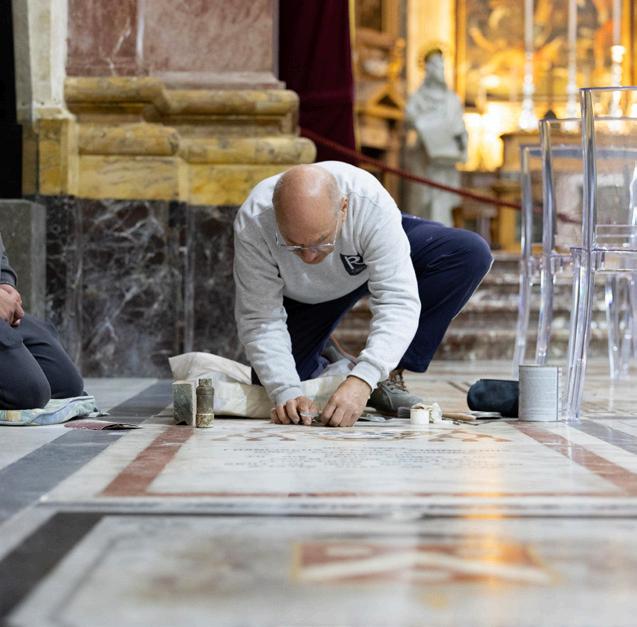
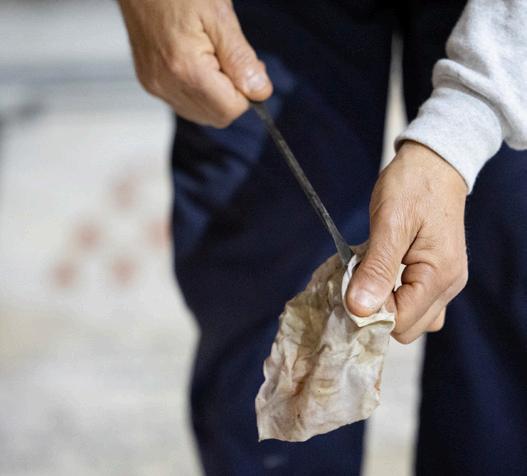
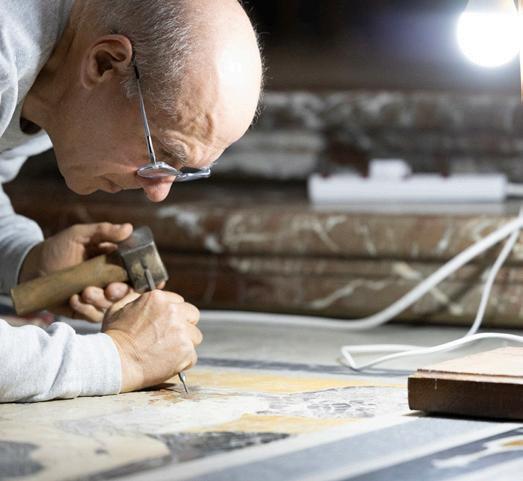
Abraham Bellia is one of a handful of marmisti – the master marble sculptors and carvers behind many of the works of art and monumental plaques adorning Maltese churches and palaces. And he hopes he won’t be the last of these skilled artisans.
The first time I met Abraham Bellia, he was covered head to toe in a fine layer of white marble dust, his kind eyes twinkling like gems. His workshop in a converted garage in the heart of his hometown Naxxar was covered in the same fine layer of dust, and by the time I left, I was coated too.
I was there with my father to discuss the design of the gravestone for my mother who had just passed away. It was one of the most heartbreaking conversations imaginable, but Abraham’s gentle nature and professionalism helped us focus on the poignant task as we discussed the details to honour my mother. Four years later, I was back to add my father’s name and photo to the same gravestone.
On the table, an elaborate curly leaf was taking shape out of a slab of white Carrara marble. Abraham wiped his hands and brought out a sizeable album packed with photographs of his works. He proudly leafed through a bewildering array of monumental plaques, altars, inlaid gravestones and myriad other marble works highlighting a vast and highly skilled portfolio.
It was then that I realised I was in the presence of a true master – an artist who combines skill with design; one of the last remaining marmisti in Malta, whose work
has etched the island’s cultural heritage into its most precious stone.
How many times have we admired and photographed churches and palaces without stopping to think about the artists, craftsmen and sculptors who have shaped and moulded magic out of wood, stone, marble, bronze and other materials, their names overshadowed by the headline-grabbing kings or whichever other authority had ‘built’ the building?
I decided I wanted to listen to Abraham’s story. And I hope this will not be the last one to be told about Malta’s marblesculpting heritage.
Abraham has been working as a marmista for over 36 years, having started as an apprentice barely out of his teens.
“I was brought up in churches and palaces,” he quips, only half-jokingly, considering the large number of hours he has spent over the past decades working in such buildings. Even before he started working, he served as an altar boy in the parish of Naxxar, and his childhood toys were a miniature altar and small Good Friday statues. Abraham is a lifelong festa enthusiast, actively participating in the local celebrations even as a statue bearer in the processions.
When I catch up with him for a formal interview, he is in the middle of a lengthy restoration project at the Mdina Cathedral by day, while working on two major commissions for the Naxxar Parish Church and the local band club, which must be completed by the beginning of September for a milestone anniversary.
“Our skill is an art form,” he explains as he makes a distinction between marble workers and sculptors like himself. I searched for an English equivalent, but no word quite captures the precision and artistry of the job – so marmista it is, from the Italian word marmo for marble.
To understand the importance of a marmista’s job, just take a look at the marble artwork inside St John’s CoCathedral in Valletta, with its famous inlaid gravestones carpeting the floor and a cascade of intricate sculptural works covering every other surface.
Abraham started his apprenticeship at St John’s and later spent 14 years as the resident marble sculptor at the President of Malta’s official residence, San Anton Palace, leaving his mark in the official dining room with an elaborate marble fireplace, featuring Malta’s coat of arms, and a tabernacle in the chapel of the Madonna tal-Pilar, among many other pieces.
One that stands out in his memory of his time at the palace, and still takes pride of place in his portfolio, is a memorial plaque he was commissioned to design and sculpt to commemorate the visit of Pope Benedict XVI to Malta in 2010.
“The plaque for the visit of the previous pope had taken almost 18 months to make and was erected after his visit. They wanted this one to be inaugurated by the Pope himself and they gave me only six weeks’ notice to design and carve it,” Abraham recalls.
But it was more than worth it. The plaque is right next to the entrance to the palace. On the day of the visit, the then President of Malta, George Abela, told Abraham to wait by the door, beneath the plaque, thus creating the opportunity for a special meeting with the Pontiff as he was leaving the palace.
“It was only a very brief meeting, a matter of minutes, but it meant a lot to me,” Abraham says. “I get a lot of satisfaction from my work, and it is very prestigious to work in such public places.”
What strikes me most about Abraham is his calm demeanour, honed, no doubt, from decades of working with infinite patience, precision and care.
“This work takes a lot of time. It is all made by hand and you make slow progress. Sometimes, I feel like a tortoise, moving so slowly in my work,” Abraham explains. He still sketches his designs on a piece of A4 paper, then enlarges them the old-school way with squared paper – “no computers”.
I ask him about the piece he is most proud of, and without hesitation, he tells me about a monumental plaque he
Photos: Julia Schembri. Abraham Bellia at work.
Fort St Angelo, Inquisitor’s Palace St Lawrence Church & Museum
18 th April 7 PM - 12 AM
ENTRY DENIED | A SATELLITE EVENT OF THE MALTA BIENNALE 2026
Christine X Art Gallery, Sliema
Entry Denied confronts the reality of artists blocked from international platforms by visa restrictions, exposing how mobility becomes a gatekeeping mechanism in the global art world. A satellite of Malta Biennale 2026, the exhibition at Christine X Art Gallery gathers artists whose practices are shaped by cross-border exclusion. Through artworks, documentary material and testimonies, it transforms rejection into artivism, questioning who is granted access, visibility and belonging. The exhibition is on until 9th April, open Monday to Saturday from 10am - 1pm and 4 - 7pm.
info@christinexart.com (+356) 9984 4653
VALLETTA WATERFRONT
Triq il-Vittmi Furjaniżi tal-Gwerra, Floriana
Discover this hidden gem within Malta's Grand Harbour, where history meets modern indulgence. Enjoy panoramic views, exciting activities and delectable dining experiences along this strolling promenade. Savour Chinese, American, Mediterranean, sushi, or local cuisine in beautifully refurbished 1752-built stores, or dine al fresco by the water's edge. Just a short walk from central Valletta and Floriana, and across from the Three Cities, experience fun and relaxation away from the crowds. There is always something happening at Valletta Waterfront, with cultural celebrations and seasonal events such as April’s Colour Fest, live music, special themed nights and family-friendly activities that bring the historic promenade to life.
vallettawaterfront vallettawaterfront.com
was commissioned to create for his parish in Naxxar, marking its elevation to a collegiate church in 2020.
“It took me six months to make, and even two hours before the inauguration, I was still there, finishing the final details with my wife helping me,” he says. “Every time I go to Mass, I make sure I sit where I can see it properly, just so I can enjoy it.”
I find a video of Abraham slowly chiselling an inscription in an Egyptian marble barrel-shaped plinth for a new bronze statue that was later erected outside Saint James Hospital in Żejtun. Each letter took time to create. And, of course, no mistakes are allowed.
“You can’t rub off a mistake with an eraser, like pencil on paper,” he points out. Autocorrect doesn’t work on marble. So, sometimes he enlists his wife Anna to double check the spelling, and one of his two sons helps him catalogue in a computer file the exact size of individual letters for different plaques for future updates on site.
Otherwise, it is the good old-fashioned pencil, ruler and very precise measuring to ensure each letter sits perfectly as it should, correctly spaced, and all at the same height and width. No pressure.
Mistakes can be costly and affect the whole project. When carving paired elements, Abraham explains how he does this simultaneously, moving back and forth between them, step by measured step, ensuring they take shape together, mirroring each other perfectly, in balanced harmony.
Not only can you not undo a mistake that easily on marble, but a commemorative plaque is there for posterity, and Abraham understands better than anyone the importance of such monumental artwork as a piece of our history.
“A plaque tells a story, and it becomes part of the story too. I am engraving a part of history. It cannot be easily removed and will be there for eternity, so to speak,” Abraham explains.
While government entities these days use cheaper options such as Perspex for their commemorative plaques, churches and band clubs still use the more prestigious, albeit expensive marble, which comes in different colours with beautifully poetic names: from the hardy Bianco Carrara from which most statues are carved; to the dramatic Nero Marquina often used for graves or prestigious commemorative plaques; the more fragile golden-hued Giallo Siena, which needs to be kept damp while cutting as it can easily
splinter; the deep red Rosso Alicante; or Verde Guatemala for palm fronds and leaves.
Abraham is now 58 years old, and is acutely aware of the need to perpetuate the tradition and skill of the marmista to the next generation. Another master marmista, Ronald Pisani, has already passed away. Two of Abraham’s friends from his apprenticeship days are still working at John’s Co-cathedral and they are now training a couple of students.
“My younger son is very artistic and has a good eye. I often encourage him to come down to the garage with me to learn the skill so maybe he could work as a marmista part-time. He comes to help me sometimes, but he also has a day job,” Abraham says.
A young conservation student is currently shadowing him in his Mdina Cathedral project, and another is joining him twice a week, Abraham happily notes, adding that he is trying to convince the latter to come every day to learn the craft.
“Hopefully, if they get trained, then the skill will live on,” he remarks. “Skilled workers today are all focusing on school. No one wants to do manual work, getting dirty with dust and spending hours on their hands and knees.”
But for Abraham, marble is literally his life. “I live for this work. I pray to God that I am given the grace to finish all these projects. I live moments of tension and stress when working on a project, especially when it’s short notice, but the satisfaction is huge. I work in places of prestige that are part of the history of the country. They want the best and I try to give my 100 per cent.”
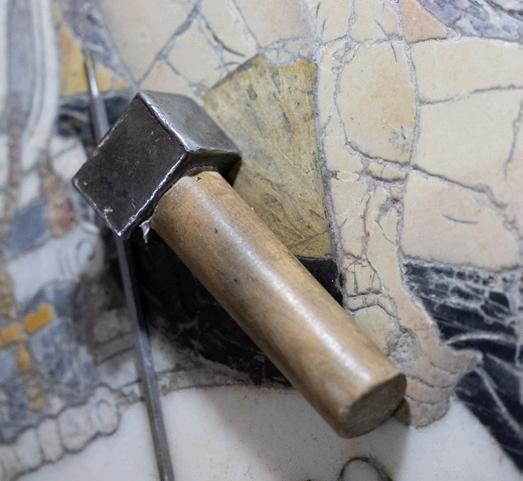
And with that, he goes back to the kitchen table to spend the rest of his Sunday afternoon with Anna, polishing small pieces of marble together, or calmly etching letters, one careful, measured tap of a hammer on a chisel at a time.
Words by Susan Morton
Susan is a journalist and trained classical singer who has worked internationally in communications and branding. She serves on several boards and when not writing is usually teaching or competing as a black belt martial artist.
The people’s theatre
The Manoel holds your attention in a way few theatres do, drawing audiences and performers closer and into the same moment. It captures something essential about Malta itself – its warmth, openness and deep affection for creativity.
Where do you turn to when you feel disconnected from the world and in need of inspiration? The performing arts have always been my refuge. I trained as a classical singer before becoming a journalist, and I find theatres a constant source of renewal – places where emotions unfold, music resonates, stories come alive and life can be glimpsed from a different perspective.
So, when I was invited to attend an opera at one of Malta’s cultural treasures, Teatru Manoel, and write about it, I did not hesitate.
Let’s start off from the perfect backdrop. Malta’s capital, Valletta, with its rich history of fortifications, towering bastions and elegant squares, is a city of drama – the perfect setting for Teatru Manoel. Its limestone streets, baroque churches and elegant palazzi frame the theatre’s story long before you reach its doors.
Walking towards Teatru Manoel – or simply the Manoel, as it is locally known – the city gradually changes scale, from the lively pulse of St George’s Square to the quieter rhythm of Old Theatre Street. The streets narrow and the buildings draw closer. Between them, I caught a brief glimpse of the harbour. And there it was…
As Malta’s national theatre and one of Europe’s oldest working playhouses, Teatru Manoel does not announce its significance loudly, nor boast of the famous artists who have graced its stage –
singers such as Kiri Te Kanawa, Joseph Calleja and Magda Olivero, violinist Yehudi Menuhin and cellist Mstislav Rostropovich. It is a place where history and creativity have intertwined for almost three centuries – and yet it remains wonderfully unassuming.
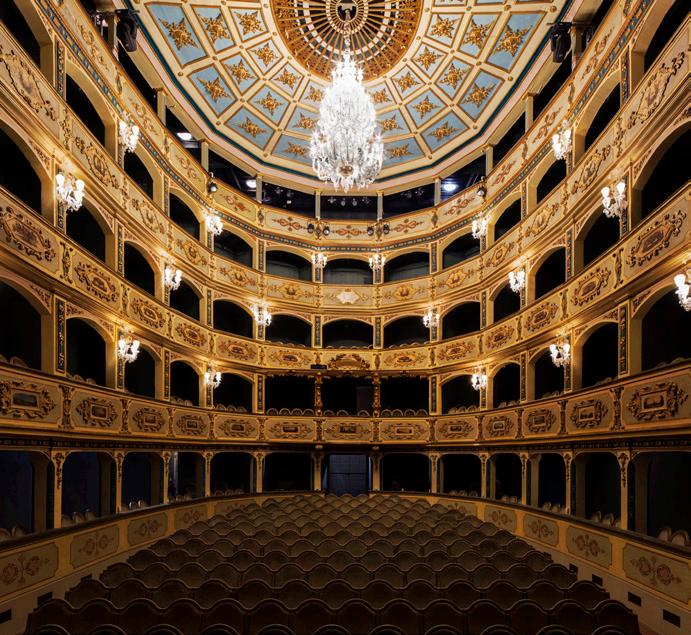
In fact, it would be easy to miss were it not for two prominent green flags flanking the main door. From the outside, there is little hint of what lies within. Step across the threshold, however, and you enter a strikingly beautiful space designed in the rococo baroque style. Gilded balconies curve around the horseshoeshaped auditorium, polished wood glows beneath a crystal chandelier, and above it all, a powder-blue ceiling is scattered with golden stars.
Despite its beauty, the theatre is not intimidating. With just 623 seats divided between stalls, three levels of boxes and a gallery, the Manoel remains modest in scale – welcoming and remarkably intimate.
WHERE MUSIC MEETS THE AUDIENCE
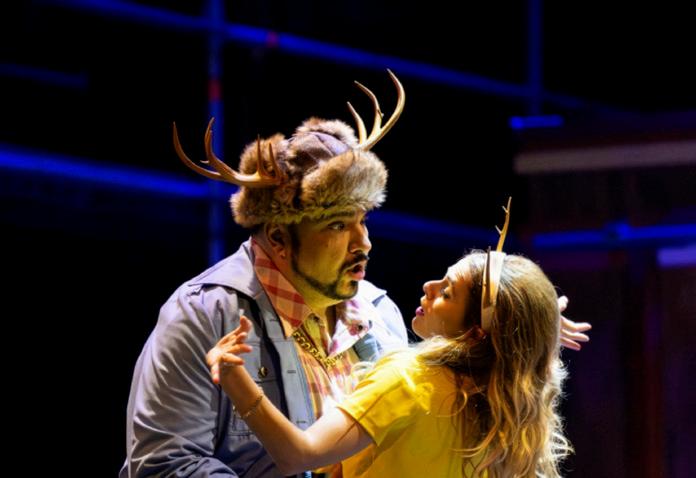
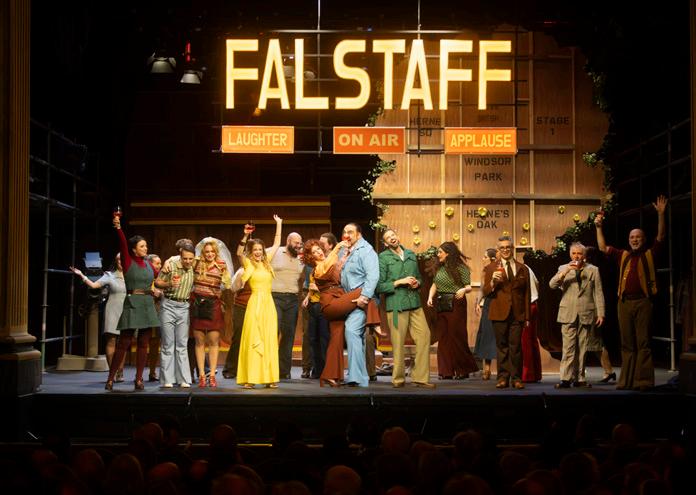
That evening, Verdi’s Falstaff filled the Manoel with warmth, wit and generous humour. This opera about ageing, love and redemption drew a full house. Co-directed by Maltese and English artists, it featured a cast of singers from across Europe – a fitting collaboration for an island whose culture has long been shaped by the meeting of different worlds.
Opera is sometimes described as formal or inaccessible. Yet sitting in the Manoel that evening, it felt anything but that. The theatre’s modest scale changed the experience completely. With the audience so close to the stage, every gesture, glance and musical phrase seemed to travel effortlessly across the room.
After the performance, several artists shared what makes the Manoel special: “This theatre was built for music,” the musical director said. “Sound travels naturally here; you don’t fight the space.” A mezzo-soprano added: “Few venues allow us to meet the audience’s gaze, draw them in, make them part of the story.”
Listening, I understood exactly what they meant. The Manoel’s beauty lies not only in its gilding or acoustics, but in the closeness between performer and audience –engagement rather than spectacle.
Supporting the singers was an orchestra drawn from the Malta Philharmonic Orchestra (MPO), based at the Manoel. Resident orchestras are increasingly rare today, and the MPO’s presence showed how deeply music is woven into the theatre’s life.
But of course, a theatre truly comes to life when people gather within it. As the performance began, a gentleman in one of the boxes struck up a conversation with me. He asked if I had visited before or joined one of the theatre’s tours. When I said no, he smiled and told me how he had come to know the Manoel over decades.
“I’ve watched children grow up here, seen performers return year after year,” he said. “It’s the People’s Theatre – part of the city, part of people’s lives. You’ll feel it, even if you come for just one performance.”
I did feel it. The Manoel holds your attention in a way few theatres do, drawing audience and performers into the same moment. For me, the theatre captures something essential about Malta itself – its warmth, openness and deep affection for creativity.
Later, as my KM Malta Airlines flight lifted gently from the island, I reflected on the experience and what the Manoel had shown me: the quiet power of shared moments. Art and aviation share a similar magic. One carries us through music and story, the other across skies and distances. Both connect worlds, bring people closer and offer fresh perspectives. Each, in its own way, makes the world feel smaller and more human.
So, when you next find yourself in Valletta, follow the notes along Old Theatre Street and step through those unassuming doors. Let the lights dim, the orchestra tune and the Manoel’s quiet magic draw you in. You may leave smiling, as I did – feeling lighter, more connected and perhaps just a little more in love with this island in the heart of the Mediterranean.
Photo: Teatru Manoel. Teatru Manoel.
Scenes from Verdi's Falstaff.
BE A STEP ABOVE THE REST
LAND YOUR MOMENT
Words by Lea Hogg
The first swim of the year
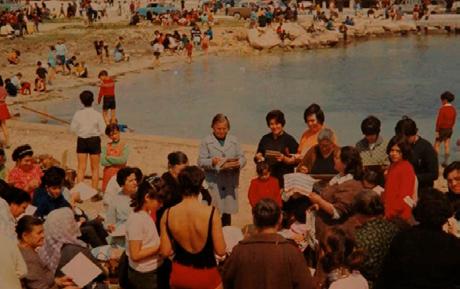
In the village of Żejtun, the first swim of the year is more than a dip in the sea. It follows a traditional centuries-old procession, a village gathering and picnics marking Malta’s official welcome to the summer season.
Every spring, on the first Wednesday after Easter Sunday, a ritual is performed that feels both ancient and wonderfully alive. Before the sun becomes warm enough for lazy beach days and long lunches by the sea, there is a walk, a church, and finally, for the brave, the first swim of the year.
This year, the tradition falls on 8th April, when hundreds will gather at the historic St Gregory’s Church in the southern village of Żejtun, following a centuries-old procession, before continuing towards the harbour village of Marsaxlokk to plunge into the still chilly Mediterranean Sea.
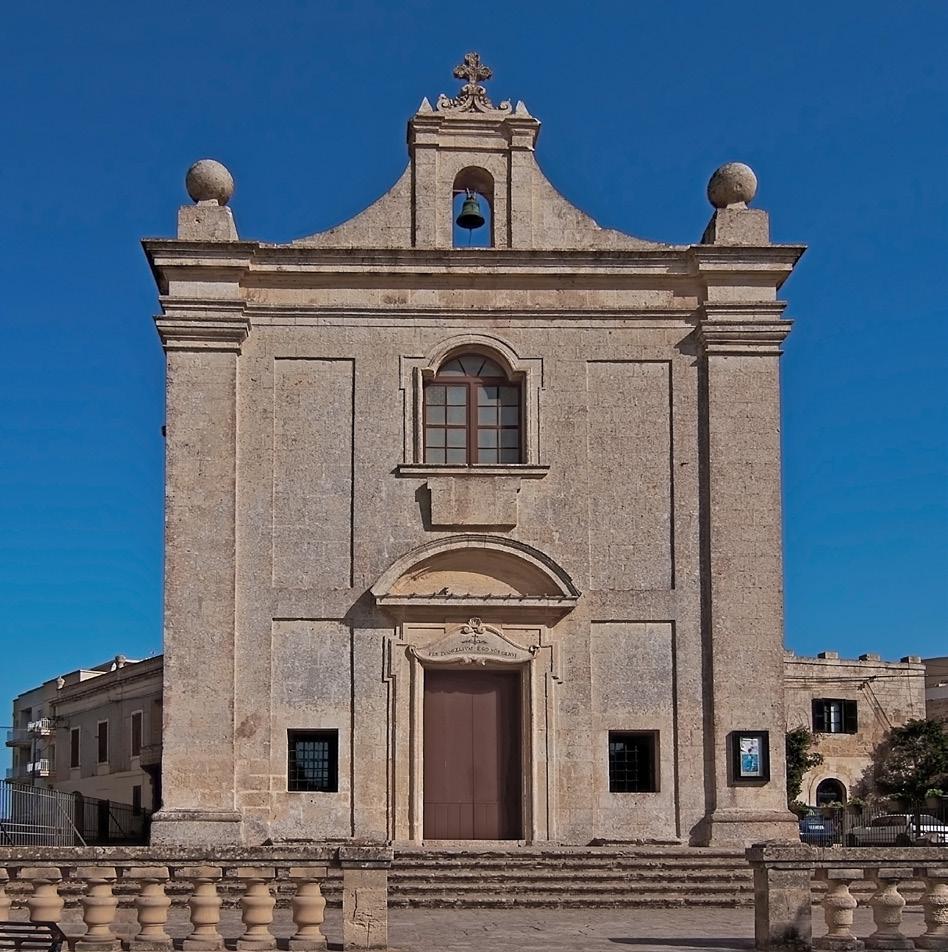
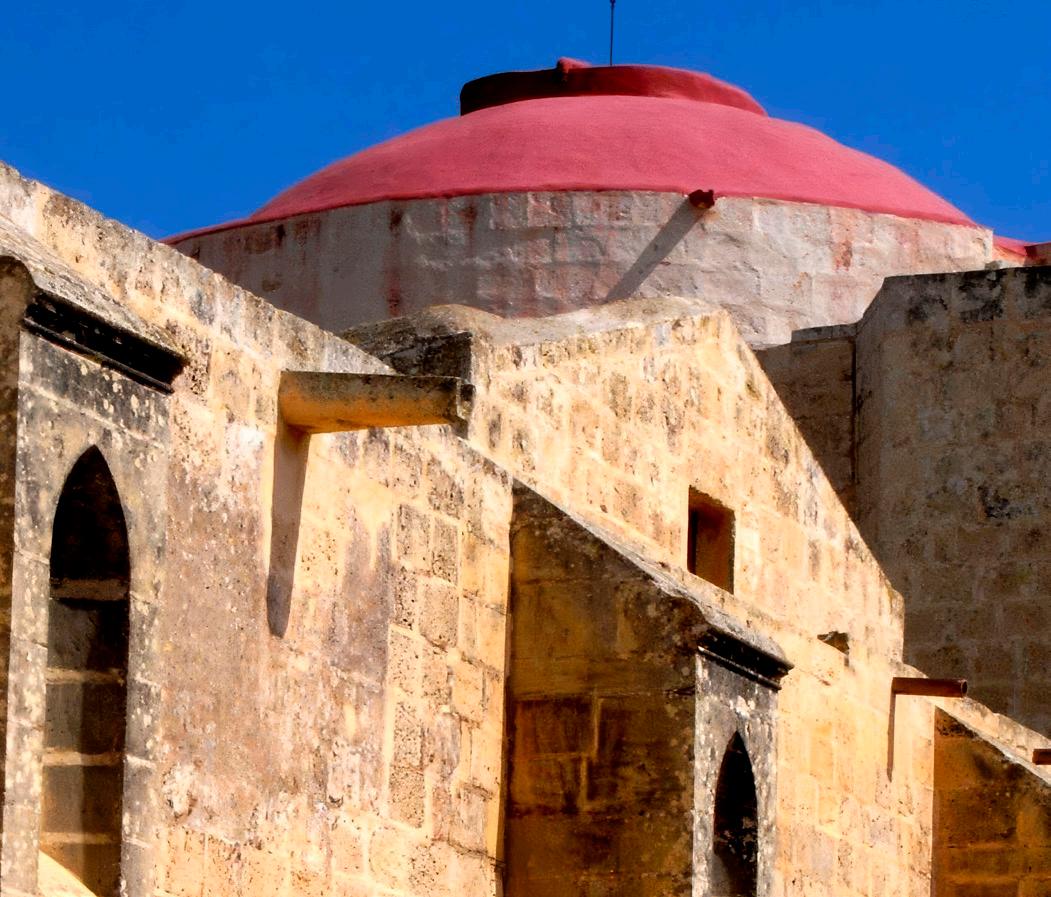
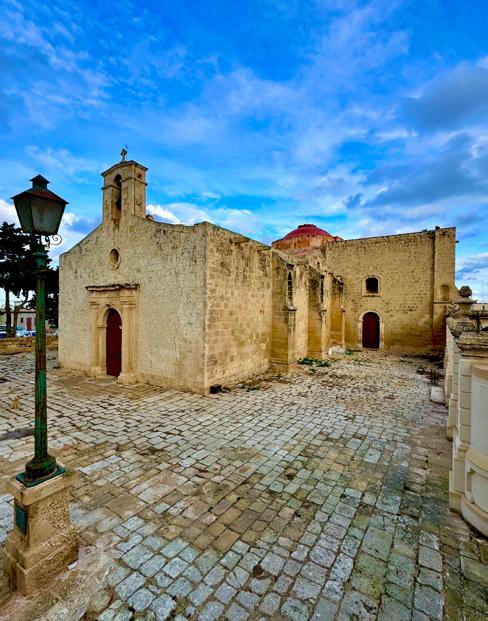
The small limestone church, with more than one name, stands quietly on the edge of Żejtun, surrounded by fields and cemeteries, and serving as the focal point of this ancient tradition.
Officially dedicated to Saint Catherine of Alexandria, it is better known to most Maltese simply as San Girgor Church. The reason lies in a statue of Pope Gregory , standing outside, facing the distant cathedral city of Mdina.
For centuries, pilgrims walked from Mdina to this church in a procession that became one of the island’s most important religious events. The statue itself is heavy, solid limestone, imposing and elegant, its grandeur expressed not through gaudy paint or ornamentation, but through the sheer strength and permanence of Maltese stone.
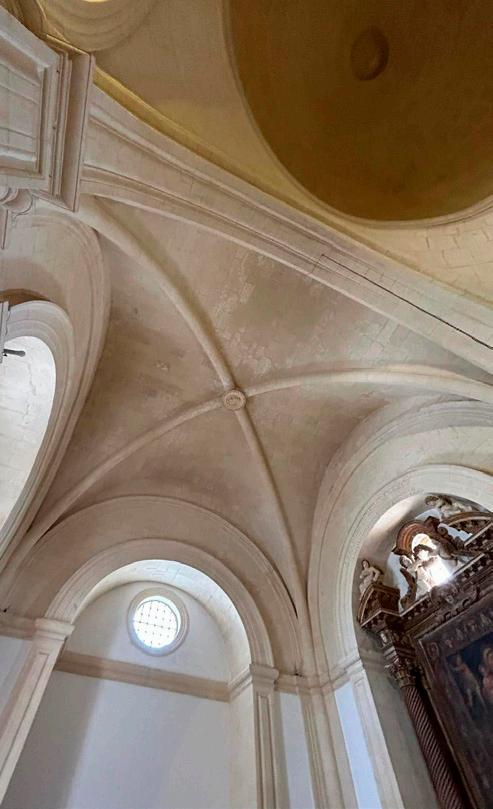
The building is older than it first appears. Dedicated to Santa Katerina of Alexandria, it was established before 1436, when Żejtun became a parish, and the current structure largely dates to the 16th century. For roughly three centuries, it served as the main parish church for southeast Malta, combining Gothic and Romanesque elements and topped by one of the island’s oldest surviving domes.
“It is one of the oldest chapels in the south of Malta,” says Joseph Apap, the voluntary curator who, together with his wife Connie, has cared for the church for three decades. “We open the church every day, and on Sundays there is Mass at 8 and 9am.”
Apap speaks with the quiet pride of someone who knows every stone. “The garigor (spiral staircase) is amazing,” he says. “The stone is pristine. The temperature inside is always ambient, never too hot and never too cold. We always wonder how there is no humidity in the place.”
His wife, who has lived in Żejtun all her life, smiles. “I also help the priest with Mass and the preparations. It’s a joy to keep this place alive.”
Apap, originally from Gozo, laughs. “I may have been born on another island, but after all these years, I feel more Żejtun than Gozo.” Together, they have raised three children in the village, tending St Gregory’s Church for decades; a couple whose lives, like the limestone walls around them, have become inseparable from the place they proudly care for.
The church also holds stories that reach far beyond architecture. In 1614, Ottoman forces attacked nearby Żejtun during a raid that still lives in local folklore. When restoration works uncovered bones inside the structure in 1960, some hidden within passages around the dome, legends quickly connected them to that invasion. In fact, the skeletons had been carefully transferred to the dome when the original graves within the church were dug up, a common practice at the time to preserve the remains while allowing the space to be reused.
Carbon dating shows that the bones discovered in 1960 date back centuries, Joseph explains. Today, they remain preserved upstairs, a careful record of the church’s past, while the building itself quietly bears witness to Żejtun’s long and sometimes turbulent history.
A WATCHTOWER FOR MDINA CATHEDRAL
The location of the church and the statue of St Gregory was not accidental. Perched on a strategic rise overlooking the southern coast, it once functioned almost as a lookout post for the island’s interior capital.
According to Żejtun’s mayor, Joan Agius, signals would be sent from here to warn Mdina of danger approaching from the sea. “This church used to give a sign to Mdina about attacks on the south,” she explains. “They would send white smoke signals northwards toward the cathedral.”
In a landscape now dotted with houses and roads, it is easy to forget that this was once open countryside farmland, stretching down towards the fishing harbour.
The nearby street still hints at that past. “Triq San Girgor is beautiful,” the mayor continues. “Many houses in the street are over 400 years old. They have a big door and a small door beside it. The smaller door was used by the maids. Żejtun had many noble families.”
THE PILGRIMAGE THAT ENDS IN A SWIM
The heart of the post-Easter tradition, however, is not the church alone but the journey that follows. Historically, clergy and worshippers from across Malta walked in procession from Mdina to Żejtun under parish banners. The pilgrimage ended with prayers at the church before continuing to the coast.
Photo: Craig Jean Deguara.
St Gregory's Church.
Over time, something wonderfully Maltese happened. “Religion blended with food, music and the rhythms of daily life,” explains the mayor.
After the ceremony, families gather outdoors for picnics. Today, the area fills with stalls selling nougat and traditional sweets, while singers perform għana, the island’s distinctive folk singing.
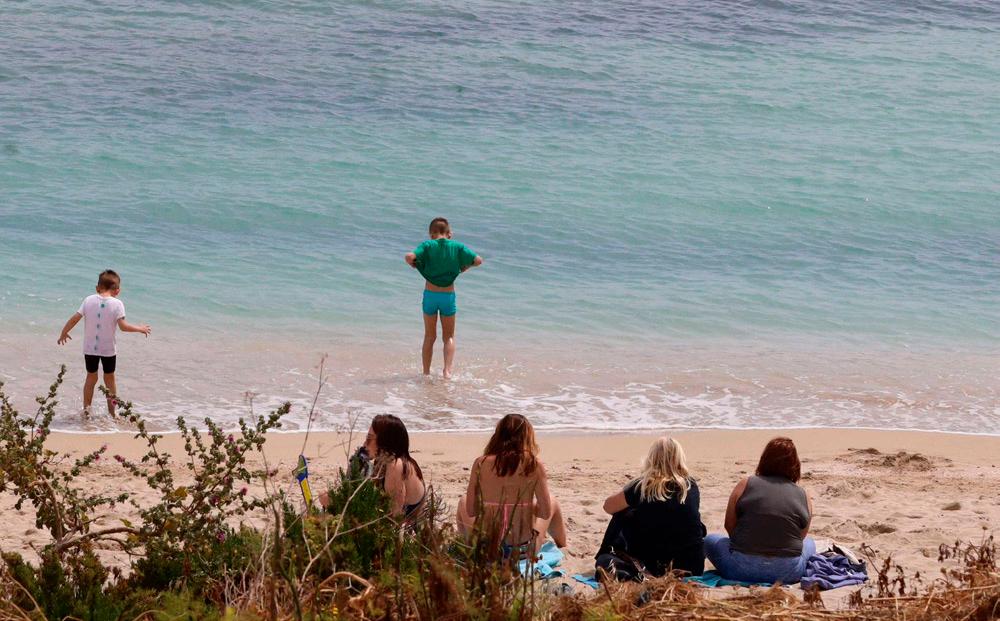
And then comes the plunge. “They say the first swim in Malta is St Gregory’s,” Agius continues. Pilgrims leave the church, and the brave follow the road heading down to Marsaxlokk’s harbour and step into the sea – some cautiously and hesitant, testing the waters; some with theatrical enthusiasm; and some fearless, diving straight in with the focus of those who take their swimming seriously.
Agius remembers doing it herself as a child: “I used to do the first swim after Easter in my childhood,” she says. “It is a lovely tradition.”
If the pilgrimage has survived for centuries, it is partly thanks to the quiet dedication of locals. Agius is quick to recognise the role played by volunteers like the Apaps. “Voluntary work is so important,” she says.
“Thanks to Connie and Joseph, who have looked after St Gregory’s Church for the last 30 years… They keep it clean, prepare it for Mass, and help the priests. Voluntary work keeps you alive, and it keeps the community alive.”
Visitors are welcome, she notes. Cultural tours can be arranged through the parish or the local council for those curious to explore the church’s long history.
But on 8th April, history will briefly step aside to welcome summer, with cold water, laughter and the thrill of the first swim. And just like that, another Maltese summer at sea will have officially begun.
Photo: Media Link.
The first swim at Marsaxlokk.
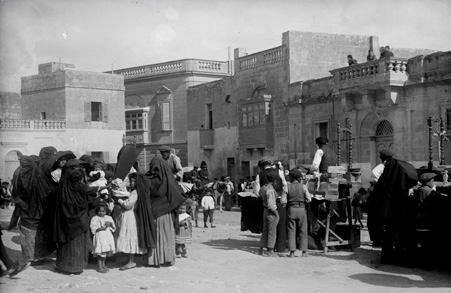
Photos courtesy of Żejtun local council. San Girgor through the years.
Photo: Tony Gatt. St Gregory's Church.
Photo: Craig Jean Deguara. St Gregory's Church.
Words by
This month’s must-see events
With longer days and warmer weather, April in Malta sets the stage for a season of inspiring cultural events and creative moments to enjoy.
An eARThistic Easter
When: 6th - 12th April
Where: Esplora, Kalkara
This Easter, Esplora presents a lively spring programme where nature meets creativity. Through hands-on science and art activities, families of all ages can explore patterns, colours, sounds and movement in the natural world. With interactive experiences that encourage curiosity, collaboration and imagination, it’s a fun and inspiring seasonal outing where science meets art and nature becomes the ultimate inspiration.
Festa Frawli
When: 12th April
Where: Mġarr
Mġarr’s annual strawberry festival returns, with the village square turning into a red-tinged feast. Explore stalls piled with fresh strawberries, jams, desserts and pastries, alongside inventive dishes, drinks and even strawberry wine. Wander the village’s charming streets and celebrate one of Malta’s most beloved spring harvests.
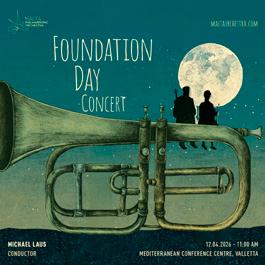
Foundation Day Concert
When: 12th April
Where: MCC, Valletta
Celebrate Foundation Day with a joint orchestral concert by the Malta Philharmonic Orchestra and the Malta Youth Orchestra at the Mediterranean Conference Centre. Conducted by Michael Laus, the programme features Smetana’s Die Moldau and Brahms’ Symphony No. 1.
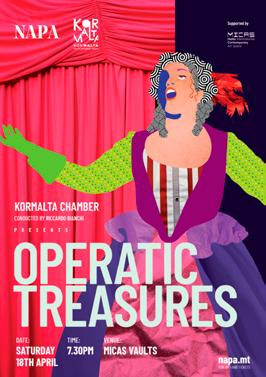
Operatic Treasures
When: 18th April
Where: MICAS Vaults, Floriana Operatic Treasures draws together a selection of duets, trios and choral scenes from across the operatic repertoire. Moving between intimacy and grandeur, the programme highlights the expressive power of opera through voices in dialogue and the dramatic voice of the choir.
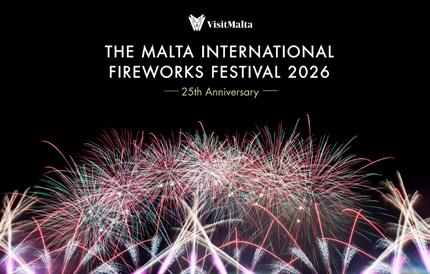
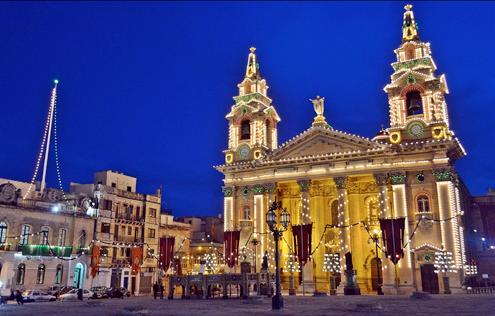
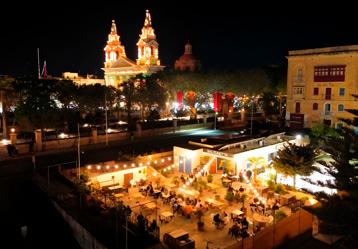
The Malta International Fireworks Festival
When: 21st, 27th & 30th April
Where: Xagħra, Marsaxlokk, Valletta
Malta’s skies become a stage for the 25th Malta International Fireworks Festival, with displays lighting up Xagħra, Marsaxlokk and Valletta. Around 40 fireworks factories and societies take part, including eight teams competing in the festival’s pyro-musical contest, where choreographed explosions are timed precisely to music before a grand finale.
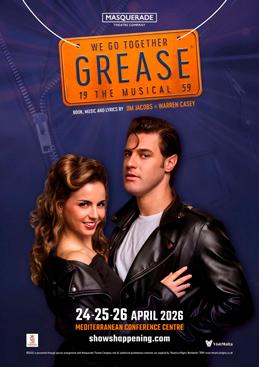
Grease
When: 24th - 26th April
Where: MCC, Valletta
Local theatre troupe Masquerade returns with Grease, the high-energy musical set in the halls of Rydell High. Holiday romance meets teenage reputation as good-girl
Sandy and leather-clad Danny navigate love, image and rock ’n’ roll. Expect all the familiar anthems, slick choreography and a cast drawn from some of Malta’s strongest musical theatre talent.
Wara
l-Mewġ
When: 25th April
Where: Teatru Manoel, Valletta
Beyond the horizon, lives a story or two, mainly fantastical but some may be true!
TOI TOI invites you to experience a new twist inspired by Maltese legends and creepy tales; a retelling of mythical stories involving puppetry and music in the stunning national theatre. This show is performed in Maltese.
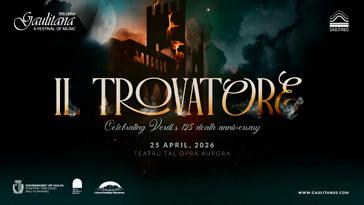
Il Trovatore
When: 25th April
Where: Teatru Aurora, Gozo
Verdi’s Il Trovatore takes centre stage at Teatru Aurora as part of the OPERA+ Weekend, marking the composer’s 125th anniversary. This dark tale of love, revenge and mistaken identity unfolds in a surge of arias and choral power, anchoring a three-day Gozo programme of concerts, talks and cultural events.
St Publius, Floriana, 19th April
Floriana proudly kicks off Malta’s festa season with the feast of St Publius, the town’s patron saint and one of the island’s earliest Christian figures. According to tradition, Publius, the Roman governor of Malta, welcomed St Paul following his famous shipwreck in AD 60 and later converted to Christianity, becoming the island’s first bishop.
Festivities unfold over several days, culminating in the grand Sunday procession when the majestic statue of St Publius – sculpted in 1885 by Vincenzo Dimech and later refined by his son – is carried through streets ablaze with colourful decorations, band marches and dazzling fireworks.
Among the festa’s most unusual traditions is the joyful throwing of gifts from balconies. Once, residents tossed rosary beads and paper flowers for decorating cars and buses during the traditional xalata, a lively post-procession celebration. Today, toys and T-shirts rain down from above as the marching bands pass below, sparking plenty of laughter and friendly scrambling.
For a guide to upcoming religious celebrations and traditional feasts across the Maltese Islands, be sure to visit inkontru.app
TRADITIONAL SPOTLIGHT
BALZUNETTA RESTAURANT
And if you’re heading to the Floriana feast, Balzunetta Restaurant is the perfect dining spot to soak up the celebrations. Set within a traditional boċċi club, it features a spacious outdoor terrace overlooking the parish church, with unbeatable views of the lights, marches and fireworks.
The menu offers Maltese favourites and Mediterranean classics, from grills and fresh fish to Neapolitan-style pizzas, with vegan, vegetarian and kidfriendly options, making it ideal for the whole family. Open daily from 5pm, and all day on April 12th and April 19th (the feast day), reservations are highly recommended at www.balzunetta.mt
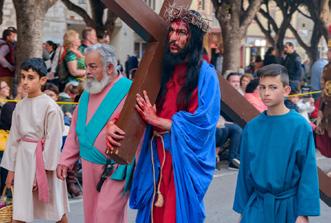
Experience Malta's rich Catholic traditions with Good Friday theatrical pageants that bring the Passion of Christ story to life. Dramatic pageants feature participants dressed in biblical costumes, life-sized statues, and sometimes even live animals, recreating scenes from the final hours of Jesus with remarkable devotion. Months of preparation go into these moving displays, involving hundreds of volunteers.
Just two days later, the mood shifts to joyful celebration on Easter Sunday, when several towns parade the statue of the Risen Christ. In one of the most exhilarating moments of the day, teams of statue bearers hoist the heavy figure onto their shoulders and break into a run toward the parish church, carrying the statue high above the crowd. As they surge forward, bells ring, bands play triumphantly and parishioners erupt in applause and cheers as they celebrate Christ’s resurrection and victory over death.
Discover and experience more with Inkontru.app, your web-based application that prioritises functionality and performance, meaning no need to download, seamless updates, no storage space taken and easy sharing. Enjoy!
INKONTRU.APP MEETS...
Every spring, the village of Mġarr turns red for Festa Frawli, a celebration of strawberries, food and community that attracts thousands. Ahead of this year’s festival, Mġarr Mayor Paul Vella explains what makes this annual harvest tradition so meaningful for the village.
Why is Mġarr so famous for its strawberries?
Mġarr’s fertile soil and favorable microclimate make it ideal for strawberry cultivation. Over time, strawberries became both an agricultural hallmark and a source of local pride, leading to the creation of Festa Frawli.
For Mġarr residents, the festival celebrates the dedication and hard work of local farmers. It provides vital economic support by boosting income for growers and small businesses, while also strengthening community identity by showcasing Mġarr on a national stage.
How does the community bring strawberries to life during Festa Frawli?
Our team of chefs, volunteers and artisans works together to create something special every year. Strawberries inspire creativity in many forms, from delicious dishes and handmade crafts to lively dances and artistic performances. Innovation is encouraged and new ideas are welcomed. The key is making participants feel they are not just selling food, but contributing to the success of this beautiful activity.
How does Festa Frawli keep evolving each year?
Recent editions of Festa Frawli have introduced exciting new elements that keep the festival fresh and engaging. These often include innovative strawberry-based gourmet dishes, live cooking demonstrations by guest chefs, fun activities for children and their families, and a broader range of cultural performances and entertainment.
INSTALL inkontru.app
Step into Malta’s scene with Inkontru.app, your personal guide to all the latest art, culture and heritage events in Malta and Gozo. More than just a calendar, the app connects you with exciting events and artists through exclusive interviews and video features. Easily find event details, get directions and purchase tickets – all in one place. Need a ride? Book a cab effortlessly through the app and share your plans with friends and family with ease.
Mayor Paul Vella.
Words by Roy (with a little help from Ruth Zammit DeBono because paws don’t type!)
Ruth is a passionate traveller, artist and devoted dog mum, who finds joy in storytelling and discovering the world always with her pet by her side.
Spring city breaks with a small dog
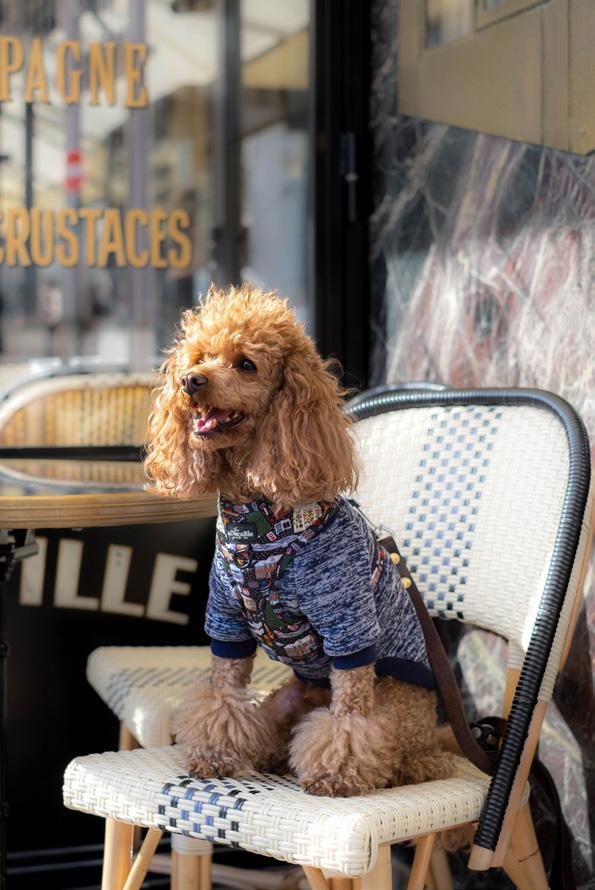
If you ask me – and as a travelling dog, I consider myself quite the expert – spring might just be the best season for a city break.
The weather is the first thing I notice. Spring days are warm enough for long walks but still cool enough for comfortable paws. No scorching pavements, no heavy summer heat – just perfect exploring weather for a small dog who likes to sniff every interesting corner of a new city.
My mama seems to enjoy this too, although I suspect she mainly appreciates how happily I trot beside her.
Then there are the crowds. Or rather, the lack of them. Spring arrives just before the busy summer season, which means quieter streets and more relaxed parks. This is important for a curious dog – I like to investigate every fountain, bench and interesting smell along the way.
Then there’s one of my favourite discoveries: outdoor café season. As soon as the sun returns, tables appear on pavements again, and many European cities happily welcome dogs beside them. While my mama enjoys her coffee, I settle down and observe the world – passing bicycles, friendly locals and, occasionally, another very stylish dog.
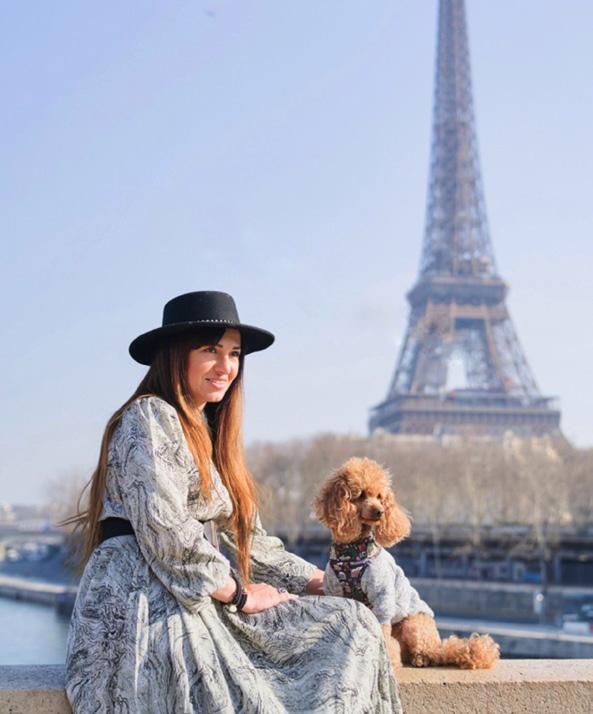
Parks also come alive in spring. Trees begin to bloom and shady paths become perfect places for mid-afternoon strolls. Cities like Rome or Paris feel especially lovely this time of year, with gardens and wide promenades that are perfect for curious paws.
Getting there is surprisingly simple too. When the journey begins with a comfortable flight with KM Malta Airlines, these springtime European cities are surprisingly close, which, if you ask me, is excellent news for adventurous dogs everywhere.
Travelling with your pet in the cabin – key rules
PETC is available for small dogs or cats only.
The pet, including the carrier, must not exceed 10kg in total weight.
Up to two per person: each adult passenger can bring up to two pets in one carrier (up to 10kg in total).
The pet must remain inside the carrier for the entire flight.
The carrier must be placed under the seat in front of the passenger during the flight.
Words by Lea Hogg
Quiet strategy on 64 squares
Malta, better known for its sun, sea and history, harbours a thriving chess culture that spans local clubs and produces world-class players.
Founded in 1923 by Erin Serracino Inglott, the Malta Chess Federation has guided generations of players through peaks and lulls. It began sending teams to the Chess Olympiad in 1960 and even hosted the event in the 1980s, welcoming some of the world’s top players, including Garry Kasparov and Anatoly Karpov.
Earlier still in 1934, Alexander Alekhine visited the island, leaving behind stories that still circulate among Maltese players. However, Malta's first major cultural surge came during the 1970s, when the Bobby Fischer boom energised local clubs and inspired a new generation of players.
Today, a fresh generation carries the tradition forward. Jack Mizzi, Malta’s 20-year-old national champion, represents the country internationally, while chess continues to flourish across local clubs, invigorated by the COVID-19 pandemic and the cultural surge sparked by Netflix’s The Queen’s Gambit.
A visitor arriving in Malta might not expect to find one of the island’s most intriguing intellectual arenas tucked between cafés and apartment blocks in St Julian’s. Behind an unassuming door lies a club where chess captivates children, teenagers and adults alike. The story of the Swieqi Chess Club begins in 2016, when it opened in collaboration with the local council. As interest grew, the club had to move to a larger venue in St Julian’s, keeping its original name in
tribute to the community that nurtured it. The club is managed by Colin Pace, one of Malta’s most recognisable chess figures. Calm, soft-spoken and passionate, Pace runs both the club and its academy, where around 100 regular students gather each week.
“We have students as young as five,” he says, watching a game unfold between two schoolchildren. “They play in the children’s club until 18, and many stay on for the adult club. Chess teaches them to analyse situations, and that skill carries them into life.”
Pace discovered chess at the age of 12 at St Paul’s Missionary College in Rabat. Within a year, he was competing under the Malta Chess Federation. Unlike today’s young players, he had little formal training. “Children now have academies, online resources and strong competition,” he notes with a smile.
By 14, Pace ranked fourth nationally and went on to represent Malta in 12 Chess Olympiads. He later earned the Grandmaster title, a major achievement highlighting Malta’s capability to produce top-level players.
highlights
Chess this month
FIDE Candidates and Women’s Candidates Tournament
Top players compete in Paphos, Cyprus (28th March - 16th April) for the chance to challenge the reigning World and Women’s World Champions.
European Individual Chess Championship 2026
Chess elites gather in Katowice, Poland (6th - 20th April), part of the official World Championship qualifying path.
World champions who visited Malta
Alexander Alekhine
Legendary French-Russian master, early 20th century
Max Euwe
Dutch World Champion, known for his strategic brilliance
Vasily Smyslov
Soviet Grandmaster and World Champion
Anatoly Karpov
Iconic Russian champion of the late 20th century
Mikhail Tal
“The Magician from Riga,” famed for his daring attacks
Garry Kasparov
Dominant champion of the 1980s - 2000s
Magnus Carlsen
Modern-day Norwegian chess superstar
“After COVID, interest in chess soared,” Pace notes. “Children began researching on their own and asking their parents to bring them to the academy.”
The gender balance is gradually evolving in Malta, with roughly one in four players being girls. “Chess is a level playing field,” Pace observes. “Girls can be just as successful as boys.”
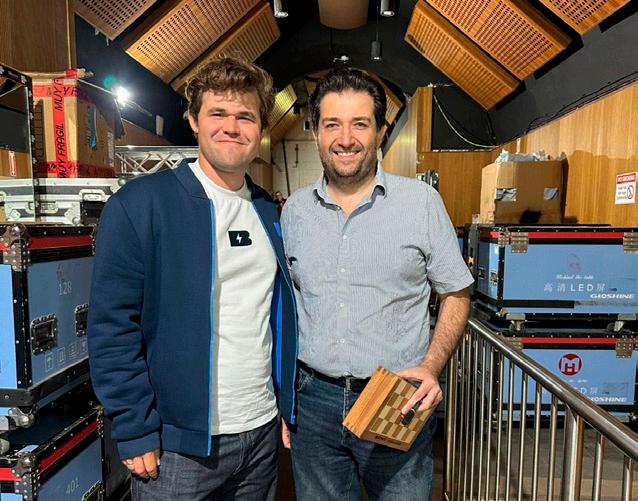
Malta has occasionally enjoyed being in the international spotlight too. In 2025, Magnus Carlsen, widely regarded as the greatest modern chess player, visited the island. Pace earned the chance to play him by winning a qualifying tournament. “Once we started, I focused only on the game,” Pace observes. Carlsen admitted the match surprised him.
“I was really excited to play against Colin. His competitive nature took over, and he clearly didn’t want to lose,” the Norwegian champion said. Noting Malta is unusual as a chess destination, he praised the experience and expressed a desire to return.
For Pace, the value of chess extends beyond competition. “It’s a life skill,” he says. “Children learn to make decisions under restrictions; to focus under time pressure. That builds confidence and autonomy. Even adults who start later find it rewarding. Many are hesitant at first, but once they play, they understand there’s nothing intimidating about chess.
“Chess teaches strategy, but also human connection,” Pace says. “Children learn to meet people face to face, not just online.”
Parents often leave impressed, he continues. “Some children who cannot sit still for five minutes suddenly concentrate for an entire game,” he laughs, adding it’s not just young minds that benefit.
According to various medical studies, mentally engaging activities like chess can strengthen cognitive skills, sharpen memory and focus, and even help protect against age-related cognitive decline when played regularly – benefits that many adults find valuable in everyday life.
For a traveller exploring Malta, chess offers an unexpected window into the island’s quieter side. Back at Swieqi Chess Club, the sound of pressed clocks and pieces being strategically moved across the 64 squares fills the room. Two players lean over a board, studying their positions with remarkable focus.
The club welcomes players of all levels, offering lessons, competitions, talks and casual games. For those wandering through its doors, it reveals a community built on quiet concentration and patience.
From the early days of the Malta Chess Federation to hosting world champions and nurturing young minds, chess in Malta is a tradition that continues to thrive.
Chess World champion Magnus Carlsen with Maltese champion Colin Pace in Malta.
Words by David Carabott
David is a teacher, specialised in mentoring students of different abilities. An avid traveller, his target is to visit all the countries in the world. When he is not in Malta or travelling elsewhere, you can find him somewhere in Rome.
Silent sentinels of faith
Malta is a living gallery of crosses and crucifixes, each carrying layers of history, artistry and spiritual significance. Wander the islands to discover this rich heritage scattered across churches, streets and landscapes.
Crosses and crucifixes dot the Maltese Islands, mapping out a journey of art and history. They embody devotion and defence, suffering transformed into redemption, and a faith so woven into daily life that it shapes the very landscape.
To seek out these symbols is to encounter the quiet heartbeat of the islands and their people. Follow this trail for guidance at the crossroads:
DEJMA CROSSES
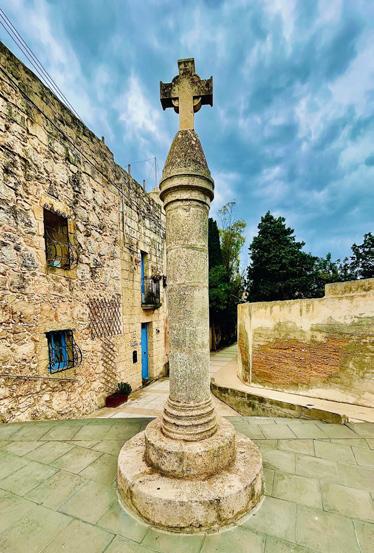
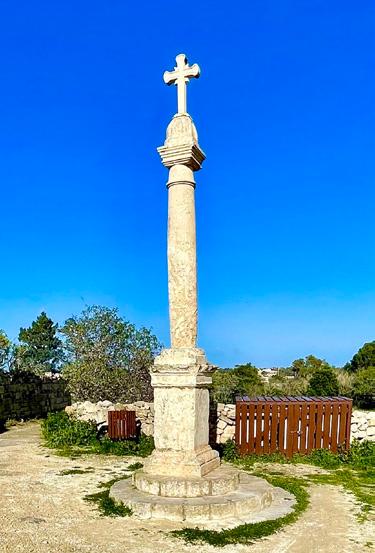
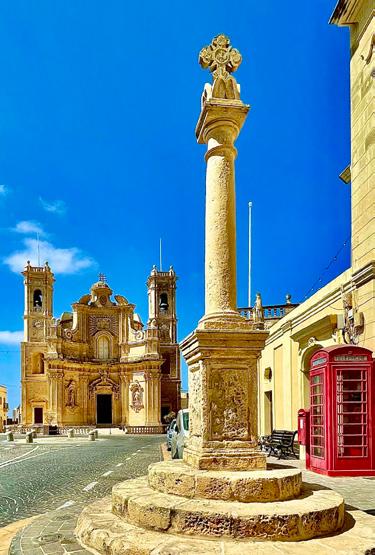
The Slaleb tad-Dejma are historic stone crosses found across several places in Malta and Gozo. They marked gathering points for the Dejma, a local militia established around 1375 to defend communities from invaders, particularly during Ottoman pirate attacks. Coastal watchmen would signal threats using fire or smoke, prompting the Dejma to assemble at these crosses.
Today, they remain in numerous localities such as Ħal Luqa, Ħal Safi, Ħal Kirkop, Ħal Tarxien and Ħal Balzan, and in Gozo, in towns such as Għasri, Nadur, Xagħra, Victoria and Qala, standing as enduring symbols of local heritage.
THE WAR MEMORIAL, FLORIANA
A pleasant uphill walk from the Valletta waterfront leads to the War Memorial in Floriana. Unveiled in 1938, few could have imagined that it would one day commemorate not just one, but two world wars. This art deco obelisk, designed by Louis Naudi, honours those who died in World War I and World War II. Its sleek, futuristic style, influenced by Italian Futurism, marks a striking departure from typical British colonial architecture. Carved from local limestone in the form of a Latin cross, it occupies a site once used for public executions during the Knights’ era. An eternal flame at its base provides a lasting tribute to fallen soldiers.
PIECES OF FINE ART IN VALLETTA
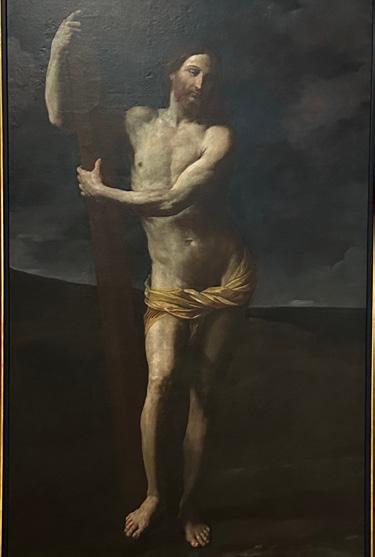
At MUŻA, the National Community Art Museum, one finds The Risen Christ Embracing the Cross, an early 17th-century painting by the renowned Italian baroque master Guido Reni. This monumental oil on canvas depicts the resurrected Christ triumphantly yet humbly embracing the Cross. Emerging from shadow into light, it presents a powerful image of redemption and spiritual victory.
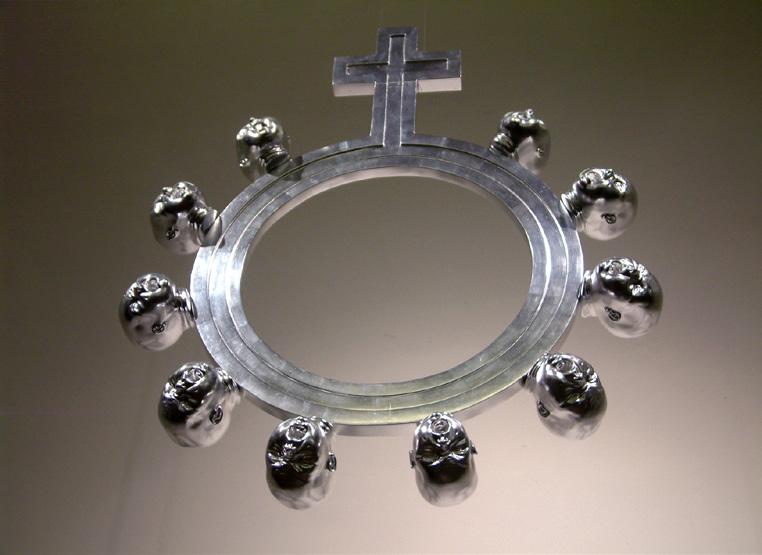
At MUŻA, visitors can also discover a striking contemporary work titled Kuruna by Austin Camilleri,
Photos: Tony Gatt. Salib tad-Dejma, Rabat. Salib tad-Dejma, Ħal Millieri. Salib tad-Dejma, Għarb.
Guido Reni's painting at MUŻA.
Photo: Austin Camilleri Studio. Kuruna by Austin Camilleri.
widely regarded as a local artist of international calibre. Crafted in wood, resin and silver leaf in 2002, it takes the form of a large silver rosary in which the usual beads are replaced by tiny crying baby heads. This creates a powerful and unconventional reinterpretation of the traditional devotional object.
St John’s Co-Cathedral holds two extraordinary masterpieces. a monumental oil-on-wood crucifix, attributed to Polidoro Caldara da Caravaggio and the Crucifixion Group, on display since 1653, featuring larger-than-life wooden figures of Christ, the Virgin Mary and St John the Evangelist. Both have been carefully restored to reveal their exceptional detail.
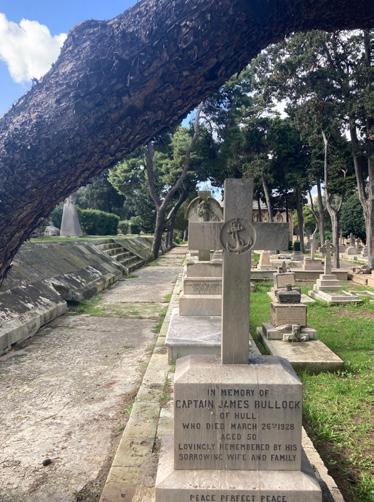
CROSSES OF MEMORY – TA’ BRAXIA CEMETERY, PIETÀ
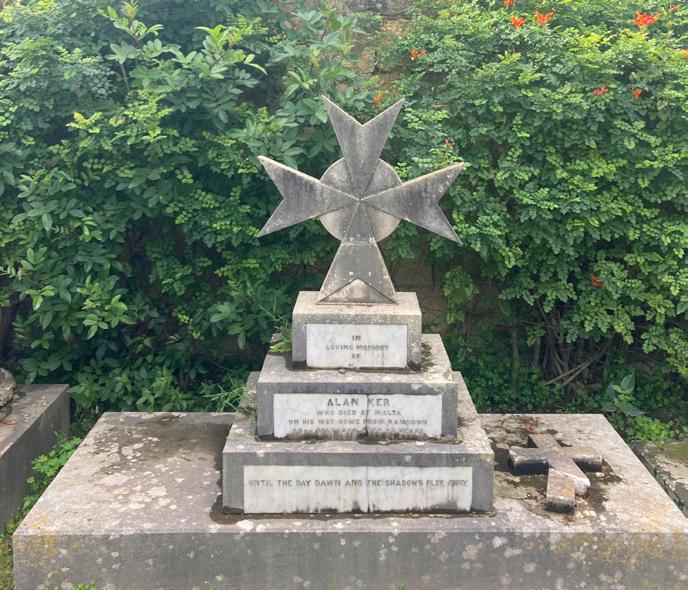
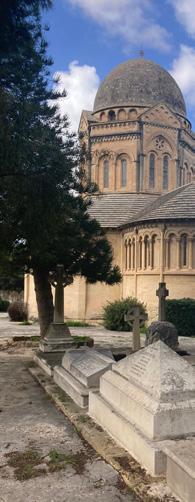
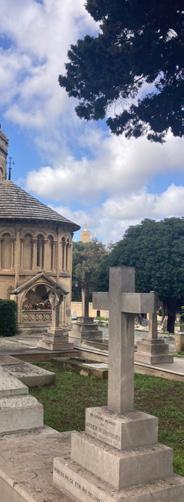
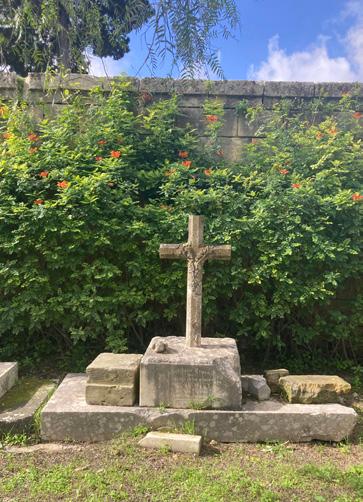
Ta’ Braxia Cemetery offers a unique experience for those interested in crosses. From simple Latin to intricate Celtic and Orthodox designs, the crosses reflect Malta’s multicultural history. Walking among these markers, visitors can appreciate centuries of devotion and artistry, where each cross tells a story of faith, remembrance and heritage.
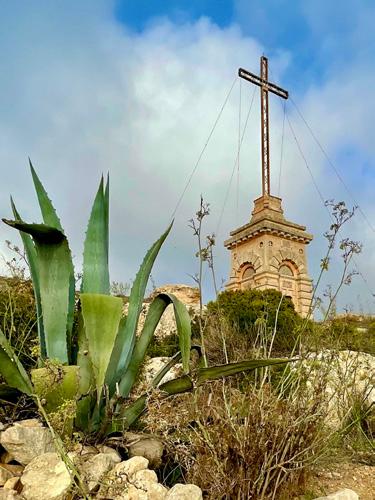
IS-SALIB TAL-GĦOLJA, SIĠĠIEWI
Every Maundy Thursday, Is-Salib tal-Għolja, also known as the Laferla Cross, built in 1903 and named after Fr Paul Laferla, comes alive with a shimmering sea of candles, creating a deeply moving display of devotion and light. The walk up the hill meanders through vineyards, silvery olive groves and open countryside. Visiting feels like stepping into a tranquil sanctuary, embraced by nature’s quiet beauty and breathtaking panoramic views.
THE MYSTERIOUS THREE CROSSES
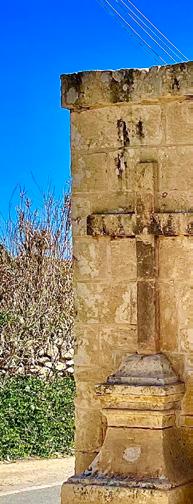
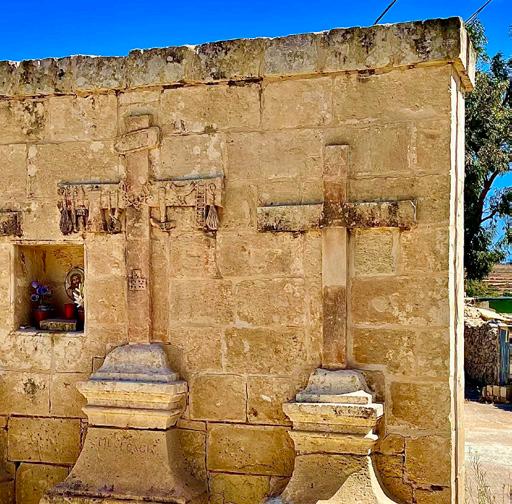
On the outskirts of Wied il-Għajn (Marsascala), in the tranquil countryside stretch of Bidni Road, the Three Crosses carved into stone form a mystically unique structure that remains shrouded in mystery. Steeped in history and local lore, they invite reflection on Malta’s rich spiritual and cultural heritage.
ST ANDREW: PATRON OF FISHERMEN
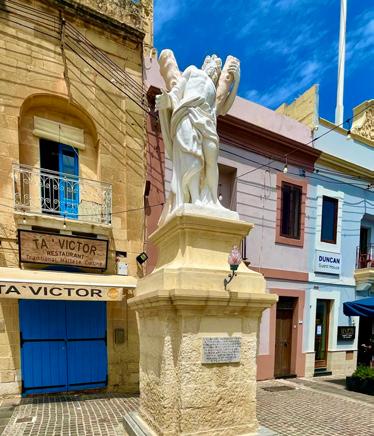
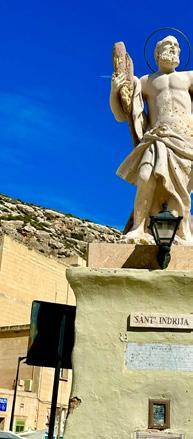
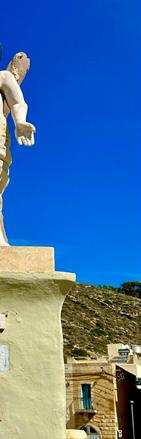
A statue of St Andrew bearing his distinctive diagonal cross stands in the square of the picturesque fishing village of Marsaxlokk, honouring its fishing heritage. A similar statue stands in Xlendi, Gozo, reflecting the widespread devotion to the patron saint of fishermen across the Maltese Islands, where the surrounding sea has always been vital for life.
VIA CRUCIS, TA’ GĦAMMAR HILL, GOZO
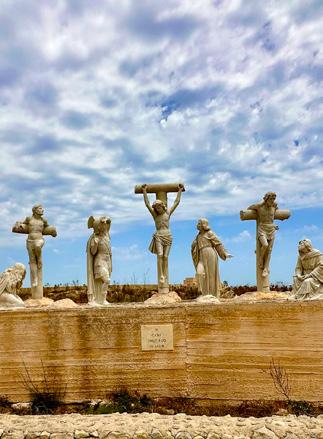
In Gozo, anyone seeking a peaceful and reflective experience can follow the open-air Way of the Cross up Ta’ Għammar Hill. The path winds through serene countryside, offering sweeping panoramic views that invite contemplation. At the summit stands a striking white Carrara marble Crucifixion statue, while 14 additional marble stations along the trail portray scenes from the Passion of Christ. Installed in the early 1980s, they transform the climb into a spiritual and nature immersed journey.
Photos: David Carabott. Crosses of memory – Ta’ Braxia Cemetery, Pietà.
Photos: Tony Gatt.
Salib
tal-Għolja, the Laferla Cross, Siġġiewi. St Andrew in Marsaxlokk.
15% Discount
On the purchase of an adult ticket
Please quote “Passaggi” at the ticketing counter to claim your discount.
(Not valid with any other offer)
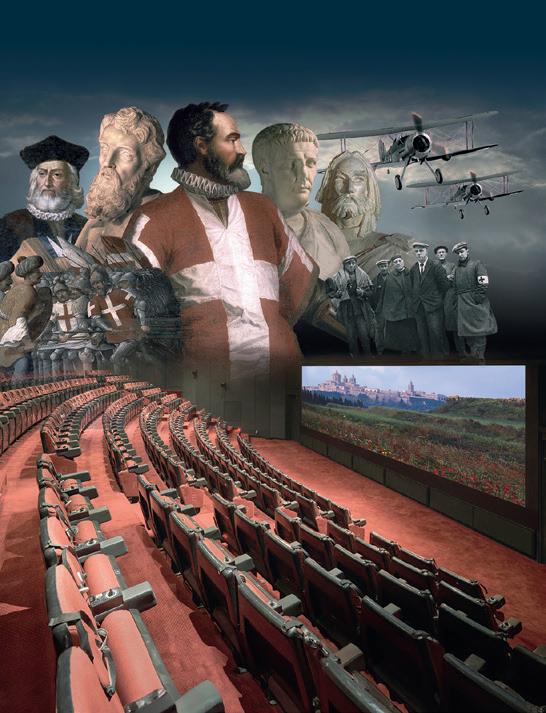
Few places have a history as turbulent and inspiring as the Maltese islands. Its gripping story is that of a country buffeted by world events, in which the bravery and resilience of its people have been tested to the limit.
Through beautiful authentic imagery and a gripping commentary, the show covers 7000 years of history in 45 minutes. From the early settlers of the temple period to the Knights of the Great Siege through to the destruction of World War 2, The Malta Experience chronicles the events that have shaped the island's history.
St Andrew in Xlendi, Gozo.
Via Crucis, Ta’ Għammar Hill, Gozo.
Three Crosses, Wied il-Għajn.
Words
APRIL IN 18TH-CENTURY MALTA
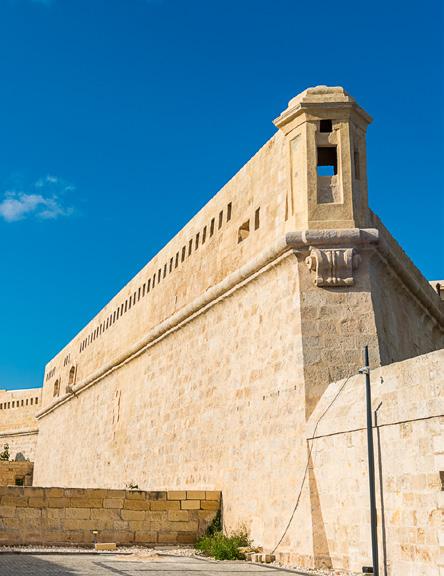
Standing above the harbour walls of Fort St Elmo, one can still sense the moment, hundreds of years ago, when the sea lanes re-opened and the Mediterranean awoke from winter, giving way to the restless energy of maritime life as ships began to appear on the horizon, sails filled the harbours and the rhythms of the sea resumed in April.
April has always been a special month in Malta. Today, the island welcomes travellers eager to explore its historic cities and harbours. But more than two centuries ago, April marked something far more dramatic. It was the moment when the Mediterranean awoke from winter and Malta once again became a stage for the restless drama of maritime life.
During the 18th century, Malta stood at the crossroads of the Mediterranean world. Governed by the Order of St John, the island was both fortress and harbour, a place where merchant ships, naval squadrons and corsairs converged. Throughout the winter months the sea often fell quiet, merchants dared not cross the seas as the winter storms battered Malta, but by April, activity returned with vigour.Ships began to appear on the horizon, sails filled the harbours, and the rhythms of maritime Malta resumed.
by Liam Gauci, Heritage Malta
The archives of the period reveal that April was often when tensions and adventures resumed at sea. In 1759, for example, a British privateer named Captain Carlo Wilson sailed into Malta’s harbour on 7th April with a captured Austrian vessel in tow. The incident caused immediate controversy. The ship had been seized just after leaving Malta, meaning the capture had occurred within Maltese waters – a violation of the island’s carefully guarded neutrality. The harbour authorities and diplomats quickly became involved, illustrating how Malta’s position as a neutral port made it a place where maritime disputes were settled as often as they were fought.
These episodes remind us that the Grand Harbour was not merely a picturesque anchorage but a stage for international politics. Merchants, consuls and captains debated the legality of prizes while crews unloaded exotic cargoes gathered from across the Mediterranean.
April was also the moment when the Order’s own naval forces resumed their patrols against corsairs from North Africa. In one striking episode of the 1780s, the Provençal Knight Fra Pietro Anibale Soubiras captured a Tripolitan corsair vessel and the infamous renegade corsair known as Papafigo, a Maltese sailor from Bormla, who had turned against Christian shipping. Dragged to Malta in chains, the renegade’s fate became a vivid reminder of the complex loyalties that shaped life in the Mediterranean frontier.
By the late 18th century Malta’s harbours were attracting ships from far beyond the central Mediterranean. In April 1788, a vessel flying the white flag with the blue cross of Russia arrived in Malta seeking provisions before continuing its cruise. The arrival of a Russian privateer symbolised the growing reach of European powers into Mediterranean waters and confirmed Malta’s role as an indispensable maritime hub where ships from distant nations could resupply before heading back to sea.
At times, April also witnessed direct confrontations with the Barbary corsairs who prowled the sea lanes. In April 1793, the Order’s frigate, St Elisabeta, sailed on patrol under the command of Soubiras. Within days the ship captured two Tunisian corsair vessels and another merchant ship, which was promptly sent to Malta for
quarantine and adjudication. Episodes such as this demonstrate how the island’s naval forces remained vigilant, protecting both trade and the island’s own corsair economy.
Yet April was not only a time of combat and controversy. It was also the season when reinforcements, merchants and travellers arrived from across Europe. In one notable instance, a powerful 60-gun ship of the Order, the San Antonio, sailed into Malta in April carrying knights who had answered the call to defend the island during a period of heightened tension. The arrival of these warriors transformed the harbour into a scene of preparation and anticipation.
To imagine these moments today, there is no better vantage point than Fort St Elmo, home to the National War Museum managed by Heritage Malta. Standing on the tip of Valletta, the fort commands breathtaking views over both Grand Harbour and Marsamxett Harbour. From its bastions, visitors can watch modern vessels glide across the same waters once crowded with corsair xebecs, merchant ships and war galleys.
Looking out across the harbour from Fort St Elmo, it is easy to picture an April morning in the 18th century. A newly arrived privateer may have been anchored below the bastions while officials debated the legality of its prize. In the distance, sails may have appeared on the horizon and perhaps a naval frigate would be returning from patrol, or a merchant ship carrying goods from Alexandria or Tunis. On the quays, sailors would unload cargo while merchants and soldiers mingled in the busy streets of Valletta.
These scenes capture the essence of April in historic Malta. It was the moment when winter’s pause gave way to the restless energy of maritime life. Corsairs prepared their ships, diplomats watched the horizon and the island once again took its place at the centre of the Mediterranean world.
Even today, standing above the harbour walls of Fort St Elmo, one can still sense that moment when the sea lanes reopened and the Mediterranean awoke.
Words by David Carabott
Discovering the fine details of filigree
Renowned for its refinement and delicacy, this art form is a symbol of the island’s rich artisanal traditions, a conversation across centuries, a skill passed down from generation to generation, and a way of connecting with Malta’s cultural past.
My interest in filigree, one of Malta's most ancient and traditional art forms, began quite by chance. I was browsing the website of Palazzo La Salle when I noticed they were offering short courses. I immediately applied.
It was not going to be easy, as they were offering three courses with only three participants in each, but I was lucky to be chosen.
My tutor on the course, Nadesh Rota, began practising filigree around five years ago with the help of her mentor, Kevin Attard, through a basic course he used to offer. There, she learnt the fundamentals, and has been practising, refining her technique and learning more ever since.
Her passion for this delicate art form was evident in every demonstration and instruction, and her patience made learning the intricate steps less complicated than I had imagined.
Filigree itself is one of Malta's most treasured traditional crafts, with roots stretching back hundreds of years. The art involves twisting and curling fine silver wire to create intricate lace-like patterns.
Historians believe that filigree arrived in Malta through Arab and Sicilian influences during the medieval period. By the 18th and 19th centuries, it had become a hallmark of Maltese craftsmanship, particularly for jewellery, decorative objects and religious artefacts.
Each piece carries the patience, skill and attention to detail of the artisan, making it not just a decorative object but a link to Malta’s cultural and artistic heritage. Maltese filigree is renowned for its refinement and delicacy, and to this day, it is recognised as a symbol of the island’s rich artisan traditions.
Filigree work involves very simple tools: mainly tweezers, a flat surface for working, a burner setup for soldering and, of course, the silver thread itself. But despite the simplicity of the tools of the trade, the process requires extraordinary precision and patience.
The four steps of filigree start with the construction of the frame, moving onto filling it, followed by soldering and finally cleaning.
My journey began by holding a length of 925 silver wire in my hands. I was slightly intimidated by how delicate it looked, yet excited to see what I could do
Photos: Sean Mallia. Filigree jewellery, courtesy of Kevin Attard from Auberge, Valletta.
with it. The instructor showed me how to place the wire on a flat surface and gently guide it into shape with tweezers.
My first attempts were clumsy and uneven, but slowly I learnt to control the wire and keep the frame level. When I finally managed to solder my first frame, even though it was slightly crooked, it felt like a small victory. It was the moment I realised I could actually learn this beautiful craft.
This next step was where I truly began to appreciate the patience required for filigree. During the course, I was introduced to the fine 999 silver thread and to the tiny shapes known as fillings. The simplest of them was the nuċċali (glasses), yet even this tiny shape took me several tries to get right. My hands trembled slightly as I used tweezers to place each piece inside the frame. At first the gaps seemed impossible to avoid, but with practice, I learnt to position the shapes more neatly. Watching the empty frame gradually fill with these delicate curls felt incredibly rewarding. I started believing I could become good at this.
Soldering was the part that frightened me the most. The blowtorch felt far too powerful for something so fragile. During the course, I learnt how to coat the piece with solder and flux and then place it carefully on the firebrick. When the heat began to melt the solder, everything threatened to move or collapse.
Controlling the flame took patience and a calm hand, two things I did not have at the beginning. But when I finally saw the fillings fuse to the frame and stay in
place, I felt a rush of pride. It was the first time I truly understood how filigree becomes a single unified piece.
The final stage felt like a reward for all the effort. I learnt how to place the piece in a heated sulphuric acid solution, known as bjankiment, and watch the silver turn a soft white as the flux dissolved away. Then came the magnetic tumbler, a machine I found both strange and fascinating, with its tiny metal pins tapping away for hours.
When my piece finally emerged from the tumbler with a soft shine, I could hardly believe this was my creation. From a few pieces of wire to a small but real piece of filigree, it was proof of what I had learnt in that simple course.
Learning filigree from scratch taught me patience, focus and above all the quiet joy of creating something beautiful with my own hands. Holding a finished piece and knowing the care and precision that went into its creation gave me a deep appreciation for the craft and for those who, throughout the years, have ensured that it is preserved.
Filigree is not simply an art form; it is a conversation across centuries, a skill passed down from generation to generation, and a way of connecting with Malta’s cultural past.
My brief time learning the art form was much more than acquiring a new skill; it was an opportunity to immerse myself in a tradition that embodies patience, beauty and meticulous craftsmanship; a reminder that even in this modern world, there is extraordinary value in slowing down, focusing on detail and creating something beautiful that can be appreciated for generations to come.
Words by Thomas Camilleri
Creative director by day and actor by night, Thomas also founded Lazarus Tiles, a project through which he saves and documents Malta's cement tile heritage.
'Too much photography'
With a camera over his shoulder and curiosity as his compass, Ed Muscat Azzopardi captures Malta’s overlooked moments. Guided by the late mentor Zvezdan Reljic, his photography trades postcard perfection for the raw, absurd and ordinary rhythms of everyday Maltese life.
“They’re my secret weapon,” Ed Muscat Azzopardi tells me of his big blue eyes. Along with his slim build and fair complexion, people in Malta tend to assume that he’s foreign. “So, when my camera is in someone’s face for that moment, they always brush it off as a tourist being a tourist.”
No matter where we went, be it abroad on a business trip, to Grasshopper Bar in Lija for catchup drinks or even round the corner in Mrieħel for a quick lunch, Ed always had his trusty Leica Camera slung around one shoulder.
I was lucky enough to work with him for 10 years at the marketing agency that he runs with his brother Richard. He was definitely one of the reasons I lasted that long, with his eternal curiosity and an insatiable thirst for knowledge being a daily inspiration.
Ed’s a curious one. He graduated as a pharmacist, soon moved into corporate marketing, then studied for his MBA in France and now co-runs Switch as one of the finer branding minds out there.
REGGIE BURROWS HODGES
While his background may be scientific, he keenly sought out the artistic: “It started with a combination of my frustration at not being able to draw and my excitement for the rich tapestry of experience that everyday life throws at us,” he says. “I'm curious and I like to observe and I'm endlessly fascinated by the way people interact with each other and their environment. I'd been exploring photography in a mostly chaotic way for a while, but I think I got too distracted with the 'toys' – the camera itself – to really think about how I could go about capturing the world around me without thinking too much.” And then, he met Zvezdan Reljic.
A refugee of the Yugoslav Wars, Zvezdan had made Malta home for him and his family in the 1990s like so many others from the region. Their loss was truly our gain, as he continued to develop (literally) his love for film photography from shutter to sheet, becoming a master of the art and a mentor for many here. He passed away far too early in 2023, leaving so many projects unfinished and many of us heartbroken.
“He looked at my photos and told me: ‘Too much photography.’ He meant I was trying to carefully assemble a shot when my mind was looking for something else. He spent all the time I was lucky enough to spend with him trying to get me to stop thinking and just get on with shooting. He loved the mundane, the absurd, the beautiful, the ugly... If it told a story, he was all for it,” Ed explains.
This can so clearly be seen in Ed’s work. Everyone tries so hard to capture the beauty of Malta, but life is rarely that perfect. And besides, perfection is boring – on that we both agree wholeheartedly.
Photos: Ed Muscat Azzopardi.
Ed Muscat Azzopardi (left) with Zvezdan Reljic.
MADE
Ed elaborates on what makes shooting here so intriguing for him: “I do find that I am drawn to hard light, the kind that our Islands give us so much of. Deep shadows are needed to see beautiful light. I guess that applies to most of our lives.”
While so much happens out in the streets, a lot of the magic takes place in the darkroom. Keenly aware of our fleeting lives, Ed appreciates the permanence of a well-developed photograph. “When a good photo is taken, it is worth turning into a physical object that will outlast us. A silver print is enduring because it is made of a precious metal that's chemically bonded to a fine paper,” he explains as his scientific background comes through.
“Then there is the uniqueness in it. I print by hand and by trial and (lots of) error, so there is no way I can ever make an identical copy of a print. I do enjoy the process as well. It is slow, it is meditative, it is solitary, and when a print cooperates, it is very rewarding.”
I ask about the future and, as always, there is a Zvezdanshaped shadow (or light?) present: “I'm in a bit of a regroup stage at the moment and at the same time excited to get back to shooting a bit more chaotically. I am also thinking that I have made enough mistakes for me to share these with others so that they don't have to make them. I don't know what shape this will take, but one way of honouring Zvez is by carrying on the mantle of sharing what one has been taught by others.”.
Explore more
horizons
With so much to explore, the choice of coastal walks is impressive.
Our recommended walks will guide you through the most scenic routes on all 3 islands!
Words by David Carabott
My favourite escape
Follow this mapped-out trail along Northern Gozo's coastal paths, up cliffs, down deep gorges; from hilltop villages to hidden valleys; punctuated by a fresh seafood lunch and a glorious sunset.
There is a special kind of magic in beginning a day on Gozo, the second-largest island of the Maltese archipelago. The morning sun illuminates the rugged coastline, while the salty scent of the sea drifts across the fresh greenery of the countryside at this time of the year.
I set out to explore, eager to breathe in the energy of nature and the spirit of the northern corner of the island.
THE GUIDING LIGHT OF ĠORDAN
I began by following winding country roads to Ta' Ġordan Lighthouse. Perched on a cliff above the sparkling Mediterranean, the lighthouse has watched over Gozo since 1851. Built during the British period, it guided sailors through the island’s challenging waters. Today, it remains a beacon not only of light but also of history.
Standing there with the wind tousling my hair, I imagine ships navigating the waves long before modern technology, guided by its steady beam. The location offers a perfect moment to pause, breathe and feel present.
SWIMMING IN WIED IL-GĦASRI
Soon after, I walk to a natural wonder where the sea and earth become one: Wied il-Għasri, a deep gorge carved into the Lower Coralline Limestone. Walking along the valley floor, towering cliffs rise around me, echoing the sounds of the sea and wind.
Following the narrow path to a small inlet, I pause to watch the sunlight glimmer on the water, listening to distant seabird cries. I cannot resist a swim, gliding along the inlet and back, letting the saltwater soak into my skin. I feel reborn, cleansed and full of vitality.
THE ARCH OF WIED IL-MIELAĦ
Continuing along the coast, I arrived at the Wied il-Mielaħ Window, a limestone arch that has grown in fame since the collapse of Dwejra’s renowned Azure Window in 2017. The natural arch spans crystal-clear waters and is a testament to the patience and power of the Mediterranean.
Observing it from the cliff’s edge, I feel the thrill of witnessing a landscape constantly reshaped by wind and sea. I linger, letting the breeze and the sound of waves fill my senses, and I cannot resist taking countless photos to capture the arch’s natural perfection.
A TASTE OF THE SEA AT QBAJJAR
By lunchtime, I have made my way to Qbajjar, a small seaside hamlet where I always crave fresh seafood. I choose a restaurant just steps from the water, popular with locals, offering uninterrupted views of the gentle waves, lapping against the shore.
I enjoy freshly caught fish, perfectly grilled and seasoned, accompanied by a seafood salad and crusty Maltese bread. Each bite reminds me of the connection between sea, land and the people who work it. As I look out at the sunlit waters, I feel fully immersed in the relaxed rhythm of island life.
THE TIMELESS SALT PANS
After lunch, I wander to the Xwejni Salt Pans at the edge of Żebbuġ. These pans showcase Gozo’s traditional methods, where seawater slowly evaporates in shallow pools, leaving crystals of pure salt ready to be harvested by hand. Sunlight dances across the surfaces, and I feel a connection to the generations who have worked this land, blending human craft with nature’s rhythm.
The geometric patterns of the pans contrast beautifully with the endless blue of the sea. Walking along the narrow paths, I marvel at the delicate balance between effort and environment and the timelessness of the landscape.
ŻEBBUĠ:
A VILLAGE ON A HILL
As afternoon gives way to evening, I leave the salt pans, which date back to Roman times, and make my way up to Żebbuġ. The hilltop road reveals the island’s varied landscapes, each bend offering fresh glimpses of the sea, cliffs and valleys. Nature and tradition intertwine, creating a sensory experience that lingers with every breath of salty air.
The quaint village is a treasure of charm, with its stone houses, narrow streets, and flowering balconies. Strolling along the main street, I admire the distinctive Gozitan stonework, where each balcony bears its own intricate design.
Photo: David Carabott. Wied il-Għasri.
The Xwejni Salt Pans.
The window at Wied il-Mielaħ.
Photos: Tony Gatt. Ta' Ġordan Lighthouse.
The Brewhouse, Mdina Road, Birkirkara +356 2779 6700
Inside the parish church, I am immediately struck by the splendour and elegance. The warm glow of onyx seems to fill every corner, suffusing the space with a radiant light.
The church’s destiny was forever changed in 1743 when a deposit of onyx was discovered in a nearby field. Much of the semiprecious stone was generously donated to the parish.
That single act of devotion transformed the interior, adorning it entirely with the luminous light that now welcomes every visitor.
Works of art sculpted by Ronald Pisani include the table altar, the baptismal font, the lectern, the coverings of the main pillars, the choir, the celebrant’s chair and the confessional box.
Before leaving, I stop at a vendor selling homemade Gozitan ġbejniet, small cheeses made from sheep and goat’s milk, and I buy some to take home as a small taste of the island.
EVENING MAGIC
For dinner, I find a spot overlooking the Ġordan Lighthouse, standing proudly in the
distance. The sun, a glowing ball of fire, begins its slow descent into the Mediterranean, painting the sky with gold, pink and violet hues.
I savour a simple yet perfect Gozitan pizza, its fresh ingredients reflecting the richness of the land, paired with a glass of local wine that captures the character of the island. Every bite, every sip and every glance at the sunset feels like a celebration of Gozo itself.
Watching the lighthouse catch the last rays of the sun, I feel the magic of the day settle over me. From the salt pans to the gorges, from fresh seafood by the sea to dinner in a charming village with a view of the glowing horizon, the day has been a journey of senses, history and connection.
At nightfall, I leave with the satisfaction of a day well spent, carrying the colours, tastes and light of Gozo with me. The memories of walking along the coast, tasting the freshest fish, exploring hidden valleys and enjoying the sunset with a glass of wine and a slice of pizza linger long after I return home.
Every step, every view and every moment reminded me that this island, small as it may be, holds vast beauty and quiet magic waiting to be discovered.
Photo: Tony Gatt. The view from Żebbuġ.
Malta’s oldest cafeteria in the heart of Valletta
Step into history at Caffe Cordina, Malta’s most iconic café in the heart of Valletta in Republic Street. Established in 1837, this family-run landmark blends tradition, quality and artistry -from timeless recipes and homemade treats to an www.caffecordina.com
elegant setting adorned with paintings and history. With over 180 years of passion, Caffe Cordina remains a mustvisit destination where locals and visitors alike can enjoy Maltese flavours, fine coffee and experience the charm of Valletta’s cultural heart.
Monday – Saturday: 7.30 – 23.00 Sunday: 7.30 – 17.00 Hours may vary due to seasonality
Words by Emmanuel Galea
Between giants and nymphs
Travellers to Gozo do not only reach an island of landscapes but also one of legends. These are the myths that still shape it, enriching the experience.
Emmanuel is a Gozitan freelance writer, who draws on his global experience to promote Gozo as a destination that rewards those who take the time to explore it.
Tourists often encounter Gozo as a postcard promise: golden bays, honey-coloured villages and a coastline cut by wind and time. Yet beneath this calm exterior lies something older and more enduring than scenery. Gozo lives as much in legend as in limestone. Its myths do not sit politely in books; they inhabit caves, temples and village squares. They shape how the island understands itself and how it invites the world to see it.
Begin with the story that links Gozo to the foundations of Western literature. Above Ramla Bay, near Xagħra, stands the site traditionally known as Calypso’s Cave. According to Homer’s Odyssey, the nymph Calypso detained the shipwrecked Odysseus on her island for seven years, offering him immortality if only he would stay.
Scholars debate the geography, yet Gozitans long ago adopted the tale. From the cave’s vantage point, the wide Mediterranean horizon makes Homer’s poetry feel plausible. The myth captures something essential about Gozo: its power to detain, to enchant, to slow down departure. Visitors arrive for a weekend and often leave reluctantly, carrying with them a trace of Calypso’s spell.
The story also reflects the island’s historic isolation. For centuries, distance defined Gozo’s fortunes. Storms cut it off from Malta and trade arrived irregularly. Young people left in search of opportunity. Calypso’s island, poised between welcome and confinement, mirrors this tension. The myth, therefore, operates not as marketing decoration but as metaphor. It expresses the push and pull between attachment and escape that has shaped Gozitan life.
Travel inland and myth turns from poetry to stone. The Ġgantija Temples rise from the earth as some of humanity’s earliest free-standing monuments, predating Stonehenge and the Egyptian Pyramids. Their vast limestone blocks puzzled earlier generations. Without archaeology to explain prehistoric engineering, imagination filled the void. Local legend claimed
that giants built the complex, and that a giantess named Sansuna carried the stones on her head while nursing her child.
This tale does more than entertain. It reveals how communities respond to mystery. Faced with structures that exceeded ordinary experience, Gozitans reached for the extraordinary. They enlarged the human scale to match the architectural one. Even today, when carbon dating and excavation offer rational explanations, the giant narrative persists in popular consciousness. It keeps wonder alive, while visitors who wander through Ġgantija often sense that data alone cannot exhaust the site’s meaning.
On the island’s western edge, myth once framed a natural spectacle. The Azure Window stood for centuries as a limestone arch carved out by wind and sea at Dwejra. Folklore spoke of sea spirits and hidden realms beneath its shadow. Filmmakers used it as a dramatic backdrop. Postcards turned it into an emblem. When storms collapsed the arch in 2017, the loss felt personal. Gozitans mourned not
Photo: Gozo Album. Ramla Bay in the 1950s, showing the passage leading to Calypso Cave.
The Ġgantija Temples.
merely a rock formation but a chapter in their visual mythology.
Yet the Azure Window’s disappearance reinforced an older lesson embedded in island lore: nature commands the last word. Gozo’s myths rarely promise permanence, but they acknowledge fragility. The same sea that inspires legends also erodes them. In this respect, mythology aligns closely with geography. Both remind inhabitants that beauty demands respect and resilience.
Beyond headline landmarks, smaller stories thread through village life. Nearly every locality carries tales of protective saints, miraculous wells, or unexplained apparitions. Chapels stand where prayers once sought relief from drought and illness. Festa processions celebrate patron saints with a fervour that blends faith, theatre and inherited narrative. These traditions overlay older Mediterranean beliefs, creating a layered spiritual landscape. Myth here functions as social glue, and it connects generations. Grandparents recount stories
that grandchildren reinterpret in modern terms, yet the continuity remains intact.
What explains the endurance of these legends in an age of instant information? Part of the answer lies in scale. Gozo’s compact geography allows memory to circulate quickly. Stories travel from one village to another within minutes. They attach themselves to visible landmarks, which visitors can touch and photograph. Myth, therefore, gains physical anchorage. It does not float abstractly; it rests on cliffs, stones and streets.
Another explanation lies in the island’s dual identity. Gozo stands close to Europe yet keeps a distinct character. Myths reinforce that distinction while they provide symbolic capital in a competitive tourism economy. More importantly, they offer residents a shared vocabulary of meaning. Calypso, giants and sea arches form shorthand references in conversation, and they signal belonging.
For travellers arriving by air or sea, these legends enrich the experience. When viewed through the lens of potential Homeric echoes, a walk through Xagħra develops beyond a simple rural excursion. A visit to Ġgantija transcends archaeology when coloured by giant lore. A sunset at Dwejra carries added poignancy when the vanished arch that once dominated the horizon is recalled.
Gozo’s myths do not claim literal authority, but they claim emotional truth. They articulate how an island interprets its environment and its history. In doing so, they resist homogenisation. They insist that even in a globalised world, small places can maintain large stories.
Travellers to Gozo do not only reach an island of landscapes but also one of legends. The cliffs and temples will endure in stone, but it is the stories attached to them that animate memory. Between giants and nymphs, between erosion and enchantment, Gozo continues to narrate itself, and visitors need only listen.
Sant' Anna Chapel, Dwejra.
Words by Edward Bonello
Malta as a movie set
How Malta and Gozo’s charming streets and stunning palazzos have featured in films, providing directors from all over with the perfect setting for their blockbusters.
You’re walking down the cutest alleyway in Mdina, it’s your first time in Malta, but you’re hit by the weirdest feeling – you’ve been here before! Is it déjà vu? Is your brain playing tricks on you? Don’t worry, it can happen, and that’s because you have seen this place already –just not in the flesh but in some film.
You see, Mdina, like Valletta, the Three Cities and several other locations around Malta and Gozo have lent themselves convincingly to movies and are the unsung heroes of countless film and TV productions. Producers have been choosing Malta as the setting for their films for just over a century, with large productions from Hollywood to Bollywood being shot on the islands.
For Game of Thrones (2011 - 2019) fans, Mdina Gate and surroundings will certainly look familiar as many scenes from season one were shot here. The narrow medieval streets of the old capital provided the ideal setting for King’s Landing. That included Pjazza Mesquita, which in the series provides the setting for Littlefinger’s brothel, and the very fateful place where Ned Stark gets arrested.
Napoleon (2023) also made full use of the picture-perfect Silent City, as did many other movies, including the Count of Monte Cristo (2002), the huge flop-cum-cult classic Cutthroat Island (1995) and others.
Valletta’s straight streets and baroque palaces are also a favourite with directors. In Jurassic World Dominion (2022), Malta played herself, as a shady underground hub for illegal dinosaur trade. St George’s Square, in the heart of the city, saw two huge CGI dinosaurs battle it out as they snatched innocent tourists for breakfast. The charming narrow streets of lower Valletta saw Velociraptors chasing Chris Pratt’s Owen on his trusty motorbike.
But this was far from the first time Valletta’s beautiful views featured on the silver screen. In fact, just a stone’s throw away is where Stephen Spielberg decided to have his leading character meet his fixer in a crucial scene that was meant to be happening in 1970s Rome. Munich (2005) was a thriller about the tragic
events that unfolded following the 1972 Olympic Games, which took place in the German city.
Back in a Pjazza Regina cafeteria, while the décor was meticulously dressed to portray the Italian capital in the 1970s, complete with Cinzano umbrellas, the world-famous director opted not to cover up the statue of Queen Victoria, bang in the middle of the square, betraying the clever setting. It is said that several options to disguise her likeness were proposed to Spielberg, but he liked the marble statue and wanted her to stay in the shot.
Another movie, famously shot in Valletta, is Midnight Express (1978), which tells the story of how Billy Hayes was caught trying to leave Istanbul with copious amounts of weed in 1970, ending up in an Istanbul jail. Based on a true story, albeit reportedly deviating considerably from the source material for dramatic purposes, the film was mainly shot in lower Fort St Elmo, doubling as the Turkish prison. Several other scenes in the opening sequences of the film were shot in Republic Street and St Paul’s Street. The film was extremely successful, and received worldwide acclaim,
getting nominated for four and winning two Oscars: for Best Adapted Screenplay as well as Best Original Score.
Michael Fassbender, or better his stunt double, had a whale of a time jumping off roofs in Merchants Street for the box-office hit Assassins’ Creed (2016), while Brad Pitt couldn’t relax either as he spent his time running away from high-speed zombies in the postapocalyptic World War Z (2013).
Pitt is said to have loved the island, having shot another two movies here: the historical epic Troy (2004) and the romantic drama By the Sea (2015). For the latter, written and directed by Angelina Jolie, a stunning albeit temporary hotel set was built on the edge of Gozo’s Mġarr ix-Xini bay, which doubled as the South of France.
Speaking of which, the highly successful Madame Blanc Mysteries series from Channel 5, starting in 2021 and in its fourth season
Photos: Karen Ballard. Daniel Craig, Steven Spielberg, Hanns Zischler and Eric Bana on the set of Munich.
Photos courtesy of Screen Malta. Troy.
now, also borrows the cute Gozitan countryside for its episodes. So, if you plan on visiting the sister island, don’t be too surprised if you stumble upon some intriguing murder mystery as it is being solved.
And if it’s mystery you’re after, you may be interested to know that Kenneth Branagh chose Malta for his Agatha Christie-inspired movie, Murder on the Orient Express (2017). Branagh himself donned the legendary Hercules Poirot moustache as he joined the star-studded cast of the movie, while still directing.
Robert Altman’s Popeye (1980) was weird and wonderful in equal measure. Starring the great Robin Williams in the leading role, the movie follows the adventures of the squint-eye sailor, who stumbles upon the seaside town of Sweethaven and its colourful ensemble of characters. Shelley Duvall, fresh from The Shining (1980) duties, played the delightfully quirky Olive Oyl.
Rather impressively, the entire town that was constructed in the northern Anchor Bay survives till today and is open for visitors daily. Referred to as Popeye’s Village, it still features its iconic streets and colourful wonky buildings, from the fire station to the saloon, and all the tiny shops that are seen in the movie.
Once we are going over the cult classics, we can’t leave out Clash of the Titans (1981), which was also shot on Maltese shores. The film follows Perseus and his quest to save the beautiful Andromeda as he has to
face evil stop-motion animation monsters, the work of legendary special-effects wizard Ray Harryhausen.
Pulp (1972), starring a young and handsome Michael Caine, showcases a Malta few may recognise, opening a window on a time long gone by.
Many more movies were shot in Malta and Gozo, but perhaps the best-known blockbuster of all time tells the tale of one Maximus Decimus Meridius, who defied an empire through his grit and determination.
The absolute classic Gladiator (2000) was mainly shot at Fort Ricasoli, overlooking the Grand Harbour, with large-scale sets built to replicate the Colosseum and ancient Roman streets and palaces. Russell Crowe and Joaquin Phoenix gave life to two of the most iconic roles in cinematic history, under the blistering Maltese sun, while a thousand Maltese extras, some of whom are well recognisable, chanted “Maximus, Maximus” at the top of their lungs!
Filmmaker Ridley Scott, together with his crew, returned to Malta to film the sequel in 2024, shooting scenes at Manoel Island, Mdina and the final showdown in the Miżieb Valley in Mellieħa.
Shining a bright spotlight on Malta, international movie productions serve as great promotion for the island, while for the locals, they offer a fun opportunity for a watch party, recognising locations, actors and extras.
A scene from Gladiator II.
A scene from Jurassic World Dominion.
Words by Adriana Bishop
From Lent to figolli
After 40 days of restraint, Maltese Easter bursts into celebration and nothing captures the joy quite like the figolla, the island’s beloved almond-filled treat steeped in centuries of tradition.
Forty days is a long time without a sweet treat! A nutritionist would have something to say about that, but the world is complicated enough right now without a biscuit to brighten up a cup of tea.
That’s the Catholic tradition during Lent, though, for those who observe it – 40 days of restraint and sacrifice, fasting and penitence, giving up meat, dairy products and eggs, as dictated by the Church. In recent years, the list of ‘sacrifices’ was unofficially extended to anything indulgent and many read that as giving up sweets.
Then, on the triumphant feast of the Risen Christ on Easter Sunday, celebrations explode with joyful brass band marches, processions in the streets, fireworks and of course an abundant lunch to make up for the previous six weeks, with plenty of meat and enough sugar to fuel another 300 days.
You could call it the perfect detox diet, even better than dry January, but the cycle of fasting before a feast followed by a bountiful celebration is deeply ingrained in religious and social tradition. Fasting was not just limited
to the 40 days of Lent but was observed on other days too – known as di magro mainly on Mondays, Wednesdays, Fridays and Saturdays, while the other days were considered di grasso with no restrictions on the menu. This meant that, in total, people were fasting for around 100 to 150 days throughout the year.
Food historians Noel Buttigieg and Kurt Gambin write that food was controlled by a multitude of rules, rituals and religious prohibitions, especially after the Council of Trent (1545 - 1563) when the Church tried to curb people’s behaviour, including what they could or could not eat, especially during Lent. Eating was purely meant for nutritional purposes, while sacrifice and restraint were encouraged.
Selling meat on a fasting day was considered a grave offence, and even cutlery changed colour, with the knife handle used by the Knights of St John during Lent being black, but then white on Easter Sunday. Recipe books published in the 17th century even had a specific chapter dedicated to Lent.
Coming straight after the exuberance of carnival, Lent was the very antithesis of the unbridled revelry of the masked balls. There were only two exceptions that sweetened the otherwise sombre 40 days. The sticky, brown karamelli tal-ħarrub (carob candies) were allowed because they were diary-free. The glass-like squares made from carob
A figolla in the shape of a Maltese tile by Sirena Delicious Bites.
syrup, lemon and cinnamon, with their distinct rich taste, are still sold in some shops especially during the Good Friday processions.
And while we patiently waited for Easter Sunday’s abundance, we could console ourselves with a bite of kwareżimal. With no eggs and no butter, but rich in fragrant spices, the soft, chewy almond biscuit is almost guilt-free and hits the sweet spot just right.
Then, after a very long 40 days, we are rewarded with the ultimate gift. Forget chocolate eggs. Yes, OK, they’re nice and kids love them. But what we truly look forward to in Malta on Easter Sunday is a figolla. The large almond ‘biscuits’ were adopted from Malta’s Sicilian neighbours and remain as loved as ever.
The earliest depiction of a figolla in Malta appears in a 1762 painting by Pasquale Leonetti in the refectory of the Archbishop’s Curia, where the biscuit is shown decorated with coloured icing and eggs, just like they are today. Historian Giovanni Agius de Soldanis, a contemporary of Leonetti, described the fegkulla as a dough figure baked in the shape of a male or female holding an egg.
Today, figolli have broken free of the traditional human, fish or lamb shapes and can be seen in as many forms as
creativity allows, from a simple heart to an elaborate Maltese tile and more.
But while the shape has shifted, the filling is sacrosanct, for some. Figolla lovers are divided between the purists and the creatives. The purists will judge the figolla by the generosity of its pure almond filling – the higher the filling encased between two layers of soft, buttery, sweet pastry, the better. A good figolla is rich and moist, scented with orange and lemon, with a heady aroma of sweet almond.
Introduced on the island in ancient times, almond trees remain a major feature of the landscape, blooming in January and February and signalling the coming of spring. Apart from featuring in the celebratory figolla, almonds were considered as ‘sweets’ in their own right. Sugar-coated almonds are traditionally handed out at weddings as a souvenir and the wedding cake would always be a precious (and expensive) almond cake.
So prized is the almond, that anyone ordering a wedding cake or buying a figolla, would insist on asking if the filling was truly made of pure almonds. No imitations would be acceptable for a discerning Maltese gourmand.
Figolli by
Barun Confectionary.
While the pure almond filling still reigns supreme, figolla lovers have recently started breaking with tradition, cooking up a wide range of alternatives. Where once the debate would be limited to whether the topping should be icing (traditional) or chocolate (controversial, but my favourite), these days you can order other varieties of fillings and toppings including Nutella, pistachio, gluten-free and even a version suitable for diabetics.
There’s even been an attempt at a ‘healthy’ version of the sugar-laden treat, using, for example, wholemeal flour and oats to make the pastry, which is sweetened with dates, agave syrup and applesauce and brought together with soya yoghurt and olive oil.
However, not everyone has an appetite for the healthier version. When a nutritionist once pointed out a single figolla has more calories than two whole pizzas, the response was unequivocal: there was no way anyone would refrain from indulging in this once-a-year treat. Calories be damned!
While there is no escaping the fact that a figolla is as rich in calories as it is in taste, after 40 days of restraint, who’s complaining? (See recipe overleaf.)
ESCAPE THE ORDINARY
Discover a side of Malta that feels intimate, inspiring, and effortlessly luxurious at Iniala Valletta.
Set along Valletta’s iconic Grand Harbour, our palatial residences and suites offer a haven of tranquility, complemented by a stateof-the-art gym, a spa nestled within our stone vaults, and our two Michelin-starred restaurant ION Harbour.
Almost better than eating a figolla is making one; it is the highlight of the season in many a home kitchen, like the spring version of Christmas. Children love helping out – rolling the dough, squishing in the filling and covering the baked biscuits with garishly coloured icing.
And never forget the little egg on top! In the past, the figolla was topped with a real hard-boiled egg
FOR 3 LARGE OR 7 SMALL FIGOLLI
INGREDIENTS
FOR THE PASTRY
1kg plain flour
2 heaped tsp baking powder
450g chilled butter, diced
300g icing sugar
6 egg yolks
METHOD
coloured with vegetable dye; these days it is usually made of chocolate.
Any shape is acceptable, though figolli are most commonly made in the form of men, women, fish (symbolising God), a lamb or a basket (a symbol of fertility).
This is the recipe, courtesy of chef Manuel Aquilina, that I turn to every year to make my figolli:
2 tsp vanilla extract
Zest of 2 lemons and 2 oranges
FOR THE FILLING
850g pure ground almonds
650g icing sugar
6 egg whites
2 tsp vanilla extract
Finely grated zest of 3 lemons
100g chopped almonds or pistachios (optional)
FOR THE ROYAL ICING
500g icing sugar
2 egg whites
Juice of half a lemon
Start by making the pastry by preparing it in two batches of 500g each. Place the flour, butter, baking powder, icing sugar and zests into the bowl of a food processor and blitz to a crumb. Add the orange juice, vanilla and egg yolks and blitz to a soft pastry. Chill for 15 minutes. Meanwhile, make the almond filling by blitzing together the ground almonds, icing sugar, egg whites, vanilla and lemon zest to a paste. Stir in the chopped nuts if using.
Roll out the pastry and, using metal figolli shapes (or giant cookie cutters), cut out two shapes for each figolla – a top and a bottom. Spread a fairly thick layer of almond filling on one of the pastry shapes, leaving an edge free for sealing. Moisten the edge with water then press the second pastry cut-out on top and seal all the edges.
Bake in a pre-heated oven at 180°C for 35 - 40 minutes depending on their size. Place them on a rack to cool. Once completely cold, decorate them with coloured icing, piped royal icing, or simply melted chocolate. Don’t forget to press a chocolate egg into the centre.
TA’ MARIJA – YOUR GASTRO MALTESE KITCHEN
Constitution Street, Mosta
Established in 1964, Ta’ Marija is one of Malta’s most historically rich restaurants. Enjoy their cultural Folklore Dinner Shows every Wednesday, Friday and Sunday evening for Maltese liveliness (transport can be arranged). The gastro menu is bursting with creativity and local traditions, stamped with Ta’ Marija’s signature flavours. From appetizers and platters to traditional homemade ravioli, Ta' Marija brings Maltese favourites to the table in a unique way. Mains include a popular rabbit selection, fish and shellfish in season, local meats and the famous Whisper chargrilled steaks.
If you're looking for an extraordinary dining experience in the capital city, book a table at MUŻA Restaurant. Situated in the picturesque courtyard of an old auberge, MUŻA provides a cosy, laidback ambiance, perfect for a romantic dinner, or a night out with friends. The menu is bursting with fresh, local ingredients, and the knowledgeable staff can help you select the perfect wine to complement your meal.
(+356) 7979 0900 muzarestaurant.com.mt
TIDE BISTRO
66, Church Street, St Paul’s Bay
MUZARestaurantValletta muzarestaurant
Discover Tide Bistro, where the land meets the sea. Located within the historic Gillieru, a beloved landmark dating back to 1966, Tide Bistro brings together the best of both worlds: fresh fish from the sea and great meat from the land, with plenty of variety served in a relaxed seaside bistro setting, where everyone finds something they enjoy. With one of the best sea views in St Paul’s Bay, it’s the perfect spot for a long lunch or a sunset dinner by the water's edge after a day exploring the island.
(+356) 7902 2371 bastions.mt
BOTTEGIN PALAZZO XARA
Triq San Pawl, Rabat
Tucked away in the heart of Rabat, just a short stroll from the historic Mdina, Bottegin Palazzo Xara offers an authentic Maltese dining experience. Situated within a local band club, the cosy bistro provides a welcoming atmosphere, while the peaceful Mediterranean Courtyard offers a tranquil setting for al fresco dining. The extensive menu features everything from hearty breakfasts to pizzas, pastas, grills, and traditional local dishes. With soft jazz music and a vibrant, social atmosphere, it's the perfect place to dine like a local!
The Michelin-recommended Grotto Tavern restaurant offers a unique and unforgettable dining experience in the heart of Rabat. Nestled in a cave, the ambience is enchanting and romantic. Grotto Tavern’s chefs expertly craft tasting menus that showcase their passion for local and seasonal ingredients. Guests can sample innovative dishes by indulging in its fiveor seven-course experience. A visit to Grotto Tavern is a must for those seeking fine dining with a twist.
St George’s Bay, St Julian’s Andrew's Bar is a freshly re-opened venue where fun is not optional, good food is compulsory, and building great memories is essential. Steeped in legacy, this is, in fact, Malta's oldest bar! The place is a go-to, and you're simply going to love indulging in the extensive menu, with a great local cuisine focus, serving traditional Maltese and modern dishes, such as pizza or pasta. Ideal for breakfast, lunch and dinner, it is also perfect for a quiet drink or two.
(+356) 2138 8031 info@andrewsbar.com
TA' KOLINA
151, Tower Road, Sliema
Ta’ Kolina is a quaint, family-run restaurant on Tower Road (one of Sliema’s most popular spots). Open since 1974, it is a typical Maltese restaurant with a traditional Maltese interior and décor. A set menu comprising of traditional Maltese food offers a choice of starter, main dish, dessert and coffee for €27 per person. There is also a vibrant à la carte menu and daily display of fresh local fish. Dining here is a true Maltese experience for a reasonable price. Ta' Kolina is open for both lunch and dinner from 12 to 10.30pm.
Women represent 42% of our workforce, contributing across every part of the airline – from flight operations and engineering to cabin crew, customer service, administration and leadership. Their dedication, professionalism and passion play a vital role in keeping Malta connected to the world.
As a signatory of the Malta Diversity and Inclusion Charter, KM Malta Airlines remain committed to fostering a workplace where talent, opportunity and respect thrive. We thank the inspiring women across our organisation for the important role they play in our success.
Antonella Zirilli Head of Digital and Distribution LET'S MEET...
WHAT’S THE MOST REWARDING PART OF YOUR JOB?
My job is rewarding in many ways. Any achievement, small or big, is a company accomplishment. Team building is crucial for effective and robust results. They are achieved through collaboration and circular knowledge. I like to share what I have learnt in almost 30 years in the airline industry, and I love to learn more.
WHAT’S ONE TRAVEL TIP YOU THINK EVERY PASSENGER SHOULD KNOW?
Travelling opens up new and different views of life. Let the world surprise you, increase your observation skills and bring back with you more awareness as your personal growth baggage. Any place, even the less known, can hide an unexpected gem and gift you with an unforeseen delightful moment.
IF SOMEONE’S VISITING MALTA FOR THE FIRST TIME, WHAT’S THE ONE THING THEY MUST SEE OR DO?
Go for a walk following one of many trekking paths the island offers, with its open-sea breathtaking panoramas.
FAVOURITE MALTESE PHRASE/ WORD OR DISH?
Warm homemade imqaret are the best. I also enjoy tasting Maltese wines. My favourite words are ‘mhux hekk’, ‘uwijja’, ‘iġifiri’ and many more that make Maltese a colorful and expressive language
WINDOW SEAT OR AISLE SEAT?
Window, window and window!
WHAT DESTINATION ON OUR NETWORK WOULD YOU RECOMMEND FOR A WEEKEND TRIP, AND WHY?
Rome is the obvious choice as it’s my city, but I would say Amsterdam in springtime or Christmas to enjoy its upbeat, serene and charming atmosphere.
IF YOU COULD SWAP JOBS FOR A DAY WITH SOMEONE IN THE AIRLINE, WHAT ROLE WOULD THAT BE AND WHY?
I would swap my role with a pilot, even though any other role within the airline would be insightful.
Two new summer Escapes for 2026
KM Malta Airlines is adding two exciting new destinations to its Summer 2026 Schedule, giving travellers even more choice for sunny escapes and short breaks: Palermo in Sicily and Málaga on Spain’s Costa del Sol.
Palermo: A new gateway to Sicily
Launching from 30th May 2026, KM Malta Airlines will operate three weekly flights between Malta and Palermo, Sicily’s vibrant capital.
Just a short hop from Malta, Palermo offers a rich mix of culture, history and gastronomy. Travellers can explore landmarks such as Palermo Cathedral and the Norman Palace, wander through the lively Ballarò and Vucciria markets, or sample the city’s famous street food. Palermo is also the perfect base for discovering western Sicily, with Mondello, Cefalù, Segesta and Erice all within easy reach.
SUMMER 2026 FLIGHT SCHEDULE – MALTA (MLA) TO PALERMO (PMO)
Days Flight Route Departure Arrival
Tue/Sat KM668 MLA – PMO 20:55 22:00
Tue/Sat KM669 PMO – MLA 22:45 23:50
Wed KM668 MLA – PMO 21:30 22:35
Wed KM669 PMO – MLA 23:20 00:35
All times local.
Málaga: Sun, culture and
Also joining the Summer 2026 Schedule is Málaga, with direct flights operating twice weekly from 28th May 2026, on Wednesdays and Sundays.
Set on Spain’s sunny Costa del Sol, Málaga combines beachside relaxation with Andalusian charm. Visitors can stroll through the historic centre, visit the Picasso Museum, explore the Alcazaba and Gibralfaro Castle, or enjoy the city’s vibrant tapas scene and waterfront atmosphere. It also serves as a gateway to some of southern Spain’s most popular destinations, including Marbella, Nerja and Ronda.
the Costa del Sol
SUMMER 2026 FLIGHT SCHEDULE – MALTA (MLA) TO MÁLAGA (AGP)
Days Flight Route Departure Arrival
Wed KM596 MLA – AGP 14:10 17:10
Wed KM597 AGP – MLA 18:00 20:55
Sun KM596 MLA – PMO 08:05 11:05
Sun KM597 PMO – MLA 11:55 14:50
All times local.
Discover a world of exclusive benefits with KM Rewards, the loyalty programme designed to make your travels with KM Malta Airlines even more rewarding. Every time you fly, you earn SKYBUX, which can be redeemed for flights, extras and more!
Join for free today and start turning your SKYBUX into unforgettable journeys. Climb the tiers faster and unlock the exclusive perks of KM Elite – before you can say: ‘Ready for take-off!’
NEW FOR 2026 – FLY FOR LESS!
Better fares await KM Rewards members who book direct on our website or app! Log in and save with the KM Rewards Discount, guaranteeing the lowest available price on our website. Exclusively for members, applicable on KM operated flights.
EARN INSTANTLY!
Just joined KM Rewards? You can still claim flights you took up to three months before your enrolment date. It’s our way of helping you get the most out of every trip, right from the start.
BOOK FASTER, FLY SOONER!
Log in before you book and let us do the work for you! Your personal details are filled in automatically, saving you time and making your booking experience smoother than ever. Less typing, more travelling!
REDEEM ON THE FLY!
Whether you fly often or just once in a while, your SkyBux can help you save on your next trip with KM Malta Airlines. Just log in and use our slider on the website or app to choose how much SkyBux and Cash to combine. No blackout dates – if the flight is for sale, your SkyBux are ready to go. Use them to lower the cost of your flight or enjoy extras like extra legroom or an additional bag.
KM MALTA AIRLINES DIRECT FLIGHTS
Amsterdam (AMS)
Berlin (BER)
Brussels (BRU)
Catania (CTA)
Düsseldorf (DUS)
Istanbul (IST)
London (LHR)
London (LGW)
Lyon (LYS)
Madrid (MAD)
Málaga (AGP)
Milan (LIN)
Munich (MUC)
Palermo (PMO)
Paris (CDG)
Paris (ORY)
Prague (PRG)
Rome (FCO)
Vienna (VIE)
Zurich (ZRH)
Düsseldorf
Catania
Rome – Fuminicio Palermo
FLIGHT AND COMPANY INFORMATION
INFORMAZZJONI DWAR
IT-TITJIRA U L-KUMPANIJA
Welcome on board
KM Malta Airlines
We’re excited to have you with us and want to ensure you have a comfortable and enjoyable flight. Here are a few important tips to keep everything smooth and safe for everyone.
OUR MAIN AIRPORT HUB
Merħba abbord
il-KM Malta Airlines
Aħna ħerqanin li inti tkun magħna, u rridu nkunu żguri li jkollok titjira komda u pjaċevoli. Hawnhekk issib ftit pariri importanti biex jinżamm kollox pinna u sigur għal kulħadd.
IĊ-ĊENTRU EWLIENI TAL-AJRUPORT TAGĦNA
Malta International Airport (MLA), the main hub for KM Malta Airlines, first opened in 1958 as Luqa Airport and has since grown into a modern, world-class facility. Playing a crucial role in connecting the island to hundreds of destinations, MLA supports KM Malta Airlines’ extensive network of flights. Guided by core values, the airport ensures a seamless travel experience for all passengers. By working sustainably and collaboratively with its partners, MLA continues to enhance Malta's connectivity and deliver exceptional service to travellers worldwide.
L-Ajruport Internazzjonali ta’ Malta (MLA), iċ-ċentru ewlieni għall-KM Malta Airlines, fetaħ għall-ewwel darba fl-1958 u minn dakinhar kiber f’faċilità moderna u ta’ klassi dinjija. Bi rwol kruċjali biex jgħaqqad ’il gżiritna ma’ mijiet ta’ destinazzjonijiet, l-MLA jappoġġja x-xibka estensiva tat-titjiriet tal-KM Malta Airlines. Iggwidat minn valuri tal-qalba, l-ajruport jiżgura esperjenza ta’ vjaġġ trankwill għall-passiġġieri kollha. Permezz tal-ħidma sostenibbli u kollaborattiva mal-imsieħba tiegħu, l-MLA jissokta jsaħħaħ l-konnettività ta’ Malta u jagħti servizz eċċezzjonali lill-vjaġġaturi mad-dinja kollha.
OUR FLEET
IL-FLOTTA TAGĦNA
AIRBUS 320NEO
QUANTITY: 8 IN FLEET
NUMBER OF SEATS: 180
ENGINES: CFM LEAP-1A
MAXIMUM TAKE OFF WEIGHT: 73.5 / 77 METRIC TONS
OVERALL LENGTH: 37.57M
WINGSPAN: 35.8M
CRUISING SPEED: MACH 0.78 (450KNOTS, 833KM/HR)
RANGE: 6,500KM, 3,500 NMI, 4,025 SMI
FUEL CONSUMPTION: 1.8 LITRES PER 100KM PER PASSENGER*
* Based on a 1,000NM (1,860KM) journey with 180 pax and bags.
A quick heads-up!
Inħejjuk bil-quddiem!
SEATBELT SAFETY
Your seatbelt is here for your protection! Please fasten it whenever the seatbelt sign is on or while the aircraft is moving. For your safety, we recommend keeping it fastened throughout the flight. If you’re travelling with a child under two, they’ll need to be secured on your lap with an infant seatbelt, which our crew will be happy to provide.
ALCOHOL CONSUMPTION
Only alcohol served by our crew is allowed on board, and it’s only for passengers aged 17 and over. Remember, alcohol can have a stronger effect at high altitudes, so please enjoy responsibly. In line with international regulations, we may prevent intoxicated passengers from boarding or continuing their journey.
PHOTOGRAPHY ETIQUETTE
We want everyone to feel comfortable, so please respect your fellow passengers and crew. Please do not take photos or videos on board without their verbal permission.
NO SMOKING ZONE
For the safety and comfort of everyone, smoking – including e-cigarettes and vaping – is strictly prohibited at any time when on board the aircraft. If you see anyone smoking, let our crew know immediately.
SURVEY
Customer satisfaction is of the utmost importance at KM Malta Airlines and we are always looking for ways to improve. Scan the QR code to tell us about your experience and be in with a chance to win a pair of return flights with us!
IS-SIGURTÀ TAĊ-ĊINTURIN
Iċ-ċinturin tiegħek qiegħed għall-protezzjoni tiegħek! Jekk jogħġbok aqflu kull meta s-sinjal taċ-ċinturin ikun mixgħul jew sakemm ikun miexi l-ajruplan. Għas-sigurtà tiegħek, aħna nirrakkomandaw li żżommu maqful matul it-titjira kollha. Jekk qed tivvjaġġa bl-ulied taħt is-sentejn, dawn għandhom jinżammu fuq ħoġrok b’ċinturin għat-trabi li l-ekwipaġġ ikun kuntent li jagħtik.
IL-KONSUM TAL-ALKOĦOL
Abbord huwa permessibbli biss l-alkoħol servut mill-ekwipaġġ tagħna, u dan qiegħed biss għallpassiġġieri li għandhom 17-il sena jew iktar. Ftakar, f’altitudnijiet għolja l-alkoħol jista’ jkollu effetti aqwa, għalhekk, jekk jogħġbok, ħu gost b’mod responsabbli. Skont ir-regolamenti internazzjonali, nistgħu nipprevjenu lill-passiġġieri fis-sakra milli jitilgħu abbord jew milli jissuktaw bil-vjaġġ tagħhom.
L-ETIKETT TAL-FOTOGRAFIJA
Irridu li kulħadd iħossu komdu, għalhekk, jekk jogħġbok, irrispetta lill-passiġġieri ta’ miegħek u lillekwipaġġ. Jekk jogħġbok tiħux ritratti jew filmati abbord mingħajr il-permess verbali tagħhom.
POST LI FIH MA TPEJJIPX
Għas-sigurtà u l-kumdità ta’ kulħadd, it-tipjip – inklużi s-sigaretti elettroniċi u vaping – huwa pprojbit f’kull waqt abbord l-ajruplan. Jekk tara lil xi ħadd ipejjep, għarraf lill-ekwipaġġ tagħna minnufih.
ST ĦARRIĠ
Is-sodisfazzjon tal-klijent huwa tal-ogħla importanza għall- KM Malta Airlines u b’hekk aħna dejjem infittxu modi kif intejbu dan. Skennja l-kodiċi QR biex tgħidilna iktar dwar l-esperjenza tiegħek u idħol fiċ-ċans li tirbaħ magħna żewġ biljetti bir-ritorn!
USING PORTABLE ELECTRONIC DEVICES (PEDs)
L-UŻU
TAT-TAGĦMIR
ELETTRONIKU PORTABBLI (PEDs)
Most portable electronic devices (PEDs) are equipped with powerful lithium batteries. Under certain conditions, these can overheat and catch fire. By following these instructions, you will be enhancing safety on board our aircraft. Monitor your PEDs during the flight and protect them from damage and unintentional activation. E-cigarettes and power banks can be easily activated and raise their temperature quickly. Keep them on your person if you can, and do not place them next to flammable items such as perfume when in hand baggage. Power banks are not to be used or charged during the flight.
PEDs IN FLIGHT MODE
Any devices that can send or receive data by wireless means, such as smartphones, tablets and e-readers must be switched to flight mode before departure and can be used throughout the flight. If data transmission capability cannot be switched off while the device is operating, the device itself must be switched off completely for the duration of the flight. Bluetooth connectivity can be used during all phases of flight.
LARGER DEVICES (LAPTOPS, LARGE TABLETS)
These should be turned off and stowed away during taxi, take-off and landing, but you’re free to use them during the cruise.
USE OF HEADPHONES
Headphones may be used during all phases of flight, however we ask you to remove them during the safety briefing. Customers sitting in an emergency exit row must refrain from using headphones during taxi, take-off and landing.
DAMAGED OR OVERHEATING DEVICES
If any device is damaged, starts to overheat or produces smoke, is lost or falls into the seat structure, please notify our crew immediately. Do not try to retrieve it yourself if it falls between seats; we’ll take care of it. Carriage of damaged, defective or recalled lithium batteries or devices is prohibited on board our flights.
We kindly ask that all passengers follow these guidelines for the safety and comfort of everyone on board. Have a fantastic flight with KM Malta Airlines!
Ħafna mill-PEDs huma mgħammra b’batteriji b’saħħithom tal-litju. Meta jkunu taħt ċerti kundizzjonijiet dawn jistgħu jisħnu żżejjed u jieħdu n-nar. Jekk issegwi dawn l-istruzzjonijiet, inti tkun qed issaħħaħ is-sigurtà abbord l-ajruplani tagħna. Osserva l-PEDs tiegħek matul ittitjira u pproteġihom mill-ħsara u milli jixegħlu b’mod mhux intenzjonat. Is-sigaretti elettroniċi u l-power banks jistgħu jixegħlu faċilment u t-temperatura tagħhom tista’ tiżdidilhom malajr. Jekk tista’ żommhom fuqek, u tqegħedhomx ħdejn oġġetti li jieħdu n-nar bħal fwieħa meta dawn ikunu fil-bagalja tal-idejn. Il-power banks m’għandhomx jintużaw jew jiġu ċċarġjati matul it-titjira.
IL-PEDs FUQ IL-MODALITÀ TAT-TITJIRA
Kwalunkwe tagħmir elettroniku li jista’ jibgħat jew jirċievi d-data mingħajr il-ħtieġa ta’ wajer, bħall-ismartphones, it-tablets u l-e-readers għandhom jinqalbu għall-modalità tat-titjira qabel it-tluq, u hekk jistgħu jintużaw matul ittitjira kollha. Jekk il-funzjoni tat-trasmissjoni tad-data ma tistax tintefa waqt li t-tagħmir elettroniku jkun mixgħul, it-tagħmir innifsu għandu jintefa għalkollox tul it-titjira kollha. Il-konnettività tal-Bluetooth tista’ tintuża tul il-fażijiet kollha tat-titjira.
IT-TAGĦMIR ELETTRONIKU TA’ DAQS IKBAR (LAPTOPS, TABLETS KBAR)
Dawn għandhom jintfew u jintrefgħu matul is-sewqan, it-tlugħ u l-inżul, iżda tista’ tużahom b’mod liberu tul il-kruċiera.
L-UŻU TAL-HEADPHONES
Il-headphones jistgħu jintużaw tul il-fażijiet kollha tat-titjira, madankollu nitolbuk tneħħihom waqt l-ispjegazzjoni tas-sigurtà. Il-klijenti bilqiegħda f’xi filliera tal-ħruġ tal-emerġenza m’għandhomx jużaw ilheadphones matul is-sewqan, it-tlugħ u l-inżul.
IT-TAGĦMIR ELETTRONIKU BIL-ĦSARA JEW LI JKUN SAĦAN IŻŻEJJED Jekk xi tagħmir elettroniku jkollu l-ħsara, jibda jisħon jew idaħħan, jintilef jew jaqa’ fl-istruttura tal-pultruna, jekk jogħġbok għarraf lill-ekwipaġġ tagħna minnufih. Tippruvax issibu inti jekk jaqa’ bejn il-pultruni; nieħdu ħsiebu aħna. Il-ġarr ta’ batteriji tal-litju jew tagħmir elettroniku bil-ħsara, difettuż jew wieħed li ntalab jinġabar lura huwa pprojbit abbord it-titjiriet tagħna.
Ġentilment nitolbu li l-passiġġieri kollha jsegwu dawn il-linji gwida għas-sigurtà u l-kumdità ta’ kulħadd abbord. Nixtiqulek titjira fantastika mal-KM Malta Airlines!