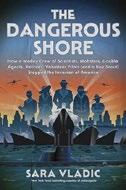
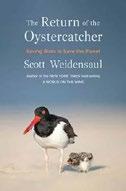
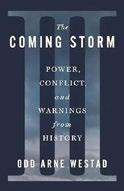
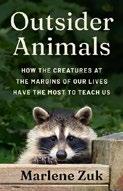
FEATURING 358 Industry-First Reviews of Fiction, Nonfiction, Children’s, Young Adult, and Audiobooks
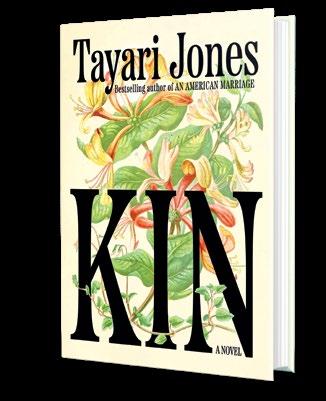
The author of An American Marriage returns with a powerful new novel, Kin TAYARI JONES EXPLORES THE MEANINGS
OF SISTERHOOD
One of the most coveted designations in the book industry, the Kirkus Star marks books of exceptional merit.
OUR FRESH PICK
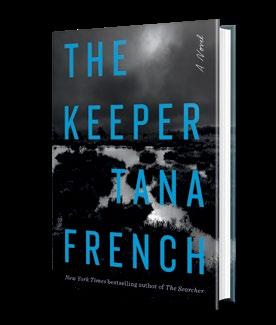
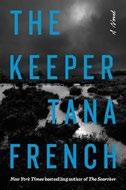
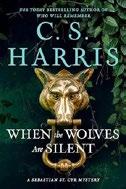
An apparent suicide threatens to destroy an Irish farm town in the final volume of French’s Cal Hooper trilogy. Read the review on p. 10
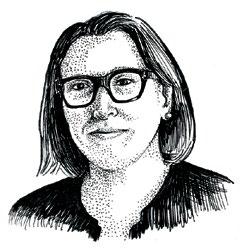
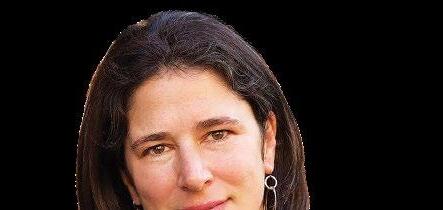
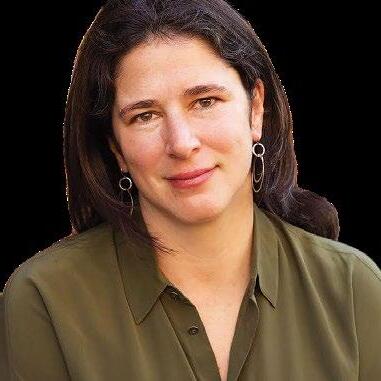
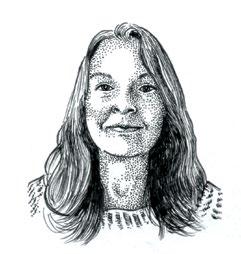
Portrait of Tayari Jones by Oriana Fenwick, from a photo by Julie Jarborough. Background illustration by Inna Sinano via iStock.
FROM THE EDITOR’S DESK
FRIENDS INDEED
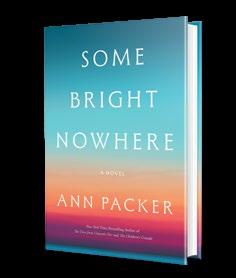
OPRAH WAS IRKED. She’d selected Ann Packer’s latest novel, Some Bright Nowhere (Harper/HarperCollins, 2025), for her book club last fall, but, as she explained on an episode of The Oprah Podcast , she was choosing the book “even though I’m very annoyed with Claire and was annoyed with Claire through half of the book.” Not one of Oprah’s more enthusiastic endorsements.
Claire is the provocative character at the center of Some Bright Nowhere —a woman in the last stages of cancer who abruptly decides she wants her two best female friends at her side as she dies, rather than her loving husband of several decades. Thus Eliot is exiled from the house and relegated to daily visits, while Holly and Michelle
move in to care for her. Oprah certainly wasn’t the only reader who found Claire’s decision challenging, but few would deny that our close friends can provide a unique and profound solace in times of hardship. And let’s face it: Friendships frequently outlast marriages.
Romance and romantasy may reign on the bestseller lists, but you don’t have to look far in contemporary fiction to find that friendship—in all its complexity— is the most resonant subject of our times. It may have started with the intense girlhood connection of Elena and Lina in Elena Ferrante’s Neapolitan Novels or the trauma bonding of the four young men in A Little Life by Hanya Yanagihara. (“Jude & JB & Willem &
For customer service or subscription questions, please call 1-800-316-9361
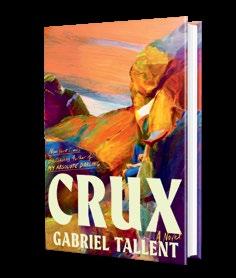
Malcolm” even found their way onto a popular tote bag and T-shirt.) Whatever the origin of the trend, a character’s friends no longer take a back seat to husbands, wives, children, or parents. Friends, as they do for Claire, often come first. One of my favorite novels of 2026 so far, Gabriel Tallent’s Crux (Riverhead, Jan. 20), takes friendship to new heights, both metaphorical and literal. Dan and Tamma are high school seniors in a small Mojave Desert town, looking to escape their dysfunctional families and narrow existences while finding communion—and hope—in their shared love of rock climbing. They’ve taught themselves this dangerous sport by watching YouTube videos, and they don’t have the proper equipment, but they dream of “sending” ever more challenging natural courses. Male-female friendship is often treated as a prologue to romantic fireworks, but these two are soulmates in the truest sense. I loved following their journey and found
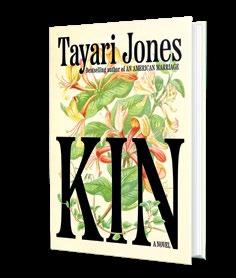
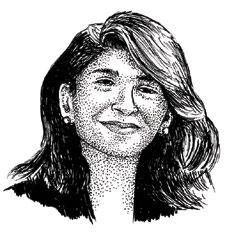
myself as invested in them as by any pair of star-crossed lovers. Which brings us to Tayari Jones, who appears on the cover of this issue and talks with contributor Jessica Jernigan on page 14. The title of Jones’ absorbing new novel, Kin (Knopf, Feb. 24), hints at the almost mystical bond that can link two friends. Vernice and Annie, young Black girls growing up in Jim Crow–era Louisiana, are not biological family— but then, biology is beside the point. Annie’s mother has run off to Memphis, abandoning her to the care of her grandmother, while Vernice’s mama was killed by her daddy, a tragedy that leaves her Aunt Irene to raise her. These two motherless girls pursue two very different paths in life, but the imprint of their childhood experiences—and the mutual under standing it yields—is lifelong. Friends are forever.
Illustration by Eric Scott Anderson TOM
Co-Founders, Kirkus Media LLC
HERBERT SIMON MARC WINKELMAN
Publisher, CEO & Partner
MEG LABORDE KUEHN mkuehn@kirkus.com
Chief Marketing Officer
SARAH KALINA skalina@kirkus.com
Enterprise Advertising Director
MICHELE COBB mcobb@kirkus.com
Indie Advertising & Promotions
AMY BAIRD abaird@kirkus.com
Author Consultant
KEELIN FERDINANDSEN kferdinandsen@kirkus.com
Lead Designer KY NOVAK knovak@kirkus.com
Magazine Compositor NIKKI RICHARDSON nrichardson@kirkus.com
Director of Kirkus Editorial ROBIN O’DELL rodell@kirkus.com
Kirkus Editorial Senior Production Editor
MARINNA CASTILLEJA mcastilleja@kirkus.com
Kirkus Editorial Production Editor
ASHLEY LITTLE alittle@kirkus.com
Indie Editorial Assistant
KATARINA YERGER kyerger@kirkus.com
Contributing Writers
GREGORY McNAMEE
MICHAEL SCHAUB
Mysteries Editor THOMAS LEITCH
Editor-in-Chief
TOM BEER tbeer@kirkus.com
President of Kirkus Indie CHAYA SCHECHNER cschechner@kirkus.com
Fiction Editor
LAURIE MUCHNICK lmuchnick@kirkus.com
Nonfiction Editor JOHN McMURTRIE jmcmurtrie@kirkus.com
Young Readers’ Editor LAURA SIMEON lsimeon@kirkus.com
Young Readers’ Editor MAHNAZ DAR mdar@kirkus.com
Audiobooks Editor JENNIFER DOWELL jdowell@kirkus.com
Senior Indie Editorial Assistant DAN NOLAN dnolan@kirkus.com
Copy Editors
ALYSSA CHOINIERE
NATALIA HOLTZMAN
NANCY MANDEL BILL SIEVER
Founder, Kirkus Reviews VIRGINIA KIRKUS (1893-1980)
Contributors
Nada Abdelrahim, Colleen Abel, Dan Accardi, Jill Adams, Autumn Allen, Stephanie Anderson, Jenny Arch, Kent Armstrong, Mark Athitakis, Susan Baird, Stephanie Baker, Kit Ballenger, Colette Bancroft, Stephanie Bange, Audrey Barbakoff, Carole Bell, Nell Beram, Elizabeth Bird, Rhea Borja, Sally Brander, Melissa Brinn, Jessica Hoptay Brown, Cliff Burke, Abby Bussen, Ana Cackley, Kevin Canfield, Bluebelle Carroll, Tobias Carroll, Charles Cassady, Ann Childs, Amanda Chuong, Shanetia Clark, Rachael Conrad, Emma Corngold, Jeannie Coutant, Michael Deagler, Lisa De Bode, Dave DeChristopher, Elise DeGuiseppi, Suji DeHart, Amanda Diehl, Maria Dietrich, Steve Donoghue, Anna Drake, Eamon Drumm, Robert Duxbury, Gina Elbert, Lisa Elliott, Lily Emerick, Joshua Farrington, Brooke Faulkner, Eiyana Favers, Margherita Ferrante, Cat Fithian, Katie Flanagan, Catherine Foster, Cynthia Fox, Mia Franz, Betsy Fraser, Ayn Reyes Frazee, Harvey Freedenberg, Jenna Friebel, Robbin Friedman, Emily Gaines, Laurel Gardner, Jean Gazis, Will Giwertz, Diana Granger, Lisa Grimaldi, Sharon Grover, Vicky Gudelot, Tobi Haberstroh, Sandi Henschel, Aaron Hicklin, Natalia Holtzman, Terry Hong, Wesley Jacques, Jessica Jernigan, Deborah Kaplan, Lavanya Karthik, Mary Klann, Lyneea Kmail, Maggie Knapp, Alexis Lacman, Megan Dowd Lambert, Carly Lane, Laurel Larrew, Christopher Lassen, Tom Lavoie, Judith Leitch, Seth Lerer, Donald Liebenson, Maureen Liebenson, Elsbeth Lindner, Coeur de Lion, Barbara London, Patricia Lothrop, Katie Lowe, Wendy Lukehart, Kaia MacLeod, Mitu Malhotra, Thomas Maluck, Joe Maniscalco, Jodi Martin, Michelle H Martin, Gabriela Martins, J. Alejandro Mazariegos, Joyce McCarty, Kate McDonald, Isla McKetta, Zoe McLaughlin, Cari Meister, Kathie Meizner, Carol Memmott, Bill Mingin, Alan Minskoff, Steve Mirsky, Clayton Moore, Rhett Morgan, Jennifer Nabers, Christopher Navratil, Liza Nelson, Rachael Nevins, Randall Nichols, Dan Nolan, Katrina Nye, Erin O’Brien, Tori Ann Ogawa, Mike Oppenheim, Nick Owchar, Emilia Packard, Andrea Page, Costa Pappas, Hal Patnott, Bethanne Patrick, Rebecca Perry, John Edward Peters, Jim Piechota, Christofer Pierson, Vicki Pietrus, Shira Pilarski, Katie Polley, Bonnie Powell, Margaret Quamme, Kristy Raffensberger, Mohana Rajakumar, Darryn Reams, Stephanie Reents, Evelyn Renold, Sarah Rettger, Alex Richey, Jasmine Riel, Michelle Ritholz, Erica Rivera, Lauren Roberts, Courtney Rodgers, Kristina Rothstein, Soumi Roy, Gia Ruiz, Laura Sackton, Roy Salzman-Cohen, Bob Sanchez, Julia Sangha, Mike Sangiacomo, Christine Scheper, Meredith Schorr, E.F. Schraeder, Aurelia Scott, Jerome Shea, Madeline Shellhouse, Danielle Sigler, Linda Simon, Julia Sirmons, Vicky Smith, Margot E. Spangenberg, Allison Staley, Sydney Stensland, Rich Stim, Mathangi Subramanian, Jennifer Sweeney, Shayna Szabo, Deborah Taylor, Lisa Taylor, Bill Thompson, Julie Thompson, Renee Ting, Lenora Todaro, Suzanne Van Atten, Francesca Vultaggio, David Walton, Caroline Ward, Susie Wilde, Kerry Winfrey, Marion Winik, Flannery Wise, Denise Zajkowski, Jean-Louise Zancanella
ROMANCE IS FOR BOOK LOVERS
ROMANCE FANS ARE among the most voracious of readers. Is it any wonder they love novels about writers, bookstore owners, librarians, and people who work in the publishing industry? With Valentine’s Day coming up, here’s a selection of bookish romances for your reading pleasure.
Love Walked In by Sarah Chamberlain (St. Martin’s Griffin, Sept. 2): Is it everyone’s fantasy to find their happily-ever-after in a London bookshop? Maybe that’s just me. Mari Cole, an American bookstore consultant, certainly isn’t looking for love when she arrives at Ross & Co. to try to save the struggling business. Leo Ross, the manager and part owner, balks at her suggestions. They’re not going to stock bodice rippers, for one thing. Then Leo nurses Mari
through a severe case of the flu, and their barriers begin to come down. “The novel is a paean to independent bookstores, the movie Notting Hill, and genre fiction, with reading recommendations peppered throughout,” says our review.
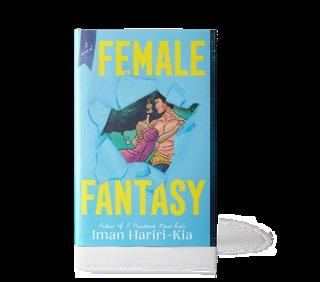
Female Fantasy by Iman Hariri-Kia (Cosmo Reads, Oct. 14): Joonie has a double life: By day she’s a copywriter, but online she creates fan fiction inspired by a popular romantasy series. When she sets out to meet the guy who was the model for the series’ hero, her brother’s best friend decides to tag along. Excerpts from the romantasy novel are interspersed throughout the book, and our starred review says that “while this two-inone book means a double happily-ever-after, the real love story here is between a
book and its reader. HaririKia affectionately satirizes the romance genre and its tropes…while also genuinely extolling how wonderful and empowering romance stories can be.”
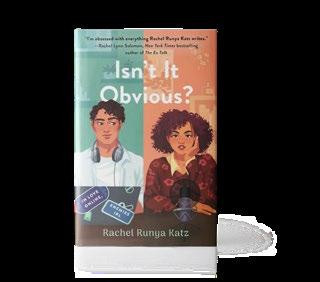
Isn’t It Obvious? by Rachel Runya Katz (St. Martin’s Griffin, Oct. 21): Yael Koenig is a public school librarian in Portland, Oregon, who hosts a secret podcast discussing high school reading. When it takes off, she hires Kevin Kisson, a producer in New York, to help her edit the show. They strike up a flirty, vulnerable email friendship. Then there’s this guy Ravi, the new volunteer for her after-school queer book club, whom she can’t stand. And guess which two guys somehow happen to be the same person? Our review says this is “an expressive, modern take on classic ‘meet-disasters’
like You’ve Got Mail, with characters who are refreshingly communicative and vulnerable.…This enemies-tolovers romance has all the winning ingredients: compassion, spice, comedy, books, and more.”
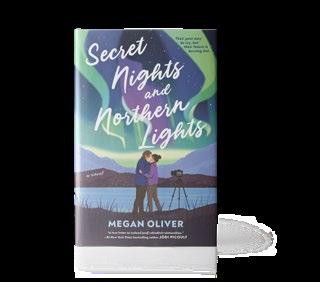
Secret Nights and Northern Lights by Megan Oliver (Berkley, Nov. 18): Travel writer Mona Miller has been given the opportunity to go to Iceland to write a cover story for the magazine where she works. It’s a big step up, but the photographer assigned to go with her is Benjamin Carter, her childhood best friend and the man who broke her heart 14 years ago. Our starred review says “Oliver’s debut is a stunning achievement, full of unresolved emotion and angst.…Mona’s frequent reflection on her history with Ben is seamlessly interwoven with the present-day timeline, for which the Icelandic setting serves as the perfect backdrop, with vivid, descriptive imagery and intense, open-air experiences that push Mona beyond her physical limits.”
Laurie Muchnick is the fiction editor.
LAURIE MUCHNICK
Illustration by Eric Scott Anderson
EDITOR’S PICK
A Pakistani woman demands money and independence—and it comes at a cost.
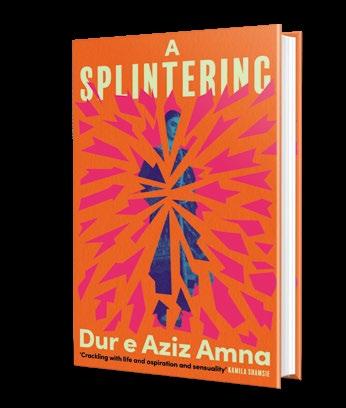
“I am what some call an unrelatable character, and I have done something unthinkable,” Tara, the narrator of Amna’s novel—set from the late 1980s to the early 21st century—tells the reader. “But I implore you to listen. As the storyteller, I need you on my side. And we know that a story is only as good as its beginning. So let my story begin with rage.” Tara has reason to be angry. She endured a childhood living under the shadow of her cruel brother, Lateef, in the fictional Pakistani town of Mazinagar, and thought
she could escape by marrying an accountant, Hamad, and moving in with him and his family in the city of Rawalpindi, where she would be free of the “darkness and filth” she came from. But she strains under the yoke of her overbearing mother-inlaw, and convinces Hamad to move with her to a new house, which she helps pay for with her wages as an art teacher. But she becomes jealous of the wealth of the mothers at her school: “Of course it was a performance; that was what made it impressive. I wanted that performance, that way of holding oneself in the world. I wanted it with a longing that threatened to drown me.” Tara finds
A Splintering
another gig: one that would destroy her life if her brother found out about it, but one that brings in steady money. Tara is an unforgettable character, seething, stubborn, and self-aware, demanding independence in a society that very much does not want to give it to
her. Amna’s writing is gorgeous, and she does an excellent job pinning Tara’s story to events in recent Pakistani history. This is a remarkably bold novel from an undeniable talent.
A fiery novel about a character who wants more than just a room of her own.
Residents and workers at a care facility for autistic adults attempt to interact across the divide of disability. Los Angeles’ Upward Bound is in some ways the average day care: “the locked cupboards with the craft supplies and toys.…there was a scruffy little play area in the far back.” The difference here is the clientele; rather than catering to children, Upward Bound provides care for disabled, mostly autistic, adults. In his debut novel, which reads like a collection of linked short stories, Brown details the lives of both the “typical” people who work at Upward Bound and a range of clients. There’s Walter, an autistic adult who takes pride in his Associate of Arts degree and his ability to communicate via letter board— and occasional echolalia in the form of phrases from TV scripts, especially episodes of Thomas the Tank Engine There’s staff lifeguard Ann, who forms a crush on one of the clients with cerebral palsy during a summer shift before her senior year of college. Bumbling Dave, who moved to LA from Kentucky with dreams of being a Hollywood actor, forces his group to enact his ambitions via a holiday show. Brown—who was the first nonspeaking autistic graduate of UCLA—offers a vanishingly rare glimpse of the interiority of nonverbal autistic adults and a critique of the well-meaning but often misguided neurotypical people in their orbits. It’s jarring to have multiple characters use the R-word to describe those neurologically different from themselves— whether that’s a neurotypical person describing an autistic person or an autistic person describing someone with more profound disabilities. Perhaps Brown’s point is that it’s human nature to punch down—a sobering note in a novel that’s mostly full of humor and charm. A debut novel that truly breaks new ground.
Wait for Me
Burns, Amy Jo | Celadon Books (336 pp.)
$28.99 | March 3, 2026 | 9781250399304
A young woman struggles to understand her relationship to a country music legend.
Marijohn Shaw’s origin story sounds a little like a fairy tale: As an infant, she was found nestled in a basket outside a gas station in a rural Appalachian town and raised by Abe Shaw, the lonely but kind man who owns the place. The only clues to her identity were a note stating her first name and a broken mandolin. But just before Abe found her that day in 1973, he’d had a memorable customer: Elle Harlow, a young country singer-songwriter on the cusp of success. Abe was a huge fan, but like all Elle’s fans he was about to be disappointed. After a betrayal and a public act of violence, she disappeared, but Abe has always believed she’s connected to Marijohn. As the novel opens in 1991, those events are 18 years in the past, and Marijohn is facing questions about her future as well as her past. Then, through a bizarre series of events featuring a meteor and a video, Elle reappears, right on Abe’s doorstep, demanding the return of the mandolin and seemingly denying any relationship to Marijohn. Where she has been and why she chose to vanish form much of the book’s plot as it moves among several timelines, recounting Elle’s childhood in Appalachia and her formative friendship with a folk healer and musician named Merry, then her ambitious flight to Nashville to pursue a career in music, first successfully, then disastrously. In the book’s present, Elle becomes the kind of mentor to Marijohn that Merry was to her but struggles to imagine her own future. Some of Elle’s self-examinations of her motives and the lyrical passages about the saving grace of music get repetitive, and a couple of romances lean toward the too-good-to-be-true. But the novel is insightful in its depiction of complex relationships between women and of the grueling
and sometimes dark sides of the music business.
Two women learn that music and friendship can bloom from loss and hard times.
Kirkus Star
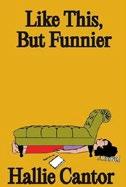
Like This, But Funnier
Cantor, Hallie | Simon & Schuster (304 pp.) $28 | April 7, 2026 | 9781668088586
A once up-andcoming, now out-of-work LA screenwriter is trapped when the worst idea she’s ever had sells. Caroline Neumann doesn’t think of herself as someone who would snoop in her therapist husband’s patient notes, become obsessed with a line she reads there, stalk and befriend the patient in question, and develop a TV show based on the woman’s life—thereby jeopardizing her husband’s career and her own, as well as their marriage, and even before that, utterly atomizing her sanity and peace of mind as the tiny bad idea spirals relentlessly into a huge, terrible project with lots of dollar signs and many important people involved. And yet this is exactly what she has done. Just as unbelievably, the line in question, written in the session notes of a special education teacher, is this: “Dream: strangles students’ parents> meat grinder> school garden: Anger.” If it seems unlikely that a story about a murderous teacher might be the best way to revive a floundering pitch based on a book about something else entirely, it must be said that few novels have ever communicated the profound absurdity of what goes on behind the scenes in Hollywood as vividly as Cantor’s achingly funny debut. For example, the opening moments of an important Zoom meeting: “Jon, Logan, Tommy, Marc, and Andrew then debated the merits of different locations for vacation homes for what felt like an egregiously long time but clearly fulfilled some kind of masculine bonding ritual that established once and for all that they
were all very rich and had huge dicks and would live forever. The women on the call wore looks of patient indulgence. The assistants had turned themselves back into black squares.” As she desperately tries to torpedo the project before her trespass comes to light, 34-year-old Caroline is also dealing with the fact that her husband, who used to share her lack of interest in parenthood, is now pressuring her to freeze her eggs in case they change their minds “later.” What later? She never wants to end up in what she thinks of as the “Mom Hole.”
This hilarious book also delivers moving insight into the things insecurity can make women think and do.
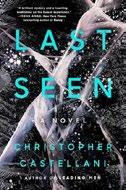
Last Seen
Castellani, Christopher | Viking (368 pp.) $30 | February 17, 2026 | 9798217061037
A brooding, lyrical story about the preciousness of life brought to us by the voices of the dead.
Caleb Aldrich, Steven Donovan, Matthew Cardullo, and Leo Ridgeway never met until the afterlife: four attractive young men who vanish at pivotal moments in their lives, their bodies eventually found in icy rivers across the U.S. Through a vague process they call “summoning,” they are able to share with each other the stories of how they lived and died, creating a fragile companionship in an opaque limbo. “We are those boys they keep finding in the river,” says Matthew, a college wrestling champ whose obsessiveness ruins his relationship with his girlfriend. “I floated alone on the surface of the Huron, trapped between ice and sky…I was terrified, until I heard their voices.” Castellani approaches his characters with deep empathy, tracing their attempts at love and human connection despite frequent bitter disappointments and heartbreaking losses. A true-crime thread runs through the narrative—media and online chatter speculate that the four (and others) are victims of the Smiley Face Killers, a shadowy network of men hunting
Does anyone think this girls trip is going to end well?
THE GIRLS TRIP
college-aged boys—but this element ultimately matters far less than the intimate testimonies of the dead and those who loved them. Castellani unfolds each story through a variety of forms—traditional narration, text message threads, emails, media interviews—all of which suggest the brittleness of human communication and how easily meanings can get lost in between the lines. There’s also a touch of the supernatural in this story—a dresser drawer suddenly flung open or the honking horn of a car kept in storage—that shows how the dead create signs of their presence in the physical world. Even though the crime-mystery framing adds some suspense, it’s an unnecessary gimmick next to the moving portraits of lives cut short and lessons learned by the survivors. Castellani creates a poignant reflection on love and loss in the stories of his lost boys—and the people they’ve left behind.
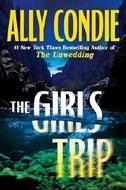
The Girls Trip
Condie, Ally | Grand Central Publishing (320 pp.) | $29 | April 7, 2026 | 9781538773451
Does anyone think this girls trip will end well?
Hope, Ash, and Carolina met at a Zoom book club during Covid-19, when they were the only three who showed up. The subject was Agatha Christie, and the three women bonded instantly over their love of the grand dame and all things mysterious. It took only a few virtual gatherings for Hope, who’d been pretending her camera was broken, to get comfortable enough to reveal that she was, in fact, a famous actress. Now, two years later and following hundreds of hours of conversation, the women have decided the time is right to
meet in person. They plan a trip to the beautiful Sonnet resort near Utah’s Eden National Park, and Hope suggests a little twist: What if, like their idol Agatha—who famously went missing for 11 days after finding out about her husband’s infidelity—they didn’t tell anyone about their plans and just seemed to disappear for a few days? Of course, this won’t end well—or, at least, it will get really, really complicated. Because: Caro is keeping secrets from her husband. Because: Ash’s marriage is falling apart. Because: Hope thinks one of them is being targeted by a stalker, so she’s built in some additional plans to help them fall off the grid. But no one could have anticipated the flash flood through the slot canyon known as the Underground, nor the young woman working at the resort who seems to have her own agenda. The second half of the novel becomes nearly silly with intrigue and overlapping red herrings, disappearances, and suspicious deaths, but the first half sets up a very real sense of tension. As in her previous novel, The Unwedding (2024), Condie offers a wild, beautiful backdrop to the plot, reminding us that nature, not unlike human passions, can’t be controlled or bent to anyone’s plan. There’s plenty of action, so strap in for a ride.
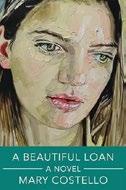
A Beautiful Loan
Costello, Mary | Norton (224 pp.) | $28.99 March 24, 2026 | 9781324106173
An Irishwoman reflects on her romantic entanglements and spiritual awakening. “My name is Anna, and for some time now, I have been trying to account for certain events in my life…
which, from this vantage point of forty-five years, I often find baffling.” So commences Anna Hughes’ look back at her life, starting when she was 19, living in a Dublin bedsit, and about to begin her first job as a schoolteacher. The first of the “certain events” to which the middle-aged Anna alludes concerns her relationship with Peter Gallagher, an accountant she met at a nightclub. For Anna, their romance was meaningful (Peter was her first lover), insecurity-making (Anna secretly rifled through his things), and consuming: “I yearn to know him fully, deeply—I have no other mission.” Their relationship proceeded the way one might expect, which is emblematic of a problem throughout this careful, searching novel: Readers will always be one step ahead of Anna. Late in the book, when she finally realizes, “I’m easily swayed by other people’s ideas and opinions, believing them to be superior to my own,” readers will likely have a “No kidding” ready to go. There are wisps of an Edna O’Brien character in Anna, a country girl coming into awareness in the big city, and there are glimmers of a promising story about the lure of the extraordinary life versus the comforts of an ordinary one. But the narrative is bogged down with Anna’s thoughts on her dreams and on Jung, Camus, and, while she’s seeing a Muslim man, Islam. This only reinforces the notion that, while Anna is intellectually voracious, she doesn’t have an original thought in her head. That may be the novel’s point, but it does make for a tiresome protagonist. May speak to readers who are spiritually seeking; will likely frustrate those who aren’t.
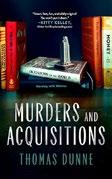
Murders and Acquisitions
Dunne, Thomas | Blackstone (352 pp.)
$29.99 | April 28, 2026 | 9798874863838
For one family-held business, personal decisions have global implications. The novel opens in Manhattan with the death of 95-year-old Werther Maybach Meyer, the most powerful American stakeholder in
Dunne unleashes his take on the state of publishing.
MURDERS AND ACQUISITIONS
Omnium, a century-old, family-owned international corporation with banking, financial, and media arms. Who will take charge now that Werther is gone? In his lifetime, Werther was a dodgy figure, having been involved in international money laundering, and he had understandably racked up some enemies. Reports the book’s omniscient narrator: “Word of Werther Maybach Meyer’s demise, though not unexpected, was of great interest in certain government, criminal, and elite financial circles,” and his death does indeed set off a chain of events with geographically far-reaching repercussions. This years-spanning novel takes readers around the world (Germany, London, Moscow) and back again, during which time the body count rises. The novel’s Manhattan-set chapters center on Werther’s “charity-case niece,” Betty Maybach, who is underestimated by those around her at their peril, and on the people of Albion, part of Omnium’s book division. Throughout the Albion chapters, author Dunne, the former head of his namesake imprint at St. Martin’s Press/Macmillan, unleashes, with satirical pistons firing, his take on the state of American book publishing. (Albion has a sensitivity department with “volunteer outriders” known as the Vigilance Committee.) Readers should anticipate meta touches; like this novel, the one that an Albion insider is writing concerns “a bunch of different things. Mystery, intrigue, a few murders, a love story.” Dunne’s novel can occasionally feel like a narrative exercise in the butterfly effect, which is a touchstone in the book, and odds are good that readers will be less absorbed by chapters revolving around finance-world machinations than by more character-driven sections devoted to publishing-world skulduggery. Nevertheless, they should expect a high return on investment. A blackly humorous feat.
Kirkus Star
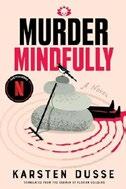
Murder Mindfully
Dusse, Karsten | Trans. by Florian Duijsens Soho Crime (416 pp.) | $19.95 paper April 14, 2026 | 9781641298506
A German lawyer who’s already involved with the mob also gets involved with a mindfulness regimen. It’s hard to say which of these two is lethal. When Katharina Diemel, unhappy with her husband Björn’s workaholism; neglect of her and their 2-year-old, Emily; and subservience to his principal client, violent criminal Dragan Sergowicz, insists that he step away from the rat race, Björn consults mindfulness counselor Joschka Breitner. Their months of sessions are so rewarding that they leave two indelible legacies. One is Dragan’s death after he pushes Björn just a little too far. The other is the brief excerpts from Breitner’s magnum opus, Slowing Down in the Fast Lane, that head each chapter of Dusse’s first novel. It turns out that mindfulness offers Björn a path to inner peace, stronger relationships with his wife and daughter, the guts to tell his bosses in the most mindful way possible that he’s not going to take any more from them, and the ability to come up with a remarkable series of strategies to persuade driver and personal assistant Sasha Ivanov, narcotics sales manager Toni, ex-friend and present competitor Boris, and the rest of Dragan’s associates that the boss has gone into hiding and appointed Björn as his spokesperson and chief deputy. It’s obviously a very temporary arrangement, but one that allows Björn not only to engineer several more homicides but to focus on what’s most important in his life: getting Emily
into a good preschool. Readers with a taste for unpunished violence may also emerge with a more mindful perspective on their own lives.
A one-joke suspenser whose marvelously rich joke is worth every one of its 416 pages.
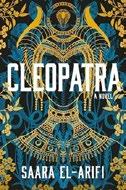
Filled with carefully researched detail, this actionpacked fictional portrait of the ancient and mysterious Egyptian empress follows her from adolescence until her end.
Cleopatra VII is a Ptolemy, heir to the throne of Egypt—but as many of us think we know, she came to a tragic end due to her ill-fated love affairs and poor military strategy. Author El-Arifi pulls from many scholarly sources to create her novel’s queen, a woman of Africa who owes nothing to future mythologizing; she’s a healer, a would-be scholar, and a fiercely loving mother. This Cleopatra lives for her people; loves freely, both men and women; and leaves little to chance, employing care and cruelty in equal measures. Her great documented loves, Julius Caesar and Marcus Antonius, appear, but so does her life’s companion, Charmion, not to mention her perfidious siblings, sister Arsinoe and brother Theos. At one point, Cleopatra says of her sister, “We had been close once; our secrets were each other’s. But somewhere along the paths of our lives we had diverged”— but she never explains how or why. Cleopatra goes out of her way in other sections to describe her emotions, so her silence on her relationship with Arsinoe feels odd, due both to their kinship and their eventual clashes. This lacuna might indicate cultural difference, as well as attention to context—we now acknowledge that emotions might be different depending on eras—but given the plethora of emotions otherwise imputed to this dynamic queen, it’s a puzzling
omission. We also now acknowledge family estrangement, but we usually see a first-person narrator understanding why a breach has occurred. Still, this Pharaoh’s imperious ability to here don gem-laden robes, there order a royal family’s murders, or hold an intimate banquet of boar and goose is a vision of absolute power and absolute control. If Cleopatra occasionally contradicts herself, claiming to care more for her family than for her people, it seems to be such a maverick’s prerogative.
A worthy addition to novels about powerful women, despite some shallow glosses on character motivations.
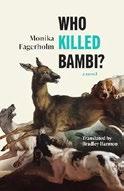
Who Killed Bambi?
Fagerholm, Monika | Trans. by Bradley Harmon | Univ. of Wisconsin (230 pp.) $17.95 paper | March 17, 2026
9780299355944
A sexual assault radiates across time and relationships in this melancholy tale. Fagerholm, a veteran Finnish novelist writing in Swedish, sets this story in Villaville, a mythical suburb of Helsinki that’s a haven for upper-middle-class families. But in 2008, it was rocked by a scandal: Four teenagers were charged with kidnapping, raping, and torturing a young woman. Six years later, Gusten Grippe, one of the teens, is trying to move on. But his relationships are crumbling: His mother, Angela, is busy with a successful opera career, and he still pines for a past love, Emmy Stranden, while pursuing a friends-with-benefits arrangement with her best friend, Saga-Lill. Other characters experience similar breakups and flimsy situationships, sometimes but not always directly related to the rape: Nathan Häggert, the instigator, has speeded his parents’ divorce and wrecked the career of his mother, Annelise, the head of an aggressively pro-capitalist think tank. (Annalise is a devotee of the unsubtly named Gayn Hand, which rhymes with
Ayn Rand.) And the story won’t die: Gusten gets word that a filmmaker friend is working on a film about the assault, titled Who Killed Bambi? Fagerholm delivers this narrative in pieces, and what in some ways feels like the “wrong” order—specifics about the rape don’t emerge until the closing pages, not to intensify the drama but to demonstrate how the characters are determined to avoid confronting it. Leaps back and forth in time, along with shifting perspectives, make the story demanding (translator Harmon offers a helpful introductory note). But the main point gets across: trauma, and especially denial of it, makes connections too brittle to last, and efforts to paper over it with money or convenient stories are doomed to failure. Difficult, both rhetorically and thematically, but worthwhile.
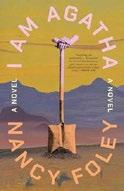
In a novel inspired by the life of the artist Agnes Martin, Foley invents a fictional scenario while capturing Martin’s emotional essence. The outer contours of Agatha Smithson’s life resemble Martin’s— early artistic success in New York City, a stay at Bellevue Hospital after a psychotic break, a university teaching stint in Albuquerque, a secluded hand-built cabin, complicated friendships with Georgia O’Keeffe and others, a return to painting, an uncloseted lesbian identity. When the novel begins in 1971, 68-year-old Agatha is living, as Martin did, in Mesa Portales, New Mexico, but fiction takes over as Agatha narrates a romantic drama involving her with a variety of local characters, some imagined, others amalgams of real figures in Martin’s life. Agatha’s attention is currently consumed by the intense love affair she
has been carrying on with local widow Alice for four years. She indignantly, perhaps defensively, claims that Alice remains “whole in her mind,” despite what others consider Alice’s increasing dementia. Rejecting the decision of Alice’s son to put her in a facility, Agatha acts to relocate Alice from her small house in town to Agatha’s unplumbed, unelectrified cabin. Agatha even digs up the grave of Alice’s daughter, who was tragically murdered at age 21, to keep her body near Alice. But readers will notice early on that whenever anyone comes looking for Alice, Agatha explains that she is “on a walk,” and so conveniently unavailable. That Agatha is not merely an unreliable narrator but an irrational one becomes increasingly clear. Then, midway through the book, Agatha begins to grapple with difficult truths that begin to reveal themselves both to her and the reader. Despite exaggerated, almost silly plotting, a rich portrayal emerges on multiple layers: the self-centered, prickly but gifted artist, the woman fighting the realities both of mental illness and aging, the derider of sentiment who desperately wants, and often makes, deep and lasting connections with others.
A fascinating portrait of a woman torn between her single-minded artistic ambition and her yearning for love.
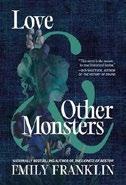
Love & Other Monsters
Franklin, Emily | Godine (464 pp.) | $32 April 7, 2026 | 9781567928563
Claire Clairmont— free-thinker, “foraging wild woman,” lover of Lord Byron and stepsister of Mary Shelley— was present at but erased from the history of a mythic moment in English literature. Franklin follows her novel about Isabella Stewart Gardner with another bio-fiction, this time based on the life of Mary Wollstonecraft Shelley’s less famous stepsister. Narrated from 1879,
the story hinges on Claire’s journal of the year 1816, when she was 17, living with Mary and her partner, poet Percy Shelley, in London, helping Mary with her infant son. The couple are unwed, Shelley being already married—such is the era’s modernism, to which Claire herself subscribes, boldly writing to the famous, wealthy, wildly successful poet Byron. She falls under his languid spell and becomes his lover, their consummation delayed by intense foreplay. Claire then engineers a summer meeting between Byron and the Shelleys at Lake Geneva, with the two households as neighbors, Byron in the grander dwelling, Villa Diodati. Franklin’s lengthy, detailed tale expends the bulk of its pages in this famous setting, where the men discuss writing and ideas while the women speculate on masculinity. Claire’s first-person narration delivers an immersion into her introverted, lonely, sensitive, unconventional persona among this creative group: Mary, with whom the relationship is close but combative; Shelley, who has a sexual interest in her; John Polidori, a physician with his own sexual preferences; and Byron, mercurial, both available (sometimes) and distant. The author’s lyrical prose doesn’t wholly distract from a sense of stasis as the days pass, the weather, food, moods, and correspondence are explored, until eventually the moment comes when the group decides to write ghost stories, including what will be Mary’s classic Frankenstein , and Claire declares a turning point of her own. Above all, the novel is a devoted restoration of a figure whose presence and contribution were obscured by men’s—and Mary’s—interventions. A satisfying if overlong act of literary reanimation, appropriate to its setting.
An apparent suicide threatens to destroy an Irish farm town in the final volume of French’s Cal Hooper trilogy. In the fictional western Ireland townland of Ardnakelty, “there’s a girl going after missing.” Soon young Rachel Holohan is found dead in the river. Shortly before, she had stopped at Lena Dunne’s home, and nothing had seemed amiss. The medical examiner determines she’d swallowed antifreeze, and he presumes she then fell from a bridge into the water. The medical examiner and the town agree she’d died by suicide. But there is far more to the plot: 16-year-old Trey Reddy thinks Tommy Moynihan murdered Rachel. Moynihan doles out favors and punishments to the local townsfolk, who know it’s best not to cross him. Now rumors spread that Moynihan wants land and has a secret plan to forcibly buy up parcels from the locals. A factory will be built, or a great big data center, or who knows what. If Tommy’s son, Eugene, can get elected to the local council, then compulsory purchase orders for land will follow, and the farms will disappear. Eugene, who’d been romantically involved with Rachel, is wonderfully described as “on the weedy edge of good-looking” and just fine as long as you “don’t have high expectations in the way of chins.” Lena is engaged to the American Cal Hooper, an ex-cop turned woodworker. They are “more or less
Claire Clairmont was present at a mythic moment in English literature.
raising” Trey, and these three core characters are drawn into the mystery of Rachel’s death and may have to face the looming clouds of civilizational change for Ardnakelty. Lena is chastised for “asking your wee questions all round the townland,” and Trey wants to quit school, against Cal’s advice. Finally, the story’s best line: “You can’t go killing people just because they deserve it.” Great crime fiction.
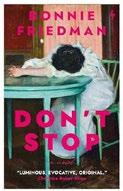
Don’t Stop
Friedman, Bonnie | Europa Editions (304 pp.) | $18 paper | April 21, 2026 9798889661740
A debut novel about discovering desire. It’s the eve of the millennium, and Ina is an almost middle-aged academic who’s trying to finish a book on the playwright Eugene O’Neill, which will launch her career as an English professor. She’s mostly happily married to Simon, with whom she has terrific adventures around New York City, though not-so-terrific sex. Enter Jack, a composer whom Ina meets at a party, who kisses her on the subway platform, even though he knows she’s married. Friedman’s novel is not about whether Ina will have an affair—the very first lines announce that her “whole life turned upside down” when she “discovered sex at the age of forty-one”—but how much she will risk to keep seeing Jack. Reading this novel is like watching a car careen over a cliff in slow motion, as Ina blows by writing deadlines, disappoints the chair of the English department where she’s a visiting professor, lies to her husband, and fulfills Jack’s ever weirder sexual fantasies. (In one scene, he confesses he’s turned on by necrophilia, and though initially repelled, Ina eventually pretends to be dead.) “The heart wants what it wants,” Emily Dickinson once wrote to a friend. Jack is a brilliant character, as unabashed as Ina is repressed, an unapologetic male
chauvinist who smokes, peeps on his neighbors, enjoys porn, and can’t quite get it up, among his other winning qualities. And yet Ina finds him absolutely irresistible. Neither raucous nor raunchy—Ina is way too prim a protagonist—this is a well-mannered and funny novel about what happens when the heart rebels against the mind, and the body demands that “what was growling up from deep within you didn’t deserve to be ignored.”
A sexy tease of a novel for the buttoned-up crowd.
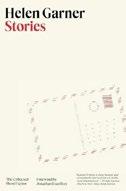
Stories: The Collected Short Fiction
Garner, Helen | Pantheon (208 pp.) $27 | March 3, 2026 | 9780553387476
Short fiction from an eminent Australian writer. In a thoughtful foreword, Jonathan Escoffery finds throughlines in this group of 14 stories, gathered from two books originally published in Australia in 1985 and 1998. He points out that most feature women living in the “transformative period of feminism’s second wave.” Many feature travelers found in airports, on ferries, in lodgings in France, Germany, or England. Though in general Garner’s approach is, as Escoffery says, associative, elliptical, and avoidant of epiphanies, some of the most accessible moments deliver feminist revelations. For example, in the last story, “What We Say,” the narrator is staying with a male friend in Sydney who serves lunch to her and her good friend after they’ve seen Rigoletto. It quickly becomes apparent that they view the opera very differently, from distinctly gendered perspectives. While it seems obvious to the host that it speaks to a male fear of losing their daughters, and thus belongs to a male tradition of art, the women see it as a story about being unable to protect their children. What are the historic themes of women’s literature, the host wonders. “We don’t have a tradition in
the way you blokes do,” the narrator says. If anything, it’s “a shadow tradition…. It’s there, but nobody knows what it is.” Her friend adds, “We’ve been trained in your tradition….We’re honorary men.” In this conversation and others, Garner moves women out of the shadows, asserts their agency. Two friends take a walk through a cemetery. “My friend pointed out a headstone which said, She lived only for others. ‘Poor thing,’ said my friend. ‘On my grave I want you to write, She lived only for herself.’” Without the strong central narrative voice of Garner’s novels, the raw, autofictional quality for which she’s known is not as prominent, though there is a charming early childhood story with a main character named Little Helen. Her prose, as always, is honest, energetic, spare, and precise. Though Garner’s voice is always worth hearing, this collection might not be the best place for new readers to begin.
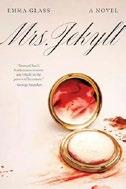
Mrs. Jekyll
Glass, Emma | Union Square & Co. (176 pp.) $17.99 paper | April 7, 2026 | 9781454965909
A primary school teacher diagnosed with cancer finds herself monstrously altered by her disease. Rosy Winter is happily married to her radio-journalist husband, Charlie. Though they have no children, Rosy hopes that will soon change. In the meantime, she loves her job as a teacher working with young children, and she enjoys spending time with her baby nephew, the son of Charlie’s sister, Sally, whose worst problems seem to be an inattentive husband and a busy postpartum life. As the novel begins, Rosy pities Sally—then all her own contentment is transformed the day she finds a lump in her breast in the shower. Sally takes her to a tarot card reader; Rosy turns up The Empress and The Devil. The reader warns Rosy of “temptation, urges, the darkness within everyone.…Embracing our urges can be freeing, but we must be
cautious not to lose ourselves in the darkness.” From that symbolic, ominous moment, the story shoots off into a feminist body-horror fever dream. A hyperlyrical take on the Jekyll and Hyde story, Glass’ novel imagines that, instead of Stevenson’s Dr. Jekyll taking a serum that turns him into the murderous Mr. Hyde, the chemo infusions bring forth the rageful and libidinous Nola, a kind of deadly doppelgänger for Rosy. Glass, who works as a nurse, is terrifyingly attuned to the dark poetics of rot and illness. The sections from Nola’s perspective, are, in fact, written in verse: “Fingers glistening with decay / Lump / Thumping / Throbbing / Purulent.” Fans of Glass’ saturated prose and gothic sensibilities will find more to love here; new readers will be in for a nearly hallucinogenic and harrowing look at the ravages of terminal illness.
A feminist revision of a classic written with prose as lush and dark as velvet.
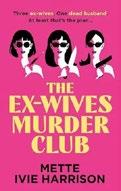
The Ex-Wives Murder Club
Harrison, Mette Ivie | Severn House (224 pp.)
$29.99 | March 3, 2026 | 9781448316472
The three wives of a very unpleasant man cook up an elaborate scheme to murder him.
Meg, the narrator, is the first wife; Jenny is the second; and Amelia the most recent. Even though Meg hated Jenny for the two years the woman was married to Mark, putting paid to Meg’s 11-year marriage, she still answers a phone call from her successor, who wants to tell her all the bad things Mark did and the lies he told. In fact, Meg falls in love with Jenny when she says she wants to kill Mark. Because they have no experience in the murder department, they decide to pick out some morally repugnant people and kill them as practice. They cut down the list of bad seeds until they decide on Terry as the first target. Surprisingly, their efforts turn into a lucrative business, for there are many wealthy people who want someone dead. But they do have
standards, and they turn down many clients when they decide that the victim’s death would not be good for humanity. Buying the coffee shop where they first met as a base for themselves and the business, they set about turning a bloodthirsty Amelia against Mark, though they don’t make her a full partner. It takes four years of murders and planning before they come up with a plan that will make Mark suffer both physically and mentally. Along the way, Meg and Jenny’s relationship has its ups and downs, and they both come to distrust Amelia. A moment of betrayal leads to an uncertain future.
A riveting psychological suspense story, not for the faint of heart.
Kirkus Star
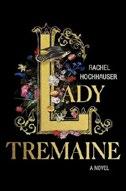
Lady
Tremaine
Hochhauser, Rachel | St. Martin’s (352 pp.)
$29 | March 3, 2026 | 9781250396341
Twice widowed and struggling to maintain the decaying manor house she and her daughters are trapped in, Lady Etheldreda Verity Isolde Tremaine Bramley does everything in her power to obtain an invitation to a royal ball that could change their lives forever.
After the death of her second husband, Ethel finds herself without any money, in charge of a rapidly crumbling house and its staff, and struggling to look after her daughters, Rosamund and Mathilde, and their self-righteous, stick-in-the-mud stepsister, Elin (aka Cinderella). It’s a challenge, to say the least. Ethel clings desperately to the image of a proper and well-to-do lady while doing whatever she can—including hunting in the woods with her peregrine falcon, Lucy—in order to protect her family and make ends meet. When word reaches her of an upcoming royal ball that could lead to a highly coveted engagement to the prince, she becomes determined to help her daughters earn an invitation, only to have
Elin be invited instead. As time passes and the engagement unfolds quickly, Ethel comes to realize that Prince Charming and the royal family are not all they’re chalked up to be, and that she must choose between the life she’s sought for years and the well-being of a stepdaughter who’s never loved her. Ethel is so much more than the cartoonishly villainous Wicked Stepmother that fans of Cinderella have come to know over the years. Instead, Hochhauser has created a desperate and prideful woman who would do anything in her power to ensure that her daughters have an easier life than she’s had. Readers will no doubt find themselves rooting for Ethel as she recounts the life she once had, the love she’s lost, and her unwavering devotion to her daughters.
A bold and beautifully written examination of a mother’s love told through the eyes of Cinderella’s “wicked” stepmother.
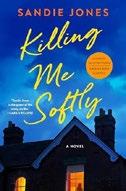
A shocking tragedy forces a young British couple to confront the truth behind the facade of a seemingly perfect marriage. Charity fundraiser Freya Adams and her husband, Charlie, an up-and-coming chef, love each other madly. A year and a half after their whirlwind courtship and wedding, they still feel blissfully “stuck in a constant honeymoon state.” But everything changes one evening at a dinner party where Charlie accepts an offer from his boss to become a business partner. Blinded by jealousy when she overhears him talking intimately to his boss’s wife, she returns home and awakens the next morning to police at her door with news that Charlie’s car has been involved in a hit-and-run accident. Moving between Freya and Charlie’s first- and third-person perspectives, Jones spins a darkly compelling story
of love, betrayal, murder, and marital collapse all while offering, at times, disturbing insight into the nature and motivations of each of the main characters. While Freya hides the shame of alcoholism, personal volatility, and an unresolved preoccupation with her Australian ex-husband, Charlie hides a wandering eye and the stress of a faltering business for which he’d make any sacrifice. When the man struck by Charlie’s car finally dies in the hospital under mysterious circumstances, masks begin to fall. Tensions and emotional toxicity levels rise as Freya and Charlie, a couple once committed to protecting each other, reveal just how far each will go to protect the secrets they have been keeping from each other. Sinister and propulsive, this romantic thriller leads readers through mazes of intrigue that reveal the author’s keen eye for character psychology and masterful control of pacing and plot.
A chilling novel that explores the darkly intimate connection between guilt and obsession.
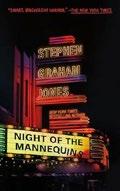
Night of the Mannequins
Jones, Stephen Graham Nightfire (144 pp.) | $14.99 paper February 24, 2026 | 9781250412812
Nightmare
whisperer Jones offers up an eerie, contrarian take on a teenage slasher’s daydreams.
Jones is clearly capable of heavier fare, but fans will appreciate this nasty little novel that’s closer to The Babysitter Lives (2025) or I Was a Teenage Slasher (2024) with its eccentric reversal of horror tropes. Wes Craven couldn’t have set it up better: A teen lark goes terribly wrong with fatal consequences. “So Shanna got a new job at the movie theater, we thought we’d play a fun prank on her, and now most of us are dead, and I’m really starting to feel kind of guilty about it all”: So confesses our narrator, Sawyer Grimes, who comes off at first like the good guy in any 1980s horror movie, just trying to Scooby-Doo his way through a bloodbath. The prank
involves a rancid old mannequin, aka “Manny,” who seemingly comes to life, gorging on plant food and growing into a murderous, unstoppable killing machine. But wait—now Sawyer has gotten the bizarre idea that Manny has sworn revenge against him and his friends, and will kill all of their families—unless Sawyer kills all of his buddies first! “I’d read Frankenstein in AP English, so I knew you don’t just walk away from your creations,” Sawyer says. “Not without consequences.” There’s a lot going on in this brief book, not least a convincing portrayal of mental illness spawned by early trauma, abetted by hallucinatory visions of carnage. Sawyer’s inner monologue is frightening because that voice is so familiar, which is why it’s disarming when readers figure out it’s all an acidly funny take on the deluded “chosen boy” trope. Sawyer’s delusional commentary is also surprisingly compelling, which is good because his friends are all, as advertised, pretty disposable—final girls and all.
Weird, startling, and tightly wound, a scary story ripe for gorehounds who grew up reading about The Baby-Sitters Club.
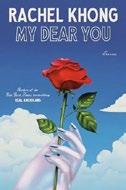
Ten stories explore premises surreal, profound, prophetic, playful, and provocative. In two preceding realistic novels— Goodbye Vitamin (2017) and Real Americans (2024)— Khong didn’t quite let on how wild and woolly her imagination might be. This becomes immediately clear in the first story here, “My Dear You.” “Something nobody tells you is that when you die a death in which your face and body are utterly maimed, you get to choose your face in heaven,” the narrator brightly says, explaining that she will now remedy the too-wide space between her eyes that
caused her to be tormented with the nickname “Hammerhead” as a child. But now that she’s actually been eaten by a shark while on her honeymoon in Australia, she can have the face she wants: “I know what you’re wondering, and the answer is yes: people in heaven are smoking hot.” In the next story, a more topical premise is explored: The government has announced a “Freshening” initiative as a desperate measure to curtail a terrifying spike in racial violence. Everyone will be given a drug that causes them to see everyone else as a member of their own race and gender. Though the Asian narrator’s white boyfriend voted against it, “the vast majority of white people, it turned out, wanted to go about their lives seeing only other white people.” In “The Family O,” a group of more than 20 Asian women join forces to get revenge on a man in their town who’s dated every single one of them, taking each to an Asian restaurant corresponding to their culture, telling each the exact same story about his trip to a Buddhist temple, then seeming to stumble on a pet store where he buys them a fish that reminds him of them: “Exotic, with elegant, beautiful fins.” Also irresistible is “Serene,” where a sales clerk in an AI-sex-doll factory develops a profound attachment to one of the dolls. Uses the flexibility of the short-story form to wonderful and whimsical advantage.
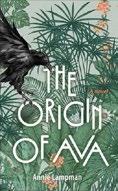
The Origin of Ava
Lampman, Annie | Torrey House Press (320 pp.) | $18.95 paper | March 10, 2026 9798890920201
A trio of damaged people seek refuge and redemption in the natural world. Following the death of her eccentric, alcoholic father by gunshot in his remote Idaho home and the loss of a prized student killed by a falling tree while battling a wildfire, Ava Estmund abandons a decade of work as an ornithology professor and leaves behind her partner, Sibley, for
TAYARI JONES
The award-winning author’s latest novel, Kin, showcases the importance of research—and the power of story.
IN KIN, THE ACCLAIMED author of An American Marriage again offers a captivating narrative rich in both emotional depth and social insight. Set against the fraught landscape of the Jim Crow South, the story traces the bond between two best friends as life pulls them from their small Louisiana hometown in very different directions. Raised by a no-nonsense aunt after her mother’s death, Vernice sets her sights on Spelman College and the opportunities that an education will offer her, while Annie’s search for the mother who abandoned her takes her on a more precarious journey. Speaking from her home in Atlanta, Tayari Jones reflected on how her own experience at Spelman shaped her latest novel and the lives she wanted to honor in writing it. “We don’t really talk about the people who lived on the periphery of the Civil Rights Movement. I also wanted to give credit to the transformative power of higher education, of historically Black colleges, and this rare bird of a historically Black women’s college.” Our conversation has been edited for length and clarity.
First, I want to let you know that I loved this book so much. I did not expect it to be so funny.
No one has mentioned that.
Really? I wonder if it’s because you deal with some heavy topics here and people are afraid to say that they laughed while they were reading. I do think that when we talk about books in the current media landscape, it’s such a compressed conversation, and the people who talk to me about the book want to do so in a way that they think will be helpful to the book and to me. I am a woman writer, and we are constantly aware of the extent to which we are not taken seriously—as writers, as thinkers, even as people.
Certainly, there have been times in my life when I’ve let my thoughts about reception interfere with my process. And that has never worked well. I only can get the book written when I let that go. So I understand that an interviewer might not want to dwell on how funny the book is, but they could at least tell me!
Well, we don’t have to dwell on it either, but I’m glad I mentioned it. I especially enjoyed Aunt Irene. All the secondary characters in this book are terrific, but she might be my favorite. She says over and over again that she’s not good with children, but she does her very best to raise Vernice.
We have this myth that if a woman says she doesn’t plan to mother any children, somehow the presence will transform her into someone else—in this case, someone this woman has distinctly said she is not.
It’s a matter of personality, right? It really is. I do think that Vernice grew on Irene. I think Irene did care for Vernice, and she took care of Vernice. But Vernice didn’t make a mama out of Irene.
While I was getting ready for this conversation, I read an interview about An American Marriage you did with the Paris Review. You said something that I found really striking: “When I first started writing, I was thinking of it as a book about mass incarceration, and mass incarceration is not a plot. It’s not a story. It’s not a character.” That captures so much of what I appreciate about both these books. You’re talking about serious social
issues, but you do it with story. Can you talk about the role of research in Kin? A lot of the research I did was about Spelman College. As an alum, I thought I knew the history of the school quite well. In fact, I was class historian my freshman year! But when I read a wonderful memoir by Dovey Johnson Roundtree called Mighty Justice—I wrote the foreword—I realized how much I didn’t know. Also, I’ve moved back home to Atlanta and there are a lot of women around me who are about the age of my characters, many of whom attended Spelman College. I’ve been able to get a lot of the details of their lives, details that aren’t really recorded anywhere.
I’ve discovered that there was a lot more class diversity at the school in the 1940s and ’50s than I thought. Spelman had a reputation as a place for young women from fairly well-off families who were looking for husbands. Spelman, like a lot of the HBCUs [historically Black colleges and universities], did provide a service for the Black middle class, but they also created the Black middle class. That’s part of our history, too, but I think it’s gotten lost in favor of this mystique about Spelman women.
In reality, some of the young women who went there worked full time doing domestic work to pay for it. A lot of them came from these little towns. I met a woman who is 97 years old now. And she told me she arrived at Spelman College
with every dime her family and community had in a sock. A sock! And she took this sock to the president of the college, who took the sock, emptied it out, didn’t count the money, returned the sock, and asked this young woman, “Where are you staying?” And this woman answered that her family knew some people in Atlanta, and she thought she’d be able to stay on their couch. The president said, “No, you’ll stay in a dormitory.” This woman didn’t know what that word meant, but she knew it had to be better than a couch. And now that woman has a PhD. She’s a Shakespeare scholar, no less. I just really wanted to give some respect to women like her.
That’s an amazing story.
I will say, one thing that was hard for me, writing a book set in the ’50s and ’60s, was writing about a time when women did not have access to safe and reliable contraception. The characters in this book are constantly talking about and worrying about getting pregnant. As someone born in 1970, someone who came of age when contraception was in regular usage, it was hard for me to get my head around the ways in which women’s lives were determined by their inability to control their own reproduction. I really wanted to underscore that. The tragedy in the book is personally tragic, but it’s also culturally tragic that women did not
have access to the health care they needed to live their lives. That was important for me to communicate.
Is there anything else you want to say before we close?
People always ask me about advice for young writers, which, honestly, isn’t all that interesting to me. I’m much more interested in talking to older people who have stories to tell. I know everybody likes to say that writers should write every day. And I do think that you should write frequently and regularly, but listen: All the things that keep you away from your writing are also the things that enrich your writing: your job, your kids, elder care, being involved in your community. All these things enrich your writing. So instead of looking at them as challenges, think of them as your superpower. I don’t want to read a book by someone who has nothing to do but write. I don’t want to read a book by someone who’s in their pajamas all day. I want to read a book by someone who is out in the world leading a meaningful life. So if you can just take time to write regularly, the book will get done, the pages will accumulate. But don’t think that your life is keeping you from telling your story.
Jessica Jernigan lives and works on Anishinaabe land in central Michigan.
I don’t want to read a book by someone who’s in their pajamas all day.
Julie Jarborough
IN THE NEWS
Sophie Kinsella Dies at 55
The author’s 2000 novel, Confessions of a Shopaholic, launched a bestselling series.
Sophie Kinsella, the British author best known for her Shopaholic series of comic novels, has died at 55, the Guardian reports.
Kinsella worked in financial journalism before making her literary debut in 1995 with The Tennis Party, published under her real name, Madeleine Wickham. She released six more novels under that name.
In 2000, she published her first novel as Kinsella, The Secret Dreamworld of a Shopaholic, released in the U.S. the following year as Confessions of a Shopaholic. The novel followed Becky Bloomwood, a financial journalist who’s in deep debt because of her love of
shopping; a critic for Kirkus wrote of the book, “A have-your-cake-and-eat-it romp, done with brio and not a syllable of moralizing.”
She would go on to write eight more novels in the series, including Shopaholic Takes Manhattan, Shopaholic Ties the Knot, Shopaholic & Baby, and
Christmas Shopaholic Confessions of a Shopaholic and Shopaholic Takes Manhattan were adapted into a 2009 film, Confessions of a Shopaholic, directed by P. J. Hogan and starring Isla Fisher, Hugh Dancy, Joan Cusack, and John Goodman. Kinsella’s stand-alone novels include Can You Keep a Secret?, I’ve Got Your Number, My (Not So) Perfect Life, and I Owe You One. In 2024, she announced that she had been diagnosed with glioblastoma, a form of brain cancer, two years earlier, and that she would publish a novella, What Does It Feel Like?, later that year.—MICHAEL SCHAUB
For a review of Confessions of a Shopaholic, visit Kirkus online.
Sophie Kinsella
the solitude and peace of a coastal town in Ecuador, the “new expat darling.” Her perspective is one of three Lampman employs to tell this story of distinctive but equally appealing characters struggling to escape an intolerable present or the burden of a painful past. Another is Ezra Kittredge, recently released from prison after having served a 10-year sentence for vehicular homicide while under the influence of heroin, who then promptly violates his parole by boarding a merchant vessel sailing for Ecuador, his ultimate destination the Galápagos Islands. Finally, there’s Greer Groff, an 11-year-old fourth grader whom Ava’s late father took under his wing to teach everything from the secrets of Idaho’s forests and rivers to the alluring mysteries of Greek and Native American mythology, urging her, above all, to “pay attention to everything nature says.” Accompanied by two llamas she helped train and a shepherd pup, she’s fleeing her mother’s abusive boyfriend through the ravishing but sometimes deadly Idaho wilderness. Lampman takes her time stitching the superficially disparate stories of these characters together, but when she does, they form a most satisfying whole. The novel features frequent lovely passages of nature writing, marred only slightly by an occasional overfondness for long lists of birds or other natural phenomena or a didactic passage about some aspect of ornithology. In her well-paced story, Lampman effectively blends the heart-pounding action of Greer’s desperate but resourceful flight with quieter moments in which Ava and Ezra reflect on their emotional wounds and their urgent desire for what Ezra optimistically imagines as a “life made new.”
A well-plotted drama linking three unlikely characters as they make the transition into their lives’ next phases.
Midnight, at the War
Laskar, Devi S. | Mariner Books (240 pp.)
$30 | April 14, 2026 | 9780063289437
War and its victims are juxtaposed against a journalist’s personal struggles in this novel set in New York and the Middle East.
Inspired by the careers of celebrated international correspondents Christiane Amanpour and Sylvia Poggioli, Laskar focuses this exemplary, tension-filled novel on Rita Das, an American reporter who runs headlong into war zones while running even faster from understanding her true self. Set mostly before and after 9/11, Rita catapults from one world calamity to another and witnesses harrowing conflicts in political hotspots including Syria, Iraq, Lebanon, and Gaza. Eventually, her editors send her to an unnamed Middle Eastern city-state, and it’s here that she finally wrestles with her inner conflicts about her marriage, her lover, on-the-job sexism, and her place in the world as a biracial woman (her father is white and her mother Bengali) and a mother-to-be. Her emotional turmoil makes the intriguing Rita a sympathetic character. Her interactions with her parents, her friends, and the people she encounters at work feel genuine and true to life, as do Laskar’s grizzly descriptions of shootings, bombings, and war’s injured, often starving casualties. Laskar deftly develops Rita’s character arc, from witnessing a horrific act of violence in India when she was a child through the attacks on the World Trade Center and beyond. The hallmarks of this absorbing novel are embedded in two literary achievements—an unerring examination of terrorism at home and abroad and a gripping exploration of the damage done by unhealed trauma. Laskar, a former reporter, thrusts us into scenes of horrific violence and suffering while expertly capturing the lives of seasoned journalists committed to bringing truth to their readers and listeners.
A dynamic novel about one woman’s struggle to understand the world and her own emotional chaos.
Kirkus Star
Transcription
Lerner, Ben | Farrar, Straus and Giroux (144 pp.) $25 | April 7, 2026 | 9780374618599
A writer’s meeting with his mentor goes complicatedly awry. Lerner’s slim fourth novel opens with an unnamed narrator arriving in Providence, Rhode Island, on a magazine assignment to interview Thomas, a professor who’s “among the world’s most renowned thinkers about art and technology.” Just before leaving his hotel, though, he accidentally knocks his phone in a sink, bricking it. His sole means of recording the interview gone, he triages, suggesting that he and Thomas conduct a pre-interview that evening and do a full-dress conversation the next day, after he can get the device fixed. The setup seems thin, but, this being a Lerner novel, rich ethical and philosophical questions fly off it: He’s concerned with the ways that an interview poisons authentic conversation, with our over-reliance on technology, and the moral dilemmas of talking to an unreliable source. (Thomas, 90, seems distracted and sometimes dotty.) Lerner’s true subject isn’t an interview so much as it is misapprehension and miscommunication; after the meeting with Thomas in the first section, the second and third parts are concerned with characters’ failures to understand something about each other, be it a romantic partner’s wishes or a child’s eating disorder. That last challenge makes for some of the most vivid, offbeat, and affecting writing Lerner has delivered—a surprise, given his fiction is typically marked by DeLillo-esque sangfroid. Another surprise is the relative embrace of a conventional story arc, as the narrator faces a reckoning about living in a “deepfake” world. This is slighter fare for Lerner but surprisingly potent given its length, interested in the ways that we manufacture our identities and how technology speeds the process along. A tart meditation on narrative and integrity.
For more by Devi S. Laskar, visit Kirkus online.
See You on the Other Side
McInerney, Jay | Knopf (304 pp.) | $30
April 14, 2026 | 9780593804797
The fourth and final installment in the saga of a well-heeled Manhattan family.
Russell and Corrine Calloway face a sobering finale in McInerney’s conclusion to his tetralogy, written over the course of 34 years. It opens in the early spring of 2020, just as the first effects of the Covid-19 pandemic are being felt; it’s just what you’d expect of this prominent pair that they attend glitzy back-to-back social gatherings despite the growing sense of alarm that will soon put a stop to such things. The first is an anniversary celebration for their best friends, Washington and Veronica Lee; like the Calloways, this couple has weathered major infidelities and come out the other side, and their respective children, Storey and Mingus, have evolved from childhood friends to romantic partners. The second is the opening of chef daughter Storey’s new restaurant; the reader is painfully aware how inopportune this timing will be. Finally, Russell will attend his monthly wine dinner, a somewhat appalling event where eight extremely rich men (as a publishing guy rather than a finance guy, he is the plebe of the group) gather in a private room at Per Se to open bottles valued in the four and five figures, paired with endless courses of gourmet concoctions; as always, McInerney’s food and wine writing glows. Wife Corrine is much less sanguine about all this than her husband, and indeed the body count eventually racked up in this episode of the saga is high; the coronavirus is not the only villain. As a writer whose early work famously celebrated the joys of “Bolivian marching powder,” it is fitting that McInerney includes fentanyl among the evils of that annus horribilis; police brutality, racial unrest, and cancer appear as well. As the curtain closes on the Calloways’ fraught love story, faithful readers will feel sad but satisfied. The reliable pleasures of McInerney’s writing make even this darkest chapter a fun read.
Kirkus Star
She Fell Away Nash, Lenore | Emily Bestler/Atria (352 pp.) $29 | March 10, 2026 | 9781668098370
A unique investigator, an unusual setting, and a highstakes, wellcrafted mystery.
Lake Harlowe knows the burden of trying to outrun a traumatic past. Maybe this is what led her to join the foreign service, where she works to support American citizens who travel abroad and run into any kind of trouble. Her previous post in Phnom Penh just a few weeks behind her, Lake is beginning to lean into her new appointment in Wellington, New Zealand, when she receives a death notification for a wealthy American, seemingly from an accidental overdose. Her call to his family, who owns the Trophy casino in Las Vegas, is combative and volatile, and leaves her spent—until she gets a call that another young American, also from Las Vegas and with ties to the Trophy, has gone missing: Bowie Bishop, an aspiring musician. Through emotional phone calls with Bowie’s mother, the aging rockerturned-cocktail-waitress Suzie, and her own investigation into the people closest to Bowie—her host family in Wellington; a dashing local musician with whom she shared the stage a time or two; an American expatriate music producer— Lake finds herself drawn deeper and deeper into something dark that may have already swallowed Bowie whole. Having grown up in a cult in Alaska, Lake is no stranger to darkness, and she has closed herself off from making personal connections outside of her irascible three-legged cat. But something about Bowie’s case gets under her skin—as does handsome Kiwi police officer Mason Yates. In tone as well as character, Nash successfully builds a modern noir here. Lake, like any good noir detective, desperately tries to armor herself against hurt, but it’s her vulnerability and woundedness that makes her
good at her job. It’s also her (or Nash’s) poetic way with descriptions and metaphors that echo masters of the genre like Chandler: “I close my eyes and corpses wash across the darkness like nightmare northern lights.”
A perfect balance of old style and new, high art and low. Here’s hoping there’s a sequel.
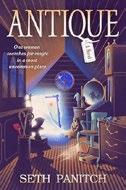
Antique
Panitch, Seth | Grand Central Publishing (352 pp.) | $29 | February 3, 2026 9781538772942
Grace Schaffer, a once-lauded appraiser for Antiques Roadshow whose career has taken a nosedive, gets a second chance when she comes into possession of a magical necklace. Despite her appraising skills, when Grace comes into possession of the necklace, she has no idea of how valuable or powerful it is. The reader knows, however, that it’s 5,000 years old and was, at one point, worn by the high priestess of Sin, the Babylonian god of wisdom. From there the necklace was passed down, taking on a tarnished appearance until making its way into Grace’s hands at the traveling antiques show where she works after having been let go from her job with Antiques Roadshow. The last thing she needs is a seemingly worthless necklace brought to her by a mother and daughter. Wracked with guilt after lying about the value of their family heirloom and filling them with false hope, Grace purchases the necklace herself and quickly discovers that it is much more than just a piece of jewelry. Suddenly imbued with a strange sense of confidence, Grace starts predicting the precise amount that objects will sell for at auction—far beyond their market value. This, in turn, catches the attention of detractors and fans alike, all clamoring to see what act of divination she’ll perform next. Riding the high of the necklace’s power and her newfound popularity, Grace is soon given a seemingly impossible task: Help uncover a
long-lost masterpiece before it, and her chances at happiness, are lost to time. Despite a likable premise, heartwarming family moments, and Grace’s affable personality, a slow plot and repetitive action make the novel feel as dusty as the antiques Grace appraises. A charming premise that loses its value under a repetitive plot.
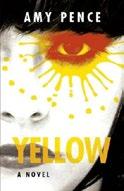
Yellow
Pence, Amy | Red Hen Press (232 pp.)
$17.95 paper | March 24, 2026 9781636284767
Mysticism and science merge in the story of a Louisiana artist. In the summer of 1973, 12-year-old Eliza discovers a mysterious yellow slime mold growing in the backyard of her suburban New Orleans home. Convinced that it’s sentient, communal, and has arrived “to teach us something,” she watches one night as the being she christens “Yellow” releases “faeries...bright as bees.” She introduces Yellow to her younger brother, Clem, who is equally fascinated. (Her parents and three other siblings, less so.) That summer, Eliza is sexually assaulted at a local lake, an event that coincides with the disappearance of Yellow. She goes on to change her name to Z, studies art at Barnard, moves back to New Orleans to make and teach art, and reunites with Clem, now homeless and ecstatic. He disappears during Hurricane Katrina, and Z continues to travel, teach, fall in and out of love, meet her soulmate, and pursue the possible serial killer who assaulted her. Poet Pence includes in her debut novel extensive, illustrated—and narratively unnecessary—timelines including the events of 1973, the aftermath of Hurricane Katrina, and the Covid pandemic. Z’s story is woven in with glimpses of astronaut Pete Conrad, who may or may not have seen a UFO somehow connected with Yellow while working on a mission outside a space station. Aside from the presence of the slime mold, the novel follows the
conventional path of a long-extended coming-of-age tale. Pence tells her story in language on the border between poetic and precious; her silky prose almost compensates for the novel’s lack of momentum. Dreamy but insubstantial.
Kirkus Star
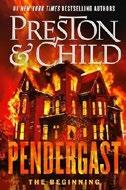
Pendergast: The Beginning
Preston, Douglas & Lincoln Child
Grand Central Publishing (384 pp.)
$30 | January 27, 2026 | 9781538765746
In 1994, Aloysius Pendergast begins his FBI career in his hometown of New Orleans, where his boss doesn’t want him, as Preston and Child take him back to his first case.
Dwight Chambers, Pendergast’s new partner and mentor, quickly realizes that his mentee “played by his own rule book,” often not troubling with FBI procedure. Early on, a corpse is discovered with its right arm severed—with considerable microsurgical precision, observes Pendergast, leading to Sherlock Holmes–level deductions about the killer. But motive? Ah, that’s the fundamental mystery. Meanwhile, a courier named Proctor is kidnapped and kept in a dark room where a disembodied voice tells him he must eat well and not hurt himself. At first, Proctor has no clue about the perpetrator’s motive but concludes he’s insane. The one-time military colleague of Pendergast seems to have no resources, but he’s determined to escape. Will he die trying? The plot is strange, likely unique, and suits Pendergast perfectly—he’s slender, pale as a ghost, and always dressed in a tailored black suit. He’s also quick-fingered, honey-tongued, and capable of necessary violence. Oh yes, and he oozes old New Orleans money of unspecified origin—witness his 1959 Rolls-Royce Silver Wraith—although his recent ancestry shows criminals and mountebanks. He lives in a bayou on Penumbra Plantation and peppers his conversations with words like homunculi,
lacunae, and sui generis. By-the-book Chambers can scarcely believe his junior partner practices a form of deep meditation called Chongg Ran as part of his investigative process. Occasionally Pendergast’s actions lean toward the paranormal, stretching credulity. Not only that, he hears so well that he “could detect even a fly farting.” All of this makes him one of the strangest and most entertaining crime fighters in modern fiction. Just as he describes the killer, Pendergast himself is sui generis.
A second-chance romance from the author of Slow Dance (2024) and the Simon Snow Trilogy. Cherry is fat. There are other things to know about Cherry, but this fact is essential to how she sees herself and—she knows—essential to how other people see her. And now that her husband’s hugely popular webcomic is a movie, she not only has to endure people confusing her with the character that’s based on her, but also the knowledge that the actor playing this character is wearing a fat suit. This pain is exacerbated by the fact that her marriage is over. It’s at this rock-bottom moment that her college crush reenters her life…This is a book about being fat, and Rowell does a great job of depicting what internalized fatphobia looks like. “Cherry was so used to thinking about being fat, she hardly even noticed that she was doing it. She was so used to thinking about being fat, she never thought about it.” Observations like this will resonate with a lot of readers, as will Cherry’s complicated feelings about weight-loss drugs. This is also a romance and, as a romance, it’s kind of all over the place. It’s totally realistic for Cherry to wonder if Russ—the guy from college—never pursued her because of her weight. This is a conflict that feels true.
What’s less believable is the way he reacts when he sees a trailer for Cherry’s husband’s movie. It’s clear that he didn’t get that this movie was going to be a blockbuster. In short, Russ freaks out, and it’s not at all clear why. As for Cherry’s husband, the way she feels about him at the beginning of the book is totally disconnected from the way she feels about him in the novel’s latter half. It’s normal to have complicated feelings about the end of a marriage, of course, but there’s no emotional throughline to help the reader understand why Cherry’s feelings change so dramatically.
Rowell delivers the requisite happilyever-after, but it doesn’t quite satisfy.
200 Monas
Saenz, Jan | Little, Brown (368 pp.) $26 | March 3, 2026 | 9780316595889
With the help of a mysterious drug dealer, a bereaved biochemistry student tries to sell a stash of 200 pills—and also pass her finals—before she’s scheduled to fly to San Francisco at the end of the week for a pharmaceutical internship. Four weeks before her final exams at Westheimer University in Central Texas, Harvey Moon Keening—called Arvy— lost her mother in a car crash that might have been an accident but that Arvy suspects was the result of what she and her mother called “the funk.” Now Arvy has four tests to take, her aunt’s incontinent foster dog to care for, and a Ziploc bag of 200 pills she thinks are molly to get rid of—the remnant of her “witchy” mother’s “light drug dealing” mostly to women “who had lost a grip on their truer selves.” As it turns out, however, the 200 pills are not molly, but Mona, an “experimental pharmaceutical made for women, by women, meant to treat extreme cases of sexual dysfunction and clitoral atrophy.” Mona, in other words, gives its users overwhelming orgasms, plus a host of side effects including vomiting, blackouts, and waves of existential dread. Arvy has less
than 36 hours to sell the pills or somehow come up with $10,000 for Francis Pete, her mother’s charming-but-also-terrifying former “business associate.” Sharp-witted and vulnerable—she brings her mother’s ashes with her everywhere—Arvy is a delightful narrator of this high-stakes adventure. Including her increasingly serious flirtation with Wolf, the college’s drug dealer, and the discovery of a cultish sorority for young women willing to pledge celibacy so they can “convert sexual energy into productive energy” and “use it for a greater purpose,” the adventure is much like Mona itself: a propulsive romp haunted by an ever-present darkness. A wild, fun, and moving page-turner.
The Book Witch
Shaffer, Meg | Ballantine (320 pp.) $30 | April 7, 2026 | 9780593983584
A young woman goes on an epic adventure while living out every book lover’s dream.
“All stories are love stories if you love stories,” and Rainy March, a 27-year-old woman living in picturesque Fort Meriwether, Oregon, certainly loves stories. Rainy’s love of literature goes beyond the surface—literally. In her job as a Book Witch, Rainy has the ability to step inside novels with the aid of her magical black umbrella and her feline familiar, Koshka. Rainy’s job, along with the other members of the Ink and Paper Coven including her grandfather, is to save stories from being destroyed by so-called Burners—conservative villains who hop into books to kill off main characters from stories they find offensive to their traditional values—or from fictional characters who accidentally wander into the real world. Rainy’s life is a little more complicated than that of your average Book Witch, however—once, on a mission, she stepped into a Duke of Chicago detective novel and fell in love with the titular Duke. Unfortunately, it’s forbidden for a Book Witch to fall in love with a fictional character lest their love end
up in the novel and the canon be changed forever. But then Rainy’s grandfather goes missing on a Book Witch mission, and Rainy and the Duke must team up to track him down, along with a stolen copy of Nancy Drew’s The Secret of the Old Clock that belonged to Rainy’s late mother. Their adventures have them popping in and out of books, including, delightfully, a party scene in The Great Gatsby, and uncovering secrets that could change the course of Rainy’s life. While Shaffer’s writing is a touch too cutesy to mine real emotional depths, the charms of the heroine and the conceit itself make up for it in spades.
Catnip for anyone who ever wished they could walk around in their favorite book.
Fatherland
Shorr, Victoria | Norton (256 pp.) | $29.99 March 10, 2026 | 9781324117551
A coming-of-age story in a world dominated by the choices of men.
“The shoes were packed. ‘Daddy loves you,’” Josie’s father tells her, “glancing around— had he left anything?” Martin Brier is halfway out the door, first wife cast aside for the younger model destined to become his second.
Shorr’s latest novel is a mid–20th century, Midwestern, nearly father-free coming-ofage story that follows Josie, her two brothers, and their mother as they try to build a life for themselves in Martin’s cavernous absence. Shorr favors a close third-person point of view which hovers, hummingbird-style, outside her characters’ windows. It’s an effective strategy, especially in Shorr’s fluidly engaging prose style, which allows readers to access the thoughts of even the most difficult characters—Martin included. He shows us in the passage above, for instance, that he can’t focus on his daughter long enough to tell her he loves her without simultaneously wondering if he’s adequately packed his belongings. His selfishness is astounding. So is the psychological astuteness with which Shorr has loaded the sentence—and
the rest of the book—which is, in the end, the portrait of a girl and her wider family as they adjust to a world whose parameters they have not set themselves. Shorr picks up the narrative in the mid-’50s and sets it down half a century later, when Cleveland has changed irrevocably and Josie’s family has scattered. If the book putters out in the last two or three chapters, that seems a small price to pay. The larger missed opportunity is that Lora, Josie’s mother, doesn’t seem fully rendered. As a momentarily penniless single mother of three, she has to act decisively—and does. Still, Shorr has cast her sights elsewhere, and the result is a remarkable success. A beautifully written portrait of a girl and her family.
Nine new stories from the author of Brooklyn (2009) and Long Island (2024). Known for his rich novels of the Irish at home and abroad, as well as his fictionalized portraits of writers Henry James and Thomas Mann, Tóibín is just as adept at the short story—indeed, his understated prose shines in miniature. Two tales in this new collection glancingly intersect with the world of his Enniscorthy novels, introducing characters familiar to readers of Nora Webster (2014). In the title story, Nora’s husband, Maurice, visits the Irish Assembly, or Dáil, hoping to petition a minister for access to a tuberculosis drug that might save his dying brother. Readers are afforded a fly-on-the-wall perspective on Irish politics; Eamon de Valera, president of Ireland in the 1960s, makes a cameo. “A Sum of Money,” in which a hard-up boarding school student begins pilfering cash from his classmates’ lockers, name-checks Nora and Maurice’s son, Donal. Not all the stories are set in the past: “Sleep” concerns a gay man who submits to being hypnotized by a psychiatrist after his younger lover
leaves him, while “Five Bridges” features a sad-sack middle-aged Irishman, living in San Francisco without documentation, who must return to his homeland, leaving behind the tween daughter he’s only just getting to know. The longest tale, “The Catalan Girls,” is the least successful of the bunch, following three sisters through the decades after they leave Spain and emigrate to Buenos Aires; it lacks the narrative tension to pull readers through its 100-plus pages. But “A Free Man,” about an Irish schoolteacher convicted of sexual abuse who relocates to Barcelona after serving his prison term, is among the author’s finest work; it’s dark, ambiguous, and quietly, profoundly unsettling.
A distillation of Tóibín’s melancholy, unadorned style.
Businessmen as Lovers
Tonks, Rosemary | New Directions (160 pp.) $16.95 paper | March 24, 2026 9780811240246
Retro in diction and cutting in observation, Tonks’ 1969 tale of Londoners abroad—newly reprinted—should amuse many and infuriate a few.
Mimi and Caroline, the former attached to a beau named Beetle and the latter married to Killi—one of the titular businessmen— have arrived in Livone on the Tuscan coast for a summer holiday in an English enclave. Although children (presumably Caroline and Killi’s) accompany them, they’re mainly mentioned in pieces of background business, often amusing the adults but rarely inconveniencing them. This is British vacationing as set piece, cold and bracing like Killi’s late-afternoon bitter lemon aperitif. Mimi ponders whether or not Beetle is marriage material while Caroline agonizes over whether to have an affair, both of them seeking the company and coyly dispensed advice of middle-aged Madeline Voos whom they refer to as La Prostitutess due to her relentless pursuit of Sir Rupert Monk-house (sic). As Killi frets over the arrival of a man
Mimi refers to as “the Persian” and several men plot to cut down a lemon tree from a Viennese doctor’s property—what larks!—the assembled begin to gossip actively about Rupert’s sexual powers, or putative lack thereof. How can he and La Prostitutess possibly have a love life at their attenuated ages? Twenty-first-century readers, used to the idea of seniors and sex, may weary of all the arch pronouncements (“he balances my emotional books without having to give the truth a twist to do it” and “Going back to your original man is the hardest thing in the world. Only a very skillful and loyal woman can manage it”) long before this amusing but ultimately shaggy-dog story concludes. The travelers ready themselves to return to their busy lives, and the most successful part of this slight, amusing fable might be a perfect metaphor on its last page about the children attempting to get a flashlight working: “It’s an English one, and you have to doctor it all the time.”
The characters inhabit their era and its discontents so fully that this comedy of manners feels more clever than meaningful.
The Scoop
Van Der Meer, Erin | Grand Central Publishing (320 pp.) | $29 | April 21, 2026 | 9781538776339
With print journalism collapsing, a spirited young editor gets laid off from her cushy magazine job and finds herself slumming at a sleazy, National Enquirer-like website.
Francesca Miller, 29, is at a low ebb—after losing her position as features editor of Marie Claire, she can’t find work. She just broke up with her unfaithful boyfriend and is fast running out of cash. Her best friend, Audrey, sympathizes; but Audrey is rich and well-connected, and after losing her job, she lands at the New York Times. Then Frankie learns of an opportunity—night editor at a down-anddirty online tabloid owned by Johnson News, which bears more than a passing
resemblance to the Murdoch media empire. Desperate, Frankie signs on to The Scoop. It’s only temporary, she tells herself, because the editor-in-chief, David Brown, has promised that if she does well, she’ll be transferred to the company’s respected, Wall Street Journal –like newspaper, Business Day. (Hard to believe the savvy Frankie would fall for such a ploy, but never mind.) This debut novel—the title echoing Evelyn Waugh’s 1938 journalism satire, Scoop —is clever and fun, at least at first. The Australian-born author, a self-described “former journalist,” clearly knows the terrain; she delivers spot-on descriptions of tabloid excess (“a celebrity nip-slip on the red carpet was our equivalent of war breaking out in Europe”) and the travails of unemployed journos. But once Frankie gets entrenched at The Scoop —struggling to impress David with her scurrilous “scoops”—things take a turn. Frankie will seemingly stop at nothing to get the goods on 1990s pop-rock icon Amanda Myles. But Frankie’s involvement with Amanda deepens, and she begins to see, with increasing horror, the damage her tell-all stories are inflicting. As the novel veers from satire to melodrama—with some anti-press moralizing thrown in—it loses its spark.
A well-written, au courant first novel that takes itself a bit too seriously.
Cry Havoc
Wait, Rebecca | Harper Perennial/ HarperCollins (432 pp.) | $18.99 paper January 20, 2026 | 9780063473133
A mysterious illness and a web of lies plagues a girls’ boarding school in southern England in the 1980s. Sixteen-year-old Ida Campbell picks the wrong time to start school at St. Anne’s. Not that there ever seems to be a right time; the building, set on a cliff overlooking the English Channel, “looked as if it had been caught in the act of falling down, and was now doing its
best to hold itself together until you looked away again.” The headmistress, Miss Christie, is unusually preoccupied with fears of nuclear attack, and despite offering Ida a scholarship and arranging her travel from Scotland, greets her with, “Oh, but we weren’t expecting you to actually come.” Ida is running from her own demons, though, and when her new roommate, Louise Adler, vows to make her leave the school, she does everything she can to prevent that from happening. Meanwhile, Eleanor Alston, the middle-aged geography teacher, knows that new history teacher Matthew Langfield is telling lies, but she can’t figure out why. More importantly, students have begun to have seizures, causing mass panic and fear that the school will be forced to close. The atmosphere of St. Anne’s is a gloomy, derelict backdrop to the novel. As Louise says to Ida, “Someone could look at our lives and have no idea what decade it is.” Wait brightens up the story with a touch of the absurd, such as the convoluted play-within-a-play that the students attempt to put on for their parents and prospective students on the school’s open day with disastrous results, and the story of the aristocrat who built the school before he was “committed to an asylum…because it turned out he thought he was Julius Caesar.” The characters are delightfully strange and constantly surprising, perfectly suited to a novel shrouded in so many questions. A dark academia novel that’s light on academia but bursting with the dark and strange.
Arab American Blues
Zarou, Paul Aziz | Interlink (240 pp.) | $18 paper | February 10, 2026 | 9781623715632
A young man’s coming-of-age amid war and social unrest in the 1960s.
John Steinbeck’s novel The Winter of Our Discontent demonstrates how a local business—a grocery store—can sit at the heart of a
community. It’s no coincidence that one of the characters in Zarou’s debut reads Steinbeck’s book, but there are long stretches where the establishment at the center of this novel—a grocery store owned by a Palestinian American family—fades into the background. The story opens with a brick thrown through the family’s window, one of several incidents of racism the Haddads—especially Michael, a high school student who works in the store—must contend with in the Queens Village neighborhood of New York. It’s a tumultuous time: Some local residents are heading overseas to fight in Vietnam, while the Haddads are also getting upsetting news from relatives in Palestine about the Six-Day War. The novel is at its best when it gets most specific, focusing on the ins and outs of the business and the family’s involvement in keeping the store running. Gradually, Michael embarks on a relationship with Nancy, an Italian American college student who grew up nearby. The fact that Nancy is a few years older than Michael adds more complexity to their relationship than their different ethnic backgrounds. (One of the couple’s dates is to see The Graduate, which makes for a memorable post-film discussion.) The sight of the pair out on the town—where Michael is assumed to be Greek by one waiter— gets at the shifting demographics of 1960s New York City. Unfortunately, the story incorporates even more flashpoints from the era, from white flight to a subplot about a Vietnam veteran whose heroin addiction leads him to a life of crime. The novel’s empathy and humanism are admirable, but the use of multiple 1960s tropes give the story a clichéd feeling at times. A story of identity, intimacy, and familial struggles.
WinningRomancesSports
Tessa Bailey
Rufaro Faith Mazarura
For more booklists, visit Kirkus online.
AWARDS
Winner of the 2025 First Novel Prize Revealed
Darrell Kinsey took home the award for Natch.
Darrell Kinsey has won the Center for Fiction’s 2025 First Novel Prize for Natch. Kinsey’s novel, published last April by the University of Iowa Press, follows the title
character, a 29-year-old man with a tree removal business, who meets Asha, a convenience store worker and aspiring therapist; the two must face reality after she becomes pregnant with Natch’s child. A critic for Kirkus called the book “a melancholy story of love and loss with a memorable narrator.”
The award was judged by the authors Xochitl Gonzalez, Adam Haslett, Tracy O’Neill, and Joseph Earl Thomas. Haslett said in a statement, “In this year’s winner, Natch, readers will discover a work of art that renders in clear-sighted, almost crystalline prose a world
few of us have visited, and fewer still have understood with the acumen and love Darrell Kinsey displays on nearly every page.”
The other finalists for this year’s award were Colwill Brown for We Pretty Pieces of Flesh, Rickey Fayne for The Devil Three Times, Justin Haynes for Ibis, Alejandro Heredia for Loca, Mariam Rahmani for Liquid, and Shubha Sunder for Optional Practical Training
The First Novel Prize, which comes with a cash
award of $15,000, was established in 2006. Previous winners include Noor Naga for If an Egyptian Cannot Speak English, Raven Leilani for Luster, and Viet Thanh Nguyen for The Sympathizer.—M.S.
Darrell Kinsey
For a review of Natch, visit Kirkus online.
A former detective is inspired by the suffrage movement to return to work.
VANISHED IN THE CROWD
Vanished in the Crowd
Bowen, Rhys & Clare Broyles | Minotaur (336 pp.) | $28 | March 10, 2026
9781250399359
A former detective is inspired by the suffragist movement to return to the job she loved. Molly Murphy Sullivan and her husband, Daniel, the newly created FBI head in 1909 New York, live with their adopted daughter, Bridie, and two younger children on Patchin Place, a dead-end street in Greenwich Village. Across the street live Molly’s closest friends, Elena “Sid” Goldfarb and Augusta “Gus” Walcott, both from society families, both with independent means, both lesbians, suffragists, and socialists who are paying for Bridie to attend private school. Now Sid and Gus, who are hosting a Boston Walcott cousin and a fellow Vassar graduate, are concerned because Willa Parker, a third expected guest who’s a scientist from Philadelphia, hasn’t arrived. Even though they suspect Willa may not want to be found, Sid and Gus hire Molly to find her. Willa is far smarter than her husband, but because she’s a woman, his name is on their scholarly papers and he’s in control of their research at Penn University. Molly is especially inclined to take the case because she’s peeved with Daniel, who hasn’t told her that he hasn’t been paid by the FBI and is using their savings to pay his men. Meanwhile, the city is getting ready for a celebration of the 300 years
since Henry Hudson sailed up the river now named for him and 100 years since Robert Fulton invented the commercial paddle steamer; Bridie’s school is decorating a float in one of the parades that have all New York and many foreign guests involved. Molly’s friends are working on another float sponsored by wealthy suffragist Alva Belmont, and Molly suspects they’re planning a protest. The case will lead to Willa’s shooting on the float and her friends’ arrest for their protest. As Daniel labors to provide security for the foreign dignitaries involved, Molly follows up on a tangled mess of clues to find the truth. A colorful mystery based on historical events that focuses on the status of women.
A Disorganised Death
Brett, Simon | Severn House (192 pp.)
$29.99 | April 7, 2026 | 9781448314690
Actually, it’s a pair of deaths and their inevitable logistical legacies that await the motherand-daughter co-directors of the English decluttering service SpaceWoman. Ellen Curtis’ latest job would be cut and dried if she cleaned out houses rather than decluttering them. Four months after alcoholic publican Arnold Yendall fell to his death down a flight of stairs, his daughter, Tamara Nicklin, wants his house cleared out. Originally resisting the gig because “no, I do not do house clearance. And no, I am
not a private investigator,” Ellen proves herself wrong both times when she takes on the job after realizing that Tamara’s really looking for her father’s will, and that she and Nicky, her flirtatious husband, have very different ideas about how they’d like to redo The Fox Hole, the pub Arnold presumably left her. In the meantime, the decluttering job Ellen’s daughter, Jools, has taken on for her upstairs neighbor Perry Driscoll, a reclusive hoarder, expands to include calling the police to clear away his body when the Curtises find him dead under a mountain of Amazon cartons. Whether or not Perry was murdered, this second case turns into another hunt for a will. As always, Brett’s touch is consistently light whether he’s dealing with sudden death, squabbles over legacies, suicidal offspring, or Ellen’s domineering mother, former actress Fleur Bonnier. Though neither mystery is especially twisty or profound, fans of the series will take considerable pleasure in the way Jools’ live-in boyfriend, Tariq, comes up with a crucial bit of evidence that wraps up the more vexing of them in a most satisfying way. A perfect snack for anyone between meals or airline flights who’s not worried that it’s just one more item to declutter.
The Boy in the Wall
Burton, Jeffrey B. | Severn House (272 pp.) $29.99 | March 3, 2026 | 9781448316038
Sibling sleuths and their K-9 sidekicks solve a creepy cold case and bust up a depraved crime ring. Cory Pratt, of the COR Canine Training Academy, is visiting Henry Horner Elementary School with bloodhound Alice and springer spaniel Rex for a simple show-and-tell. Things take a dark turn when the dogs are alerted to a suspicious wall in the cafeteria,
and a corpse is discovered inside. As in their two previous mysteries, Cory and his K-9 sidekicks team up with his sister, Crystal, a detective with the Chicago Police Department, to investigate. Since Cory and Crystal are also housemates, their interactions reveal a good deal about their personal lives. Cory’s firstperson narration has a relaxed, engaging tone, and his relationship with Crystal—warm, familiar, and sometimes scrappy—is a nice departure from the familiar tropes of sexual tension and gritty rivalry that surround so many detective teams. The plot unfolds deliberately but gradually becomes more and more tangled. Identifying the body as missing teen Patrick Shortridge is just the tip of an investigative iceberg that involves a dysfunctional family and the death by suicide of Patrick’s elder brother, star athlete Reed. His younger sister, Charlotte, may also be a target. Flashbacks fill in the details of Patrick’s final days. As the pieces fall into place, a parallel plotline stretching back several decades follows sketchy grandmother Olive Cripps from her idealistic youth to her more recent activities, which are highly questionable. The quotations about dogs that are peppered throughout are a delightful bonus. A serpentine procedural grounded in an engaging detective duo and their lovable canines.
Murder as a Fine Art
Carnac, Carol | Poisoned Pen (272 pp.) | $15.99 paper | March 31, 2026 | 9781464253744
Carnac’s whodunit, first published in 1953, might just as well have been titled “Murder Among the Not-So-Fine Art.”
In the initial glow following the Second World War, John Joyce-Lawrence, the first to be
appointed the U.K.’s Minister of Fine Arts, plastered his own office in Medici House with paintings which, owing to the new ministry’s financial constraints, were a distinctly mixed bag. After Joyce-Lawrence died of pneumonia, he was succeeded by the Right Honourable Alfred Higginson, who had no eye for the visual arts and no interest in the building’s collection. He’s been replaced in turn by Humphry David, a man of undoubted intelligence and capability who’s no more expert in the field. But he does agree with his chief deputy, Edwin Pompfret, that the enormous marble bust of the last Earl of Manderby, allegedly created by the sculptor Canova in 1815 and now prominently displayed at the top of the state staircase, is “frightful” and should be hidden away. As it happens, Pompfret and the bust, both nicknamed Pompey, exit Medici House on the same night, when the bust apparently falls from its perch down the stairs and Pompfret is crushed to death under its rubble. Chief Detective-Inspector Julian Rivers, called to the scene, must establish whether the death was accidental or deliberate—and, if it was deliberate, who killed Pompfret, and why, and above all how. The answers, sad to say, are much less interesting than the questions. What lingers most appealingly is Carnac’s sharp-tongued portrait of the Ministry of Fine Arts, an impoverished boondoggle populated under the purview of civil servants who have no clue about their nominal area.
Readers who don’t know much about art but know what they like will still be able to look down their noses at these worthies.
Death at a Firefly Tea
Childs, Laura | Berkley (336 pp.) | $30 March 10, 2026 | 9780593815472
When a wealthy society woman is murdered at one of their tea parties, the gang from the Indigo Tea Shop reluctantly investigates.
Theodosia Browning is well known in Charleston, South Carolina, for both her shop and the innovative tea parties she hosts for special occasions. Her Firefly Tea in the garden of the Tangled Rose B&B is going swimmingly, with the little insects putting on a marvelous show, until Olivia Van Courtland tastes the flambéed Alaska bombe, chokes, and dies. Noticing a shadowy figure lurking nearby, Theodosia gives chase through a hedge until she’s fended off by a butane torch. Someone posing as a waiter apparently added fentanyl to Olivia’s dessert. Theodosia’s Aunt Libby, who attended the tea, suggests that Olivia’s $20 million provides a perfect motive. Theodosia has a long record of solving murders, and although Det. Burt Tidwell warns her off, Aunt Libby and her friends urge her on. Coincidentally, Olivia had hired Gordon Twombley— who’s dating Theodosia’s friend Angie Congdon, owner of another local B&B—to appraise her collection of art and antiques, and he fills Theodosia in on some of Olivia’s problems, which include Brody, her spendthrift son; his greedy ex-wife, Payton; and Roger Birch, a real estate developer who’d been pushing
A charming mystery full of surprises and hints for throwing tea parties.
to buy her house. Theodosia starts getting threats, and with an ever-growing list of suspects, she has her hands full. To make matters worse, Brody’s new girlfriend is kidnapped, and he enlists Theodosia to help rescue her. A charming mystery full of surprises, recipes, hints for throwing unusual tea parties, and a stellar cast of characters.
The Curious Case of the Poisoned Professor
Connelly, Lucy | Crooked Lane (288 pp.) $29.99 | February 24, 2026 | 9798892424073
An American journalist takes on the job of revamping the journalism department at the university in Dillynaidd, Wales. Dr. Gwen Griffith is no stranger to Dillynaidd, where she did her undergraduate degree. Now, having watched print journalism fade away, she sees no future for herself despite her star credentials, so she’s delighted to take up the offer from Dean Carolyn Montgomery, her old college friend, to return to the university. Upon her arrival, Ellis, her teaching assistant, escorts Gwen to her lovely faculty housing. Carolyn arranges a meet and greet with her fellow professors, all of whom seem happy to meet her— except Alice Rice, who expected to get her job. Soon after Gwen returns to her rooms, she hears a loud banging on the door, and when she opens it, Alice starts to say something and then falls on top of Gwen.
When Gwen screams, Professor Rhys Davies arrives, but though they give Alice CPR, they can’t save her. She’s dead. The attractive Det. Gareth Jones seems suspicious of Gwen and questions if it was a natural death. As a long-time investigative reporter, Gwen is curious. So is Ellis, who wants to write a story that Gwen supports as a teaching exercise. Since Alice was mean to her students, the staff, and her fellow faculty members, the number of people who might have wanted her dead is overwhelming. As Gwen and Ellis take a deep dive into Alice’s past looking for clues, it’s clear that Det. Jones doesn’t approve, even though forensics has revealed that she was poisoned. When Gwen is followed and gets death threats, she knows she’s hit a nerve. Can she uncover the truth, and can her new friends help keep her alive?
There are so many suspects it’s no wonder the denouement is a surprise in this pleasing series debut.
A Murder Most Camp
DiDomizio, Nicolas | Poisoned Pen (336 pp.) | $17.99 paper | April 28, 2026 9781464250064
A nepo baby approaching his 30th birthday will lose his trust fund if he doesn’t spend the months beforehand as a camp counselor in upstate New York. The only thing missing from his misery is an unsolved mystery.
Arriving at the command of his grandfather, who’s irate at his having spent $5 million on a house for his best friend, at Camp Lore on Lake George—a place without edible food, private cabins, or indoor plumbing—Michael Hartford IV anticipates a summer worse than anything in the Friday the 13th franchise or any of the other movies he’d rather be studying. Mikey’s idea of nature runs to yachts, resorts, and meticulously maintained suntans. He’s anything but close to Annabelle Hartford, the friendless 12-year-old child of Grandpa and his current wife, Mikey’s old schoolmate Sierra. And he doesn’t take to camp leader Judy Weathers, who couldn’t care less about his complaints. Soon enough, though, the lake view, campfires, and s’mores kindle treasured memories of Mikey’s own tween years, and his joy is completed by the arrival of his dishy bunkmate, medical student and lifeguard Jackson McGraw. The only fly in the ointment is the disappearance of counselor Rose Churchill, who went AWOL from Cabin One 13 years ago in a cold case Annabelle and the buddies she’s instantly bonded with are determined to investigate even if they break every rule in Mikey and Judy’s very different books. As Mikey adapts to the rigors of Camp Lore (remarkably easy) and pursues a romance with Jackson (not quite so easy), DiDomizio dexterously juggles his tiny cast of suspects en route to a climactic reveal that will surprise most readers. Though the hero’s run through a long arc by the ending, a sequel seems assured. Here’s hoping it’s equally well plotted.
For more by Nicolas DiDomizio, visit Kirkus online.
Baking up a Murder
Fox, Hattie | Crooked Lane (256 pp.)
$29.99 | March 24, 2026 | 9798892426015
A baker of delicious French pastries finds herself as a murder suspect. When her grandfather gets sick, Madeline Andersen takes leave from her job at Le Tableau Bleu in Los Angeles to help run her family bakery in the touristy Danish-themed town of Solvang, California. When he dies, she decides to stay on to help Grandma Ruth, who can’t bake, to keep the place going. It takes a while for people to warm up to her French pastries, but business continues to improve. Even so, her business improves more than her social life, especially once Mallory, a rude customer, competes with her in a local baking contest and accuses her of stealing her éclair recipe. Even though Madeline wins the contest, the victory comes with a load of problems. When Ruth and Madeline find Mallory’s body in the alley behind the bakery, the rumor mill paints them as murderers. Madeline has established a friendship with good-looking Det. Ashton, who’s known Ruth for years, but they’re still suspects, and she decides that a bit of independent sleuthing might help prove them innocent. Meanwhile, Madeline discovers she’s being followed, possibly by a smitten teenager who leaves her gifts, possibly by someone else who leaves cryptic notes. Although Ash assures her he’s on the case, Madeline is both fearful and bold in her attempts to find clues that will lead to Mallory’s killer. Mallory was not a nice person, and Madeline continues to dig up possible suspects, but her lack of control may put her on a collision course with a killer. Plenty of suspects and secrets, but the heroine’s ditzy investigation is seriously distracting.
A baker of delicious French pastries finds herself as a murder suspect.
BAKING UP A MURDER
The Bark Before the Dawn
Fox, Sarah | Severn House (240 pp.)
$29.99 | March 3, 2026 | 9781448315468
Georgie Johansen and her supernatural spaniels find themselves embroiled in another murder. Back from her trip to Florida with her boyfriend, former major league ballplayer Callum McQuade, Georgie’s more than happy to settle into her familiar routine at her aunt Olivia’s animal sanctuary in Twilight Cove, Oregon. But things quickly get weird: Genesis, her local barista, reports that a strange woman has been in the coffee shop asking questions about Callum, and someone seems to be lurking in the bushes behind Georgie’s house at night. When Genesis sends her a picture of the nosy redhead, Georgie recognizes it as a woman who bumped into her at the Florida airport. Later, that same woman is found dead in the Sea Breeze Motel. Georgie is well acquainted with the strange side of life, since her dogs, Flossie and Fancy, have magical abilities, including opening locks and turning invisible. But Fox’s novel is more enjoyable for its ordinary, not its extraordinary, moments. Georgie’s relationships with her neighbors, her care for the animals at Aunt Olivia’s farm, and the trust she builds with Callum as she gradually reveals her dogs’ secret to him form the core of a narrative that underscores the enduring appeal of cozy mysteries. The solution to the puzzle of the
stranger’s demise offers few twists, turns, or jolts, but reveals itself gently, with due assistance from Flossie and Fancy. The ability of the dogs to communicate with their human companion is as special as any of their supernatural powers. Murder at its most pleasant.
Death in the Palace
Hambly, Barbara | Severn House (256 pp.)
$29.99 | March 3, 2026 | 9781448314881
The excesses of the Roaring ’20s include murder. Englishwoman Emma Blackstone lost her husband in the war and her family to the Spanish flu. Her in-laws, religious Jews who were furious that their son married a gentile, refused to help till Kitty, her actress sister-in-law, hired her as a companion. Movie star Camille de la Rose, as she’s known in Hollywood, has scores of lovers, including the studio head. But her true loves are her three adorable Pekingese, whom Emma cares for in addition to rewriting movie scripts, keeping Kitty on schedule, and helping her juggle her lovers. Kitty is currently feuding with Darlene Golden, her co-star in a historical epic that’s being filmed in New York. Emma is constantly pestered by the author, who’s appalled by the changes made to his book. Although Emma still mourns her husband, she’s recently formed a relationship with cameraman Zal Rokatansky, whose Jewish mother
would not be pleased. When Kitty gets a letter with a marriage proposal from Clark Dexter that includes an offer of $50,000, divorce in a week, and all expenses paid, she’s tempted to accept despite a warning from a famous director that Clark is dangerous. Ensconced at the Plaza Hotel, the cast members travel to a studio in Queens and a rented mansion on Long Island for the shoot and spend their nights partying in New York’s finest clubs alongside gangsters, Broadway stars like the Marx Brothers, and wealthy young men like Clark Dexter. Then Mila, Darlene’s stand-in, is found shot dead in the Palace Theatre, and everyone initially thinks the victim is Darlene. Emma, who’s already solved several murders, finds plenty of suspects among the smugglers using the mansion to hide booze and both stars’ jealous lovers. An entertaining look at the lives of movie stars real and imagined.
When multiple murders rock the nobility of Regency England, an aristocratic sleuth steps in to solve them.
It’s 1816. The Right Honorable Bayard Wilcox, 13th Lord Wilcox, awakens in the middle of the night to the smell of smoke and a fuzzy memory on London’s Primrose Hill. After he barely escapes the fire that engulfs the body he presumes to belong to Marcus Toole, son of the eminent Sir Samuel Toole, Bayard turns to his uncle, Sebastian St. Cyr, for help. Fortuitously, Sebastian, aka Viscount Devlin, is an esteemed and experienced investigator. Both familial duty and deep curiosity fuel Sebastian’s probe. Instead of dallying to wait for confirmation of the corpse’s identity, he wonders whether there’s a
A gracefully written mystery packed with interesting historical background.
WHEN THE WOLVES ARE SILENT
link to the recent death of another nobleman, Gilbert Keebles, two weeks ago. St. Cyr’s 21st case is brimming with members of the nobility, so many of them suspects that readers may feel challenged just to keep them all straight. The investigation spreads a wide net, featuring interviews by both Sebastian and his best friend, Sir Henry Lovejoy; Lovejoy’s wife, Hero; and others. Harris’ style and deeply researched details give her whodunit a sense of historical authenticity that’s bolstered by a culminating historical note. The location of the fatal fire, Primrose Hill—north of Regent’s Park in present-day London—figures prominently in Druidic practices, and the novel offers a deep dive into Celtic legends figured by the wolves of the title.
A gracefully written period mystery packed with interesting historical background.
Guilt
Higashino, Keigo | Trans. by Giles Murray Minotaur (416 pp.) | $29 | April 7, 2026 9781250877543
A man and a woman work in very different ways to gather exculpatory evidence in a murder case whose leading suspect has already confessed. It doesn’t take that long after attorney Kensuke Shiraishi is found stabbed to death in the back seat of his car for Det. Tsutomu Godai and Sgt. Nakamachi, of the Tokyo Metropolitan Police, to fasten on a
person of interest. Their second meeting with Tatsuro Kuraki ends abruptly when he confesses to both Shiraishi’s murder and the stabbing of scamster Shozo Haitani almost 40 years ago—a crime he tells the police he had to cover up by killing Shiraishi after the lawyer, whom he’d consulted, pressed him to turn himself over to the authorities despite the statute of limitations having run out on that earlier crime. But Kazuma Kuraki can’t believe his father would do such a thing. Neither, more surprisingly, can Orie Asaba, the daughter of restaurant manager Yoko Asaba, whose husband, Junji Fukuma, hanged himself in jail after he was arrested back in 1984 for Haitani’s murder. Working sometimes with the police but mostly on their own and independently of each other, Kazuma and Orie work to find alternative scenarios to Tatsuro Kuraki’s guilt. Why would a man confess to two murders he didn’t commit, and what evidence could they possibly dig up that’s as telling as his confession? The more holes and inconsistencies they find in that confession, the harder Godai seems to dig in his heels—until at last he’s compelled to see the force of their case in a striking denouement. A piercing and pitiless examination of guilt in all its forms and manifestations.
For more by Keigo Higashino, visit Kirkus online.
The Wolves Are Watching
Houston, Victoria | Crooked Lane (240 pp.) | $29.99 | February 24, 2026
9798892424264
Wolf watchers discover, to their sorrow, that wolves aren’t the most dangerous inhabitants of the woods.
After Dr. John McKenzie destroys the equipment of a fellow member, the wolf-watching group to which he and his long-suffering wife belong are glad to see him go, tired of his tirades. Then Lew Ferris, sheriff of the Loon Lake area of northern Wisconsin, gets a call about a couple of missing wolf watchers—the McKenzies—whom the state patrol thinks might be in her area. Lew calls part-time deputy Ray Pradt, fisherman extraordinaire and the best tracker she knows, to help in the search. Ray, who coaches a high school muskie fishing team, has other things on his mind—he’s furious that one of the members of his team has been threatened by someone demanding he cheat in order to give the man’s sports-betting business an edge. Turning his attention to Lew’s problem, Ray has a hunch the McKenzies are in Robideaux Forest, and he and Lew set off. Seeing that an old loggers’ cabin has been rebuilt and is now housing crates of high-powered weapons, Lew calls in a larger police presence in the hope of catching the gunrunners. Lew is in a long-term romantic relationship with dentist Doc Osborne, who shares her love of fly-fishing. His house is on a lake and across the road from Ray’s trailer, where Lew meets back up with the deputy, who has some new ideas about where the McKenzies may be. Sure enough, Ray finds them shot dead and partially buried, presumably by gunrunners who caught them near the cabin. When someone takes a shot at Lew through
Doc’s window, it only spurs them on to solve the murder, catch the gunrunners, and unravel the sports-betting scam.
An outstanding cast of characters whose hands are full with a series of possibly interlocking crimes.
The Dead Can’t Make a Living
Lin, Ed | Soho Crime (336 pp.) | $29.95 April 7, 2026 | 9781641297240
A corpse on the premises sends the Night Market sleuths on another crazy case. Chen Jingnan, proprietor of the Unknown Pleasures food stand in Taipei’s Shilin Night Market, suffers a particularly unpleasant session of his night-school business management class when his instructor, Mr. Chiang, dresses him down at length in front of the other students. Later that night, the team at Unknown Pleasures offers consolation and encouragement. Meanwhile, Jing-nan’s obsession with his imperious instructor is temporarily brushed aside by the discovery of a corpse eventually identified as that of Juan Ramos, a Filipino immigrant who worked at a food processing plant. Lin’s ebullient series runs on the playful camaraderie and bubbly banter of the Unknown Pleasures team, which includes Nancy, Jing-nan’s girlfriend; Dwayne, his best friend; and Frankie, an elderly curmudgeon. The plot of this fifth outing
runs on two parallel tracks, counterpointing the long arc of Jing-nan’s complicated relationship with Mr. Chiang with the search for Juan’s killer. The gang at Unknown Pleasures is drawn into the investigation through the visits of jaded Det. Liang, who, presenting himself as a tourist, seems to suspect them and, more movingly, through their acquaintance with Juan’s grieving mother, Rosario. In one of several funny episodes, Jing-nan disguises himself, shaving his head in an effort to appear Filipino. Shades of the criminal world are represented by Jing-nan’s uncle Big Eye and his colleagues, including one known as Black Bear. A refreshing multinationalism continues to run through the series, which folds Taiwanese, Vietnamese, Australian, Chinese, and Filipino characters into the action. Cheeky humor and a team of investigators you’ll want to hang with.
Death Times Seven
Perry, Anne & Victoria Zackheim Ballantine (288 pp.) | $30 April 14, 2026 | 9780593982518
Barrister Daniel Pitt’s seventh case, set in 1913, is regrettably the last by Perry, who died in 2023, leaving it to be completed by her friend and “personal editor” Zackheim. As usual, it opens with a bang. Learning that the parents of Toby Kitteridge, his senior colleague at fford Croft and Gibson, have been
Cheeky humor and a team of investigators you’ll want to hang with.
THE DEAD CAN’T MAKE A LIVING
shot—his mother is dead and his father in a coma—Daniel is tasked with informing his old friend of this shocking news while he’s in the middle of examining a witness at the trial of Peter Ward, who’s accused of murdering Alexandra Stanton while attempting to rape her. Daniel accompanies Toby to the Suffolk village where his late mother and comatose father lived. But the week’s delay Toby’s judge has granted isn’t enough, for over the strident objections of his sister, Alberta Walsh, who insists that invading their mother’s body would be a moral outrage, Toby orders an autopsy. When Toby’s wife, Dr. Miriam fford Croft, a pathologist, conducts the procedure, she makes a telltale discovery that turns out to overturn the local constabulary’s presumptive verdict of murder and attempted suicide against Toby’s father, Rev. Justin Kitteridge. Since Toby’s not in the right place geographically or psychologically to resume his defense of Peter Ward, the job falls to the less experienced and less prepared Daniel. He bumbles the case with almost comical ineptitude before the denouement vindicates the guesses of most readers helped along by the virtual absence of alternative suspects in the murders of both Alexandra Stanton and Delia Kitteridge. Fans of the period franchise needn’t worry about Perry’s lurid title: Most of those deaths are set comfortably in the past, the victims never named.
A vigorous defense of women’s rights wrapped in a pair of unsurprising mysteries.
The Girl and the Gravedigger
Pötzsch, Oliver | Trans. by Lisa Reinhardt
HarperVia (448 pp.) | $21.99 paper
February 24, 2026 | 9780063348493
Could the murders of a noted archeologist and his colleagues be the work of a mummy’s curse?
In 1892, Viennese
Egyptologist Prof. Alfons Strössner discovers an untouched Egyptian tomb underground, barely escaping a mysterious torrent of water that nearly kills him. Two years later, Strössner’s body is found in Vienna’s Museum of Art History, wrapped in bandages with the internal organs removed, in keeping with ancient Egyptian burial traditions. Enter Inspector Leopold von Herzfeldt, who naturally turns to gravedigger Augustin Rothmayer for a second investigative partnership. The plot moves slowly, laden with historic tidbits of fin-de-siècle Vienna. The murders of the other members of Strössner’s expedition are foreshadowed in the novel’s prologue, replacing surprise with suspense. Pötzsch builds his mystery around three strong characters. The starchy, abrasive Leo annoys everyone he encounters, turning nearly every interaction into a droll duel. Rothmayer is decidedly quirky but expert on the topic of worldwide burial customs. These customs are communicated through tidbits from Rothmayer’s book, Death Rites Around the World , which are dispersed throughout the tale. Leo and Rothmayer are a highly entertaining odd couple. A third main character is
proto-feminist Julia Wolf, a crime scene photographer, sidekick, and love interest for Leo; their chemistry delightfully blossoms as the story unfolds. An extensive dramatis personae helps immensely in keeping the large cast of elaborately named characters straight.
A vivid period mystery with an engaging trio of protagonists.
Death Stalks Glevum
Rowe, Rosemary | Severn House (240 pp.) $29.99 | March 3, 2026 | 9781448314430
A city in the far-flung reaches of the Roman Empire is stalked by plague and murder. In 200 C.E., Britannia is barely recovering from a brutal civil war, and in Glevum, today’s Gloucester, people who hold power must take special care not to disturb the status quo. Junio is a well-known mosaic maker whose patron, Marcus, is a powerful man who still must be careful in the new regime. When a gossipy woman tells Junio of the plague killing people, he makes some purchases in town and returns to his family home, where he settles in for a difficult period. Food and other necessities are in short supply, and people are starving. While he’s foraging, Junio meets Marcus, who’s returned to his villa with news that the plague has died down. Marcus wants Junio to take on two very
For more by Anne Perry, visit Kirkus online.
Could the murder of a noted archeologist be the work of a mummy’s curse?
THE GIRL AND THE GRAVEDIGGER
different tasks: Do mosaic work on a small public shrine for a man named Appius Limpnus Corvinus and also spy on the man, since he himself is rumored to be a spy for Emperor Severus, who’s distrustful of Britannia. On his way into town, Junio comes upon the bodies of what at first appear to be two peasants. He recognizes one of them as Craithaw, a miller, and the other as Appius Limpnus, most likely murdered. Junio’s solved many murders in his time, but looking into these deaths will be a dangerous undertaking for both himself and Marcus. Finding a link between Craithaw and Appius Limpnus is only the beginning of his problems.
A complex mystery greatly enhanced by historical detail and portraits of everyday life in Britannia.
Out of the Loop
Siegel, Katie | Crooked Lane (336 pp.) $29.99 | February 10, 2026 | 9798892423939
A time loop teaches an aspiring but risk-averse semi-detective just what in life is most worth noticing. Amie Teller has been stuck on the same Sept. 17 for two years: Waking up every morning to the same coffee shop that’s always out of blueberry bagels; witnessing the same argument between her friend David Lenski and their notoriously unpleasant neighbor, Savannah Harlow; surviving the same awkward “friend date” with her ex-girlfriend Ziya Mathur, whom Amie maybe wishes weren’t an ex at all. Everything is exactly as expected, which is kind of how Amie likes things. So what should she do when time moves and she’s free and completely unprepared to live a day she hasn’t already rehearsed hundreds of times? Before
Swann makes this sparkling box of riddles both decorous and utterly zany.
AGNES SHARP AND THE WEDDING TO DIE FOR
she can figure out what life even looks like out of the eponymous loop, Amie learns that Savannah was murdered on Sept. 17. Convinced that no one understands the day as comprehensively as she does, she accepts what she takes to be a kind of cosmic assignment: If she can solve Savannah’s murder, maybe she can make sense of having lost two years. With David’s help, and some assistance and romantic friction from Ziya, Amie sifts through Sept. 17 over and over to find those tiny moments she didn’t realize really mattered. By solving the mystery of Savannah’s death, Amie hopes to resolve her own questions about whether she and Ziya have potential, or if the time loop has drifted them too far apart.
A mystery more successful in its dive into the meaning of relationships.
Agnes Sharp and the Wedding To Die For
Swann, Leonie | Trans. by Amy Bojang Soho Crime (352 pp.) | $29.95 April 7, 2026 | 9781641297110
One of the half-dozen elderly residents of Sunset Hall is marrying. And she’s not the only house sharer who’ll be exiting the property. As the great day approaches for Bernadette Brown, her bridesmaid, ex-copper Agnes Sharp, is beating the bushes for wedding guests. The contract with Countess Constance Purr, the owner of Foxglove
Manor, requires a minimum number of guests that far exceeds Bernadette’s relatives (none) and friends (precious few). Of course, ex-military Marshall, wheelchair-bound introvert Winston, and wacky vlogger Charlie will attend. So will batty Edwina, assuming that she ever stops pretending to play dead long enough to make it to Foxglove Manor. Agnes and Charlie’s online search for other candidates turns up retired plastic surgeon Christopher and Richard the Lizard, who attaches himself to the deeply uninterested Agnes even though Edwina has obviously taken to him. The list is supplemented by the arrival of Bernadette’s old schoolmate Dorothea Gretchen, who wasn’t invited even though she played “bookworm” to the sightless Bernadette’s “blindworm.”
Rattled by a series of menacing notes and especially suspicious of Christopher, Agnes hires private detective Benjamin Stout to keep an eye on him, a strategy that falls flat when Stout is found dead in the Foxglove maze shortly after Dorothea’s stabbed to death on a bench at a local bus stop. Bernadette’s bridegroom, Jack, announces that the killer’s hallmarks remind him of a former colleague known as the Sugar Man. That revelation, which doesn’t come in time to prevent a third murder, is especially troubling because Jack used to work as a hit man himself. Beginning with its opening premise, Swann manages to make this sparkling box of riddles both decorous and utterly zany.
EDITORS’ PICKS:
Bad Influence by Claire Ahn (Viking)
Blood in the Water by Tiffany D. Jackson (Scholastic)
Ubac and Me: A Life of Love and Adventure with a French Mountain Dog by Cédric Sapin-Defour, trans. by Adriana Hunter (Summit/ Simon & Schuster)
The Greatest Possible Good by Ben Brooks (Avid Reader Press)
THANKS TO OUR SPONSORS:
They Told Us To Just Believe by Daniel Friedrich
Anna and Darel by Jim McConkey
Vibrations by A.R. Alexander
A Simple Explanation of the Gnostic Gospel by Cyd Ropp
Fully Booked is produced by Cabel Adkins Audio and Megan Labrise.
Fully Booked
Culpability grapples with the startling impact of AI.
BY MEGAN LABRISE
EPISODE 433: BRUCE HOLSINGER
On this episode of Fully Booked, Bruce Holsinger joins us to discuss Culpability (Spiegel & Grau, July 8)—on the day Oprah’s Book Club announced the novel as its 116th pick. “Medieval historian-turned-novelist Holsinger seems to have created his own subgenre of psychosocial thriller,” Kirkus writes in a starred review, “spinning supersmart, propulsive page-turners out of zeitgeisty worries like ultracompetitive school admissions, disaster relief, and now, to absolutely crushing effect, artificial intelligence.”
Holsinger is the author of five novels, including The Displacements and The Gifted School , and many works of nonfiction. He is a recipient of the Colorado Book Award, the John Hurt Fisher Prize, and fellowships from the Guggenheim Foundation and the Medieval Academy of America. He teaches English at the University of Virginia.
Here’s a bit more from our review of Culpability: “On the Cassidy-Shaw family’s way to a weekend tournament on the Eastern Shore of Delaware, paterfamilias Noah is working on a legal memo in the front passenger seat; his 17-year-old son, Charlie, is at the wheel. In the back seat are Alice, 13; Izzy, 11; and their mom, Lorelei, a MacArthur ‘genius’ grant winner who studies the ethical concerns raised by AI. And one is about to unfold before their very eyes when Alice suddenly screams, Charlie jerks the wheel, and they crash into a Honda Accord coming in the other direction. After this explosive opener, the complexities just keep coming— each person in the car has reason to believe the accident was really all their fault….AI threads through the plot in so many fascinating ways….If you are not already hooked on Holsinger, it’s time to join the club.”
Culpability
Holsinger, Bruce Spiegel & Grau | 380 pp. | $30 July 8, 2025 | 9781954118966
Holsinger and I discuss how he spent the morning of the Oprah announcement, the self-driving car accident that sets Culpability in motion, family dynamics, unpublished manuscripts, eponymous adjectives, AI’s impact on society, the challenges of teaching in the digital age, his experience judging this year’s PEN/ Faulkner Award, and much more.
Then editors Laura Simeon, Mahnaz Dar, John McMurtrie, and Laurie Muchnick share their top picks in books for the week.
Editor at large Megan Labrise hosts the Fully Booked podcast.
To listen to the episode, visit Kirkus online.
Tom Cogill
Book to Screen
Amanda Seyfried To Star in Skinny Dip Series
The Amazon show will be based on Carl Hiaasen’s 2004 novel.
Carl Hiaasen’s Skinny Dip is headed to the small screen, with Amanda Seyfried attached to star, Deadline reports.
Hiaasen’s comic thriller, published in 2004 by Knopf, follows Joey Perrone, a woman who survives an attempted murder at the hands of her crooked scientist husband but pretends to be dead in an attempt to expose him.
Seyfried, known for her work on Big Love, The Dropout, and Long Bright River, will play Joey in the series, which is now being developed by Amazon (it was previously attached to HBO Max). Seyfried and Hiaasen are among the series’ executive producers.
Hiaasen’s books have been adapted for the screen before. His 1993
novel, Strip Tease, formed the basis for the 1996 film Striptease starring Demi Moore and Armand Assante, and his 2002 children’s book, Hoot, was adapted into a 2006 movie with Luke Wilson, Logan Lerman, and Brie Larson.
A series based on Hiaasen’s 2013 novel, Bad Monkey, starring Vince Vaughn, is still on the air, while an adaptation of his 1987 book, Double Whammy, titled RJ Decker, is scheduled to premiere next year.
For a review of Skinny Dip, visit Kirkus online.
Hiaasen shared news of the Skinny Dip adaptation on Instagram, writing, “Amanda Seyfried is perfect for the role of Joey, though I hope my friend [executive producer] Bill [Lawrence] doesn’t make her dive off a cruise ship in the opening scene.”—M.S.
Amanda Seyfried
No Matter What
Bastone, Cara | Dial Press (352 pp.) | $19 paper | March 17, 2026 | 9780593977675
After a traumatic accident, a marriage in crisis is saved by a figuredrawing class. Roz and Vin have been together for eight years, but a ghastly car accident a year ago has caused what feels like an insurmountable rift in their relationship. Though Vin has taken to sleeping in the guest room, Roz still hopes that time will heal this wound. Unfortunately, her optimism takes a hit when she sees a lease for a new apartment on their kitchen table. When Roz literally stumbles into a figure-drawing class, it becomes more than just an excuse to leave the house. She finds a small community and a kind of therapy in her art. Vin’s inevitable move-out date hangs like a dark cloud over Roz’s head, and as she starts to let go, he surprises her by offering to be her nude model for drawing practice. Roz’s best friend, Raffi, is Vin’s younger brother, and he was also affected by the car accident. All three have lasting physical and emotional scars, with Roz having assumed the role of caretaker while Vin and Raff healed from their more serious injuries, to the detriment of her own mental health. This book is a slow burn with lots of tension in tight spaces. After all, Vin and Roz still live together. Miscommunication, or just the absence of communication, is what leads to Roz and Vin’s issues, which make it feel like they’re continually circling a drain made up of their own grief and trauma. Roz openly expresses her emotions, though she struggles with admitting the seriousness of her post-traumatic stress disorder. Vin is often the opposite, having difficulty clearly stating his wants and needs. Like all of Bastone’s romances, this one is high in emotional turmoil, but it feels particularly drawn out. A heart-wrenching second-chance romance—but be warned that it relies heavily on miscommunication.
Can’t Get Enough of the Duke
Bell, Lenora | Avon/HarperCollins (368 pp.)
$9.99 paper | April 7, 2026 | 9780063316928
A war-tattered duke falls for the woman he’s sworn to protect. After surviving a battle against Napoleon’s forces, Deckard Payne is left with two things: terrible injuries and a battlefield promise to care for the daughter of one of his men. Years later, Dex is still living with both, because, despite the resources at his disposal as Duke of Warburton, Analise Crewe has been impossible to find. Unbeknownst to Dex, after her father’s death, the now 18-year-old Ana was tucked away in Cornwall as the companion to a lady writer, and only arrived in London recently to find a publisher for her own novel. Unfortunately, publishers haven’t been receptive, and as she is now unable to pay rent, it seems that moving to a bawdy house is her only option. Just as she is pondering that fate, however, 35-year-old Dex appears, offering her another life entirely. Though he’s never wanted a wife and she’s focused on her writing, an attraction quickly grows between them. After turning his staid house upside down, the impulsive and inexperienced Ana asks Dex to kiss her for the benefit of a novel she’s promised to complete—and then everything changes when they’re found in that compromising position, and Dex has to marry Ana to preserve her reputation. The second volume of Bell’s Thunderbolt Club series has many of her signature touches, but it’s emotionally inconsistent. Ana and Dex start out with a classic grumpy/ sunshine dynamic, but it often reads as immaturity on her part and coldness on his, making their eventual connection feel sudden. This may be because, though their age gap is historically accurate, it’s likely to be outside the comfort zone of many readers, especially as Dex spends the
early part of the book reminding himself of how inappropriate it is to be attracted to his ward.
An uneven guardian/ward historical romance.
The Scoundrel and the Siren
Carlyle, Christy | Avon/HarperCollins (304 pp.) | $18.99 paper | March 31, 2026 9780063347380
Two archaeologists fall in love while excavating a thrilling hoard together. Tess Hawthorne would rather be home in Norfolk, even though she’s seen as the “scandalous spinster of Wiggenstow.” But she’s happy to have found a job, so she’s in London helping a rich woman catalog her library, until a run-in with a “tall, broad-shouldered madman” leads to her losing her position. Back home, she’s excited to learn that a rich American has agreed to finance a dig in her town that she’s longed to work on—then discovers that the rogue from the library will be running things on the funder’s behalf. Dominic Prince comes from a family of antiquarians, so Tess has to admit he’s ideal to lead the project. They make peace after Dominic apologizes and welcomes her on the dig, though she’s dismayed to hear that any discoveries aren’t likely to stay in England. Despite her misgivings, they fall into an easy pattern, which leads to an undeniable attraction that turns physical quickly. And though their connection only deepens from there, things get more complicated when the dig starts turning up unexpected treasures. The second entry in the Princes of London series is a charming, low-stakes romance with lots of fun archaeological details based in the actual history of the area (though with a few small tweaks to the timeline). Tess and Dominic have a kind, easy chemistry that will please readers looking for a cozy story, as their relationship is both spicy and straightforward. Though this is a
fairly traditional Victorian romance in many ways, the focus on Norfolk over London is compelling, and Carlyle’s fans will love the clever heroine who prefers digging for ancient artifacts over digging into society drama.
A historical romance that’s not afraid to get down and dirty.
Kirkus Star
The Paris Match
Clayborn, Kate | Berkley (464 pp.) | $19 paper | April 7, 2026 | 9780593819371
A physician has to endure her ex-husband’s family—and an infuriatingly handsome best man—at her former sister-inlaw’s destination wedding.
To hear Layla Bailey tell it, her divorce was amicable, but now she’s regretting her decision to stay friendly with her ex-husband Jamie’s family. When Emily, her former sister-in-law, all but begs Layla to attend her wedding in Paris, Layla can’t refuse. Then Jamie’s new girlfriend tags along, and there’s another member of the wedding party who’s even more distracting: best man Griffin Testa. He’s gruff, antagonistic, incredibly handsome, and visibly scarred in a way that hints at a traumatic past, and he also knows how to get under Layla’s skin with little more than a look. After a girls’ night out results in Emily getting cold feet, Griffin confronts Layla, demanding to know what she’d said to talk the bride out of the wedding. While Griffin is strangely determined to make sure this event goes off without a hitch, Layla doesn’t want to create a disruption for the family she once belonged to, either. The two reluctantly team up to calm any doubts that Emily and Michael—Griffin’s best friend—might be having, and as they’re increasingly forced into each other’s orbit, Griffin offers to be a
The City of Light provides a beautiful backdrop for this stunning romance.
THE PARIS MATCH
buffer so Layla doesn’t have to face Jamie alone. Clayborn’s latest romance takes big swings, both in its approach to character and to some of the genre’s most well-trodden tropes—Griffin is likened to a dark fae prince at several turns in a way that feels like a teasing wink at romantasy. The book’s leads are both wounded in different ways, but as the story progresses and their chemistry blossoms, they lower the emotional walls they’ve spent years constructing in favor of embracing more vulnerability and honesty. The result is a tremendous love story that’s never overshadowed by its immersive Paris setting but poignantly accentuated by it, proof that Clayborn only gets better with every book.
The City of Light provides a beautiful backdrop for this stunning slow-burn romance.
Unbound
Corinne, Peyton | Atria (352 pp.) | $18.99 paper | April 7, 2026 | 9781668219423
Series: Undone, 3
Two college students rekindle their relationship as they unravel the truth behind their breakup.
On the outside, college senior Bennett Reiner has it all. A goalie for Waterfell University’s hockey team, he lives with a group of friends in a luxurious off-campus house. He and his best friend, Rhys Koteskiy, have fathers who are retired hockey legends. But on the inside, he’s falling apart. Struggling with OCD, a shaky friendship with
Rhys, and second thoughts about pursuing a future in hockey, the only thing keeping Bennett afloat is also the one thing breaking his heart: Paloma Blake. All dyed-hair and attitude, Paloma has built a bad reputation on the hockey scene since their relationship ended freshman year—but Bennett knows the real P. Underneath her promiscuous facade lies a scared and lonely girl running from a childhood of abuse. When they were together, it seemed like their romance was perfect, until Paloma broke it off without warning. Since then, Bennett has run to Paloma’s side whenever she needed him, whether she was drunk, lonely, or hurting, and now he’s determined to win her back. For Bennett, Paloma is his antidote, the cure for his compulsions; for Paloma, Bennett is her protector, her safe space. And though Paloma yearns to be with Bennett again, she’s not sure she’s willing to open old wounds and reveal the truth about her painful past. In the third installment of the Undone series, Corinne spotlights familiar characters as they navigate trauma, heartbreak, and first love. Bennett and Paloma’s relationship is raw and vulnerable, and their journey of relinquishing control is both necessary and inevitable. Their romance evolves as they open up to one another, and in return, the reader is rewarded with a love story that’s as lyrical, evocative, and emotional as poetry.
A deep and moving portrayal of first love.
A Girl Like Her
Hibbert, Talia | Sourcebooks Casablanca (304 pp.) | $18.99 paper | March 3, 2026 9781464235368
A reclusive outcast falls in love with her new nextdoor neighbor. Evan Miller is looking forward to starting over in the small English town of Ravenswood, where he has a job as a metalsmith, after 11 years in the military. Determined to get off on the right foot with his neighbor, he makes a shepherd’s pie as a way of introducing himself, only to be greeted at the door by prickly, aloof Ruth Kabbah. She’s lived in Ravenswood her whole life but sticks to herself—the townspeople think her autism makes her strange and believe the gossip that has labeled her promiscuous. Luckily, her job drawing web comics allows her to live in her pajamas and avoid everyone but her loyal sister, Hannah. Evan and Ruth become friends, sharing meals and endless hours of conversation every night. Although there’s a crackling chemistry between them and they share a steamy kiss, they agree that they’ll stay friends. Ruth is worried about ruining their friendship and Evan promises to give her space. Evan starts to piece together the story of her past and is determined to discover the role his smarmy boss played in her situation, but he resists meddling out of respect for her boundaries. This is a new edition of a novel Hibbert selfpublished in 2018, and it’s a showcase for her deft skills as a romance writer. Ruth and Evan are interesting, meaty characters, each with their own growth arcs. Ruth has never believed she could trust anyone other than her sister, but it’s impossible to turn her back on a man who demonstrates such love and respect for her. After years of feeling alone after the death of his mother, Evan realizes Ruth is the family he wants and is
determined to fight for her. The pacing of the plotline about Evan’s boss is uneven at times, but this sweet and sexy romance delivers. A winning romance about two lost and lonely souls who find each other.
Queen of the Night Sky
Howard, Amalie | Avon/HarperCollins (480 pp.) | $18.99 paper | March 17, 2026 9780063355897
A woman is torn between her lover and the enigmatic ruler of a rival kingdom in the conclusion to this romantasy duology.
Following the events of The Starlight Heir (2025), Suraya Saab has been revealed to be a Starkeeper, the only source of naturally occurring magic in the kingdom of Oryndhr. Her abilities were the key to placing Roshan Acharia, illegitimate son of the former ruler, on the throne. First friends and then lovers, they thought they had surmounted most of their obstacles. But as Roshan fights to retain his power, he begins to corrupt Suraya’s magic. Roshan’s desire to subjugate the kingdom is at odds with the man Suraya loves and thought she knew. A shadowy figure soon emerges in her dreams, a man who feels both dangerous and protective. When an assassination attempt on Suraya goes awry, she’s rescued by a mythical dragon-like creature who transports her to the enemy kingdom of Everlea. Ruled by the Night King Darrius, Everlea is teeming with magic and
possibility. Suraya instantly recognizes Darrius as the man in her dreams. Darrius has his own connection to Suraya; she’s his fated mate and the woman he’s destined to kill. Caught between the two men and their kingdoms, Suraya must navigate the threat of war, ancient gods, and complex romantic dynamics. Howard expands the richly crafted mythology and worldbuilding from The Starlight Heir, introducing another kingdom with its own distinct culture and community. With all the pining and yearning going on, emotion feel as integral to the book as physical action, though introducing a second love interest does slow down the pace. Everything is wrapped up, but right at the last second. A twisty sequel that raises the stakes for its main characters.
Set Point
Jones, Meg | Avon/HarperCollins (384 pp.) $18.99 paper | April 7, 2026 | 9780063430075
A serendipitous doubles match brings two tennis rivals closer together. Tennis prodigy Inés Costa is looking for a comeback after an injury sidelined her. Chloe Murphy is the hot new name in tennis, but her tantrums on the court often result in salacious headlines. Inés and Chloe have faced each other on the court before; Inés still carries the losses with her. But what the public doesn’t know is that they also share an off-court connection: a scandalous kiss that
A serendipitous doubles match brings two tennis rivals closer together.
neither can seem to forget. When they’re paired for a doubles match during a charity event, Inés and Chloe begin to soften, establishing a mutually beneficial relationship. Chloe will help Inés on her road back to the U.S. Open and Inés will work with Chloe on approaching her matches with a more level head. This is a rivals-to-lovers story with high stakes; careers and international public opinion are on the line. The cast, at times, is confusingly large, tying in characters and events from Jones’ previous tennis romances. Chloe is a talented player, but her actions on the court are often aggressive, mean, and arrogant. She yells at officials, breaks rackets, and gives pompous sound bites about her opponents to the media. Her redemption arc feels too sudden, as if she’s only making amends because she’s suddenly in forced proximity with people she’s offended and wants to smooth things over rather than because she’s reckoned with her behavior or is facing real consequences. Inés has a massive chip on her shoulder. Her dislike for Chloe is mostly reasonable, though it often emerges in cruel and punishing behavior. These hard edges are softened through their romance, but they pose a large hurdle to push past at the start.
The players’ rivalry feels too strong to blend into a cohesive romance.
Casually Yours
Lac, Vivian Jia | Third State Books | $18.95 paper | March 17, 2026 | 9798890130464
Dani Tsai and Parker Tran were best friends with a soul-deep connection and every benefit other than sex— until he ghosted her seven years ago. Raised by her father in Silverpine, Oregon, after her mother moved halfway across the world, Dani’s separation anxiety ran deep long before Parker ghosted her, so when she runs headfirst into him at a bar in New York City, she promptly runs out rather than reopen a door for
the former best friend who’d loved and abandoned her. She had been just “six when…Mom packed up her easel and art supplies and flew back to Taiwan.” Losing Parker—the friend with whom she’d felt an “immediate spark—a seamless connection between two seven-year-olds, as if they’d known one another in a past life”—that might have been even harder. It made Dani harder too. Dani and Parker had been connected for 13 years, from elementary school through college on opposite coasts (Parker got a scholarship to play football at Oregon while Dani pursued her writing dreams at Columbia), until Parker’s no-show on Christmas Eve opened a wound that wouldn’t heal. But now, when Dani finds herself drawn to Parker against most of her instincts for self-preservation, she doesn’t begin an extended game of cat-and-mouse. Parker may be a former star athlete turned sports-marketing wunderkind and Dani a nerdy writer who lives inside her head, but it’s Dani who has the agency to grab Parker by the lapels and take what she’s long wanted. And when they rekindle the friendship, this time with plenty of steam, it’s drawn in artful detail, and both the chemistry and banter are fire.
Second chances between childhood friends are popular in romance, but deft writing makes this debut sizzle and sing.
The Write Off
McDowell, Kara | Berkley (368 pp.) | $19 paper | April 7, 2026 | 9780593955697
When two authors with a romantic history reconnect at a book festival, sparks fly. Margot “Mars” Darling arrived at the University of Arizona with an overriding goal: To publish a fantasy novel and prove to all the skeptics
that her creative writing degree isn’t a waste of money. Her classmate West Emerson may not have her singleminded focus but she admires his talent, and the two of them become close friends—and, eventually, more than friends. But the struggles of adulthood and the tumultuous publishing industry push them apart. Years later, Mars is a mega-successful YA fantasy author who has weathered a scandal over the way she ended her blockbuster trilogy. Even as she’s tried to stay away from West, their connection keeps pulling them back together; it doesn’t help that the hero of her books bears a striking resemblance to her old friend. Now she has a new book to promote, and she’s determined to get back into her readers’ good graces—a plan that’s complicated when West shows up at the same book festival she’s attending at their alma mater. West writes literary fiction, and they’re stuck doing an event together even though Mars wants nothing to do with him because of a mysterious betrayal that is eventually teased out in the text. Told in alternating timelines focusing on the present day and the characters’ college years, McDowell’s novel examines the winding paths taken by Mars and West. Their chemistry is intense, even as their own stubbornness keeps them apart. Their very human flaws are on display as West struggles with feelings of inadequacy and Mars places her sense of selfworth solely on her success as a writer. Their youthful foibles make it easy to see why their relationship struggled, and McDowell expertly shows how they’ve grown and changed over the years.
A delightfully bookish second-chance romance with plenty of angst.
Kirkus Star
For more by Kara McDowell, visit Kirkus online.
Nonfiction
JOHN McMURTRIE
CELEBRATING BLACK HISTORY MONTH
ONE HUNDRED YEARS ago, when the historian Carter G. Woodson established Negro History Week, he hoped the celebration would combat racial prejudice, which, he said, “is merely the logical result of tradition, the inevitable outcome of thorough instruction to the effect that the Negro has never contributed anything to the progress of mankind.” Negro History Week was expanded to Black History Month in 1976, and a half-century later, the commemoration is as necessary as ever. Jarvis R. Givens states the case powerfully in his latest book, I’ll Make Me a World: The 100-Year Journey of Black History Month (Harper/HarperCollins, Feb. 3). The Harvard scholar writes, “This milestone presents an opportunity to reflect on the black historical tradition, a critically important task given the current political conflicts pertaining to what can and cannot be taught about race and history in American schools and colleges or engaged in public spaces.”
One of several new books that unearths overlooked Black history is Cheryl W. Thompson’s Forgotten Souls: The Search for the Lost Tuskegee Airmen (Dafina/ Kensington, Jan. 27). Of the men who signed up for the Tuskegee Army Flying School were 27 pilots who went missing during World War II. Thompson writes that the military, in one family member’s words, “intentionally equipped the young, inexperienced Black pilots, like her dad, with less than stellar aircraft because the men weren’t wanted as pilots…to begin with.”
Over time, Black people made strides in the armed forces, but true equality was hardly achieved. In The War Within a War: The Black Struggle in Vietnam and at Home (Knopf, Feb. 10), Wil Haygood writes of how “Blacks were disproportionately being sent to the front of the battle lines in Vietnam.” One Black major who dared challenge the state of affairs—calling the U.S. military services “the strongest citadels of racism on the face of the earth”—was removed from his command. Our reviewer
calls the book “a searing history of the Black experience in Vietnam.”
A longtime journalist like Haygood, Eugene Robinson delves into Black history— his own—in Freedom Lost, Freedom Won: A Personal History of America (Simon & Schuster, Feb. 3). What he discovers, our critic wrote, is “the central truth of African American history: that for every advance toward being seen as truly American, ‘in short order, that full citizenship would be revoked.’”
There are some uplifting discoveries. In It’s No Wonder: The Life and Times of Motown’s Legendary Songwriter Sylvia Moy (Da Capo, Feb. 10), Margena A. Christian chronicles the life of a songwriter who was recognized for her
achievements late in life. Our review sums it up as “a heart-tugging tale of brilliance finally rewarded.”
A literal discovery was made in 2017, when an archivist found a short film from 1898 of a Black couple kissing. As Allyson Nadia Field writes in Acts of Love: Black Performance and the Kiss That Changed Film History (Univ. of California, Feb. 17), the couple’s tenderness was “incongruous with the stereotypes, racist tropes, and comedic ridicule that tend to characterize early cinema’s portrayal of Black people.”
It’s a good book for Black History Month and, as it turns out, a good read for Valentine’s Day, too.
John McMurtrie is the nonfiction editor.
Illustration by Eric Scott Anderson
A principled life and the landmark struggle for equality. This wonderful book is a powerful reminder that moral clarity can improve the world. As a boy, Lawson had a “transcendent” experience: “a voice beyond myself” forbid him from responding to racist taunts with violence. Thus began his lifelong commitment to nonviolence, which guided his work as an adviser to Martin Luther King Jr. and an organizer of sit-ins, strikes, and marches that helped to overturn discriminatory laws. A Methodist pastor who died in 2024, his self-portrait is eventful yet modest. In his 20s, during a 13-month prison term for refusing to register for the military draft, he refined his
views on challenging “evil social patterns,” as he wrote in a 1951 journal entry. Foreign travel was also instructive. In India, he studied Gandhi’s teachings on nonviolence, which informed one of Lawson’s civil disobedience strategies—“flooding the jails” with righteous protesters. Lawson ended his pastoral career in California, pushing for fairness in schools and the workplace, but his public life would be “defined” by his 1960s civil rights work in the South. Faced with church burnings, daily assaults, and assassinations of numerous allies, some in the movement edged toward “revolutionary violence.” Lawson impressed upon young colleagues that such acts would in turn
“destroy Black neighborhoods.” He’s transparent about missteps, blaming himself for tactical errors during the landmark Memphis sanitation workers’ strike and for not doing more to combat sexism. His chapter on King’s murder demonstrates his visionary courage. As seen in the archival
interview transcripts and newspaper articles he cites, Lawson counseled his allies to refrain from retaliatory violence, which “would be a denial of [King’s] life and work.” This one belongs in every library in the U.S. An expansive, inspiring autobiography by a crucial figure in the Civil Rights Movement.
Kirkus Star
Labor: One Woman’s Work
Afsari, Mary Fariba | Avid Reader Press (224 pp.)
$28.99 | April 7, 2026 9781668015407
An Iranian American OB-GYN shares a stirring report from the trenches of women’s health care. The frontlines of medicine have lent themselves to a long line of excellent memoirs, and they are now joined by Afsari’s gripping debut. In addition to the hair-raising stories you would expect, two elements make her version stand out. One is that she runs her practice out of an RV in order to bring care to patients who fear traditional medical environments, and the other is the role of her Iranian heritage in her career choice. In a powerful moment, we see how these two come together. A transgender patient arrives at the mobile clinic with a list of questions; one is whether Afsari has a personal motivation for providing transgender care. Afsari explains that her parents left their country to give her life where her autonomy would be protected, where she would not risk “being shot and killed in the street for daring to show her hair.” Furthermore, her Iranian grandmother died, leaving four small children, while attempting an illegal abortion. For her, this work has become “the honor and duty” of her life. The personal history woven through the narrative begins with her grandmother, Mehry, whose tragic story is beautifully imagined, and includes a loving portrait of her father, who urged her to follow him into medicine, using both carrot and stick. “If you had some big talent,” he comments, that would be one thing. But since she’s no Picasso, she might as well go to med school. Well, thank heaven she did, most readers will conclude. Her nuanced defense of women’s right to choose, written from the perspective of a person who has
been by the bedside in many life-ordeath situations, is the next best thing to the way of understanding that she often recommends to legislators, which is that they “put on a pair of scrubs and spend twenty-four hours in the hospital with me.”
Joins the best medical memoirs with a moving personal story and a passion for the work.
On Censorship
Ai Weiwei | Thames & Hudson (88 pp.)
$15.95 | March 3, 2026 | 9780500030820
A prominent Chinese artist/ activist in exile explores censorship by examining the role it has played in his life. In this collection of 20 short essays, Ai muses on the “irreconcilable conflict” between the “human values and rights” he openly champions and the suppressive tactics employed by the Chinese government. The censorship he has experienced since 2009— and which he documents throughout the book with black-and-white documentary-style photographic images—has included having his name “disappeared” from public and artistic spheres throughout China. Yet he is quick to also point out that censorship is not exclusive to authoritarian regimes and “exists everywhere,” including liberalized democratic societies. In the United States, for example, it exists more subtly as “self-censorship.” American capitalism uses “wealth, safety and comfort” as “core values upon which to construct… public discourse”: Any expression that deviates from those values risks being called out as posing a “threat” to both social and personal liberty. Ai suggests that part of what makes censorship in any social context so insidious is the way it frames itself ideologically as normal, necessary, and justifiable. He further argues that the rise of Big Tech (and especially AI) has only magnified
the power of censorship by enhancing and refining methods of surveillance. He writes, “[e]ffortless and precise, [new technologies hold] the potential to eliminate any dissenting thoughts and behaviours.” Perhaps most concerning of all is the way censorship creates a space for “fake news” meant to confuse citizens and rob them of confidence in both media and institutions. The end result is a society that “abandon[s] the pursuit of truth altogether.” As it defines censorship, Ai’s book eloquently defends self- expression as essential to both human freedom and the pursuit of a meaningful life. Timely, important work about a concept key to understanding contemporary geopolitics.
The strange, eventful life of an enigmatic spiritual adviser to Russian rulers. Countering a welter of centuryold legends, Beevor, an eminent British historian, crafts a crisp narrative of his subject’s unlikely ascent and notorious influence. The “wandering pilgrim” from Siberia insinuated himself into the St. Petersburg court of Nicholas II and Empress Alexandra early in the 20th century, a time and place that Beevor captures with concise descriptions of recreational pursuits, pedestrian traffic, and the mystical beliefs of moneyed Russians. Drawing on diaries and other sources, he shows that Alexandra came to believe Rasputin was a saint after his prayers seemed to help her son, who had hemophilia, recover from an injury. Beevor colorfully depicts Rasputin’s lifestyle, which clashed with his conspicuous piety. He drank heavily and asked women to “wash his most
intimate parts” at bathhouses. Perceived to have orchestrated Alexandra’s “takeover of government business,” Beevor writes, Rasputin’s controversial clout was one factor— though not the only one—that shook public faith in a “brittle autocracy.”
Recounting Rasputin’s murder, which occurred months before the Russian Revolution, Beevor blends arresting imagery, bizarre details, and mordant observations. Just before the killing, a conspirator entertained confederates by playing the one record he owned— Yankee Doodle Dandy. When poisoned tartlets didn’t work, Rasputin, in his satin shirt and red silk cummerbund, was shot in “softly falling snow.” One of the conspirators, Beevor writes, “reflected on Rasputin’s reputation for clairvoyance juxtaposed with his inability to” foresee his fate. Conversely, Beevor is frustratingly ambiguous on Rasputin’s purported healing abilities, writing that he “seemed to possess some sort of magnetic force in his hands” but dropping it there. And a brief glossary doesn’t include all of the Russian terms used. Still, this is brisk, engaging history.
An informative page-turner on the mystic who captivated the last czar’s family.
Migrant Midwest: The Case for Immigration and Economic Growth in the American Heartland
Burkham, Jonathan | Bloomsbury Academic (184 pp.) | $32 | February 19, 2026 9798216276098
A measured case for place-based immigration. Burkham, professor of human geography at University of WisconsinWhitewater and a self-described “Midwesterner by birth and disposition,” makes the case for immigration as a way to stave off the impacts of
population decline in the Midwest. Outmigration, lower fertility rates, an aging baby boom cohort, and low rates of immigration have led to “demographic winter”—where death rates exceed birth rates. While the environmental impact of a lower population is undoubtedly good for the planet, Burkham zooms in on the local level to explore the negative consequences for communities: fewer consumers for local businesses, fewer taxpayers to keep up roads and public transportation, fewer workers to fill job openings, less funding for schools, and more.
Grounded in a historically contextualized overview of federal policies of restriction and reform, the book makes a case for a place-based immigration strategy that would prevent this fate from befalling the Midwest. In opposition to current U.S. immigration policy (which prioritizes family reunification over economic immigration), Burkham proposes a model based on Canada’s Provincial Nominee Program, which allows provinces to prioritize immigration based on their needs (students, businesspeople, skilled workers, semi-skilled workers) with the objective of balancing where immigrants settle across the nation. A system of this sort, the author says, would boost population and fill the gaps in industries that are in need of workers—namely manufacturing, health care, and construction.
Burkham explores the current unprecedented levels of diversity and education levels of immigrants and the process of integration into suburbs.
In our current political atmosphere, where debate about immigration often lacks nuance, Burkham’s measured tone and practical approach, rooted in research, is welcome.
A sweeping, well-researched argument for “choosing a nation of immigrants.”
Kirkus Star
Stay Alive: Berlin, 1939-1945
Buruma, Ian | Penguin Press (400 pp.) $32 | March 17, 2026 | 9780593654347
Life in the Reich capital. Buruma, professor at Bard College and author of Year Zero: A History of 1945 (2013), has a personal interest in the subject of his latest book: His father spent two years in Berlin, compelled to join 400,000 foreign factory workers, poorly fed and housed but paid a small salary. Buruma draws on an abundant source of material, including letters and diaries, enriching these with interviews with wartime eyewitnesses, now in their 90s. Berlin was never a hotbed of Nazi enthusiasm, and Buruma describes many Berliners, especially artists, professionals, and the aristocracy who held a low opinion of them. Hitler’s invasions of Poland and France were mostly considered good news in Berlin. Rationing was tedious, but for the war’s first two years, provided one wasn’t Jewish, it was possible to imagine that life in Berlin was normal. By the fall of 1942, with no sign of victory in Russia and Allied bombings increasing, the quality of life declined relentlessly— although suffering in Berlin never matched that inflicted on conquered people in Eastern Europe. Jews, of course, suffered a worse fate. The avalanche of the Nazis’ antisemitic abuse, poured out since 1933, persuaded most Germans that Jews were at least “a problem.” Half of Berlin’s 160,000 Jews had left by 1939. The remainder had been ejected from jobs, schools, and homes, crammed into slum ghettoes, and forbidden to buy clothes, vehicles, and even pets. Mass deportation began in 1941. Buruma describes heroic Berliners who sheltered Jews, despite the terrible danger, but heroism is rare, and most
For more on immigration, visit Kirkus online.
Germans, even sympathizers, refused. Fewer than 2,000 remained in 1945. Richly complex, if often painful.
Kirkus Star
Mon Cher Amour:
The Love Letters of Albert Camus and Maria Casarès, 1944-1959
Camus, Albert and Maria Casarès
Trans. by Sandra Smith and Cory Stockwell
Knopf (1,216 pp.) | $60 | April 21, 2026 9780525656616
Passion on the page.
The correspondence between the French author Camus and the Spanish-born French actress Casarès contains some of the greatest love letters since those of Abelard and Heloise, the ill-fated medieval couple. When Camus and Casarès met, in 1944, he was 30 and she was 21. Their relationship lasted until Camus’ death, in a car accident, in 1960. In a translator’s note, Smith writes that Camus’ wife, Francine Faure, knew about the affair, “which caused him much guilt.” Camus— political activist, existentialist thinker, poet of modern alienation—writes with lasting power. “When I read Tolstoy, discovering an entire world of wonder on every page, how can I do that without you, in the flesh, to share it with me?” Or this: “Never more will I wash up on the terrible, deserted beaches where, deprived of you, I would die of thirst.” And this: “When you reach a certain degree of mutual passion, hearts meld together into something that can no longer be given a name, where boundaries disappear, and distinctions, something that makes you think of what eternity might be like, if that word could have a meaning.” Casarès is no less deep and deeply in love. She writes, “Resignation is giving way to an exhausting impatience, and the little personal philosophy I’d built
Albert Camus: political activist and author—and gifted writer of love letters.
MON CHER AMOUR
for myself is crumbling before the vital need of you.” She then goes on to catalogue each bit of Camus’ body, each slice of his soul, until they will meet again, “among the flowers crushed against the curtains.” As we read, we realize that whatever we are learning from these long-dead lovers pales against what we can learn about ourselves. Read this book as a guide to loving and a guide to writing. Read it for sustenance after, as Casarès puts it, “one of those days when the heart weeps, despite all the hopes and joys that might be promised to it.”
A dazzling correspondence from long ago, revived in ardent English.
On The Record: Music That Changed America
Celenza, Anna Harwell | Norton (352 pp.)
$35 | March 24, 2026 | 9781324004998
A lively survey of quintessentially American songs. It’s typically American, Johns Hopkins musicologist Celenza notes, that rebelling colonials adopted the derisive British song “Yankee Doodle” as a badge of pride. But a true anthem was wanted, and it came in the War of 1812 (which “we tend to forget… began as an act of US aggression”): the “Star-Spangled Banner,” written by a lawyer (and slaveholder in the “land of the free”) who borrowed the barely singable tune from a British men’s club. It might have been a handier ditty, such as “My Country ’Tis of Thee” (its tune borrowed from “God Save the King”) or “Hail, Columbia,”
but alas, no. Not long after emancipation, the formerly enslaved and their descendants found an anthem of their own in “Lift Every Voice and Sing,” with its resonant cadences (“Lift every voice and sing / Till earth and heaven ring, / Ring with the harmonies of Liberty…”), a song that deserves wider circulation outside the African American church community. Other songs in Celenza’s roster speak to other aspirations of freedom: George Gershwin’s “Rhapsody in Blue,” which “captured the mechanistic beat of modern life”; the collected works of Duke Ellington, blending jazz with the European classical tradition; Abel Meeropol’s antilynching ballad “Strange Fruit” as sung by the great Billie Holiday, who ended her set with it and left the stage immediately after, leaving her audiences stunned by the force of her delivery; Jerome Robbins’ musical West Side Story, originally meant to tell the story of immigrant Eastern European Jews in New York and seized upon by politicians to denounce juvenile delinquency; and of course that great delinquent Bob Dylan, whose folk anthem “Blowin’ in the Wind,” Celenza wryly notes, offers “an answer that is equally evasive and profound,” like the author himself. Celenza’s selections, extending into the era of Hamilton , aren’t unexpected, but she has something fresh to say about all of them.
A treasure for students of the true American songbook.
For more on music, visit Kirkus online.
In the Hour of Chaos: Art and Activism With Public Enemy’s Chuck D
Ed. by Chuck D with H. Samy Alim, Samuel Lamontagne & Tabia Shawel Univ. of California (352 pp.) | $24.95 paper February 10, 2026 | 9780520427396
The Public Enemy MC heads to the classroom to discuss hip-hop’s politics and aesthetics.
In 2022, Chuck D led a 10-week course at UCLA via the school’s Hip Hop Initiative (part of its African American Studies department) as its first artist in residence. He was an excellent fit for the role—Public Enemy songs routinely addressed systemic racism, the prison industrial complex, media bias, and other injustices. But in this book, based on transcripts from his residency, he’s neither snootily professorial nor just an OG unspooling war stories. Rather, he’s a thoughtful interlocutor with other scholars and academics, discussing the roles that immigration (both to the United States and within it) played in hip-hop’s evolution, how capitalism bolstered the genre while limiting its range, how hip-hop is reshaped in different countries and by different races, its capacity for affecting political change, and more. Guest speakers deliver thoughtful commentaries— especially Jeff Chang, author of the authoritative hip-hop history Can’t Stop Won’t Stop; Lamontagne, who’s studied French rappers; and Black feminist scholar Joan Morgan. Though Chuck D didn’t lead the course alone, in conversation he steers discussions toward a few core themes—the importance of understanding history, the need for artists to work collectively and seize the means of production, and the need to see hip-hop as a sonic genre over a visual one. (He regularly bemoans how personal devices have wrecked the attention spans of young and old, who he calls “screenagers.”) The book’s formatting as transcripts
has its upsides: It embeds the academic discussion in an accessible, often good-humored context, and makes room for student questions. But the conversations sometimes meander, with some subjects crying out for context beyond brief endnotes. Still, it’s a valuable chronicle of the genre’s role in troubled times—and how the times have always been troubled. Smart and chatty hip-hop history.
I Think of You Constantly With Love: The Letters of Ludwig Wittgenstein and Ben Richards
A legendary philosopher’s late-life correspondence lays bare the costs and consolations of love.
This extraordinary volume of letters offers an intimate portrait of Ludwig Wittgenstein, not as the granite logician of legend, but as a man unguarded, needy, joyful, and often undone by love. Written between 1946 and his death in 1951, the correspondence with Ben Richards, a medical student 35 years his junior, documents what Wittgenstein called “man’s greatest happiness.” The letters are disarmingly plain; they were edited by Citron, assistant professor of religion at Princeton University, and Schmidt, assistant director-general of the Austrian National Library. The letters track weather, train times, tooth extractions, flowers coming into bloom. Dried leaves are enclosed; cartoons are sketched; music is recommended with missionary zeal. Yet threaded through this domestic hubbub is an emotional intensity that can feel unbearable at times. “I want to tell you how much I love you & how
much I need you,” Wittgenstein writes, again and again. Richards’ letters strain to meet this need without being consumed by it. That imbalance is the book’s quiet drama. Wittgenstein knows he is dependent; worse, he knows his dependence can wound. A dispute over Richards growing a beard becomes a startling meditation on love, possession, and the sacredness of the beloved’s face. Elsewhere, Wittgenstein’s self-abnegation (“there is really nothing in me that is lovable”) borders on emotional blackmail. The historical context matters. Sex between men was illegal in Britain; the language available was that of “romantic friendship,” intense yet circumscribed. What survives, improbably, is joy. In his final letter, Wittgenstein thanks Richards for having made his life “different altogether.” These are love letters, and show how thinking, for Wittgenstein, was inseparable from feeling; and how love could both steady him and push him perilously close to the edge.
A fascinating, at times unsettling archive for readers with a serious interest in Wittgenstein.
Kirkus Star
A Woman’s Work: Reclaiming the Radical History of Mothering
The power of mothers. British feminist cultural historian Cleghorn takes a sweeping view of motherhood from the 9th century B.C.E. to the present, examining women’s experiences of birthing, nurturing, and raising children. Her research into archival and scholarly sources emerges in portraits of individual women, revealing the physical risks, emotional impact, social constrictions, and “misogynistic
Kirkus Star
mythmaking” that shape the reality of mothering. In antiquity, pregnant women sought supernatural aid through clay votives offered to Eileithyia, goddess of childbirth; but other goddesses could be vengeful.
“Greek mythology,” Cleghorn writes, “was replete with justifications for placing women, and their reproductive capacities, under the control of men.” Christianity added another layer of misogyny, with Eve serving as “a straw woman for patriarchal reproductive ambitions,” and the Virgin Mary representing “a model of piety, sacrifice, and purity that couldn’t be further removed” from women’s lives. Their experiences often included postpartum psychosis, which, Cleghorn speculates, probably afflicted 14th-century visionary Margery Kempe. From the early 17th century, the murderous mother emerged as a focus of witch trials and criminal trials; unmarried mothers were especially vulnerable to accusations of infanticide. Cleghorn’s populous narrative includes some well-known figures, such as Sojourner Truth, activist for women’s and civil rights, and Mary Wollstonecraft, who died soon after giving birth to her daughter, Mary. Other women who enliven this history include Louise Bourgeois, whose Diverse Observations, published in 1609, was the first book on “childbirth, reproductive health, and gynecology authored by a female midwife,” and Elizabeth Jocelin, whose Mothers Legacie was “one of a handful of maternal conduct books, written by women, which were published in England during the seventeenth century.” Although acknowledging ongoing challenges for women to control their reproduction, Cleghorn celebrates the changes in care and attitudes that made it
possible for her own mother to become a single parent. Impressive research informs a vibrantly detailed history.
The National Road: George Washington and America’s First Highway West
Crytzer, Brady J. | Diversion Books (368 pp.)
$32.50 | April 14, 2026 | 9781635769494
America’s first great national project.
Historian Crytzer, author of The Whiskey Rebellion (2023), points out that well before George Washington assumed the presidency, settlers were pouring west across the Appalachians. Trails accommodated individuals but were too primitive to allow freight to return to markets in the East. Washington was obsessed with overcoming this problem, which would also increase the value of his extensive property in those territories. His solution was a canal from the Potomac across mountains to the Ohio River, which never got off the ground. Albert Gallatin (1761-1849) did better. The longest-serving Secretary of the Treasury (1801-1814) and a resident of frontier western Pennsylvania, he persuaded President Jefferson that a good road across the Appalachians was a national priority. Jefferson and his anti-Federalists opposed lavish government spending, so the 1806 Congressional bill reduced the road’s budget to a fraction of Gallatin’s estimate; corners were cut and the National Road lived “in a near-constant state of disrepair.” Construction
When the U.S. first tried to make a highway heading west.
NATIONAL ROAD
involved heavy manual labor, clearing trees and brush for a path 66 feet wide, bridging rivers, and laying down a surface of crushed rock. Work began in Cumberland, Maryland, in 1811 and reached Wheeling (in present-day West Virginia) in 1818. Efforts to reach the Mississippi petered out, but the 620 miles across the Appalachians flourished with stage coaches, mail, and heavy wagons carrying settlers traveling west and commerce east. “The National Road was a triumph of interstate collaboration and cooperation…but by 1850 that shine had worn off.” Cheaper and faster, railroads reached Wheeling in 1853. By the following decade, nature had reclaimed the highway, and the author recounts the first of several nostalgic essays written by a journalist who traveled the overgrown, abandoned route. “All around the writer were empty and dilapidated taverns, and long-abandoned stables. ‘The turmoil of traffic, the beat of hoofs, the rumble of wheels…once so familiar would now sound strangely inappropriate,’ he opined.”
A fine reminder that a revolution first united our nation, but roads kept it united.
Boston, 1776: A Rogue Tour of Revolution City
Dickey, J.D. | Diversion Books (320 pp.)
$29.99 | February 24, 2026 | 9798895150177
Revolutionary Boston gets an engaging rogue’s tour. After a lengthy introduction that covers the period from 1760 to the summer of 1776, author Dickey (Empire of Mud, 2014) starts his tour on July 4 at Long Wharf and ventures into each storied neighborhood of provincial Boston. What begins as a capsule history becomes a comprehensive Rick Steveslike travel guide—with its own wicked sense of place—culminating in the sort of practical advice travelers could use during an 18th-century visit. Dickey
strolls from the North End and Harborside to the town center, the Common, the South and West Ends, and beyond to give the reader a sense of the city’s layout. He explores the rowdy taverns, famous assembly halls, secret meeting places, bookshops, brothels, and scenes of disease, destruction, and rebirth. Along the way we meet Whigs and Tories, smugglers and insurgents, agitators and clergy, as well as citizen soldiers, and we learn of key battles and setbacks. Of course, the author also focuses on all the most renowned local players in the drama of revolt, from John Hancock and Paul Revere to John and Abigail Adams. Dickey crams three books’ worth of facts, reflections, and anecdotes into 320 well-paced, colorful pages, illustrated by a wealth of street maps, period engravings, and other artwork. He also touches on the surprising persistence of Puritan attitudes that set the town apart from the cultures of its New York and Philadelphia brethren. As a coda, the author celebrates his cheeky “250th anniversary edition” of the book by contrasting Boston circa 1776 with the current, cosmopolitan incarnation, locating the two-dozen tourist sites and structures that survive. A lively, immersive sojourn through the old capital of Massachusetts.
The Spirit of Ani: Reflections on Spirituality, Feminism, Music, and Freedom
DiFranco, Ani & Lauren Coyle Rosen Akashic (160 pp.) | $28.95 | March 3, 2026 9781636142777
The indie-folk singer-songwriter reflects on spirituality and more. This book by DiFranco and musician and author Coyle Rosen is, in the words of the latter, “a look inside the spiritual, intuitive, and creative dimensions of Ani’s work and presence,” presented as a series of conversations between the two. Coyle Rosen is a
superfan of DiFranco, which she makes clear in the book’s introduction, writing, “Throughout the decades, Ani’s art has remained a rejuvenating, alchemical touchstone, one whose meaning for me has transformed with my own spiritual evolution.” In the conversations, DiFranco and Coyle Rosen discuss the former’s spiritual beliefs, which are vague; the words “consciousness” and “ego” each make frequent appearances. She does seem to believe in something like an afterlife, telling Rosen, “I feel like I’ve always understood that death is not an end and that, just like everything in the whole freakin’ universe, it came from somewhere, and it goes to somewhere, and it pretty much does that infinitely.” DiFranco provides some occasional interesting reflections on her career, including the backlash from some of her fans, who had assumed she was a lesbian, after she married a man, as well as some of her own heroes. Readers’ enjoyment of this book will depend on how they react to sentences like “This hum of energy is metonymic of Ani’s broader existence as a conduit for electrifying words, songs, vibrations, frequencies, and spirit.” A subset of DiFranco’s more New Age-y fans will likely find this delightful; for everyone else, it will likely read as self-indulgent and inexplicable.
A bizarre book that might still mean a lot to a very specific group of die-hard admirers.
A Four-Eyed World: How Glasses Changed the Way We See
Dunaway, David King | Bloomsbury Academic (296 pp.) | $28.95 | February 19, 2026 9798881804824
Vision quest. Dunaway, an author and professor of English, speculates on how some artists’ styles evolved because of their sight. The haziness of J.M.W. Turner’s paintings, he writes, “probably resulted from cataracts. For
Turner, visual limitation became visual transcendence.” Paul Cézanne, who was myopic, “disdained help from lenses: ‘Take those vulgar things away,’ he reportedly said.” Dunaway discusses his own near-sightedness and how it affected him growing up: “The fact that my sight was weak left me with the feeling that I was not right, or whole—a visual loser.” The author’s own experience has him wondering about the origins of glasses. He writes about Roger Bacon, the 13th-century Oxford scholar “imprisoned for inventing glasses (or trying to).” The “first published mention of spectacles,” he notes, dates to a Venetian document, from 1300, that refers to “discs for the eye.” Inspired by Aldous Huxley’s The Art of Seeing (1942), Dunaway tries living a week without them, keeping readers posted on his progress: “It oddly resembled a drug trip….colors pulsed madly; walls undulated.” Dunaway touches on various conditions, including myopia, noting that the number of people needing glasses keeps going up. He delves into the longtime stigma to wearing glasses. One of the lines he heard as a kid—“a personal favorite”— was, “You reading that book or smelling it?” He devotes a chapter to fashion and, writing about literature and film, argues that “glasses in films have historically indicated a character’s disability or inadequacy.” Dunaway eventually gets cataract surgery.
“Awaiting renewed vision, I am deeply grateful,” he writes. “For the entire optical industry, and of course, for friends and family who put up with me endlessly saying, ‘Would you move that a little closer?’ ‘What does that say?’ or ‘I’m sorry; I can’t see that.’”
A thoroughly delightful, informationpacked look into living with lenses.
Attention: Writing on Life, Art, and the World
Enright, Anne | Norton (240 pp.)
$29.99 | April 7, 2026 | 9781324124139
A decade of sharp observations. Booker Prize–winning novelist Enright offers an eclectic gathering of 24 shrewd, acerbic essays— all but two previously published—ranging from memoir to literary and cultural criticism to takes on politics and society. She pays homage to writers she admires, among them, the Australian Helen Garner; Toni Morrison; Margaret Atwood, whom she discovered while a student at an international school in Vancouver; and the “great Irish icon” Edna O’Brien. For Enright, O’Brien was a pathfinder, who “lived through times that were appalling for some women and unpleasant for all. She was the lightning rod: her work cleared the air.” She considers the scandal that surrounded Alice Munro, who protected her husband after her daughter accused him of sexual abuse. Even in light of disturbing revelations, Enright admits, “I cannot take back my great love for her work.” Enright has much to say about the #MeToo movement, notably the response of many men, whose “understanding of what they had done and of the effects of their actions was tragically limited.” In Honduras, where Enright went to write about an Irish aid agency, she riffs on the lure of escaping one’s ego. In Vienna for a book festival, she was taken on a tour of Freud’s house. A shadow on the wall where his couch once stood “made the hair on the nape of my neck stand to.” As did his bedroom, where he and his wife slept and, no doubt, dreamt. A biking trip with her husband, from Vienna to Slovenia and Croatia, inspires her to recall previous trips to Venice and also to reflect on her long marriage to a man
who “lives in a benign universe. I do not.”
A witty, perceptive collection.
Kirkus Star
Ugly: A Letter to My Daughter
Fairyington, Stephanie | Pantheon (272 pp.)
$28 | May 5, 2026 | 9780593701881
A queer, gender nonconforming mother directly addresses her daughter about self-esteem and beauty standards. In a valiant and audacious effort to spare her daughter some of the discomforts of modern patriarchal restrictions and expectations, journalist Fairyington pens a booklength sentiment to her daughter countering the “active and hostile repudiation of what I, as a woman, am called upon, daily, to do: please the gaze of others, especially men (but women too).” She reflects on the longing she’d felt to “fuse my bloodline” with her longtime partner Sabrina’s, resulting in the complex decision to have her carry their daughter through a pregnancy fraught with biological and psychological challenges. At 49, Fairyington’s startling self-perception that she is ugly (“a word with fangs”) isn’t necessarily implied in a literal sense, but is, conversely, based on several factors: the manufactured conception of impossible beauty standards foisted on females like her by appearance-obsessed societal norms, her unapologetic queerness and sexual expression, and her gender dysmorphia. As mothers, she and Sabrina fret that their daughter will mature into a vapid culture that insists on a style of dress, appearance, sexuality, and identity curated by social trends and conformity rather than by personal choice and self-awareness. The main thrust of her passionate discourse is, naturally, to instill self-confidence in her daughter. Fairyington’s vulnerability is evident as she admits to the impact that
becoming a mother has had on her life, her identity, and her precarious sense of self-worth. Through reflections on parenthood, LGBTQ+ historical context, and biting reprovals of American culture, Fairyington’s concerns for her impressionable offspring are valid, sharp, and urgent, yet eloquently conveyed in this hybrid of maternal love letter and cautionary counsel. A heartfelt consideration on navigating queer parenthood on one’s own terms, cathartic for both mother and daughter.
Out of the Sky: Heroism and Rebirth in Nazi Europe
Friedman, Matti | Spiegel & Grau (256 pp.)
$28 | March 24, 2026 | 9781954118980
Jews in the anti-Nazi resistance. Journalist Friedman, author of Spies of No Country: Israel’s Secret Agents at the Birth of the Mossad (2019), turns his attention to a 1944 British operation in Nazi-occupied Europe. Beginning in 1940, when Germany occupied much of Western Europe, the British encouraged anti-Nazi resistance by dropping supplies and agents by plane. Historians still debate its contribution to victory, but no one denies that it involved courage and sacrifice. Friedman’s subjects were Jewish volunteers from British-occupied Palestine. They were ideal because, having fled central Europe, they spoke German and hated Nazis. They also resented the British, who barred European Jews fleeing Nazis from entering Palestine. The author follows a group of young Jews, notably Hannah Senesh, who trained in Egypt and traveled to Italy to receive radios, codes, and money. They then boarded planes that deposited them in Central Europe to collect intelligence, guide downed Allied flyers to safety, and supported local resistance groups. The Nazis,
A historian trades the archives for the open road, ending at Disneyland.
THIS LAND IS YOUR LAND
whose spies proved incompetent, were superb at counterespionage, and resistance organizations were laced with double agents. Many volunteers landed successfully and were never heard of again. This was the fate of most of the parachutists; Senesh herself was tortured and executed. “Beyond the barest outline of the myth, it turns out that few know anything about them,” Friedman writes. But the parachutists were surprisingly literate—they wrote poetry and stories and memoirs— so Friedman was able to revive their memory thanks to the words they left behind. He also notes that their mission took place “four years before a country called Israel came into existence.” Today, Senesh “has not only a kibbutz named for her, but also a forest, and thirty-two streets.” The parachutists are national heroes. A stirring and well-researched remembrance of a tragic but heroic mission.
Meat: How the Next Agricultural Revolution Will Transform Humanity’s Favorite Food―And Our Future
Friedrich, Bruce | BenBella (320 pp.)
$29.95 | February 3, 2026 | 9781637747933
When will we be able to “drop the ‘alternative’ from alternative meats?”
Agriculture, which is overwhelmingly dominated by the meat industry, is growing so robustly that it will “wipe out all of the world’s forests and
savannas” by 2050, reports Friedrich, founder and president of the nonprofit Good Food Institute. Among the disasters already occurring are the pollution of lakes, seas, and oceans due to field runoff; the devastating decline of biodiversity; increasing zoonotic diseases and global pandemics; and the uncontrolled release of climate change-causing carbon. All told, it takes nine calories of crops to make one calorie of chicken, “a staggering amount of food to produce food,” the author notes. But there is hope. Alternatives being developed include plant-based meat; cultivated meat using animal cells; and genetic engineering of meat proteins to bulk up other foods. Around 2020, a few countries, including Singapore, Israel, and Japan, began tackling this new endeavor, including its biggest challenge: making such “alternative meats” taste exactly like real meat. So far, this has not happened—and that is the only way such a paradigm-shifting market can take off. But the author, who grew up in Oklahoma—“the land of cattle and steak houses”—makes many indisputable points. Cars replaced horse buggies shortly after their invention. Cell phones replaced landline phones shortly after their invention. Furthermore, we once freaked out about “artificial ice”—“The natural ice industry branded artificial ice as impure, unnatural, and inferior”— and “artificial light” generated by Thomas Edison’s strange bulbs. But we got over it all. If the price—and the taste—is right, we may—may— get over meatless Big Macs and lab-grown Whoppers.
A strong case for how science can come to our rescue in the kitchen— if we let it.
This Land Is Your Land: A Road Trip Through U.S. History
Gage, Beverly | Simon & Schuster (352 pp.) $30 | April 7, 2026 | 9781668033104
A Pulitzer Prize–winning historian hits the road to rediscover the nation’s complicated past on the eve of its 250th birthday.
In this expansive blend of travelogue, civic meditation, and cultural history, Gage (G-Man: J. Edgar Hoover and the Making of the American Century, 2022) trades the archives for the open road, visiting 13 regions where America has repeatedly defined, and redefined, itself. Beginning at Independence Hall and ending at Disneyland, she moves chronologically through two-and-a-half centuries of aspiration and contradiction. The concept is simple but effective: a road trip as metaphor for the American experiment, full of detours, breakdowns, and instructive wrong turns. Stops include the Alamo, Valley Forge, Chicago’s Haymarket Square, and Selma’s Edmund Pettus Bridge, each prompting reflections on how the stories we tell at historic sites both reveal and obscure national truths. “Traveling the country and learning about history can provide some existential comfort, since it shows that Americans have managed to get themselves out of big messes before. At the very least it makes it harder to say that things today are worse than ever.” A central theme, the possibility of loving one’s country without overlooking its sins, resonates throughout: “Though you wouldn’t necessarily realize it from the state of our political discourse, it’s possible to hold both sets of ideas—to know your history and still love your country.” Yet the book’s genial, professor-on-sabbatical tone sometimes dulls its momentum; the narrative often feels like a series of polished essays more than a genuine journey. When Gage reaches California’s Orange County, her sharpest
insights emerge: Disneyland, she observes, “likes to flirt with the past but also to jumble it up and redefine it,” a perfect emblem of American nostalgia as commerce. Despite the occasional flat stretch, Gage writes with clarity and moral conviction; her mix of curiosity, empathy, and civic faith feels both steadying and necessary. An earnest and gracefully written, if not especially revelatory, tour of America’s contested memory.
Hotwired: How the Hidden Power of Heat Makes Us Stronger
Gifford, Bill | Harper Wave (320 pp.) $32 | March 17, 2026 | 9780063448025
Good news, for a change, about high temperatures in the age of global warming. The bad news: Excessive heat is deadly, particularly for individuals not used to it, and the world is getting warmer for everybody. The good news: Even snowbirds and summer haters (like magazine writer and editor Gifford says he was before he researched the book) can teach their bodies to adapt to and thrive in extremely high temperatures, and evidence shows that exposure to heat can be good in all sorts of ways for the body and the mind. Gifford put his body through multiple challenges for the book, including undergoing heat training at the University of Connecticut’s Korey Stringer Institute (named for an NFL player who died of heatstroke after a pre-season practice in 2001), enduring saunas in Finland and elsewhere, subjecting himself to a “hot tube” for a trial testing the effects of extreme heat on depression in the Colorado Rockies, and biking in Texas’ excruciating Hotter’N Hell bike ride. “A few months before the ride, I opened Google and typed, ‘Hotter’N Hell Hundred,’” he writes. “To which the
algorithm helpfully added ‘deaths.’”
The breeziness of the prose sometimes detracts from the author’s more serious points, but overall, the book is an insightful look at his subject. “Sweating is something that we humans do exceptionally well,” he writes. “This is not an accident. Our ability to sweat to cool ourselves may in fact be one of our evolutionary superpowers, a trait that enabled our long-ago ancestors to climb from the middle of the food chain all the way to the very top.”
Invaluable for athletes in training, and instructive for those curious about humans in extremis.
Vermeer: A Life Lost and Found
Graham-Dixon, Andrew | Norton (496 pp.) $45 | April 7, 2026 | 9781324124115
New perspectives on an iconic painter.
British historian GrahamDixon draws on archival sources to create a richly delineated portrait of Dutch painter Johannes Vermeer (1632-75) and the political and religious turmoil that shaped his life. The author focuses the biography on two overarching questions: “Why did he create his paintings? What did they mean to their creator, and to those for whom they were painted?” Showing artistic talent even as a child, Vermeer was apprenticed to an artist when he was between 10 and 12. Early in his career, he thought of himself as a history painter, but soon made a transition to the genre paintings for which he has become famous. Graham-Dixon makes a convincing case, however, that what look like genre paintings carry religious themes, a reflection of Vermeer’s close links with religious dissidents— Remonstrant and Collegiant movements opposed to Calvinism that argued for tolerance and free
will. Vermeer’s parents were affiliated with Remonstrants, as were his patrons. Of the 36 works by Vermeer that survive, the most distinctive, according to the author, were created for the Van Ruijvens, his patrons for some 13 years. The author analyzes Vermeer’s paintings, beautifully reproduced in color plates, to reveal religious allusions, evidence of Vermeer’s thorough knowledge of the New Testament and Dutch dissenting literature. Virulent religious tensions were not Vermeer’s only experience with conflict; his life was embedded in war: the Eighty Years’ War that resulted in Dutch independence from Spain; the Thirty Years’ War, ended in 1648, which sent hordes of refugees from Central Europe into the Netherlands; and the French invasion of 1672. While Vermeer stands as “one of the first purely tonal painters in the history of Western art,” Graham-Dixon portrays him as a man of his time.
A well-researched, penetrating investigation.
Cave Mountain: A Disappearance and a Reckoning in the Ozarks
Hale, Benjamin | Harper/HarperCollins (304 pp.) $30 | March 3, 2026 | 9780063398122
Two missing girls, a cult, the apocalypse, and the woods that connect them all.
On a spring day in 2001, a couple brought their 6-year-old granddaughter, Haley, on a hike with friends to Cave Mountain, in Arkansas’ Buffalo National River Wilderness. As author Hale (The Evolution of Bruno Littlemore, 2011) relates, this was followed was the largest manhunt in the state’s history. Days after being found by locals, Haley told of another young girl who kept her company while lost in the thick foliage of the Ozarks. Unbeknownst to the family at the
time, another girl had gone missing in those woods nearly 30 years earlier, when a small cult fled to the mountain in fear of a foretold apocalypse. What begin as intriguing true-crime tales shift into a psychological deconstruction and a philosophical journey attempting to understand the power that religion—specifically Christianity—possesses to influence one’s perception of themselves and reality. Those close to the events, as well as many online onlookers, insist that an angel or ghost of the missing girl helped Haley survive. Although Haley herself doesn’t label her encounter as one thing or another, the author suggests that the power—and insistence—of one’s own belief holds its own kind of power: “A ghost haunts not when it manifests visibly right before our eyes, rattling chains and moaning our names, but when it evades us, when it stays just out of sight, when we think we just saw it flit past a window.” Thus begins a spiraling account, overflowing with repetitive backtracking and tangential crossroads. Digging through mounds of internal reflection on his own relationship with organized religion, as well as interviews of those connected to the cult, Hale eventually concludes, “As in all things, Christianity’s power lies in narrative, and the Christian who believes and has always believed has no story arc. It is the prodigal son, not the faithful one, who needs redemption. Doubt is the essence of faith.” Readers looking for a story thick with deeper ruminations underneath an intriguing true-crime narrative will be satisfied, if not a bit glassy-eyed, by the final page. A story of true crime that evokes the idea of good and evil both seen and believed.
G.I. G-Men: The Untold Story of the FBI’s Search for American Traitors, Collaborators, and Spies in World War II Europe
Harding, Stephen | Citadel/Kensington (416 pp.) $29 | February 24, 2026 | 9780806544137
World War II skullduggery. Harding, author of The Last Battle (2013), reveals that J. Edgar Hoover, whose FBI fought espionage in North and South
America, was certain that Allied armies reconquering Europe would reveal American traitors who had welcomed the Nazi conquest and stayed behind. He wanted to send agents across the sea, but no one liked the idea: Army and Navy intelligence services were already on the spot. Years earlier, President Franklin D. Roosevelt had listened to a friend, William J. Donovan, propose a centralized agency to direct overseas counterintelligence and covert operations. This led to what became the Office of Strategic Services (OSS), the precursor of the CIA. Hoover tended to get what he wanted, so FBI agents began flying to Europe following the first Allied landings; they turned up genuine, if not key traitors. The sole familiar name was Ezra Pound (1885-1972) the renowned poet and critic who had moved to Italy in 1924, embraced fascism, and recorded hundreds of radio propaganda broadcasts. Unlike other collaborators, he never denied his actions or expressed regret but struck his captors as a crackpot. After spending 13 years in a mental hospital, Pound returned to Italy until his death. Genuine spies existed, but Nazi espionage was largely incompetent. Mostly, there were Americans who needed to explain themselves. Many wealthy expatriates had no objection to fascism and obtained exemption from regulations by entertaining the occupiers and doing favors. Others were American citizens drafted into
The Best Dog in the World: Essays on Love
Ed. by Hoffman, Alice | Scribner (240 pp.) $22 | March 10, 2026 | 9781668209028
A collection of essays, brimming with love and sorrow, on our best friends. The best dog in the world, of course, is yours. As editor Hoffman recounts in her introduction, hers was a German shepherd named Houdini that possessed all the magic his name implied, and though he didn’t like the man who would become her husband, and later her ex-husband (“He was a good judge of character”), Houdini was a devoted companion to the rest of the household. “If you’re very lucky you may be honored to know a once-in-a-lifetime dog,” she concludes. That’s just right, and other contributors to this volume echo the sentiment in different ways. Writes novelist Emily Henry, “We are so fucking lucky to get to love someone so much that it tears a hole in the world when they’re gone.” That’s just right, too, but there’s little pathos here: The contributors are clear-eyed about what Dame Rebecca West called dogs’ one flaw, namely that they die. Of course, people do too, and one standout in this collection is Isabel Allende’s reminiscence of a normally quiet dog that would go ape whenever the household ghost—naturally, she named her home House of the Spirits—made an appearance. In another affecting piece, Paul Yoon laments the coming day when
>>> the German armed forces, or working for them. All claimed to be victims, and some were telling the truth. Overall, Harding examines a lesserknown aspect of the war, and readers will enjoy detours into the lives of FBI agents and the endless turf quarrels between Army intelligence, Navy intelligence, the OSS, and FBI. Good wartime niche history.
THE KIRKUS Q&A: BRIAN RAFTERY
A fascination with the fictional serial killer Hannibal Lecter led the author to his latest pop-culture history.
BY MICHAEL SCHAUB
IT’S ONE OF THE MOST recognizable images in the history of film: Anthony Hopkins as the cannibalistic serial killer Hannibal Lecter, wearing a face mask and staring out with intense blue eyes, murder likely on his mind. Hopkins won an Academy Award for his performance in The Silence of the Lambs, Jonathan Demme’s 1991 film based on Thomas Harris’ bestselling thriller, and both book and movie are today considered modern classics.
Lecter had debuted in a previous book, Red Dragon , as a supporting character; that book formed the basis for Michael Mann’s film Manhunter, in which Brian Cox played the killer with a taste for human organs. But The Silence of the Lambs brought Lecter to a wide audience, and he went on to appear in two more books, Hannibal and Hannibal Rising, as well as three other films and a well-regarded television series.
Brian Raftery was faintly aware of The Silence of the Lambs novel as a young teenager, but it was a Rolling Stone review of the film—which he read covertly in his eighth-grade Spanish class—that caught his eye. “This is about a guy who eats people, and it’s actually good?” he recalls. “I was probably too scared to see it in the theater, or maybe my parents didn’t let me see it. I didn’t see it until it came out on VHS in ’92 or so, but it completely floored me.”
Raftery has turned his fascination with the character into a new book, Hannibal Lecter: A Life, which examines the fictional killer through his appearances on page and screen. In a starred review, a critic for Kirkus called the biography “a fascinating book, perhaps best enjoyed with some fava beans and a nice Chianti.” (If you’ve seen The Silence of the Lambs, you’ll get it.)
Raftery talked to Kirkus about his book via Zoom from his home in Burbank, California. Our conversation has been edited for length and clarity.
What made you decide to write a book about Hannibal Lecter?
I was thinking about doing a book just on Silence of the
Lambs, and I emailed my agent that idea two weeks before Covid, so I kind of forgot about it. Later, I went to a screening in L.A. of
Manhunter with Michael Mann in attendance, and the number of people who were so fired up for that movie made me realize just how strong these films are and how strong this character is still. Then my book editor, Sean Manning, said, “Hey, what about a book about Hannibal Lecter?” The real reason I wanted to do it is because some of my favorite showbiz biographies—like the Dean Martin book by Nick Tosches, Mark Harris’ Mike Nichols book, Sam Wasson’s Fosse book— in addition to being well reported and being about fascinating people, let you look at various parts of the entertainment industry. With Hannibal Lecter, I could write about the publishing industry, the movie industry, news media, true crime, and pop culture. It seemed like a very fun way
to write about a lot of things that interest me in one book.
What do you think makes Hannibal Lecter such an iconic character that has captured the imaginations of people who’ve read the books and seen the movies? In the case of the early books, Red Dragon and The Silence of the Lambs, what’s interesting to me is for the most part he’s still just a supporting character. You learn just enough to be thoroughly creeped out by him. He’s used very sparingly in those books, and in the first two film adaptations too: If you look at Manhunter, Brian Cox has maybe three scenes, and in The Silence of the Lambs, Anthony Hopkins has maybe 25 minutes. You always wanted more, but there’s also a big- picture reason, which is that, yes, he eats people,
Marie Buck
yes, he’s bad, but he’s very smart and he’s a very good therapist. In the exchanges between him and [FBI agent] Clarice Starling, it’s like the first time anyone in her life has ever tried to understand her. Granted, he’s doing it partly to help himself escape, but he’s very intelligent and insightful. Compared to the real-life serial killers who are these degenerate scumbags who have nothing interesting to say, despite what pop culture wants us to believe, Hannibal Lecter is almost an aspirational figure.
When you conceived of the book, did the fact that Thomas Harris is notoriously media shy give you any pause?
It did. I knew he was not going to talk to me, and I didn’t want to do a writearound. I always felt that if you write about someone, you’ve got to make sure you talk to everyone and get everything officially. And then 10 or 15 years ago, I read this book called Van Halen Rising, which is a biography of Van Halen where the writer, Greg Renoff, didn’t get anyone [currently with] the band on the record, and it’s one of the most vivid musical biographies I’ve ever read. He interviewed every other person. I thought, If I could find every single person who’s alive and find any archival material, that might be enough. But also, the fact that Thomas Harris hasn’t given more than
Yes, he eats people, yes, he’s bad, but he’s very smart and he’s a very good therapist.
three interviews or so in the last 50 years is great, because he’s a mysterious figure in the book. He’s always lurking somewhere in the book, and I don’t want to compare him to Hannibal Lecter, but he has a similar elusiveness to him.
And I lucked out that Jonathan Demme has his papers at the University of Michigan. The staff there is amazing, and they let me go through all his correspondence from Silence of the Lambs . Harris and Demme were communicating quite a bit, and I was able to find some of that stuff, which was really helpful. Anything I found from Harris, every single little thing, I tried to use, because there was so little of it. I would find a two-sen -
Hannibal Lecter:
A Life
Raftery, Brian
tence fax, and I felt like I’d landed in Valhalla for a day. This was a book that was written with the help of some extraordinary librarians across the board. Nothing has made me appreciate the value of a good research library more than working on this.
In the book, you write about Donald Trump invoking Hannibal Lecter several times on the campaign trail. What was your reaction to that? When I signed the book contract, he had only mentioned him once or twice, and I thought, Well, that’s strange. And then shortly after I signed the contract, it was becoming a thing. He started saying it all the time, to the point where friends no longer had to text me. Part of me was like, I guess I’m clearly on the right path by thinking this character still has some cultural attraction because the president is talking about him in Wildwood, New Jersey, and people were hooting Trump is such a popculture vacuum. He loves catchphrases and references, and he’s old enough that he would’ve seen Silence of the Lambs in his prime moviegoing years. It still doesn’t make any sense to me, and to be honest, I don’t think Trump entirely knew what he was saying either. But look, I was happy not to be the only person in America who was obsessing over Hannibal Lecter at that point. I guess Trump and I had that in common.
Michael Schaub is a contributing writer.
Siri Hustvedt To Release a Memoir of Paul Auster
The author will share memories of her late husband in Ghost Stories.
A “patchwork-quilt mem oir” by Siri Hustvedt about the death of her husband,
novelist Paul Auster, is coming this spring.
Simon & Schuster will publish Hustvedt’s Ghost Stories, the press announced in a news release. It calls the book “a searing memoir of love and grief.”
Hustvedt, a Minnesota native, married Auster, the author of novels including City of Glass, Moon Palace, and Sunset Park, in 1982. She made her literary debut the same year with the poetry collection Reading to You, and she published her first novel, The Blindfold, a decade later. Her other books include the novels The Enchantment of Lily Dahl and The Blazing World and the nonfiction books Yonder
and A Woman Looking at Men Looking at Women
Auster died in 2024 at the age of 77. Ghost Stories, Simon & Schuster says, is both an elegy and a reckoning—a chronicle of personal loss that also bears witness to the cascading sorrows of recent years, including the tragic deaths of Hustvedt’s stepson and infant granddaughter.”
Ghost Stories is slated for publication on May 5.—M.S.
For reviews of Siri
Siri Hustvedt, left, and Paul Auster in 2007
Hustvedt’s books, visit Kirkus online.
his beloved dog will no longer walk the earth, and he fears that the day will come after that when “I will begin to erase Oscar, that I will no longer remember the feel of him—his smell, his voice—no longer remember what it was I used to imagine about him as he lay beside me.” The conclusion to these varied pieces, in as many words, is fitting: We are lucky to have the time we do with our dogs, and we wouldn’t trade a moment of it.
A moving tribute to the dogs in our lives, and the good fortune of their companionship.
Nuclear Weapons:
An International History
Holloway, David | Yale Univ. (720 pp.) $38 | March 24, 2026 | 9780300229448
A world of dangers. This comprehensive history meticulously details the process that keeps the nuclear balance in place and has prevented world annihilation.
A Stanford University historian and author of Stalin and the Bomb (1994), Holloway has examined mountains of documents (the citation list runs more than 100 pages) beginning in the 1940s, before the first and only use of nuclear weapons, to the present day. While nuclear weapons have not been used in war since 1945, the threat of their deployment has shaped military history and international politics for decades. At the end of World War II, only one country, the U.S., possessed nuclear weapons; today, there are nine countries known to have them, with a global stockpile of about 13,000 weapons in various hands. That number is down from a peak of roughly 60,000 weapons, thanks to treaties. Holloway takes readers
through brinksmanship (the Cuban missile crisis), resolution (President Ronald Reagan and Soviet President Mikhail Gorbachev), global antinuclear movements, nonproliferation agreements, deterrence, strategic defense, and nuclear saber-rattling. From atomic weapons’ earliest days, it was clear that international control over their development, deployment, and use would be unlikely, if not impossible, because the policies and actions of individual countries would prevail in any situation. Leaders around the world saw and continue to see the atomic bomb not merely as a military weapon, but as an important source of political influence. Maintaining the delicate nuclear balance has so far been achieved by the “unacceptability of nuclear war”—the “nuclear taboo.” Holloway stresses that a nuclear war is unwinnable. “Nuclear-weapon states have made threats to use nuclear weapons, but is it not transgressive to advocate violating a taboo? Is that permissible as part of deterrence, which allows us to threaten terrible things in order not to have to carry them out?”
An impressive survey that takes stock of unimaginable peril.
Safe Passage: The Untold Story
of
Diplomatic
Intrigue, Betrayal, and the Exchange of American and Japanese Civilians by Sea During World War II
Iritani, Evelyn | Farrar, Straus and Giroux (480 pp.) | $30 | March 10, 2026
9780374261078
A timely story from a receding past, recounting the exchange of civilians behind enemy lines during World War II.
As author and journalist Iritani chronicles, the onset of American involvement in World War II left many Americans in enemy
homelands or occupied territory: diplomats housed in a German castle, missionaries in China and Japan, journalists and travelers across the globe. Through a quietly negotiated agreement, American and Japanese diplomats arrived at a complex exchange to return civilians to their home countries. In Washington, D.C., this work fell to an obscure office in the State Department called the Special War Problems Division, which dealt with “foreign entanglements that fell outside the purview of generals and admirals.” Its officers were given wide latitude but stymied at some points: For instance, the division wanted to return civilians regardless of their “usefulness in the prosecution of the war,” meaning that the Japanese might conceivably request that spies or military personnel be exchanged. American intelligence indeed interdicted, banning “anyone from Hawai’i, merchant seamen, pearl divers, priests, businessmen, and community leaders.” Sadly, though, many Japanese exiled to their ancestral country were American-born children of Japanese immigrants; as Iritani notes, while both combatant countries violated the rights of civilians, only the U.S. resorted to “kidnapping and imprisoning people to use as bargaining chips.” It’s testimonial to their patriotism, she adds, that of 124 Japanese American children deported, 108 eventually returned to the U.S. after the war. Iritani’s cast of characters includes many memorable characters, such as New Yorker writer Emily Hahn and nisei deportee Don Hasuike, an intrepid Boy Scout and Green Hornet fan who spoke out about the injustices his family and fellow Japanese Americans suffered. Iritani reminds readers that many were expelled under the terms of a law aimed “to provide a path for the U.S. government to legally deport those people it deemed ‘disloyal,’” which rings familiar today.
A capable exploration of a littleknown episode in an era of total war.
Kirkus Star
Tracing the roots of QAnon back to a 1992 standoff at Ruby Ridge, Idaho.
END OF DAYS
End of Days: Ruby Ridge, the Apocalypse, and the Unmaking of America
Jennings, Chris | Little, Brown (384 pp.) $30 | February 10, 2026 | 9780316381949
A book that links modern political movements to Reaganera fundamentalist Christian theology. The 1992 standoff at Ruby Ridge, Idaho, has largely been forgotten. Jennings, the author of Paradise Now (2016), revives the story with the moment that touched off tragedy: Survivalist Randy Weaver had holed up with his family in a mountain retreat, and, having essentially entrapped him in an illegal gun sale, the FBI came looking for him. A dog was killed, then a 14-year-old boy, then an agent, after which Ruby Ridge became the site of a siege in which Randy’s wife died. While the agency never admitted overreach, the FBI quietly settled with the survivors, Randy among them, some years after the standoff. Jennings links this event to the popular “dispensationalist” theology filling the airwaves at the time courtesy of televangelists such as Pat Robertson, which, among other things, promulgated the argument that because Jesus was going to return any day now, there was no need to fret about nuclear war, environmental degradation, and the like—apocalyptic views endorsed by President Reagan and numerous members of his cabinet. “If earthly conditions are supposed to be growing
worse,” writes Jennings, “then all the old hopeful schemes for sprucing things up come to resemble schemes of a more sinister nature.” So the Weavers apparently thought, and so did the Branch Davidians who came under siege a year later, and so, Jennings suggests, do subscribers to QAnon mythology today. In any event, as Jennings writes, the Weavers became martyrs to the Christian nationalist cause, the Charlie Kirks of their day, “saints of circumstance, beatified by the calamity that landed upon their heads.” The antigovernment stance of the Weavers and their supporters lives on, too; as Jennings writes, “Three decades on, Ruby Ridge looks more like the start of something than its finale.”
A vivid reconstruction of a turning point in the history of right-wing extremism in America.
Self-Help From the Middle Ages: What the Seven Deadly Sins Can Teach Us About Living
Jones, Peter | Doubleday (368 pp.) $30 | March 3, 2026 | 9780385551687
A historian works to make the late Middle Ages’ preoccupation with vice relevant in our modern world. In an attempt to wrest pride, envy, anger, sloth, avarice, gluttony, and lust from the shrines of religion and even ridicule, Jones turns to medieval art, early medical practices, widely recognized
writers and thinkers (like St. Francis of Assisi, Dante, and St. Thomas Aquinas), and lesser-known characters of niche study. Of particular interest to the author is the blurred space, the temptations and traps where lauded behavior and modern-day virtues reach into nefarious and disorienting territory. How do self-confidence and ambition become narcissistic, domineering pride and backstabbing envy, for example, or when does grief tilt into the paralyzing “inertia” of sloth? For others among the “Seven,” the challenge is to position them as consequential at all, given the ways our world has fallen captive, desensitized to materialistic consumer culture, social media trolling, pornography, and discriminating tastes. Despite methodical research and enthusiasm for his subject, this proves difficult. Jones’ march through antiquated texts is at times hollow and convoluted, further muddied by the effortful endeavor to tie them to his own experiences as a professor in the Siberian tundra. Over-wrung anecdotes often end up defanging the sin they are meant to illustrate. But perhaps this tempering is part of the point. Jones insists that the sins are a way of “mapping the mind,” less about hand-wringing morality and more about avoiding alienation from one’s self and one’s community. Thus the key to understanding the Seven and the disconnection and disruption they can cause is rooted in a combination of moderation, clear-sighted self-awareness, and recognition for how our habits, even questionable ones, reinforce or undermine our relationships with others—all digestible within modern sensibilities. A scholarly and forgiving rethinking of problematic behavior for a world sketched by psychology and secularism.
What’s So Great About the Great Books?: Why You Should Read Classic Literature (Even Though It Might Destroy You)
Kanakia, Naomi | Princeton Univ. (232 pp.)
$25.95 | May 19, 2026 | 9780691251929
Beauty and morality.
The idea of “Great Books” was conceived by 20th-century public intellectuals, designed to affirm the values of Western culture in the wake of wars, both world and cold. Most were written by white men. Most were written long ago, from Moby-Dick to War and Peace. Why should they matter now? Kanakia, a novelist who writes a literary blog, Woman of Letters , argues that they matter irrespective of who you are. The Great Books fill us with ambition to achieve, she writes. They take us to worlds we’ve never seen. They give us insight into the kinds of people we may meet. Kanakia makes the case that some books really are better than others. And what makes them better is their moral center. They have an “aesthetic sense,” which is not so much beauty in the writing as it is “the ability to make fine moral distinctions.” Working from the philosopher William James, Kanakia avers: “If we believe there is no universal morality, then we are adrift and our life is meaningless. If we do believe in universal morality, then we live happy and peaceful lives.” This is less a book about the Western canon or the goals of college than it is a personal journey of reading in search of that happy and a peaceful life. The author affirms values shared by all: straight and queer, cis and trans-gender, white and of color. The cultivation of taste and the appreciation of beauty are not, then, socially excluding practices. They are what gives us common ground. The Great
Can AI fix a broken educational system? And create a more level playing field?
THE NEXT RENAISSANCE
Books don’t offer simple answers. They provoke complex reflections. In that act, we become, perhaps, not better people, but more accepting ones. A convincing case for Great Books as the road to self-discovery and moral action.
The Next Renaissance: AI and the Expansion of Human Potential
A guardedly optimistic look at the cultureransforming possibilities of AI. Kass, a former executive with OpenAI who helped launch the various iterations of ChatGPT, considers the arrival of the technology an “inflection point” in history akin to the dramatic social and economic shifts that occurred when the Middle Ages shaded into the first Renaissance. Unlike the dangers of the day— pirates, sinking caravels, and the like—this inflection point carries attendant risks. Kass is forthright in enumerating some of them, as well as some of the dislocating cultural changes that AI might bring. Of the former, one cost comes with resources such as electricity and water, as well as supply chain disruptions. On that note, Kass observes that only a single company, located in Holland, manufactures an essential tool for advanced AI; he also adds that resource requirements
will entail hard choices, such as whether to fuel smart machines or grow more almonds. “Energy allocation is an ethical question disguised as engineering,” he sagely observes. More difficult will be radical changes in the nature of work, especially “clerical and service roles that AI can more easily automate.” In this respect, AI will demand that we reconsider how we define ourselves, which today so often hinges on the work we do. Here Kass’ optimism shines through: AI has the potential to create a more level playing field, enhance both “scholastic mastery” and “social capacity” in retooling a broken educational system, and lift tasks both mundane and complex (e.g., doing taxes) from our shoulders. His advice along the way is welcome, too: He counsels that it doesn’t matter what college students major in, since “traits so often dismissed as ‘soft skills’ will become our greatest edge: courage, compassion, hope, curiosity, humor, wisdom, empathy. Most welcome of all, he opens his list of adaptive principles for the future with a simple, humane mandate: “Go outside.”
A refreshing, well-crafted treatise on the many possible good things that thinking machines can bring.
On Eating: The Making and Unmaking of My Appetites
Kennedy, Alicia | Balance/Grand Central Publishing (256 pp.) | $30 | April 14, 2026 9780306836336
The noted food writer takes a personal tour of the larder.
Kennedy, who’s logged many years as a cook, baker, and contributor to food and generalinterest magazines, recalls a childhood in which food was “uncomplicated” no matter how fraught or complex the rest of life, in which there was little that couldn’t be salved with the application of an Entenmann’s doughnut (“Proust had his madeleine; everyone who grew up in New York has their Entenmann’s”).
Food got a little more complicated when it came time to leave home for college, where she subsisted on “crappy pizza and paninis,” and to launch her writing career, when she lived on sugar and caffeine courtesy of a stint at Starbucks. Her 20s, Kennedy relates, were a time of discovery: of all the many kinds of chocolate there are in the world, for one, but more, of the fact that one can have lively culinary experiences without eating meat. There, Kennedy ran up against the prevailing macho culture of the food world of the Bourdain era, where “vegans and vegetarians were not welcome, could never know a good meal.” She nicely counters the assertion, though, as she admits, a plate of oysters that followed a terrible tragedy steered her from longtime veganism to vegetarianism: “Even if I’d intended to keep it secret, I was quietly, secretly, eagerly writing about the oysters bringing me back to life in the wake of death.” But vegetarians get to drink, too, and Kennedy delivers a graceful paean to the martini along the way. Kennedy encourages curiosity and experimentation, whether “making wine from pawpaw” to seeking out heirloom sugar and getting to know the fabulous diversity of beans. Indeed,
Kennedy has a warm embrace for everyone who values good food, but not for those who are indifferent to it: “These are the people to whom I have nothing to say.”
A pleasure for foodies of all persuasions.
Beyond Inheritance: Our Ever-Mutating Cells and a New Understanding of Health
Dynamic DNA. Evolution has shaped, as Charles Darwin put it, all the “endless forms most beautiful and most wonderful” of living things. But he did not know that the trillions of cells in our bodies also compete among themselves, with massive consequences for the cells and often for us. The structure of DNA has been known only since 1953. The human genome sequence wasn’t published until 2001. Not surprisingly, then, science is still making discoveries in genetics. This well-researched volume by science journalist Khamsi examines the recent appreciation that each of our particular genomes is subject to numerous and accumulating mutations during our lifetimes—often inconsequential but sometimes vital for the individual walking around with that genome. “When people talk about genetic diseases,” Khamsi writes, “they are typically referring to inherited ones.” Sickle cell is a classic example. But now we know that cells with mutations that start in a single cell in the developing fetus, or even after birth, can reproduce and outcompete “normal” cells to cause a different kind of genetic disease. Although cancer is a well-known disease of non-inherited mutations, newer studies find numerous other such conditions: Examples include some cases each of endometriosis, a heart condition called long QT
syndrome, and epilepsy. In perhaps the most fascinating chapter, Khamsi explains how acquired mutations can alleviate devastating conditions. Two boys afflicted with the rare immunological disorder known as “bubble-boy disease” seemed doomed to live sheltered from infectious threats within plastic enclosures. But they spontaneously improved, apparently because a single cell sustained a beneficial mutation after which progeny cells outcompeted the boys’ faulty cells. Even trees get in on the act. A eucalyptus in Australia was decimated by beetles—except for one branch that analysis revealed had developed multiple mutations that saved it. Such cases offer hope for future therapies.
“There is grandeur in this view of life,” Darwin said of evolution. Grandeur also exists in this new view of DNA.
Two Women Living Together
Kim, Hana & Sunwoo Hwang | Trans. by Gene Png | Ecco/HarperCollins (256 pp.) $28 | January 20, 2026 | 9780063473362
A pair of Korean 40-something housemates document their shared living arrangements. In 2019, Hwang and Kim published this book in Korea to much notice and acclaim. It has since been followed by a successful podcast and other spin-off ventures, and now, a translation and update for U.S. readers. In it, they take turns in over 50 brief chapters to describe the workings of what they call W₂C₄— the apartment the two women share with four cats in what sounds like a charming Seoul neighborhood. They each began as individuals who really loved living alone but, as Hana describes it, about 10 years into it, the charms of solitude began to fade. Neither was interested in looking for a husband, partly because in their
country the institution of marriage is ruled by rigid patriarchal tradition and burdensome obligations to one’s in-laws. So…they got a loan and bought a house together! The book is mostly devoted to describing how two people with many radically opposed habits (including the big one: neat/messy) have managed to cohabit successfully, though this point is made way too many times. For U.S. readers, the real interest of the book is less about the magic of sharing a home and more about revealing peeks into modern Korean culture, which seems to include unabashed enthusiasm for the joys of alcohol (“My best drinking pal lives in the same house as me,” reports Hwang gleefully) and pop-up social organizations like the “Frivolous Knowledge Club” (rebranded as the “Frivolous Foodie Club”) and the “Mangwon Sports Club” (which evolved into the “Mangwon Ping Pong Club”). Kim herself was the editor-inchief of Catchball Weekly, which was both a blog and a club, devoted to the sport of tossing a ball printed with anime characters among players wearing velcro gloves. “The club essentially consisted among a group of people bonding over the motto, ‘Let’s while away the hours, friends!’” Yes, let’s. Charming and heartwarming, if a bit longer than necessary.
Earth and Life: A Four Billion Year Conversation
Knoll, Andrew H. | Princeton Univ. (288 pp.)
$29.95 | March 31, 2026 | 9780691182230
A scientific exploration of how geology affects biology, and vice versa. Knoll is a student of geobiology, “the study of how Earth and life interact and have done so through time,” a relatively new field that flowered with the work of James Lovelock, whose “Gaia hypothesis”
envisioned our planet as a living system that, ideally at least, regulates itself through “interacting processes.” In that view, living beings are the fundamental drivers, living beings that are based on carbon—and, as Knoll notes, carbon isn’t especially abundant on our planet, which makes terrestrial life all the more fortuitous. In a memorable phrase, Knoll defines ecosystems as “complicated machines…[that] populate a slightly leaky cycle that moves carbon from the environment and back again.” That self-regulating system has its weak points; as Knoll notes, volcanic activity has threatened life with mass extinctions, and of course human technology is doing the same today. Knoll’s narrative begins in a more or less reader-friendly manner, but the science becomes more complex and the storyline a touch knottier as he proceeds (“scientists commonly assume that on geologic timescales microbial nitrogen fixation keeps N in ready supply, highlighting the importance of P as a limiting nutrient”). Essential to his discussion, however, is the thin skin of soil that veils the earth, with all their bacteria, archaea, nematodes, and burrowing critters that keep the whole carbon-moving cycle up and running. “If you want to discover evidence of life on another planet, look for genuine soils,” he counsels, and in that regard, among so many others, our Goldilocks planet is rare indeed, with plate tectonics, oxygen, and other uncommon ingredients combining to constitute what Knoll calls “the conversation between Earth and life,” one that requires us to clean up our act if it’s to continue.
Occasionally challenging, but a welcome look at the Earth as a single system of countless moving parts.
Levitating the Pentagon and Other Uplifting Stories: A Life of Activism
Kurshan, Nancy | Three Rooms Press (350 pp.)
$20 paper | March 24, 2026 | 9781953103710
A radical revisits the turbulent 1960s and early ’70s. Kurshan, now in her 80s, opens with a telling anecdote when, approached by a public TV reporter who evidently expected her to refute the charge that she’d come to Chicago in 1968 to overthrow the government, answered, “That was in fact what we wanted to do.” She adds, “We were good at sounding sure of ourselves, as well as at hiding how scared and unsure we felt.” Growing up as a red-diaper baby, she, like so many of the Chicago 8 defendants and their supporters, grew up already alienated from “WASP America.” It was a natural progression to go from civil rights activist to anti-war marcher to Yippie—but less so to graduate to the Weather Underground, as she did after breaking off her relationship with Jerry Rubin, aligning with a loose-knit organization whose one mission was to “bring the war home,” sometimes with bombs. Controversially, Kurshan recounts visits to Soviet Russia and North Vietnam, where she broadcast radio messages urging U.S. troops “not to risk their life and limb in an illegal and immoral war.” Considering the animus still directed at Jane Fonda six decades after the fact, it’s a brave admission. Kurshan is largely unapologetic for bygone militance, though with quiet misgivings about
A 1960s radical opens up on how “we were good at sounding sure of ourselves.”
LEVITATING THE PENTAGON AND OTHER UPLIFTING STORIES
such things as the Weathermen’s support of the Symbionese Liberation Army, less a political movement than a criminal gang. An interesting twist, on that note, is Kurshan’s account of the ineptitude of the FBI, which lost track of her not-so-deeply hidden whereabouts for a couple of years, and whom she thanks for providing the file that has enabled her to reconstruct events all these years later. She closes with the doleful observation that while young Americans have drifted to the left, the left still hasn’t quite figured out what to do with them. A useful addition to the history of the New Left.
Who’s Watching Shorty?: Reclaiming Myself
From the Shame of R. Kelly’s Abuse
Landfair, Reshona with Erica Simone Turnipseed | Legacy Lit/Hachette (272 pp.) $30 | February 3, 2026 | 9781538776957
One of R&B star R. Kelly’s victims speaks out. Best known for testifying against Kelly in his 2022 federal trial, Landfair records with steady clarity the many years she spent under Kelly’s control. Writing in collaboration with novelist Turnipseed, she recalls the grooming and abuse that began in 1996, when she was “an ambitious and starstruck twelve-yearold girl who loved Jesus and knew how to obey adults,” and Kelly, already a superstar in Chicago, was 29. She forgives but doesn’t necessarily excuse the role her family played in handing her over to Kelly, as first her singer aunt, who taught her about sex, and later her musician father, employed by Kelly, turned a blind eye as Landfair spent day after day at Kelly’s home, allegedly babysitting his children but in actuality sexually servicing the singer. “He taught me that jealousy, fear, and especially obedience were his love languages,” she
writes. Landfair deliberately omits many of the more sordid details of their relationship, but those details she does reveal are stomach-turning. Excerpts of transcripts from the trial reveal both more details of her past and a woman who is still trying to reckon with it decades later. Now in her 40s and mother to a son, she looks back with a combination of ambivalence, sympathy for her younger self, and a hard-won strength. Often, she addresses the reader directly, with calm confidence and compassion, confronting the difference between the singer so many worshipped and the man she knew. “So many of you loved R. Kelly and still do because his music was the soundtrack to your life,” she writes. But “my body was used and exploited by him to birth hit songs.”
A moving reclamation of self after abuse.
Returning: A Search for Home Across Three Centuries
Lemann, Nicholas | Liveright/Norton (448 pp.) $35 | March 24, 2026 | 9781631498411
Revealing roots. Journalist and author Lemann (The Promised Land , 1991) investigates a past that he barely knew growing up in a secular Jewish family in New Orleans, and finds his way into a new, more intense connection with Judaism. His search takes him back four generations, to his great-greatgrandfather, Jacob Lemann, who emigrated from Germany alone in his 20s, married a Christian woman, and set up a series of successful businesses that would be passed down to his children and grandchildren. Lemann’s grandfather and father attended Harvard and became lawyers. “We were insiders who were also outsiders,” Lemann writes. “We led comfortable lives that had very strict limitations.”
He situates the members of his family within the wider group of German Jews, “dignified, prosperous, and well-established Jewish people who had come here from Germany rather than Russia,” often suspicious of later waves of Jewish immigrants from Eastern Europe. As he delves deeper into his family’s history, Lemann documents their long-held desire for assimilation and strong resistance to Zionism. He also begins to question what Judaism means to him: “There is no way completely to normalize Jewishness, to the point where it comfortably conforms with the standards of the outside world, without its losing most of its richness, maybe even most of its real meaning.” As he forms a relationship with the woman who would become his second wife, journalist Judith Shulevitz, who is “a Jew first and everything else second,” he moves toward a form of Judaism that involves three-hour weekly services, celebration of the Sabbath, and Jewish education for their children. Both an argument for allowing knowledge of the past to inform present decisions, and an exploration of moving away from family and local community into a broader community, the book presents provisional answers to questions about the complications of Jewish identity. A thoughtful and deeply personal response to history and religion.
Bummerland: Ruin and Restoration in Trump’s New America
Lewis, Randolph | Bison/Univ. of Nebraska (272 pp.) $32.95 March 1, 2026 | 9781496244857
An essayistic journey through modern America. “It hurts to say it, but we’re living in cruel and shallow times.” Thus, in a nutshell, this fluent catalogue of all the ways in which cruelty and
shallowness have come to define our lives. Lewis, a scholar at the University of Texas at Austin, allows that his book is about a little of everything; among its topics are consumerism, Elon Musk, the attack on the Capitol, Donald Trump, homelessness, idiocracy, and, well, “sex robot brothels.” All are of a piece in explaining why, he goes on to say, America “often feels more like a woodchipper for the soul than a safe place to call home.” Blame it on “this strange red giant called Texas,” where so many of these things get their start or at least accumulate force: Lewis finds plenty of good in its people, yet little but toxicity in its politics. It all adds up to a “world of sick systems and faded dreams,” governed by a president, “American Caligula,” for whom “big” is the ultimate superlative: “It’s what dullards confuse with greatness.” Committed to a vision in which we’re all just a bit “smaller sweeter slower lighter,” the author looks to a few instances in which a bit of hope comes glimmering through the darkness: a blue-collar version of Burning Man, the latter of which has become a corporatized plaything for the very wealthy; the inherent goodness of ordinary people, who are “often quietly bitter about the way American life is structured by dislocation, competition, and corporate compunctions, not to mention the unavoidable triad of race, class, and gender.” Lewis can turn a memorable phrase with apparent ease, and these disparate pieces cohere nicely in the end. And more than recite all the manifold ills of America, he offers at least something of a program of resistance: “Pivot from despair to action. Avoid violence but otherwise forget the high road.” A fine book to carry to the barricades.
Kirkus Star
Against Breaking: On the Power of Poetry
Limón, Ada | Scribner (80 pp.) | $16.99 April 7, 2026 | 9781668224724
In praise of poetry. In April 2025, as her closing lecture as the 24th poet laureate of the United States, Limón, a MacArthur and Guggenheim Fellow, celebrates the power of poetry to inspire, illuminate, and transform. “When clarity is hard to come by,” she writes, “when language has morphed into a tool for confusion, I put my faith in poetry.” Speaking to her listeners at the Library of Congress, she invokes the work of poets who have given her solace and hope, among them William Butler Yeats, Lucille Clifton, Robert Hass, Jean Valentine, Langston Hughes, and Emily Dickinson. After the Sept. 11, 2001, attacks, Adam Zagajewski’s “Try to praise the mutilated world” comforted her, she attests, “when all the rhetoric of war and nationalism and violence was blotting out the sun.” Often, she has turned to Mary Oliver for wise counsel: “I don’t know exactly what a prayer is. / I do know how to pay attention.” Poetry can lift a person outside of oneself, creating a sense of belonging to a community and to the world, and also leads deeply within oneself. “Poetry can be our lens for discovering how we can find our own worth,” Limón writes, “the individual gift we can offer.” Limón’s signature effort as poet laureate has been the You Are Here project, which places poetry in National Parks. A list of seven beneficiaries of the project is appended in an afterword. Bringing poetry into public spaces reflects Limon’s ardent belief that poetry “is meant to be free, it’s meant to be given, it’s meant to travel one poem at a time, like pollen from a tree floating through the air to make more trees.”
A graceful, moving tribute, and a gift to readers.
Killers of Roe: My Investigation Into the Mysterious Death of Abortion Rights
Agatha Christie’s Miss Marple, a journalist explores who killed Roe v. Wade. In a departure from most detective novels, the killers seem ready to talk.
The setting: the years following Roe (1973). The suspects: conservatives looking out for the “taxpayers” and ensuring their own chances of getting into heaven. There are activists, too, who intimidate and are violent toward patients and abortion providers, and those who keep the massive antiabortion movement running. It’s a mix of true believers, writes Littlefield, and they believe in a Catholic or evangelical Christian God and American notions of individual responsibility and choice. Despite the undercurrent of patriarchy, Littlefield makes every effort to find humanity in her interviewees, though she does not let them off the hook for their roles in the deaths of their victims. Two recurring figures represent the many women who suffered due to late-20thcentury anti-abortion policies. The first is Rosie Jimenez, a 27-year-old mother who found herself without access to safe care when the 1976 Hyde Amendment cut Medicaid funding for abortions. The second is Becky Bell, a teenager who needed an abortion but couldn’t bear to tell her parents. Both died after unsafe procedures. Laws that restricted federal funding and required parental consent became the “law of the land,” accepted by leaders in the abortion rights movement and Democrats in Congress as perennial compromises. The existing tenuousness of abortion rights has been further exacerbated by state and local laws criminalizing abortion after Dobbs v. Jackson Women’s Health Organization
For more on a divided America, visit Kirkus online.
Thirty-Two Words for Field: Lost Words of the Irish Landscape
Magan, Manchán | Chelsea Green (256 pp.)
$19.95 paper | February 24, 2026 9781645023760
the world”—windows that could close forever. Yet for all its merits, and they are legion, Magan’s book may be a murky brew for the layperson. Its torrent of obscure, unpronounceable words and the multiplicity of their meanings and interpretations may begin to grow dizzying. Although Magan uses science to defend some of his more grounded assertions, one may question his belief that modern humanity is too fixated on rationality, and that the mythological worldview offers a deeper glimpse of “reality.” Championing the magical and mythical dimensions of Old Irish.
Who Needs Friends: An Unscientific Examination of Male Friendship Across America
McCarthy, Andrew | Grand Central Publishing (320 pp.) | $29 | March 24, 2026 9781538768945
How the real world is deciphered by Irish myth. This book by author and broadcaster Magan (19702025) explores “the enchantment, sublime beauty, and sheer oddness” of a three-millennia old, profoundly ecological, proto-Indo-European language ( An Ghaeilge, or Gaelic) that honors the natural world and celebrates an age-old way of life. Sharing a kinship with Robert MacFarlane’s Landmarks in its fascination with the origins of place names, the book will be catnip to any linguist or philologist, a rich, compelling, and often fanciful immersion in language that reflects openness, imagination, and considerable scholarship. Magan mounts a passionate defense of Old Irish, yet another traditional language and way of grasping reality being eroded by modernity. Between 50% and 90% of the approximately 7,000 languages spoken today are expected to go silent by the end of the century, according to recent research, with Irish no less vulnerable. As Magan writes, “Neuroscience tells us that a language can’t change our reality, but it also suggests that different languages allow us to see things in different ways and to focus on different things. It offers proof of the intuitive sense we always had that each language opens a unique window on
An exploration of male friendship and the difficulties of connection. Actor-turnedauthor McCarthy, now in his 60s, begins with a comment from a young son who says, offhandedly, “You don’t really have any friends, do you, Dad?” McCarthy thinks, well, he has friends, but he doesn’t see them often. The resolve, then, that drives this narrative was to go seek out friends from his hell-raising, bibulous youth and beyond, driving up and down and across the continent to check in. One visit was to a man he called his “surrogate big brother,” who had fallen on hard times, psychically speaking; though that old friend waved him off, McCarthy drove the many miles to see him all the same, to find him living as a hoarder with boxes everywhere that explained, McCarthy gamely writes, “how Jeff Bezos became a billionaire.” A modest intervention ensues before McCarthy pushes on. Friends can be as numerous as one wishes, but they require investment:
McCarthy cites a study that conjectures that “it takes two hundred hours to make a good friend.” Making is one thing, keeping quite another: He marvels at an encounter in a Texas diner with a group of women who meet for lunch every Wednesday and have for time immemorial, which causes him to wonder, “Why are women just so much better at this?” The answers are various. McCarthy notes, near the end of his narrative, that while he’s met many men who have had friends for decades, he has also met “men who have no male friends at all, who can’t even conceive of the idea.” McCarthy finds hope for those friendless men when he concludes that those with whom he’s spoken allow that they’d “just never talked about this before” and might ponder doing something about it. Thoughtful and well written—and a good prompt to call an old friend.
Starstruck: A Journalist’s Pursuit of a Fugitive Pop Star, Her Diabolical Maestro, and Their Teenage Sex Cult
McDougall, Christopher | Vintage (368 pp.) $18 paper | April 7, 2026 | 9798217008285
Before Jeffrey Epstein, there was Sergio Andrade. Investigative journalist and author McDougall (Born To Run, 2009) provides a shocking, in-depth account of the sordid events surrounding the wildly successful Mexican music producer known as Mr. Midas and his protégé, Gloria Trevi, a musical sensation nicknamed the Mexican Madonna. Together, they were accused of operating a globe-trotting sex cult in the 1990s that victimized teenage girls and produced a number of babies—one abandoned near death at a hospital in Brazil, and one who mysteriously died. Portraying himself as something of a swashbuckling reporter willing to go any length to get a story, McDougall chronicles in stomach-churning detail (2022), the Supreme Court decision that overturned Roe. This deep investigation reveals the nuances of anti-abortion politics and strategy. It also reveals that the fight for abortion rights isn’t over. An unresolved “murder mystery” doubles as a call to action.
how poverty-stricken families and their starry-eyed young daughters were lured with promises of fame and fortune, only to be sexually exploited. In the process, McDougall also faults Mexico’s largest broadcast company, Televisa, for creating a flawed model for a starmaking system that resulted in an unsafe environment for young, impressionable girls. “The Televisa method for creating stars is to seclude young girls in singing and dancing schools, then have them emerge a few years later with a new name and appearance,” McDougall writes. “Not surprisingly, these star schools are ripe for abuse by the men who run them.” The author’s dogged journalism skills land him separate jailhouse interviews with Andrade and Trevi while they await their trials, but they prove too slick and adept at gaslighting to reveal much of substance; Trevi spent four years in prison and was acquitted in 2004. Instead, it’s McDougall’s reporting on the victims, particularly the brave and forthright Aline Hernández, that make the book such a gripping read. McDougall writes that Andrade was able to entice and groom one victim after another and then, in a sickening twist, groom them to recruit younger girls.
A well-researched and disturbing investigation into a teenage sex cult that rocked Mexico’s entertainment industry.
The 27th Mile: How To Smooth the Rough Transition Out of Your Running Years
McDowell, Dimity | Balance/Grand Central Publishing (272 pp.) | $19.99 paper February 24, 2026 | 9780306837357
Finding a new way to be an athlete after you can’t run anymore. There are people who jog in their local turkey trot every year. And then there are runners : people of all shapes and sizes who meticulously log their daily runs, race
A historian takes a behind- the-scenes look at literary intermediaries: agents.
MIDDLEMEN
in half-marathons and marathons throughout the year, and who find community with other runners. But what happens when, due to injury or age, you can’t run anymore? How do you rebuild your identity as an athlete? How do you stay active when other sports pale in comparison? And how do you battle envy when your runner friends talk excitedly about their next race? That’s what McDowell, co-founder of the company Another Mother Runner and author of several books on running, aimed to find out. She stopped running in 2020 due to years of stress fractures, hip strains, and other injuries. Part therapy, part self-help, part guidebook, this book is a primer on how to gracefully transition into your next chapter as an athlete. The author talks about why running is so essential to runners, interviewing experts such as sports psychologist Kim Dawson, who says, “Runners pride themselves on the fact that not many people can do it. And that it’s the hardest, most pure sport. If it’s the purest thing in your life, it’s also going to be the hardest to leave.”
McDowell also gives guidelines on the transition, such as “don’t go more than 48 hours without a good sweat” and to create two music playlists: one of sad songs, good for a cathartic cry, and another upbeat and motivational playlist to “make you feel powerful and strong.” Although this book could benefit all runners, McDowell seems to target female runners. She tells the stories of several dozen women, ranging from their 30s to their 60s, on how running changed them and what they do now to get the endorphins flowing.
A sensitive and hands-on approach to navigating life after running.
Middlemen: Literary Agents and the Making of American Fiction
McGrath, Laura B. | Princeton Univ. (256 pp.)
$29.95 | April 28, 2026 | 9780691256160
Inside the book world. Literary historian McGrath brings sociological methodology to an examination of a particular literary subculture: agents, the intermediary between an author and publisher. Drawing on archival sources, input from more than 75 agents (including several of the most influential in the field, trade, and industry publications, biographies, and memoirs, McGrath offers insights into the strategies, values, and relationships that shape an agent’s work. How, she asks, does an agent sell books by an unknown writer? Find promising clients among the many who want to get published? Weigh her taste against commercial viability? Advocate for writers of color, in a system that values whiteness? Most important, how does the agent shape who, what, when, and how a work gets published? McGrath focuses on several facets of the publishing business, including the marketing of a debut novel, the significance of short story publication, the challenges faced by agents of color, and the selling of books internationally. Her investigations uncovered some surprises: Although an author’s track record is significant in publishers’ decisions to buy future work, she found that the debut novel has become a dominant force in the literary marketplace,
making “youth and inexperience” assets rather than liabilities. Short story publication “functions as an audition” for a writer, helping agents to identify potential novelists. In publishing writers of color, the insularity of publishing’s social networks—the field of agents is 80 percent women and largely white— tends to prop up “existing power structures,” favoring plots showing Black people or immigrants assimilated into or neutralized by white culture; similarly, in selling foreign rights, the tastes and preferences of the “literary center” dictate what gets presented to global markets. The agent, McGrath argues persuasively, serves as an “unacknowledged legislator of the literary field.”
A fresh, well-researched debut.
A Thousand Miracles: From Surviving the Holocaust to Judging Genocide
Meron, Theodor | Hurst Publishers (256 pp.)
$34.99 | May 1, 2026 | 9781805265238
Remembrance and reconciliation. When Meron’s native Poland was invaded in 1939, he writes in this impressive memoir, “Nazi Germany brought an apocalyptic change in my life: from sweet, uneventful, pampered childhood to the horrors of fleeing from monsters.” Seven years later, having fled those monsters, he arrived in Israel in 1946. “I was nearly 16 years old, with no Hebrew, no English, no algebra, no geometry; a total ignoramus.” Meron quickly made up for lost time. After serving in the 1948 Arab-Israeli War, he entered law school in Jerusalem, successfully applied to Harvard University, earning a doctorate in international law, and joined the Israeli government as a legal adviser. Meron moved to the U.S.—teaching law at New York University, Harvard,
and the University of California, Berkeley—and served as a judge and president of international criminal tribunals. He retired in 2019 at age 89. As Meron notes, international law deals with war, genocide, atrocities, and torture—he presided over cases involving crimes committed in Yugoslavia and Rwanda. Since no agency enforces international law, however, great powers, including the U.S., routinely ignore it. Meron writes well, but a lifetime in government has produced a text dotted with excerpts from documents, letters, and speeches that might not fully engage readers. What resonates the most are his personal reflections, as when he writes about the death of his wife, Monique. “I had a rough childhood, losing my mother, brother and most of my family to the Holocaust. Perhaps it was the chaos of wartime, perhaps my emotional reserves had been drained or the survival instinct was too dominating, but the pain of losing my family was nothing compared with the shock, grief, despair and total loneliness I felt when Monique left me….Perhaps this is the price one must pay for true love.”
An admirable account of a memorable life.
Kirkus Star
How To Disappear and Why: Essays
Minor, Kyle | Sarabande (260 pp.) | $18.95 paper February 24, 2026 | 9781956046571
Five essays explore the idea of disappearing and other obsessions of a restless, powerful mind. The titular first essay is a perfect way into this almost dauntingly intelligent book, employing a few of the author’s signature gambits to winning effect. There are 13 numbered sections: How To Disappear, Ways To Disappear, What They Will
Say, People Who Disappeared, Why You Are Not Famous, and so forth. Each of these is an exhaustive list of possibilities for that item, funny, provocative, relatable, vulnerable, cynical, and sobering by turns. This essay is one of the two most straightforward in the book, the other being the third, The Uber Diaries, a series of vignettes describing the author’s experiences as a rideshare driver after a big Hollywood project he had been involved in fell apart and left him disastrously overextended. All the terrible things one might imagine could happen to a driver at the hands of his riders do indeed happen, but lead to an epiphanic ending where the line between driver and rider dissolves. The next essay is much more conceptual or theoretical, titled On the Desire To Reject Narcissism: Notes Toward a Follow-Up Essay to “The Uber Diaries.” Possible openings for such an essay, numbered from 1 to 131 follow, though some are printed with strikethroughs and others only vaguely described, and some sections simply reprint poems by other people, among them Franz Wright, Fred Chappell, and Molly Peacock. Heady stuff. Subsequent essays contain autobiographical material from a painful childhood and a spiky writing career, plus detailed recountings of certain stories Minor is obsessed with, most importantly the fate of eight sailors in a 1968 sailing race. His favorite competitor: “Bernard Moitessier, the sailor who quit the race because he simply wanted to sail the seas.” It is poignantly evident that that’s exactly what Minor means to do with this book: quit the race, sail the seas. You don’t have to be as smart as he is to enjoy the ride.
It is deeply reassuring that our dumbed-down world still has room for work like this.
Money Is the Object
By Mehrsa Baradaran
By Sven Beckert
By Clara E. Mattei
By Danny Funt
By David McWilliams
John Fabian Witt
Memoir by Clint Black Coming This Spring
Harper Influence will publish the country music star’s Killin’ Time.
Country music star Clint Black will tell the story of his life and career in a new memoir.
Harper Influence will publish Killin’ Time: My Life and Music, written by
Black with Craig Shelburne. The press calls the book “a raw, intimate, and unflinching story that traces his rise from struggling songwriter to chart-topping superstar and enduring music legend.”
Black released his first album, Killin’ Time, in 1989. The record was a block-buster, spawning the hit singles “Killin’ Time,” “A Better Man,” “Walking Away,” and “Nobody’s Home.”
He went on to release several other hit albums, including The Hard Way, No Time to Kill, One Emotion, and Spend My Time. His most recent record, Out of Sane, was released in 2020.
In the memoir, Harper Influence says, Black
“recounts how his steadfast dedication to his beliefs and his passion for music led him to success after success, and through storm after storm. For longtime fans and newcomers alike, Killin’ Time is a revelatory and rare glimpse of the iconic life and career of a once in a generation talent.”
Black shared news of his book on the social platform X, writing, “Many thanks to
HEARD
everyone who put some fuel in my tank and spurred me on—can’t wait for you to read my book!”
Killin’ Time is slated for publication on May 19.—M.S.
For
Clint Black
more books about music and musicians, visit Kirkus online.
A Syrian journalist refuses to “shorten her tongue”—and instead speaks up.
DEFIANCE
Kirkus Star
Defiance: A Memoir of Awakening, Rebellion, and Survival
A Syrian journalist struggles to free herself from a dictator—and her father. When Mrie’s grandfather, a diplomat, died of a heart attack, the president of Syria came to pay his respects. The event marks the beginning of her mother’s infelicitous union with another consequential visitor: a businessman who became wealthy assassinating fellow Alawites who opposed the government. During a childhood marked by violence, beauty proves redeeming. “Silvery scales of large fish shimmer[ing] in the sunlight” catch Mrie’s eye after her mother’s move to the coastal city of Jableh. A former photojournalist for Reuters, Mrie writes with a photographer’s eye for detail: sounds, scents (a “terrible odor” wafting from a shrine her grandmother took her to visit), and, of course, light, which can enliven any scene, or drown it. Growing up mesmerized by the sea, the author writes that she was determined not to “‘shorten her tongue’—a polite way of saying ‘shut up’ in Arabic”—as she was asked to do from a young age. When the 2011 uprising begins, she breaks free from her father. Cut off from her allowance, she takes up a job and befriends a group of artists who introduce her to video journalism,
providing the world with images of “the most social-mediated conflict” in history. Mrie’s stunning account is about war, but it is also about love—for her mother, who was killed by her father’s men in retaliation for her daughter’s activism; for Peter Kassig, an American medic who was killed by ISIS; and for her fellow activists, her sister Alia, and her new life and partner in the U.S. Ultimately, Mrie’s story is about freedom, about imparting others with the greatest gift: an understanding of what it means to give up everything you’ve ever known in the name of something bigger than yourself. Like Federico García Lorca, who protesters quoted on their signs, she asks, “Can I give you my heart if it is not mine?” A fierce ode to a fight for freedom that helped a generation of Syrian artists find its voice.
Kirkus Star
The Village on the Edge of the World: Writing and Surviving Ceauşescu’s Romania
Müller, Herta | Pegasus (288 pp.)
$29.95 | May 5, 2026 | 9798897100828
A memoir from the 2009 winner of the Nobel Prize for Literature, crafted through conversation with her editor. Müller spent her childhood working in the fields surrounding her remote village, a member of the Banat Swabian ethnic German minority in Romania. This
was the period of Romania’s Socialist experiment, presided over by Nicolae Ceauşescu and his vicious secret police, the Securitate. Despite the misery, poverty, and desperation of communism, with its gray uniformity, Müller was, from an early age, drawn to the beauty and mystery of natural details, the poetry of superstition, and the specific configurations of words. These sensibilities, along with her gift for piercing, discerning attention, are all on display as she reflects on her upbringing, her personal efforts to expose Ceauşescu’s harsh oppression, and the still oft-obscured era of Romanian history that bridged from an alliance with Adolf Hitler to governance by a Stalinist dictator. The cruel political climate meant that Müller’s career as a writer carried a flavor of intrigue, with significant censorship of her texts, clandestine meetings with editors, an underground assemblage of stubbornly artistic revolutionaries, and regular surveillance and interrogation by the Securitate. But without capitulating to thrill and heroism, the author recounts her history and its influence with matter-of-fact deliberation that holds space for the severity and aloneness that characterized so much of her life. Her sober tone casts the pervasive brutality, ugliness, and distortions of Ceauşescu’s regime into unsettling relief and crystallizes the irrevocable link between Müller’s radical loyalty to the freedom of individual expression, her insistence on speaking truth, and her fierce allegiance to art. The reader is left with a solemn wonder at the singularly meticulous power of Müller’s imagination and her inimitable, granular reverence for language. A riveting account, with bittersweet, lyrical, and hard-won wisdom packed onto every page.
For more by Herta Müller, visit Kirkus online.
The Inattention Economy: How Women of Color Built the Internet
Nakamura, Lisa | Univ. of Minnesota (200 pp.) | $24.95 paper | March 23, 2026 9780816699063
An academic critique of the technology industry’s tendency to erase, devalue, and deny the contributions of women of color.
Nakamura, a University of Michigan scholar and author, begins her treatise with a striking image: a group of Kenyan women who are paid “two dollars an hour to train and clean ChatGPT by reading and labeling snippets of violent, racist, and sexist remarks.” These women “feed” developing AI models the consistent stream of data needed to help the models learn and grow. According to Nakamura, the invisibility of these workers exemplifies the vital but unrecognized labor that women of color have long invested into the modern internet. She writes, “[T]he technological horizon that marks the beginning of technologies that feel like a new epoch of machine intelligence is enabled and marked by the labor of women of color—labor that is strategically erased in some moments and hypervisible in others.” To support her thesis, Nakamura profiles Navajo women in Shiprock, New Mexico, who created “chips for calculators, transistor radios, and other early media devices [that] was understood as creative cultural labor, and thus not labor….This enables its marginalization from capital—it doesn’t pay to do this work, though it should.” Nakamura also profiles Tila Tequila, a queer, Vietnamese refugee who Nakamura calls “the first influencer.” Despite Tequila’s accomplishments, she was never credited as being a social media pioneer; instead, she was met with condescension and cruelty. Using examples like these, the author
convincingly argues that the internet (in particular, social media) would not exist without the underpaid or unpaid invisible labor of women of color. The book’s prose can be dry, but its thesis is fascinating. As Nakamura writes, “If you are holding a digital device in your hands, it was almost certainly touched by a woman of color before you, most likely the Southeast Asian woman or women who built it.”
A compelling if slow-paced history of women of color and technology.
Won’t Back Down: Heartland Rock and the Fight for America
A new look at the small-town rock anthems of the 1980s. The term “heartland rock,” writes music journalist and author Osmon, emerged in the 1970s to refer to the “roots-driven rock music that spoke of small towns, the working class, the open road, and coming- of- age nostalgia.” If your mind goes right to a certain guy from New Jersey when you read that, you’re not alone—many credit Bruce Springsteen’s album Born To Run , released in 1975 to critical acclaim, as the moment the genre broke through, although Osmon credits Bob Seger with having more influence on the music than people realize. Her book is structured as a year-by-year history of the form in the 1980s, tracing the careers of, among others, Tom Petty, John Mellencamp, and Bonnie Raitt, placing the songs and albums in their correct sociopolitical concept “of Cold War paranoia, labor resistance, embattled farmers, Southern reckoning, technological advancements, national mourning, jingoism, generational change, and cultural appropriation.” The author writes
convincingly about how conservative politicians co-opted the music of progressive artists—President Ronald Reagan played Springsteen’s “Born in the U.S.A.” while in New Jersey— and she notes that such songs’ “social and political messaging were remixed by the personal biases of its listeners.” The book contains some fascinating facts—who knew that Mellencamp and the decidedly non-rural Lou Reed were friends?—and is leavened with humorous asides: “The music video for [Springsteen’s] ‘Dancing in the Dark,’ featuring young Courteney Cox, is further evidence that straight white men can’t dance,” she writes.
The book ends with her conclusion that the genre is “here to stay,” citing acts like the War on Drugs, Waxahatchee, and the Drive-By Truckers. A smart, fun look at that old-time rock ’n’ roll.
Kirkus Star
The Evolution of Fire: Essays on Crisis and Becoming
Pelster, Angela | Milkweed (184 pp.) $20 paper | April 14, 2026 | 9781639551231
A luminous collection of essays on the making of a self. It is a generally acknowledged truth that our moments of crisis are often what come to define us.
Or as essayist Pelster might put it, the moments where our lives are set on fire make us who we are. For her, the fire is literal: A first home burns down in a flash of flame. It’s also metaphorical: Her father is charismatic and destructive, her first marriage implodes, and Pelster herself emerges from the ashes as a first-time mother clutching a dream of writing a book. She writes, “Memoir is not the story of self, but the story of self connected to other selves; memoir is a way of seeing.” In agreement with this sentiment, the essays in
How one countercultural magazine “challenged
the notion of
objectivity.”
BRAND NEW BEAT
this collection chart sightlines for her own story of self, building something akin to a memoir through a series of vivid scenes. She traverses childhood vignettes, informational and personal braided essays, and pens her meditations on crises in prose that manages to be both spacious and striking. The generosity of her attention is remarkable. Through Pelster’s eyes, nothing is too small to be unworthy, not even ants: “The easiest truth in the world to understand, and maybe the easiest one to forget, is that nothing comes from nothing.” Her power of description and enthusiasm for the world are infectious, and the reader is pulled along as if in a spell. Through it all, a buoyant curiosity remains. “We yearned for the fire and ran from the fire like any other animal with a desire for life,” she writes of evolution, and the same could be said for her own journey. These essays might be about crises, but transformation is the power that burns from them, lighting the book from within. Evocative prose meets a mind tuned to the adaptability of the world.
Brand New Beat: The Wild Rise of Rolling Stone Magazine
Richardson, Peter | Univ. of California (360 pp.)
$27.95 | April 7, 2026 | 9780520399396
A history of Rolling Stone, the longtime pop-culture magazine. Rolling Stone, writes author Richardson (Savage Journey: Hunter S. Thompson and the Weird Road to Gonzo,
2022), wasn’t quite a “hippie publication,” its founder Jann Wenner being a more frat-boy type, but it took the counterculture—and especially the counterculture’s favored art forms— seriously. By Richardson’s lights, it also drew on two Bay Area predecessors: the Free Speech Movement at Berkeley and, even more important, the convention-flouting Ramparts magazine, which wasn’t afraid to mingle journalism with opinion. In the same spirit, Richardson holds, Rolling Stone “challenged the notion of objectivity and its efficacy,” as witness the work of longtime contributor Thompson. Wenner’s creation debuted as a 25-cent tabloid in late 1967, after the vaunted Summer of Love, and zeroed in on its target audience immediately; as editor and writer Ben Fong-Torres remarks here, Rolling Stone was “the most effectively targeted new publication since Hugh Hefner founded Playboy in 1955.” Wenner— as he admits in his 2022 memoir Like a Rolling Stone —may have been too much a fanboy for comfort (Richardson writes that Wenner ordered a positive review for Bob Dylan’s 1970 album New Morning , one reason noted music writer Ed Ward didn’t last long on the masthead), and as the years went by, he distanced himself increasingly from the real counterculture, finally relocating the magazine, controversially, from San Francisco to New York. Even so, Richardson concludes, the counterculture endures, and so does the magazine, even if the two don’t talk much. For all that, there’s not much news in these pages for anyone familiar with the magazine and its long history; Robert Draper’s Rolling Stone Magazine: The Uncensored
History (1990) is the better book overall, though dated, and Cameron Crowe gets at most of the main points in a few pages of his memoir The Uncool (2025). Though with useful insights, ancillary reading on a pop music flagship.
First Freedom: The Story of Opal Lee and Juneteenth
Roché, Angélique | Illus. by Alvin Epps, Bex Glendining & Millicent Monroe | Oni Press (208 pp.) | $29.99 | February 3, 2026 9781549307911
The story of the “Grandmother of Juneteenth.” This century-spanning graphic novel surveys the life of Opal Lee, the activist who fought to make Juneteenth a national holiday. Now 99, Lee was born in Marshall, Texas. During the Great Depression, Lee’s parents moved their family to Fort Worth to find work, where Lee experienced the pervasive social and institutional racism of city life firsthand. Beginning with Lee’s adolescence in Fort Worth, the book highlights her experiences with race-based hatred, discrimination writ large in broader society, and Lee’s life of public service and social justice, teaching and counseling students in slow-to-integrate public schools and doing every job imaginable at the Fort Worth Juneteenth Museum after retirement. Juneteenth is depicted first as the event it memorializes—the belated announcement of emancipation to Texas’ enslaved people, and later as a celebration of Black history and the ongoing work of social justice for Black communities in Texas and beyond. The book shines when its subject speaks—a confident, committed woman, her words invigorate readers to embrace her perspective and join her efforts. The graphic medium, unfortunately, is not well utilized to bring her impressive
experience to life. A few images dazzle—elder Lee seeing her childhood self in a mirror or gazing up at the White House’s historic halls— but characters drawn in classic comic-book style stand static on oversimplified backgrounds, especially earlier in Lee’s life, making a dynamic story feel monotonous. Furthermore, intense plots are dropped without conclusion, leading to puzzlement rather than powerful messaging—in one instance, the burning of her family’s childhood home is dramatically foreshadowed and then not represented in images or explained in accompanying text. Depicting a life full of active purpose, this stiff graphic interpretation is informationally useful but visually weak.
In the Shadow of the Great House: A History of the Plantation in America
Rood, Daniel | Norton (528 pp.) | $35.99 March 17, 2026 | 9781631498374
A multicentury account of the plantation and its enduring legacy. This expansive history by University of Georgia scholar Rood upends the popular notion that the plantation existed only in the Deep South and disappeared immediately after the Civil War. Rood demonstrates that the plantation, defined by its specialization, centralized management, and exploitation of “a racialized labor force with an inferior legal status,” was fundamental to the growth of the American colonies. Moreover, Rood argues, its impact is still very much alive today in the “cheap meat” at “mega retailers” and in the ethanol at gas pumps. In 1672, white Barbadian planters imported “their draconian slave code and a
burgeoning racist ideology” with them to the British colony of Carolina. That model was replicated in Georgia, even as a different plantation system developed in Virginia. These plantations and their owners not only shaped the economy, but were fundamental to the political ideology of the emergent nation. Consider, writes the author, that a “Virginia tobacco planter served as president or vice president in each of the first seven presidential administrations in U.S. history.” Indeed, Rood says, these Virginians’ livelihoods were so tied to the plantation model that they could not conceive of “life, liberty, and happiness for whites without Black enslavement.” But this is just one part of the plantation story. Rood follows its development through the Civil War and into post-war survival in new forms and new locations, including California and the Global South. As the plantation labor force changed from enslaved people to sharecroppers, Mexican braceros, and Guatemalan asylum seekers, the abuse of labor remained (and remains) a constant. What could have been a dry, economic study becomes a far more personal and affecting account through Rood’s consistent foregrounding of the humanity, resilience, and skill of plantation laborers who introduce new crops, foodways, and agricultural techniques, and forge families and communities—even in the most dire circumstances.
An important and revelatory work that brings economic history to life with narrative and nuance.
Before I Forget: A Memoir (and Then Some)
Saroyan, Aram | Three Rooms Press (224 pp.) $20 paper | April 21, 2026 | 9781953103680
Road trips of the mind. The poet, playwright, and memoirist Saroyan (born 1943) grew up in the shadow of his famous writer father, William, his charismatic actress mother, Carol, and a host of Beats and rockers. One of the last living witnesses to the age of Jack Kerouac and the road trips of postwar American performance, Saroyan offers brief essays on the lives and loves of the era. Every chapter is almost as minimalistic as his own poetry (he famously published poems of one word or even one letter). We meet the Beatles, Richard Avedon, and Abbie Hoffman. Saroyan drops acid in the 1960s and trips out on the sounds of storms. Even straight, his prose still has the hallucinogenic echo of the moment: “It was summertime, and one night there was a terrific thunderstorm and I woke up and got out of bed and went over to the window and watched the lightning strike, spreading sudden silent illumination over the city. Then would come the late-breaking thunder, the noise of the lightning, that traveled so much more slowly than the light. I got back into bed and listened to the thunder, entirely unpredictable and yet inarguable,
The impact of the plantation is still very much alive today, argues a historian.
IN THE SHADOW OF THE GREAT HOUSE
Kirkus Star
inevitable, and hence as perfect as music.” Readers with a taste for such nostalgia will bathe in the clear waters of Saroyan’s memories. Memoir washes into novelistic fiction here—though we can’t quite tell where one ends and the other begins. The reader hears Saroyan’s voice on every page and will respond, like one of the participants in the book’s many enigmatic dialogues: “It’s great to hear from you. Where are you?” A writer’s vivid recollection of an age when every day could be a dream.
Trinity: An Illustrated History of the World’s First Atomic Test
Seyl, Emily with Alan B. Carr | Illus. by Paul Ziomek | Univ. of Chicago (315 pp.) $39 | May 5, 2026 | 9780226848402
Chronicling the first atomic blast. The great mushroom cloud of an atomic or hydrogen bomb detonation has been called “a thing of terrible beauty.” Indeed, at its most dramatic, Seyl’s illustrated history of the inaugural atomic bomb test, and beyond, possesses a hypnotic, terrifying majesty. The experience of reading this book is both admiring and unsettling. The Manhattan Project, which produced the world’s first atomic bomb and hastened the end of World War II, was not without its doubters. Those, like project leaders J. Robert Oppenheimer and Gen. Leslie R. Groves, whose absolute commitment to the success of the first test, codenamed “Trinity,” was, in the aftermath, matched by their disquiet at what it portended. Seyl, a science writer and editor at Los Alamos National Laboratory’s National Security Research Center, headed an editorial and photographic team that lends context to these neverbefore-seen photographs. Some, only recently declassified, provide a
close-up, on-the-ground sense of the unique challenges faced, the exhaustive preparations for a highly complex and novel procedure, and the testing in New Mexico’s Jornada del Muerto (“Journey of the Dead Man”) region, with scientists and military personnel working in the relentless heat of the desert sun. The dual detonations over Japan in 1945 famously inspired Oppenheimer to quote, ruefully, an ancient Hindu text: “I am become death, the destroyer of worlds.” Although the firsthand accounts are compelling, some of the details about the photography itself and images of the many cameras and measuring instruments employed to capture the first detona tion may be of more interest to professionals than to the general reader. But these are quibbles. A singular event captured in ordinary— and extraordinary—images.
The Information State: Politics in the Age of Total Control
Siegel, Jacob | Henry Holt (336 pp.) $29.99 | March 24, 2026 | 9781250363121
Ideologically colored account of the rise of the surveillance state.
By former Army officer
Siegel’s account, the federal government’s efforts to
“eradicate dangerous narratives” speaks to a number of points: Bad information, whether misinformation or disinformation, supposedly lies at the heart of the world’s troubles in
the minds of the political elite, and combating it has led to the development of a “parallel system of government” whose purpose it is to control the “information environment.” This parallel system has control as its aim, dictating what can and cannot be said on social media. What can be said, of course, lies on a broad spectrum; one of Siegel’s cases in point is the removal of Trump’s social media accounts following the events of Jan. 6, 2021. Most of his bad guys are Democrats. He holds, for instance, that Barack Obama turned the Democratic Party into a monolithic machine representing the “tenets of progressive technocracy,” using intelligence to “dictate the beliefs held by hundreds of millions of Americans by controlling the media and manipulating public discourse.” Against this backdrop, President Trump is the blameless victim of a “Russiagate hoax” fostered by a hostile press bent on spreading conspiracy theories that “were being used to whip the country into a frenzy of unreason.” Siegel’s villains are many, but high among them is the television host and commentator Rachel Maddow, who “was arguably the most reckless and dogged of all the Russiagate obsessives and covered every new claim in the lurid, paranoid style of a grocery store gossip rag.”
Siegel’s narrative becomes ever more fervent as he denounces Joseph Biden, the intelligence community, Black Lives Matter (compared unfavorably to the patriots who stormed the Capitol), vaxxers, and other broad-side-of-thebarn targets.
A high-toned effort of appeal to the QAnon crowd.
An illustrated history of the inaugural atomic bomb test, “a thing of terrible beauty.”
Margaret Bondfield: The Life and Times of Britain’s First Female Cabinet Minister
Sloane, Nan | Bloomsbury Academic (248 pp.) $27 | February 19, 2026 | 9781350513655
Making history in Britain.
Sloane, whose books include The Women in the Room: Labour’s Forgotten History (2018), continues to shine a light on the overlooked contributions of female politicians in her latest biography. Margaret Bondfield (1873-1953) led an extraordinary life. At age 16, after working in a London drapery store, she went undercover to report on the appalling conditions for women and domestic servants. She was intimidated and fired, and even though she was only 5 feet tall (eventually having trouble seeing over the podium in the House of Commons), she began working for her trade union. Bondfield was a founding member of what became the Labour Party. The First World War brought opportunities for women, but after the war, women returned to unemployment. Sloane writes of Bondfield’s relationship with Maud Ward. She was “an elusive figure,” Sloane says of Bondfield’s friend, but the author writes touchingly of the two women going on a walking holiday together. “They walked miles every day over every kind of terrain, enjoying stormy weather as much as the hot sunshine. Bondfield, who had never really had the time for proper holidays before, was converted.” Bondfield was eventually elected as a Member of Parliament for Wallsend. She traveled to Moscow and met Lenin: “He suggests by his manner a more or less confidential exchange of opinions. But when the interview is over, it is found that he has told you far less than you have told him.” In 1929, she was made Minister of
Labour. The government fell, and she lost her seat. It is to Sloane’s credit that she brings attention to a largely forgotten and important figure. Nonetheless, much of the narrative is devoted to tedious legislative arguments written in lackluster prose. Bondfield was a plucky woman who rose from West Country poverty to the British Cabinet. Sloane doesn’t help us understand enough why so many not only voted for her, but also loved her.
The life of a pioneering female politician lacks vitality in its telling.
Innumerable books recount its creation, but then what happened?
Historian Sneff, a leading expert on the Declaration of Independence, reminds readers that the Revolution was already a year old at its adoption on July 4, 1776. Every colony received the news by the end of the month. Sneff does a fine job of answering “the questions of who experienced the news of independence, and when and how they did so, [which] reveals a critical, overlooked history of the American Revolution.” She begins on May 15, 1776, when the Second Continental Congress issued a resolution recommending that colonies “form new governments founded on the consent of the governed.” Few doubted that this was a call for independence, and by the year’s end, all royal governors were gone. The ball was rolling; in June a committee of five composed a formal declaration with Thomas Jefferson doing most of the work, and Congress
formally adopted it on July 4. On that day, Philadelphia printer John Dunlap ran off several hundred broadsides, of which 25 survive. Both the broadsides and the news traveled the world, and half-a-dozen chapters deliver details of its reception. Mostly greeted enthusiastically throughout the colonies, the declaration was often read aloud to crowds, but Sneff reminds readers that it presented Anglican clergymen with a painful decision. During ordination, all swore to adhere to the Book of Common Prayer, which requires prayers for the king’s health and prosperity. A minority decided to skip the prayers, but breaking an oath was a serious matter, and about half of Anglican churches shut their doors. Britain was grumbling over the news by August, yet the lone copy of the official version sent to France never arrived, so representative Silas Deane could only gnash his teeth until another came in November. France’s government expressed pleasure at Britain’s discomfiture but declined a military alliance.
An enjoyable, behind-thescenes account of an iconic American document.
Western Star: The Life and Legends of Larry McMurtry
Streitfeld, David | Mariner Books (464 pp.) $35 | March 24, 2026 | 9780063234888
The man who “told Texans and the world what Texas was and what it wanted to be.”
Streitfeld, a New York Times journalist, enjoyed a long friendship with Larry McMurtry (1936–2021), who, he holds, “created modern Texas literature.” More than that, McMurtry—who lived outside Texas for most of his adult life—crafted any number of
memorable films and, as a bookseller, made a bibliophilic mecca of his hometown of Archer City, Texas, the thinly disguised setting of his famed novel and even more famed film The Last Picture Show. Streitfeld spends many pages on this film, though he has some sharp observations on its underlying meaning, including all the reasons that McMurtry should have peeled out from the place as soon as he could: “Thalia may be named after the muse of poetry but the novel is a portrait of what a town without books is like, a cultural desert where no new information comes in beyond the illusions provided by the movies.” Streitfeld often returns to McMurtry’s best-known novel, Lonesome Dove, with some juicy Hollywood gossip—for instance, the studio behind the miniseries wanted the old-time cowboys’ herd to stampede so that, the cows dispensed with, the filming costs would fall, at which the producers kept the herd and then sold it for a profit after filming was completed. Streitfeld turns in plenty of interesting asides along the way, among them McMurtry’s wish that John Wayne star in a film version of his novel Streets of Laredo. (Wayne declined, saying that in the script “I was a whiner. Why the hell should I do that?”) For all its back-and-forthness, Streitfeld’s biography paints a revealing portrait of McMurtry, who had plenty of foibles but also plenty of talents, as well as a roster of enemies who ranged from the Texas Rangers (the cops, not the baseball team) and gossip writer Sally Quinn. A long but worthy life of a writer whose work continues to shape American literature.
Emergence: A Memoir of Boyhood, Computation, and the Mysteries of Mind
Sussillo, David | Grand Central Publishing (384 pp.) | $30 | March 17, 2026 9781538768570
In which a boy from a group home grows up to study the brain.
How does a person survive a trauma-filled childhood to rise to the top of a scientific field? As a child to neglectful, drug-addicted parents, Sussillo writes that he did most of his growing up in group homes, where he learned to survive amid stern houseparents and abusive housemates. Luckily for him, he found joy in arcade and computer games, which soon offered him opportunities to understand the inner workings of computer programs. “Computers made you like an army general or master chef,” he writes.
“You gave the PC carefully written recipes, and it executed those recipes faithfully and without complaint, forever and ever.” In adolescence, he became enthralled with things he learned about from popular science magazines and television shows, ideas that further fed his intellectual curiosity. His story ping-pongs from the many terrible role models in his life to the occasional angels—friends, relatives, and teachers—who show Sussillo how friendship, love, and shared interests can make life worthwhile. The author sprinkles in well-written and engaging asides on scientific topics that fascinated him as a youth, such as physics, coding, and
A revealing portrait of the man who “created modern Texas literature.”
WESTERN STAR
neuroscience, and that foreshadow his career path, which centers on understanding complex systems. His smarts and inquisitiveness certainly served him well, and he also credits years of psychoanalysis as a key factor in becoming the person he is today. Sussillo is clear-eyed about how his tumultuous past gave him a unique perspective on the world. He writes, “The very chaos that had once seemed like an insurmountable obstacle could be a source of strength, resilience, and especially creativity.”
A riveting account of journeying from childhood chaos to a career studying order and disorder in neural networks.
Reclaiming the Internet: How Big Tech Took Control―And How We Can Take It Back
Sylvain, Olivier | Columbia Global Reports (192 pp.) | $17.99 paper | March 17, 2026 9781967190126
How consumers are paying the price. Sylvain, a professor of law at Fordham University and a former senior adviser at the Federal Trade Commission, details how our laissez-faire approach to regulating the internet has produced serious harms alongside enormous benefits. He maps the situation with clarity and common sense. From optimistic founders who believed community engagement could change the world to market- and click-driven companies that monetize nearly every online action, Sylvain assails online services that “employ service features and sycophantic AI models that seize on consumers’ deepest vulnerabilities and push them into feelings of self-doubt and depression.” He adds that “the president and many of his allies in Silicon Valley, including leaders at Amazon, Google, Microsoft, and Meta, have been eager to lift
regulatory burdens on innovation.”
The online world has become a collection of marketplaces for sex, weapons, and influence, and questions of liability loom large. Companies have argued in court that consumer-facing services are constitutionally protected platforms for free speech, but debate centers on how free the internet’s marketplace should be. Free to cause harm? And who gets to decide? The author presses readers to confront how benefits and harms might be balanced. Regulatory structures have failed to keep pace with rapid technological change, and granting special free-speech status to platform companies has “caused consumers harm and imposed social costs that businesses never have to internalize.” Sylvain sees this situation as unsustainable, observing that both the political left and right— more often the right—continue to misunderstand the realities of social media. Rather than focusing narrowly on content, he urges policymakers to “look beyond the content that brings people to online platforms and, instead, at the incentives that drive the companies to design their services.”
A lucid case that algorithms, amplifying our deepest vulnerabilities, now serve their creators’ bottom line.
Prophecy: Prediction, Power, and the Fight for the Future, From Ancient Oracles to AI
Véliz, Carissa | Doubleday (384 pp.)
$35 | April 21, 2026 | 9780385550970
Future shocks.
Véliz, a scholar at the University of Oxford, offers a brisk, lively tour of humanity’s long fascination with foretelling, arguing that prediction and power have always been intertwined and that “predictions are often power moves disguised as quests for
A brisk and lively tour of humanity’s long fascination with predictions.
PROPHECY
knowledge.” Greek soothsayers, relying on “the reading of entrails, birds’ flights, and the stars,” lacked the concept of probability. Later, as Christianity took hold, prediction became the sole jurisdiction of God, with fortune tellers barred from baptism and threatened with death. Véliz threads the insights of thinkers from Cicero to Kant and cites Max Weber’s view that the mathematization of prediction ushered in a rational but spiritually diminished world. The author also delights in the quirks of modern history— Nancy Reagan, François Mitterrand, Jacques Chirac, and Princess Diana consulted astrologers. A standout vignette traces modern insurance back to Edward Lloyd’s dockside coffeehouse, where “Lloyd’s List” began as a practical ledger of sailors’ reports before evolving into a full-blown insurance society. Today, insurance, mortgages, and hiring processes are governed by machine-learning algorithms— prediction engines supercharged by data. “AI is prediction on steroids,” Véliz writes, “and we are now using it not only on the battlefield and in the doctor’s office but everywhere, from the office to the classroom, the courtroom, our roads, our love lives, and beyond.” The book stays tightly focused on the nexus of foresight and power, asserting that digital tools are not neutral but are instruments of surveillance. Prediction algorithms and the companies that deploy them wield astonishing influence. As a result, Véliz warns, democracy now hangs in the balance.
A sharp, engaging, and often unsettling meditation on humanity’s enduring hunger to know—and control—the future.
Kirkus Star
The Last Titans: How Churchill and De Gaulle Saved Their Nations and Transformed the World
Vinen, Richard | Simon & Schuster (400 pp.) $30 | March 17, 2026 | 9781668064849
A rare grandiloquent title that is not hyperbole. Both Churchill and de Gaulle began as soldiers and authors, notes Vinen, professor of history at King’s College London and author of 1968: Radical Protest and Its Enemies (2018). Ever the hero of his own bestsellers, the charismatic Churchill (1874-1965) never lost an adolescent love of war but left the army for politics in 1899, becoming a power in Britain’s cabinet before World War I until 1931, when, a hard-line imperialist, he opposed granting India limited independence and resigned. Even as a failure, he was world-famous. A World War I hero, de Gaulle (1890-1970) found relief in becoming a military intellectual. Both denounced the 1938 Munich Agreement that allowed the Nazi takeover of the Sudetenland. Churchill became prime minister on May 10, 1940, the day Germany invaded France. An undersecretary of defense, de Gaulle opposed France’s surrender, flew to London on June 17, and delivered his famous radio address to France the following day, declaring, “The flame of French resistance must not
and will not go out.” Churchill encouraged De Gaulle’s appeals but grew exasperated at his selfimportance. Franklin D. Roosevelt never liked the Frenchman. Vinen reminds readers that both nations maintained diplomatic relations with Vichy France until late in 1942, hoping in vain that chief of state Philippe Pétain would turn against the Nazis. The conservative Churchill had little interest in social reform, so his 1945 electoral defeat should have come as no surprise. The remainder of his life was an anticlimax. His Nobel-winning World War II history is not highly regarded by scholars, and a second term as prime minister was not successful. Unhappy with postwar politics, De Gaulle retired but returned in 1958 as civil war threatened over the Algerian rebellion. Remaking the constitution to his liking, with a stronger president, he served over a decade of increasing prosperity during which France assumed the leading role in Europe. “The whole of modern France,” Vinen concludes, “is a Gaullist monument.”
Familiar events, but a superb page-turner.
The Dangerous Shore: How a Motley Crew of Scientists, Mobsters, Double Agents, Retirees, Volunteer Pilots (and a Boy Scout) Stopped the Invasion of America
Vladic, Sara | Morrow/HarperCollins (624 pp.)
$29.99 | March 10, 2026 | 9780063321045
How the U.S. readied for attacks (in secret).
Vladic, a documentary filmmaker and co-author of Indianapolis (2018), tells a story of “the unsung heroes” who defended America’s Eastern Seaboard—well
before the attack on Pearl Harbor. Vladic opens with Gill Robb Wilson, a World War I veteran flyer alarmed by German rearmament who began advocating a civilian air force. Relentless efforts led to the Civil Air Patrol (CAP), which proved a life-saver. In the catastrophic six months after Pearl Harbor, when U-boats destroyed hundreds of ships off America’s East Coast, hundreds of CAP civilians, women included, flew personal planes to detect U-boats, guide rescue ships, and drop the occasional depth charge. Despite Hollywood portrayals, Nazi spies were incompetent; Vladic writes of nervous Germans, left on our shores by submarines, who mostly dithered or tried to surrender but who were ultimately caught. Six would-be saboteurs were executed. In the covert Operation Underworld, Navy officials appealed to Mafia bosses who controlled New York’s docks to order dockworkers to watch for spies and saboteurs. Patriots all, they agreed, but nothing turned up. The author delivers vivid accounts, often related by little-known individuals; the imagined dialogue and insight into her characters’ thoughts may irritate history buffs but will entertain less-demanding readers. For example, one cinematic line reads, “‘Come now,’ she said, flicking ash from the tip of her cigarette, ‘there are friends I’d like you to meet.’” Readers who want more depth should seek out these historians’ page-turners: Stephen Budiansky’s Code Warriors (2016), Clay Blair’s Hitler’s U-Boat War (1996), and Max Hastings’ The Secret War (2016).
An entertaining read about a littleknown chapter of World War II.
The Return of the Oystercatcher: Saving Birds To Save the Planet
Weidensaul, Scott | Norton (416 pp.)
$32.99 | April 21, 2026 | 9781324036784
How we’ve saved birds, and how we can save them again. Divided into chapters that cover a specific species, place, or conservation strategy, naturalist and author Weidensaul’s book offers compelling examples of conservation efforts. In a chapter on rewilding, for instance, the author shows how European conservationists have had success by allowing tracts of land to return to a state of nature. A later chapter titled “Rescuing the Unlovely” details which strategies might work for less sympathetic birds by analyzing the success that conservationists have had with vultures in Bulgaria. Weidensaul also delves deeper into commonly told stories of conservation. Instead of focusing on Rachel Carson’s Silent Spring (1962) and the bald eagle, the author considers lesser-known species like the snail kite and the aplomado falcon and details Europe’s own raptor conservation story. Although much of this information-rich text reads dryly, each chapter begins with a more engaging section that chronicles Weidensaul’s personal experiences: “We sat together in largely contemplative silence in one of the gray-painted observation blinds that stud the island.…As we walked up, several dozen puffins flushed from their loafing ledge…one pair rubbed their orange, yellow, and blue bills together in courtship.” Thankfully, there are interesting tidbits to keep readers interested, such as the paradoxical role that duck hunters played in duck conservation—if you want to shoot ducks for sport, you can’t let them go extinct. While the book mainly covers these large-scale interventions to protect birds, Weidensaul continuously returns to the idea that an individual’s
For more by Sara Vladic, visit Kirkus online.
Feared and loathed, these “unpopular creatures” might have a lot to teach us.
OUTSIDER ANIMALS
care and attention play an important role too. As the opening line states, “This is a book about optimism.” Anyone paying attention can play a part—this book gives readers the tools to understand the complex world of conservation.
A survey of what works for bird conservation for an optimistic future.
The Coming Storm: Power, Conflict, and Warnings From History
Westad, Odd Arne | Henry Holt (256 pp.) $27.99 | March 3, 2026 | 9781250410283
Bleak analysis of current geopolitics, a powder keg awaiting its spark.
Yale historian Westad takes World War I as both his starting point and point of reference, likening the situation of the Great Powers a century ago to the “multipolar world” of today. One dangerous development, in his view, is the relative diminishment of the U.S. on the world stage, not only because of the recent tendency toward isolationism but also because of the nation’s having “squandered its global position through unnecessary wars, uncertain strategic priorities, and domestic social and economic decline.” In this scenario, Russia is a weakened but still powerful opponent, though far less so than China, which benefited from a political context in which the U.S. cast it as a “pseudo ally” in a Cold War that, in turn, cast the Soviet Union as the chief adversary. China has now emerged as a state that is clearly
determined to be the dominant power in its region, which includes Pacific Russia and the island nations to its east, a course that puts it into direct conflict with the aims of the U.S. Meanwhile, Westad writes, Russia’s invasion of Ukraine is also driven by Vladimir Putin’s intent on regaining its power over former Soviet vassal states, among them Georgia and Ukraine, which “would not willingly subordinate themselves to Putin’s view of Russian preeminence in what he regards as his region.” That other nations, such as India and Brazil, seek to become regionally dominant creates further tensions. Rather than replay the fortunes of Wilhelmine Germany, Westad counsels resolving at least some of the conflicts that are now afflicting the world, suggesting that admitting Ukraine into the EU should be a priority—but, at the same time, rethinking a security organization that might somehow include Russia. An intriguing, if discomfiting, view of world politics in a tumultuous time.
Outsider Animals: How the Creatures at the Margins of Our Lives Have the Most To Teach Us
Learning from “unpopular creatures.” Neither domesticated nor completely feral, “outsider animals,” as biologist Zuk calls them, are feared or loathed by many—but they have a lot
to teach us about adaptation and interspecies relationships. Zuk has studied many of the creatures that can intrude on our lives and are viewed as either a nuisance or a threat. They live in close proximity to people, invading our garbage and, in some cases, living in our attics or walls without our permission. We need to rethink our attitudes toward those animals, Zuk says, and has some evidence to back that up. Examples of these outsider animals include the clever opportunists, such as raccoons and gulls, which are curious, willing to try new things, and are relatively fearless. Raccoons are “lovely little critters trying to make a living.” They are excellent problem-solvers, using their nimble paws smartly. Gulls are perceived as selfish, “their eagerness and enthusiasm sometimes making them exceed the boundaries of politeness.” This tendency to anthropomorphize animal behavior—to attribute human characteristics and motives to creatures inappropriately—is behind much of our contempt for these outsider animals, the author says. Despite those cartoon gulls chanting “mine, mine, mine” in Finding Nemo, there’s no evidence to suggest that gulls are greedy; they’re just gathering food to feed their families. Cowbirds and cuckoos, which invade nests of other birds to lay their eggs—then leave the chicks to be fed and raised by others—are not bad parents; they’re just finding ways to propagate the species. And rats live and thrive near humans primarily because we’re pretty sloppy with our garbage. Snakes are perhaps the most beautiful of the outsiders, but humans shun them because of an irrational fear. Zuk notes that snakes are rarely poisonous, don’t go out of their way to attack, and eat rats and mice, so what’s not to appreciate about them? There’s a symbiosis between the human animal and the outsider animal, Zuk says, and we need a better understanding of and appreciation for that relationship. This book is a good start. Written with wit and charm, this book might change minds about unpopular creatures.
Reader Spots Error in Cynthia Erivo’s Memoir
Simply More contains a passage quoting Ariana Grande’s words without attribution.
A reader found an error in Cynthia Erivo’s new memoir, the Washington Post reports.
Cassie Plumridge, a fan of the Wicked movies
based on Gregory Maguire’s 1995 novel and the subsequent stage musical, was reading the actor’s Simply More: A Book for Anyone Who Has Been Told They’re Too Much, published by Flatiron, when she came across a passage that sounded familiar to her.
“I’ve been a specimen in a petri dish since I was a teenager,” the passage reads. “I’ve heard it all, every version of what’s wrong with me. And when I fix it, then it’s wrong for different reasons. Maybe you’ve felt the same?…If you go to Thanksgiving dinner and someone’s granny says, Oh, my god, you look skinnier, what’s wrong? Or someone
else says, You look heavier, what happened?”
Plumridge soon realized that she had seen an interview with Erivo and Wicked co-star Ariana Grande in which Grande was asked about pressure over her looks.
“I’ve been a specimen in a petri dish really since I was 16 or 17, so I have heard it all,” Grande replied, going on to talk about “Thanks-giving dinner” and “someone’s granny” in nearly identical language.
Flatiron said in a statement, “A chapter introduction, which included correct attribution,
a review
was inadvertently left out of the book.…We are deeply apologetic for this oversight and thankful that we are able to correct it.”
Cynthia Erivo, left, and Ariana Grande
—M.S.
For
of Simply More, visit Kirkus online.
New Book by Ibram X. Kendi Coming Next Month
Chain of Ideas will explore the “great replacement” conspiracy theory.
A new book by Ibram X. Kendi is coming next month.
One World will publish the author’s Chain of Ideas: The Origins of Our Authoritarian Age next
spring, the press announced in a news release. The press says the book “charts how ‘great replacement theory’ has moved from the margins to become the most dominant political theory of our time— and what we can do to safeguard democracy from this insidious threat.”
The great replacement theory, originated by French novelist Renaud Camus, is the racist idea that white people
are being “replaced” by people of color with the help of global elites. The theory gained national attention in the U.S. after the “Unite the Right” rally in 2017 in Charlottesville, Virginia, in which protesters chanted, “You will not replace us.” It was also cited by domestic terrorists in the 2018 Pittsburgh synagogue shooting and the 2019 El Paso, Texas, Walmart massacre.
Kendi is one of the country’s most influential authors of antiracist books, including his National Book Award–winning Stamped From the Beginning:
For reviews of Ibram X. Kendi’s books, visit Kirkus online.
The Definitive History of Racist Ideas in America and his bestselling How To Be an Antiracist. His most recent book, Malcolm Lives!: The Official Biography of Malcolm X for Young Readers, was published last spring.
Chain of Ideas is slated for publication on March 17.—M.S.
Ibram X. Kendi
Children's
PICTURE BOOKS CAN TACKLE THE TOUGH STUFF
THE PICTURE BOOK holds an odd distinction. It’s both universally beloved (who doesn’t have at least one treasured memory of a read-aloud?) and criminally underrated; I’ve met countless adults who dismiss these tales as merely sweet or adorable.
So I was thrilled to spend an evening in the company of two people who truly understand picture books. Last December, New York City’s 92nd Street Y hosted a conversation between author Mac Barnett and actor Jennifer Garner, who, as ambassador for Save the Children USA, promotes literacy. Barnett, who in 2025 was named the national ambassador for young people’s literature, has made it his mission to uplift the picture book— and to push adults beyond their assumptions about this format. “We have this mammalian instinct. We want to protect kids,” he said. “Often, we think children’s books have to have false cheer. And that’s dishonest.”
The best picture books manage to be both honest and bolstering—a tough balancing
act. Consider Margaret Wise Brown’s Goodnight Moon, in which a young rabbit bids goodnight to everything from a little mouse to the stars. After Garner read the book aloud to the audience, Barnett highlighted surreal details in Clement Hurd’s artwork: a pair of socks that disappear from a drying rack, an old woman who appears out of nowhere. It all evokes the strangeness of falling asleep, of losing consciousness—an experience that can feel like a kind of death. Focusing on a page with no illustrations (“Goodnight nobody”), Barnett said, “This is the absence of everything. This is absolute emptiness. This is, I think, one of the scariest things we [confront] as humans.”
But, as he and Garner both noted, the moment is followed by the bunny saying goodnight to a bowl of mush—a comforting image. The book, added Barnett, “uses poetry and…art to say something true: This is weird, this is unsettling— but also, it’s going to be OK. And that’s why this is the goodnight book.”
Indeed, some of the most powerful picture books dare to get dark. A children’s librarian I know told me she initially worried that Cecilia Heikkilä’s The Slightly Spooky Tale of Fox and Mole , translated from Swedish by Polly Lawson (Floris, 2025), was too scary for her library’s collection. In the book, a kindhearted fox, fed up with his friend’s thoughtlessness, transforms into a lurching, yellow-eyed creature. It’s a scene that arguably veers into very spooky territory, but Heikkilä uses grotesque imagery to plumb the seemingly monstrous emotions that children are often taught to suppress.
Leigh Bardugo’s The Invisible Parade (Little,
Brown, 2025) centers on a grieving girl who wanders away from Día de los Muertos festivities and encounters four skeletal horsemen. John Picacio’s haunting artwork will unnerve readers, but his willingness to depict loss as it truly is—scary, even ugly— will assure them that they aren’t alone in their pain. Honesty makes for a picture book that will linger. As Barnett put it, “Children’s literature, like any great literature, tells the truth about the world. But children’s literature’s special obligation is to tell the truth about what it’s like to be a child in a way that is recognizable and authentic to a child.” Take heed, kid lit creators.
Mahnaz Dar is a young readers’ editor.
Illustration by Eric Scott Anderson
EDITOR’S PICK
A game between father and child goes from silly to sweet.
The two are on their way out the door, Daddy’s arms filled with items. Daddy stops and, offering a water bottle, shares a simple request: “Hold, please.”
The tot grabs the bottle and asks to hold more. “Hold Speedy?” The stuffed sloth is followed in quick succession by a toy dino and the family’s startled gato. (That last draws a sigh from Daddy that will resonate with frazzled parents the world over.) But the fun’s just begun. Arms full of treasures, the child
calls for the seemingly impossible. “Hold tree?”
Concise and spirited, Ribay’s structurally simple text mines a range of vibes from page to page as each request gets bolder and sillier. Similar in scope, Peña’s richly lined artwork centers father and child against unembellished backgrounds, zeroing in on distinct facial expressions and firm body movement to elicit humor and affection. Utterly enchanted, the youngster asks to hold rain, a plane flying overhead, and a truck rumbling down the street. Then, Daddy gets an idea.
Ribay, Randy | Illus. by Zeke Peña | Kokila | 40 pp. $18.99 | April 21, 2026 | 9780593856987
Back at home, he carefully places miniature replicas of what’s possible (sans rain, natch) into the child’s arms. Soon enough, his little one learns that too much stuff can be hard to hold, but holding on to Daddy is always easy. Father and child are cued Latine. Delightfully tender. (Picture book. 4-8)
Susan Gal
We’re Here By Anne Wynter; illus. by Micha Archer
Open: Every Seed
Has Its Moment
Agis, Robert | Illus. by Sarah Jacoby Candlewick (32 pp.) | $19.99 May 5, 2026 | 9781536234916
A lively conversation between an unnamed, unseen narrator and a seed. The two voices are distinguished through the use of upright type for the narrator and italics for the seed. Children with varying skin tones and hairstyles eventually make their appearance as caretakers for their underground charges. The roughness of the paper is revealed through the watercolor and pastel images, lending a soft, fuzzy texture to the illustrations. Many of the garden compositions are split so that a cross-section at the bottom displays a range of seeds, while the young gardeners above wait and water against sun-drenched, soft-hued backgrounds. Listeners will learn that success in a garden involves soil, sun, water, and time. Adults and older kids will understand that the words could apply to seeds or children: “Every seed has a purpose. / And every seed is different.” And “growing is hard.” Pacing and close-ups are employed effectively. A particularly lovely scene homes in on five distinct, excited faces gazing at the emerging seedling. The tight zoom on the opening flower forces its petals beyond the page. As the exuberant children prance through full-grown blooms, the matured seed has the last word: “Yes, how beautiful we all are.” The dialogic text could easily serve as the script for a staged interpretation. A joyous celebration of gardens—and the people who make them possible. (Picture book. 3-6)
A joyous celebration of gardens—and the people who make them possible.
My Language Is a Garden
Alaraj, E.G. | Illus. by Rachel Wada | Orca (32 pp.) | $21.95 | February 17, 2026
9781459840652
Shock City Punks
Alexovich, Aaron | Viking (240 pp.)
$23.99 | $13.99 paper | April 21, 2026
9780593528259 | 9780593528266 paper
For more great read-alouds, visit Kirkus online.
“Do you know my language? / Have you heard the sounds it makes?”
As the book opens, a bearded caregiver smiles at a youngster dressed in a pink pinafore. Metaphors abound; the adult’s ancestral language is a garden, a skyscape, a “forest, with every kind of tree.” Language is a traveler who “roams the desert / And fills its pails with sand.” It “howls in the moonlight,” “beats across the plain,” “rumbles in like thunder,” and “chatters, laughs, and sings.” Relying on quatrains with an ABCB rhyme scheme and a delightful cadence, Alaraj’s text makes for an effortless read-aloud as she speaks to the power of language—it knows no borders, “gathers ancient knowledge,” and ties one generation to the next. In the final stanza, the caregiver tells the child that their language will bloom like a garden, binding the two of them together. With kaleidoscopic colors and dramatic shifts in perspective, Wada’s majestic visuals depict the characters—both the lead pair and others—traversing cities, mountains, the seaside, and even space. The main characters are brown-skinned, and though no culture or ethnicity is referenced in the main text, in the backmatter, Alaraj notes that while her husband attempted to teach their children Arabic, the language failed to take hold with them—until a “great teacher” entered their lives.
A lyrical ballad of a book that celebrates the gift of language. (Picture book. 4-8)
A zombie struggles with conflicting loyalties as her town splits into human and monster factions. Inviting all “cool creepsters” to come along, Alexovich returns to the unusually diverse town of Shock City. There, nerdy, brown-skinned human boy Milo, with help from his green-skinned, vat-grown friend, Sunny Von Shock, and terrifying doll-like Becky the zombie, sets about unleashing a series of humiliating pranks. Their targets are a pair of sleazy merchants, who are foaming at the mouth and urging human townsfolk to “hold the line” against the local monsters’ supposed schemes to take over. Becky, it turns out, has other fish to fry as she’s also under heavy pressure to find someone willing to give up their soul to bring back the rousingly vengeful zombie queen Resurrection Jane, never mind the consequences to town and people. To the delight of Tim Burton fans, the artist fills his graphic panels with lots of deliciously macabre figures plus lurid tweaks aplenty, from brain-flavored ice cream to a tank full of writhing necro-worms and swarms of grisly giant nocturnal millipedes. Panels of varied shapes and layouts appear against solid black pages, and Alexovich’s characters’ stylized, exaggerated facial expressions add to the gruesome hilarity. Milo may seem to be the most relatable character, but Becky—who is, as Milo’s dad rightly describes her, “an
immortal fiend”— dominates the tale with her leering presence and larger than un-life personality. Monstrous fun. (character sketches) (Graphic adventure. 8-12)
A 12-year-old Iraqi American girl navigates Catholic school, grapples with questions of belonging, and frets over her younger sibling’s health scare.
Sixth grade proves challenging for Mariam Hassan, the only Muslim and Arab student in her school. In addition to wondering whether she’s violating the tenets of her Islamic faith (surely that crucifix in her classroom is an example of idolatry?), she wants to make friends and find a way to stand out, all while feeling unseen at home and worrying that she’s falling short academically. Her father’s reminder that her successes reflect upon her community feels like an especially heavy burden. Being cast as Mary in the Christmas play—her chance to finally shine—turns out to be more complicated than it seems. And when doctors find a mass in Mariam’s younger sister Salma’s lung, Mariam throws herself into supporting her parents, trying to cope with her school problems on her own. Al-Marashi offers a well-honed exploration of the power of empathy and the ways in which we can find common ground across religious and cultural differences. Mariam’s voice rings true, and her earnestly expressed, thoughtful reflections on faith will resonate as she balances family obligations and tries to discover who she truly is. In Mariam, Al-Marashi has crafted an intensely relatable protagonist—one who sometimes sags under the weight of others’ expectations yet meets challenges with aplomb.
A heartfelt and insightful celebration of family, identity, and connection. (author’s note) (Fiction. 8-12)
Tay Naja Nitajtaketzki Achtu
Tik Nawat / Mis Primeras Palabras en Nahuat / My First Words in Nahuat
Argueta, Jorge | Illus. by El Aleph Sánchez Trans. by Elizabeth Bell & Juan Valentín Ramírez García | Groundwood (60 pp.) $21.99 | April 7, 2026 | 9781773067810
A side-byside-by-side trilingual collection of 20 poems acknowledges and commemorates Indigenous Nahuat language and culture.
Argueta, Poet Laureate Emeritus of San Mateo County, California, draws on his childhood in his native town of Witzapan, El Salvador, where his beloved grandmother taught him his first Nahuat words. “Despite all the injustices that the Nahua people have been subjected to and continue to experience, the Nahuat language still lives.” In the titular, opening poem, Argueta highlights how those first Nahuat words reflected his surroundings—including water, wind, fire, clay, stars, flowers, and Mother Earth herself. His verses recall his home village, with its Nahuat name meaning “river of thorns,” the Tepechapa River, which “can sing…can dream,” the welcomed rain, the growing corn, and the morning sun. He memorializes his grandmother with her rainbow skirt and traditional huipil (“so pretty”). To capture the “magical pathways” of Witzapan long past, Argueta writes in short bursts, often with repeated phrases, as if underscoring the simple power of nature and the indelible bonds of family. He composes in Spanish, Ramírez García translates into Nahuat, and Bell translates into English. Sánchez illuminates images inspired by “this marvelous language,” from vignettes depicting quiet moments between generations and glimpses of daily life to vibrant double-page spreads of enchanting memories. A trilingual glossary appears at book’s end.
A poet’s Nahua childhood engenders a halcyon homage through concise verses and inviting visuals. (Picture book/poetry. 7-13)
Kirkus Star
When Twilight Comes: The Animals and Plants That Bring Dawn and Dusk to Life
An observation of the animals and plants that emerge at dawn and dusk. There are two twilights, and creatures that are active at those times are called crepuscular. Skunks and rabbits, bats and spiders, possums, bees, and other animals pad, buzz, crawl, and flutter across the pages of this beautiful book devoted to these transitional moments of the day. Atkins and Morin don’t neglect plant life, either. Morning glories unfurl as the sun rises and curl up as the day grows warmer and brighter. Aromatic evening primroses open their petals as the sun sets—“ablaze in the graying night.” These verdant visions of natural beauty unfold during a Virginian summertime, with rolling hills on the far horizon, a pond glistening in the midground, and tiny insects and local wildflowers meeting readers near the front of the page—each vista has a delightful depth of field that’s a treat to get lost in. Deftly paced verse accompanies detailed gouache paintings, further encouraging readers to pause and reflect: “The darkness dwindles into a pastel sky,” and later, “day lingers, then fades.” A treasure to share one-onone or in classroom settings, this immersive visual experience is further illuminated by informative backmatter that includes brief descriptions of the flora and fauna featured in the images.
An enchanting meditation on nature’s twilight loveliness. (glossary, recommended reading, bibliography) (Informational picture book. 4-8)
Double Crossed: The WWII Spies Who Saved D-Day
Barone, Rebecca E.F. | Henry Holt (224 pp.)
$19.99 | April 28, 2026 | 9781250345561
The dramatic story of the double agents who helped orchestrate D-Day’s success. By the mid1940s, MI5 agent Thomas Argyll Robertson had created a network of 35 double agents tasked with deceiving the Abwehr, Nazi Germany’s military intelligence organization, in a massive disinformation campaign called Operation Bodyguard. With D-Day only six months away, time was of the essence. This dramatic story of their mission chronicles the rise of four key spies: Yugoslav Dušan Popov, code name Tricycle, a well- connected lawyer; Spaniard Juan Pujol Garcia, code name Garbo, who was a chicken farmer; Russian-born Frenchwoman Lily Sergueiev, code name Treasure, a dog lover with an incredible memory, and German Johann Jebsen, code name Artist, a member of the Abwehr with access to sensitive information. Each has their own story that’s complicated by real-life relationships, personal desires, and the pressures of war. Each spy’s individual voice and thoughts emerge throughout the book thanks to the inclusion of direct quotations. Barone highlights the gender-based discrimination Sergueiev experienced, and the heartbreaking saga of her separation from her beloved dog, Babs. Once the military campaigns begin, the narration alternates among descriptions of battles, intelligence negotiations, and spy activities, sustaining the momentum. Occasional well-chosen black-andwhite photographs appear alongside the relevant text, helping readers visualize people and events. Two epilogues detail the aftermath for the Nazis and the double-crossing spies, respectively.
A sweeping chronicle of wartime intelligence that balances historical fact, cinematic tension, and human victory. (historical figures, bibliography, endnotes) (Nonfiction. 10-14)
Muk ‘n’ Honey: Stormy Weather #2
Bean, Brett | Penguin Workshop (80 pp.)
$6.99 paper | $16.99 PLB | February 24, 2026
9780593659007 | 9780593658994 PLB
Series: Muk ‘n’ Honey, 2
Two animal friends battle hurt feelings as they prepare for the forest’s upcoming Invention Convention. Things are off to a rocky start as Honey Bunny— who’s made of melting honey— oversleeps, but Muk Muk the moose rouses her by pulling the Emergency Bunny Wake-Up Lever. Conflict arises as the two disagree over which invention to enter in the convention: the Nut-oRoombots vs. the Fort-a-Potty. Or maybe the Sweet-N-Sour-Smooth-E-Chomp-R? But Honey doesn’t listen to Muk Muk and bulldozes ahead. When a storm cancels the convention—and reduces all the inventions to rubble—a furious Honey Bunny vows revenge on Mother Nature: “She started this fight, but I will end it!” Attempting to rein in the maniacal Honey Bunny, Muk Muk encourages her to brainstorm, but she blows him off, and he works on his own inventions—all of which successively fail. Perhaps collaboration is just as crucial as creativity when it comes to inventions? Bean’s artwork evokes old-time Hanna-Barbera cartoons, and the string of
improbable Rube Goldberg–esque devices and resulting mishaps keeps interest high. The social message—more prominent than in the first book—adds a bit more gravitas, but there’s plenty of goofiness here, too; Muk Muk’s spiel in defense of the Fort-a-Potty, reminiscent of infomercials, is especially charming. The forecast is promising for this latest in this absurdly funny series. (Chapter book. 6-9)
Aya Has Never Seen a Bear
Blackcrane, Gerelchimeg | Adapt. by Helen Mixter | Trans. by Paul Qiao Illus. by Jiu’er | Greystone Kids (64 pp.) | $20.95 | March 17, 2026 9781778403064 | Series: Aldana Libros
In this work translated from Chinese, a young Oroqen girl is excited to travel with her grandfather into the forest. Aya awakens, steps out of her hut, and sits by the campfire with her grandparents for breakfast. It’s a special day. Today, Grandpa will take Aya into the forest to see a bear—a first for her. They mount their horses and make their way through the woods, keenly aware of indicators of the shifting seasons, among them the changing colors of leaves and birds flying south for the winter. As Grandpa and Aya reach the top of a hill, they take their places and wait… and wait. Eventually a mother bear and her three cubs appear and curl up to take a nap on an old, abandoned mattress surrounded by trash. After the bears leave, Aya and her grandfather burn the garbage to discourage the animals’ dependence on humans— an example of environmental
The forecast is promising for this latest in this absurdly funny series.
MUK ‘N’ HONEY
stewardship in action. Warm, softly blended colors create detailed portraits of Aya, her grandfather, and the various animals they encounter. Blackcrane’s gentle, appealingly straightforward narration sets a steady pace that reflects the story’s theme of patience. Backmatter offers more information on the Oroqen, an ethnic group that resides in the forests and mountains of northern China. Understated and charming. (Picture book. 5-8)
Feo the Chupacabra
Blankenship, Sequoia | Illus. by Rob Thompson | Abrams Fanfare (288 pp.)
$24.99 | April 7, 2026 | 9781419763694
Feo the chupacabra wants to be celebrated forever. It’s 1950 in Cabrito Viejo, Mexico, on the first full moon of the summer. Townspeople are celebrating the Festival del Chupacabra, little knowing that they have their own resident chupacabra. Feo loves the food and celebration in his honor— but it’s all threatened when Hollywood producer Titus Fennell decides to buy the town and make it the “Hollywood of Chihuahua.” Feo enlists the help of orphan Camila, who’s shocked to learn he’s not the stuff of legends, to go on a trip to save their home. Feo hopes to convince Dr. Acula, a bat who’s Fennell’s monster movie screenwriter, to make him a star: If he’s world famous, Cabrito Viejo will become a protected place of cultural significance. This charming graphic novel takes readers on a well-paced ride as Camila and Feo go on a train journey, encounter danger, meet notorious monsters, and ultimately discover that friendship matters more than fame. The richness of the plot balances the occasionally dense text. The debut writer and illustrator team have backgrounds in animation at Pixar, and the story is
unsurprisingly reminiscent of beloved animated films. Feo, more cute than scary, has green fur, a serious overbite, and large puppy-dog eyes. Camila has dark brown skin and long black hair. The cool tones of the color palette, vivid cultural elements, and scenic backdrops provide enough visual details to keep readers interested. An odd couple journey full of heart and hope. (Graphic adventure. 8-12)
Green Cities: How Green Infrastructure Helps Urban Centers Thrive
Boudreau, Sheila | Illus. by Katy Dockrill
Owlkids Books (56 pp.) | $18.95
April 7, 2026 | 9781771476072
A quick look at some of the ways cities are, or could be, incorporating nature to lessen their destructive environmental impact.
In this mix of proposals and examples, Boudreau mentions ancient Roman bridges that were also aqueducts and modern green infrastructure such as a rooftop farm in Brooklyn and the urban pocket woodlots known as “Miyawaki forests.” Mainly, though, she focuses on broad, basic concepts—ranging from needs that must be considered in planning a sustainable city to the importance of using both nature-based solutions and the traditional knowledge of Indigenous peoples as sources of information and inspiration. In line with the general approach, the author closes with simple guidelines for getting involved and leads to two representative youth networks rather than specific projects to undertake or a substantial list of urban environmentalist organizations. Still, it’s a strong starting point. Along with views of generic roof gardens and greenways, Dockrill’s illustrations of groups of city dwellers diverse in age and race (including one young gardener who uses a wheelchair) add a vital message that making our cities more livable must be a team effort.
An invigorating pep talk for young eco-activists. (glossary, sources, index) (Nonfiction. 10-13)
M iddle schoolers pull together when a disaster strands them in the Rocky Mountains. Though he’s just 13, Radley Shaw is a seasoned and occasionally cynical content creator with an outdoors-themed YouTube channel, “Rad Wilderness.” He has the right influencer look, practiced patter, and enough success to have his own manager (Marcos) and tutor (Juliana), a Portuguese-speaking father-and-daughter team. Sadie Hahn, 12, learned serious outdoor skills from her late father, and even though the show is too commercial and inauthentic for her tastes, she tolerates “Rad Wilderness” because her autistic 9-year-old brother, Silas, idolizes Rad. Silas insists that Sadie enter Rad’s contest—he’s seeking someone between ages 12 to 16 to be his tour guide in the Colorado Rockies. Her win allows Silas to meet Rad at a trailhead for staged photo ops, which try Sadie’s patience. Rad and Sadie, who present white, join river guide Chuck for a short rafting excursion, but a natural disaster followed by a terrible accident leaves the young people stranded alone with just their wits and a few supplies. The dual narration helps readers empathize with both leads and ramps up the tension during three days of life-or-death wilderness survival. Debut author Brorsen tempers the adrenaline rush with sensitive explorations of Rad’s ADHD, food anxiety, and influencer pressures, and Sadie’s genetic predisposition to celiac disease, panic attacks, and guilt over her father’s death.
A strong balance of pulse-pounding perils and emotional depth. (recipe, survival essentials list, discussion questions) (Adventure. 8-12)
Foote Was First!: How One Curious Woman Connected Carbon Dioxide and Climate Change
Bryant, Jen | Illus. by Amy June Bates
Quill Tree Books/HarperCollins (40 pp.)
$19.99 | January 13, 2026 | 9780062957061
Eunice Newton Foote (1819-1888) was the first to document the effect of greenhouse gases on Earth’s climate.
Eunice’s sense of curiosity—undiminished by the misogyny of her era—anchors this picture-book biography as Bryant takes her subject from a child inquisitive about life on the family farm and beyond to a young adult who eagerly studied botany, chemistry, and geology at boarding school in Troy, New York. Foote’s questioning mind extended to social issues; after marrying and settling down in Seneca Falls, she attended the first women’s rights convention in the U.S. in 1848. She knew women were just as capable as men and pursued her passion for science. Her discovery that increased carbon dioxide in the air resulted in higher temperatures still informs our understanding of global warming. Five years after she published her paper, however, the Irish physicist John Tyndall would claim he was the first to make that discovery; acknowledging that he may have been unaware of Foote’s work, Bryant mildly notes, “Like most men in those days, the professor believed that women were not curious and could not learn science.” Though skimming over some details of Foote’s life and work, Bryant’s straightforward prose pairs well with Bates’ earth-toned, impressionistic watercolor and colored pencil images. Billowing images of smoke
and gases escaping volcanoes echo Foote’s flowing skirts; the visuals also clearly demonstrate how Foote’s experiments might have looked. An admiring salute to a scientist whose contributions remain all too relevant. (timeline, glossary, bibliography) (Picture-book biography. 7-10)
Hazel Helps Out
Butler, Dori Hillestad | Illus. by Genevieve Kote Peachtree (128 pp.) | $12.99 | April 7, 2026
9781682637234 | Series: Dog Days
In this first of a new series—a spinoff from Butler’s popular Kayla and King books—a young girl’s summer is suddenly filled with dogs.
When her grandmother falls ill, 9-year-old Hazel and her mother travel from their home in Chicago to Minnesota. Grandma runs a doggy daycare out of her barn, and Hazel and Mom are here to step in while she recovers. Grandma prefers dogs to people, and she’s less than thrilled at their arrival (“Guests, like fish, begin to smell after three days,” as she puts it). Still, she begrudgingly accepts their assistance, and everyone pitches in—including Mom’s longtime friend Mallory and her children, 11-yearold KC (who uses they /them pronouns) and 7-year-old Jonah. Butler balances doggy antics with gently presented moments of emotional awareness. When Hazel struggles under the weight of keeping a secret from her mother, Jonah points out that “tattling isn’t always bad.” And when Jonah inadvertently shares the secret with his mother, Hazel astutely observes, “Sometimes it’s hard to know what to do when you have a secret.” Authentic depictions of friendship and family dynamics and realistic opportunities for responsibilities and problem-solving are smoothly and entertainingly combined here. Hazel and her family appear white in Kote’s
cheerful, clear cartoon illustrations; the visuals add to the charm and hint at some diversity among the other humans.
An appealing, doggedly upbeat tale. (Fiction. 8-11)
Time To Leave, Laverne!
Button, Lana | Illus. by Yong Ling Kang Owlkids Books (32 pp.) | $18.95
March 10, 2026 | 9781771476577
Laverne loves participating in a range of activities, but when it’s time to stop? Watch out! When Laverne visits the library, she’s “a cushionsharing, handraising, crisscrossapplesauce ray of sunshine!” But when Mom says that they need to go, Laverne transforms into a “cushion-flying, body-flailing, bolts-of-lightning THUNDERSTORM”—a pattern that holds true at restaurants, the grocery store, and the park. Mom and Dad try to encourage coping mechanisms, but while they sometimes work at home, Laverne’s emotions overwhelm her in public. It’s not until Laverne finds her own technique with the help of her stuffies that she’s able to control her outbursts. Button’s charmingly playful turns of phrases highlight Laverne’s varied emotions. The youngster’s dark, stormy feelings are on full display in Kang’s expressive, watercolorlike art, which varies between full spreads and panels; blue-black clouds, rain, and heavy lightning fill the pages, reflecting Laverne’s rage. While Mom and Dad model supportive behavior, the actual techniques aren’t explored in depth, just hinted at (deep breathing, artistic expression, movement). Instead, like the book’s protagonist, young readers will feel empowered to embrace autonomy and seek their own solutions. Blackhaired, tan-skinned Laverne and her family present East Asian; their community is racially diverse. An engaging tale of emotional regulation. (Picture book. 3-7)
A joyous celebration of Egyptian art and culture and special family bonds.
A GOOD MORNING FOR GIDDO
When We Were Snails
Cao, Nan | Crown (40 pp.) | $18.99 March 31, 2026 | 9798217028283
A mother and child navigate migratory living and a period of separation. Like snails, the parent and little one carry their homes with them, moving frequently for the mother’s work. Life is both beautiful and difficult. When they move to a new city, Mom says that “snails leave traces of themselves wherever they go.” The pair keep close amid change, so when Mom must leave the young protagonist with her own parents, the child is distressed. “My tummy hurt and my eyes stung….I was sad but I did not cry.” Straightforward first-person narration presents a deeply emotional yet unsentimental picture of a child’s transitory life. Details in the illustrations suggest that this is a particular experience of internal Chinese migration, but Cao’s textual directness feels universal; certainly, employment-based migration is a familiar phenomenon worldwide. The challenges that this experience holds for children also persist—a message communicated with subtle sophistication by an image of the youngster staring ahead stoically while held in the arms of an equally impassive grandmother. Swirling scenes of parent and child are colorful and uplifting, imbued with the loveliness of a childhood secure in familial love. Snails grace both the protagonist’s drawings and the bright, blooming flowers that curl around page corners. An affectionate ode to parental devotion in challenging circumstances. (Picture book. 4-8)
A Good Morning for Giddo
Constantine, Dahlia Hamza & Irene Latham
Illus. by Basma Hosam | Nancy Paulsen
Books (32 pp.) | $18.99 | April 7, 2026
9780593463215
A young Egyptian girl eagerly embarks on a special errand while shopping with her grandfather. It’s Friday, the day when Somaya and Giddo take their weekly trip to the market. With a secret tucked safely in her pocket, Somaya is in a hurry to visit the tentmakers, but Giddo insists on checking in on his friends—first the calligrapher, whose son recently moved far away, then the jeweler, who invites them to enjoy some mint tea. When they finally arrive in an alley lined with colorful fabrics, Somaya seizes her chance while Giddo, a tentmaker himself, admires an intricate panel. “Show me again how to tie this last knot?” Somaya asks an apprentice, revealing her own appliqué panel. Her task complete, they stroll back home, where Somaya’s parents surprise Giddo with a birthday party and Somaya at last gives him her lovingly hand-sewn gift. “Now I’m a tentmaker, just like you!” Constantine and Latham weave a tale that teaches the values of compassion and the importance of slowing down to enjoy the simple pleasures, while simultaneously offering an exploration of the ancient Egyptian arts of calligraphy, abalone inlay, and tentmaking. A special highlight is the theme of language as a cultural touchstone, where even a greeting like “Good morning with roses and jasmine” is a small act of kindness and care. Hosam’s bold and colorful illustrations capture the hustle and
bustle of Old Cairo market’s narrow, winding streets.
A joyous celebration of Egyptian art and culture and special family bonds. (glossary, more about ancient Egyptian arts) (Picture book. 4-8)
My Dad and the Fart That Shook the World
Coyne, Matt | Illus. by Richard Merritt Grosset & Dunlap (32 pp.) | $16.99
April 7, 2026 | 9798217140749
Father and child battle a stomachchurning enemy. After Eddie’s frequently flatulent dad lets a really bad one rip, the youngster knows that it’s time for action. Eddie and Dad grab their Fartinators, hop aboard Butt Force One, and set off to save humanity from “my dad’s massive bottom toot.” Their mission takes them across the globe, with famous sights spotlighted in fart-centric rhymes—e.g., “Into north of Africa, the cry went up, ‘It stinks!’ / as the smell arrived in Egypt and the / nose fell off the Sphinx.” That’s not the only couplet that doesn’t scan easily, but award-winning British parenting blogger Coyne, here with his first kids’ book, is resourceful with his rhyme pairings: A smell that is “quite / horrific!” crosses “the South Pacific,” and so on. The above description makes the tale sound like pure grossout humor, but a sweetly affectionate father–child adventure lies beneath the gaseous fumes. In Merritt’s suitably unsubtle art, a neon-green ribbonlike fart cloud startles all humans and animals in its path. Of interest to historians: The stench even reaches King Charles and President Joe Biden, whose cameo appearances in this book will surely be among both men’s greatest honors. As for the story’s ending, let’s just say that all signs point to repeat escapades. Both father and child are brown-skinned; the supporting cast is diverse.
Dopey, disgusting, and damned hilarious. (Picture book. 4-8)
Sloomoo: Making Friends
de la Cruz, Melissa & Mike Johnston Illus. by Caballo Loco Studio | Encantos (96 pp.) | $12.99 paper | March 24, 2026 9781954689367 | Series: Sloomoo
The search for a missing scientist leads to the ultimate slime playground. For 11-year-old Daisy SterlingChan, slime is a way of life. The latest episode of her video channel is devoted to Miss Joon, a famous slime scientist who, along with her slimy sidekick, Sloomoo, disappeared 10 years ago. Daisy’s lonely for like-minded friends, but her life becomes fuller when she tracks down Miss Joon (“I felt lost, so I left the celebrity life behind,” she explains) and Sloomoo, who’s the visual standout of the book, contorting across panels in bright primary colors. Tears apparently bring slime to life, but Caballo Loco Studio’s artwork truly animates them. Daisy also befriends her classmate Ren, who creates his own slime buddy and enjoys newfound popularity at school alongside Daisy and Sloomoo. Unfortunately, once Daisy and Ren reconcile a minor misunderstanding, the story peters out as the Sloomoo Institute opens to great acclaim. The book feels at times like an advertisement for the real-life Sloomoo Institute, where kids can play with slime. Mentions of Daisy’s late mother are awkwardly shoehorned in, and though many readers will be gratified to see the socially awkward Daisy make friends, the authors’ commentary on the challenges and rewards of friendship feel clunky. Daisy appears to be biracial (her father is East Asian, her mother was white), Ren is cued East Asian, and the supporting cast is diverse. A tale of bonds built over slime that will be a stretch for all but the slime- obsessed. (activities, trivia, more information on slime) (Graphic fiction. 6-10)
Emotional, reassuring, and poetic—a journey of love to be cherished.
THE PATH OF LIFE
Pig Dreams
del Mazo, Margarita | Illus. by Guridi | Trans. by Cecilia Ross | NubeOcho (44 pp.) | $17.99 May 5, 2026 | 9788410406629 | Series: Somos8
Following The Flock (2023), del Mazo offers another whimsical take on sleep. The porcine narrator dares to question why young Johnny imagines sheep instead of pigs when he’s trying to fall asleep. The ovine retort is predictably smug: “That’s strictly sheep business. Pigs simply aren’t qualified.” Determined to upend that assumption, the narrator organizes a group of confident swine. They try various schemes to usurp the flock’s role: dressing in stolen sheep fleece, blocking the sheep’s ears so they can’t hear Johnny’s calls, and dripping slop over the sheep so they smell like pigs. All are unsuccessful. Finally, they hypnotize their rivals and take over the job—which does, in fact, prove overwhelming. The pigs can’t leap over the fence the way the sheep do, and their efforts leave them exhausted. So they give up and resume life as happy pigs. Guridi’s scribbly linework stretches out to produce pear-shaped pink pigs with stubbly bristles. All the animal faces are marvelously expressive, and the pigs’ decline will be obvious to viewers. Those hoping for a tale that encourages youngsters to follow their ambitions, however far-fetched, may find the story, translated from Spanish, a bit of a downer, but this tale charms nevertheless. Clever dialogue and quirky narratorial asides make for wryly humorous reassurance that it’s OK to
stop chasing a dream—especially if pursuing one’s aspirations yields only angst. Portrayed only during nighttime scenes, Johnny has bluish-tinged skin. An appealingly offbeat argument in favor of the status quo. (Picture book. 4-8)
Wolf Girl: The Secret Cave
Do,
Anh | Illus. by
Lachlan Creagh Harper/HarperCollins
(208 pp.)
$9.99 paper | March 10, 2026
9780063346109 | Series: Wolf Girl, 3
Reunited with her band of dogs, Gwen Lang and new human group member Rupert continue the search for their parents. This story picks up from the action of the second series entry, as soldiers from the children’s camp are now back on the trail of Gwen, her diverse dog pack, and fellow escaped captive Rupert. The kids and dogs flee, following Gwen’s eagle companion toward the safety of the dense forest. Using trees and rocks as cover, Gwen and her animal friends launch a coordinated attack that sends their pursuers into retreat. Recovering a GPS tracker from a soldier’s abandoned backpack, Rupert locates signals that he hopes will lead them to their parents. But Gwen refuses to abandon Zip, a dog who was injured during their flight—“Pack is pack.” Fortuitously, the difficult choice to suspend their search gains them a new ally, and after a night of rest they carry on, following the GPS signal to an
unbelievable sight—a secret camp for adults located inside an enormous cave. Can the pack work together to free the captives and reunite with their families? Creagh’s dynamic black-and-white art adorns almost every page, heightening Do’s nonstop thrills and momentum. This spirited survival story spotlights courage, perseverance, belonging, and loyalty as the steadfast ties between humans and dogs are challenged. The illustrations portray light-skinned human characters.
Brave human, canine, and avian friends have another thrilling, high-stakes adventure. (Adventure. 8-12)
Living next to a mountain can be downright dreary. Residing amid the dark shade cast by a massive mountain, Bear yearns for brighter colors in her life. After reaching her limit, she recruits her fellow forest denizens and organizes a plan to move the mountain at any cost. They push and push but make no progress. Bear becomes consumed by her mission (“I will see a sunset if it’s the last thing I do!”), leading to increasingly desperate attempts to achieve her goal, all humorously depicted in a spread that bursts with energy that contrasts with the chilly aloofness of the anthropomorphized mountain. Eventually, the other animals take Bear up the mountain to finally experience the thing she’s been longing for most. Young readers will relate to exuberant Bear and her failed attempts at dealing with big emotions. Dumais’ descriptive text conveys both the frustration of Bear’s repeated defeats and the beauty of the natural world around her. Her painterly illustrations humorously depict Bear and her friends with vim
and vigor, homing in on their enthusiastic facial expressions and body language. A delightful look at problemsolving and emotional regulation. (Picture book. 4-8)
In a not-sospooky sequel to Little Ghost Makes a Friend (2024), the titular spirit throws himself a birthday party. Little Ghost and his human pal Anya are invited to celebrate their friend Elias’ birthday. But Little Ghost has never attended a party that doesn’t involve bats, candy corn, and pumpkins. He decides he’s too nervous to go, but Anya convinces him to be brave. Little Ghost loves most of it, though the camping theme gives him pause (the s’mores are very sticky), and no one can find him during hide-and-seek. With Anya’s encouragement, Little Ghost decides it’s time he celebrated his own birthday. The festivities will take place in July, but the bats, candy corn, and pumpkins he adores are all autumnal decor. What to do? By the day of the party, Little Ghost still hasn’t decided. Luckily, Anya has figured out a way to combine a summer theme with all Little Ghost’s favorite things; the result is a delightful tale that leans into the newly created real-life phenomenon of Summerween. Although the seasons have shifted since Little Ghost’s last outing, Willis Edkins expertly employs the same palette: muted greens, purples, and oranges (perhaps a little more green this time). And Little Ghost’s expressive eyebrows steal the show; myriad emotions, from anxiousness to excitement, rest on those two tiny wisps. Anya is brown-skinned, and
the rest of the party-goers are a diverse bunch. Problem-solving skills wrapped up in a sweetly supernatural shindig. (Picture book. 3-6)
The Path of Life
Expósito Escalona, Cristina | Illus. by Luz Marina Baltasar | Trans. by Jon Brokenbrow Cuento de Luz (32 pp.) | $19.95 May 26, 2026 | 9788410438231
A cradle-to-grave exploration of the many types of love, translated from Spanish. “What is the force that moves the world? I find that it is LOVE.” Love takes various forms; to explain them, an unseen narrator introduces readers to brand-new baby Anna, who enters the world “surrounded by unconditional love, cocooned in the deepest feelings of affection and protection.” As Anna grows, she discovers more forms of love. Her devoted dog, Milo, introduces her to “loyal love”; as she explores her passion for art, “inspirational love [shines] out of the canvas of her dreams.” Now an adult, Anna experiences “dedicated love” through her work as a doctor. “Deep love [reveals] itself in the kisses of the person who [makes] her heart race, and with whom she start[s] a family.” Eventually she grows old and dies, but “her everlasting love remain[s], glowing in the hearts of those with whom she had shared her life.” The end of Anna’s life is portrayed gently and abstractly; Expósito Escalona’s tone is reassuringly firm yet soft, matched by Baltasar’s tenderly realistic images. The use of higher-level vocabulary and mature topics—romantic love, aging— make this work more appropriate for older or more sophisticated readers; adults may want to use it to spark conversations on loss, mortality, and the power of love. Anna is pale-skinned; other characters vary in skin tone. Publishes simultaneously in Spanish. Emotional, reassuring, and poetic—a journey of love to be cherished. (author’s note) (Picture book. 6-12)
A warm, twisty mystery in which family, heritage, and courage take flight.
MYSTERY ON MACAW
MOUNTAIN
The Visit
Figueras, Núria | Illus. by Anna Font | Trans. by Lawrence Schimel | Eerdmans (56 pp.)
$18.99 | April 14, 2026 | 9780802856555
A keen appreciation for quietude comes to the fore in this affecting fable, originally published in Spain.
Like many parents in fairy tales, Little Fox’s mother leaves her youngster alone with the instructions “Don’t open the door for anyone.” While Little Fox intends to obey, when she hears a knock on the door, she discovers that the being on the other side isn’t “anyone,” but rather “Silence.” Silence, a giant white outline of a being, enters, filling the space, and Little Fox is initially afraid. After sharing a meal, however, the two learn that they both love to dance. Silence doesn’t dance to music (“If you play music, I’ll go away”), so Little Fox moves to the sound of her own heartbeat. Now that she has Silence, she realizes that she can hear the thoughts inside of herself so much more clearly. Figueras’ gently moving prose, translated from Catalan, pairs well with Font’s striking artwork as Little Fox gradually evolves from fearing silence to not simply accepting it, but hoping for more of it. Neither words nor illustrations are heavy-handed, but nevertheless send a subtle message that rings loud and clear in a busy, noisy world that could do with more silent moments. Like an oasis amid the cacophony of everyday life, Little Fox’s den is depicted in mustard yellow, surrounded by an Henri Rousseau–esque jungle filled with plants and birds. A subtle counterpoint to noise and excess that makes the absence of sound a companion worth knowing. (Picture book. 3-6)
Mystery on Macaw Mountain
Fitzgerald, María José | Knopf (272 pp.)
$17.99 | March 10, 2026 | 9780593488744
Four cousins team up to solve a mystery. Twelve-year-old Nico Paz-Murcia and his younger sister, Tessa, can’t wait for their American cousins, Emilio and Jackie Murcia-Palacios, to visit them in Honduras. The four easily slip back into their old rhythm, even as Nico and Tessa quietly navigate their parents’ recent separation. They’re hosting eight scarlet macaws who were temporarily displaced after a flood at a nearby bird sanctuary. The siblings’ mother, an archaeologist, plans to release the macaws at her Mayan dig site at Copán, helping restore the species to an area where it once thrived. When the birds suddenly disappear from their enclosures, suspicion falls on nearly everyone connected to the project. The cousins launch their own investigation, uncovering a trail of clues that raises as many questions as it answers. As they close in on the truth, they discover unexpected layers in the adults around them—and in one another. This engaging mystery blends family dynamics, conservation, and cultural heritage, offering readers a thoughtful look at the complexity of human motives. The tension remains gentle, avoiding frightening peril and making it an ideal choice for readers who enjoy whodunits without the genre’s darker aspects. A warm, twisty mystery in which family, heritage, and courage take flight. (author’s note) (Mystery. 8-12)
There’s no one quite like Dad. A gaggle of grinning gators enumerate the many reasons why their father rules. “Favorite dude” Dad fishes with his offspring, serves up a towering stack of pancakes (“No one cooks like you”), has a distinctive giggle that gives him away during games of hide-and-seek, and serenades a music-loving kiddo with his banjo. Dad knows how to “let loose and be silly” (an illustration of him and a youngster slurping an extravagant ice cream soda heaped with marshmallows through elaborately curved straws is proof positive), but he’s also willing to cuddle up for a bedtime story. The statements are simple but infused with affection—the kind of sentiments no father tires of hearing. The various images show Dad interacting one-onone with each of his children—clearly this is a patriarch willing to meet his youngsters where they are, whether they prefer to go fishing or have a tea party. This father’s as tender as he is playful, gently embracing a youngster after a teacup breaks at the aforementioned party. Alligator green, echoed in the many leaves that festoon the pages, dominates the cuddly artwork; clad in caps and clothing, these anthropomorphized reptiles are sweet, with a pair of harmless snaggle teeth protruding from their snouts.
Tender moments with dear old Dad. (Picture book. 3-7)
For more Father's Day reads, visit Kirkus online.
Dear Mom
Flamingo Books | Illus. by Natalie Lundeen
Flamingo Books (32 pp.) | $9.99
April 7, 2026 | 9798217039326
A tiger cub finds a dozen ways to praise Mom. Floating in a pond on an inflatable flamingo, shade-wearing Mom is “the coolest.” Winding through a forest and meadow, on a tandem with her youngster (both wearing helmets), Mom is “brightest, the best!” “No one dances like you!” exclaims the cub as Mom grooves in a pair of rollerblades. When Mom spots her youngster in a too-big floppy hat and boots, she giggles: “No one laughs like you.” Bearing an oversize bouquet that dwarfs the cub, the little tiger delivers an even bigger accolade: “You are the most special lady…IN THE WORLD!” As they stargaze together, the cub amends that praise: “IN THE UNIVERSE!” Best of all, Mom is always there for her little one, “when I’m having the BEST day” (one that involves an eight-scoop ice cream cone) and “when I’m having the WORST day”—the cone topples, and rain ends the outing, but Mom is there with an umbrella. When the little one is feeling blue, Mom’s warm hugs (and cookies) “turn things around.” It all ends with an exuberant “I LOVE YOU!” If there’s nothing too surprising here, these activities and the ideal sentiments expressed are nevertheless utterly sweet; soft sherbet colors, spare backgrounds, and large clear lettering will appeal to a young audience.
A heartfelt love note to a very gentle tiger mom. (Picture book. 3-7)
Just One Oak: What a Single Tree Can Be
Gianferrari, Maria | Illus. by Diana Sudyka Beach Lane/Simon & Schuster (48 pp.)
$19.99 | April 7, 2026 | 9781665961042
A joyous tribute to the many roles one living tree can take—from creating a microclimate to feeding and housing a wide variety of wild creatures.
In a mix of lyrical general statements and expansive notes in smaller type, Gianferrari describes how oaks offer a “dining room” for more types of moths and butterflies than any other native tree genus and a winter granary for woodpeckers, which drill holes where they stash acorns. The three million or so acorns each tree produces in its lifetime serve as both a “superfood” for white-tailed deer and homes for ants and insect larvae. Oak leaves that turn brown in fall “swirl off in spring, / right when they’re needed most” to support the tiny recyclers and decomposers of the “brown food web.” In her painted illustrations, Sudyka envisions a mature tree teeming with wildlife, from googly-eyed bugs to birds and bears—nearly all identified with discreet labels—as well as associated flora, fungi, and, in a final scene, a racially diverse set of young tree lovers. Moreover, along with absorbing carbon dioxide and releasing oxygen, oaks (and other trees) “block wind in storms” and in urban environments provide cooling summer shade to counteract the “heat island effect.” “Just one oak,” the author concludes, “is beautiful and bountiful to all.” Backmatter includes suggestions for how young readers can “root for oaks.” Offers plenty of cause to root for this keystone species. (more information
Visually rich, textually potent, a brief book that speaks volumes.
on oaks, source and resource lists) (Informational picture book. 6-9)
T his colorful, engaging picture book in verse celebrates Indigenous American heritage. A brownskinned baby “blessed since birth” is cradled by a caregiver with an elegant braid as an eagle soars through the sky. Visible roots resembling nerves spread gently through both the infant’s and adult’s hair—a subtle indication that this book will focus on celebrating deep, essential familial roots. Following images of children at play and at rest, González turns her gaze to history—to “a promise…made / to ancestors before you.” She calls readers’ attention to the land, which “protects all the tribes / who celebrate her glory.” Echoes of those ancestors are depicted in images of farmers cultivating native crops, people dancing in traditional garb, and Indigenous Americans observing the arrival of European ships. Finally, the author considers present-day challenges and establishes a firm position: “Mestiza, Hispanic, Latinx, Chicano, / illegal, Indian, migrant, Mexicano— / Whatever they call you / is merely a name. / Your culture, your story, / remains just the same.” Above all, Native children’s ties to the land “cannot be undone.” Kewageshig’s (Anishinaabe) warm, richly hued images celebrating the art styles and cultural symbols of Native communities are paired with gentle, firm verse, resulting in a work that’s both a lullaby and a rallying cry. An endnote provides further information on the Indigenous tribes and nations featured in the book. Visually rich, textually potent, a brief book that speaks volumes. (map, author’s and illustrator’s notes, websites) (Picture book. 3-8)
IN 2014, REBECCA Traister wrote a column for the New Republic motivated by one thing: sheer rage. “I didn’t bother to dress it up,” she says via Zoom from her home in northern New England. “I didn’t bother to make it funny. I didn’t bother to make it polite or witty or snarky or anything that might disguise how pissed off I was.”
The piece, which went viral, was spurred by a conversation she had on Twitter about an Esquire article that reduced women to their looks, but Traister also expressed a deep-seated anger as she wrote about recent examples of systemic misogyny and racism—antichoice activists testifying against a bill banning restrictions on abortion rights, a Black woman whose child was unjustly put into foster care.
Traister’s not alone. As she argues in her newest work, Angry Girls Will Get Us Through, women have been enraged throughout U.S. history—and their fury has ignited progressive movements, from suffrage to workers’ rights to the Civil Rights Movement and beyond. But women’s wrath has often been misunderstood or actively erased: Rosa Parks’ courageous choice not to give up her bus
THE KIRKUS PROFILE: REBECCA TRAISTER
The author knows that her new book will infuriate young readers. She’s OK with that.
BY MAHNAZ DAR
seat, born of simmering rage at the discrimination she’d long endured, has been flattened into the image of a gentle, quietly exhausted woman; Hillary Clinton’s fervent speeches on the 2016 campaign trail were couched as bitter, shrill, and tense, while fellow candidate Bernie Sanders’ anger was seen as authentic, righteous, even charismatic.
The new book, adapted by Ruby Shamir, draws from Traister’s adult works: Big Girls Don’t Cry, an incisive look at the 2008 presidential election, seen through the lens of gender; All the Single Ladies, an exploration of the ways unmarried women are transforming U.S. culture; and Good and Mad , which examines women’s anger as a tool for sociopolitical change.
Good and Mad was published in October 2018, during an “explosive period,” says Traister—nearly halfway through Donald Trump’s first administration and, coincidentally, just days after Christine Blasey Ford testified during Brett Kavanaugh’s Supreme Court nomination hearing. The year before, millions across the globe had participated in Women’s March demonstrations to voice their opposition
to Trump, and in the fall of 2018, an unprecedented number of women ran for—and ultimately won—public office. “I wrote it in a fever, in about four months,” says Traister. “Part of my goal was to capture that moment, to bottle it up and say, This is what it was like.”
Her latest book posed a greater challenge. Traister often lectures at colleges and high schools, and she believed that the research she’d done for Good and Mad could be reworked for an even younger audience. But she didn’t initially think that the material from Big Girls Don’t Cry or All the Single Ladies would fit. That was Shamir’s idea. “She saw that it was all part of the same story.”
Once Traister started re-examining her previous work through the lens of anger as a political force, she could “see how that ran through my entire book about unmarried women, even though I would never have thought of anger being an organizing principle there.”
Adapting the work involved some cutting (in particular, the profanity that features heavily in Traister’s adult work); she also did some additional reporting, covering the 2024 presidential election, for instance. Toughest of all was
Eliza Brown
presenting potentially disturbing material in ways appropriate for a young audience. “So much of what women and gender-nonconforming people have been angry about over the centuries in this country has been brutal, terrifying [sexual] violence and degradation, and it’s important that young people begin to understand that, but you also don’t want to overwhelm them.”
Traister wants young people to have a richer sense of history than she did as a child. “There [were] all kinds of history that had not been taught that I wound up learning through my work as a researcher and a writer.…The image of the union man is very often a white man; we’re not often taught about the Black washerwomen in Atlanta [striking for higher wages] or about the young immigrant women in the 1920s who led an uprising of 20,000 in the Triangle Shirtwaist Factory strike.”
Like Good and Mad, Traister’s new book ends by exhorting readers to stay angry—an apt conclusion for a book released during another Trump presidency, one marked by misogynistic rhetoric and attacks on marginalized groups. But she emphasizes that there are many reasons to be enraged—and politically active—that have nothing to do with the current administration. The Black Lives Matter movement began in 2012, when Barack Obama was president. “And [the] last year under Biden, we saw one of the biggest waves of student protest in this country’s history around Israel and Gaza.” Traister adds, “The sources of anger are deep and structural, and they may become intensified under certain administrations. But they’re not [dependent upon] whoever’s in the White House.”
Traister also wants to dispel the belief that anger is synonymous with divisiveness. “We too rarely acknowledge that anger is a binding force as much as it is a dividing force,” she notes. “People say, ‘I want to let go of the anger.’ Well, when you’re angry at something that is wrong in the world and you have an opportunity [to fight back], whether that’s through protest, whether it’s through doing work to change policy, whether it’s simply reading history together and learning that you’re not alone in being
angry about these inequities…it connects you.”
Anger can also coexist with joy, Traister says. For the new book, she interviewed teen activists Daniel Trujillo and Libby Gonzalez, who in 2023 organized the Trans Youth Prom in Washington, D.C.—both a celebration of trans and nonbinary people and a rebuke to the anti-LGBTQ+ legislation introduced that year. “There can be joy and communion in working to make the world better than it was,” she says. Although many associate progressive anger with a kind of finger-wagging humorlessness, Traister believes that activism can be funny; she writes about the feminists who, clad in Mickey Mouse ears and animal masks, belligerently confronted male journalists on the floor of the 1972 Democratic National Convention, calling them out for their refusal to cover women’s issues. “All kinds of activism has been wacky and fun and performative and involved music and singing and coming together, sometimes
in…worship, sometimes to celebrate, sometimes to mourn losses together.”
Admittedly, it’s hard to find reasons to celebrate now, but Traister cautions readers against writing off the current era as a time of conservative backlash; real life is far messier than history books make it out to be. “A mistake that comfortable progressives make…is they think that a victory like Roe is the end of a story,” she says. “That’s not how it works. Look at the history of abolition, Reconstruction, Jim Crow. If you are fighting to extract rights, protections, equality, and liberty from a system that does not want to give you any of those things, that system is always going to try to claw them back. By the same token, when you lose, that is not the end of the story.”
Traister adds, “There is never a stop and a start, and the people who want to tell you that things operate in neat waves… those are people who want to contain the fundamentally uncontainable impulses in this country—to fight to make it better than it has been in the past.”
We too rarely acknowledge that anger is a binding force as much as it is a dividing force.
Kirkus Star
Robin and the Stick
Goodale, E.B. | Abrams (32 pp.) | $16.99
April 14, 2026 | 9781419780837
In an effort to achieve a herculean task, a little one sticks with it. Piles of sticks are everywhere in Robin’s home, a testament to the youngster’s passion. While on a walk one day, Robin and Mama encounter the biggest stick. Robin desperately wants it but can’t pick it up. “That’s not a stick,” says Mama. “It’s a branch!” Set on having this not-a-stick, Robin returns day after day, struggling to lift it but failing repeatedly. After numerous attempts and a little bit of growing up, Robin musters the strength to carry home this prized possession, proud of the accomplishment. Punctuated by Mama’s encouraging refrain (“Today you are the biggest you’ve ever been”), Goodale’s brief text makes a nebulous concept—the seemingly tiny steps we take in pursuit of a milestone— feel concrete. Her words are matched by beautifully composed, deceptively simple visuals. Though Goodale employs a limited palette, her use of shading is intricate, every brush stroke imbued with emotion. Clad in a bright-red hoodie, Robin pops against the gray monoprint and oil paint spreads. And while the little one’s earnest resolve will elicit “Aw”s from adults, Goodale writes with utter respect for both her protagonist and her readers—this is an author well aware that growing up is hard work. Meanwhile, Mama sets a worthy example for parents everywhere with her willingness to give her youngster the space to fail before finally triumphing. Both characters have skin the white of the page. Outstanding. (Picture book. 3-6)
You and Me and the Peanut Butter Beast
Griffiths, Andy | Illus. by Bill Hope | Feiwel & Friends (288 pp.) | $17.99 | April 7, 2026
9781250367365 | Series: You & Me, 2
At the enticing suggestion of Plotty the talking book, two adventurers fall into series of really deep plot holes, with a peanut butter disaster waiting at the climax.
As readers of the series opener, You and Me and the Land of Lost Things (2025) will expect, daffy doings await the clueless duo, whose heads are, hilariously, concealed in cardboard boxes throughout Hope’s large and comical drawings. As he pitches the unnamed pair into one seemingly bottomless hole after another, Griffiths delivers some doozies—from remarkably springy giant mushrooms and subterranean flowers with names like Smellius Buttoxium and Carnivorous Horribilis , to a ravening, sluglike monster with but one thing on its mind: “PEANUD BUDDAR!” Along with persistently dueling with blocks of narrative for page space, the droll line art occasionally takes over entirely with inset minicomics and several elaborately detailed full-spread scenes. The highlights include a cutaway view of the Peanut Butter Beast’s very insides, complete with ingested adventurers and a half-digested T-Rex. Following climactic peanut butter mayhem, all comes round right, with a blank Official Adventurer License at the end as a lasting reward for staying the course. “That was our deepest and darkest adventure ever!” exclaims the narrator. Not to mention the nuttiest.
Fresh, funny, and as sweet as
A gooey goof, featuring one sticky situation after another. (Fantasy. 7-10)
Jake Spooky and the Wolves Within Him
Grover, Michael | TOON Books/Astra Books for Young Readers (112 pp.) | $13.99 April 14, 2026 | 9781662665790
A goofy, punk rock–playing ghost boy has an odd case of tummy trouble. Jake Spooky— depicted as a classic sheet ghost—has wolves inside him. Literal wolves. He keeps vomiting them up, much to the consternation of his roommates and fellow band members: a TV-headed dude named Brand-o and Quincy, an unassuming cat clad in a pair of underpants. Jake didn’t ask for this burden, and he knows he’s making life tough on everyone, especially when a threatening notice arrives from the landlord. Brand-o suggests that Jake swallow himself and enter his own stomach to determine why the wolves are there. An exquisitely trippy sequence ensues as the self-assured specter descends into his own “sparkly nothingness” only to discover a slew of angsty, combative wolves. Playing music just might soothe these savage beasts—a task to which Jake is perfectly suited. Set in a slightly otherworldly tropical locale on the verge of a hurricane, this truly unique story leans hard into its own highly specific and bizarre vibes—the strange tensions among these improbable housemates, a weather reporter held hostage by hostile beasts, and a restless wolfpack that personifies our protagonist’s inner turmoil. Accompanied by
high-contrast black-and-white drawings with ultra-cool hot pink, Jake’s tale unfolds at a leisurely pace that perfectly fits the off-kilter tone. Absurd, surreal, and confidently crafted, a delightful diversion. (Graphic fiction. 8-13)
Princess Academy: The Graphic Novel
Hale, Shannon | Illus. by Victoria Ying Bloomsbury (288 pp.) | $24.99
April 7, 2026 | 9781547612024
Hale’s well-loved Newbery Honor–winning 2005 novel gets an alluring graphic re-imagining with illustrations.
Young Miri (who, with her light skin and brown hair in two long braids, resembles Anna from Disney’s Frozen) lives in Mount Eskel, a small, struggling village where most people mine linder stone and constantly worry about making ends meet. Miri’s overprotective Pa won’t allow her to work in the quarries, to her great consternation. When the 18-year-old Crown Prince Steffan announces that he plans to wed a Mount Eskel girl, the draconian Tutor Olana sets up an academy for the girls of the village to learn refinement. Living and studying together in the old stone minister’s house, the girls develop close bonds— and rivalries. Learning to read gives inquisitive Miri newfound leverage in the exploitative linder trade and a dawning notion of how she could save her beloved home. Miri is torn over the prospect of being chosen to be a princess: Providing for her family would mean entering a world where she would be regarded as a social inferior. Hale’s fun, feminist, original fairy tale translates well to the graphic medium. Ying’s bright colors and cleanly wrought panels create a cinematic feel, with strong appeal for a new generation of fans. The visual representation of a violent encounter
with bandits ramps up the story’s intensity. Decades later, Hale’s story feels timeless in its exploration of friendship, family, and empowerment. A smart, captivating crowd pleaser. (Graphic fantasy. 10-14)
Read All About It!
Hall, Benjamin | Illus. by Martina Motzo Harper/HarperCollins (32 pp.) | $21.99 March 3, 2026 | 9780063357549
In this picture book from Fox News journalist Hall, a young hedgehog must find a way to protect his community when peril looms. Hedgehog and his father both have busy days ahead. Dad’s on his way to the newspaper to report “what new news the news brings.” Hedgehog packs his backpack for an adventure, mindful of Dad’s rules: “Don’t talk to strangers” and “never ever cross the river alone.” Obeying the rules proves difficult when Hedgehog notices commotion on the other side of the river: A bear is hungrily eyeing Baby Owl, who’s fallen from her tree. With creative thinking, Hedgehog frightens off the bear and alerts Mama Owl, but the predator is still at large. So Hedgehog and Mama Owl create flyers to warn the forest residents. Though Motzo’s airy illustrations are pleasing—particularly the adorably animated Hedgehog, a tribute to Hall’s own children—the narrative feels bogged down with multiple themes as it attempts to explore the power of the written word, the importance of community, and the need to adhere to a parent’s rules. When Hedgehog apologizes for his apparent disobedience, Dad explains that Hedgehog never actually broke the rules; turns out it’s OK to cross the river in the company of an adult, and Mama Owl’s no stranger (she’s the town librarian, whom Hedgehog sees every week). The back-and-forth may leave readers confused; it also feels like
a missed opportunity to discuss how to identify trustworthy adults. Visually sweet, though hampered by disjointed storytelling. (Picture book. 4-8)
Kirkus Star
I Told a Little Lie
Henderson, Judith | Holiday House (40 pp.) $18.99 | May 26, 2026 | 9780823461615
A small fib spirals into a giant misunderstanding, but it’s nothing that cupcakes (and an apology!) can’t fix. A brown-skinned, bespectacled young girl is thrilled when she catches a brilliant orange balloon. When two ants see the balloon and assume that it’s her birthday, she’s too flattered to correct them. Her little lie—“so little, she didn’t have to say anything”—will be all too relatable for many readers. But too late, the lie is off and growing. After no birthday party materializes, a fleet of agitated ants demand an “investicaketion,” a true delight of a portmanteau. Called on her lie, the girl has a pitch-perfect reckoning under a “Think-About-It” sign, a moment that epitomizes the narrative’s playful, absurd undercurrent. She reflects, takes accountability, and makes amends with an ant-approved compromise: “THERE SHALL BE CUPCAKES!” Morality tales often feel dour or weighty, but this one is relentlessly light. You can make mistakes, Henderson reminds readers, but you have the power to fix them. The whole book has a similarly airy feel, from the dazzling, midcentury art–inspired illustrations in a matte palette, with colorful bursts of amber, coral, and cerulean, to the frequent perspective changes that help readers empathize with the young protagonist. Smart touches, like the ants’ droll dialogue and the funky, slightly off-kilter typeface, add to the quirkiness. Fresh, funny, and as sweet as vanilla buttercream frosting. (Picture book. 4-9)
Kirkus Star
Auntie Q’s Golden Claws Nail Salon
Hoang, Van | Roaring Brook Press (272 pp.) $18.99 | April 21, 2026 | 9781250365323
When Dominique
Pham’s parents send her to work in her aunt’s nail salon, it feels like her summer will be ruined.
Twelve-year-old Domi made one mistake, but it was a big one, and as a result she’s stuck in Albuquerque, New Mexico, working at Auntie Quyền’s nail salon to earn the $500 she owes her parents. Domi isn’t happy to be away from her friends back home in Irvine, California, with no way to communicate except letters (as part of her punishment, she’s lost access to all her electronics). But as she spends time at the nail salon, she finds her place among the aunties and uncles who work there. As Domi becomes more involved in the community, she also becomes more aware of the problems her aunt and the nail salon are facing—and determines to solve them. Domi is a fun, spirited protagonist, who’s smart, witty, and relatable as she reflects on and ultimately shares with new friend Bobby (whose parents own the phở restaurant next door to the salon) the events surrounding her mistake. Domi’s story is engaging and quirky while also incorporating authentic elements of second-generation Vietnamese American identity and the impact that refugee experiences can have on whole families. These heavier themes don’t dim the sense of optimism, instead grounding the story and demonstrating that we can all grow and change.
A sparkling exploration of identity and belonging. (Fiction. 9-12)
Kirkus Star
My Brown Boy
Honoré, Leslé | Illus. by Keturah A. Bobo
Little, Brown (32 pp.) | $18.99 January 13, 2026 | 9780316314145
Brown youngsters with diverse interests and deep emotions are celebrated in this artful ode to Black boyhood.
In the voice of a proud caregiver, an unseen narrator describes “my brown boy” as someone who “doesn’t play ball,” who loves to create, and who has big dreams. But “our brown boys are sometimes afraid.” “Our brown boys are allowed tears... / It’s their right to cry / and release the anger inside.” The deft transition from “my brown boy” to “our brown boys” celebrates these youngsters’ unique talents and gifts but treats fear and pain as collective and connective rather than isolating. Expressionistic splotches of dark blue accompany an image of a boy burying his head in his knees. Another illustration shows three boys nearly waist-high in a pool of tears, but the mood returns to one of joy as the narrator looks ahead to these boys’ futures as brilliant men. Honoré’s playful and energetic rhythmic text lends itself to a read-aloud experience; in its love of sound and unabashed affection for its subject, it evokes the African American poetic and literary tradition. Bobo’s painted art begs to be pored over, with its wide-ranging palette and use of abstract shapes, textures, layers, and abundant patterns. This heartfelt poem flows effortlessly; these are messages of love and tenderness that brown boys need to hear about themselves—and
that the world needs to hear about brown boys.
A tender triumph. (author’s and illustrator’s notes) (Picture book. 3-8)
Every Space Between
Hrab, Naseem | Illus. by John Martz
Groundwood (48 pp.) | $19.99
March 3, 2026 | 9781773067100
Hrab and Martz mull the “inbetweens” that make up life.
“There is space between all moments,” announces an unseen narrator. Most are ordinary: the moment between feeling an itch on your knee and scratching it. Some are “as sweet and swift as the moment before your dad’s kiss meets your forehead.” Still others are long: “the distance between the minute you were born and today.” While early page turns feature unexpected and humorous elements reminiscent of Mac Barnett and Adam Rex’s Guess Again! (2009), the book pivots abruptly to more advanced and underexplained content. Hrab relies on child-friendly comparisons, like gooey grilled cheese sandwiches, but youngsters will nevertheless likely be left confounded as the musings become more cerebral— what does it mean for an in-between to be “as firm as the wall between your room and your brother’s”? Or for in-betweens to “teeter-totter and wibble-wobble before making up their minds”? Depicting scenarios involving a pair of brownskinned siblings, Martz’s visuals attempt to make the abstract content more concrete but can’t quite compensate for the prose’s vagueness, though creative use of the gutter, motion lines, and paneled art do effectively convey a sense of
For more by Van Hoang, visit Kirkus online.
Messages of tenderness that brown boys need to hear about themselves.
MY BROWN BOY
forward movement. The text is placed tidily on solid backgrounds in a range of muted, earthy tones.
A lofty concept fails to land amid a confusing mashup of philosophical conceits. (Picture book. 4-8)
When Bryn’s Ear Went Quiet
Hundal, Nancy | Illus. by Ellen Rooney Owlkids Books (32 pp.) | $18.95 January 27, 2026 | 9781771476553
A youngster prepares for a medical procedure. Seven-year-old Bryn has lost some hearing after recurring infections (“My right ear had gone quiet”), and a hearing aid doesn’t fully restore what Bryn is missing. When Mom and Dad parents explain that a cochlear implant could help Bryn hear whispers and bird chirps again, the youngster agrees to the operation. Hundal walks readers through the hospital experience with gentle specificity, zeroing in on details: the red line that Bryn, Mom, and Dad follow through corridors, the warm blanket that feels “as if it had been waiting in the oven just for me.” The narrative captures both Bryn’s nervousness (personified as a “squirrel rac[ing] in my stomach when I thought about the operation”) and courage; Hundal normalizes the medical procedures without glossing over the strangeness of the experience. Rooney’s illustrations complement the reassuring tone with soft, textured images in a warm palette—yellow and peachy hospital walls, toasty lemon sunshine, soothing blues and greens. The art style is childlike and approachable, with rounded figures and expressive faces that convey emotion without overwhelming young readers. Sound is cleverly visualized through concentric circles radiating from birds, voices, and Bryn’s ears. The matter-of-fact depiction of hearing loss makes this a useful resource for families navigating similar experiences. Bryn, Mom, and Dad are pale-skinned; the medical
professionals whom they encounter are diverse. An empathetic and informative primer that demystifies cochlear implants. (Picture book. 4-8)
A group of Indigenous Alaskans tan a moose hide, with hard work and nature’s gifts. First, Auntie honors the animal’s sacrifice with a blessing. “Now it’s time to scrape till our hands are raw. After that a good soak and we stretch, pull, tug!” Debut author Iceberg (Aleut/Alutiiq) writes with deceptive simplicity; her lively text flows beautifully, setting an energetic pace and capturing the exuberance of the participants. Earthy details (“Here’s the best part—making brain goo,” “Next, we pee on it! PEE! Yep, all of us!”), conveyed with a child-friendly sensibility, add a playful flair. Donovan’s (Métis) expressive artwork employs an array of hues and dynamic linework to depict the strength and spirit of this communal activity. Colors pop, and a sense of movement infuses the visuals as raindrops pulse, smoke ripples, and the moose hide itself curves across the page. Donovan differentiates the various members of the community, portraying each with care; elders lovingly guide younger children, who observe closely as “a tradition of love passes through.” Everyone takes part, and it’s clear that the experience is both vital to the community’s livelihood and a crucial part of the culture. All parts of the moose, including the hide, are used for a meaningful purpose; nothing goes to waste. Simple yet utterly joyous—a testament to Indigenous identity that exudes gratitude. (notes from creators) (Picture book. 6-10)
Kirkus Star
Emeka, Eat Egusi!
Iloh, Candice | Illus. by Bea Jackson
Atheneum (48 pp.) | $19.99
March 17, 2026 | 9781665937610
A young boy of Nigerian descent knows what he likes and what he doesn’t…or so he thinks.
“Emeka knows a lot”—that his older brother will walk him home every afternoon, that every evening at 6:00 Mama will serve him two big spoonfuls of jollof rice, and that he’ll stick to his beloved rice, despite Papa’s encouragement to try Mama’s egusi (a traditional Nigerian soup). But one day, Mama tasks Emeka with helping her prepare egusi. Together, they assemble ingredients—among them bitter leaf, beef, and crayfish—and add them one by one to the simmering pot. Enveloped by the dish’s enticing aroma, Emeka takes a bite. And tonight, the whole family—Emeka included—happily dines on egusi. Iloh’s methodically paced story is as warm and flavorful as the titular soup. Inspired by her younger sibling, she offers a loving portrait of a child on the autistic spectrum who’s supported by family members eager to meet him where he is. Emeka’s adherence to routine is never framed as a negative; instead, Iloh emphasizes his strengths: his curiosity and sense of wonder. Jackson has a rare gift for capturing emotion through body language and facial expression. Her digital illustrations rely on multiple angles, photorealistic depictions of the foods, and masterful use of light and shadow—all of which adds up to both an utterly immersive culinary experience and a tale of familial bonding at its best.
A delicious introduction to new food and old traditions. (author’s note, egusi recipe) (Picture book. 4-8)
Unexpected Guests
Ilustrajo, Mariajo | Frances Lincoln (40 pp.)
$18.99 | March 17, 2026 | 9781805701064
Rodent and human worlds collide!
The mouse who narrates this tale seems cautiously intrigued when a human parent and child (both of whom present white) move into a house where the rodents have been living under the floorboards. But the other mice are alarmed; after all, they’ve all heard Uncle Rupert’s tales. People “are three THOUSAND times bigger than we are,” they “make us run in wheels for their own entertainment,” and they have “brightly colored fur” (this last is paired with a fresh and contemporary image depicting a trio of kids with hair dyed different hues). We follow the mice as they sneak out at night to explore the contents of the moving boxes, making a mess. The next day, the child sets a glass jar over a hole in the floorboard and catches the narrator. Initially scared, the rodents come to the protagonist’s rescue and soon discover the child’s benevolent purpose: building a “Mouse Land” from the emptied boxes. Just as the mice are about to celebrate, a menacing-looking housecat shows up, sending the rodents scurrying, nixing the possibility of cross-species friendship, and bringing the tale to an abrupt end. Mixed-media illustrations recalling the artwork from Emily Arnold McCully’s mouse books set a cozy tone, while effective use of composition and layout differentiate the human and rodent realms. The narrator’s exuberant voice, marked by enthusiastic asides, is endearing, and images of the mice romping will enchant even the most rodent-averse.
Clever and playful. (Picture book. 4-8)
Solve Your Own Mystery: The Monster Maker
Jones, Gareth P. | Illus. by Louise Forshaw Penguin Workshop (224 pp.) | $8.99 paper April 7, 2026 | 9798217143313
Series: Solve Your Own Mystery, 1
In this illustrated mystery, you, the reader, can solve the mystery of Dr. Franklefink’s stolen Monster Maker. In his latest, award-winning British author Jones addresses readers directly. You’re the new assistant to yeti Klaus Solstaag, a private investigator with a beloved car named Watson, which used to be his dog (Watson has fleas and leaves “oil puddles at the bottom of trees”). The theft happened at a party for Monty, the mad scientist’s “masterpiece” of a monster—and everyone present had a motive. Was it ones of the guests, like young werewolf Huey, Lana the “pretty transparent” ghost, or Bobby, a young vampire? How about Deadzo, the zombie clown entertainer, or one of the witch caterers? You follow clues, jump around in the story Choose Your Own Adventure style, and ultimately pick from one of three endings. Jones’ witty, fast-paced writing puts readers in control, and the likable characters come to life vividly in Forshaw’s entertaining grayscale illustrations. Jones weaves in poignant themes of self-acceptance and belonging that will resonate with young readers. When Bobby criticizes Huey as being “ordinary,” Klaus responds with a gentle rebuke: “there’s no such thing as ordinary.…we’re all unusual enough to be interesting.” This clever
Certain to delight dog lovers with its heart and humor.
story also encourages readers to reflect on and come to peace with how things turn out rather than ruminating excessively over past decisions. Packed with laughs and branching paths: perfect fuel for lively engagement. (suspect case file) (Mystery. 8-12)
Buzz: A Family Guide to Bugs and How To Spot Them
Jones, Richard A. | Illus. by Sara Boccaccini Meadows | Magic Cat (64 pp.)
$22.99 | April 7, 2026 | 9781419786686
Series: In Our Nature
An appreciative tour of the insect world, with a focus on select members’ notable features and behaviors. In animated language, Jones profiles 15 six-legged “heroes”— from the “Hero of Glowing,” better known as the common eastern firefly, to the carpenter ant, or the “Hero of Teamwork”—in order to show off some of the many ways insects have adapted over millions of years to fill various environmental niches. Along with repeatedly noting that people across the world dine on these creatures (many are “high in protein and have a low environmental impact”), he also points to significant historical connections between bugs and humans, such as an 8,000-year-old wall painting of a human figure collecting honey produced by wild bees; he also spotlights the grain weevil, which once subsisted entirely on stored wheat and no longer even exists in the wild. Meadows’ artfully posed, accurately detailed images of insects in various stages of development, usually identified by scientific species labels, crawl or flit in profusion across the pages. Though the author offers no leads to further information beyond a handful of websites, he suggests that readers really need only get down on hands and knees to “discover the tiny
creatures that keep the world running.” “Trust me,” he writes. “I’m an entomologist!”
Amiable and, like the creepy-crawlies themselves, easy to digest. (glossary) (Nonfiction. 7-9)
Amy Gets Eaten
Kay, Adam | Illus. by Henry Paker Penguin Workshop (32 pp.) | $18.99 April 7, 2026 | 9798217143610
A kernel of corn takes an exciting and informative trip through the digestive system. Continuing to work the proposition that science is more fun when it’s silly and gross, the creators of Kay’s Anatomy (2022)—a gleefully daffy alternative to Gray’s Anatomy double down with an alimentary odyssey that begins in the mouth of a tan-skinned youngster who gobbles up pizza topped with lime, an egg, and a piece of corn named Amy (“Hey, don’t judge him. We all like different things on our pizza”). With a wise old raisin providing explanations as they go, the giddy if indigestible grain meets her consumer’s past few meals in the stomach, surfs on a wave of digestive juices into the small intestine, passes into the large, and finally waves at readers from atop a brown mass of poop in a school toilet before being flushed into a Rube Goldberg–esque tangle of sewage pipes and waterways. “WOO-HOO!” shouts Amy. “I wonder what my next adventure will be!” Leaning heavy on humorous dialogue and asides, Kay clearly conveys the science of digestion. Shepherding the wide-eyed kernel from stage to stage, Paker puts faces on the wormy apple, ketchupcovered cake, and other mixed-up stomach residents that flow along until they’re absorbed into the twisting, turning intestinal walls. Rarely if ever has the anatomical food-to-poop connection been made with greater gusto. (Informational picture book. 5-8)
Two middle schoolers who feel sidelined find friendship and belonging in a school book club.
Indian American sixth grader Roohi is an outgoing overachiever, juggling school, athletics, and extracurriculars while also reluctantly babysitting her three younger brothers. Losing her place on the cross-country team—the team her best friends are on—after breaking her toe is a real blow. Nate, who presents white, lives in the shadow of his brilliant older brother, struggles at school, and prefers skateboarding with his rebellious friend Z. When school librarian Mrs. Sharp creates the Lunch Bunch book club, the tweens are thrown together with a diverse crew: nerdy gamer Miles, basketball star Dao, and brooding eighth grader Troy. Discussing their book leads them to open up about topics they can’t share with others and to realize they’re more than just the stereotypes they’ve been labelled with. Facing the possibility of losing their beloved Mrs. Sharp, the five band together to find a solution. Told in chapters alternating between Roohi’s and Nate’s voices and art, the story sensitively explores its characters’ struggles with parental expectations, the burden of responsibilities, and friendship anxieties. The fun, relatable story brims with clever wordplay and inventively draws parallels between the kids’ experiences and the book they’re reading. The interplay of text and comic-style illustrations has strong appeal. Abundant references to Roohi’s family’s Maharashtrian culture are a refreshing change from generic Indian portrayals. A heartwarming tale of friendship and the power of books to bring people together. (Fiction. 8-12)
The Art of How Dogs Sleep
Kim, Alison | Little, Brown (40 pp.) $18.99 | April 21, 2026 | 9780316580281
Debut picturebook author Kim ruminates on the various ways pups settle in for a snooze. Drawing readers’ attention to a chalkboard diagram of “A Study of Sleepy Dogs,” an unseen narrator tells us to “pay close attention, as there are quite a few details to observe.” Accompanying tongue-incheek text that imitates a classroom lecture, playful illustrations portray dogs humorously engaging in a series of rituals in preparation for a siesta. First, dogs need to find the perfect spot: “It can be hard. It can be squishy. Sometimes it’s in-between.” The soft-hued pastel, colored pencil, and gouache art has a pleasing crayonlike texture, while small vignettes throughout depict all manner of antics as dogs settle down. Take, for example, the sleeping positions. From “The Turtle” (sleeping on one’s belly, with paws crookedly splayed) to “The Burrito” (slumbering rolled in a blanket), the possibilities are endless. Endpapers complement the theme with wideawake dogs cavorting while releasing energy at the beginning and, at the conclusion, dozing peacefully. But then Kim asks the big question: “What do they dream about?” That remains a mystery, but images of canines napping with dream bubbles offers an opportunity for viewers to consider the possibilities and perhaps identify their own dream scenarios. Whimsical and dreamy, certain to delight dog lovers with its heart and humor. (Picture book. 3-6)
We Are Who We Are: An Ode to Indigenous Heroes Past and Present
A collective biography that sparks further curiosity about the Native heroes it celebrates. A Canadian musician and member of the Midewin composes his second upbeat assortment of notable Indigenous North Americans, highlighting 13 men and women with a broad array of accomplishments. A companion to the author’s Go Show the World (2018), this collection expansively interprets heroism by introducing readers to actor Chief Dan George, advocates Louis Riel and George Bonga, authors N. Scott Momaday and Tasha Spillett, and Two-Spirit chief Pine Leaf, among others, though without discernible order. While the rhyme scheme occasionally stumbles, awkwardly pairing words like love and does or folk and vote in brief stanzas of verse, an uplifting refrain recenters its inspiring message: “We are who we are. / There’s strength in this too. / We kept this place free, / so you can be you.” Limited information is conveyed in just a few lines per hero while heftier content is saved for the backmatter, a springboard that contains a paragraph of text per person. Every inch of the page is covered in bold swipes of saturated acrylics, and joyful portraiture is surrounded by realistically detailed landscapes and symbolic ancestral imagery including canoes, corn, and regalia. While the individual stories presented here are scant, their presentation brims with admiration and enthusiasm, and it’s the weight of their totality that carries this picture book. A lively and beautifully illustrated salute to Indigenous achievement. (author’s and illustrator’s notes) (Picture book/ collective biography. 5-8)
A lively and beautifully illustrated salute to Indigenous achievement.
WE ARE WHO WE ARE
The Dark Is For
Kohuth, Jane | Illus. by Cindy Derby
Simon & Schuster (40 pp.) | $19.99 March 3, 2026 | 9781665906777
An appreciation of darkness as experienced by three siblings and their dog. Dramatic spreads featuring darkness in settings as varied as the ocean, the sky, the shade of a tree, and the interior of a chrysalis are inspired by short passages of blank verse, each ending in the titular phrase, completed. “The dark is for calming”—and for “cooling,” “shining,” “seeing,” and “storytelling.” Kohuth’s language and Derby’s art are, by turns, rich and expansive or precise and intimate. A mixed-media spectrum of colors—with blues ranging from pale to inky—convey the changing moods and perspectives. In a spectacular storm scene, Derby takes advantage of the way watercolor finds its own path as amorphous, pink-tinged clouds rise above a theatrical, blue-black gale that foregrounds lightning bolts. This dark is “for storming.” In other compositions, minuscule details delight: a goofy, banjo-picking frog serenading the moon; delicate flowers and insects; a rabbit, safe in its burrow. The first-person plural narration presents darkness as benevolent, sometimes mysterious, often protective: “When we tuck away treasure, / we find the dimmest spot.” After their time outdoors, the trio (two are brown-skinned; one has light skin) are welcomed home by their brownskinned mama, who tells them not to “be afraid to let in the dark” seen behind closed eyelids. Even the most dark-averse
readers will take heed; here, the dark is for dreamy coziness. Bedtime (or anytime) bliss. (Picture book. 4-8)
One Cosmic Rock: The Story of the Asteroid That Changed Our World
Krossing, Karen | Illus. by Julia Vasileva Owlkids Books (32 pp.) | $19.95 February 17, 2026 | 9781771475594
E ons ago, a collision between a rock and Earth gave birth to new life. Krossing argues that humans exist in large part because “one cosmic rock”—an asteroid—struck Earth 66 million years ago, transforming the planet and wiping out dinosaurs, among other forms of life. She raises the stakes by directly addressing “you,” pulling readers into this story of the rock “that would reshape / life on your planet forever.” Eloquent, active language propels the narrative: “The air flared so hot that plants burst into flames.” “Yet, as the world burned, some small life-forms found shelter.” Succinct descriptions of asteroid survivors follow: “Buried roots and seeds waited to sprout again.” “Insects buzzed. Ferns unfurled.” Vasileva’s richly colored, moody galaxies are paired with images of blue skies and quizzical prehistoric creatures, followed by an illustration with the look of an undersea musical, featuring squids and crustaceans that seem ready to launch into song. The artist deftly evokes strong emotions, as in a spread about extinction bursting with ghostly white shapes of long-gone
Kirkus Star
dinos pressed against a gray sky; another page depicts an adult holding up a child to the sky, both speckled with stars reminiscent of the book’s opening—the moment when your life, each of our lives, arose from stars. Krossing adds oomph with onomatopoeic interludes, from the first “TUG!” of gravity to the “FLASH!” and “CRASH!” of that one cosmic rock. A joyous, lyrical celebration of planetary life. (more information on the asteroid, glossary, sources)
(Informational picture book. 4-8)
Laugh Riot
Krovatin, Christopher | Scholastic (224 pp.)
$8.99 paper | March 3, 2026 | 9781546164616
Jeremiah can’t catch a break— his parents are divorcing, his little sister thinks he’s a loser, and he’s persecuted by a classmate, a teacher, and a terrifying dog down the block.
Jeremiah only feels comfortable when he’s with his nerdy best friend, superhero-obsessed Natt Furlough, or doodling comics featuring his own creation, a prankster he calls Laugh Riot. The drawings help him imagine enacting cartoonish revenge against his antagonists, like tossing the vicious dog in a sack or pantsing the bully in front of the crowd at a lacrosse game. But then the Laugh Riot sketches start to come true—though Jeremiah doesn’t even remember drawing some of the cruel details that begin happening in real life. The beleaguered Jeremiah’s anxiety captures readers’ sympathy early. Even with his predilection for fantasy vengeance, he’s genuinely distressed when his cartoon scenarios endanger people in real life. Krovatin follows through on the premise of a malevolent psychic force that inflicts violent acts upon kids and adults alike—and takes a significant psychological strain on Jeremiah, along with Natt and new ally Will Keyes, in whom Jeremiah confides. As Laugh Riot spirals out of Jeremiah’s
control, the book grows increasingly intense while remaining grounded in its generic suburban setting. A late reveal introduces a wider universe and sets up for a sequel. Jeremiah presents white, and Natt is racially ambiguous. Psychic horror for bold readers.
(Horror. 10-13)
At the Summer Lake
Kulot, Daniela | Trans. by Elisabeth Lauffer
Charlesbridge (32 pp.) | $17.99
April 21, 2026 | 9781623546694
Cooling off on a hot day leads to danger. The animal friends from the creators’ In the Winter Woods (2024) and In the Autumn Forest (2025) are wilting in the heat. As Fox, Mouse, and Crow commiserate, irrepressible Squirrel arrives and airily suggests a refreshing swim in the lake. His friends refuse to follow as he leaps into the water, and though Squirrel calls them “fraidy-cats,” they stay where they are. Squirrel grows chilly, but when he tries to climb out, he can’t make it up the slippery rocks. His friends note his lack of caution (“If this isn’t typical of our dear Squirrel, I don’t know what is”) but are quick to help. Flying above, Crow spots a flat place, and the others help guide Squirrel to it. Then Squirrel keeps watch while the others swim. As night falls, a perfect day comes to a lovely end as fireflies dot the air and a crescent moon looms above. Ten tips for safe swimming follow, along with a link to the Red Cross. This fitting addition to Kulot’s seasonal series (Autumn taught youngsters about the importance of listening to each other; Winter, about sharing) combines lessons in safety with artfully naïve landscapes in gold, green, and blue and appealing semi-anthropomorphized animals. Lauffer’s unrhymed translation from German is informal, vernacular, and smooth.
Deftly packaged lessons in aquatic safety and in cooperation. (Picture book. 3-7)
Kirkus Star
Truman Toad and the Quest for the Perfect Hug
Lavie, Oren | Illus. by Anke Kuhl
Enchanted Lion Books (40 pp.)
$18.99 | April 7, 2026 | 9781592704590
In this German import, a narcissistic amphibian longs for a hug that’s just right. Since Truman Toad is the kind of animal who needs no one but himself to be happy, he generally leads a rather carefree, if egotistic, life, talking only to himself and, on occasion, his geranium. That changes the night he dreams of the perfect hug; he soon sets out to find it among his friends. Unfortunately, Truman’s standards prove far too high; no hug fulfills his deep-seated need. After an amusing array of failures, he puts an ad in the paper requesting “the second half of a perfect hug.” Alas, even these attempts fall short of his expectations, though everyone else seems to be having a lovely time sharing hugs. Only when Truman realizes that he needs to let go of the concept of “perfect” does he discover precisely what he seeks. Kuhl’s visuals are an engrossing mix of William Steig’s and Arnold Lobel’s illustrations, with hijinks and hilarity apparent in the ridiculous assortment of different animals: a squirrel and a butterfly eagerly embracing; a snail and a mouse tentatively eyeing each other. Lavie’s prose is perfect in pitch, tone, and phrasing, as when an overexcited Truman sets off “with the special grace of a toad.”
A warm embrace of both story and image, this lesson in appreciating what you have delights in every way.
(Picture book. 3-6)
Rembrandt’s Blessing
Lehman-Wilzig, Tami | Illus. by Anita Barghigiani | Kar-Ben (32 pp.) | $19.99 September 9, 2025 | 9798765620663
An interfaith friendship takes center stage in this imagined origin story for one of Rembrandt’s biblical paintings.
The Dutch artist lived for years in the same neighborhood as a prominent rabbi, Menashe ben Israel. While scholars debate the extent of their interaction, in her backmatter Lehman-Wilzig asserts that they enjoyed a “close relationship” marked by a warm exchange of social invitations and mutual professional support. In this tale, Rembrandt attends Shabbat dinner at Menashe’s house, witnessing a traditional blessing in which the rabbi cups his hands over his children’s heads and recites a prayer. The ritual inspires Rembrandt’s Jacob Blessing the Sons of Joseph. Capturing the setting effectively, Barghigiani’s illustrations incorporate Dutch tropes—tulips, narrow row houses, paintings of ships—along with ribbons of color evoking an artist at work. Both text and illustration offer a pleasant vision of friendship between men of different religions. Young people unfamiliar with Rembrandt or the Bible story may not find as much import in the tale as adults, especially those who have a religious or art history background. Educators and caregivers might need to fill in some gaps, but Lehman-Wilzig’s backmatter (which includes images of Rembrandt’s work and photos of his home and studio in Amsterdam) serves as a solid starting point for doing so.
A thought-provoking historical “what if.” (Picture book. 5-8)
A mesmerizing invitation to embrace night’s beauty.
DO YOU KNOW THE DARK?
Confessions of a Mango
Lumsden, Kate & Nate Pieplow
Little, Brown (224 pp.) | $17.99
April 14, 2026 | 9780316586078
For more by Tami Lehman-Wilzig, visit Kirkus online.
Ruby Emmerson and her twin brother, Bryce, are entering sixth grade at a charter school for “the smartest kids in the district”— even though Ruby longs to do her own thing for a change. Bryce, a shy robotics enthusiast, is thrilled. Ruby longs for her old friends and feels adrift at Benton Academy. She has dyslexia, dysgraphia, and dyscalculia, and even though the school provides accommodations in accordance with her 504 plan, she struggles with the high-pressure academics in a school of overachievers. She’s worried about her poor performance having consequences for Bryce’s being able to stay—their parents want them at the same school for convenience. In a moment of desperation, Ruby creates an anonymous social media account, confessionsofamango, to share her feelings of being an imposter. The account gains a following, and a new reality opens up in which her classmates reveal they’re struggling with challenges she’d never imagined. The space she makes for her peers changes the school culture, Ruby’s perception of herself, and her relationships. First-person narrator Ruby has a likable voice; she’s empathetic and socially adept. The debut co-authors portray her learning disabilities sensitively, making her experiences feel specific to who she is, and the sibling bond between the twins is realistically fraught, although the supporting cast has less depth. Characters largely present white. Explores the power of connection and valuing difference with sincerity. (Fiction. 8-12)
Kirkus Star
Do You Know the Dark?: Exploring the Unseen, Unknown, and Unusual
MacLean, Roz | Henry Holt (40 pp.)
$18.99 | May 12, 2026 | 9781250392206
An appealing sensory exploration of nightfall’s hidden wonders. MacLean’s spare, rhythmic prose—which asks what happens “in the dark” across various landscapes— creates space for her artwork to breathe and astonish. Mixed-media spreads radiate with jewel-toned colors, including purples, bright greens, and blues that transform darkness from frightening to fascinating. The compositions employ strong visual principles: Horizontal lines in mountain scenes convey stability and peace, while curving forms in underground and underwater sequences create energy and movement. Dark silhouettes in foregrounds—trees, cave formations, a child’s profile—establish a sense of safety and frame the glowing mysteries beyond, making distant wonders feel approachable rather than threatening. The deep blue backgrounds recede comfortingly, while warm accent colors (amber firelight, pink coral polyps) pull focus to specific discoveries. The visual journey progresses from twilight’s familiar shadows through increasingly wondrous nocturnal phenomena— moths transforming, bioluminescence gleaming, northern lights dancing— culminating in a celebration of imagination itself. Text and image work in perfect tandem: Words pose questions; art inspires magical
answers. The people depicted vary in skin tone.
A mesmerizing invitation to embrace night’s beauty—great for bedtime shelves and budding naturalists alike. (Picture book. 4-8)
Chasing Eruptions: How Volcanologists
Maurice and Katia Krafft Helped Save 60,000 Lives—But Lost Their Own
Manley, Curtis | Illus. by Katherine Roy Clarion/HarperCollins (160 pp.) | $19.99 April 21, 2026 | 9780063386297
Writing in verse, Manley chronicles the passionate lives and tragic deaths of French volcanologists Katia and Maurice Krafft. The parallel childhoods of the book’s subjects unfold through vividly provided details: Katia’s love of pebbles, Maurice’s early years exploring Pompeii. Their meeting as university students ignites “L’Équipe Vulcain”—the Vulcan Team, a decadeslong partnership documenting volcanic eruptions worldwide until their 1991 deaths at Mount Unzen in Japan. Tens of thousands were saved, however; video taken by the Kraffts documenting the dangers of volcanos prompted a mass evacuation. The verse format creates narrative momentum, particularly in the chapter “The Last Day,” which effectively establishes tension and character voice. Sidebars smoothly integrate scientific content. Roy’s illustrations prove spectacular, using selective bursts of orange and red lava against grayscale backgrounds to create visceral impact; her dramatic perspectives emphasize volcanic scale against tiny human infrastructure, while atmospheric smoke and ash effects convey the chaos the Kraffts witnessed. The verse quality varies; some evocative lines achieve genuine lyricism, while expository passages such as “the analyzer determined which gases / were puffing out of the fumaroles” read more like prose
broken into lines. Some line breaks feel arbitrary rather than purposeful. Still, the Kraffts’ compelling story—two obsessive scientists committed to their work and to each other—propels the narrative with real emotional power, and the extensive backmatter grounds their legacy in contemporary volcanology. An engaging tribute to scientists who transformed volcanic study through fearless dedication. (author’s note, additional resources, bibliography) (Verse biography. 8-12)
Spy Sisters Versus Snake Ten-Fangs
Markham, Alan | Illus. by Garth Bruner Shadow Mountain (240 pp.) | $18.99
March 3, 2026 | 9781639935345
Series: Spy Sisters, 1
In this high-stakes series opener by debut author Markham, the three Spy Sisters tackle a mission to save the world on instructions from the mysterious Dr. Nobody. Ten-year-old middle sister Scarlett Macaw doesn’t want to jump out of a plane, but her 13-year-old sister, Kay-7, says, “Real heroes are afraid a lot of the time, but they do the job anyway. That’s who we are.” And so they leap, along with 6-year-old sister Mia, a language expert, who helpfully defines her $10 words for her sisters—and the readers. Unfortunately, they’re too late to stop the pale, red-bearded man known as Snake Ten-Fangs from entering the maharaja’s palace and stealing a valuable carpet. The sisters, whose parents are also spies, train relentlessly with Sensei Takahashi (a short, gray-haired man with heterochromia) and help carry out Dr. Nobody’s missions to preserve world peace. But when Ten-Fangs captures the adults, the Spy Sisters are left on their own to rescue them. They’re creative, determined, armed, and loyal, though Scarlett, in particular, is beginning to question their orders and Dr. Nobody’s identity. The tongue-in-cheek tone is
balanced with earnestness, and the inventive gadgets, swift pacing, young heroes, and clear moral (“We can never stop doing what’s right, even when bad things happen”) will please adventure fans. Bruner’s humorous, cartoonlike illustrations throughout increase the book’s accessibility and appeal. The girls’ dad presents white, and their mom is implied white and Mexican. A lighthearted madcap caper. (reading guide) (Adventure. 7-10)
Leo’s Lobo
Márquez, Melissa Cristina | Illus. by Maria Gabriela Gama | Penguin Workshop (48 pp.)
$19.99 | February 10, 2026 | 9798217048854
Leo can’t wait to adopt his first pet. Unfortunately, none of the dogs and cats at the animal shelter feel quite right. Leo is searching for something special, maybe even magical. At a lively open-air market, Leo and his older brother, Rey, are drawn to a vendor selling fantastical, brightly colored creatures— combinations of different animals in dazzling hues. The brown-skinned shopkeeper explains that these are alebrijes, magical beings from Mexico that can be adopted only by those they choose. Leo is overjoyed when a neon-winged wolf-dog selects him. He names it Lobo. But life with a magical pet isn’t easy. Lobo flies off during baths, races away “faster than a bolt of lightning” on walks, and leaves foul-smelling rainbow messes in his wake. Overwhelmed, Leo wonders if he can handle such a powerful companion. But with Mamá, Papá, and Rey’s help, he learns to care for Lobo in creative ways. Inspired by real-life alebrijes, vibrant Mexican folk-art sculptures of mythical creatures, Gama’s inviting illustrations burst with energy and imagination. Though fantastical, Marquez’s heartwarming story makes clear that adopting a pet—even an out-of-this-world one—isn’t easy, but teamwork makes all the difference. Leo and Mamá have warm brown skin and curly dark hair; Rey and Papá have lighter skin and dark hair. The
family is cued Latine, and Spanish words are interspersed. A delightful romp through the unpredictable yet rewarding world of pet ownership. (author’s note) (Picture book. 4-8)
Grandpere’s Ghost Swamp
Marsh, Rachel M. | Greenwillow Books (256 pp.) | $18.99 | March 24, 2026 9780063325432
The ghost of 12-year-old Basil’s grandfather has a message to share. Basil Theriot is the only one who can see ghostly G’pere at his funeral. In this slow-burn story, she follows his vague directions, trying to determine what G’pere needs from her. Meanwhile, her family stresses over their restaurant’s signature dish, seafood-stuffed mirlitons; her father, taking over for executive chef G’pere, can’t figure out the secret ingredient. Basil chafes against expectation that she’ll take over the restaurant someday—she knows the sacrifices involved, and she doesn’t even like Cajun food. Basil uses her school’s upcoming Career Day presentations, some fibs, and the assistance of her Creole-Italian best friend, Tommy Spizale, as cover for reconnecting with her family’s Cajun roots through visits with G’pere’s friends (a swamp tour airboat captain, a shrimper, and a coastal scientist). The outings allow New Orleans and Louisiana’s Central Wetlands to shine as key characters. In the climax, Basil, who’s found her environmentalist passion, faces consequences for the lies she’s told and the ways she’s treated Tommy during her single-minded quest. The plot threads come together neatly, and the character arcs are thematically satisfying. The book oversimplifies distinctions between Cajun identity, which is framed as white, and Creole, which is described as Black or mixed race (but “considered Black” in the U.S.), a dichotomy that erases Indigenous
Abecedarian encouragement for getting a new sibling.
CHICKA CHICKA I’M A BIG BROTHER
heritage and real-world complexities. Indigenous peoples are mentioned in a high-quality author’s note.
A family story that highlights environmentalism and personal connection. (sources) (Paranormal. 8-12)
Chicka Chicka
I’m a Big Brother
Martin Jr, Bill & John Archambault | Illus. by Daniel Roode | Little Simon/Simon & Schuster (36 pp.) | $9.99 | April 28, 2026 9781665988247 | Series: A Chicka Chicka Book
Abecedarian encouragement for getting a new sibling. Two pups, one slightly larger than the other, playfully scamper up and around an orange tree. The first page lays the foundation: “I told my family, / and my family told me, / the best big brother / knows the ABCs .” Both capital and lower-case letters scuttle around in a series of spare tableaux. “ S is for sharing / toys and books every day.” (A capital S reads a book to a smaller one.) The opposing page completes the rhyme: “ T is for together: / I’ll show you the way.” (Two T’s totter atop a rocking horse, the larger one supporting the smaller one.) A mixture of aspiring big sibling traits (“K is for kind. / I’ll help when you’re in need”) and simple declarations of affection (“L is for love. / Big brother takes the lead”) combine for a sweet family portrait, inspired by the classic Chicka Chicka Boom Boom . A cheery polka-dot border adds energy and verve, while hearts shower the pages, reinforcing the love. The upper-case letters provide steadiness, comfort, and guidance to the lower-case ones, just
as an older sibling should. Publishes simultaneously with Chicka Chicka I’m a Big Sister (2026).
A welcome addition to the Chicka Chicka oeuvre. (Picture book. 3-5)
A celebration of Black hair. A modern child getting her hair done explains that her braids are rooted in “centuries of meaning.” In short, commanding lines of verse styled in a large black font, she extols her locks: They are stories “told from mother / to daughter,” “an ancient Road Map,” “Tangled Strands / coaxed free with an Afro comb.” Hair is art, beauty, identity, and more. Longer paragraphs in a smaller font fill in the details with historical practices and beliefs about hair—for instance, how, in Yorùbá culture, the Earth is depicted as a “goddess who combs her long hair with a hoe,” or how enslaved people braided maps of escape routes into their hair. References to Yorùbá heritage are prevalent throughout, but backmatter goes into detail about other peoples, such as the Masaai, the Himba, and the Afar. Uchendu’s distinctive art makes dramatic use of light and dark, pattern, and distinctive palettes, creating a visual feast for readers to pore over, with several breathtaking spreads. Flipping through the pages to gaze at the beautiful styles is itself an awe-inspiring, confidence-boosting, and emotional experience. While the text placement doesn’t lend itself
to the most intuitive read-aloud experience, each element is nevertheless intriguing and nurturing.
A book to return to often, to build knowledge and foster pride.
(Informational picture book. 4-8)
Wild About Capybaras: Toon Level 1
McCloskey, Kevin | TOON Books/Astra Books for Young Readers (32 pp.)
$13.99 | May 19, 2026 | 9781662665776
Series: Giggle and Learn
Curious kids explore what makes capybaras so special—and learn that there’s so much more to these oversize rodents than their cute appearance. McCloskey uses the comics format to great effect once more as two children—one white, one Black— trade banter while uncovering facts about capybaras. The vibrant gouache and ink illustrations carry much of the storytelling, depicting everything from the animals’ sharp teeth to their scent glands with kid-friendly humor. McCloskey’s expressive characters have wide eyes and make animated gestures, while his capybaras range from realistically textured to charmingly cartoonish depending on context. Standout images include one of capybaras in a Japanese zoo luxuriating in hot tubs and a visual comparison showing how a single capybara outweighs 25,000 jerboas. The conversational exchanges between characters ground scientific information in relatable scenarios. McCloskey smartly balances appeal with education, explaining why these South American semi-aquatic mammals make terrible pets despite their friendly appearance. The Level 1 designation (indicating that this tale is ideal for beginning readers) proves optimistic, however. Font sizes fluctuate—at times becoming quite tiny—and complex sentences like “Capybaras eat their poop to digest their food a second time to get
more vitamins” will challenge emergent readers. Words such as coprophagia and territory and multiclause constructions will require guidance.
A visually delightful capybara primer best enjoyed as a read-aloud. (Early graphic reader. 5-7)
Wide Open Spaces
McGrath, Robyn | Illus. by Polina Gortman Blue Dot Kids Press (32 pp.) | $18.95
May 12, 2026 | 9798989858842
It’s time to set out on the open road. As the sun rises, a paleskinned family of six and their rambunctious pooch load up their minivan and their trusty trailer before setting off to visit Gram, who lives by the beach. Perched in the middle of the vehicle, the unnamed young narrator clutches a favorite seashell, remembering Gram’s words: “not long now” until they reach their destination. Along the way, frequent stops further extend the trip. “Squished between bare feet and hot breath,” the kids keep busy, pointing out sights out the window. To keep anxiety at bay amid close quarters, the protagonist turns to relaxation exercises: “I close my eyes and imagine dashing like a roadrunner in the wide open space of the desert” or “gliding like an owl, across the wide open space of the mountaintop.” Eventually, the family arrives at the seashore, where Gram is waiting, and the narrator enjoys “the wide open space…of her hug.” Gortman’s tidily composed images of the van’s interior alternate with double-page spreads that evoke the sweeping beauty of the landscapes; inset panels zoom in to capture moments of chaos. McGrath’s gracefully alliterative, child-friendly narration speaks to both the frustrations and joys of the family road trip; words and art meld for a spirited yet soothing tale of a youngster who acknowledges stress but still finds a way to appreciate nature.
Slow down, take a deep breath—and make time for this gentle ode to mindfulness. (mindfulness activity)
(Picture book. 4-8)
If You Went to the Bottom of the Ocean
McIntyre, Brooke | Illus. by Gordy Wright Chronicle Books (50 pp.) | $19.99 May 5, 2026 | 9781797226514
An invitation to explore the undersea world, from its sunlight zone to its darkest hadal depths.
Offering a compelling sense of just how deep our oceans are, Wright’s page-filling illustrations switch partway down from a horizontal orientation to vertical, with a change of perspective from close up to distant. He also fills each successively darkening scene with teeming hosts of marine life—until, at least, the seven-mile mark with Challenger Deep, where the swarms thin and only the hardiest amphipods can survive. Few humans have reached or seen so far; even at half that distance, McIntyre writes evocatively, “the water is [so] heavy, it would be like holding a hippo on your toe,” and, in the book’s final scene, a bulbous submersible shining weak lights into the apparently endless dark at the very bottom seems an intruder. Noting that 90 percent of our oceans remains unexplored, the author goes on to offer a short history of recent dives and research findings and then, in a pictorial foldout, recaps the long descent zone by oceanic zone, noting significant wildlife found in each as she goes.
Telling glimpses of the ocean’s wonders, living and otherwise. (map) (Informational picture book. 7-10)
SEEN AND HEARD
they’re drinking their juice (hold the gin).
Snoop Dogg To Publish Board-Book Series
The books will be based on the rapper’s YouTube series for children, “Doggyland.”
Snoop Dogg is releasing some board books for children to read while
The rapper will publish a series of books inspired by his children’s YouTube series, “Doggyland,” People magazine reports.
“Doggyland,” launched in 2022 by Snoop Dogg, singer October London, and producer Claude Brooks, features a group of animated dogs who perform educational songs geared to children. Snoop Dogg and London lend their voices to the shows, which
feature characters named Bow Wizzle, Wags, Yap Yap, Chow Wow, and Barks-A-Locks.
Little Bee will publish the series of Doggyland books, which kick off this month with Affirmations Song. The book is based on a song that teaches kids affirmations including “There is no one better to be than myself,” “I get better every single day,” and “Every problem has an answer.”
Eight more books are scheduled to follow in 2026 and 2027, including Counting Numbers Song Sound Book; Family Barbecue; Hello, Good
For more picture books by celebrities, visit Kirkus online.
Morning; and Eat Your Veggies
“You can just be you and be accepted in Doggyland,” Snoop Dogg told People. “And that’s what these characters represent—diversity. So kids can learn to love each other from the beginning, because hate is what’s taught but love is what’s in their hearts.”
—M.S.
Snoop Dogg
Heartwarming Tales for Valentine’s Day
Vern Kousky
Alex Willan
Pay Attention to Me!
McKean, Kate | Illus. by Rob Justus
Sourcebooks Jabberwocky (32 pp.)
$18.99 | May 5, 2026 | 9781464233128
Move over, internet cats— this feline has something to say. Though Edgar’s humans oohed and aahed over him when he was a kitten, now they spend all their time looking at images of other cats online and in print. How to receive the adulation he so deserves? By becoming the most famous cat in the world, of course! Edgar proceeds with his plan (“a three-claw approach”). Step one: “show them how smart he [is].” Step two: “prove he’s star material.” And step three: “call on the wisdom of his ancestors” (his grandfather’s words—“If I fits, I sits”—come to mind). Edgar’s humans aren’t impressed by his ability to scratch his name on the back of the sofa or the dance number he performs on the dining room table. Despondent, he takes a nap and dreams of the fame that eludes him—but perhaps celebrity isn’t all it’s cracked up to be. McKean’s tongue-in-cheek text plays cleverly off the popularity of cats online while capturing the divalike essence of real-life felines. In Justus’ energetic illustrations, Edgar’s an appropriately flamboyant, over-thetop figure, whether busting a move while clad in leg warmers and skates or (in the dream sequence) posing on the cover of Cat Vogue in a crown and ballgown. Edgar’s human family appears to be multiracial; one adult and child are brown-skinned,
while the other adult is pale-skinned.
A witty tale that oozes “cat”-titude. (Picture book. 4-8)
Kirkus Star
Hooray for My Brain!
Meisel, Paul | Holiday House (32 pp.) $19.99 | April 21, 2026 | 9780823457908
In praise of gray matter. Two smiling brown-skinned youngsters, accompanied by a cheerful cat and dog, gleefully announce their many abilities. They can run, jump, throw, read, draw, talk, play drums, and gaze up at the stars—all due, ultimately, to the brain. The kids walk us through the spinal cord and nerves before taking us up to the brain, that “gray sponge” that allows us to answer such crucial questions as “Do we want pizza or tacos?” and “Where is our cat Fluffy?” The youngsters consider the cerebrum’s four lobes, each of which does an important job, as well as the brain stem, the cerebellum, the pituitary gland, and the hypothalamus. Clearly, the kids demonstrate, without a brain we wouldn’t enjoy much of life. The writing is direct and simple enough to be understood by its target audience without sacrificing accuracy. A glossary neatly summarizes the information laid out earlier. Yes, occipital and parietal will be challenging words, but the functions they oversee are explained well: “You see the soccer
Don’t skip this heartwarming tale of queer representation and acceptance.
POPPY’S QUESTION
goal because of your occipital lobe.” “You run to where you’re supposed to be thanks to the parietal lobe.”
The clear, attractive art is integral to the book: The children do kid things, and the pets frolic, while images in bright, varied colors bridge science and art, and brain diagrams beautifully illustrate the intricacies of the brain.
An amazing organ presented with amazing clarity.
(Informational early reader. 5-8)
Poppy’s Question
Melleby, Nicole | Illus. by Forrest Burdett Little, Brown (40 pp.) | $18.99 May 12, 2026 | 9781643750965
When gender tropes impact class activities, a girl feels empowered to speak up. With a smile and skip in her step, Poppy eagerly heads to school each morning looking forward to the best part: Ava. Even though she chews her pencils and tickles Poppy with her bouncy curls, “Poppy liked sitting next to Ava.” But when the pair play house, Ava would rather ask a boy to “be the daddy” instead of Poppy. What’s more, their teacher, Ms. Merriwick, says the class will be hosting a wedding between “Mr. Q” and “Ms. U” (a common phonics lesson that teaches how the two letters always go together). While the other students enjoy weddingthemed activities, Poppy sits frowning amid a scribbly cloud that visually conveys her angst. When Ava notices, Poppy bravely opens up: “I don’t want Ms. U to marry Mr. Q…. And I don’t want to play house with a boy as the daddy.” The result is an uplifting model of communication and kindness that reinforces the importance of sharing your feelings with those you trust. And though Poppy’s never named as queer, the tale clearly speaks to the power of seeing one’s identity represented.
Poppy’s evolving emotions are reflected in squiggles, sparkles, and zigzags throughout; bold, textured background colors are dynamic and almost magical. Direct, clear language will help guide conversations in an age-appropriate, understandable way. Poppy has paper-white skin and dark hair; Ava is brown-skinned and brown-haired. Don’t skip this heartwarming tale of queer representation and acceptance. (Picture book. 4-8)
King Coyote
MeyersJones, Rachael | Jolly Fish Press (256 pp.) | $21.99 | April 14, 2026 9781631639890
While spending the summer in Vermont, 12-year-old King makes a new and unexpected friend and goes on the adventure of a lifetime.
In MeyersJones’ debut, King, a Black boy from Boston, is dropped off in Vermont by his dad to stay at his cousin Nat’s. His parents are divorcing, and he wants nothing more than to return home. Though he hasn’t seen her in several years, King was very close to 12-year-old Nat, who’s biracial (her mom is white), back when her family lived in Boston. King encounters a skinny, injured coyote when he takes the trash out one night; he starts feeding him food scraps and names him Coal. But the cousins overhear a local trapper boasting that he’s killing coyotes and selling their pelts rather than trapping and relocating them, and they decide to work together to save Coal from that horrible fate. What begins as the story of an anxious, homesick boy becomes a heartwarming tale of risking everything for a fellow creature and learning a lesson about belonging and the strength of family. The wilderness adventure King goes on with Nat isn’t just about saving
Coal; in the process he learns how to cope with the pain of his parents’ divorce, the racism he experiences, and being stuck in a place where he doesn’t feel like he belongs. An uplifting story of family and finding your place in the world. (note on the setting, discussion guide, author’s note) (Fiction. 9-13)
The Greenies
Mills, Emma | Illus. by Sarah Nicole Kennedy | Henry Holt (256 pp.)
$22.99 | March 3, 2026 | 9781250815767
Series: The Greenies, 1
Purpose and friendship launch a lighthearted first entry in a graphic novel series marking YA novelist Mills’ middlegrade debut. Her parents’ recent divorce changes everything for Violet. She’ll be transferring mid-year to Russell Middle School, where she knows only one person—her quirky cousin, Kris, who shares survival tips as well as campus legends. Missing her dad, home, and old friends, Violet leans on a tip from her fourth grade teacher: “Fake it ’til you make it” (advice she later comes to question). Violet accidentally stumbles upon a strange start-of-semester ritual and in the process makes a new friend, but an invitation to a secret lunch party ends in detention for the attendees, including Kris’ “chaotic evil” nemesis, Evelyn. The kids will serve their detention by helping the school’s struggling environmental club, led by high achiever Isabel. The newcomers don’t unanimously share Isabel’s passion, and conflicts emerge from the group’s inconsistent efforts. Despite this turmoil, getting to know each other and developing a growing respect for Isabel’s commitment and leadership brings them together. Kennedy’s illustrations feature crisp outlines, detailed settings, and vivid colors. Violet has light skin and black
hair, and the ensemble cast is racially diverse. The story has an upbeat vibe, with familiar middle-grade themes anchoring the group dynamics as the students learn to care about each other and a greater cause. Collaboration and care ground this gentle look at emotional honesty and social responsibility. (recipe) (Graphic fiction. 8-12)
Small Wonder
Montgomery, Ross | Candlewick (224 pp.) $18.99 | March 3, 2026 | 9781536252026
In a grueling cross-country chase, two orphaned children flee bandits, murderous enemy scouts, and a huge invading army in a bid to reach a legendary refuge. No sooner does 10-year-old Tick spot the black sails of the offshore Drenish fleet than he knows it’s time to ride for King’s Keep, the mountain fortress that has always protected the people of Ellia from invaders. On a mission that turns extra urgent after he discovers evidence of a traitor at the Keep, he sweeps up his 5-year-old brother, cherubic blond Leaf, and they’re off on his scarred, old, dappled gray mare, Pebble—a scene-stealing steed who repeatedly saves their bacon by being not only uncommonly brave and fast, but at least as smart as any human in the tale. Montgomery slips many brushes with danger into his headlong plot, but the fugitives escape them all a little too easily for the suspense to be any more than momentary. So direct and uncomplicated is the entire storyline, in fact, that even less analytical readers are unlikely to be really surprised when Tick, humble and true, saves the day and uncovers a hidden family secret. Most characters are cued white. A pacy ride that horse lovers and more sensitive readers will appreciate. (map) (Adventure. 9-12)
Happy Birthday, Wonderful You!: Encouraging Imaginative Play and Social Skills
Ms. Rachel | Illus. by Monique Dong Random House (32 pp.) | $12.99
January 6, 2026 | 9798217024933
Series: Books by Ms. Rachel
Internet sensation
Ms. Rachel walks readers through what to expect at a birthday celebration.
Posing questions to youngsters, Ms. Rachel encourages them to throw a “pretend party.” She invites them to participate in imaginative play: mixing the ingredients for a cake, blowing out the candles, and opening a gift. Along the way, she explains concepts that may be unfamiliar to her target audience, such as how many candles go on a cake and the importance of thanking guests for bringing presents. In addition to spotlighting the hallmarks of a birthday party, the book considers the big emotional responses that a celebration may elicit. “Birthdays can be a bit loud,” notes Ms. Rachel. “It’s okay to take a break and have some quiet time, take a walk with a grown-up, or get a drink of water.” These kid-friendly coping str ategies are paired with an appended list of tips aimed at caregivers. The interactive style and emphasis on play make for an engaging tale for little readers, especially those preparing for an upcoming soiree. Dominated by soft pastels, Dong’s illustrations feature a cartoon-style Ms. Rachel in her signature garb, looking at and gesturing to readers. As in her online
content, she addresses her audience simply and directly, with respect and empathy. Fans of Ms. Rachel and newcomers alike will eagerly join the festivities. (Picture book. 2-4)
A Kingdom of Shadows
Murphy, Emily Bain | WaterBrook (320 pp.) | $10.99 paper | March 3, 2026 9780593601457 | Series: Lightseekers, 1
A group of young people journeys to find a mythical source of light before the dark completely consumes their kingdom. Ever since the Great Betrayal, light in the Kingdom of Wildfel has slowly been consumed by shadow and darkness. Twelve-year-old master thief Finn, who was orphaned at a young age, wants to flee with his younger sister, Lydia, before the light disappears completely. He and his best friend, Adrion, have an idea: They’ll catch and sell auerflies, insects with gold-veined wings, and earn enough to start over elsewhere. Their plan falls apart, but they meet Ehrit, a strange older teen who claims to know how to find the legendary Lake of Light. The trio join him and a few other misfits on a thrilling search for the lake. Along the way, they encounter things they never imagined existed, both dangerous and beautiful: light-eating snakes, a waterfall made of starlight, and mirror spiders that produce silver. The danger-filled journey changes everything Finn thought he knew about the world—and about himself. Murphy’s middle-grade debut is a fantasy
A Jewish trans girl longs for her family to see her as she truly is.
adventure series opener that’s full of excitement, action, twists, and explorations of the darkness of the world and of humans. The group’s journey centers on trust, friendship, and finding one’s path in life. Finn and Adrion have goldenbrown skin, freckled Lydia has light brown skin, and Ehrit has dark brown skin, like other Florians.
An exciting beginning to an epic adventure. (map) (Fantasy. 8-12)
Kirkus Star
Good Morning, Morning!
Myers, Maya | Illus. by Jennifer K. Mann
Neal Porter/Holiday House (40 pp.)
$18.99 | April 7, 2026 | 9780823458318
A mantra, a ritual, and a routine for greeting the day. Our tanskinned, darkhaired young hero, clad in striped purple and red pajamas, slips out of bed in the morning when “the sky is just thinking about daytime.” The child’s every sense is attuned as the little one leaves home and moves through the meadow; Myers draws readers’ attention to the sight of slug trails on the porch (“but no slugs”), the feel of “warm feet on the cool ground,” and the sounds of squawking, squeaking birds. The inexorable slow build of the dawn reaches its zenith when the child finds a special rock in the woods (“And now here is my sitting spot: a stone curved just for me”). It all culminates with the moment the child climbs to the top of the rock and cries, “GOOD MORNING, MORNING!” to the first beams of light before returning home. What sets this title apart isn’t simply the youngster’s familiarity with this waking world, but also the little one’s independence and comfort navigating it. Myers’ pacing is superb; her use of language veers expertly from playful to meditative and back again. Mann’s depiction of light is masterful; it shifts and changes subtly on the page with the aid of almost tactile graphite and digital art. Few will
walk away without wishing for wonderful woods of their very own in which to welcome a waking world. An immersive and unforgettable appreciation of a new day. (Picture book. 3-6)
The Very Noisy House
Nicholls, Sally | Illus. by Gosia Herba Doubleday (32 pp.) | $16.99 May 12, 2026 | 9780593518632
A vibrant invitation to enter a wonderfully rowdy home— and engage in some irresistible read-a-loud fun.
Readers are encouraged to open a gate (“SQUEEEAK”), head into a garden that’s chock-full of animals announcing themselves (“NEIGH!” “CAW!” “GRRR!), and add their own voices to the cacophony (for instance, make the doorbell go “DING DONG!”). The interactive fun continues inside. In the music room, an unseen narrator offers multiple suggestions (“Can you make a noise like a big brass trumpet?”). After some time in the echo room, a trapdoor drops readers into the spooky cellar: “WOOOOOO-OOO, BOO!” Next, it’s on to a quiet maze, where readers must whisper and then gently knock “TIP-A-TAP.” The “very, very LOUD room” features cymbals, megaphones, and the room-rocking challenge “How loud can you shout?” Comic, if not auditory, relief awaits in the “mixed-up room,” where a monkey quacks and an owl lets out a “baa.” After an encounter with a lion in the hallway and a jaunt through the “SILLY room,” readers reach the bedroom haven, where only sleepy-time sounds are heard, including the best of all: “I love you.” The energy level on nearly every spread is high. Tots will have a blast—this is one house where using your indoor voice is firmly discouraged. Strikingly vibrant colors brighten jam-packed, chaotic, yet well-composed pages filled with grinning, active kids diverse in skin
tone and ability and animals both recognizable and invented. No buttons or screens here, but this book promises maximum visual and auditory engagement. (Picture book. 2-5)
A Jewish trans girl longs for her family to see her as she truly is.
Nine-year-old Joey adores playing makebelieve, drawing in chalk on the playground, and hanging out with her friends. But something troubles her. She wants her family “to know what I feel in my heart—that I’m really a girl!” On Shabbat dinner each week, Dad gives Joey and her siblings blessings—the boys’ blessing for Joey and her brother, Leo, and the girls’ blessing for her sister, Janie. Tonight, though, when Dad begins to bless Joey, she withdraws, too upset to tell her parents what she feels. But the next day, she opens up, and Mom and Dad respond with love and tenderness. Joey starts to feel comfortable and safe in her home. Ready to transition at school, Joey finally asks Dad to give her the girls’ Shabbat blessing, which Janie is happy to share. The authors have crafted an affectionate yet realistic portrait of a family who make a few mistakes along the way but whose love and support for their child is never in doubt. Tobacco depicts characters with big, expressive eyes, perfect for the book’s most emotional scenes. Most pages feature sidewalk chalk–influenced details, including dark squiggly lines to convey Joey’s anger and sadness. Her rich fantasy life figures prominently, too, as when she imagines herself as a superhero and a princess,
announcing her identity to her family. Joey and her family are pale-skinned.
Important and affirming.
(Shabbat blessing of the children) (Picture book. 5-8)
Béisbol Begins: How Nemesio Guilló Brought Baseball to Cuba
Olivera, Ramon | Millbrook/Lerner (40 pp.) $20.99 | March 3, 2026 | 9798765649343
The story of baseball’s journey from America to Cuba began with one boy. In 1858, 11-year-old Nemesio Guilló, heir to a successful Cuban sugar factory, was sent by his parents to the U.S. to study. Baseball was just taking hold in America, and Nemesio was captivated by the game. Uncomfortable with the violence of bullfighting— introduced by the Spanish, who had colonized Cuba—Nemesio believed that baseball captured the spirit of the Cuban people: Teams were even, and there was no unnecessary cruelty. When Nemesio returned home, he brought a baseball bat with him—and a deep passion for the game. In 1868, he formed the country’s first baseball team, and the sport rapidly spread across the island, but the Spanish colonizers viewed baseball as a threat to their rule. By 1895, after years of oppression, the Cuban people could no longer live under Spanish rule and revolution began. With an assist from the United States, the revolution ended with Cuban independence in 1902—and baseball was the new country’s national sport. Oliveras relies on upbeat, straightforward text and snazzy, cartoonish illustrations to intwine the story of a pioneering athlete with an account of a nation’s burgeoning independence. Spanish words are incorporated throughout, and backmatter offers further context on both Guilló and the history of Cuba. Long-overdue recognition for a founding father of Cuban baseball. ¡Maravilloso! (bibliography, glossary) (Informational picture book. 5-8)
All
That Chandni Knows
Patel, Khushboo | Putnam (272 pp.)
$18.99 | March 31, 2026 | 9798217004485
In 1999, a Gujarati girl shoulders the heavy burden of a family secret. The Indian government has a family-planning slogan: “Hum do hamare do”—literally “two of us, two of ours,” or “[Mom + Dad] + [Kid 1 + Kid 2].” So why does 12-year-old Chandni’s household number five, with Diya Masi, her maternal aunt, living under the same roof? Neither Chandni nor her older brother, Suraj, ever asks; the subject seems to be off-limits. As this novel in verse unfolds, the answer to that question confirms the troubling suspicion Chandni has long held— one that soon becomes too heavy to bear. She was an A+, prize-winning student; now her grades slip, her focus wavers, her health suffers, and even her friendship with bestie Ramya becomes strained under the weight of all she’s holding inside. Stirring further emotions is Rohan, the boy Chandni longs for; due to cultural expectations and school rules, she must keep this secret too. Her inner turmoil threatens the prestigious boarding school opportunity she both craves and fears. Are her family’s bonds strong enough to endure the forces tearing at them? In Patel’s debut, Chandni is a resilient and realistic tween character, who’s drawn with authenticity—caught between determination and desperation and tormented by what she knows. While the work doesn’t exhibit the most effective use of
verse, the format still adds moments of heightened tension and drama. A poignant, character-driven exploration of fraught relationships centering on an appealing protagonist. (Verse fiction. 10-14)
What Makes a Bird?: An Illustrated Guide to the Bird World
Perera, Nadeem | Illus. by Montse Galbany
Flying Eye Books (80 pp.) | $20.99
April 7, 2026 | 9781838742065
An extensive gallery of birds across the globe, with quick notes on their types, habitats, and behaviors. Compellingly noting that over millions of years birds have proven able to “handle whatever the planet throws at them” and that they’re found in abundance on every continent, Perera highlights both their universal characteristics (wings, beaks, feathers, two legs) and the many adaptations that have allowed them to survive in nearly every kind of habitat from oceans to cities and polar regions. Galbany follows suit with a bountiful gallery of species, all depicted in stylized but precise detail and in natural settings and attitudes but with plenty of inserted close-up views of distinctive beaks, nests, patterned feathers, and anatomical structures. Many pages do have a crowded look, but that shouldn’t deter young naturalists from poring over this mix of fascinating facts and brightly colored bird portraits. Guidelines for observing birds at the end feature suggestions for ways to attract them to the backyard and a blank sample logbook page. Human figures of diverse hue, including
A sublime blend of the snarky and sweet.
CLAYDATE
one birdwatcher in a wheelchair, put in occasional appearances. A broad addition to the flock of bird books. (glossary, species index) (Nonfiction. 7-10)
Kirkus Star
Claydate: A Playdate With the Claymates
Petty, Dev | Illus. by Lauren Eldridge Little, Brown (40 pp.) | $18.99 | April 7, 2026
9780316564540 | Series: Claymates, 2
T he two balls of clay introduced in Claymates (2017)— one brown, one gray— now play god, with mixed results. While the gray ball slumbers, the brown one creates a whole new blob made of blue and green clay. “I take a short nap and you make a new friend?” asks the uncertain gray ball. When it becomes clear that the new creation prefers to take the shape of a unicorn dragon, the gray ball decides to make an accompanying knight to do battle. Unfortunately, it turns out that the brown one is better at making things than its friend. Kids with peers or siblings whose artistic talents exceed their own will instantly sympathize with the gray’s increasing frustration at its inability to make a cool sword (it looks like a banana), a knight (his resemblance to a lumpy tuber lands him the nickname Sir Potato), or a horse (don’t ask). Happily, innate talent is less important than fun when it comes to using one’s imagination—a message that goes down easy, accompanied by a heavy dose of wit and whimsy. Once more, Eldridge’s sculpted creations, photographed against an artist’s desk, charm; her visual gags meld effortlessly with Petty’s written ones, rendering this book just as marvelous a read-aloud for groups as for lapsit storytimes. Additionally, Eldridge’s gift for wresting keen facial expressions—from glee to overt horror—out of her clay creations is without compare. A sublime blend of the snarky and sweet. (Picture book. 4-8)
A dialogue-sparking meditation on a global crisis.
APRIL’S JOURNEY
My Friend the Paintbrush: The Colorful World of Marcus Pfister
Pfister, Marcus | Trans. by David Henry Wilson | NorthSouth (40 pp.) | $19.95
March 31, 2026 | 9780735845947
A classic picturebook creator gives himself permission to crank up the creative silliness.
Addressing readers directly, Pfister praises the reliable, remarkable “friend” referenced in his title: his paintbrush. Gentle rhymes, translated from German, praise this pal’s talents and ability to adapt as needed. Along the way, Pfister indulges in a range of artistic techniques, literally illustrating these points. Oil and gouache, watercolor and acrylics—his “friend” allows him to use them all (notwithstanding a small jab at digital art). Pfister’s past creations make cameos throughout, and his many fans will recognize old friends and may even be introduced to new ones. While cheery, not all the rhymes scan easily (“You might find a picture looks blurred to your sight, / And think it needs improving. / But no, my friend has got it just right— / The creature keeps on moving”). The text ends abruptly, with the artist admitting that any mistakes readers notice in his work are entirely his own. After this comes backmatter that includes a retrospective of Pfister’s work, written with an older audience in mind. While he notes that he would be “delighted if all this inspires your own creative spirit,” the complex descriptions accompanying this gallery work will be of most interest to Pfister’s grown fanbase.
A must for the author’s legions of followers. (Picture book. 4-8)
April’s Journey
April 14, 2026 | 9788410406803 | Series: Egalité
A story of the plight of child refugees, translated from Spanish. April is alone in a bomb-ravaged landscape, surveying the remnants of buildings, surrounded by the dangerous detritus of utility poles, sewer pipes, electrical wires and rebar, all depicted with wispy, loose linework. It’s a horrifying scene, observed by a sad-eyed, pale-skinned youngster with a button nose, blond pigtails, and a stuffed rabbit clutched at her side. She moves on, pushing through snow and rain, an echo of William Steig’s Brave Irene, until she finds another child, Julio, a boy with brown skin and black hair, a worried gaze, and a well-worn teddy bear. Together, they embark on a journey in search of safety, scaling a mountain, sailing on an endless sea, and finally making contact with a caring adult who offers them a warm, peaceful home. The intentional simplicity and ambiguous cultural context of April’s journey will likely be received very differently depending on the reader. For readers with a growing understanding of real-world refugee crises, April and Julio’s perilous situation and idealized rescue may seem like an oversimplification of the complex causes and lingering effects of such emergencies. But for caregivers of young children seeking a gentle exploration of the emotional impact of violent displacement, the book offers a starting point for meaningful conversation.
A dialogue-sparking meditation on a global crisis. (Picture book. 4-8)
A sense of urgency infuses this account of hatchling salmon swimming downstream and encountering a deadly new threat to their survival when they reach the sea
Writing in rhyming text and enlarging on each verse in matching blocks of prose, Poll (Métis) chronicles salmon’s reproductive cycle as they hatch, go through stages of growth from alevin to smolt, then set off downstream to an estuary. Here they come across natural predators as well as open-net pen fish farms overcrowded with captive fish that fill the surrounding waters with waste, parasitic sea lice, and disease microbes. The consequent decline in wild salmon populations affects both ocean and upstream ecosystems, as the fish are a keystone species whose post-egg-laying deaths benefit over 135 species of flora and fauna. Trainor-Mattis, an Indigenous artist, incorporates Northwest Coastal designs into her depictions of salmon and other wildlife, with solid-black human figures in traditional dress looking on in the backgrounds from riverbanks and boats. Emotion infuses both text and visuals—the anguished faces of salmon trapped in nets are especially moving. The backmatter features no concrete suggestions for remediating the farming problem but does include a note from Lakál’t (a knowledge keeper from the Lil’wat Nation) and salmon-related glossaries in English and three Indigenous languages. An eloquent, richly illustrated cry for attention to a pressing ecological issue. (Informational picture book. 6-9)
Piccione, Annamaria & Luis Amavisca Illus. by Francesc Rovira | Trans. by Robin Sinclair | NubeOcho (40 pp.) | $17.99
A solid instruction to a time-honored form, marked by inspired visuals.
TIME FOR HAIKU
The Boy Who Lost His Laugh
Powell, Dimity | Illus. by Heidi Cooper Smith EK Books (32 pp.) | $12.99 paper
March 10, 2026 | 9781921497087
Shuttled from foster home to foster home, Tim no longer knows how to laugh. Though he enjoys living with the Lees, nothing seems to make Tim truly happy. He won’t even unpack his box of prized dinosaur toys because he’s always anticipating the next move. More than anything, he longs for a permanent family. When he overhears his social worker talking to Mrs. Lee, he fears he’ll soon be saying goodbye again. Tim joins Mr. Lee and his foster brothers as they jump on the trampoline; Mrs. Lee steps outside with spectacular news: The Lees will be adopting Tim. In his excitement, Mr. Lee jumps a little too high, crashes into the treehouse, and lands with his pants around his ankles. The family hears something new: It’s Tim’s laughter, elicited by the humorous sight of Mr. Lee—and the joyful announcement. Happy endings for foster children are always welcome, though this simplified story glosses over the often long, complex legal adoption process; adoption doesn’t typically come as a surprise to the child. Some details are also confusing, such as the Lees initially mistaking Tim’s laugh for the call of a Parasaurolophus (despite the dinosaur motif throughout, specific species aren’t mentioned until now). Smith’s soft, watercolorlike illustrations portray Tim’s life with the Lees, emphasizing his expressive face. Blond-haired Tim presents white; the Lees are East
Asian. Snapshots of previous foster placements depict diverse families. A gentle tale that only grazes the surface of a foster child’s journey. (Picture book. 4-8)
Where They Gather
Rodrigues, Teresa | Illus. by Jamiel Law
Atheneum (40 pp.) | $19.99
February 24, 2026 | 9781665957816
A Black family perseveres over generations. Soon after emancipation, a loving couple “plant new seeds with sun-kissed sweat and bow their heads to pray.” One of the pecan trees that takes root and sprouts becomes a focal point in their lives. As years pass, the “rocky ground” proves fruitful, bringing bountiful harvests, but hardship befalls the family: Their home is burned to the ground in a brutal attack, and the family’s patriarch dies. Still, they persist, rebuilding their home and, as the narrative jumps ahead to the Civil Rights era, making protest signs and marching for racial equality. Summer brings with it reasons to celebrate—a graduation, the arrival of a little one, and the joy of being together—as extended family gathers in the shade of the huge tree. Rodrigues’ lyrical verse sets a solemn tone, focusing on the passage of time as seasons shift and years go by. Law’s gouache illustrations depict characters primarily in greens and browns—an artistic choice that visually connects the family with their land. The lack of detail in facial features allows readers
to see themselves, and their own ancestors, in the characters. The final image—portrait, rather than landscape—once more focuses on the tree and ends the tale on a note of hope. An uplifting story of family triumph amid turmoil. (author’s note, photograph, recipe) (Picture book. 4-8)
Soccer World
Rothman, Scott | Illus. by Daniel Duncan Candlewick (48 pp.) | $18.99
April 28, 2026 | 9781536235845
Soccer-loving twins get a lesson in sportsmanship when they enter a fantastical land devoted to the beautiful game. For the first time, siblings Pete and Zoe will also be teammates! In their season opener, the pair play brilliantly, earning a celebratory trip to the sports superstore Soccer World. While there, they bicker over a cool-looking ball that they both want. Chasing it into a storeroom, they discover a portal to a parallel universe also called Soccer World. Surrounded by incredible soccer players, Pete and Zoe continue arguing instead of appreciating the unique opportunity. Their poor sportsmanship costs them spots on the All-Star Team and earns them a reprimand from Ref Jeff. Contrite, they begin taking steps to change their behavior. At the Championship Game, two All-Star Team players are injured in a collision; they’re led off the field as the members of the rival team, the Slide Tackling Jackals, point and jeer. Ref Jeff gives the twins a chance at redemption by putting them into the game. Colorful, comic book–style illustrations heighten the action. The upbeat, punchy writing keeps the story moving while underscoring the importance of playing with fairness and courtesy. One quibble: Older readers may question how the rude rival team passed through the
stadium’s “Sportsmanship Indicator 2000” scanner, which filters out bad sports. Main characters present white; the ensemble cast is diverse. An out-of-this-world adventure for kids who love the planet’s most popular sport. (Picture book. 4-8)
Time for Haiku: Four Seasons of Poems
Santaeulàlia, Josep | Illus. by Luciano Lozano | Trans. by Lawrence Schimel Red Comet Press (72 pp.) | $19.99
March 3, 2026 | 9781636551739
A small collection of original haiku, originally published in Catalan, set within evocatively spare illustrations. Santaeulàlia closes with a short disquisition on the traditional structure and subject matter of Japanese haiku, including useful samples and exercises for readers. His preceding poems, one or two per page and grouped into four seasonal sections beginning with “Autumn,” stick to the syllabic 5-7-5 even in translation and are properly infused with references to time or nature. In general, though he does occasionally wander off script into ambiguity—“I open, unsure, / the drawer that’s full of socks. / End of September”—his poems stick to familiar imagery, like “green stalks of wheat / gently swaying… beneath the white clouds,” water lilies blooming in the shadow of a bridge, and the sound of waves in a seashell. Lozano depicts mostly sketchy figures of racially diverse children in ordinary moments, from trick-or-treating and putting a hat on a snowman to walking a dog or spinning hula hoops. Still, the illustrator’s occasionally slips in a sunbathing mermaid or some other flight of fancy, and his minimally detailed settings create plenty of space for free-floating imaginations.
A solid instruction to a time-honored poetic form, marked by inspired visuals. (Poetry. 6-8)
Chick & T
Shand, Jennifer | Illus. by Esther Hernando Flowerpot Press (32 pp.) | $16.99 April 21, 2026 | 9781486732029
A dinosaur joins a family of chickens. A T. Rex egg suddenly hatches in a random house, alone. All by himself, T teethes, grows, feels lonely, and wants to find a family. Some willing chickens (according to research, his closest living relatives) adopt him, but his size makes fitting in at home and at school impossible. His new sister, Chick, rolls her eyes when T breaks the backyard slide and proves too big for his bed. T longs to befriend her, but she’s standoffish—until she oversleeps one morning, and T offers to let her ride him to school. The other chickens at school quickly want a ride, and T’s suddenly the most popular student. A final spread offers enthusiastically presented facts on T. Rex height, weight, scales, and more. Hernando’s clear illustrations are dominated by T’s lime-green mass; his bulbous head and large but unthreatening teeth and spine spikes feature prominently throughout. Though the fish-out-of-water premise results in some appealing visual gags (T looming over the other students in class or making a mess at the dinner table), the resolution feels rather abrupt and the happy ending unearned—the self-serving Chick makes T feel welcome only after she finds him useful.
In the huge herd of dinosaur books, this one is likely to get trampled. (Picture book. 3-6)
Taking Flight
Sheth, Kashmira | Illus. by Nicolò Carozzi Dial Books (32 pp.) | $18.99 | April 21, 2026 9798217003884
A portrait of the refugee experience, seen through the eyes of children. Leaving a highland home in Tibet, a youngster
hugs a grandmother goodbye. A Syrian child bids community members goodbye and sets out through fields of cotton. A third child flees a Ukrainian city amid the “loud BOOMS of war.” For each, the journey away from home is hard and exhausting. All find themselves at refugee camps, and when they finally leave, they’re filled with hope and relief—but also fear. The three travel to the same new country (which goes unnamed); differences are everywhere in this new land. “Still, you gather up your courage,” and isn’t long before they find familiarity and belonging. Classmates share smiles, laughs, and even a snack; recess and play make connections. “Day by day, little by little… / the new becomes known.” Writing in second person, directly addressing the displaced children, Sheth compassionately acknowledges the heartbreak they’ve endured and underscores their resilience. Carozzi’s soft and detailed digitally enhanced graphite illustrations evoke the tenderness of Sheth’s text. Shifting perspectives through wide shots and close-ups reinforce an idea of shared and personal experiences. The final spread of a child swinging against a blue sky (with the help of another, as shown on the previous page) emphasizes the hope and community support that are so crucial as young refugees build new lives.
Comforting and uplifting.
(Picture book. 4-8)
Whose Tree Is This?: Poems About the Mighty Oak and Its Companions
Singer, Marilyn | Illus. by Julian Plum Millbrook/Lerner (32 pp.) | $19.99
April 7, 2026 | 9798765670835
Singer examines a white oak tree’s central role in creating habitat for 13 species. The prolific poet delivers short verses in the personified voices of the tree’s many denizens, including cicadas, crows, and humans.
Kirkus Star
The first poem asks the titular question, and each successive entry responds, “This is my tree.” An orb weaver spider heralds the oak as “a perfect place / to spin a web, / supersized and strong, / then wait beside its perfect edge / till dinner comes along.” Accompanying each poem is a paragraph with intriguing facts about the species and its interaction with its oak host. The lichen orb weaver spider, for example, can spin an eight-foot-wide web, while chickadee parents feed their hatchlings between 6,000 and 9,000 caterpillars during the chicks’ first 16 days. The poems, short, brisk, and unsentimental, adopt a casual approach to rhyme, usually with a pair of alternate rhymes within the final three lines, with occasional internal rhymes. Caterpillar says, “I hatched in a batch / this spring, / so hungry and so keen / to crawl along the leaves / and feast on something green.” Plum supplies vibrant gouache compositions that strike the right balance between scientific verisimilitude and sprightly child appeal. Together, it all adds up to a rich, deeply immersive portrait of a keystone species—and the ecosystem it supports. Accessible, engaging, and important— STEAM writing at its best. (more on oak trees, bibliography) (Informational picture book/poetry. 5-8)
Catnip Mouse
Smith, A.J. | Kids Can (40 pp.) | $19.99 October 7, 2025 | 9781525313530
Disaster ensues when a selfsufficient introvert confronts an exuberant pal.
Vera, a plumshaped pale blue cat, happily plays alone with blocks, a book, and a beloved catnip mouse. But trouble’s looming. Gipp the dog barges into Vera’s space, flourishing a magic
wand and inadvertently destroying Vera’s toy. Vera’s distraught, but Gipp promises to bring back the catnip mouse with the power of magic. The pooch’s desperate spells produce a “ketchup joust,” a “cattle blouse,” a “fat-lipped grouse,” a “massive louse,” and a random, unidentified object that appears to be a fishing bobber, but not the longed-for mouse. Gipp apologizes, but even with Vera’s patient coaching (“catnip mouse, catnip mouse!”), comes up with more ridiculous, far-fetched phrases further and further from the rhyme. Understandably, Vera finally gives way to rage and breaks the wand. Gloom grips Gipp, but after a heart-to-heart (“I just wanted to play with you,” “I like playing with you, too. But I was already doing my own thing”), the two make amends, turn a new stick into a wand, and together generate more nonsense phrases. Youngsters whose favorite toys have been demolished may not be as quick to forgive as Vera. Still, the over-the-top rhymes will provoke giggles galore. Cartoon-style illustrations in blue and brownish-orange will help developing readers through brief text with some unusual typefaces. Goofy adventures in wordplay and conflict resolution. (Picture book. 4-8)
Awe!
Stiefel, Chana | Illus. by Susan Gal Scholastic (48 pp.) | $19.99 March 3, 2026 | 9781546150350
A n introduction to an “Awesome Wondrous Empowering emotion!” Countless picture books teach children to identify and explore feelings; this title stands out for its focus on one that few
Goofy adventures in wordplay and conflict resolution.
CATNIP MOUSE
other stories have considered: awe. Stiefel provides a vivid, child-friendly explanation of the titular word (“When your heart exclaims, ‘Ooh! Ahhh! Whoaaa! ”) before offering examples great and small. Awe can be quiet—the experience of silently taking in the northern lights—or loud, like watching fireworks. “Awe can be deep, dark, and frightful”—here, Gal depicts the grotesque creatures found at the bottom of the ocean—but it can also bring “hope and joy…delight ful.” (These words are paired with an image of children wading at the beach, gazing at baby turtles.) Awe brings people together and inspires community and creativity. The book concludes by urging readers to seek out awe wherever they are. Gal’s bold swaths of saturated color infused with movement will leave readers breathless; the book’s very format is used to great effect, creating moments of surprise, with gatefolds and rotated pages. Characters vary in skin tone, culture, religion, and ability. In a concluding note, the author and illustrator explain that they were motivated by research about the positive impact of awe on mental health, creativity, and generosity. In a word: awesome. (resources) (Informational picture book. 4-8)
Mr. Chow’s Night Market
Sun Li, Emily | Illus. by Yu Ting Cheng Penguin Workshop (48 pp.) | $19.99 April 14, 2026 | 9780593887035
Mr. Chow has a dilemma: He “lives for the night,” but his customers expect a grocery store to be open early.
Buoyant, colorful artwork shows the elder enjoying Taipei’s nightlife but snoozing when he should be running his market the following day. By the time Mr. Chow finally opens for the day, angry customers are lined up around the block, and he’s late with his preparations; perhaps worst of all, he’s too busy to play with his grandchildren. His rushing leads to a disastrous mess, and he admits that he could use
Kirkus Star
some help. After soliciting advice from other neighborhood store owners, Mr. Chow realizes that the best advice is to “try something new.” With help from his grandchildren, an evening of work dismantling indoor store fixtures and repurposing them results in an outdoor evening market. Lighting up the night, its lively, festive atmosphere with food booths and games attract a bevy of happy families. And thus, Sun Li tells us, Mr. Chow’s grocery becomes Taiwan’s first night market. Eloquent but child-friendly, food-related imagery enlivens the text (the moon is compared to a “wok full of simmering oil,” the sun to a “melting mango”), while smiles on inanimate objects, from doors to lanterns, create an enchantingly sweet world. Though Mr. Chow’s story is fictional, an author’s note offers more insight into Taiwanese night markets.
A visual delight—and vindication for night owls. (Picture book. 4-8)
Neil, the Amazing Sea Cucumber
Tonta, Amelia | Illus. by Lucinda Gifford Viking (32 pp.) | $18.99 | April 28, 2026 9798217039890
Self-deprecating Neil the sea cucumber glumly awaits BFF Sandra’s return from the undertow.
Tonte and Gifford craft an unexpectedly hilarious meditation on mundane existence through their deadpan protagonist Neil (“Don’t know why I’m in this book. Book usually just have the cool sea creatures”). The panel format amplifies the comedy, with our hero’s goggle-eyed expression remaining remarkably consistent whether Neil’s sitting motionless or experiencing what passes for excitement in sea cucumber life. Gifford’s watercolorlike illustrations employ soft blues and sandy browns to create tranquil underwater scenes, while Neil’s lumpy green body and perpetually befuddled face provide visual
A silly story infused with plenty of facts—and more than a few chuckles.
I AM SPEEDY
punchlines. Speech bubbles deliver perfectly timed comedic beats: “Nothing exciting happens around here, and I don’t really do much,” Neil observes across an empty spread, followed by panels of stillness that somehow feel action-packed. The running gag about whether Sandra has returned showcases brilliant visual storytelling. Tonte’s writing embraces Neil’s limitations without condescension, finding humor in biology (sea cucumbers do lie motionless) while giving the protagonist emotional depth. The pacing allows jokes to breathe, with plenty of empty space emphasizing Neil’s isolation and small moments of connection that feel genuinely earned.
Proof that even the ocean’s least exciting creatures deserve their moment in the current. (Picture book. 3-7)
I Am Speedy: Confessions of a Turbocharged Sloth
Tracy, Kristen | Illus. by Erin Kraan Farrar, Straus and Giroux (40 pp.)
$18.99 | May 19, 2026 | 9780374391171
Series: Funny Animal Confessions
Following I Am Picky (2022) and I Am Friendly (2024), another tale of a most unselfaware creature. A sloth tries to persuade readers that it isn’t lazy, but rather “turbocharged,” a “lightning-quick beast.” “Watch as I zoom to my favorite branch.” The sloth’s sleepy saucer eyes hilariously belie that assertion. And as our protagonist hangs from its favorite branch, a time-lapse montage depicts life passing the slow-moving sloth by: A pair of parrots
incubate eggs, which eventually hatch; a big cat watches over her own cubs.
Tracy has a sly way of folding in facts: “Eat my fuzz,” says the sloth as it moves through the trees. “(Just kidding. Sloths are herbivores. We don’t eat fuzz.)”
Lounging in a bed of flowers, the sloth shares another talent: Its ability to rotate its head 270 degrees, which helps it monitor dangerous situations. But zipping around the forest is tiring, and the sloth is definitely good at napping, “anytime, anyplace.” More fun facts follow (sloths poop only once per week), but here they interrupt the flow of the story, which picks up again when the sloth takes a dip in the water (and actually proves relatively quick) and jokes about racing a turtle but opts for a nap instead. Kraan’s animals are cartoonish with big, engaging eyes. Using a combination of woodcut prints, gouache paint, and digital collage, her illustrations play with perspective, encouraging readers to turn the book around and upside down.
A silly story infused with plenty of animal facts—and more than a few chuckles. (Picture book. 4-8)
Men Cry
Turu, Joan | Trans. by Anyeliz Pagan Munoz Charlesbridge (40 pp.) | $17.99 April 7, 2026 | 9781623546885
Musings on manhood. As Neil grows older, he worries about becoming a man. Observing the men around him and in the media, he notices that they are “belligerent,” “powerful,” “brave,” and “reckless”—but, most importantly,
they don’t cry. After creating a poster laying out the rules of masculinity, Neil sets out to be a man. He rides his bike to school without a helmet against traffic, snubs his female friend Halima, and ends up sparring with another student. Guilty over his bad behavior, Neil finds himself sobbing in the nurse’s office, where the male nurse shares that he, too, sometimes cries. Translated from Spanish, this is an empathetic tale of one boy’s attempts to grapple with masculinity. The resolution comes a bit abruptly, and the book doesn’t explore the negative impact of Neil’s misbehavior (apart from people frowning or scowling at Neil). Nor does Neil make amends to Halima, who greets him happily all the same. Still, it’s a solid start; the focus on Neil’s uncertainties and attempts to emulate those around him will spark much-needed dialogue. Turu’s dynamic, scribbly illustrations are enticing and offer many examples of traditional masculinity for adultguided analysis, from a stoic father at a funeral to a musician surrounded by curvaceous women. Neil has light-tan skin, Halima is brown-skinned, and the nurse is pale-skinned; the supporting cast is diverse.
A conversation starter for those seeking to dismantle toxic masculinity one story at a time. (Picture book. 4-8)
Mousestache Moosestache
Watkins, Rowboat | Chronicle Books (40 pp.)
$18.99 | April 7, 2026 | 9781797233918
A mouse and a moose lead readers on a nonsensical mustachefilled romp. Mousestache and Moosestache each sport a neat, slightly curved mustache, and they aren’t the only ones. The two enter a mustache-packed reality where facial hair can be seen adorning just about everyone and everything, from grandfather clocks and mountains to shrimp and houses. Everywhere you look, there’s a mustache! Snappy
vocabulary and wordplay shine. Every phrase or sentence ends with stache, making for a rhyming read-aloud with an infectious beat: “Peppermint planestaches. Daydreaming brainstaches. Passenger trainstaches. Wee drops of rainstaches.” “Tropical fruitstaches dancing in bootstaches. Some strumming lutestaches. Others toot flutestaches.” As the day passes, Mousestache and Moosestache drive “truckstaches,” row in “boatstaches,” and parachute alongside carrots and radishes. It all culminates in a delightfully silly ending. The mustaches depicted are relatively uniform in terms of shape, but they vary widely in color, size, and placement. Readers will love poring over Watkins’ scratchy, scribbly artwork to find them all; the experience will encourage them to think flexibly and find the shapes hidden throughout. With lots of animals, different types of vehicles, and goofy action, the book offers ample opportunity for interaction. A hilariously odd storytime pick. (Picture book. 4-8)
It Takes a Family To Serve: A Tribute to Military Families
Wheeler, Lisa | Illus. by David Soman Harper/HarperCollins (40 pp.) | $19.99 March 17, 2026 | 9780063283473
Family members left at home keenly feel their deployed relatives’ absence. Detailing the ways that families miss and support their service members, Wheeler introduces five military households. An Air Force mom’s family runs the farm without her: “There’s
always work to do. / Though Mom is in the service, her family’s serving too.”
Wholesome watercolor and gouache vignettes of the children hauling water on the farm concretely demonstrates the integral role they play. Thoughtfully inclusive, the book depicts a racially diverse cast, lists male and female service members, encompasses a variety of family constellations, and names five military branches. Wheeler also introduces elements of deployment that may not occur to young readers—a grandfather raising his toddler grandchild, a dad returning home as a wheelchair user. The author offers useful suggestions of ways families can help serve—providing pet care, sending care packages, or simply “looking up to ‘share the moon.’” Though the sentiments are earnest, the verse is somewhat characterless, with phrasing that feels like filler to uphold the rhyme scheme. Still, Soman’s billowy soft illustrations are an excellent counterpoint for the heavy-handed poem. Loving families and old-school aesthetics of red pickup trucks and fireworks on sprawling full-bleed spreads are appealingly poignant. Heartfelt. (Picture book. 4-8)
Night Treasure
Wortche, Allison | Illus. by Alison Farrell Knopf (40 pp.) | $18.99 | August 25, 2026 9780593704790
A girl and her father see their neighborhood in a whole new way by exploring it at night. It’s raining out, and Daddy is busy, so young Quinn tries to make her own fun by improvising a treasure hunt around the house, but the space is too
familiar to yield interesting rewards. By the time the rain finally stops, it’s dark out, and Quinn is in her pajamas; regardless, Daddy decides it’s a fine time for a treasure hunt— outside. They bundle up and find an autumnal world aglow with light from various sources: the moon, streetlamps, animals’ eyes, and so on. As for the “treasure,” Quinn discovers what she’s looking for when she reaches a tree. Underneath are acorns “glistening / like gems in silver light,” and to her, “it felt like no one else had ever / been awake so late / wandered so far / made such a discovery / (especially in pj’s).” By story’s end, Quinn has a pocketful of acorns, but readers will likely intuit that the real treasure is the time she’s spent with her dad. Wortche’s text has a poetic quality that jibes with Farrell’s mixed-media art, which is rich with nighttime blues and greens dusted with light. And Farrell offers some marvelously skewed angles on her subjects, reinforcing the book’s point: It’s all in how you look at things. Quinn is tan-skinned; Daddy is slightly darker-skinned.
A revelatory make-your-ownadventure story. (Picture book. 3-7)
Kirkus Star
While We’re Here
Wynter, Anne | Illus. by Micha Archer Clarion/HarperCollins (40 pp.) | $19.99 March 24, 2026 | 9780063238299
One sweet twist turns a lemon into pure delight. “Hurry, hurry,” a frequent life refrain, drumbeats through the first half of this indelible book as a stylish, Blackpresenting child-and-adult pair, both clad in skirts, depart for an important rendezvous. Clutching a gift, hurtling down the subway stairs, the child loses a red ballet flat, returned by a friendly fellow passenger in a hoodie.
Family members left at home keenly feel their deployed relatives’ absence.
IT TAKES A FAMILY TO SERVE
In successive frames, the parent and child run through a vast city park (which New Yorkers will recognize as Central Park), “to the trail... / round the pond... / cross the bridge... / up the hill... / We have somewhere to be!” At last they reach a picnic table, with a lone red balloon, a left-behind sign, and some discarded cups. Quickly, they pull out a party invitation. “Hurry, hurry, / check the date. / Yesterday. / Yesterday? ” Face-in-hands disappointment. Writhe in anguish on the slope? Not a bit: “We’ll head back home, / but while we’re here, / let’s take turns rolling down the hill.” Then “let’s see what’s underneath the bridge,” “watch the ducklings / in the pond,” “walk until the trail runs out.” Balloon aloft, disappointment replaced by joy in nature and in being together, the happy child lovingly embraces the resourceful carer. Archer’s brilliantly luminous cut-paper art sets the characters against vibrant greens and blues, where their vermilion jackets, shoes, and balloon pop, while Wynter’s text positively sings.
A sublime celebration of resilience and what is truly important. (Picture book. 4-8)
Is This…Spring?
Yoon, Helen | Candlewick (32 pp.)
$14.99 | March 3, 2026 | 9781536237979
Series: Helen Yoon’s Is This…?
A nature-loving pup overcomes seasonal allergies. The playful dog enjoys everything about spring: romping, rolling around, and making “spring
angels” in a blooming field. But when the pooch stops to smell the flowers, a sneezing fit ensues, conveyed in a hilariously over-thetop montage, complete with onomatopoeia: “Hurk! Haaa. Aaaah…CHOOOO!!” The dog returns home and sobs. “Spring is so special. How can I live now?” Happily, the pup’s tan-skinned owner has a solution: protective gear! With a bandanna and a pair of thick goggles, the pup may not be able to smell anything, but no matter. “I STILL LOVE SPRING!” Having experienced winter and Easter in previous outings, Yoon’s goofy, adorable canine approaches spring with the same zeal. Minimal text captures the pooch’s pure lust for life. Yoon’s sketchy, cartoonish illustrations are a necessary part of the storytelling, deftly portraying both action and emotion, from utter despondency to pure delight. The field of flowers looks lush enough to lie in, bursting with color and petals; the dotted tracks across the pages evoke pollen—and sneeze particles—floating in the air. Little readers will giggle at the dog’s silly anti-allergy getup, while similarly afflicted adults will chuckle at its effectiveness. The joy—and angst—of spring, artfully depicted. (Picture book. 4-8)
MAHNAZ’S PICKS:
Fireworks by Matthew Burgess, illus. by Cátia Chien (Clarion/ HarperCollins)
Mistaco by Eliza Kinkz (Kokila)
Everybelly by Thao Lam (Groundwood)
Island Storm by Brian Floca, illus. by Sydney Smith (Neal Porter/Holiday House)
Recess by Lane Smith (Abrams)
Stalactite & Stalagmite: A Big Tale From a Little Cave by Drew Beckmeyer (Atheneum)
Jim!: Six True Stories About One Great Artist: James Marshall by Jerrold Connors (Dial Books)
The History of We by Nikkolas Smith (Kokila)
How Sweet the Sound by Kwame Alexander, illus. by Charly Palmer (Little, Brown)
Anything by Rebecca Stead, illus. by Gracey Zhang (Chronicle Books)
THANKS TO OUR SPONSORS:
The History of Lightning by Anthony Dwanye Webb
Into the Gray Scale by Oge Mobuogwu
Maybe I’m Not God by Stefania Gander, trans. by Chiara Gastaldi
The Judgy Bunny by Gramma Sir
Fully Booked is produced by Cabel Adkins Audio and Megan Labrise.
Fully Booked
To Walk the Sky celebrates the extraordinary contributions of Iroquois steelworkers. BY MEGAN LABRISE
EPISODE 452: PATRICIA MORRIS BUCKLEY
On this episode of Fully Booked , Patricia Morris Buckley joins us to discuss To Walk the Sky: How Iroquois Steelworkers Helped Build Towering Cities , illustrated by E.B. Lewis (Heartdrum, January 28). “Buckley and Lewis pay tribute to the courage and perseverance of Iroquois steelworkers,” Kirkus writes in a starred review of this “awe-inspiring” informational picture book. Buckley is a member of the Mohawk Nation and the author of the earlyreader biography The First Woman Cherokee Chief: Wilma Pearl Mankiller. She is a regional advisor to the Society of Children’s Book Writers and Illustrators and a writing teacher. For many years, she worked as a journalist and children’s librarian. She lives in San Diego.
To Walk the Sky: How Iroquois Steelworkers Helped Build Towering Cities
Morris
Here’s a bit more from our starred review of To Walk the Sky : “Known as ‘skywalkers’ for their ability to fearlessly balance on the beams of bridges under construction, the first of these laborers were Mohawks from the Caughnawaga reserve in eastern Canada. In the face of staggering economic oppression, skywalkers earned wages that enabled them to feed their families. Their achievements brought honor as well as heartbreak to their communities: first in 1907, when 33 Mohawk skywalkers were killed during the construction of a bridge across the St. Lawrence River in Quebec.… Today, Indigenous skywalkers— including women—continue this proud tradition of sky-high steel work.…By turns solemnly reverent and enthusiastic, Buckley’s elegant text will leave young people keenly aware of the historical and present-day significance of these
groundbreaking workers, as well as their strength and resilience.”
Buckley tells listeners about her personal connection to the story of the 1907 Quebec Bridge disaster. She and I talk about the strength of the skywalkers and the historical significance of their contributions to projects across the continent, throughout time. We discuss E.B. Lewis’ gorgeous illustrations, the joys of working with an imprint that centers Native creators, and much more.
Then young readers’ editor Mahnaz Dar joins us to discuss Kirkus’ Best Picture Books of 2025.
To listen to the episode, visit Kirkus online.
Patricia Morris Buckley
Young Adult
LAURA SIMEON
SWOONY VALENTINE’S DAY READS
WHEN I WAS a school librarian, storytimes were an endless source of surprise and (often unintentional) hilarity: No matter how carefully I prepared, I never knew what would fly out of the kids’ mouths. Once, a small child asked, “Ms. Simeon, why do so many stories end with ‘and they lived happily ever after?’” Without missing a beat, another little one piped up, entirely deadpan: “That’s how you know it’s not real life.” As we get older, the dream of everlasting love often endures in the face of relationship trials and tribulations. YA authors are using genre norms as the scaffolding for creative journeys of selfdiscovery and growth. Their stories nurture the hope that drives many people to seek romantic connection and dare to dream of their own happily-ever-afters.
These two novels blend fantasy with romance, doubling the magic:
16 Forever by Lance Rubin (Harper/HarperCollins, Jan. 6): In this creative time-loop story, Carter has no memory of the past six years he’s spent being 16. As his 17th birthday approaches again, bringing the promise of another reset, his girlfriend, Maggie, is torn between her feelings for him,
the pain of being forgotten, and moving on with her life.
Until the Clock Strikes Midnight by Alechia Dow (Feiwel & Friends, Feb. 3): This charming tale centers on fairy Darling, a Mortal Outcome Academy graduate. She’s vying against cute but irritating celestial classmate Calamity for a prestigious mentorship. Each is trying to influence their client, Lucy, in the direction they choose— but will their fake-dating ruse lead to something real?
As these two stories show, sports and love both involve a rush of adrenaline, a natural pairing:
This Ain’t Our First Rodeo by Liara Tamani (Greenwillow Books, Feb. 3): The rich history of Black cowboys forms the backdrop for this swoonworthy Texas rodeo romance. Bull rider Shawn is a rising star, and horse lover Josie would rather be riding than working in her family’s restaurants. Despite the pair’s strong chemistry, their parents’ business dealings pose real obstacles.
Just Between Us written and illustrated by Adeline Kon (Dial Books, Feb. 24): Lydia Chen and Elaine Yee are figure skaters with Olympic dreams, clashing personalities, and different skills on the ice. Their
intense competition—and mutual attraction—ramp up when they enter the same training camp in this rivals-to-lovers graphic novel with beautiful artwork that accentuates the artistry and athleticism of skating.
Genuine love means true acceptance; in these two books, the characters’ mental health influences their relationships.
Love in Ruins by Auriane Desombre (Delacorte Romance, Feb. 24): In this adorable, sun-drenched romance, American Natalie is thrilled to be spending a month in Greece on a classics program. She’s uninterested in dating until she meets Athens local Melanie. Natalie’s recently diagnosed OCD and Melanie’s anxiety are sensitively portrayed, adding depth to their growing relationship. According to Plan by Christen Randall (Atheneum, Feb. 3): In this celebratory opposites-attract love story, neurodivergent nonbinary Mal, who has dyslexia and ADHD, meets bisexual Emerson, who lives with anxiety, depression, and ADHD. Mal, who struggles with uncertainty, is drawn to Emerson’s confident sense of self. Working on a zine together brings them love and a caring community.
Laura Simeon is a young readers’ editor.
Illustration by Eric Scott Anderson
EDITOR’S PICK
Young street musicians grow closer as they make music throughout New York City in Reynolds’ latest, which was adapted from the 2025 original full-cast audio production. Stuyvesant Grey learned to love and play the drums from his mother, a former drummer in the Black punk band the Bed-Stuy Magic Dusters. In his senior year, his mom began dating Dom (“Or as I call him, Dummy”). After a confrontation, Stuy moves into his Uncle Lucky’s apartment and meets Dunks Randall, a guitarist who plays a classic Fender Stratocaster and whose wealthy father gave him apartment
buildings, making him a landlord at 18. The teens meet a boy called Alexis Brown, who plays the bass, and a girl named Keith Jr., who plays the trumpet. As they spend time together, playing music and learning each other’s stories, they discover a shared dream: recording an album. One night, rain forces them to move out of their usual spot in Union Square; they end up playing underground in the subway, which becomes their “musical home.” Their increasing popularity is disrupted when they must work through complex personal challenges. This compelling story populated by irresistible characters
Soundtrack
includes surprising twists and descriptions of the sights and sounds that make the text come alive. Stuy’s energetic first-person narration is interspersed with dialogue written in a playscript format.
A rich, atmospheric portrayal of teens who become a family as they share a passion for music. (character list, playlist, author Q&A, discussion questions) (Fiction. 12-18)
A Deadly Inheritance
Armstrong, Kelley | Tundra Books (432 pp.) | $13.99 paper | March 24, 2026
9781774888032
An orphaned teen is catapulted into a different world when she enters a prestigious boarding school.
Following the untimely deaths of her beloved parents just a few years apart, focused, determined Liliana Chamberlain hides out from state authorities, scraping by in her family’s apartment, focusing on getting to her 18th birthday in May, and keeping her grades up for her full-ride college scholarship. But her estranged maternal grandparents’ lawyer—who was her mother’s close childhood friend—suddenly arrives with news: Liliana’s billionaire grandparents disowned her mom when she ran off with Liliana’s dad as a pregnant teen, but now they want to send Liliana to her mother’s alma mater, Westdale Academy. Readers will be swept along with this engaging, over-the-top account of a school that’s filled with a diverse group of glittering teens. Chemistry immediately sparks between Liliana and two love interests: bisexual Theo Dubois, whose mom is a famous actor, and brooding but kind Maddox Moreno, the son of a tech giant. She decides to run for Optima, an elite society that accepts one student per year. While readers will likely pick up that Liliana is in danger well before she does, they’ll still career along with the rollicking, trope-filled twists and turns that continue to the very end of this boarding school
adventure. Liliana and Theo are cued white, and Maddox presents Latine. A suspenseful thriller that’s elevated by a fresh romance storyline. (Thriller. 14-18)
I Was a Teenage Death God
Beasi, M.J. | Page Street (368 pp.) | $19.99 March 3, 2026 | 9798890033840
A haunted teen whose touch siphons moments of life from people hunts for answers to save their twin sister and the boy they love from the consequences of a bargain with a ghost.
All of Charlie Ford’s problems involve Lou, the ghost of a teenage girl who emerged when Charlie was 4 from the chorus of disembodied murmurs that have always haunted them. Unlike the others, Lou has a clear demand— she wants the life force that nonbinary Charlie involuntarily steals whenever they touch another person, and if Charlie doesn’t give it to her, she’ll kill Charlie’s twin, Sam. Charlie has steadfastly refused to take any life force from Ravi Jaiswal, their trans best friend and secret crush—which means never touching him. After Ravi confesses his feelings to Charlie and Charlie rejects him, Lou follows through on her threat: If Charlie won’t steal moments from Ravi’s life, Lou will have to take them from Sam. Torn between protecting the lives of their love and their sister, Charlie can no longer hide the truth about their powers from the people they’re closest to. Beasi delivers absorbing drama,
romantic tension, and a first-person narrator who balances snarky humor with vulnerable self-awareness. At times the worldbuilding connected to Charlie’s powers feels awkwardly wrested from reticent characters rather than seamlessly unfolding within the mystery. Charlie is white, Sam is cisgender and queer, and Ravi, who has two moms, is cued South Asian. A gripping debut with a promising narrative voice.
(Paranormal fantasy. 14-18)
Speak of the Devil
Boo, Sweeney | HarperAlley (240 pp.) | $18.99 paper | March 3, 2026 | 9780063056336
Series: Over My Dead Body, 2
In this second series entry, Abigail tries to set things right, only to expose the school to a vengeful entity. One month after Samhain, Younwity Hidden Institute of Witchcraft is still afflicted by the dark spell Lilith cast on school grounds, and even the Coven can’t fix things. The recently formed magical fissure is causing significant tremors and weird occurrences, like monsoons in the dining hall. Abigail and her friend Noreen continue to be bullied and blamed for what happened on Samhain, and Abigail is determined to clear their names. She and her friends sneak out to try a spell to close the fissure, but she’s interrupted before she can complete it. Unfortunately, Abigail makes things worse; thanks to the unfinished spell, a student ends up lost in the gap in the ground. Abigail, who’s been experiencing visions of the past, sets out to uncover the institute’s history and secrets in hopes of finding a solution. This entertaining graphic novel explores relationships, identity, and the enduring legacy of the past. The pacing is strong until the end, which feels rushed. Boo’s text offers important context about both Abigail’s and the school’s backgrounds, which is
supported by the spooky world evoked by her dramatic, evocatively colored illustrations that make strong use of light and shadow. In this world, which is diverse across multiple dimensions, Abigail appears to be white. Eerie and thrilling.
(Graphic fantasy. 13-18)
Kirkus Star
To Steal a Throne
Burton, Gabi | Bloomsbury (400 pp.)
$20.99 | April 7, 2026 | 9781547617272
A 17-year-old fights for her place in a world of magic and lies. Remira Kyler has lived in the Republic of Virdei since her mother died when she was 10. Loyal to her half brother, Luc, the Praeceptor of Virdei, Mira helps him influence the Honorate, an advisory council, to steer decisions in favor of him—and, secretly, Ophera, the neighboring nation she’s from. Scorned by the citizens of Virdei, she’s determined to aid her homeland in the face of deep prejudice. As an aikkari, Mira is gifted with the ability to “alter a person’s perception of the truth—their memories.” Lies fuel her magic, and her power should lead to her military conscription—but she hides her identity while moonlighting as the Shadow Queen, a mysterious figure who blackmails Virdei’s elite. Mira is determined to secure Luc’s rule beyond what should be a single five-year term. That plan unravels when enigmatic newcomer Kaidren Vale sabotages a critical Honorate vote and challenges Luc for the title of Praeceptor. The rivals must face off in the brutal Tournament of Thrones. Although she’s determined to help Luc win, Mira becomes increasingly disillusioned with him and dangerously drawn to Kaidren even as politics, scandals, and lies push Virdei to the brink. Fast-paced and compulsively readable, Burton’s latest, set in a world populated by Black characters,
expertly combines strong worldbuilding with political intrigue. Mira and Kaidren are unpredictable and compelling, richly layered leads driven by ambition and conflicting desires. Atmospheric and sharply rendered. (map) (Fantasy. 14-18)
Gods & Comics
Cho, Kat | Illus. by Robin Har Nancy Paulsen Books
(384 pp.)
$20.99 | April 21, 2026 | 9780593406816
A Florida teen’s webcomic reignites people’s belief in Korean gods, conjuring the deities into existence. Overachiever Grace Bak is determined to do whatever it takes to follow in her parents’ footsteps and get into Boston University’s combined bachelor of science/doctor of medicine program. Grace is a “hive of anxiety,” struggling to prove her worth to her emotionally distant widower father, the peers she alienated during last semester’s “incident,” and herself. Only Zoe Ortiz, her nonbinary best friend, knows that Grace is the creator behind the viral webcomic Sun God, which is inspired by the Korean myths Grace’s late halmeoni used to tell her. In the comic, Haemosu, the titular sun god, and his lover, Yuhwa, are trapped in human bodies and cursed to attend public school. Powered by readers’ adoration, Grace’s characters come to life. The new boy at school turns out to be Haemosu, who’s unable to find his way home. As Grace tries to help him return to his realm, their friendship grows into a blossoming romance that’s tested when calamities strike. People contract smallpox and are attacked by terrifying monsters, events that point to the rageful water god Habaek, who commands Grace to stop meddling in celestial affairs. Cho’s insightful story embraces Korean culture while also depicting the social-emotional challenges of being Asian American in a predominantly white community. Grace’s
relationship with Haemosu is grounded by her sincere journeys of navigating grief and embracing self-love.
A charming, emotionally intelligent adventure.
(author’s note) (Fantasy. 13-18)
Prodigal Tiger
Chong, Samantha | Putnam (352 pp.)
$19.99 | March 17, 2026 | 9780593860106
Eighteen-year-old
Caroline Chua ends her five-year banishment at a magical academy in New York City—a consequence of “the Incident”—when her older brother’s disappearance calls her home to Malaysia. Aaron, who’s destined to uphold the Chua family legacy as the next High Protector of Penang Island’s Magical Council, has been kidnapped by vengeful spirits who are seeking to seize control. With only a week until the Hungry Ghost Festival—a time when the veil between the living and the dead thins—headstrong Caro must reunite with old friends Athena, Arabella, J.J., and Zati to defend her island home. As she battles external enemies, Caro also confronts her inner struggles: lingering self-doubt, the shame of exile, and the weight of family duty. A shocking betrayal, a surprising revelation, and the kindling of a romance with J.J. add emotional depth to the action-driven plot. While the frequent battle scenes occasionally slow the story’s momentum, the novel’s heart lies in its strong portrayals of friendship, loyalty, and the courage to stand together against darkness. Debut novelist Chong deftly weaves Malaysian folklore and the lore of the Hungry Ghost Festival into a vivid modern fantasy setting, enriching the story with cultural texture, moments of light humor, and lots of heart. Brimming with action, folklore, and fearless friendship; a fantasy in which loyalty and love prove just as powerful as magic. (map, author’s note) (Fantasy. 12-18)
Hashem delivers an engaging, cohesive, genre-blending novel.
WHERE NO SHADOW STAYS
Kirkus Star
Forgive-Me-Not
Costa, Mari | First Second (320 pp.)
$25.99 | $18.99 paper | April 14, 2026
9781250784162 | 9781250784179 paper
A fae and a human discover the surprising ways their lives are intertwined. With Aisling’s 18th birthday looming, the happy, beloved princess is excited about her future. Her only real challenge is her violent allergy to iron. But when a strange young woman armed with a sword enters her bedroom one night as she sleeps, everything changes. The touch of the iron blade reveals her true form: a purple-skinned, green-haired, horned fae. When even her family refuses to believe it’s her, Aisling has no choice but to follow the intruder, Forget-Me-Not, a butch girl with light brown skin and blue eyes, into a fairy circle. She’s the human whose life Aisling stole, albeit unknowingly: Aisling was born into the Unseelie Court, but a scheming courtier swapped her for Forget-Me-Not, the mortal royals’ infant. Their lives may be connected, but the two seemingly can’t get along even for the short time Forget-Me-Not needs to complete her plans, using Aisling as a bargaining chip. As Aisling learns about the fae world and the evil ambitious force behind the original deception, she and Forget-MeNot bicker, often humorously— and grow closer, until their hostility softens. But their newfound passion is put to the test: Can their love survive? Fully realized characters grace the richly colored illustrations that bring this emotion-filled page-turner to life. Costa creatively varies the panel shapes and
borders, and her expressive artwork conveys true fairy-tale magic. A stunningly beautiful Sapphic adventure about figuring out love and belonging. (Graphic fantasy. 14-18)
The College Try
Cuartero-Briggs, Olivia | Illus. by Roberta Ingranata | Colors by Warnia Sahadewa Maverick (120 pp.) | $14.99 paper February 17, 2026 | 9781545820810
Traveling back in time gives a middle-aged woman another chance at love. Rachel Del Rio describes herself as “42, childless and single,” and while her comedy career is thriving and her lesbian best friend, Scout McDonough, is supportive, she’s insecure about her personal life. She’s reluctant to attend her 20th college reunion—everyone “who isn’t gay or a crackpot is married with kids.” Rachel finds an unsigned love letter and decides it must be from Jason Smith, her sophomoreyear boyfriend; when she’s magically transported back in time 22 years, she decides it’s an opportunity to win him back. She can also do better by her friends, own up to her self-centered behavior, and possibly even save someone’s life. Rachel is missing the full picture, however, and she’ll have to figure everything out before she’s transported back to her adult life. The book doesn’t unpack some internalized misogyny or unhealthy coping behaviors, like excessive drinking. This queer-friendly story also includes frequent positive Harry Potter references in the past timeline, and readers may be surprised that Rachel, who’s distinguished by her sharp tongue and no-holds-barred language, doesn’t mention this irony, particularly given her commentary on other societal cultural shifts. The
full-color art has a nostalgic feeling reminiscent of comics from the late 1990s and early 2000s. Rachel has tan skin and black hair, Scout presents white, and Jason has brown skin. A story of personal growth that will hold more appeal for adult readers than teens. (Graphic romance. 17-adult)
Kirkus Star
The Faraway Inn
Durst, Sarah Beth | Delacorte (384 pp.) $14.99 paper | March 31, 2026 9798217024308
A teenager’s summer job takes a supernatural turn. When rising senior Calisa leaves Brooklyn—sent by her parents, Mom-Kateand MomElise, to work at her great-aunt’s bed-and-breakfast in Vermont—she quickly realizes that the Faraway Inn needs her help. The broken porch, weed-filled garden, and dusty library clearly deserve attention; but, confusingly, Auntie Zee makes it clear she doesn’t want her there. Still, the inn feels like the perfect getaway for nursing her broken heart after a nasty breakup. After a few inexplicable magical events and close encounters with the inn’s quirky guests, Calisa makes some supernatural discoveries that answer her questions and spark further curiosity. But then Auntie Zee disappears, and the inn can’t run without her magical talents. Calisa and the handsome Jack, son of the resident groundskeeper, must figure out how to bring Auntie Zee back without worrying the guests. As it turns out, Calisa’s delicious bakes and Jack’s innkeeping know-how make them the perfect team. The cozy setting of the inn, complete with a grumpy cat named Portia, enriches this supernatural fantasy. As Calisa and Jack restore order and take care of business, kind, caring Calisa’s narrative voice adds humor and energy to the coming-of-age storyline that blends mystery, romance,
and fantasy. The magical worldbuilding’s original details, creative characterization, and the charming protagonist who treats others with respect, make this a binge-worthy read. Calisa and Jack present white. All the right ingredients combine to create this irresistible cottagecore fantasy. (Fantasy. 12-18)
Last Kiss of Summer
Felleman, Jessica M. | Putnam (320 pp.)
$12.99 paper | April 28, 2026 | 9798217001910
A tender secondchance romance blooms between two organ transplant recipients. Sera Watkins is returning to her family’s vacation home on Cape Cod after two years away. Born with a congenital heart defect, she received a transplant as an infant, but recent health problems required her to be close to her Boston-area doctor. As a baby, Luke Tisdale received the healthy valves from Sera’s heart. They became best friends with a shared love of art and science fiction—and a couple of years ago, they had a tumultuous summer involving “confusing days” that “almost went somewhere.” But Luke was coping with his parents’ messy divorce, and Sera’s diagnosis of stage-three hypertrophic cardiomyopathy led to a miscommunication that caused a rift. Now Sera’s returning to teach at the art camp she once attended, soak up every last morsel of fun, and reunite with best friend Maddy. Luke, who lives on Cape Cod, has become a successful baseball player. The story is primarily told from Sera’s point of view, with some chapters from Luke’s perspective, and it includes frequent flashbacks to their almostromance two years earlier. Debut author Felleman powerfully renders the pair’s emotions and intimate, high-octane moments. Sera’s family members are realistically well-drawn characters, constantly hovering over her with fierce devotion. Readers won’t forget the explosive conclusion. The
author’s note describes Felleman’s in-depth medical research and the liberties she took for the sake of good storytelling. Major characters are cued white.
An intensely emotional summer love story. (Fiction. 16-18)
Punk Like Me
Glass, JD | Illus. by Kris Dresen | Street Noise Books (328 pp.) | $24.99 paper March 3, 2026 | 9781951491390
A teenage punk navigates her queer identity in homophobic 1980s Staten Island. High school junior Nina plans to attend the U.S. Naval Academy when she graduates from her all-girls’ Catholic prep school. She identifies strongly with the punk aesthetic, as well as the movement’s ethic and music. She and best friend Kerry call each other “Maggie” and “Hopey,” a reference to the punk friends (and sometimes lovers) from the Love and Rockets comic series. Though Nina attempts to play by straight society’s rules, even dating a boy named Joey, she can’t deny her infatuation with Kerry and with her swim team captain, Samantha. It doesn’t help that her father regularly spouts homophobic slurs about her friends—or that choosing to live authentically would mean sacrificing her future in the military as well as her parents’ support. The story’s progression relies heavily on boxes of long-winded dialogue that are rife with ambiguous, clunky language. The characters’ motivations are underexplored, and a possible sexual assault plotline is handled poorly. Fans of punk and New Wave may enjoy the song titles for each chapter heading and references to ’80s punk bands. Dresen renders her illustrations in black and indigo with occasional red accents. All the characters’ complexions are paper white. Nina’s mother is Latine, and Kerry is Jewish. Underwhelming. (Graphic fiction. 16-18)
Kirkus Star
Where No Shadow Stays
Hashem, Sara | Holiday House (304 pp.)
$19.99 | March 31, 2026 | 9780823457007
Yasmina Mansour’s life fractures the moment she comes home to her small California town of Ward after a brief trip to Egypt. A violent entity attempts to kill her by possessing anyone Egyptian American Mina is alone with. To protect her friends and family, Mina cuts them off without explanation, retreating as she searches for a solution. The only person who seems to understand what she’s facing is Jesse Talbot, her reclusive classmate and neighbor, who presents white. He reveals that he carries a similar burden. As Mina and Jesse investigate, they discover that the intergenerational curse Mina is living with is tied to her maternal line. Mina struggles under the weight of fear and feelings of cultural dislocation, and as her late mother’s past rises to meet her, she must make an impossible choice between two heartbreaking outcomes. In her YA debut, Hashem delivers an engaging, cohesive, genre-blending novel, executing the concept of a monster that weaponizes isolation with clarity and mounting suspense and seamlessly incorporating Egyptian Arabic and other culturally rooted details. Mina and Jesse’s developing relationship is grounded in mutual vulnerability, bringing a warmth and romantic intimacy that effectively strikes an equilibrium with the horror elements. Mina’s struggle to belong, to understand her family’s past, and to reconcile the parts of herself shaped by two worlds gives the novel a lingering emotional depth. A gripping, atmospheric blend of supernatural terror and the aching work of reclaiming agency. (Horror. 14-18)
This engaging Martian romance will keep readers glued to the page.
RED STAR REBELS
Kirkus Star
Morbid Curiosities
Hati, S. | Feiwel & Friends (368 pp.)
$20.99 | April 21, 2026 | 9781250392855
A Eugene, Oregon, teen’s dream spot at a prestigious San Francisco research organization turns into a nightmare. Ambitious, driven Aarya has worked hard for years—and being accepted into the Elizabethan Institute’s yearlong high school intensive feels like the gateway to a career in biology. But from her arrival, something feels off. The city is buzzing with stories of mutated wildlife and trees blooming off-season, rumored to be connected to the Institute’s mysterious work. Surrounded by cutthroat peers, Aarya expects academic pressure but not an anonymous note reading, “You sense it already, all that is wrong. / Get out.” When she meets Sofia Castillo, who claims to be the subject of secret experiments, Aarya’s curiosity pulls her into an investigation that grows deadly as her memory fails and a classmate is murdered. The narrative folds scientific authenticity into a gothic ambience, creating a fogshrouded pressure cooker where academic ambition collides with moral catastrophes. Technical details ground the increasingly surreal mystery without sacrificing accessibility. Hati’s examination of institutional corruption and exploitation resonates powerfully. Aarya makes a compelling protagonist: brilliant, driven, and refreshingly nerdy, navigating both scientific challenges and a chronic respiratory condition with determination. Sofia’s role adds chilling
depth, while teammates Jaden Abrahms and Tassinee Yang anchor Aarya through her spiraling paranoia. When the pieces snap together, the revelations land with devastating force. Aarya’s given name suggests South Asian heritage; her surname isn’t provided, and any cultural markers are ambiguous.
Cerebral, atmospheric, and genuinely unsettling—science thriller gold. (Thriller. 14-18)
As Long As You Loathe Me
Hegde, Swati | Delacorte Romance (320 pp.) | $12.99 paper | March 31, 2026 9798217028160
Seventeen-yearold Meera Rao- George has loved her neighbor Sushant for years.
Red-haired head cheerleader Lucy Hughson, Meera’s former best friend, is fully aware of this crush—still, she abruptly ended their friendship and started dating Sushant, leaving Meera heartbroken and confused. But Lucy has her own secret reason for ending their friendship and reinventing herself as the school’s queen bee. Now, with graduation approaching and Sushant planning to leave California to follow Lucy to New York, Meera hatches a Mean Girls–inspired plan to break them up. Meera’s scheme pulls Lucy back into her orbit via a teen book club at Café Kismat, the family business run by her fathers, Appa and Dad. Their renewed contact reopens old wounds and ignites long-buried feelings. Meera, who has dark brown skin and wavy black hair, begins questioning whether her obsession with Sushant was
ever really about him. The dual-perspective narration alternates between Meera’s sarcastic voice and Lucy’s vulnerable one, skillfully peeling back layers of resentment, attraction, and regret. The writing is crisp and emotionally immediate, capturing the exhilaration and fear of wanting what you’ve sworn to hate. The cultural representation feels lived-in, from Appa’s South Indian roots (Dad is cued white) to Sushant’s home with its the North Indian influences, enriching the story’s cultural texture. Though the opening chapters rely heavily on interior monologue, the tender, unapologetically queer payoff lands with sincerity and warmth.
Earnest, swoony, and deeply romantic. (playlist) (Romance. 14-18)
Exploring Careers In Health Care
Heldorfer, Denise T. | ReferencePoint Press (64 pp.) | $33.95 | February 1, 2026 9781678212407
This concise exploration of six diverse careers offers practical guidance for those considering work in the healthcare industry. Heldorfer focuses one chapter each on the work of a nurse practitioner, dental hygienist, optometrist, chiropractor, dietician, and medical and health services manager. This selective approach allows her to go for depth over breadth, giving readers richer guidance than if she attempted a sweeping overview of the more than 250 healthcare-related professions recognized by the Bureau of Labor Statistics. Each profile covers job responsibilities, a typical workday, education and training requirements, opportunities for continuing education, and the skills and personality traits essential for success in each career, capturing the realities of each role. The book contains segments on potential employers, salaries, and the outlook for the career path. Useful sidebars distill critical facts for quick reference. Links at the end of each section guide readers to
additional resources. Clear and accessible, this insightful guide offers a realistic view of work/life balance, job satisfaction, and expectations. A handful of stock color photos show people of a variety of races and genders offering or receiving care. A focused and valuable resource for young people exploring a future in healthcare. (source notes, interview with a nurse practitioner, other jobs in healthcare, index, picture credits) (Nonfiction. 14-18)
Two teens are trapped on a hijacked Mars station in bestseller Kaufman’s latest.
Eighteen-yearold Hunter Graves is the heir to GravesUP Industries, the most powerful corporation in the solar system. His billionaire family is responsible for the colonization of Mars. Hunter is handsome, charming, and the embodiment of everything that scrappy 17-year-old hitcher Cleo thinks is wrong with the world. When Pax Station is suddenly evacuated and Cleo, who stowed away to get there, is left behind in the chaos with Hunter, they’re forced to become a team. The stakes rise when a mysterious hostile force takes over Pax, and the teens realize that the evacuation was a setup. As Hunter and Cleo work together to thwart the invaders, their romantic chemistry builds and their bond becomes one of genuine connection. All the while, Cleo’s criminal past becomes harder to keep secret. The story takes place over the course of eight hours, enhancing its tension and fast pace. The romance has a rocky start, thanks to sheltered Hunter’s classist belief system, but it evolves into something that’s grounded and believable. The futuristic setting allows for some pointed social commentary on the state of our capitalist, corporatist society. GravesUP Industries itself features some notable parallels to the
contemporary privatization of space travel. Cleo, who’s queer, is cued white, and Hunter has brown skin. This engaging Martian romance will keep readers glued to the page. (timeline) (Science fiction. 13-18)
Kirkus Star
What We Did To Survive
Lally, Megan | Sourcebooks Fire (288 pp.)
$12.99 paper | March 31, 2026 | 9781728270173
Teens fight to survive a harrowing boat expedition in Mexico. High school seniors Hannah and Emmy couldn’t be more different: After graduation, steady and staid Hannah plans to enter Linfield University and work toward a nursing degree, while impulsive Emmy aims to fulfill a longtime dream of traveling the world. As graduation looms, the girls take a spring break trip to Puerto Vallarta along with Emmy’s parents and collegeage brother, Jackson. When Emmy meets the handsome and smarmy Ben, the four young people head out—at Ben’s insistence—on an ill-advised boat trip with the sketchy hipster captain, Keith, on his weathered craft, the Be-Yacht-Ch. A day of Instagram-perfect partying quickly devolves into something else. While a series of predicted storms, which led other boat tours to cancel outings, threatens the group, secrets and accusations drive a deadly wedge into an already fraught situation. As romantic feelings simmer between Hannah and Jackson and Ben’s sinister psychopathy emerges, the teens are left to fight for their lives. Reading like a YA White Lotus seen through a Freida McFadden–tinted lens, this work will satisfy Lally’s fans, who will revel in the jaw-dropping twists and rapid-fire pacing alongside the subtle commentary on toxic masculinity, entitlement, and privilege. Each chapter ends on a pulse-pounding cliffhanger, adding to the already unrelenting tension. Even the most seasoned thriller readers
will be surprised by the tense and emotional ending. Apart from the Mexican locals, characters present white. Shocking yet bittersweet, this captivating page-turner truly delivers. (Thriller. 14-18)
Time-Tripping Over You
Lane, Brennon | Page Street (352 pp.)
$19.99 | March 10, 2026 | 9798890033864
Two time travelers fall for each other as they search for answers and a cure to stop themselves from falling into the past.
Aspiring astrophysicist Silas Turner lives at the whims of the universe. One moment, he’s a college student at the start of his STEM degree, and the next he’s thrust through time, forced to relive hours or sometimes days from his childhood, before he came out as transgender, with no control over when he returns to the present day. The time-traveling episodes started when he was 13, and ever since, Silas has kept everyone at a distance as he tracks the data, seeking a pattern that never emerges. Like Silas, Jude Forrester is trans, and while he can’t control his sudden trips to the past, he longs to return to the night he ruined everything, hoping to fix a mistake and set his life back on course. The boys’ lives intertwine when a Jude in the past meets a Silas from the future who promises that together they’ll find a cure. This time-bending romance alternates between the voices of Silas, a biracial (Black and white) boy with ADHD, and Jude, a biracial (Filipino and white) boy with depression. Although the portrayal of universitylevel science classes and Silas’ timetravel research stretches the limits of plausibility, the suspense and strong pacing keep the story engaging. The romance offers affirming aro-ace representation and an appealing, high-tension, prickly sweet dynamic. A diverting and endearing debut. (Science-fiction romance. 14-18)
THE KIRKUS Q&A: CAROLINA IXTA
The award-winning author entrusts young readers with questions for which she has no easy answers.
BY CHRISTINE GROSS-LOH
PALOMA, THE PROTAGONIST of Carolina Ixta’s second book, Few Blue Skies, is on a mission. A high school senior in a small California town comprised mostly of Mexican immigrant families like her own, she is determined to prevent a mega-corporation from building another warehouse that would add to the toxic air pollution that has already severely compromised the health of townspeople. Her boyfriend Julio’s father recently died of lung cancer, and her own father is sick. Paloma learns, however, that there are more shades of gray than she’d realized.
Ixta, whose first book, Shut Up, This Is Serious, won the Pura Belpré Award, is the daughter of Mexican immigrants to California. She is also a teacher and a lifelong writer. Ever since college, Ixta says, she “wanted to write a book on environmental justice,” but she never expected it to be so difficult to pull together her research on the warehousing industry, local history, environmental movements, labor injustice, and more—plus a tumultuous love story. “It felt like I was constantly solving a Rubik’s cube!” Kirkus spoke with Ixta from her home in Oakland, California. Our conversation has been edited for length and clarity.
mental justice—come to be?
When I was a junior in college, I took a class called Eco Poetry to fulfill a graduation requirement, and I remember really dragging my feet because I figured the environment was just a science issue, and I was always more of a humanities, artsy person. But it was one of the most eye-opening classes ever.
Why air pollution in particular?
When did you begin writing?
I started when I was 8. I wrote competitively as a child for a Reading Rainbow contest, which was the first time someone read my work, and I knew this was what I wanted to do with my life. In high school, I did the Scholastic Art and Writing Awards. For the novel writing category, I would write a book every year!
But I was raised by a teacher and have a big
heart for public education, so I became an elementary school teacher. I wrote my first book during my first year of teaching. My time as an educator is intrinsic to my work as a writer. My students have taught me a tremendous amount about what it means to find something engaging, to sink your teeth into a book.
How did this calling— writing a book on environ-
We discussed the environment as a canvas for society and discussed how it is intrinsic and intersectional to issues about race and gender and justice. We also got into class issues— like how Styrofoam was banned in the Bay Area but is one of the most accessible, affordable ways to get cheap utensils for lowincome, usually Black and brown, communities. We were forced to think past our easy assumptions and had to start thinking about issues that were local to us.
I had spent a lot of time in the Inland Empire during my childhood, but when I went back as an adult, it looked really different. I realized it was being overtaken by ware houses, and I later learned that they were responsible for a lot of pollution, like carbon emissions. They were owned by companies with large distribution centers there. They were really taking advantage of the workforce, many of whom can’t afford the right respiratory masks—or asthma or lung cancer treatments when they eventually get sick.
I love Paloma’s character. She is passionate and well-intentioned and very human. I wanted her to represent someone who thinks she knows what the right
Sergio Gómez
answer is. Her friends try. Her best friend, Alejandra, is a great character who says, “I don’t think you understand that some people like me, we don’t have a choice.” But I think her situation with Julio is what finally allows her to unwind some and say, “I cannot possibly know it all ” Paloma, despite being very intelligent, can be a bit self-absorbed. I think it’s when she nearly makes a choice that would uproot someone’s dream that she can finally think, Maybe I’m wrong. Sometimes you take the blood money because you need to go to university, you need to feed your family. Sometimes you don’t, because you have the privilege of saying, “I’m not going to do that.” I think what’s so fascinating about movements [for] justice, particularly strikes, is that we’re so busy pointing the finger at one another, saying, “You crossed the strike” [or] “You’re organizing the strike,” that we forget to point the finger at the people who are responsible.
You approach themes like collaboration or selling out with great insight and nuance. It was a deliberate choice. I had no name for this town for a long time, and I finally landed on San Fermin, named after the saint of bulls. Bulls became a huge theme for me in the book. I wanted bulls because of rodeo culture, but I also wanted to touch on how people in social movements are so bullheaded and obstinate.
Not every writer would
have that perspective on it. My grandfather came to this country as part of the Bracero Program, a program for Mexican laborers [during World War II and after]. He would make money and send it back to my mother’s family in Mexico. But he was a strikebreaker during a time when many people were
organizing to advocate for the rights of farm workers. When I went to university and studied the United Farm Workers Movement, it was depicted rightfully as a movement that got a lot of these young Latino men and women rights, but so much had been forgotten. There were many Mexican laborers trying to make
My students have taught me a tremendous amount about what it means to sink your teeth into a book.
Few Blue Skies Ixta, Carolina
ends meet who were brutally harassed because they were just trying to make a dollar, my grandfather among them. I felt a splinter of resentment for the way it was all depicted, because it felt so aligned with the people who were organizing, even though I get it, and I think they were right to organize.
Then I started teaching Esperanza Rising by Pam Muñoz Ryan to my students every year, which is set during the Depression and is about the same thing. There’s a group of young people who are organizing to get paid more for picking cotton, and Esperanza is a young girl who has just come from Mexico and has lost her entire life. Her house has burned down, her father has died, her mother has pneumonia, she has no money. She thinks, I have to go to work and I have to be a strike breaker Every year when I teach the book I ask, “Who’s right? Is it Marta, who’s organizing the strike? Is it Esperanza, who chooses to cross the picket line?” Every year my students can’t decide. They say, “Well, the stakes are so high for both. One wants better conditions for her workers and her family, and the other needs to make a dollar so she can buy her mother’s medicine.” It’s a really interesting question. The best questions are not ones where you can pick the answer out of a book and say, “On page 10, it says the sky is blue.” They’re the ones that have no closed answer.
Christine Gross-Loh is the author of Parenting Without Borders and The Path.
Black History Month Must-Reads
Marie Arnold
Sharon G. Flake
Liselle Sambury
Kareem Abdul-Jabbar
Obstfeld; illus. by Ed Laroche
Ibram X. Kendi
Moves
at a page-turning pace; the occasional reveals are well balanced.
THE ESCAPE GAME
Someone To Daydream About
Langford, Sydney | Farrar, Straus and Giroux (368 pp.) | $20.99 | March 24, 2026 9780374393656
A Deaf teen is hired as the personal ASL teacher for a boyband heartthrob. Eighteen-yearold Natalie’s Deaf family owns the Nielsen Family Deaf Center in Seattle, where they teach ASL. But Natalie’s father was the heart of the place, and since his death, things have been going downhill. Miraculously, Natalie is offered a job that pays well enough to save the center—but it involves going on tour with boy band DAYDREAM and teaching their obnoxious frontman, Felix Song, ASL. Felix has never been a motivated ASL student despite his little sister’s having degenerative hearing loss. On tour, Natalie bonds with the boys, gets a peek at the darker side of the music industry, and discovers that Felix may not be quite so annoying after all. This fun, breezy read will appeal to romance lovers, followers of boy bands, those with a connection to the Deaf community, and fan fiction readers (DAYDREAM’s fans share their stories on the site AO3). Alongside the romance, Langford incorporates elements of Deaf culture and community and touches on learning disabilities. These moments, while celebrating Deaf culture and disabled joy, sometimes read like clunky infodumps. The author portrays different approaches to communication realistically and without value judgments. Natalie’s complex relationship with her mother is given room to breathe and
avoids a too-neat ending. Natalie is cued white, and New Zealand immigrant Felix is of Korean descent. A feel-good bubblegum romance. (content warning, note on ASL and SimCom, author’s note) (Romance. 14-18)
Most Likely To Murder
McBride, Lish | Putnam (320 pp.) | $12.99 paper | March 24, 2026 | 9780593860403
A mysterious killer is on the trail of a motley crew of high schoolers. Social outsiders Rick Hicks and his best friend, Martina Lopez, just need to get through senior year—and hopefully along the way they won’t get into any fistfights with classmates or be expelled. Maybe they’ll even find girlfriends and avoid being murdered. That final task soon becomes their primary assignment in this steadily suspenseful and occasionally gory thriller. Soon after school starts, the previous year’s yearbooks arrive, and everyone discovers a shocking prank: Someone replaced the yearbook superlatives with descriptions relating to death (“Zara Moxley, Most Likely to Choke on Her Own Words”). Rick and Martina appear as “Homecoming’s Cutest Corpses.” When the body of grouchy guidance counselor Mr. Stephens (“Most Likely to Sleep with the Fishes”) is pulled out of a local lake, the other potential victims team up to find out who’s behind the gruesome stunt. Before they can solve the case, a few of the amateur sleuths meet their predicted creepy, bloody, or strange ends. McBride
slowly unravels the suspects and their motives, building up to a cinematically dramatic conclusion. White-presenting Rick’s non-murder-related concerns—his family’s financial struggles, his growing romantic feelings for classmate Nika Page, and his ride-or-die friendship with Martina (who’s cued Latine)—form the story’s emotional core, through which readers experience Meadowvale High’s horrific happenings.
A pulpy, satisfying, and horror-filled page-turner. (Thriller. 13-18)
A murder on The Escape Game, a popular reality TV show, puts the next round of contestants at risk—can they all get out alive?
The previous season of the show, in which groups of teens race to get through escape rooms, ended in disaster when Sierra Angelos and her team discovered another player lying dead in a coffin—her older sister, Alicia. But the network and ruthless executive producer determine that the show will go on. Prickly, olive-skinned Sierra, whom some suspect of murder, is returning—and she’s determined to find the killer. Her new team includes math whiz Carter Kelly, who’s Black; home-schooled, white-presenting Beck Matheson, who designs his own escape rooms and is trans; and Aditya Parvesh, who’s cued South Asian, has a way with words, and was pushed into auditioning by his movie star mother. At first, Team Helsing struggles to gel, but the teens’ shared desire to prove themselves makes them a formidable powerhouse—even if they’re hiding some of their true goals from one another. As clues to the killer’s identity start appearing, the players must try to make it to the finale before someone else becomes the next victim. This thrilling
whodunit moves at a page-turning pace; the occasional reveals for the main mystery are well balanced with the tighter sequences of solving the escape rooms. The narration rotates among the central cast, allowing readers to empathize with each character in turn and be privy to even more intrigue. Exhilarating, nonstop fun.
(Mystery. 14-18)
Wildfires: Why They Are Increasing and How We Can Adapt
In this concise narrative, Mooney uses statistics, news excerpts, and commentary from scientists and survivors to explore destructive wildfires, their consequences, and community responses. Wildfires are on the increase worldwide. The author opens with coverage of recent record-setting destructive fires in California, Canada, and Greece, followed by four chapters: “What Are Wildfires?”, “Why Are Wildfires Increasing?”, “What Are the Consequences of More Frequent, Destructive Wildfires?”, and “How Are Communities Adapting?”. The punchy prose delivers intriguing information (“some pine cones only open and release their seeds when exposed to heat from a fire”) interspersed with attentiongrabbing quotations, such as one from a survivor of the 2023 Lahaina fire on Maui: “It’s like a nuclear bomb went off here. There’s nothing left.” Mooney notes the interconnected factors contributing to the uptick in wildfires: Climate change is a major culprit, human activity often plays a role (for example, through accidents, arson, or encroaching on wilderness areas), and environmental factors, like invasive grasses and insects, also have an impact. Some strategies for adapting to this new reality include thoughtful planning and policies for preventing and slowing the
spread of fires, effective forest management, and public education. Red borders, subheadings, and callout boxes along with ample photos complement this work on an exciting topic that will be helpful for reports.
A well-written, science-based overview of wildfires. (source notes, for further research, index, picture credits) (Nonfiction. 12-18)
Estela, Undrowning
Peña-Govea, René | Quill Tree Books/ HarperCollins (368 pp.) | $19.99 March 3, 2026 | 9780063429956
Estela is close to reaching her goals, but first she needs to pass her Spanish class. Estela Morales attends San Francisco’s elite Robert Frost High School. To get in, students must take a test, and so she’s surrounded by competitive high achievers. Estela, who’s Chicana, hits her first academic roadblock when Spanish teacher Sr. Kirkland, “a fossilized white man,” emphasizes formal European Spanish and makes snide remarks about “cultural projects,” conveying his bias against heritage speakers. Estela, who has her heart set on Berkeley, fears for her GPA. A poetry contest on Latiné identity—with a cash prize—at her predominantly Asian and white school leads to accusations of unfairness and heightened racial tensions. As Estela navigates anxiety (including panic attacks), falling in love with Chinese Mexican Rogelio, and her family’s potential eviction, she confronts the deepest parts of herself. Debut author Peña-Govea intersperses Estela’s poems amid the prose. The work is at its strongest when it asks poignant questions about bias, opportunity, and racial inequalities and explores techniques for supporting mental health. First-person narrator Estela’s intense, dramatic inner voice takes center stage, highlighting her angst and emotional extremes. Estela has supportive friends and family, so at times
it is hard to understand her actions and motivations and difficult to sympathize with her; struggles with pacing add to this difficulty.
An uneven but passionate coming-of-age story.
(author’s note) (Fiction. 14-18)
Burn the Water
Ray, Billy | Scholastic (368 pp.) | $19.99 March 3, 2026 | 9798225006747
In a dystopian London, Rafe and Jule lead rival armies, but their love draws them together despite the risks.
In the year 2425, centuries after climate change caused the River Thames to rise and flood London, two rival Houses battle for the remaining 10% of land that is above water. Disease, superevolved animals, and obsolete technology stymie both sides as they fight for control and resources. As high-ranking military leaders, Rafe belongs to the Rogue Army while Jule fights for the Crown Army. They’re the ultimate enemies—each brought up to despise the opposing side—until a chance encounter stirs odd feelings between them. Despite the threat of being caught, Rafe and Jule continue to meet in secret until escalating conflicts between the Rogues and the Crowns and the appearance of mysterious outsiders push them to choose between their loyalties and their love. Screenwriter Ray’s young adult debut maps fairly closely onto the original Romeo and Juliet story with the addition of vivid images of a drowned city and an interesting twist ending. But the flat, one-dimensional characters make it hard to connect with or care about their fate, while an overreliance on narrative exposition bogs down the familiar plot. Main characters present white.
A dystopian retelling of Shakespeare’s most famous love story that misses the mark on emotional resonance. (map) (Dystopian. 13-18)
Tell Me in Secret
Ron, Mercedes | Bloom Books (240 pp.)
$14.99 paper | January 27, 2026
9781464234309 | Series: Tell Me, 2
Following the events of the series opener, 18-year-old Kamila Hamilton continues to try to reconcile her relationships with two brothers. Kami’s family is struggling financially and her parents have decided to divorce. Kami blames her mother for the split, adding to the strain between them. Making matters worse, Kami is blamed for acts of vandalism and hateful Instagram comments directed against her classmates, isolating her from friends. She finds comfort in her romantic relationship with Taylor Di Bianco and friendship with Julian, a gay boy who continues to stick by her. But Kami still can’t shake her attraction to Taylor’s older brother, Thiago, who broke things off with her. He’s now working as a PE teacher at the nearby elementary school. Struggling to navigate their history and proximity, Kami and Thiago attempt to project an appearance of just being friends for Taylor’s sake while still secretly feeling anguish and lusting after each other. After the trio agrees to unearth a time capsule they buried eight years ago, the letters from their past selves trigger events that change everything. Continuing in the same vein as the earlier entry, this uncredited translation of a work by Argentinian author Ron, which was originally self-published in 2020, centers on explorations of indecision and guilt. The mystery surrounding who’s framing Kami brings some depth to the story, but the pedestrian writing and shallowly
drawn characters undermine engagement. The central characters read white. Melodramatic, without redeeming character development. (content warning) (Romance. 16-18)
Here for a Good Time
Spencer, Kim | Swift Water Books (256 pp.)
$19.99 | March 10, 2026 | 9781774887806
Trooper’s “We’re Here for a Good Time,” beloved by the residents of the Canadian town of Prince Rupert in British Columbia, is a fitting theme song for this coming-of-age story. It’s 1990. Sixteen-year-old Morgan’s mom left when she was 10, but Morgan tries not to think about that; she has a decent life with her white commercial fisherman father. But Morgan finds it tough being Native in a largely white school. When she drops out, her friend Skye, who was expelled, convinces her to join her at Kaien Island Alternate School. Morgan’s academic achievement took a nosedive after her mom’s departure, and thanks to Skye’s influence, she gets pulled into shoplifting and partying. But as Morgan gets to know “cute Native guy” Nate, her priorities change. The more she learns about her family’s history with residential schools, the more she realizes how this legacy affects her. Spencer, who’s from the Gitxaala Nation, writes with sincerity about a “fictionalized Indigenous community,” examining how intergenerational trauma from residential schools affected families. The short, easily digestible chapters sustain an effective pace, and Morgan is a realistically drawn teen with conflicting emotions, desires, and needs. Over the course of two years, she
A moving rendition of growing up in tumultuous times.
grows and changes. The early ’90s setting allows the author to examine politics and pop culture from the perspective of a young adult finding herself at a time when residential schools were still in existence. A moving rendition of growing up in tumultuous times and circumstances. (content note, author’s note) (Fiction. 14-18)
The Light That Blinds Us
Theo, Andy Darcy | Simon Pulse/ Simon & Schuster (448 pp.) | $21.99
February 24, 2026 | 9781665979061
Series: Descent Into Darkness, 1
In this debut, a quartet of British teens discover the usual: They have phenomenal powers and must save the universe from darkness. Seventeen-yearold Alexis Michaels is doing OK now, but when he was a 6-year-old recent adoptee, he experienced terrible psychosis, with delusions of “the Shadow Man,” who ordered him to hurt people. With the help of medications (which he no longer needs), his mental health stabilized, but for a horrific recurring nightmare. During a school trip with his best friend, Demi, their bus breaks down at Stonehenge. Alexis, Demi, and two classmates are pulled by their matching necklaces through a portal beneath the monument. In an underground laboratory-like space, Alexis, Blaise, Caeli, and Demi (the alphabetical names carry no narrative weight) discover that they’re the Children of the Elements, with powers of earth, air, fire, and water. Although there’s an entire magic society that’s been trained in Elemental powers, these four random teenagers are prophesied to destroy the evil Mortem. The epic battles against monsters are described in overwrought prose. Alexis is the most important, special, and tormented of all. Theo’s author’s note references Alexis’ journey of “living with his mental illness,” but, undercutting psychological realism, instead of his being a boy with a schizophrenia-like illness that gives him
delusions of darkness and grandeur, he is a boy with a magical destined darkness and grandeur. Alexis, Caeli, and Demi read white; Blaise is Black. Falters under the weight of clunky writing and the uninspired use of familiar tropes. (Fantasy. 14-18)
Kirkus Star
Deathly Fates
Tsai, Tesia | Wednesday Books (368 pp.)
$20 | April 14, 2026 | 9781250378927
A ganshi priestess becomes caught up in politics when the body she recovers isn’t entirely deceased— and turns out to be that of a missing prince. Kang Siying, a “shepherd of the dead,” is desperate to secure funds for her father’s medical treatment. She accepts a lucrative job from Official Yi to recover a soldier’s body from across the enemy border in Wen. After she uses a talisman to reanimate the corpse, she’s shocked that he exhibits consciousness. Seeking advice from the elder wisewoman Mistress Ming, Siying learns she’s escorting no ordinary commoner but Sian’s Prince Ren, who died under suspicious circumstances. Mistress Ming gives Ren a mala bead necklace, explaining that he must collect enough qi, or life force, to warm all 54 beads if he’s to live without help from the reanimation talisman. Siying and Ren agree that she’ll exorcise evil spirits and purify their qi to give him; in return, they’ll meet Official Yi in the capital city of Hulin to ensure she’s paid. Mysteriously, Ren asks to stop in Baimu, Siying’s hometown, where he needs to recover “something precious.” The tightly written narrative builds suspense as the duo learn the spirits’ stories, which in turn deftly reveal the impact of the actions of Ren’s father and older brother, the king and first prince. Romantic feelings grow naturally as Siying and Ren navigate political and personal
entanglements that unravel, revealing a compelling larger conspiracy. Adventure, intrigue, and romance; a Chinese-inspired fantasy debut that has it all. (Fantasy. 13-18)
Seyoon and Dean, Unscripted
Witherspoon, Sujin | Union Square & Co. (336 pp.) | $14.99 paper | April 7, 2026 9781454954071
Two teens become rivals—and a fake couple—on a Survivor -style reality show. Seyoon Shin and Dean Parker have both grown up in the shadow of Forest Feud , a beloved teen wilderness reality competition show. Seyoon’s mom and Dean’s dad competed in its “most cutthroat season” and were even part of an ill-fated alliance. When the show is revived after 20 years, the teens are invited to join the reboot, which will be hosted by the player who betrayed their parents. They travel to the forests of Mount Rainier National Park, determined to win the $1,000,000 prize and uphold their parents’ legacy. Seyoon brings athletic skill and a competitor’s confident drive. Quiet Dean brings shrewd strategy and an encyclopedic knowledge of the show. Both have something to prove—and little patience for the other’s approach. When the producers encourage Korean American Seyoon and Dean, who’s white, into a fake-dating relationship to boost ratings, they strike a truce and form a tenuous alliance. Though there’s genuine chemistry between them, their hot-cold dynamic—and the show’s constant meddling—makes building real trust a challenge. Still, Seyoon and Dean make a sweetly awkward pair, and readers will root for them to outlast the games and turn their showmance into something real. Told in alternating viewpoints with occasional transcripts of confessional scenes from the ethnically diverse contestants, the story
blends interpersonal stakes with a light sendup of reality TV tropes. A breezy and funny mix of romance, rivalry, and media critique. (Romance. 14-18)
Six Must Die
Wlosok, Victoria | Little, Brown (352 pp.)
$19.99 | March 10, 2026 | 9780316510370
Seven friends in Tennessee attempted an escape room, but only six survived; one year later, mysterious invitations bring the nowestranged teens together to try again. Stephanie Zamekova, the queer daughter of immigrants from the Czech Republic, has no recollection of what caused the fire that took the life of her best friend, Matt; tore apart her friend group; and left her with a traumatic brain injury. Now, ominously, the survivors receive invitations to return to BREAKOUT to participate in “an escape room in honor of Matteo Luca Cesari.…Because secrets won’t keep themselves.” Someone wants their secrets to come out at any cost—and Steffi’s determined to get the answers she needs to solve the mystery of Matt’s death (and her potential role), but her former friends seem just as determined to keep what transpired under wraps. Wlosok steadily builds the tension, leaving carefully crafted clues showing the complexity of the escape room puzzles and weaving in elements of misdirection as the clock ticks down and Steffi and her friends must figure out if there’s a traitor among them. The author doles out revelations from the past through newspaper articles, social media chats, courtroom transcripts, and online gossip column posts—and all the while, readers will wonder whether they can trust Steffi if she doesn’t even trust herself. There’s diversity in race and sexual orientation among the friend group.
Gives all the feels of classic thrillers; suspense fans won’t be disappointed. (Thriller. 14-18)
Indie
MOVIE-READY MEMOIRS
OUR BEST Indie Books of 2025 list included several starred memoirs that were so good, they deserve their own column and maybe their own producers. (They wouldn’t be the first Indie picks to become feature films: Netflix and Amblin are developing a film adaptation of The Themis Files series.) These starred titles are cinematic in scope and would be prime prospects for a future Book to Screen column by my colleague David Rapp. In one memoir, the author describes grade school in Hiroshima at the end of World War II, another recounts being hunted by a relentless stalker, and a third chronicles finding a baby in a New York City subway.
Kazuko: Sixth Grade in World War II Hiroshima , a short memoir written by Kazuko Blake with Sandra Vega, is set is 1945 Hiroshima. Blake had a comfortable childhood with few interruptions other than an appendectomy. Gradually, the war began to affect her daily life. She learned the Japanese version of “duck and cover” (“thumbs in ears, three fingers over eyes, pinkies hold nose, you can breathe through mouth”),
which made about as much sense as the American version—until the catastrophic impact. The bomb’s blast was over quickly, but the aftermath has stuck with the author these past 80 years. “Even the chaos I witnessed while rushing home didn’t prepare me for seeing my house destroyed,” says Blake. Our reviewer writes, “Such simple, straightforward reflections fill this little book with warmth and immediacy.”
Kathryn Caraway, who was targeted by a pathological stalker, catalogs a series of terrifying experiences that left her nearly destabilized in her memoir, Unfollow Me. The author, who uses a pen name, was introduced to “Todd” by a friend. He had his own IT company and used his computer skills to burrow into all corners of her life,
wreaking havoc along the way. “Caraway not only tells an important story, but also a gripping one,” says our reviewer. “She compellingly describes not only the slow, insidious way Todd’s stalking escalated until it was entirely choking Caraway’s life, but also her own dogged pursuit of justice in a legal system that was against her at every turn.…A powerful, riveting account about a woman being victimized by a modern-day monster.”
Peter Mercurio’s There: We Found Our Family in a New York City Subway Station recounts one of my all-time favorite New York stories. In 2000, the author’s boyfriend (they’re now married), Daniel Stewart, found an abandoned baby in a Manhattan subway station. Their lives changed in an instant.
“This incredible first-person
account documents the mind-blowing surprises, coincidences, and moments of sheer luck that led to the men adopting the baby and giving him a loving home,” observes our reviewer, who calls the memoir a “mustread.” The tale is also, thankfully, one about systems actually functioning as they should. The family court made the process of adoption as painless as possible, and friends and family helped with child care and financing. Mercurio, a theater producer, director, and playwright, is a natural storyteller and threads this emotionally involving book with plenty of humor. “An engaging celebration of queer joy and diverse families,” as our reviewer notes.
Chaya Schechner is the president of Kirkus Indie.
Illustration by Eric Scott Anderson
CHAYA SCHECHNER
EDITOR’S PICK
A collection of short stories tracing the journey of a small-town New Jerseyite from boyhood to college. McLoof gathers 10 roughly 10-page stories that begin with a reference to an actual 2023 New York Times piece on Midland Park, New Jersey, a slow-paced, multigenerational “Forever Town” an hour from New York City. The narrator reads something ominous into that description and rewinds to 1994, when, at age 10, he attends his town’s centennial carnival—an event too underfunded for real rides (“Carol Ann Mejury—our lunch lady—guessed people’s weights”), leaving only DIY attractions like a dunk tank, where his father sits until on-target balls land him in the water.
More troubling is the narrator’s not unfounded sense that his parents’ marriage is faltering; his mother now sleeps in a sleeping bag on his bedroom floor. Smoking is ubiquitous—his older sister, Emily, his friends, his teachers, and nearly everyone else lights up throughout the book (his mom favors Pall Malls). Teen drinking, cocaine bumps, divorce, and a well-liked teacher who drinks before class sketch an environment of quiet dysfunction. Strong role models are all but missing. But the narrator’s love of film, inherited from both parents, runs through the collection, as do moments of unexpected poignancy, such as his mother’s disappointment when they
Empty Calories and Male Curiosity
McLoof, Ted | Cosmorama | 132 pp. December 16, 2025 | 9798987040157
skip watching the Academy Awards together for the first time; the decline of a local sporting-goods store whose owner refuses to embrace the internet in spite of his young staff offering to create a website for the shop; the surreal unfolding of 9/11; and the joys and embarrassments of early adulthood, from a first NYC apartment
shared with a good friend to lounging in the grass with a crush (seemingly unwise during cicada season). Memories of small but telling transitions—like outgrowing a favorite suit—underscore the book’s wistful tone. A quietly affecting series of recollections, at once light and full.
Death and Coffee
Acerbo, Lisa | NineStar Press (361 pp.) | $20.99 paper | October 14, 2025 | 9781648908989
In Acerbo’s fantasy novel, an agent of Death juggles newfound romance with her mission to save the world from powerful witches. In the mid-17th century, Prudence Barlow can do nothing about her mother’s death sentence for practicing witchcraft. She’s so heartbroken that she contemplates suicide—until a mysterious figure named Titus offers her a bargain. Centuries later, Prudence is a “reaper” working for Death in New York City. Collecting souls has become routine, but one day, she opts to save a dying woman, which the Reaper Employee Handbook basically allows. She’s enamored by the woman—a doctor named Daxone—who falls for Prudence as well. When Prudence does break one of those rules in the handbook, both she and Daxone wind up in purgatory together. That’s when Death assigns Prudence a mission in Salem, with her former mentor Titus as a welcome assistant. Their mission is to stop a coven of witches from making a series of sacrifices to achieve world domination that will upset the “balance of nature.” While Acerbo deftly blends genres (including comedy, horror, and romance), this novel feels like two distinct stories in one: In the first half, the reaper’s new love revitalizes her mundane existence; in the darker, latter half, Prudence and Titus face off against formidable witches and some genuinely terrifying creatures. There’s a consistently lighthearted tone; Prudence and Titus’ interactions are often playful (“What happened to your hair?” he asks her one morning. “It’s bigger than normal”). Intermittent flashbacks prove crucial for both parts of the narrative, detailing centuries of reaper duties throughout Europe and America and young Prudence’s life before her mother’s death (which ultimately connects to her Salem mission). It’s the smaller touches that truly give this book a big personality, such as Prudence collecting souls in whatever
bottles she can find and her unwavering devotion to caffeinated beverages.
A zany, clever, and thrilling supernatural tale.
Spare the Rod
Allan, Lewis | Stretched Studio (393 pp.)
$19.99 | December 15, 2025 | 9798988241034
Series: A Mason Mitchell Thriller, 2
Allan’s novel chronicles a Midwestern family tragedy. The story charts the disappearance and death of 7-year-old Jacob Hawkins and the subsequent accusation of his 13-year-old brother, Dominic. Readers follow the case chronologically, beginning in the frantic early hours when Sheriff Tommy Blumhagen mobilizes a community search. Later, dark revelations regarding the seemingly upright Hawkins household emerge. Attorney Mason Mitchell, reluctantly drawn into the case, serves as the narrative’s conscience as he uncovers layers of institutional failure, including teachers who ignored warning signs, clergy who were reluctant to intervene, and law enforcement officers who accepted too many convenient explanations. As Mason works to prevent Dominic from being tried as an adult, the story explores the corrosive effects of religiously rationalized physical abuse and the community’s unwillingness to confront its own complicity in allowing it. Themes of shame, authority, and children bearing the sins of their parents culminate in a wrenching courtroom sequence that questions Dominic’s guilt and the moral responsibilities of every adult who failed him. As a novel of crime and legal proceedings, Allan’s yarn is straightforward, well paced, and soberingly plausible. The author maintains tight control over the procedural elements and legal wrangling. The main characters’ emotional states are conveyed via crisp dialogue that also gives a sharp edge to the legal maneuvering without tipping into melodrama. Mason and the other characters, like legal assistant Lori Bedford,
are drawn economically but effectively, their flaws and misjudgments lending the story moral depth. Details about the setting of off-season Door County, Wisconsin, the “Cape Cod of the Midwest”—its wintry rural landscapes, hardboiled, heavy-drinking culture, and small-town political dynamics—feel relevant and lived-in. The narrative occasionally leans on coincidence, but the book’s emotional force and procedural authenticity make it a compelling and thoughtful work of contemporary crime fiction.
A moody, sobering exploration of how justice can falter when a community looks away.
Founder Frameworks: A Playbook for Building and Scaling Your Business
Ananth, Vivek | Notion Press (166 pp.) $13.99 paper | August 22, 2025 9798898795535
A nanth presents a bare-bones approach to management and entrepreneurship questions.
In this debut business book, the author, a tech entrepreneur, offers mnemonic-driven frameworks for various aspects of establishing, managing, and growing a business. From “ECG KISS” (end goal, current pain points, gap, knowledge, implementation, simulate, solution) to “ADMINS ER” (acknowledge area, direct positive outcome, mitigation plan, implementation steps, next steps, simulate, execute, review and re-execute), these frameworks cover big-picture planning, regular operations, and high-level strategy execution. For each framework, Ananth lays out the elements, explains their utility, and provides examples of how three different management archetypes (dreamer, guardian, and doer) might approach them (“Let’s complete the deployment on schedule and go live immediately,” the dreamer says in one example, while the guardian’s perspective opens with “Before moving forward, ensure sign-off from
A breezy read with a glamorous cast of iconic characters.
CURSE OF THE SAVOY
development, QA, tech ops, business, and customer success”). Each chapter is followed by a template for readers to use in their own strategizing. Unlike many books in this genre, there is no overall narrative thread; each framework stands alone in its chapter, with no additional text connecting them, drawing conclusions, or offering cohesive summaries— this is a collection of tools rather than a guidebook or advice manual. The frameworks are general enough to be adaptable to a wide range of industries and situations while providing strategic guidance to the reader in making business decisions. While the information Ananth provides is solid, readers should be aware that the blank templates make up a substantial portion of the page count. The book’s unconventional structure may be an asset or a drawback, depending on the reader’s perspective, but the frameworks offered here are concise and relevant pathways to leading a business thoughtfully. This minimalist take on management gives business leaders useful templates to drive decision-making.
Curse of the Savoy
Base, Ron & Prudence Emery | Douglas & McIntyre (304 pp.) | $16.95 paper
September 23, 2025 | 9781771624381
Series: A Priscilla Tempest Mystery, 4
T hings are stompin’ at the Savoy when a mythical curse rears its deadly head at the legendary London hotel in Base and Emery’s mystery novel. London in the 1960s is swinging, and Priscilla Tempest, head of the Savoy’s
press office, is keeping stellar company. She’s been invited to a soon-to-benotorious dinner in the hotel’s swank Pinafore Room, hosted by none other than legendary director Orson Welles. The guest list includes Noël Coward, Alfred Hitchcock, Cary Grant (who takes a bit of a shine to Priscilla), Lord Mountbatten, the scandalous Christine Keeler, Fleet Street maven Jack Cogan— aka “the Jackal”—and Lady Anne Harley, a valued Savoy regular whose son is a distinguished diplomat. (The diners are “impressive for their various levels of celebrity even within the hard-to-impress confines of the Savoy.”) Much to Welles’ displeasure, his showmanship is upstaged when Coward regales the table with a tale of a supposed Savoy curse: If a dinner party has 13 guests, the first to leave will suffer an untimely end. “Poppycock,” declares Lady Anne, who is the first to leave. The next morning, she’s found dead of a sudden heart attack, and her son, who is something of a bounder, is nowhere to be found. Adding to the cursedness is the non-fatal stabbing of Cogan in his hotel room. News of the curse could be damaging to the hotel’s peerless reputation, so Priscilla is directed by the Savoy’s general manager in no uncertain terms to nip this hex business in the bud. This fourth installment in the Priscilla Tempest Mystery series by Base and Emery (who is the real-life inspiration for Priscilla) is a breezy read with a glamorous cast of iconic characters that expands to include Laurence Olivier, John Gielgud, a jazz club owner, an American blackmailer, and the Queen herself. The dialogue doesn’t quite capture, say, Coward’s legendarily biting wit or Welles’ imperiousness, but Priscilla is an entertainingly plucky and resourceful heroine.
Followers of Priscilla thus far will find this star-studded ’60s era mystery groovy.
Kirkus Star
One Summer at Helgeveld Farm
Blois, John | Self (310 pp.) | $17.99 paper September 5, 2025 | 9798999265302
A boy’s summer on an Illinois farm gives him memories to last a lifetime in Blois’ historical novel. It’s 1917, and Will Parlor, from Pittsburgh, is sent with his parents’ blessing to spend a summer working on the Helgevelds’ large and prosperous farm in central Illinois. The Helgevelds are salt of the earth; they hire a bunch of boys every summer to earn money and hopefully learn the virtues of hard work. Others are two Black boys, Isaiah and Moses Butler from Alabama, and Roy March, the requisite rotten apple. Roy is lazy, sneaky, and hate-filled. The Butler boys are a real boon because their granddad has taught them how to fix practically anything. Alwin, the oldest Helgeveld son, is essentially the foreman, no-nonsense but fair; Vlinder is his beautiful and wise younger sister, and eventually she and Will fall in love. There is happiness and also tragedy along the way. At summer’s end, Will vows to Vlinder to come back next year. But then life, as they say, happens— like the Spanish flu and the death of Will’s brother and father, so Will has to be the man in the family and take over the family’s feed and supply stores. The years roll by and successes and failures come and go. But always in Will’s heart there are “bits of emptiness that…resurface unannounced.” Then one day in 1949, on a busy street in Chicago, Will sees a young woman—someone who conjures up old memories—from across the street who will change his life forever. This is a compulsively readable feel-good novel and an impressively written debut (and Blois hints at more to come). Is there too much wish fulfillment here? Maybe. Will Vlinder and Will live happily ever after? Whatever the case, the reader will be riveted throughout. A sensitively conceived, well-written book that will dazzle lovers of historical family intrigue.
Sheltering Angel of Belleau Wood: A Novel of One Woman’s Life After Titanic
Bryant, Louella | Black Rose Writing (318 pp.) | $23.95 | February 12, 2026 9781685137069
In Bryant’s historical novel, as World War II rages, a box of 25-year-old letters turns the thoughts of a twice-widowed Titanic survivor back to World War I.
Florence Cumings Swain is at the family summer retreat in York Harbor, Maine. Now in her late 60s, she is ready to part with the large house that holds so many memories. With her is her youngest and only remaining son, Thayer (aka Tax), who hands her a box of old letters written by her now-deceased sons Jack and Wells during the First World War. There is also a diary kept by Wells during his time on the front lines. Florence is not eager to relive the painful history of her traumatic losses— first, her husband, Bradley Cumings, went down with the Titanic as a terrified Florence watched from a lifeboat; next, Wells perished on the battlefield of Belleau Wood; finally, Jack died from a stroke when he was in his late 30s. Expecting to be alone for the week after Thayer’s departure, fortified with a glass of white wine, she reluctantly begins to read the letters. The ghostly presence of Bradley sits next to her whispering as she reads and reminisces (“I am here”). The next day, Jack’s widow and Florence’s 16-yearold granddaughter, Eva, arrive from New York, asking if Eva may spend the summer with her grandmother; Florence and Eva begin poring through the letters together. Bryant’s melancholy drama about profound loss and renewed forward-facing fortitude is a fictional portrait of the real Florence Cumings Swain. Florence narrates the story emotionally as she once again confronts each of the tragedies she has endured—Eva lightens the novel and reenergizes her grandmother with the buoyancy and hopefulness of youth. The letters and journal transport readers directly to the
horrific battle in Belleau Wood, and the detailed and evocative prose, which carries a touch of mysticism, vividly captures the upper-class settings of both periods. An addictive, well-composed, and historically engaging read.
Seeking Shama: Me, My Dog, and the Road to Inner Peace
Buckley, Kee Kee | Wellness Writers Press (286 pp.) | $16.99 paper | November 7, 2025
9798991204736
A woman tells of her search for inner calm while on the road, driving her trusty Prius with her rescue pup for company. In 2009, Buckley was a senior vice president of a major production company with offices on the Paramount Pictures lot in Hollywood. It was a position she’d held for 13 years, until she was laid off as one more casualty in the film industry’s economic meltdown. She’d already begun to question whether a life in which she would “make movies, lunch with important people, attend red carpet movie premieres, [and] negotiate million-dollar deals” was the right path, but now she found herself with “no job, no income, no boyfriend, no children, no safety net.” At least she still had Yoda, the boxer–French bulldog mix with severe separation anxiety who’d been her faithful companion for six years. So, she decides, at age 41, to hit the road in her car, which she nicknamed Princess Leia, embarking upon a physical and spiritual journey in search of shama—“peace, tranquility, and quietude of mind: things people usually find on a yoga mat, not on a busy highway.” With no specific plans, other than to reach Wisconsin in time for Thanksgiving with her parents and siblings, Buckley and Yoda headed north along the California coastline. Her memoir, culled from her journal entries, emails, and blog posts, is an engaging recollection of the places she visited, several of the engaging people she met, a few romantic interludes, and life lessons she learned as she roamed the
country. Fortunately, she had family and friends along the way with whom she could crash for a night or two, and she was able to locate an enviable number of pet-friendly hotels and motels. The narrative, part descriptive travelogue and part emotional reckoning with past choices, is filled with intriguing factoids: Many readers may not know that dolphins must be consciously aware of when to surface to breathe, so only half their brain shuts down during sleep. And despite occasional moments of dramatic angst, there’s enough humor and adventure to keep the pages turning. An entertaining, tender, and witty read.
The Making of a Radical Immigrant
Caccia, Ivana | FriesenPress (264 pp.) | $22.40 paper | October 24, 2025 | 9781038334039
Caccia explores mid-20th-century Canadian history through the lens of a communist immigrant in this biography. Born in 1901 outside Rijeka, Edvard (Edo)
Jardas joined the thousands of other Croatians who emigrated to Canada in the aftermath of World War I. Recruited by agents of Canadian railway companies seeking cheap labor, Jardas initially found work as a lumberjack in British Columbia. Full of youthful charisma, he quickly emerged as a militant proponent of trade unionism as a member of the Communist Party of Canada. In the 1930s, he served as the editor of a Croation-language communist newspaper and fought against fascists in the Spanish Civil War, where he lost a leg. After the conclusion of World War II, he returned to his motherland in Eastern Europe (which was now a part of communist Yugoslavia led by his personal hero, Josip Broz Tito), where he would serve in various roles in the regional Communist Party, including a stint as mayor of Rijeka. While Jardas’ personal story is full of intrigue and told in fascinating detail, what truly stands
out is the author’s skill at connecting the man’s biography to a larger consideration of Canadian communism, immigration, and working-class politics. The work effectively uses Jardas’ experiences, particularly with international communist networks and Canadian trade unionism, to inform a broader commentary on mid-20th-century history. A central theme in much of Jardas’ own writing is his disdain for nationalism, which he saw as a bourgeois invention— he distinguished this from his love of his homeland, which he viewed as “a natural, innate feeling of belonging.” The author, a historian, supports her text with more than 400 footnotes and a 20-page bibliography. Caccia’s writing style is accessible, and the book includes maps, photographs, newspaper clippings, and other engaging visual elements. A well-researched, compelling history of a lesser-known figure in Canadian history.
100 Years of Brodies With Hal Roach: The Jaunty Journeys of a Hollywood Motion Picture and Television Pioneer
Calman, Craig | BearManor Media (376 pp.)
$26.95 paper | March 4, 2017 | 9781593935771
Calman’s biography explores the work of a storied Hollywood producer. The author opens with his own first encounter with Hal Roach in 1973, describing the producer as a jolly “beardless Santa Claus.” Their exchanges sparked years of Calman’s rigorous research into Roach and the early studio system. Roach is best
known for pairing Laurel and Hardy— whom he called “comedy applesauce”—but the author argues that his influence extends far beyond that, placing him alongside Chaplin or Keaton as a “primary creator of the best comedy on film.” Organizing chapters around Roach’s productions, Calman guides readers from early one- and two-reelers through the talkies of the 1920s, the Laurel and Hardy era of the ’30s, and on into the television age, when Roach’s studio became “the first major Hollywood firm to enter the television field exclusively.” Throughout, the author offers richly reconstructed details and sharp analyses that connect Roach’s business dealings with the early studios like Pathé and MGM to the enduring tension between art and commerce that continues to shape contemporary media. Calman’s rigor and scene-setting are standout strengths: The introduction describes the author bundled in a winter coat beneath a towering portrait of Cecil B. DeMille as he pores over archival documents, an irresistible image for film buffs. His eye for detail is evident in the countless facts on offer, from production budgets to obscure collaborators and even media corrections (“Despite what the Los Angeles Times had reported,” he begins at one point, taking time to set some minute details straight for the record). A filmmaker himself, Calman weaves his own story and enthusiasm for cinema into his account, making his fact-finding feel light and invigorating. While the book’s deep focus on production histories and technical evolutions will resonate most with readers already steeped in film history, the care the author brings to re-creating a bygone era is undeniably compelling. A meticulously constructed treasure trove of facts and stories for lovers of film history.
A beautifully written saga of love, loss, and belonging.
Kirkus Star
Came a Gentle Whisper
Cathey, Rebecca A. | Self (316 pp.) | $16.99 paper | August 29, 2025 | 9798999844439
A n orphaned girl finds a home in the Ozarks, then loses it to war and an epidemic in Cathey’s heart-wrenching coming-ofage novel.
Cora Lee
McMillan is a 9-year-old orphan who comes to live with her grandmother Mae in a one-room cabin in Bennett’s Ridge, Missouri, in 1912. She takes to the poor but close-knit Ozarks community and makes many friends, including blithe, talkative, boy-crazy Alice Campbell; Ruby Douglas, the town rebel; and Ruby’s brother, Walter, a good-hearted lad eager to see the world who edges toward a romance with Cora Lee in adolescence. The fly in the ointment is Lucas McDaniel, a handsome, cruel boy whose bullying has a sinister sexual tinge. Cora Lee’s days are full of chores, prayer meetings, dances, and Mae’s reminiscences about the old days, but her world is disrupted in 1917 by America’s entry into World War I. Walter joins the army after Cora Lee promises to wait for him. Cora Lee follows Ruby to Little Rock, where they work as dance-hall girls selling dances, drinks, and conversation to lonely men—and sometimes more. (“Mavis makes plenty ’cause she’s easy,” observes Ruby. “They give her extra tickets to let ’em dance real close, if ya know what I mean.”) Country girl Cora Lee struggles to avoid being corrupted by the seamy, hard-edged city, but when Lucas tells her that Walter has taken up with another woman, she feels she has lost her past and maybe her soul. Cathey’s yarn steeps readers in a richly textured panorama of Ozarks culture and folkways. The author explores this world with a homespun lyricism, but also gives her characters a grit that she brings out in evocative, sinewy prose: “Ya just square yer shoulders, look ’em right in the eye, and
then spit,” Ruby explains on the subject of bullies. “Once ya see ya can take a punch or two and live, you’ll find out it ain’t so bad to be beat on.”
A beautifully written saga of love, loss, and belonging that turns trauma and grief into hard-won wisdom.
Poems on the Precipice
Chadwick, Elise | Kelsay Books (64 pp.) $20 paper | September 25, 2025 9781639808908
A volume of poetry explores life’s small, meaningful moments.
In this poignant book, Chadwick shares vignettes from a love- and family-filled life. Parenthood is the primary focus of the collection’s first part, which opens with “Hiding in Plain Sight,” about the invisible signs of a burgeoning pregnancy. In “Henry’s Song,” a child listens to the symphonic story “Peter and the Wolf” and asks for reassurance that the beast isn’t real. A young boy encounters an unhoused man on a busy city sidewalk and offers his tooth-fairy money in “Pockets of Generosity.” The speaker reflects on two girls’ swift evolution from being “Red-cheeked passengers / in strollers” to ordering their own food at a cafe in “Almost 10.” The subject of “The Collector” amasses everything from Beanie Babies and Marvel superheroes to non-fungible tokens over the course of his youth. The speaker searches for a new therapist online as if on a dating app in “Desperately Seeking.” Illness and mortality dominate the latter half of the book. “In the Waiting Room” finds the speaker contemplating the “tidy parallel punctures stapled / on either side of this body / I no longer trust” during a doctor’s visit. “Memory Care” is a striking and painful portrait of an older woman slowly slipping away among strangers. The book concludes with “In My Next Life,” which imagines a future of spiritual discipline and communal devotion among the Dragon Nuns of
Nepal. Chadwick vividly captures the texture of everyday life in this subtle but stunning poetry collection. The poet’s imaginative imagery shines in lines that describe sharks’ “jagged smiles welcoming as prison / grates,” butternut squash that “rest sideways / scattered like corpses on a battlefield,” and an unborn baby’s quickening that feels akin to “A black-eyed butterflyfish / afloat.” The family-themed poems are particularly emotionally resonant, like the one about a new (and reluctant) kindergartner returning home from school like a “Dutiful soldier / backpack full of resignation.” Still, some readers may find the anecdotal poems more difficult to connect with. An inventive poetry collection that shares tenderhearted memories.
Redneckonomics: Unconventional Success by Takin’ the Beatin’ Path
Chapman, Aaron B. | Illus. by Eric J. Chapman | Amplify Publishing (192 pp.) $28 | January 13, 2026 | 9798891383609
Chapman presents a humorous and heartfelt guide to finding success on your own terms. Chapman worked in cattle, oil, trucking, and mining before getting into the real estate finance business, rising to the top of that industry despite refusing to change his redneck persona (on his book’s cover, the author sports a trucker cap, braided beard, and camouflage) one iota. This volume is anything but the standard business guide; Chapman doubles down on the redneck shtick right from the start, calling each chapter an “Ass Beatin’” and giving them titles like “Quit Jerkin’ Off,” “No One Gives a Damn About You,” and “Put Your Ass on the Line.” He makes liberal use of the terms sumbitch and damn , and cheerfully invites readers who don’t like his language, style, or message to toss the book in a
dumpster or set it on fire. But the core messages are timeless: Life is difficult and unpredictable, the road to success is often rocky, and trust, reliability, resilience, humility, and treating other people well are essential. Above all, “what makes you happy and ultimately defines a successful outcome is somethin’ only you can determine.”
Anecdotes from Chapman’s own life, including a major business setback and a challenging recovery from a horrific motorcycle crash, underscore key points. More than 50 lively, colorful illustrations by the author’s brother, Eric Chapman, enhance the text. Chapman grounds his principles in his Christian faith without insisting that readers share it. Many of his messages are repeated, because, in the author’s view, “That is how you learn. You gotta hear it over and over and over again.” He also pitches an intention-setting “Ozark Experience” retreat several times and refers readers to the book’s companion website. Though most of Chapman’s messages are familiar, they have rarely, if ever, been delivered with such refreshing bluntness. Humorous, self-deprecating, and (despite plentiful references to ass-whoopin’) compassionate, his take on self-help might be just the kick in the pants some readers need. Timeless, salt-of-the-earth life advice delivered with raunchy humor.
Enough To Rise: A Journey of Reclaiming Self-Worth & Breaking the Cycle of Generational Trauma
Choi, Jenn M. | Being Seen Press (388 pp.) $21.99 paper | October 20, 2025 9798999270405
A memoir/selfhelp hybrid focuses on healing from trauma. In this unflinching book, Choi shares how she recovered from a difficult childhood. She recounts growing up in San Francisco’s
Chinatown with working-class immigrant parents who emotionally and physically abused and neglected her. She felt unsafe and unworthy, but learned to repress her feelings to survive. As an adult, she became a successful cancer medical researcher who enjoyed a vibrant social life. On the surface, she appeared to have it all. But her parents’ health was failing. On the same day her mother was diagnosed with cancer, Choi was laid off. “My life was in freefall, spiraling out of control. I felt powerless,” she writes. “I, the eldest daughter warrior, was responsible for keeping two sick parents alive.” After an unexpected breakup and her father’s death, Choi lost the will to live, but reached out to a friend who helped her reframe her dark thoughts. Following her mother’s death, the author experienced an existential crisis. Choi moved to Berlin, explored her sexuality, established a coaching career, married, and had a son. Becoming a mother motivated her to break generational patterns and seek healing through therapy and psychedelics. The book concludes with the author’s visit to Hong Kong, where she reunited with family members and reclaimed her self-worth. Throughout the story, Choi injects “Moment To Self-Reflect” sections that invite readers to explore how the author’s experiences mirror their own. Choi’s absorbing memoir is vividly written and deeply heartfelt. Her detailed scene-setting skillfully drops readers into her childhood environment, including a kitchen that had “sticky peanut oil residue coating every surface.” The author unpacks therapeutic concepts, such as the “father wound” (the enduring trauma caused by a dad who is absent, neglectful, or abusive) and the “vulnerable” inner child. She also bravely shares the darkest moments of her life, from hurting her younger brother as a child to experiencing sexual assault at the age of 28. But the book covers so much ground— childhood, career trajectory, sexua l experimentation, marriage, and motherhood—that the most compelling part, her complicated relationship with her parents, sometimes gets lost in the fray. An engrossing and harrowing story of self-discovery.
An
enticing story
for young readers.
THE FRY WHO FELL IN THE AIOLI
The Fry Who Fell in the Aioli
Dooley-Panko, Tiege | Illus. by Moch Fajar Shobaru | Self (28 pp.) | $14.99 paper September 25, 2025 | 9798266868304
A nervous but adventurous french fry learns to expand his horizons in Dooley-Panko’s picture book.
Crispy french fry Spud Russet lives in his basket at a restaurant, cozy among his many friends. His dream is to have an adventure someday, but it isn’t until a bowl of creamy aioli dip, smelling of “garlic and sunshine,” lands just outside of his container that he has the opportunity to act. As he strains to see into the bowl, he falls out of his basket and into the aioli, headfirst. His initial reaction is fear, but as he adjusts to his surroundings, he comes to love his new flavors and bask in the awe of his french fry, onion ring, and carrot stick companions. (“I’m not just a regular fry anymore. I’m a fry who’s been on an adventure!”) Even the waitress is impressed. Sometimes, he decides, it is important to step out of your comfort zone and try something new. An enticing story for young readers (who may find themselves craving a snack after reading), DooleyPanko’s debut picture book is playful and happy in tone. The plot could be better developed, given the narrative’s overemphasis on Spud Russet’s success compared to the time spent clarifying his initial fears (and his inevitable fate as he arrives on a restaurant patron’s plate). Shobaru’s illustrations are boldly outlined and colorful, adding quirkiness and character to everyday foods. An enjoyable, if slightly unbalanced, story about trying something new.
Radiant.White.Light.: A
Divorce Memoir in Poems and Stories
Duffy, Mo | Pownal Street Press (168 pp.) $21.95 paper | February 3, 2026 9781998129737
Divorce prompts one woman’s reflection on her own healing journey. This cross-genre memoir combines various storytelling techniques, blending italicized dialogue and self-talk, shape poetry, and narrative prose. Duffy journals her divorce as a healing exercise, beginning at the moment of realization that separation was the best course of action for her and her husband, who was gay, and ending in a post-divorce reflection. With an understanding that every divorce story unfolds differently, the author notes that her circumstances required respect for her former partner, honoring the love and the life they shared. This frame of mind admirably guided her through the divorce. Unlike many such stories, the work confronts the grief, pain, and rage of ending a loving relationship, but positively reframes the journey into one of personal growth and a belief in the guiding powers of the universe. Three sections, entitled “exploding stars,” “deep space,” and “fusion,” remain hopeful that the chaos of divorce will eventually result in order. For example, in her poem “the tarot of the rings,” Duffy writes of “the wheel of fortune / a direction that hangs in the balance,” but later, in “the tarot of new beginnings,” she “tear[s] up” as the Sun card’s “immediate influence” confirms that she’s found “a new way to walk in the world.” Duffy’s care for her three children
guides her as she teaches them affirmations and tries to channel negative emotions into positive pursuits: “Life went on. And in all of life’s tartness, I made lemon squares,” Duffy says. Instead of wallowing in heartache, this revealing memoir openly discusses common experiences of “divorce culture” with wisdom and insight, inviting others to listen to their inner voices and to share their own stories. Overall, Duffy’s honesty and vulnerability resonate with emotional intensity as she tells of attending to daily life while trying to make sense of her experiences, which remain relatable throughout.
This intimate and honest memoir shines a radiant, positive light in an uncertain universe.
In the Belly of the Anaconda
Ellis, C. Arthur | Gadfly Publishing (935 pp.) $39.95 paper | February 2, 2026 9798999763112
A Civil War drama that takes place off the battlefields, where ordinary Southerners contend with the tragedies and hardships of war.
The Anaconda Plan, devised by Union Gen. Winfield Scott, proposed suffocating the Southern ports along the Mississippi with naval blockades. In the center of the Anaconda lay the port of New Orleans, the setting for Ellis’ novel. It’s here, in April of 1862, that we meet Rachel Durand, a young Jewish widow who has lost her husband, Levi, in the Battle of Shiloh. Rachel lives with her younger, pregnant sister Sarah, whose husband, Jacob Mercier, is still away at war. Within a few days, the Union overtakes the Confederate barriers and begins its occupation of New Orleans. Gen. Benjamin “Spoons” Butler— locally referred to as the Beast—is put in charge of the city. When he has the Stars and Stripes hung at City Hall, it provokes a small citizen revolt with dire consequences. Rebellions continue, only more secretly. Months later, with the city suffering from devastating shortages,
A richly descriptive, compelling read, packed with historical factoids.
IN THE BELLY OF THE ANACONDA
Jacob returns home severely injured. It’s now up to Rachel to provide for her small family. This is how she finds herself joining a group of New Orleanians who, disguised as peddlers, facilitate trade between the Union and the Confederacy. Ellis’ sprawling drama is a tale of political maneuvers, schemes, backroom deals, and secret alliances. But, most of all, it’s a novel driven by a hefty cast of complex, pivotal characters navigating extraordinary times. The novel ambles slowly but deliberately, bringing readers directly into the harsh details of daily life. Short vignettes set in the White House portray intimate glimpses of President Lincoln, mourning the loss of his son while negotiating the right time to declare the Emancipation Proclamation. Through primary protagonist Rachel, initially a staunch Confederate supporter, we’re introduced to the Jewish community of New Orleans, and the subtle antisemitism to which they are subjected, a topic rarely covered in Civil War novels. Ellis includes a plethora of elaborate AI-generated illustrations, although the captions appear inconveniently in an appendix.
A richly descriptive, compelling read, packed with historical factoids.
The Spirits of ’76
Fitzhugh, T.W. | Snail House Books (314 pp.) | January 15, 2026
In Fitzhugh’s paranormal middle-grade historical novel, a young girl uses psychic visions to help fight the British during the American Revolution.
After the tragic deaths of her parents, Emmeline, who’s gifted with the ability to see the future, is separated from her sister and forced into the service of the cruel and abusive Mr. Chitwood. He disguises the 11-year-old girl as a boy and forces her to perform a fortune-telling act for wealthy clients. Its success leads Chitwood to consider taking Emmeline from America to England to perform for the king, and she fears that she may never see her sister again. Recognizing the power of Emmeline’s gift, a kind woman helps her escape and sends her to Mr. Imason, a schoolmaster in Tarrytown, New York. Imason promises to hide Emmeline from Chitwood and his imposing manhunter, Doon, and while in his care, she’ll aid the rebel cause by using her visions to help predict troop movements as the Revolutionary War looms. Hidden in Tarrytown, she takes a new identity— Roo—and befriends two other children who are also living without their parents: Izzy, a chatty and headstrong student and school custodian, has lost her mother and remains separated from her soldier father; River, a formerly enslaved runaway, has lost his father and has been away from his mother for the past four years. As tension between Patriots and Loyalists escalates, the children get to know a colorful cast of characters in the community, including Helga, a reclusive so-called “witch”; Mo, a friendly miller; and a mysterious ghost known as the Lady in White. Over the course of the novel, Fitzhugh employs well-crafted prose and creative descriptions (“her rifle, green with age, looked about ready to sprout mushrooms”) to build an immersive world that will keep readers engaged. Although the narrative becomes somewhat unfocused in the middle, introducing many different players and incorporating several new subplots, the main characters’ compelling personalities and the fast-paced action will keep readers hooked.
A fun, skillfully written adventure that ably blends historical fiction and fantasy elements.
No Free Speech for Hate
Ford, Stephen | Austin Macauley (242 pp.) $16.95 paper | February 21, 2025
9781035877645
In Ford’s dystopian satire, moral certainty becomes a weapon and safety is enforced with the efficiency of a police state.
Professor Jim Hubbings, a weary pharmacologist, navigates a society in which institutions loudly proclaim “Zero tolerance for promotion of hate. No exceptions,” even as the definition of hate shifts constantly and oppressively. From the opening pages, Hubbings is confronted by mobs, defaced posters, and campus security reciting the mantra “You know perfectly well, there is ‘No Free Speech for Hate.’” His attempts to defend nuance are treated as suspicious: “It must be possible for someone to challenge the orthodox position,” he argues, only to be met with panic and accusations of complicity. University committees wield “academic accuracy” as a tool of suppression, with colleagues insisting, “We must hold the line. Zero tolerance for hate,” even when no actual hatred is present. At home, Hubbings’ daughter, Amelia, becomes a casualty of the ideological regime—her school penalizes her simply for reading a romance novel, with administrators warning that she must undergo “anti-hate training” before her online access can be restored. Amelia’s confusion highlights the book’s central tension: “It’s funny because it is supposed to be anti-hate, but they tell you people who are supposed to be terrible like you’re supposed to hate them.” The novel widens its scope as Hubbings becomes entangled with political extremists, underground enforcers, and government agencies that monitor even innocent walks past restricted zones. Headlines scream “Cesspit of Hate,” protest groups clash,
and both sides increasingly mirror each other’s intolerance. Characters debate gender ideology, censorship, social contagion, and propaganda, often revealing how institutions exploit fear to justify expanding control. Ford’s worldbuilding is precise, bleakly humorous, and disturbingly plausible. Bureaucratic rituals, biased committees, and coded language create a suffocating sense of inevitability. A health care setting meant to help patients becomes another arena where dialogue is criminalized; Hubbings reflects that once someone is labelled as trans, “no adult is allowed to discuss this… lest they be accused of conversion therapy.”
A razor-edged vision of society.
Call Your Mother
Gold, Tracy C. | Illus. by Vivian Mineker Familius (32 pp.) | $16.99 | March 5, 2024 9781641709040
A picture book that chronicles the importance of a mother’s care over the years. Gold’s story follows an unnamed mother and her child and their routines of everyday support. Through rhyming lines, “When you’re hungry, when you’re sad, when you don’t know why you’re mad,” readers are reminded to “call your mother” in moments of need. From a baby crying in a crib to a toddler nursing a skinned knee, a child nervous about school, or an older child seeking study help, the narrative spans decades while maintaining the focus on the importance of a mother’s constant love and attention. When the child becomes an adult and has her own baby, she asks, “Mom, how did you do it?” Her aging mother replies, “I did just the same as you, I would call my mother too.” The accompanying illustration—the mother in a rocking chair with a photo of her own mother behind her—captures a powerful double meaning. The story’s soft illustrations beautifully complement the prose, tracing the intertwined lives of a mother
and her child with gentle aplomb. Light tones of green wash over the pages help paint this truly beautiful and thoughtful portrait of motherhood.
A touching love letter to mothers everywhere and a helpful guide for how best to appreciate them.
The Daisy Chain
Goros, Erica M. | Death Do We Party Press (280 pp.) | $11.99 paper September 18, 2025 | 9798999053244
In Goros’ Western novel, a tough, plucky young woman fights for survival in the Wild West. Dannah Marshall and her family are ranchers in Medea County, Texas, in the late 19th century; she’s a scrappy outsider among the townsfolk, humiliated by her father’s drunkenness and philandering, and enraged by cruelty inflicted on her mother. Dannah is a smart, capable young woman, but she tries so hard to prove that she’s strong and capable that she keeps many people at arm’s length—even though it’s hard to maintain the ranch on her own. She doesn’t think she needs anyone besides her mother and sister, but Dannah does have a soft spot for her neighbor and old flame, Cole Edwards. But Cole is the son of Henry Edwards, a coldhearted snake who’s scheming to take her family’s land, which makes Dannah and Cole’s love a star-crossed affair. A series of unexpectedly dark plot developments cause Dannah’s life to unravel completely. Her tough competency gives Goros’ novel gravitas throughout. However, as violence spirals out of control, the high tragedy loses some of its impact and believability. The narrative effectively conjures the danger and wildness of the Texas frontier, and the milieu is further brought to life with thick layers of period detail. Some figures initially feel like stock characters, but Goros develops them with enthusiasm. A skilled handling of flashbacks, and a blending of time periods, together create a poignant sense of family history. Dannah is the protagonist of the
Kirkus Star
piece, but she shares the third-person point of view with Cole, and both are shown to be young people cursed by forces beyond their control. Along the way, the novel explores the boundaries of safety and freedom for an independent woman on the Western frontier. There are references to wars and clearances, as well, but not much reflection on settlers’ theft of Indigenous land beyond that. A tragic tale of hardscrabble Texas settlers for fans of historical tearjerkers.
I Hope So: How To Choose Hope Even When It’s Hard
Hanley-Dafoe, Robyne | Page Two (296 pp.)
$17.95 paper | February 10, 2026
9781774586792
Hanley-Dafoe, a behavioral educator, offers an encouraging book about finding and sustaining hope.
“Hope is the crucial thread weaving through all aspects of a fulfilling life,” the author asserts in a work that aims to lift its readers’ spirits. The author views hope as a life practice—one that can increase resilience, foster optimism, and be easily accessed through such exercises as visualization. The book traces the concept of hope throughout history, from the works of ancient Greek philosophers, such as Aristotle, to American thinkers, such as Ralph Waldo Emerson. Another chapter explores the personal and societal costs of hopelessness, including the erosion of motivation, health, and connection. Using the characters Samwise and Frodo from J.R.R. Tolkien’s The Lord of the Rings trilogy as examples, Hanley-Dafoe explains how hope is often transmitted between individuals and need not originate from within oneself. The author then introduces her framework for cultivating resiliency, which rests on five pillars: belonging, perspective, acceptance, humor, and, of course, hope. She also describes how hope interacts with eight domains of wellness as part of her “stressing wisely model.” In her “hope blocks model,” readers learn to build hope by visiting safe havens and pursuing
healthy habits, purposeful work, and self-awareness. Journal prompts and worksheets help readers map all these elements. The final chapters encourage readers to reach out to others and adopt the author’s “hope manifesto.” Hanley-Dafoe seamlessly combines research, positive psychology, and personal accounts to make an abstract concept feel tangible. The singular focus on hope for nearly 300 pages unavoidably results in some repetition across sections. However, the book offers a number of uncommon engagement suggestions, such as creating a personal “hope timeline” that documents hope across one’s lifespan. She also shares her own profound struggles with hopelessness, including her institutionalization as a teenager. Throughout, she emphasizes hope’s universality, noting that it “transcends time, culture, and circumstance, inviting us to envision a brighter future.” A wide variety of references, from Albert Camus to R.E.M. and Bill & Ted’s Excellent Adventure, demonstrate her ideas. An emotionally resonant work on a powerful concept.
Squawk 7700
John, H. Robert, Michael McKinley & Nancy Merritt Bell | BookGo YourBook (370 pp.) $27.99 | September 15, 2025 | 9798896191698
Investigators work to unravel a terrorist plot bringing down American planes in John, McKinley, and Bell’s suspense novel. A hijacking brings down a plane in New Jersey. National Transportation Safety Board forensic inspector Dave Doyle is assigned to investigate; it’s not clear what happened, aside from the plane catching fire before it hit the ground. Medical student Sarah Hart is on another plane when a passenger—another hijacker— has a seizure; she saves him, but when he gets away, the FBI asks her to come talk to them. FBI agent Angelica Smith gets involved; she and Dave’s team speculate that an unruly passenger heard on the plane’s audio recorder may have started a
fire in a lavatory, and that the fire spread to the cockpit, causing the plane to go down, but it’s not clear if this was an accident or intentional. Shortly thereafter, another plane crashes in the exact same way the first one did (“The nose… was buried in its own pit, badly burned from the second bulkhead to the cockpit. The same, the same, the same”). The investigation then turns from finding out what happened to figuring how to stop it from happening again, especially if the terrorists have a bigger target—such as the White House—in mind. Some of the exposition is a little clunky, but there are some nice side trips into the personal lives of the characters that make them feel like fully fleshed-out people. Readers get insights into the terrorists, too, mostly from the point of view of a doctor named Samid who is roped into the plot somewhat against his will. Hassan, the ringleader, seems to be unambiguously evil; Samid thinks of him as “Insane Hassan.” While the story takes place in the wake of the Covid-19 pandemic, it feels like it could have been written right after 9/11— suspense builds effectively throughout as the investigators unravel a seemingly unstoppable plot.
An intriguing aeronautic thriller.
The Night the Bridge Cried
Jones, Janice | Illus. by Lemuel Massuia Lou-Jan Press (306 pp.) | $16.95 paper November 25, 2025 | 9798998546907
A young outcast confronts smalltown legacies and a football obsession in this novel.
Set against the backdrop of Grunion Glade, Ohio—a community of just over 1,000 people—this lively tale opens in a cemetery outside of town. It is told through the eyes of Bob Skinner Jr., cousin to the diminutive William Feely. From the start, Jones establishes the small town as more of a myth than a real locale, with Grunion Glade’s football obsession leading its high
A quiet yet forceful call to reconnect with the natural world.
THE QUIET CURE
school team to win the league championship every year. William, described as a “troublemaker from the get-go,” grows up under the shadow of his father’s goal of making him a football star. By his 6th birthday, William is still only as tall as a 3-year-old. As the story moves through the 1950s and the two young boys’ childhoods, Bob Jr. is expected to protect his cousin from bullying and small-town cruelty. Tragedy strikes with the death of William’s mother. Yet the boy’s grief “didn’t do anything to blunt his hatred of football. If anything, it made things worse. He’d taken to standing on street corners and giving speeches on why football was a senseless waste of time.” The narrative accelerates when Bob Jr. and William stumble upon a mystery: While researching a play for the town’s centennial, they discover missing pages from Martha Grunion’s diary chronicling a long-ago double wedding. Their search for these forgotten pieces of town history reveals scandals that implicate prominent families and ripple through generations. They must decide what they will do with the information and how it might affect their community. While the story remains consistent and engaging, it is sometimes tonally off-kilter. Comic moments punctuate an otherwise straight, often melodramatic narrative, which makes some backstory details, particularly the football obsession, feel overblown. There are regular blackand-white illustrations by Massuia that also fill in some aspects of the characters but seem an odd choice for a book pitched to adult readers. Still, the story remains engrossing from start to finish, even if parts of the convoluted town lore are less compelling than William’s and his cousin’s early childhoods. Overstuffed but entertaining, for readers pining for a tale in the vein of Peyton Place.
The Second World
A boy grows up on a humancolonized, perpetually restless Mars in Korell’s debut SF satire.
Flip Buchanan is born on the Red Planet to a family that hates being second, like his earthling ancestor Buzz Aldrin had been. At a mere 8 years old, he’s part of a “gang” that steals crypto coins, digital identities, and more. It’s a way to rebel against his father, Buzz Buchanan, who never seems happy with his son, a boy who isn’t first at anything. Buzz leads Mars’ fight for independence from Astral Destiny, the corporation that sponsored the planet’s biosphere colonization but eventually got greedy (“Stores closed. People were forced to squat in warehouses. The cost of living skyrocketed. The hard-earned savings of Martian colonists vanished”). But Flip’s dad isn’t ideal as a potential Director of Mars, as he has shady dealings with clones and the planet’s indigenous species, and even instigates conflict between biospheres. Flip finds solace in his best friend, Pepper, a girl who lives in the apartment below him and shares his birthday, but as the years pass, his never-ending conflict with his father spoils any romantic prospects with her; staying alive is already hard enough, especially with Buzz always ready for war. Korell’s tale, which spans a couple of decades, is quintessential satire. The social commentary (discriminated-against groups, a politically divided society) is impossible to miss, but the book is poignant as well; there are tragic moments, a strained father-son relationship, and obstacles keeping Flip and Pepper apart. The story is brimming with unexpected
turns that threaten Mars’ safety or Flip’s emotional state, though the fact that an older, wiser Flip narrates the story eases much of the tension. There is much gleefully silly humor (one of Flip’s favorite TV shows is NCIS: Mars) and sound worldbuilding, both figurative and literal (new Martian biospheres are gradually being added). While the keen final act and fantastic ending make this a standalone novel, a sequel or spinoff remains a distinct possibility. Dynamic characters and an animated distant-future setting enrich this engaging coming-of-age tale.
Kirkus Star
The Quiet Cure: How Nature Restores What Life Takes Away
Latife, Dalia | Pine Tree Press (138 pp.) $17.99 paper | August 14, 2025 9798999721624
L atife discusses making nature part of one’s daily life in this self-help guide. Each of this book’s short chapters provides a nature-focused meditation on an antidote to the cognitive fatigue caused by the unnatural busyness of life in the digital age; these include forest bathing, restoring attention, digital detoxing, reconnecting with the body through movement, finding nature in urban environments, living in harmony with the seasons, honoring transitions, coexisting with grief, and recognizing the sacredness of the small. These topics build on one another, but can be absorbed separately as needed. The closing reflections in each chapter offer the reader a way to sit with the teachings and provide instructions to practice them (the personal anecdotes sprinkled throughout make the work seem simple). Though Latife alludes to many scientific studies about the importance of nature, the author names few specifics, instead conveying a wisdom that feels instinctual and ancestral—the work serves as an expanded contemplation for anyone
Korell, Jake | jk lawlz (429 pp.) February 24, 2026
who found comfort in ‘touching grass’ during the Covid-19 pandemic. The author discusses biophilia, “our innate, biological connection to the natural world”; the health benefits of natural soundscapes; and the ways in which water can produce a “calm, meditative state” called Blue Mind. Filled with soothing sentences and gentle calls to center the senses (noticing the “coolness of shade on your skin,” “the last leaf clinging to a branch before drifting silently to the ground,” or the way a spiderweb “glimmers with dew”), the text evokes the careful attention of an artist. This slim volume would sit well next to Aldo Leopold’s A Sand County Almanac (1949) or Undrowned: Black Feminist Lessons From Marine Mammals (2020) by Alexis Pauline Gumbs as a reminder of how rekindling a relationship with nature can return us to our better selves.
A quiet yet forceful call to reconnect with the natural world.
Dragon Island
Manas, J.B. | Somerton Press (364 pp.) $14.99 paper | November 17, 2025 9798986259147
In Manas’ thriller, a scientist must face her fears and uncover the truth behind a mysterious dragon appearance.
Dr. Vikki Barnes is a paleontologist at the Academy of Natural Sciences in Philadelphia. She loves her work, but she’s stayed away from fieldwork ever since her mother died in a freak accident while on a dig. Recently, Vikki, along with millions of other viewers, watched a viral video of something that seems impossible: an enormous, flying, fire-breathing monster attacking a group of people on a small island off the coast of Puerto Rico. At the end of the video, a young girl stands in the monster’s path and seems to somehow communicate with it and calm it down. Vikki’s had to answer more questions about dragons during her museum tours, but she doesn’t think much of the video—until her father, an Army science adviser, pays her a surprise visit. He tells
Vikki that the video is real, and that there are “some things that I think you need to see” on the island. On top of that, he’s gotten in touch with Vikki’s exboyfriend Matt, who’s a scientist as well. Together, Vikki, Matt, and a couple of friends they meet along the way travel to the island, dodge terrifying dragons, investigate the military base there, and more. Overall, Manas’ thriller feels a lot like a good action movie: witty, snappy, tense, and energetic. Most of the heroes are well developed, and all are easy to root for. The dragons themselves are intriguing and, eventually, become more complex elements of the story. The prose is clear and fluid, which will help to hook readers. Some of the supporting players feel like familiar types, and the plot doesn’t have any radical surprises. Still, many readers are sure to enjoy this Jurassic Park –flavored romp. An adventure tale that’s witty, suspenseful, and full of heart.
Imminent Risk
Manning, S. Lee | Misbehavin’ Press (376 pp.) | January 13, 2026 | Series: A Kolya Petrov/Alex Feinstein Thriller, 1
A child custody case spirals into a national crisis in Manning’s spy thriller. In this installment of the author’s Kolya Petrov series, the story opens with Kolya’s fiancée, Alex Feinstein, receiving a panicked call: Alex’s best friend from high school, Yael, has just had her baby taken away by the police and CPS, and even though the two haven’t spoken in years, Yael is convinced that Alex is the only lawyer who can help. Alex is reluctant to get involved—especially considering how evasive Yael is being about where her husband, Brody, is and what he does for work—but Yael convinces her to come to New York. Meanwhile, an intrigued Kolya uses his espionage skills, honed by his work with the Executive Covert Agency, to look into Brody. He quickly discovers that Brody’s boss is Victor Forest, a man who seems to leave no digital footprint. “This was beyond bland,” Kolya
thinks to himself. “This was spook territory.” When Kolya’s colleagues reveal that Forest is actually a former CIA agent and the current head of a dangerous domestic terrorism ring known as the American Gold Posse, he rushes to meet Alex in New York. As Kolya and his team’s investigation uncovers a chilling plot, Alex tries to find a way to help her old friend and support her fiancé—but no one is safe. Kolya’s storyline follows the conventional lines of an espionage thriller, but Manning manages to imbue even his simple social media searches with great tension. The villains are characterized by a chilling (and timely) blend of patriotism, aggression, and conspiracy theory–fueled lunacy. The heart of the story is the emotionally charged court custody battle—one made even more intriguing by the involvement of a haughty and hot-tempered social worker, Barbara, who doesn’t “really like babies all that much.” Everything leads to the ticking bombs and shootouts that are staples of the genre, but the skillful combination of wildly different elements makes for a fun and fresh read.
Great villains and family drama elevate this espionage thriller above standard spy-game fare.
The Happy Ghost
Marshalsey, Kelsey | Brown Paper Fox (32 pp.) | $23.99 | April 14, 2026 | 9781998710232
An underwater tale from Marshalsey that challenges young readers to overcome the fear of being seen as different.
The book begins with a red octopus looking for shells, mistaking a passing stingray for a ghost, and then fleeing in panic (“It’s a happy ghost! I need to hide!”). The next day, other sea creatures, like a yellow fish, react similarly. The community is terrified of this unknown creature until an old turtle connects with the stingray and reveals the truth: The new member of their underwater community is just a “gentle” and “sweet” stingray—not a dangerous ghost. “I just want to befriend you. There’s no need to hide,” the stingray explains to the
An informative, empowering guide to mental and spiritual discontents.
THE MIND MATRIX MODEL
characters, who quickly make amends for their initial judgment. The story is a wonderful early entry point to showing young readers the importance of not making assumptions about their peers. Vibrant descriptor phrases like “Click-clacking teal crabs” or “wise old turtle,” paired with the curving, ripple-like flow of the text, add movement and character to the pages and marine world. The bright digital illustrations also complement the story, adding soft, expressive characteristics to the whimsical and enchanting underwater backdrop. A factual page at the end offers six kid-friendly stingray facts and invites readers to “spread your arms open wide” like a stingray, adding a science lesson to an otherwise lighthearted tale of treating strangers with kindness. Skillfully conjures a seascape filled with adorable characters and offers a reminder to welcome difference with compassion.
Science vs Spook: BPSC
101: 50 Lessons in Black American Political Science and Culture
Martin, Jamarlin | KOS Book Publishing (503 pp.) | $32.99 | June 8, 2025 9798986098517
Martin discusses Black American political realities. In his debut work of nonfiction, the author immediately defines his terms and differentiates between established, demonstrable science (including political science) and what he refers to as “spook,” defined here as “imaginary beliefs in people, leaders, and concepts that are far from what is real or scientific.” The Black American political
renaissance Martin would like to see, one grounded in reality rather than the hope of “waiting for a white Jesus in the sky,” needs more science and less symbolism, he argues—more analysis and less spook. One key tool for this renaissance, per the author, is artificial intelligence, which, he posits, “could help Black America leapfrog institutional and financial barriers”; Martin asserts that the technology is so important that “there is no political path into a political renaissance in Black America without AI.” One of Martin’s primary concerns is financial reparations for the descendants of Black slaves brought to North America in chains. “When politicians offer us cultural or identitybased recognition,” the author writes, “we must demand economic transformation.” Martin uses science and AI-guided calculations to make his case that all of the descendants of Black slaves are owed very substantial reparations in order to counter the “persistent economic inequality” that shapes Black American reality today. Each of the book’s 50 chapters presents a compelling discussion of a different aspect of Martin’s subject, from the rise of the Black Lives Matter movement (which “involves both organizational challenges and legitimate concerns about transparency and grift”) to the complexities of coalition politics between Black Americans and, for instance, Mexican Americans. The author builds a powerful argument for an information-driven approach to addressing systemic racism.
A pointed and data-fueled plea for a more cleareyed approach to Black American politics.
The Mind Matrix Model
McClellan, Sam | Finger Press (494 pp.) $22 paper | September 9, 2025 9798998788406
A sophisticated theory of the mind underpins a compendium of New Age therapies, from acupressure to essential oils, in this wide-ranging self-help work.
For more Indie content, visit Kirkus online.
McClellan, an integrative health practitioner, advances a “Mind Matrix Model” with three components: the “Vital Self” of physical energy, toggling between hyperarousal and collapse; the emotional and relational “Heart Self” that varies between closed-off introversion and extroverted connection; and the mental “Head Self” that oscillates between analytic rationalism and holistic intuition. The interplay of selves makes the mind fluctuate between positive, well-regulated states and negative, dysregulated states, per the author. He analyzes the roots of negative states in knee-jerk emotional and behavioral scripts—he calls these negative scripts “Sentries” for their role in overprotecting the psyche against old traumas—and in repetitive mental “Loops” that can be broken up by “Overrides” that nudge the mind into healthier patterns. McClellan applies his framework to many mental issues, from anxiety and depression to narcissism, and discusses a variety of remedies for them, including meditation, nutritional supplements—he’s big on magnesium, “The Mineral of Calm”— and positive self-affirmations (“Say quietly to yourself: I am safe / I am well / I am grounded in my body ”). The author especially focuses on acupressure (he presents charts of meridians and pressure points), essential oils (ylang-ylang oil, he notes, “Softens rigidity and emotional suppression”), and homeopathy (he recommends the homeopathic formula Pulsatilla 30c “For gentle, shy individuals who crave connection but fear rejection”). McClellan grounds his ideas in lucid discussions of brain science and psychotherapy as well as traditional
Chinese medicine, Eastern philosophy, and beguiling Buddhist parables. The author mixes straightforward practical tips—“instead of writing the whole email, Open the email draft and type ‘Hi,’” he suggests in a chapter on overcoming procrastination—with incisive, richly nuanced discussions of psychology and character. Readers will find many shrewd insights into their own mental roadblocks here, along with clear maps for getting past them. An informative, empowering guide to mental and spiritual discontents.
Groupies
Mullane, Helen | Illus. by Tula Lotay Mad Cave Studios (152 pp.) | $19.99 paper February 10, 2026 | 9781545821268
Mullane offers a graphic novel about the dark forces behind a popular rock group. At the heart of this story, featuring full-color, painterly art by Lotay, is the rising Los Angeles rock band The Moon Show, its roster of louche young men, and the all-female assortment of hardcore groupies who follow the musicians, hang out after hours, and frequently find themselves sleeping with various band members. These women—Amina, Vera Vicious, Lisa Storm, Morgaine, and Gaia—know every lyric and attend every show and drug-fueled afterparty. Lisa is especially struck by the band member Si. “He’s like something out of a fairytale,” Lisa notes. “We can all feel the energy. It is magic.” When Amina goes missing after an evening alone with him, the other women, and particularly Vera, become increasingly worried. The band’s fame is going national, and the groupies are encountering an increasing number of oddities in their orbit, including ecstatic states and weird, disturbing dreams; meanwhile, the members seem increasingly driven by their baser hungers: “Beauty used to unsettle them, knock them off their game. We had power over them,” one groupie reflects, before noting
that beauty doesn’t have that effect anymore. Gradually, Vera and Gaia and the others begin to realize that much darker forces might be backing The Moon Show for reasons that have little to do with selling records. Accompanied by Lotay’s sumptuously fluid and sensuous artwork, Mullane’s story takes readers deep inside a boozy, druggy world of full-time rock groupies and then very skillfully transforms that world into something much more ominous and supernatural. The book takes the woolly old plot of a rock band willing to sell its soul for success and infuses it with seductive undertones of raunchy sex and fragile hopes. Mullane also provides a knowingly ironic twist that will make readers chuckle to remember that some real-life bands are still going strong after 50 years of touring.
A beautifully crafted and ultimately moving tale of fame and corruption.
Mystery Force: Volume Three
Neill, Ted | Illus. by Suzi Spooner | Self (446 pp.) $21.95 paper | October 21, 2025 9798268288735
T he Mystery Force kids and their new allies confront plots to take over the world in Neill’s latest set of three rapid-fire illustrated middlegrade adventures.
In “Missing Person,” Rasheed, Jonathan, and Jojo, along with their animal companions, fire fox Maximilian and karkadan Dan, hunt for their missing friend Dexter. Along the way, they uncover a scheme, hatched by an old antagonist, to turn beloved Robbie Robot toys into malevolent mechanical armies. “The Stone Mountain Mystery,” told in two parts, first introduces Cole and Swathy, both sorcerers-in-training at the Magesterium. They deal with an evil scam at an amusement park involving captured magical creatures, including sabretooth squirrels. The second part introduces shy Danika, who joins Rasheed, Jonathan, and Jojo on a camping trip, which leads to a quest for a powerful stone. Along the way,
they face the question, “What is the opposite of love?” The answer is “fear,” and the importance of overcoming fear threads through every story. “Doppelgangers” introduces Lila, a Dragon Rider, and unites all the characters and magical creatures to save a city from villains wielding fear and fakery. Neill’s adventures cleverly blend magic and cutting-edge technology, but his dedication to character diversity sets his stories apart: Rasheed uses a wheelchair (with cool gadgets); Jojo manages anxiety and depression (with the help of a magical scarf); Jonathan uses a cane (also full of tech); Cole has diabetes; Swathy lives with HIV; and Lila has vitiligo. Neill effectively weaves these realities into the action, as when Cole and Swathy crack a clue while fetching medication. Medical asides, such as Cole explaining his glucose pump, may feel abrupt, but they may help spread invaluable awareness among young readers. Spooner’s bold comic book–style grayscale illustrations amplify the action and intensify the portrayal of characters’ emotions. An uplifting collection of fast-paced tales that champion resilience and understanding, while staying irresistibly fun.
The Florentine Entanglement
Norsworthy, Pamela | Black Rose Writing (340 pp.) | $21.95 paper | January 8, 2026 9781685136949
In Norsworthy’s historical novel, the Cold War U-2 spy plane incident provides the backdrop to a struggling marriage. Americans Eleanor and Talbot meet in Florence just after World War II—Eleanor came to Italy to study sculpture in 1939 and got stuck when war broke out, and Talbot was there as part of a U.S. intelligence group within the U.S. Army. They eventually marry and move to Washington, D.C., where Talbot joins the CIA and Eleanor, unable to find work in the art world, settles for a job in the Arlington Public Library system. Fifteen years later, distance has grown
between them, and while Eleanor turns a blind eye to Talbot’s numerous affairs, the cracks in their seemingly idyllic life start to show. On the night of Eleanor’s 40th birthday party, an operation led by Talbot goes badly awry when a surveillance plane is shot down over the Soviet Union just weeks before Eisenhower and Khrushchev are scheduled to have peace talks. Talbot’s extramarital activities come back to haunt him, and a foundational plot twist midway through the novel completely shifts the narrative that readers thought they were following, to great effect. Amid the political intrigue, Norsworthy ensures the story’s focus remains on Eleanor and Talbot’s relationship; chapters written from both of their perspectives deepen the context of their relationship and add to the emotional stakes. The real-life events serving as a backdrop for the story are thoroughly researched, and the robust cast of supporting characters is brought to life in a vividly rendered historical setting (“Anxiety was high that the Soviets had more missiles and were building bombers so fast the United States would never catch up”). The narrative occasionally drags in the second half of the book, over-emphasizing the logistics of various aspects of spycraft employed by the CIA and the USSR, but overall, the pacing works effectively to keep readers invested and to take Talbot and Eleanor through realistic inner journeys as they contemplate the future of their marriage.
A well-developed, deftly plotted Cold War novel with a strong emotional center.
Quiet Valor: Everyday Americans
Nouvel, Larry | Self (239 pp.) | $14.99 paper November 4, 2025 | 9798272960351
A set of stories that speaks to the wonder of underrecognized acts of kindness and resistance. Nouvel’s work is a compendium of the true stories of American citizens and residents who’ve demonstrated “quiet
courage” without any expectation of recognition. His subjects range from a Texas teacher who, during a 2019 tornado warning, ran barefoot through the storm to guide children to safety to a woman who preserved the Gullah sweetgrass tradition through basketry. Nouvel offers accounts that he categorizes into several themes, including disaster and emergency response, health and caregiving, education and mentorship, civic duty and democracy, inclusion and cultural preservation, advocacy and justice, and everyday generosity. By bringing this wide spectrum together, he reminds readers of the power of advocacy and generosity of all sorts. One particularly compelling vignette is the story of 17-year-old Carmelita Torres, who, in El Paso, Texas, in 1917, refused to comply with the so-called “public health” requirement of a chemical bath for all migrants crossing the Mexican border. Hundreds of other women soon rallied with her and faced arrests and police violence in what the El Paso Morning Times dubbed a “riot.” Her resistance was dismissed at the time, but efforts have since been made to preserve her legacy as part of the history of the borderlands. The Covid-19 pandemic is also a recurring theme, and Nouvel devotes attention to scientists, medics, essential workers, volunteers, and grocery workers who all risked their lives to aid others. The result is a testament to the value of preserving histories that otherwise risk being forgotten. Nouvel’s style is, for the most part, straightforward, aiming to faithfully record his subjects’ actions without getting lost in speculation or verbosity. The author’s own feelings can be seen most acutely in the startling clarity of such lines as “history is not nostalgia. It is instruction,” “it is the courage to say This still matters when others have moved on,” and “to revive language is to confront the violence that tried to destroy it.” Each account is accompanied by a reflection, as well as a list of references that makes the thoroughness of Nouvel’s research clear. The reflections effectively summarize each story’s key practical and emotional takeaways, although they rarely do more than restate conclusions that are already clearly present in the narrative. Some efforts are made to give context to the stories; for example, one of the pieces
draws attention to the fact that Florida leads the nation in child drownings, and another notes that around 2,000 school bus fires occur annually in the United States. The author also provides some insight into his time as a young civil rights activist in Texas in the 1960s, although these moments are somewhat brief and might have been expanded to give the book a more personal touch. That said, each and every story featured in Nouvel’s collection speaks to the concept that gives the book its name.
An earnest account of people who have done their part to make the world a better place.
Let’s Go, Darby!
Rosenbaum, Linda | Illus. by Barbara Klunder | FriesenPress (144 pp.) | $34.99 February 26, 2025 | 9781038333636
A d isabled boy at the turn of the 20th century takes a bold step towards healing, finding friendship and dignity in the process in Rosenbaum’s illustrated children’s book.
The author draws on the true stories of Georgie Titus, a 10-year-old boy with clubfoot in Uxbridge, Ontario, who hitched his dog to a sled and rode 40 miles to Toronto in the winter of 1898, as well as other patients at Toronto’s Hospital for Sick Children. Georgie is home in Uxbridge when he first hears his parents whispering about a “miracle surgery” that could straighten his legs and allow him to walk. He and his dog, Darby, regularly go on a paper-delivery route, but this time, they sled along the train tracks that head all the way to the big city. At the hospital, Georgie is introduced to the other kids in the care of kindly Nurse Underhill. They have simple conditions, such as cleft palate; accidental injuries, such as burns; and diseases, such as tuberculosis—all often exacerbated by poverty. The conventional treatment for Georgie’s condition is a monthslong process involving plaster
A compelling and vivid portrait of a deceased spouse.
WIDOW—WIDOWER—WIDOWEST—
casts; the doctor turns down his requests for surgery, saying that the boy is too old. “But no one has tried it on someone my age,” Georgie protests later. He doesn’t want to be an object of pity, despite the grim fact that putting on a pitiable spectacle generates more donations for the hospital. His hope for a surgical cure is effectively shown to be tied to his hope for a life of independence. Although the story takes place in 1898, the book’s strength lies in how it comments on lived experiences today. Georgie’s world sparkles with historical curiosity, from horse-drawn carts traveling gaslit streets to the children’s diet of stewed prunes, porridge, and “beef tea.” However, it’s the emotional realities—especially characters’ anxiety over the cost of health care, as well as concerns about pride and respectability—that make this a particularity acute and timely tale. Klunder’s occasional pastel illustrations depict a handful of notable characters. A charming, sensitive story about the trials of health care and the importance of social welfare.
The Drama Room: A Collection in Three Acts
Searle, Elizabeth | Pierian Springs Press (296 pp.) | $22 paper | October 6, 2025 9781965784310
Searle’s short stories delve into the emotional messiness of the human experience. This collection gathers slice-of-life vignettes that explore the complex and often untidy nature of emotion, with plots
that range from mundane encounters to more dramatic events. “The Quiet Car,” in which a woman on a routine Amtrak ride loses her cool at her fellow passengers after receiving bad news, is followed by “Student Shooter,” in which a playwriting professor who longs to have a child becomes close to a disturbed student. Searle’s focus on conflicting emotions is especially evident in “When You Watch Me,” the story of Evvy, a 17-year-old in 1980s Arizona. She becomes infatuated with her summer college course professor, Barry; when she loses her virginity to Barry in his pool, his wife hides nearby and takes photos. Later, the wife mails the pictures to a now-adult Evvy. Though she was exploited, Evvy also derives a complicated sense of power from the experience. The titular story, “The Drama Room,” compellingly explores similar themes: In the 1980s, when PJ is a techie for her school’s drama department, the director, Ms. L., begins an inappropriate relationship with the show’s teenage star, Freddy. PJ—like most of Searle’s characters— takes the path of least resistance, laughing it off, only to regret the choice later. The Covid-19 pandemic is a motif that recurs throughout the work. “The Mask of the Red Death” follows a Massachusetts high school senior during the quarantine lockdown. Not taking the pandemic seriously, she spends spring break in Florida with friends. When she returns home, she is diagnosed with Covid-19; after unwittingly spreading the virus to her grandfather, she is isolated by her grief and depression. This story illustrates Searle’s ability to deftly capture a youthful voice in her prose: “They all stopped talking to you…when they asked you not to mention Grandad… Which you (coward that you are)
didn’t wind up doing anyways, not wanting to get known as Arlington’s Typhoid-Whoever.” Daring plots with evocative prose and complex characters.
Widow— Widower— Widowest—: A Grief Mosaic
Simmons, Aaron M. & Polly G. Simmons Motina Books (254 pp.) | $30.99 | $21.99 paper | January 20, 2026 | 9798887840659 9798887840642 paper
A widower chronicles his grief in this memoir. After Polly Simmons died suddenly from a blood clot at the age of 43, her husband, Aaron, kept his wedding ring on and searched their house for signs of her ghost. “I want[ed] to travel through Time,” he writes. “I want[ed] to punch God in the mouth.” In this tribute to his late wife, Simmons interweaves excerpts from Polly’s private journals with his own memories of their marriage and an account of his struggles as a newly single parent. The structure creates an intimate dialogue between the living and the dead, further enriched by reproductions of Polly’s artistic work—the paintings and interior design that filled their shared home. This approach proves effective; Polly emerges as a vivid presence through her journals, her personality evident in her observations on subjects that range from mortality to menstruation to Victoria’s Secret underwear (“I know you’re trying to reflect just enough of the culture to sell more stuff, but you’re doing that by pretending to be part of the conversation. I thought it worth asking, are you going to talk to me?”). The author admirably avoids hagiography—Simmons presents their relationship with cleareyed honesty, acknowledging the imperfections alongside the love. His descriptions of taking on domestic tasks that Polly had seemed to manage effortlessly offer relatable moments for anyone who has experienced a similar loss, capturing both the mundane difficulties and profound
disorientation that accompany the death of a spouse. However, the juxtaposition that gives the book its structure also highlights its central weakness: The author’s plainspoken prose, while earnest and moving, rarely matches the energy and insight of Polly’s more freewheeling writing. The imbalance becomes increasingly noticeable as the narrative progresses, leaving readers wishing for either more of Polly’s voice or greater depth from Simmons’ own reflections. A compelling and vivid portrait of a deceased spouse.
Core Leadership: A FourStep Framework To Lead Yourself, Grow Your Influence, and Amplify Your Impact
A n executive coach challenges conventional notions of leadership in this debut book. Working in a genre dominated by books centered around “controlling or directing others,” Simon argues that true leadership begins with “an inner journey before it becomes an outward expression.” This emphasis on “self-direction” reflects the author’s belief that a personal commitment to self-mastery that eschews external validation is the foundation of leadership. Simon focuses on the titular CORE framework: The first step in her approach is to “Clarify” the values, principles, and definitions of success that guide you. Coming after this more theoretical material, the book’s midsection—covering “Operationalize” and “Reflect”—is more practical in nature, offering readers exercises and practices to shift from clarity to action and sustained commitment. The final section, “Evaluate,” discusses the importance of self-evaluation and the solicitation of feedback to identify blind spots and areas that need improvement. With degrees in both psychology and organizational behavior, Simon backs
up her arguments with more than 100 endnotes and grounds her message of self-empowerment in science and behavioral psychology (taking a pause to take a deep breath while relaxing one’s shoulders, the author notes, activates the parasympathetic nervous system that helps recalibrate the brain to make intentional, purposeful decisions in stressful situations). The advice is illustrated by examples from Simon’s own life; this is a personal work applicable to both personal and professional development, described by the author as “[her] heart laid bare.” With more than three decades of experience as a businesswoman and executive coach, Simon shares stories of her clients (whose names were changed to protect confidentiality) alongside accounts of her own endeavors in self-leadership—from climbing Mount Kilimanjaro at the age of 50 to founding IamBackatWork, an online platform dedicated to helping women reenter the workforce. The engaging text is accompanied by charts and other visual elements. A well-researched guide to becoming a leader through self-empowerment.
Throwaway Boys
Springer, Michael | Mill City Press (436 pp.)
$23.99 paper | January 11, 2026
9798868524421
Springer’s historical novel follows the decades-long investigation of the murder of three boys. When three boys, Ricky Henderson and brothers Mikey and Joey Schuler, vanish in 1950s Chicago and are later found dead in a nearby forest preserve, the city is thrown into a state of panic. A massive manhunt ensues, drawing in police from multiple jurisdictions. Despite sweeping up dozens of known pedophiles and other potential suspects, authorities fail to find the killer. The investigation is hampered by chaos at the crime scene, jurisdictional conflicts, and a flood of false leads, and the murders go unsolved
for decades. Almost 40 years later, ATF investigator Nick Ferraro, who had known the victims as a child, stumbles upon an unexpected lead—a long-buried confession overheard by a criminal informant (“He told me he killed a couple of kids one time”). Teaming up with police officer A.J. Reid, the daughter of one of the original investigating officers, Nick begins to unravel a web of corruption and criminal ties that reach far beyond the boys’ murders. As the pair dig deeper, they discover connections to the so-called “Equestrian Mafia” and the shadowy world of Chicago’s organized crime. Readers fascinated by true-crime investigations and procedural detail will find much to engage with here. The novel excels in its depiction of midcentury police work and the ensuing media frenzy. The later sections, in which Nick and A.J. piece together decades-old clues, are equally compelling, offering both emotional weight and historical resonance. That said, what begins as a breathless, sharply paced thriller loses momentum—the minutiae of the original investigation can drag, and the courtroom sequences toward the end feel unnecessarily drawn out, dulling some of the tension built earlier in the book. Still, despite its pacing issues, the novel delivers an engrossing blend of crime, history, and moral reckoning. A compelling portrait of crime and justice.
The Terminal Gene
Thomas, John H. | Self (311 pp.) | $15.99 paper December 1, 2025 | 9798999838643
A geneticist uncovers a universal, hardwired gene that determines the moment of one’s death in Thomas’ SF novel. In the hightech hub of Boston, Helix Innovations is a cuttingedge biomedical giant researching the predictive genetic foundations of dire maladies. One of their young
shining-star scientists, Dr. Emily Harper (who has a background in computer hacking), makes a shocking discovery: the “terminal gene,” sometimes called a “kill switch.” It seems every living organism possesses this, a predetermined biological timer that unerringly forecasts exactly when that living thing will die. Such powerful knowledge applied by unscrupulous business interests and authorities is a frightening prospect: “The terminal gene had the potential to redefine medicine, providing insights into deadly diseases, or it might disrupt society, giving governments and corporations the power to exploit mortality...Would the government weaponize it, sorting citizens by their expiration dates?” Straightaway, Emily begins to receive threatening messages warning her to keep quiet and cooperate, or else. The danger seems to originate from a secret group called Chronos, which is already setting itself up to control the terminal gene and actively scheming to find a way to “reset” it. A mysterious person (or persons) known only as “Q” is also involved, though whether they are friend or foe is unknown. Emily’s apartment is ransacked, and the young scientist finds herself locked out of security protocols. This is too much for Emily’s live-in fiancé, Tyler, an ex-soldier with dormant-but-deadly combat skills. He and Emily zero in on unfriendly Helix CEO James Kessler as a likely source of harassment. But as paranoia escalates, it seems nobody can be trusted—not cherished academic mentors, Tyler’s former military associates, or a mysteriously reappearing Boston beat cop. Even worse, carefully concealed terminal- gene data indicates the approach of a mass-extinction event. Some readers may find the terminalgene concept to be less like a plot device from one of Michael Crichton’s just-on-the-edge-of-plausible thrillers and more like something bubbled up from the surrealistic imagination of Jorge Luis Borges (or early-1950s horror comic books). The concept is rather akin to a pin-cushioned Voodoo doll or a monkey’s paw that
A resonant and indelible family saga.
RANGE OF MOTION
dictates one’s fate paranormally (death will come, no matter what ones does to prepare for or prevent it) rather than scientifically, though quite late in the action there is some doubletalk about retroviruses and the like. Curiously, the story remains Bostoncentric, even as news spreads of the doomsday discovery—the reactions from Washington, D.C., Wall Street, and the world in general feel curiously marginal. Readers able to suspend their disbelief will be left with an agreeable beach (or possibly hospital ward) read. It is only in the home stretch that the author addresses the philosophical conundrum, “Is it possible to reconcile human free will with a universe ruled by deterministic laws of nature?” before getting back to the actionheavy business of skulking through intranet firewalls and sneaking into besieged CRISPR labs (it is amusing how Emily, a celebrity whistleblower, can go unnoticed in a Beantown roiled by anti-Helix protests). One need not be a geneticist to diagnose the likelihood of sequels germinating. A far-fetched but often fun SF thriller.
Range of Motion
Trapp, Brian | Acre (296 pp.) | $22 paper October 15, 2025 | 9781946724960
The bounds of brotherhood and familial love are tested as an ordinary Ohio family grapples with the day-to-day realities of raising a child with cerebral palsy in Trapp’s novel.
As twins, there was never a time when Michael Mitchell couldn’t understand what his brother, Sal, was trying to communicate: “It was always. It was in the womb.” Sal was born with cerebral palsy, following a brain bleed, and never had a vocabulary consisting of more than eight words. He and his sibling have always shared a secret language that only they can understand. This fact puts enormous stress on Michael to be his brother’s keeper; still, he’s more than up to the task, despite having his own personal difficulties to navigate. The challenges are hard on the entire family, and Trapp is especially good at conveying the conflicting pain and frustration that each member experiences as they all struggle to do the best that they possibly can. Their mother, Hannah, and father, Gabe, find their marriage strained to the point of divorce as each searches their souls for the strength to carry on as a family. The author balances the profundity of his story with a comic tone throughout that some readers might find grating—until they consider what an absence of glibness might be like in the family’s darkest moments: “Still they waited for Sal to steady, to stand, for his moans to make sense. Say: No, I can’t do that yet. Or ever. No more questions. Let’s play airplane. This is your captain speaking.” The family’s pain—as well as their small triumphs—are palpable as the years pass, and the twins must face the possibility of separation as they approach their 18th birthday. This ultimately plays out in a riveting and dramatic series of events. Some readers may struggle to keep smiling along with the stalwart Sal and his devoted loved ones, but they’ll never stop feeling for the characters that Trapp has created. A resonant and indelible family saga.
Kamchatka Khronicle
Vorda, Allan | Mellemgaard (170 pp.)
$18.99 paper | May 14, 2025
9788776305611
In Vorda’s historical novel, two 18th-century naturalists explore opposite ends of the Bering Strait.
A few years after his graduation from Moscow’s prestigious Slavic Greek Latin Academy, the young naturalist Stepan Krasheninnikov is invited—by the Empress of Russia no less—to join the Second Kamchatka Expedition of the Danish explorer Vitus Bering. Merely getting to the point of disembarkation takes Krasheninnikov several years as he travels slowly through Siberia with a number of other academics who give up or get sidetracked along the way. Finally, he reaches the remote and mysterious far-eastern peninsula of Kamchatka, where the little-known Kamchadal people live beneath towering volcanoes, and meets the German scientist Georg Wilhelm Steller. “I had envisioned I might be seeing my double,” Krasheninnikov says, anticipating the meeting; “a fellow scientific naturalist with similar goals of discovering new flora and fauna; maybe even having our names included in a Latin context.” Unfortunately, their collaboration is short-lived— Steller is meant to continue with Bering on an unprecedented voyage to the American continent, while Krasheninnikov is ordered to remain in Kamchatka to document the plants and animals he finds there. In alternating chapters, the novel chronicles the
two naturalists’ discoveries and calamities at this distant edge of the world—a place from which only one of them will return alive. Krasheninnikov and Steller each narrate their chapters, and the prose—particularly early on—is frustratingly expository. There are moments when the writing becomes more sensory, as when Krasheninnikov meets the Kamchadal woman with whom he will have a tragic love affair: “Kalkina kneels before me, her long black hair virtually encircling the tray of mushrooms, whereupon she smiles and places a mushroom in my mouth. I can taste her fingers. ‘Good,’ I say after slowly chewing the mushroom. ‘Can I have another?’” Steller’s journey, littered with shipwrecks, scurvy, and death, is particularly riveting. The novel improves as it moves toward its dramatic ending, providing a window into a fascinating moment of cultural exchange in one of the world’s most far-flung regions.
A measured but ultimately revelatory novel of exploration and hardship.
Good Work!: Practical Advice for Starting & Scaling Your Creative Freelance Business
Weiher, Amy | Self (222 pp.) | $22 paper November 6, 2025 | 9798998925900
A veteran business owner offers a comprehensive road map for striking out on your own as a creative entrepreneur. Weiher, reflecting on more than two decades of work
A measured but ultimately revelatory novel of exploration and hardship.
experience that led to her owning her own design studio, distills freelance life into the essential choices, patterns, and pressures that shape long-term success. She begins with establishing the foundations of successful selfemployment, stressing the importance of a clear business plan, a credible image, and the need for creative workers to find balance (self-care amid the demands of solo work is a regularly revisited topic, from maintaining the quality of one’s work to knowing when to outsource to protecting one’s time through the establishment of firm boundaries). Each section ends with a brief “Take the Next Step” checklist, converting the ideas presented into actionable tasks and reinforcing the importance of discipline to freelancing. The book leans heavily on lists and includes compact insights and short anecdotes, making the text easy to revisit or, for more experienced freelancers, to scan quickly for the sections most applicable to them. Drawn from real-world experience and delivered in a no-nonsense tone, the book functions effectively as a comprehensive field guide to freelancing, warts and all—Weiher addresses the intense emotional strain that can come with the work. Part of the book’s grounding comes from the practical financial realities the author refuses to gloss over, like the need for cash reserves, the instability of irregular paychecks, the lost security of employer-funded benefits, and the frank admission that “nice-to-haves” like vacations and retirement may need to be deferred. Guidance concerning taxes, budgeting, client fit, and the pressure to maintain stability without institutional support underscores how demanding self-employment can be. Weiher ultimately paints a picture of freelancing that deviates less from a traditional nine-to-five gig than many might expect. A frank and honest primer for creatives who are seeking or already on the path of self-employment.
Audiobooks
LISTENING TO THE CLASSICS
WITH AUDIOBOOKS, the old can become new again. Classics are often an entrée into the format, and they’re popular for a reason—listeners can revisit famous works of literature or experience them for the first time, and they can discover lesserknown works. Audiobooks can make reading the classics more accessible, especially with a skilled narrator at the helm who can transform what might seem impenetrable into a narrative that will sweep you along.
Simon & Schuster Audio recently released fresh recordings of many of Ray Bradbury’s works. Actor Paul Giamatti narrates Something Wicked This Way Comes (Simon & Schuster Audio, 2025), and our reviewer writes,
“Combining his unpretentious style with the rhythms and tones of 1940s radio, Giamatti smoothly creates the uniquely American feel of Ray Bradbury’s 1962 classic dark fantasy.” An ominous carnival means trouble for the residents of Green Town, Illinois, and two 13-year-old best friends are the only ones who seem to notice it. Our review concludes that it’s a “thunderous swirling concoction of boyhood adventure, nostalgia, and modern horror delivered by a consummate actor.” These new recordings are an excellent reason to return to Bradbury’s books.
A new collection of Harper Lee’s writings, The Land of Sweet Forever (HarperAudio, 2025), gets an Earphones Award–
winning performance from actor Ellen Burstyn. No matter how familiar you might be with To Kill a Mockingbird , these stories, essays, and articles will likely be new to you, and listening to them adds context to Lee’s later works. As our reviewer writes, “Lee’s inimitable literary voice takes on the American South, along with her thoughts on life in New York City. Yet she remains drawn to her home in Alabama.” With her expressive voice, Burstyn situates these short works in their time and place. Create your own minisyllabus by listening to The Land of Sweet Forever and then to Sissy Spacek’s iconic narration of Mockingbird
Eva Le Gallienne (1899-1991) was an actress, director, writer, producer, and founder of the Civic Repertory Theatre in New York City. Her 1934 autobiography, At 33
(Blackstone Audio, 2025), gets refreshed with a performance from narrator Barrie Kreinik. Kreinik herself wrote a play about Le Gallienne’s life and then adapted it into an audio original, performed by a full cast. In writing The Queen of Fourteenth Street (2024), Kreinik says that she wanted to focus on the time period covered in At 33 , and she also immersed herself in the sound of Le Gallienne’s voice, so she brings a unique personal connection and level of preparation to the audiobook. As our reviewer raves, “Kreinik is so good that listeners will swear they’re hearing the cultured, intelligent voice of Le G herself.” Listen to learn about an essential chapter in theater history. If the last time you read a classic it was homework, this is your call to consider them anew through audiobooks. After all, thanks to an appearance on Late Night With Stephen Colbert , we now know that Taylor Swift is a fan of audiobooks—gothic stories in particular— and she namechecked the OG, Daphne du Maurier’s Rebecca
Jennifer Dowell is the audiobooks editor.
JENNIFER DOWELL
Illustration by Eric Scott Anderson
EDITOR’S PICK
Audie Award-winning narrator Will Patton animates this 40-year-old Pulitzer Prize winner, which has become the archetypal Western novel. A contingent of former Texas Rangers, cowboys, and others are driving stolen Mexican cattle north to Montana. The trip is long and arduous. Along the way, they endure ornery cattle; wild rivers; sudden storms; and attacks by
bandits, renegade Native Americans, and grizzlies. While the plot is compelling, it’s the characters who make this a classic. Patton portrays the men of the cattle drive in ways that are authentic and gripping. Listeners will come to recognize individuals by their manner of speaking and care about them deeply. Patton captures the spirit of this American epic. Lonesome Dove
McMurtry, Larry | Read by Will Patton, Taylor Sheridan [Fore.] | Simon & Schuster Audio (35.75 hrs.) | $39.99 September 23, 2025 | 9781668149041
Kirkus awards Earphones to truly exceptional presentations that excel in the following criteria: narrative voice and style, vocal characterizations, appropriateness for the audio format, and enhancement of the text.
The King Must Die
Ashing-Giwa, Kemi | Read by Soneela Nankani | Simon & Schuster Audio | 16 hrs. $29.99 | November 4, 2025 | 9781668154366
Golden Voice
Soneela Nankani delivers her usual superb narration. Five centuries after humans left the overpopulated Earth with the assistance of aliens, an oppressive empire rules on New-earth. Fen has just learned that her fathers have been killed in prison, so she sets out to do what they tried to: join the rebellion. She pairs up with Alekhai, the sovereign’s younger brother, and together they lead the fight to restore democracy. Nankani deals with a wide cast of characters and is particularly proficient with males. There’s plenty of action, which Nankani infuses with suspense and passion. Friendships and “found family” are at the core of the story, and Nankani captures the many different bonds that are forged.
Earphones Award
Book of Lives
Atwood, Margaret | Read by Margaret Atwood | Random House Audio | 25.5 hrs. $32 | $95 library ed. | November 4, 2025 9798217166718 | 9798217166725 library ed.
Poet, novelist, activist, mother, mentor, embodiment of Canadian literature—the list of Atwood’s achievements is remarkable. The two-time Booker Prize winner and doyenne of speculative fiction (the international phenomenon The Handmaid’s Tale) has many incarnations. She is also that rarity among writers: an excellent narrator. Now in her 80s, she has a tone with a hint of gravel, she reads with her characteristic deadpan wit, and her Canadian accent adds to her delivery. Her backstory is revealing.
The daughter of an entomologist, she was nicknamed “Peggy Nature” as a child. Educated at the University of Toronto and at Harvard, she’s mostly lived in Toronto and remains the avatar of Canadian lit.
Atwood’s travels; publishing anecdotes; and experiences with her partner, novelist Graeme Gibson, enrich this memoir.
Earphones Award
The Gales of November: The Untold Story of the Edmund Fitzgerald
Bacon, John U. | Read by Johnny Heller Recorded Books | 11 hrs. | $29.99 October 7, 2025 | 9798899734823
Bacon’s book is significantly longer than Gordon Lightfoot’s renowned song, so listeners will learn a lot more about the tragic sinking of the Edmund Fitzgerald in 1975. Johnny Heller presents fascinating details that include the physics of Great Lakes waves, the growth of its shipping industry, other notable wrecks, the commissioning and building of the Edmund Fitzgerald , biographies of the Fitz ’s 29 crew members, and the tragedy’s aftermath—in addition to the gripping tale of the Fitz ’s last voyage. Heller’s slight rasp doesn’t slow down his propulsive narration but instead lends it urgency and, in the last chapters, a hushed respect for the victims of the wreck and their survivors.
Heller makes this account of the wreck of the Edmund Fitzgerald just as masterful as Gordon Lightfoot’s timeless ballad.
Baldree successfully narrates Book 3 of this action-packed fantasy series. Fern, a bookseller, moves across the Territory to open a shop next to the Legends & Lattes coffee shop. Shortly after, she has a midlife crisis and runs away. Baldree depicts Fern’s anxiety and uncertainty with equal parts charm and compassion. On a journey of self-discovery, Fern travels with Astryx One-Ear, a legendary elf adventurer, and Zyll, a chaotic goblin who doesn’t speak Territories. Baldree portrays Astryx initially as haughty and standoffish, but over time her demeanor thaws. Baldree rounds out the quintet by voicing two magical weapons, Nigel and Breadlee, as comedic opposites. Nigel is stuffy, while Breadlee is brash. Listeners will love returning to the cozy fantasy world of Legends & Lattes.
The Predicament
Boyd, William | Read by George Blagden Simon & Schuster Audio | 8 hrs. | $24.99 November 4, 2025 | 9781668157763
For more by John U. Bacon, visit Kirkus online.
George Blagden’s pleasant performance of William Boyd’s second suspense novel about occasional spy Gabriel Dax floats equably along like a story told over a glass of postprandial whiskey. It’s an adventure set in 1963 England and Berlin, where, between conducting MI5 jobs, Dax and his compatriots savor many cocktails and cigarettes. Blagden’s vocal register rarely varies from mid-tenor, a range that risks sounding uninflected but seems right for our hero, who is a young man, a
Entertaining and heartwarming.
LOVE IN PLANE SIGHT
young man caught up in the Cold War and world-changing events, including President John F. Kennedy’s famous Berlin visit. While indistinguishable females all murmur softly, it makes them sound mysterious and of another era. Blagden’s command of American, Russian, and Latin accents adds to the verisimilitude.
Somewhere,
a Boy and a Bear: A.A. Milne and the Creation of “Winnie-the-Pooh”
Brandreth, Gyles | Read by Gyles Brandreth
Macmillan Audio | 11.75 hrs. | $26.99
December 2, 2025 | 9781250439475
Multitalented biographer, journalist, and podcaster Brandreth has long been a fan of A.A. Milne—and was friends with Milne’s son, Christopher Robin. Who better, then, to commemorate the 100th birthday of Winnie-the-Pooh with a view of childhood, Milne’s family relationships, and shining moments from the Hundred Acre Wood? Though he covers Milne’s many successes, at the core of this audio is a belief in the strength of pastoral living as a balm for conflicts. Brandreth’s richly toned delivery reflects his familiarity with Milne’s life and the eras in which he lived. Peppered throughout are Brandreth’s well-dramatized portrayals of Pooh characters.
Brandreth’s personal relationship and memories add heart to his narration, blending factual research with nostalgic joy.
Narrator Karissa Vacker delights listeners with this contemporary romance involving a brother’s best friend. When Beth Lundberg flies with pilot George Bunsen, she’s instantly turned on. However, when that first flight with George ends in an emergency landing, she’s a bit mortified at her little crush on him. Nonetheless, when he offers her discounted flying lessons, Beth can’t resist accomplishing one of her lifelong dreams. Vacker’s expressive, melodic voice successfully portrays Beth’s conflicted yet passionate persona as she navigates her feelings for George. Vacker’s warm, enticing voice for George and various other characters makes this audiobook entertaining and heartwarming. Listeners will enjoy these highflying characters.
Enshittification: Why
Everything Suddenly Got Worse and What to Do About It
Acclaimed blogger, journalist, author, and activist Doctorow’s new work, a treatise on the hills and valleys of internet platforms, is full
of wit and insight. Deeply researched and full of humor, Doctorow’s ideas explore what has made the internet both compelling and frustrating. With a comprehensive knowledge of algorithms and technology, he brings together a collection of historical and current stories about how tech giants such as TikTok, Google, and Meta lure users onto their platforms only to squeeze profit out of them, resulting in a decline in the user’s experience and in the platforms themselves. Doctorow’s writing is best when he delivers it, and this book is no exception.
The Hidden City
Finch, Charles | Read by James Langton Macmillan Audio | 8.25 hrs. | $19.99
November 4, 2025 | 9781250895721
Series: Charles Lenox, 15
Victorian amateur detective Charles Lenox is back— though he’s still recovering from wounds he suffered during his previous case. James Langton, longtime narrator of the series, is simply perfect as the dedicated, gentlemanly Lenox. Langton voices all the secondary characters with equal precision and care. Lenox is pulled in several directions as he tries to recover his health while also assisting a former housemaid who fears she’s in danger. There’s turmoil at home, too. His wife, Lady Jane, is protesting for women’s suffrage, and his niece arrives from India with an unexpected companion. Additionally, Lenox notices strange carvings on buildings that may hold the key to his investigation.
Langton brings all the pieces together in a self-assured manner, adding gravitas to this engaging mystery.
Future Boy: Back to the Future and My Journey Through the Space-Time Continuum
Fox, Michael J., Nelle Fortenberry | Read by Michael J. Fox | Macmillan Audio | 3.5 hrs.
For the 40th anniversary of the movie Back to the Future, actor Fox describes his unique experience of playing two pivotal roles at the same time. He recounts how he worked around the clock to play Marty McFly in the movie and to continue as Alex P. Keaton in the television series Family Ties . He also shares insights on the differences between TV and film acting. His enthusiastic accounts of feel-good moments on both sets will delight listeners, and he good-humoredly recites well-loved movie lines and shares new stories about his acting career. Interviews with the cast and crew of both the movie and the TV show are included. Listeners will enjoy these reminiscences from a beloved Hollywood icon.
The Dramatic Life of Jonah Penrose
Green, Robyn | Read by James Phoon Harper Audio | 10 hrs. | $27.99 November 11, 2025 | 9780063453685
James Phoon gives a charming performance of this delightful romance, set in the theater world of London’s West End. Jonah is playing Achilles, the role of a lifetime, and has just won a prestigious award for it. His life offstage might not be perfect, but at least his career is taking off—that is, until his rival, Dexter, joins the production, and Jonah inconveniently falls in love. Phoon imbues his narration with theatrical drama, giving distinct
A fascinating biography. JOHN
WILLIAMS
voices to both Jonah and Dexter, as well as the supporting characters—other actors, hotshot directors, family members, and difficult producers. Upbeat, funny, and lighthearted despite some serious themes, this is a heartfelt, hopeful audio romp.
John Williams: A Composer’s Life
Greiving, Tim | Read by Jonathan Todd Ross Recorded Books | 33.75 hrs. | $34.99 October 28, 2025 | 9798899734168
Arts journalist Greiving offers a fascinating biography of the man some call the first truly cinematic composer, John Williams. Jonathan Todd Ross masterfully performs this challenging task. His narration is intimate, measured, and enthusiastically nuanced. Williams, best known for his scores for Steven Spielberg films, initially lent little of himself to Greiving’s efforts but later became very cooperatively involved. Chapter titles are favorite musical “cues” Williams wrote and named. His more popular television and film musical efforts are in Part I, “Hollywood,” and the more classical and pops works are examined in Part II, “Tanglewood,” that venue being the summer home of the Boston Pops. This production is a joy for those committed to a major listening experience.
The Widow
Grisham, John | Read by Michael Beck
Random House Audio | 14.5 hrs. | $25
$95 library ed. | October 21, 2025
9780593607510 | 9780593607527 library ed.
Michael Beck brings his best Southern drawl to his portrayal of a wealthy, eccentric widow, Eleanor, and her small-town debt-ridden lawyer, Simon, who is eager to handle her fortune. When Eleanor dies under suspicious circumstances, evidence strongly points to Simon, who must find the true killer before he loses everything. Beck infuses his characters with drawls befitting their personalities: elderly Eleanor with her high-pitched drawl; Simon with his good-old-boy drawl; criminal stepsons with their rough, guttural drawls; and old-fashioned Southern judges with their lazy drawls.
Listeners will hold their breath as Beck builds the suspense in this slow-burn Southern tale of greed.
Earphones Award
Loudmouth: Emma Goldman vs. America (A Love Story)
Heiligman, Deborah | Read by Lipica Shah Macmillan Audio | 10.75 hrs. | $26.99
$80.99 library ed. | September 16, 2025
9781250415134 | 9781250452184 library ed.
Lipica Shah’s stirring narration of this YA biography showcases Emma Goldman’s unshakable commitment to improving the lives of the oppressed.
For the print review of John Williams, visit Kirkus online.
In 1885, Goldman immigrated to the U.S. from czarist Russia and became an ardent anarchist. A prolific writer and inspirational speaker, she gave hundreds of well-attended speeches each year. When quoting Goldman, Shah exudes the intensity of her quest to elevate America’s working class. When quoting from any of the thousands of period newspaper articles about Goldman, Shah mimics their predominantly disapproving tone. Goldman was even imprisoned because of her progressive positions on government, workers’ rights, sex, and birth control. Never deterred, Goldman was once considered the most dangerous woman in America. (Ages 14+)
We Did Ok, Kid: A Memoir
Hopkins, Sir Anthony | Read by Kenneth Branagh, Sir Anthony Hopkins | Simon & Schuster Audio | 9 hrs. | $29.99 November 4, 2025 | 9781668142608
Somewhat Dickensian and somewhat Shakespearean, Hopkins’ memoir is a fascinating, articulate, and deeply moving listen. Actor Kenneth Branagh, Hopkins’ close friend, movingly performs the memoir, sounding in timbre, tone, and nuanced pacing very much like the listener might imagine Hopkins to sound today. In this loosely chronological effort, Branagh brings listeners to Hopkins’ Welsh birthplace and shares memories of his parents. While huge swaths of his life as a skilled actor may be omitted, candid observations of his own strengths and weaknesses abound. He celebrates his conquering of alcoholism and the success of his marriage to Stella Arroyave. Hopkins himself voices the conclusion and favorite poems, primarily Yeats. This audiobook is a treasure, perhaps a work of art.
The White Hot
Hudes, Quiara Alegria | Read by Daphne Rubin-Vega, Quiara Alegría Hudes | Random House Audio | 5.25 hrs. | $22 | $76 library ed. November 11, 2025 | 9798217159185 9798217160082 library ed.
Hudes’ audiobook is a uniquely compelling experience. April Soto lives in a multigenerational home in Philadelphia. A teen mom, April is raising her daughter, Noelle, when “white-hot” rage takes over, and she walks away. The story is written entirely as a letter from April to Noelle, which Noelle is reading 10 years later. Daphne Rubin-Vega’s narration is exceptional. The letter is raw, heartbreaking, and brutally honest. Rubin-Vega’s tone and pacing perfectly match the ebb and flow of April’s emotional journey. Listeners won’t always like April or understand her choices but will be moved by the bravery she shows in sharing her story.
Motherland: A Feminist History of Modern Russia, from Revolution to Autocracy
Ioffe, Julia | Read by Julia Ioffe | Harper Audio 18 hrs. | $27.99 | October 21, 2025 9780062879141
This powerful audiobook examines Russia from the points of view of its women. Author and narrator
Ioffe’s in-depth research and personal connection to the material make this a particularly compelling listen. Featuring Russian people such as her
own great-grandmother and others alongside revolutionary icons like Alexandra Kollontai and dissidents like Pussy Riot and Yulia Navalnaya, the audiobook presents a blend of stories and experiences in a way that is intimate, educational, and inspiring. It’s a long listen but a powerful exploration of the cost of progress and the importance of mixing reclaimed personal stories with the overarching historical trajectory of Russia. Ioffe brings marginalized voices and stories to the forefront of Russian history.
The Greatest Sentence Ever Written
Isaacson, Walter | Read by Walter Isaacson, Holter Graham | Simon & Schuster Audio 1.5 hrs. | $9.99 | November 18, 2025 9781668161227
Historian and biographer Isaacson takes on the additional role of narrator for this detailed analysis of one key sentence in the Declaration of Independence. From a contemporary perspective, the assertion that all humans are created equal rings hollow since we know all 13 thirteen colonies sanctioned slavery. Most interesting here is Isaacson’s close examination of the revisions made in the document, in particular those offered by key actors like Benjamin Franklin. Often no more than a word or two, these demonstrate the indelible power of precision in language. Isaacson’s assured phrasing and tone bring power and immediacy to his narration. At just under 90 minutes, this is a highly enlightening, deeply satisfying listening experience.
A fascinating, articulate, and deeply moving listen.
Earphones Award
Bad Bad Girl
Jen, Gish | Read by Jen Zhao, Gish Jen Random House Audio | 12 hrs. | $23 $85.50 library ed. | October 21, 2025 9798217165537 | 9798217166183 library ed.
Inspired by her family history in China and the U.S., Jen’s novel is narrated with nuance, emotional depth, and clarity of purpose by Jen Zhao. Her pitch-perfect performance enhances this multigenerational story, which revolves around a challenging mother-daughter relationship. Retaining her traditional Chinese values, Agnes, the author’s mother, immigrates to the U.S. in 1947 to study psychology. Witnessing her daughter’s desire for independence and career over family duty, Agnes calls her daughter a “bad bad girl.” Zhao immerses listeners in this absorbing audiobook, highlighting period details while creating fullbodied portraits of a multiplicity of diverse characters.
Zhao’s immersion in this family story is so complete that it often sounds as if she’s narrating her own family saga.
There’s Always Next Year
Johnson, Leah, George M. Johnson
Read by Eric Lockley, Khaya Fraites Macmillan Audio | 6 hrs. | $19.99 December 2, 2025 | 9781250415141
A young adult holiday story is told through the perspectives of Dominique, portrayed by Eric Lockley, and Andy, portrayed by Khaya Fraites. On New Year’s Day, Andy wakes up in a bathtub and then discovers her car is missing. The only person who can help her find it is Iris, whose family is responsible for the closing of Andy’s family’s store. While Andy and Iris
search for the car, Andy’s cousin, Dominique, prepares for a modeling gig that could change his whole life. This novel explores themes of gentrification, queer identity, and friendship. Fraites’ expressive narration matches Andy’s bright personality, and Lockley captures Dominique’s youthful spirit. The audiobook features podcast segments with unique sound effects and pleasant music between segments. (Ages 14+)
The Sisters
Khemiri, Jonas Hassen | Read by Aleksander Varadian | Macmillan Audio | 18.75 hrs. $32.99 | September 9, 2025 | 9781250440273
Beginning right in the middle of the heaving, sweat-soaked fervor of a Y2K dance party, this explosive saga holds its firm grip for the next 20 hours. Narrator Aleksander Varadian keeps his foot on the gas for the length of this epic, shifting with apparent ease between Stockholm place names, Arabic slang, and French intimacies. As he weaves the decades together—unveiling the origin of a curse that’s haunted the Tunisian Swedish Mikkola sisters throughout their lives—the mystery of Jonas, who adores them from afar, runs parallel. While an impressive polyglot, Varadian has a habit of verbal dallying that makes this hefty undertaking seem longer. However, every sentence is worth it.
A masterclass in sibling dynamics and the indefinable bond of countrymen.
Life on a Little-Known Planet: Dispatches from a Changing World
Kolbert, Elizabeth | Read by Rebecca Lowman | Random House Audio | 12.5 hrs. $23.00 | $85 library ed. | November 4, 2025 9798217165919 | 9798217166565 library ed.
Rebecca Lowman’s measured rhythm and inviting tone perfectly transform these 17 long-form essays into an engrossing listening experience. Pulitzer Prize-winning journalist Kolbert focuses on the environmental devastation wrought upon Earth by human activity, particularly our use of fossil fuels. Kolbert imparts a sense of amazement at the aspects of our “little-known planet” that are yet to be explored and highlights the work of those engaged in these endeavors. Kolbert’s travels with many of those she profiles make their stories more personal and immediate.
Lowman’s unhurried, immersive performance enhances this thought-provoking look at what is happening to our planet.
Picket Line: The Lost Novella
Leonard, Elmore | Read by Anthony Rey Perez | Harper Audio | 3 hrs. | $27.99 September 30, 2025 | 9780063389403
Billed as “the lost novella,” this audiobook includes an introduction by Leonard biographer C.M. Kushins, which explains how the work was created and its place within Leonard’s oeuvre. Narrator Anthony Rey Perez smoothly delivers the audiobook, a mystery revolving around migrant farmworkers. At times, Perez is reminiscent of the late Frank Muller, whose husky narration and measured cadence set the standard for Leonard’s
For more by Jonas Hassan Khemiri, visit Kirkus online.
Laser’s pacing provides room for digressions and interior thoughts.
WRECK
audiobooks. The novella serves as a reminder of Leonard’s continual search for social justice, as well as the beginnings of his stylistic breakthroughs, most notably, his gift for juggling multiple points of view. As always, Leonard provides a simple plot, sharp character development, and an existential twist.
Sisters of the Jungle: The Trailblazing Women Who Shaped the Study of Wild Primates
McGoogan, Keriann | Read by Chelsea Kwoka Tantor Media | 10.5 hrs. | $19.99 $49.95 | library ed. | November 18, 2025 9798318546327 | 9798318546334 library ed.
Narrator Chelsea Kwoka’s bright, energetic performance creates an engaging listening experience centered on the pioneering women primatologists from the 1950s on who transformed primate research and inspired generations. Dr. Keriann McGoogan asks a central question: What drives high percentages of women into careers dedicated to the study of and advocacy for chimpanzees, lemurs, great apes, orangutans, and other primates? Kwoka lightly characterizes Jane Goodall, Dian Fossey, Biruté Galdikas, Jeanne Altmann, and others as their biographical profiles, mixed with the author’s own experiences, reveal a variety of personalities, opportunities, and professional support. It becomes clear that no singular trait or set of characteristics leads to primatology career paths. Kwoka’s clear, personable narration conveys the author’s professional quest.
Wreck
Newman, Catherine | Read by Helen Laser Harper Audio | 5.5 hrs. | $27.99 October 28, 2025 | 9780063453937
Helen Laser warmly narrates this family drama, closely matching its reflective tone. She shifts smoothly between comic observation and quiet unease as Rocky fixates on a local car accident and as she faces her own health concerns amid an otherwise uneventful middle-class life in Massachusetts. Laser captures Rocky’s anxious humor and habitual selfquestioning with a light touch, allowing everyday moments—family dinners, adult children returning home, a parent moving in—to feel immediate and recognizable. Laser’s pacing provides room for digressions and interior thoughts as she guides listeners through scenes of uncertainty, affection, and distraction with clarity and ease. The rhythm of her delivery is inviting, especially in passages shaped by wit and repetition. Laser’s delivery brings cohesion to a story woven from the familiar disruptions of ordinary lives.
Earphones Award
Evensong
O’Nan, Stewart | Read by Nancy Linari
Simon & Schuster Audio | 8.5 hrs. | $24.99 November 11, 2025 | 9781668151617
Nancy Linari impeccably narrates this exquisite story featuring many characters from Stewart O’Nan’s Pittsburgh novels. A group of elderly
female choir members form the Humpty Dumpty Club to ensure that those struggling with life’s challenges will never go unaided. Linari optimistically depicts the characters’ delightfully different perspectives. When Joan, their vital longtime leader, breaks her leg, Emily, Arlene, and Kitzie try to fill her shoes. Linari artfully portrays the lifelong friends as they experience cancer, dementia, and loss, which are often coupled with major holidays. Vignettes include tame “curse words,” and the antics of a pet cat provide belly laughs. The women’s beloved church and precious Pittsburgh are atmospheric characters, and wry political comments abound.
The Look
Obama, Michelle, Meredith Koop [Contrib.], Farah Jasmine Griffin [Fore.] | Read by Michelle Obama, Meredith Koop, Farah Jasmine Griffin, Carl Ray, Njeri Radway, Yene Damtew | Random House Audio | 3.5 hrs. $18 | $47.50 library ed. | November 4, 2025 9798217294435 | 9798217294442 library ed. Obama candidly shares how she worked to define, control, and project her own identity as first lady by carefully choosing fashion collaborators who understood the pressures of public life and the scrutiny she faced. Farah Jasmine Griffin opens with a foreword that frames Obama’s style within a historical and cultural context and highlights its lasting significance. Meredith Koop, Obama’s longtime stylist, offers behind-the-scenes insights into the evolution of her wardrobe. Carl Ray explains the artistry and science behind her makeup. Hairstylists Njeri Radway and Yene Damtew bring depth to the discussion of hair and its cultural meaning. This trusted team helped first lady Obama create a personal style that defined her image as she secured her place in history.
Earphones Award
Return of the Spider
Patterson, James | Read by Dion Graham, Fred Berman | Hachette Audio 8.5 hrs. | $24.99 | November 17, 2025 9781668648407 Series: Alex Cross, 33
Narrators Dion Graham and Fred Berman once again demonstrate their mastery of their craft in this Patterson thriller. Graham returns as Alex Cross, fully embodying his multiple facets: loving family man, psychology scholar, and determined detective. Berman portrays serial murderer Gary Soneji to scarily calm perfection. Berman’s performance allows listeners to inhabit this horrific man’s mind as he delights in planning and committing his murders. Graham’s and Berman’s voices complement each other wonderfully. Graham’s deliberate pacing makes every investigative turn seem heavy and consequential, while Berman injects a sharp intensity that is guaranteed to keep listeners unsettled. These stellar narrators elevate Patterson’s thriller to new heights.
The Girl in the Tree
Potter, Ellen | Read by Ellen Potter and a Full Cast | Full Cast Audio | 1 hr. | $4.99 October 15, 2025 | 9781955324557 Series: Squirlish, 1
This story, narrated by Potter and a full cast, is the first of a trilogy. A feral child named Cordelia is being raised in Central Park by a squirrel named Shakespeare. When Shakespeare (Dan Bostick) first discovers Cordelia (Ruby White) as a baby, he seeks advice from Miss Gertrude (Tamora Pierce) and decides to keep her. Things liven up when Cordelia finds a squirrel thief in their winter stash of butternuts. When
Cordelia is “discovered” by gymnastics coach Ms. Bird (Carmen Vivano Crafts), she finds making human friends confusing. After Cordelia carelessly loses the nuts, all ends well when her first human friend, Isaac (Jojo Kendrick), returns them to her. A well-performed, upbeat tale for kids. (Ages 6+)
Earphones Award
A Fine Line Between Stupid and Clever: The Story of Spinal Tap
Reiner, Rob, Christopher Guest, Michael McKean, Harry Shearer | Read by Rob Reiner, Christopher Guest, Michael McKean, Harry Shearer | Simon & Schuster Audio | 7.5 hrs. $24.99 | September 9, 2025 | 9781668123904
Series: The Lost Bride Trilogy, 3
The late Reiner recounts the bizarre origin of the mock rock band Spinal Tap and traces its evolution through the past 40 years. With band members Christopher Guest, Michael McKean, and Harry Shearer, Reiner talks tongue-in-cheek about the world’s most infamous fake band. They narrate in and out of character about the craziness of the movie project, which was pitched with no script or budget. The guest list of music celebrities in the audiobook seems endless. McKean, Shearer, and Guest are actors and writers who have appeared in countless movies and television shows, both serious and comedic. Spinal Tap is their way of letting off steam with inside jokes about the rock industry that surprisingly hit very close to home.
Hilarious—a must for Spinal Tap fans.
Earphones Award
The Seven Rings
Roberts, Nora | Read by Brittany Pressley Macmillan Audio | 15.5 hrs. | $32.99 November 18, 2025 | 9781250402868
Narrator Brittany Pressley returns the listener to Maine and Poole Manor, the house Sonya has inherited— complete with ghosts and a curse. A witch, Hester Dobbs, has cursed the family and over the years has killed seven Poole brides. Sonya; her boyfriend, Trey; her best friend, Cleo; and her cousin, Owen, are determined to break the curse and rid the manor of Dobbs. Cleo is from the South, and Pressley provides just the right touch of Cajun intonation, which contrasts pleasantly with Sonya’s Northern accent. Pressley builds the tension as Dobbs attempts to scare Sonya and the others away from the house. Pressley’s performance reflects the bond that forms among the characters as they battle the malevolent witch.
The Six Loves of James I
Russell, Gareth | Read by Gareth Russell Simon & Schuster Audio | 16.5 hrs. | $29.99 December 2, 2025 | 9781668100486
For the print review of A Fine Line Between Stupid and Clever, visit Kirkus online.
Belfast-born
Russell’s rich accent adds ambiance to this engaging biography of Scotland’s James VI and England’s James I. Despite the suggestive title, Russell’s well-researched narrative covers all aspects of James’ life and his place among the Stuart rulers who preceded and followed him. James’ private inclinations have been known for centuries, and a significant feature here is Russell’s balance and restraint. James’ belief in witches counts against him more than his errant sex life, and his faults are outweighed by his devotion to his family and to the business of the state. James sponsored
Shakespeare and the English Bible and—for better or worse—the foundations of an ocean empire. Russell, an amiable, unpretentious narrator, tells James’ story with ease and insight.
Frankenstein
Shelley, Mary Wollstonecraft | Read by Edoardo Ballerini | Simon & Schuster Audio 8 hrs. | $25.99 | October 17, 2025 9781668171622
Narrator Edoardo Ballerini tackles this 1818 classic novel written by Mary Shelley when, at age 18, she was challenged to write a ghost story. Framing the story as a recollection of past events, Dr. Victor Frankenstein tells Arctic Sea captain Robert Walton of his childhood in Geneva, his creation of a monster while he was a student in Ingolstadt, and the tragedies that followed. Speaking overall in a British accent, Ballerini flavors Dr. Frankenstein’s accounts with a Germanic lilt that almost goes unnoticed. Ballerini’s fevered and theatrical delivery matches the antiquated words penned by Shelley and conveys the emotional anguish of the main characters. With his dramatic inflections, Ballerini’s delivery is reminiscent of Vincent Price’s captivating cadence.
Earphones Award
As Many Souls As Stars
Siegel, Natasha | Read by Kristin Atherton Harper Audio | 11.75 hrs. | $27.99 November 25, 2025 | 9780063418059
Kristin Atherton gives a masterful performance of this historical fantasy. Every first daughter in the Harding family is cursed to bring disaster, and in 1592, Cybil experiences this firsthand.
A masterful performance.
AS MANY SOULS AS STARS
Miriam is a creature of darkness who feeds her immortality with the souls of mortals, and Cybil’s soul calls to her more than any other. In exchange for Cybil’s soul, Miriam agrees to allow it to reincarnate. Atherton voices Miriam in a carefully paced sultry tone, perfectly conveying her desire for Cybil’s soul—and later for something more. From Cybil’s wrathful father and grieving mother to fearful, desperate Cybil herself, Atherton differentiates characters with ease.
Atherton’s emotionally charged performance of this historical fantasy will tug at listeners’ heartstrings.
Bread of Angels: A Memoir
Smith, Patti | Read by Patti Smith Random House Audio | 8.5 hrs. | $22 $66.50 library ed. | November 4, 2025 9781101923054 | 9781101923078 library ed.
A vast undertaking, Smith’s second memoir bookends the decades before and after Just Kids, her earlier memoir. Her narration provides meaningful context to her life as a multidisciplinary artist. Her sharp memory of the textures of her childhood are almost Proustian, and one can distinguish the lyrics of Horses coming together in the young Smith’s juvenile poetry as she discovers and imitates predecessors both literary and musical. While her voice tends toward the monotone, it reflects her writing—she’s never been one for purple prose. Smith is punk rock, and the layers of sensitivity and tenderness in these pages do nothing but fortify her rebellion.
Smith’s subtle inflections contribute greatly to her straightforward storytelling.
Kid Olympians: Winter: True Tales of Childhood from Champions and Game Changers
Stevenson, Robin | Read by Jennifer Walden | Dreamscape | 3 hrs. | $26.42
November 11, 2025 | 9798349113109
Series: Kid Legends, 11
Narrator Jennifer Walden chronicles the early lives of prominent winter Olympians in a matter-of-fact tone that fits this audiobook. Walden smoothly navigates from one biography to the next, introducing young listeners to athletes such as Lindsey Vonn, Johnny Weir, Kristi Yamaguchi, Shani Davis, Michelle Kwan, Apolo Ohno, and more. The focus on the Olympians’ childhood stories creates a unique opportunity for kids to learn how they were inspired to pursue their chosen sport. Walden also captures the difficulties they faced along the way, such as bullying and anxiety. Young listeners will eagerly follow these determined athletes as they recount how they pursued their Olympic dreams. (Ages 8+)
100 Rules for Living to 100: An Optimist’s Guide to a Happy Life
Van Dyke, Dick | Read by Tom Bergeron, Dick Van Dyke [Intro.] | Hachette Audio
7.5 hrs. | $24.99 | November 18, 2025
9781668652992
While a brief introduction to this audiobook is voiced by Van Dyke himself, the balance is assigned to his friend Tom Bergeron. He does a remarkable, impeccable, and simply
An illuminating retelling.
THE AMERICAN REVOLUTION
wonderful job, narrating with a rhythm and tonality similar to Van Dyke’s. One might believe one is listening to the 100-year-old actor himself. In addition to talking about his life, Van Dyke also quite candidly describes living with the health and mobility issues that have touched him in his most recent years. Throughout the presentation, anecdotes and vignettes thoughtfully portray the pivotal influences on the man and his sensibilities. The novel approach of presenting the ever-optimistic Van Dyke’s “rules for living” works effectively.
The American Revolution: An Intimate History
Ward, Geoffrey C., Ken Burns | Read by Robert Petkoff, Beth Hicks, Fred Sanders, Ken Burns | Random House Audio | 22.75 hrs. $32 | $95 library ed. | November 11, 2025 9798217165483 | 9798217166138 library ed.
Ward’s audiobook version of the current Burns documentary series recounts the history of the Revolution as a story, and Robert Petkoff delivers it as such. He matches its narrative flow with a polished performance that draws the listener compulsively and pleasurably along. Never calling attention to himself, he narrates the text deftly with a subtle but perceptible mirroring of both sense and feeling. Petkoff’s performance is like a dish that the more you have of it, the more you want. Six sidebar essays by other authors are split between narrators Beth Hicks and Fred Sanders. While they’re not up to Petkoff’s level of fluidity— Sanders’ performance is somewhat stiff—both are able and professional enough.
Overall, an engaging, illuminating retelling of America’s founding story.
Tramps Like Us
Westmoreland, Joe, Eileen Myles [intro.]
Read by Nick Monteleone | Highbridge Audio 11 hrs. | $24.99 | June 3, 2025 | 9781696619059
This autobiographical novel, originally published to little fanfare in 2001 and long out of print, has been championed by influential queer poet Eileen Myles and reissued with their introduction. A coming-of-age story and picaresque novel set in the 1970s and ’80s, Tramps is narrated by Joe, who flees a tyrannical and abusive father in Kansas City to explore the bars, bathhouses, and street life of New York, New Orleans, and San Francisco at the twilight of gay liberation and dawn of the AIDS epidemic. Narrator Nick Monteleone captures the Alice-inWonderland quality of Joe’s adventures, dryly recounting all the drugs, dance floors, drag shows, and sexual encounters while channeling the loving camaraderie between Joe and his friends.
A rediscovered LGBTQ+ classic that draws listeners into a lost world.
Earphones Award
The Breath of the Gods: The History and Future of the Wind
Winchester, Simon | Read by Simon Winchester | Harper Audio | 13.75 hrs. $26.99 | November 18, 2025 | 9780063374485
First, Winchester, OBE, introduces listeners to the ubiquity of wind and its effects on the world. His careful pronunciation and British accent create an enjoyable backdrop for the
conversational style in which stories are integrated with information that demonstrates where and how wind has had a direct influence on all the subjects in the Dewey Decimal System, including culture, arts, science, geography, language, and history. The journalist provides information that is both relatable and educational; topics range from Oz’s Dorothy Gale being caught in “America’s storm” to examples of how wind has been used for warfare. Winchester’s passion for moving air is evident as he reminds listeners that the “wind blows equally for all.”
Finding My Way: A Memoir
Yousafzai, Malala | Read by Malala Yousafzai Simon & Schuster Audio | 9 hrs. | $26.99 October 21, 2025 | 9781668142493
Yousafzai’s story continues with an account of how she learned to balance her worldwide status and the tragedies she had lived through with her ongoing human rights activism and cultural beliefs. Listeners are given a front-row seat as she experiences freedoms unthinkable to any female in her native country of Pakistan while pursuing college studies at Oxford. Yousafzai’s soft, accented voice conveys both her desire to fit in with her peers and deal with her family’s expectations, vicious reactions from online trolls and tabloids, and recurring terrors that keep her from deciding what to do after graduation. The steps she takes to move forward are encouraging to anyone interested in anxiety.
Malala is proof of the positive effects that can be achieved through therapy.
For more by Malala Yousafzai, visit Kirkus online.
—Maria Shriver’s Sunday Paper, 2025 Summer Reading List