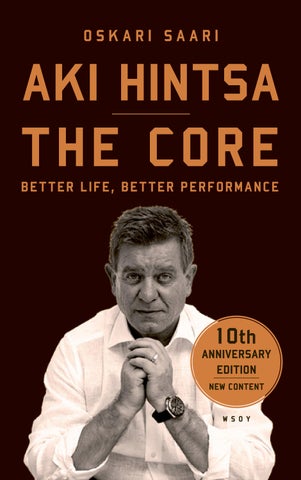
Saari, Oskari: The Core. Better Life - Better Performance (WSOY)

Page 1


OSKARI SAARI

THE CORE

BETTER LIFE, BETTER PERFORMANCE

werner söderström osakeyhtiö – helsinki

THE ORIGINAL EDITION OF THE BOOK WAS PUBLISHED IN 2015.

TRANSLATED FROM FINNISH BY DOUGLAS ROBINSON AND KRISTIAN LONDON.

1ST EDITION © OSKARI SAARI AND WSOY 2026 WERNER SÖDERSTRÖM LTD.

LÖNNROTINKATU 18 A, 00120 HELSINKI, FINLAND PRINTED IN THE EU

ISBN 978-951-0-53008-5

FOR PRODUCT SAFETY INQUIRIES, PLEASE CONTACT: TUOTEVASTUU@WSOY.FI

PREFACE 7

FOREWORD 9

DOWN FOR THE COUNT 15

AKI 23

INSIGHT 45

HAILE 55

THE CIRCLE OF SUCCESS 73

MIKA – PART 1 77 THE CORE 87

GENERAL HEALTH 107

SLEEP AND RECOVERY 118 TIME DIFFERENCES AND SHIFT WORK 132

NUTRITION 143

BORDERLINE RISKS 161

PHYSICAL ACTIVITY 174

HOW MUCH YOU SWEAT 185

BIOMECHANICS 201

MENTAL ENERGY 212

MIKA – PART 2 228

KIMI 235

DESTRUCTION AND A NEW BEGINNING 253

SEBASTIAN 262

TOMMI 294

ADRIAN 305

CHRIS 315

ERIC 325

MARKO 334

SANNI 341

THE CHOICE 357

LUKE 366

EPILOGUE 379

PREFACE

Before the final Grand Prix of the 2013 Formula One season, when I suggested to Dr. Aki Hintsa that I write a book about him, I had no idea what I was getting myself into. In the first place, I wasn’t sure what kind of book would result. But one thing is certain: I had no idea of the popularity the book would achieve. The thought never occurred to me that it might eventually be one of the best-selling Finnish titles in history and that an anniversary edition would be published ten years after its initial release.

It’s not too far-fetched to assume that by the launch of this anniversary edition, some readers will be familiar with the topic: the model of wellbeing developed by the physician Aki Hintsa and its practical application. So why the need for this anniversary edition?

While Dr. Hintsa’s story and the key tenets of his model haven’t changed over the past decade and science has continued to advance, new research has been conducted, and more information is available. In this anniversary edition, the scientific sections of the book have been updated to reflect developments relevant to the Hintsa model and new perspectives have been introduced. Completely new are the stories of Finnish singer and songwriter Sanni and Dr. Hintsa’s successor in F1, Dr. Luke

Bennett, as well as the foreword by Formula One champion Mika Häkkinen. Thank you, Sanni, Luke, and Mika!

The book is roughly divided into three parts. Hintsa’s account of his years in Ethiopia details the history of how he arrived at his insights regarding wellbeing. The middle section describes the model of wellbeing and performance he developed based on those insights, and the final section presents stories demonstrating how this model has been applied in practice. The book serves as an introduction of sorts to Hintsa’s thinking: a textbook for Wellbeing and Performance 101.

The literal translation of the book’s Finnish title is ‘the anatomy of winning.’ But there’s some complexity to the definition of winning presented here. Hintsa witnessed the most obvious instances of winning in his athlete clients’ success, but his philosophy has helped countless others achieve wins much more important than an F1 championship: a better life, experiencing greater wellbeing today than yesterday.

It’s sad that Aki didn’t get to enjoy the better life he he dreamt of for so long. Once he finally withdrew from the F1 circus, he was diagnosed with late-stage pancreatic cancer. Cancer claimed the victory in November 2016, a year after this book’s original publication. This book honours and carries on Dr. Hintsa’s mission, and I dedicate this updated edition to the memory of my friend Aki and his life’s work.

So many people over the years have contributed to this book and its anniversary edition that it would be impossible to thank each individually. And so I offer you all my warm, heartfelt gratitude. Without your help, the book would have never come to fruition.

Enjoy the read.

Espoo, May 31, 2025

FOREWORD

When I first met Dr. Aki Hintsa, I had a lot of experience with motorsports. I’d been racing since the age of sixteen, and I knew I had a gift for it. I loved the sport, and thanks to my parents, I’d been allowed since boyhood to focus on what I wanted: studying and learning anything and everything that would make me a better competitive driver and how to further develop my talents. There were a lot of things I already knew, both inside the car and out. But at some point I understood that as the years pass, it’s important to develop and grow as an individual too: I realised development has to happen off the track as well. I also realised there were many factors that, at first glance, had nothing to do with driving but it was still necessary to be a professional at—the best.

A driver’s world is a self-centred one. Everything revolves around you; top performance demands it. Success on the track requires an incredible amount of care and attention and a big team of professionals who provide all the support they can. I was surrounded by an unbelievable amount of competence, specialists at the top of their field. There were talented car designers, team principals, mechanics, marketing experts, and executives. I knew a lot of doctors and trainers who had helped me improve, and I’d met loads of people from whom I’d learned

incredible things. And yet I was still nagged by the sense that something was missing. I couldn’t even say what that missing piece was or what part of the puzzle it belonged to. But deep down I felt like I couldn’t focus fully; I was unable to be completely present or access all of my potential.

I tell the story of my relationship with Aki in greater detail later in this book, but when I met Aki for the first time around 1997, I could instantly tell: this guy is solid! Whenever there was a problem, Aki had a solution. He didn’t claim to have all the answers, but he always found the best expert within his network and told me: Go talk to so-and-so and they’ll give you what you need. And that’s what always happened. This was unbelievably significant for me.

It didn’t take me long to realise Aki was the missing piece that could complement my team. Whether the issue was mental, physical, or medical, I always received the help I needed through Aki, which meant I could relax. I knew I didn’t have to worry about anything but driving, and that helped me be fully present.

When we met, Aki was still a complete amateur when it came to motorsports. It was in his interests as well to try and understand what sort of creature a Formula One driver was, what went through his head and what his needs were. Aki made a move similar to Ron Dennis back in the day. When I joined McLaren in 1993, Ron invited me to his house in Mougins, near Cannes. I lived in Monaco, a forty-five-minute drive away. I wasn’t really sure why I had to drive all the way out to Ron’s house to meet him; I would have preferred to train and do my own thing in Monaco. But when the boss calls, you go. When I got to Ron’s, he and I played golf and I listened to his stories. It was only years later that I truly grasped how important that visit was. Ron understood that when investing

substantial sums in a Finnish driver who didn’t talk much and wasn’t known for being expressive, it was important to get a sense of what was going on inside his head, what his individual needs and requirements were. That facilitated the creation of the best possible environment to support my winning. For Ron, us spending time together was managing his investment.

Aki viewed things the same way. He wanted to spend time with me to understand me as a person. He didn’t want us to have a client–provider or patient–doctor relationship; he wanted us to have a human relationship. And that’s what we formed. That allowed Aki to build the first version of his concept around me: This is what a Formula One driver needs.

Aki quickly spotted my strengths and weaknesses, but he didn’t really talk to me about them. He built a team to counter my weaknesses and further develop my strengths.

Over the years, our relationship deepened into a friendship. As time passed, Aki came to understand me even better, and of course not everything he discovered was pleasant. When growth is the goal, it’s surprising how much laziness one suddenly finds within. I didn’t have the necessary self-discipline, although of course I thought I had it in spades.

In my experience, there’s one problem that frequently emerges in the development of a successful person: talent. When an individual has a gift, it’s not uncommon to ease up on the self-discipline, because they’ve gotten used to getting by with less effort. This was one of the phenomena Aki and I devoted a lot of work to.

Aki had a great sense of humour, which I think is important in sports and life in general. Athletics involves so much losing that if you don’t have a sense of humour, it’s really hard to get by. It never occurs to most people that even the most successful careers involve more losing than winning. I’ve found

humour to be critical when dealing with and overcoming difficult moments, and my sense of humour and Aki’s were pretty well aligned. But when we spoke seriously, all laughter went out the window: we would look each other in the eye and call things as we saw them. And Aki was immune to bullshit. He always knew exactly what was going on. If I tried to feed him a line that wasn’t exactly true about, say, practice, he wouldn’t say anything; he’d just look at me, and the truth came out every time. He’d look me dead in the eye, and I’d instantly know: I just got caught, damn it! There’s no point trying to talk my way out of this. The upshot was, being honest with Aki was always incredibly easy. He didn’t judge. Issues were taken at face value. This was critical.

I’ve always been a pretty sensitive person, and I believe solutions arrived at in harmony and cooperation generally generate the best outcome. That was why working with Aki was so great. It was by and large thanks to him that I came to understand there was no conflict between my sensitivity and my competitive nature. When I put on my helmet and drove onto the track, my elbows were out and they were sharp and aggressive. There was no giving in. I had to be tough. But that was on the track, a unique circumstance. Off the track, I could be an ordinary person.

Aki was skilled at working with a sensitive but stubborn man like me. I clearly had weaknesses, but I didn’t like admitting them. Information and specific performance and wellbeing expertise were more limited back then and not as easy to access as they are today, and although Aki wasn’t a coach, psychologist, or physical trainer per se, he built up a team of experts I could rely on.

In terms of coaching, I was fortunate to work with Hintsa Performance’s (Aki’s company) coach Mark Arnall, who

collaborated well with Aki. Mark knew how to pull the right strings. He was incredibly diplomatic and always approached the correcting of my weaknesses from a positive place. He never said: ‘Mika, you’re terribly weak at such-and-such.’ He presented things in such a way that showed me how practice would make me a better driver. The focus was always on the long run. A weakness in musculature, for instance, can take years to rectify. Nothing sustainable is going to happen in a week or a month. Simply understanding this fact took some time. And practice wasn’t always fun; it was damn hard. One thing that made it more challenging was that at the time I was actively racing, the driver’s wellbeing wasn’t a priority in car design. The cars were cramped. They were built to the designer’s specifications, and the design process didn’t necessarily consider what a driver needed to do his work and perform to the best of his abilities. This alone caused drivers a lot of physical symptoms and problems. These days the interiors of the cars are so spacious it’s not much of an exaggeration to say almost two drivers would fit in the cockpit.

Alongside the laziness that comes with being gifted, another challenge in the development process is winning. In a way, losing is beneficial, because it offers an easy opportunity to learn from your mistakes. When you win, that process demands a lot more of you. Why go through the trouble of getting better if what you’re doing is good enough? I’ve later come to see this as a major challenge for a lot of successful businesses: how can a company maintain its drive and quality when it’s successful, when there’s the temptation to settle for less? It’s been a privilege watching from the sidelines, seeing how Hintsa Performance can help such companies. Aki’s legacy lives on, and I feel some pride that my efforts allowed me to play a part in the formation of Aki’s method and philosophy.

My daughter Ella and son Daniel race these days too, and it’s been fascinating to see how Hintsa Performance teaches young drivers to find mental and emotional balance and understand what winning requires in terms of physical condition, diet, and sleep. It’s long-term work. My children are learning exactly the same things Aki and I went over, with the caveat that information and competence have been taken to a completely new level—thanks to science and Aki Hintsa.

Aki’s legacy lives on in Hintsa Performance and the work it does, not to mention this book, but it’s my experience that it first and foremost lives on in the lives of those people touched by Aki. During my racing career, I didn’t understand how much the work I did with him would benefit me after that career came to an end. I didn’t just develop as an athlete or driver; I developed as an individual. I came to realise how important it is that my life follow a rhythm and involve goals. Life needs to feel meaningful, and a certain aspiration is useful, at least for me. It would be easy to float around in an endless day off, but I’m sure doing so wouldn’t be good for me. I received this and a thousand other gifts from my collaboration with Aki—and above all from our friendship.

A long time has passed since Aki’s death, but I still miss him. I miss Aki for the person he was and for the commitment with which he invested his time and know-how into helping others. I will never forget it. Thank you, Aki, for everything!

Monaco, April 2025

DOWN FOR THE COUNT

Aki Hintsa wasn’t sure which angered him more: the attempt to interfere with his work as a medical professional, or the fact that Martin Whitmarsh couldn’t just say what he wanted to say.

It was September 21, 2013. As usual, temperatures were high in Singapore: just under thirty degrees Celsius. The sun had set three hours before, one minute after the third free-practice period had ended. A slight breeze made the humidity bearable. But Hintsa was steaming, choking on his rage, and his head was humming.

Earlier that day, Lotus driver and fellow Finn Kimi Räikkönen had punched his car against the curb violently enough to knock the wind out of him. Formula One cars ride so low that the driver’s buttocks are only about five centimetres above the asphalt, so the situation wasn’t in any way unusual. Drivers are constantly getting jolted, and at first Räikkönen thought nothing of it.

But after the practice period, Räikkönen’s pain had become crippling—so bad he couldn’t breathe properly. The team doctors had already examined him. They hadn’t dared recommend treatment and instead told him he probably had no business participating in the qualifying laps that were slated to start two hours later.

Finally a call was put out to Aki Hintsa, whom Räikkönen had known for ten years. Asking a McLaren doctor to treat a Lotus driver was a last resort. In the extremely competitive world of F1 motorsports, asking for help from a member of a rival team generally isn’t done. Like his fellow physicians, Hintsa noted the seriousness of Räikkönen’s condition.

‘I’ve got to numb it,’ Hintsa told him, ‘but it’s a tricky spot. I can’t promise it’ll help.’

Räikkönen knew that if Hintsa didn’t anaesthetise his back, his weekend would be over. The pain was insane. He consented to the treatment.

‘Do whatever it takes.’

Hintsa anaesthetised Räikkönen’s back and gave him painkillers. There was nothing else he could do.

When the qualifying laps started, Hintsa was in his usual place in the McLaren garage, and he watched in satisfaction as the black Lotus #7 curved out onto the track. Räikkönen placed fairly low, thirteenth, but at least he would be able to race.

After the qualifying laps, Hintsa checked his phone and could tell something was wrong. Someone had been trying to reach him. McLaren’s technical director, Sam Michael, grabbed Hintsa by the sleeve.

‘Aki, did you medicate Kimi today?’

‘Yes, he was—’

‘Did you do anything else?’

‘I numbed his back.’

‘Martin’s pissed. He’s unhappy you helped Kimi.’

Hintsa’s tachometer popped into the red. ‘Drop it, Sam. If Martin’s got something to say to me, I’ll talk to him directly.’ Before he even finished his sentence, Hintsa was on his way out of the garage.

He found McLaren’s team principal, Martin Whitmarsh, in the engineers’ room.

‘Martin, do you have a minute?’

‘Not now, I’m in a meeting.’

‘OK, let’s talk right here then!’

Twenty McLaren engineers stared at Hintsa in shock. Whitmarsh stood and led Hintsa into the next room. Whitmarsh wasn’t known for being the quiet type, but in this meeting he could barely get a word in edgewise.

Hintsa had a bone to pick with him: ‘Martin, you can’t tell me who and who not to treat! I’m a doctor. How am I supposed to refuse to help someone in tremendous pain? Tell me, Martin!’

‘Kimi drives for our competitors!’

‘If that’s a problem for you, you’d better fire me this instant, because I’d damn well do the same thing again. I’m a doctor, and it’s my job to help people. It makes no difference what colour shirt they’re wearing!’

Before Whitmarsh could reply, Hintsa continued: ‘If you and I were in different camps, or even enemies, and a situation like this came up, I’d treat you too.’

Whitmarsh, one of the most popular men in the McLaren pit, didn’t know what to say. He’d never seen Hintsa so resolute. The two men didn’t always see eye to eye, but they were friends and respected each other. Whitmarsh valued Hintsa’s directness when they disagreed, and Hintsa saw Whitmarsh as one of the few people who could take things straight.

Whitmarsh put his hand on his team doctor’s shoulder, looked him in the eye, and nodded. No words were needed. Their harmony and friendship survived, even though the next day, Räikkönen, treated with Hintsa’s anaesthesia, drove from thirteenth on the grid to place third, four slots ahead of McLaren’s Jenson Button and five ahead of McLaren’s Sergio

Pérez. But the confrontation sealed Hintsa’s decision to leave the F1 paddock. His work as a travelling physician with the team would last only another two months—two Grands Prix longer than Kimi Räikkönen’s season with Lotus, which was cut short by back surgery. But no one knew anything about that then. Nor did anyone know Martin Whitmarsh would only be team principal at McLaren for another six Grands Prix.

In retrospect, Hintsa wondered whether Whitmarsh had been reading the writing on the wall. He’d often thought his future as team principal was unsure.

By the Singapore race, it was clear the prestigious British McLaren team was on its way to its first season since 1980 without a single placement in the top three. McLaren’s CEO, Ron Dennis, wasn’t satisfied with McLaren Racing. Dennis had led the racing team for twenty-eight years himself, till 2009, when he had advanced from the McLaren Mercedes team principal position to become CEO of the McLaren Group. Dennis had turned McLaren into a decades-long F1 success story. For all intents and purposes, the team was Ron Dennis. His pulling out of day-today management duties had changed nothing. The success of McLaren was in his blood, and its years of defeat had been hard to swallow. In Dennis’s view, Whitmarsh had made bad decisions.

For example, after the 2008 season, Whitmarsh had come under tremendous pressure when he demanded Heikki Kovalainen’s contract be renewed after an underwhelming first year. He got his way, but the Finnish driver’s second season on the team was miserable. This would have been less of an issue had the team been otherwise successful under Whitmarsh’s watch, but despite its prestigious past and massive resources, McLaren had underperformed.

During Ron Dennis’s twenty-eight years as team principal, McLaren had brought home twelve World Drivers’

Championships and eight World Constructors’ Championships. Of the 461 Grands Prix in that period, McLaren had won 138. During Whitmarsh’s fairly short period as team principal, McLaren hadn’t won a single world championship for either drivers or constructors. The 2010 season was the only one in which a McLaren driver had entered the final Grand Prix with any possibility of winning the championship. McLaren’s win rate under Whitmarsh was 21 percent; under Dennis, it had been 30 percent.

Now Whitmarsh found himself in a situation where the young driver he’d chosen, Sergio Pérez, was getting the boot, and a contract was being offered to Ron Dennis’s choice, the promising young Danish driver Kevin Magnussen. The media were talking about a crisis of confidence, claiming Whitmarsh was down for the count—a count that in point of fact had started some time before. Dennis had decided to take up the reins himself again, and his first order of business was to switch out one of the team’s two drivers.

Arguing with Ron Dennis’s skill and know-how in Formula One was tough. He’d decided the team had a better chance with Magnussen than with Pérez, and Hintsa agreed. When asked, Hintsa had willingly shared his views—after all, a significant part of his job was assessing the drivers’ physical and psychological readiness and motivation. Hintsa thought McLaren had two drivers who might race toward a world championship but ultimately weren’t on the team to win one. Both were excellent drivers, but there were many other equally gifted athletes in the sport who had a greater hunger to win. Hintsa had known Magnussen for three years. Back in 2010, Whitmarsh had promised the Danish driver a test day with McLaren—Hintsa assumed this was a favour to Kevin’s father, the team’s former driver Jan Magnussen. Hintsa didn’t think Whitmarsh actually wanted Magnussen on

the team, though he politely supported the young driver in his career and even tried to help him find a place on one of the other teams. His caution was understandable. The young driver had enjoyed only modest success in the lower classes.

Part of Hintsa’s job was evaluating the chances a potential McLaren driver had of winning in Formula One. Hintsa didn’t know outbraking from oversteering, but he’d sensed in Magnussen an unusual degree of determination and commitment. Hintsa found the young Dane surprisingly ready to race and an unusually mature athlete. Magnussen’s attitude struck Hintsa as extraordinary too. For most young drivers, simply walking into McLaren’s headquarters outside London was enough to turn their knees to jelly. The McLaren Technology Centre is more reminiscent of the Pentagon or a space station than of a racing team’s HQ. The futuristic architecture set in fifty hectares surrounded by five artificial lakes contains the manufacturing sites for McLaren’s street and racing vehicles, the workstations of thousands of employees, a 150-metre wind tunnel, and an F1 simulator. Most first-time visitors to Woking find their words sticking in their throats.

But the young Danish driver who walked into Hintsa’s office was unfazed. He didn’t even smile. He was nervous, but not because of the scale of the operation. Hintsa pressed Magnussen: Was he absolutely sure F1 was the right place for him? And McLaren? Based on what? His results in the lower Formula series hadn’t been particularly impressive.

Hintsa liked the young man’s attitude and determination. Magnussen first offered a clear analysis of his lack of success to date and categorically insisted it was his life goal to win a Formula One World Championship for McLaren.

‘If I’m not good enough to do that, I don’t deserve to race in Formula One,’ Magnussen said.

Hintsa recommended that Magnussen be accepted into McLaren’s junior program, and the team started working with him. Simon Reynolds, the program’s performance coach, kept Hintsa in the loop as to Magnussen’s development. Changes were made to Magnussen’s nutrition, biomechanics, and physical training.

During three years of collaboration, Magnussen rapidly rose to F1 standards physically and psychologically. Hintsa eventually declared him as prepared for the demands of Formula One as a novice could be. When Magnussen won the Formula Renault series championship, it was easy for Hintsa to recommend him to Dennis. Magnussen was given a contract, and Pérez was shown the door.

Like Pérez, Magnussen found himself in the toughest possible spot as a newcomer. The car wasn’t great, and after a brilliant opening Grand Prix, Magnussen—along with the rest of the team—were left licking their chops. When Fernando Alonso joined McLaren, Magnussen was bumped to test driver. He hoped to return to his racing driver spot in 2016, but that never happened at McLaren. Magnussen first switched to Renault and in 2017 to Haas, where his Formula One career ended after the 2024 season. The second place he brought home from his first race proved to be his highest placement of 186 Grands Prix.

Kevin Magnussen never became a world champion, but Dennis had been impressed by Hintsa’s ability to spot an athlete’s psychological potential: the previous driver Hintsa had championed was Lewis Hamilton. In his day, Hamilton exuded that same determination Magnussen had, the desire to succeed against all odds. Hintsa had known Hamilton was ready for Formula One ever since his 2006 GP2 season, which had ended in Hamilton winning the championship.

Heikki Kovalainen—who’d lost the championship to Nico Rosberg the year before, in the last Grand Prix of the same GP2 series—had debuted as an F1 driver at the same time as Hamilton. Kovalainen wasn’t Hintsa’s client, but the two men knew each other. Kovalainen was an extremely gifted driver, and it was easy to predict a successful career for him—but according to Hintsa, Hamilton was ready, and Kovalainen was not.

"SUCCESS IS A BY-PRODUCT OF WELLBEING."

THintsa revealed this view to me in a private conversation just before Hamilton’s and Kovalainen’s first F1 Grand Prix in Melbourne in 2007. Hintsa thought Kovalainen’s body language and wandering gaze revealed uncertainty. He didn’t think Kovalainen was mentally ready to take Fernando Alonso’s place at Renault. Hintsa was alone in this view at that Grand Prix, but he was right. Over the course of his career, Kovalainen competed in 111 Grands Prix and won one. Meanwhile, as of 2025, Lewis Hamilton had won seven World Championships and over 100 Grands Prix. Many viewed him as the best F1 driver of all time.

he Core is a unique story from the top of the Formula 1 world, where Aki Hintsa—a Finnish doctor and F1 coach—spent years guiding drivers not only toward success, but above all toward mental and physical wellbeing. Later, executives and companies all over the world adopted Hintsa's model of holistic wellbeing, and now these groundbreaking methods are available to all of us. In this anniversary edition, Dr. Hintsa’s practical guidelines for better performance and comprehensive wellbeing have been updated to reflect the most recent research.

Hintsa was among the first people Hamilton called after winning his second championship in Abu Dhabi in 2014. The main message of his emotional phone call was clear: without Hintsa’s help, he never would have been a double champion.

Hamilton was Dennis’s choice too, but Dennis set considerable stock in Hintsa’s recommendation. There was a deep trust between the two men. It went back twelve years, to Kimi Räikkönen’s first season with McLaren.

DR. AKI HINTSA (1958−2016) was a specialist in Orthopaedic and Trauma Surgery, who worked for eleven years as a coach and chief medical officer at the Formula 1 paddocks. His philosophy is based on the idea of preventive measures, in other words, preventing ailments before they even occur.

OSKARI SAARI (born 1975) is a Finnish bestselling non-fiction author.

Turn static files into dynamic content formats.

Create a flipbook
Saari, Oskari: The Core. Better Life - Better Performance (WSOY) by Kirja.fi - Issuu