Welcome to the Kingswood College VCE Subject Handbook.
The Victorian Certificate of Education (VCE) is a significant milestone in the educational journey of our Senior School students. This VCE Subject Handbook is an essential resource for students and families as it outlines all the VCE and VET subjects offered at Kingswood College
The VCE Subject Handbook is designed to help students make informed decisions about their VCE journey. Use this Handbook to:
Plan your VCE subjects - Consider your interests, strengths and career goals when selecting subjects
Understand Assessment - Understand the weight of School Assessed
Coursework (SACs) and exams in your final score
Explore Pathways - Look into prerequisites for University courses, or other further education pathways.
The VCE is not just about academic achievement; it’s also a time to develop important life skills such as critical thinking, problem-solving, and resilience. These skills will serve you well beyond your school years, whether you choose to pursue higher education, vocational training, or enter the workforce
Take full advantage of the opportunities presented to you, and strive for excellence in all that you do Remember, you are not alone on this journey. Your teachers, family and peers are here to support you every step of the way. Together, we can ensure that your VCE experience is rewarding.
I am confident by living our values of courage and perserverance, you will achieve great success.
Georgie Jones Head of Secondary School
KINGSWOOD COLLEGE VCE SUBJECTS
Unit’s 1 & 2 Units 3 & 4
Art Creative Practice
Biology
Business Management
Chemistry
Ecomomics
English
English as anAdditional Language (EAL)
General Mathematics
Health & Human Development
History: History Revolutions
History: Modern History
Languages: Chinese First Language
Languages: Chinese Second Language
Languages: Chinese Second Language (Advanced)
Languages: French
Legal Studies
KINGSWOOD COLLEGE VCE SUBJECTS
Literature
Mathematical Methods
Music
Music Repertoire Performance
Physical Education
Physics
Politics
Product Design &Technologies
Psychology
Specialist Mathematics
Theatre Studies
Visual Communication Design
VETCookery
VETCreative & Digital Marketing
ART:ARTCREATIVEPRACTICE
VCE Art Creative Practice introduces the role of art in contemporary and historical cultures and societies, and values the meaningful and unique impact of artists on the development of arts knowledge, tradition and experiences, both locally and globally.
Students build an understanding of how artists, through their practice and the artworks they create, communicate personal experiences and ideas, and cultural values, beliefs and viewpoints. In this study, students view artworks and investigate the working practices of artists from different cultures and periods of time Students are challenged to articulate their understanding of the meanings and messages contained within artworks and to examine the effects of artworks upon the viewers or audiences who experience them Students learn to pose and solve problems, and work independently and collaboratively, to create and convey meaning through art making.
Throughout the study students have opportunities to construct knowledge and communicate personal interpretations by working as both artist and viewer or audience. In making artworks, students use their creativity to solve problems and experiment with visual language and expression. They create personal responses and meaning by applying diverse materials, techniques and art processes. Students develop skills in research, art history and critical
theory to analyse, interpret and debate the ideas and issues that are raised by artworks and by artists in their practice.
VCE Art Creative Practice uses inquiry through art practice to develop students’ critical and creative thinking skills and individual responses through researching, exploring, experimenting, developing, reflecting, refining and resolving Through Making and Responding, and through the presentation of artworks in different contexts, students understand and appreciate the role of visual art in past and present traditions, societies and cultures.
By building skills in visual literacy and creative and critical thinking, which are essential to both artist and viewer or audience, learning in VCE Art Creative Practice empowers young people to be discerning, and to engage with and make sense of what they see and experience Students are equipped with practical and theoretical skills that enable them to follow pathways into tertiary art education, further training in art related careers, as well as roles that require highly developed critical and conceptual engagement with ideas and issues VCE Art Creative Practice also offers students opportunities for personal development and encourages them to make an ongoing contribution to the culture of their community through participation in lifelong artmaking practices.
Unit Structure
Unit 1: Interpreting artworks and exploring the Creative Practice
Unit 2: Interpreting artworks and developing the Creative Practice
Unit 3: Investigation, ideas, artworks and the Creative Practice
Unit 4: Interpreting, resolving and presenting artworks and the Creative Practice
Practical
The nature of practical work undertaken in this course revolves around The Creative Practice, with students investigating artists and their art practices, collecting research and exploring ideas, all of which is documented in a visual diary Students use this investigative process to respond to, resolving personal ideas to make final artworks from a range of art making media; painting, drawing, photography, sculpture and more.
Theory
Across the four units’ students examine artists, artworks, styles and themes, along with the role art plays in society and the participation of their audience. Through research and analysis tasks students build their art analysis, terminology and writing capabilities with typical theory activities such as group discussion, individual presentations, visual analysis, artist reports and comparative essays.
ART:THEATRESTUDIES
Theatre as a form of cultural expression has been made and performed for audiences from the earliest times and is an integral part of all cultures.
Theatre is ever evolving and exists as entertainment, education, ritual, an agent for change, a representation of values and a window on society. Theatre practice has developed and has influenced cultures over many centuries through a wide variety of productions in diverse spaces and venues for a range of audiences. Theatre makers work as playwrights, actors, directors and designers, producing theatre for diverse purposes.
Through the study of VCE Theatre Studies students develop, refine and enhance their analytical, evaluative and critical thinking skills as well as their expression, problem-solving, collaborative and communication skills They work both individually and in collaboration with others to interpret scripts Through study and practice, students develop their aesthetic sensibility, including an appreciation for the art form of theatre, interpretive skills, interpersonal skills and theatre production skills.
The study of theatre, in all its various forms, prepares students for further study in theatre production, theatre history, communication, writing, acting, direction and design at tertiary level. VCE Theatre Studies also prepares students for further
learning in vocational educational training settings or for industry or community-related pathways.
Unit Structure
Unit 1: History of theatre styles and conventions (pre 1945)
Unit 2: Contemporary theatre styles and movements
Unit 3: Producing theatre
Unit 4: Presenting an interpretation
Practical
The nature of practical work undertaken in this course revolves around either acting & directing or designing for a theatre production. Students choose two areas of the production to focus on (sets, costumes, props, sound, lighting, acting, directing, hair and make-up) and work together to achieve an artistic vision For actors, they develop confidence in their acting skills through participating in class assessment and the VCE Theatre Studies Production. For Designers, they utilise technologies and resources to implement designs suitable for theatre and stage.
Theory
Students analyse and evaluate professional theatre works Through research and analysis tasks, students build their writing capabilities and use of theatrical terminology with typical theory activities such as group discussion, activities, and extended response questions.
Assessment
In addition to school-based assessments, the level of achievement for Units 3 & 4 is also assessed by a monologue examination and an end-of-year written examination. The monologue examination will contribute 25 per cent to the study score. The written examination will contribute 30 per cent to the study score.
ART:VISUALCOMMUNICATIONDESIGN
Visual Communication Design is distinct in its study of visual language and the role it plays in communicating ideas, solving problems and influencing behaviours. Students learn how to manipulate type and imagery when designing for specific contexts, purposes and audiences.
In doing so, students learn how aesthetic considerations contribute to the effective communication and resolution of design ideas, and how an understanding of visual language, its role and potential is the foundation of effective design practice.
Students explore how designers visually communicate concepts when designing Messages, Objects, Environments and Interactive Experiences. They work both together and independently to find and address design problems, making improvements to services, systems, spaces and places experienced by stakeholders, both in person and online Students employ a design process together with convergent and divergent thinking strategies to discover, define, develop and deliver design solutions Drawings are used to visually represent relationships, ideas and appearances, while models and prototypes are produced for the purposes of testing and presentation Students participate in critiques, both delivering and receiving constructive feedback and expanding their design terminology
During this study, students consider various factors that impact design decisions, including conceptions of good design, aesthetic impact, and economic, technological, environmental, cultural and social influences. Students also consider how best to accommodate the varied needs of people and our planet, both now and in the future, using human centred design principles, together with ethical, legal, sustainable and culturally appropriate design practices. Students learn about the relationships between design, place and time, acknowledging Aboriginal and Torres Strait Islander design knowledges, histories, traditions and practices.
Through exposure to the cultures and traditions of design practice, students learn how designers visually communicate ideas and information when designing for people, communities and societies They develop the knowledge, skills and dispositions required of a multidisciplinary designer who is a reflective, responsible and empathetic practitioner equipped with agency and initiative.
Unit Structure
Unit 1: Finding, reframing and resolving design problems
Unit 2: Design contexts and connections
Unit 3: Visual communication in design practice
Unit 4: Delivering design solutions
Practical
The nature of practical work undertaken in this course revolves Human Centred Design problems whilst working through the Double Diamond Design Model. Students investigate and create visualisations for initially set clients and then as students move through the course, client and design problems become individual and personalised. Throughout the design process an understanding and application of design thinking strategies are learnt and employed, as well as consideration of target audience and stakeholders Students employ manual and digital design methods, making prototypes that solve complex design problems
Theory
Across the four units’ students examine design movements, legal and ethical considerations, real life design solutions and the progression of design as it strives to be sustainable and circular as a process. Through research and analysis tasks students build their design analysis skills, terminology, and their understanding application of design methods, media and materials. Across the four fields of design practice there is a strong focus on legal and ethical factors, and adhering to safety in the industry standards.
If you love the media and multimedia sectors this course is for you. If successfully completed over Year 11 and 12, you will receive a Certificate III in Screen and Media at the conclusion of the course. This is in addition to your VCE Units 1 through 4.
The program encourages students to develop skills in animation, web development, writing for various media, drawing, basic sound editing, and digital imaging. It provides opportunity for diverse post-school pathways in visual arts, web design or film and television. Accordingly, learning is vibrant, creative and contemporary, as it prepares students for a digital workforce
Through a mix of theory and practical coursework, learn to:
Operate current industry software such as Adobe Photoshop, Illustrator and Animate
Employ filming and editing techniques
Design and create interactive web content
Create animations
Think critically and creatively.
Develop the attributes to help you get ahead:
Effective workplace communication skills
Critical thinking and problem solving skills
The ability to collaborate with a team.
Completing this course provides you with a Creative and Digital Media score contributing to your ATAR as well as a standalone National Recognised Certificate III.
Practical
Capturing photographs and manipulating them in Adobe Photoshop to communicate ideas
Creating illustrations to suit a variety of purposes Writing content for different audiences
Working in a film crew to produce a short film about a workplace or social issue
Using cutting edge technology including 360 Cameras, VR headsets, and drones
Writing and producing short animations
Pitching ideas to stakeholders Building and maintaining websites according to different design briefs
Writing for social media and radio
Building awareness of Occupational Health and Safety concerns in office and media studio environments.
Assessment
Assessment is based on successful completion of each of the required tasks. Tasks are marked:
Satisfactory (S)
Not Yet Satisfactory (NYS) or Not Submitted (NS)
SATs are graded according the VCE scale of VL to VH. All units of competency are Competent or Not Yet Competent. Students are given the opportunity to resubmit work until it is satisfactory.
Exams are undertaken on the computer
ENGLISH:ENGLISH
VCE English focuses on how English language is used to create meaning in print, digital, and audio visual texts of varying complexity. Texts selected for study are drawn from the past and present, from Australia and from other cultures, and comprise many text types, including media texts, for analysis of argument.
The study of English empowers students to read, write, speak and listen in different contexts VCE English prepares students to think and act critically and creatively, and to encounter the beauty and challenge of their contemporary world with compassion and understanding. Students work to collaborate and communicate widely, and to connect with our complex and plural society with confidence.
Unit Structure
Unit 1: Reading and exploring texts: In this area of study, students engage in reading and viewing texts with a focus on personal connections with the story. Students reflect on human experiences, and how stories or aspects of stories resonate with their own memories and lives.
Crafting texts: In this area of study, students engage with and develop an understanding of effective and cohesive writing They apply, extend and challenge their understanding of the diverse ways that vocabulary, text structures, language features and ideas can interweave to craft compelling texts They consider these texts through knowledge of the
ways purpose, context (including mode) and audience influence and shape writing.
Unit 2: Reading and exploring texts: In this area of study, students develop their reading and viewing skills, including deepening their capacity for inferential reading and viewing, to further open possible meanings in a text, and to extend their writing in response to text.
Exploring argument: In this area of study, students consider the way arguments are developed and delivered in many forms of media. Students explore the structure of texts, including contention, sequence of arguments, use of supporting evidence and persuasive strategies They closely examine the language and the visuals employed by authors and offer analysis of the intended effect on the audience. Students apply their knowledge of argument to create a point of view text for oral presentation.
Unit 3: Reading and responding to texts: In this area of study, students apply reading and viewing strategies to critically engage with a text, considering its dynamics and complexities and reflecting on the motivations of its characters They analyse the ways authors construct meaning through vocabulary, text structures, language features and conventions, and the presentation of ideas. They explore the historical context, and the social and cultural values of a text.
Creating texts: In this area of study, students build on the knowledge and skills developed through Unit 1 They read and engage imaginatively and critically with mentor texts, and effective and cohesive writing within identified contexts. Through close reading, students expand their understanding of the diverse ways that vocabulary, text structures, language features, conventions and ideas can interweave to create compelling texts.
Unit 4: Reading and responding to texts: In this area of study, students further sharpen their skills of reading and viewing texts, developed in the corresponding area of study in Unit 3. Students consolidate their capacity to critically analyse texts and deepen their understanding of the ideas and values a text can convey
Analysing argument: In this area of study, students analyse the use of argument and language, and visuals in texts that debate a contemporary and significant national or international issue Students read, view and/or listen to a variety of texts from the media, including print and digital, and audio and audio visual, and develop their understanding of the ways in which arguments and language complement one another to position an intended audience in relation to a selected issue.
Assessment
The level of achievement for Units 3 & 4 will be determined by:
Unit 3 SAC: 25%
Unit 4 SAC: 25%
End-of-year examination: 50%
ENGLISH:LITERATURE
VCE Literature focuses on the meanings derived from texts, the relationships between texts, the contexts in which texts are produced, and how readers experience texts.
In VCE Literature students develop and refine four key abilities through their engagement with texts
An ability to offer an interpretation of a whole text (or a collection of texts) based on analysis of the language in that text
An ability to closely analyse passages or extracts from a text, in consideration of the whole text
An ability to understand and explore multiple interpretations of a text
An ability to respond creatively to a text.
The study of VCE Literature fosters students’ enjoyment and appreciation of the artistic and aesthetic merits of stories and storytelling and enables students to participate more fully in the cultural conversations that take place around them. By reading and exploring a diverse range of established and emerging literary works, students become increasingly empowered to discuss texts As both readers and writers, students extend their creativity and high-order thinking to express and develop their critical and creative voices
Throughout this study, students deepen their awareness of the
historical, social, and cultural influences that shape texts and their understanding of themselves as readers. Students expand their frameworks for exploring literature by considering literary forms and features, engaging with language, and refining their insight into authorial choices Students immerse themselves in challenging fiction and non-fiction texts, discovering and experimenting with a variety of interpretations in order to develop their own responses.
Unit Structure
Unit 1: Reading practices: In this area of study students consider how Unit 1: Reading practices: In this area of study students consider how language, structure and stylistic choices are used in different literary forms and types of text
Exploration of literary movements and genres: In this area of study students explore the concerns, ideas, style and conventions common to a distinctive type of literature seen in literary movements or genres.
Unit 2: Voices of Country: In this area of study students explore the voices, perspectives and knowledge of Aboriginal and Torres Strait Islander authors and creators They consider the interconnectedness of place, culture and identity through the experiences, texts and voices.
The text in its context: In this area of study students focus on the text and its historical, social and cultural context. Students reflect on
Representations of a specific time period and/or culture within a text
Unit 3: Adaptations and transformations: In this area of study students focus on how the form of a text contributes to its meaning. Students explore the form of a set text by constructing a close analysis of that text.
Developing interpretations: In this area of study students explore the different ways we can read and understand a text by developing, considering and comparing interpretations of a set text.
Unit 4: Creative responses to texts: In this area of study students focus on the imaginative techniques used for creating and recreating a literary work
Close analysis of texts: In this area of study students focus on a detailed scrutiny of the language, style, concerns and construction of texts
Assessment
Typical assessment includes:
Short answer questions
Essays
Oral Presentations
Creative Writing
Close Analysis
The level of achievement for Units 3 & 4 will be determined by:
Unit 3: 25%
Unit 4: 25%
End-of-year examination: 50%
ENGLISH:ENGLISHASANADDITIONAL LANGUAGE
While VCE EAL closely replicates the mainstream English course (except for one Listening Task), it is assessed differently and is taught with greater support and focus on vocabulary building and writing skills.
Units 1 & 2 Structure
Through the completion of Units 1 & 2 EAL, you will: Read and explore texts, of different types, to make personal connections with, and analytical response to, selected texts and understand the different ways that meaning is constructed, while practising reading, comprehension, text analysis and essay writing Craft texts, to demonstrate your understanding of what makes writing cohesive and effective, when pursuing a specific writing purpose You will be asked to describe the writing decisions you made during the writing process Explore argument, analysing the way multimodal and written texts attempt to position the targeted audiences and delivering a speech of your own, that communicates a point of view on a recent issue, to practise your analytical writing, speaking skills and informed reasoning, and Strategically build vocabulary that will serve you in classrooms and in the completion of your academic work.
These key skills and concepts will help to prepare you for success in Year 12 EAL, while building important communication and language skills for living and working in an English speaking environment
Units 3 & 4 Structure
Across these two Units, students are expected to read widely to support the achievement of their Outcomes. They must study five texts, featuring at least two different text types, selected from the annual VCAA VCE English and EAL Text List.
In Unit 3, you will read and respond to selected texts In classes, you will listen to and discuss the ideas, concerns and values they present, as well as the vocabulary, text structures and language features through which they make meaning You will demonstrate your comprehension of audio-visual texts focused on historical-social values, and practice your reading, comprehension, text analysis and essay writing through this area of study.
In Unit 3, you will also create texts of your own Responding to three mentor texts, aligned to one of the VCAA Framework of Ideas, you will demonstrate the range of writing techniques you have developed, applying the features and style of your mentor texts to create effective writing, designed to respond to a specific context and audience, in pursuit of a specific purpose. You will
also comment on the decisions you made through the writing process
In Unit 4, you will read and respond to another selected text You will again listen to and discuss the ideas, concerns and values it presents, as well as the vocabulary, text structures and language features through which it makes meaning. You will practice your reading, comprehension, text analysis and essay writing through this area of study.
In this Unit, you will also analyse argument, studying the language and reasoning presented in persuasive texts, including one written and one audio or audio-visual text, focused on a recent issue raised in the media. From your research and analytical activities, you will practise analytical essay writing and develop and present an oral point of view text of your own
FOODSTUDIES:VETCOOKERY
SIT20421 Certificate II in Cookery is a nationally recognised qualification, delivered over two years, which can be used to gain employment in hospitality or other related industries.
It is suitable for students who have a passion for food and who are keen to gain the theory and practical skills suitable for a commercial kitchen as a career path or for part time work In Units 1 & 2, nine Units of Competency include two compulsory units for the Certificate and four units that provide the foundation theory and knowledge for the course. The additional three practical units will teach students to extend their practical skills and cook and serve food to customers. Students will be required to attend after school class at least once a week to cook for functions. In Units 3 & 4, students complete four Units of Competency which are largely practical. They are required to plan and cook for 12 functions over the year, with out of school hours included when necessary.
Unit Structure
Units 1 & 2:
Covers foundational skills in food safety and hygiene, safe work practices, cleaning kitchen premises and equipment, and using food preparation equipment
Units 3 & 4:
Focuses on preparing a variety of dishes including appetisers, salads, stocks, sauces, soups, and vegetable based meals, while developing the skills to work efficiently in a commercial kitchen environment.
Assessment
This course is VCE registered. Students have the option of scored or non-scored assessment, both pathways earning a SIT20421 Certificate II in VET Cookery.
Certificate II qualification: All activities and assessments are delivered by Kingswood trainers, supported by our Registered Training Organisation VEGED and their online portal
Scored: Students wishing to use this course towards their ATAR will complete the two years as above. In Year 12 three of their coursework tasks (Units 3 & 4) will be marked to obtain 66% of the overall study score An end-of-year examination set by VCAA worth 34% of the overall study score will also be included
VET Cookery Expectations
Class Timing: Classes are held in blocks of time with students required to remain on campus until 5.00pm one afternoon per week.
Attendance Requirement: A minimum of 90% attendance is mandatory to successfully complete the Certificate This aligns with the standards set by various educational institutions, emphasizing the importance of consistent attendance for course completion
Dress Code: Classes have a specific dresscode which includes Chefs whites, hat, kitchen clogs or leather shoes. The uniform forms part of the fees in Year 11 and is an requirement
across the two year program.
Commitment Form: All students enrolling in the VET Cookery program must complete and submit a commitment form that outlines the expected code of conduct. The completed commitment form will be available towards the end of Term 2 and must be collected and returned to the Senior School Reception by Friday, 1 August
Practical & Theortical Components:
While primarily a practical-based subject, there are also theoretical components that students are expected to complete independently outside of the scheduled class times
Out of Hours Commitments:
Students may be required to participate in events and service periods outside of regular school hours, which are essential and required components of the course Fees and Levies: Students should be aware that there are additional levies associated with the VET Cookery program. These levies cover materials and resources such as a uniform which are essential for the course. For 2027 the VET Cookery fees will be approximately $700 for the academic year.
Withdrawal Policy: Once students commence the VET course, they have until the end of February to withdraw. Withdrawals after this date will incur the full VET fee, and no refunds will be provided This policy is consistent with all VET courses , where withdrawal after a certain period requires full payment of the yearly fees
HEALTH&PHYSICALEDUCATION:HEALTH& HUMANDEVELOPMENT
VCE Health and Human Development takes a broad and multidimensional approach to defining and understanding health.
Students examine health (including the concepts of health and wellbeing, and health status) and human development as dynamic concepts that are subject to a complex interplay of biological, sociocultural and environmental factors, many of which can be acted upon by people, communities and governments. Students consider the interaction between these factors and learn that health and human development is complex and influenced by the settings in which people are born, grow, live, work and age.
Students consider Australian and global contexts as they investigate health outcomes and examine the Australian healthcare system to help evaluate what is being done to address health inequity and inequality They examine and evaluate the work of global health organisations and the Australian Government’s overseas aid program This study presents concepts of health and wellbeing, and human development, from a range of perspectives: individual and collective; local, national and global; and across time and human lifespan Students develop health literacy as they connect their learning to their lives, communities and world. They develop a capacity to critique and respond to health information,
advertising and other media messages, which enables them to put strategies into action to address health and wellbeing at a personal, community and global level
Unit Structure
Unit 1: Understanding Health and Wellbeing
In this unit, students explore health and wellbeing as a concept with varied and evolving perspectives and definitions. They come to understand that it occurs in many contexts and is subject to a wide range of interpretations, with different meanings for different people. They also explore the fundamental conditions required for health as stated by the WHO, which provide a social justice lens for exploring health inequities
Unit 2: Managing Health and Development
Students explore health literacy through an investigation of the Australian healthcare system from the perspective of youth and analyse health information. They investigate the challenges and opportunities presented by digital media and consider issues surrounding the use of health data and access to quality health care
Unit 3: Australia’s Health in a Globalised World
In this unit, students look at health and wellbeing, disease and illness as being multidimensional, dynamic and
subject to different interpretations and contexts They explore health and wellbeing as a global concept and take a broader approach to inquiry Students consider the benefits of optimal health and wellbeing and its importance as an individual and a collective resource. They extend this to health as a universal right, analysing and evaluating variations in the health status of Australians.
Unit 4: Health and Human Development in a Global Context
In this unit, students examine health and human development in a global context. They use data to investigate health status and human development in different countries, exploring factors that contribute to health inequalities between and within countries, including the physical, social and economic conditions in which people live Students build their understanding of health in a global context through examining changes in health status over time and studying the key concept of sustainability
Assessment
The level of achievement for Units 3 & 4 will be determined by:
Unit 3 SAC: 25%
Unit 4 SAC: 25%
End-of-year examination: 50%
HEALTH&PHYSICALEDUCATION:PHYSICAL EDUCATION
VCE Physical Education explores the complex interrelationships between biophysical (anatomical, biomechanical, physiological and skill acquisition) and psychosocial (psychological and sociocultural) principles to understand their role in producing and refining movement for participation and performance in physical activity, sport and exercise.
Through physical, written, oral and digital learning experiences, students apply theoretical concepts and reflect critically on factors that affect all levels of participation and performance in physical activity, sport and exercise
This study equips students with the appropriate knowledge and skills to plan, develop and maintain their involvement in physical activity, sport and exercise across their lifetime Integrating theoretical understanding and practice is central to the study of VCE Physical Education Theoretical knowledge and skills are developed and utilised in and through practical activities, which can be opportunistic, structured or investigative experiences. Practical activities challenge students to reflect on and share their participatory perspectives, while emphasising the educational value of human movement to develop theoretical understanding. These opportunities ultimately help students to develop
deeper holistic connections that support their understanding of biophysical and psychosocial movement concepts.
Unit Structure
Unit 1: The Human Body in Motion
In this unit, students explore how the musculoskeletal and cardiorespiratory systems work together to produce movement. Students investigate the role and function of the main structures in each system and how they respond to movement. Through participation in practical activities, students explore and analyse the relationships between the body systems and movement, and how these systems interact and respond at various intensities Students investigate possible conditions and injuries associated with the musculoskeletal system and recommend and implement strategies to minimise and manage such injuries and conditions.
Unit 2: Physical Activity, Sport, Exercise and Scociety
This unit develops students’ understanding of physical activity, sport and exercise from a participatory perspective Students are introduced to types of physical activity and the role that physical activity participation and sedentary behaviour plays in their own health and wellbeing, as well as in other population groups and contexts.
Unit 3: Movement Skills and Energy for Physical Activity, Sport and Exercise
This unit introduces students to principles used to analyse human movement from a biophysical perspective. Students use a variety of tools and coaching techniques to analyse movement skills and apply biomechanical and skill-acquisition principles to improve and refine movement in physical activity, sport and exercise. They use practical activities to demonstrate how correctly applying these principles can lead to improved performance outcomes.
Unit 4: Training to Improve Performance
In this unit, students’ participation and involvement in physical activity will form the foundations of understanding how to improve performance from a physiological perspective Students analyse movement skills and fitness requirements and apply relevant training principles and methods to improve performance at various levels (individual, club and elite)
Assessment
The level of achievement for Units 3 & 4 will be determined by:
Unit 3 SAC: 20%
Unit 4 SAC: 30%
End-of-year examination: 50%
HUMANITIES:BUSINESSMANAGEMENT
VCE Business Management examines the ways businesses manage resources to achieve objectives.
The VCE Business Management study design follows the process from the first idea for a business concept, to planning and establishing a business, through to the day-to-day management of a business. It also considers changes that need to be made to ensure continued success of a business.
Students develop an understanding of the complexity of the challenges facing decision makers in managing these resources. A range of management theories is considered and compared with management in practice through contemporary case studies drawn from the past four years Students learn to propose and evaluate alternative strategies to contemporary challenges in establishing and maintaining a business
Unit Structure
Unit 1: Planning a business
Businesses of all sizes are major contributors to the economic and social wellbeing of a nation. Therefore how businesses are formed and the fostering of conditions under which new business ideas can emerge are vital for a nation’s wellbeing. Taking a business idea and planning how to make it a reality are the cornerstones of economic and social development. In this unit students explore the factors affecting business ideas and the internal and external environments
within which businesses operate, and the effect of these on planning a business.
Unit 2: Establishing a business
This unit focuses on the establishment phase of a business’s life Establishing a business involves complying with legal requirements as well as making decisions about how best to establish a system of financial record keeping, staff the business and establish a customer base. In this unit students examine the legal requirements that must be satisfied to establish a business. They investigate the essential features of effective marketing and consider the best way to meet the needs of the business in terms of staffing and financial record keeping Students analyse various management practices in this area by applying this knowledge to contemporary business case studies from the past four years.
Unit 3: Managing a business
In this unit students explore the key processes and issues concerned with managing a business efficiently and effectively to achieve the business objectives Students examine the different types of businesses and their respective objectives They consider corporate culture, management styles, management skills and the relationship between each of these. Students investigate strategies to manage both staff and business operations to meet objectives. Students develop an
understanding of the complexity and challenge of managing businesses and through the use of contemporary business case studies from the past four years have the opportunity to compare theoretical perspectives with current practice.
Unit 4: Ethical production and evaluation
Businesses are under constant pressure to adapt and change to meet their objectives. In this unit students consider the importance of reviewing key performance indicators to determine current performance and the strategic management necessary to position a business for the future. Students study a theoretical model to undertake change, and consider a variety of strategies to manage change in the most efficient and effective way to improve business performance They investigate the importance of leadership in change management Using a contemporary business case study from the past four years, students evaluate business practice against theory
Assessment
The level of achievement for Units 3 & 4 will be determined by:
Unit 3 SAC: 25%
Unit 4 SAC: 25%
End-of-year examination: 50
HUMANITIES:ECONOMICS
Economics is the study of how resources are allocated to meet the needs and wants of society. It attempts to explain how and why people behave the way they do and the consequences of their decision-making. By unpacking the economic considerations around how to best meet the needs and wants of citizens, the study of Economics provides students with valuable insight into issues that may affect them both individually and as members of society.
The study of economics examines the role of consumers, businesses, governments and other organisations in decision-making about the allocation of resources, the production and distribution of goods and services and the effect that these decisions may have on material and non-material living standards. Developing students’ understanding of economics will enable them to appreciate the reasons behind these decisions as well as the intended and unintended consequences of economic decision-making. Acquisition of economics knowledge and skills assists students to make more informed and responsible economic decisions and contribute to public discourse as informed citizens.
Through studying economics, students develop a range of skills, including an ability to gather, organise, analyse and synthesise a wide selection of economics information They undertake independent inquiry, think critically
and work collaboratively with their peers to develop viable solutions to contemporary economic issues. They consider the way in which economic agents respond to incentives, disincentives, make trade-offs, weigh up costs and benefits and make judgments about what is efficient and what is fair They utilise economic models and the tools of economists effectively to analyse and evaluate the decisions made by key economic agents. In the process students appreciate the different viewpoints about issues that may affect the modern economy and broader society.
Over time, the changing nature of work will require students to be equipped with the kinds of transferrable, problem-solving, communication, evaluation and critical analysis skills developed through the study of economics. These skills can be used across many employment fields, including foreign affairs, banking, finance, health, environment and education.
This study enables students to: Develop skills that equip them for active participation in contemporary debate
Evaluate the effectiveness of government policy responses Develop a critical perspective and think creatively about approaches to economic problems
Understand how the Australian economy operates, including the role of consumers, businesses and governments and other key groups in the economy
Understand and apply relevant economic theories and concepts Use economic methods of inquiry and tools to analyse the economic causes and consequences of contemporary events on local, national and international economies
Apply economic frameworks to make rational, informed decisions that are important in everyday life
Foster an understanding of how Australia’s economic relationships with other economies affect living standards and long-term prosperity.
Unit Structure
Unit 1: Economic decision-making
Unit 2: Economic issues and living standards
Unit 3: Australia’s living standards
Unit 4: Managing the economy
Assessment
The level of achievement for Units 3 & 4 will be determined by:
Unit 3 SAC: 25%
Unit 4 SAC: 25%
End-of-year examination: 50%
HUMANITIES:POLITICS
VCE Politics is the study of contemporary power, conflict and cooperation in a world that is characterised by unpredictability and constant change. In this study students investigate contemporary issues of conflict, political stability and/or change within Australia, the Indo-Pacific region and globally.
They consider how national and global political actors respond to issues and crises such as climate change, violent conflicts, human rights, sustainability and development, inequality and economic instability Throughout this study, students examine Australia’s place in the region and globally. VCE Politics assesses how political norms, perspectives, laws and interests influence governments. Students develop tools for understanding these contemporary political events and challenges. They examine a number of current political systems to better understand how power is used and its consequences. They consider the values underpinning democratic societies, including Australia, and assess the range of national and global challenges facing democracy. examining both national and global political dynamics, students develop critical thinking skills and a deep understanding of current events and historical contexts This knowledge is essential for active and informed citizenship
Unit Structure
Unit 1: Politics, power and political actors
In this unit, students explore the concept of politics as the use of power by political actors to address societal issues and conflicts The curriculum emphasises foundational concepts that build students’ understanding of political thought. Political actors, ranging from political leaders to organisations like parliaments and the United Nations, exert influence on decisions, policies, and public discourse at local, national, regional, and global levels.
Unit
2:
Democracy: stability and change
This unit examines the core principles of democracy and how they are implemented, experienced, and challenged both in Australia and globally. Students analyse democratic principles within the Australian context through an in-depth study of a political issue or crisis that tests fundamental democratic ideals
Unit 3: Global cooperation and conflict
Students in this unit investigate global issues and crises that challenge the international community. The unit begins with an analysis of a global issue, such as climate change, economic instability, development, or weapons of mass destruction. Students then examine a humanitarian crisis that has spread beyond its origin state, requiring international response, focusing on human rights, armed conflict, or mass displacement.
Unit 4: Power in the Indo-Pacific
In this unit, students study the competition for power and influence in the Indo-Pacific region They examine the interests and perspectives of global actors in the region and the challenges to regional cooperation and stability Building on Unit 3, students deepen their understanding of power and national interests by closely studying one state’s actions and perspectives The states for study include China,
Assessment
The level of achievement for Units 3 & 4 will be determined by:
Unit 3 SAC: 25%
Unit 4 SAC: 25%
End-of-year examination: 50%
HUMANITIES:HISTORY:MODERNHISTORY1&2
Modern History explores the key events, ideas, individuals and movements that shaped the modern world. Students investigate how global conflict, revolution, and new ideologies challenged old empires and created new nations.Modern History develops critical thinking, research, and analytical skills to examine multiple perspectives, interpret evidence, and understand the roots of the world we live in today.
History provides more than just knowledge of past events. It builds invaluable skills applicable to all areas of life. Understanding our origins gives insight into the present. Employers highly value skills honed through the study of history, such as:
Advanced written communication
Planning and time management
Independent and critical thinking
Reasoned decision making
Recognition of diverse perspectives
Studying Modern History helps students make sense of today’s world by understanding its past, developing informed, analytical thinkers who are ready to engage with complex global issues Various career pathways require an understanding of modern history including law, journalism, education, international relations, public policy, politics, media, museums, and the arts
Unit Structure
Unit 1: Change and Conflict
Unit 1 explores ‘Ideology and Conflict’, focusing on the transformative period of the early 20th century when traditional empires collapsed and new ideologies and nation states emerged Students examine the causes, impact and far-reaching consequences of World War I, the rise of totalitarian regimes such as fascism and communism, and the dramatic social and cultural shifts that defined the inter-war period. The unit also investigates the road to World War II, highlighting how global tensions, economic hardship, and competing ideologies shaped the modern world
Key questions which will guide the study include:
How did significant events and ideas contribute to conflict and change?
How did individuals and movements challenge existing political and economic conditions?
How did society and culture change?
How did cultural life both reflect and challenge the prevailing political, economic and social conditions?
Unit 2: The changing world order
Unit 2 examines the Cold War, its causes, key events and global impact.
This unit also covers major political shifts such as decolonisation, independence movements, and civil rights campaigns Students also explore how social and cultural life changed during this era, including how war, ideology and technology influenced everyday life, personal freedoms and cultural expression.
Key questions which will guide the study include:
What were the causes of the Cold War?
How did Cold War ideology contribute to increased tensions and conflict?
What were the consequences of the Cold War on nations and peoples?
What caused the challenges to existing political and/or social structures and conditions?
How did the actions and ideas of popular movements and individuals contribute to continuity and change?
Assessment
Analysis of primary and secondary sources
Understanding historical cause and consequence
Evaluation of historical perspectives and interpretations
Structured argument writing using evidence.
HUMANITIES:HISTORYREVOLUTIONS3&4
VCE Revolutions is more than just learning about the past, it’s about understanding power, leadership, conflict, and change in the modern world. VCE Revolutions investigate the causes, ideas, individuals, and movements that led to the collapse of old regimes and the creation of new societies. Students develop the same high-level skills used by business leaders, lawyers, journalists, politicians, and analysts: debating ideas, identifying patterns, interpreting evidence, communicating persuasively, and thinking critically under pressure.
In an age of misinformation and rapid global change, History students stand out as informed, articulate, and adaptable thinkers
Yet Revolutions mark some of the most dramatic turning points in world history moments when societies break from the past to reshape their futures. VCE Revolutions offers students the opportunity to investigate the causes and consequences of political revolutions and explore how revolutionary ideologies, individuals, and movements attempt to remake society. Through a detailed study of the Russian and Chinese revolutions, students critically evaluate the ideals of revolution and the often complex and challenging realities that follow
Through the study of History students learn critical skills to navigate the modern world including:
Interpreting and evaluating information
Constructing evidenced-based arguments
Understanding cause and effect, continuity and change in society
Developing critical thinking, questioning and investigating ideas about: ideology, leadership, power and revolution
Unit Structure
Each VCE Revolutions unit is divided into two Areas of Study: one focusing on the causes of revolution and the other on its consequences This structure allows students to develop a deep understanding of both the factors that led to revolutionary change and the impact those revolutions had on society. By examining events, ideas, individuals and movements across both areas, students gain a balanced and comprehensive insight into the complexity of revolutionary transformation.
Unit 3: The Russian Revolution
In this unit students explore the causes of the Russian Revolution, including the collapse of Tsarism, revolutionary ideologies, and the roles of Lenin and the Bolsheviks. They then examine the consequences, including civil war, Red Terror, War Communism, and the NEP. Students evaluate how the new regime consolidated power and the extent to which revolutionary ideals were fulfilled or compromised, and assess the varied experiences of social groups such as workers, peasants, women, and the elite.
Unit 4: The Chinese Revolution
In this unit students investigate the fall of imperial rule, the rise of the Chinese Communist Party, and Mao Zedong’s revolutionary leadership They explore key causes such as the May Fourth Movement, civil war, and foreign invasion In the second area of study, students examine the Communist regime’s efforts to remake society through campaigns like land reform, the Great Leap Forward, and the Cultural Revolution They evaluate the impact of these changes on peasants, intellectuals, women, students, and party members
Assessment
The level of achievement for Units 3 & 4 will be determined by:
Unit 3 SAC: 25%
Unit 4 SAC: 25%
End-of-year examination: 50%
HUMANITIES:LEGALSTUDIES
VCE Legal Studies examines how laws are made, applied, and reformed to achieve justice in society. In Unit 1, students explore legal foundations, criminal law and the role of courts whilst Unit 2 focuses on civil law and rights. In Unit 3, students investigate the Victorian criminal and civil justice systems, analysing key personnel, court processes and the legal principles. Unit 4 explores how laws are made and reformed and the influence of individuals and the media in driving legal change.
Legal Studies can give you the basic skills required to complete a law degree but also a successful producer, politician, manager, journalist, diplomat or police officer Legal Studies provides opportunities for almost any profession that requires intellectual strength combined with a practical approach to the world
Unit Structure
Unit 1: The Presumption of Innocence Unit 1 emphasises the importance of laws in maintaining social cohesion and protecting individual rights The unit covers various legal foundations, including types and sources of law, as well as principles of justice. Students learn to apply these concepts to real or hypothetical scenarios to determine guilt and understand the criminal justice process. They also
explore the types and purposes of sanctions through analysis of recent criminal cases.
Unit 2: Wrongs and Rights
Unit 2 introduces a unit on civil law, highlighting its aim to protect individual rights and resolve disputes Students examine key concepts of civil law and apply them to scenarios to determine liability. They explore various areas of civil law, resolution methods, and institutions. The unit includes analysis of recent civil cases and covers human rights protection in Australia, potential reforms, and a contemporary human rights issue, focusing on a specific case study
Unit 3: Rights and Justice
Unit 3 focuses on the Victorian justice system, encompassing both criminal and civil justice systems. The unit aims to educate students about the methods and institutions within these systems and their roles in upholding principles of justice such as fairness, equality, and access Students explore the court hierarchy, including the Magistrates’ Court, County Court, and Supreme Court, as well as other resolution methods They delve into topics like the rights of accused and victims, the roles of various stakeholders, and the effectiveness of sanctions and remedies. Throughout the unit, students engage in legal reasoning by applying their knowledge to real or hypothetical scenarios.
Unit 4: The People, the Law and Reform
Unit 4 introduces students to Australia’s laws and legal system, focusing on the institutions involved in law making and reform. Students explore the Australian Constitution’s establishment of law-making powers for Commonwealth and state parliaments and its mechanisms for protecting citizens through checks on parliament. The significance of the High Court in interpreting the Constitution is emphasized. The unit covers the relationship between parliament and the courts in law making, as well as the influence of individuals, media, and law reform bodies on legal changes. Past and potential future constitutional reforms are also discussed
Throughout the unit, students apply legal reasoning to real or hypothetical scenarios
Assessment
The level of achievement for Units 3 & 4 will be determined by:
Unit 3 SAC: 25%
Unit 4 SAC: 25%
End-of-year examination: 50%
LANGUAGES:CHINESEFIRSTLANGUAGE
VCE Chinese First Language is designed for students who will typically have spent some time as a resident of China and/or have had significant experience of studying Chinese in a country in which Chinese is a major language of communication.
Unit 1 and 2
本课程以VCE中⽂第 语⾔Unit 1、2
考⽣为主要教学对象,旨在帮助学⽣了
解VCE中⽂的考试体系和形式,逐步扩
⼤学⽣的知识⾯,包括⽂学、历史、社
会、⽂化等各个⾯。教学内容严格按照
VCE教学⼤纲规定的主题⽽定。在教学
过程中,⼗分注重话题的丰富性和深度
性,并尽量将 些⽂学经典古⽂和现代
⽂名篇融⼊其中,夯实学⽣的⽂学基
础;同时书中增加了具有独特视⻆或深
度分析的观点性资料,以提升第 语⾔
学⽣在思想观点上的认知;此外,由于
新⼤纲强调图像⽂本(viewed text)
运⽤,本课程也穿插了⼤量图⽂阅读的
资料,以增强学⽣在这 ⽅⾯的能⼒。
总之,本课程采取了教学主题和考试技
能双向结合的原则,包含的内容覆盖了
听、说、读、写、看各个技能的训练,
以提升学⽣的VCE写作能⼒、理解能
⼒、逻辑推理能⼒和综合判断能⼒,为
学⽣下 年VCE⾼考取得理想成绩做好
铺垫。
This course is primarily designed for students undertaking VCE Chinese First Language Units 1 and 2 It aims to help students develop a thorough understanding of the VCE Chinese exam system while gradually broadening their knowledge across a range of areas, including literature, history, society, and culture. The
course content is closely aligned with the themes prescribed in the VCE study design. Throughout the program, considerable emphasis is placed on both the breadth and depth of topics Classical Chinese texts and renowned modern literary works are incorporated wherever possible to strengthen students’ literary foundations In addition, the course includes analytical and opinion-based materials that offer unique perspectives and in-depth insights, helping First Language students develop more sophisticated critical thinking and intellectual awareness. Furthermore, in response to the new study design’s increased emphasis on viewed texts, the course integrates a wide range of visual and multimodal reading materials to enhance students’ skills in this area Overall, the course adopts a dual focus on thematic learning and examination skills. It provides comprehensive training in listening, speaking, reading, writing, and viewing, with the goal of strengthening students’ writing proficiency, comprehension, logical reasoning, and critical evaluation skills, thereby laying a solid foundation for achieving strong results in VCE Chinese in the following year
This course is primarily designed for students undertaking VCE Chinese First Language Units 3 and 4. It aims to help students gain a thorough understanding of the VCE Chinese exam system while developing their writing, comprehension, logical reasoning, and critical evaluation skills. At the same time, the course seeks to broaden students’ knowledge across a range of areas, including literature, history, society, and culture, with the goal of supporting them in achieving excellent results in the VCE examinations In accordance with the teaching schedule and SAC assessment requirements, the course consists of six units These units are structured around the six SAC tasks prescribed in the VCE Chinese First Language Study Design The course provides systematic training in writing imaginative, narrative, informative, persuasive, and evaluative texts, while also developing students’ skills in oral presentations, listening comprehension, reading comprehension, extended study and interview.
LANGUAGES:CHINESEFIRSTLANGUAGE
Unit Structure
Unit 1: Family life; Education systems; Legends and Myths; a significant historical period
Unit 2:The role of the media; the environment and sustainability; China and the world; Study overseas
Unit 3:Social media; Impact of technology; Classic and contemporary literature
Unit 4:Chinese Migration; Relationships with family and friends; Youth in China
Assessment
The level of achievement for Units 3 & 4 will be determined by:
Unit 3 SAC: 25%
Unit 4 SAC: 25%
End-of-year examination: 50%made up of:
Oral Exam: 12 5%
Written Exam: 37 5%
LANGUAGES:CHINESESECONDLANGUAGE/ ADVANCED
VCE Chinese focuses on student participation in interpersonal communication, interpreting the language of other speakers, and presenting information and ideas in Chinese on a range of themes and topics. Students develop and extend skills in listening, speaking, reading, writing and viewing in Chinese in a range of contexts and develop cultural understanding in interpreting and creating language.
Students develop their understanding of the relationships between language and culture in new contexts and consider how these relationships shape communities Throughout the study students are given opportunities to make connections and comparisons based on personal reflections about the role of language and culture in communication and in personal identity The study of Chinese contributes to student personal development in a range of areas including communication skills, intercultural understanding, cognitive development, literacy and general knowledge. Learning and using an additional language encourages students to examine the influences on their perspectives and society, and to consider issues important for effective personal, social and international communication. It enables students to examine the nature of language, including their own, and the role of culture in
language, communication and identity
Eligibility
Chinese Second Language:
A student is NOT eligible for Chinese Second Language if they have had either:
12 months or more education in a school where Chinese is the medium of instruction, or 3 years (36 months) or more residence in any of the VCAA nominated countries or regions / i e a student is eligible for Chinese Second Language if they have had less than 12 months of education in a school where Chinese is the medium of instruction, or less than 3 years (36 months) of residence in any of the VCAA nominated countries of regions. (choose the one you feel is better)
The nominated countries and regions are China, Taiwan, Hong Kong or Macau
Chinese Second Language Advanced:
A student is eligible for Chinese Second Language Advanced: if they have had:
No more than 7 years of education in a school where Chinese is the medium of instruction
The highest level of education attained in a school where Chinese is the medium of instruction is no greater than the equivalent of Year 7 in a Victorian school
The time periods referred to in these criteria will be counted cumulatively since the time of the student’s birth.
As the formal education commencement age for a Victorian student is 5 years of age, then all applicants will be deemed to have commenced formal education by the end of their 5th year of age, regardless of the setting
Unit Structure
Unit 1: Chinese Spring Festival, Asking for directions, spending holidays
Unit 2: Family influence, personal aspirations, travel and study in China, China’s geography and judicial system
Unit 3: Volunteering and contributing to community, recreation and entertainment, issues concerning life in the country or the city
Unit 4: Cuisines and food culture, health and diet, modern technology, environmental protection
Assessment
The level of achievement for Units 3 & 4 will be determined by:
Unit 3 SAC: 25%
Unit 4 SAC: 25%
End-of-year examination: 50% This is made up of:
Oral Exam: 12 5%
Written Exam: 37 5%
LANGUAGES:FRENCH
VCE French focuses on student participation in interpersonal communication, interpreting the language of other speakers, and presenting information and ideas in French on a range of themes and topics. Students develop and extend skills in listening, speaking, reading, writing and viewing in French in a range of contexts and develop cultural understanding in interpreting and creating language.
Students develop their understanding of the relationships between language and culture in new contexts and consider how these relationships shape communities. Throughout the study students are given opportunities to make connections and comparisons based on personal reflections about the role of language and culture in communication and in personal identity
The study of French contributes to student personal development in a range of areas including communication skills, intercultural understanding, cognitive development, literacy and general knowledge Learning and using an additional language encourages students to examine the influences on their perspectives and society, and to consider issues important for effective personal, social and international communication. It enables students to examine the nature of language, including their own, and the role of culture in language, communication and
identity. By understanding the process of language learning, students can apply skills and knowledge to other contexts and languages Learning a language engages analytical and reflective capabilities and enhances critical and creative thinking
The study of French develops students’ ability to understand and use a language which is widely learned and spoken internationally, and which is an official language of many world organisations and international events. The ability to use and understand French also provides students with a direct means of access to the rich and varied culture of francophone communities around the world The study of a specific language exposes students to different experiences and perspectives at a personal level. It encourages students to be open to different ways of thinking, acting and interacting in the world, even beyond the language being studied and their own language.
A broad range of social, economic and vocational opportunities result from study in a second language Students are able to engage with French-speaking communities in Australia and internationally in a variety of endeavours, including banking, international finance, international law, diplomacy, engineering, medicine, international aid, tourism, architecture, education, fashion, the arts, translating and interpreting.
Unit Structure
Unit 1: L’adolescence: un vrai tour de montagnes russes (Youth issues); Mes proches (Family); La technologie, c’est notre avenir (Technology and the future).
Unit 2: La force de la diversité (Immigration); Le plaisir des loisirs Lleisure activities); La guerre et la paix (2nd World War from a French perspective).
Unit 3: Impressions de voyage (Travel); Dossier environnement (Environment and sustainability); Au travail (The world of work).
Unit 4: Quelle est votre histoire (Historical France); Vive la culture (French culture); Discussion topic (to be decided by teacher and students)
Assessment
The level of achievement for Units 3 & 4 will be determined by:
Unit 3 SAC: 25%
Unit 4 SAC: 25%
End-of-year examination: 50% made up of
Oral Exam: 12 5%
Written Exam: 37 5
MATHS:GENERALMATHEMATICS
General Mathematics Units 1 and 2 cater for a range of student interests, provide preparation for the study of VCE General Mathematics at the Units 3 and 4 level and contain assumed knowledge and skills for these units.
The areas of study for Units 1 & 2 of General Mathematics are ‘Data analysis, probability and statistics’, ‘Algebra, number and structure’, ‘Functions, relations and graphs’ and ‘Discrete mathematics’. General Mathematics Units 3 and 4 focus on real-life application of mathematics and consist of the areas of study ‘Data analysis, probability and statistics’ and ‘Discrete mathematics’.
In undertaking these units, students are expected to be able to apply techniques, routines and processes involving rational and real arithmetic, sets, lists and tables, diagrams, networks and geometric constructions, algorithms, algebraic manipulation, equations and graphs, with and without the use of technology They should have facility with relevant mental and by-hand approaches to estimation and computation The use of numerical, graphical, geometric, symbolic, financial and statistical functionality
of technology for teaching and learning mathematics, for working mathematically, and in related assessment, is to be incorporated throughout each unit as applicable
Unit Structure
Unit 1:
Investigating and comparing data distributions
Arithmetic and geometric sequences
Linear functions, graphs, equations, and models
Matrices
Unit 2:
Investigating relationships between two numerical variables
Graphs and networks
Variation
Space, measurement, and applications of trigonometry
Units 3 & 4:
Investigating data distributions, associations between two variables, linear associations, time series data
Recursion and financial modelling
Matrices and their applications
Graphs and networks
Assessment
The level of achievement for Units 3 & 4 will be determined by:
Unit 3 SAC: 24%
Unit 4 SAC: 16%
End-of-year examination: 60%
Examination 1: 30%
Examination 2: 30%
MATHS:MATHEMATICALMETHODS
Mathematical Methods Units 1 & 2 provide an introductory study of simple elementary functions of a single real variable, algebra, calculus, probability and statistics and their applications in a variety of practical and theoretical contexts. The units are designed as preparation for Mathematical Methods Units 3 & 4 and contain assumed knowledge and skills for these units.
In undertaking Mathematical Methods, students are expected to be able to apply techniques, routines and processes involving rational and real arithmetic, sets, lists and tables, diagrams and geometric constructions, algorithms, algebraic manipulation, equations, graphs and differentiation, with and without the use of technology. They should have facility with relevant mental and by-hand approaches to estimation and computation. The use of numerical, graphical, geometric, symbolic and statistical functionality of technology for teaching and learning mathematics, for working mathematically, and in related assessment, is to be incorporated throughout the unit as applicable
Unit Structure Unit 1:
The focus of Unit 1 is the study of simple algebraic functions, and the areas of study are ‘Functions, relations and graphs’, ‘Algebra, number and structure’, ‘Calculus’ and ‘Data analysis, probability and statistics’ At the end of Unit 1, students are expected to have covered the content outlined in each area of study, with the exception of ‘Algebra, number and structure’ which extends across Units 1 and 2. This content should be presented so that there is a balanced and progressive development of skills and knowledge from each of the four areas of study with connections between and across the areas of study being developed consistently throughout both Units 1 and 2
Unit 2:
The focus of Unit 2 is the study of simple transcendental functions, the calculus of polynomial functions and related modelling applications. The areas of study are ‘Functions, relations and graphs’, ‘Algebra, number and structure’, ‘Calculus’ and ‘Data analysis, probability and statistics’ At the end of Unit 2, students are expected to have covered the content outlined in each area of study
Units 3:
For Unit 3 a selection of content would typically include the areas of study ‘Functions, relations and graphs’ and ‘Algebra, number and structure’, applications of derivatives and differentiation, and identifying and analysing key features of the functions and their graphs from the ‘Calculus’ area of study. For Unit 4, a corresponding selection of content would typically consist of remaining content from ‘Functions, relations and graphs’, ‘Algebra, number and structure’ and ‘Calculus’ areas of study, and the study of random variables, discrete and continuous probability distributions, and the distribution of sample proportions from the ‘Data analysis, probability and statistics’ area of study.
Unit 4:
For Unit 4, the content from the ‘Calculus’ area of study would be likely to include the treatment of anti-differentiation, integration, the relation between integration and the area of regions specified by lines or curves described by the rules of functions, and simple applications of this content, including to probability distributions of continuous random variables
Assessment
The level of achievement for Units 3 & 4 will be determined by:
Unit 3 SAC: 20%
Unit 4 SAC: 20%
End-of-year examination: 60%
Examination 1: 20%
Examination 2: 40%
MATHS:SPECIALISTMATHEMATICS
Specialist Mathematics Units 1 & 2 provide a course of study for students who wish to undertake an in-depth study of mathematics, with an emphasis on concepts, skills and processes related to mathematical structure, modelling, problem-solving, reasoning and proof. This study has a focus on interest in the discipline of mathematics and investigation of a broad range of applications, as well as development of a sound background for further studies in mathematics and mathematics related fields.
Mathematical Methods Units 1 & 2 and Specialist Mathematics Units 1 & 2, taken in conjunction, provide a comprehensive preparation for Specialist Mathematics Units 3 & 4. Study of Specialist Mathematics Units 3 & 4 also assumes concurrent study or previous completion of Mathematical Methods Units 3 & 4.
In undertaking Specialist Mathematics students are expected to be able to apply techniques, routines and processes involving rational, real and complex arithmetic, sets, lists, tables and matrices, diagrams, graphs, logic gates and geometric constructions, algorithms, algebraic manipulation, recurrence relations, equations and graphs, with and without the use of technology
They are expected to be able to construct proofs and develop and interpret algorithms to solve problems. They should have facility with relevant mental and by-hand approaches to estimation and computation The use of numerical, graphical, geometric, symbolic and statistical functionality of technology for teaching and learning mathematics, for working mathematically, and in related assessment, is to be incorporated throughout each unit as applicable.
Unit Structure
Units 1 & 2:
The areas of study for Specialist Mathematics Units 1 & 2 are ‘Algebra, number and structure’, ‘Data analysis, probability and statistics’, ‘Discrete mathematics’, ‘Functions, relations and graphs’ and ‘Space and measurement’.
At the end of Unit 1 students are expected to have covered the material in the areas of study: ‘Algebra, number and structure’ and ‘Discrete mathematics’. Concepts from these areas of study will be further developed and used in Unit 2 and also in Units 3 & 4
Units 3 & 4:
For Unit 3 a selection of content would typically include content from the ‘Discrete mathematics’, ‘Functions, relations and graphs’, ‘Algebra, number and structure’, ‘Space and measurement’ and ‘Calculus’ areas of study. In Unit 4 the corresponding selection of
content would typically consist of the remaining content from the ‘Discrete mathematics’, ‘Calculus’, and ‘Space and measurement’ areas of study and the content from the ‘Data analysis, probability and statistics’ area of study.
Assessment
The level of achievement for Units 3 & 4 will be determined by:
Unit 3 SAC: 20%
Unit 4 SAC: 20%
End-of-year examination: 60%
Examination 1: 20%
Examination 2: 40%
MATHSPATHWAYS
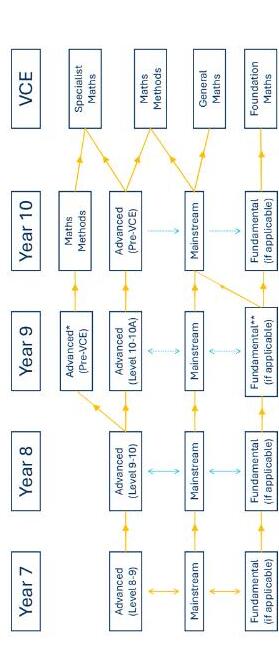
T h e r e w i l l b e t h e g r e a t e s t m o v e m e n t b e t w e e n s t r e a m s a t Y e a r 7 , w i t h t h e e x p e c t a t i o n i t w i l l d e c r e a s e o v e r t i m e t o m i n i m a l m o v e m e n t s i n
Y e a r s 9 a n d 1 0 . Y e a r 1 0 M a i n s t r e a m s t u d e n t s w i s h i n g t o s t u d y S p e c i a l i s t M a t h s i n V C E w i l l b e c o n s i d e r e d o n a c a s eb yc a s e b a s i s
* E x c e p t i o n a l s t u d e n t s a t t h e e n d o f Y e a r 8 c a n m o v e i n t o a Y e a r 9 P r eV C E c l a s s ( s e p a r a t e f r o m t h e Y e a r 1 0 g r o u p ) t o p r e p a r e t h e m f o r
a c c e l e r a t i o n i n t o M a t h s M e t h o d s a t Y e a r 1 0 .
* * S t u d e n t s w i s h i n g t o s t u d y G e n e r a l M a t h e m a t i c s i n V C E w i l l n e e d t o m o v e f r o m t h e F u n d a m e n t a l c l a s s i n t o t h e M a i n s t r e a m g r o u p f o r
Y e a r 1 0
MUSIC:MUSIC1&2
VCE Music is based on active engagement in all aspects of music. Students develop and refine musicianship skills and knowledge and develop a critical awareness of their relationship with music as listeners, performers, creators and music makers. .
Students explore, reflect on and respond to the music they listen to, create and perform They analyse and evaluate live and recorded performances, and learn to incorporate, adapt and interpret musical practices from diverse cultures, times and locations into their own learning about music as both a social and cultural practice. Students study and practise ways of effectively communicating and expressing musical ideas to an audience as performers and composers, and respond to musical works as an audience. The developed knowledge and skills provide a practical foundation for students to compose, arrange, interpret, reimagine, improvise, recreate and critique music in an informed manner
Unit Structure
Unit 1:
In this unit students explore and develop their understanding of how music is organised By performing, creating, analysing and responding to music works that exhibit different approaches, students explore and develop their understanding of the possibilities of musical organisation They prepare and perform solo and ensemble musical works to develop
technical control, expression and stylistic understanding on their chosen instrument/sound source. Students use music analysis skills to refine strategies for developing their performances They analyse technical, expressive and stylistic challenges relevant to the works they are preparing for performance, and develop strategies to address these challenges. This analysis and the strategies that have been developed are then presented to the class in an oral presentation. They create (arrange, compose or improvise) short works that reflect their understanding of the organisation of music and the processes they have studied They develop knowledge of music language concepts as they analyse and respond to a range of music, becoming familiar with the ways music creators treat elements of music and concepts and use compositional devices to create works that communicate their ideas.
Students analyse interpretation in a wide range of recorded music, responding to and analysing musical elements, concepts and compositional devices They develop their ability to identify, recreate and notate music language concepts such as scales, melodies, chords, harmony and rhythmic materials that relate to the works studied
Unit 2:
In this unit, students focus on the way music can be used to create an intended effect By performing, analysing and responding to music works/examples that create different effects, students explore and develop their understanding of the possibilities of how effect can be created. Through creating their own music, they reflect this exploration and understanding. Students prepare and perform solo and ensemble musical works to develop technical control, expression and stylistic understanding using their chosen instrument/sound source. Students use music analysis skills to refine strategies for developing their performances. They analyse technical, expressive and stylistic challenges relevant to the works they are preparing for performance, and develop strategies to address these challenges This analysis and the strategies that have been developed are then presented to the class in an oral presentation
They compose short works that reflect their understanding of the organisation of music and the processes they have studied As they analyse and respond to a wide range of music, they become familiar with the ways music creators treat elements and concepts of music and use compositional devices to create works that communicate their ideas. They continue to develop their understanding of common musical language concepts by identifying, recreating and notating these concepts.
MUSIC:MUSICREPERTOIREPERFORMANCE3&4
This study is designed for students whose musical interests are grounded in the recreation and interpretation of notated musical works, and who wish to gain and share knowledge of musical styles and performance practices.
Students may present on any instrument for which there is an established repertoire of notated works. They work towards a recital program that demonstrates highly developed technical skills and stylistic refinement as both a soloist and as an ensemble member. They develop the capacity for critical evaluations of their performances and those of others, and an ability to articulate their performance decisions with musical evidence and independence of thought.
Unit Structure
Unit 3:
In this unit students begin developing the recital program they will present in Unit 4 This preparation includes consideration of the historical performance practices and interpretative traditions that inform the styles represented in their programs Students use music analysis skills to refine strategies for developing their performances They analyse technical, expressive and stylistic challenges relevant to the works they are preparing for performance, and develop strategies to address these challenges. The strategies are then presented for assessment at a school-based discussion. Students analyse
interpretation in a wide range of recorded music, responding to and analysing musical elements, concepts and compositional devices. They develop their ability to identify, recreate and notate music language concepts such as scales, melodies, chords, harmony and rhythmic materials that relate to the works studied
Unit 4:
In this unit students continue to develop the performance program established in Unit 3 for their end-of-year practical examination. This preparation includes consideration of the historical performance practices and interpretative traditions that inform the styles represented in their programs Students use music analysis skills to refine strategies for further developing and presenting their final recital. They analyse technical, expressive and stylistic challenges relevant to the works they are preparing for performance, and develop strategies to address these challenges. The strategies are then presented and discussed in a school-based assessment Students analyse interpretation in a wide range of music, responding to and analysing musical elements, concepts, compositional devices and music language Students also learn how to recognise and notate music language concepts such as scales, melodies, chords, harmony and rhythmic materials that relate to the works studied.
Assessment:
Performance: Students must perform a prepared programme of works on their chosen instrument, which incorporates an element of ensemble performance. Students prepare a 20-minute programme of works across Units 3 & 4, which is presented in an external examination at the conclusion of Unit 4. Students are required to participate in regular performance workshops, and to perform at internal recital events
Analysing for Performance: Students describe their desired artistic and musical performance outcomes, identify challenges that they have encountered in achieving these performance outcomes, and develop strategies (including technical exercises) to overcome these challenges Students prepare an oral presentation that addresses these three areas, which is then presented to the class
Responding: Students learn to analyse recorded performances of music, assessing how the composer and performers manipulate musical elements to achieve a particular mood and character. Students also study a number of theoretical concepts, and learn to notate them (written theory test), recognise them aurally (written aural text) and reproduce them (practical aural test, involving rhythm clapping and pitch singing.
Product design is a solution focused approach that engages with the diverse needs and opportunities of individuals, society and the environment in which we live.
Product designers aim to improve welfare, which includes quality of life, by designing innovative and ethical solutions Product design is enhanced through knowledge of social, technological, economic, historical, ethical, legal, environmental and cultural factors These factors influence the form, function and aesthetics of products
Central to VCE Product Design and Technologies is a design process that encourages divergent and convergent thinking while engaging with a problem. The design brief identifies a real need or opportunity and provides scope for designing, making and evaluating. Investigation and research inform and aid the development of designed solutions that take the form of physical, three-dimensional products.
In VCE Product Design and Technologies students are designer makers who design solutions that are innovative and ethical. As designer makers, they learn about the design industry, teamwork and the collaborative nature of teams, entrepreneurial activities, innovative technologies and enterprise The development of designed solutions requires speculative, critical and creative thinking, problem-solving, numeracy, literacy, and tenancy. Students participate in problem based design approaches that trial, test, evaluate, critique and iterate product solutions. Students prototype and test using a variety of materials, tools and processes. Throughout the process of designing and testing, students learn that innovative and ethical solutions come from constructive failure and intentional evaluation
Unit Structure
Unit 1: Design practices
Unit 2: Positive impacts for end users
Unit 3: Ethical product design and development
Unit 4: Ethical production and evaluation
Practical
The nature of practical work undertaken in this course revolves around Double Diamond Design approach. This supports students to generate and refine three dimensional prototypes, and test elements of the proposed production until a final proof of concept is achieved and before the actual production occurs.
Theory
Students will be able to investigate and critique products using the factors that influence design, to make judgments about the success or failure of the products to support positive impacts for end users They will explore concepts around sustainability, different manufacturing ideology and cultural understanding and inclusion As well as developing an understanding of market needs, expectations and opportunities
SCIENCE:BIOLOGY
VCE Biology explores the wonders of life, from DNA to ecosystems. You’ll uncover how the body works, how diseases spread, and how life evolves. With hands-on experiments and real-world applications, Biology helps you solve real-world problems, explore life’s mysteries, and better understand your world.
VCE Biology opens pathways to further study and a wide range of careers in areas such as genetics, microbiology, medicine, ecology and biotechnology Biology knowledge is also applied across many fields including health care, environmental conservation, forensic science, medical research and sports science
Unit Structure
Unit 1: How do organisms regulate their functions?
Cell structure and function
Cell cycle and cancer
How animal and plant systems work, and how they are regulated
Unit 2: How does inheritance impact on diversity?
DNA and inheritance
Reproductive strategies
Bioethical issues like genetic engineering
How adaptations ensure survival in different ecosystems
Unit 3: How do cells maintain life?
Links between genetics and proteins
DNA manipulation
Key processes like photosynthesis and respiration
The role of enzymes in every reaction in our body
Unit 4: How does life change and respond to challenges?
Pathogens and how they cause disease
How our immune system protects us
Factors that cause evolution
Evidence of evolution and how humans have evolve
Practical Work
Practical work is a central component of learning and assessment and may include activities such as laboratory experiments, fieldwork, simulations, modelling and other direct experiences.
Assessment
The level of achievement for Units 3 & 4 will be determined by:
Unit 3 SACs: 2 x 10% = 20%
Unit 4 SACs: 3 x 10% = 30%
End-of-year examination: 50%
SCIENCE:CHEMISTRY
VCE Chemistry is all about exploring what the world around us is made of and how different substances interact, react and change. From medicines and food production to clean water, renewable energy and new materials, chemistry plays a huge role in solving real-world problems and improving our everyday lives.
Throughout the course, students investigate how matter behaves and carry out practical experiments involving the analysis and production of different substances. Chemistry is hands-on, analytical and highly relevant, giving students the chance to develop problem-solving, practical and critical-thinking skills
VCE Chemistry provides pathways to further study and careers in areas such as organic chemistry, biochemistry, engineering, medicine and pharmacy Chemistry is also applied across many fields including environmental science, forensic science, agriculture, toxicology and sports science
Unit Structure
Unit 1: How can the diversity of materials be explained?
Structure/bonding explain material properties
Structures of metallic, ionic and covalent compounds
Identify organic compounds using spectroscopy and chromatography.
Practical Work
Practical work is a central component of learning and assessment and may include activities such as laboratory experiments, fieldwork, simulations, modelling and other direct experiences.
Assessment
The level of achievement for Units 3 & 4 will be determined by:
Unit 3 SACs: 2 x 10% = 20%
Unit 4 SACs: 3 x 10% = 30%
End-of-year examination: 50%
SCIENCE:PHYSICS
The study of VCE Physics involves investigating, understanding and explaining the behaviour of physical phenomena in the Universe. In each unit, students develop key science skills through practical activities and apply physics concepts to real-world applications and technologies that benefit society.
VCE Physics provides pathways to further study and careers in fields such as engineering, astrophysics, medical technologies, communications and renewable energy Physics is also applied across many cross-disciplinary areas including climate science, forensic science, neuroscience, sports science and transport safety
Unit Structure
Unit 1:
How is energy useful to society?
Students explore energy in different forms, how it is used by society, and how it is transformed and transferred.
They examine:
Light and heat: Wave and particle models of light; heat transfer. Energy from the nucleus: Radiation, radioactive decay, nuclear fission and fusion. Electricity: Electric circuits, electrical safety, and use of electricity in the home.
Unit 2:
How does physics help us understand the world? Students explore the power of experiments and models in physics to help understand phenomena
They study:
Motion: Analysing forces, energy and motion mathematically
One of 18 detailed options such as: Nuclear energy, flight, materials, medical physics, astrophysics, particle physics
A student-designed investigation on a physics question of their choice.
Unit 3:
How do fields explain motion and electricity? Students explore the important concept of fields in physics
Topics include:
Fields and interactions: Gravitational, electric and magnetic fields; forces and motion
Generation and transmission of electricity using motors, generators and transformers
Unit 4:
How have creative ideas and investigation revolutionised thinking in physics? Students examine how major shifts in scientific thinking have influenced physics.
They explore:
Light and matter: How new evidence led to different models of light and matter
Einstein’s theories of special relativity: Counter-intuitive ideas about space, time and mass at high speeds
A student-designed investigation related to fields, motion or light.
Practical Work
Practical work is a central component of learning and assessment and may include activities such as laboratory experiments, fieldwork, simulations, modelling and other direct experiences
Assessment
The level of achievement for Units 3 & 4 will be determined by:
Unit 3 SACs: 3 x 10% = 30%
Unit 4 SACs: 2 x 10% = 20%
End-of-year examination: 50%
SCIENCE:PSYCHOLOGY
VCE Psychology is a multifaceted discipline that seeks to describe, explain, understand and predict human behaviour and mental processes. It includes many sub-fields of study that explore and seek to better understand how individuals, groups, communities and societies think, feel and act.
Students study contemporary research, models and theories to understand how knowledge in psychology has developed and how this knowledge continues to change in response to new evidence and discoveries in an effort to solve dayto-day problems and improve psychological wellbeing An important feature of undertaking a VCE science study is the opportunity for students to engage in a range of scientific investigation methodologies, to develop key science skills and to interrogate the links between knowledge, theory and practice.
VCE Psychology can lead to a wide range of careers working with people and communities, both as registered psychologists and in related fields. Psychologists may specialise in areas such as clinical, educational, forensic, neuropsychology, sport, or organisational psychology, or work in research, government, and industry settings.
Studying psychology also supports career pathways in counselling, social work, human resources, health and community services, education, policy, and administration roles across public and private sectors
Unit Structure
Unit 1: How are behaviour and mental processes shaped?
Brain, mind and behaviour basics
Hereditary and environmental influences on psychological development
Psychological development across the lifespan
Brain plasticity and brain injury
Scientific models of psychological development
Unit 2: How do internal and external factors influence behaviour and mental processes?
Sensation and perception processes
Factors affecting perception accuracy
The influence of relationships and social factors on behaviour
Attitudes, stereotypes and prejudice
Unit 3: How does experience affect behaviour and mental processes?
Nervous system structure and function
Stress responses and coping strategies
Brain plasticity and adaptation
Memory formation and storage
Learning processes and conditioning.
Unit 4: How is mental wellbeing supported and maintained?
Defining and measuring mental health
Mental health promotion and prevention
Factors affecting wellbeing outcomes
Research methods and data analysis.
Practical Work
Practical work is a central component of learning and assessment and may include activities such as laboratory experiments, fieldwork, simulations, modelling and other direct experiences.
Assessment
The level of achievement for Units 3 & 4 will be determined by: