WELCOME TO SENIOR SCHOOL

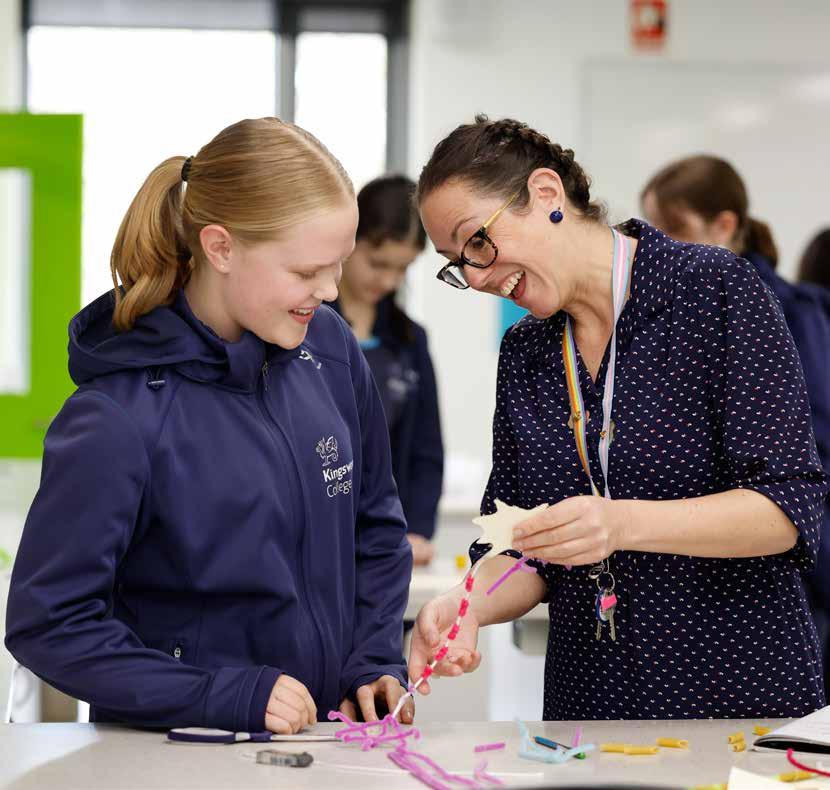
The senior years of schooling at Kingswood College represent a transformative period in which students develop independence, resilience, and a strong sense of personal purpose.
Our commitment is to ensure that each Kingswood student successfully achieves their VCE and is supported academically, socially, and emotionally throughout Years 10 – 12. We aim for our students to thrive, not only in their studies, but as confident young people prepared for a wide range of pathways including university, TAFE, apprenticeships, and employment. Years 10 to 12 are a time of increased focus, as students pursue their preferred subjects and work hard to get where they wish to be. We expect every student to develop selfregulation and diligence, to strive for their personal best and develop their perseverance and independence. While study is important, student wellbeing is also a focus.
As students enter the final phase of their time at school it is important to know that at Kingswood College, we will support them in navigating the challenges and triumphs ahead.
A dedicated team of Mentors, Year Level Coordinators, College Counsellors, teaching staff, and the Careers and Pathways Coordinator work in partnership with students and families to provide a connected, structured, and caring learning environment. We want every student to feel valued, supported, and equipped to make the most of the opportunities ahead whilst developing into independent and young adults.
It is important that students embrace all the opportunities provided, develop strategies to work through the many challenges they will be faced with and take the time to get to know their teachers and to enjoy the experience shared with their peers.
We wish all our students well as they navigate Years 10-12.
Lisa Sacristani Head of Secondary School
LIFE IN THE SENIOR SCHOOL
Year 10
Year 10 marks students’ formal transition into the Senior School. They move from wearing the College wardrobe daily to following the Senior School dress code. Students enjoy a greater range of subject choices, engage in a structured careers education program, and may begin their first VCE subject. Leadership opportunities expand, including House roles and peer mentoring activities. Year 10 is a time of learning growth, increasing independence, and the development of strong study routines.
Year 11
Year 11 is a year of significant choice, with students selecting almost all their program. Whilst Year 11 subjects are only reported as a Satisfactory (S) or Not Satisfactory (N) result to the Victorian Curriculum and Assessment Authority, it is vital that students develop their skills and aim high in this year, as it will form the foundation of success in Unit 3 & 4. Students are expected to build strong study habits, prioritise their learning, and engage meaningfully with feedback and revision. There are several leadership roles available to Year 11 students and we encourage them to take on activities that they enjoy rounding out their development and senior school experience. Many students also take on part-time work; however, the College recommends a limit of 12 hours per week to maintain balance.
Year 12
While Year 12 is academically challenging, it is also rich in personal milestones and celebratory events. Through preparation, routine, and wellbeing practices, Year 12 becomes manageable and fulfilling. We encourage students to maintain balance through healthy sleep, physical activity, social connection, and time management. Our goal is for every student to finish the year with a sense of pride in their effort and personal growth.
IMPORTANT INFORMATION ABOUT SENIOR SCHOOL
KEY SENIOR SCHOOL STAFF
2026
• Head of Secondary School
– Lisa Sacristani
• Head of Curriculum
– Casey Hawley
• Year 12 Coordinator
– Ben Collins
• Year 11 Coordinator
– Katherine Fullarton
• Year 10 Coordinator
– Paige Buenemann
• Head of Individual Difference
– Linda Abbott
• Teaching & Learning Administrator
– Gill Pasco
• College Counsellor
– Angela Caruso
• Careers & Pathways Coordinator
– Sarah Sage
CONTACT DETAILS
Senior Secondary School Reception: 9896 1723
Main College Reception: 9896 1700
Senior School email: seniorsecondary@kingswoodcollege. vic.edu.au
TERM DATES 2026
Term 1: Monday 3 February
– Thursday 2 April
Term 2: Monday 20 April – Friday 26 June
Term 3: Monday 20 July – Friday 18 September
Term 4: Monday 5 October – Friday 4 December
SENIOR SCHOOL HOURS
Senior School runs from 8.20am to 3.10pm. Students must be onsite and ready for learning by 8.20am. The Senior School building closes at 3.30pm unless supervised activities are taking place.
PERIOD TIMES
PERIOD 12.10PM
In Senior School, this time is used to provide a range of programs and activities that minimise disruption to class times. It is typically allocated in the following ways:
Monday: EISM Sport training Tuesday: Wellbeing time in mentor groups
Wednesday: Study Hall prior to EISM competitive sport
Thursday: Daily Physical Activity program
Friday: Secondary School Assembly or other wellbeing activities
TIMETABLE STRUCTURE
- 8.30am
Each Senior School academic subject is allocated nine periods per fortnight.
Monday Week B
For VCE students, Periods 5 and 6 on a Monday Week B is reserved to conduct Units 3 & 4 School Assessed Coursework (SAC) and Units 1 & 2 Outcomes and other important year level activities.
• Year 12 students who don’t have any scheduled Unit 3 and 4 SACs or year level-based activities can sign out at the commencement of lunchtime to study offsite.
• Year 11 students must remain at school even if they have no scheduled activities in this Monday Week B time, therefore using the time for private study onsite within the Senior School building or the Resource Centre.
• Year 10 students will follow their normal timetable during this Monday Week B time. Students should not organise personal appointments in this time, as this is a normal component of the school day. Year 12 students who do not have an assessment are not required to be at school until the commencement of Recess. Year 11 students may study in the Senior School building or Library during this time.
LATE ARRIVALS, EARLY DEPARTURES AND ABSENCES
• Signing In: Students in Years 10–12 arriving after 8:20am must sign in via Compass at the Senior School Reception before attending class.
• Roll Marking: Attendance is recorded throughout the day via Compass.
• Parent Notification: Parents/guardians must notify the College if:
• A student is absent; or
• A student needs to leave early.
* Notifications can be made via Compass or by contacting the Senior School Office.
• Medical Certificates:
• Required for absences of three or more consecutive school days.
• Mandatory if a student misses a VCE assessment.
• Year 12 Study Periods:
• Year 12 Students who have a study period during periods 1 and 2 may arrive for their first scheduled class at recess. Year 12 students who have a study period during period 5 and 6 can leave at the commencement of lunch – 12:50pm
• Attendance at any extra classes or SACs scheduled after school is compulsory
• Students with study periods in the middle of the day cannot leave and return unless signed out with parent approval.
• Appointments: Where possible do not schedule personal appointments during school hours.
DRIVING TO SCHOOL
Students with a P-plate licence who wish to drive to school must:
• Collect and complete a Driving Consent Application from the Senior School Office.
• Submit the form to the Year 12 Coordinator with a copy of their licence.
Please note the following:
• Parking on campus is not permitted.
• Students may not transport other Kingswood students without written consent from all parents and approval from the Year 12 Coordinator.
• The College accepts no responsibility for vehicles or property left in vehicles.
YEAR 12 STUDY BLOCKS
Each Year 12 student is allocated one study block per fortnight (nine periods) for private study. This time should be used effectively for revision, completing tasks, and preparing for assessments. Students have access to the Year 12 Common Room, Senior School Lounge and Resource Centre and may book a classroom for small group study if available. For assistance with bookings, please contact the Senior School Office.
VET STUDY BLOCKS
Each VET student is allocated one study block for private study. This equates to nine lessons per fortnight. This time is provided to ensure they have sufficient time to complete set tasks they may have missed due to their VET commitments, and they are encouraged to utilise this time in an effective manner. They will have access to the Senior School Lounge for these periods. Please note, Year 11 students with VET study blocks at the beginning or the end of the day are required to stay at school to utilise their teachers and seek support to catch up on missed work.
IMPORTANT INFORMATION CONTINUED WELLBEING AT KINGSWOOD COLLEGE
ASSESSMENTS AND EXAMINATIONS IN SENIOR SCHOOL
Assessment requirements vary across Years 10 – 12. While projectbased work is more common in Years 10 and 11, Year 12 students frequently complete assessments under timed conditions as part of School Assessed Coursework (SACs).
Students must remain vigilant about due dates and assessment schedules, ensuring they are prepared and submit work on time.
All Senior School students will undertake examinations:
• Year 10: Mid-year and end-of-year exams for most subjects.
• Year 11: Mid-year and end-of-year exams for all subjects.
• Year 12: General Achievement Test (GAT) in June. Compulsory Units 3 & 4 trial exams in final week of Term 3 holidays
Externally assessed VCAA exams (typically mid - Oct to mid -November)
Further details are provided in later sections of this handbook
VCE ASSESSMENT CALENDAR
The VCE Assessment Calendar, available on Compass, provides students, families, and teachers with a clear overview of all scheduled SACs, SATs, and key assessment dates across Year 11 and 12. Students are responsible for staying informed and keeping track of their upcoming assessments, while teachers must ensure that all dates entered are accurate and up to date.
If any changes to assessment dates are required, teachers are expected to contact the Teaching and Learning Administrator so updates can be made promptly. This calendar must be fully completed and published in time for the start of each semester, ensuring transparency, consistency, and smooth planning for all members of the VCE community.
SUBJECT CHANGES
Students may request a subject change if they are having trouble or have altered their pathway direction. Changes are subject to timetable constraints and class availability. Process:
• Student to discuss pathway implications with the Careers and Pathways Coordinator to confirm options remain open.
• If the change is due to difficulty in a subject, first consult the subject teacher to explore strategies for improvement.
• If a change is still required, contact your Year Level Coordinator, who will liaise with subject teachers, the Careers and Pathways Coordinator, parents, and the Daily Organiser. Change of subject Deadlines:
• Week 2 of Term 1 for Unit 1 or Units 3 sequences.
• Week 1 of Term 3 for Unit 2 subjects.
APPROVAL CRITERIA:
• Written parent approval is provided
• Progress report from the current subject teacher.
• Class size and timetable feasibility allow the change.
• Student has considered the impact on tertiary course selection and career pathways.
A change may not be possible if:
• It requires altering other subject groupings.
• The desired class is full. AND/OR
• The student has not met prerequisites or demonstrated readiness.
WELLBEING
Every Senior School student is assigned a Wellbeing Mentor and Wellbeing Group who provides ongoing support and connection throughout the year. Students meet their mentor:
• Each morning for a 10-minute greeting session; and
• Three additional periods per fortnight for wellbeing activities and check-ins. This structure fosters a sense of trust and belonging, ensuring students have a dedicated adult to guide them academically, socially, and emotionally
Wellbeing and academic success are closely connected. Our wellbeing program from Years 10 – 12 includes time management, revision strategies, goal setting, life skills such as road safety and Consent Education, and pathways planning. Students are encouraged to seek support early and maintain healthy routines. Families are welcome to contact their Wellbeing Mentor, Coordinator, or College Counsellor with any concerns.
TIPS TO BEING SUCCESSFUL WITHIN THE SENIOR SCHOOL
To be successful in their studies, Senior School students should:
Work Smart
Focus on understanding, not busy work. Read actively, highlight key points, and summarise each topic as you go. Use tools like mind maps and online resources (e.g., Edrolo) to reinforce learning.
Plan Your Time
Start good habits early. Create weekly and term study plans, balance school and life, and use class time effectively, be punctual, prepared, and engaged.
Take Effective Notes
Record key ideas, not every word. Date and organise notes, use colour and headings, and review and summarise regularly.
Study Actively
Summarise topics, review teacher feedback, pre-read where possible, and connect new learning to previous work. Keep your study environment focused and distraction-free.
Manage Stress
Set realistic goals, prioritise tasks, break work into steps, and schedule time to relax. Sleep well (9–10 hours) and seek support if you feel overwhelmed.
UNIFORM AND CLOTHING EXPECTATIONS IN SENIOR SCHOOL MOBILE PHONE POLICY
All Kingswood College Students in Years 10 – 12 may wear comfortable, neat and appropriate non-uniform attire on all days except Wednesdays.
Acceptable everyday wear includes:
• Dresses, skirts, pants or shorts
• Chinos, jeans or cargo pants
• Plain leggings or tracksuit pants
• Shirts, blouses, plain T-shirts or polo shirts
• Jumpers, cardigans, hoodies or rugby tops
On Wednesdays, Senior School students are required to wear the designated College wardrobe for EISM sport as their team uniform:
• Team X comfort T-shirt
• Team X shorts
Students may also wear any items from the Kingswood College branded range alongside non-wardrobe clothing. For example, a student can wear the jacket with other nonwardrobe items.
All Senior School students are expected to uphold a neat, clean and appropriate standard of dress, acknowledging that the Senior School operates as a shared learning and working environment.
In addition, the following guidelines always apply:
General Requirements
• No distressing, holes or transparent fabrics
• Underwear must not be visible
• Tattoos must be always covered (including during swimming)
Tops
Tops must:
• Have short, long or cap sleeves (no singlets, workout tops or muscle shirts)
• Fully cover the torso (no midriff, chest or back exposure)
• Be appropriately cut at the front and worn properly buttoned
• Display only discreet and respectful logos, text or images
Bottoms and Dresses
• Dresses and skirts must be at least mid-thigh in length; sleeveless dresses are permitted
• Shorts must be tailored or loose-fitting and at least midthigh in length
Footwear
Footwear must:
• Be comfortable, suitable and supportive
• Include secure fastening if sandals are worn (heel strap and toe strap required)
• Not include thongs, Ugg boots, Crocs or slippers
Extremes in attire are not appropriate. If unsure, students should reconsider their choice or seek guidance from staff.
Excursions, Assemblies and Formal Events
Some excursions may require specific attire; details will be communicated to students.
At other times, including assemblies, a higher standard of dress is required:
• Closed-toe shoes are mandatory
• Tracksuit pants and leggings are not appropriate
Students presenting on stage at assemblies or formal events may be asked to wear:
• Collared shirts or blouses
• Trousers, chinos, skirts or dresses
• Jackets Special Occasions
For designated special events, the following additional expectations apply:
• Dresses or pants (no denim)
• Chinos or trousers (no denim)
• Jackets (no denim)
• Formal gowns without sleeves or straps may be worn
Subject-Specific Requirements
Staff will provide clear instructions where clothing relates to health, safety or industry standards. Additional expectations commonly apply in:
• Art
• Hospitality and Food Studies
• Product Design Technology
• Science
• Sport and Physical Education
These may include:
• Hair tied back or covered
• Removal of jewellery (e.g., necklaces, bracelets or sleepers)
• Closed-toe footwear
RATIONALE
Digital technology provides students with significant opportunities for collaboration, creativity, problemsolving and access to information. However, research consistently highlights the need to monitor screen time and its effects on students’ social, developmental and academic wellbeing. This policy supports a safe, focused and engaging learning environment for all students.
SCOPE
This policy:
• Applies to all students within the Kingswood College community.
• Applies during all school hours (8.20am –3.10pm).
• Applies on all school days, including camps, sport days, excursions and other schoolrelated activities.
POLICY
During the School Day (8.20am–3.10pm)
Students must adhere to the following expectations:
• Mobile phones and all personal electronic devices (including but not limited to AirPods and headphones) must be stored in locked lockers for the entire school day.
• Devices must not be accessed at any time during the school day.
• Social media platforms, including TikTok, Snapchat, Instagram, Facebook, Skype and other messaging or networking apps, must not be accessed on any personal device, including laptops.
• Headphones may not be used unless explicitly directed by a teacher as part of a learning activity.
• Students in Years 11 and 12 may use headphones connected to their laptops only in the Walker Building shared study spaces during break times or study periods, and only while studying.
• Teachers may, at times, require students to bring mobile phones to class for specific learning activities. Devices must be returned to lockers immediately after the activity or at the next available break.
• Students requiring access to a device for medical or other special circumstances must have this approved in advance; staff should be notified so appropriate adjustments can be made.
• Parents wishing to contact their child between 8.20am and 3.10pm must do so via the relevant school administration office.
NON-COMPLIANCE
Students who repeatedly breach this policy will be required to sign in their mobile phone at the start of the school day and sign it out upon departure until the College determines the arrangement is no longer necessary.
USING COMPUTERS FOR ASSESSMENT
THE VCE
We strongly encourage all Senior School students to handwrite their notes and classwork wherever possible. Regular handwriting practice supports the development of stamina, speed and accuracy skills essential for success in formal examinations. Students who require the use of a laptop for Units 3 and 4 assessment tasks must have approved special provisions, unless the task explicitly permits the use of technology.
When working on a notebook or desktop computer, students are responsible for regularly backing up their work on an alternative platform and ensuring that all submissions are completed in an appropriate and accessible format.
Please note that technology issues, including device failure, lost files or connectivity problems are not valid grounds for extensions, special consideration or internal adjustments.
The Victorian Certificate of Education (VCE) is the qualification most students in Victoria attain upon the successful completion of their secondary schooling. It is a highly regarded credential, recognised nationally and internationally, and offers students multiple pathways into university, TAFE, further training and employment.
For any queries relating to the administration of the VCE, students and families should contact their Year Level Coordinator or the Head of School.
The VCE is awarded based on satisfactory completion of units in accordance with VCE requirements. To satisfactorily complete a VCE Unit, a student must demonstrate the achievement of all prescribed outcomes for the Unit as outlined in the study design. Teachers determine satisfactory completion using their professional judgement, based on the student’s performance across the duration of the unit. This determination is separate from the assessment of the student’s level of performance.
In studies where School-assessed Coursework (SAC) tasks assess all outcomes, satisfactory performance on these tasks constitutes sufficient evidence for awarding an ‘S’ for the unit.
ACHIEVING OUTCOMES
To achieve an outcome for a VCE Unit, a student must:
• Produce work that meets the required standard
• Submit all work by the due date
• Ensure all submitted work is authentically their own
• Comply with VCAA and school rules
A student is awarded a satisfactory (‘S’) result for a Unit when the teacher determines that all outcomes have been successfully achieved.
VCE PROGRAM REQUIREMENTS
To be awarded the VCE, a student’s program must include the satisfactory completion of:
• Three units of English, including both Unit 3 and Unit 4
• Three sequences of Units 3 and 4 from studies other than English
Each VCE study consists of semester-length units:
Units 1 & 2
Units 1 and 2 may, in some studies, be taken as stand-alone units.
Assessment for these units is conducted by the school.
Units 3 & 4
Units 3 and 4 must be completed as a sequence. Assessment includes both school-based components and external assessment conducted by the VCAA.
VCE COURSE STRUCTURE AT KINGSWOOD COLLEGE
A typical VCE program at Kingswood College comprises:
• Six VCE units per semester in Year 11
• Five VCE units per semester in Year 12
Requests to vary a student’s VCE program are considered on a case-bycase basis. Decisions will consider academic progress and pathways, previous VCE results, and any special circumstances or commitments outside the curriculum (e.g., elite sport, medical needs).
Families should note that standard school fees apply even when a student undertakes a reduced study load in Years 11 and 12.
THE VCE
VOCATIONAL EDUCATION AND TRAINING (VET) AND THE VCE
• VET programs may be undertaken as part of a student’s VCE program. These programs are coordinated by the Careers and Pathways Leader, and all enquiries should be directed to this staff member.
• Most VET programs are delivered off campus. Students enrolled in a VET subject will typically be absent from Kingswood College once a week, usually on Wednesday afternoons.
• Students undertaking VET must manage their time effectively. They are responsible for communicating with their class teachers and ensuring that all missed work is completed promptly.
• To support this, VET students will be allocated a study block on their timetable to assist them in keeping up to date with any missed lessons.
• During these allocated study times, students must work in the Resource Centre and report to the librarian for attendance checking.
• If a VET commitment results in a student missing an assessment, the student must notify their teacher and arrange an alternative time with both the teacher and their Year Level Coordinator. In most cases, assessments will be completed during the designated SAC Reschedule session.
• Attendance at VET programs is governed by the Kingswood College Attendance Policy, requiring a minimum attendance rate of 95%. Students who will be absent from a VET class must follow the standard College absence procedures and notify the school accordingly.
ASSESSMENT AND REPORTING FOR UNITS
1 & 2
VCE Units 1 and 2 are assessed in two ways:
• Each Learning Outcome is assessed as Satisfactory (S) or Not Satisfactory (N)
• To satisfactorily complete a unit, students must achieve an S for all Learning Outcomes within that unit.
VCE ENROLMENT REQUIREMENTS
All VCE students are required to complete and sign a Personal Details Form and an agreement to abide by VCAA regulations at the beginning of the school year. Each VCE student is issued a unique VCAA identification number, which is also recorded and securely stored by the School.
Students undertaking a subject through another Registered Training Organisation (RTO) must provide full details of this enrolment to the Head of School. This ensures the subject is accurately recorded in the VASS system and included in the student’s official academic record.
Throughout the academic year, students will be asked to review and confirm their VCAA enrolment information. It is the student’s responsibility to check their enrolment details carefully and notify the School immediately of any inaccuracies, including errors in subject selection, enrolment in external studies, or changes to personal information such as address details.
VCE ATTENDANCE REQUIREMENTS
Regular and sustained attendance is essential for success in the VCE. At Kingswood College, students are required to attend a minimum of 95% of all scheduled classes to ensure they can satisfactorily complete the learning outcomes for each unit.
Any missed class will be recorded as an unapproved absence unless the student provides a medical certificate confirming they were unfit for school on that day or were required to attend an unavoidable medical appointment.
Exceptions to the requirement for a medical certificate include:
• Attendance at a school excursion or when representing the College
• Participation in an approved VET program
• Attendance at a VCAA externally assessed performance examination
Students who anticipate missing classes for any other reason must request special leave of absence in writing, in advance where possible, from the Year Level Co-ordinator.
Students are responsible for catching up on all learning and coursework missed during an absence. All lesson materials and assessment dates are available on Compass, and students are expected to access these resources proactively for planning and completion of work.
Students who do not meet attendance expectations and do not qualify for an approved absence may receive an ‘N’ (Not Satisfactory) for the unit.
If a student knows they will be absent for a SAC, SAT or Outcome task, they must ensure the absence is approved in advance.
Requests for extensions when it comes to Senior School assessment must also be submitted prior to the due date to the Year Level
Coordinator. Extensions of up to seven days may be granted once only, unless otherwise approved by the Head of School. The revised deadline is final, and failure to submit work by the extension date may result in a zero.
In accordance with VCAA requirements, all VCE students must provide a medical or other professional certificate for any absence on the day of a scheduled SAC, SAT or Outcome task. A note from a parent or guardian is not sufficient.
LEARNING OUTCOMES (S/N) - VCE UNITS 1, 2, 3 & 4
To successfully complete the VCE, students must demonstrate the skills and knowledge prescribed for each subject. These expectations are outlined in the VCAA Study Designs and expressed as Outcomes, which collectively form a Unit (Unit 1, 2, 3 or 4).
Teachers assess student performance against these Outcomes through a range of evidence, which may include assessment tasks, classwork, homework, practical activities, oral presentations and other subjectspecific requirements.
A student is awarded a Satisfactory (S) for a Unit when the subject teacher determines that all Outcomes for that Unit have been achieved. If one or more Outcomes are not met, the student will receive a Not Satisfactory (N) for the Unit.
THE VCE
REDEMPTION TASKS
If a student is identified as being at risk of receiving an N for a Unit, parents/guardians will be notified by the subject teacher, initially via email or telephone, followed by a formal letter from the School.
Students who are at risk will be given the opportunity to demonstrate the required Outcome(s) through a redemption task. Details of the task and expectations will be clearly outlined in the School’s communication.
Redemption tasks are developed by the subject teacher and may take the form of:
• A full or partial assessment task
• A targeted component of classwork
• Homework or consolidation activities
• Any other task that allows the student to demonstrate the required Outcome
The classroom teacher, in consultation with the Head of School, will schedule an appropriate time for the student to complete the redemption task.
The purpose of a redemption task is to enable the student to achieve a Satisfactory (S) for the Unit. The original numerical score or grade awarded for the related assessment task does not change because of the redemption process.
VCE ASSESSMENT
At Kingswood College, all VCE Units 1 & 2 are assessed using a range of instruments, including tests, projects, assignments, and oral presentations. Each Assessment Task will include a percentage or numerical score, providing a clear indication of the student’s level of achievement for that specific Outcome. NA will appear on Compass when a student has been formally exempted from an assessment task or has missed the task due to an unapproved absence. At the beginning of each Unit, teachers will outline the specific Assessment Tasks that make up the unit of study. All assessments for Units 1 & 2 are internally marked. Student performance is reported through Compass and in school reports but is not submitted to the VCAA.
If a student misses an Assessment Task due to an unapproved absence, they will still be given the opportunity to demonstrate the Outcome to receive an S (Satisfactory). However, an NA will be recorded for the missed task, resulting in a score of 0.
This may affect eligibility for awards, prizes, or other forms of academic recognition.
All VCE Units 3 & 4 offered at Kingswood College are assessed through a combination
School-Assessed Coursework (SACs), School-Assessed Tasks (SATs) (for relevant subjects), and VCAA end-of-year examination.
These assessments contribute directly to a student’s study score and ATAR.
SCHOOL ASSESSED COURSEWORK (SACS)
School-Assessed Coursework (SACs) measure each student’s level of achievement in relation to the prescribed Outcomes for Units 3 & 4. SACs form part of the regular teaching and learning program and are generally completed during scheduled class time.
In some cases, preparation or preliminary work may be completed outside of class. When this occurs, teachers must be able to authenticate the work to ensure it is entirely the student’s own. All SACs are internally assessed in line with VCAA requirements.
SCHOOL ASSESSED TASKS (SATS)
The studies Art Creative Practice, Visual Communication & Design, Computing, and Product Design & Technology include School-Assessed Tasks (SATs) in addition to School Assessed Coursework. SATs are used in studies where students produce products, models, or creative works.
Specifications for SATs are set by the VCAA, ensuring consistency of task type across all schools. While the VCAA outlines the structure and assessment criteria, schools determine the specific content of each task. Teachers assess SATs using VCAA performance criteria, and the resulting scores are submitted to the VCAA for moderation.
MISSED SACS OR SATS
If a student misses a SAC or SAT due to an unapproved absence, they will still be provided with an opportunity to demonstrate the Outcome and achieve an S (Satisfactory) result. However, the assessment task itself will receive a score of zero, which will contribute to the final study score. This may significantly impact a student’s overall subject score and, subsequently, their ATAR.
Unit 3 and 4 Assessment Information Provided to Students
By the end of the first full week of Term 1, all Units 3 & 4 teachers will make the following information available to students via their Compass class pages:
• Weekly Learning Overview: A clear outline of the week’s learning focus, including scheduled SAC/SAT/ Outcome dates.
• Assessment Breakdown: An overview of each assessment component, including its weighting and contribution to the final study score.
• Summative Assessment Topics: A summary of the topics and skills that will be assessed in each summative task.
CONFIDENTIALITY OF STUDENT RESULTS
Students are reminded that their results are confidential. There is no expectation for students to share their scores or grades with peers. Feedback is provided to support each student’s growth, helping them understand their progress and identify areas for improvement.
RETURN OF SUMMATIVE ASSESSMENTS (SACS)
Summative Assessments (SACs) are generally returned to students within 14 days of the assessment date. This timely feedback ensures students can consolidate their understanding, revise key content, and integrate teacher feedback into their ongoing examination preparation.
COMPLETION OF VCE UNITS
Each VCE unit comprises two to four outcomes that students must satisfactorily achieve to complete the unit. In line with VCAA requirements, the subject teacher is responsible for determining whether a student has met the satisfactory completion criteria.
Parents and guardians will be notified if a student is at risk of not achieving an outcome or has not completed an assessment task by the designated due date. A student may not be granted satisfactory completion of a unit if any of the following conditions apply:
• There is doubt regarding the authenticity of the work submitted.
• The work does not meet the required standard as outlined in the Study Design.
THE VCE
• The student has failed to meet a school deadline for an assessment task, including cases where an approved extension was granted.
• A substantive breach of VCAA or school rules has occurred.
SPECIAL PROVISIONS FOR SUMMATIVE ASSESSMENTS (INTERNAL)
Students eligible for Special Provision are not exempt from meeting the requirements for satisfactory completion of the VCE, nor from being assessed against the Outcomes for their studies. Special Provision is designed to ensure that students whose learning or assessment programs are affected by illness, impairment, or personal circumstances can demonstrate their capabilities under fair and appropriate conditions.
The following guiding principles apply to all forms of Special Provision:
• Arrangements should provide equivalent, alternative opportunities for students to demonstrate their learning.
• Provisions must not confer an advantage over other students.
Students may be eligible for Special Provision for schoolbased assessment if their ability to demonstrate achievement is adversely affected by:
• An acute or chronic illness (physical or psychological)
• Personal circumstances
• An impairment or disability, including learning disorders
Schools have a range of strategies to enable students to be assessed against the prescribed Outcomes, in accordance with VCAA guidelines.
Units 1 & 2:
• Special Provision arrangements are determined internally, overseen by the Head of Individual Differences and the Head of School.
• Appropriate evidence must be provided to support the request, such as documentation outlining a learning or wellbeing diagnosis.
Units 3 & 4:
• Special Provision arrangements are determined through application to the Victorian Curriculum and Assessment Authority (VCAA).
• The process is managed by the Head of Individual Differences in consultation with the Head of School and relevant Heads of Department.
• Families of Units 3 & 4 students are provided with detailed information regarding the application process, required evidence, and submission deadlines.
• Until formal approval is received from the VCAA, the school will implement provisional Special Provision measures based on VCAA guidelines and the evidence provided.
Communication is sent to all Units 3 & 4 families informing them of this process and requesting evidence be provided to the school with the required due dates. Until the school receives formal decisions from the VCAA special provisions will be provided to the student based on VCAA guidelines and evidence provided.
STATISTICAL MODERATION (UNITS 3 & 4)
Schools are responsible for the initial assessment of School-Assessed Coursework (SACs) and SchoolAssessed Tasks (SATs), which are then submitted to the Victorian Curriculum and Assessment Authority (VCAA). After the VCE examinations have been marked, statistical moderation is applied to these assessments. Coursework results contribute to a student’s overall Study Score in each VCE study.
School-based assessment forms a significant component of the VCE, often accounting for at least 50% of a student’s overall assessment in many studies. To ensure equity across Victoria, it is essential that assessments from all schools are comparable and fair.
Statistical moderation guarantees that school-based assessments are aligned with statewide standards while preserving the relative ranking of students within each school.
Moderation ensures that consistent assessment standards are applied to all students undertaking a particular study, regardless of school.
Statistical moderation involves adjusting a school’s assessments to align with the level and distribution of student scores on the corresponding external examination, without altering the rank order determined by the school.
The VCAA uses statistical moderation to ensure that student assessments are comparable across all schools in the State, maintaining fairness in the calculation of Study Scores.
For further details, a copy of the VCAA Statistical Moderation Policy is available on the VCAA website.
Finally, all Units 3 & 4 studies comprise three graded components:
• School-Assessed Coursework (SACs)
• School-Assessed Tasks (SATs)
• External examination
BREACHES OF VCAA ASSESSMENT RULES
If a teacher suspects that a breach of VCAA assessment rules has occurred during a SAC or SAT, the matter will be reported immediately to the Head of School and the Head of Curriculum.
A preliminary investigation will then be conducted in accordance with the procedures outlined in the VCAA VCE and VCAL Administrative Handbook. These procedures form the basis of Kingswood College’s VCE Breaches Policy, ensuring that all allegations are managed fairly, consistently, and in alignment with VCAA requirements.
YEAR 10 AND 11 EXAMINATIONS
Year 10 and Units 1 & 2 examinations are conducted at the end of each semester. These examinations provide students with a valuable opportunity to demonstrate their understanding of course content and consolidate the skills required for their final Units 3 & 4 examinations. Performance in these Year 10 and 11 examinations contributes to overall student results and may influence end-of-year subject awards and Year Level Dux recognition during the College’s Celebration Evening. Additionally, examinations may support students in achieving a Satisfactory (S) result for a Unit if they are at risk of receiving a Not Satisfactory (N).
LATENESS TO EXAMINATIONS
Students who arrive late for an examination must report immediately to Senior School Reception where the Head of School will be notified.
• Students arriving within the first 30 minutes of the examination will be permitted to enter and complete the exam.
• Students arriving more than 30 minutes after the commencement of the examination may, at the discretion of the Head of School, be permitted to sit the exam. No additional time will be granted in these cases.
UNITS 3 & 4 SPECIAL EXAMINATION ARRANGEMENTS
For all VCE external assessments, including examinations, oral presentations, and the General Achievement Test (GAT), the Victorian Curriculum and Assessment Authority (VCAA) determine student eligibility for Special Examination Arrangements (SEA) and the Derived Examination Score (DES).
Students may be eligible for Special Examination Arrangements if it can be demonstrated that their performance in the examination is adversely affected by:
• An acute or chronic illness (physical or psychological)
• Factors relating to personal circumstances
• An impairment or disability, including learning disorders
Special Examination Arrangements are not approved solely based on intellectual disability. Applications must be supported by recent, relevant medical or specialist documentation and are administered by the Head of Individual Differences in consultation with the Head of School.
Special Examination Arrangements may include, but are not limited to:
• Additional reading time beyond the official allocation
• Additional writing time for the examination
• Scheduled rest breaks during a standard examination
• Use of a computer for written responses
• Permission to sit the examination in a separate room
Additional measures may be approved by the VCAA for students with specific illnesses or disabilities.
Students granted EAL status based on unfamiliarity with English are not eligible for Special Examination Arrangements solely on this ground.
APPLICATION PROCESS
All Units 3 & 4 families will receive communication in December outlining the process for applying for Special Examination Arrangements. Families who believe their child meets the criteria are encouraged to contact the Head of School to discuss eligibility and submit an application, accompanied by the necessary documentation.
DERIVED EXAMINATION SCORE (DES)
The Derived Examination Score (DES) is calculated by the VCAA and may be used as a student’s examination result when the student meets the eligibility requirements for this provision. The DES is designed for students who are ill or affected by significant personal circumstances at the time of an examination, such that their performance would not fairly or accurately reflect their level of learning or achievement in the study. The purpose of the DES is to ensure that a student’s final examination result reflects, as accurately as possible, the level of achievement expected based on the learning demonstrated throughout the semester or year.
UNITS 3 & 4 SPECIAL EXAMINATION ARRANGEMENTS
Students may be eligible for a DES if illness, personal trauma, or other circumstances occurring immediately before or during the examination period:
• Affect their performance on an examination, or
• Prevent attendance at an examination
“Immediately before” refers to the two-week period preceding a performance or oral examination, or the first written examination in the October/November examination period.
The DES is not intended to compensate for learning or achievement lost due to long-term illness or ongoing conditions throughout the year.
DES APPLICATION AND APPROVAL PROCESS
Students who believe they may be eligible for a DES should contact the Year 12 Coordinator and/or the Head of School. The school is responsible for making the initial eligibility determination and recommending approval to the VCAA. Final approval rests with the VCAA.
The DES is calculated using:
• All available scores for the affected study
• The indicative grade for the examination provided by the school
• GAT component scores
• Moderated school-based assessments and other available examination scores
For each approved application, the VCAA calculates a range of possible DES scores statistically, using the student’s other assessments and performance data to determine a fair and equitable result.
GENERAL ACHIEVEMENT TEST (GAT)
All VCE students enrolled in one or more sequences of Units 3 & 4, including Year 11 students, are required to sit the General Achievement Test (GAT). This requirement also applies to Year 12 students who may have elected not to sit their external examinations at the end of the year.
The GAT is typically held in June each year, as scheduled by the VCAA, and comprises a combination of written tasks and multiple-choice questions. Students receive a confidential statement of results at the end of the year, which includes their score and descriptive comments on each component. These results are not used for tertiary selection or employment purposes.
The GAT is a pen-and-paper assessment of general knowledge and skills designed for students completing their senior secondary studies. It serves a dual purpose:
• Ensuring the quality and consistency of VCE assessments across all schools
• Allowing students to demonstrate attainment of the Victorian Literacy and Numeracy Standards expected at the senior secondary level
No special preparation is required. The GAT draws on skills and knowledge developed through the study of subjects such as English, Mathematics, Science, and History, particularly in areas of writing, numeracy, and reasoning.
PURPOSE OF THE GAT AND HOW IT IS REPORTED
Section A of the GAT is designed to assess whether students have demonstrated the literacy and numeracy skills typically expected of students completing secondary schooling. This provides an additional measure of a student’s readiness for further education, training, or employment.
The Victorian Literacy and Numeracy Standards are based on the Australian Core Skills Framework (ACSF). Further information is available on the VCAA website.
A GAT Statement of Results is issued to each student, indicating performance against these standards. Student achievement in literacy and numeracy is assessed in reading, writing, and numeracy, with results indicating whether the student has:
• Met the standard
• Not met the standard
• Met the standard with a level of excellence
For students who complete both Sections A and B, the Statement of Results also includes scores for each GAT component, as follows:
• Writing (Section A) and Written Communication (Section B)
• Numeracy (Section A) and Mathematics, Science, and Technology (Section B)
• Reading (Section A) and Humanities, the Arts, and Social Sciences (Section B)
The VCE or VCAL Statement of Results also indicates whether a student participated in the GAT or had an authorised or unauthorised absence from one or both sections.
FINAL SENIOR SCHOOL EXAMS REPORTING AND FEEDBACK
UNITS 3 & 4 TRIAL EXAMS
Units 3 & 4 Trial Exams are typically scheduled during the final week of the Term 3 School Holidays. These exams are compulsory for Year 12 students and for Year 11 students enrolled in a Unit 3 & 4 subject. While trial exams do not contribute to the awarding of Satisfactory completion (S) for Units or the VCE, they play a critical role in the learning and feedback process for both students and teachers.
• For teachers: They provide insight to guide the planning of targeted revision classes.
• For students: They highlight areas of strength and weakness, identify skills requiring further refinement, and inform strategies for time management within examinations.
• For teachers and students together: Enable personalised guidance on revision focus, ensuring students can optimise their preparation for the VCAA external examinations.
Trial exams are conducted within a condensed schedule to allow prompt marking and feedback. In some subjects, external markers often experienced VCE assessors collaborate with Kingswood College teachers to ensure accurate and timely feedback in preparation for the final VCAA assessments.
SENIOR SCHOOL FINAL EXAMS
Year 10 and Year 11 students undertake final examinations towards the end of Semester 2, providing an opportunity to demonstrate their understanding and mastery of course content.
For Units 3 & 4 subjects, the final examinations are developed and administered by the Victorian Curriculum and Assessment Authority (VCAA). These examination dates are fixed and cannot be altered.
VCAA Exam Supervisors, appointed by Kingswood College, are responsible for administering and supervising these external exams in accordance with VCAA exam conditions. Detailed information regarding exam procedures is provided to students in the VCAA Exam Navigator, issued each September.
Important: Students are not permitted to bring mobile phones or other unauthorised electronic devices (e.g., smart watches) into any assessment or examination. Failure to comply with this rule may result in forfeiture of marks or cancellation of scores, in accordance with VCAA policy for Units 3 & 4.
SEMESTER REPORTS
• Year 10 – 12 students receive semester reports at the conclusion of Semester 1.
• Year 10 and 11 students also receive reports at the conclusion of Semester 2.
• Throughout the year, detailed continuous feedback is provided online via Compass for all assessment tasks, allowing students and parents to monitor progress and achievement.
UNITS 3 & 4 REPORTING
• Specific grades or marks for Units 3 & 4 subjects are provided to students in accordance with VCAA rules, which ensure that exact subject rankings are not disclosed.
• Due to VCAA privacy requirements, parents will not receive final marks for Units 3 & 4 subjects. Parents may view feedback and S/N outcomes online and are encouraged to discuss specific marks directly with their child if desired.
VCE COMPLETION AND FINAL RESULTS
• Upon completion of the VCE, Year 12 students receive a statement of results from the VCAA. No College Semester 2 report is issued.
• The VCAA Statement of Results includes: o A cumulative record of achievement for all VCE and VCE VET units undertaken, including the year of completion.
• Graded Assessments and Study Scores for each Unit 3 & 4 sequence undertaken, either in the current year or previously.
• University Enhancement studies, including titles and university if successfully completed.
• Any credit obtained for study undertaken overseas, interstate, in the International Baccalaureate, or for a Vocational Certificate.
• A declaration of whether the student has or has not been awarded the VCE.
• Where applicable, English as an Additional Language (EAL) status and the year it was conferred.
• Year 12 students also receive their ATAR score from the Victorian Tertiary Admissions Centre (VTAC).
APPENDIX 1: RESOURCES FOR STUDENTS APPENDIX 2: RESOURCES FOR PARENTS
REACHOUT
ReachOut is a leading youth mental health website. It provides practical tools and support to help young people get through everything from everyday issues to tough times. The website has factsheets, tools, apps, videos and forums.
GENERATION NEXT
Generation Next is a website that provides education and information about the prevention and managements of mental illness in youth. There are resources for young people, professionals and the community.
YOUTH BEYOND BLUE
Youth Beyond Blue provides information on a range of topics and issues that are relevant for young people. The website also allows young people to link in with free confidential counselling either by phoning 1300 22 4636 or webchat.
HEADSPACE
Headspace is a national mental health service for young people. The website has several factsheets on a range of topics and helps young people link in with their local centre. There is also ‘eheadspace’ which offers free confidential counselling via webchat or phoning 1800 650 890.
KIDS HELPLINE – TEENS
Kids Helpline has a section just for teens which offers information and counselling for people aged 13–25 years. The counselling is free and confidential and can be accessed by calling 1800 55 1800, emailing counsellor@kidshelpline.com.au or webchat.
PARENT LINE
Supports and nurtures positive, caring relationships between parents, children, teenagers and the significant other people who are important to the well-being of families. Visit the website for more information or call 13 22 89.
RAISING CHILDREN NETWORK
An Australian parenting website that provides comprehensive, practical child health and parenting information and activities covering children aged 0–15 years.
FAMILY RELATIONSHIPS ONLINE
The advice line complements the information and services offered by Family Relationship Centres. The website offers access to information about family relationship issues, ranging from building better relationships to dispute resolution.
LIFELINE
Lifeline provides all Australians experiencing a personal crisis with access to 24-hour counselling support and suicide prevention services that can be accessed by calling 13 11 14 or on their website.
BEYOND BLUE
A national, independent, not-forprofit organisation working to address issues associated with depression, anxiety and related substance-use disorders in Australia. If you need help you can contact 1300 22 4636 or visit the website to seek support.