Total Lunar Eclipse
dark red tinted moon is called a blood moon.

The lunar eclipse is known as the "blood
By Hadeel Qandeel '27
Gathering by the observatory, King's Academy students, faculty, and staff witnessed a total lunar eclipse on September 7.
A total lunar eclipse happens when the earth comes in between the sun and the moon, all aligning in a straight line. This leads to the moon passing directly through the earth's umbra - the term for the planet's shadow-which blocks all direct sunlight causing the moon to gain a dark red hue. This
A total lunar eclipse occurs around every two and half years. Since 2015, the past total lunar eclipses have taken place outside of the academic year or during school breaks when students, faculty, and staff are not on campus. The last time that a total lunar eclipse was visible at King's during the school year was nearly 10 years ago on September 28, 2015.
For those on campus who witnessed this year's eclipse, the blood red moon was a sight to behold.
"It seemed very ominous because it was red, and it seemed almost magical," Dianne Wohnsiedler '27 said. "It was something revolutionary. I've never seen one before."
Written in the Star: A Symbol of l(ing's
country to a new home.
The dorm's name, tied to a star, became part of her story. Over time she felt that the houses - Murzim, Alnilam, Atairare meant to encourage students to shine just as stars do.
"The dorms are named after stars? It surprised me when I came to King's," she said.
"Out of everything, why stars?" Ange asked herself. "Then people shared with me that it could be that they want the students to shine within. They do not want their light to be blocked or stopped by anything."
Flora and Fauna at l(ing's
By Dylan Al Jaff '27 and Omar Sharrab '27
Imagine a regular day at King's Academy: students rush with eager anticipation to get to their classes and free blocks.
But we have realized that if you take just one minute to observe the world around us, that minute will drastically shift your perspective towards our beautiful home.
trees; blue jacarandas, which provide a beautiful pop of color with their magenta flowers; and Queensland bottle trees with their wide, bottle-like trunks that hold water for the coming summer.
By Banah Allawama '27
On a clear night in Madaba, the stars stretch endlessly across the sky, glowing above. At King's Academy, one star in particular shines everywhere, not only in the night sky, but carved onto the walls, stitched into the uniforms, and echoed in the school's motto: _;;\..lji 4-!y.-JIin Arabic andfl.oreat scientia in Latin.
The star at King's is more than a design, it connects to Jordan: its hills and valleys,
its history, and to a feeling of reaching and thriving. It acts as a bridge between the old and the new, a symbol that students and teachers know what learning should feel like: open, bright, and expansive.
For many individuals, this connection is often seen in the dorms, as each is named after a certain star.
Uwase Ange '26 has been a student at King's for four years. Her first year was spent in Murzim House, and she remembers the adjustment from a new
She also compared stargazing to life at King's.
"When you stare at the stars it is easy to notice one star," she said. "But when there is a constellation, they shine brighter and show even more. When people are together, they shine brighter. They share light together. Everyone ends up picking their own thing."
The sense of inspiration is also shared by art teacher Mr. Shadi Joudeh.
To the students, staff, and boarding community living here, King's is a giant ecosystem full of plants and animals. So slow down with us and observe the beauty of King's.
The school grounds are massive; it takes around ten minutes to walk from the Health Center to the Academic Building. To outsiders, King's is described as a close-knit community, but the diversity of the school's campus makes it more than that.
We started walking around campus, through the wooded areas and locations we rarely visited. Flora is as diverse as the school itself. The campus is widely populated by a variety of trees: American sycamores with Chinaberry ,.
These trees provide shade for students and are well paired with the perfect amount of green from bushes like thorny olives, Mandarin orange shrubs, and Spanish brooms. Mediterranean staples like olive trees, bay laurel trees, sage, and rosemary bushes can also be found scattered around campus, as well as figs, apricots, and loquats.
Beyond trees and shrubs, King's also provides a varied selection of crops, cared for by the staff and appreciated by all.
Take the path northwest, behind the observatory, and you will eventually come across a field full of a beautiful, healthy variety of chillies, bell peppers, onions, cucumbers, eggplants, pumpkins, lemons, and grapes.
The fauna of the campus completes the ecosystem.
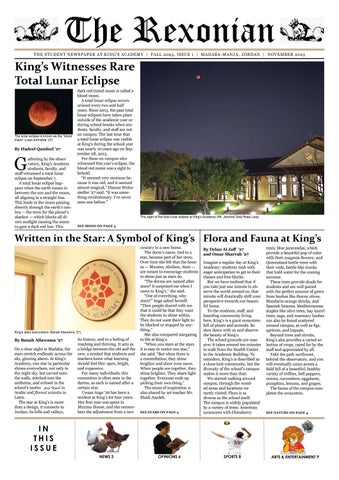
moon" (Leen AIHrishat '27)
The sight of the total lunar eclipse at King's Academy (Mr. Jeromel Dela Rosa Lara)
King's stars everywhere (Banah Allawama '27)
THE MOSAIC
Pieces of campus captured by our roving Rexonian reporters

\!tbe3aexonian
BANAHALLAWAMA'27
Editor in Chief
LAMAR WAHBEH '27
Managing Editor
LUBNA SABBAGH '27
Managing Editor
YOUSUF ALWAHSH '26
Head of Arabic
OMAR SHARRAB '27
Multimedia Director
NAYAALBADOUR '27
Multimedia Director
HADEEL QANDEEL '27
Photography & Communications
Director
Reporters
Dylan Al Jaff '27
Yara Kaanan '27
Natali Nijmeh '28
Dianne Wohnsiedler '27
Translators
Suhaib Alhamad '26
Jenan AlJayyar '27
Photographers
Leen Khalil '28
Saba Alasuli '28
Faculty Advisors
Mr. J eromel Dela Rosa Lara
Dr. Christina Z. Hawatmeh
Faculty Reviewers
Mr. Ahmad Freihat
Mr. Anas Shalan
Ms. Hanan Al Bqour
Dr. Hani Elayyan
LETTERFROM THE REX TEAM
Dear Readers,
We, the Rexonian team, are _proud to announce our first issue of tfie 2025- 2026 year.
Thank you for all your support and for reading this issue!
This edition would not exist without our heads, editors, reporters, photographers, visual artists, and anyone who managed to meet the deadline.
We hope you enjoy the mix of stories, art, and opinions that make the Rexonian what 1t is: a little whimsical, a lot_passionate, and entirely student- made with a sprinkle of Mr. Jeromel's undying enthusiasm.
Happy reading, The Rexonian Family
(Naya AIBadour '27)
(Dianne Wohnsiedler '27)
(Dylan Al Jaff '27)
(Dylan Al Jaff '27)
(Omar Sharrab '27)
(Dylan Al Jaff '27)
(Dianne Wohnsiedler '27)
Feathered Friends: l(ing's Acadellly's Lively Residents

ByYaraKanaan '27
Tucked near the stadium and quietly clucking away, a group of 15 chickens go about their business: laying eggs, scratching in the dirt, and turning their beadyeyed judgment on anyone who walks past.
While many schools boast libraries and athletic fields, few can also say they have a chicken farm. At King's Academy, though, a lively flock has been a distinct part of campus life.
Most chickens have come from animal markets in Madaba, becoming an integral part of the school's backyard ecosystem. Their presence turns into a conversation starter, a source of surprise for newcomers, and a reminder that school life sometimes has few feathers tucked into it.
The poultry project came about after an unexpected find one spring in 2023. As Dr. Ethan Jerome recounted, his son, Owen Jerome '30, found an unused chicken coop on campus while both were walking
through school grounds.
"There was actually a chicken coop that had probably been built when the school had originally been built," Dr. Jerome recalled.
And so, he and his students worked hard to build a functioning chicken coop. This included a roost the students constructed themselves.
What started as an idea in Dr. Jerome's classroom quickly grew into a hands-on project to help students connect to the natural world.
The flock quickly became a living part of campus life, cared for by students and staff alike.
The chickens are fed a thoughtful mix of vegetables left over from the school dining hall. However, they are picky eaters and will not lay a beak near any citrus or onions.
The chickens lay 2-4 eggs per day or 20-25 a week, and the eggs are shared around campus.
In addition, the chickens also play an important part in the ecosystem. They consume food scraps that are further broken down in an on-site worm farm
that doubles in size every three months. The worm farm is located next to the chicken coop. The chickens and the worms break down and recycle organic matter, enriching the soil.
This chickens' nutritious diet results in eggs with noticeably richer, more golden yolks compared to the usual pale ones.
With the guidance of their devoted caretakers, these feathered residents also contribute to composting efforts made in part from the chickens' droppings
Their bedding, made of dry leaves, absorbs excrement and is later mixed with food scraps to create nitrogen-rich compost for the school's gardens.
"Chicken poop is gold when it comes to compost," said Ms. Lucy LaFave, wife of math teacher Mr. Brett LaFave.
Ms. LaFave helps manage the project, noting that "the bedding also encourages natural behavior, or what I call their 'chickenness."'
That sense of chicken-y natural behavior which stems from the flooring also shapes how the flock relates to one another, es-
Once in a Red Moon Experience
MOON FROM PAGE 1
For many, the eclipse was not just about seeing the moon that night, but it was also about spending time with the community.
The Astronomy Club organized a viewing party by the observatory. It was their first event of the school year.
Mr. Thomas Allen, the club's advisor, admired how students came together to witness the eclipse.
"What I enjoyed most was meeting the members of the Astronomy Club and seeing the enthusiasm and cooperation," Mr. Allen said. "It felt like open-
ing a new chapter for this year."
"I really liked when we were taking a picture together, as a community," Lamar Atoom '27, a member of the club, commented.
"The next total lunar eclipse that will happen during the academic year will be on October 18, 2032."
The evening was remembered most for the excitement it generated. Students were left not only with the memory of seeing the
lunar eclipse but also the amazing night the event was.
Some described it as a "oncein-a-lifetime experience," according to Mr. Allen.
The next total lunar eclipse visible in Jordan will be on December 31, 2028. It will be during the winter break.
The next total lunar eclipse that will happen during the academic year will be on October 18, 2032.
For many in the King's Academy community, coming together to watch the lunar eclipse will be a memorable part of the 20252026 academic year.
pecially when it comes to roosters, which are a more complicated matter. Roosters are easy to spot with their upright tail feathers, larger wattles, combed head appendages, a third claw used for protection, and their attitude. As expected, they are more aggressive and territorial, often taking up the role of coop protector.
There is only one rooster in the coop. Comically, his crow early in the morning can be heard all the way from the school dorms.
Due to their territorial ambitions, new chickens must be carefully introduced.
"We sequester them for a week," Ms. LaFave explained. "If you plop them in immediately, the flock won't accept them."
Over the summer, while Dr. Jerome's family was away, one teacher stepped in to manage the coop, taking on the full daily routine during the heat of summer break.
"Almost every other day I'd clean their water containers and refill them with fresh waterespecially in the summer," Mr.
Jeromel Dela Rosa Lara explained. "Chickens don't sweat, but they definitely feel the heat, so keeping them hydrated was important."
Aside from hydration and feeding, the job also involved the occasional crisis.
"One of the chickens escaped once, and it took me over an hour to get it back," Mr. Lara recounted. "I tried deceptionhoping it would come near the coop door - but chickens are smarter than you think. Eventually, food worked. You just have to be more stubborn than they are."
They cluck away in the corner of campus, giving life to compost, smiles to visitors, and eggs to campus residents.
Looking back, Dr. Jerome described the chickens as part of a larger goal.
"The idea here is to connect," Dr Jerome emphasized. "And what I'm talking about here is to connect with the natural world."
Chickens being chicken-y (Omar Sharrab '27)
The Astronomy Club celebrates together during a lunar eclipse viewing party (Mr. Thomas Allen)
FEATURES
Where the Star Shines at King's
STARS FROM PAGE 1
For him, the night has always been a canvas for creativity.
"In Jordan we have the heat, so we love the nights more than the daylight, and we look at the stars at night," he said. "It is like planting seeds. These stars are the seeds for knowledge. Nights are cooler and the interaction between artists and the stars appears then. It inspires us with our work, whether you are a visual artist or exploring the poetic side."
He explained that the star is also a marker of Jordanian identity.
"Our flag has seven angles of the star. When you discover the stars, you reach another whole world," he said.
His reflections recalled Van Gogh's "The Starry Night," a painting famous for its swirling stars. Similar to this painting, the Jordanian night sky invites artists to see beyond what is in front of them, and capture something both real and imagined.
Ms. Muntaha Milhem has been teaching at King's since 2017. She explained that the star

on Jordan's flag carries both a cultural and a spiritual meaning for King's.
"The star itself symbolizes elevation and loftiness," Ms. Milhem explained. "When it is linked to the opening of the Holy Qur'an and to Jordan's seven mountains/hills, King's star becomes tied to the heritage, religion, and geography of this good country. That is why knowledge flourishes and will continue to flourish."
"I have witnessed the flourishing of knowledge through generations of graduating students," Ms. Milhem remarked. "I have also seen how King's has supported teachers in their academic year and intellectual developments."
The school's motto, ../6~ :i.!_y,..,,.ll in Arabic andfloreat scientia in Latin, translates to "Let Knowledge Flourish." But at King's Academy, it is more than words. From the stars on the dorms to the classrooms where ideas grow, the star reminds students to shine and reach higher. At King's, knowledge does not only exist. It spreads, inspires, and lights the way just like the stars in the night above Madaba.
The Outdoors at l(ing's
NATURE FROM PAGE 1
It is always heartwarming to remember our little neighbors! There are several foxes around campus, birds of many species.
A rather fascinating example is the hoopoe. Its large orange crest is an incredible sight to see in the mornings between Meissa and Nihal. There are also laughing doves, which I'm sure we've all heard at one time or another. Other than the morning birds, some birds are always present and often seen or heard near the gymnasium. For example,
"We think we can all recognize that every part of nature in King's Academy is important and beautiful."
the hooded raven, with its black and white wings and laugh-like croaks. Or the great tit, whose green and yellow splotches add pops of color to a monotone selection of birds.
At night, life is still out and about with barn owls and bats.
The owls are often near the stadium at night. Look out for these nocturnal predators; their heart-shaped faces will stand out. If you see something flying
overhead in the night sky, it is probably a bat.
There are also snakes around the edge of campus, though they tend to slip away before anyone has the chance to notice. Even if you are looking for them, snakes tend to avoid humans and attacking is their last resort, so finding them will be difficult.
The lizards on campus help control the equilibrium in the ecosystem. Without them, the ecosystem falls apart, as they act as keystone species. If pest numbers were not managed, and insect populations boomed, plants would be eaten too fast to regenerate, which would lead to a collapse in other species. As I'm sure some of us have learnt in biology class, in an ecosystem, the removal of one species alone might create a cascading effect where all other species decline or must adapt.
Although some students might dislike certain species of arachnids and pests, we think we can all recognize that every part of nature in King's Academy is important and beautiful. Our campus is a part of us, so we must maintain and appreciate it together.
A raven perches nevermore (Dianne Wohnsiedler '27)
Peace and beauty amidst the chaos (Dylan Al Jaff '27)
Flags always soaring high, our beliefs higher (Saba Alasuli '28)
A Year of Beginnings and Endings
By Natali Nijmeh '28
The beginning of a new school year can be an opening and a closing, a fresh beginning for some and the end of the journey for others.
According to Dr. Martin Luther King Jr., "We must accept finite disappointment, but never lose infinite hope." His words renew our sense of hope and remind us that it is a quiet fire that flickers even in the darkest nights, a spark that refuses to be extinguished.
For new students, hope represents their excitement to find everlasting bonds, discover their passion, and expand their horizons of knowledge. For the seniors, on the other hand, this last beginning marks a final chapter of a book they had spent 12 years writing, where they had
poured their everything into, from restless nights to countless sacrifices.
First-year student Emma Mahmoud '29 shared the desire to build confidence and step outside of her comfort zones.
Others hope to find communities that inspire them, ones in which they can express themselves and exhibit their talents and abilities. New students see this year as an empty book, one in which they will write their stories and have the chance to experiment with it by trying different experiences and activities.
Seniors, by contrast, hope that this year will fulfill the wishes they wrote down from the very first moment they set foot in the school.
Mwiza Joy '26, a graduating senior, hopes to achieve many things, particularly to make the
year meaningful and unforgettable so that it sticks with her for life.
Some seek leadership and push themselves academically or athletically to achieve one final triumph. Still, others plan to enjoy the passing months while holding onto friendships and memories.
Faculty members also have their hopes for the year. Teachers, such as Mr. Fuad Habjouqa, hope that their lessons will echo beyond the classroom environment. Lessons that will nurture students, not just academically, but things that will stick with them for life.
Ultimately, hope lights the path ahead regardless of where we stand. Whether marking a new beginning or an end to a journey, hope helps us turn dreams into action, inspiring us to continue striving.
The Art of Inconvenience: Does Physical Media Still Matter?
By Naya AlBdour '27
Remember when your parents used to rent out DVDs of "Finding Nemo" and "Monsters Inc." and play it on the TV using your Xbox 360? A good chunk of you would have had an actual DVD player to insert those DVDs.
Physical media like DVDs, CDs, and vinyls feel like a thing of the past, but it only slowly began to die out a decade ago. Despite people's efforts to prove the digital age is significantly better, physical media will always be something more real. This is the art of inconveniencing yourself.
Owning physical media such as CDs, records/vinyls, DVDs, or even books can give you a greater sense of connection over the digital version.
According to Dylan Al Jaff '27, "Physical media makes me feel a genuine connection to the artist who is producing music, books, or movies. When I collect them physically, it's a promise or evidence that I am actually in some way connected to this author."
In an interview with Mr. Jeromel Dela Rosa Lara, he shared a heartwarming story about his physical media journey of collecting vinyl records.
While some of his record collection came from personal purchases from antique and thrift shops, others came from more personal sources - his own grandmother's.
"No one was using them at all," Mr. Lara said. "So I asked my grandfather many years ago when he visited the Philippines, 'Could you take grandmother's records with you and bring them over here for me?"'
People with collections tend to have a treasure or a select favorite. Maybe it could be something that was hard to get.

As Al Jaff expressed, "I have two CDs that mean a lot to me because they took a lot of time to get my hands on, especially in Jordan. So those were kind of like my gems of the collection."
Mr. Lara highlighted the sentimental value of holding onto his grandmother's records. One of his grandmother's albums is a series of performances of Johann Strauss II, which includes the very famous song called "The Blue Danube."
"The reason why that's very important for me is because I only know about my grandmother through the stories from my mother since she passed away many years ago in the 70s," Mr. Lara explained. "So, my mother would tell me, 'Oh, this is what your grandmother's favorite music is. She loves 'The Blue Danube,' Johann Strauss, the waltz."
The emotional exhilaration coming from collecting physical media is a good catalyst to why people do it.
According to Dianne Wohnsiedler '27, "For some people it gives them a heightened sense of emotion. When you get it, you
"It's like a gift. You have it there. Itjust makes you feel good."
Dianne Wohnsiedler '27
receive such a rush of dopamine, especially opening it. The poster, the vinyl, putting it on display, letting it be known."
While digital media is everywhere, Wohnsiedler believes physical media is unique
because it can be passed down with intention.
"When you actually receive something [physical], you work hard to get it," she said. "It's like a gift. You have it there. It just makes you feel good."
Mr. Lara shared his story of working at Harvard Radio Station, which is still up and running today.
Physical media, he explained, "is something that you can tangibly hold on to."
"Even though we could just play things off Spotify, YouTube, or the computer, we still make an effort to use physical media, records, and CDs."
During Mr. Lara's jazz shows at Harvard Radio, he would play as much music using physical records from the radio studio's music library.
"I think for our listeners, when something is played through physical media, they experience it more," Mr. Lara described. "You hear the crackle of the needle as it touches the vinyl. There's a process of touching actual music, the actual vinyl, whereas you don't really get that with the digital media."
Al Jaff '27 shared how inconveniencing yourself can give you a sense of reward rather than having everything at your fingertips.
"For physical media, you have to stand up and you have to take the vinyl out. You have to put it on the recorder, and you have to start playing it," he stated.
"I think physical media offers work. You work for the music or you work for the CD. And it's more enjoyable because it feels more genuine."
After establishing the narrative, the question lingers above our heads like a cloud. Will physical media ever disappear? A good amount of people disagree.
"No, I don't think it will disappear. The reason why? It's because we are human beings and we like to create things," Mr. Lara opined. "That's part of being a human. Human beings like to create things that they can physically see, physically touch, physically sense, physically experience."
For Al Jaff, "I don't think physical media will ever disappear completely because
somewhere out in the world is thinking about collecting them. Let's say even if hypothetically they stop making vinyls and stop collecting them, someone will always collect books or some sort of physical media."
Wohnsiedler had a different perspective on the future of physical media.
"With the internet and social media, I feel like the love for it will slowly start to die down," she said. "Especially as the new generations start to evolve, there will always be somebody, but there won't be as many as there is now."
Physical media may seem outdated and inconvenient, but that is the whole point. The effort, the weight, the ritual, it makes the entire experience more real, more rewarding. In a world where everything is instant, maybe a little trouble is what keeps it meaningful.
Dabke gathers us all (Naya AIBadour '27 )
King's very own collection (Banah Allawama '27)
OPINIONS
Pages into My Profession as King
By Banah Allawama '27

Wthe history of Jordan. In one Talal, may ?od bless his sou~, particular year, the book My as well as his grandfather, King
hen I was m sev- Profession as a King was the fo- Abdullah I." enth grade, around cal point for studying biography. He also stressed th~t the the a~e ?ftwelve,! During our conversation out- book reveals the emot10nal and came across a distmct book m side of class Mr. Shalan offered the humanitarian side of King my f~ther's library - one that an accurate ~nd precise summa- Hussein's relationship with the captivated me from the very first ry of the book's content. Jordanian people. momen~. It was _thebo~k My "This book narrates the life of "Sahebjam speaks of the Professzon as Kzng: a b10g_ra- His Late Majesty King Hus- King's popularity in Jordan and phy of His_Late MaJesty King sein bin Talal in full detail in the people's love for him," Mr. Hussein ~m Talal, ~ay he rest an interview format where the Shalan emphasized. "This came in ~eace, m fu~ldetail. It wa~ biographer, Sahebjam, poses through several example~ that written br Freidoune SahebJam numerous questions to the King, the King shared_with the m~erand published by Robert Laffont and the King responds," Mr. viewer, along with phrase~ m in 1975. which King Hussein, echomg his
To me, this biography is not "The book made me grandfather's words, expressed mere narration, but a literary think more about the the Hashemite family's love for and historical document that f t the Jordanian people in all their history o my coun ry demonstrates how the bond and about the role of diversity and origins." between leadership and people
Mr. Anas's reflections made • , Hashemite leadership was formed, and how the Kings me see the book in a deeper private life intertwined with the in shaping Jo rd an's light - not only as a student nation's collective path. present and future." reading for a competition, but
For me, it was not just an as a reader searching for meanordinary book, but a window Shalan said. "These questions ing beyond events, as a student into a living memory, lived by open the doors to stories from probing the depths of words and His Majesty King Hussein from the living memory that the King letters, striving to shape and his childhood until his years experienced from his childhood restore them, in pursuit of that of rule. I read it voraciously. I until the time of writing the hidden treasure, that buried
wanted to showcase it in my book."
meaning not everyone perceives. "passport" for the Arab Read- He then went on to emphasize For me, reading this book at ing Challenge, launched by His the importance of the personal an early age was not mere enterHighness Sheikh Mohammed and human details King Hussein tainment but a lesson in identity bin Rashid Al Maktoum, where provided about his childhood. and belonging. The book made each student reads fifty books "Through the voice of King me think more about the history This book truly deserved to be at Hussein, the author describes of my country and about the the forefront of my passport. his childhood, recounting his role of Hashemite leadership in In a discussion session with family's social circumstances, shaping Jordan's present and Mr. Anas Shalan, who teaches a their residence in Jabal Amman, future. class focusing on historical nov- the design of their house, their As a voracious reader since els in Arabic, I delved into the lifestyle, and their economic childhood, I felt this book was value of this genre ofliterature. situation," Mr. Shalan stated. among the most impactful readThe course varies from year to "The King also spoke about the ings in my life. It is what drove year, addressing topics such as role of his father, the late King me to speak about it often with biography, prison literature, and
my friends.
I recommend this book to anyone interested in Jordan's history or in the art of biography. It is not merely the biography of a King, but a story of a nation, narrated in the voice of someone who lived it from an important perspective.
Through it, the new generation can better understand how the Jordanian state was built, how it faced challenges and emerged stronger, and how both personal and external circumstances play a vital role in shap-
ing and refining great leaders.
During my conversation with Mr. Shalan, I learned that studying these texts is not simply a way to look into the past, but also a means of understanding the present and drawing inspiration for the future.
This book is an example of a literary and historical document, carrying within its pages the spirit of Jordan and the features of its renaissance.
Translated from Arabic by YousufAlwahsh'26
Students can check out My Profession as King in the library (Leen Khalil ·2s)
OPINIONS
Who is the Brightest Star, Meissa or Nihal?

ByYousuf Alwahsh
'26 at all. Even in Meissa's first year of use, this competitive spirit
At King's Academy, boys had not yet emerged. In his and girls reside in board- view, comparisons only began ing houses designed to once there were five different foster an educational and social dorms, each with its own identienvironment that supports their ty and traditions. personal growth and provides Later, Meissa opened its doors an exciting experience. to students from grades ten
Boys and girls live in sepa- through twelve. At first, things rate dorms, which resemble a remained calm, with no rivalry university-style setting. The - until suddenly, the spark of allocation of students to the competition was lit. dorms depends on several When asked which of the factors, including grade level, "star dorms" was the greatest dorm availability, and student and the biggest among the boys' preference. houses, Mr. Ryuji Yamaguchi
For the boys, there are three replied, "Meissa is the largest dorms. Sulafat for freshmen and star among them all. But the sophomores while Meissa and real question is: which dorm is Nihal are both assigned to ju- the best? And in my opinion, the niors and seniors. These dorms answer is as clear as the sun!" were named after stars in the Mr. Yamaguchi is the house sky, a tradition started by the head for Meissa. founding faculty. From the moment Meissa
In King's history, Meissa and started hosting students, Mr. Nihal played the largest role in Yamaguchi cultivated this comshaping the boarding experience petitive spirit among them, conat the school. They constantly vinced that they were in desperclashed with fierce competition ate need of it. To him, healthy between them that created a competition was an important spirit of rivalry and vibrancy way to develop their character among the students. and strengthen their connection
To understand the foundation to the school community. of this rivalry, one must return The saga truly began when to the origins of the dorms. Meissa students challenged Meissa and Nihal have both Nihal students to a football existed since the establishment match during a school meeting of King's Academy in 2007. one day. From that moment on, However, for the first three Meissa and Nihal competed in years, Meissa was unused. Only all sorts of games and activities. Nihal and Sulafat served as the Mr. Yamaguchi even bought a boys' dormitories. goat's head, boiled it, and paintAccording to Mr. Hamzeh ed its horns green and orange, Qudah '11, Nihal was the only turning it into a trophy that the dorm, so there was no competi- dorms would battle over. The tion between Meissa and Nihal winner would keep the head
until the next face-off. As Mr. Mr. Yamaguchi also highYamaguchi said: "From that day lighted a structural difference on, the overall score between the that shaped the personalities of two dorms has remained around Meissa and Nihal and the type even." of bonds created between their
Perhaps what sets Meissa members. apart most are its unique tradi-
"The key difference in the tions - the Meissawi traditions, character of each dorm goes which give it its character. Meis- back to architecture. Nihal is sa has a rich history of customs bigger, so everyone can see their and rituals. When a new mem- friends easily," he explained. ber joins the dorm family, they "Meissa, on the other hand, form a lifelong bond with it. was divided into three sections,
As Mr. Yamaguchi put it, "The which meant fewer people in relationships forged by Meissa each, making it a quieter place members last forever. That's than Nihal."
He also revealed a fact not "A fact not widely widely known: His Royal Highknown: His Royal ness Crown Prince Hussein lived Highness Crown in Meissa and will always be Prince Hussein lived considered a Meissawee. in Meissa and will Nihal, on the other hand, has always be considered its own charm, unique nature, a Meissawee." and distinct personality.
Responding to a question why, when you look at the veins about life in Nihal and the of a Meissa student, you'll see most memorable traditions, that they are green, because the Mr. Qudah explained, "At the blood of Meissa flows through beginning, the school had only their arteries and veins." two dorms: Nihal and Alnil-
Other traditions include the am. There weren't any special seniors-send off, a ritual unique traditions for one dorm or the to Meissa. The house also has other; everyone was new, and its own traditional game, which everyone was setting boundaries Mr. Yamaguchi described. with each other. Things started "Gazu is Meissa's traditional slowly, but soon enough, evgame. Some say it was invent- eryone grew accustomed to one ed 500 years ago in this dorm another. That might have been (which, according to Meissa due to the way Nihal was built: lore, is older than the school everyone was a neighbor, since itself). Others say Coach Eyad the hallways between rooms created it twelve years ago," Mr. were long and narrow." Yamaguchi recounted. "It's an Of course, there were also Indian game that Coach Eyad joyful moments. once saw athletes playing, and As Mr. Qudah recalled, "The he modified it to create its best sporadic dorm feeds they gave version - the Meissa version." us were some of the most won-
derful experiences. The hummus and falafel meals they brought us were unmatched at the time. We would literally jump for joy whenever there was food for the dorm."
Nihal students also enjoyed table tennis, which became their tradition. After the twohour evening study period, they would play from 10:00 to 10:45 p.m.
As Mr. Qudah described, "It was one of the funnest activities but also one of the toughest. The table was always crowded. You'd wait five minutes to play for half a minute. And if you weren't good enough, that was all the time you'd get, because the rule was: King of court - the winner stays, the loser leaves."
It is worth mentioning that Mr. Qudah lived three years in Nihal.
In the final analysis, whether you were a Meissa student or a Nihal student, you cannot deny that without the other, boarding life would have been less fulfilling. These interactions between students are what plant the seeds of belonging and love for the school, and what create wonderful memories among peers. This rivalry was not just a passing or circumstantial competition, but an indirecteducational project that strengthened loyalty and built bonds of friendship despite the intensity of the challenge.
So, in your opinion, which is better?
Translated from Arabic by YousufAlwahsh'26
Home away from home (Banah Allawama '27)
First l(ing's Cross Country Hoine Meet of the School Year
By Omar Sharrab '27 and Dianne Wohnsiedler '27
Just before the setting sun on Monday, September 22, King's Academy hosted the first cross country meet of the season. It was a tri-meet where King's raced with American Community School (ACS) and New English School from the U12 to the U19 divisions.
King's placed very well, securing seven podium positions across all divisions. Joud Althamneh '31 in U12 girls and Hashem Zaitoun '28 in U16 boys both won 1st place.
Despite their competitive nature, runners from across schools supported one another.
Lubna Sabbagh '27, who got 4th place for U16 girls, described the positive environment of the competition.
"It was supportive all the way. We kept clapping for everyone, and people would tell 'Go King's!"' Sabbagh recounted.

"If some runners start walking during a race, other runners from all teams are quick to stay behind to motivate themeven if it would hurt their own timings."
Toby Jay '29 from ACS, who ran for her U14 team, shared her insights into what runners learn to do.
"It's a race where you have to keep a good pace and keep a good mindset because if you don't have a good mindset, then you're already mentally giving up. You won't be able to keep going."
Jay emphasized that a positive attitude is always essential for every runner and may even be as important as one's physical ability.
Ultimately, with strong results, a positive atmosphere, and impressive mental grit shown by all, this first meet has set the high bar for the season.
2025-2026 First Cross Country Meet Participants
Adam Alouneh '28
Adam Dekaidek '27
Amneh Aldaraien '30
Banah Allawama '27
Dana Park '30
Dania AbuDawwas '31
Faisal Nasrallah '30
Faisal Qutaifan '30
Hashem Zaitoun '28
Jinho Park '31
JoudAthamneh '31
Kiyan Qusous '30
LeenAlami '31
Lubna Sabbagh '27
Maya Sweis '30
Minhoo Kim '31
Mohammad Alnader '30
Natatli Nijmeh '28
Raya Sweis '30
Sarni Alazzeh '31
Yujin Jeong '30
Zain Al Zumot '31
Podium Finishers
U12 Girls
1stJoudAthamneh '31
2nd Dania AbuDawwas '31
3rd Leen Fayzeh Alami '31
4th Zain Al Zumot '31
U14 Girls
3rd Amneh Aldaraien '30
6th Dana Park '30
U16 Girls
4th Lubna Sabbagh '27
U12Boys
2nd Sarni Alazzeh '31
U14Boys
4th Minhoo Kim '31
5th Jinho Park '31
6th Faisal Qutaifan '30
U16 Boys
1st Hashem Zaitoun '28
U19 Boys
3rd Adam Dekaidek '27
King's Volleyball Teams Make Big Gains
to try out a new skill that I've been working on, which is a jump serve, and when I played the game it was really amazing," Kayitare Benjamin '26 - a current volleyball varsity team member - explained.
Even though the girls' team lost against ACS earlier in the season, they were excited to prove themselves in the September 22 match, working extra hard during their practice four days a week.
"This week we came back and we showed them how we really are on the court, so I'm super happy that we won," Raya Khalifa '27 expressed her excitement.
lot of points on my jump serve," Benjamin said. "I'm happy. Ultimately, King's won 3-0."
"It was nerve-wracking, obviously, but it was definitely a rush," Khalifa commented.
"Playing sports is like a rush, so it's amazing."
"Throughout the game I was actually kind of scared because there were some parts of it where ACS [could] actually beat us in terms of points," Tareq Oweis '27 - a player on the boys' varsity team - recounted.
"We were able to overcome our difficulties through communication and sheer determination."
my teammates up. Hopefully, they can cheer themselves up next time, but I was really happy throughout the game," Benjamin joked.
One thing that stood out to spectators was King's teamwork and spirit.
"I think King's team, more specifically, had really good team spirit and that's what helped me bounce back," Noora Haffejee '26 - a former player - said.
The King's Academy girls' and boys' volleyball teams left the court with pride as they won their matches against the American Community School (ACS) on Monday, September 22. Both victories took place on King's campus, setting the 2025-2026 volleyball season up with a great start.
The girls' team won 2-1 while the boys' won 3-0. These wins boosted both teams' high spirits, keeping morale up. Even before the game, players were pumped up to give their best and to try new things. The post-game emotions were filled with happiness, pride, and even hunger.
"Before the game I was really psyched up. I was really excited
"I am so happy, honestly; the girls were amazing, and their morale was great!" Raghad Haimour - King's girls' volleyball coach - said.
As the match unfolded, whistles blew, balls flew, and emotions seemed to be all over the place as players and fans were nervous but always focused on having fun. ACS nearly turned the tables, but King's managed to win in the end by keeping high spirits and focusing on player communication.
"I really loved it. I scored a
For some players, they expressed going through a roller coaster of emotions.
"At the beginning, I felt that we were not giving our best," player Naur AbuRuja '28 stated, "but then in the last two sets we did really well."
Coach Haimour also commented on the team's gameplay, "If we did not lose the first set we would not have won the last two."
Some players recalled their efforts keeping team morale up during some parts of the game.
"Well, I was trying to cheer
The King's community stood up for the occasion, coming to support both teams with a lot of passion. Haffejee attended the game in support of King's.
"It was really nice to see King's win, especially since I've been playing on the volleyball team since I was a sophomore, and back then we didn't have many wins. It's really nice to see some improvement on the team and us winning," Haffejee pointed out.
With the season underway, morale is high and sportsmanship is strong, promising a strong season.
Translated from Arabic by YousufAlwahsh'26
Lubna Sabbagh '27 makes it through the finish line (Saba AIAsuli '28)
Strategizing the lion's gameplay (Noora Haffejee '26)
By Hadeel Qandeel '27
ARTS & ENTERTAINMENT
DAD JOKES
A lettuce and tomato were racing. The lettuce was ahead of the tomato, but the tomato would ketchup!
I asked my brother ifhe liked chemistry. He said, "NaBrO"
My wife said I should do lunges to stay in shape. That would be a big step forward.
Why can't a nose be 12 inches long?
It would be a foot.
"Do you want a box for your leftovers?"
"No, but I'd wrestle you for them:'
If you see a robbery at the Apple store, what does that make you?
An iWitness.

By Dylan Al Jaff '27
Libra
HOROSCOPES
You will be joyous in your relationships, but you may suffer consequences for any unjust actions you have committed. Beware and tread lightly this month.
Scorpio
Uncertainty and frustration will come into your personal life, but everything will return to normal by the end of every week. You will prosper in your assignments and quizzes.
Sagittarius
A great opportunity will come to you in the middle of the month, and if you take it, it will change your way of thinking and challenge you. Demanding situations will arise, and you will be faced with tough decisions.
Capricorn
At the month's beginning, you will have outbursts of rage and anxiety, which will result in fatigue and irritability. As the month progresses, things will fall into place.
Aquarius
Throughout this month, you will have a heavy workload with little to no recognition from your peers and teachers. But some of your old health issues may resurface, and you will be affected.
Pisces
All your studies will improve and come easily, but any stress you allow to happen will overtake your days. Positivity will aid you in your personal life and your relationships.
Aries
The first half of the month may be difficult, but it will also bring new opportunities for mental growth and gain. Be ready to accept new challenges and anxiety in your studies.
Taurus
As the month begins, you may proceed with your studies with great interest. You should keep your self-confidence and motivation. Planetary alignments will aid you in assessments and tests.
Gemini
You will suffer minor health issues, but you will maintain normal health. You will have great stamina and an even greater ability for athletics. This month will bring joy and harmony to your relationships.
Cancer
You will defeat your rivals. But due to a lack of focus, you will struggle in your studies, but you will gradually make progress. If any doubt comes into your life, dismiss it immediately.
Leo
This month, you will go through stiff challenges, but you will have to keep your optimistic view on life. Your strong commitment, devotion and a strong sense of belonging will help you strengthen your relationships.
Virgo
You will learn to manage and express emotions wisely. It will bring boosts of harmony in your individual life, but your carelessness may cost you some of your relationships.
VOXROAR
Contemplating (Naya AIBadour '27)
ARTS & ENTERTAINMENT
Reporting and Visuals By Banah Allawama' 27
hat are some of the instruments that King's students play? Whether they have been playing for years or just started recently, one thing was clear: music means something special to them. Here is a look at some of our student musicians.
For Tala AlDeheisat '28, it is her first year learning the guitar. Tala is in Ms. Tania Banna's guitar class.Even though she's still new to the instrument, she already loves it and enjoys pushing herself
One of her favorite pieces to play is "Kan Ena Tahoon" because she loves the fast finger movements and the rhythm that comes with

8th grader, she is preparing to join the orchestra. She plays both the piano and the flute. Even though she is in middle school, she
school.
Along with piano, she also plays the violin. Her favorite piece to play is Felix Mendelssohn's Venetianisches Gondellied. Hadeel also plays the flute, along with the violin and piano. This is her first year learning the flute! By

Do you want your club' event, or initiative featured in the next Rexonian issue?
Reach out to the Rexonian team to submit your blurb and get included. . :Q ~J:1
Join the Theater Co-co!
If you're interested in acting or just want to try something new, audition for this year's play Arsenic and Old Lace.
Perform or work behind the scenes of this dark comedy.
For any questions contact:
MGilmore@kingsacademy.edu.jo
LamarWahbeh27@kingsacademy;edu.jo
NatalieCoffman27@kingsacademy.edu.j o
TEDX
King's Academy
TedX King's Academy will on January 22, 2026, bringing together ideas, stories, and voices from across our community. Guided by this year's theme "Think Again:' the event invites us to question assumptions and look at the world with fresh eyes. This year's lineup features student speakers Jaafar Wahbeh '26, Lubna Sabbagh '27, and Tala Sahibeh '27, alongside seven distinguished guest speakers from across the region. It will be an evening built to spark curiosity and meaningful conversation. Keep an eye out for the upcoming ticket sale.
Read with Treat at the Library
The library will be hosting a special event called "Read with Treat" starting on the last week of assessments. It is an initiative to encourage students to enjoy relaxing reading time while receiving small treats as a reward. The circulation period for the books borrowed during this event will extend throughout the entire winter break.
El Beil Beitak
El Beit Beitak encourages local students and faculty to host our boarding students who live beyond Amman, as well as faculty, for Friday lunch. We work hard to ensure connection between hosts and guests to help bring about a wonderful event. It is our sincere hope that you will join us in this excellent community event that does so much to bring together the King's family.
Our next El Beit Beitak is on Friday, December 5. Please sign up. If you would like to be a host or guest. For questions, please speak to Mr. Ryuji.
f\' ~I w,;l '\'V' t4',<1.AJ f.' '-"""_,...l;l.4, r-,•~~·
f • ' .J.1Lill~, '\'A' ~l.:l\,,;, f •' '-"""_,...1.;1.), f \' oja.ll ',_r'II...., f • ~-.9:A'W:A-..9:!' f \ ' hAI.jll w.J.
1c-~-ud
• 1- ·1 • -c:'1
U;:""'Y.,, _.? -r (.)-'-' «.j\:i,Q.,Q
o) ,.~1 ul wl.J .J~ ~.J..i..o..11 }» :) ..:ui'il clliA -::..ulS~1~1
~\ W ,JJ':/1 .b_y:;JI
«.~ __j-.1 jjJI
fa .ill , (.j:l_)JI cJ.J uc-I.... l
J 6.1 -::.us·l=..'lA..a • 6..i.J J » .J (.);:A J.JJ ,~)l.....j wl;l~ c}) ,)
~~l~(JAl~ul
\~-::.US~ ,4-a..i\..il\wl..,;,JI
«.o\J~.J\ Jlyb ,('l'i W..i) I.J.J-i~J w~J ,¼L...~'i ulS~\ _# (.j:l.) ul l» : (.j:l_}JI .l!
o..lcL...I....\~ J ,(.j:l_}JI CJY. I.SY 01 ~\)I (.)A_ofa. o..iyJI
I....~ ~l 'l"..iii\1 I~ (.)A~\ (.j:l_}JI -::.US .:. ~1L.J ~1 • ';/\ wl l....::ui'il ...)-"'-"-'yw-a u .J « .J.~\ \~ ~j) jJ 4~ O.JJ~ .)~\ ' • .~I\ J <:: Li.::...i ~\.:iS.i ~J""" I...>" .J 1- :; • I l _i.__;,,.\lA..a ~~--..?.~ -~\ ~I J F' _,.JI J)lhj\ J w\j~\J w~L: _# i..,.=)I.....

~L:l~ J ,w)I.A~ 2fi.w~I «!~b ulS ·o l..'.i'iL.J -::..ulS:;1 WI .J ' .J , .J:llb:i:i wl .ft ,~k.:i:i w I.)~
, La.:.J\ -:1;11• I...>" J (Y"-' l.J:H ..JC- J \fo .J~IJ ~)IJ\ rjSJ
.(.j:l..}JI CJ.JJ ~\ 0;jS y w'iJ~ .JJ ACS~ ·- I\ j ·.:. :.<::~, • ·\ I\ i""'""'"' '-.?" • U:l.J.r-' l I .-:I\ U\.:iil\ )\ l --~ u,...ay,aJ CJ )IJ\ _;11 -~ (.);H ',$.)"-' ~l -~ u~l • 6..i..i ». (.);:A
o..i:i..lct.blii 4\_»iSolJ.;1.JI
CJ)\ ul J~ ,t\jJ..i')IJ ',$.JS F'~ ~WI wl;l_Jk..JIJ ·r'J\j '\'A' 4-i_JL!Ii".i\ 'l'V' ~.1;1.S.1i".1\ f • &I.J.lll f • ' ~.JI.:ul.1 f ' ' (.)"l_j.1;.,l l,jl.1 y-.,~,~~ f•'w~~ '\'A' wfo~ ~I.Ao f,, ~.JI.:~ f ' ' ~'ii .I_F,,, r-.' '-""~ w4S ,1~ :;~ wi» :A..tl§\+i4c. y
..l.a..,,,, \_j\ --~\.ii\JL... 'ii J)l:.. • .__,r .J' (..)A « .• -i \_jjS w..i';/ ulS ~I~» :~ ,~ Lil ~l A....iSJ ' -:ll.J\_j ';/\ yy,a, ~y ~L:1)1 4......,.JlA..a_:;.J\..:i';/1.: «.~I.J l~J 't:\jJ..i\ .J~lJ ½_; '~ ,-) J W..i) l>":lJC-J.Jlb LI...,Q J I~ ol.J4.JI J)l:..» :~__?.-J('1'V u':l)l..fo wy,JL:wY,..::. w..ilS wl..h.:...lACS Jj:i:i ui w..iSJ_.blLll «.J~';/IJ ~l_;ll: wl:~1 )IJ\ ~w ~..?.---l~ J .JY dl§ , ..JC-UI (.)A.J~ ~1~1 ~» :('1'A W.i) ~.J Y-l , ~.l! 1..... l \".iii w..ilw y..:;.
..l:i .) J .1~..91-~, t..:..:..:; (i1 WJ) rf,~ _: (i\WJ)ccl.). 1 ~.o (i, WJ) ul.9,il..b!J.-4 i ..:,4:i!-~ ''\..:..:..:; ('l'V WJ) t~ : .1~..9\-~\'\..:..:..:l ('I'A WJ) uji.j ~I.A. 1 .1~..91-~, ..:..:..:; ('l'VWJ)ccl.l,llSJ/'Ji _i :;fl\ F' _yJ~j Aj)lhj\ uk,.:il (.j:l.) jlli , 'I' , 'l'i _ 'I' , 'I' o :;ylhll • \...a.i..i.i , , 'I' w\_i_J I l-'fa ~)l'.i.i • II .~ (.);:-'-:'-' ~__,r ~_}JI wl;l~ .J jjJI \~ i...>"La.:...ll ~lJ U.J-:IC-)IJ\ulS ,ol.J4.JI J r,1~ jb ,AJlhlL: wlJi--4 ~__?.-JJ~.l! Li ~l w ,:;1.J4.J1 1.....l.o..i:i~ ,~)IJ\~IJ ,o..ik....J\..JC-~ Jw ,..i:ij.-Jl uJ•~,b..:.i.Ql~lJ JAJ ,('1' i W..i) ',$.J~lS :~ JJ':/1 (.j:l_}JI er-'i .b.\ J~ -::.USol.J4.JI ~» -::.USo..l.J.b. o \ •• 4..J·- -:I \j ... .)~ -~ _.)\.ill JL....J';/1~J ,~ ~l w1.J y':/1 0 i_s ,~ 1.....~J
.illJI o~ uc, ~lJ olji .Ji\~ «.JJ':ll .Ji\ ¥,) ..i:i..:;.'-1 ,ill\~ j
ul..:JI • ~l u..:& 1...Jl.:iS..11
• • (JC - - • Aj)l.t:. ~L....i)'IJ ~WI
6..i..:...:i»:~..i)·:ll ~½ ~\
J)b • :; 111-...ii\.S..l\ • -· (JC ...);:"-"-" • ,AJ~\ ~J 0..i.}:ll -tlW\ ~'JI~ J~ u,,a.:-4,.ill\jJ
~j ,~L.J.I -tlW\ 6..i..:...:i~\ ~\ -tlW\ 4-JJw:iwl)~
4..tW\ 11 ~- 0~ • L.J I..S"',~ .u
'l.s..i ·..i 'JI ~1.11 (..)-" .-,r.J«.~l.l.a j Aj4h\ jl:i..., ':l \ u,awL...~;/ I o~ - 1...Jl.:iS..I\ l :~L.. ·l (.,_G.J (.)-"-l l ••1-..JjlhS_bii I,~ ...>-9:1 (.)"':i-' uc, ts)jS '-1,'-:?..i.:..:i.l.l ~lhS ,61~':ll .:-1.JJ~I
~J ,wJ~IJ w\..JS.11J_,c-1 • 1..:i..::...JI • 1.l.c:~.~ I\ r..JC ~YJ I..S"', '-:?.ill~..i..11~\ ill\j , pl ill\j
0l J Jl .iii .A.S.J-l:lJSJI ,..iy,,i ..l..fe-A WA~I.ill o~I u,iS 1.:. \_:i i.l..l\ I - - ,.J j - j (.)-/
)I ).-,..JL: ~WI

·.c:'.. .I .illJ\ 0 I\ 1-...ii\.S u-•:q.... J ~. o~w '-1 'J ~½ ~..ib 1.:1..:iS ~l~b~op\j~ ,~wl~~Ja..:i..lfou-a JJb.lJ o3.)l JAJ "-~- 11·1 ,,, ·~..il·l .JY?- .J u (,r,yJI '-:?..i.:..:i\\¼~ l.>-"'W\ 01.S~I ,o.:-1.).ll l..ft.l , 4,i1.b l Jg I".f&,. JI I.J ,J ~½ .1..:1..:iS ~lbJ\
1-1.!l--~ y u.1 JC~I
c)JI lJA \_jSj_d}\ ~j
ul.SJ «.~ f"~ -::.iJ~ ..i~ :i....a1• - - JL .: _j Uhl\ u~ ~'-.?"" • ,~..ifoi 01.S1~ u}-9,:uJlh.11(YUJ ~\.J..i.l\ ~L... lyl.S jJ
:UJlhll (YUJu~ 4, a, O' JI ,~..i i o J , , JI , , JI lJA :d}I ~j uc,o~ o~ J~J
4. .JY.'11 fol lJA i..::..uts..iii»
i..::..ul.S jJ ~~l§ ~l i..::..ul.S ~J
ul.Ss, I~ ~..i j,a :UJlhll
u....a.i ~U..i o ul i,,(. L.4.J\..i.=. ·.<'.~ _, \j\ - ••_. u--'"'i ,J ,~..i
i..Sy.,, d .J-! uli
ul ..i...w..:;wL:1.Jl+J1i..::..ul.S jJ
lJAJ « .J..ili:l -->"-"WIJ ylill
~le o~ o • • l .c:::JL.JJ.::J1 l>" ~UJ- .__>.l.
ut:ii.... :J~ i ~lhll o~ljWI wl~\ ~I ~lhll ~J 'i..S..,k.JI.
JI½1J4 w.iSf°.,ly.,, ,~~\ ') .1 A....i\.<'.:~ • 1 )lj ,\..JI~-.: y u - -
04-:JI i..::..u\.S.l y,. ';l\ µ1 ..ife J -::..i)lc\.9:i.l\ ~o..i fe Jsl ~I
CJ.J t.JJi ~1 ~1

-:.i..i.::...:i 1.r-J.J Jl.9 ,~lJ LaS -JI •. : • -::_i\j)l.:j,.;,_ "I • ~J - U:H J l.P ..;.JA~1 u)\.:i..;,.'ii ul»
~l~.J:l~r:fo.-.JS~ 1JJ _fi.l J¼-# ,~1 ~1 ~u.11
,4..ju.1...,Q1 JS i..S.J:lul ..i.).ll
ul.S 4 ,y,.';/1 ~4,JI ~J
I~ cl:il IJ J 'f"ul i ~J
JS (.)-0~ '1 I lJA Js l l..i..l.c
(JA1~1µ11~~~r:fo.-, l.?.J.J JU ..igJ«.J~
_»a'll ul ~J 'i
½1J4 01.S~1 J J
4.li , y,. 'ii ~1 J~ Lal
A...i~WI~ W1,.:'. J (.)-0 ""-"-'J..)
o ,o•.•·.I\"'''' O' '~'J .J-
04-:JI uc, AJ\y-, o~
wl..iWI ~'11 • l J 1 • .: J .JY. J
~» :J_# '~ UY.~ \_,.i\.S~\ lJA AJfa .J~I i..::..ul.S,~\~\
•.<:. _, )L,_jj\ JI : • :<'. ~,Jf" - J :~
~I .JY"l JI wl..ile ..;1
JSJIJ \..i~ lyl.S JSjl..9~r:fo.-,
J ,~ ..)~\ o,4.J J .,Lui\ W\)\ WL;1_.fijj\ ~\ ..l__)-?-A ~w:il\ \~ ,.,)l...aj\ ul.S Ji,~~ JI~ ~w:; JY-9'y:;,~ .J:!C½.J-!Yle J~ .J AJ1.i....:J1~1Jl J .,Lui'il i..S..i.::...:i.llo~ - • \' '1 I lJA l ..>:19 .4
wl-¥ .0.ly,.)IJ ..iJJ.::J1 0 ts '-4 ule-->"-"uSJ J .--¥. .JY. '11 J ,~ JSJI ..il:ic. I
~~\¼~I ~J ~.J:l ~j wl~ lyl.S JSJl..9 i..::..ul.Suy.ll wl~I u'l
-1.!'iul.S ~J «.¼_,.bJ (J)I )W ~\ u\..l;.:J.l\ lJA ..iii «:o~ o J_# ,4, IAL;1Ju.-..b1 ~I w~}I i..::..ul.S '.Jy.'11 tJ) (.)A oW µ1 ~I\ Jg)W\ - - I\ d--=. ••• i.r J~ JS
JI •• : _bii • \.S l' u vi f" -.Jfi.:ill ul~ )I 01..&.JIwlil y.,, J ul.S ,~I.J..i J) _.cll.'.l.il JU LaSJ~ JA ~)\ µ1 ~jJJ 0~ jl:i...,')\
JI •• : ~. ~U..., ~J - U:H i..S ~~~J'114~j~J ~~w:ill CJ)I o~ lJA-~l .cl~ 'iJ WW.)Li.JI 0~ l~ ~l..>:19 ~\j ,~ wwS....... o ..lfeJ ..i..J\1i~I.:. k"l • - J - 't""""'~ ,"u, I...J)Lhll ,-uig\ • ...,-- • - ~- l..>-"J ~WI u....a.11 - ~w1 u....a.11 j'-" 0 .JY' ') \ wl.l::iJ 'y::.c ~wUU......;l~~~~J
J~ .oW ~w:ill oJ~ w~I
UC- JC I.AL;1i.,p"J..) jl:i...,') \ f"L...l.S~~11"'~1 ..;l AJly-, :\'.Jfij_\\ wwS....... _fi.'11 JA '~ _fi.')\ ~\ jA 4» w\..&.J\ ..;l :JA '11 Jly.JI uSJ J ~IJ ~~)II ,'-Fly,J \'~l wl-1.! lJAJ «!~I C~J 4 r:fo.-iY::,l: j_,oj ~~l.S.:J I --~ <.r-"J.J f"u ,~1 AJ~1 AJ') ~w:il\ CJ)\ o~ ,~J 41..:JI (.)"Al: lyl.S ~ly,J ~I ~w:ill • L W:ii.. • ts j\ u. u ' -~ .L~I" 4...h..., '~- j,l~~ - J ~.J~I ~\.+i) o..i½JJ. f"u I.A~ ~I o~ wl-¥ ~J~~..;~4y)Lb
~.J~\ t~'il f"..iil\op 4J r'~\ ~j ~J 'f"J:l -::_i\j

1-1.!~» : )..l;lL.....i JJ ~l.:i ,rj)ll ~1 utS AJ~ u.a _JAi.11 '-?~ 1-1.!<l..:i\jd)I ~J

Indeed, to Allah we belong and to Allah we shall return God, your mercy surrounds all things, so grant Fawaz Abu Tayeh a mercy that brings peace to his soul