A Noble Pursuit: Story of Jordan's First Nobel Prize Winner Inspires Young People
By Banah Allawama '27
For his groundbreaking work in chemistry,
Professor Omar Yaghi made history on October 8, 2025, as the first person from Jordan to ever win a Nobel Prize.
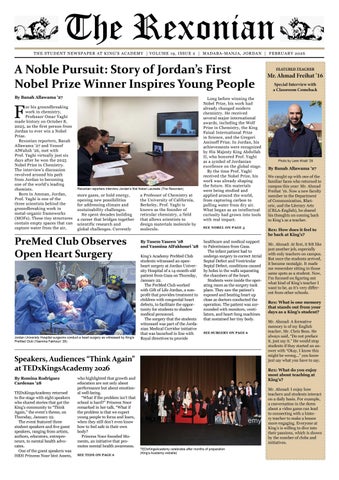
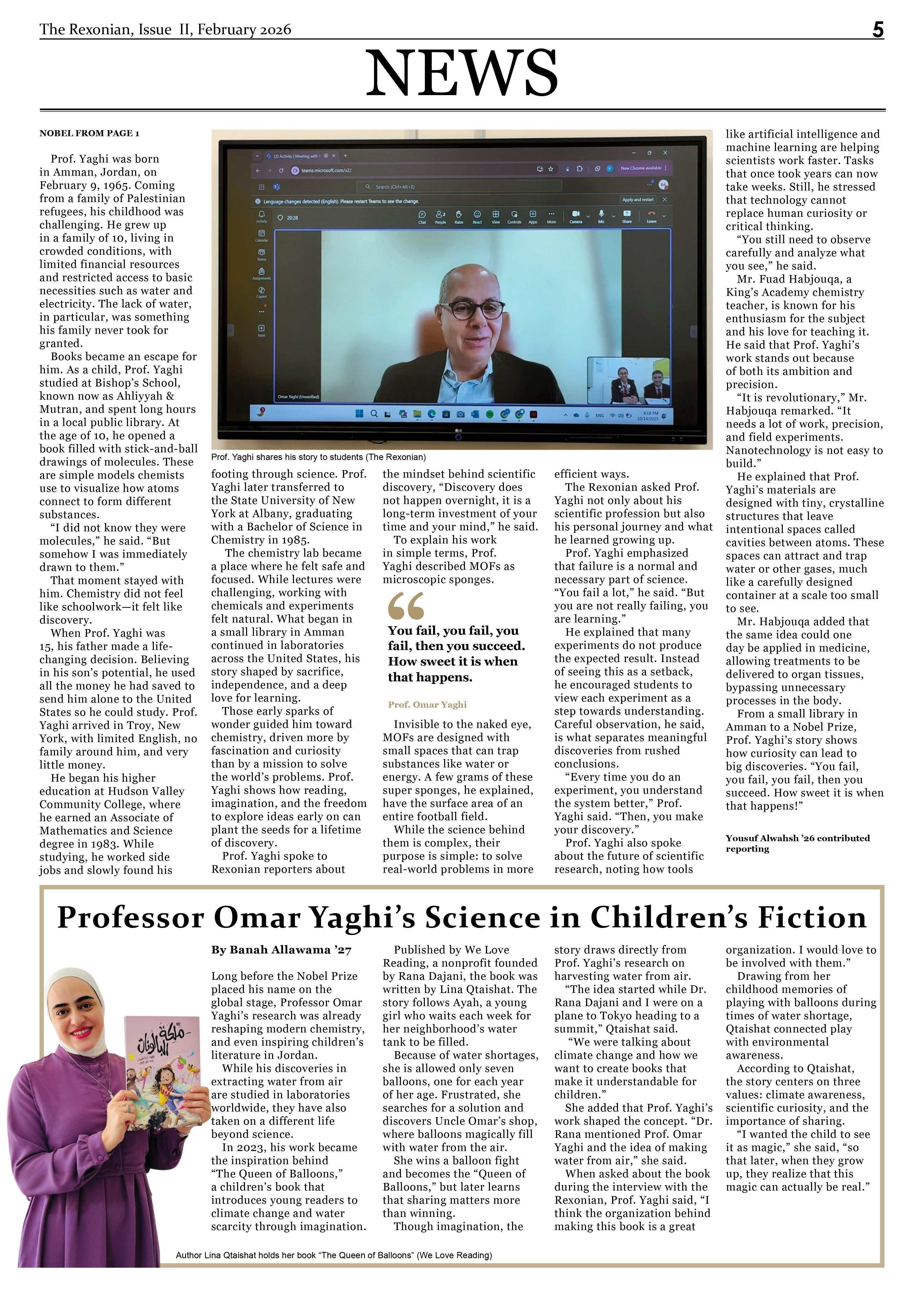
Rexonian reporters, Banah Allawama '27 and Yousuf AlWahsh '26, met with
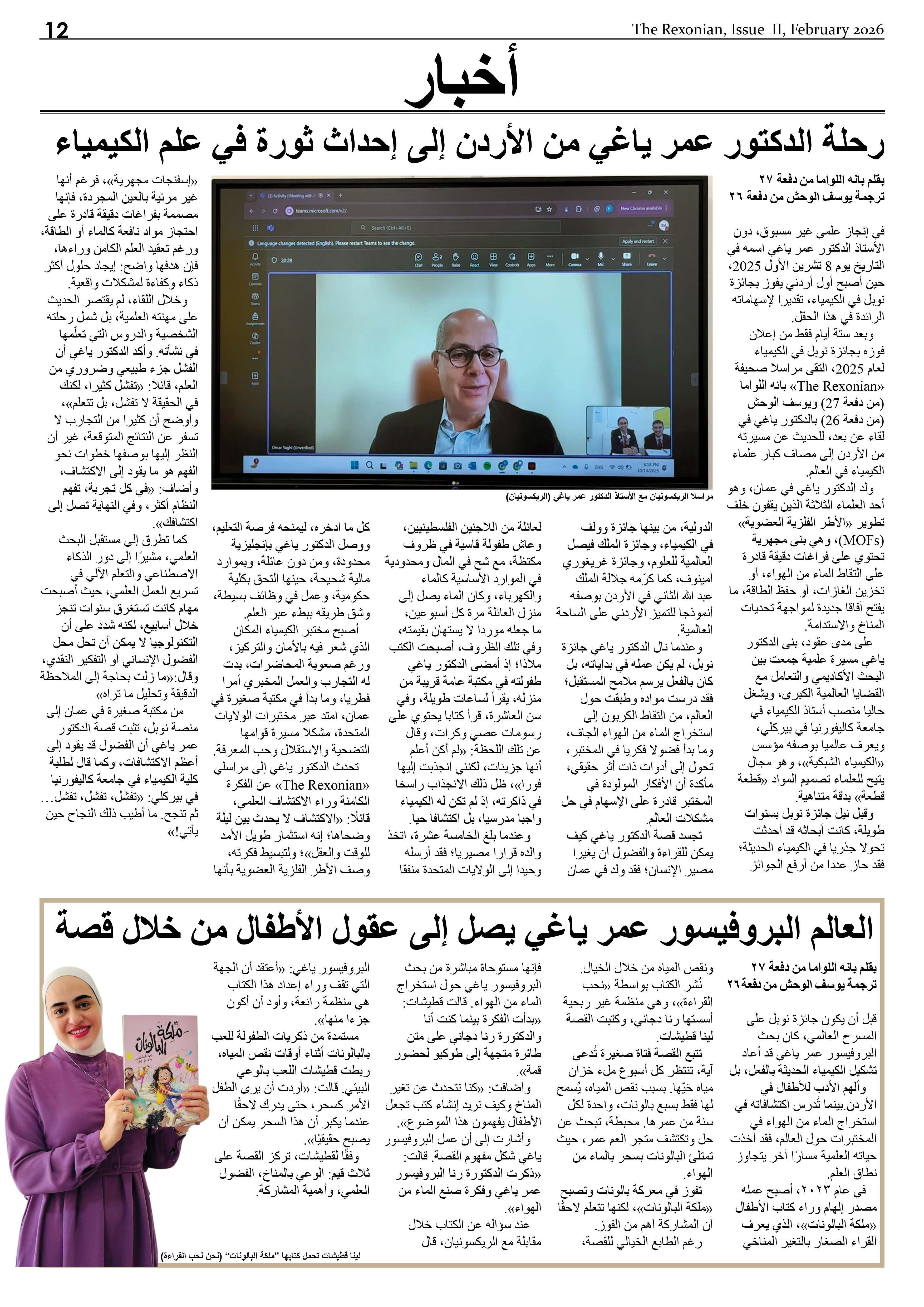
Prof. Yaghi virtually just six days after he won the 2025 Nobel Prize in Chemistry. The interview's discussion revolved around his path from Jordan to becoming one of the world's leading chemists.
Born in Amman, Jordan, Prof. Yaghi is one of the three scientists behind the groundbreaking work in metal-organic frameworks (MOFs). These tiny structures contain empty spaces that can capture water from the air,
store gases, or hold energy, opening new possibilities for addressing climate and sustainability challenges. He spent decades building a career that bridges together scientific research and global challenges. Currently
PreMed Club Observes Open Heart Surgery
a Professor of Chemistry at the University of California, Berkeley, Prof. Yaghi is known as the founder of reticular chemistry, a field that allows scientists to design materials molecule by molecule.
By Tusem Yaseen '28 and Yasmina AlFakhouri '28
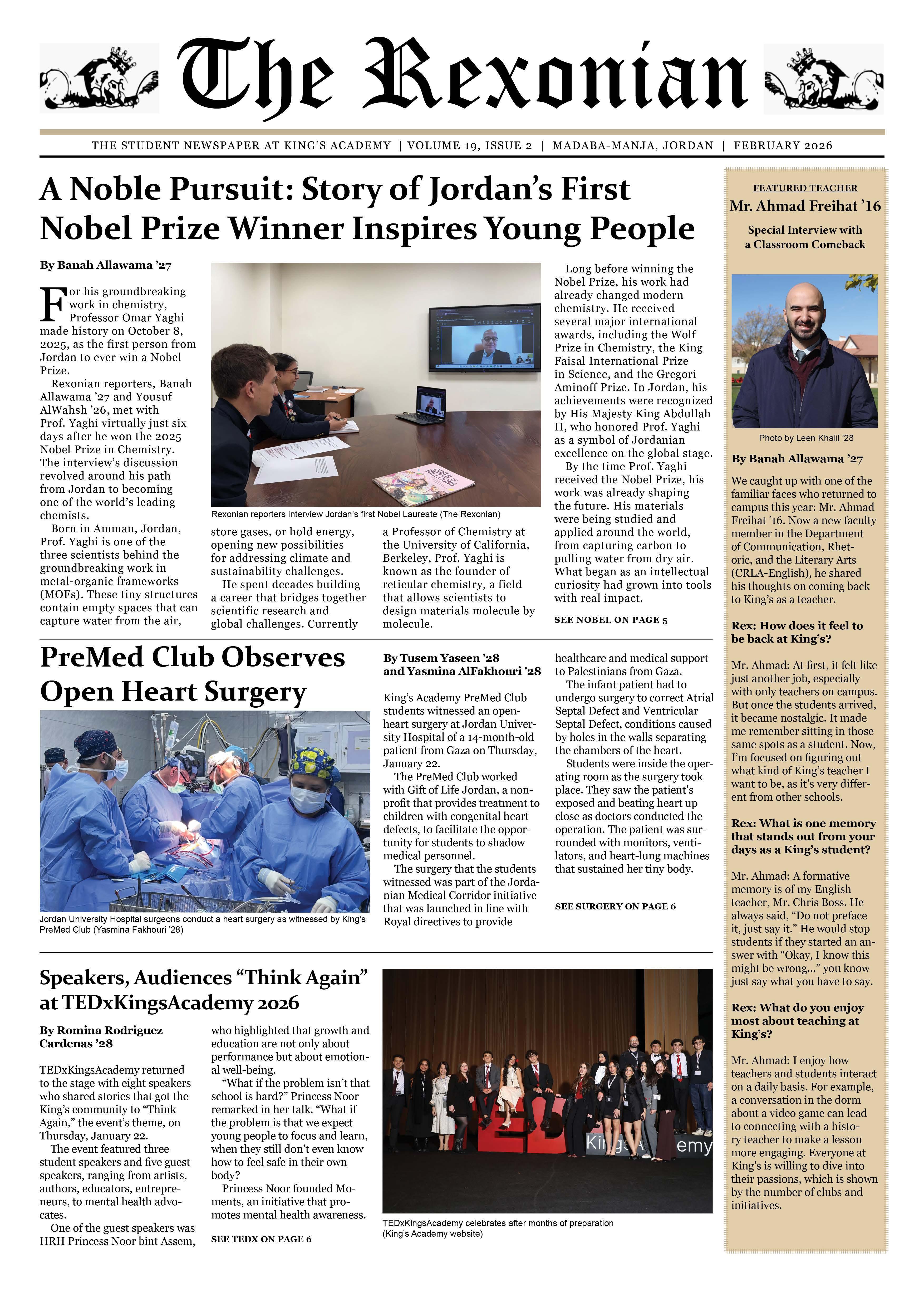
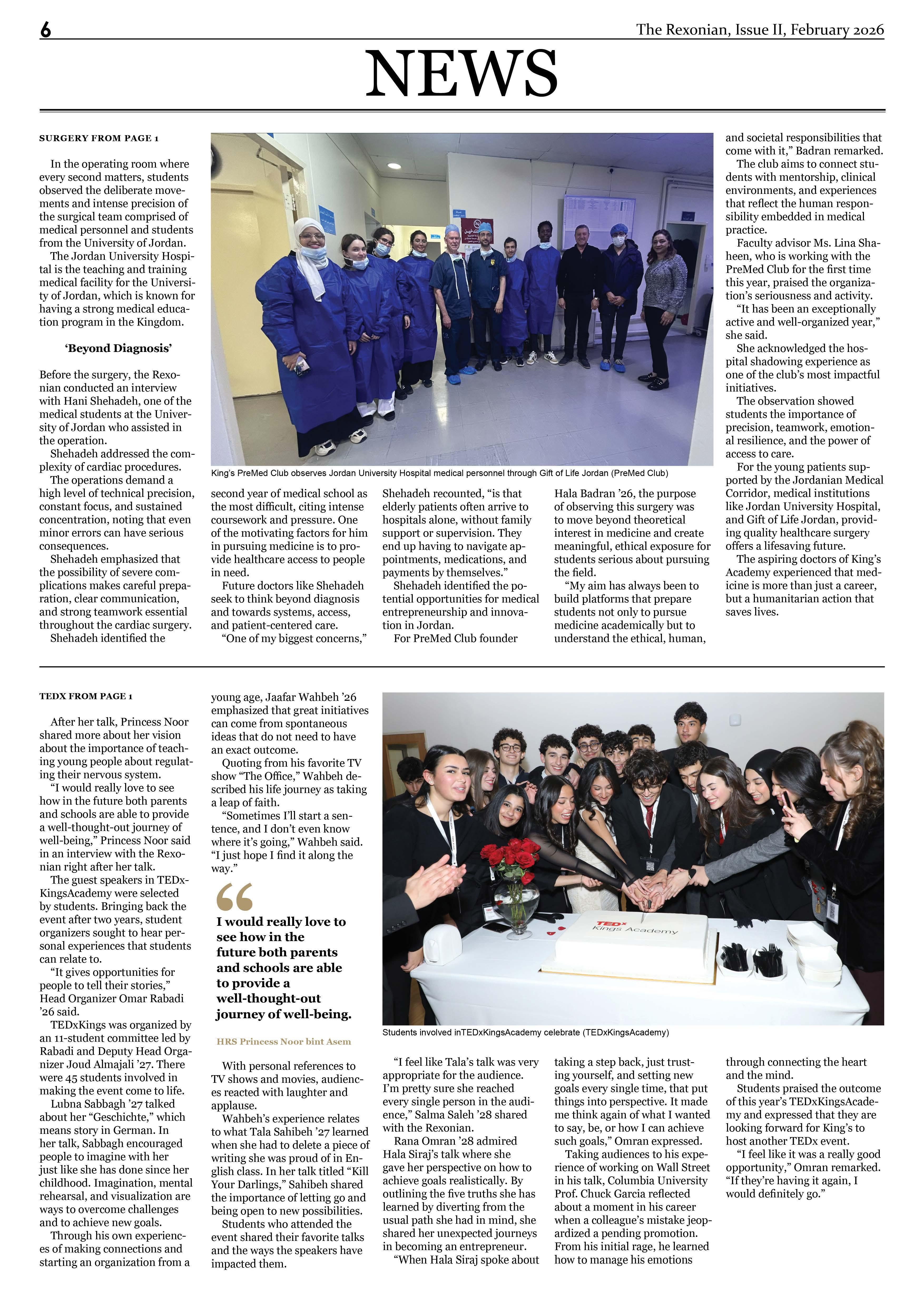
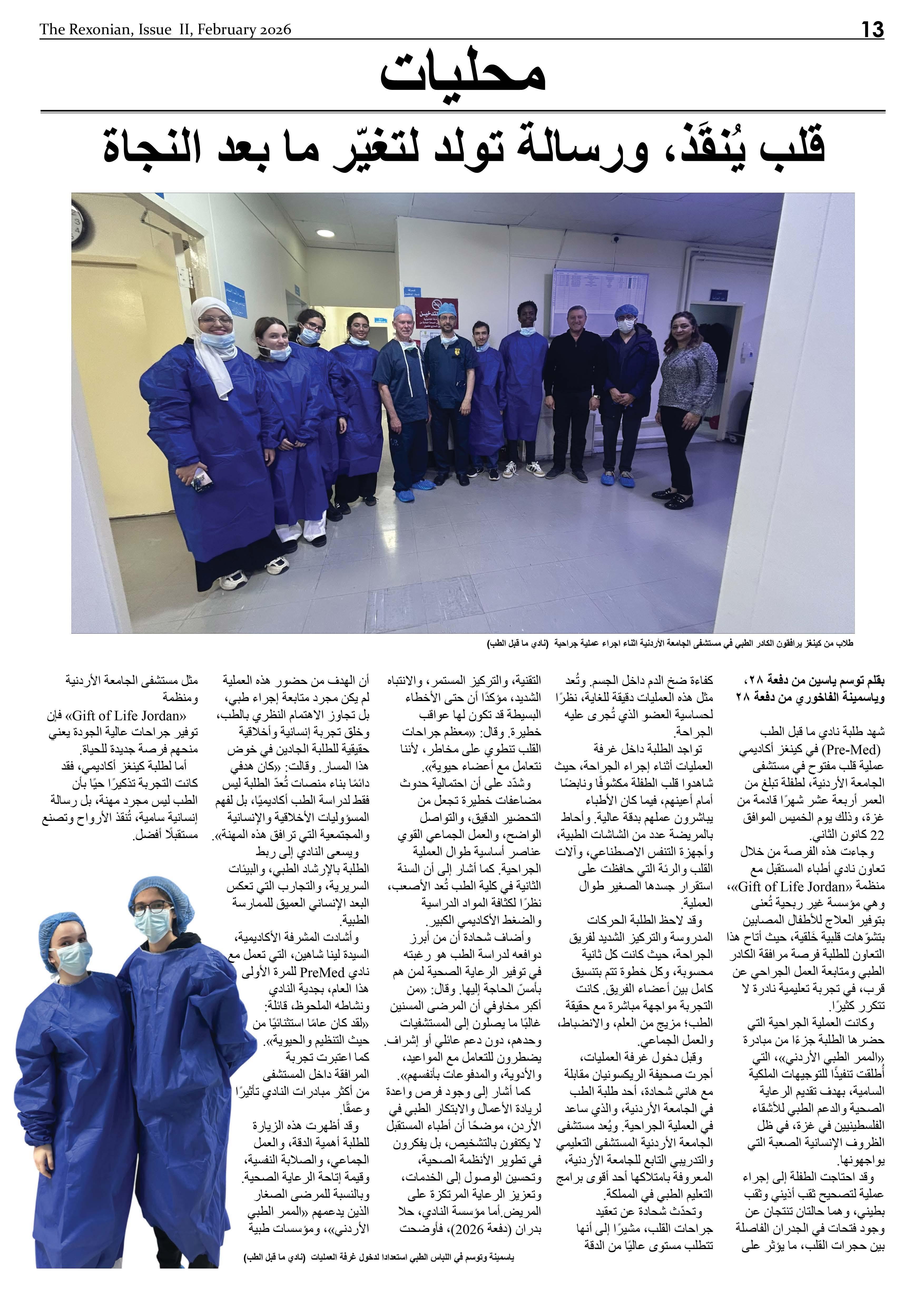
King's Academy PreMed Club students witnessed an openheart surgery at Jordan University Hospital of a 14-month-old patient from Gaza on Thursday, January 22.
The PreMed Club worked with Gift of Life Jordan, a nonprofit that provides treatment to children with congenital heart defects, to facilitate the opportunity for students to shadow medical personnel.
The surgery that the students witnessed was part of the Jordanian Medical Corridor initiative that was launched in line with Royal directives to provide
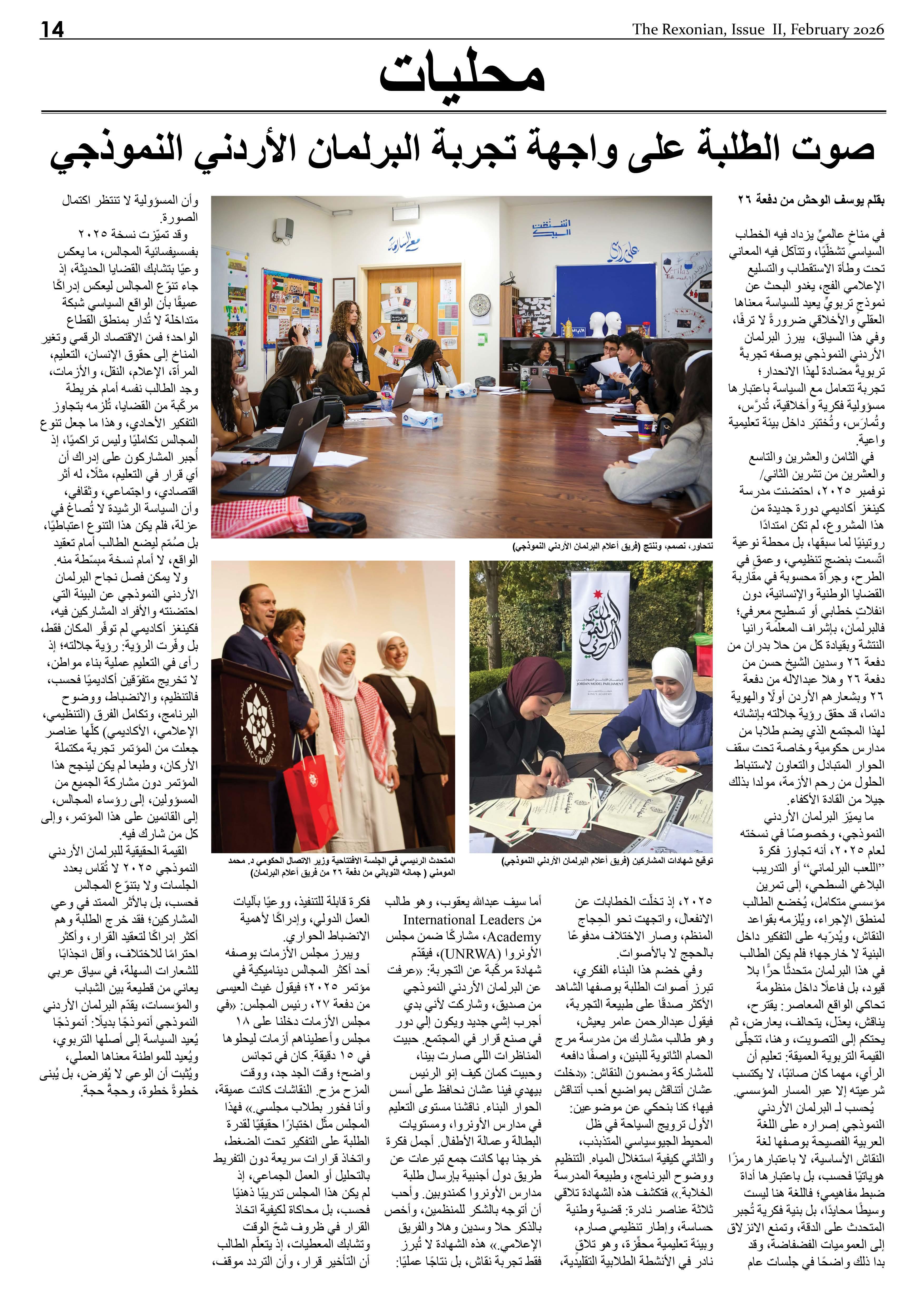
Speakers, Audiences "Thinl{Again" at TEDxl(ingsAcademy 2026
By Romina Rodriguez Cardenas '28
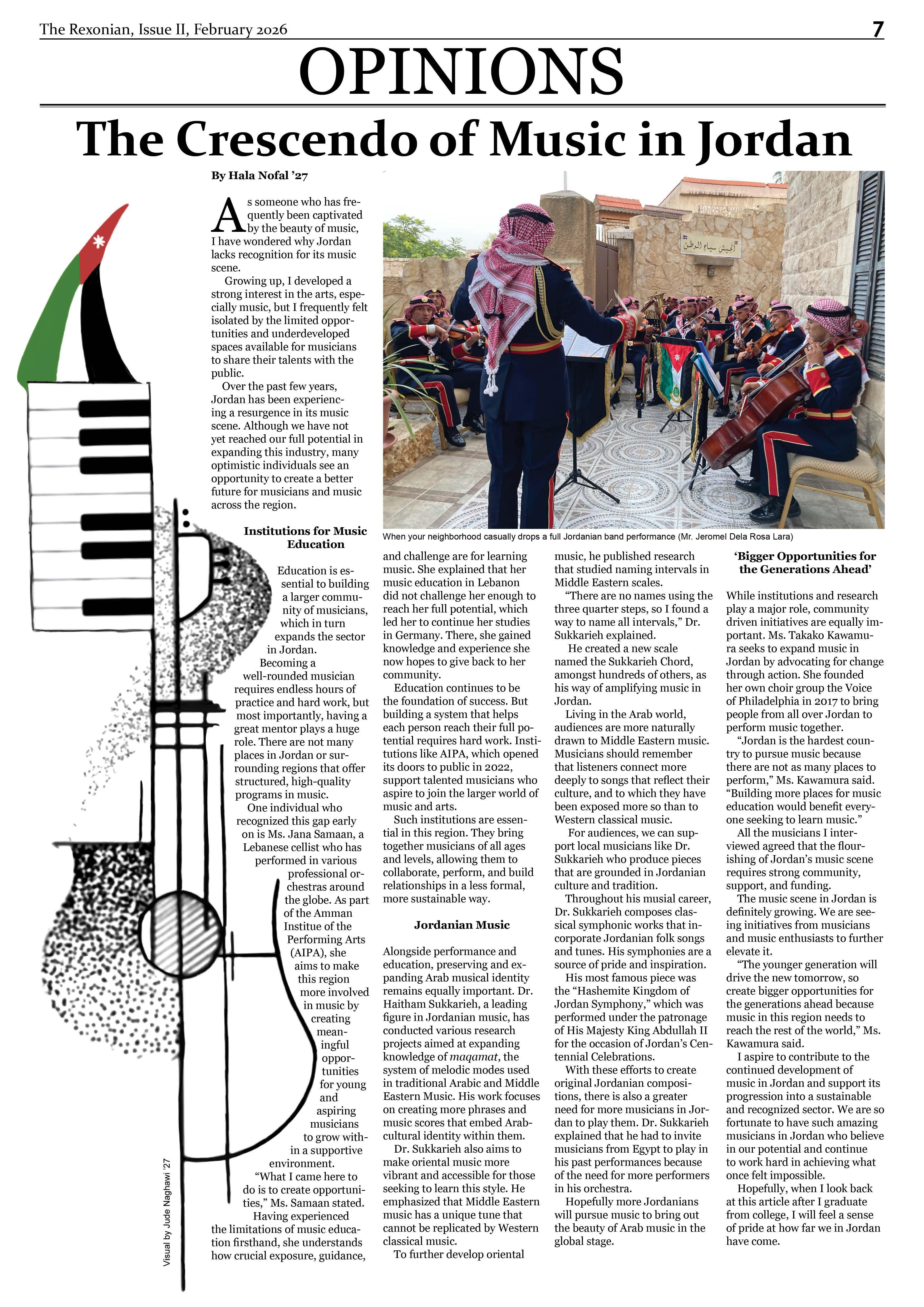
TEDxKingsAcademyreturned to the stage with eight speakers who shared stories that got the King's community to "Think Again," the event's theme, on Thursday, January 22.
The event featured three student speakers and five guest speakers, ranging from artists, authors, educators, entrepreneurs, to mental health advocates.
One of the guest speakers was HRH Princess Noor bint Assem,
who highlighted that growth and education are not only about performance but about emotional well-being.
"What if the problem isn't that school is hard?" Princess Noor remarked in her talk. "What if the problem is that we expect young people to focus and learn, when they still don't even know how to feel safe in their own body?
Princess Noor founded Moments, an initiative that promotes mental health awareness.
SEE TEDX ON PAGE
Special Interview with a Classroom Comeback
Long before winning the Nobel Prize, his work had already changed modern chemistry. He received several major international awards, including the Wolf Prize in Chemistry, the King Faisal International Prize in Science, and the Gregori Aminoff Prize. In Jordan, his achievements were recognized by His Majesty King Abdullah II, who honored Prof. Yaghi as a symbol of Jordanian excellence on the global stage. By the time Prof. Yaghi received the Nobel Prize, his work was already shaping the future. His materials
were being studied and applied around the world, from capturing carbon to pulling water from dry air. What began as an intellectual curiosity had grown into tools with real impact.
healthcare and medical support to Palestinians from Gaza.
The infant patient had to undergo surgery to correct Atrial Septal Defect and Ventricular Septal Defect, conditions caused by holes in the walls separating the chambers of the heart.
Students were inside the operating room as the surgery took place. They saw the patient's exposed and beating heart up close as doctors conducted the operation. The patient was surrounded with monitors, ventilators, and heart-lung machines that sustained her tiny body.
SEE SURGERY ON PAGE 6
By Banah Allawama '27
We caught up with one of the familiar faces who returned to campus this year: Mr. Ahmad Freihat '16. Now a new faculty member in the Department of Communication, Rhetoric, and the Literary Arts (CRLA-English),he shared his thoughts on coming back to King's as a teacher.
Rex: How does it feel to be back at King's?
Mr. Ahmad: At first, it felt like just another job, especially with only teachers on campus. But once the students arrived, it became nostalgic. It made me remember sitting in those same spots as a student. Now, I'm focused on figuring out what kind of King's teacher I want to be, as it's very different from other schools.
Rex: What is one memory that stands out from your days as a King's student?
Mr. Ahmad: A formative memory is of my English teacher, Mr. Chris Boss. He always said, "Do not preface it, just say it." He would stop students if they started an answer with "Okay, I know this might be wrong " you know just say what you have to say.
Rex: What do you enjoy most about teaching at King's?
Mr. Ahmad: I enjoy how teachers and students interact on a daily basis. For example, a conversation in the dorm about a video game can lead to connecting with a history teacher to make a lesson more engaging. Everyone at King's is willing to dive into their passions, which is shown by the number of clubs and initiatives.
Rexonian reporters interview Jordan's first Nobel Laureate (The Rexonian)
Jordan University Hospital surgeons conduct a heart surgery as witnessed by King's PreMed Club (Yasmina Fakhouri '28)
SEE NOBEL ON PAGE 5
TEDxKingsAcademy celebrates after months of preparation (King's Academy website)
THE MOSAIC
Movements Captured by Our Roving Rexonian Reporters
\!tbe3aexonian
BANAHALLAWAMA'27
Editor in Chief
LAMAR WAHBEH '27
Managing Editor
LUBNA SABBAGH '27
Managing Editor
YOUSUF ALWAHSH '26
Head of Arabic
OMAR SHARRAB '27
Multimedia Director
NAYA ALBADOUR '27
Multimedia Director
HADEEL QANDEEL '27
Photography & Communications Director
Reporters and Editors
Alia'a Akel '27
Dylan Al Jaff '27
Gasaro Migisha Ange '26
Yasmina AlFakhouri '28
Romina Rodriguez Cardenas '28
Yara Kaanan '27
Natali Nijmeh '28
Jude N aghawi '28
Hala Nofal '27
Tusem Yaseen '28
Photographers
Leen Khalil '28
Jumana AlNobani '26
Faculty Advisors
Mr. Jeromel Dela Rosa Lara
Dr. Christina Z. Hawatmeh
Faculty Reviewers
Mr. Ahmad Freihat
Mr. John Langer
Dr. Hani Elayyan
THE EDITOR-IN-CHIEF
To the ones turning these pages, and to the ones who created them, this issue is more than ink on paper. It is study hall nights spent in the library. It is stories taking shape. It is drafts rewritten, photos retaken, new ideas born during Co-Co time, and moments almost missed but captured just in time.
To our readers: thank you. Every article, every interview, every caption was written with you in mind. We hope you see yourselves somewhere in these pages, in the stories, the voices, and the moments that make our community what it is.
To the team: from talented students to the faculty members who guided us, this is your work. Your patience. Your creativity. Your belief that student voices matter. You trusted the process, even when deadlines felt too close and ideas felt too big.
Thank you for reading, and thank you, team, for creating what they are reading.
With gratitude, Banah Allawama
ByTusem Yaseen '28 and Lamar Wahbeh '27
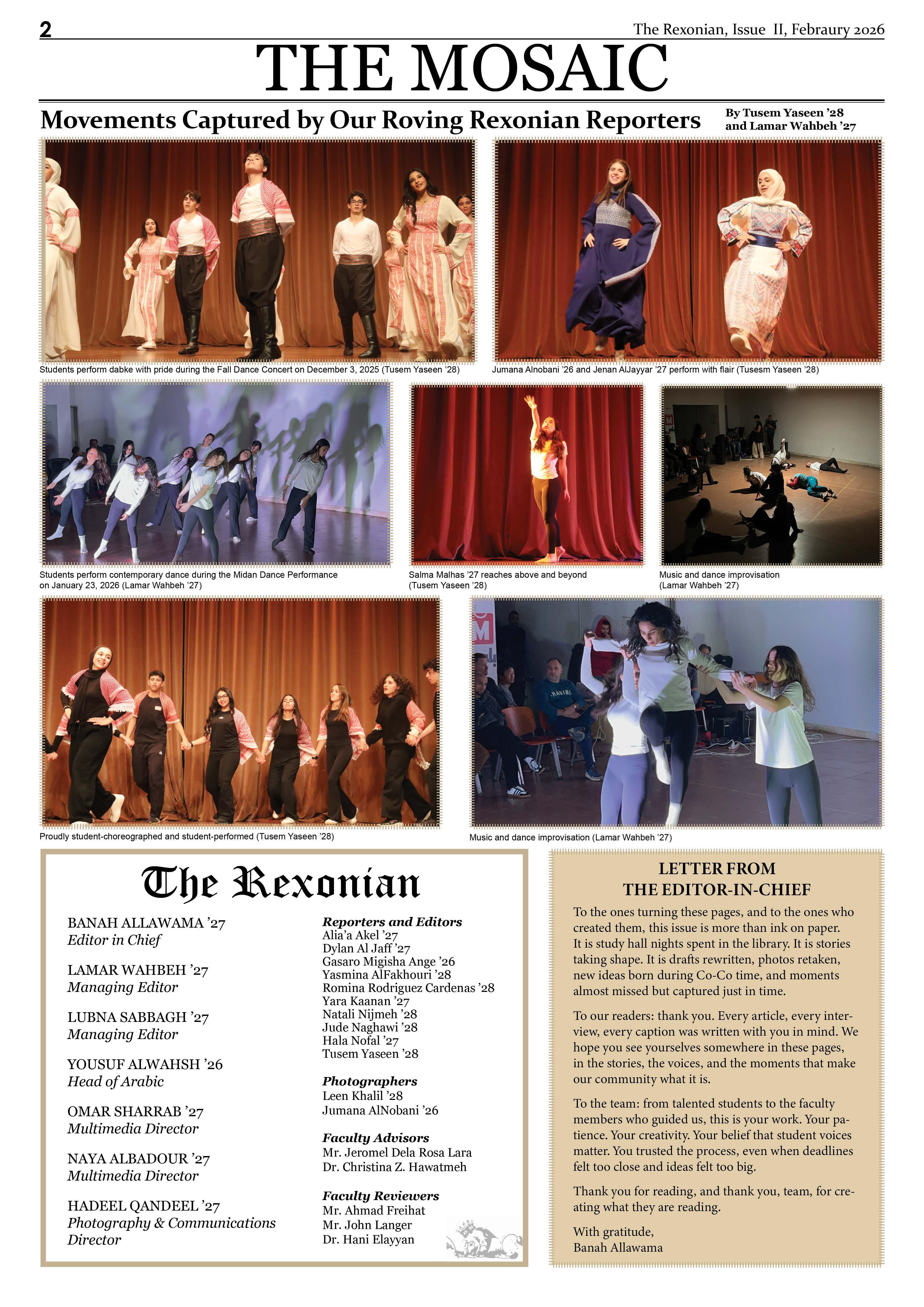
Jumana Alnobani '26 and Jenan AIJayyar '27 perform with flair (Tusesm Yaseen '28)
Students perform contemporary dance during the Midan Dance Performance on January 23, 2026 (Lamar Wahbeh '27)
Salma Malhas '27 reaches above and beyond (Tusem Yaseen '28)
Music and dance improvisation (Lamar Wahbeh '27)
Proudly student-choreographed and student-performed (Tusem Yaseen '28)
Music and dance improvisation (Lamar Wahbeh '27)
FEATURES On Sonder: Being More Than a Teacher
By Gasaro Migisha Ange '26 Reporting and Photography
Teachers teach and students learn. Yet it is often difficult to imagine what life looks like for each other once the classroom door closes.
At King's Academy, classrooms are often seen as the center of school life. But for many teachers, the places that shape them as people and define their relationships with students exist beyond faculty desks and whiteboards.
When I asked about special spaces on campus, faculty members spoke of places that make them feel like more than teachers.
I remember, on my first day, I was rummaging through the library shelves, unable to find one of my life-buoying books. Ms. Jumana Qaimari noticed and kindly helped me locate "The God of Small Things," a book that has long shaped my reading life.
Hearing about my love for books, she began sharing how she finds a similar sense of belonging in the library.
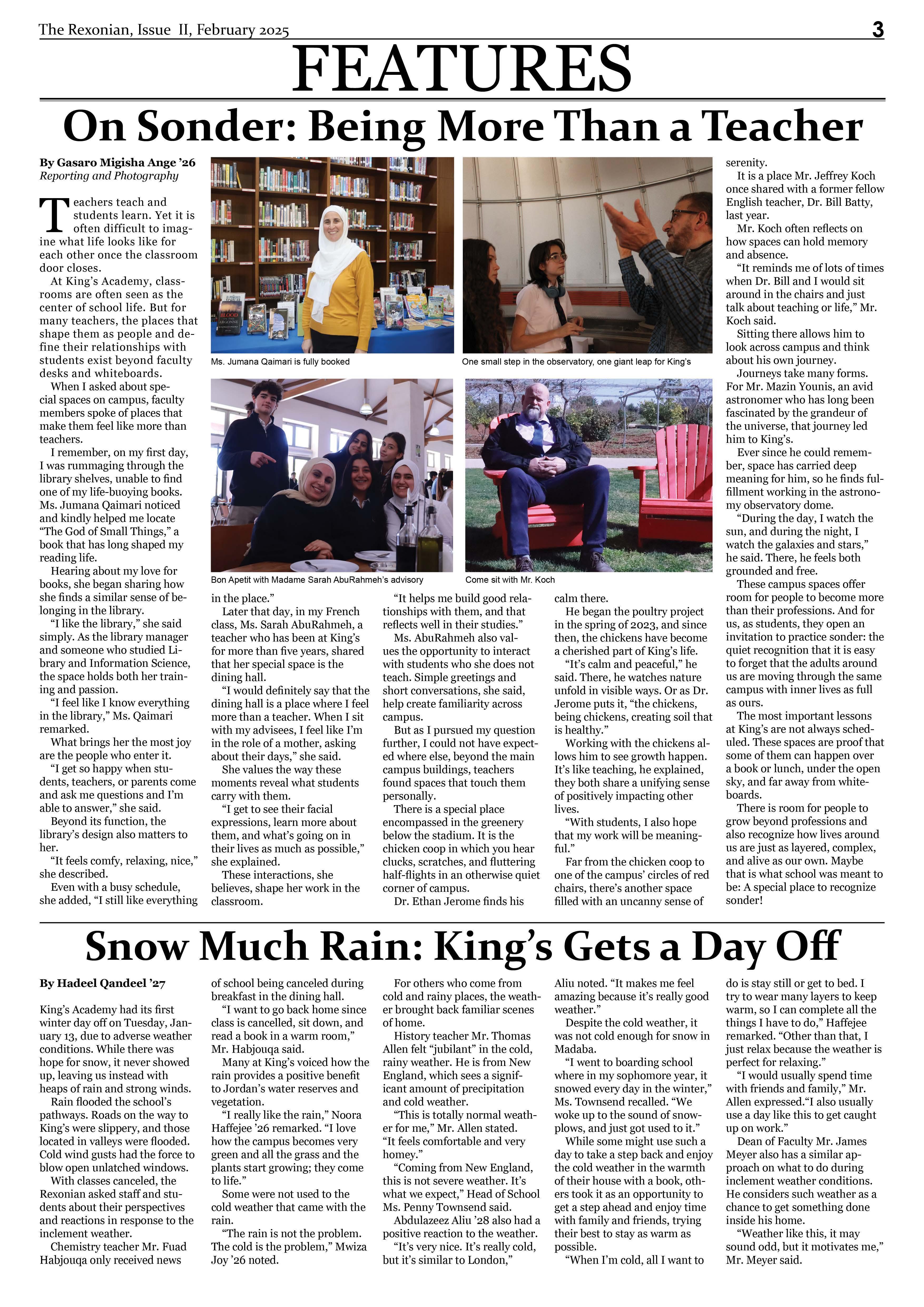
"I like the library," she said simply. As the library manager and someone who studied Library and Information Science, the space holds both her training and passion.
"I feel like I know everything in the library," Ms. Qaimari remarked.
What brings her the most joy are the people who enter it.
"I get so happy when students, teachers, or parents come and ask me questions and I'm able to answer," she said.
Beyond its function, the library's design also matters to her.
"It feels comfy, relaxing, nice," she described.
Even with a busy schedule, she added, "I still like everything
place."
Later that day, in my French class, Ms. Sarah AbuRahmeh, a teacher who has been at King's for more than five years, shared that her special space is the dining hall.
"I would definitely say that the dining hall is a place where I feel more than a teacher. When I sit with my advisees, I feel like I'm in the role of a mother, asking about their days," she said.
She values the way these moments reveal what students carry with them.
"I get to see their facial expressions, learn more about them, and what's going on in their lives as much as possible," she explained.
These interactions, she believes, shape her work in the classroom.
"It helps me build good relationships with them, and that reflects well in their studies."
Ms. AbuRahmeh also values the opportunity to interact with students who she does not teach. Simple greetings and short conversations, she said, help create familiarity across campus.
But as I pursued my question further, I could not have expected where else, beyond the main campus buildings, teachers found spaces that touch them personally.
There is a special place encompassed in the greenery below the stadium. It is the chicken coop in which you hear clucks, scratches, and fluttering half-flights in an otherwise quiet corner of campus.
Dr. Ethan Jerome finds his
calm there.
He began the poultry project in the spring of 2023, and since then, the chickens have become a cherished part of King's life.
"It's calm and peaceful," he said. There, he watches nature unfold in visible ways. Or as Dr. Jerome puts it, "the chickens, being chickens, creating soil that is healthy."
Working with the chickens allows him to see growth happen. It's like teaching, he explained, they both share a unifying sense of positively impacting other lives.
"With students, I also hope that my work will be meaningful."
Far from the chicken coop to one of the campus' circles of red chairs, there's another space filled with an uncanny sense of
serenity.
It is a place Mr. Jeffrey Koch once shared with a former fellow English teacher, Dr. Bill Batty, last year.
Mr. Koch often reflects on how spaces can hold memory and absence.
"It reminds me oflots of times when Dr. Bill and I would sit around in the chairs and just talk about teaching or life," Mr. Koch said.
Sitting there allows him to look across campus and think about his own journey.
Journeys take many forms.
For Mr. Mazin Younis, an avid astronomer who has long been fascinated by the grandeur of the universe, that journey led him to King's.
Ever since he could remember, space has carried deep meaning for him, so he finds fulfillment working in the astronomy observatory dome.
"During the day, I watch the sun, and during the night, I watch the galaxies and stars," he said. There, he feels both grounded and free.
These campus spaces offer room for people to become more than their professions. And for us, as students, they open an invitation to practice sander: the quiet recognition that it is easy to forget that the adults around us are moving through the same campus with inner lives as full as ours.
The most important lessons at King's are not always scheduled. These spaces are proof that some of them can happen over a book or lunch, under the open sky, and far away from whiteboards.
There is room for people to grow beyond professions and also recognize how lives around us are just as layered, complex, and alive as our own. Maybe that is what school was meant to be: A special place to recognize sander!
Snow Much Rain: King's Gets a Day Off
By Hadeel Qandeel
'27 of school being canceled during For others who come from Aliu noted. "It makes me feel do is stay still or get to bed. I breakfast in the dining hall. cold and rainy places, the weath- amazing because it's really good try to wear many layers to keep King's Academy had its first "I want to go back home since er brought back familiar scenes weather." warm, so I can complete all the winter day off on Tuesday, Jan- class is cancelled, sit down, and of home. Despite the cold weather, it things I have to do," Haffejee uary 13, due to adverse weather read a book in a warm room," History teacher Mr. Thomas was not cold enough for snow in remarked. "Other than that, I conditions. While there was Mr. Habjouqa said. Allen felt "jubilant" in the cold, Madaba. just relax because the weather is hope for snow, it never showed Many at King's voiced how the rainy weather. He is from New "I went to boarding school perfect for relaxing." up, leaving us instead with rain provides a positive benefit England, which sees a signif- where in my sophomore year, it "I would usually spend time heaps of rain and strong winds. to Jordan's water reserves and icant amount of precipitation snowed every day in the winter," with friends and family," Mr. Rain flooded the school's vegetation. and cold weather. Ms. Townsend recalled. "We Allen expressed."! also usually pathways. Roads on the way to "I really like the rain," Noora "This is totally normal weath- woke up to the sound of snow- use a day like this to get caught King's were slippery, and those Haffejee '26 remarked. "I love er for me," Mr. Allen stated. plows, and just got used to it." up on work." located in valleys were flooded. how the campus becomes very "It feels comfortable and very While some might use such a Dean of Faculty Mr. James Cold wind gusts had the force to green and all the grass and the homey." day to take a step back and enjoy Meyer also has a similar apblow open unlatched windows. plants start growing; they come "Coming from New England, the cold weather in the warmth proach on what to do during With classes canceled, the to life." this is not severe weather. It's of their house with a book, oth- inclement weather conditions. Rexonian asked staff and stu- Some were not used to the what we expect," Head of School ers took it as an opportunity to He considers such weather as a dents about their perspectives cold weather that came with the Ms. Penny Townsend said. get a step ahead and enjoy time chance to get something done and reactions in response to the rain. Abdulazeez Aliu '28 also had a with family and friends, trying inside his home. inclement weather. "The rain is not the problem. positive reaction to the weather. their best to stay as warm as "Weather like this, it may Chemistry teacher Mr. Fuad The cold is the problem," Mwiza "It's very nice. It's really cold, possible. sound odd, but it motivates me," Habjouqa only received news Joy '26 noted. but it's similar to London," "When I'm cold, all I want to Mr. Meyer said.
Ms. Jumana Qaimari is fully booked
One small step in the observatory, one giant leap for King's
Bon Apetit with Madame Sarah AbuRahmeh's advisory Come sit with Mr. Koch in the
FEATURES
Rain, Rain, Don't Go Away: Every Drop Counts for the Plants on Campus
By Yara Kanaan '27
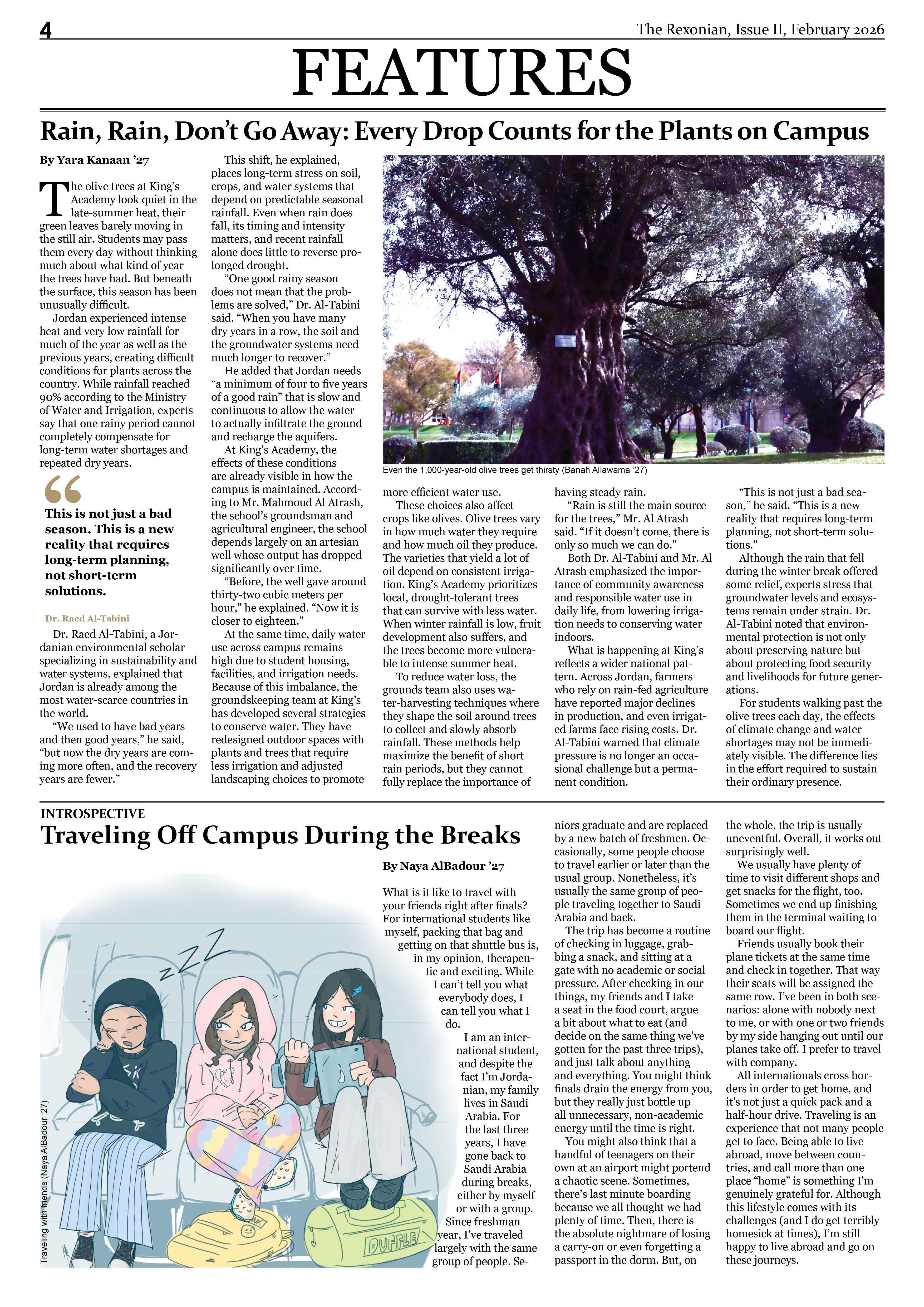
The olive trees at King's Academy look quiet in the late-summer heat, their green leaves barely moving in the still air. Students may pass them every day without thinking much about what kind of year the trees have had. But beneath the surface, this season has been unusually difficult.
Jordan experienced intense heat and very low rainfall for much of the year as well as the previous years, creating difficult conditions for plants across the country. While rainfall reached 90% according to the Ministry of Water and Irrigation, experts say that one rainy period cannot completely compensate for long-term water shortages and repeated dry years.
''This is not just a bad season. This is a new reality that requires long-term planning, not short-term solutions.
Dr. RaedAl-Tabini
Dr. RaedAl-Tabini, a Jordanian environmental scholar specializing in sustainability and water systems, explained that Jordan is already among the most water-scarce countries in the world.
"We used to have bad years and then good years," he said, "but now the dry years are coming more often, and the recovery years are fewer."
INTROSPECTIVE
This shift, he explained, places long-term stress on soil, crops, and water systems that depend on predictable seasonal rainfall. Even when rain does fall, its timing and intensity matters, and recent rainfall alone does little to reverse prolonged drought.
"One good rainy season does not mean that the problems are solved," Dr. Al-Tabini said. "When you have many dry years in a row, the soil and the groundwater systems need much longer to recover."
He added that Jordan needs "a minimum of four to five years of a good rain" that is slow and continuous to allow the water to actually infiltrate the ground and recharge the aquifers.
At King's Academy, the effects of these conditions are already visible in how the campus is maintained. According to Mr. Mahmoud Al Atrash, the school's groundsman and agricultural engineer, the school depends largely on an artesian well whose output has dropped significantly over time.
"Before, the well gave around thirty-two cubic meters per hour," he explained. "Now it is closer to eighteen."
At the same time, daily water use across campus remains high due to student housing, facilities, and irrigation needs. Because of this imbalance, the groundskeeping team at King's has developed several strategies to conserve water. They have redesigned outdoor spaces with plants and trees that require less irrigation and adjusted landscaping choices to promote
more efficient water use.
These choices also affect crops like olives. Olive trees vary in how much water they require and how much oil they produce. The varieties that yield a lot of oil depend on consistent irrigation. King's Academy prioritizes local, drought-tolerant trees that can survive with less water. When winter rainfall is low, fruit development also suffers, and the trees become more vulnerable to intense summer heat.
To reduce water loss, the grounds team also uses water-harvesting techniques where they shape the soil around trees to collect and slowly absorb rainfall. These methods help maximize the benefit of short rain periods, but they cannot fully replace the importance of
Traveling Off Campus During the Breal<:s
By Naya AlBadour '27
What is it like to travel with your friends right after finals?
For international students like myself, packing that bag and getting on that shuttle bus is, in my opinion, therapeutic and exciting. While I can't tell you what everybody does, I can tell you what I do.
I am an international student, and despite the fact I'm Jordanian, my family lives in Saudi Arabia. For the last three years, I have gone back to Saudi Arabia during breaks, either by myself
or with a group. Since freshman r ear, I've traveled ~i4--~, ~largely with the same =----group of people. Se-
having steady rain.
"Rain is still the main source for the trees," Mr. Al Atrash said. "If it doesn't come, there is only so much we can do."
Both Dr. Al-Tabini and Mr. Al Atrash emphasized the importance of community awareness and responsible water use in daily life, from lowering irrigation needs to conserving water indoors.
What is happening at King's reflects a wider national pattern. Across Jordan, farmers who rely on rain-fed agriculture have reported major declines in production, and even irrigated farms face rising costs. Dr. Al-Tabini warned that climate pressure is no longer an occasional challenge but a permanent condition.
niors graduate and are replaced by a new batch of freshmen. Occasionally, some people choose to travel earlier or later than the usual group. Nonetheless, it's usually the same group of people traveling together to Saudi Arabia and back.
The trip has become a routine of checking in luggage, grabbing a snack, and sitting at a gate with no academic or social pressure. After checking in our things, my friends and I take a seat in the food court, argue a bit about what to eat (and decide on the same thing we've gotten for the past three trips), and just talk about anything and everything. You might think finals drain the energy from you, but they really just bottle up all unnecessary, non-academic energy until the time is right.
You might also think that a handful of teenagers on their own at an airport might portend a chaotic scene. Sometimes, there's last minute boarding because we all thought we had plenty of time. Then, there is the absolute nightmare oflosing a carry-on or even forgetting a passport in the dorm. But, on
"This is not just a bad season," he said. "This is a new reality that requires long-term planning, not short-term solutions."
Although the rain that fell during the winter break offered some relief, experts stress that groundwater levels and ecosystems remain under strain. Dr. Al-Tabini noted that environmental protection is not only about preserving nature but about protecting food security and livelihoods for future generations.
For students walking past the olive trees each day, the effects of climate change and water shortages may not be immediately visible. The difference lies in the effort required to sustain their ordinary presence.
the whole, the trip is usually uneventful. Overall, it works out surprisingly well.
We usually have plenty of time to visit different shops and get snacks for the flight, too. Sometimes we end up finishing them in the terminal waiting to board our flight.
Friends usually book their plane tickets at the same time and check in together. That way their seats will be assigned the same row. I've been in both scenarios: alone with nobody next to me, or with one or two friends by my side hanging out until our planes take off. I prefer to travel with company.
All internationals cross borders in order to get home, and it's not just a quick pack and a half-hour drive. Traveling is an experience that not many people get to face. Being able to live abroad, move between countries, and call more than one place "home" is something I'm genuinely grateful for. Although this lifestyle comes with its challenges (and I do get terribly homesick at times), I'm still happy to live abroad and go on these journeys.
Even the 1,000-year-old olive trees get thirsty (Banah Allawama '27)
NEWS
Prof. Yaghi was born in Amman, Jordan, on February 9, 1965. Coming from a family of Palestinian refugees, his childhood was challenging. He grew up in a family of 10, living in crowded conditions, with limited financial resources and restricted access to basic necessities such as water and electricity. The lack of water, in particular, was something his family never took for granted.
Books became an escape for him. As a child, Prof. Yaghi studied at Bishop's School, known now as Ahliyyah & Mutran, and spent long hours in a local public library. At the age of 10, he opened a book filled with stick-and-ball drawings of molecules. These are simple models chemists use to visualize how atoms connect to form different substances.
"I did not know they were molecules," he said. "But somehow I was immediately drawn to them."
That moment stayed with him. Chemistry did not feel like schoolwork-it felt like discovery.
When Prof. Yaghi was 15, his father made a lifechanging decision. Believing in his son's potential, he used all the money he had saved to send him alone to the United States so he could study. Prof. Yaghi arrived in Troy, New York, with limited English, no family around him, and very little money.
He began his higher education at Hudson Valley Community College, where he earned an Associate of Mathematics and Science degree in 1983. While studying, he worked side jobs and slowly found his
Prof. Yaghi shares his story to students (The Rexonian) footing through science. Prof. Yaghi later transferred to the State University of New York at Albany, graduating with a Bachelor of Science in Chemistry in 1985.
The chemistry lab became a place where he felt safe and focused. While lectures were challenging, working with chemicals and experiments felt natural. What began in a small library in Amman continued in laboratories across the United States, his story shaped by sacrifice, independence, and a deep love for learning.
Those early sparks of wonder guided him toward chemistry, driven more by fascination and curiosity than by a mission to solve the world's problems. Prof. Yaghi shows how reading, imagination, and the freedom to explore ideas early on can plant the seeds for a lifetime of discovery.
Prof. Yaghispoketo Rexonian reporters about
the mindset behind scientific discovery, "Discovery does not happen overnight, it is a long-term investment of your time and your mind," he said.
To explain his work in simple terms, Prof. Yaghi described MOFs as microscopic sponges.
''You fail, you fail, you fail, then you succeed. How sweet it is when that happens.
Prof. Omar Yaghi
Invisible to the naked eye, MOFs are designed with small spaces that can trap substances like water or energy. A few grams of these super sponges, he explained, have the surface area of an entire football field.
While the science behind them is complex, their purpose is simple: to solve real-world problems in more
efficient ways.
The Rexonian asked Prof. Yaghi not only about his scientific profession but also his personal journey and what he learned growing up.
Prof. Yaghi emphasized that failure is a normal and necessary part of science. "You fail a lot," he said. "But you are not really failing, you are learning."
He explained that many experiments do not produce the expected result. Instead of seeing this as a setback, he encouraged students to view each experiment as a step towards understanding. Careful observation, he said, is what separates meaningful discoveries from rushed conclusions.
"Every time you do an experiment, you understand the system better," Prof. Yaghi said. "Then, you make your discovery."
Prof. Yaghi also spoke about the future of scientific research, noting how tools
like artificial intelligence and machine learning are helping scientists work faster. Tasks that once took years can now take weeks. Still, he stressed that technology cannot replace human curiosity or critical thinking.
"You still need to observe carefully and analyze what you see," he said.
Mr. Fuad Habjouqa, a King's Academy chemistry teacher, is known for his enthusiasm for the subject and his love for teaching it. He said that Prof. Yaghi's work stands out because of both its ambition and precision.
"It is revolutionary," Mr. Habjouqa remarked. "It needs a lot of work, precision, and field experiments. Nanotechnology is not easy to build."
He explained that Prof. Yaghi's materials are designed with tiny, crystalline structures that leave intentional spaces called cavities between atoms. These spaces can attract and trap water or other gases, much like a carefully designed container at a scale too small to see.
Mr. Habjouqa added that the same idea could one day be applied in medicine, allowing treatments to be delivered to organ tissues, bypassing unnecessary processes in the body.
From a small library in Amman to a Nobel Prize, Prof. Yaghi's story shows how curiosity can lead to big discoveries. "You fail, you fail, you fail, then you succeed. How sweet it is when that happens!"
Yousuf Alwahsh '26 contributed reporting
Professor Oillar Yaghi's Science in Children's Fiction
By Banah Allawama '27
Published by We Love story draws directly from organization. I would love to Reading, a nonprofit founded Prof. Yaghi's research on be involved with them."
Long before the Nobel Prize by Rana Dajani, the book was harvesting water from air. Drawing from her placed his name on the written by Lina Qtaishat. The "The idea started while Dr. childhood memories of global stage, Professor Omar story follows Ayah, a young Rana Dajani and I were on a playing with balloons during Yaghi's research was already girl who waits each week for plane to Tokyo heading to a times of water shortage, reshaping modern chemistry, her neighborhood's water summit," Qtaishat said. Qtaishat connected play
and even inspiring children's tank to be filled. "We were talking about with environmental ,,,...,.,, literature in Jordan. Because of water shortages, climate change and how we awareness. ,..,.~ While his discoveries in she is allowed only seven want to create books that According to Qtaishat, extracting water from air balloons, one for each year make it understandable for the story centers on three are studied in laboratories of her age. Frustrated, she children." values: climate awareness, worldwide, they have also searches for a solution and She added that Prof. Yaghi's scientific curiosity, and the taken on a different life discovers Uncle Omar's shop, work shaped the concept. "Dr. importance of sharing. beyond science. where balloons magically fill Rana mentioned Prof. Omar "I wanted the child to see
In 2023, his work became with water from the air. Yaghi and the idea of making it as magic," she said, "so the inspiration behind She wins a balloon fight water from air," she said. that later, when they grow "The Queen of Balloons," and becomes the "Queen of When asked about the book up, they realize that this a children's book that Balloons," but later learns during the interview with the magic can actually be real." introduces young readers to that sharing matters more Rexonian, Prof. Yaghi said, "I climate change and water than winning. think the organization behind scarcity through imagination. Though imagination, the making this book is a great
Author Lina Qtaishat holds her book "The Queen of Balloons" (We Love Reading)
SURGERY FROM PAGE 1
In the operating room where every second matters, students observed the deliberate movements and intense precision of the surgical team comprised of medical personnel and students from the University of Jordan.
The Jordan University Hospital is the teaching and training medical facility for the University of Jordan, which is known for having a strong medical education program in the Kingdom.
'Beyond Diagnosis'
Before the surgery, the Rexonian conducted an interview with Hani Shehadeh, one of the medical students at the University of Jordan who assisted in the operation.
Shehadeh addressed the complexity of cardiac procedures.
The operations demand a high level of technical precision, constant focus, and sustained concentration, noting that even minor errors can have serious consequences.
Shehadeh emphasized that the possibility of severe complications makes careful preparation, clear communication, and strong teamwork essential throughout the cardiac surgery.
Shehadeh identified the
TEDX FROM PAGE 1
After her talk, Princess Noor shared more about her vision about the importance of teaching young people about regulating their nervous system.
"I would really love to see how in the future both parents and schools are able to provide a well-thought-out journey of well-being," Princess Noor said in an interview with the Rexonian right after her talk.
The guest speakers in TEDxKingsAcademy were selected by students. Bringing back the event after two years, student organizers sought to hear personal experiences that students can relate to.
"It gives opportunities for people to tell their stories," Head Organizer Omar Rabadi '26 said.
TEDxKings was organized by an 11-student committee led by Rabadi and Deputy Head Organizer Joud Almajali '27. There were 45 students involved in making the event come to life.
Lubna Sabbagh '27 talked about her "Geschichte," which means story in German. In her talk, Sabbagh encouraged people to imagine with her just like she has done since her childhood. Imagination, mental rehearsal, and visualization are ways to overcome challenges and to achieve new goals.
Through his own experiences of making connections and starting an organization from a
second year of medical school as the most difficult, citing intense coursework and pressure. One of the motivating factors for him in pursuing medicine is to provide healthcare access to people in need.
Future doctors like Shehadeh seek to think beyond diagnosis and towards systems, access, and patient-centered care.
"One of my biggest concerns,"
young age, Jaafar Wahbeh '26 emphasized that great initiatives can come from spontaneous ideas that do not need to have an exact outcome.
Quoting from his favorite TV show "The Office," Wahbeh described his life journey as taking a leap of faith.
"Sometimes I'll start a sentence, and I don't even know where it's going," Wahbeh said.
"I just hope I find it along the way."
''I would really love to see how in the future both parents and schools are able to provide a well-thought-out journey of well-being.
HRS Princess Noor hint Asem
With personal references to TV shows and movies, audiences reacted with laughter and applause.
Wahbeh's experience relates to what Tala Sahibeh '27 learned when she had to delete a piece of writing she was proud of in English class. In her talk titled "Kill Your Darlings," Sahibeh shared the importance of letting go and being open to new possibilities.
Students who attended the event shared their favorite talks and the ways the speakers have impacted them.
Shehadeh recounted, "is that elderly patients often arrive to hospitals alone, without family support or supervision. They end up having to navigate appointments, medications, and payments by themselves."
Shehadeh identified the potential opportunities for medical entrepreneurship and innovation in Jordan.
For PreMed Club founder
Hala Badran '26, the purpose of observing this surgery was to move beyond theoretical interest in medicine and create meaningful, ethical exposure for students serious about pursuing the field.
"My aim has always been to build platforms that prepare students not only to pursue medicine academically but to understand the ethical, human,
Students involved inTEDxKingsAcademy celebrate (TEDxKingsAcademy)
"I feel like Tala's talk was very appropriate for the audience. I'm pretty sure she reached every single person in the audience," Salma Saleh '28 shared with the Rexonian.
Rana Omran '28 admired Hala Siraj's talk where she gave her perspective on how to achieve goals realistically. By outlining the five truths she has learned by diverting from the usual path she had in mind, she shared her unexpected journeys in becoming an entrepreneur.
"When Hala Siraj spoke about
and societal responsibilities that come with it," Badran remarked.
The club aims to connect students with mentorship, clinical environments, and experiences that reflect the human responsibility embedded in medical practice.
Faculty advisor Ms. Lina Shaheen, who is working with the PreMed Club for the first time this year, praised the organization's seriousness and activity.
"It has been an exceptionally active and well-organized year," she said.
She acknowledged the hospital shadowing experience as one of the club's most impactful initiatives.
The observation showed students the importance of precision, teamwork, emotional resilience, and the power of access to care.
For the young patients supported by the Jordanian Medical Corridor, medical institutions like Jordan University Hospital, and Gift of Life Jordan, providing quality healthcare surgery offers a lifesaving future.
taking a step back, just trusting yourself, and setting new goals every single time, that put things into perspective. It made me think again of what I wanted to say, be, or how I can achieve such goals," Omran expressed.
Taking audiences to his experience of working on Wall Street in his talk, Columbia University Prof. Chuck Garcia reflected about a moment in his career when a colleague's mistake jeopardized a pending promotion. From his initial rage, he learned how to manage his emotions
The aspiring doctors of King's Academy experienced that medicine is more than just a career, but a humanitarian action that saves lives. through connecting the heart and the mind.
Students praised the outcome of this year's TEDxKingsAcademy and expressed that they are looking forward for King's to host another TEDx event.
"I feel like it was a really good opportunity," Omran remarked. "If they're having it again, I would definitely go."
King's PreMed Club observes Jordan University Hospital medical personnel through Gift of Life Jordan (PreMed Club)
The Crescendo of Music in Jordan
By Hala Nofal '27
As someone who has frequently been captivated by the beauty of music, I have wondered why Jordan lacks recognition for its music scene.
Growing up, I developed a strong interest in the arts, especially music, but I frequently felt isolated by the limited opportunities and underdeveloped spaces available for musicians to share their talents with the public.
Over the past few years, Jordan has been experiencing a resurgence in its music scene. Although we have not yet reached our full potential in expanding this industry, many optimistic individuals see an opportunity to create a better future for musicians and music across the region.
Institutions for Music Education
Education is essential to building a larger community of musicians, which in turn expands the sector in Jordan.
Becoming a well-rounded musician requires endless hours of practice and hard work, but most importantly, having a great mentor plays a huge role. There are not many places in Jordan or surrounding regions that offer structured, high-quality programs in music
One individual who recognized this gap early on is Ms. Jana Samaan, a Lebanese cellist who has performed in various professional orchestras around the globe. As part of the Amman Institue of the Performing Arts (AIPA), she aims to make this region more involved opportunities for young and aspiring musicians to grow within a supportive environment.
"What I came here to do is to create opportunities," Ms. Samaan stated.
Having experienced the limitations of music education firsthand, she understands how crucial exposure, guidance,
and challenge are for learning music. She explained that her music education in Lebanon did not challenge her enough to reach her full potential, which led her to continue her studies in Germany. There, she gained knowledge and experience she now hopes to give back to her community.
Education continues to be the foundation of success. But building a system that helps each person reach their full potential requires hard work. Institutions like AIPA, which opened its doors to public in 2022, support talented musicians who aspire to join the larger world of music and arts.
Such institutions are essential in this region. They bring together musicians of all ages and levels, allowing them to collaborate, perform, and build relationships in a less formal, more sustainable way.
Jordanian Music
Alongside performance and education, preserving and expanding Arab musical identity remains equally important. Dr. Haitham Sukkarieh, a leading figure in Jordanian music, has conducted various research projects aimed at expanding knowledge of maqamat, the system of melodic modes used in traditional Arabic and Middle Eastern Music. His work focuses on creating more phrases and music scores that embed Arabcultural identity within them.
Dr. Sukkarieh also aims to make oriental music more vibrant and accessible for those seeking to learn this style. He emphasized that Middle Eastern music has a unique tune that cannot be replicated by Western classical music.
To further develop oriental
music, he published research that studied naming intervals in Middle Eastern scales.
"There are no names using the three quarter steps, so I found a way to name all intervals," Dr. Sukkarieh explained.
He created a new scale named the Sukkarieh Chord, amongst hundreds of others, as his way of amplifying music in Jordan.
Living in the Arab world, audiences are more naturally drawn to Middle Eastern music. Musicians should remember that listeners connect more deeply to songs that reflect their culture, and to which they have been exposed more so than to Western classical music.
For audiences, we can support local musicians like Dr. Sukkarieh who produce pieces that are grounded in Jordanian culture and tradition.
Throughout his musial career, Dr. Sukkarieh composes classical symphonic works that incorporate Jordanian folk songs and tunes. His symphonies are a source of pride and inspiration.
His most famous piece was the "Hashemite Kingdom of Jordan Symphony," which was performed under the patronage of His Majesty King Abdullah II for the occasion of Jordan's Centennial Celebrations.
With these efforts to create original Jordanian compositions, there is also a greater need for more musicians in Jordan to play them. Dr. Sukkarieh explained that he had to invite musicians from Egypt to play in his past performances because of the need for more performers in his orchestra.
Hopefully more Jordanians will pursue music to bring out the beauty of Arab music in the global stage.
'Bigger Opportunities for the Generations Ahead'
While institutions and research play a major role, community driven initiatives are equally important. Ms. Takako Kawamura seeks to expand music in Jordan by advocating for change through action. She founded her own choir group the Voice of Philadelphia in 2017 to bring people from all over Jordan to perform music together.
"Jordan is the hardest country to pursue music because there are not as many places to perform," Ms. Kawamura said. "Building more places for music education would benefit everyone seeking to learn music."
All the musicians I interviewed agreed that the flourishing of Jordan's music scene requires strong community, support, and funding.
The music scene in Jordan is definitely growing. We are seeing initiatives from musicians and music enthusiasts to further elevate it.
"The younger generation will drive the new tomorrow, so create bigger opportunities for the generations ahead because music in this region needs to reach the rest of the world," Ms. Kawamura said.
I aspire to contribute to the continued development of music in Jordan and support its progression into a sustainable and recognized sector. We are so fortunate to have such amazing musicians in Jordan who believe in our potential and continue to work hard in achieving what once felt impossible.
Hopefully, when I look back at this article after I graduate from college, I will feel a sense of pride at how far we in Jordan have come.
When your neighborhood casually drops a full Jordanian band performance (Mr. Jeromel Dela Rosa Lara)
ARTS & ENTERTAINMENT
An Ode to My Piano
By Hadeel Qandeel '27
Piano has become one of the most versatile and popular instruments, not only around the world, but at King's Academy. The nine pianos around campus hold much love and passion in our community. But what are the stories of those musicians who transform the keys of the piano into a musical story?
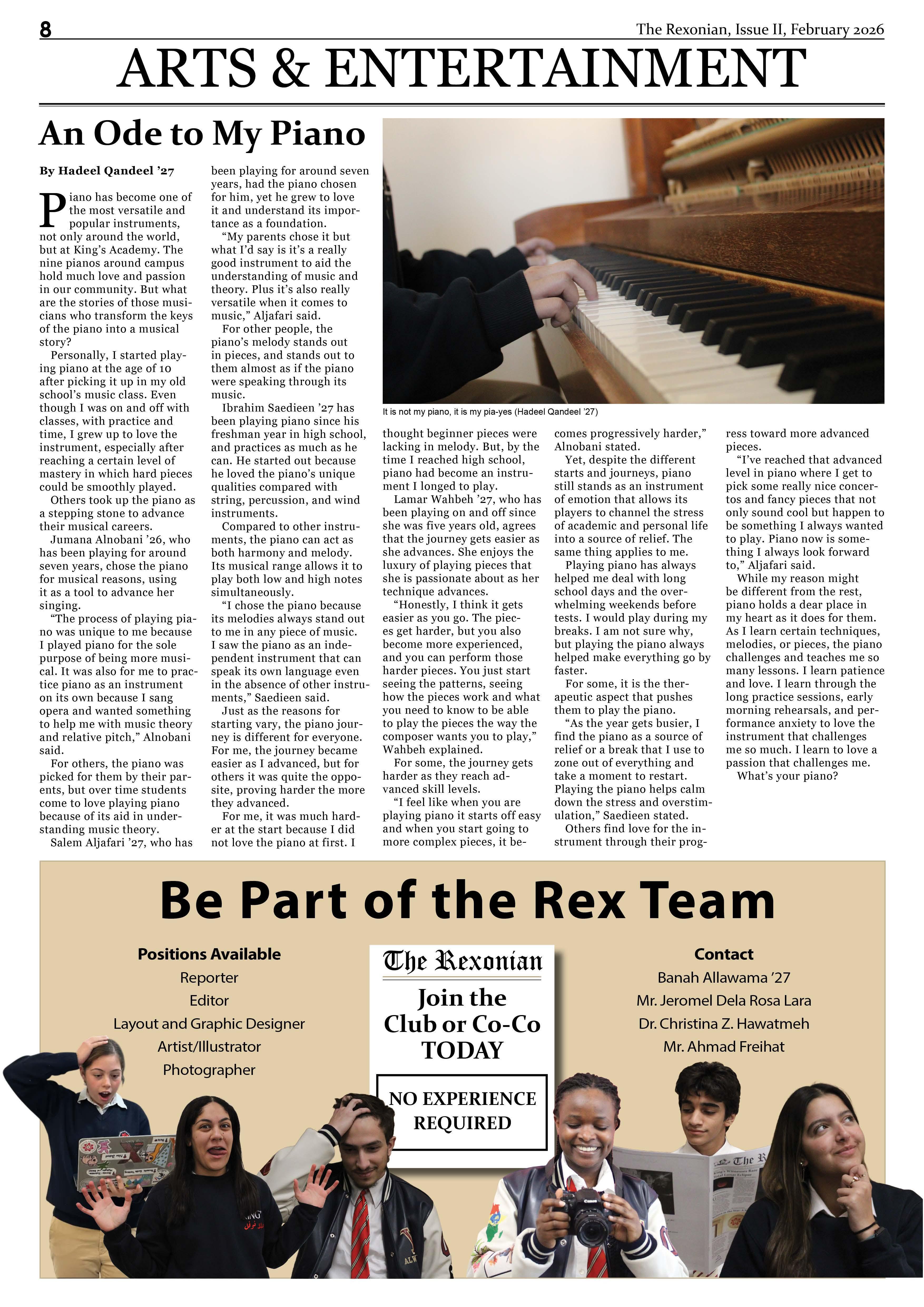
Personally, I started playing piano at the age of 10 after picking it up in my old school's music class. Even though I was on and off with classes, with practice and time, I grew up to love the instrument, especially after reaching a certain level of mastery in which hard pieces could be smoothly played.
Others took up the piano as a stepping stone to advance their musical careers.
Jumana Alnobani '26, who has been playing for around seven years, chose the piano for musical reasons, using it as a tool to advance her singing.
"The process of playing piano was unique to me because I played piano for the sole purpose of being more musical. It was also for me to practice piano as an instrument on its own because I sang opera and wanted something to help me with music theory and relative pitch," Alnobani said.
For others, the piano was picked for them by their parents, but over time students come to love playing piano because of its aid in understanding music theory.
Salem Aljafari '27, who has
been playing for around seven years, had the piano chosen for him, yet he grew to love it and understand its importance as a foundation.
"My parents chose it but what I'd say is it's a really good instrument to aid the understanding of music and theory. Plus it's also really versatile when it comes to music," Aljafari said.
For other people, the piano's melody stands out in pieces, and stands out to them almost as if the piano were speaking through its music.
Ibrahim Saedieen '27 has been playing piano since his freshman year in high school, and practices as much as he can. He started out because he loved the piano's unique qualities compared with string, percussion, and wind instruments.
Compared to other instruments, the piano can act as both harmony and melody. Its musical range allows it to play both low and high notes simultaneously.
"I chose the piano because its melodies always stand out to me in any piece of music. I saw the piano as an independent instrument that can speak its own language even in the absence of other instruments," Saedieen said.
Just as the reasons for starting vary, the piano journey is different for everyone.
For me, the journey became easier as I advanced, but for others it was quite the opposite, proving harder the more they advanced.
For me, it was much harder at the start because I did not love the piano at first. I
thought beginner pieces were lacking in melody. But, by the time I reached high school, piano had become an instrument I longed to play.
Lamar Wahbeh '27, who has been playing on and off since she was five years old, agrees that the journey gets easier as she advances. She enjoys the luxury of playing pieces that she is passionate about as her technique advances.
"Honestly, I think it gets easier as you go. The pieces get harder, but you also become more experienced, and you can perform those harder pieces. You just start seeing the patterns, seeing how the pieces work and what you need to know to be able to play the pieces the way the composer wants you to play," Wahbeh explained.
For some, the journey gets harder as they reach advanced skill levels.
"I feel like when you are playing piano it starts off easy and when you start going to more complex pieces, it be-
comes progressively harder," Alnobani stated.
Yet, despite the different starts and journeys, piano still stands as an instrument of emotion that allows its players to channel the stress of academic and personal life into a source of relief. The same thing applies to me.
Playing piano has always helped me deal with long school days and the overwhelming weekends before tests. I would play during my breaks. I am not sure why, but playing the piano always helped make everything go by faster.
For some, it is the therapeutic aspect that pushes them to play the piano.
"As the year gets busier, I find the piano as a source of relief or a break that I use to zone out of everything and take a moment to restart. Playing the piano helps calm down the stress and overstimulation," Saedieen stated.
Others find love for the instrument through their prog-
ress toward more advanced pieces.
"I've reached that advanced level in piano where I get to pick some really nice concertos and fancy pieces that not only sound cool but happen to be something I always wanted to play. Piano now is something I always look forward to," Aljafari said.
While my reason might be different from the rest, piano holds a dear place in my heart as it does for them. As I learn certain techniques, melodies, or pieces, the piano challenges and teaches me so many lessons. I learn patience and love. I learn through the long practice sessions, early morning rehearsals, and performance anxiety to love the instrument that challenges me so much. I learn to love a passion that challenges me.
What's your piano?
It is not my piano, it is my pia-yes (Hadeel Qandeel '27)
FEATURES
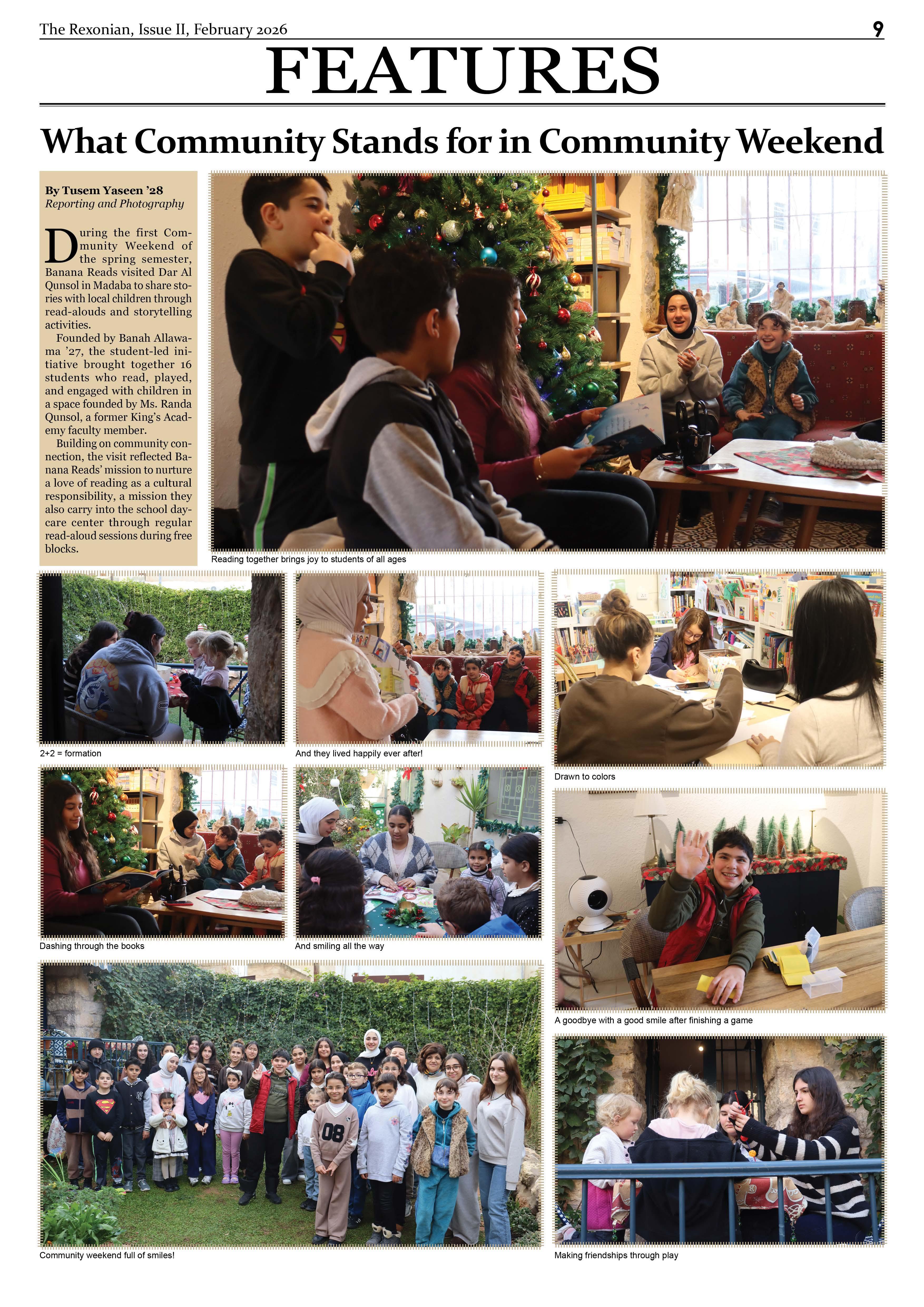
What Community Stands for in Community Weekend
By Tusem Y aseen '28 Reporting and Photography
During the first Community Weekend of the spring semester, Banana Reads visited Dar Al Qunsol in Madaba to share stories with local children through read-alouds and storytelling activities.
Founded by Banah Allawama '27, the student-led initiative brought together 16 students who read, played, and engaged with children in a space founded by Ms. Randa Qunsol, a former King's Academy faculty member.
Building on community connection, the visit reflected Banana Reads' mission to nurture a love of reading as a cultural responsibility, a mission they also carry into the school daycare center through regular read-aloud sessions during free blocks.
HOROSCOPES
May the Stars Align in Your Favor With This Month's Astrological Reading
Aries
You'll feel more social and energized this month. Team projects will come naturally. You'll likely end up taking the lead, which suits you. But don't be surprised if someone else takes credit or the group dynamics shift unexpectedly.
Cancer
Home and family will be on your mind, maybe even more than you would like. There may be some emotional tension or unresolved issues that are bubbling up. It is not all bad, but it might leave you feeling drained or stuck in the same old patterns.
Leo
You will shine in social and professional settings, and people will notice you. You'll feel like you are in control, and that is a good place to be. But the pressure to keep up that energy might start to wear you down. Do not let the spotlight make you lose sight of your own needs.
Libra
Harmony and balance will be your priorities, especially in relationships and creative projects. But finding that balance might be harder than you think. Some situations might feel unfair, and you could end up compromising too much just to keep the peace.
Capricorn
Be ready as you willl be making decisions that could shape your future, some big and some small. The weight of those choices might make you second-guess yourself Trust your instincts, but do not let fear keep you from moving forward.
Aquarius
You'll feel creative and bold, like you can do anything. That confidence might come off as arrogance, especially if you are not listening to others. Be open to feedback, or you could end up pushing people away.
When it comes to comfort and stability, you will have a clear sense of what you want and how to get it. That confidence might make you a little stubborn. You could end up overspending on things that do not really matter. Keep an eye on your wallet.
By Dylan Al Jaff'27
by Yara Kanaan '27
Gemini
Your brain will be on overdrive. You will be all over the place with ideas and conversations. It is a great time to network and share your thoughts. But do not be shocked if people do not take you seriously,or if you end up spreading yourself too thin.
Virgo
Everything will need to be just right for you. You'll be hyper-focused on details and systems. That's great for productivity, but it could also make you overly critical, especially of yourself Don't let perfectionism slow you down or make you anxious.
Scorpio
Romance could be intense this month, and emotions will run deep. You might find yourself drawn to someone unexpected. But passion can turn to jealousy or control, so be careful not to let your intensity push people away.
Saggitarius
You'll feel restless and eager to explore, whether it is new places, ideas, or people. That energy might scatter your focus. You could end up starting a lot of things without finishing them, or chasing after opportunities that aren't quite right.
Group activities might feel overwhelming for you at this time. You'll be drawn to quiet, introspective moments. You could end upisolating yourself more than you'd like. But don't let that stop you from connecting with people who truly matter.
Visuals
Pisces
CLASSIFIEDS
0 ° KING'S ACADEMY'S MUL TILING-UAL STUDENT PUaLICATION IS IN THE WORKS! forAllljin\uiries,contActBsu•bniSAcdtM_lj-tdu.coM, f11_1jSAlAlwir27•bniSACAdtM_lj-td•-k'>·or_ljArAkAnAAn27•bniSACAdtM_lj-tdu.coM
.illL::i:iS I « G.::....J\1::.. I\ L~ lAS • I..S"' '-'~ .:-1.SjJ\_;J.i ~l l~~.a ,~1 J'i \ ~\ J -.r-Uh....a 'i I ~l ,~1 J,-J1 cly..,:; wl_Jiu, J~ i.::.ul.Sr"~
• 1 1- .l~ <l.iS.I ' l....,\J)l:.. u (.5"'""" &! J=-.:i0l 'i ~}yS:ill , .iii.II ·.<'. 11 \ 'L....i')!\J - ·-~1\ '-? j;:-=-'-'J'-F ' 4-fu.)W\ ~l 4b./ -.::.Jj La»:JUJ ol "La LL ~.i.11 « y U:l-'-""-'J
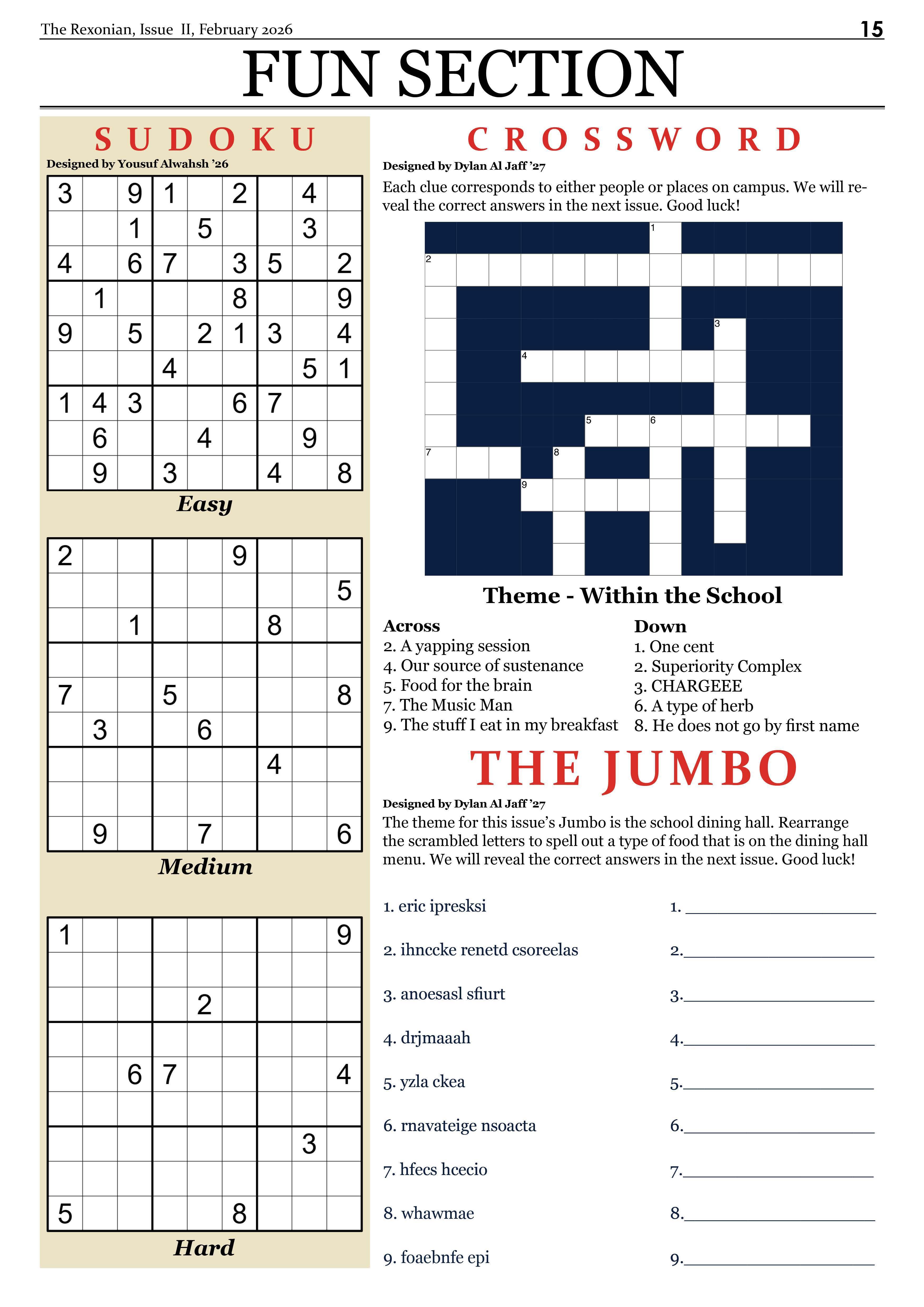
Each clue corresponds to either people or places on campus. We will reveal the correct answers in the next issue. Good luck!
Theme - Within the School
A yapping session
Our source of sustenance
Food for the brain
The Music Man
The stuff I eat in my breakfast
One cent
Superiority Complex
CHARGEEE 6. A type of herb 8. He does not go by first name
THE JUMBO
Designed by Dylan Al Jaff '27
The theme for this issue's Jumbo is the school dining hall. Rearrange the scrambled letters to spell out a type of food that is on the dining hall menu. We will reveal the correct answers in the next issue. Good luck!
SPORTS AGAINST Alt ODDS NA
By Hala Nofal
Two days after the end of the first semester at King's Academy, on Thursday, December 18, I joined fellow Jordanians in Lusail Stadium in Doha, Qatar. Whether at home watching the match on TV or in the stadium, we were all hoping to witness Jordan make history by winning our first ever Arab Cup title.
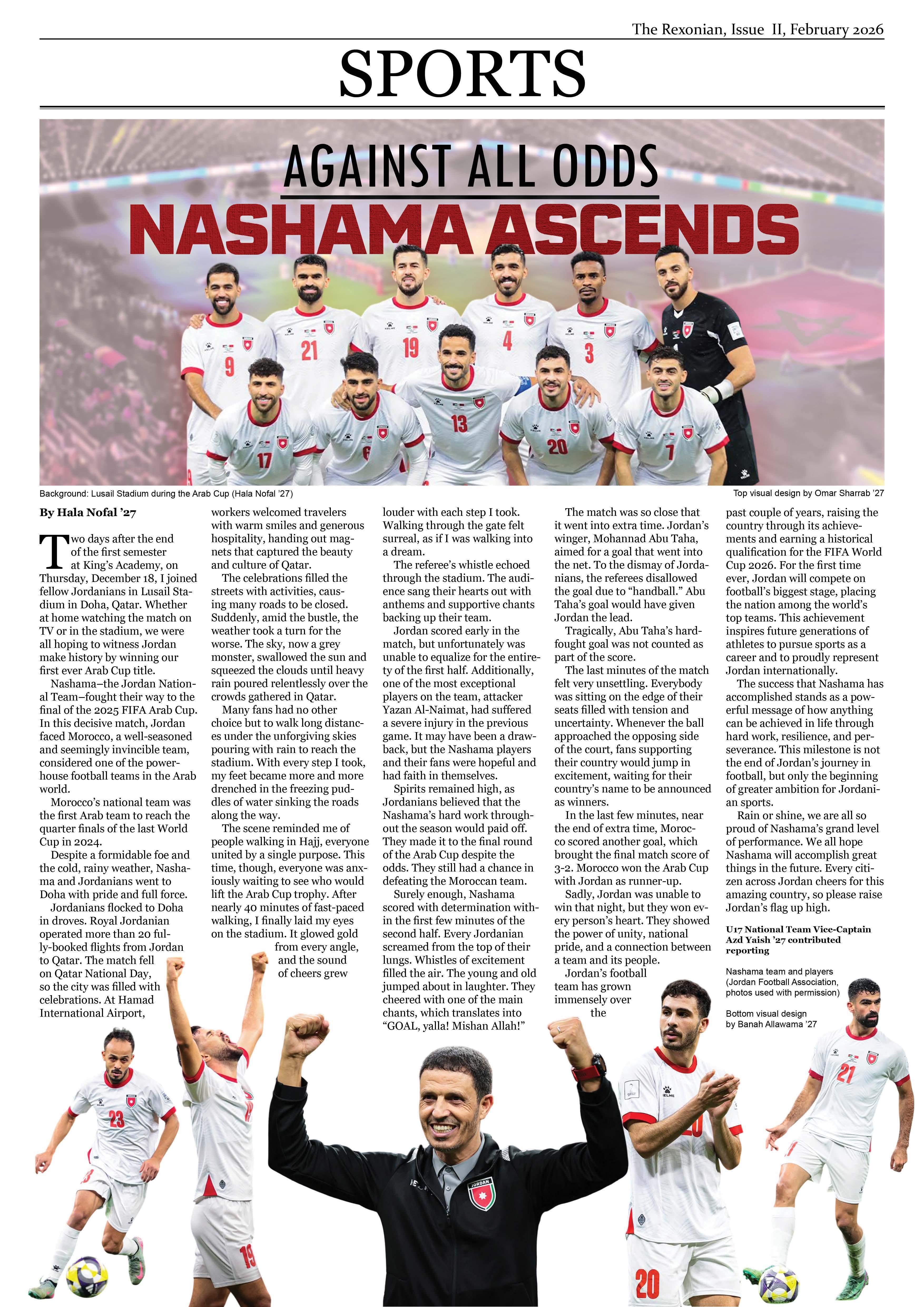
Nashama-the Jordan National Team-fought their way to the final of the 2025 FIFA Arab Cup. In this decisive match, Jordan faced Morocco, a well-seasoned and seemingly invincible team, considered one of the powerhouse football teams in the Arab world.
Morocco's national team was the first Arab team to reach the quarter finals of the last World Cup in 2024.
Despite a formidable foe and the cold, rainy weather, Nashama and Jordanians went to Doha with pride and full force.
Jordanians flocked to Doha in droves. Royal Jordanian operated more than 20 fully-booked flights from Jordan to Qatar. The match fell on Qatar National Day, so the city was filled with celebrations. At Hamad International Airport,
workers welcomed travelers with warm smiles and generous hospitality, handing out magnets that captured the beauty and culture of Qatar.
The celebrations filled the streets with activities, causing many roads to be closed. Suddenly, amid the bustle, the weather took a turn for the worse. The sky, now a grey monster, swallowed the sun and squeezed the clouds until heavy rain poured relentlessly over the crowds gathered in Qatar.
Many fans had no other choice but to walk long distances under the unforgiving skies pouring with rain to reach the stadium. With every step I took, my feet became more and more drenched in the freezing puddles of water sinking the roads along the way.
The scene reminded me of people walking in Hajj, everyone united by a single purpose. This time, though, everyone was anxiously waiting to see who would lift the Arab Cup trophy. After nearly 40 minutes of fast-paced walking, I finally laid my eyes on the stadium. It glowed gold from every angle, and the sound of cheers grew
louder with each step I took. Walking through the gate felt surreal, as if I was walking into a dream.
The referee's whistle echoed through the stadium. The audience sang their hearts out with anthems and supportive chants backing up their team.
Jordan scored early in the match, but unfortunately was unable to equalize for the entirety of the first half. Additionally, one of the most exceptional players on the team, attacker Yazan Al-Naimat, had suffered a severe injury in the previous game. It may have been a drawback, but the N ashama players and their fans were hopeful and had faith in themselves.
Spirits remained high, as Jordanians believed that the Nashama's hard work throughout the season would paid off. They made it to the final round of the Arab Cup despite the odds. They still had a chance in defeating the Moroccan team.
Surely enough, Nashama scored with determination within the first few minutes of the second half. Every Jordanian screamed from the top of their lungs. Whistles of excitement filled the air. The young and old jumped about in laughter. They cheered with one of the main chants, which translates into "GOAL,yalla! Mishan Allah!"
The match was so close that it went into extra time. Jordan's winger, Mohannad Abu Taha, aimed for a goal that went into the net. To the dismay of Jordanians, the referees disallowed the goal due to "handball." Abu Taha's goal would have given Jordan the lead.
Tragically, Abu Taha's hardfought goal was not counted as part of the score.
The last minutes of the match felt very unsettling. Everybody was sitting on the edge of their seats filled with tension and uncertainty. Whenever the ball approached the opposing side of the court, fans supporting their country would jump in excitement, waiting for their country's name to be announced as winners.
In the last few minutes, near the end of extra time, Morocco scored another goal, which brought the final match score of 3-2. Morocco won the Arab Cup with Jordan as runner-up.
Sadly, Jordan was unable to win that night, but they won every person's heart. They showed the power of unity, national pride, and a connection between a team and its people.
Jordan's football team has grown immensely over the
past couple of years, raising the country through its achievements and earning a historical qualification for the FIFA World Cup 2026. For the first time ever, Jordan will compete on football's biggest stage, placing the nation among the world's top teams. This achievement inspires future generations of athletes to pursue sports as a career and to proudly represent Jordan internationally.
The success that N ashama has accomplished stands as a powerful message of how anything can be achieved in life through hard work, resilience, and perseverance. This milestone is not the end of Jordan's journey in football, but only the beginning of greater ambition for Jordanian sports.
Rain or shine, we are all so proud of N ashama's grand level of performance. We all hope Nashama will accomplish great things in the future. Every citizen across Jordan cheers for this amazing country, so please raise Jordan's flag up high.
U17 National Team Vice-Captain Azd Yaish '27 contributed reporting
Nashama team and players (Jordan Football Association, photos used with permission)
'27
Background: Lusail Stadium during the Arab Cup (Hala Nofal '27)