
OPGA Ohio Propane News, Spring 2026

Page 1


CUSTOM TRUCKS BUILT

EVERY DAY SAFE PROGRAM

Building a safety culture isn't about a single training session or a manual on a shelf; it’s a commitment to the well-being of every employee and the families they return to each night. To support this mission, the Propane Education & Research Council (PERC) has launched the Every Day Safe Program.

This initiative is designed specifically for propane marketers to strengthen their safety culture through manageable, consistent steps: one habit, one goal, and one day at a time.

ASSESS: KNOW YOUR STARTING POINT

The journey begins with an internal deep dive. Leadership is encouraged to evaluate current safety practices, policies, procedures, and training. By identifying gaps or areas for improvement today, companies can build a more resilient foundation for tomorrow.

SET GOALS: MAPPING THE FUTURE

Once the assessment is complete, the program guides managers in setting clear, actionable milestones for the next six months, one year, and three years.

These evaluations and touchpoints are for internal company use only. PERC does not collect or store this data, ensuring that your company’s internal reviews remain private.

TAKE ACTION: RESOURCES AND ENGAGEMENT

The "Action" phase is where the culture truly takes root. The program provides a wealth of resources to keep safety top-of-mind:

• The Learning Center: Access to specialized training on safe driving, workplace safety, delivery best practices, consumer safety, and more.

• Monthly Webinars: 30-minute sessions featuring external safety subject matter experts to provide fresh perspectives.

• Real-World Steps: Engage with the community through fire department visits, hold weekly safety meetings, and participate in industry celebrations like National Truck Driver Appreciation Week.

STRENGTHENING THE INDUSTRY TOGETHER

When one company improves its safety habits, the entire propane industry becomes stronger and more reputable. By enrolling in the Every Day Safe Program, you are choosing to make safety an active, everyday priority for your co-workers, your customers, and the communities you serve.

Every Day Safe Training Resources & Categories

Ready to take the next step? Visit propane.com/EveryDaySafe to enroll your company and begin building a safer future.

Once enrolled in the program, you’ll have access to a full library of hands-on learning tools — built by and for the propane industry.

Live Webinars

Participate in interactive sessions with PERC safety experts and peers from across the industry.

On-Demand Learning

Access courses through The Learning Center at any time, for any team member.

Incident & Accident Habits

Learn how to document, investigate, and prevent incidents using proactive safety practices.

Community Preparedness

Strengthen preparedness with resources for emergency responders and consumers, from severe weather guidance to what to do if someone smells gas.

Daily Practice Tools

Reinforce habits through short safety talks, meetings, and practical training you can use year-round.

3 DIFFERENT SCHOLARSHIPS

MULTIPLE FUTURES FUELED BY PROPANE

The OPGA Scholarship

• $1,000 each

• Pays for college, university, vocational or technical schooling.

• For graduating seniors and undergrads with a parent employed by an OPGA member, residing in Ohio

Rachel Buschur Scholarship

• $2,000

• Pays for college, university, vocational or technical schooling.

• For graduating seniors and undergrads with a parent employed by an OPGA member, residing in Ohio

H&H can meet all of your gas handling needs. We build our gas handling equipment knowing you need and expect quality and performance. H&H builds it all in. You’ll reduce labor, increase safety, and save time and money.

Truck Bodies — We design our truck bodies with your field service work in mind. Transport, service or deliver cylinders and other awkward loads anywhere. Large or small, custom or standard, steel or aluminum. H&H offers a large choice of options, including in­bed lift platforms, electric or hydraulic cranes, grated or diamond plated flooring, and more.

Trailers — Our Smooth­RiderTM bulk tank trailers are built to make moving tanks a breeze. They cushion the load with rubber torsion axles. One person can operate these trailers with your choice of

David Lowe Scholarship

• $2,000

• Pays for college, university, vocational or technical schooling.

• For employees or customers of an OPGA member who are pursuing careers in propane, skilled trades or healthcare

hydraulic hoist, dual­cable top­mount or side

winch, or hand winch.

Tank storage cabinets — Our rugged Cylinder­Stor cabinets are built for secure outside storage of cylinders, giving you better inventory control and bigger profits. Single­ & double­section models are furnished with keyed padlocks, tamper­proof padlock hasps, reinforced back panels, and bolt­down features for complete security and safety. Call: 800-551-9341 • E-mail: info@hhsalescompany.com

Reese, Michigan

Newport, Michigan

Port Huron, Michigan

Bellefontaine, Ohio

D.H.T. Group is a reliable and experienced transportation company that specializes in propane but has other divisions ready to meet of all your needs.

RELIABILITY AND EXPERIENCE

D.H.T. has been ensuring safety and satisfaction for over 35 years. D.H.T. also operates a 24-hour full service repair facility.

CAPABILITIES

We utilize vessels from 9,000 to 18,500 gallon capacity All units are tracked by GPS so we can provide immediate location and delivery updates, as well as 24-hour dispatch.

PERC PROPANE SALES REPORT WINDOW OPENED MARCH 1

The survey window for PERC’s 2025 retail propane sales report opened on March 1. For over 20 years, the Propane Education & Research Council (PERC) has produced an exclusive annual report on U.S. odorized propane sales by market, region and state. Each year we rely on propane professionals like you to provide the data necessary to portray an accurate picture of the industry’s retail sales performance. This information is vital to helping PERC and the industry understand market trends and the evolving needs of individual retailers. It is also vital to ensure that Ohio receives all of its share of the national check-off funding.

A letter was sent to your company or parent company that provides information on how to report 2025 gallons. There will only be one contact per company.

Please make sure you have the appropriate contact information on file with PERC. If you are unsure whether your info is correct, please email salesreport@propane.com

Individual responses are kept confidential and anonymous.

The GEC Virtual Warehouse Mobile App

Trust the sale of your business to experienced professionals with proven results.

Legacy Energy Consulting has over 30 years of direct industry experience. Since forming our family - owned business in June of 2020, we have successfully completed over 25 sales nationwide. 763 - 772 -

chad@legacyenergyconsulting.com

Strategic Planning Services

We use a proprietary strategic planning process to outline future vision, assess the current state of critical operational areas, and develop strategies, tactics, timelines, and resource allocations to help businesses reach their goals.

The Ohio Propane Gas Association offers employee training for those employed in the propane industry. To make training more accessible to everyone, classes are held in multiple locations. Classes are open to members and non-members and pre-registration is necessary. For more information or assistance, please contact the OPGA office at 844.454.5338 or opga@kdafirm.com

GENERAL INFORMATION

• Attendance at training classes is by pre-registration only.

• The number of students is limited for each class. Register early to ensure your participation.

• OPGA reserves the right to cancel a class.

• Class times vary. Please refer to the schedule for class times for each course.

• Registration includes course materials, continental breakfast and lunch.

• Attendees are responsible for lodging costs.

• Classes are held from 8:00 a.m. to 4:00 p.m., unless otherwise stated.

• Registration includes computer usage, continental breakfast, lunch and beverages. Students will be provided a computer during class to access materials and quizzes through their account in the PERC Learning Center.

COURSE LOCATIONS

• Lucasville Arrick’s Propane 10073-A US 23, Lucasville, OH 45648 (Tan building located behind Dollar General)

• Lucasville Cox Gas Company 2629 Lucasville Minford Road, Lucasville, OH 45648

• New Albany Courtyard by Marriott 5211 Forest Drive, New Albany, OH 43054

• Milan Coles Energy 3619 State Route 113 E, Milan, OH 44846

• Upper Sandusky The Alibi Room

128 S. Sandusky Avenue, Upper Sandusky, OH 43351

• Waldo

Schilling Propane

7344 Waldo-Delaware Road, Waldo, OH 43356

REGISTRATION

The registration deadline is 10 business days prior to the start of each class. Online registration is available at ohiopropanegas.org or scan the code.

REGISTRATION FEES

Ohio-Based Company $100 (Waived upon completion)

Registration fees for Ohio-based companies will be waived when the registrant attends the training. If registrant does not attend and does not cancel a minimum of 7 business days prior to the first date of the class, the registration fee will be charged to the credit card on file for this registration. You may send a substitute in place of the original registrant at no additional charge.

Company Outside of Ohio .................................................... $300

A refund less a $25 administrative fee will be granted for cancellations received a minimum of 7 business days prior to the first date of the class. You may send a substitute in place of the original registrant at no additional charge.

FACULTY

Bob Herron has been employed in the petroleum industry for more than 45 years, with 25 of those years working in the propane industry. He established two successful propane companies, as well. He is a past president of the Ohio Propane Gas Association and currently serving on the OPGA Education Committee. Bob is also a past member of the National Propane Gas Benchmarking Group.

In 2002, at the request of local Fire Chiefs, developed a Propane Emergency Responder Training program, and since its inception, has trained several thousand firefighters, across the State of Ohio, on how to safely handle an emergency where propane may be involved.

Bob is a PEP Recognized Instructor and a PEP Recognized Field Trainer for the Ohio Propane Gas Association, where he applies a “real experience” to the classroom, based on his many years in the field.

2026

Scan Me!

COURSES

Introduction and Fundamentals of Propane

This session provides a foundation and is a recommended pre-requisite to all other training. This beginning program will include properties and characteristics of propane, theory of combustion, measurement and odorization, ideal fuel, uncontrolled release, and safety content. Replaces CETP 1.0 Basic Principles and Practices of Propane.

April 15-16

May 5-6

June 29-30

October 6-7

Propane Delivery

Courtyard, New Albany

Arrick’s Propane, Lucasville

Courtyard, New Albany

Courtyard, New Albany

Includes pre- and post-trip inspections, bobtail components inspection, accident prevention measures, load and secure containers, load bobtails, exterior customer site inspection, location requirements of containers, cylinder exchange, filling containers, leak check and troubleshooting leaks, and restoring service and lighting pilots. Replaces CETP 2.2

Bobtail Delivery Operations and Cylinder Delivery.

June 9-11

August 25-27

October 13-15

Courtyard, New Albany

Courtyard, New Albany

Courtyard, New Albany

Mobile Crane Training for the Propane Industry

A training program designed to teach crane operators, field technicians, and managers the best practices and procedures for the safe operation of a mobile crane in the propane industry.

June 17

Schilling Propane, Waldo

Propane Container Installation: Session 1

Contents include uncontrolled release of propane, load and secure containers, exterior site assessment, determining total connected and actual BTU load, container sizing, installing containers, location requirements containers, installing piping and joining piping, installing regulators, sizing and installing vapor and liquid piping, testing of piping systems, leak check and troubleshooting leaks. Replaces CETP 4.1 Designing and Installing Exterior Vapor Distribution Systems.

May 26-28

September 15-17

Courtyard New Albany

Courtyard New Albany

Propane Container Installation: Session 2

This session is a continuation from Session 1 and includes location and installation requirements tanks over 2,000-gallon water capacity, connected load large commercial and industrial systems, selecting, sizing, and installing large piping systems, conducting interior site assessments, validating correct appliance installation, large regulator install, appliance startup and proper operation, corrosion system installation and prevention, and purging piping. Replaces CETP 4.2 Placing Vapor Distribution Systems and Appliances into Operation

June 23-25

Courtyard, New Albany

August 11-13 Courtyard, New Albany

Refresher Course: Multiple Modules (1.0, 2.2, 4.1, 4.2)

This one-day course will cover refresher training for multiple modules: Basic Principles and Practices of Propane, Bobtail Delivery Operations, Designing and Installing Exterior Vapor Distribution Systems and Placing Vapor Distribution Systems and Appliances into Operations. You may attend the training for all or a portion of the modules that will be covered. If you require certification for only a portion of the modules offered, please contact the OPGA Office at opga@kdafirm.com or 844-454-5338 for more information about when to attend the day of class.

April 22

Arrick’s Propane, Lucasville

July 9 Courtyard, New Albany

Customer Service Representative (CSR)

This seminar covers many issues that the company CSR deals with routinely, and includes relevant topics such as telephone customer service, and basic and advanced CSR skills. Other topics will include a review of the physical properties and characteristics of propane and how these properties correlate with problems or issues raised by the customer.

June 16

The Alibi Room, Upper Sandusky

Transport Operator Training

This class will provide information, practices, and procedures that support general loading and unloading tasks for drivers who operate transports to deliver propane.

September 29

Coles Energy, Milan

COURSES

HazMat Training

Dispensing Propane Safely (Cylinder Refill)

This program was developed to assist companies in complying with the federal training requirements prescribed by the Department of Transportation (DOT) and the occupational Safety and Health Administration (OSHA). The program includes six modules in total. Modules one through five are based on DOT training requirements that apply to any hazmat employee. The sixth module covers the OSHA initial training requirements. The modules are as follows:

• DOT Hazardous Materials (Hazmat) Training: Introduction

• DOT Hazardous Materials: General Awareness and Familiarization

• DOT Hazardous Materials: Function-Specific Training

• DOT Hazardous Materials: Safety Training

• DOT Hazardous Materials: Security Awareness

• OHSA Hazard Communication

April 21

Arrick’s Propane, Lucasville

April 23 Cox Gas Co., Lucasville

July 8 Courtyard, New Albany

October 8

Arrick’s Propane, Lucasville

This program details the many tasks associated with the safe and effective dispensing of propane into several types of propane cylinders and tanks. The program is organized into modules that allow you to select what material is covered based on your job responsibilities. This class is a half-day from 8:00 a.m. to 11:30 a.m. Lunch will be available following the conclusion of this session.

July 7 Courtyard, New Albany (Half-day, morning)

Propane Cylinder Requalification

Provides in depth procedures for requalifying DOT cylinders using the external visual inspection method. To ensure your safety and the safety of your customers, propane cylinders must be inspected, each time, before they are filled. This course provides you with current information, practices, and procedures to safely and efficiently perform DOT cylinder requalification by visual inspection. This class is a half-day from 12:30 p.m. to 4:00 p.m. Lunch will be available beginning at 11:30 a.m.

July 7 Courtyard, New Albany (Half-day, afternoon)

ENSURE SAFETY AND COMPLIANCE WITH NEW PROPANE REFRESHER TRAINING

In the fast-paced world of propane professionals, staying current with the latest technology, regulations, and safety procedures is paramount. Refresher training is not just a regulatory requirement; it's a vital component of a robust safety program. PERC has recently introduced updated refresher training programs designed to empower employees with the skills and knowledge they need to excel in their roles.

WHY REFRESHER TRAINING MATTERS

Refresher training serves several critical purposes:

• Compliance: It fulfills the requirements mandated by NFPA 58, ensuring your organization remains in compliance with industry standards.

• Knowledge Updates: It provides a platform to educate professionals on new technologies, evolving regulations, and the latest safety protocols.

• Skill Reinforcement: It reinforces initial training and helps professionals stay sharp in their daily operations.

• Enhanced Engagement: New, interactive training programs use real-life scenarios to improve retention and engagement, making the learning process more effective.

SCALABLE AND FLEXIBLE TRAINING SOLUTIONS

The new refresher training programs are designed to be scalable, meeting the needs of both year-round and seasonal staff. Whether you're a full-time employee or a seasonal worker, these programs provide a convenient and accessible way to stay informed and skilled.

Regardless of your initial training source, the PERC refresher training can be used to fulfill NFPA 58 requirements. This flexibility allows organizations to integrate these programs into their existing safety protocols seamlessly.

GET STARTED TODAY

The new refresher training programs are available now and can be completed at your own pace on a computer or phone via The Learning Center. Whether you're planning the upcoming training season or looking to refresh your skills today, these programs offer a valuable resource for the industry.

For more information and to access the training, visit training. propane.com.

Energy Transfer provides complete Marketing, Supply, Logistics and Risk Management solutions to propane and NGL marketers across the Midwest. Our team of experienced NGL professionals — with a proven track record — offers you greater assurance of propane supply and complete risk management services that increase your profitability.

When you partner with Energy Transfer, we’ll help you develop a comprehensive supply plan that is tailored to your business needs.

Amanda Hartman

C: 913-602-4223

Amanda.Hartman@energytransfer.com

Carter House

C: 816-289-4470

Carter.House@energytransfer.com

Jeff Nelson

C: 913-484-2141

Jeff.Nelson@energytransfer.com

Blake Philips

C: 816-729-7529

Blake.Philips@energytransfer.com

Luke Wassel

C: 913-293-8095

Luke.Wassel@energytransfer.com

OPGA LEGISLATIVE NEWS & UPDATES

APP AGE VERIFICATION – ALEX BOEHNKE

House Bill 226/Senate Bill 175 - Earlier this spring, the General Assembly began considering these two competing proposals, each addressing age verification requirements for certain apps. Council feedback raised significant concerns with House Bill 226, particularly the provision requiring retailers to obtain “actual knowledge” of a minor’s age. Senate Bill 175 takes a different, more workable approach, placing the onus on app stores rather than retailers. The Council, however, continues to believe that a uniform federal framework is the most appropriate solution for regulating app-based age verification. Given the already fluid legislative calendar and the added constraints of an election year, the path forward for either bill remains uncertain. We will continue to monitor developments closely and engage as appropriate.

CIVIL JUSTICE – LORA MILLER

House Bill 126 – This bill would codify an Ohio Supreme Court decision concluding that Ohio law does not permit product liability claims to be brought as public nuisance actions. This came into play in late 2024 when a federal court of appeals asked our high court for their opinion on the issue. The OSC’s decision es-

sentially vacated a previous ruling that would have provided two counties in northeast Ohio with a $650 million verdict against national pharmacy chains for their alleged role in the opioid crisis. The bill has passed the House, and we are advocating for its passage in the Senate as well.

House Bill 447/Senate Bill 292 – Both of these bills would increase the current cap on non-economic damages (pain and suffering, emotional distress, etc.) and require an annual escalator based on the Consumer Price Index from the previous year. Non-economic damages are the subjective and intangible losses in personal injury lawsuits. The current caps were put in place in 2005 and include an exception for catastrophic injuries. The law was enacted in response to out-of-control injury lawsuits against businesses in Ohio, with overly punitive non-economic damage awards being granted, which were driving up the cost of liability insurance premiums and the cost of doing business in general. The Council stands in opposition to both bills.

LABOR RELATIONS – ALEX BOEHNKE

Senate Bill 50 - The bill would have amended Ohio’s age and schooling certificate requirements and expanded work hours

for 14- and 15-year-olds, allowing them to work until 9 p.m. on school nights. The bill garnered support from many in the business community prior to and during its passage through both chambers of the Legislature; however, Gov. Mike DeWine ultimately vetoed the bill, citing concerns about maintaining current child labor protections and the balance between work and study for young people. It is possible that the Legislature will seek to override the Governor’s veto.

Senate Bill 143 – This proposal seeks to modify employer hiring

of cash as legal tender for in- person payments, but in differing ways. House Bill 554 would apply to every retail and governmental transaction totaling $500 or less and made at a physical location, with the exception of airports. It would prohibit charging a cash-paying customer a higher price than someone paying via other means. Violation of these requirements would be considered an unfair or deceptive act or practice, creating a new legal cause of action. The affected party would be entitled to the same relief available to a consumer under the Consumer Sales Practice Law.

ANDY VANCE

RegO® Presto-Link© – Fast, accurate testing

RegO® Presto-Link© – Fast, accurate testing

The Presto-Link Bluetooth device communicates with the RegO app to allow for pressure readings to be obtained on your mobile device. The result is a safe, secure, efficient and cost-effective way for on-site service personnel to obtain pressure readings to assist with fine tuning and troubleshooting a propane vapor system.

The Presto-Link Bluetooth device communicates with the RegO app to allow for pressure readings to be obtained on your mobile device. The result is a safe, secure, efficient and cost-effective way for on-site service personnel to obtain pressure readings to assist with fine tuning and troubleshooting a propane vapor system.

• Bluetooth connection thru an Android or Apple Device

• Bluetooth connection thru an Android or Apple Device

• Lightweight & compact design

• Lightweight & compact design

• Battery percentage indicator

• Battery percentage indicator

• 1.5 times overpressure protection

• 1.5 times overpressure protection

• Bluetooth connection up to 100’ range allows for troubleshooting and adjustment to systems while recording the pressure

• Bluetooth connection up to 100’ range allows for troubleshooting and adjustment to systems while recording the pressure

• Visual indicator for pressure settings; Red casing indicates a highpressure device and black casing indicates a low-pressure device

• Visual indicator for pressure settings; Red casing indicates a highpressure device and black casing indicates a low-pressure device

Convenient and easy to use...

Download it for FREE!

Convenient and easy to use... Download it for FREE! Scan here to download the RegO App Today!

This is what Innovation Looks Like

This is what Innovation Looks Like

Learn how the MEC Excela-Wynd Hose Reel can increase your bobtail driver’s productivity while also reducing comp claim injuries and fatigue by scanning the QR code above.

Learn how the MEC Excela-Wynd Hose Reel can increase your bobtail driver’s productivity while also reducing comp claim injuries and fatigue by scanning the QR code above.

• Adjustable Speed for increased delivery efficiency & safety

• Adjustable Speed for increased delivery efficiency & safety

• Auto-Wind to suit driver preference and seasonal conditions

• Auto-Wind to suit driver preference and seasonal conditions

• Auto-Push feature takes the starting hose pull effort off the driver

Scan here to download the RegO App Today!

• Auto-Push feature takes the starting hose pull effort off the driver

• Reduced Pull Effort - the gimbal roller assembly makes even tough side pulls painless

• Reduced Pull Effort - the gimbal roller assembly makes even tough side pulls painless

• Remote Control with BASE Engineering PC3 or ASK technology

• Remote Control with BASE Engineering PC3 or ASK technology

• Minimal Maintenance designed for ease of serviceability

• Minimal Maintenance designed for ease of serviceability

Scan here to learn more about Excela-Wynd Today!

Scan here to learn more about Excela-Wynd Today!

House Bill 665/Senate Bill 79 – In many states throughout the country, legislation to regulate the use of pricing algorithms by businesses is being debated. These union-driven proposals are based on unfounded public concern about transparency and fairness in pricing. Consumers want to know how prices are set and if their personal data is being used against them. State-level legislation is accelerating to address these concerns, focusing on two main areas: transparency - requiring disclosure when algorithms and personal data are used to set a price; and anti-discriminationprohibiting the use of certain data to create unfair price increases.

While the stated goal of these proposals is to protect consumers and ensure they aren't being taken advantage of by opaque, data-driven pricing and marketing, there has been no evidence that the information retailers use to set prices has been unfair to consumers in any way. In fact, customer data is used to create pro-consumer benefits like personalized savings and loyalty rewards. Instead of protecting consumers, these proposals could stifle innovation in pricing and promotions, resulting in higher costs for shoppers. We oppose these efforts and will work to ensure they don’t gain any traction.

PENNIES - LORA MILLER

Like every other state, we are anxiously awaiting a federal solution to resolve the outstanding issues related to the discontinuation of minting pennies. In late 2025, the US Department of the Treasury issued guidance on the issue; however, it is not legally binding. Congress needs to take definitive action to provide certainty to retailers who must continue to accept pennies as legal tender. Several bills have been introduced in the 119th Congress to officially phase out the penny and address the challenges it creates, but none have passed the House or the Senate. Along with our national partner organizations, we will continue to call for Congressional action.

EV CHARGING – ALEX BOEHNKE

Senate Bill 106 – The bill seeks to establish a clear regulatory framework for the ownership and operation of electric vehicle charging stations, promoting fair competition while encouraging private-sector investment in charging infrastructure. The Council and our affiliate, the Ohio Energy & Convenience Association (OECA), strongly support this measure as it helps prevent cross-subsidization by utilities, ensures a level playing field for retailers, and expands consumer access to EV charging across both urban and rural communities. We will continue working with lawmakers and stakeholders to advance Senate Bill 106 and support its passage.

REFERENDUM ON SENATE BILL 56 – LORA MILLER

Late last year, the General Assembly passed Senate Bill 56, which made sweeping changes to Ohio law regarding marijuana and hemp-based products. Many of the changes are in direct conflict with the provisions of Issue 2, the ballot initiative that legalized recreational marijuana, which passed by a significant margin in November 2023. The bill, as enacted by the Legislature, would have permitted the sale of low-level THC-infused hemp-based beverages until December 31, 2026, when the federal law to ban them takes effect. As many suspected, Governor DeWine lineitem vetoed the provision, calling it a bad idea that would create confusion for consumers.

Ohioans for Cannabis Choice, a group created in response to Senate Bill 56, filed a referendum petition to place an initiative on the November ballot that would overturn much of the bill. Last week, Attorney General Dave Yost and Secretary of State Frank LaRose cleared the way for the group to start gathering signatures to get the issue before Ohio voters in November.

The petitioners have until mid-March to collect and submit signatures equal to 6% of the votes cast in the most recent gubernatorial election, or roughly 250,000. Those signatures must come from at least 44 of Ohio’s 88 counties.

Find Your Ohio Employees Here Post

Your Jobs, FREE

Over 60,000 job seekers have visited OPGA’s workforce website to learn more about careers in Ohio’s propane industry.

Take advantage of the pipeline of potential candidates for your jobs by posting on the OPGA job board - It’s FREE

It Only Takes 2 Minutes to Post Your Job:

• Go to: OhioPropaneCareers.com/post-a-job/

• Enter your information

• Submit

Jobs stay listed until the position is filled.

Reach out to the Workforce Team anytime: CR@CRMarketing.biz

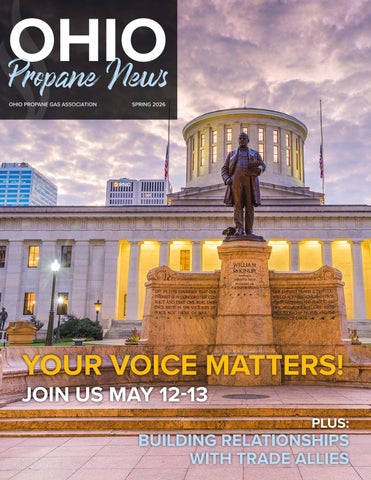
YOUR VOICE MATTERS: JOIN US MAY 12-13

I want to personally invite you to join us for the Ohio Propane Gas Association’s Day at the Statehouse on May 12-13. There is no substitute for showing up. Advocacy works best when lawmakers and regulators hear directly from the business owners and leaders who keep Ohio’s energy infrastructure running every day. Your voice carries weight—not just as an industry representative, but as an employer, a community leader, and a trusted resource in your region.

And your engagement is working. Because of your involvement, you’ve built meaningful relationships with legislators and regulators across the state. Those relationships have delivered real results:

• The passage of a highly successful checkoff program, gen-

• S2G / C2 BUS / IC BUS

erating hundreds of thousands of dollars to support propane retailers and better serve your customers

• Defeating burdensome regulations while cutting red tape

• Expanding workforce opportunities by helping young people earn their hazmat driver certifications

• Securing your seat at the table as Ohio charts its energy future

That kind of progress doesn’t happen by accident—it happens because you’ve stayed engaged. The Day at the Statehouse is our opportunity to build on that momentum. It’s a chance to strengthen relationships, reinforce our priorities, and ensure policymakers continue to hear directly from the people who understand this industry best.

I appreciate everything you’ve done to get us here. But we can only continue this success if we stay engaged and keep showing up. I hope to see you in Columbus!

The OPGA is battling to maintain propane use throughout Ohio. Please make a donation to the Ohio Propane PAC today and encourage your employees to make donations as well. Our entire industry is being threatened, and we need our entire industry to help and contribute.

PROPANE AUTOGAS: A CLEANER FUEL FOR OUR NATION’S FUTURE

America is turning 250 years old in July, and it’s definitely a time to celebrate how far we have come in transportation from horses and buggies to vehicles that run on alternative fuels. Innovation is alive and well in the transportation sector. Although electric vehicles have dominated the headlines in recent years, propane autogas has consistently established itself as a powerful, American-made fuel, ready to power fleet vehicles into the next chapter of history.

Propane vehicles are a path toward lower vehicle emissions that is available right now. It bridges the gap between environmental goals and the practical realities of fleet management. The environmental benefits of propane autogas are many. The Environmental Protection Agency (EPA) classifies it as a low-emission alternative fuel. Unlike traditional diesel or gasoline, propane is non-toxic and emits virtually zero particulate matter, which is a major contributor to respiratory health issues.

Modern engine technology amplifies these benefits. For example, ROUSH CleanTech’s propane engines are certified to be 90% cleaner than the EPA’s most stringent heavy-duty emission standards. This isn’t theoretical technology for the distant future; it is a solution being deployed today in school buses, transit shuttles and delivery trucks across the country.

For fleet operators, the transition to propane autogas offers a compelling economic argument. It provides the lowest total cost of ownership compared to other fuel types. Propane historically costs significantly less per gallon than diesel or gasoline, and operates cleaner, leading to less wear and tear on engines and fewer expensive maintenance requirements compared to complex diesel emission systems. Plus, unlike the massive grid upgrades required for wide-scale electrification, propane infrastructure is straightforward and affordable to install.

Need some social media content this month? We’ve got you covered:

Propane autogas is an American-made fuel. In fact, more than 90% of the United States propane autogas supply is produced domestically, with an additional 7% from Canada.

Another part of propane’s strength lies in its supply chain. Over 90% of the United States’ propane supply is produced within its own borders, with the majority of the remainder coming from Canada. Domestic production ensures a secure energy supply that insulates American fleets from the volatility of foreign oil.

As we look toward the next 250 years, embracing domestic energy solutions like propane autogas is an investment in our nation’s future that supports local economies, cleans the air in our communities and ensures secure energy.

TODD MOUW IS EXECUTIVE VICE PRESIDENT OF ROUSH CLEANTECH, AN INDUSTRY LEADER OF ADVANCED CLEAN VEHICLE TECHNOLOGY. MOUW HAS MORE THAN TWO DECADES OF EXPERIENCE IN THE AUTOMOTIVE AND HIGH-TECH INDUSTRIES. AS FORMER PRESIDENT OF THE NTEA GREEN TRUCK ASSOCIATION, MOUW HELPED SET STANDARDS IN THE GREEN TRUCKING INDUSTRY. TO LEARN MORE, VISIT ROUSHCLEANTECH.COM.

THE WAY MEN CARRY TOOLS IN THEIR TRUCKS IS QUIETLY VIOLATING 2026 WEAPON LAWS

A routine traffic stop, a casual question about what’s under the seat, and suddenly a driver is standing on the shoulder wondering how a pry bar, machete, or modified bat turned into a legal headache. Across the country, state troopers are encountering a pattern that keeps popping up in police reports and courtrooms alike: ordinary tools, carried in ordinary trucks, becoming legally complicated under updated weapon laws in 2026.

The surprise isn’t that weapons are regulated. It’s that so many people never realize when a tool quietly crosses that line. What feels like common sense to a driver

can look very different through the lens of modern statutes, intent standards, and transport rules that have evolved faster than truck culture has.

THE BLURRY LINE BETWEEN TOOL AND WEAPON

Tools live in trucks for good reasons. Work demands them,  emergencies happen, and rural life especially runs on being prepared. The legal system generally recognizes that reality, but it also draws lines that aren’t always obvious at first glance. In many states, the law doesn’t only care about what an object is designed for, but how it is carried, altered, or described during an encounter with law enforcement. A hammer is a tool, until it’s wrapped in tape for grip and stored under

the driver’s seat within immediate reach. A machete is agricultural equipment, until it’s carried loaded and accessible in a way that suggests defensive or combative use.

State troopers are trained to evaluate context, not just labels. That context includes where the object is stored, whether it’s modified, and how the driver explains its purpose. Under 2026 laws, intent can be inferred from circumstances even if no harm was planned. This is where many well-meaning drivers get caught off guard. They aren’t breaking the law on purpose, but the law isn’t written around intention alone anymore.

ACCESSIBILITY = TROUBLE

One of the biggest changes reflected in

recent weapon enforcement trends is the focus on accessibility. Courts and lawmakers increasingly differentiate between tools stored for work and objects kept ready for immediate use. A crowbar locked in a toolbox bolted to the truck bed is rarely an issue. The same crowbar tucked beside the driver’s seat can raise eyebrows, especially during a stop that already involves heightened scrutiny.

State troopers often explain that accessibility suggests readiness, and readiness can imply use beyond work-related tasks. This doesn’t mean every reachable tool is illegal, but it does mean drivers are expected to think about placement. Laws in many jurisdictions now emphasize whether an item can be quickly deployed against a person. That single factor has quietly turned glove compartments and floorboards into legal gray zones.

MODIFICATIONS CHANGE LEGAL INTERPRETATIONS

Another underappreciated issue is modification. Drivers often customize tools without thinking twice, adding grips, weights, or sharpening edges to make them more effective for work. Legally, though, modifications can shift an object’s classification. A baseball bat with added weight or reinforced ends may no longer be treated the same as one pulled fresh from a sporting goods store.

State troopers don’t need to be tool experts to notice alterations that change function. Courts tend to view these changes as evidence of intent, even if the driver insists the purpose was practical. Under 2026 standards, prosecutors often argue that modifications demonstrate preparation for use as a weapon rather than incidental utility. That argument doesn’t always win, but it’s strong enough to bring charges or seize property during an investigation.

VERBAL EXPLANATIONS MATTER MORE THAN PEOPLE THINK

What a driver says during a stop can mat-

Chris DeFilippo
David Stroupe
Daniel Dixon

ter as much as what’s in the truck. Troopers are trained to document statements carefully, and casual comments can take on new meaning in reports. Saying a tool is kept “just in case things get sketchy” may feel harmless, but legally it can suggest defensive or confrontational intent.

Many weapon laws rely on how an object is described at the moment it’s discovered. A driver who frames a tool as part of work or emergency preparedness is usually viewed differently from one who frames it as protection. The law doesn’t punish honesty, but it does weigh language heavily. This reality surprises people who assume only physical evidence counts.

WHY ENFORCEMENT FEELS SUDDEN IN 2026

To many drivers, it feels like these rules appeared overnight. In truth, the laws evolved gradually through court decisions, legislative tweaks, and enforcement guidance. What changed in 2026 is consistency. State troopers across multiple jurisdictions are now applying similar standards around accessibility, modification, and inferred intent.

This uniformity makes enforcement more noticeable. Drivers who went years without issue are suddenly hearing warnings or facing citations for setups they’ve always used. From the troop-

ers’ perspective, they’re enforcing clarified rules, not inventing new ones. From the driver’s perspective, it feels like the ground shifted beneath their tires.

PRACTICAL AWARENESS WITHOUT PANIC

None of this means trucks need to be stripped bare or that carrying tools is inherently risky. It does mean awareness matters more than ever. Keeping tools stored securely, avoiding unnecessary modifications, and thinking about how items might be interpreted during a stop can prevent problems before they start.

State troopers often emphasize that most encounters end with education, not punishment. The drivers who run into trouble are usually the ones who never considered how modern weapon laws view everyday objects. A small change in storage or mindset can make the difference between a routine stop and a long legal process.

WHEN PREPARATION MEETS MODERN LAW

Tools in trucks aren’t going away, and neither is the culture of being ready for anything. What’s changing is how the law interprets readiness in a world increasingly focused on prevention. The gap between intention and perception is where many drivers stumble, often without realizing it.

NEWS MEDIA AND THE OHIO DEPARTMENT OF AGRICULTURE PROMOTE PROPANE POWER

The Ohio Department of Agriculture distributed an OPGA news release to farmers in the state’s 88 counties.

The report covered PERC’s Propane Farm Research Program, which showcases how propane can benefit farmers and increase gallons for propane marketers. It’s real visibility for farmers who want to upgrade to propane. “Ohio farmers need tools that are flexible, cost-effective, and reliable, without sky-high prices,” said OPGA Executive Director Derek Dalling.

The ag department has a great working relationship with the OPGA because of their shared leadership on the Ohio Propane Council. The OPGA Marketing Team is driving this news coverage across several channels as part of the association’s Commercial/Industrial Committee, Chaired by Josh Greene, of Arricks Propane in Clarktown, Ohio.

On February 19, the Ohio Country Journal also featured the OPGA news release, including details on how Ohio farmers can get involved with the grant and its eligibility.

PERC’s grant is designed to reward farmers for documenting their real-world performance of propane-powered equipment. Participating farmers can earn up to $10,000 or more by sharing operational data that helps validate equipment performance and supports ongoing innovation in agriculture.

“This program is designed to help our farmers go green, and the best way to do that is to give them practical equipment that works,” said Stephanie Davis, OPGA President.

The Ohio Country Journal isn’t the only news outlet taking notice of propane. In Ohio Country Today’s podcast, hosted by Dan Wilson, OPGA Executive Director Derek Dalling discussed the important role Ohio propane marketers play in fueling the state’s ag community. Listen to Derek’s interview: Click Here.

Ohio Country Today’s podcast recently hosted OPGA Executive Director Derek Dalling to discuss the important role Ohio propane marketers play in fueling the state’s ag community.

Youare notalone.Compliancechanges,risinghealthcarecosts,andendlesspaperwork.

Wesimplifybenefitssoyoucanfocusonrunningyourbusiness.

Buildingrelationshipswithsmartguidance,clearoptions,andrealsupport.-Let’smakebenefitseasier.

Introduction

Sinceourinceptionin1984,wehavebuiltareputationastrustedadvisorsbyforgingstrongrelationshipswith leadinginsurancecarriersandbenefitproviders.Thesepartnershipsenableustooffercompetitive,cost-effective solutionswhilemaintainingahighstandardofserviceandstrategicguidance.

Manyemployersweengagewitharefacing:

Risingpremiums

Limitedbrokertransparency

Manualpayrolladjustments,disconnectedTPAandbenefitsadministration

Lackofproactiveserviceonemployerandemployeeissuesthatbenefitsagency&brokersshouldbe handling

ValuePosition

“Whatwedodifferently”:

Providefullcompensationtransparency.&Offerproactiveemployeeadvocacy

IntegratebenetswithpayrollsystemslikeADP,Paychex,Gusto,etc.&CoordinatedirectlywithTPA services

Automateenrollment,deductions,andcompliance&Identifycost-containmentstrategiesbeforerenewal

SAFETY RESOURCES & REMINDERS

NFPA LiNK

As a reminder, PERC has partnered with the National Fire Protection Association (NFPA) to provide propane industry members with a Learning Center account full access to NFPA LiNK at no additional cost. This subscription-based application delivers the complete library of NFPA codes and standards—including NFPA 54 and NFPA 58—along with valuable supporting content. Now, industry professionals can seamlessly transition from training to reference, accessing these vital resources on-demand via desktop or mobile devices to ensure compliance and safety wherever the job takes them. Simply log in to The Learning Center and click the “NFPA LiNK” button to get started.

2026 NATIONAL TRAINING & EDUCATION CONFERENCE

Over 115 industry members, from marketers to distributors, to state entity representatives, gathered for the annual National Propane Education & Training Conference in Ft. Lauderdale, FL. Ohio’s own trainer, Bob Herron with Safety Training & More, was among the attendees.

During the two days of powerful sessions, hands-on learning, and industry collaboration, the focus was on keeping safety and education at the heart of our industry.  Updates were shared on new codes, ways to enhance training across the industry, and more.

Trade professionals such as residential builders, HVAC and plumbing contractors, and real estate agents are more than just service providers; they are key decision-makers. When a homeowner is considering a new heating system or choosing between gas and electric appliances, they look to these experts for advice. By partnering with these professionals, propane marketers can ensure that propane’s benefits are effectively communicated at the point of decision.

A THREE-STEP APPROACH TO STRATEGIC ENGAGEMENT

1. Identify Local Partners: The first step is to locate potential allies within the community. Marketers are encouraged to look toward professional organizations like the Plumbing-Heating-Cooling Contractors Association (PHCC) or the National Association of Home Builders (NAHB). To assist in this process, PERC provides specialized training through its online Learning Center, offering marketers the tools they need to make meaningful initial connections.

2. Share Valuable Resources: Once relationships are established, the goal is to provide these partners with the resources they need to succeed. PERC offers a wealth of free

BUILDING RELATIONSHIPS WITH TRADE ALLIES EVERYTHING FOR THE PROPANE INDUSTRY
training courses and programs through its website. One standout initiative is the Propane Construction Research Program, which offers up to $1,000 per home for builders who integrate propane systems and appliances. By sharing these resources, marketers position themselves as valuable partners who contribute to the success of the builder or contractor.

3. Invest in Education: Building for the future means investing in the next generation of trade professionals. PERC’s HVAC Technical School Grant Program has already awarded grants to more than 100 schools across the country. These grants facilitate hands-on training in propane technology, ensuring that future contractors are comfortable and competent with propane systems. For marketers, this represents a long-term strategy for market growth and stability.

STRENGTHENING MARKET PRESENCE

The ultimate goal of these efforts is to grow propane usage and maintain market share in a rapidly evolving residential market. By building strong, collaborative relationships with trade professionals and educational institutions, propane marketers can create a robust network of advocates for their product.

General Agency Company

OPGA Endorsed Insurance Agency

“Our relationship with General Agency dates back more than 30 years and 2 generations. There is something about local, family-owned, and operated companies working with each other. From simple insurance questions to more sophisticated employee benefit advice, we rest assured GA has our back. Their involvement and commitment to the MPA speaks volumes. Knowing that a percentage of every dollar we spend goes directly to the association gives us confirmation we are working with the right people. Their diverse set of services also makes it a one stop shop for all our insurance, employee benefit and HR needs. Having these subject matter experts on our side has been a huge part of our success over the years especially through these current times. It is truly a pleasure being a customer of such a great company, and it keeps getting better year after year. Thank you, Nate, and the entire GA team!” –

Oil

AUTHORITY HAVING JURISDICTION

The OPGA received a rather interesting question from a local fire chief. He stated that a large propane refilling station just opened in his area. According to the chief, the propane refilling station did not receive any permits for this location and did not contact the fire department prior to beginning its operations. The chief asked the OPGA how the permitting process works for propane refilling stations.

This is rather ironic as fire departments may be the authority having jurisdiction (AHJ) in many areas.

The OPGA response to the fire chief was: Because there is not uniform statewide permitting in Ohio, the permits required would be determined by the local AHJ in your region.  The permits required may differ from region to region as well.  For instance, in speaking with some of the member experts within the OPGA, some areas require electrical permits and/or concrete permits while others do not.  Some regions may require fire department input and approval while others do not.  The members who shared this with the OPGA also shared that they believe it is a good business practice to discuss with the fire department prior to installation even if the fire department/fire marshall did not need to be involved.

All that said, the OPGA also shared the following excerpts from the Ohio propane rules that might be of interest and provide some direction.

EXTREME WINTER WEATHER DOESN’T HALT BUS OPERATIONS

In the midst of one of the most extreme winters in recent memory, with millions of Americans facing sub-zero temperatures, many public and private businesses are reminded that not all transportation technology can withstand the demands of harsh winter weather.

Different fuels perform better in cold weather, which is why we’re seeing a significant shift in the market toward adopting a diversified fuel strategy that allows fleets to overcome challenges like prohibitive costs, infrastructure issues, range anxiety and downtime.

During cold-weather months, propane vehicles across North America prove year-after-year that they thrive in below-zero temperatures, offering unaided cold-weather starts to -40 degrees Fahrenheit. They also warm up quickly, providing a comfortable ride for drivers and passengers.

Why? Because with today’s most cutting-edge propane autogas

technology, propane remains in a liquid state until it reaches the cylinder. This advancement alleviates cold-weather start issues associated with vapor technology propane systems of the past.

Transportation directors across the U.S. and Canada continue to share that, in cold weather conditions, buses fueled by propane autogas start and operate better than their diesel and EV counterparts, where the fuel may gel or range may be compromised. See for yourself how this school bus start up in -41 degrees after sitting for two days. Read about how three school districts across North America continue to rely on propane’s outstanding operations in harsh winter weather. Or, listen to one school transportation director’s testimonial on how her district’s propane buses have lived up to their promise of dependable cold-weather performance.

TODD MOUW IS EXECUTIVE VICE PRESIDENT OF ROUSH CLEANTECH, AN INDUSTRY LEADER OF ADVANCED CLEAN VEHICLE TECHNOLOGY. MOUW HAS MORE THAN TWO DECADES OF EXPERIENCE IN THE AUTOMOTIVE AND HIGH-TECH INDUSTRIES. AS FORMER PRESIDENT OF THE NTEA GREEN TRUCK ASSOCIATION, MOUW HELPED SET STANDARDS IN THE GREEN TRUCKING INDUSTRY. TO LEARN MORE, VISIT ROUSHCLEANTECH.COM.

APPROVED BENEFIT

IDENTIFYING AND REPORTING SUSPECTED CLAIM FRAUD

The word “fraud” carries a heavy connotation with it and making a fraud referral to the Bureau of Workers’ Compensation can feel a bit overwhelming. What should you do if you suspect that a fraudulent claim has been filed against you? The Bureau of Workers’ Compensation has an entire division devoted to analyzing and investigating fraud concerns. The Special Investigations Department was created in 1994 with the sole purpose of reviewing potential fraud in the workers’ compensation system.

According to the Bureau’s Special Investigations Department Annual Report from 2025, they received 2,164 fraud allegations and ultimately closed 1,395 cases with 56 resulting in convictions for an identified savings of $91 million dollars.

It is important to understand the activities that are most associated with potential workers’ compensation claim fraud:

• Collecting disability benefits while receiving compensation

• Receiving cash payment for work performed “under the

table”

• Claiming to be injured while at work when the injury happened elsewhere

• Exaggeration of disability complaints to extend disability

FALSIFYING DOCUMENTS RELATED TO AN APPLICATION

Employers are often notified of potential fraud either from co-workers who witnessed or heard about the suspected incident or through personal observation, such as seeing a post on social media. Should you suspect one or more of the above activities you should contact the BWC Fraud unit to report a concern. You can do this either through the Bureau of Workers’ Compensation’s website or by contacting the BWC Fraud department directly at 1.800.644.6292.

FOR MORE INFORMATION, CONTACT OUR SEDGWICK PROGRAM MANAGER, JULIA BOWLING AT JULIA.BOWLING@SEDGWICK.COM OR PH 513218-4062.

SEDGWICK OHIO REBRANDING

We have exciting news to share! Sedgwick Ohio has rebranded. What changed is how our brand looks, sounds and feels. This is to better reflect the growth of Sedgwick’s global footprint, solution offerings and investments in technology. Under our new branding, we’ll continue to build on our capabilities, so we can be the forward-looking, consultative partner you need to navigate the unexpected in today’s evolving risk landscape.

What won’t change due to this rebranding is our commitment to helping you thrive by delivering the very best experience and outcomes. We understand the importance of continuity, rest assured knowing that your Sedgwick contacts will remain in place.

IF YOU HAVE ANY QUESTIONS, CONTACT OUR SEDGWICK PROGRAM MANAGER, JULIA BOWLING AT JULIA.BOWLING@SEDGWICK.COM OR BY PHONE AT 513-218-4062.

Why Sedgwick

Sedgwick is proud to deliver workers’ compensation claims management and cost containment strategies to nearly 60,000 hardworking Ohio employers and have the endorsement of more than 340 associations, chambers of commerce, governmental agencies and public sector organizations.

Savings

Our clients save $160 million annually in workers’ compensation premiums with our two highest performing savings programs:

• Group rating ― More than $4 billion in savings in the past ten years

• Group retrospective rating ― Over $1 billion has been earned by participants since implementation in 2009

Personalized service

Our experienced colleagues are strategically located across the state, allowing us to respond quickly to service needs while ensuring operational efficiency.

Claims management and hearing representation

Our qualified team of colleagues provide expertise that is unmatched within the industry. We go beyond simple claims management to provide a consultative approach to strategies that will ensure compliance while improving efficiencies, outcomes and overall results.

Technology and reporting

Our proprietary digital platform, viaOne, provides clients with complete, real-time visibility into their claims information. This solution offers a “one-stop” information management program that is unparalleled in the industry.

Educational programs

We offer educational sessions for public and private employers on a variety of topics such as cost reduction strategies, workers’ compensation and premium reduction, alternative rating programs, return-to-work strategies, investigation tools, safety and loss control.

Lower rates

Understanding your experience modifier is the key to reducing your workers’ compensation costs and measuring how your loss prevention and cost control practices stack up against the state average, as well as others in the industry.

Our clients have an average experience modifier of 66% (34% below base) as opposed to the industry average of 11% below base; this 23% difference has a direct impact on your premium.

2025-27 OPGA BOARD OF DIRECTORS

OFFICERS

President | Stephanie Davis, DHT Logistics

Vice President | Joe Henry, Ray Energy

Treasurer | Mike Walters, Superior Energy Systems

Secretary | Mike Sharkey, The Energy Cooperative

Past President | Josh Greene, Arrick’s Propane

DIRECTORS

Northeast Director | Ken Epling, Grammer Logistics

Northwest Director | Gary Veith, Schilling Propane

Southern Director | Bill Barger, Central Ohio Farmer’s Co-op

NPGA State Director | Frank Edwards, Coles Energy, Inc.

AT-LARGE-DIRECTORS

Dale Aldrich, Bergquist, Inc.

John Hutchison, Prism Propane Services of Ohio

Tyler McCormick, Collett Propane

COMMITTEE CHAIRS

Autogas/New Technologies | Gary Bozigar, Bergquist, Inc.

Code & Safety | John Hutchison, Prism Propane

Convention | Diana Vick, Collett Propane, Inc.

Education | Mike Sharkey, The Energy Cooperative Government Affairs | Chris Buschur, McMahan’s Bottle Gas

Member Services | Mike McCoun, Bergquist, Inc.

Ohio PERC | Ralph Arrick, Arrick's Propane Ohio Propane PAC | Butch Carper, Rutland Bottle Gas Propane Awareness | Josh Greene, Arrick's Propane Scholarship | Kaley McCoy, Prism Propane

PERC Research | Brian Buschur, McMahan's Bottle Gas Transportation | Ken Epling, C Three Logistics

STAFF

Executive Director | Derek Dalling

Deputy Executive Director | Matt Solak Director of Events | Geri Root

Financial Director | Erin Dalling

Member Services Coordinator | Erin Theis

Creative & Communications Director | Melissa Travis

Communications & Admin Assistant | Brooklyn Heath

DISCLAIMER

The information contained herein is provided as a service by the Ohio Propane Gas Association (OPGA) for the purpose of education, communication, and information and OPGA accepts no liability relative to the contents or accuracy. Nothing in this publication is intended to be construed as legal advice. The user is strictly cautioned to seek legal assistance when attempting to determine any legal rights, responsibilities and procedures with respect to business affairs, or other legal aspects of operating a propane business. OPGA disclaims any and all liability for injury and/or other damages which result to

Turn static files into dynamic content formats.

Create a flipbook
OPGA Ohio Propane News, Spring 2026 by kindsvatterdalling - Issuu