Alumni JOURNAL UPSTATE MEDICAL
AUTUMN 2 0 2 5 PUBLISHED BY UPSTATE MEDICAL ALUMNI FOUNDATION
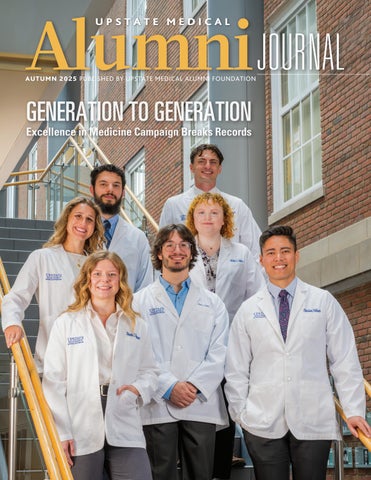
GENERATION TO GENERATION
Excellence in Medicine Campaign Breaks Records
M ED I C A L A L U M NI B O A R D O F D I R EC T O R S
1
5
Barbara Anne Morisseau, MD ’98 President Robert A. Dracker, MD ’82 Vice President Danielle A. Katz, MD ’97 Treasurer Barbara Jones Connor, MD ’82 Secretary Richard M. Cantor, MD ’76 Larry S. Charlamb, MD ’88 Peter J. Christiano, MD ’85 Dennis D. Daly, MD ’83 Mantosh Dewan, MD, HS ’79 Mark S. Erlebacher, MD ’79 Brian J. Gaffney, MD ’72 Douglas W. Halliday, MD ’79 Ruth H. Hart, MD ’80 Robert H. Hill III, MD ’06 Samantha Jones, MD ’11 Bruce M. Leslie, MD ’78 Barbara Clayton Lutz, MD ’92 Kirsten P. Magowan, MD ’87 Mark S. Persky, MD ’72 Amy L. Reynders, MD ’01 Charles J. Ryan III, MD ’82 K. Bruce Simmons, MD ’79 George L. Stanley Jr., MD ’94 Ralph L. Stevens, MD ’81 James A. Terzian, MD ’75
EMERITUS
Frederick R. Davey, MD ’64 Richard W. Doust Karen K. Heitzman, MD ’83 Patricia J. Numann, MD ’65 Michael H. Ratner, MD ’68 Gregory A. Threatte, MD ’73 Jack Yoffa, MD ‘69
EX-OFFICIO
Lawrence Chin, MD Christopher Morley, PhD, MA, CAS Paul Norcross Robert Ruiz
STUDENT REPRESENTATIVES
Katherine Narvaez Mena ’26 Maushmi Chitale ’26 Binghamton Raquel Batista ’27 Christopher Bushnell ’27 Binghamton Stevie Tchako-Tchokouassi ’28
AlumniJOURNAL UPSTATE MEDICAL
12
20
Features
5 Generation to Generation The Medical Alumni Foundation’s record-breaking campaign has raised $25 million to support student scholarships and programs.
12 The Disease Detective CDC epidemiologist Erin Staples MD/PhD ’00 is one of America’s leading experts on emerging vector-borne infectious diseases.
Departments 1 20 22 30
COURTYARD STUDENT ROUNDS CLASS NOTES IN MEMORIAM
AUTUMN 2025 ISSUE Published three times in 2025 in spring, autumn, and winter. Copyright ©2025 by Upstate Medical Alumni Foundation. Opinions expressed are those of the individual authors and subjects and do not necessarily reflect the views of the Alumni Foundation or Upstate Medical University. Published by the Upstate Medical Alumni Foundation of Upstate Medical University, Setnor Academic Building #1510, 750 E. Adams St., Syracuse, New York 13210-9976 Issue Number: 95
Submissions and address corrections should be sent to Paul Norcross, SUNY Upstate Medical University, Setnor Academic Building #1510, 750 E. Adams St., Syracuse, New York 13210-9976 Phone: 315/464-4361 Fax: 315/464-4360 Email: norcrosp@upstate.edu Paul Norcross Executive Editor Renée Gearhart Levy Managing Editor Lori Murphy Associate Managing Editor Sarah Burns Ellen Edgerton Skip Lockwood Chere Raven Contributing Editors Kiefer Creative Design and Production
Darryl Geddes Kayla Richmond Contributing Writers William Mueller Debbie Rexine Rebecca Stumpf Rich Whelsky Photographers
Michael H. Ratner, MD ’68, Chair Fred Davey, MD ’64 Ruth H. Hart, MD ’80 James A. Terzian, MD ’75 Editorial Board JUST A CLICK AWAY Visit the Medical Alumni web page at medalumni.upstate.edu for special event information, past Alumni Journals, giving opportunities, and more. Follow us on Facebook at www.facebook.com/ UpstateMedicalAlumni ON THE COVER: Some of the inaugural recipients of the Blau Scholarships, from top, left to right: Jonathan Rismany ’28, Jackson Bright ’28, Gianna DeRoberts ’28, Michelle Robbins ’27, Brianna Rheaume ’27, Mack Ogden ’28, and Christian Poblano ’27. Not pictured: Eunice Baik ’28, Stephanie Ezeoke ’28, Khristy Tapiero ’28, and Kelly Zhou ’27.
C O U R T YA R D
Upstate Earns Prestigious R2 Carnegie Classification for High Research Activity
U
pstate Medical University has been officially designated a Carnegie R2 (Research 2) institution by the Carnegie Foundation for the Advancement of Teaching and the American Council on Education (ACE), a distinction that recognizes the university’s significant research achievements and trajectory. The 2025 Research Activity Designations mark a major milestone for Upstate, placing it among 139 institutions nationwide recognized as “High Research Activity” universities. The new R2 designation reflects more than $53 million in research expenditures during fiscal year 2023 and the awarding of 22 research doctorates in the 2022–2023 academic year. The Carnegie Foundation updated how they classify research institutions in 2025, an effort to “make the Carnegie Classifications more reflective of the wide range of higher education institutions across America and how well they serve their students,” according to the organization. “This designation underscores the incredible momentum we’ve built,” says Dave Amberg, PhD, vice president for research at Upstate. “Upstate Medical University has been on a fantastic research growth trajectory for the last several years, leading to a more than doubling of our research expenditures. This accom-
plishment would not have been possible without the efforts of our highly accomplished research faculty and the support they receive from my staff in Research Administration.” In the last year alone, Upstate researchers have: ■ Participated in a groundbreaking pediatric cancer trial ■ Learned more about how glaucoma, the leading cause of irreversible blindness worldwide, develops ■ Embarked on projects to learn more about difficult-to-treat brain tumors ■ Created new tools to study actin, the most abundant protein in the body ■ Helped develop AI systems to shed light on how Alzheimer’s disease develops The R2 classification highlights institutions with high research spending and doctorate production, placing Upstate within a national community of universities contributing cutting-edge scholarship and innovation. It is especially significant for an academic medical center.
Spotlight on Student Research
N
early 100 students participated in the Charles Ross Memorial Student Research Day, held March 12. The annual event provided an opportunity for student researchers in the College of Graduate Studies, Norton College of Medicine, College of Health Professions, and College of Nursing to highlight their work. The event included oral presentations, a keynote address, and poster session.
UPSTATE MEDICAL ALUMNI JOURNAL | AUTUMN 2025
1
C O U R T YA R D
Upstate Medical University Graduates 161 New Physicians
U
pstate Medical University conferred 406 degrees and certificates on new graduates during Commencement May 4 from all four Upstate colleges: Graduate Studies, Health Professions, Medicine, and Nursing. Upstate President Mantosh Dewan, MD, HS ’79, presided over the ceremonies with assistance in awarding the degrees by the college deans: Mark Schmitt, PhD, Graduate Studies; Katherine Beissner, PT, PhD, Health Professions; Lawrence Chin, MD, Norton College of Medicine; Tammy Austin-Ketch, PhD, College of Nursing. The Norton College of Medicine awarded 172 degrees: 156 doctor of medicine and 15 master of public health degrees and one public health certificate. Three students received both an MD and MPH degree, and two students were awarded MD/PhD degrees. The College of Graduate Studies awarded 23 degrees, including eight in biochemistry and one master’s degree. The College of Health Professions awarded 164 degrees: 53 bachelor of science, eight bachelor of professional studies, 67 master of science, and 36 doctorate of physical therapy. The College of Nursing awarded 42 degrees and certificates: 19 doctorate in nursing, six master of science, 15 bachelor of science degrees, and two postgraduate certificates. Katelyn K. Jetelina, MPH, PhD, founder and publisher of “Your Local Epidemiologist” and a former senior scientific consultant at the Centers for Disease Control and Prevention, gave the commencement address and received an honorary degree.
Medical Alumni Foundation Board President Barbara Anne Morisseau, MD ’98, and her daughter, Serena G. Schmitt, MD ’25
Jetelina is an epidemiologist, data scientist, and a skilled scientific communicator, with expertise in health outcomes among vulnerable populations, diffusion of innovations in diverse community settings, stakeholder engagement, and scientific communication and knowledge translation. She previously has served as director of population health analytics at the Meadows Mental Health Policy Institute, as an assistant professor of epidemiology at the University of Texas Health Science Center at Houston (UTHealth) and as scientific advisor to the White House. Over the past decade, Jetelina has conducted research on topics with vulnerable populations exposed to violence: victims of child abuse, human trafficking, intimate partner violence, gun violence, and police officers. Her e-newsletter “Your Local Epidemiologist” has grown to serve an international audience of more than 200,000 subscribers. As part of her research portfolio, she has developed interventions using smart and personal technology and analyzed “big data” from health systems. Her current research interests are improving health access and outcomes for vulnerable populations, characterizing social factors related to healthcare quality outcomes, scientific communication, and combating misinformation and disinformation.
Upstate President Mantosh Dewan, MD, HS ’79; honorary degree recipient and Commencement speaker Katelyn K. Jetelina, MPH, PhD; SUNY Trustee Eunice Lewin; and Upstate Council member Gwynn Mannion
2
UPSTATE MEDICAL ALUMNI JOURNAL | AUTUMN 2025
C O U R T YA R D
Gregory Conners, MD, MBA, MPH, Honored With Prestigious AAP Pediatric Emergency Medicine Award
G
regory Conners, MD, MBA, MPH, chair of the Department of Pediatrics and executive director of Upstate Golisano Children’s Hospital, is the 2025 recipient of the American Academy of Pediatrics (AAP) Section on Emergency Medicine’s Jim Seidel Distinguished Service Award. This prestigious national award—the highest honor presented by the AAP Section on Emergency Medicine— recognizes physicians who have made outstanding and lasting contributions to the field of pediatric emergency medicine (PEM). Often referred to as the PEM “Hall of Fame,” the award celebrates a career of exemplary service, leadership, and innovation. Named in honor of the late James S. Seidel, MD, PhD, FAAP, the award is given to a leader who embodies the same spirit of tireless advocacy, education, and impact. Dr. Conners joins a select group of individuals whose work has shaped the evolution of pediatric emergency medicine nationwide. Conners has had a distinguished career in pediatric medicine and academic leadership. He has authored or co-authored approximately 100 peer-reviewed papers, 20 book chapters, and a peer-reviewed textbook. He has served on the editorial boards of three professional jour-
nals and is a fellow of both the American Academy of Pediatrics (AAP) and the American College of Emergency Physicians. He is also a member of the American Pediatric Society and past chair of the International Group on BS/ MD Programs. He has long been a contributor to faculty development, pediatric leadership, and quality improvement initiatives. In addition to his leadership post in pediatrics and with Upstate Golisano Children’s Hospital, Conners serves as an attending physician in the Upstate Pediatric Emergency Department. Conners joined Upstate in March 2019, from Children’s Mercy Hospitals & Clinic, University of Missouri, Kansas City School of Medicine, where he served in a variety of roles, including associate chair of pediatrics and director of the Division of Emergency Medicine. Conners earned his bachelor’s degree from Amherst College, his MD from Stony Brook School of Medicine, and holds MPH and MBA degrees from the University of Rochester. He completed his residency in pediatrics and fellowship in pediatric emergency medicine at Children’s National Medical Center in Washington, DC.
Gregory Conners, MD, MBA, MPH
Upstate Ranked Among Best in Nation for Pediatric Care
M
oney magazine has ranked Upstate University Hospital as the 17th Best Hospital for Pediatric Care in the country, and the second best in New York state. Pediatric services are provided by Upstate Golisano Children’s Hospital, which features more than 100 pediatric specialists in more than 40 specialties. The hospital offers a comprehensive range of services, including inpatient care in areas such as general pediatrics, pediatric surgery, hematology/oncology, and the region’s only pediatric intensive care unit (PICU). It also offers a comprehensive range of ambulatory services, including primary care and several nationally recognized specialty medical care programs. Additionally, Upstate Golisano Children’s Hospital serves as the region’s only ACS-verified Level 1 Pediatric Trauma and Burn Center. “We are honored to be recognized among the nation’s top pediatric hospitals,” says Gregory Conners, MD, MBA, MPH, chief of pediatrics and executive director of Upstate Golisano Children’s Hospital. “This achievement reflects the dedication of our team and the trust our community places in us. We remain committed to providing exceptional care and advancing pediatric medicine.”
FAST FEET. Medical student John Monroe ’27 ran the Boston Marathon on April 19 in 3 hours, finishing 4,843 out of 28,284 runners, landing in the 17th percentile. The race was his third marathon, each completed during his time at Upstate. His first marathon was in October of his MS1 year and ended in heat stroke, followed by a second marathon in April 2024, which was a Boston time qualifier at 2:50.
UPSTATE MEDICAL ALUMNI JOURNAL | AUTUMN 2025
3
C O U R T YA R D
Alicia Pekarsky, MD ’02, F’09, Honored for Work With Abused Children
U
pstate Golisano Children’s Hospital physician Alicia Pekarsky, MD ’02, F ’09, was honored with the Catherine Senska-Haas Distinguished Service to Abused Children Award, given to an individual who has demonstrated exemplary dedication in the care, treatment, or investigation of child abuse. Among her many roles serving children, Dr. Pekarsky is co-medical director of the McMahon Ryan Child Advocacy Center in Syracuse. “Dr. Pekarsky has dedicated the past 20 years to providing exceptional care and unwavering support to the children of Onondaga County,” says McMahon Ryan Executive Director Erin Bates. “Her expertise, compassion, and commitment are deeply felt by our multidisciplinary team and the families who rely on her care. It is truly an honor to celebrate Dr. Pekarsky for her years of service, dedication, and advocacy.” Pekarsky was one of the first physicians in the country to be certified in child abuse pediatrics. After completing her pediatric residency in 2005 at St. Christopher’s Hospital for Children in Philadelphia, she returned to Upstate and completed a three-year fellowship in child abuse pediatrics, a new subspecialty approved by the American Board of Pediatrics in 2006. She is currently an associate professor at Upstate Medical University as well as the director of Upstate Golisano Children’s Hospital Child Abuse Pediatrics Division, co-medical director of the McMahon Ryan Child Advocacy Center and program director for the Upstate child abuse pediatrics fellowship.
Alicia Pekarsky, MD ’02, F ’09
Scott Albert, MD ’04, HS’11, Named Director of Upstate Breast Care Program
S Scott Albert, MD ’04, HS ’11
4
cott P. Albert, MD ’04, HS ’11, has been named director of the Breast Care Program at Upstate Medical University. He is also an assistant professor of medicine. The Upstate Breast Care Program offers on-site imaging and routine, preventative or complex care for breast disease. Dr. Albert served at Upstate from 2013 to 2017 and held numerous roles, including as chief of the Division of Breast Endocrine and Plastic Surgery and Breast Program leader. He also served as associate program director for the surgery residency program. He most recently served as a surgeon at St. Joseph’s Health Hospital. Albert is board-certified in complex general surgical oncology, which is granted to surgeons who have completed advanced training and demonstrated expertise in
the field of surgical oncology, specifically focusing on patients needing complex cancer surgeries or with rare or unusual cancers. Albert has lectured and written on topics such as breast cancer, melanoma, and thyroid diseases and has been published in numerous publications, such as Critical Care Medicine, Annals of Surgical Oncology and the Journal of Surgical Research, among others. Albert was a general surgery resident and surgical research fellow at Upstate, before completing a surgical oncology fellowship at Ohio State University. His honors include the Humanitarian Award from the Carol Baldwin Breast Cancer Research Fund.
UPSTATE MEDICAL ALUMNI JOURNAL | AUTUMN 2025
Record-Breaking Campaign Delivers Life-Changing Support for Future Physicians Blau Scholarship recipients Michelle Robbins ’27, Jackson Bright ’28, Mack Ogden ’28, Brianna Rheaume ’27, Jonathan Rismany ’28, Gianna DeRoberts ’28, and Christian Poblano ’27
UPSTATE MEDICAL ALUMNI JOURNAL | AUTUMN 2025
5
W
hen Pat Blau reviewed the applications of prospective scholarship recipients from the Upstate Medical Alumni Foundation, she knew she was about to change lives. The widow of Stephen Blau, MD ’68, a psychiatrist who practiced for more than 50 years, was preparing to distribute a transformative gift: 11 full-ride scholarships that would eliminate a year of medical school debt for a cohort of medical students with substantial financial need.
Stephen Blau, MD ’68 and his wife, Pat, met while both were studying in Syracuse, he in medical school at Upstate and she at Syracuse University.
6
The impact of that gift was immediate and profound. When Stephanie Ezeoke ’28 first received the scholarship notification email, she thought it was a scam. It wasn’t until she received a follow-up email that she understood it was real. “I had to take a moment to collect myself,” she says. “Then I called my mother and grandmother.” Christian Poblano ’27 was on a break during his psychiatry rotation at Binghamton General Hospital when he opened the email. “I thought there was a typo and the alumni office accidentally added an extra 0,” he says. Gianna DeRoberts ’28, was heading to a wedding when she quickly checked her email. “I opened the attachment, and I just stood there, mouth open,” she says. Her boyfriend, Jackson Bright ’28, wondered why she had stopped responding to their conversation. Bright had also received an email from the
Medical Alumni Foundation but hadn’t read it. “You might want to open it,” she told him. These Upstate medical students had just been notified that they’d been selected to receive the Stephen Blau, MD ’68 Memorial Scholarship, which would cover the cost of their medical school tuition and living expenses for the 2025-26 year. Blau’s million-dollar gift represents the capstone of the Generation to Generation campaign, an ambitious fundraising effort that has not only exceeded its original goals but has also fundamentally changed how Upstate Medical University supports its students. What began as a $15 million campaign is now expected to surpass $25 million, creating a new standard for alumni giving and establishing a sustainable foundation for future generations of physicians. Blau’s decision to fund immediate scholarships rather than an endowment reflects her desire to see substantial, immediate impact. Her connection to Upstate is personal—she met her future husband, Stephen, in a bank on Marshall Street while she was attending Syracuse University’s School of Social Work, and he was a medical student. The couple eloped after Pat’s graduation in 1969, and Stephen went on to practice psychiatry, maintaining a psychoanalytic practice while teaching medical students at Albert Einstein College of Medicine. Pat worked as a social worker for more than 40 years, including 30 years at Bellevue Hospital. After her husband died in 2024, Pat thought about a tangible way to honor his memory. “With both of our backgrounds in healthcare, it made sense to help future physicians, particularly since we have a shortage of doctors and medical education now costs a fortune,” she says.
The Burden of Modern Medical Education Indeed, medical education costs have skyrocketed in ways that would have been unimaginable to earlier generations of physicians. At Upstate’s Norton College of Medicine, tuition has increased from $16,000 annually in 2000 to $46,470 today, with the yearly cost of attendance estimated at $82,323 for New York residents. The average debt for graduates commonly tops $200,000 at graduation, a burden that grows with compound interest that begins with residency.
UPSTATE MEDICAL ALUMNI JOURNAL | AUTUMN 2025
“This scholarship helps me in a tremendous way in terms of finances, but it also motivates me knowing that it was birthed from a career built on a foundation of work ethic and determination by Dr. Blau. I intend to continue to pursue this career with intention and generosity, just as it was exemplified by Dr. Blau.” —JACKSON BRIGHT ’28
Herb ’65 and Suzy Weinman at Reunion 2015 with scholarship recipient Rachel Kopicki, MD ’16
The financial stress weighs heavily on current students. “As someone financing their medical school education primarily through loans, it can be daunting to watch the debt accumulate,” says Khristy Tapiero ’28, another recipient of a Blau Scholarship. Recent legislation that caps federal loans for professional education at $50,000 annually adds additional stress. “If that bill went into effect and impacted me, I would be capped out and forced to drop out of medical school,” says Michelle Robbins ’27, another Blau recipient. “There is no back up plan for me.” These are financial worries earlier generations of medical graduates did not have to balance along with their medical study. “Over and over, I hear how comparatively little it cost our older alumni physicians to obtain their medical education,” says Paul Norcross, executive director of the Upstate Medical Alumni Foundation. “Many of them worked their way through school, paying their tuition with side jobs, and they’re grateful for the successful careers and comfortable lives that their Upstate education provided for them and their families.” Herbert Weinman, MD ’65, who practiced family medicine for decades in New Paltz, New York, exemplifies this generational divide. He recalls funding his own medical education through “savings and working” with help from his in-laws—a scenario that would be impossible for today’s students facing dramatically higher costs.
Jackson Bright ’28 and Gianna DeRoberts ’28
UPSTATE MEDICAL ALUMNI JOURNAL | AUTUMN 2025
7
Campaign Leadership Committee
“Upstate Medical University, as it’s now called, set me on my career path, and I won’t forget it,” he says of he and wife Suzy’s financial support. “With the cost of medical education as it is today, every little bit helps,” he says.
A Campaign Born from Board Vision The Generation to Generation campaign emerged from discussions within the Medical Alumni Foundation’s Finance and Executive Committees around 2019, as board members recognized the growing financial burden facing students. Key alumni donors were approached to gauge support for a concentrated scholarship effort. “Those early conversations with alumni and donors reinforced the understanding that student need was overwhelming and that we really should have a concentrated, focused effort to do something about it,” recalls Norcross. The campaign officially launched in 2021 with a $15 million goal, supported by early major gifts from alumni such as Zaven Ayanian, MD ’59, and Bruce Leslie, MD ’78, whose early commitment helped demonstrate the campaign’s viability to other potential donors. The Foundation’s existing scholarship program, which at the time —JONATHAN RISMANY ’27 administered 82 alumni-funded scholarships providing more than $500,000 annually, served as the foundation for expansion. Dr. Leslie, who established the Stanley D. Leslie Memorial Scholarship in honor of his father, Stanley Leslie, MD ’51, personifies this sentiment. “I had the option of attending Upstate, which cost $1,500 a semester, or Tufts Medical School, which cost many times that. It was an easy decision,” Leslie recalls. “When I started my post-graduate education in Boston, it quickly became apparent that the education I received at Upstate was at least as good, if not better, than my Boston-educated peers. My class spent next to nothing for our Upstate
“I would like to express my deepest gratitude to Patricia Blau for her incredibly generous contribution to my medical education. With the current cost of attendance and rising federal loan interest rates, her gift has fundamentally changed my ability to attend school this year.”
8
Zaven S. Ayanian, MD ’59 Patricia and Stephen P. Blau, MD ’68* Elliot Brandwein, MD ’67 and Arlene Brandwein, MD ’68* Richard W. and Joan Doust Robert A. Dracker, MD ’82 Susan and Welton M. Gersony, MD ’58 Bruce M. Leslie, MD ’78 Laura and Norman Loomis, MD ’56 Nancy and David Lynch, MD ’75 Helen* and Albert F. Mangan, MD ’54* Angeline R. Mastri, MD ’59* Patricia J. Numann, MD ’65 Allan J. Press, MD ’67 Michael H. Ratner, MD ’68 Charles J. Ryan, III MD ’82 Maureen L. Sheehan, MD ’88 Mrs. Barbara Sheperdigian and Ara A. Sheperdigian, MD ’60* Department of Surgery Swift Family Legacy Grants Suzy and Herbert M. Weinman, MD ’65 Frank E. Young, MD ’56* * deceased
medical degree. We should be grateful for the many opportunities our degree provided.” Maureen Sheehan, MD ’88, who established an endowed scholarship fund at age 56 targeting primary care students, decided to act during her lifetime rather than waiting for estate planning. “Some people wait until they die to do something like this, but I don’t want to have regrets or have someone else decide what to do with my money,” she says. The Weinmans bring a personal approach to their giving, establishing criteria that reflect their values and professional focus. Their annual scholarship gift targets third-year students interested in family medicine, requiring essays about community service and career motivation. Over the course of the campaign, they have increased their annual scholarship gift from $10,000 to $25,000. “People were supportive of me when I went to medical school, and so I thought it’s time to return the favor,” says Weinman. Mallory Stephens, MD ’54, a 96-year-old rheumatologist who practiced for 49 years, represents the campaign’s oldest generation of supporters. After completing his medical train-
UPSTATE MEDICAL ALUMNI JOURNAL | AUTUMN 2025
ing in New York City and serving in the Army at Fort Detrick’s Biological Warfare Center, Stephens established a career in private practice that spanned 36 years. “I thought endowing a scholarship was a good way to help today’s medical students,” says Stephens. His perspective reflects the straightforward generosity of many alumni who view scholarship support as a natural extension of their gratitude to the institution. Early on, the campaign’s trajectory changed dramatically, when retired opthalmologist Alan Norton, MD ’66, reached out expressing interest in supporting his medical alma mater in a major way. Dr. Norton served as a visiting faculty member at the Stein Eye Institute at UCLA for more than 20 years and also had his own ophthalmology practice and served as a consultant to three different hospitals in Los Angeles in his subspecialty of retinal diseases. Ultimately, he and his wife, Marlene, made a significant gift to name the Alan and Marlene Norton College of Medicine. “I am grateful for the quality education that I received from the SUNY Upstate Medical University,” Norton says. “This provided me the opportunity for a career in medical research and practice. Our estate gift to the Upstate College of Medicine is to demonstrate our appreciation and help the college to continue its excellence in teaching and innovation.” While the full naming gift wasn’t counted toward the campaign total, the cash portion provided crucial momentum. “It gave us a jumpstart for where we were headed and was a wonderful testament to how we were going to reach our goal,” Norcross explains. And in a full-circle moment, Dr. and Mrs. Norton made a second generous gift that will close the campaign at more than $25 million raised. Their second gift establishes the Alan and Marlene Norton Presidential Chair, given in honor of Upstate Medical University President Mantosh Dewan, MD, HS ’79. The first Presidential Chair in SUNY history, it will provide the president with $250,000 in discretionary funds annually for strategic priorities such as scholarships, faculty, and student research.
The Alan and Marlene Norton Presidential Chair, given in honor of Upstate Medical University President Mantosh Dewan, MD, HS ’79, will provide the president with $250,000 in discretionary funds annually. It is the first Presidential Chair in SUNY history.
Life-Changing Impact But the campaign’s impact extends far beyond numbers, transforming individual lives and career trajectories. As an Upstate medical student, Cholette Fiore, MD ’25, was awarded the Elliot Brandwein, MD ’67 and Arlene Eckstein Brandwein, MD ’68 Scholarship as well as the Nathan and Ada August Memorial Scholarship. “In addition to providing financial support on this costly journey, being honored with these scholarships was a recognition of hard work and dedication and a reminder that we, as medical students, have a strong community and support system behind us,” says Fiore, now beginning internal medicine residency at Boston University Medical Center. “As a recent graduate, I intend on being active in our alumni community and look forward to be in the position where I can pay it forward and join our gracious donors in supporting the next generation of doctors.” Maria Krisch, MD ’24, benefited from four different scholarships during her third and fourth years of medical school. Now in her second year of ophthalmology residency at Upstate, she reflects on what those scholarships meant to her. “Medical school is hard as is. You’re constantly swamped by studying. You’ve got tons of clinical duties. You come home, you’re exhausted. And, the added stress of growing debt is huge,” she says. “The generosity of scholarship donors helps alleviate some of that stress to help you focus on your studies and on becoming a good clinician.”
UPSTATE MEDICAL ALUMNI JOURNAL | AUTUMN 2025
9
Stephen Blau ’68 Memorial Scholarship Recipients Krisch received the Joseph J. Gadbaw and Anne Gadbaw Scholarship, the Sonia LaBella Scholarship, the James McGraw Scholarship, and the Zaven Ayanian Scholarship. While she hasn’t met her donors in person, she made contact through letters expressing her gratitude. “I’m forever thankful to these donors and I’m committed to paying it forward myself,” she says. “I think these scholarships speak volumes about the Upstate culture as a whole. We have really good students here. We have really good clinicians. But I think our best asset is the fantastic people committed to giving back.” Thomas Bedard, MD ’21, began medical study at the Norton College of Medicine directly after college. “With very little financial means or savings, taking on more debt was daunting,” he says. A good student, Bedard went on to receive support from the Upstate Medical Alumni Foundtion with the Kasten Aker Family Scholarship, Swift Family Legacy Grant, N. Barry Berg Scholar-
Eunice Baik ’28 Jackson Bright ’28 Gianna DeRoberts ’28 Stephanie Ezeoke ’28 Mack Ogden ’28 Christian Poblano ’27 Brianna Rheaume ’27 Jonathan Rismany ’28 Michelle Robbins ’27 Khristy Tapiero ’28 Kelly Zhou ’27
ship for Musculoskeletal Medicine, and the Rick Zogby Memorial Scholarship. “The scholarships helped pay for educational resources, housing, and other life expenses that otherwise would’ve been difficult to afford,” says Bedard, now a fourth-year orthopedic surgery resident at Upstate. “I am forever grateful for the support that I received. In the future, I too will look to ‘pay it forward,’ remembering the humble roots from which I came.” The relief expressed by Blau scholarship recipients only amplifies the profound effect of donor generosity on students’ lives. “I feel a tremendous weight lifted off my shoulders,” says Tapiero. “Just days earlier, I had been discussing my concerns about student debt with my mother, so learning that I had received this scholarship felt surreal. It was a powerful reminder that things sometimes fall into place when you least expect it.” For Christian Poblano ’27, the scholarship’s impact extends beyond his own education. “It sets me years ahead of my goal to help my parents retire and pay off their mortgage,” he says. “A dollar amount can’t directly be equated to the time we have in life, but this scholarship will hopefully help me take care of my family in a way I have dreamt of for years, much sooner.” “I am almost always thinking about how I am going to afford tuition and living expenses,” adds Mack Ogden ’28. “This scholarship gives me the peace of mind necessary to focus on my studies instead of my finances and I am so grateful for this luxury.”
Christian Poblano ’27
10
UPSTATE MEDICAL ALUMNI JOURNAL | AUTUMN 2025
“As a first-generation medical student, this scholarship has an immeasurable impact. Not having to worry about tuition for the year lifts an enormous weight off my shoulders, both financially and emotionally,” says Brianna Rheaume ’27.
“I am so thankful to Mrs. Blau for her generous support of me through this scholarship. Her generosity is going to make a world of a difference for me and my family. Thanks to her, I feel empowered to continue forward in my journey to becoming the first doctor in my family. I hope that I can honor the investment that she made in me by continuing to work hard to achieve my dreams so that I can lift as I climb, just as she has done for me.” —KELLY ZHOU ’27
A Legacy of Generational Support The Generation to Generation campaign was the Medical Alumni Foundation’s first comprehensive fundraising campaign, setting a new standard for alumni engagement. Previous fundraising efforts, while successful, were more targeted, such as the Lloyd Rogers Chair in Surgery or individual scholarship endowments. The campaign’s success demonstrates that when alumni understand the challenges facing current students and see concrete ways to help, they respond with remarkable generosity. The more than $25 million raised represents a collective commitment to ensuring that financial barriers don’t prevent talented students from pursuing medical careers. The Generation to Generation campaign has dramatically expanded the Foundation’s scholarship capacity. The endowment has grown from $22 million at the campaign’s launch to $37.6 million today, enabling the Foundation to award 178 scholarships totaling $985,000 this fall—nearly double the amount at the start of the campaign— and that’s not including the Blau scholarships. “This will be a new record,” Norcross notes, reflecting on the unprecedented level of support now available to students. The timing couldn’t be more appropriate. New legislation capping federal loans on professional
education threatens the accessibility of medical school for students most at need and to exacerbate the growing physician shortage. Financial need at Upstate has reached unprecedented levels. The Medical Alumni Foundation received more than 2,800 scholarship applications for the 2025-26 academic year from students seeking support from the growing number of scholarship awards. “Sadly, student need still exceeds our ability to provide support,” says Norcross. “There is more work to be done and we will continue looking to alumni and friends for support.” As the first cohort of Blau scholarship recipients begin a year of medical school without tuition worry, they represent the fulfillment of the Generation to Generation promise: that each generation of physicians will support the next, ensuring that the opportunity to serve others through medicine remains accessible to all who have the calling to heal. “If I had the opportunity to speak with my benefactor, I would express my immense gratitude for helping students from backgrounds like mine pursue medical education with a lighter financial burden,” says Tapiero. “As the first in my family to attend medical school, the journey has been both rewarding and challenging. Knowing that someone believes in us enough to invest in our future is incredibly motivating, and it inspires me to one day pay that generosity forward.” 7
UPSTATE MEDICAL ALUMNI JOURNAL | AUTUMN 2025
11
REBECCA STUMPF
12
UPSTATE MEDICAL ALUMNI JOURNAL | AUTUMN 2025
THE DISEASE DETECTIVE:
Dr. Erin Staples and the Hunt for Hidden Viruses How a music major turned CDC epidemiologist became one of America’s leading experts on emerging vector-borne infectious diseases BY RENÉE GEARHART LEVY
W
hen Erin Staples MD/PhD ’00 received a phone call just before Thanksgiving 2015, she could hardly have imagined it would lead her to a hospital waiting room in Brazil, staring at eight children with severe microcephaly—a devastating birth defect that is caused by abnormal brain development leading to small heads and developmental delays. What she witnessed that day would help unravel one of the most significant public health mysteries of the 21st century: the connection between Zika virus and birth defects. “I had seen maybe one, two cases of microcephaly in all my pediatric practice,” recalls Dr. Staples, a senior medical epidemiologist at the Centers for Disease Control and Prevention (CDC). “But then I got there and I’m standing in a waiting room, and there were eight moms and their infants with microcephaly all born at the same time. That’s where you start putting those blocks together. How can this be?” The ability to see patterns where others might see coincidence exemplifies the work of disease detectives like Staples, who spend their careers hunting for emerging pathogens that threaten public health.
Over nearly two decades at the CDC, she has investigated outbreaks of everything from influenza in Chicago to plague in Africa and novel tick-borne viruses in Missouri farmland, always asking the fundamental question: What’s making people sick, and how do we stop it? Since 2020, Staples has led the surveillance and epidemiology team for the CDC’s Arboviral Diseases Branch in the Division of Vector-borne Diseases. Her team focuses on responding to outbreaks, planning and managing vaccine programs for four vaccinepreventable diseases—chikungunya, Japanese encephalitis, tick-borne encephalitis and yellow fever—and managing disease surveillance systems and public information dashboards. Her team also assists international partners on various diseases and outbreak responses when more subject matter expertise is required than available in the affected countries, which is what landed Staples in Brazil back in 2015. “Working together with all of the wonderful scientists at CDC, from virologists to the diagnostic labora tory personnel, and putting the information together
UPSTATE MEDICAL ALUMNI JOURNAL | AUTUMN 2025
13
Dr. Staples with Upstate MD/PhD students during a campus visit in 2013
we were able to advise the Brazil Ministry of Health that this did not look like toxoplasmosis. This did not look like cytomegalovirus. This looks like a new entity, and it is likely Zika,” she says.
AN UNLIKELY PATH TO MEDICINE
S
taples’ journey to becoming one of America’s foremost experts on vector-borne diseases began in an unexpected place: a music classroom. Born south of Boston, she spent a year of her early childhood traveling the United States in a motor home with her family before they settled in Canton, New York, near the Canadian border, on a self-sustaining organic farm. “There wasn’t a lot of exposure to medicine,” she says. “My grandmother had been a nurse for 70 years, starting before antibiotics were readily available and we had a lot of old-fashioned remedies from her to take care of infections and cuts.” Staples remembers often being bored in school, which is why she didn’t initially consider medicine as a career option. “I thought, ‘I can’t spend eight additional years in school,’” she says. She loved music and played multiple instruments. At St. Lawrence University, she majored in music, an experience that included study abroad in Vienna, Austria. “I focused on music composition,” she says. But along with her general studies requirements, she also took science courses, which provided Staples with the intellectual challenge she’d been seeking. Through her college’s alumni network, she secured a research opportunity at the NIH working with immunologist John O’Shea, MD, HS ’81. “He was doing basic science research, but also took me on his rounds at the NIH, where they see all of these patients with medical conditions that didn’t really have an easy answer or easy fix,” she says. “He and his colleague Dan McVicar, PhD, were both approaching the same problem of
14
“It was kind of a full-circle experience for me, finding and discovering something that was important for an immunologic response in bench research, identifying that as a deficiency in a person, and then being able to treat that.” —ERIN STAPLES MD/PHD ’00 understanding the immunologic response to different stimuli.” Seeing this dual perspective—the clinician’s focus on individual patients and the researcher’s view of broader patterns—lit a spark for Staples, who decided she wanted to pursue an MD/PhD. Despite having graduated magna cum laude and a member of Phi Beta Kappa, not everyone was convinced of her aptitude. “When I went to my interviews, some of the people were like, ‘Wait a minute, you’re an undergraduate music major, you can’t be serious,’” she recalls.
THE MAKING OF A SCIENTIST
S
taples arrived at SUNY Upstate Medical University in 1993 to pursue her MD/PhD, focusing her dissertation research on factors that influence T cell development. Under the mentorship of Allen Silverstone, PhD, professor of microbiology and immunology, she studied how compounds like estrogen and dioxins affect immune cell maturation, creating knockout mice to understand whether the effect was on the immune cells themselves or their supporting environment.
UPSTATE MEDICAL ALUMNI JOURNAL | AUTUMN 2025
“With dioxin, it was pretty straightforward that it does target the developing T cells,” she explains. “But with estrogen, it was complicated. We were trying to address the issue of why women potentially are more at risk for certain autoimmune diseases, why during pregnancy certain diseases get better or worse.” The research provided crucial insights into fundamental questions about immune function, but it also gave Staples something equally valuable: the methodical approach to problem-solving that would serve her throughout her career. This training proved particularly relevant when she entered pediatrics during her clinical years, drawn by the resilience and honesty of young patients. “I never met a kid who really wanted to be sick,” she says. “Once we figured out that the girl who had a tonsillectomy just wanted more ice cream, and we negotiated with her mom to buy ice cream on the way home, she was out of the hospital.” Staples went to Duke University for her pediatrics
residency, where she trained under Samuel Katz, MD, a developer of the measles vaccine and former chair of the CDC’s advisory committee on immunization practices. “He was a good mentor to marry my immunologic background and experiences with pediatrics and I was thankful to match there,” she says. During her residency training, Staples cared for children with severe combined immunodeficiency (SCID)—some of whom lacked the very genes she had helped discover during her NIH research. To help one child with SCID caused by JAK3 deficiency, the team transfected cells with the missing gene. “It was kind of a full-circle experience for me, finding and discovering something that was important for an immunologic response in bench research, identifying it as a deficiency in a person, and then being able to treat it,” she says. Unfortunately, the experimental treatment failed, and the young patient died from an infection during transport to another facility. Not the outcome that the team, including Staples, had hoped for, but the experi-
Dr. Staples on a ferry traveling to a health clinic in the southwest Central African Republic as part of an investigation into the cause of an increase in yellow fever cases. Results from the investigation informed yellow fever vaccination strategy to decrease the risk of disease in the country.
UPSTATE MEDICAL ALUMNI JOURNAL | AUTUMN 2025
15
ence reinforced her understanding of how basic science research could directly impact patient care and help save lives.
JOINING THE DISEASE DETECTIVES
R
ather than pursuing a traditional fellowship, Staples applied for the CDC’s Epidemic Intelligence Service (EIS)—a two-year program that trains physicians in applied epidemiology. The American Board of Pediatrics granted her an exception to combine this training with a pediatric infectious disease fellowship. “Who wouldn’t want to be a disease detective?” she says. Her EIS assignment took her to the CDC’s Bacterial Diseases Branch, where she investigated outbreaks of plague, tularemia, and Lyme disease. Much of her work focused on Africa, where she spent eight months studying antibiotic resistance in plague treatment and experienced the challenge of implementing clinical trials in foreign countries with different healthcare systems and regulatory frameworks. The experience was “very, very enriching” but also “very challenging,” providing Staples with crucial skills in working internationally that would prove invaluable throughout her career. After completing her EIS training and pediatric infectious disease fellowship, Staples took advantage of an opportunity to join pharmaceutical company Sanofi Pasteur as a vaccine researcher. “I worked on a couple of different projects, including a delivery platform—a better way to get a vaccine into a person that’s easier—and also on combination vaccines in pediatrics. How many antigens or elements can you put in a vaccine and still have it be effective in terms of providing an immune response?”
Staples says the work was rewarding and provided lots of intellectual freedom and resources, yet she found herself wondering if it was the right fit. She found herself drawn back to the kind of public health work she’d done at the CDC. “Most of what we do at the CDC is really identifying an issue that’s causing an infectious disease cluster outbreak and figuring out what that cause is to figure out how to prevent people from getting sick,” she says. “We do investigations relative to novel and new diseases and understanding reemerging diseases. We also do investigations to improve our recommendations for vaccines. So, it pulled in a lot of the aspects of all the different phases of the training and experiences that I’d had.”
DISCOVERING THE UNKNOWN
R
eturning to the CDC in the Arboviral Diseases Branch—focused on viruses transmitted by arthropods like mosquitoes and ticks—Staples settled into work that would define the next phase of her career. Based in the CDC’s Fort Collins, Colorado, office, she found herself at the center of efforts to understand and respond to emerging vector-borne diseases. One of her most significant early discoveries came almost by accident. In 2009, two Missouri farmers arrived at Heartland Hospital within days of each other, suffering from fever, nausea, diarrhea, and rapidly declining white blood cell counts. When their blood samples reached the CDC, laboratory analysis revealed something unexpected: both men had been infected with a previously unknown virus. “An infectious disease doctor sent some samples to Atlanta on what he thought was patients infected with Ehrlichia,” Staples explains. “Well, they cultured it and said, ‘This isn’t Ehrlichia,’ but there was something
Dr. Staples (left) meeting with the Secretariat of Health in Paraiba, Brazil, to discuss the investigation looking at the association between Zika virus infection during pregnancy and microcephaly.
16
UPSTATE MEDICAL ALUMNI JOURNAL | AUTUMN 2025
JAMES GATHANY
A female “Lone star tick,” Amblyomma americanum, which is found in the Southeastern and Mid-Atlantic United States. This tick is a vector of several zoonotic diseases including human monocytic ehrlichiosis and Rocky Mountain spotted fever.
growing causing a problem. That led to the discovery of Heartland virus.” As a newly identified pathogen, Heartland virus presented unique challenges. Staples and colleagues had to develop surveillance systems, diagnostic tests, and prevention guidelines for a disease that had never been formally recognized. “I started with two cases, and I’m supposed to figure out what role does this human pathogen play in human disease? We just found it recently. What does it do?” The work required collaboration with state health departments to identify additional cases and develop a registry that has now documented more than 60 infections. While searching for Heartland cases, the team made another discovery: Bourbon virus, which causes similar symptoms and is also transmitted by ticks. “Once we start looking and understanding what we’re seeing, we find more things that have probably been present and causing disease for longer than we even knew about,” Staples says.
THE ZIKA INVESTIGATION
S
taples’ experience with novel pathogen discovery proved invaluable when she received that Thanksgiving phone call in 2015. Brazilian health officials were reporting unusual clusters of microcephaly cases, and they needed experts to investigate. The Pan American Health Organization invited her to join an international team assessing the situation. While the team was investigating, laboratory testing suggested that Zika virus—previously considered a relatively mild tropical disease—might be responsible for the birth defects. The implications were staggering. Zika had been causing occasional outbreaks in Africa and Asia for decades without any reported association with birth defects. “We had to go back and put those pieces together to prove that it was associated,” Staples explains. The investigation required coordinating multiple scientific disciplines: epidemiologists to track cases, laboratory scientists to confirm diagnoses, and clinicians to document symptoms. In addition to proving causation, the work involved understanding why Zika suddenly seemed more dangerous than before. The answer lay partly in human susceptibility. “When it came into the Americas, Zika caused large outbreaks because no one had any immunity and
UPSTATE MEDICAL ALUMNI JOURNAL | AUTUMN 2025
17
you can see rare complications when more people are infected,” Staples explains. As to why we are not seeing the risk from Zika virus as much now, Staples says, “We call it a reservoir in our terminology. After a lot of people were infected, that element was removed. As more people became immune, fewer people could amplify it.” A similar threat Staples is currently investigating is Oropouche virus, another previously obscure pathogen that has recently expanded its geographic range and developed new, more serious symptoms. “Oropouche virus had been causing periodic outbreaks in the Amazon Basin in South America, particularly in the 70s and 80s,” she explains. “But more recently, it kind of pushed its boundaries.” Like Zika before it, Oropouche has begun causing deaths and birth defects—outcomes never previously associated with the virus. “Starting around August 2024, the first deaths due to this virus were recognized. And then the association between children that were born with microcephaly and mothers who had been exposed to Oropouche during pregnancy,” she says. There are many factors that contribute to the emerg ence of these new threats, including global travel, changes in temperature and weather, deforestation, and urbanization, all of which contribute to bringing humans into contact with previously isolated pathogens. Meanwhile, advances in genetic sequencing allow
scientists to identify new viruses faster than ever before. “There are hundreds of arboviruses or viruses that are transmitted by arthropods—ticks, mosquitoes, and biting midges—that we know about in this world,” Staples says. “They’ve been discovered for decades in several cases, but it’s more thinking about ‘how do these viruses spread?’”
THE DETECTIVE’S TOOLKIT
M
odern disease investigation requires a sophisticated toolkit that has evolved dramatically since Staples began her career. “In the 1990s, PCR (polymerase chain reaction) was brand new. Now we can do sequencing of a whole genome to look for the presence of something that we don’t expect there,” she says. These technological advances have revolutionized pathogen discovery, but they’ve also highlighted how much remains unknown. Among patients with encephalitis of unknown cause, doctors can identify the culprit in only 20-30% of cases. “It’s that 70% of the unknown cases that we’re still challenged by,” Staples says. The work requires technical expertise as well as the intellectual curiosity to question assumptions and recognize patterns. “Sometimes we don’t think enough, but it’s really astute clinicians that are the ones that often bring something to us that lead us to understand in a new way,” she says. This collaboration between frontline clinicians and public health investigators has led to several important discoveries, including the identification of yellow fever vaccine virus transmission through organ transplantation—a previously unknown risk that led to updated prevention guidelines. She’s learned through decades of investigation that the next pandemic is just a phone call away. “Unfortunately, I don’t think we’re done,” says Staples, who has received numerous honors for her work, most recently the CDC’s Schuchat Berger Excellence in Leadership in Public Health Service Award for exceptional and unequalled leadership in prevention and control of emergent and domestic arboviral diseases. “There are just a lot of different viruses out there that are able to cause people to get sick that are transmitted by arthropods.” Staples remains committed to the work, driven by the same motivation that led her from music composition to medical research to public health. “It’s the ability that I have really to mirror what I love to do One of the initial infants with Zika virus congenital syndrome from the CDC’s investigation in Brazil, which studied the association between Zika virus infection during pregnancy and microcephaly.
18
UPSTATE MEDICAL ALUMNI JOURNAL | AUTUMN 2025
Dr. Staples being interviewed for the BBC in Pariaba, Brazil, about Zika virus.
and still feel like I’m making that difference that drew me into medicine in the first place,” she says. Her advice to aspiring physicians and scientists: “Pursue your passions,” says Staples, who continues to enjoy playing music in her spare time, particularly when she’s joined by her teenage son.
“You don’t have to necessarily end up in clinical practice and do the same thing every day if you don’t like it. Find where you can pull all of what interests you together and pursue a career that you find incredibly rewarding.” 7
AN OUNCE OF PREVENTION Despite the sophisticated tools available for pathogen discovery and investigation, prevention often remains frustratingly simple—and ignored. “Use your insect repellent,” Staples says emphatically. “I’ve got a can at my front door and my back door, and I don’t go outside without it.” Other preventive measures include wearing protective clothing (longsleeved shirts and pants), and being aware of disease risks in different geographic areas. The CDC provides updated surveillance data through online dashboards that track disease activity across the United States. For healthcare providers, Staples emphasizes the importance of maintaining diagnostic curiosity. “Be curious,” she says. “Think about what you’re seeing and whether it makes sense. Don’t just use your UpToDate. Put your minds together and ask, ‘Is this normal? Is this really what I think this is?’ And if it’s not normal, talk it through.”
UPSTATE MEDICAL ALUMNI JOURNAL | AUTUMN 2025
19
STUDENT ROUNDS Finding Their Voice MEDICAL STUDENTS USE MUSIC TO HEAL PATIENTS AND FIND BALANCE.
T
he corridors of the SUNY Upstate Cancer Center echo with more than just the usual sounds of medical monitors and murmured conversation. If you’re there on the right day, you might hear the melodic strains of a piano, the rhythmic pulse of a guitar, or the harmonious blend of voices in song. The live music, performed by Upstate medical students, is intended as therapy for cancer center patients and their families. But many of the participants have found the act of performing healing to themselves as well, providing a creative outlet and relief from the stress of their medical studies. For these students, music isn’t just a hobby—it’s become an integral part of their journey toward becoming physicians. Estelle Khairallah ’27, who trained as a classical pianist, discovered the symbiotic relationship between her two passions when she performed at her class’s Anatomical Gift Memorial Service, which honors the individuals who donated their bodies for educational use in Upstate’s anatomy lab. “There was something about honoring the donors and giving back to their families that was healing for me, even as it was healing for the families,” she says. “We felt like we connected with these families, and people came up to us afterward to say things like, ‘that song meant a lot to me. It was one of my grandfather’s favorites.’” This powerful experience sparked the realization that music could serve as a bridge between the clinical and the deeply human aspects of medicine. Wanting to replicate that experience, Khairallah went on to found the Music is Healing service learning group within Upstate’s Community Engaged Learning (CEL) program. Upstate medical students are expected to complete 40 hours of community service during the course of their medical 20
Members of the Spinal Chords: Shaun Sergott, who works in the Department of Neurology, Humza Khan ’26, Olivia Laniak ’29 Dean Larry Chin, MD, Michael Vertino MD ’95, and Jian Li ’26
education through approved CEL opportunities, and the CEL program offers student leaders course credit for developing and implementing service learning programs. Music is Healing provides opportunity for students to use music as a pathway for service and healing by performing at Upstate’s Cancer Center. But for students navigating the intense pressures of medical school, music serves as more than just community service—it’s essential medicine for their own well-being. “Medical school is hard, and singing is my expressive outlet,” says Ariana Barlas ’28. “When I heard about Music is Healing, I knew this was a perfect opportunity to be able to connect with patients on a level that wasn’t clinical, and to be able to treat them in a way that they weren’t able to be treated physically or with medication.” UPSTATE MEDICAL ALUMNI JOURNAL | AUTUMN 2025
Barlas says she’s been able to connect with a range of patients, family members, and staff through performing. “We have some regulars that keep coming back to listen to us, so it’s been a really rewarding experience,” she says. “And it’s a lot of fun.” The program is currently led by Barlas and classmates Chiazam Nzeako ’28 and Jacob Chacko ’28. Nzeako, a bass-baritone vocalist, says performing allows him to maintain a passion despite being “busier than I’ve ever been in my entire adult life.” The act of making music together creates a space where students can be fully present with something they love, temporarily stepping away from the relentless demands of their studies. “Despite our busy schedules, I think the fact that we take the time to relate to
Members of the Music is Healing service learning group perform at the Upstate Cancer Center.
“When I heard about Music is Healing, I knew this was a perfect opportunity to be able to connect with patients on a level that wasn’t clinical, and to be able to treat them in a way that they weren’t able to be treated physically or with medication.” —ARIANA BARLAS ’28
patients in this way and to be in touch with our humanity is really important. Especially as future physicians, it’s really important for us to be able to relate to our patients and also be in touch with our community,” says Chacko, who plays guitar. To that effort, the group has evolved beyond weekly performances at the Cancer Center. In December, Music is Healing performed a benefit holiday concert at the New Academic Building that raised nearly $800 for cancer research. And in May, the students held a free concert, Sounds of Healing, at the Community Folk Art Center. “We wanted to do something to give back to the Syracuse community,” says Barlas.
B
ut Music is Healing is not the only organized outlet Ariana Barlas ’28 performs at the Sounds of Healing concert, for musically inclined put on by the Music is Healing service learning group, in May. medical students. The Spinal Chords is a rock band that ate. “Coming into med school in a new includes both student and faculty town, I’ve been able to meet so many musicians, including Norton College great people through music and really be of Medicine Dean Lawrence Chin, MD, on a part of the community here.” drums, neurologist Michael Vertino, MD Shaping how future physicians view ’95, on bass, and internist Amit their relationships with patients and Dhamoon, MD/PhD ’07 on guitar. communities is a significant outcome The Spinal Chords have played on of something that could be viewed as a campus during Welcome Week and at the hobby. Traditional medical education can Upstate Gala and at local venues includinadvertently create hierarchical barriers ing the Rockin’ the Redhouse fundraiser. between doctors and patients—and facIn June, the band was the headliner at the ulty and students—but music levels the White Coat Rock concert at the local club playing field in unexpected ways. Funk n’ Waffles, which raised money for “Hospital spaces can be so sterile,” student scholarships at Upstate. says Khairallah. “If patients are able to Olivia Laniak ’29, lead singer for see medical students in a different conthe band, is a music graduate from Case text—see them playing an instrument Western Reserve University. She met in the middle of the cancer center—that Dean Chin at a student lunch during her might actually help them feel more comfirst week at Upstate “and the rest is hisfortable getting medical services from tory,” she says. Being part of the band has those students.” provided her an important musical outlet, And the converse is also true. “There’s and also helped her form close friendsomething very important about being ships with bandmates Humza Khan ’26 able to talk about something beyond medand Jian Li ’26 and with faculty members icine,” says Nzeako of patient interactions. she might not have met otherwise. “Something that might not heal somebody Khan, guitarist for the Spinal Chords, in the traditional sense we see in Western says participation in the band “has been medicine, does still have impact. Even if the ultimate way to keep a core part of it’s just bringing peace of mind, that can my identity intact when so much of my mean all the world. And it brings us peace time has been devoted to earning the of mind too.” next grade.” “The best part of music is sharing it with others,” adds keyboardist Li, who was lead pianist for the Emory (University) Big Band as an undergradu-
UPSTATE MEDICAL ALUMNI JOURNAL | AUTUMN 2025
21
CLASS NOTES 1953
Daniel J. Mason, of Coral Springs, FL, writes “I am still idling along at age 98 alongside Lauris at 94. We’ve been married 73 years and are enjoying Florida.”
1954
David J. Turell, of Hemp stead, TX, is planning a cruise to Norway to see the Northern Lights.
1955
1959
Thomas J. Berrigan, Jr., of Hilton Head, SC, retired from radiology in 2023.
1960
September 19•20, 2025
September 19•20, 2025
1958
Richard Schoenfeld, of Bethesda, MD, is enjoying retirement with his wife, children, grandchildren, and great grandchildren. “I am truly blessed.” Howard L. Weinberger ’58 and family
where he celebrated his 68th anniversary and his upcoming 90th birthday. “In attendance are my wife, Anita, our three children and their spouses, as well as nine of our 10 grandchildren and seven of our nine greatgrandchildren.”
Howard L. Weinberger, of DeWitt, NY, shares a family photo in Westchester, NY,
Julian M. Aroesty, of Scituate, MA, arranged for five classmates to attend a Zoom meeting, including Sam Thier, Allen Unger, Lewis Wexler and Phil Wolf. “It was great being able to see and talk to each other although not equal to being together in person,” he writes. “All have had interesting, productive careers. Unger continues to see patients and I continue
to review malpractice cases and second opinion consultations over the web for Teladoc International.” Jerome Glazer, of Boca Raton, FL, turned 91. “I have a wonderful wife and a very good life. She is a retired principal. My two sons are excellent physicians and highly respected by their peers. My daughter is a teacher of handicapped children and adults. She is very well liked, and she is also an attorney of law and has worked for the attorney general. My grandchildren have done very well. My oldest granddaughter is finishing her first year of medical school, another recently graduated from Duke University, another is going to Northwestern next year, another to Columbia, and another granddaughter is a straight A student and an excellent singer. My grandson recently won the Principal’s Award at his school. I hope all is well with everyone. Best regards.”
1962
Steven N. Berney, of Lafayette Hill, PA, is emeritus professor of medicine, master of the American College of Rheumatology, and retired chief of the section of rheumatology at Temple University School of Medicine. He will celebrate his 90th birthday this year and signed another year contract to continue seeing patients and precepting fellows in the rheumatology clinic. He and his wife, Hollis, recently moved into
22
UPSTATE MEDICAL ALUMNI JOURNAL | AUTUMN 2025
a continuing care retirement community in the Philadelphia suburbs, prolonging his commute. However, he says, as long as he has cognitive function, energy, enjoyment, and the institution still values him, he will continue to work. Several of his children and grandchildren live nearby, adding to a full life.
1963
Michael A. Kirsch, of Encino, CA, writes “I’m a widower for the past two years. Some of you may remember my lovely wife, Barbara. However good news this past year with the addition of two great grandchildren: a girl named for her and a boy. Time moves on. Hope all is well with those of us who have gotten this far.” Malcolm E. Levine, of Palm Beach Gardens, FL, shares, “Margie and I are celebrating a fourth grandchild’s wedding, Maddie Cohen, on August 31. We continue to enjoy Florida except for the summer months when we travel to the Hamptons on Long Island, where our two daughters and spouses and six grandchildren and spouses visit most weekends.” Carl Salzman, of Cam bridge, MA, was quoted in a New York Times article on benzodiazepines in the Well Section on May 22, 2025.
1965
September 19•20, 2025
ROBERT A. LEVINE, MD ’66
Tackling the Opioid Crisis
Medical inventor Robert A. Levine, MD ’66, believes he’s found a solution to one of medicine’s biggest problems. He’s looking to Big Pharma for support.
A
t 83, Robert A. Levine, MD ’66, embodies the spirit of innovation that has defined his remarkable five-decade career in medicine and diagnostics. His journey—from an overwhelmed 19-year-old who nearly quit medical school to a distinguished physician-scientist whose inventions have been used over 100-million times worldwide—reflects compassion, scientific brilliance, and resilience. For four decades, Levine has focused on developing point-of-care diagnostic technology, most notably the QBC (Quantitative Buffy Coat) test for Complete Blood Counts and malaria diagnosis, that has found applications far beyond traditional medical settings—from cruise ships, Navy submarines, and military field stations to remote African villages and even a potential Mars missions. The technology was sparked by his own Connecticut internal medicine practice near Yale, where he served as a professor of laboratory medicine.
Levine recognized that rapid, accurate diagnostics could be transformative in resource-limited settings where traditional laboratory infrastructure was unavailable as well as in traditional settings, where receiving immediate results at the point of care could expedite diagnosis and treatment. Other inventions include tests for colon cancer, for the diagnosis of malaria and other hematoparasitic diseases, detection of circulating cancer cells, and expert systems for the interpretation of hematologic, thyroid, and allergy testing. With nearly 250 patents for medical diagnostic devices that have generated more than $1 billion in sales, it’s not surprising that Levine and his partner, Stephen C. Wardlaw, MD, were once referred to as the “Thomas Edisons of Medicine” by Medical Economics magazine. Levine was honored as Distinguished Alumnus by the Upstate Medical Alumni Foundation in 2016 for his contributions to the field. But his career has not been without setbacks. Nine years ago, after years of development, his pharmaceutical partner canceled a major hematology analyzer project just before FDA approval, despite the technology’s successful completion of European market studies. He later learned the termination was the result of corporate politics rather than the project itself. Undeterred, Levine turned his attention to tackling one of medicine’s most pressing challenges: the opioid epidemic. Working with his son Joshua, an herbalist, he developed a patented approach that combines traditional opioids with sensory cues and gradually decreasing doses to harness the placebo effect while reducing addiction potential. The method involves adding safe, sensory-active compounds like capsaicin or mint to pills, creating physical sensations that trigger the body’s natural endorphin release. Over a 20-day course, the opioid content decreases while the placebo effect is reinforced, potentially offering a path away from addiction. Despite enthusiasm for the methodology, pharmaceutical companies have been reluctant to partner. “We’re in the business of selling drugs,” one executive bluntly told him. “I am still seeking a pharmaceutical company willing to fund a clinical trial,” he says. Levine’s professional achievements are matched by personal resilience. After losing his wife Elana to lung cancer in 2019, he found love again at age 78, meeting his current partner, Liping, on a train to New York. Their relationship has taken him to China to meet her family, where her father learned a few English phrases specifically to thank Levine for caring for his daughter, who was also widowed. Now living with Liping in Portsmouth, New Hampshire, Levine is retired from active practice but continues his work on medical innovations. He’s recently filed new patents on his diagnostic technology, and once complete, expects to finalize a renewed corporate partnership. Levine says he’s not driven by personal gain, but a fundamental commitment to improving medical care. “I strongly believe that both innovations are important for the world and have potential for tremendous impact,” he says. —Renée Gearthart Levy
Robert A. Levine, MD ’66 UPSTATE MEDICAL ALUMNI JOURNAL | AUTUMN 2025
23
CLASS NOTES A. Michael Kapla n ’66, of Delray Beach,
FL, writes “I’m not sure if this is really the golden years, but I certainly enjoy Lenox, MA, in the summers and fall and winters in Delray Beach. Our marriage is coming up on 59 years.”
1966
Barry H. Dolich, of Bea verton, OR, retired after 37 years in private practice of plastic and reconstructive surgery in Manhattan, Bronx, and Long Island, and as associate professor of surgery and reconstructive surgery at the Albert Einstein College of Medicine and Montefiore Hospital. He also retired as lieutenant commander of the U.S. Navy Medical Corps. “I am now living in Portland, OR, with my wife of 62 years, and doing stand-up comedy at local clubs. Bucket list completed!”
1967
Roger A. Breslow, of New Harford, NY, will serve as president of the Rotary Club of Utica for a year starting July 1. Bruce D. Edison, of Houston, TX, met Joan and Marty Cohen for lunch in Florida and got updates on classmates. “Looking forward to our 60th!”
24
1969
Joann T. Dale, of New York, NY, writes, “At 81, I am pretty old to be living in a nine-room house. I finally decided to investigate a senior community not far away. It is large with many activities and amenities on the grounds. I signed up in November and learned that my apartment will be available in August. I am delighted to be moving because we had a terrible, frigid winter with icy streets and paths. My mailbox is five houses away, so I worried about slipping whenever I went to retrieve my mail. My next mailbox will be inside the building. I also had an infestation of creatures. Black squirrels were running a hotel in my attic! When one somehow made it to the living room and was running around the top of the wall and jumping from one place to another, I was petrified and trembling. Exterminators solved the problem, but I would not want to go through that again. I hope my classmates have a lovely summer.”
Kenneth M. Grundfast, of West Roxbury, MA, shares that his beautiful, angelic wife, Ruthanne, was diagnosed more than 10 years ago with early-onset Alzheimer Disease. “This means that I have needed the assistance of various levels of caregivers for a long time to help Ruthanne, first within our home, then in an assisted living memory care unit, and now at a residential skilled nursing facility,” he writes. “In the panoply of caregivers, certified nursing assistants (CNA’s) might be those people who have the least prestigious credentials and who work for relatively low pay. They are often people who are new to this country and may not speak English well. Nonetheless, I have come to know a lot of CNAs and, for the most part, they are compassionate people who work hard and accept a lot of the responsibility for assisting with the care of our loved ones. CNA Appreciation Week for 2026 will be June 11-17. Maybe us old folks who graduated from medical school so long ago can keep the date in mind and do what we can to recognize and pay homage to people who do so much for
UPSTATE MEDICAL ALUMNI JOURNAL | AUTUMN 2025
patients yet who sometimes do not get the recognition and pay that they so richly deserve.” John T. McCarthy, of Rensselaer, NY, says the highlight of his past year was a move to a more compact home. “We are across the street from Jane’s son Andy, his wife Karen, and five-year-old daughter, Sadie, who we often spoil and who loves our ice cream.” Mark C. Rogers, of Miami, FL, has enjoyed an an exciting year, professionally and personally. “My eponymous Rogers’ Textbook of Pediatric Intensive Care came out in its sixth edition and my biotech company received NIH funding for a phase II trial in glioblastoma,” he writes. “My wife, Elizabeth, and I continue to travel and visited Egypt, Thailand, Cambodia, Australia, and Japan in a round-the-world tour. More planned. I don’t know how long this can go on, but we keep trying to stay active.”
1970
September 19•20, 2025
1971
Lester D. Miller, of Aptos, CA, continues teaching rheumatology fellows at University of CaliforniaSan Francisco. In addition, he joined the Arthritis Research Coalition (ARC), a charitable foundation located on the Monterey Peninsula. The ARC has helped fund cutting edge rheumatology research projects at Stanford and UCSF.
CLASS NOTES
1973
Raymond L. Bell, of Mobile, AL, received the Dr. James Alexander Franklin Award, at the 50th Anniversary Founders Day Gala, at Franklin Primary Health Center Inc. on January 31. He is a board-certified gastroenterologist and fellow of both the American College of Gastroenterology and the American College of Physicians. For nearly 50 years, he cared for thousands of patients, improving healthcare access and outcomes and is known for his compassionate bedside manner and dedication to underserved communities. His clinic, the Mobile Medical and Diagnostic Center, was a trusted healthcare hub.
1975
September 19•20, 2025
Craig J. Byrum, of Manlius, NY, is blessed with good health, and continues working in pediatric cardiology three days a week, concentrating on chronic adults with congenital heart disease and Pacemaker/ICD patients. “My wife, Kathy (coming up on 47 years married!!), is well and busy on many fronts and our two boys have good jobs and varied interests. My free time is spent skiing in the winter and sculling in the warm weather,” he writes.
1978 and is professor emeritus at the UW School of Medicine and Public Health, received the Wisconsin Medical Alumni Associa tion’s Distinguished Resi dent Citation Award in May, recognizing excellence in the practice of medicine, academic activities, and research. “I am looking forward to the 50th Class Reunion in September.” Charles I. Hecht, of Phoenix, AZ, and his wife attended the annual Bob Green memorial game on Memorial Day with Bob’s widow Joan, children and grandchildren. “The game was in honor of Bob, a wonderful physician, family man, and lover of baseball.”
1977
Thomas J. LaClair, of Syracuse, NY, retired from his family practice in 2020 after 40 years of full spectrum family medicine. “I continue as the family medicine clerkship director at Upstate,” he writes. “Four of our six children and all 12 of our grand children live in Syracuse. Jane and I do grandma and grandpa duty two days a week.”
Craig J. Byrum ’75
Robert M. Goldberg, of Somers Point, NJ, hopes to see all at the 50th Reunion. Raymond L. Bell ’73
1974
Paul M. Grossberg, of Madison, WI, who completed his residency at the University of Wisconsin Department of Pediatrics in
Charles I. Hecht ’75, with wife Harriet, Joan Green, and family members at the Bob Green memorial game.
1976
Barry C. Altura, of Piney Flats, TN, writes, “Hopefully we get wiser and more empathetic with age.”
James H. Brodsky, of Potomac, MD, enjoyed seeing old friends at his 50th reunion and recently celebrated his 50th anniversary with his wife, Mindy. “Cheers to 50!” he writes. Paul M. Grossberg ’75
UPSTATE MEDICAL ALUMNI JOURNAL | AUTUMN 2025
25
CLASS NOTES 1986
1978
James A. Shaw, of Cabin John, MD, shares that his latest book, Historical Diseases from a Modern Perspective: The American Experience, is now available in a German translation (Springer Nature publisher/ available everywhere). “Check it out in English or German. Interesting medical history, particularly in light of the current RFK, Jr. nightmare,” he writes.
1980
September 19•20, 2025
John Machata ’80
John Machata, of North Kingstown, RI, retired in April after a delightful career as a solo family doctor in a micro practice: no nurse, no secretary and no biller. “I loved it. I’ve been married for 27 years to Candie; my daughter Anna is 25 and designs video games; my son Nate lives in Boston; and we live next to Narragansett Bay. I ride bikes, garden, read and make postcards when not volunteering at the local animal shelter,” he writes. William L. Sternheim, of Boca Raton, FL, retired after 38 years in hematology/ oncology practice in Palm Beach County, FL. After celebrating with his family, including his two grandsons, he has spent the year pursuing his hobbies of photography, saltwater aquariums, and extensive travel. Along with his wife, Lori Jalens (Sternheim) ’81, they have traveled recently to Antarctica, Costa Rica, and Norway, to
Shelley R. Berson, of Nyack, NY, writes, “Medicare age already?! Still enjoying part-time ENT work at the VA and making time for music, cycling, and visiting friends Beth Prezio and Lee Shangold.”
William L. Sternheim ’80 with his grandsons
try to see the Northern Lights. “We can’t wait for our June trip to the Arctic Circle on a climate change expedition to photograph polar bears and dwindling glaciers, along with world renowned oceanographers and climate scientists,” he writes. “Lori continues her practice of radiology and says hi to the class of ’81.”
1985
September 19•20, 2025
Ralph S. Mosca, of New York, NY, along with Bob Baltera and Mark Ianne ttoni, had a mini reunion at Ralph’s son, Mike Mosca, MD’s wedding to Brenda Aydin on January 19, 2025.
1981
Stephen A. Spaulding, and his wife, Terry, now live in Scarborough, ME, enjoying grandchildren and all the beauty Maine has to offer.”
1982
Alan J. Goodman, of New York, NY, writes, “It’s always good to leave the wintery Northeast to meet up in Aruba with Catherine Vernon ’87.”
Mark ’85 and Anne Iannettoni, Robert ’85 and Margo Baltera, and Ralph ’85 and Lori ’84 Mosca
Catherine Vernon ’87 and Alan J. Goodman ’82
26
John J. Grosso, of Melville, NY, shares that his daughter Christine completed her fellowship in pediatric psychiatry at University of North Carolina and will begin working for Northwell Health on Long Island in August. Son Brian was accepted to a pediatric residency at Nassau University Medical Center on Long Island and started in July.
UPSTATE MEDICAL ALUMNI JOURNAL | AUTUMN 2025
M E E T
O U R
B OARD
CHARLES J. RYAN III, MD ’82
Second Chances
An accident led surgeon Charles J. Ryan III, MD ’82, to focus on fatherhood and community service.
C
harles J. Ryan III, MD ’82, doesn’t recall a time growing up that he didn’t plan on becoming a surgeon. His father, Charles B. Ryan, MD ’46, was one of the first board-certified general surgeons in Auburn, New York, and he wanted to emulate the important role his dad played in the community. “At the time, there were no ER physicians or orthopedic specialists, so anytime someone came to the hospital with a laceration or a broken bone, my dad had to go in,” he recalls. Like his father, Dr. Ryan came to Upstate for his medical education. Surgeon Patricia Numann, MD ’65, served as his advisor, helping guide his surgical path. It was during Ryan’s general surgery training at what is now Drexel University College of Medicine that he became interested in vascular surgery, which focuses on blood vessels outside the heart. At the time, there were few accredited specialty programs in the field. “There may have only been 60 to 70 vascular surgery spots in the country,” says Ryan, who completed a two-year fellowship program at Henry Ford Hospital in Detroit. After completing his fellowship, Ryan returned to Auburn to join his father—by then 67—and cousin in practice. Upon his arrival, his father retired. “I was crazy busy,” Ryan says of his practice taking off. Then his life took an unexpected turn. Ryan remembers the day vividly. It was a Sunday. He had conducted hospital rounds at 5:30 a.m. before heading to the golf course. When his game was rained out after 16 holes, he took his three young daughters out for a pancake breakfast and to shop for new bicycles. On their way out of a sporting goods store, a portable basketball backboard came down on his head, fracturing two cervical vertebrae and herniating a cervical disc. The freak accident caused permanent neurological deficits to his left upper extremity, leaving the left-handed surgeon unable to perform surgery at only 40 years old. “It was very frightening,” he says. Fortuitously, Ryan had recently increased his disability insurance coverage. “That’s the biggest piece of advice I offer young physicians; you always have to plan for the unexpected.” Out of practice, Ryan forged a new path. He volunteered at the vascular clinic at the Syracuse VA Hospital; helped establish a simulation lab for laparoscopic surgery at Upstate; served briefly as director of surgical education; and taught medical students and residents. He also became an active community volunteer, serving as president of the boards of the Auburn chapter of the American Red Cross and the Cayuga County Medical Society.
In 2001, he joined the Upstate Medical Alumni Foundation Board, something he’d done in the early 1990’s but had to pause due to his busy surgical schedule. He’s been on the board nearly 25 years, serving as president from 2008-2010. “The board’s focus is to support Upstate medical students, which I’ve always felt is a tremendous mission,” says Ryan. “With the increasing cost of a medical education, providing scholarship support is more important than ever. I’m happy to be part of that effort.” Now retired for many years, Ryan owns and manages a 500-acre working farm in Fleming, New York, where he hunts and leases land for farming. “I’m basically a country boy at heart,” he says. Despite the professional detour, Ryan harbors no regrets. “The bright side was that I got to spend time with my daughters and support them growing up in a way I never would have been able to do if I was a practicing surgeon,” he says. “I’ve been fortunate in many ways.” —Renée Gearhart Levy
If you are interested in learning more about the Medical Alumni Foundation Board, please contact Paul Norcross, executive director, at norcrosp@upstate.edu.
UPSTATE MEDICAL ALUMNI JOURNAL | AUTUMN 2025
27
CLASS NOTES clinical rotations at Einstein Medical School and still plans on taking after her parents and becoming a pediatrician. Finally, my eldest daughter, Rachel, was chosen earlier this year to be a clerk for a federal district judge in Boston. Pretty exciting year and it’s only May.”
1990
Ronald S. Gilberg ’87, son Caleb Gilberg ’25, wife Sharon and daughter Shayna
September 19•20, 2025
1987
Ronald S. Gilberg, of Tarpon Springs, FL, writes, “Thirty-eight years after I graduated from Upstate Medical University, I attended my son Caleb’s graduation from the same medical school as a member of the class of 2025. It was an amazing moment and honor to place the hood over his head on stage in front of our family signifying his transition to becoming a physician. Caleb was accepted into the radiology residency at Rutgers University in New Jersey. We both are very thankful to Upstate Medical University for providing us with a wonderful medical school education.”
1989
Ronald C. Samuels, of Eastchester, NY, shares, “These days, all my news is about my family. My son, Brian, graduated from UMass Amherst and the same day, my wife, Laurie, became president of the Pediatric Endocrine Society. A couple months ago, my daughter Julie started her 28
dency at the Mayo Clinic in Jacksonville, FL. She has been an exceptional student scoring in the 98th percentile on the MCAT and was elected to Alpha Omega Alpha. When Coral asked what I scored on my MCAT, I had a sudden lapse of memory.”
1991
Mark Charlamb, of Skan eateles, NY, is happy to celebrate another Upstate medical graduation. “My son Jacob graduated class of 2025 and will pursue an internal medicine residency in Syracuse. It was an honor to be able to hood him on stage. This is the fifth Charlamb, MD at Upstate. Where does the time go?”
Daughter Coral and Raymond R. Holt ’93
1995
2006
Joanne Andrades, of New York, NY, is director of obstetric simulation at Harlem Hospital. Jason L. Freedman, of Philadelphia, PA, and his husband Neil welcomed baby girl Ezra Mali into the world on January 7, 2025. Ezra means helper in Hebrew and Mali means gardener in Gujarati, tranquility in Hawaiian, and symbolizes abundance and completeness. “And with Ezra’s arrival, I note our family is just that—complete. Ezra is already winning the hearts of us, her dads, and big brother Eli with her smiles and love.”
September 19•20, 2025
2000
September 19•20, 2025
Mark Charlamb ’91 and son Jacob Charlamb ’25
1993
Raymond R. Holt, of Myrtle Beach, SC, writes, “We had the thrill of having our middle child, Coral, graduate from the Uni versity of South Carolina School of Medicine. She will begin internal medicine resi-
Robert L. Smith, of Bluf fton, SC, joined Palmetto Medical Group of Beaufort Memorial Hospital in 2022. He continues to work in family medicine and urgent care and has enjoyed the success of being a cofounder of Updox, a leading telemedicine and CRM platform for numerous electronic medical record platforms. His practice was the first to develop and use Updox in its daily workflow practices.
2005
September 19•20, 2025
UPSTATE MEDICAL ALUMNI JOURNAL | AUTUMN 2025
Eli and Ezra Mali, children of Neil and Jason L. Freedman ’06
2007
David Spirer, of Buffalo Grove, IL, writes, “Since 2017, I’ve worked in teleradiology to stay close to my son, Aaron, who’s now nine. After a complicated domestic legal matter and full acquittal in 2024, I spent the past year rebuilding. I’ve now joined Northwestern Medicine, returning to the hospital system where I originally trained in neuro-
CLASS NOTES
radiology. The journey back wasn’t linear, but as the saying goes: ‘The crack is where the light gets in.’”
2010
September 19•20, 2025
2013
Edward Grove, of Myrtle Beach, SC, was appointed by the governor to serve on the South Carolina State Board of Medical Examiners, 7th congressional district seat for a four-year term. Son Aaron and David Spirer ’07
2009
Dodji V. Modjinou, of Henderson, NV, shares, “My wife, Leticia, and I are thrilled to announce the birth of our third child, a son, Edem Aldéric Modjinou, who joined us one week earlier than expected on January 4. I actually delivered him, unplanned, at the house before we headed to the hospital (shoutout to Gene Bailey ’89 who first introduced me to a live childbirth when I was doing an elective with him, as a firstyear medical student, 20 years ago!). Edem weighed 7lbs 2oz and was 20.5 inches long at birth.”
Nikolai V. Kolotiniuk, of Fresno, CA, writes, “From Cali with love!”
2015
September 19•20, 2025
Sean P. Haley, of Mount Pleasant, SC, was appointed the chair of the Department of Family Medicine at Medical University of South Carolina College of Medicine, begining July 1, 2025.
Edem Aldéric Modjinou, son of Dodji V. Modjinou ’09
director for Penn State. She lives with her husband, Matt and kids Luke, eight, Micah, four and Maya, two, in Hershey, Pennsylvania.
Residents
John R. Iacovino, HS ’69, of Wallace, NC, shares his publications: NonPhysiologic Doses of Androgenic Anabolic Steroids: Mortality and Underwriting Assessment, Journal of Insurance Medicine, Vol 51, #3 and Mortality of Bechet’s Disease, Journal of Insurance Medicine, Vol 52, #1.
Sean P. Haley ’15
2016
Matthew ’16 and Leesha Helm ‘16, and their children, Maya, Micah, and Luke
Leesha A. Helm, was promoted to associate professor of family and community medicine at Penn State. She also serves as the community health medical
Leslie J. Kohman, HS ’85 (thoracic surgery), of Syracuse, writes, “As the chief wellness officer at Upstate, I recently led an effort to revise all of University Hospital’s medical staff application, credentialing and peer reference forms to assure they are
free of intrusive mental health questions and stigmatizing language. Physicians deserve the right to pursue mental health care without fear of losing their job.”
Padala P.J. Reddy, F ’73, of Wichita, KS, did a oneyear fellowship in plastic surgery at Upstate in 197273. “I was recertified in general surgery six times and am a retired general surgeon now,” he writes. “I recently wrote an article about GLP-1 drugs for losing weight. It was published in the Kansas City Star newspaper on March 17.”
UPSTATE MEDICAL ALUMNI JOURNAL | AUTUMN 2025
29
IN MEMORIAM 1959
GEORGE A. “SANDY” LAMB, of Portland, OR, died March 25. Dr. Lamb completed his residency at Upstate in pediatrics under his respected mentor, Julius Richmond, MD. During that time, he became interested in the field of infectious diseases and spent two years working as an epidemiologist for the Epidemic Intelligence Service of the Centers for Disease Control in Kansas City, MO. Following the EIS, he returned to Upstate in 1964 to work with Dr. Richmond and Harry Feldman, MD, (preventative medicine). He was also involved with research, administration, teaching, and patient care. In 1972, he left Upstate and followed Richmond to Harvard University Medical School, where he worked in preventive and social medicine, pediatrics, and community health. In 1979, he went to work at Boston University Schools of Medicine (pediatrics) and public health and Boston City Hospital, later becoming director of health and hospitals for the city of Boston. There, he led city efforts to respond to homelessness and the emerging AIDS epidemic. He advocated for one of the nation’s first needle exchange programs, making many friends whose lives were later lost to AIDS. From one of these friendships came the inspiration to retire early. In 1990, he and Ruth moved “off the grid” to Sandy’s family camp in Hague, NY, where they lived for 15 years, cutting and splitting wood, making maple syrup, and observing nature. Lamb had a heartfelt drive to make the world a better place through providing healthcare, making children smile, reducing his ecological footprint, caring for those who had less than he did, and taking in wayward dogs. Lamb was survived by his wife, Ruth; children Bonnie, Glenn, and Bruce; sister Kitty; two grandchildren; and two nieces.
30
1960
FRANK J. WEINSTOCK, of Boca Raton, FL, died July 8, 2022. Dr. Weinstock attended medical school in Lausanne, Switzerland, before finishing his degree at Upstate Medical University. He completed his ophthalmology residency at University Hospitals in Cleveland. He had a short stint in the public health service in Washington, DC, and then returned to Canton, NY. He opened Canton Ophthalmology Associates in the 1960’s. He authored hundreds of articles and multiple books on diseases of the eye. He lectured internationally and practiced medicine until the age of 78. Weinstock received the lifetime achievement award from the American Academy of Ophthalmology. He was survived by his wife, Saragale; sons Michael and Jeffrey; daughter Jill; and nine grandchildren.
1963
RAYMOND W. SHAMP, of Roseville, CA, died July 13, 2024. KENNETH TAYLOR STEADMAN, of Geneva, NY, died May 1. In 1968, Dr. Steadman completed his residency at Strong Memorial Hospital of the University of Rochester and moved to Fort Jackson, SC, to complete his U.S. Army service as an obstetrician and gynecologist. He practiced obstetrics and gynecology with Geneva Medical Associates from 1970 to 1999. He was deeply honored to serve as an OB/GYN and took great pride in guiding countless families through some of life’s most profound moments. Over the course of his career, he delivered thousands of babies and was a trusted presence in the lives of many throughout the community. He was a proud member of the Geneva Rotary Club for more than 50 years. Steadman was survived by his sons Peter, Erich, and Karl; daughter Sharon; and five grandchildren.
UPSTATE MEDICAL ALUMNI JOURNAL | AUTUMN 2025
1965
DONALD S. BIALOS, of New York, NY, and Seattle, WA, died September 26, 2023. Dr. Bialos served as an officer in the U.S. Navy and served at the base in Groton, CT, as a psychiatrist during the Vietnam War. He owned a private psychiatric practice with his wife, Sandra, in Madison, CT. He also taught at Yale University and provided psychiatric support for an AIDS hospice in New Haven, CT. Bialos was survived by his sons, Michael and Jeffrey. ANTHONY R.M. CAPRIO, of Fall River, MA, died October 2, 2024. Dr. Caprio served his country honorably in the U.S. Army as a commissioned officer during Vietnam, retiring with the rank of captain. He was a recipient of the Bronze Star for Valor during his time in the war. He operated the former Nashoba Orthopedic Associates for more than 30 years and was a highly respected trauma surgeon throughout his career. He also worked at the Shriners Children’s Hospital in Springfield, MA. Caprio was survived by his wife, Gail; children Christopher, Melissa, James, Kim, and Keith; and six grandchildren. DAVID BARUCH GELLES, of Puyallup, WA, died January 30. Dr. Gelles did his residencies at Stanford University and UCLA in neurology and psychiatry respectively. He served as a doctor for the U.S. Navy in the early 1970s, then in private practice in Los Angeles for 30 years. Gelles was survived by his children, Jeff, Beth, Judy, and Annie; and 10 grandchildren. DONALD C. WHITE, of Coffeyville, KS, died February 7. Dr. White began his internship at San Francisco General Hospital under the auspices of the University of California. In 1966, he was drafted into the U.S. Army during the Vietnam War. He served in Wurzburg, Germany. His military service concluded where he was honorably discharged as a major in the 3rd Infantry Division in 1969. After returning to civilian life, he completed his residency in California and then moved to Oklahoma City, OK, to finalize his three-year residency in radiology. In 1973, he relocated to Coffeyville, KS, and began a rewarding career at Coffeyville Regional Medical Center. He retired after 42 years of dedicated service to the community. White was survived by his wife, Joan; son John; and two grandchildren.
1967
PAUL ARTHUR DEMARE, of Palm Beach, FL, died May 31, 2023. Dr. DeMare completed his medical internship in Honolulu, HI, and residencies in radiation oncology in Philadelphia, PA, and London, England. In 1975, he returned to Hawaii to join the medical practice that would define him professionally for the next four decades. DeMare was survived by his partner, Maureen Riley; children Pamela, Jeffrey, Tracey, and Brian; and eight grandchildren.
1968
LAWRENCE JOEL ROSENBLUM, of Ashton, MD, died June 15, 2023. After an internship in Oakland, CA, Dr. Rosenblum was drafted into the U.S. Army during the Vietnam War. He served two years as a major and the base doctor at Camp Drum in Watertown, NY. Following his discharge, he returned to Upstate to begin a residency in radiology. He subsequently practiced in Syracuse, Exeter, NH, Tucson, AZ, and then Norwich, NY, where he spent the mainstay of his career. His professional life as a radiologist spanned teaching and research, hospital, group, and ultimately, private practice. He and his wife, Leslie, built Central Diagnostic Imaging, a freestanding multi-modality imaging center in Norwich. CDI began as a mobile CT service to three hospitals in three small rural counties. Ten years later, after CT service was standard in hospitals, they transformed their mobile practice into an independent state-of-the-art imaging center with ultrasound, CT, MRI, and bone densitometry. He and his partner, Janet Martin, were passionate advocates for their patients. Over the course of 26 years, he provided quality care to rural Upstate. Rosenblum was survived by his wife, Leslie; daughters Jessica and Lilah; and two grandchildren.
1970
ROBERT H. CANCRO, of Burien, WA, died January 27. Upon completion of his surgical internship at Harborview in Seattle, Dr. Cancro joined the Indian Public Health Service in Montana, serving the Cheyanne and Blackfeet Reservations as a general medical officer. After completing his service, his medical journey continued with an orthopedic residency at Vancouver General Hospital in Canada. He joined Valley Orthopedic Associates (now Proliance Orthopedic Associates) in 1979 as a partner and compassionately cared for many patients in his 30 years of practice. Cancro was survived by his daughters, Tara and Kate.
1971
MICHAEL I. KELLER, of San Diego, CA, died in 2024. Dr. Keller spent almost 50 years caring for people with arthritis and osteoporosis. He began his practice in 1975 and subsequently the San Diego Arthritis Medical Clinic, which served San Diego, Chula Vista, Poway, El Centro and Yuma, AZ, specializing in rheumatology, rehabilitation and research. Keller was a leader who provided care for thousands of patients and medical practices. He served on the board of the Arthritis Foundation for many years. Keller was survived by his husband, Daniel; son Kevin; daughter Tamara; and three grandsons.
1979
STEPHEN RICHARD CUDDY, of Collierville, TN, died April 3. Dr. Cuddy completed his medical internship at the State University of New York at Buffalo. He then completed a residency in internal medicine at St. Vincent Hospital in Indianapolis, IN, and a fellowship in invasive cardiology at the Cleveland Clinic. He was board certified in both cardiology and internal medicine. He had a long career and worked in private practice and managed health care. Cuddy also worked in government sponsored positions including the Indian Health Service at Fort Defiance on the Navajo Nation. Cuddy was survived by his wife, Mary Linda; sons Kevin and Ryan; and his mother Lucille Spongberg.
Residents
ROBERT E. MAHER, of Worcester, MA, died February 3, 2021. Dr. Maher graduated from Tufts University School of Medicine. He served in the Navy and practiced obstetrics and gynecology in Worcester for more than 35 years, serving as an attending physician on the staffs of Worcester City, St. Vincent, and Hahnemann Hospitals. In 1978, he left private practice to become the first chief of obstetrics and gynecology at the Fallon Clinic. He was board certified by the American Board of Obstetrics and Gynecology and a fellow of the American Congress of Obstetricians and Gynecologists. Maher was survived by his children, Linda, Robert, Jeffrey, Mary, Timothy, Deidre, and Patricia; son-in-law Robert Moberg; 15 grandchildren; and 18 great-grandchildren.
UPSTATE MEDICAL ALUMNI JOURNAL | AUTUMN 2025
31
IN MEMORIAM NEIL NASON MANN, of Gloucester, MA, died September 5, 2019. Dr. Mann attended and graduated University of Vermont Medical School in 1963. He completed his residency at Upstate and was a doctor and captain in the U.S. Army from 1966 to 1968 in San Antonio and Glen Burnie. In 1968 and 1969 he was the chief medical resident at Addison Gilbert Hospital. In 1969 he became a founding partner of the Cape Ann Medical Center, where he worked until 2005. He was a self-taught toxicology expert for all of Cape Ann. He was instrumental in bringing the Veteran’s Clinic to Gloucester. Later in his career he shifted his focus to geriatric care working at the senior adult unit at AGH, the Center of Healthy Aging in Danvers, as well as with Seacoast Rehabilitation Center. His career with the Lahey group spanned over 50 years. Mann was survived by his wife, Debra Burke; sons Richard and Scott; daughters Debra and Leah; stepson Dustin; six grandchildren; and two great-grandchildren. DONALD “DON” BARRIE MCBURNEY, of Mandeville, LA, died May 27. Dr. McBurney graduated from Louisiana State University Medical School in 1968. He completed his internship at Charity Hospital in New Orleans and subsequently volunteered to serve two years in the U.S. Navy, functioning as a flight surgeon with the rank of lieutenant. His primary duty was caring for pilots stationed stateside during the Vietnam War at South Weymouth Naval Air Station in Massachusetts. To complete his residency in radiology, he trained and completed rotations at Charity Hospital in New Orleans, Upstate Medical Center, and St. Christopher’s Hospital for Children in Philadelphia. He began his practice at Ochsner Clinic in Metairie, LA. In 1977, he transitioned to private practice at St. Tammany Parish Hospital and Highland Park Hospital in Covington, LA. In the 1980’s, he was recruited back to Ochsner to develop new radiology departments across southeast Louisiana, including Baton Rouge, Hammond, and Covington. He retired in 2011. McBurney was survived by his wife, Dawn Marie; daughters Leanne, Susan, and Ashley; and three grandsons.
32
RANDOLPH (RANDY) SHERMAN, of Rancho Palos Verdes, CA, died July 18, 2023. Dr. Sherman earned his medical degree from the University of Missouri-Columbia in 1977. He completed general surgical training at the University of California, San Francisco, and SUNY Upstate. His plastic surgery training took place at the University of Southern California in 1985, after which he joined the faculty in the Departments of Surgery, Orthopedics and Neurosurgery. He most recently served as director of the Cedars-Sinai Division of Plastic Surgery in Los Angeles, where he was also vice chair of the Department of Surgery and a professor of surgery. He specialized in reconstructive micro-neurovascular surgery, aesthetic and reconstructive breast surgery, hand surgery, cosmetic surgery, and the care of difficult wounds. He served as director of the American Board of Plastic Surgery as well as the American Board of Surgery, in addition to his ASRM presidency. He was a plastic surgery icon and integral to the advancement of microsurgery. Sherman founded the Southern California Chapter of Operation Smile, a nonprofit organization that provides reconstructive surgery to people all over the world. He participated in Operation Smile medical missions to most of the organization’s partner countries, leading many of the missions himself. In 1999, Sherman participated in Operation Smile’s World Journey of Hope, which circled the globe in a flying hospital to bring reconstructive services to more than 5,000 children. As chief medical officer, he operated in more than 40 countries for over 25 years while providing exceptional logistical and clinical leadership of Operation Smile. Sherman also served on the organization’s board of directors, consulting with the U.S. Navy on multiple humanitarian missions. Sherman was survived by his son, Max.
UPSTATE MEDICAL ALUMNI JOURNAL | AUTUMN 2025
ALAN JAY SIMONS, of Naples, FL, died May 10 after a courageous battle with cancer. Dr. Simons earned his medical degree from New York Medical College in 1985, followed by an internal medicine residency at Upstate where he served as chief resident. He completed a fellowship in cardiac disease at Upstate from 1989-92. For more than 30 years, Simons served as an interventional cardiologist at St. Joseph’s Hospital Health Center in Syracuse, where he held positions as director of invasive cardiology, director of acute care cardiology, and medical director of cardiology. His compassion and dedication to his work were unparalleled. He cared for his patients as people, always taking the time to listen, to empathize, and to make everyone feel heard and valued. His life was defined by his kindness, resilience, and the deep love he had for his family and friends. He served as a member of the LeMoyne College Board of Regents. Simons was survived by his wife, Deborah; and children Matthew, Alexis, and Sara. DOROTHY URBAN WRIGHT, of Fayetteville, NY, died September 5, 2024. Dr. Wright attended the Medical College of Virginia on a full academic scholarship. She later trained at Johns Hopkins and Harvard (at the Jimmy Fund under Sidney Farber). She worked in public health and eventually founded her own solo practice in Oswego, NY, which she ran for nearly 18 years until returning in 1996 to a pediatric practice in Syracuse with a focus on asthma education and treatment. In the 1990s, she began to pivot to medical ethics and palliative medicine, soon teaching medical ethics at Upstate and co-founding the Palliative Medicine Service at Crouse Hospital in 2003. Retiring shy of her 80th birthday she continued as a volunteer at Crouse, counseling patients nearing life’s end into her early 90s. Wright was survived by her children, Stephen, David, Julie, and Susan; five grandchildren; and three great-grandchildren.
REGIONAL ALUMNI EVENTS ARE BACK!
White Coat Soiree Happy Hours Come gather with fellow alumni to network, share memories, make new friends, and catch up with old ones in a fun and relaxed atmosphere.
JOIN US!
REGISTER AT:
ROCHESTER, NY – MAY 2025 BOSTON, MA – JUNE 2025 ALBANY, NY – OCTOBER 2025 – REGISTER TODAY MORE CITIES COMING SOON!
UPSTATE MEDICAL ALUMNI FOUNDATION SUNY Upstate Medical University Setnor Academic Building, Suite 1510 750 E. Adams St. Syracuse, New York 13210
REUNION 2025 CLASSES ENDING IN 5 AND 0
Register Today!
SEPTEMBER 19 & 20, 2025
150th REUNION WEEKEND UPSTATE MEDICAL ALUMNI FOUNDATION NORTON COLLEGE OF MEDICINE
Whether you graduated a decade or half-century ago, coming back together with your classmates for Reunion will be an experience to remember. Be sure to check out all of our Reunion pages for details on your upcoming Reunion! Make your hotel reservations early!
medalumni.upstate.edu/reunion
NON-PROFIT ORGANIZATION U.S. POSTAGE
PAID
SYRACUSE NY PERMIT #994