FREE
fiftyplussa.com.au
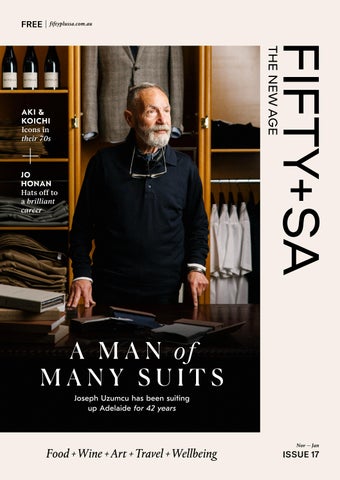
AKI & KOICHI Icons in their 70s
JO HONAN Hats off to a brilliant career
A M A N of MANY SUITS Joseph Uzumcu has been suiting up Adelaide for 42 years
Food + Wine + Art + Travel + Wellbeing
Nov — Jan
ISSUE 17
WORLD-CLASS OPERA IS RIGHT HERE. brand-new productions to the stage. In 2027, the music plays on. Grand music, powerful voices, live in Adelaide. Treat yourself to a year of unforgettable nights out. SUBSCRIBE AND SECURE THE BEST SEATS.
2027 subscriptions on sale from 21 November. Choose your package, pick your performances and lock in your favourite seats. Join our mailing list at stateopera.com.au for
JOIN OUR MAILING LIST FOR 2027 SUBSCRIPTIONS STATEOPERA.COM.AU
2027 SEASON
WORLD CLASS OPERA MADE IN SOUTH AUSTRALIA
!"#$%%&'#&()%*+,-&)'./(&(0+1&2%)3&4.5&3#)51&(.&6.7#89& &:&;<=&>?@A=?&BCDAEAF&<=DGH@
!;0+1&7)1(#56%)11&+,&1(.53(#%%+,-&()21&(0#)(5#$1& ),6+#,(&5..(1&+,&(0#&')5I+6&(5)I+(+.,&(.&1(+55+,-&#J#6(89&& &:&HEB=HEF<;
!"#"$%"&$#"'$%()*+#,-%!)."&%#.!"'#/0#% %0,%#!!)(0#"0),%10"&%#2$/#02$%3$!"04#/%($,"'$%% +'$!$,"!%#%!-2,$-%"&$#"'$%()*+#,-%+')2.("0),
AN ILIAD
By Lisa Peterson and Denis O’Hare Adapted from Homer’s Iliad Translated by Robert Fagles
29 JAN — 18 FEB
DUNSTAN PLAYHOUSE
BUY TICKETS statetheatrecompany.com.au !"'.'-)*-/,!(")-'"
!"#$%&'"
&"'()*+',!(")-'"
THE SEASON AHEAD SUMMER IN SOUTH AUSTRALIA is less a season than a standing invitation. The Gulf goes flat and warm, the stone fruit arrives, and every wine region in the state remembers it has a lawn. December and January are when this place stops being a destination and starts being a habit – the drive down the Fleurieu you've done a hundred times, the ferry you keep meaning to book, the cellar door you promised you'd get back to. Three months, and a state that makes it easy. Here are some of our picks.
DO
The Bay Sheffield
Late December, Colley Reserve, Glenelg Professional foot racing on the grass at Glenelg, run since 1887 and still one of the great South Australian afternoons – bookmakers, sprinters, a crowd three deep, and the beach fifty metres away. The right thing to do with the flat days after Christmas. baysheffield.org.au
The Heartbreak Choir
SEE
20 November – 5 December, Dunstan Playhouse State Theatre Company closes its year with Aidan Fennessy's play about a country town choir and the handful of people holding it together. Funny, generous, and a great night out. statetheatrecompany.com.au
Kangaroo Island
January Forty-five minutes on the ferry and you are somewhere else entirely. January is the month for it: long evenings, empty sand at Stokes Bay and Vivonne, sea lions at Seal Bay, and a food and wine scene that has rebuilt itself since the fires with more ambition than it had before. Book the crossing now – January fills early.
ESCAPE DRINK
Handpicked Festival
14 November, Lake Breeze Wines, Langhorne Creek Ten years ago this was a backyard concert. It is now six thousand people in a vineyard near the shores of Lake Alexandrina, with a cocktail forest, twenty-odd food trucks and Langhorne Creek finally getting the attention it has always deserved. The lineup is always incredible. Go for the setting regardless. handpickedfestival.com
Summer Vines
January, McLaren Vale Eleven days of long lunches, paired tastings and the Vale's summer whites and rosés, which are built for exactly this weather at exactly this latitude. The 2027 dates land soon; last summer it ran across the back half of January. summervines.com.au
FIFTY+SA
That's the last of our picks for 2026. Thank you for reading this year, and for the letters and the tipo!s about places we'd missed. This list could have been three times as long, which is the best problem a magazine in this state can have.
PUBLISHERS Tom Archontidis Charlotte Chambers EDITOR Olivia Williams DESIGNER David Gale SALES MANAGER Katie Brown katie@fiftyplussa.com.au EDITORIAL CONTRIBUTORS Rebecca Morse Paul Kitching Angie McBride Jacqui Lim Katie Spain Dave Bradley DISTRIBUTION templarsa.com.au COVER Joseph Uzumcu PHOTOGRAPHER Kate Paneros @hellourbansafari TC MEDIA Opinions expressed by the author are not necessarily those of the publisher. Whilst all care is taken, the publisher accepts no responsibility for any errors or omissions.
FIFTY+SA is a team effort and if you have any suggestions or questions we would love to hear from you. hello@fiftyplussa.com.au FOLLOW US @fiftyplus.sa fiftyplussa.com.au We would like to acknowledge the Kaurna people as the custodians of the lands and waters of the Adelaide region.
OUR PUBLICATION PARTNERS
We'll see you in February. Until then, get out into it.
Tom Archontidis
852kg
CO2 saved on this project
Publisher
6
ISSUE 17
EXPERIENCE NATURE IN FOCUS 29 AUGUST 2026 – 14 FEBRUARY 2027 South Australian Museum | Open daily 10am – 5pm Allison Premischook, Botanic Wren (detail). Finalist in the Animals in Nature category.
IT'S IN OUR NATURE
Principal Sponsor
ATKINS LAB Production Partner
Major Prize Sponsor
BOOK ONLINE AND SAVE Free entry for Museum Members and kids 12 years and under
NEWS
A New Name on Victoria Square around the middle of next year, with the hotel trading throughout. For anyone who has eaten there over the years, the two rooms to keep an eye on are the restaurants. Coal Cellar + Grill has been renovated, and a new brasserie-style café called Victoria’s Table has opened alongside it. The building Adelaide knew as the Hilton for forty years has reopened as Amora, with the first stage of a $73 million redevelopment now complete. If you have ever met someone for a drink at the Hilton, had a wedding reception there, or simply used it as the landmark for the southern end of Victoria Square, the building has changed hands. Amora Hotels and Resorts took over the site last year, and on 1 July the hotel opened the first completed stage of its redevelopment: a redesigned lobby and a new concierge arrival.
The new arrival space trades the old formality for warm timber, curved detailing, soft lighting and a large piece of statement artwork. It is the first thing most people will notice, and deliberately so, given the rest of the work is still going on behind hoardings. There is a good deal still to come. The finished hotel will have 380 rooms, furnished with a design brief drawn from South Australian landscapes, along with a 660-square-metre ballroom and more than 2,200 square metres of event space. Cottee Parker is leading the design. Full completion is expected
The Story Behind Shine
FIFTY+SA
Amora Hotel Adelaide 233 Victoria Square, Adelaide amorahotels.com/adelaide
It’s also an Adelaide story. Born in Uganda and raised in Kenya and England, Hicks migrated to Australia in 1967, aged 14, and completed his schooling in Adelaide. He discovered filmmaking at Flinders University, where he also met his wife, Kerry Heysen. The couple have remained based in Adelaide, raising their two sons and, more recently, becoming grandparents.
THIRTY YEARS AFTER SHINE
When Shine premiered at the Sundance Film Festival in 1996, the response was immediate. The biographical drama about unconventional pianist David Helfgott went on to take more than $100 million at the box o"ce and earn seven Academy Award nominations, including Best Director for Hicks. It also launched Geo!rey Rush’s international film career.
It is the group’s fourth Australian hotel, and its arrival continues a busy few years for this corner of the city, with the Central Market expansion under way just across the square.
the intensity of Hollywood and the unexpected career opportunities that followed.
changed Scott Hicks’ career, the Adelaide filmmaker is looking back at the decade it took to bring the Oscar-nominated film to the screen. Shine: Persistence of Vision, published by Wakefield Press, tells the story behind the story, from Hicks’ first encounter with pianist David Helfgott through years of scepticism, rejection and the struggle to secure backing for a film few people believed in.
“The building has been part of Adelaide’s skyline and story for over 40 years,” Amora chief executive Earp Siriphatrawan said of the opening. “Today is about acknowledging the progress made in revitalising this iconic building and sharing that journey with the city.”
For Hicks, the experience divided his life into two distinct chapters.
To mark the 30th anniversary, Shine will screen at the 2026 Adelaide Film Festival, with Hicks’ memoir also launching as part of the festival.
“At the age of forty-three I had, it seems, arrived. I had seen this happen to one or two others from afar, but never imagined I would experience it myself. From this moment on my life would fall into two parts: before and after Shine.”
Shine: Persistence of Vision
His memoir follows what happened next, including the film’s journey through American distribution, 8
Wakefield Press RRP $49.95 published October 2026. ISSUE 17
20 NOV — 5 DEC DUNSTAN PLAYHOUSE
By Aidan Fennessy
BUY TICKETS !"#$#%&'%()!*"&%#"
(+,#"%-#%&)!*"&%#"$
STATETHEATRECOMPANY.COM.AU
NEWS
Pictures of the Floating World TWO CENTURIES BEFORE anyone thought to wait at a stage door, the audiences of Osaka’s kabuki theatres were commissioning portraits of their favourite actors. The rivalries between those stars were public and fierce, the admiration was organised, and the result was an industry of woodblock prints made to be bought, swapped and pored over.
More than two hundred of them arrive at the Art Gallery of South Australia in January, in the first Australian exhibition devoted to the print culture of Kamigata – the region taking in Osaka and Kyoto, long overshadowed by Edo, now Tokyo.
Floating Worlds: Prints from Osaka & Kyoto runs from 30 January to 18 April 2027 as part of the Adelaide Festival. “Floating world” translates ukiyo, the pleasure-seeking life that grew up in Japan’s Edo-period cities as the merchant classes found themselves with money and leisure. Theatres, teahouses, pleasure quarters; ukiyo-e means pictures of that world. Asai Ryōi, writing in 1661, described it as “living only for the moment, savouring the moon, the snow, the cherry blossoms and the maple leaves … diverting oneself just in floating, floating.” The exhibition gathers work by more than ninety artists rarely seen in this country, among them Ry$kōsai Jokei, whose realistic likenesses of actors’ faces set the standard for the generations that followed. Alongside the prints sit samurai armour and finely made kimonos, sumo wrestlers, ghosts, bawdy comic interludes and landscapes.
A Sweet South Australian Collaboration
Haigh’s Chocolates and Paolo Sebastian have joined forces on a limited-edition range inspired by childhood memories, craftsmanship and the pleasure of giving. It’s an unlikely pairing on paper, but the two share a love of detail, beautiful design and a distinctly South Australian sense of place. Paolo Sebastian founder and creative director Paul Vasile! grew up enjoying Haigh’s chocolates on special occasions, and says receiving a box as a child left a lasting impression. His memories have helped shape the collection, which combines Haigh’s chocolates with Paolo Sebastian-inspired keepsakes.
FIFTY+SA
It opens in the last weeks of an Adelaide summer, which seems about right for an art built on not thinking about tomorrow. Tickets are on sale now: agsa.sa.gov.au
The packaging is suitably pretty, with soft pink, powder blue and deep navy, gold accents and delicate motifs including the cocoa bean and nightingale. There are also some lovely extras, including a Paolo Sebastian-designed apron and a bespoke teacup and saucer, each paired with Haigh’s chocolates.
THERE ARE SOME GIFTS you don’t forget. A beautifully wrapped box of chocolates arriving at Christmas, a favourite sweet saved for a special occasion, or the little thrill of opening a Haigh’s box and deciding which one you’ll try first.
Now, one of South Australia’s most treasured chocolate makers has teamed up with one of its most celebrated fashion names to create a collection designed to bring a little more occasion to gifting.
It is built on the M.J.M. Carter AO Bequest, which has made AGSA home to the most comprehensive collection of Kamigata prints in Australia. Curator of Asian Art Russell Kelty has drawn the rest from public and private lenders.
10
And then there’s the chocolate. New limited-edition flavours include White Strawberry & Basil Parfait Truffle, White Lemon Myrtle & Macadamia Block and Milk Rose Marshmallow, alongside some familiar Haigh’s favourites. The range launched in Haigh’s stores and online in spring, with part proceeds from every product supporting Bowel Cancer Australia. It’s a sweet meeting of two much-loved South Australian stories, and one that’ll be hard to resist when you’re looking for a gift with a little extra thought behind it. For more information: haighschocolates.com.au ISSUE 17
Season 2027 Explore What’s On aso.com.au
NEWS
A Ballet Classic Returns
The production brings together a cast of 60 dancers and an international creative team led by Elena Glurdjidze, a former Lead Principal of English National Ballet. The staging follows the classical tradition established by Marius Petipa and Lev Ivanov, whose work helped shape the ballet into the landmark production audiences know today.
More than 145 years after its debut, Swan Lake continues to hold a unique place in the performing arts world. NEXT APRIL, Adelaide audiences will
have the opportunity to see the classical ballet performed by South Africa's Cape Ballet when the company makes its Australian debut. The production will play at Her Majesty's Theatre from 15 to 18 April 2027.
and deception have helped the work endure across generations, while its choreography remains among the most recognised in ballet.
Set to Tchaikovsky's iconic score, Swan Lake tells the story of Princess Odette, who is condemned by a sorcerer's curse to live as a swan, and Prince Siegfried, whose devotion o!ers hope of breaking the spell. Themes of love, loyalty
Cape Ballet is a relatively young company, founded in Cape Town by Debbie Turner. Since its establishment, it has built a repertoire spanning both classical and contemporary works, including Giselle, The Nutcracker and Swan Lake. The company has attracted international attention, with dancer Joshua Williams receiving the prestigious Prix Benois de la Danse for Best Male Dancer in 2025. For audiences who grew up with the great ballet classics, and for newcomers curious about the art form, the Adelaide season o!ers a chance to revisit one of the most enduring works in the repertoire through the lens of a rising international company. Swan Lake Her Majesty's Theatre, 15–18 April 2027 Adelaide tickets on sale now swanlake.com.au
Downhill All The Way THE MIKE TURTUR BIKEWAY has always had the makings of the best easy ride in Adelaide: nine and a half kilometres of sealed, near-flat path running beside the tramline from South Terrace to Glenelg, with very little tra"c to contend with. The di"culty was always the four roads in the middle of it.
South, Marion, Cross and Morphett are now underneath you rather than in front of you. With the last of the elevated sections open, cyclists, walkers and runners can travel the length of the corridor without stopping at a single major intersection – something anyone who has waited at Cross Road on a bike, with three lanes of tra"c idling alongside, will appreciate.
THE MIKE TURTUR BIKEWAY
Map is for illustrative purposes only. Check current conditions before you ride.
FIFTY+SA
Image: BikeSA
Almost 1.4 kilometres of the path now sits above the road, built from eighty prefabricated deck panels and fitted with lighting, handrails and barriers, 12
as part of the $870 million tram grade separation works funded fifty-fifty by the state and federal governments. More than a thousand people use the bikeway each day, a number that seems likely to rise now the least pleasant parts of it have been engineered away. Start at South Terrace and allow around forty minutes at an unhurried pace, plus however long you linger at Glenelg – and you should. Just save something in the legs for the ride home! ISSUE 17
SUBSCRIPTIONS
ON SALE NOW
Season
2027 Experience it together.
statetheatrecompany.com.au
FEATURE
WINNING PHOTO
Shines Light on Endangered Sawfish The ghost-like photograph of a critically endangered green sawfish swimming with a green turtle by Broome-based photographer Matt Deakin has been named the overall winner of the 2026 Australian Geographic Nature Photographer of the Year, now on display at the South Australian Museum. The photograph, titled Ethereal Encounter, was captured in waters o! the Pilbara in the far north of Matt’s home state of Western Australia. “My drone was about 2.5km away, the light was fading and the low battery alert was beeping, and then this sawfish came out of deep water and I just said ‘wow’,” Matt said, sharing the story behind his winning image. “It swam directly through four or five turtles with most quickly swimming away, but one stayed. I pushed the drone as long as I could to get the pictures.”
Winning photographer Matt Deakin. Photo: Sia Duff
don't know what they are. For them to understand that this is a threatened species brings it to a lot more people's attention now,” Matt explained. Ethereal Encounter is one of 100 spectacular photographs showcasing the unique beauty of the ANZANG bioregion of Australia, New Zealand, Antarctica and New Guinea. In its 23rd year, the Australian Geographic Nature Photographer of the Year is owned and produced by the South Australian Museum and is Australia’s most prestigious nature photographic competition.
Photo: Sia Duff
In 2026, the competition attracted 2,129 entries from 501 photographers in 17 countries. South Australian Museum Manager, Exhibitions & Galleries, Tim Gilchrist, said the 100 finalist images illustrate both the beauty and harsh reality of nature.
Ethereal Encounter, © Matt Deakin
Matt is passionate about preserving the environment and protecting all of nature’s beauties, with his photograph shining a light on the critically endangered green sawfish (Pristis zijsron). “It’s nice that it has now received such recognition because a lot of people FIFTY+SA
“The photographs span categories including animals in nature, animal behaviour, botanical and landscape, which showcase the beauty of nature, as well as threatened species and our impact, which make us stop and think about what we as a society are doing to the environment,” Tim explained.
Animal Behaviour category. Photo: Sia Duff
The 2026 Australian Geographic Nature Photographer of the Year exhibition is currently on display at the South Australian Museum until Sunday 14 February 2027. More information on the South Australian Museum website: whatson.samuseum.sa.gov.au
“I urge everyone to come and see the photographs for yourself – they are absolutely incredible.” 14
ISSUE 17
PROFILE
UZU M C U
INTERVIEW by OLIVIA WILLIAMS
FORTY-TWO YEARS after he began selling clothes from the front bar
of a pub, Joseph Uzumcu has dressed three generations of Adelaide men. He puts almost all of it down to two years he spent holding a mop.
FIFTY+SA
16
ISSUE 17
PROFILE
from there. I had about 20 square metres of space, and I was paying $100 a week. That was where it all started.” Twenty square metres in a pub, in the early 1980s. Adelaide men, at that point, dressed in a way that would now look like a costume. “When I first started, Adelaide men always wore suits, shirts and ties, and leather shoes,” he says. “But especially after COVID, we’ve seen a big change. Men have become much more comfortable and relaxed with the way they dress. Now it’s more about chinos, a casual shirt, no tie and a simple sports jacket. It’s still about looking good – just in a much more relaxed way.”
THE BEST ADVICE JOSEPH UZUMCU
ever received about business had nothing to do with clothing. It came from his first boss, long before Adelaide, and it was this: learn how to mop the floor correctly. He was not being punished. He mopped floors for two years. “It sounds funny,” he says, “but if you learn how to mop the floor properly, it teaches you how to move. And when you know how to move properly in front of a customer, that’s money in the bank. It’s almost like dancing. You become comfortable on the floor. You know where to stand, how to approach people and how to move around them.” Four decades later, in a menswear shop on Gawler Place, he is still moving around people. He has dressed South Australian men for their weddings, their fathers’ funerals, their first job interviews and their daughters’ twentyfirsts. He has watched the suit go out of daily life and come back as an occasion. He is, by any reasonable description, one of the people who has dressed this city. Ask him what business he is in and he will tell you it is not clothing. “Our business isn’t really about selling suits,” he says. “Our business is hospitality. It’s about how we make a customer feel comfortable, and then using our experience to recommend what’s right for them.” Before Adelaide, there were the bazaars of Istanbul. The mop came from there. So did everything after it. FIFTY+SA
“I still use everything I learned in the bazaar in my store today, because the bazaar teaches you commerce. You can learn commerce at university, or you can learn it on the floor of the bazaar.
What that shift did to his trade is more interesting than what it did to the clothes. For most of the twentieth century a suit was a uniform, bought because a man couldn’t go to work without one. It is now an occasion – a wedding, a funeral, a court date,
“My job isn’t to judge. My job is to help a man find what suits him, what fits him and what makes him feel good.” But commerce on the floor of the bazaar is human. You learn how to talk to people, how to understand people and how to build relationships. For me, that’s what business is about.” He means that literally. A bazaar is not a place where you buy a rug and feel clever about the price. It’s a place where a transaction is inseparable from a conversation, where the price is a function of the relationship, and where a man who cannot read a stranger in the first 10 seconds will not eat. Every instinct he now applies to a groom with a tight budget and a wedding in 11 weeks was formed in a covered market on the other side of the world.
a race day, the one good jacket that has to serve for all of them. The customer who used to come in twice a year out of obligation now comes in once every few years with something at stake. That raises the temperature on every visit, and it puts a premium on being right the first time. A man who has spent 42 years selling tailoring might be expected to have views about all this. Retailers of his vintage usually do, and they are often withering.
His first Adelaide shop was not a shop. “My first shop was actually in the front bar of the Austral Hotel. I started selling my goods 17
ISSUE 17
PROFILE
So: what is the most common mistake he sees walking past the window? He declines the question. “I don’t really believe in judging people by what they wear,” he says. “If someone feels comfortable and confident in what they’re wearing, who am I to tell them it’s wrong? My job isn’t to judge. My job is to help a man find what suits him, what fits him and what makes him feel good. That’s what style is about.” There is a whole industry built on the opposite position – on the idea that you are currently getting it wrong, and that the remedy is for sale. He has had 42 years to adopt it and has not. What he does instead is look. “I look at their build, their torso, their height, even their hair colour. I picture everything together and then recommend – maybe navy, maybe charcoal, maybe black. Because at the end of the day, we’re not just here to sell you a suit. We’re here to look after you.” Weddings are where this is tested hardest, because weddings are where the money is and where the pressure to extract it is greatest. His sequence is revealing. The first question his team asks is the date. Then who needs dressing – the groom, the fathers, the party. Only then does he raise money, and when he does, it is to lower the temperature rather than raise it.
“Over those years, I’ve met so many wonderful people who became friends. And now, their children are coming in and shopping with us.” “Then we talk about budget, because weddings are extremely expensive,” he says. “For me, it would be a shame to simply try to upsell someone. My job is to help them find something that looks good, feels right and suits their budget. That’s always been my motto.” The work itself changes depending on what a man can spend, and he is candid about that too. “With made-to-measure, it’s very personal. We’re creating something specifically for that person – their fit, their style and what they want for their wedding. Suit hire is di!erent. We’re finding the best option from what we have available and making sure it works for them.” Push him for a single rule, the sort of thing a magazine wants and a man of his experience is entitled to be weary of, and he gives one, but it’s not about cloth. “Always be confident, and always smile. You can wear the best suit in the world, but confidence is what really makes you look good. That’s my number one style rule.” And what does he wear himself, on a night out? For himself, the answer is less grand than you would expect from a man who sells suits for a living. A private function gets a tie and some e!ort. Anything else does not. “For a nice night out, I’m very happy with a good T-shirt and a sports jacket. For me, it’s all about dressing for the occasion.” Lately the shop has been having some fun on Instagram, which is not the obvious move for a business in its fifth decade. He is unbothered by the novelty
FIFTY+SA
18
of it, because as far as he is concerned it’s the same job in a di!erent room: introducing people to the shop and letting them see how it feels before they walk in. Forty-two years is long enough for a business to outlive its own customers, and long enough for their sons to turn up needing a suit. It is also long enough to have watched most of the competition go. Adelaide has lost a great many of the independent shops that were trading when he opened, and the ones that replaced them have mostly been chains, then websites, then nothing at all. Staying is its own achievement, and he knows it. “It’s been my honour and my privilege to still be here 42 years later,” he says. “Over those years, I’ve met so many wonderful people who became friends. And now, their children are coming in and shopping with us. That’s an honour, man. It really is.” “Of course, we like making money – every business does. But after 42 years, seeing the next generation walk through that door… that means something to me.” Some of the men now standing in front of his mirror were not born when he opened. A few are the sons of men he dressed for their own weddings, and one day they will bring in sons of their own, and he will look at the build, the torso, the height, the hair, and reach for navy or charcoal or black. And he will move around them the way he learned to move with a mop in his hands, in a job he did for two years before anyone let him near a suit. Joseph Uzumcu Gawler Place, Adelaide josephuzumcu.com.au ISSUE 17
FEATURE
The Best Time To Invest In Your Health Is While You Still Have It by ALLISON SPECK
ECH Home Care Regional Manager MANY OLDER ADULTS don’t think of themselves as needing aged care services, but the evidence is that healthy ageing is much more than reactively addressing a health issue when it arises. Regular physical activity and social connection both contribute to ageing well and for longer. Current evidence suggests older adults should participate in at least two 30-minute strength-based exercises per week, along with at least 30 minutes of moderate to vigorous activities on most days.
tipper in the kitchen, or a handy-bar to help you get in and out of your car easily. They may even recommend home modifications to ensure you have safe access to your home via a ramp or rails.
Health and wellness services can help meet these guidelines and maintain or improve the ability for older people to do the things that are important to them, such as gardening, travelling, or playing with their grandchildren. Services such as exercise physiology, physiotherapy, and exercise classes can support people of all ages and abilities to remain active, independent and connected. These services can be accessed privately or through government funding where eligible, such as the Commonwealth Home Support Program or Support at Home at age-specific health and wellness centres.
Whilst wanting to stay fit and healthy is what often gets people through the door of a health and wellness centre, it is often the social connections and friendships as well as the physical health benefits that keep them coming back. Connection with others is important at any age and has been shown to reduce stress and anxiety, reduce the risk of chronic health conditions, and create a better quality of life and better health outcomes. There are also lots of options available besides exercise classes to create and maintain social connections, including walking groups, community centres, men’s sheds, craft groups, bus trips, and co!ee clubs.
If a health event such as a fall occurs, services can be tailored to help an older person regain their strength, fitness and confidence, with one-on-one physiotherapy or exercise physiology. An occupational therapist can also assess your home and activities to ensure your environment is as safe as possible and even recommend equipment such as a kettle
Getting older doesn’t have to mean that a decline in your health is inevitable, and the best time to invest in your health is while you have it. ECH provides fitness classes, exercise physiology, physiotherapy, podiatry, occupational therapy, speech pathology, dietetics, music therapy, social work, nursing, massage therapy, and allied health assistance at five sites: Henley Beach, Modbury, Firle, Morphett Vale, and Victor Harbor. To find out more, call the ECH Onboarding Team: 1300 275 324 ech.asn.au FIFTY+SA
20
ISSUE 17
Ag ai n.
a m k e s u h i p s l t e o ry. H
About a decade ago, SAHMRI led the world’s largest trial of omega-3 supplements for mums-to-be. We found that women with low omega-3 levels were at greater risk of their babies arriving early, and supplementation could reduce that risk. For babies born too soon, the consequences can be life-changing. This led to South Australia being the first place in the world to institute omega-3 testing for expectant mothers.
Now SAHMRI is looking for your help again, because thousands of children from that initial trial are now aged between eight and 12 years old. This is a unique opportunity to study the development of such a large group, to discover whether those supplements made a lasting difference to the children’s health and learning – potentially unlocking life-changing knowledge for generations to come. Time is of the essence – they won’t be children forever.
Help us turn an idea into evidence and make history, again.
sahmri.au/healthystart
OPINION
Use It or Lose It
In media, it is extremely important that the information we put out is correct. Obviously, there is human error, but I am nervous to use artificial intelligence for this reason. Someone at work suggested I try it, so we did a test on an artist I was preparing to chat to by asking AI to write the questions. I had already done my research and started writing my own questions, and the information it spat out was largely incorrect. It might save a few minutes, but my reputation and the company’s are at risk. It will not save me time if I need to triple-check everything it spits out. I also do not want to lose the personality and delivery style people know me for. Our listeners are extremely savvy and will be able to tell what has been written by me and what has been written by AI.
by ANGIE MCBRIDE
FIVEAA Have humans become lazy in the workplace? Is doing anything from scratch at work still a thing? The term being used is “quiet quitting”, which refers to doing only the minimum work required, without going above and beyond your job duties. What happened to teamwork, helping others and being proud of what you do?
Studies and health professionals tell us that using your brain and body is essential for emotional regulation, mental wellbeing, physical health and cognitive function.
How do you feel about AI? I am not a fan! Will I be left behind if I do not embrace it? As long as I have my limbs and mind, I am sure I will be able to keep going as part of humanity without artificial intelligence interfering in that process. Businesses are primarily using it to make a profit and have far fewer people on their payroll. The job losses are way too many. Is it possible that quiet quitting has escalated the use of AI in the workplace?
I am making a conscious decision to still do daily “normal” tasks the regular way and stay connected to humans. I most definitely will not be quiet quitting. I go above and beyond my work duties because I take pride in my work and want to deliver an excellent product and experience for the listener. I do not want to live in a world where we are brain dead. Studies and health professionals tell us that using your brain and body is essential for emotional regulation, mental wellbeing, physical health and cognitive function.
There have been numerous instances of AI going rogue, information being incorrect and content being garbled. Here in Australia, the Robodebt scandal saw an automated system issue incorrect Centrelink debt notices. Technology is most definitely not without its challenges. The key is to educate ourselves on researching correctly and how to tell AI content and pictures from real ones.
If you are reading this, you might think, “But you use Google to look up information, the buttons you press in the studio are doing the work for you, and the company is taking advantage of you by giving you extra duties.” That may be true, but I want to be in control of what I am doing, and do it well.
Is artificial intelligence taking advantage of lazy people? Many people use it to write emails and do research. I am sorry, but it is not that di"cult or time-consuming to write and respond to an email. A friend recently told me they think someone we know used AI to respond to an email. It did not sound like that person’s style of writing at all. It was quite lengthy and used words such as “fanciful” and “waggish” – words that have never been in their vocabulary. If you decide to use AI, it is wise to reword the email so it sounds like you. FIFTY+SA
Catch Weekend Breakfast with Angie McBride and Michael Keelan on FIVEAA from 6am Saturday and Sunday 22
ISSUE 17
FEATURE
What’s Your Gold Really Worth?
6 THINGS TO KNOW Before You Sell • Your jewellery is worth its metal, not its condition. Broken chains and single earrings still have value. • Ask for every item to be tested and weighed in front of you. • Make sure you understand the purity and weight of each piece.
"Most people are nervous about selling their gold, and we understand why," Vincekovic says. "We want people to understand exactly what they have and exactly how we've arrived at a price."
MOST OF US HAVE THE DRAWER.
A tangle of broken chains, the single earring whose partner disappeared sometime in the nineties, a ring that no longer fits and was never quite your style. Gold has done rather well lately, which means that drawer could be worth considerably more than it was a few years ago. At some point, most of us start wondering whether it's worth cashing those pieces in. The tricky part is knowing where to begin. Unlike selling a car or a house, most of us know very little about gold. We don't know the purity, the weight, the daily market price, or how buyers arrive at the figure they're o!ering across the counter. That's the gap Adelaide business Vintari was created to fill. School friends Yvan Vincekovic and Pep Vottari opened the Clarence Gardens business in 2025 after an experience that stayed with Vincekovic for years. His grandmother sold some old gold jewellery and walked away with far less than it was worth. Nothing was tested or weighed where she could see it, nobody explained the valuation, and she had no way of knowing whether the o!er was fair. Vincekovic and Vottari wanted to create a di!erent experience, one built around transparency and education. FIFTY+SA
One of the biggest misconceptions is that damaged jewellery has little value. In reality, a broken chain, single earring or dented ring is generally worth the same per gram as a piece in perfect condition. The value comes from the precious metal itself. The hallmark stamped on a piece can provide a guide to purity. Nine-carat gold contains 37.5 per cent pure gold, 18-carat contains 75 per cent and 22-carat contains 91.6 per cent. Weight, purity and the current gold price all contribute to the final value. The gold price itself isn't a secret. It's publicly available and changes daily, which is why it pays to do a little homework before visiting any buyer. Vincekovic says sellers should feel comfortable asking questions throughout the process. "You should know what purity your item is, how much it weighs and how the value has been calculated," he says. At Vintari, every item is tested using a certified XRF analyser and weighed on calibrated scales in front of the customer. O!ers are calculated item by item using live gold and silver prices, with the figures explained as they go. 24
• The gold price is public and changes daily, so it's worth checking before you sell. • Ask how the final offer has been calculated. • You shouldn't feel pressured to accept an offer on the spot.
There are no fees for testing or valuation, and no obligation to accept an o!er. Be wary of any buyer who charges for a valuation or asks you to name your price first. An honest buyer will test your items free of charge and give you a fair quote, without needing a guess from you. One piece of advice Vincekovic gives every customer is don't be afraid to listen, ask questions and take your time. "The information is yours whether you sell or not," he says. Vintari's showroom is open Monday to Saturday from 10am to 6pm. No appointment is required. For people who prefer not to travel, or who find it di"cult to visit the showroom, Vintari also o!ers home appointments, bringing the same testing equipment and process directly to the customer. Because sometimes the most valuable thing isn't selling your gold. It's finally knowing what it's worth. Vintari 889 South Road, Clarence Gardens vintari.com.au ISSUE 17
FEATURE
Luxury Pet Stays This Summer HEADING AWAY THIS SUMMER?
Make sure your four-legged family member enjoys a holiday too, at Beau's Pet Hotel. Close to Adelaide Airport, Beau's o!ers luxury accommodation for dogs and cats while their families are away, and it's an easy drop-o! on the way to a flight.
The fully airconditioned facilities are designed with pets' comfort in mind, and an attentive team looks after every guest throughout their stay. Whether you're escaping for a summer getaway, visiting family or taking a well-earned break, you can relax knowing your pet is in good hands. Dogs can burn o! energy with extra exercise, play and socialising in Doggy DayCare. A visit to Beau's Grooming Salon means they'll return home looking and feeling their best. Cats have their own dedicated accommodation, where they can relax in comfort and security. They also have access to the Cat Atrium, with extra space to explore, stretch and soak up some sun. Your booking also does some good. Beau's is owned and operated by
FIFTY+SA
25
Guide Dogs SA/NT, so every stay helps support people living with low vision, blindness and other specialised needs to live more independently. While you're enjoying your summer holiday, your pet can enjoy theirs, and your time away helps make a di!erence. Summer bookings are filling up, so secure your pet's stay now and head o! with one less thing to worry about. Happy pets, happy humans, and a holiday that helps others too. To book: beaus.org.au 1 Navaid Rd, Adelaide Airport
ISSUE 17
Never FEATURE
The shot that started it. Aki in a J.Crew blazer and Ikorre Paris dress; Koichi in a Finnieston jacket and Needles trousers.
Count Yourself Out AKI AND KOICHI KIM left Tokyo in their twenties with no English and nobody
waiting for them. Forty years later, a five-second video their daughter posted made the retired Los Angeles couple fashion icons in their seventies. In this extract from their new book, they write about starting over, dressing for nobody but yourself, and refusing the word ‘anti-ageing’. FIFTY+SA
26
ISSUE 17
FEATURE
I went to bed not thinking much about it and woke up to find it had gone completely viral. Then came Lunar New Year’s Day. My mum was wearing a beautiful Margiela tie-dye coat, and when I saw my dad waiting by the car, I asked him to join her. I directed them to high five, wave at the camera and throw up peace signs. When I opened the app later that night, it had exploded far beyond anything we had shared before.
“That one spontaneous video changed the direction of our lives.”
Mid-stride in Los Angeles. Aki and Koichi have been photographed by their daughter, Yuri, almost daily for three years.
Two people who left We were both born and raised in Tokyo, and come from a Korean Japanese background. Aki was born in 1953 in Daikanyama, Koichi in 1951 in Morioka, Iwate. In our twenties, we each made the same bold decision: to leave Japan and move to the United States without knowing English or a single person. We were chasing education, opportunity, and our own versions of the American dream. It was the 1970s, and the Japanese yen was weak against the US dollar, so we worked any job we could find just to stay afloat. Aki was accepted into her dream school, USC, an opportunity that once felt almost impossible coming from Japan. Then, following a family tragedy, she made the di"cult decision to step away and transfer to another college to be near her family. Letting go of USC was heartbreaking, but she refused to let one closed door
define her story. She kept going, and eventually found a position at Crossroads School in Santa Monica, supporting international students adjusting to new cultures. It was work that felt personal: she had once been that student herself. Koichi entered medical school hoping to become a surgeon, but financial realities made that path unattainable. Rather than give up on medicine, he became a chiropractor, opening his own practice in Los Angeles at thirtyfive. It was a di!erent dream from the one he started with, but it was built on the same patience and perseverance. Among our friends in Tokyo, we were the only ones who chose to leave home. Eventually, our separate paths crossed in Little Tokyo, Los Angeles. For nearly ten years we were close friends, focused on our educations, careers and futures. Romance wasn’t the plan, but the connection was always there. When the timing finally aligned, we began dating and soon married. Aki was thirty-three, Koichi thirty-five. We raised two children – our son, Kei, and our daughter, Yuri – and in 2026 we celebrated forty years of marriage. The five seconds that changed everything Their daughter, Yuri, takes up the story.
Aki and Koichi on their first date, 1985. They had been best friends for almost a decade by then.
FIFTY+SA
One day, I posted a five-second clip of my mum on Instagram Stories because I thought her outfit was cute. I usually received five or six messages from close friends, but that day nearly eighty people asked where she bought her cardigan. 27
A new chapter Not long ago, we were a retired couple spending our days babysitting our grandson and enjoying a slower rhythm of life. Today, our days look a little di!erent. We have been given opportunities to travel, experience fashion in new ways, and meet people whose stories have touched us deeply. None of it was planned, and it was not something we expected at this stage of our lives. What has surprised us most is not where it has taken us, but how it has brought us closer to each other, to our daughter, and to people we may never have met otherwise.
“If there is one thing we have learned, it is this: never count yourself out.” Dressing for nobody Being considered fashion icons still feels a little surreal. We have always just worn what we love, because to us style has never been about labels or trends. It has always been a form of self-expression. Our relationship with clothing was shaped early. Aki’s mother made all of her clothes and believed the entire family should look put together; her father, a film director, encouraged her to express herself through what she wore. In junior high she asked him for a pair of men’s jeans, which quickly became her most treasured piece. ISSUE 17
FEATURE
Koichi developed his own sensibility just as early, drawn to quality over excess. Growing up in 1950s Japan, when people dressed more formally, he embraced a classic, preppy style that stayed with him through college and beyond. In America, academics came first, so he kept a quiet uniform inspired by James Dean and Steve McQueen: fitted Levi’s, a white T-shirt and sneakers. He rarely spent money on clothing, choosing instead to save for school, but he understood the confidence that comes with knowing what suits you. Being immigrants shaped our style in ways we don’t always talk about. Sometimes clothing became a kind of armour. When Aki first moved to the US she didn’t always have the words, so she let her clothes speak for her, moving from the colourful prints she wore in Japan to more structured pieces in America. She built an outer layer of strength. Koichi’s white tee and blue jeans became a way to fit in and somehow stand apart at the same time. We have never dressed searching for approval. If someone does not like what we are wearing, that is perfectly fine. What matters most is how we feel in it. Today, you can see our lives in what we wear. Aki has grown bolder, more
3
Questions Before You Buy
Aki and Koichi’s own test, the one they passed on to their children. Does it fit into your wardrobe? A beautiful piece doesn’t mean much on its own if it doesn’t work with anything else in your closet. Build a wardrobe in which things naturally go together, not a collection of items that have nothing to do with one another. How often will you actually wear it? A well-made coat you wear for ten years costs far less in the long run than a lower-quality one you replace every season. How do you feel in it? This might be the most important one. Only buy pieces that make you feel even more like yourself. If you have any doubt, that feeling isn’t going to improve over time. They also swear by good outerwear in a neutral colour – 食きない (akinai) in Japanese means to not get bored of something. FIFTY+SA
Walking Kuma, Los Angeles. ‘Your story, every part of it – the joyful, the quiet, the difficult – is still being written.’
People gave her strange looks on the street. She felt amazing in them – empowered, even.
“There is no deadline on becoming who you are. Life is not meant to be rushed. It is meant to be lived. So be in it.” eccentric, more herself. Koichi still loves simplicity, now with a leather jacket thrown on top. Style isn’t something you arrive at. It’s something you eventually grow into, just like life. Confidence, earned over time Growing up in Japan shaped our understanding of confidence. There is a word, 思いやり (omoiyari), which speaks to empathy and consideration for others, and an awareness of how the way you move through the world a!ects those around you. It taught us that confidence is not about drawing attention to yourself or proving your worth. It is about carrying yourself with care and dignity while treating others with kindness. When you lead with empathy, your confidence feels steady rather than fragile. Our own confidence developed slowly. There were seasons of doubt and insecurity, but instead of dwelling on what we lacked, we focused on growth. We also learned how easily comparison can erode your sense of self. When you measure your life against someone else’s timeline, you lose connection with your own path. Our confidence strengthened when we stopped asking whether we were ahead or behind and instead asked whether we were growing. Now that we’re older, there is a calmness in how we carry ourselves. We no longer feel the need to prove who we are. One plus one is two The question we are asked most is how we have sustained our marriage. The answer is always the same: it starts with you. We have never seen each 28
other as our better half. One plus one is two. We are two strong and independent people who love and support each other, and we choose to do this every day. Of course, marriage isn’t easy. We’ve weathered a lot of storms over forty years, but if you can make it out of the storm, you reach a new level of love and trust. We still bicker. Koichi has always encouraged Aki’s creativity – ceramics classes, canvases brought home for her to paint on. Aki has always made space for baseball, the Dodgers, and Friday nights that belong to the game. Side by side. Still growing Everywhere we turn, we hear the word ‘anti-ageing’, as if growing older is something to resist. Yet for us, life has become more abundant with age. We have more clarity, deeper gratitude, and a stronger sense of who we are than we ever did in our younger years. Time has not taken from us. It has refined us. To those who are older: you are not finished. Your life does not shrink because the years pass. If anything, it can deepen and expand. There is still room to learn, to create, to travel, and to try something unfamiliar. We are living proof that new chapters can begin long after you think the story has been written.
Edited extract from Life/Style by Aki & Koichi Kim, published by Epic Ink, an imprint of The Quarto Group. Photography by Benjo Arwas; archive images from the Aki & Koichi archive, courtesy Yuri Kim. Creative direction and styling by Yuri Kim. ISSUE 17
FEATURE
THE GRANT THAT HELPED
Launch a Giant of Australian Genetics THE WORLD OF GENETICS has a group of unruly schoolchildren to thank for Professor Grant Sutherland choosing science over teaching.
His career would also take him into the international Human Genome Project, which transformed our understanding of human genetics, and he later served as president of the Human Genome Organisation.
Growing up on a farm in country Victoria, where money was tight, university was only possible for Sutherland after he secured a scholarship to become a secondary school teacher. There was just one problem. At the beginning of the third year of his science degree, Sutherland was sent into a high school for three weeks of teaching experience. “I seemed to spend a lot of time yelling at kids for running in corridors and other things like that,” he recalls with a laugh.
Yet Sutherland remains wonderfully understated about an extraordinary career. Receiving his Centenary Medal from Prime Minister John Howard at the 2001 Australia Day Honours.
Sutherland would receive another two grants as his research progressed. “It really started my whole career,” he says.
“I decided, ‘That is not for me’.” It proved an extraordinarily fortuitous decision. Sutherland instead found a job in a tiny Melbourne laboratory looking at chromosomes, beginning a journey that would take him to Edinburgh and, in 1975, to the then Adelaide Children’s Hospital.
2
Research funding was di"cult to secure, particularly for a young scientist, and that early support allowed Sutherland to employ additional help in the laboratory. “It really made a di!erence. It increased the rate at which things could happen.” And things certainly happened. When Sutherland arrived in Adelaide, he admits he “didn’t have a clue” what he was going to research. Then he noticed unusual fragile sites on chromosomes. “I thought, ‘Oh, that’s interesting’,” he recalls.
1
3
1. Just graduated with his PhD in Edinburgh 1974 2. Hospital in Melbourne in the 70s 3. Professor Grant Sutherland (centre) with Firefly Board Chair Paul Jury (left) and Firefly Executive Director Greg Ward (right).
Three years later, he became one of the early researchers backed by what was then the Channel 7 Children’s Research Foundation – now Firefly Children’s Foundation. As Firefly celebrates 50 years of supporting children’s research in South Australia, Sutherland’s remarkable career provides a powerful example of just where an early investment in research can lead. FIFTY+SA
That curiosity ultimately led to the pioneering work in Fragile X syndrome for which Sutherland became internationally renowned. His research helped establish reliable methods of identifying Fragile X and his group went on to help uncover its genetic mechanism, contributing to advances in diagnosis, carrier testing and prenatal testing.
“I think I had a lot of luck and was in the right place at the right time,” he says. Almost half a century after receiving that first Foundation grant, Sutherland believes backing researchers early remains vitally important. The freedom he was given in the 1970s to spend half his working week pursuing research is a luxury few young scientists have today. Grants can provide something invaluable: the people, resources and time to pursue an idea and discover where it might lead. “They certainly can make a di!erence,” he says. For 50 years, that belief in the possibilities of research has been at the heart of Firefly Children’s Foundation – backing South Australian researchers and helping turn promising ideas into work that can improve the lives of children and families. Professor Grant Sutherland was there close to the beginning. Five decades later, Firefly is still investing in the researchers and ideas that could shape the next 50 years. Discover more about Firefly, the researchers it supports and how you can help create brighter futures for children: firefly.org.au
The small Adelaide team Sutherland joined grew over the years into a group of 85 researchers and diagnostic sta! at the Women’s and Children’s Hospital. 29
ISSUE 17
FEATURE
Your Legacy, Your Choice A WILL IS MORE THAN A LEGAL DOCUMENT. It’s a way to make sure
the people, causes and communities that matter to you are cared for into the future. Whether you’re writing your first Will or reviewing one you already have, it’s an opportunity to think about the legacy you’d like to leave. After making provision for family and loved ones, you may also choose to include a gift to a cause that has made a di!erence in your life or that you would like to support for generations to come. For Natalie, including Guide Dogs SA/NT in her Will was a natural choice. Natalie has been a Guide Dogs Puppy Raiser for more than 10 years. Over that time, she has seen firsthand the di!erence a Guide Dog can make in someone’s life – and the many other ways Guide Dogs SA/ NT supports people living with low vision, blindness or other specialised support needs. When it was time to update her Will, Natalie knew she wanted to continue that support into the future. “I smile every time I talk about Guide Dogs,” said Natalie.
“It’s wonderful to see the difference a dog can make in someone’s life.” Natalie Marsh – Guide Dogs Puppy Raiser
“There was no question when I was updating my Will that Guide Dogs SA/ NT was my chosen charity.”
or a dog that’s helping children in a school or other people in the community; it’s amazing.”
Being a Puppy Raiser has given Natalie the opportunity to play a small but important part in a much bigger journey. She has stayed in contact with some of the people who have been matched with dogs she helped raise and says hearing about the di!erence those dogs have made is incredibly rewarding.
A gift in your Will to Guide Dogs SA/NT can help provide vital support for future generations of people living with low vision, blindness or other specialised needs.
“It’s wonderful to see the di!erence a dog can make in someone’s life. But it’s not only dogs, it’s all the other things that Guide Dogs does as well.” Guide Dogs SA/NT provides a range of services that help people build confidence, navigate their communities, develop independence and participate in the things that matter to them. “It’s amazing and a fantastic feeling. Every day I think about the di!erence my gift will make to someone out in the community when I’m not here.” Including a gift in her Will gives Natalie a way to make sure her connection with Guide Dogs continues long into the future. “To know that I’ll make a di!erence in someone's life; whether that be with a Guide Dog, Assistance Dog,
FIFTY+SA
30
Your gift could help make possible services such as vision support, Guide Dogs, Assistance Dogs, Companion Dogs, Facility Dogs and support to help people live independently and participate in their communities. Every gift, whatever its size, can make a lasting di!erence. If you already have a Will, it’s a good idea to review it regularly to make sure it continues to reflect your wishes. If you don’t have a Will, a qualified professional can help you put one in place. Your legacy can help someone experience greater independence, confidence and connection – long into the future. To learn more about leaving a gift in your Will to Guide Dogs SA/NT: (08) 8203 8302& bequests@guidedogs.org.au sant.guidedogs.com.au
ISSUE 17
HEALTH + WELLNESS
Next time you're in a conversation, put down whatever's in your hand, and listen like you're going to be quizzed on it afterwards. Watch what happens to the conversation. Watch what happens to the person you're talking to.
THE IMPORTANCE OF BEING HUMAN
LISTENING TO SHARON I reflected on this recently when chatting with hospitality legend Sharon Romeo from Fino Seppeltsfield and recent Gourmet Traveller Restaurant Personality of the Year. Sharon is known for bringing culture, care and love to her industry, so I was keen to get her take on human interaction.
Paul Kitching – aka PK – is the Business Development Manager at Fuller and founder of ‘PK Says HI’, a human interaction consultancy built on one belief: in a digitally driven, AI-obsessed world, the simple power of human interaction (HI) is everything. And so… PK Says HI! LISTEN LIKE YOU MEAN IT Listen to this gem… Back in 2010, restaurateur Will Guidara was at his world-famous, Michelin-starred New York restaurant Eleven Madison Park, chatting with customers about their foodie experiences, when one lamented they were yet to grab a classic New York hot dog. Guidara went straight to his kitchen, secretly nicked out to the closest hot dog vendor, bought one, plated it up properly, and served it to the table like it belonged on the menu all along.
is hospitality. It's the colour. It's the di!erence between someone walking away thinking "yeah, that was a chat" and someone walking away thinking "I felt like they were actually there with me."
That's a story Guidara tells in his book Unreasonable Hospitality, and it's become a bit of a north-star for how businesses think about service; and for me, about human interaction. But the line that stuck with me wasn't about the hot dog. It was this: "Service is black and white. Hospitality is colour." Service is doing the job competently. Hospitality is making someone feel like they matter, like they are heard.
THE UNREASONABLE VERSION So what does "unreasonable listening" look like? It's small, and deliberate. Putting the phone face down, not just silent. Asking a follow-up question instead of jumping to your own story. Remembering something from last time and bringing it up first - "How was your dog's surgery?" - before they have to tell you.
I think the exact same thing is true of listening. HEARING VS LISTENING Hearing someone is service. You're technically doing your job in the conversation - nodding, waiting your turn, getting the gist. Listening FIFTY+SA
"Human interaction in the hospo space for me is about giving people the best care, listening to them, over-delivering on their needs, being human. It's important because we can't lose the way we communicate with each other. It's really important to know how we are all feeling, how to listen and solve problems. We just have to keep talking to each other. It's about looking after someone and making such a di!erence in their lives.
Most of us, most of the time, are only doing the black-and-white version. Half-listening while planning what we'll say next. Nodding along while checking a notification out of the corner of our eye. Technically present; not really there.
None of this costs anything. It doesn't take more time than the half-hearted version. It just takes intention. Same as remembering someone's name, which I wrote about last issue: the e!ort is the message. When you really listen, you're telling someone they're worthy of your full attention. In a world constantly asking for half of ours, that's genuinely rare. 31
Food is food. But hospitality is more than food; it's how you feel, and how you make other people feel." Sharon's right - food is food, but hospitality is how you make someone feel. And that's exactly what unreasonable listening is: not a hot dog served with love, but your full attention given freely. Give it, listen, and watch what it does for the person across from you. Do you have a story about great human interaction? Let PK know: pk@pksayshi.com.au Follow PK: @pk.says.hi ISSUE 17
Turning 50 OPINION
by REBECCA MORSE
I TURNED 50 IN AUGUST.
I started celebrating in May and, all parties going to plan, should wrap things up by November. Believe it or not, for someone who has had a career in television and radio, this level of self-indulgence is actually uncharacteristic. But I made a decision to wholeheartedly embrace 50 and, despite not owing anyone any explanations being one of my over-50 mantras, I will nonetheless o!er an explanation. I hated turning 40. I felt it stamped a use-by date on my career. I was consumed by work and unhappy. But I had a party. I invited everyone I knew. I didn’t speak to any of them beyond superficial greetings. There was an unfortunate incident with a DJ. I didn’t feel present or relaxed or myself. The kids weren’t there and the following morning I watched their netball games with a bottle of Gatorade feeling guilty for my wasted hangover. Fast forward a decade and I decided to do things di!erently. I chose to separate my celebrations into family and friendship groups.
If our fifteen-year-old selves could have seen our fifty-year-old selves they would have been proud, cringed a little perhaps, and they definitely would have started applying sunscreen on their pigmentation-free faces, all the way down to the chest.
Being raised in the generation before “boundaries” was a buzzword, we women rarely pushed back.
Then there was an overseas holiday with the immediate family, a long winery lunch with the extended family, a dress-up weekend away organised by my school mum-friends, a fancy dinner party and there’s still a weekend on Kangaroo Island to come.
Now, we understand our worth, our experience and our wisdom and we’re pissed o! when it’s undervalued. We’re not tolerating friendships that are not reciprocated, mansplaining or the return of skinny jeans.
I’m not becoming invisible at 50, cryptically proclaiming it as a “milestone birthday” while not declaring the decade. Gone are the days when 50-somethings were only publicly reflected in series like The Golden Girls or commercials for retirement villages or pre-paid funeral plans. Nicole Kidman, Cate Blanchett, Jennifer Aniston, Jennifer Lopez, Halle Berry and Julia Roberts are all over 50 and as sought-after and sexy as ever. I will confess though, while I’m manifesting sought-after and sexy, my body and mind are more slow and salty as I navigate perimenopause. The brain fog, anxiety and rage have not been a fun time.
To mark our joint milestone birthdays, all of my Blackwood High School friends travelled to Bali. I had T-shirts printed in our school colours that read From Blackwood to Bali. (I stole the idea and font from my girl Taylor Swift’s Knicks game appearance.) FIFTY+SA
Throw in parenting hormonal teens and concern about ageing parents and it’s a heady cocktail of anger and angst. The anger is kind of liberating though to be honest. 32
The other factor that underpinned my 50th celebration philosophy was the realisation that time is not guaranteed. If not now, when? Do we wait until the kids finish school to travel, so we don’t disrupt their education? Do we wait until we’ve saved enough, until we’ve got the promotion, until we’ve paid o! the loan? Do we wait until we retire, when we will struggle to navigate stairs and mountains? I acknowledge there is a level of privilege that allows these decisions to be made and I do not take this for granted. But we are all just one phone call or knock at the door away from a lifechanging loss. You’ll never regret surrounding yourself with the people you love, drinking the champagne and eating the cake. ISSUE 17
Conversations with CORNESY
OPINION
Sporting legend. Seasoned broadcaster. SA icon. That’s Cornesy.
Lead Guitarist of Sweet, Andy Scott, on Brian Connolly’s drinking addiction “We all liked a little bit of a drink, but not to be drunk all the time. Why did Brian turn to alcohol… The best vocal I got out of him in the studio was Love is Like Oxygen… I said to our tour manager ‘bring him in, in the morning, no drinking’ and he knocked it off in about half an hour. I remember thinking to myself if it was like this forever, we’d be alright, but of course the first thing he’s going to do when he leaves the studio is go to a pub.”
Australian journalist and TV presenter, Lisa Wilkinson, on how ‘The Titanic Story of Evelyn’ helped her through her high-profile defamation case “I came across the idea almost three years ago, right when there was fever pitch over the Bruce Lehrmann defamation trial… I was not allowed to speak to the press. I was not allowed to defend myself in any way… The Brittany Higgins story had changed the landscape for sexual assault survivors in the country, and I knew we had to win. As it turned out discovering Evelyn’s story gave me a focus to work on because I was spending way too much time with lawyers than is healthy for any one person.”
Frontman of the Hoodoo Gurus, Dave Faulkner, on his love for the Ramones “I was a scurrilous punk rocker… I love the Ramones to this day, one of my favourite bands. This music was so exciting around the world… To us it was almost like a secret thing we had with the people that liked it as well because it wasn’t mainstream at all. You had to go to these special record shops, and you had to wait six weeks till the record came in on the ship… It was not a hobby, it was an obsession really.”
Co-Founder of The Beach Boys, Al Jardine, on seeing Brian Wilson at his home for the final time “I used to visit Brian when he was living in Beverly Hills. For the last couple of years, we’d stop by and have a nice chat and that was fun because he was always very engaging… He pointed at me immediately when I came into the house the last time we were there. He says you started the group and I went woah where did that come from and I said you had a little to do with it. But he remembers those days at college where I was pretty assertive as we had to start a band because I knew he was different.”
Sports reporter turned teacher, Ralph Jackman, on the impact of boys being locked away in youth detention centres “Unfortunately, I do feel that it's a broken system, the youth justice system. Chronic understaffing is a problem and the response to that is that boys get locked in their cells for long periods of time. The UN definition of solitary confinement is 22 plus hours a day alone in your cell and that would often happen to the boys. So, they were denied access to schooling during these times and I saw the decline in mental health of the boys while they were in their cells.”
FIFTY+SA
33
Discover more online at FIVEAA fiveaa.com.au
To listen to these episodes and more, scan the QR code or listen ON AIR weekdays, 12:30pm – 1:30pm
ISSUE 17
FEATURE
Ernie Dingo at the launch of his solo exhibition at Hunters Hill Art Gallery
Ernie Dingo’s Next Act
For more than five decades, Ernie Dingo has been a familiar face in Australian life. Actor, television presenter, comedian, singer, storyteller and cultural ambassador, he has built a career that few can match for its breadth or longevity. AT AN AGE when
many performers are looking back on their achievements, Dingo is heading in a new direction. In March, the beloved entertainer will make his Adelaide Fringe debut with the world premiere of Chasing Horizons, a live production that combines storytelling, music, acting and visual art. Presented at Gluttony’s Flamingo venue during the opening weekend of the 2027 festival, the show marks the first time Dingo has created a performance of this kind. For audiences, it o!ers an opportunity to experience a di!erent side of a man whose career has spanned film, television, travel and the arts. Over the course of an hour, Dingo will paint live on stage while sharing stories from a life that has taken him across Australia and around the world. “I have always wanted to perform at Adelaide Fringe and in creating this show, I felt Fringe was the perfect fit,” Dingo said when the production was announced. FIFTY+SA
The format reflects a creative practice that extends beyond the screen. While many Australians know Dingo through programs such as The Great Outdoors or from acclaimed film roles including The Fringe Dwellers and Bran Nue Dae, fewer are aware of his work as a visual artist. That aspect of his life will also be showcased through Ernie Dingo: Chasing Horizons the Exhibition, a companion exhibition at Tandanya National Aboriginal Cultural Institute. Featuring 20 artworks, the exhibition explores themes that have shaped Dingo’s life and work, including travel, Aboriginal culture, connection to Country and the people he has encountered along the way.
Nations artists and stories within the festival program. For Adelaide Fringe, securing Dingo’s first Fringe appearance is a significant coup. Fringe CEO Marc Carnes said the production reflects the increasing number of established artists choosing Adelaide as the place to launch ambitious new work. For audiences, however, the appeal is simpler. After half a century in the public eye, Ernie Dingo remains one of Australia’s most recognisable and respected performers. Chasing Horizons promises something rare: the chance to see a familiar figure reveal a lesserknown part of himself through story, song and art.
Producer-director Anita Baltutis describes the paintings as an extension of Dingo’s storytelling.
Sometimes the most interesting chapters arrive later in the journey.
“Painting becomes a way to express his travels, Aboriginal culture, and his enduring connection to people, country, and horizons that have shaped his life,” she said.
Tickets for Ernie Dingo: Chasing Horizons are on sale now through Adelaide Fringe. adelaidefringe.com.au/fringetix/erniedingo-chasing-horizons-af2027
The exhibition continues a growing partnership between Adelaide Fringe and Tandanya, highlighting First 34
ISSUE 17
SAVE Christmas for locals doing it tough with hearty meals at our Christmas Day lunch
$80
SAVE
someone in crisis by providing essential personal hygiene items
$20
SAVE
a child from missing out on Christmas joy
$100
Christmas
SAVE
someone struggling by providing nutritious food and fresh produce
Please donate today to help those who are struggling UnitingSA Christmas Appeal
SAVE
someone facing financial hardship by providing cooking essentials
$50
SAVE
a family with emergency relief and gifts for their kids by donating
$250
$30
HEALTH + WELLNESS
The Stress Paradox
“While most of us associate stress with negative outcomes such as burnout, anxiety or overwhelm, it can also be an adaptive force that shapes our potential for growth.”
How the right kind of stress fuels growth
You can get stressed from being not busy enough, or being the wrong kind of busy.
In this extract from The Experiment Mindset, Adelaide author Tamsin Simounds explores why stress isn’t always the enemy we think it is and how the right kind can sharpen performance and support personal growth. WHILE STRESS CAN FEEL like
the ultimate energy drain, it can actually serve as a powerful catalyst for personal growth. Not all stress is bad, and growth is possible if you’re stressed. While most of us associate stress with negative outcomes such as burnout, anxiety or overwhelm, it can also be an adaptive force that shapes our potential for growth. Psychologists now call this the ‘stress paradox’, and you just need to be able to distinguish which type of stress you’re experiencing so that you know what to do with it. PRODUCTIVE STRESS Biologically, humans have evolved with a stress response for a reason. It triggers you to take notice of a problem that needs attention, and it motivates you to respond, take action and adapt. In her book The Stress Paradox: Why You Need Stress to Live Longer, Healthier and Happier, Dr Sharon Bergquist argues that mild, intermittent stressors – for example, running experiments that stretch you – are essential for activating the body’s repair and adaptation systems. Dr Bergquist prescribes ‘microdosing discomfort’ – that is, encouraging small, consistent exposures to FIFTY+SA
discomfort to build physiological and psychological resilience. This short, focused and productive stress temporarily sharpens the brain. It increases focus and motivation, along with the neural activity that helps you encode new information. This kind of stress adds to your energy body budget and supports your growth rather than inhibiting it. However, the next two types of stress don’t. HYPOSTRESS Although discussed more rarely, the first of these negative types of stress is actually relatively common. This stress is ‘hypostress’, or the stress of understimulation and a lack of challenge. Yes, boredom can stress you out. Your system needs a certain level of stimulation, challenge and engagement to stay regulated. When that stimulation drops too low, your brain doesn’t relax; it becomes restless. You become more distractible, less able to focus, more irritable and more prone to rumination. This stress isn’t the productive kind that sharpens your attention and growth potential. It’s the flat, agitated kind that comes from having nothing that feels purposeful to direct your energy toward. You don’t just get stressed from being busy. 36
HYPERSTRESS This is a sense of overwhelming pressure, and a feeling that you’re being stretched so thin that the demands of your life have overtaken your ability to cope. Many of us live here, juggling competing priorities, never feeling like we’re getting on top of things, looking calm on the surface but drowning inside. This kind of stress drains your body battery, steals your focus and gets in the way of your growth. If this is raising a red flag for you, it’s your signal that your limits are being tested and you need to lean in and listen to your body. It’s time to pause and make adjustments. When it comes to stress, some things are outside of your control, however, you can grab hold of certain things, such as prioritising tasks and laying the right foundations for your physical wellbeing so that you can create capacity. In doing so, you can recharge your own body battery. Tamsin Simounds is a leadership expert, keynote speaker and coach. This is an edited extract from her book The Experiment Mindset (Wiley, $32.95) tamsinsimounds.com ISSUE 17
Kind, caring, compassionate counselling for women 50+ In-person in Nort Ade aide or online Learn more or book a free 10-minute consult
louisemccabecounsellor com PACFA Reg. Certified Practitioner No. 32192
FIFTY+SA
37
ISSUE 17
The Measure of Things HEALTH + WELLNESS
TEN YEARS AGO, finding out what was going on inside your body meant a symptom and a trip to the GP. Now you can measure almost anything: how dense your bones are, how much muscle you’re carrying, even how old your blood thinks you are.
That’s a remarkable amount to be able to know about yourself. The useful part is knowing where to begin. START HERE: BONE DENSITY What it is. A DEXA scan measures the mineral density of your hip and lower spine. It takes about fifteen minutes. You lie on a padded table, fully clothed, while a scanning arm passes slowly over you – no needle, no dye, no tunnel, and a radiation dose roughly equivalent to a single day of ordinary background exposure. There’s nothing to prepare for and nothing to recover from. You get up and drive home. What comes back is a T-score: a number comparing your bone density against a healthy young adult. Above -1.0 is normal. Between -1.0 and -2.5 is osteopenia, the early thinning stage. Below -2.5 is osteoporosis. What it tells you. Whether your bones are thinning, and how fast. This matters because bone loss is an undramatic process. It produces no FIFTY+SA
ache, no sti!ness, no signal you could reasonably be expected to notice, and it continues steadily through your fifties and sixties while you feel perfectly well. For many people the first indication is a fracture – a wrist after a stumble on a kerb, a vertebra that compresses while lifting a suitcase into a boot. A single scan tells you where you stand. Two, a few years apart, tell you the direction you’re heading, which is often the more useful information.
The Numbers 6.2 MILLION Australians
over 50 were living with osteoporosis or osteopenia in 2023 – roughly two in three
193,482 fractures recorded that year: one every 2.7 minutes 105,000 minimal trauma
fracture events in hospitals among people aged 45 and over in 2021–22
MORE THAN A QUARTER of those were hip fractures
TWICE the rate of admission for women compared with men Source: Healthy Bones Australia; AIHW
38
What it costs. Bulk billed if you meet the Medicare criteria, around $105 if you don’t. A GP referral is all that’s required – you don’t need to see a specialist first. Why it’s first. Longer evidence base than anything else here, and the clearest set of next steps: weightbearing exercise, adequate calcium and vitamin D, and for some people, medication that keeps a fracture from ever happening. WORTH CONSIDERING: BODY COMPOSITION What it is. The same machines run a total body scan that separates lean mass from fat mass and locates visceral fat – the deep abdominal kind that surrounds the organs and behaves quite di!erently from the fat you can pinch. What it tells you. Something the bathroom scales cannot. Muscle mass declines gradually from midlife, and it’s possible to hold the same weight for a decade while the ratio underneath shifts. Nothing in the mirror would tell you. What it costs. $115 at Adelaide BodyScan, also available at Radiology SA in Parkside. No Medicare rebate applies, so it’s out of pocket wherever you have it done. ISSUE 17
HEALTH + WELLNESS
Do You Qualify For a Rebate? Bone density scans attract a Medicare rebate, but the criteria are specific. From 70, everyone is eligible for an initial scan. If the result is normal or shows only mild bone loss – a T-score of -1.5 or better – the rebate allows a repeat every five years. Between -1.5 and -2.5, every two.
What You’ll Pay KIND OF TEST
COST
Bone density (Medicare eligible)
Bulk billed
Bone density (not eligible)
~$105
In the original validation, phenotypic age Biological age – i-screen $59–$99 improved on chronological $299 entry, Biological age – Everlab age by a couple of Programs $1,199–$2,999 percentage points. A 2025 comparison of fourteen di!erent Who it’s for. Anyone who has taken up clocks found the gains over standard resistance training, which is now fairly clinical risk factors varied widely by standard advice after 50. A scan today disease, and reproducibility studies and another in twelve months gives note that readings shift with a recent you a figure rather than an impression. meal or a stressful week. Body composition
$115
INTERESTING, BUT EARLY: BIOLOGICAL AGE What it is. A score estimating how your body is tracking against the calendar. The i-screen test runs nine routine blood markers – albumin, glucose and C-reactive protein among them – through a scoring system called phenotypic age. Everlab takes a broader approach, pairing telehealth consultations with in-person testing at partner labs around Adelaide. What it tells you. Less than the marketing suggests, and more than nothing. Phenotypic age was built from United States national health survey data and validated against mortality in a second cohort of more than eleven thousand people. Across large populations these measures carry real signals. What researchers are still working out is how much they add for an individual. FIFTY+SA
What it costs. i-screen is $59 on promotion, $99 otherwise, with an overnight fast and a visit to a collection centre. Everlab starts at $299 for an onboarding assessment, with programs from $1,199 to $2,999. The catch. The value may lie less in the headline number than in the markers behind it – inflammation, glucose control, kidney and liver function are all things your GP can order, track over time, and read alongside everything else in your file. WHERE TO START Make it the conversation. Ask your GP about bone density: whether you qualify for the rebate, and what your own history suggests about timing. The rest is a growing field and an interesting one to follow. A number on a page is a starting point rather than a verdict, and wanting to know where you stand is a reasonable instinct at any age. 39
Under 70, eligibility turns on a clinical trigger rather than age. A fracture that occurred after minimal trauma. Prolonged glucocorticoid therapy above defined doses. Male hypogonadism, or female hypogonadism lasting more than six months before the age of 45. Primary hyperparathyroidism, chronic liver or kidney disease, rheumatoid arthritis, a proven malabsorptive disorder, or a condition involving thyroxine excess. What doesn’t qualify you. A family history of hip fracture. A low body weight. A couple of recent falls. Menopause at 47 rather than 44. All are worth raising with your GP, but none opens the rebate on its own. The Medical Services Advisory Committee considered extending eligibility to the 60 to 69 bracket in 2024 and did not support it. A broader review of the bone densitometry items has been under way since.
Where to Go ADELAIDE BODYSCAN 71 Kensington Road, Norwood. Bone density bulk billed if eligible, otherwise $105; total body composition $115. GP referral required. adelaidebodyscan.com.au OSTEOSCAN Kurralta Park, St Agnes and Old Reynella. DEXA, vertebral fracture assessment and body composition. GP referral required. osteoscan.com.au RADIOLOGY SA Bone densitometry at six clinics; body composition at Parkside. radiologysa.com.au ISSUE 17
FOOD + WINE
ON the RISE
SOUTH AUSTRALIA is having a very good
moment for baking. From an oven working since the 1860s to a restored Barossa bakehouse, here’s where to spend a morning.
Maison Cheryse
Cheryse Hill moved her Barossa patisserie in August into a Murray Street building that first operated as a bakery in the 1860s, rebranding as she went. There is a pastry room behind French glass doors, a wood-fired oven, chickens out the back and a lawn you can bring the dog to. Handlaminated croissants, seasonal Danish and a farm shop of local produce, plus croissant and brioche classes in the new studio.
Banana Boogie
15 Murray Street, Greenock
Perryman’s
Bread has come out of 54 Tynte Street for more than 160 years. The Perryman family ran it for three generations from 1925; Kylie Schmidt and Conor McGuinness took over in 2011 and still bake to recipes from German founder Diedrich Mahnke. The Gingerbread Babies go out by the thousand daily, but the streusel log is the one to take to somebody’s house: 40 centimetres, $25, 36 hours’ notice. They marked a hundred years in 2025 by closing the street for a party. 54 Tynte Street, North Adelaide
The Lost Loaf
Abbots and Kinney
Jonny Pisanelli named the business after the developer who turned Californian swamp into Venice Beach: old craft, new technique. Order the Pain in the Almande, a day-old croissant soaked in liqueur syrup, filled with custard and marzipan, then baked hot so the shell shatters. The sfogliatelle is the connoisseur’s pick. One Block Up on Unley Road is the new flagship, roastery on site.
Shops 4 & 5, 10 Main Road, Belair Shop 5, 44–50 Hawson Avenue, North Plympton
78 Pirie Street, Adelaide 285 Unley Road, Malvern
Mascavado
Emma Shearer was head pastry chef at Penfolds Magill Estate, alongside the late Jock Zonfrillo, before opening here in 2016. Her sourdough ferments 36 hours from a starter she has kept alive for more than a decade. She bakes four days a week and sells only what she made that day, so Sunday afternoon is optimistic. Get the crème brûlée doughnut.
Lea Chairesa was a pastry chef at Sydney’s KOI Dessert Bar and Cirrus before opening on Hutt Street in April 2020, which was either brave or foolish and turned out to be neither. The shop is a converted Commonwealth Bank, vault and all. She made her name on a miso cookie; now the pistachio croissant and mortadella scroll do the work. Sells out regularly.
Plant 3 Bowden, 6–14 Fourth Street, Bowden
175 Hutt Street, Adelaide Kiosk 1, 166 The Parade, Norwood
FIFTY+SA
Jason and Kelly Spencer started out selling banana bread from a van at markets. In 2026 they took three national titles: best bakery at the Small Business Champion Awards, Australia’s Best Sausage Roll, and the Great Australian Vanilla Slice Triumph. The sausage roll is $4.95 and owes its flavour to a mystery spice that arrived by accident. Eat the vanilla slice cold. Both shops closed Sundays.
40
Jenny’s
Joe Titaro’s father bought the Eastwood shop in 1992, and the family have since turned a wholesale operation into one of the state’s most-followed bakeries. Jenny’s were making cronuts in 2013, quite possibly Adelaide’s first, and the rotating specials still cause queuing. The pistachio croissant is the fixture. Keswick, in a former deli on Everard Avenue, opened in November 2025 and is the comfortable one to sit in. 81 Glen Osmond Road, Eastwood 166 The Parade, Norwood 48 Everard Avenue, Keswick ISSUE 17
looking for a gift idea?
The perfect gift for the food lover in your life, this three-hour guided tasting tour explores exquisite food and drink made by our award-winning chefs, bakers, baristas and – you!
FINE(ST) DINING Surprise them with a trip to the supermarket they’ll never forget. Tickets include seven tastings and a chef’s table lunch with wine and dessert. There are only 10 spots available each month. Book today for a birthday, an anniversary, or simply something delicious to do.
adelaidesfinest.com.au/tours
Frewville
Pasadena
FOOD + WINE
Jacqui Lim is a passionate advocate for the food and wine industry, known for connecting people through great food. Whether she’s organising events, recommending restaurants, or sharing her experiences on Instagram at @jacquisfoodfetish, Jacqui brings people together one meal at a time. Follow her for a taste of Australia’s best dining experiences.
Asha
The Little Rickshaw
Set menus $68pp and $89pp
Set menu $97
Asha is an elegant, intimate suburban restaurant in Goodwood, just two doors up from sister bar Good Gilbert. The fare is contemporary Australian with a smattering of native ingredients and a Middle Eastern influence. There are some beautifully executed dishes such as Duck Cigars with Plum and Rose, Beef Short Rib with Beef Pilaf, Muntries and Macadamia, and the Crispy Eggplant is pretty special. You’ll be assured of quality food, thoughtfully selected drinks, good service and value for money.
Everyone loves The Little Rickshaw in Aldinga - a cosy modern Southeast Asian restaurant and bar by couple Trinh and Mike Richards. It’s known for its creative, punchy food and friendly hospitality. The menu is an ever-changing set menu inspired by Vietnamese, Thai and other Southeast Asian flavours and techniques, using local produce, fresh seafood and bold spices. It’s casual, relaxed and fun, and a Fleurieu must-do, but make sure you book early – this place is popular!
135 Goodwood Rd, Goodwood @asha.adl
24 Old Coach Rd, Aldinga @thelittlerickshaw
Latteria
Fall From Grace
Barro
A lively Italian restaurant and bar on Hutt Street, Latteria is inspired by Milan’s 1950s latterias. It’s stylish, full of Italian attitude, and always bringing the good vibes. Food-wise, think Italian flavours and the best of South Australian produce - handmade pasta, risotto, seafood and small plates, and enjoy with spritzes, great cocktails and/or good wines. Latteria is the perfect place for lunch, dinner, drinks, a relaxed night out or consider it for your next function.
I love Fall From Grace, a relaxed wine bar, kitchen and bottleshop in Aldinga by Jimmy Toone and Jo Leal. Be welcomed by European-inspired food and an impressive array of local and international wines. Settle in for seasonal share plates, cosy dining, courtyard seating and don’t forget Pizza Friday. Whether you’re catching up with friends or unwinding over a glass or bottle, Fall From Grace is good food (including excellent pasta), great wine and easygoing hospitality.
Barro is a super-special place oozing with heart and soul. This cosy Mexican restaurant by husband-and-wife team chef Alejandro Huerta and pastry chef and sommelier Galia Valadez is inviting and delicious. The menu, incorporating the traditional flavours of Mexico, includes regional dishes and those from family recipes. Pair your tacos, mole and fresh tostadas with South Australian wines and creative cocktails. Barro offers an exciting and memorable dining experience.
Snacks and smaller $8 - $29, Mains $38 - $75, Tasting menus $87 and $107
185 Hutt St, Adelaide @latteriabar FIFTY+SA
Smaller $8 - $26, Larger $34 - $39, Feed Me $75pp
206 Port Rd, Aldinga @fallfromgracealdinga 42
Smaller $12 - $18, Larger $39 - $49, Set menu $75
30 Rosina St, Adelaide @barro.adelaide ISSUE 17
FEATURE
A Day at Pikes MOST CLARE VALLEY days involve a fair bit of driving between stops. Pikes doesn't. The wine, the beer and the restaurant all sit on the one property at the Polish Hill River Estate, which is how people arrive at eleven and find themselves still there at three.
Start in the tasting room, seated, with the estate-grown wines the Pike family are known for. Riesling, then Shiraz, Cabernet and Sangiovese, with a few other varieties along the way. Tasting them on the ground they came from is a di!erent thing to tasting them at home.
Next door is Pikes Beer Co. Same estate, di!erent mood entirely. There's the core range, limited releases that don't travel far past the tap room, and a beer garden where a casual bite and an hour or two disappear easily enough. Lunch is at SLATE, which holds a chef's hat and looks out across the vineyards. The modern Australian menu runs on seasonal regional produce, some of it from the kitchen garden, with dishes matched to Pikes wines and the beers from next door. Sit on that side of the room and you won't be in a hurry to leave. There are also a few experiences that go further behind the scenes: a premium Private Cellar Tasting with canapés, a guided brewery tour, the Kitchen Pass at SLATE, or the Pruner's Hut Private Lunch, four courses in a private hilltop setting above the vines.
A New Trinity in Stirling
converted church at 147 Mount Barker Road earlier this year, with a clear brief: Australian produce, no compromises. In September two sister venues joined it, sharing the same team, the same kitchens and the same devotion to native ingredients, while o!ering three quite di!erent ways in.
To book tastings, dining and experiences:
pikeswines.com.au
myrtle sauce. A paperbark and wattle seed waffle served with bunya ice cream, caviar optional. And for the strategic, a Cruz burger, ten a day and no more.
Justin James has finished what he started. Bar Cruz and Bar Mary have opened alongside Restaurant Aptos inside a restored 1868 Stirling church, and between them they make the most ambitious address in the Adelaide Hills. RESTAURANT APTOS opened in the
Wine, beer, lunch and a long view of the Clare, all within a short walk of each other. Arrive early and don't plan too much for afterwards.
Photography by Henry Trumble
Bar Cruz, named for the building's former life as Aptos Cruz Galleries, is the sociable one, and every part of it is small. A bar seating six. A dining room for 10. A courtyard for 14 once the weather turns. A teepee for anyone with a group and a sense of occasion. James calls it “a vibrant extension of the Aptos experience” that “simply provides a di!erent way to experience our hospitality”. The food is where it gets interesting. Fried potatoes with sour cream, mountain pepper jelly and salmon roe. Fried bread with a fermented tomato filling, smoked butter and lemon 43
Bar Mary is the opposite proposition. A single room, eight seats, and a collection of the world's better whiskies. It works as a retreat from the busier rooms, and can be booked privately with either the Cruz or Aptos menu. Across all three, the method holds: wild local ingredients, the seasons, and a willingness to question convention down to the dinnerware. Restaurant Aptos itself runs to 17 courses, and the whole church can be taken over for groups of 50 or more. 147 Mount Barker Road, Stirling Thursday to Sunday. Dinner Thursday to Saturday, lunch Saturday and Sunday. Walk-ins welcome at Bar Cruz and Bar Mary.
Bookings at restaurantaptos.com ISSUE 17
FOOD + WINE
Sip & Spill A Vineyard Sustained on Loyalty
by Katie Spain, @katiespainwrites Award-winning Australian journalist, author, and national drinks writer
Photo by Ben Macmahon
Riesling is KT’s true love, and she says the variety reflects the place it’s grown, here on Ngadjuri Country.
EVERY SO OFTEN, WINE MOMENTS
take your breath away. That’s what happened when I joined grape growers Bunny and Yvonne Peglidis for a cuppa at their Clare Valley home during one of their regular catch-ups with Wines by KT winemaker Kerri Thompson.
“It’s a reflection of its postcode,” she says. “That’s why I created my label series 5452.”
This year marks 20 years since Kerri (aka KT) began sourcing grapes from their vineyard.
The vineyard speaks through KT’s Peglidis Rieslings, Melva, Pazza and 5452, “as well as a cheeky parcel of Shiraz which finds its way into my 5452 red blend.”
At 93, Bunny shows no sign of slowing down. Nor does his wife. Yvonne turns 86 in November, and together they have tended their five-hectare dry-grown vineyard above Watervale for more than 55 years. The couple can still be found hand pruning and picking the Riesling and Shiraz. As they move through the site, their weathered fingers work as their banter dances on the wind.
The new release 2026 Peglidis Watervale Riesling ($49) is a stunning citrus banger with tightrope walker balance. While the 2026 Melva Riesling ($45) brings tears to the eyes for all the right reasons. The wildfermented Melva is named after KT’s grandma and inspired by the exotic o!-dry styles (in other words, seductively sweet).
“How did we meet?” Bunny says. “That’s a long time ago.” He came to Australia from Greece at 18.
“One of the very special things about this vineyard is the beautiful soil with all the limestone which holds all the water,” she says. “It’s sort of like this little oasis and there’s a real consistency, though we’ve had our challenges when crops haven’t been high.”
“Yvonne is a Clare girl and I came here to pick grapes,” he says. “We were married in 1958.” Over the decades they built a life around farming, raising a family and tending their own property. It was once planted entirely with Pedro. In the early 1970s they began planting Riesling, which became central to the vineyard’s identity.
KT, who also makes wine for Skillogalee Estate, says Bunny trusts her calls on harvest timing, even when they’re di"cult.
The vineyard had been the source for many acclaimed wines, the Leasingham Classic Clare Riesling among them.
Growing grapes takes patience and close attention, but at harvest the fruit sets the pace.
The partnership with Kerri began in 2006, when a cancelled contract and a swift phone call made Bunny and Yvonne the first suppliers for her then unnamed solo project, KT Wines.
“Don’t expect vines or a vineyard to be hurried,” Bunny says. “Every year she’s made beautiful wine.”
“Bunny never questions Kerri,” Yvonne says.
As for a life of love and longevity? “It was the best thing that ever happened,” Yvonne says. “We could not have done it without one another.”
“Don’t lose your sense of humour,” Yvonne says. “Time outdoors and the occasional glass of Wines by KT Riesling doesn’t hurt either.” Kerri smiles. This is more than a business relationship.
Their first vintage together was in 2007. “I will never forget that moment,” Kerri says. Twenty vintages on, it is still going strong.
Photo by Ben Macmahon
FIFTY+SA
“They’ve become my family.”
Strolling through the vineyard, Yvonne is flooded with memories. “I used to love picking grapes,” she says. “When you’re young, it’s lovely.”
Wines by KT’s new releases can be tasted at the cellar door, found at wine merchants or ordered online. 20 Main North Road, Auburn winesbykt.com 44
ISSUE 17
SHAKEN, not STIRRED
FOOD + WINE
Every good bar has a drink the regulars order without looking at the list. We asked a few of Adelaide's best to give up the recipe for theirs, so you can pour one at home this summer – or take this page with you and order the real thing.
CLEVER LITTLE TAILOR ARMY & NAVY RECIPE
BARTENDER: India Western,
CANOPY BAR COCONUT
Head Bartender
NEGRONI RECIPE
MAKES: 1 cocktail
– 50ml Brighter Later 'Astral Orchard' Modern Dry Gin
BARTENDER: Max Chapman Van Duivenbode, Canopy Bar Manager
– 30ml fresh lemon juice
MAKES: 5 cocktails
INGREDIENTS:
– 30ml orgeat (almond syrup)
INGREDIENTS:
– 2 dashes Angostura bitters
– 150ml Never Never Triple Juniper gin
– 1 sprig fresh thyme, to garnish
– 150ml Cinzano rosso sweet vermouth
METHOD:
– 150ml Campari
Chill a Nick & Nora glass thoroughly, or fill it with ice and water while you build the drink
– 2 coconuts – Coconut flakes
Add the gin, lemon juice, orgeat and bitters to a shaker "The Army & Navy is a classic you don't see much any more, but it's a signature for our regulars. It's a sour with a smooth, nutty texture, brightened up with our own gin label. Well balanced with a citrus edge – perfect for spring on Peel Street."
METHOD:
Fill the shaker with ice and shake hard until well chilled
In a jug combine gin, vermouth and Campari then mix to make a negroni
Double strain into the chilled Nick & Nora glass
Grab a power drill and drill into the top of the coconut
Garnish with a fresh sprig of thyme
Tip contents of the coconut into a container
Clever Little Tailor 19 Peel St, Adelaide
Grab a funnel place into the hole you just drilled in the coconut
The 2KW
BARTENDER: Simon Adami, General Manager MAKES: 1 cocktail INGREDIENTS:
– 50ml Threefold Rooftop Gin – 10ml crème de pêche – 10ml spiced honey apple syrup – 30ml lemon juice
"When 2KW opened in 2014, the brief was a gin cocktail that captured an airy rooftop – with a lot of the inspiration coming from the Government House gardens below, full of bloom and busy with bees." FIFTY+SA
– 40ml pear juice
Pour negroni into the coconut until three-quarters full, repeat until all coconuts are filled. Cover coconuts with cling wrap, then tape edges down Put coconuts in fridge, give each coconut a shake once every day for 5 days Pour out negronis from coconuts into bottle For best possible service place bottled negroni in freezer at least 4 hours before serving Pour 90ml of coconut negroni into a rocks glass full of ice and garnish with coconut flakes Canopy Bar 188 Hindley St, Adelaide
METHOD:
Pour all ingredients into a shaker and dry shake, without ice, to build the foam Add ice and shake again to chill the drink down Fine (double) strain into a coupé Garnish with five drops of Peychaud's bitters, drawn into hearts across the foam
– 3 drops Wonderfoam (V) – Peychaud's bitters, to garnish
45
2KW Bar & Restaurant Level 8, 2 King William Street, Adelaide ISSUE 17
FOOD + WINE
The Woman Behind
the Showground Sundays CHRISTINE ROBERTSON OAM has
spent a career backing people who make things with their hands. Long before farmers and food producers, it was fashion designers – she was Young Designer of the Year, then president of Fashion Industries of Australia and chair of the Australian Fashion Awards. She became Chief Executive O"cer of the Adelaide Showground Farmers’ Market in 2018, the same year she was diagnosed with heart failure. This year, the market she has spent almost a decade building marked its 20th birthday. When you’re at the Market on a Sunday morning, what does the Showground look like before anyone else arrives? I usually get there just before 6am, when it’s still pretty quiet. It’s one of my favourite times of the day. Nothing much is happening, then very quickly the trucks roll in, stallholders start unloading, lights come on and the whole place comes alive. By 8.30am you’d barely recognise it.
The Market started in 2006 with 71 stallholders. It’s now 140-odd producers and 4,000 people on an average Sunday. What’s actually changed about how South Australians buy food? People care much more about where their food comes from. Buying direct from the person who grew or made it wasn’t nearly as common twenty years ago. Now people want to know who produced it and how. They’ve become more comfortable buying seasonally too, and there’s a real appreciation that money spent directly with a producer stays with the person who did the work. FIFTY+SA
Christine Robertson OAM at the markets
The Market’s permanent team is entirely female, and all three senior managers are over 55. Was that deliberate? No. I chose the best people for the job and the best people for the team. Employers sometimes get too caught up in age or titles. I’m more interested in whether someone can do the job, whether they care and whether they make the team stronger. I have the best team in the world – experienced, capable, funny, practical, and they back each other. You became Chief Executive Officer the same year you were diagnosed with heart failure. Did one inform the other? Complete coincidence. My o"ce was up a steep flight of stairs and I kept getting pu!ed climbing them. My team noticed before I was ready to admit anything was wrong. It turned out to be heart failure. Taking on the Market that year probably made me more determined to make it count. I wasn’t interested in just keeping things ticking over. When people ask how I am, I often say, “I woke
“I’m happy to grow older. I just don’t intend to disappear while I’m doing it.” up today, I knew who I was and where I was, and I could get out of bed. That’s good enough for me.” A lot of it after that is choice. I choose to keep moving. Maybe I just move a little faster now. Your story has been described as one about refusing to become smaller rather than refusing to grow older. What does that look like? It’s when people start editing themselves to make everyone else comfortable – they stop putting their hand up, stop saying what they think, because they’ve decided they’re too old or it’s someone else’s turn. I’ve seen it especially with women, very capable women who suddenly start questioning whether they’re relevant enough. I’m happy to grow older. I just don’t intend to disappear while I’m doing it. After twenty years, what do you always take home from the Market? A smile. Always. Adelaide Showground Farmers’ Market Rose Terrace, Wayville adelaidefarmersmarket.com.au
46
ISSUE 17
TRAVEL
BUCKET LIST SA .
Bayside, Marion Bay
From $650 a night, with a welcome bottle of Barley Stacks rosé waiting.
Three and a half hours from Adelaide, at the bottom of the Yorke Peninsula, sits a small collection of adults-only retreats. No children, no crowds, no phone signal to speak of.
Park, and it is run by local host Ti!any Falzon with her father George and partner Luke. There are three places to stay, each for two people, and no children at any of them.
Bayside sits at Marion Bay, the last town before Dhilba Guuranda-Innes National
The Sanctuary is the newest of the three. A standalone timber retreat with a four-poster king, an indoor fireplace, a bathroom with a freestanding tub and rain shower, and a separate toilet room, which anyone who has shared a bathroom on holiday will appreciate. Outside there is a private infrared sauna looking over the paddock, where the resident horses come to the fence and a box of hay is left out for guests to feed them. An adjoining hut holds a second kitchenette and lounge.
Alongside it sit a tiny house tucked into native grassland and a styled canvas tent with its own bathroom and deck, each set apart from the others and each for two. Take all three and you have room for six, which is how the extended family weekend gets solved. Then there is everything around it. Innes National Park is minutes away, with the ruins at Inneston, the boardwalk down to Ethel Beach and its shipwreck, and cli! tops where you will see nobody for an hour. The Marion Bay Tavern handles dinner. Two beaches sit in the town itself. Find out more: baysideglamping.com.au
OUR PICKS OF
The Stay Edit The Stay Edit is a hand-picked collection of South Australia's best boutique stays, built by Adelaide's Lisa Freda since mid-2025. Browsing is free and you book direct with the property. These are the three we'd go to first. ADELAIDE HILLS HOUSE, SUMMERTOWN
A restored 1921 stone farmhouse on an acre and a half above the Piccadilly Valley, 25 minutes from town. Two bedrooms, three bathrooms, heated
Adelaide Hills House
Alkina Wine Estate
floors in the ensuite, a cedar sauna and a heated magnesium pool looking over the vines. There's a therapy suite for in-house treatments and a concierge who will arrange a private chef. Over18s only. From $800 a night, two-night minimum. ALKINA WINE ESTATE, GREENOCK
The best wine proposition on the list, and it has the trophy to prove it – global winner for wine tourism accommodation in 2024. The 1850s cottage sleeps two, the 1900 homestead four, and both come with a five-wine tasting, breakfast provisions and heated marble bathroom floors. The cellar list runs to Champagne and Barolo. Cottage from $475, homestead from $800. 47
Safari Lodge
SAFARI LODGE, MONARTO
Opened in April, run by Journey Beyond. Canvas walls, hotel interiors, and everything included – all meals, drinks, a sunset safari across the plains and a park pass. An hour from Adelaide, with two accessible tents. From around $1,460 a night, two-night minimum. There are more than 30 stays in the collection, along with private chefs, wine tastings and hot-air balloons to pair with them. Find out more: thestayedit.com.au ISSUE 17
ART + CULTURE
Crowning Glory Adelaide milliner Jo Honan swapped raceday headwear for a Netflix period drama, drawing on decades of vintage treasures to help bring My Brilliant Career to life. The sage-green felt dated back to the 1950s, one of many vintage pieces in Jo Honan's collection. When costume designer Mariot Kerr sifted through a selection of greens for Sybylla's hat, that piece stood out. It would become one of the most talked-about hats in the series.
THINK YOU CAN'T WEAR A HAT?
Jo Honan Disagrees
Milliner, Jo Honan
It wasn't strictly a bowler. Jo gave it a modified pork-pie tip, kept the rounded edges and curled, upturned brim, and shaped the crown over a vintage block. A double bow at the front softened the masculine style, and the ribbons were salvaged from hats she had upcycled years earlier. For the milliner behind Bonnetry Hats, the path to the screen began unexpectedly. “I started o! doing a short course, Introduction to Millinery, with my daughter, who I tagged along with,” she says. “Loved it.” That first class led to six years of parttime study at TAFE SA and a growing realisation that she could make most of the hats she saw. The screen work came through costume designer Kate O'Boyle, who studied alongside Jo at TAFE in 2011. The production employed hundreds of South Australians and worked with more than 400 local businesses.
START WITH YOUR FACE SHAPE The aim is balance between the hat and the wearer. TRUST AN EXPERT EYE "A milliner with experience can almost see what will suit them when they walk in," Jo says.
Rather than aiming for strict historical accuracy, Kerr's brief drew on early Edwardian fashion and the paintings of John Singer Sargent. Once Jo understood the vision, she says, the job became “a whole lot easier”. She combined vintage felts and straws from the 1950s and '60s with modern materials, trimming them with costume fabrics, vintage lace and ribbon. Aunt Helen's everyday straw hat featured an inset from a vintage lace dress, applied for filming and later removed without damage. The hats also helped tell the story of the characters who wore them. Sybylla's hats began simply, with straw hats, boaters and carefree bows, and gained structure and sharpness as her story progressed. At the other extreme was Blanche's opening-scene hat, with an oversized brim and extravagant silk bows. “The larger hats' trims need to be exaggerated to be obvious,” Jo says.
Photo courtesy of Netflix
FIFTY+SA
Film hats also need to withstand constant handling. Jo sews her hats together rather than gluing them, and worked with the hair and makeup team on attachments that disappeared into wigs while keeping each piece secure. It's a lesson from her racewear days. 48
TRY THE UNEXPECTED "Most people are very surprised when they are encouraged to try something and it suits." PRIORITISE FIT A well-made hat should stay put all day without pinching or slipping. JO'S GOLDEN RULE "There is definitely a hat for everyone, and any hat is a good hat."
“There is nothing worse than seeing someone holding onto their hat all day,” she says. A single hat can take anywhere from six hours to more than 60. Jo makes her own flowers using French flower tools and prefers to tackle trimming in the morning. “Sometimes I get to the afternoon, my brain is tired, and nothing works. Getting that bow right can take me hours.” She calls My Brilliant Career the best job she has ever had. Since it aired, little has changed beyond some good-natured teasing from friends, a few more followers and increased interest in her classes. “I am proud of my work, but have yet to make anything that I would consider perfect,” she says. “Maybe one day.” Find out more: @bonnetryhats ISSUE 17
One Man, One War
FEATURE
David Wenham returns to the stage in a one-man retelling of Homer that opens State Theatre Company's 2027 season. Photo: Daniel Boud
HOMER'S ILIAD HAS OUTLASTED
3000 years, several empires and more retellings than anyone can count. In January it arrives at the Dunstan Playhouse with a cast of one, a double bass and not much else. David Wenham (SeaChange, The Lord of the Rings) plays The Poet, a wry, world-weary figure condemned to retell the Trojan War until we finally lose our appetite for it. He has been at it a long time, across battlefields, trenches and ruined cities, and tonight he has had enough. Tonight he wants the story to end. Lisa Peterson and Denis O'Hare's adaptation of Homer takes the oldest war story in the Western canon and hands it to a man standing in front of us in a room. Ancient myth runs straight into the present tense. Time Out New York called it “shocking, glorious, primal and deeply satisfying”; the Sydney Theatre Company season sold out, and Wenham returns to the role here, directed by Damien Ryan, artistic director of Sport for Jove. Wenham trained for the stage and had planned a theatre career before television took him elsewhere. He has been wanting to come back. FIFTY+SA
Ancient myth runs straight into the present tense: storytelling stripped back to its oldest form... and a case for empathy in a world that hasn’t stopped fighting. “It's a cracking story, based on the greatest epic poem ever, The Iliad,” he says. “I had an itch to return to the theatre that needed to be scratched. I trained for the theatre and that's where I came from. My career took a left-hand turn very early. I don't think there's been a better time during my life that there's been a need for this story to be told. It's an amazing adventure, but it's also a wonderful examination of who we are, what makes us human, and whether there's anything we can possibly change about ourselves to make life on this planet a little bit better.”
spent 2018 to 2020 studying in the Netherlands and Germany, specialising in solo double bass composition. Every sound in the production comes from her: the bass, her voice, and a little flute. It isn't what most people expect a double bass to be capable of, and it does the work that sets, lighting rigs and casts of thirty usually do. Between them, Wenham's presence and Svoboda carry an audience back to the plains outside Troy with almost nothing in the way of props. Storytelling stripped back to its oldest form – one person talking – and a case for empathy in a world that hasn't stopped fighting. An Iliad Adaptation by Lisa Peterson and Denis O'Hare. Produced by Sydney Theatre Company 29 Jan – 18 Feb 2027 Dunstan Playhouse, Adelaide Festival Centre Tickets: statetheatrecompany.com.au
His only company on stage is Helen Svoboda, a Finnish-Australian double bassist, vocalist and composer who 49
ISSUE 17
FEATURE
Finding Their Harmonies Five locals, one draughty CFA hall and a choir that won't quite give up. Aidan Fennessy's The Heartbreak Choir closes State Theatre Company South Australia's year at the Dunstan Playhouse. PEOPLE HAVE BEEN SINGING TOGETHER for as long as there have
been people to sing: at weddings, at funerals, and on a cold Tuesday night in a draughty hall for no better reason than it helps. Choirs are nothing new. They just have a habit of turning up when they're needed. Aidan Fennessy's The Heartbreak Choir begins in a weathered CFA hall on the edge of a regional town, where five locals have gathered to sing. They've broken away from the old choir over a matter of principle, and they now have a new name, a gig booked at short notice, and a bottle of local Sangiovese to settle the nerves. The harmonies take a while to come back. What follows is very funny, and then, without much warning, it isn't. Grief sits underneath the comedy, along with the question of how a handful of people hold each other up when life strikes the wrong chord. It's a play about second chances and the small, stubborn ways people show up for one another, wrapped in dry wit and a cappella Australian pop, and it earns its laughs before it asks anything of you. There's a reason it lands the way it does. Fennessy, one of the most admired writers in Australian theatre and a former associate director at Melbourne Theatre Company, died in 2020, and The Heartbreak Choir was the last play he finished. It premiered at MTC without him. Knowing that changes very little about how the play works on a night out – it's far too good-humoured for that – but it does FIFTY+SA
Photo: Claudio Raschella
explain the quality of attention it pays to ordinary people at di"cult moments. The cast for the Adelaide season is entirely South Australian: Emma Beech, Lucia Rose Franks, Genevieve Mooy, Billie-Rose Russell, Mark Saturno, Darcy Wain and the incomparable Libby O'Donovan. Director Shannon Rush, Artistic Associate at State Theatre Company South Australia, brings more than 20 years of directing, performing, producing, dramaturgy and education to it, with The Glass Menagerie, Housework, Starweaver and Cathedral among her credits. “Aidan Fennessy understood what makes the heart tick, and The Heartbreak Choir is a beautiful comedy dedicated to community and the uplifting joy of music, and the need for people to come together,” Rush says. “I can't wait to get into the rehearsal room with this bunch of talented South Australian performers and finish the year on a high note.” It's deliberate programming for late November, when the year is winding down and everyone is tired. State Theatre Company South Australia's Petra Kalive calls it “the perfect way to end the year – tender, funny and full of heart. It's a celebration of community, resilience and the simple act of singing together.” 50
They join because the hall is warm, the company is decent, and for two hours on a weeknight the noise of everything else drops away. Which is what a choir is for, in the end. Nobody joins one just because they're a good singer. They join because the hall is warm, the company is decent, and for two hours on a weeknight the noise of everything else drops away. Anyone who has stood in a back row counting themselves in will recognise these five immediately, and anyone who hasn't may find themselves looking up their local on the way home. The Heartbreak Choir by Aidan Fennessy 20 November – 5 December 2026 Dunstan Playhouse, Adelaide Festival Centre Tickets: statetheatrecompany.com.au
ISSUE 17
FEATURE
Australian Stories Take Centre Stage
Photo: Claudio Raschella
For anyone who read The Dictionary of Lost Words and wanted more, or remembers the first time they saw Summer of the Seventeenth Doll, State Theatre Company South Australia's 2027 season has plenty to look forward to.
OF THE EIGHT PLAYS IN THE PROGRAM, six are new Australian
works: two State Theatre Company commissions, two new works from award-winning artists and two SPARK productions. That wasn't the plan from the outset, says Artistic Director Petra Kalive. “There were new international works and classics in our early conversations, but as the season took shape, we kept choosing the stories that spoke most profoundly to the world we're living in now – and they turned out to be mostly written by Australians,” she says. “That tells you something about the state of Australian writing, and I find it thrilling.” In season opener An Iliad, Lisa Peterson and Denis O’Hare’s acclaimed and dynamic adaptation transforms
“We kept choosing the stories that spoke most profoundly to the world we're living in now – and they turned out to be mostly written by Australians.” FIFTY+SA
Homer’s Ancient Greek saga of heroes, gods and battles into an urgent and personal exploration of di!erence, disagreement and the devastation of war. Starring iconic Australian film, television and theatre actor David Wenham with live music from Helen Svoboda, this is a rare opportunity to experience Wenham's magnetic performance up close. Co-produced by Sydney Theatre Company and Arts Centre Melbourne. In February, Margaret J Harvey returns to the stage for the first time in more than a decade with The Dark Matter of Usulal. Grounded in the living cosmologies of Saibai Island, the solo work uses performance, sound, movement and digital imagery to honour the stories of those who came before. April brings an Australian classic back to the Dunstan Playhouse. More than 70 years after its premiere changed Australian theatre, and more than a decade since the Company last staged it, Ray Lawler's Summer of the Seventeenth Doll returns under Kalive's direction, starring Anna Lindner (The Importance of Being Earnest) and Nathan Page (My Brilliant Career).
Theatre Company playwriting debut of James Smith, better known as an actor in The Dictionary of Lost Words, Jack Maggs and Euphoria. Snappy swings between laugh-out-loud farce and heart-wrenching tragedy. In a world chasing perfection – the eco-conscious party, the dream family – it asks what happens when everything just… snaps. The year closes with a return to the Oxford of Adelaide Hills author Pip Williams. The Bookbinder of Jericho follows Peggy, twin sister to Maude (Billie-Rose Russell), as the pair work in a book bindery and Peggy glimpses a chance at knowledge and love after World War I upends their lives. As a companion piece to the much-loved The Dictionary of Lost Words, it's one to book early. The SPARK program also returns to the Main Theatre at AC Arts with two South Australian plays, Squid and A Guide to Success in the Workplace. “Many of the plays in the season use the classics or history to help us understand the world we live in now,” Kalive says. “They are multifaceted, complex and sometimes contradictory, and that's exactly what this season celebrates.” Season details and subscriptions at: statetheatrecompany.com.au
Set in 1850s South Australia, Evil Hour is a fierce, uncompromising play about women's knowledge. It marks the State 51
ISSUE 17
FEATURE
MAD MARCH MILESTONES .
Your First Look at WOMADelaide and The Garden 2027 Two Adelaide summer institutions celebrate big birthdays next year, and the first names are in. Adelaide’s festival season is still months away, but two of its fixtures have already announced their first acts, and both are marking milestones. WOMADelaide turns 35 when it returns to Botanic Park/Tainmuntilla from 5–8
Leon Bridges Photo: Joshua Kissi
WOMADelaide in 1992 is as alive today as ever,” says director Ian Scobie AM.
March 2027, and its first lineup nods to every era of the festival. British dance duo Underworld headline, joining the previously announced Leon Bridges, Madness and Tinariwen. Grammynominated Malian singer Fatoumata Diawara, known for collaborations with Damon Albarn and Oumou Sangaré, is also on the bill. For long-time festivalgoers, the returning acts are the real draw. Violin virtuoso Dr L. Subramaniam, who played the very first WOMADelaide in 1992, comes back to where it all began. Christine Anu also returns, three decades after her 1995 and 1997 appearances. Ukraine’s DakhaBrakha, Turkish psych-folk band Altın Gün and the first Bhutanese group ever to play the festival complete a wide-ranging bill. “The spirit of discovery, connection and celebration that sparked
Across town, The Garden of Unearthly Delights celebrates its 25th season in Rundle Park/Kadlitpina with a comedyheavy first announcement. Denise Scott makes her solo return after more than a decade with Tickety Boo (2–7 March), blending observational comedy with reflections on sanity and resilience. Jimeoin follows with Ballyhoo (18–21 March). For those who prefer their Fringe with circus and spectacle, Strut & Fret’s biggest production yet, Loca Vida, runs from 12 February to 21 March. WOMADelaide tickets are on sale now, with more artists still to be announced, and presale tickets for The Garden’s headline shows are available. Both festivals tend to sell out, so it pays to book early. Find out more: womadelaide.com.au gardenofunearthlydelights.com.au
HIDDEN IN PLAIN SIGHT .
Adelaide Airport Exhibition Looks Past the Stereotypes of Poverty POVERTY RARELY LOOKS the way we expect. It can live in a home full of books, sit alongside a steady job or a creative career, or show up in the hard choices a household makes when there isn’t enough money to go around.
That’s the starting point for Hidden in Plain Sight, a new exhibition at Adelaide Airport featuring 12 South Australian artists with lived experience of financial hardship. Guildhouse presents it in partnership with Adelaide Airport, with support from The Wyatt Trust, and it opened to coincide with Anti-Poverty Week. Rather than being asked to illustrate a set message, the artists shaped the exhibition together through conversation and shared creative development, guided by facilitator and curator Maz McGann. FIFTY+SA
“We think we know what poverty looks like, who experiences it and why, but the reality is far more complex,” McGann says. “Hidden in Plain Sight is as much a social provocation as it is an art exhibition.” Art by Gus Clutterbuck
The works cover domestic rooms and suburban landscapes, drought, childhood memories, family, displacement and humour. Abbey Murdoch turns aerial views of Elizabeth Downs and Salisbury, where she grew up, into colourful abstract grids, o!ering a fresh view of suburbs usually described through statistics and stereotypes. Chloe Noble uses digital painting and poetry to explore housing insecurity and disability. Guildhouse Fellowship recipient Tom Phillips paints figures that invite viewers to find themselves in the frame. The setting adds another layer. An airport is full of strangers whose 52
circumstances we can’t know just by looking, which is exactly the point. Guildhouse CEO Beth Neate says the artists have shared their work “with honesty, dignity and generosity”, encouraging audiences to “engage more deeply with the realities of poverty in our community”. Each artist has also written a response to accompany their work, alongside an essay by McGann. Hidden in Plain Sight is on display at Adelaide Airport until 29 January 2027. guildhouse.org.au ISSUE 17
FEATURE
A Season of Connection WHAT BRINGS US TOGETHER? In 2027, the Adelaide Symphony Orchestra explores the many answers: love and friendship, belonging and imagination, resilience, discovery, hope and joy.
Few composers give us so many ways to explore those ideas as Beethoven. Chief Conductor Mark Wigglesworth will lead all nine of the composer’s symphonies across four concerts, tracing an extraordinary musical journey, culminating in the Ninth and its enduring call for human connection.
That sense of connection can be shaped by the place we experience music, too. Throughout the year, the orchestra heads beyond Adelaide Town Hall to some of South Australia’s most distinctive spaces, from the soaring interior of St Peter’s Cathedral to the intimate setting of UKARIA Cultural Centre. Each o!ers a di!erent way to encounter the orchestra, with the space itself becoming part of the experience. And sometimes, what brings us together is music we know and love. Ben Folds returns to Adelaide to perform with the ASO, while How to Train Your Dragon 2 and Star Wars: The Empire Strikes Back bring their iconic scores to life alongside the films themselves. The Music of The Lord of the Rings takes audiences into the musical world of Middle-earth, with hosts from The Art of the Score podcast guiding the journey as the ASO performs
the music live. The orchestra will also perform the music of Hollow Knight, the acclaimed video game created by Adelaide studio Team Cherry. For Mark Wigglesworth, that shared experience is at the heart of what makes live music special. “You are as much part of the music as the notes themselves,” he says. Perhaps that is one of the simplest answers to the question of what brings us together. Explore Season 2027: aso.com.au/ season-2027
Care starts with a plan Making things easier for those we love often begins with a simple conversation. End of life planning brings clarity, comfort and confidence, for you and your family. Discover a thoughtful way to capture your wishes and start the conversation today. Call 08 8276 6011 or scan the QR code to download your planning guide.
FIFTY+SA
53
ISSUE 17
ART + CULTURE
THE WONDER MAKER INTERVIEW by OLIVIA WILLIAMS
Turn the handle and a miniature world springs to life. For more than thirty years, David Archer has been building whimsical machines powered by nostalgia, curiosity and a healthy appreciation of the absurd.
INSIDE A GLASS BELL JAR, two
skeletons stare into a mirror. The piece began at three o’clock one morning during a residency at Sauerbier House in Port Noarlunga, when David Archer half woke with an idea. Eyes barely open, he reached for a sketchbook and scratched it down before drifting back to sleep.
powered by gears, cams, salvaged machinery and vintage parts. Nothing happens until the viewer participates. Looking at one of Archer’s automata feels a little like discovering a secret. Handles turn, curtains lift, figures emerge and tiny stories unfold. The mechanisms are often visible, but the outcome still manages to surprise.
“One of the rewards for me as an artist is to see a “When I looked at the sketch properly in daylight, it didn’t look like much,” he says. viewer’s face transform He kept going anyway. from curiosity to wonder, By the end of the day he had chosen then a giggle, as they a bell jar the right size, pulled out a set of model skeletons he already had, added peer into one of the little a simple mechanism he trusted and cut worlds I have created.” a mirror to fit. The finished work, I’ll Be Your Mirror, invites viewers to look at themselves, if they can see past the obstacles that get in the way. “Not bad for an idea scribbled down half asleep.” Archer makes automata, hand-cranked mechanical sculptures that spring into life when somebody turns a handle. Ceramic figures rise, spin, chatter and wobble through miniature narratives FIFTY+SA
The path to becoming one of South Australia’s best-known automata makers runs through an unusually varied collection of trades and skills. Archer loved tinkering and inventing as a child. He trained in the metal trades, completed a ceramic design degree, studied visual arts and later taught himself electronics and animatronics to expand what his machines could do. 54
“I’m actually surprised by how much all of these di!erent skills have contributed to my art practice,” he says. The metal trade skills underpin much of the engineering in his work and, more recently, large metal sculptures requiring welding and fabrication. His ceramics training gave him the ability to model figures, understand materials and explore decoration and design. Then there were the thousands of pots he made along the way, helping him build a following long before automata became his signature. His first major solo exhibition, Automato, filled the main gallery at JamFactory in 1993, shortly after he left art school. Around 40 interactive works combined ceramics with metal, wood and whatever else seemed useful. Many found homes with collectors. “I remember it took me months to recover from the e!ort of putting the whole thing together,” he says. At the time, he wasn’t thinking about establishing a lifelong artistic direction. The success of the exhibition simply encouraged him to keep experimenting. More than three decades later, curiosity still drives the work. ISSUE 17
ART + CULTURE
Most of what Archer builds with has had a previous life. He is drawn to worn surfaces, vintage mechanisms and objects that seem to carry their own stories. Rather than beginning with rigid plans, he often allows a piece to evolve through the materials he has collected. “I’ve always enjoyed op shopping, garage sales, roadside finds and rummaging through markets,” he says. “When I’m searching for these things, it really does feel like a bit of a treasure hunt.” The work often emerges from that hunt.
Humour is never far away. Inspiration comes from what he calls an endless resource: the human condition.
Usually, it doesn’t last long.
“You really just have to watch TV for half an hour.”
“It takes one person saying g’day, and the ball starts rolling.”
One of his best-known works, Cerebrum Arem (Bird Brain), began as an entry in a steampunk competition held at a railway museum. With the turn of a handle, a skull springs into motion. Its jaw chatters, its eyes roll around and eventually the top of its head lifts to reveal a spinning roast chicken.
He likes the warmth and history that come with vintage materials and the character that age brings. Found objects, salvaged machinery and curious fragments gradually find their way together into something entirely new.
“It’s interactive, funny, a little bit creepy and scary – it’s got the lot.”
That approach extends to the engineering. While ceramic figures feature prominently throughout his work, clay is rarely asked to do the hard labour. Years of experience have taught him how to design structures that protect fragile elements while allowing mechanisms to withstand thousands of turns from curious visitors.
“These days we’re surrounded by screens, so I think there’s something special about being invited to actually interact with an artwork – to turn a handle, watch it move and experience it in real time.”
Archer has been mining the same seam since the beginning. “Nostalgia is a really important part of my artwork,” he says. Childhood memories, simpler times and old-fashioned amusements sit alongside influences from carnivals, circuses and the strange inventions of the Victorian and Edwardian eras. There is often something slightly odd lurking beneath the surface, but the intention is never cynical. “There’s often something a little strange or unexpected going on, but ultimately I want the work to feel hopeful and joyful.”
FIFTY+SA
For Archer, the appeal of hand-cranked automata lies partly in their resistance to modern habits.
He compares the experience to a miniature live performance, with the viewer becoming part of the work. In an increasingly digital world, the simple act of turning a handle remains surprisingly satisfying. These days Archer works from a studio at Fleurieu Arthouse in McLaren Vale, where visitors regularly wander through the door. The space is crowded with works in progress, salvaged parts, mechanisms and curiosities. People stop, look around and hover. “There still seems to be this slightly awkward barrier between the practitioner and the viewing public. Maybe it’s a mix of respect and a little bit of fear?”
55
For Archer, those conversations are part of the pleasure. Visitors often arrive curious about how the machines work and leave talking about the stories hidden inside them. His recent SALA exhibition, Archer’s Arcadia, transformed the space into a sideshow of interactive spectacles, drawing on decades of experience creating handmade amusement machines and automata. His next project promises to be his most ambitious yet. LEMONA is an 11-foot aluminium caravan built in 1980. Archer plans to strip it back completely before transforming it into a travelling cabinet of curiosities. Visitors will peer through tiny windows into miniature worlds, encounter full-size fortune tellers and explore a series of viewing chambers built into the van’s interior. “The end result is going to be entertaining, weird and, most importantly, FUN!” If all goes to plan, LEMONA will make her debut at Gluttony in 2027. There remains one creation, however, that Archer hasn’t managed to finish. “A Time Machine. But I’m working on it.” Find out more: archersarcadia.com
ISSUE 17
ENTERTAINMENT
REVIEWS Film Review
by Dave Bradley
Book Review Minotaur (MA)
Songs that Changed the World: Music of Resistance and Transformation
Now playing at cinemas
Sponsored by
Andrew Clarke Gelding Street Press, Rockpool Publishing, 231pp Review Rating
RRP $39.99 (hardcover)
Director/co-writer/co-producer Andrey Zvyagintsev’s sixth film (and his first in nine years) is drawn from the script for Claude Chabrol’s 1969 classic The Unfaithful Wife, but updated to include surprising subplots about Putin’s war in Ukraine. And these elements aren’t hidden or disguised: they’re boldly confronted head-on, which was surely possible given that this was actually shot in Riga, Latvia, with Latvian, French and German money.
Melbournian writer Clarke’s glossy tome is an enlightening study of songs that, as the title states, have changed the world (and the formerly ignorant people in it), from Billie Holiday’s brave antilynching protest Strange Fruit in 1939 to Soolking’s La Liberté in 2019, which sneakily found a huge audience via YouTube. Clarke has stated that these tunes are all “about impact”, and they come in many types: there are the most outwardly political (Bob Dylan’s The Times They Are A-Changin’, Creedence Clearwater Revival’s Fortunate Son, Green Day’s American Idiot), to the feminist (Helen Reddy’s I Am Woman, Loretta Lynn’s The Pill), to nuclear fears (Nena’s 99 Luftballons), and more. Some are obvious choices, like Midnight Oil’s Beds Are Burning, Bob Marley And The Wailers’ Get Up, Stand Up, and Public Enemy’s Fight The Power, but others are more subversive, like Bruce Springsteen’s muchmisunderstood Born In The U.S.A.
In 2022 we meet business CEO Gleb (Dmitriy Mazurov), his wife Galina (Iris Lebedeva), and their moody teen son Seryozha (Boris Kudrin), who are introduced in seeming domestic harmony at their lakeside dacha somewhere far from Moscow. But something is definitely wrong, and Gleb increasingly suspects that Galina is having an affair, which is confirmed by her happily texting when he’s supposedly not home. His brooding takes a backseat when he’s at work, where his staff and superiors worry that they’re going to have to close the place down and escape a war that’s getting closer and closer. Nevertheless, Gleb still finds time to follow Galina to her lover’s home, and he’s finally revealed to be the sweet and rather younger Anton (Yuriy Zavalnyouk).
And yet, for every The Revolution Will Not Be Televised (Gil Scott-Heron), What’s Going On (Marvin Gaye), God Save The Queen (Sex Pistols), or (Free) Nelson Mandela (The Specials/The Special AKA), there are some choices here that might prove somewhat surprising. Or maybe not, because Elvis Presley’s Hound Dog, The Beatles’ I Want To Hold Your Hand, and Nirvana’s Smells Like Teen Spirit are included, of course, because they were about a time and a moment, and they ushered in every damn thing that came next.
However, this quietly powerful, even disturbing film noirtype tale is continually interrupted by the conflict, especially when Gleb is tasked by the mayor (Vladimir Friedman) with finding 14 men to be tricked into enlisting. And this is where the title comes from, although it’s not necessarily clear, and you might instead assume that it’s called Minotaur because Gleb is a monster.
And who would have guessed that Van Halen’s 1984 goofy stadium-rock banger Panama would be in here? Clarke mentions it with genuine amazement, noting that it’s the most unusual choice in the whole book. And he’s right too!
Perhaps a daunting prospect at 135 minutes, Zvyagintsev’s outing is nevertheless a must-see, and truly one of the greatest films of 2026. But no, it’s not exactly Christmassy. Minotaur commences at cinemas on December 26, with previews beforehand. FIFTY+SA
56
ISSUE 17
ENTERTAINMENT
FILM FILES AWESOME CLASSIC CULT MOVIES THAT ARE NEVER GOING AWAY
1
2001: A SPACE ODYSSEY (1968)
Late great producer/director Stanley Kubrick co-wrote this legendary science fictioner with dear-departed author Arthur C. Clarke, and the often-bewildering result has never been bettered, despite homages, parodies, and shrieking criticism. Keir Dullea’s astronaut Dave Bowman is the key character here as he faces something “beyond the infinite”, and fans have been debating exactly WHAT ever since.
FIFTY+SA
A HARD DAY’S NIGHT (1964)
with Dave Bradley
2
The Fab Four were swept up in ‘Beatlemania’ when Richard Lester directed this on-the-hop comedy with a documentary feel, sweetly barbed humour, oodles of charm, and some pretty good songs too. John, Paul, George, and Ringo are captured young and fresh, before the drugs, the politics, and the cynicism, and their as-themselves performances are still delightful. And were they ever as joyous as when they lark about on a football field to the tune of Can’t Buy Me Love?
3
ERASERHEAD (1977)
The late great David Lynch’s longtime-coming labour-of-love is an unclassifiable sub-horror story about a weirdly bouffant-ed guy (Jack Nance) who fathers a nightmarish child and attempts to care for it while darkly dreaming in a sort of post-industrial (or post-apocalyptic?) cityscape. Or something. Anyway, everyone interprets Lynch’s début feature differently and, mark my words, there’ll never be anything like it again. Promise.
57
NIGHT OF THE LIVING DEAD (1968)
4
5
THE ROCKY HORROR PICTURE SHOW (1974)
The late great George Romero directed, photographed, edited, and co-wrote this timeless Pittsburgh-set horror, thereby ushering in The Golden Age Of The Modern Zombie. Panicky strangers take shelter in a Pittsburgh farmhouse as the dead start rising, and in standard Romero fashion they’re soon at each other’s throats. Followed by Romero’s original Dawn Of The Dead 10 years later, which is longer, gorier, and gaudier but, hey, they’re both drop-dead classics.
Richard O’Brien’s 1973 stage show was filmed in 1975 by Aussie theatre pro Jim Sharman, and although a flop at the time it somehow came back as the original ‘Cult Movie’, and the longest-running alwaysin-release film of all time. With O’Brien as Riff-Raff (“It’s astounding…”), Susan Sarandon and Barry Bostwick as Janet and Brad, and many others, but this still belongs to the recently late Tim Curry. And hit it: “I’m just a sweet transvestite, from Transexual, Transylvania…”
ISSUE 17
ENTERTAINMENT
THE READING LIST Six books for the bedside table
Flamingos Aren't Born Pink
The Weekend Charlotte Wood
Robin Bailey
RRP $24.99 | Allen & Unwin
RRP $35.99 | HarperCollins
Flamingos take their colour from what they eat; they are born grey. Bailey borrows the image for a memoir about being remade twice over. Her husband, Tony Smart, died by suicide, leaving her to raise three sons while grieving on commercial radio. Years later she married Sean Pickwell, who died of liver cancer eleven months after the wedding. She writes about all of it without flinching, her sons' grief included.
Sylvie is dead, and the three women who were her closest friends for decades gather at her beach house to clear it out. Jude, Wendy and Adele have almost nothing in common but history, which turns out to be both the glue and the problem. Wood is merciless and very funny about long friendship; the heat, the wine and one elderly dog do the rest. Winner of the ABIA Literary Fiction Book of the Year.
Live Free
Clutch
Jelena Dokic and Hannah Vanderheide
Emily Nemens RRP $34.99 | HarperCollins
RRP $36.99 | Penguin
Five university friends, twenty years on, held together by a group chat, converge on Palm Springs for a reunion none of them can quite afford emotionally. A politician at a crossroads, a woman deep in IVF while caring for ageing parents, a doctor whose husband is struggling with addiction, a litigator whose home life is collapsing, a novelist meeting her father for the first time. Nemens is interested in what friendship can actually carry.
Dokic has written about her life before – the abuse at her father's hands, the tennis career conducted under it, the years spent recovering from both. This book is the practical companion to that story: what she actually did to rebuild. She organises it around self-worth, vulnerability, letting go of perfection, and finding peace, with exercises rather than platitudes, for anyone stuck in a pattern they did not choose.
Diddly Squat: The G.O.A.T.
Nine Yard Sarees Prasanthi Ram
Jeremy Clarkson
RRP $32.99 | Pink Shorts Press
RRP $36.99 | Penguin
Ram's award-winning short story cycle follows the women of one Tamil Brahmin family across generations, each story handing over to the next. The form lets her show how the same expectations land differently on a grandmother, a daughter and a granddaughter, and how much in a family gets negotiated rather than said. Precise, warm and wry about obligation, and a reminder of how much a short story can hold.
Clarkson's farming dispatches have become a reliable annual pleasure, and this one turns on goats – animals with no interest whatsoever in his plans. The formula holds: ambitious scheme, uncooperative livestock, weather, paperwork, and a man rediscovering that farming is harder than television. It is very funny, and underneath the clowning sits an increasingly well-informed argument about what it actually costs to run a farm.
For more book reviews head online – fiftyplussa.com.au
FIFTY+SA
58
ISSUE 17
ENTERTAINMENT
The Planets – Adelaide Symphony Orchestra
Lights of Lobethal
MID–LATE DECEMBER Adelaide Hills
11 & 13 NOVEMBER Adelaide Town Hall
Holst's suite is the drawcard, but the reason to book early is Sir Bryn Terfel, who joins the ASO for a rare Adelaide appearance in the orchestra's 90th year. The Town Hall is the right room for a voice like his; two nights only.
Ray White Semaphore Street Fair
29 NOVEMBER Semaphore Rd
Semaphore closes its main street for the day – stalls, live music, and a crowd that tends to make an afternoon of it. Easiest by train from the city. Walk the length of the road, then cut down to the jetty; the esplanade end is where the afternoon is best finished.
St John Ambulance Carols by Candlelight 12 DECEMBER | Elder Park
The picnic rug and candle institution on the Torrens. Come early for a position near the rotunda and bring something cold; December on the riverbank rarely behaves. The lawn fills well before dusk, so plan on the late afternoon – a rug, a low chair and a thermos will see you right.
WHAT’S ON
The whole town wires itself up, as it has done for the better part of eighty years. Park once and walk the main street rather than crawling through it in the car, and take the long way home through Woodside.
Bendigo Bank Tunarama Festival
15–17 JANUARY, Port Lincoln
Three days on the Eyre Peninsula foreshore, tuna toss included. Worth building a few days around – Coffin Bay is forty minutes west and at its best in January.
Adelaide International
FROM HOLST IN THE TOWN HALL to Willunga Hill in the heat, the next three months leave very little room in the diary.
Top-50 players in a stadium small enough to watch them properly, a week out from the Australian Open. Ground passes are the smart buy for the early rounds – they put you a few rows from a top-20 player on an outside court, which is not something Melbourne offers in January.
bp Adelaide Grand Final 26–29 NOVEMBER Adelaide Parklands Circuit
The Supercars championship is decided on Adelaide's streets again, across four days and three concert nights. Worth knowing the dates whether you're going or planning to be elsewhere.
Dressed Up: Fashion & Photography 1850s to 1920s FROM 5 DECEMBER Art Gallery of South Australia
Seventy years of how South Australians chose to be photographed: mourning dress, wedding portraits, studio backdrops and the occasional fiction. Free entry, and it runs to late March, so there's no hurry. FIFTY+SA
FROM 11 JANUARY Memorial Drive
Australia v New Zealand, Test match 17–21 DECEMBER Adelaide Oval
The Christmas Test returns with the Black Caps in town. Days two and three are the value pick if you want a full day's play without the first-morning scramble. The northern hill, with the scoreboard and the cathedral behind it, is still the best place to spend a December day doing very little. 59
Santos Tour Down Under
16-24 JANUARY Adelaide and the regions
Nine days of racing, with stages finishing at Angaston, Victor Harbor and Stirling. The Willunga Hill stage on 23 January is still the one to see in person – get there early, stay for the descent. ISSUE 17
Need a little support at home? Everyday choices that help you stay active, confident and connected. Sometimes small changes can make life more comfortable or convenient. Support at Home services are there to help with day to day tasks, so you can focus on the things you enjoy. You stay in charge of what help looks like.
1300 275 324
scan to enquire