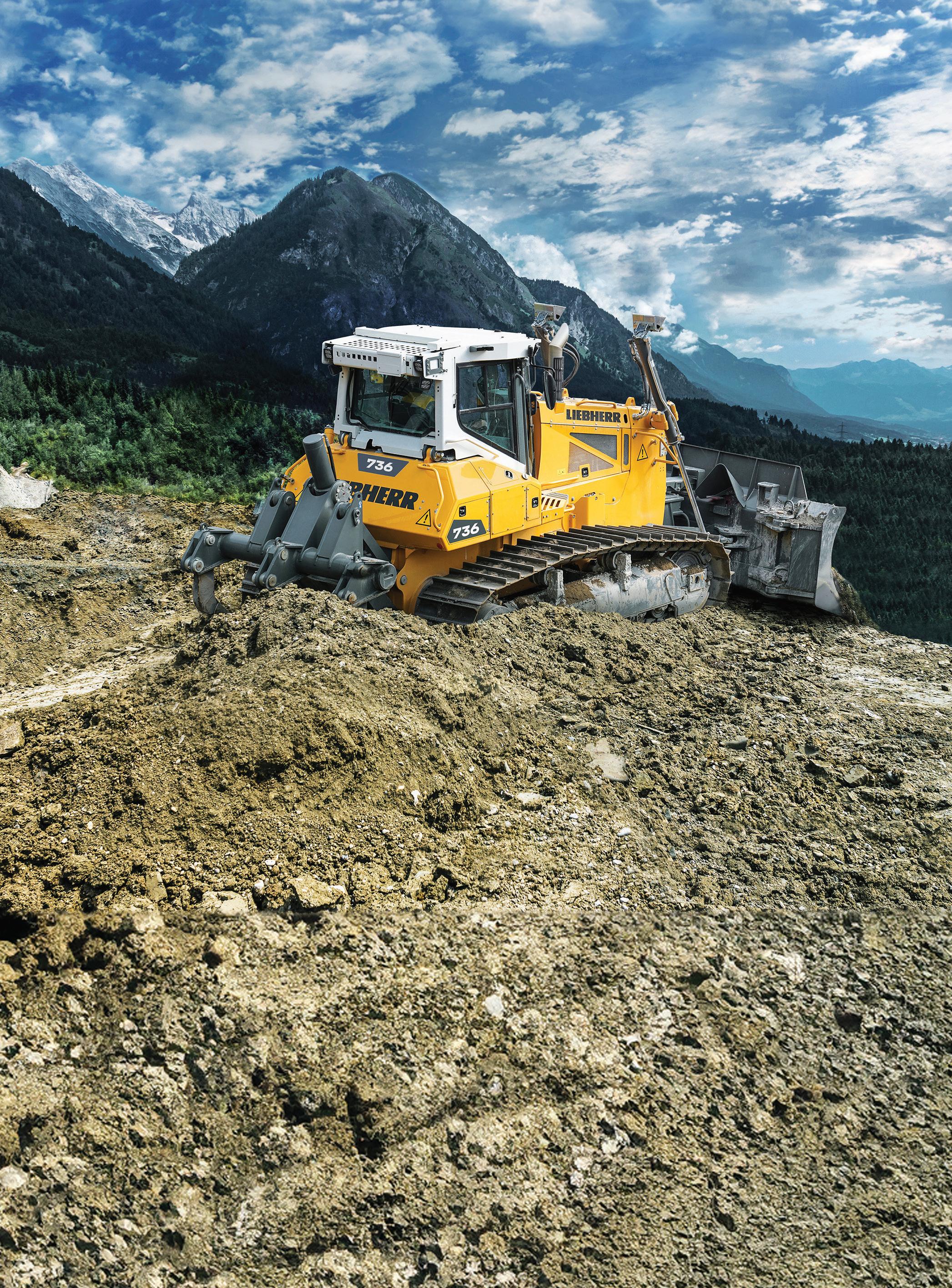
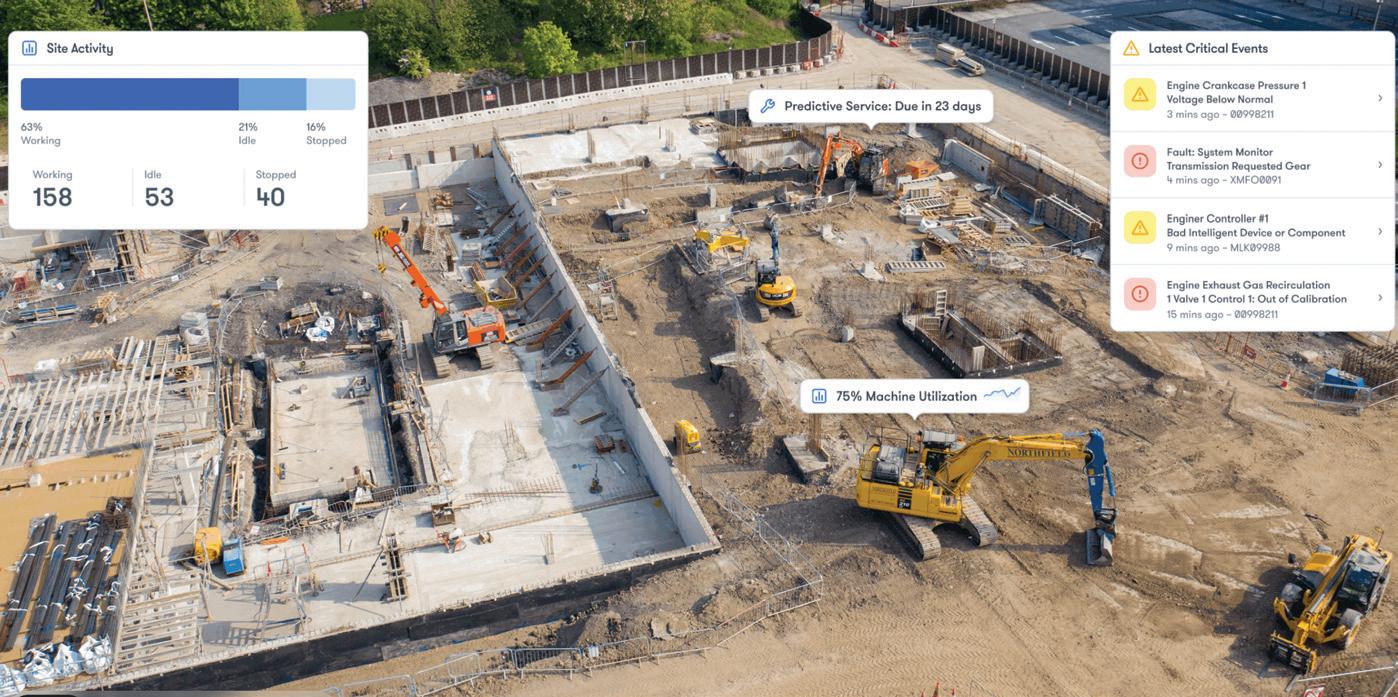
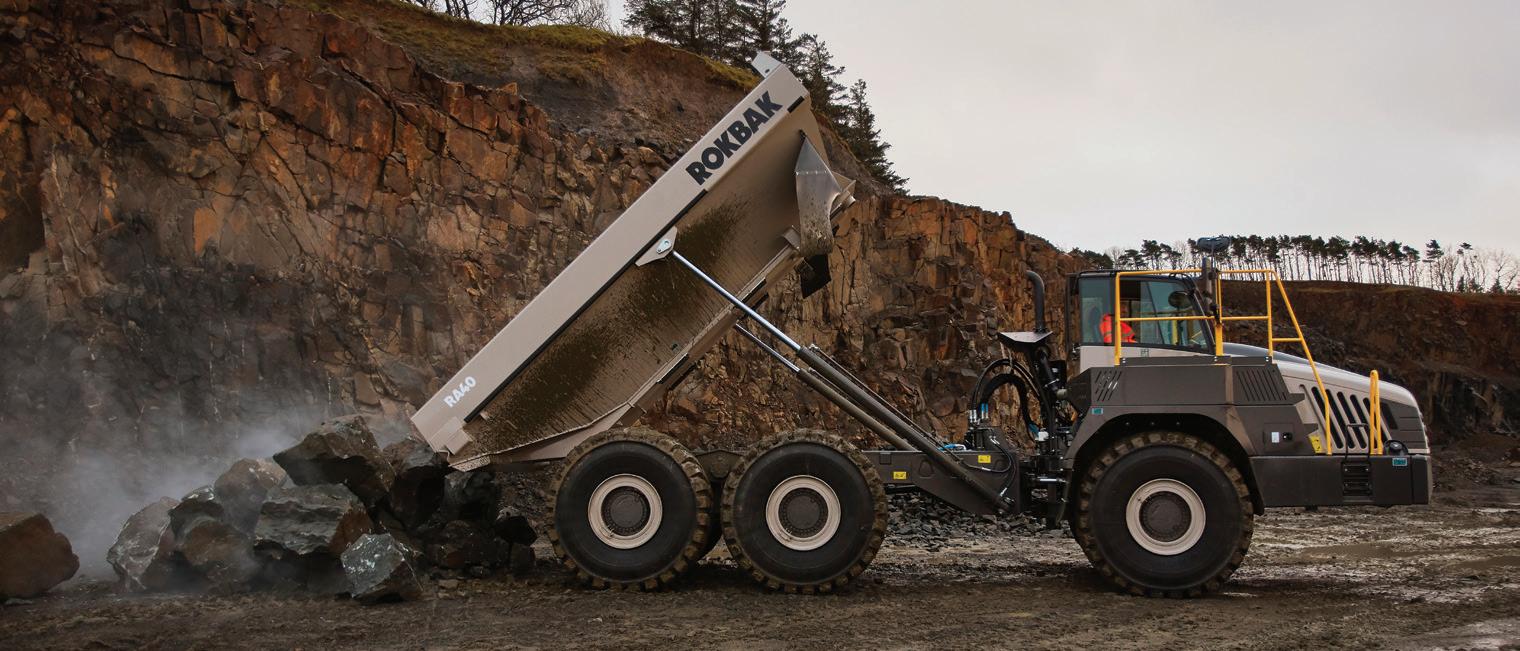
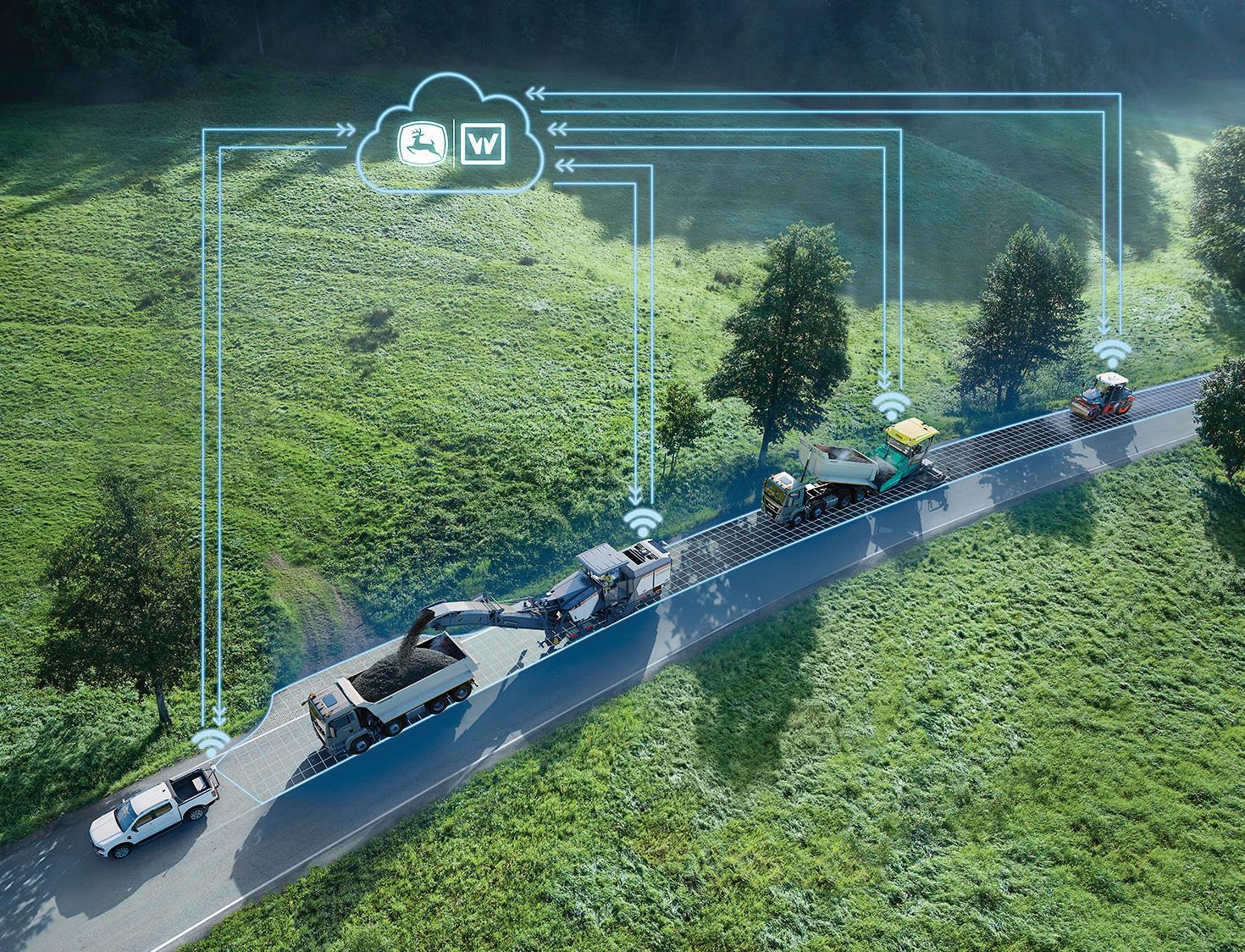
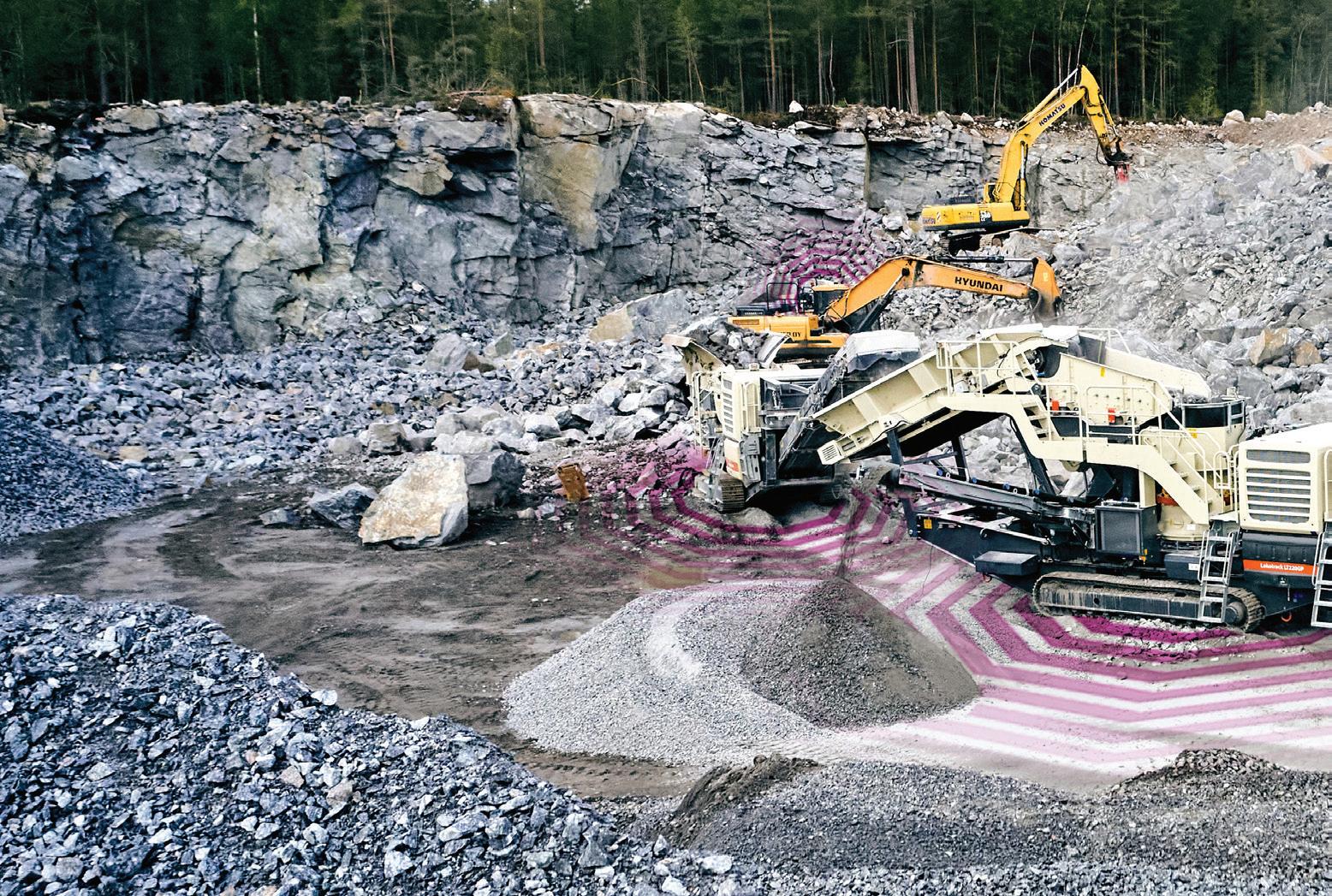
Here’s a prediction that won’t get me compared to Nostradamus, but one I’ll make anyway: 2026 will be just as volatile and uncertain as 2025 was. The major global political and economic issues and frictions we saw last year have not gone anywhere, and construction would do well to strap itself in for the ride.
The good news for construction is that – as I have said more than once – it is an essential industry. So, while it may have to endure a few bumps and bruises, it will emerge on the other side. In our first issue of the year – and the first in which we incorporate Construction Europe magazine and all her readers (hello, everyone!) – we focus on two sectors at the heart of the industry: earthmoving equipment, and quarrying and mining.
We also, with our European readers especially in mind, include an update from CECE (the Committee for European Construction Equipment) and take a look at how tariffs have impacted European-based manufacturers. Talking of tariffs, we also feature an interview with the president of China-based LiuGong – one of the world’s 20 biggest OEMs – in which one of the subjects touched on is how the company has sought to turn tariffs into a positive by accelerating its globalisation strategy.
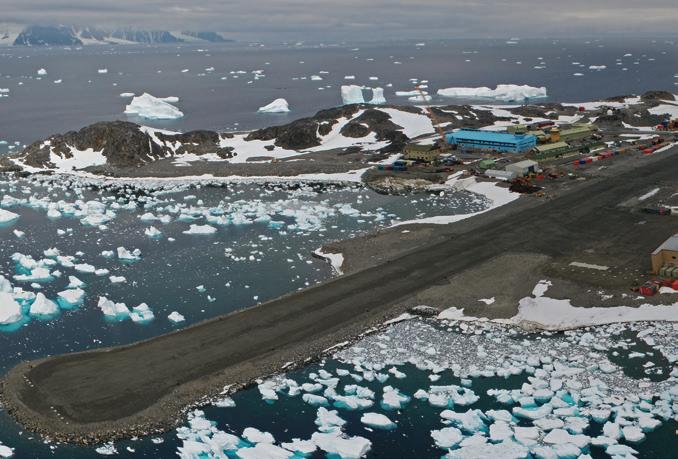
With further features on the German construction market, building in Antarctica (spoiler alert: it’s really cold), the continued evolution of telematics in construction, and a preview of ConExpo, we have started the year at full pelt.
Here’s to a great 2026 for everyone. And remember – we’re here to provide news, interviews and features from across the world of construction: to entertain, but above all to keep you informed. After all, the more information you have, the less bumpy the ride should be.
Offshore wind; AI assistants; acquisitions.
STAFF LIST
EDITOR Andy Brown andy.brown@khl.com | +44 (0)1892 786224
CONSTRUCTION BRIEFING EDITOR
Neil Gerrard
TECHNICAL EDITOR Julian Buckley
DIRECTOR OF CONTENT Murray Pollok
EDITORIAL MANAGER Alex Dahm
GROUP EDITORS Lindsey Anderson,
D.Ann Shiffler, Hannah Sundermeyer, Euan Youdale
BRAND MANAGER Eleanor Shefford
eleanor.shefford@khl.com | +44 (0)7850 313753
CLIENT SUCCESS & DELIVERY MANAGER
Charlotte Kemp charlotte.kemp@khl.com | +44 (0)1892 786262
CLIENT SUCCESS & DELIVERY TEAM Alex Thomson, Ben Fisher, Olivia Radcliffe
GROUP DESIGNER Jade Hudson
DATA MANAGER Anna Philo
DATA EXECUTIVE Vicki Rummery
HR MANAGER Sharron Brown
FINANCE MANAGER Yasmin Toumi
EVENTS MANAGER Steve Webb
EVENTS DESIGN MANAGER Gary Brinklow
CREATIVE DESIGNER Kate Brown
CLIENT SUCCESS & DELIVERY DIRECTOR Peter Watkinson VP SALES, CONSTRUCTION DIVISION Peter Collinson
GLOBAL VP SALES Alister Williams
CHIEF FINANCIAL OFFICER Paul Baker
CHIEF EXECUTIVE OFFICER James King
Vögele machine renews mountain road in Germany.
Stability for the sector in 2026? Lewis Tyler reports.
Facts and figures, courtesy of Scott Hazelton
Neil Gerrard reports on sectors that are developing commercial-scale autonomous operations.
LiuGong’s President talks to Andy Brown
Earthmoving equipment is increasingly prioritising operator comfort and safety, writes Andy Brown
Viva Las Vegas; industry-leading event nears.
Impact of Trump’s tariffs examined.
AUSTRALIA Laing O’Rourke and Aecom have won the delivery partner contract for the Brisbane 2032 Olympic and Paralympic Games in Australia. Working together under the Unite32 joint venture, the two firms will act as delivery partners on the A$7.1 billion infrastructure programme for the games.
Unite32 will be responsible for 17 new and upgraded venues and monitoring of two other venues across Queensland. Laing O’Rourke said that the JV comprises some of its most senior experts who have been involved in the delivery of every Olympic programme since 2012.
GERMANY Construction activity finally returned to growth in December 2025, for the first time since March 2022, according to a new survey of construction buyers. The Hamburg Commercial Bank (HCOB) Germany Construction Purchasing Managers’ Index (PMI) rose to 50.3 in December (where any score above 50.0 indicates a growth in activity), up from 45.2 in November.
Increased civil engineering activity boosted the figures, as the segment registered its strongest rate of expansion since March 2011. Meanwhile, the drag on total activity from the housing sector “eased considerably”.
SAUDI ARABIA Saudi Liebherr Company, the joint venture between Liebherr and the Juffali Group, has opened a new branch in Riyadh, Saudi Arabia, marking its third location in the Kingdom.
The company said the Riyadh facility will serve as a fully equipped hub for its activities in the central region, offering a range of services including sales, aftersales support, spare parts and technical services across Liebherr’s product divisions in Saudi Arabia.
SLOVAKIA A 7.5km-long tunnel has finally opened in Slovakia after nearly three decades of planning and over ten years of construction. The Višňové tunnel forms part of the D1 highway between Lietavská Lúčka and Dubná Skala. The project was first mooted in around 1990 but has been beset by challenges including political wrangling, multiple changes in contractor, and the difficult geology of the Malá Fatra mountains. Exploratory works first began back in 1998.
Caterpillar says that its AI Assistant will help fleet managers, owners, technicians, and operators
IMAGE: CATERPILLAR
US CONSTRUCTION
WHAT HAPPENED?
Construction contractors in the US have lowered their expectations for 2026, with optimism concentrated in data centres and power projects, according to a new survey from the Associated General Contractors of America (AGC) and Sage.
The report found contractors are increasingly concerned about the broader economy, while also reporting disruption from tariffs, immigration enforcement and ongoing difficulty finding qualified workers.
“While there are pockets of optimism in select private-sector markets, contractors’ overall sentiment has dampened notably compared to last year,” said Jeffrey Shoaf, AGC’s chief executive officer.
“One reason for their lowered expectations is that contractors are increasingly worried about the broader economy, the possibility of a recession and the outlook for materials costs.”
STOP WORK ORDERS FOR FIVE OFFSHORE WIND PROJECTS
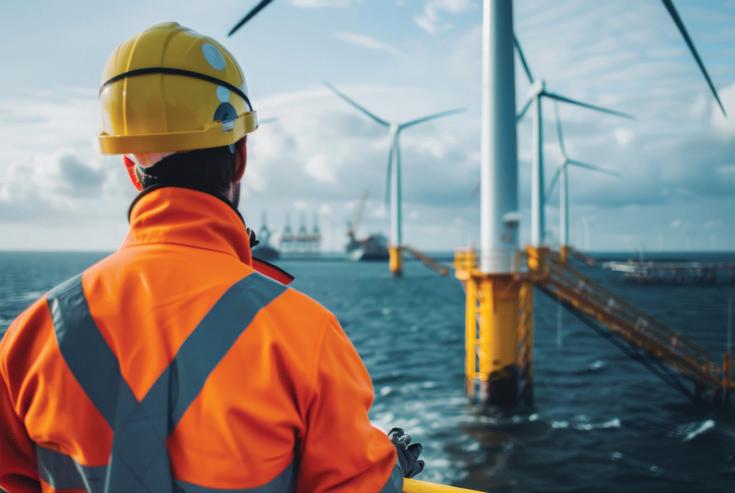
Five major US offshore wind energy construction projects have received stop work orders, after the Trump administration paused leases for all large-scale projects.
Citing national security risks identified by
the recently renamed Department of War, the US Department of the Interior said the pause would allow it time to work with leaseholders and state partners “to assess the possibility of mitigating the national security risks posed by these projects”.
The US Department of the Interior said unclassified reports from the US government have found that the movement of large turbine blades and the “highly reflective” towers cause radar interference called “clutter”.
It said that clutter can obscure legitimate moving targets and generate false targets in the vicinity of wind projects.
The move has faced criticism and could be challenged legally.
Five major US offshore wind energy construction projects have received stop work orders IMAGE: ADOBE STOCK
Project uncertainty remains high in the US, but over 60% of firms expect to add staff in 2026 IMAGE: ADOBE STOCK
WHAT IT MEANS
The US is the world’s largest market for construction equipment sales and what happens there impacts the world. The US is a major market for the vast majority of the world’s biggest OEMs and contractors. It is no surprise that date centres are an area of optimism – there is a case to be made that the construction industry is being somewhat propped up by data centre-related construction and without it order books would not be looking so healthy.
AGC said the survey measures expectations using a “net reading” –the percentage of respondents who expect the available dollar value of projects to expand minus the percentage who expect it to shrink. Data centres recorded the
DATA CENTRE DEAL
Australian property development firm Goodman Group has struck a A$14 billion (US$9.3 billion) deal with Canadian pension fund CPPIB to build data centres across Europe.
Goodman is Australia’s largest property developer and has been looking for ways to expand its data centre and AI infrastructure business.
It has created a 50-50 joint venture with CPPIB, which involves an initial A$3.9 billion funding commitment to develop a portfolio of projects in Frankfurt, Amsterdam and Paris. All projects have been designed for speed to market and construction is expected to start by 30 June 2026.
Caterpillar has unveiled Cat AI Assistant, an AI-based solution that it says allows its customers to engage with Caterpillar’s equipment and portfolio of digital applications in new ways.
The OEM said that the launch marked a “major step forward for Industrial AI, redefining how work gets done by combining data, AI and heavy equipment to help customers improve productivity, efficiency and safety.”
Caterpillar plans to bring the off-board Cat AI Assistant live in the first quarter of this year and is in the final stages of validation for in-cab applications.
Cat AI Assistant unifies Cat’s diverse portfolio of digital applications and data. It operates against the entire knowledge base of the OEM and serves as a proactive partner for customers, providing personalised data and insights.
“Caterpillar’s strong digital foundation, including our Helios data platform that manages over 16 petabytes of data, is helping us move fast and deploy new AI capabilities,” said Ogi Redzic, chief digital officer, Caterpillar. “Cat AI Assistant is a major leap forward in how Caterpillar supports customer success through best-in-class digital solutions, whether they’re working from corporate headquarters or at a remote jobsite.”
In a press release the OEM highlighted how the tool could be used by fleet managers and owners to manage their equipment and for technicians to access the right section from a library of thousands of instruction manuals and provide guidance on repairs. It can also be used by operators to access information and even assist with directing a machine.
strongest reading, with 65% of firms expecting growth in that market.
Contractors also remained positive about power work, which recorded a net reading of 34%. More modest optimism was reported for healthcare (non-hospital facilities at 24%, hospitals at 20%), water and sewer (16%) and manufacturing (15%).
By contrast, expectations weakened across several major segments. The net reading for transportation structures fell to 11% from 29% a year earlier, while bridge and highway work dropped 14% to 10%. Contractors’ outlooks also softened – though remained slightly positive – for warehouses, federal work, multifamily housing and public buildings.
Over 60% of respondents said an owner postponed or cancelled a project in the past six months.
BATOKA GORGE REVIVED
According to media reports, Zambia and Zimbabwe have agreed to each commit US$220 million toward reviving construction of the long-delayed $4.2 billion Batoka Gorge hydropower project.
The Batoka Gorge hydropower project is a 2,400MW hydroelectric power station, planned for the Zambezi River on the international border between the two countries.
The project was first proposed in the 1990s. In 2019 a deal was signed to build the dam with a China-based company but in 2023 the contract was cancelled. Both Zambia and Zimbabwe were hit by widespread power outages last year when a severe drought slashed water levels at the Kariba Dam, cutting hydroelectric output.
WHAT’S NEXT?
The construction industry in the US – and all those who operate there – must wait and see how the sector performs in 2026. Like all of construction, finding enough skilled workers is a genuine issue but the sector also has to cope with the impacts of President Trump’s tariffs. About 70% of survey respondents said they have been affected by tariffs, with 40% saying they responded by raising bid prices. The survey also found 33% of firms were affected by immigration enforcement actions in the past six months.
Despite the cautious outlook, 63% of firms still expect to add headcount in 2026, versus 15% anticipating a decrease – but 82% said they struggle to fill hourly craft roles and 80% reported difficulty filling salaried positions.
JACOBS ACQUIRES PA
Global engineering company Jacobs has agreed to take full ownership of management and technology consultancy PA Consulting, in a deal worth around £1.2 billion ($1.6 billion).
The deal reflects a valuation for 100% of the business of around £3.05 billion (US$4.1 billion).
Jacobs first took a strategic stake in UK-based PA Consulting in 2021.
The company said full ownership would strengthen its position across the asset lifecycle, embedding advisory and transformation services earlier in client programmes and expanding its exposure to higher-margin consulting activities, including digital and artificial intelligence-related work.
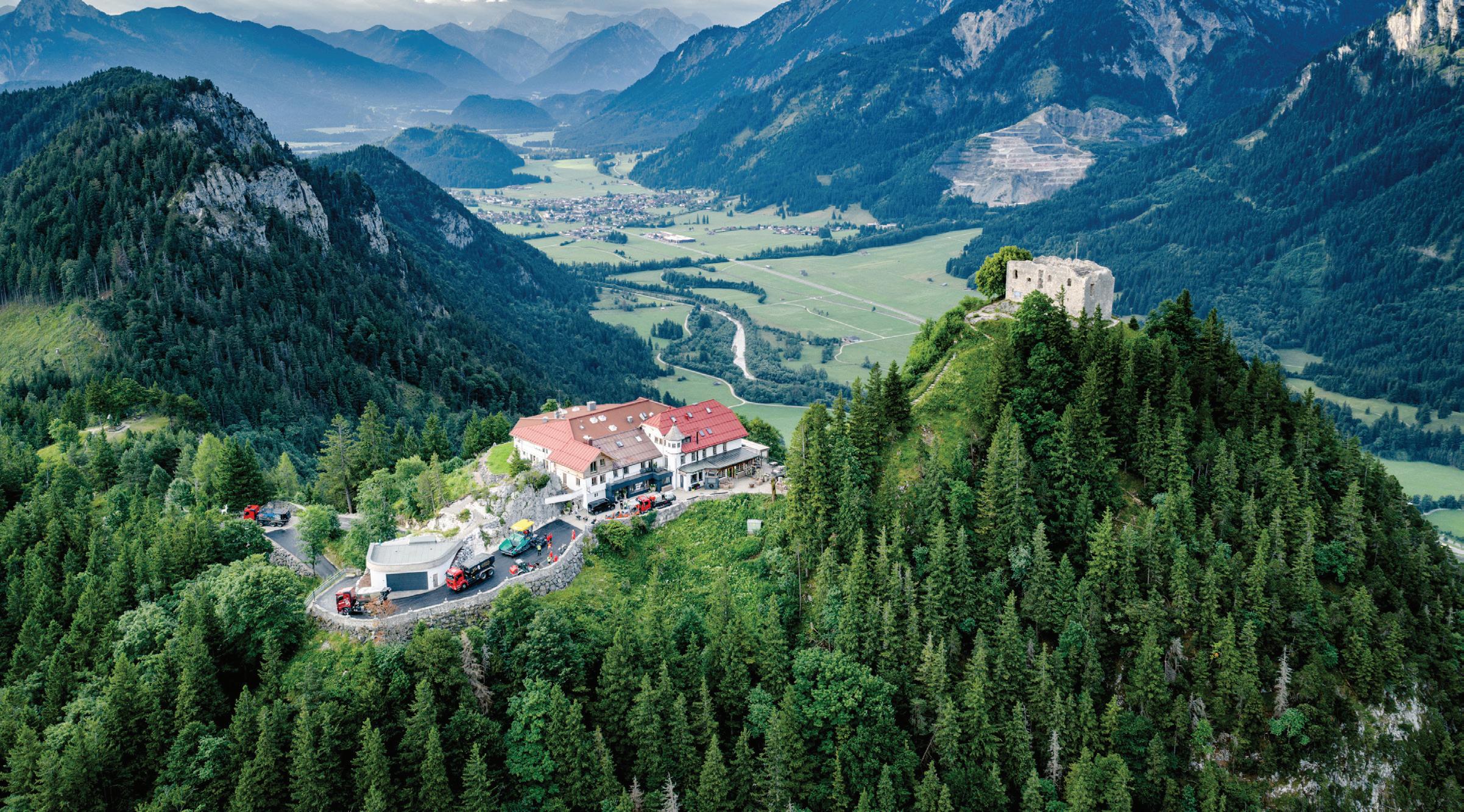
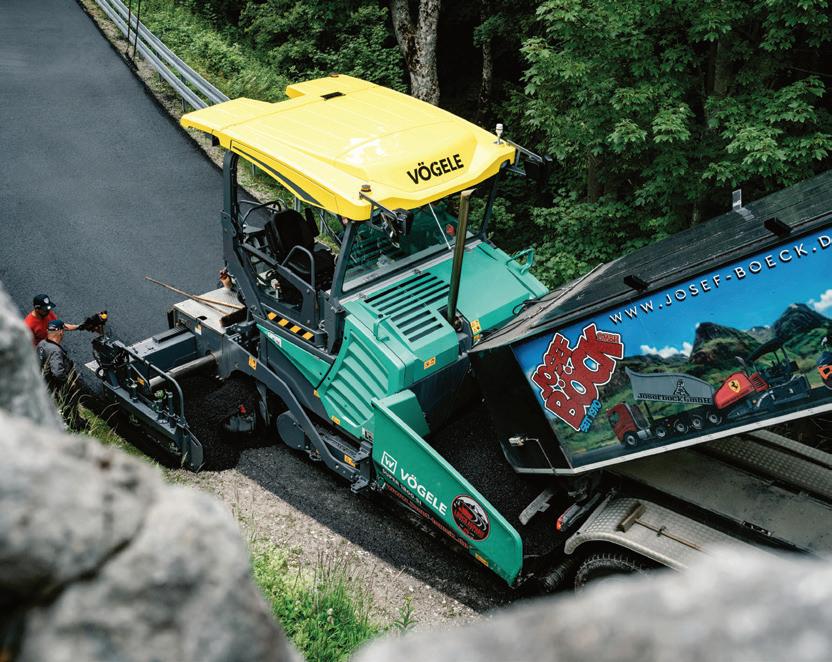
The road to Germany’s highest castle ruins, located at an altitude of 1,277m, has been renewed by a Vögele SUPER 1800-5 X road paver.
The road to the castle ruins, which is just over 2km long, is only 3m wide in places. It is said to be showing its age, with many sections being bumpy and deep potholes an issue.
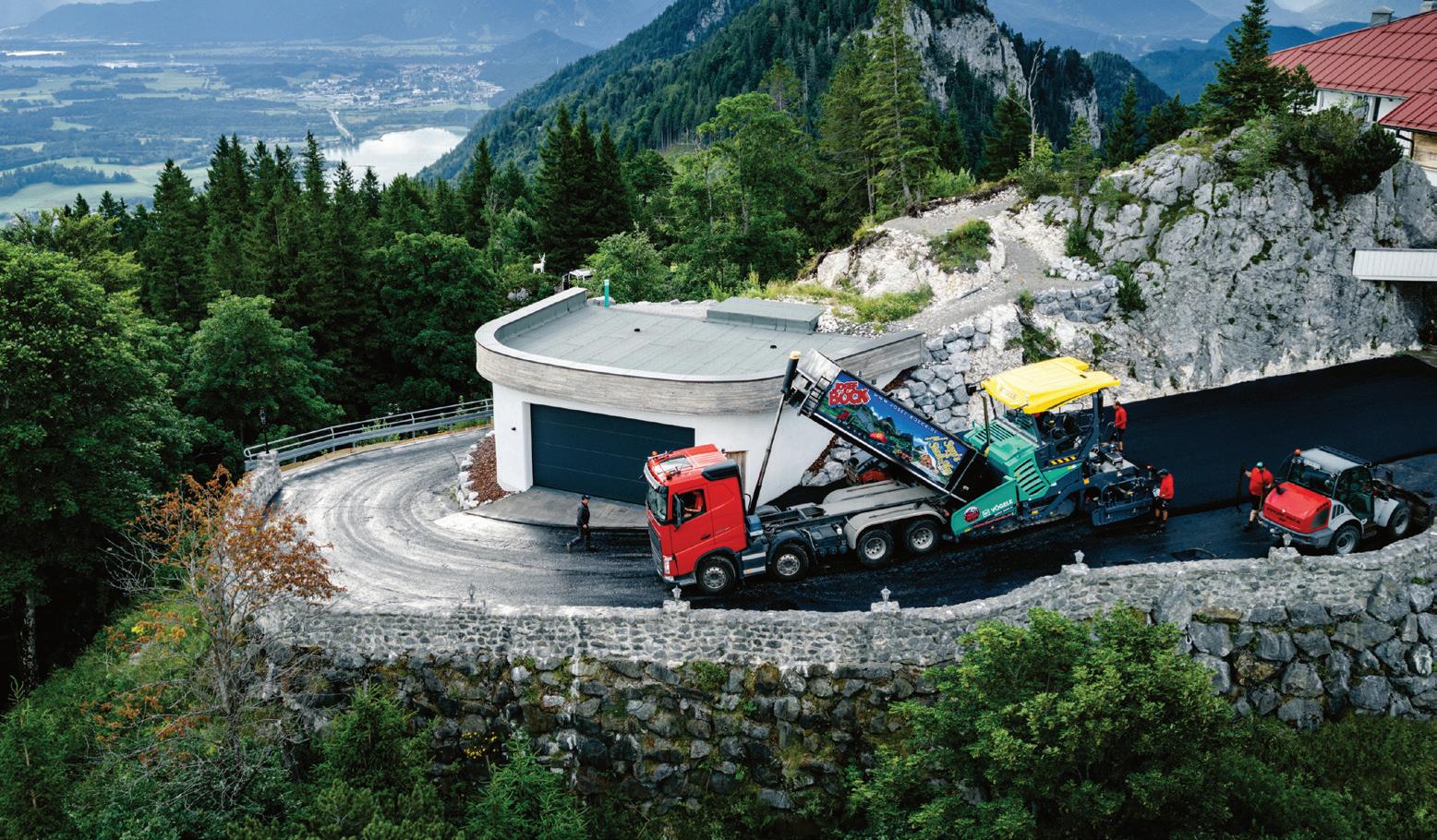
“The construction site has many sophisticated features. We’re dealing with steep gradients and very tight bends at the same time. This poses a challenge in terms of paving and logistics,” commented Sascha Böck, managing director of Josef Böck GmbH, the company commissioned with the task.
Due to the hairpin bends, only three-axle
COURTESY OF VÖGELE
ALL PICS
lorries could be used to deliver the mixed material. In addition, there were only limited passing places on the route to be negotiated, and the lorries had to reverse over long distances.
The Vögele SUPER 1800-5 X road paver used at Falkenstein is 6.15m long and is said to offer high traction and precise steering, required by the paving team given the tight space they were working in, with the mountain on one side and a steep slope on the other.
For final compaction, the team used an HD 13 VO oscillation roller and an HD 10 VT from Hamm.
The slope of the route, which in some places exceeds 30%, combined with the tight hairpin bends, placed high demands on the skills of the roller driver and the capabilities of the rollers. They had to be driven with care to avoid pushing the mix away, tearing it up or slipping with the roller.
According to Josef Böck GmbH, in this regard, the 3-point articulation of the Hamm rollers was a valuable feature. iC
It would be an understatement to suggest that the German construction sector has been through a period of instability in recent years.
Like much of Europe, Germany has grappled with severe economic downturns, rising interest rates, and a surge in the cost of materials. Making the landscape even more volatile was the collapse of the Social Democratic Party (SPD), Free Democrats, and Greens coalition government at the end of 2024.
A resulting election in February 2025 saw the Christian Democrats Union (CDU) take the largest share of federal votes, but a coalition with the centre-left SPD was needed to reach the required threshold, which was formed in April.
The political uncertainty had immediate consequences for construction companies, delaying decisions on public contracts, slowing approvals, and creating a cautious climate for investment
Current market conditions
Even before the government collapse, the German construction industry faced serious challenges. In the first nine months of 2024, the state issued just 157,200 building permits, with new permits in September that year hitting their lowest level since January 2012.
This was a sharp fall from 2023, when 260,200 permits were issued.
The long-term impact of this decline is significant: fewer permits now may translate into reduced construction activity and slower growth in residential and commercial sectors in the coming years, further stressing contractors’ revenue streams and workforce planning.
In that respect, Bauindustrie, the association that represents German contractors, paints a sobering picture.
Managing director Tim-Oliver Müller tells International Construction, “Provisional budget management following the traffic light coalition’s collapse, the suspension of tenders by Autobahn GmbH, the continuing crisis in residential construction, and dashed hopes for the special fund: 2025 has really
While economic and political factors have rocked construction in Germany, could an upsurge in infrastructure spend mark a turning point for contractors and OEMs? Lewis Tyler reports
demanded everything from the industry.”
However, there are signs that the sector may be turning a corner. “We are seeing an increase in orders in all key sectors at the end of the year. I am cautiously optimistic, as some sectors are still struggling and suffering from a lack of orders. But many indicators are pointing in the right direction.”
He adds that some large-scale infrastructure projects are helping to
Bauindustrie managing director Tim-Oliver Müller PHOTO: HDB / MARK BOLLHORST
buoy confidence, including federal highways and bridge replacement, rail corridor renovations, and upgrades to waterways. These projects not only provide contracts and revenue streams for construction firms but also serve as critical indicators of government commitment to long-term infrastructure investment, helping the sector plan effectively.
Infrastructure
spend
Another factor driving optimism is the €500 billion (US$588 billion) infrastructure package signed by the new coalition in March 2025.
While specifics of spending remain unclear, the bill aims to finance projects across transport, healthcare, energy, education, research, and digitalisation, and has been described by CDU party leader Friedrich Merz as a long-term programme.
Müller stresses that political announcements such as the infrastructure package are only the first step, and implementation remains
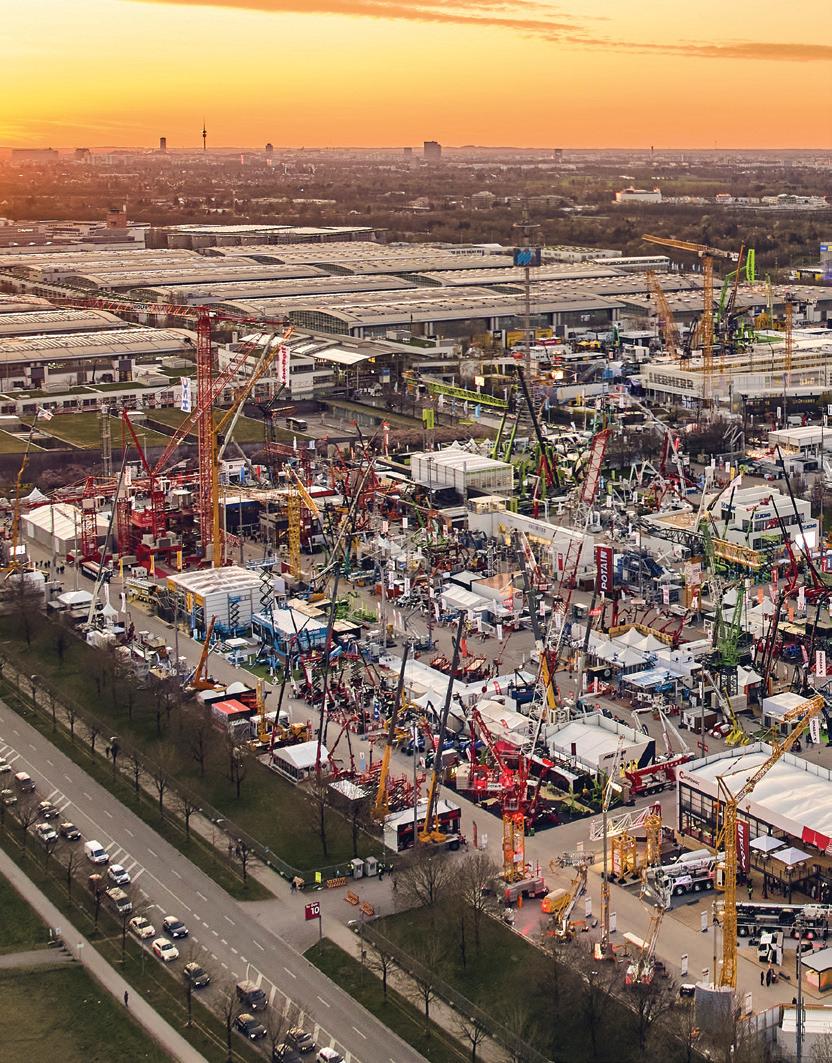
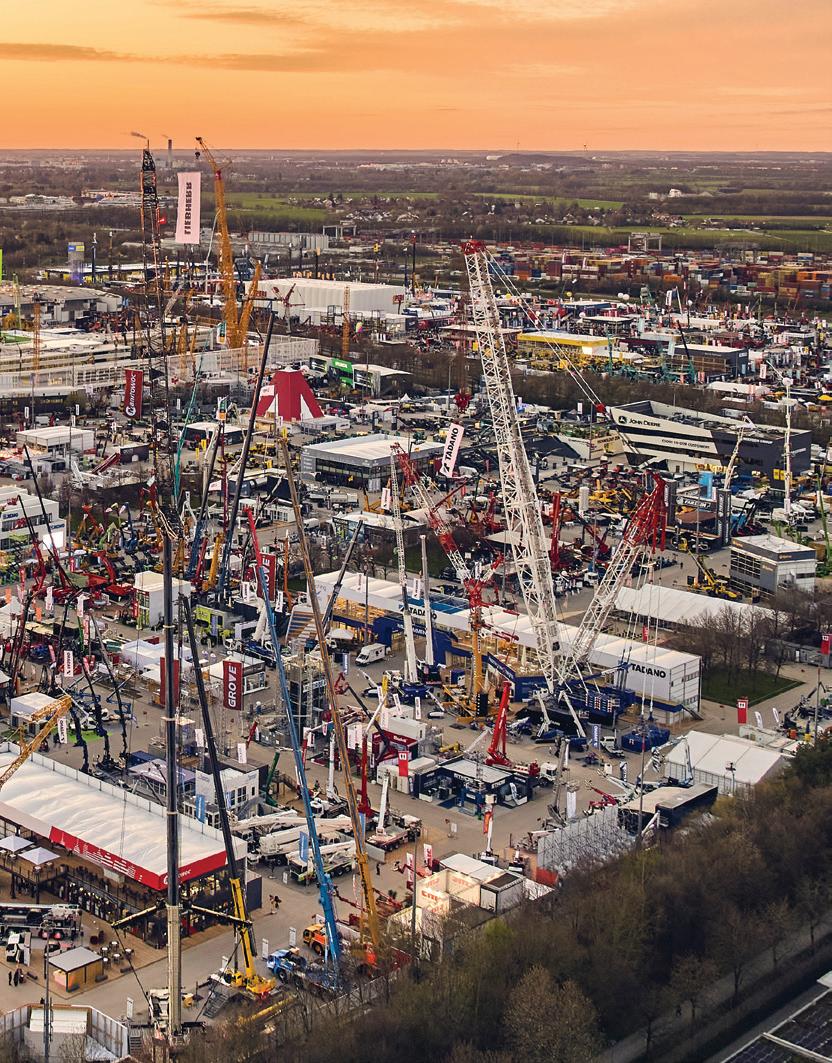
Bauma 2025 attracted ‘around 600,000’ visitors, confirming the show’s unrivalled status in the industry
critical; “Politically speaking, the special fund was a huge step forward. However, the entire industry must come to terms with the sobering fact that, economically speaking, the special fund will, at best, result in a sideways movement.”
The association is of the belief that growth in the federal highway sector, from an initial €10.3 billion (US$12.1 billion) to €11.05 billion (US$12.9 billion), has been made possible only because an additional €3 billion (US$3.5 billion) has now been approved for roads, spread over four years from 2026.
Müller points out the paradox: “The Bundestag approves a special fund of €500 billion that is supposed to stimulate growth but ultimately acts as a transfer station.
“Budget funds in the transport budget are being cut, replenished by special funds – and the transport minister then needs another €3 billion just to have any growth in the road budget at all. Meanwhile, bridges are collapsing in Germany. That needs to be explained politically first.”
He stresses that simply allocating funds is not enough. “It is important that projects are now launched. This is relevant not only for construction, but for the entire economy,” Müller says, highlighting that delayed
GOOGLE'S €5.5BN INVESTMENT PROGRAMME
Google has announced a €5.5 billion (US$6.3 billion) investment programme in Germany, covering new data centre construction, office redevelopment and a range of energy, water and community initiatives.
tendering, stretched planning administrations, and complex interactions between the core budget and special funds are slowing project delivery.
“Without a clear, actionable pipeline of ready-to-build projects, the industry cannot fully benefit from the infrastructure bill.”
The scale of these projects underlines the challenges and opportunities simultaneously: federal highways and bridge projects represent some of the most visible infrastructure work in Germany.
Rail corridor upgrades, including the Riedbahn and Hamburg-Berlin lines, and major junction projects in Hamburg, Munich, and Frankfurt, constitute the largest interventions in the rail network for decades.
Similarly, waterways and ports, including Brunsbüttel and Scharnebeck locks and improvements along the Elbe, Weser, and Rhine, are central to logistics and trade efficiency.
Residential recovery
Germany’s housing construction sector has also fluctuated in recent years, remaining under pressure from high interest rates and rising building costs.
However, in October, the Bundestag passed a law aimed at speeding up planning and approval processes, giving municipalities more flexibility and allowing regulatory exemptions such as noise protection rules.
Bauindustrie welcomed the law, and housing
Google Corporate Headquarters in California
The programme, which runs from 2026 to 2029, includes the construction of a new data centre in Dietzenbach and continued development of its existing Hanau facility, which opened in 2023.
The tech giant said both sites will support its cloud regions in Germany, delivering cloud and AI services including Vertex AI with Gemini models.
The company expects the investment to contribute an average of €1 billion ($1.1 billion) to German GDP annually and support around 9,000 jobs through 2029.
On the energy side, Google is expanding its 24/7 carbon-free energy partnership with Engie in Germany through 2030.
The agreement covers power from new onshore wind and solar projects, alongside optimisation of existing clean energy infrastructure using battery and hydro storage systems.
Google said its German operations are projected to run at or near 85% carbon-free energy in 2026.
PHOTO: WOLTERKE VIA ADOBESTOCK
PHOTO: BERLINPICTURES VIA ADOBESTOCK
PHOTO: MESSE MUNCHEN
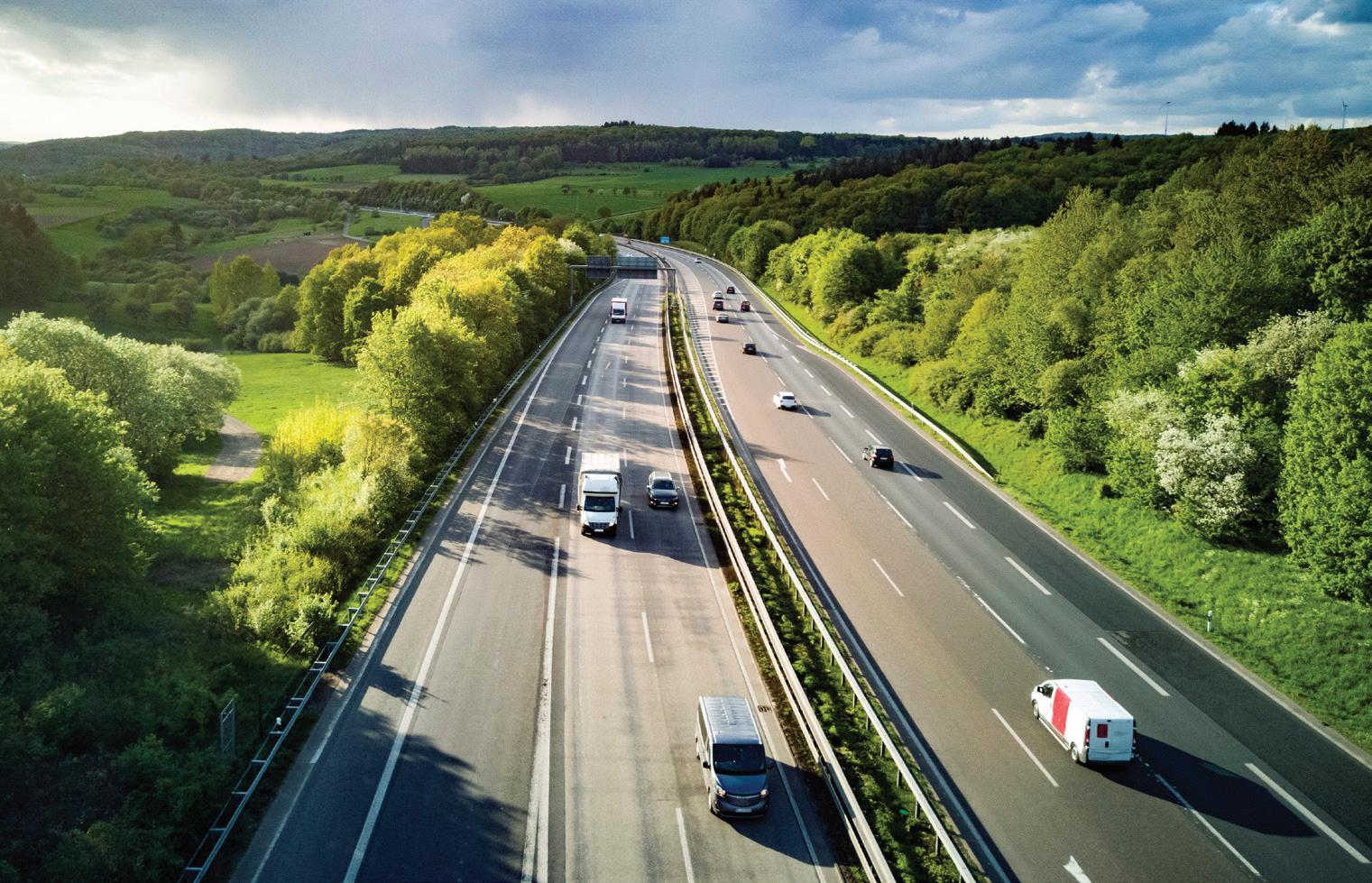
A road in Germany – an additional €3 billion has now been approved for roads, spread over four years from 2026 to 2029 IMAGE: ADOBE STOCK
construction is now showing early signs of recovery. “After years of double-digit declines, the number of building permits increased compared to the same period last year,” reveals Müller.
“However, a permit does not necessarily mean a contract. We therefore expect the number of completed apartments last year to be only around 225,000.
“The fact that Federal Minister of Construction Verena Hubertz is slightly increasing KfW [a German state-owned investment and development bank] subsidy programs and enabling improved interest rates is likely to lead to stabilisation in new housing construction at the lowest level in 2026.”
He adds that the one-time €800 million subsidy for the EH55 energy efficiency standard for new buildings could also contribute but is “only a start to resolving the housing shortage.”
He also calls for further reductions in costdriving building requirements, which are needed alongside reliable government subsidies.
The association believes these measures could improve investor confidence in residential projects and provide much-needed support to contractors navigating cost pressures.
The view from manufacturers Manufacturers have also faced their own challenges in recent years, from pandemicrelated order backlogs to supply chain issues linked to the conflict in Ukraine.
Tariffs have added further pressure, with the VDMA, representing 3,600 mechanical and plant engineering companies, calling the proposal to remove duties on imported US industrial goods a “slap in the face” for Europe’s industry.
Despite these hurdles, manufacturers have noted improvement. The VDMA says, “The Bauma trade fair in April boosted morale and was a great success for companies, despite the issue of US tariffs already being in the spotlight at that time.
CONTRACTORS WIN WORK ON €850M CROSSING
A group of contractors have won spots on seven packages of works for the construction of the Fehmarn Sound Crossing in Germany, which is expected to cost around €850 million to build.
There had been fears that the 2.2kmlong tunnel, which forms part of the cross-border Fehmarn Belt Fixed Link between Denmark and Germany, could be delayed.
The Fehmarn Sound Crossing will run between the island of Fehmarn and the German mainland on its northern coast, replacing the existing Fehmarn Sound Bridge.
It increases capacity for road traffic, which will run on four lanes through two tunnel tubes. The railway will be routed on two tracks in separate tubes.
It’s a key piece of infrastructure; without it, road and rail traffic from the German mainland would not be able to reach the Fehmarnbelt tunnel portal leading to Denmark on Fehmarn island.
“Order intake increased in the second half of the year, and sales are currently just above last year’s level, although this year’s figures are not yet finalised.”
The association, however, cautioned that the US market, which it describes as Germany’s most important export destination, remains fragile due to high tariffs, and warned of additional pressures from low-cost Chinese imports flooding the market at “rock-bottom prices that do not allow for fair competition.”
These factors continue to influence manufacturers’ strategic planning, investment decisions, and approach to production, particularly as OEMs weigh domestic demand against international market volatility.
Looking ahead
While Germany’s construction sector has faced a turbulent 2025, there are encouraging signs: order intake is rising, infrastructure investment promises a strong pipeline, and OEMs are cautiously optimistic.
Large-scale infrastructure projects, including federal highways, bridge replacements, rail corridor renovations, and upgrades to waterways and ports, are helping boost confidence and providing a more predictable workload for contractors.
The €500 billion infrastructure package, if effectively implemented, could provide a long-term foundation for growth, supporting multiple sectors including transport, energy, healthcare, education, research, and digitalisation.
However, the sector’s recovery will depend on more than just funding. Contractors continue to face bottlenecks in public administration, stretched planning resources, and delays in tendering that can slow even well-funded projects.
There’s no getting away from the fact that much of the health of the sector hinges on the success of implementing the infrastructure bill. As Müller notes, “The lack of planning resources will be the major challenge in the coming years. That is why we need to change. We need to plan and build more efficiently, and we need to become more productive.
“Partnership models and digitalisation are crucial in this regard. Hopefully, the legislature will lay the groundwork for this in the Procurement Acceleration Act.”
If these challenges are addressed, Germany may reach a turning point, setting the stage for a more stable and growth-oriented construction sector in the years ahead. The coming months will reveal whether the combination of policy, funding, and large-scale infrastructure projects can truly provide the industry with the momentum it has long needed. iC
A digital render of the Fehmarn Sound Crossing IMAGE: STRABAG
US tariffs and lingering supply chain and investment uncertainty will allow German real GDP (Gross Domestic Product) to grow only 1% in 2026. Fortunately, Germany’s outgoing parliament voted in March to create a 12-year, €500 billion (US$584 billion) off-budget fund for infrastructure and an uncapped off-budget fund for defence.
This major expansion of government investment, which will be exempt from Germany’s debt brake rules, will take some time to impact fully. Nevertheless, additional public expenditures will reach up to 1.5% of GDP per year, adding 0.3%-0.4% to real GDP growth on average during the next decade. The new coalition government has moved quickly with various economic policy initiatives, most notably the 30% capital allowance for new fixed investment during 2025–27.
Persistently high uncertainty about domestic and foreign demand prospects remains a burden, reinforced by the shift to far-right parties in various domestic and European elections. Concurrently, planning bottlenecks and skill shortages are hindering a rapid buildup of investment.
Construction output will strengthen from late 2025 onward owing to pent-up housing demand, migrant needs, and substantial additional public spending on transport, energy, IT infrastructure and the military. Investment in equipment faces a greater challenge given the structural loss in competitiveness owing to the loss of cheap Russian gas and a tougher market for exports to China.
After four years of decline, real total construction spending in Germany is expected to rise by 0.4% in 2025. The recent upturn in new orders and building permits and Germany’s fiscal expansion via major offbudget funding for infrastructure bode well for the industry’s recovery, although any impact will take time. These factors, combined with
After years of decline, rising public investment and improving order volumes should lift construction growth, with infrastructure leading the way, reports Scott Hazelton
a more supportive economic environment, should see stronger growth of 3.9% in 2026.
Recovery signs in sight
Data from the Federal Statistical Office showed that new order volumes rose for a second consecutive month in August, by 2.4% month over month, primarily driven by non-residential building orders. Moreover, new order volumes rose 6.4% year over year during the first eight months of 2025, although this is largely due to low base effects.
Residential construction is expected to decline 0.4% in 2025, due to still-high financing and construction costs. These, coupled with stricter energy standards and rising house prices, continue to limit housing affordability and profitability of new projects. An ongoing shortage of skilled workers remains a key challenge for this segment.
The recent upturn in building permits and record public investment in social housing construction should support a rebound in growth to 3% in 2026. The residential segment continues to face high cost pressures; the construction price index for residential
OUTLOOK FOR KEY CONSTRUCTION TYPES
buildings remains 47.6% higher than its prepandemic level.
Growth in the residential segment will be supported by various housing initiatives. Specifically, record funding of €23.5 billion has been committed for social housing construction for the 2025–29 period. Moreover, the ‘Construction Turbo,’ which is designed to accelerate planning and approval processes and create more affordable housing, should further support residential construction growth.
Nonresidential structures construction is set to experience slight growth of 0.6% in 2025, as ongoing uncertainties and high financing and building costs weigh on investor appetite for new developments. As economic and financing conditions improve further, growth should strengthen to 4% in 2026.
Office construction will continue to be impacted by economic and geopolitical uncertainties and still-high development costs. Despite this, the shift toward hybrid working is increasing demand for high-quality space, particularly in central locations, that meets environmental, social and governance requirements. Investment in data centers to support AI and cloud computing will also support growth in the medium term.
Elsewhere in the non=residential structures segment, many electric vehicle microchip factory projects have either been suspended or postponed because of high costs, financial issues and viability concerns.
Growth for Germany’s infrastructure
Infrastructure construction spending is expected to grow by 2.8% in 2025 and by 6.4% in 2026, driven by investment to renovate and modernise transport infrastructure, as well as various energy projects aimed at transporting electricity from renewable energy sources.
In June 2025, the government committed €166 billion for transport investments during the 2025–29 legislative period.
CONSTRUCTION OUTLOOK FOR DETAILED INDUSTRIES
(COMPOUND ANNUAL GROWTH, REAL 2019 €)
This represents a 63% increase from the €102 billion allocated during the previous five years (2020–24). Of this, €107 billion will go to railways, €52 billion to federal highways, and €8 billion to waterways. A further breakdown of the transport investments shows that €33.5 billion is earmarked for 2025, €33.7 billion for 2026 and €33 billion for 2027, with the majority of funding to come from the special fund for Infrastructure and Climate Neutrality.
In March 2025, Germany’s parliament approved the incoming coalition government’s
plan to create a €500 billion off-budget fund for infrastructure investment over the next 12 years. Of this, €100 billion will be allocated to climate and energy transition projects, while a further €100 billion will be allocated to federal states for various infrastructure projects. Infrastructure projects are also set to benefit from funds through the EU Recovery and Resilience Facility. However, spending is spread out over several years and will contribute only modestly to growth in the near term. So far, €19.8 billion (equivalent to 65% of the
S&P GLOBAL is an American publicly traded corporation headquartered in Manhattan, New York City. Its primary areas of business are financial information and analytics. It is dedicated to sharing essential economic intelligence with those working in and affected by global markets. Its experts provide a 360-degree perspective across countries, risks, industries, and commodities.
country’s €30.3 billion financial allocation) has been disbursed by the European Commission to Germany to date.
While infrastructure is the clear leader for construction over the medium (and long) term, the growth comes primarily from the transportation sector. Water/sewer also benefit from climate resiliency spending, but are more dependent upon new structural activity, which will be benign. Energy infrastructure will see some contraction, but from the very high levels of activity of the past five years. iC
The rapid development of autonomous machinery in mining and quarrying is filtering through to construction. But, Neil Gerrard discovers, it isn’t as simple as just transferring technology straight from one sector to the other
Automation has long been associated with mining. Large, fixed sites, predictable flows of material, and a long asset life have made it the most natural environment for autonomous and semiautonomous machinery to take hold.
It’s a similar story for quarrying, which is selectively adopting technologies where repetitive processes and controlled layouts allow a clear return on investment.
In construction, there may be an appetite to automate but progress is generally slower. Temporary sites, fragmented workflows and shorter project horizons continue to make automation harder to justify at scale.
Yet the gap is narrowing. Technologies refined in mining and adapted in quarrying are increasingly filtering into construction, albeit in more modular and incremental forms.
Data, operator assistance and semiautomation are emerging as the most transferable elements.
Automation maturity
Mining has already graduated from isolated technology pilots to a new phase of scalable commercial application, a spokesperson for Chinese OEM LGMG notes. “The haulage cycle in open-pit mines is automating the fastest and is the most mature. This is due to relatively fixed routes and confined sites, which facilitate autonomous haulage system (AHS) deployment.
“For instance, we have successfully implemented autonomous wide-body mining trucks in an open-pit coal mine in
Xinjiang, achieving commercial operation at a scale of over one hundred units,” she says.
As Mayya Popova, product manager automation, surface division, Epiroc, says, autonomous and remote operations in mining have been developing for more than a decade.
Speaking about Epiroc’s autonomous Pit Viper drills, she says, “We’ve had our initial installations [in mining] starting from 2012, so we definitely have over ten years of experience on that frontier and over 150 autonomous drill rigs deployed globally. The mining sector has been adopting remote and autonomous drilling and a broader spectrum of automation solutions for many years.”
That experience has allowed suppliers to refine not just technology, but implementation, training and performance
measurement. However, this does not mean mining-grade automation can simply be transplanted into construction environments unchanged.
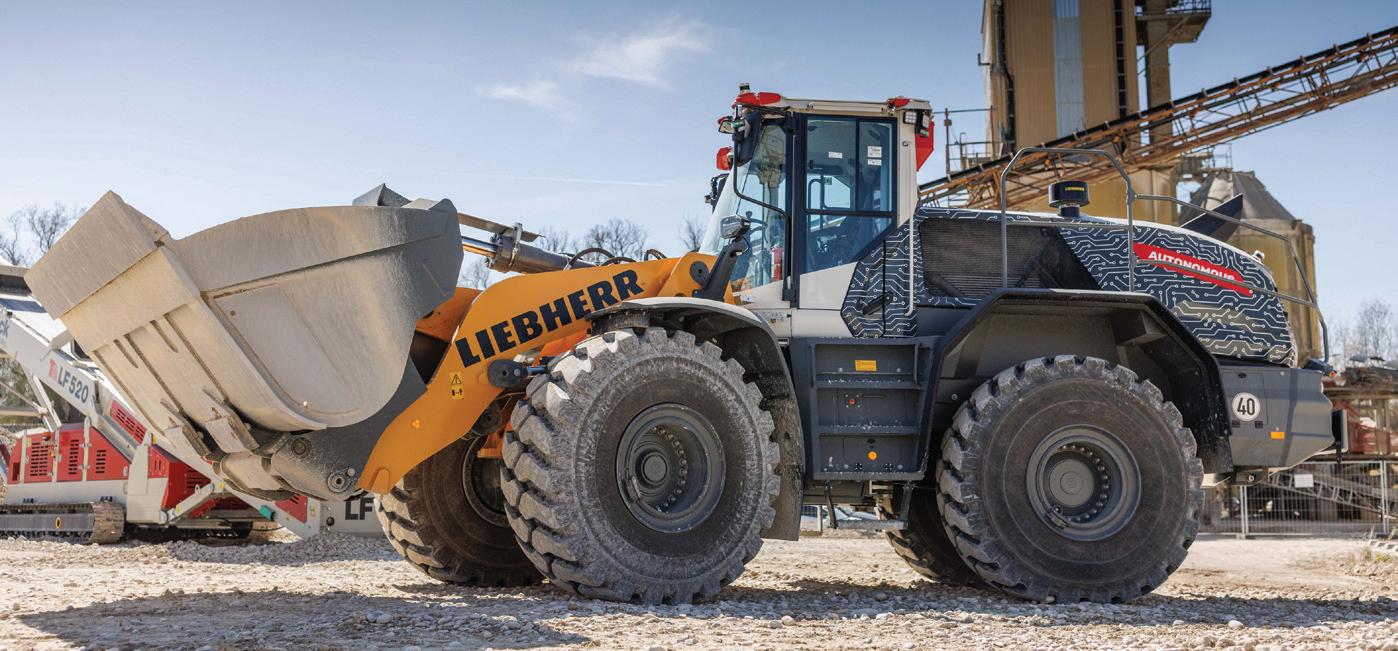
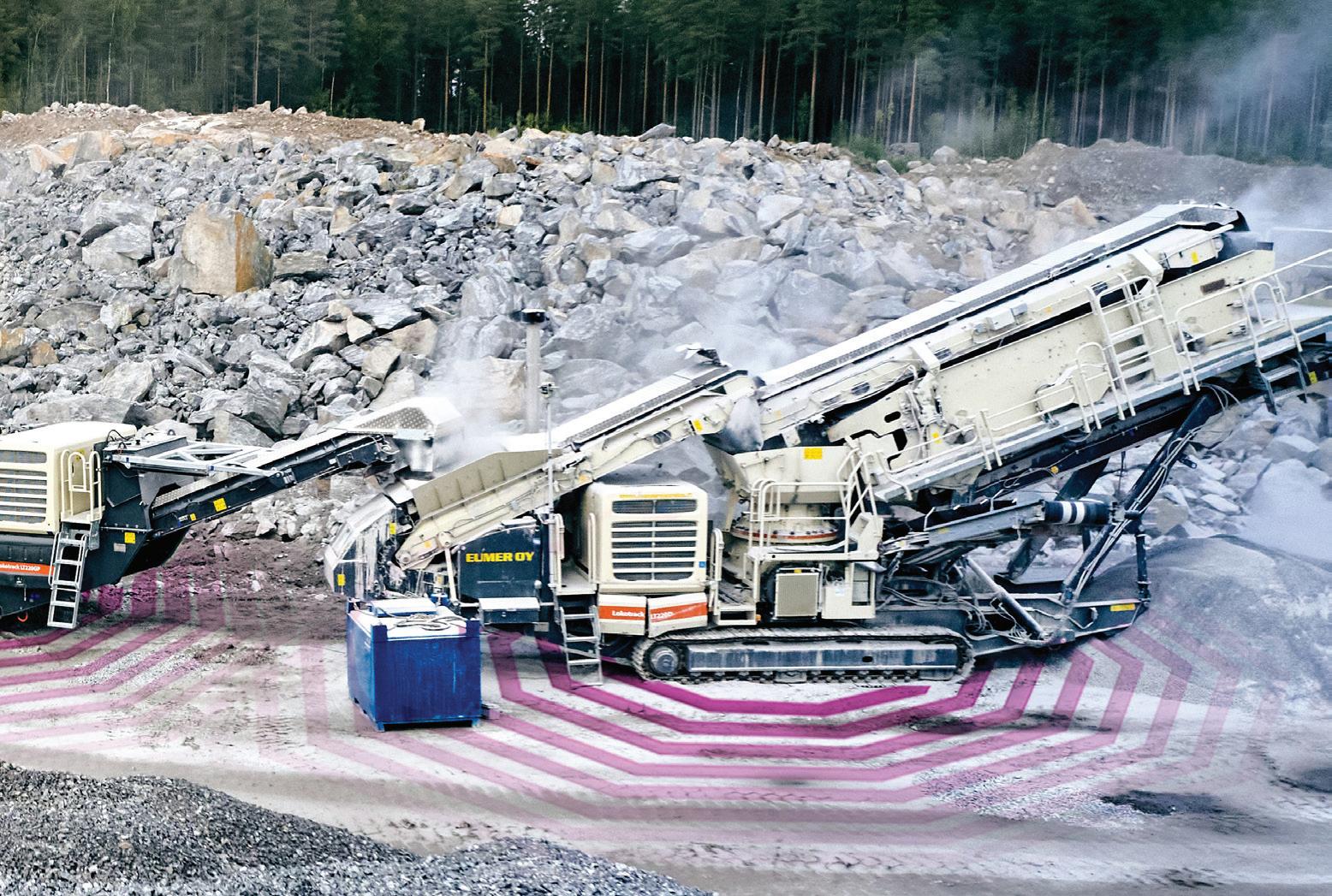
Liebherr’s autonomous wheel loader in a quarry setting IMAGE: LIEBHERR
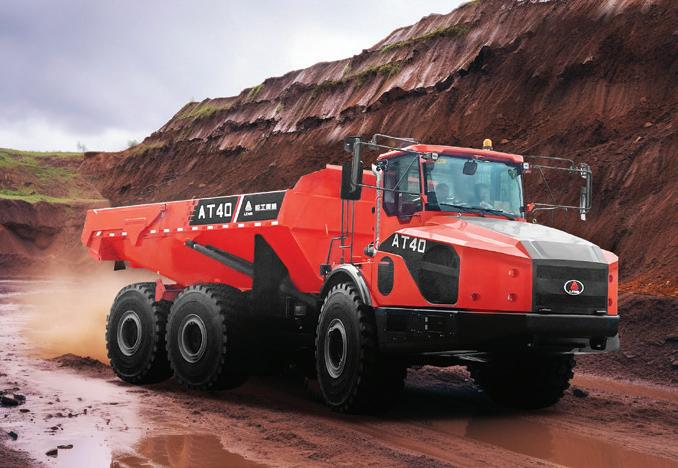
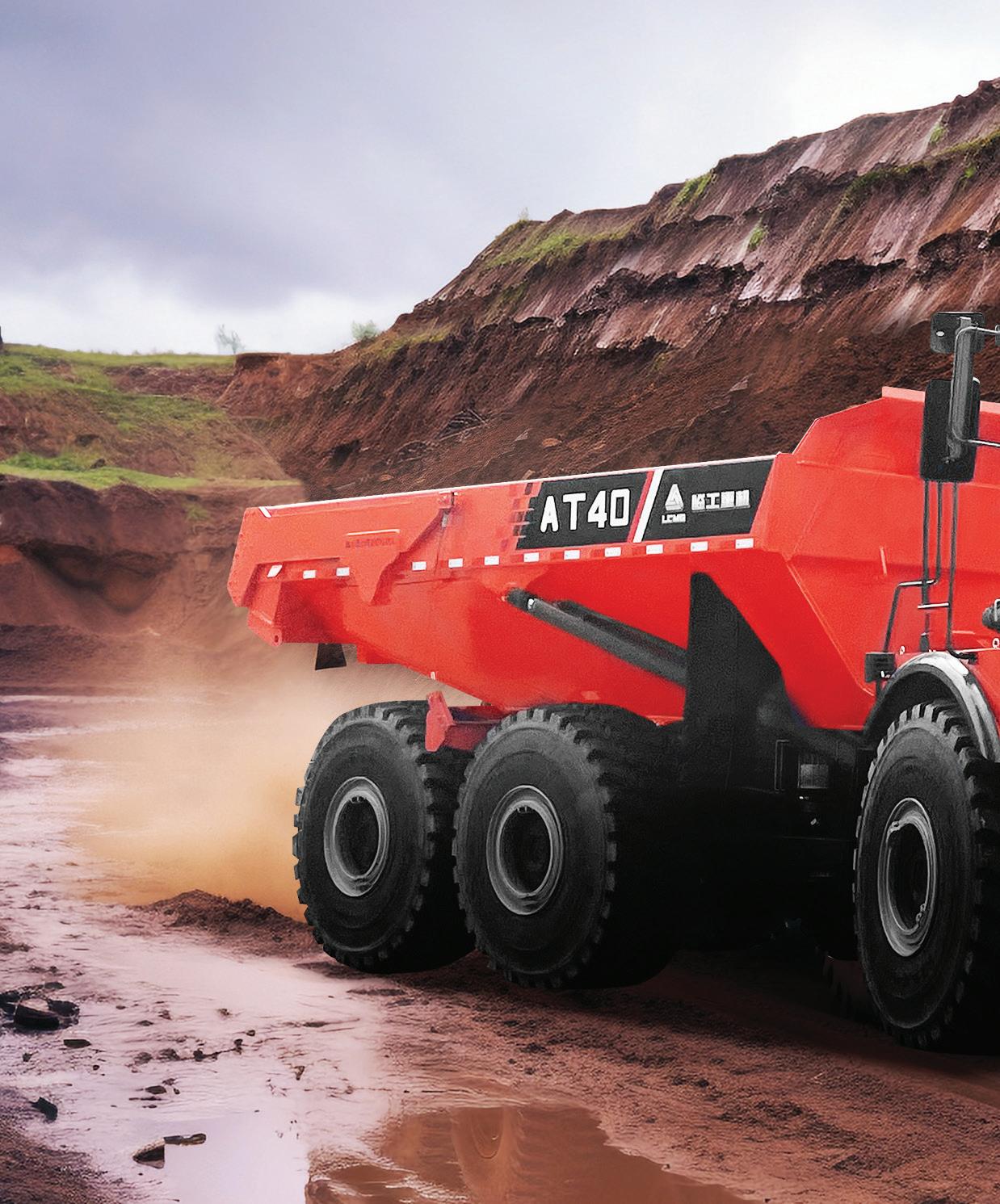
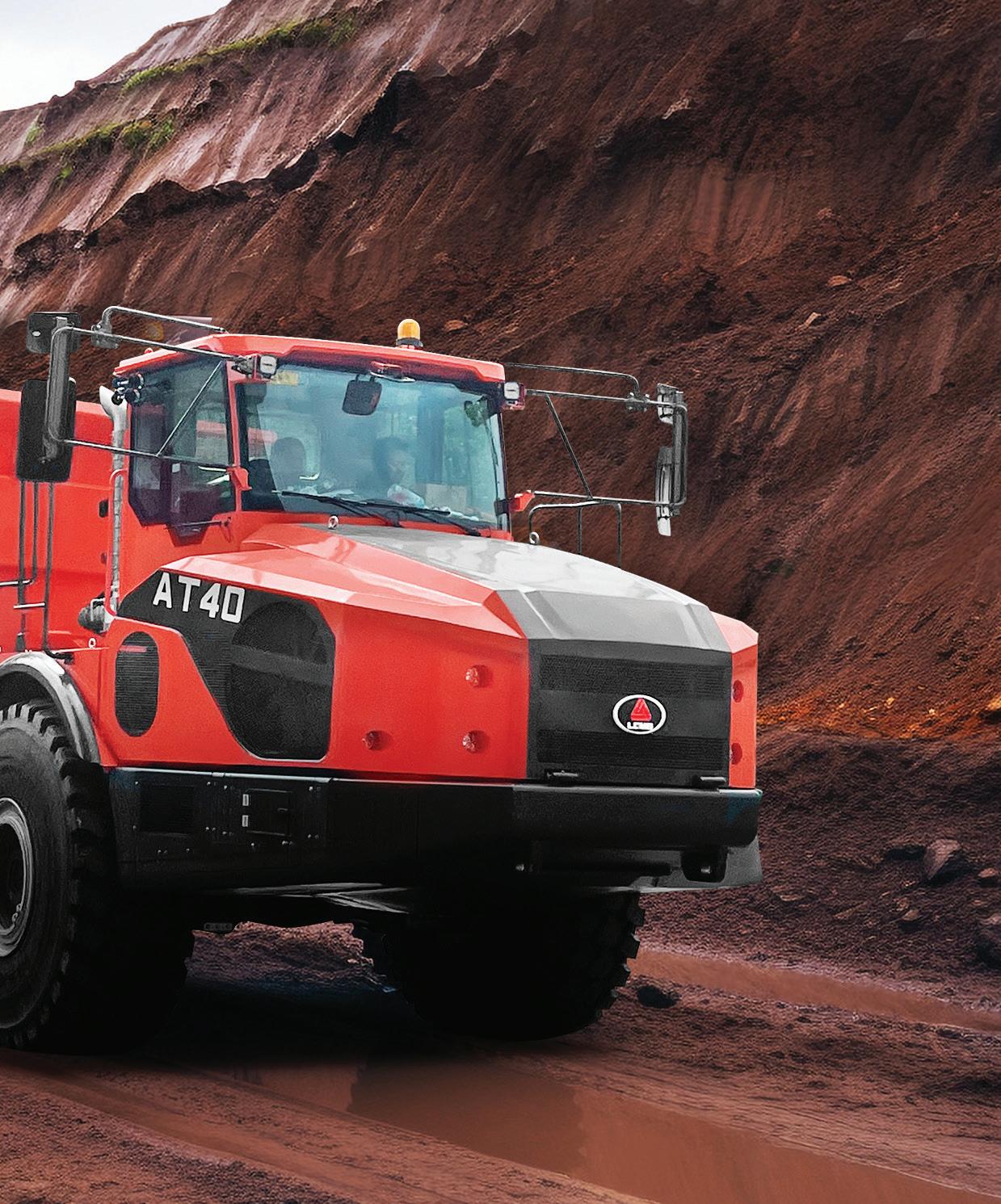
LGMG’s AT40 articulated dump truck has a rated load capacity of 40 tons
IMAGE: LGMG
A super pit open cut gold mine in Western Australia – mines are usually large and fixed sites compared to construction sites PHOTO: ADOBE STOCK
Mayya Popova IMAGE: EPIROC
Bridge between sectors
In general terms, quarrying sits between mining and construction, sharing characteristics with both. Sites are typically fixed for long periods, but often operate with smaller fleets, tighter margins and more contractor-driven decision-making. This has made quarrying an important proving ground for adapting mining automation into more flexible forms.
Epiroc’s Popova distinguishes between different layers of automation, noting that quarrying and construction have historically gravitated towards individual machine-level solutions rather than fully autonomous systems.
“In quarrying applications and construction, those segments definitely are interested in a lot of our machine automation solutions, meaning functions that we develop either to improve productivity and increase efficiency, things
compared to a dynamic construction site.”
Liebherr has focused on well-defined material handling tasks. “That is why we focus primarily on recurring material loading between piles or the feeding of hoppers,” Bös explains.
Some markets have been quicker to adopt automation in mining than others – Australia, North America, and parts of Europe identified the benefits rapidly. But in the last five years, the appetite is growing in regions like Africa, Asia, and South America.
“[These markets] have started to take decisions on how they purchase their fleet of the machines and choose some of the embedded automation options as their standard specifications,” asserts Popova.
Construction’s slower adoption of automation is not primarily a technology issue. Instead, it reflects the structural realities of the sector: short project durations, variable site conditions, and mixed fleets and workforces.
that directly impact enhancement of drilling operations,” she says.
She adds that functions such as Epiroc’s Automated Rod Handling System, optimised drilling parameters and operator-assist systems have been easier to adopt than fleet-level autonomy.
This pattern is echoed at Liebherr. Dr Manuel Bös, head of emerging technologies at LiebherrWerk Bischofshofen, describes quarrying as the natural starting point for autonomy.
“To select suitable machine applications, we need to consider a) the complexity of the task and b) the potential to implement a safety concept that complies with standards and regulations in the country or region,” he says. “For both reasons, repetitive work in quarries, industrial sites, or gravel plants is much better suited in the short-term
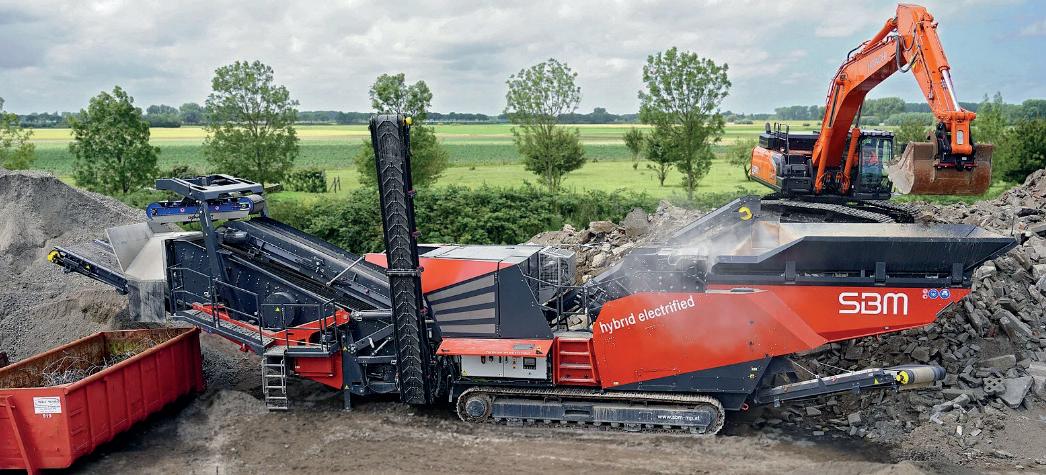
SBM DEVELOPING AUTONOMOUS CRUSHER
Austria-based manufacturer SBM mineral processing is on the “home strait” of developing an autonomous crusher.
SBM has been working with the University of Leoben to integrate sensors into its crushers and optimise AI-supported visual real-time detection of the feed material.
Popova highlights the contrast in investment timescales between mining and construction. “The mining houses take decisions for the next three, five years. They already have plans and budgets planned for capital expenditure and operational expenditure,” she says. “In quarrying and construction, it is a bit more dynamic, often driven by a specific project’s needs, because of the nature of that industry.”
That dynamism can be a double-edged sword. While decisions can be made more quickly, it can be harder to justify long-term investments for sites that may operate for a limited period.
Bös reinforces this point from a safety and regulatory perspective. “With the currently available technology and the standards that must be met, there is still work to do – both on the regulatory level and in technology development…to enable more dynamic usecases involving pedestrian traffic and similar challenges,” he says.
SBM
SBM claims it is on the “home strait” of developing an autonomous crusher
It is also expanding its global information networks with the aim of connecting its autonomous crushers to the SBM headquarters via the cloud. There, a “digital twin”, will validate the settings made on site in real time, or optimise the crushing processes based on reference data. The technology is expected to be ready for the market by 2026.
Liebherr’s Dr Manuel Bös, head of emerging technologies at Liebherr-Werk Bischofshofen IMAGE: LIEBHERR
IMAGE:
Operator assistance
Instead of pursuing all-or-nothing autonomy, manufacturers are increasingly pitching automation as a continuum. Operator assistance, semi-automation and remote control are positioned as practical steps that deliver immediate benefits while laying the groundwork for future advances.
At Liebherr, Bös describes this layered approach. “For tasks that are not yet within the scope of fully autonomous machinery, Liebherr also provides suitable solutions to empower customers,” he says. “These range from various operator assistance and semi-automation features to remote control solutions.”
Remote operation is seen to address safetycritical scenarios without the complexity of full autonomy. Epiroc’s experience in mining has informed similar strategies. Popova emphasises that automation must be accepted by site teams if it is to succeed. “We want to ensure that we implement a new technology to a quarry or to a construction site using a systematic approach, providing relevant training and support needed through our local organisations and dealers,” she says.
“This technology is there to enhance the site operation with minimum disturbance.”
LGMG employs what it calls a “phased and scalable” strategy, starting with retrofitting existing fleets with digital monitoring terminals to achieve operational transparency, followed by a pilot project introducing a small number of autonomous trucks on a suitable fixed route. Only after those stages and after obtaining
Dr Manuel Bös demonstrates Liebherr’s Autonomous Job Planner web application IMAGE:
reliable ROI data, does LGMG start assisting clients in scaling their autonomous fleet and integrating it into a unified intelligent dispatch platform, the company says.
Data as the common denominator
If there is one area where mining, quarrying and construction are clearly converging, it is data. Access to reliable, actionable data is essential, regardless of the level of automation.
“There is a really big trend on data, acquiring data, analysing data, interpreting data, and all the insights that come from the equipment,” says Popova. “I would say there is equally as much interest in mining, in quarrying, and in construction.”
Data serves multiple purposes, from performance optimisation to compliance and reporting. “Usually you need to have a documented proof of work being done,” Popova explains. “So in that case, it’s the data coming from our equipment that clearly states,
LGMG manufactures a wide range of mining machinery and is entering a new phase of scalable commercial application for autonomy in the sector IMAGE: LGMG
LIEBHERR
for example, how many metres were drilled in what time interval, including data points that help assessing the quality of the drilling.”
This focus on data-driven decision-making is also central to recent developments from Trimble. In November 2025, the company announced Trimble Mine Insights, a cloudbased analytics platform designed to automate and optimise workflows across surveying, drilling, blasting and geotechnical operations.
While positioned primarily for mining and quarrying, its emphasis on AI-powered insights and integrated data workflows reflects a broader shift towards digital foundations.
Economics and market conditions
Automation investment does not take place in a vacuum. The Parker Bay Company’s thirdquarter 2025 update points to a downturn in global mining equipment shipments, with
AUTONOMOUS QUARRY HAULAGE
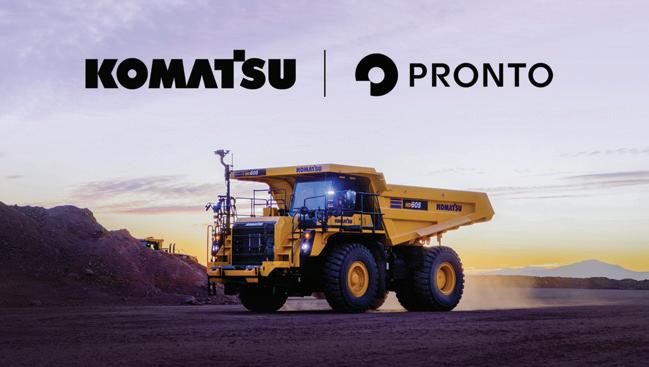
In August 2025 Komatsu announced that it was collaborating with autonomy firm Pronto to deploy Pronto’s autonomous haulage technology to quarry operations in North America.
Called Komatsu Smart Quarry Autonomous, powered by Pronto, the system integrates Pronto’s technologies into quarry-sized haul trucks and ties into Komatsu’s Smart Quarry solutions.
Komatsu said the new solution will allow quarry operators to retrofit existing Komatsu vehicles or purchase new trucks equipped with Pronto’s self-driving system, enabling 24/7 operation with minimal human intervention.
“We have decades of experience with autonomous haulage in large-scale mining. Now we’re bringing that expertise to quarries of all sizes,” said Jason Anetsberger, Komatsu’s senior director for customer solutions.
Komatsu is collaborating with autonomy firm Pronto IMAGE: KOMATSU
deliveries down more than 25% across Q2 and Q3 compared with late 2024 and early 2025. While not directly linked to automation demand, softer market conditions can influence capital allocation decisions.
In such an environment, technologies that improve utilisation, reduce operating costs and enhance safety without requiring wholesale fleet replacement are likely to be more attractive.
While lessons from mining must be adapted rather than copied in construction, many of the underlying technologies are transferable although site conditions and infrastructure remain critical variables.
“To a very big extent what we’ve developed for mining can be adopted and used in other applications as well,” says Popova. “Of course, there is a recognition of the fact that there might be no fixed infrastructure.”
Connectivity, in particular, can be a limiting factor. “Aspects like access to the network, the coverage of the satellites play a crucial role to be able to use some of our technologies for multi autonomous operations,” Popova adds.
Liebherr’s modular approach reflects similar thinking. “Our system is designed in a modular fashion so that other use-cases with different conditions can be unlocked step-by-step via software updates over time,” Bös says.
Technology alone is not enough to deliver automation’s promised benefits. Both companies emphasise the importance of organisational readiness, training and change management.
“There are two big factors that can really unlock the value that automation creates: people and processes,” Popova says. She describes what Epiroc calls “the disciplined use of automation”, where organisations continuously monitor performance, identify inefficiencies and adapt their procedures and processes accordingly.
Bös also highlights the human dimension. “Simple and repetitive tasks pose a major challenge for small and medium-sized companies when it comes to finding and motivating skilled workers to perform them,”
he says. Automation offers the prospect of taking dull work away from employees, freeing them up for more interesting tasks.
Looking forward, the consensus among OEMs is that automation in construction will continue to advance, but in measured steps. Eliminating live work where people are placed in potentially dangerous situations, improved operator interfaces and deeper data integration are likely to deliver the most immediate gains.
“I believe that there is a lot of focus on live work elimination, and that continues to be a very strong trend across all the industries,” Popova says.
For Bös, regulatory progress and technology development will be key enablers. “With the currently available technology and the standards that must be met, there is still work to do,” he says, pointing to sensors, communication protocols and AI as areas requiring further advancement.
Automation’s trajectory across mining, quarrying and construction is increasingly one of convergence rather than uniformity. Mining looks set to remain the proving ground, with many developments also applicable to quarrying. Construction looks set to make adoptions on a more selective basis.
“Mining automation serves as the ‘proving ground’ for construction machinery automation,” LGMG’s spokesperson concludes. “Breakthroughs in perception for complex environments, high-precision positioning, and fleet scheduling algorithms from mining are directly advancing construction equipment automation.
“Although construction sites are temporary and variable, the core technologies validated in mining are being adapted and applied to equipment like excavators and rollers, giving rise to solutions like assisted construction and intelligent paving.”
What construction can learn from mining is not simply how to automate, but how to build the organisational and digital foundations that make automation viable, as well as how to bring people along with the process. iC
A Christensen Rod Handling System working together with a Christensen CT20 in the wilderness IMAGE: EPIROC
One of the major themes of 2025 in the world of construction was tariffs.
Tariffs in themselves are nothing new, but President Donald Trump’s tariffs on raw materials and goods coming into the US caused major ripples around the world, including within the boardrooms of the world’s biggest OEMs and construction contractors.
China-based LiuGong certainly falls into this category, with the company ranked number 18 in International Construction’s Yellow Table – a ranking of the world’s biggest OEMs by sales – with US$4.1 billion of sales. Luo Guobing, president and vice chairman of the company, reveals in an exclusive video interview with International Construction that these tariffs have altered the way that the firm does business.
Challenges – and opportunities
“It really has created some significant challenges for us, and also for other Chinese companies to do business in the US,” says Mr. Luo, who has been with the company since 1994, and became president and vice chairman last year.
However, he adds that it has also led to positives as it has been a factor in the company accelerating its globalisation strategy.
“Before, basically, we made machines in China and exported globally. Now we think more about localisation and globalisation. This really had a big influence on us, but I think that it is good for us, for the globalisation strategy.”
The tariffs have turbo-charged an existing policy of building up local dealers, subsidiaries and support networks around the world. A figure that underlines how long this strategy has been in place – and how important it is to the company – is the percentage of LiuGong’s sales that come from overseas markets: 50%.
According to Mr. Luo, the company’s overseas revenue increased by 15% last year. He adds that he expects overseas revenue, as a percentage of the company’s total revenue, to increase by 2-3% every year.
Focusing back on the US, and Mr. Luo makes it clear how vital the China-based firm sees it.
LiuGong’s president
Luo Guobing explains to Andy Brown how US tariffs have sped up their globalisation efforts
Earthmoving equipment is a key segment for the company
“We think the US market is a very important market. Number one market in the world. We need to be there. The US market is a strategic market, and we will never give up being there.”
Regarding the US, Europe and other mature markets, the president concedes that there is still some improvement that LiuGong can make.
Mature markets have different expectations than developing ones regarding products and aftersales care. While LiuGong and other major China-based OEMs have made significant strides in this area, there is more that can be done.
“We need more focus
Luo Guobing, who joined LiuGong in 1994, became president and vice chairman last year
and more investments through the local value chain and to build capability to support local business and the after-market service. We need more focus on being close to the customers and high efficiencies to sort out any issues. There is some space in which we need to improve.”
Optimistic outlook
LiuGong performed well in 2025 with both revenue and profits up and Mr. Luo strikes a (cautiously) optimistic outlook for 2026. “I think global construction equipment will see a steady recovery; some increase, but not too much,” he says.
When it comes to their home market of China, he is more bullish, suggesting China will see a 5-10% increase in construction equipment sales this year. This will be mainly driven by
LiuGong is targeting 60% of its overall sales coming from overseas markets by 2030
government investment as 2026 is the first year in the government’s new five-year plan (20262030) and there is a focus on projects such as energy transition and water conservation.
Interestingly, he makes the point that in China the main demands of the customers are changing. “It used to be that price was number one, the price of equipment. Now there is more [focus]on the value of technology and service. More focus on research and development and global supply chains,” he says.
Another change in China – albeit one that has been going on for longer – is the move towards electric equipment. China is, by a considerable
distance, the world’s biggest market for electric construction equipment. This has been driven by the government through strict emissions standards and subsidies on electric equipment.
“It is very important to say that now the general trend is very clear, and that’s electric and intelligent products,” says, adding that the “electric wheel loader had more than 50% penetration in 2025,” in China.
He also says that the increase in sales of electric equipment is not now due to government policy but due to customer demand for a product that is zero emissions, more comfortable to operate and has the same performance levels. While China remains the main market for electric equipment, he reveals that LiuGong has now launched electrical machines in more than 60 countries.
Long-term vision
One of the (many) impressive things about the global Chinese OEMs in construction is their long-term planning – they are typically thinking about the next five to ten years rather than what the financial results at the end of the year will look like.
It is clear from speaking to Mr. Luo that the company wants to transition more into being a player that focuses on high-quality products
and providing the levels of service and support that customers expect from a producer of such products. Part of this strategy is – of course – to produce ‘intelligent’ equipment that is increasingly automated and comes in a wide range of power options. But the conversation keeps on returning to the things around machine sales.
“We want to be a very good global partner for customers. So, this means we will be more trusted and also have reliable products and quality service. Very important is customer trust and [being a] premium brand,” he asserts. “We’ll set up more subsidiaries to be closer to the customers, together with our dealers to support the customers.”
The strategy is for LiuGong to continue its growth in mature and emerging markets and to see sales from overseas markets hit the 60% mark in five years’ time.
The president also reveals that the company’s sales goal is to be a RMB60 billion (US$8.6 billion) company by 2030. This is an ambitious target but one that, if the firm can manage to grow as it wants to in overseas territories while enjoying a relatively stable home market, may be achievable. Given the growth that LiuGong has seen over the last ten years it is certainly not an ambition that can be discounted. iC
Advances in automation, digital systems and cab ergonomics are reshaping the operator’s role in earthmoving equipment, with comfort now firmly part of the technology story, Andy Brown reports
Liebherr says that operator comfort is at the centre of every development
While the general aesthetics of earthmoving equipment has remained fairly constant for decades – excavator design has been honed and improved but a machine today is still recognisable compared with those from 50 years ago – the big changes have come inside the cab, both in terms of the technology options that are available but also regarding operator comfort and safety.
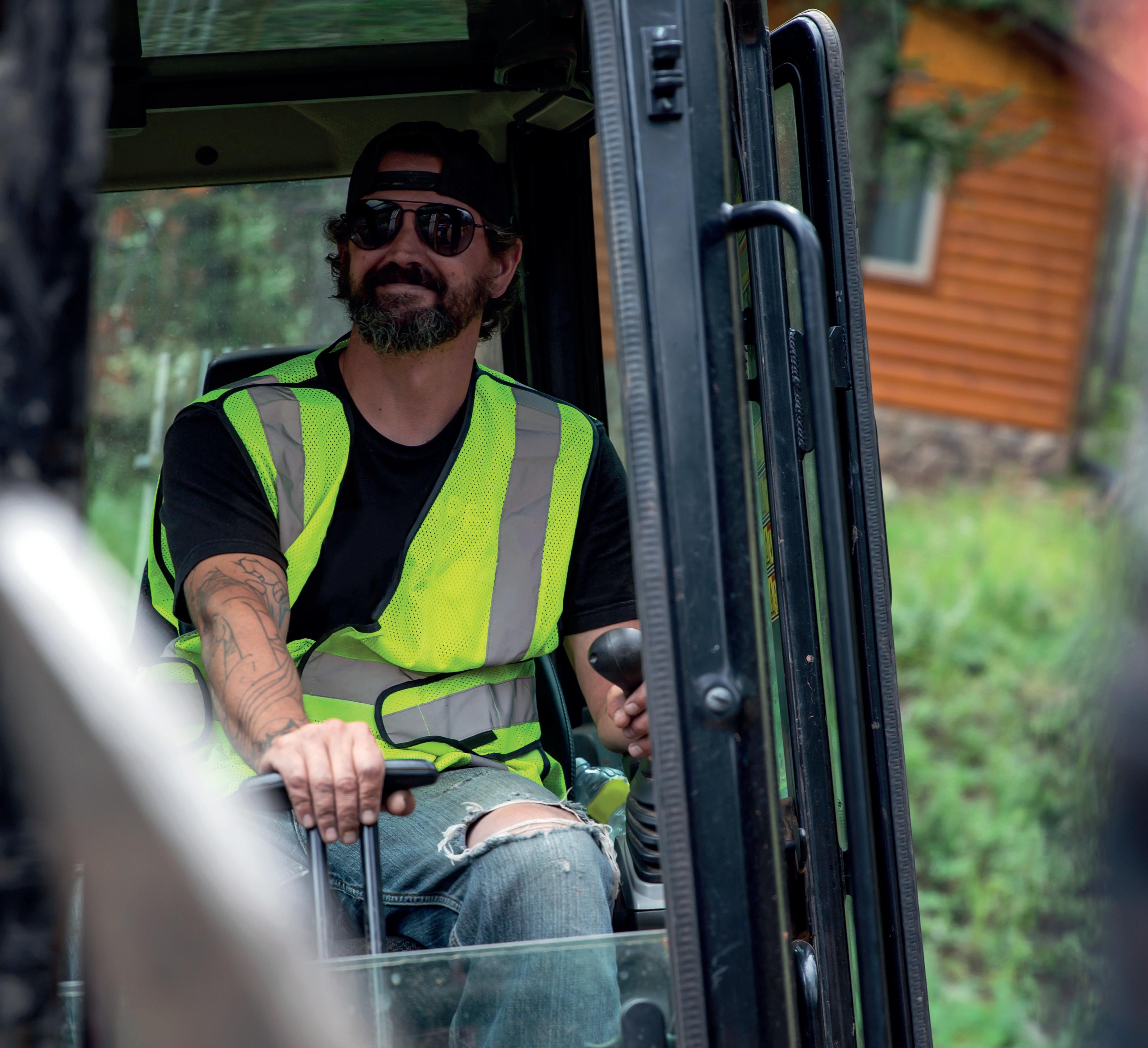
This all makes perfect sense; the technology is available to semi-automate and even automate tasks so that they are performed more efficiently and safely but it also makes sense given construction’s well publicised skills shortage. If there are fewer operators than ever before then ensuring they can work in an environment where they feel happy and comfortable becomes more important than ever.
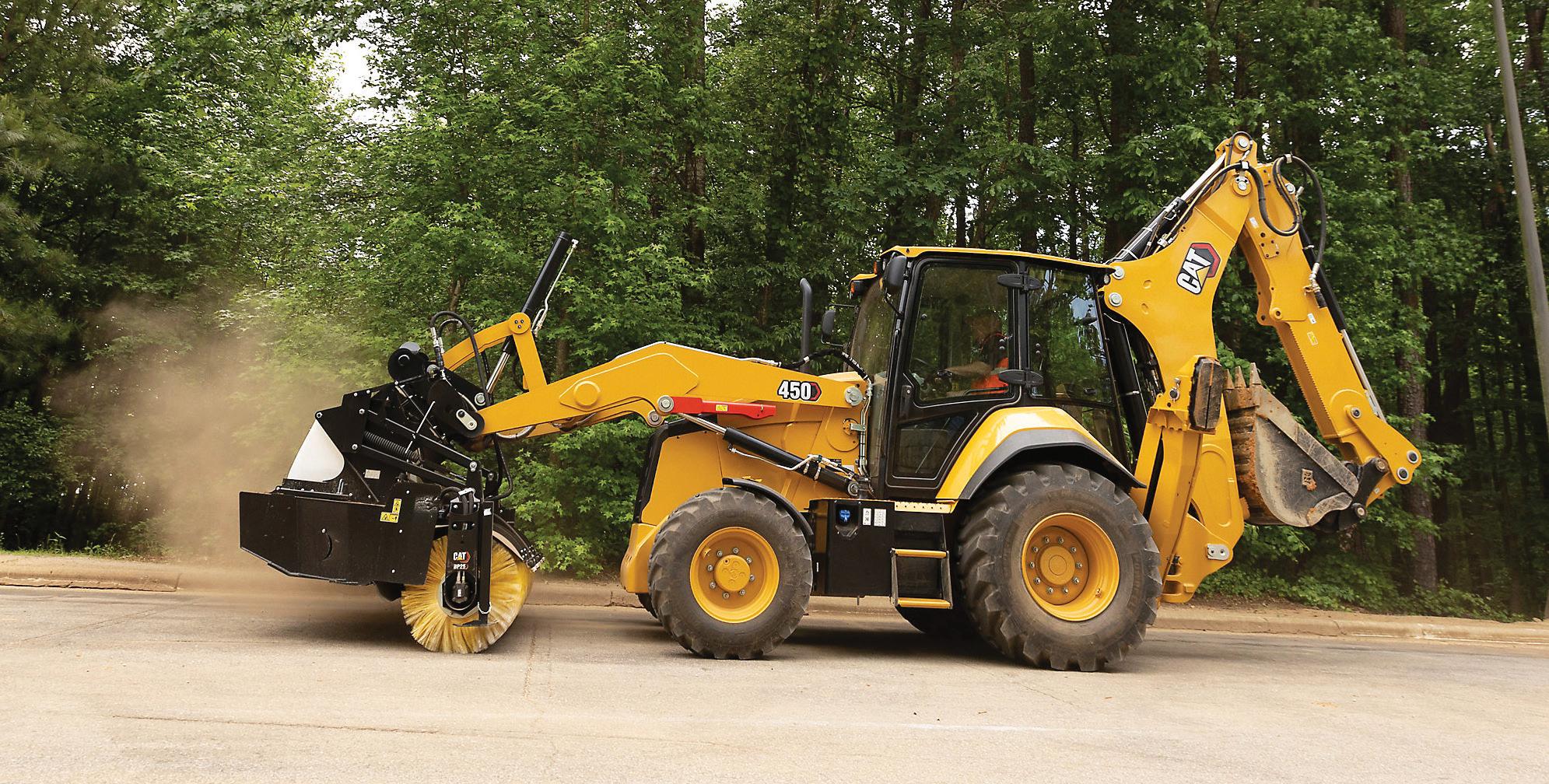
Dominic Bunting, global marketing manager for Backhoe Loaders at Caterpillar, puts it
clearly and succinctly when he says: “One of our customers’ biggest challenges going forward is a lack of skilled operators.”
A welcome feedback loop
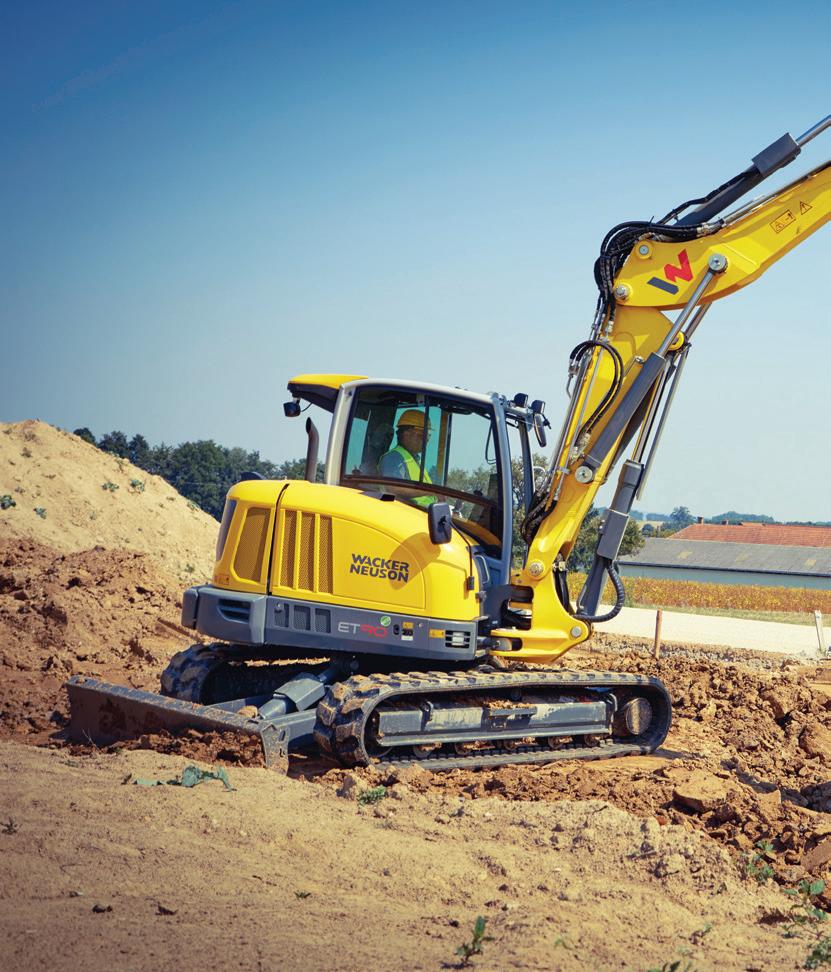
Andreas Gstoettenbauer, head of product management at Wacker Neuson, says that operator and customer feedback is vital and
Cat says that that its next generation backhoe loaders feature improved machine performance, an advanced hydraulic system and increased versatility
Wacker Neuson equipment in action
IMAGE: WACKER NEUSON
IMAGE: CATERPILLAR
IMAGE: LIEBHERR
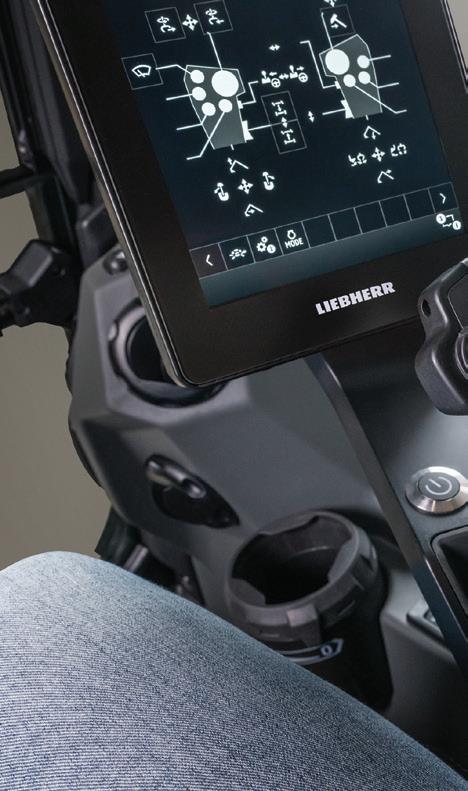
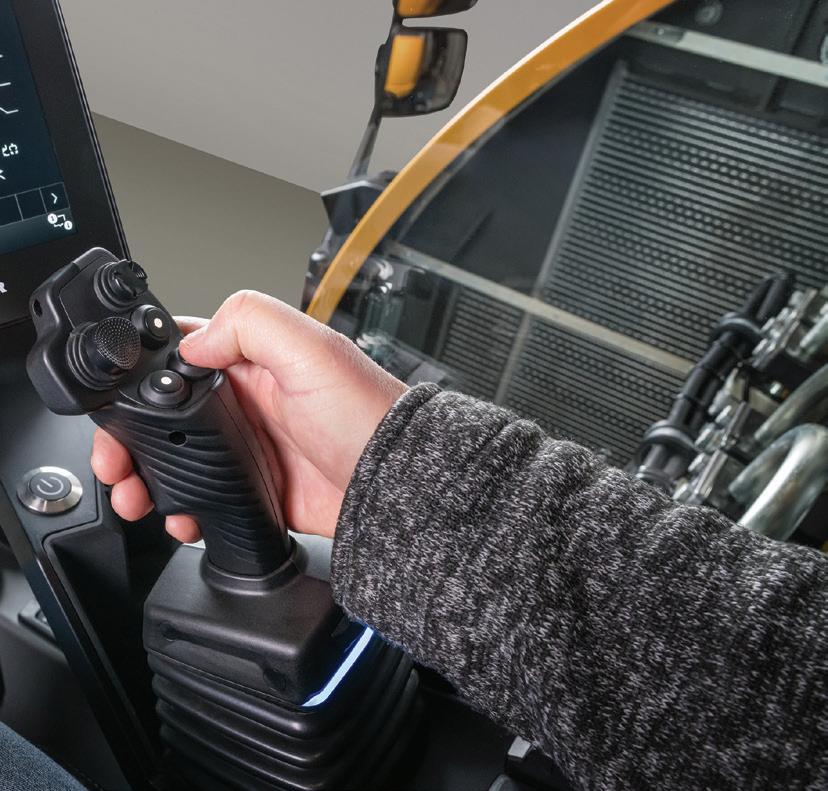
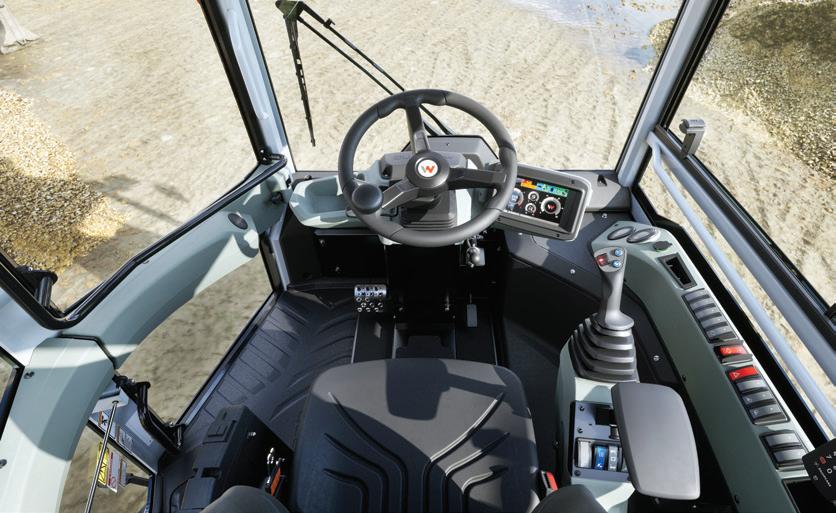
The inside of a cab offers operators more comfort and ease than in the past
IMAGE: LIEBHERR
The elimination of all disruptive factors at the driver’s workplace is the main objective in the development and component design of earthmoving machines
comes through a variety of sources. “Close customer contact through our direct sales network, dealer partners, and continuous field feedback ensures we understand operator needs early. Across all channels – jobsite interactions, trade fairs, social media – priorities consistently point to safety, visibility, comfort, and intuitive usability. These factors directly shape our product development across the entire portfolio.”
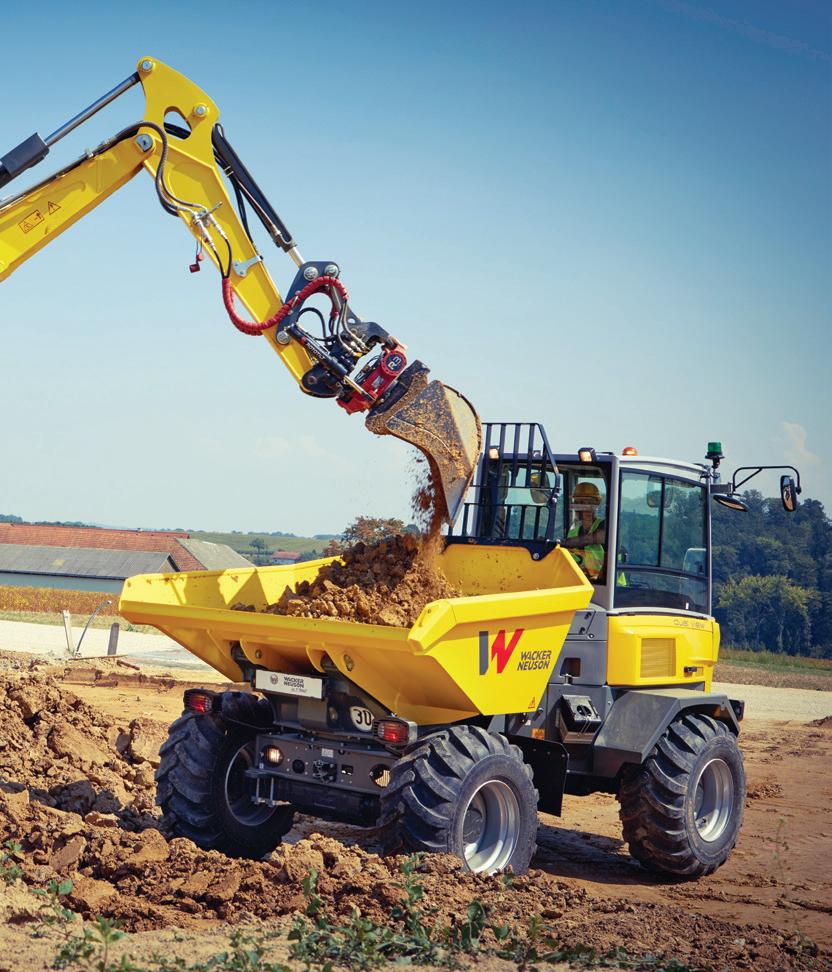
He says that a good example of this in action is the company’s dual view dumpers
Q&A: CAMERON CLARK, BUSINESS AREA DIRECTOR, EARTHMOVING, TRIMBLE
What technology tools are now standard or most in demand among operators, and how are they changing day-to-day operation on site?
Machine control is table stakes when it comes to tools that make it easier for operators to do their job, and shifting from 2D to 3D control provides another big step forward when it comes to automating work, especially for complex designs. With Trimble Earthworks, for example, the ‘autos’ functionality semi-automatically controls the excavator boom and bucket, while the operator controls the stick, which allows operators to create smooth, flat or sloped surfaces to design more easily.
Connecting the field and the office is also standard practice these days, which also helps make an operator’s job easier and makes the day-to-day operation of a site significantly more efficient. Connected workflows give the office and field teams an up-to-date view of progress, materials and design changes.
How do you see operator roles changing as more automated functions, digital interfaces and AI-driven systems become available?
I think the continued evolution of technology is going to allow operators to focus more on higher value and more complex tasks and less on the mundane and repetitive ones that are most likely to be automated. Technology will also continue to provide opportunities for lesser skilled operators to join the construction workforce and add value right away, with increased safety and operator assistance provided in the machine with grade control solutions.
I also anticipate that we will see a shift from manual to more supervisory roles, with operators transitioning from performing manual tasks to overseeing automated systems. These roles will focus more on monitoring and managing systems to ensure they function correctly and efficiently.
Operators that lean into learning and contributing will have the greatest growth opportunity. Gone are the days when you could learn a task once and be done for your career. Now, operators have an opportunity to contribute to innovation by providing feedback on automated systems and suggesting improvements based on their experience and insights. The future is bright for those who embrace these new technologies and the value and opportunities enabled by them.
which were shaped by the feedback the OEM received. The dumpers help address visibility challenges by allowing operators to rotate their seat console, so they have a clear view in their chosen direction of travel.
“By listening closely to operators and responding with targeted solutions, we create machines that are easier, safer, and more comfortable to operate – enabling safe yet high performance in increasingly demanding construction environments,” adds Gstoettenbauer.
Construction powerhouse Liebherr says that operator comfort is at the centre of every development. “The ergonomic workstations in our machines are designed in such a way that they enable stress-free working, even for long
Trimble’s Clark says that the operators that lean into technology will have the greatest career opportunities
IMAGE: TRIMBLE
hours. Modern assistance systems support the operator so that he can work safely and efficiently,” says Florian Falbesoner, group leader technology and advanced development at Liebherr.
Elimination of disruptions
When it comes to operator safety and comfort, the base level, of course, are the legal requirements regarding noise and vibrations but all OEMs are striving to increase safety and comfort as much as possible. Indeed, Falbesoner says that, “The elimination of all disruptive factors at the driver’s workplace is the main objective in the development and component design of earthmoving machines.” Bunting from Caterpillar echoes the previous
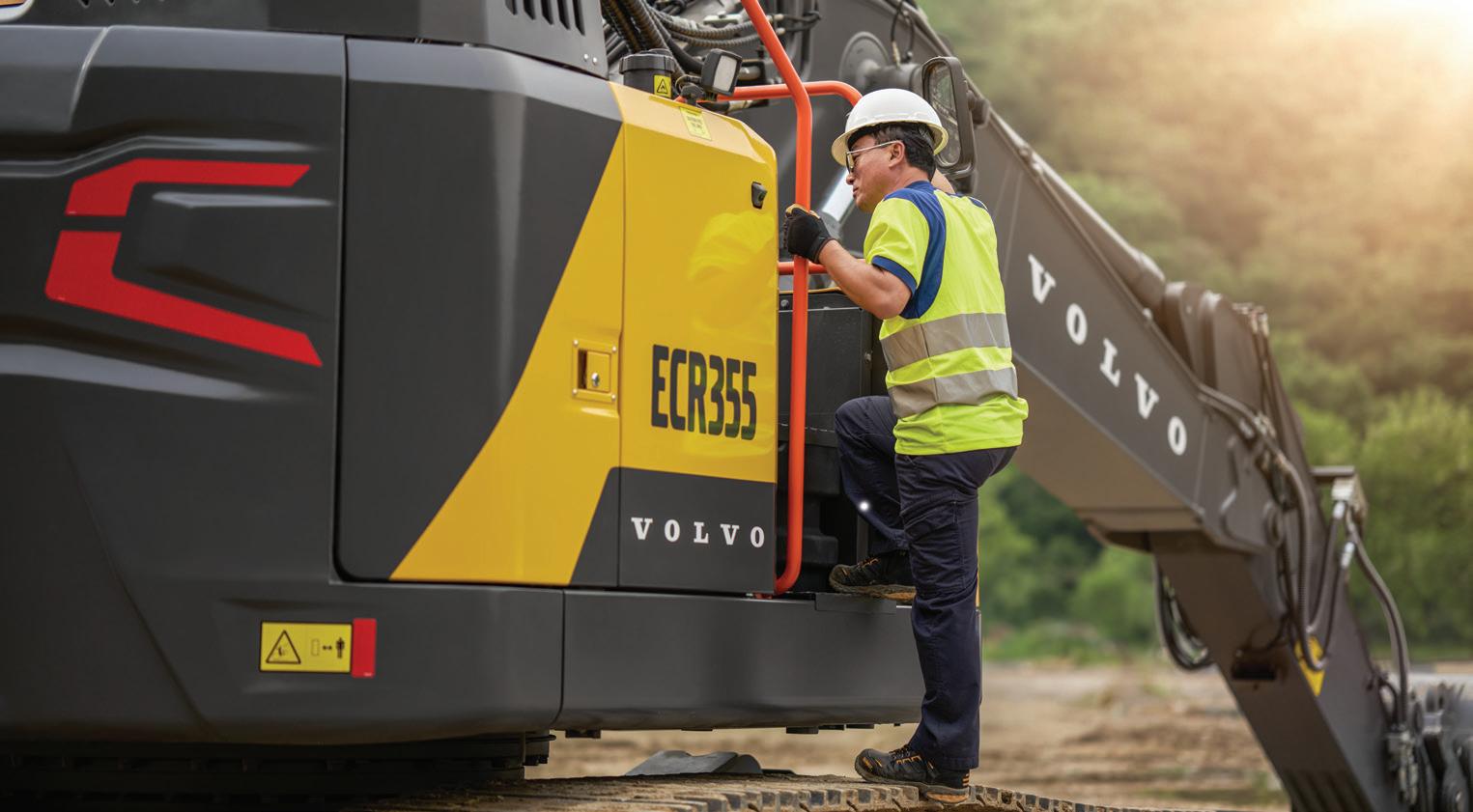
The ECR 355 is said to offer an “industry-leading” operator environment
comments and says that operator comfort is a “top priority” when developing machines. He reveals that this was a key reason for an update last year on the OEMs next generation machines.
“We introduced Electro-Hydraulic Seat Mounted controls on our latest generation of machines allowing operators to control front/ rear or even at the same time from any seated position. This means operators can operate in a much more ergonomic position, prioritising their comfort alongside getting the job done,” says Bunting.
Last year Volvo Construction Equipment (Volvo CE) unveiled new generation upgrades to the 35-ton ECR355 short swing excavator, with a particular focus on the operator. The OEM says that it addresses key productivity challenges such as tight-space operation and demanding lifting needs as well as providing greater fuel efficiency and increased lifting performance. Volvo CE adds that the machine also provides an “industry-leading” operator environment.
“When designing any new product, we wanted to keep the interest of our operators at heart. The improved productivity within the ECR355 creates an unrivalled comfortable
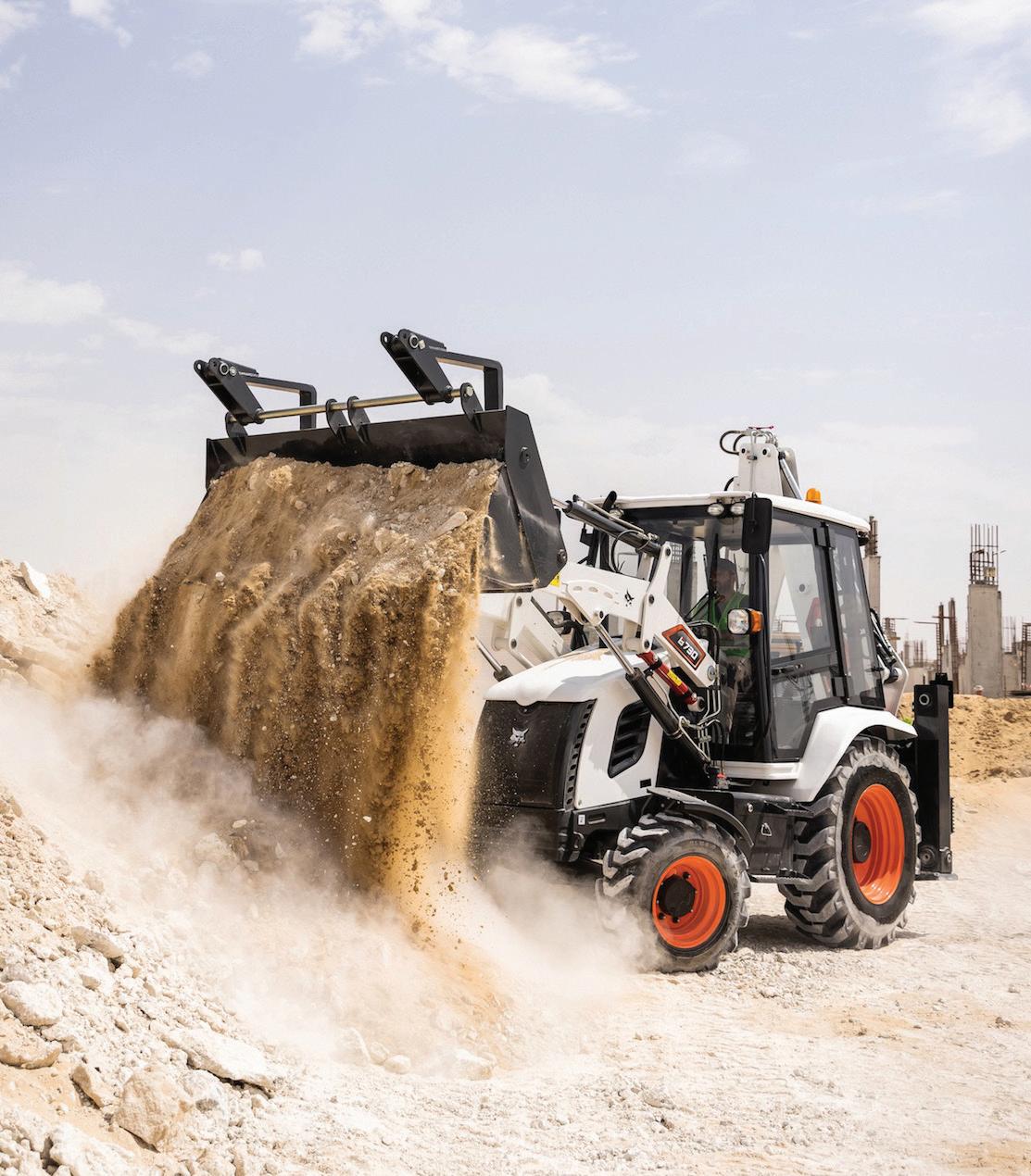
The B730 M-Series backhoe loader from Bobcat is designed for markets in the Middle East and Africa (MEA) and CIS regions IMAGE: BOBCAT
equipment design was primarily on performance metrics – engine horsepower, dig depth, blade capacity, and lifting capabilities. While these remain crucial, a new era has emerged, placing operators at the forefront,” says a spokesperson for the company.
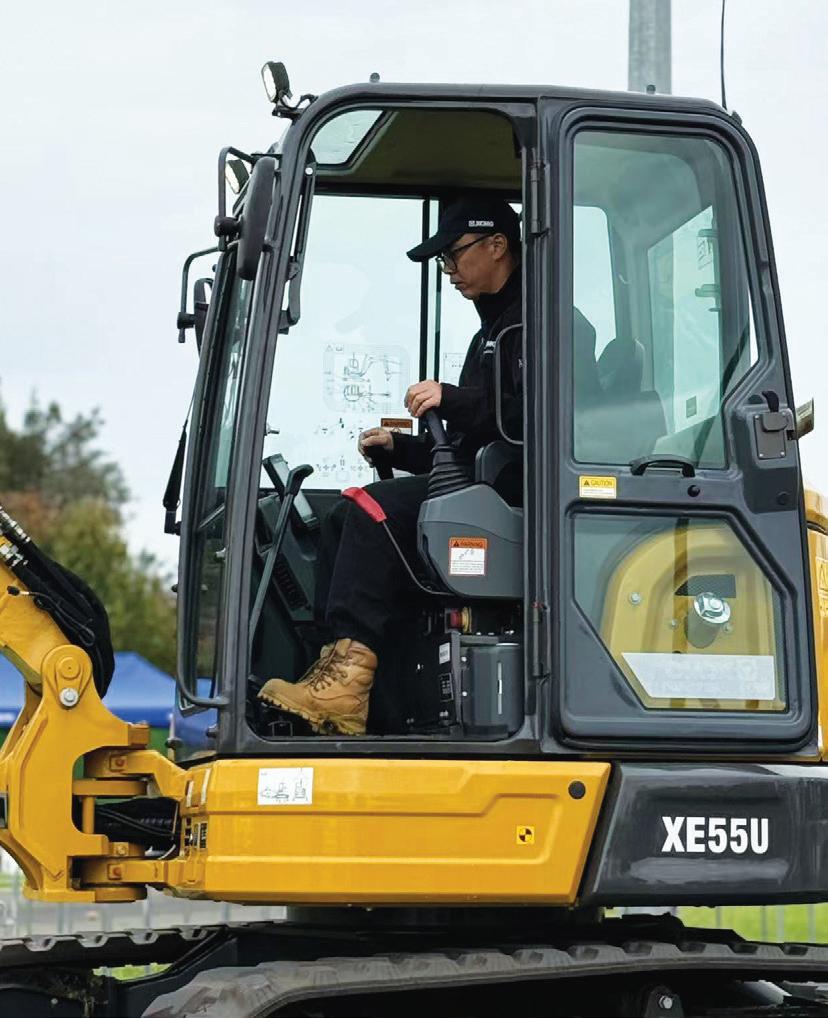
“Comfort, safety, and technological integration are now considered equally essential to ensure efficiency, productivity, and long-term operator well-being. At XCMG, this evolution is not just a trend; it’s a core philosophy. Operators are at the centre of every design decision. Machines are engineered around their needs – from ergonomics to smart technology –enabling them to work longer, safer, and with reduced fatigue.”
The resounding message coming from the manufacturers of earthmoving equipment is that operator safety and comfort are key. This will remain the case in the future but how might these areas evolve and, with technology everchanging, how might the role of the operator themselves alter in the future?
working environment across long shifts,” says Jaesu Kim, global product manager, Volvo CE. He adds that, inside the cab, “operators will also find 50% better in-cab cooling performance, reduced noise levels due to new electric fans, and a host of modern conveniences, including Bluetooth connectivity, wireless phone charging, extensive storage solutions, and a two-stage filtration system for cleaner air.”
A global trend
This ever-increasing focus on operator comfort and safety is not something that is restricted to specific markets; it is a global trend. To illustrate this point, China-based XCMG comments that, “For decades, the focus in earthmoving
“Over the next five to ten years, we expect the operator’s role to evolve significantly – but not disappear. Construction sites will remain too dynamic, too variable, and too complex for full automation in the near term. Instead, assistance systems will increasingly take over repetitive or safety-critical tasks while operators remain in command,” comments Gstoettenbauer from Wacker Neuson.
“We are actively researching these next steps. Together with university partners, we are testing concepts e.g. for automated bulk material transport, including autonomous routing and ‘Find-Me’/’Follow-Me’ functions tested under real jobsite conditions. The challenge remains the constantly changing construction environment, which requires highly adaptive perception and control systems.”
This article started by stating how the design
BOBCAT’S B730 M-SERIES BACKHOE LOADER
The B730 M-Series backhoe loader from Bobcat is designed for markets in the Middle East and Africa (MEA) and CIS regions. The B730 M-Series is said to offer high performance, ease of operation and superior comfort.
Conceived and built at the Doosan Bobcat manufacturing facility in Chennai, India, the B730 M-Series is the latest addition to the Bobcat backhoe loader range, providing a model for the value market. Available in a choice of different configurations and matched with attachments for diverse applications, Bobcat says that the B730 M-Series is ideal for use in construction, rental, roadworks, demolition, excavation, landscaping and many other industries.
“Together with our customers and experienced dealer network we developed a machine that is ideal for mixed contractor and rental fleets,” said John Chattaway, loaders product manager at Bobcat.
IMAGE: VOLVO CE
The role of an operator may change significantly in the next five years I MAGE: WACKER NEUSON
of most earthmoving equipment has remained unchanged – it may well be that in the next decade the operator’s role undergoes one of its biggest changes.
XCMG certainly thinks so, with a spokesperson for the company saying that, “The next frontier in earthmoving equipment is machines that adapt to the operator in real time. Sensors, smart hydraulics, and advanced software now allow machinery to respond intuitively – adjusting speed, pressure, and control sensitivity based on the operator’s movements and workload.
“This approach transforms the operator’s role from constant manual adjustment to strategic decision-making. For example, an excavator can subtly modulate boom speed during delicate digging, or a bulldozer can maintain perfect grading lines automatically, letting the operator focus on precision rather than effort,” says a spokesperson from the OEM.
This blending of human skill with intelligent machine response offers the construction industry a tantalising glimpse of the future; one with less operator fatigue fewer mistakes, and smoother workflows.
Of course, intelligent control and assistance systems in earthmoving equipment already ensure that these machines react independently to potential obstacles and sources of danger, as well as helping to guarantee tasks, such as digging to a certain depth.
Dr. Ing. Manuel Boes, R&D wheel loader, emerging technologies, Liebherr, says that now – and in the future – there is, “no such thing as a generally applicable degree of automation.”
The OEM is making the point that the demands placed in earthmoving equipment are
so varied and diverse from task to task, site to site, and country to country that there is no ‘one size fits all’ approach.
It is good news for those who want technology to make human lives better rather than take over the creative and interesting tasks, as that is exactly how Liebherr sees the future for operators. “Where human creativity, inventiveness and the ability to solve problems are required, the operator will continue to play a decisive role,” says Manuel Boes, Liebherr.
“Where work is characterised by great monotony, a high or even complete degree of automation will probably become apparent sooner than in the next five years. However, the rapid change of operating mode during operation is also an important factor.
“For example, in a very monotonous job, a machine can work autonomously for a few hours but can easily and quickly be transitioned to be operated manually or remotely when required for more challenging tasks. Once the special task has been completed, the machine is switched back to autonomous operating mode. In this way, the strengths of the human operator and the autonomous system can be ideally combined.”
An optimistic view of the future
The future for earthmoving equipment operators may well be more comfortable and more ergonomically designed seats, the latest air conditioning and heating, increased visibility and – crucially – automated assistance when it comes to repetitive tasks.
“Human-machine interaction is developing rapidly, and operators will expect clearer, more intuitive, and more integrated digital workflows [in the future],” says Gstoettenbauer. “As a result, operators will increasingly supervise and optimise smart, sensor-rich, partially automated machines. Their task profile will shift toward managing and optimising these systems, leading to higher safety, efficiency, and overall jobsite performance.”
This sentiment is echoed by Manuel Boes from Liebherr. The company says that, in the medium-term future, the path will continue from a single autonomous machine to systems consisting of several different types of machines involved in a material flow process.
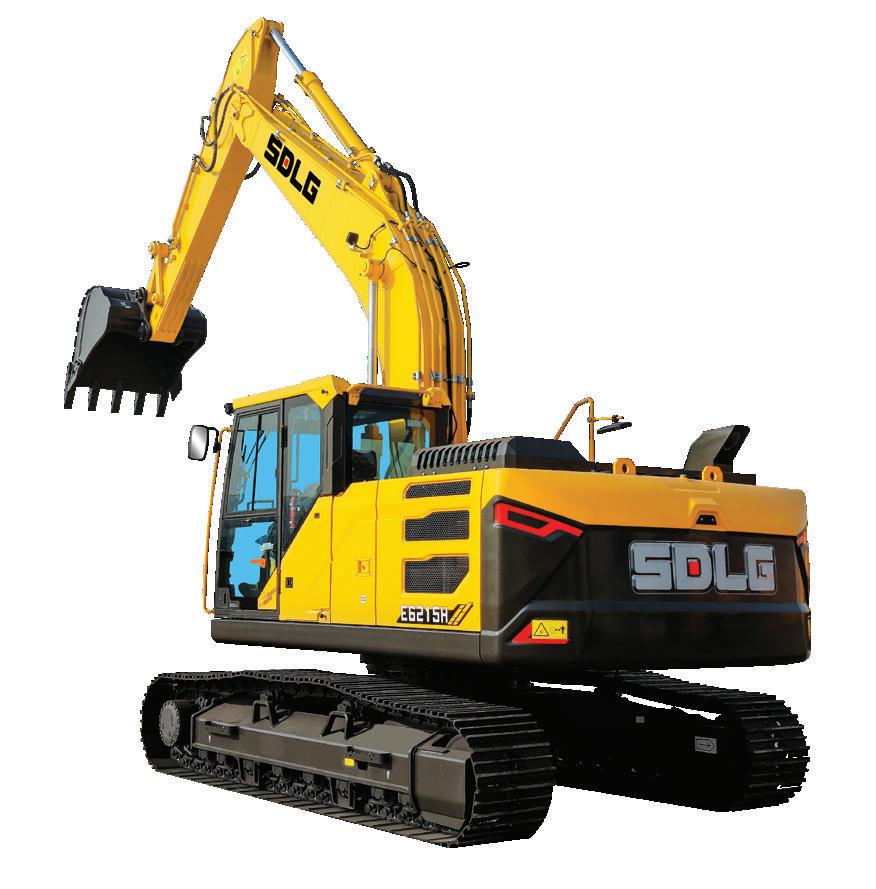
COMFORT-LED SDLG E6215H AT WORK IN THAILAND
On a jobsite site in Thailand a E6215H excavator from China-based SDLG that has been designed for operator comfort is being put to work.
The cab of the E6215H is a 0.9m space, nearly 10% larger than the standard size for this equipment type with a wide field of vision and a large skylight.
The seat is shock-absorbing and, according to SDLG, can filter out over 90% of the body vibration. The cab has fully enclosed sound insulation design and also features a three-dimensional air conditioner air outlet and strong wind force. Commonly used buttons such as start and stop, and lights are centrally arranged.
Previously, when lubricating the excavator, the operator had to climb up and down the machine. Now, with a centralised lubrication and maintenance design, it can be done in just 20 minutes. The optional fuel filling pump is even more ‘hands-free’. Connect the fuel pipe
The E6215H has a fully electronically controlled hydraulic control system
“In some cases, this may be completely autonomous but manually operated and autonomously operating machines may also be involved along the process. The role of the operator is thus evolving in the direction of a
coordinator of the entire material flow,” says Boes.
Rather than diminishing the operator’s role, the industry’s roadmap points towards greater operator effectiveness. With automation handling repetitive and high-risk tasks, operators are set to become supervisors, decision-makers and coordinators of increasingly intelligent machines. If manufacturers get that balance right, the result will be safer sites, more efficient workflows and a more attractive working environment at a time when skilled operators are in short supply. iC
XCMG says that the next frontier in earthmoving equipment is machines that adapt to the operator in real time
IMAGE: XCMG
IMAGE: SDLG
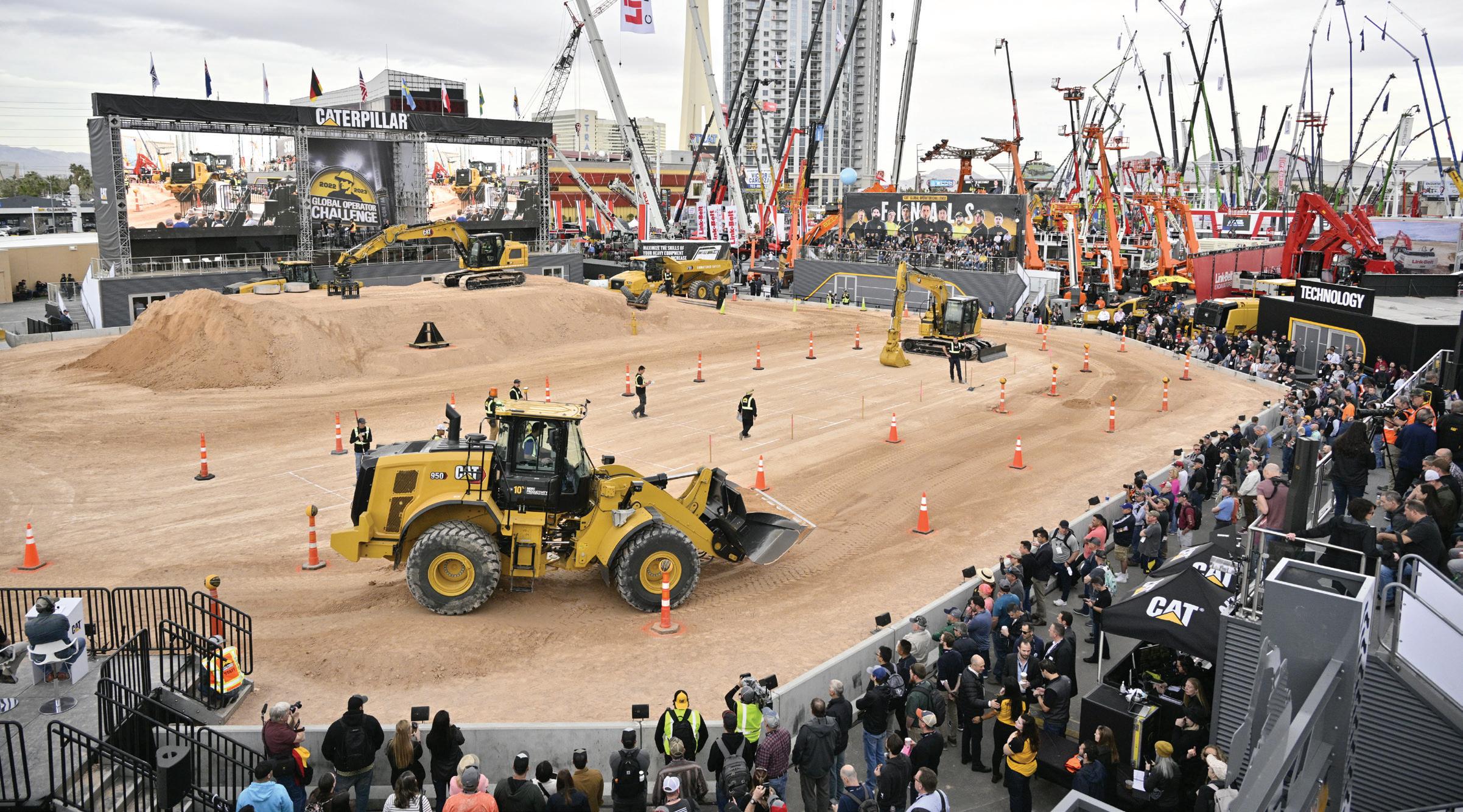
The global construction industry will once more converge upon the bright and shining lights of Las Vegas, US, in March for ConExpo where the latest in equipment, technology, safety, and much more will be showcased to a global audience
EVENT DETAILS
WHAT The largest construction trade show in North America that connects professionals from all aspects of industry WHERE Las Vegas Convention Centre, Las Vegas, US WHEN March 3-7
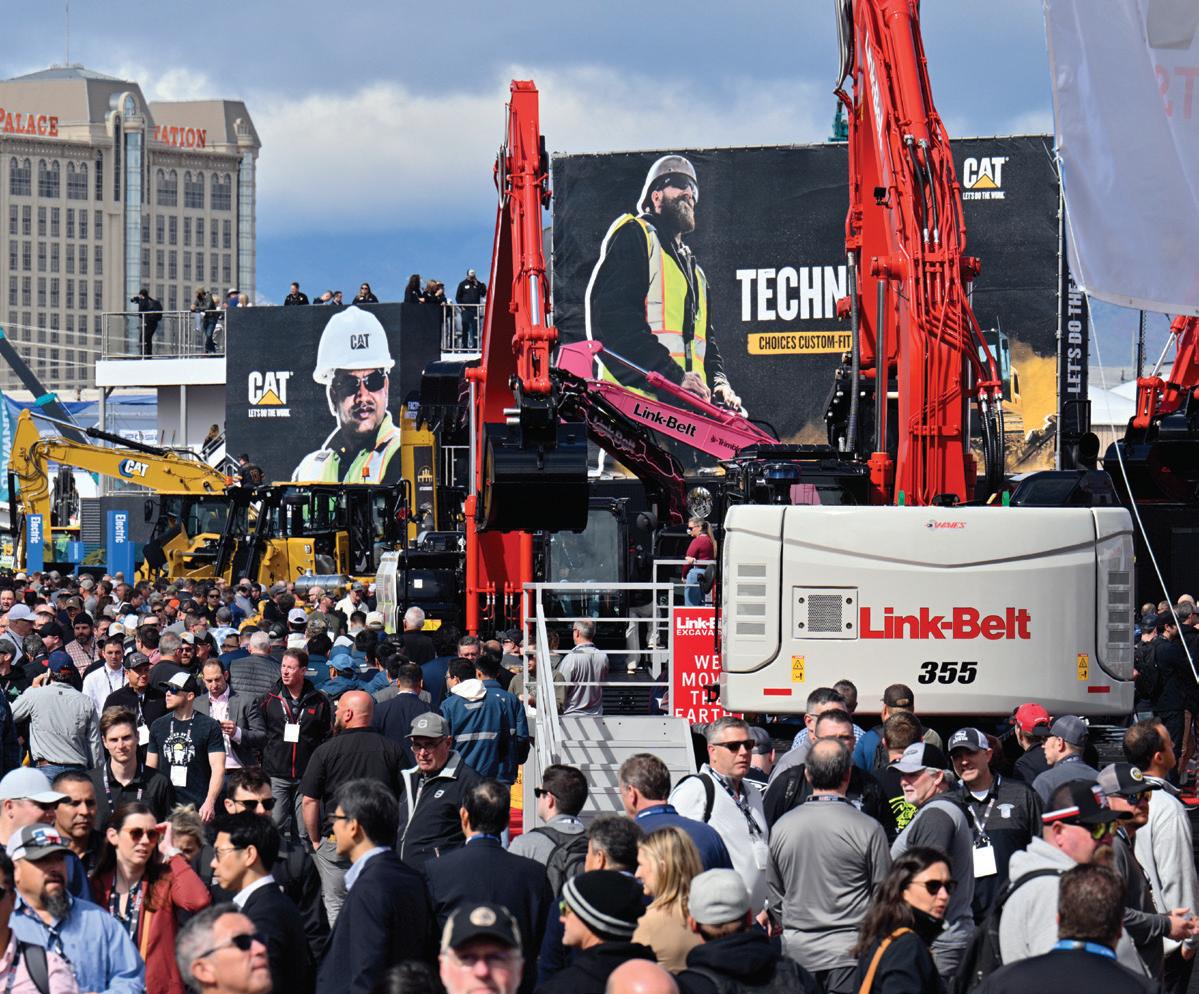
There are fewer than 50 days until the start of ConExpo, which will take place as ususal at the Las Vegas Convention Center, US, from March 3-7, 2026.
The event will feature 2,000 exhibitors across 2.9 million square feet of exhibit space. There will be 50 educational sessions designed to help construction and aggregate industry professionals stay ahead of the emerging technologies, workforce trends and sustainability practices shaping the industry’s future.
The event is organised by the Association of Equipment Managers (AEM), a US-based industry body. AEM serves more than 1,100 member companies across more than 200 product lines in multiple sectors including construction, agriculture, mining, utility, and forestry.
“From a business and trade show perspective, it has been proven repeatedly that people want to come together. They want to see and experience the products and meet the people behind the products, the experts that make them. They want to connect with them in ways that it is impossible to replace with digital,” said Dana Wuesthoff, show director of ConExpo in an interview last year with International Construction
“The heart of why people are coming to the show is to connect with the brands that are building the equipment and technologies that they use in their everyday life.”
Ground Breakers Keynote Stage
Debuting in 2026, the Ground Breakers Keynote Stage, is spotlighting the people, policies, and technologies driving the
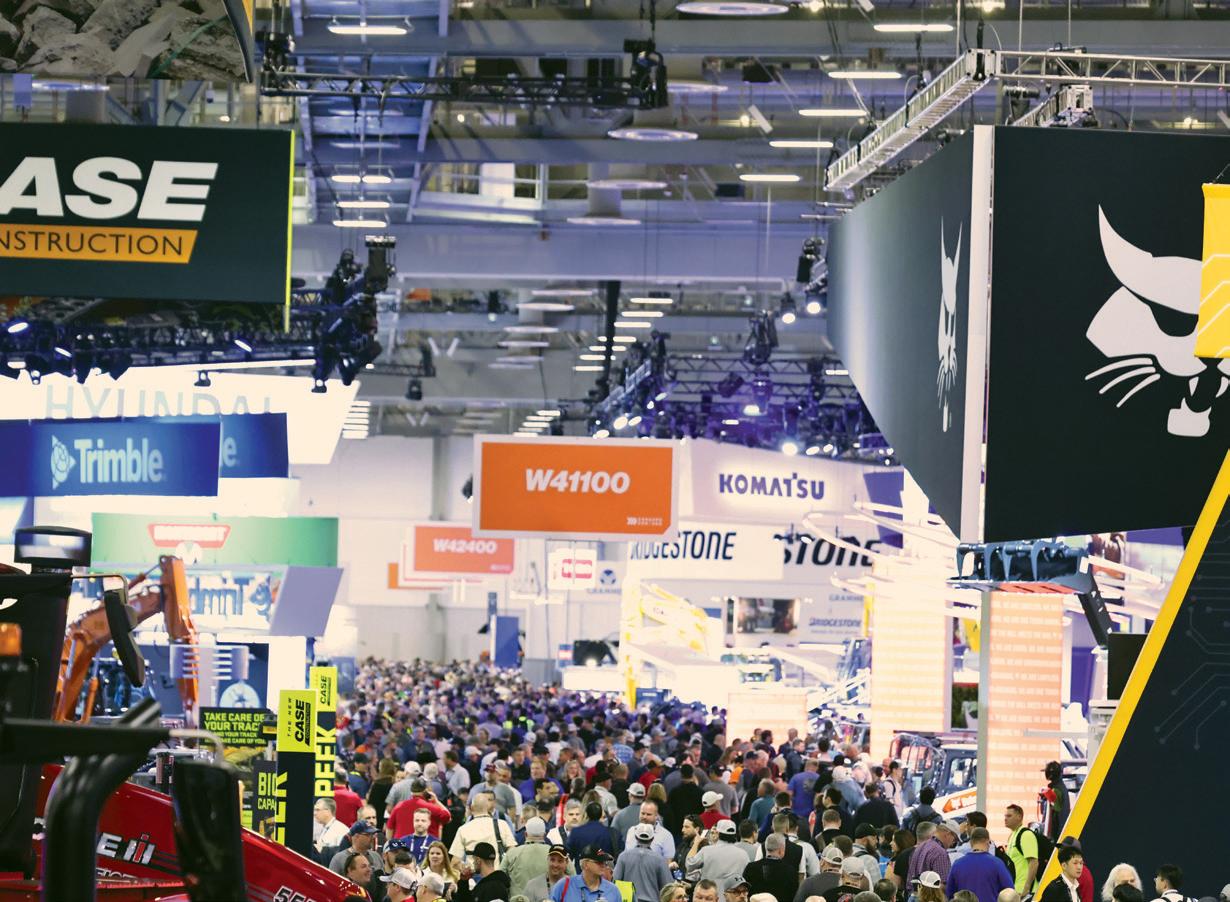
The show is once again being held in Las Vegas, US IMAGE: ADOBE STOCK
construction industry forward.
Sessions will explore topics such as: Artificial intelligence and next-gen tools transform jobsite safety and productivity; Sustainability strategies for reshaping materials and methods; Workforce growth and mental health across the construction sector.
DID YOU KNOW?
More than 139,000 attendees were at the 2023 event
The event will feature 2,000 exhibitors across 2.9 million square feet of exhibit space IMAGE: AEM
The event will also feature a Community Zone which, according to AEM is, “designed as a hub for collaboration and relaxation, the Community Zone is where attendees can pause, recharge, and reconnect.”
LOOKING TO THE SKIES AT CONEXPO
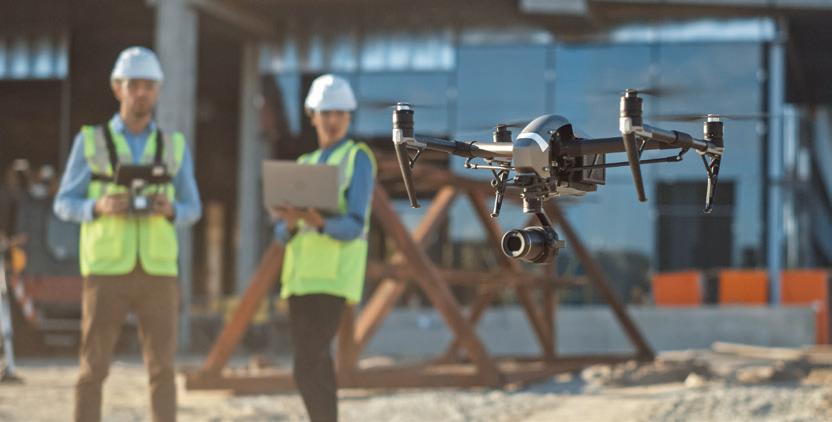
Imagine seeing your entire jobsite every day, in real time without sending a single person into the field. At ConExpo, contractors will discover how automated drone docks deliver daily progress tracking and real-time aerial intelligence, with a live demonstration in the session, Eyes in the Sky, On-Demand: Drone Docks Built for Dirt, Deadlines, and Data. Nino Efendic, president of Aerial Prospex, will detail how autonomous drone docks are transforming jobsite operations with real-time aerial intelligence, 24/7 monitoring and zero pilot overhead. No longer will contractors have to wait to hear from people in the field about changing site conditions.
“You now have an automated tool that gives you updated data about site deliveries, site conditions after rain, conditions over the weekend,” Efendic says. “You really have an endless toolbox of use cases you can now implement with all the data collection.”
The biggest misconception in construction is that drones are just a marketing tool, he says. Not so: automated aerial intelligence can really change the way contractors make decisions day-today, which can then materially boost their bottom line. Contractors will see a live demonstration of a drone dock in action and explore practical deployment strategies for real-world jobsites.
Drones can provide automated updates for the construction industry IMAGE: ADOBE
Located near the entrance of the Festival Grounds, this area will welcome all showgoers and bring together the people and perspectives shaping construction. Attendees can listen to informal presentations, live podcast recordings and conversations with industry voices.
Workshops and education
New workshops like the EmpowerHER, Small Business, and Shop Talks & Walks workshops, will deliver peer-led insights for women in construction, entrepreneurs, and maintenance professionals.
Shop Talks & Walks is a hands-on training focused on preventive maintenance, fleet efficiency, and real-world equipment solutions.
EmpowerHER Workshop – held in celebration of Women in Construction Week 2026 – will connect women industrywide for mentorship and inspiration.
There will also be a Small Business Workshop dedicated to helping small business owners and family-run firms strengthen operations and build partnerships.
These are in addition of the show’s education tracks that cover topics from sustainability and workforce development to equipment management, business practices, and safety.
Tracks are tailored to core construction sectors, including aggregates, asphalt, cranes and rigging, earthmoving, and technology solutions. iC
A STRIKING
Having the best in class engine under the hood, the 4TN101 engine is your best excuse to take on any job. Giving you 105kW and a staggering 550Nm of torque, it can handle anything you put it up to. With over 100 years of experience and our renowned Japanese engineering, Yanmar is your partner in high performance engines and true reliability. More info? Visit yanmar.com/eu/industrial
LiuGong OVM supplied the cable-stay system for Myanmar’s Dala Bridge — a 690m-long structure with a 370m main span and 140m-high towers spanning the Yangon River.
While building materials suppliers have largely weathered US tariffs, European manufacturers face rising costs as steel and aluminium duties bite, reports Neil Gerrard
Before US President Donald Trump took office for the second time, the word ‘tariff’ was generally confined to the dustier corners of trade policy briefings and economic reports.
That all changed – quite spectacularly – in April 2025 when Trump and his team unveiled a wide-ranging set of “reciprocal tariffs” on goods from countries around the world.
While one of the main targets was China, even the US’s closest trading partners like
Canada, Mexico, and the European Union, found themselves grappling with the prospect of their exports becoming much less attractive to US consumers.
As the world scrambled to understand what it all meant, so the situation continued to change. Certain reciprocal tariffs were rowed back, while diplomatic efforts to carve out deals and exemptions intensified.
So where has the situation ended up? And what does it mean for European construction materials and equipment suppliers?
Complicated picture
Needless to say, it’s a complicated picture. April 2025 ‘Liberation Day’ tariffs set import rate taxes at 10-30% (or even higher for some countries like China).
But in July, the US and European Union (EU) reached a trade deal, with a new reciprocal rate
for the EU of 15%. In August, it emerged that the EU faces a sliding scale reciprocal rate that ensures the total tariff rate on most goods is at least 15%.
If the baseline tariff on a good is higher than 15%, the reciprocal rate does not apply. If the baseline tariff is lower than 15%, the reciprocal tariff is 15% minus the baseline rate. What that means in practice is that if the baseline tariff is 4%, the importer pays an additional rate of 11% to bring the total tariff up to 15%.
The UK’s situation is slightly different to the EU. In May, the UK and US reached an agreement that would subject most imported goods from the UK to a 10% tariff.
But then there are blanket Section 232 tariffs that apply specifically to certain goods used in the construction industry, such as steel and aluminium. In June 2025, President Trump raised Section 232 tariffs on steel and aluminium to 50% from 25%. The lower rates that UK-origin steel and aluminium faced were raised to 25%, from 10%.
Steel workers in a factory with molten metal –steel is one of the materials to be impacted by the tariffs
What does it all mean?
Naturally, the announcements, the uncertainty they created, and then further follow-up deals and continuing negotiations have made the situation hard to keep track of.
When it comes to European construction materials, it appears that the impact varies. There are several reasons for this.
First of all, there are areas like concrete, bricks, and cement, where the effect is pretty limited. That’s because they are heavy and costly to transport, meaning that exports to the US were limited in the first place.
“For most building material categories from EU countries, less than 3-4% is exported to the US. Only France and Spain have a higher share of their exports to the US for lime, cement, and fabricated construction materials,” explains Marice van der Sante, senior economist, construction, ING. He notes that French building materials suppliers exported only €55 million (US$64 million) worth to the US in 2024, as an example.
The US imports the most gypsum from Spain – even more than from Mexico and Spain. But at $85 million (US$100 million), the value is still relatively small considering that the total EU building material output for the concrete, cement and brick subsegment alone is worth €260 billion (US$306 billion) a year.
“US import tariffs will hardly affect the EU building material industry of these products. However, for some specific individual companies it could be a real burden,” adds van der Sante.
According to Dr Nicholas Fearnley, head of global construction at Oxford Economics, Europe has fared “reasonably well” from changes to US tariffs over 2025 because tariffs on EU goods, while high, are still lower than those being faced by some other key US trading partners.
That’s not to say that there is no impact. “The EU exports sizeable amounts of steel, ceramics, lumber, electrical equipment and wiring to the US, so construction material producers will continue to feel an impact,” he says.
That impact is likely to be most keenly felt when it comes to the export of steel and, in particular, structural steel, where the US is looking to use Section 232 tariffs to boost domestic production. It’s also a “relatively lower value-add product”, Fearnley points out. This could lead to a supply glut in Europe, he cautions.
He notes one interesting exception to the fact that cement isn’t generally exported from the EU to the US in large quantities: 5% of the global trade in Portland Cement goes from Turkey to the US. “There is a risk that some of this is redirected to Europe, which could
impact local cement producers. Having said this, there are legislative protections to limit the impact of this, as we have seen the EU impose anti-dumping tariffs on Chinese products in recent times,” he adds.
Impact of exports
As explained earlier, the situation for the UK is a little different than for Europe. But here too, the proportion of construction products manufactured in the UK and exported to the US is relatively small, at around 15%.
However, as Rebecca Larkin, head of construction research at the Construction Products Association (CPA) notes, the US is still the second-largest export market for UK construction products after the Republic of Ireland.
“Generally, most of what we export to the US tends to be of higher value and higher quality, meaning that there is likely to be less pricesensitivity than some other countries’ exports to the US and, therefore, demand may not have been affected.”
However, a trade deal that would drop tariffs for steel and aluminium to zero still hasn’t been ratified since it was outlined in May. According to Larkin, the UK exported 180,000 tonnes of semi-finished and finished steel to the US worth £370 million (US$496 million). That accounts for 7% of the UK’s total steel exports by volume and 9% by value.
“In 2024, the US accounted for 10% of all aluminium exports in 2024, valued at around £225 million (US$301 million). Looking at
total steel and aluminium exports data for the year to September, there doesn’t appear to have been a noticeable impact on exports to the US since May, however.”
In fact, Larkin suggests that the most significant tariff-related concerns in the UK are not actually around the trade in goods but around the uncertainty they have helped create and the impact of a potential global economic slowdown. That has implications for the UK where economic growth has been sluggish anyway.
Tariffs themselves have now “slipped down the risk register” for the UK economy, even without final decisions on where they will settle. That’s because the main uncertainty now relates to the impact of November 2025’s Budget, questions over when UK housebuilding will recover, and when investors feel confident enough to approve major new projects, she says.
Europe hit hard
The impact of tariffs on European construction equipment manufacturers is more obvious and, to a large extent, more dramatic.
Analysis by Off-Highway Research in September 2025 showed how American construction equipment buyers can expect the prices of all construction machinery to increase as a result of the expansion of Section 232 tariffs on steel and aluminium.
These new tariffs don’t just override the previous ones, Off-Highway Research has found – they essentially level the playing field so that price increases on machines made in the
The EU exports sizeable amounts of steel, ceramics, lumber, electrical equipment and wiring to the US
In July, the US and European Union (EU) reached a trade deal, with a new reciprocal rate for the EU of 15%
REPORT
Analysis by Off-Highway Research in September 2025 showed how US construction equipment buyers can expect the prices of all construction machinery to increase. For more information visit: www.offhighwayresearch.com
EU, for example, could be almost as high as those manufactured in other countries with whom the US purports to have less friendly relations, like China.
“The issue for the construction equipment industry is that the steel content of the products is so high that the 50% tariff on this element of the machine, component, part or attachment will override any (lower) tariff which has been previously negotiated,” Off-Highway Research managing director Chris Sleight noted in summer 2025.
Meanwhile, the Committee for European Construction Equipment (CECE) warned that it expected the expanded tariffs to impact €2.8 billion (US$3.3 billion) of EU construction equipment exports to the US annually.
The situation has changed little since then, explains CECE’s secretary general Riccardo Viaggi. “We continue to alert the EU on this topic, and the Commission’s trade department raises it with their US counterparts.
“Europe has strongly criticised the unilateral move to impose the so-called Section 232 steel derivatives only a few weeks after the bilateral deal between Trump and [European Commission president] Von der Leyen,” says Viaggi, referring to the US-EU deal struck in May 2025.
“Some in our industry are openly saying that the EU-US deal is almost worthless for the European heavy machinery industry, since it has not prevented this further escalation.”
He adds that while there has been some progress in meetings in Brussels, “nothing has moved or will significantly move any time soon”.
“Our board hosted representatives from the EU negotiating team [in November 2025] and discussed possible ways to mitigate the impacts
Tariffs have, in some cases, led to a breakdown in the global supply chain which impacts construction
of the US steel derivatives tariffs, such as easing compliance and calculations of duties, but nothing more ambitious than that,” he said.
Dialogue between CECE and its US counterparts at the Association of Equipment Manufacturers (AEM) and with CECE’s sister associations in Brussels continue but the sides are said to “remain far apart” on steel derivatives tariffs.
When it comes to trade relations with other countries, however, there could be better news. Viaggi says CECE is supporting the EU’s push to diversify trading partners and open up new free trade agreements (FTAs).
“The key one at this stage is the finalised EU-Mercosur FTA, which includes an agreed timeline for the Mercosur [a South American trade bloc] countries to reduce tariffs on construction machinery, which are now as high as 20%. CECE is advocating for the swift ratification of this deal, but political blockages – most of all in certain European countries over ideological positions on agri-food products from Brazil – is delaying this crucial step.”
Significant compliance challenges
In the meantime, the economic impact that US tariffs have had on European OEMs remains to be seen but should become clearer early in 2026.
Viki Bell, who heads up the Construction Equipment Association (CEA) in the UK, notes that the situation for manufacturers there is similar to companies in the EU. “Steel prices feed directly into the cost of a machine, and with around 70% of UK-built machines exported, the consequences are felt quickly and sharply,” she says.
“The latest US measures on steel and aluminium content have already created significant compliance challenges for UK exporters, particularly where complex machines contain thousands of components and suppliers do not provide detailed material breakdowns. In these cases, duty can end up being applied to the full value of the machine, which is completely disproportionate to the issue the policy is trying to address,” she adds.
The CEA is working with the UK government to see if UK manufacturers can secure any further assistance. The CEA has proposed options including a quota arrangement to keep the dialogue open but progress is “slow”.
As eyes now turn to the huge ConExpo construction equipment show in Las Vegas, US, in March, EU manufacturers will be looking to press for a level playing field. “The sector cannot plan or invest with confidence until these issues are addressed, and we will keep making that point firmly on behalf of our members,” Bell concludes. iC
WORLD’S BIGGEST DEMOLITION CONTRACTORS REVEALED
With annual revenues of almost $9 billion, the 100 largest demolition contractors in the world saw an average increase of 8.2% in 2024.
Published in Demolition & Recycling International (D&RI), the survey highlights a market that continued to grow steadily in
2024 despite wider economic pressures. Although growth among the top 10 was slightly lower than in previous editions – this year they account for 35% of total revenues, down from 36.4% in 2023 – the ranking saw significant movement.
NEW CEO FOR PRIESTLY DEMOLITION
Canadian specialist contractor Priestly Demolition has appointed a new CEO as part of a series of executive leadership appointments.
Shane Stewart has been appointed chief executive and president of the company, which ranks 24th in the list of the world’s 100 biggest demolition contractors, according to the d&ri100 published in December 2025.
Meanwhile, Brian Priestly has been named chief operating officer and Andrew Smith chief financial officer. The appointments take effect immediately.
The company said Stewart joins at a pivotal stage as Priestly Demolition accelerates growth and diversification across its demolition, environmental and infrastructure activities in Canada and the US.
He was previously president and chief operating officer of Alberta-based Northern Mat & Bridge. His background includes senior leadership roles across construction and infrastructure-related sectors, with experience managing complex and remote operations.
Europe remains the largest regional contributor, accounting for 50.2% of total turnover. North American-based firms provide 42.5% of the total sales of the list, with companies from the rest of the world making up the remaining 7.2%
D&Ri Briefing official sponsor
CDE TO OPEN ‘IRELAND’S LARGEST C&D WASTE RECYCLING PLANT’
Wet processing specialists CDE, in partnership with recycling and resource recovery firm Enva, is to open what is claimed to be one of Ireland’s largest Construction and Demolition (C&D) waste wash plants.
Located in Naas, County Kildare, the 100-acre facility will be able to process 180 t per hour and is licensed to accept 330,000 tonnes of construction and demolition waste annually, predominantly consisting of waste soil and stone.
CDE, which has designed and engineered the plant, said it will process a variety of brownfield construction, demolition, and excavation wastes to recover premium sand and aggregate products suitable for high-value construction and critical infrastructure projects.
CDE business development manager, Garry Stewart said, “Our partnership with Enva demonstrates the role that private industry can play when it comes to addressing the waste burden and advancing the circular economy for the benefit of all.”
Demolition & Recycling International brings you the latest major demolition projects and news from across the globe
DEMOLITION COMPLETED AT FORMER NEW YORK DAILY NEWS SITE
The redevelopment of the former New York Daily News site in New Jersey, US, has moved a step closer after demolition works were completed.
The site, which is adjacent to Liberty State Park and overlooks the Statue of Liberty, was acquired by infrastructure firm Goodman Group in 2024 for a reported US$100 million.
With demolition now complete, Goodman
Group has received board approval for what it describes as a “state-of-the-art logistics hub.”
The proposed two-building development will provide up to 427,130 square feet of warehouse space across a 17-acre site.
Goodman Group said build-to-suit opportunities will be available for a limited time, allowing the development to accommodate a wide range of uses.
EUROPE BOLSTERS ASBESTOS PROTECTION FOR WORKERS WITH NEW GUIDELINES
The European Commission has adopted new measures aimed at strengthening protection for workers exposed to asbestos.
The package includes new guidelines to support member states in implementing EU rules that promise to lower occupational exposure to asbestos, alongside an updated recommendation expanding the list of recognised occupational diseases linked to the substance.
The guidance is designed to help national authorities, employers and workers apply the revised Asbestos at Work Directive agreed in
2023, which introduced lower exposure limits and tighter controls. Member states had until 21 December 2025 to transpose the Directive into national law.
B e t t e r T u n n e l l i n g B e t t e r L i f e
CECE Mining highlighted the strategic role of mining equipment as an enabler of a sustainable mining industry
during EU Raw Materials Week
CECE Mining and its member companies took part in the EU Raw Materials Week 2025 in Brussels in November, the main stakeholder engagement event organised by the European Commission for the raw materials and mining industry.
The yearly event gathers policymakers, mining companies, investors, start-ups and academia to discuss industry challenges and implications for policymaking.
The conference programme covered some of the hottest topics in the raw materials space, from progress towards realizing the goals of the Critical Raw Materials Act (CRMA), to strengthening competitiveness and reducing dependencies from China, while keeping the objectives of the European Green Deal in sight.
The CECE Mining session “How innovation enables sustainable mining practices” brought together influential voices from industry and EU institutions. Speakers included representatives from the European Commission, CECE president José Antonio Nieto, and experts from Metso, Epiroc, and Siemens Mobility.
Strategic importance
In his keynote speech Mr. Nieto reiterated CECE’s support for the CRMA, describing it as an important step toward greater strategic autonomy. He highlighted the strategic importance of maintaining a robust domestic mining technology sector and to safeguard its competitiveness by refraining from excessive regulation.
Daniel Cios, policy officer at the Commission, reaffirmed the EU’s determination to reinforce the entire raw materials value chain including the mining equipment industry.
Katarina Öquist, strategic innovation alliance lead at Epiroc’s Underground Division, outlined how automation, digitalisation, and electrification unlock new possibilities for complex mining operations and stressed the importance of a systemic approach and tighter collaboration to accelerate innovation.
Patrik Åkerman, business development manager for Trolley Trucks at Siemens Mobility, raised awareness about the growing volume of materials to be moved as part of mining operations due to decreasing concentration and increasing depth of ore deposits for key minerals like copper.
Addressing the topic of recycling technologies, Madeleine Scheidema, technology manager for Battery Recycling at Metso, noted that mining of EV battery minerals will remain indispensable to meet demand driven by the green transition. However, recycling will complement primary mining and will contribute to long-term circularity goals.
Representing the Commission, Peter Broertjes outlined ongoing efforts to streamline regulatory frameworks and described how the Machinery Regulation covers automated non-road mobile machinery, a cornerstone of next-generation mining operations.
At the event OEMs highlighted how Europe is one of the leaders in the mining technology
sector but stressed the growing challenges created by turbulent geopolitical situation and lack of a level playing field regarding state aid, energy costs and IP protection. For the battery material recycling sector, the issue of scale of EU projects and lower than expected feedstock volume were cited as important risk factors.
Recycled raw materials
On the question of sustainability, Metso highlighted the importance of stimulating the demand for batteries containing recycled raw materials by educating consumers and implementing labelling and traceability schemes. Speakers also addressed the growing skills gap.
A discussion on Research and Innovation saw panelists advocate for stronger collaboration between OEMs, mining companies, academia and start-up in order to move faster from lab to mine. On the topic of funding, OEMs pledged for simplified EU funding programs, more targeted funding and bigger tickets for projects that have higher chances to develop marketready solutions.
Scan the QR code to visit CECE's website.
Sustainability is an increasingly important topic in mining IMAGE: ADOBE STOCK
TELEMATICS CAN MAKE CONSTRUCTION SITES MORE EFFICIENT AND PRODUCTIVE IMAGE: ADOBE STOCK
Telematics technology has evolved from an add-on to an essential feature guiding operations. CRISTINA LAGO looks at what the future could hold for this now essential technology option
Telematics technology is now ubiquitous across the construction industry. The global installed base of original equipment manufacturer (OEM)-fitted telematics systems reached 6.8 million units in 2023 and is projected to reach 12.1 million by 2028, according to IoT market research provider Berg Insight.
What began its life as a nice-tohave has grown into a strategic asset that shapes everything from daily operations and health
CUTTING-EDGE
and safety to long-term financial planning. Through GPS, sensors and data analytics, contractors can track and manage their fleet, boost efficiency and cut costs by providing real-time insights on location, fuel use, engine health, operator behaviour, and more.
Telematics is also tackling
GARRY MOORE, CUSTOMER SUPPORT MANAGER, ROKBAK IMAGE: ROKBAK
TELEMATICS
Bylor, a joint venture (JV) between Bouygues Travaux Publics and Laing O’Rourke, partnered with French con struction tech company Hiboo five years ago to achieve a unified view of the JV’s heavy plant assets at the Hinkley Point C (HPC) nuclear power station in the UK.
Bylor faced fragmented telematics data from dozens of OEMs and rental firms, each delivering information in disparate formats and at inconsistent intervals. This fragmentation produced low data complete ness, patchy connectivity and poor signal quality for equipment operating inside concrete‑dense structures.
AT HINKLEY POINT C
Manual reporting hindered accurate utilisation tracking, maintenance planning and carbon‑emission monitoring – key metrics required by developer EDF.
Hiboo supplied a single data source that aggregated all OEM feeds into a standardised model. The platform integrated directly with Bylor’s computerised main tenance management system, automating real‑time telemetry on fuel, diesel exhaust fluid levels and sensor data from MEWPs, dumpers and other equipment. Advanced geofencing, API‑driven data streams and bespoke dashboards were said to deliver actionable
the increasing problem of plant theft, as well as optimising maintenance and ensuring compliance. This technology is now commonplace within the sector.
“Today, every machine is connected and visible in one place, even in mixed fleets,” says Mikkel Dalgas, chief technology officer at construction technology company Trackunit.
“Contractors expect live location, utilisation, idle time, machine health and fault data, plus simple alerts that help them act fast.”
Capabilities that once felt advanced in
ROKBAK’S ARTICULATED HAULERS ARE FITTED WITH THE COMPANY’S OEM TELEMATICS SYSTEM BY DEFAULT IMAGE: ROKBAK
the industry are now part of everyday fleet management, adds Garry Moore, customer support manager at Scottish-based heavy machinery manufacturer Rokbak.
Rokbak’s articulated haulers are fitted with Haul Track as standard, an OEM telematics system with advanced GPS technology which can pinpoint the machine’s location and track its movement. The system’s mainstream
KPIs, including utilisation, idle time, fuel consump tion and CO2 emissions. Change‑management initia tives, including targeted training and embedding dashboards into existing workflows, ensured rapid adoption across the joint venture’s diverse teams. Hiboo’s unified telematics solution helped eliminate manual reporting, unlocked precise insights for predictive maintenance and is supporting Bylor’s carbon‑reduction targets. Real‑time alerts and exception‑focused analytics also prevent information overload, allowing teams to act swiftly on genuine issues. Bylor provides EDF with verifiable usage data on over 1,500 machines at HPC.
JEFF DRAKE, DIRECTOR OF EMERGING MARKET SOLUTIONS FOR CIVIL CONSTRUCTION, TRIMBLE IMAGE: TRIMBLE
produce reports demonstrating that they are reducing their carbon impact.
Trackunit’s emissions reporting software has a site-specific tracking capability that can be used on an off-highway vehicle fleet, showing the emissions of all connected equipment through a display which allows action to be taken where necessary to reduce emissions.
Dalgas says that the impact of these tools for tier ones contractors is consistent. In the case of Laing O’Rourke, the company has achieved a reduction between 20-30% of idle time across its sites by using Trackunit’s telematics software to analyse machine utilisation, fuel use and emissions across its operations.
capabilities include real-time GPS location, geofencing, engine-hour tracking, fuel burn, idle-time reporting and service-interval scheduling.
“These fundamentals give fleets the visibility they need to stay productive, compliant and efficient,” says Moore. “We’ve reached a point where many capabilities that once felt advanced in the construction industry are now part of everyday fleet management.”
DRIVING DECARBONISATION
Telematics is also playing an essential role in decarbonising the industry. Construction is responsible for around 38% of global emissions, and off-road equipment alone contributes about 1.1% of worldwide CO2 Tightening environmental regulations across different jurisdictions require contractors to
Like other major contractors, Laing O’Rourke faced the challenge of having a huge fleet across multiple sites with limited visibility of real utilisation and idle waste. By connecting assets and using utilisation and site insights, the contractor can now identify underused equipment, reduce idle patterns, and act before small issues become downtime events.
“The focus is contractor-relevant reporting that supports better deployment decisions and lower downtime,” says Dalgas. “When utilisation data is actively managed, it translates into clear fuel, cost and carbon emissions savings.”
BUILT‑IN, NOT BOLTED ON
Rather than a retrospective add-on, equipment today is designed to incorporate telematics from the outset. OEMs are building their equipment to support continuous data exchange and remote diagnostics. Increased inclusion of telematics hardware
TRACKUNIT’S SOFTWARE FOR SITE EMISSIONS REPORTING HAS A SITE SPECIFIC TRACKING CAPABILITY THAT CAN BE USED ON AN OFF HIGHWAY VEHICLE FLEET IMAGE: TRACKUNIT
TELEMATICS
by OEMs has significantly reduced the cost of this technology and data services, making telematics more accessible globally, explains Jeff Drake, director of emerging market solutions for civil construction at US-based software firm Trimble.
“Construction companies benefit from equipment that comes with analytics telematics solutions, providing fleet and service managers with consistent and predictable data to manage equipment utilisation and maintenance across mixed brands,” says Drake.
“Due to telematics standardisation, many OEMs offer richer data feeds with more parameters related to equipment use and operation than those available through international data standards for telematics data.”
This distinction allows OEMs to improve their telematics offerings, giving fleet and service managers richer data and metrics on vehicle health and availability.
Jaakko Huhtapelto, VP of technology and digital business at Finnish industrial machinery manufacturer Metso agrees that telematics is now a standard equipment feature, although the technology still impacts design.
“The same components are also available for stand-alone crushers and screens that are equipped with Metso’s automation system,” Huhtapelto adds. “So, in that sense, it has impacted our product design quite significantly.”
INTEGRATING TELEMATICS
In the case of Wirtgen Group – owned by John Deere – the construction machinery giant has been integrating telematics into its equipment for many years, Johannes Zametzer, associate director of digitalisation and production systems at the company, tells International Construction Contractors can access their sites and equipment in real time through the John Deere Operations Centre - a central digital platform for managing machines, jobs and service for construction and road-building operations.
their locations and their operating status. Job information and site data can also be managed in the same system.
“For the workshop managers, for example, the system provides notifications for diagnostic trouble codes, supports maintenance planning, and helps secure machine uptime,” explains Zametzer.
“Site supervisors benefit from live monitoring of site progress and performance against targets, enabling real-time decision-making. Meanwhile, process experts and reporting teams gain access to in-depth analysis of all process data collected from machines equipped with wireless power transfer (WPT) technology, including export options for Department of Transportation reporting.”
JOHANNES ZAMETZER, ASSOCIATE DIRECTOR OF DIGITALISATION AND PRODUCTION SYSTEMS, WIRTGEN GROUP
Wirtgen Group machines equipped with its telematics control unit or John Deere modular telematics gateway can connect to the centre. The platform can also integrate compatible machines from other manufacturers. The exact data available depends on the telematics and optional equipment installed on each machine. The platform is used mainly for fleet and site management. Users can see their machines,
WIRTGEN GROUP HAS BEEN INTEGRATING TELEMATICS INTO ITS EQUIPMENT FOR MANY YEARS
The John Deere Operations Centre is also used for performance monitoring and analysis. Productivity and performance data can be viewed and analysed within the platform to help users understand how machines and projects are performing over time. The level of detail available depends on the machine equipment and the digital options installed. In the US, BOCA Construction is using the John Deere Operations Centre to improve the efficiency of operations, says Zametzer. The contractor’s site managers save several hours of work each day as they no longer need to make phone calls. Thanks to the data generated by WPT milling and transmitted to the operations centre, they have real-time insights into the work being carried out on site.
AI: THE BRAIN BEHIND THE SENSORS
The use of AI in telematics in construction is growing and is expected to expand significantly over the next few years. Widespread adoption
IMAGE: WIRTGEN GROUP
could dramatically improve operations by turning raw data into actionable insights.
For example, machine learning can classify fault codes by severity, detect abnormal pressure fluctuations or identify overheating in machinery, explains Rokbak’s Moore. By analysing these and other datapoints, AI can reduce inefficiencies, such as queuing time, optimise fleet management by pairing the right excavators or loaders with appropriately sized haulers and predict the number of machines needed to meet production targets on a daily, weekly or monthly basis.
“AI can also enhance parts forecasting and service scheduling, helping to prevent downtime and reduce maintenance costs,” Moore adds.
“More broadly, AI is shifting how we utilise telematics data; rather than simply reporting how a job site performed last week, it can provide actionable recommendations to improve operations in the coming week.”
At the heart of the transformation is the ability to process massive streams of sensor data in near real‑time. Drake at Trimble explains that AI has the potential to process vast amounts of data rapidly, providing construction companies with near real‑time insights into project status and fleet conditions, predicting potential issues that could affect production.
This could result in not merely faster reporting but a closed‑loop system where data from design, execution and maintenance flow continuously, allowing on‑site staff to adjust plans before any delays could happen.
But as Dalgas notes, the challenge lies in the, “messy, mixed‑fleet, highly variable” nature of construction data: any successful model will require cleaning, standardising and enriching it before AI can be applied.
“Models only work when data is harmonised and tied to real operating conditions,” Dalgas adds.
THE ROAD AHEAD
Looking forward, experts believe that telematics will evolve from a dashboard of numbers into a real‑time, AI‑augmented command centre. The most innovative cases will be found after the initial connectivity.
5G and edge computing will supply the bandwidth and latency needed for site‑wide digital twins, while AI will translate raw sensor streams into predictive actions and autonomous assistance.
Trimble’s Drake predicts that 5G and edge computing will facilitate the aggregation of project fleet telematics data at the source (the project site) and enable rapid transmission of synthesised data to other systems within the construction company in real time.
“This [will allow] for the use of lower cost telematics hardware on machines, with direct links to onsite edge computing systems that aggregate and process data for faster real time equipment insights,” he says.
Moore at Rokbak adds that edge computing will be “particularly crucial” for systems that require low latency data transfer, such as collision avoidance or personnel proximity monitoring. This might be a game changer for sites with poor connectivity due to factors such as dense metal structures or remote locations like mines.
“Edge computing allows analytics to be carried out directly on site rather than relying on the cloud, ensuring faster response times and more reliable safety and operational monitoring,” Moore explains.
Secure, open data ecosystems will give
contractors the confidence to share insights across every party in the supply chain, and equipment designers will embed connectivity as a core attribute.
The result will be construction sites that operate with unprecedented efficiency, safety and adaptability – where the machines themselves actually help orchestrate the work, rather than merely reporting on it. CT
Q&A With HÅKAN
SCHILDT, vice president safety & digital
applications,
Epiroc
What is considered mainstream and cuttingedge telematics technology today? How do you see telematics evolving in the industry over the next three to five years?
The volume of data – and the way in which it is utilised – will continue to grow, both to improve control and to provide documentation of completed work. New laws, regulations, and requirements from infrastructure owners will increasingly influence decision-making, with data playing a central role. Today, documenting proof of work through datadriven records has become essential. As a result, more advanced planning will be required, and from this perspective the importance of data will continue to expand. Transparency is crucial, though its application varies depending on the project and how the data is ultimately used.
How can the industry make the best use of the data obtained through telematics?
Growing data volumes require new technology. For example, 5G is an important enabler for telematics. We need to develop new solutions to manage both these emerging technologies and the increasing amounts of data.
Data-driven decisions are essential to improve productivity and efficiency, as well as to strengthen security. The demand for data is significant – not only to understand processes but also to detect errors and ensure quality.
One key challenge is: how do we deliver this information to the customer in the most effective way? A way to do this is to monitor the single machine and function, rather monitor and use data for improve collaboration in-between machines, this to use output data from one machine to input data to next machine. If this can be done with the possibility for the decision maker to overview in real time, then data will play a completely new role.
PHOTO: MAGNUS WAHMAN
METSO’S CRUSHING AND SCREENING EQUIPMENT COMES WITH A RANGE OF TELEMATIC OPTIONS IMAGE: METSO
After years of delays and extreme weather, engineers race to finish historic Antarctic project, Neil Gerrard reports
It may be winter in the northern hemisphere but in Antarctica it’s the start of the summer, when temperatures in coastal regions can reach a positively balmy 0˚C.
That means the start of a seventh – and final –construction season to deliver one of the most complex projects ever undertaken in the polar regions.
After six previous seasons of work, the Discovery Building at Rothera Research Station, located on Adelaide Island off the Antarctic Peninsula, is almost complete and ready for handover in April 2026.
As the 2025–26 summer season progresses, the modernisation programme is now focused on final commissioning of the 60room building, which provides all electricity, drinking water, drainage,
heat, and communications from a single, modern hub. At the same time, it reduces the British Antarctic Survey’s (BAS) carbon emissions in Rothera by 25%.
Within the Discovery building, work involves testing and confirming mechanical, electrical and plumbing systems all work as intended, as well as fine-tuning generators so that they recover and use as much heat as possible.
Meanwhile, work this season also involves the deconstruction of six buildings dating back to the 1970s. All of those responsibilities are being handled by a team of 45 contractor personnel, supported by a BAS supervisory team of five people who will be living on
Antarctica for the six-month season. They find themselves working alongside around 120 BAS operational personnel conducting research at one of the most remote places on earth.
The final push to completion
As David Brand, senior project manager at BAS (based this season in the UK but who has worked previous seasons at the station), knows all too well, the seasonal window is uncompromising.
Take the deconstruction of those 1970s buildings, for example. They need to be carefully dismantled from top to bottom due to their age, asbestos and even some lead paint. Work involves isolating services, internal stripout and dismantling in time for waste to be loaded into containers and transported by ship back to the UK for recycling.
The ship arrives in March; it’s not a deadline
The Discovery Building at Rothera Research Station, located on Adelaide Island off the Antarctic Peninsula
David Brand, senior project manager at BAS, got well acquainted with cold weather
that can be missed. Brand is nonetheless confident and there’s some “float” built into the schedule to accommodate potential delays.
There have been delays, of course: This final season completes a construction journey that began with a planned four-season programme. The fact that it has extended to seven is down less to the challenges of the harsh Antarctic environment than to the delays caused by the Covid-19 pandemic.
Although that’s not to say that Antarctica doesn’t present a challenging construction environment. Summer may be starting in December but conditions at Rothera can still change rapidly. Snowfall is not confined to winter; it is common during ‘shoulder’ periods when temperatures fluctuate and meltwater can refreeze, creating variable ground conditions.
Brand notes that assumptions are constantly tested by the variability of snow and ice. “There’s so many challenges to work through. You think that snow behaves in one way and it always surprises you because it’s such a variable – it can be icy, it can be very soft, it behaves in different ways around the building.”
Working at height is prohibited during high winds, while low temperatures force more frequent breaks to allow workers to warm up. They also require specialised personal protective equipment (PPE).
“You also have to be particularly careful around having banksmen, particularly with traffic movements in those sorts of in those conditions at a busy operating station. Before you get to the start of the season, you need to define your traffic management plans, your snow management plans and then the activity plans around what you’re doing. Every single activity is reviewed by the contractor, the subcontractor, before it is reviewed and signed off by us,” Brand adds.
Engineering responses to climate
The Discovery Building has been engineered to operate in a unique combination of climatic conditions: extreme cold, variable snow loads, strong winds and prolonged periods of
daylight or darkness depending on the season.
BAS worked with contractor BAM and technical adviser Ramboll on long-term modelling to inform design decisions. They used a “build it before you build it” approach, with trial builds in the UK, digital modelling, and prefabricated components.
Brand also describes a multi-layered approach to risk mitigation. “We did snow modelling before we started the project. We had a good idea based on years of meteorological data. We’ve also done an appraisal on future climate change.” However, localised conditions don’t make things entirely predictable.
Rothera’s location, surrounded by sea, adds complexity as sea temperatures affect localised weather patterns and wind flows.
One notable feature is the large wind deflector on the south elevation. Its purpose is to shape airflow over the building so snow scours away from the immediate footprint, reducing the need for mechanical clearance. But even this has produced unexpected consequences as snow eddies have developed in areas that modelling suggested would remain clearer. The result is ongoing adjustment of external elements, including louvers protecting air-intake systems, which can accumulate and freeze snow.
Other adaptations include design solutions that ensure external doors do not freeze up. These refinements allow the building to maintain operations during the Antarctic winter when the station is staffed by a small overwintering team.
Solar panels have been installed on the building’s north-facing side, rather than on the roof, to maximise exposure during long summer days and reduce the effect of snow accumulation. The building-management system also plays a key role, allowing energy use to be adjusted according to occupancy.
Construction in Antarctica is unusual in another sense: the workforce doesn’t just live and work on site – they are doing so alongside the “client”: BAS’s operational staff of around 120 people. Construction teams reside, eat and socialise with station personnel, and must
Getting materials and resources to and from the site posed some logistical challenges
adapt to an environment where work and personal life are inseparable.
This arrangement requires careful coordination. Additional support staff (extra chefs, for example) are brought in during construction seasons to accommodate the higher population, Brand says. There are also social activities organised to allow integration between a group of people who are, for the entire season, in close proximity to each other.
Full handover in sight
Full handover of the Discovery building in April 2026 will mark a major upgrade to Rothera’s scientific and operational capability. By consolidating power, water, logistics, storage, workshops and welfare facilities under one roof, it allows BAS staff to concern themselves less with the day-to-day logistical and operational challenges of being in the Antarctica and gives them more time to dedicate to science, says Brand.
It also ensures that the UK maintains a sustainable presence in Antarctica at a time when environmental research and monitoring are increasingly critical.
Covid-19 forced the project team into prioritising certain aspects of the project with the limited resources they could muster during the pandemic, such as resurfacing the runway at the station and upgrading lighting.
The resequencing of works led not only to the extended timeline for the project but also to an increased cost, although Brand is not able to discuss the final figures, which are still being assessed.
Unsurprisingly though, he notes that it’s “more expensive per square metre than you’d expect for a building in the UK, mainly because of the logistical constraints – you have to ship all this material down there.”
What BAS will end up with at the end of this season, however, is a building with a 60-year design life that won’t require major maintenance for the first 25 years, cementing BAS’s presence in Antarctica long into the future.
IMAGE: BAS
Construction has started on a third runway at King Salman International Airport in Riyadh, Saudi Arabia.
Contractors FCC Construcción and AlMabani General Contractors Company are responsible for the works, according to the airport’s developer, which is owned by Saudi Arabia’s Public Investment Fund (PIF).
The third runway forms part of the King Salman International Airport (KSIA) master plan and has been designed to align with prevailing wind conditions in Riyadh, with the aim of improving operational efficiency.
It will be 4,200m long and include multiple access taxiways to support smoother aircraft movements.
Once operational, the runway is expected to increase the airport’s hourly capacity from 65 aircraft movements to 85, supporting long-
Where is it?
Riyadh, Saudi Arabia
Completion date?
Due to be completed in 2030
Did you know?
When finished the airport will be one of the world’s five largest by area
term growth in passenger and cargo traffic.
King Salman International Airport is being developed on the existing site of King Khalid International Airport and is one of Saudi Arabia’s most significant infrastructure programmes under Saudi Vision 2030. The overall airport development is widely reported to carry a total investment value of around SAR 112.5 billion (US$30 billion).
UK-based construction company Mace won the role of delivery partner for the project in 2024.
The wider scheme will comprise six runways, three new passenger terminals alongside the existing King Khalid terminals, extensive logistics facilities, and associated residential
King
and leisure developments.
Covering an area of approximately 57 square kilometres, the airport is designed to handle up to 100 million passengers annually and more than two million tonnes of cargo by 2030. When compete it will be one of the world’s largest airports.
In a statement reported by the Saudi Press Agency, acting CEO of KSIA, Marco Mejia, said, “Launching construction of the third runway marks a pivotal step in delivering the KSIA Master Plan and reflects our commitment to developing world-class infrastructure capable of supporting future growth, enhancing operational efficiency, and expanding long-haul connectivity without constraints.” iC
Salman International Airport will be located to the North of Riyadh on an extended area adjacent to the existing
King Khalid International Airport IMAGE: ADOBE STOCK
Official image of how the King Salman International Airport is expected to look when work has been completed
IMAGE: MACE
The Worldwide Leader in Concrete Paving Technology
Central Hall -- C5148
Las Vegas Convention Center
January 20-22, 2026
Central Hall -- C30282
Las Vegas Convention Center
March 3-7, 2026
GOMACO offers the full range of concrete slipform pavers, curb and gutter machines, trimmers, placer/spreaders, texture/cure machines and bridge/canal finishing equipment. GOMACO equipment features our exclusive and proprietary G+® control system, created in-house by our software engineers from the wants and needs of contractors paving in the field. At the heart of GOMACO equipment is our passion for concrete and our commitment to our customers. We look forward to visiting with you about your upcoming paving projects and your concrete paving equipment needs. Our worldwide distributor network and our corporate team always stand ready to serve and assist you.