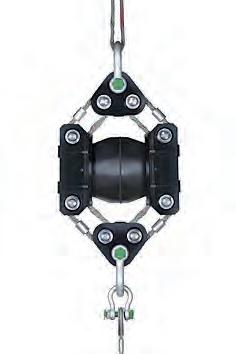
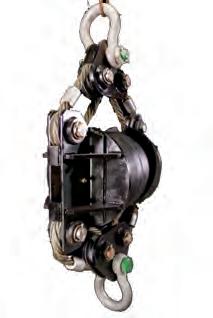
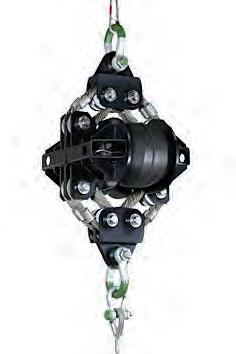
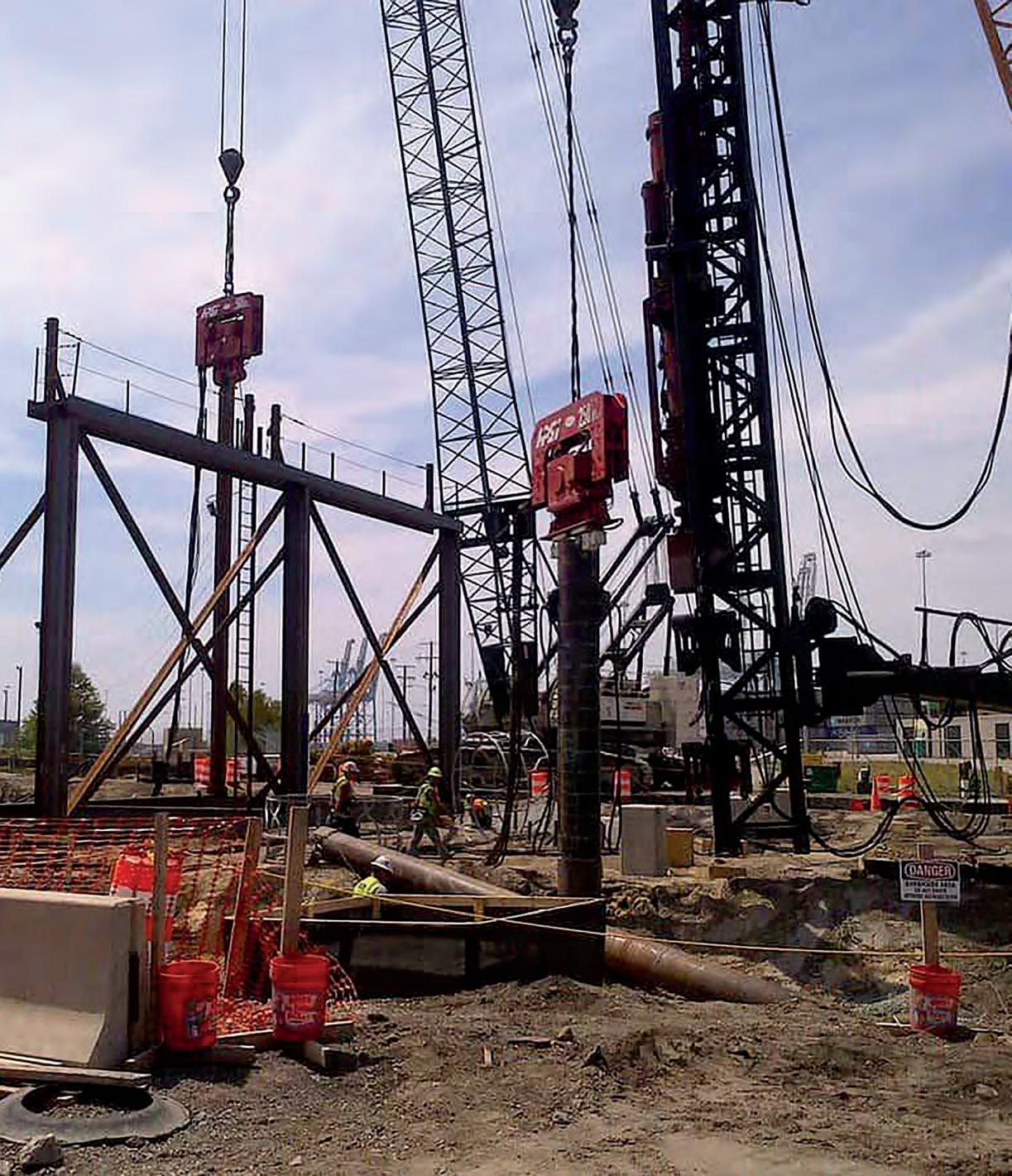
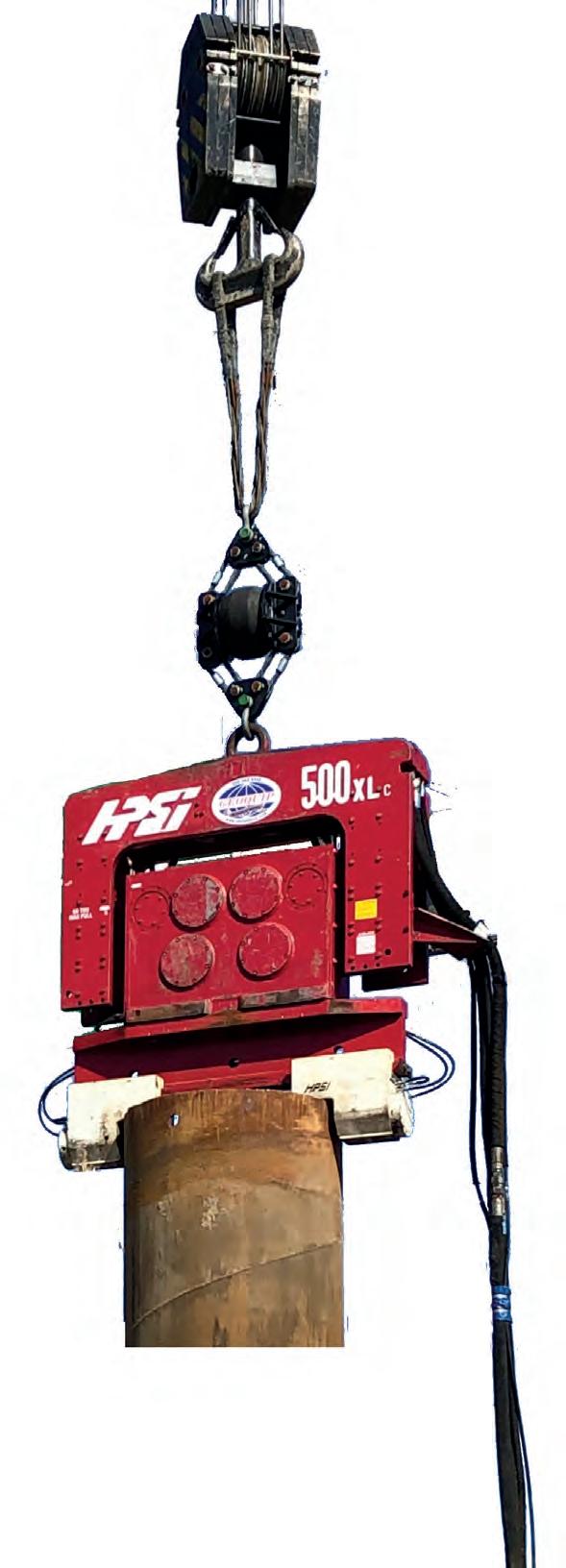
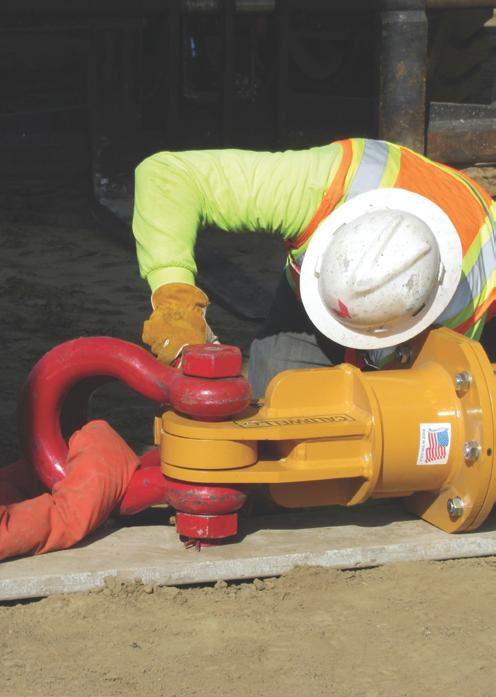
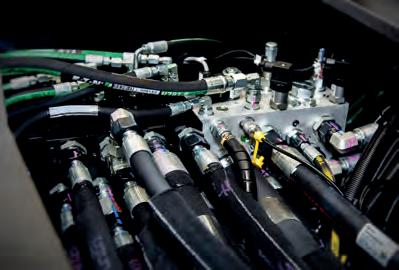
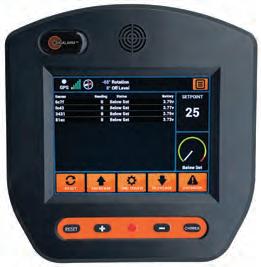
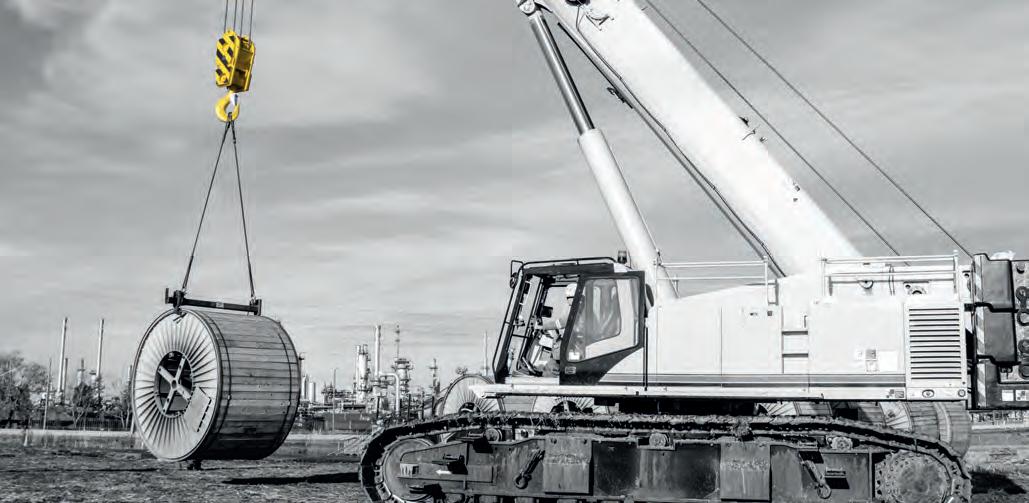
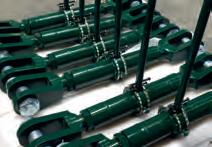
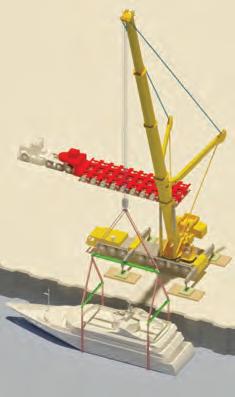
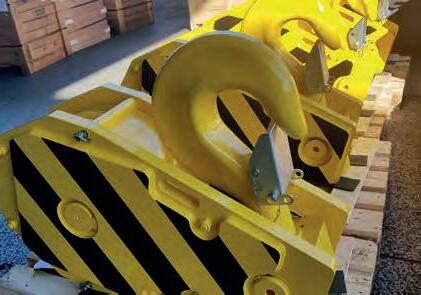
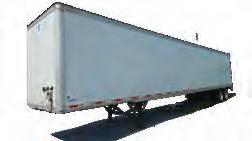
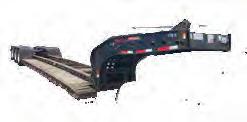
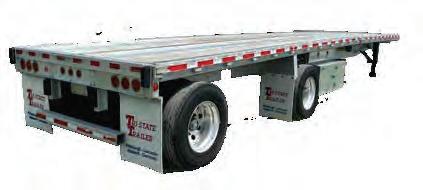
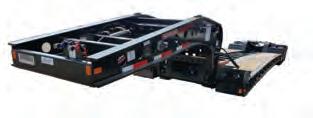
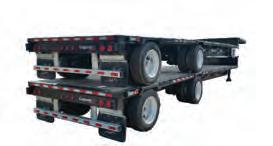
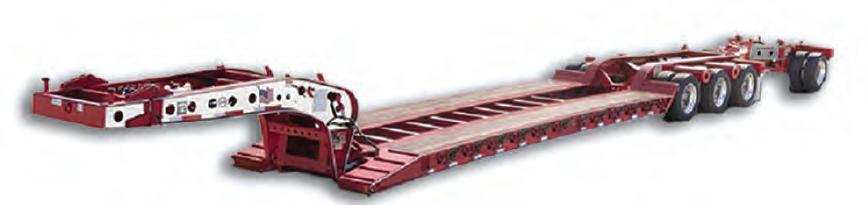
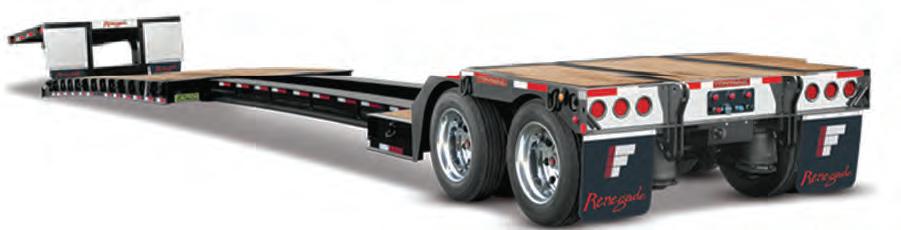
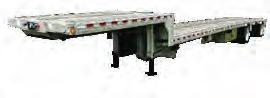
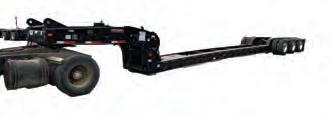
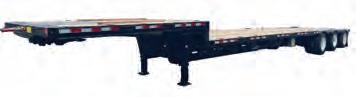
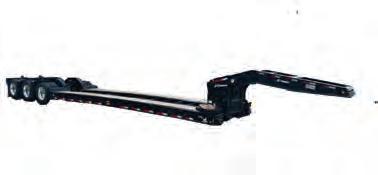
Full range of models from 5,000 lbs. capacity up to 180,000 lbs
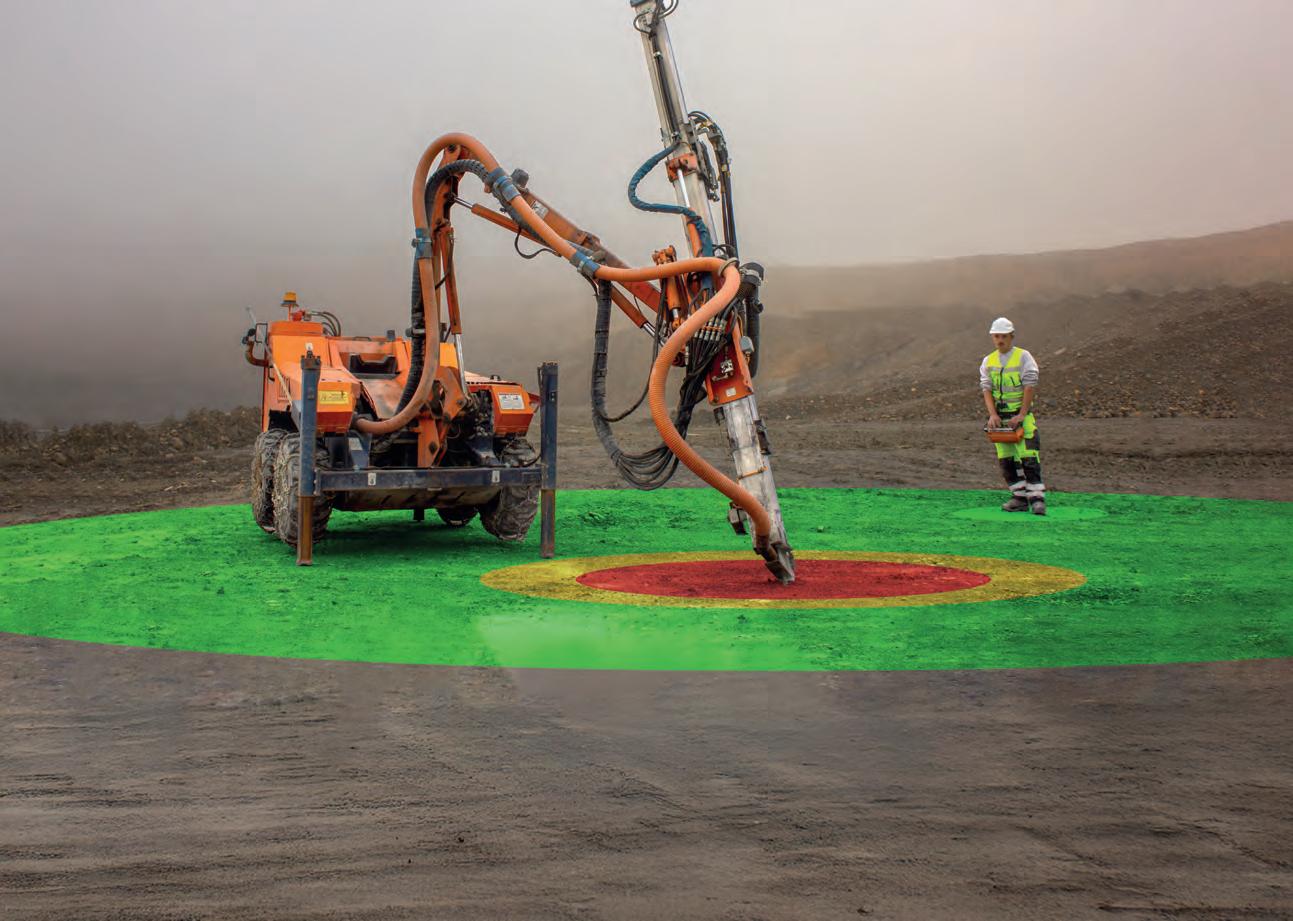
95% vibration reduction
Load cells don’t have to be removed for use with vibratory hammer
Eliminates wear and tear on hydraulic boom cylinders
Suitable for use with any hydraulic boom/crawler crane and any make/model vibratory hammer
757-485-2500 sales@geoquipusa.com
www.geoquipusa.com/tunkers-vibratory-dampeners
Editorial
Editor
D.Ann Slayton Shiffler
d.ann.shiffler@khl.com | 512 868 7482
Deputy editor
Hannah Sundermeyer
hannah.sundermeyer@khl.com | 913 259 8060
International editor
Alex Dahm | alex.dahm@khl.com
SC&RA correspondent Mike Chalmers
Director of content Murray Pollok
Media Production
Client success & delivery manager
Charlotte Kemp | charlotte.kemp@khl.com
Client success & delivery team
Ben Fisher | ben.fisher@khl.com
Olivia Radcliffe | olivia.radcliffe@khl.com
Alex Thomson | alex.thomson@khl.com
Group designer Jade Hudson
Circulation
Audience development manager
Anna Philo | anna.philo@khl.com
Events
Events manager Steve Webb
Events design manager Gary Brinklow
Creative designer Kate Brown
Sales
National sales manager
Michael Sharkey
michael.sharkey@khl.com | 515 269 0258
National account manager
Bev O’dell
bev.odell@khl.com | 816 886 1858
Vice president global sales
Alister Williams
alister.williams@khl.com | 843 637 4127
Client success & digital director
Peter Watkinson
peter.watkinson@khl.com
Chief financial officer
Paul Baker
Chief executive officer
James King
N 87th Street, Suite. 205, Scottsdale, AZ 85260, USA 480 779 9969
americas@khl.com
Lucky number 7
As the month of March dawns, I will be on my way to Las Vegas for my seventh ConExpo Con/Agg. I attended my first ConExpo in 2005, the spring before KHL Group, (in partnership with SC&RA), launched American Cranes & Transport. At that show, I met the KHL team and started contemplating taking on the editor role. Now, almost 21 years later, I’m anticipating another crazy few days in ‘Vegas meeting the masses and looking at cranes, trailers and other equipment and technologies.
It actually should be my eighth time to go to ConExpo, but I sat out 2020. That turned out to be a good year to miss due to all the drama caused by the Covid-19 pandemic. While the show closed early, that didn’t phase the news cycle in terms of new products. That’s the most exciting part about ConExpo, covering all the new stuff.
Last month we broke the news of three ConExpo exclusives, and we look forward to the April issue when we will write a huge review of all the new cranes, trailers, rigging gear and related services that were launched at the show. Hannah Sundermeyer and I will be racking up the steps all week, taking photos and getting all the details.
Our ConExpo Show Guide, in this issue, is for those who attend ConExpo and for those who don’t. This comprehensive show guide features a list of the select exhibitors pertinent to our readership, as well as a preview of everything we could gather before the show. Some 44 companies contributed to this year’s massive show guide.
The March issue is chock full of editorial – ranging from our ACTSPECIALIZEDLIFTING&RIGGING50 toplist to our roundup of the latest rigging gear. Tonya Fry discusses private party equipment sales in our Business and Finance column, and W.O. Grubb’s Chuck Cooke explains situational awareness in our Risk Management column. Also don’t miss our Site Report that chronicles a Budrovich steeple project and our Industry Spotlight on pilot cars. And there’s an article by someone who we haven’t covered in a good while. Frank Bardonaro offers an interesting viewpoint on tariffs in our Perspective article.
And finally, come see us at ConExpo. Our KHL outdoor booth is a thing of the past, but you can find us inside the North Hall at booth 12525.
And finally, let me know what’s going on with your machines, people and jobs.
D.ANN SLAYTON SHIFFLER Editor
KHL Group Americas, 30325 Oak Tree Drive, Georgetown TX 78628 +1 512-868-7482 | d.ann.shiffler@khl.com
SUBSCRIPTIONS:
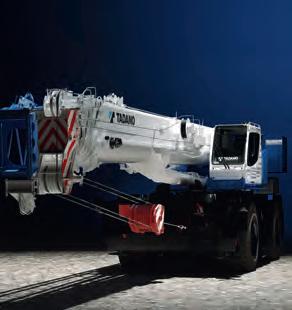
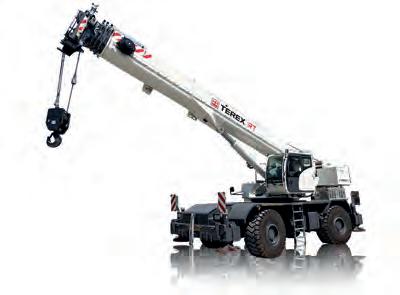
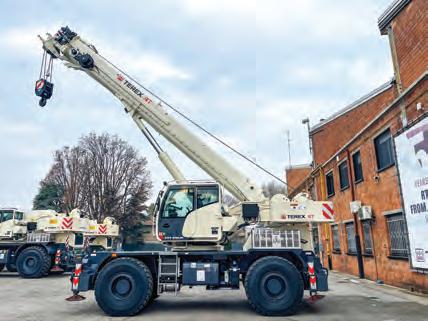
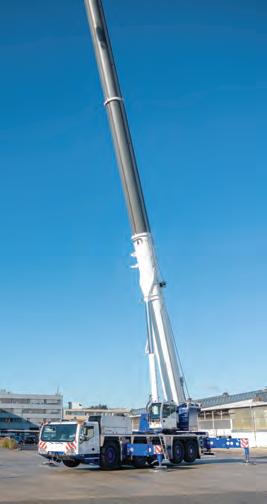
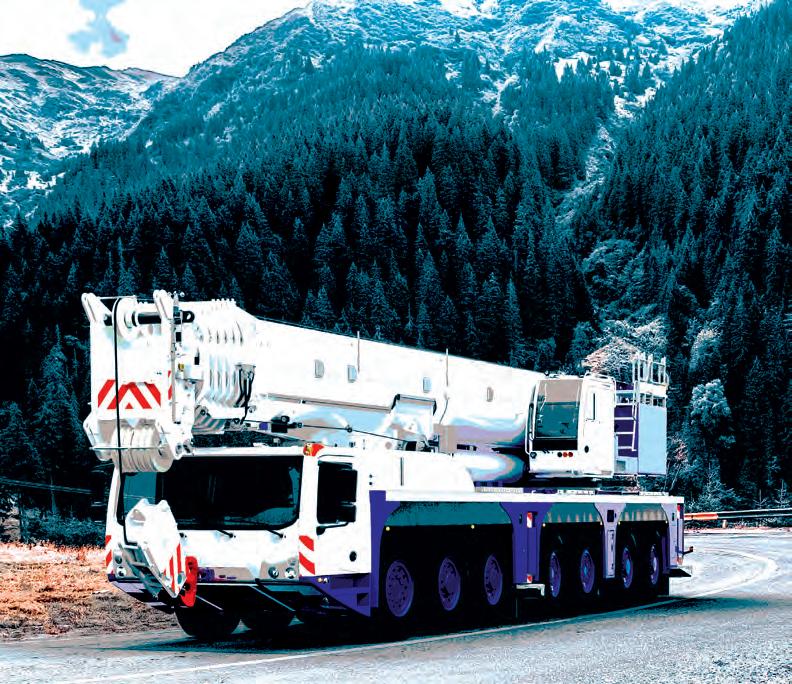
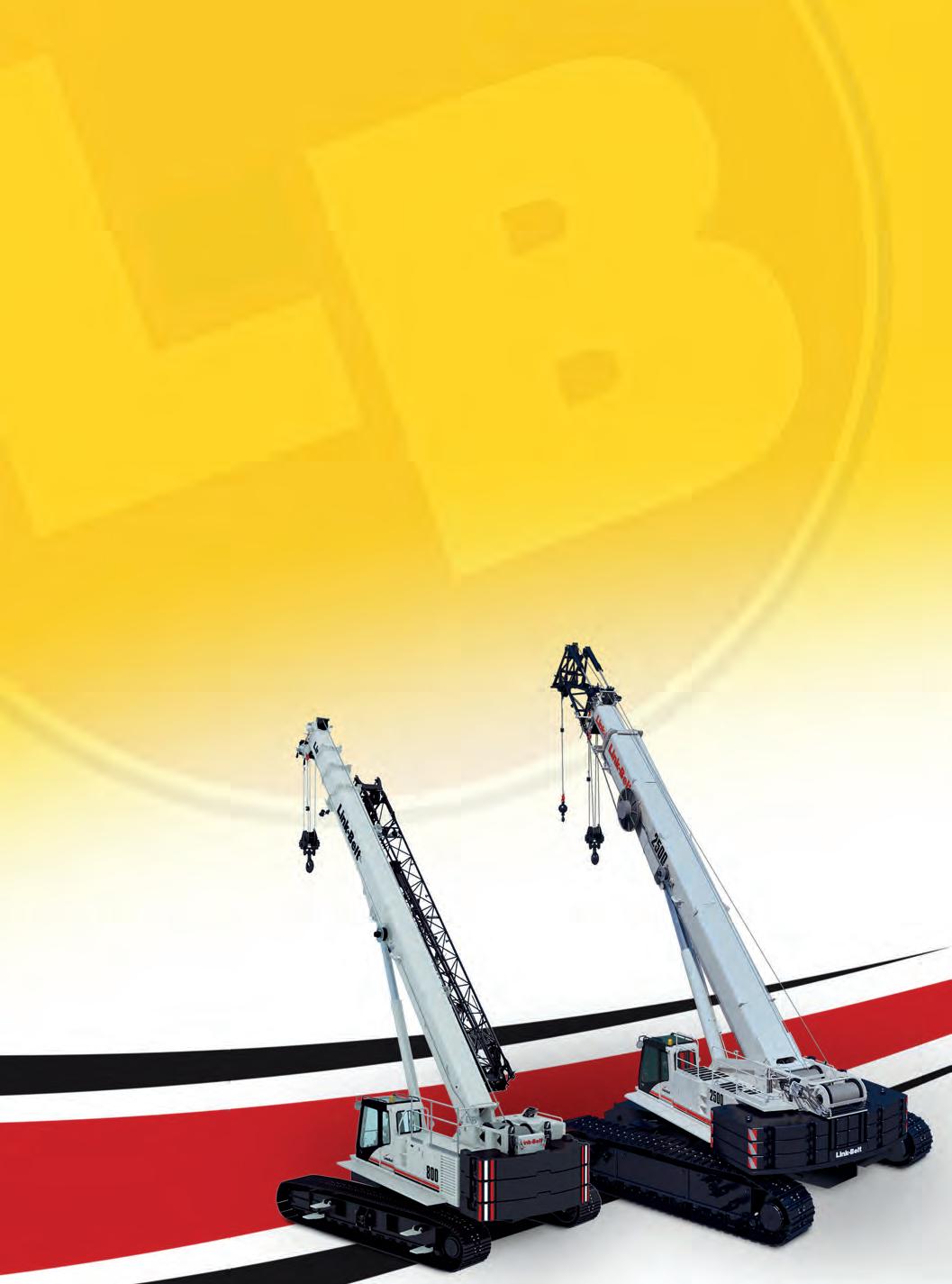
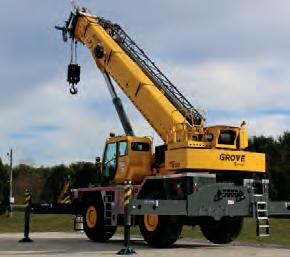
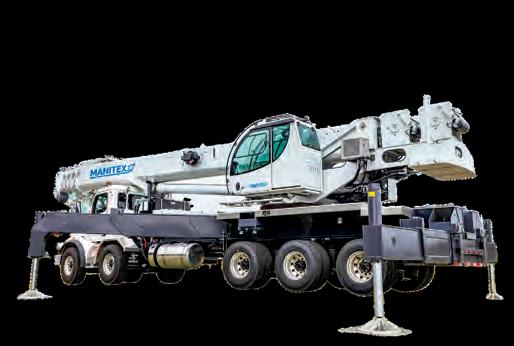
120 USt| 110 mt Rough Terrain Crane
✓ 38.3’ - 164.1’ six-section pin & latch boom
✓ 261.7’ max tip height
OPTIONAL SMARTFLY:
✓ 35’ - 58’ of stowable fly
✓ SmartFly features
✓ One-person operation
✓ Assembly controls accessed from the ground
✓ Designed to minimize ladder climbs
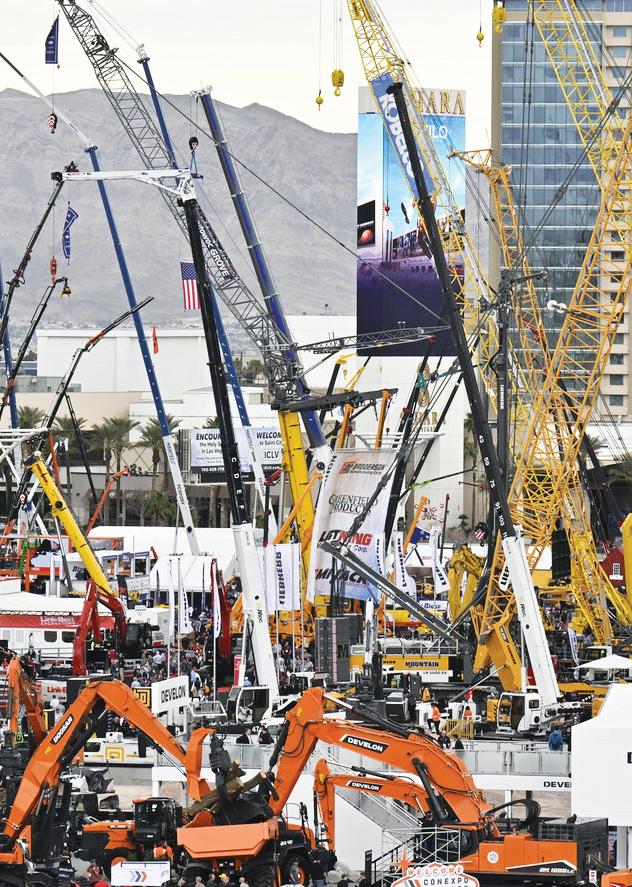
ConExpo Con/Agg 2026 convenes in Las Vegas this week. Don’t miss our show guide starting on page 42.
American Cranes & Transport makes every effort to ensure that editorial and advertising information carried in the magazine is true and accurate, but KHL Group Americas LLC cannot be held responsible for any inaccuracies and the views expressed throughout the magazine are not necessarily those of the publisher. KHL Group Americas LLC cannot be held liable for any matters resulting from the use of information held in the magazine. The publisher is not liable for any costs or damages should advertisement material not be published.
ACT is published 11 times a year by KHL Group Americas LLC, 11811 N. Tatum Blvd, Suite P118, Phoenix, AZ 85028. This issue is mailed on February 25, 2026.
SUBSCRIPTIONS: Annual subscription rate is $301. Free subscriptions are given on a controlled circulation basis to readers who fully complete a Reader Subscription Form and qualify under our terms of control. The publisher reserves the right to refuse subscription to non-qualified readers.
ANNUAL CONFERENCE
The Specialized Carriers & Rigging Association
Annual Conference features full slate of education, networking and industry recognition.
42 SHOW GUIDE CONEXPO
ACT’s show guide to ConExpo Con/Agg 2026.
DEPARTMENTS
6 NEWS/EVENTS
Check out the latest headlines, project updates and industry developments.
37 SPECIALIZED
RIGGING&LIFTING50
The SLR50 is resilient, showing modest but steady growth in 2026.
79 CCO CERTIFICATION NEWS
CCO Certification’s Employer Recognition Awards honor organizations that invest in competence, certification and safer jobsite outcome.
106 MOVING UP
Spotlighting people, promotions and progress.
Official domestic magazine of the
69 SC&RA COMMENT
Resetting the broker playing field. Joel Dandrea discusses.
70 SC&RA NEWS
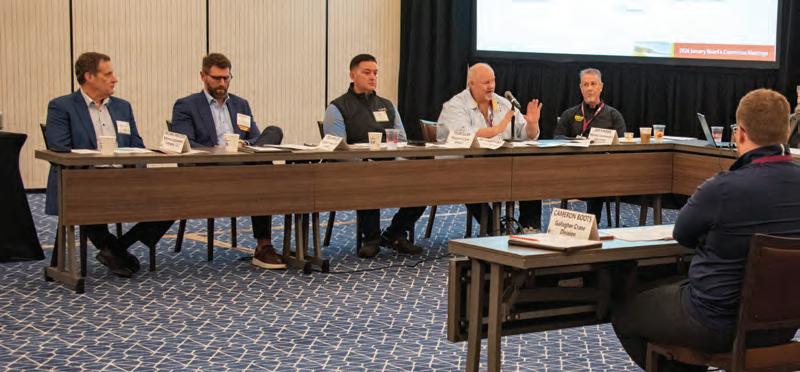
SC&RA committees are moving beyond reactionary work toward proactive safety and strategic engagement.
73 RISK MANAGEMENT
Chuck Cooke discusses situational awareness.
FEATURES
15 PERSPECTIVE
Frank Bardonaro contends that tariffs can lift up the American crane rental industry.
16 INTERVIEW
Liebherr’s Simon Schuster is the consummate team player. D.Ann Shiffler reports.
19 RIGGING MATTERS
Support for your lifting equipment is not the place to cut corners. David Duerr reports exclusively.
23 PRODUCT FOCUS
RIGGING GEAR ROUNDUP
Hannah Sundermeyer rounds up the latest rigging innovations across North America.
33 INDUSTRY SPOTLIGHT
PILOT CARS
Pilot cars are critical once the load is approved.
63 BUSINESS AND FINANCE
Tonya Fry discusses the good, the bad and how to protect yourself in private party sales.
67 SITE REPORT LIFTING
Budrovich supports steeple inspections at the Cathedral Basilica of St. Louis.
MARKETPLACE
TRAINING DIRECTORY
SLINGS & THINGS
PERMITS & PILOT CARS
DEALER LOCATOR
PRODUCTS, PARTS & ACCESSORIES
EQUIPMENT FOR SALE OR RENT
SAFETY & TRAINING
TRANSPORT & HEAVY HAUL
CAREER OPPORTUNITIES
n The North American construction industry is preparing to make history at ConExpo 2026, with organizers planning a Guinness World Records attempt for the most people wearing high-visibility vests during the trade show’s opening ceremony in Las Vegas.
n Link-Belt Cranes has named its top five distributors for 2025, recognizing dealers that delivered standout performance across marketing, sales and customer support throughout the year. The 2025 distributors, listed alphabetically, include Atlantic & Southern Equipment, Doggett Crane Services, Holt Crane & Equipment, Mardian Equipment Company and Wood’s CRW Corporation.
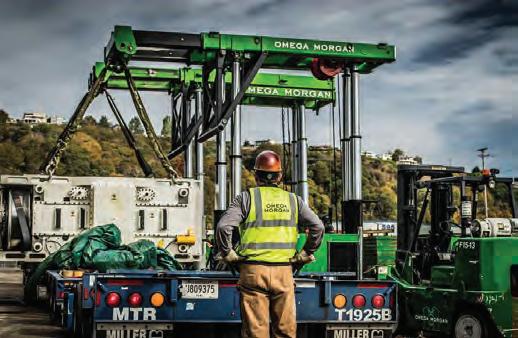
Omega Morgan officially acquires Omega Riggers
Omega Morgan, a provider of heavy rigging, machinery moving and specialized industrial services has acquired Omega Riggers, a Seattle-based machinery moving and rigging company. As part of the transaction, Omega Riggers will operate as Omega Morgan, bringing the two organizations together under one name. Terms of the deal were not revealed. The acquisition brings together two companies that have worked in the same market and were often mistaken for one another, according to Omega Morgan. Leadership from both organizations said the move is intended to eliminate market confusion while strengthening capabilities for employees and clients.
like the right time to take the next step. The fit was right, the culture matched and the timing made sense.”
“This is something we’ve talked about over several years,” said Wes Cotter, owner of Omega Riggers. “We’ve grown significantly over the last few years, and this felt
Cotter will remain with the company and employees will continue in their current roles, with existing contracts and compensation remaining in place.
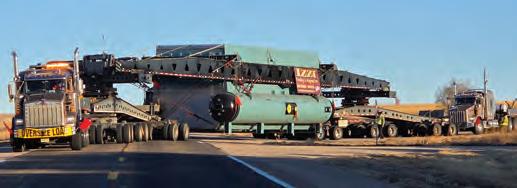
Izzi Trucking & Rigging enters heavy haul sector
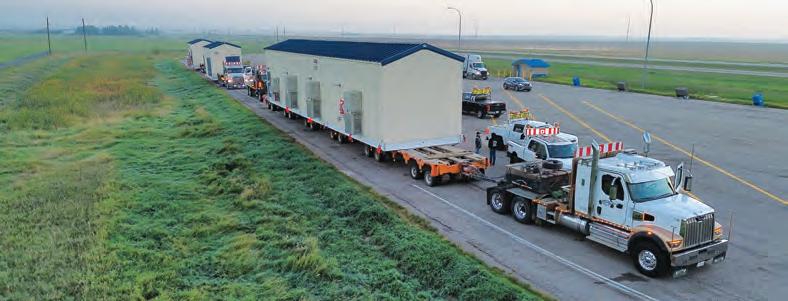
Izzi Trucking & Rigging is expanding into the super heavy haul trucking and rigging sector, marking a significant evolution for the New Jersey-based carrier. The move reflects the company’s strategic response to growing demand for increasingly complex, large-scale transportation projects.
As part of this expansion, Izzi has enhanced its fleet with dual-lane capabilities,
“This expansion is a natural next step for our company," incorporating perimeter frame and suspension hauling configurations. These additions are designed to meet stringent weight regulations
TCNA 2026 keynote speaker confirmed
Tower Crane North America’s 2026 program has confirmed its first keynote address, “A 40-Year Evolution,” delivered by industry veteran Peter Juhren, president and COO of Morrow
Equipment. Drawing on more than four decades in the tower crane sector, Juhren will reflect on how the industry, equipment and regulatory landscape
while maintaining low travel heights required for oversized and super-heavy loads.
have evolved and the challenges that have shaped the business.
The program continues with a panel discussion, “Wind,
said David Izzi, president. "As project demands grow in scale and complexity, we’re positioning ourselves to provide the advanced solutions our clients need, backed by the same reliability we’ve built our name on for more than 50 years.”
The acquisition will alleviate confusion in the market and strengthen capabilities.
Izzi has enhanced its fleet with dual-lane capabilities, incorporating perimeter frame and suspension hauling.
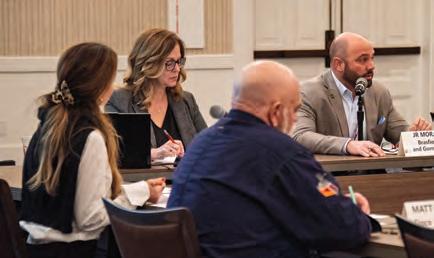
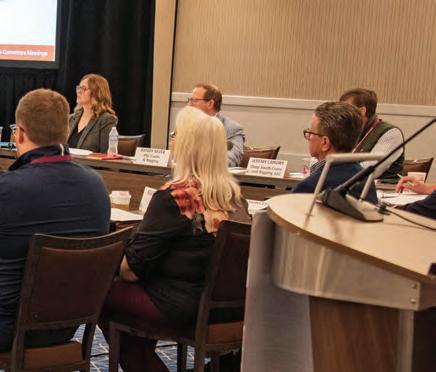
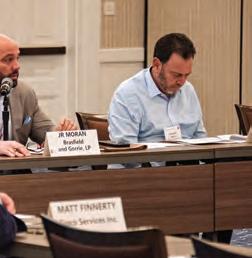
Weather and Rising Storms,” led by JR Moran of Brasfield & Gorrie, featuring panelists Chris Noblitt of Manitowoc Potain, Matt Finnerty of Finnco Services and Rob Posch, P.E., of Posch Engineering. The panel will examine how tower cranes are engineered to withstand wind and severe weather, how wind
Morrow Equipment's Peter Juhren headlines TCNA, June 10-11 in Nashville.
MARCH
CONEXPO-CON/AGG
March 3-7
Las Vegas, NV
Las Vegas Convention Center
March 2-4
THE ARA SHOW
Orlando, FL
Orange County Convention Center arashow.org
APRIL
April 20-23
AWRF SPRING PIE & TECHNICAL SUMMIT
Marriott Marquis Houston awrf.org
April 20-24
SC&RA ANNUAL CONFERENCE
Amelia Island, FL Omni Amelia Island scranet.org
MAY
May 4-7
OFFSHORE TECHNOLOGY CONFERENCE
Houston, TX NRG Park 2026.otcnet.org
JUNE
June 1-3
CLEANPOWER 2026
CONFERENCE & EXHIBITION Houston, TX
George R. Brown Convention Center cleanpower.org
June 10-11
TCNA 2026
Nashville, TN Music City Center khl-tcna.com
tolerances are established, best practices for storm preparation and more.
TCNA sponsors include Silverlevel supporters Comansa, Liebherr and Raimondi/Terex Tower Cranes. Bronze-level sponsors include Bishop Lifting, Bondura Technology and JASO Tower Cranes. Top List
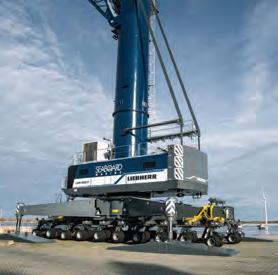
Seaboard Marine invests in electric LHM 550s
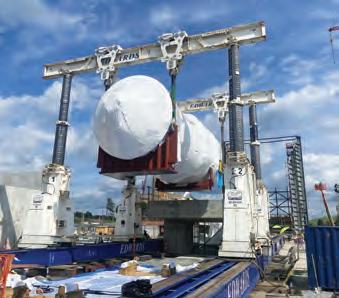
Liebherr will supply three LHM 550 mobile harbour cranes to Seaboard Marine for deployment across its private terminals at PortMiami and the Port of Houston.
Configured in a high-rise setup, the cranes are intended
to enhance container handling capacity at two of Seaboard Marine’s primary U.S. gateways supporting trade throughout the Americas.
At PortMiami, where more than 1.1 million TEUs were handled in 2024, the additional crane capacity is expected to improve berth productivity and support growth in refrigerated cargo and breakbulk shipments. The new cranes will complement the company’s expanding LNGpowered fleet while helping
One of three Liebherr LHM 550 mobile harbour cranes prepared for shipment to Seabord Marine’s U.S. terminals, featuring custom structural adaptions.
maintain efficient vessel turnaround times during peak operating periods.
At the Port of Houston, which set a new record last year by handling more than 4.1 million TEUs, the LHM 550s will provide added flexibility for container handling and support Seaboard's service model.
With an outreach of up to 177 feet and a lifting capacity of up to 115 tons, the cranes are capable of servicing New-Panamax vessels while preserving efficiency. The cranes feature electric drive systems designed to support future shore-power initiatives, along with hydrostatic drive technology. n
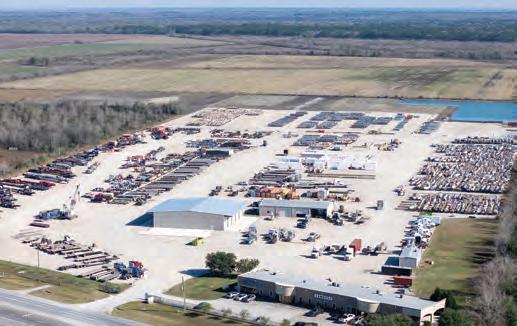
Bennett adds new Texas foreign trade zone
Bennett and BOSS Companies expanded their Gulf Coast logistics footprint with the activation of a 15-acre Foreign Trade Zone at its Dayton, TX facility, strengthening port connectivity and project cargo support just northeast of Houston.
The new FTZ is at Bennett’s Dayton terminal, which serves Bennett On-Site Services (BOSS), BOSS Heavy Haul and Bennett Motor Express from a single campus. The site includes an 80-acre
sponsors for 2026 are Cropac Equipment and Tipton Crane.
SC&RA is a partner with KHL Group hosting TCNA.
yard, a 10,000-square-foot office facility and 15 acres of activated FTZ space dedicated to customer storage.
The FTZ area is designed for the storage and staging of cargo moving inland from the port, including pipe spools, coolers, lithium batteries and other specialized equipment. Goods entering an FTZ are not subject to import duties or taxes until released for domestic consumption, providing customers with greater financial and
operational flexibility.
“This expanded footprint allows us to better support complex logistics and project cargo needs while offering EPCs and freight forwarders greater flexibility,” said Mark Brewton, general manager of the Bennett Motor Express Houston terminal. “By delivering cargo directly into a foreign trade zone, Bennett helps customers defer upfront tariff costs and better align import timing with project schedules.”
An aerial view of Bennett’s new terminal shows the expanded campus, including an 80-acre yard, office facilities and the newly activated 15-acre foreign trade zone. PHOTO: BENNETT
June 2-4
CRANE RENTAL ASSOCIATION OF CANADA
Halifax, NS TBD
crac-aclg.org
SEPTEMBER
September 22-24
SC&RA CRANE & RIGGING WORKSHOP
Omaha, NE
Hilton Omaha and the CHI Health Center scranet.org
For all trade show listings, scan the QR code or visit: www.khl.com/ all-events-diary
n SC&RA wants to hear from you. Tariffs on steel and equipment are driving up costs and causing major project delays across the specialized transportation, crane and rigging industry, particularly in infrastructure, energy and data center work. If your company has experienced significant tariff-related equipment delays, SC&RA encourages you to share your firsthand experience with Joel Dandrea at Jdandrea@scranet.org
Link-Belt crawler assists water facility upgrade
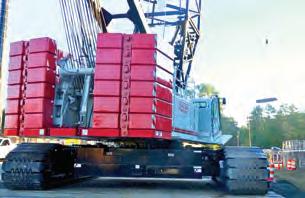
A300-ton crawler
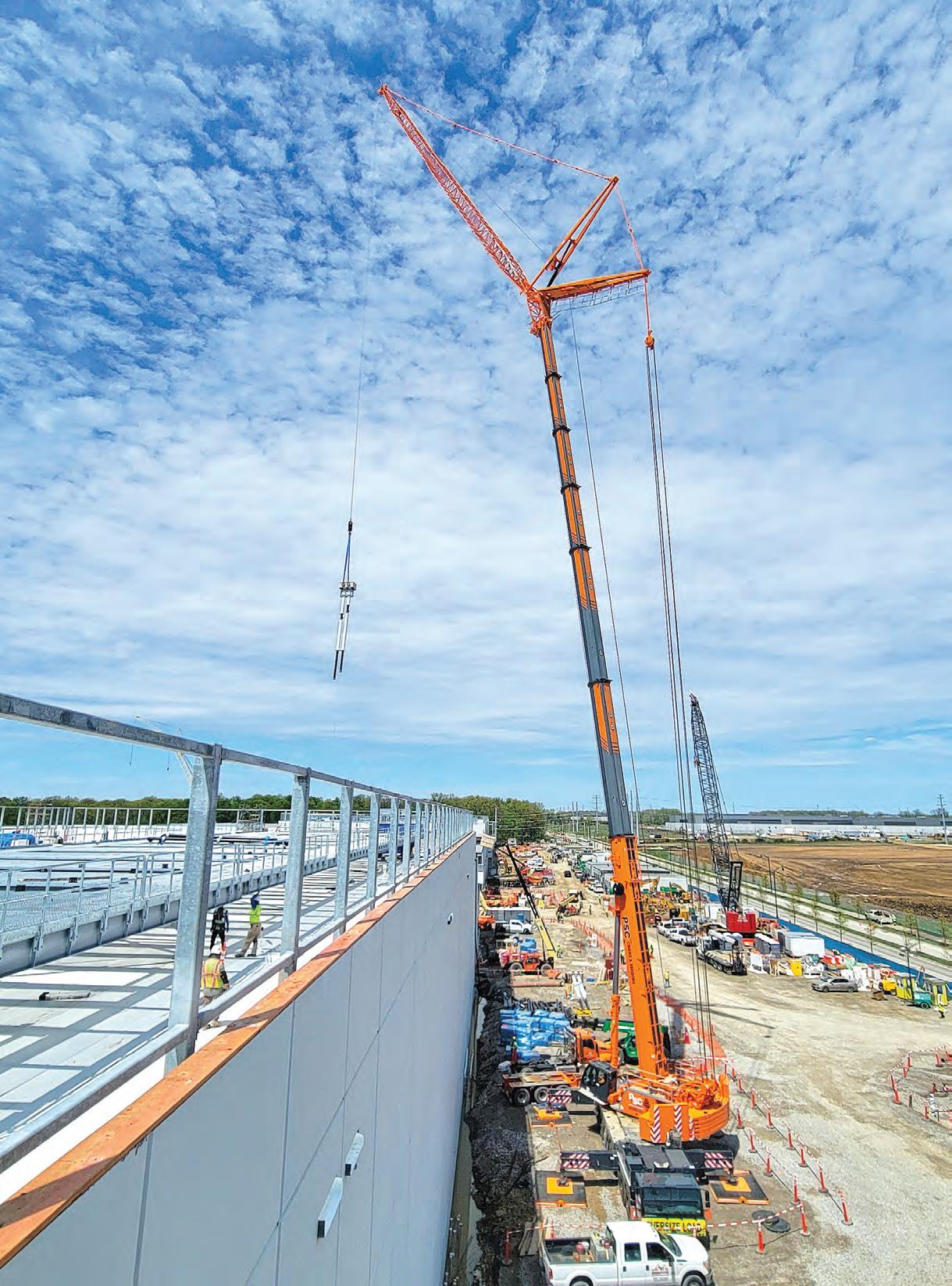
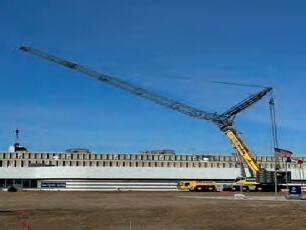
crane from LinkBelt Cranes is playing a central role in the reconstruction of a major water treatment facility in Raleigh, NC. Led by English Construction, the nearly $50 million project at the E.M. Johnson Water Treatment Plant is designed to increase clean water production by approximately 25 percent, expanding capacity from 90 million gallons per day to 120 million gallons per day. The facility currently supplies about 90 percent of Raleigh’s potable water.
The project involves
dismantling, reconstructing and demolishing 60-yearold sedimentation basins and ancillary piping while maintaining operations at the active plant. A Link-Belt 348 Series 2 crawler crane, configured with 140 feet of main boom, 180 feet of luffing jib and 80 feet of fixed jib, is handling key lifts, including a 74-foot, 19,000-pound rake arm/bridge and a 9,000-pound plate settler that will replace the original equipment.
According to English operator Tim Tebbe, the crane provides the capacity and reach required for the site’s varied lifting demands.
The project will produce around 25 percent more clean water for the local population.
“The 348 Series 2 gives us enough capacity and reach to complete every task out here,” Tebbe said. “It has the picking power you need, and it’s been performing great.”
Sarens delivers modules in Québec
Sarens has completed a complex heavy transport scope in Québec, Canada, delivering 10 large equipment units safely and ahead of schedule under tight timelines and challenging site conditions. The project required rapid mobilization and precise execution,
Military veterans are untapped workforce
The NCCCO Foundation has published new workforce research examining how military veterans find, experience and navigate careers in the crane industry, offering fresh insights into recruitment opportunities and ongoing workforce challenges.
The report was developed in collaboration with SmallBox Consulting and explores four key questions: how veterans discover careers in cranes, what makes veterans a strong fit for the industry, why the crane industry appeals to veterans and the challenges veterans face transitioning into the civilian workforce.
“The new research reinforces that veterans represent an untapped source of high-quality potential employees and that the crane industry provides a unique environment that is a very good fit for the skills and values of veterans,” said T.J. Cantwell, executive director, NCCCO Foundation.
To read the full report, please visit: ncccofoundation.org/research/military-veteran-research
with Sarens receiving nine modules and one lift frame on short notice at the Port of Bécancour. Following offload and staging on engineered mats and supports, the cargo was transported to site in five barge shipments, with two modules per barge.
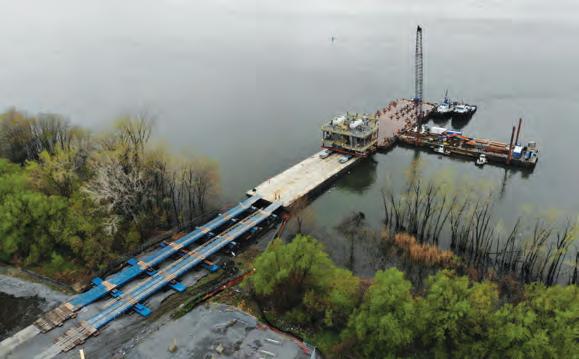
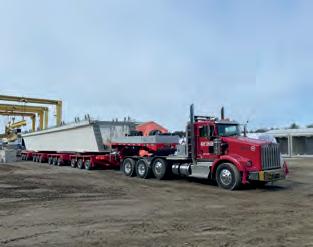
Restricted access along the riverbank presented a key logistical challenge, prompting Sarens to design and construct a 60-meter temporary bridge linking the shoreline to a beached barge. The bridge enabled controlled roll-on/roll-off operations and was engineered to accommodate dual trailer
trains with varying axle configurations. Mobilization of the bridge began before final design issuance, allowing construction to align with vessel schedules and port constraints and helping the team complete execution two weeks ahead of contract.
The operation relied on 38 lines of SPMTs, six ballast pumps, 450 concrete staging blocks and approximately 500 tonnes of steel and mats. Engineering, marine, transport and site crews worked in close coordination throughout the project, maintaining productivity despite persistent rain. n
Sarens constructed a 60-meter temporary bridge to support roll-on/roll-off operations during a heavy transport project in Québec, Canada.
The Specialized Carriers & Rigging Association
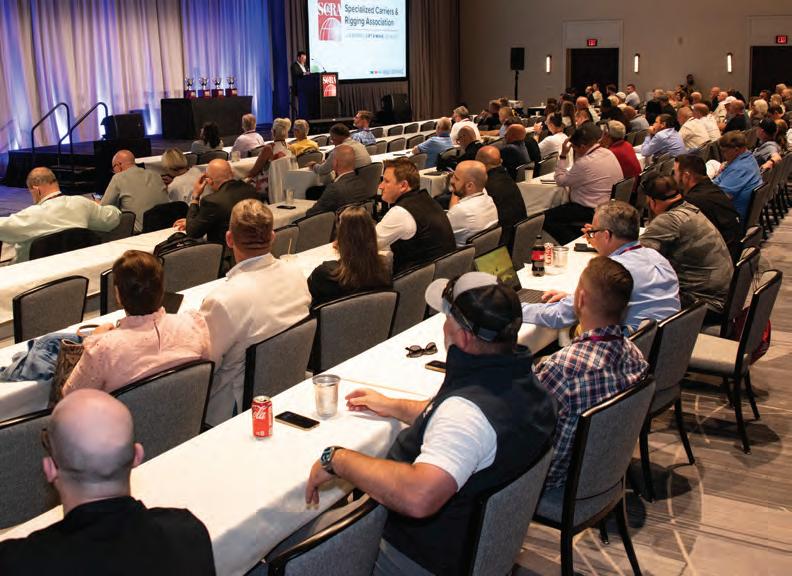
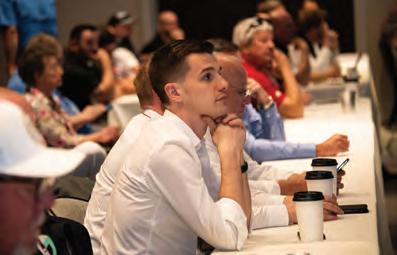
Annual Conference, held April 20-24, 2026, returns with a full slate of education, networking and industry recognition.
Each year, the SC&RA Annual Conference provides a moment for the industry to step away from daily operations and engage with the broader forces shaping its future. In 2026, that gathering unfolds April 20-24 at the Omni Amelia Island Resort, located on the picturesque Amelia Island, FL, where owners, executives and managers will convene for five days of education, committee collaboration and networking. The program is designed to move deliberately from governance and policy to leadership and strategy, while leaving space for informal conversations that often prove just as valuable as time spent in session.
Early momentum
The conference opens Monday afternoon, April 20, with registration and executive committee meetings, followed by the Past Chairman’s Dinner. That evening
Annual rhythm
also features the First-Timers’ Reception, offering new attendees a chance to connect with SC&RA officers, staff and fellow members before the week’s full program begins.
By Tuesday morning, committee meetings across crane and rigging, transportation, safety, labor, permitting, insurance and workforce development are already underway, reinforcing the member-driven foundation of the Association.
Tuesday afternoon turns to issues with direct impact on business operations. The Opening Session, “Tort Reform: The Current Landscape and National and State Priorities,” runs from 1:00 to 2:30 p.m. and examines how litigation trends, nuclear verdicts and third-party funding are influencing insurance costs and risk exposure.
Sherman “Tiger” Joyce, president of the American Tort Reform Association, and
The sold out Exhibit Center offers an opportunity to explore new solutions while networking with peers from across the industry.
Richard Pianka, general counsel for the American Trucking Associations, will outline where reform efforts are gaining traction and how industry stakeholders can engage in the process.
Lessons learned
That conversation continues from 2:45 to 4:15 p.m. with “Lessons Learned in a Challenging Insurance Market.”
Moderated by Rose Augustin of National Interstate, a panel brings together SC&RA members and a loss control specialist to share practical approaches to managing total cost of risk, preventing claims and responding effectively when losses occur. Together, the two sessions frame the
The 2026 Annual Conference will be held April 20–24 at the Omni Amelia Island Resort, located on the picturesque Amelia Island, FL.
legal and insurance environment many members are navigating daily.
Brand shifts
Wednesday begins with the Link-Belt Breakfast from 7:30 to 8:45 a.m., featuring communication speaker Mark Gungor and his presentation, “Tale of Two Brains.” Known for blending humor with insight, Gungor explores how differences in thinking styles influence leadership, teamwork and communication in the workplace.
The breakfast sets the tone for a day that balances governance with broader business discussion, as crane and rigging and transportation group governing committee meetings follow later in the morning.
Wednesday afternoon focuses on leadership and market dynamics.
During the sponsored lunch session, “Unbranding: Loyalty in the Age of Disruption,” author and speaker Scott Stratten examines how organizations can navigate constant change without losing sight of core values and culture.
Later that day, “Volatility in Equipment Valuations” brings together Lee Danhauer of Jeff Martin Auctioneers, Harry Fry of Harry Fry & Associates and Mike Rosendahl of PCE Investment Bankers to discuss how tariffs, taxation and shifting economic conditions are influencing equipment pricing, financing and resale decisions.
Exhibit pulse
Thursday morning opens from 7:30 to 8:45 a.m. with “Find a Way Every Day,” a keynote delivered by former NFL running back Merril Hoge, and sponsored by Trail King. Drawing on his journey from small-town Idaho to the professional football ranks with the Pittsburgh Steelers and Chicago Bears, Hoge reflects on the moments that tested his resilience both on and off the field. Facing careerending head trauma, a cancer diagnosis and open-heart surgery, he shares how a simple mantra — “find a way” — became a guiding principle for leadership, accountability and perseverance, with lessons that extend into business, family life and personal ownership.
The next focus of Thursday is the highly-anticipated Exhibit Center, open from 9 a.m. to noon. With exhibitors representing equipment manufacturers, service providers and technology firms, the Exhibit Center offers a concentrated opportunity to explore new solutions while connecting with peers from across the industry.
The afternoon turns competitive as the Rigging Job of the Year competition runs from 1:30 to 5 p.m., highlighting innovation, planning and execution behind some of the industry’s most complex projects.
Thursday evening is reserved for “Making Waves: SC&RF’s 40th Anniversary Celebration,” a fundraiser
marking four decades of workforce development, education and research supported by the SC&RA Foundation. Running from 7 to 10 p.m., the beachthemed event combines celebration with purpose, reinforcing the Foundation’s long-term impact on the industry.
Resilient close
Friday morning opens with the Annual Membership and Board of Directors Meeting, followed by the Hauling Job of the Year competition from 9:45 a.m. to 2:45 p.m., where teams showcase logistical expertise and problem-solving at the highest level.
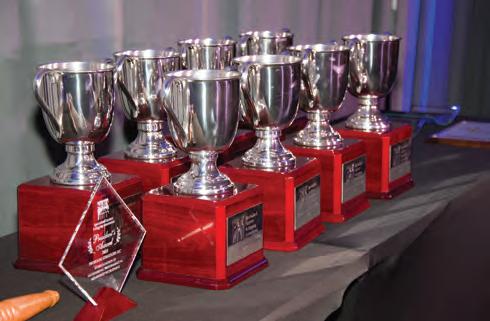
The conference concludes with the Board of Directors and International Reception and the Closing Night Awards Dinner, where Job of the Year honors, safety awards and membership milestones are recognized.
More than a schedule of sessions, the SC&RA Annual Conference remains a place where the industry gathers to exchange ideas, recognize excellence and strengthen relationships. With programming that spans policy, risk management, leadership and innovation, the 2026 Annual Conference continues that tradition — offering perspective, momentum and connection as the industry looks ahead n
Every year, the Annual Conference hosts the famous Jobs of the Year competition. Members are encouraged to submit projects that showcase impressive hauling and rigging feats.
Tariff counterpoint
For more than four decades, I have been involved in the crane, rigging and specialty rental industry. I am a lifelong advocate for this business and have been actively involved with the Specialized Carriers & Rigging Association (SC&RA) for over 25 years. Today, as the CEO of a company with very limited access to U.S.-based manufacturing, tariffs are material to my business as well.
That is precisely why much of the current outrage over U.S. tariffs in the crane industry is misguided.
The loudest voices attacking tariffs would have you believe they represent an existential threat to U.S. crane owners. In reality, tariffs are a corrective response to a problem decades in the making – one that our industry largely ignored while it was convenient to do so.
Let’s be clear about history. The global crane market has never been a freetrade environment. For years, U.S. manufacturers and crane owners were effectively blocked from selling new or used cranes into countries such as Japan, Brazil and Germany through a combination of tariffs, regulatory barriers, certification requirements, local-content rules and administrative hurdles. At the same time, European and Asian manufacturers enjoyed largely unrestricted access to the U.S. market.
That imbalance mattered.
I remember when we were forced to shut down a U.S. tower crane manufacturing facility in Wilmington, NC – not because the workforce or quality failed
THE AUTHOR
G.
president and
Tariffs are a corrective response to a problem decades in the making.
Frank Bardonaro contends that tariffs are not a weakness and can lift up the American crane rental industry.
– but because it had become cheaper to manufacture cranes in Italy, France and Germany and ship them across the Atlantic than to continue producing them domestically. That was not a failure of American labor or engineering. It was the result of long-standing trade imbalances.
And nearly every crane owner has lived the next chapter of that story. Many of us have purchased a European-built crane at a lower upfront price than a comparable U.S.-built machine, only to later discover that replacement parts for the same size engine, motor or component cost two times-or more-than they would have from a domestic manufacturer. That pricing power exists only because prior practices drove U.S.-based manufacturing out of the market.
Competition reduced
Roughly 20 to 25 years ago, foreign manufacturers dumped equipment into the United States at prices that were not economically sustainable. This wasn’t because the products were better. It was because the strategy was to buy market share. U.S. manufacturers could not compete with below-cost pricing, nor could they ship equipment overseas to offset losses. One by one, domestic manufacturing options disappeared.
Once competition was reduced, pricing power shifted.
Those same global manufacturers that once underpriced the market began raising prices-on new equipment, parts, service and support-without ever assuming the operational risks borne by U.S. crane owners. We carried the labor risk, the financing risk, the regulatory risk and the utilization risk. They controlled the supply.
Many owners remember what happened during supply shortages about 15 years ago. We were required to pay in advance just to “hold” production slots – only to see those slots sold to Europe, the Middle East or Asia at higher margins while U.S. deliveries were delayed. That could only happen because domestic alternatives no longer existed.
Add to that currency dynamics. When the Euro traded near $1.35 to the dollar, global manufacturers passed every cost increase straight through to U.S. buyers. We were told, quite plainly: take it or lose it.
Now here is the uncomfortable truth no one wants to address.
The price of a new crane has more than doubled over the last 15 years. Ownership costs – purchase price, parts, service, compliance and capital-have exploded. Rental rates have not.
ROI problem
Many U.S. crane companies are charging rates today that do not reflect inflation, let alone the true cost of capital. That is not a tariff problem. That is a return-oninvestment problem.
Recently, I was told tariffs could add roughly $500,000 to the cost of a new 500ton all-terrain crane. Spread over a 15-year ownership period, that equates to roughly $17 per operating hour. Raise your rate accordingly and the cost disappears –while asset value, borrowing base and market discipline improve.
Crane rental typically represents about 2 percent of total project cost. A modest increase does not kill projects – but failing to price responsibly will kill owners.
The only real beneficiaries of attacking tariffs in the crane industry are European, Japanese and Chinese manufacturers who have enjoyed decades of asymmetric access while dictating pricing and supply to the U.S. market.
The U.S. crane industry has always been resilient. We have persevered through economic cycles, supply disruptions and decades of reliance on outside manufacturing. This moment is not a threat; it is an opportunity. Tariffs are not the primary issue for the crane rental industry. Failure to manage rental rates that support increased costs, inflation, insurance and liability are the primary factors negatively impacting the industry. Tariffs can support growth in my industry, as well as the crane rental industry, if we choose to lead rather than complain. n
Frank
Bardonaro, Jr . is
CEO of Brock Group, based in Houston. His experience includes roles with Maxim Crane Works, Terex Cranes and AmQuip.
An up-and-comer with Liebherr Cranes USA, Simon Schuster is the consummate team player.
Rising
What if you started a new job in a new country, and your first big project is 2026 ConExpo Con/Agg in Las Vegas?
This is the exact situation Simon Schuster is facing, and with the support of his team, he is confident in success. As the new divisional director for Liebherr’s mobile and crawler cranes in the U.S., Schuster is looking forward to the big event, conversing with customers and celebrating the partnerships Liebherr has with its customers.
Moving up
Schuster started at Liebherr in 2018 as a sales trainee at Liebherr-Werk Ehingen, where he underwent comprehensive on-the-job training across multiple business units and departments. His training also included a two-month assignment in the U.S. and Canada.
“In 2020, I advanced to the role of area sales manager for the U.S. and Canada, serving as a key liaison between these markets and Liebherr-Werk Ehingen,” he said. “In this capacity, I was responsible for aligning sales strategies, engineering coordination and production planning, while maintaining daily communication with divisional directors, management and sales representatives.”
As divisional director, he is responsible for ensuring the best possible support for U.S. mobile and crawler crane customers, including new and used crane sales, customer service and spare parts. He brings extensive knowledge and experience with the U.S. market, having worked closely with both the U.S. team and customers over an extended period through his responsibilities in Ehingen.
“I look forward to using my expertise to continue to drive the sales growth of the mobile and crawler crane product portfolio and the service organization in the USA.
A team player
With a lot on his plate in terms of helping pull off a huge trade show and starting his new job in the United States, Schuster is optimistic. He is grateful for the support of his team throught the transition. Whatever
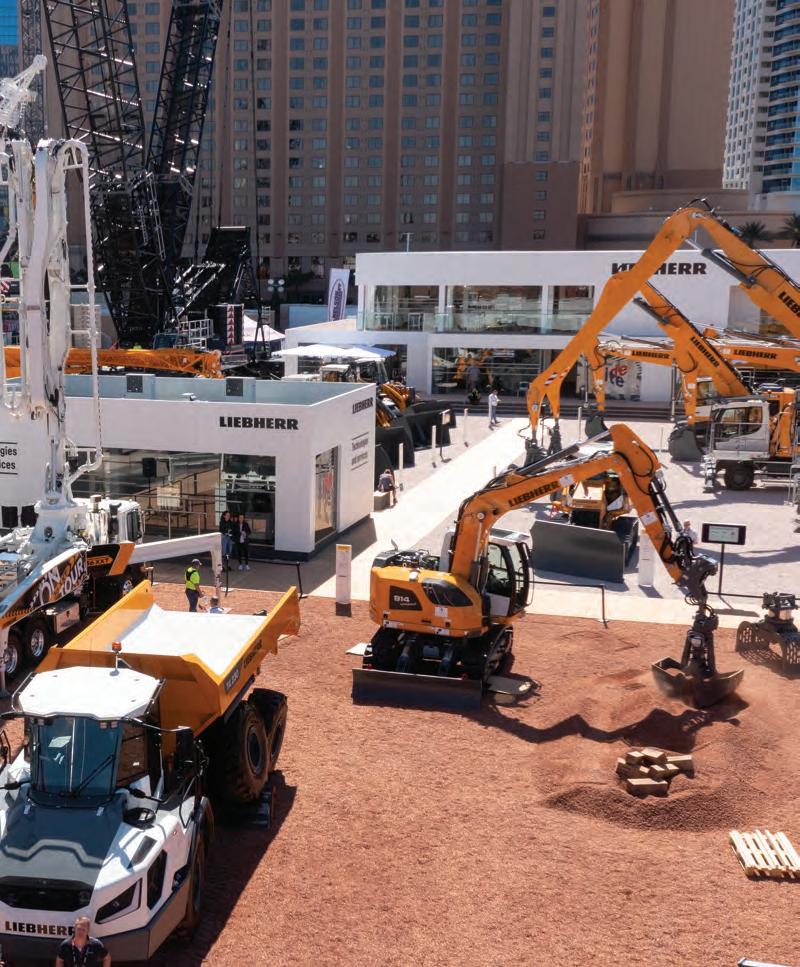
With 66,000 square feet of exhibit space, and one of ConExpo’s largest exhibitors, Liebherr will showcase developments across its full crane portfolio.
gets thrown at him, Schuster and his team are ready to take it on together, he said. I think you will be interested in his answers to our questions, especially his career advice to a newcomer in the crane industry. As well, he teased a new crane model that is making its world premiere at ConExpo this month.
WHAT MADE YOU DECIDE TO PURSUE A CAREER IN CRANE SALES?
I really enjoy the mixture of dealing with state-of-the art technology for a market leader and building relationships with people, both employees as well as customers.
WHAT DO YOU LIKE ABOUT THE BUSINESS?
I like the impressive projects that our cranes are being used for and the special team of people involved, from manufacturing to sales, all the way to the service of the cranes. As odd as it may sound, the crane industry often feels like a large family.
HOW DO YOU DESCRIBE THE MARKET FOR CRANES IN NORTH AMERICA? (RTS, ATS, CRAWLERS AND TOWER CRANES)
To me there is no doubt that North America is one of the most impressive markets for mobile and crawler cranes. RTs are very special for the U.S. market and are definitely not as popular in Germany. The focus customers have on safety and the U.S. market are in line with our goal to provide the safest product with maximum uptime to our customers.
star
I like the impressive projects that our cranes are being used for and the special team of people involved, from manufacturing to sales, all the way to the service of the cranes. As odd as it may sound, the crane industry often feels like a large family.
SIMON SCHUSTER, Divisional Director of Mobile and Crawler Cranes, Liebherr USA
WHAT CRANES ARE IN MOST DEMAND?
This is a very hard question to answer; the projects and jobsites across the USA are very different and that’s reflected in the full line of cranes that we offer.
WHAT ARE THE BIGGEST CHALLENGES IN THE AMERICAN MARKET TODAY?
Our motivation is to be a reliable source of support in every regard for our customers. The size of the United States itself, as well as the installed crane fleets, are factors that need to be considered to ensure uptime and customer satisfaction.
WHAT ABOUT TARIFFS? HOW ARE THEY AFFECTING SALES AND YOUR CUSTOMERS?
Building and maintaining strong relationships with our customers is crucial. Regardless of the challenges we face, we are committed to navigating them together.
WHAT IS YOUR FAVORITE LIEBHERR CRANE?
I think if I had to pick one, I’d say the LTM 1230-5.1. Roadability in the U.S. is key, and this crane type has the capability to be driven almost anywhere the U.S. Personally, I like this crane as it was introduced right around the time when I started my career with Liebherr.
CONEXPO IS COMING UP. WHAT ARE YOU LOOKING FORWARD TO IN TERMS OF THIS SHOW?
As I am attending this show for the first time in my new role, I am looking forward to having great conversations and celebrating the partnerships we have with our customers. It will be incredibly exciting to see how the market reacts to a new model that is making its world premiere in Las Vegas.
WHAT IS THE BEST CAREER ADVICE THAT YOU CAN GIVE A NEWCOMER IN THE CRANE INDUSTRY?
Nobody is starting as an expert. Be honest. If you don’t know the answer to a question, do the necessary research and follow up. Internal and external customers will appreciate your honesty.
WHAT DO YOU DO IN YOUR LEISURE TIME?
I enjoy a bit of everything I guess, including tennis, running, watching movies and sports, reading, music and traveling. I am looking forward to exploring new hobbies in the U.S. n
Ground control
Support for your lifting equipment is not the place to cut corners. David Duerr reports exclusively.
We all understand the importance of planning for load handling operations. Select the right crane and rigging gear, lay out the equipment arrangments, plan the work and make sure that all of the crew members know their jobs. Without the right support under the crane, though, none of the rest of this matters. Adequate support is absolutely essential.
KNOW THE EQUIPMENT AND KNOW THE SITE: To plan the crane support, the lift planner must know the loads that the crane will impose of the ground and what level of pressure the ground can safely support (the allowable ground bearing pressure).
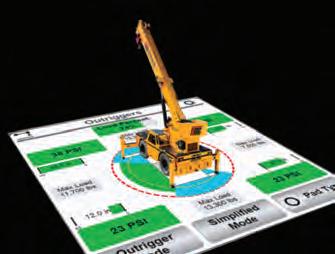
Figuring out the loads imposed by the crane, whether outrigger loads or track bearing pressures, is often easy. Some of the major crane manufacturers now have teamed up with A1A Software by providing information about their cranes for incorporation into 3D Lift Plan. Other manufacturers maintain their own applications that can be used to calculate support loads for their crane models.
THE AUTHOR
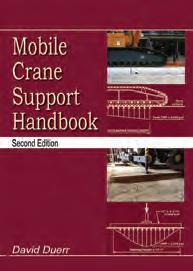
David Duerr , P.E. (ret.), is president of 2DM Associates, which he founded in 1986. He entered the rigging industry in 1974, working for Hoffman International, followed by VSL Corporation, Williams Crane & Rigging and McDermott International. Duerr is the author of Mobile Crane Support Handbook , and Telescopic Hydraulic Gantry Systems . He currently serves as a Contributing Member on the ASME P30 Committee and provided an independent review of the SC&RA Guide to Outrigger Pad Materials, Selection and Usage
Either way, the key to the successful use of these applications is assuring that all information entered into the input fields is accurate (load, radius, swing angles, boom type and length, boom tip extensions or jibs, counterweight size, crawler pad size, and outrigger extension position). Carelessness in defining the crane and the lift parameters here can result in inaccurate results.
WHAT IS THE ALLOWABLE GROUND
BEARING PRESSURE? This can be a difficult question to answer because of the many factors involved. A hard surface layer only a couple of feet thick can hide soft soil below. This hard surface layer alone often will not be strong enough to support the loads from a large crane. Additionally, underground structures, such as pipes, culverts, buried tanks and the like, can be the weak link in determining the allowable ground bearing pressure. And when working anywhere around new construction, one must ask how well any backfilled areas has been compacted. When planning major lifts in a safetycritical location, such as in a refinery, it is common practice to have a geotechnical engineer take soil borings and prepare a detailed report that shows the allowable ground bearing pressure at the surface. For smaller jobs with a short schedule, getting a geotechnical investigation done is often not practical, so the allowable ground bearing pressure often must be estimated based on past experience at the site or by simply working with a very low allowable bearing pressure. However,
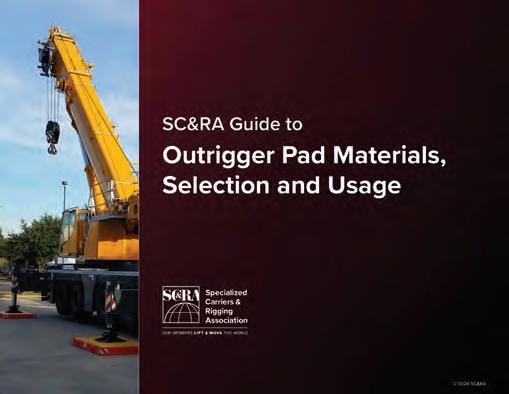
The SC&RA Guide to Outrigger Pad Materials, Selection and Usage addresses the range of topics one must understand to select and use outrigger pads safely.
when making assumptions about the allowble ground bearing pressure, never lose sight of the fact that without adequate support of the crane, nothing else matters.
SHOULD CRANE MATS OR OUTRIGGER PADS BE USED TO SUPPORT THE CRANE? The short answer to this question is: Yes. Soil conditions in many locales are such that all except the smallest cranes will require some type of load spreading materials to reduce the pressures imposed by the crane to values low enough that the crane can be supported safely. This means that crane mats or pads are needed most of the time. Crane mats serve two purposes. First, they must spread the load from the crane over a large enough area that the bearing pressure imposed on the ground by the crane is less than the allowable ground bearing pressure. Second, the mats must provide support to the crane that is stiff enough that the crane will not go out of level as the loads from the crane change during lifting operations.
Evaluating the strength, stiffness, and load spreading ability of a crane mat requires preparing engineering calculations. A practical method of performing these calculations, called the Balanced Mat Analysis Method, is detailed in Chapter 4 of the author’s book Mobile Crane Support Handbook We also have two other very useful tools for designing the support of a crane. The first is the SC&RA Guide to Outrigger Pad Materials, Selection and Usage. The SC&RA Guide addresses the range of topics one must understand to select and use outrigger pads safely. These topics include the applicable aspects of lift planning, descriptions of the various types of pads available, job site considerations
When it comes to the support of a mobile crane, the bottom line is simple. Without adequate support (strength and stiffness),
that may affect equipment location and setup, and guidelines for outrigger pad setup and use. The SC&RA Guide also provides a list of outside references for those situations where more in-depth information is needed. The second is
The Nonmandatory D appendix of P30.1, (2024 edition) provides information and guidance for the selection and sizing of outrigger pads, timber crane mats, steel crane
SPECIALTY SOLUTIONS FOR YOUR MOST COMPLEX PROJECTS
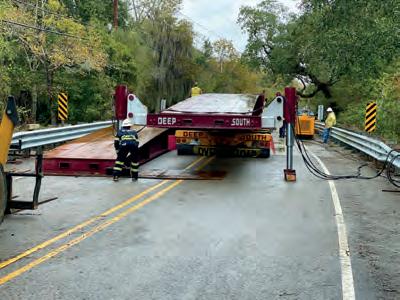
When your project calls for specialized equipment or expert insight, Deep South Crane & Rigging is here to support you. With a deep inventory and decades of experience, we offer tailored solutions for complex lifts and heavy transport. From our powerful VersaCrane™ fleet to custom-engineered bridge systems, cantilever bars, gantries, and more, we deliver the tools and expertise to keep your project moving forward.
Whether you’re up against a tight timeline, a one-of-a-kind lift, or a critical transport challenge, we’re ready to step in to meet your project’s demands with precision. Let’s DEEPSOUTHCRANE.COM
Nonmandatory D in ASME P30.1-2024 Planning for Load Handling Activities
This appendix, new in the 2024 edition of P30.1, provides technical information and guidance for the selection and sizing of outrigger pads, conventional timber crane mats, steel crane mats, and the like. This all starts with a detailed flow chart that organizes the process necessary to design and specify a safe support system for load handling equipment.
The actual evaluation of conventional crane mats, whether made of large timbers or of structural steel beams, often presents a challenge to the lift planner who does not have a strong engineering background. Appendix D includes not only a detailed discussion of how mats perform to distribute the support loads to the ground, but also includes graphs by which the load spreading ability of timber and steel mats can be determined. The timber mat curves are based on the species of wood commonly used for mat construction in the United States and Canada. The steel mat curves are based on a range of section properties (that is, the section modulus of the beams), as noted on the graphs. The calculation method used to generate these graphs are as developed in the Mobile Crane Support Handbook. Example problems illustrate the use of these graphs.
DETERMINING THE MAT. The most common types of crane mats are made from rough-sawn hardwood or softwood timbers. Timber crane mats are widely available from vendors through the world. There is also a variety of synthetic pads for small to medium outrigger-supported cranes.
When it comes to the support of a mobile crane, the bottom line is simple. Without adequate support – strength and stiffness – a mobile crane cannot operate safely. Those responsible for the planning and performance of the crane work, regardless of the complexity of the lifts, must go through the steps necessary to assure that the crane’s support meets the specific demands of the job. n
The Balanced Mat Analysis Method is detailed in the Mobile Crane Support Handbook.
At the ready
Hannah Sundermeyer rounds up the latest in rigging innovations across North America.
Rigging crews are being asked to do more with less – tighter schedules, fewer people on the ground, more complex picks and higher expectations around documentation, inspection and repeatable performance. At the same time, jobsite realities like limited headroom, constrained access, irregular load shapes and unpredictable weather continue to test the basics: control, communication and safety at every lift point.
This roundup highlights products designed to support those priorities, from manual hoists, modular spreader systems and high-capacity hydraulic jacking setups to remote-release hooks, load-stabilization technology and real-time line tension measurement. But all of these products reflect a common direction, encouraging more control with less risk.
All Material Handling
Ongoing supply chain disruptions, along with the discontinuation of several legacy hoist models, have made it harder for distributors and end users to source dependable manual hoists on short notice.
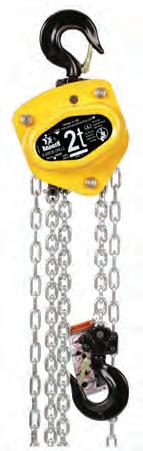
All Material Handling, Inc. (AMH) is positioning two manual hoist lines as readily available alternatives intended to cover a broad range of lifting needs.
The AMH MA Hoist is a premium manual chain hoist available from ½ ton through 30 tons. It uses Grade 80 load chain and is assembled and
AMH’s manual chain hoist offerings include the MA Hoist and Badger Hoist (pictured) lines, with capacity ranges designed to support a variety of lifting applications.
The Slingmax Helix high-performance synthetic roundsling is designed with a smaller profile to fit tight pick points while maintaining high capacity.
tested in the U.S., with an emphasis on durability.
Standard lift lengths are available, along with custom configurations for specific job requirements. Key features include a Weston-style mechanical load brake with self-adjusting double pawls, sealed ball bearings on the chain wheel to improve efficiency and serviceability, a double roller guide for consistent load-chain tracking and cast latches. The Badger Hoist line is positioned as a valuefocused option, available in capacities from ½ ton to 10 tons. Badger Hoists use zinc-plated Grade 80 load chain for corrosion resistance and are proof tested prior to shipment.
Buckingham
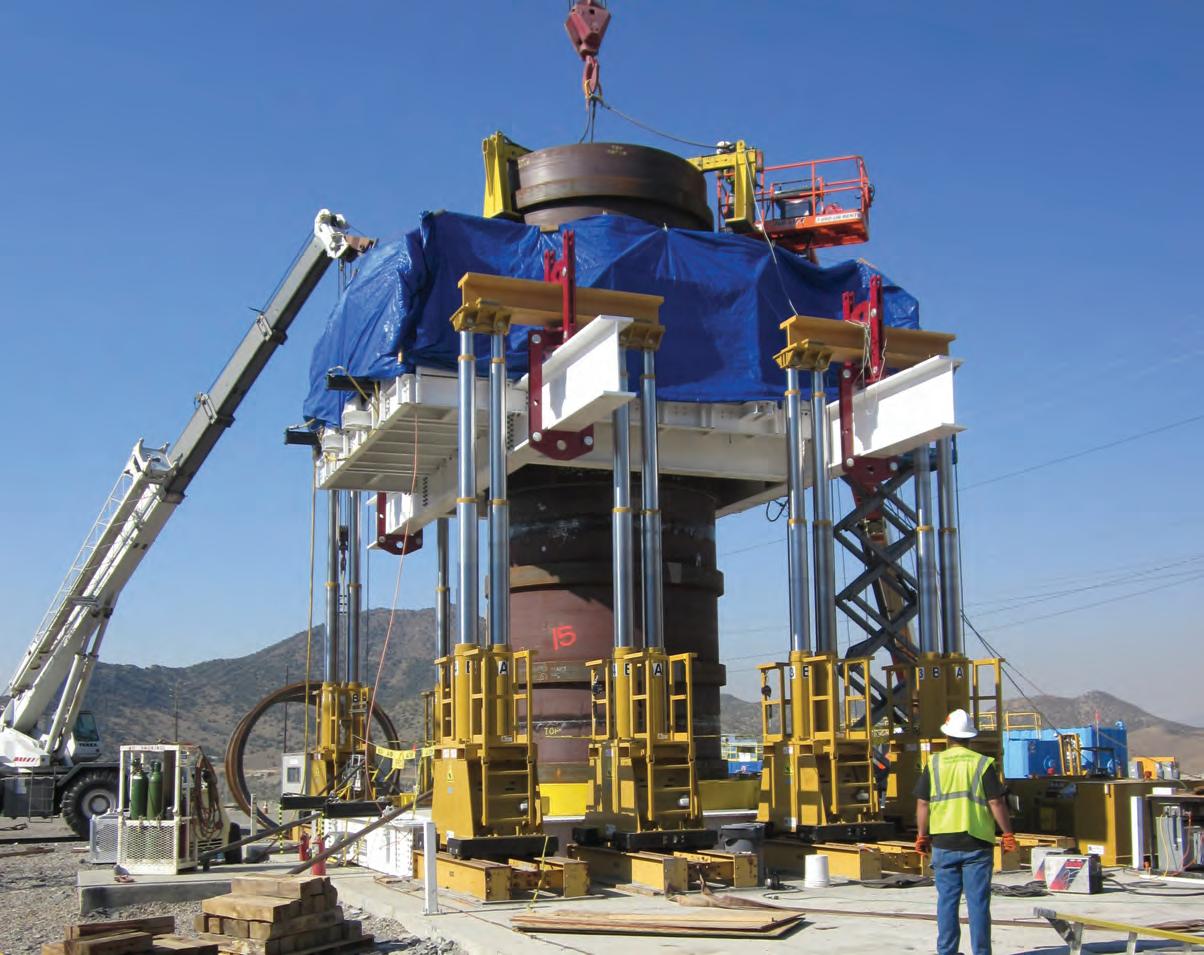
Buckingham Structural Moving Equipment’s multi-purpose hydraulic jacks, used with the company’s unified jacking machines, are designed for rigging and heavy transport
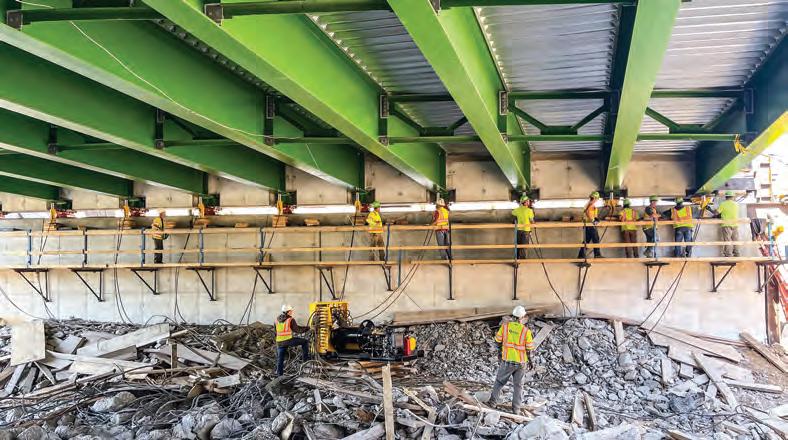
applications that require high-capacity, multi-point lifting with controlled, synchronized movement. Manufactured in the U.S., the hydraulic jack line is intended to function as part of a unified system for raising, lowering and positioning large loads with a focus on safety and precision. The multi-purpose jacks are offered in multiple capacity and stroke configurations, giving contractors flexibility to match equipment selection to project-specific requirements related to load, clearance and lift height. When paired with unified jacking machines, each jack is pressurized evenly, helping unify lift points regardless of load distribution. This approach is used to reduce differential movement when lifting large, irregular or sensitive loads.
Buckingham’s hydraulic jacks and unified jacking machines support synchronized multi-point lifting for bridge work, heavy lifts and industrial moves.
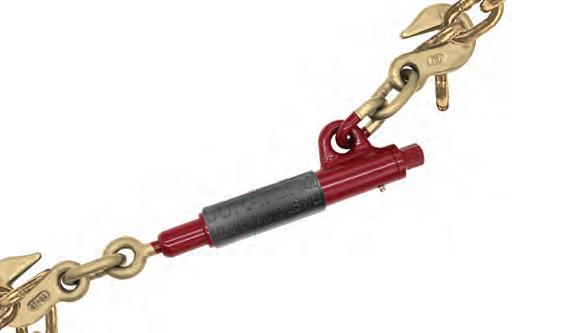
Durabilt Durbin’s DuraTorQ DTQ Series torque-drive load binder is designed for drill-assisted tensioning to reduce manual effort during load securement.
lifts and industrial equipment moves.
The Caldwell Group
The Caldwell Group’s Dura-Mod Modular Spreader Beam Systems are designed to help rigging shops, crane dealers and rental companies expand lifting options without stocking dozens of complete, fixed-length beams. The concept is simple: users select a system capacity (listed from 6 to 250 metric tons) and then combine end fittings, spreader sections and drop links to assemble a beam configuration that fits the lift. (For reference: 6 to 250 metric tons is approximately 6.6 to 275.6 U.S. tons.)
Because the system is modular, configurations can be built quickly from a smaller set of components, helping reduce downtime and the risk of having the wrong beam on hand. Storage and transport can also be simplified by keeping smaller sections on the shelf and assembling/disassembling on site.
Among the commonly used options is the Dura-Mod Model DM24, a two-point spreader beam system rated for a 24-ton capacity. It can be configured in spreads from 3 to 24 feet. The DM24 assembly is designed around a 17-ton top and 12-ton bottom carbon bolt-type top shackle.
Durabilt Durbin
Durabilt Durbin’s DuraTorQ (DTQ) Series is a torque-drive load binder designed for power-assisted tensioning using a drill, with the goal of reducing physical strain while speeding up securement. The DTQ-12 is listed as compatible with 1/2-inch to 3/8inch chain, and the DTQ-38 is listed as compatible with 3/8-inch to 5/16-inch chain. By shifting tensioning effort from manual force to power-assisted operation, Durabilt positions the DTQ Series as a way to reduce operator fatigue and shorten loading and unloading cycles.
Each DTQ binder is proof-load tested and includes trace codes intended to support product identification and tracking. Durabilt emphasizes consistency and repeatability for crews managing frequent securement cycles.
The DTQ Series includes a 1-inch screw diameter, an 8-inch take-up and a 3:1 design factor. A built-in barrel stop is designed to prevent binder separation, and the “no back-off” design is intended to help maintain tension under vibration and transit conditions.
Enerpac
Enerpac has announced the new LHS42, a skidding system that is easier and quicker to deploy for skidding loads up to 400 tons. Backwards compatible with the earlier LHSS400 skidding system, the LHS4-2 features a new track coupling system (no tools needed) and longer tracks allowing quicker track assembly.
The Low-Height Skidding System’s modular design comprises a series of skid beams, skid track and hydraulic push-pull units. Loads travel over
special PTFE-coated pads placed on the skid tracks to reduce friction. The pushpull cylinders are powered by a standard Enerpac split flow pump to ensure each skid beam travels synchronously. It also allows bi-directional operation – avoiding the need to reposition cylinders when switching skidding direction.
The LHS4-2 uses a simple hand twist motion to connect the track together in place of the bolting joint used for the earlier skidding system. While track lengths have increased from 38 inches to 56.4 inches. Both features, taken together, allow the skidding system to be assembled and disassembled more easily and quickly. Enerpac has developed new skid track handling hooks for a more ergonomic assembly. For ease of transport and storage, the LHS4-2 skidding system is supplied in a steel transport frame.
Engineered Rigging
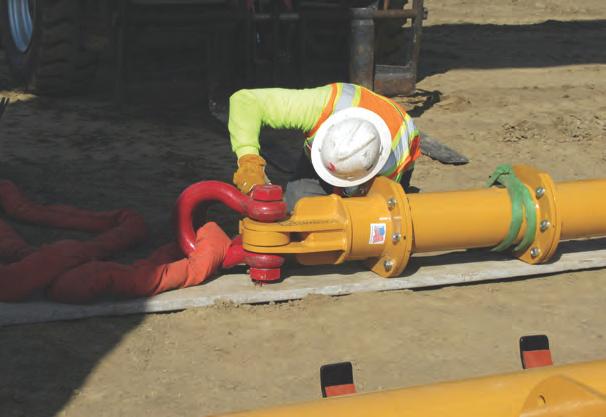
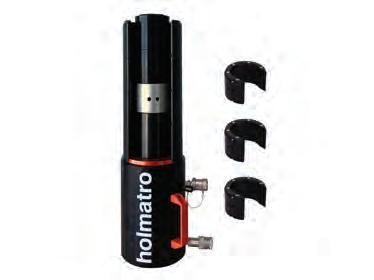
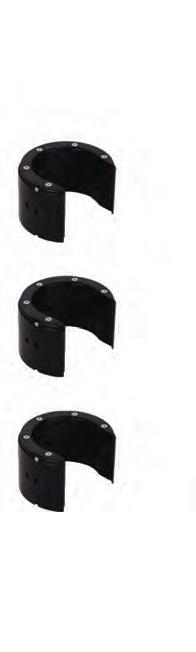
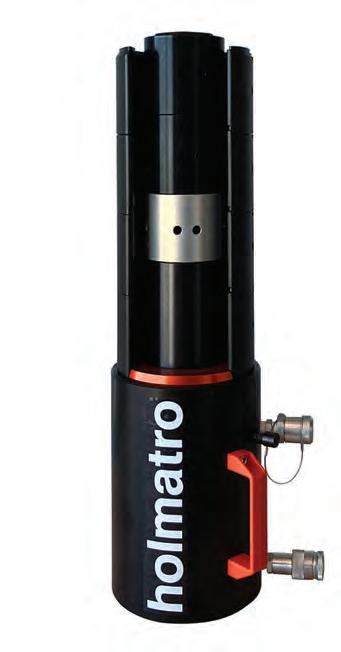
Engineered Rigging introduced Holmatro Ring Climbing Cylinders to the U.S. market as an option for high-capacity lifting where compact equipment and controlled, incremental lift heights are required. With a retracted height of under 12 inches, the ring climber provides incremental lift heights up to nearly 36 inches, substantially more than many traditional hydraulic cylinders. Made of aluminum and weighing approximately 50 pounds, the system is designed to be portable while still supporting heavy-duty lifting applications.
Caldwell’s Dura-Mod modular spreader beam components can be assembled into a range of beam configurations to match projectspecific rigging needs.
With a 4.7-inch stroke, each cylinder can lift, lower and mechanically secure a load of 100 tons. Instead of relying on external cribbing built up manually around a traditional jack, the ring climber incorporates aluminum stacking rings as part of the system. As the cylinder extends to the end of its stroke, a technician inserts lightweight stacking rings (about 2.2 pounds each) around the cylinder rod, between the load and the top of the cylinder housing.
The rings are engineered to defined specifications with documented load ratings, and they lock into position to create a stable, predictable load-bearing column. The approach is intended to eliminate time-consuming cribbing stacks
kit.
Enerpac LHS4-2 skidding system starter
HEROES. AMERICA. MADE TO MOVE
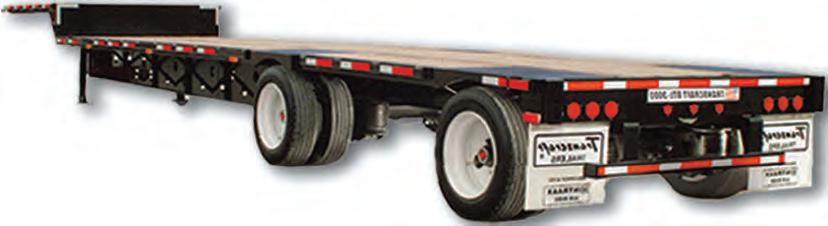
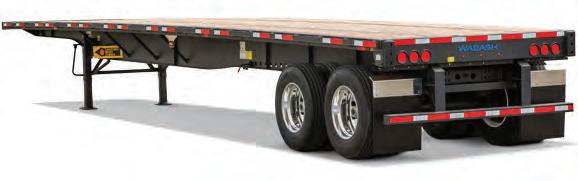
Introducing two powerful trailers for the U.S. market:
This isn’t just a launch. It’s a calling. It’s the beginning of something BIG!
JOIN A TEAM THAT TREATS YOU RIGHT.
Main Terminal: 19285 Old Houston Rd, Conroe, Texas 77302
West Texas Terminal: 8703 W I-H 20 Big Spring, Texas 79720
RANKED ON
ACT Transport 50 List & Winner of SC&RA Fleet Safety Zero
Accidents, Fleet Safety by Percentage & Driver Safety
AFD is a recognized leader in the transportation industry, specializing in (OS/OW) shipments across the United States and globally. We have built our reputation on a foundation of on-time delivery, budget adherence, and unwavering reliability. We commit to providing individualized attention and strategic oversight for every client and shipment. Our service model encompasses full turn-key logistical operations, managing every step from initial pickup to rail transport, strategic storage, and final destination delivery.
Our capabilities are built on specialized equipment and end-to-end logistics management:
• Project Logistics / Full Turn-Key Logistical Operations
- Multiple jack and slide options up to 500T / Turntables
• Rail Services
- Integrated rail spur access at our West Texas Terminal
•Warehousing & Yard Management
- Secure storage solutions
• Support Services
- Pilot car and specialized operator services SERVICES
and provide a more repeatable, controlled process for building lift height.
Greenfield Products
Greenfield Products’ Roborigger is a remote-controlled load orientation device designed to stabilize and rotate suspended loads without traditional tag lines. Using gyroscopic rotation technology, the system is intended to reduce the need for workers to stand near swinging or spinning loads – a change that can lower exposure during placement and alignment.
Roborigger is designed to hold and rotate loads with controlled positioning, including in challenging wind conditions. The system maintains orientation autonomously, helping crane operators place loads more precisely when load shape or jobsite conditions make control difficult.
Greenfield’s lineup is designed to cover a capacity range from 10 tons to 50 tons, operating wirelessly with a stated control range of 350 feet.
Beyond load control, Roborigger also adds a reporting layer through integrated tracking software that logs lift data such as time, weight and location. For companies tracking lift cycles, repeat picks or site productivity, that data can support better visibility into workflow and downtime, and provide documentation that can be useful for planning and accountability. For operations looking to reduce tag line handling, improve placement
Greenfield Products’ Roborigger is a remotecontrolled load orientation device that stabilizes and rotates suspended loads without traditional tag lines.
constraints can require fast adjustment of lift points.
accuracy and add a data trail to routine lifting tasks, remote load orientation technology like Roborigger reflects a broader push toward keeping crews farther from suspended loads while improving control at the hook, the company said.
LGH
LGH’s Multi-Lug Lifting Beams are designed for crane and rigging work where headroom is limited, loads are complex and lift setups need flexibility without sacrificing control. The beams are intended for applications across construction, millwrighting, energy, manufacturing and specialized transportation, where evolving jobsite
Available in capacities ranging from 30 to 100 tons, the beams feature a continuous drilling pattern on both top and bottom flanges. This allows crews to adjust lifting points to better align a load’s center of gravity. The dual-lug configuration supports multiple rigging approaches, from low-headroom single-point lifts to two-leg grabs intended to improve stability and load control. The layout also supports more creative rigging arrangements when required, including scenarios where loads may be shared between cranes due to site constraints or capacity limits.
LGH notes the beam was recognized with a First-Place Gold Award at the 2025 Leadership in Lifting Equipment and Aerial Platforms (LLEAP) Awards. Judges cited the combination of top and bottom lifting lugs and the beam’s broad tonnage range as key differentiators. >28
Holmatro ring climbing cylinders use stacking rings to build lift height and mechanically support the load without traditional cribbing stacks.
PRODUCT FOCUS
Mazzella
Mazzella distributes the Slingmax Helix High-Performance Synthetic Roundsling as an option for tighter rigging applications where a smaller sling profile can make the difference. The Helix roundsling is designed to deliver high capacity with a reduced diameter compared with traditional synthetic slings, helping crews fit synthetic rigging into restricted pick points without defaulting to heavier solutions.
The Helix sling is rated for a vertical capacity up to 200,000 pounds. The core uses K-Spec Core Fiber, described as a durable, high-strength fiber system designed to be lightweight while maintaining lifting performance. Mazzella notes the material is described as significantly stronger than nylon or polyester fibers, supporting higher capacity in a lighter form factor. The sling also incorporates Rifled Cover Technology, which is designed to improve core-fiber strength (listed at 17 percent) and help the sling achieve a high strengthto-diameter ratio while remaining easier to handle than wire rope. Applications span industries where tight rigging points and high capacity are common, including wind energy and clean energy projects, manufacturing and automotive operations, power generation, construction, marine work and general heavy lifting.
OTH
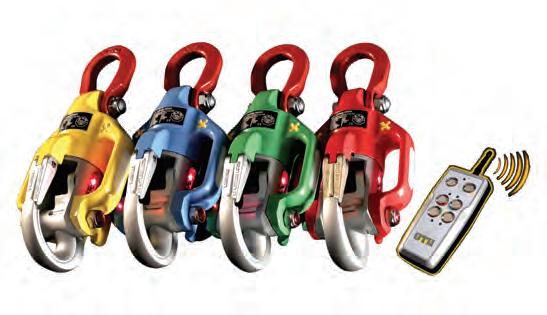
Falls, slips and trips remain a leading cause of serious injury and fatalities in construction, and load release can be a high-risk moment when crews must climb or access elevated positions to manually unhook rigging. Wireless rigging technology is increasingly being used to reduce that exposure. One example is the Quick-Release LudwigHook, a radiocontrolled hook designed to allow crews to release loads from ground level using a
two-button remote sequence.
Available in working load limits of 4,400 pounds and 11,600 pounds, the hooks are designed for compatibility with multiple crane types and a range of rigging configurations. The system is designed to release loads in under two seconds, allowing the crane hook to return with the rigging and prepare for the next lift without requiring personnel to access the release point.
Multiple hooks can be synchronized to a single remote, supporting multi-leg lifts. Operators can release hooks individually using color-coded channels (red, blue, green and yellow) or release all at once, depending on the lift plan and load handling needs.
RUD Group
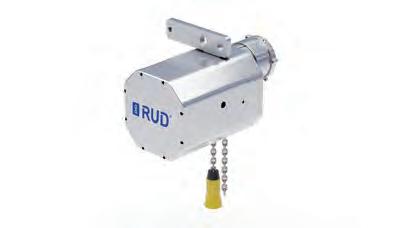
RUD’s neXera is an electric hoist designed for wind turbine service and maintenance cycles, where lifting height and cycle time can directly affect downtime and labor efficiency. RUD lists variable lifting speeds
of 79 to 262 feet/minute for loads up to 1,764 pounds. The company positions the system as faster than conventional hoists for typical service cycles, enabled in part by its patented X-Drive chain drive.
RUD says neXera was developed for lifting applications with heights up to about 656 feet and beyond, reflecting increasing hub heights in the wind sector. The hoist is designed for use on onshore and offshore turbines. The patented X-Drive chain drive supports chain speeds listed up to 262 feet/minute, which the company says can reduce waiting time during lifting and lowering, shorten service time and lower downtime per turbine. RUD also notes reduced chain wear and a chain pocket wheel design intended to help prevent chain issues such as unclamping or shearing.
Rugged Controls
In crane and rigging operations, real-time load measurement can support both safety and efficiency, especially when conditions change quickly and crews need immediate feedback. Rugged Controls’ Programmable
LGH’s Multi-Lug Lifting Beams feature adjustable lift points on the top and bottom flanges to support many configurations.
A radio-controlled quick-release hook allows crews to release loads from ground level, reducing exposure during load unhooking.
RUD’s neXera electric hoist is designed for wind turbine service lifts, with higher lifting speeds and features aimed at repeatable positioning and inspection documentation.
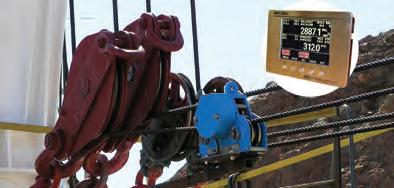
Rugged Controls’ running line tensiometer and controller provide real-time line tension data and configurable alarms.
RING CLIMBING
Save man-hours with this innovative incremental lift system. Engineered rings eliminate the guesswork, safety risks and crew strain inherent in crib stacking/unstacking.
Ring climbers deliver precision, power and portability.
Load Capacity: 115-tons per double-acting cylinder
Diameter: 7.68”
Height: 11.8” retracted, 35.91” fully extended
Weight: 50 lbs. per cylinder
Stroke: 5.1”
The kit includes 4 cylinders, 24 stacking rings and accessories.
Controller (RPC-90x-C), paired with a Running Line Tensiometer (RLT), is designed to provide continuous load and tension monitoring on the active line. The RLT installs directly on the line, with models designed for line diameters from 7/8 inches to 6 inches.
Slingmax Twin-Path synthetic roundslings use a dual-path load-bearing design with protective jackets and inspection features for critical heavy-lift applications.
It provides continuous load and tension measurements without requiring changes to the rigging configuration. That data is transmitted to the RPC-90x-C, a programmable controller designed for harsh industrial and marine environments, featuring flexible I/O, an operator-friendly
FULL-SERVICE TURNKEY PROJECTS MADE SIMPLE
We
RIGGING SOLUTIONS
interface and a high-visibility display. In combination, the system allows operators to view live load data, track trends over time and respond to changing conditions during a lift.
Slingmax Group
Slingmax Twin-Path high-performance synthetic roundslings are used in heavy-lift applications across crane and rigging, millwrighting, construction and specialized transportation. Twin-Path slings are positioned as significantly lighter than comparable steel options while still delivering high capacity and improved handling ergonomics.
Each Twin-Path sling is constructed with two independent paths of load-bearing fiber that function together as one sling, providing built-in redundancy. Slingmax notes that each sling uses K-Spec core yarn, a blend of high-performance fibers that the company states has been approved by DNV and independently tested for durability as a load-bearing core. With a high strength-to-weight ratio and less than 1 percent elongation at rated capacity, the slings are designed to support controlled load handling during critical lifts. n
• CRANE RENTALS
• FORKLIFTS AND MOBILE LIFTS
• HYDRAULIC GANTRY SYSTEMS UP TO 900-TON CAPACITY
• HYDRA-SLIDE™ SKIDDING SYSTEMS UP TO 1,000-TON CAPACITY
• HYDRAULIC PLATFORM TRAILERS
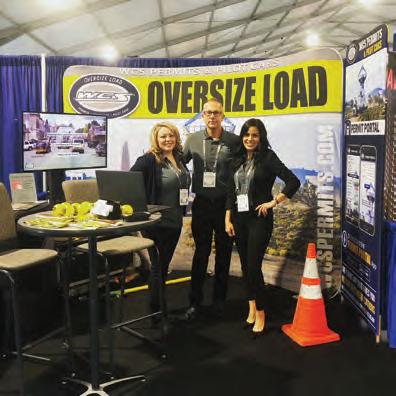
WCS Permits’ Wes Mollno and Valerie Daniel discuss why pilot cars are critical once the load is approved.
Securing permits is often viewed as the finish line in heavy haul planning, but in reality it is only the starting point. Once a route is approved and the paperwork is in hand, the real work begins. Loads must move safely, compliantly and in real time through an unpredictable environment.
That transition, from approval to execution, is where pilot cars play a critical and increasingly complex role.
“A permit defines what can move,” said Wes Mollno, president of WCS Permits & Pilot Cars. “Pilot cars are what make sure it does move safely once the wheels start turning.”
A growing challenge
One of the biggest challenges carriers face today is securing qualified pilot car operators. According to Mollno, the issue stems from inconsistent certification
From permits to pavement
requirements, rising costs and increased liability exposure.
“The role of a pilot or escort vehicle operator is critical to public safety, but the pathway into the profession is not always clear,” said Mollno. “Training and certification requirements vary widely by state, which creates an uneven supply of experienced operators.”
That inconsistency becomes even more problematic on multi-state hauls, where trigger dimensions, equipment requirements and certification rules can change from one border to the next.
At the same time, pilot car services have become significantly more expensive. Costs vary based on load size, route complexity, distance and regional regulations, but the overall trend continues upward as the dimensions of moved commodities increase.
Economical escorting
A permit defines what can move. Pilot cars are what make sure it does move safely once the wheels start turning.
WES MOLLNO, President, WCS Permits
Pilot
Rising escort costs have prompted some carriers to consider bringing pilot car services in house. While the approach can appear economical at first glance, the reality is often more complicated.
“Some carriers do explore self-escorting,”
cars play a critical role in safely escorting oversize loads, managing traffic and supporting compliance once permitted moves are underway.
said Mollno. “But once you factor in specialized training, equipment, insurance and multi-state certification, it is not always practical.”
Regulatory inconsistency is another deterrent. Because escort requirements vary by state, carriers operating their own pilot cars may incur significant mileage in areas where escorts are not required. Combined with increased liability exposure, many carriers ultimately determine that the risks outweigh the perceived cost savings.
Pilot car responsibilities extend well beyond leading or following a load. Their role involves active roadway management, real-time communication and public safety coordination.
“A typical heavy haul may require one to two pilot cars for moderate loads, or three or more for extreme height, width or route complexity,” said Valerie Daniel, national pilot car manager.
Pilot car operators warn the traveling public, communicate hazards and maintain constant contact with the truck driver. They are also responsible for ensuring required equipment, including signs, flags, height poles and radios, is present and functional.
Pre-trip planning is essential. “Every trip should include verifying load dimensions, reviewing permits and routes, checking clearances and accounting for construction zones,” said Daniel.
“Post-trip reviews with the driver are often overlooked, but they are critical for improving future moves.”
Operators typically carry commercial auto and general liability insurance. Professional liability coverage is especially important, though it is not always required by law.
Real-world conditions
Even with a permitted route, conditions on the road can change quickly.
Construction activity, weather and traffic behavior all introduce variables that pilot cars must manage as the move unfolds.
“Miscommunication, inconsistent training, equipment failures, route changes and regulatory differences across
Pilot cars are often the first line of defense when conditions change unexpectedly.
state lines are some of the most common challenges,” said Daniel. “Pilot cars are often the first line of defense when conditions change unexpectedly.”
Given the safety-critical nature of the role, both Mollno and Daniel believe there is a strong case for more consistent pilot car certification. State-level programs
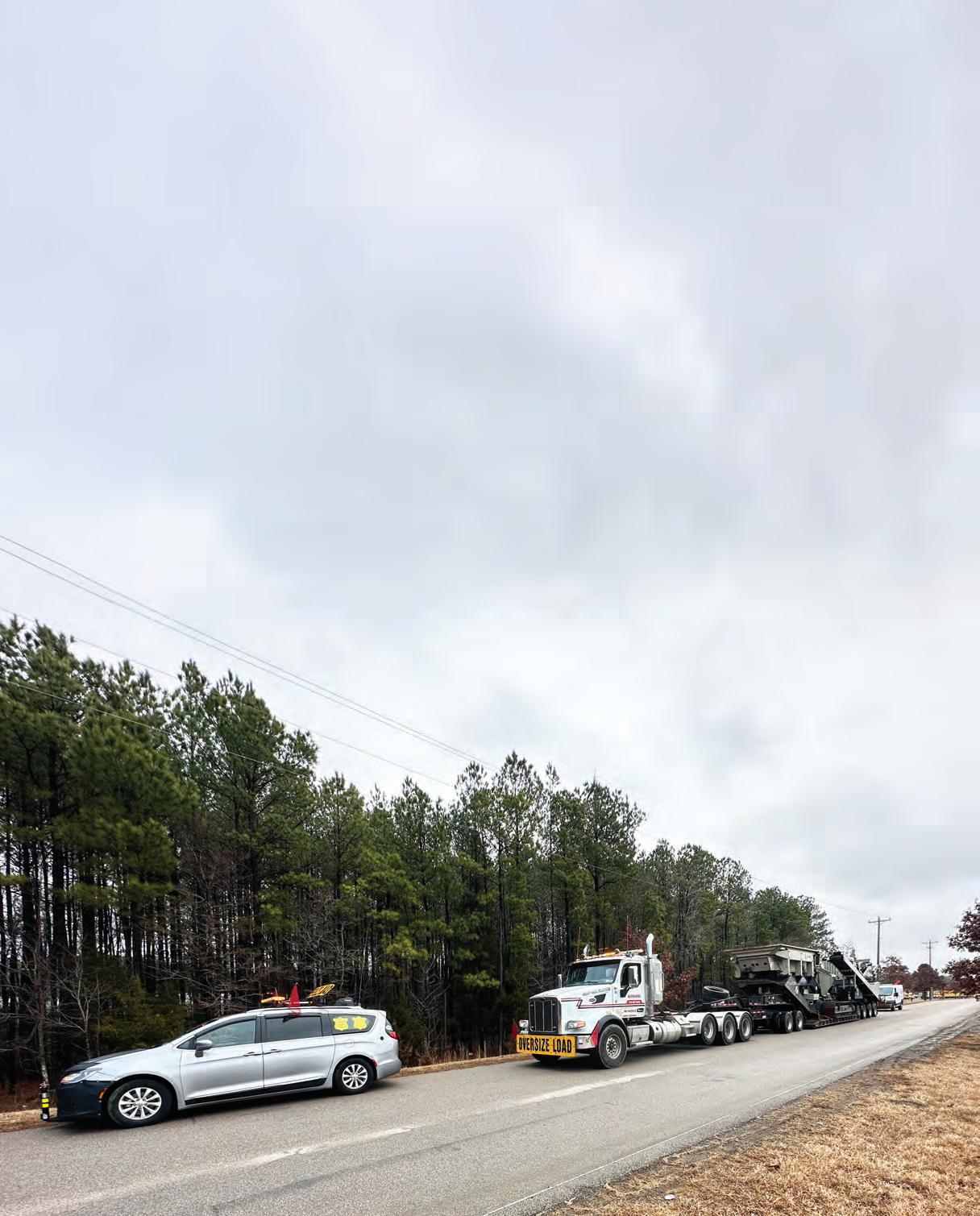
Oversize and superload moves often require multiple pilot cars to support route execution, real-time coordination and public safety throughout the haul.
allow requirements to be tailored to local infrastructure, but they also create gaps and inconsistencies for interstate hauls. Some states do not require pilot car certification at all.
“A national baseline certification, paired with state-specific add-ons, would provide the best balance,” said Mollno.
Approval to arrival
Permits may authorize a move, but pilot cars ensure it happens safely from start to finish. They translate approved routes into real-world execution, navigating traffic, weather and infrastructure challenges mile by mile.
“Compliance does not end when the permit is issued,” Mollno said. “It continues all the way to the destination, and pilot cars are central to making that happen safely.”
Your project’s success depends on conquering challenges. Safety concerns, tight deadlines, availability, budget — the list goes on.
For over 30 years, LGH has provided customers like you with the safest rigging gear rentals and most knowledgeable staff in the industry. Why? Because safety and excellence are our core values. We offer rental solutions at every step of your project.
Experience the LGH difference by scanning the QR code above! Your job is already tough. Find
VALERIE DANIEL, National Pilot Car Manager, WCS Permits
Machinery
Powerbars
The SLR50 is resilient and robust, showing modest but steady growth in our 2026 top list.
Heavy lifters
For the first time in a few years, the ACTSPECIALIZEDLIFTING &RIGGING50 showed growth in every category, and the index rose as well. While growth was modest, with the 2026 index at 1,884,058 tons, we see growth from 1,856,949 tons in 2025 and 1,656,082 tons in 2024. In just two years, the index has grown more than 200,000 tons. This growth can be attributed to two factors. Number one, specialized lifting and rigging companies are adding all types of lifting and rigging solutions to their fleet. Number two, large-scale infrastructure and industrial projects are requiring advanced specialized equipment that can rig, lift and install ever heavier, taller and awkward equipment, vessels and materials.
Mammoet Americas, Fagioli USA
The total workforce count this year is 24,433, an increase of nearly 3,000 employees from 21,449 in 2025.
and Barnhart Crane & Rigging again rank at Number 1, 2 and 3. All three of these companies have huge fleets and operate highly advanced rigging and lifting systems. At Number 4, Bay Crane Companies joined the ACTSPECIALIZEDLIFTING &RIGGING50 for the first time in 2025. Also in 2025,
Bragg Companies and Superior Rigging & Erecting joined the list. Both retain their spots at 33 and 40 respectively.
The total workforce count this year is 24,433, an increase of nearly 3,000 employees from 21,449 in 2025. In 2024 the employee count was 20,781, an indication that there’s an increased demand for workers in the construction, energy and heavy transportation sectors.
Fleet additions
Fleet sizes increased in every category this year with 1,307 gantries, including rubber-tired gantries. While strand jack
fleet acquisition didn’t increase much, the “other” specialized lifting equipment category grew exponentially from 10,213 in 2025 to 10,140 in 2026. In 2024, the other category was at 6,869 units. This increase
shows that versatile and adaptive lifting technologies are needed to accommodate evolving lifting and rigging projects.
In summary, the 2026 SLR50 top list reflects healthy growth. The biggest issue with the list is that we didn’t add any new companies this year. We are sure that there are at least 25 companies that should be on this list based on their lifting and rigging fleets. More crane and specialized transportation companies are adding specialized lifting equipment to their fleets to further expand into machinery repair and replacement and other specialized lifting and rigging projects. ■
Methodology
ACT began distributing survey forms for the ACTSPECIALIZEDLIFTING &RIGGING50 list via email in January 2026 and followed up with phone calls and more emails. The companies that completed and returned these surveys over the course of the last two months were included in this year’s list. For some companies we used data from 2025. In these cases, an asterisk appears next to that company’s name as an estimate.
While every effort was made to ensure the accuracy and completeness of this information, ACT, its editors and publishers do not assume responsibility for errors or omissions. We strive to improve this list every year.
2027 toplist
To be a part of our 2027 SPECIALIZEDLIFTING &RIGGING50, email the editor, D.Ann Shiffler, to request a survey form. She can be reached at: d.ann.shiffler@khl.com. Or you may email Hannah Sundermeyer at: hannah.sundermeyer@khl.com
ACT’s show guide to ConExpo, North America’s construction equipment oasis.
Desert
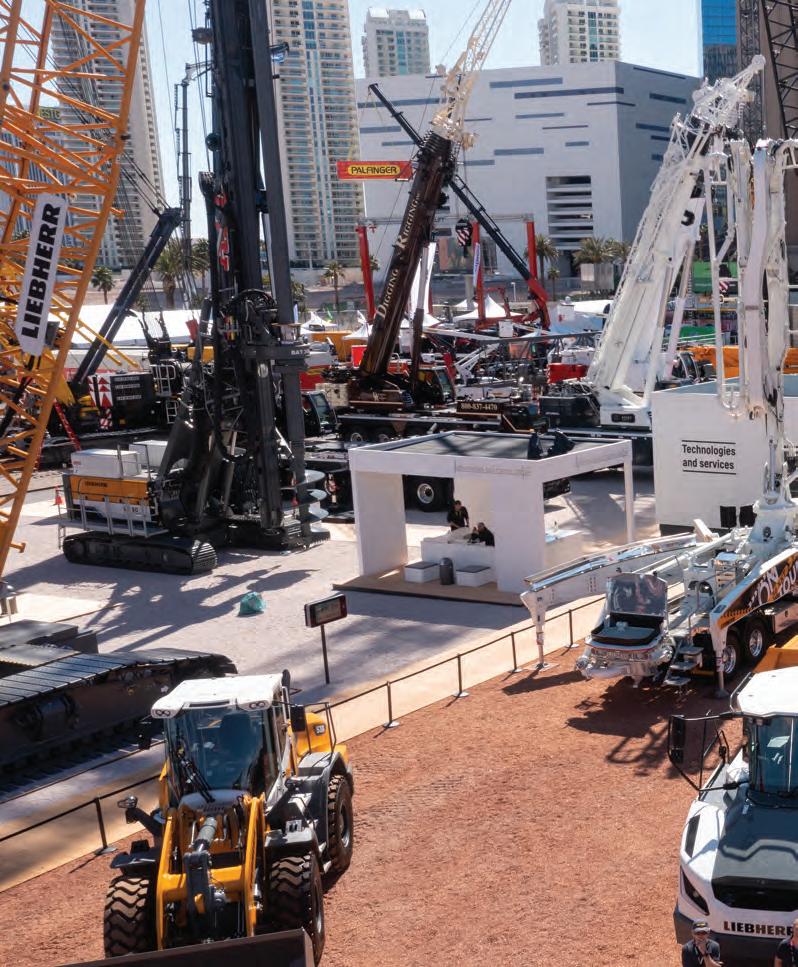
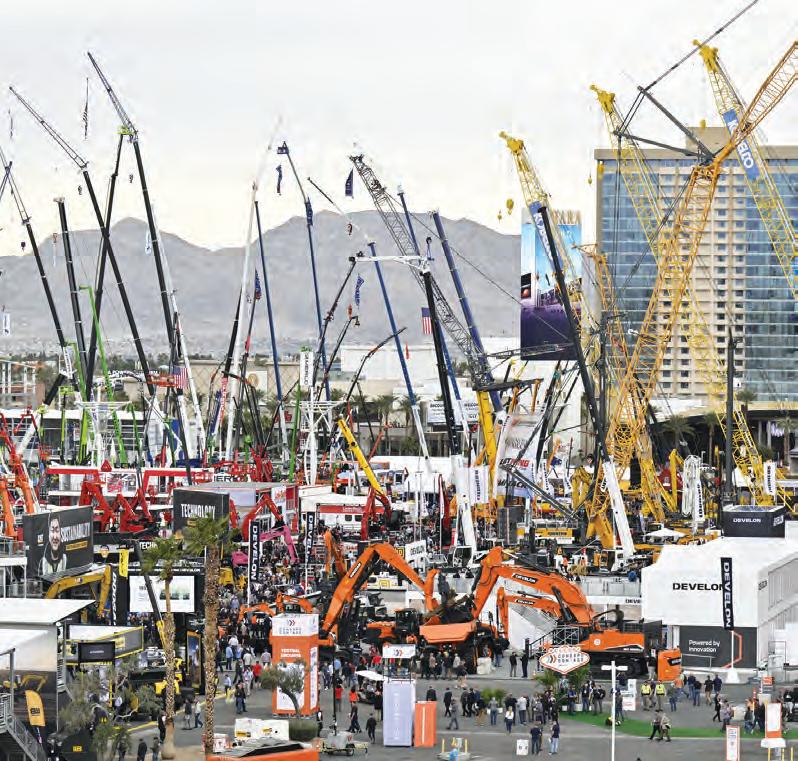
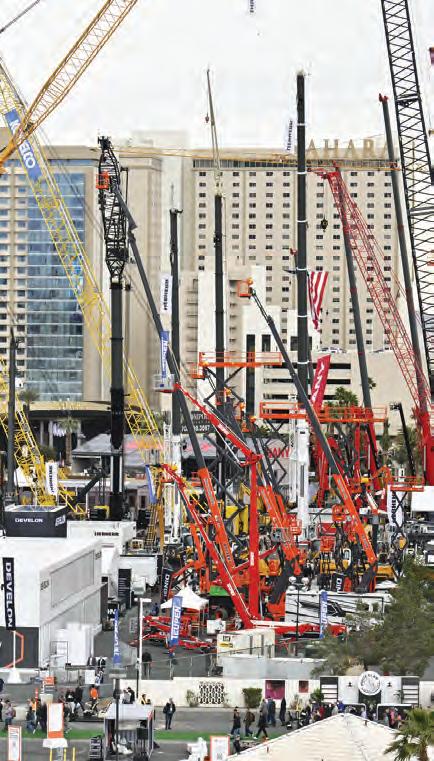
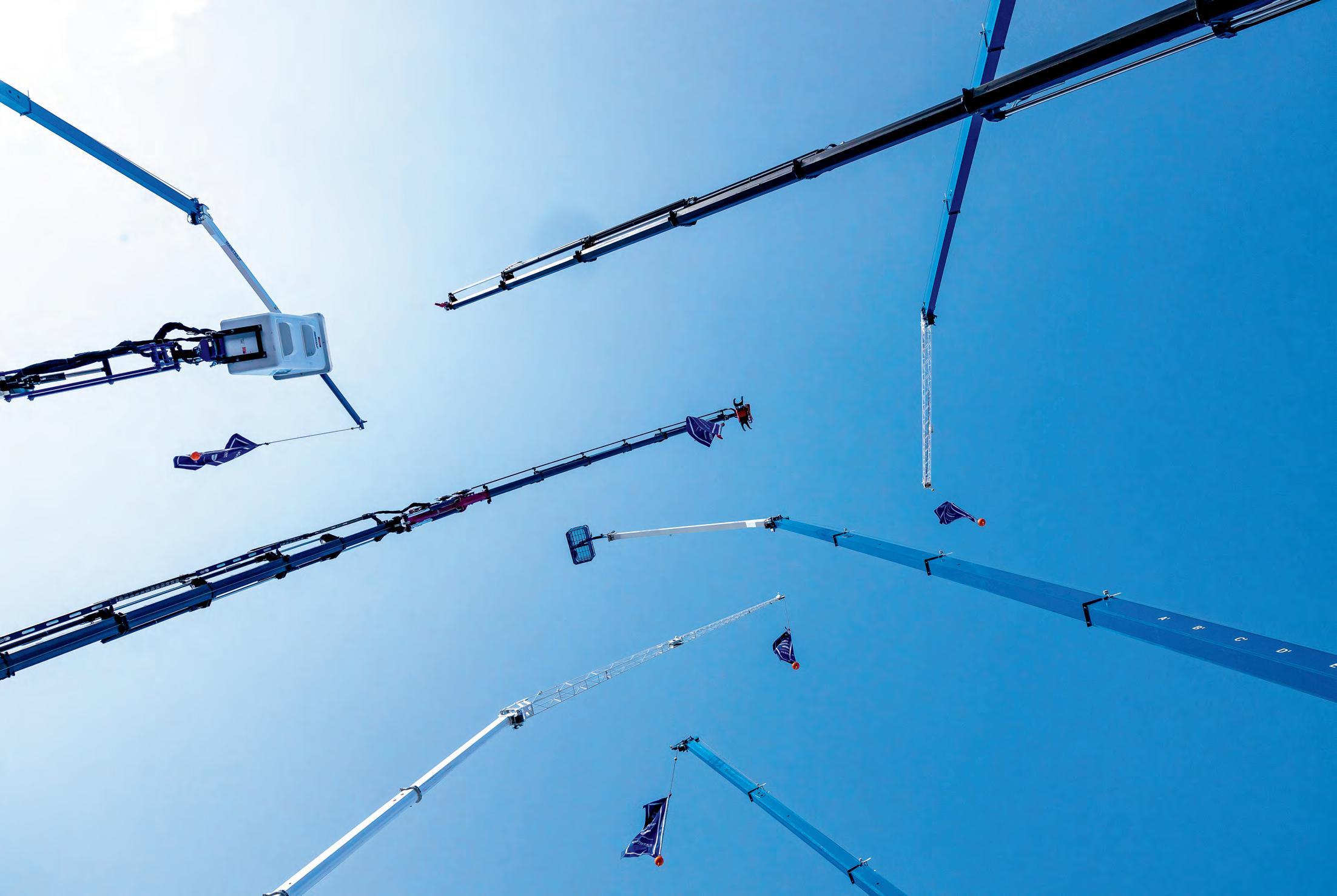
Here we are, ConExpo Con/ Agg in Las Vegas. For old timers, there’s a sense of déjà vu. For first timers, it’s an unforgettable experience. The skies are filled with colorful booms, forks, buckets, flags, balloons and more. The exhibitors are as ready as they will ever be. New product launches are ready to be unveiled, the machines have been shined to perfection, and it’s time to get this show on the road. Welcome to ConExpo 2026. Buckle up because the ride is fast, furious and fantastic.
Close to 140,000 people are expected to walk through the gates at this, the largest construction equipment show in North America. More than 2,000 exhibitors will showcase the latest equipment, technologies and services pertinent to the construction industry as a whole, and in our case, specifically to the crane, rigging and specialized transportation sector. In our February issue, we revealed several product exclusives, including new cranes from Link-Belt, Liebherr, PVE America and Trail King. This show
WHEN: March 3-7, 2026
WHERE: Las Vegas Convention Center
REGISTRATION:
Scan here or visit: conexpoconagg.com/ attend-the-show/ registration-and-pricing
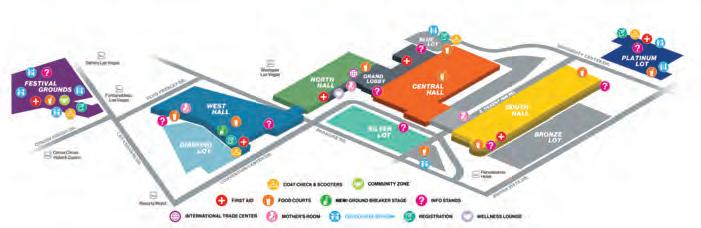
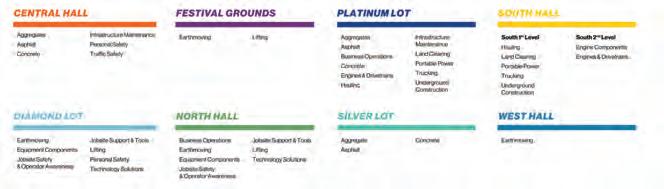
2026 overview map
guide represents our efforts to feature information about as many companies in our sector as possible. There’s also our Select List of Exhibitors, which features the names and booth numbers of all exhibitors pertinent to our industry sector. And don’t forget to drop in and see our American Cranes & Transport, International Cranes and Specialized Transport and the greater KHL Group team. We will be at Booth N12525.
CRANES
Altec Industries, F44042
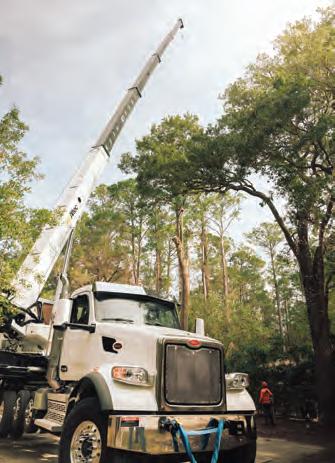
One of the biggest utility equipment providers at the show, Altec will exhibit the Altec AC65E-155S, the company’s largest and most capable dual-rated crane, offering both lifting and personnel platform capabilities. The unit features
showdown
130,000 pounds of maximum lifting capacity with 155 feet of main boom length. It can reach a platform working height of 215 feet when configured as an aerial device with the telescopic jib extended. The machine features 12,500-pounds of hydraulically removable counterweight that is configurable
in 3,000-pound increments. This counterweight optimizes pick capacity and weight while enabling easy, one-man installation and removal from inside the cab. Swing-out-and-down style outriggers allow for the machine to be extremely rigid and provide a solid feel when at the limits of the load chart, Altec said. 22 inches of outrigger penetration, four span charts and Altec’s Smart-Zone Rating system give the crane flexibility during set up.
Fascan International, Jekko USA, F40054
Since its founding in 1992, Fascan International has earned an impressive reputation as the United States’ official importer and distributor of Fassi articulated hydraulic cranes and Jekko mini cranes. Under the leadership of President & CEO Bernie J. Faloney, Jr., the company has grown from a modest Baltimore distribution facility into a 55,000-square-foot hub supporting nearly 7,000 cranes installed across the United States and Caribbean markets. On show will be several new and improved Fassi and Jekko cranes.
Elliott Equipment, S60430
Elliott Equipment Company produces truck-mounted aerial work platforms,
Broderson, F46010
Broderson, a subsidiary of the Lanco Group of Companies, will show the new Broderson IC-400 variable outrigger modes. Broderson said they are the first carry deck crane manufacturer to offer this technology.
This system allows operators to maximize the machines’ potential when using mixed outrigger position combinations and get capacities for each of the four zones, making working in tight spaces easier with greater flexibility. And this new technology only requires a software upgrade, so it can be added to existing models. No physical hardware changes are required.
Broderson IC-400 with variable outrigger modes
cranes and digger derricks for the utility industry. Several units will be on show including Elliott’s E160 Transmission Class Aerial, which delivers 1,500 pounds of material handling capacity and 1,200 pounds of personnel capacity, with a combined 2,000-pound rating.
Lampson International, N10346
Lampson International will be showcasing its various products and services, as well as its Millennium Series Crawler Cranes. Specializing in heavy lift services including crawler-mounted, rough terrain, all-terrain and lattice truck cranes as well as the proprietary product, the Lampson Transi-Lift, the company’s fleet is expansive. With weights ranging from 50 to 3,000 tons, and over 500 pieces of equipment, Lampson can meet any lift requirement necessary.
In addition to its heavy lift services,
PHOTO: AEM/CONEXPO CON/AGG
Altec Industries AC65E-155S
Jekko USA and Fascan International
CTT 392-16
> 18 USt (16 t) max capacity
> 82 - 246 ft (25 - 75 m) min/max jib length
> 322.7 ft (98,35 m) max free-standing height
> T-torque slewing technology
> 4 tower systems option
TRT 55US
> 55 USt (50 t) rated capacity
> 123 ft (37,4 m) max main boom length
> 149 ft (45,4 m) max boom lenght with jib
> 8.2 ft (2,5 m) maximun crane width
> Fully proportional boom mode
CTL 702-32 / 712-45
> 35 - 50 USt (32 - 45 t) max capacity
> 98 - 230 ft (30 - 70 m) min/max jib length
> 2/4 falls or 1/2 falls operation
> T-torque slewing technology
> Excellence in the sky design
Lampson also specializes in heavy haul services to include its exclusive Lampson Crawler Transporters ranging from 400 to 4,000 tons as well hydraulic platform trailers, both self-propelled and towable. Lampson International also offers specialized engineering and customized rigging services, steel mat rental and load testing services.
Manitowoc Cranes, F39029
With its “big and bold” theme, Manitowoc promises “huge launches” and a major showcase of its industry leading customer support offerings. Range-topping crane introductions from Grove and National Crane will be a focus at the show, alongside new aftermarket products and services to expand Manitowoc’s goal as a total lifecycle lifting solutions company.
Manitowoc said one of North America’s most popular rough-terrain cranes, the Grove GRT780 , will be at the booth.
“Our CRANES+50 strategy guides us as we work to become a full-lifecycle service lifting provider for our customers,” said President and CEO Aaron Ravenscroft.
“Our presence at ConExpo 2026 reflects that commitment. We are showcasing some of the largest mobile cranes at
Liebherr Cranes, F35055 / P7761
Liebherr will showcase developments across its full crane portfolio. Exhibits include a worldpremiere all-terrain crane, along with a range of mobile and crawler cranes spanning compact to heavy-duty lifting classes. These machines emphasize optimized transport concepts, advanced assistance systems and efficient setup procedures, the company said. Liebherr will emphasize its advanced assistance systems, transport-optimized designs and digital services that are designed to simplify planning, dispatching and daily operations.
At ConExpo in 2017, Liebherr launched the LTM 1090-4.2, which was marketed as an economical all-terrain crane on four axles. Nine years later, Liebherr is presenting its successor, the LTM 1090-4.3. The 110-ton crane can be driven with many different axle loads on roads and construction sites: 22,050 pounds, 26,450 pounds and 35,275 pounds per axle load. The standard quick-change ballast system makes switching between driving modes quick and easy, Liebherr said. Carrying up to 19,400 pounds of counterweight with an axle load of 26,450 pounds gives value to the crane allowing crane operators to complete crane jobs without transporting additional ballast.
Live demonstrations, a hallmark of the Liebherr booth, will take place several times each day. The demos will center on practical applications of operator assistance systems, digital solutions and alternative drive technologies. Demonstrations include MyLiebherr for fleet and performance management and Crane Planner 2.0 for 3D lift and site planning.
Link-Belt Cranes, F35029
Link-Belt is set to show several cranes in its product range, but as we reported last month, a highlight of the show is the new TCC-1800, a 180 US-ton telescopic crawler crane designed to bridge the gap between the company’s 140-ton TCC-1400 and its flagship 250-ton TCC2500. The new telecrawler is rated at 180 tons at an 8-foot radius and features a 42.7- to 197.3-foot greaseless six-section pin-and-latch boom.
This crane is Link-Belt’s answer to a fast-growing market segment, telecrawlers in the 150to 200-ton class, where contractors are asking for more reach, more capacity and better jobsite mobility without stepping into a much heavier, harder-to-transport machine, Link-Belt said. The TCC-1800 will make its first public appearance at ConExpo before shipments begin in the third quarter of 2026.
Link-Belt TCC-1800
Link-Belt will also show the new 248|V lattice-boom crawler crane, which is the fifth generation in the 248 family of 200-ton lattice boom crawler cranes. The crane features a new luffing jib that was designed to increase lifting capacity and ease of transport and installation.
the show and demonstrating how our partnership helps customers maximize their investments with industry-leading product support.”
One highlight is the new Mobile Training & Technology Center that is making its debut at the show. This industryfirst mobile classroom offers modular, on-site training for customers and North American dealers, advancing workforce development for large crane owners and dealers by streamlining technician upskilling.
Palfinger, F46041
For the first time, Palfinger will highlight all six of its North American product lines, showcasing its full portfolio of lifting solutions, including the Palfinger TEC Series, which includes the new PK 580 TEC and PK 1050 TEC knuckleboom cranes.
The Palfinger TEC cranes offer a range of comfort features and intelligent assistance systems, enabling operators to handle complex lifting tasks with confidence, Palfinger said. All TEC series cranes feature the patented tear-drop P-Profile boom, an industry first that delivers a lighter, more rigid extension system, reducing >46
Peter, Kate and Bill Lampson
Manitowoc Grove GMK 5150XL
EXHIBITOR BOOTH
A1A Software F29067
Allison Transmission S80915
Altec Industries F44042
Aluexbeams N12071
AMCS technologies F41011
Arrowhead Winch N12125
Ascorel D1224
Aspen Custom Trailers P7327
Associated Wire Rope & Rigging F27020 Association of Equipment Manufacturers (AEM) GL20100
Autec North America N11055
Auto Crane Company S63159
Behnke Trailers P8132
Bigfoot Construction Equipment F24054
Bigge Crane and Rigging F41020
Bloom Manufacturing N11011
Bridgestone Americas W41633
Brigade Electronics N12945
Broderson (Lanco Group) F46010
Brutus Truck Bodies / Next Hydraulics F19026
Buckingham Structural Moving Equipment N11614
Cargo Equipment N10300
Cattron W42748
Cavotec N10476
CICB N11362
CM Labs Simulations N11839 N11839
Comansa Tower Cranes F42086
Cormach D1153
Cranes 101 N10665
Cranesmart Systems N13250
DanFoss Power Systems F24054
De Haan Special Equipment F41010
DICA F42066
Dinamic Oil North America W44105
DSR International N10232
Elliott Equipment Company S60430
Enerpac F42020
Erkin World Power D1245
deadweight and improving load stability for operators.
PVE American, D1040
PVE Cranes Group, in partnership with its master distributor Atlantic Coast Cranes & Machinery, will roll out the PVE American CC200 crawler crane. The new PVE American combines a European crawler platform with Cummins Tier 4F power, Rexroth hydraulics, advanced telematics and self-assembly systems specifically engineered for North American lifting and transport requirements, the company said.
The CC200-1 model was chosen as the introductory model because the 200-ton class is a sweet spot in the market. Other models in the series include the CC601, CC110-1 and CC330-1, representing capacities of 60 tons, 110 tons and 330 tons, respectively. The cranes all have the same design attributes. The CC200-1 features a 246-foot main boom and a 160foot luffing jib for a tip height of 406 feet.
The 330-ton PVE American CC330 can be equipped for wind maintenance jobs with 282-foot main boom and 20-foot heavy duty jib. In this configuration it would be able to pick 88 tons at 28-foot radius.
Sany America, F44054
Sany America will launch two new cranes, the SCA3300A and SCA1100TB.
The company said the SCA3300A is a 330-ton crawler crane designed with a strong chart with versatile attachments. The new crane has an updated operator’s cab featuring heated, ventilated seats and electrochromatic glass. Easy to transport in as few as two loads, the SCA1100TB 110-ton telescopic crawler has a five-section, full power boom which is the longest boom in its class at 174 feet, Sany said. It comes standard
Raimondi/Terex, F18012
Terex Rough Terrain, now part of the Raimondi Group, is set to present the TRT 55US. The crane is engineered to meet North American operational, regulatory and environmental requirements. This marks the first product debut under the Raimondi North America brand.
Designed and developed in Italy by the Terex Rough Terrain team, the new crane boasts a 55-ton lifting capacity and a maximum jib length of 122.7 feet, supported by three telescoping boom modes for enhanced operational flexibility; the third mode, a distinctive feature of Terex Rough Terrain models, is the Proportional Telescoping Boom mode, designed to simplify operator workflows.
Attendees will also be able to learn more about the tower cranes portfolio, including the launch of new flat-tops and luffing jib cranes.
with 3-position side frames, flat pad tracks, a 20-degree tilt cab and is powered by a Cummins engine.
Franna, the Australian manufacturer of pick and carry cranes, will showcase the AT24 US. Launched to the U.S.
looking forward to presenting the AT24 US to an even broader
The AT24 US incorporates operators, personnel environment. The
Palfinger PK 1050 TEC-2
PVE American Cranes CC200-1
Terex Raimondi TRT 55US
The centrepiece of the Çanakkale suspension bridge.
How to bridge two continents overseas with Green Pin® Super Shackles.
The 1915 Çanakkale Bridge in Istanbul is the world’s longest suspension bridge being 3.7 km long, connecting Asia and Europe overseas. Yet, since the rapid growth of the social economy and tourism, the bridge needed an extension. For such a big and important project, Green Pin Super® Shackles were selected due to their weight, size, strength, and availability. The centrepiece of rigging in bridging two continents.
Project highlights
Used sling shackles (400 t) and Green Pin Super® Shackles (G-5263)
Longest suspension bridge in the world
Total length of 3.7 km
The suspension span is 2,023 meters long
The bridge is designed to withstand earthquakes
BIGFOOT: AMERICAN GRIT THAT PERFORMS UNDER PRESSURE
For more than three decades, Bigfoot has operated as a family run American manufacturer producing American made wood outrigger pads, custom composite outrigger pads, and steel crane mats used across all seven continents. From the beginning, Bigfoot products were shaped by American Grit, and real world field experience in crane operations, lineman work, and concrete pumping, where STRENGTH, STABILITY, and SAFETY are not optional.
As lifting equipment has grown in size and capacity, dependable ground support has become increasingly critical. Jobsite conditions are rarely ideal. Uneven terrain, changing soil conditions, moisture, and
compaction all affect how loads are transferred into the ground. Because of this variability, reliable ground support depends not only on equipment size, but also on how loads are broadcasted.
Ground bearing capacity refers to the ability of soil to support applied loads without failure and varies significantly based on soil type, moisture content, drainage, and compaction.
In practice, lift planning relies on allowable ground bearing pressure, which applies conservative safety factors to account for uncertainty and dynamic loading. OSHA and ASME guidelines emphasize the use of properly sized, adequately rated outrigger pads and blocking to help support stable equipment setups.
Load spreading systems such as outrigger pads and crane mats do not increase the strength of the ground itself, but instead reduce applied pressure by broadcasting loads over a larger surface area. This helps maintain pressures within allowable limits across a wide range of jobsite conditions.
Bigfoot designs and manufactures ground support products with these realities in mind. Higher load ratings, consistent material performance, and clear engineering standards guide product development so crews can rely on equipment that performs in the conditions they actually face, not ideal scenarios. This approach reflects an understanding of what operators expect from ground support used beneath critical lifts.
Beyond manufacturing, Bigfoot actively participates in industry organizations including NAMA, ASME, and the SC&RA Safety, Education and Training Committee to support education, collaboration, and the development of best practices. This involvement, combined with hands on field experience, informs Bigfoot’s understanding of how varying ground conditions interact with load spreading systems.
At Bigfoot, American grit is engineered into every solution through reliable products, accountability, and respect for the responsibility carried by crews working under pressure every day. As the company expands its product portfolio and supports new applications, its commitment remains unchanged: deliver dependable ground support solutions that help promote safer, more consistent jobsite performance.
Come see Bigfoot at the CONEXPO CON/AGG Show in Las Vegas, March 3th to 7th, located at Booth #F24054 in the Festival Lot.
Steel Crane Mats For Cranes 200 to 500 Tons
Bigfoot Wooden Outrigger Pads
Tadano, F47010
With its theme “Reaching New Heights,” Tadano will display the breadth of its expanded global portfolio, reflecting its continued evolution into a full-line lifting and access solutions provider. Tadano will present a more comprehensive offering for North American customers, including former Manitex product lines now fully integrated into the Tadano portfolio – supporting a “one-stop” approach across lifting, access and jobsite solutions.
Innovation will be a central focus, with multiple new and enhanced machines. Among the highlights is the AC 5.250L-2 all terrain crane, featuring a bifold jib designed to increase flexibility and efficiency on site. Tadano will also present advancements such as the removable outrigger box for larger capacity cranes like the AC 6.300-1, reinforcing the company’s emphasis on transport efficiency and jobsite versatility. Additionally, the GTC-600-2 telescopic boom crawler crane will be featured with its strong combination of lifting performance, compact jobsite access and logistical convenience.
Several boom trucks and PM knuckle boom cranes will be featured as a part of Tadano’s expanding lifting solutions lineup. Sustainability, digitalization and customer support will also be key themes. Tadano will spotlight its True Mission Zero Emissions strategy, including its pathway toward reduced and ultimately zero emissions, and its latest digital tools and connected solutions aimed at improving fleet uptime, safety and operational transparency.
overload protection, Franna’s proprietary Dynamic Load Moment Indicator, an external emergency stop and an ergonomically designed cabin that supports operator comfort, Franna said. Precision and control are supported by intelligent functions including automatic counterweight detection, operator‑defined height limits, maximum working radius settings, front axle weight monitoring, rigging limits and real‑time feedback on percentage of rated capacity. These features enable the AT24 US to deliver the consistency and on site agility expected by contractors and fleet owners, the company said.
TOWER CRANES
Comansa, F42086 Comansa introduces its latest innovation, the 6LC85 flat top tower crane, a versatile and
compact model designed for urban and confined workspaces. The 6LC85 offers a maximum load capacity of 11,020 pounds and a reach of 172.2 feet. There are multiple versions available: embedded, supported on bases of 12.5 or 14.8 feet or on top of travelling bases. The crane’s standard mast size of 3.9 feet allows it to fit in small areas. Its modular jib can be configured from 65.6 to 172.2 feet, with increments every 8.2 feet. The crane features a minimum working radius of 5.8 feet and a counterjib radius of just 41 feet.
The 6LC85 is equipped with Comansa’s compact head design, which integrates the slewing and hoist mechanisms, electric control panel and safety limiters into a single unit. Nearly all connections are pre assembled, reducing installation time. Compact components simplify transport and handling, reducing on site logistical challenges and resource requirements. Components are located within the compact head, allowing for quick inspections and easy maintenance.
Comansa will display its CUBE Cab and components of the 16LC260 12 ton tower crane. >50
Fascan International F40054
Faymonville P7427
Felling Trailers P8250
Globe Trailers Manufacturing P7459
Goldhofer F39020
Green Pin/Irizar Forge (Royal Van Beest) N10355
Hallite Seals S82619
HBC-radiomatic N12238
Hendrickson S63910
Hetronic N11027
Hilman Rollers F45049
HookCam D1101
Instagrid P7233
Intercomp N12066
Intercontrol Hermann Kohler Elektrik N10545
International Union of Operating Engineers GL50001
Iowa Mold Tooling Company Inc (IMT) N12324
IPS Cranes N10909
ITI N10466
J.R. Merritt Controls S82156
Jaso Tower Cranes F41002
Kaufman Trailers P8315
KHL Group N12525
Kinshofer North America F16027
Kito Crosby N11827
Kobelco F35004
Lampson International N10346
Landoll Company P7959
Liebherr F35055 / P7761
Link-Belt Cranes F35029
Maeda F42012
Magna Tyres W42754
Manitowoc F39029
Michelin North America W42901
Miller Lifting Products N12777
Murray Trailers P7267
NBB Controls S83520
Nelson Manufacturing F43086
OverWatch F41001
Pacific Gulf Wire Rope F50028
Palazzani Industrie D1349
Palfinger North America F46041
Paus North America D1249
Pfeifer Wire Rope and Lifting Technology N11967
PVE American D1040
Ramsey Winch S63159
RaycoWylie N10762
Ritchie Bros. W41567
Rotzler USA N10263
Samson Rope N11462
Sany America F44054
Tadano AC 5.250L-2
Franna AT24 US
Comansa 6LC85
Scanreco US W44101
Service Trucks International S61147
Shuttlelift F42078
Sigalarm N10663
Specialized Heavy Transport S63115
Spydercrane F40084
Stellar Industries S61822
Tadano F47010
Talbert Manufacturing P8349
Techking Tires N10815
Tecno Electtrica Ravasi (TER)
Springer Controls Company N10348
Tele Radio America S63559
Tenstar Simulation W42760
Terex Franna SV2357
Terex Cranes by Raimondi F18012
Teufelberger-Redaelli N10252
TII Scheuerle S63200
TKA Cranes D1241
Trail King Industries P7445
TVH Parts W41435
TW Products N10141
TWG (A Dover Company) N11727
Venco Venturo N12906
Verope USA N12273
Vita Industrial D1109
Voltek Systems D1326
WCS Permits N11901
WireCo N10519
Witzco Challenger Trailers S63058
XCMG (Xuzhuo Construction Machinery Group) F33005
Xwatch N12545
Yoke Industrial C23133
ZF Group S81717
Zoomlion F42027
JASO, F41002
A global frontrunner in design and manufacturer of tower cranes, personnel and material lifts and overhead cranes, JASO is a family-owned company based in the Basque Country, Spain. Today the company has a significant global footprint, reaching over 70 countries. JASO will be showing the J1920.DC derrick crane.
Liebherr, F35055/P7761
Liebherr tower cranes will highlight solutions designed for high-density urban construction and large infrastructure projects.
This includes the Liebherr 91 K selferecting tower crane from the new K series, which will be showcased with
Goldhofer, 39020
Goldhofer is looking forward to direct exchange with customers and showing new products, including the PST/SL-E split with widening system. With an axle load of 99,000 pounds and a variable width from 10 feet to 17 feet, optionally even up to 22 feet, it offers a flexible solution for transporting high loads, Goldhofer said. This concept is complemented by the new E-PowerPack, which has a rated output of 250 kW (around 340 HP). The revised operating concept – including a new remote control, an ultra-bright LED display and an integrated inclinometer – enable
maximum precision and show how customer feedback is incorporated into product development.
Another highlight for the heavy haul industry is the Goldhofer PST/ES-E (315). With axle
intelligent assistance systems that enhance precision, efficiency and safety in material handling, Liebherr said.
TRAILERS & TRANSPORT
Faymonville, P7427
The Faymonville Group is excited about the big U.S. premiere of the MAX Trailer, which is presenting its first U.S. vehicles in the form of the MAX110 SD140 and MAX510 LD140 models. Also new is an electronically controlled, self-propelled MSPE that the company said stands out in the Cometto range of products.
Landoll Corporation, P7959
Landoll Corporation will debut the 850XT Extendable Detachable Trailer, engineered to simplify heavy hauling, increase operator safety and provide >53
loads of up to 132,300 pounds on air-inflated tires and without TPMS, even the heaviest loads can be moved with significantly fewer axle lines without any mileage restrictions. The 8-foot-wide heavy-duty module can also be transported economically in flat racks. Designed specifically for the U.S. market, Goldhofer is also showing the THP/DC, which has the ability to quickly adjust the vehicle width between 14 feet and 20 feet.
Also on show is the STZ-H 6, which has been one of the most reliable semi low loaders in the American market, Goldhofer said. It can be adapted to various cargo requirements thanks to its telescopic functionality.
Liebherr 125 K
Goldhofer PST/ES-E
Faymonville MAX Trailer
Landoll 850XT
JASO J1920.DC
The world’s most popular rubber-tired gantry crane, with custom specifications and capacities from 30-300 tons.
fleet reliability, the company said. Built with Landoll’s proven engineering and customer-driven design philosophy, the 850XT is the most versatile extendable detach trailer Landoll has ever produced, Landoll said. The 850XT was designed to help operators haul more efficiently while spending less time worrying about equipment performance.
The 850XT is available in 48- and 53-foot configurations, featuring an extendable lower deck with four locking positions (closed, 2.5 feet, 5 feet and 8 feet) that quickly adapts to changing load requirements. This flexibility allows operators to handle oversized and heavy equipment without the delays and complications of switching trailers, reducing downtime and increasing productivity. The trailer’s low load angle and trunnion-style structure make loading low-clearance equipment, such as buses, –RVs, fire trucks, excavators and specialized machinery – safer and easier.
TII Scheuerle, S63200
North America has been an important market for TII Scheuerle for many years, working closely with such partners as TPSE and RGS. ConExpo provides the ideal environment to strengthen these relationships and to initiate new projects.
One of the central topics of discussion in the specialized transport realm is the development of efficient and futureready drive concepts. With the electronic Power Pack Unit (ePPU), TII Scheuerle has already introduced a solution that
Trail King Industries, P7445
Trail King will show the TK110HD-S, TK160HDG-S and TK130HES-S, the company’s newly unveiled automatic kingpin steering trailers. Trail King said these trailers represent a shift in heavy-haul equipment design. Trail King collaborated with the heavy haul community on these trailers, gathering real-world insights about tight jobsites, restrictive routes and the pressure to move bigger loads more efficiently. The trailers feature a 9-foot-wide, 53-foot-long frame and a three-axle configuration, with the option of a removable fourth steering axle for added flexibility. The kingpin steering system delivers 40 degrees of steering angle.
The TK110HD-S is available with an extendable deck, along with multiple deck styles and lengths to suit a wide range of hauling applications. Customizable axle configurations further allow operators to tailor the trailer to their specific needs.
The TK160HDG-S closely mirrors Trail King’s traditional 13-axle configuration, consisting of a jeep, trailer and booster—while incorporating kingpin steering on the trailer. The unit features a 108-inch overall width, multiple deck styles and deck heights.
The TK130HES-S is an extendable-deck, fixed hydraulic gooseneck trailer equipped with six steerable axles. It also features a 108-inch width and a loaded deck height of 38 inches. The trailer is designed with an extendable mono-beam deck which provides flexibility in kingpin-toaxle group spacing. The trailer can also accommodate both jeep and booster configurations.
enables emission-free operation for specific transport tasks. The ePPU is designed to support operators in reducing local emissions, particularly in sensitive environments such as industrial facilities, ports or inner-city construction sites. In parallel, modular vehicle concepts remain a cornerstone of TII Scheuerle’s approach. Modular systems allow transport solutions to be precisely tailored to project-specific requirements, whether in infrastructure projects, energy, shipyards or highly specialized applications. SPMTs will be a focal point for TII Scheuerle.
RIGGING GEAR
Arrowhead Winch, N12125
Arrowhead Winch will show the TR25 and TR35 hydraulic planetary winches, expanding the trusted TR Series with two new models engineered for the demanding needs of trailer manufacturers, towing and recovery fleets, utility operations, forestry equipment and more.
The TR Series delivers fast line speeds, high efficiency, and continuous-duty performance, the company said. A compact, low-profile housing allows each model to fit into tight installation envelopes, while the 18-inch mounting bolt pattern ensures the TR25 and TR35 serve as direct replacements for existing hydraulic winches.
Arrowhead Winch TR25 AWRR RopeBlock products
To learn more about oversize/overweight load permits, pilot cars, route surveys and top-notch truck safety equipment, make WCS Permits and Pilot Cars a priority visit. WCS will also showcase some of their industry-leading tools, helping carriers transport some of their most complex projects with more ease.
Associated
Wire Rope & Rigging, F27020
Incorporated in 1994, Associated Wire Rope & Rigging is a broker for >54
Scheuerle SPMT ePPU
Trail King Industries TK160HDG-S
WCS Permits & Pilot Cars team
products in the rigging and lifting industry. The company has established strong working relationships with suppliers/manufacturers across the industry. Product lines represented include RopeBlock, which is a Dutch manufacturer of crane blocks, overhaul balls, snatch blocks, hooks and sockets to name a few. RopeBlock currently OEM blocks and overhaul balls and sockets to such global crane manufacturers as Terex, Manitowoc/Grove, Link-Belt, Kobelco, Liebherr plus many specialty crane manufacturers in the oil and gas exploration industry.
Enerpac, F42020
A global market leader in high pressure hydraulics, Enerpac will show a range of new lifting systems, battery-operated pumps and tools and smart transportation solutions.
Making their first appearance at a ConExpo are the 600-ton capacity Enerpac SBL600
hydraulic gantry and a 60-ton capacity DTA by Enerpac automated guided vehicle (AGV) Smart Transporter. The Enerpac booth will also feature an Enerpac JS-250 jack-up system for lifts up to 1,000 tons. Strand jacks typically used for bridge launching and a 12-point, Enerpac EVO Synchronous Lifting System used for monitoring, lifting, lowering and weighing of non-uniform distributed heavy loads will also be shown.
Bigfoot Construction Equipment, F24054
Bigfoot Construction Equipment is showcasing a lineup of its signature 100 percent American-made outrigger pads, steel crane mats and ground support Solutions. Along with its classic product line, Bigfoot will be unveiling new products that broaden the scope of its current applications. As the only manufacturer of wood and custom composite outrigger pads and steel
crane mats, Bigfoot builds equipment that prioritizes durability, efficiency and realworld usability.
Bigfoot’s expanded product portfolio will be on display, including its ground mats, rigging racks, rigging gear, cribbing and custom solutions.
Danfoss Power Systems, F24054
Danfoss Power Solutions will exhibit key solutions in mobile and industrial hydraulics, eHydraulics, electrification, digitalization, autonomy and software. Danfoss will debut its BMV Integrated Drive Motor, FC619C Corrugated Suction >57
Enerpac SBL500 gantry
Bigfoot crane mats
Hose, ICMB Industrial Cam Lobe Motor, and additions to the PVG Valve family.
DICA, F42066
DICA is expanding its product portfolio with the introduction of its own product line of ground protection and site access mats.
Making their debut are the new Ranger HD, Defender and Titan crane and construction mats that provide contractors with highperformance and cost-effective access options for a variety of demanding jobsites.
Rotzler Group, N10263
Rotzler Group will introduce the new TITAN TI 3 EVO, a high-performance
demanding lifting applications where flexibility, safety and compact design are essential, the company said.
Designed for hoisting applications across knuckle boom cranes, service cranes, telescopic cranes, crawler cranes, mini cranes, aerial platforms and drilling rigs, the TITAN TI 3 EVO delivers a maximum hoisting force of 10,000 lbf, making it suitable for heavy-duty and precision lifting tasks.
Shuttlelift’s rubber-tired mobile gantry cranes and customized spreaders are for long-term, heavy-duty cycle use. The >58
Green Pin/Irizar Forge (Royal Van Beest) N10355
Green Pin/Irizar Forge (Royal Van Beest) will present the IFNA Hook, which is tailored for North American market. The IFNA Hook brings together Irizar Forge’s century long forging expertise with a geometry engineered for seamless compatibility with local equipment and standards.
Traditional DIN‑designed hooks, though widely used internationally, often mismatch with North American rigging tools and below‑the‑hook devices, reducing efficiency or requiring additional adaptors. The IFNA Hook has been engineered to solve this challenge. Its design ensures seamless integration with the full variety of equipment used across cranes and industrial sectors in North America. Built with exceptional strength, high mechanical performance and remarkable robustness, it offers users a reliable solution for demanding lifting operations.
The current IFNA product range covers capacities from 1.35 tons up to 67.5 tons,
Danfoss PVG 48 valve
DICA Ranger HD
Shuttlelift team works in partnership with its customers throughout their machine’s many years of reliable service. The arsenal of Shuttlelift’s rubber-tired industrial cranes includes the highly mobile SB Series, the value-powerhouse DB Series, and its SL Series overhead cranes.
WireCo, N10519
WireCo will highlight its latest crane rope technologies designed to support the increasing load demands, higher duty cycles and evolving performance expectations seen across today’s lifting operations. WireCo’s focus at the show will be on how rope design, construction and material selection can help address challenges such as rotation control, spooling behavior, wear resistance and long-term reliability across a wide range of crane applications. The company will present a selection of crane rope solutions manufactured in the U.S. under its CASAR and OLIVEIRA brands. Featured solutions will include CASAR Lazerlift, a rotationresistant hoist rope developed for large telescopic, crawler and high-capacity tower cranes; CASAR Boomfit, designed as an adjustment rope in boom hoist applications with multi-layer spooling conditions and OLIVEIRA Durascend, a compacted rope solution intended for small to mid-capacity cranes.
TECHNOLOGY
A1A Software, F29067
HBC-radiomatic, N12238
HBC-radiomatic will show several of its radio solutions including the HBC repeater and the Spectrum Series.
The HBC repeater extends the radio link, ensuring optimized range and high availability of the radio control system. Offering simple and flexible integration with a variety of radio systems, and with battery-powered option, the HBC repeater can be used for almost any application as the ultimate solution for uninterrupted productivity.
accounting and full-sync QuickBook integration; enhanced user permission controls; online document management; mixed fleet dispatch and maintenance; reporting and fleet management tools; as well as telematics, GPS reporting and dash cam technology. It also features sales management tools.
The A1A Product Suite is a collection of app-based tools designed for flexibility and performance. The suite includes 3D Lift Plan, (A1A’s legacy program), Sketch Pad, Jobsite Designer, Rigging Designer and 3D Lift Vision. Each application works
Intercomp, N12066
3D Lift Plan, Sketch Pad, Rigging Designer and Jobsite Designer have all been upgraded and will be demonstrated by A1A’s software staff. The A1A Product Suite will include the following apps. All apps will be available through Microsoft, Google Play or the Apple App Store or the A1A Software website.
Tele Radio America, S63559
Tele Radio will show its line of radio remote controls that are widely used in cranes and lifting equipment. As construction equipment evolves toward greater efficiency and operator safety, Tele Radio is expanding its support for OEMs and integrators, while strengthening local stock availability and technical resources in the U.S.
Intercomp LS-WIM In-Ground Weight in Motion Scale system
A1A Software will debut its iFleetTrax, an all-in-one business management tool built for mixed fleets. The A1A team will demonstrate how iFleetTrax can streamline mixed fleet operations with independently or as part of a fully connected ecosystem and no web browser is required.
Intercomp manufactures portable and inground weighing solutions. From complete wireless communication between scales, remote devices and software, to industryleading battery life, Intercomp offers a comprehensive range of products to fit any weighing application, the company said. Among Intercomp’s advanced solutions, the LS-WIM In-Ground Weigh-In-Motion Scale Systems are an ideal alternative to older static truck scales that require drivers to stop on the scales to manually receive a weight. LS-WIM systems provide individual axle and total gross weights. The LS-WIM collects axle weights, group weights, gross vehicle weight and axle spacing data for a full vehicle weight profile.
A1A Software iFleetTrax
HBC-radiomatic Spectrum series
Shuttlelift DB Series
LEADERS IN LUFFING CRANE SOLUTIONS
JASO TOWER CRANES
Ctra. Madrid-Irún, Km 415 20213 Idiazabal (Gipuzkoa) • Spain
T. (+34) 943 187 000 E. jaso@jaso.com www.jaso.com
JASO TOWER CRANES
Ctra. Madrid-Irún, Km 415 • 20213 Idiazabal (Gipuzkoa) • Spain T. (+34) 943 187 000 • E. jaso@jaso.com • www.jaso.com
North America
AMCS Technologies, F41011
AMCS Technologies is a specialist in anticollision and zoning solutions, developing systems compatible with all brands of cranes and lifting equipment. Core solutions include the DCS 61-S, an advanced anticollision and zoning system for tower cranes; the DCS 61-M, an anti-collision system managing interactions between tower cranes and mobile or crawler cranes using GNSS positioning and the DCS 61PB, an anti-collision solution dedicated to concrete placing booms and gantry cranes, enabling safe coexistence with tower cranes through 3D interference management.
Scanreco, W44101
Scanreco will introduce three new remote-control systems – Mega Flex, OneGrip and Rocket Plus. Each transmitter is engineered and built on Scanreco’s G6 platform to address unique operational requirements, providing machine builders with advanced safety, cyber-security and compliance features. The new product lineup reflects Scanreco’s commitment to platform-based modularity, operational flexibility and export-ready design. These innovations are tailored to help OEMs and machine manufacturers respond to evolving regulations and expanding market opportunities.
Scanreco is also offering their insights into HMI design and operator productivity. Their specialists help machine builders optimize human-machine interfaces for reduced fatigue, enhanced situational awareness and safer operations in demanding environments.
AMCS Technologies also offers IoT Lifting, a web and mobile platform allowing contractors and site managers to remotely monitor crane activity, system status, wind data and productivity indicators.
Job site supervision is reinforced by SUP 61, a centralized supervision system providing real-time visualization, data logging and remote diagnostics of all equipped cranes on a site. AMCS also produces CAM 61, a high-definition camera system designed for crane environments. The ANEM 200 monitors wind speeds with alarms, data logging and external displays.
AMCS Technologies
DCS 61-M
housing versions, the CTL-S700 series offers a range of PLd and SIL2 controllers with CODESYS 3.5 SIL2 compound runtime. These controllers provide flexibility with up to 64 multi-purpose inputs and 58 multi-purpose outputs for both safety and non-safety applications. With 4 CAN interfaces and 2 Ethernet interfaces, the CTL-S700 series ensures seamless communication, WIKA said.
EDUCATION & SAFETY TRAINING
CICB, N11362
WIKA, N11063
WIKA Mobile Control will introduce the CTL-S700 series controller. With an IP6K9K rating, these controllers are designed to endure harsh environments, offering superior shock and EMC resistance. The CTL-S700 is a TÜV Rheinland certified universal controller for mobile machine applications. Available in two
Experience real-world crane and rigging training at the CICB booth, which will feature hands-on rigging demonstrations. Get a front-row seat to proper hitch configurations, load control, equipment inspection and safe lifting techniques using actual rigging gear. CICB experts will break down best practices, highlight common field mistakes and show proven methods that can be taken straight back to the jobsite.
ITI, N10466
Industrial Training International (ITI), an Interplay Learning company, will showcase a suite of new training solutions, highlighting how modern, skills-based training enables safer performance in high-risk environments, reducing operational risk for contractors and their teams.
ITI will debut updates to its VR Crane Simulator, which include expanded training scenarios. ITI will introduce a Magnetek brand XLTX Bellybox Transmitter developed in partnership with Columbus McKinnon.
CM Labs Simulations, N11839
CM Labs Simulations will demonstrate how simulation-based training is helping
CM Labs Simulations
crane and rigging teams train smarter, close skills gaps and address pressing labor shortages. CM Labs will introduce a set of new features within the Intellia Training System, designed to enhance instructor oversight and training efficiency. The company said simulation technology training is entering a new era, pushing boundaries behind the scenes. n
CCO ConExpo change-up
NCCCO will be hosting two events at ConExpo, Green Sticker by CraneSafe and CCO Initiatives and CertConnect.
CraneSafe will be held from 1 to 3 p.m. (PST) on March 3, in the South Hall, Level 2, Room S226. CCO CEO Thom Sicklesteel said Green Sticker by CraneSafe is the gold standard of periodic inspections and the first of its kind.
CCO has new certification programs and initiatives that they will announce at their second public event.
CCO Initiatives & CertConnect will be held from 1 to 3 p.m. March 4, also at the South Hall, Level 2, Room S226. CertConnect is a new tool that gives organizations the ability to monitor certification status in real-time, stay compliant, receive important alerts and more, CCO said.
Private party sales
Private party sales – end-user sales, user-to-user sales, or whatever you want to call them – are an increasingly common way of purchasing equipment in the crane and heavy lift industry. At Harry Fry & Associates, we’ve averaged about a 40/60 split financing new versus used equipment over the past few years. Many of those used cranes were purchased through private-party transactions. For a private-party transaction, there is a process customers should follow whether financing or paying cash. The process can be cumbersome, but with fraud on the rise, it helps protect all parties.
Why the increase in private party sales? Historically, many used crane sales have been private-party transactions. The COVID pandemic significantly reduced manufacturing output. As post-COVID production began to ramp back up, tariffs implemented during the Trump Administration added additional pressure. This also decreased manufacturing and reduced the importation of new equipment.
With decreased dealer and manufacturer inventory, buyers are searching for equipment wherever they can find it. With limited supply and higher market prices, sellers are choosing to sell without the help of dealers or equipment brokers in hopes of retaining more profit on the sale.
Buyer considerations
As a buyer, here are some things to consider when purchasing from a private party. First, buyers may be able to get a slightly better price by purchasing directly from the seller rather than through a dealer or equipment broker. This is no
THE AUTHOR
Tonya Fry , (CLFP) vice president for Harry Fry & Associates, has been in the crane and financing industry since 2004. Past chairman of the SC&RA Allied Industries Group, she is a Certified Leasing and Finance Professional. She earned a Bachelor’s Degree in Economics from Stonehill College in 2001.
Tonya Fry discusses
the good, the
bad and how to protect yourself as the buyer in private party purchases.
Purchase risks
different than purchasing a car or home that is “for sale by owner.”
However, buyers should recognize that dealers, manufacturers and equipment brokers provide valuable services when selling equipment. Dealers are required by law to pass clear title, so they typically handle ordering UCC searches and clearing any liens prior to selling the unit. In addition, a dealer or equipment broker will typically require the full history of the equipment before putting it up for sale. Some may already know the equipment because they know the owner, have serviced it, or may have sold it previously. Dealers may also complete minor repairs prior to a sale.
Second, with limited supply and high-quality equipment being scooped up quickly, buyers may get a lead on a unit before it is ever listed publicly. A buyer may know of a company that is considering selling a unit or may put feelers out to associates in the industry to see if anyone is interested in selling a particular unit. As a result, the buyer may be able to purchase equipment without competing against multiple bidders.
The largest issue, when purchasing from a private party, is that the buyer has limited recourse when it comes to the equipment and the title. Private parties typically sell equipment “as is,” meaning if there is an issue after the sale, the seller is unlikely to do anything about it. If the issues are serious, an attorney may need to be consulted, which comes with added cost. When purchasing from a dealer, manufacturer or equipment broker, those entities typically hope for repeat business and want to provide service to the customer. As a result, if there is an issue post-sale, most will want to make it right. This gives the buyer additional comfort during the purchase, especially when buying from a dealer or manufacturer with a service team. Dealers and manufacturers may also offer warranties to address future issues within a certain time frame. Private parties typically do not provide warranties, unless the unit is lightly used and the manufacturer warranty has not expired. Another major item buyers need to be aware of is title work. If the seller does not have a lien on the title, the transfer of title should be relatively quick. However, if the seller does have a lien on the equipment, buyers should expect the title transfer to take time – and they may have a unit they cannot put to work right away.
The title process may take a while, and temporary tags aren’t always issued. Buyers may have a unit for which the first payment is due before it is put to work.
Once payoff is received, a lender may take up to 10 business days to apply the payoff and release the title. If the seller is in an electronic title state, the lender will send the release to the state, which then prints the paper title and mails it to the owner of record. This can take an additional 10 to 15 business days depending on the state. Some states offer expedited service where the owner can have the title printed as soon as it is released. Once the seller receives the title, it can then be transferred to the new owner. Buyers should keep in mind that the title process may take up to a month, and not every state will issue temporary tags. A buyer may have a unit for which the first payment is due before it can be put to work.
Due diligence checklist
Purchasing from a private party is a viable option, but due diligence should be completed whether the buyer is paying cash or financing the purchase. This may take additional time, but in the long run it can help ensure a successful private-party transaction. The following are tasks that lenders typically complete, but cash buyers should do as well:
INSPECTION. Never purchase sight unseen. Kick the tires, operate the crane and ask for service records. Make sure the unit is as advertised and confirm the unit actually exists. With the increase in fraud and AI, it is easy for someone to advertise equipment they do not have. A lender will typically require a third-party inspection to verify the equipment, including serial numbers and VINs.
HOW DO YOU KNOW THE SELLER? Some lenders will ask: How do you know the seller? Are they a competitor or business associate? If not, how did you learn about the sale?
BILL OF SALE SIGNED BY BOTH PARTIES.
Buyer and seller should execute a Bill of Sale listing the full equipment description, including make, model, serial numbers, and VIN. Include additional items in the sale (boom dolly, counterweights, etc.).
IF APPLICABLE, GET A COPY OF THE FRONT AND BACK OF THE TITLE OR MSO. This document confirms who legally owns the equipment. If the unit is not titled, ask for a copy of the invoice or Bill of Sale from when the seller purchased the equipment this will tell you who legally purchased the unit.
UCC LIEN SEARCH. Once legal ownership is verified, run a UCC lien search at the state level on that owner. Lenders require this prior to closing a private party transaction. Cash buyers should do the same. Check for blanket UCC filings or filings specific to the equipment being purchased.
IS THERE A PAYOFF ON THE MACHINE? If so, a lender will require a payoff letter and will wire payoff directly to the lienholder. A cash buyer should follow the same practice to ensure payoff funds reach the lienholder and that the title and security interest are released quickly.
VERIFY WIRE INSTRUCTIONS. Any time funds are sent electronically, contact the receiving party to confirm wire instructions.
In today’s market, private party crane sales can be a smart and efficient way to secure the right equipment – but only if the buyer approaches the transaction with discipline and a clear process. Having both a buyer and seller that are knowledgeable in the process will allow for a smooth transaction. A private party purchase doesn’t have to be risky, but it does require diligence. n
PST/ES-E (315) UP TO 60 T AXLE LOAD AS STANDARD.
The tougher the challenge, the more the electronically-steered PST/ES-E (315) self-propelled transporter shines. At 2,430 mm base width, it’s flat rack compatible and delivers up to 60 ton axle loads – achieved with standard pneumatic tires, no TPMS, polyfill or mileage limitations required. Even compact configurations can handle the heaviest payloads. Goldhofer’s PST/ES-E (315) redefines the benchmarks for performance, flexibility, and cost-effectiveness.
VEGAS
Irizar Forge
(overhead,
Here’s the church, here’s the steeple
Budrovich deployed a Liebherr LTM 1130 to support steeple inspections at the Cathedral Basilica of St. Louis.
In the wake of an EF3 tornado that struck St. Louis, MO in May 2025, Budrovich Contracting was called in to support critical roof repairs at the Cathedral Basilica of St. Louis, a landmark known worldwide for its historic architecture and extensive mosaics.
Budrovich’s involvement centered on assisting a local roofing contractor with repairs to the front steeples of the cathedral. Due to the height and location of the repair areas, operating from a personnel basket was identified as the safest and most efficient approach.
“The contractor determined that working from a personnel basket would be the most efficient option,” said Sam Harper, crane rental sales manager, Budrovich. To safely reach both steeples, Budrovich selected a Liebherr LTM 1130 from its fleet. The crane was set up directly in front of the cathedral, allowing access to both work areas from a single position.
“We look at every project through the same lens when it comes to safety and efficiency,” Harper said. “When you’re hoisting a personnel basket, the awareness is amplified and the rules regarding capacity change compared to lifting inanimate objects.”
With 197 feet of main boom and a 62-foot offsettable swing-away jib, the LTM 1130 provided the reach and capacity needed while maintaining appropriate safety margins.
“It’s become a go-to machine in our fleet because of its reliability and configurable options,” Harper added.
Extensive planning and coordination were required ahead of the lift, particularly due to traffic considerations. Lindell Boulevard is a major thoroughfare,
Comprehensive lift planning
“In addition to the traffic control plan, our team developed a comprehensive lift plan,” said Harper. “We used field measurements, Google Earth and 3D lift planning technology to create an accurate rendering of the hoists before we ever mobilized.”
The detailed planning ensured that both steeples could be accessed safely while minimizing public street disruption.
The Cathedral Basilica of St. Louis carries deep historical and architectural significance, a fact not lost on the project team. Planning for the cathedral began in the late 19th century, though construction was delayed after a devastating tornado impacted the area. The cathedral was completed in 1914 and later designated a basilica by Pope John Paul II in 1997.
Known for its mosaics, the basilica
features more than 41 million glass pieces covering approximately 83,000 square feet, making it the largest mosaic collection in the world.
“There’s an interesting connection between the cathedral’s history and this repair,” Harper noted. “A tornado delayed the original construction, and more than a century later, another tornado led to the repairs we were supporting.”
Weather and traffice control were the biggest challenges. High winds forced the team to postpone the original hoist day, requiring a rapid reschedule.
“Mother Nature shut us down on the originally scheduled hoist day due to higher-than-expected winds,”
Managing traffic control equipment safely, particularly when drivers were unfamiliar with rerouting, added a layer of complexity. Despite the challenges, Budrovich successfully adapted to the schedule change and completed the hoists as planned, safely and without incident.
“In the end, everything went smoothly, and we were able to complete the work safely and as intended,” Harper said. n
and the crane setup required reducing traffic to one lane in each direction.
The Liebherr LTM1130 hoisted a personnel basket for roof inspections on the historic Cathedral Basilica of St. Louis.
The basilica features more than 41 million pieces of glass, making it the largest mosaic collection in the world.
A structural shift
Beginning in mid-January, the Federal Motor Carrier Safety Administration (FMCSA) now has clear authority to suspend the operating authority of brokers and freight forwarders who fall below the required $75,000 in financial security and fail to restore it within seven days. The change stems from provisions in the MAP-21 transportation law passed in 2012, but only now is being enforced through FMCSA’s final rule.
For SC&RA members, this is more than a regulatory housekeeping update. It represents a structural shift in how broker solvency, payment risk and
SC&RA Leadership
J Rozum
MSA Delivery Service, Canton, MI
PRESIDENT
Jim Sever
PSC Crane & Rigging, Piqua, OH
VICE
Harry Fry
Harry Fry & Associates, West Newbury, MA
Michael Vlaming
Vlaming & Associates, Vallejo, CA ASSISTANT
Keith Settle
Peter Juhren
Equipment
OR
Anderson Trucking Service
counterparty credibility should be evaluated before freight ever moves.
At its core, the rule is designed to strengthen confidence that brokers have real, accessible financial backing in place. Only assets that are readily available – such as cash, irrevocable letters of credit from federally insured institutions or U.S. Treasury bonds – can be used to satisfy the $75,000 requirement. This is intended to eliminate arrangements that may look compliant on paper but fail to provide real protection when a claim arises.
FMCSA can now suspend a broker’s operating authority if its financial security drops below the threshold and is not replenished within seven calendar days. That creates a near-immediate compliance trigger rather than a drawnout enforcement process.
carriers have raised concerns about access to transaction records and the ability to verify rates, margins and payment practices. While federal rules already require brokers to maintain transaction records and provide parties the right to review them, enforcement and compliance have been inconsistent. FMCSA proposed updates to broker transparency rules in 2024 and reopened the comment period in early 2025. A second proposal is expected later this year. That process will likely shape how much visibility carriers gain into broker transactions and pricing practices moving forward.
Oxbo Mega Transport Solutions
Houston, TX
Troy Geisler
Kalyn Siebert
Gatesville, Texas CRANE & RIGGING GROUP
The rule also places new responsibilities on sureties and trustees. If a surety or trustee becomes aware that a broker or freight forwarder is facing financial failure or insolvency, it must notify FMCSA and begin cancellation of the financial responsibility filing. FMCSA will then publish a notice of failure in the Federal Register. While bankruptcy alone does not automatically constitute insolvency under the rule, financial distress now has clearer regulatory consequences.
In addition, loan and finance companies are no longer eligible to serve as trustees for BMC-85 trust fund filings. This further narrows the field to entities with more direct financial accountability.
Why it matters
The takeaway is not to assume this rule solves every broker-related issue. Instead, it should be viewed as a baseline reset. Companies should consider updating internal vetting processes for brokers and freight forwarders, including monitoring FMCSA authority status more actively. Contract language may also warrant review to ensure payment terms, dispute resolution and financial responsibility expectations are clearly defined.
Just as important, project logistics teams should recognize how quickly a broker’s authority can now change. A mid-project suspension could disrupt freight flows, requiring contingency planning and alternate sourcing to keep schedules intact.
Ultimately, the new rule won’t eliminate bad actors overnight, but it raises the bar for participation and gives carriers clearer signals about who is standing on solid financial ground. For SC&RA members, it’s a meaningful step toward a more transparent and accountable marketplace – and another reminder that regulatory details increasingly translate into real operational and financial outcomes. n CHAIRMAN
This rule gives carriers and specialized transport providers a clearer signal. A suspended broker authority is a visible red flag. It also gives carriers another tool to evaluate financial legitimacy before accepting loads, particularly in volatile markets where new brokers may enter quickly.
At the same time, the rule does not eliminate all broker-related risk. Financial security is one piece of a larger transparency puzzle. For years,
Evolving priorities,
SC&RA committees are moving beyond reactionary work toward proactive safety and strategic engagement.
As regulatory pressure, jobsite complexity and workforce expectations continue to evolve, SC&RA’s committees are increasingly focused on anticipating change rather than reacting to it. Across both the crane and transportation sides of the Association, committee leaders are reassessing priorities, expanding collaboration and sharpening how guidance, education and advocacy are delivered to members.
For Randy Sever, with PSC Crane & Rigging, and chair of the Crane & Rigging Safety Education & Training Committee, mental health is currently at the top of the Committee’s agenda from a safety and workforce perspective.
“It’s front and center,” he emphasized. “We’ve experienced it recently within our own company – and it impacts not just employees, but extends to family members and beyond.”
Sharpening the focus
That focus was formalized during the Committee’s 2025 strategic planning process, which identified four core objectives: increasing committee engagement, enhancing safety awareness, staying ahead of technology and regulation, and advancing mental health awareness.
On the Committee’s education and training front, Sever pointed to ongoing collaboration between SC&RA and the Commercial Vehicle Safety Alliance (CVSA) as one of the most significant developments underway. “One of the biggest things I’d point to is how SC&RA and CVSA are working together on recommended weighing procedures for mobile cranes,” he said.
A key part of that progress, Sever said, has been the involvement of SC&RA’s transportation expertise. “The
fact that the Permit Policy Committee has convened a task force with members from both crane and specialized transport has been critical in our efforts. The task force’s knowledge and experience working with DOTs from different states, understanding of permitting – is really driving this effort productively forward.”
Additionally, Sever highlighted the Committee’s continued focus on developing practical resources for SC&RA members “These resources are developed by industry professionals with decades of hands-on experience,” he noted, “and reflect real-world processes and procedures used across crane and rigging operations.”
broader member engagement. We want members to share what they’re struggling with, what challenges they’re seeing and what may be prevalent in their region – and, in turn, how proactively we should address it.”
Increased emphasis
Looking ahead, Sever said the Committee is deliberately changing how it identifies priorities and engages with members. “We’re not only relying on committee members to drive topics, and we’re not sitting back in a reactionary mode waiting for OSHA or other regulatory changes to force our hand,” he said. “We’re seeking
As projects grow taller, denser and more urban, said JR Moran, with Brasfield & Gorrie, and chair of the Tower Crane Committee, his group is increasingly focused on challenges that sit just outside traditional crane operations but have direct operational impact.
Urbanization continues to drive new legislative and regulatory pressures, Moran said, and at the same time, workforce challenges remain persistent.
“Additionally, economic uncertainty has added another layer of complexity, with fluctuations between commercial and infrastructure work and tariff-related pressures – slowing fleet investment and modernization.”
Cross-committee collaboration remains a priority as SC&RA leaders examine emerging workforce, safety and policy issues.
Permit Policy conversations at recent SC&RA meetings have zeroed in on aut omation and enforcement considerations affecting specialized transport.
Bryce Baker, Oxcart Permit Systems
Randy Sever, PSC Crane & Rigging
shared focus
SC&RA committees continue refining education and oversight as projects grow taller, denser and more complex.
Those headwinds, he emphasized, may be indirect, but they shape the environment tower crane operators are navigating every day. “From a safety and planning standpoint, the committee’s work centers on two parallel tracks. One focuses on regulatory engagement at the local and state level, and the other centers on providing practical guidance to the industry.”
On the education side, in 2025, the Committee published the Guide to Tower Crane Procedures, which Moran said is available to the entire industry (and free as a download for SC&RA members) and served as a basis of design for the recently launched CCO assembly and disassembly director certification.
Looking ahead, Moran said the Committee is placing increased emphasis on strategic planning and member engagement. “In June of last year, the group launched a formal strategic planning effort that now guides our work across regulatory and legislative issues, workforce development and collaboration with the SC&RA Foundation,” he said.
As part of that effort, Moran
said the committee is preparing to survey members to better understand what they know and what they want to know relating to tower cranes and wind-related considerations.
Balancing act
Permit policy continues to be a moving target for Permit Policy Committee chair, Bryce Baker, with Oxcart Permit Systems, LLC. “It requires this committee to constantly evaluate which issues can be addressed quickly and which demand longer-term effort.”
While Baker echoes Sever in recognizing the cross-over work SC&RA is pursuing via size and weight coordination with CVSA, he pointed out that some of the most immediate challenges for his group stem from the unintended consequences of automation.
“While the industry has pushed hard for automated permitting systems, several states are now encountering friction as those systems come online,” he said. “We’ve seen issues arise in one state with unaccounted-for bridge data, and in another state, automation led to staffing reductions that left agencies without the human capacity needed to resolve problems when they arose.”
Baker said those examples illustrate the balancing act facing permit authorities and carriers alike as automation expands. Progress is being made, he affirmed, but the transition has not been seamless.
Circling back to collaboration with CVSA, Baker said the Committee’s longerterm work is now focusing particularly on mobile crane enforcement.
“For years, CVSA guidance has treated mobile cranes the same as trucks, without accounting for their unique configurations and operating characteristics. But that’s finally changing – resulting in a draft guidance document now advancing through board processes within both CVSA and SC&RA. Once finalized, the document will clearly outline recommended weighing procedures for mobile cranes.”
Core functions
Dave Merrill, with Pahoa
JR Moran, Brasfield & Gorrie
Express, chairs the Transportation Safety Education & Training Committee. He indicated that many of the most pressing safety and training gaps facing specialized operators today have less to do with missing regulations or equipment and more to do with judgment and execution.
“Too many issues are traced back to overreliance on route verification and GPS, and a limited understanding of how permit conditions actually govern a move. Of course, many SC&RA members manage those challenges well, but the issue remains widespread across the broader industry.”
Currently at the center of a lot of challenges in the space, added Merrill, is a lack of judgment-based training as drivers approach complex sites. “That’s where last-second decisions come into play,” he said, emphasizing the need for more deliberate preparation before those moments occur.
Merrill underscored that education becomes far more effective when it is rooted in real-world experience rather than theory. “Training is far more meaningful when it’s built around actual enforcement encounters, trends and incidents that we all come across,” he said.
Looking ahead, Merrill said some of the most impactful initiatives underway within his committee involve a more proactive, judgment-driven approach to safety.
“Improved use of data and operational feedback is helping companies identify patterns in routing, permitting and last-mile execution before they result in violations or incidents. We’re also putting an emphasis on the importance of elevating dispatch, planning and permitting roles within organizations. They need to be recognized as core safety functions, not just administrative roles.”
As data tools continue to improve, Merrill said companies will gain a clearer view of where their pain points lie. While technology adoption varies by fleet, he said the broader trend is clear. “Everything is moving toward a more proactive approach and better outcomes.” ■
Dave Merrill, Pahoa Express
Chuck Cooke discusses how situational awareness can positively affect crane and rigging operations.
THE AUTHOR
Chuck Cooke is vice president of risk management for W.O. Grubb Steel Erection and W.O. Grubb Crane Rental, where he started his career and has worked for 47.5 years in the steel erection, crane rental and rigging industry. He is a 45-year member of IUOE Local 147, graduating the apprenticeship program in 1984 to become a Journeyman crane operator.
Situational awareness
Situational awareness in crane and rigging operations is the ability to perceive, understand and anticipate potential hazards in the surrounding environment to prevent accidents, injuries and property damage. It requires active scanning and constant updates to one’s mental picture of the worksite. Effective situational awareness involves three main aspects:
PERCEPTION. Actively monitoring the work area, including the load, the crane’s movement, the surrounding personnel, obstacles, and environmental conditions like wind or rain.
UNDERSTANDING. Interpreting the perceived information to grasp its meaning in the context of the lifting operation. This includes understanding of load dynamics, ground stability, and potential “line of fire” exposures.
PREDICTION/ANTICIPATION. Forecasting what might happen next and preparing to adapt instantly. This allows operators and riggers to make split-second decisions to avoid accidents.
Key practices
Several practices and tools boost situational awareness and minimize risk:
■ Pre-lift planning. Conducting a thorough job hazard analysis and lift plan before operations begin. This team-driven exercise ensures everyone understands potential exposures and the controls in place to mitigate risk.
■ Clear communication. Utilizing standardized hand signals (as established in ANSI B30.5 and OSHA 29CFR1926.1419, 1420, 1421,1422.
■ Optimal visibility. Positioning the crane operator to maximize their view of the work area, the load, and the boom. For areas with limited visibility or “blind lifts,” using qualified spotters and qualified signal persons.
■ Team coordination. Fostering collaboration among the entire crane crew (operator, lift director, riggers, signalperson, general contractor and other crafts working on the area) ensures everyone understands their
roles and responsibilities, promoting a unified safety approach.
■ Continuous monitoring. Constantly checking operational safety devices (e.g., load moment indicators), weather conditions, and the stability of the ground or outriggers.
■ Proper training and certification. Ensuring all personnel have the appropriate certifications/qualifications and ongoing training to understand best practices, equipment limitations, and emergency protocols.
By prioritizing situational awareness, crews significantly reduce the risk of accidents and ensure safe, efficient operations. Key challenges include such human factors as:
■ Fatigue and stress. Operators often work long hours in demanding conditions, leading to physical and mental fatigue, which significantly reduces reaction times and concentration. High-stakes situations and the knowledge that mistakes can be catastrophic also create stress, which impairs judgment.
■ Distractions. Internal distractions (like preoccupation or complacency during routine tasks) and external distractions (like personal electronic devices or excessive radio chatter) can cause an operator to lose focus on the immediate environment.
■ Complacency. With experience comes the risk of overconfidence or becoming too comfortable with the routine, leading operators to overlook critical safety checks or potential hazards.
■ Miscommunication. Lack of clear, standardized communication protocols (e.g., using incorrect hand signals or unclear radio instructions) among the operator, riggers, and ground crew can lead to dangerous misunderstandings and accidents.
Environmental and site conditions that must be considered include:
■ Limited visibility and blind spots. The size and structure of the crane itself can create significant blind spots. Fog, rain, snow, nighttime lighting, and the glare of direct sunlight can impair visibility,
Pre-lift planning, pre-lift meetings, JSA’s fully filled out, sit walks and proper crane set up are crucial elements for successfully completing a lift and assuring full situational awareness.
making it difficult for the operator to see the load, ground personnel, or surrounding obstacles.
■ Adverse weather. High winds can cause loads to swing unpredictably and compromise the crane’s stability, requiring operators to constantly monitor wind speed and the limits of the crane. Other weather conditions like heavy rain or icy surfaces also impact ground stability. Heavy snow buildup on boom surfaces can add extra weight to the crane and load and cause overloading. Ice buildup in/on sheaves can cause damage to wire ropes and back lashing of drums.
■ Unstable or uneven ground. Operating on soft, uneven or unsurveyed ground can compromise the crane’s stability, increasing the risk of tipping over.
■ Site congestion and obstacles. Busy construction sites with multiple pieces of equipment, overhead power lines, and changing layouts require constant vigilance to avoid collisions or contact with electrical hazards.
Also, operational challenges must be addressed:
■ Complex loads. Handling dynamic or irregularly shaped loads requires advanced skills and constant attention to maintain balance and control, as the center of gravity can shift unexpectedly.
■ Information overload. Modern crane systems provide a wealth of data (load moment indicators, camera feeds, etc.). The challenge lies in processing this information effectively in real time without becoming overloaded and missing other critical cues from the environment.
■ Mechanical failures.: Equipment malfunctions due to poor maintenance or lack of inspection can create sudden, unpredictable hazards that require instant identification and decisive action from the operator to manage.
Key safety procedures
Poor situational awareness significantly compromises numerous crane safety procedures, transforming standard operations into high-risk activities. The failure to perceive, understand and anticipate the working environment leads directly to a breakdown in critical safety protocols. Key crane safety procedures impacted include pre-lift planning and assessment:
■ Site evaluation. Inadequate awareness during planning can lead to failure to identify critical site hazards such as
Communication breakdowns
Communication breakdowns during crane operations are a leading cause of accidents and stem from various sources and often have severe consequences:
■ Misint erpretation of signals. A signalperson might give an action signal, but the operator interprets it incorrectly, perhaps confusing a “hoist” signal with a “lower the boom” signal. This can lead to uncontrolled load movements and collisions.
■ Unseen signals (Line of sight Issues). If the signalperson moves out of the crane operator’s line of sight, the operator has no guidance and must stop operations immediately. A breakdown occurs if the operator attempts to continue the lift without a visual or auditory signal, leading to potential accidents in the blind spot.
■ R adio interference or failure. In noisy environments teams rely on radios. If radio coverage is bad, batteries die or there is interference, operations must cease.
■ Mult iple signalpersons. The operator must know who the single designated signalperson is for a given lift to avoid conflicting instructions.
■ L anguage barriers. On multicultural work sites, language differences can impede clear communication and understanding of instructions and safety protocols.
■ Usin g non-standard signals. Relying on ad-hoc or “invented” signals instead OSHA/ANSIapproved standardized hand signals can lead to severe misunderstandings.
■ De layed communication. Can lead to catastrophic events such as boom striking the building, load hitting a person or being dropped.
■ Ignor ing a stop signal. Every person on the worksite is authorized to give an “emergency stop” signal. A communication breakdown occurs if the operator is distracted or lacks situational awareness and ignores this critical signal from anyone.
■ Ambi guous instructions. Verbal instructions must be concise. If a ground crewman yells “move it over there” without specifying direction, speed or distance, accidents can occur.
■ Misunder standing load weight. In a case in Franklin VA, the lift planner miscalculated the load weight by 50,000 pounds. This incorrect information was not caught during the pre-lift communication, leading to the cranes exceeding their capacity and tipping.
unstable ground conditions, overhead power lines or underground utilities, increasing the risk of crane overturns or electrocution.
■ Load calculation. Underestimating or misjudging the weight, size, or center of gravity of a load due to poor assessment can result in overloading the crane, leading to structural failure or tipping.
■ Weight language differences.
a The short ton, also known as the U.S. ton, is 2,000 pounds.
b The long ton, also known as the Imperial (British) ton is 2,240 pounds.
c The third ton is the metric tonne which is, equal to 1000 kilograms, or approximately 2,204 pounds
d 2.20462 pounds = 1 kilogram
e Kilonewton (KP) = 224 pounds
f KIP = 1,000 pounds
Communication and signaling are also important.
■ Communication protocols. Lack of situational awareness often results in miscommunication or a complete breakdown in communication between the operator, signalperson, and ground crew.
■ Use of standard signals. Failure to stay focused on the signalperson or to use clear, standardized hand signals (as
established in ANSI B30.5 and OSHA 29CFR1926.1419, 1420, 1421,1422.) increases the chance of operational errors.
Operational execution must include:
■ Maintaining clearances. Operators with poor situational awareness may fail to maintain safe minimum clearances from obstacles, other equipment, and power lines, resulting in dangerous collisions or electrical hazards.
■ Securing the load. Inattention during the rigging process can lead to improper attachment of the load, causing it to slip or fall during the lift.
■ Controlling load movement. Without full awareness, operators may make sudden, jerky movements or fail to account for wind, causing the load to swing unpredictably and strike personnel or structures.
■ Pre-operation checks. Complacency driven by poor awareness can lead to skipping or rushing vital daily or preshift inspections of the equipment, allowing potential mechanical failures to go unnoticed until an incident occurs. And the fourth area that must be considered is personnel safety.
■ “Line of Fire” avoidance. A lack of awareness means personnel might
inadvertently place themselves in the path of the swinging load or underneath the crane while it is in operation, a situation that should never occur.
■ Response to emergencies. In critical situations, poor situational awareness can lead to delayed or inadequate responses, as workers may not grasp the urgency or potential consequences of a developing emergency.
Human factors
Human factors are the primary contributors to poor situational awareness. These factors are broadly categorized into the operator’s psychological state, communication issues and training deficiencies. These may include:
■ Fatigue. Working long hours and irregular shifts significantly increases mental and physical fatigue, which slows reaction times, decreases alertness, and impairs decision-making abilities.
■ Stress and emotional state. High-stakes situations create pressure, and stress can lead to “cognitive tunnel vision,” where an operator focuses on a limited number of tasks and misses critical information.
■ Distractions. Both internal distractions
(personal issues, mind-wandering) and external distractions (phone use, nonessential radio chatter, excessive noise) divert an operator’s attention.
■ Complacency and overconfidence. Experienced operators may become overconfident in their abilities, leading them to overlook safety protocols or neglect pre-lift inspections, assuming that routine tasks are without risk.
■ Information overload. The large amount of data from modern crane systems and the complex site environment can overwhelm an operator’s cognitive capacity, making it difficult to process information effectively in real-time. Training and experience usually root from issues that include:
■ Insuf ficient training. Operators who lack comprehensive training may not recognize safety hazards, misunderstand operational limits (like load charts), or be unable to respond appropriately during emergencies.
■ Inexperience. Less experienced operators may struggle to handle the high workload and stress of complex lifts, making them more vulnerable to errors in judgment
■ Lack of safety awareness.
can result in a general lack of safety awareness and an inability to correctly predict the consequences of actions, a key component of situational awareness.
Missed cues
Communication issues:
■ Poor communication protocols. Lack of clear, standardized communication between the operator, rigger and signalperson leads to misunderstandings and dangerous errors.
■ Unclear signals. Failure to use standardized signals or relying on unreliable communication equipment (e.g., static-filled radios) results in misinterpretation of instructions.
■ Lack of teamwork. Inadequate coordination and a lack of trust among crane team members prevent the development of a shared understanding of the lift plan and potential hazards. It is up to the entire crew to be fully aware of potential hazards associated with crane and rigging operations. This is why pre-lift planning, pre-lift meetings, fully filled out JSAs, sit walks and proper crane set up are crucial elements for successfully
• 3D Laser Scanning & UAV (”Drone”) Data Collection
• Haul Route Surveys
The Gold Standard
CCO Certification’s Employer
Recognition
Awards spotlight organizations that consistently invest in verified competence, third-party certification and safer jobsite outcome.
Every year, employers make decisions that directly influence jobsite safety and operational reliability. Some of the most important choices may appear straightforward like investing in training, verifying competence and ensuring crews are prepared to perform under pressure. Now in its fourth year, CCO Certification’s Employer Recognition Awards highlight organizations that consistently make those decisions and reinforce them through accredited, third-party certification. The employers that are recognized demonstrate a sustained commitment to competence, accountability and safer outcomes.
Compliance support
As jobsites grow more complex, the industry benefits when employers raise expectations and make competence visible.
A strong safety culture reveals itself in the moments crews can’t fully predict – when lift plans change, sites become more congested or operators face unfamiliar conditions. In those moments, preparation and validated competence matter. Employers recognized by CCO are displaying a clear message: qualification should be structured, measurable and independently verified. Certification provides a consistent framework for confirming that personnel meet nationally recognized standards across a wide range of roles connected to cranes and loadhandling equipment.
That independence is intentional. CCO certifications are developed and maintained separately from training providers and employers, giving organizations a reliable, repeatable way to validate knowledge and skills –particularly on complex jobsites involving multiple contractors, equipment types and overlapping responsibilities.
OSHA regulations place significant emphasis on ensuring crane operators
are qualified, and CCO Certification programs are widely recognized as being aligned with those requirements. For employers operating across multiple sites and jurisdictions, that alignment brings clarity. CCO Certification adds an additional safeguard that provides a structured, third-party assessment which supports consistency across crews and projects. This layered approach helps employers strengthen both compliance efforts and operational performance.
Industry recognition
Many organizations talk about safety. The employers recognized build the systems that make safety practical on active jobsites. Those systems often include:
■ Clear role definitions and jobsite responsibilities
■ Support for testing logistics and recertification planning
■ Ongoing skills development tied to real-world conditions
■ Leadership follow-through to maintain consistency across shifts and locations Certification becomes part of how work gets done and not an occasional box to check.
CCO Certification’s Employer
Recognition Awards are grounded in measurable participation. Awards are based on testing volume as reflected on candidate exam applications and represent
employers with the highest number of CCO-certified personnel in a given year. This recognition reflects more than a single initiative. It signals sustained investment, coordination across teams, and leadership commitment. Throughout 2026, CCO will visit recognized employers across the country to present awards in person and engage directly with the teams behind the work. These visits turn recognition into shared learning, offering insights the broader industry can apply. Each employer’s story is unique, spanning utilities, energy, construction and specialized lifting environments. The common thread is a commitment to investing in people and validating competence through nationally accredited certification programs.
Why it matters
As jobsites grow more complex and the demand for qualified personnel continues to rise, the industry benefits when leading employers raise expectations and make competence visible. The takeaway is simple: when employers invest in certification, crews gain clearer standards, jobsites achieve more consistent performance, and the industry moves closer to safer outcomes. Congratulations to the employers being recognized for 2026. By investing in certification, these organizations are helping define the Gold Standard for competence, accountability and safer jobsite outcomes across the industry. ■
the products and/or services
ACT’s Marketplace is designed to help readers find the products and services they need. It is divided into convenient categories including equipment for sale, crane & lifting services, transport & heavy haul, training and dealers & distributors.
82 Training Directory
Training, inspections and certification
83 Slings & Things
Useful rigging hardware products.
84 Permit & Pilot Car
Find a compant for your Permit & Pilot Car needs
85 Dealer Locator
Find a Dealer/Distributor by using ACT’s Dealer Locator. Check out the interactive map online. Click to see where the dealers are and contact them from the map. From the printed page, please pick up the phone and call for your crane needs.
90 Products, Parts & Accessories
Operational aids, communication systems, components, controls, software, crane mats and outrigger pads, crane repair, hydraulics, jacks, attachments, personnel baskets, rigging hardware, rollers, slings and chains, tires, winches, wire rope, batteries, braking systems, and new, used and refurbished parts.
97 Equipment for Sale or Rent
Crane, rigging and lifting equipment for sale or rent, new or used.
100 Safety Products
Training, Fall Protection, Cameras, Safety Apparel, Signs, Lights, Hard hats
101 Transport & Heavy Haul
Heavy Haul, Trailers, Freight forwarding, Pilot cars, Permitting companies.
Career Opportunities
Posted Jobs in Your Industry
TRAINING DIRECTORY
A1A Software (3D LiftPlan Training) 904 430-0355
www.a1asoftware.com/training
Geoff Weiss
Cheqed It Training 712-249-4598
www.cheqedit.com
Shawn Sarsfield sugar@cheqedit.com
Crane Tech 1-800-290-0007
www.cranetech.com
Sherri McLean smclean@cranetech.com
NCCER 888-622-3720
Scott Fisher sfisher@nccer.org www.nccer.to/crane
American Crane Training and Consulting 805-314-4121
www.americancranetraining.com
Greg Peters greg@americancranetraining.com
Crane Institute Certfication 407-878-5590
www.cicert.com help@cicert.com
Crane U Inc 205-478-6331
www.craneu.com
Madison Fant Locarno madison@craneu.com
OVERTON Safety Training, Inc. (866) 531-0403
www.overtonsafety.com
Cody Fischer cody@overtonsafety.com
CICB, Crane Inspection & Certification Bureau 800-327-1386 www.cicb.com info@cicb.com
Crane Institute of America 800-832-2726
www.craneinstitute.com
James Headley info@craneinstitute.com
Morrow Training Center 1-503-585-5721 ext 0118 or 0128
Maximize performance, reduce wear, and extend equipment life with our advanced, purpose-built lubricants.
Trusted by OEMs, equipment owners, service techs, and operators who demand reliability in the toughest conditions.
SCAN TO FIND OUT MORE
Finally! There is one company that satisfies all our lubrication requirements and the best part is, it is reasonably priced. Whether we need to lubricate a load cable, load chain or pinion gear, LUBE-A-BOOM has the right product for the application.
Richard Wehrmeister
Advanced Overhead Crane – Crosby, TX
LUBE-A-SHINE, it cleans and protects like no other product I’ve used. It eliminates using multiple products. Whether polishing the trucks to get them ‘show ready’ or cleaning grease off of a customer’s crane. LUBE-ASHINE is my go to!
James Flaherty Flaherty Equipment & Repair
We use LUBE-A-BOOM on all our cranes from our 5-ton Crane Carry Deck to 250-ton Cranes. We have found that LUBE-ABOOM has outperformed all the other products we have used in the past. We even use LUBE-A-BOOM on our Landoll sliding axle and extendable trailers. Now, these products are used company-wide on our entire fleet.
Imperatore Crane Rental & Rigging Services
CRANE AND RIGGING
LIFT PLANNING SOFTWARE
LiftPlanner is a 3D Crane and Rigging planning software custom made to include the cranes in your fleet. The software controls Crawlers, ATs, RTs, Towers, transport, gantries and other lift equipment.
AT crane controls are:
• Select Main/Guyed/Jib/SL config
• Assemble configuration
• Move entire crane with load
• Swing topworks with load
• Hook "GoTo Point" command
• Raise/lower Hook with load
• Spin Hook/load (tagline)
• Boom Up/Down
• Telescope
• Skew carrier orientation
LiftPlanner has an extensive Rigging library and programs to create vessels, exchangers, steel, supports, chokers & piping. Libraries from Crosby, Van Beest, Modulift, steel and outrigger mats. LiftPlanner Software gives you the ability to pre-test every aspect of your lift before setting foot in the field. There is a "BOM sum deductions" for rigging and many tools to create lift diagrams. Rendering and many presentation tools for the Lift Director.
New to the field? Need to recertify?
Our comprehensive, hands-on training programs give operators the skills, confidence, and credentials to work safely and succeed on the job. American Crane Training & Consulting, Inc. offers all levels of training—from essential basic courses to full CCO certifications.
For many organizations, annual safety training is required to uphold internal policies, even when certification isn’t mandated. Our training ensures your employees receive— and you can document—the essential safety knowledge needed.
Oregon-based OXBO Mega Transport Solutions has promoted Andy Hulings to chief operating officer, elevating a long-time leader whose career has grown alongside the company’s expansion in specialized rigging and transportation.
Hulings joined OXBO at age 18 and has spent more than 22 years advancing through the organization, building hands-on experience across operations and earning
n Timothy Klein has been promoted to senior principal engineer, global lifting and fabrication at WireCo. Klein has been with the company for the last 25 years. “This is an exciting new role for me that I am looking forward to developing. New challenges, team members and a much wider product space,” he wrote to a post on LinkedIn.
n Paul Hiltenbeitel has been named vice president of sales and marketing for Arrowhead Winch. Hiltenbeitel joined Arrowhead Winch (formerly PACCAR Winch) as a senior district sales manager in 2020 and was promoted to director of sales in 2024.
n Engineered Rigging has promoted Charles Anderson to assistant project manager following his completion of an internship with the company last fall.
a reputation for steady leadership. Now 40, he was recognized in 2023 as one of the SC&RA’s Top 4 Under 40, an honor highlighting his influence within the specialized transportation and rigging sector.
Over the course of his career, Hulings has played a key role in shaping OXBO’s operational strategy and delivering some of the company’s most complex projects across North America. In his new role as COO, Hulings will oversee companywide operations, with a focus on aligning processes and procedures across all branches as OXBO continues to grow.
“Congratulations to Andy on this well-deserved
promotion,” said Keith Settle, chief executive officer. “We look forward to the continued success of OXBO under his leadership.” ■
Jeff Steiner celebrated his 30th anniversary as chief executive officer of Bigfoot Construction Equipment. The Woodstock, IL-based company manufactures wood and plastic outrigger pads.
New CIO for Maxim Crane Works
Maxim Crane Works has promoted Dave Reed to chief information officer, advancing the executive who has led the company’s information technology operations since joining the organization in 2022.
Reed was most recently vice president of information technology and has been instrumental in strengthening
Maxim’s technology platform and integrating IT more closely with day-to-day business operations.
“Dave has been instrumental in modernizing our technology foundation,” said Sean Collopy, chief financial officer, Maxim Crane Works. “His leadership, vision and partnership have created improvements in efficiency, data
Frank Hegan has reached a 21-year milestone as president and co-owner of Crane Tech Solutions. Crane Tech operates from its corporate headquarters located in Portsmouth, VA. accessibility and system reliability.” As CIO, Reed will continue to lead technology as an enabler to increase efficiency and performance.
“Maxim has an extraordinary team, and everything we’ve accomplished so far has been possible because of strong collaboration within the company,” Reed said. “Our focus remains clear – using technology to simplify work, unlock insights and empower our people to operate at their best.” ■
Link-Belt expands RT crane team
Link-Belt Cranes has named Nathan Ramsey as marketing specialist for its rough terrain crane product line. The announcement was made at the company’s headquarters in Lexington, KY.
In his role, Ramsey will provide marketing and sales support for rough terrain crane products to internal teams and distributor sales personnel. He holds
a mechanical engineering degree from West Virginia University and brings experience from the energy transmission and automotive industries, where he worked on engineering projects involving natural gas pipeline equipment design and vehicle durability testing.
“Nathan brings a unique work experience and skillset to our marketing team,” said Kelly Fiechter, product manager for rough terrain cranes. “I look forward to watching him grow as he takes on the marketing specialist role for the rough terrain crane product line.” ■