KU influencers’ shadow ban? Alone for Ramadan
By Jade Oates
KU students working as social media influencers are concerned that they have become victims of so-called shadow banning or have had content removed without a reason.
Shadow banning occurs when a site such as Instagram limits the visibility of a creator’s content without notifying them. It is controversial though, as while many believe it happens, social media businesses deny they use this tactic.
Nadine Oates, a KU stu-
dent, model and influencer with over 5,000 followers on Instagram, collaborates with brands directly and through her agency to promote products to her followers.
Oates described the treatment she faced from Instagram after posting a promotion for an underwear brand, she said: “I believe I have been shadow-banned twice before due to the content I posted for Savage X Fenty. Instead of hiding my post, they took it down even though the content was not provocative.”
She continued: “I do not
understand why this happened as they never gave an explicit answer. However, it is frustrating as then I need to communicate to the brand as to why I was unable to complete our deal for that month.”
With the rise of influencing over the past decade, brands hire micro-influencers to reach niche audiences, offer cost-effective partnerships, and build connections with followers.
Many influencers who make money from social media have spoken publicly about shadow-banned content which is not being seen by their followers and the wider population.
TikTok influencer Kay Donnelly has 4.5m followers on the app and is widely known for her family account, which includes videos of her two young daughters. She often makes videos on TikTok when she receives fewer views and interactions on her Instagram page and believes
that this is due to shadow banning. In one video, she mentions how the algorithm is not “allowing her recent videos to perform well”.
Shadow banning is most associated with apps like Instagram and TikTok due to their large user bases. However, the companies have previously denied this is what is happening and with their heavy reliance on algorithms, and efforts to maintain content quality and user experience, it is hard to find concrete evidence.
When asked how she controls this, Oates said: “Unfortunately, I can’t, I try with all my posts to make sure that they are fitting the guidelines given however, you cannot control whether the app will showcase your content or not. It’s frustrating when my content receives less engagement and there ends up being no place I can reach out to on Instagram for help, especially as a person who’s a micro-influencer.”
The story of a Syrian refugee
By Marcus Liu
“THERE was an eerie feeling that you are living in a place, but it’s not yours. Syria was not Syria, it was Assad’s backyard.”
Hanna Bakhash, a 33-yearold chartered civil engineer living in London, grew up in the Syrian city of Aleppo when reminders that dictator Bashar al-Assad was in control could be seen everywhere.
“Especially when you go to school and salute him and salute the regime, it felt like the entire country was in a fake play. Everyone knows that this is crazy, but everyone is going along and clapping be-
cause they’re afraid,” he said.
In 2011, when Bakhash was at university, the Arab Spring reached Syria and Syrians rose up against Assad. He launched a brutal crackdown on protestors which escalated into a devastating civil war as he clung onto power.
Bakhash’s hometown was split in two by the war and he lived in the area controlled by the regime, which experienced fighting but was spared from the worst of Assad’s airstrikes.
“I used to go visit the rebel area for humanitarian work and it was like the end of the world. You’d look and see buildings and they looked
like cardboard, people were still living in them sometimes because they had no place else to go.”
Bakhash began to make plans to leave Syria whilst trying to complete his studies amid the chaos and disruption of the war.
“With every year the situation got worse, but I was closer to graduating. I would calculate the risks, do I stay one more year so I can graduate before I leave Syria, or do I leave now because the civil war is too intense and my life is being threatened every day?”
He left Aleppo the day after finishing his last exam in 2015, in order to be able to cross the border into Turkey under student status. He worked in the humanitarian sector there providing aid to displaced Syrians and in 2017 was offered a scholarship to complete a master’s degree at Leeds.
Living in the UK since then, Bakhash has settled and made a life for himself here, recently gaining British citizenship. But he still refers to himself as being a Syrian first and his homeland is never far from his thoughts.
As the years passed, it appeared that Assad’s grip on
By Khizra Mahmood
AS the time for Ramadan approaches once again, many students face spending the holy month alone.
Ramadan is a month where fasting takes place, it is a time where families spend time together and it can be challenging for those facing it alone.
Annaya 20 said: “I do live alone in accommodation at university and will be spending Ramadan alone. It will be different to the other times when I have spent it with my family.”
Syria was secured. But he was caught by surprise when a rebel offensive swept the country in late November 2024, and Aleppo was the first major city to be captured from the regime. Within a week, the Assad family which had ruled Syria for 53 years would be gone.
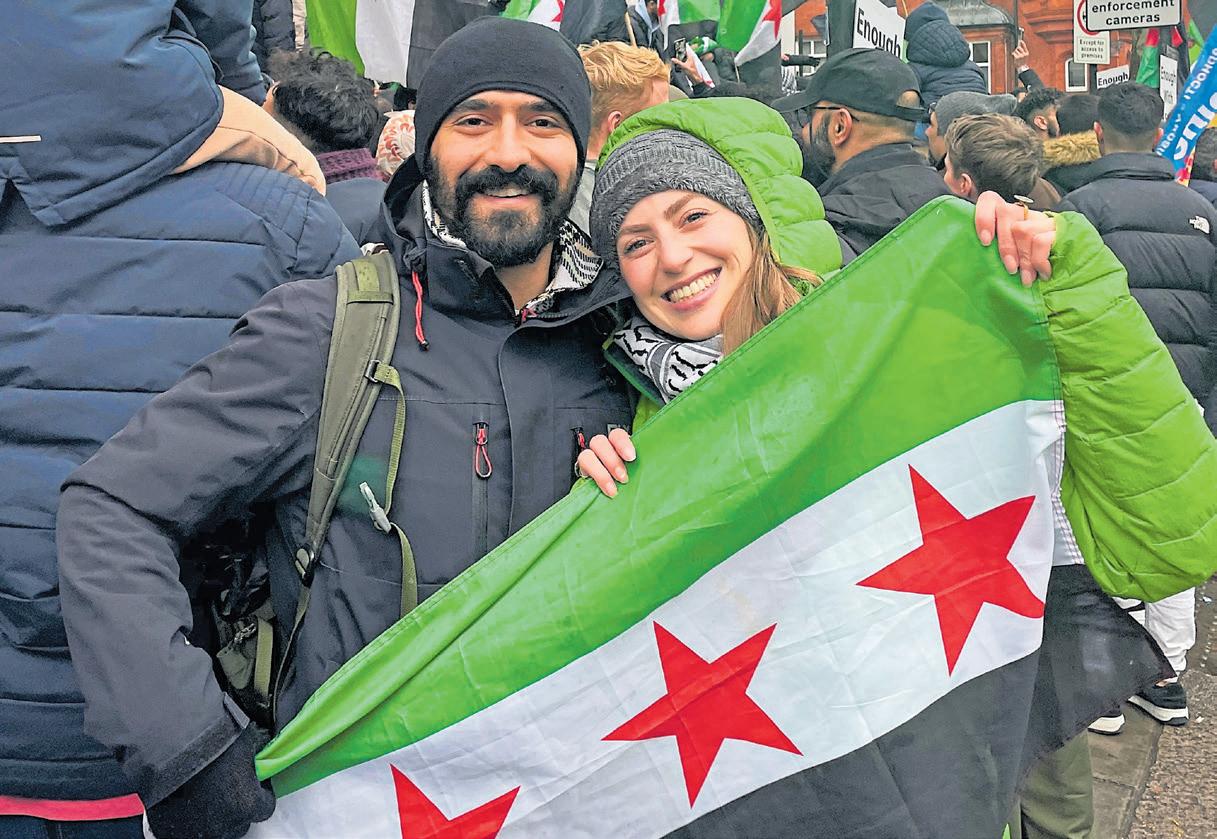
“The entire thing was one of the best weeks of my life. Me and my partner would meet Syrian friends as much as possible during that time. Everyone wanted to be around each other and go to demonstrations and celebrations. It was very joyful.”
For Bakhash, the toppling of the regime has given Syrians their country back and the opportunity to finally live without Assad looming over them.
“It felt like one day you’re a refugee with no country, then the next day you have a home.”
Bakhash is now eager to visit his hometown Aleppo for the first time in ten years and bring together his family which has been displaced across the globe.
“My brother is in the US, my parents are in Vienna. We’re hoping we can all go for a visit and meet there again in the family house.”
Another student Sana, 21, said: “I don’t live alone however I do know many sisters who do. It does break my heart knowing they will not be with family, but classes will still be running so it’s not like they can just go home. I do hope they can at weekends.”
The University will be providing free iftar meals for students and staff. In order to fund this the Islamic Society is running a Ramadan programme.
The Society hosted a Ramadan food stall where many brothers and sisters contributed by buying food and baked goods, and all proceeds will go towards providing 300 free iftar meals for staff and students.
The University has granted the ISOC the KUBacker Scheme, which means the university will double the money that the Islamic society donates.
This will benefit those who might not be able to afford meals during the month of Ramadan.
The free iftar meals are also a good way for brothers and sisters who will be alone during this time, as they can open their fasts with others around them, as well as performing prayers together in congregation.
Insta ban. Image MATEUSZ SLODKOWSKI/ Sopa Images/Shutterstock