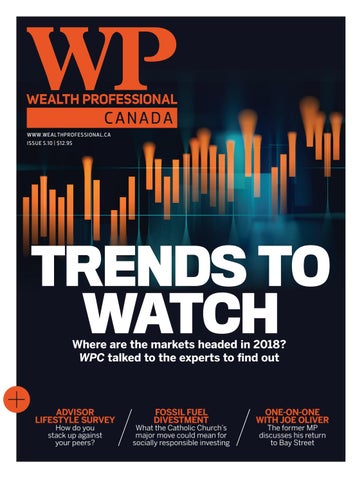
WWW.WEALTHPROFESSIONAL.CA ISSUE 5.10 | $12.95
TRENDS TO WATCH Where are the markets headed in 2018? WPC talked to the experts to find out
ADVISOR LIFESTYLE SURVEY How do you stack up against your peers?
00_Spine-OFC-SUBBED2.indd 2
FOSSIL FUEL DIVESTMENT
What the Catholic Church’s major move could mean for socially responsible investing
ONE-ON-ONE WITH JOE OLIVER The former MP discusses his return to Bay Street
17/11/2017 4:30:17 AM
Summit
Leadership &Tech T
O
R
O
N
T
O
MAY 30, 2018 | TORONTO
HOW CAN YOU EFFECTIVELY EMBRACE TECHNOLOGY AND INNOVATION? HOW CAN YOU TAKE YOUR ADVISORY PRACTICE TO THE NEXT LEVEL? HOW CAN YOU STAY RELEVANT AND COMPETITIVE IN TODAY’S DIGITAL WORLD? GET THE ANSWERS TO YOUR MOST PRESSING QUESTIONS AT WPC LEADERSHIP & TECH SUMMIT
IFC-01_KMI.indd 1 Ad for WPC 5.10.indd All Pages WPLT Summit_DPS
17/11/2017 4:31:51 AM
SESSIONS AND SPEAKERS INCLUDE:
ROBO-ADVISER: HOW CAN ROBO-ADVISERS ENABLE THE HUMAN ADVISERS? MICHAEL KATCHEN, Co-founder & CEO, Wealthsimple
MANAGING YOUR PRACTICE THROUGH TECHNOLOGY: WHAT THE OFFICE OF THE FUTURE ADVISER LOOKS LIKE BRIAN LAUNDRY, Insurance Consultant Hollis Insurance Inc.
THE MILLENNIAL PANEL: INTERACTING AND COMMUNICATING WITH MILLENNIAL CLIENTS CHELSEY CHARTREN, Financial Advisor, The McClelland Financial Group at Assante Capital Management Ltd. PATTI DOLAN, Portfolio Manager, SAGE Connected Investing at Raymond James ROSEMARY HORWOOD, Vice President, Investment Advisor, Rosemary Horwood Wealth; Multi-Award Winning Advisor, Richardson GMP
DEEP DARK TRUTHS: CYBERSECURITY AND DATA PROTECTION ON THE DEEP WEB ATTRACTING, RETAINING AND SERVICING CLIENTS VIA SOCIAL MEDIA … AND MANY MORE!
REGISTER TODAY AT
WEALTHPROFESSIONALSUMMIT.CA #WPSUMMITTO
IFC-01_KMI.indd 1
17/11/2017 4:32:10 AM 17/11/2017 3:32:43 AM
ISSUE 5.10
CONNECT WITH US
CONTENTS 30
Got a story or suggestion, or just want to find out some more information? @WealthProCA facebook.com/WealthProCA
UPFRONT 04 Editorial
Advisors’ important role in lessening the stigma of financial stress
05 Head to head
Has Canada’s rosy economic outlook prompted advisors to increase domestic exposure? PEOPLE
ADVISOR PROFILE
20
Chris Poole reveals how his past entrepreneurial endeavours have helped him relate to clients
PEOPLE
MAKING INNOVATION PRACTICAL
INDUSTRY ICON
FEATURES
Five ways to ensure that ‘innovation’ is more than just a buzzword
Joe Oliver is bringing a regulator’s perspective to his new role as chairman of Echelon Wealth Partners
16
Should you help your clients follow the Catholic Church’s stand against fossil fuel investments?
12 Alternative investment update
Ninepoint Partners aims to capitalize on the senior debt niche in Canada
14 ETF update
A new series of active fixed-income ETFs responds to rising interest rates
19 Opinion
Why it’s important for advisors to take their own advice
PEOPLE 47 Career path
Cam La Civita discovered his passion for investing early in life
48 Other life
44
All the world’s a stage for advisor and playwright Francine Dick
FEATURES
WHY SLOWING DOWN IS VITAL
It may sound counterintuitive, but sometimes doing less can actually lead to getting more done
2
08 News analysis
This month’s big movers, shakers and new products
42
TRENDS TO WATCH IN 2018
Comparing Canada’s mutual fund costs to those in the US
10 Intelligence
What’s in store for advisors in the coming year? WPC talked to experts in fixed income, ETFs, alternatives and more to find out
SPECIAL REPORT
06 Statistics
WEALTHPROFESSIONAL.CA CHECK IT OUT ONLINE
www.wealthprofessional.ca
02-03_TOC-SUBBED.indd 2
17/11/2017 5:10:19 AM
32 FEATURES
ANATOMY OF A CANADIAN FINANCIAL ADVISOR
WPC asked, you answered – now find out what your fellow advisors are wearing, how many extra hours they’re working and how their investments are performing
See which multi-asset solution you can grow with... ...by looking at their roots. Our multi-asset solutions are deeply rooted in our heritage, providing tactical diversification across asset classes, styles, geographies and managers. Your outcome matters.
Dig into our Multi-Asset Solutions. Download your guide at russellinvestments.com/ca/multi-asset Commissions, trailing commissions, management fees, and expenses all may be associated with mutual fund investments. Please read the prospectus before investing. Mutual funds are not guaranteed, their values change frequently and past performance may not be repeated. Russell Investments is the operating name of a group of companies under common management, including Russell Investments Canada Limited. Russell Investments’ ownership is composed of a majority stake held by funds managed by TA Associates with minority stakes held by funds managed by Reverence Capital Partners and Russell Investments’ management. Frank Russell Company is the owner of the Russell trademarks contained in this material and all trademark rights related to the Russell trademarks, which the members of the Russell Investments group of companies are permitted to use under license from Frank Russell Company. The members of the Russell Investments group of companies are not affiliated in any manner with Frank Russell Company or any entity operating under the “FTSE RUSSELL” brand. Copyright © Russell Investments Canada Limited 2017. All rights reserved.
www.wealthprofessional.ca
02-03_TOC-SUBBED.indd 3
3
17/11/2017 5:10:19 AM
UPFRONT
EDITORIAL
The stigma of money troubles
H
ealth and wealth are inextricably linked. While it’s true that you can’t buy good health, stress leads to illness in various forms, and money is often a root cause of that stress. In a recent study on the link between health and wealth, Manulife spoke to professional counsellors across Canada. The findings suggest that people in this country have an issue talking about their personal finances. The counsellors surveyed revealed that feelings of shame and embarrassment often hinder people from acknowledging their own personal financial struggles. “The stigma, shame and embarrassment of being financially unwell often prevents people from taking action to address and overcome these issues,” says Sue Reibel, general manager of group benefits and retirement solutions
“Our industry can help remove these stigmas by encouraging those going through financial challenges to discuss these problems more openly” at Manulife. “We believe that the industry as a whole has a bigger role to play in helping remove these stigmas. Only once an individual is comfortable discussing their money problems can they begin to take steps to address them.” Financial stress that leads to ill health is not only a major concern for the individuals affected, but also for employers and the wider economy. The Manulife study reveals that 500,000 workers in Canada miss work each week due to mental health problems. Employees who suffer from these issues and aren’t receiving the right support cost the Canadian economy between $15 billion and $25 billion in lost productivity each year. While Canada has come a long way on mental health in recent years, it’s clear there are certain topics people are still reluctant to talk about. Money remains near the top of that list, but Reibel says advisors can help change that. “Our industry can help remove these stigmas by encouraging those going through financial challenges to discuss these problems more openly, and to take advantage of free and accessible tools that help alleviate financial distress, which can lead to anxiety, depression and stress.” Being a financial advisor in 2017 means performing many different roles, but providing an outlet for people to talk about money troubles can be among the most important. The team at Wealth Professional Canada
wealthprofessional.ca ISSUE 5.10 EDITORIAL
SALES & MARKETING
Editor David Keelaghan
National Accounts Manager Dane Taylor
Writers Libby Macdonald Leo Almazora Joe Rosengarten
Associate Publisher Trevor Biggs
Executive Editor – Special Features Ryan Smith
Project Coordinator Jessica Duce
Copy Editor Clare Alexander
CONTRIBUTORS Rosemary Horwood Amantha Imber Angela Lockwood
ART & PRODUCTION Designer Marla Morelos Production Manager Alicia Chin Traffic Manager Ella Dayandante
General Manager, Sales John Mackenzie
CORPORATE President & CEO Tim Duce Office/Traffic Manager Marni Parker Events and Conference Manager Chris Davis Chief Information Officer Colin Chan Human Resources Manager Julia Bookallil Global COO George Walmsley Global CEO Mike Shipley
EDITORIAL INQUIRIES
david.keelaghan@kmimedia.ca
SUBSCRIPTION INQUIRIES
tel: 416 644 8740 • fax: 416 203 8940 subscriptions@kmimedia.ca
ADVERTISING INQUIRIES dane.taylor@kmimedia.ca
KMI Media 312 Adelaide Street West, Suite 800 Toronto, Ontario M5V 1R2 tel: +1 416 644 8740 www.keymedia.com Offices in Toronto, London, Sydney, Denver, Auckland, Manila, Singapore, Bengaluru
Wealth Professional Canada is part of an international family of B2B publications and websites for the finance and insurance industries LIFE HEALTH PROFESSIONAL david.keelaghan@kmimedia.ca T +1 416 644 874O
INSURANCE BUSINESS CANADA john.mackenzie@kmimedia.ca T +1 416 644 874O
INSURANCE BUSINESS AMERICA cathy.masek@keymedia.com T +1 720 316 0154
4
www.wealthprofessional.ca
04_Editorial-SUBBED.indd 4
Copyright is reserved throughout. No part of this publication can be reproduced in whole or part without the express permission of the editor. Contributions are invited, but copies of work should be kept, as the magazine can accept no responsibility for loss
17/11/2017 5:11:04 AM
UPFRONT
HEAD TO HEAD
Have you increased your domestic exposure? Given Canada’s improving economic outlook, are advisors starting to refocus clients’ portfolios closer to home?
Elie Nour
Michelle Apollinaro Financial advisor B & A Financial Group
Co-owner Wise Riddell Financial Group
“We have maintained our exposure to Canadian equities in our portfolios at this point because our bottom-up analysis does not dictate any increase. We expect the above-average growth we witnessed during the first half of 2017 to moderate due to tighter financial conditions (two rate hikes from the BoC), the appreciation of the Canadian dollar, NAFTA policy uncertainty, rising minimum wages and tax changes. Our Canadian exposure is focused on names that have international operations. Overall, we are holding slightly more cash to deploy if there is a pullback.”
“Over the last couple of years, we have been diversifying clients’ portfolios outside of Canada, but Canada appears to be on an upswing with the announced economic numbers. The recent run-up in the US market versus the underperformance of the Canadian stock market presents opportunities for clients’ portfolios. There appears to be value in the commodity and service sectors of the economy. With the NAFTA negotiations in the background, we have been slowly increasing our allocation to Canadian holdings in our portfolio mix.”
“As an advisor, I am constantly conflicted between logic and the threats and opportunities in the market. When we see the Canadian economy growing at over 4% and appearing to be able to withstand higher central bank rates, it is very perplexing as to why our market has been lagging behind other G7 markets. But perhaps therein lies the opportunity – so yes, we have increased our Canadian exposure. It has been primarily in the non-energy, non-commodity sectors. We have moved capital in the direction of financials and protecting the downside with options/notes.”
Senior investment advisor Nour Private Wealth Manulife Securities
Mark Winson
NO STOPPING CANADA “There seems to be no stopping Canada of late,” TD Economics senior economist Brian DePratto wrote in a recent client note, revealing that the country’s economy posted annualized growth of 4.5% during the second quarter of 2017, beating projections by almost a full percentage point. Coupled with a robust first quarter, this result gives the first half of 2017 the distinction of having the most rapid rate of growth the country has seen in the first six months of a year since 2002. The numbers show broadbased growth driven by household spending and exports, buttressed by robust job gains that have led to increasing household incomes. Families are also saving more – the rate of household savings hit 4.6% in the second quarter, up from 4.3% in the first three months of the year.
www.wealthprofessional.ca
05_Head to Head-SUBBED.indd 5
5
17/11/2017 4:33:28 AM
UPFRONT
STATISTICS
Finding value across borders
Mutual fund fees have been coming down at home and in the US, but how much clients pay still varies widely SITTING JUST north of the world’s largest economy means Canada often falls in the shadow of the US, and the mutual fund industry is no exception. There’s a large size disparity, of course – mutual fund assets in the US are approximately 10 times what they are in this country – but certain trends are playing out in both nations. Most notable is the shift toward lower fees, confirmed by a recent report commis-
2.14%
1.95%
Average ownership cost of Canadian actively managed mutual funds in 2016
Average ownership cost of actively managed US mutual funds in 2016
sioned by the Investment Funds Institute of Canada. Analyzing data over a two-year period ending December 2016, IFIC found that North American mutual fund AUM increased by nearly 20%. The report also highlighted a notable difference in the way investors pay for funds: The embedded fee structure accounts for 80% of all fund assets in Canada, while fee-based accounts are dominant in the US, where taxes are not part of the total expense ratio for mutual funds.
FEES ACROSS THE 49TH PARALLEL The more assets a client has, the lower their fee ratio – that’s a maxim that holds true in both Canada and the US, where mutual fund distributors often offer discounts to investors above certain asset thresholds. However, there is much more range in fees in the US, reflective of the greater competition in that market.
$56.8 billion $108.8 billion Net inflows into Canada’s mutual fund industry in 2015
Asset growth in the Canadian mutual fund industry in 2016
Source: IFIC, Monitoring Trends in Mutual Fund Cost of Ownership and Expense Ratios, 2017
THE COST OF USING AN ADVISOR For the roughly 80% of mutual fund holders in the US and Canada who use a financial advisor, the cost of owning those funds is higher north of the border. AVERAGE MUTUAL FUND COST OF OWNERSHIP WHEN USING A FINANCIAL ADVISOR 2.30% 2.14% 0.18%
1.60% 1.96%
1.00% – 1.50%
Pre-tax CoO
0.60% – 0.80% Canada (Advice channels)
Fees external to TER
LONG-TERM MUTUAL FUND ASSETS UNDER MANAGEMENT, AS OF DECEMBER 2016
US
$12.1 trillion
$1.3 trillion
Total expense ratio [TER]
US (Fee-based programs)
Source: IFIC, Monitoring Trends in Mutual Fund Cost of Ownership and Expense Ratios, 2017
6
The size of the US mutual fund industry is reflective of that nation’s power and influence across all spheres. This allows it to offer innovations such as fund supermarkets that provide lower ownership costs not available to Canadian investors.
Canada
1.95%
Taxes
ECONOMIES OF SCALE
Source: IFIC, Monitoring Trends in Mutual Fund Cost of Ownership and Expense Ratios, 2017
www.wealthprofessional.ca
06-07_Statistics-SUBBED2.indd 6
17/11/2017 6:54:24 AM
UNITED STATES
1.85%–2.55%
COST OF MUTUAL FUND OWNERSHIP BY ACCOUNT SIZE
Total expense ratio Fees external to TER
1.70%–2.40%
1.45%–2.15%
CANADA
1.20%–1.90%
1.25%–1.75%
2.07%
1.10%–1.60%
1.86%
$100,000 and below
1.75%
$100,000 to $250,000
$250,000 to $1 million
0.85%–1.35% 0.60%–1.10%
1.70%
0.60%–0.80%
0.60%–0.80%
0.60%–0.80%
0.60%–0.80%
$100,000 and below
$100,000 to $300,000
$300,000 to $1.5 million
$1.5 million and above
$1 million and above
Source: IFIC, Monitoring Trends in Mutual Fund Cost of Ownership and Expense Ratios, 2017
INDUSTRY GIANTS
KEEPING WITH TRADITION
The size differential between the US and Canadian mutual fund industries is never more apparent than when comparing both country’s largest asset managers. Some of the top firms in the US have more assets under management than the entire Canadian mutual fund industry.
Despite the recent popularity of other investment vehicles, mutual funds remain the investment of choice for a large proportion of investors in Canada, and only slightly less so in the US.
AVERAGE ASSETS OF THE LARGEST MUTUAL FUND COMPANIES
LONG-TERM MUTUAL FUNDS AS A PERCENTAGE OF WEALTH
Largest 5 fund managers
$122.8 billion
35%
$1.4 trillion
30% 25%
Largest 10 fund managers
$94.9 billion
20%
$872.7 billion
Canada US
Largest 20 fund managers
31.9%
15%
27.3%
10%
$58.2 billion
5%
$535 billion
0% Source: IFIC, Monitoring Trends in Mutual Fund Cost of Ownership and Expense Ratios, 2017
Canada
US
Source: IFIC, Monitoring Trends in Mutual Fund Cost of Ownership and Expense Ratios, 2017
www.wealthprofessional.ca
1 06-07_Statistics-SUBBED2.indd 7
2
3
4
5
6
7
8
9
10
7
17/11/2017 6:54:35 AM
UPFRONT
NEWS ANALYSIS
An article of faith Now that the Catholic Church is throwing its weight behind fossil fuel divestment, what are the implications for Canadian investors?
ON OCTOBER 4, 40 Catholic institutions took a stand against pollution by making the world’s largest ever faith-based divestment. Making the announcement on the day of the Feast of St. Francis of Assisi, the patron saint of animals and ecology, the Global Catholic Climate Movement explained its reasoning: “Joint divestment from fossil fuels is based on both the shared value of environmental protection and the financial wisdom of preparing for a carbon-neutral economy.” That logic is backed by a growing number of institutions – NGO Fossil Free puts the global institutional divestment movement for fossil fuels at US$5.56 trillion. To put that number in perspective, the entire energy sector is valued at US$7.1 trillion, according to research firm Euler Hermes. Wayne Wachell, CEO of Vancouver-based asset manager Genus Capital, says the move
Genus Capital’s Fossil Free CanGlobe Equity Fund, Wachell has observed how Canada has slowly reduced its energy dependence over the past decade. It’s a transition that won’t happen overnight, and one that will continue to be met with plenty of opposition from the oil patch, but Wachell believes the divestment movement will only grow in size and scope. “There are usually three waves,” he says. “The first wave, usually the smaller wave, is driven by churches and activists; the second wave is universities and public institutions; and the third wave is then broader with pension plans.” By that measure, Wachell believes Canada is currently entering phase two. “We saw the University of Laval divest a couple of months back,” he says. “The Catholic Church has a lot of followers, so this is a reinforcement of the
“I’ll take the bet that technology and financials will definitely beat oil over the next 10 years” Wayne Wachell, Genus Capital by the Catholic Church is the thin end of the wedge when it comes to this issue. “The divestment movement is a social movement, and once [social movements] get going, they build their own momentum,” he says. As the person charged with overseeing
8
movement and will help it accelerate further.” Aside from ethical considerations, fossilfuel-free investing appears to be a smart way to make money. For his fund, Wachell combines international and global names outside of the resource sectors. It’s a strategy
that has served him well so far, and he expects strong returns over the long term. “Technology, financials, consumer discretionary and telecom – those four sectors we tend to have more weight in,” he says. “I’ll take the bet that technology and financials will definitely beat oil over the next 10 years.” The divestment movement is certainly a major concern for the energy industry’s biggest names, and they are repositioning their businesses as a result. It means companies like ExxonMobil, Shell and BP are scaling back on oil sands production to focus on cleaner fuels such as liquefied natural gas. That’s something investors in Canada’s oil patch need to consider, Wachell points out. “I think areas like the oil sands and coal, they will become like the tobacco companies: sin stocks that will be heavily discounted and will probably have good yields and cash
www.wealthprofessional.ca
08-09_News Analysis-SUBBED.indd 8
17/11/2017 6:03:18 AM
FOSSIL FUEL DIVESTMENT BY THE NUMBERS
807
Number of institutions worldwide that have divested of fossil fuels
27%
Percentage of those institutions that are faith-based organizations
20%
Percentage that are philanthropic foundations
18%
Percentage that are governments
$5.56 trillion
Amount divested from fossil fuels worldwide by institutions
58,000
Individuals worldwide who have divested from fossil fuels
flow, but there won’t be any growth – they will be isolated.” On the opposite end of the spectrum are the investment vehicles that prioritize a strong environmental, social and govern-
food startup Sweet Earth (which was part of the Renewal Funds portfolio until being bought out by Nestlé in September). Those who want to get in on the ground floor of such companies can invest in one of
“We are laggards on having well informed investment advisors. I think a lot of people don’t realize what their options are” Paul Richardson, Renewal Funds ance [ESG] rating. British Columbia-based Renewal Funds is a venture capital firm that invests in early-stage companies in Canada and the US, including organic food brand Alter Eco, environmental technology provider Aquatic Infomatics and vegetarian
Renewal’s 10-year funds. The firm recently raised $98 million in capital to launch a new fund next year. According to Renewal CEO Paul Richardson, Canadian investors are thinking more with their conscience, and the advisory business needs to catch up.
$5.2 billion
Amount divested by individuals Source: Fossil Free; all figures in US dollars
“One of the areas we are laggards on is having well informed investment advisors,” he says. “I think a lot of people don’t realize what their options are. Also, a lot of the larger banks that could really move the needle are not involved to the extent they could be in this space.” Ultimately, Richardson believes the industry will have no choice but to take notice of the preference for socially responsible investments as wealth is passed to the next generation. “Advisors who want to keep that business need to be able to address the questions of this next generation,” he says, “which will be more about where the planet is going.”
www.wealthprofessional.ca
08-09_News Analysis-SUBBED.indd 9
9
17/11/2017 6:03:23 AM
UPFRONT
INTELLIGENCE CORPORATE ACQUIRER
TARGET
PRODUCTS COMMENTS
CI Financial
BBS Securities
The acquisition includes fintech firm Pario Technology and online brokerage Virtual Brokers
Evolve Funds
Sphere Investment Management
Evolve will acquire the management contracts for Sphere’s ETFs
PARTNER ONE
PARTNER TWO
COMMENTS
Collins Barrow
Ian H Whitton
The merger will bring additional personal tax, small-business and corporate accounting, and estate planning expertise to Collins Barrow
Mackenzie Financial
Investors Group
The partnership will merge Investors Group’s investmentmanagement functions into Mackenzie Financial
Starlight Investments
AIMCo and PSP Investments
Starlight has partnered with the two pension boards to create a portfolio of US multi-family properties
iA Clarington enhances highnet-worth pricing program
iA Clarington has introduced several enhancements to its pricing program for high-networth investors. Those with at least $100,000 in a single fund in a single iA Clarington account will be automatically transferred into the discounted Elite Series. In addition, the firm has introduced householding, allowing investors with at least $250,000 in mutual funds or $100,000 in managed portfolios to extend the benefits of Elite Pricing to corporate accounts and to family members living at the same address. Finally, iA Clarington is offering tiered rebates to investors with $2.5 million to $5 million in a single account.
Evolve Funds to acquire Sphere’s ETF business
Evolve Funds and Sphere Investment Management have forged an agreement for Evolve to purchase the management contracts for Sphere’s ETF business. Evolve stands to gain some $68 million in AUM from the acquisition. It will also expand its lineup of themed, index-based and active ETFs with five funds from Sphere, including the Sphere FTSE Canada Sustainable Yield Index ETF, Sphere FTSE US Sustainable Yield Index ETF, Sphere FTSE Europe Sustainable Yield Index ETF, Sphere FTSE Asia Sustainable Yield Index ETF and Sphere FTSE Emerging Markets Sustainable Yield Index ETF. “We are very pleased that Sphere’s products will be managed by Evolve and add a dimension to an already impressive array of products,” said Keith McLean, Sphere’s CIO. “These ETFs will continue to act as a core holding for client portfolios, as they provide an opportunity for good risk-adjusted returns and enhanced yield for investors.”
10
Willoughby announces changes to global portfolio
Willoughby Asset Management, which manages the WAM Portfolios, has renamed the WAM Collins Global Portfolio to WAM Collins Income Pool. The fund’s investment objective has also been expanded to accommodate the creation of an income pool for investors seeking regular income or diversification of an equity portfolio. Its investment strategies now focus on building a liquid, high-quality, income-generating portfolio of equity and fixedincome strategies. Willoughby has also reduced fees on the portfolio from 1.98% to 1.88% for series A units and from 1% to 0.88% for series F units.
www.wealthprofessional.ca
10-11_Intelligence-SUBBED.indd 10
17/11/2017 4:33:53 AM
PEOPLE Mackenzie rolls out China equity fund
Mackenzie Financial has launched the Mackenzie All China Equity Fund to address Canadian investors’ increasing demand for access to Chinese equities. The fund will be subadvised by China Asset Management Co., in which Mackenzie recently acquired a 13% stake. China AMC’s investment team will allocate the majority of the fund’s assets to China A-shares, H-shares and Chinese American Depositary Receipts [ADRs]. China A-shares trade on the Shanghai and Shenzhen stock exchanges, while H-shares are those of companies incorporated in the Chinese mainland and listed on the Hong Kong Stock Exchange.
Vanguard launches new target-date retirement funds
Vanguard Investments Canada has expanded its line of Canadian target-date retirement funds with the introduction of Target Retirement 2060 and 2065 pooled funds for qualified Canadian institutional investors, including plan sponsors. The funds invest in indexed pooled funds, seeking broad diversification, low costs, market-like returns and transparency. As a fund approaches its target date, it is gradually and automatically rebalanced into more conservative asset allocations. “These funds provide age-appropriate asset allocation in a simple yet sophisticated and low-cost solution for retirement investing,” the company said in a statement.
Fidelity expands high-networth private offering
Fidelity Investments Canada has launched the Fidelity Global Asset Allocation Private Pool. Managed by portfolio managers Geoff Stein and David Wolf, the global balanced portfolio strategy is targeted at risk-conscious investors seeking longterm capital growth. The majority of the fund’s assets will be invested outside of Canada, exploiting market trends uncovered through Fidelity’s global research network and expertise. The fund will have a neutral investment mix of 50% equities and 50% fixed income and money-market securities. The pool is also available in a currency-neutral version.
NAME
LEAVING
JOINING
NEW POSITION
Glen Hirsh
Oxford Properties
Starlight Investments
Chief operating officer
David Johnston
Government of Canada
Fairfax Financial Holdings
Global advisor
Dustyn Lanz
N/A
Responsible Investing Association
CEO
Adrian Mantesso
N/A
Ivanhoé Cambridge
Senior vice-president, Brazil, growth markets
Darryl White
N/A
BMO Financial Group
CEO
BMO names Darryl White as CEO
BMO Financial Group has appointed Darryl White to succeed Bill Downe as CEO. White previously served as the bank’s COO, providing global strategic leadership to BMO’s personal, commercial and wealth businesses. He also made sure the bank’s marketing strategy contributed to its growth plans, that its technology functions enabled strategic capabilities and that there was consistent operating discipline throughout the bank. “Although the industry continues to evolve, the fundamentals of anticipating and responding to customers’ needs never change,” White said. “We embark on our third century in business well positioned to capitalize on market opportunities, grow our customer base faster and deliver value for our shareholders in the process.”
RIA promotes Dustyn Lanz to CEO
Starting January 1, Dustyn Lanz will vacate his position as chief operating officer of the Responsible Investing Association and move into the role of CEO. Since 2013, Lanz has been essential in expanding the RIA’s membership and strengthening its brand and communications initiatives. In his new role, he hopes to increase the focus on responsible investing among investors and advisors. “In my mind, we’re just getting started,” Lanz said. “What I am most excited about are the opportunities that lie ahead for the RIA and responsible investing more broadly. Three-quarters of Canadian investors [we’ve surveyed] are interested in responsible investing but know little or nothing about it. We’re going to change that.”
www.wealthprofessional.ca
10-11_Intelligence-SUBBED.indd 11
11
17/11/2017 4:33:56 AM
UPFRONT
ALTERNATIVE INVESTMENT UPDATE NEWS BRIEFS Bridging Finance introduces mid-market debt fund Bridging Finance has launched the Bridging Mid-Market Debt Fund through the IIROC dealer channel on Fundserv. Using a strategy typically reserved for institutional investors, the fund allows financial advisors to access consistent, low-volatility yield that’s not correlated to the public markets. The fund provides assistance to North American companies that require alternative financing. According to Bridging Finance chief investment officer Natasha Sharpe, the new fund complements the Sprott Bridging Income Fund, which Bridging Finance co-manages, by focusing on businesses that are not transitioning or focusing on near-term exits.
Sprott and Ceres partner for institutional farmland fund
Sprott Asset Management has partnered with specialist agricultural asset manager Ceres Partners to launch the CeresSprott Institutional Farmland Fund, which will allow institutional investors to access the North American farmland investment market. Managed by Ceres Partners, which also oversees the US$620 million Ceres Farms, the new fund will aim to acquire and actively lease farmland in the US to experienced local farmers. It will also seek income from both tillable and non-tillable areas wherever possible and reasonable, given each farm parcel’s unique characteristics.
TD extends fintech pool to support patent program
TD Bank has earmarked $3.25 million from its $30 million Fintech investment pool to support a new patent program. The move makes TD the first North American bank to offer a non-equity-
12
based program that specifically supports the patent application process for early financial-sector startups. Eligible companies at the seed stage will receive funding and assistance with patent applications in Canada, the US and elsewhere. The startups will retain all rights to the underlying technology, and although TD will be granted a nonexclusive license to patents, the patents themselves will belong to the startups.
3iQ launches fund with exposure to multiple cryptocurrencies 3iQ has launched the 3iQ Global Cryptoasset Fund on Fundserv. The first diversified, institutional-quality cryptoasset portfolio in Canada, the fund invests directly in bitcoin, ethereum and litecoin, as well as external crypto-focused funds that invest in digital commodities such as computing storage space, bandwidth and processing power, and tokens for digital services. 3IQ’s exclusive relationships give the fund an institutional level of security, lead consultancy and expert trading to access liquidity in the cryptoasset space. It is available to accredited investors across Canada and is eligible for registered accounts.
Middlefield unveils flowthrough limited partnership Middlefield Group has closed the initial public offering of units for its Discovery 2017 Flow-Through Limited Partnership. Offered in each province of Canada, the partnership aims to provide investors with capital appreciation and significant tax benefits that enhance after-tax returns, including the deductibility of 100% of the original investment. It will be invested in an actively managed, diversified portfolio composed primarily of Canadian exploration, development and production firms in the mining and oil & gas sectors.
Closing the privatedebt gap Ninepoint Partners’ new senior debt fund finds opportunities in a space left open by Canada’s biggest banks Since buying out Sprott’s diversified asset business, Ninepoint Partners has been hard at work creating funds that provide innovative risk and return opportunities. As part of that effort, it has launched the Sprott Canadian Senior Debt Fund, managed by Waygar Capital. “If you look at the private market for senior debt in particular, it’s potentially a $3–$4 billion market,” says Ramesh Kashyap, managing director of Ninepoint Partners’ alternative income group. “I think we’re just scratching the surface at $1 billion.” According to Kashyap, the fund exploits a gap that became apparent when many foreign institutions exited the Canadian financial space after the global financial crisis. While Canada’s current economy is significantly influenced by the financial sector, its lending space is not as evolved as the one in the US, where businesses can turn to Tier 1 institutions, regional banks, intermediate banks and myriad other options. At the moment, most commercial borrowers in Canada approach the Big Five banks, which can reject them based on a variety of factors, including high debt-toequity ratios, low interest coverage and reputational risk concerns. “I would say that the private debt side of the space we’re in is underserviced,” says Waygar Capital president and CEO Wayne Ehgoetz. The Sprott fund’s returns
www.wealthprofessional.ca
12-13_Update ALT-SUBBED.indd 12
17/11/2017 4:34:19 AM
come from high-yield, senior-secured, firstlien asset-based loans made to small and mid-market Canadian enterprises. The market for such loans is sizeable; potential demand might come from firms planning restructuring and turnaround transactions, the burgeoning marijuana industry, or traditional sectors such as manufacturing and logistics. There’s even opportunity from defence and security firms, given Canada’s
“Senior debt is potentially a $3–$4 billion market … we’re just scratching the surface at $1 billion” commitment to spend billions in such areas as a member of NATO. While other investment managers might see potential in the private senior debt space, new players often don’t last because they lack the expertise to survive and thrive, Kashyap explains, adding that “you need to have done it for many years to do it properly.” That’s where Waygar Capital comes in. Through its experience and proven track record, the firm is able to originate, underwrite and manage loans with double-digit interest rates. Most investors associate such numbers with high risk profiles, but Ehgoetz says that doesn’t apply here. “Our assessment on these loans is favourable based on the collateral value,” he says. “If a loan goes bad, we can liquidate ourselves out.” The Sprott Canadian Senior Debt Fund launched with a $500 million capacity, targeting net annual returns of 9% to 12%. “From a risk-reward perspective, looking at the Sharpe ratio,” Kashyap says, “the senior debt category of private debt is a better investment than traditional fixed income.”
Q&A
Daniel Geraci Partner and managing director CYGNUS INVESTMENT PARTNERS
Years in the industry 37 Fast fact Cygnus Investment Partners partnered with Morningside Capital Management to launch the Cygnus Secondary Focus Fund, designed to provide investors greater access to secondarymarket private equity strategies
The secondary market edge What makes the secondary market for private equities potentially appealing for Canadian investors? Private equity is becoming a mature product in Canada. While it’s very mature for the biggest institutions, the wealthiest individuals and so on, it’s mostly unknown to the much larger masses. Approximately half of the institutions in Canada – pensions, foundations, endowments – do not have an allocation to alternatives at all. When you buy a PE fund on the secondary market, it’s been half to fully invested already. That J-curve mitigation – missing those first three or four years where you’re making capital calls, but not receiving any distributions – makes it a shorter-term investment with around a seven-year life, compared to the typical 10 or 11 years of a primary fund. Research from Morningside shows that a portfolio of secondaries will typically drive the same, if not higher, IRR compared to a primary PE fund because of the shorter duration. Another big benefit is transparency. As an investor entering the picture four years in, when a fund has been significantly invested, you can see the companies it has bought, as well as the performance for the past several years.
Why are secondary private-equity assets generally harder to access? The minimum investment to access true global diversification from a Tier 1 PE manager like KKR or Blackstone is $10 million to $25 million per strategy. That’s pushed many investors toward smaller firms with shorter track records and mostly domestic content. Through our relationship with KKR, we’ve brought the access level down to $250,000, which we believe is the ‘flexibility sweet spot’ for institutions that have less than $1–$2 billion in assets. The secondary PE market is somewhat fragmented, and Morningside’s deep knowledge is a definite advantage. There’s a finite number of Tier 1 PE firms, for which Morningside gathers product intelligence that’s updated quarterly. That means a lot of due diligence is already done when we decide to acquire something in the secondary markets. Morningside is thus able to provide better price, valuation and return analyses than someone who doesn’t have that specialization. Having this advantage also allows us to be faster with bids compared to other buyers who have to start their analysis from scratch; we can make an offer in a couple of days.
What’s the range of asset types and regional markets you expect to take advantage of? We have access to KKR’s full menu of products, including private equity, infrastructure and real estate. KKR also has substantial offerings in private credit, which a lot of people want to talk about nowadays. Geographically, we can access Asia, Europe and the Americas. We’ll be shopping for secondaries from a menu of funds that are currently still in the marketplace, generating return.
www.wealthprofessional.ca
12-13_Update ALT-SUBBED.indd 13
13
17/11/2017 4:34:24 AM
UPFRONT
ETF UPDATE
Actively adapting to hawkish policy Now that interest rates are on the rise, RBC GAM is responding with a series of active fixed-income ETFs
based on the firm’s approach of adding value through credit and liquidity rather than relying on interest rate calls. “With rates on the rise, having active control and flexibility in portfolio positioning is likely a good idea,” Cummings says. For added North American diversification, RBC GAM is also offering the RBC Short Term US Corporate Bond ETF (RUSB), the first active short-term US fixed-income ETF in Canada. Unlike other asset managers, RBC
“Navigating through an environment of low and rising rates will only get trickier from here on in”
After years of sustaining a low-yield environment with dovish rate calls, the Bank of Canada has joined other central banks in edging toward hawkishness via gradual rate hikes. While the return to normality should prove beneficial to investors over time, the anticipated changes in monetary policy also spell potential challenges for those in the fixed-income space. “Navigating through an environment of low and rising rates will only get trickier from here on in, so being active in this space makes good sense,” says Trevor Cummings, head of business
NEWS BRIEFS
development and ETFs at RBC Global Asset Management. With that in mind, RBC GAM has expanded its ETF lineup with four new active fixedincome funds. On the domestic front are the RBC PH&N Short Term Canadian Bond ETF (RPSB) and the RBC 6-10 Year Laddered Canadian Corporate Bond ETF (RMBO). RMBO is meant to provide investors with simple, diversified exposures across different terms, credit ratings and industries. RPSB, managed by Phillips, Hager & North, is
Pimco enters the Canadian ETF market
Pimco Canada has entered the Canadian ETF space with ETF versions of its Pimco Monthly Income Fund (PMIF) and Pimco Investment Grade Credit Fund (IGCF). Diversified across different bond sectors and sources of high-dividend income, PMIF provides access to nonCanadian-dollar fixed-income instruments of varying maturities. Meanwhile, IGCF provides exposure to a portfolio of nonCanadian-dollar, high-quality corporate bonds, with some US government bonds, mortgages and foreign bonds.
14
GAM can leverage insights and intelligence from its US business for the fund. Finally, the RBC BlueBay Global Diversified Income (CAD Hedged) ETF (RBDI) invests in a diversified portfolio of global credit strategies. Managed by BlueBay Asset Management in London, RBDI provides even greater contrast to the plain vanilla bonds to which many investors’ portfolios are already exposed. “It’s particularly good to have exposure to specialty credit in places like high yield and emerging markets,” Cummings says. RBDI also can tap into a wide universe of fixedincome instruments, including developed market investment-grade corporates, financial capital bonds, global high-yield bonds and emerging market sovereign issues.
BMO unveils five new index-tracking funds
BMO Asset Management has launched five new index-based ETFs. The BMO High Yield US Corporate Bond Index ETF gives investors unhedged access to high-yield corporate bonds. The BMO Shiller Select US Index ETF tracks seasoned US companies that show good value based on their CAPE ratio. The BMO MSCI Canada Value Index ETF, BMO MSCI EAFE Value Index ETF and BMO MSCI USA Value Index ETF offer access to Canadian, international and US companies with higher value characteristics than their peers.
www.wealthprofessional.ca
14-15_Update ETF-SUBBED.indd 14
17/11/2017 4:34:54 AM
Q&A
Jeff Weniger Asset allocation strategist WISDOMTREE
Years in the industry 11 Fast fact In September, WisdomTree Canada was the fifth largest firm in the country in terms of ETF inflows
The wisdom behind dividend-weighted indexing WisdomTree Canada recently expanded its Canadian ETF shelf with quality-dividend ETFs. Can you discuss the thinking behind that?
With regard to your emerging markets ETF, EMV, what measures do you have in place to reduce liquidity risks?
Since we launched in the middle of 2016, our plan in Canada has really been to build on the success of sister strategies in the US. That’s what we’re doing with our quality-dividend approach, which we’ve had for numerous years in other markets. We call it ‘modern alpha’ to distinguish it from concepts that are based on cap-weighted indexes.
With emerging markets, there’s risk when you move down the spectrum into illiquid stocks, so we have liquidity minimums in place. EMV still does the dividend weighting, but we also require a certain minimum dividend amount to qualify for inclusion in our index. To avoid holdings that don’t change hands very often, we apply liquidity and minimum size restrictions as well. It can also be onerous when the bid-ask spreads down into the smaller securities are wide, so we have a minimum market cap of $200 million for these companies, as well as average daily volume requirements.
What benefits can Canadian investors expect from the firm’s Canadian qualitydividend ETF, DGRC? We believe there’s a better way than market-cap weighting. Consider the core Canadian mainstream indexes we see every day, which have tended toward allocations hovering in the high 30% range in financials alone. They create major sector concentration risk in the duopoly that is financials and energy. Everything we do in Canada and the US, for the most part, is self-indexed. We were among the first to use in-house indexes rather than go to external providers. That means for our Canadian equity ETF, we’re able to screen companies based on their profitability and growth projections from the Street, and then weight holdings by the dollar amount of their dividends paid instead of their market caps. It gives investors an extra layer of value – you get holdings with growth characteristics that are oftentimes at valuestock type prices.
Evolve debuts two new actively managed funds
Evolve Funds has launched two new active ETFs on the TSX. The Evolve Active US Core Equity ETF, available in both hedged (CAPS) and unhedged (CAPS.B) units, seeks long-term capital appreciation from large-cap, US-listed companies selected through quantitative techniques, fundamental analysis and risk management. The Evolve Active Short Duration Bond ETF pursues current income from monthly distributions by investing in debt rated BB+ or lower by Standard & Poor’s or Ba1 or lower by Moody’s.
Finally, there’s UMI, your US mid-cap dividend ETF. Can you explain the opportunities you see for this product? There’s a structural lack of ownership in US mid-caps in Canadian portfolios. The average Canadian equity portfolio has about 0.5% of total capital in US midcap stocks, and often has between 60% and 80% in Canadian stocks. The global stock market is worth $43 trillion; Canadian equities comprise around $1.3 trillion these days, around 3% of the total market capitalization. But US mid-caps alone comprise 8% of equities worldwide. From that perspective, you can see that Canadian portfolio exposures are completely upside down. So many players target the biggest asset classes, but we think we can control the Canadian market for US mid-caps, which is so underestimated in size.
Assets in smartbeta ETFs reach new record
Assets invested in globally listed smart-beta equity ETFs and ETPs reached a new record of US$644.4 billion at the end of September, according to ETFGI. US funds accounted for US$571.45 billion in assets, while Canadian assets reached US$14.4 billion. As of September, the year’s inflows are US$53.38 billion, which, together with movements in the equity markets, resulted in 21.9% growth in smart-beta equity ETF/ETP assets over the first three quarters of 2017. The segment’s five-year compounded annual growth rate is 31.3%.
Invesco adds laddered bond ETF to NEO
Invesco has launched the PowerShares 1-10 Year Laddered Investment Grade Corporate Bond Index ETF (PIB) on the NEO Exchange. Tracking the FTSE TMX Canada Investment Grade 1-10 Year Laddered Corporate Bond Index, the fund seeks low-risk growth through Canadian investment-grade corporate bonds. Securities must be rated BBB or higher with a minimum issue size of $300 million. As bonds approach maturity, proceeds will be reinvested in securities with maturities between nine and 10 years.
www.wealthprofessional.ca
14-15_Update ETF-SUBBED.indd 15
15
17/11/2017 4:34:55 AM
PEOPLE
INDUSTRY ICON
BALANCING ACT Former Finance Minister Joe Oliver reveals why he decided to return to Bay Street after his time on Parliament Hill
WHEN HE named Joe Oliver as chairman of Echelon Wealth Partners this past June, CEO David Cusson outlined what the former finance minister brought to the table: “With Joe aboard, we will have a strong voice representing the value of robust independent investment firms in Canadian capital markets.” Specifically, Oliver brings not only decades of experience in the investment industry, but also expertise in the regulatory field from his years with the Mutual Fund Dealers Association, Investment Dealers Association and Ontario Securities Commission. Increased compliance costs are felt much more by independent firms, and it’s no coincidence that there are fewer of them out there in 2017. Echelon Wealth Partners, a marriage of Euro Pacific Capital and Dundee Goodman Private Wealth in 2016, is an example of an independent that is managing to carve out its own place in the wealth management space. The firm has more than 100 advisors and portfolio managers, $4 billion in assets under management, and 10 offices in Canada and Japan. Having Oliver on board is another statement of Echelon’s intent to become one of the country’s top independent brokerages. As a former regulator himself, the former MP for Eglinton-Lawrence is well aware of the difficult balancing act that goes into
16
drafting legislation. “I understand why it is more comprehensive than it used to be,” he says, “but there is a danger that disclosure will become so verbose and lengthy that it adds costs and doesn’t necessarily achieve the regulatory purpose to protect investors.” Another unintended consequence of increased compliance and its associated costs has been a reduction in the number of
Advice for all One of the major talking points in Canada at the moment is the federal government’s tax-reform plans for incorporated businesses. The proposals put forward in July by Finance Minister Bill Morneau received quite a backlash from the advisor community – not surprising, given that small business owners make up a large part of advisors’ clientele.
“We know that people getting advice tend to do better. So you have to be careful that regulations don’t become so burdensome that they drive the investors who most need advice out of the market” advisory firms. Competition is good in any industry, and Oliver acknowledges that fewer independent names in the space certainly isn’t in consumers’ best interests. “We know that people getting advice tend to do better,” he says. “Those with larger portfolios can afford more, and the investment firms are more interested in them. So you have to be careful that regulations don’t become so burdensome that they drive the investors who most need advice out of the market.”
As someone who has been in the hot seat now occupied by Morneau, Oliver explains his philosophy when it comes to taxes. “You always have to balance competing interests, but the tax system is supposed to be fair and also efficient,” he says. “We were of the view that you try to minimize the tax bite because it can create quite the disincentive to entrepreneurship, to employment and economic growth. People with a different philosophy will be more focused on income redistribution and inequality. I’m of the view
www.wealthprofessional.ca
16-18_Industry Icon-SUBBED.indd 16
17/11/2017 6:56:43 AM
PROFILE Name: Joe Oliver Title: Chairman Company: Echelon Wealth Partners Based in: Toronto Years in the industry: 47 Fast fact: While leading the Investment Dealers Association for more than a decade, Oliver oversaw the group’s division into a selfregulatory organization (IIROC) and trade association (IIAC).
www.wealthprofessional.ca
16-18_Industry Icon-SUBBED.indd 17
17
17/11/2017 6:56:50 AM
PEOPLE
INDUSTRY ICON
that you try to raise all boats.” Trying to balance the federal budget, a task Oliver achieved in 2015, is now the responsibility of his successors, while Oliver is busy assisting Echelon in its efforts to become a premier wealth management brand. The industry in 2017 is in a state of flux, and the firm needs to ensure it is on the leading edge of that evolution. “We have to think about ways to provide products that aren’t terribly expensive and are suitable for people with less means, because there are a lot of those people,”
Intelligent investing As a profession, advisors and financial planners have struggled in the court of public opinion over the years. Having been part of the federal government for four years, Oliver is no stranger to criticism. Expecting nothing but praise is as unrealistic on Bay Street as it is on Parliament Hill, but it’s certainly something to strive for. “I was a lawyer, an investment banker and a politician, so sometimes a bad reputation is richly deserved, and other times not at all,” Oliver says. “Of course it is a concern,
“We have to think about ways to provide products that aren’t terribly expensive and are suitable for people with less means, because there are a lot of those people. That is one of the main challenges” Oliver says. “That is one of the main challenges. I’m not critical in principle with robo-investing, but clearly for most people, they want to deal with a human being.” Robo-advice is another divisive topic in the advisory space: threat or tool? As a platform, it clearly has its advantages; advisors are increasingly using it to delegate some of their more time-consuming and tedious work. In Oliver’s view, robos have their place in the investment space and will be increasingly used by investors of lesser means. “They are not necessarily disadvantaged in using a robo-advisor, provided the initial analysis of their financial circumstances has put them in the right category,” he says. “Then the firm can afford to provide the best possible management of those resources, because in aggregate they are big enough to justify the effort.”
18
because if people don’t have confidence in their advisor, then they won’t put their money in, but it’s really important that they get advice.” The need for proper financial planning has never been more apparent: As the baby boomer generation retires, Canada will undergo the greatest transfer of wealth in its history. The implications for the advisors tasked with overseeing that transfer are clear. “We have a retirement issue – people are living longer, and government pensions are never going to be adequate for the vast majority of people to keep them in the same standard of living,” Oliver says. “Increasingly, people will have to rely on their investments, so the need for intelligent investing is going to be become more acute for individuals.”
JOE OLIVER’S CAREER HIGHLIGHTS
1970 Begins financial services career in investment banking at Merrill Lynch
1995 Named president and CEO of the Investment Dealers Association
2011 Elected MP for Eglinton-Lawrence (Ontario) and immediately named as minister of natural resources
2014 Appointed minister of finance after Jim Flaherty’s retirement; presented a balanced budget in 2015
2017 Selected as chairman of independent advisory firm Echelon Wealth Partners
www.wealthprofessional.ca
16-18_Industry Icon-SUBBED.indd 18
17/11/2017 6:56:56 AM
UPFRONT
OPINION
GOT AN OPINION THAT COUNTS? Email wealthprofessional@kmimedia.ca
Why advisors need skin in the game The litmus test for any financial advisor, writes Rosemary Horwood, is whether they are willing to take their own advice IN THE business of investment advice, financial advisors build relationships based on trust, transparency and integrity. Clients take our advice in the belief that we have their best interests at heart. If we know we have made worthwhile recommendations, we should have no problem acting on those recommendations ourselves. We are a walking example of our brand, our business and our profession. How we manage our own money speaks volumes about how we will steward the wealth of our clients. Our clients value transparency. As leaders in wealth management, we should be comfortable being honest and direct with our clients about our personal financial goals and trade-offs. Our clients also value our leadership. It is important that we save and manage our personal wealth to lead our clients in the right direction with reasonable expectations. In other words, it is important that we take our own advice, that we invest alongside clients as partners. Knowing that we are partners gives my clients confidence in our relationship and builds trust. As an advisor, I have the opportunity to invest my own money in a wide universe of investment options. Given this opportunity, the holdings of my personal portfolio speak volumes as to where I see opportunities for growth. If I am choosing an investment for my
personal wealth, you can bet that investment is going to be very attractive. Before recommending any investment, we have to commit to investing. Not every individual investment will work out perfectly.
strategies I recommend are the ones I apply to my personal finances. There is a lot of speculation on the effectiveness of tax-saving strategies, and people often ask me if the strategies we discuss are effective. The basic strategies I apply to my own money include maxing out my RRSP, investing within my TFSA and claiming every honest deduction on my tax return. In addition, I personally invest in flow-through shares, tithe 10% of my pre-tax income to my church, make charitable donations in-kind using appreciated securities, and invest tax-efficiently in my non-registered investment account. After executing these strategies personally, I can speak to my clients about my experience and the effect these strategies had on lowering my tax bill. Planning ahead for my estate was another great experience. I completed this process with signed, up-to-date wills and power of attorney documents, which left me with peace of mind about what will transpire when I am no longer in control of my finances. My plans have been openly communicated with my
“How we manage our own money speaks volumes about how we will steward the wealth of our clients” In instances where an investment has taken an unexpected turn, our clients know we recommended the investment with the best of intentions – the fact that we also have skin in the game provides clear evidence. Speaking with clients about our personal financial situations will gain their trust and respect. I am transparent with my clients about how I chose the best financing option for my condo, where I buy my shoes and how I chose my car. I am constantly evaluating how my spending lines up with my goals, tracking every dollar I spend and considering what my most cost-conscious clients would have to say about the way I spend my money. The choices I make when spending my own money are in line with what I recommend to my clients if they ask for my opinion. Along those same lines, the tax-saving
executor and the beneficiaries of my estate, so there should be minimal surprises. My ability to speak about this experience has encouraged many of my clients who were reluctant to engage in estate planning to start the process. At the end of the day, the true test of trustworthy advice is: Would you take your own advice? I always want my answer to that question to be, “I already have.” The opinions expressed in this report are the opinions of the author, and readers should not assume they reflect the opinions or recommendations of Richardson GMP Limited or its affiliates. Richardson GMP Limited, Member Canadian Investor Protection Fund. Richardson is a trademark of James Richardson & Sons, Limited. GMP is a registered trade-mark of GMP Securities L.P. Both used under license by Richardson GMP Limited.
Rosemary Horwood is an award-winning Toronto-based wealth management professional who focuses on advising medical professionals and successful families to achieve their financial goals.
www.wealthprofessional.ca
19_Opinion-SUBBED.indd 19
19
17/11/2017 4:35:41 AM
FEATURES
SPECIAL REPORT
TRENDS TO WATCH IN 2018 In the face of rising interest rates, bloated stock valuations and the always volatile energy sector, what does 2018 have in store for Canada’s financial advisors?
A SOOTHSAYER and a financial advisor are two different things. But while only one claims to have the ability to predict the future, the other has clients who typically expect the same service. That may be a fool’s errand in many cases, but keeping a close eye on developing trends can give advisors some ability to read where things are headed. Analyzing the equity markets over the past year, for instance, provides an indication as to where the smart money will be going in 2018. As for fixed income, it’s no secret that interest rates will likely rise again in the coming year. The role of the advisor,
20
therefore, is to collect as much information as possible and plan accordingly with an asset mix that protects clients’ interests in good times and bad. To find out which trends advisors should watch heading into 2018, Wealth Professional Canada spoke to experts in mutual funds, fixed income, the equity markets, ETFs, alternatives and the wider economy, all of whom landed on the side of cautious optimism. A person tasked with managing other people’s money isn’t in a position to take big risks, and that principle is reflected in the predictions of this collection of industry insiders.
www.wealthprofessional.ca
20-29_IndustryTrends-SUBBED.indd 20
17/11/2017 5:51:45 AM
What’s next for
EQUITIES The performance of Canadian equities was underwhelming for much of 2017, until a rally in October saw valuations soar again. As with any other year, the fortunes of the TSX were largely tied to the price of oil; when crude prices spiked in late September, so too did the main Canadian exchange. That overdependence on resource stocks is one reason Jeremy Peng, portfolio manager with NEI Investments, is looking elsewhere for his equity exposure in 2018. “From an asset allocation perspective, we are overweight in equity, but within equity, we are underweight in Canadian equity,” he says. “We still favour equities over bonds; global equity has done very well for the majority of the year, and we don’t see that changing. The advance of global equity this year has really been driven by the earnings growth of companies. We are seeing about 10% EPS growth in 2017, and that’s driven by earnings growth being a lot more synchronized in the past year.” Aside from the dominance of resource stocks on the TSX, Peng has other reasons for adding international names to his port-
folios. As part of the NEI Asset Allocation Committee, he must look at all fundamentals, and currently they aren’t entirely positive for Canada. “From a macro point of view, we have some concerns with Canada,” he says. “That’s because of the high level of household debt. The Bank of Canada is potentially raising its rates in December, but what might have an even bigger impact on consumers is tighter mortgage rules. The buying power for people wanting to buy houses will be significantly reduced, and that will have an impact on housing prices.” The TSX also has a heavy weighting toward financials, so the prospect of a housing correction has clear implications for Canadian lenders. Across the border, with all the focus on the political machinations in Washington, Wall Street has never been stronger. But the question on everyone’s mind is: Just how long can this bull market ultimately run? “We share the view that we are in the late stage of the market cycle,” Peng says, “but most of the economic indicators are pointing to sustained economic growth in the US and Europe. That should extend the bull market for a little longer.” While Peng believes US growth will
www.wealthprofessional.ca
20-29_IndustryTrends-SUBBED.indd 21
21
17/11/2017 5:51:47 AM
FEATURES
SPECIAL REPORT “Valuations in Europe are much more attractive than the US. Part of that is justified because US corporations are more profitable, but we see the profit margin gap closing for European companies” Jeremy Peng, NEI Investments
continue for some time yet, the high price of stocks in the world’s largest economy is causing investors to pursue other avenues. Since the financial crisis, Europe has struggled through false start after false start for a sustained recovery. Despite the shock of Brexit in 2016, it appears the continent finally turned a corner this year, which drew in Peng and his team. “Valuations in Europe are much more attractive than the US,” he says. “Part of that is justified because US corporations are more profitable, but we see the profit margin gap closing for European companies. That’s why we find there is a higher probability for a better return in Europe than the US.” Farther east, Peng believes the overall strength of the global economy bodes well for the Asian market, as well as for emerging markets in general. “Asia is a little more difficult to say, because a lot of the Asian and emerging market economies depend on exports,” Peng says. “But from that standpoint, we
22
think emerging markets are also favourable, and we have a sizeable weight in emerging markets.” In addition to geographical weighting, valuations are another factor Peng is keeping a close eye on. In 2017, established names in the North American markets performed well, but perhaps not well enough to justify their price. “The valuations have been stretched because the expectation built into their price is really high,” he says. “Take Amazon, for example, at 250 times [price-toearnings ratio] – it’s not impossible to grow their earnings by 10 times to justify that PE; it’s just that the probability is lower. Growth stocks in general are getting to an area where expectations are too high.” Despite that, Peng feels 2018 might be the year to shift into blue-chip names. The cost of these stocks, particularly in the North American markets, has made generating high returns difficult, but with possible headwinds in Canada, they remain an attractive investment proposition. “This year, value stocks have significantly underperformed growth stocks,” he says. “It’s hard to call when that cycle will turn, but when you have such a large outperformance, the probability of a reversal gets higher and higher.”
What’s next for
FIXED INCOME Rate hikes by both the Bank of Canada and the Federal Reserve in 2017 indicated the dawn of a new interest-rate era. But while the rates are higher, they’re still historically low, so there are a number of considerations for advisors to take into account when adding bonds to a client’s portfolio. Brian D’Costa is the founder of Algonquin Capital and the former global head of fixed income and rates for CIBC. Prior to that, he spent more than a decade with TD Securities, where he managed trading teams in Toronto, London, Tokyo and Sydney. Such experience means he looks at a lot more than just interest rates when choosing securities for the Algonquin Debt Strategies Fund he manages. “When I worked as a bank trader, we would use a variety of strategies to make money for the bank that were independent of the direction of interest rates,” he says. “My partners and I decided that instead of running our strategy within the bank, why not start our own business and offer a product based on the same strategy to retail investors?”
www.wealthprofessional.ca
20-29_IndustryTrends-SUBBED.indd 22
17/11/2017 5:51:52 AM
“We tend to own three- to four-year-maturity bonds, and in a rising rate environment, we position our portfolio with even shortermaturity bonds” Brian D’Costa, Algonquin Capital
D’Costa and his team focus on investmentgrade debt issued by blue-chip companies. In addition, when he uses a corporate bond, he simultaneously short-sells a government bond of similar maturity, holding the two together as a package. This protects the fund from interest-rate volatility. “As interest rates go up or down, the capital price appreciation in one security is offset by the other security,” D’Costa explains. “That is a key part of our strategy because interest rates were so low – a year ago, Canadian 10-year government yields were 1%, and today they are 2.1%. We wanted to be insulated from interest-rate movements.” Looking to the coming year, D’Costa believes conditions are ripe for additional hikes by the major central banks. Rate increases are far from a bygone conclusion, however, and the possibility of a housing correction in Canada looms large. There’s also the Trump effect and what that might mean for the US economy, particularly when it comes to trade deals like NAFTA. Such uncertainty is why D’Costa goes to great lengths to ensure his flagship fund is
protected against market turmoil. “Our starting point is to be interest-rate neutral, so we make sure our hedges are extremely tight,” he says. “We rebalance every day, tweaking the portfolio to make sure we truly are interest-rate agnostic, unless we have a very specific short-term view we want to express. We also look at the quality of our corporate holdings – we may choose to hold higher-quality securities when the market is more volatile. We certainly choose to hold shorter-maturity bonds – three or four years – but when we are concerned about the environment, we can shrink that down to two years.” Outside the realm of corporate debt, D’Costa believes there is currently better value to be found in provincial rather than federal bonds. The returns aren’t anything to write home about, but for those seeking the security of government debt, D’Costa has some guidance. “If you are an index manager replicating the FTSE TMX Bond Index, owning provincial bond debt in lieu of federal debt is more attractive,” he says. “A 10-year Province of
Ontario, you can earn a credit spread of 68 basis points – a yield of 2.78%, over 2.10% for a Government of Canada 10-year bond. The risk of the Province of Ontario defaulting is quite remote, so you might as well take the extra yield.” Investment-grade debt is the bread and butter of the Algonquin Debt Strategies Fund, accounting for 98% of the portfolio. When D’Costa does his daily rebalancing of the fund, there are a number of factors he considers in security selection. The first is choosing names with lower amounts of debt and stronger cash flow, which makes them less susceptible to interest-rate pressure. Maturity profile is another key consideration for corporate bonds, and in his case, shorter is better. “Enbridge, a high-quality company – they issue one-month commercial paper; they also issue 30-year debt,” he says. “The one-month commercial paper has virtually zero price volatility, but 30-year debt can move $2 to $3 in a month, based on market sentiment. So if the stock market drops 5%, then Enbridge’s 30-year bond will lose some value. So we tend to own three- to four-yearmaturity bonds, and in a rising rate environment, we position our portfolio with even shorter-maturity bonds.”
www.wealthprofessional.ca
20-29_IndustryTrends-SUBBED.indd 23
23
17/11/2017 5:51:56 AM
FEATURES
SPECIAL REPORT “The economic and inflation data has been as strong or stronger as we have seen in at least 10 years. Yet we still have money flowing into fixed income ... I think that is going to change” Dan Bastasic, iA Clarington
What’s next for
MUTUAL FUNDS Mutual funds have been the preeminent investment vehicle in Canada for decades now, and despite the emergence of competing products like ETFs, that’s unlikely to change anytime soon. That doesn’t mean asset managers can rest on their laurels, however, as their fees are increasingly being called into question. Active managers have also had some explaining to do in recent years, as it’s become more challenging to beat their respective benchmarks. Dan Bastasic is the lead portfolio manager for the iA Clarington Strategic family of funds and, not surprisingly, a proponent for what active managers bring to the table. Heading into 2018, he believes their value will only become more apparent. “One of the trends I have noticed is that correlation of individual stocks has been decreasing for the past year,” he says. “Dispersion between outperformers and underperformers has been decreasing. Why that’s important is that it tells you there are winners and losers; the sectors and groups are not moving in tandem with each other.” Bastasic attributes this shift to central banks moving away from the quantitative easing programs that have been in place since the financial crisis. Liquidity in the markets will therefore be reduced, allowing the firms
24
with the best fundamentals to stand out. The active managers tasked with finding those firms will therefore see their value proposition enhanced as fund performance is dictated by security selection. “When everything moves in tandem, just put your money in a sector or two and walk away,” Bastasic says. “It’s a passive investment environment, so everyone is a winner or everyone is a loser. As these correlations decrease, a successful active management strategy will probably do well. My guess is that active management starts to fight back over the next several years as this environment unfolds.” In terms of the mutual funds that will
prove popular with investors in 2018, Bastasic believes the popularity of fixed income may be waning. “You would expect to see the better risk-adjusted opportunity in equity relative to investment-grade fixed income,” he says, “but that’s not where the flows have been – they have been relatively strong into fixed income over equity products.” The reason investors have been attracted to the fixed-income side of the market is simple: People are worried about another 2008-style crash in the equity markets. The financial crisis still looms large in the memory, but as the years pass, sentiment will change. In Bastasic’s view, 2018 may be the year when investors are ready to move back into equity funds. “It’s fair to say that interest rates probably bottomed last year,” he says. “The economic and inflation data has been as strong or stronger as we have seen in at least 10 years. Yet we still have money flowing into fixed income – investment-grade, interest-rate-sensitive fixed income. I think that is going to change.” In his position with iA Clarington, Bastasic oversees three core funds – a high-yield
www.wealthprofessional.ca
20-29_IndustryTrends-SUBBED.indd 24
17/11/2017 5:51:59 AM
corporate bond offering, an equity fund and a strategic balanced fund. This, he believes, offers clients plenty of choice – and the fund managers leeway to pursue different options. “The way we invest – unconstrained and able to go where we likely won’t have as many headwinds – that’s likely the environment we are going to be in,” he says. “In the last 10 years, you have had an environment where stocks win and government bonds win. You typically don’t have that environment, with all the central bank stimulus going into the economy, artificially decreasing rates and propping up growth expectations.” Now that the stimulus appears to be over, at least for now, investors will need to seek greater diversification in their portfolios. Ultra-low interest rates have been a constant over the past decade, but that can’t be assumed any longer. “If interest rates are going up and the Fed balance sheets are unwinding, you’re not going to have the wind on the investmentgrade fixed income side,” Bastasic says. “Now you will need to be more balanced going forward in terms of where you want your fixed-income exposure from. This environment is what we should be planning on for the next several years.”
What’s next for
ETFs Speaking to Wealth Professional Canada in December last year, Karl Cheong of First Trust Portfolios said of the ETF space: “People may be asking whether ETFs are getting oversaturated – investors will make that decision.” One year later, it’s clear that Canadian investors’ appetite for ETFs isn’t abating. Assets are approaching the $140 billion mark, and the Canadian ETF space now has more than 600 products and 27 providers. Pimco is the latest entrant, and according to Daniel Straus, ETF analyst at National
Bank, more are sure to follow in 2018. “We might see some consolidation on the margins, but I do think that number will continue to rise,” he says. “If it falls for any reason, it will be because smaller providers down the chain either combine with each other or are picked up by larger dealers. It’s something we saw several years ago when BlackRock acquired Claymore.” The growth of exchange-traded funds (26.1% year-over-year at press time) has been a real standout in the Canadian investment space. When Straus began covering ETFs, it was a $10 billion industry; today, it stands at $135.4 billion, and he believes there’s plenty more room for further expansion. “Last year, we had a record year for ETF inflows – $16 billion,” he says. “That barely edged out 2015. I thought that perhaps we were coming to a time when assets might plateau and we would have much more organic growth, but we broke last year’s record in 2017 with several months left to go.” Rather than wondering when ETFs’ momentum will come to an end, Straus says Canadians need only look across the border to see what the industry could become. “I ask myself every year whether we will have double-digit growth yet again, and I think this trend could continue for several
“I ask myself every year whether we will have double-digit growth [in ETFs] yet again, and I think this trend could continue for several years to come” Daniel Straus, National Bank Financial years to come,” he says. “If you consider the mutual fund industry in Canada, it is $1.4 trillion, and ETFs have 7% to 8% market share. In the United States, ETFs have 16% market share and just crossed $3 trillion in assets.” While the industry itself is prime for further growth, it’s natural to wonder whether new entrants are indeed bringing something different to the table. BlackRock and BMO dominate the Canadian landscape for ETFs; their index-tracking funds account for the majority of the industry’s $135 billion. Rather than trying to compete with these giants,
www.wealthprofessional.ca
20-29_IndustryTrends-SUBBED.indd 25
25
17/11/2017 5:51:58 AM
FEATURES
SPECIAL REPORT
smaller asset managers are electing to launch actively managed and factor-based products. “A lot of the traditional mutual fund companies that have come to market – Manu life, AGF, Desjardins, Franklin Templeton – they have all put out multi-factor ETFs,” Straus says. “They appear to be quite similar, but when you look at the methodologies and see how the indices are constructed, we see potentially significant differences that could cause a wide divergence in returns.” Despite its growth in recent years, the ETF industry is still very much the junior partner to mutual funds. This has both advantages and disadvantages, but one clear positive is the ability to foster innovation. Straus has observed some exciting new products with strategies unheard of in traditional mutual funds. He points to Purpose Investments’ multi-asset fund, which uses call options, as an example. “This is a true alternative, almost hedgefund-like strategy that doesn’t exist anywhere else in the ETF or mutual fund universe,” Straus says. “So it’s interesting to see ETFs being used as a breeding ground for this type of innovation.” Straus believes the pace of change is much more pronounced in the ETF space, which he says is good news for investors looking to branch out from traditional fund options. “If you asked me a year ago, I would have thought that almost every new product would have been factor-based, and all innovation would be in the smart-beta sphere,” he says. “I now think there will be at least three prongs to the onslaught of product launches: factor-based strategies, niche or thematic ETFs for subsectors, and alternative or hedge strategies.” Canada saw the first wave of new thematic ETFs in 2017; Horizons’ marijuana ETF in particular generated a lot of interest. The coming year will see further additions to this segment, Straus predicts, providing access to very specific parts of the market. “Niche and thematic investing is something that has been in the US for quite some
26
“A trend that doesn’t get talked about as much is the amount of capital that is moving to private versus public. We are seeing that in the numbers of private credit and debt funds, but also private equity” James Fox, Ninepoint Partners time, and interest has ebbed and flowed,” he says. “We have seen thematic ETFs for things like cloud computing, smartphones and social networking. Some have been quite successful, such as cybersecurity, and robots and automation, which have attracted hundreds of millions of dollars quite quickly.”
What’s next for
ALTERNATIVES Advisors and portfolio managers have different ideas about what might lie in store for investors in 2018. That’s to be expected, of course – it’s impossible to definitively predict something as temperamental as the markets. Much better to prepare for all eventualities, and in financial advice, that means diversification – and increasingly, diversification
means seeking out alternative strategies. Previously the preserve of the institutional class, alternatives are much more accessible to retail investors these days. One of the more notable deals to occur in this space in 2017 was the buyout of Sprott Asset Management by its executive team, led by John Wilson and James Fox. In recent years, Sprott has moved beyond its precious metals roots to become a more well rounded asset manager, providing alternative solutions to retail investors. The deal created a new entity, Ninepoint Partners, led by Wilson and Fox, with $3 billion in assets under management. Upon launching the firm, Fox identified a clear focus for Ninepoint: “finding yield and adding meaningful diversification to a portfolio.” The new company will therefore operate much like Sprott Asset Management, providing strategies in real assets, liquid alternatives and alternative income. “We will look to expand our lineup and bring out funds that aren’t easily replicated
www.wealthprofessional.ca
20-29_IndustryTrends-SUBBED.indd 26
17/11/2017 5:52:01 AM
by ETFs – products that are innovative or have an institutional following where we can provide access to retail clients,” Fox says. In the alternative space, Sprott Asset Management was regarded as somewhat of a trailblazer. In 2012, it became the first asset manager to launch a private credit fund for the retail advisor channel. Providing access to everyday investors was a prerogative for the firm throughout its existence and will remain so under the Ninepoint Partners banner. Looking to the year ahead, Fox is confident this approach will continue to bear fruit. “A trend that doesn’t get talked about as much is the amount of capital that is moving to private versus public,” he says. “We are seeing that in the numbers of private credit and debt funds, but also private equity. We had the largestever PE fund raised by Apollo this summer – $24 billion.” The money for such funds is typically raised through institutional or pension fund capital, as well as high-net-worth families. Ninepoint provides access to the retail space through its funds, which is a relatively underinvested section of the market, Fox says. “I do think, generally, there is very little in the retail space towards these investments,” he says. “It’s a percentage of the portfolio that will be determined by the advisor, and it could be a complement to other equity or fixed-income asset allocation mix.” This year has seen private equity activity reach record highs, driven by foreign capital flooding into Canadian assets. Venture capital investment has also been buoyant, thanks to deals in the healthcare and technology sectors. Such trends make private-debt and equity funds more enticing, but there are some things investors need to consider. “There is always that trade-off on liquidity,” Fox says. ”There are lock-up trades and notice periods that are a lot longer to get out of. But you are trading that off with being higher up on the capital structure with a privatedebt fund, and you often get more stable and potentially higher yield.”
For advisors planning to add alternatives to their investment strategy in 2018, there are a number of variables that will dictate performance. Alternatives’ strength comes when they are used alongside more traditional asset classes. If the markets perform well in 2018, then an equity-based mutual fund will provide the desired returns; if a downturn occurs, however, alternatives will really demonstrate their worth. “We have a liquid alternative fund that is more defensive in nature,” Fox says. “Because the structure is to have more absolute return, options will often underperform in a bullish market. I think we will continue to add to that area because they will have their day. When the markets are turned down, it could be one of the stars of the portfolio.”
What’s next for
THE ECONOMY After years of anemic growth, Canada’s economic engines finally started firing again in 2017, but can that momentum be
while the expected global rates are 3.5% and 3.7%, respectively. While the OECD raising its growth prediction for Canada is welcome news, it would be foolish to think such numbers will be replicated over the long term, says David Foot, recently retired professor emeritus of economics at the University of Toronto. Author of the best-selling books, Boom Bust & Echo: How to Profit from the Coming Demographic Shift and Boom Bust & Echo: Profiting from the Demographic Shift in the 21st Century, Foot holds the view that growth in the coming years will principally be dictated by Canada’s demographic shift. For that reason, he says there isn’t much policymakers in Ottawa – or the power brokers on Bay Street – can do to spur growth over the long term. “What I have been saying for a long time is that in aging societies, growth declines,” Foot says. “It’s inevitable – you have a slowergrowing workforce and a slower-growing economy. Looking at Canada, in the 1950s and ’60s it was 5% real economic growth, the 1970s and ‘80s it was 4%, 1990 to 2000s it was 3%, and now as we go into the 2010s to 2020s, 2% economic growth will be a major achievement. That’s the long-term
“What I have been saying for a long time is that in aging societies, growth declines. It’s inevitable – you have a slower-growing workforce and a slower-growing economy” David Foot, Footwork Consulting sustained? The OECD has forecast GDP growth of 3.2% for Canada this year, which is the best among the G7 nations. For 2018, the association predicts growth will slow somewhat to 2.3%, which is still decidedly better than most years since the Great Recession. In comparison, the OECD’s forecast for the US is 2.1% for 2017 and 2.4% for 2018,
trend perspective you have to look at – there’s nothing new going on at the moment.” Analyzing the OECD’s forecast for 2018, Foot believes 2.3% should be considered an achievement in light of this long-term growth trend for Canada and other wealthy nations. “I would consider 2% growth to be very adequate, and anything above that is quite
www.wealthprofessional.ca
20-29_IndustryTrends-SUBBED.indd 27
27
17/11/2017 5:52:01 AM
FEATURES
SPECIAL REPORT
positive,” he says. “So 3.2% would be very positive, in my opinion, because I expect the long-term trend to be much closer to 2%.” Because the prospect of Canada returning to the growth levels of the postwar era is highly unlikely, investors must adapt to a lower-growth environment. Moreso than most professions, financial advisors are well aware of the demographic shift that is underway in this country. Retirement planning is a major part of the job, after all, and it will only grow in importance as more and more boomers enter their golden years. “The first boomer born in 1947 turns 70 this year, and that is a trigger point for those who have financial assets – it is where they turn from accumulation to decumulation,” Foot says. “The whole financial industry better understand that it’s not growth that will drive things anymore. The first of the boomers will now take their funds out for retirement.” For investors, this does present opportunities. In Foot’s opinion, Canada’s changing demographics will be a boon for certain industries, making them good potential investments. “Healthcare and financial management are both positive investment areas in an aging population,” he says. “When you are young, you borrow money; therefore you are in debt. Gradually, as you hit your 40s and 50s, you accumulate assets, and they need to be managed. The tremendous growth in financial management has little to do with the expertise of the people in the industry; it’s got to do with the baby boomer generation gradually building its assets for retirement.”
What’s next for
ADVISORS Advisors have a lot to consider heading into 2018. The job is becoming increasingly complex, and clients’ expectations are high. Over the past two years, the introduction of CRM2 has been a key talking point for the business, but further legislation is always
28
“Historical averages are looking pretty expensive right now, and as interest rates come up, if earnings do not continue to outpace expectations, we could see a pullback in the markets” Grant White, National Bank Financial just around the corner. Advisors are divided on whether that’s a good thing or not, but it’s something they all must be prepared for. Grant White of National Bank Financial sees a number of trends in store for advisors in 2018; increased regulation is the obvious starting point. “There’s a continued push towards fiduciary duty,” White says. “There are a lot of advisors out there who will make a shift in their practices on that fiduciary duty and also the know-your-product rules that are coming into place. There is more of a push towards transparency.” White welcomes any move that raises standards for the profession and improves the standing of financial advisors. In his view, CRM2 was a step in the right direction, but something of a half-measure when it comes to protecting investors.
“I think we need to take it all the way,” he says. “Let’s not exclude mutual fund fees being reported. We should be reporting segregated fund fees as well in the same manner. It all should be very transparent, and if you have your fee, plus an MER and that equals 2% per year, people should see that in a dollar amount.” While in the past, an advisor could have built a solid book of business simply by selling one type of product – a life insurance policy, perhaps, or an equity-based mutual fund – that’s no longer the case, and those in the business of providing financial advice today must have many strings to their bow. “I recently reviewed an advisor’s book that had approximately 1,000 different positions,” White says. “So the question will ultimately become: How do you manage 1,000 different positions? Do you know these positions well enough to make a recommendation?”
www.wealthprofessional.ca
20-29_IndustryTrends-SUBBED.indd 28
17/11/2017 5:52:07 AM
In terms of investment strategy for 2018, White is cautiously optimistic that the markets will continue to rise. Earnings results have been mostly positive for many of Canada’s largest corporate names, although there is a downside when it comes to valuations. “Historical averages are looking pretty expensive right now, and as interest rates come up, if earnings do not continue to outpace expectations, we could see a pullback in the markets,” White says. “We are prepared for that and have taken our foot off the gas and are waiting for opportunities to present themselves if and when the market crash does come.” That strategy means increasing fixed
income and alternative positions, but also keeping a higher proportion of his clients’ assets in cash. In order to stay on top of what’s happening in the markets while not neglecting the other aspects of financial planning, White now operates as part of a sevenperson team. In his view, being part of a collective is becoming increasingly important in the advisory space. “I’m a firm believer in specialized advice, and I have structured my team that way,” he says. “We have a specialized tax advisor on the team, a specialized estate planner, a portfolio manager. In order to provide the best advice, specialists are necessary.” One of WPC’s 2016 Young Guns, White
is now a veteran of the business. Starting his career with BMO Nesbitt Burns in 2008, he honed his craft with Wellington West before joining National Bank in 2012. Today he oversees the CGW Family Wealth Management team, and his journey means he can offer some words of wisdom for younger advisors looking to make their mark. “Anyone looking to start in the business today, I would be looking to create your own team or join with a team,” he says. “There are stand-alone advisors who have carved out a reasonable clientele, and they will be able to last in their careers from that. But for younger advisors, the days are numbered for going as a stand-alone.”
Appointment Notice Mr. Yvon Charest, President and CEO of iA Financial Group, is pleased to announce the appointment of Mr. Carl Mustos as Executive Vice-President, Wealth Management.
Carl Mustos In this role, Carl oversees all iA Financial Group wealth management activities. He is responsible for the company’s cross-Canada advisory network, made up of Investia, FundEX, iA Securities and recently acquired HollisWealth, which represents some $80 billion in assets. In addition, he remains President of iA Clarington Investments, the company’s mutual fund operation, which he has led since 2015. Carl is a member of the company’s eight-member planning committee that sets the strategic direction for the organization.
iA Financial Group is a business name and trademark of Industrial Alliance Insurance and Financial Services Inc.
SRM190A-11
Founded in 1892, iA Financial Group is one of the largest insurance and wealth management companies in Canada, with operations in the U.S. It is listed on the Toronto Stock Exchange under the ticker symbol IAG.
ia.ca
www.wealthprofessional.ca
20-29_IndustryTrends-SUBBED.indd 29
29
17/11/2017 5:52:10 AM
PEOPLE
ADVISOR PROFILE
Lines of communication For Sun Life Financial’s Chris Poole, running a successful practice means earning clients’ respect through regular contact CHRIS POOLE learned early on what it takes to make a business successful. Poole was still a high-school student when he launched Yardworks 4 Life, an enterprise he ran for 12 years before eventually selling up. Today, he relies on that same entrepreneurial spirit to lead his own advisory team, CWP Financial Services, which is part of the Sun Life Financial family. Business owners now constitute a large part of his client base, and his background means he can really relate to them. “I was basically helping people to create a blueprint for a project and then execute on the job,” he says. “I like dealing with people, managing relationships and servicing the expectations of the people around me. I also liked the financial side of running a budget on a job and creating a project.” While designing a landscaping plan isn’t quite the same as coming up with a financial plan, Poole’s transition into financial advice was fairly seamless. “When I found myself thinking about the financial services industry, I realized it wasn’t that different,” he says. “Instead of designing some custom landscaping, we design people’s retirement path or business succession plan.” Now five years into his career as an advisor, Poole and his team continue to expand their reach. In his opinion, there is one key element that separates CWP from many of its competitors. “The most important thing in our busi-
30
ness is client communication – we are in the loop with clients’ needs regularly,” he says. “Only when underlying circumstances change dramatically do they need a dramatic change in their investments. Otherwise, it’s a series of tweaks along the way and making sure we have constant feedback.” Currently, taxes are a dominant topic of those advisor-client conversations. The noises emanating from Ottawa don’t overly concern Poole, because he knows the open lines of communication he’s fostered will allow him to prepare clients for whatever policy comes along. “The ability to manage any tax changes that are forthcoming is more easily done when there is an active relationship with a good advisor,” he says. “We are very proud of the fact that we maintain good relationships with our clients, because when things like this happen, it’s already part of the regular conversation.” Poole has prioritized three factors in his
relationships with clients: access, guidance and precision. The first – access – often involves bringing in outside expertise to help in specific situations. “Whether it’s business succession planning through estate freezes, buy-sell agreements, shareholder agreements with clients, an acquisition of one company by another – we are able to have these conversations, but we aren’t lawyers or accountants, so we are providing access to highly capable and experienced lawyers and accountants with the particular expertise that is required,” Poole says. The everyday work of financial planning is where the guidance part of CWP’s advice triumvirate comes into play. Investment strategy is tailored to each client, and market conditions are secondary to that client’s specific circumstances. “We act as a financial Sherpa, walking people through strategies because we have been there before and know what it looks like at other companies,” Poole says. “Sometimes
MAINTAINING INDEPENDENCE While CWP Financial Services is under the Sun Life Financial banner, that doesn’t mean Poole is tied to using products from the firm’s asset manager, Sun Life Global Investments. It’s important that clients know that any investment advice isn’t subject to vested interests. “We work with a number of different companies in the mutual fund space,” he says. “Over time, we aim to build strong relationships with fund managers directly so we understand what options are best suited for the unique needs of our clients. We aren’t reinventing the wheel; we believe this can be done by focusing on three primary fund companies and using funds beyond this core to slot in under special circumstances.”
www.wealthprofessional.ca
30-31_Advisor Profile-SUBBED.indd 30
17/11/2017 5:43:30 AM
FROM ENTREPRENEUR TO ADVISOR The skills Chris Poole learned from running his own businesses provide invaluable perspective for his current role of helping other business owners manage their financial assets.
2000
Starts Yardworks 4 Life Poole started his first business – a construction services firm specializing in complex landscaping for high-end homes – while still in high school; he eventually sold it in 2012.
2003 Studies at Dalhousie University While still running Yardworks 4 Life, Poole began working toward a bachelor of management degree at the Halifax, Nova Scotia, institution.
2008
“We act as a financial Sherpa, walking people through strategies because we have been there before and know what it looks like at other companies” it’s important to weather the storm and maybe turn down risk. In other cases, it will be important to forge ahead and take advantage of the opportunities that come.” Finally, precision comes from providing this service in a manner that ensures compliance and fiduciary responsibility. When Poole joined Sun Life in 2012, Canada was still emerging from the depths of the Great Recession. Heading into 2018,
things are looking much more positive, both in the markets and the wider economy. “It’s important to know where there are trends and where there are fads,” he says. “The conversation really isn’t that different this year compared to five years ago. We lean on certain investment products or tools to get the results clients need, but today, as always, they drive the conversation because they are the ones we are working to support.”
Launches 120 Tea Poole co-founded a retail loose-leaf tea business with two partners, opening three kiosk locations in two months. He had six full-time staff until selling the company to Teaopia later that year.
2012
Joins Sun Life Financial Poole joined Sun Life Financial as an advisor in 2012 before going on to start his own team. Servicing business owners, corporate executives and medical professionals, CWP Financial Services currently has assets under management of $25 million.
www.wealthprofessional.ca
30-31_Advisor Profile-SUBBED.indd 31
31
17/11/2017 5:43:37 AM
FEATURES
LIFESTYLE SURVEY
ANATOMY OF A CANADIAN FINANCIAL ADVISOR Wealth Professional Canada asked advisors to share the details of their lives – from how their portfolio looks to whether they work on the weekends – to paint a picture of what the profession looks like in 2017 FINANCIAL ADVICE is a profession that has struggled with an image problem for some time now. In fact, some question whether it is, in fact, a profession at all – a source of unending frustration for those who hold their careers in financial planning in high regard. But beyond semantics, what makes an advisor? What are the likes and dislikes that
shape who they are and how they provide financial advice? Looking at the responses to WPC’s fourth annual lifestyle survey, it’s clear that family is a priority for many, despite the increasingly rigorous demands of the job. Most advisors also realize the importance of decompressing from their fast-paced and often stressful daily responsibilities, whether it’s at the gym,
down by the lake or across the ice. Also illuminating was advisors’ attitudes toward money. While most aren’t averse to spending when it’s justified, squandering cash on luxury items isn’t something you’ll see from many in this business. Instead, their priorities lie in building a solid portfolio of assets to protect themselves and their family for the long term – sound advice indeed.
DIVERSITY INERTIA That the advisory business is male-dominated isn’t exactly a secret. WPC’s survey results suggest that any progress being made is marginal; in fact, the male/female split is slightly worse than last year: 76% to 24% in 2017 versus 74% to 26% in 2016. The majority of advisors are also over 40, although an increase from last year of those in the 20–29 age bracket is reason for optimism.
GENDER
FEMALE
24.1%
MALE
75.9%
AGE
20 – 29 30–34 35–39
4.8% 6.9% 6.1%
40–44
14.4%
45–49
15.1%
50–54
15.1%
55–59
19.2%
10.9% 65–69 6.1% 70–74 60–64
32
1.4%
www.wealthprofessional.ca
32-41_LifestyleSurvey-SUBBED2.indd 32
17/11/2017 8:25:25 AM
LIVING FOR THE CITY
Despite its vast geographical size, Canada has a relatively small population of 36 million, according to the last census. While most advisors work in the country’s main urban centres, living in a huge metropolitan area clearly isn’t a requirement for running a successful practice. This year’s survey respondents included advisors from Vernon, BC; Dartmouth, Nova Scotia; and Listowel, Ontario.
Vernon, British Columbia
Dartmouth, Nova Scotia Listowel, Ontario
WHERE DO RESPONDENTS LIVE AND WORK?
Newfoundland and Labrador
British Columbia
8.2%
2.1%
Alberta
Manitoba
16.4%
12.3%
Quebec
Saskatchewan
6.2%
Ontario
2.1%
Prince Edward Island
1.4%
49.3% Nova Scotia
2.1%
www.wealthprofessional.ca
32-41_LifestyleSurvey-SUBBED2.indd 33
33
17/11/2017 8:25:31 AM
FEATURES
LIFESTYLE SURVEY
THE DAY-TO-DAY Mutual funds have gotten a bad rap in Canada in recent years, but they remain the investment vehicle of choice in this country; accordingly, a majority of survey respondents concentrate solely on mutual funds, holding an MFDA licence. Choosing which funds best fit a client’s portfolio is clearly more than a 9-to-5 job, too – more than half of advisors admitted they work weekends. Advisors’ responses also indicated that Canadians still have plenty of choice when selecting an advisory firm. Nearly a third of advisors labelled themselves as independent, and while many hailed from industry giants like BMO, Manulife, RBC, HollisWealth and Raymond James, names like Quadrus Investment Services and Worldsource Financial Management were also in the mix.
HOW MANY YEARS HAVE YOU WORKED AS AN ADVISOR? 16–20 years
1–5 years
13.7%
25.4% 6–10 years
11.6%
11–15 years
15.8%
Portfolio manager
30.1% 54.1%
6.9%
17.8% 26–30 years
More than 30 years
9.6% 8.9%
39.7% Yes
60.3%
ARE YOU A FULLTIME OR PART-TIME ADVISOR?
No
FULL-TIME
LESS THAN 6 HOURS
6–10 HOURS
13% ARE YOU INDEPENDENT?
MFDA
IIROC
HOW MANY HOURS A DAY DO YOU WORK?
21–25 years
13%
WHAT TYPE OF LICENCE DO YOU HOLD?
80.1%
MORE THAN 10 HOURS
DO YOU WORK WEEKENDS?
YES
51%
NO
49%
97.9%
PART-TIME
2.1%
34
www.wealthprofessional.ca
32-41_LifestyleSurvey-SUBBED2.indd 34
17/11/2017 8:27:31 AM
MONEY MATTERS Does a chef eat good food? Is flossing and brushing a daily ritual for a dentist? One would hope so – and the same applies to those entrusted with managing other people’s money. Fortunately, WPC’s respondents gave every indication of practicing what they preach. The vast majority not only own their own home, but also hold a healthy portfolio of assets. When it comes to their own investments, advisors prefer to stick with the products they know best; strategies like puts/calls and options were uncommon.
DO YOU OWN YOUR HOUSE?
YES
92.6% NO
7.4%
WHAT’S THE SIZE OF YOUR PERSONAL INVESTMENT PORTFOLIO? $0 to $100,000
$251,000 to $500,000
Less than 1%
More than 15%
15.8%
$101,000 to $250,000
WHAT WAS THE RATE OF RETURN ON YOUR PORTFOLIO LAST YEAR?
1%
10.6%
18.6% 18.6%
$501,000 to $1 million
23.5%
Over $1 million
23.5%
1.0% to 4.9%
7.7%
10.0% to 14.9%
19.2%
DO YOU HANDLE YOUR OWN INVESTMENTS, OR DO YOU HAVE AN ADVISOR?
93.5% Have an advisor 6.5%
5.0% to 9.9%
61.5%
HOW MANY DIFFERENT ETFS OR MUTUAL FUNDS DO YOU OWN PERSONALLY?
Do it myself
47.7% 0 to 5
DO YOU PERSONALLY INVEST USING SOPHISTICATED INVESTMENT TOOLS LIKE PUTS/CALLS OR OPTIONS?
9.4% Yes 90.6% No
31.7% 6 to 10
14%
11 to 15
4.7%
16 to 20
1.9%
More than 20
www.wealthprofessional.ca
32-41_LifestyleSurvey-SUBBED2.indd 35
35
17/11/2017 8:27:39 AM
FEATURES
LIFESTYLE SURVEY
BACK TO SCHOOL While the university of life is often the best training ground for financial advisors, it’s uncommon to see someone in the industry who hasn’t earned at least a bachelor’s degree. Late nights hitting the books don’t end there, however – there’s a multitude of professional designations out there. Completing the Canadian Securities Course is the first step on the advisory ladder, but there are many more after that for those that seeking to boost their professional knowledge.
WHAT’S YOUR HIGHEST COMPLETED LEVEL OF EDUCATION?
8.8% High-school diploma 15.7% Some university 52.0% Undergraduate degree
23.5% Graduate degree
LOOKING THE PART Appearance is important. While the substance of what an advisor says determines their true value, clients are less likely to entrust someone with their personal finances who arrives to a meeting wearing shorts and flip-flops. A business suit (costing anywhere from $500 to $1,000) is the dress code of choice among most survey respondents. A nice watch is a natural accompaniment, and one advisors don’t mind splashing out on when required – 26% of respondents admitted to spending more than a $1,000 for their timepiece.
DO YOU DO BUSINESS IN A SUIT?
WHAT’S THE PRICE TAG ON YOUR BEST BUSINESS SUIT?
$500 to $1,000
39.8%
$500 or under
28.1%
60.2%
More than $2,000
10.7%
Yes
39.8% No
36
$1,000 to $2,000
21.4%
www.wealthprofessional.ca
32-41_LifestyleSurvey-SUBBED2.indd 36
17/11/2017 8:27:48 AM
HOW MANY CERTIFICATIONS DO YOU CURRENTLY HOLD?
One
17.0%
Three
Two
37.7%
Four 21.7%
HOW MANY BESPOKE OR CUSTOM-TAILORED SUITS DO YOU OWN?
23.6%
HOW MUCH DID YOU SPEND ON YOUR WATCH?
$100 to $499: 62%
More than five
11.7%
Two to five
11.7%
$500 to $999: 12% None
One to two
25.1%
51.5% More than $1,000: 26%
www.wealthprofessional.ca
32-41_LifestyleSurvey-SUBBED2.indd 37
37
17/11/2017 8:27:58 AM
FEATURES
LIFESTYLE SURVEY
LIFE IN THE FAST LANE While it’s important for an advisor to present an image of success, that usually doesn’t stretch to driving an Aston Martin or Bentley. The most common vehicle among our respondents is an SUV, reflecting the fact that many in the industry are middle-aged with families and thus need the extra space. But even family cars don’t come cheap these days – $50,000 to $80,000 was the typical outlay for respondents.
DO YOU OWN OR LEASE YOUR CAR?
Don’t have a car
1%
Lease
33.3%
Own
65.7% WHAT KIND OF VEHICLE DO YOU DRIVE?
HOW MUCH DID YOU SPEND ON YOUR CAR?
42.2%
SUV
$50,000 to $80,000
64.7%
Sedan 24.5%
12.8% 8.8%
5.8%
Sports car
10.8%
38
Less than $20,000
4.8%
$20,000 to $25,000
$25,000 to $30,000
$30,000 to $40,000
12.8% $40,000 to $50,000
12.8% More than $80,000
www.wealthprofessional.ca
32-41_LifestyleSurvey-SUBBED2.indd 38
17/11/2017 8:59:30 AM
OFF THE CLOCK The hours in this industry can be a real strain, so it’s heartening to see how many respondents take time off to recharge – the majority said they take four weeks or more of vacation each year. Aside from ski trips and beach holidays, advisors like to unwind in a variety of ways. Gardening, cooking, boating and – of course, this being Canada – hockey were all cited as ways to blow off some steam.
HOW MANY WEEKS OF VACATION DO YOU TAKE PER YEAR?
Two weeks One week
4.9%
Four or more weeks
6.9%
Three weeks
65.6%
22.6%
DO YOU OWN A VACATION PROPERTY?
A cottage
24.5%
A condo or house in the US or other country
10.6%
Both No
1.1%
63.8%
HOW OFTEN DO YOU GO TO THE GYM? Never
35%
ARE YOU A MEMBER OF A PRIVATE CLUB OR COUNTRY CLUB?
77% No
Once a week
23% Yes
10% Two to four times a week
47% Five or more times a week
8%
www.wealthprofessional.ca
32-41_LifestyleSurvey-SUBBED2.indd 39
39
17/11/2017 8:56:41 AM
FEATURES
LIFESTYLE SURVEY
FAMILY MATTERS Financial advisors tend to be over the age of 40, so it’s not a surprise to see that most are married and have kids. Balancing home and work life is a real challenge – one that 20% of respondents have witnessed from an early age, having followed a parent into the profession. Perhaps all that time in the office is why so many advisors said having a pet is a luxury they simply can’t afford.
ARE YOU MARRIED?
14.1%
HOW MANY TIMES HAVE YOU BEEN MARRIED?
Never 11.1%
Twice 21.2%
Once 66.7%
Three or more times 1%
No
WERE ANY MEMBERS OF YOUR FAMILY IN THE ADVISORY BUSINESS BEFORE YOU?
85.9%
YES
Yes
20%
HOW MANY KIDS DO YOU HAVE?
17% One 9%
NO
80%
None
53% Three 14% Four or more 7% Two
40
DO YOU HAVE A PET?
29.3% Dog
42.4%
10.1% Both
18.2% Cat
No
www.wealthprofessional.ca
32-41_LifestyleSurvey-SUBBED2.indd 40
17/11/2017 8:28:36 AM
TECH SAVVY OR SORRY Tim Cook will be happy to see that the iPhone is the cell phone of choice among advisors – although BlackBerry, once the dominant brand in this space, is making a solid comeback. In terms of social media, Facebook is the most popular platform among advisors, most of whom don’t share Donald Trump’s proclivity for Twitter.
HOW OFTEN DO YOU USE SOCIAL MEDIA?
14.9% Occasionally 33.6% Daily 51.5% Never
WHAT TYPE OF MOBILE DEVICE DO YOU USE?
iPhone
65%
Android
WHAT IS YOUR PREFERRED SOCIAL MEDIA PLATFORM?
Facebook 41%
LinkedIn 23%
24%
Twitter 16% BlackBerry
10.3%
Old-school flip phone
0.7%
Instagram 14%
Snapchat 6% www.wealthprofessional.ca
32-41_LifestyleSurvey-SUBBED2.indd 41
41
17/11/2017 8:28:50 AM
FEATURES
INNOVATION
Making innovation practical Dr. Amantha Imber, author of The Innovation Formula, presents a ‘no-fluff guide’ to getting you and your team thinking outside the box
INNOVATION IS a term that is surrounded by fluff. Many people will offer opinions on how to innovate more effectively, but few actually base this advice on any sound evidence. As is often the case, the voice of popular culture and fad-ridden management books wins out over the voice of scientific research. However, the scientific research into how to drive innovation is both plentiful and precise. Let’s explore some of the methods that have been scientifically proven to improve your innovation efforts. Why brainstorming doesn’t work – and what to do about it There are several big problems that go handin-hand with brainstorming. A lot of us don’t generate our best ideas most effectively in a group, but rather when we have time to think about it on our own for a bit. Likewise, brainstorming suits highly extroverted people who are comfortable putting their thoughts on the table, but less extroverted people do not work so effectively in these types of situations. In addition, groupthink, in which group members start to think and behave in similar ways, can significantly reduce the effectiveness of a brainstorming session. To overcome the huge shortcomings of brainstorming, try adopting a technique called ‘shifting.’ Shifting involves getting people to generate ideas on their own for five minutes or so – and then, after they have had enough individual idea generation time, getting the group to re-merge, giving everyone a turn to share their ideas. Finally, the group works
42
together to flesh out the ideas that have the most potential. At Harvard University, researchers found that groups using shifting generated significantly more and significantly broader ideas compared to traditional brainstormers. So if you do decide to use this technique, you can expect a whole lot more ideas – and more diverse ones at that.
The happiness hangover Our emotional state has a big impact on our ability to be innovative. Researchers at Pennsylvania State University conducted a study that examined the impact of happy and sad moods on idea generation. To put them into the required mood, participants were first asked to describe a recent life event that
analysis of these diary entries showed that people were more likely to come up with breakthrough ideas when they were feeling happy, even if this happiness was experienced the day before the idea was generated. When we are happy, the level of a brain chemical called dopamine increases. In the frontal lobe, dopamine controls the flow of information to other parts of the brain. When people feel happy, information flows more freely, thus opening up connections between concepts that are only remotely associated with one another. By contrast, when people feel sad, they become more detail-oriented in their thinking, which means they often will not see the greater possibilities. In other words, they get focused on the trees to the exclusion of the forest.
Creative behaviour occurs when employees have the freedom to work out for themselves how to reach their challenging targets made them feel happy or sad. Following the mood manipulation, participants were asked to write down as many things they could think of that could fly. On average, participants in the ‘happy’ group came up with almost 50% more ideas than the ‘sad’ group. The happiness hypothesis was also explored by Teresa Amabile at Harvard University. Amabile asked several hundred people to keep a work diary that detailed their daily activities, moods and other workplace events. An
Recognize, but don’t reward Think back over the past few years and consider how your performance at work has been rewarded, or how you have rewarded others in your organization. Has cash or recognition featured more strongly? Many universities and researchers around the world have studied pay-for-performance reward systems. In one such study, researchers found that individuals who were rewarded in this manner tended to avoid risky behaviour.
www.wealthprofessional.ca
42-43_BIZSTRAT Innovation-SUBBED.indd 42
17/11/2017 4:36:08 AM
are allowed to work autonomously, rather than being given step-by-step, day-by-day instructions on how to reach these goals. Creative behaviour occurs when employees have the freedom to work out for themselves how to reach their challenging targets. However, it is important that employees do not feel too stretched, as this can lead to frustration. Likewise, not feeling stretched enough can lead to boredom. At many organizations, matching projects to employees is not something that tends to take priority. Instead, it is simply a matter of working out who is up to their eyeballs in work and who has time to take on extra work. However, this traditional approach to task allocation hinders innovation. The assignment of tasks needs to be based instead on skill level and whether the employee would feel challenged by the task. A project should be assigned to an employee who can understand the task and not be completely daunted by it. Likewise, the task should challenge them and not be too simple for them to complete.
Crush some assumptions
People got so caught up in achieving their targets that they focused on repeating what they had done in the past and tried not to do anything that might mess up their rewards. When people try to avoid risk, creativity is one of the first things to fly out the window. Creativity and innovation, of course, require a degree of risk and often a large number of failures before a breakthrough happens. On the other hand, recognizing employees for their achievements and contributions will go a lot further than monetary rewards in keeping staff satisfied and increasing their ability and motivation to think creatively at work. You can recognize staff in a number of different ways. Many organizations hold annual awards ceremonies in which people
who have contributed great ideas to the company are crowned ‘innovators of the year.’ Others award an ‘idea of the month,’ and the winner receives a voucher for his or her efforts and is publicized through the internal company newsletter or intranet. And of course, informal recognition is important too.
Find the right amount of challenge One of the strongest predictors of innovation in the workplace is whether employees feel adequately challenged by their jobs. Those who feel their jobs are challenging and that their objectives and goals stretch their capabilities are more likely to behave more creatively. This effect is enhanced when employees
Assumptions are one of the biggest innovation killers in organizations of all sizes – those nasty things that sit around in the back of your head and stop your thinking from going anywhere interesting. Chances are, if you have a problem you are trying to crack, you hold a whole lot of assumptions or preconceived notions that are boxing in your thinking. Take some time to identify the assumptions that are governing your thinking around problems you are trying to solve. Once you have identified those assumptions, deliberately crush them by asking: What if the opposite were true? By asking this question, you will unlock significantly more creative solutions.
Dr. Amantha Imber is the founder of Inventium, a leading innovation consultancy. Her latest book, The Innovation Formula, tackles the topic of how organizations can create a culture in which innovation thrives.
www.wealthprofessional.ca
42-43_BIZSTRAT Innovation-SUBBED.indd 43
43
17/11/2017 4:36:14 AM
FEATURES
WORK-LIFE BALANCE
Why slowing down is vital to business success Ever feel like life is moving too fast? Do you wish you had more time to work on your business? The great news is you can – you just need to slow down, writes Angela Lockwood IN BUSINESS, there is a lot to do. Whether it’s your own business or you’re working for a company, there is always an endless list; people expect a lot of you, and a mountain of tasks is vying for your attention. Whether we like it or not, the situation is not going away, and if future predictions are correct, things are not going to slow down. In fact, strap in, because we are in for a long and fast ride. Advancements in technology, an overwhelming amount of choice and everchanging expectations are impacting our ability to cope with the speed of change and the expectation that we will keep up. Unfortunately, there’s no big red button in front of us to press when things are getting too overwhelming. Instead, we keep persisting with working late, working on weekends and pushing through sickness in an attempt to get the basics done, even though we know the long hours and constant connectivity aren’t doing us any favours. Constant connectivity to people, technology and our workloads is resulting in our work and life becoming overwhelming, making it hard to ever switch off. Our frenetic pace – racing from one meeting to the next and one client to the next – is affecting our ability to take time out, slow down, switch off and refuel. We are in a state of chronic ‘overconnec-
44
www.wealthprofessional.ca
44-45_BIZSTRAT Slowing down_SUBBED.indd 44
17/11/2017 4:36:44 AM
tion’ – overwhelmed and overstimulated. With our bodies and minds constantly ‘switched on,’ our health, well-being and relationships are increasingly paying the price. Despite our best efforts to manage focus and productivity alongside creativity and progress, as a society, we are finding that the pursuit of ‘more’ and ‘now’ is not working, and is an ever-growing concern we must address before it gets out of hand.
our lives and see what is happening to our health, our relationships, our businesses and our goals. When we are too bogged down in our to-do list, looking down constantly at our devices, our field of view narrows, and we can miss the opportunities that are right in front of us. Giving ourselves the opportunity to step out of the detail of our day and take a look at the big picture will provide perspective on whether we are moving in the
3 Sharper focus. We all know what it feels like to hear the alarm sound when it seems like we have just fallen asleep – it’s awful! Sleep deprivation is known to affect our ability to make rational decisions and respond to situations, and it impacts our mood and emotions. Not getting enough sleep could be holding you back in business, and if you are not an early riser, then you could be missing out on your peak period of produc-
Life role evolution Over the last two decades in particular, we have seen a significant shift in life roles for men and women. Stay-at-home roles and parttime work that were predominantly undertaken by women are now being embraced as options for men, allowing them to pursue their passions outside of work or share family responsibilities with their partners so they can both develop careers. The evolution of our value of work and its purpose in our lives on a personal level is creating a shift in our expectations of our workplaces as we look for new ways of working that allow us to be engaged in productive and meaningful work, in addition to spending time with family and pursuing our interests. From workplace health and well-being incentive programs to paid mental health days and health education sessions, the responsibility for employee health and well-being is now falling to both the employee and the employer. This continual shifting of work roles and workplace expectations is evidence that people are searching for ways to better manage their lives and all this involves, knowing that without optimal health, we are not performing at our best.
Doing more by doing less To achieve more, we do not have to keep pushing ourselves to do more; in fact, we are capable of achieving more by doing less. How? By slowing down. By taking our foot off the pedal, we are allowing ourselves three important gains that will improve our motivation for work while also improving our productivity and progress. 1 Perspective. When we slow down, we can take a big metaphorical step back from
By taking our foot off the pedal, we are allowing ourselves three important gains that will improve our motivation for work while also improving our productivity and progress right direction. This can be as simple as setting a reminder to look out the window, going outside to eat lunch to take in your surroundings, or reflecting on your week with a friend or partner.
tivity. Early morning is when our circadian rhythms are at their most alert, our attention and energy peak, and it’s the perfect time to work on priorities, setting a frame of clarity and calm for the rest of the day.
2 Renewed energy. Ever tried sprinting a marathon? It would be impossible. Our bodies are not designed to go full throttle for long periods without rest. When we try to push ourselves beyond our limitations, the effects of burnout take over, and we find ourselves without the energy, focus and motivation to get through the day. Energy, focus and motivation are three factors crucial to success in any business. When we slow down, we give our bodies the time they need to rest and re-energize, boosting their resistance to illness, meaning fewer sick days and more energy. With energy, we become agile in our responses to unexpected challenges; this enhances our ability to make better decisions, and our creativity flows. If you live life at full throttle, slowing down can feel like you are being lazy or wasting your time. But that is far from the truth. Resting can be as simple as a fiveminute break where you stand up from your desk and take a big, deep breath. Slowing down is necessary if we want to keep moving forward with energy and stamina.
Making time to slow down The argument that slowing down is impossible in today’s society is not true, and there is ample evidence to show how people are successfully integrating the skills of slowing down into their fast-paced lives. Slowing down can feel like an impossible scenario when we lead such full lives, but switching off isn’t about doing more; it means doing less! If we focus on the payoff of taking time to slow down – better health, improved energy, clearer thinking and a renewed motivation for work – switching off will no longer seem like a cop-out or a luxury, but instead a necessity if we are to keep up with the pace of life.
Angela Lockwood is an occupational therapist whose retreats, corporate education programs and keynotes help organizations, schools and individuals prioritize their health and wellbeing. Lockwood is the author of Switch Off: How to Find Calm in a Noisy World and The Power of Conscious Choice.
www.wealthprofessional.ca
44-45_BIZSTRAT Slowing down_SUBBED.indd 45
45
17/11/2017 4:36:47 AM
The powerful PR and marketing service that connects your company directly to the financial planning profession
• Fast, complete and incredibly effective channel to ensure all your important news and PR is seen by those who matter • Distribution to over 120 of Canada’s leading media journalists and influencers, newspapers, websites and tv stations • Content to the wealth industry and national press within minutes
POWERED BY AN AWARD-WINNING TEAM
AZBEES
PUBLISH AWARDS
TABBIES
THE BIG 95
MAGGIES
COPA
EXCELLENCE AWARDS
APEX
BELL AWARDS
For inquiries please contact ABHI DADARKAR, Business Development Manager p. 416-644-8740 ext. 248 | e. abhi.dadarkar@kmimedia.ca
WEALTHPROFESSIONAL.CA
WPC_WP PRPath-SUBBED.indd Wire FP Ad - 2017.indd 46-47_Career 46 48
1/09/2017 12:15:27 AM 17/11/2017 4:37:14 AM
27 AM
PEOPLE
CAREER PATH
NATURAL INVESTOR Cam La Civita’s track record demonstrates that he thrives when he’s in charge of his own destiny La Civita studied accounting and finance at the University of Windsor, where he excelled at athletics, running track and field and playing on the JV basketball team. His time on campus also marked the emergence of his entrepreneurial streak when he collaborated with another student to put together a summer basketball league “We took registrations, organized schedules, booked facilities, hired referees. It was almost like a business. We kept any money left over at end of the summer”
1981
DABBLES IN BUSINESS
1983
BUILDS HIS PERSONAL WORTH After university, La Civita took a job at the local auto plant with the goal of salting away funds before moving into financial services
1988
MOVES INTO INVESTMENTS Two years into a position as an insurance advisor, La Civita resolved to realign his professional life with his field of interest “I realized this was not the place for me; I was much more interested in investment products than insurance sales. Even though I had done quite well, I wanted to get into an investment environment. So I resigned my position and joined Royal Trust, where I could work with clients”
1996 GETS IN ON THE GROUND FLOOR When La Civita caught wind of TD’s plan to start an investment firm, TD Evergreen, the opportunity to get in on the ground floor of such a venture inspired him to change course yet again “I thought this was a great opportunity. My manager at Midland Walwyn left to start the Windsor office, and I followed him a little later; I was the only advisor he approached. The new firm was fantastic”
2013 JOINS BMO NESBITT BURNS Attracted by the promise of synergy, La Civita accepted an offer to join BMO Nesbitt Burns “We have a very good relationship with the parent bank here; I am physically in the bank because I’m expected to partner with the branch. If I have clients who have a need for banking products, I refer them to the bank, and I am referred clients who need more sophisticated investment advice. Our arrangement lends itself to synergy”
“I didn’t like the work; I liked the money. I used it to build up my investments. I was only in my 20s but accumulating a decent personal worth. I really enjoyed investing my money and seemed to be good at it – I thought I could translate that into a living” 1992
TAKES CHARGE OF HIS DESTINY A chat with a Midland Walwyn advisor with whom La Civita shared a client led to another job change “He planted the seed that I could make more money and do better at Midland, where you had to go out and find your own clients. It meant taking on more responsibility. I was in charge of my own destiny; failure was not an option. I had to push myself hard those first years. It made me the person I am today”
2001
BECOMES A FELLOW La Civita was honoured to be named a Fellow of the Canadian Securities Institute, one of the investment industry’s most prestigious distinctions “It’s the recognition of a proven track record in the industry over an extended period of time. It gives me greater credibility with new clients; it inspires confidence. They know I’m a proven commodity”
www.wealthprofessional.ca
46-47_Career Path-SUBBED.indd 47
47
17/11/2017 4:37:21 AM
PEOPLE
OTHER LIFE
TELL US ABOUT YOUR OTHER LIFE Email wealthprofessional@kmimedia.ca
Dick’s play, Wedding Night in Canada, had seven showings at the Toronto Fringe Festival
8
Plays Dick has written (four have been produced)
6
Actors in Preparing for Passover, Dick’s most recent play
140
Pages in Enjoy Your Latte, Dick’s book about financial planning
SETTING THE STAGE For Francine Dick, there’s nothing quite like seeing the characters she’s created come to life on stage FRANCINE DICK has long had a passion for words, but the Toronto-based financial advisor is particularly drawn to the imme diacy of theatre. “I love the dynamic interaction,” she says. “It really appeals to me.” Dick’s passion for playwriting intensified when she submitted her first play to the Alumnae Theatre in 2006 and saw it produced as part of the theatre’s New Ideas Festival. Today, although she’s had her plays produced in locations as far-flung as Bermuda and Alaska, Dick says it was
48
winning the Toronto Fringe Festival lottery in 2010 that meant the most to her. That enabled the staging of Wedding Night in Canada, her tale of a bride who has planned her wedding for two years, only to find that the date coincides with the Maple Leafs playing in the seventh game of the Stanley Cup finals. “Everyone is watching the game, not her wedding – she’s locked herself in a room, and the best man is trying to encourage her to come out,” Dick says. “It’s
about how the best-laid plans go askew and managing great disappointment. It’s a life lesson – we make plans and then the unexpected happens.” Although her passion for plays persists, Dick stepped away from the stage for her most recent endeavour: Enjoy Your Latte, an instructive tome on personal financial planning that eschews the standard trope of forbidding small luxuries. “So often we are begrudged our small indulges,” she says. “I say be responsible, but also enjoy life.”
www.wealthprofessional.ca
48-IBC_Other Life2-SUBBED.indd 48
17/11/2017 4:38:00 AM
A r h w o i
T:8.25”
As machines replace human hands, we see opportunity in minds. In the next 20 years, more factory jobs will be taken over by machines, decreasing the number of people on assembly lines and increasing the number of people needed to manage them. This means more programmers, operators, and software engineers. All of which leads to innovations in the tech industry, which provides the software and the people that will run the machine revolution. At AGF, our collaborative global intelligence and rigorous data analysis ensure stability for your investments, whatever tomorrow may bring. AGF.com/discipline
™ The ‘AGF’ logo and ‘Invested in Discipline’ are trademarks of AGF Management Limited and used under licence. Investment advice should be tailored to the specific needs of an investor. We strongly recommend you consult with a financial advisor prior to making investment decisions. The information is general and not to be considered as an offer or solicitation to buy or sell securities.
48-IBC_Other Life2-SUBBED.indd 49
17/11/2017 10:17:21 PM
INSIGHTS TRANSCEND BORDERS. 53% of Canadian advisors expect clients to increase their international investments in 2-3 years. Introducing
Mackenzie All China Equity Fund. A solution offering global diversification and high growth potential.
Find out more about our diverse suite of innovative investment solutions. Talk to your Mackenzie Representative.
Commissions, trailing commissions, management fees, brokerage fees and expenses all may be associated with investment funds. Please read the prospectus before investing. Investment funds are not guaranteed, their values change frequently and past performance may not be repeated. A survey of 412 Canadian advisors was completed online between June 20 and July 12, 2017 using Environics’ Advisor Research panel. A probability sample of the same size would yield a margin of error of +/- 4.8%, 19 times out of 20. A survey of 1247 Canadians 18 – 75 years old, who have an investment portfolio or plans to begin investing in the near future was completed online between June 27 and July 11.
ETFs
|
MUTUAL FUNDS
130714 Insights_Wealth_Prof_8.25 x 10.875.indd 2 00_OBC.indd 10
|
PRIVATE WEALTH POOLS
|
MANAGED ASSETS 2017-11-09 4:42 17/11/2017 4:29:35 AMPM