




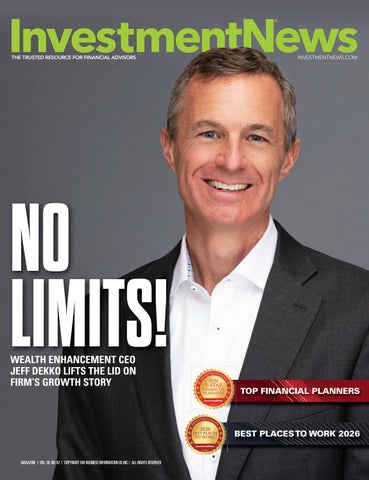




















































Wealth managers move toward an AI future
Amid uncertainty, advisors are connecting AI across systems
24 Orion doubles down on AI CEO Natalie Wolfsen forecasts an exponential productivity boost

















26 Renaissance in Caribbean nation as Americans invest Gaston Browne, prime minister of Antigua and Barbuda, welcomes the global elite
28 A future for AI notetaking tools? ‘Advisor operating systems’ may top CRMs






















BY JAMES ROGERS
Afew years ago, if I’d used AI to help in the production of a story, I would have been marched out of the newsroom. Today, like many of my colleagues, I’m leaning on it more and more – for research, sharpening angles, and speeding up routine work. The job hasn’t disappeared; it has changed. The same dynamic is now bearing down on financial advisors, broker-dealers, and RIAs.
Orion’s annual Advisor Wealthtech Survey underscored just how central AI is becoming: more than half of respondents said AI and automation will have the biggest impact on firm success in 2026 and beyond.
Yet the survey also highlighted friction points most firms will recognize: uncertainty around compliance and regulation, anxiety about accuracy and client trust, and a shortage of internal AI expertise or training. The wealth industry is convinced AI matters, but it’s far less certain about how to adopt it safely and intelligently.
For many firms, AI conversations start – and potentially stall – in the compliance department. At the recent Exchange ETF conference in Las Vegas, SEC Commissioner Hester Peirce described getting “an earful” during meetings with compliance officers. They “want to use AI,” she said, but they feel like they’re “walking into some landmines on the regulatory side.”
Her response should be carefully noted by anyone leading an RIA or broker-dealer: “My view is that we don’t need a rule that is specifically for AI unless we see problems that are specifically tied to AI.”
As for the technology itself, advisors have every right to be skeptical of something that sometimes “hallucinates.” While that’s an annoyance for consumers, it’s a risk in a regulated environment.
But it is getting better by the day. The building blocks of AI are being constantly fine-tuned, boosting accuracy and precision.

Building client trust is a mountain advisors should be able to climb – trust, after all, is the cornerstone of the advice industry. Openness is key, and advisors should spell out both the benefits and limits of AI. Make it crystal clear where AI ends and human oversight begins; the human-in-the-loop is key.
Yes, this is a training challenge, particularly for smaller firms, but it’s also an opportunity − early, disciplined adopters can quickly build a lead over their rivals. Now is the time to identify the “AI champions” in your business and let them lead.
“Building client trust around AI is a mountain that advisors should be able to climb – trust, after all, is the cornerstone of the financial advice industry”
If you feel behind on AI, you’re not alone. A recent survey of 5,000 knowledge workers in large companies across the US, Canada, and the UK found that, three years after the release of ChatGPT, most people are still AI beginners. Less than 3 percent of the workforce currently qualifies as AI practitioners or experts, according to the research by AI workforce transformation firm Section.
Quite simply, your career could hinge on how quickly you get to grips with AI. Half of the CEOs recently surveyed by Boston Consulting Group said that their job is on the line if AI doesn’t pay off. In virtually every industry, AI may be the biggest wave that any of us have seen. But, whether you’re a journalist or an RIA, we all have to ride it.
EDITORIAL
VP - Editorial: James Burton
Managing Editor: James Rogers
Senior Columnist: Bruce Kelly
Retirement & Planning Editor, Multimedia Anchor: Gregg Greenberg
Journalists: Andrew Cohen, Leo Almazora
Senior Sponsored Content Writer: Manal Ali
SALES
Chief Revenue Officer: Dane Taylor dane.taylor@keymedia.com
Business Development Managers: Catherine Reale catherine.reale@keymedia.com; Victoria Hamilton victoria.hamilton@keymedia.com; Barry Echavarria barry.echavarria@keymedia.com
Lead - Fulfillment Team: Cole Dizon Fulfillment Coordinators: Cyrus Arroyo, Pauline Talosig
PRODUCTION
VP – Production: Monica Lalisan
Lead Production Editor: Roslyn Meredith Production Editors: Tara Tovell, Karen Atienza, Allison Ingusan
Production Coordinator: Kat Guzman Designers: Joenel Salvador, JP Dizon, Juan Ramos Design Manager: Sheila San Miguel Creative Director: Marla Morelos
EVENTS VP – Events: Katie Jones Head of Event Marketing: Oliver McCourt Awards Director: Jessica Duce Head of Event Production: Jesse Friedl
MARKETING & RESEARCH
Global Director: Claire Preen Marketing and Operations Director: Danica Mendoza Managing Editor – Special Reports: Chris Sweeney
VP – Marketing Services: Lauren Counce
Marketing Activation Manager: Rissa De Leon
Project Manager: Kristyn Dougall
CORPORATE
President: Tim Duce
Director, People and Culture: Julia Bookallil CIO: Terry Szames
CEO: Mike Shipley
COO: George Walmsley
INSURANCE BUSINESS AMERICA cathy.masek@keymedia.com
INSURANCE BUSINESS AUSTRALIA sophie.knight@keymedia.com
INSURANCE BUSINESS CANADA chad.beck@keymedia.com
INSURANCE BUSINESS UK gemma.powell@keymedia.com
BENEFITS & PENSIONS MONITOR WEALTH PROFESSIONAL CANADA abhiram.prabhu@keymedia.com




Allianz Life has found more than half of women taking responsibility of their household’s finances, though just two thirds say they’re on sound financial footing.
In Cerulli’s survey research of advisors, an overwhelming majority agreed their firms’ tech is somewhat or very effective at supporting a wide range of key business objectives, including but not limited to regulatory compliance, creating quality experiences for clients, and enabling delivery of investment management services.

The most recent analysis by the Tax Foundation found that for 2026, New York, New Jersey, California, District of Columbia, and Connecticut were the least tax-competitive jurisdictions, based on five major areas of taxation, including individual income taxes. EASTERN STATES



Source: Allianz Center for the Future of Retirement, March 2026


Based on survey data from Greenwald Research, the Center for Retirement Research at Boston College in partnership with Jackson Financial determined that since the start of 2025, nearly one in two advisors thought the US economy has gotten stronger, while just over half of near-retiree and retired investors think it’s taken a turn for the worse.
Source:





























While most college students see planners as a trusted source of financial advice, two thirds say they don’t know where to find the right one, and just over half don’t know what questions to ask.
























With $11 billion in assets across 20 deal announcements, Wealth Enhancement Group was the most prolific acquirer last year, though Mariner got the most new assets, according to Echelon Partners’ 2025 RIA M&A deal report.
Congressional hearings in March laid bare the severe doubts some lawmakers in Washington have about FINRA, the giant self-regulatory organization that oversees the securities industry
BY BRUCE KELLY
After a year when it fended off questions about its legitimacy raised by a lawsuit by brokerdealer, FINRA started 2026 in the hot seat before Congress.
At hearings in March, some lawmakers questioned whether the self-regulatory organization, which acts at the behest of the Securities and Exchange Commission, even has a right to exist.
Meanwhile, as it remains under attack in the highly anti-regulatory environment in Washington, FINRA is also working to have a friendlier relationship with the securities industry.
For example, recent changes make the enforcement process a little easier for broker-dealers.
Plus, FINRA recently said it was giving a rebate of $100 million to the broker-dealers it oversees, dismissing howls from the plaintiff’s bar that such money should go to investors who won arbitration awards against firms but never received a dollar in payment.
FINRA’s current dilemma is due, in part, to its role as a regulator during a Republican administration that staunchly believes in cutting regulations and rules, many of which are costly to implement.
The Trump administration’s recent push to allow advisors to sell more alternative investments in retirement plans will only put more pressure on regulators.
“I don’t think FINRA is being picked on, but the organization is being looked at to see its effectiveness versus its cost,” says Sander Ressler, managing director of Essential Edge Compliance Outsourcing Services. “Lawmakers are concerned that a membership organization that regulates the industry will have buy-in.”
“The biggest firms contribute the most cash,” he notes. “Will FINRA regulate those firms as tough as smaller firms? It’s a legitimate concern.”
“Congress is looking to reduce regulation, and as long as there is a Republican majority, it will continue to seek a reason to cut regulations for the securities industry,” Ressler says. “That also means tarnishing FINRA in public and questioning its constitutional authority.”
FINRA right now is no darling of some in Congress. On March 6, the Capital Markets Subcommittee took its time criticizing the selfregulatory organization in a hearing devoted to SROs.
“Today, FINRA staff, not industry members, writes binding rules, investigates people, brings enforcement cases, holds hearings, issues large fines, and can permanently end someone’s career,” says Republican Congresswoman Lisa McClain of Michigan.
“Yet, FINRA is not subject to the same transparency laws as federal agencies,” McClain says. “Its meetings are not fully open. Its records are not fully public. Now, if an organization exercises government-level power, it should have governmentlevel accountability.”

“The biggest firms contribute the most cash. Will
FINRA regulate those firms as tough as smaller firms?”
SANDER RESSLER, ESSENTIAL EDGE COMPLIANCE OUTSOURCING SERVICES
“FINRA exercises regulatory authority over thousands of firms, yet it is not subject to the Administrative Procedures Act, FOIA, or direct congressional appropriations,” says Republican Congressman Warren Davidson of Ohio. “So members of this committee have had similar concerns about the structure of the Federal Reserve, for example.”
When asked about the Congressional hearing and such comments, a FINRA spokesperson replied: “As a self-regulatory organization, FINRA protects investors and safeguards market integrity at zero cost to the American taxpayer.”


At the end of 2024, Finra reported

“FINRA is not subject to the same transparency laws as federal agencies. Its meetings are not fully open. Its records are not fully public”
LISA MCCLAIN, REPUBLICAN CONGRESSWOMAN, MICHIGAN
FINRA has faced criticism from the securities industry it regulates ever since it was formed in 2007 by the merging of NASD and NYSE Regulation, Enforcement, and Arbitration.
At the end of 2024, FINRA oversaw and regulated 3,249 firms and 634,508 registered reps, or financial advisors. Although it is not a governmental agency, it operates under the aegis of the SEC. It charges broker-dealers fees, which make up its budget.
Once Donald Trump was re-elected president in 2024, FINRA staff was likely preparing to face such public criticism. After all, Project 2025, published by long-running FINRA foe the Heritage Foundation, and a blueprint for the Trump presidency, calls for the self-regulator to be eliminated.
Despite the attacks, FINRA is still the central regulator of the securities industry.
And the organization had its defenders in the March hearings in Congress.
“The Exchange Act’s model of securities industry self-regulation is grounded in certain core principles, which continue to resonate today,” said Onnig Dombalagian, professor of law at Tulane University, in written testimony.
“These include the industry’s familiarity with securities market operations, its reputational interest in upholding mutual and reciprocal principles of trade, and the ability to shift the financial burden of regulation to the industry through membership fees and other revenue sources,” Dombalagian notes.
“As markets have evolved, SROs including FINRA also maintain critical infrastructures for advancing the goals of the national market system, such as information processing and dissemination services, market and member surveillance systems, and other utilities,” he adds.
FINRA’s been in the hot seat before.
It spent 2024 and 2025 fighting a lawsuit that in part alleged the organization didn’t have a constitutional reason to exist. It ultimately prevailed when the Supreme Court last June declined to hear the appeal of Alpine Securities, the firm suing FINRA. That left in place a lower court’s ruling that gives FINRA the authority for enforcement action but required it to check with the SEC before expelling a firm.
“We’ve seen more attacks on FINRA the last couple years than in decades before,” Ressler says. “From the Alpine lawsuit to hearings in Congress, FINRA is being questioned for its reason to exist.”
Alternative investment platforms like SEI Access now let financial advisors explore litigation finance, a high-return but high-risk alternative
BY ANDREW COHEN
Alternative investment platforms are adding litigation finance opportunities for financial advisors, but many RIAs remain cautious about allocating client capital to a strategy whose returns hinge on courtroom outcomes rather than market performance.
SEI announced earlier this year that it expanded its alternatives marketplace, SEI Access, to include a litigation finance offering from Pravati Capital, an Arizona-based firm that’s funded more than $248 million to law firms and litigants since its founding in 2013. The global litigation funding investment market was valued at more than $20 billion in 2025 and is projected to grow to more than $50 billion by 2036, according to a report from consulting firm Research Nester.
“Oftentimes litigation finance for the United States isn’t nearly as adopted as it is outside the United States, in Europe specifically, and historically it has been institutional in terms of who would be allocating to it,” Pravati Capital managing director Kris Kjolberg tells InvestmentNews “But now advisors are looking at asset classes like litigation finance, which leads us to platforms like SEI’s Access, like CAIS, like iCapital. They provide compliance workflow, due diligence, and operational controls that wealth managers, RIAs really require.”
Litigation financing remains a niche corner under the broader private credit asset class. “Advisor demand is real, but the category is education
driven,” says Kjolberg. Pravati Capital primarily makes senior-secured loans to middle-market law firms, using portfolios of legal claims as collateral instead of financing individual cases. Loans typically originate at annualized interest rates between 19 and 27 percent, with an average investment duration of roughly two to two-and-a-half years, according to company materials.
“It’s an interesting alternative class, because the returns could be pretty high. From what I know,

“Large-scale commercial disputes illustrate why advisors are seeking exposures that are driven by legal processes and not economic cycles”
KRIS KJOLBERG, PRAVATI CAPITAL
returns on successful funds are 20 to 40 percent,” says attorney Corey Kupfer, whose Kupfer Law firm specializes in M&A for RIAs. “They’re totally unrelated to economic conditions. In fact, sometimes when there are bad economic conditions, there’s more litigation.”
Public disclosures from Burford Capital, the largest litigation financing firm in the US, show the economics driving litigation finance. Across concluded investments, the firm reports a roughly
26 percent internal rate of return (IRR) and 83 percent return on invested capital. Most cases − roughly 78 percent − settle before trial, generating around 22 percent IRR, while cases that proceed to trial and win can produce returns exceeding 200 percent on invested capital.
According to Burford’s latest investor presentation, approximately 8 percent of funded cases lose at trial, resulting in an average negative 87 percent return on invested capital.

“Because of the nature of the risk level, this is less applicable for firms that are doing massive affluent type clients as opposed to more ultra-high worth,” adds Kupfer. “Obviously, this is something you see in the family office model, the multi-family office model much more often.”
Count Mercer Advisors among the large national RIA firms not buying the return-to-risk profile of litigation financing. The mega-RIA manages nearly $100 billion in client assets, including its Regis Group division covering ultra-high-net-worth clients with $25 million or more in investible assets. Litigation financing was described as a “highly speculative investment” by advisor David Krakauer, VP of portfolio management at Mercer Advisors.
“There’s a high risk of loss, very unpredictable outcomes. And then when we think about who’s bringing the lawsuits and who’s actually running the proceedings, there’s actually a high potential for conflicts of interest as well when we think about
the outcomes and who’s influencing the outcomes of some of these cases,” says Krakauer.
“With something like litigation finance, the outcomes are so widespread. It’s very hard to peg this asset class as something that’s going to deliver X returns for our clients over a certain period of time,” he adds.
Current broader market developments could affect demand for litigation finance. A U.S. Supreme Court decision in February to strike down many of President Trump’s tariffs imposed under the International Emergency Economic Powers Act has spurred a wave of litigation seeking refunds to recover tariff payments totaling over $130 billion in the 10 months they were in effect.
The Wall Street Journal reported in March that more than 2,000 lawsuits have been filed by companies seeking tariff refunds, including well-known names like FedEx, Costco Wholesale, Goodyear Tire & Rubber, and Barnes & Noble Purchasing.
GLOBAL LITIGATION FUNDING MARKET
2025 market value: $20B
Projected 2036 value: $50B
Growth driven by US commercial disputes and global adoption

“Companies that paid tariffs are pursuing refund litigation. The analysts that I read estimated $130 to $175 billion in refund claims, which is very large,” says Kjolberg. “Large-scale commercial disputes illustrate why advisors are seeking exposures that are driven by legal processes and not economic cycles.”
Pravati Capital mainly finances contingency-fee personal-injury law firms, and to a lesser extent backs mass-tort, commercial, intellectual property, and whistleblower cases. Pravati Capital has participated in government litigation, funding a law firm that represented individuals in the Camp Lejeune toxic-water cases stemming from water contamination at the North Carolina Marine Corps base between the 1950s and 1980s. Settlements and awards since 2023 have totaled hundreds of millions of dollars.
New York has taken the lead on regulating litigation finance, passing one of the first substantive state laws aimed at increasing transparency and consumer protections in third-party funding arrangements. The New York Consumer Litigation Funding Act, signed by Governor Kathy Hochul in December 2025, requires funders to disclose key terms of their financing agreements to plaintiffs and courts and prohibits funders from interfering with litigation strategy.
“New York has moved litigation financing from the shadows to a supervised, disclosure-heavy regime, while empowering courts to probe funding when it bears on motive or misconduct,” wrote Maryan Alexander, partner at New York-based law firm Wilson Elser. “Stakeholders should prepare for regulatory compliance and more nuanced discovery practice as these changes take hold.”
“With something like litigation finance, the outcomes are so widespread. It’s very hard to peg this asset class as something that’s going to deliver X returns for our clients over a certain period of time”
DAVID KRAKAUER, MERCER ADVISORS
SEI Access reports having over 250 wealth management firms using its alternatives platform, which is distinguished in its litigation finance offering compared to competing alts marketplaces like CAIS and iCapital that have not made any announcements around litigation finance offers. New York’s legislation to bring transparency to litigation financing is a step toward filling the transparency gap for RIAs currently avoiding the asset class.
“There’s so much non-transparency and expertise that’s involved in this, it makes it highly
difficult to say [litigation financing] is a good, investable asset class for our clients,” says Krakauer. “If we did hear demand for it, I think the question would be, how do we put a valuation on that? How do we know if the price we’re getting is a good price or a bad price − if we’re investing into that space, what’s the yield, or what’s the multiple we should be requiring to take that risk?”

















































AMID MARKET VOLATILITY, persistent in ation, and an aging population that increasingly must shoulder retirement security, the work of the best nancial planners in the US has never been more consequential.
It’s estimated by Northwestern Mutual that Americans will need $1.26 million to retire comfortably. At the same time, surveys show nearly half of Americans expect to retire with less than $500,000, underscoring a widening advice gap and the need for high-quality planning.
Against this backdrop, the profession continues to expand in both scale and in uence. As of December 31, 2025, the number of CFP® professionals reached an all-time high of 107,529, an increase of 4.3 percent over 2024. Last year also marked the largest number of exam candidates in CFP Board history, with 11,037 people sitting for the exam, a 5.7 percent increase over 2024. Revenues from
INVESTMENTNEWS’ 5-STAR FINANCIAL PLANNERS: BY THE NUMBERS
Total AUM: $37,197,405,093
Average AUM: $470,853,229
Total clients: 26,844
Average number of clients: 340
fee-based advisory relationships climbed from an estimated $150 billion in 2015 to $260 billion in 2024, re ecting robust demand for human advice that has grown several times faster than the overall population. McKinsey estimates advised relationships will expand at least 28 percent over the next decade, from 53 million to 67–71 million by 2034.
Yet the value of the best nancial planners cannot be measured by growth statistics alone. In 2025, CFP® professionals in the US delivered more than 433,390 hours of pro bono nancial planning – an 11 percent increase over the prior year –providing an estimated $130 million in services to households that might otherwise go without advice. This combination of technical rigor and publicspirited service re ects the profession at its best.
This report is where InvestmentNews recognizes those nancial professionals who stand out within that landscape – planners who, over the past 12 months, have demonstrated not only strong performance but also integrity, client-centric innovation, and a clear commitment to helping individuals and families reach their nancial goals. These nancial planners are setting the standard for what modern planning can and should be: goals based, evidence driven, and rmly anchored in the best interests of the client.
about what his rm is really selling: service. As a CFP® professional and CFF®, he has built his practice around a high-touch, highly responsive client experience that he insists is still the exception rather than the rule.
“We believe that the product that we deliver is service,” he says. “Nowadays, technology is amazing at what it can put at your ngertips, and advisors exist all over the US. But what we pride ourselves on is that high level of service and responsiveness to our clients, and it makes them know that we care.”
Research shows clients now prioritize trust, communication, and personalized planning over raw investment performance, with the “human touch” eclipsing returns as the main driver of satisfaction and loyalty.
Cuplin and his team lean into that human element by deliberately positioning themselves as “bearers of good news” in an environment saturated with market scares, geopolitical shocks, and dire economic headlines. The goal is not to ignore risk but to pull clients out of a permanent state of anxiety and back toward the progress they are actually making. That optimism is grounded in process. He says, “We try to look at things in the big picture. That then is the blueprint that we use to make our decisions, to build out a portfolio, and to plan insurance coverages.”
Cuplin’s operating model is designed for ef ciency. Midwest Financial Group consolidated operations from three locations into a single agship of ce, allowing clients to meet the team’s specialists on the spot.


Matthew Cuplin: service, perspective, and planning Chief executive officer/ president of Midwest Financial Group (Wisconsin)

As portfolios and products increasingly feel commoditized, Matthew Cuplin is unapologetic
Community presence is another de ning theme. Cuplin attributes much of the recent organic growth to visibility and goodwill in the local area. He and his colleagues regularly teach no-cost classes at libraries and community centers, treating those sessions as education and outreach rather than prospecting events. That work lands against a national backdrop in which nancial illiteracy is estimated to cost American adults more than $200 billion a year, underscoring the stakes of better decision-making for everyday households.




“Some of the best meetings I’ve ever had were with people who didn’t end up working with us,” he says. “I’m a big believer in karma from the aspect of if you put something out there, it comes back to you.”
Cuplin sticks to the mantra of serving everyone, with a client walking in today experiencing the same level of care, discipline, and consistency as one who started a decade ago.
RJ Cunningham: planning first, products second Financial advisor–senior partner at Summit Global Private Wealth (Utah)

RJ Cunningham has a simple rule for rst meetings: no product talk, no annuities, no option strategies, and no alternatives. Instead, he focuses on mapping goals, trade-offs, and timelines before a single investment is proposed. “When I meet with a client, I’m not talking about options trading, stocks, or alternative investments,” Cunningham says. “First, we’ve got to get the plan in place.”
That planning- rst stance resonates in a market where anxiety is high and headlines are noisy. Nearly three in four US investors expect stock market volatility to persist through 2025, and a growing share say it is causing them to check accounts more often and second-guess decisions. Cunningham views those conditions not as a headwind but as an opportunity for differentiation. “Anytime volatility enters, I tell other advisors on our team, this is ‘go time’ – this is what’s going to separate you from every other advisor,” he says. In practice, that means phoning clients more when markets are rough and reaching out before nervous investors call him. His rst question when someone fears a looming recession is disarmingly basic: When do you actually need this money? If the goal is 15 or 20 years away, he argues, a short-term drawdown is usually a distraction, not the real risk.
Cunningham, who is a CFP® and ChFC®, leans heavily on metaphor and education to keep clients from making panicked moves. He likens market turbulence to a bumpy ight: when the plane shakes, the pilot doesn’t tell everyone to stand up and walk around – passengers are told to buckle up and ride it out. The same logic, he says, applies to portfolios mid-correction. Abandoning a longterm strategy in midair often does more damage than enduring volatility. That framing is backed by emerging research on advice: in a 2025 Vanguard study, 86 percent of advised investors reported greater peace of mind compared with managing nances on their own.











To identify outstanding nancial planners across the United States, InvestmentNews conducted a nationwide, nomination-based survey between November 3 and 28, 2025. The process was designed to recognize nancial professionals who demonstrate excellence, integrity, and a strong commitment to helping clients achieve their nancial goals, based on achievements during the past 12 months.
Nominations were accepted from industry peers, colleagues, clients, and self-nominated individuals. Only nancial planners who were formally nominated during the survey period were considered for evaluation. Nominators were required to submit detailed information for each nominee, including professional credentials, areas of expertise, and notable achievements from calendar year 2025. All nominations were subject to review and con rmation by the nominee’s compliance team to verify accuracy, authenticity, and adherence to ethical and regulatory standards before being accepted into the evaluation process.
A total of 231 nominations were received. Following an objective review and benchmarking process conducted by the IN editorial team, 80 nancial planners were ultimately selected for recognition.
Evaluation criteria
Each nomination was evaluated through a qualitative, information-based assessment focused on achievements and contributions over the previous 12 months. Evaluation considerations included:
• professional credentials and quali cations
• demonstrated areas of specialization or expertise
• signi cant professional or business achievements
• evidence of integrity, professionalism, and client-focused service
All entries were reviewed consistently to ensure fairness, objectivity, and editorial independence.
What the recognition measures
This recognition highlights nancial planners who demonstrated professional excellence and meaningful achievement during calendar year 2025, based solely on the information submitted and veri ed through the nomination process.
What the recognition does not measure
To comply with regulatory and advertising standards, this recognition is not based on:
• investment performance or portfolio returns
• client testimonials, endorsements, or satisfaction metrics
• quantitative business metrics such as assets under management (AUM)
• any criteria not expressly stated in this methodology
Fee and promotional disclosure
There is no fee to nominate, self-nominate, or be considered for this recognition. This award is not payto-play. Some recipients may choose to purchase optional promotional or marketing materials from IN after being selected; however, such purchases have no in uence on the nomination process, evaluation criteria, scoring, or nal selection.
Referrals tend to come from clients who felt listened to rather than pitched, whether the conversation centered on Roth conversions, Social Security timing, or sustainable withdrawal rates. This is a key driver of how Cunningham’s own metrics have scaled: assets under management (AUM) has grown from roughly $100 million to about $500 million in recent years, with a long-stated goal of reaching $1 billion. But he says the motivation behind that target has shifted. What began as an ambitious number he wrote down in his early 20s has evolved into a measure of how many retirements he can help steward over decades.


“I take assurance in knowing that I’m trying as hard as I can for the people we’re helping”

MATTHEW CUPLIN, MIDWEST FINANCIAL GROUP
That long-term commitment is rooted in a line he discovered in his great-grandmother’s journal: “You help other people get what they want, and you’ll get what you want tenfold.” For Cunningham, the compounding effect of that philosophy shows up less in asset totals than in something harder to quantify, clients who keep showing up or referring others.
Faiza Kedir: disciplined strategy meets human connection Managing director and partner at Steward Partners (Florida)

Clients don’t just come to Faiza Kedir for asset allocation or tax ef ciency; they come because she makes a point of understanding the people behind the balance sheets – their families, aspirations, and the legacy they hope to leave.
In a business that can default to spreadsheets and product menus, she positions herself as a longterm partner in her clients’ nancial lives. “Clients appreciate having someone who listens carefully, explains complex topics clearly, and helps them make thoughtful decisions during both calm and uncertain markets,” she says.
That philosophy has been stress tested over the past 12–18 months, as investors have navigated in ation worries, rate moves, and intermittent bouts of volatility. Rather than chase headlines or try to outguess every twist in the news cycle, Kedir has doubled down on fundamentals: a disciplined plan and the emotional discipline to stick with it. She emphasizes diversi ed portfolios, regular checkins on risk tolerance, and a cadence of proactive communication so clients understand not only what they own but also how each piece supports their objectives. Industry research continues to back that approach; investors with a written nancial plan report higher con dence and are less likely to make panic-driven changes during market swings.


Adaptability has been another de ning theme in Kedir’s recent work. She notes that markets, regulations, and client circumstances are in constant motion and that effective advice requires both technical uency and the willingness to adjust as life changes. In one recent case, a newly retired professional was shifting from accumulation to income. Rather than focus narrowly on withdrawal rates, Kedir designed a comprehensive roadmap that integrated retirement cash ow, tax strategy, estate planning, and charitable goals, giving the client clarity not only on “how much” to draw but also on how their money could support the causes and people they care about over time.
She cites the example of a recently retired professional transitioning from accumulating wealth to generating sustainable income. “Together
Percentage of respondents
we developed a comprehensive plan addressing retirement income, tax considerations, estate planning goals, and charitable giving priorities,” Kedir says. “While every client situation is unique, this re ects my philosophy of thoughtful planning and long-term partnership.”
Source: The Financial Planning Longitudinal Study
between professionals who won’t take ownership. That positioning is increasingly powerful in a landscape where tax ef ciency has become a central value driver for RIAs, with industry research highlighting tax-aware strategies as a key competitive edge in attracting high-net-worth clients.
Trevor
Scotto:
selling simplicity Partner at Fiduciary Financial Group (California)

By the time many wealthy retirees reach Trevor Scotto’s of ce, they are worn out from juggling a disjointed cast of CPAs, advisors, and specialists who never seem to be on the same page. Scotto’s differentiator is that tax and wealth management quite literally sit at the same table. Drawing on his own deep tax background, he and his in-house CPAs handle the heavy technical lifting, translating the results into plain English.
The same ethos has guided Scotto’s approach through the last year of market turbulence. Rather than reacting to every headline, he leans on a risk capacity, needs-based framework that starts with what a family actually requires to fund retirement and then works backward. It is an intentionally objective philosophy designed to strip out the emotion that so often derails investors. Once the plan is in place, the mandate is to stay disciplined, keep scanning for nancial and tax planning opportunities, and let clients focus on living their lives. Recent investor surveys suggest that advisors who proactively communicate around volatility and connect portfolio moves to long-term income needs enjoy signi cantly higher loyalty from retirementage clients, validating Scotto’s approach.


Clients receive high-level, integrated planning without having to decode acronyms or referee
Over the past year, one lesson has crystallized for Scotto: as wealth and business scale, the hunger for simplicity has to grow in parallel. Having recently crossed $1 billion in AUM while raising
FAIZA KEDIR, STEWARD PARTNERS
“Successful financial planning is not about predicting markets – it’s about building a thoughtful strategy that helps people live the life they want with confidence and clarity”
Scotto is part of this trend, as he, along with his team, uses a suite of AI tools to capture pristine meeting notes and automate documentation, particularly on complex retirement and tax plans where missing a detail can be costly. He says, “Right AMERICANS WORKING WITH CFP® PROFESSIONALS ARE CONFIDENT THEY WILL ACHIEVE THEIR
three young children, he has become even more convinced that time is the only truly non-renewable asset. That insight shapes both his rm and his life. He has surrounded himself with what he calls “insanely intelligent” specialists and built a culture where complexity is managed centrally so clients don’t have to carry it.
A recently retired couple illustrates how that plays out. For years, their advisor told them to “ask the CPA,” while the CPA sent them back to the advisor, promising strategies surfaced but were never implemented, and tax advice focused narrowly on the current year. Scotto’s team ended the ping-pong immediately. With tax and wealth experts in one room, they combed through the couple’s balance sheet, designed a uni ed, needsbased portfolio, executed a Roth conversion strategy, consolidated scattered retirement accounts, harvested tax losses and gains, updated bene ciary designations to match new legacy goals, and built a straightforward Social Security plan. What had been a source of frustration became a coherent, actionable roadmap.
AI is moving quickly from experiment to embedded tool. A 2026 Schwab study of RIAs found 63 percent of advisors are already using AI, most in early stage or “test and learn” mode, with the biggest impact showing up in administrative work and client communications rather than in pure investment selection.
now we use Gemini, Jump AI, and Contio, and we are also dipping our toes into Hazel AI.”
With the machines handling accuracy and admin, Scotto is able to be fully present in the room, asking better questions, spotting planning opportunities in real time, and maintaining the proactive engagement clients value most.
While Kedir incorporates portfolio management platforms, planning software, and secure portals to monitor accounts, model “what if” scenarios, and keep clients engaged. “Technology remains a tool – human judgment and experience are essential when guiding clients through complex nancial decisions,” she says.
This chimes with the market, as the Natixis 2025 global survey of individual investors shows only 40 percent say they trust algorithms and AI to support their nancial decisions, and separate research
nds nearly six in 10 expect the future of advice to be a human–AI partnership rather than a handoff to machines.
Advisory work has long been portrayed as a solo profession, but the data show a clear payoff toward team models.
Cuplin frames his own success as inseparable from his team. Clients go through the same disciplined process with outcomes tailored by other advisors, plus specialists in taxation, insurance, and administration. That structure creates deliberate redundancy – the “next person in line” can pick up right where he left off – giving clients continuity and peace of mind if life happens to any one advisor.


“The biggest lesson over the past year has been realizing that as wealth and business grow, your appetite for simplicity has to grow right alongside it”
TREVOR SCOTTO, FIDUCIARY FINANCIAL GROUP
Consolidating into a single agship of ce has ampli ed the bene ts: ef ciency is higher, “sharing of ideas” is easier, and the culture of camaraderie is now something clients can feel as they meet, in one place, a CPA for tax planning, a Medicare specialist, and other experts in an unusually polished but accessible setting designed for “millionaires to missionaries” alike. Emotionally, the team also helps him carry the weight of dif cult cases; having trusted colleagues to “bounce things off” matters when clients are facing illness or major life shocks.
Studies echo the advantage, with an analysis by Cerulli highlighting that team-based practices generate higher median AUM per advisor ($100 million versus $72 million for solo models) and are better positioned to offer a wider range of planning and high net worth services.
And Cunningham takes a similarly intentional approach. He insists every new prospect meeting includes at least two advisors so clients feel they are “working with a team,” typically pairing himself with a partner or junior planner. For households with more than $5 million in liquid assets, he extends that model into a dedicated family of ce group, ensuring multiple specialists are in the room for key decisions.
Client bene ts are both practical and emotional: broader listening, more perspectives, and better risk management during the volatile periods he calls “go time” for proactive outreach. Clients see that someone will always answer the phone and that their portfolio is backed by an actively managing investment team rather than a single decision-maker.
For Cunningham himself, the team model has improved close rates, exposed his own blind spots, and created a scalable path toward his billion-dollar AUM ambition. “What I’ve found is that 50 percent of something is better than 100 percent of nothing. It goes back to that quote ‘If you want to go fast, go alone. But if you want to go far, go with somebody else.’”
RJ Cunningham
Financial Advisor–Senior Partner
Summit Global Private Wealth
Phone: 385 509 0901
Email: rj@sgipw.com
Website: sgipw.com
Matthew Cuplin
Chief Executive Of cer/President
Midwest Financial Group
Phone: 608 807 4775
Email: matt@mfgteam.com
Website: mfgteam.com
Scott Van Den Berg
President Century Management Financial Advisors
Phone: 512 636 2026
Email: svandenberg@centman.com
Website: centman.com
Trevor Scotto
Partner
Fiduciary Financial Group
Phone: 415 578 6630
Email: tscotto@ffgwealth.com
Website: ffgwealth.com
Faiza Kedir
Managing Director and Partner Steward Partners
Phone: 941 217 7016
Email: faiza.kedir@stewardpartners.com





Website: sunshineprivatewealth.stewardpartners.com
Gideon Drucker
President and Chief Executive Of cer Drucker Wealth
Phone: 212 681 0460
Email: gideon@druckerwealth.com
Website: druckerwealth.com
Kate Feeney
Vice President and Wealth Advisor
Summit Place Financial Advisors
Phone: 908 517 5882
Email: kate.feeney@summitplace nancial.com
Website: summitplace nancial.com



Signature Estate & Investment Advisors, LLC (SEIA)
Phone: 310 712 2362
Email: mhurtienne@seia.com Website: seia.com
Robert Westley
Regional Wealth Advisor Northern Trust
Phone: 212 339 7293
Email: raw8@ntrs.com Website: northerntrust.com/united-states/home
Sammy Grant Senior Wealth Advisor and Shareholder HB Wealth
Phone: 404 459 0027
Email: sammy.grant@hbwealth.com Website: hbwealth.com
Thomas M. Dowling Head of Wealth Management Alliance Global Partners of the Lowcountry
Phone: 843 420 1993
Email: tdowling@allianceg.com Website: agplowcountry.com
Aaron Brachman Steward Partners
Adam Glassberg Savant Wealth Management
Anthony Consiglio Baird
Anthony Gerbi Stein Financial Group
Becca Mathis
Jeter Hrubala Wealth Strategies
Caitlyn Salloum Key Wealth Management
Carl Gravina Steward Partners
Carson Odom
Adams Wealth Partners
Chad Osmanski Baird
Charles Cooper III StrongBox Wealth




Christopher Crotty
Ameriprise
Christopher Detmer
Steward Partners
Christopher Ruedi
Savant Wealth Management
Corey Briggs
Plaza Advisory Group
Courtney Shrewsberry
Steward Partners
Danilo Kawasaki
Gerber Kawasaki Wealth & Investment Management
David Johnson
Signature Estate & Investment Advisors (SEIA)
DeHaven Becker
Steward Partners
Dominic Hubert
Schmidt Financial Management
Doug Peterson
Adams Wealth Advisors
Evan Schmidt
Schmidt Financial Management
Gary Williams
Williams Asset Management
George Nottingham
Steward Partners
George Webb
Pension & Wealth Management Advisors
Giancarlo Troncoso
Jaffe Tilchin Wealth Management
Greg Bogdan
Private Vista
Greg Giardino
Wealth Enhancement
Gregory Armstrong
Armstrong Dixon
Gregory Kurinec
Pennant Planning
Hannah Varnado
Wood Opal Financial Advisors
James Sahagian
Steward Partners
Jared Hoole
Lakeside Financial Planning
Jason Botten eld Steward Partners
Jason VanDuyn
AQuest Wealth Strategies
Jeremy DiTullio
Cleveland Financial Group
Joe Breslin
Armstrong Dixon
Joe Cilley
Merit Financial Advisors
John Ferguson
Steward Partners
John Litscher
The Capital Group
John Loyd
The Wealth Planner
Joseph Goldfeder
Valley National Financial Advisors
Julie Hall Labrune
Vision Capital Partners
Kathy Longo
Flourish Wealth Management
Keith Barberis Steward Partners
Kerry Meath-Sinkin
Meath Wealth Advisors
Lawrence Sprung
Mitlin Financial
Libby Muldowney
Savant Wealth Management
Louis Barajas International Private Wealth Advisors
Matt Parenti
Private Vista
Max Baer
Merit Financial Advisors
Michael Addessi
Addessi Financial Partners
Michael Englehart
Steward Partners
Michael Randall
Oak Summit Wealth Management
Miriam Falaki
Savant Wealth Management
Myles Zueger
Adams Wealth Partners
Navarone Simpson
Armstrong Dixon
Oliver Kollofski
Sweet Financial Partners
Ralph Leopold
Ameriprise
Rob Howland
Howland and Associates
Schuyler Engelhardt
Armstrong Dixon
Scott Gaynor
Navalign Wealth Partners
Sharon Nassir AIRE Advisors
Stephanie Petrosini
Morgan Stanley
Thomas Pontius
Kayne Anderson Rudnick
Tim Lonergan Westmount Partners
Todd Bryant
Signature Wealth Partners
Tucker Dunn
Armstrong Dixon
Wayne McCormick
Steward Partners
William Rodriguez
Briggs Wealth Management














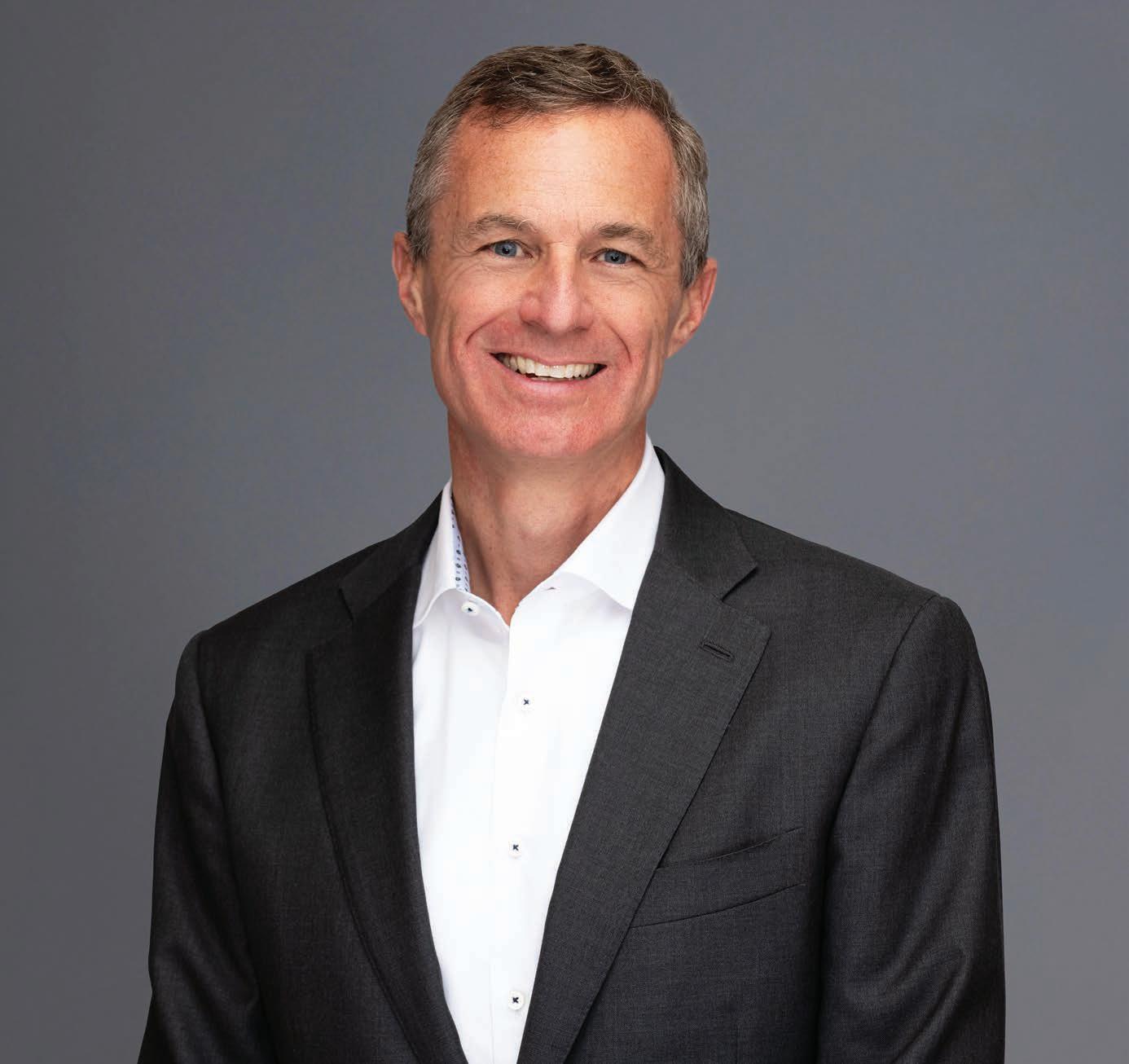
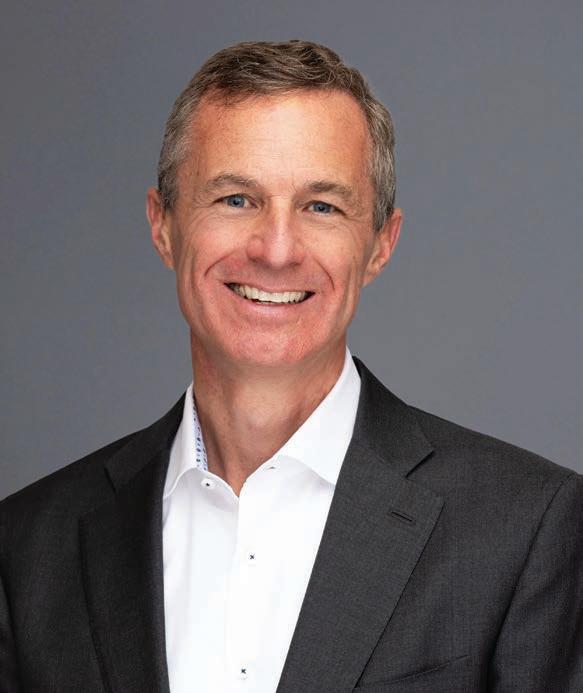
CEO Jeff Dekko’s secret to growth? Keep building and never set a target
BY GREGG GREENBERG
JEFF DEKKO joined Wealth Enhancement as CEO back in 2003 when it was a regional advisory business with $600 million in AUM. Now, it’s a national firm with over $143 billion.
Not that he had a target number in mind, mind you.
“I was asked early on, ‘How big is big enough?’ and my answer was always the same: high-quality companies don’t set an end number. They focus on building something that lasts,” Dekko says.
For Dekko, that meant building a quality business centered on comprehensive financial planning and a client-first mindset. All that growth, in other words, has been a by-product of operating with a laser focus on those two areas.
ABOUT JEFF DEKKO
Assumed role as CEO of Wealth Enhancement in 2003
Prior to Wealth Enhancement, held key strategic and marketing roles at Fortune 500 companies such as General Mills
Serves on the board of trustees for the United States Ski and Snowboard Association
Enjoys fly fishing, hiking, and backcountry skiing
Currently trying to complete six marathons over the course of a year and a half
Earned MBA in finance and strategy from the University of Chicago Booth School of Business
Not that he hasn’t done his fair share of strategic corporate construction as well. Under Dekko’s leadership, Wealth Enhancement has completed over 100 strategic acquisitions, a sizable number even if he’s not counting, which, once again, he’s not.
If a deal is sensible and serves the firm’s stakeholders then he’ll make it. If that’s not the case, then he’ll wait for the next one to come along. And considering the red-hot, private equity−fueled M&A environment in the RIA space, suffice to say the wait has not been that long of late.
“We are thinking about clients, employees, and shareholders alike, not just the owners of the firm. Supporting all three in a balanced way is what drives better outcomes for clients and leads to sustainable growth. Over time, that approach has allowed us to expand well beyond our Minnesota roots into a truly national firm, while staying grounded in the same core principles we started with,” Dekko says.
Despite his dealmaking skills, Dekko was not a Wall Street investment banker prior to joining Wealth Enhancement. In fact, he spent over a decade as a marketing executive at General Mills and Recovery Engineering before getting into the wealth management business. And it was building all those brands as a marketer that helped shape his thinking about the RIA business from the very beginning.
“At General Mills, there was a strong focus on understanding your audience, and being clear about who you’re trying to serve, then building around their needs. That client-centric mindset translated directly into how we’ve built Wealth Enhancement,” Dekko says.
It also influenced how he thinks about growth. Rather than relying on a single source, Wealth Enhancement has built a diversified approach to marketing and lead generation that supports advisors and creates more consistent, long-term growth.

“For us, it is not about replacing personal service with digital. It is about using technology to strengthen it and ultimately deliver better outcomes for clients”
And speaking of growth, what about all those acquisitions? What in fact does Dekko look for in a partner?
“We pursue acquisitions to grow our reach and strengthen our team and capabilities so we can ultimately help more people. When we evaluate a firm, we start by looking for those that truly put clients and employees first, with a culture that reflects that in both words and actions,” Dekko says.
As for the advisors joining Wealth Enhancement, Dekko says they gain the ability to maintain and expand their promises to their clients by gaining access to the resources, infrastructure, and scale of a national organization.
Emphasizes Dekko: “At the end of the day, we see every acquisition as a long-term partnership,
where the commitments those firms have made to their clients become shared commitments moving forward.”
ORGANIC GROWTH COUNTS TOO Sure, Dekko does a lot of valuation exercises when acquiring a new advisor team. That’s literally part of the deal. But he also sees value in the relationships his advisors have with their clients, something that is far harder to hang a number on.
“Those relationships are an incredible asset, and we see a real opportunity to help advisors deepen them over time while also building new ones,” Dekko says.
Additionally, Wealth Enhancement has always had a strong marketing capability, which ties back
“When we evaluate a firm, we start by looking for those that truly put clients and employees first, with a culture that reflects that in both words and actions”
to his background as a consumer marketer. And it was one of the things that attracted him to the firm early on. That’s why he continues to invest in that capability in order to generate interest and connect with prospective clients, creating a steady flow of opportunities for our advisors.
“Many advisors see a meaningful acceleration in net asset flows after joining us, which reflects the strength of that engine,” Dekko says.
They also maintain relationships with custodial referral partners, which can be an important source of growth. At the same time, the firm has been very intentional about building a diversified portfolio of growth opportunities so they are not dependent on any single channel, which is where some firms can get challenged.
“We’re bringing new assets from multiple sources, not just relying on their programs. It needs to work for everyone, starting with the client, and then for the custodian and for us,” Dekko says.
Over a year ago, Dekko began taking prompt engineering courses because of his belief that AI is going to transform the business world. Put simply, if he expected the organization to embrace AI, then he felt obligated to learn it himself.
“In many ways, I think of AI skills today the same way we once thought about basic software skills like email, spreadsheets, and presentation tools. At one point, those were specialized capabilities. Today, they are simply part of how everyone gets their work done. I believe AI will follow a similar path, becoming a core skill set across roles and functions. My goal is to build a company where everyone has that level of capability,” Dekko says.
Nevertheless, while jumping into AI with both feet, Dekko also wants his employees to

remember where AI fits in Wealth Enhancement’s business.
“For us, it is not about replacing personal service with digital. It is about using technology to strengthen it and ultimately deliver better outcomes for clients,” Dekko says.
And just because he’s investing in technology does not mean he’s simultaneously scrimping on employees new and old. In Dekko’s opinion, attracting great talent starts with culture and extends to creating long-term alignment. To get everybody on the same page, Wealth Enhancement offers employees the opportunity to participate in equity.
“It’s not just about advisors. We invest in our corporate teams as well to strengthen capabilities across the organization, and we maintain a strong internship program to help build the next pipeline of talent,” Dekko says, adding that what he enjoys most about his role is working with interns, advisors, and all the other members of his team.
In a word: People. Not numbers.
“Earlier in my career, I was marketing inanimate products. They never had opinions. Today,
Founded in 1997
Headquartered in Plymouth, Minnesota
Provides wealth management services to over 82,000 households
182 offices nationwide
$143 billion in total client assets
Over 1,800 employees
I get to work with talented people who have strong ideas, perspectives, and a real passion for what they do. The leadership challenge, and the reward, is bringing those ideas together in a way that unifies us around a shared vision,” Dekko says.
Advisors discuss their use of AI now and how it will change going forward
BY GREGG GREENBERG
The numbers clearly show that wealth managers are moving toward an AI future.
They also show that – at least for now –they don’t know how to get there.
Approximately 95 percent of financial services and wealth management professionals plan to increase AI investment in the next three years, and 68 percent consider it important for future competitiveness, according to MSCI’s Wealth Trends 2026 report.
Nevertheless, despite that overwhelmingly supportive forecast surrounding the future adoption of AI, the MSCI study, which surveyed 250 wealth managers worldwide, indicated that many financial advisors are still unsure of how to best integrate the technology into their practices. While nearly all firms plan to increase investment in AI tools, the report showed that 44 percent believe the wealth segment’s AI adoption rate lags the broader financial services industry. Furthermore, only 27 percent feel wealth managers are leading the rest of the industry.
“I’m surprised many advisors say AI isn’t critical yet,” says Michael Mignosi, senior director of organic growth at Perigon Wealth Management. “Wealth management is still fundamentally a relationship business and technology doesn’t replace trust, but it certainly helps on many levels.”
Early on, Mignosi used AI mainly for productivity, such as content drafting, research, and helping advisors translate complex financial topics into clearer client communication. Now, he’s moving toward a more architectural approach, connecting AI across systems so that better data at the prospecting stage can inform onboarding and ultimately create more personalized client experiences.
“We approach AI with continuous experimentation and a scientific mindset. The goal isn’t just adopting tools but learning quickly and reducing
the technology fragmentation that has slowed innovation in our industry,” Mignosi says.
Meanwhile, Jason Hanavan, president and CFO at VestGen Wealth Partners, utilizes AI to identify M&A targets, recruit advisors, and drive strategic growth, while his advisors use it for notetaking, follow-ups, and task management after meetings with clients and prospects.
“Our AI tool integrates with our CRM, performance reporting system, and planning software to deliver a comprehensive data view. Our technology team uses AI to execute certain data migration tasks related to custodian and CRM data,” Hanavan says.
Elsewhere, Jacob Roos, a financial advisor with 49 Financial, is using AI most intentionally on the

“We view AI as a tool that increases advisor capacity to be able to provide services to more clients”
JASON HANAVAN, VESTGEN WEALTH PARTNERS
learning and development side of the business. He recently launched a tool called Virtual Coach, an AI-powered practice environment where advisors and leaders can rehearse client conversations with an avatar trained on the firm’s language and methodology.
“On the client side, I also use tools like Finmate to capture notes, key numbers, and specific quotes during conversations,” says Roos. “That allows me to stay fully present in the discussion, ask better

HOW ADVISORS USE AI NOW
Identify M&A targets
Recruit advisors
Notetaking, follow-ups, and task management after meetings Content drafting
Research
Translating complex financial topics
follow-up questions, and focus on what the client is actually saying rather than worrying about documentation.”
When it comes to budgeting for AI investments, Tim Thornberry, financial planner at Prudential Advisors and founding partner of Cornerstone Financial Partners, says he measures AI investment by what it unlocks, not what it saves. In his view, the real return is an advisor who can think more deeply, analyze more rigorously, and deliver better outcomes for clients.
“That’s the lens we apply,” Thornberry says, adding that the enterprise’s investments also give his team access to sophisticated tools without

bearing the full cost, enabling him to “focus our own spend where it directly improves client experience.”
Perigon’s Mignosi, for one, does not treat AI as a separate budget category. It’s increasingly embedded across his technology stack, from marketing tools to CRM and data infrastructure.
“One advantage we have is agility. At our size, we can move faster than many larger, more traditional firms that are constrained by layers of legacy systems and red tape,” Mignosi says.
His approach is to test new capabilities, measure the impact, and scale what works. If it helps advisors prospect more effectively, improves the client experience, or frees up advisor bandwidth for more meaningful conversations, it earns a place in his stack.
For his part, VestGen’s Hanavan is more than doubling the amount of third-party spend on AI tools in 2026, and he expects to continue to increase this investment in the coming years.
“We view AI as a tool that increases advisor capacity to be able to provide services to more clients,” Hanavan says.
And then 49 Financial’s Roos views AI as an accelerator embedded across multiple functions, including training, advisor productivity, and client engagement. And because the space is evolving quickly, he’s less focused on large upfront investments and more on iterative adoption − or, more specifically, on testing tools to see what’s working and scaling the ones that demonstrably improve advisor effectiveness or client experience.
Looking out a decade from now, Mignosi thinks AI will ultimately make the human side of advice even more important. As AI automates research, preparation, and documentation, he sees it freeing

“Ultimately, I see AI strengthening the human side of the profession rather than replacing it. The advisors who win in that future will be the ones who use technology to deepen relationships, not distance themselves from them”
JACOB ROOS, 49 FINANCIAL
advisors to spend more time understanding clients and guiding them through important financial decisions. He also foresees a shift in how trust is built between advisors and clients, as well as prospects.
“Historically, firms relied heavily on thought leadership content to demonstrate credibility. But with AI, everyone can generate expert-level information instantly. Clients and prospects are already coming to meetings with more sophisticated questions because they’ve explored topics through AI. When everyone can sound like an expert, the real differentiator becomes the human dimension,” Mignosi says.
Similarly, over the next decade, Roos thinks AI will increasingly handle the operational load that has historically consumed much of advisors’ time, which will free them up for more client-facing, relational work, “which is what clients really value.”
“Ultimately, I see AI strengthening the human side of the profession rather than replacing it,” Roos says.“The advisors who win in that future will be the ones who use technology to deepen relationships, not distance themselves from them.”
Finally, Cornerstone’s Thornberry thinks the advisors who win in the end won’t be the ones who
Freeing advisors to spend more time with clients
Strengthening human side of wealth management
Enabling better thinking, deeper planning, and lasting results for clients
Increasingly handling operational load
adopted AI first. They’ll be the ones who learned to ask better questions with it.
“For us, AI’s biggest promise is connecting the dots across tax planning, business succession, estate strategy, and investments − faster and more precisely than ever before,” says Thornberry. “The goal is always the same: better thinking, deeper planning, lasting results for our clients.”
Artificial intelligence could revolutionize how Americans receive financial advice by freeing advisors up to provide support to huge swaths of the population
BY ANDREW COHEN
As wealth management firms experiment with artificial intelligence, Orion CEO Natalie Wolfsen believes the technology could dramatically scale the advisory model − potentially doubling the number of Americans who receive financial advice.
“Personally, I want AI to increase our output. I want it to increase advisors’ productivity. Right now, about 20 percent of Americans benefit from advice, and if I can double every advisor’s productivity, then that means that 40-plus percent of Americans can benefit from advice,” Wolfsen tells InvestmentNews
A 2024 survey from YouGov found that 27 percent of Americans work with a professional financial advisor. Orion launched the enterprise version of its Denali AI for advisors earlier this year, opening the software to Orion’s ecosystem that spans $5.8 trillion in platform assets and $133 billion in wealth management assets across thousands of advisors and eight million end-client accounts.
“For me, it’s not about eking out an extra couple of dollars or an extra couple of points in margin, but instead, can I take functions of Orion and functions of advisory businesses and double the productivity in that area,” says Wolfsen.
Advisors using Orion had a 2025 organic asset growth rate that was approximately 40 percent higher than that of non-Orion client advisors, according to Orion’s Advisor Wealthtech Survey Orion has also debuted its AI-powered Report Assistant to draft automated reports for clients and its Query Studio assistant that lets operations teams ask questions in plain English to pull complex data.
“We know that this will replace this swivel chair that advisors have, where you go into your research, and then you go into your custodial system, and then your financial planning system, and then
your trading system, and then your portfolio construction system, and then your reporting. All of that information can be put in Denali AI, and then actions can be started and questions can be answered using this tool,” says Wolfsen.
All Orion employees have been tasked with individual “AI goals” for 2026. While some newer RIA startups believe AI can fully automate investment

portfolio decisions, Orion views the tech as being more limited to streamlining research and data entry.
“A lot of the basic work that goes into portfolio construction, like evaluating securities and evaluating scenarios, that’s really where the tools are able to help. Making the recommendation or making the decision, to me, that’s still very much an advisory act,” says Wolfsen.
“If I can double every advisor’s productivity, then that means that 40-plus percent of Americans can benefit from advice”
NATALIE WOLFSEN, ORION
ADVICE ADOPTION
A 2024 YouGov survey found 27 percent of Americans work with a professional financial advisor.
ADVISOR PRODUCTIVITY
Advisors using Orion had 2025 organic asset growth about 40 percent higher than non-Orion client advisors, according to Orion’s Advisor Wealthtech Survey
ADVISOR WORKFORCE OUTLOOK
• McKinsey & Company projects a shortage of roughly 100,000 advisors in the US wealth management industry by 2034.
• Mariner Wealth Advisors reported 30 percent organic growth from 2024 to 2025 while expanding AI-enabled advisor workflows.

Orion had previously planned to have a wealth innovation lab in San Francisco, but it has now pivoted to innovation hires in multiple locations − Omaha, Nebraska; Jacksonville, Florida; and Lehi, Utah, rather than concentrating them in a single San Francisco hub.
“Going into the AI innovation lab, we thought it would be great to have a team of people co-
located in San Francisco working on nothing but AI. Instead, we found we need AI capabilities across all of Orion, because the whole company needed to transform to an AI-native company,” says Wolfsen.
“So we pivoted, and we’ve hired the AI innovation resources, but instead of hiring them in one location, we’ve hired them in multiple

“AI will reshape the advisor workforce by making advisors more capable and scalable. It will also accelerate training and development”
KENNY POINTER, MARINER WEALTH ADVISORS
locations. Now, all of Orion is transforming into an innovation lab, rather than having a smaller, highly competent resource group do it.”
Orion touts having 17 of the top 20 largest RIA firms as clients, including its addition of Edelman Financial Engines announced in January. Another mega-RIA client of Orion is the Kansas-based RIA roll-up firm Mariner, which integrates its own AI tools for advisors on top of Orion’s wealthtech layer.
“Orion is part of our core infrastructure layer, helping organize and unify data,” says Mariner’s chief innovation officer, Kenny Pointer. “Our advisor-centric AI tools − like Sherpas, Zocks, LLMs − sit on top of that foundation to automate workflows and generate insights.”
The family office of Mariner Wealth Advisors founder and CEO Marty Bicknell, 1248, is a lead investor in AI startup Sherpas. About 125 Mariner advisors are using Sherpas, which automates the investment proposal process for prospective clients.
“Advisors are using Sherpas to accelerate the path from an initial prospect conversation to a personalized, high-quality recommendation. It automates much of the analysis and proposalbuilding process, reducing turnaround time from days to hours, while allowing the advisor to guide the strategy and final output,” says Pointer.
The tech stack for Mariner Wealth Advisors also includes meeting management via AI assistant Zocks and back-office automation from Humanity Labs. Mariner reported a 30 percent organic growth increase from 2024 to 2025 and said AI could help offset the roughly 100,000advisor shortage that McKinsey & Company projects for the US wealth management industry by 2034.
“AI will reshape the advisor workforce by making advisors more capable and scalable. It will also accelerate training and development, enabling more professionals to step into clientfacing roles and helping to address the industry’s looming advisor shortage,” says Pointer.
The prime minister of Antigua and Barbuda says the country is undergoing a renaissance and there has been an increase in American investment, from both developers and high-net-worth individuals
BY JAMES BURTON
The imposing cruise ships docked in St. John’s, Antigua, loom over the lowincome neighborhood of Point. A drive through these old, working-class streets contrasts sharply with the shiny, multimilliondollar floating towns. But rough-and-ready does not mean a lack of aspiration − just ask Gaston Browne.
The prime minister of Antigua and Barbuda, and leader of the Antigua and Barbuda Labour Party, grew up in Point, represents the area in parliament, and is the person responsible for transforming parts of it with overseas investment.
InvestmentNews spoke to him just before he dissolved parliament and announced a general election, seeking a fourth term in power. Attracting outside investment remains a core policy and a central part of his plan to build Antigua and Barbuda into a “lifestyle superpower” − one that can enrich the local community and attract wealthy Americans seeking both yield and quality of life.
From his office in St. John’s − a short ride but seemingly miles away from his humble Point beginnings − Browne opens his arms to the global elite and expresses confidence the country’s current phase will go down as a renaissance, not a bubble.
The bullishness of the prime minister, who entered politics after a career in banking, stems from what he believes is a sharp reversal of fortune under his watch. When his Labour Party returned to office in 2014, Antigua and Barbuda had just come through what he calls “total decay” − fiscal distress, crumbling infrastructure, and a 25 percent loss of gross domestic product between 2009 and 2014. Today, he argues, the macro picture has flipped in ways that matter to investors as much as to voters.
“When we came to office, there was total decay within our country,” he says. “There was infrastructural decay, social decay, economic decay, environmental decay.” Debt-to-GDP hovered around 104 percent. The country was in an IMF program.
In 2026, Browne reels off a list of his government’s accomplishments. Debt-to-GDP has fallen from about 104 percent to roughly 62 percent, close to international benchmarks; employment is up; and Antigua has recorded budget surpluses for the
past several years. He says these surpluses will be plowed into infrastructure and social programs designed to raise long-term productivity.
The macro repair job underpins an aggressive push upmarket. “We are transforming Antigua and Barbuda into an economic power in the Caribbean − what we consider to be a lifestyle superpower,” Browne says. And the focus is on luxury: “We’re not particularly keen on these low-end hotels.”
The result is a busy development pipeline. On Barbuda, the PLH development alone has attracted about $1 billion so far, and, Browne says, it “boasts some of the wealthiest people in the world.”The project is anchored by a Tom Fazio golf course, surrounded by nearly 300 degrees of beach and designed with native species and
shoreline engineering to reduce storm risk on an island that is naturally flat.
Robert De Niro’s Nobu resort is expected to open on Barbuda by late this year or early next, joining a slate of other approved luxury brands now completing environmental studies and preparing to break ground.
On Antigua itself, projects associated with Nikki Beach, One&Only, and Marriott are in various stages of land preparation and construction.
WHY THE WEALTHY ARE PAYING ATTENTION Browne makes the pitch that, per capita, “there’s no other destination in the Caribbean that has more luxury properties than Antigua and Barbuda,” and that the country has “attracted more billionaires
“Generally speaking, we keep out of geopolitical spats and we don’t want to get in the crosshairs of anybody. But, yes, we are seeing an increase from American applicants”
Gaston
Browne, prime minister of Antigua and Barbuda



“We are transforming Antigua and Barbuda into an economic power in the Caribbean”
Gaston
Browne, prime minister of Antigua and Barbuda
and multimillionaires than any other, per capita” in the region.
Antigua offers “very attractive concessions” for people building luxury homes, hotel properties, or any significant capital project, from duty-free treatment on building materials, fixtures, and fittings to broader investment incentives. The aim is to reduce upfront costs and compress payback periods in a small market where scale is finite but margins can be attractive.
Security is another part of Browne’s calling card. Antigua, he says, has “one of the lowest” levels of violent crime in the Caribbean, typically with no more than 10 homicides a year. Barbuda, with roughly 1,500 residents, has not had a homicide in more than four
decades. For clients accustomed to reading travel advisory headlines, he presents that as a core asset.
Two key elements may also stand out for US advisors evaluating Antigua and Barbuda as part of a broader wealth-planning strategy: citizenship by investment (CIP) and the personal tax regime.
Antigua’s citizenship-by-investment program, now about 13 years old, is explicitly framed as a tool “to de-risk investments” and provide constitutional protection to investors. Once investors are naturalized, “if the government wants to acquire any private property, it must be for public purpose and you must settle the full market value
Name: Gaston Browne
Born: St. John’s, Antigua Age: 59
Politics: Browne has been prime minister of Antigua and Barbuda since 2014. He was elected to parliament in 1999 and became leader of the Labour Party in 2012.
Career before politics: Commercial Banking
Manager, Swiss American Banking Group
Music: Browne writes and performs reggae under the name Gassy Dread.
immediately,” Browne explains. The constitution’s protection of private property, he notes, applies across both residential and commercial holdings.
The program also has a geopolitical dimension. Antigua does not process applications from individuals in sanctioned countries such as Iran and North Korea, and tends to “move in tandem” with the US and European positions when considering applicants from higher-risk states.
The conflict in the Middle East and the rise in oil prices have created economic uncertainty, but interest from the US remains strong. “Generally speaking,” Browne says, “we keep out of geopolitical spats and we don’t want to get in the crosshairs of anybody. But, yes, we are seeing an increase from American applicants.”
For developers, the citizenship-by-investment program can also be a funding tool. “You can literally use a CIP over a period of time to raise the capital,” he says, or “you can actually upfront the proceeds to build the hotel and then sell the units.”
For buyers, the structure offers real estate plus optionality. Investors purchasing qualifying units − typically at $350,000 or more − may be eligible for Antiguan citizenship as part of the package. “So it’s a win-win for everybody,” Browne says.
Tax policy is equally important. Within a year of taking office, Browne’s government eliminated personal income tax. The move, he says, was designed to increase disposable income, encourage saving and investment, and underpin what he describes as a “housing revolution” on the islands.
For individuals domiciled in Antigua, whatever you make, gross is net, although corporate tax is treated differently and set at 25 percent.
Behind the investor-facing messaging is a domestic development agenda that also reinforces Antigua’s appeal as a place to spend time, not just park capital. Browne is keen to emphasize that the lifestyle story is being built “for the benefit of our visitors, but for the locals alike.”
Housing, healthcare, infrastructure, and even the beautification of the landscape are all central pillars of the planned renaissance.
“In terms of the prospects of the country, I feel confident that Antigua has a very bright future ahead of it,” he says. “It’s a good time for investors to come and invest. A good time to acquire a luxury home.”
Antigua and Barbuda is clearly betting that its renaissance will show up on the next GDP chart − and on the balance sheets of those who invest early.
Advisor-specific AI meeting note tools have existed for about three years now, and over that time one of the biggest questions has been their viability as a standalone solution. While the value of AI notetakers is clear-cut given the material time savings of eliminating the manual work involved in logging meeting notes and managing follow-up tasks, what’s questionable is whether those capabilities should exist in one standalone tool or as a feature within an existing platform. In the early days of AI notetakers, the answer seemed obvious: they make the most sense living within CRM software (since that’s the repository of all the client data that the AI notetaker deals with). Which meant that once CRMs started to roll out their own integrated AI notetaking tools, it would be hard for any of the standalone notetakers to survive on their own.
ADVISORTECH
BEN HENRY-MORELAND AND MICHAEL KITCES
But over the last year, an interesting thing has happened. CRMs took a very long time to roll out their own notetakers – for example, Wealthbox just launched its own internal notetaker in the fall of 2025, while Redtail still has yet to introduce a notetaker of its own – which cost the CRMs a lot of the initiative in the race to gain market share. Instead, two standalone providers, Jump and Zocks, became the clear-cut #1 and #2 market leaders in the advisor-specific notetaker category, which allowed them to raise capital and build out features like meeting prep summaries, natural language search capabilities, and document extraction. And so by the time Wealthbox finally unveiled its own AI notetaker, its features were already outpaced by Jump and Zocks, making advisors less likely to drop the standalone solutions even though it meant paying for another software license on top of the CRM.
The result is that, with AI notetakers building out their capabilities and integrating to other parts of advisors’ tech stacks, it’s ironically the CRMs now that are being threatened by the existence of the standalone AI notetakers rather than the other way around.
If the CRM’s main roles are as (1) a repository for data on clients and their historical interactions with the advisor and (2) a hub for client-related tasks
and workflows, then AI notetakers are already close to taking over the first role: every meeting or email the advisor has with the client while using the notetaker already in the system, and it would be a relatively simple matter to pull in the remaining historical client data from the CRM (given that most notetakers are accessing that data via integration already). And with the AI notetakers now building connections to other software tools, their users arguably have access to a richer depth of client data they can get from their CRM, since an advisor can effectively search their entire tech ecosystem to answer a question (e.g., whether the client has taken an RMD yet this year) using the AI notetaker’s interface. Where the AI notetakers haven’t yet caught up is in supporting the creation and management of advisor workflows (since that arguably isn’t a function that needs to –or should – be done using AI), but given the fairly dim view advisors have of their CRMs’ existing workflow capabilities, even a fairly basic (non-AI) workflow management function could be an upgrade over what advisors experience with their current CRMs.

it’s getting hard to imagine that isn’t the case. For example, Jump claims to already be used by around 27,000 advisors, which equates to nearly 10 percent of everyone in the US who can currently call themselves a financial advisor. If their investors hope to 10x their growth at their current pricing and service model, then Jump alone would need to be used by nearly every single advisor in the country (without even accounting for Zocks or any other competing notetaker). That’s plainly unrealistic, as no matter how popular AI notetakers become, they likely won’t reach 100 percent adoption (not even CRMs are at that point now), and not everyone who uses an AI notetaker will use Jump. So, rather than aiming to increase the notetakers’ user bases to an implausible number, there must be a plan to increase revenue per user to achieve their investors’ growth goals. Which means expanding the AI notetakers’ capabilities (and add pricing tiers accordingly) so that rather than generating around $1,000 of revenue per user per year, they can generate closer to $2,000 or more. And as to how they’ll expand their capabilities, it doesn’t take much of a stretch of the imagination to predict that they’ll keep building in
“If Wealthbox wants to gain significant market share in the competitive AI notetaker market, it still needs to show advisors that its solution works as well as, or better than, the other advisor-specific options”
In that context, it’s notable that this month Jump and Zocks, the two leading standalone AI notetakers (at least according to the most recent Kitces Research on Advisor Technology), have each announced their own Series B fundraising rounds, with Zocks raising $45 million and Jump raising a whopping $80 million – suggesting that far from being threatened by disruption from CRMs and other platforms launching their own bundled notetakers, their investors see them as the most likely disruptors that could eventually usurp the CRMs’ roles in the advisor tech stack.
It’s worth noting that neither Jump nor Zocks has explicitly stated that they’re planning to compete head to head with the CRMs. But given the increasing size of their funding rounds,
the direction of CRM-like features with their fresh capital.
But while the funding rounds are obviously good news for Jump and Zocks as the market leaders in the AI notetaking category, they’re a much worse sign for the other standalone AI notetakers. Jump’s and Zocks’ investors alone have essentially funded 100 percent (or more) of the addressable market for AI notetakers, which leaves zero room, in their view, for any remaining competitors. Making matters worse, those competitors are also now farther behind in capital and scale, which makes it even harder for them to innovate and catch up to Jump and Zocks. We’ve already seen some tools either be acquired (as Thyme did − being acquired by Altruist and rebranded as Hazel) or pivot to different use cases (as Warmer did by jumping to
advisor lead generation), and such moves will likely only increase from here as the writing on the wall gets clearer.
Ironically enough, the prediction may still hold that standalone AI notetakers won’t exist in the future as they do today. But if that’s true, it’s because, rather than being absorbed or undercut by competition from CRMs, the leading AI notetakers eventually build toward being CRMs themselves – or toward a whole new category of “advisor operating systems” that encompass both the traditional CRM functions as well as agentic AI and data orchestration between multiple tech systems – while the remaining notetakers may be forced to pivot away to other use cases to remain viable. And with Jump and Zocks building their CRM-like capabilities faster than CRMs have built their own AI capabilities, they now have the momentum – over not just the standalone notetakers but also the CRMs that they (explicitly or not) are rushing to compete with.
This article first appeared on the Nerd’s Eye View at Kitces.com and has been reprinted here with permission.
Ben Henry-Moreland is a senior financial planning nerd at Kitces.com, where he specializes in writing and speaking on financial planning topics, including tax, practice management, and technology. He also co-authors the monthly Kitces #AdvisorTech column. Drawing from his experience as a financial planner and a solo advisory firm owner, Ben is passionate about fulfilling the site’s mission of making financial advicers better and more successful.
Michael Kitces is head of planning strategy at Focus Partners Wealth, which provides an evidence-based approach to private wealth management for near- and current retirees, and Focus Partners Advisor Solutions, a turnkey wealth management services provider supporting thousands of independent financial advisors through the scaling phase of growth. In addition, he is a co-founder of the XY Planning Network, AdvicePay, fpPathfinder, and New Planner Recruiting; the former Practitioner Editor of the Journal of Financial Planning; the host of the Financial Advisor Success podcast; and the publisher of the popular financial planning industry blog Nerd’s Eye View through his website Kitces. com, dedicated to advancing knowledge in financial planning. In 2010, Michael was recognized with one of the FPA’s “Heart of Financial Planning” awards for his dedication and work in advancing the profession.























IN TODAY’S wealth and investment landscape, the employers that stand above the rest are those that lead with transparency and respond with agility to the evolving needs of their teams.
The top rms aren’t just competing on compensation grids and bene ts packages; they are building workplaces where individuals can see a future, feel a purpose, and participate in genuine ownership of the rm’s success.
The exceptional employers recognized in InvestmentsNews’Best Places to Work 2026 were evaluated using both employer-provided data and anonymously collected employee feedback. Collectively, they are proactive in three key areas:
• giving nancial advisors and support staff autonomy over their time
• investing in education to ensure staff development
• ensuring employees can retire with lasting financial security
Andrew Blake, associate director of the wealth management team of Cerulli Associates, underlines how guidance matters. “Strong mentor relationships foster a cohesive culture built on trust. When junior advisors and staff feel heard, it creates an environment where everyone wants to thrive,” he says. That human connection is not a soft extra – it’s a hard performance driver. Gallup’s latest US engagement data shows only about 31 percent of employees are engaged at work, with disengagement costing the global economy an estimated $8.8 trillion in lost productivity. In that context, the rms that


“The most valuable asset that we have as a firm goes home every night. You have to respect that and to nurture a sense of protection, where they absolutely want to come back tomorrow and the day after”
BOB SMITH, SAGE ADVISORY
deliberately engineer high trust mentoring, regular feedback, and visible sponsorship are creating a structural advantage.
Career trajectory is another de ning fault line between top workplaces and the merely competitive. According to Schwab, top-performing advisory rms post staff attrition of about 1.6 percent, versus a median of 6.9 percent for their peers –a gap strongly linked to better development and clearer career paths.
Blake notes, “Advisors thrive where the runway for career growth is long and friction is low.” What matters is transparency into future roles and early, meaningful client exposure. Leading rms have responded by mapping progression by role, funding credentials and advanced education, and building team-based structures where junior talent is pulled into planning conversations instead of trapped behind paperwork.
Compensation design is also shifting from safety to upside. Cerulli’s research shows many newer nancial advisors prefer a higher share of variable or production-based pay, even at the cost of

some base salary, because traditional salary-heavy models cap their long-term earnings and dilute their sense of ownership.
“Ensuring that less senior team members are closely linked to the rm’s or practice’s overall success is crucial for their retention and helps build a culture of being in it together,” adds Blake.
Finally, exibility in 2026 is no longer about having a hybrid policy on paper; it’s about real control over how work is done. Surveys of US workers show roughly two-thirds say exible schedules are a major bene t, and knowledge workers overwhelmingly rank schedule and location exibility among their top priorities. For advisors, that dovetails with Cerulli’s nding that the top reasons they choose this career include the desire to help clients reach nancial goals, gain control over their schedule, and pursue a strong interest in investment topics.
• Retirement plan leads because workers are acutely aware of retirement funding gaps and see employer pensions/savings plans as their main chance to achieve long-term security.
• Vacation leave ranks second because in a stressed, post-pandemic workforce, time away from work is both a core part of total compensation and one of the clearest signals of an
to well-being. Industry surveys








To compile the thirdannual Best Places to Work list, InvestmentNews opened a participation process for organizations across the nancial advice and wealth management industry. Employerswere invited to complete an of cial company questionnaire outlining their workplace policies, bene ts, and cultural practices. Only organizations that formally submitted this questionnaire were eligible for evaluation. All employer-provided information was required to be reviewed and veri ed internally before it was accepted into the evaluation process.
Participating organizationsthen invited their employees to complete ananonymous workplace satisfaction surveyadministered independently. Only organizations that met the required employee response threshold –based on total company size – advanced to the scoring stage.
A total of 99 organizations and 1,284 employees participated in the process, and 43 companies were selected as recipients of the 2026 Best Places to Work recognition.
Evaluation criteria and scoring Organizations were evaluated using both employer-provided data and anonymously collected employee feedback. Scoring was driven primarily by employee sentiment, consistent with SEC expectations for transparency in awards that incorporate survey results.
1. Employer questionnaire (company-provided data) Organizations supplied veri ed information regarding:
• workplace culture and values
• employee bene ts and compensation practices
• policies related to exibility, well-being, and work–life balance
• learning, development, and advancement programs
2. Anonymous employee survey
Employees evaluated their workplace across key areas, including:
• satisfaction with leadership and communication
• perceived culture, collaboration, and engagement
• fairness of compensation and bene ts
• trust in management
• opportunities for growth and career advancement
Scoring and recognition threshold
Organizations that received an average employee satisfaction score of 80 percent or higher were recognized as 2026 Best Places to Work honorees.
What the award measures
This recognition re ects:
• aggregated and anonymous employee satisfaction scores
What the award does not measure
To comply with SEC advertising and antifraud rules, InvestmentNews con rms that the Best Places to Work list is not based on:
• investment performance or portfolio returns
• client experience, testimonials, or client satisfaction
• nancial performance, pro tability, or business growth
• industry reputation, brand recognition, or rm size
• any criteria not expressly disclosed in this methodology
This award does not evaluate the advisory services offered by participating rms and should not be interpreted as an endorsement of investment results or client outcomes.
Fee and promotional disclosure
No fee is required to be nominated or considered for the Best Places to Work recognition. Some organizations mayelect to purchase optional promotional, licensing, or marketing packages from InvestmentNews after being selected. Such purchases have no in uence on:
• participation eligibility
• questionnaire acceptance
• employee survey administration
• scoring methodology
• nal recognition decisions




• Medical coverage is third but still elite, with healthcare costs and medical bills named as top nancial stressors and premiums hitting record highs, comprehensive health insurance consistently emerges as the single most valued bene t in large surveys, explaining its high score in IN’s 2026 ratings.


Sage Advisory Austin, TX
Overall rating: 4.57

Sage Advisory regards its people as its primary asset and has designed the business around that principle. President, co-founder, and CEO Bob Smith made a conscious choice to leave New York.
“I came to enjoy the more open and relaxed atmosphere that Austin provided. It’s that simple; it was to essentially create something from scratch


that would be sustainable and really attract people,” he says.
Smith emphasizes that, as the founder, he treats the firm as “part of me” for over 30 years, which drives his commitment to “care for and feed it” on every level. He deliberately built a firm “where people felt that it was a nice place to work, that there was not a lot of drama” and had a strong sense of stability.
High retention underlines this culture, with roughly half to three quarters of the rm having been there 10 years or longer, a notable tenure in nancial services.
Key benefits: retirement, medical, community Sage is unusually generous and pays for medical, dental, and eye care. Smith acknowledges this makes the rm somewhat unusual because very few people get 100 percent of their healthcare paid for anymore.
He adds, “We felt that it was extremely important to give people a sense of security.”
On retirement, the rm lists a 401(k) match among the standard bene ts it offers. Beyond core bene ts, Sage offers paid volunteer time and allows employees to request charitable donations of up to $1,000 to causes aligned with the rm’s values. This positions the company as communityminded and values-driven.
Work–life balance is clearly intentional, not rhetorical. Smith says work should not “destroy [employees’] lives,” and that work–life balance “was very important for me from the get-go.” During school shutdowns, employees who have children are supported to work from home, backed by sophisticated IT infrastructure to make remote work seamless.
Smith prefers in-of ce collaboration but accepts a hybrid reality, treating people as professionals rather than closely monitoring their time.
“We’ve always emphasized it was important for [employees] to grow, and in that growth, the rm would bene t,” comments Smith. “And so, we are always willing to fund people who really want to develop their minds.”
This extends to supporting CIMA and other certi cations, lowering cost barriers.
Intellectually, employees are encouraged to write and publish. The rm produces so much research that sometimes it is mistaken for a publishing company rather than solely an investment manager. This public platform for ideas, backed by AI tools where appropriate, gives staff visibility and ownership.
Sage operates with the main salary plus bonus model, with the bonus determined by:
• overall rm performance
• each team’s contribution to the rm’s bene t
• difference makers within a team
Smith adds, “While all contributions matter, there are times when certain individuals have an outsized impact, and that is recognized in compensation.”
As part of our editorial process, InvestmentNews’ researchers interviewed the subject matter experts below for an independent analysis of this report and its ndings.


Andrew Blake Associate Director, Wealth Management Team, Cerulli Associates
Todd A. Bryant, CFP®, ChFC®, CLU®, AIF® Partner, Signature Wealth Partners


“Our company culture is really built on trust, clarity, thoughtfulness. We preach our core values every single day”
NICHOLAS DIFIORE, VLP FINANCIAL ADVISORS

VLP Financial Advisors prioritizes people and builds everything around that foundation, contrasting this with financial firms that prioritize production and scale. Their use of an Entrepreneurial Operating System creates transparency and accountability across all departments, so everybody knows each department’s goals. This structured, values-driven approach is the driver behind VLP’s third successive appearance on IN’s annual Best Places to Work list.
Benefits are explicitly framed as a tool to lower stress and support real life, not as a box-ticking exercise. Director of operations, Nicholas DiFiore, says, “Many firms talk about growth, whereas we focus on how growth happens and that starts with our people.”
• Retirement and long-term security: As a nancial advisory rm, VLP naturally thinks in terms of long-term outcomes. They describe bene ts as an “investment in longterm retention, engagement, and not just an expense,” which emphasizes long-horizon bene ts such as retirement saving and nancial security.
• Medical and health coverage: Health is explicitly part of the bene ts philosophy: the rm prioritizes “ exibility, health, support during major life moments,” aligning medical and wellness coverage with real-world needs rather than minimum compliance.
• Vacation and time away: VLP emphasizes bene ts that reduce stress and acknowledges that stress is a huge detractor in productivity that leads to burnout. Their willingness to support bereavement leave and remote work during dif cult periods implies a humane approach.
VLP operates a hybrid model of two days remote and then three days in o ce, balancing collaboration with
flexibility. The firm intentionally uses hybrid work, clear role expectations, and workload sharing to manage burnout. DiFiore notes that VLP conducts “consistent check-ins with our team not as a check-mark exercise, but genuine check-ins” asking how people are feeling and redistributing work when someone is overloaded.
DiFiore says, “We understand that in this day and age, exibility is a necessity.”
In the client service team, for instance, colleagues routinely step in when one person has a particularly heavy workload. This peer-to-peer support culture is a practical safeguard against burnout, not just rhetoric.
STAFF EDUCATION AND DEVELOPMENT VLP heavily invests in learning, both in onboarding and ongoing development. New hires get a deliberately slow, structured ramp up.
“The only expectation we have of you within your rst 90 days is to learn our systems, our processes, and our company culture,” explains DiFiore. Rather than pushing for immediate production, the rm builds a strong foundation so employees can “go further, faster, and more ef ciently” later.
For ongoing development, leadership and advisors participate in industry study groups with comparable rms, sharing best practices and learning what works elsewhere. This continuous benchmarking also informs compensation, helping VLP to never lag the market on pay.
Prentice Wealth Management Rochester, NY

Overall rating: 4.38
Prentice Wealth Management is a people-first firm that invests heavily in coaching, culture, and long-term financial security for sta . The firm’s practices around performance coaching, proactive sta ng, generous retirement design, health protection, and education support explain why it qualifies as a top employer.
CULTURE, COACHING, AND WORK–LIFE BALANCE
A defining feature is universal access to an in-house performance coach who isn’t reserved for senior sta
but positioned as a tool to help all employees become better versions of themselves, personally and professionally. Leadership credits this coaching with greater alignment and better communication among the team, and with giving managers a safe space to refine ideas before bringing them to the team.
In hiring, Prentice deliberately applies a “culture rst” approach. Candidates go through “at least three or four touch points” and come into the of ce to “meet every single person on our team.” The rm looks less for industry experience and more for “basic emotional intelligence skills” and a “drive to learn,” which supports a collaborative environment. Work–life balance is pursued through day-today exibility and social connection. The rm advocates for group lunches and allowing people to connect. Senior director of trading and operations, Amanda Rodriguez, says, “We know people have appointments and different things going on and we offer that exibility.”
Burnout is addressed structurally through proactive staf ng.
“We hire in an anticipatory way,” says communications specialist Connie Ciarico. “When someone needs to go out on leave or if we anticipate hiring additional advisors, we hire the support sta so that they are trained and ready to go. The advisor then has that support and can hit the ground running, which I think separates us.”
As a financial firm, Prentice Wealth aligns benefits with long-term financial stability. It operates a safe harbor 401(k), plus an age-weighted new comparability profit-sharing plan, targeting eight percent or so in terms of the match and the profit sharing into their retirement account annually. The firm also aims to be at or above the midpoint in compensation to employees.
“We want people to have long-term stability for their nancial future,” explains managing partner Bill Prentice. “We don’t want people to wonder if they’re getting paid appropriately. I think that we do a pretty good job of that to make sure people are compensated properly and above where competing rms generally are.”


“When a client calls in, the person who answers is not overworked or stressed. We make sure our team has a smile on their face and feels good about what they are doing”
BILL PRENTICE, PRENTICE WEALTH MANAGEMENT
MEDICAL AND PROTECTION
On the health side, the firm covers single healthcare costs for insurance and provides a stipend to those who aren’t on the plan. Protection is layered through a group life plan, “enriched short-term and long-term disability,” plus a “multi-life group discount” for employees who want more coverage.
Prentice Wealth* invests aggressively in development. Continuing education is “a big thing,” with licensing and certifications fully on the table and essentially without limit as long as it benefits the employee and the firm. The company also maintains an annual firmwide education budget of around $30,000 that it doesn’t hit but wants people to use.
Recognition and ownership are built into compensation: each person has a $500 gratitude budget to use on other staff members yearly, plus client referral rewards and hiring referral bonuses.
*Securities offered through LPL Financial, member of FINRA/SIPC. Advisory services offered through Prentice Wealth Management LLC, an SEC-Registered Investment Adviser. Prentice Wealth Management and LPL Financial are separate entities.
The Wall Street stereotype of “living to work” is a thing of the past, as employees now want to not only be challenged but also appreciated and supported.
IN’s Best Places to Work 2026 winners share a common pro le of understanding by ensuring their teams have:
• real control over schedule and where work gets done, and not just a policy on paper
• transparent career paths, mapped progression, and visible future opportunities
• compensation linked to overall rm success and competitive xed pay that removes anxiety about being underpaid
• retirement plans that meaningfully move the needle
• serious investment in education and professional growth
• recognition, feedback, and visible appreciation
<99 employees
Vanderbilt Financial Group
Phone: 631 845 5100
Email: info@vanderbiltsecurities.com
Website: joinvanderbilt.com
Prentice Wealth Management
Phone: 585 218 0001
Email: admin@prenticewealth.com
Website: prenticewealth.com
Adams Wealth Advisors
Af rm Wealth Advisors
AlphaCore Wealth Advisory
Armstrong, Fleming & Moore Inc.
Burton Enright Welch
Cassaday & Company Inc.
Center for Financial Planning
Concurrent Investment Advisor
Diversi ed LLC
Drucer Wealth
EBW Financial Planning




Prosperity Capital Advisors
Quantum Financial Planning Services Inc.
Quotient Wealth Partners
Rise Private Wealth Management
Sage Advisory
Sensible Money LLC
SFMG Wealth Advisors
Skyeburst Wealth Management
Tobias Financial Advisors
Ullmann Wealth Partners
Vanilla
Vestia Personal Wealth Advisors
VLP Financial Advisors
Yeske Buie Inc.
Gerber Kawasaki Wealth and Investment Management
Glassman Wealth Services
Greenspring Advisors
Legacy Wealth Management Inc.
Moisand Fitzgerald Tamayo LLC
Per Stirling Capital Management LLC
Peterman Financial Group Inc.
Procyon Advisors LLC
500–1,000 employees
Wealthspire Advisors

AI is taking over the financial advice industry and killing back office jobs
Despite the broad market’s fears that artificial intelligence tools will replace financial advisors, AI will be a boon for financial advice firms of all stripes, from mega broker-dealers to humble one- and two-advisor RIAs.

OPINION
BRUCE KELLY
Costs are likely to plummet for firms due to AI replacing back office workers. That means greater profits for brokerdealers and registered investment advisors, many of whom are controlled by private equity managers.
Private equity is money, and money has no soul. That’s bad news for the lowersalaried data and phone workers behind the scenes at PE-controlled firms.
Financial advisors are not going anywhere, at least not in the near future. They control the clients, the wealthiest of whom are over 60 years old and not about to switch to using a machine for financial advice.
Indeed, financial advisors could see a boost in the profession in the coming years as AI reshapes work.
While many in the industry run around with their hair on fire crying about an impending doomsday shortage of advisors, the Bureau of Labor Statistics last year projected 375,900 financial advisors to be employed by 2033. That would be a 17.1 percent increase on the 2023 total of 321,000, among the highest
increases for jobs projected to feel the impact of artificial intelligence.
But AI is bad news for the lowerpaid and salaried employees of financial advice businesses.
Chatbots and the like are replacing the labor of back office workers who oversee the transfer of accounts from one firm to another when a firm recruits an advisor; it’s replacing the tedious task of filling out forms when clients buy specific products like annuities, still the bread and butter for many large broker-dealers.
While this means a significant cost saving for many firms, it also means that behind-the-scenes workers will lose their jobs.
Take recruiting: home office employees spend hours each weekend moving clients’ accounts from an advisor’s old firm to the new.
Not so with the flick of a switch that turns on AI.
“We had a very large office come into us in July last year, and we needed to work very quickly to move that business efficiently and effectively, so we relied on AI,” said Colleen Bell, president, innovation and experience, at Cambridge Investment Research Inc.
“We worked with an outside partner to build a new process at the home office level for work that our associates had done behind the scenes,” said Bell, who spoke earlier this year on a panel addressing AI in the industry in San Diego at the annual Financial Services Institute conference.
The result for Cambridge? The work that a team would have done, moving tens of thousands of accounts, was completed in just 17 minutes using computer learning, Bell said.
More sophisticated, smarter AI means thousands of fewer phone calls per month to the home office as clients are getting questions answered online, she said. That’s another significant cost saving for firms that will translate into fewer jobs.
“AI won’t replace an advisor’s personality, intelligence, or plain old gusto”
Cambridge Investment Research is privately controlled and not owned by private equity money, so the firm is still thinking about how its staff will evolve, Bell said.
“What do we need to do as firms to make sure we’re making those changes to stay ahead of this and prevent the job loss of our own associates?” she asked.
“Think about the industrial revolution. It was the same problem,” said another panelist at the FSI meeting, Robert Coppola, chief technology officer at Sanctuary Wealth. “We were losing types of jobs for other types of jobs.”
“I think the reality is the market straightened it out,” Coppola said. “It’s scary to hear about a 20 percent reduction in jobs, but there’s another side – when you spend billions or a trillion dollars and you’re a big tech company, you kind of have to eliminate jobs because you’re a public company and have an earnings dance to do.”
Meanwhile, the share prices of financial advice companies appear vulnerable to the broad market’s speculation about the effect of AI on such businesses.
Earlier this year, Altruist announced a new tax planning tool and investors dumped shares of the top financial advice companies in the industry; LPL Financial Holdings Inc.’s share price dropped and the Charles Schwab Corp.’s stock also declined.
The market has it wrong. Financial advisors drive revenue, through either smarts, via portfolio management, or social skills, via invitations to dinners or rounds of golf.
AI won’t replace an advisor’s personality, intelligence, or plain old gusto.
But when a private equity manager needs to boost the profitability of a broker-dealer or RIA it owns to sell it to another investor, it will simply replace workers with AI and computer learning.
Many in the industry don’t want to admit that loyal employees who’ve worked with advisors will lose their jobs in the coming years, but it will happen. The bottom line dictates it.



Advisory & Planning Solutions
Be recognized as a leading wealth tech provider
Showcase your innovation across:



Data, Analytics & Insights

Client Engagement & Growth Tools Operations, Compliance & Infrastructure
Entries close on Friday, May 15. MAKE YOUR MARK TODAY






THE FEDERAL Reserve has some good news for financial advisors –your clients are now worth more
than ever, according to the latest data from the central bank.
US household net worth hit a record $184.1 trillion in the fourth quarter, a $2.2 trillion increase, according to new Federal Reserve data. The central bank says that, during the fourth quarter, modest gains on corporate equity assets more than offset a decline in the value of real estate.
For advisors, the $184.1 trillion dollar number is ““positive news,” according to Tyler Vernon, managing principal at Merit Financial. “When clients see their assets growing, satisfaction tends to increase because it usually means they’re making real progress toward their goals,” he told InvestmentNews . “That leads to better conversations, stronger trust, and more confidence in the planning process.”
EDWARD JONES has taken the top spot for overall satisfaction among advised investors in a new JD Power survey, even as fintech platforms gain ground with young er, self-directed clients and more of those investors say they are open to working with an advisor.
The 2026 U.S. Investor Satisfaction Study from JD Power captures a generational inflection point for wealth management. As Gen Y moves into higher-earning years and Gen Z begins to think beyond nearterm savings, younger investors are gravitating toward digital-first experiences and showing more willingness to pay for guidance − but often on their own terms.

rankings, which the research firm says points to a potential changing of the guard.
EDWARD JONES is using India-based contractors to support its digital and operations functions while reducing US home office headcount, according to its latest SEC filings and a company spokesperson. The move underscores a shift in how the brokerage manages back office work.
The firm reported 8,971 home office employees at the end of 2025, down 4.5 percent from 9,393 a year earlier, according to its latest Form 10-K filing, dated March 13, 2026. A companywide restructuring last year included layoffs and voluntary separation buyouts that together impacted more than 800 home office employees across multiple rounds of job cuts.
A spokesperson for Edward Jones confirmed to InvestmentNews that the St. Louis-based firm began outsourcing to India in late-2021, operating primarily in Hyderabad and Bangalore. Mentions of Edward Jones offshoring support roles to India have circulated on Reddit
and TheLayoff.com message boards in recent years, but the firm had not publicly confirmed its use of India-based contractors until now.
“We are continually evaluating opportunities to strengthen our ability to serve clients and branch teams at scale. The firm currently has a team of India-based contractors who support our digital and operations functions. We do not have any in-country associates, and none of our contractors are client- or branch-facing. Edward Jones remains focused on delivering consistent, high-quality service and support to our clients,” said the Edward Jones spokesperson.
Adding, “We do utilize global contractor support, including in India, to support our operations and digital teams,” the spokesperson declined to share specific contractor headcounts. Edward Jones is not the only brokerage giant expanding in India, as LPL Financial opened its new technology and operations
On the self-directed side, fintech brands made their first appearance among the highest-ranked do-ityourself platforms in the JD Power
“Two of the top three ranked brands for do-it-yourself investor satisfaction in this year’s study are fintechs, which is noteworthy because they are increasingly being viewed not only as innovators but also as trusted brands – and attracting affluent investors along the way,” says Mike Foy, managing director of the wealth management practice at JD Power.
Mass-affluent households are a $25T opportunity, says Cerulli, but don’t wait to win
MIDDLE-MARKET AND mass-affluent households in the US have seen their wealth grow dramatically since 2013, according to research from Cerulli Associates, spelling opportunity for financial advisors.
The Cerulli report, U.S. Retail Investor Solutions 2026, found that middle-market
and mass-affluent households with between $100,000 and $2 million have seen their wealth grow from $14 trillion to $25 trillion between 2013 and 2025.
Cerulli said that this $25 trillion market comprises 46.9 million households, and is typically younger and less advised. These households seek involved advisor relationships, benefiting providers that can best offer streamlined advisory services at scale, according to the firm

“We are continually evaluating opportunities to strengthen our ability to serve clients and branch teams at scale”
EDWARD JONES SPOKESPERSON
support center in Hyderabad earlier this year, led by former StateStreet India head Ramesh Kaza.
While home office staff declined, Edward Jones reported ending 2025 with 20,425 advisors, about 1.5 percent more than the year prior. The company did mention outsourcing services in
SOME 13 years after its founding, hybrid RIA the Independent Advisor Alliance has rebranded, becoming Visionary Square. The organization, which supports
its 10-K filing, noting, “These third parties enable certain critical business operations, including outsourcing services which had previously been performed by the Partnership, such as tools that support branch teams’ interactions with clients and enhance client experiences.”
over 250 advisors and over 140 advisor firms in the US, announced the change at the Exchange ETF conference in Las Vegas. ”We just really wanted to be a little bit more clear on who we are,”
Visionary Square CEO Robert Russo told InvestmentNews. “We work with advisors, they are all visionaries – the square is where people meet.”
In addition to the name change, Visionary Square also has a new logo. Founded by Russo in 2013, the group now supervises over $23 billion in assets. “13 years on, we created something to match who we are,” he said, adding that there are no changes in the organization’s ownership structure.
Banks brace for client shift to non-bank rivals as AI skills gap widens, report reveals

CORPORATE AND investment banks are under growing competitive pressure as corporate clients increasingly consider alternatives outside the traditional banking sector, according to new research.
It shows that 85 percent of corporate clients expect to engage a nonbank financial institution within the next year as they seek faster, more transparent and responsive financial services. Rising expectations are creating a widening gap
between what clients want and what many banks can deliver.
The inaugural World Corporate andInvestmentBankingReport2026, from Capgemini Research Institute, indicates that 58 percent of corporate clients expect real-time responsiveness, 49 percent want more personalized engagement, and 40 percent are looking for innovative solutions. But just 23 percent of respondents believe banks currently meet these needs.
Wells Fargo shakes off last Fed consent order after decade-long regulatory cleanup
WELLS FARGO is officially out from under the Federal Reserve’s last remaining consent order, closing a chapter that has shaped the bank’s strategy and balance sheet for much of the past decade.
The Fed said it has terminated its 2018 enforcement action after determining Wells Fargo met all the required conditions, including proving that overhauled gover nance and risk systems are effec tive and completing two thirdreviews of those changes.
Under the 2018 action, the Fed put a freeze on Wells Fargo’s asset growth, determining that it must undertake a top-to-bottom rebuild of its risk and oversight frame work before it can be trusted to ex pand. At the time, the central bank said the firm had pursued growth without “appropriate management of all key risks” and lacked an ef fective firmwide risk-management structure to ensure serious issues reached its board.
Around a decade ago, the wirehouse captured headlines over revelations that its employees had been creating fake accounts behind consumers’ backs for the better part of a decade, generating millions of unauthorized credit card and deposit accounts before the unethical sales practices were exposed.


THE AMERICAN Securities Association is urging FINRA to refi ne proposed rules aimed at curbing elder fraud and broader investor exploitation, warning that some changes could create new risks for smaller fi rms and customers.
In aMarch 12 open letter, the ASA offered responses to Regulatory Notice 26-02, which would amend Rule 4512, revise Rule 2165, and add proposed Rule 2166 to give broker- dealers more tools to pause suspicious transactions and protect vulnerable clients.
“Protecting America’s seniors from fraud demands a regulatory framework that empowers fi rms
to intervene when they see red fl ags without forcing investors who have done everything right to endure months-long freezes, account holds, or intrusive data collection,” ASA president and CEO Chris Iacovella said in a statement.
The association’s letter said it supports several of the proposal’s goals – including the use of an “emergency contact” option and short delays on disbursements – but pressed FINRA to limit data collection, avoid turning temporary holds into de facto freezes, and provide clearer standards that work for regional and smaller fi rms.

THE U.S. Securities Exchange Commission imposed a $500,000 fine against Ally Invest Advisors because the RIA failed to disclose a conflict of interest tied to its no-advisory fee Cash-Enhanced robo-advisor accounts, highlighting the latest regulatory scrutiny of algorithm-driven investment products.
Ally Invest Advisors is the RIA subsidiary of parent company Ally Financial, an online bank and leading provider of car financing. According to the SEC’s administrative order issued March 23, Ally Invest allocated 30 percent of client portfolios to cash in its Cash-Enhanced robo-advisor product.
The SEC found the firm did not fully disclose that clients’ cash allocation generated revenue for affiliates, creating a conflict between client returns and the firm’s financial incentives.
“Starting in September 2019, Ally Invest allocated 30 percent of client assets in its Cash-Enhanced Accounts to cash, but failed to disclose that it had a conflict of interest in setting this allocation because the allocation percentage was selected, in part, to generate a financial benefit for Ally Invest’s affiliated broker-dealer and its affiliated bank to make up for the revenue Ally Invest lost from not charging an advisory fee on these accounts,” wrote the SEC.
FOCUS
SEC COMMISSIONER Hester Peirce says that the regulator’s proposed update to its definition of a “small” advisory firm will give it a much more accurate view of a wide swath of the industry. The move could have major implications for the compliance burdens place on a slew of firms.
a requirement on federal agencies to work out how new rules would place a compliance burden on smaller firms and consider alternatives. Expanding the definition of what constitutes a “small” advisory firm could therefore potentially reduce the compliance burden on a much larger number of RIA companies.
“I haven’t had a chance to read the comments that have come in yet, but I have wanted us to look at this issue for a long time”
HESTER PEIRCE, SEC
In a dramatic move earlier this year, the SEC said that it would raise the limit for RIAs to be considered “small entities” under the Regulatory Flexibility Act from $25 million to $1 billion in assets under management. If this goes forward, the cap would jump from $50 million to $10 billion in assets for investment companies.
The proposal is important for the RIA industry because the Act places
Can’t we just be friends? SEC, CFTC signal end to longrunning turf battle
TWO OF the United States’ most influential financial regulators have agreed to deepen collaboration, unveiling a historic memorandum of understanding intended to strengthen coordination and reduce friction between their rulebooks.
“The definition is so out of date,” Peirce told InvestmentNews at the Exchange ETF conference in Las Vegas. “I haven’t had a chance to read the comments that have come in yet, but I have wanted us to look at this issue for a long time.”
“It’s going to help us as a regulator − again, if it gets adopted, which is not final − it will help us to think about firms more realistically,” Peirce added.

The Securities and Exchange Commission and the Commodity Futures Trading Commission said that their agreement formalizes how they will share information, consult on policy initiatives, and coordinate enforcement where their responsibilities intersect.
The arrangement is designed to improve regulatory efficiency while maintaining robust protections for investors, customers, and the broader financial system.
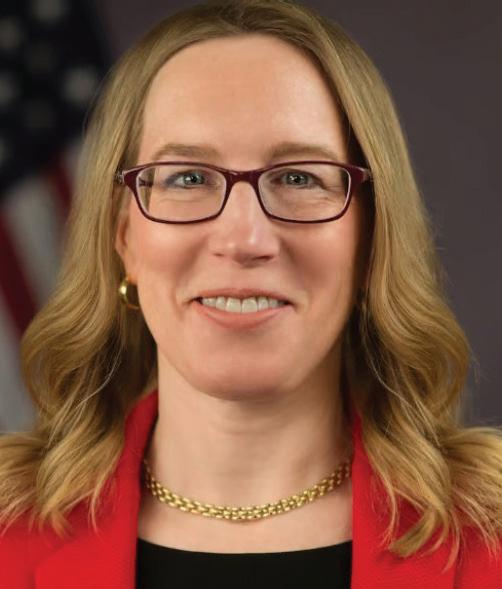
Advisory fi rms are wrestling with a complex regulatory environment that encompasses new reporting mandates, cybersecurity requirements, and increased oversight.
In a statement announcing the proposed change, SEC Chair Paul Atkins said that the proposal is consistent with the commission’s intent to modernize regulatory requirements.
The proposal’s goal is to minimize the “signifi cant economic impact” on small entities.
Charles Schwab threw its weight behind the proposal in a letter to the SEC. However, the company also encouraged the commission to provide adequate notice and a reasonable implementation period of 180 days.
Firms will need time to adapt, with Charles Schwab noting in particular that fi rms will have to update internal form ADV fi ling procedures, train their compliance and personnel, and coordinate updates with third-party compliance vendors or fi ling service providers.
Genuity LLC for violations of the Bank Secrecy Act, describing the enforcement action as the largest of its kind against a broker-dealer and a warning to the wider industry.
FinCEN said the firm admitted willful failure to meet core anti-moneylaundering obligations, including maintaining an effective AML program, filing required suspicious activity reports, and conducting appropriate due diligence tied to certain accounts.
“Today’s action should be a wakeup call to broker-dealers that willfully fail to comply with their obligations to safeguard the financial system from illicit actors,” FinCEN director Andrea Gacki said in announcing the action.
AS WASHINGTON under the business-friendly administration of President Donald J. Trump continues its de-emphasis on regulation, FINRA’s disciplinary actions, including fines, against the broker-dealers it oversees in 2025 declined, falling to 431 cases, a 22 percent decrease from the 552 disciplinary actions it reported in 2024, according to a new report.
The annual analysis by law firm Eversheds Sutherland found that FINRA’s top five enforcement issues by total fines were anti-money laundering; misleading, inaccurate, or unbalanced communications;
trade reporting; recordkeeping; and Regulation Best Interest.
FINRA enforcement actions spiked in the years after the 2008 credit crisis but have fallen steadily over the past decade. In 2015, FINRA pursued more than 1,300 claims and actions against brokerdealers, more than three times the number last year.
And as FINRA pursued fewer cases last year than a year earlier, the total dollar amount of fines it levied against broker-dealers increased, to $75 million from $59 million in 2024, a 27 percent increase, according to the analysis.

A COALITION of financial planning organizations, including CFP Board, are backing the Securities and Exchange Commission’s bid to modernize how it defines “small” advisory firms – but they want the agency to rethink how far it goes and how it gets there.
In a joint comment letter filed March 13, CFP Board, the Financial Planning Association, the National Association of Personal Financial Advisors, and XY Planning Network told the SEC that its current threshold for small entities under the Regulatory Flexibility Act –a ceiling of $25 million in regulatory assets under management, which is applied alongside a related test on total assets – is badly out of date.
That definition, set in the 1990s, has not kept up with the growth of the RIA industry. According to the groups, only about 3 percent of SECregistered advisors counted as small entities in 2025, undermining the
point of an analysis that is supposed to show how new rules hit smaller players.
In its own letter supporting the proposal, the Investment Adviser Association pointed to inflation, market performance, and consolidation trends that have led to higher asset levels across the board.

FAMILY BUSINESS owners are increasingly choosing to pass leadership directly to their grandchildren rather than their own children.
It’s a shift that reflects changing demographics, longer leadership tenures, and evolving views on legacy, according to Ben Persofsky, head of the center for family business at Brown Brothers Harriman, who shared his insights with InvestmentNews
This “skipped generation” succession pattern is due mainly to
founders remaining active in their businesses for longer than previous generations. As Persofsky explained, “This pattern is emerging largely because owners are living and leading for longer, all while keeping their identity deeply rooted in their business.”
He added that succession itself is being reimagined as a longer process. “These owners are thinking of succession as a longer transition, potentially spanning a decade or more,” he said.

LONG-TERM CARE is becoming increasingly unaffordable for middle-income older Americans, with rising costs and limited financing options leaving many retirees exposed to significant financial strain, according to a new AARP report.

The study concludes that a growing share of older households cannot cover the cost of needed services and supports without exhausting savings or relying heavily on unpaid family care. Researchers found that inflation has accelerated cost pressures in recent years, further weakening the ability of middle-income retirees to pay for assistance with daily living.
The AARP Public Policy Institute warns that long-term care affordability is sharply worsening for middle-income Americans.
“Home care and other long-term care services have quickly become increasingly unaffordable in recent years,” says Alan Weil, senior vice president for public policy at AARP. “The result is a widening gap between what care costs and what older adults and their families can afford – and we’ve got to fix this, because the consequences can be life-threatening.”
AMERICANS WHO overpaid on their taxes throughout the year will get refunds from Uncle Sam. Some of those checks will be sizable enough to make a difference to their long-term financial plans.
And that’s where a financial advisor can step in to make sure those dollars – and plans – aren’t squandered, says Ed Mooney, director of planning at Fiduciary Trust International.
In his view, a practical approach is to first reduce high-cost debt and ensure adequate cash reserves are in place. Once those priorities are addressed, he says the remaining funds can be directed toward long-term goals such as retirement contributions, education savings through 529 plans, or other goalbased planning vehicles relevant to the individual’s situation.
For individuals with variable income such as bonuses, equity compensation,
self-employment income, or sizable investment distributions, it can also be prudent to reserve a portion of the refund for upcoming estimated tax payments.
“The key is aligning the [tax] refund with existing priorities rather than treating it as discretionary spending”
ED MOONEY, FIDUCIARY TRUST INTERNATIONAL
DPL FINANCIAL Partners has introduced a portfolio-level tool designed to help RIAs evaluate and manage large books of legacy annuities as they migrate to fee-based advisory models.
The Annuity Review expands on DPL’s single-contract comparison utility to let advisory firms analyze entire annuity books in bulk, the company said in a statement.
The tool flags contracts that may be
candidates for exchange into fee-based products, enables transfers of nontransferable contracts to DPL for oversight, and provides a centralized dashboard where advisors can review and approve recommendations and initiate online applications.
DPL said nearly $1 billion in annuities has been uploaded to the platform since a late-2025 soft launch with select member firms.
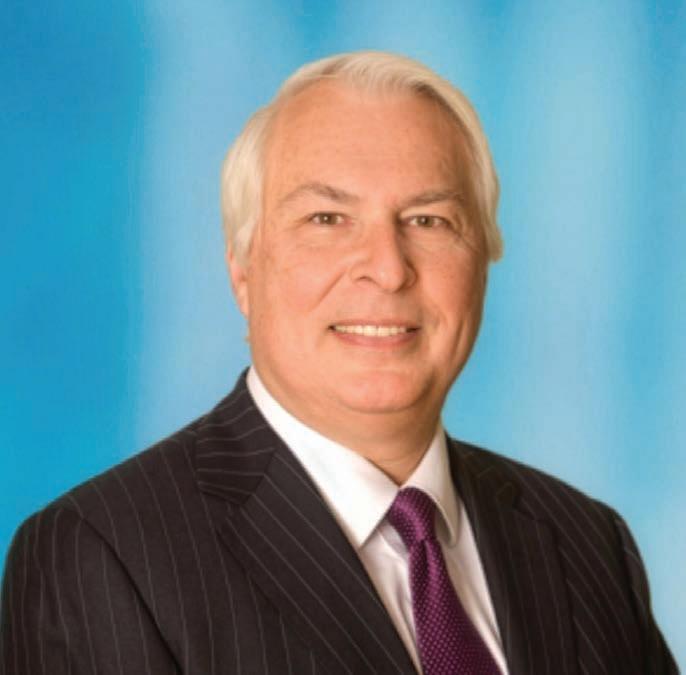
“Retirement contributions and education savings plans are common destinations, as refunds can provide a structured way to accelerate longterm planning,” he says. “There is also continued emphasis on maintaining adequate emergency savings, particularly for households with variable income or evolving financial obligations. The key is aligning the refund with existing priorities rather than treating it as discretionary spending.”
Mooney adds that owing taxes is often due to a withholding and timing issue, where the amounts paid during the year don’t align with the ultimate liability. Common drivers include higher-than-expected compensation, bonus withholding that doesn’t
A FEDERAL judge in Texas has vacated the Labor Department’s 2024 fiduciary rule for retirement advice, rolling back a key Biden-era attempt to expand when
reflect an individual’s effective tax rate, capital gains and dividends in taxable accounts, or retirement distributions with insufficient withholding.
Life changes such as marriage, divorce, a new dependent, or a job change can also affect the outcome, Mooney notes.
“A review of withholding elections is often warranted to better reflect current income and deductions,” he says. “Retirees can frequently adjust withholding on pensions and retirement distributions to spread tax payments more evenly throughout the year. For those taking required minimum distributions, qualified charitable distributions may be appropriate if they are eligible and charitably inclined.”
brokers and insurance agents must act as fiduciaries to retirement investors.
In a final judgment issued March 17, the US District Court for the Northern District of Texas set aside the Retirement Security Rule: Definition of an Investment Advice Fiduciary, along with a package of related amendments to prohibited transaction exemptions governing commissions and other conflicted compensation.
The Texas court decision comes roughly four months after the DOL moved to end its defense of the contentious regulation. Had it passed, it would have expanded the definition of a fiduciary to cover investment advisors guiding 401(k) rollovers and small employer plans.
AMERICANS ARE increasingly reshaping how they approach retirement, with new research showing growing optimism about retirement prospects alongside a decisive shift toward flexible, non-traditional pathways.
Fidelity Investments’ 2026 State of Retirement Planning Study found that 72 percent of Americans expect to retire on their own terms (up five percentage points from last year) as nearly seven in 10 consider alternative approaches to retirement.
The firm said the improved outlook is tied in part to a renewed focus on
preparation, with nearly three quarters of respondents reporting they have a plan in place to reach their retirement goals.
The findings reflect what Fidelity describes as a “new retirement playbook,” in which individuals rethink not only when they retire but how they remain engaged in work and life during the transition. About 61 percent of Americans say they intend to phase into retirement, with common alternatives including gig work and side hustles, launching small businesses, consulting part-time, or switching industries altogether.

RETIREES AND those nearing re tirement are increasingly focused on a core set of financial concerns: generating reliable income, coping with unpredictable spending, and maintaining adequate emergency savings.

J.P. Morgan Asset Management’s 14th edition of its annual Guide to Retirement, examines evolving retirement trends through anonymized household data and proprietary research, including spending patterns, Social Security preparedness, the potential role of alternative investments in 401(k) plans, and growing interest in guaranteed income strategies.
“This year’s findings show that the top concerns for retirees and those preparing for retirement are gener-
ating sufficient income, managing spending volatility, and maintaining emergency savings,” said Michael Conrath, chief retirement strategist. “As people live longer and the retirement landscape becomes more unpredictable, advisors need practical tools to help clients and participants understand and navigate retirement challenges.”
One of the report’s recurring themes is the gap between what workers expect and what actually happens when they retire. While many Americans plan to retire around age 65, the median retirement age is closer to 62, often because of health issues, layoffs, or family caregiving needs.
ARTIFICIAL INTELLIGENCE
could deliver enormous economic gains − but not for everyone.
That’s a key takeaway from BlackRock chairman and CEO Larry Fink’s latest annual letter to investors, which warns that technological transformation may further concentrate wealth among asset owners unless more households gain access to capital markets.
For financial advisors, the message reinforces the importance of positioning client portfolios to participate in long-term growth trends rather than reacting to short-term market volatility: “AI may accelerate this trend further. The companies with the

data, infrastructure, and capital to deploy AI at scale are positioned to benefit disproportionately,” Fink says.
He argues that previous waves of economic expansion disproportionately rewarded investors, a dynamic he believes could intensify as artificial intelligence reshapes productivity, corporate earnings, and competitive dynamics.

MOIRA BUCKLEY, a senior leader at Prudential Advisors, has been selected as secretary of Finseca, placing her on a multi-year leadership trajectory expected to lead to the organization’s presidency in 2028−29.
Buckley, who serves as Western Territory vice president at the retail wealth arm of Prudential Financial Inc., secured the role after a competitive nomination process and a formal vote by Finseca’s
board of directors. She brings more than three decades of experience at Prudential to the position. Finseca advocates for public policies that promote financial security while working to broaden access to comprehensive financial guidance for Americans. Through member engagement and industry leadership, it aims to elevate professional standards and strengthen the overall impact of advice nationwide.
FOCUS
THERE ARE economic realities that specifically impact high-net-worth women before, during, and after divorce. And they’d better be prepared to meet those challenges every step of the way during the separation process. If not, it could prove even more costly for them. Not just financially, but emotionally as well.
In her view, women need to know what their life costs before anyone negotiates a divorce on their behalf. She says one of the most important financial issues before divorce begins is an accurate picture of what a woman’s life requires: not just her household budget but the full cost of her life, broken into every category, including
“No amount of exhaustion changes the underlying financial tradeoffs”
MICHELLE SMITH, SAVANT WEALTH MANAGEMENT
Michelle Smith, a certified divorce financial analyst and managing partner at Savant Wealth Management, is also the founder of Wife2CFO, a platform that teaches women to become confident financial decision-makers.
MONEY PROBLEMS aren’t always showing up as missed credit card payments or a request to rebalance a portfolio. Sometimes they show up as a
the non-monthly expenses that only arrive a few times a year.
“Many women haven’t been able to see this number clearly. And if they are given a net worth statement or financial affidavit from their attorney’s office to
skipped wedding, a declined group trip − and a vague excuse that keeps the real reason off the table.
That kind of quiet financial strain is surfacing in new research from CFP Board and from Empathy. The studies focus on different moments of the financial life cycle, but they land in a similar place: Americans say they’re comfortable talking about money in theory, yet many avoid the conversations that would actually reduce friction in relationships – and prevent messy planning outcomes later.
CFP Board’s survey found that 67 percent of Americans have declined social events in the past two years primarily because of cost.

fill out, they may be creating a baseline that isn’t accurate. The number she lands on may look significant and still be entirely insufficient,” Smith says.
That’s the “before” divorce advice. When it comes to the “during,” Smith says women too often expect their divorce lawyers to also be their personal financial advisors. To prevent such an expectation, she reminds women that their lawyer’s expertise is legal, not financial. The emotional weight of divorce is enormous, and the legal and logistical demands of the process can
feel relentless. Financial clarity feels like the last thing the woman has bandwidth for, but she should create the bandwidth and surround herself with personal financial education and advice, according to Smith.
“The decisions being made at the table could have a 30- or 40-year time horizon. No amount of exhaustion changes the underlying financial tradeoffs. And no attorney, however skilled, is responsible for the life she will live when her case is closed,” Smith says.
J.P MORGAN ASSET Management has released its latest annual college savings guide, warning that steadily rising tuition and escalating student debt are reshaping the financial outlook for millions of families.
The 2026 College Planning Essentials report provides updated data and practical strategies aimed at helping parents and advisors prepare for the growing cost burden of higher education.
“Planning for college is one of the most important financial decisions families make, and the landscape is constantly evolving,” says Tricia Scarlata, head of education savings at J.P Morgan Asset Management. “College tuition has increased 914 percent since 1983 With costs and student debt continuing to rise, it’s more important than ever for families to make informed choices and maximize their savings.”
AS WEALTHY clients demand more personalization and tax efficiency, direct indexing is emerging as a powerful tool advisors can offer, though many are still learning how to use it.
The strategy, which allows investors to own the individual stocks of an index via a separately managed account instead of buying an index fund or ETF, has grown rapidly alongside rising expectations for portfolio customization in wealth management. For bigger accounts, this also unlocks significant tax advantages.
Emily Gray, managing director at Parametric, an asset
manager owned by Morgan Stanley, believes direct indexing is now synonymous with tax management and loss harvesting. She says, “We can do tax-efficient transitions the client can fund with appreciated stocks that they have; we can manage them over time to get closer to the index. And we do daily loss harvesting, so we evaluate portfolios on a daily basis for opportunities to realize a loss − that client can take that loss and use it to offset a capital gain.”
Industry reports show the growth of direct indexing in recent years. Cerulli Associates found that direct indexing strategies closed out 2024 with $864.3 billion in assets − nearly double the level reported in 2021 − and they projected direct indexing to eclipse $1 trillion in assets this year. However, just 18 percent of advisors adopted direct indexing strategies as of 2024, with asset managers like VanEck remaining confident in the market dominance of ETFs and mutual funds.

FAMILY OFFICES are accelerating their investment pace while spreading capital across a broader mix of sectors and regions, according to new research.
FINTRX’s 2025 Family Office Industry Report points to a significant increase in both dealmaking and geographic diversification among newly identified family offices. The analysis is based on proprietary tracking of firms added to FINTRX’s database over the past year.
The firm added 442 family offices in the year, representing growth of more than 10 percent in its overall dataset. Researchers also monitored more than 1,500 private-company
transactions and upwards of 150 direct real estate deals connected to these new entrants.
Chief product and data officer Dennis Caulfield notes that the uptick in activity has been accompanied by more deliberate diversification strategies.
“What’s particularly telling is not just the quantity of activity, but the pattern emerging within it: as transaction counts climbed, sector concentration declined, a signal that family office allocators are broadening their mandates and diversifying exposure across industries with greater intentionality than we’ve observed in previous cycles,” he says
What’s burning out today’s equity traders? Poll reveals a very modern cause of stress

EQUITY TRADERS at asset managers, pension funds, and other institutional investment organizations have always faced stress, but as the methods of trading evolve, so too do the causes of workplace pressure.
A new survey of buy-side traders has found that internal IT failures now rank as the biggest contributor to fatigue and burnout, with 51 percent of respondents identifying them as their main day-to-day stress factor. That places technology problems well ahead of regulatory and compliance pressures (27 percent), career-related concerns (25 percent), and work−life balance challenges (20 percent).
The results of the research from Crisil Coalition Greenwich point to a notable change in what traders perceive as the toughest part of the job, reflecting the rapid evolution of electronic trading and rising expectations for performance and reliability.
“The rapid growth of electronic trading has reduced patience for IT failures,” says Jesse Forster, senior analyst in market structure and technology at Crisil Coalition Greenwich. “Traders see volatility, long hours, and performance pressure as part of the job. But with e-trading ratcheting up expectations for speed and scale, traders increasingly view problems with technology tools as completely unacceptable.”
In its latest annual outlook, Infrastructure Strategy 2026: A Year of Increasing Scale and Diversification , Boston Consulting Group says the asset class has begun to recover from a period marked by weaker fundraising, declining deal activity, and heightened macroeconomic uncertainty.
“Private infrastructure investing has recently passed through two challenging years,” the report states, noting that fundraising dropped by nearly half in 2023 and improved only slightly in 2024 as inflation, higher interest rates, and regulatory concerns weighed on portfolios.
STAGFLATION, the toxic combination of stagnant growth and high inflation, is often referred to as the worst of both worlds. And it could very well be where the US economy is headed based on recent government data.
US real GDP grew at an annualized rate of 0.7 percent in Q4 2025, according to the Bureau of Economic Analysis, marking a significant slowdown from the 4.4 percent growth in Q3. Meanwhile, the US Producer Price Index (PPI) surged 0.7 percent in February 2026, exceeding expectations and marking a 3.4 percent increase over the past 12 months, the highest in a year. Moreover, the economy lost 92,000 jobs in February, while long-term unemployment rose to 1.9 million.
The added twist in the current equation for advisors seeking to navigate these perilous times is the
dramatic rise in market volatility. Not only is growth sagging while prices and unemployment are rising, but the Cboe Volatility Index (VIX) has spiked since the start of the year.
Nevertheless, despite the unnerving economic outlook, one advisor is not doubling up on his cash positions to match the surge in the so-called “fear index.” Isaac Wakszol, CEO of Activest Wealth Management, believes that at a yield of roughly 3 percent, the opportunity cost of staying in cash is rising every week, particularly if the Fed moves back toward two cuts and money market yields drift lower. In his view, the real danger is the “double miss.”
“If normalization happens, and we believe it is the base case, cash investors miss fixed income appreciation as rate expectations shift and equity recovery as risk premiums compress. Both can
Round-the-clock trading of US equities could begin by year-end as Cboe files SEC proposal
PRIVATE INFRASTRUCTURE
investing is regaining momentum after a difficult two-year stretch, with fundraising rebounding sharply and investors concentrating capital in the industry’s largest managers.
Despite those headwinds, returns largely remained within historical ranges, reinforcing infrastructure’s reputation for delivering steady, relatively inflation-resilient performance. Still, volatility increased and holding periods for portfolio companies lengthened, with more exits executed through continuation vehicles.
CBOE GLOBAL Markets is advancing plans that could significantly lengthen the US trading day, filing a proposal with regulators to introduce near-continuous equities trading during the business week.
The exchange operator has submitted a rule change to the Securities and Exchange Commission, seeking approval to offer near-24×5 trading on its Cboe EDGX Equities Exchange. A launch is
tentatively targeted for December 2026, contingent on regulatory clearance and broader industry readiness. If the change is approved, all National Market System stocks would be eligible to trade from Sunday at 9 p.m. ET through Friday at 8 p.m. ET. The proposed schedule includes a one-hour nightly pause between 8 p.m. and 9 p.m. ET from Monday through Thursday, while trading
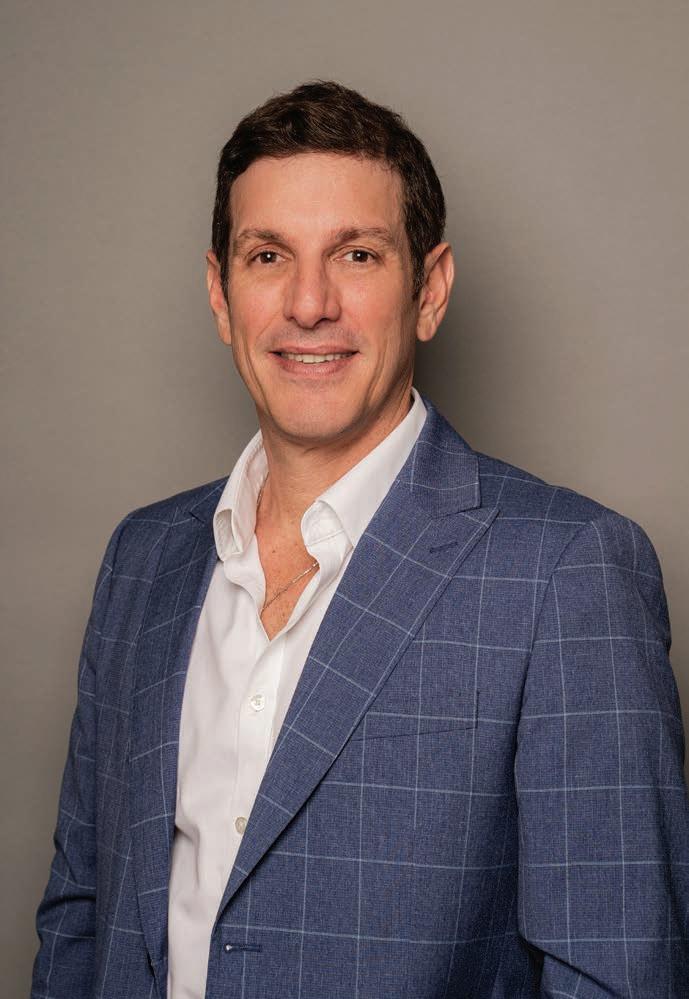
“If normalization happens, cash investors miss fixed income appreciation as rate expectations shift and equity recovery as risk premiums compress”
ISAAC WAKSZOL, ACTIVEST WEALTH MANAGEMENT
happen quickly and without warning,” Wakszol says.
Wakszol believes client cash belongs in three places: near-term liquidity needs, a defined tactical reserve, and a psychological buffer when clients need it. Everything beyond that is a “long-term drag.”
would remain closed on US market holidays. Transactions executed during the extended session would be cleared via the Depository Trust and Clearing Corporation.
“Cboe’s filing with the SEC is the latest step in ensuring we are ready to offer overnight trading once the industry launches in December,” s aid Oliver Sung, head of North American equities at Cboe. “ Since announcing our plans for near 24x5 trading amid growing global interest for US markets, we have been engaging with clients and market participants across the globe, underscoring the importance of collaboration throughout this process ”
“The most expensive thing about excess cash is not the yield missed today,” Wakszol says. “It is the compounding missed over the next decade while waiting for an all-clear signal that never arrives with a clear label. Time in the market beats timing the market.”

ACTIVE EXCHANGE-TRADED funds could roughly quintuple in size to about $10 trillion by 2033 if current adoption and market conditions hold.
That’s according to the latest projections from Brown Brothers Harriman’s 2026 Global ETF Investor Survey, which also suggest US investors are poised to be a major driver of that growth.
The survey draws from a poll of investors including institutions, RIAs, fund managers, private banks, and wealth managers, with 51 percent of respondents
in the pool managing more than $1 billion in assets.
The report models a “base case” in which active ETFs compound at about 20 percent annually, taking the segment from just under $2 trillion in assets at the end of 2025 to around $10 trillion by the middle of the next decade. Most survey respondents think that kind of expansion is plausible: Ninety-four percent said active ETFs will reach $10 trillion within 10 years, with 42 percent expecting the milestone in seven years or less.

NORTHERN TRUST Wealth Management is doubling down on the art and collectibles space with the appointment of Alyssa Quinlan as head of advisor relationships and strategic partnerships, a newly elevated role that sits at the intersection of private banking, estate planning, and the booming market for “passion” assets.
Quinlan, who will report to global head of sales David Albright, will oversee Northern Trust’s relationships with outside professionals, including law and accounting firms, business advisory shops, and investment consultants.

The firm says those advisor relationships are increasingly tied to client needs around fine art and collectibles, as wealthy families look to integrate trophy assets into their wealth, tax, and estate plans.
“Our clients rely on a network of trusted advisors, and those relationships are central to delivering sophisticated advice,” Albright said in a statement.

A GROWING number of chief executives are grappling with sustained high levels of stress as immediate business pressures crowd out longer-term priorities, creating a potential concern for those watching corporate performance.
More than 70 percent of CEOs report stress levels that fall into a clinically high range, with many leaders describing a role increasingly dominated by urgent demands. At the same time, 57 percent say short-term
issues take up a disproportionate share of their time, highlighting a widening gap between strategic ambition and day-to-day reality.
The findings, drawn from a new Boston Consulting Group survey of roughly 500 CEOs and supported by five years of turnover data, point to a leadership environment where pressure is intensifying and increasingly coming from inside the organization rather than outside it.
A GROWING share of companies are failing to hit their revenue targets, highlighting the widening gap between executive optimism and operational reality in an environment shaped by AI disruption and geopolitical instability.
While corporate leaders are doubling down on growth ambitions, execution is becoming more difficult.
According to the survey by Bain & Company, 42 percent of executives across 18 industries globally missed their revenue goals last year, a notable jump from 32 percent in 2024, even as most had expected to meet their projections.
That disconnect continues into 2026, with companies now aiming for revenue growth rates about 20 percent higher than last year and 91 percent of executives believing they will deliver on those targets.
But the findings point to a business environment where forecasting has become increasingly unreliable. Accelerating AI adoption, geopolitical tensions, and shifting customer demand are making it harder for companies to produce consistent revenue outcomes.
Volatility remains a defining feature of the current cycle, even as growth continues to dominate executive priorities.


INSTITUTIONAL INVESTORS are preparing to increase exposure to digital assets in 2026 even as recent market turbulence pushes firms to strengthen governance, risk management, and regulatory due diligence, according to a new global survey.
Of the institutional decisionmakers surveyed by EY-Parthenon and Coinbase, nearly three quarters said they plan to boost digital asset allocations this year, underscoring continued long-term conviction in the asset
class despite volatility. At the same time, 49 percent said recent market swings have prompted greater emphasis on liquidity management, position sizing and broader risk controls.
The findings reflect a shift in institutional crypto investing from experimentation toward more structured portfolio integration. Investors are increasingly prioritizing governance frameworks, operational resilience and compliance standards alongside return expectations.

IT’S BEEN a rough few weeks for participants in the private credit space as many of the purveyors of the asset class have suffered both in the press and in their publicly traded share prices.
Nevertheless, the panic doesn’t capture that these growing pains are confined to one corner of the asset class, according to Roland Kastoun, asset and wealth management advisory leader at PwC. In his view, private credit remains structurally sound and the true story isn’t collapse − it’s maturation.
“Private credit has been on an exceptional growth trajectory in both size and breadth, driven by the supply of capital interested in the space and, more importantly, by borrower demand for this type of capital,” Kastoun says. “During this growth phase, sponsors have also been on a steady journey toward further institutionalization and innovation across the market. This evolution will undoubtedly be shaped by the questions and concerns investors are raising in response to recent market events ”

The Women Advisor Summit brings together a dynamic community of women who are rewriting therules of advice and growth in wealth management, offering a dedicated space for advisors, planners, wealth managers and firm leaders to strengthen theirimpact and support one another.

♦ Gain practical insights to grow your practice and strengthen your leadership.
♦ Refresh your perspective with new approaches from inspiring women across the industry.
♦ Exchange ideas and experiences with peers who understand your challenges and ambitions.
♦ Build meaningful connections through interactive sessions and networking opportunities.