The state capitol rises over the water in Olympia.
Spring Fling
Spring is the perfect time to explore Washington’s state capital. Cherry blossoms, oyster bars, the farmers market, outdoor adventures—find it all in our Trip Planner. (pg. 78)
Cayman Waughtel/Experience Olympia & Beyond
54
A Healthier Tomorrow
Sometimes good food and targeted nutrition are the best medicine. See how Sea le-based community health organization Lifelong is breaking down barriers and helping people with chronic diseases thrive.
wri en by Corinne Whiting
60
Reconnecting the Wild
A photographic view inside Tenino’s Wolf Haven International.
wri en by Kerry Newberry
46
Between Strait and Sounds
How to identify our di erent whale pods, and the best times and places to spot them. And why sidling up to them in a boat may not be in the best interest of whales.
wri en by Ryn Pfeu er
Rachel Haight
Orcas swim by Long Point on Whidbey Island.
21
Editor’s Le er 1889 Online Map of Washington Until Next Time 10 11 86 88
14 SAY WA?
Tulips, Lilac Days, Tacoma Literature Festival and a new novel from Jess Walter.
18 FOOD + DRINK
Perihelion Brewery, Cascadia Creamery, best places for cider.
22 FARM TO TABLE
Radishes find their place.
26 HOME + DESIGN
Two kitchen remodels where color makes a huge splash.
34 MIND + BODY
Owen Powell on breaking the mile record and what’s next.
THINK
38 MY WORKSPACE Cowboy poet Dick Warwick.
42 GAME CHANGER
Alchemy Skateboarding goes from outlaw to in-law.
LIVE EXPLORE
70 TRAVEL SPOTLIGHT
East of Wenatchee, Soap Lake is a place for healing.
72 ADVENTURE
San Juan Islands adventures.
76 LODGING
Columbia River Gorge’s cool glamping cluster.
78 TRIP PLANNER
Olympia, shellfish and the great outdoors in spring.
84 NW DESTINATION Point Reyes, California.
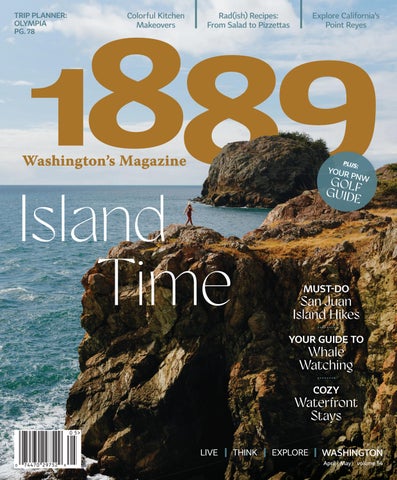
COVER photo by Eva Seelye (see Adventure, pg. 72)
Jason Redmond
Under Canvas
Woven Seafood & Chophouse
ALYSON BROWN
Photographer
Farm to Table
“When approached to work on this piece, I knew I wanted to build a scene that felt playful, textural and full of color. I sourced as many varieties of radishes as I could find and arranged them into a vibrant composition. The range of shapes and hues, from deep violet to bright pink and green, showcases the diversity of this humble, yet tasty vegetable.” (pg. 22)
Alyson Brown is a photographer, stylist and art director specializing in food and beverage. Born and raised in Florida, Alyson has felt lucky to call Bend, Oregon, her home for over a decade.
CONTRIBUTORS
TEGRA STONE NUESS
Photographer
My Workspace
“Meeting Dick Warwick on his farm in the rolling hills of the Palouse was a delight. This cowboy poet showed us around his farm while cracking jokes and comparing travel stories. After reciting one of his poems for us in the barn, we took a break from the cold and bought farm-fresh eggs from his wife, Sue. The ever-changing spring weather threatened to ruin the golden-hour sunset light, but Dick patiently waited with us to see the sun break through and light up the wheat fields. It ended up being one of my favorite environmental portraits I’ve ever taken.” (pg. 38)
Tegra Stone Nuess is a freelance photographer based in Spokane. She loves to travel the world and can’t wait to share the beauty of Washington state with her new son, Stone.
MELISSA DALTON Writer
Home + Design
“White, gray and ‘greige’—yes, that’s a color—will always be popular picks for kitchen palettes, but for this month’s Home + Design feature on creative color choices, I was inspired by two Washington designers who embraced more vibrant shades in the color wheel. Say hello to pink, cranberry and teal!” (pg. 26)
Melissa Dalton is a freelance design and architecture writer who covers a wide range of stories, from A-frames to passive homes, historic restorations and DIY projects. She painted her own kitchen cabinets greige.
KRISTIINA ALMY
Illustrator
Home + Design DIY
“I enjoy illustrating everyday objects, exploring how color, texture and form give them personality. Each brief is an opportunity to learn something new, and creating an illustration for a DIY project is a way to celebrate the creativity and satisfaction that comes from making something yourself.” (pg. 32)
Kristiina Almy is a Massachusetts-based freelance illustrator whose work captures everyday objects and moments through vibrant color and thoughtful composition.
EDITOR Kevin Max
CREATIVE DIRECTOR Allison Bye
WEB MANAGER Aaron Opsahl
SOCIAL MEDIA MANAGER Joni Kabana
OFFICE MANAGER Cindy Miskowiec
DIRECTOR OF SALES Jenny Kamprath
BEERVANA COLUMNIST Jackie Dodd
C ONTRIBUTING WRITERS Cathy Carroll, Melissa Dalton, Joni Kabana, Lauren Kramer, Kerry Newberry, Daniel O’Neil, Ryn Pfeuffer, Ben Salmon, Corinne Whiting
CONTRIBUTING PHOTOGRAPHERS Christian J Anderson, Alyson Brown, Jackie Dodd, Rachel Haight, Berty and Emily Mandagie, Armand Nour, Jason Redmond, Eva Seelye, Tegra Stone Nuess, Dain Susman
CONTRIBUTING ARTISTS Kristiina Almy
Mail Headquarters
70 SW Century Dr. Suite 100-218 Bend, Oregon 97702
www.1889mag.com /subscribe @1889washington
592 N. Sisters Park Ct. Suite B Sisters, OR 97759
All rights reserved. No part of this publiCation may be reproduCed or transmitted in any form or by any means, eleCtroniCally or meChaniCally, inCluding photoCopy, reCording or any information storage and retrieval system, without the express written permission of Statehood Media. ArtiCles and photographs appearing in 1889 Washington’s Magazine may not be reproduCed in whole or in part without the express written Consent of the publisher. 1889 Washington’s Magazine and Statehood Media are not responsible for the return of unsoliCited materials. The views and opinions expressed in these artiCles are not neCessarily those of 1889 Washington’s Magazine, Statehood Media or its employees, staff or management.
FROM THE EDITOR
THIS ISSUE is essentially about the wild and why that matters for us all—people, land-bound animals and water-based species as well. The theme of Islands and the Sound frames this issue’s narrative nicely.
In all of our DNA lies a vestige of what being in the wild feels like and must be why we always route for whales to survive against the odds and wolves to be set free, even close to our own backyards. This gene remembers where we started and imbues where we are now with primal empathy.
You can feel it in our feature “Between Strait and Sounds” (pg. 46), where Ryn Pfeuffer, who went through the Marine Naturalist Training Program at The Whale Museum, takes us inside the various whale communities along the Washington coast and “humanizes” them for our understanding. The insights from this piece will make you a better whale spotter and supporter.
Back on land, we get a rare window into the lives of wolves through a photographic portfolio of Wolf Haven International in Tenino, south of Olympia. Wolf Haven is a sanctuary that supports the recovery of wolves within their historic ranges and was named Outstanding Wildlife Sanctuary by the Global Federation of Animal Sanctuaries in 2024. Its education programs and
ongoing advocacy for how wolves can thrive alongside peopled communities is an inspiration for us all. See Gallery on page 60.
Another way to take a small step toward the wild, perhaps, is to sleep out in it. A new glamping site, Under Canvas, opened in the Columbia Gorge. Sure, it’s not sleeping in a sleeping bag in a tent, but this venue, on a hillside and with open views of Mount Hood, is closer to touching grass than staying at a Hilton. Turn to page 76 to put yourself in place.
Another way to commune with the wild is to soak it in or soak in it. An hour east of Wenatchee lies Soap Lake, a small, laid-back community with the mineral-teeming waters of the lake at its core. For decades, Soap Lake has drawn people who seek its healing waters for myriad reasons. One of those was a treatment for Buerger’s disease, for which the VA sent afflicted veterans here in 1933. Our Travel Spotlight on page 70 gives you more information.
If nothing else, rewild yourself with a Crimson Moon cocktail (pg. 19). A lovely blend of, among other things, gin, pomegranate juice and Burlesque bitters, it can turn your mind inward in reflection and outward to the moon, where you can hear the howls coming from Tenino and beyond.
Stop by Local, our curated online shop of goods made by businesses in the Pacific Northwest. Find outdoor gear, specialty foods and more. Or show your state pride with 1889 T-shirts, hats and other apparel. Buy local. Feel good. www.1889mag.com/shop
WASHINGTON: IN FOCUS
Have a photo that captures your Washington experience? Share it with us by filling out the Washington: In Focus form on our website. If chosen, you’ll be published here!
www.1889mag.com/ in-focus
YOUR PNW NEWSLETTER
More Pacific Northwest, delivered to your inbox! Sign up for our Adventure Mail newsletter and get access to the latest getaways, giveaways and more.
www.1889mag.com/ 1889-newsle er
NEVER MISS AN ISSUE
Read 1889 Washington’s Magazine and 1859 Oregon’s Magazine anywhere, on any device, with our digital edition. Follow us today on Issuu.com.
www.bit.ly/ statehoodmediadigital
photo by Margot McKibben The Palouse River plunges
Palouse Falls
SAY WA? 14
FOOD + DRINK 18
FARM TO TABLE 22
HOME + DESIGN 26
MIND + BODY 34
Two renovated kitchens where color makes all the di erence.
Dain Susman
Tidbits + To-dos
written by Lauren Kramer
Tulip Town
Nothing says spring quite like the bloom of tulips, and in Mount Vernon, that bloom covers 6 acres with breathtaking color April 1 through 30. A Skagit Valley tradition since 1984, the Tulip Town festival highlights 100 varieties of tulips. Guests can drive themselves along the picturesque farm roads or step on board a vintage trolley for a scenic loop. www.tuliptown.com
Eight Diving
If you’ve always wanted to scuba dive, now’s the time. Eight Diving in Des Moines is offering Open Water certification classes. Students start their training dives in a swimming pool and then move to Redondo Beach, where new divers are rewarded with sightings of vibrant kelp forests, nudibranchs, rockfish and lingcod. This calm underwater landscape is ideal for beginners to build confidence while experiencing some of the most beautiful cold-water diving in the region.
www.8diving.com
Tacoma Literature Festival
Indie bookstores are booming in Pierce County, and the May 2 Tacoma Literature Festival, held noon to 6 p.m. at the Tacoma Armory, is a great excuse to explore them. Grit City Books, Hi-Voltage Records and Books, Shelf Indulgence (Tacoma’s first romantasy bookstore), Page & Pine, Bundok Books and The Lakewood Bookstore are all newcomers to the literature scene.
“Literature is the social ointment that our fragmented world needs more than ever,” say its organizers. We couldn’t agree more! Admission to the festival is free. www.gritcitystudio.org
Serafi
na Lemos/Tulip Town
Sam Smith
The Colorama Rodeo & Festival, held May 7 through 9 in Grand Coulee, will combine professional rodeo events with parades, vendors, live music, kids’ activities and more. Festival admission is free, but tickets are required for the rodeo.
www.coloramaprorodeo.org
Sunnyside’s Cinco de Mayo Festival
The annual spring Cinco de Mayo Festival in downtown Sunnyside on May 1 through 3 brings thousands of people together to celebrate Mexican and Latin American heritage. Attractions include authentic Mexican food, a festive parade and traditional events like a charro (dancing horse) competition and car show. Admission is free.
www.sunnysidewa.gov
Lilac Days
Love lilacs? Check out the annual Lilac Days at Woodland’s Hulda Klager Lilac Gardens from April 18 to May 10 to see the lilacs in luscious bloom. This national historic site is home to an 1880s Victorian farmhouse and country gardens. At the twenty-threeday event, visitors can stroll the gardens and shop for their favorite lilacs. Admission is $10 with discounts for seniors and children.
www.lilacgardens.com
Colorama Rodeo & Festival
Yakima Valley Tourism
Hailey Rae Photography
Musician
Blazing a Trail
Damien Jurado makes music on his own terms
written by Ben Salmon
FOR THE FIRST couple decades of his career, Damien Jurado more or less followed the traditional model for releasing music: Sign to a record label, record a batch of songs, submit them to the label and wait for it to put out the album. Tour to promote the album for a while, and then repeat the whole process in another year or two, or maybe three.
But those days are over. A celebrated indie-folk songwriter from the Seattle area, Jurado has worked with some prestigious labels in his time, including Sub Pop, Secretly Canadian and Mama Bird. Since 2021, however, he has released albums through his own label, Maraqopa Records. And more recently, he has been self-releasing singles, EPs, demos, outtakes, live recordings and more at a mind-boggling pace, posting twentynine releases to his Bandcamp between the beginning of 2025 and March 2026.
“The reality is that there are no rules for anything. It’s your life. It’s your creativity. If you want to release (a song or an album), it is completely, entirely up to you,” Jurado said.
“All we’ve been doing as musicians has been dictated by people who built the system that they built,” he continued. “It doesn’t benefit us! It doesn’t benefit me to produce a record every two years. Sorry, it just doesn’t.”
Listen on Spotify
It’s impossible, of course, to pinpoint the origin of this shift in thinking; it has no doubt been an evolution over time. But in a November 2025 post on his Substack blog, Jurado cited a particular answer from a Believer interview with ambient and electronic music giant Brian Eno that provides some insight. Asked what he would tell his 20-year-old self if given the chance, Eno said, in part, “‘Put out as much as you can. It doesn’t do anything sitting on a shelf.’ My feeling is that a work has little value until you ‘release’ it, until you liberate it from yourself and your excuses for it.”
That quote was a revelation, said Jurado, whose sad, storydriven songs have floated gently between quiet and folky, dreamily psychedelic, lo-fi indie rock and avant Americana over the years.
“It kind of rocked my world. I was already headed in that direction. All that quote did for me was just boost my confidence and secure my belief in where I was going already,” he said.
“By the time I read that quote, I’d already released three records in a year,” he continued. “But for me, it was like, OK, boom! If the gods are saying, ‘We approve,’ then let’s go. There’s no need to be precious about it.”
Sea le’s Damien Jurado posted twenty-nine releases to his Bandcamp between the beginning of 2025 and March 2026.
Photo: courtesy of Damien Jurado
Bibliophile
Jess Walter’s Wild Ride Through a Fractured America
Walter sends a reluctant hero from the wilderness outside Spokane into a splintered Northwest—and a divided nation
interview by Cathy Carroll
SPOKANE NATIVE SON Jess Walter is earning national acclaim for his eleventh novel, So Far Gone, which opens in the wilderness outside his hometown, where a reclusive former journalist is living o -grid. When his grandchildren are kidnapped, he’s forced back into the world, launching—with a caustic ex-girlfriend, a bipolar retired detective and a furious friend—a razor-sharp, rollicking journey across a fractured America.
Describe what urged you to write So Far Gone. I wrote So Far Gone with a feverish immediacy in 2024, as I watched the U.S. lurch toward what I feared would be a banal and absurd kind of authoritarianism. I kept thinking: What can a person do with all of this dread—political, environmental, societal, technological dread? At the same time, I watched the polarization in America cleaving families and friendships. Then: One day my phone bonged at me, informing me that I’d averaged almost six hours a day doomscrolling. All of that combined to create a story of a former environmental reporter who throws his phone out a window and turns his back on the world, a story that I pictured being fast, funny and suspenseful, a story that also imagined how we might begin to heal these fissures.
the Northwest has always been a place of extremes. Just take a seven-hour drive from Seattle to Missoula, Montana, and you see it. You’ll cross ocean harbors and mountain ranges, channeled scablands and rich farmland, ancient forests and glacial lakes. And you’ll cross even more cultures. The fabric of all of those cultures is straining at the seams right now. But it’s straining in every part of the country. I’ve heard from readers all over who don’t speak to family members because of politics, who don’t know what to do with their addiction to technology, who want to find a way back to a common sense of national purpose.
Did So Far Gone change how you’re thinking about what you’ll write next?
challenge myself as a writer. But mostly, I think the stories choose their own forms. A tale about two drug addicts trying to sell a big-screen television is simply going to go in a different direction than one about an actress getting abandoned in a tiny coastal town in Italy. The common denominator, I suppose, is care for my characters, a darkly comic bent and what my son calls my “toxic optimism.”
Your first book, Every Knee Shall Bow (Ruby Ridge) (1995), examined extremism and the tragic Idaho standoff between federal agents and a white separatist family. Do you see So Far Gone as part of that evolving conversation?
How did Spokane and the Northwest shape the novel?
It’s very much a Northwest story, a road trip from Southern Oregon to Eastern Washington, from a psychedelic music festival in British Columbia to a radical church in North Idaho. I think
Every book changes the author, I suppose. I used to joke that I wrote each new book to get the taste of the last one out of my mouth. I’ve gained something of a reputation for jumping around, from satire to historical fiction, from epic romance to short fiction. Part of that comes from spending years inside a certain kind of story and wanting to do something else, to
I think about Ruby Ridge a lot. In fact, I just finished a new afterword to that book, which will be rereleased in May. I can trace so many of the themes of our current discontent to that event; it almost feels like first foreshocks of a seismic rift that has affected our politics, our media and our culture at every level. The conspiracy theories I covered back then have become mainstream, and the sparks of anger and violence now smolder all over the country.
So Far Gone, the latest book from Spokane’s Jess Walter, is receiving national praise, as has many others from this No. 1 New York Times bestselling author.
Rajah Bose
Seattle’s Perihelion Beer Has Heart
written and photographed by Jackie Dodd Beervana
PERIHELION BREWERY reminds you why pubs existed in the first place. Before they became cool, hipster dwellings and trivia night havens, they were where the neighborhood gathered. A “third place” between work and home. A room with a heartbeat. A place where someone asked how your day went, cooked you something you actually wanted to eat and poured you a beer that felt like home. Perihelion feels like a throwback and, hopefully, a glimpse of what beer is evolving back into.
PERIHELION BREWERY
2800 16TH AVE. S.
SEATTLE
www.perihelion.beer
What to Know:
• Kid- and dog-friendly
Opened in Seattle’s Beacon Hill neighborhood in 2016, the brewery sits a short walk from the Beacon Hill light rail station in a part of the city that, for years, didn’t have enough good places to grab a pint.
Perihelion was founded by Les McAuliffe and Karin Paulsen, longtime Beacon Hill residents who set out to build something for the neighborhood they live in and raised their daughters in. McAuliffe had been brewing beer at home for decades before opening the brewery, and he brought that experience with him when he decided to turn a former dentist’s office and the neighboring hair salon into a brewpub.
When Perihelion opened its doors in February 2016, it filled a noticeable gap in Seattle’s beer landscape. Beacon Hill, despite being one of the city’s most vibrant neighborhoods, didn’t have its own brewery.
The name comes from astronomy. A perihelion is the point in an orbit when a planet or celestial body is closest to the sun. McAuliffe had previously homebrewed a beer called “Perihelion,” and the name stuck. It also works nicely as a metaphor. Just as an orbiting body swings closest to the sun at perihelion, the brewery aims to be a place where people come together. In practice, that idea shows up in the way the space operates. It’s equal parts neighborhood pub, community living room and craft brewery, run by a family, and you can feel it.
CLOCKWISE FROM TOP The combination of good food and good beer were a missing element in the Beacon Hill neighborhood before Perihelion Brewery. Perihelion’s craft beers put them in good standing in a city of craft beer. The brewery is a place where people just talk among the wood rafters and beams.
Perihelion runs on a relatively small seven-barrel brewing system, which keeps the beer list moving and focused on smaller batches rather than largescale production. That setup gives the brewers room to experiment while still keeping a few familiar styles on tap. The lineup often pulls from Belgian brewing traditions, but it’s not limited to them. On any given visit you might find saisons, IPAs, lagers, Märzen or the occasional experimental release.
The smaller scale keeps things flexible and lets the brewery chase interesting ideas without committing to massive production runs.
Unlike many small breweries that rely on rotating food trucks, Perihelion operates as a full brewpub with an in-house kitchen. The menu leans past elevated pub fare into thoughtful dishes built with house-made ingredients. Paulsen and her kitchen team smoke meats and nuts with cherrywood and produce items like house-made mustard and sauerkraut for the sausages they make themselves. The food is deliberate and well made, designed to pair with the beer while still standing comfortably on its own.
The team, which now includes the couple’s twin daughters, runs the place the way you want to see a family business run—with heart and intention. They brew the beer, cook and serve the food, bake the beautiful house-made cakes and even deliver kegs to local accounts. The takeaway window they added during the pandemic is still operating, offering meals to anyone who wants to grab dinner and head home. The focus is simple. Make beer and food they’re proud of and take care of the people who walk through the door.
Seattle has no shortage of breweries. The city has been a cornerstone of the American craft beer movement for decades, and the surrounding region is packed with world-class producers. In that landscape, Perihelion represents a slightly different model than the large production breweries that dominate store shelves. The emphasis here is on kegs, well-made food and making sure the space feels welcoming.
That approach is part of what has allowed the brewery to settle naturally into the neighborhood over the past decade. Instead of chasing rapid expansion or distribution growth, Perihelion has stayed focused on what it originally set out to be: a local brewpub where good beer, good food and good company intersect.
In other words, the kind of place you wander into for one beer and accidentally stay for three. Which, historically speaking, is exactly how the best neighborhood pubs have always worked.
Cocktail Card
recipe courtesy of Svea Deacon, Rock and Rye Oyster House / BELLINGHAM
“The Crimson Moon hits that beautiful balance where earthy meets juicy. The tart of the pomegranate with the rich sweetness of cassis (black current liqueur) compliments the earthiness of the beet-infused gin. The two bitters add warmth, structure and a touch of spice. … This cocktail is complex, balanced, interesting and very approachable.” — Svea Deacon
Crimson Moon
• 2 ounces beet-infused gin
• 1 ounce pomegranate juice
• 1 ounce lemon juice
• 3/4 ounce Giffard cassis liqueur
• 1 dropper Burlesque bitters
• 1 dropper spiced cranberry bitters
• Candied hibiscus leaf, for garnish
Shake the gin, pomegranate juice, lemon juice, cassis liqueur and bitters together. Strain into a curvy coupe glass, and garnish with candied hibiscus leaf.
Photo: Celia Scruton
Cascadia Creamery Gastronomy
written by Lauren Kramer
THE TOWN of Trout Lake was once a hive of dairy and cheesemaking activity, but by the 1950s the last of the cheesemakers had closed up shop. When Marci and John Shuman moved to town in 2008, they were intrigued by that history and determined to reignite Trout Lake’s cheesemaking legacy.
The town, located in a lush agricultural valley at the foothills of Mount Adams and surrounded by lava cave tube systems, had the perfect microclimate for cheesemaking. The Shumans purchased 20 acres of agricultural land, located a 600-square-foot lava tube cave chamber on the property and built a small creamery on top of the cave, where they’ve been handcrafting Cascadia Creamery’s raw milk, organic, artisan cheese since 2009.
The small creamery crafts four cheeses: Sleeping Beauty, a rich, buttery cheese; Cloud Cap, a fresh, milky cheese with a citrusy interior; Glacier Blue, a blue cheese with a luxurious texture; and Sawtooth, a washed-rind cheese with a savory, meaty flavor. All are raw milk, organic cheeses aged between 60 and 100 days.
“Our cheese truly reflects the Trout Lake terroir in which they’re created,” John said, adding that the products have won multiple Good Food awards since 2018. “The unique geological environment of the cave provides optimal temperature, humidity and airflow conditions for traditional cheese aging, and our organic, raw milk comes from a fifth-generation local dairy farm.”
The process of crafting the wheels of cheese is slow and intimate, he said. “What I love most about the process is that every batch of cheese has its own distinct character. It’s shaped by what the cows were eating at the time, what the weather was like and how the wind was moving through the cave system.”
Cascadia Creamery cheese is available at natural and specialty grocers and cheese shops in Washington, Oregon and California.
TROUT LAKE
www.cascadiacreamery.com
CRAVINGS
ELEVATED S’MORES
At Crafted in Yakima, you don’t have to wait for a campfire to enjoy s’mores. The restaurant offers a s’mores dessert in which smoke from applewood chips is trapped under a glass. The smoke clears to reveal a divine confection of graham cracker ice cream, chocolate logs, caramel sauce, toasted house-made marshmallows and a graham cracker crumble.
22 N. FIRST ST. YAKIMA www.craftedyakima.com
ICE CREAM
Ice Cream Social, a Tacoma micro-creamery with locations on Hilltop, on Proctor Street and at Point Ruston, is a city favorite where incredible ice cream flavors meet hand-rolled waffle cones. With flavors like salted caramel, buttered pecan, Valhalla coffee and lemon gingersnap, the aroma alone will convince you a sweet treat is absolutely necessary.
5107 MAIN ST.; 1110 MARTIN LUTHER KING JR. WAY; 2521 N. PROCTOR ST. TACOMA www.icecreamsocialtacoma.com
MILKSHAKES
When it comes to milkshakes, The Yard Milkshake Bar on the Vancouver waterfront is really shaking things up. These are extraordinary milkshakes, piled high with mouthwatering treats. Try the Northwest berry cheesecake, mint brownie mudslide, cereal killer or peanut butter brownie bliss. These and other ingenious, yummy combinations will ensure you never look at a milkshake the same way again.
656 WATERFRONT WAY VANCOUVER www.theyardmilkshakebar.com
TIRAMISU
Tiramisu never goes out of style, and chef Brian Clevenger’s classic dessert contains ladyfingers soaked in rich espresso, layered with a smooth mascarpone cream and finished with a dusting of cocoa. Order this timeless Italian dessert at any of his six Seattle General Harvest restaurants.
Cascadia Creamery cheeses are a renaissance of recent local cheese-making history and part of an age-old global tradition.
Cascadia Creamery
BEST PLACES FOR CIDER
3 DOG CIDER
Small-batch blends and single-varietal ciders are the focus at 3 Dog Cider, a cidery with a diverse orchard of culinary varieties, heirloom trees and selections from the Lost Apple Project. At its heritage barn tasting room, look for rotating ciders on tap, fresh-pressed apple juice in the fall and fun events including live music, pop-up food vendors and pig roasts.
At Cockrell Hard Cider in Puyallup, Rich Cockrell grows and ferments the apples, bottling his sweet elixir on site. There are eight ciders on tap at The Roost tasting room, and in summer locals and visitors bring chairs, lawn games and dogs to enjoy the live music, food trucks and, of course, Cockrell Cider in the cidery’s expansive outdoor space.
6613 114TH AVE., COURT E PUYALLUP www.cockrellbrewing.com
TIETON
CIDER WORKS
Tieton Cider Works in Yakima is one of the state’s largest dedicated cider-fruit producers, with 55 acres of apples and pears grown specifically for cider. Flavors include huckleberry, bourbon barrel peach, lavender honey, pomegranate and chili lime, and the cider bar offers comfort food and small bites.
619 W. JAY ST. YAKIMA www.tietonciderworks.com
YONDER CIDER
Yonder Cider’s newest taproom is at Cashmere’s Side Street, where visitors can select from fifteen ciders with intriguing names such as Brown Snout, Daily Disco, Wenatchee Wave and Thunderpussy. One of Washington’s fastest-growing cider producers, this woman-owned cidery uses a blend of dessert apples and bittersweet cider apples.
111 RAILROAD AVE. CASHMERE www.yondercider.com
Dining
Woven Seafood & Chophouse
written by Lauren Kramer
IF YOU want to send your taste buds into complete rapture, pull up a chair at Woven Seafood & Chophouse in Tacoma, and order the misoyaki-glazed cod or the slow-cooked beef short ribs. These two dishes alone represent executive chef Dexter Mina’s incredible culinary talent and his ability to effortlessly blend Hawaiian influences into Pacific Northwest cuisine, adding his favorite Filipino flavors along the way.
Woven, a partnership between the Puyallup Tribe of Indians and celebrity chef Roy Yamaguchi, opened on Tacoma’s beautiful Ruston Way in July 2024. The large restaurant is a gallery of exquisite Indigenous art: Dan Friday’s glass salmon swim on one wall, while Ty Juvinel’s painted paddles adorn another. Tables overlook the ocean, and the menu, a tapestry of fusion cuisines, includes a soul-satisfying smoked salmon dip with bannock, phở-inspired pork ribs, seafood paella and ube cheesecake.
“Our goal was to create a dining experience that is woven together as one ohana,” Mina said. “Our open-flame, cherrywood grill is both a culinary centerpiece and a symbolic gathering point, anchoring the restaurant as a place where people naturally come together to connect and create memories over food.”
At Woven, those culinary memories will be superb. The tribal influence is strong and proud in this restaurant, and Mina is an exceptional, Yamaguchitrained chef with a broad culinary repertoire. So, forget the fish and chips and burger eateries that dot the Tacoma waterfront. Weave your way into Woven instead.
3017 RUSTON WAY TACOMA www.eatwoven.com
CLOCKWISE FROM TOP Woven dishes fuse Hawaiian and Filipino influences with Pacific Northwest fresh ingredients. Woven’s patio overlooks Commencement Bay. Chef-founder Roy Yamaguchi (left) and executive chef Dexter Mina.
Photos: Woven Seafood & Chophouse
Varieties of radishes for di erent culinary outcomes—they always add color if not spice.
Farm to Table
Rooting for Radishes
Local chefs and produce purveyors celebrate the zesty, crunchy root vegetable
written
by
Corinne Whiting
photography by Alyson Brown
ANYONE LUCKY ENOUGH to enjoy radishes the French way won’t soon forget the experience. Think vibrantly hued radishes served with a dab of butter, a pinch of flaky sea salt and ideally an accompaniment of fresh, crusty bread. The result? Simple, yet flawless.
There are, of course, countless other ways to enjoy this crisp, zesty root vegetable, which is rich in vitamin C, antioxidants such as lutein and zeaxanthin, and minerals such as potassium and calcium. They’re also said to be hydrating and detoxifying, having been used for centuries in traditional Chinese and Ayurvedic medicine. Radishes bring an undeniable crispness and zesty crunch to salads, sandwiches and wraps, among many other preparations.
Frank’s Quality Produce, a fourth-generation, family-owned and -operated produce company in Pike Place Market (since 1928), knows a thing or two about radishes. In addition to their flagship market farm stand, Frank’s has been a reliable source for many local, independent restaurants and cafés for decades through wholesale offerings. Jeffrey Hagen, sales manager at Frank’s, explains that for restaurant wholesale customers, they offer about 600 to 700 different items ranging from fresh fruits and vegetables to locally produced tofu and dairy.
Growing radishes here makes sense, Hagen explained, since Washington has very fertile river valleys. “During the season, we procure radishes from Newaukum Valley all the way up to Skagit Valley,” he said. Planting typically happens as early as March, with harvests starting in April for spring radishes, and October for winter radish varieties. When it comes to home gardens, Hagen is all for companion planting. “Pair radishes with leafy greens, brassicas, other root vegetables, herbs and flowers to provide the best pest resistance,” he advised. Around the time of our conversation, Hagen was enjoying winter storage radishes at home like green daikon, purple daikon and watermelon radishes sliced thinly in a salad—while combined with locally grown chicories, Washingtongrown apples, shaved fennel, a fresh farmer’s cheese or crumbly blue, and a bright apple cider and honey vinaigrette.
When she first launched the business at the age of 24, the catchy moniker quickly came to the budding entrepreneur; it wasn’t necessarily something she expected to stick around. Halvorsen had pulled out her thesaurus, determined that the adjective “ravishing” sounded “fresh and fun” and thrown some alliteration into the mix. The name has survived all these decades, and now the company even calls team members “the radishes.” They’ve become “a funny little club of sorts,” Halvorsen said. “It makes people smile.”
Recently the catering company has been incorporating radishes into their dishes more frequently—whether sautéed on charcuterie boards (“more meaty, more depth,” Halvorsen said) or sliced atop pizzas. Sometimes they sprinkle radishes onto salads for a “splash of color, bit of crisp” or throw them into spring or fresh rolls, alongside tofu or shrimp, for “extra spice.” She also shares the hack of slicing the vegetable with a mandoline, dunking it in ice water and then placing it atop a crostini with a bit of salt (and perhaps goat cheese or hummus) to complement the flavors, too.
There are, of course, countless ways to enjoy this crisp, zesty root vegetable, which is rich in vitamin C, antioxidants such as lutein and zeaxanthin, and minerals such as potassium and calcium.
Her team typically sources fresh goods like radishes from Frank’s (wholesale), who Halvorsen first got to know when she had a restaurant at 3rd and Pine, just steps from Pike Place Market. Here, a mandatory daily special tied into the lease gave the chef “forced homework,” something she now deems one of the best things to happen during her culinary career. Each day, she’d head down to Pike Place to visit vendors like Frank’s, where she’d brainstorm, chat with staff and get creative.
Halvorsen calls her career “quite a ride.” She loves how the company has grown organically since opening in 1993, back when it was just her and a few girlfriends helping out. They now cater larger-scale events from weddings and galas to holiday parties; since COVID, they cater more corporate events, too.
Hagen had advice for those wanting to support providers like Frank’s, who care greatly about sourcing locally and seasonally. “Frequent the market and support all the vendors there,” he said, “and eat out at your locally owned restaurants!”
Another Seattleite who echoes this sentiment is Lisbet Halvorsen, owner and creative director of Ravishing Radish Catering. (It turns out she frequents Frank’s Produce, too.) Halvorsen seemed an obvious choice to chat with, thanks to her company’s enticing name.
Everything Ravishing Radish does centers on the food—delivering restaurant-quality, fresh fare, and they do as much cooking on-site as possible. A consistent crew and emphasis on communication and training means they always have what’s promised align with what appears on plates. The company has four or five full-time staff in the kitchen; this number can double during summer months. All food is seasonal and handmade from scratch, and staff members pride themselves on taking presentation into mind, too, from the serving vessels to garnishes.
And, of course, occasionally throwing radishes into the mix merely plays into the company’s playful theme—which seems to be happily standing the test of time.
Havarti, Leek and Radish Pizze as Ravishing Radish Catering / SEATTLE Lisbet Halvorsen
MAKES 8-10 SLICES
• 4 red radishes
• 1 medium watermelon radish
• 2 tablespoons olive oil
• 1 leek stalk, washed, trimmed and thinly sliced on the bias
• Pinch kosher salt, plus more to taste
• Pinch ground black pepper
• 1 Udi’s gluten-free pizza crust (or favorite pizza dough, parbaked into a thin, 8-inch crust)
• 3 ounces havarti, sliced
• 1-2 ounces blue cheese, crumbled
• Fresh microgreens, for serving (optional)
To reduce the spiciness and sharpness of the radishes and add structure and curling, fill a bowl with water, and chill it in the refrigerator. Using a mandoline (or a very sharp knife), slice the red radishes and watermelon radish paper thin. Place the sliced radishes in the cold water for a minimum of 30 minutes (or up to 4 hours ahead). Drain well, and pat dry.
Heat a sauté pan over medium heat for about 1 minute. Add the olive oil, and swirl to coat the pan. Add the leeks, and sauté until so ened, 2 to 3 minutes, removing from the heat before they brown. Season with salt and pepper.
Place the pizza crust on a baking sheet lined with parchment paper. Top with the havarti, covering the crust to the edges. Prebake until the cheese is melted and the crust is lightly crisp, 3 to 5 minutes.
Remove from the oven, and top with the drained radishes and sautéed leeks.
Radishes Washington Recipes
Dishes Made Better With
Sprinkle with the blue cheese. Return to the oven, and bake until the crust edges are golden-brown and the toppings are lightly browned, 8 to 10 minutes.
Remove from the oven, and transfer to a cu ing board. Let rest for 3 to 5 minutes, and then slice into 8 to 10 pieces. Arrange on a decorative pla er, and top with microgreens, if using.
Anna Bernhard Carson Photography
Radish “Chips”
Ravishing Radish Catering / SEATTLE
Lisbet Halvorsen
SERVES 6
• 1 bunch red radishes
• 3-4 watermelon radishes
• Maldon salt or flaky kosher salt
To reduce the spiciness and sharpness
of the radishes and add structure and curling, fill a bowl with water, and chill it in the refrigerator. Using a mandoline (or a very sharp knife), slice the red radishes and watermelon radishes paper thin. Place the sliced radishes in the cold water for a minimum of 30 minutes (or up to 4 hours ahead of serving). Drain well, pat dry and sprinkle with salt. Arrange in a bowl, and serve with crudités or with your favorite hummus.
FOR THE ARUGULA-LEMON VINAIGRETTE AND DRIZZLE Makes ¼ cup
• ½ ounce fresh arugula
• 1 tablespoon fresh lemon juice, plus more to taste
• 4 tablespoons extra-virgin olive oil
• 1 teaspoon shallot, chopped
• 1 teaspoon honey
• Pinch kosher salt, plus more to taste
• Pinch ground black pepper
FOR THE SALAD
• 2-3 red radishes
• 1-2 medium watermelon radishes
• 4 ounces mixed field greens
• 2 ounces crumbled goat cheese (feta or gorgonzola are good alternatives)
• 2 ounces sliced almonds, toasted (optional)
FOR THE ARUGULA-LEMON
VINAIGRETTE AND DRIZZLE
Combine all ingredients in blender or Bullet until smooth. Add a teaspoon of water if it’s too thick. (It should be easily pourable.)
Taste, and adjust lemon juice, salt and pepper as needed.
FOR THE SALAD
To reduce the spiciness and sharpness of the radishes and add structure and curling, fill a bowl with water, and chill it in the refrigerator. Using a mandoline (or a very sharp knife), slice the red radishes and watermelon radishes paper thin. Place the sliced radishes in the cold water for a minimum of 30 minutes (or up to 4 hours ahead). Drain well, and pat dry.
In a large bowl, toss the mixed field greens with about 2/3 of the vinaigrette until the leaves are coated.
Arrange in a serving bowl or on individual plates. Top the greens with the radishes and goat cheese. Drizzle the remaining vinaigrette around the plates. Finish with toasted almonds, if using.
Shaved Radish and Cucumber Salad
Whidbey Island Bed & Breakfast / WHIDBEY ISLAND
Ashlyn Forshner, owner
SERVES 4
FOR THE PICKLED RED ONIONS
• ½ cup red wine vinegar
• 1 tablespoon white granulated sugar
• 2 tablespoons red wine
• ½ medium red onion, thinly sliced toward the root end
FOR THE RADISH SALAD
• 2 small bunches of red radishes, remove the top leaves leaving ¼ inch of stem
• 1 English cucumber, skin on
• ½ cup feta cheese
• ¼ cup extra-virgin olive oil
• 1/8 cup lemon juice
• 1/8 cup whole mint leaves
• Salt and pepper, to taste
• Zest of 1 lemon
FOR THE PICKLED RED ONIONS
Add the red wine vinegar, sugar and red wine to a mason jar large enough to hold the quantity of onions. Shake the jar to mix the ingredients and dissolve the sugar. Add the onions, and make sure they are submerged under the liquid. Add more red wine if more liquid is needed. Let marinate in the fridge for at least two hours. (Can be made a day ahead.)
FOR THE RADISH SALAD
Using a mandoline or sharp knife, thinly slice the radishes from top to root so that a little of the green top shows on some slices. Thinly slice the cucumber into round discs.
Add the sliced radishes, cucumbers, pickled onions and feta to a mixing bowl. Add the olive oil, lemon juice, half of the mint leaves, salt and pepper, and gently toss to combine. Plate the salad on a platter, and scatter the remaining mint leaves and lemon zest on top.
Shaved Radish and Cucumber Salad.
Radish “Chips.”
Anna Bernhard Carson Photography
Whidbey Island B&B
Home + Design
Creative Color
Two Seattle kitchens are reinvented with vibrant, unexpected color
written by Melissa
Dalton
A kitchen in Queen Anne gets a lavish robing of color.
Christian J Anderson
Escapeto Sunny Sequim!
Tucked in the rain shadow of the Olympic Mountains, Sequim is full of natural beauty, outdoor adventure, and small town charm. Any time is a great time to visit Sequim on the Olympic Peninsula!
visitsunnysequim.com 1-800-737-8462
Crossroads Carnegie Art Center
Historic Baker City, Oregon
Welcomes you to First Friday Art Walk
Eat, drink and sleep in our quaint and charming town while enjoying the vibrant art scene. Explore a Northeastern Oregon gem!
Our 2026 First Friday Schedule
April 3 April Open Theme Show “This Land is Your Land”
May 1 Joachim McMillian (Modern Impressionist painter)
June 5 “Substrate” Pattie Young (metal), Kathy Pennington (mosaics), and Andrea Stone (painter/mosaics)
July 3 “The Educator’s Palette” Prevot, Godwin, Street, Thomas, and Ballard (multimedia)
August 7 Debra Otterstein (Scratchboard and Feather Painting)
September 4 September Open Regional (Our Biggest Show of the Year – a judged show with numerous awards)
October 2 “Journeys & Convergence” Denise Stone, Jan Clark, and Linda Peterson (paint, batik and mixed media)
November 6 Marlene Kingman (pastel, watercolor), Christie Lower (felt), and City-wide En Plein Air Exhibition
December 4 Dawn Marie deLara (mixed media)
2020 Auburn Avenue, Baker City, Oregon www.crossroads-arts.org
541.523.5369 • angela@crossroads-arts.org
Hours: 10am to 5pm Monday through Saturday Scan for a map
QUEEN ANNE
A Classic Victorian’s Color-Drenched Kitchen
THIS PETITE KITCHEN in a 1910 Victorian in Seattle’s Queen Anne neighborhood looked nothing like the rest of the house. Whereas the other rooms revealed hardwood floors, diamond pane windows and wainscot—all expected in something of this era—a more-recent remodel had left the kitchen out of step, with drab big box-store cabinets, glossy black granite counters and a stainless-steel backsplash. “The kitchen had undergone a previous remodel that was not in keeping with the original character or quality of the home,” said interior designer Sheila Mayden of Sheila Mayden Interiors.
But the homeowner loved everything about the Victorian era, even collecting antiques and dishware, and wanted a kitchen that aligned with not only the rest of the home but also her favorite teacups and saucers. “She has all kinds of cool pieces,” said Mayden. “She really wanted a kitchen that felt cohesive with the house and displayed all the things she loved.”
Mayden stayed within the same 153-square-footprint so as not to disturb the surrounding rooms, and focused on the kitchen and its attached pantry. She started with the stove wall, allotting a 36-inch Lacanche range there to create a focal point across from the dining room, and then surrounded it with a custom stove hood and cabinetry, the uppers fitted with bespoke leaded glass that echo the pattern found in the windows. (All the better to display the owner’s pretty dishes.)
When it came to the cabinet fabrication, the owner did not want any sort of composite wood, or MDF. “She said, ‘No, that’s not how it would’ve been made back then. I want a solid wood door,’” Mayden recalled. The owner chose cherry for the door and drawer fronts, for its weight and solidity, and asked the painter to apply a hand-brushed finish for further authenticity. “You feel like you’re in a turn-of-the-century hotel, or somewhere in Europe,” said Mayden. “I felt very transported when I stand in the new kitchen, like I’ve gone back in time.”
As for the color palette, it was inspired by some favorite pieces from the client’s china collection, and she requested a bold, red-toned pink, or cranberry. Mayden matched her with, appropriately enough, Benjamin Moore “Chinaberry.” The color was applied to the majority of the room, including the cabinets, tongue-and-groove beadboard backsplash, window frames and crown molding. “We liked how the singular use of a bold color unified everything and made it feel like all one piece,” said Mayden. Honed black granite on the counters grounds the bright color, while just a dash of Pierre Frey wallpaper on select walls picks up the motif from the dishware. Delicate chandeliers cast a warm glow.
The result is a room the owner adores. “She loves color and pattern, and old things,” said Mayden. “This was about her finding overall delight in the space.”
Photos: Christian J Anderson
VICTORIAN STYLE FOR YOUR HOME
Light fixtures are always the jewelry of the room, and the Margolis Pendant from Arhaus reads like a pearl drop earring, thanks to the handblown molten glass shade surrounded by a brass-finished iron frame. (www.arhaus.com)
Sure, wall hooks can be utilitarian, but why not do as the Victorians did, and add a little flourish? The Wildwood Hook from Rejuvenation does just that. Designed in Portland, it’s cast in solid brass from a hand-carved wood mold, so as to pretty up the wall, even when nothing needs hanging. (www.rejuvenation.com)
The Lotus Wallpaper by Farrow & Ball is a popular pattern made by a singular technique: The 80-yearold British company handcrafts it in Dorset, using traditional application methods and their own paint. This gives each roll a certain tactility and ensures the product is as unique as the home where it appears. Available at Sage Interiors in Tacoma. (www. sageinteriors.com/collections/ farrow-ball-wallpaper)
It’s technically not a Victorian fainting couch, but the Samuel Tufted Chaise Lounge from Jennifer Taylor Home is equally comfortable for reading, relaxing, or swooning. We especially like the traditional touches, such as the velvety fabric, turned legs, scrolled arm and tufted upholstery. (www.jennifertaylorhome.com)
Photos, from top: Arhaus, French & Tye/Farrow & Ball
CLOCKWISE FROM LEFT The Lacanche range creates a focal point for the kitchen, while the sink basin really pops against the predominant color. Custom cabinetry and a splash of complementary wallpaper bring it all together as one. Even the stained-glass windows feel part of the cranberry-color zen.
“Paint is a great way to get a lot of design interest without spending a lot of money.”
— Ian Butcher, Best Practice Architecture founder and architect
Color Blocking Refreshes a Rental Kitchen
Design doesn’t have to take itself so seriously, as this project proves. When the couple that owned this Beacon Hill Craftsman home decided to move out of the city and rent their home while they were gone, they knew they needed to spruce up the kitchen first. They reached out to local firm Best Practice Architecture and essentially said, “‘Do something fun,’” remembered founder and architect Ian Butcher. Known for its creative use of color and unexpected design treatments, the firm did just that, teaming up with contractor Ainslie-Davis Construction to transform the failing space in a cheerful, and economic, remodel.
BEACON HILL
Photos: Dain Susman
Having been previously spruced up in the 1960s, the kitchen had all the finishes to prove it: outdated appliances, laminate counters and vinyl flooring. Still, the existing plywood cabinets were in pretty good shape, with cast metal hardware. “That’s something people pay a lot to buy new at Rejuvenation now,” said Butcher of the hardware. The architect decided to keep all of the cabinets, just replacing a few of the boxes that were damaged, and then applied a two-tone “color dip” to the entire room. “Paint is a great way to get a lot of design interest without spending a lot of money,” said Butcher.
The color scheme started with the floor, where the vinyl was replaced with a durable pink Marmoleum sheet. “The clients wanted a bright color, and there’s not a lot of bright colors available in that product, so they chose pink,” said Butcher, who also rehabbed the exterior with the same hue, applying multicolor shingles to a rebuilt porch-turned-family room.
The base cabinets then received Benjamin Moore “White Dove” on the frames, door and drawer faces, and even powdercoated the hardware to match. The new laminate counter is also white, with an exposed plywood edge, and white ceramic subway tile on the backsplash completes that layer. Up top, Butcher wanted a “poppy, contrasting color” and opted for Benjamin Moore “Bermuda Teal,” including the ceiling for an immersive effect.
“It is almost like Neapolitan ice cream,” mused Butcher on the design. “A lot of people are concerned about resale, or whether it’s too weird, or too personal, but these clients were like, ‘Let’s do it,’ and that makes it a lot of fun.” Both for the design process—and the finished room.
CLOCKWISE FROM LEFT The renovated kitchen has a simple and fresh feel in turquoise. Multihued pink shingles cover the rebuilt porch-turned-family room. The color of the home’s exterior is brought inside to create a more unified thesis.
Design an Upholstered Ottoman with Turned Legs DIY
written by Melissa Dalton | illustration by Kristiina Almy
AN UPHOLSTERED ottoman (or bench) brings a touch of decorative panache, and doubles as seating. Purchase the turned legs from a big box store, online or from a woodworkers’ supply shop. Just make sure they’re the right height (15 inches for an ottoman, 18 inches for a bench).
CUT THE TOP
Start by cutting a piece of 3/4-inch plywood into the desired shape for the top, keeping in mind how the fabric will cover it. (As in, how the pattern will display, making sure there are no seams across the ottoman top, and there’s enough to also cover the cushion.)
BUILD THE FRAME
The frame for this project consists of four premade turned legs and an “apron,” the latter made of 1x4s that span between the base of the legs. Line up the legs so that one is flush with each corner of the plywood top. (Do not attach yet; at this stage, the plywood top is just the template for building the frame.) Line a 1x4 up with the long edge of the plywood, cutting it to fit between the leg at either end. Repeat for the opposite edge. Use two metal L-brackets for each
corner, and attach the apron sides to the top of the leg. Repeat the process for the short sides.
MAKE THE
CUSHION
Cut a piece of 3-inch foam to fit the top of the plywood. Attach it with spray adhesive. Cut a piece of batting to cover the top of the foam, as well as the sides, so that it can reach the underside of the plywood. Pull it taut, and staple the batting in place, making sure the plywood edges are covered and none of the staples are seen.
UPHOLSTER
THE CUSHION
Repeat the above process with the upholstery fabric. Lay it on the ground, pattern-side down. Lay the batting/foam/plywood sandwich on top, with the plywood facing up. Pull the fabric taut and staple to the underside of the plywood, being careful to fold, or pleat, the
corners neatly. Finish by stapling down a layer of dust cover fabric to cover the fabric edges.
FINISH THE APRON AND LEGS
Stain or paint the frame, including the apron and legs, to your desired finish.
ATTACH THE CUSHION TO THE FRAME
Lay the cushion on a clean surface, plywood facing up. Place the frame on top, with the legs aligned with each corner and the apron sides flush with the edge of the plywood. Attach the apron sides to the plywood using metal L-brackets, with one metal side against the 1x4 board and one against the plywood. Be sure to use 3/4-inch screws, so the ends don’t protrude on the finished side of the apron. Use two brackets for the long side and one bracket for the short side.
Crowded terminals Room to breathe
Mind + Body
Going the Extra Mile
Owen Powell broke the record for the mile in high school—now he has his eyes on world records
written by Lauren Kramer
“No one becomes great overnight—it’s weeks and weeks of training that build up to a singular moment.”
— Owen Powell
Owen Powell competes at the University of Washington Preview in January 2025.
IN FEBRUARY 2025, Owen Powell made history by clocking an indoor mile time of 3:57.74, the fourth-fastest mile time by a high schooler ever, indoor or outdoor. Just 17 at the time and a senior at Mercer Island High School, he was the first Washington high schooler to ever break the four-minute mark for the indoor mile. That fourminute mark had held for sixty-one years, when 1964 Olympian Gerry Lindgren had last set the record.
“It was a really cool moment that reflected all the training and hard work I had put in,” said Powell, who had started running and competing in cross-country and track-andfield events only four years prior. “When I’m running, I turn my brain off. I try not to overthink, not to focus on the pain and to hold on for as long as I need to.”
As a child he played soccer and basketball and loved spending time on his mountain bike. When he left Eugene for Seattle and started middle school, he joined the run club to make new friends. “I wasn’t very good at running at that time,” he recalled. “I hadn’t hit my growth spurt, and I was still small, but I enjoyed it so much. Over the course of two years, as I grew, matured and started trying harder, I improved. And once I started prioritizing sleep, recovery and stretching, I also started to see huge improvements in my training.”
In grade ten, Powell’s coach saw his potential and began pushing him harder. Together they set a goal of beating the mile record, and Powell began running in earnest. His rapid speed immediately caught attention, and in grades eleven and twelve, he was named Gatorade’s Washington Boys Cross-country Player of the Year three times. He won
seven Washington state titles for Mercer Island—five in track-and-field and two in cross-country.
It didn’t hurt that both his parents, Andy and Maurica Powell, are track head coaches at University of Washington. Though Powell grew up hearing stories of the athletes they were coaching, neither parent forced him into sports, and he made his own way into crosscountry and track-and-field, at his own pace. Today Andy coaches his son’s Husky team at UW. “It’s working great so far, though it feels funny calling him ‘Dad’ when everyone else calls him ‘coach,’” he said.
Now a freshman at UW, Powell has set his sights on running professionally and hopes to be recruited to the Diamond League and to run in the Olympics one day. “I’d like to set American records nationally, even world records,” he said. “I’m not putting a ceiling on myself!”
Despite his incredible speed and his achievements to date, this 6-foot, 150-pound young athlete remains grounded and focused. “No one becomes great overnight—it’s weeks and weeks of training that build up to a singular moment,” he said. “I try to stay consistent and always be the best version of myself. Ultimately, that’s the biggest win you can ask for.”
Owen Powell Runner
Born: Eugene, Oregon
Lives: Seattle Age: 18
WORKOUT
“I run three times a week for a total of about 60 miles and head to the gym twice a week to weight lift.”
NUTRITION
“I’m staying in the dorms at the University of Washington, and the dining at UW is good. I just eat until I’m not hungry anymore and try to fuel up for my next run.”
INSPIRATION
“Nathan Green is a runner who was on the UW Husky’s team last year. Now that he’s graduated, he’s a professional runner. … He inspires me by how hard he tries, and he makes me want to keep competing with the goal of being the best version of myself I possibly can.”
Scott Eklund (Red Box Pictures)/University of Washington
Tegra Stone
Nuess
Cowboy poet Dick Warwick in the
“I am keenly aware of language’s limitations,” he said. “Words can only gesture toward reality, never fully capture it. Poetry, however, sometimes succeeds where plain speech cannot.”
My Workspace
A Life in Rhythm, Rhyme and Rolling Hills
Cowboy poet Dick Warwick finds words in the land and captures them as they rise written by
Joni Kabana photography by Tegra Stone Nuess
AMID THE ROLLING HILLS of the Palouse Country, Dick Warwick lives on the property where he grew up, a landscape that is far more than simply a backdrop. Those long, fluid lines of wheat and sky have worked their way into his consciousness and become part of the DNA of his identity. Place, for him, is formative. It influences his values, his sensibilities, the way he looks at the world and, inevitably, the way he writes.
A cowboy poet at heart, words have always mattered to Warwick. “I am keenly aware of language’s limitations,” he said. “Words can only gesture toward reality, never fully capture it. Poetry, however, sometimes succeeds where plain speech cannot.” Through rhythm, sound and cadence, Warwick believes the flow of language can evoke feelings and insights that resist explanation, creating meaning that is felt, not merely understood.
Although he had been writing poetry most of his life, his appreciation for traditional rhyme and meter arrived unexpectedly in 1981 after hearing Banjo Paterson’s “The Man from Ironbark” recited in a pub in Western Australia where he was working during a wheat harvest. Back home, he began writing rhymed verse rooted in his own experiences and homeland. Nearly a decade later, a trip to Elko, Nevada, revealed he had already been practicing a distinct and venerable form of cowboy poetry.
Cowboy poetry occupies a small but essential niche in American literature, one that values humor, honesty, hard work, tradition and reverence for the land. At gatherings like the National Cowboy Poetry Gathering, he discovered an audience eager to listen, and he found himself equally motivated to share.
Inspiration often comes unannounced to him: a striking landscape, a stray phrase, a rhythm, a story best told in verse. He is not prolific, but he is devoted. His work has led to books, recordings and performances across the American West and Australia. He hopes to publish one final collection, simply to share what he once felt compelled to say. His advice for someone who would like to try their hand at writing poetry of any form is to simply to look around, enjoy the music of language and be true to oneself. Then let words arise as they may.
Palouse near Oakesdale.
Where legend is still in the making.
Come to Pendleton, where culture lives. It breathes in the landscape and through the hands of makers at work. This is a place of legendary hospitality and unparalleled craftsmanship, where tradition is honored and new stories are just waking up. Discover your legend in Pendleton, and what keeps you coming back. @travelpendleton
Dick Warwick on his farm in Oakesdale.
Dick Warwick
I once knew a bronco stud by the name of Sunfish Slim. There weren’t a rider worth his mud didn’t dream of riding him.
But Slim was meaner than a wasp, more limber than a snake, and many’s the cowboy that he tossed and many their bones did break.
For more than one cow herder had a kick aimed at his head— they knew the horse could murder and leave the victim dead.
So I could spin some anecdotes of this stallion’s cruel career; I could repeat a dozen quotes from brave men who learned to fear.
For I was a buckaroo back then and really in my prime; I was, it’s true, a man among men, a legend in my time.
I’d rode full span on Terpsichore, on Jawbone passed the test; I rode young Warlock and kicked for more and Spindrift I did best.
I spurred the spirit from Hoppin’ Mad, frustrated Attila the Hun; I was first to ride Arco and Billy the Bad— I conquered every one.
And then in a two-bit Texas yard I finally got the draw for which I’d trained so long and hard— I drew that famed outlaw.
I knew him right then for a renegade cuss, a type I know full well— there just ain’t much room for critters like us, it was him or me, I could tell.
I dropped on his back and I felt him go tense and quickly the gate opened wide; then Sunfish Slim lost his mind and his sense as he tried to get me off his hide.
He bucked and he jumped, he quite nearly flew, landed hard, leaped, twisted and spun; I was dizzy, off-balance and riding askew, but I stayed on that son-of-a-gun.
He sideswiped the fence, sunfished and twirled, at once went eleven directions; that hoss would’ve tossed me right off the world but I clung to the rope, my connection.
Now, Sunfish Slim had never been rode, he’d put everyone on the ground; bareback or saddle, they all had got throwed, and now my turn came around.
Only eight seconds long is a rodeo ride eight seconds to buck and to pitch; but in that short span some riders have died, some made famous, or broken, or rich.
There was Slim in the chute, seemingly calm, but his eyes sought mine with a glare, and I felt just a hint of sweat on my palm as I challenged him back with my stare.
Then Slim in a frenzy went totally nuts— no rider had made such a stand; I hung on with gristle, grit, gumption and guts ’til the rope was jerked out of my hand.
At the top of Slim’s flight in the midst of a turn, I flew off as the buzzer did sound— whichever came first I never did learn for I buried my face in the ground.
I dislocated a shoulder, broke my shinbone and wrist, brain concussion, abrasions and bruises, and the doctor told me I must cease and desist from riding those bucking cayuses.
And Sunfish? Why, that was his final performance— he cracked a bone and injured a tendon; and now it’s not riders, but mares he torments, as we’re both convalescin’ and mendin’.
And the ride? Some said it was even, a tie— neither one of us suffered defeat; but when I last saw Slim and looked in his eye, I felt that we’d both gotten beat.
If we could do it again, we’d find out who’s best, we surely would settle our score. But we can no longer be put to the test ’cause we can’t rodeo anymore.
So now Sunfish Slim’s out to pasture, a stud; I’m married, amazing but true, and he’s throwing colts full of his ornery blood while I’m Dad to a boy buckaroo.
Game Changer
Sideways Transformation
Alchemy Skateboarding brings positive momentum and community to Pierce County youth
written by Daniel O’Neil | photography by Jason Redmond
WHEN ALCHEMY SKATEBOARDING got rolling back in 2011, skateboarding was still illegal in downtown Tacoma. But skaters don’t sit around and wait for others to accommodate them, so Alchemy co-founder Ben Warner worked with the city and had the ban lifted. Soon enough, Alchemy was providing youth services to Pierce County’s juvenile detention program and to after-school programs, while also supporting a positive sense of community. Through Alchemy, skateboarding today gives back more than its weight in gold.
With this momentum, the team at Alchemy designed a nonprofit based around an indoor skate park with skatebased programming to create alternative pathways for young people to succeed. Skateboard deck manufacturing, graphic design and screen printing, and a retail shop offer real-life skills to participating youth. Conflict resolution and social-emotional learning opportunities are also transmitted while youth engage in these activities and while they go skate together.
“The whole goal is to identify the interests and the passion, and to use that spark to connect them to academic success or career pathways,” said Alchemy’s executive director, Taylor Woodruff. “So we really try to explore all those peripheral opportunities to build those skills so that the young people coming through the programs realize that the
thing they’ve been doing for years is actually really building into something they can leverage.”
Participants come from a variety of ages and backgrounds as diverse as skate tricks. Besides skaters who pay to access Alchemy’s indoor park, one of only a handful in all of Washington, contracts with entities like the Pierce County juvenile court system bring more youth into skateboarding’s embrace. Positive youth development programs, or opportunity-based probation, dovetail perfectly with the board-building and art skills offered by Alchemy, and with skateboarding’s counterculture.
“Building a community of caring people and a safe space to go is one of the best ways to curb incidences of youth violence or crime,” Woodruff said. “We kind of joke that skateboarding is the
Cheef Williams (right), 18, and Alchemy Skateboarding Executive Director Taylor Woodruff skate the half-pipe at Alchemy Skateboarding in Tacoma. ABOVE, AT RIGHT Woodruff (second from left) holds an end-of-class checkout with students in the Skateboarding and Leadership Team (SALT), a high-schoolage program at Alchemy that aims to cultivate leadership skills, employment readiness and civic engagement.
Alchemy Skateboarding Executive Director Taylor Woodruff.
right amount of trouble to get into. Something that could have sent you to juvie years ago is now actually being realized as a tool to pull you out of that system.”
Another way to prevent juvenile detention is to reach youth early. Alchemy also partners with Greentrike, a Pierce County nonprofit that focuses on after-school programming with active, enriching pursuits like skateboarding. From grades 3 to 8, students can learn to skate with Alchemy’s instructors and make skate-influenced art. A waitlist for Alchemy’s after-school offerings proves its popularity with kids and school districts.
“Skateboarding gets kids out and active, which is so important these days, and the artistic expression is wonderful,” said Erika Kerr, operations coordinator for Greentrike’s expanded learning opportunities program. “But the core of it is just giving kids opportunities to talk to safe, supportive, trusted adults that they want to connect with, because those adults care about things that these kids care about. The folks at Alchemy are really good at connecting with the kids at their level.”
In the coming years, Alchemy seeks to acquire a larger space for its indoor skate park, its vocational programs and all of its community benefits. Alchemy also wants to expand its reach in Pierce County and beyond. As a start, having recently teamed up with the City of Tacoma, Alchemy secured $1 million of federal funds to build a covered skate park in downtown Tacoma, a project to be completed in the next five to ten years. Meanwhile, this summer, Alchemy will oversee a sanctioned DIY public skate park in the middle of Tacoma.
“We’re working with those systems to advocate for more skateable spaces, whether it’s in schools or in unused parts of the city,” Woodruff said. “We just want to see more spaces to recreate and meet and grow because we’ve seen how impactful it is in our spot.”
As its name implies, Alchemy blends skateboarding with the needs and support of Pierce County to formulate a seemingly magical process of transformation. Yet unlike its ancient namesake, Alchemy Skateboarding has proven its effectiveness and legitimacy in the modern world.
“We kind of joke that skateboarding is the right amount of trouble to get into. Something that could have sent you to juvie years ago is now actually being realized as a tool to pull you out of that system.”
— Taylor Woodruff, Alchemy Skateboarding executive director
FROM TOP Reuben Tweet (left), 17, gets help from Program Director Travis Stull drilling a skateboard deck at Alchemy Skateboarding. Turner Jackson, 18, makes a screen printed T-shirt at Alchemy. Executive Director Taylor Woodruff shows off one of the program’s student-created skate decks.
Between Strait
and Sounds
When it comes to spotting Washington’s whales, where they move year-round & attention make all the difference
written by Ryn Pfeuffer
get an alert on my phone:
Orca Network: 15:23—T46E and others slowly northeast bound approaching Possession Point, aimed toward Possession Sound, midchannel to Whidbey side.
I grab my keys. My binoculars are already on the passenger seat. I head to Glendale Beach Preserve, where Glendale Creek meets the sea—one of just two salmon-bearing streams on Whidbey.
By the time I pull in, the small parking lot is mostly full. A line of strangers stands along the shore, binoculars and telephoto lenses raised toward a stretch of gray water that looks empty to anyone who doesn’t know what to look for.
Then someone says it: “There!”
A dorsal fin cuts cleanly through the surface. Another follows. A smaller one surfaces, tight against a larger body; the crowd gasps.
A calf! You can feel the energy shift.
You hear the whales before you fully process what you’re seeing: a sharp, hollow whoosh as they surface. Then they dip below the surface and repeat. A man lowers his camera and grins at no one in particular.
A woman near me whispers, “Wow.”
People talk about “orca season” as if it’s a set window on the calendar.
Spoiler alert: There isn’t one.
Whales can be found in the Salish Sea yearround, but what you’re most likely to see changes with the seasons. Bigg’s killer whales are regularly present throughout the year. Southern Resident killer whales (SRKW) are most often seen from spring through fall. Gray whales pass through in spring on their northward migration after winter breeding and calving in the warm lagoons of Baja California, and humpbacks tend to appear from spring into summer when feeding conditions are favorable.
What changes in summer isn’t the whales. It’s the number of people paying attention.
As the season picks up, ferries fill with visitors, kayaks gather along the shoreline and cars stack up at the beach pullouts. The water feels busier because more people are watching it.
Later, I learn we were looking at members of the T46s (minus T46D), along with T100Bs and T100Es. The calf everyone locked onto was T100B3, Selkie, born in 2024. After you learn a whale’s name, the daily reports hit differently. It’s not just data; it’s whereabouts.
About a decade ago, I took the Marine Naturalist Training Program at The Whale Museum. I wasn’t planning to lead tours or switch careers. I wanted to better understand the place I lived. The class shifted how I experience the Salish Sea. Patterns appear in the current and in the birds working above it, and the tide stops feeling arbitrary. Orcas move with food and geography, not chance, and their dependence on sound makes boat traffic something more serious than background noise.
Every September, I camp at San Juan County Park on the west side of San Juan Island. From my site overlooking Smallpox Bay, I can watch Haro Strait without moving from my chair. Just up the road sits Lime Kiln Point State Park, known informally as Whale Watch Park. It’s one of the best places in the world to watch whales from shore. Water depths drop to over 950 feet, allowing whales to swim surprisingly close to the rocky coastline.
I’ve stood on that cliff in sideways rain with a handful of locals. I’ve also stood there in July surrounded by visitors, hopeful after long drives and ferry rides. The whales moved through just the same.
AT FAR RIGHT Writer Ryn Pfeu er watches orcas pass by. ON PREVIOUS SPREAD Orcas surface at Deception Pass. (photo: Rachel Haight)
Rachel Haight
Two ecotypes of killer whales use these waters. And understanding the difference changes how you watch them.
Bigg’s killer whales, often called transients, eat marine mammals and travel widely along the West Coast. Their numbers have increased in recent decades as seal and sea lion populations rebounded. Southern Resident killer whales rely almost exclusively on Chinook salmon and remain closely tied to this region. Their population sits just above seventy individuals. They are federally endangered.
When people show up in summer hoping to see whales, they’re often unaware of the distinctions. For Southern Residents, the stakes are much higher. Salmon shortages, accumulated contaminants and vessel noise all affect their ability to survive. More boats on the water means more sound. For an animal that hunts using echolocation, it’s a big deal.
And whales are only part of what’s out there.
Harbor seals haul out on nearly every rock. Sea lions bark from channel markers. Harbor porpoises surface in quick arcs that disappear before you’re sure you saw them. Gray whales migrate through Saratoga Passage in spring. Humpbacks now show up often enough that long-time residents no longer treat them as anomalies. At low tide, you can crouch beside a tide pool and find ochre sea stars, anemones pulsing open and sculpins.
Last summer, a northern elephant seal nicknamed Elsie Mae hauled out on a Whidbey beach. Northern elephant seals are massive animals, second only to walruses among pinnipeds. For her safety, the location wasn’t broadcast. (Seals and sea lions are protected under the Marine Mammal Protection Act, and you’re required to stay at least 50 yards away.)
What changes in summer isn’t the whales. It’s the number of people paying attention. As the season picks up, ferries fill with visitors, kayaks gather along the shoreline and cars stack up at the beach pullouts. The water feels busier because more people are watching it.
A gray whale makes an appearance at Monroe Landing on Whidbey Island.
Rachel Haight
Mark Your Calendar
Welcome the Whales Festival & Parade
Each spring in Langley, the community turns out for this cheerful weekend of whalethemed fun, crafts and a critter parade as gray whales cruise Puget Sound. It’s the small-town festival that feels like a hug (I go every year). (www.orcanetwork.org/events/ welcome-the-whales-2)
Ways of Whales Workshop
This annual gathering in Coupeville convenes scientists, local advocates and curious learners for a full day of talks, panels and whale-focused community. Far from a tourist fest, it’s a deep dive into orca science and stewardship early in the year. (www.orcanetwork.org/events/ ways-of-whales-workshop-1)
Orca Month (June)
Across the region each June, groups host talks, beach cleanups, webinars and family events celebrating orca conservation and habitat protection. From webinars to festivals and community science days, it’s a season of connection and action.
Salmon Recovery/ Orca-Salmon Month (October)
In the fall, events spotlight salmon habitat and its link to orca well-being, with educational programs, film screenings and stewardship projects that bring attention to the fish that fuel the Salish Sea’s top predator.
Some Spots to Spot
Possession Point
Lime Kiln Point State Park
Whale Bell Park, Langley
If summer brings more people to the shoreline, it also creates more eyes scanning the water.
Most serious watchers rely on Orca Network (www.orcanetwork.org). The nonprofit tracks sightings in real/near-real time and shares alerts that include location, direction of travel and timing on its Facebook page (Orca Network Community Group) and via a paid text subscription ($25 per year). Subscribers select the zones they want alerts for, from the southern Strait of Georgia at the tip of Vancouver Island down to South Puget Sound. The system functions because ferry riders, shoreline walkers and photographers report what they see within minutes.
“There isn’t a guaranteed spot,” said Rachel Haight, who leads Orca Network’s sightings team. Meeting them requires flexibility and a bit of humility. It also means respecting private property and not racing down narrow roads because a pod was reported twenty minutes ago, Haight reminds.
On Whidbey Island, Glendale Beach and Possession Point sit along a well-traveled marine corridor linking the Strait of Juan de Fuca and Puget Sound. When whales pass through Possession Sound, they’re often sighted along the Whidbey shoreline, though their path follows prey more than preference. Farther north, Fort Casey State Park and Ebey’s Landing National Historical Reserve look out over Admiralty Inlet. At this narrow gateway, inland waters meet the Strait.
You don’t need a car to reach these viewpoints. Park in Mukilteo, walk onto the ferry
to Clinton and then connect to Island Transit. The crossing itself doubles as your first scan of the water. Slowing down long enough to pay attention is part of what makes any sighting feel meaningful.
Boat tours run year-round, but summer offers the broadest schedule. If you book one, Haight says, look for operators affiliated with the Pacific Whale Watch Association. Members follow strict distance and speed guidelines designed to reduce disturbance, particularly for Southern Residents.
In Langley, the Langley Whale Center is just steps from the Saratoga Passage shoreline. Educational exhibits and resources ground the experience, while volunteer docents share the latest sightings and maps. The small gift shop leans into field guides and marine life finds, and the whole place feels less like a museum and more like a community hub for people who keep one eye on the water.
At nearby Whale Bell Park, a bronze gray whale named Hope faces the water. Georgia Gerber, the artist behind Rachel the Piggy Bank at Pike Place Market, created the sculpture. When whales are spotted offshore, someone rings the bell hidden inside, and heads turn toward the channel almost instinctively.
Summer may bring more visitors eager for a glimpse of black dorsal fins against blue water. The whales aren’t performing on cue. They’re moving through an inland sea that has supported them for generations.
If anything returns each year, it’s the collective enthusiasm—and eyes trained on the water.
Get Involved
Track Sightings in Real Time.
Orca Network’s Viewpoints Map lets you see where whales have been spotted from shore. It’s a living, communitybuilt record—proof that science doesn’t only happen on boats. (www.orcanetwork.org/ whale-sightings-report)
Listen In.
Through Orcasound, you can hear whales via underwater microphones placed around the Salish Sea. Some days it’s faint. Some days it’s electric. Either way, it’s connection. (www.orcasound.net)
Start Local. The Orca Network’s Langley Whale Center website has a “Take Action” tab packed with education, volunteer opportunities and practical next steps. (www.orcanetwork.org/ langley-whale-center)
Help Salmon Thrive. Orcas depend on Chinook salmon. Supporting habitat restoration, dam removal advocacy and local conservation groups strengthens the entire food web.
Mind Your Runoff. What you spray on your lawn or wash down your driveway doesn’t disappear—it flows into storm drains, then into creeks, then into the sea. Cleaner yards mean cleaner water.
Two ecotypes of orcas navigate Washington’s waters: Southern Resident and Bigg’s (or transient) killer whales. Photos, at left, clockwise from top: Jason
Kara Patajo (@YourNorthwestieBestie)
A Lifelong volunteer packages a medically tailored meal for home delivery.
Suzi Pratt/Lifelong
Healthier A Tomorrow
Seattle-based community health organization Lifelong fights to remove barriers to health care, housing and food written by Corinne Whiting
For more than four decades, Seattle-based community health organization Lifelong has been standing up for those facing illness and injustice. They do this by helping folks find access to health care, lifesaving medicines, stable housing and nutritious food. What began as a response to assisting those living with HIV has since expanded to also address the broader needs of individuals navigating other complex and chronic illnesses. Today they continue to fight for marginalized communities with renewed purpose, holding on to the fervent belief that every human deserves the chance to live their healthiest life possible— without battling stigma, judgment or isolation.
Last July, James Shackelford took over as the chief executive officer of Lifelong. He leads their mission to make health and food accessible and oversees the agency’s programs, including aging and disability, HIV care and prevention, housing, and food and nutrition. He brings with him a personal story that connects him to such work—plus twenty-five years of nonprofit, corporate and consulting experience.
Before joining Lifelong, Shackelford held global roles at amfAR: The Foundation for AIDS Research and Aon. In 2010, at the age of 28, he founded a consulting firm named after his great-grandmother (which he exited in 2021), that supported the growth and awareness of huge brands like Walmart, UNICEF, Be the Match, AT&T and Westinghouse.
Shackelford’s pull toward mission-related work began in high school, through statewide service with Key Club (part of Kiwanis). Throughout his career, he’s always served on nonprofit boards, too—nineteen total, in fact. He currently serves on the advisory board of the Food is Medicine Coalition and the Seattle Pride advisory board, and the board of directors of the Haitian Global Health Alliance and the Town Hall Theater in New York City.
A New Mission in Seattle
Since arriving last summer, Shackelford has yet to experience the alleged “Seattle freeze,” having already connected with likeminded folks at local galleries and dinner parties. This is his third time starting afresh in a brand-new city, and he sounds up for the challenge. He’s finding many of the things he liked most about NYC here in Seattle. And with a Belltown address, waterfront walks with his 11/2-year-old goldendoodle, Charlie, quickly have become a surprise highlight.
Landing in Seattle at Lifelong has felt like the perfect culmination of his life and work thus far.
As an out gay man who grew up with a single, lesbian mother in the heart of the AIDS epidemic, Shackelford knows what it’s like to feel terrified of HIV—talking about it, getting tested for it and so on.
As a kid, Shackelford felt incredibly lucky to still have a great-grandmother around.
When he was 10 years old, he watched her go through breast cancer (even accompanying her to treatments), and later a stepmother who dealt with the same disease. When he was 21, one grandmother passed away from COP. More recently, he watched a grandmother suffer from leukemia and Alzheimer’s.
These life experiences led him to always consider people’s access to health and to food.
“Those memories are so vivid for me,” he said, adding his belief that access should never be based upon whether someone can afford it or not.
The storied legacy of Lifelong really spoke to him, yet he’s excited to try to rearrange this mission in a new way, too. “I love the history and roots of the organization in HIV,” he said, which he hopes to use as a solid foundation that can expand toward other focuses as well.
Over the decades, the organization has broadened its mission to address the needs of individuals facing complex and chronic illnesses such as diabetes, kidney disease, plus aging and disability. This extension beyond solely those diagnosed with AIDS truly began nearly fifteen years ago with the inception of Lifelong’s Chicken Soup Brigade, which they’re now bringing back to life with a rebrand. Chicken Soup Brigade was founded in 1983 and is an original organization— one of three that merged to make Lifelong.
The Chicken Soup Brigade
This service provides something called “medically tailored” meals and healthy groceries for clients who are living with life-challenging illnesses. “This means, we support people’s overall health by focusing on the importance of nutrition as part of someone’s care,” said Executive Chef Lauren Daniel of Lifelong’s Chicken Soup Brigade. She explained the Chicken Soup Brigade was founded in 1983 during the early days of the HIV/AIDS epidemic, and was a grassroots volunteer effort delivering meals and support to those affected.
Lifelong Chief Executive Officer James Shackelford.
(photo: Suzi Pratt/ Lifelong)
A Lifelong volunteer loads grocery bags into a delivery van.
Many Chicken Soup Brigade clients are homebound. “Our goal is to increase food security among the city’s most vulnerable neighbors and support the long-term health of individuals who are disproportionately impacted by nutritionrelated diseases,” Daniel said. In talking to delivery drivers, Shackelford has learned they can be the only person some clients see throughout their day. Not only are clients excited to open their door for this connection, but these deliveries might serve as a weekly check-in from someone who cares.
A graduate of Johnson & Wales University, Daniel has now been in her Lifelong role for three years. She started her culinary career with Hyatt Hotels and has taught culinary arts at Le Cordon Bleu and the Art Institute of Seattle. She also managed retail dining operations on the University of Washington campus and worked with a local food service company supporting the Alaska fishing industry.
legacy and mission of supporting people’s health through access to nutritious food deeply resonated with me,” she said.
For clients, these medically tailored meals can reduce the symptoms and daily impact of many illnesses, minimize medication side effects and provide comfort when needed most, Daniel explained.
“We support people’s overall health by focusing on the importance of nutrition as part of someone’s care.”
— Lauren Daniel, Lifelong Chicken Soup Brigade executive chef
Daniel was excited when she first saw the opportunity to join this cause, as she’d been seeking an opportunity to give back to her community. “The Chicken Soup Brigade’s
“We work hard to ensure our meals contain a balance of nutrients including vegetables, grains, lean proteins and healthy fats,” she said.
Their Registered Dietitian Nutritionists ensure the meals meet their nutritional guidelines and standards and are specialized appropriately to client health conditions. For instance, they offer a menu specifically for clients on dialysis. “Additionally, we are the first and only Food is Medicine Coalition-accredited agency in Washington state,” Daniel said, “demonstrating that our medically tailored meals meet the needs of clients living with severe, complex or chronic health conditions.”
In 2025 alone, the Chicken Soup Brigade delivered more than 155,000 medically tailored meals and nearly 26,000
FROM LEFT Guests participate in Lifelong’s annual Gay Bingo event.
Lifelong Chicken Soup Brigade executive chef Lauren Daniel.
healthy grocery bags to the doorsteps of 1,400 community members living in King, Snohomish, Pierce, Yakima, Spokane and Island counties.
Their menu is informed by their nutritional standards plus client input, which gets reviewed regularly. “We make menu changes based on client feedback as well as regular menu tastings and offer a special holiday menu annually,” Daniel said. “We strive to balance keeping ‘crowd pleasing’ items on the menu while adding variety and seasonality where possible.” A couple of menu items they’re excited about this spring include their barley vegetable risotto and baked pollock with spinach and pesto sauce.
Looking Down the Road
Lifelong continues to learn how to evolve with the times. The organization does rely on government funding and contracts, which they are intentionally working to strategically diversify and strengthen their resiliency. Yet Shackelford views this as a challenge to reassess where nonprofits stand today, and to enhance advocacy and policy. He feels it’s part of his role to get back to their mission of improving access to health and food. At the same time, increased philanthropy is a funding strategy to ensure they can provide access and not
rely on government funding. “We’re trying to think innovatively and how we can make it another forty-four years,” he said.
A big part of it is the mindset— honoring what they do and paying attention to how they help clients, while raising money and thinking boldly and creatively at the same time. “Reimagining feels imperative,” he admitted.
“How can we mobilize the community?” Shackelford asked. For one, they’ll host their inaugural Pride celebration June 13 in addition to continuing their annual Gay Bingo, which has been running for two decades. Many other fun plans are in the works.
Folks are encouraged to visit Lifelong’s events page to learn about upcoming community and fundraising happenings. Shackelford and his team welcome anyone interested to read up on the organization’s work and to sign up for newsletters, so they too can “join the fight.” With any kind of luck, they’ll be making a nourishing mark on the lives of community members for many more decades to come.
Photos, from left: Lifelong, Suzi Pratt/Lifelong
INSIDE WOLF HAVEN INTERNATIONAL
written by Kerry Newberry
TUCKED AMONG towering evergreens and open prairie just twenty minutes south of Olympia, the small town of Tenino is home to one of the region’s most remarkable institutions: Wolf Haven International. Globally accredited and award-winning, the sanctuary remains surprisingly unknown to many locals. Within its spacious, natural enclosures lives a vast diversity of wildlife from bears, bobcats and elk to the majestic wolves themselves.
Since 1982, Wolf Haven International has pursued a clear mission: “to conserve and protect wolves and their habitat.” Accredited by both the American Sanctuary Association and the Global Federation of Animal Sanctuaries, the organization has provided lifelong care to more than 325 animals at its locations in Tenino, Washington, and Bridger, Montana. In 2024, that dedication earned global recognition when the Global Federation of Animal Sanctuaries named Wolf Haven its Outstanding Wildlife Sanctuary, selected from more than 200 sanctuaries worldwide.
Through educational programs, advocacy for wolf restoration within their historic ranges and ongoing conservation efforts, Wolf Haven actively supports the recovery of wolves in the Pacific Northwest. With at least 230 wolves statewide, Washington is emerging as a leader in balanced wolf conservation and management. At Wolf Haven, visitors see firsthand how thoughtful solutions allow wolves to thrive alongside local communities—and leave with the lasting sense of our shared connection to the wild.
AT RIGHT Born into the exotic pet trade, the gray wolf Sierra was sold into private ownership at a young age. At 3, she escaped and was later found roaming the Hollywood Hills in Los Angeles. A California rescue took her in, but Sierra remained a skilled escape artist. Today, she has a permanent home at Wolf Haven International, where she shares a prairie-view enclosure with her companion, Mesa—finally in a setting suited to her wild nature. (photo: Julie Lawrence)
photography courtesy of Wolf Haven International
CLOCKWISE FROM LEFT
At its Tenino site, Wolf Haven International protects 36 acres of rare Mima Mound prairie, 8 acres of Garry oak-conifer woodlands and 8½ acres of wetlands. This diverse landscape supports restoration and reintroduction of rare regional species, like camas. To date, more than 190 plant species, forty-eight butterflies and fifty-nine birds have been documented on the prairie. (photo: Jessica Pellington)
In addition to serving on the state’s Wolf Advisory Group, Wolf Haven International runs Wolf Wise Communities, engaging southwest Washington residents and stakeholders in the region’s wolf recovery. Through dialogue, collaboration and hands-on experiences, the program helps communities set shared goals, explore coexistence strategies and foster a sense of ownership. Here, Executive Director Geoff Willard describes a map to visitors that shows the status of wolf population recovery in Washington. (photo: Kody Christen/The Chronicle)
In today’s fast-paced world, many young people are losing touch with nature. Wolf Haven International helps bridge that gap with science-based programs, guided sanctuary visits and prairie walks for all ages. Staff engage with students and teachers on-site, in English and Spanish, and even offer interactive presentations via Zoom worldwide. (photo: Jessica Pellington)
Wolf Haven participates in federally managed Saving Animals From Extinction (SAFE) programs for the critically endangered American red wolf and Mexican wolf. One success story is American red wolf M2191 (Finch), who was born at Wolf Haven in 2016 and released into North Carolina’s Alligator River National Wildlife Refuge in 2024 as the Milltail pack’s breeding male. Finch has since produced two litters totaling eight pups—boosting the wild population by at least 25 percent. (photo: Gelane Clements)
The Sanctuary as a Mindset experience gives guests the opportunity to cultivate a deep, contemplative connection with the environment and its residents. Available on select days by reservation, guests can engage in silent reflection, observation and creative expression, such as drawing or writing. The majority of the time in the sanctuary is devoted to quiet and mindful presence. (photo: Diana Hulet)
Luca is a male wolfdog confiscated by the Illinois Department of Natural Resources from an unpermitted owner—who planned to “pelt out” him and the other animals. Luca now enjoys a peaceful life at Wolf Haven International on the public visitor route with his companion, Little Foot. (photo: Julie Lawrence)
Wolf Haven International’s location near Tenino. (photo: Exit 54 Films)
TRAVEL SPOTLIGHT 70
ADVENTURE 72
LODGING 76
TRIP PLANNER 78
NORTHWEST DESTINATION 84
The Li le Farm on Olga Road
Fresh ways to experience the San Juan Islands.
Travel Spotlight
Mineral-Rich and Timeworn
Soap Lake’s gentle magic is worth the stop
written by Joni Kabana
photography by Berty and Emily Mandagie ( eMandagies.com)
SOAP LAKE doesn’t announce itself loudly. Tucked into central Washington’s sun-washed landscape near Moses Lake, this small town feels almost otherworldly, defined by big skies and a slower pace of life.
The lake itself is the star. Rich with naturally occurring minerals, Soap Lake has drawn people seeking healing and restoration for generations. Long before wellness became a trend, Indigenous communities recognized the lake’s restorative qualities. Later, travelers arrived with the same hope: to float, to soak, to feel better. Even today, slipping into the warm, buoyant water feels like stepping into a gentler version of time.
Beyond the lake, Soap Lake’s charm lies in its quiet authenticity. The town is small, but it carries a deep sense of place. Vintage signage, modest motels and locally owned cafés give it a retro, unpolished appeal that feels increasingly rare. There’s no rush here, just open roads, desert air and the hum of wind moving across sagebrush.
Nature frames daily life in this village. Sunsets spill across the horizon in painterly bands of gold and lavender, and birds skim the lake’s surface in early morning light. Nearby trails and wildlife areas invite wandering, reflection and long walks that feel less like exercise and more like meditation.
Soap Lake isn’t a destination for spectacle. It’s a place for those drawn to subtlety and for travelers who value atmosphere over itinerary and healing over hype. You come for the minerals, but you stay for the quiet recalibration that happens almost without notice. In Soap Lake, restoration isn’t promised—it unfolds at your own pace.
Central Washington’s Soap Lake is a place for healing, slowing down and seeing time as an abstract from the moment.
Expansive ocean views and frontier history await on the 2.6-mile American
written by Cathy Carroll Adventure
San Juan Islands, Three Ways
Hike rugged blu s, explore charming island paths and sleep steps from the Salish Sea—an intimate look at the islands’ best immersive adventures
FROM ICONIC HIKES packed with history, vistas and wildlife to serendipitous finds for those who wander, spring days in the San Juan Islands end best with dreaming by the sea.
Camp-Salish Coast hike with Trace Your Trail.
Jason Tracer adventure
Sunsets, Stories and Island Trails
Of all the indelible moments of San Juan Island’s Jakle’s Lagoon-Mount Finlayson trail—fern-filled forests teeming with songbirds and spring wildflowers, a rocky shoreline rich with oysters and clams and windswept prairie ridges unveiling views of the Olympic and Cascades ranges—one relatively humble spot prevails. Just beyond the lagoon’s beach, where the coastal trail slips into the woods, an enormous western red cedar swoops over the path.
“People just gravitate toward it,” said Jason Tracer of Trace Your Trail guided hikes in the San Juan Islands. “They need to touch it, stop and hang out with it for a while. They’re just kind of awestruck.”
The effect of that one cedar is emblematic of why Tracer, who grew up in Port Townsend and led sea kayaking and hiking tours in Alaskan backcountry for two decades, began guiding here three years ago. Aside from the cedar’s striking beauty, Tracer notes how the Coast Salish communities thrived here for 11,000 years, using western red cedars for everything from baskets to roofing. They would cast reef nets to catch salmon along these shores and harvested camas bulbs from these forests.
More botanical insight lies ahead on the moderate, 3.8-mile loop that rises about 290 feet in a roughly quarter-mile stretch through big-leaf maples and cedar groves climbing toward
Mount Finlayson. Brushed up against stinging nettles en route? The remedy grows nearby. Just rub the powdery spores from the back of a western sword fern frond for some instant backwoods pain relief, Tracer said.
Emerging from the forest, the trail reaches a ridge of windswept golden grasslands that looks out over the Salish Sea to Mount Baker on a clear day. “It’s prairie land up there—a completely different environment,” said Tracer. “On the right is forest dropping away; on the left, prairie and sea.” Sea lions, orcas and humpback whales surface and dive below; bald eagles, turkey vultures and hawks circle above.
Rabbits, as well as the red foxes pursuing them—two species introduced by settlers more than a century ago—aren’t the only remnants of the era. The 2.6-mile American Camp-Salish Coast hike with Tracer combines forest and coastal ecology with frontier history. Explore two of the original U.S. Army officers’ quarters dating back to the Pig War of 1859, sparked when an American farmer shot a British-owned pig rooting in his potatoes. With both nations claiming the islands, U.S. and British troops occupied them jointly until 1872, when Germany’s Kaiser Wilhelm I arbitrated in favor of the United States.
Reflect on more recent time passages by meandering through madrona and oak on Young Hill, a 650-foot point for watching the sun set over islands stretching into Canadian waters. (www.traceyourtrail.com)
Trace Your Trail guided hikes, typically for six or fewer, o er insight into San Juan Island landscapes and wildlife.
Photos: Jason Tracer
Ways to Wander
Flowing through yoga takes on another level of conscious connection at Heaven on Earth Animal Retirement Sanctuary on San Juan Island. An instructor leads the classes on a pasture amid cedars and Douglas firs—as well as llamas, sheep, donkeys, cows, pigs, goats, chickens and geese—May through September. The sanctuary, which provides lifelong care for animals rescued or retired from working farms, aims to foster empathy toward animals, boost human health and reduce climate change by promoting plant-based diets. (www.heavenonearthanimalsanctuary.org)
On Orcas Island, The Little Farm on Olga Road invites meanderers—no appointment, no agenda. Follow pathways lined with vegetables and herbs and wander among rows of flowers. QR codes on a bird perch offer a glimpse into what the farmers are growing and why, along with insights for the gardening-curious. The farm stand offers seasonal bounty and pick-your-own bouquets. (www.littlefarm.life)
Sleeping by the Sea
Waterfront cabins and suites with vaulted ceilings offer expansive views over Mitchell Bay at Snug Harbor Resort on San Juan Island. The resort loans kayaks, canoes, paddleboards, bikes and e-bikes for exploring. Three major whale research organizations operate out of the resort marina, a prime location for marine mammals as well as fishing and crabbing. (www.snugresort.com)
On Orcas Island at Doe Bay Resort & Retreat, cabins, yurts and geodesic domes are secluded in the woods or overlook the Salish Sea. Clothing-optional soaking tubs and a sauna are set over a waterfall, and guided ecology hikes into nearby Moran State Park round out the experience of wandering, as much about where you rest as where you roam. (www.doebay.com)
ABOVE, FROM TOP Snug Harbor Resort overlooking Mitchell Bay on San Juan Island. A secluded yurt at Doe Bay Resort on Orcas Island. AT LEFT On Orcas Island, The Little Farm on Olga Road invites guests to wander at their own pace and gather bouquets.
The Little Farm on Olga Road
Doe Bay Resort & Retreat
Snug Harbor Resort
Under Canvas Columbia River Gorge Lodging
written by Lauren Kramer
UNDER CANVAS opened its first Washington luxury glamping site in the Columbia River Gorge last May, the answer to those who love the idea of camping but don’t want to relinquish comfort or luxury overnight. A half-hour’s drive from the town of White Salmon, the campsite and its fifty-nine tents are located on a hillside with spellbinding views of Mount Hood. The safari-style tents are cozy and comfortable, equipped with private bathrooms, hot showers and gas fireplaces. By day, the mountains, rivers and waterfalls offer a playground of adventure, from hiking to white water rafting and fishing. At night, Under Canvas guests gather in front of the communal fire pits for s’mores, drinks and conversation by starlight. With no wifi and no screens to distract from the beauty, guests soak in the serene beauty, pull out board games, join an outdoor yoga class or try one of the crafts offered at camp.
433 OAK RIDGE ROAD WHITE SALMON www.undercanvas.com/camps/columbia-river-gorge
ACCOMMODATIONS
Under Canvas redefines the camping experience, with large, spacious tents and decadently comfortable beds with down comforters and quality linens. Our tent suite contained a leather sofa and gas fireplace, and staff delivered hot water bottles to take the edge off a cold night. While there’s no electricity, the tents are equipped with battery packs for charging devices and batterypowered lanterns to minimize light pollution. Carefully spaced out to ensure privacy, campsites are separated by pedestrian pathways, greenery and indigenous plants. As a result, the campsite feels ensconced in nature, its physical footprint treading ever so lightly on the land around it.
AMENITIES
The schedule at Under Canvas changes daily, but your stay might include an outdoor yoga class, candle decorating, bookmark making or an invitation to “nature journal.” There’s a fire pit every night, with live music two-tothree times a week and unlimited packages of s’mores, ready for roasting. The campsite has a collection of games, a couple of telescopes and a guitar available for guest use. A four-room, massive tent straight out of Cirque du Soleil contains the reception and lobby, the dining room and a lounge. The campsite is open April through October, when the tents are dried, dismantled and stored for the next season.
DINING
Ember, the on-site restaurant, offers breakfast, packed lunches to go and dinners with a small, concise menu. Complimentary tea, coffee and hot chocolate are available throughout the day, and complimentary s’mores are handed out around the fire pit at night.
DON’T MISS
Walk through the towns of White Salmon, on the Washington side, and Hood River, just across the Button Bridge in Oregon. The small towns have a smattering of restaurants, and Hood River’s Oak Street is full of boutiques, camping stores and galleries. Multnomah Falls, one of the largest waterfalls in the area, is a forty-five-minute drive from camp.
CLOCKWISE FROM LEFT The overview of Under Canvas, the fifty-nine-tent glamping resort in the Columbia River Gorge. Each room defines glamping with upscale amenities. The reception and lobby at Under Canvas presents like Cirque du Soleil. Live music and fire pits are part of the evening agenda.
Photos: Under Canvas
Spring Comes Alive in Olympia and Thurston County
From fresh oysters to the outdoors and Saturday markets, the state capital creates an agenda of its own written by
Ryn Pfeuffer
I LIVED in Seattle for nearly two decades and still managed to overlook Olympia. Maybe I assumed Washington’s capital would feel buttoned-up, or maybe I was distracted by ferries heading north. Spring proved me wrong. With Thurston County just beyond town (think waterfalls roaring, wildlife stirring, prairies greening), Olympia makes for an easy base. Add cherry blossoms and magnolias on the capitol campus and the Procession of the Species in April, and the city feels fully awake.
Three days is plenty to use Olympia as a launching point and see how much lies just beyond its city limits.
Day
DOWNTOWN • OYSTERS • SMALL-BATCH SCOOPS
If you’re driving south from Seattle, ease into the weekend with lunch at Bacco Trattoria Italiana, just off Martin Way East in Lacey, right before you reach Olympia. It’s an easy stop locals swear by: small dining room, handwritten notes lining the walls and Italian comfort food rooted in chef Riccardo Simeone’s hometown of Gaeta. The potato crocchette arrive hot and crisp, the bucatini all’Amatriciana unapologetically rich. It’s the kind of meal that makes you stop checking the clock and put up your out-of-office reply a little earlier than planned.
From there, continue into downtown and check in at the DoubleTree by Hilton Olympia Downtown Capitol District, a convenient home base near Percival Landing. Rooms on the quieter back side look toward the waterfront. The location makes it easy to explore on foot. So, drop your bags, and head out.
Downtown Olympia is compact but full of personality. The Wiggle Room packs vintage furniture, rock ’n’ roll memorabilia and crystals into a thoughtfully curated space that invites browsing. A few doors down, Browsers Bookshop manages to feel both deeply local and surprisingly comprehensive, with staff picks, Pacific Northwest titles and a calendar full of community events that spill beyond its small footprint.
Nearby, Compass Rose offers an artful mix of indie jewelry, fragrances, books and gifts sourced from local artisans and small makers across the country. Nothing feels random. A stop at Rainy Day Records completes the loop: crates packed with vinyl, posters lining the walls and staff who still talk about the local music scene with genuine enthusiasm.
Dinner belongs at Chelsea Farms Oyster Bar. Grab a seat at the front oyster bar if you can, and watch the shucking while a knowledgeable server explains how farming techniques shape flavor and shell. Chelsea’s tide-tumbled Pacific oysters shine, especially the Mirimichi from Totten Inlet. Plates like geoduck ceviche with cucumber and lime or Brussels sprouts topped with butter-poached Dungeness crab show off the kitchen’s deft hand. And if you’re feeling
The Neoclassical state capitol and the surrounding gardens designed by the Olmsted brothers stand out in the blossoming spring.
Burgher/Experience Olympia & Beyond
celebratory, oysters and caviar with crème fraîche, and potato chips, are always a smart decision.
Dessert is close by at Sofie’s Scoops, tucked inside 222 Market. The small-batch gelato is made fresh daily using milk from TUNaWERTH Creamery in nearby Tenino, pasteurized on-site. Flavors rotate; Olympia Fog, scented with black tea and vanilla, is a standout. Check Instagram for the day’s offerings.
Wind down the night with a short walk. Shiny Prize serves retro cocktails from a Trapper Keeper menu in a tiny, neonlit room. Around the block, The Brotherhood Lounge offers shuffleboard, a heated patio and cozy booths inside the historic Labor Temple. Cash only. Hit the photo booth before turning in.
Day
FARMERS MARKET • BRUNCH • WOLVES
Saturday morning starts at the Olympia Farmers Market, a waterfront fixture for more than fifty years and one of the state’s largest. (It runs Thursday through Sunday, April through
October; Saturday during the fall and winter months.) Stalls spill over with just-cut greens, crusty loaves cooling in paper bags, jars of smoked salmon and buckets of fresh-cut flowers. Nearby, makers sell hand-thrown pottery, candles, prints and letterpress cards. Food trucks keep everyone well fed—pakoras, breakfast burritos, tamales, bratwurst, meant to be eaten on the move, as music drifts through the market. It’s Olympia at its most communal.
From there, head south to Brewery Park at Tumwater Falls, where the Deschutes River rushes past at arm’s length, framed by mossy stone and evergreens. Just beyond, brunch at Bar C’est L’eau feels like an impromptu trip to Paris. The bistro-crêperie sits in the Tumwater Craft District and does quiet indulgence nicely. The crêpe madame arrives layered with house-cured ham, Dijon, Gruyère and egg; adding the house bacon turns it properly decadent. Take a seat at the bar, order a glass of bubbles and let the morning stretch.
The afternoon is reserved for Wolf Haven International in Tenino, a globally recognized wolf sanctuary set on 82 acres of rare Mima Mound prairie. Tours are small and require reservations; only a limited number of wolves are visible, by design.
Wolf Haven prioritizes minimal human interference, focusing on conservation, education and the role wolves play in healthy ecosystems—particularly for endangered Mexican gray wolves and the critically endangered American red wolves. The sanctuary participates in both recovery programs and is the first and only wolf sanctuary accredited by the Global Federation of Animal Sanctuaries. If you’re lucky, a distant howl carries across the prairie, a quiet reminder of the important work being done here.
If you have time on the way back, Offut Lake Resort is worth a stop. A longtime local favorite, it offers cabins, RV sites and a general store stocked with fishing gear and essentials. The on-site Lady of the Lake serves food and drinks with views of the lake. Dinner brings you back to Olympia for Nineveh, a rare find focusing specifically on Assyrian cuisine. Run by siblings Lisa and Jacob David, the restaurant balances warmth and precision. Order the lahamajeen, flatbread topped with ground lamb and beef, pomegranate molasses and mint, and save room for the tahini pie finished with pistachio and rose.
CLOCKWISE FROM FAR LEFT Sample a variety of fresh oysters at Chelsea Farms Oyster Bar. An overview of Olympia, the state capital. Hit Olympia’s farmers market to get the most of the local terroir. Brewery Park at Tumwater Falls is a beautiful outing. Treat yourself to a dash of France with a crêpe madame at Bar C’est L’eau.
Experience Olympia & Beyond
Cayman
Waughtel/Experience Olympia & Beyond Experience Olympia & Beyond Bar
Read more in “Inside Wolf Haven International” on pg. 60
View wildlife from boardwalks through marshes and mudflats at the
EAT
Bacco Trattoria Italiana www.baccotrattoriaitaliana.com
Bar C’est L’eau www.barcestleau.com
The Brotherhood Lounge www.thebrotherhoodlounge.com
OLYMPIA,
Chelsea Farms Oyster Bar www.chelseafarms.net
Glowies
@glowiesoly on Instagram
Lady of the Lake www.offutlakeresort.com/ public-house-restaurant
Left Bank Pastry www.leftbankpastry.com
Nineveh www.nineveholympia.com
Shiny Prize www.shinyprize.com
Sofie’s Scoops www.sofiesscoops.com
STAY
DoubleTree by Hilton Olympia Downtown Capitol District www.hilton.com
PLAY
Billy Frank Jr. Nisqually National Wildlife Refuge www.fws.gov/refuge/ billy-frank-jr-nisqually
Browsers Bookshop www.browsersolympia.com
Compass Rose www.compassroseshop.com
Olympia Farmers Market www.olympiafarmersmarket.com
Rainy Day Records www.rainydayolympia.net
The Wiggle Room www.thewiggleroomolympia.com
WET Science Center www.wetsciencecenter.org
Wolf Haven International www.wolfhaven.org
Day
SCIENCE CENTER
PASTRIES
BIRD-WATCHING
Ease into the morning at Glowies, where egg sandwiches come on tasty brioche buns. Order the SPCE (fried Spam, crispy rice cake, nori, egg, cheese, sesame mayo) and pair it with a Glowie, an affogato-style drink brightened with citrus curd.
A few blocks away, the WET Science Center offers a surprisingly engaging look at water conservation and wastewater systems through hands-on exhibits that lean smart rather than preachy. It’s free, easy and worth a quick stop. Before heading out of town, stop at Left Bank Pastry for a sweet treat. The minimalist space turns out excellent baking: canelés with crisp, caramelized shells, croissant doughnut
holes (a kid fave) that sell out quickly and savory quiches that travel well.
End the weekend at Billy Frank Jr. Nisqually National Wildlife Refuge, where the Nisqually River fans into Puget Sound. Boardwalks skim tidal marsh and mudflat, and the light and wildlife seem to shift by the hour. Go early for owls in the woods; move slowly, and keep an eye on both sides of the trail. Sparrows and warblers flit low, while herons and eagles rule the sky. Near the Twin Barns, close to the barns and brushy edges, keep an eye out for long-tailed weasels. Also, don’t miss the Nisqually Overlook; it’s especially good for bird-watching at low tide.
End the weekend at Billy Frank Jr. Nisqually National Wildlife Refuge, where the Nisqually River fans into Puget Sound. Boardwalks skim tidal marsh and mudflat, and the light and wildlife seem to shift by the hour.
Billy Frank Jr. Nisqually National Wildlife Refuge.
Experience Olympia & Beyond
Northwest Destination
Point Reyes National Seashore
A coastal weekend of wind, wildflowers and one of California’s great migration corridors
written by Ryn Pfeuffer
DRIVE NORTH from San Francisco on Highway 1, and the air changes first. Saltier. Cooler. At times, a little unruly. About 30 miles later, the road narrows, and suddenly you’re inside Point Reyes National Seashore—71,000 acres of working ranchland and raw coastline where the Pacific does whatever it wants.
Spring doesn’t tiptoe in here. The beaches get loud with elephant seals, whales cruise by like they have somewhere better to be and the hills quietly start showing off.
If you can swing it, roll in when the gates open at 6 a.m. Bear Valley is mostly yours then—just a few other early risers and the sound of gravel under tires. By 9:30, when the visitor center opens, the day feels underway. Rangers post updates on plover nesting areas and beach closures, worth a glance before you commit to a long drive. The Earthquake Trail makes an easy
first stop: a short loop across the San Andreas Fault, with spring wildflowers edging the path.
Out at Chimney Rock, spring leans in harder. The hike isn’t long, but the wind likes to test your balance. By late March, the bluffs glow with Indian paintbrush, and elephant seals sprawl below in blubbery heaps. Offshore, gray whales push toward Alaska, and if you’re lucky, you’ll spot a mother pacing herself beside a calf.
The lighthouse sits at the very edge of things, built in 1870, back when ships needed the warning. Getting there involves a narrow drive and a bit of faith in the parking situation. Wind will close the stairway without warning. When the stairway’s open, make the descent. Otherwise, the observation deck more than suffices.
ABOVE The historic Point Reyes Lighthouse, built in 1870, stands as a reminder of naval navigation.
Photo: Marin Convention & Visitors Bureau
POINT
The Old Western Saloon @oldwesternsaloon on Instagram Station House Café www.stationhousecafe.com
Hiking at Point Reyes National Seashore www.nps.gov/pore/ planyourvisit/hiking.htm
Point Reyes Birding & Nature Festival www.pointreyes birdingfestival.org
Point Reyes National Seashore www.nps.gov/pore
And then there are the beaches, each with its own personality. Great Beach stretches for 11 uninterrupted miles—no snack bars, no distractions, just sand and surf. McClures comes with a quick, steep drop. At the bottom: tide pools and cliffs brushing into bloom. Abbotts Lagoon feels like a quiet find—an easy walk to a broad stretch of sand where western snowy plovers nest in plain sight. The rope lines give them space. Otherwise, they’re nearly invisible.
Up at Tomales Point, cue The Chicks, as the landscape breaks into “Wide Open Spaces.” (A window down, wind in your hair playlist track, perhaps?) The trail runs through the tule elk reserve, and even turning around halfway often means spotting antlers against the sky. It’s almost always windy, so bring a layer. With nearly 490 species recorded, Point Reyes ranks among the top sites for bird nerds in the country. Spring migration brings Wilson’s warblers through the brush, and loons are often seen beyond the breakers. Download Merlin or eBird before the cellphone signal cuts out. (It will.)
If you want to stay overnight inside the park, your options are very limited. Limantour Lodge has dorm beds and a handful of private rooms, and backcountry camping takes planning and permits. Plenty of visitors stay in Inverness or along Tomales Bay instead, where oysters are within slurping distance and the water settles down toward evening.
As the day winds down, most roads seem to lead back to Point Reyes Station. Station House Café picks up when there’s live music. The Old Western Saloon is exactly what it’s always been: pool tables, stiff drinks, locals at the bar. In late April, the Point Reyes Birding & Nature Festival brings in guides who know the terrain well enough to point you toward the right bluff … or the right tree.
The weather is known to change by the hour, so layers matter. So does an offline map.
Point Reyes is wild and unpredictable and certainly not here to accommodate you. And honestly, that is a big part of its appeal.
CLOCKWISE FROM TOP Point Reyes National Seashore is one of the top spots for bird-watching, whale sightings and coastal ecology in full bloom. It’s not unusual to spy great blue herons at Point Reyes. The enticing path to McClures Beach and solitude.
Photos: Marin Convention & Visitors Bureau
1889 MAPPED
Think Live Explore
Remember the last time your family visited the forest? It’s a place of wonder and imagination for the whole family—where stories come to life. And it’s closer than you think. Sounds like it’s time to plan your next visit. Make the forest part of your story today at a local park near you or find one at DiscoverTheForest.org.
Until Next Time
A starry sky hangs over Rialto Beach in Olympic National Park.
photo by Armand Nour
aCowiche Canyon Conservancy Trails
aAhtanum Forest
aBoulder Cave Trail
aRimrock Lake
is for
They’re only this age once
Here’s a little unsolicited advice. Take your kids on vacations when they’re young. Doesn’t have to be for a long time. Could even be a surprise beach weekend somewhere within easy reach, somewhere like Seaside. Because when they get older they aren’t going to remember routines and regular days. They are going to remember the way going on adventures with you made them feel.
Continue for Special Inserts
OREGON’S MT. HOOD TERRITORY
THESE MT. HOOD STAYS OFFER POSTCARD VIEWS
ROOMS AND RENTALS WORTHY OF YOUR PHOTO ROLL
In Oregon’s Mt. Hood Territory, the view isn’t just a backdrop, it’s part of the vacation itself.
Waking up to snowcapped mountain peaks, watching a river wind past your window or taking in wide-open farm landscapes can shape the entire rhythm of your stay. These lodging experiences are designed to slow you down and pull you into the scenery, whether you’re sipping coffee with Mt. Hood on the horizon, listening to flowing water from a riverside deck or enjoying the sunset glowing across working farmland.
From forest canopies to peaceful rural vistas, these unique views create moments you’ll remember long after the trip ends, proving that where you stay truly matters.
Timberline Lodge | Government Camp
Goat Shed | West Linn
Orchards Hideaway | Wilsonville
Whether it be on foot and touching trees while hiking through the forest, or by car and hopping from one small town to another in an extended foodie quest, Oregon’s Mt. Hood Territory is a destination that brings you to the intersection of authentic experience and healthy restoration.
Hike the trails of the national forest to find untouched wilderness. Take in the work of talented local artists. Find the best burger in town. Retreat to your private sauna in the mountains. Get ready to embark on an unforgettable adventure through Mt. Hood Territory.
No matter what time of year, this region offers authentic experiences throughout four seasons. Maybe it’s because of the awe-inspiring Cascades in her midst. Maybe the small cultural communities here bring arts to a personal level. The vast outdoor playground certainly plays a leading role. The Clackamas River holds its own recreational allure. For legend-trackers, however, this area, cloaked by the Mt. Hood National Forest, boasts the most sightings of the lumbering 10-foot-tall ape-man, Bigfoot. Three days won’t be enough, but a summer return visit is always in the cards.
Keep an eye out for huckleberries on late summer hikes.
DAY 1
Huckleberry pancakes, hiking trails and local Mt. Hood history
Wake up with Mt. Hood above you, Government Camp at your feet and a big day folding out in front of you. There’s no better way to start your day in Government Camp than with huckleberry pancakes at the Huckleberry Inn, a classic camp diner that has been family-owned and -operated since 1966. Come back later when you’ve earned your huckleberry milkshake!
Start earning that shake with a two-hour guided hike over the Crosstown Trail with Mt. Hood Outfitters. This 5.2mile hike mercifully doesn’t gain a lot of elevation, instead skirting the scenic lowers of Mt. Hood. Expect to find more feral huckleberries mixed in with rhododendron along your hike. Glimpses of Mt. Hood are rare on this hike, but you do get to see a piece of history by crossing the Barlow Road. The Barlow Road was an alternative passage for Oregon Trail
travelers in covered wagons seeking a more direct route to the Willamette Valley over Mt. Hood. Largely the brainchild of Oregon Trail pioneer Sam Barlow, it was cut through the forest and then opened in 1846 with a $5 toll. Mt. Hood Outfitters also offers other levels of hikes, as well as kayak and SUP rentals. In winter, you can sign up for snowshoe or snowmobile tours.
Government Camp came to be due to an act of frugality, entrepreneurship and nature. When Barlow built the Barlow Trail, the western sheltering place of their extraordinary effort became known as Government Camp. A massive snowstorm forced an Army regiment to halt their wagons and supplies and shelter at this spot on Barlow’s trail, earning its name, Government Camp.
Learn more about local history and the history of skiing here at the Mt. Hood Cultural Center & Museum. This mu-
seum is truly a gem. Another legend lurking in the woods of Mt. Hood National Forest are the Steiner cabins. Named for the German craftsman who built perfect little log homes, Henry Steiner, these cabins are also a standing exhibit at the Mt. Hood Cultural Center & Museum.
Just down Highway 26 in Welches, lunch is being served at Koya Kitchen, a cool sushi and noodle place with fresh ingredients and a creative, cozy setting. Try the salmon poke bowl, the chicken katsu curry, sashimi or sushi rolls. This little redoubt on the edge of the woods also has a full bar and outdoor seating, including heated A-frames and a renovated bus.
After lunch, treat yourself to a short and scenic walk along the Wetlands Trail at Wildwood Recreation Site, a few miles north on Highway 26. The Wetlands Trail is great if you have young kids, as it’s an easy
ABOVE, CLOCKWISE FROM LEFT Smoky Hearth in Sandy is the perfect place to wrap up a day on the trails. Mt. Hood Cultural Center & Museum delves into the area’s local history and ski heritage. Grab a bite in Koya Kitchen’s cool, eclectic setting.
half-mile amble along boardwalk and gravel and through a cattail marsh flitting with birds. You’ll appreciate this slower pace as you wind down in anticipation of a relaxing night at the Mt. Hood Oregon Resort in the thick of the Salmon-Huckleberry Wilderness.
For something a little more challenging, plan ahead for a four-hour out-and-back on Wildwood’s Boulder Ridge Trail, a hike that gains 1,600 feet over nearly 4 miles and transports you to the beautiful Salmon-Huckleberry Wilderness. Check weather reports, and carry plenty of water.
In the evening, it’s off to Sandy where you have new options that blaze new trails in the adult beverage category. The Boring Cider Company, with flavors of caramel apple pie to raspberry, and Just Rum, with complementary flavors of maple wood and blackberry, came together in a new tasting room that caters to many tastes. Down the road a mile is Boring Brewing Co., where you can grab a Big Yawn IPA and a quiver of darts to make the evening a little more competitive.
Hit Sandlandia World Cuisine for global dining from a group of food carts. There’s Bobablastic for crispy orange chicken bowls, heart gyros from Gyro Time, poke bowls at All Blue Poke and, yes, smashburgers from Mt. Hood Cheesesteaks.
Finish the night at Smoky Hearth in Sandy with fish ’n’ chips, a Thai chicken lettuce wrap or wood-fired pizza. After a hearty day on the trails, know that Smoky Hearth also has a full bar to whet your conversations.
ACCESSIBLE TRAVEL IDEAS
REAL STORIES BY REAL PEOPLE
Oregon’s Mt. Hood Territory is an unforgettable place, and accessible travel options ensure that everyone can enjoy its breathtaking scenery, outdoor adventures and charming communities. Travel with guides who offer accessible excursions or visit lower-mobility-friendly trails throughout the area. There are also many ways to experience inclusive events and destinations for those with invisible disabilities. Walk quietly through forest trails or book a private tour of a historic home and explore at your own pace. Whether you’re strolling one of the boardwalks or enjoying a quiet farm visit, Mt. Hood Territory offers a variety of welcoming experiences.
Looking for great trip ideas? View articles at the link below to help inspire your next adventure.
Go Adaptive Mountain Biking
Take A Guided Kayak Tour
Explore Quiet Nature Trails
DAY 2
Rafting, burgers and murals
Mornings should last all day when you’re at the Tollgate Inn Bakery in Sandy. There are far too many homemade temptations in the bakery case to ever care about calories again—crème brûlée Danish, caramel apple bars, muffins, croissants, cakes, pies. Eat there, or take it with you on the way to your first adventure of the day.
Join your guide at Blue Sky Rafting for your half-day plunge through the Clackamas River’s whitewater and under towering Douglas fir stands. Keep an eye out for bald eagles, the endangered northern spotted owl and other creatures that may be ambling through the adjacent woods.
Lunch in Estacada, where you’ll find a trio of burger joints to choose from: Granny’s Drive-Thru, Lew’s Drivein and The Old Mill Saloon, where the Estacada Burger is part of local lore. After lunch, take in more local culture with a downtown tour of Estacada’s mural scene. In the early ’90s, a group of nine artists came together and began creating civic art under their organization called Artback. These paintings tell the story of Estacada over time. Find the map of these murals at www.artbackmurals.com.
Check out other galleries and boutiques downtown at places such as local artist collective Spiral Gallery, handmade goods at Mossy Rock and interesting curio and antiques at Wade Creek Vintage Marketplace.
FROM LEFT Take a
JOIN YOUR GUIDE AT BLUE SKY RAFTING FOR YOUR HALF-DAY PLUNGE THROUGH THE CLACKAMAS RIVER’S WHITEWATER AND UNDER TOWERING DOUGLAS FIR STANDS.
CLOCKWISE
thrilling trip down the Clackamas River with Blue Sky Rafting. The huckleberry pancakes at the Huckleberry Inn in Government Camp are a must-try. Boring’s North American Bigfoot Center is fun for the whole family.
By now, you’ve earned a rest with a good glass of wine. Wednesdays Wine Bar downtown on Broadway offers glasses and bottles of regional wines along with charcuterie boards, a perfect complement to an artful day.
Finish your evening with the best pizza in town at Hitchin Post Pizza and Watering Hole Saloon. Keep on theme with the Pioneer pepperoni pizza, three cheeses and pepperoni.
There is no better way to end a cool night in the mountains than at your overnight lodging with a sauna. In Rhododendron, Government Camp, Brightwood and Welches, you can find many places offering cozy mountain lodging with saunas on the premises. Go to www.mthood territory.com/articles/saunas to plan your stay.
DAY 3
Coffee, Bigfoot and goodbye
On your final day, take breakfast at the hidden gem Country Coffee Sit & Sip, a tasteful remodel of a two-story barn. Find all of your favorite morning drinks, plus bagels, scones, donuts and breakfast sandwiches.
Of course, you can’t complete this visit without leaving a footprint. Actually you can buy a cast of a Bigfoot footprint from various discoveries throughout the years at the North American Bigfoot Center in Boring. If the cast footprint is too large, grab a cool T-shirt as a memento of your incredible three-day journey in Mt. Hood Territory.
WHERE
EAT + DRINK
» Boring Brewing Co. {www.boringbrewing.com}
» The Boring Cider Co. {@boringcider on Instagram}
» Country Coffee {www.countrycoffee company.com}
» Granny’s Drive-Thru {www.grannystogo.com}
» Hitchin Post Pizza {www.hitchinpostpizza.com}
» Huckleberry Inn {www.huckleberry-inn.com}
» Just Rum {www.justadistillery.com}
» Koya Kitchen {www.koya.kitchen}
» Lew’s Drive-In {www.lewdsdrive-in.com}
» The Old Mill Saloon {www.the-old-mill-saloon. res-menu.net}
» Sandlandia World Cuisine {www.facebook.com/ sandlandia}
» Smoky Hearth {www.smokyhearth sandy.com}
» Tollgate Inn Bakery {www.visittollgate.com/bakery}
» Wednesdays Wine Bar {www.wednesdayswine.com}
STAY
» Mt. Hood Oregon Resort {www.mthood-resort.com}
PLAY
» Blue Sky Rafting {www.blueskyrafting.com}
» Estacada Murals Walking Tour {www.artbackmurals.com}
» Mossy Rock {www.mossyrockgiftshop. weebly.com}
» Mt. Hood Cultural Center & Museum {www.mthoodmuseum.org}
» Mt. Hood Outfitters {www.mthoodoutfitters.com}
» North American Bigfoot Center {northamerican bigfootcenter.com}
» The Spiral Gallery {www.thespiralgallery.com}
» Wade Creek Vintage Marketplace {www.wadecreek vintagemarketplace. wordpress.com}
MORE TO EXPLORE
EAT + DRINK
» B’s Bake Shoppe {www.bsbakeshoppe.com}
» Keeper Coffee Co. {www.keepercoffee.com}
» Oregon City Brewing Canby Beer Library and food carts {www.ocbeerco.com/ canby-beer-library}
» Clackamas County Fair & Event Center {www.clackamascounty fair.com}
» Pat’s Acres Racing Complex {www.patsacres.com}
» SaunaGlo {www.saunaglo.com}
» TMK Creamery Tours {www.tmkcreamery.com}
THE ULTIMATE MT. HOOD SPRING GUIDE
Inside this free guide, you’ll discover:
• The Wooden Shoe Tulip Festival, running tentatively from March 20–April 26, features 40 acres of blooms, hot air balloons at sunrise and other events.
• Insider tips on whitewater rafting the Clackamas River, spring wildflower hikes, wine tasting in the Willamette Valley and baby animal encounters at local Oregon farms.
• The best spring lodging in Oregon, from the Mt. Hood Oregon Resort with its heated outdoor pool to cozy riverside cabins and places to stay with a farm view.
• Oregon Trail activities for kids and seasonal event recommendations.
YOUR FREE, MOBILE GUIDE TO PLAN A MT. HOOD SPRING TRIP omht.us/springguide26
Stay. Play. Repeat.
Discover our award-winning golf courses, where stunning settings meet exciting challenges for golfers of every skill level. With our resort golf package, you can enjoy unlimited play on the Meadows and Woodlands courses, and up to 30% off lodging. Whether you choose to play Meadows and Woodlands or tackle all 63 holes with our new Crosswater and Caldera Links add-ons, an unforgettable golfing adventure awaits you!
PACIFIC NORTHWEST GOLF GETAWAYS
NOW IS A TIME of healing, of getting out and touching grass, of being close to friends and being able to detach. Golf is one way you can do all of these at once. Whether that means heading to the coast and playing rounds and then nding clam chowder and a good pint, settling into the Cascades for eighteen and a spa treatment, or teeing o in the high desert and following with a crisp IPA, there are an embarrassment of greens to do just this in the Paci c Northwest. If the resort doesn’t require you to take a cart, walk the course and get your steps in for a better day and a healthier tomorrow. On average, you’ll get in 12,000 to 13,000 steps in a round, more than the recommended 10,000 daily steps. Here are a few of our favorite places to get outside and recharge with a round or two of golf.
Cover: Sunriver Resort
photo: Cody Rheault/Visit Central Oregon
SUNRIVER RESORT
SUNRIVER, OREGON
Long the gold standard of golf in Oregon, Sunriver Resort’s four courses include Caldera Links, Woodlands, Meadows and the famed Crosswater, one of Golf Digest’s top American courses. Though golf may be at its heart, Sunriver is a year-round resort with dozens of restaurants, hiking and biking trails into the Deschutes National Forest and a village center with shops and sports gear rentals. Recreation abounds with pools, hot tubs and private cabanas in the summer. Take the kids to the Sunriver Nature Center & Observatory to teach them the wonders of the natural and celestial worlds.
When your golf day is done, head to the Village Bar & Grill or Marcello’s Cucina Italiana for dinner and a cocktail.
Learn more: www.sunriverresort.com/play/golf
Sunriver Resort
(photo: Gritchelle Fallesgon/ Visit Central Oregon)
SALISHAN COASTAL LODGE GLENEDEN BEACH, OREGON
Oregon golf legend Peter Jacobsen had his hands on the 2004 makeover of the Salishan course on the Oregon Coast, but not the menu at The Attic bar and lounge. Recount the best and worst of your play with signature cocktails such as the Western Meadows, a citrus vodka-based drink, or a Salishan Sour, a shaken bourbon, lemon, pinot noir and orange bitters concoction. Stay close to the ocean with coastal scallops, Oregon Dungeness crab cakes or Pacific Northwest clam chowder. Thai green curry and rib eyes are popular, as well as the roasted tomato caprese salad.
Book time at the spa, and you will be transported. From private wellness sessions, to massage and sound bath healing, The Spa at Salishan Coastal Lodge will help you realign for the week ahead or your next round of golf.
Learn more: www.salishan.com/golf
The Attic at Salishan Coastal Lodge
(photo: Salishan Coastal Lodge by SCP Hotels)
BLACK BUTTE RANCH SISTERS, OREGON
Black Butte has long been a generational retreat for Pacific Northwesterners and never needed to do too much to maintain its allure. Recently the 53-year-old resort unveiled a new elegant modern lodge with blonde wood finishes, three fireplaces, a restaurant, bar and gasping views of the Three Sisters peaks.
The dark beauty that is Black Butte overlooks the iconic Black Butte Ranch Glaze Meadow course, in a placid setting in the Deschutes National Forest. Designed by architect John Fought, Glaze Meadow has elevated greens and views of Mount Washington and North Sister in the Cascade Range. This resort is perfect for a family adventure, with horse stables, hiking, tennis courts, restaurants and a full spa for pampering. In between golf days, hike the steep trail to the top of Black Butte and celebrate your fitness and the gorgeous national forest all around. Learn more: www.blackbutteranch.com/golf
WILDHORSE RESORT & CASINO PENDLETON, OREGON
The course at Wildhorse Resort & Casino opens your mind and eyes to the Blue Mountains. This 7,000-yard course has five lakes, dozens of sand traps and is rated as one of America’s top casino resort courses.
The Wildhorse Clubhouse Bar & Grill is that reward for a long day on a long course. Unwind with an Oregon huckleberry jalapeño margarita or the Mother of Pearl, the official cocktail of the Masters. Start with a Wildhorse Cobb, adorned in slow-roasted pork, crispy fried avocado, egg, shredded cheddar, more veggies and ranch dressing. Because this is Pendleton, someone in the group should cowboy up with the Cowboy Burger, a stack of beef, bacon, an onion ring, cheese and a smothering barbeque sauce.
Of course, there’s always the casino itself for trying your next shots down the roulette fairway!
Learn more: www.wildhorseresort.com/resort/golf
Black Butte Ranch (photo: Brian Oar/Visit Central Oregon)