EXPLORE MISSOULA—A MONTANA MOUNTAIN TOWN WITH BIG PERSONALITY
Missoula, Montana, is a hidden gem where adventure meets culture. Nestled between mountains, the city offers outdoor experiences just minutes from gourmet restaurants, local shops, and a vibrant music scene. With a population of just under 75,000, Missoula combines small-town charm with big-city amenities. There are several daily flights from Seattle, which get you here in just an hour and a half, along with other non-stop routes. Accommodation options range from boutique hotels to your favorite national brands.
For outdoor enthusiasts, Missoula is paradise. On any given day, you'll see anglers casting, river surfers tackling the engineered Brennan's Wave, and rafters, kayakers, tubers, and paddleboarders riding the river right through town. Off the water, they hit never-ending trail systems and cycle the country's friendliest streets.
Culturally, Missoula shines. Its music venues regularly appear on lists of the best places to catch a concert, and art galleries and murals color the streets.
The town takes “local” seriously, with three farmers markets offering everything from locally grown produce to handmade crafts. From farm-to-table dining to food trucks, Missoula’s food scene is a delicious blend of local flavors and diverse influences.
Whether you're immersed in nature or wandering downtown, Missoula offers the best of both worlds. You can hike a trail, then savor a meal at a local café or sip a craft beer by the river. This Montana town offers the perfect mix of nature and culture—just waiting for you to discover. So why not plan your trip this summer and experience everything Missoula has to offer?
Call 1.800.526.3465 or visit destinationmissoula.org/1889 for more information.
Cabin Fever
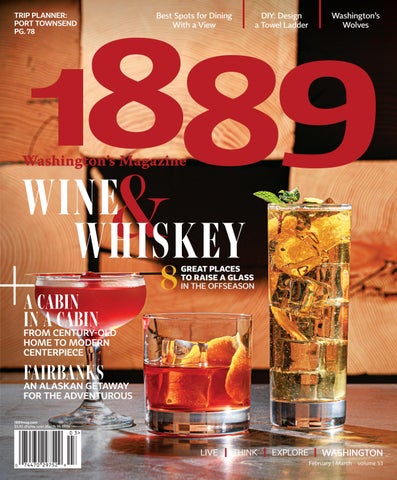
After time took its toll on a century-old cabin on Lake Wenatchee, an architect’s unconventional vision meshed old and new to preserve the original structure. (pg. 28)
photography by Will Austin
The updated rustic charm of a Lake Wenatchee cabin.
Drink Up!
For lovers of wine and whiskey, Washington’s o season o ers abundant opportunities for tasting and one-of-a-kind experiences— without the crowds.
wri en by Ryn Pfeu er
54 Washington’s Wolves
The return of gray wolves to Washington brings ecological renewal but raises challenges for coexistence with humans and livestock. Can Washington strike a new balance between conservation and protecting livelihoods in a shared landscape?
wri en by Daniel O’Neil
Outside the Lines
Diverse techniques and energies form the works of self-taught artist David Syre.
wri en by Kerry Newberry
Jeremy Bi ermann/JBSA
During the winter months, don’t miss Echolands Winery’s double-feature movie series.
WASHINGTON’S MOST AWARD WINNING WINERY
5 ,0 00+ AWA RD S & CO U N T ING !
Maryhill Winery is a celebrated Washington destination for both seasoned wine enthusiasts and those exploring wine for the first time. Drawing from vineyards across the state, Maryhill crafts an expansive collection of award winning wines from more than 35 grape varieties, guided by a philosophy of passion, patience, and balance. Across four scenic tasting room locations, guests are invited to enjoy curated wine flights and thoughtfully prepared culinary offerings that celebrate the wines and the region we proudly call home. We invite you to join us and experience the story behind every bottle.
AWARD WINNING WINE | RESTAURANT | EVENT SPACE
Experience a Maryhill Moment with Us.
Old Log Cabin Distillery
(see “Washington’s Spirited Side,” pg. 48)
Editor’s Le er 1889 Online Map of Washington Until Next Time 10 11 87 88
LIVE
14 SAY WA?
Cra y classes; Daniel G. Harmann’s new album; Katrina Carrasco’s novel
Rough Trade dives into late-1800s Tacoma.
18 FOOD + DRINK
Lowlander Brewing; Chelan Ranch turns imperfect fruit into crunchy, nutritious snacks; Lynden’s Newsroom Pub.
22 FARM TO TABLE
Washington-grown cabbage, and local chef recipes.
28 HOME + DESIGN
A century-old Lake Wenatchee cabin gets a stunning makeover.
38 MIND + BODY
Ultrarunner Courtney Olsen is breaking records and finding resilience.
THINK
42 MY WORKSPACE
A Spokane ta oo artist’s inspiring story of renewal.
46 GAME CHANGER
North Cascades Institute is connecting communities to the beauty of North Cascades National Park.
EXPLORE
72 TRAVEL SPOTLIGHT
Explore the enigmatic prairie landscape of Mima Mounds.
74 ADVENTURE
Unforge able wildlife encounters across Washington.
76 LODGING
Dayton’s historic Hotel Hardware.
78 TRIP PLANNER
Port Townsend’s charming Victorian seaport for a weekend escape.
84 NW DESTINATION
Embrace Fairbanks and winter in Alaska’s interior.
photo by Brooke Fitts
Breakside Brewery Beaverton, OR
BROOKE FITTS
Photographer Washington’s Spirited Side
“I loved visiting the tasting room at Old Log Cabin for this assignment and getting to see on-site how they make their whiskey. I had such a cool conversation with head distiller Ben Capdevielle about the ancient craft of making spirits and had a lot of fun photographing his cocktails! This spot is a must-try for Seattle natives and visitors alike.” (pg. 48)
Brooke Fitts is a Seattle-based food and lifestyle photographer. When she’s not taking photographs, you can find her in her veggie garden, planning her next adventure or happily cooking and eating something delicious.
CONTRIBUTORS
DANIEL O’NEIL Writer On Familiar Ground
“Wolves are a family-centered species just like we are. As I listened to a range of views on the subject, the wolf debate in Washington reminded me of an extended family gathering, where disputes over differing opinions are inevitable. A sense of commonality and mutual respect therefore prove necessary to keep Washington moving forward, together, as it adapts to the return of a more natural order, because Washington isn’t really Washington without the gray wolf.” (pg. 54)
Daniel O’Neil was raised in Oregon and lives on the Oregon Coast with his wife, daughter and two Shiba dogs. He has seen a wolf mother and pup in the wild, in Yellowstone, and hopes to witness them in the Pacific Northwest one day soon.
WILL AUSTIN Photographer
Home + Design
“In my line of work, I get to visit many spectacular homes, but this one really took my breath away. The high-mountain lakeside setting and the craftsmanship were spectacular of course. But Syndicate Smith’s design, which retained the cozy and inviting existing cabin within the beautiful new home, was truly groundbreaking. I actually found it difficult to leave as I wrapped up my shoot!” (pg. 28)
Will Austin’s award-winning photographic work has taken him around the world. Whether shooting from a saddle, a helicopter seat or the dizzying height of a tower crane, Austin enjoys the adventure of capturing people doing what they love. He lives in the Seattle area with his wife and son but hails from Colorado cowboy country.
JENNA LECHNER
Illustrator
Home + Design DIY
“One of my favorite parts about the illustration process is imagining new worlds, and the ‘research’ that goes along with that. For the DIY towel ladder illustration I did for this issue, I had fun imagining a new lived-in space; I spent time browsing bathroom tile floor patterns, and photos of cute cats in repose. My fondest memories as a kid are doing DIY craft projects, so it’s always a delight to illustrate a craft project!” (pg. 36)
Jenna Lechner is a freelance illustrator in Portland, Oregon. Her nature-inspired ink and watercolor illustrations have appeared on stationery, wallpaper, packaging and more. You can see more of her work on Instagram @jennamlechner.
EDITOR Kevin Max
CREATIVE DIRECTOR Allison Bye
WEB MANAGER Aaron Opsahl
SOCIAL MEDIA MANAGER Joni Kabana
OFFICE MANAGER Cindy Miskowiec
DIRECTOR OF SALES Jenny Kamprath
BEERVANA COLUMNIST Jackie Dodd
C ONTRIBUTING WRITERS Cathy Carroll, Melissa Dalton, Joni Kabana, Lauren Kramer, Kerry Newberry, Daniel O’Neil, Ryn Pfeuffer, Ben Salmon, Corinne Whiting
CONTRIBUTING PHOTOGRAPHERS Will Austin, Ryan Cox, Jackie Dodd, Brooke Fitts, Young Kwak, Scott Minner, David Moskowitz
CONTRIBUTING ARTISTS Jenna Lechner
Mail Headquarters
70 SW Century Dr. Suite 100-218 Bend, Oregon 97702
www.1889mag.com /subscribe @1889washington
592 N. Sisters Park Ct. Suite B Sisters, OR 97759
All rights reserved. No part of this publiCation may be reproduCed or transmitted in any form or by any means, eleCtroniCally or meChaniCally, inCluding photoCopy, reCording or any information storage and retrieval system, without the express written permission of Statehood Media. ArtiCles and photographs appearing in 1889 Washington’s Magazine may not be reproduCed in whole or in part without the express written Consent of the publisher. 1889 Washington’s Magazine and Statehood Media are not responsible for the return of unsoliCited materials. The views and opinions expressed in these artiCles are not neCessarily those of 1889 Washington’s Magazine, Statehood Media or its employees, staff or management.
FROM THE EDITOR
IF YOU Beautiful Mind this issue, some patterns will emerge from print and into the sublime. It begins with a mystery. Imagine walking along a footpath somewhere west of Olympia in a prairie. Then you notice that the earth adjacent to the path is a series of perfectly rounded undulations. It’s not volcanic like many geological phenomena in the Pacific Northwest. They’re not human-made. Indeed, no one can really account for these calming domes in the Mima Mounds Natural Area Preserve. Stroll over to page 72 to read about them and tell us what you think.
The first clue for decoding this issue begins with the story of singer-songwriter-composer Daniel G. Harmann. With medication and music, he fought through depression to come out on the other side to bring us an album of healing atmospheric music for altered states—a complete tangent to his prior music composition (pg. 16).
The second piece of code comes in the form of Courtney Olsen, a woman who left behind an unsuccessful relationship and depression to try simple exercise. The Bellingham native would let it all go in her unlikely path to become one of the
top ultrarunners in the country. Turn to Mind + Body on page 38.
Keen ciphers will already have it. If not, consider the story of Susan Webber, who was laid off from her longtime job as a lactation consultant, was diagnosed with breast cancer and then turned to art through tattoos. She was born in Korea, but was raised in Spokane, where she plies her trade (My Workspace, pg. 42).
The final clue comes from another artist. David Syre left behind a career in business development and took up paints at 72, after his adult twin daughters surprised him with the gift of art supplies. Instead of driving KPIs and leveraging data, he creates large-scale stunning acrylic paintings and atmospheric watercolors. Turn to page 62 to see his work.
By now you’ve grouped these four like NYT’s Connections, under the decoded theme of rebirth. They all faced extraordinary soul-gazing moments, asking themselves, “Can I?” Then getting on with the hard work of “Yes, I can!”
There are so many other great stories in the issue, but I wanted to share a glimpse of these with the little space I’m allotted. Cheers!
1889 ONLINE
More ways to connect with your favorite Washington content
Have a photo that captures your Washington experience? Share it with us by filling out the Washington: In Focus form on our website. If chosen, you’ll be published here! www.1889mag.com/in-focus
A
NEVER MISS AN ISSUE
Read 1889 Washington’s Magazine and 1859 Oregon’s Magazine anywhere, on any device, with our digital edition. Follow us today on Issuu.com www.bit.ly/statehoodmediadigital
YOUR PNW NEWSLETTER
More Pacific Northwest, delivered to your inbox! Sign up for our Adventure Mail newsletter and get access to the latest getaways, giveaways and more. www.1889mag.com/1889-newsle er
SHOP LOCAL
Stop by Local, our curated online shop for 1889 gear and goods made by businesses in the Pacific Northwest. Buy local. Feel good. www.1889mag.com/shop
photo by Zinetta Hope
cool day at Mount Rainier.
SAY WA? 14
FOOD + DRINK 18
FARM TO TABLE 22
HOME + DESIGN 28
MIND + BODY 38
Lowlander Brewing joins the Sea Creatures family in Sea le.
Jackie Dodd
Find Your Winter Wonder
Just minutes from Bend, Oregon, Sunriver Resort is where winter warms, thrills, and renews you—your place to discover true winter wonder. Days start on crisp trails and open slopes, with plenty of room to chase a thrill or take it slow. Afterward, it’s the simple comforts that linger, warming up by the fire, easing into the spa, sharing a good meal, and feeling the pace of everything soften. Out here, winter isn’t just something to look at. It’s something to step into, breathe in, and leave feeling better than when you arrived.
Tidbits + To-dos
written by Lauren Kramer
Simply Sawdust Workshops
Simply Sawdust in Waitsburg offers a fun, soft introduction to wood laser printing in DIY private or group classes. Participants can choose a wood cutting board, tote or spoon, personalize it with an image, use a laser to engrave the image onto the wood and then paint, sand and stain it. Owner Gloria Wilson, a patient, soft-spoken coach with a passion and talent for woodworking, makes the process inspiringly fun and easy.
www.simplysawdust.com
Chocolate-Making Classes with Boehm’s
Candies
Boehm’s Candies in Issaquah is a sweet place for a chocolatemaking class. The two-hour classes, open to adults and kids aged 10+, are held Thursdays and weekends, when groups of up to eight participants get to dip clusters, decorate chocolate bars and package 1½ pounds of chocolate to devour after class. A tour of the chalet and the High Alpine Chapel is included for the $68-per-person fee. www.boehmscandies.com
Make a Fused-Glass Pendant
Etch your heart in glass with a fused-glass heart pendantmaking workshop February 7 at the Jansen Art Center in Lynden. Open to kids 6 and up and adults, participants in the $33 workshop will create two custom heart pendants, which will be fused in a kiln and sent home with accompanying leather necklaces. www.jansenartcenter.org
Simply Sawdust
Natasha W Portrait/Boehm’s Candies
Photo: Jansen Art Center
Northwest Carriage Museum + Willapa Seaport Museum
The small town of Raymond is home to two fascinating museums. The Northwest Carriage Museum displays an international selection of sixty-four horse-drawn carriages dating back to the 1800s, including farm wagons, hearses and a mobile food truck once used on cattle drives. Steps away, the Willapa Seaport Museum is another treasure filled with tales of shipwrecks, lighthouses and military nautical paraphernalia. Ask for a personalized tour, and look out for the human skull of an unfortunate sailor.
The seventeenth annual Northwest Glass Quest, held February 13 through 22, is a tenday treasure hunt for hand-blown glass balls throughout Stanwood and Camano Island. Participants in this free event search area businesses and parks for some 400 hidden plastic clue balls. The clue balls inform finders where to go to claim their hand-blown glass art. Download the app or an online brochure at the Northwest Glass Quest website.
www.northwestglassquest.com
Rails & Ales
Wenatchee’s Centennial Park and Orondo Avenue are the venues for Rails & Ales on March 7. For the ales portion, attendees 21+ can visit a variety of beer gardens to taste craft brews from Pinnacle Beerworks, Blewett Brewing, Wenatchee Valley Brewing and Hellbent Brewing. For the epic rail jam competition, Mission Ridge Ski & Board Resort delivers truckloads of snow so skiers and snowboarders can demonstrate their tricks starting at 4:30 p.m.
www.visitwenatchee.org/listing/ rails-ales
Chelan County
Northwest Carriage Museum
Photo:
Discover Snohomish County
Musician
Floating Through Versailles
A musician comes out the other side with songs for altered states
written by Ben Salmon
OVER THE PAST couple decades, Daniel G. Harmann has recorded and released a whole bunch of songs. They vary in style— from quiet singer-songwriter fare and pretty indie-pop to crunchy post-rock, moody synthwave and beyond—but Harmann can hear a sonic throughline.
“I always lean towards the cinematic,” he said in an interview from his Seattle home. “So this, to me, seems like the place where I was always headed.”
By “this” he means the music on his new full-length album, Versailles, a twelve-track collection of, yes, cinematic (and gorgeous) ambient music designed to soundtrack psychedelic journeys.
“I’ve struggled with depression (for) as long as I can remember—thirty years of being on and off of prescription drugs and going to therapy and stuff,” Harmann said.
“I was at a birthday party with some friends and one of them was like, ‘You know, a friend of mine started a ketamine clinic, which they found really helps with depression. You should give it a shot,’” he continued. “So I did, and it changed my life.”
Harmann discovered that regular ketamine infusions made him feel significantly better, and as a bonus, they provided him with time for some seriously deep listening experiences during what he calls “altered states.” As a longtime music lover, he started creating his own playlists for these experiences, and then—as a
musician—soon decided he’d like to make his own music for them.
“I started kind of plotting it out, and it literally took me almost two years to write and finish,” he said. “It’s a tricky thing, right? You want to make music for altered states, but you’re not in an altered state when you’re writing the music.”
Harmann went through a long process of listening to music during his treatments, making notes about how certain sounds made him feel, figuring out what worked well and what didn’t and then incorporating what he learned into his own compositions. Once he had the basic songs down, he started adding what he calls “ear candy”—bird calls, a beard scratch, street sounds.
“(The idea is) to add those little things to make it interesting and give it a bit more texture,” he said. “To me, field recordings are what really take it from something you’re listening to to something that’s part of this whole other world.”
A trip through Versailles is, indeed, like floating gently through a sort of dusky vivarium teeming with bioluminescent sounds, including billowing synths, drifting tones, dulcet melodies and little surprises along the way. Whether you’re altered or not, it’s a beautiful journey through a space also occupied by ambient and neoclassical giants like Max Richter, Nils Frahm and Stars of the Lid.
Since recording, Harmann has worked with a friend to create visuals for every track on the record to give people who are simply seeking some relaxation something to watch, if they choose. And he has passed Versailles on to other people at the ketamine clinic, who have used it to soundtrack their own journey. The feedback has been very positive, he said.
“I was scared, because this is a big (change) compared to a lot of the stuff that I’ve done in the past. And also, it’s a sacred space, you know? It’s a very deep, personal, meditative thing, and you’re kind of inviting yourself into people’s hearts and exposing yourself to some degree,” Harmann said. “It’s the scariest thing I’ve done, but also the most fulfilling, and I’m really proud of it.”
Listen on Spotify
Daniel G. Harmann, singersongwriter-composer, finds soothing sounds in a place he’s always been heading.
John E. Hollingsworth
Bibliophile
Writing with Muscle
Author leverages blacksmithing and boxing in researching her acclaimed queer crime novel set in Old Town Tacoma in 1888
interview by Cathy Carroll
IN HER WIDELY acclaimed crime novel Rough Trade, Sea le author Katrina Carrasco vividly reimagines queer communities in Old Town Tacoma in 1888 amid the turbulent dawn of modern media and medicine and the pleasures and perils of satisfying desire. Carrasco plunges readers into the hardscrabble world of dockworkers and opium smugglers who spend their days moving crates and nights at the center of Tacoma’s queer scene, where skirts and trousers don’t signify and everyone’s free to suit themselves.
How did you embody your characters through boxing, blacksmithing and powerlifting—treating the body almost as a research tool?
Using my own body as a research tool is a very apt description! I wanted to know how my characters’ bodies would feel while unloading steamship cargo or while throwing a punch, and be able to describe those sensations. I drew on my weightlifting experience to embody hauling heavy loads and the soreness that comes after. I joined a boxing gym to prepare for writing fight scenes in Rough Trade, and I took a terrific blacksmithing class at Pratt Fine Arts Center in Seattle to learn about the physicality of that trade. My hope is that these visceral descriptions connect readers to my characters in an intimate, immediate way that also builds empathy. For example, Alma, the book’s main character, has strong appetites that propel her through the world: hunger, lust, love of muscle. One of the reasons I wrote her this way was to explicitly depict female physical strength—to celebrate it as an asset that women can cultivate. Our society can be hostile toward strong women who take up space and pursue their desires, so I wanted Alma to revel in her physicality and invite the reader to connect with her in that experience.
hungry for as a queer reader myself. With Rough Trade, I wanted to recreate a queer community in a place and time we might never have seen or even imagined one. LGBTQIA+ people have always existed and built families and communities, and one of my primary drivers as a novelist is to make our queer past visible and, therefore, unerasable—writing us into existence where the historical record and homophobia have obscured what traces of us remain. Obviously it’s important to invite non-queer readers into this project as well so we can collectively recognize and celebrate our shared history. Another aspect of Rough Trade that I hope speaks to all readers is its consideration of how gender can be an expansive place of exploration, play and discovery. We would benefit greatly from less fear and more curiosity about gender and its many expressions.
Following the acclaim for Rough Trade, how are you thinking about what comes next—have you changed how you approach the stories you feel drawn to tell?
How do you think the themes of gender, identity and community in the novel resonate with readers today, and what do you hope they carry away from your work?
I hope the book provides queer readers with a sense of history and visibility—things I’m always
My novels are always queer and always political, and the recognition Rough Trade received has helped me feel confident to take on even bigger questions in my writing. My next book is a contemporary novel concerned with border militarization, immigration and the prison industrial complex. With it, I’m using fiction to try and understand our current moment in America. I want to learn how we arrived here as a country and explore how we might find the resilience and resources we need to fight state violence and fascism.
Katrina Carrasco’s second novel, Rough Trade, was a best novel pick by The New York Times and The New Yorker and won the 2025 Washington State Book Award for fiction.
Courtesy of Katrina Carrasco
Lowlander Rides High
The
recent Sea Creatures
addition is the new brewery Seattle needed written and photographed
by Jackie Dodd
THERE IS a certain level of bravery it takes to open a brewery in the landscape of the current beer market, even for a team as seasoned and well regarded as the Sea Creatures staff, led by iconic Seattle chef Renee Erickson. And that’s exactly what you see walking into Lowlander Brewing in Seattle’s historic Pioneer Square: a space that feels both familiar and excitingly fresh, comfortable but new, while quietly pushing the city’s beer scene forward.
Lowlander isn’t just another taproom. It’s part of a thoughtful, multivenue rollout by Erickson’s restaurant group Sea Creatures, opening alongside a pizza spot and a full-service restaurant at 419 Occidental Ave. It’s a location with weighty footsteps to follow in, the former home of FX McRory’s, a beloved sports bar that anchored the neighborhood for decades. The TVs lining the walls feel like a respectful nod to the space’s former life, little echoes of sports fans past that make it feel instantly welcoming as a place to grab a beer and watch the game.
What makes Lowlander stand out is its concept. It’s being pitched locally as one of the region’s first true “tank bars.” Instead of traditional keg lines, beer will ultimately be brewed on-site and served straight from conditioning tanks mounted in full view. For now, production is happening offsite at Stoup Brewing while licensing is finalized, a common but unglamorous reality of opening a brewery. Tank service is not just for show. It maximizes freshness and gives the room an unmistakable brewery feel without hiding the process in a back room. It’s a subtle invitation to watch
Cocktail Card
the beer come to life while you watch the game.
Inside, the vibe walks a smart line between modern beer hall and lively game-day bar, softened by the bright, beautiful touches Sea Creatures is known for. There are bar seats and communal tables framed by floor-toceiling windows, plus big screens that make it easy to keep an eye on whatever Seattle team is playing. The space feels warm and social, and the wraparound bar practically begs for communal cheers.
The food follows suit. Expect classic companions that make sense here: house-made sausages, fries, salads and the kind of food you want with a fresh pour of well-made beer. The menu leans into simplicity so the beer can do the heavy lifting, but, in Erickson fashion, it’s done with precision.
Erickson brought in longtime Seattle brewer Josh Waldman to spearhead the brewing efforts. His résumé includes years at Elysian Brewing, both before and after the AB acquisition, as well as arguably the state’s coolest and most highly regarded brewery, Cloudburst Brewing. Waldman’s approach at Lowlander is intentionally restrained and focused on clean, well-executed classic styles: an Italian pilsner, a lower-ABV lager, a
West Coast IPA. “They’ve really trusted me with the direction of the beer,” Waldman said of the Sea Creatures team. “It’s exciting.”
If you’re wandering Pioneer Square on a sunny afternoon or heading toward a game at the Seattle Seahawks’ home at Lumen Field or over to TMobile Park, Lowlander is worth a stop. It’s what happens when hospitality, thoughtfully made food and well-crafted beer collide. Lowlander doesn’t just nod to Seattle’s brewing heritage—it builds on it. In a moment when beer news often feels bleak, Lowlander is a welcome bright spot in an otherwise uneasy landscape.
King Coal
• 11/2 ounces choice bourbon
• 1/2 ounce sweet vermouth
• 1/2 ounce dark brown simple sugar (see recipe)
• 3 dashes Angostura bitters
• 2 dashes orange bitters
• Orange twist, for garnish
FOR DARK BROWN SIMPLE SUGAR
• Dark brown sugar
• Hot water
Pour bourbon, sweet vermouth and dark brown simple in a cocktailmixing glass. Add both bitters, and stir to mix and chill.
Pour and strain into an oldfashioned glass, served on a big rock or ice cubes. Garnish with an orange twist.
To smoke the cocktail, use bourbon staves or a smoking gun with cherry wood. Put the glass upside down to capture the smoke, and then turn it right side up just before pouring the King Coal into the glass.
FOR DARK BROWN SIMPLE SUGAR
Measure equal parts dark brown sugar and hot water. Place in a quart container, mix and place in a refrigerator to chill.
recipe courtesy of Salted Mill / WALLA WALLA
Photos: Salted Mill
Lowlander head brewer Josh Waldman.
ABOVE Lowlander Brewing on Seattle’s Occidental Avenue. AT FAR LEFT Lowlander’s interior blends modern beer hall and lively game-day bar, with bright, beautiful touches.
Chelan Ranch Preserves with Freeze-Dried Fruit Gastronomy
written by Lauren Kramer
BILL CLARK was bothered by the amount of fruit being wasted on his 140-acre organic farm in Chelan, where he grows apples, blueberries and cherries. Anything short of perfect fruit didn’t make it to the packing warehouses, and it killed him to see nutritious fruit headed to the landfill. Knowing he needed a new solution, the farmer launched Chelan Ranch Organics Freeze-Dried Fruit four years ago. His freezedried fruit has a five-year shelf life and a wonderfully crunchy texture that makes it a perfect snack.
Its transformation from fresh to freeze-dried fruit is quite a process. Fruit is sliced, cored and frozen by Individual Quick Freeze in Yakima using liquid nitrogen, after which it’s sent to Ferndale’s Innovative Freeze-Dried Fruits. Here, under vacuum combined with low heat, the process extracts 90 to 95 percent of all moisture, giving the fruit a dry, crumbly effect. “The freeze-drying process seals in a lot of the fruit’s nutrients, so nutritionally, it’s the next best thing to a fresh piece of fruit,” Clark explained. “And there’s no waste when it comes to freeze-drying!”
The family-owned Chelan Ranch, certified organic since 1995, offers u-picks and a farm stand July through October. Its freeze-dried fruit is available at the farm stand, online at www.chelanranch.com and at select grocery retailers in the state. While name-brand freeze-dried products are available at a cheaper price point, Chelan Ranch isn’t trying to compete with those. “We don’t buy our fruit from third-world countries,” he said. “Everything with this fruit, from the ground up, is done in Washington State, and that’s something we’re pretty proud of.”
90 CHELAN RANCH ROAD CHELAN www.chelanranch.com
CRAVINGS: SWEET TREATS
GIG HARBOR CANDY COMPANY
If you’re a lover of English toffee, Gig Harbor Candy Company has your back. Its toffee recipe, a generations’ old, tried-and-trusted formula, is available in milk chocolate, dark chocolate and vanilla varieties. The University Place, family-owned business has added tiger butter squares, which are a melt-inyour-mouth combination of chocolate and peanut butter, sea-salted caramels, espresso bark and, seasonally, peppermint bark to its product line, which is available in online and select grocery stores statewide.
www.gigharborcandycompany.com
THE NOM NOM STOP
The Nom Nom Stop in Lacey is where you’ll find knafeh pistachio chocolate bars, a scintillating mixture of milk or white Belgian chocolate, pistachio paste, crunchy kataifi dough and hints of tahini. Nom Nom also offers cheesecake platters, cheesecake on a stick and babka.
1107 COLLEGE ST. SE, SUITE C LACEY www.thenomnomstop.com
OLD TOWN DELIGHTS
Chocolate meets art form at Tacoma’s Old Town Delights, where hand-painted truffles are infused with Baileys, whiskey, raspberry and strawberry. Look for caramels, turtles, chocolate bars containing edible flowers and other handmade sweet confections. For Valentine’s Day, Old Town is retailing a real heartbreaker: a chocolate heart with a candy-filled interior and a wooden mallet (to break the heart!).
2703 LOCUST AVE. W. UNIVERSITY PLACE www.oldtowndelights.com
MAEVE CHOCOLATE
Maeve Chocolate has taken the reins of what was previously Seattle Chocolate, so if you’re looking for truffle bars and bonbons, this is your kinda place. Look for chocolate confections in flavors including mint, San Juan salted toffee and blackberry. Maeve works with cocoa farmers in Ghana, Peru, Tanzania and the Dominican Republic and donates 10 percent of net profits to support farmer communities.
1180 ANDOVER PARK W. TUKWILA www.maevechocolate.com
ABOVE Waste no more. Imperfect fruit becomes a nutritious freeze-dried snack at Chelan Ranch. AT RIGHT Chelan Ranch owners Angell and Bill Clark. Photos,
BEST PLACES FOR
DINING WITH A VIEW
SUMMIT HOUSE
There aren’t many places where you can eat a meal while gazing at three mountain peaks, but Summit House at Crystal Mountain Resort in Enumclaw is one of them. Located at an elevation of 6,872 feet, reaching this restaurant requires a gondola ride (or very strong, determined legs). It offers lunches 10 a.m. to 3 p.m. and features a hearty menu of comfort foods including burgers, sandwiches, tofu curry, soup and salads.
A meal at The Oyster Bar on Chuckanut Drive is a great reason to explore Chuckanut Drive, one of Washington’s scenic byways. This winding, 20-mile road between Bellingham and Burlington delivers stunning views of the Salish Sea and the steep, towering forests on either side of the road. The Oyster Bar, 120 feet above the ocean in Bow, overlooks Taylor Shellfish’s oyster farms, and its seafood-focused menu includes palate cleansers between courses and little extras like cheese soufflés that accompany dinner entrées.
2578 CHUCKANUT DRIVE BOW
www.theoysterbar.net
CLARK & LEWIE’S
Check out the powerful Columbia River from Clark & Lewie’s in Stevenson. This restaurant has a panoramic riverfront location, an enclosed deck and a lineup of lively events. The menu offers wraps, burgers, sandwiches, pizza and other comfort foods.
Spokane’s river and city views are best appreciated from Clinkerdagger, a restaurant situated in a historic 1895 flour mill. A classic American grill, it serves steaks, seafood and more for fine dining lunches and dinners.
621 W. MALLON AVE. SPOKANE www.clinkerdagger.com
The Newsroom Pub Dining
written by Lauren Kramer
LYNDEN’S NEWSROOM PUB opened in 2022 in a 1939 building constructed for the Lynden Tribune, the city’s newspaper. That publishing legacy runs throughout the eatery’s identity, adding interest, a strong sense of place and a tribute to the past in a town where history remains vibrantly alive.
Walk through the front door, and the first thing you see is part of the machinery of a 1,200-pound printing press manufactured in 1890 and once used to print the Tribune. Black-and-white photographs on the wall display images of the Lewis family, the Tribune’s founders, as well as editors and the kids who once distributed the paper to city homes. Even the menu is laid out in the style of an old newspaper.
This is a lively place in the summer, when the pub’s heated outdoor space opens with live music on Saturdays and ice cream by Lynden’s Edaleen Dairy on sale at the Daily Scoop, its in-house ice cream parlor. The menu features a wide range of comfort food, from wings to macaroni, burgers to tacos, paninis and wraps to soups and salads. It also includes Dutch dishes bitterballen, which are Dutch meatballs, and landjäger, smoked sausage.
Surrounded by agriculture, The Newsroom has made every effort to incorporate local harvests into its dining experience. The drinks menu includes cider by Bellingham Cider Company and beer by local breweries such as Boundary Bay. The soda floats feature local ice cream, and the cheesecake is drizzled with raspberry sauce made from raspberries grown on Lynden’s farms.
Located on Front Street, downtown Lynden’s main thoroughfare, The Newsroom is a fun neighborhood gathering space and the perfect spot to soak up local ambience over a hearty burger.
608 FRONT ST. LYNDEN www.thenewsroompub.com
The Newsroom Pub inside the historic Lynden Tribune building serves up local headlines with tantalizing desserts and classic mains.
Photos: Lauren Kramer
Farm to Table
Cabbage Takes Center Stage
Whidbey Island’s Deep Harvest Farm gives this cool-weather crop the limelight it’s due
written by Corinne Whiting
CABBAGE ENTHUSIASTS may feel their favorite cool-weather crop doesn’t always get the credit it deserves. Some say it’s o en overshadowed by trendier relatives such as kale and Brussels sprouts. Yet those in the know understand the benefits of this dense, leafy member of the cruciferous vegetable group. As an exceptionally healthy superfood, which comes in a rainbow of hues including green, white, purple and even red, cabbage is especially high in vitamins C and K.
Annie Jesperson, co-owner of Whidbey Island’s Deep Harvest Farm, explains that all members of the Brassica family, which includes cabbage, broccoli, cauliflower, kale, radishes and turnips, thrive in cool maritime climates. “These crops get stressed by too many heat units and without sufficient moisture,” she said. “The Pacific Northwest weather provides pre y optimal growing conditions for all of these crops.”
Primax cabbage is a favorite of Deep Harvest Farm owners Annie Jesperson and Nathaniel Talbot. They grow the spring and summer cabbage for seed as well as for their CSA and grocery store.
Deep Harvest Farm
While Jesperson doesn’t know Washington cabbage to have a specific flavor, she does attest to cabbage being mild, juicy and delightfully crisp when grown in ideal conditions, like we have here in the Northwest. When exposed to too much heat and not enough moisture, however, the vegetable can get stressed (which may lead to spicy and softer heads).
“I wholeheartedly recommend making fermented sauerkraut and kimchi from cabbage as there are countless health benefits one receives from eating fermented foods,” she said. “We also love it in stir-fry, stew and slaw.”
Home cooks and professional chefs alike appreciate all of the creativity that this vegetable allows for in the kitchen. Fresh cabbage can deliver a crisp crunch that’s perfect for salads and other meal toppers, while cooked cabbage leaves are durable and full of flavor, ready to be stuffed or served in other ways. “You can do so many things with cabbage, and we do!” Jesperson said. “Sauerkraut and kimchi play huge roles in our meals. We’re not afraid to have fermented cabbage at breakfast, lunch and dinner.” She also enjoys a fancy coleslaw with kohlrabi, carrots and apples, as well as a hearty beet and cabbage borscht or other stew options on a cold winter evening.
Jesperson and her husband, Nathaniel Talbot, have been farming on Whidbey Island since 2011, when they moved from Portland, Oregon, to participate in the Greenbank Farm Training Center program, now called the Organic Farm School. For the past decade, they’ve run their own organic seed company, through which they sell more than 170 varieties of organic-certified, regionally adapted vegetable, herb and flower seeds ideal for northwest farmers and gardens. (They sell seeds on their website and at about twenty-five regional nurseries.) They also run a farm share program for 100 local households, while selling to their neighborhood grocery store, local restaurants and the Whidbey Island Grown Food Hub.
On the farm, they begin seeding cabbage in their start house in mid-March and seed their last cabbage plantings in mid-July. “We love growing both the quicker-growing green, tender, juicy varieties like Primax and the Napa cabbage variety Sativa. We grow both the seed for these varieties as well as the tasty heads,” Jesperson said. They also grow lots of hefty fall and winter varieties such as Reaction, Melissa and an “amazing pointy kraut cabbage” called Filderkraut for their customers to enjoy from October through December.
“You can do so many things with cabbage, and we do! … We’re not afraid to have fermented cabbage at breakfast, lunch and dinner.”
— Annie Jesperson, Deep Harvest Farm co-owner
Employees Kevin Holton and Claire Botcher make up Deep Harvest’s farm crew. Here, Holton holds an heirloom Filderkraut cabbage.
Jesperson recommends growing varieties offered by regionally based seed companies such as their own (Deep Harvest Seeds), Uprising Seeds in Bellingham or Adaptive Seeds in Sweet Home, Oregon. “If these farmer-owned, organic-certified and local outfits are selling a variety, customers in the Northwest can trust they’ll be appropriate varieties to grow in their gardens and farms,” she advised. As for storage, cabbage likes to be kept in a plastic bag inside a fridge, ideally unwashed to maximize its longevity. (Like this, it can store for up to two months.)
Culinary experts appreciate multi-use vegetables like cabbage that can be boiled, steamed, braised, sautéed or baked. Chef Robin Posey of downtown Seattle’s brand-new Marin, attached to the recently revamped Kimpton Hotel Monaco Seattle, shows how this vegetable can be worked into scrumptious recipes in any season.
One such creation of Posey’s, ideal for chillier months, features warm cabbage salad with pork belly “croutons,” honeycrisp apples and hazelnuts in a black garlic-molasses vinaigrette. “The crunchiness of the cabbage, combined with the sweet sharpness of the apple and the nuttiness from the filberts, makes this a delightfully Pacific Northwest-y dish, with ingredients that are easy to find in any local market,” said Seattle native Posey.
Cabbage Patch Washington Recipes
Seared Cabbage Steak with Sesame Miso Butter
ShoMon Kappo / SEATTLE
Chef Masaki Nishioka
SERVES 3-4
FOR THE CABBAGE
• 1 small green cabbage, cut into 6 wedges
• 2 tablespoons olive oil
• 2 tablespoons unsalted butter
• Kosher salt or sea salt, as needed
• Freshly ground black pepper, as needed
FOR THE SESAME MISO BUTTER
• 11/2 tablespoons white miso
• 1 tablespoon sesame paste (or tahini)
• 1 tablespoon unsalted butter, softened
• 1 teaspoon honey (optional, adjust to taste)
• 11/2 teaspoons rice vinegar or lemon juice
• A small garlic clove, grated (optional, for flavor)
• 1-2 teaspoons water or dashi, more if needed, to adjust consistency
TO SERVE (OPTIONAL)
• Chives, finely chopped
• Parmesan, freshly shaved
Sprinkle salt over the cut sides of the cabbage wedges, and let them rest for about 5 minutes. Cover with plastic wrap, and microwave for 11/2 minutes to draw out surface moisture, which will help the cabbage caramelize evenly.
While the cabbage rests, make the sesame miso butter. In a small bowl, stir together the white miso, tahini, softened butter, honey, rice vinegar, garlic and water until smooth. Heat oil in a large castiron or heavy skillet over medium heat. Place the cabbage wedges, cut-side down, in the skillet, and cook until deeply golden and charred in spots, about 6-8 minutes. Adjust heat if necessary to prevent burning.
Flip the cabbage wedges. Add the butter, and let it melt, tilting the pan to baste the cabbage. Continue cooking until the core is tender but the wedges hold their shape, about 5 more minutes.
Transfer the cabbage to a serving platter. Spoon the sesame miso butter over the wedges while still warm, letting it melt slightly. Sprinkle with freshly ground black pepper. Garnish with optional chives and Parmesan if desired.
Seared Cabbage Steak with Sesame Miso Butter.
ShoMon Kappo
FROM TOP Whidbey Island’s Deep Harvest Farm grows produce and flowers and sells more than 170 varieties of seeds. Deep Harvest co-owners Nathaniel Talbot and Annie Jesperson have been farming on Whidbey Island since 2011.
Turkish Cabbage Dolmas Hamdi / SEATTLE
Chef Berk Güldal
SERVES 4-6
FOR THE FILLING
• 2-3 tablespoons olive oil
• 2½ tablespoons pine nuts
• 3 medium onions, finely chopped
• ⅔ cup rice, rinsed and soaked
• 2½ tablespoons currants, rehydrated
• 2 teaspoons ground cinnamon
• 2 teaspoons ground allspice
• 1 tablespoon paprika
• 1 tablespoon plus 1 teaspoon dried mint
• 3 tablespoons fresh dill, chopped
• 3 tablespoons fresh mint, chopped
• 1 teaspoon black pepper
• ¾ teaspoon salt, plus more to taste
• 2 teaspoons pomegranate molasses
FOR THE CABBAGE
• 14-18 savoy cabbage leaves
• Salt, for blanching water
• Ice bath
TO SERVE (OPTIONAL)
• Dill sprigs
• Sumac yogurt
• Pickled mustard seeds
• Pickled savoy cabbage
• Grilled lettuce
• Puffed black rice
FOR THE FILLING
Heat the olive oil in a pot over medium heat. Add the pine nuts, and toast until light golden. Add the onions and a pinch of salt, lower the heat and cook until fully caramelized, 20 to 30 minutes. Meanwhile, rinse the rice 6 times in cold water, and leave it soaking until needed. Rehydrate the currants in warm water, and finely chop the fresh mint and dill.
Drain the rice, and stir it into the caramelized onions. Cook for 2 to 3 minutes, and then
add just enough water to cover. Cover the pot, and cook until the rice is tender, 10 to 12 minutes. Spread the mixture onto a sheet pan to cool.
When cooled to room temperature, transfer to a bowl, and add the currants, cinnamon, allspice, paprika, dried mint, fresh herbs, salt, pepper and pomegranate molasses. Mix well, and adjust seasoning as needed.
FOR THE CABBAGE
Bring a large pot of salted water to a boil. Remove the cores from the savoy leaves, and peel them apart. Blanch the leaves for 5 minutes, stirring occasionally to ensure even cooking, and then immediately transfer to an ice bath. Drain well and pat dry.
TO ASSEMBLE
Place a cabbage leaf flat on a board. Add about 75 grams of filling (roughly a heaped 2-tablespoon scoop) to the base of the leaf. Fold the sides inward, and roll tightly from bottom to top to form the dolma. Repeat with remaining leaves.
Arrange the dolmas seam-side down in a steamer basket or perforated pan set over simmering water. Cover and steam for 40 minutes. Let rest briefly before serving.
To serve, arrange the warm dolmas on a platter, and garnish with dill and any combination of sumac yogurt, mustard seeds, pickled cabbage, grilled lettuce or puffed black rice.
Turkish Cabbage Dolmas. (photo: Evan Sung)
Warm Cabbage Salad with Pork Belly “Croutons,” Honeycrisp Apples and Hazelnuts in a Black Garlic-Molasses Vinaigrette. Marin
Warm Cabbage Salad with Pork Belly “Croutons,” Honeycrisp Apples and Hazelnuts in a Black Garlic-Molasses Vinaigre e Marin / SEATTLE Chef Robin Posey SERVES 6
FOR THE BRAISED PORK BELLY
• Salt, sugar and black pepper (1:1:1), for curing
• 1 onion, chopped
• 1 carrot, peeled and chopped
• 1 rib of celery, chopped
• Stock, as needed
FOR THE BLACK GARLIC VINAIGRETTE
• 4 tablespoons black garlic (or 2 tablespoons soy sauce and an additional tablespoon of molasses)*
• 2 tablespoons molasses
• 2 cups aioli or mayonnaise
• ¼ cup rice wine vinegar
• Pinch of salt
FOR THE SALAD
• 4 cups green cabbage, shredded
• 4 cups purple cabbage, shredded
• 8 ounces braised pork belly, cut into cubes (see recipe)
• 1 honeycrisp apple, cut into thin slices or batons
• 6 mint leaves, finely chopped
• 3 parsley sprigs, finely minced
• ¾ cup black garlic vinaigre e (see recipe)
• ½ cup hazelnuts, toasted, salted and slightly crushed
• Salt and pepper, to taste
FOR THE BRAISED PORK BELLY
Cure the pork with a combination of salt, sugar and black pepper (1:1:1) overnight.
Sear the cured pork belly on both sides in an oven-safe pot or Dutch oven. Add chopped onion, carrot and celery. Caramelize the mirepoix in the pork fat. Add enough stock to nearly cover the belly, cover
with parchment paper and foil, and braise at 300 degrees for 3 hours. Remove (carefully!) the belly from the liquid, transfer to a different pan, cover with parchment and press overnight. (You can use a second pan and a big can of pumpkin purée to press, but any weight will work.)
Slice the pressed belly into inchwide slices, and broil them for about a minute, or heat in a frying pan or an air fryer, just before you’re ready to serve the salad.
Chef’s note: Alternatively, cut some thick-cut bacon into inch-wide pieces and gently fry them up (lardons). Whether you’re using the belly or the bacon, the key to success is to have the other ingredients assembled and ready to go; the warmth of the hot fat breaks down the cabbage just enough to really pull the sweetness out.
FOR THE BLACK GARLIC VINAIGRETTE
Combine all in a food processor.
FOR THE SALAD
In a large bowl, combine the green and red cabbages, lightly salt and pepper and toss.
Heat up the pork belly (or lardons), and toss them into the cabbage. Toss together while the pork is hot.
Add the apple slices, herbs and black garlic vinaigre e. Toss together, and plate. Finish with toasted hazelnuts.
*Chef’s note: Black garlic is a form of aged garlic in which the sugars in the cloves are transformed through the Maillard reaction—the same magic performed when perfectly searing a steak or caramelizing an onion. The sulphurous notes in raw garlic degrade into a sweeter, more mild flavor that is similar to tamarind or molasses. Indeed, if you don’t have any black garlic in your pantry, and you don’t have the 45 days needed to make it in your home, this dressing can be made with a li le soy sauce and molasses.
The old cabin opens up to its modern shell in the living room, combining cozy with practical.
Home + Design
A Cabin in a Cabin
Everyone told them that their century-old cabin in Lake Wenatchee should be torn down—their architect had a different idea written by Melissa Dalton | photography by Will Austin
IN 1914, an article appeared in The Leavenworth Echo, an area newspaper. It compared the “beautiful” Lake Wenatchee, a glacier- and snowmelt-fed lake that’s 5 miles long and surrounded by forest and mountains just 23 miles from Leavenworth, to the “grandeur of a Switzerland.” The writer continued: “The Lake Wenatchee district will be the mecca for the sportsman in the future.” They weren’t wrong. And thanks to the establishment of new scenic roads and railways in the early twentieth century, those nature lovers built quite a few rustic log homes along the lake’s shores, including this one built in 1915.
It was constructed as simple as they come: a single room, about 12x20 feet, anchored by a chunky stone fireplace at one end and a door and window at the other, facing the water so the attached porch had the best views. In the ensuing decades, the owners added rooms, including a kitchen and bathroom with the advent of plumbing and running water. The front porch was enclosed into a bedroom, albeit with a window into the living room. With its ad hoc layout, and exterior covered in cedar shake, after a hundred years it was barely recognizable as a log cabin anymore.
By 2021, the century had taken its toll, and the most recent owners, who had purchased the property in 2000, were worried. The home was originally a summer cabin and had never been built for use all year round, with uninsulated pipes and no foundation. There was a rodent infestation. The sagging roof was propped up with strategically placed poles. “Then things just started to fail, like the toilet, then a washing machine, just one thing after another,” said the owner. They wondered if they would be able to save it, or if they would have to sell. “I couldn’t stand the idea of tearing it down,” they said. But friends, neighbors and even an architect they brought out for a look all said the same thing: that the home was long past gone.
That is, until they asked architect Todd Smith, of the Leavenworth-based firm Syndicate Smith, to weigh in. Smith walked inside the remaining portion
The original cabin, built in 1915, before construction. Syndicate Smith
The design preserves some of the best elements while also solving for the problem of light in many historic cabins.
of the log cabin, with its thick log walls and exposed mortar still visible, soot covering the fireplace stone, and a thick log for a mantle, and felt the pull of the original. “You go into that room, and you are transported back a hundred years,” said Smith. “This is the heart of the home.” His idea was not to tear down the structure, or add on to it. Instead, he suggested stripping away all of the “garbage” and “bad additions,” and then “building a whole new house over the top of it,” said Smith, which would make the preserved cabin at the center “much like a museum diorama.”
The owners were intrigued, and cautiously optimistic. “They were imaginative enough to say, ‘Yeah, this is wacky, but I think we can do it,’” said Smith. They teamed up with local contractor Timberwood Construction, which proceeded to strip away the cobbled additions to reveal the original structure, from its interlocking corners, to the roof ridge beams. They poured a new foundation and then cleaned up the exposed logs, sanding down rough spots, and stripping paint off the chimney rock.
Smith and his colleagues then oriented the rest of the house around the cabin, lucking out when the property’s setback requirements made it possible to keep it at the center of the plan to function as the cozy living room. They placed an open kitchen and dining area to one side of it, complete with mudroom spots to handle wet and snowy gear, and a two-story bedroom wing on the other, with an en suite bedroom for the owners on the main floor, and upstairs, a bedroom for each of their two grown children when they come to visit. The entire footprint was kept to a modest 1,764 square feet.
In contrast to the cabin’s rough texture, the new finishes were kept sleek and streamlined, with white walls and fir casework built by Timberwood Construction. “It’s just simple materials,” said Smith. “Nothing fussy.”
A bank of floor-to-ceiling windows on the lake side
ABOVE, FROM TOP A dream kitchen in a historic cabin? The impossible made actual in this reimagination. Light floods into the well-organized mudroom.
Large windows provide connection to the outdoors as well as a jewel case for the cabin within.
brings in light and views. “One thing that we told our team is we wanted it light,” said the owner. “The old cabin was actually pretty dark.” The decking from the cabin roof was removed to drop pendant lights through, and facilitate sun inside the room. That wood was then repurposed for the front door and select built-ins, like a television cabinet in the living room that looks like shutters in an old cabin window.
The owners have set up two rocking chairs where the front porch once was, and enjoy the same view of the lake. It’s still the best spot to drink morning coffee and consider the day ahead. Whether that entails dropping floaties and canoes in the water in the summer, or skate skiing in the winter, the area is just as much an outdoor mecca as was promised a hundred years ago. “The original cabin was someone’s piece of solace up at the lake,” said Smith. “To honor that was a big deal.”
ABOVE The warmth of the furniture is an unexpected gift in an unconventional cabin. AT RIGHT, FROM TOP Pendant lights connect old to new through log rafters. From the back, the cabin masquerades as a thoroughly modern structure. The best indoor seating overlooks Lake Wenatchee.
How to Build a Towel Ladder
DIY written by Melissa Dalton | illustration by Jenna Lechner
TRY THIS quick weekend project to maximize an empty patch of wall for extra towel storage.
MATERIALS AND MEASUREMENTS
This ladder is planned to be around 6 feet tall, but can be tweaked to preference. For the rungs, we recommend a finished width that allows for ¾-inch clearance on either side of a typical bath towel, folded lengthwise. Using a standard bath towel at 40x58 inches, the cut size of the rung in this example will be 23 inches, with a finished width of 21½ inches once assembled, because each end of the rung is sunk into the side rail at a depth of ¾ inch.
For materials, we’re using two 2x2 boards for the side rails (double-check they are straight!) and four sections of ¾-inch dowels for the ladder rungs.
CUT THE SIDE RAILS
Since the ladder leans against the wall, the bo om of each side rail needs to be cut at a 10-degree angle with a miter saw, with the long edge at the front of the ladder.
To ensure both side rails are exactly the same height, stack them one on top of the other, lining up the bo om so the angles are flush. Then, cut the tops of both at the same time to square them, keeping the overall length around 6 feet.
MAKE HOLES FOR THE RUNG PLACEMENT
Cut the dowels to size. Flip the 2x2s so that the inside
faces up, and push them together. Each rung will be placed at about 12-inch increments in height. Use a 90-degree straight edge to mark four equidistant lines across both pieces of wood, in exactly the same place. (The holes for the ladder rungs must be lined up, or the whole thing will be crooked.) Use a nail punch to mark the center of each line, and a ¾-inch Forstner drill bit to create the holes for each rung, drilled to a depth of ¾ inch.
A note about dowels: Dowels might be marked at ¾ inch, but they can be variable. Just know that sometimes the dowel will fit perfectly in the hole, sometimes it will be loose and, occasionally, too tight. If the la er, sand it to fit. Once the holes are drilled, do a dry fit with the dowels. If one feels snug, do not tap it in, or else you will not get it back out.
ATTACH THE RUNGS AND FINISH
Put a bead of glue in all of the holes along one side rail, and tap the rungs in with a mallet. Then put glue in the holes on the second side rail, lay both on their narrow side and push the two side rails together until the rungs are securely a ached to both. Add a clamp at each rung while the glue dries. Once ready, sand the whole ladder, and finish with paint, or sealer, as desired.
Planning a Cabin Getaway? Pack These for Cozy Vibes
written by Melissa Dalton
Every cabin needs a lantern on hand, but how many have one shaped like a rainbow? The Vuelta Portable Lamp by Ferm Living, available at the Seattle-based Woodland Mod online, is just that. Made of durable white plastic, with a soft, diffused glow, it’s the perfect night-light, complete with dimmable LED light source and charging cable.
www.woodlandmod.com
Ceramics was a side hustle for Kelsey Johnson until 2015, when she established KJ Pottery, which now operates out of a small studio in Spokane, selling plates, mugs and bowls. We like the KJP Mug—at 10 to 12 ounces, it’s a nice size for a range of hot beverages, with straight sides, a comfortable handle and a selection of earthy glazes.
www.kjpottery.com
The whole family can cozy up to this Lantern Press jigsaw puzzle, appropriately titled “The Mountains Are Calling.” The cheery graphics, glare-free matte image and precision-cut pieces on premium puzzle board make for a truly relaxing experience, for both puzzle masters and novices alike.
www.lanternpress.com
Regaining Control
Courtney Olsen took to running to get her mind back—now she’s standing atop ultra podiums
written by Lauren Kramer
Ryan Cox/Stay
Steady Media
Ultrarunner Courtney Olsen breaks the women’s 50-mile world record with a time of 5:31:56 at the Tunnel Hill 50 Mile in Vienna, Illinois, in 2024.
COURTNEY OLSEN is the 50-mile world record holder and has made five U.S. World Teams in ultrarunning. On an average week she trains by running 100 miles, and in 2021 she ran her first 100-kilometer race at Project Carbon X 2. Four years later, she placed first in the 50-kilometer U.S. championships in Wisconsin, and in December 2025 she was in India, running for Team USA at the 50-kilometer World Championships.
But back in 2013, Olsen, a full-time banking specialist at People’s Bank in Bellingham, was in the midst of a deep depression. She had moved from Colorado to Bellingham and had just ended a long-term relationship when a therapist suggested she start exercising. Olsen turned to running, a sport that had fueled her from elementary school through college. At the start, her runs were short, just 1 to 3 miles at a time. But as she laced up her shoes and hit the road, she noticed something remarkable: Running calmed her mind and promised a way out of her sadness.
When her friends encouraged her to run the Boston Marathon with them in 2014, Olsen began training in earnest. To compete in Boston you have to qualify, so Olsen ran the Skagit Flats, her first marathon, crossing the finish line in just over three hours. “My brain quieted in that race for the first time in years,” she said.
Over the ten years that followed, she kept increasing her workouts and mileage and improving her times. By 2020, she qualified for the Olympic marathon trials in Atlanta. She came in 53rd out of 500 runners, winning a four-year Hoka sponsorship, and with it, encouragement to run a 100-kilometer race. Olsen knew she’d plateaued at marathon running, and she was ready for a new challenge. “It was a natural evolution for me to start dabbling in races of 50 kilometers and 100 kilometers,” she said. “I learned I’m better at the longer stuff. I found the sweet spot.”
As she reflects on her athletic career, two races stand out for her. In June 2024, she came third in the 90-kilometer Comrades Marathon in Cape Town, South Africa. “It was the first time I’d competed in that race, and I went into it thinking I’d learn from it and go back and do it better the next time,” she said. “When I placed third, I felt seen by people I respected and, for the first time, proud of myself.” The same year, she came first in the Tunnel Hill 50-mile race in Vienna, Illinois, beating a world record previously held for thirty years by Ann Trason.
“Running has helped me gain control back over my life,” she said. “It’s my biggest form of therapy. When I’m running, I’m listening to podcasts, music, and thinking about my life. I also visualize the races that are coming up to better prepare myself.”
Over the next five years she’s planning to return to South Africa to run three more Comrades marathons, as well as the Two Oceans Marathon. “Everything about racing road ultras in South Africa is warming, invigorating and full of love,” she said.
Trason still holds the 100-kilometer American record, and Olsen aspires to be the first American woman to break that seven-hour record. She’s also hoping to podium at a World Championship, and to help Team USA win as many gold medals as possible.
At 38, she’s doing anything but slowing down.
Courtney Olsen Ultrarunner
Born: Bellingham
Lives: Bellingham Age: 38
WORKOUT
“I run twice a day most days, around 100 miles per week.”
NUTRITION
“I don’t hold back; I eat anything and everything. I am very fond of all cheeses, whole baguettes consumed in a single day, green olives, oysters, wine, cocktails, IPAs and trying new food in other countries. I’m afraid of what this gluttony means if/when running is put to the wayside!”
MENTOR
“Devon Yanko, a professional runner in the ultrarunning world for over twenty years, is a friend I run with and a woman I greatly admire.”
Running has helped me gain control back over my life. It’s my biggest form of therapy. When I’m running, I’m listening to podcasts, music, and thinking about my life. I also visualize the races that are coming up to be er prepare myself.”
— Courtney Olsen
Young Kwak
Ta oo art becomes personal and full time for
Discover Nature' s Splendor at Mount Rainier National Park CHASE
CASCADING WATERFALLS AND WANDER WONDERFUL TRAILS
Mount Rainier National Park is a place of transformation, where snowmelt fuels powerful waterfalls, and hiking trails reveal their vibrant beauty. Discover iconic cascades like the 72-foot-high Myrtle Falls, the Narada Falls, and the Christine Falls, with their rushing waters framed by lush greenery and dramatic rock formations. Each trail offers a chance to get close to the action, with the sound of waterfalls creating a backdrop for an unforgettable adventure. As you hike, look for blooming avalanche lilies along the trails, their bright white petals adding to the breathtaking scenery. The trails are alive with fresh air, stunning views, and the promise of discovery around every corner. Whether you’re chasing waterfalls or enjoying a peaceful walk, join us for an adventure that will leave you inspired and connected to the beauty of Mount Rainier.
My Workspace
Marked by Art
A Spokane ta ooer’s journey through risk and renewal
written by Joni Kabana
photography by Young Kwak
In Spokane’s South Perry neighborhood, where tree-lined streets give a sense of continuity and care, one artist’s life story unfolds as a leap of faith. Born in Seoul, Korea, Susan Webber grew up in Spokane after her parents moved there sight unseen, guided only by friends’ recommendations. It turned out to be a gift. Webber loved growing up in Spokane and now loves raising her own children in the same city that shaped her.
Art has always been a constant in Webber’s life. For decades she practiced oil and watercolor painting, sculpture, mosaics, jewelry making, printmaking and mural painting. Professionally, she followed a different path, becoming a lactation consultant, a career she believed would last a lifetime. But creativity never loosened its grip.
Everything shifted at age 40. While learning to tattoo, initially just for fun, Webber fell for the craft immediately and obsessively. Two weeks after first holding a tattoo machine, she was unexpectedly laid off from a job she’d held for thirteen years. At the same time, she was recovering from her first breast cancer diagnosis, marked by multiple surgeries and a year of chemotherapy. Faced with mortality, the message felt unmistakable: Focus on what you love most.
AT FAR LEFT Ta oo artist Susan Webber in her studio space at The Missing Piece Ta oo in Spokane. ABOVE, FROM TOP Artwork and ta oo designs pepper Webber’s workspace. One of Webber’s ta oo machines.
Today, Webber works at The Missing Piece Tattoo, a studio space brimming with art. Tattooing with needles, she said, “offers finer lines than any pen,” and she relishes the profound intimacy of working with the human body as canvas. Her work is built on trust, something Webber holds with deep honor. A second breast cancer diagnosis later forced Webber to take a year and a half away from work, leaving her with neuropathy and arthritis in her hands. But she’s again back in her tattoo studio, grateful, stronger and newly aware of how much joy tattooing brings her.
Webber offers advice for anyone wishing to enter this field of work by relaying a simple formula: “Draw daily, build a style, stay curious, escape boxes. It’s guidance for artists of all kinds, and for life.”
FROM TOP Susan Webber transitioned to a career in ta ooing a er age 40. Inks inside Webber’s studio space.
Beyond Outdoor School
The North Cascades Institute grows lifelong connections to North Cascades National Park
written by Daniel O’Neil
TRUE STORY—back in 1986, a group of backcountry rangers were sitting around a fire in North Cascades National Park discussing how to connect more people with the park, still overshadowed by Washington’s other national parks. These rangers knew that if they could bring more people to love North Cascades National Park, to experience for themselves the beauty and magic of that place, they’d be inspiring individual stewards and champions for keeping the park wild and its ecosystem healthy.
The park’s superintendent liked the idea and gave the group an empty desk and a phone at headquarters. Soon enough, they were taking small groups of adults into the park’s wilderness to do anything from wildlife tracking to learning about glaciers at eye level. They hosted art retreats as well: writing classes, poetry retreats, photography or watercolor workshops. By now the former rangers were running a nonprofit they called the North Cascades Institute.
Today, NCI introduces more people than ever to the wonders and significance of North Cascades National Park. Having originally given classes in campgrounds, using old army tents for shelter, NCI now operates out of the North Cascades Environmental Learning Center on the shore of Diablo Lake, right
in the park’s center. The center’s lodges, classrooms and dining hall allow for educational activities nearly year-round, including a high school backcountry program called Youth Leadership Adventures, family camps and boat tours. NCI also cooperates closely with tribes, the Upper Skagit Indian Tribe in particular.
Now forty years into its mission, NCI offers online presentations and emphasizes outreach to Whatcom and Skagit county communities that wouldn’t necessarily have the opportunity to visit the park. Some programming is multilingual, for example.
“We want to bring everybody along to teach them how amazing this ecosystem is, how lucky we are to live here and how important it is to do the best we can to protect it, and even to restore it, so that we’re passing it on to future generations,” said Christian Martin, NCI communications and marketing manager.
Younger generations have been especially important to NCI’s work since the beginning. Only a few years into its efforts, NCI’s founders realized that to create conservation stewards for the park, they needed to start early. So in 1990, they initiated a program called Mountain School that still brings local fifth-grade classes and teachers up to North Cascades National Park for a three-day, two-night environmental education program.
North Cascades Institute
North Cascades Institute program participants take to the water for a guided exploration of Diablo Lake in the institute’s Big Canoe.
“We want to bring everybody along to teach them how amazing this ecosystem is, how lucky we are to live here and how important it is to do the best we can to protect it, and even to restore it, so that we’re passing it on to future generations.”
— Christian Martin, North Cascades Institute communications and marketing manager
“That really changed the organization because now we weren’t just doing cool little field trips with adults,” Martin said. “It’s really neat to see that some of our earliest students that came up as kids are now teachers in these schools bringing their classrooms up thirty years later.”
For John Fahey, who teaches fifth grade at Centennial Elementary School in the Mount Vernon School District, “Mountain School provides hands-on learning immersed in nature while using a curriculum that also connects with state standards.” Fahey has brought students to Mountain School for the last twenty-five years.
Fahey incorporates Mountain School into his classroom throughout the school year, referencing the important lessons it teaches not just about the environment but also about relations between individuals and the community, and about self-development.
“While students are learning about the systems within a forest ecosystem and the cultural significance of the North Cascades, they are building confidence in themselves and strengthening trust with their peers,” Fahey said. “Once they start learning about the systems of life within a forest ecosystem, they start making connections to their own personal lives. This is where the true learning begins.”
With such a wide range of adults and youth now connecting with North Cascades National Park, who knows how future fireside conversations will lead to further enhancing, protecting and loving the park and local communities that NCI helps support.
To learn more about experiences with NCI, visit www.ncascades.org
FROM TOP High schoolers in last summer’s Youth Leadership Adventures program set off for backcountry camping in the North Cascades. Birding enthusiasts bundle up for a winter field excursion around Skagit Valley, led by local expert Brendan McGarry. Many of the institute’s programs take place at the North Cascades Environmental Learning Center located on the wooded shores of Diablo Lake.
Photos: North Cascades Institute
Washington’s Spirited Side In the Offseason Wine Whiskey
written by Ryn Pfeuffer
WHISKEY DIDN’T BECOME a winter spirit by accident. Some of the pull is mental—the comfort of a warming sip in hand when daylight disappears before dinner. Some of it is just how it works: Higher-proof spirits feel warmer, and cold air makes flavors easier to pick out. Winter food helps, too. Whiskey fits the season’s cooking—braises, stews, pan sauces and desserts that lean chocolatey or nutty. Even the way it’s made matches winter’s pace, built over time in barrels, with patience and letting things take their course.
Wine follows the same logic, but with different cues. Cold weather nudges drinkers toward reds with structure—cabernet sauvignon, syrah, zinfandel—wines with tannin and weight that stand up to roasts and rich reductions. Winter also makes room for spiced mulled wine when the mood calls for it, or dessert wines and ice wine alongside a plate that ends in blue cheese or chocolate.
In Washington, the offseason adds another layer for wine and whiskey lovers. Fewer crowds mean more access and better conversations.
Old Log Cabin Distillery’s aged bourbon ready for the sipping in Seattle’s Interbay.
(photo: Brooke Fitts)
That access is easiest to recognize on the west side, where most travelers land and where winter drinking grows more focused. Crowds thin, calendars narrow and experiences get smaller … and better.
In Seattle’s Interbay neighborhood, Old Log Cabin Distillery occupies the former Batch 206 spot. It feels like a real workshop: a genuine craft maker committed to small-batch spirits and a hands-on process that shows up in the glass. Its bourbon ages in new American oak barrels for a minimum of eighteen months. This detail matters when the goal is a spirit that tastes inte grated rather than aggressively woody.
Ben Capdevielle oversees distillation and sales, and his background reads like a particularly useful résumé for this moment in Seattle’s drinking culture. Distilling runs in his family across three generations. A decade behind the bar in notable local restaurants put him close to the city’s palate—what people actually order, what they avoid, what they claim to like versus what they finish. Af ter the successful launch, growth and even tual sale of Big Gin, he joined Old Log Cabin, bringing that keen awareness of what and how people drink.
custom bottle that evening. It’s an immersive experience for which winter provides the perfect setting.
Just east of the city, Woodinville leans into winter with structure. Chateau Ste. Michelle’s Wine Education Series offers experiences that reward curiosity without requiring a certification. BLEND: Winemaker for a Day runs Wednesday through Sunday at 11 a.m. and gives guests ninety minutes to taste varietals, learn their attributes and build a red blend with guidance from the winery’s experts. Decadent Duets: Wine & Chocolate Pairing follows later in the day—Wednesday through Sunday at 3 p.m.—pairing five gourmet chocolates from local artisan JM Pastries and Chocolates with five wines from its Limited Release collection.
Old Log Cabin centers on the experience with its Distiller’s Table series at its Queen Anne tasting room. The event is limited to twelve guests and works like a guided build from raw materials to a finished bottle. Multiple barrels are tasted and debated before the group lands on a favorite. The rest of the evening is spent proofing to strength, bottling and labeling by hand. A welcome cocktail opens the night, pizza from Dantini keeps it grounded and everyone leaves with a
The outdoor programming is winter-aware rather than winter-defiant. Private igloos offer secluded tastings on the concert field, while Twinkle in the Trees brings wine flights to the sunken garden beneath lights and near fire pits, with optional s’mores kits for anyone who believes dessert should come over a flame.
March shifts the state into a larger gear without losing the offseason advantages. Taste Washington returns in March, with the Grand Tasting at Lumen Field Event Center on March 21 and 22, featuring pours from more than 200 Washington wineries and bites from more than seventy-five restaurants. The range is part of the draw—tightly allocated producers like Trothe (fewer than 300 cases annually) show up in the same ecosystem as Chateau Ste. Michelle. The savvy move is to treat the festival like a series of smaller rooms: seminars for the deep cuts, Pacific Standard for seafood-forward pairings with white, light and sparkling wines, and dinners where winemakers sit long enough for the conversation to leave the script.
HOW TO MAKE THE MOST OF WINTER TASTINGS (WITHOUT BEING THAT PERSON)
ASK FOR WHAT ISN’T ON THE BOARD.
Winter is when staff have time—and when library bottles or barrel samples are most likely to appear if you ask thoughtfully.
DRESS LIKE YOU MIGHT END UP OUTSIDE.
Even indoor tastings often involve quick walks between buildings or barrel rooms. Comfortable shoes and an extra layer keep you focused on the glass, not the temperature.
SLOW DOWN YOUR PACING.
Cold weather dulls perception slightly. Take smaller sips. Give wines and spirits a minute to open up. You’ll taste more.
BOOK AHEAD, BUT STAY FLEXIBLE.
Winter schedules are leaner, and sure, reservations still matter. But so does leaving room for a second stop when someone behind the bar says, “If you’ve got time, you should check out …”
TALK TO THE PEOPLE POURING. This is the season when winemakers and distillers are most present. Ask what they’re excited about right now. The answer is rarely the same as in July.
Build your own bottle at Chateau Ste. Michelle’s BLEND: Winemaker for a Day experience. (photo: Chateau Ste. Michelle)
Old Log Cabin head distiller Ben Capdevielle.
(photo: Brooke Fitts)
WINTER EVENTS
WORTH TRAVELING FOR
ECHOLANDS MOVIE NIGHTS
WALLA WALLA
Fridays, November-March
Classic films after dark in Echolands’ tasting room. Wine in hand, snacks nearby, locals lingering. The right answer to a long winter night.
DW DISTILLING O CLUB COCKTAILS
WALLA WALLA
Tuesdays, 4-8 p.m.
Guest mixologists rotate monthly, building drinks around DW’s house brandy distilled from Washington wines. Set inside a WWII-era Officers’ Club with just enough history in the walls.
OLD LOG CABIN DISTILLERY THE DISTILLER’S TABLE
SEATTLE QUEEN ANNE
Second Thursday of the month
A twelve-seat whiskey workshop. Barrel pulls, group proofing, bottling and labeling on the spot. Welcome cocktail, pizza and a bottle to take home.
TERRA BLANCA ONYX
FOOD AND WINE EXPERIENCE
BENTON CITY
February 12
An intimate winter pairing focused on ONYX wines and chef-driven bites. Seasonal, polished and intentionally unhurried.
PEPPER BRIDGE SNOWSHOE DAY
WALLA WALLA
February 14
Snowshoe through vineyard country, and then warm up with coffee, lunch and wine. Outdoorsy first, civilized always.
TERRA BLANCA ONYX WINEMAKER’S DINNER
BENTON CITY
February 14
A multicourse dinner built around rare, libraried ONYX vintages. Winemaker-led, detail-forward and designed for lingering.
TASTE WASHINGTON SEMINARS AND GRAND TASTING
SEATTLE
March 19-22
Seminars, walkaround tastings and serious face time with Washington winemakers and chefs. Winter timing means fewer crowds and better conversations.
In Walla Walla, winter doesn’t feel like a slowdown so much as a reset. With more than 130 wineries, the valley doesn’t need the season to justify its relevance. What winter offers instead is clarity.
From Seattle, the winter drive east feels deliberate—fewer detours, less visual noise.
Yakima Valley comes into view with a reminder of scale: It’s the oldest and largest wine-growing region in the state, producing more than a third of Washington’s wine, yet it doesn’t always top the weekend-getaway list. Winter is when this trip seems most advantageous.
At Terra Blanca Winery & Estate Vineyard in Benton City, the setting puts you in authentic wine country: a 55,000-square-foot villa with views over vineyards and terraces toward the Horse Heaven Hills. The winter events are built for people who want their wine with context. The ONYX Food and Wine Experience, for example, pairs chef-driven bites with the winery’s flagship wines in a guided format that’s too time-intensive for peak-season crowds. The ONYX Winemaker’s Dinner expands into a multicourse evening featuring rare library vintages and direct commentary on production choices and aging decisions.
Continue east, and the offseason clicks fully into place.
In Walla Walla, winter doesn’t feel like a slowdown so much as a reset. With more than 130 wineries, the valley doesn’t need the season to justify its relevance. What winter offers instead is clarity. Tastings run longer. Winemakers are here and unhurried. Barrel rooms abound.
On a winter afternoon at Echolands Estate, the tasting room is half full and staying that way, the kind of quiet that feels intentional rather than empty. Music hums low in the background, and the person behind the bar pauses mid-pour to answer a question about last year’s bottling run—because they were there for it.
Founded in 2018 by Brad Bergman and Doug Frost (one of just three people in the world to hold both Master of Wine and Master Sommelier titles), Echolands was built with restraint and precision. Winemaker and general manager Brian Rudin brings a deep résumé, including nine years as winemaker for Duckhorn Wine Company. At the estate, nothing is accidentally there. The tasting room is gorgeous, framed by floor-to-ceiling glass that looks out over the Walla Walla
Valley toward the Blue Mountains. This view is a whisper to stay awhile.
That sense of ease becomes especially tangible on Friday nights between November and March, when Echolands’ winter movie series turns the tasting room into a gathering spot. The double-feature movie lineup includes modern classics such as The Big Lebowski, Best in Show and Thelma & Louise. Wine, snacks and popcorn are available, but the real pairing is a glass of cabernet franc and a room that’s in no hurry to move on.
Elsewhere in the valley, winter programming feels purposeful rather than performative. Pepper Bridge Winery’s Snowshoe Day leans fully into the season, beginning with local pastries and the Pepper Bridge Coffee Blend before heading to Andie’s Prairie for a guided snowshoe outing with Adventure-Fit. The excursion includes lunch and concludes back at the winery, where you’ll find a tasting menu and charcuterie. Transportation and gear are included for the day. The whole experience elevates winter and vice versa. Balboa Winery, making wine since 2005 in the Southside Vineyards, offers another kind of offseason experience.
Barrel and bottle tastings invite side-by-side comparisons of wines in progress with finished releases, offering a clear view of how decisions evolve. Walk-ins are welcome based on availability; reservations are recommended, and the patio is pet-friendly. Flights are $20, with six pours, and wine club members receive complimentary flights.
At DW Distilling, winter belongs to cocktails. O Club Cocktails runs Tuesdays from 4 to 8 p.m. inside a WWIIera Officers’ Club building connected to the Walla Walla Army Air Base. Each month, a different guest mixologist builds drinks around DW’s house brandy, which begins as finished Washington wine (already barrel-aged and bottleready), then distilled once to preserve the wine’s complexity and the winemaker’s imprint. After distillation, the brandy is barrel-aged until it’s ready to bottle, resulting in a smooth spirit that still carries traces of its origin. Add a room lined with wartime artifacts and photographs, and a Tuesday night takes on notes of history and high craft.
This is Washington at its most honest—conversations worth lingering over and bottles worth tasting before deciding what to take home with you for another winter’s eve.
CLOCKWISE FROM LEFT Echolands Winery’s tasting room offers stunning views of Walla Walla Valley and the Blue Mountains. Terra Blanca’s ONYX Food and Wine Experience pairs chefdriven bites with the winery’s flagship wines in a guided format. Snowshoers explore the serene beauty of Andie’s Prairie during Pepper Bridge Winery’s Snowshoe Day. (photos, clockwise from left: Jeremy Bittermann/JBSA, Terra Blanca Winery & Estate Vineyard, Pepper Bridge Winery)
Wolves howl at Washington’s Northwest Trek Wildlife Park.
More than forty wild wolf packs currently reside in Washington.
On Ground Familiar
The wolf’s return to Washington brings renewal and challenge
written by Daniel
O’Neil
photography by David Moskowitz
In July 2008, a gray wolf and several pups loped past a game camera in north-central Washington’s Methow Valley. Such a sighting should have made no news at all, considering how ideal that remote and varied terrain, stocked with plenty of prey, is for wolves. But the gray wolf had been missing from Washington since the 1930s, victim of a crazed campaign of eradication as the state forged a new era. These wolves, however, lived in the twenty-first century, a far different time—now, for instance, they were protected as an endangered species. They also formed part of a breeding pack. Today, wolf packs exist once again across parts of central and eastern Washington. But much has changed since they last roamed freely here. Human population, development and livestock operations have all grown to prominence, and the wolf must meet this new landscape and scenario on humankind’s terms. Resilient and adaptable, the wolf seems naturally to accept that fact, and given the chance, it will find its place throughout Washington again.
The dilemma with wolves in Washington isn’t so much whether they will be banished once more. The majority of Washingtonians, as well as the government and even many ranchers and hunters, support their continuity. Instead, the issue centers on coexistence. How does Washington adapt to living with an animal whose instinct encroaches upon human interests and industries, and whose behavior we cannot change?
After
the wolf slipped back into Washington in 2008, crossing a border both literally and figuratively, more wolves followed, dispersing naturally from recovering wolf populations in British Columbia and Idaho. Wolves were not reintroduced by humans to Washington, nor have they been translocated within the state. For this reason, citizens and the government have accepted the will of nature, for the most part.
poachers took them out, and by late 2024 the area was empty of wolves again. According to Dr. Subhadeep “Shubh” Bhattacharjee, WDFW’s Wolf and Grizzly Bear Policy Lead, Washington’s main threat to wolf recovery is poaching, or illegal take.
“That’s something that is pushing us back because if that whole pack of four wolves in Klickitat County would have stayed, I think we would have been so close to getting three or four breeding pairs by this year in that area,” Bhattacharjee said.
A success story for conservation, wolf numbers in Washington had risen steadily until 2023, when a minimum of 254 wolves were tallied. (Wolves are difficult to count accurately.) Then, in 2024, its most-recent count as of this writing, the Washington Department of Fish & Wildlife reported a minimum of 230 wolves. Year-to-year fluctuations are normal in species recovery, so biologists are not worried, for now.
At least forty-three packs call Washington home again, mostly in the northeast and southeast corners of the state but also on the eastern flank of the North Cascades. But the number of breeding pairs, composed of a male, female and two pups, which is the metric used for wolf recovery, has fallen from a high in 2022.
Wolves are doing especially well in northeastern Washington, but they have not yet returned west of the Cascade Crest, and local stakeholders have not shown interest in state-sanctioned relocation because nobody wants to assume responsibility for any conflict between wolves and livestock.
A pack of four wolves did form in the mountainous country south of Yakima in 2022, but still-at-large
Still, Bhattacharjee remains optimistic about wolf recovery in Washington. Recent computer modeling done by WDFW in collaboration with the University of Washington provided encouraging results. “Statistical probability predictions show that if we continue the protection management, by the next fifty years we’ll get back almost up to that pre-1930s era,” he said. “Wolves will recolonize the entire state of Washington naturally.”
Washington’s landscape stands to benefit from the wolf’s return. Its interaction with prey—here, primarily deer and elk—helps restore ecosystem balances lost after its removal. Overall, elk and deer herds in Washington wolf country have not declined since the predator’s return. By targeting the sick and feeble of a herd, for example, more forage remains for the herd’s young reproductive members. Removing the weak can also help limit the spread of chronic wasting disease and hoof rot, both of which now affect herds in Washington.
Currently, wolves are protected under the federal Endangered Species Act across Washington, except in the eastern third of the state where recovery has allowed for federal delisting. Yet the state of Washington still considers the wolf an endangered species statewide, so hunting or harassing it is illegal. Eastern Washington and the North Cascades both exceeded regional recovery objectives in 2024, but that same year, following
a periodic review, the Washington Fish and Wildlife Commission maintained the wolf’s endangered status, delaying what ranchers and hunters desire most.
“It’s that down-listing at the state and federal level that we’re looking for,” said Blake Henning, chief conservation officer for the Rocky Mountain Elk Foundation, a hunting advocacy group that seeks state-based authority with hunter input for wolf recovery in Washington. “And then a management plan that allows for dealing with private landowner issues, livestock issues. And if we do have [deer and elk] population drops in areas, some crazy stuff is going on, then we have the ability to manage in some way and address that decline.”
In many ways, the Confederated Tribes of the Colville Reservation (CTCR) already live in a state where the wolf, due to its natural abundance, is no longer protected, and local management applies. Ever since the federal government delisted wolves in Eastern Washington in 2011, the CTCR have been able to manage wolves on their reservation and treaty lands as a sovereign nation.
Initially, the tribes’ biologists figured the reservation’s 2,100 square miles could support only two wolf packs, but today they number seven, and possibly eight. In 2023, a minimum of fifty-four wolves called the reservation home, but that figure dropped to thirty-nine in 2024, due in part to tribal hunting of wolves. The twelve tribes of the CTCR all have different cultural ties to the wolf, and the tribal government allows its members to hunt or trap them yearround with no limits. In 2024, CTCR members killed eighteen wolves.
CTCR chairman Jarred-Michael Erickson, who, as a tribal biologist, has experience managing wolves, honors the significance of wolves once again roving the reservation and beyond. He understands their
ecosystem benefits and recognizes the cultural respect for wolves held by the various tribes on the reservation—even the eagle staff in the tribal government chambers is wrapped in a wolf hide.
“I’m glad they’re back, but that also means we need to manage them because we’ve always managed them,” Erickson said. “We’ve always had interactions historically with them, and people have harvested them. But that’s not to say that we don’t want to make sure they’re still on the landscape in healthy numbers. There’s a balance to everything, and we do our best to help maintain that balance, from the human component.”
Erickson said deer and elk populations have remained sufficient to feed tribal members through subsistence hunting, and that due to this plenitude of natural prey, cattle herds on the reservation and bordering nontribal lands have had few interactions with wolves. Wolf recovery in Washington remains in its early stages, and some tribal members expressed alarm as wolves returned, Erickson noted. But that fear has since subsided.
“Wolves are out there just trying to survive like we are,” Erickson said. “We all need a better understanding. And if people had that, I think there’d be a little less controversy. What our membership has seen over time is that it’s not as bad as everyone thought it was going to be.”
Wolves have resided again in Washington for less than two decades now. After living, and most crucially, raising livestock without their predatory presence on the landscape for a century, the sudden transition to sharing the land with wolves has caught many in Eastern Washington off guard. Herein lies the state’s real wolf debate.
As wolves returned, public sentiment surveys conducted in 2008 and 2009 showed overwhelming support for wolf recovery in Washington, and more recent surveys have demonstrated a continued majority. In 2011, the Washington Fish and Wildlife Commission unanimously adopted a Wolf Conservation and Management Plan. While its first goal is to restore the
Wol f Packs in Washing ton in 2024
Wolf pack territories
Single wolf territories
Source: Washington Department of Fish & Wildlife
wolf population to self-sustaining levels statewide, its second goal demands a more challenging task: “manage wolf-livestock conflicts in a way that minimizes livestock losses, while at the same time not negatively impacting the recovery or long-term perpetuation of a sustainable wolf population.”
According to WDFW, about 80 percent of Washington’s wolf packs avoid livestock depredation altogether, even though their territories often overlap livestock operations. The wolf’s preferred prey is not cattle or sheep, but wolves will target livestock in certain situations, such as when deer and elk are scarce, when packs have been broken up, or when lax ranching practices present an easy opportunity.
In 2024, WDFW investigators determined that wolves killed seventeen head of cattle, mostly calves, and injured twenty-six. Two more calves were “probably killed by wolves,” testimony to the difficult task of deciding which species—wolf, cougar, coyote, bear, dog—was responsible for killing livestock, and not blaming the subsequent scavengers instead. These investigations weigh heavily because they carry the weight of politics—confirmed wolf kills can lead to state-paid compensation, and to state-sanctioned lethal removal of repeat offenders, a flash point in the entrenched debate between ranching advocates and some conservation groups.
Jay Shepherd is a biologist who has worked for WDFW on such depredation cases. He stressed how careful investigators must be, and how loaded their decisions were for both sides. “It’s hard on everybody,” he said. “It’s hard on the rancher to get turned down for something that … I’ve had them say this to me a lot when I was out there, they’d say, ‘Look, we know you can’t call it a wolf kill, but let’s be clear here, we know what happened.’ So it’s more complicated, I think, than just looking at those numbers.”
Up until 2017, the USDA published self-reported statistics on the
“I’m glad they’re back, but that also means we need to manage them because we’ve always managed them. We’ve always had interactions historically with them, and people have harvested them. But that’s not to say that we don’t want to make sure they’re still on the landscape in healthy numbers.
There’s a balance to everything, and we do our best to help maintain that balance, from the human component.”
— Jarred-Michael
Erickson, Confederated Tribes of the Colville Reservation chairman raising livestock on a wolfless landscape, ranchers have a new unknown to reckon with, and they’re not too pleased about it.
mortality of cattle and calves due to predator and nonpredator causes. For the last year tallied, 2015, the report stated 240 cattle killed by predators in Washington. Wolves, then numbering at least ninety in the state, accounted for one-quarter of these deaths, but coyotes accounted for nearly 53 percent of those kills, and cougars for 14.6 percent. (Wolves were only held responsible for 5 percent of calf deaths that year.) The WDFW report for 2015 cites only seven cattle confirmed as wolf-kills.
Compared to the 21,770 cattle reported dead of natural causes in Washington in 2015, even sixty wolf-kills seem insignificant. The state of Washington pays compensation for wolfkilled livestock, but for ranchers it isn’t always about the money—some cattle are kept as breeders, for example, irreplaceable long-term investments. And then there’s the fear.
Cows threatened by the wolf’s presence can miscarry or fail to breed altogether, and calves fail to gain weight when chased by wolves. For ranchers, such outcomes are difficult to bear, both financially and emotionally. After a century of
“We understand that the wolf is not going anywhere, but we didn’t ask for this issue,” said Chelsea Hajny, executive vice president of the Washington Cattlemen’s Association. “The ranchers in Washington state that have wolf depredation problems are suffering, and the state has done very little to make inroads on making the problem any better.”
There are two ways to deal with wolves that have taken an interest in livestock. One is to proactively deter them from engaging with cattle or sheep. The other is to kill them.
In 2024, the state of Washington authorized the “lethal removal” of four wolves from packs related to repeated instances of livestock depredation. Another was shot by a rancher in a self-declared case of “caught in the act” depredation. As with livestock losses, these seemingly insignificant figures instantly become disproportionately explosive and divisive.
A gray wolf from Washington’s Loup Loup pack.
That same year, among other causes, a cougar killed a wolf, a wolf pack killed another and poachers took out seven. In total, thirty-seven wolves were declared dead. For some conservation groups, even one lethal removal is too many. For ranchers, though, more important than the number killed is the degree of lawfulness to defend their herds themselves.
“We know that it’s not a one-sided argument, and there’s probably multiple solutions, as long as it allows ranchers to have the resources to protect their livelihood,” Hajny said. “That’s where the frustration lies with the rancher, is that the current efforts aren’t working. So how can we be collaborative with all sides and move the needle? That’s all we’re asking—allowing the restrictions in Washington state to be more rancher-friendly so that ranchers have the ability to help themselves.”
As a protected species across the state, ranchers cannot shoot threatening wolves like they can coyotes or cougars. This they would like to change. But until the state feels like wolf recovery is secure in Eastern Washington, only the state can intervene.
WDFW follows its wolf-livestock interaction protocol to determine if chronic or repeated conflict justifies lethal action. “We go for lethal removal recommendation when the non-lethal deterrence is not working,” Bhattacharjee said. “We need to change that depredative behavior of the pack, and that’s why we need lethal removal.”
Some conservation groups, like the Center for Biological Diversity, vehemently oppose such measures and even the nature of the protocol itself. The wolf-livestock interaction protocol includes no rules or regulations around lethal removal or “caught in the act” killings, only guidance that is not enforceable. For instance, the protocol “expects” that livestock operators will employ one or more non-lethal proactive measures to prevent conflicts
FROM TOP A Teanaway wolf pack member’s track in the Teanaway River watershed. A wolf from Washington’s Lookout pack gnaws on the remains of a deer the pack killed a month previously.
before demanding lethal removal, but it’s just that—an expectation.
“Having rules in place makes everything transparent, and it makes accountability very clear,” said biologist Amaroq Weiss, senior wolf advocate for the Center for Biological Diversity. “It allows for enforceability, and that’s something that really benefits everybody, no matter where you are around the table.”
Other challenges to lethal removal argue that it doesn’t have any lasting effect, and that it doesn’t even help. Inevitably, other wolf packs will soon enough claim the void. And, according to Weiss, the latest science shows the killing of wolves can actually increase conflicts.
Wolves are a family-structured species. Weiss referenced studies showing how when a multigenerational pack loses wolves, especially breeding members, it is likely to dissolve or to split into smaller packs. Taking down an elk requires five or more wolves, while only one or two can tackle
livestock. Also, orphaned pups, lacking the skills to hunt large wild prey, sometimes turn to livestock instead.
“It isn’t just rancher education and awareness, but the agencies as well, to get over this old mindset that the way you resolve a problem with predators is you kill them, when it’s shown not to be effective and when there are so many other tools,” Weiss said.
Deterrence aims to prevent depredation before it happens. Various means are employed, including scare devices, guardian or herding dogs, and wolf-aware animal husbandry and pasturing practices. But the simplest, and most effective, measure is age-old: maintaining a human presence alongside the herd.
On large ranches, and on vast national forest grazing allotments, range riding has proven its weight in gold— ranchers like it, and so do conservationists. Range riders keep one eye on predator activity and the other on the herd. They’re able to haze wolves, avoid areas like wolf denning sites, get sick animals—which attract wolves— off the range and keep the herd intact, which frustrates wolves.
“Wolves really upped the game,” Shepherd said. “You could probably do less lethal removal if you’re patient about it and you had the resources to dump into an allotment and deal with it, but those wolves might go somewhere else and cause a problem, or you might have a lot of depredations occur while you’re trying to do that.”
Recognizing the need for improved deterrence, Shepherd started the Northeast Washington Wolf-Cattle Collaborative, a nonprofit that hires range riders. Today Shepherd is the Wolf Program senior manager for Conservation Northwest. As its name implies, Conservation Northwest advocates for environmental causes like wolf recovery. But the Olympia-based group also understands the need to protect ranchers’ livelihoods and has been instrumental in expanding the NWWCC’s reach. “It’s not a success if
ranchers don’t accept wolves,” Shepherd said. “Or if they don’t feel like people are trying to help them deal with it.”
Seeking input from all sides of the wolf debate to help guide its management efforts, WDFW created the citizen-led Wolf Advisory Group in 2013. Members are appointed by WDFW to a two-year term, and their interests range from cattle and sheep producers to conservation groups to hunters. WAG is credited by many for bringing Washington’s disparate wolf views together to focus on practical, balanced solutions as the state adapts to the wolf’s renewed presence. Recently, an independent consultancy convened a national take
on WAG called the National Wolf Conversation. Conservation-minded journalist Michelle Nijhuis, who lives in rural Washington, was one of twenty-five attendees. One of her impressions from the NWC is that there’s more common ground than people are led to believe, and it can be found through dialogue.
“I think that it is really valuable for wolf advocates, and the people who live alongside wolves and are worried about their livelihoods, to sit down and talk about what makes sense, what’s going to serve wolves and people in the long term,” Nijhuis said.
“And if you can build trust among people, I really do think it’s possible to come up with solutions that neither side would have come up with on their own.”
The gray wolf seems to be teaching us about ourselves—about our fears, our intolerances, our prejudices, our violence and our lack of understanding—and about each other. By asking post-colonial society to live with the wolf, the wolf dilemma challenges Washingtonians from across the state and from both sides of the urban-rural divide to better coexist. It’s no coincidence that such a family-oriented species as the wolf would inspire such reconciliation.
ABOVE Keller Ridge wolf pack pups on the reservation for the Confederated Tribes of the Colville Reservation.
LATELY INSPIRED
written by Kerry Newberry
IT IS NEVER too late to begin again, to answer a calling that can quietly transform a life. For self-taught artist David Syre, that moment came at 72. His love of art began in childhood, painting beside his Swedish grandmother on the family dairy farm in Everson. Though creativity was always present, he did not fully embrace it until—a er a long career in business development—his twin daughters gi ed him art supplies, opening a luminous new chapter.
Now living between the shi ing landscapes of Bellingham and Tucson, Arizona, Syre creates immersive works that flow from large-scale acrylic paintings, to atmospheric watercolors, gestural drawings and select sculptures. Exhibited internationally over the past decade, his art is grounded in experimentation, wonder and renewal.
Syre’s global travels and study of religion, spiritual practices and Indigenous cultures inform both technique and imagery. Works created in southern Argentina echo tribal pa erns, while those inspired by the Pacific Northwest conjure watery atmospheres and his signature vertical “spines,” reminiscent of dense forests.
His drawings on black paper—executed with quick, decisive strokes—return again and again to themes of the universe, landscapes and totemic forms. Across media, precise linework is a defining hallmark, revealing hidden shapes beneath layered color. Rather than depicting landscapes literally, Syre absorbs their cultural and spiritual codes, producing works that balance kinetic energy with meditative calm.
A collection spanning his earliest drawings to his most-recent paintings is on view at Cordata Gallery in Bellingham. Mind and Method at Work features more than seventy pieces and runs through March 28. For more information, visit www.davidsyreart.com and www.cordatagallery.com
photography courtesy of David Syre and Cordata Gallery
Artist David Syre finds meaning in hidden shapes, luscious layers and brilliant landscapes.
Let’s Fly, 2017, Prisma crayon on black paper.
Falls, 2025, acrylic and ink pen on canvas.
CLOCKWISE FROM TOP Maui Snapper, 2015, acrylic on paint board. Summer Energy, 2025, acrylic on canvas. Meditation on the Nooksack, 2025, acrylic, ink pen and gel pen on canvas.
Universe Lift, 2022, watercolor, colored pencil and ink pen on paper.
TRAVEL SPOTLIGHT 72
ADVENTURE 74
LODGING 76
TRIP PLANNER 78
NORTHWEST DESTINATION 84
Expect the unexpected on a Port Townsend getaway weekend. pg. 78
Greg Balkin/State of Washington Tourism
Explore The Dalles
The Best Hidden Gem for History, Adventure & Taste in the Northwest
Tucked along the Columbia River Gorge, The Dalles, Oregon is a rich historical destination that blends outdoor adventure and exceptional local flavor. A hidden gem for travelers in the know, this vibrant town offers memorable experiences at every turn. From storied landmarks to scenic river views, The Dalles has some thing for every kind of traveler. Here are a few highlights to inspire your visit.
Walk Through History
Follow in the footsteps of Lewis and Clark, who loved the area so much they camped here not once, but twice during their expedition. Experience stories that span from ancient Indigenous cultures to the pioneer era. Throughout town, historic buildings, museums, and Oregon’s oldest bookstore, Klindt’s, invite you to connect with the original adventure.
Taste the Region
Known as the highest per-capita producer of sweet cherries, The Dalles delivers some of the juiciest fruit you’ll ever taste. The region’s rich agricultural roots of wheat, grapes, cattle, and sheep make it a haven for farm-to-table dining. Visit local orchards, farmers markets, and tasting rooms to savor the bounty.
Get Outside
Adventure comes naturally here. The Columbia River offers prime conditions for fishing, boating, kayaking, paddleboarding, and jet skiing. Anglers may even catch a glimpse of the legendary river monsters (sturgeon) that have inhabited these waters for generations.
Discover the Unexpected
Savor Fun Local Craft
The Dalles’ food and drink scene is as welcoming as it is flavorful. Enjoy locally sourced cuisine, sip wine at Sunshine Mill & Winery inside a historic flour mill (just one of many tasting rooms), or sample craft beer at Freebridge Brewing in the iconic Mint Building.
Feel the Music
Dubbed “Little Music City,” The Dalles boasts a thriving live music scene, with performances nearly every night. Intimate venues showcase talented regional artists across a range of genres, creating unforgettable evenings filled with sound and atmosphere.
From Bigfoot lore to immersive museums, The Dalles delights with its unique attractions. The Columbia Gorge Discovery Center offers engaging exhibits for all ages, while the Fort Dalles Museum, Original Wasco County Courthouse, and National Neon Sign Museum provide fascinating glimpses into the area’s past and culture. Be sure to explore local shops and eateries along the East Gorge Food Trail.
The Mystery of the Mima Mounds Washington’s enigmatic landscape are humps that stump written by
Joni Kabana
SOUTHWEST WASHINGTON holds a landscape so peculiar, so quietly mesmerizing, that it feels like stepping into the pages of a natural-world mystery novel. The Mima Mounds Natural Area Preserve, an expanse of thousands of low, rounded earth domes, stretches beneath wide prairie skies just west of Olympia. At first glance, the terrain looks as though an invisible hand gently rumpled the earth into a quilt of soft rises. But spend even a few minutes here, and the place begins to work on you: calming, curious and just a little bit wild.
Each mound stands roughly 6 feet high and dozens of feet across, arranged in patterns that extend farther than the eye can see. Scientists have proposed countless theories to explain their origin. Giant pocket gophers industriously rearranging soil? Shifting glacial meltwater? Ancient earthquakes? Nothing has been definitively proven. The result is a geological mystery that has fascinated researchers and travelers for more than a century.
Wander the easy loop trails, and you’ll encounter a prairie ecosystem unlike any other in the Pacific Northwest. In spring, wildflowers ignite the grasslands with camas blues, buttercup yellows and the delicate blush of shooting stars. Butterflies drift between blooms, and red-tailed hawks circle lazily overhead. By summer, the prairie hums with insects and feels warm and open, like a savanna tucked into the Evergreen State.
Visitors can climb the wooden viewing tower to take in the full sweep of the landscape of rolling mounds fading into distant forest edges, lit by shifting clouds. It’s a place that feels both ancient and alive, shaped by forces that are not fully understood. And perhaps that’s the true draw: Mima Mounds invites you not only to explore, but to wonder.
In a world mapped and measured down to the tiniest detail, this quiet pocket of mystery reminds us that some places still resist explanation. And that’s exactly what makes them unforgettable.
The undulating landscape of Mima Mounds Natural Area Preserve is a calming mystery you can hike through.
Crowded terminals Room to breathe
Wild, Wherever You Are
From orcas and cranes to Sea le raptors, unforge able wildlife awaits those who slow down
written by Cathy Carroll
FROM EVERYDAY urban spaces to remote, windswept landscapes, revelatory wildlife encounters abound—from orcas surfacing around the San Juan Islands and thousands of sandhill cranes dancing and calling in courtship in rural Othello to raptors hunting amid Seattle skyscrapers. Wherever you are, it’s about slowing down, training your eye and tapping into the knowledge of local experts who know these places best. Here are a few standout ways to experience that powerful connection to the natural world.
SEATTLE
The Wild in Plain Sight
Seattle’s David B. Williams, a prolific author of natural history books, encourages city dwellers to discover the wildlife all around them—along freeways, marinas, city parks and their own backyards. The requirement: paying attention. Binoculars help, too. He details this in his latest book, Wild in Seattle: Stories at the Crossroads of People and Place
“At Seward Park yesterday, in a span of five minutes, we saw a bald eagle, a barred owl and a pileated woodpecker,” he said. “That’s pretty darn cool to see a 14-inch-tall woodpecker banging his or her head against a tree. We probably all want to do that, but they can handle it.”
Monika Wieland Shields (Orca Behavior
Institute)/San Juan Islands Visitors Bureau
In the San Juan Islands, expert-led whale-watching tours launch as early as mid-February, o ering the chance to see orcas and other marine wildlife.
What makes urban encounters dramatic, Williams said, is not just the species themselves but their resilience: wild animals thriving amid traffic, noise, concrete and human activity. By simply tuning in—listening for frog choruses near restored wetlands, scanning shorelines for great blue herons hunting along Elliott Bay or noticing eagles returning to the city in late winter—you can witness predator and prey, migration and return, life and death, all without leaving town.
Williams grew up in Seattle and formerly worked as a park ranger in Utah’s Arches National Park. “People would come to the park and ask all these questions: ‘What’s the geology? What’s that plant? What’s that animal?’ I always encouraged people to ask those same questions when they got back home, figuring that the answers were always just as interesting, no matter where you’re from,” he said.
He recommends flocking to Seattle’s Center for Urban Horticulture, adjacent to the Union Bay Natural Area. It draws more than 200 bird species to its wetlands, open water, shoreline, meadow and woodland. Watch for everything from pond-gliding geese and long-legged great blue herons to peregrine falcons diving overhead. Williams offers public talks and walks around the city, too.
Songbirds such as red-winged blackbirds and ruby-crowned kinglets create the soundtrack. As spring approaches, Pacific treefrogs chime in with a chorus of classic “ribbits,” especially in early morning and near sunset.
Even the stone of city buildings offers a glimpse of wild creatures, said Williams, a geologist. Embedded in 150-million-yearold German limestone, cinnamon roll-like swirls are ammonites, fossilized relatives of squid and octopus, extinct for 65 million years. Just glance down at the lobby floor of the Grand Hyatt or the stone walls of Swedish Medical Center’s Cherry Hill Campus and Seattle-Tacoma International Airport’s concourse A and B food courts, and you’ll find them.
SAN JUAN ISLANDS
Eagles to Orcas
The San Juan Islands are part of the Puget Loop of the Washington State Birding Trail, where more than 200 bird species visit,
many only in winter. More pairs of bald eagles nest here than anywhere in the lower forty-eight states. Harlequin ducks sport slate-blue feathers—easy to spot along the shore. Female hooded mergansers’ cinnamon crests offer punk-rock plumage. Trumpeter swans, short-eared owls and northern harriers—hawks with owl-like faces—round out the menagerie.
Look to the Salish Sea in March and April for orcas returning from wintering in Puget Sound or the outer Washington coast. Certain families of Bigg’s killer whales also spend early spring here including one of the most recognizable orcas in the world— Chainsaw. Born in 1978, his dorsal fin has two large notches easily seen from a distance, making him stand out among the blackand-white behemoths.
The islands’ core community of naturalists, captains and researchers know every fin notch and marking of these wild inhabitants. Soak in their expertise aboard tours, which start in midFebruary. Pro tip: All the guides talk to each other via radio once they leave the dock, so the chances of spotting whales are equal among outfitters. What varies is the style—from an open-air Zodiac where you wear a padded adventure suit to shield you from the elements, to cozy cabin cruisers where you can sip hot coffee and savor snacks while spotting spouters.
OTHELLO
Sandhill Crane Festival
Each March, nearly 35,000 sandhill cranes arrive in Othello in southeastern Washington, dancing and whooping it up in a sort of bird Bumbershoot. Males and females call out their distinctive “kar-r-r-r-o-o-o!,” bow to each other, flap their wings and spring into the air during courtship as they pause on their journey north. The Sandhill Crane Festival on March 20 through 22 includes talks, tours, hikes and activities with local experts offering insight into one of the Pacific Flyway’s greatest migrations against the backdrop of the Saddle Mountains and sprawling cornfields.
A great blue heron feeds on prey.
The annual Sandhill Crane Festival in Othello running March 20 through 22 celebrates the thousands of cranes migrating into the Columbia Basin, with guided viewing tours and activities.
David B. Williams
Lodging
Hotel Hardware
written by Lauren Kramer
DAYTON’S NEW Hotel Hardware is a polished boutique hotel whose rooms boast 15-foot ceilings, exposed brick walls, hardwood floors and leather saddles on the walls. Downstairs, guests mingle with locals over sophisticated cocktails in the Bobcat Room and gather for coffee in the coffee bar overlooking Main Street. But prior to its March 2025 opening and the nine months of extensive renovations that preceded it, the 135-year-old building was tired, dilapidated and direly in need of new direction. It took the vision and drive of Padraic Slattery, a historical preservationist from Seattle, to complete the transformation. He created a designer-grade, boutique hotel with a unique design aesthetic that speaks to Dayton’s past. Whimsical touches include Paulie Two Paws, a taxidermied black bear on the lobby wall, stirrup-shaped door knockers, exterior door handles shaped like an outstretched hand and a huge, colorful mural by Spokane artist Daniel Lopez on the outside wall. Jacob Weinhard, under whose watch the building began in 1890 and who is buried a mile away, looks down approvingly from an oil painting in the lobby.
235 E. MAIN ST. DAYTON www.hotelhardware.com
DRINKS
At the Bobcat Room, Slattery infuses the menu with his longstanding passion for cocktails. His elevated elixirs, decorated with fresh herbs and carrying aromas of toasted cedar and burnt cinnamon, were inspired by years of Seattle life and frequent trips to Vancouver, BC. A taxidermied bobcat looks down from above the bar, and House of Hackney wallpaper, coupled with vintage-style lighting and sleek hardware floors, creates an atmosphere of elegant, timeless sophistication.
HISTORY
Over the course of its lifetime, Hotel Hardware has been a hardware store, a drug store, a saloon, a restaurant, a lodge, a social club and a Safeway. It’s listed on the National Register of Historic Places and, under Slattery’s stewardship, recently won the Excellence on Main Award from the Washington Trust for Historic Preservation.
ACCOMMODATIONS
The fifteen rooms feel large and airy thanks to high ceilings, 10-foot glass windows, refinished red brick walls and sleek, dark hardwood floors. All have private bathrooms with tiled showers or tubs, lavatories with bidets and flat-screen TVs mounted on the walls. Soft robes hang on the walls, Handmade La Conner bath products are stocked in the bathrooms and decor is uncluttered, accentuating the airiness of the space.
NEARBY
Don’t miss a visit to two historic treasures a quick walk away. The 1881 Dayton Historic Depot is the oldest standing depot in the state and still contains a working freight scale, along with other period railway and retail items. A few blocks away, the Boldman House Museum, built in 1880, is also open to the public for free tours. Owned by members of the Boldman family for eighty-seven years, the house is a rich repository of 1912 life in Dayton, full of their original furniture, periodicals, kitchenware and clothing. When the last Boldman family member died in 1999, she left the home and gardens in the care of the Dayton Historical Depot Society, to serve as a lasting educational showpiece.
CLOCKWISE FROM TOP The history of Hotel Hardware in Dayton is spotlighted throughout. An elegant wooden staircase showcases the hotel’s charm. A classic car parked outside Hotel Hardware sets the tone.
Port Townsend
Learning to breathe again in a seaport town that’s lost in time
written by Ryn Pfeuffer
GETTING TO Port Townsend from Sea le is pre y much an exhale disguised as a road trip. You hop a ferry—Bainbridge if you want a full reset, Kingston for the impatient—and watch Sea le fade out as Puget Sound reminds you to breathe. Once you hit the Kitsap Peninsula, it’s an easy drive north, the kind where you wonder why you don’t do this more o en.
Port Gamble is your sanctioned snack stop. It looks like a living museum, and Butcher & Baker Provisions serves a cinnamon co ee cake that is so good it’ll make you rethink every baked-good decision you’ve ever made. (The fried chicken sandwich with pimento cheese is also a blue ribbon winner.)
Roll into Port Townsend, and you’ll see why everyone gets all glowy about this place. It’s a Victorian seaport that never got the railroad the 1890s promised, so the town basically froze in its cutest era. You won’t complain.
Visit the stately Point Wilson Lighthouse at Fort Worden Historical State Park.
Greg Balkin/State of Washington Tourism
Day
LOCAL SHOPS • ICE CREAM • COZY STAYS
The weekend adventure begins the minute you park the car and inhale that slightly briny, slightly caffeinated downtown air. If your group is still riding the high of the ferry crossing, go straight to Sirens Pub and head for the back deck for a beer, a bowl of garlicky steamed clams and a Pub burger. The view alone could fix most modern problems. If you’re traveling with people who get hangry fast (no judgment), Aldrich’s, Washington’s oldest operating grocery, is your emergency solution—grab a pastrami on marbled rye, and take it to Chetzemoka Park.
Spend the afternoon on Water Street, where the energy is so unmistakable, you swear you could move there after one matcha latte. The boutiques spill over with handmade jewelry, letterpress cards and the occasional wool blanket you’ll think about for weeks. William James Bookseller is the black hole of your itinerary. Think creaky floors, tight aisles where the shelves crowd close and that used-book smell pages collect after years of being loved. Someone in your group will disappear, guaranteed. Elevated Ice
Cream Co. stays undefeated; Swiss Chocolate Orange is the move, especially if you wander down to Union Wharf with it. You’ll pop in and out of shops, and talk yourself into a driftwood-scented candle you definitely don’t need. Bit by bit, you remember the joy of letting your senses, not your schedule, decide what’s next.
When check-in time hits, choose your mood. The Bishop Hotel is intimate, romantic and full of atmosphere; the clawfoot tub suites are absolutely that girl. If you want space (or brought kids who need it), book The Swan Hotel or one of the officer houses at Fort Worden. Between the wide porch and the comfortably worn floors, it feels like you’ve been invited to stay in someone’s historic summer home.
Dinner sets the tone for your weekend self. If you want to feel like the more capable, more composed version of you, book Finistère. It’s run by Deborah Taylor and Scott Ross, who met on the Upper West Side before bringing their sophisticated, big-city instincts to Port Townsend. Taylor’s background spans Eleven Madison Park, Per Se, Canlis and Staple & Fancy. Ross’ frontof-house experience comes from Txikito, Tilth, Intermezzo and Goldfinch Tavern.
Insider move: Go for happy hour. Order the Lorea Spritz with Cocchi Americano, Izzara, alpine bitters and cava. Pair it with
the salmon tartare, the duck confit and gruyère croquettes, or for something heartier, the squash risotto finished with brownbutter pecan gremolata. If you want unfussy comfort, The Old Whiskey Mill is friendly, filling and fun.
End the night with a walk around Point Hudson Marina. The quiet sway of the boats will have you imagining ownership (you probably shouldn’t attempt).
Day
FORT WORDEN • BIKES • SAUNA + A SOAK
Start the day the way nature intended: with coffee next to water. Better Living Through Coffee sits on the bay, so you get caffeine with a view. After that, make your way to Fort Worden. The bunkers pull you in, and the tunnels bounce your footsteps right back at you, while Point Wilson Lighthouse gives you that windswept moment you’ll think about later.
The Port Townsend Marine Science Center is a sleeper hit. You go in for a quick look and come out armed with sea star trivia and a surprising amount of whale-skeleton knowledge.
Spend the afternoon on Water Street, where the energy is so unmistakable, you swear you could move there after one matcha latte. The boutiques spill over with handmade jewelry, letterpress cards and the occasional wool blanket you’ll think about for weeks.
Lunch is at The Strait Slice Pizza Co. on the waterfront. Go for the pepperoni with the curled edges or the pesto-tomato slice that locals swear by. Take it to the dock—the light hits the water just right, and the seals surface like they’re checking out your choices.
Then head uptown. Take the big staircase and claim the small, satisfying thrill of earning the view. The air shifts at the top, and the whole town feels a little bit wider.
Uptown moves at its own cadence. Drop into Uptown Pub & Grill, a low-key spot where the burger hits the mark and the beer list keeps things interesting. You come in for a drink and end up staying, swapping stories with locals who make it easy to lose track of time.
Your afternoon depends on your mood. For something active, rent bikes and cruise the Larry Scott Trail; the water views and long, easy stretches make it feel like you actually know how to pace yourself. For a slower vibe, head to Finnriver Farm & Cidery in Chimacum, where you can sit under apple trees while live music drifts through the orchard. The cider flights are excellent.
For a left-field discovery, the Port Townsend Aero Museum delivers—vintage aircraft, polished hangars and a glimpse into a world of people who truly geek out about these machines.
Dinner leans cozy at Alchemy Bistro and Wine Bar. Candlelight, mussels and a thoughtful wine list create an atmosphere that makes even ordinary conversations feel a little fancy. If you’d rather keep it casual, Lila’s Kitchen is an easy win. It’s a shared culinary space that hosts rotating pop-ups, so check the kitchen calendar and follow your appetite.
But the star of the night? Soak on the Sound. Book the Soak & Sauna Suite, ease into the warm pool and then finish with the Finnish steam sauna. It’s calm, restorative and the kind of treat you want to make a habit.
CLOCKWISE FROM TOP LEFT Discover the charm of Water Street’s unique local shops. Relax and rejuvenate at Soak on the Sound. Take a peaceful stroll along the scenic Fort Worden Historical State Park shoreline. Vintage aircraft take off at the Port Townsend Aero Museum.
Greg Balkin/State of Washington Tourism
Photos, from top: Greg Balkin/State of Washington Tourism, Greg Balkin/State of Washington Tourism, Port Townsend Aero Museum
EAT
1-2-3
Thai Food www.123thaifood.com
Alchemy Bistro and Wine Bar
Alchemy Bistro and Wine Bar on Facebook
Aldrich’s www.aldrichs1895.com
Better Living Through Coffee www.bltcoffee.com
Blue Moose Café www.facebook.com/ fabulousbluemoosecafe
Fort Worden Historical State Park www.parks.wa.gov/find-parks/ state-parks/fort-wordenhistorical-state-park
Magpie Alley Antiques and Oddities www.facebook.com/MagpieAlleyPT
Point Wilson Lighthouse www.pointwilsonlighthouse.org
Port Townsend Aero Museum www.ptaeromuseum.com
Port Townsend Marine Science Center www.ptmsc.org
Soak on the Sound www.soakonthesound.com
William James Bookseller www.williamjamesbookseller.com
When a gray whale died and washed ashore near Port
Administration’s Marine Mammal
in 2019, volunteers with the
the
and
and
With hundreds of volunteer hours and support from the
Day
BEACHCOMBING • COMFORT FOOD • ANTIQUES
Ease into the day with breakfast at Blue Moose Café at Boat Haven Marina, a true locals’ haunt, with big plates, strong coffee and a wonderfully simple ambience. After breakfast, head to North Beach. The scattered driftwood looks like nature got ambitious with the décor and called it a day, while hunting for sea glass is surprisingly addictive. If you’re up for it, walk all the way to Glass Beach, a 6-mile round-trip with glittering rewards. If you’re not up for the schlep, tide pools closer to the parking lot are perfectly delightful.
Lunch is your victory lap. Fountain Café offers a cozy comfort-food stop (they open at 2 p.m.), with dishes like creamy pesto pasta, chicken marsala and whatever soup they put on that day. And 1-2-3 Thai Food serves broth that feels like a warm hug from someone who knows all your secrets.
Before you leave, stroll through Water Street one last time. Pick up the book you hesitated over on day one. Grab another ice cream (because, why not?). Find something
thrifted at Magpie Alley Antiques and Oddities, and pretend you discovered it in a charming European market.
You’ll stop in Port Gamble (because everyone does), and on the ferry back, you’ll stare at the water and feel noticeably calmer. Pulling into Seattle, you finally get it: Port Townsend wins you over without even trying—and that’s why you keep coming back.
Ludlow
National Oceanic
Atmospheric
Stranding Network helped lead
necropsy
preservation of his bones.
Port Townsend Marine Science Center, the City of Port Townsend and the Port of Port Townsend, the whale—later named Gunther—now stands at Union Wharf so his story in the Salish Sea can be shared with the community.
Gabriele Sanchez/Port Townsend Marine Science Center
Enjoy elevated eats at Port Townsend’s Finistère.
Kimberly Jefcoat/Finistère
Fairbanks, Alaska
A winter wonderland of auroras, hot springs and Arctic adventures
written by Ryn Pfeuffer
FAIRBANKS IN FEBRUARY isn’t just cold—it’s Alaska cold. The kind of cold that insists you respect it, layer for it and, eventually, admire it. After a day or two, you catch yourself saying things like, “Negative 18 isn’t so bad when the sun’s out,” and you almost mean it. Winter here isn’t a backdrop. It’s a character. And a charming one at that.
Getting there is simple enough: a short flight from Seattle, just long enough to wonder whether wool socks were a bold choice or an underestimation. Landing in Fairbanks feels like stepping into a different sort of winter. The air snaps. The snow squeaks. The town has that mix of frontier grit and creative energy that invites you to stay curious.
Most visitors chase the northern lights, and yes, Fairbanks delivers. But don’t race straight to the auroras. Take a day to acclimate. Downtown is compact and walkable, painted with bright murals and framed by generous Alaska-size streets. Stop by Alaska Coffee Roasting Co., where the heat of the pizza oven makes the whole place gleam, and the espresso is strong enough to keep locals functioning through the lengthy winter nights. It’s a crosssection of Fairbanks life: mushers, students, families, travelers … all thawing out in their own way.
When you’re ready for fresh air, start at Creamer’s Field. The trails are gentle, and the snow so pristine it seems staged. Rent fat bikes or cross-country skis if you want to feel like you’ve earned your Alaska stripes; walk if the cold still has the upper hand. Either way works.
Sooner or later, Fairbanks points you toward Chena Hot Springs. The drive alone is cinematic: endless spruce, low golden light and the possibility that a moose might appear without warning. Chena is a historic resort built around geothermal pools, and sliding into hot water on a subzero day feels practically illicit. Steam curls around your face, and you understand why people travel this far north in the dead of winter.
When night falls, Chena becomes one of the best aurora-viewing spots anywhere. You can take the snowcat up to a ridge for a panoramic view or stay near the springs and simply look up. The lights operate on their own schedule; you don’t negotiate with them. But when they appear—greens, violets, slow-rolling waves—you stop thinking entirely.
Landing in Fairbanks feels like stepping into a different sort of winter. The air snaps. The snow squeaks. The town has that mix of frontier grit and creative energy that invites you to stay curious.
Bask in the magic of the northern lights dancing over Fairbanks’ snowy landscape.
Fountainhead Antique Auto Museum www.fountainheadmuseum.com
The Morris Thompson Cultural and Visitors Center www.morristhompsoncenter.org
University of Alaska Museum www.uaf.edu/museum
Back in town, museums and cultural centers offer a different kind of warmth. The Morris Thompson Cultural and Visitors Center is a thoughtful introduction to Athabascan stories and the traditions that shape life in Interior Alaska. The University of Alaska Museum of the North serves up a modern, art-and-nature experience that lingers long after you leave. And for families, the Fountainhead Antique Auto Museum is unexpectedly entertaining. It highlights vintage cars and period fashion and offers a stylish glimpse of Alaska winters back when “winter gear” meant whatever you could stitch together. If you prefer to stay in Fairbanks proper, Pike’s Waterfront Lodge is an ideal base. Comfortable, unpretentious and close to cafés and restaurants, it’s the kind of place you want to land
after a day outside or a late-night aurora quest. The return to a hot shower, a warm room and a bed ready for collapse is its own quiet luxury. Waking up steps from good coffee is another.
Fairbanks isn’t a culinary capital, but it sure does know comfort. The Crepery is warm, tiny, and perfect for a midday thaw. For dinner, head to Silver Gulch or The Pump House for hearty Alaskan plates paired with local beer. By the time you fly home, you’ll have that specific Fairbanks glow: part cold, part awe, part quiet pride. You’ll tell people the truth. Sure, it was freezing. But it surprised you. It softened you. And it reminded you that winter still has teeth— and that sometimes, biting cold is exactly what makes a place unforgettable.
CLOCKWISE FROM TOP Soak in the steamy warmth of Chena Hot Springs, surrounded by a winter wonderland. Stroll through the serene snow-covered trails of Creamer’s Field at sunrise. Explore the striking architecture of the University of Alaska Museum of the North.
1889 MAPPED
Until Next Time
An owl takes a break on a moody morning in Snohomish.
photo by Scott Minner
WASHINGTON’S GATEWAY TO
WINE, CULTURE & ADVENTURE
Experience the Lewis Clark Valley, one of Washington’s finest small-town destinations for wine, culture, and adventure. Sip 78+ Platinum Award–winning Lewis-Clark Valley AVA wines, explore Hells Canyon by jet boat, and engage with the living traditions of the Nez Perce (Nimiipuu) people. From scenic golf to unforgettable culinary and wine experiences, the Northwest Discovery Destination invites you to explore, savor, and discover more.
seaside is for
Yes, we know they grow up fast
Here’s a little unsolicited advice. Take your kids on vacations when they’re young. Doesn’t have to be for a long time. Could even be a surprise beach weekend somewhere within easy reach, somewhere like Seaside. Because when they get older they aren’t going to remember routines and regular days. They are going to remember the way going on adventures with you made them feel.
PACIFIC NORTHWEST CASINOS
THE AFFORDABLE RESET FINDING VALUE & FUN AT NORTHWEST CASINOS IN 2026
We’ve seen prices of food, travel and entertainment all increase over the past year.
Inflation is up, but there are some unexpected budget-friendly ways to get out for a 2026 reset. Casinos in the Pacific Northwest offer an all-in-one value proposition that is hard to beat when it comes to fun, entertainment, dining, recreation and budget. Book a midweek reservation to save a little more.
The Pacific Northwest casino is more than a place to gamble—it’s a multifaceted entertainment resort accessible to the smart, budget-conscious traveler. Here are some of our favorites and how you can enjoy them and sleep well at night.
Cover photo: Bigstock
Relaxing massage treatments at the luxurious T Spa in Tulalip Resort Casino, offering Nativeinspired rituals and therapies for ultimate rejuvenation.
WASHINGTON
UNWIND IN THE BEAUTY: THE SKAGIT CASINO RESORT
Just south of Bellingham, and in the bountiful Skagit Valley, The Skagit Casino Resort models a fun getaway with a Las Vegas-style casino, dining options for all tastes and nearby activities that will keep your visit active and beautiful.
Sign up for Skagit Rewards and start earning points toward gaming perks. Feeling lucky? Skagit Casino gave away $45 million in jackpots in 2024 alone!
Book midweek nights at the Skagit Hotel or Skagit Ridge Hotel to save a little extra. Dine in-house at Express Eats or Tacos & Tequila. Express Eats serves all-day breakfast as well as a deep roster of burgers and other
WASHINGTON
The Twelve Tribes of Colville came to be by an act of the United States government in 1872 under President Ulysses S. Grant thereby combining twelve tribes and reducing their lands to acres along the Columbia River. Today, you have vast options when it comes to the 12 Tribes Colville Casinos. The three properties are at Coulee Dam, Omak and Lake Chelan, each with its own nearby adventures.
Known for its blackjack tournaments, each property, however, has
sandwiches. Get three street tacos ($11) and a margarita at Tacos & Tequila.
Tired of winning? Meander into town for breakfast at the locally famous Arctic Fox Bakery in Bow, scheduled to reopen March 15. For a
bit of romance, head to the Samish Bay Overlook just a short drive north, where paragliders are often soaring overhead. At the end of your Skagit getaway, you will have scenic drives, overlooks and, perhaps, a jackpot story of your own to talk about.
THE GETAWAY YOU DESERVE: 12 TRIBES COLVILLE CASINOS
its own charm. The flagship property is the Omak casino, just south of the Canadian border on Highway 97. Rooms in the hotel have windows that showcase the vast rugged terrain of the surrounding Okanogan country. Typical midweek rooms run about $170, and just a little more on weekends. Look for special seasonal packages such as the Staycation, Rise ‘n’ Shine or Romance.
Just east of Omak is Omak Lake, the state’s largest saline lake at 3,244 acres. Though the shoreline is prohibited to
non-tribal members, the boat launch and waters are open to the public for boating in its crystal-blue waters. Gaming includes slots, blackjack, poker, roulette and more. Bonus, hit the 12 Sports Book, and kick back while your team comes in big for you. Feeling lucky after a straight flush with spades? Grab a set of clubs across the road at Okanagan Valley Golf Club, where it’s $40 for eighteen holes, or $25 for nine. Wind down at the casino’s Loggers Pub, where the bourbon BBQ ribs or salmon will pair nicely with a craft IPA.
The Skagit Casino Resort offers gaming, dining and scenic getaways in Skagit Valley.
The Skagit Casino Resort
WASHINGTON
TAKE IN HISTORY & WINNINGS: LEGENDS CASINO HOTEL
On the edge of the Yakama Indian Reservation and just west of the Tri-Cities, Legends Casino Hotel offers 200 rooms with eighteen of those luxury suites, outfitted with Native murals and Native Naturals bath amenities, a Native American-owned company that uses Native botanicals. The Celilo Suite is the essence of renewal, with a relaxing soaking tub and 800 square feet of mindspace. The nicely appointed rooms average $150-$160 per night, with the option to ramp up to a deluxe suite in the $240 range.
The hotel also has an indoor pool and hot tub for those who don’t have a private soaking tub.
Because you’ve earned it this year, book some time and pampering at the new Sage Spa—from body wraps to pedicures.
Join Legends Rewards and get perks on games and entertainment,
dining discounts and others. Legends welcomes such entertainment brand names as Jay Leno (April 24) and Tommy James and the Shondells (April 11).
Who doesn’t love an all-you-can-eat buffet? Mondays through Fridays from 11 a.m. to 2 p.m., feast on soups, salads and sandwiches. Thursdays and Friday 4 p.m. to 9 p.m., enjoy seafood and fish and chips, respectively. Legendary Burgers, Madres Mexican restaurant and pizza at Creations round out the dining options.
Walk to the Yakama Nation Cultural Center to learn more about the history of the Yakama Nation, made up of fourteen tribes and bands.
A short 12-mile drive south, head to the Toppenish National Wildlife Refuge, an almost 2,000-acre wetland preserve where you’ll find lots of shorebirds and upland wildlife such as coyotes, deer and badgers.
FROM TOP Legends’ grand lobby: an elegant and welcoming space with Native-inspired decor. Delicious dining options with diverse cuisines to satisfy every palate. A relaxing indoor pool and hot tub
WASHINGTON
OCEANSIDE LUXURY AT TULALIP RESORT CASINO
Anew 70,250-square-foot expansion complete, the Tulalip luxury resort and casino is just a short drive north of Seattle. The resort has more than 300 luxury rooms designed with traditional Tulalip Tribes decor and a pool and hot tub for relaxation. Book midweek when rates are $140-$160 per night for a deluxe queen.
Don’t give up your fitness routine, as Tulalip has a fitness room with many of the cardio machines you’d find at your own fitness club.
Across from that is the T Spa, a luxurious sanctuary offering deep tissue
massages as well as Native-inspired spa rituals, body treatments and skin therapies. Ask about the Enchanted Forest Facial, which brings you under the spell of snow mushroom, birch water and reishi mushrooms.
For entertainment, the resort has a full suite of slots and table games, as well as a cabaret venue, a ballroom for bigger bands. Resort dining options include Asian cuisine at Journeys East, Mexican dishes at Salish Sun Taqueria and stone-fired pizza at Blazing Paddles.
A short drive south of the resort puts you at the Hibulb Cultural Center
and Natural History Preserve, where you can learn about the history of the Tulalip Tribes and meander the 50-acre natural preserve.
Just 7 miles south, find peace at the Evergreen Arboretum and Gardens. This 3.5-acre redoubt has eleven gardens, including the Urban Tree Walk, Rock Garden, Northwest Native Plant Trail, Japanese Maple Grove and others.
BELOW, CLOCKWISE FROM LEFT Stunning Tulalip Tribes decor in a grand and inviting space. Luxurious accommodations with traditional Tulalip-inspired designs and modern amenities. Diverse culinary options, including Asian, Mexican, stone-fired pizza and traditional salmon feasts.
Photos: Tulalip Resort Casino
LIVE THINK EXPLORE
OREGON
HIT WATERFALLS BEFORE THE TABLES AT SEVEN FEATHERS CASINO RESORT
Seven Feathers sits between Eugene and Medford in Oregon’s Umpqua Valley, home to many beautiful waterfalls—Deadline Falls, Fern Falls and Fall Creek Falls to name a few.
After a vigorous hike to waterfalls, come back to Seven Feathers’ River Rock Spa and take to the calming soaking pool, the sauna and massage treatments.
Find your cozy space in Seven Feathers’ 300-room hotel—perhaps a newly renovated 600-square-foot king suite with Jacuzzi tub and walk-in
shower. Midweek rates run from $120$150 per night.
The K-Bar Steak House (porterhouse and filet mignon steaks) and Stix Bar & Grill (Baja salmon and lemon ricotta pasta) are two of many restaurants and bars on Seven Feathers’ campus. Entertainment runs the gamut from comedy shows to Fleetwood Mac and Michael Jackson tribute bands.
An indoor pool and fitness center will keep you fit if the weather doesn’t abide. Know that out front you can find Skookum Hyak, the largest bronze-cast eagle in the world.
FROM TOP An iconic bronze-cast eagle sculpture welcomes visitors to Seven Feathers. Relax at the River Rock Spa with its soaking pool and sauna. Take in an exciting live show or performance at Seven Feathers.