Studies from the Center for Neuropsychology and Neuroscience Research at Kessler Foundation
Studies from the Center for Neuropsychology and Neuroscience Research at Kessler Foundation
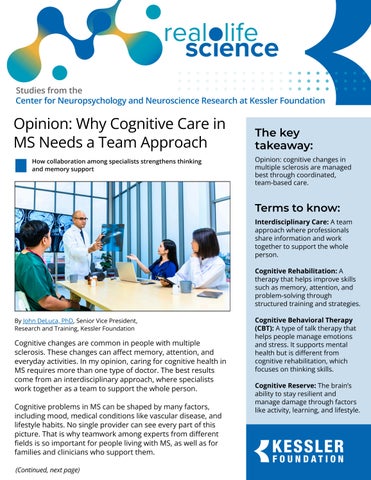
How collaboration among specialists strengthens thinking and memory support

By John DeLuca, PhD, Senior Vice President, Research and Training, Kessler Foundation
Cognitive changes are common in people with multiple sclerosis. These changes can affect memory, attention, and everyday activities. In my opinion, caring for cognitive health in MS requires more than one type of doctor. The best results come from an interdisciplinary approach, where specialists work together as a team to support the whole person
Cognitive problems in MS can be shaped by many factors, including mood, medical conditions like vascular disease, and lifestyle habits. No single provider can see every part of this picture. That is why teamwork among experts from different fields is so important for people living with MS, as well as for families and clinicians who support them.
Opinion: cognitive changes in multiple sclerosis are managed best through coordinated, team-based care.
Interdisciplinary Care: A team approach where professionals share information and work together to support the whole person.
Cognitive Rehabilitation: A therapy that helps improve skills such as memory, attention, and problem-solving through structured training and strategies.
Cognitive Behavioral Therapy (CBT): A type of talk therapy that helps people manage emotions and stress. It supports mental health but is different from cognitive rehabilitation, which focuses on thinking skills.
Cognitive Reserve: The brain’s ability to stay resilient and manage damage through factors like activity, learning, and lifestyle.


(Continued from first page)
To explain further, below are several important areas that shape how we understand and treat cognitive problems in MS. These include the way care teams work together, the limits of medication, and the difference between types of therapies that are often confused.
A multidisciplinary model means specialists work in parallel, each focusing on only one area. An interdisciplinary team, however, shares information, coordinates care and looks at the person as a whole. This approach provides a clearer and more complete understanding of a person’s cognitive needs
Why medication alone is not enough
Immunotherapy is important in treating MS, but it may not meaningfully improve thinking or memory problems. To support cognitive health, people need additional strategies, training, and rehabilitation.
Cognitive behavioral therapy can improve mood and emotional well-being, but it is not the same as cognitive rehabilitation. Cognitive rehabilitation focuses on skills like memory, attention, and problem-solving, and could include CBT if warranted.
Healthy lifestyle habits, such as regular physical activity, staying mentally active, and getting enough sleep, can help protect cognitive reserve, the brain’s ability to manage or delay the effects of damage
The importance of early intervention
Early assessment is essential. Sometimes cognitive changes can be subtle and easy to miss. When we start rehabilitation early, we can help build or preserve cognitive reserve and possibly slow down future decline.
and
People with MS benefit when family members, friends, nurses, and other care partners share what they notice about changes in thinking or memory Their observations add valuable information that professionals may not see in the clinic
Looking ahead at a teambased future
The field is moving toward a model where neurologists work as part of a larger interdisciplinary team. I believe this shift will improve how cognitive decline is identified, treated, and supported over time. Combining lifestyle strategies, cognitive rehabilitation, and input from their community may help people with MS maintain better cognitive function and independence
Learn more
Visit our Join a Study webpage for information on how to participate in Kessler Foundation MS research.
This Real-Life Science summary is part of our series that translates peer-reviewed research into practical, real-world understanding.
To read the full study, scan the QR code below or visit:
doi:10.1177/1352 4585251315357.