stones
Centers for Neuropsychology and Neuroscience Research and Multiple Sclerosis Research at Kessler Foundation

Centers for Neuropsychology and Neuroscience Research and Multiple Sclerosis Research at Kessler Foundation
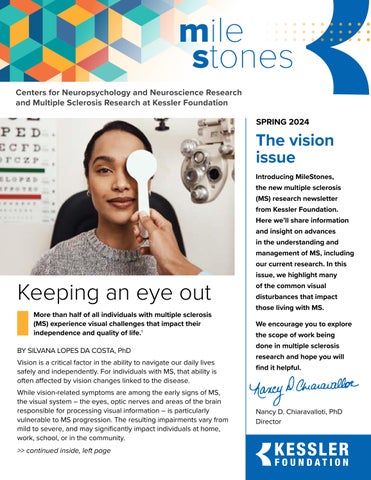
More than half of all individuals with multiple sclerosis (MS) experience visual challenges that impact their independence and quality of life.1
BY SILVANA LOPES DA COSTA, PhD
Vision is a critical factor in the ability to navigate our daily lives safely and independently. For individuals with MS, that ability is often affected by vision changes linked to the disease.
While vision-related symptoms are among the early signs of MS, the visual system – the eyes, optic nerves and areas of the brain responsible for processing visual information – is particularly vulnerable to MS progression. The resulting impairments vary from mild to severe, and may significantly impact individuals at home, work, school, or in the community.
>> continued inside, left page
Introducing MileStones, the new multiple sclerosis (MS) research newsletter from Kessler Foundation. Here we’ll share information and insight on advances in the understanding and management of MS, including our current research. In this issue, we highlight many of the common visual disturbances that impact those living with MS. We encourage you to explore the scope of work being done in multiple sclerosis research and hope you will find it helpful.
Nancy D. Chiaravalloti, PhD Director
<< continued from front cover
Among the most common visual difficulties associated with MS are:
■ Optic neuritis, an inflammation of the optic nerve, may lead to pain, blurry vision, and, in some cases, temporary or permanent vision loss. One of the most common visual deficits, optic neuritis often affects one eye at a time and may be an early symptom of MS.
■ Diplopia, or double vision, results from damage to the nerves that control eye movements and/or eye coordination. Individuals may see double images, making it difficult to accurately perceive their environment or perform everyday tasks such as driving or reading.
■ Nystagmus is the term for involuntary, uncontrolled eye movements often associated with MS progression. These abnormal movements make it difficult to focus and may contribute to other visual disturbances.
■ Reduced contrast sensitivity causes some individuals with MS to have difficulty
distinguishing between objects with similar colors or shades. This can affect the ability to recognize faces or read.
■ Visual field defects may develop from damage to the optic nerve and other parts of the visual pathway. As a result, individuals may experience blind spots or areas of reduced vision in the field of view.
Studies have shown that 90 percent of individuals with MS experience at least one visual issue and more than half report having at least five visual issues over the course of the disease.1
Whether a singular episode or multiple events, visual challenges can be daunting –physically, psychologically, emotionally, and socially.
As with most complex medical issues, managing visual impairments in MS is best served with a multidisciplinary clinical approach.
1van der Feen FE, de Haan GA, van der Lijn I, et al. (2022) Recognizing visual complaints in people with multiple sclerosis: Prevalence, nature and associations with key characteristics of MS. Multiple Sclerosis and Related Disorders. 2022; Volume 57. 103429, ISSN 2211-0348.
Routine screenings for visual problems are critical in helping manage MS and maintain quality of life. In addition:
Medical interventions, such as corticosteroids to reduce inflammation in optic neuritis, may be prescribed. Diseasemodifying therapies to control the underlying MS and prevent future complications may also be introduced.
Vision rehabilitation, including visual therapy, can help maximize remaining vision and provide strategies to cope with visual challenges
Psychosocial support, including counseling and support groups, can help individuals deal with the emotional impact and lifestyle changes of visual impairment.
Follow the science, as research is leading to new avenues of MS treatment.
Our studies investigate changes after MS diagnosis, and ways to minimize deficits prior to or following their onset. To learn more, go to bit.ly/43bXR9B or scan the code >>
Findings highlight the need to evaluate both objective measures and the impact of cognitive and emotional health on self-reported visual issues in MS.
Looking at nearby objects, such as a book or smartphone, our eyes rotate inward, allowing us to see a single, focused image. This binocular, neuromuscular ability is called convergence. Because MS often affects the nerves that control eye muscles, individuals may develop an inability to coordinate eye movement, causing blurry or double vision, headaches and dizziness – all symptoms of convergence insufficiency
This issue has not been widely investigated. A 2022 paper by Gil-Casas1 noted differences in individuals’ objective and subjective (self-reported) experience of this visual disturbance. Building on this, Kessler Foundation researchers examined the relationship between objective and

subjective reports and cognitive and emotional symptoms in individuals with MS.
According to investigator Silvana Lopes Da Costa, PhD, findings2 were consistent with past research. Individuals with MS subjectively report higher levels of convergence insufficiency in comparison to those without MS. However, there were no differences between the two groups on objective measures of convergence ability. “As hypothesized, we found that higher self-reported symptomatology was associated with poorer cognitive abilities, and higher levels of self-reported depression, anxiety, and fatigue,” explains Dr. Costa. “In contrast, there was no association between objective measures of convergence ability and
Normal convergence

Convergence insufficiency
these factors.” These findings highlight the importance of evaluating objective measures of visual disturbances as well as the effect of other factors on subjective reporting to accurately define visual disturbances.
More specifically, to further understand convergence insufficiency and develop appropriate treatment protocols, future studies should examine the impact of cognitive abilities and emotional status on self-reported measures of visual function among individuals with MS.
1Gil-Casas A, Piñero DP, Molina-Martin A. Are near visual signs and symptoms in multiple sclerosis compatible with convergence insufficiency? Clinical and Experimental Optometry. 2022 Aug; 105(6):631-636
2Maloku D, Armknecht C, Tong T, Costa, SL (in press). Convergence Insufficiency and cognitive abilities in multiple sclerosis: A pilot study.
Silvana Lopes Da Costa, PhD, is a Kessler Foundation research scientist and director of the Neuropsychology of Eye Movements Laboratory. Her research focuses on cognitive assessment and training, including the use of innovative eye tracker technologies, in MS, traumatic spinal cord injury, and aging populations. Widely recognized for her work, Dr. Costa has secured more than $2 million in funding over the past decade.
Kessler Foundation is currently recruiting individuals with MS for the following research studies. For more information, contact Nancy Moore at NBMoore@KesslerFoundation.org
This study examines memory issues common in MS. The first step is a 30-minute screening with our data collectors. Individuals with MS ages 18-79 may participate.
This study is a six-week, virtual, group intervention that uses cognitive, behavioral, and positive psychology principles to improve individuals’ confidence and ability to live well with MS. Open to individuals with MS age 18 or older who are not in any concurrent formal clinical group or psychotherapy, or experiencing any significant depression.
This study compares the ability of two different types of walking exercise – over ground and treadmill – to improve brain health in individuals with MS. Participation involves three
in-person visits to Kessler Foundation over a three-week period. Open to individuals ages 18-65 who are able to walk without an assistive device, such as a cane or walker.
This study compares the effects of two different 12-week exercise programs – aerobic and stretching/muscle toning –combined with cognitive rehabilitation on learning and memory. Open to individuals ages 18-70 who have mobility challenges (i.e., use a cane or walker).
This study explores how cycling combined with different types of virtual reality can help individuals improve the speed at which they think. Open to Individuals ages 18-65 who have mobility challenges (i.e., use a cane or walker).
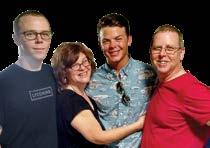
“Early in my 20-year journey with MS, my declining cognition and overall wellness led to some very dark days. However, becoming a research participant at Kessler Foundation, and then an advisory board member and peer facilitator, brought me to a happier, healthier place. These roles enabled me to examine my own challenges, strengths, and limitations, explore new ways of thinking and doing, and learn from others living with MS. I am grateful for the opportunity to learn, grow, and contribute as part of this supportive community.”
-Tammy Quasius, above, with her family