
Center for Autism Research at Kessler Foundation

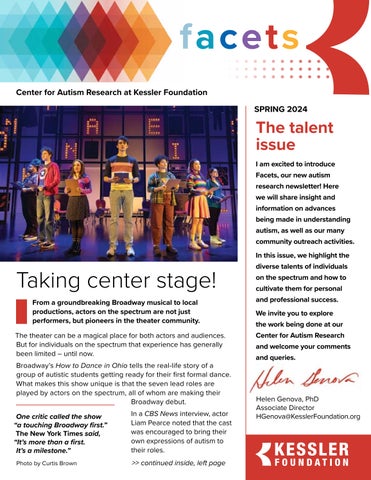
From a groundbreaking Broadway musical to local productions, actors on the spectrum are not just performers, but pioneers in the theater community.
The theater can be a magical place for both actors and audiences. But for individuals on the spectrum that experience has generally been limited – until now.
Broadway’s How to Dance in Ohio tells the real-life story of a group of autistic students getting ready for their first formal dance. What makes this show unique is that the seven lead roles are played by actors on the spectrum, all of whom are making their Broadway debut.
One critic called the show “a touching Broadway first.” The New York Times said, “It’s more than a first. It’s a milestone.”
Photo by Curtis Brown
In a CBS News interview, actor Liam Pearce noted that the cast was encouraged to bring their own expressions of autism to their roles.
>> continued inside, left page
I am excited to introduce Facets, our new autism research newsletter! Here we will share insight and information on advances being made in understanding autism, as well as our many community outreach activities. In this issue, we highlight the diverse talents of individuals on the spectrum and how to cultivate them for personal and professional success. We invite you to explore the work being done at our Center for Autism Research and welcome your comments and queries.

Helen Genova, PhD Associate Director HGenova@KesslerFoundation.org
<< continued from front cover
“[We were told] if you feel the need to let out your energy or show your excitement in your own, individual, physical ways you do outside the theater, feel free,” Liam commented. That sense of freedom not only strengthened the cast’s performances but also sent an important message: The stage is now set for other individuals on the spectrum to achieve their dreams.
And as one theater critic said, this marks a “new vision … for a more accepting, accessible, and autism-friendly Broadway.”
The Center for Autism Research at Kessler Foundation has long celebrated the unique and diverse talents of individuals on the spectrum. We are privileged to work with many local organizations that share this mission, including the Newmark School in Scotch Plains, NJ.
Jennifer L. Pacht-Goodman, Newmark’s music therapist, explains, “Singing, dancing, acting, playing an instrument, or other creative arts can help open the door to greater selfexpression and confidence.”

Singing, dancing, acting, playing an instrument, and other creative arts, can lead to greater confidence and self-expression.
She adds that her autistic students have “developed their courage and found their voices.” Their success goes beyond the Newmark walls.
One current student was recently nominated by the New Jersey Association of Community Theaters as the “outstanding youth actor in a play,” and a recent graduate has performed with entertainers Katy Perry and Weird Al Yankovic.
Even more than being an outlet for creative talents, the theater–like a team or club – offers individuals on the spectrum sense of community, a sense of belonging, and a sense that what they say or do warrants our applause.
Every child has talent. Be creative in supporting them!
1
Try different activities. Give your child the time, encouragement, and resources to connect with a new interest, hobby, or skill.
2
Check out local classes or clubs. This provides an opportunity for your child to increase their knowledge and engage with peers.
3
Use their interests to work on other skills. If they love drawing, introduce books about famous artists to increase reading skills. If they collect action figures, have them compose a short story about the characters to enhance writing skills. If they enjoy games, invite a friend to play to reinforce social skills.
Our studies investigate changes after MS diagnosis, and ways to minimize deficits prior to or following their onset. Scan code to learn about our pioneering research >>
Our research develops interventions focusing on the critical adolescence-to-adult transition. Go to KesslerFoundation.org/autism-research or scan to learn more >>
Interviewing for a job is similar to auditioning for a role. Both require you to reveal your talents and connect with your audience. Our research shows you how.
A job interview can feel a bit like a performance. You need to figure out how to remember your lines, deliver them with confidence, and impress an employer. Studies indicate that individuals on the spectrum may have difficulty on an interview not because they lack job skills, but because they are unsure what to say and how to express their strengths and weaknesses. New research offers important tips on how to prepare for an interview and hopefully get the job you want.
■ Be positive. At Kessler Foundation’s Center for Autism Research, “positivity” guides us in helping to identify and celebrate each individual’s traits. As you prepare for an interview, write down a list of all your talents, skills, and

positive attributes and then think about how to convey them to an interviewer. After all, employers want to know why they should hire you –and being able to tell them about your strengths is a great start!
■ Rehearse. Rehearse. Rehearse. Research shows that practice significantly improves an individual’s interview skills. A study by Kessler Foundation showed that youth on the spectrum who practiced job interviews through an innovative, virtual reality program dramatically enhanced their ability to talk about themselves. Further research notes that this technique increases the likelihood of becoming employed.

■ Start training. Specialized training programs are among the resources available to help you perform your best on job interviews.
For more information on our strengths-focused program, email AutismResearch@ KesslerFoundation.org
For a personal perspective on participating, turn the page >>
This renowned stage in Millburn, NJ, has offered autism-friendly performances for more than a decade, helping to make live theater accessible for more than 30,000 children and their families. Shows are presented in a comfortable, judgment-free environment that allows attendees to move about as needed and enjoy other accommodations. This innovative program also provides extensive resources to help create a positive and engaging theater experience for all. Learn more at papermill.org
Research helps scientists gain greater insight and understanding of autism. But for study participants, it can lead to self-discovery. Here’s a personal perspective.
When Will Kendis signed up to participate in a study at Kessler Foundation’s Center for Autism Research, he thought he was just helping out in a scientific way. His involvement, however, benefited him more personally as he gained a stronger understanding of himself.
Will, now 19 years old, took part in a study evaluating the effectiveness of Kessler Foundation Strength Identification and Expression (KF-STRIDE®), a tool to help teenagers and young adults on the spectrum identify their strengths and learn to talk about them on job interviews. As part of the study, Will took an online survey to identify his top strengths.
“It was really cool … I learned that creativity is one my top strengths,” says Will. “I hadn’t realized that but now I think about this and my other strengths in ways I hadn’t before.
“I also began to think about how I would use them when looking for a job and in the workplace.”
Will’s mother Lori believes this opportunity gave him the confidence to land his first real job, saying “He walked away from this research experience with greater selfassurance. It’s been really gratifying to see him get out into the community, knowing how much he has to offer.”
Research participant
Will Kendis, shown with Dr. Helen Genova, learned that his creativity is a top strength, and how to use it in the workplace.

The scientists at Kessler Foundation’s Center for Autism Research are exploring new tools, techniques, and strategies to help individuals on the spectrum improve their communication, behavioral, and social functioning skills.
Participating in our studies is easy! Most are conducted online and may include, for example, meeting with a staff member via Zoom, completing a survey, or taking part in skills training related to finding and keeping a job.
Individuals are compensated for their participation.
For more information, scan the code to email the Center for Autism Research. (AutismResearch@ KesslerFoundation.org)