SEPTEMBER 2025
with Kentucky Explorer
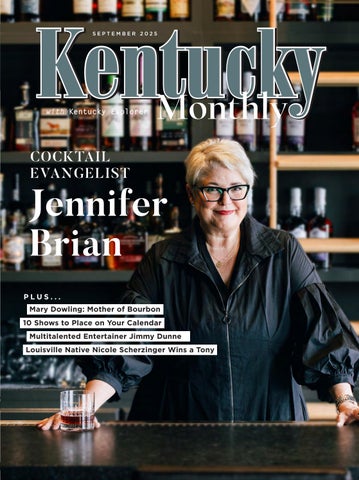
COCKTAIL EVANGELIST
Jennifer Brian PLUS... Mary Dowling: Mother of Bourbon 10 Shows to Place on Your Calendar Multitalented Entertainer Jimmy Dunne Louisville Native Nicole Scherzinger Wins a Tony
O N T H E C OV E R Author, entrepreneur and mixologist extraordinaire Jennifer Brian. Photo by Jessie Kriech Higdon.
in this issue
SEPTEMBER
16 Courtesy Mary Dowling Whiskey Company
D E PA R T M E N T S 2 Kentucky Kwiz 3 Readers Write 4 Mag on the Move 8 Healthcare Q&A 10 Music 12 Cooking 43 Kentucky Explorer 54 Off the Shelf 56 Past Tense/ Present Tense 58 Field Notes 60 Gardening 62 Calendar 64 Vested Interest
F E AT U R E D 16 Mother of Bourbon In the early 1900s, Mary Dowling’s determination and ingenuity enabled her to overcome discrimination and misfortune 26 Cocktail Evangelist Jennifer Brian aims to bring the craft of creating elegant drinks to the home mixologist 32 Ready for Her Close-Up Nicole Scherzinger, who grew up in Louisville, wins a Tony Award for her role as Norma Desmond in the Broadway musical Sunset Boulevard
36 A Double Thumbs-Up Jimmy Dunne’s Kentucky alma mater will honor him for his achievements in the arts, but he’s also a pillar of his Pacific Palisades community
41 The Shows Go On From Paducah to Pikeville, venues across the state are gearing up for the 2025-2026 season of Broadway-style shows, concerts, plays, dance and all-around entertainment. Here, we present a sampling.
12
k e n t u c k y m o n t h l y. c o m 1
kentucky kwiz Test your knowledge of our beloved Commonwealth. To find out how you fared, see page 5.
1. Pennsyltucky is the nickname for the Appalachian area of Pennsylvania and the name of a fictional battleship in which 1940s cartoon?
A. Less than a mile
A. Gil Thorpe
7. Which of George Washington’s officers owned a Hopkins County salt spring?
B. Beetle Bailey C. Popeye
A. Indiana B. West Virginia C. Nebraska 3. The Virginia region known as “Old Bourbon” accounted for how many of Kentucky’s 120 counties? A. 16
VOLUME TWENTY-EIGHT, ISSUE 7,
B. 178 miles
SEPTEMBER 2025
C. 220 miles
Stephen M. Vest Publisher + Editor-in-Chief
A. Alexander Hamilton
2. Pennsyltucky Blue Label Straight Bourbon Whiskey, produced in Harrisburg, Pennsylvania, is blended from whiskey from Kentucky and which other state?
© 2025, VESTED INTEREST PUBLICATIONS
B. Major Gen. Philip Schuyler C. Baron Von Steuben
8. At least five Kentucky nightclubs, including Hopkinsville’s Skylark and Chesterfield, were included on the Black version of New York’s Borscht Belt. The “circuit” was named after which soul-food staple? A. Chitlins B. Ham hocks C. Okra
EDITORIAL Patricia Ranft Associate Editor Rebecca Redding Creative Director Deborah Kohl Kremer Assistant Editor Ted Sloan Contributing Editor Cait A. Smith Copy Editor
SENIOR KENTRIBUTORS Jackie Hollenkamp Bentley, Jack Brammer, Bill Ellis, Steve Flairty, Gary Garth, Jessie Hendrix-Inman, Mick Jeffries, Kim Kobersmith, Brigitte Prather, Walt Reichert, Tracey Teo, Janine Washle and Gary P. West
BUSINESS AND CIRCULATION Barbara Kay Vest Business Manager Katherine King Circulation Assistant
ADVERTISING Lindsey Collins Senior Account Executive and Coordinator Kelley Burchell Account Executive Kristina Dahl Account Executive Hal Moss Account Executive
B. 34
4. Which bourbon has been continuously on the market longer than any other?
9. Susan Shelby Magoffin, Isaac Shelby’s granddaughter, is believed to be the first “American lady” to have traveled which trail south from Independence, Missouri?
A. Old Granddad
A. The Oregon Trail
B. Old Forester
B. The Santa Fe Trail
C. Pappy Van Winkle
C. The Carson Trail
C. 50
Laura Ray Account Executive Teresa Revlett Account Executive For advertising information, call 888.329.0053 or 502.227.0053 KENTUCKY MONTHLY (ISSN 1542-0507) is published 10 times per year (monthly with combined December/ January and June/July issues) for $25 per year by Vested Interest Publications, Inc., 100 Consumer Lane, Frankfort, KY 40601. Periodicals Postage Paid at Frankfort, KY and at additional mailing offices.
POSTMASTER: Send address changes to KENTUCKY MONTHLY, P.O. Box 559, Frankfort, KY 40602-0559. Vested Interest Publications: Stephen M. Vest, president; Patricia Ranft, vice president; Barbara Kay Vest, secretary/treasurer. Board of
5. Kuttawa, originally Cuttawa, was the name of a village of which Native American tribe?
directors: James W. Adams Jr., Dr. Gene Burch,
B. Chickasaw
10. Newport-born Josephine Kirby Henry (1846-1928), who moved to Versailles when she was 15, was the first Kentucky woman to do what?
C. Choctaw
A. Drive an automobile
A. Cherokee
Gregory N. Carnes, Barbara and Pete Chiericozzi, Kellee Dicks, Maj. Jack E. Dixon, Mary and Michael Embry, Judy M. Harris, Jan and John Higginbotham, Frank Martin, Bill Noel, Walter B. Norris, Kasia Pater, Dr. Mary Jo Ratliff, Randy and Rebecca Sandell, Kendall Carr Shelton and Ted M. Sloan. Kentucky Monthly invites queries but accepts no responsibility for unsolicited material; submissions will not be returned.
B. Buy property 6. South Carrollton is how far from Carrollton? 2
K E N T U C K Y M O N T H LY
SEPTEMBER 2025
C. Campaign publicly for statewide office
K E N T U C K Y M O N T H L Y. C O M
Counties mentioned in this issue...
Readers Write ‘The Body’ Regarding Bill Ellis’ column on Kentucky-born actors and actresses (June/ July issue, page 56), Marie “The Body” McDonald was born Cora Marie Frye in Burgin (Mercer County) on July 6, 1923. She appeared in a number of movies, including Getting Gertie’s Garter and the 1950 version of Once a Thief, among others. McDonald probably became best known for an alleged kidnapping incident. On Jan. 4, 1957, she disappeared from her home in Encino, California, and was found 24 hours later 100 miles away wandering in the desert. A lengthy investigation
Marie “The Body” McDonald
followed that included the FBI. My father, Robert Clark Stone, was one of the FBI agents investigating the case. After finding evidence that it was a false kidnapping report, the investigation ended. McDonald died on Oct. 21, 1965. Our family moved to Kentucky in 1958, and my father, after his retirement from the FBI, became the commissioner of the Bureau of Training in Kentucky’s Department of Justice. Bill Stone, Louisville
Happy Camper I read with great interest the Gary Garth article in the March issue about the KDFWR Conservation Camps (page 60). Camp John Currie was especially important in my life, as I worked there the summers of 1978-79 as one of the conservation education supervisors. It was my first full-time job after
graduating from Eastern Kentucky University in 1977. It was a great job and a joy to work with the children of the 4th District. I taught swimming at Currie and was thrilled to see my own children, Monica and Jeremy, get to attend there during their elementary school years. Monica got the Outdoorsman Award both years she attended! My wife, Donna, volunteered as a counselor both summers I was there, and Monica worked one summer while at Murray State University as a paid counselor. Those were great memories, and I certainly can recommend to anyone who has a family member in the 4th-6th grades to sign up their child/ grandchild for camp next summer. It’s a great value, especially considering all the activities offered. Syd Tate, Madisonville
We Love to Hear from You! Kentucky Monthly welcomes letters from all readers. Email us your comments at editor@kentuckymonthly.com, send a letter through our website at kentuckymonthly.com, or message us on Facebook. Letters may be edited for clarification and brevity.
The Kentucky Gift Guide Kentucky Monthly’s annual gift guide highlights some of the finest handcrafted gifts and treats our Commonwealth has to offer.
Drink Local This handy guide to sipping in the Bluegrass State spotlights local breweries, wineries and, of course, distilleries. Discover unique ways to drink in Kentucky, creative cocktail recipes and more.
Follow us @kymonthly Find more at kentuckymonthly.com. Use your phone to scan this QR code and visit our website.
UNITING KENTUCKIANS EVERYWHERE. k e n t u c k y m o n t h l y. c o m 3
Even when you’re far away, you can take the spirit of your Kentucky home with you. And when you do, we want to see it!
travel
M AG O N T H E M OV E florida The Revlett family of Georgetown ventured to the most magical place on earth—Walt Disney World—for a fun-filled visit. From left are Kentucky Monthly Account Executive Teresa; her husband, Sam; their son and daughter-in-law, Campbell and Megan; and grandchildren Coleman and Annabelle.
jamaica Paul and Annie Calico of Cincinnati traveled to Jamaica, where they stayed at the Sandals Ochi Rios resort in Ocho Rios.
italy The Fielders of Nicholasville visited The Eternal City of Rome. From left are Nathan Fielder, Nicole Fielder, Mark Fielder, Jill Denham Fielder, Phillip Massie and Anita Denham Kintisch.
4
K E N T U C K Y M O N T H LY
SEPTEMBER 2025
mexico Walton residents Denise and Randy Lawrence celebrated their 45th wedding anniversary in sunny Cabo San Lucas, Mexico.
K W I Z A N S W E R : 1. C. The pejorative nickname appears in an episode titled “Baby Wants a Battleship”; 2. A. Two 84-proof Hoosier Bourbons are used; 3. B. Bourbon County predates Kentucky by nearly seven years;
These and more coming to Madisonville, Kentucky! Season starts 9/18/25. See complete lineup at GlemaCenter.org.
4. B. George Garvin Brown began marketing his bourbon, the first sold in sealed bottles, in 1870; 5. A. Although near the Chickasaw lands acquired by Andrew Jackson and Isaac Shelby, the Lyon County town supposedly was controlled by the Cherokee; 6. B. Farm,” the Muhlenburg County town was renamed in honor of farmer Randolph’s son, Carroll, in 1838; 7. C. Von Steuben, a Prussian who trained Washington’s army, “quit-claimed” the land but returned to
Photo: Lukas Beck
Originally founded as “Randolph Old
New York after being wounded in an attack by Native Americans; 8. A. The Chitlin Circuit peaked in the 1940s; 9. B. The Santa Fe Trail was through disputed lands, especially in the 1840s, when Susan took the trip; 10. C. A member of the Prohibition Party, she ran for clerk of the Kentucky Court of Appeals in 1890 and 1894.
k e n t u c k y m o n t h l y. c o m 5
travel italy Emilie Schalk Heesen, originally from Owensboro, traveled on a Jubilee Year Pilgrimage with the Diocese of Allentown, Pennsylvania, to Florence, Assisi and Rome, Italy. She now lives in Bethlehem, Pennsylvania, with her husband, Pete. Both are proud members of the Honorable Order of Kentucky Colonels. Kentucky Monthly helps keep Emilie’s Kentucky home close to her heart. She is pictured here in front of Rome’s Trevi Fountain.
Grant County Tourism presents . . .
A COUNTRY CHRISTMAS
Sat., Dec. 6 4:30 - 8:30 p.m. Downtown Williamstown, Ky. visitgrantky.com Festivities include:
SPONSORED BY:
• Free Pancake supper with Santa • Ferris Wheel • Carousel • Games • Journey Through Bethlehem (live nativity) • Frosty’s Fun Run/Walk • Parade • Vendors/Merchant Open Houses • Magic Show • Live Music • Tree lighting ceremony • Wagon Rides • Contests: Ugly Christmas Sweater & Window Decorating
GTouriRstA&NConventiT CoOn Commi UNsTsiYon For event schedule, go to: www.visitgrantky.com For information, call 859-824-3322
Egypt Alexandria residents Pamela and Ricky Casebolt, center, and their daughter, Melissa McGrath, right, traveled to Egypt, along with family friend Nicole Modafari from Cincinnati. They are pictured at the newly opened Grand Egyptian Museum in Cairo.
submit your photo Take a copy of the magazine with you
800-382-7117 @GrantCoCountryChristmas
and get snapping! Send your highresolution photos (usually 1 MB or higher) to editor@kentuckymonthly. com or visit kentuckymonthly.com to submit your photo.
Greyline Station 101 W. Loudon Ave Suite 136 Lexington, KY 40508
BESPOKEN SPIRITS Exclusive Tastings Award -Winning Whiskeys
Barrel Picks
Distillery Tours Book Your Tour Today
five minutes with...
Dr. Stephen Behnke CEO of Lexington Clinic jockeys’ racing silks from some of the Bluegrass’ world-famous horse farms and even bourbon barrels used as a unique decoration in the entryway.
Question: In May 2025, Lexington Clinic opened its new state-of-theart Orthopedic and Neuroscience Center. What are the highlights of the new facility? Answer: Lexington Clinic’s Orthopedic and Neuroscience Center is a state-of-the art facility that is designed around the patient. We brought six specialties under one roof: interventional pain management, neurology, neurosurgery, orthopedics, physical medicine and rehabilitation, and physical therapy. Our OrthoGo walk-in orthopedic clinic also is in the building. We have two X-ray suites on-site, which is more convenient. Many providers’ offices are now bullpen-style to promote collaboration and enhance communication for our teams. But the building is more than just doctors’ offices. It’s intended to enhance the patient experience. Few people enjoy going to the doctor, so we designed the facility to provide a more positive experience. There are windows everywhere, allowing a significant amount of natural light. The design is open and welcoming. When you walk around this building, you’ll also see gorgeous photographs taken from all over Kentucky, showing off some of the gems of natural beauty to be found across our Commonwealth. There are several other tributes to Kentucky’s culture as well, such as 8 K E N T U C K Y M O N T H LY
SEPTEMBER 2025
Q. What led to the idea of combining the specialties of orthopedics and neuroscience in the new facility? A. The Orthopedic and Neuroscience Center was designed with deep collaboration with our physicians around the idea of integration across specialties. For example, our neurology providers often closely collaborate with our neurosurgery team, just as our orthopedics and physical therapy teams frequently work together to treat patients. Our neurology team was located at our main South Broadway location, but our neurosurgery providers were in another building down the road. Orthopedics, OrthoGo and physical therapy used to be at our former Picadome site, and interventional pain management was at South Broadway. Being spread across all these sites was inconvenient for patients and providers alike. Now, patients can go to a single location for these needs, and our providers can meet face-toface with their colleagues to ensure better patient outcomes. This is especially helpful for patients who live farther away and drive to Lexington for care.
Q. A key feature of the center is the role of nurse navigators. Can you explain their role in the patient process?
A. Our nurse navigators are key to the Orthopedic and Neuroscience Center. They follow up with patients after visits as well as to coordinate appointments and procedures for them across the specialties in the building. For example, if a patient comes in to see orthopedics for an issue in the shoulder, but it turns out to stem from a problem in the neck, the nurse navigator can quickly refer the patient to a neurosurgery provider. The nurse navigators streamline the process and reduce the amount of time it takes for our patients to get the care they need.
Q. Have you received feedback from patients about their ease of care now? A. We have, in fact. I receive almost daily compliments from patients about the flow of the new building. Recently, a close colleague came to me and mentioned that the speed and connection of his care was unlike any other care he’d received previously from other local health care systems. He complimented us on the power of this new model. It makes us really proud of what this building has accomplished in a short period of time.
Q. What’s next for Lexington Clinic? Tell us where you see Lexington Clinic in the next five to 10 years. A. It’s important to remember Lexington Clinic isn’t only in Lexington. We have dozens of locations across Kentucky—from
Cynthiana, Frankfort and Georgetown to Mount Sterling, Nicholasville, Richmond and Versailles. Our focus is to give patients all over Kentucky the highquality care they need, expect and deserve. That said, we are working on plans to expand to bring our trusted care to more people. We do this by attracting some of the best providers in the country to Lexington Clinic.
Q. What do you like to do for relaxation? Or describe your perfect day. A. My perfect day would be to wake up and solve complex patient flow problems, followed by dinner with my family and spending some time enjoying the outdoors.
Q. If you could invite three guests for dinner, past or present, who would they be? A. It’s impossible for me to choose only three guests, because I have so many questions for all of them. However, it’d be really fun to invite three specific physicians and processdesign leaders from the past to see what’s happening at Lexington Clinic and talk about what’s possible for patients through health care. One of those would be Dr. Henry Plummer from Mayo Clinic, who revolutionized medical charting. He created a system to keep track of patients’ records under a single, efficient chart that could be sent across the clinic through a pneumatic tube system, which greatly improved patient outcomes. Another would be Shigeo Shingo from Toyota. He designed the
Toyota Production System, which streamlined production, cut down on waste, and improved consistency across the manufacturing process. I also have to pick Steve Jobs from Apple. Most people know Steve Jobs’ name. Founder of Apple, creator of too many innovations to list, including the iPhone and Macintosh computer. He’s also listed as an inventor on more than 300 patents. These three probably would not be a lot of fun to hang out with, but it’d make for a fascinating conversation.
Periodically, we pose questions to a prominent Kentucky business leader and publish them along with the responses.
Got Business News to Share? Contact Business Editor Hal Moss at hal@ kentuckymonthly.com with press releases or business news.
LIVE MUSIC • SCULPTURES FOOD TRUCKS • MUSICLAB AND MORE LEARN MORE AND GET TICKETS AT
JOSEPHINESCULPTUREPARK.ORG
AN IMMERSIVE EVENING OF MUSIC, ART, & NATURE 4-8PM
ke n t u c k y m o n t h l y. c o m
9
music B Y L AU R A YO U N K I N
Sister Act
S
ometimes one moment can change the trajectory of a musician’s professional life. For Kenzie Crowe of the band Girl Tones, it happened when she was around 16. “My dad introduced me to the White Stripes, and that was about it. I started playing guitar and writing my own songs,” she said. Girl Tones is made up of sisters Kenzie and Laila Crowe from Scottsville in Allen County. Growing up near Bowling Green they were inspire by Cage the Elephant, an influential alternative rock band also from that city. Once they started Girl Tones, the band played around town and became well-known regionally. “Basically, we were playing around Kentucky, playing lots of DIY shows and house parties,” Kenzie said. They also played at Tidball’s, a music venue in Bowling Green. David Fricke of Rolling Stone has referred to Tidball’s as “the CBGB of the South.” “[We] started very small, and we just kept at it, and we’ve ended up where we are,” Kenzie said. Brad Schultz, rhythm guitarist and a founding member of Cage the Elephant, followed Girl Tones on social media and reached out to the sisters about working together. He produced their debut releases on his label, Parallel Vision, in partnership with Big Loud Rock. This fall, Girl Tones will open for Silversun Pickups and Cage the Elephant in shows across the country. Girl Tones also will play at iconic festivals Shaky Knees and Austin City Limits. It might look like the band has hit
10 K E NT U C K Y M O NT HLY SEPTEMBER 2025
Laila, left, and Kenzie Crowe
it big quickly, but Kenzie said that isn’t the case. “We’ve been recording since 2022,” she explained. “Laila and I have played together for 10 years.” They’ve been a band for 10 years, but they’ve played music together much of their lives. “Kenzie and I were both put into classical music lessons when we started out. I started at piano when I was 5½. Kenzie was 8 and played cello,” Laila said. She said as they got older, Kenzie picked up guitar, and she started playing drums. Growing up, there was always music in the house. Their parents are music lovers. “[Our mom] did band in high school,” Laila said. “Dad was a drummer.” In their early years, the sisters listened to their mother playing Alanis Morissette and Red Hot Chili Peppers. Their father liked rock, and both parents played R&B and Ray Charles. “That helps us with our creativity. We had all kinds of influences to draw on,” Laila said. The sisters described their sound as 1990s-influenced alternative rock. “We have synthesizer and some piano
touches. But the roots of it are guitar and drums,” Laila said. Both women write songs, and it’s a collaborative endeavor. Ideas and bits of melody are brought to the practice room and then fleshed out to create complete songs. “You never know how or when [they’re] going to come to you,” Kenzie said of her song inspirations. “I draw from interpersonal relationships, and overall, I guess you could just say life in general—grieving and things like that, natural human emotions.” Girl Tones’ visual style is as distinctive as its sound, from costumes to sets to videos. That’s intentional. “The aesthetic is important to us. We have a specific vision,” Kenzie said. “We were having a bit of a challenge about how to make some kind of statement that can be recognized. Simple. We landed on primary colors. It really took off for us.” Although young—Kenzie is 26, and Laila is 21—they’ve already seen much of the world, touring in the United Kingdom, Germany, The Netherlands, France and all across the States. While they appreciate seeing the world, they plan to keep Scottsville as their home base. “Nashville is close to the work we’re doing, but Kentucky is this magical place. It’s home s,” Laila said. They plan to continue their careers in Girl Tones “We just want to take it as far as it can go,” Kenzie said. “Every step of the way we look at where we are, and we’re so grateful for where we are … We want to keep on pushing.”
k e n t u c k y m o n t h l y. c o m 11
cooking
12
Healthy and Flavorful
K E N T U C K Y M O N T H LY S E P T E M B E R 2 0 2 5
Not all delicious foods are decadent. This month’s recipes from Louisville-area restaurants present vitamin- and nutrient-rich foods such as beets, salmon and avocados in delightful and delectable dishes.
Mesclun Salad Mesclun greens (young salad mix) Champagne vinaigrette (recipe follows) Seasonal stone fruit (peaches, nectarines and/or plums), sliced Goat cheese, crumbled Candied hazelnuts (recipe follows) Sea salt, optional 1. In a large bowl, toss mesclun greens with champagne vinaigrette to lightly coat. 2. Plate the greens and top with sliced stone fruit, crumbled goat cheese
and candied hazelnuts. Finish with a drizzle of vinaigrette and a pinch of sea salt, if desired.
until fully emulsified. Season with salt and white pepper to taste.
CA N D I E D H A Z E L N U T S C H A M PAG N E V I N A I G R E T T E 2 tablespoons Champagne vinegar
Hazelnuts Simple syrup
1 teaspoon minced shallot 1 teaspoon sorghum ¼ cup olive oil Salt and white pepper, to taste In a small bowl, whisk together Champagne vinegar, minced shallot and sorghum. Slowly whisk in olive oil
1. In a small saucepan over low heat, combine hazelnuts with enough simple syrup to coat. 2. Cook gently, stirring constantly, until the nuts soften slightly and become glossy and sticky. 3. Remove from heat and spread on parchment paper to cool and crisp.
Recipe courtesy of Oscar Bello, executive chef, Barn8 Restaurant & Bourbon Bar, Goshen Photo courtesy of Ryan Mahony/Hermitage Farm hermitagefarm.com
k e n t u c k y m o n t h l y. c o m 13
cooking
Lobster Scampi Bucatini
Beet and Salmon Salad
Olive oil for sautéing 2 tablespoons minced 3 ounces roasted beets, wedges (recipe follows) 2 tablespoons juniper berry vinaigrette (recipe follows) 2 ounces cured salmon, thinly sliced (recipe follows) Salt and pepper to taste 8 orange segments 2 tablespoons shaved fennel 6 rye croutons 1. In a mixing bowl, combine the beets and the vinaigrette. Season with salt and pepper. 2. Neatly arrange the beets on a plate. Curl the thinly sliced salmon and place neatly on the plate. Add the orange slices and fennel. 3. Spoon some of the juniper berry vinaigrette on the plate. Garnish with croutons.
R OA S T E D B E E T S 5 beets, washed Place beets in a steamer basket and steam at 212 degrees for 1 hour. Remove and allow to cool. Peel and cut into wedges.
14
CURED SALMON ½ cup juniper berries, toasted 1¾ cup salt 1¼ cup sugar 1 side of salmon, clean, skin on 2 tablespoons gin
garlic ¼ cup white wine 6 ounces bucatini pasta, partially cooked 3 ounces poached lobster 2 tablespoons herb butter (recipe follows)
and toss, keeping the emulsion. 4. Make two passes over a block of Parmigiano Reggiano with a cheese grater, add to dish, and toss. 5. Plate with pasta tongs, keeping a tight nest. Garnish with blistered cherry tomatoes, lemon oil, lemon zest and basil.
Parmigiano Reggiano, 1. Mix together juniper berries, salt and sugar in a mixing bowl. Cover the bottom of a large baking dish with half the mixture. 2. Add the side of salmon, and then cover the salmon with the rest of the mixture. Refrigerate for five days. 3. Flip over the salmon on day three and add the gin to the bottom of the baking dish.
JUNIPER VINAIGRETTE ¾ cup citrus vinaigrette 1 tablespoon juniper berries, toasted Combine citrus vinaigrette and juniper berries in a mixing bowl. Place in a clean container with a lid and refrigerate until use.
K E N T U C K Y M O N T H LY S E P T E M B E R 2 0 2 5
grated 5 blistered cherry tomatoes Lemon oil Lemon zest 1 pinch basil, chiffonade 1. Add olive oil to a large pan, sauté garlic and deglaze with white wine. 2. Add poached lobster and partially cooked bucatini. Add 1 ounce of pasta water and bring to a boil. 3. Top with cold herb butter
H E R B BU T T E R (makes a large batch) ½ cup tarragon, chopped ½ cup parsley, chopped ½ cup chives, chopped ½ cup rosemary, chopped ½ cup garlic confit, chopped 5 pounds butter Add all ingredients to a mixer and mix to combine. Place in an airtight container and refrigerate.
Recipes and photos courtesy of High Stakes Rooftop Grill, Louisville highstakesgrill.com
Farmhouse Beet Salad
Avocado Toast 2 avocados, mashed 1 tablespoon beet sumac purée (recipe follows) Champagne herb vinaigrette (recipe follows) 1 medium roasted red beet, diced 1 medium roasted yellow beet, diced 2 cups arugula 1 tablespoon goat cheese 1 tablespoon olive oil 2 tablespoons toasted pistachios, finely grated 1. Add beet sumac purée to the bottom of a salad bowl or plate. 2. Add champagne herb vinaigrette to another bowl. Toss diced red roasted and yellow roasted beets with champagne herb vinaigrette. 3. Add half of the beet mixture to one side of the purée and half to the other side of the purée. 4. Toss arugula in champagne herb vinaigrette and place on top of beet purée. 5. Sprinkle goat cheese on top of the arugula. Drizzle olive oil on top of the beets. Lay pistachios on both sides of the arugula. Garnish with fresh marigold flowers.
B E E T S U M AC P U R É E
1 slice of wheat berry bread, toasted
2 pounds roasted beets
¼ grapefruit, supreme cut (remove
2 garlic cloves 4 tablespoons lime juice 4 tablespoons olive oil 2 teaspoons kosher salt 1 teaspoon chili powder
peel, pith and membranes from a grapefruit to isolate the segments) 2 radishes, finely sliced 1 teaspoon everything bagel seasoning
2 teaspoons sumac
1 egg, cooked to personal preference
¾ cup water
Pea tendrils, for garnish
Fresh marigold flowers, for garnish
Fresh marigold petals, for garnish
Place all ingredients in a blender. Blend until completely smooth. Store in a quart container. The shelf life is seven days.
1. Spread mashed avocado onto toasted bread. Top with sliced grapefruit, radishes and everything bagel seasoning.
C H A M PAG N E H E R B VINAIGRETTE 1 cup champagne vinegar 1 tablespoon Dijon mustard 1 tablespoon honey 1 cup torn herbs of your choice 1 teaspoon kosher salt 2 cups vegetable oil Combine all ingredients except the vegetable oil in a blender. Blend well. Slowly add oil while blending. Store in a quart container. The shelf life is five to seven days.
2. Add egg and garnish with pea tendrils and fresh marigold flower petals.
Recipes courtesy of Kris Cole, executive chef and co-owner of The House of Marigold,
Louisville Photos courtesy The House of Marigold thehouseofmarigold.com k e n t u c k y m o n t h l y. c o m 15
16
K E N T U C K Y M O N T H LY S E P T E M B E R 2 0 2 5
f o r e h t o M n o b r u Bo
In the early 1900s, Mary Dowling’s
determination and ingenuity enabled her to overcome discrimination and misfortune B Y JAC K I E H O L L E N K A M P B E N T L E Y
B
eam. Noe. Van Winkle. Samuels. Anyone with a smattering of bourbon enthusiasm knows these legendary names. But there’s a new legend emerging from the buried annals of early 20th century bourbon lore, and Kaveh Zamanian, the founder of Rabbit Hole Distillery, is making sure the whole world learns about her. Yes, her—Mary Dowling, a 2025 inductee into the Kentucky Bourbon Hall of Fame. “I came across her name a couple of different places, really more like a footnote,” Zamanian said. “I got curious after that and started digging a little bit more to understand, you know, who she was. There are not a whole lot of people talking about female distillers or distillery owners and operators … I just started learning more, and I realized that there’s more to her story.” Born to Irish Catholic immigrants John and Mary Murphy in 1859, Mary wed John Dowling in 1874, and
together, they helped build three distilleries, including Dowling Brothers Distillery and Waterfill and Frazier. When John Dowling died unexpectedly in 1903, Mary took charge, surprising many in the industry. “When she was widowed in her early 40s, she was uncommonly equipped to take the reins of the Dowling bourbon business, and in 1903, when she was widowed, women didn’t have the right to vote, and few women owned their own businesses, very few,” said Cathy Stewart Brown, Dowling’s great-great-granddaughter. “A female manager among distillers was an anomaly. She taught us gender and talent didn’t know any boundaries.” The Dowling empire thrived under Mary’s leadership, affording her opportunities for philanthropic endeavors. “She was a pillar of the community of Lawrenceburg,” Brown said. “She did so many things. When there was discrimination against Irish Catholics, she helped build her church. She championed immigrants and women’s rights and created a free hospital in Lawrenceburg. So, she k e n t u c k y m o n t h l y. c o m 17
just did wonderful things for her community while being a trailblazer in the bourbon industry.” • • •
Then came the 18th Amendment, otherwise known as Prohibition. The Dowling distilleries, like most in Kentucky, shut down. But in 1923, Mary and four of her children were charged with bootlegging. She spent the next three years fighting the charges in court, ultimately losing the battle and seeing two of her sons serve prison time. While she maintained her innocence, prosecutors were determined to bring her empire down. “We’re talking about a period where women had no rights at all, no rights to property, to vote,” Zamanian said. “But I also think the fact that she was Irish Catholic … and there was the undercurrent of prejudice. She was also a very vocal person who, I think, had the right moral compass, and she took a position on those types of issues. You blend all those things together, [and] it created a perfect storm to have people in opposition to her.” Undeterred, Mary hired a member of the Beam family to dismantle the Waterfill and Frazier Distillery and defiantly rebuilt it in Juarez, Mexico, under the name D&W Distillery. “Mary was so creative in overcoming the limitations imposed by the 18th Amendment,” Brown said. “She 18
K E N T U C K Y M O N T H LY
SEPTEMBER 2025
thought outside the box by moving that distillery to Mexico, where she could make [bourbon] legally. She knew the 18th Amendment was not going to completely change people’s desire to drink bourbon.” The Juarez distillery remained in operation until 1964, 34 years after Mary Dowling’s death in 1930. • • •
It is that determination, ingenuity and guts that Zamanian wants the whole world to know about. In late 2023, Zamanian launched the Mary Dowling Whiskey Company. He also joined forces with author Eric Goodman to memorialize Mary’s life in print, releasing the book Mother of Bourbon: The Greatest American Whiskey Story Never Told. “We spent about a year and a half doing as much research as we could, and the more we found out, the more interesting her story became,” Zamanian said. The pair conducted countless interviews and researched newspaper accounts, United States Census records and county records. Mother of Bourbon is presented as historical fiction to account for the lack of Mary’s written records. “I think there were maybe a couple of characters that we added where we felt like the story needed some additional voices,” Zamanian said. “But by and large, all
Opposite page, the D&W Distillery in Juarez, Mexico, which operated until 1960; left, Mary Dowling at the Mexico distillery; above, the interior of the D&W Distillery. Images courtesy of Bruce Beam.
the characters are real—certainly the family members, the cast of characters around the court case. We decided to take some creative license and imagine what the conversations would be like, but otherwise, we had access to Mary’s descendants and pictures … as well as descendants of the Beam family and pictures from their side.” Brown said they were cautiously optimistic about the book’s release. “As a family member, we’ve always known her story and her legacy,” she said. “We just didn’t see someone bringing her life story forward and telling it in the most wonderful way. It is historical fiction, so we were a little nervous about what they were going to say. I think they did create the conversations, but the characters are all true in there.” As if a book wasn’t enough to honor her legacy, the Mary Dowling Whiskey Company has released three bourbons: Winter Wheat, Double Oak Barrel and Tequila Barrel.
“I decided to release a wheated bourbon because I never want to create and release the same recipe for two brands, and Rabbit Hole does not have a wheated bourbon. I wanted to make sure that Dowling offers a very distinct liquid,” Zamanian said. “So that was part of the rationale behind releasing a wheated bourbon for Dowling, and a double oak wheated, and then the high rye, which was close enough to the mash bill she was producing in Juarez—a little bit of a nod to that part of her history.” Mary’s great-great-granddaughter said it’s a history of resilience that needs to be told. “It’s just hard to put into words the tremendous pride our family feels that this remarkable legacy of our greatgreat-grandmother is being honored,” Brown said. “I think she inspires us to embrace challenges and find solutions in seemingly insurmountable obstacles and that she shows us that an indomitable spirit lives within each of us.” Q
k e n t u c k y m o n t h l y. c o m 19
Influential Women OF B O U R B O N
Mary Dowling’s story may
Mary Jane Dickerson
Donna Nally Creator of Maker’s
have been obscured over the
Administrative assistant with the world-famous Kentucky
Mark’s original visitors center and one of the original founders of the Kentucky Bourbon Festival and
past 100 years, but her legacy helped pave the way for women to blaze even
Bourbon Festival.
Katrina Egbert Longtime
Kentucky Bourbon Trail.
more trails in the bourbon
employee of Wild Turkey Distillery in Lawrenceburg, credited with boosting
Joyce Nethery Co-founder, co-owner and master distiller of
industry. While this list is by
the brand’s popularity and expansion.
Shelbyville’s Jeptha Creed Distillery.
Dee Ford Serves as brand home general manager at Angel’s Envy in Louisville and currently chairs the Kentucky Distillers’ Association’s
Joy Perrine Award-winning Louisville bartender and co-author of The Kentucky Bourbon Cocktail Book and
no means comprehensive, here are a few outstanding women who have contributed to the history and success of Kentucky bourbon.
Bourbon Trail Committee.
Rita L. Greenwell Longtime
Marianne Eaves Named Kentucky’s first female bourbon master distiller since Prohibition while working at Frankfort’s Castle & Key Distillery. She recently launched a new label: Forbidden Bourbon.
Dixie Sherman Demuth The late owner of the former Dixie’s Elbow Room who challenged and overturned a state law that banned women bartenders and prohibited women from being served at a bar. She died in 2020.
Kathleen DiBenedetto While working for Jim Beam, she was credited with bringing smallbatch brands into the mainstream and helping inspire the modern
Susan Reigler Past president of the
Pamela Wood Gover Former marketing manager at Bardstown’s Sazerac and former executive director
Bourbon Women Association and author and co-author of numerous books, including The Kentucky Bourbon Cocktail Book, Kentucky Bourbon Country: The Essential Travel Guide, and her most recent release, Kentucky Bourbon: The Essential
of the Kentucky Bourbon Festival.
Guide to the American Spirit.
Dixie P. Hibbs Historian and author of nearly a dozen books, including Prohibition in Bardstown: Bourbon, Bootlegging & Saloons and Bardstown:
Margie Mattingly Samuels
Hospitality, History and Bourbon.
founded Makers Mark Distillery.
Mollie Lewis President of New
Peggy Noe Stevens Named the world’s first female master bourbon taster, founder of the Bourbon Women Association and co-founder
administrative assistant of the
Jane Bowie Co-founded Potter Jane Distilling in Springfield after serving as head of blending at Maker’s Mark.
More Kentucky Bourbon Cocktails.
Kentucky Distillers’ Association.
Riff Distilling in Newport.
Hannah Lowen Chief executive officer of New Riff
The sole inductee in the 2014 Kentucky Bourbon Hall of Fame, she and husband Bill Samuels Sr.
of the Kentucky Bourbon Trail.
Distilling in Newport.
Elizabeth McCall Woodford Reserve’s first female master distiller and the third master distiller in the brand’s history.
bourbon renaissance.
Andrea Marie Wilson Chief operating officer and master of maturation at Michter’s Distillery and the first woman to chair the Kentucky Distillers’ Association board of directors.
Denotes member of the Kentucky Bourbon Hall of Fame
20
K E N T U C K Y M O N T H LY
SEPTEMBER 2025
Passed down by hand, shared with heart. Explore the handcrafted art of bourbon distilling all across our New Kentucky Home. Meet the makers, share the legacy and savor extraordinary moments. Plan your amazing getaway today. KentuckyTourism.com
W I LD TU R K E Y D I STI L LI N G CO., L AW R EN C EB U R G
kentuckytourism.com
EXPERIENCE HAUNTED GRAVES COUNTY IN MAYFIELD Halloween & Fall Lovers Unite in Mayfield
Haunted Graves, sponsored by the Mayfield-Graves County Tourism Commission, is a monthlong celebration of fun fall activities and all things Halloween in Mayfield-Graves County, Kentucky. Here you’ll find the Wooldridge Monuments in Maplewood Cemetery, known as the “Strange Procession that Never Moves” and featured on “Ripley’s Believe it or Not” and in “Weird Kentucky.” MayfieldGraves County is also host to A-Maize-ing Farms, the largest corn maze in Kentucky, as well as Talon Falls ScreamPark and the Industrial Slaughterhouse, two haunted attractions open every weekend in October. Ever been to a Haunted Fall Festival in an 1880s Wild West town? Visit Cartwright Grove to see the spooky decorations. Make sure you listen to the playerless piano in the saloon for an especially ghostly experience. The kiddos might like to participate in one of the many trick-or-treat opportunities provided by local nonprofits and businesses throughout the month. The highlight of Haunted Graves is the FNB Glowing Graves Parade, a nighttime lighted Halloween parade through the heart of downtown Mayfield. And speaking of downtown Mayfield, don’t forget to take the kids to see the River Valley AgCredit Hay Bale Trail, featuring over 100 hay bales themed and decorated by local businesses. This year’s schedule couldn’t be contained to just one month, so it kicks off with the West Kentucky Paranormal Expo on Saturday, September 27, and ends with the Fright Night Enduro Derby on Saturday, November 1. To see the full calendar of events, visit the Mayfield-Graves County Tourism website at visitmayfieldgraves.org/haunted-graves and then make your plans to experience Haunted Graves County. visitmayfieldgraves.org/Haunted-Graves
kentuckytourism.com
SOAK UP SEPTEMBER SUNSHINE Outdoor Escapes + Local Sips
September’s the sweet spot for sunny skies, cool breezes and plenty of ways to enjoy Jessamine County. Paddle the Kentucky River, stroll small-town streets and sip your way through the Jessamine County Wine & Spirits Trail. From live music to local pours — it’s the perfect time to unwind and savor the last golden stretch of summer. visitjessamine.com
RAISE A GLASS IN FRANKFORT
September is Bourbon Heritage Month There’s no better place to celebrate National Bourbon Heritage Month than Frankfort, the capital city of Kentucky. Bourbon is woven into Kentucky’s story. Tour legendary Buffalo Trace, sip rare selections downtown and experience bourbon history around every corner. This September, raise a glass of Kentucky’s signature spirit in the heart of the Bluegrass. Plan your bourbon adventure now. visitfrankfort.com
BOURBON GENESIS Georgetown, Kentucky
In 1789, at Royal Spring Park in Historic Downtown Georgetown, Kentucky, Reverend Elijah Craig began aging whiskey and lit a fire under it, literally, in new charred-oak barrels. His bold innovation didn’t just spark a spirit; it shaped an entire industry. Start your pilgrimage where bourbon began. bourbongenesis.com
BOURBON, HISTORY & CHARM Celebrate in Danville, Kentucky
This September, celebrate Bourbon Heritage Month in Danville, Kentucky, home of Wilderness Trail Distillery and the Luca Mariano Distillery. Tour both venues and then explore a vibrant downtown full of history, art and Southern hospitality. Offer a toast to tradition in the Birthplace of Kentucky. Start your bourbon getaway now. danvillekentucky.com
kentuckytourism.com
UNWIND IN PRINCETON Explore the New Thrills
Passing through western Kentucky? Make a quick stop in Princeton for favorite local bites, historical sites and outdoor fun. Tour the Victorian-era Adsmore Museum, dig into Southern specialties and smoky barbecue, and make time for swimming, pickleball and more at the recently renovated City-County Park. tourprincetonky.com
DISCOVER GREENUP COUNTY Your Gateway to Adventure
Greenup County has breathtaking scenery, historic charm and an abundance of recreational opportunities. From shopping, splash pads, hiking, biking, fairs and festivals, Greenup County has something for everyone. Visitors and residents alike can enjoy scenic trails, camping and fishing at Greenbo Lake State Resort Park. Whether you’re drawn to the gentle ripples of the mighty Ohio River or the quiet charm of the Little Sandy River, every day is perfect for casting a line and soaking in the serenity. Take a moment to admire the timeless beauty of Bennett’s Mill Covered Bridge, where history and nature meet in one peaceful scene. Come experience the warmth, charm and natural rhythm of Greenup County. discovergreenup.com
UNFORGETTABLE BLUEGRASS VACATIONS Known as the Horse Capital of the World and the epicenter of Bourbon Country, the Bluegrass State is also a land of immense natural beauty. Sip centuries of tradition in the birthplace of bourbon. Stroll through rolling horse farms and catch a race at the track. Explore waters, caves and trails, offering endless adventure. With so much to see and do, the Bluegrass State is the perfect place for your next vacation. Come see our new Kentucky home! kentuckytourism.com
kentuckytourism.com
EXPLORE PENDLETON COUNTY Gateway to Northern Kentucky
Pendleton County’s agritourism invites visitors to explore Kentucky’s farming heritage with nine local farms offering self-guided tours. Experience sustainable farming, livestock care and farm-fresh produce firsthand. Beyond farms, enjoy the annual Kentucky Wool Festival, celebrating local fiber arts, and the lively Balloons & Tunes Festival with hot air balloons and live music. These events, alongside farm tours, showcase the passion and community spirit that keep Kentucky’s rural traditions alive and thriving. Make it a weekend in Pendleton. pendletoncountytourism.com
KENTUCKY’S HIDDEN MOUNTAIN GEM
Outdoor Adventure, History, Music & Events Bell County is Kentucky’s hidden gem for folks who crave outdoor adventure, frontier-era history, jaw-dropping mountain scenery, live music and events throughout the year. Both Middlesboro and Pineville offer local restaurants, shopping, lodging and more. Enjoy a hike at Cumberland Gap National Historical Park. Take in the view at Chained Rock at Pine Mountain State Resort Park. Go fly fishing at Clear Creek or golf at two incredible courses. Catch a show at the Bell Theater or Levitt AMP Stage and check out renowned events like Laurel Cove Music Festival. bellcountytourism.com
Cocktail Evangelist Jennifer Brian aims to bring the craft of creating elegant drinks to the home mixologist STORY AND PHOTOS BY ABBY LAUB
26
K E N T U C K Y M O N T H LY S E P T E M B E R 2 0 2 5
k e n t u c k y m o n t h l y. c o m 27
T
he vivacious Jennifer Brian wiped condensation from the glasses of three beautifully crafted cocktails and rattled off the cocktail ingredients like a chef in a kitchen planning next week’s menu. Fat-washed sesame, egg whites, cloves, apples, bergamot, persimmons, charred lime, star anise, some roots I’ve never heard of—on and on … “Really, you’re a foodie at heart, aren’t you?” I asked. Without hesitation, Brian—the owner of Louisvillebased Make & Muddle and author of the newly published Classic Cocktail Revival—said, “Yes! I grew up in and around kitchens and gardens my entire life. Every single woman on both sides of my family are phenomenal cooks. Phenomenal. “My earliest memories are being in the kitchen at the hip of my grandma, stirring gravy. It was the smell of tomato vines … all of the things that were so central to our family. I collect cookbooks, and that is a happy place for me. I absolutely am starstruck by chefs.” 28
K E N T U C K Y M O N T H LY
SEPTEMBER 2025
• • •
The self-proclaimed “cocktail evangelist” combines extensive knowledge of ingredients with the knowledge of what people in 2025 are looking for in spirits. Thirty years of working in luxury catering proved educational. “I was doing high-end events and multi-course dinners for clients who wanted to have 10 or 12 friends over for dinner,” Brian recalled. “Then I moved into more event planning instead of the catering. I really wanted to do the flowers and work with all of my favorite vendors and design pretty events. “I did that for a while and then realized that there was this growing need for signature cocktails in the event world and also a growing need to simplify processes for bartenders.” Brian also noticed that the good bartenders were gravitating toward city centers for better money, creating markets that needed three- or four-ingredient solutions that batch well, “so that folks can get the same cocktail,
Classic Cocktail Revival is full of easy-to-follow recipes, tips and straightforward cocktail know-how to demystify the process for at-home mixologists.
no matter who’s behind the bar,” she said. She quickly realized the need for premier, natural, fresh syrups designed to simplify beverage making for restaurants or at-home cocktail connoisseurs. This need was exacerbated by COVID-19, when people decided to stay home. “[People] want something customized that they can do at home, and we are totally seeing that still,” she said. Make & Muddle was founded in 2018, and the line of mixers now includes 10 signature products, including the flagship “7 Syrup” to make “the best old fashioned you have ever had.” There’s also cucumber mint, strawberry basil, blueberry lavender shrub, and many more, including recipes that Brian said vary based on seasonal ingredients “so our two-pepper agave syrup is gonna be hotter some seasons than others because of those fresh serrano peppers.” Brian stressed that people should know what is in their food and their drinks. “[From] ground to glass and farm to table is how I prefer to cook and make cocktails … and as local as we can get is what we always prefer. I think what we’ve really come up against over the years is the big production of getting a product out there. “There were so many times our former co-packer would say, ‘Why don’t you just do blah blah blah,’ and I said, ‘That’s not why I got into this. I’m not here to put chemical flavors in anything.’ ” Brian researches and develops all her Make & Muddle products in an industrial kitchen in Louisville. “It started with the 7 Syrup,” she said. “I really wanted a good pumpkin spice liqueur for a client, who wanted a seasonal pumpkin cocktail for a huge Halloween party. So, I kept fussing with it … It didn’t want to be alcohol; it wanted to be a syrup. We started bottling it. Since then, it has been a joy to explore the curiosity of ‘I wonder what would happen if …’ It has served me very well.” This fall, Brian will release four new Make & Muddle products, including a bloody Mary mix, a bloody Mary rim, a syrup for the Kentucky Herbal Society called Four Tea Tonic, and a Hoosier Black Forest old fashioned syrup in a collaborative project with the Old Homestead
Distillery in French Lick, Indiana. “It is a smoked persimmon syrup that has molasses and maple syrup,” she said. “It’s pretty unreal. My dad’s side of the family is from Indiana, and I grew up eating persimmon pudding. It’s a regional thing.” Like Brian’s other mixers, these are designed to “work with every single spirit. It cannot be a one-trick pony,” she said. Brian’s favorite cocktail? “A Manhattan, hands down. I love a G&T [gin and tonic], too, but as far as a mixed drink, a Manhattan is just understated elegance. It’s so beautiful. And you can swap out pretty much anything you want to,” she said, adding that the Make & Muddle version of a Manhattan features a spiced cherry vanilla syrup. • • •
Classic Cocktail Revival is chock-full of easy-to-follow recipes, tips and straightforward cocktail know-how to demystify the process for at-home mixologists in the increasingly popular home bar industry. Plus, it’s just fun. “The book is written in a very tongue-in-cheek kind of religious speak,” Brian said. k e n t u c k y m o n t h l y. c o m 29
The book is part of Brian’s bigger mission to create connection over cocktails ...
Brian’s website, makeandmuddle.com, describes Classic Cocktail Revival as “drawing on the language of tent revivals to offer an entertaining and irreverent history of each drink … taking the reader on a journey from the ‘genesis’ of classic cocktails to the ‘revelation’ of mocktails, ending with a ‘benediction.’ ” The book was one of many ventures Brian had pursued for years—including spirits events, education, cocktail events, and menu designs for bars and restaurants “before I realized I needed to pick a lane, so we picked products because it was a revenue source,” Brian said. At the beginning of each chapter in Classic Cocktail Revival, Brian breaks down the recipes and their foundational ingredients. “Then we can substitute anything in,” she said. “The spirit could be something else. We start swapping it out, and I teach people how to customize the cocktails, teach them what they like, and empower them to experiment on their own.” It’s part of her bigger mission to create connection over cocktails and help people learn their preferences. “Ultimately, all of this is about what happens over a good pour,” Brian said. “And that is literally the foundation of the business, which is collaboration and 30
K E N T U C K Y M O N T H LY
SEPTEMBER 2025
craft and connection. And those three things are the heart of the business—to take a moment to sit down with people you love and share an idea, and slow down and enjoy the ritual of building the cocktail, and all of those things that happen that take you from one head space to another.” If you’re working on building a home bar or crafting a menu for a dinner party, Brian said to start with deciding on a “brown or clear” spirit. And then figure out the “vibe … Is it family? A celebration? The girls? Is it bubbles or a bloody Mary bar?” • • •
As fall approaches, Brian said she’ll be doing a lot with apple cider reductions. “It adds all of that complexity of the season, and then we throw in the baking spices and persimmon syrup, and it turns into some pretty magical stuff,” she said. “And we have a fall mimosa that we call ‘Sweater Weather.’ It’s fall in a glass; it’s really gorgeous.” With a nod to an article from humor website McSweeney’s Internet Tendency, Brian named her other fall cocktail on the menu “Decorative Gourd Season.” Q
1
2
Grab a mixing glass and try these crafted cocktails, courtesy of Jennifer Brian.
1
Rosemary Grapefruit Spritz 1 ounce Ketel One Botanical Grapefruit & Rose vodka 1 ounce Make & Muddle 3 Herb Gracious Grapefruit mixer 3 ounces prosecco Build in a large wine goblet with ice and stir gently. Garnish with fresh rosemary and a lime wheel.
3
2
Aperol Spritz 2 ounces Aperol 1 ounce soda water 3 ounces prosecco Build in a large wine goblet with ice. Stir gently. Garnish with an orange slice.
3
Make & Muddle Old Fashioned 2 ounces bourbon ¾ ounce Make & Muddle 7 Syrup Dash of orange bitters
Visit makeandmuddle.com to check out Make & Muddle products.
Build cocktail in a mixing glass with ice. Stir until very cold. Strain into a rocks glass with fresh ice. Garnish with cherry pick and orange peel.
k e n t u c k y m o n t h l y. c o m 31
“I don’t want to be alone, that’s all in the past This world’s waited long enough I’ve come home at last” *
Ready for Her Close-Up Nicole Scherzinger, who grew up in Louisville, wins a Tony Award for her role as Norma Desmond in the Broadway musical Sunset Boulevard B Y JAC K B R A M M E R
G
ail Benedict plopped down on the sofa with her four dogs at her Louisville residence on Sunday night, June 8. She tuned in to watch the 78th Annual Tony Awards show live on TV from Radio City Music Hall in New York City as she does most years in hopes of “seeing a lot of my beauties.” Benedict was referring to the multitude of young men and women she has taught over the years at the Youth Performing Arts School at duPont Manual High School in Louisville who have achieved successful careers in Broadway 32
theater productions. Benedict was excited and said she “absolutely lost it” when one of her students from the 1990s, Nicole Scherzinger, appeared on the screen minutes away from becoming a Tony Award winner. Benedict’s former student had to be noticed. She was dressed, as Harper’s Bazaar described it, as “a vixen … a sight to see.” Scherzinger wore a custom-made strapless, sequined red gown by Rodarte, a fashion label based in Los Angeles. The dress featured a high slit and a classic Old Hollywood silhouette with a modern twist. She accessorized with matching red
K E N T U C K Y M O N T H LY S E P T E M B E R 2 0 2 5
pointed-toe heels, diamond stud earrings and a large pear-shaped diamond pendant. Her hair was styled in a slick-back bun, and she wore a statement red lipstick and gold-andcrimson eyeshadow. She also wore more than 50 carats of diamonds, according to InStyle.com. “She was beautiful,” Benedict said. “And so talented. You showed Nicole something once, and she had it. Yes, you can call her a natural.” Then came the song. Scherzinger took to a stage filled with smoke, alone in a black, silk slip dress with her long black hair cascading down her back. In a powerfully emotional voice, she belted out the “As If We
Scherzinger, seated, with Mark Sawyer-Dailey and V. Craig Heidenreich (both of whom have graced the cover of Kentucky Monthly) in the Actors Theatre of Louisville production of La Bête by David Hirson. (Photo by Richard C. Trigg)
Never Said Goodbye” from Sunset Boulevard, in which she starred as former film great Norma Desmond. The performance brought tears to Benedict’s eyes, as did the later announcement that Scherzinger had won the 2025 Tony Award for best actress in a musical. “Oh, my,” Benedict said. “She certainly deserved it. Louisville did good that night. It’s where she got her musical roots.” • • •
Several people with Kentucky connections have won Tony Awards. They include Steve Kazee of Ashland in 2012 for best actor in Once and
Darron L. West of Elizabethtown in 2012 for best sound design for the musical Peter and the Starcatcher. George C. Wolfe of Frankfort has received three best direction awards for Angels in America: Millennium Approaches in 1993, Bring in ’da Noise, Bring in ’da Funk in 1996, and Elaine Stritch at Liberty in 2002. George C. Clooney of Augusta was at this year’s Tony Awards ceremony as a best actor nominee for Good Night, and Good Luck. But the evening belonged to the talented beauty from the Louisville performing arts school. • • •
“And this time will be bigger And brighter than we knew it So watch me fly, we all know I can do it” * Scherzinger was born in Hawaii on June 29, 1978. Her father, Alfonso Valiente, was of Filipino descent and her mother, Rosemary, was of native Hawaiian and Ukranian descent. Scherzinger’s father left the family when she was 2. Her mother then married German-American Gary Scherzinger, who adopted Nicole. The family, with younger daughter Keala, moved to Louisville when Nicole was 6. In Louisville, Scherzinger’s mother k e n t u c k y m o n t h l y. c o m 33
Left, Scherzinger with Gillian and Kenna Morris backstage for Dancin’ Man at YPAS (photo courtesy of Gail Benedict); above, as a youngster with her mother, Rosemary; below left, Scherzinger with her Tony Award.
worked as a clerk, and her stepfather was a welder. The staunchly Catholic family did not have much money, and Nicole supported it by working as a server and in an entertainment troupe at Kentucky Kingdom. In 1992, at age 14, Scherzinger was cast in her first professional play, La Bête, at Actors Theatre of Louisville with encouragement from her mother, said Philip Allgeier, the theater’s video supervisor. Nicole also was the first runner-up at the 1996 Kentucky State Fair’s CocaCola Talent Classic contest at 18. Scherzinger became interested in music early in school. She first attended Bowen Elementary and later Meyzeek Middle School. After Scherzinger won her Tony Award, Meyzeek congratulated her for her “incredible achievement and talent” and reminded students that she once walked the halls at Meyzeek. Scherzinger blossomed at the Youth Performing Arts School at duPont Manual. YPAS offers Jefferson County high school students disciplines in various vocal, instrumental, theater, musical theater 34
K E N T U C K Y M O N T H LY
and dance. The audition process to be accepted to the program is rigorous. Once accepted, students have no less than a 90-minute block of arts studies each day with the rest of their academic classes at Manual. YPAS is one of only 100 schools of its type in the United States. It is a magnet school of Manual, with about 430 students. A public school, Manual has 1,922 students in grades 9-12 and is a part of the Jefferson County Public Schools district.
SEPTEMBER 2025
Billy Bradford taught Scherzinger performance at YPAS during his 50 years of teaching. “She was a lovely, sweet, nice individual—talented and beautiful,” he said. “She had chutzpah. Her desire was to go to Broadway, and she has more than accomplished that.” Bradford said Scherzinger’s mother and stepfather were “very supportive. They knew their daughter had that something special.” Like his colleague Benedict, Bradford watched this year’s Tony Awards. “It is an amazing feeling when you see one of your students reach the top,” he said. After YPAS, Scherzinger attended Wright State University in Dayton, Ohio, majoring in acting and musical theater. In 1999, Scherzinger stopped her studies to sing backing vocals for the rock band Days of the New. She then became part of the reality TV girl group Eden’s Crush. In 2002, Scherzinger joined the Pussycat Dolls and became the group’s lead vocalist during their transition from burlesque to music. With two albums and more than 55 million
records sold worldwide, the Pussycat Dolls became one of the world’s bestselling female groups of all time. After leaving the group in December 2010, Scherzinger began a solo career with the release of her debut studio album Killer Love. The album’s second single, “Don’t Hold Your Breath,” peaked at No. 1 on the UK singles chart, marking her first No. 1 hit as a solo artist. In early 2010, Scherzinger won the 10th season of ABC’s Dancing with the Stars. She became a judge on the American version of The X Factor and has been a panelist on the popular FOX show The Masked Singer. In 2014, Scherzinger landed a theatrical role in Cats. Later, she had roles in the Disney animated film Moana (2016), the ABC film Dirty Dancing (2017) and the NBC special Annie Live! (2012). She won the 2024 Laurence Olivier Award for best actress in a musical for her performance as Norma Desmond in the 2023 West End (London) revival of Sunset Boulevard. The Tony Award came this year after the show transferred to Broadway in 2024. Sunset Boulevard also won a Tony for Best Revival of a Musical. The show closed in July. Scherzinger’s other interests include clothing lines and a fragrance, plus she serves as an ambassador for the Special Olympics and a supporter of UNICEF. Scherzinger rarely gives interviews but often expresses her views on social media. She once posted on Facebook how grateful she is for Louisville. “Show my love for my hometown,” she said. Her hometown is honoring her now. The Greater Louisville Pride Foundation announced earlier this year the new honorees for the Hometown Heroes Class of 2025.
They will include Scherzinger. The program hangs portraits on banners—sometimes as large as 60 feet tall—on the exterior walls some of Louisville’s most visible buildings to honor a mix of stars, musicians, athletes, academics and professionals who have left their mark on the city and the world. Nicole Scherzinger is more than ready for her close-up. Bring it on, world. Q
“I’m coming out of makeup The lights already burning Not long until the cameras will start turning And the early morning madness And the magic in the making Yes, everything’s as if we never said goodbye” * * From Andrew Lloyd Webber’s 1965 song “As If We Never Said Goodbye,” sung by Nicole Scherzinger at the 78th Annual Tony Awards show before she received a Tony for best performance by a leading actress
k e n t u c k y m o n t h l y. c o m 35
A Double Thumbs-Up Jimmy Dunne’s Kentucky alma mater will honor him for his achievements in the arts, but he’s also a pillar of his Pacific Palisades community B Y JAC K B R A M M E R
A
“
yyyy!” Take it from the Fonz, the fictional character from the hit TV show Happy Days played by Henry Winkler. He portrayed the epitome of cool and confidence as he shouted out his favorite one-word catchphrase with both thumbs up to signify extreme approval. Winkler is cool and confident today when he talks about his longtime friend, James “Jimmy” Dunne, and the big award coming Dunne’s way at the University of Kentucky. Dunne is one of 20 to be honored Sept. 12 at a prestigious ceremony on the UK campus in Lexington as inductees into this year’s UK Hall of Distinguished Alumni (see listing on page 40). Dunne, a 1977 UK College of Arts and Sciences graduate, became a giant in the entertainment industry. He established himself while writing episodes for Happy Days, a comedy series that ran from 1974-1984 about “innocent teenagers” in Milwaukee in the 1950s and early ’60s. “I wish I had come up with the ‘Ayyyy!’ phrase for the Fonz, but unfortunately I didn’t,” Dunne said. From Happy Days, Dunne enjoyed diverse careers in the 36
K E N T U C K Y M O N T H LY S E P T E M B E R 2 0 2 5
world of entertainment as a songwriter, recording artist, composer, film and television producer, author and entrepreneur. In 1984, he wrote the hit song “Nobody Loves Me Like You Do.” It was popularized by Whitney Houston, Anne Murray and Kenny Loggins and made it to No. 1 on the Billboard U.S. Hot Country Songs chart. Aside from the accolades Dunne has received in the entertainment industry, his neighbors in Pacific Palisades in Los Angeles know him as a good neighbor. They credit him as a driving force in local rebuilding efforts from the widespread damage done to the community earlier this year by wildfires. “Community is where it’s at,” he said in a recent interview. “I am a big believer in community and relationships.” Now, the affable Dunne, 70, is getting the worthy attention of his alma mater. His buddy Winkler could not be happier. “I think Jimmy has lived every day of his life with a smile on his face,” Winkler said. “He was a struggling
Jimmy Dunne with his wife, Catherine
musician when we met and then became a behemoth in the music world. “He is lovely to know, and it is a pleasure to say congratulations to you, Jimmy, on this wonderful honor of yours. Love, Henry.” JIMMY DUNNE AND KENTUCKY
Dunne grew up in La Grange, Illinois, a Chicago suburb, in a family of seven children. He was the second oldest. “Well, it was more like I grew up in a parish,” he said, noting his family’s strong ties to the Catholic church. Dunne was a good student who enjoyed music and playing tennis. He wanted to study journalism in college. His mother recommended the University of Kentucky, and he was off to the Bluegrass State. “I didn’t know anybody when I went there,” he said, “but I soon met some great people, and I fell in love with Kentucky.” Dunne played on UK’s varsity tennis team and became a member of the Sigma Alpha Epsilon fraternity and the Omicron Delta Kappa honorary society. He also wrote features for the Kentucky Kernel school newspaper. While in college, Dunne, an accomplished pianist, began a musical career by holding concerts throughout the
area. “I sang James Taylor and Elton [John] stuff,” he said. He also founded Dunne Productions, a music booking agency, in Kentucky. His college best friend was Joe Gran Clark, who put together an illustrious career as an attorney in Russellville. “Jimmy and I met the first night we were staying at Haggin Hall on UK’s campus,” Clark said. “He was in the hallway on a carpeted floor. He was challenging anyone to beat him running from one room to another. “He was so full of life. Happy. Easy to be around. He was then and is now.” Dunne said he learned “to learn” from Clark. They pushed each other in and out of classes as they forged ahead in college. Clark went on to law school, and Dunne graduated with majors in journalism and business and minors in music and advertising. He graduated Phi Betta Kappa, finishing in the top 1 percent of his graduating class—not too shabby for a guy who started college challenging all comers to a run in a dorm. DUNNE’S ENTERTAINMENT CAREER
Dunne thought a little about attending law school but went west after UK. He was a tutor for Sigma Alpha Epsilon members while taking graduate courses at the
k e n t u c k y m o n t h l y. c o m 37
Above, Dunne in his office with the numerous gold, platinum and multi-platinum records he has accumulated during his career.
University of Southern California Thornton School of Music. He soon landed a job with Happy Days as a writer. After crafting more episodes for the show, he became the youngest producer at Paramount. When Happy Days ended, Dunne became the producer and writer of the spin-off, Joanie Loves Chachi, and continued to produce pilots for director Ron Howard. Dunne acted in a number of hit TV series and films, including Dynasty, As the World Turns, Guiding Light and Pretty Woman. He also excelled in song writing. “No One Loves Me Like You Do” remains a staple on oldies radio. Other Dunne songwriting accomplishments include official songs of the Olympic Games, presidential campaigns and numerous alma maters, and fight songs for universities such as Southern Methodist and Pepperdine. Dunne’s songs have been released on 28 million records worldwide, along with scores, songs and themes in more than 1,500 television episodes and dozens of feature films. He is the founder of Inspire, a music and branding firm that has directed many national branding campaigns for retail stores and corporations. They include JC Penney, Staples, Office Depot, Visa and St. Joseph’s Aspirin. Dunne is the author of the award-winning children’s book The Shepherd’s Story, published by Loyola Press. He is promoting his new book, Jimmy Dunne Says: 47 Short Stories That Are Sure to Make You Laugh, Cry—and Think. He has been dubbed “America’s New, Positive and Inspiring Voice.” In addition to all this, Dunne is a keynote speaker at entertainment and business conferences and on college campuses. Yet he finds time for community leadership 38
K E N T U C K Y M O N T H LY
SEPTEMBER 2025
roles and recently was honored as Pacific Palisades’ Citizen of the Year. He and his wife, award-winning interior designer Catherine Bailly Dunne, have two daughters. In January, Dunne and his wife were displaced temporarily from their condo in Pacific Palisades as wildfire cleanup efforts swept through the area. Their home was spared, but their former family home—where they had lived for nearly 40 years before moving in 2021—was destroyed. The Palisades fires destroyed 7,000 structures and killed 12 people. When Dunne returned to the site of his former home, he found a slab of sidewalk discolored by the fire, but he could make out the tiny handprints of his daughters, Alexis and Kaitlyn, that were imprinted in the concrete long ago. He cried. RETURNING TO KENTUCKY
“I am humbled to receive this award from UK. I have such a reverence and love for the school and state,” said Dunne as Big Blue Nation prepares to formally recognize his impact and achievements. “It will be an absolute joy to come back.” UK is ready to praise him. “Jimmy Dunne’s path—from the Kentucky Kernel to a dynamic career in music, television and film—reflects the creativity and versatility that define an arts and sciences education,” said UK College of Arts and Sciences Dean Ana Franco-Watkins. “His storytelling has inspired audiences around the world, and we are proud to recognize his achievements and celebrate his lasting impact.” Ayyyy! Q
VISIT SIKESTON this FALL Spend the day or a weekend!
NEW Rodeo Museum now open!
Fun fall events and attractions. Call 888-309-6591 or email tourism@sikeston.net to plan your trip!
sikeston.net/tourism
k e n t u c k y m o n t h l y. c o m 39
UNIVERSITY OF KENTUCKY HALL OF DISTINGUISHED ALUMNI
2025 Inductees former U.S. ambassador to the United Nations, 2019-2021.
Michael L. Marberry
College of Communication and Information, 1978
Brian L. Cury
Pigman College of Engineering, 1983
College of Education, 1994
Founder and CEO of EarthCam
Dr. Terry L. Birdwhistell College of Arts and Sciences, 1974
Dean of Libraries, University of Kentucky/William T. Young Endowed Chair Willis K. Bright Jr. College of Social Work, 1966 Program formerly part of the College of Arts and Sciences Manager, $100 million grant, Lilly Foundation, to improve lives of Blacks in Indianapolis. Clyde R. Carpenter
College of Fine Arts, 1981
James “Jimmy” P. Dunne College of Arts and Sciences, 1977 American songwriter, recording artist, composer, film and television producer, author and entrepreneur
Program formerly part of the Pigman College of Engineering Chair of Historic Preservation, UK College of Design; also served as interim dean. Dr. Xiangming B. “Jack” Cheng Pigman College of Engineering, 2000 Gatton College of Business and Economics, 2003 Founder, president and CEO of AA Metals
Pigman College of Engineering, 1988 Senior VP, Government Policy & Strategy at Inmarsat
College of Arts and Sciences, 1985 Businesswoman, politician and 40
K E N T U C K Y M O N T H LY
College of Communication and Information, 1984 J. David Rosenberg College of Law, 1987 President, Drake University
College of Communication and Information, 1994
College of Arts and Sciences, 1987
Ambassador Christine A. Elder College of Arts and Sciences, 1989 United States ambassador to Liberia Robert Hall Jr. Martin-Gatton College of Agriculture, Food and Environment, 1953 President, Hallway Feeds
Gatton College of Business and Economics, 1982 President and CEO, Hospital Corporation of America Rebecca Liebert
Ambassador Kelly Craft
Earl F. “Marty” Martin III
Ouita K. Michel
Samuel “Sam” N. Hazen Rebecca M. Cowen-Hirsch
President and CEO, J.M. Huber Corporation
Michael T. Eaves
Anchor, ESPN’s SportsCenter
College of Design, 1959
Pigman College of Engineering, 1981
Pigman College of Engineering, 1990 President and CEO, The Lubrizol Corporation
SEPTEMBER 2025
James Beard Foundationnominated chef and owner of a regional restaurant chain anchored by Holly Hill Inn in Midway Dr. Caroline R. Pogge College of Public Health, 1999 Engagement and policy chief for the Army Recruiting Task Force, Pentagon David B. Ratterman Pigman College of Engineering, 1968 Member of Construction Service Group at Stites & Harbison J. David Rosenberg J. David Rosenberg College of Law, 1973 Senior partner, Keating, Muething & Klekamp Dr. Pamela S. Whitten College of Communication and Information, 1986 President, Indiana University
the shows go on B Y D E B O R A H KO H L K R E M E R
LLL From Paducah to Pikeville, venues across the state are gearing up for the 2025-2026 season of Broadway-style shows, concerts, plays, dance and all-around entertainment. Here’s a sampling. SEPT 28
N OV 7 - 1 6
JA N 2 3
Ailey II: The Next Generation of Dance
Nickelodeon’s SpongeBob the Musical: Youth Edition
EKU Center for the Arts, Richmond
Playhouse in the Park, Murray
Twist & Shout: The Music of the Beatles—A Symphonic Experience
859.622.7469 • ekucenter.com
270.759.1752 • playhousemurray.org
One of the most popular modern dance companies, Ailey II brings The Next Generation of Dance to Richmond. The troupe was founded in 1974 and brings together vibrant young dancers and emerging choreographers who create awe-inspiring performances.
Everyone’s friend, SpongeBob SquarePants, along with his underwater pals from Bikini Bottom, star in this lighthearted comedy based on the Nickelodeon show. This musical is based on the wildly popular Broadway show, but it is pared down a bit, making it perfect for kids and families.
OCT 10-11
Dracula The Brown Theatre, Louisville 502.583.3150 • louisvilleballet.org
In time for Halloween, the Louisville Ballet presents this classic vampire tale. Based on Bram Stoker’s iconic 1897 novel, the spine-tingling yet sensual story unfolds gracefully en pointe.
LLL Looking for more shows? V I S I T K E N T U C K Y M O N T H L Y. C O M
DEC 26
Dolly Parton’s Smoky Mountain Christmas Carol Lexington Opera House 859.233.4567 lexingtonoperahouse.com
Create a family holiday tradition with a new twist on an old favorite. The classic story of Ebenezer Scrooge and his ghostly visits is set in a coal camp in the Smoky Mountains. This heartwarming musical features songs written by Dolly.
Lexington Philharmonic at Singletary Center for the Arts, Lexington 859.233.4226 • lexphil.org
Celebrating the early years of The Beatles appearing in the United States, the performance begins with the group’s first appearance on The Ed Sullivan Show on Feb. 9, 1964. The LexPhil concert will include No. 1 hits such as “A Hard Day’s Night,” “Yesterday” and “Can’t Buy Me Love.” FEB 27-MARCH 8
Anything Goes The Carnegie, Covington 859.491.2030 • thecarnegie.com
Who doesn’t love a musical full of tap dancing and comedy? The plot combines crime, romance and farce set on an ocean liner in the 1930s. This show, a co-production of The Carnegie and University of Cincinnati College Conservatory of Music, keeps the cast dancing and the audience singing along to the well-known Cole Porter hits “You’re the Top,” “It’s DeLovely” and “I Get a Kick Out of You.”
k e n t u c k y m o n t h l y. c o m 41
LLL APRIL 24
Michael Carbonaro
Preston Arts Center, Henderson
Based on the beloved family movie about an out-of-work actor who lost custody of his kids, the story shows just how far a dad will go to keep his family intact. Audiences are treated to hilarious moments from the movie combined with new song-and-dance numbers.
270.826.5916 haaa.org
JUNE 26-28
Calpulli Mexican Dance
MARCH 19
Carbonaro: Lies on Stage Norton Center for the Arts, Danville 859.236.4692 • nortoncenter.com
Michael Carbonaro, known for his appearances on The Tonight Show with Jay Leno and The Carbonaro Effect on truTV, blends comedy and magic to create a hilarious show that includes tricks involving the unsuspecting audience.
Celebrating the rich diversity of Mexican culture and heritage, this New York City dance company’s performances feature animated storytelling, energetic dance and music, and colorful costumes. M AY 3
Mrs. Doubtfire: The New Musical Comedy The Carson Center, Paducah
Ramsey Theatre Company Presents: Disney’s The Hunchback of Notre Dame SKyPAC, Bowling Green 1.800.214.9060 • theskypac.com
Truly a show for all ages, this classic story of acceptance is based on the novel by Victor Hugo that became a treasured Disney animated feature. This musical includes the muchloved characters Quasimodo and Esmeralda, along with gothicinspired sets, complete with the iconic cathedral bell tower.
270.450.4444 • thecarsoncenter.org
Nov07
Oct11
VAN THE BAND
LOUIS PRIMA , JR
LOVIN’ SPOONFUL
VAN MORRISON TRIBUTE
Oct24 Oct17
VIENNA BOYS C HOIR
AMERICAN SPIRITUAL ENSEMBLE • LEE CRUSE & MIKE ARMSTRONG AND MORE
FOLLOW US ON FULL SCHEDULE AT thegrandky.com
Frankfort, KY 502.352.7469
42
K E N T U C K Y M O N T H LY S E P T E M B E R 2 0 2 5
Nov14
DAMN TALL BUILDINGS
A section for Kentuckians everywhere … inside Kentucky Monthly.
The 1901 Kentucky Derby was the 27th running of the Kentucky Derby. The race took place on April 29, 1901.x
K ENTUCKY XPLORER E All About Kentucky
Volume 40, Number 7 – September 2025
Heaven Hill Distillery On Dec. 13, 1935, in Bardstown, the Shapira brothers filled their first barrel of bourbon. Ninety years and more than 10 million barrels later, Heaven Hill is the largest independent, family-owned, single-site bourbon distillery in the world. Photo from Heaven Hill’s Facebook page
Newport: aka Sin City -- page 44 Big Bone Lick State Historic Site -- page 48 Memories of Glencoe Distillery -- page 52
“I Remember” By Our Readers
and More!
Featuring Things Old & New About Kentucky
44 THE KENTUCKY EXPLORER
Kentucky Explorer a magazine published for Kentuckians everywhere Charles Hayes Jr. • Founder Stephen M. Vest • Publisher Deborah Kohl Kremer • Editor Rebecca Redding • Typographist
FOUNDED 1986, VOLUME 40, NO. 7 Kentucky Explorer appears inside each issue of Kentucky Monthly magazine. Subscriptions can be purchased online at shopkentuckymonthly.com or by calling 1.888.329.0053.
One-Year Subscription to Kentucky Monthly: $25
In memory of Donna Jean Hayes, 1948-2019
Newspaper Ad Query
Newport: aka Sin City
The Lexington Herald, the city’s morning newspaper, began publication as the Lexington Daily Press in 1870. The paper merged with the afternoon paper, The Lexington Leader, in 1983. Below is a 1920 Lexington Herald ad recruiting advertisers.
By Mike Leising, Fort Thomas In 1804, a federal arsenal called Newport Barracks was established at the junction of the Licking and Ohio rivers. Strategically located in Campbell County—directly across from Cincinnati—many soldiers lived there. Away from home for the first time and with a little money in their pockets, they attracted ladies who camped nearby. Gambling and alcohol soon followed. Throughout the Civil War, Union Gen. Joseph Hooker had two armies encamped in Cincinnati, and in the evenings, the men rowed across the river to Newport to drink, gamble and visit with the “hookers.” After the floods of 1884-85 the arsenal was moved to higher ground in Fort Thomas, yet the prostitution, alcohol and gambling remained rooted in Newport. Following the beginning of Prohibition in 1920, Newport had operated establishments continously, with gambling in the backrooms and brothels upstairs. Throughout the 1920s and ’30s, illegal liquor flowed freely, thanks to homemade stills, and pharmacist George Remus producing his “medicinal” alcohol. Remus owned seven distilleries in the area and became so rich that in 1925, he is said to have inspired the Jay Gatsby character in the novel The Great Gatsby after a meeting with author F. Scott Fitzgerald. At the 1929 Atlantic City gangster summit, the Cleveland Four was given jurisdiction over Ohio and Northern Kentucky, which soon included high-class gambling at the “carpet joints” such as Beverly Hills in Southgate and Lookout House in Kenton County. There were as many as 45 illegal gambling institutions operating in Newport alone. After World War II, soldiers returned home, vice continued to thrive, and Newport’s reputation of “Sin City” grew. With the first nationally televised United
Governor Steve Beshear, in office from 2007-2015, was born in Dawson Springs on Sept. 21, 1944.
September 2025 45
States Senate hearings on organized crime in 1951, Newport officials were subpoenaed to testify, making a farce out of the proceedings. A 1957 article in Esquire magazine titled “Sin Town” enhanced its open-city reputation. Cincinnati was able Clockwise from above, Newport’s to keep its lily-white Monmouth Street; the Flamingo Club image and became a at 633 York Street; and The Brass “A” popular site for many Lounge on Monmouth Street. business conventions. A $1.90 cab ride could get a person from Cincy to Newport and its tempting vices. As organized crime established its hold on the politicians and police, Newport’s questionable reputation seemed to be solidified in the Feb. 19, 1961, Louisville Courier-Journal political cartoon “Green Light District,” proclaiming, “If you don’t see the vice you want, just ask for it.” While the many small businesses in Newport’s 1 square mile did well, the business owners in the suburbs were concerned. A civic organization known as the Committee of 500 and the Newport Ministerial Association took 500 signatures and a 32-page report to the newly elected Gov. Bert Combs, demanding ouster of the elected officials for not doing their jobs. Illegal gambling and prostitution were being scrutinized by the churches throughout Campbell County, and their research showed that the sheriff’s powers were far-reaching and could enforce the laws against gambling and prostitution. When the churches joined forces with the suburbs’ Committee of 500, well-known local athlete George Ratterman, who starred at Notre Dame and played quarterback in the NFL, emerged as the Return to Honesty Party’s candidate for sheriff in 1961. Supported by many Catholic and Protestant churches and the Committee of 500, the Return to Honesty Party proved to be a formidable opponent for the Democratic and Republican parties in the 1961 Campbell County election for sheriff. “Switch to Honesty” and “Root the Reds Home” were popular bumper stickers. Throughout the spring, Ratterman’s campaign gained momentum, and in May, he was duped into attending a meeting with some former football acquaintances. Knockout drops were put into Ratterman’s drink in order to take incriminating pictures of him with strippers. Through quick blood tests and
television interviews, the plan backfired, and the story made national news. The court proceedings revealed that bribery of public officials was rampant throughout Campbell County. In August 1961, the state police were brought in to keep order while the ouster hearings took place in Frankfort. When the gambling establishments did not close during the hearings, Combs was furious. Throughout October, leading up to the Nov. 5 election, testimony identified organized crime’s influence in Newport. The ballots were counted, and Ratterman emerged with 13,000 votes, defeating Democrat Johnny Peluso and Republican Al Howe, who tallied 7,000 votes each in the largest off-year election turnout in Campbell County history. On Jan. 1, 1962, gambling establishments closed throughout Northern Kentucky, sending casino workers to the new and fast-growing Las Vegas. By the end of 1965, Ratterman had done what he had promised and cleaned up Campbell County. He, his wife and their eight children promptly moved to Colorado, where Ratterman worked as a television analyst for pro football games. Newport has again become a destination for tourists, but it is because of the Newport Aquarium, Newport on the Levee, music venues and restaurants, not for the bribes, betting and brothels that once made “Sin City” famous.
Muhlenberg County was founded in 1798, becoming Kentucky’s 34th county.
4 THE 46 THEKENTUCKY KENTUCKYEXPLORER EXPLORER Send memories to Deborah Kohl Kremer at deb@kentuckymonthly.com or mail to Kentucky Monthly, Attn: Deb Kremer, P.O. Box 559, Frankfort, KY 40602.
“I Remember” Send in your memory today! Remembering First Grade By Bobbie S. Bryant, Jefferson County The double blackboard is a sea of black at the front of the classroom at Kirksey Elementary School (Calloway County). I take my seat in the third aisle in the last row. My feet easily reach the floor, unlike my girlfriend. She isn’t as tall as I am, and her legs swing back and forth. Along the wall above the blackboard are strips of paper that show each letter of the alphabet. Momma says I must learn how to write, and she has helped me learn the shapes of each letter. I don’t know if I’ll ever be able to put the letters together to spell real words. A cute boy sits in front of me, and he is always talking. He is restless and goes to the pencil sharpener or sometimes to look out the window. His family goes to church with me, so I am used to his constant commotion. Mrs. Farris comes into the room and calls us to order. She is tall and thin, with a white mop of curly hair. She’s taught first grade at our school for a long time. Everyone knows her because she organizes a rhythm band each year, teaching her students how to keep a beat. Every week, she pulls out a box of instruments from her closet. Each student gets to pick from the noise makers— tambourines, triangles, drums, sticks, blocks of wood with sandpaper, castanets, hand bells and maracas. She uses one of the instruments to set a beat for us to follow and marches us around the classroom, down the halls, into the auditorium and back again. We all march in step and play. I like the rhythm band, but my favorite part of music is the first Tuesday of each month. We have a pretty teacher who visits our school to teach us to sing. It is the best day
Pine Mountain Settlement School Fair of 1954 By Edwin P. Hall Jr., Kennesaw, Georgia The gravel road was dusty, narrow and winding, but our Chevrolet kept a steady pace up the mountain. Dad and Mom were talking in low tones in the front seat, while
By Our Readers
of the month—well, except for the days we have fried chicken at lunch. Our music teacher arrives at 10:30. She gives each of us a sheet of music and sounds out the notes as we follow along. We learn songs like “Row, Row, Row Your Boat,” “She’ll be Coming ’Round the Mountain,” “Good Morning,” “If You’re Happy and You Know It” and “Home, Home on the Range.” We learn to sing in rounds, and we girls always out-sing the boys. We play games, and our class favorite is “Button, Button, Who’s Got the Button.” It’s usually the last activity before the music teacher leaves. After music, we have lunch. Before we go to the cafeteria, Mrs. Farris sits in a chair, and we all sit around her on the floor. She asks us to put our hands together and say a prayer. I notice that one of the boys doesn’t close his eyes during the prayer, so I jump up to tell on him, whispering into the teacher’s ear. Mrs. Farris looks surprised. She pulls me close to her and whispers in my ear, “Why, Bobbie, how would you know his eyes were open if yours were closed?” I hadn’t thought about that. I’m ashamed and embarrassed and really glad no one else heard her. After lunch, Mrs. Farris reads to us from the Little House on the Prairie books. I am scared for Laura sometimes, but her Pa takes good care of her. After we listen to a chapter, we each have our pallets to lie on and take a nap. The afternoon goes by quickly. We are learning about coins and paper money. I am a little bored because my daddy made me learn about them before I started to school. At the end of the day, we line up to ride the bus back home. I do love first grade and Mrs. Farris. Now, if I can just remember how many humps an M has, I’ve got it made.
little sister Suzy was asleep beside me on the backseat. I was sleepy, too, and was only mildly excited about our annual trip across the mountain to the Pine Mountain Settlement School Fair in Harlan County. Last year at the fair, a boy from the mountain community of Redbird (Whitley County) had edged me out of a ribbon in a foot race. That was a disappointment,
Land Between the Lakes was designated as a National Recreation Area in 1963 by President John F. Kennedy.
September 2025 47
but there were plenty of other fun things about the fair, such as checking out the craft items and baked goods on display. Also, some of the Settlement School students had done a choral reading of “The Mountain Whippoorwill,” a favorite poem of mine, and a mine rescue squad had given a demonstration. My favorite part of the fair was the opportunity to purchase old books from the library that students no longer checked out. Plus, visiting schoolteachers got first pick of the books, and Mom was a kindergarten teacher back home in Cumberland (Harlan County), so that was a big plus for us. For the princely price of one nickel each, I purchased several books of sports stories, mysteries, a version of Homer’s Odyssey, an edition of Gulliver’s Travels with interesting illustrations, and a large book on astronomy, all published before 1900. Pretty neat. Dad’s loud voice suddenly awakened me from daydreaming. “Mules, right in the middle of the road!” he said. I quickly sat upright and peered out the Chevrolet’s front windshield with intense interest. One, two … heck, five! Five big brown mules were in the middle of the road, and not one of them was showing any interest in us or in moving out of the way of our approaching car. Dad applied the brakes, and Mom asked, “What are we going to do”? We couldn’t go around them since the shoulders of the
road were too narrow, so Dad said we should stop and wait a few minutes to see if the mules would move. So, we stopped. We waited. No movement by the mules. Little Suzy seemed to not know whether to be amused or scared. These mules definitely were not like the cartoon ones in her Disney storybook. Dad was running out of patience, but the mules seemed to have plenty of patience and no motivation to move. After several minutes, Dad decided the only choice was to go through those mules, a choice that spooked everyone in the car. “I think we’ll be fine if none of them gets excited and kicks the car and caves a door in,” he said. Then, slowly and carefully, Dad eased the Chevy forward and began to weave it in and out among those stubborn animals. I was holding my breath and had moved to the center of the back seat with Suzy holding tightly to me. We crept—if a car can creep—our way through the mule pack, a process that probably took all of two minutes but seemed much longer, passing sooo closely to mules that ignored us and did not move at all. We all breathed a collective sigh of relief when the mule pack finally was behind us, and we were alone on the road at the top of Pine Mountain. Dad then made an attempt at humor, saying, “It’s all downhill now.”
Smoky Memories
feeling of belonging and gives you a chance to gather your wits and decide how to get yourself unlost. Whenever I smell wood smoke, I am transported back to around 8 or 10 years old, when Dad and I went camping and fishing with my cousins and uncle. We sought out areas in Jenny Wiley State Park in Floyd County and nearby Johns Creek. We also camped at Breaks Interstate Park in Pike County, and if there were no other options available, we could always make a campsite right in our backyard. That was a time in my life when I felt as comfortable in a sleeping bag as I did in my bed. Dad and his brother didn’t question the importance of taking me and my cousins camping. Teaching their sons about the outdoors, nature, wildlife and fishing seemed to be something that was not only a rite of passage but a necessity of fatherhood. It was also a time to leave the radio and television behind, sit around the campfire, and talk. We were allowed and encouraged to ask any questions about whatever we wanted. Practical jokes and good-natured harassment were part of the agenda, because it was important to learn the value of humor and never take yourself too seriously. Even today, I can always count on the smell of wood smoke to take me there.
By P.K. Compton, Lexington Science maintains that odors are linked with memory more than any of our senses. I grew up in Eastern Kentucky, and there are odors there that keep taking me back. I started school in 1956 at Mullins Elementary in Pike County and woke up every morning for the next 17 years to the combined smell of coffee, bacon and Old Spice aftershave. But they weren’t the smells of breakfast and cologne. Those were the aromas associated with Mom and Dad. Grade School always will be the smell of crayons, glue and mimeographed worksheets. In later years, when I came home late from school in Paintsville (due to band practice), I could always tell before I entered the house that we were having fried chicken for supper. No matter how bad that day might have been, it instantly turned into a good one. There is one particular smell memory that overpowers all others. It can practically lock me in a time machine with the dial stuck on 1959. It is the smell of a campfire that brings about a sense of one’s primordial home. I was taught that if I ever got lost in the woods, I should stop where I am and make a fire. Building and sitting by a fire give you a
The first steamboat arrived in Louisville from New Orleans in 1815, a trip that took one week.
6 THE 48 THEKENTUCKY KENTUCKYEXPLORER EXPLORER
Big Bone Lick State Historic Site Important to Kentucky and the World By Jeannine Kreinbrink, MA, RPA President, K&V Cultural Resources Management
B
ig Bone Lick State Historic Site is in southern Boone County along Ky. 338 in a broad valley flanked by steep hills. The 525-acre State Historic Site is 25 miles southwest of Cincinnati. Big Bone Creek flows through the park. Gum Branch flows southward out of the nearby hills and joins Big Bone Creek. Found along the stream valley and especially near its confluence with Gum Branch are saline springs that flow out onto the ground surface. These mineral springs are created by water flowing through the underlying Ordovicia-period rock formations, where trapped salts are dissolved and carried, in solution, to the surface. The salt and mineral springs are surrounded by buried layers of fossilized bones that date to the Pleistocene geologic epoch (2.6 million to 11,700 years ago). The fossils at Big Bone Lick date to the end of the period, circa 20,000 to 11,700 years ago. A state park since 1960, the site includes a campground, visitor center/museum/gift shop, playgrounds, picnic shelters, outdoor diorama of mastodons, and an extensive trail system. You can visit live bison roaming the pastures from a raised viewing platform along an accessible trail. The park has acquired many honors over the past several decades that celebrate its significance to paleontology, archaeology and history: n National Register of Historic Places, 1972 n National Register Archaeological District, 2002 n Lewis and Clark National Historic Trail, 2003 n National Natural Landmark, 2009 n National Historic Landmark, 2024 For more than 250 years, Big Bone Lick has been known
as a significant paleontological resource. Often referred to as the “birthplace of American paleontology,” it is recognized as the “first major New World fossil locality known to Europeans” with global notoriety as “a place of great geological celebrity” throughout the 18th and early 19th centuries. Collections from the site during the 1700s and early 1800s played a significant role in the development of scientific thought regarding the idea of extinction and to the beginning of vertebrate paleontology as a science. Big Bone Lick’s national and international historical significance is based on its place in the historic context of the history of paleontology. Building on the work of other paleontologists, George Gaylord Simpson in 1942 divided the history of the discipline in the United States into six distinct phases: Pre-Scientific Period (prior to 1762), Proto-Scientific Period (ca. 1762-1799), Pioneer Scientific Period (ca. 1799-ca. 1842), First Classic Period (ca. 1842-ca. 1865), Second Classic Period (ca. 18651895); and Modern Period (post-1895). Big Bone Lick’s significance during the Pre-Scientific period lies in the interest created by fossils sent back to the eastern U.S. and Europe from 1739 through the early 1760s. The first recorded European visitor to the site, Capt. Charles le Moyne de Longueuil, sent fossils from Big Bone Lick back to France for study. These fossils prompted the naming of an unknown animal species (mastodon), referred to as the “animal of the Ohio” in studies, and spurred intense interest in Big Bone Lick. These unidentified fossils generated much discussion among well-known scientific men of the day and provided new avenues for research and debate. For example, a 1756 report by French scientist Jean-Étienne Guettard is an early published reference that included a drawing of two
John Rowan named his Bardstown home Federal Hill in 1818 in honor of the Federalist Party.
September 2025 49
and the processes associated with it continued to evolve, as molars identified as being from Big Bone Lick and may be did their understanding of stratigraphy and its association the first illustration of a vertebrate fossil from the U.S. with temporal sequences. Big Bone Lick fossils also were highly significant in the Fossils obtained from Big Bone Lick’s 18th-century history of vertebrate paleontology during the ProtoScientific period. These fossils generated a lively discussion excavations may be seen today in the leading museums of Europe and the U.S. The fossil beds at the site have among early well-known scientists as to the nature and form of the animals represented. Extensive correspondence produced the species holotypes for at least four Pleistocene epoch mammals, including Harlan’s muskox (Bootherium and articles from this period highlight the intense debate and centered on the part played by the elephant-like fossils bombifrons), American bison (Bison antiquus), American mastodon (Mammut americanum) and stag moose collected from Big Bone Lick. Most of the well-known (Cervalces scotti). botanists and naturalists of the 18th century studied them A holotype is the bone(s) selected to be the type over the next several decades. These included Louis Jeanspecimen that represents the official description for that Marie Daubenton, Georges Cuvier, Peter Collinson, species. Other bones found can then be compared to that Petrus Camper, Benjamin Franklin and Georges-Louis holotype to see if they are from the same species of animal. Leclerc, Comte de Buffon, among others. Through the efforts of local citizens in the 1950s, Collinson, an 18th-century London botanist and merchant, played a central role in correspondence between Kentucky State Parks designated Big Bone Lick a state park in 1960. Paleontological excavations in the early 1960s English and American naturalists. He presented the first technical monograph on Big Bone Lick fossils to the British were the first at the site in more than 100 years. Royal Society on Nov. 26, 1767, noting differences among the teeth and the resemblance of some of the fossils to elephants. This and similar papers highlighted the important role of fossils from Big Bone Lick during the ProtoScientific Period. During the Pioneer Scientific period, fossils from Big Bone Lick also were highly significant as vertebrate paleontology continued to develop into a separate field of study. Thomas Jefferson served as president of the American Philosophical Society from 1797-1814. In that role, he served as a patron of science and “encouraged the study of vertebrate paleontology.” Based on Jefferson’s influence, the search for large fossil bones became a key part of the institution’s official collecting strategy. Jefferson organized multiple collecting expeditions to Big Bone Lick and considered the retrieval of fossils from the site to be a part of Meriwether Lewis and William Clark’s objectives for their expedition to the West between 1803-1807. In the early 19th century, Cuvier in Paris and Caspar Wistar and Richard Harlan in the States, among others, examined, compared and defined newly recognized species based on fossils from Big Bone Lick. Using these fossils, their recognition of extinction Big Bone Lick is noted on this 1793 map of Kentucky. Library of Congress photo. While drilling for salt in 1829, Dr. John Croghan of Louisville discovered oil along the Cumberland River.
50 THE KENTUCKY EXPLORER
The Dinner Bell A Memorable Pikeville Restaurant By Walker Williamson, Middletown, Ohio
O
n Feb. 12, 1965, two single women took a giant leap of faith and opened a restaurant in downtown Pikeville. Hazel Williamson and her sister, Toni Williamson, had never been in the restaurant business, or any other business, for that matter. Hazel was 59, and Toni was 49. Their sister, Fayne, was not an official partner, but she was heavily involved in the restaurant’s operation. These three sisters, my aunts, were influential in the upbringing of my sister, two brothers and me. The name chosen for the new restaurant Downtown Pikeville in the late 1960s or early ’70s.. was The Dinner Bell. A dinner bell was were in the restaurant eating our last free meal for a while brought from the family farm and mounted and preparing to make the five-hour trip back to Ohio. over the restaurant’s entrance. While on the farm, the bell Harding Dawahare, owner of a nearby department store, was not a piece of art but a working tool used to call field walked into The Dinner Bell for his breakfast. As Harding hands for dinner. was eating, Sally asked him when the store opened. She The Dinner Bell quickly became a favorite place to eat was disappointed to learn it did not open for another hour. and served breakfast, lunch and dinner. An egg-and-bacon When Harding learned Sally wanted to look around the breakfast was $2.35, and store, he casually pulled his keys off his belt and told her to lunch was about the same. A go over and unlock the store but remember to lock it back dinner with salad, two when she was done. Sally went to the store, got in, and vegetables and meatloaf cost browsed to her heart’s content, then locked up, came back $4. A piece of pie or cobbler and handed the keys to Harding. She even collected a bill cost 45 cents. All the food from a customer who knocked on the door and was was home-cooked. adamant to pay her Dawahare’s bill right then. You have to The Dinner Bell was the love a small town. favorite place in town to eat. One summer, after Toni and Aunt Hazie (nickname for It became a gathering place for people to discuss politics, Aunt Hazel) had been in business for several years, they went on vacation and left Aunt Fayne and Sally in charge religion or any other hot of the business. Aunt Fayne was working full time, so Sally topic. Many a political ran the business, and Aunt Fayne came at the end of the decision was made around a day to take care of all the banking/financial chores. Toni table at The Dinner Bell. It was, in many ways, similar to had made all the piecrusts and had printed the menus for the week. All Sally had to do was make the pie filling and the bar in the TV series assemble the pies. Cheers, where everybody The dinner bell in its present Sally jumped into the fray on Monday and became an knew your name. location in Glen Allen, instant entrepreneur and a hit with the locals. She even One summer, my wife, Virginia, at the home of the caused one customer to remark, “She ain’t no ordinary Sally, and I spent a week author’s great-niece, Ashley Witt, and waitress.” The man knew class when he saw it. Her pies visiting our aunts and her husband John. helping at the restaurant. We were ranked up there with Toni’s. American Revolutionary War military officer and founder of Louisville George Rogers Clark … 50 K E NT U C K Y M O NT H LY NOV EMBER 2 0 2 0
September 2025 51
The Dinner Bell closed April 4, 1977, at the height of its popularity and profitability. The immediate cause was the devastation of the 1977 flood. The business never reopened. Aunt Hazie and Aunt Toni had been thinking of retirement for some time. Absent the flood, they probably would have stayed in business another year or so. They made a good living at The Dinner Bell and were able to save enough money for retirement. When The Dinner Bell closed, it seemed like an end of an era in which a restaurant actually served home-cooked meals. Some restaurants dump food out of a can, heat it up, and call it home-cooked. I am betting no restaurant owner buys green beans at the market, strings and breaks them, and cooks the beans with a hunk of fat back, Southern style. That’s what a diner got at The Dinner Bell. The three sisters determined they had had enough of Pikeville flooding. The 1977 flood was the second major one they had experienced in a 20-year period. When their home was restored, they sold it and made enough to buy a condominium near Sally and me in Middletown, Ohio. The bell that hung over the entrance was taken down and taken to Virginia by my brother, John. It now is mounted in the backyard of my niece, Ashley Witt. Ashley is charged with the responsibility of not only keeping the story of The Dinner Bell alive for generations but of telling the story of two women who took a giant leap of faith and dared to make their dream come true. If you have memories of The Dinner Bell and would like to share them with Mr. Williamson, you can email him at wwilliamson@ cinci.rr.com A poem by the author’s sister, Nancy Williamson Caudill If ever you think you will be down in Pikeville, Kentuckee go one and go all go ye short and tall, sick or well to a place on Division Street called The Dinner Bell. It is not only a restaurant with good food to eat it is the town meeting point but, mind you, it’s not a joint. Policemen stop in while on their beat shoppers stumble in with tired feet clerks flop into a booth and order pie to cure a sweet tooth. At the Dinner Bell the food is swell the pies are grand
The menu at The Dinner Bell
some say the best in the land. If the cashier gets lax a few try to beat her out of the tax but not many get by the proprietor’s evil eye. A few gripe about the menu price but they still order after thinking twice where else could they dine for a dollar/three and that includes coffee or tea but if you want cobbler then that’s another quarter. In the winter their profits are high but come summer, they’re almost nigh. The reason for this, let me explain freeloading by relatives … is the name of the game. You can eat in the east and you can eat in the west but The Dinner Bell is where the food is the best!
… is buried in Cave Hill Cemetery in Louisville.
52 THE KENTUCKY EXPLORER
Memories of Glencoe Distillery By Patricia DeChurch, Louisville
M
y dad, Fedrick Neville Simpson, better known as Ned, was superintendent of a distillery named Glencoe in Bardstown. He started around 1934, and for the next 30 years, he was in charge. The distillery, which eventually became Bardstown Distillery, was built by Jim Beam himself. My family moved into Beam’s former house, just across the street, in 1945, when I was in fourth grade. Beam lived in it for as long as he owned the distillery. When we moved out in 1960, the house was demolished, as it was eaten up with termites. There were two huge ponds and a third that was built later. Good water is important in making bourbon. There were many times when Dad went fishing, and we had fried catfish for dinner. Fried catfish is still my favorite. We also used to go frog gigging. I got to hold the flashlight. I loved fried frog legs. I have to tell you that the first time I saw a skillet of frog legs, several jumped up at me and scared me to death. I yelled out, “They are alive!” Whenever I was sick, Dad fixed a hot cup of tea, made it real sweet, and put in a splash of bourbon. I loved it and slept like a baby. One of Dad’s favorite things to do with a newcomer touring the distillery was to encourage them to take a deep smell of mash. Now if you have done this, you know it can knock you off your feet. It has quite a kick. Sometimes Dad had to go to the office after hours. He took my two sisters and me with him. We had a grand time rolling the big carts in the warehouse. These were on wheels and carried barrels of bourbon. They were easy to roll and could turn on a dime. We had our own roller derby. Every barrel of bourbon had to be tested. Testing meant taking a mouthful, swishing it around, and spitting it out. Dad had to do this to a number of barrels. The test was to make sure the bourbon was good. Of course, you could not help but swallow some. Dad always came home with a bad headache, but being the manager, he had to do it. Dad’s distillery was the first to use a fiddle bottle. The idea was to commemorate the songs of Stephen Foster. Dad’s best-known brand was bottled in the fiddle bottle.
For several years, he gave a miniature fiddle bottle of bourbon to guests. The state decided that that was too much bourbon to give away for free and ended that. I always thought the distillery was beautiful. The office building and all the warehouses were painted white. Dad had a tulip garden built in the shape of a fiddle. A little farther down from the flower bed, he had a pond built, complete with goldfish. I never went to the distillery without feeding the fish. There was nothing so beautiful in the spring. One afternoon, when I was 12, a car drove up to the house. There were two ladies and a gentleman in it. The lady driving talked to Dad, and then Dad opened the back door and shook hands with the gentleman. They talked for several minutes. I saw the gentleman and never forgot how he was dressed—nattily, with a plaid jacket, tie and hat. After they left, I asked Dad who the gentleman was, and he said, “Well, Pat, that was Mr. Jim Beam.” He was 92 years old and wanted to see his old home one more time. One day, Dad got a call from the neighbor, Mr. Blandford, who owned a cattle farm adjacent to the distillery. He had been getting the distillery’s slop, which is the waste after the alcohol is taken out. It is mostly corn and good for cattle. Mr. Blandford asked Dad to come up to the farm because he wanted to show him something. Dad went up, and Mr. Blandford took him out to where the cattle were. Dad stood looking at the cattle and didn’t notice anything and asked Mr. Blandford what he was looking at. Mr. Blandford said, “Well Ned, they are all drunk.” Then Dad noticed the cattle were lowing their heads, swinging them from side to side, and lots of them were upchucking. There were 300 head of drunk cattle. I wonder if that turned out to be the best tasting beef ever recorded. In the 1950s, the distillery was up for sale. The only thing I remember was Dad coming home from work and being relieved. He had four men from New York visit and look over the property. Dad had been informed that they were with the mafia. He was uneasy the whole time and was glad when they left. They did not buy the plant. It was bought by a company from California. At that time, Dad decided it was time to retire.
Camp Breckinridge was built in Union County by the United States Army in 1942.
September 2025 53
UPCOMING HISTORY EVENTS ACROSS KENTUCKY Give Your Regards To Broadway! A Profile Of The Majestic Columbia Theater at McCracken County Public Library in Paducah, Sept. 4. Free. For more information, call 270.442.2510 or visit mclib.net.
The Kentucky Historical Society Presents:
Waveland Tea Tuesdays at Waveland State Historic Site. Sept. 9, 16, 23 and 20. For more information, call 859.272.3611 or visit parks.ky.gov. Noe The Craft: 230 Years of The Beam Family Legacy at Jim Beam Distillery, Clermont, Sept. 9. For more information, visit jimbeam.com. The Great Siege of 1778 at Boonesborough State Park, Richmond. Sept. 20-21. For more information, call 859.527-3131 or visit fortboonesboroughlivinghistory.org The Filson Presents Red Scare: Blacklists, McCarthyism, and the Making of Modern America at The Filson Historical Society, Louisville, Sept. 25. For more information, call 502.635.5083 or visit filsonhistorical. org. The Smithsonian’s Museum on Main Street Exhibit at River Discovery Center, Paducah. Through Sept. 27. Traveling exhibit will be in several Kentucky museums through July 5, 2026. For more information, call 859.257.5932 or visit kyhumanities.org. Louisville Orchestra’s “In Harmony” Tour brings free concerts to Southeastern Kentucky: n Sept. 11 at Shaker Village pf Pleasant Hill, Harrodsburg n Sept. 12 at Happy Top Park, Beattyville n Sept. 13 at The First Federal Center, Hazard n Sept. 18 at Taylor County High School, Campbellsville n Sept. 19 at Cumberland Falls State Resort Park, Corbin n Sept. 20 at Harlan Elementary School, Harlan For more information, call 502. 587.8681 or visit louisvilleorchestra. org.
CLASSIFIED ADS Reach 120,000 readers a classified ad in Kentucky Explorer! Classified ads are only $50 per issue (up to 25 words). Contact Deborah Kohl Kremer at deb@kentuckymonthly.com or call 888.329.0053.
BOOK FOR SALE — Highlighting rural Kentucky events from 1865, this adventurous story by C.W. Shumate waited 160 years to be shared. The Butler Books novel is available at www.cwshumate.com.
(M-D)
BOOK FOR SALE — George Graham Vest: The Life and Times of Dog’s Best Friend chronicles the life and career of Frankfort native, jurist and legislator George Graham Vest. The book is by Stephen M. Vest, a cousin, who is known for his command of the English language. $26.95 plus shipping. To purchase, call 888.329.0053 or visit shopkentuckymonthly.com.
ANTIQUES & VINTAGE MARKET — Lawrenceburg Fairgrounds, 351 East Eads Pkwy., Lawrenceburg, Indiana. The first Sunday of the month May-October, next show September 7, 6 a.m.-3 p.m. More than 200 dealers. 513.702.2680, lawrenceburgantiqueshow.com. (M-O) WANTED — Paying cash for large diamonds; collections of vintage wrist and pocket watches; gold and silver coins; sterling flatware and serving pieces; gold and silver jewelry; collections of arts and crafts and pottery; antique advertising signs; antique walking canes; pocket knives; collections of antique guns and swords; military collections; early hand-crafted crocks and jugs; musical instruments; call Clarence, buyer for more than 35 years; 606.531.0467. (F-D) KENTUCKY ANTIQUE TRAIL — Trail brochures/maps are in Kentucky state welcome centers and member stores. Visit KentuckyAntiqueTrail.com. Contact info@AntiqueTrail.com or call 256.797.5640.
The former state arsenal was built in Frankfort in 1850 and now houses the Kentucky Military History Museum.
off the shelf
Warts and All
Savannah Smugglers
Encounter With Evil
The esteemed Filson Historical Society felt secure enough to allow a respected researcher to take a deep look into its past and share what he found. The result is Daniel Gifford’s Benefactors of Posterity: The Founding Era of the Filson Historical Society 18841899, which commemorates the Filson’s 140th anniversary. Gifford found that in its early years, the organization, originally called the Filson Club, struggled at times in its development and was mired in systemic racism of the Gilded Age. Gifford, an FHS board member, sheds light on the good and bad of the Filson. He focuses on 10 men, led by Reuben Durrett, who built a foundation for sustaining the Filson. The society, in those years covered in the book, showed flashes of progressive actions despite its transgressions, accepting female, Jewish and Catholic members. The organization’s contributions to the general welfare of Louisville— through collecting, preserving and sharing the history of Kentucky and the Ohio Valley—are welldocumented.
Mack Abbott is an expert on surveillance, and now—just out of his stint in the United States Navy and navigating civilian life—he is doing work for a client in Atlanta. His mission is to track a drug shipment near Savannah, and he has few connections to the area other than an exotic dancer who enjoys partaking of what the smugglers smuggle. Abbott develops feelings for her, but can she be trusted? In Moneymaker: A Southern Crime Thriller, Lexington author Josh Boldt shows his protagonist finding out quickly that the smugglers will do whatever it takes to protect their business venture, including acts of violence. Undaunted, he resorts to a bit of that himself by shooting off the finger of a bad guy who loves his family enough to work hard making a dishonest living for them. This is Boldt’s third novel, all set in America’s South. He previously released Slurry and The False Favorite. Moneymaker is set some 20 years earlier in the life of his recurring character, Abbott, perhaps making it a special treat for those who have already read Boldt’s work.
America’s first serial killers may have been Wiley and Micajah Harpe, who committed murders across four states, including Kentucky, in the late 1700s. With the Harpes’ deaths and the death of another criminal of the time, Sam Mason, such danger seemed to lessen in America’s early frontier. One of the last published writings of the late Dr. Kenneth Tucker, a Murray State University professor, is a historical novel on danger still lurking. Set in the 1820s, Oh Beautiful Ohio, Bloody Ohio, and the Last Days of Wiley Harpe presents Norm and Catherine Pierce, who meet the “respected” James Ford on their way to live in Illinois after passing through Western Kentucky. Ford, a justice of the peace, turns out to be the leader of an infamous criminal gang. Fearing Ford, the Pierces find themselves in a quandary. Will they and others take the law into their own hands and confront the evil adversary?
By Steve Flairty
By Steve Flairty
Benefactors of Posterity: The Founding Era of the Filson Historical Society 1884-1899, by Daniel Gifford, Butler Books, $35 (H)
Moneymaker: A Southern Crime Thriller, by Josh Boldt, Brown Hound Publishing, $15.99 (P)
54 K E NT U C K Y M O NTHLY SEPTEMBER 2025
By Steve Flairty Oh Beautiful Ohio, Bloody Ohio, and the Last Days of Wiley Harpe: A Novel Based on History, by Kenneth Tucker, Outskirts Press, $18.89 (P) (Editor’s note: A feature story on the brutal Harpe brothers will appear in the October issue.)
(P)-Paperback (C)-Clothbound (H)-Hardback
Testing Faith Mira Dean never thought she’d run into an old classmate who would offer her a job, let alone ask her to marry him and leave her Louisville home. Stunned but not dismissive because she needed a teaching position, Mira experienced a dramatic change with the coming of Gordon Covington, a minister in the Kentucky mountains. To create such a storyline and make it compelling, Ann Gabhart drew from her rural background to accentuate her authentic voice and produce The Song of Sourwood Mountain. The best-selling author from Lawrenceburg writes of the early 1900s, conjuring believable characters who could fit into any era. There’s Mira, steadfast in her faith but never fully tested until now. Gordon has grown to a mature man, but he has doubts, too. Predictably, hardships can come from big risks, and so it is at Sourwood Mountain. But the antidote to tough times might be to have a strong and steady faith, and eloquently telling others of it is what Gabhart does best. By Steve Flairty The Song of Sourwood Mountain, by Ann H. Gabhart, Revell, $17.99 (P)
PENNED S U B M I T AT K E N T U C K Y M O N T H LY. C O M
kentucky monthly’s annual writers’ showcase
We are seeking submissions for the literary section in our February 2026 issue. Categories: POETRY FICTION CREATIVE NONFICTION OPENING PARAGRAPH FOR NOVEL SUBMISSION DEADLINE:
December 5, 2025
past tense/present tense BY BILL ELLIS
School Days, School Days, Dear Old Golden Rule Days
E
ducation has changed a lot during my lifetime. I began my education at Henry Clay School in Clay Village, Shelby County, in September 1946. That’s right. I am old, but so are many of you. If you’re lucky, you younger folks will live beyond my 85-plus years. Henry Clay School was a first- through 12th-grade, so-called “comprehensive” school. In a single building, kids as young as I was—6 years old—were kept a bit isolated from the older students. I recall seeing the high school kids playing softball on the playground, and the high school had a basketball team. It even had a gymnasium. The school later was replaced when several county schools were consolidated. At the end of the school year, I took part in a program. I recall singing a song from the Walt Disney movie Song of the South. The lights were blinding. I was petrified. That was my first and last foray into singing and acting. The world has been a better place since. We had a lot of “readin’, ’ritin’ and ‘rithmatic.” But not “to the tune of a hick’ry stick.” As a matter of fact, I don’t recall that anyone in my school days received a whipping. Maybe I just have a romantic memory of the old days. From Henry Clay, I next attended Shelbyville Elementary on College Street, so named because the area was once the site of a real college with a large telescope (you can look it up). A few kids who attended through the sixth grade were in some way mentally challenged. They typically did not go beyond the sixth grade. Jimmy Hedden was one of the students who dropped out after sixth grade. He became a fixture around Shelbyville for many years, riding his bicycle around town, running errands for a few people. I recall him being mocked by some of my classmates. How sad. They will have to apologize to him in heaven someday. The public schools I attended were rigidly segregated through the 1950s. I recall talking to and playing with Black kids in my wanderings around Clear Creek. Later, I worked for Black farmers who came to my father’s business, Ellis Welding and Brazing Co. I went to Georgetown College in the fall of 1958 and played on the football team for three years, until I suffered a broken arm my senior year. Those three years were under head coach Bob Davis, a real taskmaster. After we lost the 56
K E N T U C K Y M O N T H LY
SEPTEMBER 2025
homecoming game in 1960, we practiced for five hours. I still kid my grandson, Jordan Ellis, a graduate of Centre College, that I played some in the 1958 victory of the Georgetown Tigers over the Centre Colonels, the last time the two schools squared off in football. Centre had outstanding teams in the mid-1950s but could not tolerate a victory by upstart Georgetown, I reckon. • • •
I had ambitions of being a high school history teacher and football coach in my senior year at Georgetown. Fortunately, about the time I graduated, I heard the head coaching job at Harrodsburg High School was vacant. I had only one other feeler, from a school north of Cincinnati. I took the Harrodsburg job. It seemed to fit me—small-town boy, small school. I was assigned five history classes, a homeroom, a senior sponsor (thankfully, the seniors did not plan a trip), head football coach and junior high basketball coach, plus I started a tennis team. I earned my salary. Harrodsburg schools had been one of the first to integrate in the ’50s. About a fourth of my team members were Black. Remember, I was 22, a bit wet behind the ears, and thrown into the fray with competitive teams we faced. I was not a successful football coach, but my junior high basketball team won the county tournament in 1963. The head football coaching position at Shelby County High School became open, and for $1,000 a year more in salary, I took the new post. I was returning home, in a way. In three seasons, we won a few games, one year stopping Jimmy Green of Eminence, who was a great running back with outstanding speed. He later went to the University of Kentucky, but injuries ruined his chances for the Olympics. In the summer of 1965, I took part in a high school history teachers’ seminar at Eastern Kentucky State Teachers College, now Eastern Kentucky University. That experience introduced me to members of the history department and, by the way, saved me from a job selling encyclopedias that summer. I taught and coached at Shelby County for one more year. After defeating Franklin County High School in the next-tolast game of my coaching career, I rode to the Halfway House, a rather famous restaurant at the time, with a friend. To celebrate, I ate a big T-bone steak. When we went to my
friend’s car, a brand-new Ford Mustang, I sat for a moment, then opened the door and upchucked my steak. Maybe it was time to seek another profession. I did. • • •
In 1966-67, I got a fellowship and spent a year at the newly named Eastern Kentucky University working on a master’s degree in history, writing a thesis entitled “The Kentucky Evolution Controversy.” Teaching jobs for someone with my qualifications were few and far between. Fortunately, I got a job at Lees Junior College in Jackson, replacing a teacher who went back to school for a year. In the summers, I took classes at UK toward a doctorate in history. I taught at Lees for two more years. In the spring of 1970, I accepted a position as instructor in the Department of Social Science at EKU. I taught freshman and sophomore courses while pursuing my doctorate. Pursuing is the right word. When it came time to perform, completing written and oral examinations, I thought I was ready. I got permission to type the written exams, because my left-handed handwriting was not always legible. I PASSED. When it came time for my orals, the process included senior professors. At the last minute, I was assigned a new professor under whom I had not had any classes. When time came for the questions, he grilled me on subjects I had not thought about, much less studied. I FAILED. There I was, still teaching, with a wife and two young kids, a car payment and a mortgage. As the old saying goes, I decided to stick it out. I read for the professor for a whole semester and then retook my orals. He was absent that day and had been replaced by someone else. I PASSED. I completed my doctorate in December 1974 and had a long career at EKU until I retired in 1999. EKU paid me a stipend to work on a history of the school, which I completed in 2005. The title of the monograph, A History of Eastern Kentucky University: The School of Opportunity, sure fit my life as it did for thousands of others. I am forever grateful to Eastern Kentucky University first for the chance to earn an M.A. in history, for 30 years of teaching, for travel grants for research, and aid in writing a history of the school. GO MAROONS! Who were the people and what institutions changed your life? Readers may contact Bill Ellis at editor@kentuckymonthly.com.
k e n t u c k y m o n t h l y. c o m 57
field notes BY GARY GARTH
Be Prepared
A
horrific double murder at an Arkansas state park this summer prompted a question from a reader that, I suspect, occasionally flashes through the mind of many who venture outside and off the beaten path. “Is it safe?” the reader asked. The Arkansas murders made national news, in part because they were extremely rare in both their violence and randomness. Clinton Brink, 43, and his wife, Cristen Brink, 41, along with two of their three children were on a hiking trail in Devil’s Den State Park, a popular 2,500-acre tract in Northwest Arkansas, when they were attacked by a knife-wielding man. According to reports by the Associated Press and other news outlets, Cristen ushered the children, ages 7 and 9, to safety, then returned to help her husband. Both adults died in the attack. At this writing, a 28-year-old man had been arrested and charged with two counts of capital murder. He was injured in the struggle, but to what extent was unclear. There was no evidence that the attacker knew his victims or that they knew him. The children were uninjured. “I hear about these kinds of stories,” the reader wrote in an email exchange, “and sometimes I wonder if it’s safe to even go in the woods.” The attack was stunning and unnerving, even to veteran police investigators: A family was suddenly and violently attacked while enjoying a hike in a popular state park. They were reportedly about a half-mile from the trailhead. The park is in a rugged part of the Ozark Mountains but located about 25 miles from Fayetteville, the home of the University of Arkansas. It is hardly an isolated area. “In my 27 years that I’ve been with the state police, this is probably one of the most heinous [crimes] that we’ve had, especially the aspect of just how random it was,” Major Stacie Rhoads, commander of the Arkansas State Police criminal investigation division, said via an Associated Press report. Statistics regarding violence in state parks are hard to come by, largely because it is so rare. It is also rare on a national level. Across the 428 properties managed by the National Park Service, an average of 308 deaths annually were reported from 20142023. That’s about one per 1 million park visitors. The majority of those deaths were accidental, with vehicle accidents, drownings and falls being the leading causes. Medical emergencies accounted for some, as did suicides. National Park Service data from 2017-2022 revealed
58
K E N T U C K Y M O N T H LY
SEPTEMBER 2025
25 homicides during that period—fewer than four a year. Any outdoor activity, of course, carries an inherent level of risk. But the danger almost always comes from situational action (or non-action), accidents or carelessness, not outside violence. Help in the wild can be slow in coming, quickly vaulting a minor mishap into a crisis. A disabling ankle injury in your backyard, for example, is a painful annoyance. A similar mishap in the bottom of a remote ravine is potentially life threatening. Stay safe outside by exercising caution and common sense. Know and acknowledge your physical and skill level limitations.
A Few Safety Tips: n
Stay on marked trails.
n
Hike with a friend.
n
Leave an itinerary with someone.
n
Stay well-hydrated.
n
Carry first aid.
n
Carry a whistle.
n
Carry a compass and know how to use it.
n
Wear the proper clothing and gear for the planned activity, especially supportive footwear.
n
Leave wildlife alone. Most snakebites, for example, occur while someone is trying to catch or handle a snake. If you’re in bear country, carry a bear bell and bear spray.
n
Don’t count on cell service. On the trail, it’s often spotty or unavailable.
n
If you’re on the water, wear a personal flotation device (PFD). •
•
•
The Devil’s Den State Park attack on the Brink family was horrific, unpredictable and apparently unavoidable. Violence does happen in places we like to visit, and while extremely rare, it would be foolish to assume it cannot or will not happen. Risk comes in many forms, including unpreparedness. Be prepared. Be cautious. Be careful. But get out there. And be safe. Readers may contact Gary Garth at editor@kentuckymonthly.
Visit Thomas & Friends at the Kentucky Gateway Museum Center September 13th - January 3rd www.kygmc.org
215 Sutton Street • Maysville, KY 41056 Cycling Hiking Fishing Paddling Off-Roading Wakeboarding Camping
Choose your own
Purchase your tickets online today! 606.564.5865
Battle of Battle of Camp Camp Wildcat Wildcat October 17-18, 2025
Civil War History
Adventure
Motocross Hunting Drag Racing Kayaking
History buffs won't want to miss the Camp Wildcat Civil War Reenactment in London, Kentucky! Step back in time and witness the dramatic events as dedicated reenactors bring the first land battle of the Civil War in Kentucky to life. Feel the rumble of cannons, hear the crack of muskets, and experience the tension as Union and Confederate forces clash. Just up the road, immerse yourself in history at the original Camp Wildcat Civil War Battlefield Site of the battle that took place on October 21, 1861. Explore the well-maintained trails, discover interpretive wayside tablets detailing the conflict, and even see preserved Union trenches that bear silent witness to the fierce fighting. It's a truly evocative and educational experience.
visitlondonky.com visitlondonky.com
k e n t u c k y m o n t h l y. c o m 59
gardening B Y WA LT R E I C H E R T
Cover Up That Garden Bed
C
over cropping is a topic usually skirted by garden columnists because it seems a thing belonging to big farms and traditional agriculture. But cover cropping has benefits that apply to the small-scale vegetable or flower garden, the orchard and even the lawn. This month, let’s take a look at cover cropping—what it is, its advantages and disadvantages, and how to use the practice in home gardening. A cover crop is a crop grown not for its own purpose but to benefit the “crop” that follows. That “crop” can be anything from a field of soybeans or corn to a modest home vegetable garden. The cover crop is grown for a limited time, then turned under either by hand or with power machinery.
ADVANTAGES + DISADVANTAGES
First and foremost, cover cropping improves soil quality. Bare ground is an invitation to soil erosion. Bare ground leaches nutrients below the root zone, where they are not accessible to plants, and those nutrients also end up in our water supply. Second, cover cropping improves the quality of the soil. When the crop is turned under, its biomass increases the humus content, which slowly releases nutrients to the succeeding crop and improves the soil’s ability to hold water. The garden will then need less fertilizer, and the plants grown 60
K E N T U C K Y M O N T H LY
will better tolerate drought. Third, cover cropping breaks up pests and disease cycles, so less spraying is subsequently needed. A thick stand of a cover crop also breaks weed cycles. Some cover crops, especially rye, produce chemical compounds that suppress weed growth. Finally, some cover crops are attractive to pollinators. I grew buckwheat in a portion of my vegetable garden one summer, and when it flowered, it was literally covered with honeybees, wasps and pollinators of every sort. Nothing is without its disadvantages, and that is true of cover cropping. Cover crop seeds can be hard to find locally, and they’re not cheap, but the cost on a small scale is negligible. Some cover crops grown over the winter, such as rye and wheat, can get so thick that getting the ground dry enough to work in spring can be a challenge. Those cover crops also are difficult to turn under by hand. Another disadvantage is that the cover crop does take some management. Allowing it to go to seed before it is turned under creates a situation where the cover crop itself becomes a weed. Buckwheat can be a persistent weed if allowed to seed itself in the garden. What types of cover crops work well in the home garden? There are four broad categories: Legumes—Beans, peas and clovers. These add nitrogen to the
SEPTEMBER 2025
soil, while improving water-holding capacity. Soybeans and cowpeas are best planted after the soil is warm in late spring. Clovers can be planted in the fall or early spring. Crimson clover is a great cover crop that also adds beauty to the landscape. Years ago, I was driving back from Louisiana, and around Memphis, the Tennessee Highway Department had planted construction sites with crimson clover to hold the soil in place. The vast vistas of red blooms were breathtaking. Grasses/cereals—Rye and wheat have been used as cover crops for centuries. They typically are planted in early fall. They will form a dense mat of roots in the soil and arrest erosion. Rye also suppresses weeds. Brassicas—Turnips, radishes, etc. Usually planted in the fall, brassicas suppress weeds and break up hard clay soils. The soil will work much better in the spring where brassicas have been used as a cover crop. A mix of the three—Cover crop seed can be found that is a mix of legumes, grasses and brassicas. That may be a good choice, especially for small gardens or where the cover crop will be turned by hand rather than by a tiller or larger machinery.
PRACTICAL APPLICATIONS
In the vegetable garden, use a cover crop to let a portion of the garden “rest.” Most gardeners, myself included, plant too large a vegetable garden. So, parts of the garden are not
Act
needed all summer long. Plant buckwheat in that portion not being used. It will grow quickly and smother weeds, and the bees will love you for it. Just don’t let it go to seed. In September or October, when the vegetable garden is ready for bed, plant turnips over the whole patch. You can harvest the greens and roots through most of the winter and leave the rest in place to add organic matter for next year. Fall is a good time to start a new flower or rose bed. Mark off the space for the bed with a garden hose, till up or dig the soil, and plant crimson clover where the flowers will go next year. The clover will bloom in early to mid-spring and provide a show before the flowers go in. If you’re planning a small orchard, getting organic matter into the soil is crucial for a good start. In the fall, plant the space with clover or rye that will be turned under before trees are planted in the spring. Some orchardists plant the low-growing Dutch clover under their trees and keep it there year-round to provide weed suppression and to attract pollinators to the trees. Finally, September is a good month to establish a lawn, but if you miss that window, you can work up the ground later in the year and plant a rye grass/clover (not the cereal rye) cover crop to hold the soil in place over the winter. Then in early March, you can kill or dig up the cover crop and plant turf type tall fescue seed to create a lawn that will withstand the rigors of a Kentucky summer.
ivit The ies & Pum Visit Pat pkin ch
e solv you Y? Can YSTER M the
Mystery Train September 20
Autumn Express September 27
r n fo st fu mily! We Old ntire fa e e th
Climb Aboard Our September Train Rides. Reservations required on these events. ine e, w ngs teri rcu tasti Cha heese c and
Outlaw Express September 6
Kentucky Railway Museum New Haven, KY 800.272.0152 www.kyrail.org
Wine & Cheese Train September 13
Readers may contact Walt Reichert at editor@kentuckymonthly.com
k e n t u c k y m o n t h l y. c o m 61
calendar
F I N D M U C H M O R E A T K E N T U C K Y M O N T H LY. C O M
SEPTEMBER 2025 S U N
T U E S
W E D
T H U R S
>>>
Ongoing
M O N 1
Regionalism Exhibit
4
7
8
250Lex: LexPhil Concert
Flutter Fest
Singletary Center for the Arts, Lexington, 859.233.4226
Louisville Zoo, through Sept. 14, 502.459.2181
15
9 Noe the Craft at Jim Beam Jim Beam Distillery, Clermont, 502.543.9877
Frazier History Museum, Louisville, 502.753.5663
F R I
S AT
5 Kentucky Bourbon Festival
6 Waveland Art Fair
Courthouse Square, Bardstown, through Sept. 7, 502.348.4877
Waveland State Historic Site, Lexington, through Sept. 7, 859.272.3611
10
11
12
13
L+A+N+D & Millennium Trail Stroll
Bourbon and Beyond
Poppy Mountain Music Festival
Constitution Square Festival
Poppy Road, Morehead, through Sept. 20, 606.784.6221
Constitution Square, Danville, 859.618.6433
Bernheim Arboretum and Research Forest, Clermont, 502.215.7155
Kentucky Expo Center, Louisville, through Sept. 14
16
17
18
19
20
Berea Spoonbread Festival
The Avett Brothers in Concert
Tagging Monarchs
Louder Than Life
Cow Days
Memorial Park, Berea, 859.986.9760
SKyPAC, Bowling Green, 270.904.1880
Bernheim Arboretum and Research Forest, Clermont, 502.215.7155
Kentucky Expo Center, Louisville, through Sept. 21
Greensburg Square, Greensburg, through Sept. 20, 270.932.6407
The Great Siege of 1778
21 Kathy Mattea in Concert
23
24
25
26
27
Indigo Girls & Melissa Etheridge
Into the Deep Tour
World Chicken Festival
Marion County Ham Days
Dylan Scott in Concert
downtown London, through Sept. 28, 606.878.6900
downtown Lebanon, through Sept. 28, 270.692.0021
Ongoing A Life in Color
Ongoing Jerry Garcia: A Bluegrass Journey
Bluegrass Music Hall of Fame and Museum, Owensboro, 270.926.7891
Iroquois Amphitheater, Louisville, 502.368.5865
>>>
28 The Next Generation of Dance Presented by Ailey II, EKU Center for the Arts, Richmond, 859.622.7469
29
Lexington Opera House, 859.233.3535
Ongoing 30 Chamber PhotographMusic Recital: ing Western Exhibit Leland Ko, Kentucky Cello
Museum, Bowling Glema Mahr Green, through Center for the Dec. 20, 2026, Arts, Madisonville, 270.745.2592 270.821.278
62 K E NT U C K Y M O NT HLY SEPTEMBER 2025
National Quilt Museum, Paducah, through Oct. 7, 270.442.8856
Bluegrass Music Hall of Fame, Owensboro, through March 28, 270.926.7891
Fort Boonesborough State Park, Richmond, 859.527.3131 through Sept. 21
Amp at Log Still, Gethsemane, 502.917.0710
FIND MORE
14
Speakeasy at the Frazier
Labor Day
Owensboro Museum of Fine Arts, Owensboro, through Oct. 19, 270.685.3181
Tagging Monarchs, Bernheim Arboretum and Research Forest
vested interest
Chalk One Up to Fatherhood
N
early two score years ago, I began my newspaper career in Calhoun, a town of 1,081 on the Green River. The office was a gray cinderblock building 50 yards from the county courthouse. My title was reporter, which meant I covered everything from abnormally large vegetables to Friday night football games. My assignments included crime (of which there was little), city council meetings, circuit and fiscal court and school board meetings … oh, and “The Yard of the Week.” Each of the five or six smaller towns was covered by a “correspondent,” who wrote “social news,” which consisted mainly of residents’ vacation plans and dinner parties. “Those attending enjoyed a meal that included chicken cordon bleu, gourmet potatoes, zucchini casserole, warm bread and iced tea” … “Mildred and Humphrey are visiting their grandchildren in Tybee Island, S.C., for the holidays” … “Madge Stafford is recovering from gallbladder surgery at home.” In the corner of the office was a weathered metal cabinet with old STEPHEN M. VEST issues dating back Publisher + Editor-in-Chief decades. We were discouraged from looking at the yellowed pages other than required research, such as for the “Fifty Years Ago” brief that I so enjoyed writing. “You think you’re spending a few minutes and ‘poof,’ you’re sucked in and have lost an entire day,” I was told. Most people wouldn’t consider the community journalism we performed 64 K E N T U C K Y M O N T H LY
to be of any great value. We didn’t win any Pulitzer Prizes, but one of my photographer friends, Wales Hunter, who worked there a few years after I left, was nominated for one. Our most popular items were obituaries, weddings, the police blotter and abnormally large vegetables. Nothing earthshaking, but we created a sense of community, which I hope we can hold onto as we charge into an age dominated by social media and sound bites. Keeping things the way they were is nothing new. In 1945, W.D. Funkhouser (1881-1948) wrote in The Days That Are Gone, “It is quite the fashion for persons who belong to older generations to sing the praises of ‘the good old days.’ And to bemoan the customs, manners and morals of the present. Such persons are particularly fond of describing the joys of their youth and of insisting that young people of today are most unfortunate because they miss a great many of the delightful experiences of childhood which were enjoyed by earlier generations. Most of this is sentimental nonsense. “When older persons describe the experiences which have lingered so pleasantly in their memories—when they relate the joys of trudging miles down a country road to school, of chopping wood in the barn lot, of thawing out the pump, of taking their baths in a wash-tub in the kitchen, of old-fashioned toilet facilities … putting hot flat-irons in their beds to keep their feet warm, and of ‘hitching old Dobbin to the shay’—when they tell of these experiences and insist life in those days was more enjoyable than it is now with all our modern conveniences; that simply does not
SEPTEMBER 2025
make sense.” Funkhouser, who also wrote Dead Men Tell Tales and Autobiography of an Old Man, is correct, but thus has always been the case. Socrates and Aristotle voiced concerns about younger people’s lack of manners, so it shouldn’t be surprising to see it appear in Daniel Drake’s 1870 book Pioneer Life in Kentucky. “In all the schools … when the master had taken his seat, the boys were required, on entering the door, to take off their hats and make a bow—the girls to curtsey. It was further inculcated on them to take off their hats and bow and curtsey to all when they met, either coming or going. This was the cultivation of reverence and good manners which, 50 years afterward, I find so ominously neglected.” We need voices from the past. We need community news, without which I would not have known about my fifth great-granduncle James “Chalk” Webster (born 1791), who was, according to The Covington Journal (March 30, 1872), responsible for oneeighth of Grant County’s population. “Webster, 74, who resides at Stevens Creek, in Grant County, Ky., is the father of 45 children,” wrote the Marysville (Calif.) Daily Appeal on Aug. 25, 1865. “His grandchildren number 80, and his great-grandchildren 27. He is living with his fourth wife, who is a sister of the wife of one of his sons.” Father and son were thus brothers-inlaw. Some might say Chalk needed a hobby—maybe a vegetable garden. I would argue that newspapers could prosper if they paid more attention to such stories. Forty-five children! Vest can be contacted at steve@kentuckymonthly.com