OCTOBER 2026
with Kentucky Explorer
Remembering Wendell Berry Vent Haven Museum
Cherie DeVaux
A CONVERSATION WITH HISTORY-MAKING TRAINER
Keeneland’s New Paddock Building Traditional Country Stores
YOUR EVENT STARTS HERE Trade Shows
Meetings
Ballard Convention Center 605 East Arch St., Madisonville, KY 42431 270-245-2970
ballardconventioncenter.com
Weddings
Catering
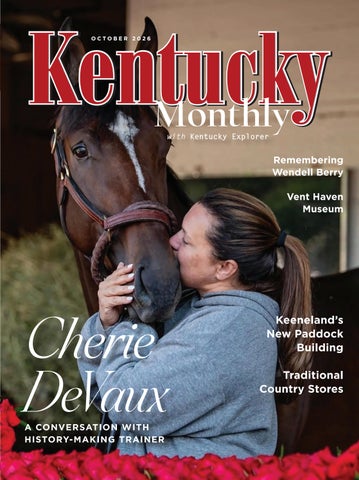
O N T H E C OV E R Cherie DeVaux with Golden Tempo the morning after the Kentucky Derby, © 2026 carson blevins / Agentes 305
in this issue
26 2 Kentucky Kwiz
O C TO B E R
3 Readers Write
FE AT URED
D E PA R T M E N T S
4 Mag on the Move 6 Music 8 Women Leading Kentucky 10 Cooking
9 Wendell Berry (1934-2026) More than a brilliant writer, the Henry County icon stood for sustainable farming, the health of rural communities and race relations
43 Kentucky Explorer 54 Off the Shelf 56 Past Tense/ Present Tense 58 Field Notes
10
26 A Voice for an Ancient Craft Vent Haven curator Lisa Sweasy’s spirit of childlike curiosity has been a burning ember throughout her tenure at the museum
16 A New Seat at the Races Keeneland’s Paddock Building blends an up-close view of the horses with sophisticated hospitality
32 Stage Fright Turning the spotlight on the enduring spirits of Kentucky’s theaters
22 Her New Kentucky Home Kentucky Monthly asked history-making trainer Cherie DeVaux about her favorite things from our beautiful state
38 Food, Friends and Family Country grocery stores still play an important role in rural Kentucky communities
60 Gardening 62 Calendar 64 Vested Interest
k e n t u c k y m o n t h l y. c o m 1
kentucky kwiz This month’s spooky quiz was provided by Dr. Tamela W. Smith, Western Kentucky University Staff Emeritus. ©2026, VESTED INTEREST
1. The first person in the United States to die chasing a UAP (formerly UFO) was killed when his plane crashed in what county? A. Simpson County
6. Which Harlan County inn has a history of unexplained footsteps, images showing up in photos, the sounds of laughter, and slamming locker doors?
B. Pulaski County
A. Trigg Wildcat Inn
C. Henry County
B. Wilson Inn C. Benham Schoolhouse Inn
2. Three spirits are said to linger in Frankfort’s Liberty Hall. They are said to be those of whom? A. A small child, a former governor and a Civil War soldier B. A Spanish opera singer, a Civil War soldier and a former governor C. A British soldier, a Spanish opera singer and the Gray Lady 3. Which building at Murray State University is known for its cold spots and an elevator that will hang on certain floors, has doors that sometimes will not close, and may even stop between floors for no reason?
PUBLICATIONS VOLUME TWENTYNINE, ISSUE 8, OCTOBER 2026
Stephen M. Vest Publisher + Editor-in-Chief
E D I TO R I A L Patricia Ranft Associate Editor Rebecca Redding Creative Director Deborah Kohl Kremer Assistant Editor Ted Sloan Contributing Editor
7. People report seeing shadowy figures, feeling cold spots, and hearing a bell ringing, even though there is no bell, in what Owensboro building, making it one the city’s most haunted places?
S E N I O R K E N T R I B U TO R S Jackie Hollenkamp Bentley, Jack Brammer, Bill Ellis, Steve Flairty, Gary Garth, Kristy Robinson Horine, Kim Kobersmith, Abby Laub,
A. The Theater Workshop of Owensboro
Brigitte Prather, Walt Reichert,
B. Odd Fellows Building
Janine Washle and Gary P. West
C. Union Station 8. Civil War soldiers are said to roam this fort, which has a serpentine shape and is one of the largest, best-preserved earthen forts in Kentucky.
Tracey Teo, Jarrett Van Meter,
B U S I N E S S + C I R C U L AT I O N Barbara Kay Vest Business Manager
A DV E R T I S I N G Account Executives: Kelley Burchell Laura Ray • Teresa Revlett
A. Alexander Hall
A. Fort Sumpter
For advertising information, call
B. Regents Residence Hall
B. Fort Berry
888.329.0053 or 502.227.0053
C. Price Doyle Fine Arts Building
C. Fort Duffield
4. Lily Memorial Hall, Cushing Hall, Carrick Hall and Campbell Arts Center are just a few of the buildings said to be haunted on what college campus?
9. The Old Stone Jail in Franklin (Simpson County) has several spirits who seem to be still serving their sentences in the afterlife. But what, rather than who, is the one spirit in the building that stands out from the rest?
A. Alice Lloyd College B. Lindsey Wilson College C. Centre College
A. A parrot B. A dog
5. The spirit still roaming the halls and keeping watch over the Speed Art Museum in Louisville is believed to be that of whom?
C. A cat
B. Hattie Bishop Speed
10. What event was held in August to commemorate the landing of an alien craft and the invasion of small creatures on a rural Kentucky farmhouse in 1955?
C. Lightning McQueen
A. The 1955 Alien Invasion Expo
A. James Breckinridge Speed
B. Strange Kentucky Stories Expo C. GoblinCon UFO & Paranormal Expo
For answers, see page 4.
2
K E N T U C K Y M O N T H LY
O C TO B E R 2 0 2 6
Kentucky Monthly (ISSN 1542-0507) is published 10 times per year (monthly with combined December/January and June/July issues) for $25 per year by Vested Interest Publications, Inc., 102 Consumer Lane, Frankfort, KY 40601. Periodicals Postage Paid at Frankfort, KY and at additional mailing offices. POSTMASTER: Send address changes to Kentucky Monthly, P.O. Box 559, Frankfort, KY 40602-0559. Vested Interest Publications: Stephen M. Vest, president; Patricia Ranft, vice president; Barbara Kay Vest, secretary/ treasurer. Board of directors: James W. Adams Jr., Dr. Gene Burch, Gregory N. Carnes, Barbara and Pete Chiericozzi, Kellee Dicks, Maj. Jack E. Dixon, Mary and Michael Embry, Judy M. Harris, Jan and John Higginbotham, Frank Martin, Bill Noel, Kasia Pater, Dr. Mary Jo Ratliff, Randy and Rebecca Sandell, Kendall Carr Shelton and Ted M. Sloan. Kentucky Monthly invites queries but accepts no responsibility for unsolicited material; submissions will not be returned.
K E N T U C K Y M O N T H LY. C O M
Counties mentioned in this issue...
Readers Write Breaks Park Aficionado
the establishment to display some.
Thank you for Kim Kobersmith’s article in the August edition titled “The Grand Canyon of the South” (page 30). It certainly brought back memories.
After many years of service to the park, due to a change in Kentucky political administrations, Dad was not reappointed to the board, but his love for the park remained throughout the rest of his life.
Breaks Interstate Park was very dear to my father, Lon B. Rogers. In 1918, when he was 13 years old, Dad, along with his Boy Scout troup, rode the C&O railroad from Pikeville to Elkhorn City. Scoutmaster Gene Auxier had the boys hike up through the gorge that is now part of Breaks Park and camp there. That must have lit the spark of interest for the area in my father. Kelley Day, who is mentioned in the story, had been a business associate of my grandfather, Fon Rogers. Day encouraged my father to get involved with the park. My dad served on the park’s board for many years, including terms as vice chairman and chairman of the park’s board. During Dad’s service on the board, our family made frequent trips to the park to see the improvements being made there. Dad always kept a case of Breaks Park brochures in his car. Whenever we stopped at a restaurant or motel on our travels, he looked to see if there were Breaks brochures displayed. If not, he would try to persuade the manager of
Fon Rogers II, Lexington
THE KENTUCKY GIFT GUIDE Kentucky Monthly’s annual gift guide highlights some of the finest handcrafted gifts and treats
Long Kentucky Heritage
our Commonwealth has to offer.
Last year, I became a tour guide at the Basilica of St. Joseph Proto-Cathedral in Bardstown. When it was consecrated in 1819, it was the first cathedral in the United States. Being a guide gave me a chance to tune up my knowledge of my heritage. My fourth great-grandmother, Monica Hagan, came to Holy Cross in 1785 with her three sons and daughters as part of the “League of 25” families who came from Maryland. She was a widow. I am a descendant of her son, Clement. That makes me one of the seventh-generation Hagans to live in this area. My father gave me The Centenary of Catholicity in Kentucky in 2000. His mother had given it to him in 1949. Monica is listed in the book. Fred Hagan, Bardstown
We Love to Hear from You! Kentucky Monthly welcomes letters from all readers. Email us your comments at editor@kentuckymonthly.com, send a letter through our website at kentuckymonthly.com, or message us on Facebook. Letters may be edited for clarification and brevity.
D R I N K LO C A L This handy guide to sipping in the Bluegrass State spotlights local breweries, wineries and, of course, distilleries. Discover unique ways to drink in Kentucky, creative cocktail recipes and more.
Follow us @kymonthly Find more at kentuckymonthly.com. Use your phone to scan the code.
UNITING KENTUCKIANS EVERYWHERE. k e n t u c k y m o n t h l y. c o m 3
travel
M AG O N T H E M OV E Even when you’re far away, you can take the spirit of your Kentucky home with you. And when you do, we want to see it!
submit your photo Take a copy of the magazine with you and get snapping! Send your high-resolution photos to editor@kentuckymonthly.com or visit kentuckymonthly.com to submit your photo.
germany A group of Paducah friends displayed their Kentucky Wildcat colors as they enjoyed a cruise along the Rhine River in Germany. Clockwise from upper left are Kathryn Barkett, Patricia Halicks, Andria Barkett and LaDonna Driver.
KWIZ ANSWERS: 1. A. Thomas Mantell was part of a Kentucky Air National Guard flight dispatched to investigate a UFO. It is believed that Mantell pursued the object until he flew too high, passing out from lack of oxygen and crashing; 2. C. The Gray Lady is Margaretta Varick, who died in the home. Legend says the Spanish opera singer is Madame Rose, who disappeared from the garden in 1805. The British solder’s identity remains unknown; 3. C. The Price Doyle Fine Arts Building is said to be haunted by a young woman who died when the elevator doors opened and she stepped into 4
K E N T U C K Y M O N T H LY
O C TO B E R 2 0 2 6
the shaft, but the elevator was not there; 4. A. The beautiful campus in Pippa Passes (Knott County) has haunting stories from at least eight buildings; 5. B. Hattie Bishop Speed founded the museum in memory of her late husband, J.B. Speed, in 1925. Her spirit is seen and felt throughout the museum; 6. C. Benham Schoolhouse Inn is a former schoolhouse built for the families of the coal camp there. A church and cemetery were relocated to build it, which may contribute to the haunting; 7. A. The Theater Workshop is located in the Old Trinity Centre Church. A young woman reportedly
hanged herself in the church years ago; 8. C. Fort Duffield in West Point (Hardin County) was used rarely during the Civil War, but there are reports of soldiers being seen there; 9. B. A dog named Lady is said to still roam the cells, patrolling in the afterlife as she did when she lived there with the jailer. Her toenails have even been heard clicking on the concrete floors; 10. C. GoblinCon was held August 22-23 on the anniversary of the landing and sightings by the Sutton family in Kelly (Christian County). The story is said to have been Steven Spielberg’s inspiration for ET.
Dear Wild Places,
Love, Kentucky Natural Lands Trust
Little Shepherd Trail, courtesy of Jennifer Honeycutt
In the past 30 years, Kentucky Natural Lands Trust has protected, connected, and restored 100 square miles of wildlands. Our primary focus area in Central Appalachia is one of the most biodiverse temperate geographies on earth. KNLT is committed to safeguarding the wildlands of this region which are critical to sustaining all life on the planet. Building on three decades of knowledge and success, we aim to protect 25,000 additional acres of wildlands at a greatly accelerated pace. We need your help to accomplish this urgent mission. Learn more and donate at KNLT.org
Together, We Are Wildlands
music B Y L AU R A YO U N K I N
Like Water and Food
B
luegrass legend Dale Ann Bradley was born in Bell County, and although she’s lived many places, she calls Middlesboro home again. She’s won multiple International Bluegrass Music Association (IBMA) awards, has been nominated for two Grammys and has been inducted into the Kentucky Music Hall of Fame. “I have been away from where I was raised for about 30 years. I’m looking at Virginia and Tennessee right now,” Bradley said during a telephone interview. “It’s one of the most beautiful places in the country.” Bradley has an unabashed love for Kentucky, and it shows up not only in where she lives but also in her music and her drawl. She has no doubt that growing up in Kentucky influenced her music. Her father was a minister at a Primitive Baptist church. Primitive Baptists do not believe in having instrumental music in church, but a capella singing is allowed. The hymnals of Bradley’s youth were written for shape-note singing. Primitive Baptist is a conservative denomination, and Bradley’s desire for a life in music was not a given. Bradley said Primitive Baptists consider instruments to be worldly. “That was the one thing I struggled 6
K E N T U C K Y M O N T H LY
O C TO B E R 2 0 2 6
with understanding,” she said. “I’ll tell you what was awkward was going to another church, and they did have music. And I liked it.” Delving into music wasn’t easy for her family. “It was a rough time,” Bradley said, but by the time she was in high school, her father realized she was serious, and he supported her decision. Bradley and her father have a strong relationship to this day. “He’s just the dearest to me. He’s always been there for me,” she said. He even built her a special shelf to hold all her IBMA awards. It must be a hardy shelf because Bradley has 11 IBMA awards, including six for Female Vocalist of the Year. She also was a founder of Sister Sadie, an
all-female bluegrass band. While she didn’t expect to be an award-winning musician, Bradley always knew she needed to make music. She does not have a specific moment when she decided she’d become a musician. “I don’t remember not ever that [music] being the focus of everything. It’s my first memory,” she said. Bradley grew up in the southeastern part of the state in a rural setting. She said her family had to carry water to the house, and there was one socket in the middle of the ceiling for an extension cord. There was no money for music. But singing was free. An uncle who had moved to Detroit to work for Ford did well for himself, and he bought Bradley an 8-track player when she was young. She listened to Dolly Parton and Porter Wagoner, Charley Pride, and Loretta Lynn’s gospel music. Her exposure to music broadened even more when that same uncle brought surplus compilation 8-tracks that used to be given away with luxury cars. Her world expanded to include Barbra Streisand, Johnny Mathis and classical music. Another uncle gave her a record player, and when Bradley entered high school, she found out she could check albums out from the library. “I was really tickled with that,” she recalled.
2026/27 SEASON OF RADICAL JOY
Since recorded music had been hard to come by for much of her life, “I had a strong passion for trying to listen to different styles.” Bradley believes the deprivation in her youth helped her. Where she grew up in Kentucky, not everything was at her fingertips. Making things work with what she had made her resilient and grateful. Bradley said she’s not touring as much or as far as she used to, although she’s still recording. She has a new album out called Phases, and she said in many ways it’s a reflection on her life so far: “I guess it’s a place where I
am now, age-wise, and where I am in life. It’s looking back.” The album includes a cover of the Dolly Parton and Porter Wagoner duet “Making Plans.” Bradley included it because it’s one of the first songs she played with her band, and it was influential when she was young. Bradley is joined by Kathy Kallick and Laurie Lewis, two more bluegrass heavy-hitters. “Hopefully, this little album, people will enjoy it,” Bradley said. “You never know, and I never take it for granted. You’re kind of sitting there with your heart in your hand”
when you release an album. Bradley said for the first time all her band members live within 100 miles of one another. She still plans to play live and go to festivals, small venues and churches. “I hope to keep doing what I’ve been doing for years,” she said. Bradley remains committed to a life of music: “I think music is so important, like water and food.” For more information on touring and new releases, visit daleannbradley. com or find Bradley on Facebook. Her music is available on all major streaming services.
Offering Subscriptions, Group Rates, and Student Tickets
Box Office Hours: 11am - 5pm Tuesday - Friday
www.woodfordtheatre.com
(859) 873-0648
November 6-8
April 2027
k e n t u c k y m o n t h l y. c o m 7
WOMEN & ENTREPRENEURSHIP
Operating Multiple Enterprises B Y J A N E T S T E E L E H O L LO WAY
Harlan County was built by hardworking coal miners—men and women who kept the lights on for generations, powered our nation, and shaped the spirit of this community. (Citation from social media for Harlan County Beer Company)
I
had the pleasure of talking with entrepreneur Sky Marietta of Harlan last week, and the conversation brought back many fond memories. I grew up just a few counties east of Harlan. In Logan County, West Virginia, my father and a few uncles worked the mines in southwest West Virginia and Eastern Kentucky. It was hard work, but they made a living. And my granny was always singing what she called her favorite song, “In the Pines Where the Sun Never Shines.” She swore it was about Harlan County, and I’d always nod and smile, ready to believe just about anything she said. Turns out, the song is an old Appalachian folksong with no known author. Sky puts her remarkable talent and energy to work with her family and her four business enterprises: Harlan County Beer Company, Moonbow Tipple Café & Books, a bed and breakfast, and an event space for catering parties, weddings and other celebrations. That woman is busy! She said she began working at 7 as a babysitter. At 10, she attended craft fairs to help her parents in their business of selling the Appalachian books they’d acquired. Her parents loved to read and collect books about Appalachia, and they encouraged Sky’s youthful business interests. Roughly 40,000 of those books are 8
K E N T U C K Y M O N T H LY
O C TO B E R 2 0 2 6
now available to read/purchase at Moonbow. Imagine a summer afternoon sipping a cold drink and reading about the area where you live or discovering a book by an Appalachian writer who might have lived nearby. If you’re a student and you read for 20 minutes or more, staff will give you a free cookie. Sky told me her employees at Moonbow, who make the drinks, aren’t just coffee makers: “They’re artisans who’ve dedicated years to perfecting their craft.” Nearby, housed in a restored 100-year-old building on the courthouse square, is where the county’s first legal brewery after Prohibition was located. It’s now the home of Harlan County Beer Company and a restaurant. “We see it as a gathering place for our community,” Sky said, “where people celebrate milestones, watch ballgames, rekindle friendships and make music together.” As if managing four businesses and 30 staff members isn’t enough, Sky is focused on her community, creating several programs and activities with local leaders in the beer company restaurant and the coffee shop. For example, on Dec. 6, National Miners Day, all current and former miners are welcome to come in for a free lunch bucket meal. Sky and her husband, Geoff, support the Kentucky State Police Post 10’s efforts to help local children, and they schedule Trivia Nights, such as “Are You Smarter Than a Fifth Grader?” Adults and children participate, with questions covering math, science, geography and
other facts you wish you remembered. Mountain Mic Night, a monthly acoustic-style competition on stage, features local talent—singers, songwriters—who vie for cash prizes and a shot at the finals prize of $500. Sky and her team prepare special programs that celebrate the holidays or welcome tour groups. The Louisville Orchestra recently stopped by Harlan to play for the community, which rallied in support. Last year, the Kentucky Tourism, Arts and Heritage Cabinet and the Kentucky Heritage Council selected the Harlan County Beer Company as one of 18 restaurants in the Commonwealth to be featured in Kentucky’s new Historic Dining Guide. The guide highlights restaurants across Kentucky that not only have great food but also help preserve and tell the story of their communities through historic buildings and space. Sky said the recognition at the state level “was a meaningful moment and a reminder that the story of Harlan County matters.” There’s excitement in Harlan, and Sky is one of those committed to bringing the community together. I think it’s time to visit and get in on the fun.
Janet Steele Holloway is the founder of Women Leading Kentucky and the former state director of the Kentucky Small Business Development Centers (SBDC). Readers can contact her at janet@womenleadingkentucky.com.
Wendell Berry (1934-2026): An Appreciation More than a brilliant writer, the Henry County icon stood for sustainable farming, the health of rural communities and race relations B Y R I C H A R D TAY L O R
D
oing justice to Wendell Berry’s long and distinguished career is like trying to lasso a slippery fish in wide water. Few would dispute that he is perhaps the most influential writer to emerge from Kentucky, not only as a literary artist but as a shaper of ideas that too many of us ignore—the health of the earth and the communities it supports, the history of agriculture and the impact of industrialization on rural communities, and the accompanying dissolution of our moral center. Few, if any, writers are as intimate with Kentucky and the practice of farming, especially the history and fortunes of the Commonwealth’s rural communities. He often described himself as a poet and farmer, but his long career was much broader. Poet, essayist, novelist, social activist and critic, he has been likened to a contemporary Henry David Thoreau. Sustainable agriculture, the health of rural communities and the environment, race relations—all are themes that thread through his work, including his longer works of nonfiction such as The Unsettling of America and The Need to Be Whole, a 2022 book representing his latest thinking on themes that grew out of his long association with a place. That place was Henry County, an agricultural county bordering the Kentucky River in North-Central Kentucky—Port Royal on the map, Port William in his fiction. Following the example of William Faulkner, Berry recreated the life and history of his own Yoknapatawpha
County, peopling it over generations with a half-dozen interconnected families to create a narrative whole. What’s remarkable is the consistency of his themes throughout his long life in poems, essays and fiction—that and his gifts as a natural storyteller. This body of work begins with his first published novel, Nathan Coulter (1960), and extends through Marcie Catlett: The Force of a Story (2025), whose central character, Andy Catlett, is a mask for the author himself—with more than 50 books in between. The forms in which he chose to write are like branches and foliage stemming from a common rootstock, each with its own distinctive shape and fruits. It’s wonderful to realize that he wrote nearly all his works in an unwired shack elevated on stilts in the woods with a view of his beloved and befouled Kentucky River, the degradation of which he has witnessed and opposed over a half-century. Among thoughtful readers, the book that catapulted Berry into national consciousness was The Unsettling of America (1977), an indictment of the rapid conversion of family farms to a model of agribusiness through mechanization and the imposition of factory systems—monocultural crops, increasing dependence on chemical fertilizers and pesticides, and bigger machines. Berry made a compelling case for sustainable farming and ecological responsibility, relying on the old ethic that farming should nurture the land as it nourishes the community of growers rather than exploiting it for short-term economic advantage. The book ignited a spirited national debate
that hasn’t ended. He became an important spokesman for generations of environmentalists and back-to-thelanders, elevated to a folk hero. In addition to such novels as Jayber Crow, Hannah Coulter and The Memory of Old Jack, Berry won esteem for his poetry, much of it published in beautiful letterpress editions at Larkspur Press in nearby Monterey. His “Mad Farmer” and “Sabbath” poems won awards and a wide readership. Part of his legacy is in The Berry Center in New Castle that promotes responsible agriculture and the small family farm. The list of his many honors and awards is too long to recite here. Whether in poems, essays or novels, Berry’s writing style has all the virtues of a Shaker cupboard. It is plain, elegant in form, skillfully tooled, unadorned with frills, and made of the finest native materials— durable walnut or cherry. Its wording weathers well and lasts—what used to be called classic. His sentences consist of no-nonsense prose that is naturally seasoned and, as with most finely made furniture, takes on a fine patina. Inside that cupboard are riches. He does Kentucky proud. About the Author: Richard Taylor is an accomplished Kentucky poet and writer of fiction and nonfiction. He was Kentucky’s Poet Laureate from 1999-2001. GUY MENDES PHOTO
k e n t u c k y m o n t h l y. c o m 9
cooking
Pleasures of the Palate F
or Mitzie and Jim Wittliff of Louisville, dining has always been one of life’s cherished pleasures. A Louisiana native of Acadian French and Choctaw heritage, Mitzie brings a multi-cultural
blend of flavors to the table, while Jim, a renowned professor emeritus Mitzie Wittliff
of biochemistry & molecular genetics at the University of Louisville, grew up in Texas with typical ranch-style fare, including wild game. The Wittliffs are known for hosting private dinners that feature Mitzie’s delectable culinary creations, a few of which are presented here.
10 K E NT U C K Y M O NT HLY O CTO BER 2 0 2 6
SERVES 6-8
HUNTER’S RICE Olive oil for sautéing 1 cup wild rice 4½ cups chicken broth (or Better Than Bouillon Roasted Chicken Base in water) 1 teaspoon salt Pepper to taste 1 cup rice, long-grained white 4 teaspoons butter or margarine ½ cup onion, chopped (I prefer red onion, but a sweet white onion will suffice) 2-3 green onions, chopped (all of white section and some of tender green section) 2 garlic cloves, minced ¼ cup red and green sweet peppers (or red and green bell peppers), coarsely cut ½-1 cup dried apricots, chopped ½ cup raisins or currants 1 bay leaf ½-1 cup pecans or walnuts, coarsely chopped and sautéed in butter
1. Sauté wild rice in olive oil. Add approximately 2½ cups chicken broth, salt and pepper to taste. Cook on low to medium heat until rice is firm but tender, about 45 minutes. Drain, if necessary, and place in a large deep casserole. RECIPES AND PHOTOS COURTESY OF MITZIE AND JIM WITTLIFF
2. Sauté white rice separately (and a bit later because the wild rice takes longer to cook) over medium heat with butter for about 5 minutes, stirring. 3. Add onion, green onion, garlic, and red and green peppers and continue cooking 3-4 minutes. 4. Add 2 cups chicken broth and stir in chopped apricots, raisins or currants, and bay leaf. Reduce heat to low, cover and simmer for about 20 minutes or until white rice is cooked to tender but firm. 5. Gently add white rice mixture to wild rice, then stir in sautéed nuts. Carefully stir to blend all ingredients. Note: I often serve this wholesome dish as an accompaniment to beef and chicken dishes and even with grilled salmon. My husband, Jim, particularly likes Hunter’s Rice served with venison from our Texas ranch or with lamb chops.
k e n t u c k y m o n t h l y. c o m 11
cooking
M U S H R O O M PAT É 1 tablespoon olive oil 1 pound mushrooms (white, cremini or a mixture of exotic varieties for a gourmet twist), finely chopped ¼ cup onions, finely chopped Garlic cloves, minced ¼ cup beef broth (I prefer ¼ teaspoon Better Than Bouillon Beef Base in water) 2 teaspoons Worcestershire sauce ¼ cup dry red wine 1/ 3
teaspoon cayenne pepper
8 ounces cream cheese, softened Paprika for garnish
R OA S T V E N I S O N B AC K S T R A P 1-1¼ pounds venison backstrap, whole and wiped dry Brisket rub (I use Fiesta Brand Extra Fancy Brisket Rub or Adams Reserve Texas Brisket Rub) Pepper, to taste
1. Sauté mushrooms, onions and garlic in olive oil until onions are soft and no liquid remains. 2. Add beef broth, Worcestershire sauce and red wine and reduce until very little liquid remains; add cayenne pepper a little at a time. 3. Remove from heat and let mixture stand a few minutes. 4. Add softened cream cheese and blend well. Place in an attractive dish and top with a sprinkle of paprika. 5. Serve on crackers or lightly toasted French bread (preferred).
12 K E NT U C K Y M O NT H LY O CTO BER 2 0 2 6
Fresh sage leaves 4-5 strips thick hickory-smoked bacon Wild berry or fruit sauce for serving
1. Preheat oven to 350 degrees. 2. Lightly and evenly coat entire backstrap with the rub and pepper, then lay individual fresh sage leaves lengthwise on the backstrap. 3. Carefully wrap bacon strips around the backstrap. Wrap most of the sage and backstrap with the bacon strips, and fasten the bacon ends to the venison with small stainless-steel meat pins. 4. Sprinkle a bit more rub over the entire preparation. 5. Place in roasting pan and roast until desired doneness is reached. I test backstrap with an instant-read thermometer and halt roasting when the meat center registers 120-125 degrees—medium rare for venison. 6. Serve with wild berry or fruit sauce.
KENTUCKY L I M E S TO N E BIBB SALAD 1 small head Kentucky Limestone Bibb lettuce for each person, or if smaller heads are unavailable, use several whole Bibb lettuce leaves per guest, arranged on individual plates Orange sections, freshly prepared Mushrooms, sliced (I prefer white mushrooms, but baby bellas also work well) Red onions, very thinly sliced Campari tomatoes, cut into sections Pecan halves (sautéed first in butter and New Orleans seasonings, or if you prefer them sweet, Gil Logan, former executive chef of Churchill Downs, tosses them in melted butter, brown sugar and a tablespoon of bourbon, then bakes them on a cookie sheet for 10 minutes) Shrimp, grilled separately, cooled and peeled, except for tail sections (optional) Mrs. Davis’ French Dressing (recipe follows)
1. Place the fruits, vegetables, pecans and shrimp (if using) atop the lettuce.
2. Drizzle assembled salads with several teaspoons of dressing before serving.
Note: I often marinate the chilled shrimp for 1-2 hours in the dressing before assembling the salads.
M R S . DAV I S ’ F R E N C H D R E S S I N G Yields approximately 4 cups 1 can quality tomato soup
½ cup sugar
2 teaspoons paprika
1 onion, Vidalia or similar taste, thinly sliced
1 tablespoon Worcestershire sauce
1 teaspoon chili powder
2-4 garlic cloves, minced
1 tablespoon dry mustard
1½ cups canola or other high-quality salad oil
2 teaspoons salt 2 teaspoons pepper
Mix together all ingredients well and refrigerate overnight before serving.
¾ cup white vinegar Note: This original recipe, which is unlike conventional French dressings, was given to me in 1958 by Barbara Davis, the wife of Professor George Davis, with whom I worked in the Department of Physiology, Louisiana State University School of Medicine, New Orleans.
k e n t u c k y m o n t h l y. c o m 13
Wendell Berry (1934-2026): An Appreciation More than a brilliant writer, the Henry County icon stood for sustainable farming, the health of rural communities and race relations B Y R I C H A R D TAY L O R
D
oing justice to Wendell Berry’s long and distinguished career is like trying to lasso a slippery fish in wide water. Few would dispute that he is perhaps the most influential writer to emerge from Kentucky, not only as a literary artist but as a shaper of ideas that too many of us ignore—the health of the earth and the communities it supports, the history of agriculture and the impact of industrialization on rural communities, and the accompanying dissolution of our moral center. Few, if any, writers are as intimate with Kentucky and the practice of farming, especially the history and fortunes of the Commonwealth’s rural communities. He often described himself as a poet and farmer, but his long career was much broader. Poet, essayist, novelist, social activist and critic, he has been likened to a contemporary Henry David Thoreau. Sustainable agriculture, the health of rural communities and the environment, race relations—all are themes that thread through his work, including his longer works of nonfiction such as The Unsettling of America and The Need to Be Whole, a 2022 book representing his latest thinking on themes that grew out of his long association with a place. That place was Henry County, an agricultural county bordering the Kentucky River in North-Central Kentucky—Port Royal on the map,
Port William in his fiction. Following the example of William Faulkner, Berry recreated the life and history of his own Yoknapatawpha County, peopling it over generations with a half-dozen interconnected families to create a narrative whole. What’s remarkable is the consistency of his themes throughout his long life in poems, essays and fiction—that and his gifts as a natural storyteller. This body of work begins with his first published novel, Nathan Coulter (1960), and extends through Marcie Catlett: The Force of a Story (2025), whose central character, Andy Catlett, is a mask for the author himself—with more than 50 books in between. The forms in which he chose to write are like branches and foliage stemming from a common rootstock, each with its own distinctive shape and fruits. It’s wonderful to realize that he wrote nearly all his works in an unwired shack elevated on stilts in the woods with a view of his beloved and befouled Kentucky River, the degradation of which he has witnessed and opposed over a half-century. Among thoughtful readers, the book that catapulted Berry into national consciousness was The Unsettling of America (1977), an indictment of the rapid conversion of family farms to a model of agribusiness through mechanization and the imposition of factory systems—monocultural crops, increasing dependence on chemical fertilizers and pesticides, and bigger machines. Berry made a compelling case for sustainable farming and ecological responsibility, relying on the old ethic that farming should nurture
the land as it nourishes the community of growers rather than exploiting it for short-term economic advantage. The book ignited a spirited national debate that hasn’t ended. He became an important spokesman for generations of environmentalists and back-to-thelanders, elevated to a folk hero. In addition to such novels as Jayber Crow, Hannah Coulter and The Memory of Old Jack, Berry won esteem for his poetry, much of it published in beautiful letterpress editions at Larkspur Press in nearby Monterey. His “Mad Farmer” and “Sabbath” poems won awards and a wide readership. Part of his legacy is in The Berry Center in New Castle that promotes responsible agriculture and the small family farm. The list of his many honors and awards is too long to recite here. Whether in poems, essays or novels, Berry’s writing style has all the virtues of a Shaker cupboard. It is plain, elegant in form, skillfully tooled, unadorned with frills, and made of the finest native materials— durable walnut or cherry. Its wording weathers well and lasts—what used to be called classic. His sentences consist of no-nonsense prose that is naturally seasoned and, as with most finely made furniture, takes on a fine patina. Inside that cupboard are riches. He does Kentucky proud. About the Author: Richard Taylor is an accomplished Kentucky poet and writer of fiction and nonfiction. He was Kentucky’s Poet Laureate from 1999-2001. GUY MENDES PHOTO
k e n t u c k y m o n t h l y. c o m 13
A
A
utumn dventures IN BOWLING GREEN, KENTUCKY
Fall is the perfect time to slow down and enjoy what’s close to home. Summer heat is finally making way for crisp mornings, the countryside starts showing off its color, and farms, orchards, restaurants and downtown gathering spots have plenty going on. In Bowling Green, where “green means go,” there’s no shortage of places to go—or reasons to stay awhile once you get there. It’s the kind of place where a Saturday drive can turn into an afternoon at the farm, a scoop of ice cream and a good meal, and maybe even a little live music before the day is over. The best part? You don’t have to go far to find it.
S N A E M N E E GR G O!
Lost River Cave is transformed for Lost Tales of the Underground
Go for the thrills. Go for the memories. Go for the outdoor experiences, local flavor, and family fun—because you don’t have to stop after one adventure.
Bowling Green takes you everywhere you want to go. WWW.VISITBGKY .COM Learn More
800.326.7465
Start with a trip to Lost River Cave, where the annual Scarecrow Trail brings a little fall magic to the woods. Handcrafted scarecrows pop up along the wooded paths, creating a free, whimsical and downright entertaining The Scarecrow Trail at Lost display beneath the changing leaves. After dark, River Cave is free to enjoy Lost Tales of the Underground transforms the cave and valley into something spookier, combining Kentucky folklore, theater and the naturally mysterious setting of the cave itself.
No visit is complete without Chaney’s ice cream!
In surrounding Warren County, harvest season is in full swing. At Chaney’s Dairy Barn, a longtime family farm, the annual corn maze is a must for fall visitors and a tradition for plenty of local families. After making your way through the maze, reward yourself with a scoop of their famous ice cream and a visit with the farm’s beloved Jersey cows.
Jackson’s Orchard is another fall favorite, offering apples, cider and baked goods to take home. The annual Pumpkin Festival runs through
Pick the perfect pumpkin at Jackson’s Orchard
the end of October, bringing with it plenty of pumpkins, family activities and no shortage of great photo opportunities. All these adventures are bound to work up a thirst—and Bowling Green has plenty of places to settle in and quench it. Purple Toad Winery offers fruit-forward wines and the fan-favorite wine slushies, best enjoyed by their roaring fireplace. Meanwhile, White Squirrel Brewery is a good spot to grab a house-brewed beer and spend some time catching up with friends in the newly added arcade. Skee-ball, anyone? Top: Sample award-winning brews with a flight at White Squirrel Brewery Bottom: Beautiful Fountain Square Park in Historic Downtown Bowling Green
Fall weekends bring plenty of reasons to head downtown, too. Seasonal food and drinks, special events and live music give Fountain Square and the surrounding streets plenty of activity. Browse boutiques, grab dinner or find a patio and enjoy the weather. You don’t have to have a plan—sometimes the best feeling is simply having nowhere else you need to be. When the weather turns crisp and the countryside starts showing off, there’s only one thing to do: get out and enjoy it. After all, in Bowling Green, green means go.
16
K E N T U C K Y M O N T H LY O C TO B E R 2 0 2 6
Keeneland’s Paddock Building blends an up-close view of the horses with sophisticated hospitality
A New Seat at the Races BY JACKIE HOLLENKAMP BENTLEY
I
t’s a crisp fall afternoon at Keeneland Race Course in Lexington. You’re perusing the racing program at a high-top table in the legendary track’s new 1936 Room, when—lo and behold—the jockeys for the next race, decked out in their colorful silks, walk through on their way to the Saddling Paddock. That’s just one of the experiences now enjoyed at Keeneland’s Paddock Building. The $100 million project officially opened at the track’s spring meet this year. It adds five new dining rooms, sweeping views of various track areas, and opportunities for event planning. Kara Heissenbuttel, the racetrack’s senior director of community relations, said Keeneland was pleasantly surprised with how well fans and patrons received the new offerings.
“Of course, everyone has always enjoyed coming to Keeneland and the experiences that we offered, and I think it was really fun for them to see different ways that we could host them and create a racing experience for them,” Heissenbuttel said. “Before, when our dining room tickets would go on sale, we would sell out immediately … and we hated to turn away fans. So, we’re really happy that we’re able to add those additional seats and experiences.” The project is the largest capital construction in track history. Kansas City-based Populous designed the threelevel building, staying true to Keeneland’s architectural heritage that dates to its 1935-36 construction. Lexington’s Matthew Carter designed the interiors for each of the dining spaces.
WHEN YOU GO:
Keeneland Race Course 4202 Versailles Road, Lexington | 859.254.3412 | keeneland.com k e n t u c k y m o n t h l y. c o m 17
The Sycamore Room A huge sycamore tree in the paddock area is a track icon, so it’s not a surprise that one of the new dining rooms would pay homage to the tree. Located on the first floor in the south end of the building, the Sycamore Room provides more traditional sit-down eating, with an à la carte menu of American cuisine.
The Rooftop Heissenbuttel said the Rooftop was one of the more popular rooms in the Paddock Building this past spring. The more exclusive third-floor space provides guests with views of Keeneland’s campus, premium dining, patio seating and a high-end bar. “We had such amazing weather in the spring that everybody wanted to be in that exclusive space,” she said.
The Dogwood Room Keeneland’s beloved dogwood trees that bloom during the spring meet get a nod as the moniker for the Paddock Building’s second-floor dining venue. Guests can enjoy the room’s views overlooking the Saddling Paddock with buffet-style dining.
The 1936 Room The Ivy Room Of course, the ivy that creeps up Keeneland’s limestone structures can’t be forgotten. Like the Dogwood Room, the Ivy Room is located on the second floor with buffet-style dining, but it is typically reserved for private gatherings. However, guests can purchase tickets for select race days during the October fall meet. 18
Named after the first year Keeneland opened for racing, the 1936 Room, located in the north end of the new building, offers guests a deluxe race-day experience with premium bar services and lounge seating. Tickets to the room include exclusive access to the Paddock Lawn and Saddling Paddock and that chance to see the jockeys as they walk through the room to those areas. “It’s been really fun for our fans to be able to see them and have that upclose-and-personal experience,” Heissenbuttel said. “I think, for the jockeys, it’s really fun because they get to feel the appreciation of the fans. When they’re walking through the room, people might give them a high five or something like that. So, I think it’s been a lot of fun for both. It gives them a little boost going into the next race.”
K E N T U C K Y M O N T H LY O C TO B E R 2 0 2 6
Photos courtesy of Keeneland
The Lexington/Kentucky Room, Equestrian Room and Phoenix Room are still popular fixtures for Keeneland guests, but Heissenbuttel said they sell out meet after meet. With the new Paddock Building, the track is now able to sell 1,000 more public dining tickets a day. “While it’s a great problem to have, we really don’t want to turn away fans, and we want to be able to offer the experiences that they’re looking for,” she said. “We’re so fortunate that we have such a great, strong fan base that wants to be here, and the timing was just right [to build the Paddock Building]. Let’s expand and let’s continue to offer these fans the experiences that they’re looking for because Thoroughbred racing is so special here in this community.” Reservations start at $40 per person and—depending on the day of the week—can go up to $200. The Paddock Building is available year-round for special events and private parties. “It’s been really fun for our event team to see different events in the different spaces that we have and see what works best there,” Heissenbuttel said. “From rehearsal dinners to retirement parties and charitable fundraisers, there are so many different events that we were able to host, and each room has a little different feel and identity and lends itself to different types of events.” Q
The Carnegie Center Presents
Carnegie Classics
Pride & Prejudice An evening of entertainment, hors d'oeuvres, cocktails, and dancing inspired by the book. NOVEMBER 14 • 7:00—11:00 PM
BUY YOUR TICKETS TODAY!
bit.ly/PandPCC
sponsored by: REITZEL COOK
k e n t u c k y m o n t h l y. c o m 19
The Breeders’ Cup Returns to Keeneland
K
eeneland will host the Breeders’ Cup World Championships on Oct. 30-31. This will be the track’s fourth time hosting the international, twoday horse-racing extravaganza, having previously presented the event in 2015, 2020 (to a limited audience due to the COVID-19 pandemic) and 2022. Fans will get the chance to see Kentucky Derby and Belmont Stakes winner Golden Tempo, as he is scheduled to run in the Breeders’ Cup Classic (see related story on page 22), while enjoying new amenities at the Lexington track’s new Paddock Building. Kara Heissenbuttel, Keeneland’s senior director of community relations, said the Paddock Building, which opened during Keeneland’s spring meet, will be a step up for their racing fun. “It’s been quite an enhancement for this year’s Breeders’ Cup that we are able to offer more high-end experiences to Breeders’ Cup fans,” she said. For more information and ticket availability, see breederscup.com/ tickets or keeneland.com. 20
K E N T U C K Y M O N T H LY
O C TO B E R 2 0 2 6
CONCEPT ART
Bundle the Christmas Magic, Save on the Fun Experience the next evolution of ice! at Gaylord Opryland as Home Alone unfolds in an all-new frozen world. Step inside larger-than-life scenes, race down frozen slides, and discover festive moments inspired by the holiday favorite guests know and love.
Nov. 6 - Jan. 2 ChristmasAtGaylordOpryland.com © 20th Century Studios
CONCEPT ART
k e n t u c k y m o n t h l y. c o m 21
Kentucky Monthly asked history-making trainer Cherie DeVaux about her favorite things from our beautiful state
Her New Kentucky Home It’s difficult to forget the name Cherie DeVaux. Or her bright red blazer, custom sneakers and goosebumpinducing cheering. Or, of course, her beautiful bay colt, Golden Tempo. Millions of spectators watched as DeVaux trainee Golden Tempo, owned and bred by Phipps Stable and St. Elias Stable and ridden by José Ortiz, scored a dramatic win in the 152nd Kentucky Derby in Louisville on May 2, making DeVaux the first female trainer to win the prestigious race. Since then, she’s been a busy trainer, based largely in Kentucky and her hometown of Saratoga Springs, New York. Her husband, David Ingordo, works in the Thoroughbred industry as a bloodstock agent. Launched in 2018, Cherie DeVaux Racing certainly is making a name for itself. With the onset of autumn in the Bluegrass State, Keeneland’s fall meet upon us, and the Breeders’ Cup at Keeneland just around the corner, contributor Abby Laub spoke with DeVaux to learn what she appreciates about her Kentucky home base. 22
KM: Talk about what you’re looking forward to with Cherie DeVaux Racing, the Breeders’ Cup and everything else you’re involved with. CD: We always look forward to the Keeneland meet. We start many of our 2-year-olds in the fall, so it’s exciting to watch the next generation of our stable begin their careers. I’m also really looking forward to having the Breeders’ Cup at home. There’s nothing quite like running horses out of your own stable—and getting to sleep in your own bed. KM: On a personal level, what do you typically get into during the fall? What is your ideal fall day in Kentucky? CD: It’s difficult for me to find much downtime during the fall because everything is ramping up toward the [Breeders’ Cup] championships. I try to appreciate the season whenever I can, even if it’s simply enjoying the scenery during my drives back and forth from Louisville. KM: What is something about the Kentucky way of life that you have grown to appreciate?
K E N T U C K Y M O N T H LY O C TO B E R 2 0 2 6
CD: I’ve grown to appreciate Kentucky’s laid-back atmosphere. I’ve also made many wonderful friends here who help keep me grounded. KM: If you were giving a guest or client a perfect Kentucky experience, what would you insist they do? CD: I would insist that they take several bourbon tours and visit multiple horse farms. You really need to experience both to understand what makes Kentucky so special. KM: What is your quintessential Kentucky meal? CD: When it comes to Kentucky food, I’m all about the desserts— either Derby Pie or bourbon bread pudding. KM:: If you could sit and speak with any Kentuckian—living or dead— who would it be? CD: Daniel Boone. I would love to hear what Kentucky was like through his eyes and listen to the stories of everything he experienced.
P HOTOS COURT E SY OF C HE RI E DE VAUX RAC I N G
With Golden Tempo’s triumph, Cherie DeVaux became the first female trainer to win the Kentucky Derby.
KM: What is your favorite place in Kentucky and why? CD: My favorite area is the stretch encompassing Lexington, Versailles and Paris. There’s nothing like driving along the country roads, seeing the horses in the fields, and passing so many beautiful historic properties.
KM: What are some things about your career that people don’t understand or see when the television cameras are off?
they don’t always show the constant work, responsibility and decisionmaking that happen behind the scenes.
CD: This industry operates 24 hours a day, seven days a week. There is very little true downtime. The cameras capture the exciting moments, but
KM: Is there something you can point to in your life when your trajectory changed—besides the obvious one where you became a household name? k e n t u c k y m o n t h l y. c o m 23
Left, Cherie DeVaux and her husband, David Ingordo, hold the Kentucky Derby trophies; right, DeVaux poses with a likeness of Golden Tempo at the Kentucky Derby Museum. Photos courtesy of Cherie DeVaux Racing.
CD: Definitely the decision to go out on my own and begin training under my own name. That completely changed the trajectory of my life and career. KM: As a woman in the horse industry, what do you hope young women in Kentucky, Saratoga and beyond will see? CD: I hope they see that we don’t have to allow our gender to define us or limit what we pursue. We can do anything we set out to do. It may simply require working a little harder to get there. KM: Now that you’ve achieved this great success, how does it compare with what you thought it would be like? CD: I’m still learning how to take it all in. It has been incredibly 24
K E N T U C K Y M O N T H LY
rewarding, but it’s also much busier than I ever anticipated. Success brings more opportunities, but it also brings greater responsibility.
way back there.
KM: What is next for you and your team?
CD: Kentucky, especially Lexington, offers all the comforts of a small city, but you’re never more than a short drive from the countryside. I love having that balance.
CD: Our immediate focus is the upcoming Keeneland meet and the Breeders’ Cup. Beyond that, we want to continue building on our success while developing the next generation of horses in our stable.
KM: You have lived and worked in some special places throughout your childhood and career. What makes Kentucky special?
Kentucky quick hits with Cherie DeVaux: 1. Bourbon or nah? Yes
KM: How do you think you’re going to feel heading into next year’s Derby?
2. Hot Brown or fried chicken? Fried chicken
CD: I think it will feel very different. Having experienced everything that comes with the Derby once, I’ll have a greater appreciation for the moment and a better understanding of what to expect. But first, we have to find the right horse and earn our
3. Bourbon balls or Derby Pie? Derby Pie
O C TO B E R 2 0 2 6
4. Mint julep or sweet tea? Mint julep 5. Spring or fall in Kentucky? Spring 6. One word that describes Kentucky: Diverse
k e n t u c k y m o n t h l y. c o m 25
Vent Haven curator Lisa Sweasy’s spirit of childlike curiosity has been a burning ember throughout her tenure at the museum
A Voice for an Ancient Craft B Y J A R R E T T VA N M E T E R PHOTOS BY REBECCA REDDING
C
ars began pulling into the parking lot at around 12:40 p.m., 20 minutes before our tour. It was early August, and engines stayed on for air conditioning while we waited. License plates from Indiana, Maryland, Tennessee and Kentucky adorned the cars. It was a sellout crowd of 11 visitors—a dozen people, counting Lisa Sweasy. Sweasy has possibly the shortest out-of-house work commute in Kentucky. Our cars were parked in the lot behind Vent Haven in Fort Mitchell, the world’s only museum dedicated to ventriloquism, where she has 26
K E N T U C K Y M O N T H LY O C TO B E R 2 0 2 6
worked for the last 26 years as curator and director. Her home is located directly across the driveway from the museum, roughly a dozen steps away. A former high-school math teacher, Sweasy had no ventriloquism experience when she was hired by Vent Haven in 2000. Hard-earned expertise and industry-wide respect have come in the decades since, but originally, she was drawn to the museum role for its flexibility, the prospect of meeting interesting people … and the house. A perk—and requirement—of the curator role is occupancy of the adjacent four-bedroom home, located just
k e n t u c k y m o n t h l y. c o m 27
off Dixie Highway in a leafy section of the Northern Kentucky city. It was built in 1915 by the museum’s original benefactor, William Shakespeare (W.S.) Berger, whose interest in ventriloquism led to a collection that ultimately would become Vent Haven. Berger moved into the house owning just a single dummy, but by the time he passed away in 1972, his personal inventory was up to around 500. Berger outlived his entire family, so his house became the compensation package for looking after the collection. “There’s no salary with the job,” explained Annie Roberts, who held the position before Sweasy and remains on the museum’s board of directors. “Basically, you’re provided with a residence, and utilities are covered.” • • •
Sweasy grew up in a military family, moving every few years. Her surroundings changed—Massachusetts, West Virginia, Kansas, Missouri, the Carolinas, Mississippi— but she found stability in her schoolwork and reading 28
K E N T U C K Y M O N T H LY O C TO B E R 2 0 2 6
books. She came to Northern Kentucky for college and hasn’t left, earning her bachelor’s and master’s degrees from Northern Kentucky University before becoming a teacher in a nearby school district. After having two children of her own, she decided to take a step back from her classroom duties and become a stay-at-home mom. She was a few years removed from teaching when, in late 1999, she bumped into Roberts, a friend and former colleague, at a local tire store. In addition to teaching full time, Roberts had served as the Vent Haven curator since 1993 but was looking to pass the role on to the right person. Sweasy was curious. “The fact that I had lived in this area for many years and hadn’t heard of it was really intriguing to me,” Sweasy said. “At the time, of course, the internet was in its infancy, and there was no such thing as social media or websites or anything like that. It was just a community treasure that nobody really knew about, and so I thought that was cool.” Sweasy drove over for a tour, then an interview. She
The World's Only Museum Dedicated to Ventriloquism V E N T H AV E N . O R G
landed the job, and her young family replaced Roberts’ in the brown brick three-story home over Memorial Day weekend in 2000. Then the work started. As when she was a young girl, Sweasy threw herself into her studies, soaking up everything she could about the art and history of ventriloquism. “She started diving into the archives, and she started reading,” Roberts said. “She really was just like a sponge and absorbed things … It was another job where she could use her teaching degree [and] her learning.” Roberts accompanied her during the first few weeks of giving tours. Sweasy initially carried a script, but it didn’t take long before she was book-free. When she started in the role, she was giving three or four tours per week. Now, the weekly count usually ranges from eight to 10, spread across Tuesdays, Wednesdays, Fridays and Saturdays. Tours are by appointment only and are offered from the beginning of May through the end of September. Giving that many tours requires a certain disposition.
“My energy kind of reflects what the tourists are like,” Sweasy said. “So, if they are very energetic and enthusiastic, then I am as well. Sometimes, at the end of something like that—where you feel like you’ve really given it all you’ve got—then you can be a little bit tired … But it’s always a very pleasant experience.” • • •
Our tour group was her second of the day and included a high schooler, a middle schooler, a 7-year-old boy, parents, a retired magician and a writer. We started in the theater room, watching a six-minute film created by Sweasy’s husband, Bryan, before beginning the journey through roughly 750 dummies across six rooms. The exhibit is set up as a chronological timeline from ventriloquism’s entry into vaudeville in the 1880s to recent history, where performers such as Jeff Dunham and Darci Lynne Farmer help to keep it alive. The heyday of regular late-night talk-show appearances and international k e n t u c k y m o n t h l y. c o m 29
renown has past, but there is still a vital, if close-knit, contingent of practitioners. One of them was in our group. As we reached the third room, the 7-year-old boy revealed that he was preparing to perform his own ventriloquism act at a public library in his hometown. Sweasy stoked his enthusiasm, inviting him to the annual Vent Haven International Ventriloquist Convention that the museum spearheads each July. A few rooms later, she pulled out her cell phone and called one of the makers whose work is on display, so that the boy could speak with him. (Austin Phillips, who is based in Maine, didn’t answer, but did call Sweasy back the next day and was tickled to hear the reason she had called.) At the conclusion of our roughly 90-minute tour, Sweasy stayed late to talk shop and swap stories with the boy and his parents. “I just love young people, and I think they’re fun and curious,” she said. “I love curious people, and I think a lot of adults lose their curiosity about how things work … They lose that spirit of adventuring out and trying something new.”
• • •
From her transient childhood to her teaching career, her 26 years at Vent Haven to whatever comes next, that sustained spirit of childlike curiosity has been the burning ember through Sweasy’s life. She has protected the glow, keeping it ready for when she needs a light through the unknown. She plans to retire after the 2026 tour season to spend more time with her now-grown children and, of course, read. Like Roberts before her, Sweasy will stay on to train her replacement and then to serve on the board of directors. Over her career, she has given tours to celebrities, international visitors and industry heavyweights. The job has given her close friends and fluency in a world that she might not have otherwise experienced. It gave her a home—literally, intellectually and energetically. But when asked what she will miss the most, it’s the lifelong student who answers. “Being around the collection,” she said. “Examining them and reading their histories … learning new stories.” Q
WHEN YOU GO Vent Haven Museum 33 West Maple Avenue, Fort Mitchell | 859.341.0461 | Open by appointment only
30
K E N T U C K Y M O N T H LY O C TO B E R 2 0 2 6
32
K E N T U C K Y M O N T H LY O C TO B E R 2 0 2 6
Turning the spotlight on the enduring spirits of Kentucky’s theaters
ST A G E
FRIGHT B Y T O M M U S G R AV E
Content warning: This story mentions a suicide, which may be difficult for some readers. k e n t u c k y m o n t h l y. c o m 33
T
heaters are spaces that inspire imagination. On stage, comedy and drama hold sway, enrapturing audiences for a few hours at a time—a brief, joyous escape from the real world. When the show is over and the candy wrappers have been swept up, sometimes the play isn’t finished. It’s just beginning.
PARAMOUNT JOE
Ashland’s Paramount Arts Center opened in 1931 as the art-deco style Paramount Theater. It is the main performance venue for the Paramount Players and annually hosts a variety of 34
touring productions. The theater also is home to a more permanent resident. Executive director Matt Hammond said, according to local legend, a spirit—dubbed Paramount Joe—is the ghost of a Cincinnati construction worker named Joe who allegedly fatally hanged himself in the rigging above the stage while the theater was being built in 1931. It is uncertain whether the death was intentional or accidental. No matter the cause, staff and visitors believe Joe is still with them. “I’m not a person who particularly believes in ghosts,” Hammond said, but his opinion has changed since he has spent time at the venue. “Lights turn on and off constantly.
K E N T U C K Y M O N T H LY O C TO B E R 2 0 2 6
Doors slam. Pictures fall off the wall,” Hammond said. Box office manager Allison Keesee is one of the longest-tenured staff members at the center, having been there about 12 years. She has had several encounters with Joe. She’s never experienced anything malevolent from Joe and said he has a flair for playful mischief. Following an evening rehearsal for a Paramount Players’ production of Rent, Keesee, who was acting as stage manager for the production, and a friend were the last ones left in the building. They were trying to find Keesee’s keys to lock up the facility and leave. Failing in the search, the friend looked at the empty stage from the lighting booth and said, “Joe, this isn’t funny. We want to go home.” The keys fell from the catwalk onto the stage. Because the sets for Rent were static, there was no reason for anyone to be up in the catwalk, Keesee said. “[My friend] thought that I had thrown the keys on the stage—that I’d gotten mad and had thrown them. So, he comes down to the stage right as I’m getting off the elevator,” she said. “He loses it, freaks out, grabs my keys. He’s like, ‘We’re out of here.’ ”
HILLTOPPER HAUNTINGS
Since retiring from the Western Kentucky University staff in 2018, Dr. Tamela Williams Smith has made a full-time endeavor of studying paranormal activity on campus and in the Bowling Green community at large. She currently is working on a book that compiles the ghostly tales she has discovered and her research into the spirit world. One such story involves a WKU theater student in the mid-1960s who saw a strange male figure while taking
S. G. R O G E R S S T U D I O
off his makeup in the Van Meter Auditorium green room. “He’s sitting there looking in the mirror taking off the makeup, and he saw somebody standing behind him. They’re bent over with their face kind of close to his head and shoulder kind of leaning over, and they’re looking in the mirror at him,” Smith said. The student exclaimed something in fright, but the man in the reflection didn’t react. “[The figure] was just staring in the mirror at him, and [the student] described him as having stark features, and that he had this type of blue glow around him,” Smith said. “And when he turned around to see who was there, there wasn’t anyone.” Smith cited two similar occurrences separated by decades. A student in the 1960s and a service attendant in the late 2010s reported feeling motherly fingertips graze the backs of their necks. Then there were mysterious visitors who looked as if they had stepped out of a time machine. Smith said that in 2017, a campus catering employee was pushing a dish cart past the balcony seats following a special event at the auditorium. “He felt like somebody was looking at him. He looked down, and there was a man sitting in the middle of the auditorium,” Smith said. The man was described as older, bald and dressed in antiquated clothing. “[The employee] was like, ‘Well, I guess he’s just waiting for somebody.’ And so he looked away, took a step or two, and thought, ‘Well, maybe I should check on him.’ ”
When the employee looked back down, the solitary man wasn’t there, and, after that, he said the atmosphere in the theater grew cold. The employee said he got the feeling that he didn’t belong there and that he needed to leave.
A ‘LITTLE’ MISCHIEF
On an Eastern Kentucky campus, a somewhat contemporary ghost has taken up residence. The Lucille Caudill Little Theatre in Morehead State University’s Breckinridge Hall opened in the fall of 2002. It is named for noted Kentucky arts and culture philanthropist and Morehead State’s first-ever theater faculty member, Lucille Caudill Little. On the day of the first-ever production on the new stage—Peter Shaffer’s Equus—Little died in Lexington. But Morehead State theater professor Denise Watkins said she and many other faculty, staff and students believe Little keeps watch over the theater that bears her name. Lucille, as faculty and students call her, manifests in subtle, mischievous ways, Watkins said.
“There have been a few incidents where the dimmers have just gone completely out for no explanation— the lightboard just shuts down,” she said. “There have been a few instances of a rush of cold air seemingly from nowhere. And it’s just a little burst of air that’s five seconds, and then it’s gone, like a breeze off the ocean or something.”
‘THE LADY OF THE OPERA’
Roger Slade, owner of Rohs Opera House in Cynthiana, said he was once skeptical of spirits and specters. “I was one of those people [who said], ‘I’ve got to see it.’ You could tell me a ghost story and show me a picture, and I would have been thoroughly entertained, and I still am today,” Slade said. “But I still looked at it through the lens of skepticism.” That was true until an encounter with a spirit Rohs staff and volunteers call “The Lady of the Opera.” “That’s the one that made a believer out of me,” Slade said. “I followed a lady into the balcony one night to tell her she couldn’t sit there. I didn’t think she was a ghost. She was not transparent. She was not floating. She was solid.”
k e n t u c k y m o n t h l y. c o m 35
The cast of She Kills Monsters performs at the Lucille Caudill Little Theatre, Monday, April 6, in Morehead. Photo by Gunnar Porter | The Trail Blazer
The balcony was roped off, and there was a knee-high pile of debris blocking the entrance to it, Slade said. “So, I scooted down the steps, opened the balcony, and the building was just electric. It was one of those instances where the hair on your arm stood up,” he said. “When I got to the balcony, there was no lady there.” Rohs leans into its paranormal activity. The opera house hosts ghost walks every Friday and Saturday during October. The activity is a walking tour of haunted locales in downtown Cynthiana and includes a visit to Rohs Opera House. Slade said that even as active as the spirits have been in the venue, he must manage 36
visitor expectations. “I’ll tell people it’s like fishing. Sometimes they bite; sometimes they don’t,” he said. “When the building is active, it is crazy active, and when it’s not, it’s not.”
THE GHOST LIGHT
Haunted or not, many theaters engage in the tradition of leaving a ghost light on after everyone has left the building. Watkins said it’s usually a single bulb on a post set at center stage. Smith said some people believe the light attracts spirits the same way a flame draws moths. “But I think mainly it’s there just
K E N T U C K Y M O N T H LY O C TO B E R 2 0 2 6
to keep it lit for—you know—if there’s spirits around,” she said. Watkins said she believes there are spiritual and practical reasons to keep the ghost light on. “It’s left to let the ghost know that they’re not alone, that they haven’t been forgotten,” she said. “But really, it’s probably more about safety. So, if somebody comes into the theater when it’s dark, they’re not tripping over a set piece and falling off the stage. “I think that’s where a lot of the myths in theater come from. There’s a practical reason for them,” Watkins said. “But I don’t know. I guess it’s just more fun for us to make a story out of it.” Q
S H O P K E N T U C K Y M O N T H L Y . C O M
KENTUCKY STORIES BELONG ON YOUR BOOKSHELF Find your next great read...or gift... at Kentucky Monthly.
Ahead of the Pack Garvice Delmar Kincaid was an iconic visionary, a man ahead of his time, indeed Ahead of the Pack. This is the story of a Lexington, Kentucky Businessman who turned $1,500 into a $500 million empire over a 40- year period. At his death, his five hundred-million-dollar empire was comprised of over one hundred and seventy-five organizations consisting of radio and television stations, banks, hotels, resorts, consumer finance companies, life insurance companies and real estate holdings. This is the true story of Kincaid’s historic rise and the catastrophic fall of his organization after his death.
About the Author ROBERT A. MUCCI has a business degree from Transylvania University and is a Charter Financial Analyst who began his 40-year investment career at Kentucky Central Life in 1981, working there until it was sold in 1995. He has extensive knowledge of the company, including the important participants in the building of Mr. Kincaid’s empire and later its destruction. Robert and his wife live in Lexington, KY.
Now available for purchase at your independent bookstore, through national online booksellers, or directly via RabbitHousePress.com. Get your copy today!
k e n t u c k y m o n t h l y. c o m 37
Country grocery stores still play an important role in rural Kentucky communities
Food, Friends and Family B Y JAC K B R A M M E R
T
he hungry lunchtime crowd shuffled into Carriss’s Grocery in rural Shelby County, ready to savor the day’s special: hand-breaded or fried pork chops, mashed potatoes with gravy, and baked apples or broccoli casserole. For those who wanted, store manager Vivian Lisby threw in a generous piece of cornbread for the $12.99 meal. When she saw a customer’s plate empty, she asked if the diner would like a slice of homemade carrot cake for dessert. Patrons left full and satisfied. Regulars such as Ernest Lisby, Preston Hall and Jim Evans grabbed their own drink refills from the ice 38
cooler and paid June Lisby on their way out. June is Vivian’s husband, the store’s cashier and a cook. Ernest Lisby, who lives in the Southville community and is a distant cousin of Vivian and June, said he has eaten at Carriss’s “all my life. I eat here a lot. The special changes every day.” Aside from the food, Shelby County resident Hall said he “enjoys all the people.” “I just do not like to cook. I am a bachelor,” added Evans, of nearby Mount Eden. “I have been eating here two or three times a week for about five years. You just can’t beat country cooking.”
K E N T U C K Y M O N T H LY O C TO B E R 2 0 2 6
• • •
Such scenes occur regularly in traditional country grocery stores across Kentucky. Some serve hearty meals such as Carriss’s, while others offer food items such as fully dressed bologna sandwiches and soda that customers can flavor with a bag of peanuts. These havens of good food, conversation and provisions ranging from groceries and household products to plumbing fixtures and baseball cards serve as rural community hubs. They often have front porches for gathering, sometimes known as “the liar’s bench.” Folks can sit and chat, spread gossip and tell highly exaggerated stories.
The stores played an important role in the history of rural America. Emerging in the 18th and 19th centuries, they were located at crossroads or near post offices, making them accessible to farmers and small-town residents for vital sales and social gathering spots. The oldest country store in America continuously operated by the same family is Penn’s Store, located at 257 Penn’s Store Road near Gravel Switch in the southwest corner of Boyle County. The building has been a store site since 1845 and has remained in the Penn family since 1850. It is famous for thick-cut fried bologna sandwiches. (Rabbit Hash General Store near Burlington in
Boone County opened in 1831. It sells packaged snacks and cold drinks along with select grocery staples, but it does not prepare hot meals.) Country stores have dwindled in recent decades with urbanization and large retail supermarkets, but dozens remain in rural areas of the state and are of utmost importance to their communities.
Here is a closer look at three of them. CARRISS’S GROCERY STORE The Lisbys have operated the historical family-owned country store for more than 20 years. Vivian’s parents, Jay and Bessie Mae Carriss,
began running it in 1978 as a deli. Jay died of a heart attack in January 2023 during a store robbery that shook the community. The Lisbys rent the building from Patricia Skelton. It was formerly known as Skelton Grocery. “I’ve been in this store for a long time,” said Vivian during a break after the lunch rush. She said she has seen a photo of the building from 1905 and guesses it was built in the late 1800s. Customers go up four stone steps to get to the front door. Once inside, they discover the fragrances from the cooking area at the back of the store. The interior offers a view from the past—weathered hardwood floors, shelves stocked with hardware k e n t u c k y m o n t h l y. c o m 39
Carriss’s Grocery Store 7 Southville Pike, Shelbyville | 502.738.5163 | facebook.com/CarrissGrocery
goods, a potbellied stove and a church pew with a rock larger than a football on it. The rock looks like a human skull and is a conversation piece among the customers. “A guy came in one day and had the rock in the back of his car,” June said. “He sold it to me for $20, said he found it around Mammoth Cave. I have been offered $150 for it, but my kids do not want me to sell it.” A workday at the store starts at 7 a.m. “Lunch time is the busiest for us,” Vivian said. “But we also get a good crowd for Saturday morning breakfast. “My favorite thing is seeing all the people that come here.” Vivian said she planned to retire at 70, but now that she’s approaching 40
K E N T U C K Y M O N T H LY
that age, she might work for a few more years. The Lisbys’ son, Brock, has always said he would take over the restaurant someday, she said. “People around here have told us they would miss it if we weren’t here,” Vivian said.
GREEN RIVER HILL GROCERY It has been a tough year for the Hart County store, which has been open for 75 years. Tony and Rachelle Wright bought the business from a family member in December 2024 and loved cooking and running it. But Tony died unexpectedly on July 13 of a blood clot in a lung artery, possibly arising from a bump by a cow a few days earlier. He was 56.
O C TO B E R 2 0 2 6
The Wrights were farm kids who dated after high school and got married on New Year’s Day 1989. They had three children and operated a mobile kitchen while farming. Tony worked at the grocery store when he was 14. “He was the happiest when working,” said Rachelle. The store closed for a few weeks after Tony’s death, its future uncertain. But the family reopened it in August. Daughter Dara and son Wayne run the business now. “I’m in and out and still involved somewhat,” Rachelle said. “I am their greatest cheerleader.” The Wrights take pride in their “comfort food.” Recent additions to the menu include chicken quarters and catfish.
Green River Hill Grocery 5685 North Jackson Highway, Munfordville 270.528.3667 | greenriverhillgrocery.com
Newby Country Store 435 Newby Road, Richmond 859.624.2274 newbystore.com
The store seats 14 diners. Customers can buy basic grocery items, such as bread, fresh meat, flour, canned goods and SKI, a regional soft drink in Western Kentucky with a citrusy flavor. “We want to keep alive the authenticity of the era of the country store,” Rachelle said. “I think Green River Hill’s future is in good hands. Everyone is welcome.”
NEWBY COUNTRY STORE Brad and Ashlie Hatton bought the Madison County building that houses Newby Country Store “right before” the COVID-19 pandemic started. Built in 1891, the building always has been a store. It also served as a
post office for several years. “We bought it to save the building. It is a true country store,” Ashlie said. The Hattons are the 11th owners of Newby Country Store. “It has become our heart and soul,” Ashlie said. The business offers specialty grocery items, deli sandwiches, apparel, vintage candy, premium meats by the pound and more than 80 flavors of soda in glass bottles. Local art, unique gifts and custom boxes also are available. “If we don’t have it, we’ll try to find it for you,” Ashlie said. Most important are the people who frequent the store. “It was amazing to see how neighbor helped neighbor in the floods this year,” she said. “It’s like Mayberry. If you do not know somebody, it will not take long to know them, and you have got a friend forever.” Q k e n t u c k y m o n t h l y. c o m 41
More Rural Kentucky Grocery Stores
STULL’S COUNTRY STORE
Payneville (Meade County) In operation since the turn of the 20th century, Stull’s provides food and groceries. A member of the Stull family has owned it since 1972. Its front porch offers rocking chairs and a checkerboard. The food selection is highlighted by pulled-pork barbecue and pork tenderloin sandwiches.
LENOXBURG STORE AND CAFÉ
THE HITCHING POST AND OLD COUNTRY STORE
Foster (Bracken County)
Hardin (Marshall County)
This business has been a fixture in the community since the late 1930s. It has tried to keep alive the traditions of an old-time country store and café and offers breakfast, lunch and dinner.
This local landmark has been in business 85 years. It sells about 200 varieties of classic glass-bottled sodas, fresh fudge, homemade ice cream, candies and unique souvenirs. It often hosts fun gatherings, such as the weekly “Sunday Soda Showdown” to determine the best soda among 20 selections.
HUNLEY’S GROCERY
Edmonton (Metcalfe County)
THE STORE
Preston (Bath County) Formerly known as Blevins Grocery, The Store has served the area since 1927. It offers homemade sandwiches and sells products ranging from propane to animal feed. It has a hitching post for Amish customers to secure their horses.
Hunley’s Grocery has served Metcalfe and Barren counties since 1940. Its major food item is bologna sandwiches. The store says it can cut the meat thin or thick or, if customers prefer, they can purchase the bologna by the roll.
WATSON’S STORE
Plummer’s Mill (Fleming County) The Fleming County fixture has been run by the same family since it opened in 1950. It serves deli sandwiches and Ale-8-One, a regional ginger and citrus-blended soft drink bottled in Winchester.
Find out more about The Hitching Post and Old Country Store at hitchingpost.net. Additional information on the other stores can be found on their Facebook pages. 42
K E N T U C K Y M O N T H LY
O C TO B E R 2 0 2 6
A section for Kentuckians everywhere … inside Kentucky Monthly.
The 1901 Kentucky Derby was the 27th running of the Kentucky Derby. The race took place on April 29, 1901.
K ENTUCKY XPLORER E
All About Kentucky
Volume 41, Number 8 – October 2026
The Old State Capitol in Kentucky’s Capital City This postcard of downtown Frankfort appears to be from the 1940s. The city of Frankfort was established in 1786, and after Kentucky achieved statehood in 1792, it outbid other contenders—such as Lexington—to become the state capital. The Old State Capitol, in the center of the photo, was built between 1827-1830 and used until 1910, when the current Kentucky State Capitol was completed.
Your Letters -- page 44 The End of the Line -- page 50 William H. Natcher: The Gentleman From Kentucky -- page 52
“I Remember” By Our Readers
and More!
Featuring Things Old & New About Kentucky
44 THE KENTUCKY EXPLORER
Kentucky Explorer a magazine published for Kentuckians everywhere Charles Hayes Jr. • Founder Stephen M. Vest • Publisher Deborah Kohl Kremer • Editor Rebecca Redding • Typographist One-Year Subscription to Kentucky Monthly: $25
FOUNDED 1986, VOLUME 41, NO. 8 Kentucky Explorer appears inside each issue of Kentucky Monthly magazine. Subscriptions can be purchased online at shopkentuckymonthly.com or by calling 1.888.329.0053.
In memory of Donna Jean Hayes, 1948-2019
Letters to the Kentucky Explorer
Poor Lester and Earl
Letters may be edited for clarification and brevity.
While I enjoy all the remembrances in Kentucky Explorer, I chuckled out loud at John Mitchell Johnson’s story of Lester and Earl (August issue, page 52), even though it ended with their horrific demise. It conjured a memory of my Grandma Doyle slinging an unfortunate chicken around her farmyard. Mr. Johnson is an entertaining storyteller. I hope to see more of his writing in future issues.
Remembering Happy One of the wonderful things about reading the Kentucky Explorer is that even the Letters to the Editor can bring back fond memories. Amy T. Barkman’s letter (August issue, page 46) about Happy Chandler mentioned her father, Kyle Tackett, who was the special agent in charge of the FBI office in Frankfort. My father, Robert Clark Stone, worked alongside Mr. Tackett as an FBI agent in Frankfort from 1959-65, when he retired and became the Commissioner of the Kentucky Department of Justice, Bureau of Training, which was located at Eastern Kentucky University. I have many pleasant memories of Mr. Tackett and his children. Bill Stone, Louisville
Vicki Easterly, Frankfort
School Days Memories The “I Remember” stories by Carolyn Coffey Pennington and Carol Ingle in the August issue (page 48) strike a noticeable contrast in teachers. As a longtime teacher who began without a chalkboard and with secondhand textbooks in Harlan and saw several Holy Trinity School graduates attend Ivy League schools, I want to say that Ms. Pennington was graced with a teacher and Ms. Ingle was cursed with a school district employee. Cathy Jones, Harlan
Fohs Hall Centennial Celebration Fohs Hall is the community auditorium and civic center in Marion (Crittenden County). It was built in 1926 by petroleum geologist Ferdinand Julius Fohs, who donated it to the Marion citizens. The hall has welcomed generations of visitors for performances, celebrations and community gatherings, preserving its legacy as a place where history, arts and community thrive. Listed on the National Register of Historic Places, it is now owned, maintained and operated by a nonprofit named Fohs Hall Inc. On Oct. 23, at 6 p.m., the community will hold the Fohs Hall Centennial Ball with the Todd Hill Orchestra from Murray. On Oct. 24 at 2 p.m., there will be a “Rededication Ceremony” open to the public. For more information, visit fohshall.org. The U.S. Civil War Battle of Camp Wildcat occurred Oct. 21, 1861, in northern Laurel County.
October 2026 Page 45
Kentucky history captured in documents and photos are available at the Kentucky State Digital Archives in Frankfort. Kentucky Explorer has partnered with the KSDA to share a piece of this history each month.
The Kentucky State Digital Archives Superintendent of Public Instruction Photos
The Superintendent of Public Instruction Photos contains 41 photographs from the late 1870s to late 1880s. The images feature schools and students from throughout the state, although many have not been identified, including this image. The KSDA welcomes any assistance identifying the people, schools or counties featured in these photographs. For more information, visit the KSDA at https://kdla.access. preservica.com/portal/en-US. The Kentucky State Digital Archives is a free online service operated by the Kentucky Department for Libraries and Archives and features more than 130,000 documents, photographs and A/V materials of government records. For questions, visit kdla.access.preservica.com/portal/en-US or email electronic.records@ky.gov.
Country music star Dwight Yoakam was born at Pikeville Methodist Hospital on Oct. 23, 1956.
s.
4 THE 46 THEKENTUCKY KENTUCKYEXPLORER EXPLORER Send memories to Deborah Kohl Kremer at deb@kentuckymonthly.com or mail to Kentucky Monthly, Attn: Deb Kremer, P.O. Box 559, Frankfort, KY 40602.
“I Remember” Send in your memory today! The Ghost of Spirit Hollow By Terry Diamond, Kingsport, Tennessee One of the most memorable Halloweens occurred in the 1970s when I was 8. It was a beautiful, perfect fall day in the Northeastern Kentucky town of Flatwoods in Greenup County—one where the temperature was warm during the day and the evening was cool and crisp. The trees were at their peak color, with the falling scarlet and golden leaves swirling in the breeze and landing gently on the ground. My sister and I arrived home from school to the smells of soup beans and cornbread. Mom simmered the beans all day on the floor furnace, and the aroma filled our home. The cornbread was just as I liked it—baked in a cast-iron skillet, which made the crust brown and crispy. She slathered a steaming-hot piece with butter and, along with a cold glass of milk, served me a quick snack. She said she would fry the potatoes when Dad arrived home from work. We eagerly waited for darkness, as we thought we were going trick-or-treating that evening. Our older sister was planning to escort us around the neighborhood, then drive us to one of the more affluent areas of town to get the “good candy,” which usually was full-sized candy bars. We had looked forward to this for days, and our costumes were ready. Earlier in the day at Advance Elementary School, I had participated in the traditional Halloween Parade in which the younger students marched through the school in costume and entertained the older children. Then the announcement came from Mom: Dad planned for everyone to visit Grandpa and Grandma Diamond that evening. What? What was he thinking? My sister and I were in shock! Were we going to miss the most important night of the year? How were we going to get the full-sized candy bars? There must be a mistake. There was no way on Earth we were going to see our grandparents. Dad must have looked at the calendar wrong. When Dad arrived home, we had the answer. He explained that Grandma Diamond was not feeling well, and he felt we needed to visit her. We pleaded with Dad not to make us go that evening. No amount of arguing could change his mind. We were going, and that was that. Dad could be stubborn at times, so further discussion of
By Our Readers
the issue was useless. We were going. And we were going to miss the full-sized candy bars. Dad said we needed to eat supper early so we could get to Grandma and Grandpa Diamond’s house around dark. They lived in a small rural community called Twin Branch in Lawrence County near Louisa. Twin Branch was a narrow country valley drained by Blaine Creek. The only way in and out was a one-lane, gravel road. The community was nestled in the foothills of the Appalachian Mountains and consisted of small farms, cornfields, simple country dwellings and the old one-room Twin Branch School, which had long ago closed its doors. A steep, dirt driveway led to Grandpa and Grandma’s house, which sat atop a small knoll. The trip to Twin Branch took about an hour and a half. As we roared along U.S. 23, we passed through the familiar towns of Ashland, Cattlettsburg and the old C&O Railroad whistle-stops of Buchanon, Catalpa and Potters, home to my maternal grandparents. It was total misery. My sister and I were sad, mad, disappointed and worried—worried that we were missing the full-sized candy bars! We finally reached Twin Branch Road. As our Ford Torino sped along, gravel pinged underneath and on the sides of the car as dust swirled behind us. We made our way closer to our grandparents’ house. It was dark, and the large Halloween moon illuminated the countryside. It looked like a giant silver dollar hanging in the sky. By moonlight, we saw fields of dry, dusty corn not yet cut for fodder, an occasional farmhouse and patches of forest not yet cleared for crops. As we approached a particular curve in the road, Dad suddenly stopped the car and asked, “Did I ever tell you two the story of the ghost of Spirit Hollow?” This caught our attention and snapped us out of our doldrums. We replied that he, in fact, had not told us this story. He pointed to the left side of the road and explained that the shallow ravine beside us used to be a wagon path that led to a country store. Early settlers of Twin Branch used the path frequently to trade at the store for supplies they could not produce on their hillside farms. It was rumored that a spirit—or “haint,” as the old folks called ghosts—haunted the hollow, and that no one in their right mind went there after dark. The haint was believed to be the ghost of a Civil
The Battle of Perryville, also known as the Battle of Chaplin Hills, was fought on Oct. 8, 1862.
October 2026 Page 47
War soldier who had been ambushed and brutally killed in the ravine. The soldier was buried in a shallow grave nearby. Strange things had been seen and heard over the years in Spirit Hollow. Over time, the old store had closed, and nature had reclaimed the old wagon path. However, many people claimed that when passing the ravine, the sounds of a man in agony could be heard, especially when the moon was bright. One story is about two brothers who were sent by their parents to the store on Halloween to purchase a sack of flour. Boys being boys, the young men took their time. They stopped at a creek and skipped stones, chased a bullfrog, fought with sticks, and had an enjoyable time. By the time they reached their destination, the sun was low in the sky. The brothers made their purchase and started toward home. The older brother, being the boss, made the younger brother carry the flour. Because they were in a deep hollow, it became dark quickly. As the boys walked toward their home, which was 2 miles away, they heard a noise behind them. It was a blood-curdling scream of a man who was in pain and agony. They looked back and saw nothing, but not taking any chances, quickened their pace. They heard the noise again! With terror setting in, the youngsters started running. Suddenly, something grabbed the younger boy who was in the rear. His older brother looked back and witnessed a white apparition chasing after him. Panicking and without thinking about his brother, he sprinted home as fast as he could. The boy arrived home and, trembling, explained what had happened. The parents were panic-stricken. Wasting no time, they went back to where the lost boy was last seen. Reaching the site, they found him covered in flour! He explained that while running, he and the sack of flour became entwined with a low-hanging tree branch. The
sack of flour ripped apart, covering him with the fine, dusty white powder. He tried to yell at his brother, but his mouth and throat were coated with flour, and no sound came out. Thus, he was the “ghost” his brother saw. The younger boy further explained that he could not keep up with his older brother. Not wanting to get lost, he stopped running and waited for someone to help him find his way home. Suddenly, someone in an old Civil War uniform approached him. Instead of being scared, a peaceful calm settled over him. The soldier sat beside him and said not to worry, that his folks would be by shortly and take him home. When the family was heard approaching the site, the soldier stood, started to walk away, and faded into a thin mist that wisped into the trees. Dad ended the story and explained that while he did not believe in haints, there are things that happen in this world that cannot be explained. He started up the Ford and pulled away from Spirit Hollow. We made it to our grandparents’ house and visited for about an hour. Grandma Diamond said that our visit made her feel better. She asked if we had our “false faces” (the old folks’ term for costumes) ready for trick-or-treat night. Confused, my sister and I explained that we thought we had missed it. Laughing, Dad and Mom explained that, while that night was Halloween, trick or treat was the next evening. We had not missed it after all! Arriving home and falling asleep, I was thankful that we would not miss the full-sized candy bars, and I was a little spooked of what Dad told us about Spirit Holler. Twin Branch now lies under Yatesville Lake. Who knows? Boaters sailing over the area may still encounter the ghost of Spirit Hollow! Whenever I took my own children trick or treating years later, I recalled with fond memories of that long-ago Halloween night.
Apple Stack Cake Apple stack cake is a specialty of Appalachia that is credited by many to James Harrod, the founder of Harrodsburg. According to legend, the stack cake served as a replacement for a fancy wedding cake for the early settlers of the mountains. Neighbors brought in cake layers to donate to the bride’s family, and the family spread the apple filling on the layers as they arrived. The taller the cake, the more loved the couple was! Middlesboro is said to be the only U.S. city built in a meteorite crater. It is 4.5 miles across and 360 feet deep.
6 48THE THEKENTUCKY KENTUCKYEXPLORER EXPLORER
I Remember continued One Fright After Another By Betty Norment, Henderson In the late 1950s, the school campus in Morganfield in Union County was the hub of our community. Although we celebrated many events there, we looked forward to the Fall Festival and Halloween. It took me several years to pay my 50 cents and gather enough courage to slide down the dark tunnel of the school fire escape. It was a rite of passage I eventually conquered, but I can’t say I enjoyed it. It was beyond scary, helplessly sliding into the great unknown, and it wasn’t until I turned the corner and saw a shaft of light and welcoming hands ready to catch me that I finally took another breath. All the kids looked forward to the yearly fun. The fishpond, a crowd favorite, required each kid to hold a pole while a parent volunteer threw the line over a screen to a hidden “fish” that hooked you up with a great prize. The makeup booth had all the girls standing in line. Lipstick and eye shadow were strictly for teenagers, but we all got painted up that night! The cake walk was popular with the older folks. But I wouldn’t have wasted a moment while they got a full circle and played the endless music before they finally named a winner. There were simply more exciting things to do. Popcorn balls, snow cones, Cracker Jacks, corn dogs and candy corn all called my name. This was before anyone worried about nutrition. I wanted to try everything, but my money only went so far. I had to choose carefully. Each year I had gone to the Fall Festival with one goal in mind: to visit the haunted house. My sister was six years older, and I reasoned I should be able to hold her hand and do just fine. Year after year, I was not allowed, but finally, I was given the OK along with the proper warnings. I held
A Joke on Me That Turned on the Jokester By J.R. Harris, Louisville My story takes place in the small railroad town of Russell in Greenup County, where the population was just 1,200 in 1951. I was 14 and a paper boy. Every day, I picked up my 25 papers off the 3:15 p.m. passenger train. One day, a man who worked around the depot gave me a dollar bill and asked me to go to Russell Hardware to get some wheelbarrow wheel seed. I asked him, “What’s that?” A 14-year-old back then believed about anything an adult told him or her. The man told me he grew wheels on the hill behind his house, and when the wheels got ripe, “they roll off the hill, and I can sell them,” he said.
Sara’s hand in line and was perfectly fine. We were welcomed in, and I was all smiles. But when we turned the corner and entered a dimly lit coffin room with four recently departed on full display, my eyes became as big as saucers. Then when one of the inhabitants slowly rose from his resting place, I let out a blood-curdling scream that didn’t stop until he reached over and patted my hand and said, “Betty Faye, it’s OK. It’s just me, Mr. Sam.” I was so relieved, but the damage was done, and Mr. Sam ordered all the lights on so I could escape the nightmare! All the kids griped and complained, “Aw, they’re turning all the lights on for Sara’s little sister!” I had to endure the taunts and chiding as I made my way to the exit.To this day, I am still a little spooked when I go into a locker room. But if that was scary, the ride home took the prize. My exhausted PTA mother headed home in cold, drizzling rain with two sleepy girls. The car had finally warmed up, and we had nearly nodded off, when Mom slowed the car to a complete stop. Across the road was a barricade of hay bales and sawhorses. The low bridge supports gave no leeway to drive around those spooky barriers. Sara and I were terrified, miles from the next farmhouse, with only the headlights from our car illuminating the rainy night. That’s when I learned my mom was the bravest woman I knew. She was sure it was just a Halloween prank, but I knew the Devil himself was in the bushes! I was sure if she set one foot outside the car, I’d never see her again. But she got out of the car alone, getting soaking wet, and hauled the debris to the side of the road and tossed it in the ditch. At least I think she did. My eyes were squeezed shut tight. It would take the entire year for me to come to grips with the trauma of that night. But by the time the teacher handed out the first pumpkin coloring sheet the next year, I was determined to enjoy that fire escape one more time. I jumped on my bike and sped to the hardware store. Wayne England saw me come in and said, “Hi, junior, what can I do for you?” I told him, “Bill Johnson at the depot wants wheelbarrow wheel seed.” Wayne looked puzzled for a few minutes and then asked, “Did he say rubber or steel?” I told him Bill had not specified. Wayne went to the back and put a palm full of steel shavings in a bag, stapled it and charged me 25 cents. He smiled and wished me good luck. I jumped on my bike and away did I ride. When I pulled into the depot, Bill’s jaws dropped, and his eyes got big. He and two others were laughing hysterically, slapping their bib overall pants legs. I kept the 75 cents, got my newspapers and took off!
Kentucky Lake has 2,064 miles of shoreline.
October 2026 Page 49
The Little Princess of Ritte’s Corner By Sherron Westerfield, formerly of Danville
W
hen I turned 7 in 1949, I was looking for a change of scenery. I was tired of dealing with a new baby brother and being babysat by my grandmother and her boyfriend. So, I took the money I had in my bank, along with a $5 bill I lifted from Grandmother’s purse. I took the bus to downtown Lexington and walked to the nearby Greyhound station. I watched people buying tickets and got in line. I told the ticket man that I wanted to go to Cincinnati. I believe he said the ticket would be $6, and he asked where my family was. I motioned over thata way, and he went ahead and sold me the ticket. I was about eye-level to the ticket counter. I had the presence of mind to call home, and I told my grandmother to please let my mother know I was going to Cincinnati. She got upset with me, of course, and said she would not. I said I was going and that my bus was leaving, and then I hung up. The trouble was, my kinfolks didn’t live in Cincinnati. They actually lived in Covington, but in conversation, my parents referred to it in general as “Cincinnati.” I heard the announcement for the bus to Cincinnati and boarded with everyone else going in that direction. It was probably an hour-and-a-half ride before the bus pulled into Covington. I was not sure what I planned to do when I got there, but I looked up and there came my mother’s brother toward me, smiling and asking me what in the world I was doing there. I was so glad to see my Uncle Lovell, and I got off the bus with him. My grandmother had called my mother after all, and Mother had called her brother to have him get me. Later, Mother said Dad was so angry that he wanted to send the state police to stop the bus and “yank my little tail off there.” But Mother said if I had been unhappy enough to run away, he was to leave me alone. That summer was one of the happiest in my life. Uncle Lovell and Aunt Lucy had no children, and they sure loved me. There also were extended family in the neighborhood who loved and spoiled me.
I was passed around and got to stay a few days with everyone and felt loved by all. My days were spent going around the busy neighborhood known as Ritte’s Corner, a five-cornered intersection in the Latonia section of Covington. Aunt Edna had a beauty parlor downstairs under their apartment. I would go in there and visit a while. Then she would give me quarter, and I would head out. I always stopped to see Gallagher, the drycleaning man, and sometimes he’d give me some change, too. The bakery was around the corner, as was the Five & Dime. Wood floors. Screen doors. Overhead fans. I can smell that little store now. I had a friend named Judy. She and I walked down the street to her Great-Aunt Dolly’s apartment and visited a while. Dolly always fed us snacks and sometimes gave us a little change for the Five & Dime. My great-grandmother was not known to be a cook, but she kept me supplied with either red Jell-O or tapioca. My great-grandfather smelled of tobacco and peppermint. He’d let me stand behind his chair and comb his white hair. Sometimes, he’d make me sit in his lap, and in an attempt to keep my little ADHD self still, he’d put his railroad pocketwatch up to my ear and tell me to be quiet and listen to it tick. But that didn’t hold my attention long. They had a big Crosley radio, and I liked to sit on the floor in front of it and listen to programs with Grandpa. The picture show was right across the street from their apartment. They lived over a bank on the corner for about 30 years. There was a big clock on that corner that chimed the Westminster chime on the hour. I got to go to matinee movies by myself, but sometimes one of my uncles or aunts went with me. The Turf Club was just next door. I was in love with Butch, the bartender, and stopped in there with Grandpa. Butch gave me a little glass with maraschino cherries in it. But the fun ended as the summer wrapped up. Uncle Lovell rode the bus home with me before I started in second grade started that fall. That was the summer I was the Little Princess of Ritte’s Corner.
Built in 1879, High Bridge in Jessamine and Mercer counties is the first cantilever bridge built in the U.S.
50 THE KENTUCKY EXPLORER
The cemetery at the Kentucky State Reformatory
The End of the Line By Gaye Holman, Lexington gdholman@bellsouth.net
In the early years, inmates were rented out for their labor, and many died at their workplaces across the state. Only local lore remains as to where they were buried. No names were recorded. For example, we hear that four Frankfort, Kentucky, August 20, 1922 inmates died while working on the state property at The body of desperado Wallace Bishop, not being claimed by Natural Bridge and are buried in unmarked graves relatives and not being wanted by medical college, on account of the somewhere in the surrounding woods. fact that this is not the season for dissection, was buried in the prison The infamous flood of 1937 made it clear that the graveyard this morning at 7 o’clock without service of any kind. Only Frankfort prison needed to be relocated, and construction prison guards and the necessary workmen were present. No morbid began on Kentucky State Reformatory (KSR) in La Grange. interest was shown by outsiders. Inmates were brought to the site, and the prisoners constructed the 12-story tower and surrounding buildings. allace Bishop’s final resting place has disappeared, Some apparently died from accidents or disease as there mostly forgotten, covered up today by the State were 11 deaths recorded before the facility opened in Office Building or other Frankfort structures. His burial is October 1939. unusual as there is a newspaper article recording it. The The cemetery there has been dubbed “Chicken Hill” remains and memories of most of the other thousands of since its beginnings, named unclaimed Kentucky after possibly its first prisoners are long gone. occupant, Henry “Chicken” Kentucky’s first prison— Montgomery, who was and the first prison west of buried in 1937. Incarcerated the Alleghenies—was for stealing chickens, opened in Frankfort in 1800. Montgomery was known as Conditions there were harsh, “Chicken” by fellow inmates and disease was rampant. and guards. He died at 36, so Policies were questionable, it is assumed he was killed in and many died. As is the case a construction accident on today, if the family does not the property or perished as claim a prisoner’s body or the result of some disease. cannot afford to, the His simple metal marker individual is buried on the reads “H. Montgomery prison grounds. While we know the (Chicken) 020804.” His penitentiary in Frankfort nickname lives on. Chicken’s marker is had a cemetery, details about surrounded by others who it are vague and also died in the two years contradictory. There are varied speculations as to before the institution officially opened. There are where it was located. some female names, as well In 2002, bones were Top, “Chicken Hill “Cemetery; above, the Kentucky State as “Infant Richmond” and found during construction of Reformatory in La Grange. “Infant Nichols” with no the State Office Building, dates of death listed. They apparently were children born and it was determined some had connections to the old to women at the Kentucky Correctional Institution for prison, but that was not the site where most prisoners Women, which opened in 1938. At some point, young were buried. The impression is the prison may have used several locations other than its official cemetery. The children were allowed to stay with their incarcerated mothers. bottom line is that none of the departed are remembered Chicken Hill (formally recorded as Kentucky State by name, location or records.
W
Gov. George Madison was the first governor to die in office, serving Sept. 5-Oct. 14, 1816. 50 K E NT U C K Y M O NT H LY NOV EMBER 2 0 2 0
October 2026 Page 51
Reformatory Cemetery) lies on a gentle hill on state property, surrounded by trees and within the sound of the nearby practice gun range. It is mowed and cared for today by inmates from the nearby Roederer Correctional Complex. All prisoners—both men and women—who die unclaimed in Kentucky are brought to Chicken Hill for burial, with the exception of those incarcerated in far Western Kentucky. Kentucky State Penitentiary (KSP or “Eddyville”) was opened in 1886, when the Frankfort prison became too crowded. The cemetery there was known as “Vinegar Hill,” and according to Bill Cunningham, author of The Castle, “It was laid down in the hollow by the Firing Range.” It has been unused for years and lost to memory by most people. Inmates who die at KSP today are taken to the nearby
Prison Farm Cemetery at Western Kentucky Correctional Complex for burial. Recording prison burials has never been a priority in the state. Only recently has a history-minded administrator put together the bits and pieces of burial records of Chicken Hill and digitized them. They are available to the public at the Oldham County Historical Society. Death and burial often present unique challenges to historians, but incarcerated people, already forgotten and hidden within the prisons system, offer an additional challenge. Graves at Chicken Hill are designated by rows of small concrete blocks with metal markers attached that indicate names and institutional numbers. Walking among those simple markers, one wonders about the tragedies that brought people to this forgotten end, where they are forever tied to the institution they likely longed to escape.
An 1854 Kentucky Cold Case
doctors declared, “We have had ample opportunities of ascertaining by observation and experience, that a great variety of diseases have been and can be subdued effectually and radically, by the proper use of these waters. They are situated in a healthy region, with a pure atmosphere in a beautiful and picturesque part of the county of Logan, agreeably diversified with hill and dell” (Daily Courier, May 14, 1851, page 2). Other newspaper accounts of the murder add some more information. The doctor’s horse was found tied up to a fence near the body. Upon close examination, Fox’s skull had been broken in two places. While numerous reports stated that $500 in his wallet was not taken, there also were statements made that all of his silver was taken. The good doctor was described as a “most respectable citizen.” So, who would have wanted to kill this healer of the sick? John McGill, in his genealogical work The Beverley Family of Virginia, noted that Fox “was killed by one of his slaves” (page 884). This has been the story handed down by family members. They relate that the enslaved person had seen the happiness in the Fox family and killed the senior Fox out of jealousy. If this story is true, what happened to the enslaved person? I could find no record of a trial or punishment for the crime, nor evidence of the person missing. There are many unanswered questions for this “horrid murder.”
By Ron Milliner A “foul murder,” as described by the Louisville Daily Courier, was committed near Trenton in Todd County on Jan. 14, 1854. The body of Dr. Newton Fox was found on the lane leading to his house on that day. A local physician, he had been summoned at 3 a.m. for a medical need in the area. The report of the murder originally was carried by Hopkinsville’s Rifle newspaper but was picked up by several prominent U.S. papers. The story in the image above appeared on the front page of the Baltimore Sun. Fox was born in Danville in 1803. He farmed in addition to practicing medicine. He had financial dealings with the Southern Bank of Kentucky in Elkton, according to a report in the April 25, 1839, issue of the Clarksburg Weekly Chronicle. His role in politics is seen in the fact that in 1830, he was a Todd County delegate to the State Convention, which put forth the name of Henry Clay as a presidential candidate. As a physician, Fox, along with several other area doctors, praised and advertised “the astonishing medicinal virtues and remedial qualities of” the waters of Buena Vista Springs in Logan County. These statements appeared in both the Louisville Daily Courier (1851) and Nashville’s The Tennessean (1847). Using the scientific method, these
Paducah, originally called Pekin, was laid out by explorer William Clark in 1827.
52 THE KENTUCKY EXPLORER
William H. Natcher:
The Gentleman From Kentucky By John W. McCauley, Lexington
I
was fortunate to have known and, on occasion, worked with the distinguished gentleman from Bowling Green, Congressman William H. Natcher. During his career in the U.S. House of Representatives, he maintained a high level of character and dignity for the office and the people he represented, and he set a high bar for those who were to follow. Born on Sept. 11, 1909, in Bowling Green, Natcher was the son of Joseph McCormack and Blanche Geneva (Hays) Natcher. He attended high school at Ogden Preparatory and college at Western Kentucky University, earning a bachelor of arts degree in 1930. He attended law school at The Ohio State University, where he earned an bachelor of laws degree in 1933. He married Virginia C. Reardon on June 17, 1937, and they had two daughters, Celeste and Louise. He served honorably in the U.S. Navy during World War II. Natcher, a Democrat, served as Warren County Attorney and as the Commonwealth’s Attorney for Kentucky’s 8th judicial district prior to his 1953 special election to the U.S. House of Representatives to fill an unexpired term due to the death of Congressman Garrett L. Withers. Congressman Natcher, who represented Kentucky’s 2nd congressional district for more than 40 years, was always accessible to the people, and he did not accept campaign contributions. He was known for never missing a roll call vote and cast 18,401 consecutive votes until his final days in office when his health had declined and he was unable to return to the U.S. Capitol. His accolades are far too many to mention in this article, but Natcher supported numerous road projects, including securing federal dollars for the construction of a cablestayed bridge between Maceo, Kentucky, and Rockport, Indiana, that connects U.S. 231 between the states. The bridge was not completed until 2002, eight years after his death, and was named in his honor. He was an outspoken proponent for federal funding to support public libraries and literacy programs. He knew that our nation’s future depended on proper support for our educational system.
Today, the Kentucky Library Association still presents the William H. Natcher Award to individuals and businesses whose philanthropic support benefits Kentucky’s libraries. Past winners include Mary Bingham, William T. Young and Dr. Thomas D. Clark. Natcher supported the Voting Rights Act of 1965, landmark legislation that has had a profound and lasting impact on our society. In addition, he was an outspoken proponent for agricultural and health programs. During his distinguished career in Congress, he served as chairman of the House Appropriations Committee, and he was known for returning unused dollars from his congressional budget to the taxpayers each year. In 1984, I served on the staff of Kentucky’s senior U.S. senator, Walter D. Huddleston. We were working on a project, and the senator asked me to contact Congressman Natcher’s office. When I called the congressman’s office, it was Natcher who answered the telephone. When I told Huddleston that Natcher had answered the telephone and that I talked directly with him, the senator was not surprised. On another occasion, I was traveling with Sen. Huddleston when we met Congressman Natcher for an event at Nolin Lake. When Congressman Natcher was called upon to speak, he introduced his primary opponent, State Sen. Frank Miller from Bowling Green, and graciously invited him to speak. Natcher went on to carry all 18 counties in the district and handily won the race. In my personal experience, Natcher always conducted himself in a professional and dignified manner. He truly was “The Gentleman from Kentucky.” Natcher died of heart failure on March 29, 1994, at the age of 84, in Bethesda, Maryland. Just 25 days earlier, he had been presented the Presidential Citizens Medal by President Bill Clinton. At the time of his passing, Natcher had served in Congress longer than any other Kentuckian. He was preceded in death by his wife, Virginia, and they are buried in Fairview Cemetery in Bowling Green. Today, I can still hear Congressman Natcher, as if it were yesterday, beginning his speech with “Ladies and Gentlemen, My Friends,” and he, through his contributions and service, was a longtime friend to many Kentuckians.
The Daniel Boone National Forest includes land across 21 Kentucky counties.
October 2026 Page 53
CLASSIFIED ADS Reach 120,000 readers a classified ad in Kentucky Explorer! Classified ads are only $50 per issue (up to 25 words). Contact Deborah Kohl Kremer at deb@kentuckymonthly.com or call 888.329.0053.
BOOK FOR SALE — Highlighting rural Kentucky events from 1865, this adventurous story by C.W. Shumate waited 160 years to be shared. Butler Books novel available at cwshumate.com. BOOK FOR SALE — Reflections of a Scared Soldier Boy in Vietnam: God, Redlegs and Blueboys by Robert Adams. My combat tour with the First Air Cav Division 1967-68. 859.806.5199.
BIBLE REBINDING/BOOK PRINTING AND PUBLISHING — Reformation Publishers, 14 S. Queen Street, Mount Sterling, KY 40353. 1-800-765-2464, rpublisher@aol.com, www. reformationpublishers.com.
(F-D)
(J-D)
BOOK FOR SALE — George Graham Vest: The Life and Times of Dog’s Best Friend chronicles the life and career of Frankfort native, jurist and legislator George Graham Vest. By Stephen M. Vest, a cousin, who is known for his command of the English language. To purchase, call 888.329.0053 or visit shopkentuckymonthly.com.
BOOK FOR SALE — Lavishly illustrated history of the coal wars in Harlan County, Kentucky; color photographs of the scrip; many maps. Large format, libraryquality hardback. 286 pages. harlanscrip.com
(O)
BOOK FOR SALE — Tom Tinker and the Lawmen, by J. Eric Thomas, is a true story of Western Kentucky’s most notorious outlaw and the lawmen who captured him. Available on Amazon.
(O)
1880s Version of Facebook Marketplace Classified ads from a 1880s Midway newspaper C E L E B R AT I N G T H E P E O P L E , P L A C E S , E V E N T S + C U LT U R E O F T H E C O M M O N W E A LT H Q
Uniting Kentuckians Everywhere K E N T U C K Y M O N T H LY. C O M
Lexington and Fayette County are completely merged with no incorporated cities within the county.
off the shelf
The King’s Tribute
Adolescent Adventures
A Story of Survival
As a 1950s basketball star at Wayland High School in Floyd County, Kelly Coleman was tagged “King” because of his dominance in the sport. He set scoring records that may never be broken. He later was a basketball star at Kentucky Wesleyan College before briefly playing professional basketball. In Gary P. West’s “new expanded edition” of his 2005 book, King Kelly Coleman: Kentucky’s Greatest Basketball Legend, the author has added “dozens of additional photographs and newly uncovered details about Coleman’s life through his passing in 2019.” West is fair in his portrayal of Coleman. The author shares words of praise and anecdotes from Coleman’s contemporaries, making no doubt of his impact, saying he “belonged to all of Kentucky.” He also shares the unsavory parts, though West shared in the eulogy at Coleman’s funeral that he “never forgot where he was from … [and] his last years were [spent] helping raise money for the Mountain Hall of Fame Museum in Wayland.”
This is a collection of memories of a group of eight boys who grew up in Lawrenceburg in the 1990s and early 2000s. As adults, they decide at a reunion that each should tell a story about an experience they had together. The rules for the storyteller are that the experience must be the most outlandish thing that ever happened to them and could include aspects that were dangerous, humorous and even unbelievable. Each book chapter relates one story of the now-grown boys’ memory. Kentuckians will be drawn in to the adventures that take place around The Burg, as the author refers to Lawrenceburg. The setting for the adventures—whether it is along the Salt River, the Burgoo Fest or the Perryville Battlefield—is described in great detail with historical elements sprinkled in. Some of the hijinks described in the 300 pages could spark a memory for any reader who was ever a clumsy adolescent. Delwin B. Jacoby, who retired from a career in health care, lives in Lawrenceburg, where she and her husband raised three boys.
In a style mildly reminiscent of the late Jame B. Goode, Paul David Combs presents a 440-page, wellresearched novel based on the life of his great-grandfather, Shadrack “Rebel Shade” Combs, and his extended family. Beginning in the 1840s, the story runs through the buildup and completion of the Civil War. Set primarily in the hollows of Breathitt County, the narrative follows Shade, an avid dreamer, on his travels throughout Kentucky, Virginia and Tennessee as a member of the 10th Kentucky Mounted Rifles. Even after leaving the Confederate Army in 1864, Shade’s day-to-day survival is threatened around every bend on an uncertain trail. “This is a story of what it costs to survive when your homeland becomes a battlefield,” writes author Combs, a 40-year international educator.
By Steve Flairty King Kelly Coleman: Kentucky’s Greatest Basketball Legend (New Expanded Edition), by Gary P. West, Acclaim Press, $26.95 (H) 54 K E NT U C K Y M O NT HLY O C TO B E R 2 0 2 6
By Melissa Hunt Boys of the Burg, by Delwin B. Jacoby, Palmetto Press, $17.99 (P)
By Stephen M. Vest A Time for Every Season by Paul David Combs, Palmetto Publishing, $23.99 (P)
(P)-Paperback (C)-Clothbound (H)-Hardback
INDEPENDENT BOOKSTORES
Dark, Cold Mission In January 1944, during the throes of World War II fighting, a U.S. Army transport aircraft crashed into a Tibetan snowfield. It was discovered many years later that all crew members were killed. The plane and victims were hidden under heavy snow and not found until 1993, when a Tibetan hunter came upon the crash site. A Chinese army garrison investigated and recovered plane remnants and victims’ remains. In his book, Cold Sun, William H. Jordan details American forces following up on the discovery. A U.S. Army colonel, Jordan was assigned to investigate and “recover, identify, and repatriate the remains of the fallen U.S. servicemen.” Jordan shows the complexity of the project along with handling the details of informing loved ones. The author also takes a wider look, weaving “the mission of the aircraft and crew’s fate through the prism of America’s history of identifying and recovering their fallen heroes.” Jordan lives in Western Kentucky and Idaho. By Steve Flairty Cold Sun: The Search for World War II Airmen Lost in a Tibetan Glacier, by William H. Jordan, Texas A&M University Press, $47 (H)
Main Street Books 21 N. Main Street, Monticello (606) 753-6125 msbmonticello.com
Carmichael’s Bookstore 1295 Bardstown Road, Louisville 2720 Frankfort Avenue, Louisville (502) 896-6950 carmichaelsbookstore.com Poor Richard’s Books 233 W. Broadway, Frankfort (502) 223-8018
poorrichardsbooksky.indielite.org
The Shire Bookstore 115 Newman Drive, Eddyville (264) 245-0439 theshirebookstore.square.site The Kentucky Bookstore (inside Tastefully Delicious) 126 S. Main Street, Lawrenceburg (502) 598-3131 tastefullydeliciousky.com/books Coffee Tree Books 159 E. Main Street, Morehead (606) 784-8364 coffeetreebooks.com A Likely Story 113 E. Main Street, Midway (859) 753-4962 alikelystoryky.com
Read Spotted Newt 221 Memorial Drive, Hazard (606) 373-4811 readspottednewt.com
From the Ground Up Books 206 E. Main Street, LaGrange (502) 293-0496 106 Frank E Simon Avenue, Shepherdsville (502) 531-0032 fromthegroundupbooks.com Broadway Books 1530 Winchester Ave., Suite 17, Ashland (insde the Camayo Arcade) (606) 694-7100
facebook.com/broadwaybooksaky
Roebling Books and Coffee 306 Greenup Street, Covington 601 Overton Street, Newport (859) 240-9476 roeblingbooks.com Kentucky Soaps and Such 203 W. Main Street, Stanford (606) 365-0808 kentuckysoapsandsuch.com Bourbon Trail Fairy Bookshop 208 E. Main Street, Campbellsville (270) 789-9510 Bourbontrailfairybookshop
past tense/present tense BY BILL ELLIS
A Boy and His Dog
W
hen I tell people that I have had only one dog in my 86 years, they look at me rather puzzled. “Aren’t you the guy who makes over everyone else’s dog and can’t wait to ask, ‘Does your dog bite?’ ” That’s me. When I was a kid, we lived on a corner of U.S. 55, a few miles outside of Shelbyville. Folks always seemed to be “dropping” dogs and cats as they rounded the corner in front of our house. From the time we moved Young Bill with Daisy into the little house in 1946 until school. Someone had dropped it I became an adult during the night. It looked pitiful. I and moved away, it seemed like placed a small bowl of milk outside dozens of dogs and cats wound up at our garage, expecting the pup to be our back door looking for a meal. gone when I returned from school. One time, I fed a dog for several days but never touched it. When I got But the puppy appeared to be waiting for me when I got home. I fed her milk within a few feet, off it would and some table scraps. I tucked part scamper. You could see welts on its of an old blanket in a cardboard box back where someone had beaten it. When I was 9, a scruffy black-and- and placed it inside our garage, which white puppy appeared one morning as had no door. Just as it turned dark, I went out to the garage to check on I prepared to leave the house for her. She was nestled inside the box, 56
K E N T U C K Y M O N T H LY
O C TO B E R 2 0 2 6
sound asleep. She looked cute and helpless. I was in love. I got up the next morning and got ready for school. Usually, the stray dogs stayed around for a day or so and then disappeared. The puppy waited outside our back door. She looked pitiful, sitting there staring up at me with soulful eyes. I blurted out, “Mom, can I keep the puppy?” “We’ll see,” she said. “It’ll probably run away or get hit by a car before you get home from school.” I filled a bowl with breakfast scraps, refilled another with milk, and placed them inside the garage. At school, I told two neighbor kids about the puppy. They agreed that the puppy would get run over by the time I got home. Such was the history of the dangerous curve on U.S. 55. When I got home that afternoon, the first thing I did was check in the garage. The food and water were gone. But there was no puppy in sight. Then, I saw her sitting upright on the
old well cover. She barked twice and then came running to me, falling down a time or two. She snuggled up against me and licked my hand. When my father got home from his welding shop just after 5, I ran to him with my arms full of black-and-white puppy. “Pop, can I keep the puppy, huh?” I asked. “Well, let’s see what your momma says,” he replied. Pop was a sucker for a little puppy. I just knew it. Mom would be a harder sell. When I showed up at the back door with the puppy in my arms, my mother confronted me with a grim stare. “If you promise to take care of the puppy—feed, clean up and so forth—I guess we can try for a while,” she said. “Thanks, Mom,” I said, squeezing the pup. Pop had a big grin on his face. “What are you gonna name her?” he asked. He had already revealed to me that the puppy was a female. “I think I’ll call her Daisy,” I said. The name came from the popular Blondie comic strip that I read in the paper every day. I think Mom also fell in love with Daisy. We took Daisy for an overnight stay with a vet named Dr. Palmer. Over the next few weeks, Daisy received her shots for distemper and other animal maladies and was “fixed” at the appropriate time. Being only a child at the time, I did not quite know what that meant but finally I figured it out.
In the meantime, Daisy grew into adulthood. She had quite a personality that did not always suit my strongwilled mother. Daisy was allowed to sleep in our house or basement only on the coldest nights. When Daisy and Mother had a spat—a disagreement of some sort— Daisy would go to the neighbor’s house. When Pop got home from the shop, Mom would tell him, “Go next door and bring Daisy home.” Pop would walk the few dozen feet to the Tacketts’ house, knock on the door, ask to be admitted to retrieve Daisy, and in a few minutes, he would come home carrying what eventually became a full-size dog, usually with a big smile on his face. We all loved Daisy—even Mom. But I reckon two females, although of different species, can have an occasional falling out. • • •
Life went on in the Ellis household for about three years or so. Daisy, Mom, Pop and I lived together peacefully. Every so often, Mom told Pop to go to the neighbor’s and retrieve Daisy. Mom had to remind me regularly to give Daisy a bath, clean up her poop in the yard, or other jobs. Kids came over especially to play with Daisy rather than me, but that was OK. Then, it happened. One day, I came home from school and called for Daisy, but she did not appear. I went across to the neighbor’s house to ask
if she was there. I looked in the garden, and between two rows, I saw Daisy’s unmistakable black-and-white coat. At first, I thought she was asleep. I called to her: “Daisy! Daisy, come here, girl.” But she did not rise. Somehow, I knew she was dead. As I got closer, I touched her gently. Her body already had begun to stiffen. I started to cry. I was about 13 by that time. I picked Daisy up and walked to the house. She was almost too heavy for me to carry, but I was not going to let her lie there. Mother heard me crying and came to the back door to find out what had happened. Mom said, “OH, NO” in an unusually loud voice. “I am so sorry, Billy.” Pop came home a little while later and told me to bury Daisy at the lower end of our lot, which extended at least 150 feet along the highway. Before dark, I took a shovel from the garage, went to the assigned place, dug a hole at least 3 feet deep, and placed rock in the bottom. I went back to the house, rolled a gunnysack around Daisy, placed her in the hole, and covered her up. I have never owned another dog. Maybe that’s why I make over other people’s dogs so much, but I think you can understand. I can take you to the exact spot where I buried Daisy nearly three-quarters of a century ago. Readers may contact Bill Ellis at editor@kentuckymonthly.com.
k e n t u c k y m o n t h l y. c o m 57
field notes BY GARY GARTH
More Than a Map
H
ome for a weekend visit, daughter Sarah bounded into my office to discover an array of maps scattered across my desk. She scooped up one that had slid onto the floor and deposited it on the desk, delivered William Clark’s 1804 map a quick hug, and helped herself to the glass of give it a name: Lake Ontario. Grand merlot perched among the paperwork. Teton. Green River. Weddell Sea. “Where are you going?” she asked Cumberland Gap. Elephant Island. brightly. Black Sea. Gulf of Mexico. Names on “Nowhere yet.” the map are a foothold on history’s This was a common childhood timeline, not chips to be shuffled on a sight in our home—Dad prowling political whim. through maps. I suspect that the first maps were She plopped onto the couch and etched on clay or stone tablets and picked up a dog-eared DeLorme Atlas & predate the written word. Gazetteer: Kentucky that was open to Greek scholar Eratosthenes, who page 81. A faded blue highlight marked lived about 200 years before Christ, a small creek. She studied it for a gets credit for producing one of the moment. first world maps. His world was “We’ve fished here!” she said. pretty small. He did come up with “Yes, we have.” the idea of map grid lines—useful She laid the map aside. then and now. “You know you don’t really need About 1,500 years later, Gerardus these anymore.” Mercator’s 1569 world map greatly “Don’t need what?” expanded on Eratosthenes’ effort and “These maps.” put sailors on the right path by I glanced over my shoulder to see showing lines of directions as straight the same grin she’d flashed as a lines, a major help in moving around youngster when straining to hold a the seas. stringer of bluegill. In 1784, John Filson (possibly with “I don’t?” some help from Daniel Boone) “It’s all on your phone!” produced the first map of Kentucky, “I like maps.” eight years before Kentucky became “I know!” she said, springing to her the 15th state. Elihu Barker is credited feet and bounding from the room as with the first post-statehood map of quickly as she had appeared. the Commonwealth, but at that time, I both enjoy and value maps. I was people of European descent had raised in a loving home of limited explored little of the far western means. Reading opened the world to section of Kentucky, and his 1793 map me, but maps give it legs. Maps make leaves what became known as the it real. Maps make it reachable. Maps Jackson Purchase largely blank. 58
K E N T U C K Y M O N T H LY
O C TO B E R 2 0 2 6
My favorite Kentucky mapmaker is Corps of Discovery co-commander William Clark, though most of Clark’s work was done far from his Kentucky home. Clark was a military officer and skilled woodsman but enjoyed very little formal education, although he likely received some instruction from his surveying older brother (and Revolutionary War hero), George Rogers Clark. William Clark assumed most of the mapmaking duties for the Corps of Discovery as the Lewis and Clark Expedition traveled from Camp Dubois near the confluence of the Missouri and Mississippi rivers along the Missouri River and across the Rocky Mountains to the Columbia River to the Pacific Ocean and back to St. Louis. His map of the West would have justified the enterprise had no other information been gathered. It was a stunning achievement, both in its accuracy and understanding of the geography of the newly acquired 530-million-acre Louisiana Purchase. Using celestial readings when weather permitted, geographic observations and the daily calculation of dead reckoning, Clark measured the Corps’ distance traveled from Camp Dubois to the Pacific Ocean at 4,162 miles. It’s actually 4,122 miles, an error of less than 1 percent. That’s pretty good. When Corps of Discovery co-commander Capt. Meriwether Lewis headed to Washington, D.C., to meet with President Thomas Jefferson following the Corps’ return in September 1806, he carried Clark’s
JOIN US FOR THE 40TH ANNUAL maps with him. Lewis met with the president in December. Little is known of that meeting except this: The two men rolled out the maps onto the floor of the President’s House, as the White House was then commonly referred, got on their hands and knees, and studied them. You can’t do that with Google. • • •
Oct. 1 marks opening day of Kentucky’s catch-and-release trout season on 14 streams and creeks across the Commonwealth. All trout caught from these waters between Oct. 1 and March 31 must be released. Anglers are restricted to artificial lures. Statewide license requirements apply. The delayed-harvest trout streams are scattered across 12 counties and total 86.6 miles of water. Details are at fw.ky.gov. Kentucky deer hunters get their first shot at whitetail this month. Early muzzle-loading season, open in all zones, is Oct. 17-18. Special regulations apply to some areas. A youth-only deer hunt—during which any legal weapon, including modern firearms, may be used—will be open Oct. 10-18 in all zones. The youth-only hunt is open to residents and non-residents but is only for hunters ages 15 and younger. Youth hunters using a firearm must be accompanied by an adult. Licenses and permits are required of hunters ages 12-15. Hunters 11 and younger are license exempt. Accompanying adults are not required to have a license. For more information, check the 2026-27 Kentucky Hunting and Trapping Guide, which is available at most sporting goods outlets and where licenses are sold. The guide also is available at online at fw.ky.gov.
APPALACHIAN
HOLIDAY
ARTS & CRAFTS FAIR NOVEMBER 21, 2026
9AM-4PM $5 ENTRY AT DOOR CHILDREN 12 & UNDER ADMITTED FREE
MOREHEAD CONFERENCE CENTER 111 E. FIRST STREET 50+ ARTISTS AND CRAFTSPEOPLE
Selling handcrafted goods from across Appalachia
FOOD TRUCKS & FESTIVE CHEER!
For more information call (606) 783-2204 or visit www.downtownmorehead.org
Readers may contact Gary Garth at editor@kentuckymonthly.com.
k e n t u c k y m o n t h l y. c o m 59
gardening B Y WA LT R E I C H E R T
Plant the Garlic
H
umans have cultivated garlic for more than 5,000 years. In that time, garlic has been credited with being just shy of a miracle cure for a variety of ailments, from high blood pressure to headaches, fever, cholera, even clogged arteries and vampires. All those claims for garlic’s powers are above my pay grade to decipher, but I do know that garlic is a satisfying and easy-to-grow crop in your vegetable garden or even in a pot on the back porch.
TYPES AND VARIETIES
The garlic that we grow to consume basically comes in two types: hardneck and softneck. You will find another “garlic” in the catalogs and garden centers called elephant garlic, but this actually is a type of leek that produces a large bulb with a mild garlic flavor. Hardneck varieties are probably a little easier than softneck to grow in Kentucky, but they can’t be braided, as softnecks can. Softnecks also store a bit longer than hardneck types. Common hardneck varieties include 60
K E N T U C K Y M O N T H LY
‘Polish’ and ‘Music.’ Common softneck types include ‘Silver White’ and ‘Idaho Silver.’ There are dozens of others. Feel free to experiment to find the flavor you want. Some varieties are more pungent than others. I’ve had the best luck growing ‘Music.’ I would not advise buying garlic from a grocery store and planting that because it may be treated with a chemical that keeps it from sprouting. GARLIC CULTURE
In Kentucky, garlic is best planted in the fall any time between midOctober and Thanksgiving. I like to wait until after a couple of frosts to plant garlic. Like most vegetables, garlic likes full sun and well-drained soil with high organic matter. It is not a heavy user of fertilizer, but if you have not had your soil tested, you might add 25-30 pounds of 10-10-10 per thousand square feet to the soil before planting. Weeds will seriously diminish your garlic crop, so I like to plant garlic with black plastic as a weed barrier. Straw or other organic mulches would work, too.
O C TO B E R 2 0 2 6
The garlic you purchase for planting arrives as a bulb. You don’t plant the whole thing. Take apart the bulb and plant the individual cloves. There should be anywhere from six to a dozen cloves per bulb. (We probably cook with an average amount of garlic, so three or four bulbs give us plenty of garlic. If your cooking is heavy on the garlic, you might buy six or eight bulbs for planting.) One end of the clove will be pointed and almost sharp; the other end will have what looks like a little scar. The “scarred” end has the roots, and the clove should be planted with pointed end up, roots down. You don’t need to bury the clove, just shove it into the ground, with about half the clove still visible. I poke a hole in the black plastic and open it a few inches before inserting the clove. Each clove is planted about 6 inches apart. In a week or so, the cloves will send up their green stalks. If you have planted under plastic, be sure the stalks are getting above the plastic to capture some sunlight. The great thing about garlic is that you don’t have to do much else once it’s planted. There is rarely any need to water the plants through the winter if you have used a mulch, and the stalks handle the cold quite well without any protection. Garlic is rarely bothered by insects or disease. Sometimes, wireworms and/ or army worms will feed on the bulbs. They can be controlled organically by using a product that contains Bt. Most other problems are solved by rotating garlic to new spots in the garden every year.
ll board rain ides
A Garlic usually is harvested in Kentucky in late June/early July. You know it is ready when the bottom leaves turn yellow. Harvest before the rest of the stalk turns brown. Waiting too long to dig or pull invites attack from worms. Gently pull the garlic from the soil if they are hardneck types. Softneck types can be dug, carefully lifting them with a trowel or shovel so as not to cut into them. Brush off the dirt that clings to the roots but do not wash the bulbs unless you are using them right away. If you choose to braid softneck garlic, this is best done shortly after the bulbs are dug. Garlic should be cured for three to four weeks before putting in storage. Curing enhances the flavor of the bulbs and makes them store better. I put mine on an old screen door raised on sawhorses under a lean-to next to the barn. Spread them out so they dry evenly. They also can be tied in groups of 20 or so and hung up to dry. In the unlikely event that we have a long rainy spell during the curing process, you can put a fan on the bulbs to enhance drying. After curing, I cut the stalks to about an inch above the bulb. Cured garlic bulbs will store in a dry, well-ventilated space, such as a basement, for up to eight months, depending on variety and storage conditions. Remember that the garlic you grow yourself may be a lot more potent than store-bought garlic, so use with care. Your social life may depend on it! Readers may contact Walt Reichert at editor@kentuckymonthly.com
T
A
Wine & Cheese Trains
November 14
Train Robbery
November 21
Whistles Witches & Wine
October 23-24
Car and Truck Show Trivia Train
October 17
October 3 November 7
Kentucky Railway Museum (Just South of Bardstown) New Haven, KY 800.272.0152 www.kyrail.org
STATEMENT OF OWENERSHIP, MANAGEMENT & CIRCULATION: 1) Publication Title: Kentucky Monthly, 2) Publication No.: 1542-0507, 3) Filing Date: Oct. 1, 2026, 4) Issue Frequency: 10 times per year (monthly), 5) No. of Issues Published Annually: 10, 6) Annual Subscription Price: $25, 7-8) Complete Mailing Address of Known Office of Publication & Address of Headquarters: 100 Consumer Lane, Frankfort, KY 40601, 9) Full Name & Complete Mailing Address of Publisher, Editor & Managing Editor: Stephen M. Vest, 100 Consumer Lane, Frankfort, KY 40601, 10) Owner: Vested Interest Publications, Inc., 100 Consumer Lane, Frankfort, KY 40601. Shareholders owning at least 1%: Barbara K. & Stephen M. Vest, 1001 Silver Creek Drive, Frankfort, KY 40601; Barbara Ann Chiericozzi, 7114 Topsail Court, Tega Cay, SC 29708; Michael & Mary Embry, 152 Skyview Drive, Frankfort, KY 40601; Walter Norris, 418 Northridge Drive, Lexington, KY 40505; Dr. Mary Jo Ratliff, PO Box 1347, Pikeville, KY 41502; Jack E. Dixon, 1301 Clarity Drive, #1102, Crofton, MD 21114; Judy Harris, 1713 Parkridge Parkway, Louisville, KY 40214; Ted Sloan, 1067 Macland Street, Lawrenceburg, KY 40342; Kendall Shelton, 204 Denison Way, Frankfort, KY 40601; 11) Known Bondholders, Mortgagees & Other Security Holders Owning or Holding 1% or More of Total Amount of Bonds, Mortgages or Other Securities: First Federal, 216 West Main Street, Frankfort, KY 40601, 12) For completion by nonprofit organizations or other securities: not applicable, 13) Publication Title: Kentucky Monthly, 14) Issue Date for Circulation Data: September 2026, 15A) Total No. of Copies. Avg. No. of Copies Each Issue during Preceding 12 Mos.: 21,632. No. of Single Issues Published Nearest to Filing Date: 22,561, 15B) 1) Mailed Outside-County Paid Subscriptions Stated on PS Form 3541. Avg. No. of Copies Each Issue during Preceding 12 Mos.: 15,549. No. of Single Issues Published Nearest to Filing Date: 16,832. 2) Mailed In-County Paid Subscriptions Stated on PS Form 3541: Avg. No. of Copies Each Issue during Preceding 12 Mos.: 0. No. of Single Issues Published Nearest to Filing Date: 0. 3) Paid Distribution Outside the Mails Including Sales Through Dealers & Carriers, Street Vendors, Counter Sales & Other Paid Distribution Outside USPS: 0. Avg. No. of Copies Each Issue during Preceding 12 Mos.: 0. No. of Single Issues Published Nearest to Filing Date: 0. 4) Paid Distribution by Other Classes of Mail Through USPS: Avg. No. of Copies Each Issue during Preceding 12 Mos.: 0. No. of Single Issues Published Nearest to Filing Date: 0. 15C) Total Paid Distribution: Avg. No. of Copies Each Issue during Preceding 12 Mos.: 15,549. No. of Single Issues Published Nearest to Filing Date: 16,832. 15D) 1) Free or Nominal Rate Outside-County Copies Included on PS Form 3541: Avg. No. of Copies Each Issue during Preceding 12 Mos.: 0. No. of Single Issues Published Nearest to Filing Date: 0. 2) Free or Nominal Rate In-County Copies Included on PS Form 3541: Avg. No. of Copies Each Issue during Preceding 12 Mos.: 0. No. of Single Issues Published Nearest to Filing Date: 0. 3) Free or Nominal Rate Copies Mailed at Other Classes Through the USPS: Avg. No. of Copies Each Issue during Preceding 12 Mos.: 0. No. of Single Issues Published Nearest to Filing Date: 0. 4) Free or Nominal Rate Distribution Outside the Mail: Avg. No. of Copies Each Issue during Preceding 12 Mos.: 5,613. No. of Single Issues Published Nearest to Filing Date: 5,259 15E) Total Free or Nominal Rate Distribution: Avg. No. of Copies Each Issue during Preceding 12 Mos.: 5,613. No. of Single Issues Published Nearest to Filing Date: 5,259. 15F) Total Distribution: Avg. No. of Copies Each Issue during Preceding 12 Mos.: 21,162. No. of Single Issues Published Nearest to Filing Date: 22,561. 15G) Copies Not Distributed: Avg. No. of Copies Each Issue during Preceding 12 Mos.: 470. No. of Single Issues Published Nearest to Filing Date: 470. 15H) Total: Avg. No. of Copies Each Issue during Preceding 12 Mos.: 21,532. No. of Single Issues Published Nearest to Filing Date: 23,031. 15I) Percent Paid: Avg. No. of Copies Each Issue during Preceding 12 Mos.: 71.87%. No. of Single Issues Published Nearest to Filing Date: 74.60%. 16A) Paid Electronic Copies: Avg. No. of Copies Each Issue during Preceding 12 Mos.: 0. No. of Single Issues Published Nearest to Filing Date: 0. 16B) Total Paid Print Copies + Paid Electronic Copies: Avg. No. of Copies Each Issue during Preceding 12 Mos.: 15,549. No. of Single Issues Published Nearest to Filing Date: 16,832. 16C) Total Print Distribution + Paid Electronic Copies: Avg. No. of Copies Each Issue during Preceding 12 Mos.: 21,632. No. of Single Issues Published Nearest to Filing Date: 22,561. 16D) Percent Paid: Avg. No. of Copies Each Issue during Preceding 12 Mos.: 71.87%. No. of Single Issues Published Nearest to Filing Date: 74.60%. I certify that statements made above are correct & complete. Barbara Kay Vest, Business Manager.
k e n t u c k y m o n t h l y. c o m 61
calendar
F I N D M U C H M O R E A T K E N T U C K Y M O N T H LY. C O M
OCTOBER 2026 M O N
UPCOMING Hometown Christmas Open House
Ongoing Eric N. Mack: Rare Essence Exhibit
Downtown Glasgow, Nov. 5-7
Speed Art Museum, Louisville, through Nov. 29, 502.634.2700
4
5
T U E S
W E D
1
T H U R S
Wynonna Judd The Virginia Theater, Somerset, 606.679.6366
6
7
F R I
S AT
2 Kentucky Mushroom Festival
3 The Brothers Comatose The Grove, Glasgow, 270.629.4263
>>>
S U N
Eric N. Mack: Rare Essence Exhibit, Speed Art Museum
Barren River Campground, Edmonton, through Oct. 4, 270.551.2070
8
9
10
The Temptations & The Four Tops
The Music Man
Graham Nash
Bell Hollow Gardens Tour
Haunted Fall Festival
RiverPark Center, Owensboro, 270.687.2770
The Troubadour Concert Series, Kentucky Theater, Lexington, 859.231.6997
Historic Belltown, Marion County, 202.215.2355
Cartwright Grove, Mayfield, through Oct. 24, 270.970.0790
15
16
17
Josiah & The Bonnevilles
Wicked Wines and High Spirits
11
The Crucible Market House Theatre, Paducah, through Nov. 1, 270.444.6828
The Grove, Glasgow, 270.629.4263
’
22
23
24
Carrie: The Musical
Ty Myers Concert
Carnegie Visual and Performing Arts, Covington, through Nov. 4, 859.491.2030
Appalachian Wireless Arena, Pikeville, 606.444.5500
Thriller Halloween Parade
29 Proof
30 Breeders’ Cup
>>>
18
19
20
21
Burlington Antique Show
Clifford the Charlotte’s Big Red Dog: Web The Musical SKyPAC,
Boone County Fairgrounds, Burlington, 513.922.6847
Boyle County Performing Arts Center, Danville, 859.439.5143
Bowling Green, 270.904.1880
27
28
25
26
Lindsey Wilson University, Columbia, 270.384.8044
62
K E N T U C K Y M O N T H LY
O C TO B E R 2 0 2 6
Louisville Palace, 1. 800.745.3000
Keeneland, Lexington, through Oct. 31 859.254.3412
Logan Vineyards Winery, Harrodsburg, 502.783.6604
Downtown Lexington, 859.288.2925
31
Halloween
SCALABLE SOLUTIONS TO MEET YOUR SUPPLY CHAIN NEEDS Verst is a third-party logistics provider that specializes in: Omnichannel fulfillment Warehousing Shrink sleeve labeling Transportation management A family-owned company for 60 years, we combine industry and technical expertise with a commitment to seamless customer relationships to help achieve our client's supply chain and logistics goals.
859.485.1212 VERSTLOGISTICS.COM
k e n t u c k y m o n t h l y. c o m 63
vested interest
1968: The Last Great Halloween
H
UBER HEIGHTS, Ohio— “Trick or treat, smell my feet, give me something good to eat,” I sang at the lady who answered the door. “That’s not a very friendly ghost,” said the lady, looking at me in my Casper costume. “Who would teach a sweet little boy like you something like that?” “My big brother,” I said. “Wanna hear about the girl from Nantucket?” “Oh, heavens,” she said as she slammed the door. ...
Growing up on Huber Heights’ Larcomb Drive—in what was then the outskirts of the World’s Largest STEPHEN M. VEST Community of AllPublisher + Editor-in-Chief Brick Homes—was all any kid ever could have wanted. It was like growing up on the set of The Wonder Years, it really was. In the fall of 1968, a kid lived in every single house on Larcomb Drive and the halfdozen streets that surrounded it. When you headed out for trick-ortreat, porch lights were on at every single house, and at every single house could be found some wonderful variety of store-bought candy. As I remember it, I received very few apples. But back then, there was no talk of razor blades nor fear of candy injected with poison. It wasn’t until sometime in the Nixon administration that people started worrying about such things. Back then, we didn’t have to trick-ortreat in a church parking lot. One trip around our part of Huber 64 K E N T U C K Y M O N T H LY
O C TO B E R 2 0 2 6
Heights provided enough loot to fill a 25-cent department store shopping bag—heavy enough, in fact, that my brother had to help carry it. Because of my brother, I’m able to share first-hand accounts of some of the more notable moments in recent American history. With my brother, I watched as Bobby Kennedy was killed. Because of my brother, I remember the death of Martin Luther King Jr., the shootings at Kent State and the events surrounding Woodstock. With him, I, a 7-year-old, watched Playboy After Dark, The Avengers and the Tonight Show wedding of Tiny Tim. Thus, I have my brother to thank for my twisted mind, but I also owe him quite a bit. Without him, I would have missed The Beatles, the Smothers Brothers and Barbi Benton. I also might have missed out on the Last Great Halloween—the last one before razor blades, pins and poison candy. But as we all know, those were the days. In many ways, they really were. “All right, punk, that’s enough candy for me,” my brother said once the first bag was full. “Let’s go home and get you out of that Casper suit.” “But I like my Casper suit.” “Don’t worry, squirt,” he said as he pulled back the rubber band that held my mask and let go. “WWACCKK!” “Whaaa,” I screamed. “Shut up, squirt, or you’ll have to go around as Batman alone,” he said. “Batman?” I said. “Sure. See, we’ll dress you up as the Caped Crusader, and we’ll go around and rip those people off again. Then we’ll go home and sort out the candy that’s not good for you.”
“Not good for me?” “Yeah, like those nasty Hershey bars and the Three Musketeers. You don’t want those, kid. You want the marshmallow chicks, the wax teeth and the black jellybeans.” “Huh?” “Yeah, and these Reese’s Cups. Those are awful. I’ll eat those for you, ’cause that’s what big brothers are for.” It never crossed my mind that rerouting the neighborhood could be wrong. After all, my mother’s secondoldest child was encouraging it. “You’re gonna hafta stop singing the ‘smell your feet’ song, or they might catch on that it’s you,” he said. “This time you can say, ‘Knock, knock’ and when they say, ‘Who’s there?’ you can scream, ‘Boo!’ at the top of your lungs,” he said. “But what if they do figure out it’s me?” “Run.” As I remember it, I did get to keep a few Reese’s Cups. In fact, the way I remember it, my brother took notes the second time through the neighborhood. When we got back to our house, he dressed me up in parts of my other brother’s Marine uniform, smeared shoe polish under my eyes and had me go around as GI Joe the third time just for the good stuff. “Here, punk. Carry this toy gun, and when they answer the door, tell them you want cash,” he said. “Then tell them if they don’t have cash, you’ll accept a personal check.” Vest can be contacted at steve@kentuckymonthly.com This column is excerpted from Briar Bits, © 1992 by Kentucky Monthly publisher and editor Stephen M. Vest.
Back to School Means Supporting Kentucky’s Classrooms Hey teachers! We know how hard you work to support your students. You are their mentor, guide and champion, helping them develop life’s most important skills. And you know better than anyone else how to prepare them for the road ahead. That’s why KET joined PBS, GBH and other public media partners to contribute to PBS LearningMedia, a trusted source for pre-k through 12 classroom resources.
KET.PBSlearningmedia.org
Catering, MADE SIMPLE. Yo u En te r tai n . We’ll H and le t he Rest . BOXED OR PLATTER-STYLE BREAKFAST AND LUNCH SANDWICH PLATTERS | CHARCUTERIE | COCKTAIL PARTY PLATTERS
SCAN TO EXPLORE OUR MENU
PICKUP OR DELIVERY AVAILABLE NEED HELP PLANNING YOUR ORDER? (502) 576-5760
ORGANIC | LOCAL | GRASS-FED | PASTURE-RAISED | NO SEED OILS NO PRESERVATIVES | INGREDIENTS YOU CAN RECOGNIZE
Discover
THE GARDENS O F H AY M A R K E T A Beautiful Open-Air Venue for Your Next Celebration.
SCAN TO LEARN MORE
CORPORATE EVENTS | SHOWERS | BIRTHDAYS REHEARSAL DINNERS | GRADUATIONS | AND MORE