with Kentucky Explorer

TRAVEL SEASON KICKOFF
Kentucky Trail Towns
Kid-Approved Campgrounds
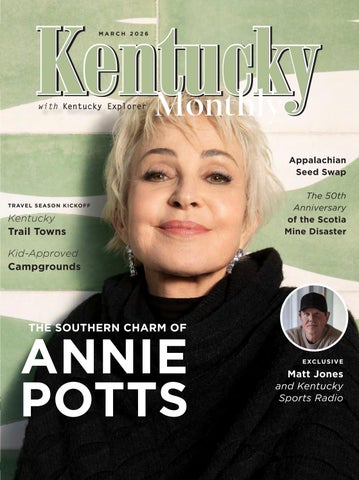
THE SOUTHERN CHARM OF
with Kentucky Explorer
TRAVEL SEASON KICKOFF
Kentucky Trail Towns
Kid-Approved Campgrounds
THE SOUTHERN CHARM OF
Appalachian Seed Swap
The 50th Anniversary of the Scotia Mine Disaster
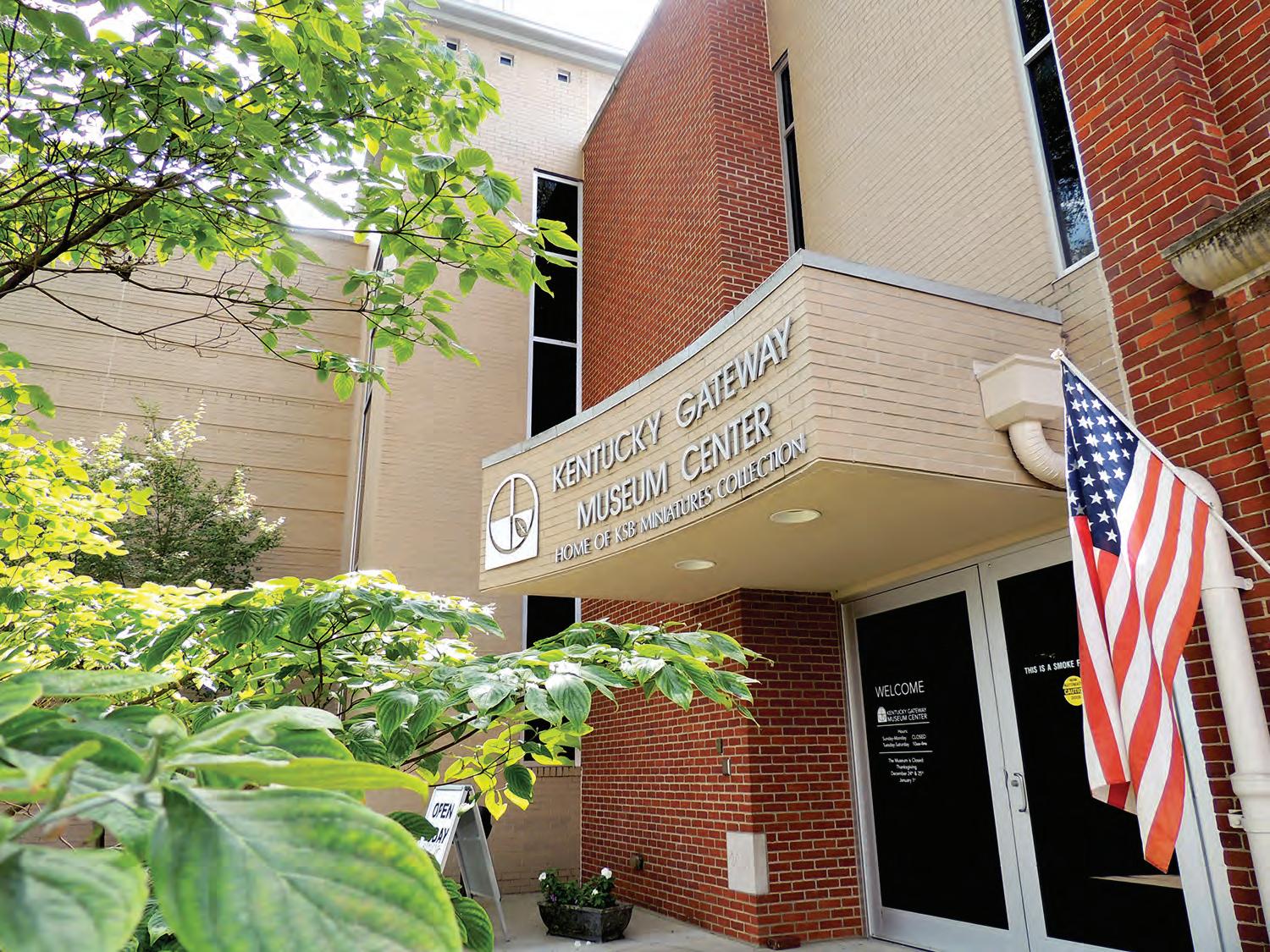

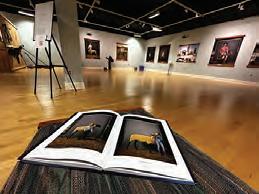






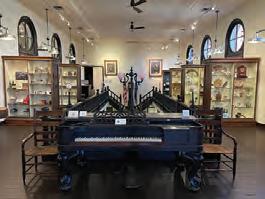

Kentucky Gateway Museum Center is the oldest Kentucky state-chartered historical organization in continuous existence.
We have been collecting, preserving, and telling the story of Kentucky and the Ohio River Valley since March 1, 1878.



The Kentucky Historical Society and the Louisville-based National Society Sons of the American Revolution are two of the many groups (including the Daughters of the American Revolution and First Families of Kentucky) organizing special events this year to honor the 250th anniversary of the Declaration of Independence on July 4. Look for many references to these events in Kentucky Monthly this year.
1. Kentucky’s slogan “United We Stand, Divided We Fall” was selected because of what?
A. Gov. Louie B. Nunn was a big fan of the 1970 hit by Brotherhood of Man.
B. Gov. Isaac Shelby was fond of the Founding Father John Dickinson’s “The Liberty Song,” which includes the phrase.
C. It was suggested by the printer of the state’s first stock of stationery.
2 Isaac Shelby, Kentucky’s first governor to serve two nonconsecutive terms, was nicknamed “Old Kings Mountain” for his service in which war?
A. Lord Dunmore’s War
B. The American Revolution
C. The War of 1812
3 Stephen Trigg Logan, the grandson of one of the fallen commanders at the Battle of Blue Licks (1782), became an Illinois legislator and whose future law partner?
A. Abraham Lincoln
B. Stephen A. Douglas
C. Edward Logan
4 Rebecca Bryan Boone, the wife of pioneer Daniel Boone, is credited with raising how many children?
A. 6
B. 12
C. 18
5. While Daniel Boone and George Rogers Clark have schools and bridges named after them, Rebecca Boone can lay claim to having what named in her honor?
A. 396 chapters of the Daughters of the American Revolution
B. A World War II liberty ship
C. The main highway through North Carolina’s Yadkin Valley
6. Squire Boone, the younger brother of Daniel Boone, founded Squire Boone’s Station, which was 2 miles north of which county seat?
A. Burlington
B. New Castle
C. Shelbyville
7 Blandville, the original seat of Ballard County (which is now Wickliffe), was unique for being what?
A. One of the least exciting towns on the Mississippi River
B. The county and the city representing both the first and last name of its honoree—Bland Ballard
C. The only seat-county combination beginning with the same letter
8. The Society of Cincinnati gets its name from Lucius Quinctius Cincinnatus (c. 519-c. 430 BCE) because he shared what in common with George Washington?
A. He peacefully relinquished power to return to plowing his fields.
B. He was a tall fellow.
C. He was the 11th great-grandfather (twice removed) of Maj. Gen. Henry Knox and Lt. Col. Alexander Hamilton
9 Wilkinson Boulevard in Frankfort is not named for Gov. Wallace Wilkinson but for whom?
A. Bessie Wilkinson, a longtime friend and confidante of Rebecca Boone
B. Gen. James Wilkinson, whom many considered treasonous and treacherous
C. Tommy Wilkinson, who led the Frankfort Panthers in scoring in basketball in 1957 and ’58
©2026, VESTED INTEREST
PUBLICATIONS VOLUME TWENTYNINE, ISSUE 2, MARCH 2026
Stephen M. Vest Publisher + Editor-in-Chief
EDITORIAL
Patricia Ranft Associate Editor
Rebecca Redding Creative Director
Deborah Kohl Kremer Assistant Editor
Ted Sloan Contributing Editor Cait A. Smith Copy Editor
SENIOR KENTRIBUTORS
Jackie Hollenkamp Bentley, Jack Brammer, Bill Ellis, Steve Flairty, Gary Garth, Kim Kobersmith, Brigitte Prather, Walt Reichert, Tracey Teo, Jarrett Van Meter, Janine Washle and Gary P. West
BUSINESS + CIRCULATION
Barbara Kay Vest Business Manager
ADVERTISING
Lindsey Collins Senior Account Executive + Coordinator
Account Executives: Kelley Burchell Laura Ray • Teresa Revlett
Kentucky Monthly (ISSN 1542-0507) is published 10 times per year (monthly with combined December/January and June/July issues) for $25 per year by Vested Interest Publications, Inc., 102 Consumer Lane, Frankfort, KY 40601. Periodicals Postage Paid at Frankfort, KY and at additional mailing offices.
POSTMASTER: Send address changes to Kentucky Monthly, P.O. Box 559, Frankfort, KY 40602-0559.
Vested Interest Publications: Stephen M. Vest, president; Patricia Ranft, vice president; Barbara Kay Vest, secretary/ treasurer. Board of directors: James W. Adams Jr., Dr. Gene Burch, Gregory N. Carnes, Barbara and Pete Chiericozzi, Kellee Dicks, Maj. Jack E. Dixon, Mary and Michael Embry, Judy M. Harris, Jan and John Higginbotham, Frank Martin, Bill Noel, Walter B. Norris, Kasia Pater, Dr. Mary Jo Ratliff, Randy and Rebecca Sandell, Kendall Carr Shelton and Ted M. Sloan.
Kentucky Monthly invites queries but accepts no responsibility for unsolicited material; submissions will not be returned.


Haven Gillespie isn’t the only Kentuckian to write a famous Christmas song (December 2025/January 2026 issue, page 54)
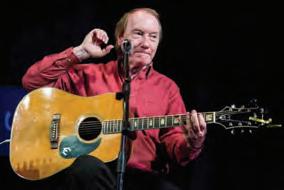
“Grandma Got Run Over by a Reindeer” was composed by Randy Brooks, who attended Hawthorne Elementary School in Jefferson County in the late 1950s and early ’60s. Randy had an interest in music at that time, as his favorite singer was Pat Boone Randy continued his career by penning many well-known tunes that have been recorded by top artists.
If his name sounds familiar, Randy’s two uncles are comedian Foster Brooks and “Cactus” Tom Brooks of T-Bar-V Ranch fame (a 1950s-60s Louisville-based television show). But that’s another story.
Woody Turrentine, Hawthorne classmate, Louisville
I live in Louisville, and it’s been a long time since I’ve been to Locust Grove, but
after reading your article on it new program (December 2025/January 2026 issue, page 24), I am really impressed. It’s nice to see someone doing something that has a lasting impact for America’s birthday.
I know Locust Grove isn’t a big place, but it sure is doing big things. I hope other museums do the same and create meaningful projects like these. Great job, Locust Grove.
Amy Morgan, Louisville
I wanted to let you know I enjoy reading Bill Ellis’ articles in Kentucky Monthly. I usually turn to his column first.
I am currently reading Mr. Ellis’ book A History of Education in Kentucky. I am a retired elementary teacher and am actively involved in the Laurel County Historical Society. Laurel County began celebrating its bicentennial recently. I hope to write some sketches of histories of the current schools to post on our website.
The book’s information about the 1838 school law has been helpful in guiding me to locate additional information about our county’s history. I am appreciative of Mr. Ellis’ book.
Renee Beets, London
We Love to Hear from You! Kentucky Monthly welcomes letters from all readers. Email us your comments at editor@kentuckymonthly.com, send a letter through our website at kentuckymonthly.com, or message us on Facebook. Letters may be edited for clarification and brevity.


Even when you’re far away, you can take the spirit of your Kentucky home with you. And when you do, we want to see it!

Sharon Lillie of Louisville is pictured in Wellington, New Zealand, with a new friend outside of the Weta Workshop, which designed and produced armor, specialty costumes, prosthetics, miniatures and weapons for the Lord of the Rings film trilogy.
submit your photo
Take a copy of the magazine with you and get snapping! Send your high-resolution photos (usually 1 MB or higher) to editor@kentuckymonthly.com or visit kentuckymonthly.com to submit your photo.

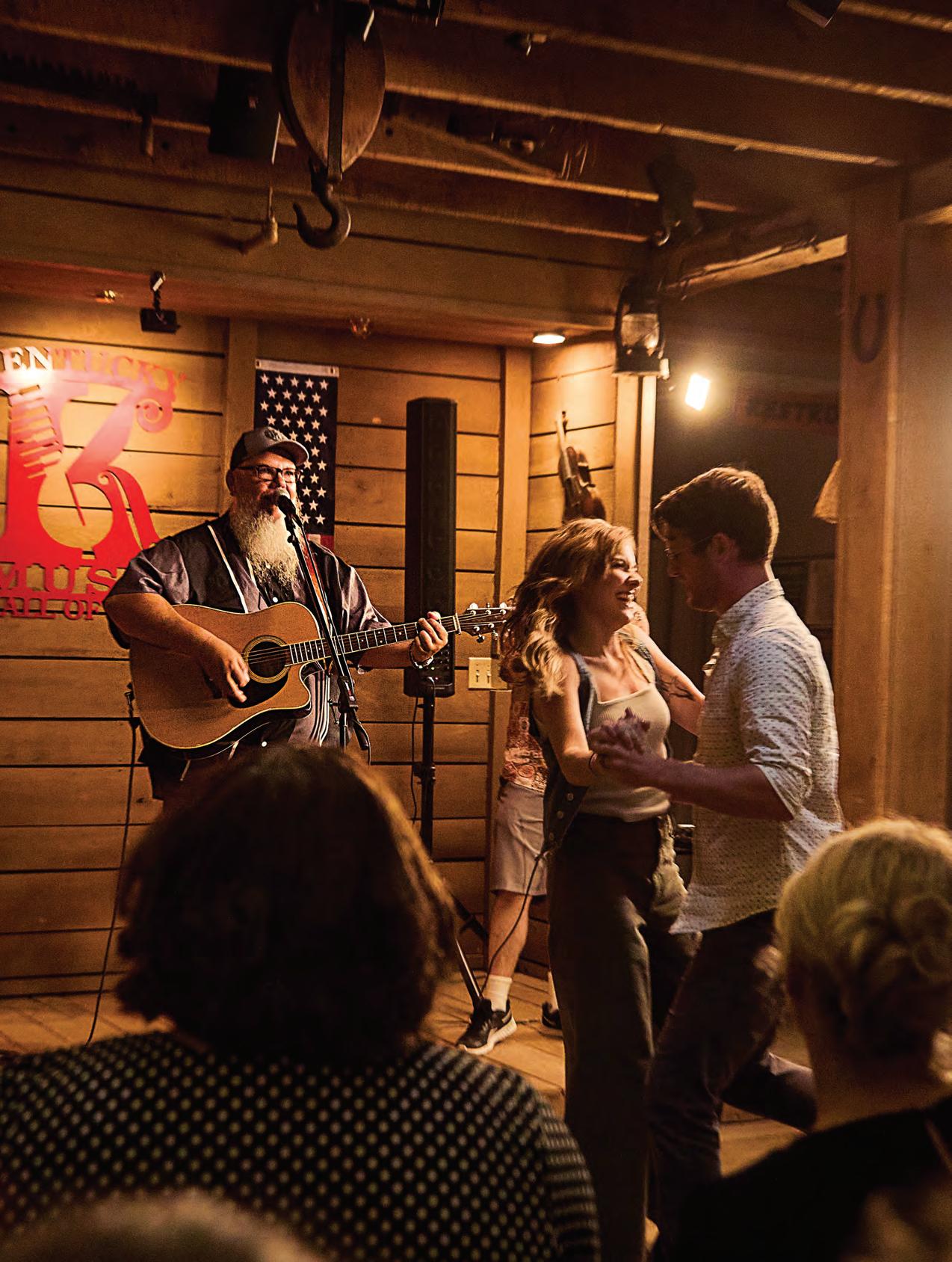


EXPLORE FRANKFORT’S CURIOUS PUBLIC ART SCENE
Frankfort, Kentucky, puts creativity on display with a public art scene that’s as welcoming as it is unexpected. Murals, sculptures and playful installations appear along downtown streets, river views and even tucked into nature — turning a casual stroll or scenic walk into an art-filled adventure.
VisitFrankfort.com/listings/see/arts-entertainment


YOUR BOWLING GREEN GETAWAY AWAITS
See Bowling Green from a new point of view. Iconic innovation meets American performance at the National Corvette Museum, with rotating exhibits and new vehicles coming in regularly. Visit the Kentucky Museum to see its immersive new exhibit, “Sonic Landscape: The Musical Legacy of Southcentral Kentucky,” celebrating the musicians who shaped the region. For a one-of-a-kind new dining experience, The Mustang Club offers a refined menu with locally sourced ingredients and a speakeasy featuring live jazz, all in a beautifully restored former high school gymnasium. An unforgettable getaway awaits in Bowling Green.
VisitBGKY.com

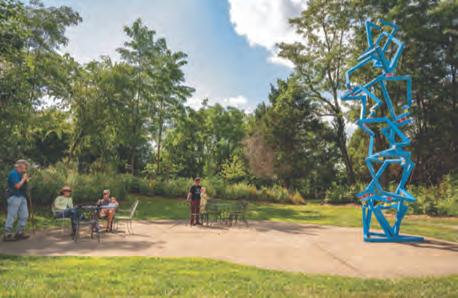
YOUR NEXT ADVENTURE IS WAITING
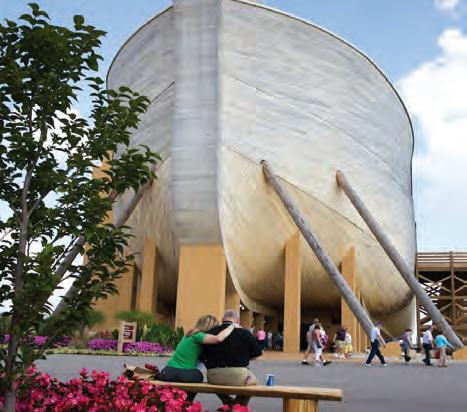
Are you ready for some good times of epic proportions? Make Grant County, Kentucky, your next stop. Conveniently located between Lexington, Kentucky, and Cincinnati, Ohio, on I-75, you’ll find lakes and trails for fishing and hiking, historical sites, family fun and the Ark Encounter.
VisitGrantKY.com

Discover award-winning wineries, the Jessamine Wine + Spirits Trail and The Kentucky Wine & Vine Fest — all worth toasting and all in the heart of Central Kentucky. Sip local vintages, meet passionate wine artisans and savor scenic countryside views, where every pour tells a story and every visit feels like a celebration.
VisitJessamine.com/things-to-do
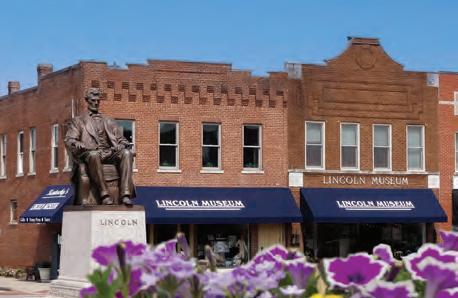
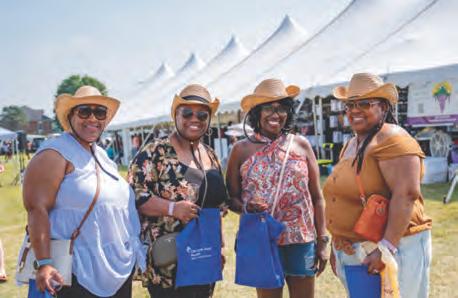
Discover an immersive experience at Kentucky’s official tribute to Abraham Lincoln, located in the heart of the downtown Hodgenville Historic District. Engaging, educational and fun for all ages, the museum offers self-guided tours for individuals and families, group tours by appointment and printed guides in multiple languages. The museum is just three miles from Lincoln’s Birthplace National Park.
LincolnMuseum-KY.org
Just 20 minutes south of Louisville, explore the Bullitt County Wine, Whiskey & Ale Trail. Discover the James B. Beam American Outpost & Distillery, the Four Roses Bourbon Warehouse & Bottling Experience and Coxs Creek Distilling. The trail also features four award-winning wineries and two craft breweries. Get a free souvenir glass when you complete the trail.
TravelBullitt.org

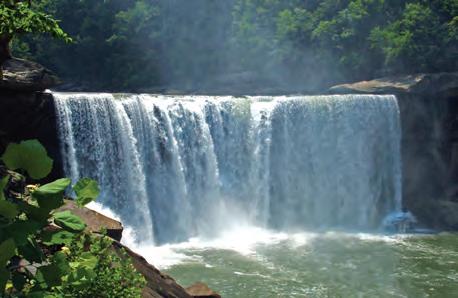

Discover the history and wonder of Williamsburg, nestled between the Cumberland River and Daniel Boone National Forest. Explore the rolling hills where pioneers Daniel Boone and Thomas Walker traveled. See the rare moonbow at Cumberland Falls. Hit the water at the state-of-the-art Kentucky Splash Waterpark. Then, savor hometown flavors from our local culinary scene.
WilliamsburgKY.com

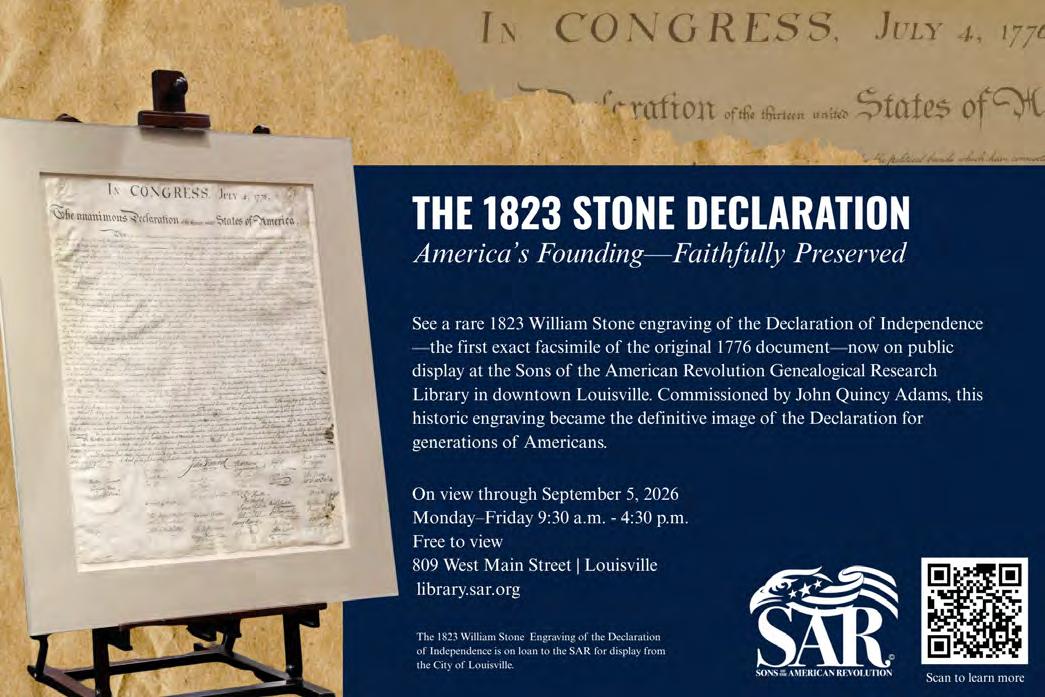
The National Society Sons of the American Revolution, in partnership with the City of Louisville, unveiled a rare 1823 William Stone engraving of the Declaration of Independence, one of the most significant printed representations of America’s founding document.
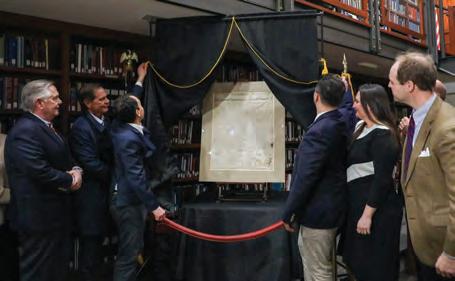
Loaned by the city to the SAR, it is on public display in the SAR Genealogical Research Library in Louisville. It is one of six that have some level of public access, such as those at the Smithsonian Institution and the Henry Ford Museum.
The unveiling of the engraving at the National Society Sons of the American Revolution Headquarters.
The display will be on view Monday through Friday, 9:30 a.m.-4:30 p.m., through Sept. 5.
The announcement was made during a press conference hosted by Louisville Mayor Craig Greenberg, members of the Louisville Metro Council, representatives of the Louisville 250 Commission, and SAR leadership. The standing-room-only event marked the kickoff of America 250 celebrations.
“This display represents a remarkable opportunity for the public to encounter history firsthand,” said SAR President General Michael Elston. The SAR moved its
The Kentucky Foundation for Women announced winners of the inaugural KFW Writer’s Prize in early February. The prize, established through a gift from the Kentucky Women Writers Conference, honors Kentucky women writers whose work demonstrates artistic excellence, aligns with feminist values, and advances social change through literature.
This award continues the shared vision of the KFW and the Kentucky Women Writers Conference to support
KWIZ ANSWERS
national headquarters to Louisville in 1979.
Commissioned by thenSecretary of State John Quincy Adams, the Stone engraving is widely regarded as the most accurate reproduction of the original Declaration of Independence.
“The Declaration does not speak softly. It asserts that rights are inherent, that government must be accountable, and that we, the people, are the ultimate stewards of a free nation,” Mayor Greenberg said.
The America250KY Committee in Louisville includes representatives from the SAR, Historic Locust Grove, the Filson Historical Society, the Frazier History Museum and others.
Dr. Benjamin M. Gies, chairman of America 250 Louisville, said, “We invite every resident to be part of this once-in-a-generation celebration.”
The Stone copy was donated to the city by the family of Kitty and William P. Mulloy in 1986. “This is a natural place for this document to be displayed,” said Mark Mulloy, the son of the late benefactors. “They were, and we are, all lifelong products of this community.”
women and marginalized voices in the literary arts, center feminist perspectives, and amplify voices that challenge oppression. The award—which includes a cash prize, a reading and an inscribed plaque—will be offered each year and will feature different genres.
The genre for 2025 was poetry and was judged by former Kentucky Poet Laureate and Sallie Bingham Award winner Crystal Wilkinson. Kentucky poets Carrie Green, Adrian Sanders, and Marianne Worthington will be awarded $1,000 each and invited to give a reading of their work. Tina Parker and Te’zha Jones received honorable mentions.
1. B. The phrase is found in the seventh verse of Dickinson’s song, first published in 1768; 2. B. Shelby was considered instrumental in winning the Battle of Kings Mountain (Oct. 7, 1780); 3. A. Logan and Lincoln were partners from 1841-43; 4. C. In addition to her six sons and four daughters, Rebecca raised orphaned nieces and nephews; 5. B. The SS Rebecca Boone was launched in Houston, Texas, on Dec. 21, 1943; 6. C. Squire Boone’s Station originally was considered for Shelby County’s courthouse, but nearby landowner William Shannon donated his land for public buildings; 7. B. Bland Ballard, who served as a scout during several campaigns led by George Rogers Clark, served three terms in the Kentucky General Assembly; 8. A. His selfless service: Omnia relinquit servare rempublicam (“He relinquished all to serve the Republic”); 9. B. President Theodore Roosevelt said of Wilkinson: “In all our history, there is no more despicable character.”
The Lexington-based band
Magnolia Boulevard’s two original members love to play music, but more importantly, they are on a mission. Lead singer Maggie Noelle said the band wants to “spread common decency and humanity” and believes music is the way to do it. Keyboardist and songwriter Ryan Allen agrees: “Songs are important to me. They can save lives.”
While Magnolia Boulevard is doing important work, the band also puts on a high-energy, lively show. Its music is an amalgamation of so many styles. Noelle said some people have referred to it as Appalachian rock and soul. She said their music has Appalachian roots with a folk aspect, which meets rock ’n’ roll and soul. Comparisons to the Tedeschi Trucks Band, Bonnie Raitt and Grace Potter are common.
Whatever the sound is called, it is growing in popularity as the band travels across the country. They’ve played live shows in more than 40 states, according to Allen. “We’re starting to build little scenes all over,” he said. He noted Atlanta and Chicago as having strong fan bases, and Magnolia Boulevard goes to Oregon and California a couple of times a year.
Playing live is something Noelle and Allen both love. Noelle said over the years, she’s realized what she loves most about live shows. “It’s just human connection,” she said. “People crave connection and genuine communication … the human emotion from real people.”
Allen said that, in an era of fragmentation, of social media and cell phones, it’s unusual to get people in a room together and agreeing, so “200 people focused on one thing” leads to powerful moments. He feels sharing music matters: “It’s always
just felt important to me, like it’s an important job.”
This particular job started nine years ago. “Ryan and I had been spinning in the same circle for a long time,” Noelle said. They met at the band’s first rehearsal. Noelle had moved to Lexington from Clintwood, Virginia. “It’s about half an hour from the Kentucky border,” she said. “Might as well call it Eastern Kentucky.” Allen is from Jackson County. He was in a bluegrass band while in college at Morehead State University. After graduation, he said, band members decided to “move to the big city and make it.” For Allen, that meant “I was getting asked to do a lot of different things. I said yes to everything.”
One of those things was playing keyboard for a band Lexington musician Todd Copeland was starting that featured a vocalist he admired—Maggie Noelle. After two years as a band, PRS Guitars founder and owner Paul Reed Smith heard the group play PRS guitars at Willcutt Guitars, a store in Lexington. Smith was impressed and helped out. “He’s been really nice since and taking us under his wing,” Noelle said, which has included helping them record singles and EPs.
Although they’ve been together for nine years, they released their first full-length album last November. “We’ve been blessed but also had hard hits, like losing our original drummer [Copeland] in 2021,” Noelle said. Financing also has been an issue. “It takes a lot of money to record.”
Both musicians believe the wait has been worth it. They feel their sound is solid and tight now. They have played for two years with the current lineup. “It’s easy. It’s seamless. We all have

the same goal,” Noelle said. The rest of the five-piece band includes Roddy Puckett (bass), Austin Lewis (guitar) and Brandon Johnson (drums), all Kentuckians except Lewis.
Kentucky’s rich musical history has influenced the band. Noelle and Allen said Goose Creek Symphony, with its mix of rock, folk, jazz, surf and prog rock, intrigued them. “They were a big influence on the way we write songs,” Allen said. “That’s a big one for me.”
The two know their Kentucky musicians and mentioned several as influences, including Loretta Lynn, My Morning Jacket, Keith Whitley, Bendigo Fletcher, Ricky Skaggs and Sturgill Simpson. “I think it’s interesting that we have a lot of influences, but that’s not what we sound like,” Allen said.
The band members have day jobs to support their music, which is not unusual for working musicians. The band’s goals are straightforward: They want to continue to touch peoples’ lives. Also, “I think it would be cool to pay our bills and make art,” Noelle said. “We’re definitely going to be hitting a lot of ground this year.”
To find out more about the band’s tour schedule, plus how to book them, go to magnoliaboulevardband.com Their music is available on all premium streaming platforms.

Easter arrives early this year—on April 5— before strawberries are ripe and new potatoes are ready to dig. Still, we can enjoy the spirit of spring with grocery-store strawberries and tender new potatoes. Family recipes passed down through generations grace our tables, and it’s perfectly fine to build on them with a few convenient shortcuts—because the love put into making them is what truly matters. This menu is full of color and flavor, sure to delight everyone gathered for Easter.
JANINE WASHLE
Bowling Green native Duncan Hines created cake mixes that are still sold today. These rolls taste much like Hawaiian sweet rolls. Tip: These rolls become more tender if baked a day in advance.

MAKES 36 ROLLS, DEPENDING ON SIZE
1½ cups pineapple juice, room temperature (canned or bottled juice)
2 ¼-ounce packages (4½ teaspoons) active dry yeast
1 box Duncan Hines Classic Yellow Cake Mix
2 large eggs
½ teaspoon sea salt
5½ cups bread flour
Melted butter
1. Pour pineapple juice and water into a large bowl. Add yeast; stir to moisten. Wait 10 minutes or until yeast starts to form bubbles. Stir in cake mix. Mix in eggs and sea salt.
2. Add flour by the cupful, stirring until dough forms. Place dough in a large, oiled bowl. Turn dough to coat all sides.
3. Cover bowl with a cloth and set aside in a warm place. Let rise for 1 hour. After an hour has elapsed, punch down dough.
4. Prepare 3 12-cup muffin pans by spraying each cup with non-stick baking spray.
5. The dough will be a little tacky, but don’t be tempted to add more flour, or the rolls will be tough and dry. Use vegetable oil to grease hands. Pluck off dough in walnut-size pieces and roll into a ball. They don’t have to be perfectly round. Place three dough balls in each muffin cup.
6. Once rolls have been formed, cover muffin pans with greased plastic wrap. Set in a warm place and allow to rise until doubled, about 40-45 minutes. You really want them to be well risen, or they will be dense once baked. If your kitchen is cool, rising time may need to be increased to 1 hour, 15 minutes or 1½ hours.
7. While rolls are rising, preheat oven to 350 degrees. Bake 18-20 minutes or until rolls are golden brown.
8. Remove from oven. Immediately brush tops with melted butter. Allow to cool slightly before transferring to a cooling rack.
The word “pudding” in this recipe actually refers to a savory casserole perfect for Easter lunch.

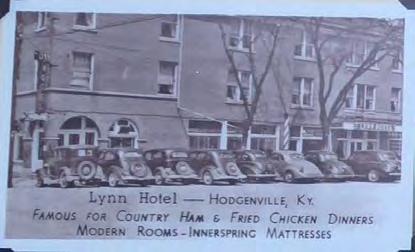
The Lynn Hotel in Hodgenville was a family-style hotel that drew Sunday dinner crowds from a wide area of Kentucky. When President Dwight D. Eisenhower visited, he was served this cheese pudding. He requested a second helping and the recipe as well.
SERVES 6-8
½ cup unsalted butter
¼ cup cornstarch
3 cups whole milk
½ teaspoon salt
¼ teaspoon pepper
6 hard-boiled eggs
½ cup drained, chopped roasted red peppers
1½ cups crumbled soda crackers
1½ cups grated yellow cheddar cheese
2 tablespoons chopped chives
1. Preheat oven to 350 degrees. Spray an 8- x 8-inch baking dish with nonstick spray. Set aside.
2. In a medium saucepan, set over medium-high heat, melt butter, then whisk in cornstarch.
3. Once mixture is smooth, cook for 3 minutes. Whisk in milk. Cook an additional 5 minutes or until thickened. Season with salt and pepper. Remove from heat.
4. Halve hard-boiled eggs. Chop whites and set aside. Mash yolks in a medium bowl. Stir ¼ cup of white sauce into yolks. Mix together thoroughly until smooth. It’s OK if a few small bits of yolk remain.
5. Stir the yolk mixture back into remaining white sauce.
6. Spoon half the white sauce into prepared baking dish. Scatter half the chopped egg whites over top, along with half the red peppers, cracker crumbles and cheddar cheese.
7. Repeat layering one more time.
8. Bake for 30 minutes in preheated oven until cheese is melted and top is slightly puffed. Remove dish from oven and sprinkle with chives. Serve hot.
Tip: This is pretty when made in individual ramekins. Makes 8 ramekins.
RECIPES + IMAGES PROVIDED BY JANINE WASHLE , WAVE COUNTRY & WBKO CONTRIBUTOR.
MAKES ONE 8- X 8-INCH BAKING DISH OR 8 SERVINGS.
16 medium strawberries
1 roll of Pillsbury Original Crescent Rolls
1 stick (½ cup) unsalted butter
¾ cup granulated sugar
1 teaspoon vanilla
1½ cups orange juice
1 teaspoon grated fresh ginger
Vanilla ice cream, optional
1. Preheat oven to 350 degrees. Spray an 8- x 8-inch glass baking dish with nonstick spray. Set aside.
2. Unroll crescent rolls and separate. Place two strawberries on the wide end of the dough. Pull sides up slightly over top of strawberries, then roll up and pinch all of the seams to enclose the strawberries. Place in prepared baking dish. Toward the end, you may have to crowd in the last two.
3. Continue process until all the dough and strawberries are used.
4. Melt butter in a small pan set over medium-high heat. Add sugar; stir to moisten. Stir in vanilla.
5. Divide sugar mixture over top of each dough bundle. Scrape any remaining mixture into pan.
6. Stir together orange juice and ginger. Pour around each bundle.
7. Cover top of baking dish with a piece of parchment paper, then a piece of aluminum foil, crimping edges to keep steam inside of dish. Bake for 30 minutes. Remove foil and parchment paper and bake an additional 15 minutes. Remove from oven. Cool until warm.
8. Spoon out cobbler along with some syrup per serving. Add a big scoop of vanilla ice cream alongside, if desired.
9. Store leftovers in a covered container in the refrigerator.

4 pounds new potatoes, also called “little” potatoes
1 stick (½ cup) unsalted butter, melted
1 cup sour cream, divided
1 teaspoon salt
¼ teaspoon pepper
¼ teaspoon garlic powder, optional
1¼ cup grated Parmesan cheese
1½ cups shredded cheddar cheese, divided ½ cup sliced scallions
6 slices crispy bacon, crumbled
1. Preheat oven to 350 degrees. Butter a 9- x 13-inch baking dish and set aside.
2. Wash potatoes, and place in a large pot. Cover potatoes with water and cook over medium-high heat until tender, about 20-25 minutes. Drain water. Set aside several small potatoes to use as a garnish.
3. Mash potatoes with butter, ¾ cup sour cream, salt, pepper, garlic powder, Parmesan and 1 cup cheddar cheese.
4. Transfer to prepared baking dish. Decorate the top with reserved small potatoes. Cover top with piece of parchment paper. Cover with a large piece of foil.
5. Bake for 30 minutes. Uncover and bake an additional 10 minutes.
6. Remove casserole from oven and immediately sprinkle with reserved cheddar cheese. After 10 minutes, drizzle remaining sour cream over top. Scatter scallions and bacon over top. Serve hot or warm. Refrigerate leftovers in a covered container in refrigerator.
SERVES 6
1 5-pound pork loin, trimmed
½ cup Dijon mustard
1 tablespoon orange zest
½ teaspoon salt
¼ teaspoon pepper
1 cup brown sugar
1 tablespoon orange juice or water Strawberry Ketchup, recipe follows
1. Preheat oven to 350 degrees.
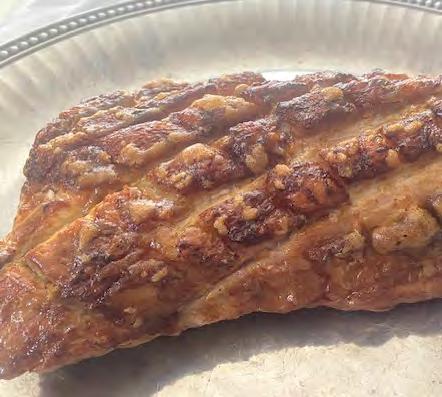
2. Combine mustard, orange zest, salt and pepper in a small bowl.
3. Score top of pork loin in a 1- x 1-inch diamond pattern reminiscent of the pattern scored on a ham. Rub mixture well into the score marks and all over the loin.
4. Place in roasting pan and cook for 1 hour and 15 minutes, or until the internal temperature reads 160 degrees. Remove from oven. Turn oven to Broil.
5. Combine brown sugar and orange juice. Pat firmly over top of score marks. Place loin back in oven several inches underneath the broiler (be careful not to be too close or the sugar will scorch) for 5 minutes or until the sugar starts bubbling. Remove from oven.
6. To serve, slice pork loin thinly and spoon strawberry ketchup over top or to the side.
MAKES 2-3 CUPS
2 pounds fresh strawberries, washed and hulled
1½ tablespoons fresh orange zest
2 teaspoons cracked black peppercorns
½ cup balsamic vinegar (apple cider vinegar works, too) 8 whole cloves 2 cinnamon sticks
teaspoon ground nutmeg 1 cup granulated sugar
1. Combine all ingredients in a large saucepan and simmer until strawberries start to soften. Remove whole spices and set aside.
2. Transfer mixture to food processor bowl and purée until smooth.
3. Pour back into saucepan, add reserved spices, and cook over medium-high heat to reduce until thick like ketchup, about 25-30 minutes. Stir constantly toward the end of the cooking time to prevent scorching.
4. Remove from heat. Discard whole spices. Press mixture through a fine mesh strainer, discarding solids. Store in refrigerator.
*Make a week in advance.





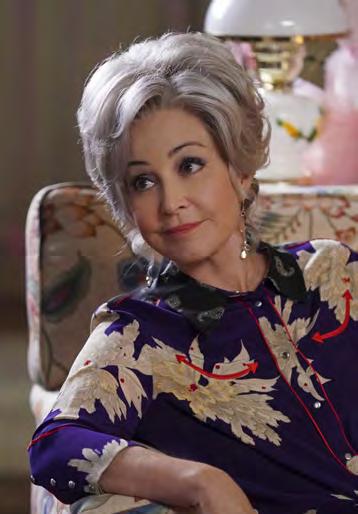
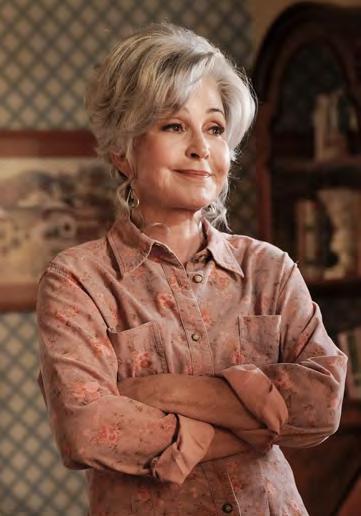
With a résumé of iconic roles in film, TV and the Broadway stage, Annie Potts reflects on her journey to stardom
BY GERRY STRAUSS
Janine Melnitz in Ghostbusters
Mary Jo Shively in Designing Women
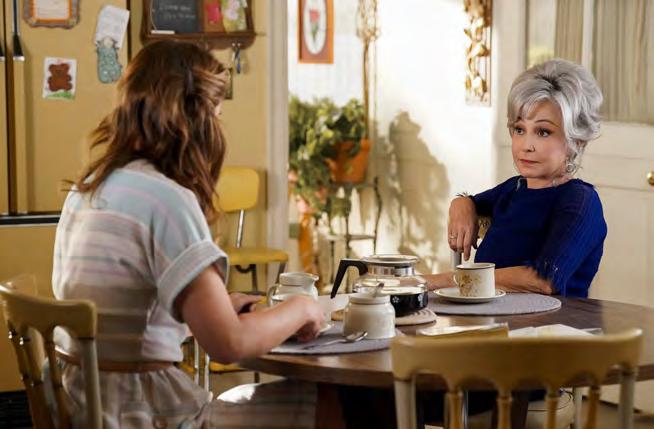
Meemaw in Young Sheldon
From an early age, it was clear that Franklin, Kentucky’s own Annie Potts was destined not only to perform in the spotlight but to thrive.
“Our parents sent us to summer camp with a drama program when we were kids, and then Kentucky started up an arts program in the Franklin and Bowling Green area, so we had a real director and performed,” Potts explained. “The bug bit me so hard. I was obsessed from the get-go, and I entertained myself by reading literally every play they had in the library. I went to college and got my degree in theater, and I was off.”
Potts has stood out in star-making roles during every phase of her 50-plus-year career since starting out in community theater in her teens. So it’s almost impossible to think that a terrifying twist of fate almost derailed her career—and her life—back in 1973.
“I was in a horrific car accident,” Potts explained. “Drunk drivers hit me while drag racing down the wrong side of the highway at high speeds, and I broke [nearly] every bone below my waist. It destroyed me, and I thought, ‘Oh, that’s it; my career’s over.’ ”
Despite suffering permanent damage from the accident (she lost her right heel and walks with a limp to this day, while co-passenger and then-husband Steven Hartley lost his left leg), fate once again intervened.
“I was recovering for a long time in New Mexico, and I saw an ad in the local paper that California Institute of

the Arts was going to be auditioning for their graduate program in Santa Fe in the spring,” Potts recalled. “There wasn’t a lot to do in Santa Fe, because I had broken both my legs and was using a walker. As they say, I didn’t have a leg to stand on.
“I went there and auditioned for California Institute of the Arts with my walker. I did a monologue from The Glass Menagerie, and they accepted me on the spot. They told me that school started in September and asked if I’d be OK by then. Of course, I wasn’t sure, so I simply said, ‘I think so,’ and that’s how I got to California.”
From there, Annie’s career was off and running, but it may never have taken shape without the principles and life lessons she had learned growing up in the Bluegrass State—even if she didn’t appreciate them at the time.
“When I was growing up, I thought, ‘Poor me, we’re such hicks here, and I’m completely underexposed to culture, art, ballet, theater—all of that.’ But that’s what took me to the library to read all those plays,” she explained. “Living on a farm out in beautiful nature with 200 acres to roam and have my imagination as my closest
companion, it fed me in a way that I couldn’t even understand then. Once I matured, I could be nothing but grateful for that background.
“Kentucky was my foundation, and I do think there’s something valuable about the land you come from, which for me was the land right underneath me in that little farm where I grew up,” she said, smiling. “That little town gave me substance and purpose, so I am grateful for it. I have spent most of my career playing Southern women, and my Kentucky upbringing gave me a real cast of characters to draw from. That has been the foundation of the work I’ve
done, and it pays the rent to boot.”
That Kentucky upbringing, combined with Annie’s one-of-a-kind talent, has led to a career full of memorable roles that stand the test of time with multiple generations of fans. Case in point: Ghostbusters, a 1984 comedy classic that placed her right in the center of bona fide comedic geniuses Bill Murray, Dan Aykroyd and Harold Ramis
“Danny and Harold were great scriptwriters, so the movie was already funny as all get out, but I arrived on set and people were just making stuff up,” she chuckled. “I was like, ‘Wait a minute. The script is good, and I
memorized the scene, but now I don’t know what to say!’ It was a bit of a learning curve for me, and that itself shaped the character in a way, because I think I was always just trying to let the boys finish whatever nutty thoughts that they had … Somehow, it all worked for what we were doing.”
In 1986, Annie broke out in an even bigger way by joining the cast of what would become one of TV’s greatest ensemble comedies ever—Designing Women.
“I’d been studying Southern women my entire life, and I recognized all those iconic characters,” she said. “We had a very, very gifted writer who was also Southern, and the writing was so good and so funny. We were planting our flag as smart professional women who were feminine and feminist and holding our own in a man’s world, and we’d never seen women like that on TV comedies before.”
Fueled by a lifelong passion for her craft, Potts happily took on a role in The Big Bang Theory spinoff Young Sheldon that would catapult her to fame for a new generation as Meemaw.
“I knew her very well,” Potts said with a smile. “She’s kind of a composite of my mother and my sisters and aunts and all the Southern women I knew—very feminine. But they all walk like they just got off a horse. I don’t know what it is, but it’s some kind of attitude that is very particular to Southern women. My mother walked like that, and she was gorgeous and super feminine, so I thought, ‘Oh, that will be fun to play that role.’
“I also loved the idea of being the grandparent in a family where they have a super-special kid. I think everybody can relate to that, and it’s easy to go, ‘My God, what’s wrong with you?’ But it is a lot harder to go, ‘I want to nurture you. You’re special.’ And I love that about the show.”
Now 73, Potts is leaping right back into TV with a new hour-long “dramedy” for Fox called Best Medicine, and she’s hoping for yet another hit.
“The show is based on a British series called Doc Martin, which was a huge hit internationally, and I loved it,” she said.
“It’s about the kind of town where I grew up in Kentucky, a little town where everybody knows everybody and takes care of each other, and here comes a new doctor who spent his summers as a child there and has been a top surgeon in Boston. He retreats to the little town of his youth, where things are just a little gentler. I don’t want to jinx it, but I feel about it the same way I felt about those other things in my life that turned out to be successful, because I think we’re all looking for a gentler place and a reminder of who we ought to be.”
From early success stories in TV and film to debuting on Broadway at 57, Potts is truly a favorite, an inspiration and even a “Meemaw” to us all. She dared to dream big. It’s paid off, and she isn’t done yet.
“I’ve been working for a couple of years now and developing a one-woman show—a theater piece that’s about race—and I love it,” she said. “As a Southerner, I’ve always been drawn to that subject matter, so I’m really hoping to do that, because if we don’t figure out how to love each other—no matter what color we are, no matter what God we worship—we won’t last.”
She’s still here; she’s still working; and she’s still bringing her talent, her passion and her heart into our living rooms.
“I love it so much, but I’m working 14 hours a day. It’s like, ‘Listen, do you guys know how old I am? You’re killing me!’ ” she said with a laugh. “But hey, I’m still working. I can still memorize lines. It’s like, ‘Is your mother still driving?’ It’s like, ‘Yeah, your mother can still remember lines.’ So far so good.” Q
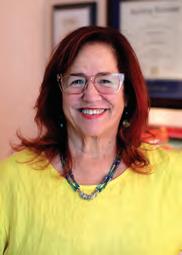
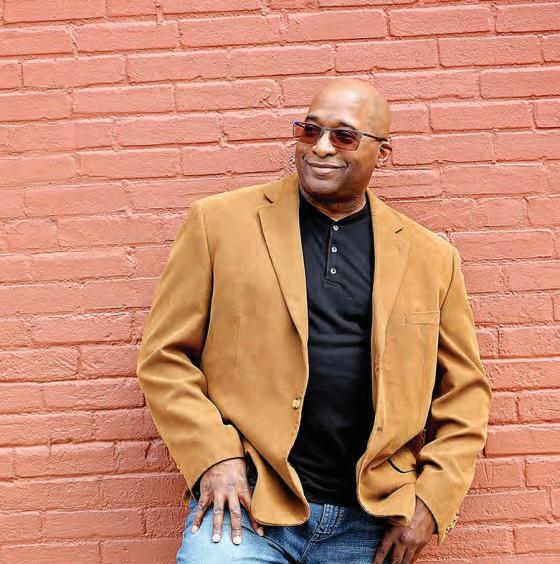
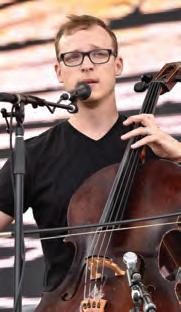
The James Baker Hall Foundation Presents An Afternoon with Marta Miranda-Straub, Hassan Davis and Ben Sollee
Join the James Baker Hall Foundation for an afternoon of music and poetry, featuring published authors Marta Miranda-Straub, Hassan Davis and acclaimed cellist Ben Sollee and student poets from Berea College.
Admission is free, but registration is required (donations are graciously accepted for our work to support Kentucky Writers). Food and Drinks will be available!
Saturday, March 14
1:00 p.m. to 3:00 p.m.
REBEL, REBEL, Studio, Lounge, Music and Event Venue 440 Chestnut Street, Berea, Ky
REGISTER HERE
Kentucky’s Trail Towns are gateways to fun in natural settings
BY LAURA RAY

From the world’s longest cave to a few of the largest man-made lakes in the country, Kentucky offers endless outdoor exploration in its beautiful backyard. Kentuckians and tourists alike hike, bike, ride and paddle thousands of miles of trails and waterways that crisscross the Commonwealth. Kentucky’s Department of Tourism created the Trail Town program to cultivate adventure tourism, designating Dawson Springs as the first Trail Town in 2012. Today, 25 communities hold the title. Trail Towns are gateways to the great outdoors, offering access to terrestrial, water and even underground trails. Visitors can get a taste of local life with a sampling of the cuisine and culture. In addition to campgrounds with primitive and RV camping, lodging options include hotels and bed and breakfasts, plus state resort parks. You can even sleep in a teepee!
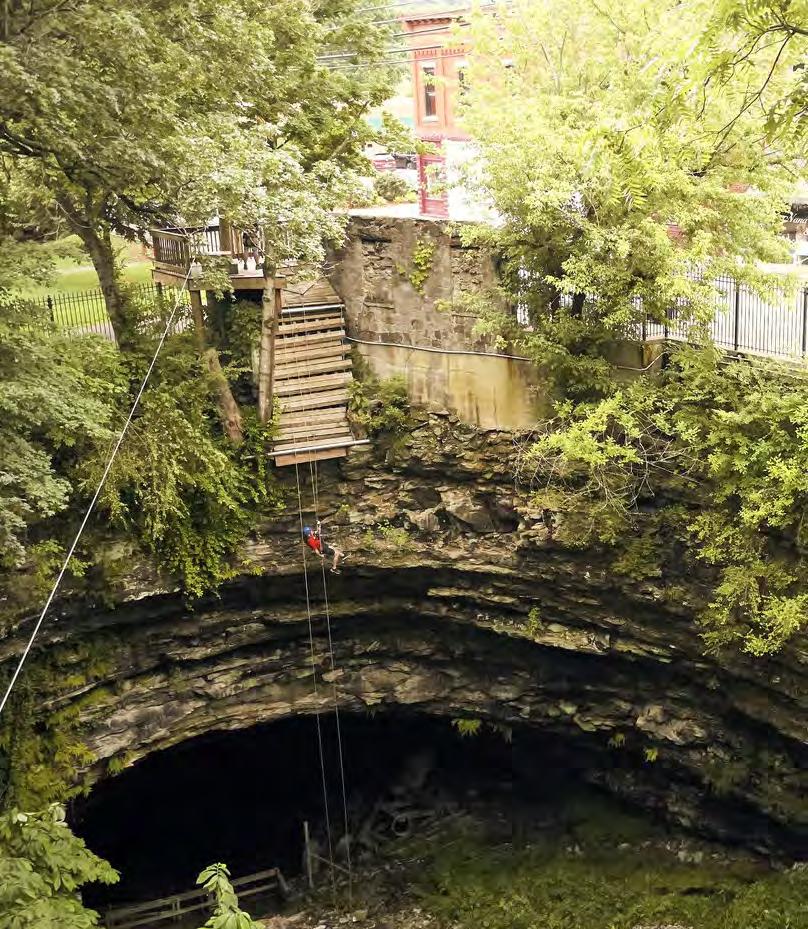
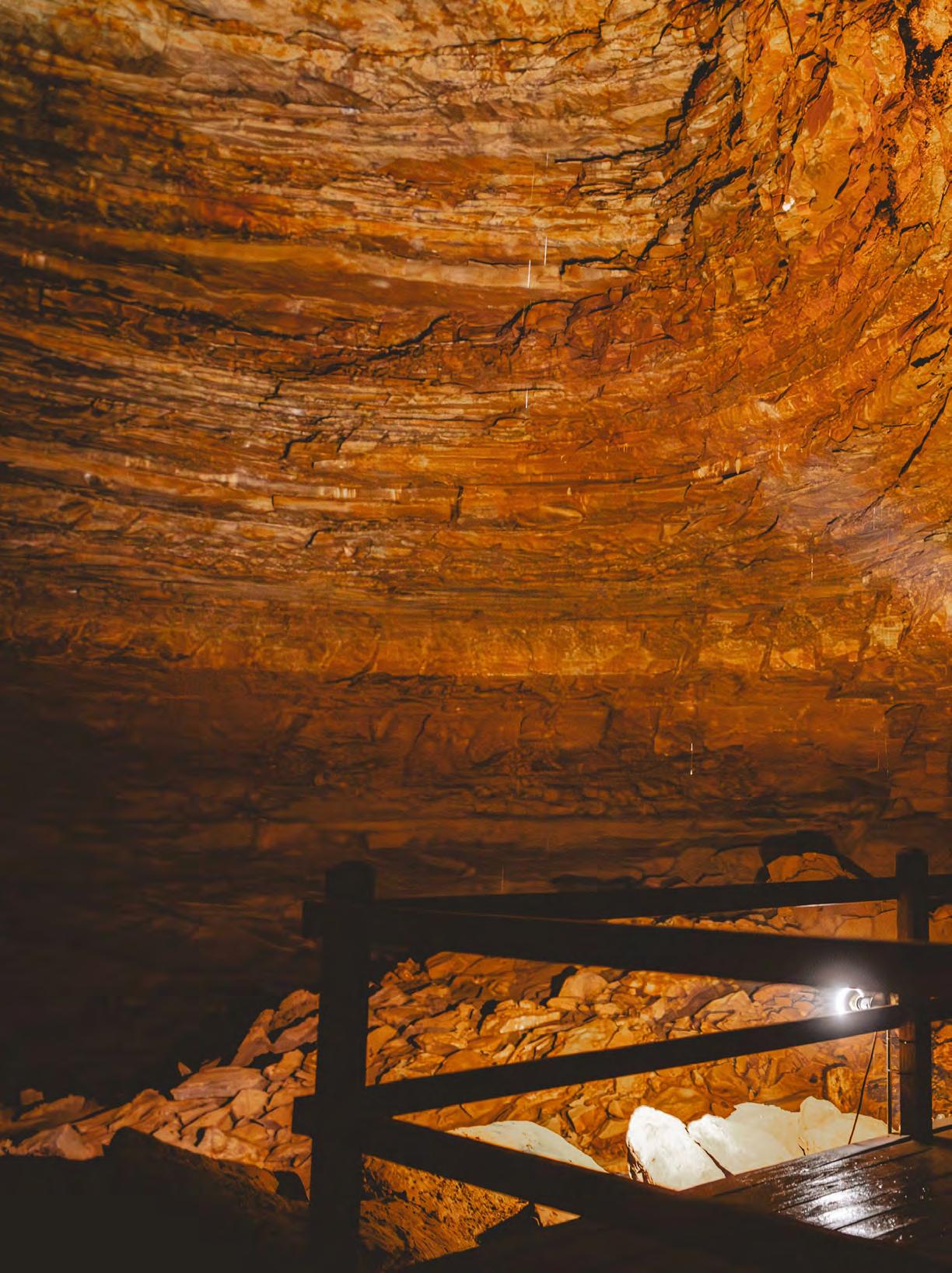
You likely have heard the expression “hole in the wall.” Cave City has a hole in the ground—or, rather, several holes. Water-worn limestone makes for a unique subterranean escape in the southern part of the state. Located between Louisville and Nashville, Kentucky’s cave region is home to six trail towns that make up Cave Country Trails, a collective of communities with hiking, biking, equestrian and water trails that surround the designated Dark Sky Park and International Biosphere Region known as Mammoth Cave National Park. Three caves—Crystal Onyx Cave, Onyx Cave and Outlaw Cave, and Jesse James Riding Stables— earn Cave City its moniker. Visitors
can book a wigwam for the night at the Historic Wigwam Village No. 2.
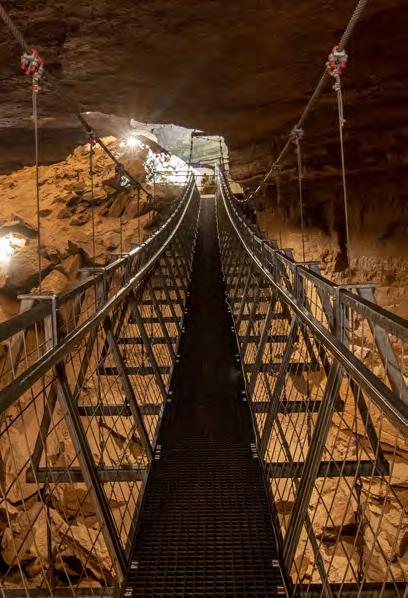
The largest natural opening in the area is the entrance to Hidden River Cave just off Main Street in nearby Horse Cave. Its caverns hide two rivers as well as Sunset Dome, described as “one of the largest freestanding cave domes in the United States.” Adventurers can rappel down its limestone face, zipline across its mouth, or take a tour across a 100foot suspension bridge—the world’s longest underground suspension bridge in a cave—if you dare!
“Horse Cave is a proud partner of Cave City in the Kentucky Trail Town program,” said Sandra T. Wilson, Horse Cave/Hart County Tourism executive director. “Horse

Want to visit the world’s longest known cave system? Book a Mammoth Cave National Park tour via the National Park Service site.
Cave has two unique trails inside [and underneath] our city limits: Hidden River Cave, the centerpiece of our downtown National Register of Historic Places Commercial District, and Mammoth Onyx Cave at the edge of town inside the Kentucky Down Under Adventure Zoo property.” Kentucky Down Under Adventure Zoo also offers the opportunity to pet a kangaroo! Horse Cave’s Hart County is home to a large Amish community and several Amish-owned businesses. Indulge in the freshly baked Amishmade confections at R&S Grocery and Bakery and Farmwald’s Dutch Bakery & Deli. In addition to cabins and RV sites, Horse Cave KOA campground offers unique places to
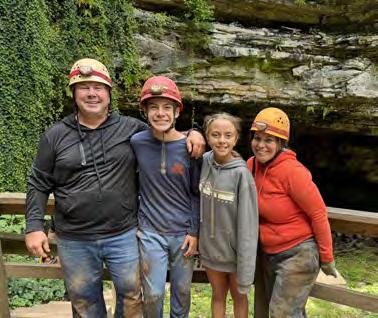
sleep—choose from a teepee, a covered wagon or a treehouse!
Nearby Munfordville is a popular place for paddling the Green River and also is home to Kentucky Stonehenge. Park City serves as the trailhead for the Mammoth Cave Railroad Bike and Hike Trail and is home to Diamond Caverns, which features drapery formations, also known as “cave bacon,” which are mineral deposits that hang like curtains. Of course, there’s plenty of fun to be had above ground in the town named after its neighboring national park, from cycling and hiking Mammoth Cave Railroad Bike and Hike Trail to backcountry horseback riding.

amestown is located in Russell County in South-Central Kentucky. Its claim to fame is Lake Cumberland, and the lake’s claim to fame is “Houseboat Capital of the World,” boasting “more rental houseboats in one location than anywhere else in the U.S.” With more than 60,000 acres of water and 1,225 miles of shoreline, the 101-mile-long man-made lake and the 36,000 acres of public land that surround it supply plenty of room for everyone. Lake Cumberland State Resort Park offers fishing, boating, hiking and even lakeside accommodations.
Anglers flock to Lake Cumberland for its striped bass fishing, while nearby Hatchery Creek is a one-of-a-kind, world-class man-made trout stream full of rainbow, brown and brook trout. The Cumberland River flows through town, leading to the dam. Visitors can canoe or kayak along the Cumberland River Paddle Trail and hike the trails at Wolf Creek National Fish Hatchery.
“From trailheads to wide-open waters, Russell County invites you to ride, paddle and unwind where the Cumberland River and Lake Cumberland steal the show,” said Danielle Wilson, executive director of Lake Cumberland Tourist Commission.
Natural Bridge Arch and Red River Gorge get all the glory, but Russell County boasts its own huge limestone arch called Creelsboro Natural Arch, known to locals as “The Rockhouse.” Follow your GPS and brace for challenging terrain to be rewarded with natural beauty that’s been around for 300 million years!
Explore the Trail Towns of Stearns, McKee and Livingston within a 90-minute drive of Russell County, which offer access to the Sheltowee National Recreation Trail, Daniel Boone National Forest and Big South Fork National River and Recreation Area.
Kentucky has 25 Trail Towns:
Berea
Brownsville
Campbellsville
Cave City/ Horse Cave
Columbia Dawson Springs
Elizabethtown
Elkhorn City
Estill Twin Cities (Irvine)
Harlan (Tri-Cities)
Hazard
Jamestown
Livermore Livingston London Manchester McKee
Morehead
Morgantown
Munfordville
Olive Hill Park City
Royalton Slade Stearns
To learn more about them, head to kentuckytourism.com.
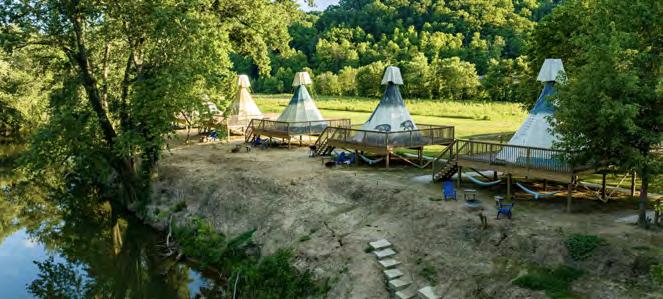
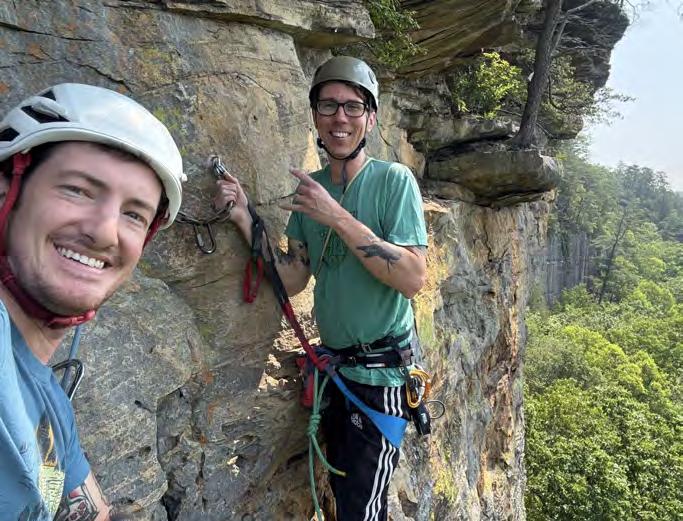
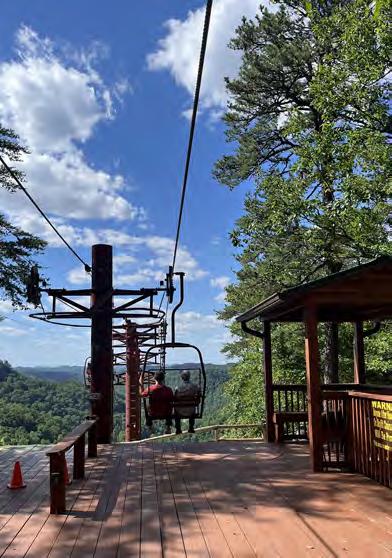
On the eastern side of the state, Slade serves as the gateway to the worldrenowned Red River Gorge and Natural Bridge State Resort Park. Boasting some of the best rock climbing in the Bluegrass State and beyond, this area is home to the striking Natural Bridge. Ride the skylift or hike up to Natural Bridge State Resort Park to check out the enormous eponymous sandstone arch. While in the area, tour Natural Bridge Cave and hike to Henson’s Arch. Red River Gorge trails range from easy to difficult, winding past natural wonders, including Gray’s Arch and Balanced Rock. In addition to the Red River Gorge and Natural Bridge trails, the Sheltowee Trace National Recreational Trail and Daniel Boone National Forest Trail System offer hiking nearby. Paddlers can give the Red River rapids a go or mill about Mill Creek Lake.
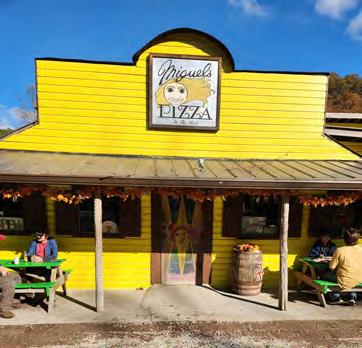
Grab some grub at Miguel’s Pizza, a Slade favorite
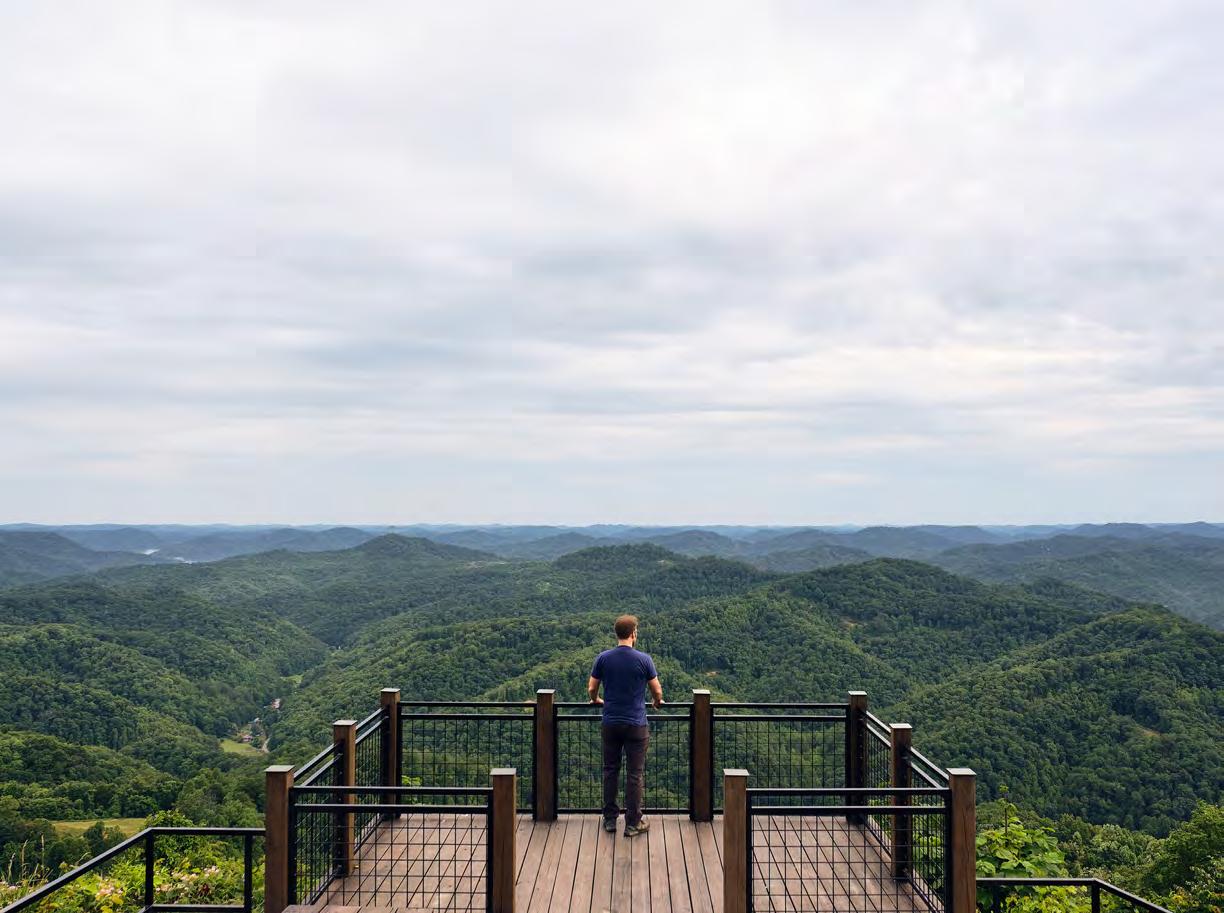
Rising along the Pine and Black mountains, in the heart of Eastern Kentucky’s Appalachian coalfields, Harlan and the historic mining communities of Cumberland, Benham and Lynch— collectively known as the Tri-City area of Harlan County—offer one of Eastern Kentucky’s most compelling Trail Town experiences. Once bustling company towns built by industrial giants such as U.S. Steel and International Harvester, the communities blend rich Appalachian history with a cornucopia of outdoor adventure. Visitors can explore Kingdom Come State Park, hike the Pine Mountain Scenic Trail or Little Shepherd Trail, and tackle popular bike routes such as the Summit Bike Trail, which climbs to the top of Black Mountain, Kentucky’s highest peak at 4,145 feet. Just keep an eye out for black bears along the way!
Located in Lynch, Portal 31 Mine Tours takes tourists
underground through a former coal mine on an oldfashioned railcar. Learn more about the region’s heritage at the Kentucky Coal Museum. Order a latte at Lamp House Coffee before browsing the local farmers market.
In Benham, a beautifully restored 1926 schoolhouse, the Benham School House Inn offers a unique overnight stay rooted in the town’s progressive past. Seasonal events such as July’s “Black Mountain Madness: Ride to the Summit” bring more excitement, while ziplining, ATV trails and elk tours in the nearby Trail Town of Hazard add to the adventure.
As Erica L. Eldridge, Tri-Cities Main Street director, puts it, “Tri-Cities is where the ride turns into a story woven through the histories of Cumberland, Benham and Lynch. Come for the adventure, stay for the shared history and small-town charm, and leave with a reason to come back.”
Middlesboro native Matt Jones left his law practice to launch a sports media career—and he’s never looked back
BY JARRETT VAN METER
On the afternoon of Saturday, Dec. 20, 2025, Matt Jones, 47, turned off the lights at his Louisville Highlands home, grabbed the keys to his black BMW, and went for a drive. He slowly made his way out of the city, the metro sprawl giving way to farmland. He passed through Bullitt, Spencer and Nelson counties. He didn’t have a destination in mind; his focus was on the radio broadcast
of the first-round College Football Playoff matchup between Miami and Texas A&M—not the outcome of the game but the voices calling it.
Jones was scheduled to call a matchup of his own—the 2025 New Orleans Bowl between Southern Mississippi and Western Kentucky University on Dec. 23 alongside partner Myron Medcalf for ESPN Radio. It would be a new challenge for veteran radio host Jones. He had never called a live game.
The preparation in the weeks leading up to the assignment had been an arduous slog of research, annotation and rote memorization. Jones watched hours of film for both teams, dug up anecdotes about Hattiesburg and Bowling Green, and practiced live-calling other televised games. By the weekend of the CFP first round, just days before he was set to travel to New Orleans, he had done all he could do. The hay, as they say, was in the barn. Yet on Friday
night, sitting in his home office listening to the Alabama-Oklahoma game that kicked off the weekend’s slate, he felt his confidence draining. The talent of the broadcasters was overwhelming. They were smooth, detailed and fast—so fast. There was no way he could do it like that.
The unease persisted into the next day. He considered calling ESPN to back out but instead opted for a change of scenery and hit the road. From the driver’s seat, he called friend and longtime broadcaster Tom Hart, who reassured him. Then, he turned on the radio. Marc Kestecher was on the call for the Miami-Texas A&M game. Kestecher’s cadence was relaxed. Still detailed, still precise, but at a brisk walk rather than a sprint.
“I started to realize how many different styles there were,” Jones remembered.
It was a relief. It was freeing. He kept driving and kept listening.
Jones’ professional life has taken place largely at the edge of his comfort zone. He left a stable career as a lawyer to run a sports blog, wrote an adversarial book about Mitch McConnell, and opened a restaurant. Even on his Kentucky Sports Radio show, the mainstay of his growing media portfolio, Jones and his co-hosts often veer away from their nominal focus of Kentucky Wildcat athletics and onto less-stable ground such as current events, statewide news and their personal lives.
But it’s the leap that makes life fun, Jones said, even more so when he can bring his collaborators, audience and state along with him.
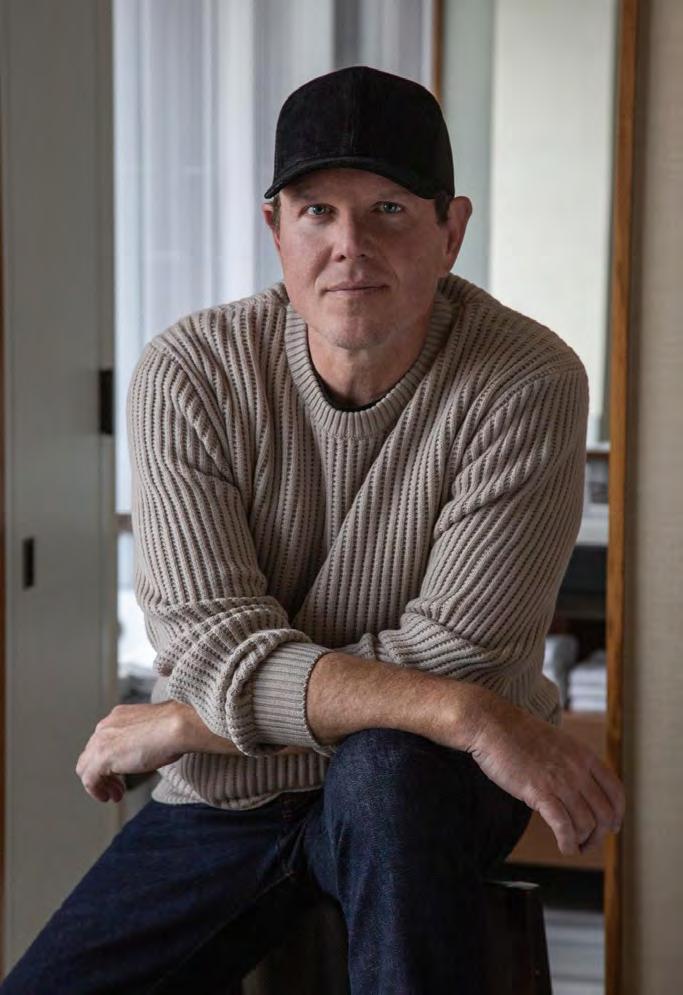
• • Jones grew up in Middlesboro. His parents both worked, so he spent most of his free time at his grandparents’ house a mile across town. An only child, he entertained himself with backyard sports, shooting hoops or grabbing his old seven iron and a tennis ball for a round on his homemade golf course that included his grandparents’ yard and those of the half-dozen neighboring houses. He whacked the haggard ball along the edge of the canal out back, over his grandfather’s
forgotten garden bed, between the houses and across Chester Avenue, aiming for telephone poles, tree trunks and clotheslines along the way.
Indoors, he read. He had a Sports Illustrated subscription and loved books about athletes. As he got older, mentors such as English teacher Billie Jo Booth and pastor Derek Penwell introduced him to Fyodor Dostoevsky, Harper Lee and Herman Melville. This was his public-facing media diet, but in his
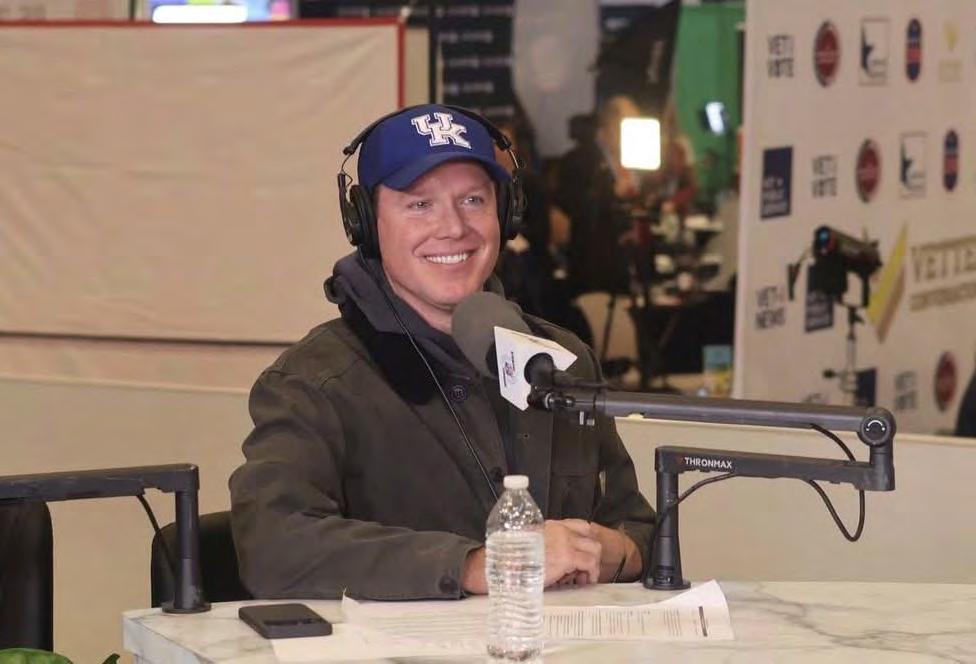
basement bedroom at his parents’ house, the volume turned low so they couldn’t hear, he watched The Howard Stern Show . He loved how Stern brought in his crew as characters and how their lives outside of the studio became content for the program.
“That was not something people did back then,” he said.
Jones played golf, tennis and (some) basketball at Middlesboro High. He also wrote up game stories about the other Yellowjacket teams for the Middlesboro Daily News, his first foray into media, but he was still eyeing a career in law as he left for college. A political science degree from Transylvania University was followed by law school at Duke University, where most of his classmates arrived from different worlds.
“A lot of them had lived in very cultured lives but had no perspective of what the rest of the country was like, and I felt like I did,” he said. “I learned that my accent could be an advantage because people would underestimate you.”
It was the early aughts, and
blogging was coming into vogue. In the fall of 2005, while working a post-grad clerkship for Judge Karen Caldwell of the Eastern District of Kentucky, Jones started a blog of his own: Kentucky Sports Radio. Not yet on the radio, the name was aspirational. He continued to work on the site after accepting an associate position at the Louisville law firm Frost Brown Todd. The site continued to grow, and Jones transitioned away from practicing law. First, he left the firm and started his own practice. Not long after, he went all in on KSR.
• • •
In 2010, KSR launched as a daily radio show. It soon became a sensation, filling a void for Wildcats fans and Kentuckians who wanted a show about their team and their state. Like Stern, Jones has relied on a consistent cast of contributors since the beginning. He met Drew Franklin during their early blogging days. Producer Shannon Grigsby initially was assigned to the show by

iHeart Radio in a sort of arranged marriage gone right. Ryan Lemond was a veteran of Kentucky sports media who first appeared on the show as a guest back in 2011. It was Kentucky Derby week, and, like Jones before the New Orleans Bowl, Lemond prepped hard for the episode. He memorized odds, read up on jockeys, and picked a winner.
“Not one time did we talk about the Kentucky Derby,” Lemond remembered. “That’s when I knew: OK, this is my kind of show.”
The show is purposefully seat-ofthe pants. Each morning, Jones jots down a dozen topic ideas that he pulls from personal experience, Wildcat happenings and general news. None of the co-hosts is briefed on the items.
“A lot of the time, we haven’t even talked to each other before we turn on the show,” Franklin said. “We’ll walk in two minutes before, say, ‘Good morning,’ and then we’re just off and running, just having a conversation.”
KSR has become one of the most popular local sports shows in the
country, and the dedicated clientele has given Jones a transferable customer base to carry into other pursuits. The national Sunday morning show he co-hosts with Medcalf on ESPN has had its own success. His book Mitch, Please , about longtime United States Senator Mitch McConnell from Kentucky, was a bestseller. His restaurant, KSBar & Grille, is approaching eight years in business. Many of those close to Jones say he doesn’t take it for granted.
“I think Matt feels responsible for shaping the narrative about what Kentucky is, who the people are … I think he feels like every time he turns on a hot mic nationally, he has to say, ‘Wait a minute; I’m going to show you that this place isn’t maybe what you think, but I’m also not going to let you bash the people that I grew up with and who love and support me,’ ” Medcalf said. •
Around dinnertime on an unseasonably warm December night in New Orleans, Jones and Medcalf exited the Superdome as victors. They had delivered, as agreed upon by both men and their bosses, a good call of WKU’s victory over Southern Miss. As a bonus, an influx of KSR fans lent a ratings boost.
Around them, a stream of red and gold-clad fans flowed into the night. Several people from the Hilltopper contingent recognized Jones as he and Medcalf walked down Poydras Street toward a nearby restaurant where, once inside and off their feet, they ordered gumbo, watched the house musician play the electric flute, and exhaled. It was, Jones said, a special moment. They had stuck the landing. Q
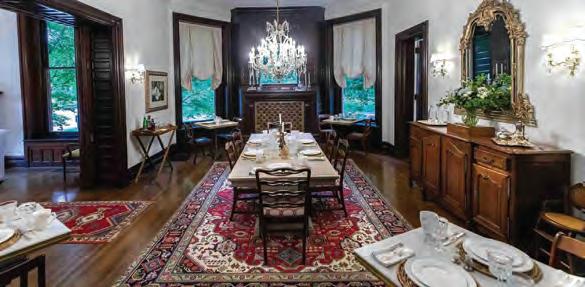
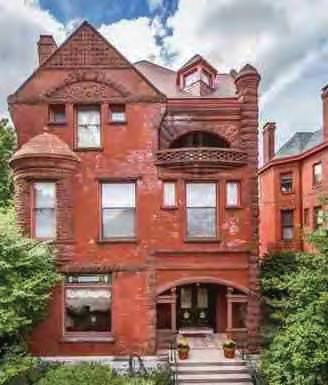
Louisville Bourbon Inn 1332 South Fourth Street, Louisville (502) 813-1137 www.louisvillebourboninn.com
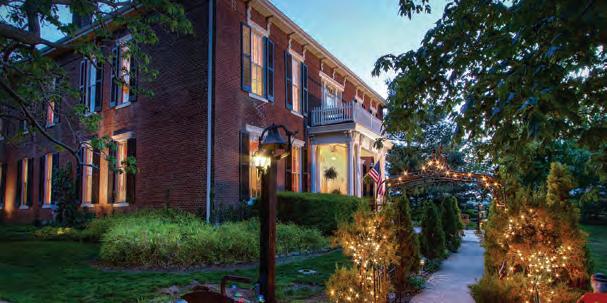

Maple Hill Manor B&B 2941 Perryville Road, Springfield (859) 336-3075 • maplehillmanor.com
Grand Victorian Inn
5 Old Dixie Highway, Park City (270) 590-1935 grandvictorianinnky.com
Rose Hill Inn
233 Rose Hill Avenue, Versailles (859) 214-2144 stayrosehillinn.com
River Trails Inn
301 Hill street, Livermore (270) 993-0766 river-trails-getaway.com
Thurman Landing & Guest Home
107 Broadway Street, Sonora (270) 949-1897 thurmanlanding.com
Belle Louise Historic Guest House 304 N. Sixth Street, Paducah (270) 210-2553 bellelouisepaducah.com
Moon River B&B
320 Market Street, Maysville (513) 739-5770 moonriverbedandbreakfast.com
Pillow and Paddock B&B 3262 Old Sligo Road, LaGrange pillowandpaddock.com
Riverside Inn B&B 85 U.S. Hwy 42 East, Warsaw (859) 567-1329 riversideinnbb.com
Burlington’s Willis Graves B&B Inn
5825 N. Jefferson Street, Burlington (859) 689-5096 willisgraves.com
Ivy Manor, B&B 17720 Hopkinsville Road, Princeton (270) 832-7685 ivymanorbnb.com

BY KIM KOBERSMITH
A
Pikeville event carries on the Appalachian tradition of sharing and preserving heirloom seeds
Every year, Pikeville’s Appalachian Seed Swap begins with a ritual that pays homage to the event’s origins and its cultural importance. Organizers choose an honored guest—usually a regular attendee or an expert seed saver, but it’s also been a re-enactor portraying Abraham Lincoln. In the front of the room, with all attendees looking on, the chosen one carefully wields a knife and commences with the ceremonious Cutting of the Cushaw. Once the squash is sliced and venerated, the event can begin.
The cushaw, a large bulbous sweet winter squash, has been grown for generations in Eastern Kentucky. As with many heirloom crops, varieties often are passed down and cared for by individual families in local hollers. A major flood swept through Harless Creek in 2010 and nearly wiped out the local Farmer Brown Cushaw forever. The event awakened local gardeners to the vulnerability of this hyper-local seed stock and spurred the creation of the Appalachian Seed Swap.
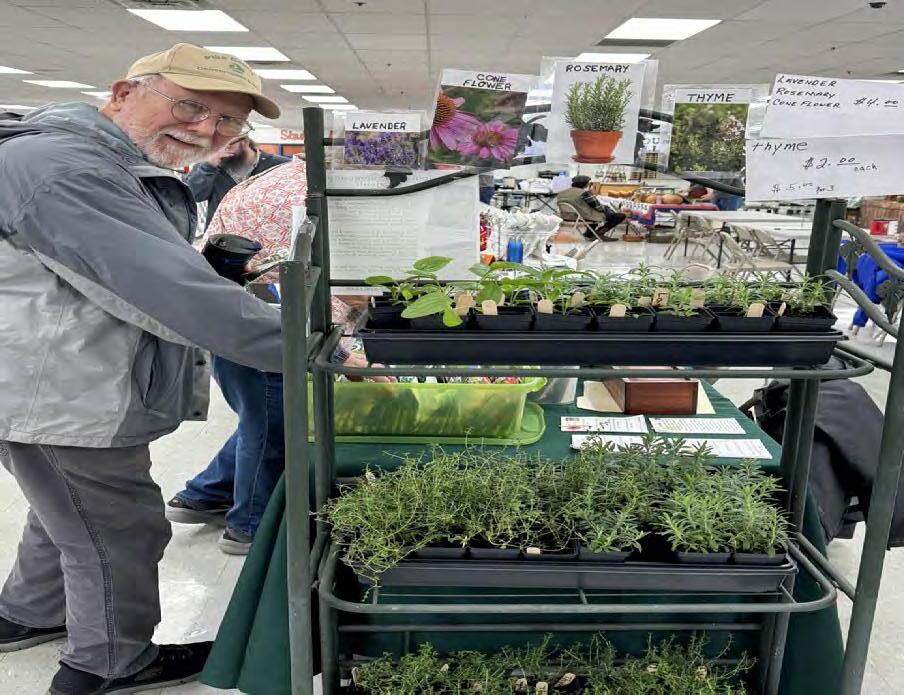
In the face of increasing disasters such as floods, organizers of the seed swap hope to increase the chances that individual strains live on. Sharing seeds across larger geographies increases crop resiliency and creates a fallback plan. That hope already has come to fruition at the seed swap.
A couple of years back, a local woman shared her family bean seeds with a dedicated seed saver from Michigan at the swap. Later, she lost her crop in a flash flood and feared the heirloom might be lost. Then, she attended the next seed swap and approached the same farmer from Michigan. Upon discovering he had grown out her family seeds and could share them with her, she was so moved that all she could do was stand in the aisle and cry.
Swap co-founder Joyce Pinson, proprietor of Friends Drift Inn Farm and Kitchen in Pikeville, has family and personal connections to heirloom cushaws. She grew up eating the squash in pie, pudding and soup. When she married and began her own gardening tradition, she realized they were a specialty crop, and seeds were not readily available in standard catalogs. Her mother mentioned Appalachian heirloom seed expert Bill Best, 90, of Berea, who connected her to the seeds she desired. Heirlooms are deeply tied to familial traditions and Appalachian culture. Pinson refers to Eastern Kentucky and East Tennessee as “the bean nation,” where generations of Appalachians have guarded their own variety of cut shorts, greasies and limas. She is astonished by each seed’s history and its journey to her garden. Her favorite butter bean has a mix of speckled, black and red
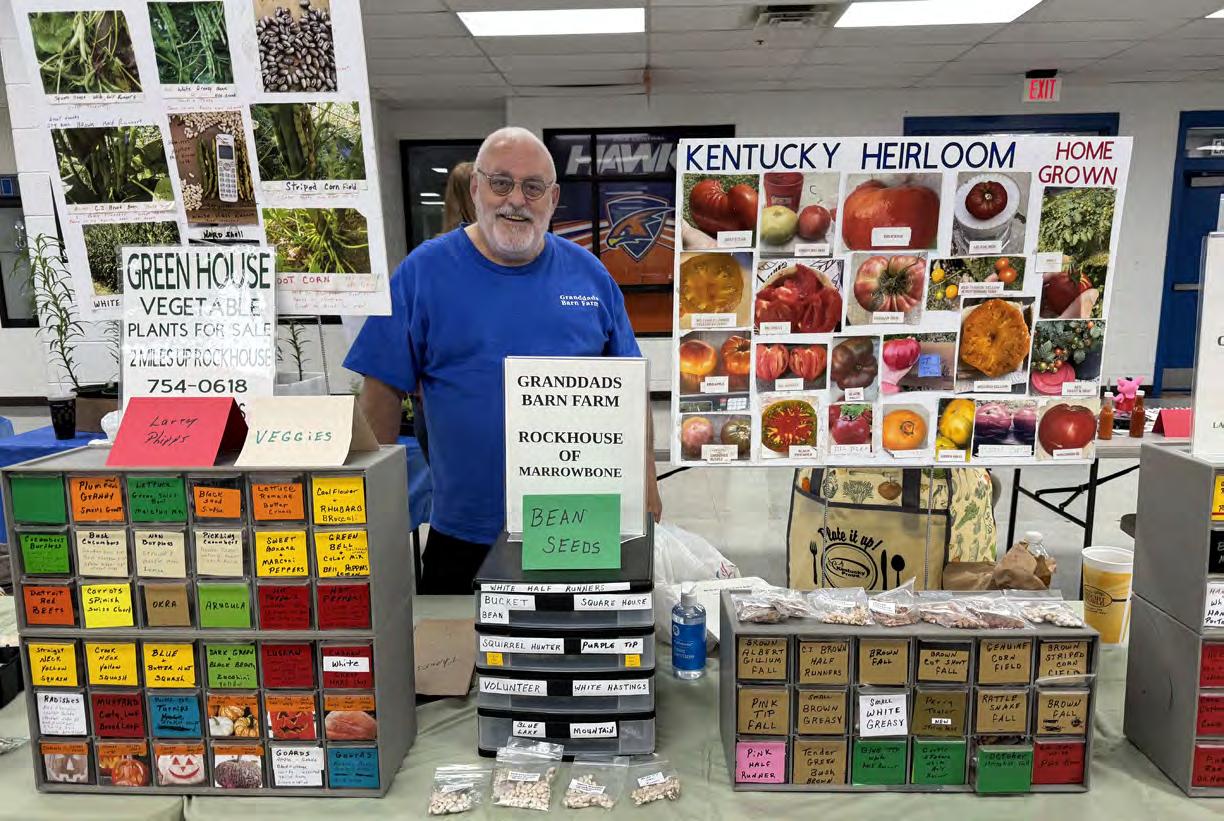
seeds. The Civil War-era story about this bean is that a Union soldier was fighting in the South and grabbed some seeds on his way home.
From a biodiversity standpoint, preserving heirlooms increases global and regional resilience. Saving seeds allows gardeners to more quickly recover from floods. And while heirloom seeds don’t usually produce as prolifically as modern hybrid seeds, proponents like Pinson believe the taste is far superior.
“We save seeds, not because we are paranoid [doomsday] preppers, but because it’s a way of life here,” Pinson said. “I love that foods we have been cooking for hundreds of years and think of as common, like black-eyed peas, become trendy in the hands of chefs. It’s just fun.”
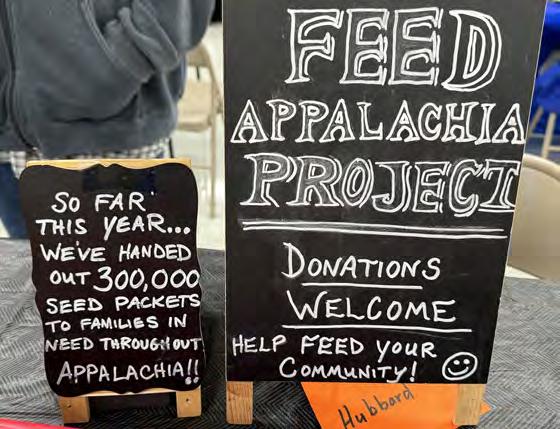
The Pike County event is one of the largest seed swaps east of the Mississippi. It regularly welcomes 200-300 people, but the numbers wax and wane. The largest had more than 1,000 participants. Attendees hail from Louisiana, Mississippi, New York and as far away as California.
It is a buy/sell/trade event, so people need not bring
seeds to participate—or even money. Kentucky State University and University of Kentucky Extension agents and Pike County Master Gardeners hand out free seeds, and the local conservation district distributes small trees. Often, some seed-saving old-timers bring 5-gallon buckets of unusual corn or bean seeds to trade or give away. They are committed to preserving these rare heirlooms by getting them out to gardeners across the community.
Many among the who’s who of seed savers participate in the Appalachian Seed Swap. Jim Wyant, known as “Tomato Jim,” travels every year from his home in Indiana to share obscure and unusual Appalachian tomato seeds. Rodger Winn has saved seeds and gardened since he was a child. He now is an heirloom evangelist of sorts, writing articles and teaching seminars from his home in South Carolina.
For Ben Cohen of Michigan, the passions for seed saving, herbalism, book writing and podcasting all grew out of his family homestead, Small House Farm. John Coykendall is the celebrated master gardener at Tennessee’s Blackberry Farm. Sporting a plaid shirt and overalls, he spins tall tales and takes copious notes in his field-guide notebooks. Pinson said he collects background
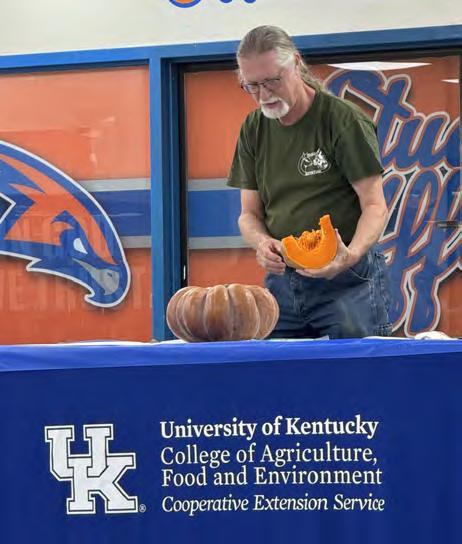
information about the seeds he gathers along with cultural peculiarities and quirks about the Appalachian region.
There are plenty of swap participants close to home. Bill Best founded an heirloom seed company, Sustainable Mountain Agriculture Center, and has written several books about Appalachian heirlooms. One young man from Whitley County drives over every year in his custom-painted car. The hood sports a farming and seed saving scene.
Regular Pikeville Farmers Market vendors bring their seed-adjacent wares, such as baked goods, jams and jellies. Craft participants create toys from dried gourds and gardening books from recycled seed packets. Retiree-aged gardeners mingle with young people learning about the land and families wanting their children to experience growing their own food.
The Pike County Cooperative Extension office has been a partner since the beginning—its parking lot hosted the first seed swap. Extension Agent Emily Davis has been involved the last couple of years and is excited to expand educational opportunities for attendees. A flood event preceded last year’s swap, and Davis handed out research-
based flood-relief information.
“We emphasized building back seed collections after disasters,” she said. “I want people to learn something about seed saving and gardening that they can take home with them.”
At past events, the Family Consumer Science agent conducted cooking classes; Pinson explained seed saving; and one of Pinson’s co-founders spoke on beekeeping. Davis is growing a partnership with the University of Kentucky to include additional experts and to receive a grant to purchase seeds to give away. Locally, connections with universities and master gardener programs also are increasing.
Davis loves heirloom seeds because they bring all kinds of people together—farmers, gardeners, historians and families. She sees more young people getting into traditional ways of doing things, learning skills that their grandparents knew decades ago. In addition, saving and sharing seeds reduces costs and helps build resilience in tough times.
“Families in Appalachia have been passing down seeds for generations,” Davis said. “Saving seeds protects rare and heirloom plants. It’s helping farmers and gardeners grow food suited to our climate and terrain and keeping our Appalachian traditions alive for years to come.” Q
Aftershocks of the Scotia mine disaster still reverberate 50 years later
BY JACK BRAMMER
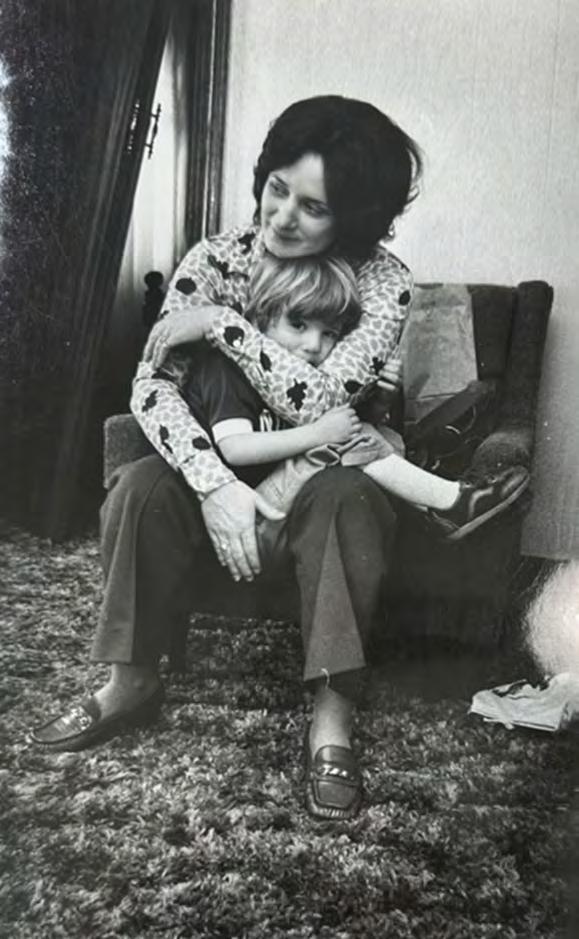
John Hackworth II was 6 months old when his daddy died in a famous coal mine explosion. Fifty years have piled atop one another in the Eastern Kentucky coalfields since that horrible day in Letcher County, which often is relayed to Hackworth by his father’s family and friends.
“I’ve heard all about the tragedy of Scotia,” said Hackworth, now a truck driver who lives near Middlesboro and nurses a weak back. “I’ve heard about how Daddy survived the first-day explosion on March 9, 1976, and then was killed the second day on March 11, when he volunteered quite vigorously to take a rescue crew down to the first explosion, only to be met by a second explosion and death.
“I’ve heard about the federal coal-mining regulations that followed. I have heard a lot of things. The question for me is, do I grieve about a man I never really met? Every day. That’s right. Every day.”
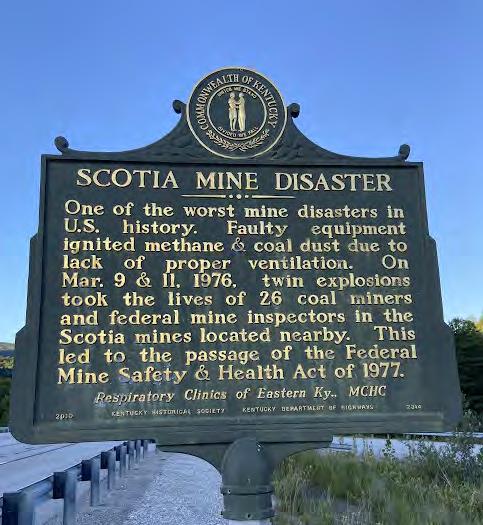
There have been larger coal-mine disasters in Kentucky than Scotia but probably none more impactful. It involved the deaths of 15 miners after the first-day explosion and 11 rescue workers and inspectors in the second explosion two days later.
The two explosions and the deaths of miners and rescue workers spurred major federal coal-mine safety legislation, but coal mining still is considered a highly dangerous occupation.
Incidents of black lung disease, scientifically known as coal workers’ pneumoconiosis, are increasing in the United States, with rates rising following decades of decline. The surge is particularly active and severe in Kentucky, Virginia and West Virginia. The increase is due largely to increased exposure to highly toxic silica dust, produced when mining through sandstone to reach coal seams. The disease is incurable and progressive.
Other risks of mining include fatal explosions, mine collapses and accidents involving heavy machinery.
Meanwhile, Kentucky’s coal production is on the decline. The Commonwealth produced 24.3 million short
tons (a short ton is 2,000 pounds) in 2024, ranking the state seventh in the nation. Production was more than 100 million tons annually in the 1990s and about 26.6 million tons in 2021 for underground and surface mines.
As of mid-2025, Kentucky had fewer than 3,800 coal miners, a record low. The job losses were attributed to automation and other energy sources, particularly natural gas.
Mining coal at Scotia began in 1962. Located about 14 miles northeast of Cumberland in Harlan County, Scotia was a subsidiary of the Blue Diamond Coal Co. The mine is a spur of Black Mountain, the highest mountain peak in Eastern Kentucky, which stretches more than 2,500 feet from its base into the sky and 4,145 feet above sea level. The mines run a long distance the opposite way.
The morning of March 9, 1976, at Scotia was cold and cloudy. Local weather reports highlighted the overall wintery, often icy conditions in the region.
At about 11:45 a.m., an explosion occurred deep within the Scotia mine that extended about 1,200 feet down a slope before reaching a 2½-mile, or approximately 13,200foot, horizontal in-mine passage. The victims were located at the far end of the underground network.
A spark in the mine ignited methane gas. It likely came from electrical equipment. About 108 to 116 miners were working underground when hell broke loose as word spread about trapped miners.
Bill Bishop, a Kentucky journalist, had started working at The Mountain Eagle in Whitesburg in September 1975. He was at the newspaper office when he got word about the problem at Scotia.
The newspaper was run by legendary journalists Tom and Pat Gish. “I did everything at the paper. We all did,” Bishop said. “I was a reporter, but you also helped produce the paper, got it ready for circulation, even got the pizza. No job was too small for anyone.”
Bishop went to the scene. He reported about miners being trapped and ventilation problems in the mine. He
talked to family members. Scotia became a major story on Bishop’s work list. The New York Times checked in with him as the story unfolded.
It was shocking that another explosion occurred two days later, said Bishop. A lack of ventilation figured prominently in the incidents.
Bishop left The Mountain Eagle in January 1977 and became an author and social commentator. He now lives in Louisville.
Gerald Tate, an employee of Westmoreland Coal Co. who now lives in Gate City, Virginia, was a member of the rescue team for both Scotia explosions.
“It was traumatic, chaotic,” he said. “You never forget the dead bodies and the family members waiting for their loved ones. We spent about 15 hours underground on the first rescue clearing the dangerous gases and setting up ventilation.”
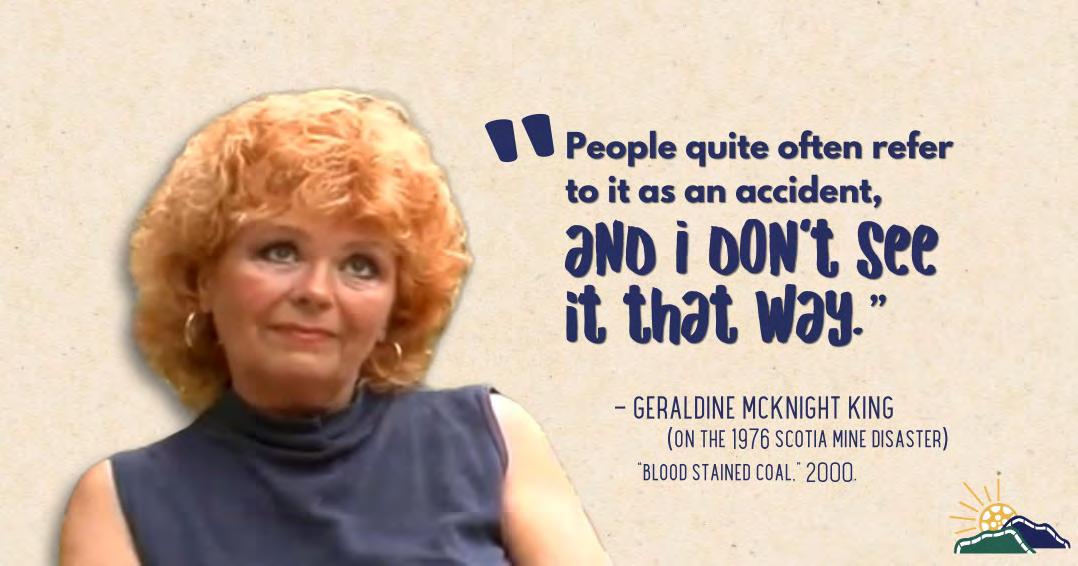
Geraldine McKnight-King was married to Scotia miner Roy Edward McKnight, better known as “Big Sack.”
“He was over 6-foot-7 and had all the muscles to go with it. The babies could sleep in his big hands,” Geraldine said. “And he never once raised his voice to me. He had a big heart.”
The couple had two children—Davis, 5, and Victoria, 2. Geraldine got word the morning of March 9 about the Scotia explosion, hurried to the scene, and waited with her mother and sisters.
“Reporters started coming. I went over to a mirror in a building where I was waiting to try to look half-decent for them,” Geraldine recalled. “I told them if anyone could get out of that mine, it would be ‘Big Sack.’ ”
The young woman later had to tell her children that their father was not coming back home. Davis and Victoria now live in Fort Wayne, Indiana. Davis never was interested in mining. They plan to be with their mother at a memorial ceremony at Scotia in March.
“It will be the first time they set foot on the property where their dad got blown up,” Geraldine said.
Geraldine was one of the leading widows of Scotia who successfully lobbied Congress for safer mining regulations. She worked with the office of then-United States Sen. Wendell Ford of Owensboro and his late chief of staff, Jim King. She and King eventually married. Geraldine now lives in Gulston in Harlan County.
As Geraldine talked about Scotia in a recent phone interview, her voice was hushed, tender, except when she was asked, “Could the deaths at Scotia have been avoided?” After a long pause, she screamed, “Yes.” The hurt lingers.
Dr. Brian McKnight—a history professor, author and co-founder of the Center for Appalachian Studies at the University of Virginia in Wise—has produced a manuscript about Scotia. McKnight (no relation to Roy McKnight) maintains there is plenty of blame to go around for the deadly explosions.
“Federal inspectors wrote hundreds of violations while the mine actively played shell games by making things right while the inspector was standing there and then doing whatever they wanted in order to run more coal once the inspector turned his back,” McKnight wrote.
“Scotia miners knew when inspectors were coming and only paid attention to safety rules on the days the inspector was there. The company seldom trained its miners and usually provided training only during times when a miner would have to choose between being at home or sitting in safety training. It also provided minimal safety equipment that many miners did not know how to use in the first place.”
Hackworth became a coal miner. He even mined coal right above a seam where his father was killed.
“I wanted to be a Kentucky trooper for $11 an hour, but the mine was offering $18,” he said. “I took the job with more money for a short while and then went back to school and had other jobs. I have a daughter, Alyssa. She’s 18. My son, Jordan, is 28. He’s a graphic artist in Brooklyn, New York, for Pepsi-Cola.
“I never wanted [Jordan] to go into the mines. The money is not worth it. There are still a lot of lies about mine safety. The thoughts of my dad and the lack of safety at Scotia still bother me. I live in the ‘what if’ a lot. What if it all never happened?
“But it did, and we should never forget. Don’t want it to happen again.” Q
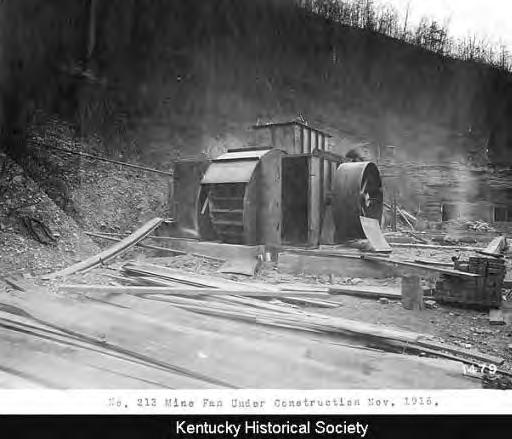
The old wounds from the Scotia disaster—it was not an accident—will be opened at public events in March to commemorate Scotia and its victims.
At 11:30 a.m on March 9, a memorial gathering and moment of silence will be held at the former Scotia mine at Oven’s Fork near the Clover Fork of the Cumberland River. The outdoors event will be brief because of the uncertainty of the weather. The company that now owns the property, Natural Resources Partners/ACIN, welcomes attendees to revisit the site.
Another public event will be held at 1 p.m. on March 9 at the Kentucky Coal Mining Museum in Benham. It will examine the lasting impact of the tragedy and recognize the family members and the mine rescuers who worked the explosions.
Dr. Brian McKnight will talk about his manuscript about Scotia on March 21 at 11:30 a.m. at the Thomas D. Clark Center for Kentucky History in downtown Frankfort. A $10 box lunch will be available. Register at history.ky.gov/events
PHOTO: Tim Talbott, “Scotia Mine Disaster,” ExploreKYHistory, accessed Feb. 5, 2026, explorekyhistory.ky.gov/items/show/238











BY JACKIE HOLLENKAMP BENTLEY
Picture this: The family wakes up to a warm, sunny day. After breakfast, the parents watch the kiddos swim, play and generally wear themselves out. The fun-filled day ends with either catching an outdoor movie or roasting marshmallows by a campfire near the family’s cabin, RV or tent.
Now that it’s March, those visions of sun and fun are getting close to reality. It’s time to start planning the family vacation. Kentucky boasts several locations that provide not only cabin, RV and tent sites but also attractions and activities that keep the entire family entertained. Here are some to consider.
CITY Q


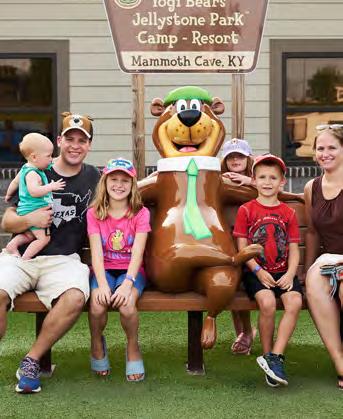
Families have traveled to Cave City since 1974 to take advantage of Jellystone Park’s amusements and scenic campsites.
A floating obstacle course, two swimming pools, a swimming lake, pedal carts, jumping pads (think inflated trampolines), movie nights, mini-golf and various basketball, volleyball, cornhole and horseshoe

areas are just a few of the activities available to all who stay at the nearby campground.
“All the entertainment is packed in. You come to Jellystone Park and basically ask the kids, ‘Do you want to go to the pool? Do you want to go to the floating obstacle course? Do you want to go do tie-dye?’ ” said Trent Hershenson, marketing vice
president for Yogi Bear’s Jellystone Park Camp-Resorts. “It’s great for families of all ages. We’re starting to see more grandparents come and bring the grandkids and give the parents the weekend off.”
Primitive tent camping, RV sites and large-occupancy cabins are available to rent.
Guests may just run into some

famous characters.
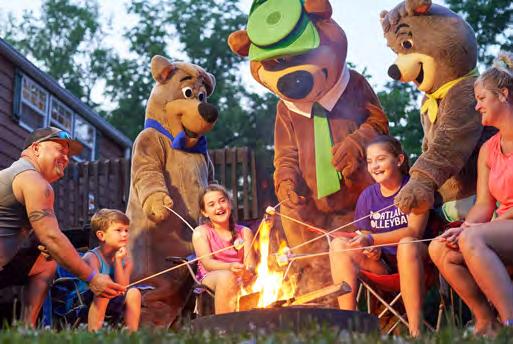
“Yogi Bear, Boo-Boo and Cindy Bear come out and interact with guests, and you can take pictures, do high fives and bear hugs,” he said. Each month, the park hosts various themed events. March’s theme is “Wake Up Yogi Bear,” where guests can enjoy PJ parties, special crafts and more to kick off the season. Other special themed events include luaus and beach parties.
“It’s just a fun way to play and to add even more fun to a camping getaway,” Hershenson said. “Jellystone Park is really a family entertainment destination, and it’s right in the heart of Kentucky.”

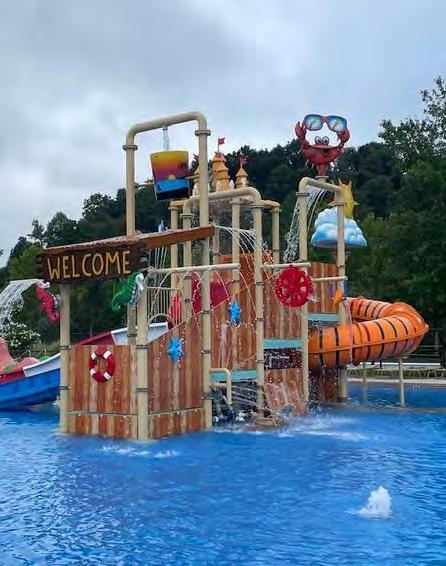
In about two months, Kentucky Splash Waterpark & Campground will open its gates for another season of summer fun. Since its opening in May 2001, the 55-acre park has drawn thousands to enjoy its multiple water features, mini-golf course, arcade and other activities with the goal of keeping the entire family entertained.
The park also has two slide complexes, a wave pool and a lazy river. Among its water features is Burg Island, with its twisty water slides and sprays. Tadpole Island keeps younger children busy and entertained with a 300-gallon bucket dump and smaller slides.
The adjacent campground makes it easy for families who want to enjoy the park for longer than just one day. The campground has more than two dozen RV sites, complete with electric, water and sewer hookups, WiFi and cable TV. Tent sites are also available.
Kentucky Splash Waterpark & Campground is slated to open in late May. Visit its website at kentuckysplash.com for the latest information.
For more information about activities and reservations, visit campjellystone. com/kentucky/ jellystone-parkmammoth-cave.

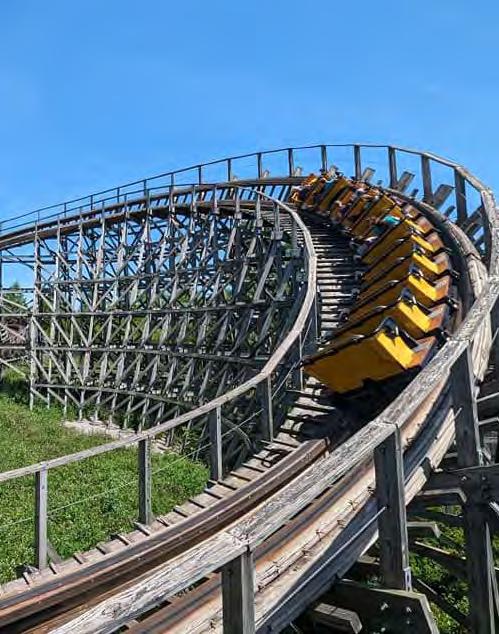
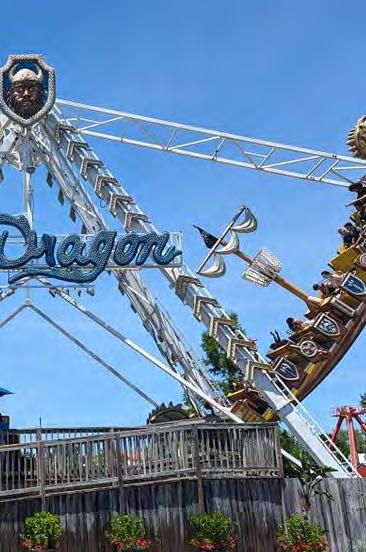
Established in 1898, Bowling Green’s Beech Bend Park is one of the oldest family-owned parks in Kentucky. Initially opened as a picnic area, Beech Bend has added many attractions over the years, including a raceway, a zoo, and amusement park rides such as this ferris wheel from decades ago.

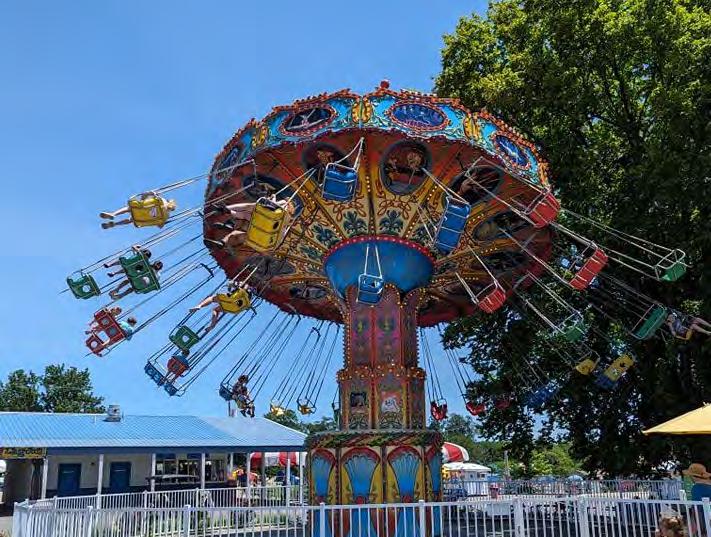
Named for its many beech trees and location in the bend of the Barren River, Beech Bend Park has been a Bowling Green fixture since 1898. Now, 128 years later, the attraction includes a water park, live entertainment, roller coasters and other thrill rides.
“We have so much to offer here at the park,” said Paul Blick, Beech Bend operations manager. “We have the racetrack [Beech Bend Raceway]; we have the campground; we have the music park; we have the water park. It’s like a one-stop destination for travel itinerary plans, vacation plans, weekend plans or just-for-theday plans.”
For those who want to play for more than one day, Beech Bend Campground offers more than 400 sites for RV and tent camping, with 250 sites offering full hookups.
“When your day’s done, you can come down and maybe watch a live band, maybe have a bonfire and roast some wienies and s’mores and stuff like that,” Blick said. “We’re going to have parades, and we’re going to have movie nights and activities that are family friendly. So, when you


come here, it’s a one-stop shop.”
For 2026, the park has streamlined its operations technology under the motto “Tap, Pay, and Play,” where guests can use tap-to-pay methods to keep the fun moving.
“I don’t want you to come to the park and have to wait in line,” Blick said. “I want you to have a fun experience, and the quicker I can get you in the park to play, the better. When you get hungry, I don’t want you to wait in line too long. I want you to get that food and go back to playing.”
PLAN YOUR TRIP
Ticket sales, hours of operation and a list of attractions can be found at beechbend.com.

For a more relaxing vacation that also keeps the youngsters entertained, head to Adventure Bound Eagle Valley in Sanders (Carroll County).
The RV and camping resort features more than 500 RV and cabin sites to put up your feet, relax and enjoy the scenery.
A pool and waterslides are on site for those who want to cool off in the summer sun or kick it up a notch slipping and sliding.
PLAN YOUR TRIP
For more information, check out abcamping. com/eaglevalley.
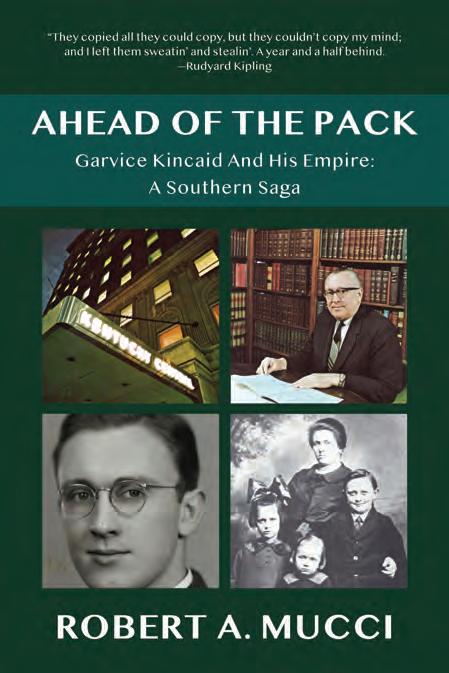
Garvice Delmar Kincaid was an iconic visionary, a man ahead of his time, indeed Ahead of the Pack. This is the story of a Lexington, Kentucky Businessman who turned $1,500 into a $500 million empire over a 40- year period.
At his death, his five hundred-million-dollar empire was comprised of over one hundred and seventy-five organizations consisting of radio and television stations, banks, hotels, resorts, consumer finance companies, life insurance companies and real estate holdings. This is the true story of Kincaid’s historic rise and the catastrophic fall of his organization after his death.
About the Author
ROBERT A. MUCCI has a business degree from Transylvania University and is a Charter Financial Analyst who began his 40-year investment career at Kentucky Central Life in 1981, working there until it was sold in 1995. He has extensive knowledge of the company, including the important participants in the building of Mr. Kincaid’s empire and later its destruction. Robert and his wife live in Lexington, KY.


Now available for purchase at your independent bookstore, through national online booksellers, or directly via RabbitHousePress.com. Get your copy today!





The 1901 Kentucky Derby was the 27th running of the Kentucky Derby. The race took place on April 29, 1901.
Volume 41, Number 2 – March 2026
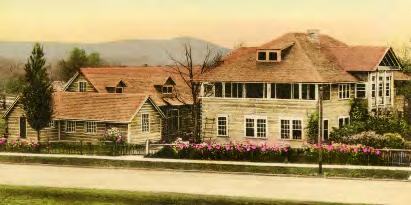
The Log Palace
This colorful circa 1925 postcard features the Berea College Log House (right, built 19151916) and the Sunshine Ballard Cottage (left, built 1920-1921). Originally named the Log Palace, the Log House has served as display and sales space for Berea College crafts for more than a century. The cottage was added to house Fireside Industries, a program that promoted Appalachian crafts. In 1924, more than 150 mountain families benefited from income generated by sales of their handmade items through Fireside Industries. (Image courtesy of Berea College Special Collections and Archives)
To learn more, visit libraryguides.berea.edu/aboutsca.
Your Letters -- page 46
The Revolutionary War and Boone County Settlers -- page 50 Billy C. Clark: The Chronicler of the Big Sandy -- page 54
FOUNDED 1986, VOLUME 41, NO. 2 a magazine published for Kentuckians everywhere
Charles Hayes Jr. • Founder
Stephen M. Vest • Publisher
Deborah Kohl Kremer • Editor
Rebecca Redding • Typographist
One-Year Subscription to Kentucky Monthly: $25
Letters may be edited for clarification and brevity.
While reading Tom Eblen’s article “In Their Own Words” in the October 2025 issue of Kentucky Monthly (page 14), I noticed a photo of a rural classroom with an old potbellied stove. This reminded me of all the many oneand two-room schools I attended, most of which had this type of heating. My father was a tenant farmer, and we moved frequently.
I started school in 1943 at Springfield Elementary, followed by quick stints at Hanby Grade School in Washington County, Leestown Elementary in Fayette County, and Salvisa Elementary in Mercer County.
We briefly moved to a large corn-growing farm in DeKalb County, Illinois, where my father worked in the corn-canning industry. All I can remember about this experience is how cold it was.
We returned to Springfield, Kentucky, and I attended Lincoln Park School, a two-room school with large sliding doors that could be closed to use only one room. Each classroom was heated with a large potbellied stove. Our teacher, Mrs. Elizabeth Rudd, taught all classes. On Fridays, Mrs. Rudd sent the oldest boys into the woods to gather kindling for the stove. Since we lived close to the school, Mrs. Rudd paid me a nickel a day to get to school early and start the fire each morning. I really appreciated the confidence Mrs. Rudd had in this little farm boy.
We then headed to Spencer County, just outside of Fairfield. My brothers, Jerry and Ben (now both deceased), and I walked up an old wagon road to the main highway and then to the one-room Little Union Grade School.
In seventh grade, I briefly attended Taylorsville Junior High, but then, we moved 5 miles outside Springfield. The three of us walked across two swinging bridges to get to the Valley Hill Store and then catch the school bus to Maud Elementary in Washington County. For the next
Kentucky Explorer appears inside each issue of Kentucky Monthly magazine. Subscriptions can be purchased online at shopkentuckymonthly.com or by calling 1.888.329.0053.
In memory of Donna Jean Hayes, 1948-2019
half-year, I attended high school in Springfield, but then we moved to Mercer County, where I eventually graduated from Harrodsburg High School in 1955.
Most of the schools I attended did not have running water, plumbing or central heating. Drinking water came from a cistern, and our teachers added bleach to make sure the water was safe for us to drink.
My educational travels ended when I attended Georgetown College for two years. I met my wife of 64 years at Georgetown and then graduated from the University of Kentucky.
Bob Lykins, Danville
Lawrence County, Kentucky: A Look
Back is a brief overview of the origins of Lawrence County’s settlement, commerce and early Kentucky life. In this project, local historian and genealogist Victoria Moore joined forces with J. Lynn See, a teacher, businessman and historian. See published Old Louisa Remembered, a popular look at Louisa from the late 1800s through mid-1900s.
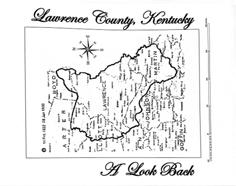
The book is $45 ($5 shipping and handling, if mailed). It is available for in-person purchase at the Lawrence County Public Library, 102 West Main Street, Louisa, and the Louisa Drug Store, 408 North Lock, Louisa.
For information on in-person purchases, contact Caleb Farley at caleb.farley@gmail.com. To get a book mailed, please contact Victoria Moore at bhictoria.ni.omordha@ gmail.com. For mailed books, checks should be made out to Lawrence County Kentucky Genealogical and Historical Society and mailed to P.O. Box 1445, Louisa, KY 41230.
All proceeds benefit Hilltop Methodist Church and The Lawrence County Kentucky Genealogical and Historical Society.
Kentucky history captured in documents and photos are available at the Kentucky State Digital Archives in Frankfort. Kentucky Explorer has partnered with the KSDA to share a piece of this history each month.
In 1922, Harriette Beecher Stowe Marble became the first Black woman licensed as a pharmacist in the Commonwealth of Kentucky. Born in Mississippi in 1888, Marble attended Meharry Medical College in Nashville, Tennessee, and graduated in 1906. Following graduation, Marble worked in several states before settling in Lexington.
The Kentucky State Digital Archives is a free online service operated by the Kentucky Department for Libraries and Archives and features more than 130,000 documents, photographs and A/V materials of government records. For questions, visit kdla.access.preservica.com/portal/en-US or email electronic.records@ky.gov.

…
Send memories to Deborah Kohl Kremer at deb@kentuckymonthly.com or mail to Kentucky Monthly, Attn: Deb Kremer, P.O. Box 559, Frankfort, KY 40602.
Story related by Vivian Hall and written by her son, Edwin Hall Jr., of Cumming, Georgia
It was was March, 1942, and my husband, Edwin Hall Sr.,was home on leave from the United States Army. All his brothers, sisters and cousins were gathered at the home of his parents on Sand Hill, just outside Cumberland (Harlan County). One brother had walked across Black Mountain from Virginia in the snow to visit Edwin.
In addition to the smokehouse/toolshed out back of Edwin’s parents’ house, there was another little structure down the hill. Sooner or later, everyone made their way to this little house, known as a two-holer. At some point, I excused myself and walked out in the snow to pay a visit.
When I opened the door, I was shocked to find one of the seats occupied. A second look told me that someone had placed a snowman on the seat of honor, complete with a hat and pieces of coal for his eyes. But he was definitely not a member of the Hall family.
By Linda J. Hawkins, Morgantown
One summer evening in Morgantown in Butler County in the early 1960s, my siblings and I took a stroll down the lane with our parents. We enjoyed our walk as the smell of wildflowers and fresh cut logs filled our nostrils. You see, we lived not far from B & R Lumber, which is a sawmill that is still in business today.
We ventured to an abandoned sawdust pile at the sawmill. We were amazed that it was larger than our own home. It resembled a giant sandbox, ready for play. When we dug down several inches, heat could be felt radiating from it. We stuck our bare toes into the holes we had dug. We also discovered that a variety of insects made their homes there.
When I returned to the house, I could feel that family members were waiting for my reaction, but I certainly was not going to break the silence first. Finally, one of the brothers asked, “Where have you been, Vivian?” “Oh, just out looking at the snow” was my reply. “Did you see anything out back?” “Nothing unusual” was my steady reply. I didn’t say a word about meeting “Frosty” all afternoon, but it was obvious there were several people who were anxious to hear about it.
Flash forward 40 years to a Hall family reunion, where relatives, in-laws and outlaws were swapping memories and stories. My curiosity got the better of me, and I had to ask, “Who put that snowman in the outhouse back in 1942?” Looks were exchanged, chuckles rippled across the room, and one of the brothers said, “It was me.” Then another brother said, “I did it,” and another brother chimed in: “No, it was me.”
Some jokes are better when you wait 40 years for the punch line, but I never learned who really introduced me to Frosty back in 1942.
first pointed out the spiral-shaped homes the bugs had bored into the sawdust. The homes resembled little tornadoes but were perfectly still.
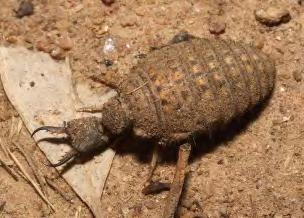
Dad told us to bend down and repeatedly speak with low, hushed tones, “Doodlebug, Doodlebug, your house is on fire!” “Doodlebug, Doodlebug, your house is on fire!” The bug felt the heat of the fire and appeared, thus giving us a frontrow seat to view this fascinating insect. Excitement intensified as each of us located our very own little house to chant over, “Doodlebug, Doodlebug, your house is on fire!” We jumped up with shouts of glee as the little bug surfaced then scurried away for protection.
Dad began to explain about unique insects, one we called a doodlebug, but it’s officially called an antlion. Dad
Dad and Mom laughed heartily, but later, we learned that it wasn’t our words that had lured the doodlebug out. It was the heat of our breathing that had brought it darting to the surface to investigate. This experience was stamped into my memory of precious family moments—learning, laughing and being taught to love nature.
By Ben Shipe, Erlanger
Upon returning home to Taylor Mill from a tour of duty with the United States Army’s 1st Cavalry Division, I bought a 1969 Chevelle Super Sport 396 from a longtime friend. It was fine for my wife and our son, but after several years, two more children, and a hound named Boots, it was time for a true family car. It was time for a station wagon.
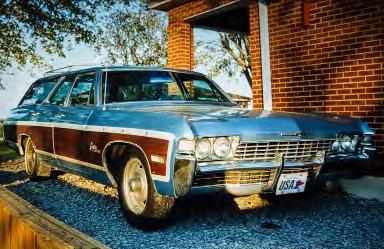
Before the minivan craze and well before the SUV became the cat’s meow, station wagons were popular. The Chevrolet Motor Division made owning a station wagon cool when it introduced the two-door Nomad station wagon in 1955.
There would be no more driving to Morning View (Kenton County) to race at Thorn Hill drag strip—one of the oldest drag strips in the country. No more cruising Frisch’s on Friday and Saturday nights. The beautiful fourspeed SS 396 Chevelle, with a black lacquer finish deeper than any Kentucky coal mine, was traded for a station wagon.
I opened an old album to a photo of a 1968 Grotto Blue metallic Chevrolet Caprice Estate wagon. Back in the day, “Estate” meant that it had simulated wood on the sides and the tailgate. On a scorching sunny day in the summer of 1974, I spotted the wagon on a small car lot just off Saratoga Street in Newport. It was sitting under many rows of bright, clear light bulbs and colorful streamers.
Even though the car was 6 years old, the paint shone like a new penny on that bright sunny day. Opening the door for the first time, I found myself looking at a massive amount of blue simulated leather covering the three rows of seats. When I sat behind the oversized steering wheel, I recall breathing deeply, trying to pull in any lingering newcar smell, but there was none, only the smell from the pinescented air freshener hanging from the rearview mirror.
The wagon had all of the most desirable options one could lust for in that era, including air conditioning, which was a big deal in 1968. It had power windows, brakes, steering, locks and a V8 engine.
Since giving up our Chevelle was such a devastating event at the time, the memory is permanently etched in my memory. I even recall the jolly plump salesman who came out of his tiny sales building to greet me as I pulled up on the lot. Making deals on small used car lots back then could be quite an adventure. His tie was undoubtedly from the boy’s department, and the buttons on his plaid jacket were under more pressure than any geyser in the country. I’m sure I looked down at the ground when I told him I was interested in the 1968 Caprice wagon and that I would
trade in my Chevelle Super Sport. I expected him to express his sympathy, some level of compassion, some comfort, but his expression never changed as he pulled out a well-used handkerchief to wipe a river of sweat from his ample forehead.
After we completed a short test drive of both cars, we met back at the lot and did the dance. I remember going into the sales office. It reeked of cigar smoke and was full of worn-out furniture and outdated magazines. The window air conditioner spewed a moldy coolness that barely kept up on this hot August afternoon.
He told me the wagon’s price was $1,595, which included what he called “dealer prep.” I am quite sure dealer prep at that place involved rinsing it off weekly until sold, plus tax and title. I initially was elated to hear this amount, as it was about what I expected in trade for my Chevelle Super Sport.
I told him that I was willing to make an even trade. To this day, I can still see him leaning back in his worn-out chair. He had an unlit, well-chewed stogie barely hanging from his mouth as he erupted into side-splitting laughter.
After he had composed himself, I was shocked when he told me I needed $300 plus the Chevelle to make the deal happen. Sensing that his nap time was probably near, I went ahead and made the deal. I recall writing a check, something quite common back in the day, for the difference. I felt like a traitor. We had taken the Chevelle on our honeymoon to the Smoky Mountains and had brought our children home from St. Elizabeth hospital in that car. I thought about the hundreds of hours I had spent working on the engine and the suspension modifications and lovingly waxing and polishing it every week. I recalled the drag-racing events, knowing my wife and kids sat on the small grandstands cheering for me, win or lose.
As I drove the station wagon away, I looked back through the storefront-sized rear window and said goodbye to our high-performance car. It was the only relationship I ever ended while the love was still viable.
The Caprice wagon went on to serve us well for almost a decade. When the kids refused to behave on our many road trips, the penalty box was the third rear-facing seat. We owned more wagons in the following years, but the old ’68 was our first and only woody wagon. Thankfully, funds became more plentiful over the years, and various highperformance cars shared our garage with the mundane family vehicles.
I am retired now and have owned many cars, trucks and SUVs. But to this day, I can honestly say it is hard to beat the ride and comfort of a full-size station wagon.
By Hillary Delaney, Archive and History Center at Boone County Public Library, Burlington
Boone County’s namesake, frontiersman Daniel Boone, is credited with opening up Kentucky for settlement. His earliest expeditions predate the American Revolution by several years. As the United States celebrates the 250th anniversary of our independence, it seems a good time to revisit the stories of those who followed Boone. These men, women and children included soldiers, laborers, immigrants and enslaved people who contributed to the establishment of a new nation and the Kentucky county that later bore Boone’s name.
The battles of the Revolutionary War had mostly ended in the east with British Gen. Charles Cornwallis’ surrender in 1781, but the western territory, including what became Kentucky, still was under siege. Frontier settlements were under attack by the combined forces of British and Indigenous fighters. There, the war raged on. One of the last clashes on the frontier was the siege of Bryan Station.
Events began in mid-August 1782, when British troops led by Gen. William Caldwell and supported by hundreds of Native American warriors arrived near the fort, remaining hidden while secretly staging an attack. Though the residents of Bryan Station were aware of the danger, a plan was hatched to operate in a normal manner, which included women leaving the safety of the fort to replenish the water supply from the nearby well. The water provided by these brave women served two purposes: hydration and a means to put out any fires started by attackers, should they occur.
The women successfully followed their normal routine, which may have gained them some valuable time. The two-day siege that followed was interrupted by the news that a larger militia was on its way to defend the frontiersmen, and the invading forces retreated. The defense of Bryan Station was a tactical success. The role of frontier women was complicated. They were called upon to feed, clothe and care for their families in unrefined surroundings, often under threat of violence. Even the most privileged among the women at Bryan Station joined in the
efforts to support and defend their families.
Among those who put themselves in harm’s way at the well were Sarah Page Craig and her daughter, Elizabeth “Betsy” Craig, both of whom later settled in what became Boone County. Sarah Craig is believed to be buried on land she and her husband occupied in Francisville. Betsy Craig Johnson was laid to rest at Sand Run Baptist Church Cemetery in Hebron.
Not long after the harrowing events of Bryan Station, Betsy married Cave Johnson. Johnson had been away during the siege but had, at other times, been called upon to defend its occupants against frequent raids. His service in the war had begun in Virginia, where he had enlisted under Lt. Samuel French. Once in Kentucky, Johnson joined his older brother, Robert, to serve among Gen. George Rogers Clark’s soldiers.
Though the war had ended by the time the Johnsons and Craigs arrived in Northern Kentucky, they still faced the challenge of settling in an area that was largely wilderness. These battle-hardened pioneers had their work cut out for them as they began establishing the foundations of a new frontier community. Cave Johnson was appointed the first clerk of courts for Boone County, later serving as a justice of the peace and sheriff. He also served in the Kentucky Legislature.
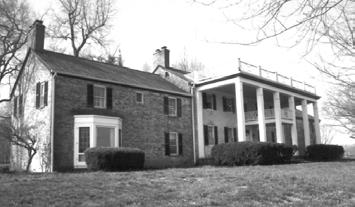
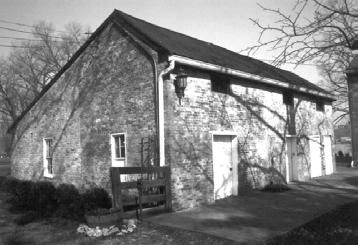
Many of these pioneering families brought enslaved laborers with them. The large share of clearing, building, farming and housework was done by these people, who primarily remain unnamed. In 1790, a few years prior to the Craigs’ arrival in Boone County, John Craig executed a deed of gift to his son-in-law, Cave Johnson. The deed transferred ownership of an enslaved girl named Linney, who was later called “Pigeon (Pidgin),” probably a name given in reference to the way she spoke. Lamonia was the name given to her at birth in Africa, according to descendants. She had been captured and brought to America as a young child. It’s unclear when or where Craig purchased her, but it’s possible she, too, was among the enslaved people at Bryan Station during the siege.
Lamonia remained enslaved by the Johnsons in Boone County up until just before her 1851 death, when she was enumerated as a Free
woman in the 1850 census. She was one of our earliest pioneers. Cave Johnson died in 1850 and is buried with his first wife, Betsy, at Sand Run Baptist Church Cemetery. It is believed that Lamonia also is buried there in an unmarked grave. Enslaved people, and women as a whole, were not well-documented, but it’s clear their roles during the war and early settlement of Kentucky were essential.
Boone County was a destination for hundreds who had served in the Revolutionary War. Some simply acquired land for profit, while others put down roots. There was no military bounty to be had in that part of Kentucky, but many veterans purchased land there or were compensated for their work as surveyors with tracts of land. Among the veterans who settled there, evidence shows that 115 patriots died in Boone County, though burial sites remain undiscovered for many of these. The more affluent among the veterans left a clear paper trail, while others are harder to document, particularly those who died without a pension or many worldly goods.
Among the most prominent Revolutionary War veterans in early Boone County history is Jacob Piatt. Piatt was born in New Jersey, where he enlisted as an ensign in the First Regiment of the New Jersey Line. His path in military service took him into the battles of Brandywine, Germantown and Short Hills. He later joined Gen. John Sullivan’s expedition against the four nations of the Iroquois. He was wounded at the Battle of Monmouth, after which he was given a commendation by Gen. George Washington, for whom he also served as adjutant.
Piatt arrived in Boone County around 1795 and began building a home he called Federal Hall atop a ridge above Petersburg. It was completed in 1804. Like Cave Johnson, Piatt was among the earliest county officials, serving as justice of the court of quarter sessions at the establishment of Boone County and later as a circuit court judge. He was buried near the ruins of his once-magnificent home after his 1834 death.
Another patriot of note buried in Boone County is Pvt. Daniel Goff, a free African American man born in Virginia, who was among several brothers who all fought in the Revolutionary War. His service took him from the encampment at Valley Forge to the Battle of Monmouth and points south before the end of the war. Possibly seeking work or adventure, Goff found himself among a group of pioneers led by Maj. David Leitch, clearing a settlement area that was to become “Leitch’s Station” on the Licking River. After Leitch’s untimely death, his
widow, Keturah, married Newport founder James Taylor
As a valued laborer, Goff was offered work by Taylor, first in his mill and later as a gardener on the family grounds.
As Goff aged, Taylor worried for the man’s well-being. He was aware of Goff’s service to the country and helped him obtain his pension. Goff may have been acquainted with the Alexander Marshall family in Chesterfield, Virginia, either before or immediately after the war. The Marshalls had purchased land in Boone County, and Goff spent his later years living on their Florence farm, after retiring from working for Taylor. Goff died there in 1843 and is believed to be buried in the family cemetery. A dedication ceremony was held in honor of his life and service in 2018, and a Daughters of the American Revolution marker was placed to memorialize him.
One of the most brutal events of the Western Theater was the massacre of Col. Archibald Lochry and his troops near a tiny island in the Ohio River, now known as Laughery Island (the spelling evolved over the years.) In 1781, as Lochry and his men were traveling up the river to rendezvous with Gen. Clark, they were overtaken by a group of Native Americans. Forty men were killed, including Lochry, who was scalped on site. Another 60 men were captured and marched to the British, who were offering bounties on the heads of the Revolutionary soldiers.
Among those who escaped slaughter in that massacre was a soldier named Hugh Steers. Steers, who had immigrated to America from Ireland before the start of the war, enlisted on August 1, 1781, in Westmoreland, Pennsylvania. He joined Lochry’s men, who left for the rendezvous with Gen. Clark. The massacre he witnessed occurred only 23 days later. Once captured, Steers was taken first to Chillicothe, then later held by the Shawnee at St. Mary’s before being traded nearly two years later. The affidavit Steers gave as part of his pension application describes being held under “very suffering conditions,” that included frequent threats of being burned and frequent “massacres.” Despite these brutal experiences, Steers went on to live a full life. He settled in Boone County, where he died in 1846 at the age of 90 and is buried on land that later became the Lassing Pointe Golf Course. His grave is near the 18th hole.
Boone County celebrates America’s 250th anniversary on June 20 from 4 -10 p.m. at the Boone County Fairgrounds. This free event will include music, food, community booths, vendors and fireworks.
By Hubert E. King, Jr., Flemington, New Jersey, and Cathy (King) O’Bryan, Edgewood
The smell of cornbread is one of the most memorable things about our grandmother’s kitchen. She made it every day, usually in her black iron skillet. A slice always went into my grandfather’s railroad lunch pail, and the rest was eaten by us children—crumbled into milk or spread with butter and sorghum. Her cornbread was a taste of home, but it also was a link to the journey that carried our family from the farms of West Tennessee to the hills of Northern Kentucky, following the call of the L&N Railroad.
Sonnie Bates and Bertha Bomer—our “Mom and Pop Bates”—were born just before the turn of the 20th century in Weakley County, Tennessee. Both came from farm families. Life then was all about the land and the animals. Horses and mules did the heavy work, and corn was the main crop, not only for people but to feed the animals that made the work possible.
In 1909, Sonnie and Bertha got married, set up housekeeping on rented land, and started raising a family. Their first children, Cecil and Wesley, were born in 1910 and 1914, respectively. Bertha cooked for farm hands, cared for children, and helped in the fields. Cornbread was always on the kitchen table. It was filling, easy to make, and went with just about everything.
The outside world was changing quickly. Railroads brought new opportunities, and McKenzie, Tennessee, became a hub. The L&N had shops nearby in Paris that employed hundreds of men. For many farm families, the railroad offered steady wages that farming could not guarantee.
In the summer of 1922, a national railroad strike shook
the industry. When the strike was broken, the L&N began hiring in earnest, looking for men to keep the trains rolling. That was when Sonnie, at 32, left farming behind and took a railroad job. It was hot and dirty work—repairing freight cars—but it meant a steady paycheck.
At first, Sonnie worked in Tennessee, but the railroad soon drew him farther north. The L&N was busy in Kentucky, where it was trying to improve its line into Cincinnati. Freight trains had trouble crossing the Ohio River, and in 1925, the company began building a new bridge at Newport and expanding the Decoursey Yard in nearby Covington. Those projects needed workers, and Sonnie was sent north.
For a time, he went alone, leaving Bertha with now three children—daugher Laura arriving in 1922—to keep the farm in Tennessee. He sent postcards home asking Cecil how the corn crop was coming along. But in 1927, Sonnie bought a small farm on Taylor Mill Road in Kenton County, and the family moved to Kentucky.
The new farmhouse was simple—no plumbing, no running water, no central heat. But it gave them land to work and a place to put down roots. And in its kitchen, Mom Bates’ skillet once again turned out daily cornbread, now for a Kentucky table.
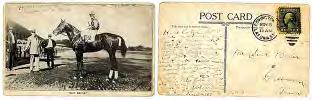
Though he worked for the railroad, Sonnie never gave up farming. He plowed with a horse, milked his cow each morning, and raised corn and chickens. The garden grew large, especially during the Depression, when homegrown food kept many families fed.
Neighbors helped one another. At canning time, the kitchen filled with people peeling and cutting, while kettles of boiling water steamed up the room. Mom and Pop Bates wasted nothing—every jar saved, every nail straightened and reused, every scrap put to use. They heated with coal, carried water by hand, and brushed their teeth with cottonwood sticks instead of toothbrushes.
When railroad work sent Sonnie away, sometimes to the coal fields in Eastern Kentucky, cousins stepped in to help with chores. The L&N gave workers free passes, so trips back to Tennessee were common. At least once a year, Bertha visited kinfolk, sometimes staying weeks at a time.
Faith was important to the Bates family. They belonged to Oak Ridge Baptist Church and were faithful in attendance. Family was everything else. Over the years, their children married, and grandchildren came along, filling the farmhouse with laughter. In 1959, Sonnie and Bertha celebrated their 50th wedding anniversary surrounded by friends and kin.
By the time they reached their 70s, Mom and Pop Bates had lived through two world wars, the Depression and enormous change. Yet much about their lives remained the same as it had in their early years. They grew their food, tended their animals, and ate cornbread with nearly every meal.
Bertha passed away in February 1969, and Sonnie followed two months later. They left behind children, grandchildren and great-grandchildren and a way of life that still lingers in memory.
The recipe for Mom Bates’ cornbread has been handed down through the family. Their daughter, Laura, made it, as did her daughter, Cathy. Today, it is still baked in cast-iron skillets, sometimes in modern kitchens far removed from the old farmhouses but always carrying the same smell and taste.
That skillet bread is more than food. It is a reminder of Sonnie and Bertha, of the farm in Tennessee and the move to Kentucky, of the hard work on the railroad and the long rows of corn. It is the story of a family—ordinary, resilient and faithful—whose lives were shaped by land, by labor and by the steady whistle of the L&N.
Mom Bates’ Cornbread
Modern Version
1 cup cornmeal
1 cup flour
1 tablespoon baking powder
2 eggs
½ cup buttermilk
¼ cup water (or more if needed)
¼ cup oil
Heat oil in a heavy skillet. Mix the dry ingredients in a bowl. Beat the eggs with buttermilk and water, and stir into the dry mixture. Mix well, then add the hot oil. Pour the batter into the hot skillet. Cook on low until the top begins to set, then brown under the broiler. Serve hot, preferably with butter and honey.
As Bertha Might Have Described the Recipe (around 1910)
1 cup good cornmeal
1 cup flour
1 spoon of saleratus (or baking powder, if you have it)
2 eggs
½ cup sour milk or buttermilk
Water to make a smooth batter
A spoon or two of lard
“Melt the lard in your spider (cast-iron skillet with long legs), pour it into the batter, then put the batter into the hot skillet. Cover it with the lid, put coals on top, and bake until the top is firm and the bottom well-colored. Serve it hot, with butter or molasses.”
By James M. Gifford, Ph.D., CEO & Senior Editor, Jesse Stuart Foundation
Billy C. Clark began life in storybook fashion. On Dec. 29, 1928, Bertha Clark, who was pregnant with her seventh child, went to Huntington, West Virginia, to shop for second-hand clothes for her six children. While shopping, she experienced labor pains. Quickly gathering her purchases, she boarded a streetcar and headed home. One thought occupied her mind: She was determined that her child would not be born a “foreigner.”
The streetcar driver noticed Mrs. Clark was in distress, and he didn’t want to deliver a baby, so he drove straight to her stop. The rest of the passengers shouted as the driver passed their stops, refusing to let them off. Now and then, he looked over at Mrs. Clark, “Hold it, lady! Hold it just a little longer!”
Virginia Writing. He left Longwood University in 2003 for Hampton-Sydney College, also in Virginia.
Clark’s books had been out of print for almost two decades when he signed a letter of agreement in 1991 that gave the Jesse Stuart Foundation the exclusive rights to republish and market his books. The following year, the Stuart Foundation republished A Long Row to Hoe. That fall, the city of Catlettsburg proclaimed Sept. 5 “Billy C. Clark Day” because the Commonwealth of Kentucky had named the bridge leading from Catlettsburg to Kenova, West Virginia, the “Billy C. Clark Bridge.” Billy also served as Grand Marshall of the Catlettsburg Labor Day Parade that year. A mural on the floodwall in Catlettsburg depicts Billy C. Clark and his books.
When Billy Curtis Clark was born on Kentucky soil that day, he seemed to be just another child born into Appalachian poverty. Billy’s father, Mason, was a cobbler and a mountain fiddler. His mother took in washing and “scrubbed until her hands bled,” but she often gave to needier families.
Billy left home when he was 11, and for the next five years, he lived on the third floor of the City Building in Catlettsburg while he worked his way through high school.
“I cleaned the men’s and women’s jails,” he remembered, “wound the town clock, and served as a volunteer fireman.” He also fished, trapped, picked berries to sell, and worked at odd jobs.
After high school, an almost three-year stint in the Army made Billy eligible for educational benefits under the G.I. Bill, and he enrolled at the University of Kentucky in the fall of 1952. For financial reasons, he left college without a degree in 1955 and proceeded to publish five books with New York publishers, including his classic coming-of-age memoir, A Long Row to Hoe (1960).
In 1956, Billy had returned home and was working for Ashland Oil when he met and married Ruth Bocook, also a native of Catlettsburg. Billy’s second cousin, Jesse Stuart, and Jesse’s wife, Deane, “stood up with them” when Billy and Ruth married in July. In 1963, he returned to UK to finish his coursework and graduated in 1967. In 1985, Billy and Ruth moved to Farmville, Virginia, where he served as writer-in-residence at Longwood University and founded
The gradual re-issue of Clark’s books created a renaissance of interest in his life and works that resulted in a flood of new publications. Like most successful writers, Clark published extensively in periodicals and participated in numerous writing workshops, literary festivals and book fairs.
Clark loved conversations, and all who knew him remember him as an enthusiastic storyteller. Once, when he and I were driving from Ashland to Oil Springs Elementary School in Johnson County, I remember lowering my window a couple of inches. I suspect that I felt so overwhelmed by Clark’s avalanche of words that I was giving some of them a chance to escape into the Big Sandy Valley, a region that he truly knew and loved.
Clark’s “brother by mutual adoption,” Frosty Lockwood, once observed that being in a car with Clark for eight hours “was like being locked in a moving boxcar with a wild horse. It’s dark. You’re off balance; you don’t know which direction you’re going to get kicked from.” Since Billy’s death on March 15, 2009, my memories of our long trips together and his stories, supercharged with hyperbole, always make me smile.
Now, he belongs to the ages. It is easy to imagine him in well-worn fishing garb talking with his heavenly Father: “Lord, I know you’ve been listening in on some of those stories that my Catlettsburg friends have been telling on me. Now here’s what really happened.” And the Lord smiles, wondering if eternity will be quite long enough for the old muskrat hunter to complete his report.
Billy C. Clark rose from poverty to become a nationally famous educator and author. Thanks to his mother’s courageous journey in 1928, Kentucky lists him as one of its finest writers.
By Bobbie Smith Bryant, Jefferson County
Clicking through the channels recently, I stumbled upon a familiar voice with a slight accent wafting from the screen, “A one, and a two, and a …” Yes, sir, I stopped scrolling when I heard musical maestro Lawrence Welk. He revved up the band, hoisting his baton in front of a full orchestra of men dressed in lilac leisure suits.
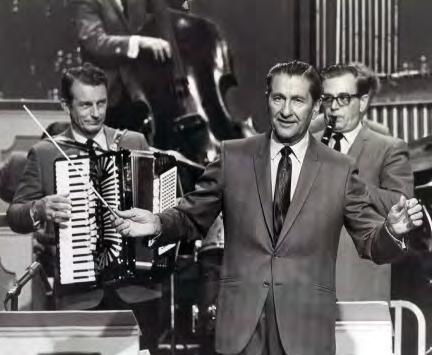
Bandleader Lawrence Welk (1903-1992)
Oh my goodness, did I step back into memory lane!
The music featured several songs I recalled from my preteen days in Calloway County, including “Delta Dawn” and “Kiss an Angel Good Morning.” That one cracked me up because Welk gave credit to country music star Charlie Pride for making the song a hit, but on this show, it was Ava Barber, a white woman, who sang the familiar tune.
I sat down to watch for a few minutes and was astonished to see the orchestra was no longer made up of all white men. There were several men of color in the ensemble.
The show ran from 1955-1982, and this episode had been taped in 1982. One of the acts was a lovely ballroom dancing couple. The woman was dressed in a swirling evening gown of Big Bird yellow. Typical of that era, the man’s attire matched the color of her gown—awful as it was—a brilliant yellow tuxedo with tails.
There were talented accordion players performing a traditional polka, a feature of this well-known show. One of my favorite performances was the aging but still fleetfooted “King of Tap,” Arthur Duncan Welk’s orchestra music was dubbed “champagne music” because it was considered light and bubbly. This idea was exaggerated by a machine that spewed bubbles over the band members during their performances. Welk always danced with the female vocalist during the polka or waltz numbers, and she became known as the Champagne Lady.
I had completely forgotten about the audience being invited to take the dance floor when the orchestra was the featured entertainment. Elbow to elbow, the couples shuffled across the floor to the swanky sounds of “Canadian Sunset” and “Night Must Fall.”
Then, the singing duet—the Otwell Twins—with their velvet voices, winning smiles and wholesome good looks, took the stage. Their identical hairstyle reminded me of my childhood heartthrob, Donnie Osmond Singing twins or siblings apparently were a performance
attraction back then. The Aldridge Sisters performed with one another and then sang “Walkin’ in the Sunshine” with the Otwell Twins.
As I watched, I kept thinking about the nights I spent at my grandparents’ house on the weekends. The Lawrence Welk Show was a staple in their home every single Saturday night. There was something of interest for each person in the family, no matter their age.
Variety programming like the The Lawrence Welk Show was just as predictable back then as the television shows today. I remember watching others like it—The Flip Wilson Show, The Sonny & Cher Comedy Hour, The Smothers Brothers Comedy Hour, The Tonight Show Starring Johnny Carson and even The Bobby Goldsboro Show. While they were prescriptive, they gave viewers a taste of pop culture and exposed us in rural America to current fashion trends. They also encouraged us to accept and appreciate others whose skin color or accent was different than our own.
Somehow, on this recent Saturday night, the sounds of The Lawrence Welk Show were comforting to me. Or maybe I just recalled feeling loved at my grandparents’ home as we watched each week.
Previously published in the Murray Ledger & Times.
Reach 120,000 readers a classified ad in Kentucky Explorer! Classified ads are only $50 per issue (up to 25 words). Contact Deborah Kohl Kremer at deb@kentuckymonthly. com or call 888.329.0053.
BOOK FOR SALE — Highlighting rural Kentucky events from 1865, this adventurous story by C.W. Shumate waited 160 years to be shared. Butler Books novel available at www cwshumate.com. (F)

LOOKING FOR INFO — on Susan Hurt: b. 17 April 1806 (South Carolina); parents William Hurt & Jennie “Jenny” Foster; moved to Wayne County KY ~1813; married John Tuggle 1825. Interested in photos of both. My email address is gtug@juno.com, Gary Tuggle (M)
WANTED PAYING CASH FOR YOUR scrap gold and silver; gold and silver coins; jewelry; sterling flatware; serving pieces; mint juleps; pocket and wrist watches; gun and knife collections; military items/swords; musical instruments; stoneware crocks and jugs; advertising items; walking canes; cast iron skillets; antique toys; postcards and much more. Call Clarence, buyer for 35+ years. 606.531.0467 (F-D)
BY GARY GARTH
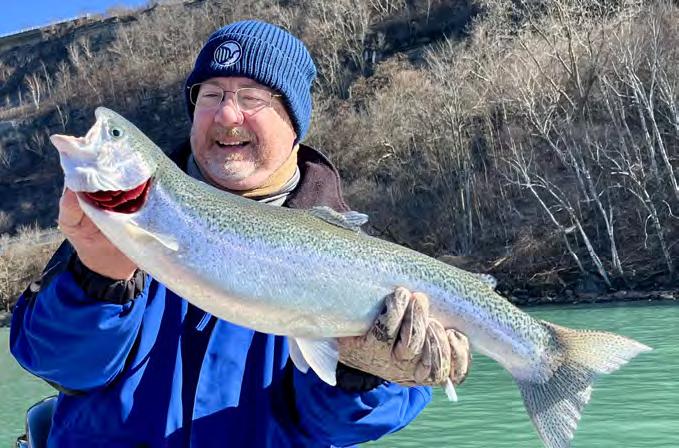
As any regular reader of this space may have noticed: I like to fish. I always have. I learned early and am still learning. I haven’t fished all the waters in Kentucky, but I’m working on it. I’ve lived in Kentucky longer than I’ve lived anywhere else so, statistically, I’ve probably fished in Kentucky more than I’ve fished anywhere else. This is a blessing, as we have some extraordinary and varied angling.
According to the Department of Fish and Wildlife Resources, Kentucky is home to 245 native fish species, along with an additional 24 that have been added (some intentionally, a few accidentally).
About 25 of the state’s 269 fish species are regularly targeted by anglers, the most sought after probably being the largemouth bass followed by crappie, bluegill, catfish and smallmouth bass.
One fish we don’t have is the steelhead trout—at least not officially. While you can’t catch a steelhead in Kentucky, you can catch a rainbow trout, and according to the U.S. Fish
and Wildlife Service, they are, scientifically, the same fish (Oncorhynchus mykss), with steelhead trout being an anadromous form of rainbow trout, traveling from fresh to saltwater then returning to freshwater to spawn.
Steelhead are native to the West Coast but, like rainbows, have been transplanted and prospered beyond their native range, including the Great Lakes, which puts them within a day’s drive of many Kentucky anglers. Rainbow trout (one of Kentucky’s 24 added fish species) are regularly stocked in more than 70 Kentucky waters, including the Cumberland River below Wolf Creek Dam, which is considered one of the region’s finest tailwater trout fisheries.
A few years ago, I was invited with a group of other media types to Western New York to fish the Niagara River below Niagara Falls, an area I had never visited before. The trip was in late April. The weather was miserable, rainy and cold. The Niagara is a splendid fishery, weather notwithstanding. Our first morning
on the water, while I was pulling on my raingear and wishing I’d brought another layer of wool, I ask our guide for the day what he had in mind.
“We might still find some steelhead.”
“What do you mean, ‘still’ find some?”
He explained that Great Lakes steelhead, having adapted to freshwater, move out of the lakes in early/late fall and into the various rivers, streams and tributaries, where they spend the winter before returning to the big waters for the summer. Typically, by late April or early May, most lower Niagara steelhead have moved back into Lake Ontario, he said. “But not all. And,” he added with a grin glancing at the sky, “it’s steelhead weather.”
I caught a few fish that day but no steelhead. I hooked one fish that stayed deep and pulled like a bulldog. “Probably a steelhead,” the guide said when the line went slack. My partner in the boat later landed a steelhead about the length of his arm.
We returned to the dock around mid-afternoon, wet and shivering cold.
“How’d you like it?” our guide asked.
“I loved it,” I said, through the teeth-clattering cold. “When is the best time to come for steelhead?”
“Depends on the weather and water conditions,” he said. “We’re usually seeing pretty good numbers by November through March. Sometimes into April.
“Be careful, though,” he said with a smile. “They’ll get into your dreams.”
• • •
Seasonal catch-and-release regulations for 14 trout streams across the Commonwealth, including a
20-mile stretch of Jefferson County’s Floyds Fork, end March 31. Statewide regulations for these waters will be in effect April through September. Details, including a full list of the waters and their locations, are at fw. ky.gov/Fish/Pages/Seasonal-Catchand-Release-Trout-Streams.aspx
• • •
Kentucky’s spring turkey hunting season opens in mid-April, but now is not too soon to start scouting. Get out and find a bird. While doing so, look and listen but don’t use a turkey call. It’s illegal, although it’s OK to sound like an owl, crow, coyote or woodpecker to try and get a preseason gobbler’s attention.
Confusing? I’ll let the Department of Fish and Wildlife Resourses explain. From the KDFWR website: “A person shall not mimic the sound of a turkey in an area open to turkey hunting and where turkeys are reasonably expected to be present from March 1 until the opening of the youth-only turkey season, and from the close of the youth-only turkey season until the opening of the statewide turkey season. However, locating turkeys with an owl, crow, coyote or woodpecker call is permitted when scouting.”
The statewide spring season is April 18-May 10, but youngsters (age 15 and younger) will have the first shot during the two-day youth hunt April 4-5. During last year’s spring turkey season, hunters checked 30,661 birds. Do yourself and the future a favor. Take a kid hunting.
Gobbler details at fw.ky.gov/Hunt/ Pages/Spring-Turkey-Hunting.aspx
Readers may contact Gary Garth at editor@kentuckymonthly.com.

Jacqueline Hamilton, an experienced writer and teacher with a passion for inspiring young people from Eastern Kentucky, has written A Pencil Grows in Kentucky, which “weaves together creative writing lessons, Appalachian history, and powerful poetry to celebrate the voices of young women,” especially ones from the mountains of Kentucky.
The book is the culmination of Hamilton’s educational project Appalachia Girl Dreaming. Those in the program listened to stories of people who “once walked the same hills and towns these girls know well.” Participants practiced writing taught by Hamilton and contributed poems to the book written from their own experiences.
The book includes teaching strategies to foster creativity and a positive writing mindset.
Hamilton, a Clark Countian, studied on a Rotary Fellowship in London, England, and later taught English at Eastern Kentucky University. She leads the popular “Inkspire Camps” as part of the nonprofit Why We Write, Inc.
By Steve Flairty

Taking a dip into the 100-year heritage of Louisville’s Lakeside Swim Club becomes an exercise of joy, especially if the source is Brigid Kaelin’s attractive, comprehensive coffee table book, Lakeside. With 200 pages of historical narrative, blackand-white and color photos, riveting sidebars and individual testimonials, Kaelin’s book invites readers to take a look at the recreational community that helped raise her.
Lakeside arose from a quarry lake considered in the early 1920s to be a blight and an obstacle to growth in the Lakeside Addition near what is now Bellarmine University. Action by a small group turned Lakeside into a nonprofit organization, ensuring the lake’s long-term place in the community.
The Louisville resident chronicles the life of Lakeside, showcasing its highlights. She acknowledges Lakeside’s past racial diversity challenges and discusses current efforts to improve those areas.
In addition to writing books, Kaelin is a songwriter, multiinstrumentalist, composer and visual artist who has appeared as a guest on A Prairie Home Companion
By Steve Flairty
BY BILL ELLIS
Imust admit that, after my family and my country, I have another love affair. If you think that old Bill is crazy, you may be right. My other love is fly-fishing for trout, particularly a beautiful and colorful rainbow trout.
First, I am not an expert fly fisherman. I can get the fly into the water, but old age has caught up with me. Fishing with waders in swiftly moving water is too dangerous for an old man with bad knees and a bad back.
I have been fortunate to have fished for trout in several locales. In 1989, during my Fulbright time in New Zealand, Warwick Tyler, a history professor at Massey University, took me on a fly-fishing trip to Lake Taupo, which was formed from a volcanic explosion some 27,000 years ago, according to the official Lake Taupo website.
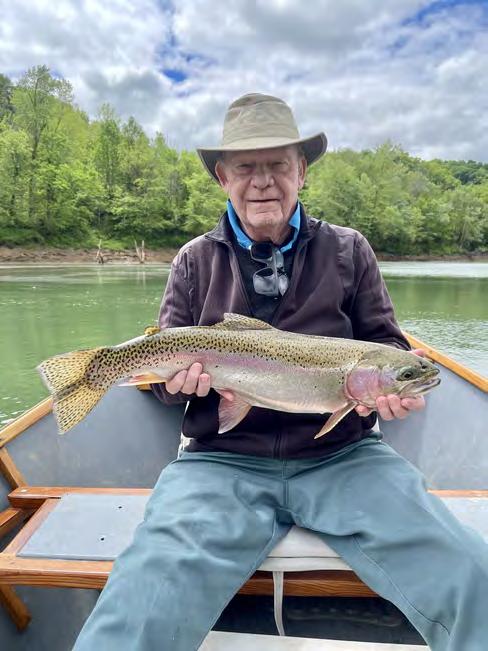
also a high wind that soon turned into a cold rain. I landed a 28-inch brown trout and was hooked for life.
In good weather, that area is beautiful. However, I was there in the wintertime, and the weather was cold and windy. The fly was quite large and heavy enough to cast into a tough wind. One time, the wind blew the weighted fly back into my face. After several casts, with absolutely no finesse, a large brown trout, called German trout in New Zealand, snapped up the fly.
It took several minutes to land the fish, as I fought not only the trout but
After returning to Richmond and Eastern Kentucky University, I bought a fly-fishing outfit and tried to fly-fish a bit. I fished a few spots in Kentucky, the Smoky Mountains and other places.
With a guide, I fished a spring creek in Montana with great luck. The weather was beautiful, and I caught several trout more than 18 inches long.
I fished a stream in New York State with little luck and a guide
who was not great.
A fly-fishing trip in a provincial park near Dauphin, Manitoba, Canada, proved successful. There, I fought mosquitoes all day long but caught rainbows, brownies, and large- and small-mouth bass. I fished from a large canoe all day with a local guide who was outstanding. Did I mention the mosquitos?! •
A little over 20 years ago, I caught up with a young man, Hagan Wonn, who guides on the Cumberland River below Wolf Creek Dam, fishing from a so-called float-boat. He provides all the tackle needed, instruction for the uninitiated, a light snack and great knowledge of the Cumberland.
The first thing Hagan does for the uninitiated is drop anchor in midstream and explain to the rookie how to get the fly into the water and how to “mend” the line. When the strike indicator sinks, he calls out your name. Over the years, he has shouted “Bill, Bill” so many times I am sure he must do it in his sleep. Hagan and flyfishing experts call a strike indicator what I still think of as a bobber.
As demonstrated by the picture, over the years I have caught some beautiful rainbow trout. I hold them only for a moment, and Hagan takes a quick picture and then carefully slides
the fish back into the water. Rainbows have a brilliant color, which fades when kept out of the water. Brownies have beautiful spots that seem to radiate.
There is only one word to describe the Cumberland: beautiful. There is wonderful scenery everywhere, including the Rockhouse formation. There are famous stretches of the river, such as Rainbow Run.
Usually, I sit in the back of the three-man boat, while Hagan sits in the middle and rows the craft with expert ease. I have shared the boat with my son, Bill, and others. They all agreed Hagan is the best, period.
Son Bill confirmed: “I wouldn’t fish the Cumberland without giving Hagan a call. He knows where the fish are and helps to get you to the very best spots for success.”
David Shaw, like my son, praised Hagan “for teaching me to mend my line to achieve a good drift for my lure
and pointing out the best spots to cast.”
“Hagan makes the most mediocre of fly-fishers think they are better than they are,” praised John Veith
Over the years, I have caught bass, crappie and catfish. In my younger days, I enjoyed gigging frogs. My father loved fishing for sea trout in Florida, and I enjoyed those trips. He and I once caught a boatload of crappie in Lake Barkley.
But nothing surpasses tying into a rainbow trout and seeing that first flash of brilliant color as the fish rises to the surface and makes a spectacular jump.
I eat fried catfish with abandon, love a fried flounder sandwich on rye bread, prefer fried oysters to raw, and love salmon croquets, but to eat a beautiful and feisty rainbow would turn my

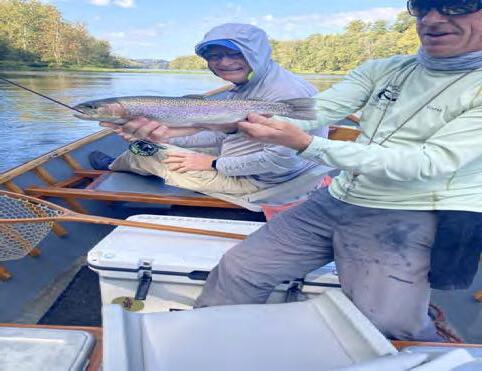
stomach. I am sure you readers have other opinions.
Readers may contact Bill Ellis at editor@kentuckymonthly.com

BY WALT REICHERT
Over the years, I have been blessed to receive many awards and honors for my writing, my work with kids, and my horticultural endeavors. Last fall, I received an award I am especially proud of—the Shelby County Soil Conservation District named me a “Friend of Conservation.”
It was an especially meaningful award because in the 20-plus years I have written this column, my book A Kentucky Cornucopia of Gardening Miscellany, and other writings, I have strived to encourage home gardeners not just to grow plants but to help save the quality of our air, water and soil.
Here’s a little background on the Soil Conservation Service for those readers not as seasoned as I am. The service was founded in the aftermath of the Dust Bowl years of the 1930s, when the sky was blackened with blowing soil from the farm fields of the Midwest. The loss of soil contributed to the great migration of farmers from midwestern states who looked for work in California, Oregon and Washington. The intent of the Soil Conservation Service, then and now, was to help farmers find ways to conserve precious topsoil.
I remember driving around the Kentucky countryside as a kid and young teenager and seeing at each county line, “Now entering ___________ County Soil Conservation District.” A few of those signs remain, but most have long since rusted away.
Unfortunately, the need for preserving the soil that is the
lynchpin of our agriculture/food supply has not gone away. We are still losing topsoil at a rate 10 times faster than it can be replaced. Scientists estimate it takes at least 100 years to develop an inch of topsoil. Some studies suggest by the year 2050, 90 percent of the earth’s soil could be degraded to the point it is no longer capable of growing food and fiber.
In the past couple of decades, the Soil Conservation Service has gone beyond helping large farmers preserve their topsoil to promote efforts to clean up the water in streams and ponds, benefit wildlife, and fight invasive plants and animals at the farm as well as the home gardener level.
Saving soil and natural resources is not just a job for large-scale farmers. Anyone who has even a few square feet of land can help.
Here are some suggestions:
n Use less tillage, especially on slopes. The Dust Bowl happened because large swaths of land had gone under the plow, and during windy drought periods, the soil blew away. The home gardener who tills or otherwise works the soil on slopes invites serious soil erosion during rainy periods. Keep the soil covered with mulch or plants as much as possible.
n Plant a tree. Trees are havens for
wildlife, capture carbon dioxide, cool the surrounding air and soil, and aid in erosion control. Oaks and hickories are best for wildlife but not always for backyards because of their acorns and nuts. But poplars, maples and evergreens are good for wildlife, too, and aren’t as messy.
n Plant shrubs. No room for a tree? Shrubs are great for wildlife. They can provide food, shelter and nesting sites for birds, and they mature much faster than trees. Creating a shrub border also is a good way to eliminate some of the lawn, which is our next bullet point.
n Reduce the size of the lawn. A well-tended lawn is pretty to look at, but it sucks up fertilizers and pesticides that can end up in the water supply. And it provides precious little in the way of wildlife habitat. Planting several large shrubs, like ‘Shasta’ viburnum, will—in a few years—eliminate a large chunk of the lawn and require much less maintenance. If nothing else, let a section of the lawn, maybe somewhere out back, “go wild.” Don’t do anything to it. No mowing, no spraying, no nothing. I have allowed a portion of my front yard that was formerly a pond “go wild” because it was a pain to mow, and the birds and animals love it. I see sparrows and other grassland birds feeding there, and a family of rabbits made a home among the overgrown grasses last summer. I’m gradually planting native trees in
the “mess” so, eventually, it may not be the neighborhood eyesore.
n Keep heavy vehicles and equipment off the soil, especially when it’s wet. Tractors, large lawn mowers and automobiles compact the soil, squashing out the oxygen and creating a hardpan where plants cannot grow.
n Resist the urge to “clean” the garden. Many beneficial insects and pollinators live in or just under plant debris. Removing leaves, stems and small twigs deprives them of a spot to overwinter. It’s best to wait until early spring for garden clean-up chores. Having said that, it is a good idea to remove any plant debris that shows signs of disease as soon as possible.
n Avoid invasive plants. Unfortunately, nurseries and garden centers still sell some plants that are invasive in the wild and choke out native trees, shrubs and grasses. Callery (Bradford) pear is just one example. Nandina is another—its berries are poisonous to birds. Choose plants that are native to Kentucky or at least native to the eastern United States. Your local wildlife and plant communities will thank you for it.
Do all or any of these suggestions and you, too, can be a “Friend of Conservation” in your own backyard garden.
Readers may contact Walt Reichert at

CELEBRATES
CULTURE








Ginnie Baer
Gateway to Somewhere, The Loudoun House, Lexington, through March 27, 859.254.7024
Indigo Dyeing Adult Workshop KMAC, Louisville, 502.589.0102
Brent Maher and Trey Hensley
Presented by WoodSongs, Kentucky Theatre, Lexington, 859.231.6997
Schubertiade
Presented by NouLou Chamber Players, Oxmoor Farm, Louisville, 615.417.2110
Bernheim Forest & Arboretum, Clermont, 502.215.7155
Beauty and the Beast
Kentucky Center for the Arts, Louisville, through March 15, 502.584.7777
The Phil Collins Story Lexington Opera House, 859.233.3535
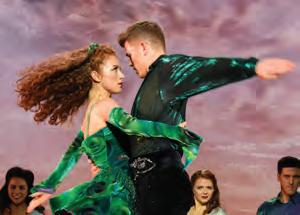
Patrick’s Day
Comedy of Errors Actors Theatre, Louisville, through March 15, 502.584.1205

9 to 5
859.233.3535
606.886.2623
Patrick’s Day Parade
25 26 27 28
Kinky Boots
30: The New Generation
Kentucky Center for the Arts, Louisville, 502.584.7777
Sweet Honey in the Rock
Kentucky Center for the Arts, Louisville, 502.584.7777 Riverdance
The Carson Center, Paducah, 270.450.4444
29 30 31 Ongoing Ongoing Ongoing Tangents to Heaven
Daniel Tosh: My First Farewell Tour Lexington Opera House, 859.233.3535
Leeds Center for the Arts, Winchester, through March 15, 859.744.6437 The Hound of the Baskervilles EKU Center for the Arts, Richmond, 859.622.7469
Kentucky Museum, Bowling Green, through March 31, 270.745.2592
LaVon Van Williams Jr. Everything Must Change, Speed Art Museum, Louisville, through March 8, 502.634.2700
Jon Pardi in Concert Appalachian Wireless Arena, Pikeville, 606.444.5500
859.622.7469 Jack Girard Canines, Collages, and Bowling Pins, The Loudoun House, Lexington, through April 3, 859.254.7024
Verst is a third-party logistics provider that specializes in:
Omnichannel fulfillment
Warehousing
Shrink sleeve labeling
Transportation management

A family-owned company for 60 years, we combine industry and technical expertise with a commitment to seamless customer relationships to help achieve our client's supply chain and logistics goals.



aving several inches of snow hang around for weeks is not something we’re used to in Kentucky. This time of year is rough for many of us, but adding cabin fever on top of it creates a true struggle. Being inside for so long forces us to take a closer look inside our houses and ourselves, both of which can be uncomfortable. We’ve read every magazine, watched every show (on all 400 channels), and had every conversation (at least twice). We’ve cleaned out every closet and dusted each memento. “Isn’t this your thirdgrade photo?”
the black cone. The squirrel swings from its razor-thin edge and uses it as leverage to access the bird feeder and suet cake. On occasion, it reaches the top of the shepherd’s hook, turns toward the kitchen window, and mocks us with Elvis-worthy gyrations. Its long gray tail is nearly identical to the one worn by bully Scut Farkus in A Christmas Story
from Washington, D.C., before the hapless Reds went out and beat the slightly more hapless Philadelphia Phillies, 2-1.

That’s when we became birders. From the window above the kitchen sink or the window in the upstairs guest room, there’s an unobstructed view of our bird feeder, which, per instructions, is at least 5 feet off the ground, 7 feet away from any structures, and 9 feet below overhanging branches or rooflines. It hangs from an iron shepherd’s hook, protected (in part) by a baffle. I’m guessing it’s called a baffle because it’s meant to confuse animals that might climb the shepherd’s hook to steal the seeds meant for birds in the feeder.
Maybe we have highly intelligent squirrels in Kentucky because ours— an Eastern gray (which was designated as Kentucky’s state animal in 1968)— doesn’t seem the least bit baffled by
Our yard has a loyal following of wrens, cardinals, woodpeckers and crows. Based on the footprints left in the overnight snow, we have more than one obnoxious squirrel wandering our acreage, but only one makes a daytime appearance during the coldest days.
Mimicking human behavior, a dozen wrens surrounded the squirrel. Together, they could have taken it, but—individually—each being a quarter of its size—they fled at the slightest swish of its tail. The squirrel followed their departure with another Elvis dance, which wasn’t wasted on the audience. “Those little birds have left the building.” . . .
With baseball right around the corner, here’s a story I’ve been unable to confirm.
It happened, I assume, sometime after May 4, 1919, when the Major Leagues legalized Sunday games, and before May 24, 1935, when more than 20,000 fans crowded into Crosley Field in Cincinnati for the first-ever night game. That night, President Franklin Delano Roosevelt symbolically switched on the lights
According to several tall-tale tellers, there was once a baseball player in Northern Kentucky—it could have been Walton, Verona or Crittenden; heck, I guess it could have been Piner, Union or Dry Ridge—who was signed by the Reds after hitting five lost-ball home runs in a community game. By “lost ball,” I mean they cleared the trees and were never found.
According to the story, the player was signed on the spot by a scout traveling through town on the Louisville & Nashville Railroad. He joined the Reds at once, mid-season, and continued to blast shots out of Crosley with regularity, but when the first Sunday game rolled around, he didn’t show up at the ballpark.
Club officials were sent to his house, and they came back with the news that the superstar was hanging up his cleats. He wasn’t thrilled with getting home after dark, and under no circumstances would he play on Sunday. When they explained they were getting ready to start a 10-game road trip, that sealed the deal. “Count me out,” he said.
Those are the alleged facts, but I’ve searched the Baseball Encyclopedia and the Internet without much luck. Have you heard this tale? Can you fill in the blanks?
Vest can be contacted at steve@kentuckymonthly.com