with Kentucky Explorer Pine Mountain Warblers, Woodlands and Wildlife Weekend
The Job of a Farrier
KENTUCKY DERBY FESTIVAL Official Schedule of Events
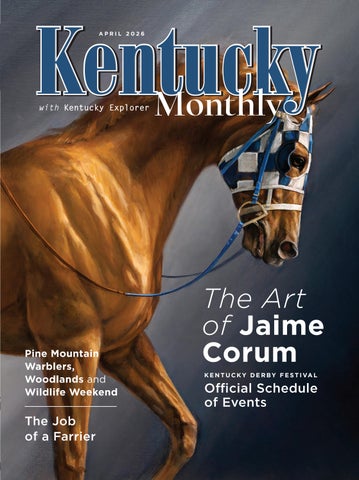
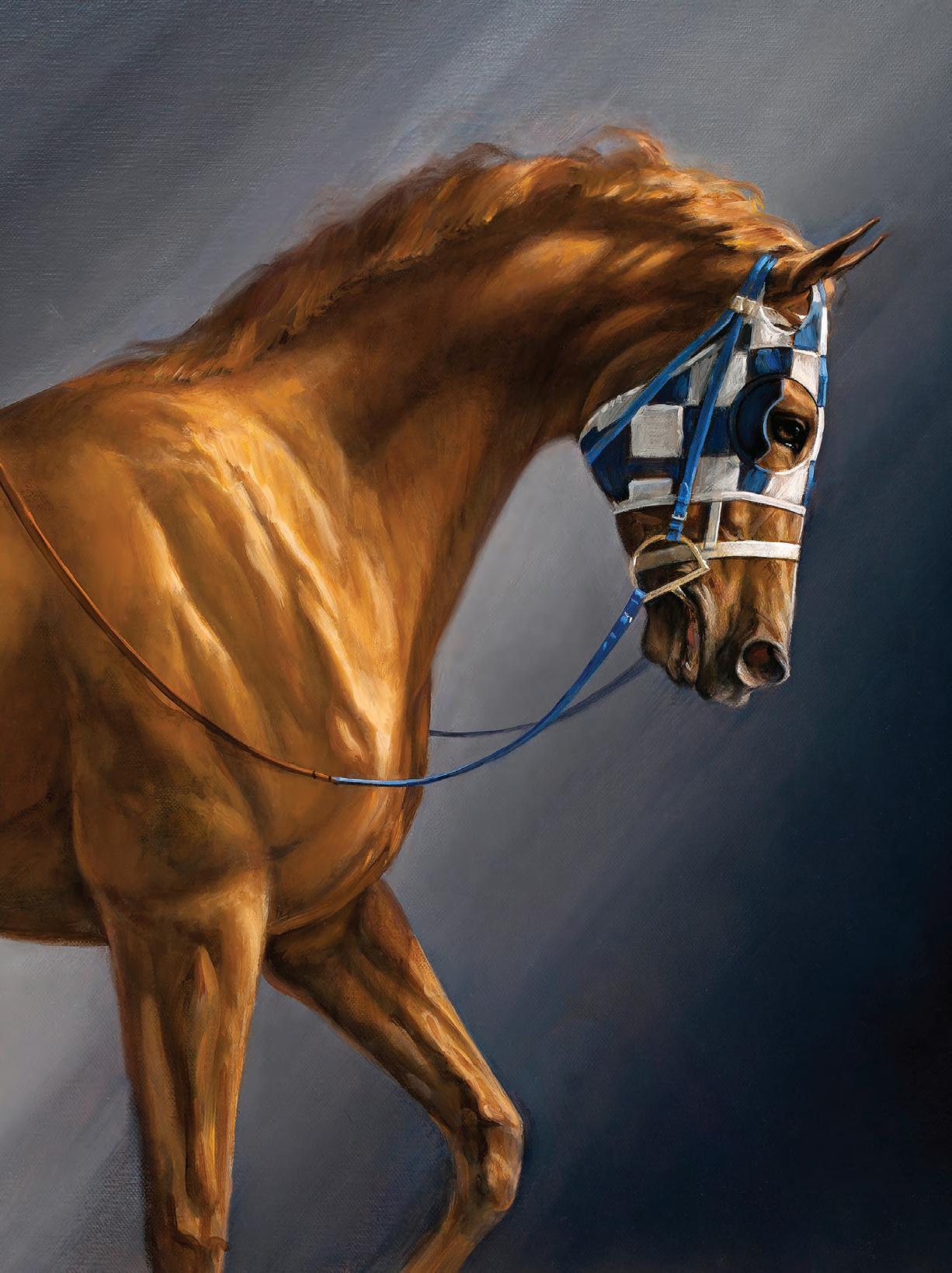
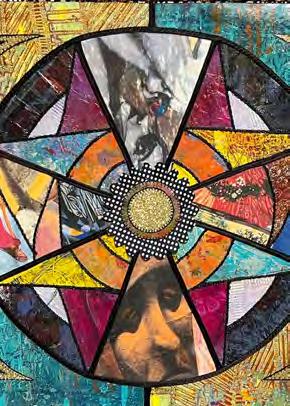
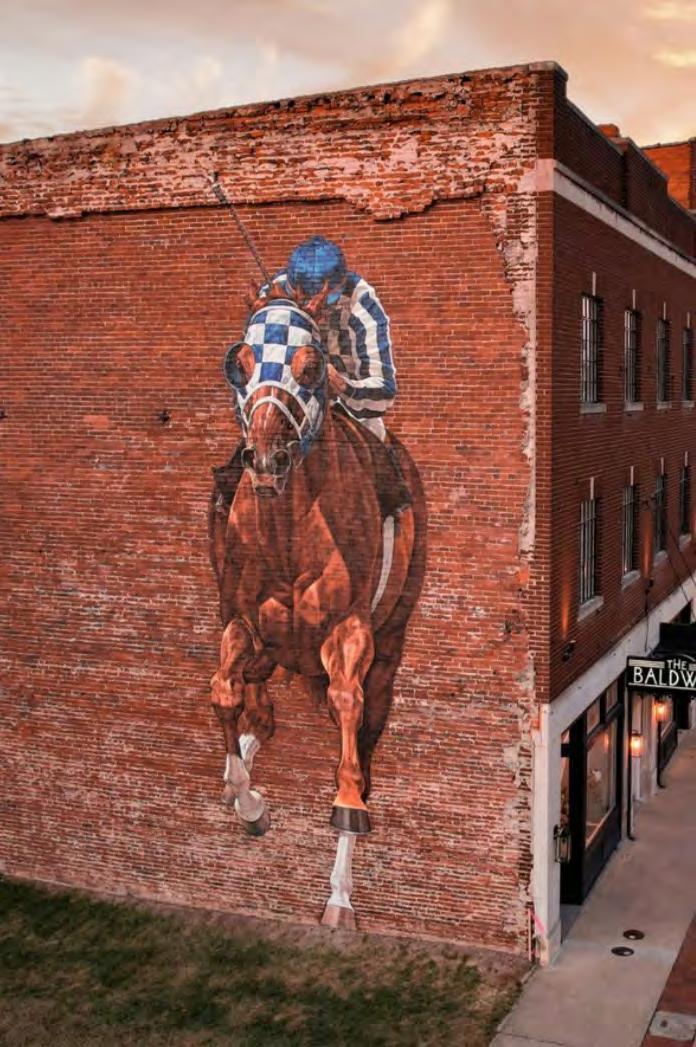
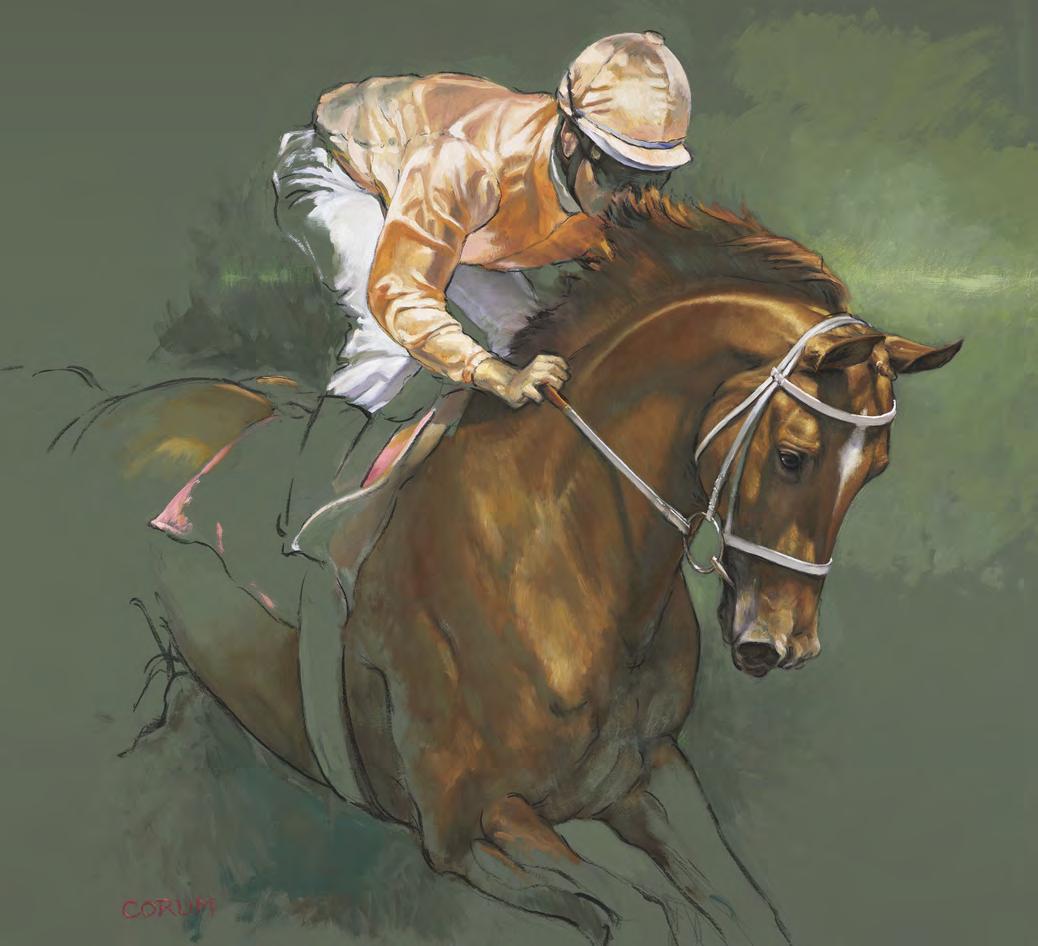
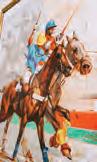
Jaime Corum’s portrait of Thoroughbred racing superstar Secretariat, courtesy of the artist.
The Kentucky Historical Society and the Louisville-based National Society Sons of the American Revolution are two of the many groups (including the Daughters of the American Revolution and First Families of Kentucky) with events this year to honor the 250th anniversary of the Declaration of Independence on July 4. Look for references to these events in Kentucky Monthly. This is the third installment of Kentucky 250 trivia. Many of these questions came from A New History of Kentucky (1997) by Lowell H. Harrison and James C. Klotter
1. Captured by the Shawnee in 1775, who was the first colonial woman to visit what is now Kentucky?
A. Rebecca Boone
B. Mary Draper Ingles
C. Jane Kenton
2. Pioneer Daniel Boone generally had several books with him during his treks to Kentucky. One of his favorites was which classic?
A. A Tale of Two Cities
B. Oliver Twist
C. Gulliver’s Travels
3. Boone, James Knox and Thomas Bullitt were among the early frontiersmen commonly known by which moniker?
A. Trailblazers
B. Linemen
C. Long Hunters
4. At the start of the American Revolution, Virginia extended as far west as which river?
A. The Mississippi
B. The Big Sandy
C. The Kanawha
5. The resolution of land claims by settlers led by James Harrod and others who followed the McAfee brothers into Mercer County led to the establishment of which early settlement?
A. Danville
B. Stanford
C. Harrodsburg
6. On July 21, 1776, John Floyd (the namesake of Floyd’s Fork) estimated the population of Kentucky to be no more than how many persons?
A. 200
B. 300
C. 400
7. In 1780, growth justified the division of Kentucky County into which three counties?
A. Fayette, Jefferson and Lincoln
B. Christian, Bourbon and Mercer
C. Washington, Bourbon and Jessamine
8. Kentucky became a state in 1792, but the first state convention was held in what year?
A. 1790
B. 1784
C. 1777
9. Who was the first Kentucky governor to have been born in the Commonwealth?
PUBLICATIONS VOLUME TWENTYNINE, ISSUE 3, APRIL 2026
Stephen M. Vest Publisher + Editor-in-Chief
EDITORIAL
Patricia Ranft Associate Editor
Rebecca Redding Creative Director
Deborah Kohl Kremer Assistant Editor
Ted Sloan Contributing Editor Cait A. Smith Copy Editor
SENIOR KENTRIBUTORS
Jackie Hollenkamp Bentley, Jack Brammer, Bill Ellis, Steve Flairty, Gary Garth, Kim Kobersmith, Brigitte Prather, Walt Reichert, Tracey Teo, Jarrett Van Meter, Janine Washle and Gary P. West
Account Executives: Kelley Burchell Laura Ray • Teresa Revlett
For answers, see page 6
Kentucky Monthly (ISSN 1542-0507) is published 10 times per year (monthly with combined December/January and June/July issues) for $25 per year by Vested Interest Publications, Inc., 102 Consumer Lane, Frankfort, KY 40601. Periodicals Postage Paid at Frankfort, KY and at additional mailing offices.
POSTMASTER: Send address changes to Kentucky Monthly, P.O. Box 559, Frankfort, KY 40602-0559.
Vested Interest Publications: Stephen M. Vest, president; Patricia Ranft, vice president; Barbara Kay Vest, secretary/ treasurer. Board of directors: James W. Adams Jr., Dr. Gene Burch, Gregory N. Carnes, Barbara and Pete Chiericozzi, Kellee Dicks, Maj. Jack E. Dixon, Mary and Michael Embry, Judy M. Harris, Jan and John Higginbotham, Frank Martin, Bill Noel, Kasia Pater, Dr. Mary Jo Ratliff, Randy and Rebecca Sandell, Kendall Carr Shelton and Ted M. Sloan.
Kentucky Monthly invites queries but accepts no responsibility for unsolicited material; submissions will not be returned.
Readers Write
Homeplace Memories
This note is in regard to “Where the Hills Remember Me” by Ashton Woodard of Mount Sterling (February issue, page 21)
As I read this beautiful poem by Ms. Woodard. It brought smiles, love and tears down my cheeks for all the beautiful memories.
I was born in Paintsville and raised on a farm with my grandparents, Lon and Lora Daniels, at Tutor Key. I graduated from Paintsville High School and Morehead State University. “Where the Hills Remember Me” talks to me, walks with me, and—most of all—reminds me of my wonderful old Kentucky homeplace
Thank you, Ms. Woodard, for giving the gift “memories of past and present.”
Sandra J. Nietubic, Flagler Beach, Florida
Proper Verbiage
Those were three fine stories about Annie Potts, Matt Jones and the Scotia Mine disaster, one of the best sets of stories I think you have ever had (March issue).
I noticed more than one reference to the Eastern Kentucky “coalfields,” which is the vernacular usage but not correct geologically, geographically or economically. The term arose before the advent of comprehensive geologic mapping, when “the Hazard field,” for
example, was a group of mines served by a particular railroad. So, it started out as an economic term.
Mapping revealed that coal underlays the entire area known as the Eastern Kentucky Coalfield, and it has been labeled that way on geologic and physiographic maps for a century. (That is not true of the Western Kentucky Coalfield, a term that was applied to all Pennsylvanian-age rocks in that field, the oldest of which do not include coal, but do include tar sands, or Kentucky rock asphalt.)
Because Kentucky has two geologically distinct coalfields, the plural term often was used in geological and geographical discussion, and helped the Eastern Kentucky vernacular persist. In the west, both the plural and the singular are part of the vernacular. But the Kentucky Geological Survey will tell you that we have only two coalfields, east and west.
Al Cross, Frankfort
Corrections
n In question four of February’s Kentucky Kwiz (page 2), the paternal grandfather of Mary Todd Lincoln should have been identified as Levi Todd
n In the Easy Cloverleaf Rolls recipe in the March issue (page 10), water should not have been included in step one of the instructions.
We Love to Hear from You! Kentucky Monthly welcomes letters from all readers. Email us your comments at editor@kentuckymonthly.com, send a letter through our website at kentuckymonthly.com, or message us on Facebook. Letters may be edited for clarification and brevity.
The Kentucky Gift Guide
MAG ON THE MOVE
Even when you’re far away, you can take the spirit of your Kentucky home with you. And when you do, we want to see it!
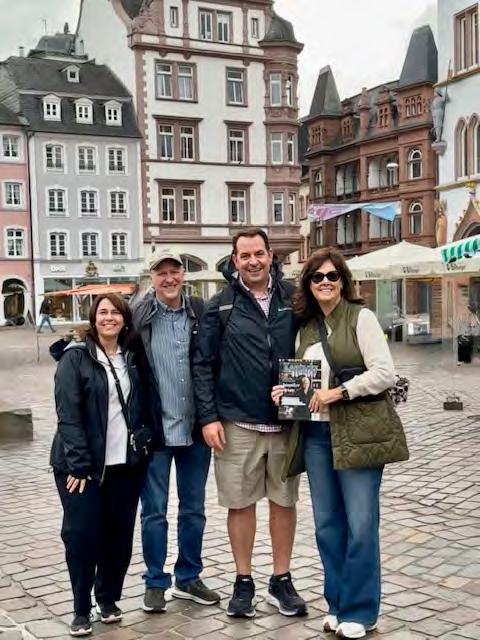
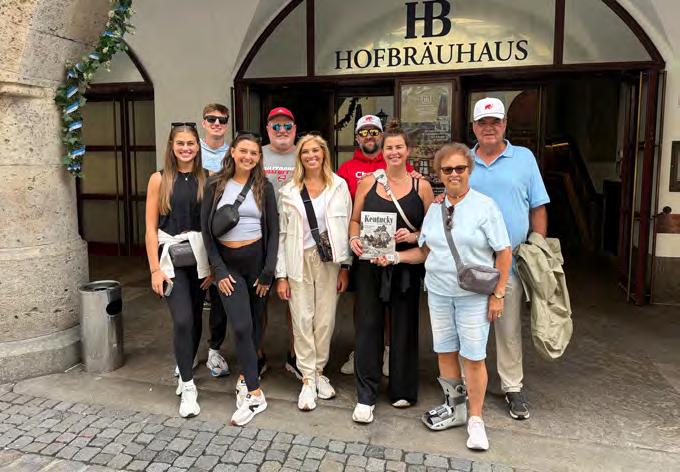
germany and belgium
Kurt and Linda Dobbs, along with friends Kent and Lisa Filbeck, all of Owensboro, visited Hauptmarkt, in Tier, Germany, and cruised along the beautiful canals in Bruges, Belgium.
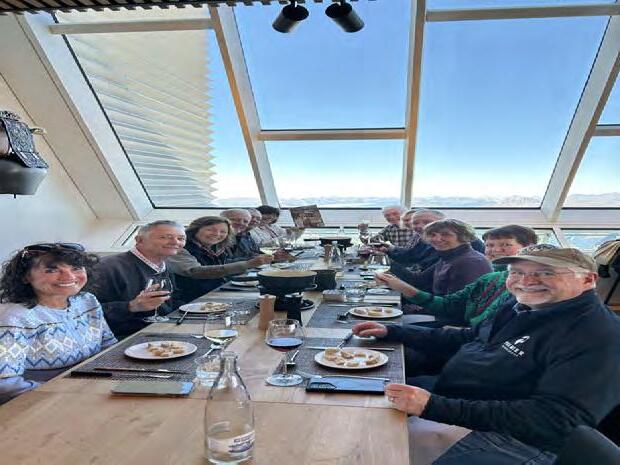
switzerland
A group of Northern Kentuckians (Colleen, Tim, Karen, Joe, Gary, Sally, Jim, Marybeth, Bill, Pat, Patti and Greg) traveled to Switzerland before departing on a Viking River Cruise on the Rhine River. The are pictured enjoying fondue in the Alps at Glacier 3000, with Kentucky Monthly displayed at the end of the table.
germany
A group of friends and family from Bowling Green traveled to Germany and stopped by the world-famous Hofbräuhaus in Munich. Front row, from left: Chloe Milliken, Abby Thomas, Amy Chandler, Heather Boyd and Brenda Hale; back row, from left: Geoffrey Ross, David Chandler, Jason Boyd and Terry Hale. The crew visited several areas in Germany.
submit your photo
Take a copy of the magazine with you and get snapping! Send your high-resolution photos (usually 1 MB or higher) to editor@kentuckymonthly.com or visit kentuckymonthly.com to submit your photo.
KWIZ ANSWERS:
B. Mary escaped from her captors near Big Bone Lick (Boone County) and survived a 40-day walk home to Virginia; 2. C. Gulliver’s Travels by Jonathan Swift was published in 1726; C. Prior to the survey of 1773, most explorers came and went from Kentucky, taking home the bounty of their hunts; 4. A. Virginia was separated from Spanish claims by the “Big Muddy”; 5. C. The McAfees laid claim to parts of northern Mercer County in 1773, predating Harrod’s claims in 1774 and ’75, but the competing claims were resolved peacefully; 6. B. Floyd reported to William Preston that the total population was roughly 280 (including 121 able-bodied riflemen in Harrodsburg and Boonesborough);
A. The original three counties were named for the Marquis de Lafayette, Thomas Jefferson and Benjamin Lincoln; 8. B. The convention was held Dec. 27, 1784, with each militia company sending a delegate to Danville; 9. B. Morehead was born in 1797 in Bullitt County.
With
April 18
Derby Primp & Prep
April 24
Food Truck Fridays
April 26
Farmers’ Market Open*
*Every Sunday through Nov 1
May 5
Oaks Night Party
May 16-17
Art Festival
June 20
Music by the Water
July 4
Stroll 4th of July Parade
July 18
Music by the Water & Much, Much More Event times and details are subject to change. Check nortoncommons.com/events for the most up-to-date event information.
BY LAURA YOUNKIN
Music Therapy
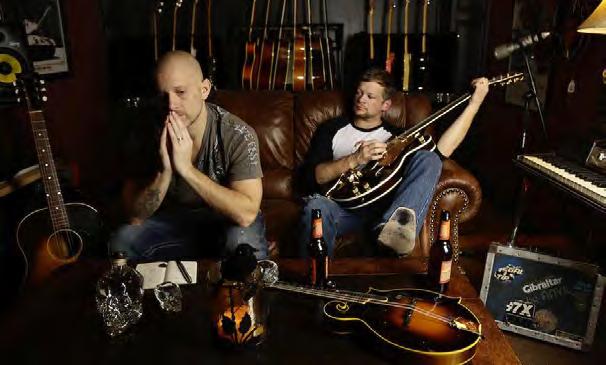
Sixteen Bones bandmates
Bryan Fox and David “Sailor” Bryant met in a decidedly unusual and not rock ’n’ roll way. They met at a dentist appointment.
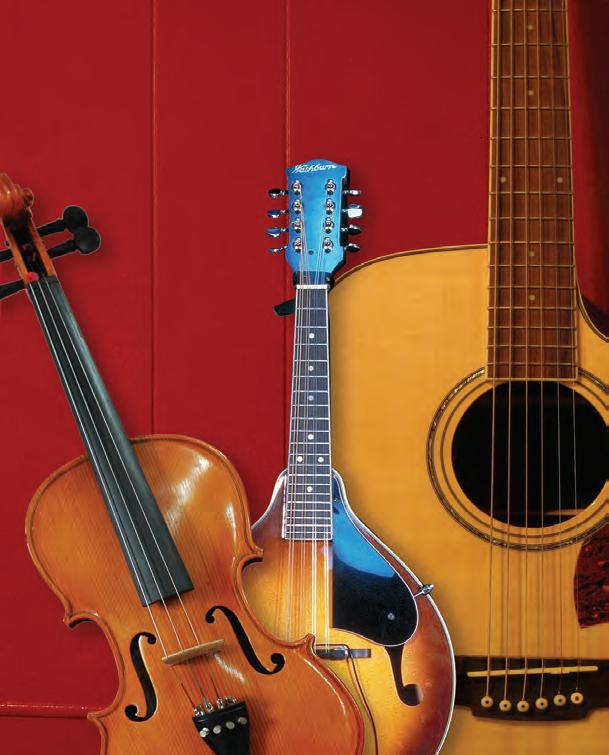
Fox, from Henderson, sings backup vocals and plays guitar, mandolin and keyboards for Sixteen Bones. Fox has been around music all his life. He played trumpet in high school. By 16, he was teaching guitar lessons at Abba Music in Henderson.
Conceit,” and the lyrics had a profound impact. “I felt myself physically change, like my DNA shifted,” he said. “I paid him $20 to $30 in gas to keep driving and cruise around and play the music on repeat.”
Once he hit college age, “I was premed and doing biology at Murray [State University],” Fox said. “I had a trumpet scholarship but turned it down for academics.”
After completing his coursework at Murray State, he headed to the University of Louisville in 1997 for dental school. “I actually, my first year at dental school, had record label attention,” he said, but it didn’t work out. Now Fox is a semi-professional musician and a dentist.
Bryant, who goes by Sailor, grew up in Louisville in what he calls a dysfunctional family. “I bounced back between Louisville and Hart County,” he said. “I was always down on the farm.”
Bryant had a restless spirit, a church background, and anger growing up. He distinctly remembers sitting in the backseat of a friend’s Buick Skylark as they drove around and listened to music. His friend put on the metal band Pantera, and Bryant’s life changed in an instant.
He heard the song “Regular People
Bryant said the “angst, anger and attitude” expressed all the feelings he had as a young man but couldn’t articulate. His path was cemented. Music was his home, and metal spoke to him. Bryant began playing in various metal bands.
After his mother died, Bryant felt another shift. He began exploring acoustic guitar because his feelings “didn’t fit with metal.” He played at times with Days of the New, a nationally recognized Louisville rock band that flourished briefly in the mid-1990s.
Bryant played on stage and toured some with the band. “I lost a tooth while touring with Days of the New,” he said. “My introduction to Bryan was through dental work.”
During the appointment, Fox mentioned he was moving to a new house, and Bryant offered to help him move. The friendship quickly blossomed, and the two began writing and playing music together. Bryant was a metal fan, while Fox brought a
different sound. “I have a bigger country background,” he said. When asked to describe Sixteen Bones’ sound, both Fox and Bryant deferred to other people’s descriptions. “Alice in Chains with a Johnny Cash flair” is the most popular explanation.
Growing up in Kentucky has influenced both musicians. “I lived in Western Kentucky for basically my entire life,” Fox said. Bluegrass was a huge influence: “It was something I heard a lot.” Bryant heard hymns while growing up, as well as Appalachian music. He said his parents moved frequently, and when he attended inner-city schools, he learned to rap.
Fox and Bryant, a business intelligence engineer, both devote time to bands besides Sixteen Bones. Fox said he has several projects, including a country band called Bryan Fox and the Good Chickens and an alt band called End of Me. Bryant also performs with Warplan.
Sixteen Bones released its album Signs, Symptoms and Other Ill Conditions in October 2025. Bryant said Fox has excellent taste about what works and what doesn’t.
“We’re very willing to listen to each other’s ideas,” Fox said.
When he was younger, Bryant used metal to work through the traumas of his childhood, and he found a healthy way to channel his anger. As he’s gotten older, he plays and listens to a wider variety of music.
“I think any musician will tell you it’s all therapy,” Fox said.
David “Sailor” Bryant (left) and Bryan Fox
Gather with Sweets
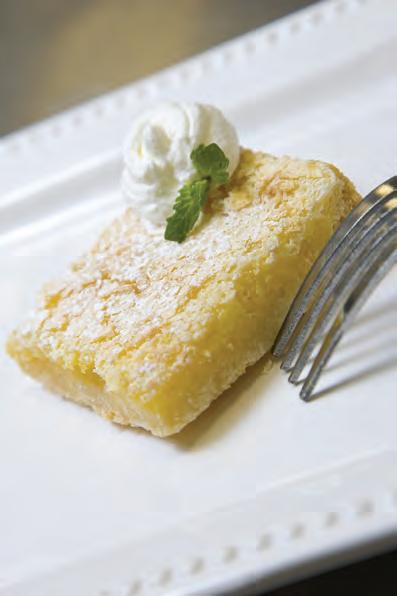
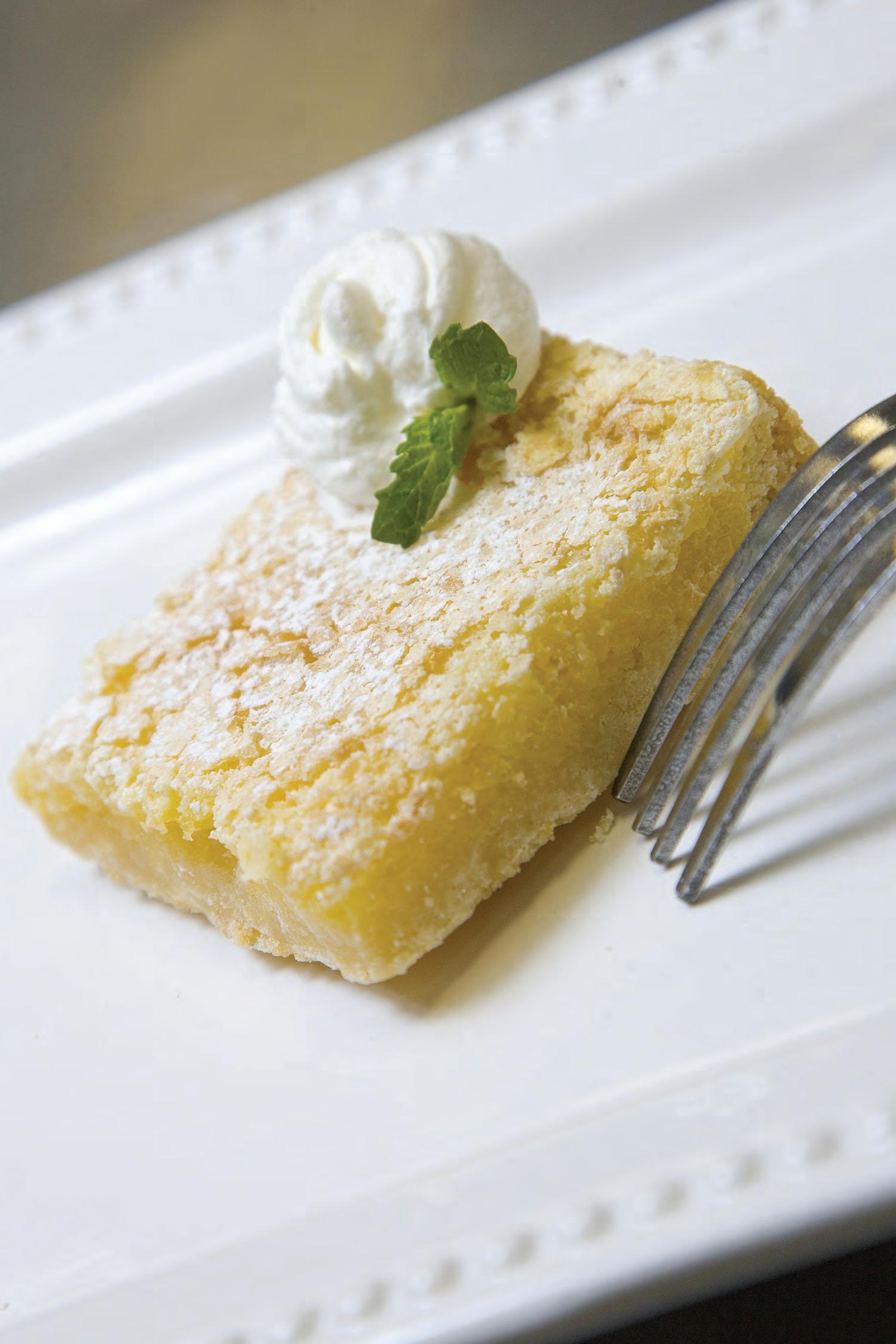
Quick Lemon Bars
MAKES 9 2-INCH SQUARES
16.5-ounce package
Betty Crocker lemon bars mix
Lemon juice
Powdered sugar, for dusting
Fresh mint, for garnish
1 Line an 8x8-inch square pan with foil.
2 Prepare lemon bars according to package instructions, substituting lemon juice for the water.
3 Cool and chill.
4 Cut into 2-inch squares. Dust with powdered sugar and garnish with sprigs of fresh mint just before serving.
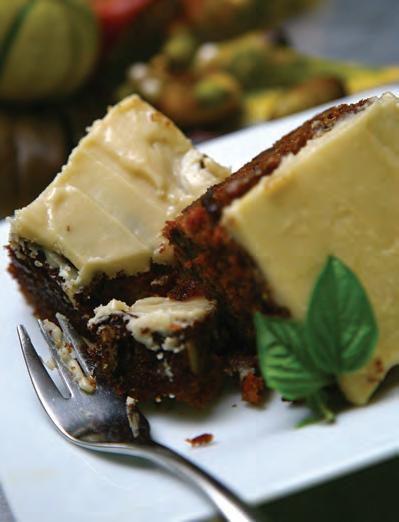
Carrot Bars with Cream Cheese Frosting
MAKES 24 SQUARES
1 Preheat oven to 350 degrees.
4 eggs
2 cups sugar
1 cup vegetable oil
3 cups carrots, grated
1 teaspoon vanilla
2 cups self-rising flour
2 teaspoons baking soda
2 teaspoons cinnamon
1 teaspoon allspice
¼ teaspoon cloves
½ cup chopped nuts
Any occasion can be an opportunity to gather with friends and family and share good food and good times.
2 In a large mixing bowl, beat eggs, sugar and oil. Add carrots and vanilla and mix well.
3 Combine the dry ingredients (reserving nuts) and add to the carrot mixture. Fold in nuts.
4 Pour into a coated 15x10x2-inch baking pan. Bake for 30 minutes.
5 Allow cake to cool completely.
6 Spread cream cheese frosting over the cooled cake. Cut into bars.
1 In a mixing bowl, combine butter and cream cheese and beat well.
2 Add powdered sugar and vanilla and blend well.
For sweet inspiration for your Derby party, graduation celebration or Sunday brunch, check out Just Desserts. This month, we share a sampling of the enticing recipes featured in the book.
Desserts
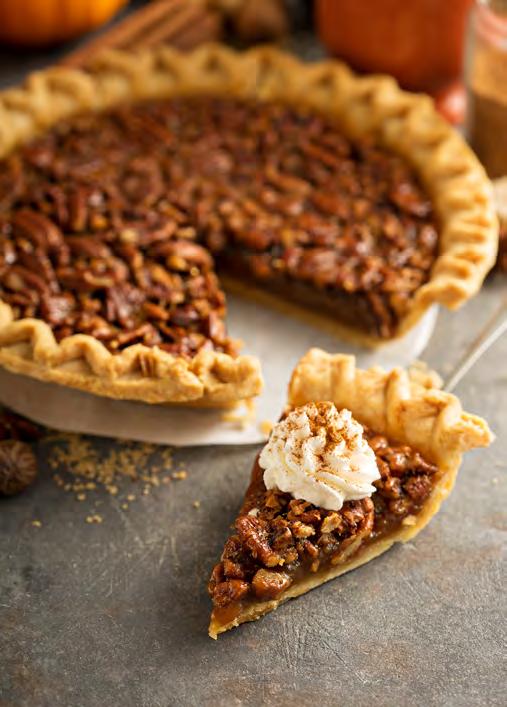
Kentucky Pie
MAKES 6 TO 8 VERY RICH SERVINGS
1 cup granulated sugar
½ cup all-purpose white flour
½ cup melted butter
2 eggs, slightly beaten
1 6-ounce package semi-sweet chocolate chips
1 cup chopped pecans
1 teaspoon vanilla extract
1 9-inch unbaked pie shell
1 Preheat oven to 325 degrees.
2 Mix together sugar and flour. Add melted butter and blend well.
3 Stir in eggs, chocolate chips, nuts and vanilla.
4 Pour mixture into pie shell. Bake for 1 hour or until golden brown.
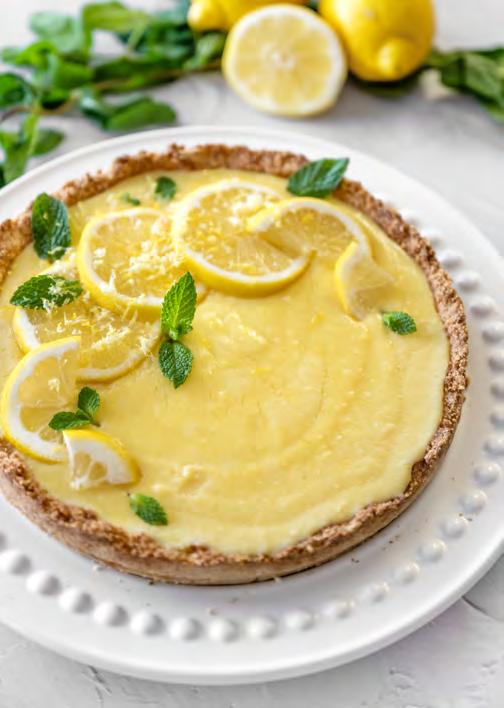
Lemonade Pie
MAKES 6 SERVINGS
8-ounce container whipped topping
14-ounce can low-fat sweetened condensed milk
6-ounce can frozen lemonade, thawed
1 prepared graham cracker crust
1 Combine whipped topping and sweetened condensed milk using an electric mixer.
2 Add lemonade in a steady stream while continuing to mix.
3 Pour the mixture into the crust and cover. Chill for 3 hours before serving.
Back on April 25, 2026...
Benefiting Liberty Hall Historic Site VIP tickets & tables available!
For tickets & info, visit libertyhall.org
*After Party features local favorite Sorry Atari! Tickets and exclusive merchandise included with ticket.
Providing a view of old France mirrored in modern Missouri, Sainte Geneviève mingles the past with present, generating a certain je ne sais quoi that will rouse something inside. Plan your trip at VisitSteGen.com.
Reverence and Awe
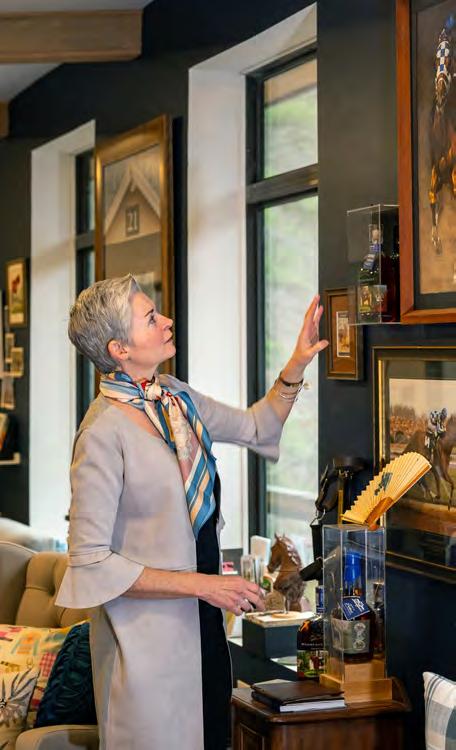
Equine artist Jaime Corum feels blessed to meet and paint famous racehorses
BY ABBY LAUB
Abby Laub photo
Jaime Corum once shipped the famed racehorse Zenyatta across the country in a horse trailer—a life-size painting of Zenyatta, that is.
“I’m her fangirl,” said Corum, an Eastern Kentucky-based artist widely known for her equine paintings, who affectionately calls the 2010 North American Horse of the Year “Zenny Z.” Zenyatta’s her favorite race mare.
“I’ve met her a few times, and she’s truly one that gives me goosebumps,” Corum said. “[When] she was just retired, I got to go out to Lane’s End Farm [in Versailles] and really be with her and get all of her proportions for the life-size canvas. It was like painting your
favorite rock star.”
Zenyatta is one of many famous racehorses Corum has spent time with, getting backstage access not available to the general public so she can paint her commissioned equine portraits.
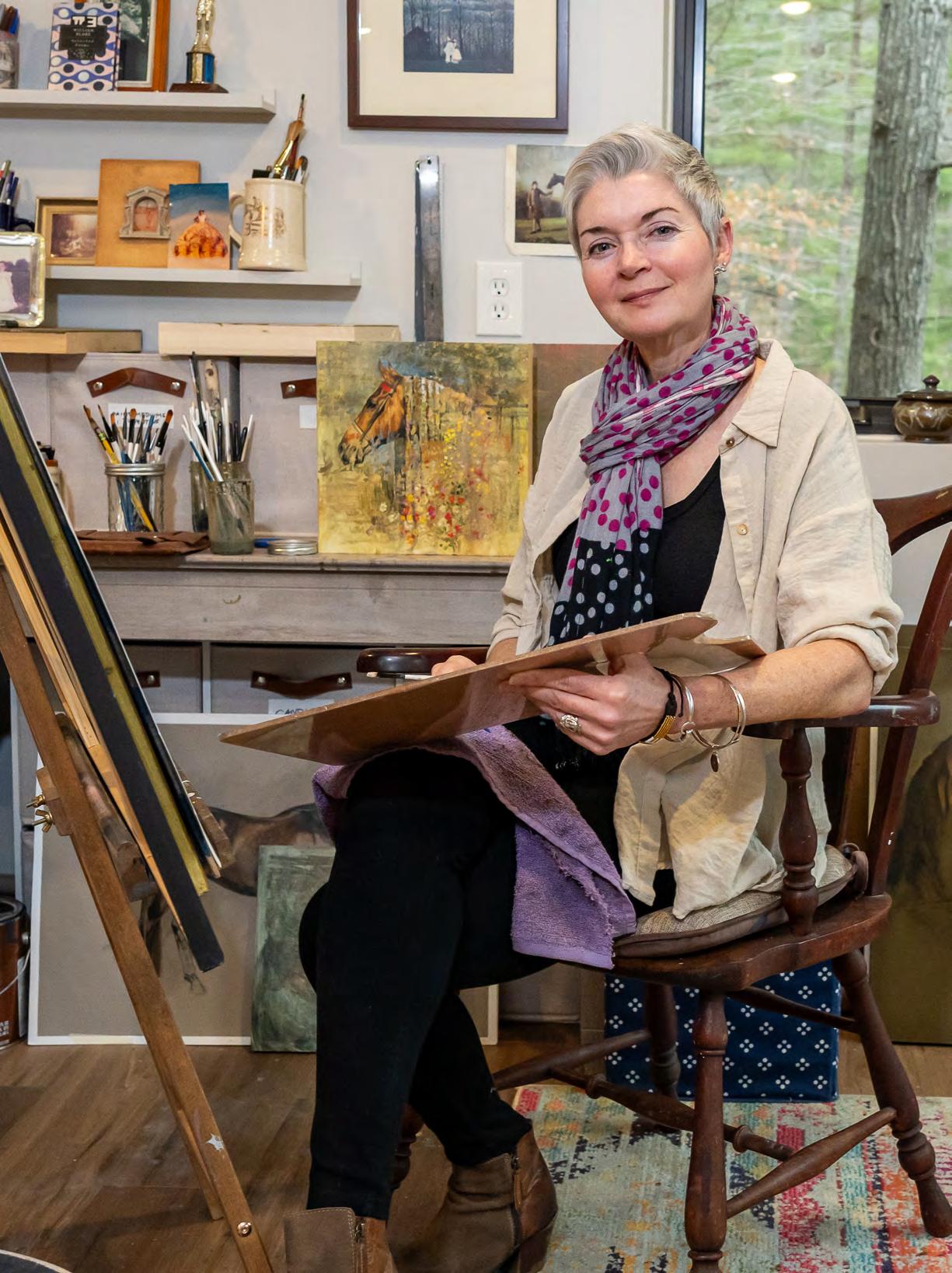
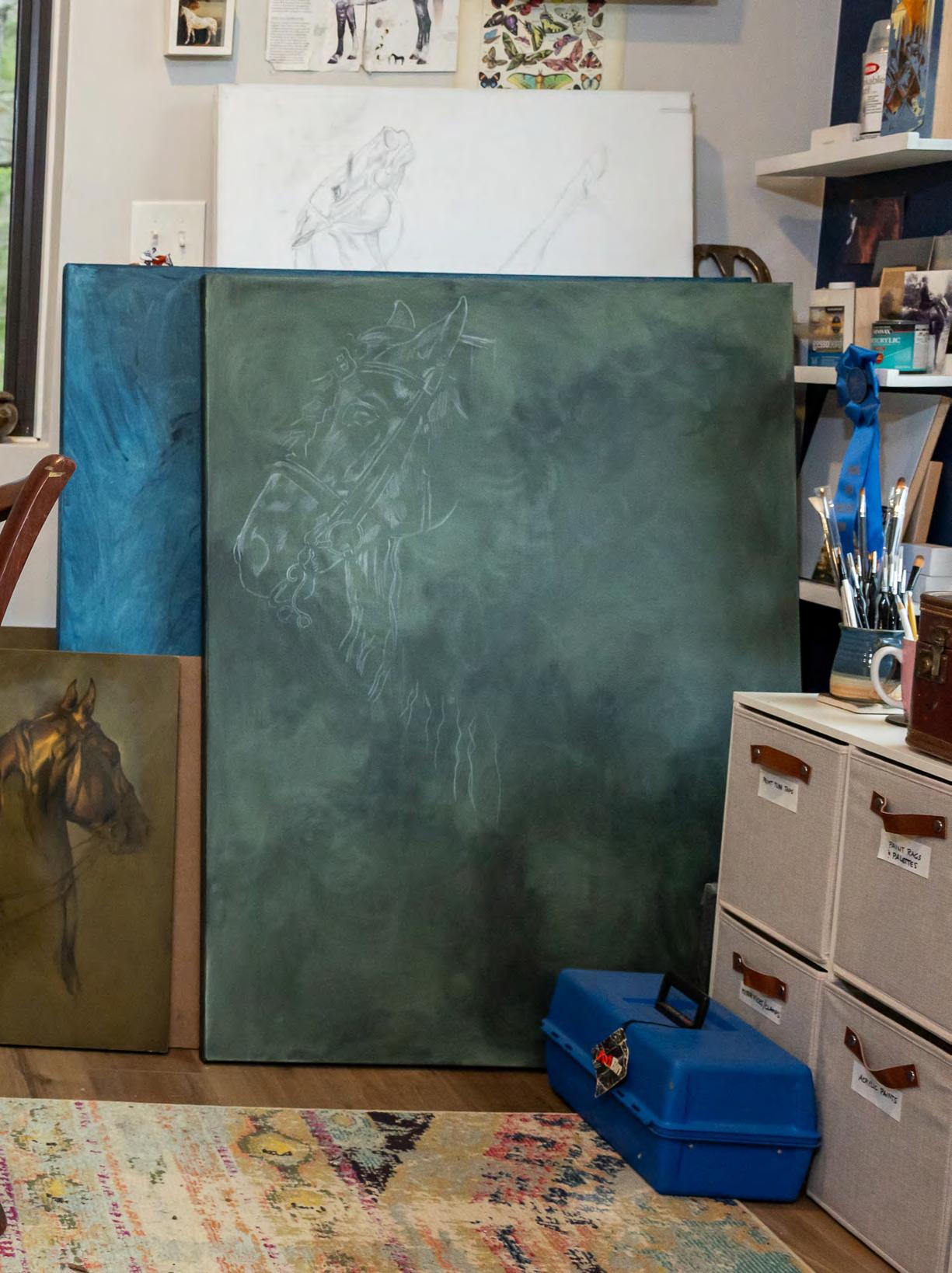
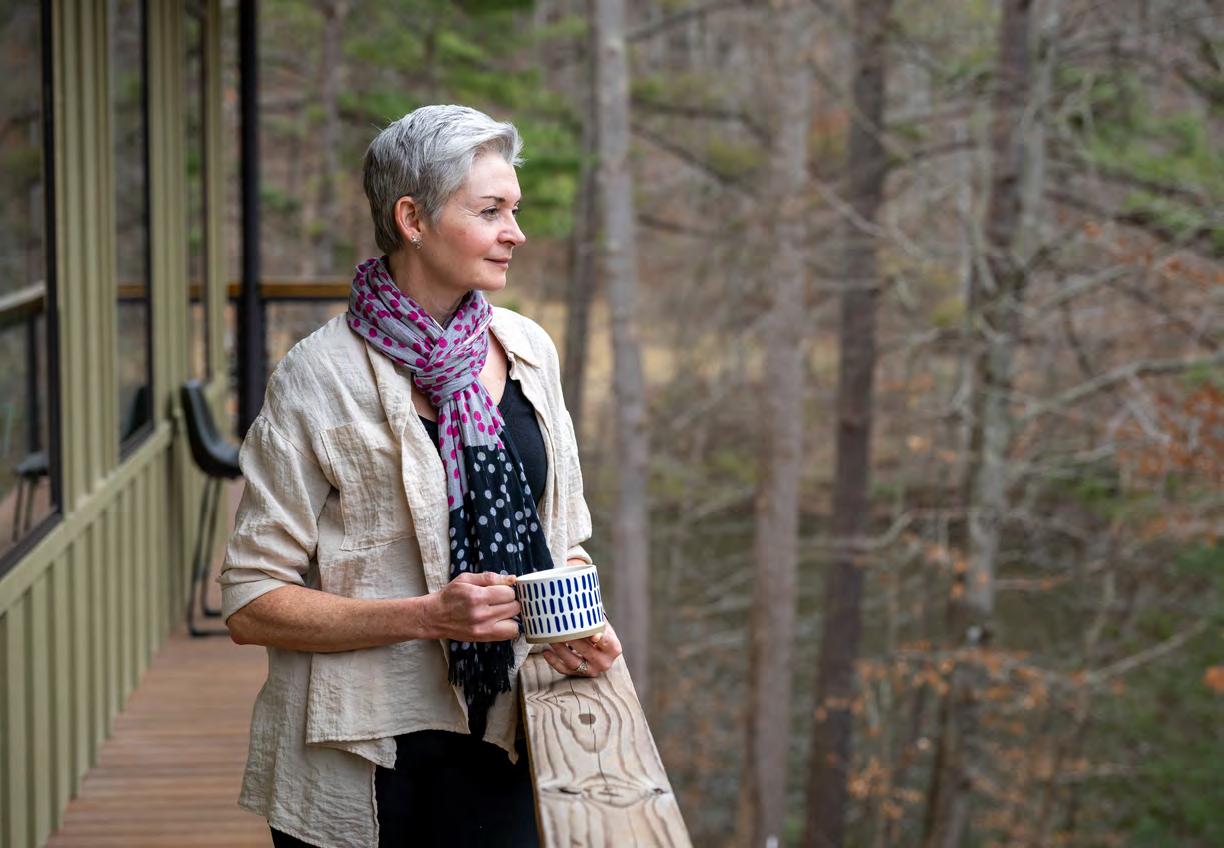
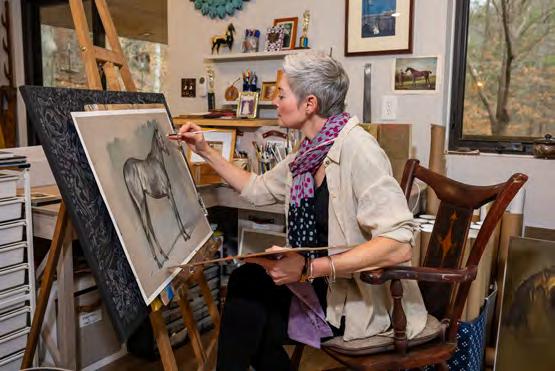
Much of the painting—primarily oil on canvas—happens in Corum’s family’s holler near Pineville, almost in the shadow of Pine Mountain. It’s where Corum can often be found ambling through the forest behind her home, riding a four-wheeler, watching otters swim in the pond below her house, shooting a rattlesnake that’s threatening one of her three dogs, or simply soaking in the trees.
“The rattlesnake was threatening my furry children, so that got my Uma Thurman Kill Bill going on. I have two different sides,” she laughed.
Her shot was accurate, and her art is just as successful, her talent cultivated through years of practice and thousands of paintings.
•
•
Corum began drawing when was young. Growing up in Southeastern Kentucky, she did not get to see and ride many horses in person, but the love was innate. She called them her “special muses.”
“I don’t remember a time when I wasn’t enamored by horses,” she said. “I was always drawn to horses and always wanted one. I’d always draw them and watch horse movies and collect horse figurines.”
While she didn’t live in horse country, a neighbor owned a Tennessee Walking Horse that
Corum sometimes got to ride. At 11, her family moved to Louisville, where her aunt was a professional dressage trainer, and Corum’s life changed.
“I’m so glad I got to grow up as a tomboy country girl, playing in the mud, chasing frogs and stuff—I wouldn’t trade that for anything— but I rarely really got to ride,” she said. “When we moved to Louisville, my aunt Marjorie had ridden at Spring Run Farm out in Prospect— it’s still there and active—and that was probably the thing that formed me most as a human because I spent so much time out there as a young person. I was like, ‘OK, I’ll move to Louisville if I get to ride.’ ”
Corum joined Pony Club and continued drawing horses, which evolved to painting horses. She
sometimes painted horses or dogs for her friends, which led to more—and bigger—customers. At that time, she was fully ensconced in the eventing and dressage world. Thoroughbred racing wasn’t yet on her radar.
Corum attended Louisville’s Bellarmine University, received an MFA from the University of Kentucky, and ultimately returned to Bellarmine to teach part time, allowing time for her blossoming painting career.
“Suddenly, I was being asked to paint people’s horses more outside of my immediate circles, and I was having shows,” Corum said. “Leonard Lusky, who created secretariat.com, saw my work and commissioned me to do a Secretariat and Barbaro pair, and that was my first entrée into
Thoroughbred racing … This was about 2004. That grew into me getting audiences with Zenyatta, [American] Pharoah and others.”
•
•
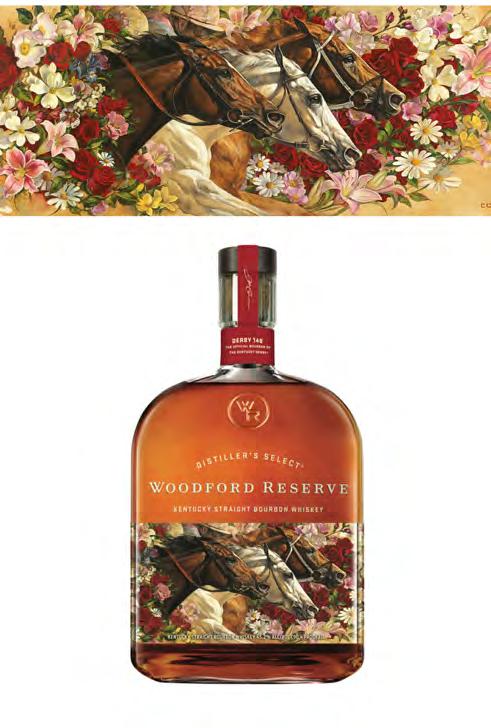
Fast forward to 2022, when Corum was commissioned to create a painting for Woodford Reserve’s Kentucky Derby collector’s edition bottle, which the distillery releases each year. She was asked again the following year to paint Secretariat. for Woodford Reserve to mark the 50th anniversary of Big Red’s 1973 Triple Crown win.
“I love bourbon culture, so it was a really cool honor that they wanted me to do it,” she said. “I loved it, and it was a huge benefit to my business. I even heard that a bottle made it to
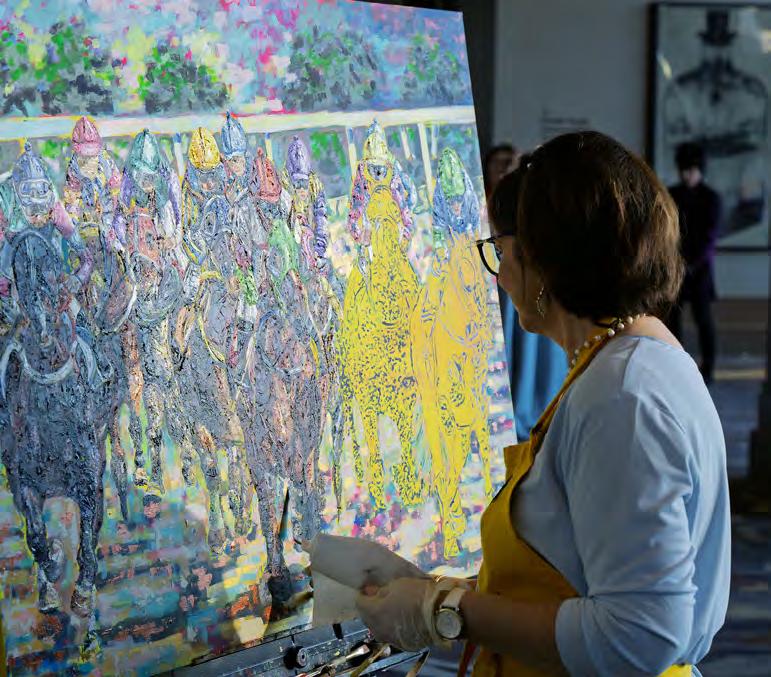
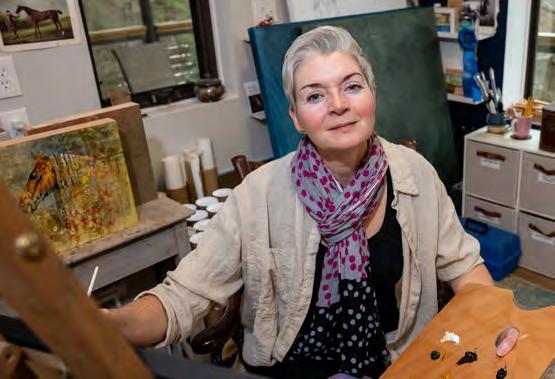
Most of Jaime Corum’s painting takes place in her native Eastern Kentucky. [Abby Laub photos]
the Vatican. You just never know where it’s going to wind up.”
That project took her name recognition to the next level. Corum’s paintings and prints ship worldwide, and she’s painted commissions for clients in far-flung locations.
“It’s just funny what can happen if you just keep doggedly following the path,” she reflected. “I think I was just naive enough not to give up. And I had a very supportive family who, in the lean years, made sure I wasn’t starving.”
But it’s more than Corum’s sheer talent as a painter that sets her apart. It’s clear that she just “gets” horses.
“A lot of times, people try to overpower the horse, but the horse
understands you,” she said. “They can feel your energy. You really have to work with them and speak their language.”
She’s fascinated with the psychology of horses and why people, especially women, are drawn to them.
“You can talk to anyone who has that horse connection and have instant common ground,” Corum said. “I love, of course, their beauty, and as a woman, I always wonder if they are a pathway to strength and a power that we don’t have. We don’t want to overpower them—we become friends with that power, and they willingly give us that strength. There’s often a relationship between horses and women that’s different than [that of horses and] men.”
She believes learning to work successfully with horses and other animals can translate to human psychology and that it has “built a lot of character in me.”
Meeting famous racehorses continues to cultivate her reverence and awe.
“Horses have millions of personalities, just like people,” Corum said. “And the great ones have a different quality; they have a powerful essence that you can feel. Like Zenyatta … ahh … the way that she held herself—she held her neck so high, and she was already so tall. She was over 17 hands tall [around 70 inches], and she held her head just so, and she’d just look at you. But she was always very sweet, which you
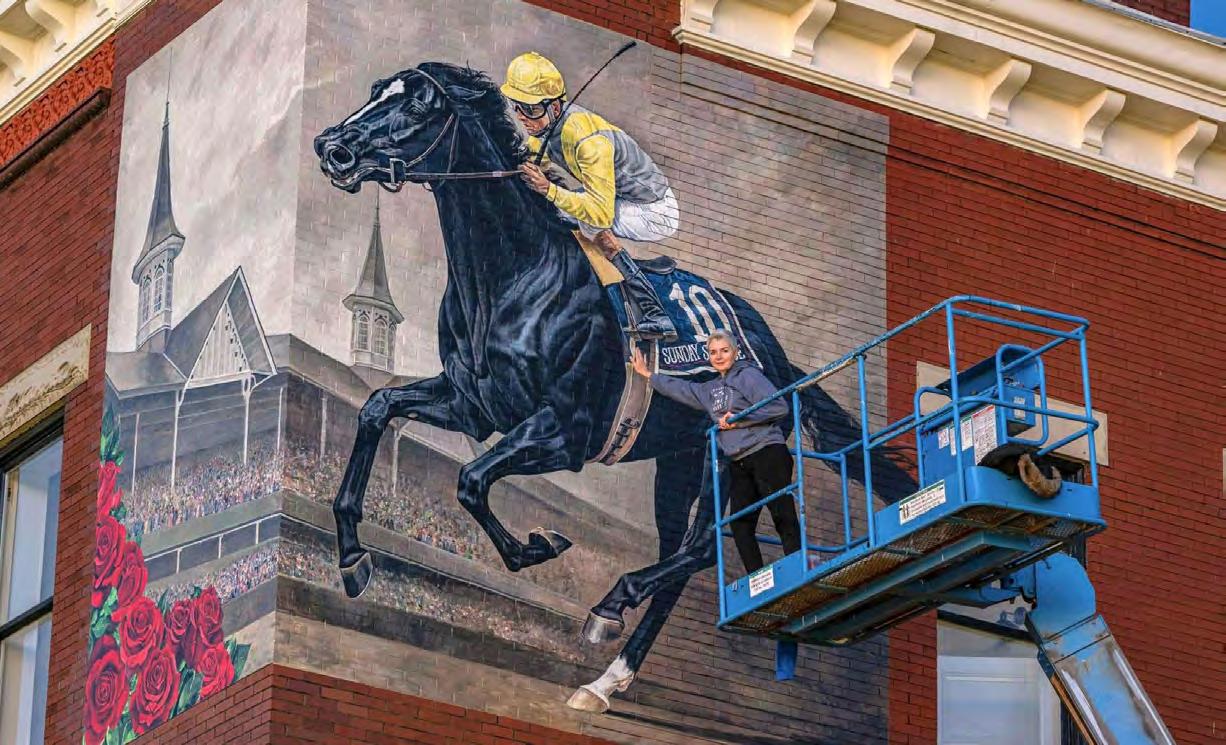
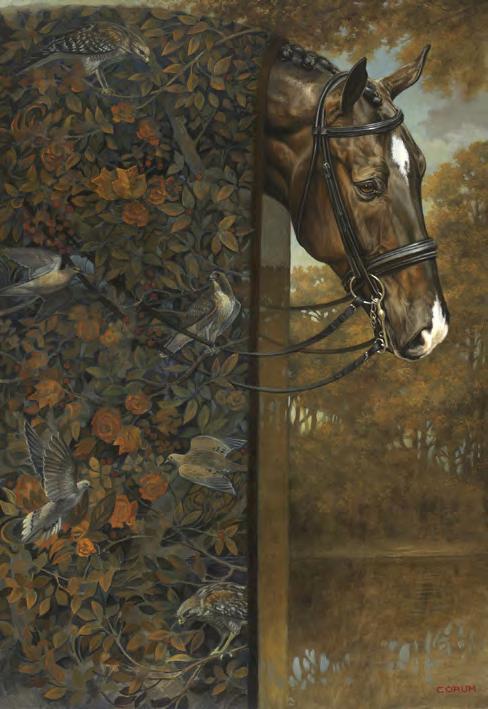
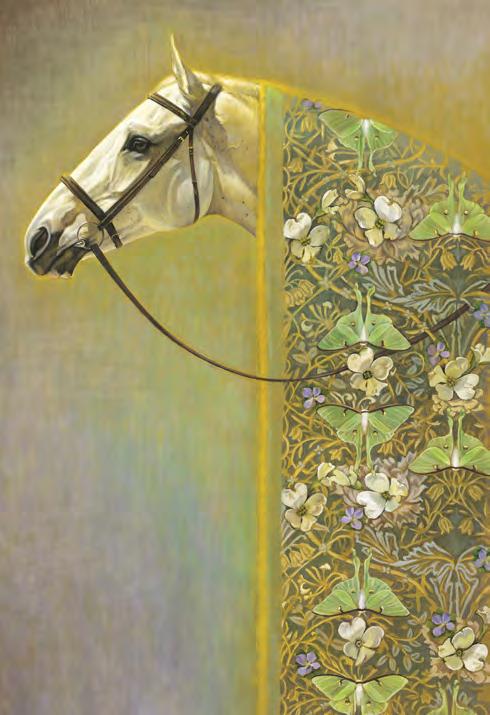
Above, Corum in downtown Paris with her mural of 1989 Horse of the Year Sunday Silence. [Bobby Shiflet photo] Opposite page, top: Two paintings from the artist’s tapestry collection. [Courtesy of Jaime Corum] Opposite page, bottom left: this enormous mural of 1973 Triple Crown winner Secretariat overlooks the site that would become Paris’ Secretariat Park. [Courtesy of Jaime Corum] Opposite page, bottom right: Corum’s “Dreams in Bloom” painting graced the cover of Woodford Reserve’s 2022 commemorative Kentucky Derby bottle. [Courtesy of Jaime Corum]
“Chestnut Warm-Up” [Courtesy of Jaime Corum]
don’t always get with the race mares.”
She described 2015 Triple Crown and Breeders’ Cup Classic winner American Pharoah as “actually super chill, but also you got the sense that he knew his worth.”
When Corum met 2007 and 2008 Horse of the Year Curlin, she said, “He was one that I could look at all day, a truly gorgeous creature.
“You realize it’s not a common thing for your average person to come into these beautiful Thoroughbred farms and have an audience with these horses,” she said.
“I feel very, very blessed. I will never lose how special that is. I feel like I have the best job in the world.”
Meeting racehorses and trying to paint them isn’t like asking a human subject to “sit” for a portrait. Corum meets the horses, often takes their measurements, and takes videos and photographs, but otherwise, she draws on her many years of experience with horses to be successful.
“That allowed me to distinguish individual features very clearly in each one,” she said. “I grew up in the right state. I had just the right little bubble
environments to grow up and do this in. And then by the time I was out of graduate school, I felt confident having the educational credentials behind me. I could confidently walk the walk.”
•
•
Corum’s work now speaks for itself. Recent projects locally include three massive, commissioned murals in Paris, Kentucky. They include depictions of 1989 Horse of the Year Sunday Silence, Curlin and Secretariat. These murals make
beautiful additions to the town as it celebrates its horse racing heritage. The initial painting of Secretariat was the first element toward the creation of Secretariat Park and has contributed to the revitalization of the downtown led by Paris native Chris Poynter, his family and his partners.
“I feel like Paris is my second home,” Corum said. “It’s gotten so cool there with a great downtown and main street.”
She also painted the winners of the Vox Populi Horse of the Year Award, created by the late Penny Chenery, who bred and owned Secretariat.
This year, Corum looks forward to celebrating the “Year of the Horse” and plans some special shows to honor it. Follow along on her website
Experience
“I love to explore more surrealist and maybe symbolist themes in my art where are some non-literal things happen with the horse—for example, the horse will be standing in front of or weaving in and out of a tapestry background,” Corum said. “There will be just a little nod to something different. They are not just standing in a landscape.
“I love the elements of the surreal, the romanticism. I’ve always loved those non-literal elements. The way horses make me feel—it really is kind of a spiritual experience. It’s something that deserves more than just a cut-anddry photo realism treatment. It deserves something a little bit extra.”
EXPLORE
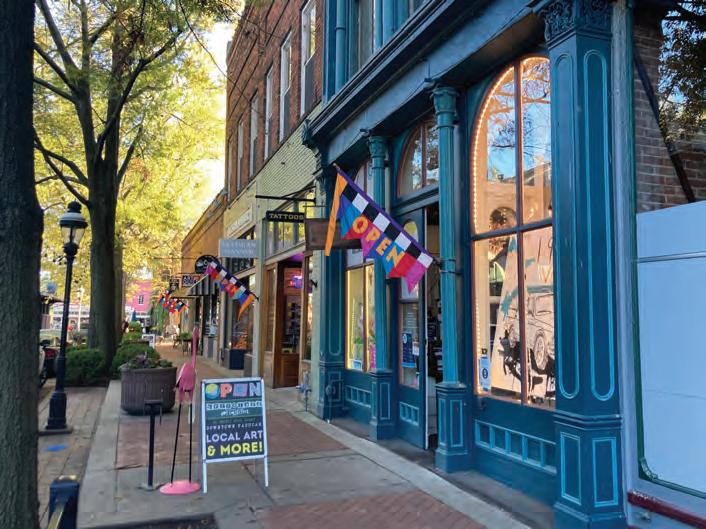
KENTUCKY MAIN STREETS
KENTUCKY
DERBY FESTIVAL
Official Schedule of Events
FAMILY FUN
ACTIVE LIFESTYLE
CULINARY
ENTERTAINMENT + SOCIAL
BY JACKIE HOLLENKAMP BENTLEY
The circus is coming to town, as are a water lantern festival, a spectacular fireworks extravaganza, road races, music, concerts and much more—all for the month-long celebration that leads up to the most famous two minutes in sports.
For more than seven decades, the Kentucky Derby Festival has produced more than 70 events in Louisville and surrounding communities to celebrate the running of the Kentucky Derby at Churchill Downs. Here, we’ve highlighted a handful of the events. The complete KDF schedule begins on page 24.
FAMILY FUN
APRIL 3 • 4-8PM
Caesars Foundation of Floyd County Kentucky Derby Festival FamFest
Floyd County Family YMCA, Downtown New Albany
Family-friendly event with a special preview of the 2026 Festival, featuring inflatables, activities, face paintingand more. First 1,000 attendees receive a custom event pin.
Sponsor: Caesars Foundation of Floyd County. Contributing Sponsor: Samtec. Media Sponsor: 102.3
The Rose.
APRIL 11
Brightside Spring Community-Wide Cleanup
Various locations throughout Louisville
Brightside encourages all residents to take part in the Community-Wide Cleanup. All
cleanup teams will receive bags and gloves at no cost. Contact Brightside at 502.574.2613 or email Brightside@louisvilleky.gov to participate.
APRIL 12 • NOON–2PM
The Children’s Tea with The Derby Festival Princesses Presented by The Fillies, Inc.
The Olmsted
Meet the Kentucky Derby Festival Queen and Princesses at The Children’s Tea, themed “A Mad Hatter Wonderland.” Tickets: $35 each. Adults accompanying children also need a ticket. Event suggested for children ages 3-8. Produced by: The Fillies, Inc. For more info and tickets, visit acwfillies.wildapricot.org
APRIL 18
Kentucky Derby Festival Thunder Over Louisville®
FoodFest and Thunder On the Ground open at 11 AM. Airshow 3 PM. Drone and Night Show 9 PM. Fireworks 9:30 PM.
Downtown Louisville Riverfront, Waterfront Park, River Road and Southern Indiana shoreline
Thunder Viewing Areas. Admission is free with a 2026 Pegasus Pin®: North Great Lawn (Opens at 9 AM). Thunder Chow Wagon at Waterfront Park and the East River Road Beer Garden (Opens at 11 AM). West Belvedere (Opens at 11 AM). Meijer Family Fun Zone at the Big Four Bridge Lawn (Opens at 2 PM). (No tents, stakes, tape or pets.)
2026 Sponsors: Caesars Southern Indiana, Ford Motor Company, LG&E, Meijer, UA Local 502 and UPS. Official Bourbon: Four Roses Bourbon. Official Hotel: The Galt House Hotel. Official Soccer Partner: Lynn Family Stadium. Supporting Sponsor: Clark Material Handling Company. Official Broadcast Partners: WLKY and MIX 106.9
APRIL 18 • 2:30-10:30PM Louisville Muhammad Ali International Airport Thunder Over Louisville VIP Rooftop Party Presented by Kentucky Proud
Brook Street Garage Top
Front-row seat for Thunder Over Louisville. Tickets – General Admission: $225 each or a Premium Reserved Table of 8: $3,000. Tickets at ThunderOverLouisville.org
Sponsor: Louisville Muhammad Ali International Airport. Presenting Sponsor: Kentucky Proud. Military Zone Sponsor: KCS Foundation and Waterproofing. Official Healthcare Provider: UofL Health. Contributing Sponsor: Crushed Ice Catering.
APRIL 23-25
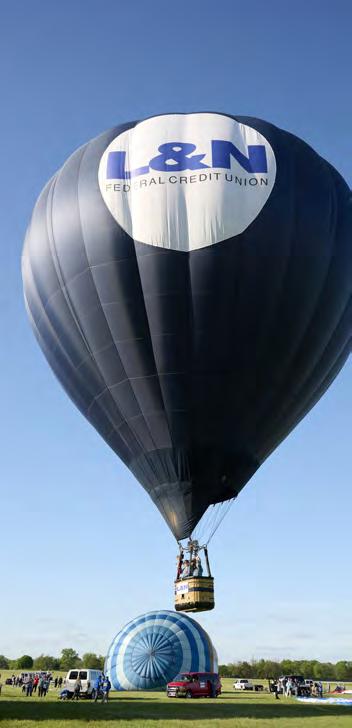
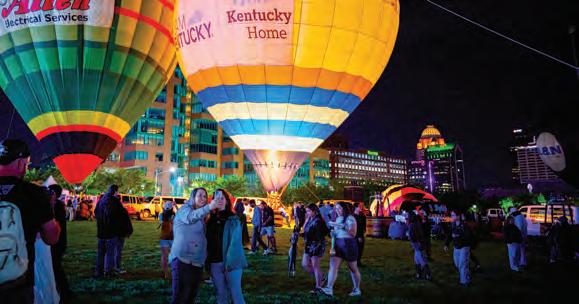
L&N Federal Credit Union Kentucky Derby Festival Great BalloonfestSM
Various locations
Four balloon events over three days. Colorful hot air balloons will light up the Louisville skyline during one of the Festival’s most picturesque events. Admission is free with a 2026 Pegasus Pin®.
Sponsor: L&N Federal Credit Union.
Contributing Sponsors: Ivy Tech
Community College, KCS Foundation and Waterproofing, Kentucky Kingdom
Theme & Water Park, Kentucky State Parks, Shady Rays and UA Local 502.
Admission is free with a 2026 Pegasus Pin®. Streamed live on WLKY.com on April 23.
Broadcast special on April 25 at 8 PM on WLKY.
Sponsor: L&N Federal Credit Union.
Contributing Sponsors: Ivy Tech
Community College, KCS Foundation and Waterproofing, Kentucky Kingdom
Theme & Water Park, Kentucky State Parks, Shady Rays and UA Local 502.
Official Broadcast Partner: WLKY.
Media Sponsor: MIX 106.9.
APRIL 24 • 7AM LAUNCH
L&N Federal Credit Union
Kentucky Derby Festival Great Balloon Rush-Hour Race
Bowman Field, Public entrance off Pee Wee Reese Road.
Admission is free with a 2026 Pegasus Pin®.
Sponsor: L&N Federal Credit Union. Contributing Sponsors: Ivy Tech
Community College, KCS Foundation and Waterproofing, Kentucky Kingdom
Theme & Water Park, Kentucky State Parks, Shady Rays and UA Local 502.
Official Broadcast Partner: WLKY.
Media Sponsor: MIX 106.9
APRIL 25 • 7AM LAUNCH
L&N Federal Credit Union
Kentucky Derby Festival Great Balloon Race
Bowman Field, Public entrance off Pee Wee Reese Road.
Admission is free with a 2026 Pegasus Pin®.
Sponsor: L&N Federal Credit Union.
Contributing Sponsors: Ivy Tech Community College, KCS Foundation and Waterproofing, Kentucky Kingdom
Theme & Water Park, Kentucky State Parks, Shady Rays and UA Local 502.
Official Broadcast Partner: WLKY.
Media Sponsor: MIX 106.9
APRIL 23-25
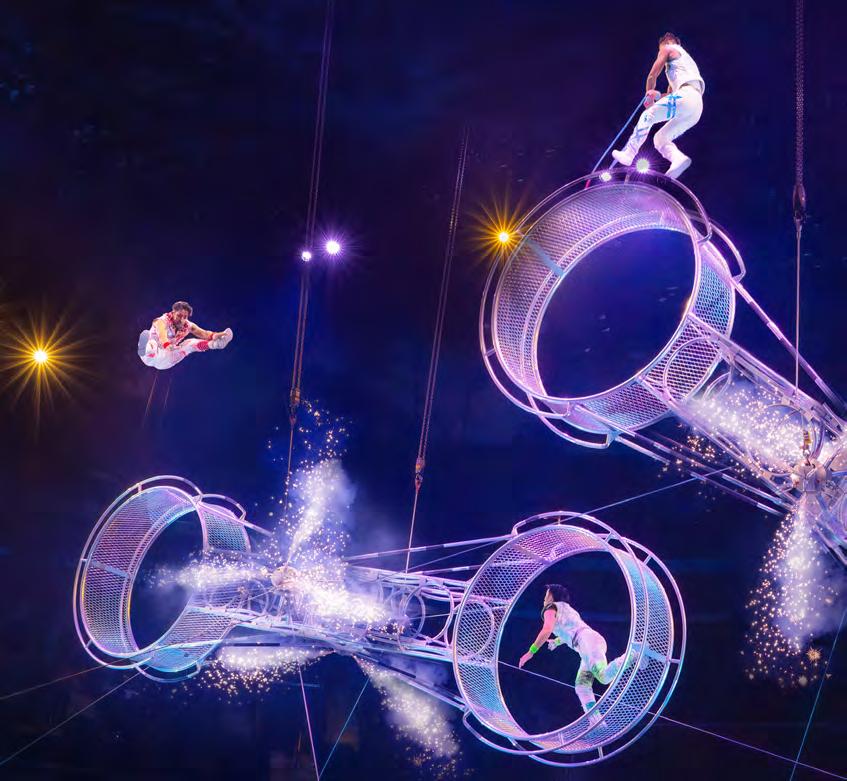
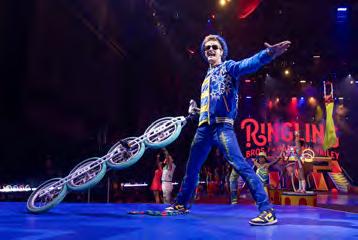
Kentucky Derby Festival Ringling Hype Crew
Kroger’s Fest-a-Ville on the Waterfront, Ringling Circus Party Lawn (Great Lawn)
Performances throughout the day. New for 2026! For wide-eyed kids to “seen-it-all” grown-ups, the all-new Ringling Bros. and Barnum & Bailey® is packed with jaw-dropping acts, laugh-outloud fun and memory-making moments you’ll never forget.
Admission is free with a 2026 Pegasus Pin®. (Food, drink and pets are not permitted.)
APRIL 25 • 1-5PM
Kentucky Derby Festival Ken-Ducky Derby
Kroger’s Fest-a-Ville on the Waterfront
Call to the Post 4 PM. Duck Launch 4:02 PM. See the launch of 50,000 ducks into the Ohio River for a chance to race and compete for prizes. Admission is free with a 2026 Pegasus Pin®. To adopt a duck and for more information, visit gotducks.org or
NEW IN 2026
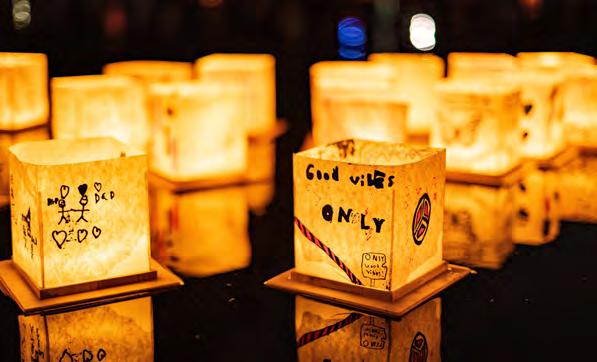
WATER LANTERN FESTIVAL
The Utah-based Water Lantern Festival has visited Kentucky during the summer since 2018, but this is the first time it will be part of the Kentucky Derby Festival at Kroger’s FestA-Ville at Waterfront Park.
“Our motto as a company is bringing hope and joy and connection to all the communities that we go to, so we’re really excited to get in and go to the Kentucky Derby Festival,” said Justin Rash, the Water Lantern Festival’s event coordinator. “So just being able to change that date and bring it up in April with the Festival and be a little bit more involved in the community is something that we’re super stoked about, and it’s a great way to bring together the entire community of Louisville and the surrounding areas.”
This year’s Water Lantern Festival is set for April 29 at Kroger’s Fest-A-Ville at Waterfront Park. Participants are encouraged to check in at 6 p.m. to pick up a lantern kit, find a spot to put down blankets or chairs, and enjoy all the festivities Fest-A-Ville offers each year—live music, food and more.
“Then, right before sunset, the vibe starts to change, and it definitely turns inward and more reflective as we invite guests to write on their lantern to decorate it either with drawings or messages or words,” said Tess Rouser, the Water Lantern Festival’s marketing manager. “At sunset, the guests release their lanterns onto the [Ohio River], transforming it into a glowing display of light. It’s peaceable and emotional and really moving because it’s something you participate in and not just observe. It’s the best of both worlds—fun and lively but also peaceful and introspective.”
Rash said all the lanterns are environmentally friendly and eventually are picked up from the water. “We collect all the lanterns after the event goes on and people have had a chance to launch their lanterns and kind of sit there and watch them for a while,” he said. “We like to leave parks better than we found them because we want to come back, and we want to be able to bring this event to the community year after year.”
Admission to the Water Lantern Festival in Fest-A-Ville is a 2026 Pegasus Pin®. Lantern kits are purchased separately with prices starting at about $30 each.
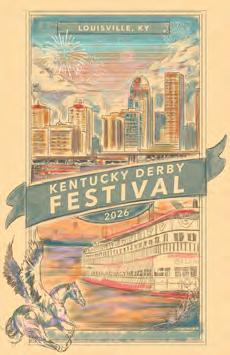
THE 2026 OFFICIAL KDF POSTER
Each year, the Kentucky Derby Festival commissions artwork that encapsulates what Derby Festival time means for the region. This year, Louisville artist Shae Goodlett designed the poster.
“I wanted to create an illustration that looked like a vintage travel poster,” Goodlett said.
KDF’s official 2026 merchandise collection, including apparel, features Goodlett’s work. It can be purchased at Festival events and online at KDF.org
2026 KENTUCKY DERBY FESTIVAL PEGASUS PINS
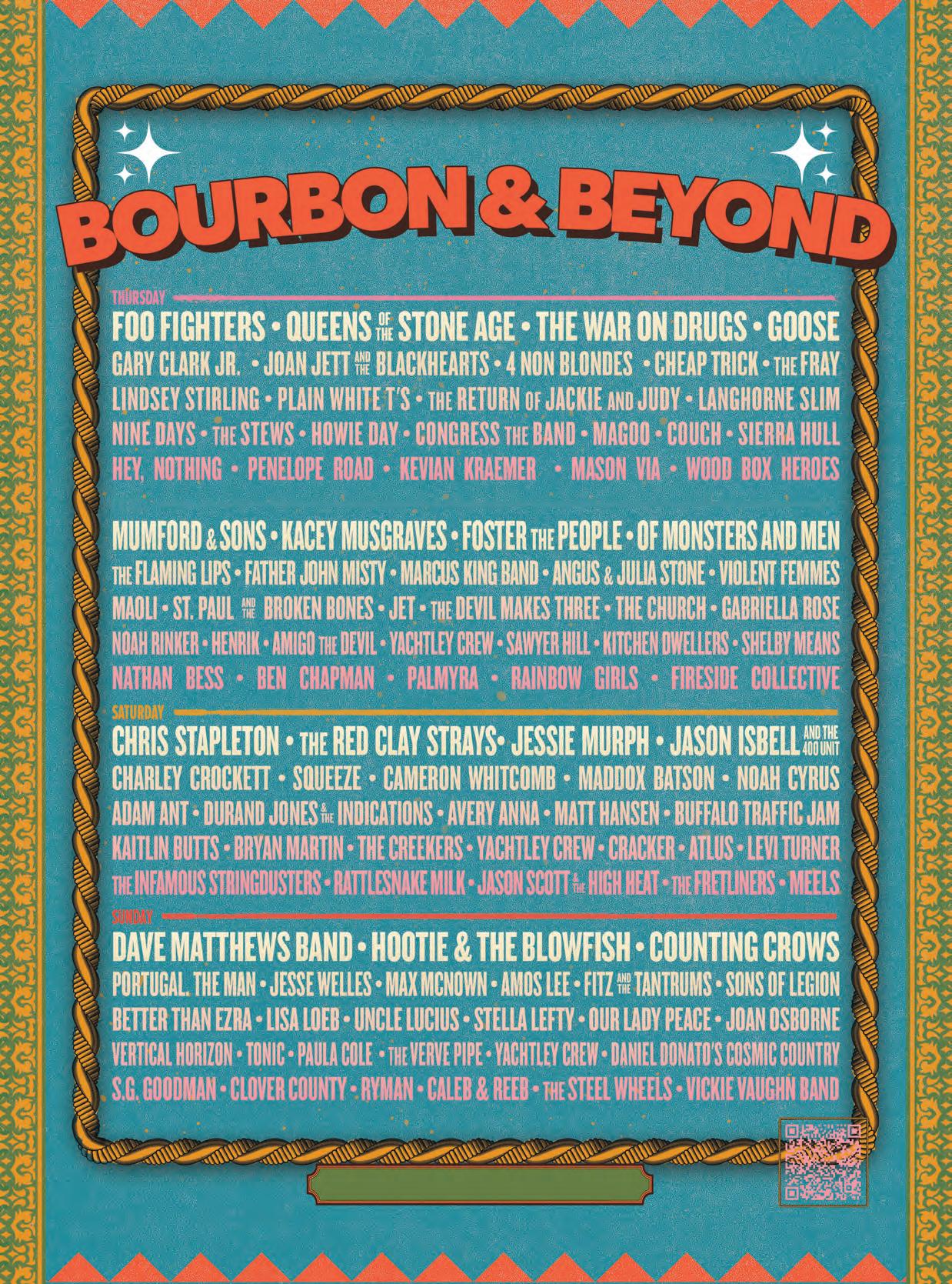
It’s springtime when the official Kentucky Derby Festival Pegasus Pins® appear at retail locations throughout Kentuckiana. This year’s pins are translucent teal, the Festival’s signature shade, with a horseshoe design. Many Kentucky Derby Festival events require a Pegasus Pin® for admission. Those with pins have the chance to win weekly prizes, including grocery gift cards, Visa gift cards and tickets to the Bourbon & Beyond and Louder Than Life music festivals.
General Pegasus Pins® cost $7 at retail locations and $10 at Kentucky Derby Festival events. Limitededition gold pins and metal pins can be purchased at KDF.org
RINGLING BROTHERS AT FEST-A-VILLE
The Ringling Bros. and Barnum & Bailey’s “Greatest Show on Earth” hasn’t been in Louisville since 2015, but all that changes this May with a three-day production at the KFC Yum! Center.
Kroger’s Fest-A-Ville will feature a multi-day “sneak peek” of the highenergy, music-driven experience.
“We’re bringing bite-sized bursts of the same world-class talent you’ll see in the full show this May, including acrobatics, skill, comedy and interactive moments that pull the crowd right into the experience,” said host and singer Juanita Olivo. “It’s fast, fun and designed to stop people in their tracks.”
It’s also not the same production it was 11 years ago.
“The new Ringling is all about creating a celebratory atmosphere, so expect big music, big visuals and that contagious party vibe that turns spectators into participants,” Olivo said. “Fest-A-Ville is a celebration of community, and that aligns perfectly with what Ringling is all about today—bringing people together for a shared live experience. So, if you see us, don’t just watch … get ready to join the fun.”
The “Greatest Show on Earth” preview is set for April 23-25 at Fest-A-Ville. The full circus will be at the Yum! Center May 15-17.
call 502.719.0072.
(Food, drink and pets are not permitted.)
Proceeds benefit Harbor House of Louisville. Produced by Harbor House of Louisville.
APRIL 26 • 3PM
Zoeller Pump Company
Kentucky Derby Festival
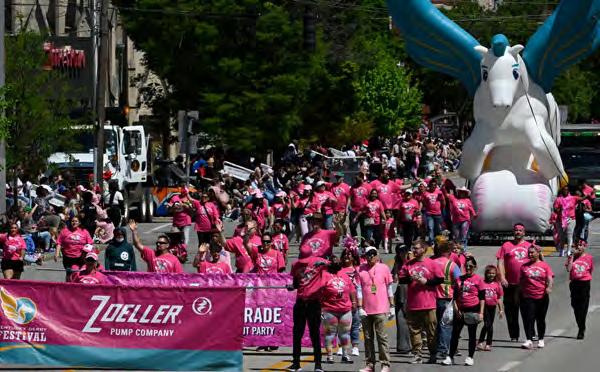
Pegasus® Parade
West on Broadway from Campbell to 9th streets
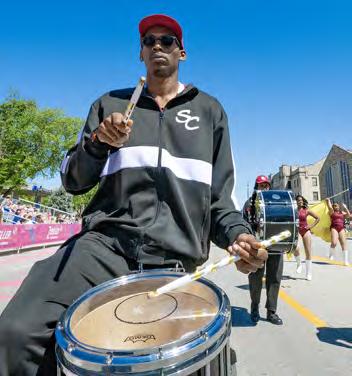
Annual parade that kicks off the Derby Week festivities, featuring colorful floats, marching bands, inflatables and equestrians.
Theme: “Festival on the Move.”
General Admission bleacher tickets along route: FREE to the public courtesy of Churchill Downs. VIP tickets: $50 (includes parking pass and complimentary drinks). Tickets available at KDF.org or call
502.584.FEST. Streamed live on WAVE3.com on April 26.
Broadcast special on April 30 at 8 PM on WAVE.
Sponsor: Zoeller Pump Company.
Contributing Sponsors: Churchill Downs and Kentucky Venues. Official Hotel: The Galt House Hotel. Official Broadcast Partner: WAVE.
APRIL 27
Kentucky Derby Festival
Great Bed Races
Presented by Snap-On
6 PM Parade of beds
7 PM Racing
Broadbent Arena
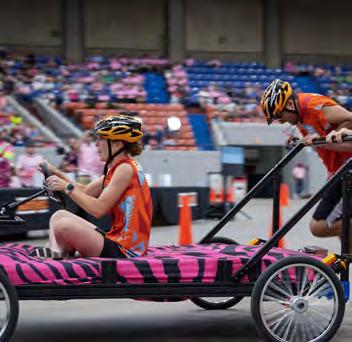
Beds aren’t for sleeping during Derby Week; they’re for racing! Beds on wheels compete in a race around a figure-eight course during this annual tradition. Theme: “Festival on the Move: Ticket to Ride.” Admission is free with a 2026 Pegasus Pin®.
$15 KEC parking. $175 entry fee for a team of 5.
Presenting Sponsor: Snap-on.
Contributing Sponsors: Kentucky Venues and UA Local 502
Apprenticeship Program. Official Health Partner: Baptist Health ER & Urgent Care. Official Finish Line
Family-friendly event featuring a special celebration of the Zoeller Pump Company Pegasus Parade featuring inflatables, bounce houses and obstacle course, face painting, an appearance by the Derby Festival’s 2026 Royal Court and more.
Sponsor: Zoeller Pump Company.
Contributing Sponsor: Kentucky Venues. Official Hotel: The Galt House Hotel.
RACE WEEKEND
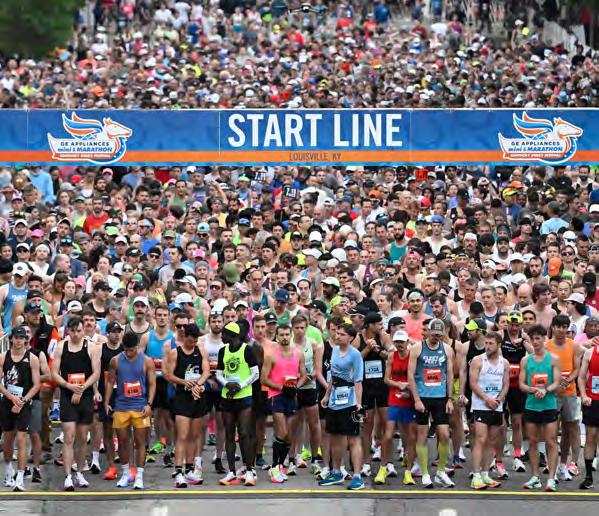
The Kentucky Derby Festival is, of course, known for its atmosphere of fun, food and festivities, but its road races, with varying distances, have drawn thousands of runners from around the country for more than five decades.
“Race Weekend offers something for everyone, whether you’re training for a full marathon, tackling your first half, or just looking to enjoy a fun 5K experience,” said Chris Martini, Kentucky Derby Festival’s race director.
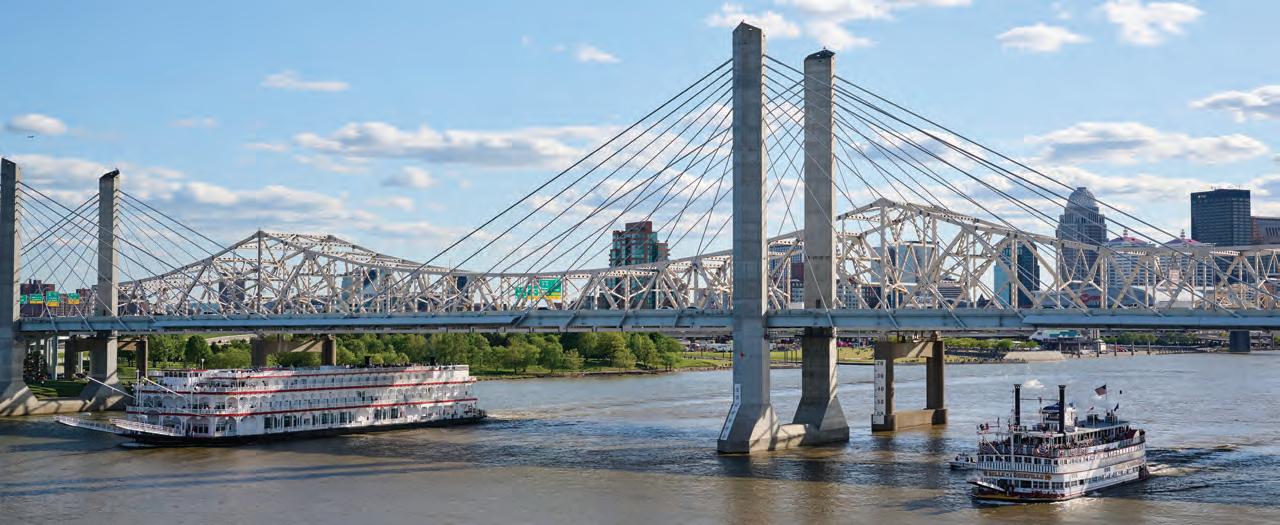
The Festival’s Race Weekend kicks off at 7 p.m. on Friday, April 24, with the second annual Derby Festival 5K Presented by First Urology. The looped course starts at Harbor Lawn in Waterfront Park, crosses the Big 4 Bridge, and heads back to the park, giving participants iconic views of the Louisville and Southern Indiana skylines. “[The 5K] will offer a unique experience for Race Weekend with an evening run over the Ohio River just before sunset,” Martini said. “Fans and families at all fitness levels can participate.”
Martini said the 5K can be a nice warmup for the more-ambitious distances of the Humana miniMarathon and Marathon the next morning.
This will be the 53rd running of the beloved miniMarathon, which takes participants by the city’s well-known downtown landmarks Churchill Downs and the Olmsted Park System.
The Marathon marks its 25th running this year. The longer route takes runners through the city’s South End along Southern Parkway and through Iroquois Park.
“If you’ve ever wanted to run our Marathon, 2026 is the year to do it,” Martini said. “It’s one of the flattest Boston [Marathon]-qualifying courses in the Midwest.”
More information on all three races and Kentucky Derby Festival Race Weekend can be found at DerbyFestivalMarathon.com
APRIL 12
PNC Kentucky Derby Festival Tour de LouSM
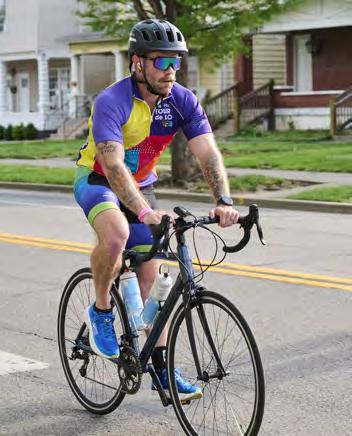
62.1 Metric Century – 8 AM, 35-mile ride – 8:15 AM, 25-mile ride – 8:30 AM, NEW 12-mile ride – 9 AM
Starts and finishes at Big Four Lawn Open course cycling event with four distances for beginners to experienced cyclists. Entry fees and registration info at KDF.org
Sponsor: PNC. Official Health Partner: Baptist Health ER & Urgent Care. Official Nutrition Partner: Kroger. Contributing Sponsors: Scheller’s Fitness & Cycling. Supporting Sponsors: Louisville Bicycle Club and Louisville Water Company. Media Sponsors: 102.3 The Rose and ALT 105.1.
APRIL 16-26
Stock Yards Bank Kentucky Derby Festival $1 Million Hole-in-One Golf ContestSM
April 16-25: 10 AM-8:30 PM, (Closed April 18 for Thunder), April 26: 10 AM-5 PM, Semi-finals 6 PM.
Seneca Golf Course Driving Range
$1 per swing. Take a swing at $1 million. Special promotions daily. Grand Prize: $1 million. First Prize (if no Hole-in-One): $5,000. April 16: College Day – College students (with a valid ID) get 2 swings for $1. April 17: Jr. Day –Under 18 get 2 swings for $1. April 20: First Responders and Veterans Day – First Responders and Veterans get 2 swings for $1. April 21: Ladies Day – Ladies get 2 swings for $1. Weekdays: Senior Special 10 AM-2 PM – Ages 62 and up get 2 swings for $1.
Sponsor: Stock Yards Bank. Contributing Sponsor: Louisville Parks & Recreation. Official Luxury Vehicle: Cadillac/Courtesy Cadillac. Media Sponsor: WLKY.
APRIL 18-26
Kentucky Derby Festival Volleyball Classic Tournament
One of the country’s largest and oldest outdoor volleyball tournaments featuring sand and grass volleyball for all levels of play. For more information, call The Volleyball Connection
502.582.3530 or visit BaxterJacks. com
Contributing Sponsors: ASICS and Mikasa.
Sand Divisions at Baxter Jacks
APRIL 18-19: 9 AM-6 PM
APRIL 25-26: 9 AM-6 PM
Grass Divisions at Seneca Park at the Tennis Courts
APRIL 25-26: 9 AM-6 PM
APRIL 23-24
Publix Super Markets
Kentucky Derby Festival Race Expo and Packet Pickup
Kentucky Exposition Center, Freedom Hall
Two-day expo where you can see the latest running gear, get nutritional advice, obtain prerace running tips and pick up your race packet for the Festival 5K Presented by First Urology and the Humana miniMarathon and Marathon®.
Thursday: 4-8 PM Expo and Packet Pickup; Friday: 11 AM-8 PM Expo and Packet Pickup
Sponsor: Publix Super Markets.
Contributing Sponsors: Kentucky Department of Tourism and Kentucky Venues. Media Sponsor: 99.7 DJX.
APRIL 24 • 7 PM
Kentucky Derby Festival 5K Presented by First Urology
Looped course starts and finishes at Harbor Lawn in Waterfront Park and includes a lap on the Big Four Bridge.
Open to participants ages 10
and up. Registration fee: $45. Free for spectators.
DerbyFestivalMarathon.com
Sponsor: First Urology. Official Medical Provider: Norton Sports Health. Contributing Sponsor: Kentucky Proud. Media Sponsor: 99.7 DJX.
APRIL 25 • 7 AM
Humana Kentucky Derby Festival mini and Marathon®
Kentucky’s largest day of road racing with both 13.1-mile and 26.2-mile routes. Also, Marathon Relay (26.2 miles) for teams of 3-5 runners. Free for spectators.
DerbyFestivalMarathon.com
Sponsor: Humana. Official Medical Provider & Training Partner: Norton Sports Health. Contributing Sponsors: Churchill Downs, Kentucky Department of Tourism, Louisville Muhammad Ali International Airport,
Louisville Water Company, Powerade and TEN20 Craft Brewery. Official
Nutrition Partner: Publix Super Markets. Official Refuel Partner: Prairie Farms. Official Pace Team Sponsor: Ken Combs Running Store.
Official Bourbon: Hartfield & Co.
Official Hotel: The Galt House Hotel.
Official Timing Partner: Rumpke
Waste & Recycling. Official Broadcast Partner: WLKY. Media Sponsor: 99.7 DJX.
APRIL 26 • 6 PM
Stock Yards Bank
Kentucky Derby Festival
$1 Million Hole-in-One Golf ContestSM SemiFinals
Seneca Golf Course Driving Range
Grand Prize: $1 million. First Prize (if no Hole-in-One): $5,000.
Sponsor: Stock Yards Bank. Contributing Sponsor: Louisville Parks & Recreation. Official Luxury Vehicle:
Seneca Golf Course, Hole #8
Grand Prize: $1 million. First Prize (if no Hole-in-One): $5,000.
APRIL 28 • 6 PM
Stock Yards Bank
Kentucky Derby Festival
$1 Million Hole-in-One Golf ContestSM Finals
Sponsor: Stock Yards Bank. Contributing Sponsor: Louisville Parks & Recreation. Official Luxury Vehicle: Cadillac/Courtesy Cadillac. Media Sponsor: WLKY.
SATURDAY, APRIL 18 AIR SHOW 3 PM | DRONE SHOW 9 PM | FIREWORKS 9:30 PM
Join the Opening Ceremonies of the Kentucky Derby Festival with all day activities leading up to the nation’s largest annual fireworks
Cadillac/Courtesy Cadillac. Media Sponsor: WLKY.
CULINARY
APRIL 2 • 6:30-9:30PM Republic Bank
Kentucky Derby Festival BourbonVille®
Ice House
Taste signature drinks from Kentucky’s bourbon distilleries, enjoy bourbon-inspired cuisine and meet the Master Distillers or Brand Ambassadors. Tickets: $75 General Admission; $125 VIP Experience. General admission tickets include bourbon and food tastings, commemorative glass and BourbonVille event pin. VIP includes complete event experience, VIP area, plus 5:30 PM early access, exclusive bourbon tasting experience and VIP gift. (21 and over only. Must present ID upon entry.) Tickets available at KDF.org, or call 502.584.FEST.
Sponsor: Republic Bank. Contributing Sponsors: Caesars Southern Indiana, Crushed Ice Catering, Danny Wimmer Presents, Dark Arts Whiskey House, Four Roses Bourbon and UA Local 502. Official Luxury Vehicle: Cadillac/ Courtesy Cadillac. Official Safe Ride
Home Partner: Kentucky Office of Highway Safety Drive Sober or Get Pulled Over. Official H.R. Partner: BIG Solutions. Supporting Sponsor: Kroger. Media Sponsors: Classic Rock 107.7 and The Voice-Tribune
APRIL 19 • 1-3PM
Kentucky Derby Festival Afternoon Tea Presented by SOS for Addictions, LLC
The Brown Hotel, Crystal Ballroom
Enjoy an English afternoon tea experience, along with traditional tea sandwiches, savory bites and Derby-inspired sweets. Derby attire encouraged. Tickets: $135 per person. This event supports addiction recovery programs. For tickets and more info, email Kim at kim@sosforaddictions.org or call 502.381.9023.
APRIL 21 • 5:30-8PM
Dare to Care Kentucky Derby Festival “Taste of Derby Festival®”
Louisville Slugger Field
Savor signature dishes from more than 100 of Louisville’s finest restaurants and beverage companies. As Dare to Care’s largest fundraiser, all proceeds benefit the Dare to Care Food Bank and its work to nourish Kentuckiana. Tickets are available in advance only. (21 and over only.) For tickets and more information, call 502.966.3821 or visit tasteofderbyfestival.org
Sponsor: Dare to Care. Presenting Sponsor: Brown-Forman Corporation.
APRIL 23-MAY 1
Kentucky Derby Festival Chow Wagon®
Open daily 11 AM-11 PM, except Sunday NOON-10 PM Kroger’s Fest-a-Ville on the Waterfront
Outdoor food and live music venue. Happy Hour Weekdays 4-6 PM $4 beer at the Beer Garden. Admission is free with a 2026 Pegasus Pin®. (Food, drink and pets are not permitted.)
Sponsor: Kroger. Music Stage Sponsor: Miller Lite.
APRIL 26 • 11AM-1:30PM
Mayor’s Derby Brunch on the River
Riverside, the Farnsley-Moremen Landing
A festive brunch featuring a traditional Kentucky breakfast, music, live and silent auctions and tours of the FarnsleyMoremen House. Tickets: $125 per person; $950 for a table of 8. For tickets or information, call 502.935.6809 or visit RiversideLanding.org
Produced by Riverside, The FarnsleyMoreman Landing, with proceeds supporting the historic property’s mission.
APRIL 28 • 6-9PM
Commonwealth Credit Union Kentucky Derby Festival WineFest
Mellwood Art Center
Sip and savor more than 100 local wines from Kentuckiana wineries. Tickets: $30 Designated
Driver (available at event only); $75 General Admission; $125 VIP Experience (Limited Availability). General admission tickets include wine tastings, light appetizers, shopping, souvenir glass and WineFest pin. VIP includes 5 PM early entrance, opportunity to barrel taste local wine, VIP gift and access to private area with seating and food stations. (21 and over only. Must present ID upon entry.)
Tickets available by calling 502.584.FEST or online at KDF.org
Sponsor: Commonwealth Credit Union. Contributing Sponsors: Crushed Ice Catering and Old 502 Winery. Official Luxury Vehicle and VIP Sponsor: Cadillac/Courtesy
Cadillac. Official Safe Ride Home
Partner: Kentucky Office of Highway Safety Drive Sober or Get Pulled Over.
Supporting Sponsor: Kentucky Wineries Association. Media Sponsor: MIX 106.9.
Whether it’s at Thunder Over Louisville or Kroger’s Fest-A-Ville, the plethora of culinary options never disappoints. This year, the Kentucky Derby Festival is teaming up with Louisville-based Khalil’s Catering to manage and provide food service to the masses attending these signature events.
“Stepping into the main concessionaire role for the Kentucky Derby Festival is a major milestone, and I’m grateful for the opportunity,” said owner Khalil Batshon.
“The Kentucky Derby Festival is known for its iconic events and traditions, and I am proud, honored and ready to serve Kentucky on one of the biggest stages we have.”
The company will work with local culinary talent, food trucks and vendors to provide a diverse menu at Thunder and Fest-A-Ville, while simultaneously
supporting locally owned businesses.
“Khalil has built a strong reputation for hospitality and service, and we are excited to welcome Khalil’s Catering as the Festival’s Official Concessionaire,” said KDF president and CEO Matt Gibson. “We look forward to working with his team.”
Batshon has been a Louisville entrepreneur for more than a decade, recently transitioning from operating a brick-and-mortar bar and restaurant to focus exclusively on catering events throughout the region. He also serves as a member of the Louisville Metro Council, representing District 25.
“I love Louisville, and I love helping people,” he said. “This partnership allows us to bring great food, strong service and Kentucky pride to every festival guest experience.”
APRIL 4 • NOON -6 PM
Kentucky Derby Festival Block Party, Presented by Humana and Park Community Credit Union
Norton Healthcare Sports and Learning Center
Community celebration of Derbytime traditions featuring local food, fare and fun. Plus, live entertainment showcasing local talent and family-friendly activities all day! Admission is FREE.
Presenting Sponsors: Humana and Park Community Credit Union.
Contributing Sponsors: Brown-Forman, Ford Philanthropy, Heuser Hearing Institute and Walmart. Supporting Sponsors: BRAINFREEZE: Cones for a Cause, Erica Denise Entertainment, Louisville Parks & Recreation, MELANnaire Marketplace, The Hope Buss and The Hope Village.
APRIL 13-14 • 6–11 AM
Kentucky Derby Festival Morning Line Presented by AT&T and Kentucky Lottery
Radio stations from around the region will broadcast their morning shows live from the Kentucky Derby Museum.
Presenting Sponsors: AT&T and Kentucky Lottery. Contributing Sponsors: Kentucky Department of Tourism and Kentucky Derby Museum. Supporting Sponsosr: AARP Kentucky, Copper & Kings, Shady Rays, Vernon Lanes and Wild Eggs.
APRIL 16
Kentucky Derby Festival Senior Derby Party
11AM-2PM
Louisville Slugger Field
New for 2026! A special Derby season event designed for seniors in the community, featuring a DJ, plated lunch, virtual horse racing and more. Admission is $5. More info: www. chandlerigfoundation.org
APRIL 17 • 11 AM
Kentucky Derby Festival They’re Off!® Luncheon Presented by BAE Systems
11AM
The Galt House Hotel, East Grand Ballroom
Official Kentucky Derby Festival kick-off luncheon. Guest Speaker Teddy Bridgewater. Tickets: $130 each or $1,040 for a table of 8. Tickets available at KDF.org, or call 502.584.FEST.
Presenting Sponsor: BAE Systems. Contributing Sponsors: The Galt House Hotel and Kentucky Proud. Official Luxury Vehicle: Cadillac/ Courtesy Cadillac. President’s Reception Sponsor: Davis Jewelers. Supporting Sponsors: East and Westbrook Construction, Jeff’s Donuts and Luzianne Tea.
Media Sponsor: Louisville Business First.
THUNDER OVER LOUISVILLE
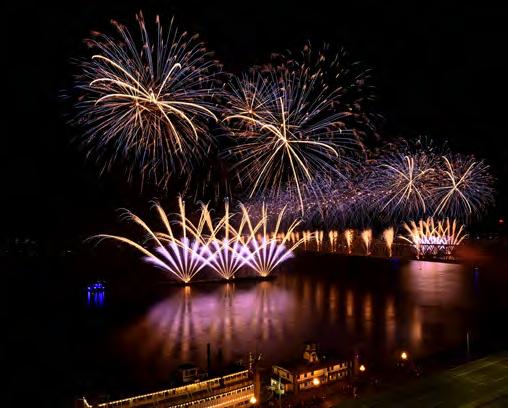
After flood waters led to the cancellation of 2025’s Thunder Over Louisville, the nation’s largest annual fireworks display and accompanying air show are back, and Kentucky Derby Festival officials say they will be better than ever. With a nod to America’s 250th anniversary, this year’s theme is “Thunder in the U.S.A.”
KDF president and CEO Matt Gibson said Thunder is one of the Commonwealth’s most-anticipated spring traditions.
“When Thunder returns on April 18, it will do more than kick off the Derby Festival Season; it will bring our community together in a way only Thunder can,” Gibson said.
Beginning at 3 p.m., an air show featuring military and civilian aircraft will entertain the crowds. KDF officials said multiple flybys will include F-15, F-16 and F/A-18s from the United States Marine Corps, the V-22 Osprey, and the new frontline fighter, the F-35C. There will also be parachute
APRIL 18 • 5 PM
Kentucky Derby Festival Official Soccer Match
Featuring Louisville City FC
Lynn Family Stadium. Louisville City FC hosts Sporting Club Jacksonville. For tickets and to shop: LouCity.com
APRIL 23-MAY 1 Kroger’s Fest-a-Ville on the WaterfrontSM
Open daily 11AM-11PM except Sunday NOON-10PM
Waterfront Park
ULTIMATE ENTERTAINMENT
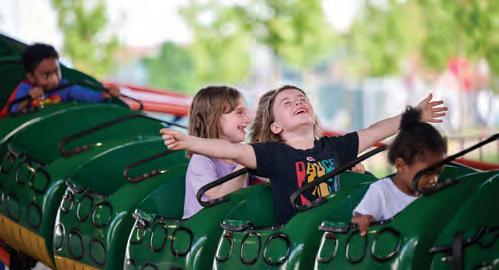
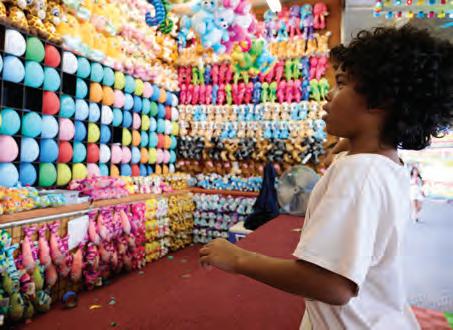
EXPERIENCE featuring concerts, family fun, kids’ inflatable playground, midway rides and more at the Ringling Circus Party Lawn (Great Lawn). Admission is free with a 2026 Pegasus Pin®. (Food, drink and pets are not permitted.)
Sponsor: Kroger. Music Stage Sponsor: Miller Lite. Pegasus Play-Ville Sponsor: Norton Children’s. Official Safe Ride
Home Partner: Kentucky Office of Highway Safety Drive Sober or Get Pulled Over.
APRIL 24 • 6-7:30 PM
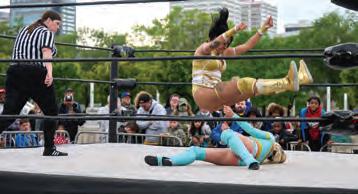
Kentucky Derby Festival Ohio Valley Wrestling Run for the Ropes
Kroger’s Fest-a-Ville on the Waterfront, Ringling Circus Party Lawn (Great Lawn)
Special meet-and-greet with OVW stars at 5 PM, followed by six big matches including a special “Every Man for Himself Free-for-All” over the top rope Battle Royal. Admission is free with a 2026 Pegasus Pin®. For more information, call 833.477.6786. (Food, drink and pets are not permitted.)
Produced by Ohio Valley Wrestling.
demonstrations, large aircraft flybys and aerobatics shows.
The Drone & Night Show begins at 9 p.m., with the fireworks and music blasting off at 9:30 p.m.
“We have always designed Thunder to be a 30-minute finale starting with the very first spark in the sky … and just when you think it can’t get any bigger, we add a finale on top of the finale,” said Thunder Over Louisville producer Wayne Hettinger.
He compares the music soundtrack to a roller-coaster ride.
“Music selections are edited and blended together to give the effect of climbing to the top, freefalling and gaining speed, with lots of twists and turns,” Hettinger said. “Setting the pace to launch the tonnage of fireworks in 30 minutes is critical to Thunder’s legacy.”
APRIL 25 • 1-3 PM
Kentucky Derby Festival Saturday Soiree Derby Drag Show
Kroger’s Fest-a-Ville on the Waterfront, Chow Wagon Music Stage
A Drag Show featuring some of Louisville’s finest entertainers. Tickets: $350 VIP Experience includes prime seating for a table of 8, plus $80 in food and drink tickets. $35 Individual VIP tickets. General Admission is free with a 2026 Pegasus Pin®. Food and drinks available for purchase. (18 and over only.) For tickets and information: LouPrideKy.org. (Food, drink and pets are not permitted.)
Produced by Louisville Pride Foundation.
APRIL 25 • 1-5 PM
Kentucky Derby Festival Cars & Coffee
Kroger’s Fest-a-Ville on the Waterfront, Circus Party Lawn (Great Lawn)
Judging 2-4 PM. Awards 4 PM.
Enjoy a variety of cars, including exotic, muscle, imports, hydraulics and American favorites from all over the region. The first 50 registrants receive a free T-shirt. Produced in partnership with Stir Crazy 4x4 Club and Bourbon City Camaro Club. Early registration entry fee to display a car: $30 until April 20: Late registration: $35. Register online at KDF.org. Spectator admission is free with a 2026 Pegasus Pin®.
Contributing Sponsor: Digital EFX.
Supporting Sponsor: NICS Horsepower. Media Sponsor: ALT 105.1.
APRIL 25 • 8 PM
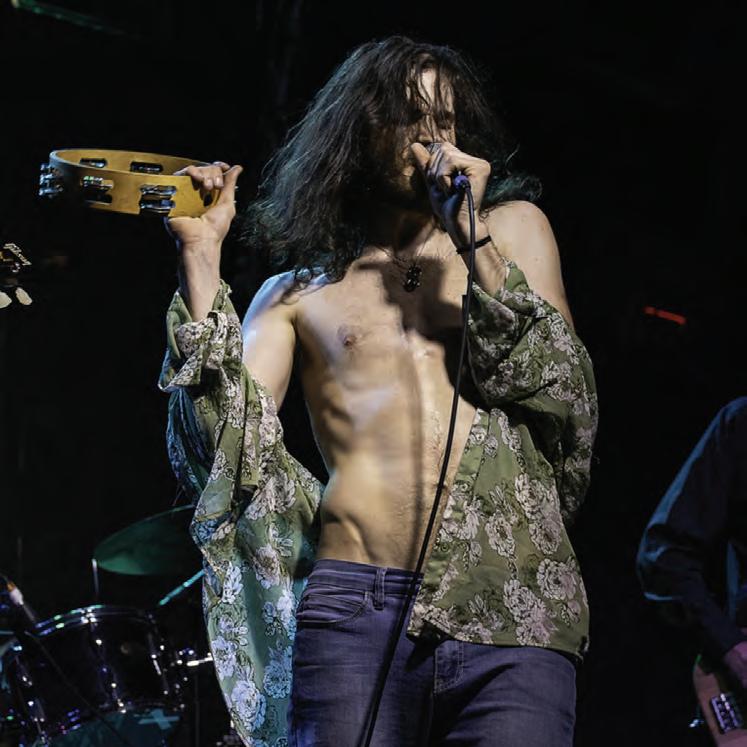
Doorway: A Tribute to the Doors Featuring Johnny Edwards With Special Guest Hank Linderman and Friends
Kroger’s Fest-a-Ville on the Waterfront, Miller Lite Music Stage
Admission is free with a 2026
Pegasus Pin®. (Food, drink and pets are not permitted.)
Sponsor: Kroger. Music Stage Sponsor: Miller Lite. Media Sponsor: Waky 103.5.
APRIL 26 • NOON-5 PM
Kentucky Derby Festival Custom Car Showcase at Kroger’s Fest-A-Ville
Kroger’s Fest-a-Ville on the Waterfront, Ringling Circus Party Lawn (Great Lawn)
Enjoy beautifully painted and detailed custom cars from all over the United States and Canada. Admission is free with a 2026 Pegasus Pin®. (Food, drink and pets are not permitted.)
Presented by USO and Individuals Car Club. Sponsor: Kroger.
Contributing Sponsor: Digital EFX.
APRIL 26 • 6:30-9:30 PM
Kentucky Derby Festival GospelfestSM Presented by Passport by Molina Healthcare and Republic Bank
Kroger’s Fest-a-Ville on the Waterfront
Gospel Artist and Choir Showcase. Admission is free with a 2026 Pegasus Pin®.
Presenting Sponsors: Passport by Molina Healthcare and Republic Bank. Media Sponsor: B96.5 FM.
APRIL 28
Kentucky Derby Festival Texas Hold’em Tournament
4:30 PM boarding and check-in; 6 PM tournament begins, plus one-hour cruise (subject to river and weather conditions).
Belle of Cincinnati, docked at Kroger’s Fest-a-Ville on the Waterfront
$100 Buy-in until April 14; $125 Buy-in after April 14, includes 10,000 in chips and commemorative pin. Add-ons available first hour of play $50 for 5,000 chips. $2,500 first-place prize. Payouts for 10% of field. Payouts based on 325 players; payouts pro-rated based on
APRIL 25 –MAY 1
KENTUCKY DERBY WEEK AT CHURCHILL DOWNS
Experience the excitement of live racing at Churchill Downs during Derby Week with special programming each day. For more info and tickets: call 502.636.4400 or visit KentuckyDerby.com.
APRIL 25
Opening Day Powered by LG&E and KU
Celebrate the 152nd Kentucky Derby and Kentucky Oaks post position draws.
APRIL 26
Sunday Funday Racing returns to Sunday for the first time during Derby Week since 2010.
APRIL 28
502’sDay Celebrates the community. General admission is $5.
APRIL 29
Winsday
Shines the spotlight on Louisville’s nonprofit community.
APRIL 30
Thurby
Churchill Downs will transform into a showcase of Kentucky’s rich heritage.
MAY 1
152nd running of the Kentucky Oaks
actual number of players. $15 for guests if cruise takes place. LICENSE# ORG0001638. Register by calling 502.584.FEST or online at KDF.org
Supporting Sponsor: Louisville Poker Tour.
APRIL 28 • 5-8 PM
Kentucky Derby Festival
Happytail Hour
Kroger’s Fest-a-Ville on the Waterfront, Ringling Circus Party Lawn (Great Lawn)
A pet-friendly (leashes, please!) social event. Admission is free with a 2026 Pegasus Pin®. (Food and drink are not permitted.)
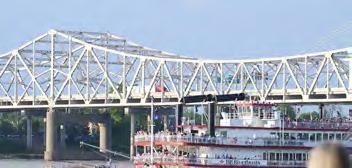
The Belle of Louisville and the Belle of Cincinnati will compete for bragging rights on the Ohio River. Awards presentation immediately following on the Belle of Louisville. Tickets on the Belle of Louisville $200. For Belle of Louisville tickets, call 502.584. FEST or visit KDF.org. Tickets on the Belle of Cincinnati $85 General Admission, Cruise Only; $130 Dinner and Cruise. For Belle of Cincinnati tickets, call 1.800.261.8586 or visit BBRiverboats.com. Free spectator viewing at Kroger’s Fest-a-Ville and along the banks of the Ohio River.
Sponsor: Shepherd Insurance. Official Luxury Vehicle: Cadillac/Courtesy Cadillac. Official Patient Care Provider: PPL Therapeutic Services, PLLC. Official Bourbon: Brough Brothers Distillery. Official Rum: Captain Morgan. Supporting Sponsors: Belle of Louisville and Belle of Cincinnati. Media Sponsor: Q103.1.
Kroger’s Fest-a-Ville on the Waterfront, Ringling Circus Party Lawn (Great Lawn) New for 2026! Experience thousands of lanterns glowing along the Ohio River as guests personalize and release them at sunset, creating a stunning display of light and reflection. For more info and tickets, call 833.477.6786 or visit waterlanternfestival.com/events/ louisville. (Food, drink and pets are not permitted.)
APRIL 29 • 6 PM
Kentucky Derby Festival Louisville Urban League Derby Gala
Norton Healthcare Sports and Learning Center
The annual Derby Gala features legendary hip-hop artist Common, plus funk-soul group Tank and Bangas. Cocktail reception, dinner, open bar, live concert, dancing, bourbon pull and more. Produced by the Louisville Urban League, with proceeds benefiting the Louisville Urban League. For tickets and more info, visit lul.org or call 502.585.4622.
APRIL 30 • 11:30 AM
Kentuckiana Honda Dealers Kentucky Derby Festival Day at the Downs
Churchill Downs, Fourth Floor, Skye Terrace
Celebrate Thurby at the track with a great view and allinclusive ticket. Tickets: Reserved Seating: $375 each or $3,000 for a table of 8. Preferred Seating: $400 each or $3,200 for a table of 8. Tickets available at KDF.org or call 502.584.FEST.
Sponsor: Kentuckiana Honda Dealers. Contributing Sponsor: Kentucky Proud. Media Sponsors: MIX 106.9 and The Voice-Tribune
Waterfront, Ringling Circus Party Lawn (Great Lawn)
Live televised Ohio Valley Wrestling event. Special meetand-greet with OVW stars at 6 PM. Admission is free with a 2026 Pegasus Pin®. For more information, call 833.477.6786. (Food, drink and pets are not permitted.)
Produced by Ohio Valley Wrestling.
APRIL 30 • 5-11 PM
Kentucky Derby Festival Motorcycle Night
Kroger’s Fest-a-Ville on the Waterfront, Ringling Circus Party Lawn (Great Lawn)
Enjoy a variety of motorcycles from all over the region. The first 100 attendees receive a free 2026 Pegasus Pin®. Admission is free with a 2026 Pegasus Pin®.
MAY 2 152nd Running of the Kentucky Derby
For Derby information contact Churchill Downs 502.636.4400 or visit KentuckyDerby.com
MAY 8
Pegasus Pin® Gold Pin Winner Grand Prize Drawing
2026 Gold Winner Pins are eligible to win a $20,000 cash Grand Prize given away on Friday, May 8. To be eligible, register pins online at PegasusPins.com. Drawings broadcast on WAVE.
KentuckyDerby.com
APRIL 29 • 6-10 PM Water Lantern Festival Louisville
APRIL 30 • 7-9 PM
Kentucky Derby Festival Ohio Valley Wrestling Live
Kroger’s Fest-a-Ville on the
The KENTUCKY DERBY FESTIVAL is a private, not-forprofit, community organization dedicated to providing unique entertainment for the Greater Louisville area. One of America’s greatest community celebrations, it is known for its whirlwind of colorful events and programs, and how it brings the community together in celebration every spring. With more than 70 special events, there is something for everyone. More details on the 2026 Festival can be found online at KDF.org, or on social media @ KyDerbyFestival. *Schedule subject to change.
AARP Fraudwatch Network is empowering you with simple, actionable steps to better protect yourself and your family from scams and identity theft.
AARP Fraud Watch Network™ is a free resource for all, offering expert insights and tips to help individuals better spot and avoid potential scams.
Contact the AARP Fraud Watch Network Helpline at 877-908-3360 to discuss suspicious a ctivity, report potential fraud, and seek guidance on next steps. April is AARP Fraud Prevention Month Protect Yourself From Scams and Fraud
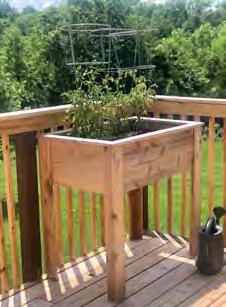
Garden Without Bending Over
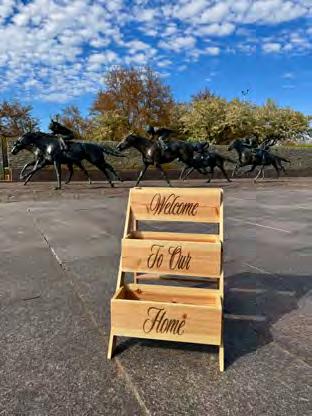
Larson Wood Designs builds handcrafted cedar Elevated Garden Beds and other Planters right here in Lexington, KY. Perfect for patios, decks, and gardens. Local pick up is in Lexington, KY, delivery available.
The farrier plays an invaluable role in a racehorse’s performance
‘No Foot, No Horse’
TEXT + PHOTOS BY KEN SNYDER
“Good shoes take you to good places” is an axiom that nails it (pun intended) when it comes to horseshoes and Thoroughbred horses. Shoes can be a factor in who makes it into horse racing’s most desired place: the winner’s circle.
“You can’t make them run faster, but you can make them move as fast as they can,” said Frankie Gaurneri, a farrier for 38 years on racetracks in Kentucky and elsewhere.
You could probably guess that Guarneri’s shoeing method involves far more than just nailing “racing plates”—aluminum horseshoes—to
the horse’s hooves. Balance is at the top of the list for maximizing running performance, according to Guarneri. Surprisingly, every horse has plenty of imbalance to overcome.
Horses’ hooves aren’t like our feet, which—with a few exceptions—are the same size. The four hooves on the same horse can be different sizes and shapes and vary in length and width. For instance, back hooves grow faster than front hooves. It is common for a heel on a front hoof not to match the heel on the other front hoof, or for one hoof to have a longer toe that must be trimmed to match the other front hoof, according to Guarneri. “You have to
trim more toe on one hoof and more heel off the other hoof to get them both level and matching,” he said.
An accomplished farrier such as Guarneri can look at a horse and see the straightness of the legs and direction of the hooves as the horse walks. Many horses toe in, with hooves pointing in under the horse, or toe out, their hooves pointing away from the horse. “When they toe in, you’ve got more foot on the inside. You have to take that extra foot off to balance the hoof,” Guarneri said. The reverse is done when a horse toes out.
Guarneri can counter a conformation defect with how he trims
a hoof and the amount he trims. He can remedy imbalance with horseshoes that are a full circle, rather than u-shaped. Extensions and built-in supports in shoes can offset or correct any issue a horse may have. Guarneri and other farriers know which plate can accomplish what outcome. •
In 1946, Triple Crown winner Assault ran with a hoof that earned him the nickname “Club Foot Comet.” It came from a birth defect that resulted in an abnormally upright hoof. The horse’s farrier would have performed corrective trimming to
overcome the abnormality when Assault got his first shoes, according to Guarneri. “Trimming the hoof from the ‘quarters’ [sides] of the hoof back to the heel will make that heel drop,” he said.
The outcome is a horse that still can run. Assault is perhaps the most famous example of club foot correction.
The knowledge required to analyze the needs of each horse and make the right decision on how to trim the hoof and fit a shoe exactly to its shape isn’t necessarily handed down from one generation to another.
A New Orleans native, Guarneri
went to the late Bud Beaston’s Horseshoeing School in Oklahoma, when physical growth derailed his career as a jockey before it could begin. “[The school] had eight-week classes, but I went five or six months when I was 17,” Guarneri said. “I figured I’d go the longest to shoe more horses and learn more.”
An apprenticeship under farrier Russell Rogers followed. It returned Guarneri to his hometown, where Rogers shoed horses at the Fair Grounds Race Course. This is where things “took off,” said Guarneri.
It was a first step to landing in Kentucky, Guarneri’s home base since
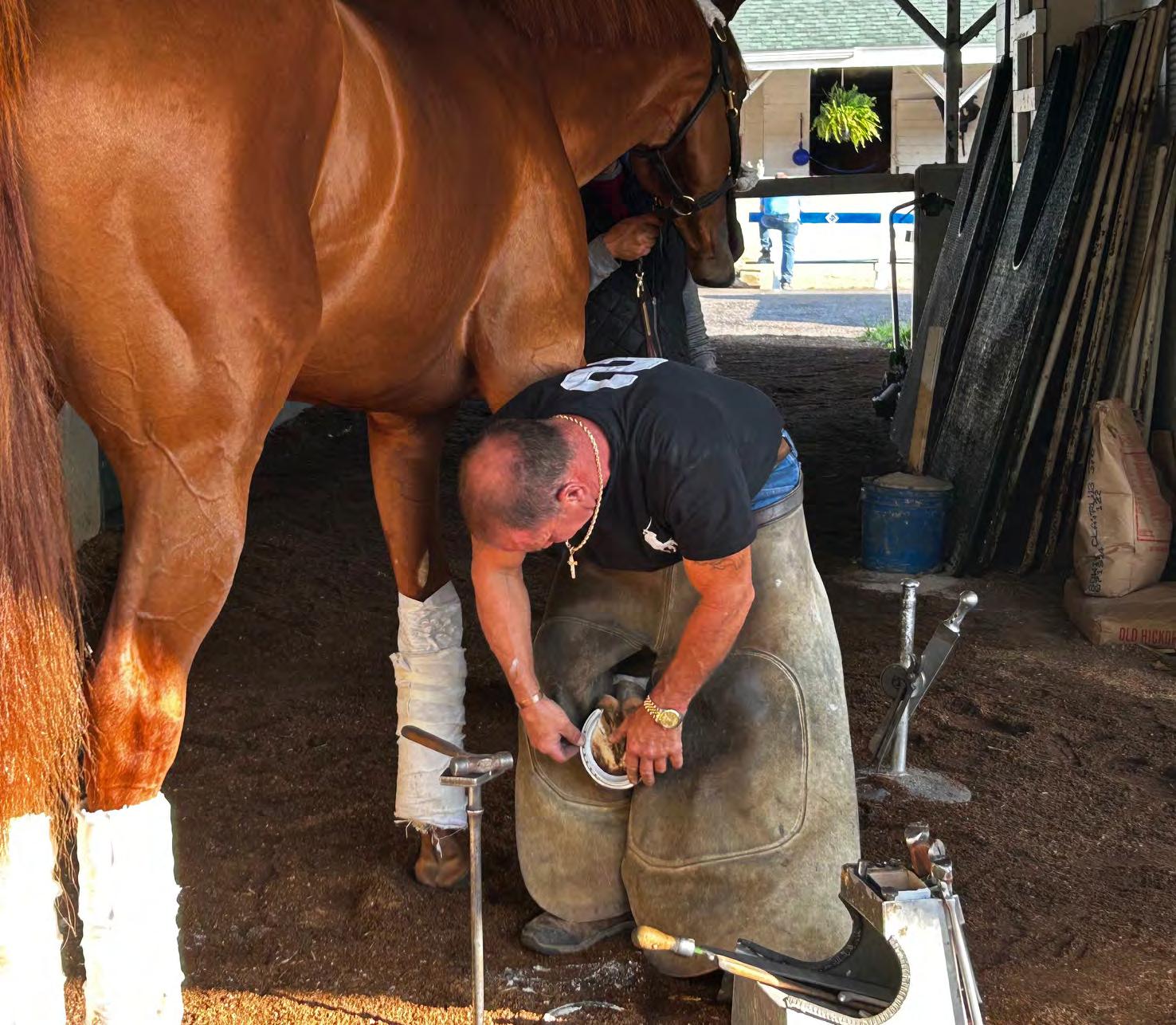
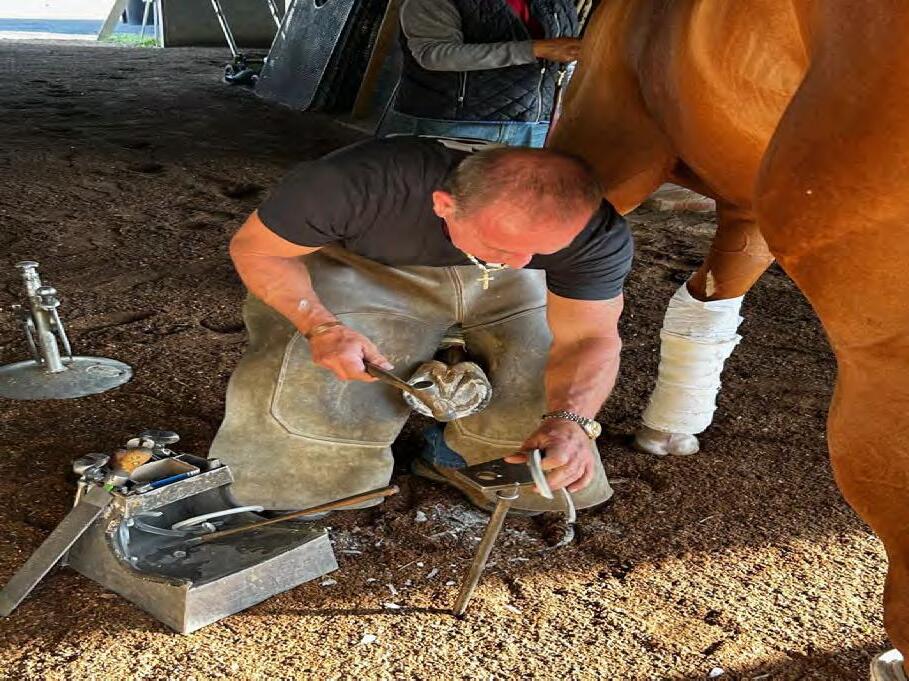
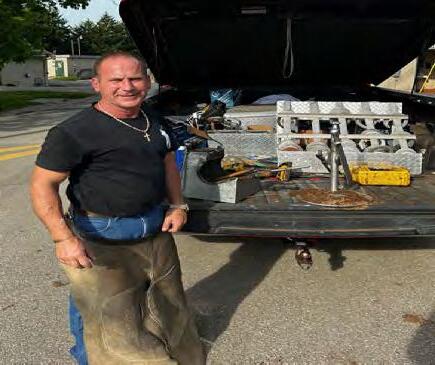
Farrier Frankie Gaurneri plies his trade.
1999. Rogers was farrier for Louisvillebased trainer Forrest Kaelin, who had taken horses to New Orleans from Kentucky for a race meet. Rogers decided to put Guarneri on Kaelin’s horses, telling the well-respected trainer, “Let him do the work. If he has any problems, I’ll come help.” Rogers never was needed.
The Fair Grounds put Guarneri in the right place at the right time when Mike Maker, an assistant to the late trainer D. Wayne Lukas at the time, needed a shoe fixed. A good job by Guarneri led to shoeing for the legendary Lukas in New Orleans. “I thought I’d just do Wayne’s horses in
“You can’t make them run faster, but you can make them move as fast as they can,” Gaurneri said.
do 22 horses one day and 22 the next at Delaware Park,” Guarneri recalled. Today, the 56-year-old farrier shoes eight to 10 horses daily.
An internet search suggests that it usually takes 45 minutes to an hour to shoe a Thoroughbred. Guarneri does it in 25-30 minutes “depending on how good the horse stands. Each hoof will take me eight to 10 minutes,” he said.
•
New Orleans, but he brought me with him up to Kentucky,” Guarneri said.
One of Guarneri’s first experiences with Lukas in Kentucky occurred two weeks before the 1999 Derby with a horse named Charismatic, who had been shipped from California to run in the Lexington Stakes at Keeneland. After finishing first in the Lexington Stakes, Charismatic went on to win the Kentucky Derby and the Preakness Stakes, the first and second jewels in racing’s Triple Crown.
Over time, Lukas’ trust and confidence in Guarneri’s work had the Hall of Fame trainer flying the farrier to racetracks across the country. “I’d
For humans who “break in” new shoes, it may come as a surprise that a Kentucky Derby starter such as American Promise—Lukas’ final Derby horse, who ran for the roses in 2025—and all starters get new shoes the day of a big race or a day or two before. Guarneri prefers to shoe horses the day before a race in case a horse is skittish and needs another day to get calm.
The process of shoeing an 1,100pound animal requires a combination of strength, skill, a strong back and courage. With American Promise, Guarneri lifted the horse’s left front leg and flexed the knee back toward him to have the hoof facing upward.
He used a pliers-like tool to pull old nails out, and used a rasp on the hoof bottom and toe to trim excess growth. He then retrieved a new shoe from the hundreds in his truck and held it against the hoof to match it to the hoof’s shape. He tapped the shoe on the outside edges with a hammer to change its shape, holding it each time against the hoof for an exact fit. Finally, he nailed on the new shoe.
If you’re wondering about pain or any sensation for the horse: The hoof wall is like a human fingernail— there’s no feeling when you clip them.
And for the record: Farriers are not blacksmiths. Blacksmiths work with metals. Farriers work only with horses.
As it is for all farriers, job security for Guarneri is the wear on horseshoes. The source of wear is not where you might think it would be. It is not where the hoof hits the track surface while the horse is running but what happens after it hits. The hoof slides briefly along with the lowest section of a horse’s leg, the pastern, that flexes down to the racing surface. It’s no wonder that new shoes are needed monthly, on average, except in the winter when hooves grow more slowly.
Horses can run “barefoot” or “barehoof,” but hoof protection has been around for a long time. In 1897, four bronze horseshoes, complete with nail holes, were found in a tomb in Etruria (present-day central Italy) dating to 400 BCE.
In 1751, the book No Foot, No Horse by Jeremiah Bridges was published in London. It emphasized the importance of hoof health. You’ll still hear the phrase “no foot, no horse” uttered by racetrackers everywhere … maybe along with the sound of a farrier’s hammer. Q
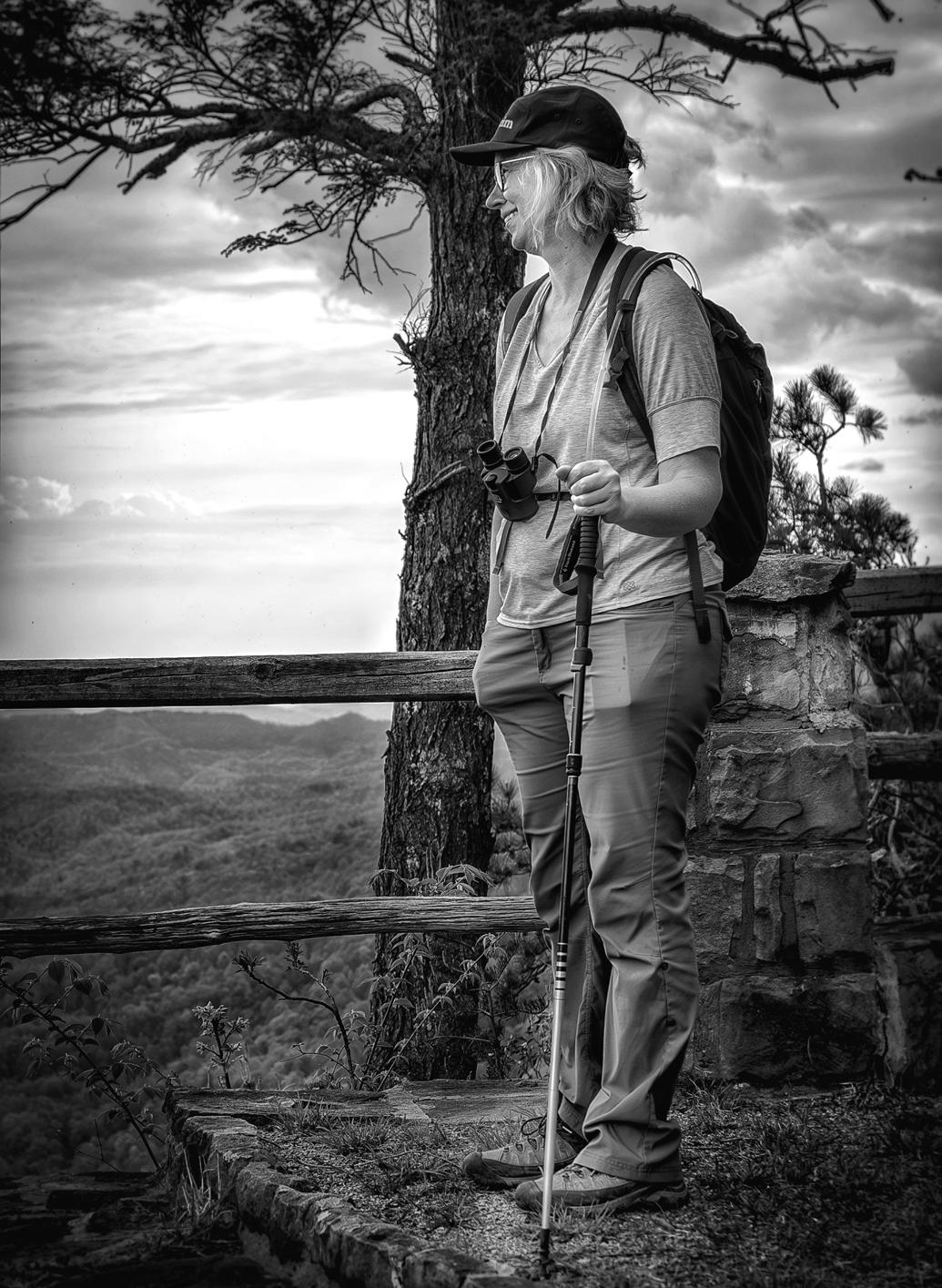
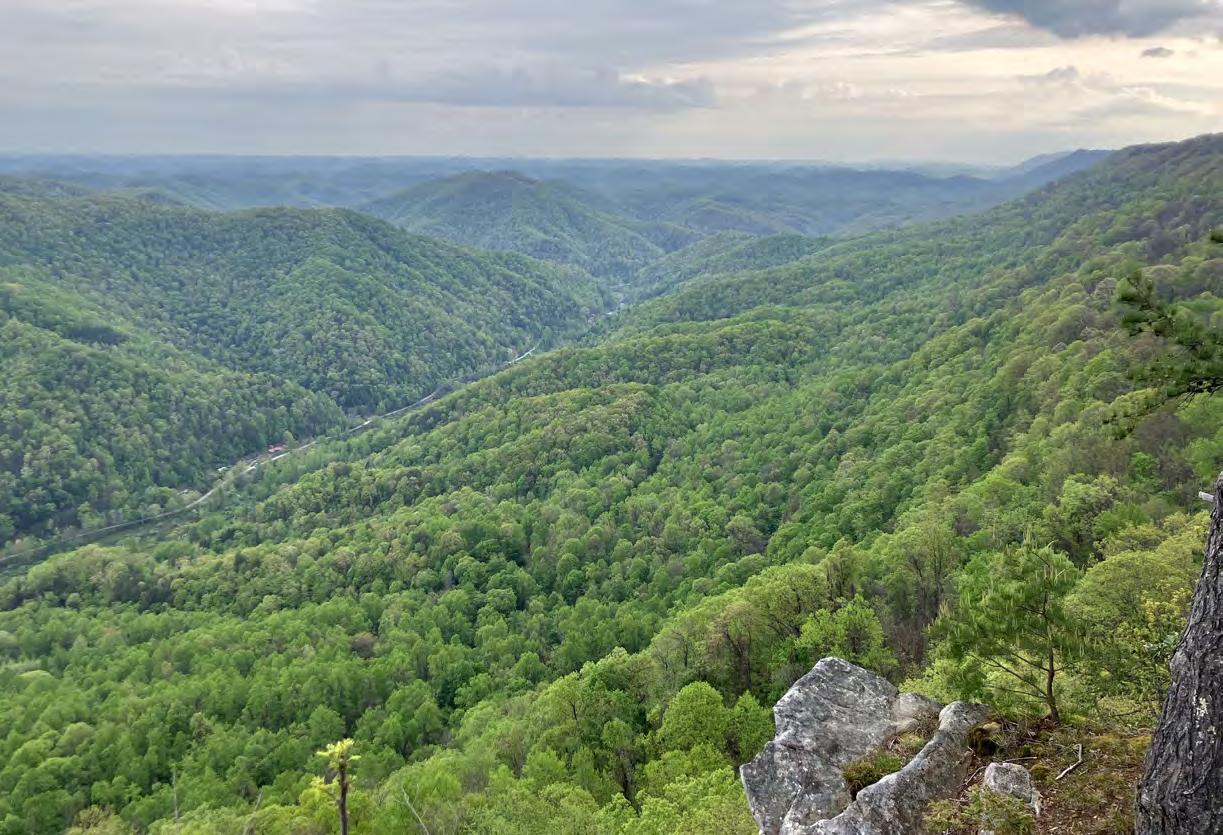
A birder takes a break on an overlook in Kingdom Come State Park. PHOTO: ANNA MULLINS
Natural Wonders
Whitesburg hosts a weekend of exploring and learning about the area’s warblers, woodlands, watersheds and wildlife
BY KIM KOBERSMITH
Last year’s inaugural Pine Mountain Warblers, Woodlands and Wildlife Weekend in Whitesburg changed my perspective.
I have always been an outdoorsy person who likes to hike, camp and view wildlife. But I had never really bird-watched in a concentrated way. During the weekend, expert birders led hikes and identified species by listening to their calls and observing their habits. That buzzy, scaleclimbing call? A northern parula. A hidden species that keeps singing “teacher?” An ovenbird. The zebrastriped friend perched on a nearby branch? A black-and-white warbler. I realized I was missing an ongoing
conversation happening all around me. How could I not have learned the language of these seasonal Kentuckians? As we traversed the Letcher County wildlands, I developed a desire to gain a more intimate knowledge about my avian neighbors. After I returned home, I put the Merlin Bird identification app on my phone. My husband and I began quizzing each other on the sounds of birds we heard in our neighborhood. I joined local birding walks to continue to expand my knowledge and understanding.
I encourage you to experience a bird-focused event for yourself. Consider attending this year’s Pine Mountain Warblers, Woodlands,
Watersheds and Wildlife Weekend May 8-10 at the Cowan Community Center near Whitesburg. For those not familiar, Pine Mountain is an ecological treasure, a rugged ridge running more than 100 miles along the Kentucky-Virginia border. According to biologist and Cowan watershed coordinator James Stapleton, it is one of the most prolific areas in Kentucky for seeing native birds, especially during spring and fall migrations.
“We are right in their flight path,” Stapleton said. “Pine Mountain is the last little fingernail of a pretty intact ecosystem within central Appalachia.”
• • •
Pine Mountain stands as a remnant of Appalachian forest that is minimally impacted by extraction. Its geology is primarily limestone with no coal deposits. Only a couple of roads penetrate its 2,500-foot peak, creating a protected space that serves as a crucial ecological corridor for all kinds of wildlife.
David Burns participated in last year’s weekend. “The amazing birding opportunity is what brings me back, and I’m really looking forward to leading a bird walk again this year,” he said. “As I reflect on last year’s ‘Warblers, Woodlands and Wildlife’ weekend, I’m remembering all the energy and joyful discovery I had that weekend. I’m already imagining the flowers, the sounds and the simple
quiet of walking in the woods, celebrating all things Pine Mountain and Kentucky culture.”
The event is free for all participants and open to all levels of bird watchers. Several meals prepared by Whitesburg’s CANE Kitchen are offered at no charge. Saturday night will feature an expert speaker, yet to be announced at the time of this writing (the bar is high, as last year’s speaker was the internationally renowned author and artist David Allen Sibley). The days are filled with hikes and outdoor opportunities in nearby natural areas, including Lilley Cornett Woods and Kingdom Come State Park.
The excursions explore more than
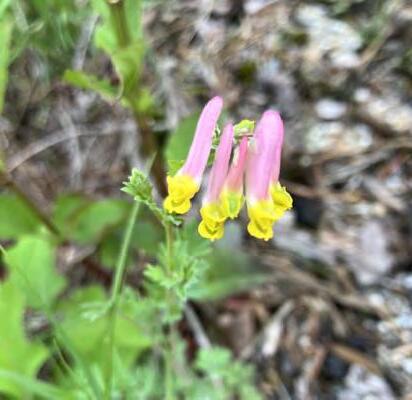
just birds. I joined naturalist-led hikes in the spring woodlands and saw a variety of rare and beautiful spring wildflowers—lady slippers, painted trillium, rock harlequin and showy orchis. Jess Slade with Kentucky Natural Lands Trust (KNLT) and Heidi Braunreiter with the state Office of Kentucky Nature Preserves will lead a hike on Friday afternoon, May 8. The group will traverse a section of the Little Shepherd Trail
Above, a view of the north slope of Pine Mountain from Kingdom Come State Park. Right, participants might see rare species like this rock harlequin.
PHOTOS: KIM KOBERSMITH
along the ridge of Pine Mountain in the Hi Lewis Pine Barrens State Nature Preserve and KNLT’s Warbler Ridge Preserve.
One of the hike highlights will be the rare Cumberland Mountain pitch pine barrens, an open habitat with a large diversity of native species. Trees include Fraser’s magnolia (Magnolia fraseri) and American chestnut (Castanea dentata), which routinely sprout, bloom and produce fruit on the mountain despite the chestnut blight. Slade said they will discuss the ecology of the area and specific plant adaptations, plus highlight management efforts underway to protect the rare species and communities there.
Stapleton plans to lead a hike at Bad Branch State Nature Preserve, an easy and spectacular trail. A pair of ravens nest there—rare in
Southeastern Kentucky. While taking in the waterfall and walking along the creek, he will share about stream ecology. An anthropological element will contemplate what stories ancient residents might have told in the archaic petroglyphs near the water level.
Friday evening activities will celebrate community. An open conversation will give people the chance to share their connection to Pine Mountain and its ecology, ideas on how to best preserve and share it, and tensions with historic economic opportunity in the region. The Birdie in a Cage Square Dance follows the talk.
“The role of Cowan Community Center is to be a nonpolarizing, comfortable and friendly place to connect,” Executive Director Valerie Horn said. “We have to be open to
MAP WEEK
bringing everyone to the table for conversations without being judgmental.”
The center has been a place of welcome and education for 60 years. It emerges from and focuses on the community it serves. A wide range of programs helps it meet its mission of providing educational, social, cultural and recreational experiences for the entire community in order to sustain healthy lifestyles that encourage intergenerational relationships.
The Cowan Mountain Music School teaches traditional Appalachian music to 120 students of all ages for a week in June. Kids on the Creek camp runs for eight weeks each summer and serves more than 100 kids a year. The Levitt AMP Concerts bring nationally known acts to Whitesburg. Each week, people shop at the farmers market, join in sewing classes, and
learn music through the Pick and Bow program. Summer interns—88 last year—support its programs and offer paid employment for young people in the region.
• • •
Renamed this year to include information about the hydrology of the area, the Pine Mountain Warblers, Woodlands, Watersheds and Wildlife Weekend grew out of a major new element of Cowan’s work. The center sits on and has a deep connection to the mountain, from the trees sourced there to construct it to the ancestors rooted there who made it thrive. Through the Sustaining Our United Regenerative Community Efforts (SOURCE) initiative, people are invited to consider how they are part of the natural world through community efforts that enhance quality of life while preserving
cultural identity and sense of place.
The headwaters of three major water systems begin in Letcher County, and actions there can impact everyone and everything downstream to the Gulf of Mexico. Stapleton coordinates scientifically sound, community-based solutions to water issues. One of the most problematic pollutants in the North Fork is excessive sedimentation. He experimented with restoring two riparian zones behind Cowan, creating a demonstration project by replacing grass with 400 native plants along the creek. Scientific analysis showed a significant reduction in parking lot runoff entering the stream. Then, Stapleton held four workshops last year to introduce the community to these stream buffer solutions.
Other SOURCE programming celebrates the special place that is Pine Mountain. The family-friendly
Salamander Soiree incorporated short exploratory hikes, artwork, a dance and stories to spark interest in these amphibians’ end-of-winter migration. Participants were introduced to one species that is known to exist only in Letcher County.
Agroforestry classes teach people how to grow ginseng and mushrooms, while the woodland growers program encourages re-establishing native tree species. Leaders envision integrating SOURCE into everything that happens at Cowan, with an emphasis on how environmental stewardship increases quality of life.
“Our place is important, and what we do here matters to all these birds that migrate through here,” Horn said. “We want visitors and our community to appreciate and recognize the specialness of our area and see its potential for economic development as a tourism site.” Q
The Pine Mountain Warblers, Woodlands, Watersheds and Wildlife Weekend takes place May 8-10. Stay updated on plans at facebook.com/cowancommunitycenter.
As a community-focused event, the open conversation is an important element of the weekend.
PHOTO: ANNA MULLINS
Waiting for “Riders Up”
This 1929 photo depicts jockeys waiting for their next race at Churchill Downs. The racetrack opened in 1875 and initially was known as the Louisville Jockey Club. It was commonly referred to as Churchill Downs after brothers John and Henry Churchill, who provided the land on which the track was built. The name officially was changed in 1937. Photo courtesy University of Louisville Photographic Archives
Kentucky Explorer
One-Year Subscription to Kentucky Monthly: $25
Paris Storytelling Festival
The Paris Storytelling Festival will take place May 8-10 in several locations throughout Paris in Bourbon County.
This is the festival’s 10th year, which coincides with the 250th birthday of the United States of America—a special year for storytelling.
The Paris Storytelling Festival has much to offer, and most of it is free to the public. All day Friday, May 8, the storytellers will tell tales at nine schools.
That evening, Josh Goforth, Donald Davis and Paul Strickland will tell some outrageous stories at the Hotel Thoroughbred, 530 Main Street, from 7-9 p.m. This event is $15 per person with a cash bar. Tickets must be purchased in advance on the Paris StoryFest website, parisstoryfest.com
nearly 20 musical instruments. At 11:30 a.m. on Saturday, he will perform a jam session sing-along at the ParisBourbon County Library. Guests are invited to bring along their instruments and voices—no matter what level—and to be part of the fun.
Storyteller Mary Hamilton specializes in folk and fairy tales, ghost stories, myths, legends, true stories and original fiction. In addition to hosting a monthly program in Frankfort called “Story by Story,” she was the first storytelling recipient of the Jesse Stuart Media Award. From 8-9 a.m. on Saturday morning, a buffet breakfast will be served at Paris’ Trackside restaurant. The cost is $22.50 per person.
Hamilton’s storytelling begins at 9 a.m., and breakfast is not required to listen, but guests should bring a chair. Reservations for breakfast are required by calling Trackside at 859.340.3010.
Strickland will present some tales at Secretariat Park in downtown Paris on Saturday at 10:30 a.m. He lives just outside Cincinnati and has a flair with fairy tales, tall tales, down-home memories, ghost stories and stories that never—but could have—happened. He tells family-friendly stories with a country spin.
Goforth, who hails from North Carolina, is a master of
There will be time for lunch from 12:15-1:30 p.m., with several downtown Paris restaurants from which to choose.
For the Storytelling Showcase beginning at 1:30 p.m. on Saturday, Davis, the “dean of storytelling,” will perform at the Wallis Arboretum, 616 Pleasant Street in Paris. The award-winning storyteller was born in the Southern Appalachian Mountains, a place rich in stories. He will share tales that are relatable and heartwarming.
At 2:20 p.m., Sheila Arnold will present her story of a Black enslaved maid in Williamsburg, Virginia, in the early 1700s. She will be in period dress during her performance, which is appropriate for all ages.
Storyteller Antonio Rocha will give a dramatic interpretation at 3:10 p.m. as told from the perspective of the Magala, a ship that carried chained African men, women and children to foreign lands and a life of slavery.
Rocha, who lives in Maine, is a master in pantomime and storytelling who was born in Brazil, where many slaves were taken. He has performed his story of the Magala in 16 countries on six continents. His performance will be followed by a Q&A. Rocha’s program is graphic and is open only for those 12 years old and older.
A buffet dinner with all six storytellers will be held at the Wallis Arboretum beginning at 6 p.m. Tickets are $35 per person and must be pre-purchased through the Paris StoryFest website.
For more information visit parisstoryfest.com
Kentucky Derby was founded by Col. Meriwether Lewis Clark Jr., who was
Kentucky history captured in documents and photos are available at the Kentucky State Digital Archives in Frankfort. Kentucky Explorer has partnered with the KSDA to share a piece of this history each month.
The Kentucky State Digital Archives
Coming Around the Bend
Estimated to have been taken between 1939-1941, this photo shows horses and their riders rounding the final turn at Churchill Downs in Louisville. This image was taken as part of the Works Progress Administration, which operated from 1935-1943. As part of the project, photos were taken of racetracks, races and horse farms across Kentucky. Visit the KSDA at kdla.access.preservica.com/portal
The Kentucky State Digital Archives is a free online service operated by the Kentucky Department for Libraries and Archives and features more than 130,000 documents, photographs and A/V materials of government records. For questions, visit kdla.access.preservica.com/portal/en-US or email electronic.records@ky.gov.
… the grandson of William Clark, half of the famous Lewis and Clark explorer duo.
Send memories to Deborah Kohl Kremer at deb@kentuckymonthly.com or mail to Kentucky Monthly, Attn: Deb Kremer, P.O. Box 559, Frankfort, KY 40602.
“I Remember”
Send in your memory today!
Sounds and Smells of the Early Morning
By Carol Ingle, Scott County
This morning, my thoughts are drifting back to my childhood in the 1950s in Wayne County. I can hear my step-grandpa starting a fire in the living room’s coal stove. Granny is building a fire in the kitchen wood stove. I’m still in bed with so many quilts over me that I can’t turn over. There will be a fire in no time. Coil oil lamps are burning. I can smell them. They will burn only until daylight.
The coals were banked last night. I hear the damper being opened, the shake down of the ashes, the noise of the little shovel scraping up the ashes and putting them in the ash bucket. There’s a trick to putting ashes in the bucket. You never just dump them; you put the shovel in the bottom of the bucket and let the ashes slide off it. If you don’t do it like that, ash dust will fill the air and settle on everything in the room.
I hear the lid raised on the stove to add wood to the coals. Once the fire is burning, a chunk of coal will be added to the stove.
Walking on Water
Story told by Edwin Hall Sr. and written by Edwin Hall Jr., Cumming, Georgia
Most boys growing up in the Southeastern Kentucky mountains in the 1930s had slingshots and knew how to use them. Tin cans and tree stumps made good enough targets, but the Cumberland River provided real live targets, such as frogs, muskrats and water snakes.
One spring day, brother James, cousins Mark and Bruce, and I were looking for action along the river when we spotted a tempting live target. A huge ball of water snakes in their mating ritual was on a rock in midstream. It took two volleys of stones from us young sharpshooters before
By Our Readers
The next sound I hear is cabinet doors being opened. Granny is making biscuits. Then I remember smells drifting through the house and lingering in my room, which was over the kitchen. The smell of smoked jowl bacon and sausage frying is a beautiful thing. Next, the gravy is being made in the meat grease. I like some sausage crumbled in the gravy. The next sound is the oven door opening and the pan of biscuits being put in the oven.
I take that as my cue to rise and shine. I’ve got to put on my boots and coat and to run to the outhouse as quickly as I can. When I get back, I wash my hands and set the table. Next, I put the meat on the table plus the gravy and pile up the biscuits on a platter.
The last thing to do is cook the eggs. They are fried two ways—some will have the yellows runny and some fried hard. They will be placed on a plate in the center of the table with the other foods.
At the end of the table is a bowl of butter, blackberry jam, apple butter and molasses. I like to top a biscuit with butter and jam to eat with all the other stuff.
the snakes turned from reproduction to survival tactics and began to plunge into the river.
Snakes’ heads sticking up out of the water made fine targets, so we waded into the stream to continue the assault. I kept popping, reloading and popping away until I felt something grab my leg. One quick glance downward showed a large snake wrapped around my ankle, and this let me know that snake popping was over for the day.
With great yells and leaps that might have qualified us for the 1932 Olympics, Bruce, Mark, James and I made it to dry land, sort of like we had been hurled from slingshots ourselves. I don’t believe it is possible for mortals to walk on water, but we came pretty close on that occasion.
After breakfast, I fill two dish pans with water that had been heating on the stove, and the day’s chores begin. Churchill
Downs has a capacity of about 170,000 people.
The 1974 Super Outbreak:
The most violent tornado outbreak ever recorded at the time
By Rev. Dr. Marci Pounders, McKinney, Texas
For many Kentuckians, April 3, 1974, compares to the John F. Kennedy assassination, the moon landing or 9/11 in that everyone who experienced the destruction of that date remembers exactly where they were and what they were doing. I learned that day that Mother Nature is impartial, unstoppable and undeniable.
We lived in East Louisville in Crossgate. I was 12 and attended Kammerer Middle School. I always had been interested in the weather and loved watching young meteorologist Tom Wills on WAVE-TV Channel 3. I had even written him a fan letter that he responded to by sending me some of his old hand-drawn weather maps. Forecasting was primitive back then. In fact, the weather station at Standiford Field still used its post-World War II radar technology. Probably the best tornado tracker that day was Dick Gilbert, the WHAS radio helicopter pilot who usually reported on traffic but that day had gotten air clearance to follow the tornado as it raged through Louisville.
Around 3 p.m., the skies became cloudy. I overheard some of the teachers whispering something about “Brandenburg being wiped off the map” and that bad storms were coming.
As soon as I got home, I told my mother about what I had heard. She explained that we were under a tornado watch, but there was nothing to be concerned about. She was busy fixing dinner, so I sat in our den and nervously did my homework with the TV on.
Suddenly, the TV screen showed a horrible huge black font that screamed doom: TORNADO WARNING! I ran out to the back patio. A giant slate-gray cloud was churning, seemingly turning itself inside and out. It looked like the End Times were coming straight down the Watterson Expressway.
I screamed for Mom. She came out and stared at the tornado uncomprehendingly. “It’s just
another thunderstorm, honey,” she said. “No, it’s not, Mom! It’s a tornado! We have to go to the basement!”
Mom calmly turned off the stove, and I got my Grandma Laura, who lived with us, down to the basement. Mom realized she had forgotten to open the windows, and she ran back upstairs. The tornado was parallel to our house, less than a quarter-mile away. When Mom came back down, her face was gray. We waited and prayed.
After about 30 minutes, when nothing had happened, we all went back upstairs. The sky in the east was an unearthly purple, but the sun was shining, and the electricity was still on. The storm seemed to have passed without incident. Mom turned the stove back on to finish dinner.
Meanwhile, my dad had just gotten off work in Buechel and had followed the tornado down the Watterson as it hit the Fairgrounds, Freedom Hall and the horse barns. He could see it was headed east, and he tore down the expressway to get to us. As he rounded the corner on Brownsboro Road, he could see that Dunn Elementary School was a shell. Northfield was devastated. A veteran of D-Day, Dad went into rescue mode, pulling tree branches aside, assisting in directing traffic, and helping to search for survivors.
When he finally got home, he told us what he saw. We had no idea, and without cell phones and constant media coverage, it was hours before we knew the extent of the damage. We felt blessed that the tornado just missed us, and except for some huge downed trees on the old Oertel Place, our Crossgate neighborhood was unscathed.
I will never forget driving by beautiful homes destroyed, the heavy smell of sap, the National Guardsmen on duty, and the constant sound of saws. The old Holiday Inn on Brownsboro Road became a haven for those left homeless. This went on for weeks as people tried to pick up the pieces of their lives. Churches and schools set up emergency aid drives; people cooked meals and donated needed supplies. Local entrepreneur Danny Byck and his business partners even set up a fund to help restore the city’s lost trees. I’ve rarely seen such forwardthinking generosity and kindness. But that is who Kentuckians are.
The 1974 Super Outbreak was the most violent tornado outbreak ever recorded at that time, with 30 F4- or F5-rated tornadoes confirmed. From April 3-4, there were 149 tornadoes confirmed in 13 U.S. states, with a total death toll of 319— 75 in Kentucky.
Damage from the 1974 tornado in Northfield, in northeastern Jefferson County, 8 miles from downtown Louisville.
When Women Took the Reins
By Jessica K. Whitehead, Senior Curator of Collections, Kentucky Derby Museum
Had you opened almost any newspaper to the sports pages in the late 1960s, chances are you would have come across the name Diane Crump. Crump was busy shaking up the racing establishment in those years, fighting for women’s long-denied right to ride as jockeys in professional horse races.
Crump died after a battle with brain cancer in January, and her passing has inspired countless memorials honoring her contribution to women’s participation in the maledominated sport of Thoroughbred racing.
The Connecticut-born Crump, whose love affair with horses began with her mother’s hand-painted murals of Walter Farley’s The Black Stallion on her childhood bedroom walls, never let social norms keep her from her dreams. She, and a small cohort of determined women, brought the national movement for women’s equal rights into the heart of American horse racing in the 1960s and ’70s—even if Crump insisted until her death: “I never felt like I was making a statement. I wanted to ride! That was my statement. I wanted to ride.”
This first wave of professional female jockeys attempting to break in to the sport—of which Crump was one—met significant opposition in print and in person.
When Kathy Kusner, an Olympic equestrian skilled at show jumping who dreamt of racing against men on the flat, announced her intention to seek a professional license to ride Thoroughbreds in November 1967, conservative turf writers like Canada’s Jim Coleman were merciless. In his syndicated column, “Bang Tails,” Coleman snarled, “While I am prepared to acknowledge that North American women can do many things better than North American men, I plead with them to refrain from further encroachment on
our few remaining preserves … Stay away from the race track, Miss Kathy Kusner. The kitchen is the proper place for every North American woman.”
Even female horse trainer Judy Johnson, who received a provisional license to ride as a steeplechase jockey during the workforce shortages of World War II, went on record against Kusner’s quest. “There’s a lot of difference between galloping on a jumper and breaking out of the gate on a race horse,” she said. “You don’t get hit in the face with dirt, or have to judge distances and pace the same way, or a number of other things. They really aren’t the same at all.” Johnson said she hoped Kusner’s applications would be turned down.
Kusner prevailed against the establishment nearly a year later, when in 1968, she sued the Maryland Racing Commission for discrimination after it refused to issue her a license—despite her having passed the necessary gate tests for apprentice male jockeys. Using the Civil Rights Act of 1964 in her defense, Kusner became the first woman to receive the right to compete in professional, pari-mutuel races in the United States.
Although only a teenager when Kusner won her landmark suit, Crump already had pedigree as a horsewoman for the battle ahead. She spent her early years learning the ins and outs of the horse industry. Some of her most formative experiences came at Nelson Zambito’s Oldsmar, Florida, operation, Lake Magdalene Farm, where Zambito’s head trainer, Art Chestnut, recognized a special spark in Crump.
At Magdalene, Crump saw the life of a horse from foal to starting gate, learning the foundational skills of breeding, weaning and breaking. When Chestnut saw how Crump took to the work, he advanced her to racing, never failing to be impressed by her singular work ethic and drive. “The more I did it, the more I loved it,” Crump said in an oral history interview conducted for the Kentucky Derby Museum in 2019. “I was the groom; I was the exercise rider; I was the hotwalker; I was everything … It was the greatest passion I could ever imagine.”
However much Chestnut believed in Crump, the rest of the industry still needed convincing that women belonged on the backside of the racetrack—let alone in a racing saddle. Kusner’s lawsuit may have provided women a legal precedent in the fight to ride, but the victory did not ensure social acceptance for aspiring woman riders.
Days after Kusner received her license, an exercise rider from Chicago named Penny Ann Early applied for hers at Churchill Downs. The track granted Early her license beacause the stewards saw no recourse in the face of civil rights legislation. Unfortunately, the male jockeys who were expected to ride against her decided to boycott what would have been Early’s maiden race—and the first race for
The horse that wins the Kentucky Derby is covered in a blanket of roses, a tradition that began in 1896.
any woman as a professional rider—on Nov. 21, 1968.
By this time, Crump had a proven record working for a number of successful trainers in multiple states and at various tracks as an exercise rider. One of these trainers was her future husband (later ex-husband), Don Divine, who had Crump riding horses for him at Churchill Downs during the Early protest. Despite witnessing Early’s frustration, Crump wished to pursue a license to ride in races. Divine supported her, believing her ability gave her as much chance as any woman to succeed in becoming a jockey.
But Crump had competition. Back on her home turf of Florida, Barbara Jo Rubin was agitating the conservative establishment at Tropical Park for her opportunity to ride. Subjected to a rock or two thrown through her temporary jockeys’ quarters in a trailer at Tropical Park, Rubin endured a boycott in January 1969. The striking jockeys— including top riders such as Jorge Velasquez and Ray Broussard—found themselves staring at a hefty fine from the Tropical stewards for obstructing the racing schedule.
With an increasing number of women legally licensed and a bevy of disaffected male riders formally chastised, by February 1969, it was only a matter of time before a woman finally would be successful getting out of the gate.
The question was: who?
Most bets were on Rubin, whose skill on horseback even her most acerbic opponents couldn’t ignore. Ed Pons, the steward at Tropical Park, commented after Rubin’s January 1969 gate test, “We were very impressed. It looked to me like she can ride as good as anybody. She broke the horse very well and even used the whip effectively, which we do not require of the male jockeys taking the test.”
But eyes were also trained on Crump, who finally received her license to ride in Florida the week after the Tropical Park boycott of Rubin.
There were some false starts in getting newly licensed Crump in a race. Mary Keim, an established female owner and trainer with horses at Hialeah Park near Miami, thought highly of Crump and wanted to give her the leg up she knew any young rider—especially a woman—could use. “She is a smooth rider,” Keim said of Crump. “She’s cool enough and has enough gray matter to make as good a rider as any boy.” But the horse Keim had in mind to make history with Crump in the saddle, Merr E. Indian, failed to draw in as an also-eligible in a race on Feb. 3, 1969.
A few days later, owner Tom Calumet—reportedly at the behest of his wife—named Crump as the rider on his horse Bridle ’n Bit in Hialeah’s seventh race on Feb. 7, 1969. In front of more than 15,000 fans, Crump had the chance to become the first woman to ride in a professional race in this country.
In spite of the catcalls hurled at her from the massing
crowd—“Go home and cook dinner,” and “Go home and have babies,” chief among them—Crump marched confidently to the post, dressed in a smile. She later told her biographer, Mark Shrager, “I’ve never been the type of person to get nervous.”
Crump didn’t win the race that day, but she certainly felt the weight of her accomplishment. It was a triumph for women, of course. But more than anything, Crump treasured the validation of her long-held dream of riding fast and beautiful horses—just like those painted on the walls of her childhood bedroom.
Barbara Jo Rubin claimed the title as the first woman to win a professional, pari-mutuel race as a jockey later that month, at Charles Town Racetrack in West Virginia. Amid the media circus that followed, Barbara Jo is quoted as asking a friend, “When will all this publicity end, so I can just get down to the business of riding?” She, too, just wanted to do the job she loved.
And that’s the funny thing about these women who changed the history of horse racing. Even amidst the rampant, sometimes personal sexism they were forced to encounter, women like Crump, Rubin, Early and Kusner didn’t let anger overtake their passion for their work. Instead, they bore down, worked hard, and proved everyone wrong.
Case in point:
On April 5, 1970, the columnist Don Zamarelli published an article on the heels of Rubin’s sudden retirement from riding due to a catastrophic knee injury and pointing out the seeming dearth of female riders a year after the movement began. He prophesied the imminent end of the industry’s pesky “female jockey problem,” sneering, “Orchids to all of you girls, for giving it a big try. For that, and for that alone, you’ll always be remembered.”
Less than a month later, on May 2, 1970, Crump rode out under Churchill Downs’ Twin Spires, entered the starting gate, and burst into the annals of history as the first woman to ride in the Kentucky Derby. Although she finished fifteenth in the race—the fault of a longshot horse more than of a bad ride— Crump came in just behind Bill Hartack, the same jockey who told LIFE Magazine in 1968, “I still doubt you’ll ever see a female riding in the Kentucky Derby.”
Today, we honor Crump as one of only six women (still!) to have ridden in the Derby in its 151-year history. We also honor her as one of the most kind, yet determined, souls to ever grace a racing saddle. Crump’s passion changed history, paving the way for other monumental career firsts from the likes of Patti “P.J.” Cooksey, Julie Krone and Rosie Napravnik
Zamarelli can keep his orchids. These women ran for the Roses, and we remember them just fine.
Remembering Pikeville’s Hatcher Hotel
The Hatcher Hotel in Pikeville was owned and managed by James E. Hatcher, a businessman who had made his money in coal and timber. He built the 106-room hotel in 1931 at the current location of the East Kentucky Exposition Center. Ads bragged that the hotel was fireproof and had running water. It was reported that it cost $250,000 to build.
In its spacious lobby was a small museum displaying ox yokes, ancient handmade furniture, weapons from long ago, a huge old-fashioned fireplace and utensils used by early settlers.
The walls of the lobby were covered with Pike County and Floyd County historical data, favorite mottos and philosophical sayings. For example, “We serve free beer if you are over 95 years old and accompanied by your parents.”
Many years before he built the hotel, James had married Octavia Smith, and they had a son, Jacob. In January 1891, their infant son died. Suffering from unbearable depression, Octavia grew ill, slipped into a coma, and was unresponsive. She was pronounced dead on May 2, 1891.
Days after Octavia’s burial, word spread of an illness caused by the bite of a bug, now known as the tsetse fly. The bite brought a sleeping sickness from which victims awakened eventually.
Legend has it that James secured an emergency exhumation and raised the coffin. Inside, Octavia’s nails were bloody, and her face was frozen in a look of
terror, as she apparently had scratched at the coffin lid to escape from her grave.
Her body was reburied, and James had a life-size monument of Octavia erected over her grave.
In one room of the hotel, Hatcher kept his own custommade coffin. The reason it was novel was that it could be opened from the inside, a safeguard against being buried alive.
The hotel closed in 1945, and even though it had been built 40 years after their death, James had situated the hotel so that he could see Octavia and Jacob’s graves from his office.
Information courtesy of Robert Perry and the Pike County Historical Society, pikecountykyhistoricalsociety.com
Memories of Working at the Hatcher Hotel
By Walker Williamson, Middletown, Ohio, orginally from Pike County wwilliamson@cinci.rr.com
This story is not about the Hatcher Hotel but about my three-year tenure as desk clerk at the hotel. I was the third member of my family to hold that job. My grandfather was employed there in the 1940s, and my brother, John, held the job in 1955 while attending Pikeville College.
I began my tenure at the hotel in March 1960 while I was a freshman at Pikeville College, now Pikeville University. The job paid $1.25 per hour. As a fringe benefit, I was given a free room at the hotel. It had a shower, and by that time, the hotel had both hot and cold running water. The room was a major plus for me, as I had been living with my three aunts and sister in a three-bedroom apartment. My aunts were making plans to move my 80-yearold grandparents from the farm to this apartment. Someone had to go, and it would have to be me. Fortunately, I got the job and the room just before my grandparents moved.
A Western Union office was in one corner of the large hotel lobby. Larry Compton was the operator of the office, and we became good friends. He offered me a position as the after-hours operator of the Western Union office. Larry left the office at 5 p.m., which was my start time as desk clerk. I sent and received telegrams and issued money orders. I was paid 50 cents for any transmission, and there were typically two or three per evening. I could take care of the telegraphs and money orders and still perform my job as hotel desk clerk.
Among the town loafers who visited the hotel lobby almost daily to find out the latest news was a gentleman named Grant Phillips. Everyone called him “Hooker,” and the origins of the nickname will be the subject for another story. Hooker and I became well acquainted, and I believe he admired me as a young man working his way through college. I eventually married his daughter, Sally Phillips, and he was a wonderful father-in-law.
My schedule at the hotel was brutal. The job was from 5-11 p.m., seven days a week. I usually finished classes at about 4 p.m., rushed down the 99 steps from the main campus, stopped at the Sandwich Shop for a quick dinner, and then rushed to be at the hotel by 5. To the best of my
knowledge, the only days I missed work was in October 1961, when I got tickets to the fifth game of the World Series. Unfortunately, the Cincinnati Reds lost in five games to the New York Yankees.
One of the busiest and most exciting times at the hotel was the week that the United States Federal Circuit Court came to Pikeville. The hotel was filled to capacity with interesting characters. One of the most memorable was Presiding Judge Mac Swinford. Judge Swinford was an imposing figure—tall and thin with iron-gray hair and an angular face. He was friendly and called me by name when he checked in on Sunday evening before court began the next day. I’m sure he didn’t have my name in his memory bank but relied on one member of his entourage to remind him of the young man’s name who was the hotel’s desk clerk. Judge Swinford was a dignified, classy individual who I am sure ran his courtroom with authority and integrity.
I would not take any amount of money for the experience I had while working at the Hatcher Hotel. I learned not only how to operate the plug-in telephone switchboard but also how to deal with many different kinds of people.
The Gospel on the Hill
By Jodi Ann Pruden, Owensboro Spring.
Dogwood trees bear a symbol that resembles a cross on their petals. They are almost always delicate pink and white, with soft ruffled edges. They bloom just in time for Easter, reminders of enduring faith, promises kept and new beginnings.
Those trees, alongside the bright yellow of forsythia bushes and daffodils, were scattered throughout the countryside of my childhood in Spottsville in Henderson County in the early 1970s. The sugary-sweet scent of lilacs in every shade of purple signaled that a new chapter was approaching. Soon, honeysuckle wove its way through every crook and cranny left bare—taking ownership without asking permission or making excuses.
These blossoms were reminders of homes that had disappeared years ago. Like ghosts, the daffodils remained where the sweet ladies who had planted them lived. Likely given from one neighbor to another, those bulbs multiplied, carried by animals and time. You could almost see those women in calico aprons, clothespins tucked at the waist, hanging out laundry and exchanging stories.
The smell of laundry detergent and fresh air, touched by lilac blossoms, are scents I most associate with childhood springs.
Like the daffodils, the ghosts of the past rose, too, appearing just when we needed them and sometimes when we didn’t, but they were never far from our minds.
Jess and Lola Gorbett lived across the street from me and were two of the kindest souls I’ve ever known. Lola grew flowers and made fried biscuits she called Lottie Maes—crispy, fluffy and the perfect vessel for homemade apple butter or syrup. She loved me, and I loved her.
Jess was tall and lean, a former coal miner who had entered the mines at 13. He rarely spoke of those days. Instead, he talked about happy memories. He smelled of sawdust, and his leathery hands bore the scars of a lifelong woodworker. He said his carving skills had come from his father and grandfather, and he figured they had learned from their elder kin.
Jess told me that his father could carve delicate details into a peach pit in mere minutes. Jess built johnboats—the pride of any fisherman—as well as fiddles and clocks with the patience of Job. His love for music, especially the fiddle, started when he heard a friend’s father playing bluegrass. His family couldn’t afford lessons or instruments, so he built his own and taught himself to play.
The talent inside that kind soul was a true gift. I never
heard an unkind word or a complaint come from his mouth.
You could hear church hymns playing on the radio long before you reached Jess and Lola’s front door. Unlike my home, which was often too loud from arguments—or too quiet with sadness—it was peaceful up on the hill.
They didn’t own a television, just a radio tuned permanently to the gospel station. I remember thinking I was missing Sesame Street, but I learned early on that boredom wasn’t allowed—and I didn’t think much of Big Bird when I was with them.
Once a week, we crossed the bridge to clean a small church where Jess and Lola worshipped. Jess gave me a rag and asked me to wipe down the pews. I wasn’t much taller than the seats, but I loved seeing how fast I could weave between them, racing to the front.
Sloan’s Chapel was a Southern Pentecostal church in which people spoke in tongues and worship services were full of fire and brimstone. As calm and quiet as the Gorbetts were at home, their worship was not. It was loud. It was lively. It scared me at times.
There were stories of snake handlers and people grabbing red-hot potbelly stoves when the Spirit came upon them. It was holy, and it was rambunctious.
After Jess and Lola passed away, their house grew quiet. There were no more gospel hymns drifting from the windows. The woodshed stood still, violin and clock pieces swinging gently from the rafters as the walls decayed. In the distance, they clacked like wind chimes made of memory.
The johnboats sat untouched, slowly withering in the yard, as if waiting for someone to take them to the river again. The apple trees kept producing until, finally, they gave up. The fruit lay on the ground, soft and wasted.
I often wondered if Lola knew how much was being left behind.
Yet every spring, after the last frost, the daffodils rose again. The dogwoods bloomed beside them, and I could hear the fiddles and the radio hymns playing like a memory stitched into the season.
It was sad to see the house collapse, but again and again, the tiny yellow flowers emerged—reminders of those sweet faces and kind hearts.
They were good people.
I think as we grow older and our memories fade, the real blessing is not whether we are remembered perfectly, but how we’re remembered. I hope I’m remembered for kindness more than for the mistakes I’ve made along the way.
Sir Barton, the 1919 Kentucky Derby winner, was the first …
‘DRECKLY’
By John Mitchell Johnson, Lexington
I love the language of Appalachia—the rich, rhotic Rs; the soft, round consonants; and the unassuming, flattened vowels. I love the way we “a-prefix” our verbs and drop our Gs. “I’m afixin’ to leave.” “You’re agettin’ on my last nerve.” “It ain’t aworkin’.”
I like that we sometimes conjugate several words, such as “like to have.” “I liketa never got to sleep last night.” If you’ve a mind to, you can Google Wikipedia (that’s a verb and a noun) for Appalachian English and read about the phonology, morphology, syntax and lexicon of our way of speaking. Too much information, as far as I’m concerned.
One of my favorite mountain words is “dreckly.” I have seldom heard it outside of Appalachia. I’m sure it is derived from directly, but dreckly, in fact, connotes quite the opposite. “You all go on down to the garden and get started. I’ll be there dreckly.” That doesn’t mean that I’m coming straightaway. It means I’m coming after a while; don’t wait on me. I’ll get there when I get there.
I like dreckly people. Nowadays, we seem to operate in a world where everything is done with a sense of urgency whether it merits it or not. We organize our lives around perpetual to-do lists, and we measure our accomplishments by how many things we check off and add on to our inventories.
My Aunt Lillo was a dreckly person. She was easy as dusk on a summer evening. Her couch often was piled high with laundry awaiting folding. Her favorite sitting chair was surrounded by newspapers, books and magazines. She could talk for hours on the phone with friends or family, or she might just let the phone ring if she had something better to do.
“Sit down, honey. Move those clothes over. I’m going to fold them dreckly.” I like to think that’s where I get my penchant for piddling. A dreckly person can turn a most-
onerous task into a tolerable endeavor. “I’ll finish it dreckly.”
I miss dreckly. I learned it on store porches, from old men who turned blocks of cedar into mounds of wood shavings heaped about their feet. From Elmer, who carried the mail and always had time to stop by the market to pick up something for a patron along his route. From my mammaw, who taught me how to saucer sassafras tea, and who schooled me in the fine art of inaudibly listening in on party-line conversations. From Uncle Claude, who, on a whim, would stop to wander through a neglected cemetery, just to read the names and dates and speculate on the long-forgotten occupants of the graves. From my father, who taught me that fishing had little to do with catching fish.
Yes, I grew up in a dreckly world. It was a simpler time back then in Appalachia. By the way, I much prefer Ap-alatch-a over Ap-a-lay-sha. But most of us just call it back home. Maybe I’ll look that up … dreckly.
UPCOMING HISTORY EVENTS ACROSS KENTUCKY
Hiking in the Shawnee National Forest at McCracken County Public Library in Paducah, April 2. Free. For more information, call 270.442.2510 or visit mclib.net.
Kentucky Humanities Chautauqua Series: Loretta Lynn: The Queen of Country Music at Equus Run Vineyard in Midway. April 3. For more information, call 859.846.9463 or visit equusrunvineyards.com.
Revolutionary War Tour of the Frankfort Cemetery. April 18. The tour will meet at Daniel Boone’s grave. For more information, call 502.564.1792 or visit history.ky.gov/events
Native Plants and Landscapes with Farmington at Farmington Historic Home in Louisville. April 18.Co-hosted by The Filson Historical Society. For more information, call 502.635.5083 or visit filsonhistorical.org/events/upcomingevents.
Reach 120,000 readers a classified ad in Kentucky Explorer! Classified ads are only $50 per issue (up to 25 words). Contact Deborah Kohl Kremer at deb@ kentuckymonthly.com or call 888.329.0053.
BOOK FOR SALE — Highlighting rural Kentucky events from 1865, this adventurous story by C.W. Shumate waited 160 years to be shared. Butler Books novel available at www cwshumate.com. (F)
BOOK FOR SALE — George Graham Vest: The Life and Times of Dog’s Best Friend chronicles the life and career of Frankfort native, jurist and legislator George Graham Vest. By Stephen M. Vest, a cousin, who is known for his command of the English language. To purchase, call 888.329.0053 or visit shopkentuckymonthly.com
WANTED PAYING CASH FOR YOUR scrap gold and silver; gold and silver coins; jewelry; sterling flatware; serving pieces; mint juleps; pocket and wrist watches; gun and knife collections; military items/ swords; musical instruments; stoneware crocks and jugs; advertising items; walking canes; cast iron skillets; antique toys; postcards and much more. Call Clarence, buyer for 35+ years. 606.531.0467 (F-D)
Mountain Tales
Roger Guffey is steeped in memories of growing up in his beloved Wayne County during the 1960s and ’70s. He has crafted four books largely touching on the subject, including his newest, Just a Hoot and Holler Away: Every Mountain Has a Story Worth Telling.
Guffey, a former Lexington Lafayette High School math teacher, divides this book into three parts. The first shares true stories from his background, highlighting the resilience and determination of his people. The second presents short stories based on real and fictional characters. In the final part, Guffey becomes somewhat playful, using his character, a clever red fox named Reynard, to retell classic tales. Reynard’s narratives, according to Guffey, embody “the joy and survival instinct of the Appalachian people.”
Always insightful and with the ability to get to the crux of a matter in a readable style, Guffey adds this book to two similar ones he has published: The People Up the Holler and Parables from the Porch. Also included in Guffey’s writing résumé is his memoir, When I Was My Father’s Son
By Steve Flairty
Tiny Treasures
Kaye Savage Browning’s collection of world-class miniatures is on display in Maysville’s Kentucky Gateway Museum Center. More than 3,300 square feet are dedicated to the curations.
Recently featured on national television, Browning’s collection has a deep global history—from ancient Egypt to 16th-century Europe—in a collection built over five decades. There’s George Washington’s office, Thomas Jefferson’s room and the Amber Room, considered the “Eighth Wonder of the World.”
Browning’s coffee-table book Masters of Miniature offers a visually striking tour of meticulously crafted 1/12-scale homes and their rooms, decorative arts, furnishings and clothing. It is both an artbook and an exploration of the emotional and imaginative worlds that miniatures uniquely capture. The stunning images in the 282-page book were photographed by Kim McKisson, also from Northern Kentucky.
Maysville native Browning was honored with the Governor’s Award in the Arts Milner Award in 2022.
By Stephen M. Vest
Just a Hoot and Holler Away: Every Mountain has a Story Worth Telling by Roger Guffey, Palmetto Publishing, $23.99 (P)
Masters of Miniature: The KSB Miniatures Collection, by Kaye Savage Browning, Acclaim Press, $99.95 (H)
INDEPENDENT BOOKSTORES
The American Spirit
Susan Reigler has spent many hours studying and writing about Kentucky bourbon, and her knowledge and passion come through in Kentucky Bourbon: The Essential Guide to the American Spirit, in which she takes a look at 38 of the state’s top bourbon distilleries.
Carmichael’s Bookstore
Read Spotted Newt
221 Memorial Drive, Hazard (606) 373-4811 readspottednewt.com
For each distillery chapter, the Louisville-based author focuses on history, culture and people, such as master distillers, families and innovators in their process. Reigler supplies flavor profiles of specific bourbon drinks, e.g., “nutmeg and allspice balance the fruit with just a hint of honey.” Included are curated bottle recommendations, a distillery checklist page and annual event information. Its 228 pages are loaded with attractive photos of people, places and bourbon bottles.
Reigler is the author or co-author of nine books on bourbon and Kentucky and once served as the beverage columnist and travel writer for the Louisville CourierJournal Julian Van Winkle III, a member of both the bourbon and the Whisky Magazine Halls of Fame, wrote the book’s foreword.
Kentucky Soaps and Such 203 W. Main Street, Stanford (606) 365-0808 kentuckysoapsandsuch.com
Bourbon Trail Fairy Bookshop
208 E. Main Street, Campbellsville (270) 789-9510 FB: Bourbontrailfairybookshop
Main Street Books
21 N. Main Street, Monticello (606) 753-6125 msbmonticello.com
the American Spirit, by Susan Reigler, Countryman Press, $35 (H)
BY WALT REICHERT
Plant ‘Pollinator Pockets’
Mixed messages are going out this year about the status of the monarch butterfly population. One group following the migration of monarchs to Mexico claims that the population down there has almost doubled from last year. Good news!
Other groups in the United States, conducting “monarch counts,” report that the iconic insect’s numbers continue to decline. Bad news!
It’s almost like trying to follow local and national news; you’re not sure what to believe.
What is still a given, though, is that gardeners should continue their efforts to assist pollinating insects, birds and other critters with what we plant in our landscapes. Regardless of what is going on with the monarch butterfly, pollinating insects, birds and other critters still face declining numbers. As gardeners, we can help.
POLLINATOR POCKETS
Pat Greer, a master gardener friend of mine, and her husband, Jim, have created a number of what she calls “pocket gardens” on her 10-acre property. Each garden is relatively small—some no more than 20 or so square feet— that she has filled with native plants attractive to pollinators. Some gardens are filled with native grasses, such as big and little bluestem. Others surround a native shrub, such as spicebush, with a mix of native perennials, including coneflower, monarda, butterfly weed or rattlesnake master. Close planting of perennials and a little mulch keep the gardens manageable. And the plants swarm with butterflies, bees, wasps and other pollinators, while birds build nests in the shrubs and on the ground.
Inspired by the Greers, I have set out to slowly transform my 15-acre property that is mostly pasture into better room and board for insects and birds.
First come the trees. One mature red oak stands alone on the property. Last year, I planted about 20 native tree “sticks,” courtesy of the local Natural Resources Conservation Service, to get started. I set out bald cypress, Shumard oak, red oak, burr oak, white oak, tulip poplars and redbuds. Oaks are generally slow growing,
but they are especially beneficial to wildlife. I may never see them at maturity, but they will make sizable growth in as little as 10 years.
In a nod to the Greers, I also planted what I’m calling “pollinator pockets.” These are small gardens, easy to maintain, with a mix of shrubs and perennials enticing to birds and pollinators.
The first garden, a 12- by 4-foot rectangle, contains mountain mint, coneflower, rudbeckia, sedum and goldenrod. Bees and wasps love mountain mint and sedum; butterflies flock to coneflower and rudbeckia; and honeybees swarm goldenrod in the fall when nectar is getting harder to find.
Another garden is even smaller, maybe 2 by 5 feet, and contains butterfly weed and blue and black salvia. Both are butterfly magnets that thrive in the heat of summer. Hummingbirds also love the salvia, which is not a native plant but is stunning in bloom in late summer.
Two other plantings—calling them gardens may be a stretch—contain native shrubs and a tree. One planting has a chokeberry plant (white blooms in the spring and brilliant fall color), a small native shrub attractive to birds. I’ve also planted there an arrowwood viburnum, a large shrub that blooms white in the spring, followed by berries in the fall. It has good fall color, too. The last shrub in that garden is a calycanthus, commonly called Carolina allspice, with burgundy blooms in the summer and yellow fall color.
The other planting is in a low spot in the yard, where I put two button bushes and a bald cypress tree. Button bushes bloom in June, and honeybees swarm the ball-shaped flowers. The large shrub is also tolerant of wet, clay soils. I’ve seen them growing several feet from shore at Lake Barkley. The bald cypress is a tree of the Louisiana swamps. It is a deciduous conifer that turns a rusty red in fall—a handsome tree that makes a great home for bird nests.
THIS SPRING
Planned for this year is another pollinator pocket that will feature a native shrub, the spicebush; three to five little bluestem grasses; and two to four coneflowers. The
spicebush is an early blooming, somewhat rangy shrub that is the only home to the spicebush swallowtail butterfly. Butterflies also love the bluestem and coneflowers that will surround the spicebush.
Trees planned for this year include dogwoods, more oaks, perhaps the native fringe tree and more tulip poplars. I’m especially fond of tulip poplars because not only are they the Kentucky state tree but they are reasonably fast growing, giving me some chance at seeing some of my trees grow taller than I am.
You can benefit wildlife and pollinators by turning just a corner of your yard into a pollinator paradise. I’ve seen artistic renderings of whole front yards that have been turned into flower gardens and meadows, but for most of us who can’t spend 10 hours daily gardening, those aren’t realistic. A small patch of native pollinators, a few shrubs, and a tree or two are certainly within the realm of possibility.
Get out there and do it.
Readers may contact Walt Reichert at editor@kentuckymonthly.com
PERENNIAL PICKS
These perennials are excellent choices if you want to attract pollinators, butterflies and hummingbirds. All are native:
• New England Aster — provides nectar late in the season
• Rudbeckia — butterflies and birds that love the seed heads
• Echinacea (coneflower) — butterflies and seed for birds
• Goldenrod — late nectar for bees
• Bluestem — butterflies, ornamental in fall
• Joe Pye Weed — tall native attractive to butterflies in late summer
BY GARY GARTH
Forecasting the Fishing
I’ve spent a sizable chunk of my writing life in the newspaper business, a laborious portion of which sometimes was invested in compiling weekly fishing reports. These typically appeared from April through September and proved to be surprisingly popular with readers, although from a usable information standpoint, there often wasn’t much to them. Up-to-date information was hard to come by, and what information I could piece together was highly subjective. But fishing reports were popular, and if a week was missed, reader complaints filtered in.
A few years ago, the Kentucky Department of Fish and Wildlife Resources launched an annual Fishing Forecast (now expanded to “Fishing Forecast and Tips”). I remember being skeptical. Forecasting a season of fishing? It would be little more than a guess, at best.
Well, not exactly—not after I read a few and started to understand what those who put it out were doing. The information in the forecast was a year old, yes. Part of it was decades old. All of it, oddly enough, was relevant to your next fishing trip. Wildlife management, and particularly fisheries management, is an inexact science. Information is gathered over time, much of which is sliced and diced into the annual prediction on how the fishing would be tomorrow, next week or next month. The 2026 version of the Fishing Forecast, like
earlier versions, offers nothing on what fish are biting, where they are biting, how they are being caught (trolling, jigging, bait under a bobber, which bait color to choose, etc.)—all staples of weekly reports. What it augers with surprising accuracy is what fishermen can reasonably expect in regard to size and numbers of specific species of fish in more than 115 lakes that swallow more than 250,000 acres across the Commonwealth, plus more than 900 miles of rivers, including the Kentucky and Ohio.
The information is compiled by the state’s fisheries biologist and staff (27 people are listed as contributors). These folks are some of the finest in the business, and they have a great deal of data at their disposal. What they sift and sort to turn into the annual forecast is based on the previous year’s fishpopulation surveys, creel surveys, fish stockings and “historical knowledge of the fisheries.”
The report won’t make you a better fisherman, but it can help you target and catch more fish.
It usually is available by early March, is free of charge, and is surprisingly detailed.
The 2026 version is 47 pages long and fairly straightforward. Waters are listed in alphabetical order. Species available in each waterway are rated on a 5-star system accompanied by a brief note. For example, at AJ Jolly
Lake (175 acres in Campbell County), for 2026, bluegill earn one star, a poor rating. But that doesn’t mean you won’t find many, according to the accompanying comment: “Abundant, most fish are less than 6 inches.” It’s news you can use.
The fisheries folks have added a “cheat sheet” to their annual forecast, which lets you know where the best fishing might be expected for specific species.
This was done by matching waters with species that earned a 4-star or higher rating. I don’t know how the star ratings are compiled or awarded. They were based on ample information that was analyzed by people who know much more about fish than you and I do. Some of the results are surprising. Largemouth bass and bluegill swim in nearly every lake, pond, river or stream in the state. If you want to try waters where largemouth got the highest marks, there are 30 to choose from; for bluegill, only 12. Muskellunge are found in only a handful of waters; one (Cave Run Lake) made the muskie 4-star cheat sheet.
The cheat sheet also includes Kentucky’s 45 Fishing in Neighbors— or FINs—lakes. These are stocked regularly and managed for urban-area angling, which generally means they are heavily pressured. Six were toprated for catfish, rainbow trout, largemouth bass, bluegill and redear sunfish. Trout angling and catfishing
Download at fw.ky.gov/ Fish/Documents/ CurrentFishingForecast.pdf
in FINs waters largely depend on seasonal stocking schedules.
All fisheries cycle over time. Fishery forecasters have targeted a few of these as “new up-and-comers” (translation: expect better populations and sizes from last year), where cycles are on the upswing, and include:
| Bluegill at Kentucky Lake
| Crappie at Fishtrap Lake and Nolin River Lake
| Largemouth bass at Boltz Lake and Lake Walgree
| Muskellunge at Dewey Lake
| Saugeye at Carpenter Lake
There are no guarantees in fishing, of course, but the report is stuffed with news you can use. Put it to work.
That’s it for the fishing report.
Readers may contact Gary Garth at editor@kentuckymonthly.com.
THEATRE UNDER THE STARS
BY BILL ELLIS
Could It Happen Again?
Old historians of my vintage always seem to want to bring up unpleasant subjects, don’t they?
I am not old enough to recall the Great Depression of the 1930s, but my parents were forever imprinted with those days. They always believed it could happen again and told me so more often than I care to remember.
They and their generation survived, but could we?
What really happened nearly 100 years ago, beginning with the Wall Street stock market crash in October 1929, when the boom of the “Roaring Twenties” busted?
In the 1928 election, both political parties promised farm aid, but they could do little as the country soon spiraled into the Great Depression. Blame always has been placed on Wall Street and the fact that stock values tripled from 1925-1929. Was it just a belief that what goes up must come down?
Many investors believed that they were safe and bought stocks “on margin,” meaning on borrowed money. If stocks declined, they could be wiped out. Why worry? Temporary setbacks soon were resolved. After all, the automobile and radio industries were doing well.
What could happen? In late October 1929, disaster struck. The stock market crashed when what’s been called an “avalanche of sellers” found no buyers.
On Oct. 30, Variety magazine ran the headline: “Wall St. Lays an Egg.”
The Great Crash evolved into the Great Depression.
The causes of the Great Depression were manifold. It became an international problem. Debtor nations could not repay their World War I debts. American farmers could not get credit they needed for production and equipment. The value of farmland declined.
Whether you call it overproduction or underconsumption, the result was the same. Factories produced more goods than could be consumed. Even installment buying worked for only a while.
Stock market speculation became a form of gambling and made economic decline more severe.
Other nations’ economies fell into depression also. There were other unwise governmental policies including “the prohibitively high Fordney-McCumber Tariff,” and the Warren G. Harding and Calvin Coolidge administrations insisted on collecting war debts from countries that were in the same shape as the United States.
One explanation often given for the Great Depression is that “the rich got richer much faster than the rest of the people. Some 30,000 families at the top of the economic pyramid received as much as about 11 million families at the bottom.”*
My parents and their parents were farm people. They were used to hard manual labor. They knew how to fix things that were broken and to make do with what they had. My Grandmother Stratton gathered eggs well into her later years to take to a market in Shelbyville. Woe be the snake or other varmint that bothered her hens. During the worst days of the Depression, Granddaddy Stratton rented out his services and that of his mules to help build a dam for a lake for the sum of one dollar a day. That is how desperate farm people were for added income.
In this day and time, you would think everyone is enjoying prosperity. Not so, when you hear about the homeless. More than 1,000 elementary, middle and high school students in my home county of Fayette are homeless.
What do you think? How did the Great Depression impact your family? Are we safe from the conditions that caused the stock market crash and Great Depression? Are your investments safe? Could you and your family survive another depression? I would love to hear from you.
*I could have used innumerable books with quotations about the crash and the Great Depression, but I used a simple old high school history textbook, Henry W. Bragdon and Samuel Proctor McCutchen’s History of a Free People, published in 1969. Keep it simple, right?
Readers may contact Bill Ellis at editor@kentuckymonthly.com
APRIL 2026
And Now I Know My ABCs!
Janet Stone, National Quilt Museum, Paducah, through Sept. 22, 270.442.8856
The Comedy of Errors
Actors Theatre, Louisville, through March 15, 502.584.1205
Jim Breuer: Find The Funny MegaCorp Pavillion, Newport, 859.900.2294
My ABCs!
Illusionist Rick Thomas Paramount Arts Center, Ashland, 606.324.0007
Easter
Native Plant Sunday Seminar
Mahr Park Arboretum, Madisonville, 270.584.9017
Bob Dylan: Rough And Rowdy Ways Tour Louisville Palace, 1.800.745.3000
From Village to Parlor
NouLou Chamber Players Grand Finale, Oxmoor Farms, Louisville, 615.417.2110
Murray State University’s Cinema International Faculty Hall at MSU, through April 18, 1.800.272.4678
Itzhak Perlman: Cinema Serenade Kentucky Center for the Arts, Louisville, 502.584.7777
Spring Race Meet
Old Washington Festival
Old Washington Visitors Center, Maysville, 606.563.2596
Jimmy Buffett Tribute Badgett Playhouse, Grand Rivers, 1.888.362.4223
Handcrafted Weekend and Quilt Show
Greenbo Lake State Resort Park, Greenup, through April 12, 606.473.7324
Swan Lake Presented by the World Ballet Company, Louisville Palace, 1.800.745.3000
Keeneland Race Course, Lexington, through April 24, 859.254.3412 19 20 21 23 24
The Comedy of Errors
’
Dogwood Artisan Showcase Shelby County Fairgrounds, Shelbyville, 502.641.1920
Earth Day Hike
Glema Mahr Center for the Arts, Madisonville, 270.821.2787
The Cat in the Hat RiverPark Center, Owensboro, 270.687.2770 The Troubadours Tour Lexington Opera House, 859.233.3535
The Virginia Theatre, Somerset, 606.679.6366 Eykamp String Quartet
Cruizin Keys Dueling Pianos
Calpulli Mexican Dance
Cynthiana Arts & Wine Festival
Actors Theatre, Louisville, through March 15, 502.584.1205
Carter Caves State Resort Park, Olive Hill, 606.286.7009
Preston Art Center, Henderson, 270.826.5916 26 30
Travis Tritt Live SKyPAC, Bowling Green, 270.904.1880
East Pike Street, Cynthiana, cynthiana tourism.com/artsand-wine-festival
Janet Stone: And Now I Know
No Two Derbies Are Alike
The quote “No man ever steps into the same river twice, for it’s not the same river, and he’s not the same man” is credited to Heraclitus (c. 535-477 BCE), a Greek known as “the laughing philosopher.”
Heraclitus’ quote applies to the Kentucky Derby, which is much more than two minutes, a hat and a julep. When you take the Kentucky Derby Festival into account, the Run for the Roses stretches into an extravaganza, with events over several weeks, including the They’re Off! Luncheon (April 17) and Thunder Over Louisville (April 18). Each Derby is a flashpoint in our collective history.
STEPHEN M. VEST Publisher + Editor-in-Chief
My first introduction to the Derby, traditionally run on the first Saturday in May, came in 1972 as part of a group of kids who attempted to watch the race through the Longfield Avenue fence. We listened to Cawood Ledford call the race on WHAS on a General Electric transistor radio. It was one of 22 Kentucky Derbies to which Ledford lent his “smoky and resonant” Harlan narration. Riva Ridge won the 98th running that year. I can’t swear for certain that any of us saw a Derby horse. I was a 10-year-old wearing shorts and sneakers.
While I’ve seen nearly every Derby broadcast since Secretariat’s record-
breaking 1973 run, the next time I stepped into the metaphorical Derby River was in 1981. Again, I was wearing shorts and sneakers, but I was 19 and in the legendary, out-ofcontrol infield. “Wow, look at that! Did you see what I saw?”
I suffered one of the worst sunburns ever, and again, I cannot be certain that I, or any of my college friends, saw a Derby horse that year or the following two.
My first time going to the Derby as a journalist came in 1989 when Patrick Valenzuela won aboard Sunday Silence. I upgraded my attire to a sport coat and tie, variations of which I wore throughout the 1990s, including Real Quiet’s Derby win in 1998. Different ties, different coats. I’ve been there during the heat and the cold, the dry and the wet. I’ve lost more than my share of money and umbrellas at Churchill Downs.
Kay, whose first name is Barbara, was there to see Barbaro win in 2006. She didn’t believe that we didn’t have actual seats and was surprised when we watched the Derby sitting atop an industrial air conditioner on the roof to the left of the Twin Spires. She also disregarded my advice about wearing comfortable shoes, and her footwear may or may not have made it home from the track.
In 2011, I was afforded the opportunity to do the “walkover” from the backside of the track with Mucho Macho Man and his connections. Mucho Macho Man was partially owned by my Howell Valley
(Hardin County) friends, Beth and Martin Morrow. Mucho Macho Man finished third behind 30-1 shot Animal Kingdom. Not long after, we attended the wedding of two of 3M’s other owners in the winner’s circle at Churchill Downs. We were dressed the part of wedding guests.
In 2014, I had a bit part in the film 50 to 1, which was about Mine That Bird’s 2009 upset Derby win. If you look closely, you’ll see me decked out by the film’s costuming crew in a recreation of the box owned by Sheikh Mohammed bin Rashid al Maktoum. You’ll see me looking disappointed as I pretend to watch as Mine That Bird pulls away.
Churchill Downs was empty during filming. We, the actors, were watching an inverted broom held over the head of a mounted stunt man.
In 2018, more than 3 inches of rain, a Derby Day record, fell as we fled our first Derby box near the rail. Kay and I were in our Derby finest, from cufflinks to money clips. Our new shoes, hats and her fascinators were ruined by the largest Derby downpour since 1918’s muddy win by Exterminator
The only Derby horses we saw that year were in the replays on the evening news.
Justify, who eventually took the Triple Crown, was the winner. We were the losers.
Vest can be contacted at steve@kentuckymonthly.com