March 2026

The Kernel tested the security in residence halls across campus. Read about our investigation on Page 10.

March 2026
The Kernel tested the security in residence halls across campus. Read about our investigation on Page 10.
Since 1915, the Kentucky Kernel has been the heartbeat of this campus, documenting the triumphs and trials on newspaper.
Across decades of a continuallyshifting campus and generations of learners, the Kentucky Kernel has lived in the hands of University of K entucky students, accompanying each daily edition was the familiar weight of crisp pages and scent of fresh ink.
This heritage will always remain embedded in us.
History is not stagnant— a pristine monument to be worshipped and protected. It is a tradition: the foundation to build upon, or it erodes away with time.
Despite feeling gratitude that our digital presence has reached heights we never imagined, we have recognized a quiet truth: for print to survive in a digital age, it must be more than its history. It must be an experience.
Welcome to the rebirth of the Kernel.
Welcome to our first news magazine.
We are pushing the boundaries of what a student publication can be, blending a storied past with a fearless vision for the future.
This evolution is our commitment to the very embodiment of quality journalism.
Within these pages, you will rediscover the soul of our campus community through the grit of our sports coverage, the urgency of our news, the human pulse of our features and the bold conviction of our editorials.
We aren’t just printing stories to keep a tradition alive; we are reinventing what it means to be captivated by words on a page.
With this new format comes a new editorial promise: we will trade the frantic pace of the 24-hour news
cycle for the rhythm of expansive, creative storytelling.
This news magazine grants the space to ask the harder questions and hold the mirror up to our institution with more deliberate transparency than ever before.
We aren’t just reporting on the happenings of yesterday; we are uncovering how they impact our collective tomorrow.
We are honoring the 111 years of journalists who came before us by building a home for those who will follow.
This isn’t the end of an era; it is the breathtaking beginning of a new one.
In these news magazines, tradition endures while vision ignites.
Take a piece of history with you and flip through.



Editorial Opinion: Residence hall security matters; it’s time UK took it seriously
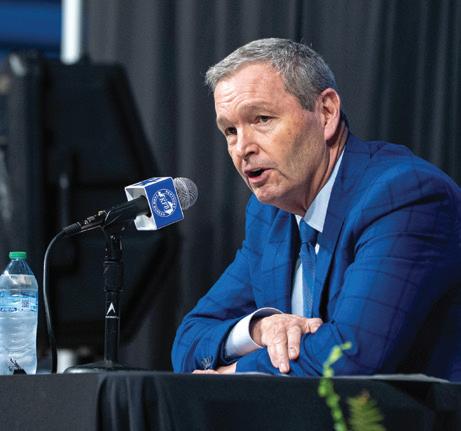
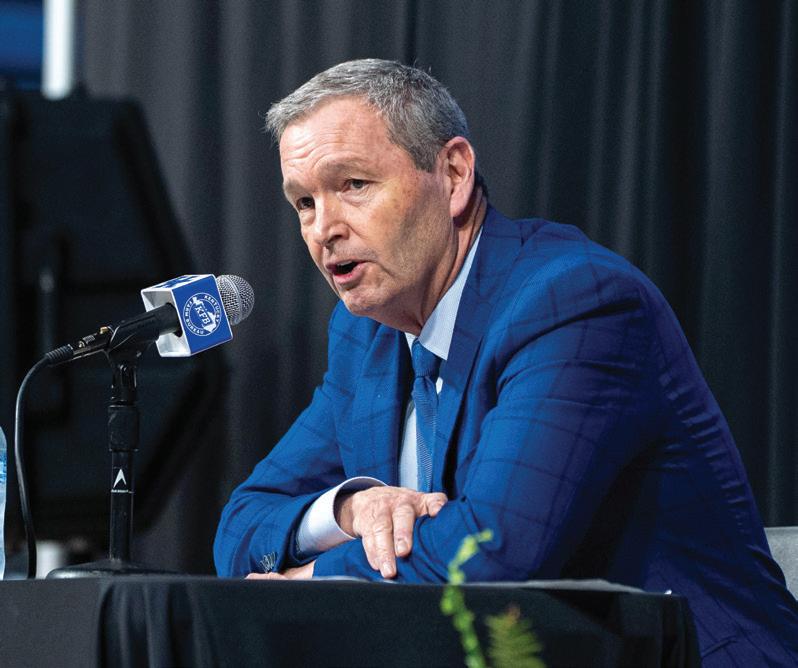
Timeline: Mitch Barnhart’s time at UK
10
News: Are residence halls safe?
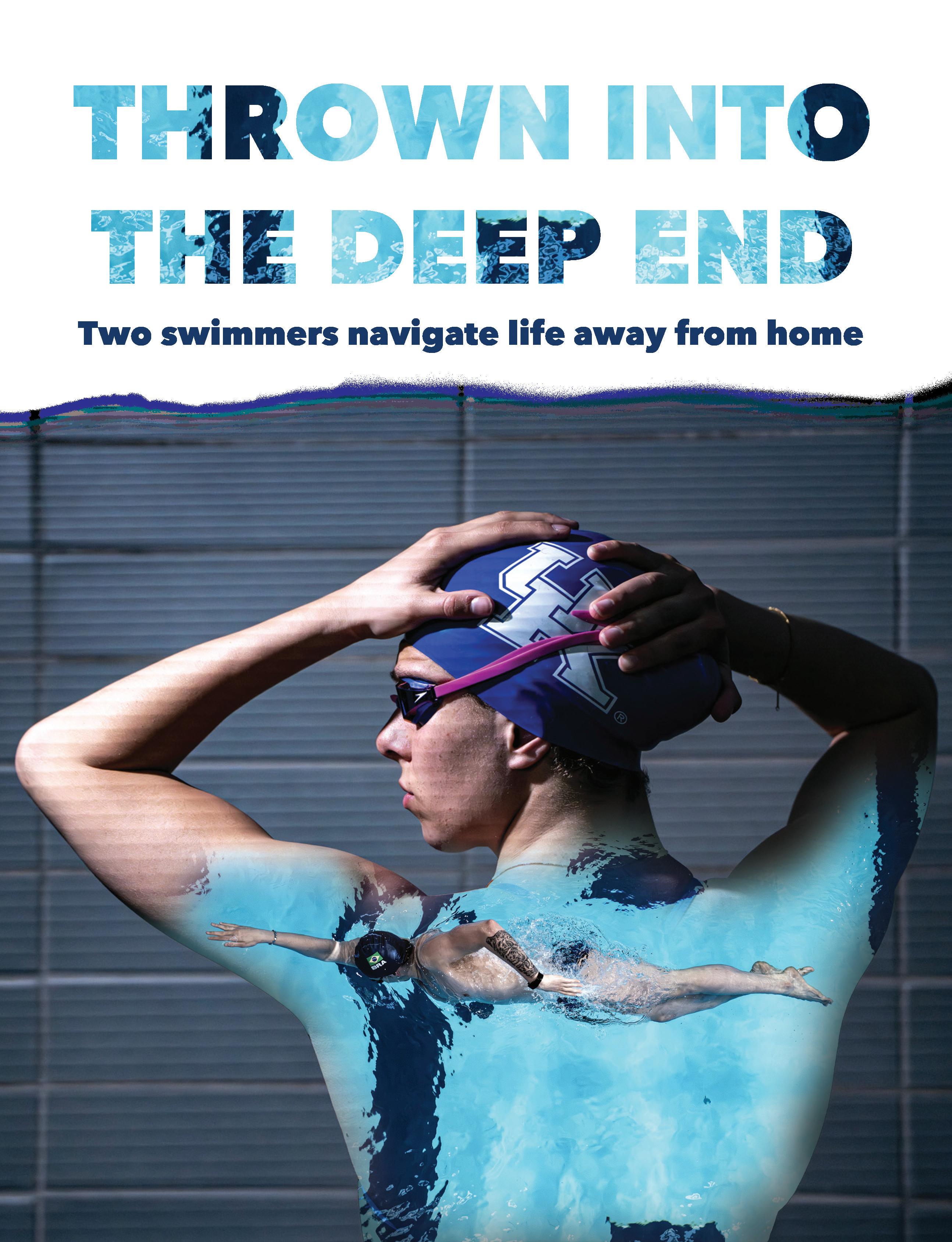
Feature: Thrown into the deep end
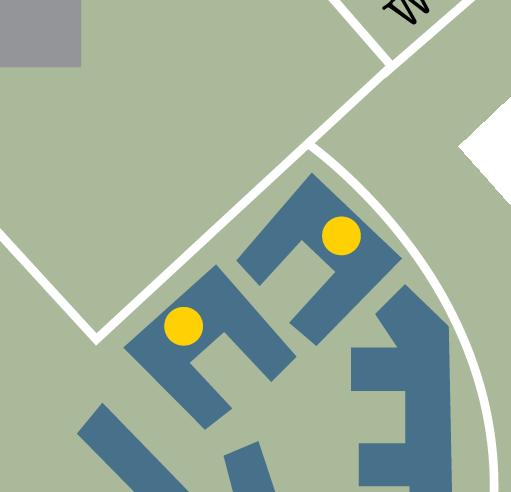
Sports: Kentucky’s ‘Blue Blood’ status is history

The Kentucky Kernel sent two of its reporters into UK residence halls to test safety and see if the reporters would be stopped at the door like they are supposed to be.
In a place that gives grades, UK gets a miserable F.
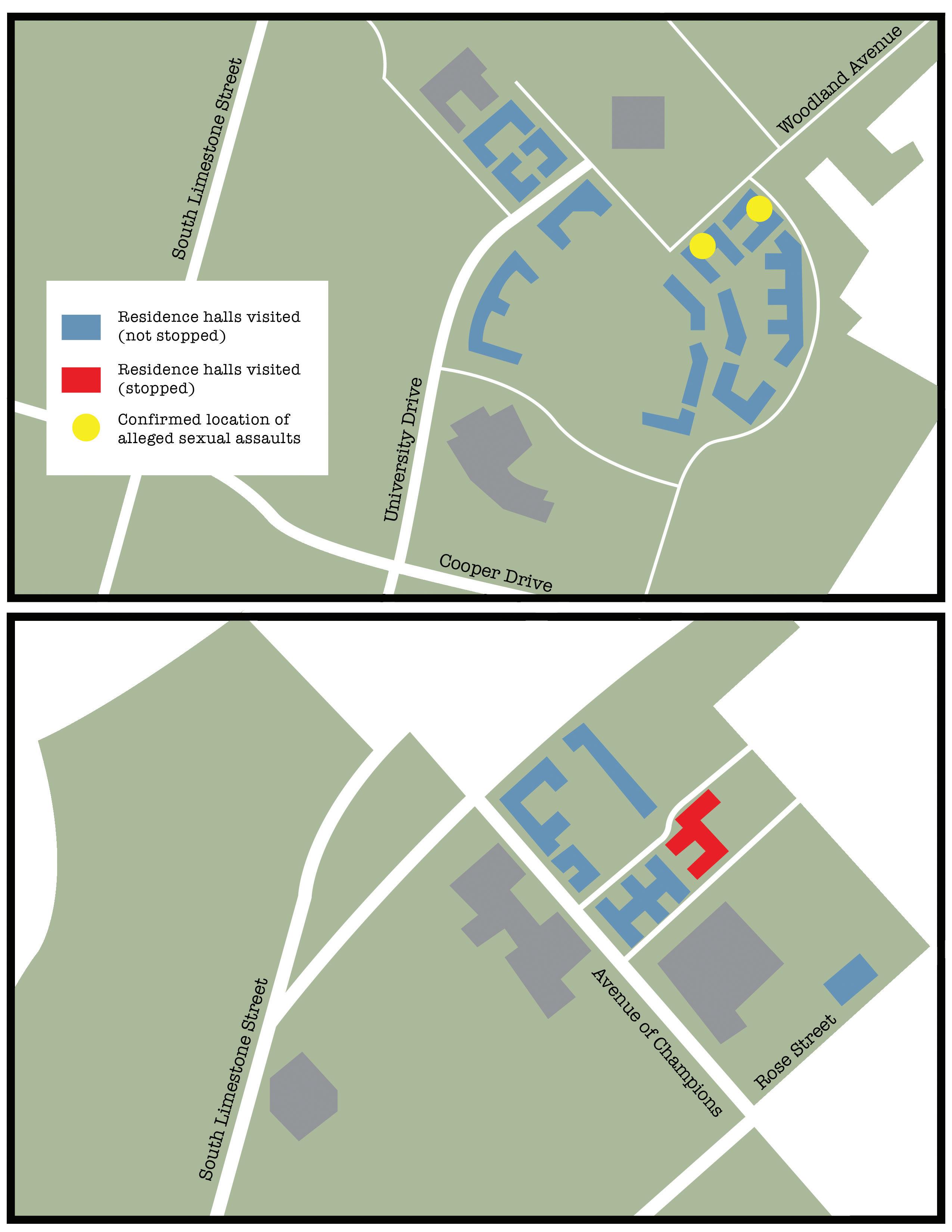
The reporters were only stopped once, by a resident adviser, out of the 19 halls they visited. The only residence hall that they were stopped at on the first try was Blazer Hall.
A different reporter was sent back through Blazer Hall and was not stopped.
One of the reporters was able to make it so far into some buildings that they were able to walk up the steps in four residence halls, which would have given them access to every room there.
If UK is going to send email after email about campus safety, regulations and “enhanced” residence hall security, then the university needs to live up to its word and follow it.
Once someone gets past the desk at a residence hall, someone’s child, brother, sister or partner
from a sexual assault, robbery or something potentially worse.
College is supposed to mold people into better individuals, and it should be a welcoming environment where students can feel safe. They should not fear going to bed at night, where someone might walk past a resident adviser, or desk clerk, and enter a residence hall without a reason to be there.
At UK, this is not the case.
“ In a place that gives grades, UK gets a miserable F.”
In the last year and a half, the UK Police Department released eight sexual assault bulletins, with nearly all being in residence halls.
In the fall of 2024, UK said they partnered with Allied Universal, which would conduct community rounds in residence halls and at the William T. Young Library on Thursday, Friday and Saturday nights.
Allied Universal security officers are supposed to be identified by their high visibility vests, black polo shirts or jackets and black tactical pants.
Where are they now? Does sexual assault and crimes only occur on Thursday, Friday and Saturday nights?
The editorial board at the Kentucky Kernel does not recall seeing any security members at all of that description.
If resident advisers can not simply keep watch over who is coming into their building, then how is UK keeping students safe?
Is it on a college-aged resident adviser or desk clerk to stay on guard, or should residence halls have security at all times?
Do these resident advisers need better training? What about the desk workers who are not resident advisers but hired on?
Do they need more incentives to actually do their job that they get paid to do?
There is a reasonable expectation of security for those living in UK’s residence halls.
UK must provide an environment with well-trained employees already in place so students can feel safe in their halls.
To learn more about this story, visit our YouTube or scan here.

Infographic
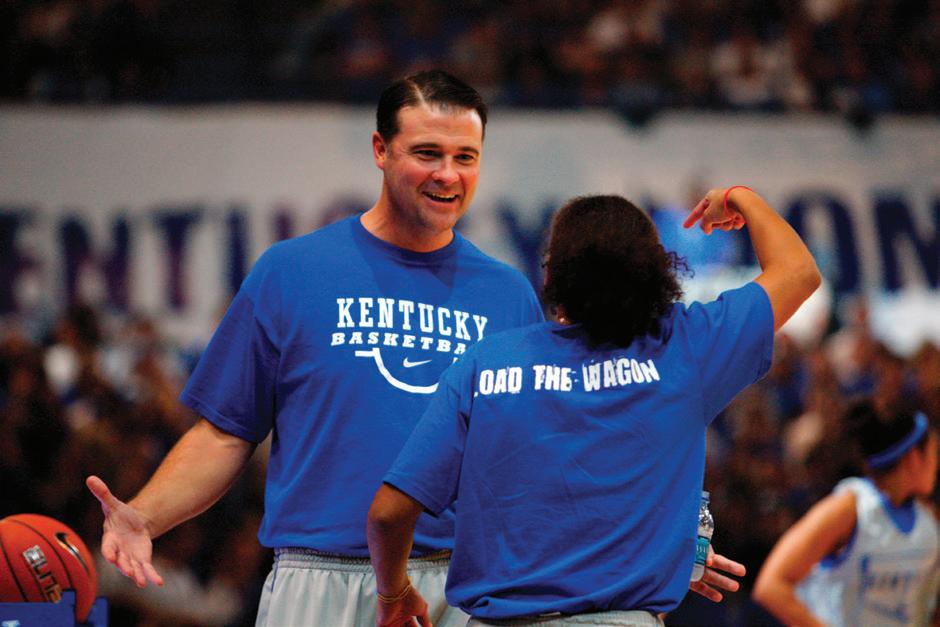
Mitch Barnhart concluded his fouryear term (1988-2002) as athletic director at Oregon State and was introduced as Kentucky’s 10th athletics director on July 15, 2002, succeeding Larry Ivy.
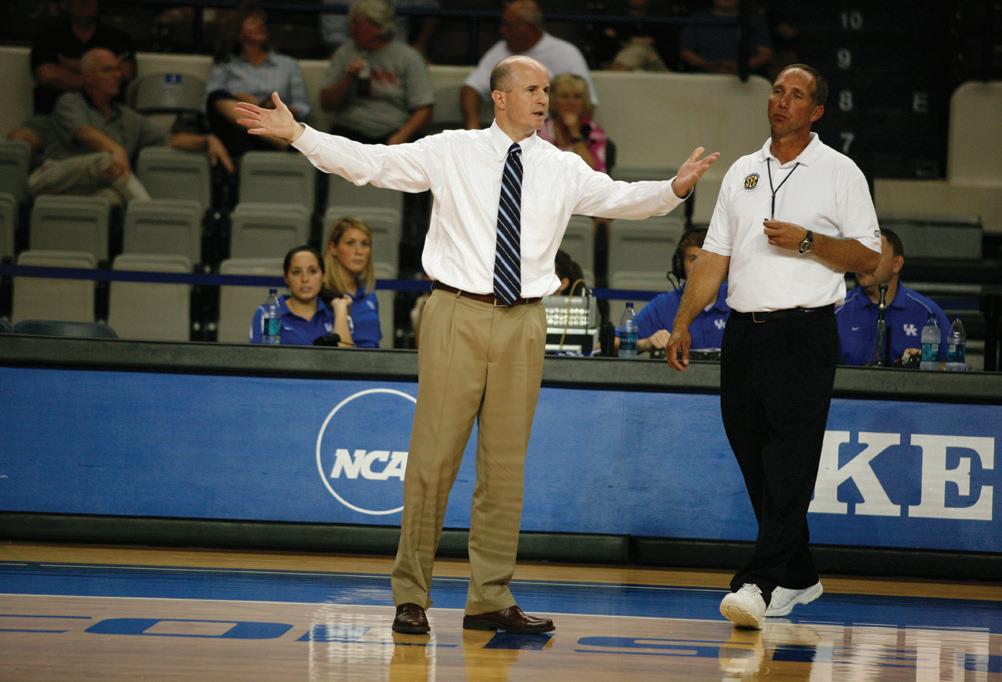
Kentucky volleyball head coach Craig Skinner was hired in December. Kentucky men’s basketball finished 27-5, won the SEC Tournament and was a No. 1 seed in the NCAA Tournament, but lost in the round of 32.
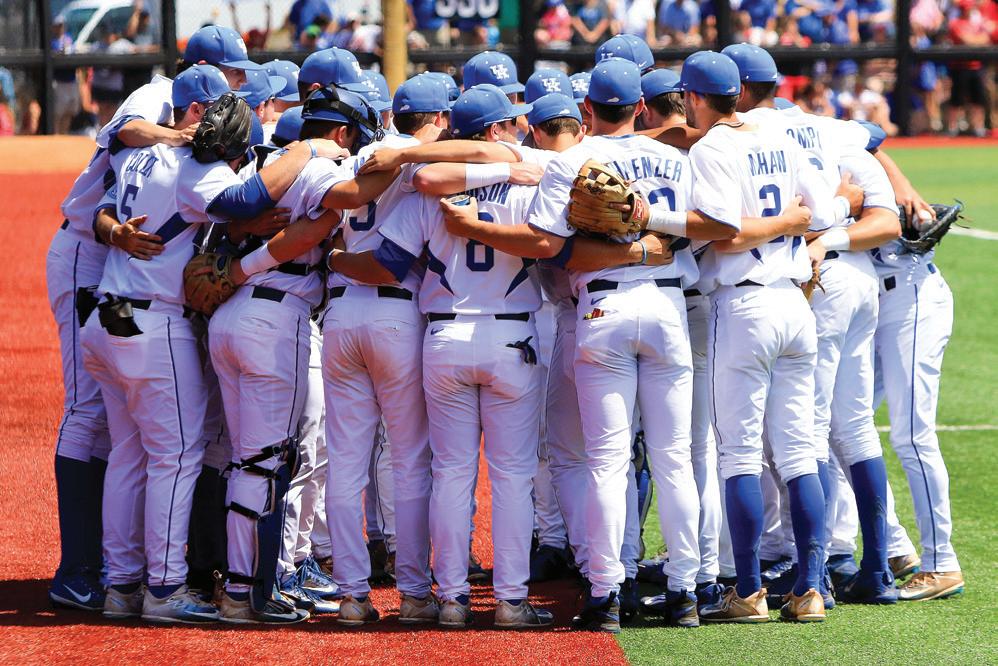
After being expected to finish last in the SEC, Kentucky baseball had a historic season during which it won its first regular-season SEC Championship and hosted an NCAA Regional for the first time in program history.
Orlando “Tubby” Smith signed an eight-year extension through 2011.
Introduced the 15x15x15 initiative aimed at winning 15 regular season or national championships and being top-15 in the Directors Cup by 2015.
Rich Brooks retired on January 3, 2010, after seven seasons as Kentucky football head coach and was replaced by Joker Phillips.
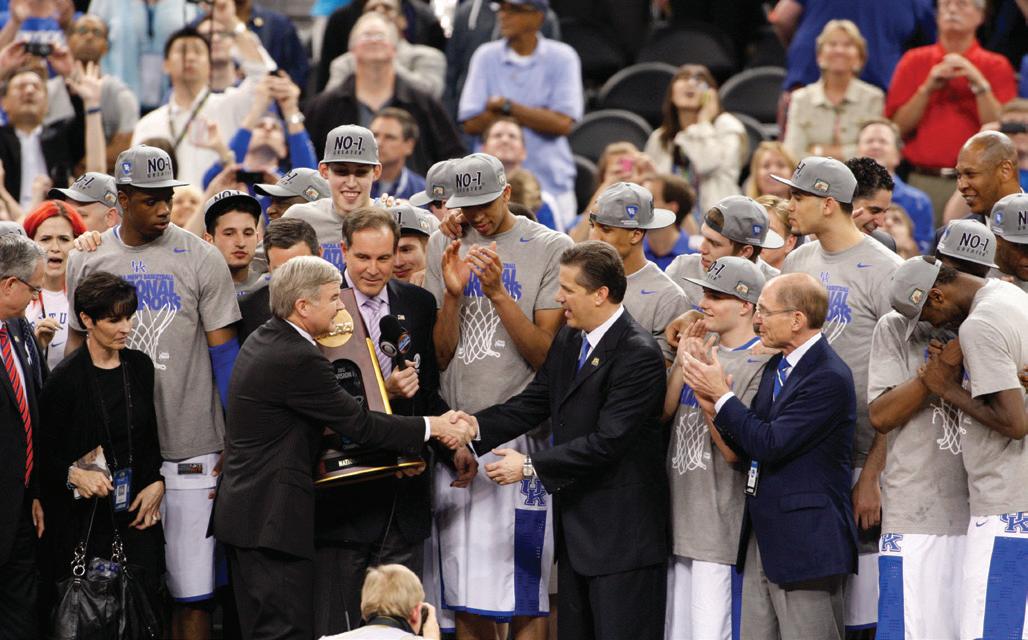
Kentucky men’s basketball won the national championship and Mark Stoops was hired as Kentucky football head coach after Joker Phillips was fired.
Kentucky baseball’s AJ Reed won National Player of the Year and was picked in the second round by the Houston Astros. Austin Cousino was picked in the third round by the Seattle Mariners.
Began the planning stages of the Joe Craft Center and eventual Barnhart Family Athletic Complex. Big Blue Madness was held at Rupp Arena for the first time. Kentucky men’s golf won first SEC Championship in program history.
Hired Billy Gillispie as Kentucky men’s basketball head coach after Tubby Smith resigned on March 22, 2007. Matthew Mitchell was hired as Kentucky women’s basketball head coach after Mickie DeMoss resigned.
Kentucky men’s basketball fired Billy Gillispie on March 28, 2009, and hired John Calipari as head coach on March 31, 2009. John Wall announced his commitment to Kentucky basketball on May 19, 2009.
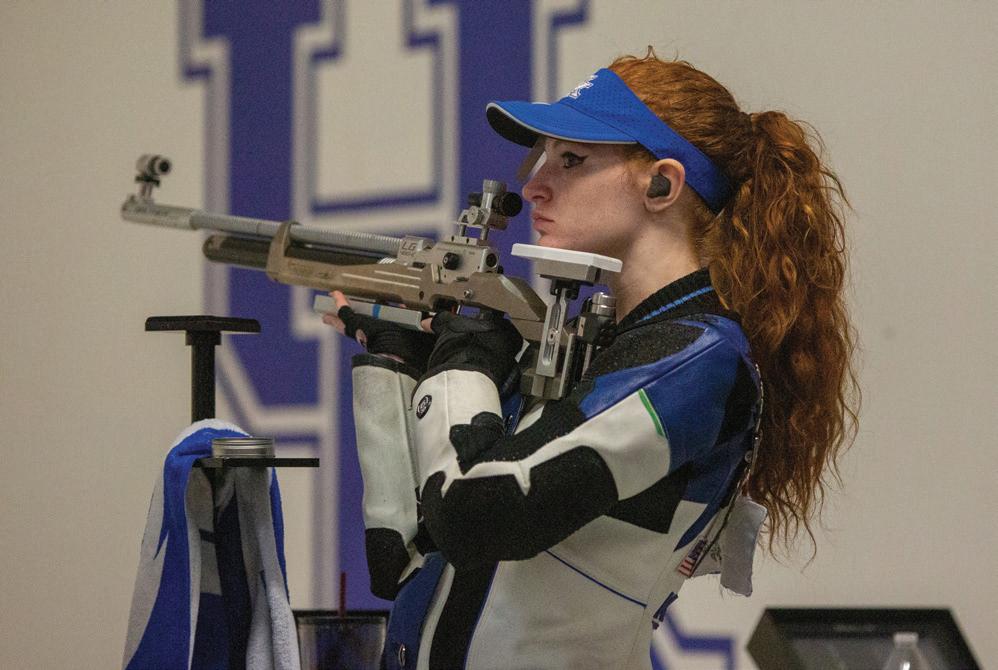
Kentucky men’s basketball advanced to its first Final Four since 1998 and rifle won its first national title.
John Cropp Stadium opened, and Kentucky hosted the 2013 SEC Tournament. Lars Jorgensen was promoted to swim head coach.

Gary Henderson resigned as Kentucky baseball head coach, and Nick Mingione was hired. Joe Craft football training facility opened.
Kentucky men’s basketball went undefeated all season before losing to Wisconsin in the Final Four. Six players got drafted in the NBA Draft.
Kentucky football had its first 10-win season since 1977 led by Benny Snell Jr.
In May 2020, UK fired its entire four-member cheerleading coaching staff: head coach Jomo Thompson and assistants Ben Head, Spencer Clan and Kelsey LaCroix, following a three-month investigation into hazing, alcohol use and public nudity. Kentucky volleyball won its first national championship in program history.
UK Athletics announces new indoor track and field facility and renovations to Nutter Field House. Kentucky rifle won its fourth national championship.
John Calipari stepped down as Kentucky men’s basketball head coach on April 9, 2024, and Mark Pope was hired on April 12, 2024. Former swim and dive head coach Lars Jorgensen was accused of sexual violence and harassment. Kentucky baseball played in the College World Series for the first time in program history.
Kentucky baseball advanced to first ever NCCA Super Regional in program history. Benny Snell Jr. set Kentucky football single-season touchdown record at 18.

Kentucky football beat Penn State in the Citrus Bowl to cap off historic season. Elizabeth Niblock and Meredith Newman sue UK for a Title IX violation, alleging that UK officials are discriminating against female athletes by refusing to create varsity sports opportunities.
Kentucky rifle won its third national championship, and Kentucky football had another 10-win season (wins later vacated due to NCAA violations).
Renovations for Historic Memorial Coliseum began, and Lars Jorgensen resigned as swim and dive head coach.
Mitch Barnhart announces his retirement on March 3, 2026.
Dec.
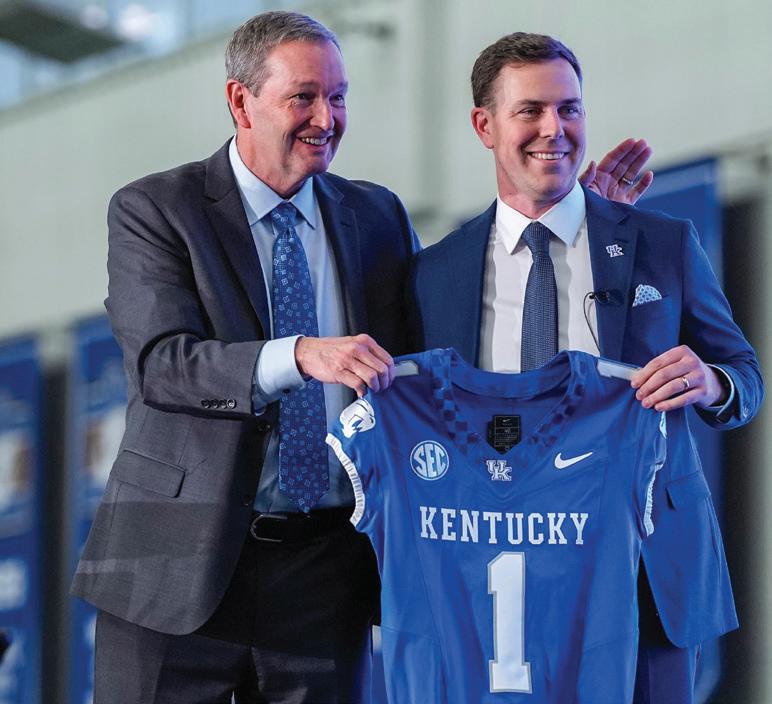
Assistant track and cross country coach Hakon DeVries was investigated for alleged sexual harassment and stalking. Kentucky football head coach Mark Stoops was fired after 13 seasons, and Oregon offensive coordinator Will Stein was hired.
Sylvia Freire Assistant News Editor
The University of Kentucky’s residence halls are noncompliant with security measures, specifically, desk clerks are not signing in students upon arrival.
The Kentucky Kernel sent out two reporters and entered all residence halls on UK’s campus to see if they would be able to enter without checking in.
Out of the 19 residence halls, Kentucky Kernel reporters were only stopped at one hall: Blazer Hall.
A different reporter was sent shortly after and was not stopped.
The university and UK’s spokesperson Jay Blanton were contacted by the Kentucky Kernel for comment.
Blanton said the print deadline the Kernel established was not fair and did not give them enough time to respond by deadline.
According to the Residence Life website, the university prioritizes safety in residence halls, including resident advisers, a role dedicated to ensuring a “safe and welcoming environment.”
Front desk work is included as
part of the resident advisers’ roles. However, UK also has desk clerks that are not RAs.
According to a former RA who chose to remain anonymous, the process to become an RA is “extremely competitive” throughout the interview process.
Students who apply to become an RA first undergo an interview that is “pretty rigorous.”
After completing the interview and being selected, all candidates are required to take a course titled “Leadership Lab.” This is a course that is not counted in a candidate’s credit hours, where candidates meet once a week with weekly assignments on Canvas.
According to the RA acceptance email, the course is designed to teach future RAs skills necessary to do well in their role.
“The Lab combines interactive learning, reflective exercises and practical applications, focusing on areas crucial to your success and the well-being of your residents,” the email wrote.
After taking the course, 80100 candidates are selected from the group to become RAs for the following year.
According to the anonymous former RA, the course candidates take is a portion of their training. Then, two weeks before the start of the semester, RAs arrive on campus
in, a lot more UKPDtype situations, in comparison to Central or South Campus,” the anonymous former RA said.
The protocol for working at the front desk is the same for both RAs and desk clerks.
One of the responsibilities of desk clerks, according to the Residence Life website, is to “Enforce the Visitation Policy, which requires accurate and consistent practice of requiring picture ID from visitors and requiring that guests be escorted by their hosts at all times.”
According to the anonymous former RA, the desk clerk procedure and protocol are included in training, which includes meeting with the community administrative assistant, who works the front desk during the day, to teach desk clerks how the system works.
and complete further training.
The training was tailored to the building RAs are placed in, informing them of specific situations that happen in the residence halls they should be aware of, the anonymous former RA said.
Part of the training was dedicated to understanding real-life situations.
“You might have someone walk into the building who’s kind of strange. You don’t really know how to respond to that … where you, in general, know the procedure, but then, situational stuff comes up and you don’t exactly know how to handle it,” the anonymous former RA said. “So I think it trains you to a certain extent, but I think also part of it is just like, you learn as you go.”
According to the anonymous former RA, when RAs are uncertain about procedure, they are encouraged to ask someone higher up, such as a their resident director.
Each residence hall on campus has its own resident director, according to UK’s Residence Life website.
The anonymous former RA said RAs encounter more difficult situations based on which side of campus they are assigned to.
“On North Campus, they’re going to see a lot more alcohol incidents, a lot more people trying to sneak
“Typically, the resident director will be like, ‘Hey RAs, if you see someone who’s not checking them … make sure when you’re walking past the desk, if you see someone not checking them in, you make sure to take note of that and tell them to check them in,’” the anonymous former RA said.
Included in residence hall safety, UKPD has maintained its partnership with Allied Universal, a professional campus and security team that works with other regional universities and organizations across the country, according to Dani Jaffe, UKPD spokesperson.
“Since 2024, security officers have continued to conduct community rounds around residence halls and at the William T. Young Library on Thursday, Friday and Saturday nights,” Jaffe said.
According to Jaffe, they are an “added layer” to the university’s security system that UKPD manages on campus.
UKPD continues to conduct its usual protocols on campus, according to the UKPD website.
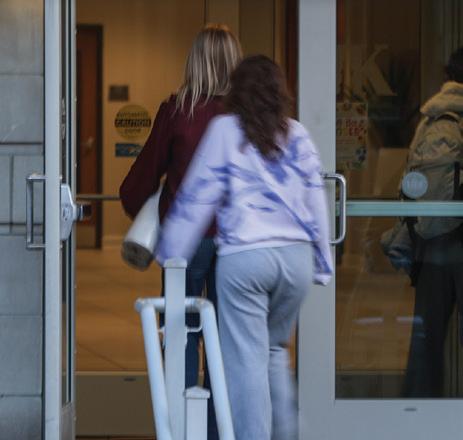
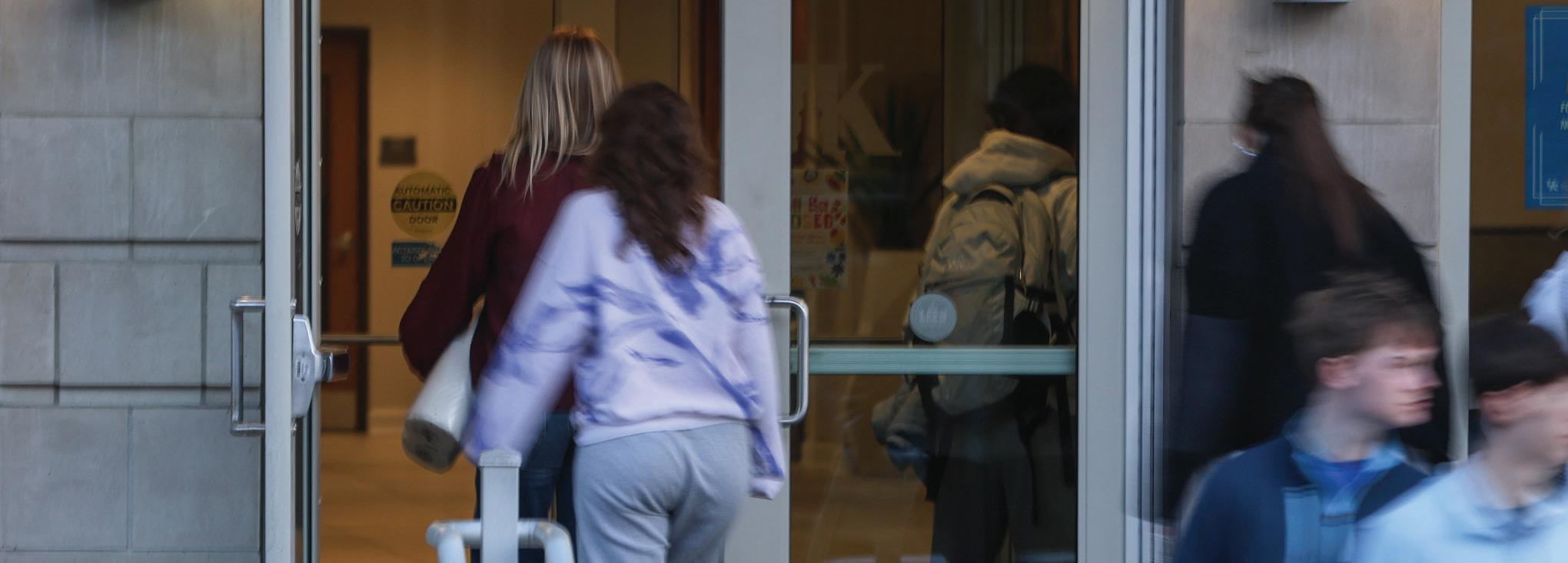
Students walk in and out of their residence hall on Sunday, March 22, 2026, at the University of Kentucky in Lexington, Ky. Photo by Cara Raiford.
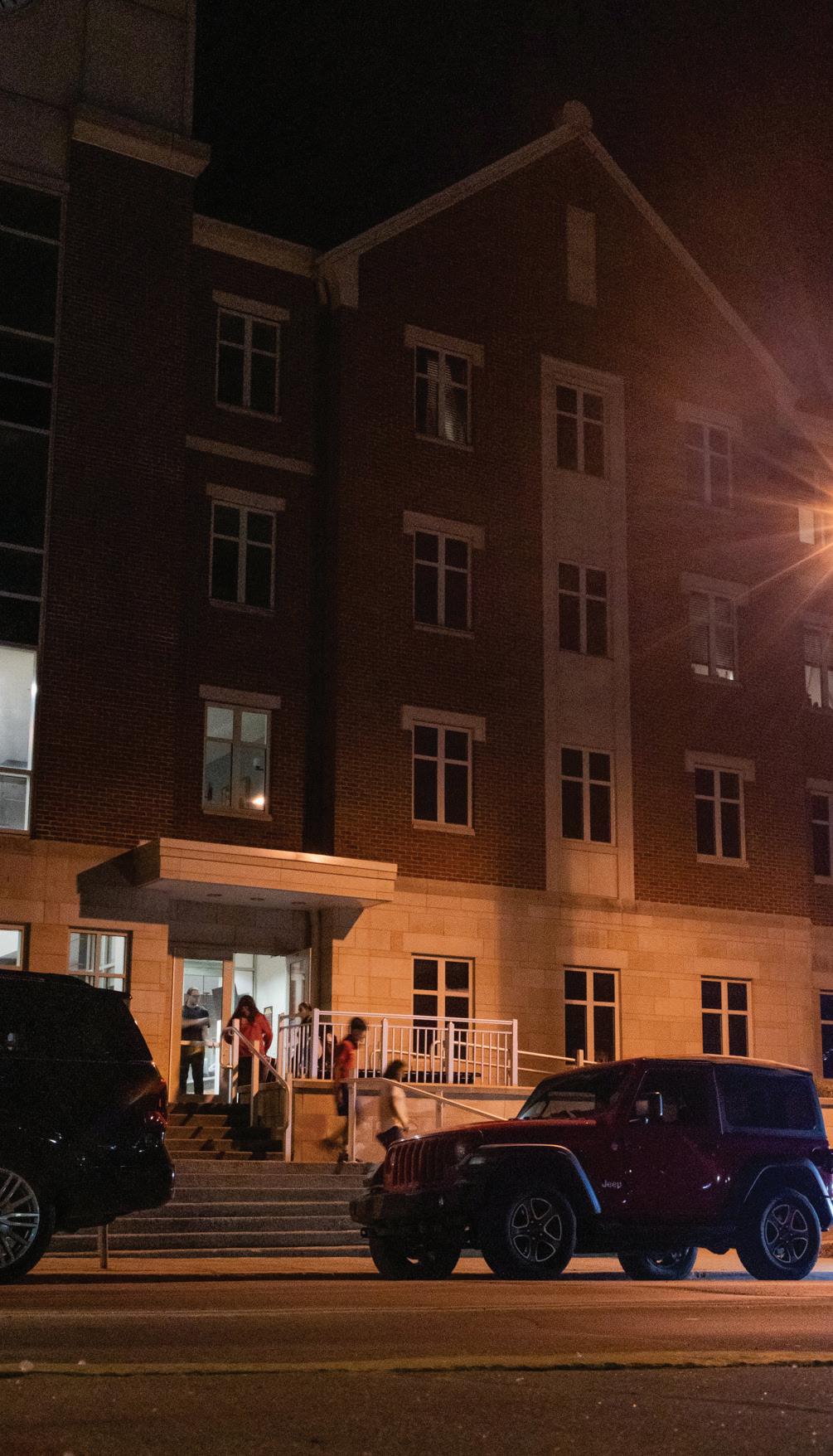
Safety concerns in residence halls and on campus led the Kernel to send reporters to test compliance with residence hall safety protocols.
It remains unclear how many incidents involved non-UK visitors or UK students who may not have been properly signed in.
There were eight reported incidents regarding sexual assault in residence halls or on campus during this period.
The following timeline documents reported incidents in UK residence halls and on campus since 2024 and the university’s security responses to said incidents.
During this time, RAs and desk clerk procedures remained the same, checking in students as they arrive to the residence hall.
UKPD reported an alleged sexual assault in a residence hall.
The suspect is a UK victim and is known by the student.
UKPD reported an alleged sexual assault in Chellgren Hall on Sept. 3, 2024, and sent out an email on Sept. 4, 2024.
The alleged assault occurred on Aug. 29, 2024, inside the victim’s dorm. Both the victim and suspect were UK students.
UKPD sent out an email on Sept. 5, 2024, addressing safety concerns after shots were fired on North Campus, a robbery near Boyd and Patterson Hall and a reported sexual assault case at Chellgren Hall.
The email said UKPD will increase its presence in residential areas and mentioned its partnership with Allied Universal.
UKPD sent out an email on Sept. 12, 2024, explaining Allied Universal’s partnership to increase security measures.
Part of this included security officers conducting community rounds in residence halls and the William T. Young Library on Thursday, Friday and Saturday evenings.
UKPD sent out an email on Sept. 22, 2024, reporting an alleged sexual assault on the crime bulletin that occurred “over multiple days offcampus and on-campus inside the victim’s room in a residence hall.”
The victim reported to police that Chase McGuire, 22, sexually assaulted her off-campus and in the William T. Young Library parking lot on Sept. 19, 2024.
According to Kernel reporting, McGuire also raped the victim in her Chellgren Hall dorm room later that night.
The case against Chase McGuire, 22, accused of raping and strangulating a UK student, was dismissed by a Fayette County grand jury on March 18, 2025. McGuire was charged with
five counts of 1st degree rape, four counts of 3rd degree sodomy, one count of 3rd degree sexual abuse and one count of 1st degree strangulation (attempted) on Sept. 25, 2024.
UKPD sent out a crime bulletin regarding an alleged sexual assault incident that occurred in a student’s residence hall room on Sept. 28, 2024.
The bulletin was sent out on Oct. 2, 2024, and the offence the bulletin included was first-degree rape.
The University of Kentucky Open Records Office denied a request filed by the Kentucky Kernel regarding non-UK student visitors checking into on-campus residence halls.
The request was filed as part of a Kernel investigation of residence hall visitation protocol compliance, following the arrest of McGuire, according to Kernel reporting.
The UK Open Records Office said providing records of non-UK student guests would be “considered an invasion of personal privacy” under a Kentucky statute of the Open Records Act. According to the UK Open Records Office, the records requested were considered “preliminary” and therefore exempt.
UKPD sent out an email on Oct. 21, 2024, regarding an alleged sexual assault that occurred on campus on Oct. 17, 2024.
The incident occurred inside the victim’s dorm room. According to the email, “the suspect is known to the victim.”
UKPD announced increased safety measures after the rise in criminal activity that year.
UKPD said they will have extra officers on “bike, foot and vehicle” to patrol the North Campus area from 10 p.m. to 4 a.m. on Fridays and Saturdays, in addition to the already patrolling officers.
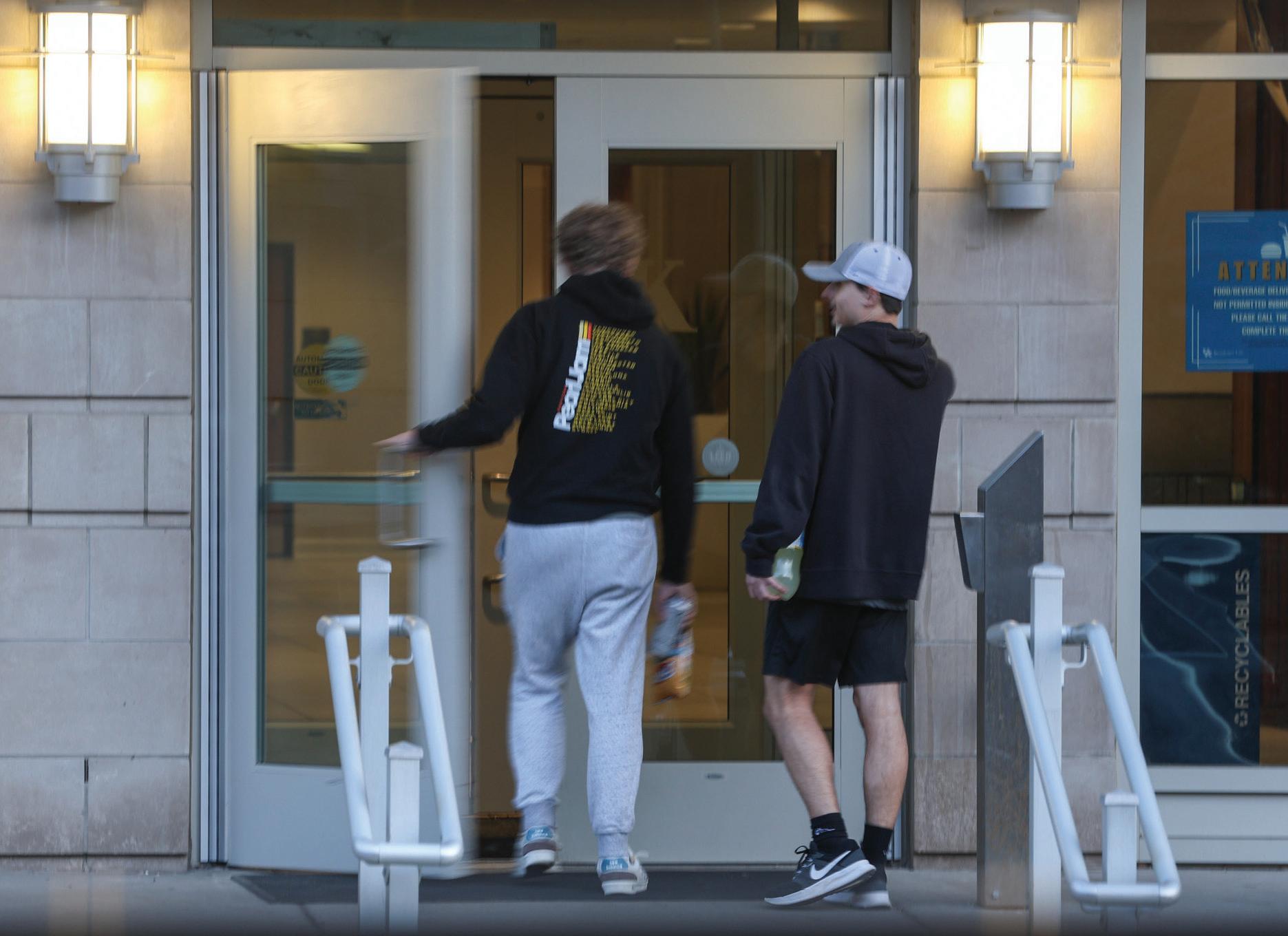
security measures in residence halls, following the series of crime bulletins issued in the previous year.
According to Jaffe, UKPD began testing a new system in a residence hall, Woodland Glen IV, including scanning all guests into the residence hall, which will alert the front desk if the guest is not a UK resident, requiring them to sign in before entering.
UKPD said they were evaluating where to add more security cameras that needed to fill gaps on UK’s campus.
Additional safety measures include some residence halls having professional security guards in addition to resident advisers manning the front desk.
UKPD released a crime bulletin detailing an alleged assault that occurred on Nov. 10, 2024, near the intersection of Rose Street and Euclid Avenue, during “overnight hours.”
The crime bulletin was released Nov. 13, 2024.
The suspect was unknown to the victim and has been identified by police.
UKPD reported an alleged sexual assault that occurred on UK’s campus on Jan. 26, 2025.
The incident occurred on Jan. 17, 2025, inside the victim’s room in a residence hall.
According to the crime bulletin, the suspects are known to the victim.
UKPD released a crime bulletin email on Feb. 24, 2025, reporting an alleged sexual assault in a residence hall.
According to Kernel reporting, two former UK students, Angus Thompson and Addison Adkins, were arrested on March 3, 2025. Thompson, 19, was originally charged with 1st-degree rape and
Adkins, 19, was charged with 1st-degree rape and 2nd-degree strangulation.
The grand jury declined to indict the two former students, dismissing the case in a Fayette County court.
According to court documents, a former student is now suing UK, alleging she was raped in a UK dorm, and claiming UK failed to protect her.
The University of Kentucky provided open records regarding non-UK student visitors checking into on-campus residence halls.
The records were regarding an alleged rape by McGuire in Chellgren Hall in September 2024.
On March 18, 2025, a Fayette County grand jury did not find “enough evidence” to indict McGuire and dismissed the case.
The received records show McGuire was checked into Chellgren Hall from Sept. 18, 2024, at 6:54 a.m. until Sept. 20, 2024, at 5:44 a.m.
McGuire was then checked back in on Sept. 20, 2024, at 5:44 a.m. and was checked out at 10:07 a.m. that day.
UK implemented additional
Security guards are said to roam campus and do frequent check-ins at residence halls and the Cornerstone Garage during overnight hours, according to Jaffe. Additionally, two security officers were assigned to North Campus, one to South Campus and one to Central Campus.
To learn more about this story, visit our TikTok or scan here.

T´
he rain was falling in Recife, Pernambuco, Brazil. The tears of Caue Gluck fell just as steadily.
3:55.83.
The time lit up the board and all the 17-year-old could do was cry.
It wasn’t a personal best, but it was enough to take home gold in the 400-meter freestyle at the 2024 Brazilian Junior Interclub Championship.
One thing Gluck “always loved to do was swim in the rain.” As he stood behind the block, only moments before his race began, raindrops fell from the sky right on top of him.
“I just like inhaled and I was like, ‘Okay, it’s gonna be alright,’” he said.
Gluck took home first place in his favorite event, one he hadn’t lost in over three years, by just 16 hundredths of a second.
“That night wasn’t a day for me to swim fast. It was just a swim for me to win,” Gluck said. “I remember as soon as I saw that (time), I started crying so much. I only stopped crying when I got to the hotel later that night.”
Tears also fell from the eyes of Fernanda de Goeji, a swimmer holding the emblem of the Brazilian Navy, from the same state as Gluck, Curitiba.
But she had another reason.
It was all dark.
There was no crying in front of family and friends, but inside that airplane, all she could do was cry.
That was far from her first flight.
She had already been to China, France, Mexico and Peru, to name a few.
But this time, it was her crossing the ocean into the unknown.
Her destination wouldn’t be another swimming championship, or a Chinese village with other athletes brimming with shops selling stuffed animals and souvenirs that wouldn’t fit in suitcases.
No sign of light.
“Then, when one of my coaches
drove me to the dorms … I couldn’t see anything,” de Goeji said. “It was dark, I just went straight to my dorm.”
At this point, she was no longer alone.
Inside the car, her coach tried to start a conversation, but she couldn’t keep up. It wasn’t because she was tired. In fact, she didn’t know his language.
Even so, sitting in the passenger seat, she was excited to see what was ahead of her: Missouri.
This was just the beginning for two Brazilians, two swimmers, navigating through two different journeys in and outside the sport, away from home.
after he began swimming at the competitive level that the Curitiba, Brazil, native had made up his mind, after one of his coaches introduced him to the Olympics and competing at the collegiate level in the United States.
“That was the plan since I was 11. I was gonna swim in Brazil until I was old enough to come to college here, so that was always something I was sure of,” he said.
Since he could remember, sports had always been a part of his life. From a young age, he was doing everything from tennis to soccer to judo.
As he got older and the training became more intense, he was focused on just two: soccer and swimming.
Eventually, he had to choose just one, and swimming was his decision.
After going winless in individual medals through his first year and a half of swimming, only earning medals on relays, Gluck’s coach challenged him to practice more to improve.
Things began to finally click.
“In the very next like competition, after I started having more workouts a week, I got my first individual medal,” Gluck said.
“ So at that moment, I was like, maybe if I put effort (in)to this, this might be for me.”
To this day, Gluck has no doubt in his mind that he made the right decision.
After competing in hundreds of races for Clube Curitibano, the Brazilian had officially swum his final competition for the club.
“It was a day that I will remember for the rest of my life. It wasn’t easy necessarily; it was stressful until the end, but the end was great. It ended the way it was supposed to end,” Gluck said.
One chapter of Gluck’s life was coming to a bittersweet end, but 4,700 miles away, a new chapter was awaiting him in Lexington, Kentucky.
It had been only four years
Far from being a childhood dream
Within minutes, reality sank in when she arrived at her dorm. That same night, other members of her swimming team gathered in the hallway to greet her, telling jokes and chatting.
She, once again, could only remain silent, not understanding what they were saying.
She had found her place, but she was still lost.
“I was very depressed when I left Curitiba (Brazil), I left my family,” de Goeji said. “I never had a desire to come to the U.S. and be far away from my family. Never had this desire.”
Deciding to study abroad didn’t stem from a childhood dream, but from an alternative way to cope with frustrations.
She needed to be in a different atmosphere.
“Everything started after I didn’t make (the) Olympic Games in 2021,” de Goeji said.
At the beginning of 2020, her plans for a career as a professional swimmer seemed to be going smoothly.
She even did a month of altitude training in Mexico in preparation for the trials.
But the pandemic derailed all her plans.
“COVID canceled everything,” she said.
For the first time, as someone who, since childhood, couldn’t stay still and needed to be out of the house, she ended up spending six months without swimming.
In 2021, the pandemic still loomed, and the Olympics became a distant dream. She could no longer be trained by her coach either.
Her body needed movement, but her mind needed a breath of new air.
She needed a change.
On Jan. 19, 2024, the 16-time Brazilian Junior National Champion and four-time South American Junior Champion officially signed with the University of Kentucky, fulfilling his lifelong dream.
For Gluck, competing at a high level was always the plan, but choosing Kentucky specifically came down to something simpler: the people.
During his visit, he said the connection with the coaching staff stood out immediately.
“I think the coaching staff here really cares about us, so that’s something that’s very important for me,” he said.
It was something Gluck valued a lot — knowing the people that he was going to work with cared about him as well.
Only three weeks after his final race in Brazil, Gluck was on a oneway flight to Lexington alongside his parents.
While most of his mind was filled with excitement and joy for what was ahead of him, there was a small part of him that was being left in his home country – his younger brother, Gael.
He said saying goodbye to him was by far “the hardest part,” as Gael was a part of every aspect of his life, even swimming for the same club.
School, lunch, practice and everything in between, the two were inseparable.
“We would spend all day together, and all the sudden I didn’t have him next to me anymore. So
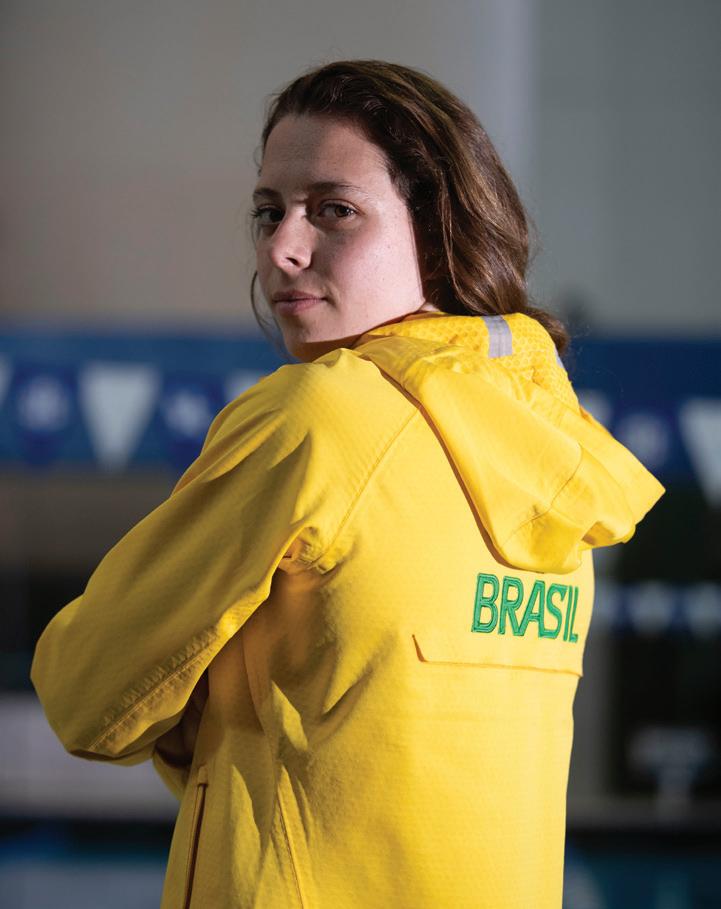
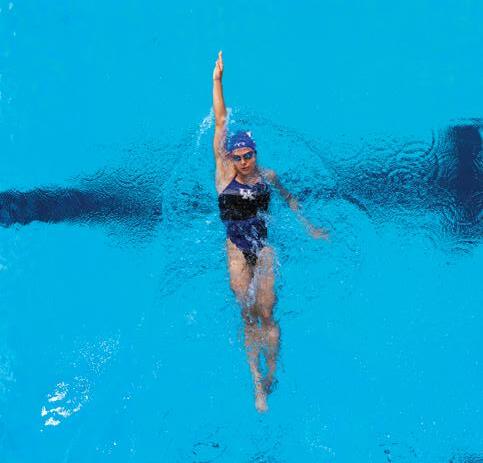
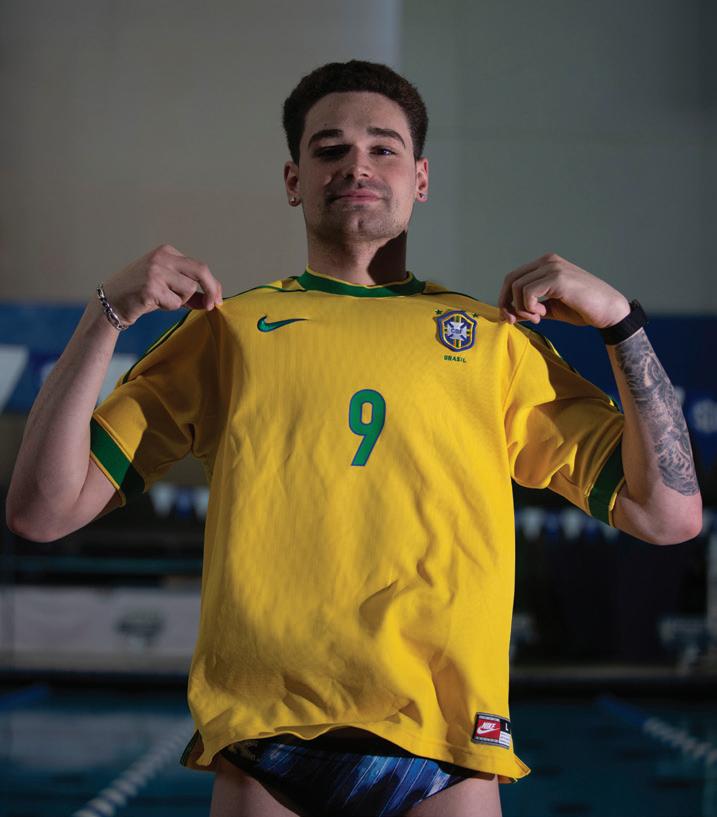
backstroke swimmer Fernanda de Goeji poses wearing a Brazil jacket on Monday, March 9, 2026, at Lancaster Aquatic Center in Lexington, Ky. Photo by Vincenzo Ciaramitaro.
that was really hard,” he said.
Luckily for Gluck, a brotherhood was awaiting him in Lexington.
He was surrounded by others just like him – athletes who had moved their lives across the world to fulfill a dream.
When he arrived on campus as a freshman, 10 members of the men’s swimming and diving team were international.
One of whom was Murilo Amatuzzi.
Amatuzzi, his new roommate, happened to be his teammate from back home as well.
Ten years of swimming together,
on the same team, at the same club, with the same coaches.
By some miracle, Amatuzzi and Gluck would remain teammates in their first year of college.
While most people spend their first night at college feeling alone and missing their loved ones, Gluck felt as at home as he could be.
“I was without my parents, but I didn’t feel like I was by myself at all. He was really important for me in this process of adapting to living here. I don’t think I would have been able to do it without him,” Gluck said.
There was no home for her
“If I’m gonna be far away from my family, I’m gonna go somewhere that I can get a degree and actually have like a totally different scenario,” de Goeji said.
She said she didn’t even know which schools were better at swimming, but she knew she needed something new, even if it scared her.
“I didn’t visit Missouri, I had no idea what was the place or the city,” de Goeji said.
Many doors kept closing. The one that opened led her down a dark path.
At the airport on her way to Missouri, she also ended her relationship. She was alone, and there was no going back.
After all, it was her first time “living far away from my family, from my twin sister, that we would do everything together,” she said.
The longing for the smell of home, for having her sister by her side, and for not being able to be herself turned her time in Missouri into troubled waters.
In her first year, giving up wasn’t an option; she gave her all.
“I didn’t spend any time out of the pool,” de Goeji said. “I kept swimming.”
At the beginning of her second year, she went to nationals and made it to the Pan American Games in 2023.
The girl from Curitiba, who had found swimming as her passion since she was 7 years old, still strived.
But while she was on the Missouri team, for some practices,
she said she was on her own.
“I went to (the) Pan American Games without a training plan, and I swam so bad,” de Goeji said.
Outside the pool, even after leaving her dorm and finding a house, nothing felt like a real home.
“If you’re not happy, you cannot swim fast,” de Goeji said.
Going to church on Sundays was her escape and her way of taking care of what shouldn’t be underwater — her mind.
After carrying the burden of not being able to be herself in a space where she didn’t belong, she decided to take a step back.
By the end of 2023, she returned to Brazil.
As a sophomore, Gluck no longer struggles to feel at home in Kentucky.
While part of that comes with the experience of already spending a whole year away from home, another came with the family he had built in Lexington.
“It was so quick we got close –we are so close and it’s like family … that for sure makes it so much easier to not miss home so much,” he said.
That family and team element, which Gluck has now fully embodied, was something new to him at first.
It was the complete opposite of the culture of swimming he had grown up on in Brazil, one that was always focused on yourself and nobody else.
“Competing in Brazil for my club back there or even for the national team, it’s always like, it’s an individual sport. Like you’re racing for yourself and for your own result,” Gluck said.
Learning how to be a part of a team was unfamiliar territory for him, but it was something he was ready to take on.
He quickly realized that being a part of a team like Kentucky’s gave Gluck a bigger purpose, and in turn, the motivation to be better.
It wasn’t necessarily hard for him to adjust to the training style the team had, but it was something different than anything he had experienced before.

He said the program was always looking to get better, faster and more competitive, which was something he was familiar with. That level of competitiveness and the drive to always be the best is something that he said has always reminded him of home.
More specifically, it reminded him of one of his coaches from back home, who “had very high goals” for Gluck, which became one of his biggest motivations.
To this day, he continues his career with the same mindset that drove him back in Brazil.
“I believe that if you’re gonna have a goal, you should have a goal that’s hard to achieve, because why not? Since you already have a goal, like do something that’s hard, something that’s challenging,” Gluck said.
So she did: Embracing a challenge of retracing her path
Her return home carried another burden, despite the relief of knowing her destination.
Back at home, Gluck was a part of a small club and worked with a small team, and all of a sudden, he was on a team made up of 72 athletes, 37 of them being on his men’s squad.
While it was overwhelming at first, having to learn how to practice with so many people alongside him, Gluck said it came naturally, and more importantly, it was for the better.
“You’re not racing for yourself, you’re racing for your team, for your teammates … I have no doubt that it’s made me a better swimmer,” Gluck said. “Like some days I get to practice and I’m tired and I see that I have so many teammates that are like fighting for the same objectives as me, and that just makes me better.”
That sense of collective competition was one of the reasons Kentucky stood out during Gluck’s recruitment.
Kentucky being a part of the SEC, which is recognized as the best conference in the country for Division I swimming and diving, was another big factor for Gluck.
“I was so sad about myself, ‘of’ being in that place, in depression, leaving what I was … (what) I set my mind to do, but I couldn’t do it anymore by myself,” de Goeji said. “I really needed to take this time.”
At first, the feeling of going back left her feeling lost.
“I didn’t know what I wanted to do,” de Goeji said. “I didn’t want to swim anymore.”
Even the place where she was born, Curitiba, reminded her of memories she didn’t want to relive.
That’s when another change put her back on track.
She moved to Minas Gerais, another state in Brazil, to join the Minas Tênis Clube.
“It was actually good for me,” de Goeji said. “New place again, new club, new friends.”
One friend in particular made her realize how much the ups and downs of her time away had helped her grow.
Nicolas Albiero, a BrazilianAmerican and “a three-time member of the U.S. National Swim Team,” went to Brazil to train for the Olympics to represent Team Brazil.
Directly from Louisville,
Kentucky, his home for a year was the Minas Tênis Clube, the same one where she reconciled with herself.
By that time, among everyone at the club, she was the only one who knew English. Now, she was no longer alone.
“I saw myself a lot in him,” de Goeji said.
She said he didn’t speak Portuguese and didn’t know anyone. He was going through the same feeling of displacement as her.
Her return to Brazil at that time in that specific club wasn’t an accident after all.
“I decided in my mind to be the best friend I could be to him,” de Goeji said. “I would translate, I would be with him all the time, and I would do everything to help him.” She knew firsthand what it would be like not to have that.
When Albiero arrived in Brazil, everyone at the club was on break, so people went home, and she didn’t want him to be alone.
“I invited him to my house without barely knowing him to stay with me ‘in’ a week,” de Goeji said.
Being in a home was all they both needed.
“The feeling of going back to my house was not good, but then I really found joy again,” de Goeji said.
This friendship changed everything, both inside and outside of swimming.
“I had another reason to be at the pool, to be in this world of swimming, because I had a very good friend with me,” de Goeji said.
During that same period when they were close, building a friendship that lasts to this day, she decided to continue her search for other schools in the United States. That path no longer frightened her. This came into life when, in

I believe that if you’re gonna have a goal, you should have a goal that’s hard to achieve, because why not? Since you already have a goal, like do something that’s hard, something that’s challenging,”
- CAUE
GLUCK UK SWIMMER
a conversation with her friend, Albiero suggested the unexpected.
“There’s Kentucky,” Albiero told her. In a few months, he would return home.
“You could just move to Kentucky, and we would be an hour from each other,” he told her.
He said he knew a coach from the University of Kentucky who used to be in Louisville.
“I can send your contact to him,” she said when recalling what he told her. “So, he did it.”
Before long, she was on a call with Colin Faris and Caitlin Hamilton, UK associate coaches at the time.
The next day, on the other end of the line was Bret Lundgaard, UK head coach of swimming and diving.
On the third day, “I committed to Kentucky,” she said.
Besides being an hour away from her friend, she would also be close to her childhood best friend, Gustavo Saldo, a Brazilian native who also swims for the University of Louisville.
The pieces that were once scattered then fell into place.
Meanwhile, her parents, who don’t speak English and “don’t know anything about the world here,” had only one response — to support her.
“My mom has a very strong faith,” de Goeji said. “So, (she)
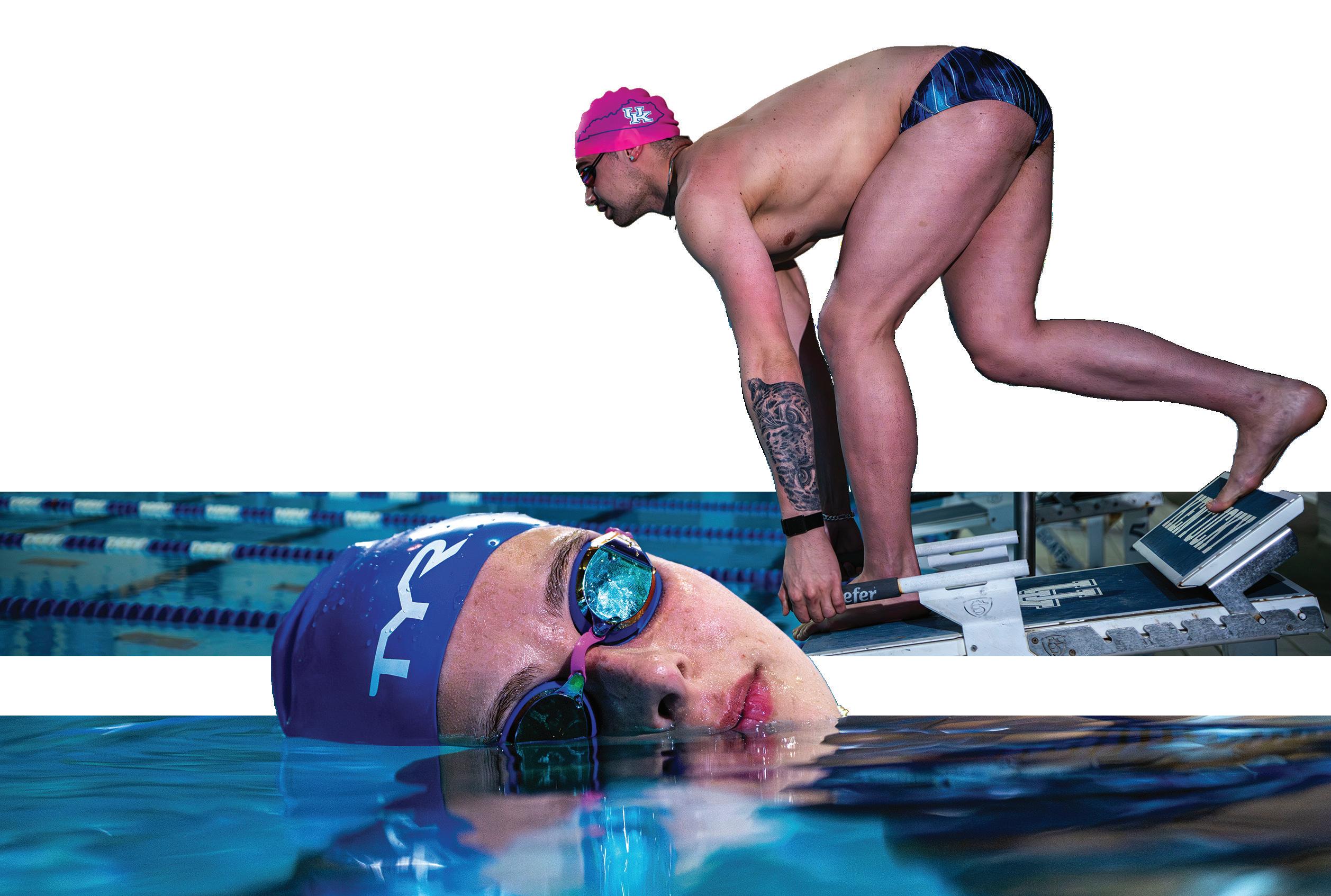
always put in the hands of God and prayed and support(ed) me in anything I decided to do.”
At this point, the only weight she carried was her luggage.
Aiming high, driven by the same old passion
Since he was just a kid receiving his first-ever individual medal, Gluck had always dreamed big.
While the sophomore continues competing amongst some of the best in the country and around the world, Gluck’s long-term goals remain unchanged.
The next being one most competitive swimmers spend their whole lives working toward .
“I have the dream to be an Olympic athlete,” Gluck said.
He said he hopes to achieve it in just two years from now in the 2028 Olympics in Los Angeles, but if not, he will try one final time in 2032.
Gluck’s dreams go outside of the pool as well, as he works toward a degree in civil engineering, following in the footsteps of both his father and grandfather.
“I really like numbers. I really like math. I like physics. It’s a little bit weird, I know, but that’s what I like,” he said.
There’s no question that his passion and strength in numbers have helped him in the pool.
“I am very methodic(al) in the way I swim. I know all my stroke counts by every lap, my underwater kicks … I’m sure that being good with numbers helps me to be a faster swimmer,” he said.
Gluck said sometimes, when he takes a breath and is able to look up at the board during a race, he can tell exactly where he is in the pool just by the time.
Whether it’s in Brazil, Kentucky or somewhere in between, the pool has always been a place Gluck feels the most at home.
The water is the same, the standard is the same and the goals he sets are always ones he is willing to give everything to achieve.
Nearly 4,700 miles from the pool where he swam his final race for Clube Curitibano, Gluck continues to pursue his dreams, both in the pool and outside of it.
It was all sunny.
When she arrived in Lexington, she only had time to grab her lunch and go straight to the meetings on UK’s campus to “be cleared to swim.”
Throughout the day, she met her roommates and felt that “they were happy to see me,” she said
For me, there was no difference ... practicing in Brazil or in the U.S.
It’s more, like, the people around me that I miss (and) being myself.”
- FERNANDA DE GOEJI UK SWIMMER
As someone who had always been the only girl in the group, being part of a women’s team, especially with athletes from different countries, gave her a new perspective.
“The funny thing is all my good friends here are all internationals,” de Goeji said. “I laugh a lot about the other internationals trying to speak English, because I know my English is not good.”
Cultural barriers persisted, but they didn’t prevent her from finding joy even in challenges.
In Portuguese, she can be who she truly is, speaking “bad words” and having a closer connection with her coach and the people around her, she said.
“In Portuguese, I would sing, people would sing with me in the warm-up,” de Goeji said. “I would make jokes, I would not be quiet the entire time.”
Being trained in English forces her to be more formal and limits how far her excitement can go, she said. But over her time at UK, she said she learned to understand “different ways to see the environment around me.”
Even after swimming in pools that surpass physical barriers, in
opposite temperatures, altitudes and hemispheres, what keeps her on or off balance is her mental state.
“For me, there was no difference ... practicing in Brazil or in the U.S.,” de Goeji said. “It’s more, like, the people around me that I miss (and) being myself.”
Now, there’s only one more class left to finish her time at UK as an animal sciences major.
Until recently, her plans involved staying active in swimming to try for the 2028 Olympics, but another direction has taken shape.
Other passions that still accompanied her through her degree made her look at the future from a different viewpoint than expected.
Beyond the sport, she sees herself managing a farm and caring for horses — another element that greatly excited her when she discovered more about Kentucky.
“The plan outside (of) swimming is (to) get an internship, see if I can extend my visa and stay here as long as I can, get as much experience as I can,” de Goeji said. “If I need to start cleaning stalls, I must start it like that.”
Between cold and warmer waters, swimming was the point of equilibrium that kept her close to the inner child, who only needed to be outside.
Far from home, de Goeji learned the need to be away from troubled waters and be close to herself — her true refuge.

Jenna Lifshen Assistant Sports Editor
Three things have always been certain in life: death, taxes and Kentucky men’s basketball as a Blue Blood program.
However, the original saying reminds us of a different life certainty — change.
Kentucky’s Blue Blood status, which it has held for decades without question, has changed more than fans are willing to admit.
Now, it’s not that the Wildcats have lost, or even come close to losing, their reputation as a Blue Blood.
That title is rooted in history, with Kentucky standing as the winningest program of all time and ranking No. 1 in a multitude of categories.
This includes leading the NCAA in all-time NBA draft picks (154), winning percentage (75.7%) and NCAA Tournament appearances (61).
The Cats have also appeared in the AP Top 25 58 times (preseason) and 56 times (final) for a total of 996 weeks, as well as leading the NCAA in final AP Poll No. 1 finishes (8).
However, even with all the accolades, the Blue Blood label has

long been defined by more than history — it requires sustained success.
Kentucky is not only struggling to keep up with its traditional Blue Blood programs of Duke, North Carolina and Kansas, it is also struggling to compete with the new bloods as well.
While the new bloods may not carry decades of history, they carry something just as valuable — recent dominance and adaptation to the modern era of college basketball.
Meanwhile, Kentucky’s results have begun to show its inability to keep up.
The Wildcats finished the 2025-26 regular season 19-12 and 10-9 in the SEC, marking only the fourth time since the 1990-91 season they have ended the regular season with fewer than 20 wins, and the basketball world is starting to question the state of a once dominant program. With that, the Blue Blood status Kentucky once held with authority and control is no longer the standard — and it no longer carries the same weight it once did.
On March 7, 2020, No. 6 Kentucky
What could have been another deep March Madness run instead became a season defined by “what ifs.”
The following season proved to be a turning point for the Wildcats, and not the kind they were hoping for.
Kentucky went on to have one of its worst seasons in recent history.
After starting the year 1-6, marking its worst start since 1911, the Cats finished with a 9-16 record and an 8-9 mark in the SEC, placing eighth in the conference.
It marked their first losing season since 1988-89, their worst winning percentage since 1926-27 (36%), and the Cats did not receive an NCAA Tournament bid for the first time since the 2012-13 season.
It was also the worst season Calipari had coached since his first year as head coach at Massachusetts in 1988-89.
men’s basketball narrowly escaped an upset on the road against Florida, securing a 71-70 victory over the Gators to conclude conference play for the 2019-20 season.
Two days later, the Wildcats dropped to No. 8 in the AP Poll after losing to Tennessee earlier that week.
Either way, the Wildcats remained in the AP Top 10 for the fourth consecutive week and the 12th week of the season.
After finishing the year 25-6 overall and 15-3 in the SEC, Kentucky became the 2020 SEC regular-season champions.
Former head coach John Calipari won SEC Coach of the Year honors, while future first-round draft pick Immanuel Quickley earned SEC Player of the Year honors.
The Wildcats were set to be the No. 1 seed in the SEC tournament, but never made it to Nashville, Tennessee, as the COVID-19 pandemic forced the cancellation of conference tournaments. Kentucky’s regular-season championship granted an automatic bid to the 2020 NCAA Tournament, but the pandemic canceled the tournament for the first time in history.
larger discrepancy between the programs.
While all four teams have suffered just four losses in the NCAA Tournament since the 202021 season, Duke has 12 wins, Kansas has nine and North Carolina has seven.
Kentucky, on the other hand, has just two wins, making it the only Blue Blood with a win percentage below 50% in March Madness.
Kentucky has struggled not only at the national level but also within the conference.
For decades, Kentucky stood at the top of the SEC by a wide margin. Statistically, that still stands.
The Cats have been named SEC regular-season champions 49 times and have won 32 SEC Tournament titles since 1933.
In recent history, Kentucky has struggled to stay on pace with its fellow Blue Bloods.
Since the 2020-21 season, Kentucky is the only Blue Blood program that has not made an Elite Eight, Final Four or National Championship appearance.
Kansas won the 2022 National Championship, defeating North Carolina. Duke made an Elite Eight run in 2024 and reached the Final Four in both 2022 and 2025.
Kentucky’s last Elite Eight appearance came in 2019, while its most recent Final Four run came a year earlier in 2018. The Wildcats have not reached the National Championship game since 2014.
Over the past five seasons, Duke has led the way with a 134-40 record and a 77% win percentage.
Kansas follows at 127-47 (73%), while North Carolina sits third at 119-56 (66%).
Kentucky ranks last among the group at 104-58 with a 64% win percentage.
last SEC Tournament title came in 2018.
The Cats have only made it past the quarterfinal once in the last six seasons.
Since 2021, Alabama, Auburn, Texas A&M, Vanderbilt and South Carolina have all produced an SEC Coach of the Year.
Kentucky has not had an SEC Coach of the Year since Calipari won the award in 2020.
Between 2008 and 2019, Kentucky produced nine SEC Rookie of the Year awards.
Since then, Kentucky has produced just one, Reed Sheppard (2023-24).
In March Madness, Florida, Auburn, Alabama, Tennessee, Arkansas and Texas have all made deeper runs than Kentucky since the 2020-21 season.
LSU and Tennessee are tied for second with 11 SEC regular-season titles apiece, while Alabama sits second behind the Cats with eight SEC Tournament titles.
From 1991 to 2017, the Wildcats won or shared 14 SEC regularseason titles and captured 15 SEC Tournament championships.
Between 1992 and 2004, Kentucky had its most dominant stretch in SEC history, winning 11 SEC
Over the past five seasons, the SEC’s March success has been highlighted by Florida’s National Championship last year, while both Auburn and Alabama have made Final Four runs.
During that span, Kentucky’s conference record was 57-32, for a 64% win percentage.
In the five seasons prior, the Cats went 69-21 with a 76.6% win percentage.
In a conference Kentucky once dominated, the Wildcats now find themselves trying to regain control.
What could have been another deep March Madness run instead became a season defined by “what ifs.”
Tournament titles in just 13 seasons.
However, since 2021, four different programs, Auburn, Alabama, Tennessee and Florida, have claimed SEC regular-season or SEC Tournament titles.
March Madness reveals an even
Kentucky’s last SEC regularseason title came in 2020, while its
The rise of the challengers
In the context of both Blue Bloods and its conference foes, the Cats are falling behind by miles.
Across college basketball, several programs have entered the conversation as potential New Bloods. However, the only true New Blood with a legitimate argument for earning Blue Blood status is UConn. While the Huskies have historically had fewer accomplishments than the four traditional Blue Blood programs, they have built their status over the last quarter-century.
All six of their national championships have come within the past 27 years.
Five have come since 2000, with four since 2020, highlighted by backto-back national championships in 2023 and 2024.
Over the past five seasons, UConn has gone 130-40 with a 76.4% win percentage.
In the last five years, the two programs most often mentioned in the New Blood conversation, aside from the Huskies, are Arizona and Houston.
Both have dominated their conferences, remained consistent contenders for a national championship and backed it up with deep March runs.
Within the SEC, both Florida and Alabama have made deep runs in the NCAA Tournament.
Their turnarounds have earned national recognition, allowing both programs to steadily build their case among college basketball’s rising powers.
Once again, even among the New Bloods, Kentucky is struggling to keep up.
When it comes to the Cats, it feels as though their status is beginning to enter True Blood territory.
For now, Indiana and UCLA are the only two programs placed in this category.

1940 and 1987, most notably capturing three between 1976 and 1987 under coach Bob Knight.
Outside of the Bruins, no program had won more titles than Indiana between 1939 and 1987.
However, similar to UCLA, its dominance is largely rooted in history and tied to one of the greatest coaches the game has ever seen.
Every year, it seems Kentucky is inching closer to that reality.
While the Wildcats are still far from the kind of drop-off both the Hoosiers and Bruins experienced, the pattern is beginning to look familiar.
Mark Pope recently addressed the idea on Tom Leach’s radio show.
“That’s been an ongoing conversation for us,” Pope told Leach. “We’ve had a lot of conversations trying to find exactly the space that will work best for us. As everybody figures this out, that is certainly a direction some teams have gone with, with really incredibly varied levels of success. We’re probably having conversations about it on a weekly basis.”
That uncertainty is yet another factor behind Kentucky’s inconsistent performance in recent years and another example of the Cats struggling to keep up with the times.
But the conversation might shift toward what they once were, rather than what they are and what the future is looking like for the Wildcats.
The label refers to programs with enough history and dominance to still be respected as Blue Bloods, but not consistent enough to be considered among the elite programs as of late.
UCLA, of course, still holds the most national championships all time with 11 and has reached 19 Final Fours overall.
Under coach John Wooden, the Bruins won seven consecutive titles between 1967 and 1973.
That stretch remains one of the most dominant dynasties in the history of American sports.
However, despite its historic dominance, UCLA’s place among college basketball’s elite now relies more on history than sustained modern success.
The Indiana Hoosiers won five national championships between
In today’s game, falling behind isn’t just about results.
It’s about failing to keep pace with the sport’s rapidly changing landscape.
A number of programs have adopted the general manager model, most notably the Duke Blue Devils men’s basketball team, which became one of the first major programs to create a full-time men’s basketball GM role in 2022 with Rachel Baker.
In the modern college basketball landscape, teams increasingly rely on leadership to manage NIL deals, roster construction and the transfer portal.
Kentucky, however, remains one of the programs that has yet to adopt the model.
Recruiting has also been a clear challenge for Mark Pope since joining Kentucky.
While the Cats have found success in the transfer portal and will most likely do so again next year, they have not secured a single commitment from the 2026 recruiting class as of March.
Duke, North Carolina, Kansas and even UConn each have at least two commits ranked within the top 100, with Duke leading the way with three ranked inside the top 15.
In the SEC, 13 teams have a top-100 recruit, and every team has at least one signee — except the Cats.
Among the New Bloods, both Houston and Arizona have at least one top-100 commit.
Among the True Bloods, Indiana has three top-100 signees while UCLA has one.
When placed alongside college basketball’s traditional powers, rising programs and even those living off history, Kentucky’s current situation becomes increasingly difficult to ignore.
The standard the Wildcats spent decades upholding is slowly becoming a distant memory, drifting further out of reach.
All in all, there’s no doubt history will forever keep Kentucky as a Blue Blood.
But the conversation has already begun to shift to what Kentucky once was, not what it currently is.
To read more about Kentucky men’s basketball, visit our Instagram.

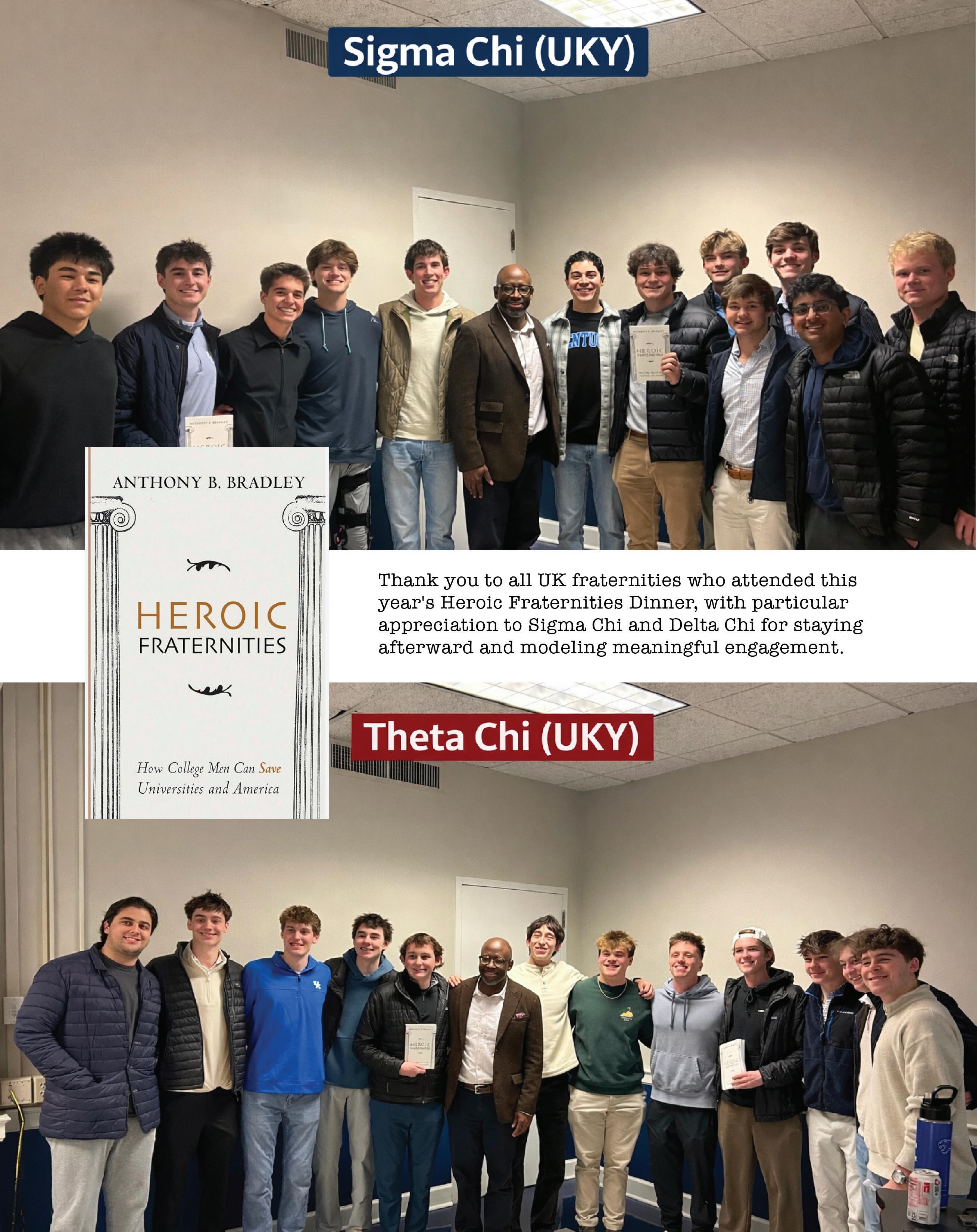
Thank you to all UK fraternities who attended this year’s Heroic Fraternities Dinner, with particular appreciation to Sigma Chi and Theta Chi for staying afterward and modeling meaningful engagement.