未點亮的水晶燈
The Unlit Chandelier
停電的晚餐 Dinner During The Blackout
回憶童年在黑暗中吃晚餐的經驗,偶然的事件改變了日常用餐的狀態,幽暗的環境使熟悉的工作變得異常, 事與物開始分離,視線的缺乏卻讓食物與用具的質感被凸顯。
The memory of having dinner in the dark during childhood—an accidental event that changed the usual dining experience. The dim environment made familiar tasks feel unusual, causing a separation between things and actions. The lack of sight, however, emphasized the texture of the and food and the tools.
食物的準備,農業的週期到城市的更新,皆是被一種相對異常的儀式定義出週期性
The preparation of food, the cycles of agriculture, and urban renewal are all defined by a kind of irregular ritual that creates their own sense of periodicity.
日本懷石料理美學與《陰翳禮讚》的啟發,強調光 影、留白、季節感、樸實器皿與幽微燈光下食物的 靜謐美。這提示了非視覺感官的重要性以及環境氛 圍對體驗的深刻影響。
Influences from Japanese Kaiseki Aesthetics and In Praise of Shadows: These sources emphasize the quiet beauty of light and shadow, negative space, seasonality, humble tableware, and the subtle presentation of food under dim lighting. They highlight the importance of non-visual senses and suggest how atmosphere can deeply influence experience.
探討「陰」作為一種流動且隱性的力量,不僅是二元對 立,也演變成情感與社會身份的流動性。藝術品「my bed」將床作為個人情感的隱藏場所,強調空間中的隱 匿性與痕跡。這引入了對空間中不易見、動態或隱藏元 素的思考。
Beyond binary oppositions, “yin” is understood here as a shifting, emotional, and social dynamic. The artwork My Bed by Tracey Emin treats the bed as a space of hidden emotional residue, drawing attention to the unseen and ephemeral aspects of space. This introduces a broader inquiry into invisible, dynamic, or concealed spatial elements.
“The Unlit Chandelier”model film making
The RiverBED
裝置「河床」的嘗試,探索身體與環境的互動,以及如何透過 儀式性行為(如進食)被動地介入環境,也同時作為一個閱讀 周邊環境的介質,特別是河面與河岸介面,揭示了城市的水作 為一種訊息載體。這將個人經驗與更廣闊的環境感知連結起來 ,並開始關注水作為載體的潛力。
To linking to the environment The contraption RiverBED explored how the body interacts with its surroundings and how ritualistic actions like eating can subtly engage the environment.It serves as a medium for reading the interface between river surface and riverbank, uncovering how urban groundwater can act as a carrier of environmental messages. This bridged personal sensory awareness with broader environmental perception and introduced the idea of water as a information carrier.
Riverside of Agondian River
《阿公店溪治理計畫》作為典型的現代水利工程範例。該計 畫基於百年與五十年重現期洪峰流量等工程標準,主要目標 是透過築堤、護岸、河道截彎取直等工程手段來控制洪水, 保護沿岸居民生命財產安全及提高土地利用價值。它將洪水 視為需要「防範」、「消減」的「災害」或「水患」,城市 被視為需要「排水的容器」。
The Agongdian River Governance Plan exemplifies conventional hydraulic engineering, focusing on flood prevention through levees, river straightening, and embankment fortification based on 50- or 100-year flood projections. Floods are treated as "disasters" to be "prevented" or "eliminated," and the city becomes a vessel for drainage.
民國110年~(2021) Existing rainwater sewer The old Agondian river Flood area
《Mythologies》 Roland Barthes
巴黎沒淹水:「洪水使某些東西變得不尋常,清新了 世界的觀感.....我們看到汽車只剩車頂、路燈被截斷 ,只見頭部如睡蓮般浮游、房屋被切割成像小孩玩的 積木、一隻貓被困在樹上多日,所有這些日常生活事 物好像忽然脫離了它們原來的根,除去了它們最適合 的滋養實體-大地」。
The Mythology of the Flood: ”The flood made certain things unusual, refreshing the perception of the world... We saw cars with only their roofs visible, streetlights severed with their heads floating like water lilies, houses cut into pieces like children's building blocks, a cat trapped in a tree for days. All these everyday objects seemed to have suddenly been uprooted from their origins, stripped of their most fitting nourishing entity—the earth.”
對比停電時不點蠟燭而產生感官深度,以及河邊氾濫時不蓋堤防而產生新的生活形態,都是 源於接受不便利卻不採取防範措施,進而創造出一種新的狀態。這與現代工程「去反抗」不 便利的邏輯截然不同。
not lighting candles during a blackout can enhance sensory depth, just as not building levees during a flood can create new lifestyles. In both cases, accepting inconvenience rather than resisting it leads to a transformative experience—a logic fundamentally at odds with modern infrastructure.
Association of GangShan Vein & The Festival of Exiting
理 事 會 策 劃 部
身為岡山的導覽員志工我加入一個相對於水利署的 河川自治機關:岡山水徑會所,其目標並非河川治 理,而是成為組織都市水體的節點,進一步創造新 的空間模式。
As a volunteer guide in Gangshan, I joined the AGSV, a river-based self-governance association in contrast to the Water Resources Agency. Its aim is not river control, but to serve as a node for organizing urban water flow and to explore new spatial pattern.
阿公店溪舊河道
淹水深0.3m-0.5m, 500mm/24hr
淹水深0.5m-1.0m, 500mm/24hr
阿公店溪8k+376-9k+453流域
淹水範圍 S:1/1500
New enclosure in flooding city
Flooding area
The old River and Lifestyle
每十五年,舊河道在地表顯影。大雨像是一場關於記憶的地景事件,提醒我們這塊土地原本的輪廓與節奏。淹水或許不是 基礎設施的失效,而是某種土地的個性與在其之下的痕跡。
Every fifteen years, the old river reveals itself on the surface. Heavy rain becomes a landscape event of memory, reminding us of the land’s original rhythm and contours. Flooding may not be a failure of infrastructure, but rather an expression of the land’s character and the traces beneath it.
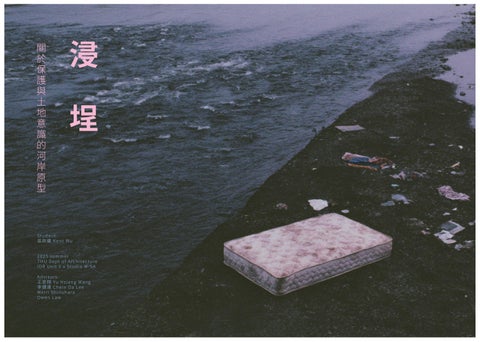
「浸埕」提出一種相較於快速排洪的「漫水體系」新分類也是對現代城市基 礎設施邏輯的溫柔解構,城市不再以結構抵抗不確定,而是以形式邀請不確 定。都市不再是排水的容器,而是讓水可以停留與被參與的場域。此計畫同 時也是一個領域性的策略,可以成為一種河岸原型,並將水的來去,轉化為 對保護、土地與公共性的重新提問:我們是否能接受,最終塑造城市的不是 固定的線條而是不確定的型態,例如:洪氾區的地形推測、土壤組成在時間 跨度上的變化,以及人們如何透過儀式佔據與適應這片空間
“Jincheng” proposes a slow-water system, a deconstruction of modern urban infrastructure logic.
The city no longer resists uncertainty through structure, but nvites it through form. It becomes not a vessel for drainage, but a space where water can stay, be felt, and be part of. This is also a territorial strategy, a riverside prototype that reimagines water’s presence as a question of protection, land, and public life:
Can we accept that cities are shaped not by fixed lines, but by uncertain forms like floodplains, shifting soil, and the ways people adapt through ritual?
除了河邊的堤防作為一種基礎設施,城市裡的牆,如住家的外牆,學校與廟的圍牆 ,也象徵著邊界與保護,從堤防的破口來解構並從新串連這些牆體,使牆不是為了 抵擋,而是為了停留。作為組織都市水體的策略節點。國立岡山高中是岡山水徑會 所的一部分,而水徑會所從學校的圍牆與堤防開始,以水從新定義學校與鄰裡的邊 界,甚至開始建立一種新的生活方式的文明。
Beyond the river’s embankment as infrastructure, walls within the city—such as house facades, enclosures of school and temple also symbolize boundaries and protection. By reinterpreting and reconnecting these walls through intentional opening in the embankment, walls shift from being barriers to new zone.
The intervention become strategic nodes for organizing urban water flows. Gangshan High School is part of the AGSV, which begins with the school’s wall and the embankment, using water to redefine the boundary between school and neighborhood. In doing so, it begins to cultivate a new, water-centered way of life,a new culture.
十五年一次的出城祭,作為歌頌洪 水的祭典,將水的來去(例如每隔 一段時間的氾濫)轉化為一種新的 公共節奏,並透過儀式性、週期性 的方式重新進入都市系統。
The Festival of Existing held by the association during the big rain, people celebrate and appreciate the land and the Flooding is reimagined as a public event, reintroduced into the urban system through ritual and cyclical interaction.